Acta Aeronautica et Astronautica Sinica ›› 2025, Vol. 46 ›› Issue (11): 531282.doi: 10.7527/S1000-6893.2024.31282
• Articles • Previous Articles
Menglong DING1, Daochun LI1,2( ), Yaoming ZHOU1,2, Chuanyan FENG1, Haoyuan SHAO2, Jinwu XIANG1,2
Received:2024-09-30
Revised:2024-10-29
Accepted:2024-11-18
Online:2024-11-26
Published:2024-11-25
Contact:
Daochun LI
E-mail:lidc@buaa.edu.cn
Supported by:CLC Number:
Menglong DING, Daochun LI, Yaoming ZHOU, Chuanyan FENG, Haoyuan SHAO, Jinwu XIANG. Crashworthiness analysis and optimization for eVTOL vehicles[J]. Acta Aeronautica et Astronautica Sinica, 2025, 46(11): 531282.
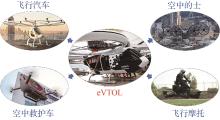
Fig.1
Applications of eVTOLs
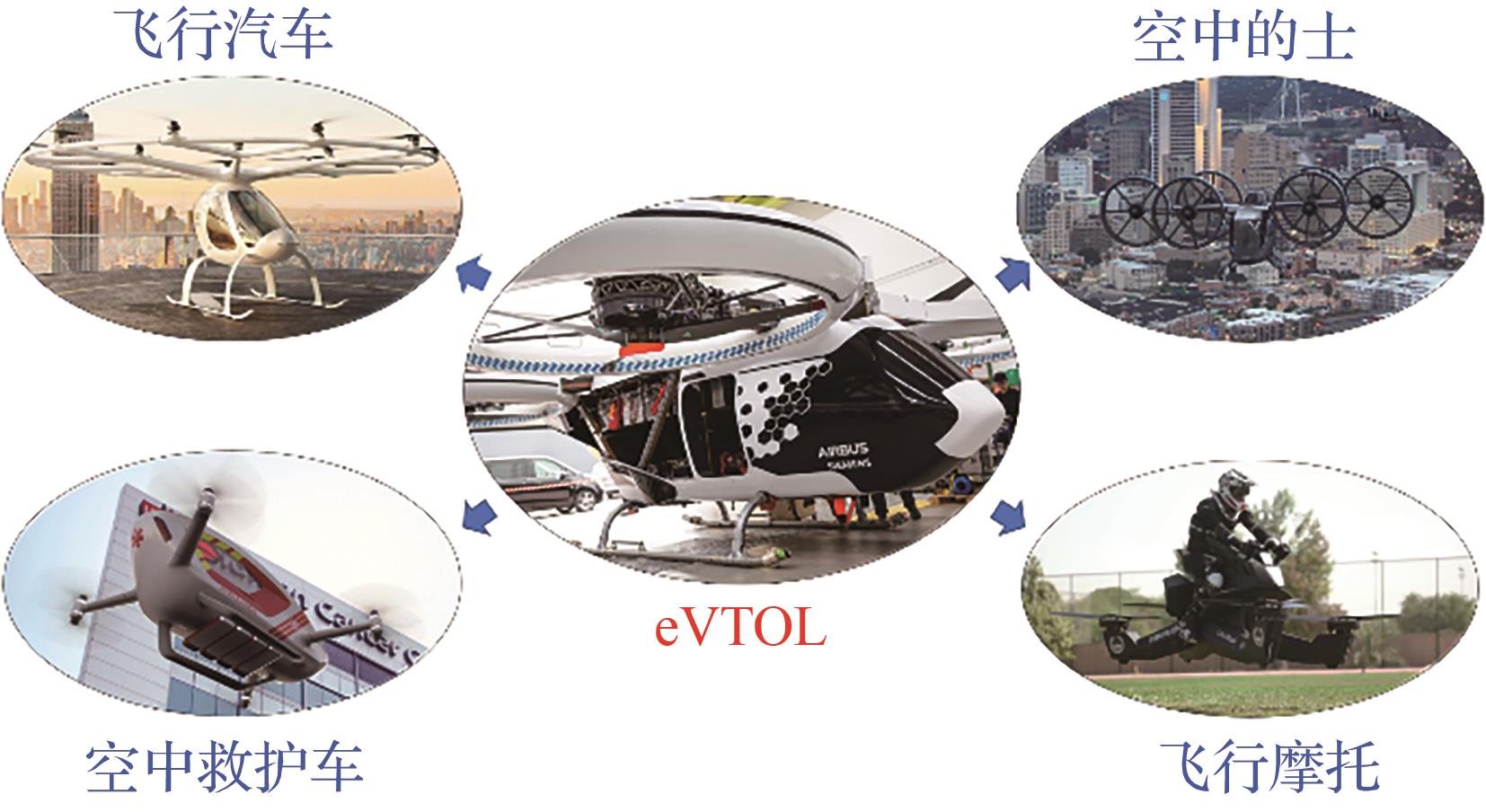
Table 1
Comparison of crashworthiness requirements among planes, helicopters, and eVTOLs
| 适航要求 | 固定翼飞机 | 直升机 | eVTOL |
|---|---|---|---|
| 无动力着陆能力 | 强 | 中 | 弱 |
| 结构轻量化要求 | 低 | 中 | 高 |
| 座舱底部空间 | 大 | 中 | 小 |
| 复合材料使用率 | 中 | 中 | 高 |
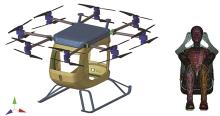
Fig.2
Finite element model of eVTOL and dummy model
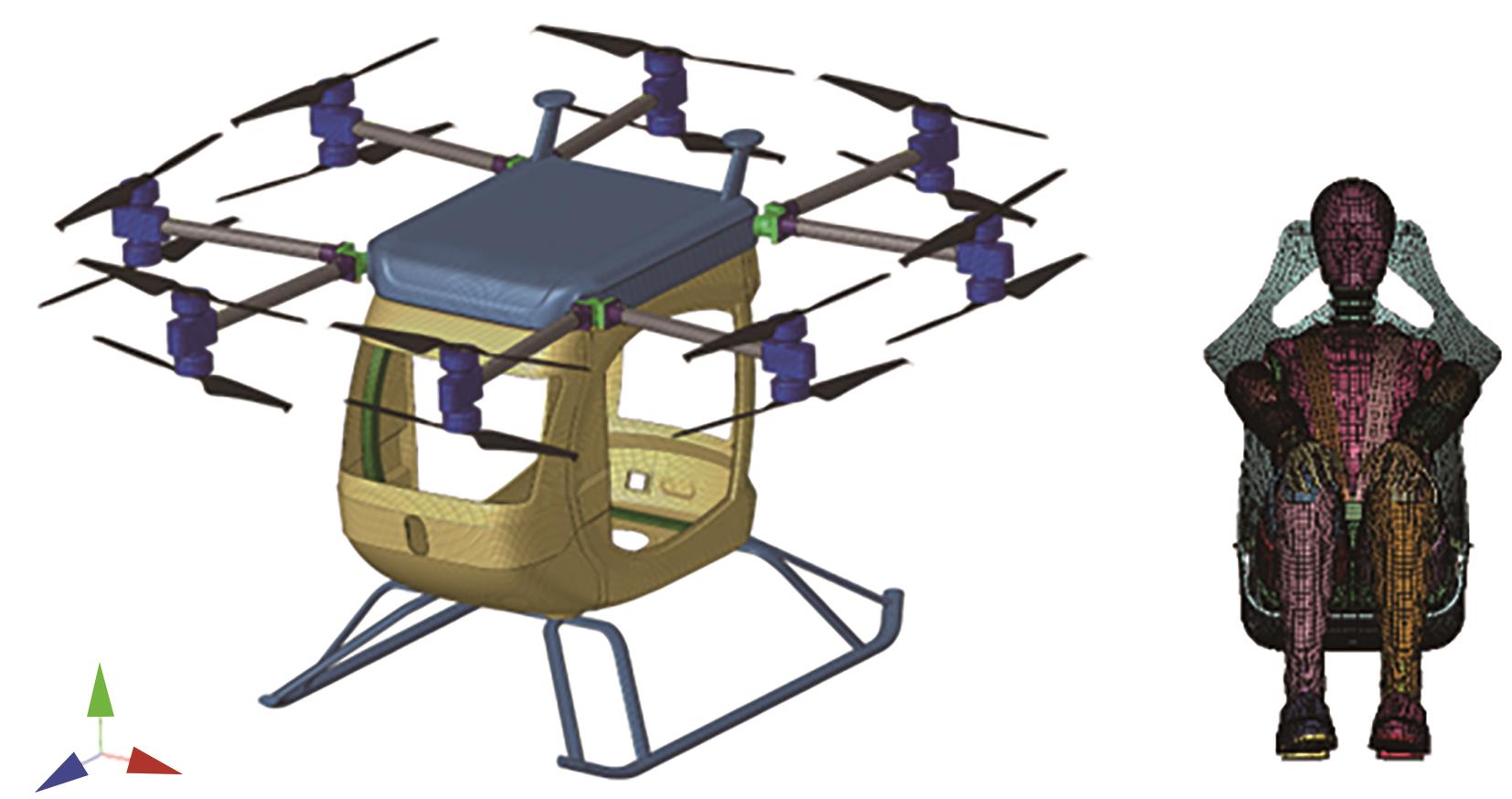
Table 2
Mechanical parameters of composite material
| 参数 | 编织布 | 单向带 |
|---|---|---|
| ρ/(kg·m-3) | 1 500 | 1 500 |
| E1/GPa | 70 | 135 |
| E2/GPa | 70 | 10 |
| E3/GPa | 10 | 10 |
| v12 | 0.1 | 0.3 |
| G12/GPa | 5 | 5 |
| G13/GPa | 3.8 | 5 |
| G23/GPa | 3.8 | 3.8 |
| XT/MPa | 600 | 1 500 |
| XC/MPa | 570 | 1 200 |
| YT/MPa | 600 | 50 |
| YC/MPa | 570 | 250 |
| S/MPa | 90 | 70 |
Fig.3
Illustration of segments of landing skid
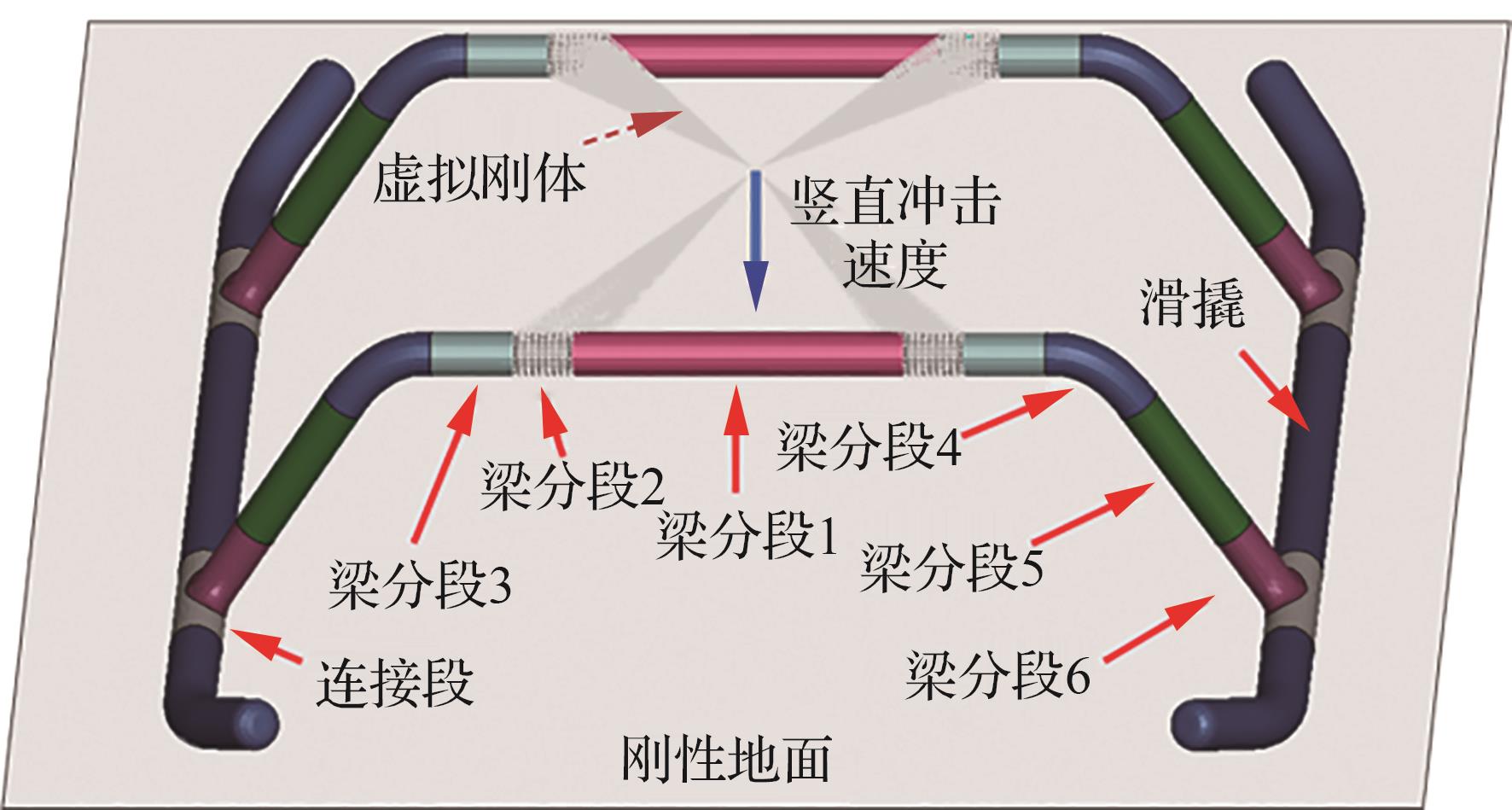
Table 3
Iterative optimization of landing skid design
| 方案 | 厚度/mm | 破坏模式 | 吸能率/% | 加速度/g | |||||||
|---|---|---|---|---|---|---|---|---|---|---|---|
| 梁分段1 | 梁分段2 | 梁分段3 | 梁分段4 | 梁分段5 | 梁分段6 | 连接段 | 撬 | ||||
| 1 | 3 | 3 | 3 | 2 | 1.5 | 1.5 | 1.5 | 1 | 弯管处折断 | 33.9 | 3 286 |
| 2 | 3 | 3 | 3 | 2.5 | 1.5 | 1 | 1.5 | 1 | 渐进破坏 | 89.3 | 541 |
| 3 | 3 | 3 | 3 | 3 | 1.5 | 1.5 | 2 | 1.5 | 中段两侧折断 | 33.9 | 3 031 |
| 4 | 5 | 5 | 5 | 3 | 2 | 2 | 2.5 | 1 | 中段两侧折断 | 37.2 | 3 082 |
| 5 | 5 | 5 | 5 | 3 | 2 | 1 | 2 | 1 | 渐进破坏 | 95.4 | 24 |
| 6 | 5 | 5 | 5 | 3 | 2 | 1.5 | 1.5 | 1 | 弯管处折断 | 44.7 | 1 194 |
| 7 | 5 | 5 | 5 | 4 | 2 | 2 | 2.5 | 1 | 斜管处折断 | 76.9 | 2 684 |
| 8 | 5 | 5 | 5 | 4 | 3 | 2 | 2.5 | 1 | 中段两侧折断 | 67.2 | 495 |
| 9 | 7 | 7 | 7 | 5 | 3 | 2 | 2 | 1.5 | 渐进破坏 | 93.8 | 34 |
| 10 | 7 | 7 | 7 | 5 | 3 | 2 | 2.5 | 1.5 | 渐进破坏 | 94.9 | 41 |
| 11 | 5 | 7 | 7 | 7 | 3 | 2 | 2.5 | 1.5 | 渐进破坏 | 98.9 | 29 |
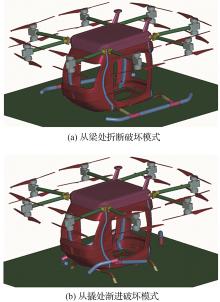
Fig.4
Damage patterns before and after optimization
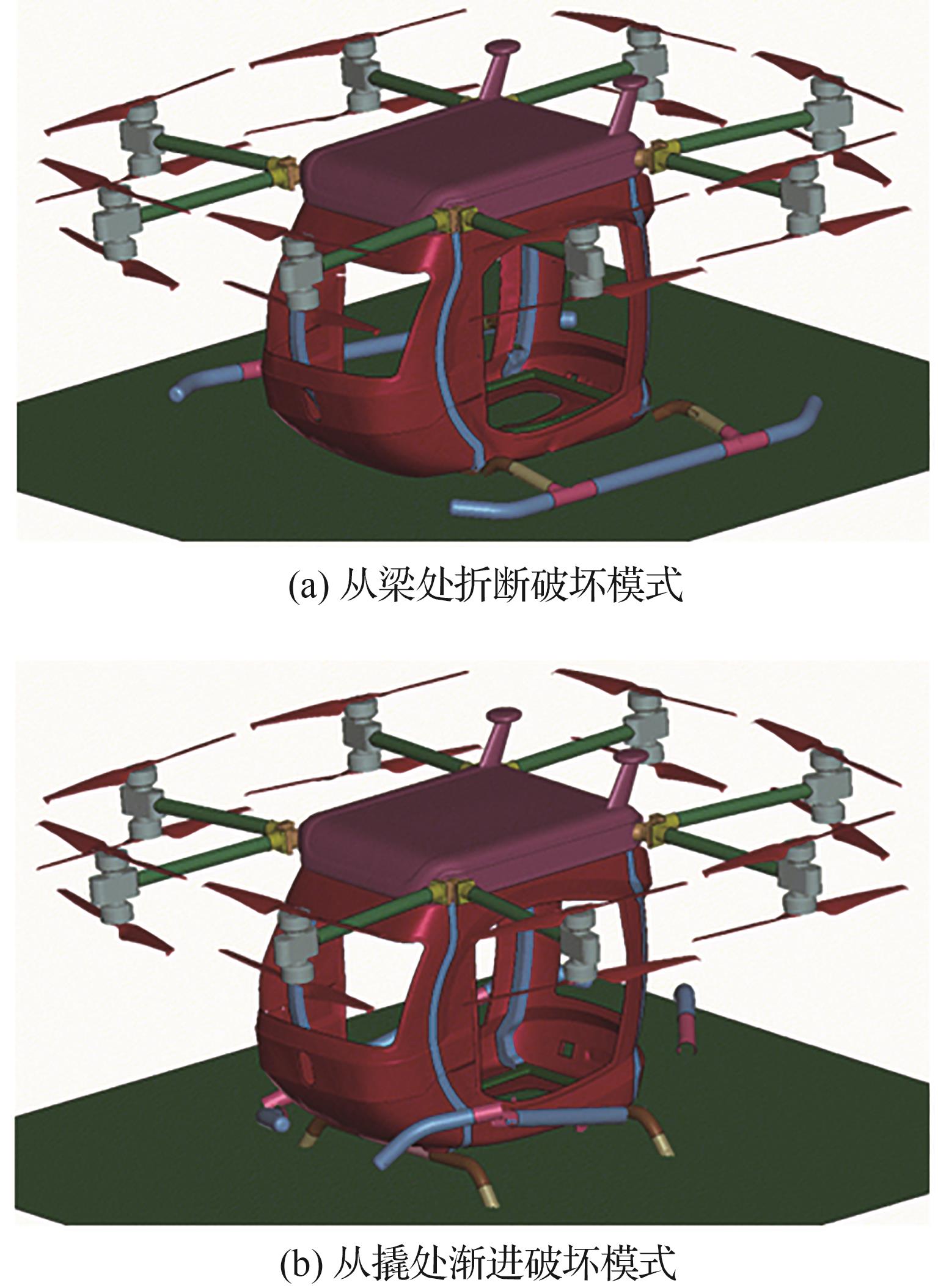
Table 4
Crashworthiness of landing skid before and after optimization
| 性能 | 原起落架 | 新起落架 | 优化/% |
|---|---|---|---|
| 质量/kg | 8.5 | 9.3 | -9.4 |
| 峰值接触力/kN | 7 200 | 109.3 | 98.5 |
| 残余速度/(m·s-1) | 8.26 | 0.96 | 88.4 |
| 吸能量/kJ | 0.1 | 17.8 | 17 700.0 |
| 能量吸收率/% | 0.6 | 98.9 | 17 700.2 |
| 加速度/(m·s-2) | 19 000 | 288.0 | 98.5 |
| 过载/g | 1 937 | 29 | 98.5 |
Table 5
Stack of plies of composite landing skid after crashworthiness optimization
| 区域 | 厚度/mm | 铺层方案 |
|---|---|---|
| 梁分段1 | 5 | [0/45/(0)12]s |
| 梁分段2 | 7 | [0/45/(0)20]s |
| 梁分段3 | 7 | [0/45/(0)20]s |
| 梁分段4 | 7 | [0/45/(0)20]s |
| 梁分段5 | 3 | [0/45/(0)4]s |
| 梁分段6 | 2.5 | [0/45/0/45/0] |
| 连接段 | 2.5 | [0/45/0/45/0] |
| 撬 | 1.5 | [0/45/0] |
Fig.5
Composite landing skid after design optimization, and the mold and curing equipment
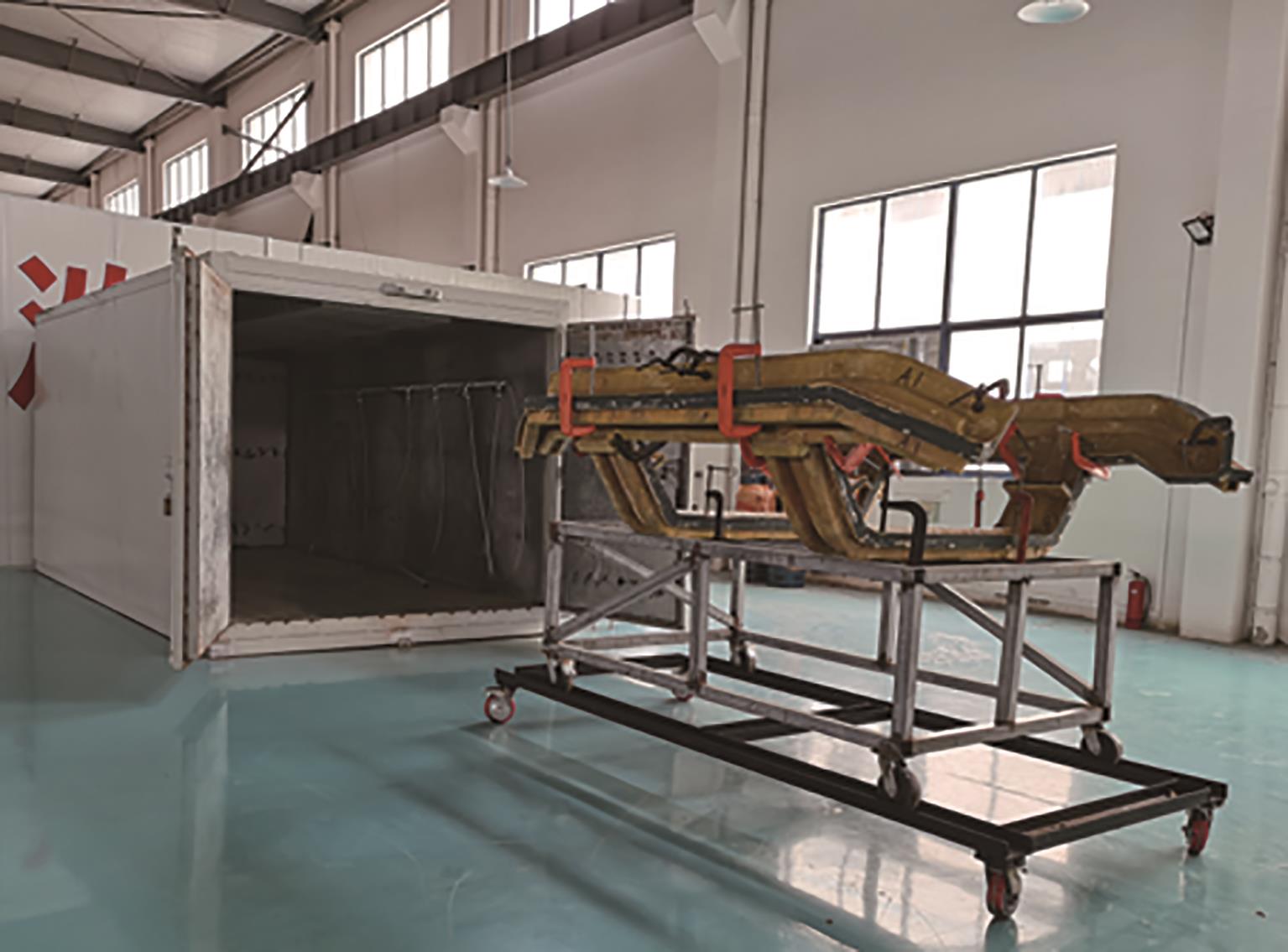
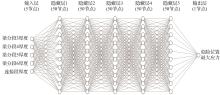
Fig.6
Neural network for stress prediction of landing skid
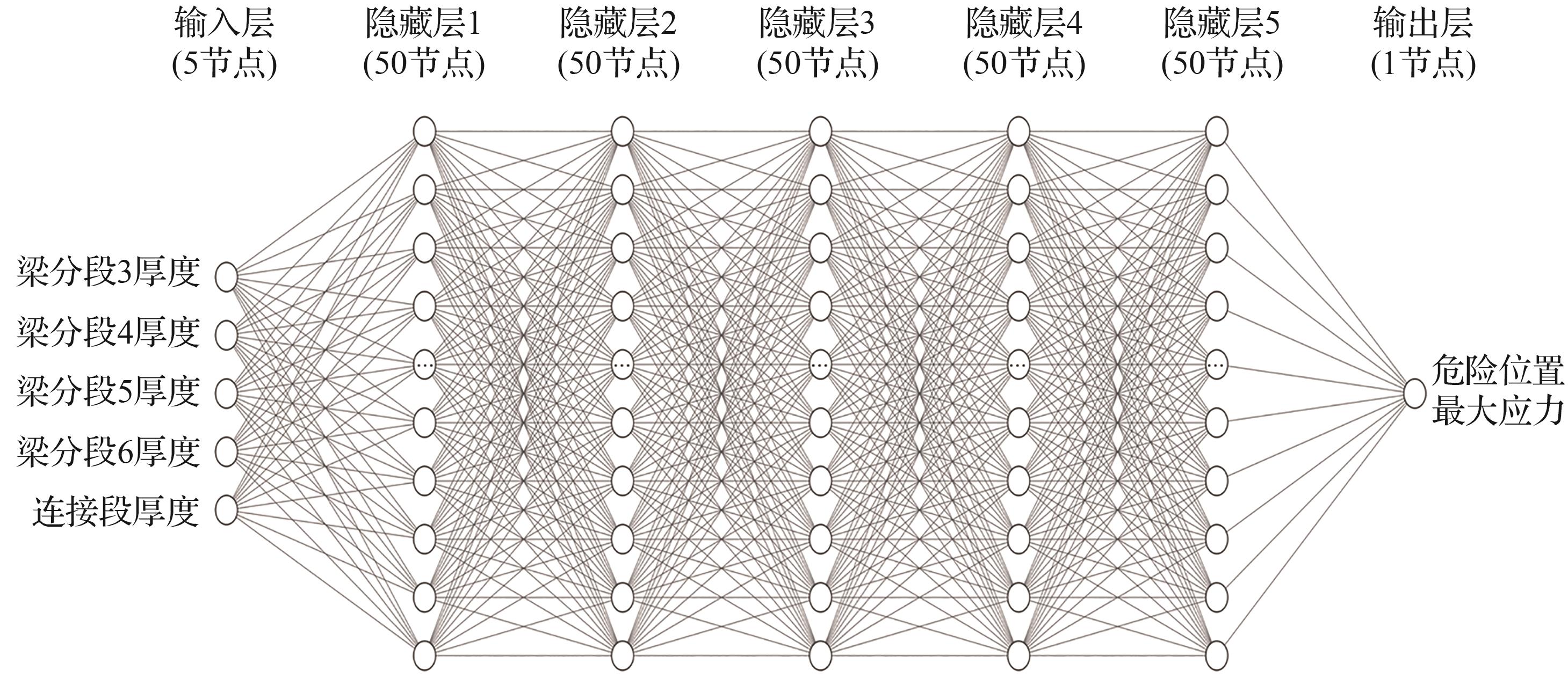
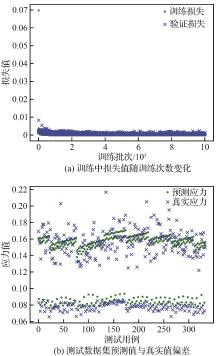
Fig.7
Training curve and test results of surrogate model for predicting stress of landing skid
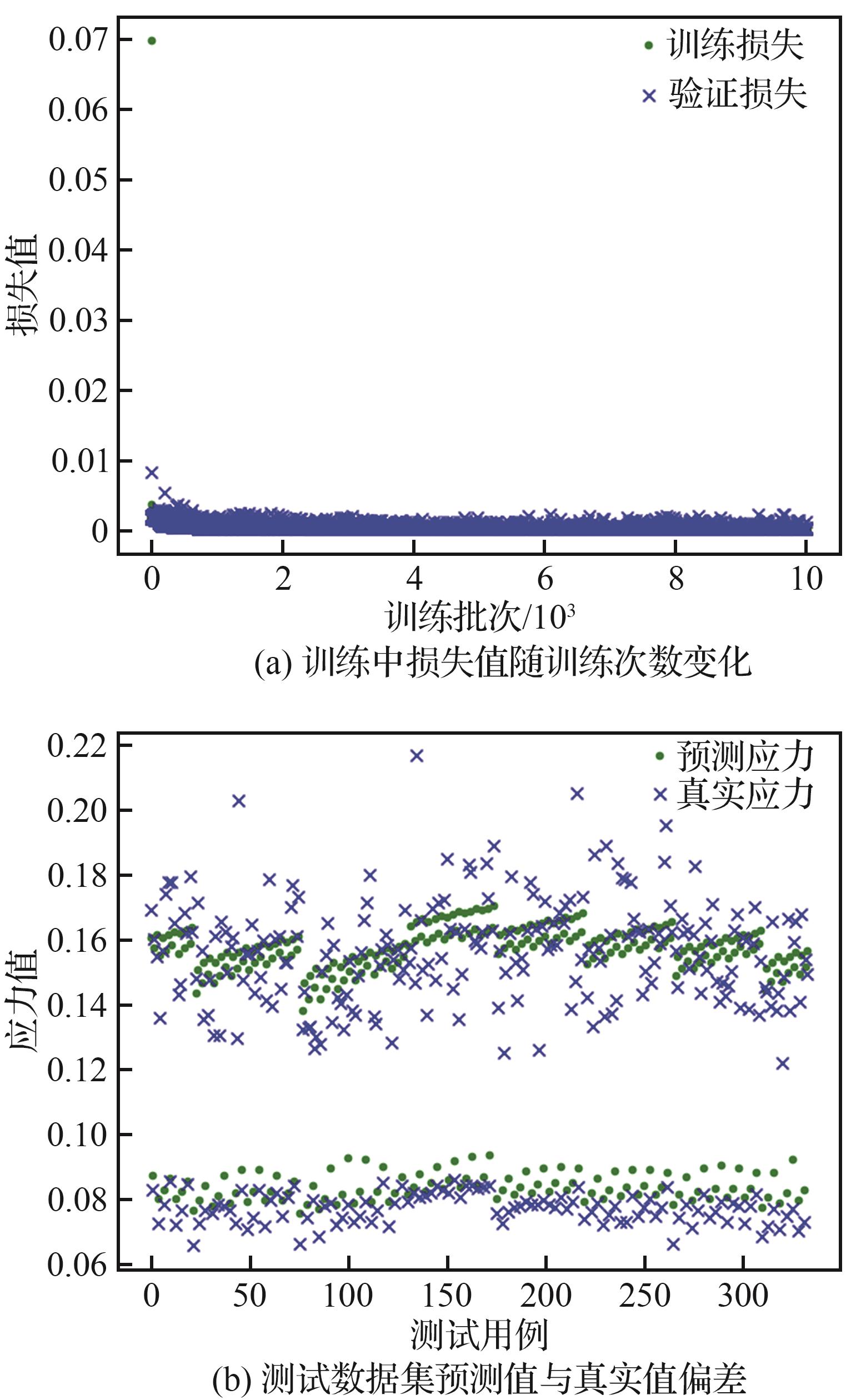
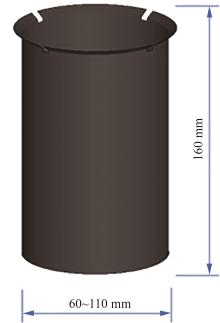
Fig.8
Model and size of energy absorber
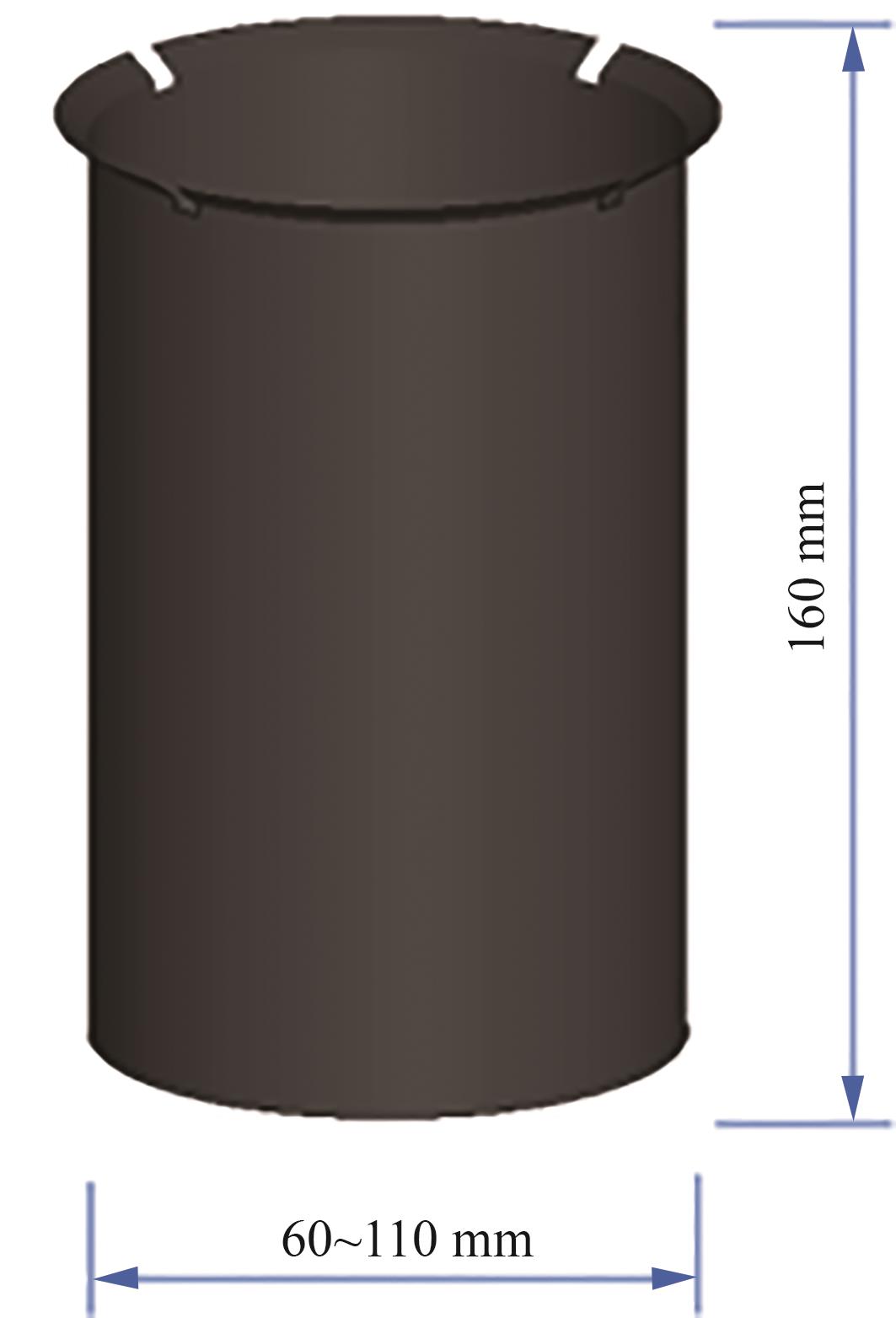
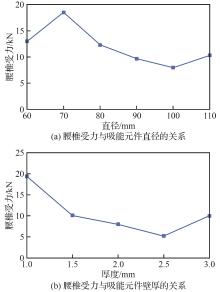
Fig.9
Lumber force vs. diameter/thickness
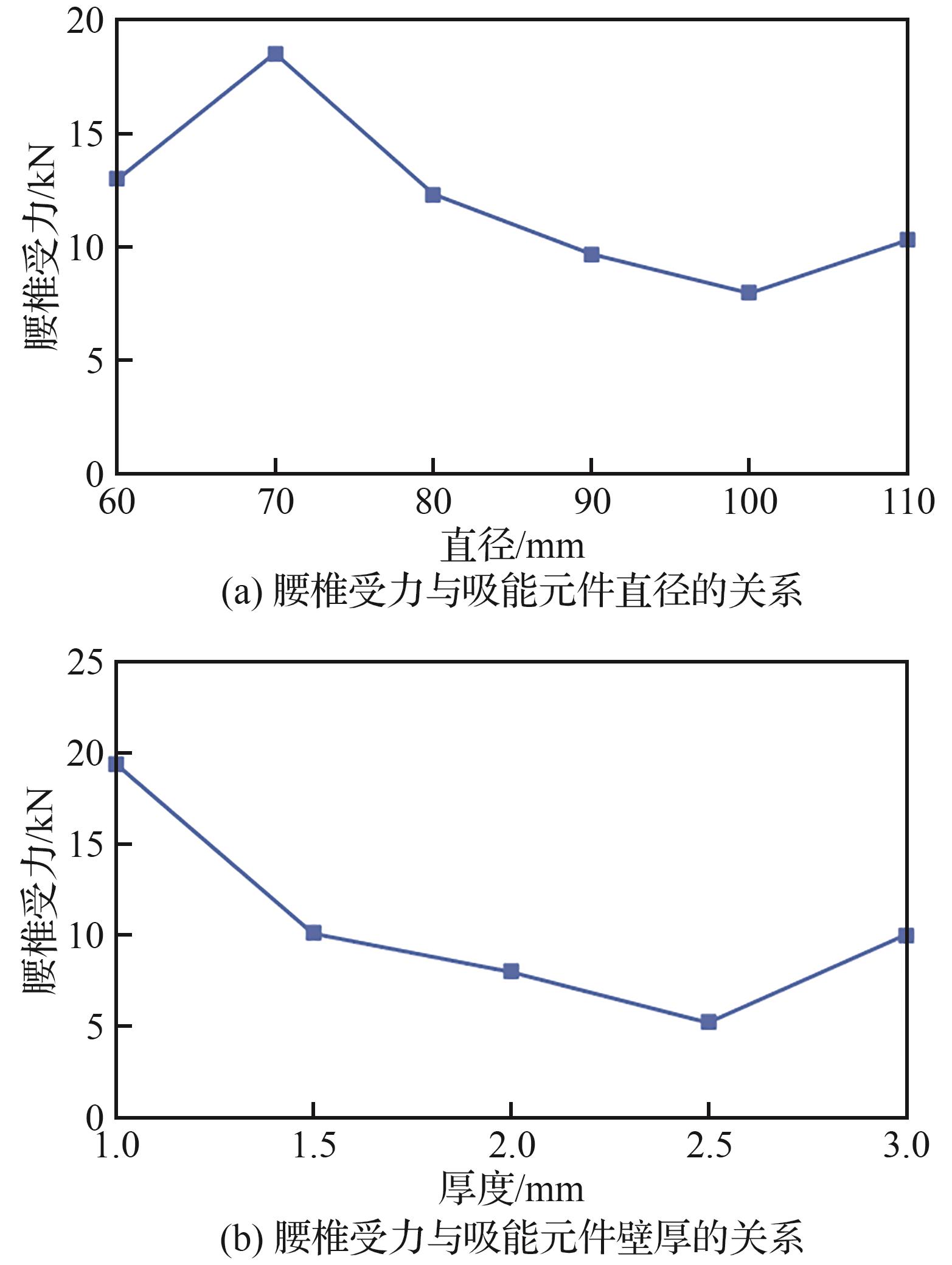
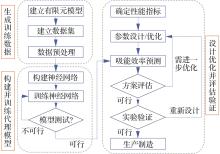
Fig.10
Optimizing workflow of energy absorber
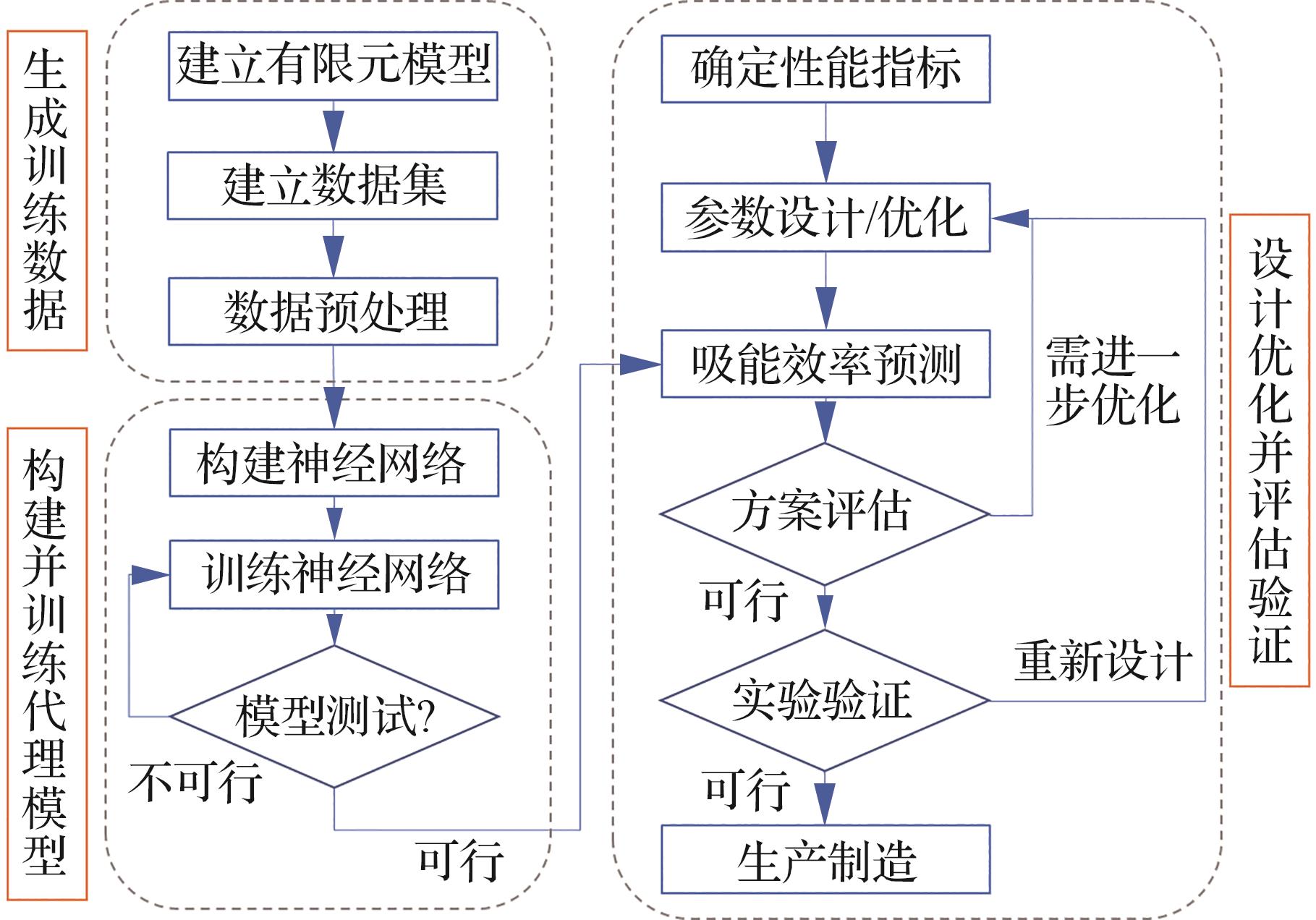
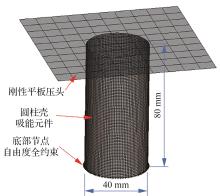
Fig.11
Finite element model of energy absorber
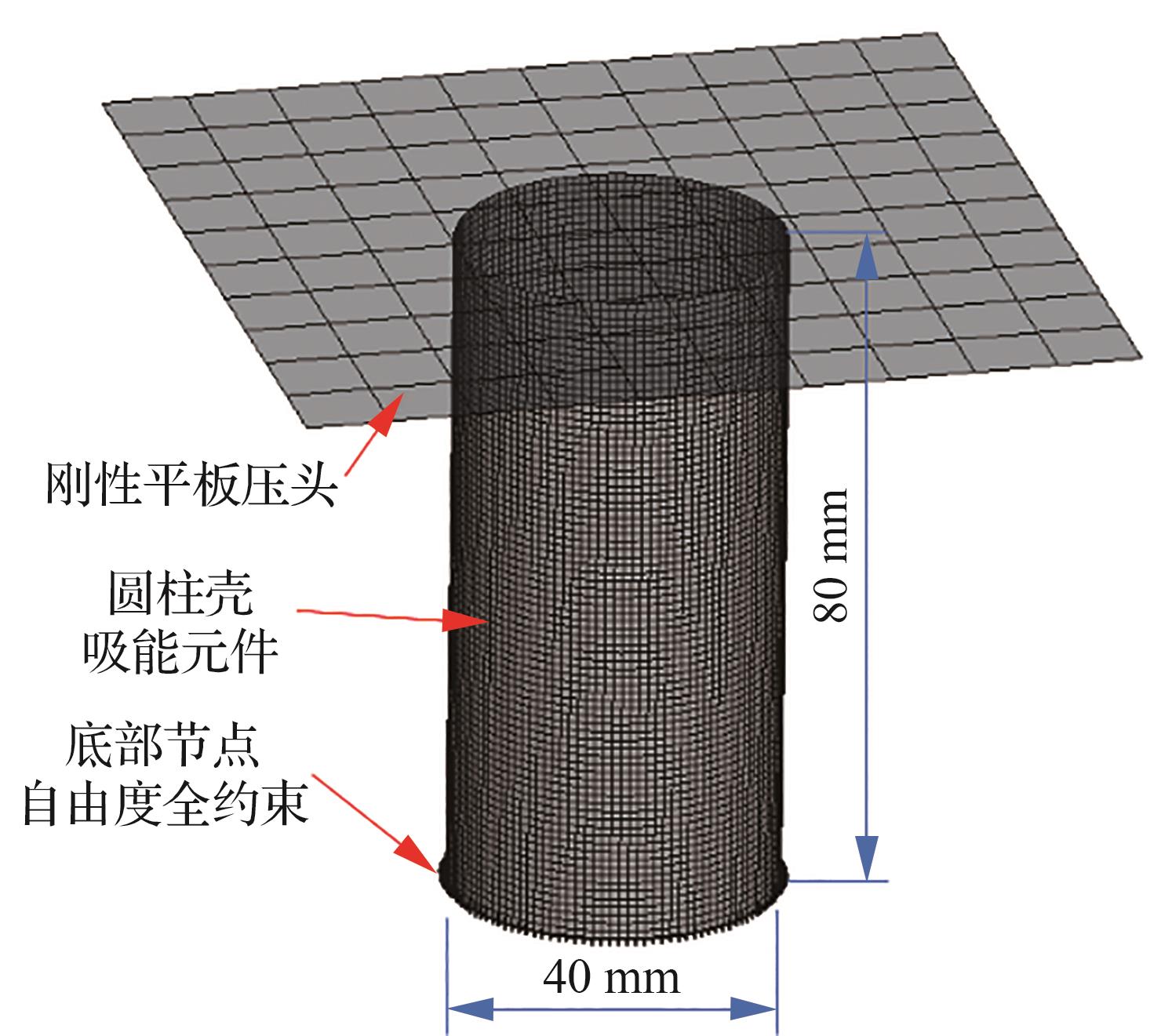
Table 6
Values of primary parameters of material used in energy absorber
| 参数 | |||||
|---|---|---|---|---|---|
| 范围 | 2 680~2 840 | 50~80 | 180~380 | 42~62 | 6~15 |
| 步长 | 160 | 10 | 50 | 5 | 3 |
| 个数 | 2 | 4 | 5 | 5 | 4 |
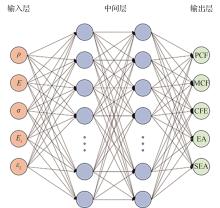
Fig.12
Structure of neural network for predicting energy absorbing efficiency of energy absorber
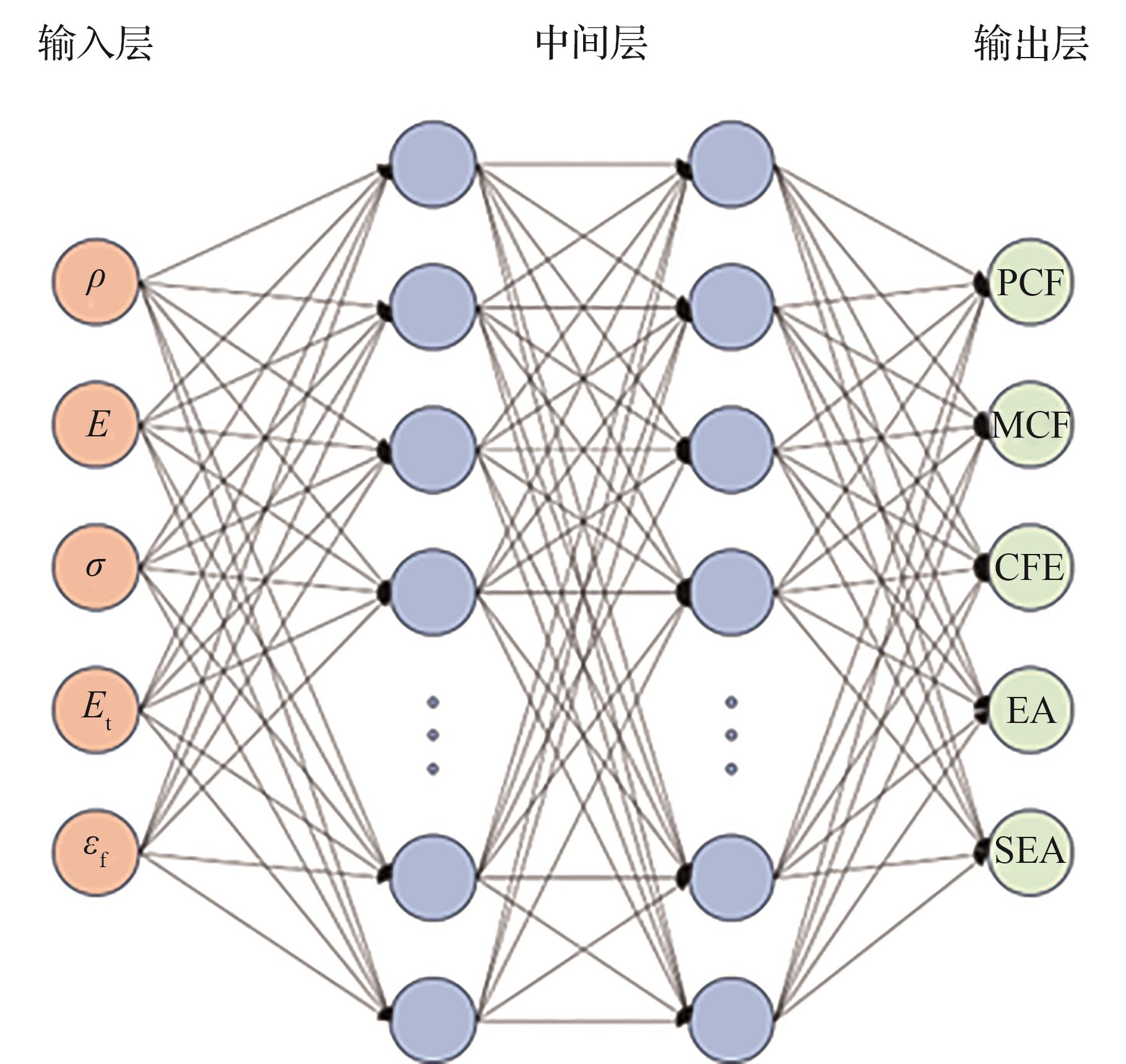
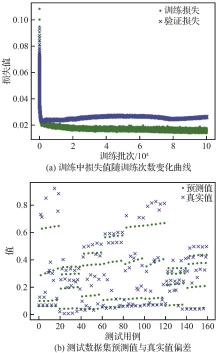
Fig.13
Training curves and test results of surrogate model for energy-absorbing efficiency prediction
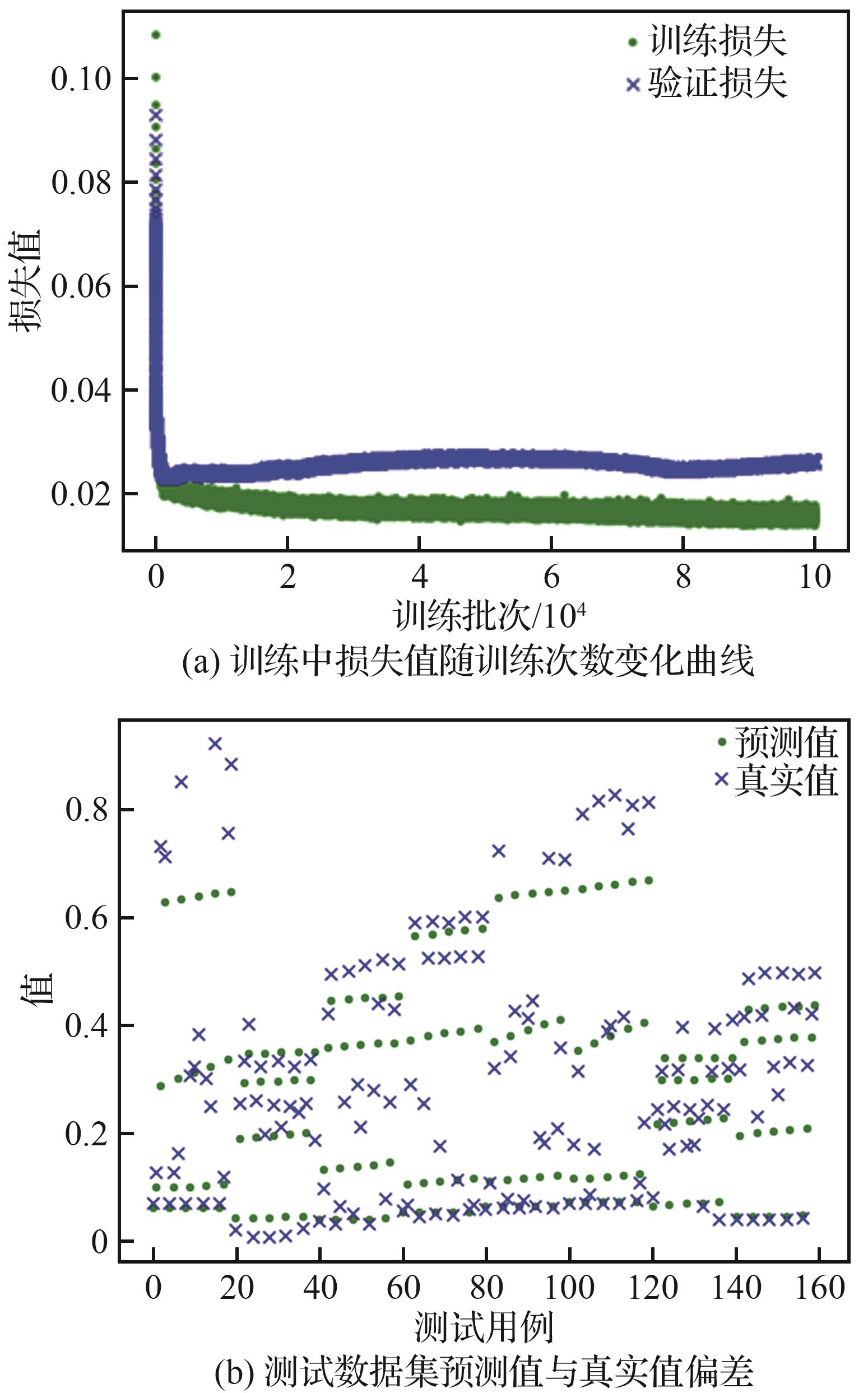
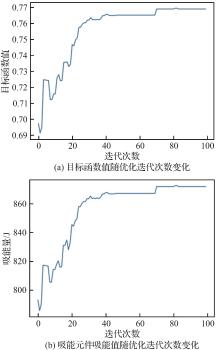
Fig.14
Optimizing process using genetic algorithm
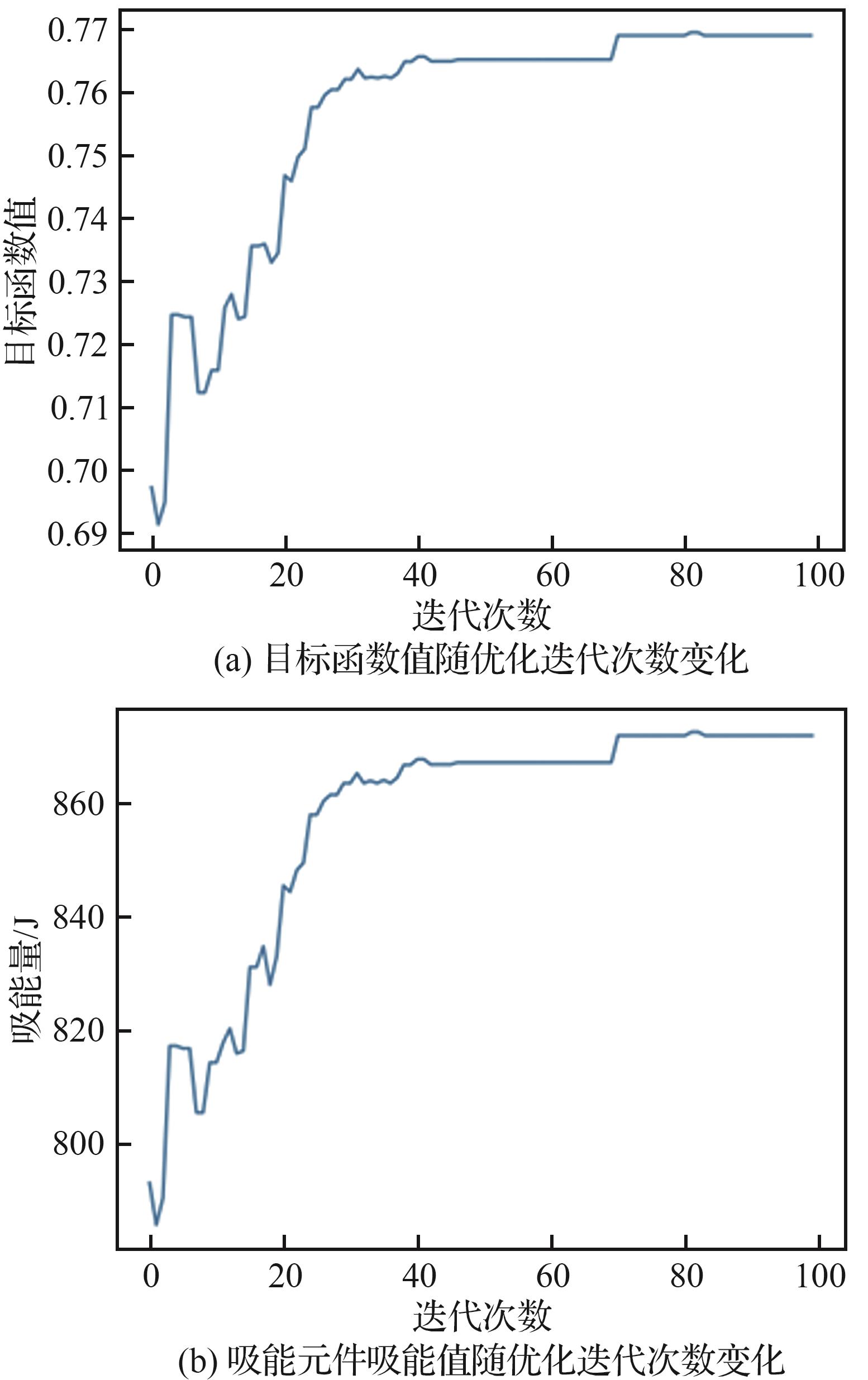
Fig.15
Post-crash result of eVTOL after optimization
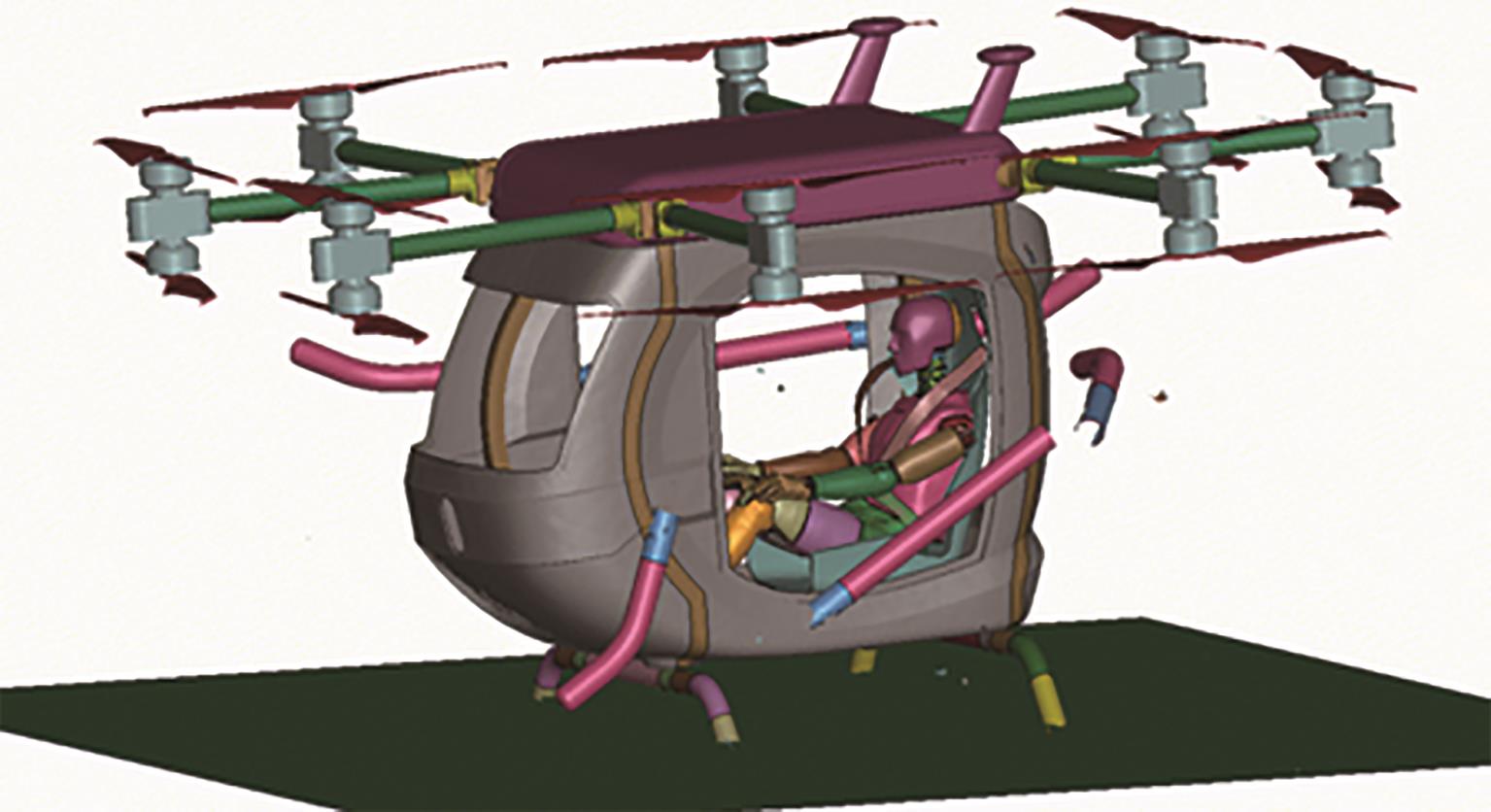
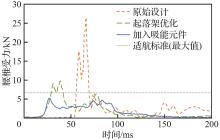
Fig.16
Decline of lumber force of passenger through crashworthiness optimization
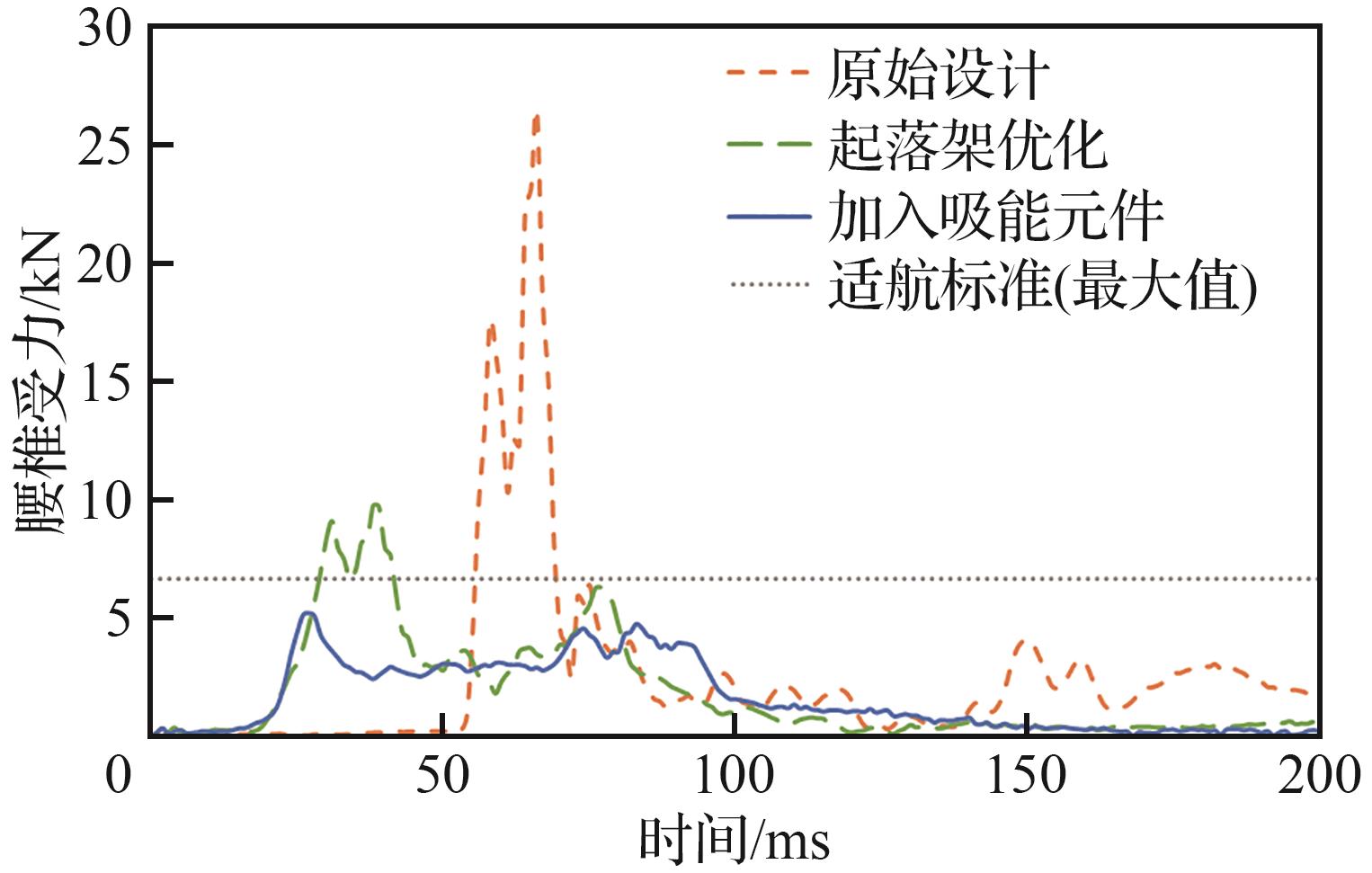
Table 7
Reduction of threat to passengers after crashworthiness optimization
| 序号 | 总质量/kg | 腰椎受力/kN | HIC |
|---|---|---|---|
| 适航标准要求 | <6.7 | <1 000 | |
| 原始设计 | 423.7 | 26.4 | 2 491 |
| 起落架优化 | 426.6 | 9.7 | 233 |
| 加入吸能元件 | 426.9 | 5.2 | 166 |
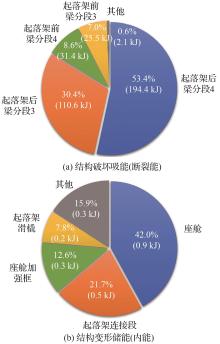
Fig.17
Energy absorption proportion of components
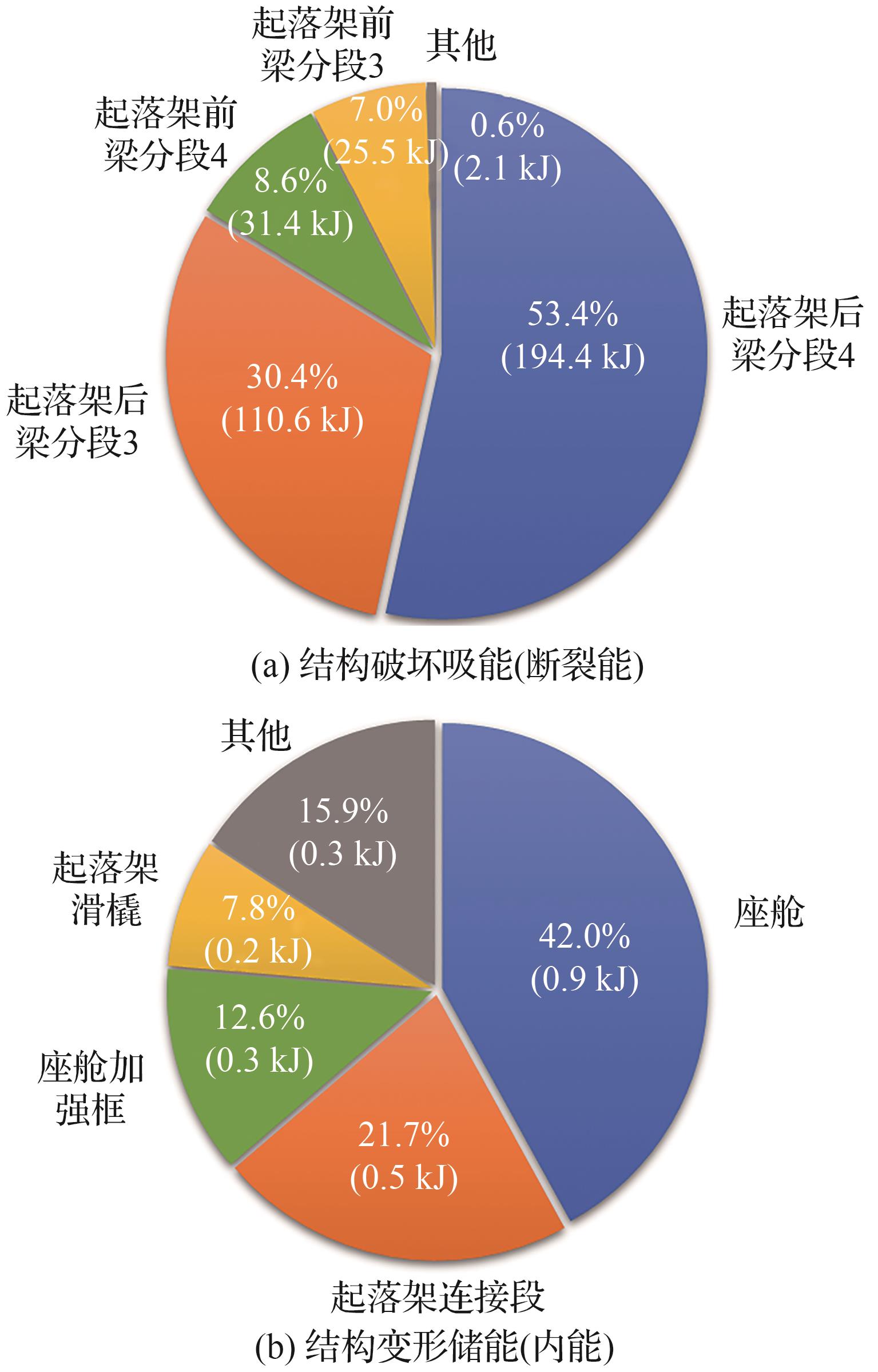
Table 8
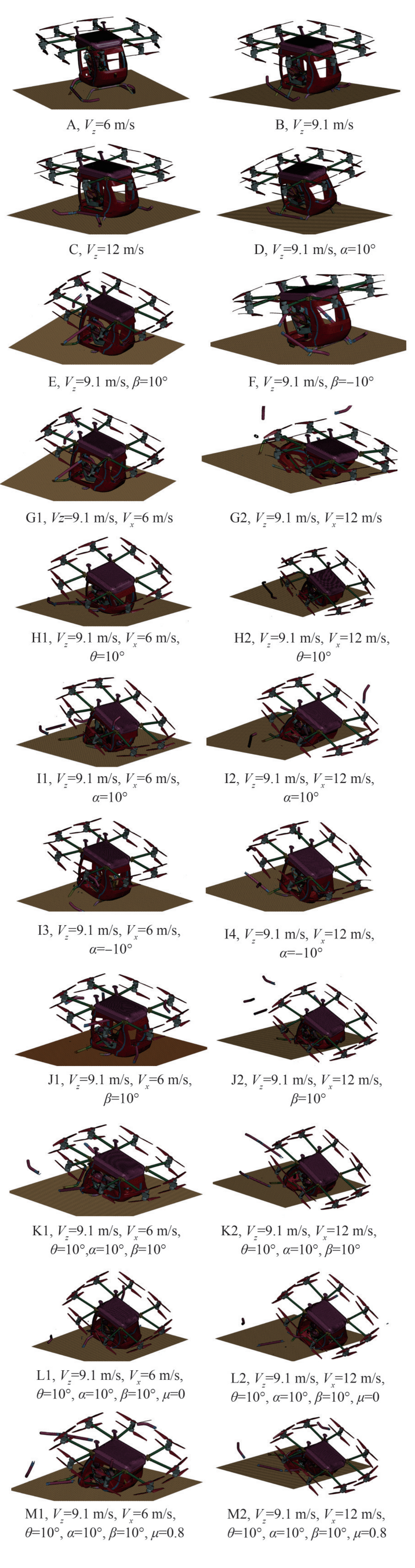
Configurations and results of off-axis impact of eVTOL
| 系列 | 实例 | 垂直速度Vz /(m·s-1) | 水平速度Vx /(m·s-1) | 侧倾角θ/(°) | 俯仰角α/(°) | 偏航角β/(°) | 地面摩擦系数μ | 腰椎受力/kN | 头部损伤判据HIC | 座舱完整性情况 |
|---|---|---|---|---|---|---|---|---|---|---|
| 1 | A | 9.1 | 0 | 0 | 0 | 0 | 0.4 | 7.62 | 206.9 | 完整 |
| B | 6.0 | 0 | 0 | 0 | 0 | 0.4 | 6.02 | 185.8 | 完整 | |
| C | 12.0 | 0 | 0 | 0 | 0 | 0.4 | 10.31 | 574.3 | 完整 | |
| 2 | D | 9.1 | 0 | 10 | 0 | 0 | 0.4 | 7.22 | 200.7 | 完整 |
| E | 9.1 | 0 | 0 | 10 | 0 | 0.4 | 4.14 | 189.1 | 完整 | |
| F | 9.1 | 0 | 0 | -10 | 0 | 0.4 | 10.91 | 233.1 | 完整 | |
| 3 | G1 | 9.1 | 6 | 0 | 0 | 0 | 0.4 | 6.31 | 207.7 | 完整 |
| G2 | 9.1 | 12 | 0 | 0 | 0 | 0.4 | 9.00 | 1 192 | 座舱压溃 | |
| H1 | 9.1 | 6 | 10 | 0 | 0 | 0.4 | 8.31 | 199.9 | 完整 | |
| H2 | 9.1 | 12 | 10 | 0 | 0 | 0.4 | 4.08 | 636.4 | 座舱压溃 | |
| I1 | 9.1 | 6 | 0 | 10 | 0 | 0.4 | 3.20 | 211.1 | 完整 | |
| I2 | 9.1 | 12 | 0 | 10 | 0 | 0.4 | 2.81 | 416.7 | 完整 | |
| I3 | 9.1 | 6 | 0 | -10 | 0 | 0.4 | 7.61 | 533.2 | 完整 | |
| I4 | 9.1 | 12 | 0 | -10 | 0 | 0.4 | 20.78 | 508.1 | 完整 | |
| J1 | 9.1 | 6 | 0 | 0 | 10 | 0.4 | 6.83 | 257.7 | 完整 | |
| J2 | 9.1 | 12 | 0 | 0 | 10 | 0.4 | 2.78 | 260.3 | 座舱压溃 | |
| K1 | 9.1 | 6 | 10 | 10 | 10 | 0.4 | 4.52 | 186.8 | 座舱压溃 | |
| K2 | 9.1 | 12 | 10 | 10 | 10 | 0.4 | 3.36 | 257.3 | 座舱压溃 | |
| 4 | L1 | 9.1 | 6 | 10 | 10 | 10 | 0 | 4.04 | 189.9 | 完整 |
| L2 | 9.1 | 12 | 10 | 10 | 10 | 0 | 3.59 | 208.9 | 完整 | |
| M1 | 9.1 | 6 | 10 | 10 | 10 | 0.8 | 3.13 | 267.2 | 座舱压溃 | |
| M2 | 9.1 | 12 | 10 | 10 | 10 | 0.8 | 10.43 | 998 | 座舱压溃 |
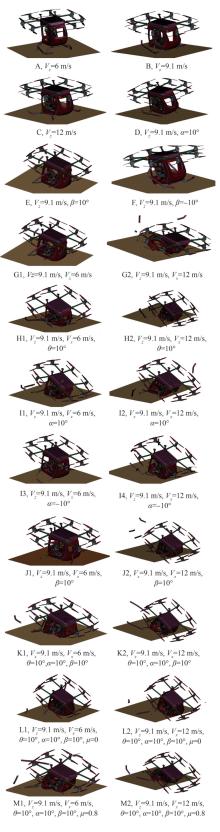
Fig.18
Post-crash deformation of eVTOL with multi-angle and multi-velocity impact
| [1] | GOYAL R, REICHE C, FERNANDO C, et al. Advanced air mobility: Demand analysis and market potential of the airport shuttle and air taxi markets[J]. Sustainability, 2021, 13(13): 7421. |
| [2] | National Transportation Safety Board. Survivability of accidents involving part 121 U.S. Air Carrier Operations [Z]. 2020. |
| [3] | Boeing. Statistical summary of commercial jet airplane accidents worldwide operations 1959-2020[R]. Washington,D.C.: Aviation Safety Boeing Commercial Airplanes, 2021. |
| [4] | NITSCHKE D R, MÜLLER R. The system approach to crashworthiness for the NH90[C]∥Proceedings of the Annual Forum Proceedings-American Helicopter Society, 1995. |
| [5] | 刘小川, 惠旭龙, 张欣玥, 等. 典型民用飞机全机坠撞实验研究[J]. 航空学报, 2024, 45(5): 529664. |
| LIU X C, XI X L, ZHANG X Y, et al. Full-scale crash experimental study of typical civil aircraft[J]. Acta Aeronautica et Astronautica Sinica, 2024, 45(5): 529664 (in Chinese). | |
| [6] | 牟浩蕾, 谢威威, 解江, 等. 坠撞环境下乘员伤害分析及飞机适坠性评估[J]. 航空学报, 2024, 45(3): 228786. |
| MOU H L, XIE W W, XIE J, et al. Occupant injury analysis and aircraft crashworthiness evaluation under crash scenarios[J]. Acta Aeronautica et Astronautica Sinica, 2024, 45(3): 228786 (in Chinese). | |
| [7] | 石霄鹏, 钟欣言, 牟浩蕾, 等. 垂向冲击下的民机乘员腰椎载荷研究[J]. 航空学报, 2024, 45(8): 229108. |
| SHI X P, ZHONG X Y, MOU H L, et al. Lumbar load of seated occupant under vertical impact[J]. Acta Aeronautica et Astronautica Sinica, 2024, 45(8): 229108 (in Chinese). | |
| [8] | MOU H L, XIE J, FENG Z Y, et al. Review on the crashworthiness design and evaluation of fuselage structure for occupant survivability[J]. Progress in Aerospace Sciences, 2024, 148: 101001. |
| [9] | LITTELL J D. Challenges in vehicle safety and occupant protection for autonomous electric vertical take-off and landing (eVTOL) vehicles[C]∥2019 AIAA/IEEE Electric Aircraft Technologies Symposium (EATS). Reston:AIAA, 2019: 1-16. |
| [10] | LAARMANN L, THOMA A, MISCH P, et al. Automotive safety approach for future eVTOL vehicles[J]. CEAS Aeronautical Journal, 2023, 14(2): 369-379. |
| [11] | XUE P, DING L, QIAO F, et al. Crashworthiness study of a civil aircraft fuselage section[J]. Latin American Journal of Solids and Structures, 2014, 11(9): 1615-1627. |
| [12] | 陈彦达, 范振民, 李军. 民用飞机机身段适坠性数值仿真分析[J]. 民用飞机设计与研究, 2020(2): 43-50. |
| CHEN Y D, FAN Z M, LI J. Crashworthiness numerical simulation of a civil airplane fuselage section[J]. Civil Aircraft Design & Research, 2020(2): 43-50 (in Chinese). | |
| [13] | DOLZYK G, SUNGMOON J, UFODIKE C O. Crashworthiness of circular tubes with rhombus xtar grooving pattern[J]. Materials Today Communications, 2021, 29: 102899. |
| [14] | 张欣玥, 惠旭龙, 刘小川, 等. 典型金属民机机身结构坠撞特性试验[J]. 航空学报, 2022, 43(6): 526234. |
| ZHANG X Y, XI X L, LIU X C, et al. Experimental study on crash characteristics of typical metal civil aircraft fuselage structure[J]. Acta Aeronautica et Astronautica Sinica, 2022, 43(6): 526234 (in Chinese). | |
| [15] | RAYHAN S BIN, XUE P, XI H L. Modeling of fuel in aircraft crashworthiness study with auxiliary fuel tank[J]. International Journal of Impact Engineering, 2023, 173: 104449. |
| [16] | ZHANG Y J, WANG H C. Crashworthiness analysis of PRSEUS-based blended-wing-body civil aircraft[J]. Aerospace Science and Technology, 2024, 146: 108927. |
| [17] | DING M L, XIE A H, ZHU S Q, et al. Crashworthiness design optimization for an eVTOL aircraft[C]∥2022 IEEE International Conference on Robotics and Biomimetics (ROBIO). Piscataway: IEEE Press, 2022: 82-86. |
| [18] | 彭亮. 基于乘员生存性的机身结构适坠性设计与评价方法研究[D]. 西安: 西北工业大学, 2018. |
| PENG L. Research on design and evaluation method of fuselage structure crashworthiness based on occupant survivability[D]. Xi’an: Northwestern Polytechnical University, 2018 (in Chinese). | |
| [19] | CENTER N L R, PUTNAM J, LITTELL J. Evaluation of impact energy attenuators and composite material designs of a UAM VTOL concept vehicle[C]∥Proceedings of the Vertical Flight Society 75th Annual Forum. The Vertical Flight Society, 2019. |
| [20] | LIU X C, BAI C Y, XI X L, et al. Impact response and crashworthy design of composite fuselage structures: An overview[J]. Progress in Aerospace Sciences, 2024, 148: 101002. |
| [21] | 解江, 牟浩蕾, 冯振宇, 等. 大飞机典型货舱下部结构冲击试验及数值模拟[J]. 航空学报, 2022, 43(6): 525890. |
| XIE J, MOU H L, FENG Z Y, et al. Impact characteristics of typical sub-cargo structure of large aircraft: Tests and numerical simulation[J]. Acta Aeronautica et Astronautica Sinica, 2022, 43(6): 525890 (in Chinese). | |
| [22] | Federal Aviation Administration. Methodology for dynamic seat certification by analysis for use in parts 23, 25, 27, and 29 airplanes and rotorcraft[R]. Washington, D.C.: FAA, 2003. |
| [23] | AN W G, WANG S G, HAN X. Crashworthiness optimization design of regional airliner’s fuselage section through topometry optimization[J]. AIAA Journal, 2021, 59(11): 4754-4763. |
| [24] | CENTER N L R, PUTNAM J, LITTELL J. Crashworthiness of a lift plus cruise eVTOL vehicle design within dynamic loading environments[C]∥Proceedings of the Vertical Flight Society 76th Annual Forum. The Vertical Flight Society, 2020. |
| [25] | WADIA K, BUSZEK M, POLIAKOV N, et al. Preliminary design and analysis of crashworthy structures for a long-range eVTOL aircraft[C]∥AIAA Scitech 2022 Forum. Reston: AIAA, 2022. |
| [26] | DING M L, CAI J D, ZHANG Y Y, et al. Crashworthiness analysis on multiple styles of skid landing gear[C]∥2022 8th International Conference on Mechanical Engineering and Automation Science (ICMEAS). Piscataway: IEEE Press, 2022: 76-80. |
| [1] | You HE, Yu LIU, Yaowen LI, Ziran DING, Kai DONG, Yaqi CUI, Caisheng ZHANG, Xueqian WANG, Zhi LI, Chen GUO. Development and prospects of multisource information fusion [J]. Acta Aeronautica et Astronautica Sinica, 2025, 46(6): 531672-531672. |
| [2] | Xudong LI, Wei ZHONG, Zhen WANG, Tongguang WANG, Jinlong LI. Ratio of propeller thrust to total thrust of ducted propellers [J]. Acta Aeronautica et Astronautica Sinica, 2025, 46(4): 230829-230829. |
| [3] | Changxiao ZHAO, Yixuan SUN. A safe scheduling model for eVTOL avionics systems for airworthiness requirements [J]. Acta Aeronautica et Astronautica Sinica, 2025, 46(11): 531252-531252. |
| [4] | Xinglong WANG, Youjie WANG. Safety interval evaluation for multi-aircraft eVTOL in urban low altitude [J]. Acta Aeronautica et Astronautica Sinica, 2025, 46(1): 330604-330604. |
| [5] | Xiaopeng SHI, Xinyan ZHONG, Haolei MOU, Jiang XIE, Zhiyu ZENG, Peiyao LI. Lumbar load of seated occupant under vertical impact [J]. Acta Aeronautica et Astronautica Sinica, 2024, 45(8): 229108-229108. |
| [6] | Xiaochuan LIU, Xulong XI, Xinyue ZHANG, Chunyu BAI, Yabin YAN, Xiaocheng LI, Rangke MU. Full⁃scale crash experimental study of typical civil aircraft [J]. Acta Aeronautica et Astronautica Sinica, 2024, 45(5): 529664-529664. |
| [7] | Jinghui DENG. Technical status and development of electric vertical take⁃off and landing aircraft [J]. Acta Aeronautica et Astronautica Sinica, 2024, 45(5): 529937-529937. |
| [8] | Haolei MOU, Weiwei XIE, Jiang XIE, Zhenyu FENG, Lanhui LIN. Occupant injury analysis and aircraft crashworthiness evaluation under crash scenarios [J]. Acta Aeronautica et Astronautica Sinica, 2024, 45(3): 228786-228786. |
| [9] | Haoxuan PENG, Xiaochuan LIU, Xulong XI, Chunyu BAI, Xiaocheng LI, Hao AN, Rangke MU. Emergency evacuation experiment of civil aircraft considering crash environment impact [J]. Acta Aeronautica et Astronautica Sinica, 2024, 45(15): 229755-229755. |
| [10] | Shibo WEI, Hongji SHU, Xiaoqiong ZHANG, Tingting ZHAO, Tao WANG, Zhihua WANG, Qingxue HUANG. High⁃velocity impact performance of thin⁃ply carbon fiber/ ultra⁃thin stainless⁃steel strips fiber metal laminates [J]. Acta Aeronautica et Astronautica Sinica, 2024, 45(14): 429420-429420. |
| [11] | Yunlong ZHOU, Yi MA, Yingchun GUAN. Research progress on laser selective melting technology for high-performance manufacturing of aero-engines [J]. Acta Aeronautica et Astronautica Sinica, 2024, 45(13): 629508-629508. |
| [12] | Jinyi MA, Can WANG, Tao XUE, Jianliang AI, Yiqun DONG. Development and illustrative applications of an air combat engagement database [J]. Acta Aeronautica et Astronautica Sinica, 2023, 44(S1): 727538-727538. |
| [13] | Haolei MOU, Jiang XIE, Zhenyu FENG, Kun CHENG, Yi LIU. Crashworthiness characteristics analysis of typical fuselage section of large transport aircraft [J]. ACTA AERONAUTICAET ASTRONAUTICA SINICA, 2023, 44(9): 227512-227512. |
| [14] | Weishi CHEN, Jia LIU, Qingbin WANG, Xianfeng LU, Jie ZHANG, Xiaolong CHEN, Yifeng HUANG. Review on technology of bird detection with weather radar [J]. ACTA AERONAUTICAET ASTRONAUTICA SINICA, 2023, 44(5): 26781-026781. |
| [15] | Lei HE, Weiqi QIAN, Kangsheng DONG, Xian YI, Congcong CHAI. Aerodynamic characteristics modeling of iced airfoil based on convolution neural networks [J]. ACTA AERONAUTICAET ASTRONAUTICA SINICA, 2023, 44(5): 126434-126434. |
| Viewed | ||||||
|
Full text |
|
|||||
|
Abstract |
|
|||||
Address: No.238, Baiyan Buiding, Beisihuan Zhonglu Road, Haidian District, Beijing, China
Postal code : 100083
E-mail:hkxb@buaa.edu.cn
Total visits: 6658907 Today visits: 1341All copyright © editorial office of Chinese Journal of Aeronautics
All copyright © editorial office of Chinese Journal of Aeronautics
Total visits: 6658907 Today visits: 1341

 CJA
CJA
