刘延芳1,2,3( ), 王洪悦1, 鄂羽佳1, 齐乃明1,2,3
收稿日期:2025-04-28
修回日期:2025-05-30
接受日期:2025-08-15
出版日期:2025-08-29
发布日期:2025-08-28
通讯作者:
刘延芳
E-mail:lyf04025121@126.com
基金资助:
Yanfang LIU1,2,3(), Hongyue WANG1, Yujia E1, Naiming QI1,2,3
Received:2025-04-28
Revised:2025-05-30
Accepted:2025-08-15
Online:2025-08-29
Published:2025-08-28
Contact:
Yanfang LIU
E-mail:lyf04025121@126.com
Supported by:摘要:
新一代高超声速飞行器因高马赫数、长飞行时间、过载大的特性,面临着极端气动加热与复杂力学环境,对减阻与降热性能提出了严峻挑战。聚焦高超声速飞行器边界层主动质量引射减阻降热研究方法,系统评述该领域的研究进展及其范式转型路径。全面梳理了传统研究范式——实验、理论与数值方法的发展现状,并揭示核心挑战:实验数据稀疏性与多场耦合测量瓶颈、数值模拟的“精度-效率”权衡困境以及多尺度耦合建模理论与方法缺失。基于这些挑战,提出了以数据驱动、物理信息融合和多尺度耦合为核心的智能化科研新范式,并归纳了其技术分类与前沿进展。通过流体力学场景中的应用案例,深入分析了该新范式的创新机制及其在解决传统研究范式挑战中的优势和潜在应用思路。旨在通过对智能化科研新范式的深入洞察,激发研究人员的兴趣,推动高超声速飞行器减阻降热研究的持续发展与范式跃迁,为后续提升新一代高超声速飞行器的减阻降热性能提供重要的参考与启示。
中图分类号:
刘延芳, 王洪悦, 鄂羽佳, 齐乃明. 迈向智能驱动的高超声速飞行器边界层主动质量引射减阻降热研究新范式[J]. 航空学报, 2026, 47(2): 132171.
Yanfang LIU, Hongyue WANG, Yujia E, Naiming QI. A new paradigm of intelligence-driven active mass ejection drag and heat reduction research for hypersonic vehicle boundary layer[J]. Acta Aeronautica et Astronautica Sinica, 2026, 47(2): 132171.
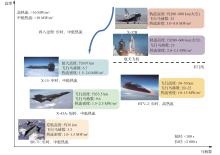
图 1
典型飞行器表面的热流密度[4]


图 2
代表性实验研究[42-45]


表1
机理性实验研究考虑的主要影响参数
| 全局变量 | 代表论文 | 具体参数 | 物理意义 |
|---|---|---|---|
| 几何参数 | Hwang[ | 几何尺寸 | 主动质量引射结构的几何尺寸 |
| 位置 | 主动质量引射结构的布置位置 | ||
| 面积 | 主动质量引射结构的面积 | ||
| 形状 | 主动质量引射结构的边界形状 | ||
| 多孔材料特性 | 孟丽燕等[ | 物理参数 | 固体骨架的热导率、比热容、密度和渗透率 |
| 厚度 | 多孔材料的厚度 | ||
| 耐温性 | 多孔材料的长期使用温度 | ||
| 表面发射率 | 多孔壁面的热辐射特性 | ||
| 颗粒直径 | 粉末烧结多孔材料的粉末颗粒直径 | ||
| 孔隙率 | 多孔介质中孔隙体积与总体积的比值 | ||
| 冷却工质供应 | 黄拯等[ | 冷却工质特性 | 导热系数、比热容、密度、黏度、相变温度 |
| 冷却工质的质量流量 | 单位时间内冷却工质的供给质量 | ||
| 供给温度 | 冷却工质供给腔室的温度 | ||
| 供给压力 | 驱动冷却工质从主动质量引射结构中流出的压力 | ||
| 渗透速度 | 冷却工质透过多孔介质的速度 | ||
| 主流参数 | Langener等[ | 物理参数 | 导热系数、比热容、密度、黏度 |
| 马赫数 | 风洞流场的马赫数 | ||
| 总温 | 风洞流场的滞止温度 | ||
| 总压 | 风洞流场的滞止压力 | ||
| 注入率 | 黄干等[ | 无量纲参数 | 冷却工质与主流气流之间流动强度的相对关系 |
表2
典型的地面考核实验研究项目
地面考核 实验类型 | 研究单位 | 加热设备 | 主流条件 | 研究对象 | 材料 | 冷却工质 |
|---|---|---|---|---|---|---|
辐射加热 实验 | NASA 兰利研究 中心[ | 60 kW弧光灯 | 热流密度: 2 271.2 kW/m2 | 圆管、矩形管 | 烧结不锈钢 | 氦气、氢气 |
中国运载火箭技术 研究院[ | 石英灯 | 热流密度: 500 kW/m2 | 平板 | 钛铝合金、镍、 陶瓷 | 水 | |
对流加热 实验 | 静冈大学[ | 750 kW电弧 加热装置 | 速度:4 087 m/s 总温:4 303 K | 扁圆柱体 | 氧化铝 | 氮气 |
| 德国航空航天中心[ | 缩比燃烧室 | 速度:300 m/s 总温:3 600 K | 圆管式燃烧室 | C/C-SiC陶瓷基 复合材料 | 氢气 | |
空中客车防务与 航天公司[ | ILTR电加热 风洞 | 马赫数:2.1 总温:1 450 K | 平板 | C/C材料 | 空气、氮气 | |
| 德国航空航天中心[ | M3 缩比燃烧室 | 速度:294 m/s 总温:3 400 K | 简化火箭燃烧室与 喷管结构 | C/C-SiC陶瓷基 复合材料 | 氢气 | |
| 德国航空航天中心[ | L2K/L3K电弧 风洞 | 马赫数:7.0, 7.6 总温:4 220 5 400 K | 钝锥 | 陶瓷基复合材料 (91% Al2O3、 9% SiO2) | 氮气、水 | |
| 中国科学技术大学[ | 电加热风洞 | 雷诺数:16 000 总温:673~823 K | 楔形头锥 | 烧结不锈钢 | 水 | |
| 中国科学技术大学[ | 电弧风洞 | 马赫数:2.19 总温:2 400 K | 平板 | 烧结不锈钢 | 水 |
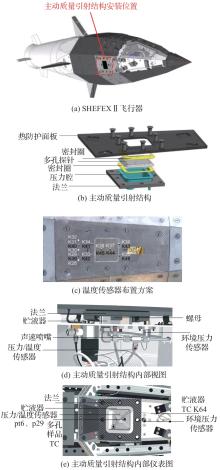
图 3
高超声速飞行实验项目SHEFEX Ⅱ[45,75-79]


图 4
不同Kn数下流动机制及对应的飞行高度与研究尺度

表3
各流动机制下的主要理论方程与数值计算方法
| 流动机制 | 核心理论方程 | 数值计算方法 | 适用性描述 | 适用物理学尺度范围 |
|---|---|---|---|---|
| 连续流动 | Navier-Stokes方程 | FVM、FDM与FEM等 | 连续介质假设 | 宏观 |
| 滑移流动 | Navier-Stokes方程/ Boltzmann方程 | 考虑滑移边界的FVM、LBM、 DSMC | 增加滑移边界条件、Boltzmann 方程可精确描述 | 宏观、介观 |
| 过渡流动 | Boltzmann方程 | LBM、DSMC | 分子间碰撞、分子与物面碰撞均显著 影响流动 | 宏观、介观 |

图 5
多孔介质的不同尺度表征

表4
多孔介质内部流动传热理论模型对比
| 理论模型 | 物理假设 | 优势 | 劣势 | 方程组构成 |
|---|---|---|---|---|
| SFM | 流体的气相和液相被视为独立的相,各自有独立的流动和传热特性 | 可提供详细的相间互动信息, 计算精度较高 | 计算复杂、数值求解难度大,准确捕捉界面困难 | 流体的气液相分别采用独立的质量、动量、能量方程 |
| TPMM | 流体的液相和气相被视为单一混合相,统一处理速度、温度等物理量 | 数学处理简化,计算效率高 | 捕获具体的界面特性方面存在局限性 | 将流体的气液两相使用统一的质量、动量、能量方程 |
| LTE | 流体相和固体相在局部区域内达到热平衡,温度相同 | 简化传热过程,计算成本低 | 不适用于流固之间热交换缓慢或温度差异明显的情况 | 使用单一能量方程描述共同温度分布 |
| LTNE | 流体相和固体相存在温度差异,不处于热平衡状态 | 精确描述流固之间的热传递过程,适合各自行为差异明显的场合 | 建模与数值求解难度增加、边界条件和参数确定困难 | 流体相和固体相分别建立能量方程 |

图 6
核心模型的演变与修正路径

表5
SFM与TPMM修正的研究内容汇总
| 文献 | 理论模型 | 理论模型修正内容 | 数值计算方法 |
|---|---|---|---|
| Wang等[ | SFM | 引入新的压力修正方程和相分数方程,通过迭代更新压力和速度场,简化求解过程,避免复杂的相变界面跟踪 | 采用FVM离散扩散项与对流项,使用通量修正传输方案和隐式欧拉方法处理非稳态 |
| Dong等[ | TPMM | 引入混合比焓,作为热力学状态的单调函数,简化相变 界面处理,提高计算稳定性 | 采用FDM对空间离散化,验证网格独立性 |
| Hu等[ | TPMM | 提出动能焓概念,捕捉低压条件下两相区的温度变化, 改进模型对低压条件下温度梯度的描述能力 | 基于COMSOL Multiphysics的FEM,采用隐式时间步进与自适应时间步长策略 |
| He等[ | SFM | 考虑蒸汽的可压缩性、液体相变引起的动量转移及焓的 变化,解决热绝缘层问题,增强模型的准确性与鲁棒性 | 全隐式时间推进格式,求解动量与能量耦合方程 |
| Liu等[ | TPMM | 引入修正混合焓和焓比,实现不同流动状态下焓变化的 平滑统一处理,避免温度“跳跃”现象 | 基于FLUENT的FVM,嵌入用户自定义函数,并优化网格独立性和时间步长选择 |
| Su等[ | TPMM | 引入修正温度,将能量方程对流项系数转换为常数,简化方程并提高数值模拟的稳定性和收敛性 | 采用FVM迎风格式离散方程,使用PISO算法进行压力速度耦合,验证网格独立性 |
Dong和 Wang[ | SMM | 提出半混合模型(Semi-Mixed Model, SMM),结合SFM与TPMM优点,无需相变界面追踪,避免热绝缘层问题 | 采用FVM离散方程,对流项采用1阶迎风格式,扩散项采用中心差分格式,并使用SIMPLE算法耦合压力与速度 |
表6
Nu数的实验拟合关联式及其适用范围
| 文献 | 公式 | 适用范围 | 条件 |
|---|---|---|---|
Pallares和 Grau[ | 稳态层流 | ||
| Achenbach[ | 层流至湍流 | ||
胥蕊娜和 姜培学[ | 颗粒几何特性 | ||
| Xu等[ | 不同Kn数,多种气体 | 考虑稀薄效应下的速度滑移和 温度跳跃影响 |
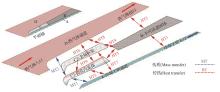
图 7
分区建模-界面耦合示意图[118]

表7
外内外流耦合流动传热特性研究中涉及的理论模型及数值计算方法
| 文献 | 外部主流选用的理论方程及湍流模型 | 孔隙内流的流动传热理论模型 | 数值计算方法 |
|---|---|---|---|
| Cerminara等[ | N-S方程,DNS(直接求解方程,捕捉所有流动尺度无需湍流模型) | 等效Darcy-Forchheimer行为后 仍采用N-S方程 | 六阶中心差分,WENO格式, 3阶Runge-Kutta方法 |
| Liu等[ | RANS方程,SST k-ω湍流模型 | Darcy-Forchheimer模型,LTNE | FVM离散方程,压力基求解器 |
| Jiang等[ | 热化学非平衡N-S方程,Standard k-ω湍流模型 | Darcy-Forchheimer模型,LTE | FVM离散方程,对流项2阶迎风格式 |
| Huang等[ | RANS方程,Spalart-Allmaras湍流模型 | Darcy-Forchheimer模型,LTE | FVM离散方程,对流项2阶迎风格式 |
| Xiao等[ | N-S方程,LES直接解析大尺度湍流结构,引入SGS模型处理小尺度湍流对大尺度流动的影响 | Darcy-Forchheimer模型,LTNE | |
| Xiao等[ | RANS方程,SST k-ω湍流模型 | Darcy-Forchheimer模型,LTNE | 多区域数值策略 |
| Ding等[ | RANS方程,SST k-ω湍流模型 | Darcy-Forchheimer模型,LTE | FVM,多区域数值策略 |
| Su等[ | RANS方程,SST k-ω湍流模型 | TPMM-LTNE | FVM,多区域数值策略 |

图 8
3类智能代理模型方法分类示意图及其代表性应用[128-137]

表8
数据驱动代理模型代表工作
| 方法分类 | 方法 | 年份 | 主干网络 | 场景 |
|---|---|---|---|---|
| 规则网格 | DPUF[ | 2019 | CNN | 圆柱绕流 |
| TF-Net[ | 2020 | CNN | 湍流 | |
| EquNet[ | 2020 | CNN | Rayleigh-Bénard流、海洋 | |
| RSteer[ | 2022 | CNN | 烟雾 | |
| 不规则网格 | MGN[ | 2020 | GNN | 圆柱绕流、跨声速流 |
| MP-PDE[ | 2022 | GNN | Burgers方程、波浪、Naver-Stokes方程 | |
| BENO[ | 2024 | GNN/Transformer | Poisson方程 | |
| FCN[ | 2022 | GNN | Naver-Stokes方程 | |
| HAMLET[ | 2024 | GNN/Transformer | 浅水方程、Darcy方程、扩散、翼型 | |
| MAgNet[ | 2022 | GNN/CNN | Burgers方程 | |
| DINo[ | 2022 | FourierNet | Naver-Stokes方程、波浪、浅水方程 | |
| 深度算子网络 | DeepONet[ | 2021 | MLP | 反应-扩散方程、ODE |
| PI-DeepONet[ | 2021 | MLP | 跨声速流、反应-扩散方程、Burgers方程 | |
| MIONet[ | 2022 | MLP | 反应-扩散方程、ODE | |
| Fourier-MIONet[ | 2024 | MLP | 多相流 | |
| NOMAD[ | 2022 | MLP | 对流方程、浅水方程 | |
| Shift-DeepONet[ | 2022 | MLP | 对流方程、Burgers方程、Euler方程 | |
| HyperDeepONet[ | 2023 | MLP | 对流方程、Burgers方程、浅水方程 | |
| B-DeepONet[ | 2023 | MLP | 反应-扩散方程、对流方程 | |
| SVD-DeepONet[ | 2023 | MLP | ODE | |
| L-DeepONet[ | 2023 | MLP | Rayleigh-Bénard流、浅水流 | |
| 物理空间 | MGNO[ | 2020 | GNN | Burgers方程、Darcy方程 |
| LNO[ | 2024 | Laplace | 反应-扩散方程、Duffing方程 | |
| CNO[ | 2023 | CNN | Poisson方程、Naver-Stokes方程、Darcy方程 | |
| KNO[ | 2024 | Koopman | Naver-Stokes方程、Bateman-Burgers方程 | |
| SINGER[ | 2025 | GNN | 反应-扩散方程、Burgers方程、Allen-Cahn方程 | |
| FactFormer[ | 2023 | Transformer | Kolmogorov流,烟浮力 | |
| ICON[ | 2023 | Transformer | Poisson方程、反应-扩散方程、ODE | |
| Transolver[ | 2024 | Transformer | 汽车、翼型 | |
| GNO[ | 2020 | GNN | Poisson方程、随机系数的椭圆型方程 | |
| 傅里叶空间 | FNO[ | 2020 | Fourier | Burgers方程、Darcy方程、Navier-Stokes方程 |
| PINO[ | 2024 | Fourier | Burgers方程、Darcy方程、Navier-Stokes方程 | |
| Geo-FNO[ | 2023 | Fourier | Euler方程、Naver-Stokes方程、对流方程、弹性方程 | |
| GINO[ | 2023 | Fourier | RANS方程、汽车 | |
| DAFNO[ | 2023 | Fourier | 跨声速翼型、超弹性材料本构方程 | |
| U-NO[ | 2022 | Fourier | Darcy方程、Navier-Stokes方程 | |
| F-FNO[ | 2021 | Fourier | Kolmogorov流、跨声速流 | |
| CMWNO[ | 2023 | Fourier | Gray-Scott与Belousov-Zhabotinsky反应扩散方程 | |
| CFNO[ | 2022 | Fourier | Navier-Stokes方程、浅水方程、麦克斯韦方程 | |
| MCNP[ | 2025 | Fourier | 对流扩散方程、Allen-Cahn 方程、Navier-Stokes方程 | |
| RecFNO[ | 2024 | Fourier | 圆柱绕流、Darcy方程 | |
| G-FNO[ | 2023 | Fourier | Navier-Stokes方程、浅水方程 | |
| CoNO[ | 2023 | Fourier | Burgers方程、Darcy方程、Navier-Stokes方程、浅水方程 |
表9
物理信息融合代理模型代表性工作
| 方法分类 | 方法 | 年份 | 主干网络 | 场景 |
|---|---|---|---|---|
| 物理信息神经网络 | PINN[ | 2019 | MLP | Navier-Stokes方程、反应-扩散方程、KdV方程 |
| PINN-SR[ | 2021 | MLP | Kuramoto-Sivashinsky方程、Navier-Stokes方程和Burgers方程等 | |
| NSFnets[ | 2021 | MLP | Kovasznay流、Beltrami流、圆柱绕流 | |
| Phygeonet[ | 2021 | CNN | Navier-Stokes方程、Poisson方程、热传导方程 | |
| CPINN[ | 2022 | MLP | Poisson方程、非线性Schrödinger方程、Burgers方程、Allen-Cahn方程 | |
| Stan[ | 2022 | MLP | 热传导方程、ODE | |
| NASPINN[ | 2024 | MLP | Poisson方程、Burgers方程、对流方程 | |
| Hodd-PINN[ | 2023 | Resnet | 对流方程、热传导方程 | |
| DAST[ | 2023 | MLP | Burgers方程、对流方程、反应扩散方程、Navier-Stokes 方程 | |
| OrPINN[ | 2025 | MLP | Helmholtz方程、线弹性波动方程 | |
| Sharp-PINN[ | 2025 | MLP | Allen-Cahn方程、Cahn-Hilliard方程 | |
| BINN[ | 2023 | MLP | Poisson方程、Hertz接触问题 | |
约束信息嵌入 神经网络 | DGM[ | 2018 | LSTM | Hamilton-Jacobi-Bellman方程、Burgers方程 |
| ADLGM[ | 2023 | LSTM | Poisson 方程、Burgers 方程 | |
| EDNN[ | 2021 | MLP | Burgers 方程、波动方程、Navier-Stokes方程 | |
| INSR[ | 2023 | MLP | Euler方程、对流方程、弹性动力学方程 | |
| AmorFEA[ | 2020 | MLP | Poisson方程、超弹性材料平衡方程 | |
| Neu-Gal[ | 2024 | MLP | Allen-Cahn方程、Fokker-Planck方程、KdV方程 | |
| PPNN[ | 2024 | CNN | 反应-扩散方程、Burgers 方程、Navier-Stokes 方程 |
| [1] | 包为民. 可重复使用运载火箭技术发展综述[J]. 航空学报, 2023, 44(23): 629555. |
| BAO W M. A review of reusable launch vehicle technology development[J]. Acta Aeronautica et Astronautica Sinica, 2023, 44(23): 629555 (in Chinese). | |
| [2] | 魏礼响, 徐惊雷, 陈匡世, 等. 宽域高超声速飞行器可调矢量喷管方案设计与性能研究[J]. 航空学报, 2025, 46(8): 631086. |
| WEI L X, XU J L, CHEN K S, et al. Scheme design and performance study of adjustable vector nozzle for wide-range hypersonic aircraft[J]. Acta Aeronautica et Astronautica Sinica, 2025, 46(8): 631086 (in Chinese). | |
| [3] | 张益荣, 张毅锋, 解静, 等. 典型高超声速翼身组合体粘性干扰效应模型研究[J]. 空气动力学学报, 2017, 35(2): 186-191. |
| ZHANG Y R, ZHANG Y F, XIE J, et al. Study of viscous interaction effect model for typical hypersonic wing-body figuration[J]. Acta Aerodynamica Sinica, 2017, 35(2): 186-191 (in Chinese). | |
| [4] | 潘利生, 郝亨隆, 姚子康, 等. 高速飞行器减阻降热研究进展[J]. 力学进展, 2023, 53(4): 793-818. |
| PAN L S, HAO H L, YAO Z K, et al. Current status of research on reducing drag and cooling of high-speedaircraft[J]. Advances in Mechanics, 2023, 53(4): 793-818 (in Chinese). | |
| [5] | 王长青. 空天飞行技术创新与发展展望[J]. 宇航学报, 2021, 42(7): 807-819. |
| WANG C Q. Technological innovation and development prospect of aerospace vehicle[J]. Journal of Astronautics, 2021, 42(7): 807-819 (in Chinese). | |
| [6] | 罗振兵, 夏智勋, 王林, 等. 高超声速飞行器内外流主动流动控制[M]. 北京: 科学出版社, 2019. |
| LUO Z B, XIA Z X, WANG L, et al. Active flow control of internal and external flow in hypersonic vehicle[M]. Beijing: Science Press, 2019 (in Chinese). | |
| [7] | 黄红岩, 苏力军, 雷朝帅, 等. 可重复使用热防护材料应用与研究进展[J]. 航空学报, 2020, 41(12): 023716. |
| HUANG H Y, SU L J, LEI C S, et al. Reusable thermal protective materials: Application andresearch progress[J]. Acta Aeronautica et Astronautica Sinica, 2020, 41(12): 023716 (in Chinese). | |
| [8] | 丁明松, 刘庆宗, 江涛, 等. 磁控热防护系统在天地往返运载器上的应用仿真[J]. 航空学报, 2021, 42(7): 124501. |
| DING M S, LIU Q Z, JIANG T, et al. Simulation of magnetohydrodynamic heat shield system on reusable launch vehicles[J]. Acta Aeronautica et Astronautica Sinica, 2021, 42(7): 124501 (in Chinese). | |
| [9] | 艾邦成, 陈思员, 韩海涛, 等. 疏导式热防护结构传热极限特性[J]. 航空学报, 2021, 42(2): 623989. |
| AI B C, CHEN S Y, HAN H T, et al. Heat transfer limit characteristics of integrated dredging thermal protection structure[J]. Acta Aeronautica et Astronautica Sinica, 2021, 42(2): 623989 (in Chinese). | |
| [10] | 朱广生, 姚世勇, 段毅. 高速飞行器减阻降热流动控制技术研究进展及工程应用[J]. 航空学报, 2023, 44(15):529049. |
| ZHU G S, YAO S Y, DUAN Y. Research progress and engineering application of flow control technology for drag reduction and heat reduction of high-speed flight vehicles[J]. Acta Aeronautica et Astronautica Sinica, 2023, 44(15): 529049 (in Chinese). | |
| [11] | 沈斌贤, 曾磊, 刘骁, 等. 高超声速飞行器主动质量引射热防护技术研究进展[J]. 空气动力学学报, 2022, 40(6): 1-13. |
| SHEN B X, ZENG L, LIU X, et al. Research progress of thermal protection technique by activemass injection for hypersonic vehicle[J]. Acta Aerodynamica Sinica, 2022, 40(6): 1-13 (in Chinese). | |
| [12] | 罗飞腾, 渠镇铭, 李海涛, 等. 高超声速进气道预喷注技术研究进展与关键问题[J]. 航空学报, 2025, 46(8): 27-59. |
| LUO F T, QU Z M, LI H T, et al. Research progress and key issues of inlet pre-injection at hypersonic condition[J]. Acta Aeronautica et Astronautica Sinica, 2025, 46(8): 27-59 (in Chinese). | |
| [13] | 梁彬, 赵俊波, 付增良, 等. 气体质量引射对钝锥俯仰特性的影响[J]. 航空学报, 2025, 46(3): 267-275. |
| LIANG B, ZHAO J B, FU Z L, et al. Effect of gas mass injection on pitching characteristics of blunt cone[J]. Acta Aeronautica et Astronautica Sinica, 2025, 46(3): 267-275 (in Chinese). | |
| [14] | ZHANG J Z, ZHANG S C, WANG C H, et al. Recent advances in film cooling enhancement: A review[J]. Chinese Journal of Aeronautics, 2020, 33(4): 1119-1136. |
| [15] | HWANG D. Review of research into the concept of the microblowing technique for turbulent skin friction reduction[J]. Progress in Aerospace Sciences, 2004, 40(8): 559-575. |
| [16] | MI Q, YI S H, GANG D D, et al. Research progress of transpiration cooling for aircraft thermal protection[J]. Applied Thermal Engineering, 2024, 236: 121360. |
| [17] | SHEN B X, LIU W Q, YIN L. Drag and heat reduction efficiency research on opposing jet in supersonic flows[J]. Aerospace Science and Technology, 2018, 77: 696-703. |
| [18] | 向树红, 商圣飞, 沈自才, 等. 高超声速气膜冷却技术研究进展及发展方向[J]. 宇航材料工艺, 2020, 50(3): 1-10. |
| XIANG S H, SHANG S F, SHEN Z C, et al. Research progress and development direction of hypersonic film cooling technology[J]. Aerospace Materials & Technology, 2020, 50(3): 1-10 (in Chinese). | |
| [19] | BERTIN J J, CUMMINGS R M. Critical hypersonic aerothermodynamic phenomena[J]. Annual Review of Fluid Mechanics, 2006, 38: 129-157. |
| [20] | CHEN L, HE A, ZHAO J L, et al. Pore-scale modeling of complex transport phenomena in porous media[J]. Progress in Energy and Combustion Science, 2022, 88: 100968. |
| [21] | WEINAN E, HAN J Q, ZHANG L F. Machine-learning-assisted modeling[J]. Physics Today, 2021, 74(7): 36-41. |
| [22] | CHEN X H, WANG Z C, DENG L, et al. Towards a new paradigm in intelligence-driven computational fluid dynamics simulations[J]. Engineering Applications of Computational Fluid Mechanics, 2024, 18(1): 2407005. |
| [23] | LENG C, TANG Z, ZHOU Y G, et al. Fifth paradigm in science: A case study of an intelligence-driven material design[J]. Engineering, 2023, 24: 126-137. |
| [24] | MALITSKY N, CASTAIN R, COWAN M. Spark-mpi: Approaching the fifth paradigm of cognitive applications[DB/OL]. arXiv preprint: 1806.01110, 2018. |
| [25] | HAN J Q, ZHANG L F, CAR R. Deep potential: A general representation of a many-body potential energy surface[DB/OL]. arXiv preprint: 1707.01478, 2017. |
| [26] | LI J H, HUANG W L. Paradigm shift in science with tackling global challenges[J]. National Science Review, 2019, 6(6): 1091-1093. |
| [27] | 杨小康, 许岩岩, 陈露, 等. AI for Science: 智能化科学设施变革基础研究[J]. 中国科学院院刊, 2024, 39(1): 59-69. |
| YANG X K, XU Y Y, CHEN L, et al. AI for Science: AI enabled scientific facility transforms fundamental research[J]. Bulletin of Chinese Academy of Sciences, 2024, 39(1): 59-69 (in Chinese). | |
| [28] | 陈云霁, 郭崎. AI for Technology: 技术智能在高技术领域的应用实践与未来展望[J]. 中国科学院院刊, 2024, 39(1): 34-40. |
| CHEN Y J, GUO Q. AI for Technology: Applied practices and future perspectives of technological intelligence in high tech areas[J]. Bulletin of Chinese Academy of Sciences, 2024, 39(1): 34-40 (in Chinese). | |
| [29] | 鄂维南. AI助力打造科学研究新范式[J]. 中国科学院院刊, 2024, 39(1): 10-16. |
| ER W N. AI helps to establish a new paradigm for scientific research[J]. Bulletin of Chinese Academy of Sciences, 2024, 39(1): 10-16 (in Chinese). | |
| [30] | BHARDWAJ G, O’CONNOR J, RETTIE S, et al. Accurate de novo design of membrane-traversing macrocycles[J]. Cell, 2022, 185(19): 3520-3532. |
| [31] | DAVIES A, VELIČKOVIĆ P, BUESING L, et al. Advancing mathematics by guiding human intuition with AI[J]. Nature, 2021, 600(7887): 70-74. |
| [32] | JUMPER J, EVANS R, PRITZEL A, et al. Highly accurate protein structure prediction with AlphaFold[J]. Nature, 2021, 596(7873): 583-589. |
| [33] | DEGRAVE J, FELICI F, BUCHLI J, et al. Magnetic control of tokamak plasmas through deep reinforcement learning[J]. Nature, 2022, 602(7897): 414-419. |
| [34] | 吴智, 范德威, 周裕. 人工智能控制湍流进展: 系统、算法、成就、数据分析方法[J]. 力学进展, 2023, 53(2): 273-307. |
| WU Z, FAN D W, ZHOU Y. Advances in control of turbulence by artificial intelligence: Systems, algorithms, achievements and data analysis methods[J]. Advances in Mechanics, 2023, 53(2): 273-307 (in Chinese). | |
| [35] | KRAMER B, PEHERSTORFER B, WILLCOX K E. Learning nonlinear reduced models from data with operator inference[J]. Annual Review of Fluid Mechanics, 2024, 56: 521-548. |
| [36] | 李道伦, 沈路航, 查文舒, 等. 基于神经算子与类物理信息神经网络智能求解新进展[J]. 力学学报, 2024, 56(4): 875-889. |
| LI D L, SHEN L H, ZHA W S, et al. New progress in intelligent solution of neural operators and physics-informed-based methods[J]. Chinese Journal of Theoretical and Applied Mechanics, 2024, 56(4): 875-889 (in Chinese). | |
| [37] | 王怡星, 韩仁坤, 刘子扬, 等. 流体力学深度学习建模技术研究进展[J]. 航空学报, 2021, 42(4): 524779. |
| WANG Y X, HAN R K, LIU Z Y, et al. Progress of deep learning modeling technology for fluid mechanics[J]. Acta Aeronautica et Astronautica Sinica, 2021, 42(4): 524779 (in Chinese). | |
| [38] | 安凯, 黄伟, 王振国, 等. AI驱动高速飞行器多学科发展知识图谱分析[J]. 航空学报, 2024, 45(S1): 48-66. |
| AN K, HUANG W, WANG Z G, et al. Knowledge atlas analysis of AI-driven multidisciplinary development of hypersonic aircrafts[J]. Acta Aeronautica et Astronautica Sinica, 2024, 45(S1): 48-66 (in Chinese). | |
| [39] | 张伟伟, 寇家庆, 刘溢浪. 智能赋能流体力学展望[J]. 航空学报, 2021, 42(4): 524689. |
| ZHANG W W, KOU J Q, LIU Y L. Prospect of artificial intelligence empowered fluid mechanics[J]. Acta Aeronautica et Astronautica Sinica, 2021, 42(4): 524689 (in Chinese). | |
| [40] | 吴光辉, 王景, 谢海润, 等. 数据与知识联合赋能的民机智能气动设计[J]. 航空学报, 2025, 46(5): 43-60. |
| WU G H, WANG J, XIE H R, et al. Data and knowledge-enabled intelligent aerodynamic design for civil aircraft[J]. Acta Aeronautica et Astronautica Sinica, 2025, 46(5): 43-60 (in Chinese). | |
| [41] | BRUNTON S L, NOACK B R, KOUMOUTSAKOS P. Machine learning for fluid mechanics[J]. Annual Review of Fluid Mechanics, 2020, 52: 477-508. |
| [42] | LANGENER T, VON WOLFERSDORF J, SELZER M, et al. Experimental investigations of transpiration cooling applied to C/C material[J]. International Journal of Thermal Sciences, 2012, 54: 70-81. |
| [43] | 黄干, 廖致远, 祝银海, 等. 高温主流条件下相变发汗冷却实验研究[J]. 工程热物理学报, 2017, 38(4): 817-821. |
| HUANG G, LIAO Z Y, ZHU Y H, et al. Experimental investigation of transpiration cooling with phase change in high temperature flow[J]. Journal of Engineering Thermophysics, 2017, 38(4): 817-821 (in Chinese). | |
| [44] | LIAO Z Y, ZHU Y H, HUANG G, et al. Experimental investigation of transpiration cooling on a porous plate with phase change in supersonic flow tunnel[J]. Journal of Propulsion Technology, 2019, 40(5). |
| [45] | BOEHRK H. Transpiration cooling at hypersonic flight - AKTiV on SHEFEX Ⅱ[C]∥11th AIAA/ASME Joint Thermophysics and Heat Transfer Conference. Reston: AIAA, 2014. |
| [46] | 孟丽燕, 姜培学, 蒋方帅, 等. 烧结多孔壁面发汗冷却换热的实验研究[J]. 清华大学学报(自然科学版), 2005, 45(11): 1537-1539. |
| MENG L Y, JIANG P X, JIANG F S, et al. Experimental investigation of the heat transfer for transpiration cooling through a sintered porous plate[J]. Journal of Tsinghua University (Science and Technology), 2005, 45(11): 1537-1539 (in Chinese). | |
| [47] | 黄拯, 祝银海, 熊宴斌, 等. 激波对超音速平板发汗冷却的影响[J]. 工程热物理学报, 2014,35(11): 2288-2293. |
| HUANG Z, ZHU Y H, XIONG Y B, et al. Investigation of shock wave influence on supersonic transpiration cooling[J]. Journal of Engineering Thermophysics, 2014, 35(11): 2288-2293 (in Chinese). | |
| [48] | LANGENER T, VON WOLFERSDORF J, LAUX T, et al. Experimental investigation of transpiration cooling with subsonic and supersonic flows at moderate temperature levels[C]∥44th AIAA/ASME/SAE/ASEE Joint Propulsion Conference and Exhibit.Reston: AIAA,2008. |
| [49] | 熊宴斌. 超声速主流条件发汗冷却的流动和传热机理研究[D]. 北京: 清华大学, 2013. |
| XIONG Y B. Study of the mechanism of flow and heat transfer on supersonic transpiration cooling[D]. Beijing: Tsinghua University, 2013 (in Chinese). | |
| [50] | MOFFAT R J, KAYS W M. The turbulent boundary layer on a porous plate: Experimental heat transfer with uniform blowing and suction[J]. International Journal of Heat and Mass Transfer, 1968, 11(10): 1547-1566. |
| [51] | SIMPSON R L, MOFFAT R J, KAYS W M. The turbulent boundary layer on a porous plate: Experimental skin friction with variable injection and suction[J]. International Journal of Heat and Mass Transfer, 1969, 12(7): 771-789. |
| [52] | KAYS W M. Heat transfer to the transpired turbulent boundary layer[J]. International Journal of Heat and Mass Transfer, 1972, 15(5): 1023-1044. |
| [53] | THIELBAHR W H, KAYS W M, MOFFAT R J. The turbulent boundary layer on a porous plate: Experimental heat transfer with uniform blowing and suction, with moderately strong acceleration[J]. Journal of Heat Transfer, 1972, 94(1): 111-118. |
| [54] | KEARNEY D W, KAYS W M, MOFFAT R J. Heat transfer to a strongly accelerated turbulent boundary layer: Some experimental results, including transpiration[J]. International Journal of Heat and Mass Transfer, 1973, 16(6): 1289-1305. |
| [55] | LIU Y Q, JIANG P X, XIONG Y B, et al. Experimental and numerical investigation of transpiration cooling for sintered porous flat plates[J]. Applied Thermal Engineering, 2013, 50(1): 997-1007. |
| [56] | HWANG D P. Skin-friction reduction by a micro-blowing technique[J]. AIAA Journal, 1998, 36(3): 480-481. |
| [57] | NOWAK R, WIETING A, HOLDEN M. Shock/shock interference on a transpiration cooled hemispherical model[C]∥21st Fluid Dynamics, Plasma Dynamics and Lasers Conference. Reston: AIAA, 1990. |
| [58] | HOLDEN M, RODRIGUEZ K, NOWAK R. Studies of shock/shock interaction on smooth and transpiration-cooled hemispherical nosetips in hypersonic flow[C]∥22nd Fluid Dynamics, Plasma Dynamics and Lasers Conference. Reston: AIAA, 1991. |
| [59] | CASTIGLONE L A, NORTHAM G B, BAKER N R, et al. Wall drag in internal Mach-2 flow with cavity and transpiration injection[J]. Journal of Propulsion and Power, 2000, 16(3): 472-477. |
| [60] | 马杰, 林佳, 王建华. 液态水相变发散冷却的实验[J]. 航空动力学报, 2014, 29(3): 556-562. |
| MA J, LIN J, WANG J H. Experiment on transpiration cooling with phase change of liquid water[J]. Journal of Aerospace Power, 2014, 29(3): 556-562 (in Chinese). | |
| [61] | HUANG G, ZHU Y H, LIAO Z Y, et al. Experimental investigation of transpiration cooling with phase change for sintered porous plates[J]. International Journal of Heat and Mass Transfer, 2017, 114: 1201-1213 |
| [62] | CHOI S H, SCOTTI S J, SONG K D, et al. Transpiring cooling of a scram-jet engine combustion chamber[C]∥32nd Thermophysics Conference. Reston: AIAA, 1997. |
| [63] | SONG K D, CHOI S H, SCOTTI S J. Transpiration cooling experiment for scramjet engine combustion chamber by high heat fluxes[J]. Journal of Propulsion and Power, 2006, 22(1): 96-102. |
| [64] | 吴亚东, 朱广生, 高波, 等. 多孔介质相变发汗冷却主动热防护试验研究[J]. 宇航学报, 2017, 38(2): 212-218. |
| WU Y D, ZHU G S, GAO B, et al. An experimental study on the phase-changed transpiration cooling for active thermal protection[J]. Journal of Astronautics, 2017, 38(2): 212-218 (in Chinese). | |
| [65] | 陈星宇, 王丽燕, 陈伟华, 等. 真空条件下多孔平板发汗冷却试验研究[J]. 北京航空航天大学学报, 2021, 47(8): 1594-1604. |
| CHEN X Y, WANG L Y, CHEN W H, et al. Transpiration cooling test of porous plate in vacuum environment[J]. Journal of Beijing University of Aeronautics and Astronautics, 2021, 47(8): 1594-1604 (in Chinese). | |
| [66] | OTSU H, FUJITA K, ITO T. Application of the transpiration cooling method for reentry vehicles[C]∥45th AIAA Aerospace Sciences Meeting and Exhibit. Reston: AIAA, 2007. |
| [67] | FROEHKLE K, HAIDN O, SERBEST E. New experimental results on transpiration cooling for hydrogen/oxygen rocket combustion chambers[C]∥34th AIAA/ASME/SAE/ASEE Joint Propulsion Conference and Exhibit. Reston: AIAA, 1998. |
| [68] | SOLLER S, KIRCHBERGER C, KUHN M, et al. Experimental investigation of cooling techniques and materials for highspeed flight propulsion systems[C]∥16th AIAA/DLR/DGLR International Space Planes and Hypersonic Systems and Technologies Conference. Reston: AIAA, 2009. |
| [69] | SERBEST E, HAIDN O, HALD H, et al. Effusion cooling in rocket combustors applying fibre reinforced ceramics[C]∥35th Joint Propulsion Conference and Exhibit. Reston: AIAA, 1999. |
| [70] | VAN FOREEST A, SIPPEL M, GÜLHAN A, et al. Transpiration cooling using liquid water[J]. Journal of Thermophysics and Heat Transfer, 2009, 23(4): 693-702. |
| [71] | GÜLHAN A. RESPACE-Key technologies for reusable space systems[M]. Berlin, Heidelberg: Springer, 2008. |
| [72] | WANG J H, ZHAO L J, WANG X C, et al. An experimental investigation on transpiration cooling of wedge shaped nose cone with liquid coolant[J]. International Journal of Heat and Mass Transfer, 2014, 75: 442-449. |
| [73] | LIANG D, KUAN W, QIAN Z, et al. An experimental investigation on transpiration cooling of porous flat plate[C]∥2011 International Conference on Remote Sensing, Environment and Transportation Engineering.Piscataway: IEEE Press, 2011: 5692-5696. |
| [74] | HOLDEN M. Experimental studies in the LENS shock tunnel and expansion tunnel to examine real-gas effects in hypervelocity flows[C]∥42nd AIAA Aerospace Sciences Meeting and Exhibit. Reston: AIAA, 2004. |
| [75] | WEIHS H, LONGO J, TURNER J. The sharp edge flight experiment SHEFEX Ⅱ, a mission overview and status[C]∥15th AIAA International Space Planes and Hypersonic Systems and Technologies Conference. Reston: AIAA, 2008. |
| [76] | BÖHRK H. Transpiration-cooled hypersonic flight experiment: setup, flight measurement, and reconstruction[J]. Journal of Spacecraft and Rockets, 2015, 52(3): 674-683. |
| [77] | WEIHS H. Sounding rockets for entry research: SHEFEX flight test program[C]∥Proceedings of the 21st ESA Symposium on Rocket and Balloon Programmes. Noordwijk: ESA Communications, 2013: 143-152. |
| [78] | TURNER J, ETTL J, HöRSCHGEN-EGGERS M, et al. Shefex Ⅱ vehicle and subsystem design, flight performance and their application to future hypersonic missions[C]∥Proceedings of the ESA-PAC 21st Symposium, Thun, Switzerland. Noordwijk: ESA Communications 2013: 9-13. |
| [79] | GÜLHAN A, SIEBE F, THIELE T, et al. Sharp edge flight experiment-Ⅱ instrumentation challenges and selected flight data[J]. Journal of Spacecraft and Rockets, 2013, 51(1): 175-186. |
| [80] | WEIHS H. Wall thickness optimization of a transpiration-cooled sharp leading edge at atmospheric re-entry[C]∥5th International Conference on Porous Media and Their Application in Science, Engineering and Industry. New York: Curran Associates, Inc., 2014. |
| [81] | 靳旭红, 黄飞, 张俊, 等. 上层大气层飞行器研究进展及气动技术挑战[J]. 航空学报, 2024, 45(22): 1-16. |
| JIN X H, HUANG F, ZHANG J, et al. Spacecraft in upper atmosphere: Research development and aerodynamic challenges[J]. Acta Aeronautica et Astronautica Sinica, 2024, 45(22): 1-16 (in Chinese). | |
| [82] | 张俊, 蒋亦凡, 陈松, 等. 超低轨卫星气动阻力计算与减阻设计研究综述[J]. 航空学报, 2024, 45(21): 159-180. |
| ZHANG J, JIANG Y F, CHEN S, et al. Overview of aerodynamic drag calculation and reduction design for very low Earth orbit satellites[J]. Acta Aeronautica et Astronautica Sinica, 2024, 45(21): 159-180 (in Chinese). | |
| [83] | PICONE J M, HEDIN A E, DROB D P, et al. NRLMSISE-00 empirical model of the atmosphere: Statistical comparisons and scientific issues[J]. Journal of Geophysical Research: Space Physics, 2002, 107(A12): SIA15-1-SIA15-16. |
| [84] | LOCKERBY D A, REESE J M, GALLIS M A. Capturing the Knudsen layer in continuum-fluid models of nonequilibrium gas flows[J]. AIAA Journal, 2005, 43(6): 1391-1393. |
| [85] | MOHAMAD A A. Lattice boltzmann method[M]. London: Springer, 2011. |
| [86] | 黄飞, 沈清, 程晓丽, 等. 一种DSMC分子仿真下的权因子预定义方法[J]. 航空学报, 2014, 35(8): 2174-2181. |
| HUANG F, SHEN Q, CHENG X L, et al. A new predefined method of particle weight in DSMC molecular simulation[J]. Acta Aeronautica et Astronautica Sinica, 2014, 35(8): 2174-2181 (in Chinese). | |
| [87] | JINDAL P, AGARWAL S, SHARMA R P. A brief review on numerical studies on film cooling effectiveness[J]. Applied Mechanics and Materials, 2016, 852: 699-706. |
| [88] | JOON A. Large eddy simulation of film cooling: a review[J]. Energies, 2022, 15(23): 8876. |
| [89] | 刘汉儒, 陈南树, 刘宇, 等. 多孔介质流动控制及气动降噪研究进展[J]. 航空学报, 2023, 44(16): 027923. |
| LIU H R, CHEN N S, LIU Y, et al. Review of porous media used in flow control and aerodynamic noise reduction[J]. Acta Aeronautica et Astronautica Sinica, 2023, 44(16): 027923 (in Chinese). | |
| [90] | WHITAKER S. The Forchheimer equation: A theoretical development[J]. Transport in Porous Media, 1996, 25(1): 27-61. |
| [91] | ABRIOLA L M, PINDER G F. A multiphase approach to the modeling of porous media contamination by organic compounds: 1. equation development[J]. Water Resources Research, 1985, 21(1): 11-18. |
| [92] | WANG C Y, BECKERMANN C. A two-phase mixture model of liquid-gas flow and heat transfer in capillary porous media: I. Formulation[J]. International Journal of Heat and Mass Transfer, 1993, 36(11): 2747-2758. |
| [93] | WANG C Y, BECKERMANN C. A two-phase mixture model of liquid-gas flow and heat transfer in capillary porous media: Ⅱ. Application to pressure-driven boiling flow adjacent to a vertical heated plate[J]. International Journal of Heat and Mass Transfer, 1993, 36(11): 2759-2768. |
| [94] | ALOMAR O R, MENDES M A A, TRIMIS D, et al. Simulation of complete liquid-vapour phase change process inside porous evaporator using local thermal non-equilibrium model[J]. International Journal of Thermal Sciences, 2015, 94: 228-241. |
| [95] | WANG M, WANG J H, PU J, et al. Transient heat dissipation performances of transpiration cooling with coolant phase change[J]. International Communications in Heat and Mass Transfer, 2022, 135: 106082. |
| [96] | DONG W J, WANG J H, CHEN S Y, et al. Modelling and investigation on heat transfer deterioration during transpiration cooling with liquid coolant phase-change[J]. Applied Thermal Engineering, 2018, 128: 381-392. |
| [97] | HU H W, JIANG P X, OUYANG X L, et al. A modified energy equation model for flow boiling in porous media and its application to transpiration cooling at low pressures with transient effect[J]. International Journal of Heat and Mass Transfer, 2020, 158: 119745. |
| [98] | HE F, WANG J H, XU L C, et al. Modeling and simulation of transpiration cooling with phase change[J]. Applied Thermal Engineering, 2013, 58(1/2): 173-180. |
| [99] | LIU T L, SU H, CHEN Z W, et al. Numerical investigation on the transient transport and heat transfer characteristics of transpiration cooling with liquid phase change during coolant adjustment[J]. Applied Thermal Engineering, 2022, 209: 118277. |
| [100] | SU H, HE F, WANG J H, et al. Numerical investigation on the effects of porous cone parameters on liquid transpiration cooling performance[J]. International Journal of Thermal Sciences, 2021, 161: 106743. |
| [101] | SU H, WANG J H, HE F, et al. Numerical investigation on transpiration cooling with coolant phase change under hypersonic conditions[J]. International Journal of Heat and Mass Transfer, 2019, 129: 480-490. |
| [102] | DONG W J, WANG J H. A new model and its application to investigate transpiration cooling with liquid coolant phase change[J]. Transport in Porous Media, 2018, 122(3): 575-593. |
| [103] | LEE D Y, VAFAI K. Analytical characterization and conceptual assessment of solid and fluid temperature differentials in porous media[J]. International Journal of Heat and Mass Transfer, 1999, 42(3): 423-435. |
| [104] | MARAFIE A, VAFAI K. Analysis of non-Darcian effects on temperature differentials in porous media[J]. International Journal of Heat and Mass Transfer, 2001, 44(23): 4401-4411. |
| [105] | WANG J H, WANG H N. A discussion of transpiration cooling problems through an analytical solution of local thermal nonequilibrium model[J]. Journal of Heat Transfer, 2006, 128(10): 1093-1098. |
| [106] | 黄拯. 高温与超音速条件下发汗冷却基础问题研究[D]. 北京: 清华大学, 2015. |
| HUANG Z. Research on the transpiration cooling in supersonic and high temperature flow[D]. Beijing: Tsinghua University, 2015 (in Chinese). | |
| [107] | 苏浩. 发散冷却系统冷却能力和流动换热特性的数值研究[D]. 合肥: 中国科学技术大学, 2020. |
| SU H. Numerical investigations on the cooling capacity and characteristics of flow and heat transfer of transpiration cooling[D]. Hefei: University of Science and Technology of China, 2020 (in Chinese). | |
| [108] | MINKOWYCZ W J, HAJI-SHEIKH A, VAFAI K. On departure from local thermal equilibrium in porous media due to a rapidly changing heat source: The Sparrow number[J]. International Journal of Heat and Mass Transfer, 1999, 42(18): 3373-3385. |
| [109] | PALLARES J, GRAU F X. A modification of a Nusselt number correlation for forced convection in porous media[J]. International Communications in Heat and Mass Transfer, 2010, 37(9): 1187-1190. |
| [110] | ACHENBACH E. Heat and flow characteristics of packed beds[J]. Experimental Thermal and Fluid Science, 1995, 10(1): 17-27. |
| [111] | 胥蕊娜, 姜培学. 流体在微多孔介质内对流换热实验研究[J]. 工程热物理学报, 2008, 29(8): 1377-1379. |
| XU R N, JIANG P X. Experimental investigations of convection heat transfer in microporous media[J]. Journal of Engineering Thermophysics, 2008, 29(8): 1377-1379 (in Chinese). | |
| [112] | XU R N, HUANG Y L, JIANG P X, et al. Internal heat transfer coefficients in microporous media with rarefaction effects[J]. Science China Technological Sciences, 2012, 55(10): 2869-2876. |
| [113] | CERMINARA A, DEITERDING R, SANDHAM N. A mesoscopic modelling approach for direct numerical simulations of transition to turbulence in hypersonic flow with transpiration cooling[J]. International Journal of Heat and Fluid Flow, 2020, 86: 108732. |
| [114] | LIU X, ZHOU W X, YU W L. Numerical simulation study of transpiration cooling with hydrocarbon fuel as coolant[J]. Applied Thermal Engineering, 2023, 221: 119687. |
| [115] | JIANG P X, LIAO Z Y, HUANG Z, et al. Influence of shock waves on supersonic transpiration cooling[J]. International Journal of Heat and Mass Transfer, 2019, 129: 965-974. |
| [116] | HUANG Z, ZHU Y H, XIONG Y B, et al. Investigation of transpiration cooling for sintered metal porous struts in supersonic flow[J]. Applied Thermal Engineering, 2014, 70(1): 240-249. |
| [117] | XIAO X F, ZHAO G B, ZHOU W X, et al. Large-eddy simulation of transpiration cooling in turbulent channel with porous wall[J]. Applied Thermal Engineering, 2018, 145: 618-629. |
| [118] | XIAO X F, ZHAO G B, ZHOU W X. Numerical investigation of transpiration cooling for porous nose cone with liquid coolant[J]. International Journal of Heat and Mass Transfer, 2018, 121: 1297-1306. |
| [119] | BETCHEN L, STRAATMAN A G, THOMPSON B E. A nonequilibrium finite-volume model for conjugate fluid/porous/solid domains[J]. Numerical Heat Transfer, Part A: Applications, 2006, 49(6): 543-565. |
| [120] | ALBERTO J. Momentum jump condition at the boundary between a porous medium and a homogeneous fluid: Inertial effects[J]. Journal of Porous Media, 1998, 1(3): 201-217. |
| [121] | PHANIKUMAR M S, MAHAJAN R L. Non-Darcy natural convection in high porosity metal foams[J]. International Journal of Heat and Mass Transfer, 2002, 45(18): 3781-3793. |
| [122] | ALAZMI B, VAFAI K. Analysis of variants within the porous media transport models[J]. Journal of Heat Transfer, 2000, 122(2): 303-326. |
| [123] | VON WOLFERSDORF J. Effect of coolant side heat transfer on transpiration cooling[J]. Heat and Mass Transfer, 2005, 41(4): 327-337. |
| [124] | KOVENSKII V I, TEPLITSKII Y S. Modelling of heat transfer in an infiltrated granular bed in view of the difference of phase temperatures[J]. International Journal of Heat and Mass Transfer, 2006, 49(1/2): 359-365. |
| [125] | 董文杰. 发散冷却基础问题的理论与数值研究[D]. 合肥: 中国科学技术大学, 2018. |
| DONG W J. Theoretical and numerical investigations on basic problems of transpiration cooling[D]. Hefei: University of Science and Technology of China, 2018 (in Chinese). | |
| [126] | DING R, WANG J H, HE F, et al. Numerical investigation on a double layer combined cooling structure for aerodynamic heat control of hypersonic vehicle leading edge[J]. Applied Thermal Engineering, 2020, 169: 114949. |
| [127] | SU H, HE F, WANG J H, et al. Numerical investigation on the characteristics of coolant flow, heat absorption and phase change in transpiration cooling process[J]. International Journal of Thermal Sciences, 2019, 142: 68-76. |
| [128] | LEE S, YOU D. Data-driven prediction of unsteady flow over a circular cylinder using deep learning[J]. Journal of Fluid Mechanics, 2019, 879: 217-254. |
| [129] | PFAFF T, FORTUNATO M, SANCHEZ-GONZALEZ A, et al. Learning mesh-based simulation with graph networks[C]∥International Conference on Learning Representations. Virtual Event: ICLR, 2020. |
| [130] | LU L, JIN P Z, PANG G F, et al. Learning nonlinear operators via DeepONet based on the universal approximation theorem of operators[J]. Nature Machine Intelligence, 2021, 3(3): 218-229. |
| [131] | JIANG Z Y, ZHU M, LU L. Fourier-MIONet: Fourier-enhanced multiple-input neural operators for multiphase modeling of geological carbon sequestration[J]. Reliability Engineering & System Safety, 2024, 251: 110392. |
| [132] | RAONIC B, MOLINARO R, ROHNER T, et al. Convolutional neural operators[C]∥The Eleventh International Conference on Learning Representations. Kigali: OpenReview, 2023: 1-14. |
| [133] | LI Z Y, KOVACHKI N, AZIZZADENESHELI K, et al. Fourier neural operator for parametric partial differential equations[DB/OL]. arXiv preprint: 2010.08895, 2020. |
| [134] | RAISSI M, PERDIKARIS P, KARNIADAKIS G E. Physics-informed neural networks: A deep learning framework for solving forward and inverse problems involving nonlinear partial differential equations[J]. Journal of Computational Physics, 2019, 378: 686-707. |
| [135] | OLDENBURG J, BOROWSKI F, WOLLENBERG W, et al. Augmentation of experimentally obtained flow fields by means of Physics Informed Neural Networks (PINN) demonstrated on aneurysm flow[J]. Current Directions in Biomedical Engineering, 2023, 9(1): 519-523. |
| [136] | SIRIGNANO J, SPILIOPOULOS K. DGM: A deep learning algorithm for solving partial differential equations[J]. Journal of Computational Physics, 2018, 375: 1339-1364. |
| [137] | HAO Z K, WANG Z Y, SU H, et al. Gnot: A general neural operator transformer for operator learning[C]∥International Conference on Machine Learning. Honolulu, Hawaii, USA: PMLR, 2023: 12556-12569. |
| [138] | WANG R, KASHINATH K, MUSTAFA M, et al. Towards physics-informed deep learning for turbulent flow prediction[C]∥Proceedings of the 26th ACM SIGKDD International Conference on Knowledge Discovery & Data Mining. New York: ACM, 2020: 1457-1466. |
| [139] | WANG R, WALTERS R, YU R. Incorporating symmetry into deep dynamics models for improved generalization[DB/OL]. arXiv preprint: 2002.03061, 2020. |
| [140] | WANG R, WALTERS R, YU R. Approximately equivariant networks for imperfectly symmetric dynamics[C]∥International Conference on Machine Learning. Baltimore, Maryland, USA: PMLR, 2022: 23078-23091. |
| [141] | BRANDSTETTER J, WORRALL D, WELLING M. Message passing neural PDE solvers[DB/OL]. arXiv preprint: 2202.03376, 2022. |
| [142] | WANG H X, LI J X, DWIVEDI A, et al. Beno: Boundary-embedded neural operators for elliptic pdes[DB/OL]. arXiv preprint: 2401.09323, 2024. |
| [143] | HE X D, WANG Y N, LI J. Flow completion network: Inferring the fluid dynamics from incomplete flow information using graph neural networks[J]. Physics of Fluids, 2022, 34(8): 087114. |
| [144] | BRYUTKIN A, HUANG J H, DENG Z Y, et al. Hamlet: Graph transformer neural operator for partial differential equations[DB/OL]. arXiv preprint: 2402.03541, 2024. |
| [145] | BOUSSIF O, BENGIO Y, BENABBOU L, et al. MAgnet: Mesh agnostic neural PDE solver[J]. Advances in Neural Information Processing Systems, 2022, 35: 31972-31985. |
| [146] | YIN Y, KIRCHMEYER M, FRANCESCHI J Y, et al. Continuous PDE dynamics forecasting with implicit neural representations[DB/OL]. arXiv preprint: 2209.14855, 2022. |
| [147] | HAN X, GAO H, PFAFF T, et al. Predicting physics in mesh-reduced space with temporal attention[DB/OL]. arXiv preprint: 2201.09113, 2022. |
| [148] | WANG S F, WANG H W, PERDIKARIS P. Learning the solution operator of parametric partial differential equations with physics-informed DeepONets[J]. Science Advances, 2021, 7(40): eabi8605. |
| [149] | JIN P Z, MENG S, LU L. MIONet: Learning multiple-input operators via tensor product[J]. SIAM Journal on Scientific Computing, 2022, 44(6): A3490-A3514. |
| [150] | SEIDMAN J, KISSAS G, PERDIKARIS P, et al. NOMAD: Nonlinear manifold decoders for operator learning[J]. Advances in Neural Information Processing Systems, 2022, 35: 5601-5613. |
| [151] | LANTHALER S, MOLINARO R, HADORN P, et al. Nonlinear reconstruction for operator learning of PDEs with discontinuities[DB/OL]. arXiv preprint: 2210.01074, 2022. |
| [152] | LEE J Y, CHO S W, HWANG H J. HyperDeepONet: Learning operator with complex target function space using the limited resources via hypernetwork[DB/OL]. arXiv preprint: 2312.15949, 2023. |
| [153] | LIN G, MOYA C, ZHANG Z C. B-DeepONet: An enhanced Bayesian DeepONet for solving noisy parametric PDEs using accelerated replica exchange SGLD[J]. Journal of Computational Physics, 2023, 473: 111713. |
| [154] | VENTURI S, CASEY T. SVD perspectives for augmenting DeepONet flexibility and interpretability[J]. Computer Methods in Applied Mechanics and Engineering, 2023, 403: 115718. |
| [155] | KONTOLATI K, GOSWAMI S, KARNIADAKIS G E, et al. Learning in latent spaces improves the predictive accuracy of deep neural operators[DB/OL]. arXiv preprint: 2304.07599, 2023. |
| [156] | LI Z Y, KOVACHKI N, AZIZZADENESHELI K, et al. Multipole graph neural operator for parametric partial differential equations[J]. Advances in Neural Information Processing Systems, 2020, 33: 6755-6766. |
| [157] | CAO Q Y, GOSWAMI S, KARNIADAKIS G E. Laplace neural operator for solving differential equations[J]. Nature Machine Intelligence, 2024, 6(6): 631-640. |
| [158] | XIONG W, HUANG X M, ZHANG Z Y, et al. Koopman neural operator as a mesh-free solver of non-linear partial differential equations[J]. Journal of Computational Physics, 2024, 513: 113194. |
| [159] | FENG M Q, HUANG Y X, LIAO W X, et al. SINGER: Stochastic Network Graph Evolving Operator for High Dimensional PDEs[C]∥The Thirteenth International Conference on Learning Representations. Singapore: OpenReview, 2025: 36855-36874. |
| [160] | LI Z J, SHU D L, BARATI FARIMANI A. Scalable transformer for pde surrogate modeling[J]. Advances in Neural Information Processing Systems, 2023, 36: 28010-28039. |
| [161] | YANG L, LIU S T, MENG T W, et al. In-context operator learning with data prompts for differential equation problems[J]. Proceedings of the National Academy of Sciences of the United States of America, 2023, 120(39): e2310142120. |
| [162] | WU H X, LUO H K, WANG H, et al. Transolver: A fast transformer solver for pdes on general geometries[DB/OL]. arXiv preprint: 2402.02366, 2024. |
| [163] | GENEVA N, ZABARAS N. Transformers for modeling physical systems[J]. Neural Networks, 2022, 146: 272-289. |
| [164] | LI Z Y, ZHENG H K, KOVACHKI N, et al. Physics-informed neural operator for learning partial differential equations[J]. ACM /IMS Journal of Data Science, 2024, 1(3): 1-27. |
| [165] | LI Z Y, HUANG D Z, LIU B, et al. Fourier neural operator with learned deformations for PDEs on general geometries[J]. Journal of Machine Learning Research, 2023, 24(1): 18593-18618. |
| [166] | LI Z Y, KOVACHKI N, CHOY C, et al. Geometry-informed neural operator for large-scale 3D PDEs[C]∥Proceedings of the 37th International Conference on Neural Information Processing Systems. New York: ACM, 2023: 35836-35854. |
| [167] | LIU N, JAFARZADEH S, YU Y. Domain agnostic fourier neural operators[J]. Advances in Neural Information Processing Systems, 2023, 36: 47438-47450. |
| [168] | RAHMAN M A, ROSS Z E, AZIZZADENESHELI K. U-no: U-shaped neural operators[DB/OL]. arXiv preprint: 2204.11127, 2022. |
| [169] | TRAN A, MATHEWS A, XIE L X, et al. Factorized fourier neural operators[DB/OL]. arXiv preprint: 2111.13802, 2021. |
| [170] | XIAO X Y, CAO D F, YANG R C, et al. Coupled multiwavelet neural operator learning for coupled partial differential equations[DB/OL]. arXiv preprint: 2303.02304, 2023. |
| [171] | BRANDSTETTER J, BERG R, WELLING M, et al. Clifford neural layers for PDE modeling[DB/OL]. arXiv preprint: 2209.04934, 2022. |
| [172] | ZHANG R, MENG Q, ZHU R C, et al. Monte Carlo neural PDE solver for learning PDEs via probabilistic representation[J]. IEEE Transactions on Pattern Analysis and Machine Intelligence, 2025, 47(6): 5059-5075. |
| [173] | ZHAO X Y, CHEN X Q, GONG Z Q, et al. RecFNO: A resolution-invariant flow and heat field reconstruction method from sparse observations via Fourier neural operator[J]. International Journal of Thermal Sciences, 2024, 195: 108619. |
| [174] | HELWIG J, ZHANG X, FU C, et al. Group equivariant fourier neural operators for partial differential equations[DB/OL]. arXiv preprint: 2306.05697, 2023. |
| [175] | TIWARI K, KRISHNAN N M, et al. Cono: Complex neural operator for continuous dynamical systems[DB/OL]. arXiv preprint: 2310.02094, 2023. |
| [176] | LI Z Y, KOVACHKI N, AZIZZADENESHELI K, et al. Neural operator: Graph kernel network for partial differential equations[DB/OL]. arXiv preprint: 2003.03485, 2020. |
| [177] | CAO Y D, CHAI M, LI M C, et al. Efficient learning of mesh-based physical simulation with bi-stride multi-scale graph neural network[C]∥Proceedings of the 40th International Conference on Machine Learning. New York: ACM, 2023: 3541-3558. |
| [178] | LINO M, FOTIADIS S, BHARATH A A, et al. Multi-scale rotation-equivariant graph neural networks for unsteady Eulerian fluid dynamics[J]. Physics of Fluids, 2022, 34(8): 087110. |
| [179] | CHEN Z, LIU Y, SUN H. Physics-informed learning of governing equations from scarce data[J]. Nature Communications, 2021, 12: 6136. |
| [180] | JIN X W, CAI S Z, LI H, et al. NSFnets (Navier-Stokes flow nets): Physics-informed neural networks for the incompressible Navier-Stokes equations[J]. Journal of Computational Physics, 2021, 426: 109951. |
| [181] | GAO H, SUN L N, WANG J X. PhyGeoNet: Physics-informed geometry-adaptive convolutional neural networks for solving parameterized steady-state PDEs on irregular domain[J]. Journal of Computational Physics, 2021, 428: 110079. |
| [182] | ZENG Q, KOTHARI Y, BRYNGELSON S H, et al. Competitive physics informed networks[DB/OL]. arXiv preprint: 2204.11144, 2022. |
| [183] | GNANASAMBANDAM R, SHEN B, CHUNG J, et al. Self-scalable tanh (Stan): Faster convergence and better generalization in physics-informed neural networks[DB/OL]. arXiv preprint: 2204.12589, 2022. |
| [184] | WANG Y F, ZHONG L L. NAS-PINN: Neural architecture search-guided physics-informed neural network for solving PDEs[J]. Journal of Computational Physics, 2024, 496: 112603. |
| [185] | YOU R Q, ZHANG S M, KONG T L, et al. High-order discontinuity detection physics-informed neural network[DB/OL]. arXiv preprint: 2307.15877, 2023. |
| [186] | TOLOUBIDOKHTI M, YE Y B, MISSEL R, et al. DATS: Difficulty-aware task sampler for meta-learning physics-informed neural networks[C]∥The Twelfth International Conference on Learning Representations. Vienna: OpenReview, 2024: 1-21. |
| [187] | DUARTE D H G, DE LIMA P D S, DE ARAÚJO J M. Outlier-resistant physics-informed neural network[J]. Physical Review E, 2025, 111(2): L023302. |
| [188] | CHEN N X, CUI C J, MA R J, et al. Sharp-PINNs: Staggered hard-constrained physics-informed neural networks for phase field modelling of corrosion[DB/OL]. arXiv preprint: 2502.11942, 2025. |
| [189] | SUN J, LIU Y H, WANG Y Z, et al. BINN: A deep learning approach for computational mechanics problems based on boundary integral equations[J]. Computer Methods in Applied Mechanics and Engineering, 2023, 410: 116012. |
| [190] | GAFOOR CTP A, KUMAR BOYA S, JINKA R S, et al. A physics-informed neural network for turbulent wake simulations behind wind turbines[J]. Physics of Fluids, 2025, 37: 015110. |
| [191] | ARISTOTELOUS A C, MITCHELL E C, MAROULAS V. ADLGM: An efficient adaptive sampling deep learning Galerkin method[J]. Journal of Computational Physics, 2023, 477: 111944. |
| [192] | DU Y F, ZAKI T A. Evolutional deep neural network[J]. Physical Review E, 2021, 104(4): 045303. |
| [193] | CHEN H L, WU R D, GRINSPUN E, et al. Implicit neural spatial representations for time-dependent pdes[C]∥International Conference on Machine Learning. Honolulu, Hawaii, USA: PMLR, 2023: 5162-5177. |
| [194] | Amortized finite element analysis for fast PDE-constrained optimization[C]∥Proceedings of the 37th International Conference on Machine Learning. New York: ACM, 2020: 10638-10647. |
| [195] | BRUNA J, PEHERSTORFER B, VANDEN-EIJNDEN E. Neural Galerkin schemes with active learning for high-dimensional evolution equations[J]. Journal of Computational Physics, 2024, 496: 112588. |
| [196] | LIU X Y, ZHU M, LU L, et al. Multi-resolution partial differential equations preserved learning framework for spatiotemporal dynamics[J]. Communications Physics, 2024, 7: 31. |
| [197] | LYU Y F, ZHAO X Y, GONG Z Q, et al. Multi-fidelity prediction of fluid flow based on transfer learning using Fourier neural operator[J]. Physics of Fluids, 2023, 35(7): 077118. |
| [198] | WU T L, MARUTAMA T, ZHAO Q Q, et al. Learning controllable adaptive simulation for multi-resolution physics[DB/OL]. arXiv preprint: 2305.01122, 2023. |
| [199] | ZHANG X, HELWIG J, LIN Y C, et al. Sinenet: Learning temporal dynamics in time-dependent partial differential equations[J]. arXiv preprint arXiv: , 2024. |
| [200] | SERRANO L, LE BOUDEC L, KASSAï KOUPAï A, et al. Operator learning with neural fields: Tackling pdes on general geometries[J]. Advances in Neural Information Processing Systems, 2023, 36: 70581-70611. |
| [201] | VLACHAS P R, ARAMPATZIS G, UHLER C, et al. Multiscale simulations of complex systems by learning their effective dynamics[J]. Nature Machine Intelligence, 2022, 4(4): 359-366. |
| [202] | FANG S K, COOLEY M, LONG D, et al. Solving high frequency and multi-scale pdes with gaussian processes[J]. arXiv preprint arXiv: , 2023. |
| [1] | 刘祥雨, 王刚, 王思远, 陈卓文. 数据-知识双驱动的编队目标意图识别方法[J]. 航空学报, 2026, 47(2): 332170-332170. |
| [2] | 徐惊雷, 黄帅, 潘睿丰, 张玉琪. 气动推力矢量喷管研究近况和发展趋势[J]. 航空学报, 2025, 46(8): 631216-631216. |
| [3] | 罗越群, 丁达理, 谭目来, 刘屹东, 周欢. 无人作战飞机自主机动决策方法综述[J]. 航空学报, 2025, 46(7): 30877-030877. |
| [4] | 吴光辉, 王景, 谢海润, 马涂亮, 苗强, 向纪鑫, 张淼. 数据与知识联合赋能的民机智能气动设计[J]. 航空学报, 2025, 46(5): 531485-531485. |
| [5] | 罗振兵, 王浩, 赵志杰. 合成双射流理论及其赋能航空技术进展[J]. 航空学报, 2025, 46(5): 531821-531821. |
| [6] | 屈峰, 王青, 程少文, 王开强. 基于气动/轨迹/控制耦合的飞/发一体高超声速飞机气动外形优化设计[J]. 航空学报, 2025, 46(4): 130874-130874. |
| [7] | 秦强, 穆永祥, 许宇声, 邱志平, 王晓军. 高超声速飞行器热结构多学科可靠性优化双层序贯高效算法[J]. 航空学报, 2025, 46(24): 232060-232060. |
| [8] | 谢启超, 曹承钰, 赵逸云, 李繁飙. 基于深度强化学习调参的制导控制一体化方法[J]. 航空学报, 2025, 46(24): 632345-632345. |
| [9] | 宋亚航, 张鑫, 马志明, 左峥瑜. 翼型阵风减缓等离子体流动控制低速风洞试验[J]. 航空学报, 2025, 46(22): 131975-131975. |
| [10] | 胡仕林, 陈柄宙, 康伟. 基于动力学模态分解的柔性膜翼增升机制[J]. 航空学报, 2025, 46(2): 130618-130618. |
| [11] | 王有盛, 孙立国, 魏金鹏, 谭文倩, 潘永豪. 基于改进鸡群-Gauss伪谱法的组合动力飞机爬升轨迹优化方法[J]. 航空学报, 2025, 46(2): 230737-230737. |
| [12] | 杨述明, 吴建军, 谢昌霖, 程玉强, 王彪. 数据驱动智能故障诊断技术在液体火箭发动机的应用与展望[J]. 航空学报, 2025, 46(15): 131427-131427. |
| [13] | 王宏宇, 王刚, 李涛, 超珍厚, 高峰. 基于脉冲放电能量沉积控制的横向射流掺混[J]. 航空学报, 2025, 46(14): 131520-131520. |
| [14] | 赵浩天, 邱实, 刘明, 盖琦超, 曹喜滨. 基于全生命周期数据驱动的通讯卫星行波管退化评估方法[J]. 航空学报, 2025, 46(12): 331376-331376. |
| [15] | 曾宇, 汪洪波, 连城阅, 杨揖心, 熊大鹏, 孙明波, 刘卫东. 两种SST湍流模型改进方法适用性分析[J]. 航空学报, 2024, 45(S1): 730574-730574. |
| 阅读次数 | ||||||
|
全文 |
|
|||||
|
摘要 |
|
|||||
版权所有 © 航空学报编辑部
版权所有 © 2011航空学报杂志社
主管单位:中国科学技术协会 主办单位:中国航空学会 北京航空航天大学

 CJA
CJA
