Acta Aeronautica et Astronautica Sinica ›› 2025, Vol. 46 ›› Issue (23): 631694.doi: 10.7527/S1000-6893.2025.31694
• special column • Previous Articles
Runmin CONG1,2, Haoyan SUN1,2, Yuxuan LUO3( ), Hao FANG1,2
Received:2024-12-19
Revised:2025-03-04
Accepted:2025-04-23
Online:2025-05-13
Published:2025-05-06
Contact:
Yuxuan LUO
E-mail:yuxuanluo4-c@my.cityu.edu.hk
Supported by:CLC Number:
Runmin CONG, Haoyan SUN, Yuxuan LUO, Hao FANG. Generalized few-shot segmentation for remote sensing image based on class relation mining[J]. Acta Aeronautica et Astronautica Sinica, 2025, 46(23): 631694.
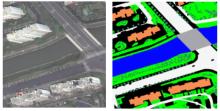
Fig.1
Example of similar objects feature
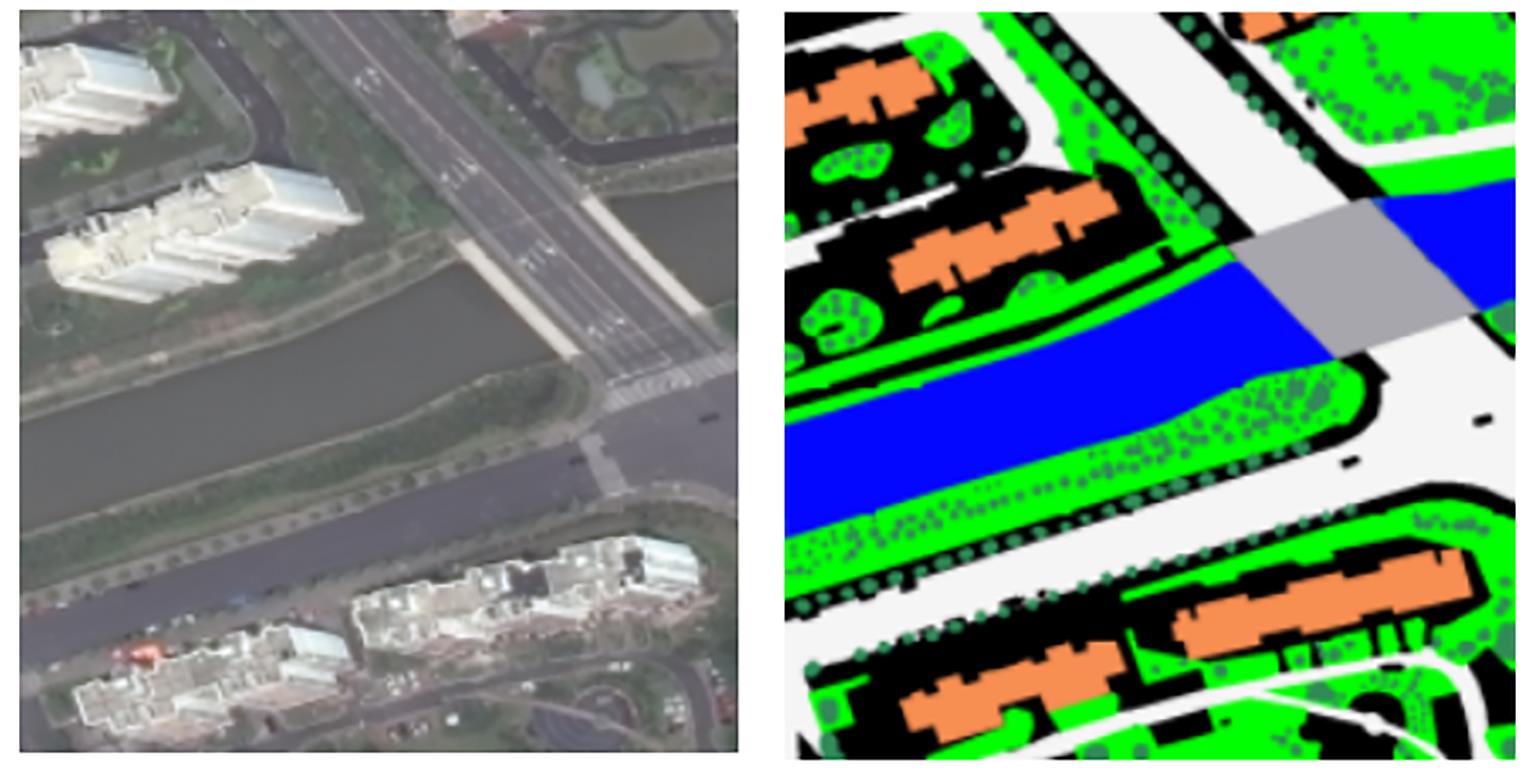
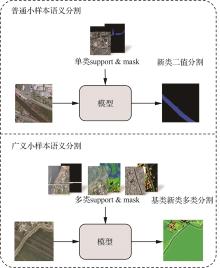
Fig.2
Comparision of few shot and generalized few-shot setting
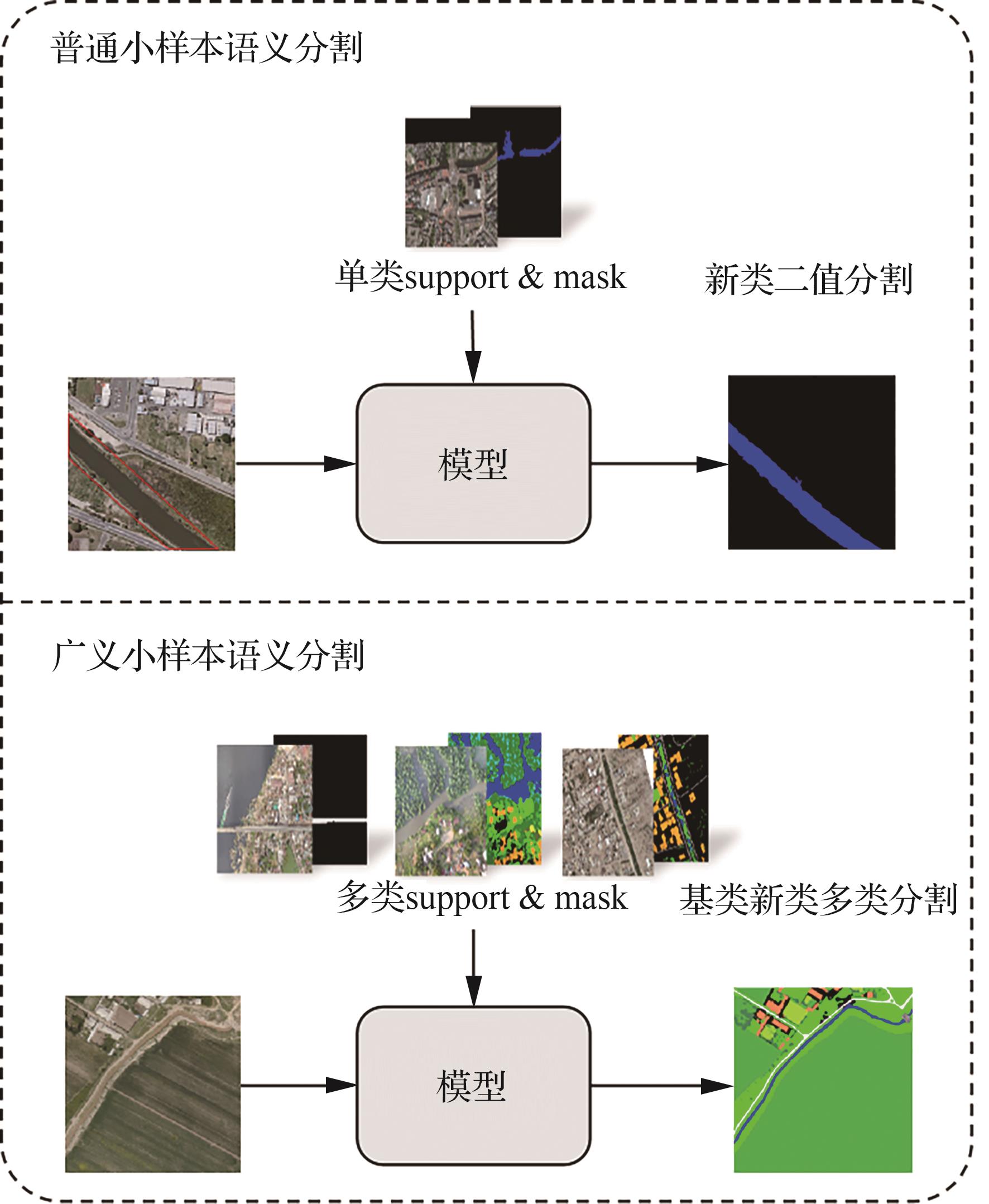
Fig.3
Network architecture
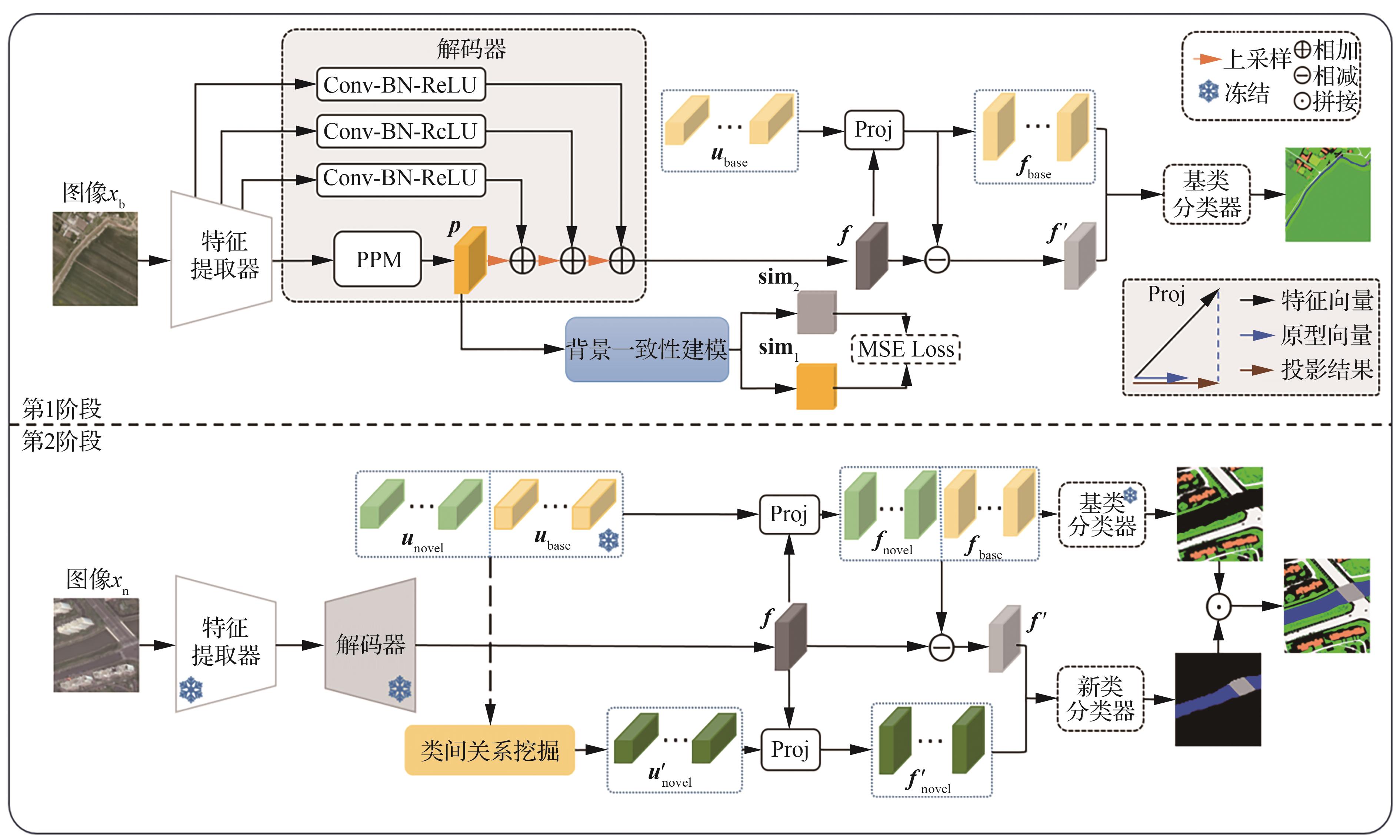
Fig.4
Consistent background modeling
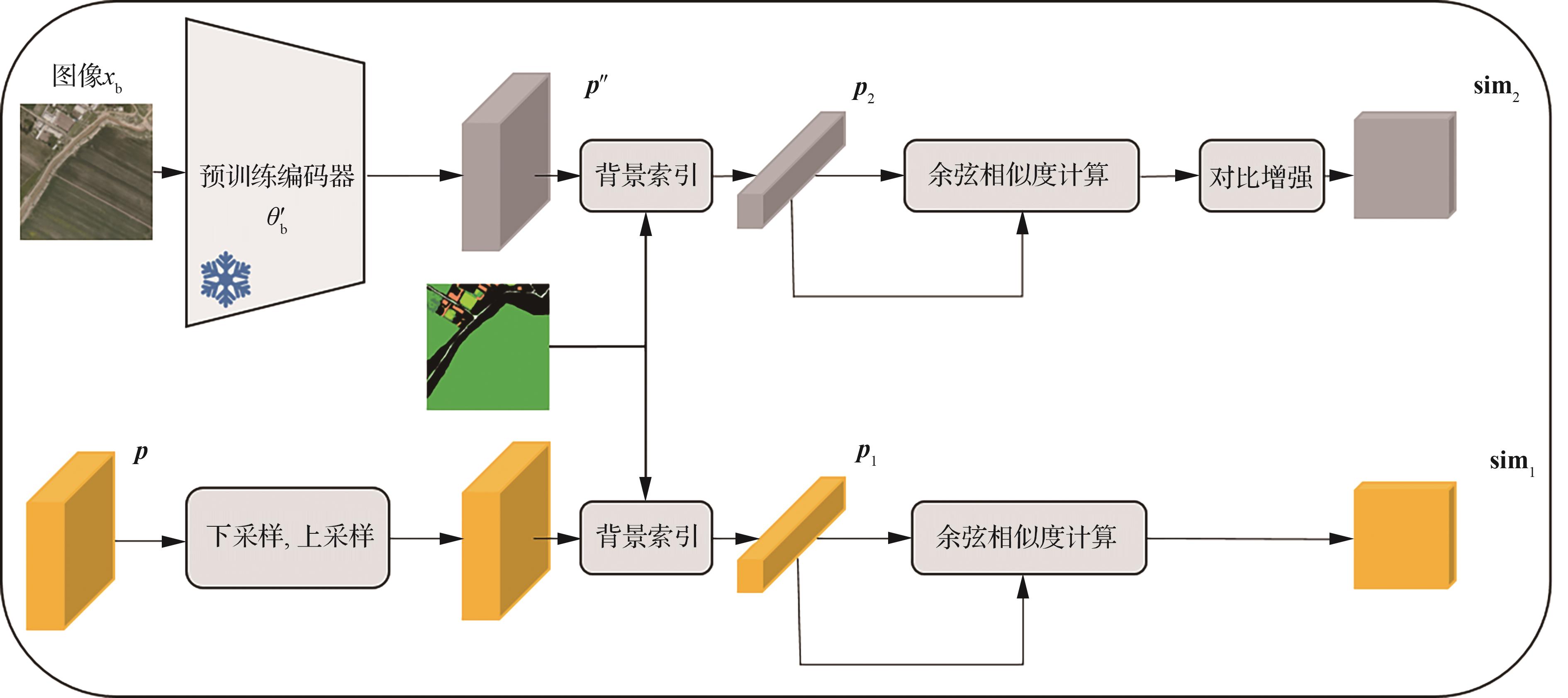
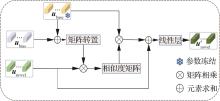
Fig.5
Inter-class relationship mining
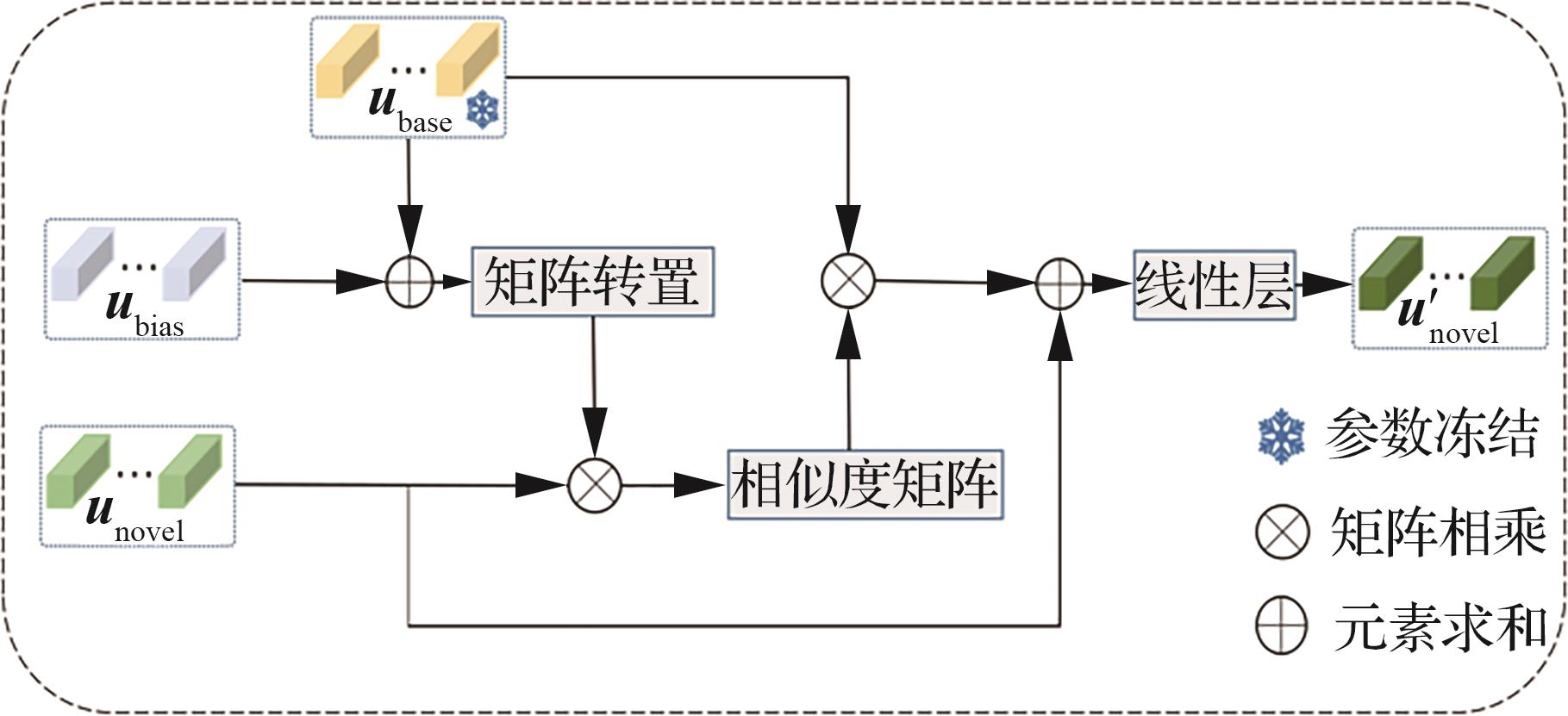

Table 1
OpenEarthMap experiments results
| 方法 | 来源 | 编码器 | 基类mIoU/% | 新类mIoU/% | W-mIoU/% |
|---|---|---|---|---|---|
| CAPL | CVPR’22 | Resnet50 | 21.57 | 5.38 | 11.86 |
| DIaM | CVPR’23 | Resnet50 | 29.48 | 3.18 | 13.70 |
| POP | CVPR’23 | Resnet50 | 30.10 | 4.90 | 14.98 |
| HBNC | IJCV’24 | Resnet50 | 21.25 | 3.65 | 10.69 |
| 本文方法 | Resnet50 | 34.13 | 10.69 | 20.07 | |
| 本文方法 | Swin-S | 44.83 | 14.21 | 26.46 |
Table 2
iSAID experiments results
| 方法 | 来源 | 编码器 | 基类mIoU/% | 新类mIoU/% | W-mIoU/ % |
|---|---|---|---|---|---|
| POP | CVPR’23 | Resnet50 | 37.18 | 4.91 | 17.82 |
| 本文方法 | Resnet50 | 37.14 | 14.69 | 23.67 |
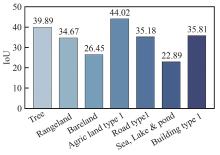
Fig.6
Base class performance distribution diagram
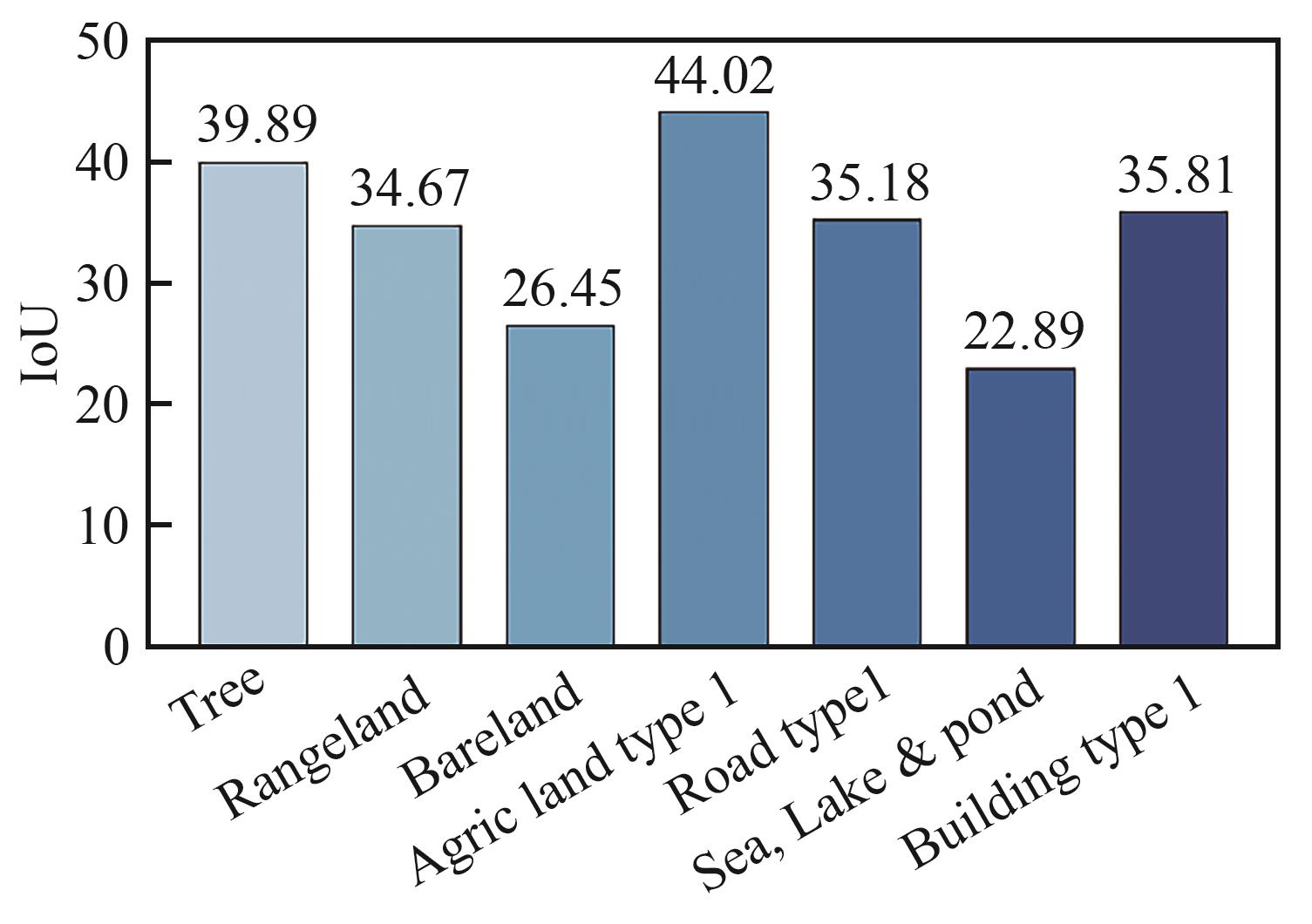
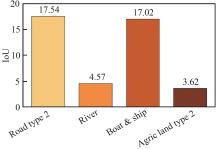
Fig.7
Noval class performance distribution diagram
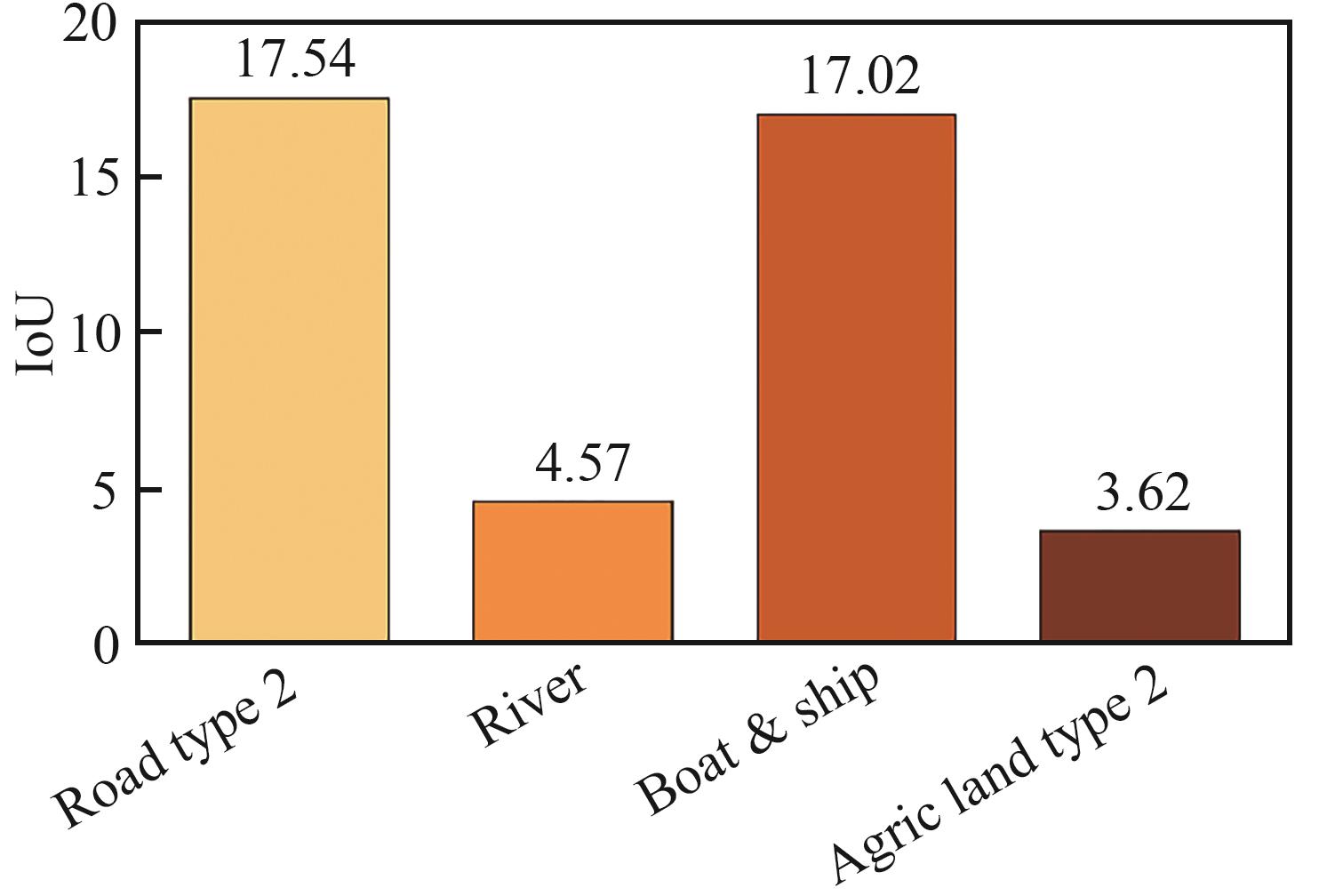
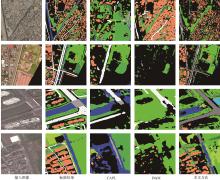
Fig.8
Visual comparison of the proposed method and comparison methods
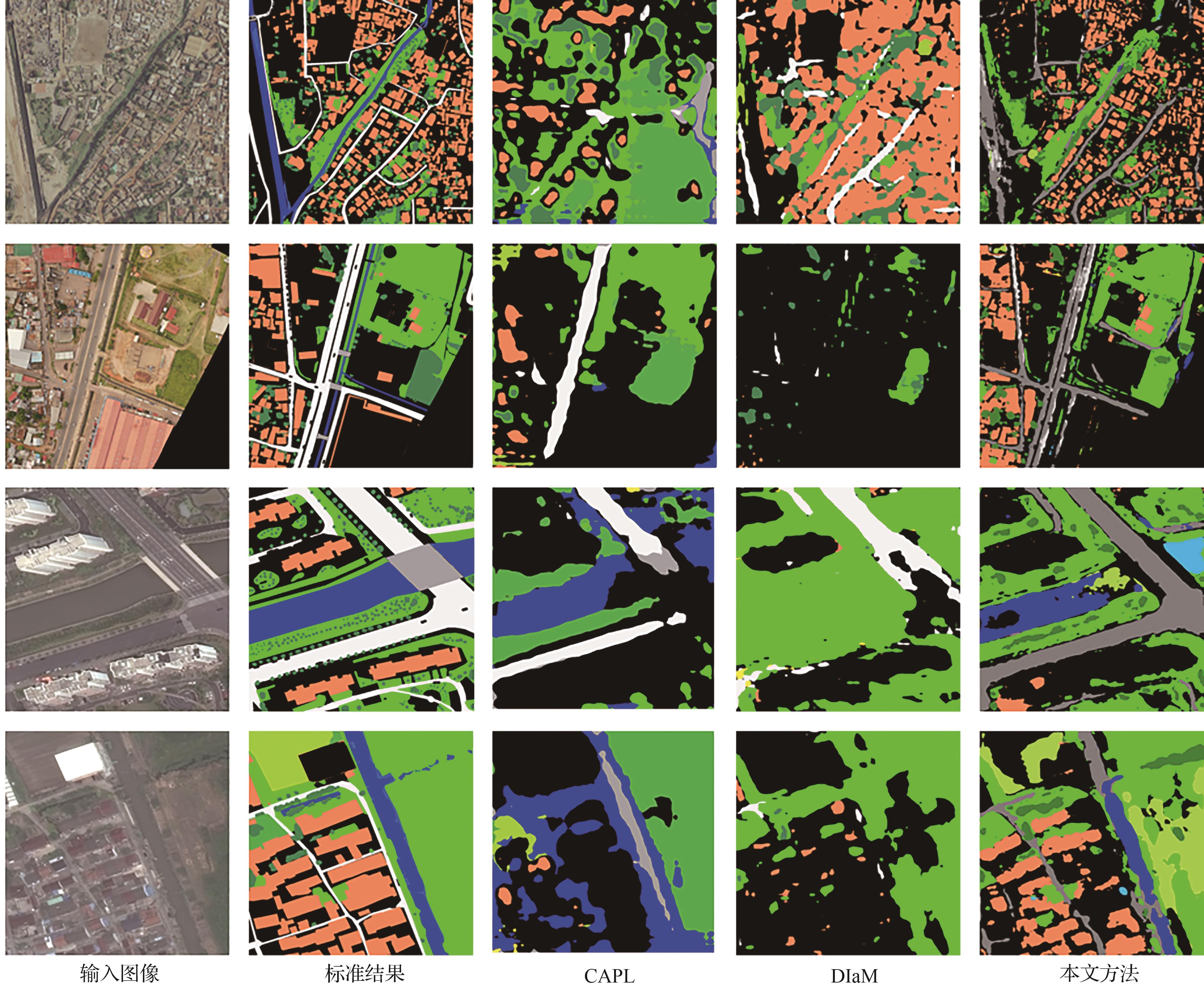
Table 3
Ablation experiments results
| MFD | CBM | IRM | 基类mIoU/% | 新类mIoU/% | W-mIoU/% |
|---|---|---|---|---|---|
| × | × | × | 38.31 | 12.09 | 22.58 |
| √ | × | × | 42.46 | 12.71 | 24.61 |
| √ | × | √ | 42.69 | 13.35 | 25.09 |
| √ | √ | × | 44.90 | 12.69 | 25.57 |
| √ | √ | √ | 44.83 | 14.21 | 26.46 |
| [1] | DIAKOGIANNIS F I, WALDNER F, CACCETTA P, et al. ResUNet-a: A deep learning framework for semantic segmentation of remotely sensed data[J]. ISPRS Journal of Photogrammetry and Remote Sensing, 2020, 162: 94-114. |
| [2] | 罗旭东, 吴一全, 陈金林. 无人机航拍影像目标检测与语义分割的深度学习方法研究进展[J]. 航空学报, 2024, 45(6): 028822. |
| LUO X D, WU Y Q, CHEN J L. Research progress on deep learning methods for object detection and semantic segmentation in UAV aerial images[J]. Acta Aeronautica et Astronautica Sinica, 2024, 45(6): 028822 (in Chinese). | |
| [3] | 张文凯, 刘文杰, 孙显, 等. 多源特征自适应融合网络的高分遥感影像语义分割[J]. 中国图象图形学报, 2022, 27(8): 2516-2526. |
| ZHANG W K, LIU W J, SUN X, et al. Multi-source features adaptation fusion network for semantic segmentation in high-resolution remote sensing images[J]. Journal of Image and Graphics, 2022, 27(8): 2516-2526 (in Chinese). | |
| [4] | 杨俊俐, 姜志国, 周全, 等. 基于条件随机场的遥感图像语义标注[J]. 航空学报, 2015, 36(9): 3069-3081. |
| YANG J L, JIANG Z G, ZHOU Q, et al. Remote sensing image semantic labeling based on conditional random field[J]. Acta Aeronautica et Astronautica Sinica, 2015, 36(9): 3069-3081 (in Chinese). | |
| [5] | HUA Y S, MARCOS D, MOU L C, et al. Semantic segmentation of remote sensing images with sparse annotations[J]. IEEE Geoscience and Remote Sensing Letters, 2021, 19: 8006305. |
| [6] | SONG N, ZHANG C, LIN G S. Few-shot open-set recognition using background as unknowns[C]∥Proceedings of the 30th ACM International Conference on Multimedia. New York: ACM, 2022: 5970-5979. |
| [7] | ZHANG Y, YANG J W, TIAN J, et al. Modality-aware mutual learning for multi-modal medical image segmentation[M]∥Medical Image Computing and Computer Assisted Intervention-MICCAI 2021. Cham: Springer International Publishing, 2021: 589-599. |
| [8] | 文贡坚, 王润生. 从航空遥感图像中自动提取主要道路[J]. 软件学报, 2000, 11(7): 957-964. |
| WEN G J, WANG R S. Automatic extraction of main roads from aerial remote sensing images[J]. Journal of Software, 2000, 11(7): 957-964 (in Chinese). | |
| [9] | SPASEV V, DIMITROVSKI I, KITANOVSKI I, et al. Semantic segmentation of remote sensing images: definition, methods, datasets and applications[M]∥ICT Innovations 2023. Learning: Humans, Theory, Machines, and Data. Cham: Springer Nature Switzerland, 2024: 127-140. |
| [10] | WANG K X, LIEW J H, ZOU Y T, et al. PANet: Few-shot image semantic segmentation with prototype alignment[C]∥2019 IEEE/CVF International Conference on Computer Vision (ICCV). Piscataway: IEEE Press, 2019: 9196-9205. |
| [11] | FAN Q, PEI W J, TAI Y W, et al. Self-support few-shot semantic segmentation[M]∥Computer Vision-ECCV 2022. Cham: Springer Nature Switzerland, 2022: 701-719. |
| [12] | PENG B H, TIAN Z T, WU X Y, et al. Hierarchical dense correlation distillation for few-shot segmentation[C]∥2023 IEEE/CVF Conference on Computer Vision and Pattern Recognition (CVPR). Piscataway: IEEE Press, 2023: 23641-23651. |
| [13] | WANG J, LI J Y, CHEN C, et al. Adaptive FSS: a novel few-shot segmentation framework via prototype enhancement[J]. Proceedings of the AAAI Conference on Artificial Intelligence, 2024, 38(6): 5463-5471. |
| [14] | VILALTA R, DRISSI Y. A perspective view and survey of meta-learning[J]. Artificial Intelligence Review, 2002, 18(2): 77-95. |
| [15] | ZHUANG F Z, QI Z Y, DUAN K Y, et al. A comprehensive survey on transfer learning[J]. Proceedings of the IEEE, 2021, 109(1): 43-76. |
| [16] | KANG D, CHO M. Integrative few-shot learning for classification and segmentation[C]∥2022 IEEE/CVF Conference on Computer Vision and Pattern Recognition (CVPR). Piscataway: IEEE Press, 2022: 9969-9980. |
| [17] | TIAN Z T, LAI X, JIANG L, et al. Generalized few-shot semantic segmentation[C]∥2022 IEEE/CVF Conference on Computer Vision and Pattern Recognition (CVPR). Piscataway: IEEE Press, 2022: 11553-11562. |
| [18] | HAJIMIRI S, BOUDIAF M, AYED I BEN, et al. A strong baseline for generalized few-shot semantic segmentation[C]∥2023 IEEE/CVF Conference on Computer Vision and Pattern Recognition (CVPR). Piscataway: IEEE Press, 2023: 11269-11278. |
| [19] | LIU S N, ZHANG Y H, QIU Z F, et al. Learning orthogonal prototypes for generalized few-shot semantic segmentation[C]∥2023 IEEE/CVF Conference on Computer Vision and Pattern Recognition (CVPR). Piscataway: IEEE Press, 2023: 11319-11328. |
| [20] | LIU W D, WU Z H, ZHAO Y, et al. Harmonizing base and novel classes: A class-contrastive approach for generalized few-shot segmentation[J]. International Journal of Computer Vision, 2024, 132(4): 1277-1291. |
| [21] | BRONI-BEDIAKO C, XIA J S, SONG J, et al. Generalized few-shot semantic segmentation in remote sensing: Challenge and benchmark[J]. IEEE Geoscience and Remote Sensing Letters, 2024, 21: 8003905. |
| [22] | LI Z H, LU F X, ZOU J Q, et al. Generalized few-shot meets remote sensing: Discovering novel classes in land cover mapping via hybrid semantic segmentation framework[C]∥2024 IEEE/CVF Conference on Computer Vision and Pattern Recognition Workshops (CVPRW). Piscataway: IEEE Press, 2024: 2744-2754. |
| [23] | GAO T Y, AO W, WANG X G, et al. Enrich, distill and fuse: Generalized few-shot semantic segmentation in remote sensing leveraging foundation model’s assistance[C]∥2024 IEEE/CVF Conference on Computer Vision and Pattern Recognition Workshops (CVPRW). Piscataway: IEEE Press, 2024: 2771-2780. |
| [24] | ZHU J G, TANG S X, CHEN D P, et al. Complementary relation contrastive distillation[C]∥2021 IEEE/CVF Conference on Computer Vision and Pattern Recognition (CVPR). Piscataway: IEEE Press, 2021: 9256-9265. |
| [25] | 赵翔, 李洪双. 基于交叉熵和空间分割的全局可靠性灵敏度分析[J]. 航空学报, 2018, 39(2): 221570. |
| ZHAO X, LI H S. Global reliability sensitivity analysis using cross entropy method and space partition[J]. Acta Aeronautica et Astronautica Sinica, 2018, 39(2): 221570 (in Chinese). | |
| [26] | XIA J S, YOKOYA N, ADRIANO B, et al. Open-EarthMap: A benchmark dataset for global high-resolution land cover mapping[C]∥2023 IEEE/CVF Winter Conference on Applications of Computer Vision (WACV). Piscataway: IEEE Press, 2023: 6243-6253. |
| [27] | SYED W Z, ARORA A, GUPTA A, et al. iSAID: A larg-e-scale dataset for instance segmentation in aerial images[DB/OL].arXiv preprint, 1905.12886, 2019. |
| [28] | HE K M, ZHANG X Y, REN S Q, et al. Deep residual learning for image recognition[C]∥2016 IEEE Conference on Computer Vision and Pattern Recognition (CVPR). Piscataway: IEEE Press, 2016: 770-778. |
| [29] | LIU Z, LIN Y T, CAO Y, et al. Swin transformer: hierarchical vision transformer using shifted windows[C]∥2021 IEEE/CVF International Conference on Computer Vision (ICCV). Piscataway: IEEE Press, 2021: 9992-10002. |
| [1] | Fujie WU, Bowen WANG, Jingya QI, Mingzhi CAO, Yingjun SANG, Sheng LI, Yuzhen ZHANG, Qian CHEN, Chao ZUO. A review of airborne multi-aperture panoramic image compositing [J]. Acta Aeronautica et Astronautica Sinica, 2025, 46(3): 630505-630505. |
| [2] | Jiaxin LI, Shuaishuai LYU, Yezi WANG, Yu YANG, Ziyue LI. Transformer-based intelligent tracking method of aviation structure surface cracks [J]. Acta Aeronautica et Astronautica Sinica, 2025, 46(21): 532355-532355. |
| [3] | Bin SUN, Hang YOU, Wenbo LI, Xiangrui LIU, Jiayi MA. Dual-band payload image fusion and its applications in low-altitude remote sensing [J]. Acta Aeronautica et Astronautica Sinica, 2025, 46(11): 531343-531343. |
| [4] | Fanteng MENG, Yong QIN, Jing CUI, Yunpeng WU, Zicheng ZHANG, Shaowei WEI. Unknown risk detection in external environment of railroad using UAV images [J]. Acta Aeronautica et Astronautica Sinica, 2025, 46(11): 531262-531262. |
| [5] | Qichang ZHAO, Yiquan WU, Yubin YUAN. Progress of ship detection and recognition methods in optical remote sensing images [J]. Acta Aeronautica et Astronautica Sinica, 2024, 45(8): 29025-029025. |
| [6] | Xudong LUO, Yiquan WU, Jinlin CHEN. Research progress on deep learning methods for object detection and semantic segmentation in UAV aerial images [J]. Acta Aeronautica et Astronautica Sinica, 2024, 45(6): 28822-028822. |
| [7] | Ziling WANG, Zhenyu XIONG, Lucheng YANG, Ruining YANG, Linzhou HUANG. Spaceborne SAR ship target recognition network guided by AIS and optical remote sensing images [J]. Acta Aeronautica et Astronautica Sinica, 2024, 45(2): 328672-328672. |
| [8] | Yanfang LIU, Jiayu SHE, Qiufan YUAN, Rui ZHOU, Naiming QI. Real⁃time small target detection networks for UAV remote sensing [J]. Acta Aeronautica et Astronautica Sinica, 2024, 45(14): 630119-630119. |
| [9] | Xinlin XIAO, Weichao SHI, Xiangtao ZHENG, Yueming GAO, Xiaoqiang LU. Multiple models collaboration for ship detection [J]. Acta Aeronautica et Astronautica Sinica, 2024, 45(14): 630241-630241. |
| [10] | Xin SU, Runcheng GUAN, Qiao WANG, Weizheng YUAN, Xianglian LYU, Yang HE. Ice area and thickness detection method based on deep learning [J]. Acta Aeronautica et Astronautica Sinica, 2023, 44(S2): 729283-729283. |
| [11] | Liqun CHEN, Xu ZOU, Lei ZHANG, Yingpan ZHU, Gang WANG, Jinyong CHEN. On⁃board intelligent target detection technology based on domestic commercial components [J]. Acta Aeronautica et Astronautica Sinica, 2023, 44(S2): 728860-728860. |
| [12] | Zhenyu XIONG, Yaqi CUI, Kai DONG, Mengyang LI, Wei XIONG. Interpretable fusion association network for multi-source remote sensing ship target based on attribute guidance [J]. Acta Aeronautica et Astronautica Sinica, 2023, 44(22): 627476-627476. |
| [13] | Xiaohang LI, Jianjiang ZHOU. Multi⁃scale modality fusion network based on adaptive memory length [J]. Acta Aeronautica et Astronautica Sinica, 2023, 44(22): 628977-628977. |
| [14] | WANG Ziling, XIONG Zhenyu, GU Xiangqi. Correlation learning algorithm of visible light and SAR cross modal remote sensing images [J]. ACTA AERONAUTICAET ASTRONAUTICA SINICA, 2022, 43(S1): 727239-727239. |
| [15] | LIU Jingyu, CUI Yufu, XU Meng, HE Hongyan, YIN Huan, WANG Yu. Image restoration method for TDICCD camera with micro vibration [J]. ACTA AERONAUTICAET ASTRONAUTICA SINICA, 2018, 39(S1): 722230-722230. |
| Viewed | ||||||
|
Full text |
|
|||||
|
Abstract |
|
|||||
Address: No.238, Baiyan Buiding, Beisihuan Zhonglu Road, Haidian District, Beijing, China
Postal code : 100083
E-mail:hkxb@buaa.edu.cn
Total visits: 6658907 Today visits: 1341All copyright © editorial office of Chinese Journal of Aeronautics
All copyright © editorial office of Chinese Journal of Aeronautics
Total visits: 6658907 Today visits: 1341

 CJA
CJA
