Acta Aeronautica et Astronautica Sinica ›› 2025, Vol. 46 ›› Issue (9): 231167.doi: 10.7527/S1000-6893.2024.31167
• Fluid Mechanics and Flight Mechanics • Previous Articles
Xiaoyuan ZHANG1, Jinping LI1( ), Hu MA2, Shizhong ZHANG1, Shuo CHEN2, Xingyu LU1
Received:2024-09-09
Revised:2024-09-27
Accepted:2024-10-24
Online:2024-11-04
Published:2024-11-04
Contact:
Jinping LI
E-mail:lijinping@imech.ac.cn
Supported by:CLC Number:
Xiaoyuan ZHANG, Jinping LI, Hu MA, Shizhong ZHANG, Shuo CHEN, Xingyu LU. Experimental initiation process of oblique detonation wave in combustion chamber under high Mach number conditions[J]. Acta Aeronautica et Astronautica Sinica, 2025, 46(9): 231167.

Fig.1
Schematic diagram of detonation-driven shock tunnel direct-connect experiment system


Fig.2
Schematic diagram of the operational principle of reverse detonation-driven shock tunnel


Fig.3
Tunnel stagnation pressure and fuel injection pressure during test


Fig.4
Structure of oblique detonation test model


Fig.5
Mach number distribution in fuel injection and mixing section


Fig.6
Vertical parameter distribution at the exit cross-section of mixing section

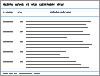
Table 1
Central region airflow parameters
| 物理量 | 数值 |
|---|---|
| 当量比 | 0.49 |
| 速度/(m·s-1) | 2 155 |
| 马赫数 | 3.58 |
| 静温/K | 952 |
| 静压/bar | 0.442 |
| 比热比 | 1.32 |

Fig.7
Image of oblique detonation wave


Fig.8
Object detonation polar curves and experimental results


Fig.9
Wall pressure of oblique wedge


Fig.10
High-speed shadow imaging and high-speed photography of oblique detonation waves

| 1 | LEE J H S. The detonation phenomenon[M]. Cambridge: Cambridge University Press, 2008: 73-83. |
| 2 | KAILASANATH K. Review of propulsion applications of detonation waves[J]. AIAA Journal, 2000, 38(9): 1698-1708. |
| 3 | MA J Z, LUAN M Y, XIA Z J, et al. Recent progress, development trends, and consideration of continuous detonation engines[J]. AIAA Journal, 2020, 58(12): 4976-5035. |
| 4 | 范宝春, 张旭东, 潘振华, 等. 用于推进的三种爆轰波的结构特征[J]. 力学进展, 2012, 42(2): 162-169. |
| FAN B C, ZHANG X D, PAN Z H, et al. Fundamental characteristics of three types of detonation waves utilized in propulsion[J]. Advances in Mechanics, 2012, 42(2): 162-169 (in Chinese). | |
| 5 | 谭风光, 王可, 于潇栋, 等. 无阀式脉冲爆震火箭发动机运行稳定性实验[J]. 航空学报, 2021, 42(3): 225-236. |
| TAN F G, WANG K, YU X D, et al. Experiment on operation stability of valveless pulse detonation rocket engine[J]. Acta Aeronautica et Astronautica Sinica, 2021, 42(3): 225-236 (in Chinese). | |
| 6 | 刘卫东, 彭皓阳, 刘世杰, 等 .旋转爆震燃烧及应用研究进展[J]. 航空学报, 2023, 44(15): 528875. |
| LIU W D, PENG H Y, LIU S J, et al. Research progresses of rotating detonation combustion and its application[J]. Acta Aeronautica et Astronautica Sinica, 2023, 44(15): 528875 (in Chinese). | |
| 7 | WU W B, WANG Y N, HAN W B, et al. Experimental research on solid fuel pre-combustion rotating detonation engine[J]. Acta Astronautica, 2023, 205: 258-266. |
| 8 | ROSATO D A, THORNTON M, SOSA J, et al. Stabilized detonation for hypersonic propulsion[J]. Proceedings of the National Academy of Sciences of the United States of America, 2021, 118(20): e2102244118. |
| 9 | 苗世坤, 周进, 刘彧, 等. 超声速气流中的斜爆震研究进展综述[J]. 实验流体力学, 2019, 33(1): 41-53. |
| MIAO S K, ZHOU J, LIU Y, et al. Review of studies on oblique detonation waves in supersonic flows[J]. Journal of Experiments in Fluid Mechanics, 2019, 33(1): 41-53 (in Chinese). | |
| 10 | JIANG Z L. Standing oblique detonation for hypersonic propulsion: A review[J]. Progress in Aerospace Sciences, 2023, 143: 100955. |
| 11 | DUNLAP R, BREHM R L, NICHOLLS J A. A preliminary study of the application of steady-state detonative combustion to a reaction engine[J]. Journal of Jet Propulsion, 1958, 28(7): 451-456. |
| 12 | GROSS R A. Oblique detonation waves[J]. AIAA Journal, 1963, 1(5): 1225-1227. |
| 13 | VALORANI M, DI GIACINTO M, BUONGIORNO C. Performance prediction for oblique detonation wave engines (odwe)[J]. Acta Astronautica, 2001, 48(4): 211-228. |
| 14 | 熊皓晨, 邱若凡, 韩信, 等. 一种弯曲激波诱导爆震的起爆新方式[J]. 航空学报, 2024, 45(18): 50-62. |
| XIONG H C, QIU R F, HAN X, et al. New method for detonation initiation induced by curved shock wave[J]. Acta Aeronautica et Astronautica Sinica, 2024, 45(18): 50-62 (in Chinese). | |
| 15 | 黄恩, 史爱明. 斜爆轰波总压规律及其在爆轰发动机分析模型中的应用[J]. 力学学报, 2023, 55(9): 1892-1899. |
| HUANG E, SHI A M. The law of total pressure of oblique detonation wave and its application in detonation engine analysis model[J]. Chinese Journal of Theoretical and Applied Mechanics, 2023, 55(9): 1892-1899 (in Chinese). | |
| 16 | RADULESCU M I, HIGGINS A J, MURRAY S B, et al. An experimental investigation of the direct initiation of cylindrical detonations[J]. Journal of Fluid Mechanics, 2003, 480: 1-24. |
| 17 | VERREAULT J, HIGGINS A J. Initiation of detonation by conical projectiles[J]. Proceedings of the Combustion Institute, 2011, 33(2): 2311-2318. |
| 18 | QIN J X, ZHU D H. Criticality for oblique detonation waves induced by a finite wedge in a hydrogen–air mixture[J]. Aerospace, 2023, 10(6): 508. |
| 19 | PRATT D T, HUMPHREY J W, GLENN D E. Morphology of standing oblique detonation waves[J]. Journal of Propulsion and Power, 1991, 7(20): 837-845. |
| 20 | 滕宏辉, 姜宗林. 斜爆轰的多波结构及其稳定性研究进展[J]. 力学进展, 2020, 50(1): 202002. |
| TENG H H, JIANG Z L. Progress in multi-wave structure and stability of oblique detonations[J]. Advances in Mechanics, 2020, 50(1): 202002 (in Chinese). | |
| 21 | WALTER M A T, SILVA L F F DA. Numerical study of detonation stabilization by finite length wedges[J]. AIAA Journal, 2006, 44(2): 353-361. |
| 22 | LIU Y, LIU Y S, WU D, et al. Structure of an oblique detonation wave induced by a wedge[J]. Shock Waves, 2016, 26(2): 161-168. |
| 23 | TENG H H, TIAN C, ZHANG Y N, et al. Morphology of oblique detonation waves in a stoichiometric hydrogen-air mixture[J]. Journal of Fluid Mechanics, 2021, 913: A1. |
| 24 | VERREAULT J, HIGGINS A J, STOWE R A. Formation and structure of steady oblique and conical detonation waves[J]. AIAA Journal, 2012, 50(8): 1766-1772. |
| 25 | 袁生学, 赵伟, 黄志澄. 驻定斜爆轰波的初步实验观察[J]. 空气动力学学报, 2000, 18(4): 473-477. |
| YUAN S X, ZHAO W, HUANG Z C. Primary experimental observation of standing oblique detonation waves[J]. Acta Aerodynamica Sinica, 2000, 18(4): 473-477 (in Chinese). | |
| 26 | SRULIJES J, SMEETS G, SEILER F. Expansion tube experiments for the investigation of ram-accelerator-related combustion and gasdynamic problems[C]∥28th Joint Propulsion Conference and Exhibit. Reston: AIAA, 1992. |
| 27 | DABORA E, BRODA J C. Standing normal detonations and oblique detonations for propulsion[C]∥29th Joint Propulsion Conference and Exhibit. Reston: AIAA, 1993. |
| 28 | VIGUIER C, SILVA L F F DA, DESBORDES D, et al. Onset of oblique detonation waves: comparison between experimental and numerical results for hydrogen-air mixtures[J]. Symposium (International) on Combustion, 1996, 26(2): 3023-3031. |
| 29 | STERLING J, CUMMINGS E, GHORBANIAN K, et al. Oblique detonation wave studies in the Caltech T-5 Shock Tunnel Facility[C]∥8th AIAA International Space Planes and Hypersonic Systems and Technologies Conference. Reston: AIAA, 1998. |
| 30 | LIN Z Y, ZHANG J Y, ZHOU J. Design of high-enthalpy premixed supersonic heater and experimental study of detonation[C]∥43rd AIAA/ASME/SAE/ASEE Joint Propulsion Conference & Exhibit. Reston: AIAA, 2007. |
| 31 | 张子健, 韩信, 马凯夫, 等. 斜爆轰发动机燃烧机理试验研究[J]. 推进技术, 2021, 42(4): 786-794. |
| ZHANG Z J, HAN X, MA K F, et al. Experimental research on combustion mechanism of oblique detonation engines[J]. Journal of Propulsion Technology, 2021, 42(4): 786-794 (in Chinese). | |
| 32 | JIANG Z L, ZHANG Z J, LIU Y F, et al. Criteria for hypersonic airbreathing propulsion and its experimental verification[J]. Chinese Journal of Aeronautics, 2021, 34(3): 94-104. |
| 33 | YU H R, CHEN H, ZHAO W. Advances in detonation driving techniques for a shock tube/tunnel[J]. Shock Waves, 2006, 15(6): 399-405. |
| 34 | 俞鸿儒. 探索发展激波风洞爆轰驱动技术[J]. 力学学报, 2011, 43(6): 978-983. |
| YU H R. Development study of detonation driving techniques for a shock tunnel[J]. Chinese Journal of Theoretical and Applied Mechanics, 2011, 43(6): 978-983 (in Chinese). | |
| 35 | 崔东明, 范宝春. 用于推进的驻定斜爆轰的基本特征[J]. 宇航学报, 1999, 20(2): 48-54. |
| CUI D M, FAN B C. The essential feature of steady detonation wave using propulsion[J]. Journal of Astronautics, 1999, 20(2): 48-54 (in Chinese). |
| [1] | Feiteng LUO, Zhenming QU, Haitao LI, Xinke LI, Dahao YAO, Wenjuan CHEN, Yaosong LONG, Baoxi WEI, Yanjin MAN, Fujiang YANG, Qiang CHENG, Wubin KONG. Research progress and key issues of inlet pre-injection at hypersonic condition [J]. Acta Aeronautica et Astronautica Sinica, 2025, 46(8): 631189-631189. |
| [2] | Xiaogang ZHENG, Chongguang SHI, Jiale ZHANG, Mi ZHANG, Wenlei ZHU, Chengxiang ZHU, Yancheng YOU. Research progress review on hypersonic three-dimensional inward-turning inlet [J]. Acta Aeronautica et Astronautica Sinica, 2025, 46(8): 631245-631245. |
| [3] | Chengpeng WANG, Chenguang HAO, Hao LI, Longsheng XUE, Yun JIAO, Siyu WU, Zhangyu MA, Ye YUAN, Weijun LI, Puchen HOU. Application of minimum entropy production principle to analysis of shock wave/boundary layer interactions [J]. Acta Aeronautica et Astronautica Sinica, 2025, 46(8): 631458-631458. |
| [4] | Zonglin JIANG, Guilai HAN, Yunpeng WANG, Yunfeng LIU, Chaokai YUAN, Changtong LUO, Chun WANG, Zongmin HU, Meikuan LIU. Theoretical bases and key technologies of JF-22 hypervelocity wind tunnel [J]. Acta Aeronautica et Astronautica Sinica, 2025, 46(5): 531130-531130. |
| [5] | Kai YANG, Mengfei ZHANG, Chongguang SHI, Yaokun YU, Xiaogang ZHENG, Chengxiang ZHU, Yancheng YOU. Method of three-dimensional curved stream-surface and its application in external waverider [J]. Acta Aeronautica et Astronautica Sinica, 2025, 46(2): 130492-130492. |
| [6] | Luoyu RAO, Tao ZHANG, Chongguang SHI, Chengxiang ZHU, Yancheng YOU. Effects of sideslip angle on shock wave interference structure of V-shaped blunt leading edge [J]. Acta Aeronautica et Astronautica Sinica, 2025, 46(2): 130681-130681. |
| [7] | Dong LI, Yining ZHANG, Wenhui LING, Guozhu LIANG, Hao MENG. Inlet flow characteristics analysis of air-breathing rotating detonation engine [J]. Acta Aeronautica et Astronautica Sinica, 2025, 46(2): 130732-130732. |
| [8] | Tao LIANG, Wanwu XU, Zhiyan LI, Saiqiang ZHANG, Gang LI, Dongdong ZHANG. Starting and operating characteristics of precooled supersonic ejector [J]. Acta Aeronautica et Astronautica Sinica, 2025, 46(2): 130701-130701. |
| [9] | Guangning LI, Kunpeng LEI, Xiaomin AN, Min XU, Yong XU. Numerical flight simulation of an airfoil with time varing Mach number effect acrossing transonic region [J]. Acta Aeronautica et Astronautica Sinica, 2024, 45(S1): 730875-730875. |
| [10] | Wenchang WU, Xingsi HAN, Yaobing MIN, Zhenguo YAN, Yankai MA. Sixth-order low-dissipation WCNS-CU6-ST scheme based on smooth TENO nonlinear weight [J]. Acta Aeronautica et Astronautica Sinica, 2024, 45(S1): 730598-730598. |
| [11] | Wei XIE, Zhenbing LUO, Yan ZHOU, Qiang LIU, Jianjun WU, Hao DONG. Double wedge shock interaction control using steady jet in hypersonic flow: Experimental study [J]. Acta Aeronautica et Astronautica Sinica, 2024, 45(7): 128813-128813. |
| [12] | Hongbo WANG, Yu ZENG, Dapeng XIONG, Yixin YANG, Mingbo SUN. Improvement of shock wave and compressibility effects in SST turbulence model [J]. Acta Aeronautica et Astronautica Sinica, 2024, 45(3): 128694-128694. |
| [13] | Yu ZHU, Jianhui CHENG, Cheng CHEN, Hexia HUANG, Huijun TAN. Mechanism of Bump inlet stable working at supersonic speed [J]. Acta Aeronautica et Astronautica Sinica, 2024, 45(24): 130408-130408. |
| [14] | Zhihao ZHU, Xiuming SUI, Jian PU, Long HAO, Wei ZHAO, Qingjun ZHAO. Aerodynamic load of multistage vaneless counterrotating turbine under wake/shock rotor/rotor interactions [J]. Acta Aeronautica et Astronautica Sinica, 2024, 45(24): 630582-630582. |
| [15] | Xuechen XI, Shuzhen NIU, Pengfei YANG, Wenqiang DU, Guosheng HE, Honghui TENG. Dynamic response characteristics of wave systems to wedge control in hydrogen-fueled oblique detonation engines [J]. Acta Aeronautica et Astronautica Sinica, 2024, 45(22): 130275-130275. |
| Viewed | ||||||
|
Full text |
|
|||||
|
Abstract |
|
|||||
Address: No.238, Baiyan Buiding, Beisihuan Zhonglu Road, Haidian District, Beijing, China
Postal code : 100083
E-mail:hkxb@buaa.edu.cn
Total visits: 6658907 Today visits: 1341All copyright © editorial office of Chinese Journal of Aeronautics
All copyright © editorial office of Chinese Journal of Aeronautics
Total visits: 6658907 Today visits: 1341

 CJA
CJA
