Acta Aeronautica et Astronautica Sinica ›› 2025, Vol. 46 ›› Issue (9): 131261.doi: 10.7527/S1000-6893.2024.31261
• Fluid Mechanics and Flight Mechanics • Previous Articles
Shiqi WANG1( ), Qinglan WEN2,3, Peng ZHAO1, Yixin CHENG1,4, Liang MA5, Zhigang JIA1, Quan WEN1
Received:2024-09-24
Revised:2024-10-09
Accepted:2024-10-25
Online:2024-11-06
Published:2024-10-29
Contact:
Shiqi WANG
E-mail:wangsq6@126.com
Supported by:CLC Number:
Shiqi WANG, Qinglan WEN, Peng ZHAO, Yixin CHENG, Liang MA, Zhigang JIA, Quan WEN. Experiments on afterburner combustion performance with self-excited sweeping nozzle in high speed and medium temperature air flow[J]. Acta Aeronautica et Astronautica Sinica, 2025, 46(9): 131261.
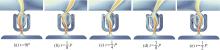
Fig.1
Flow channels and flow structure inside self-excited sweeping nozzle
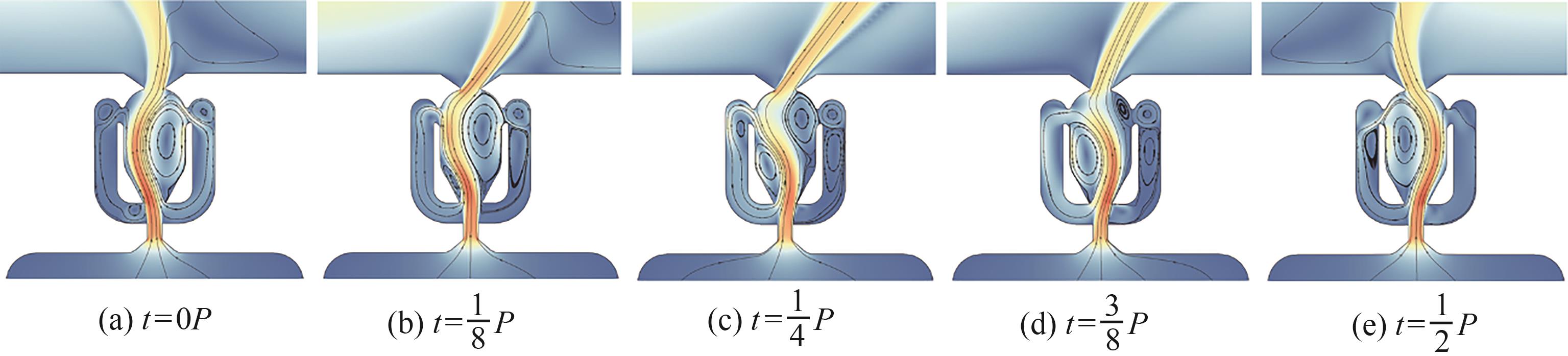
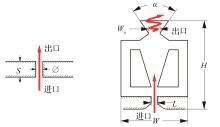
Fig.2
Comparison of flow channels between plain-orifice nozzle and self-excited sweeping nozzle
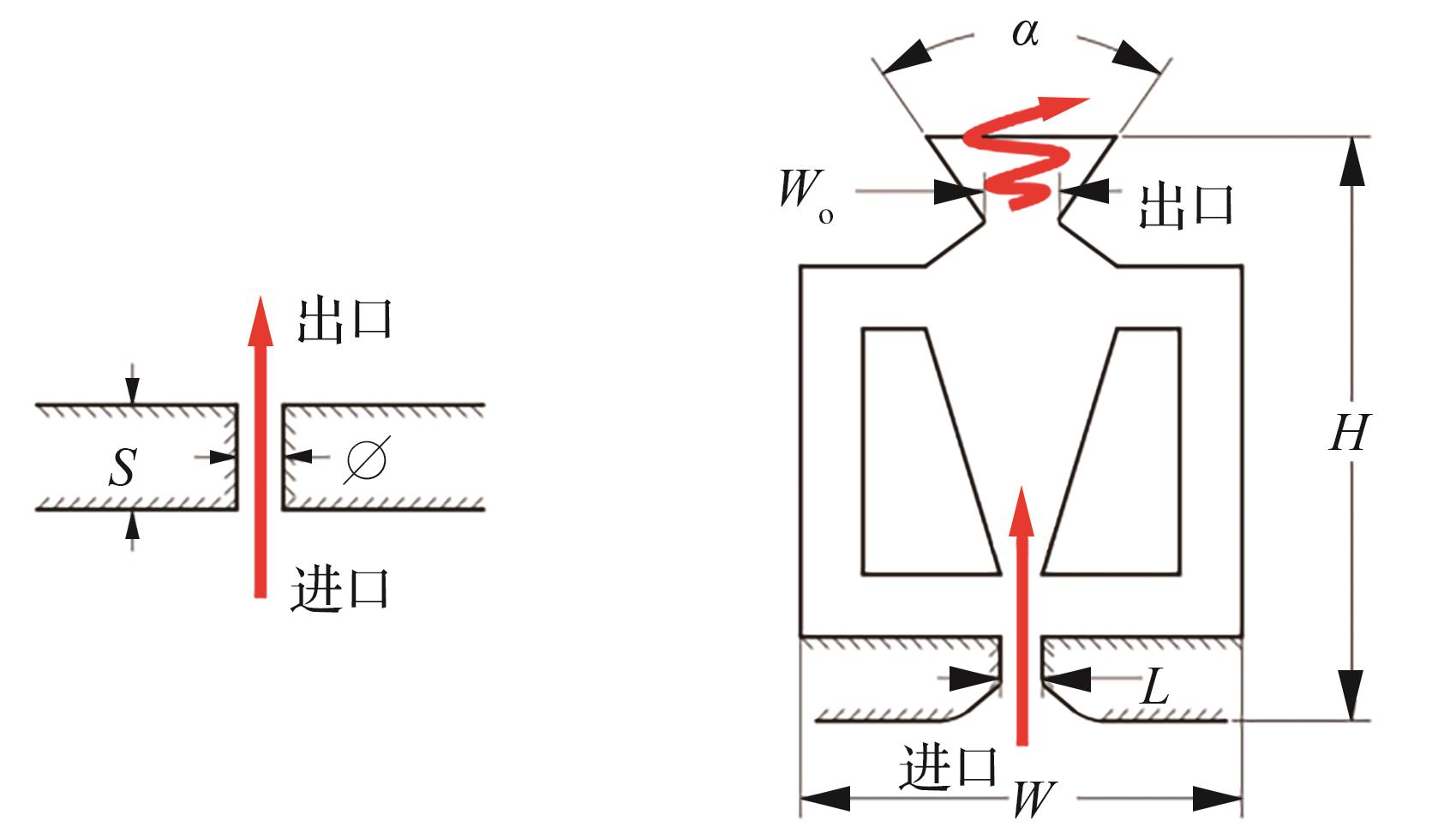
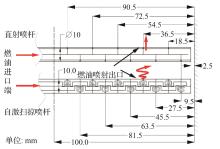
Fig.3
Comparison of internal structure betweentraditional plain-orifice spray bar and self-excited sweeping spray bar
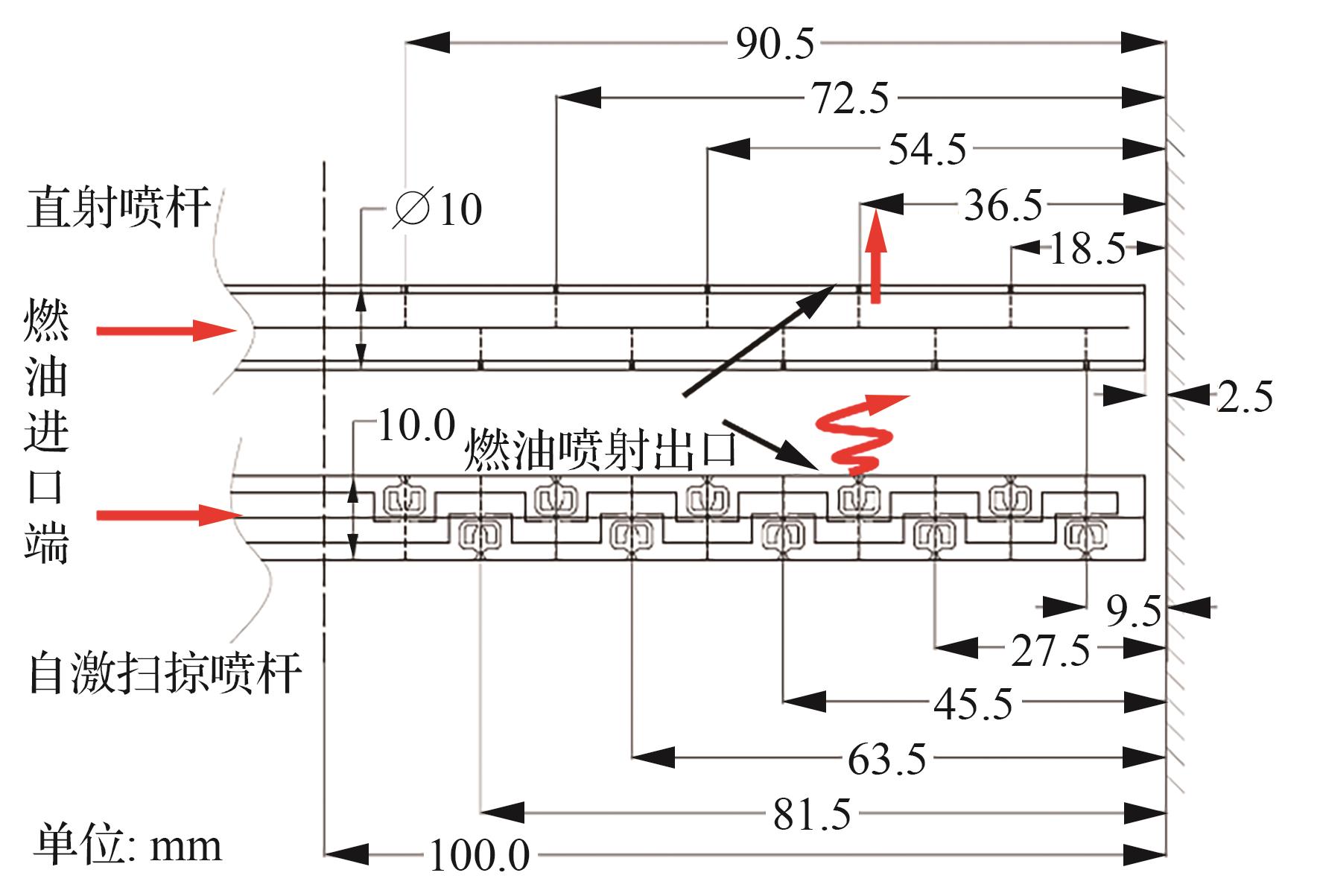
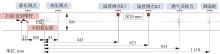
Fig.4
Structure of rectangular afterburner test bench
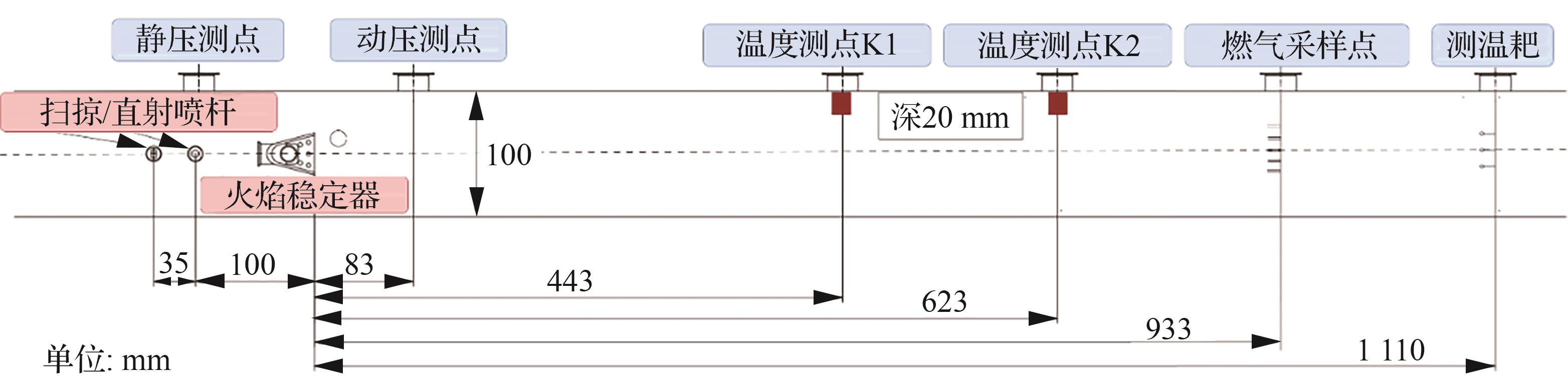
Fig.5
Rectangular afterburner combustion performance test bench
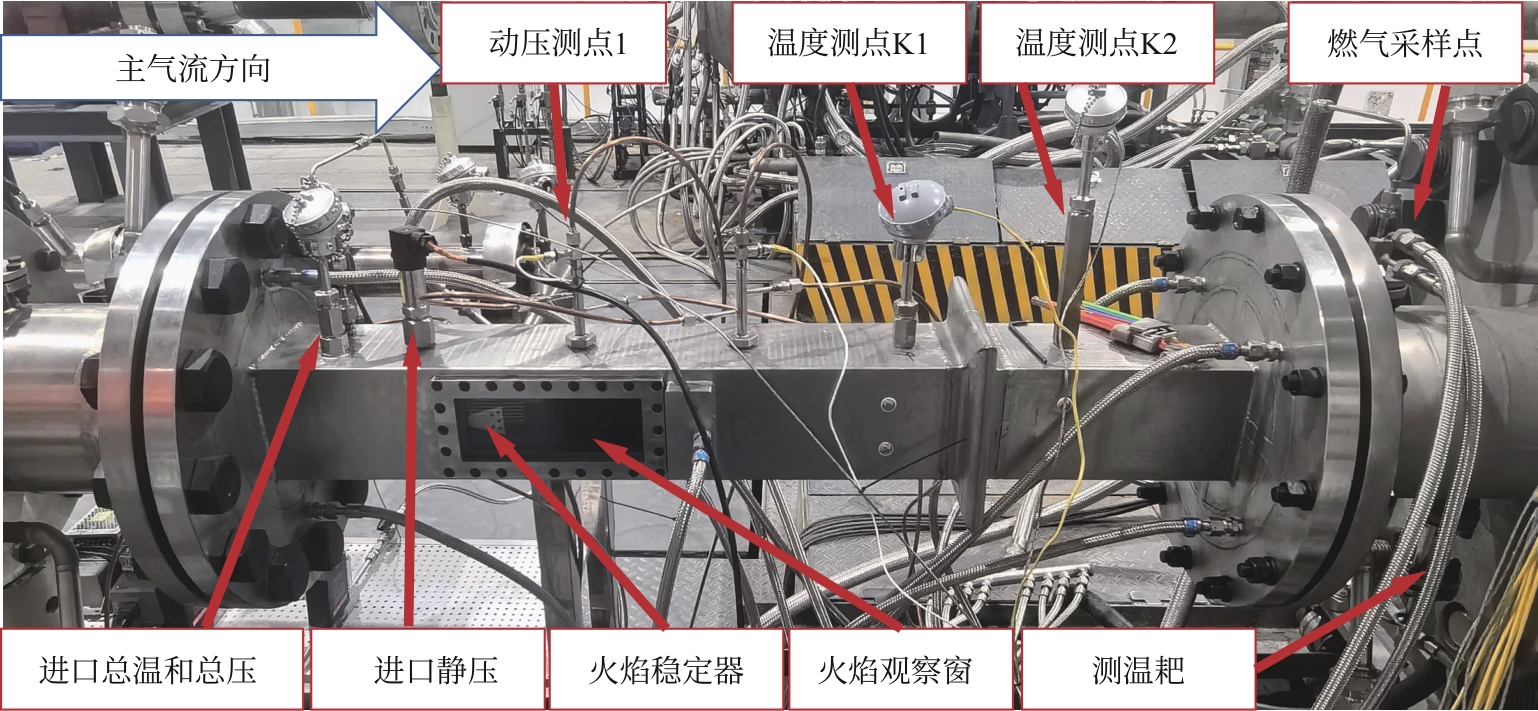
Fig.6
Staged flame holding and fuel injection system
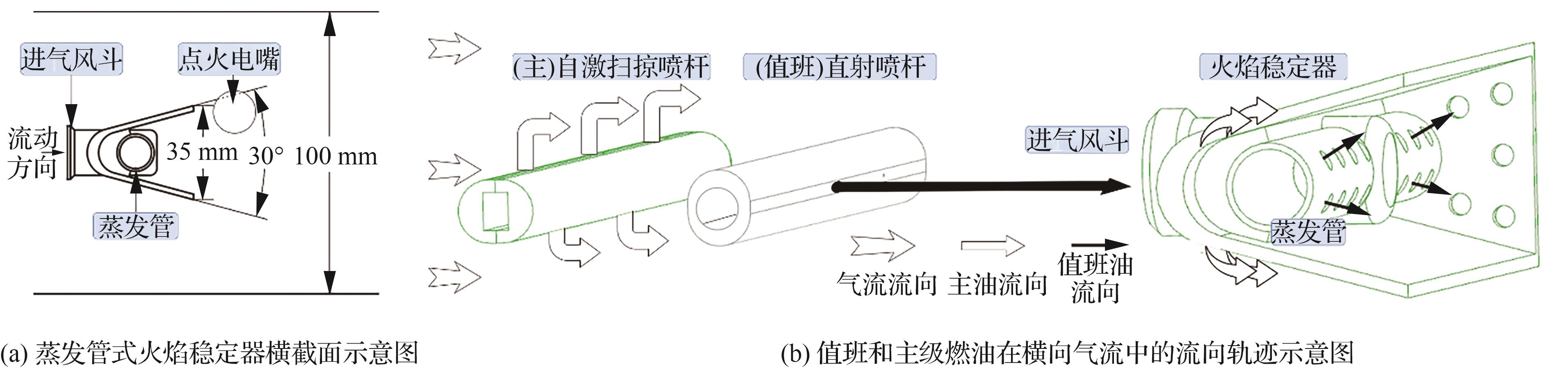
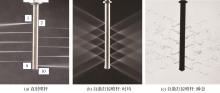
Fig.7
Spray appearance of plain-orifice spray bar and self-excited sweeping spray bar (Δp=0.5 MPa)
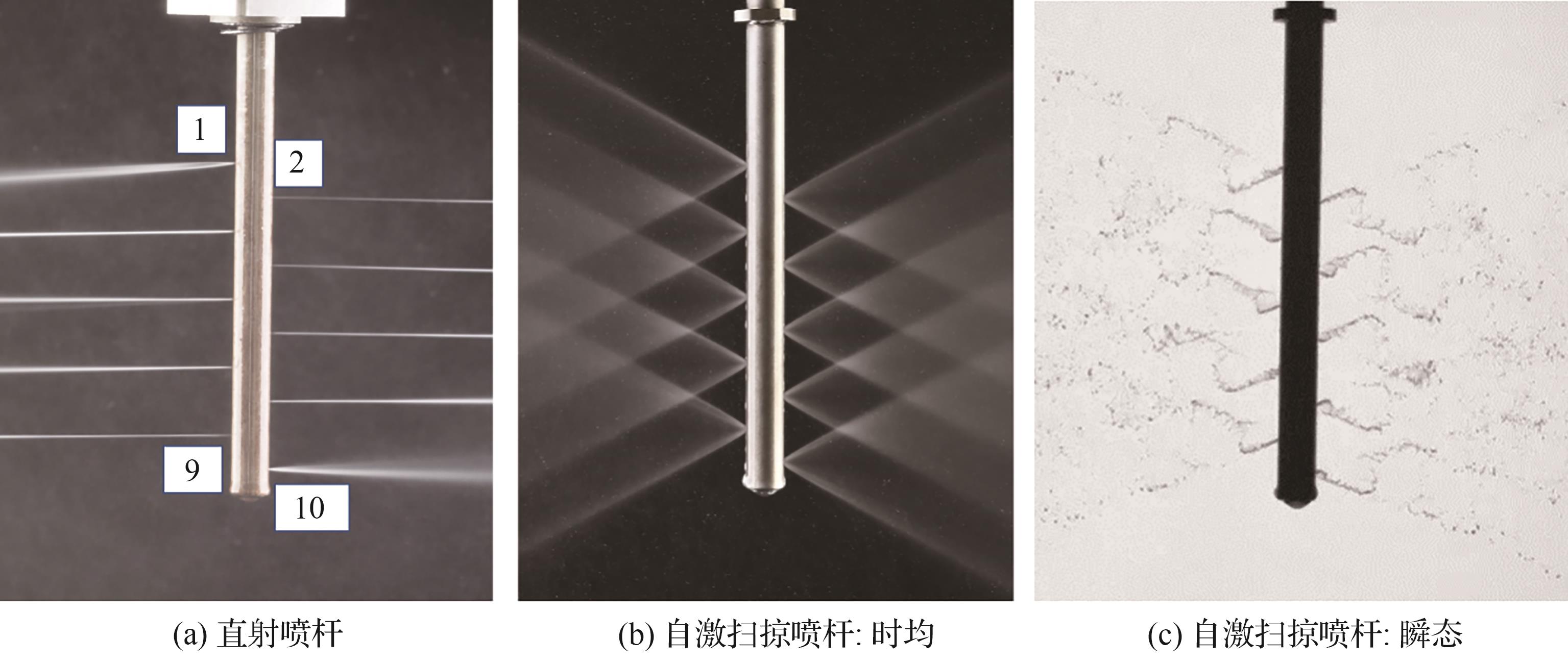
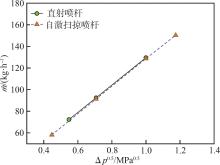
Fig.8
comparison of flow rate characteristics between self-excited sweeping spray bar and plain-orifice spray bar
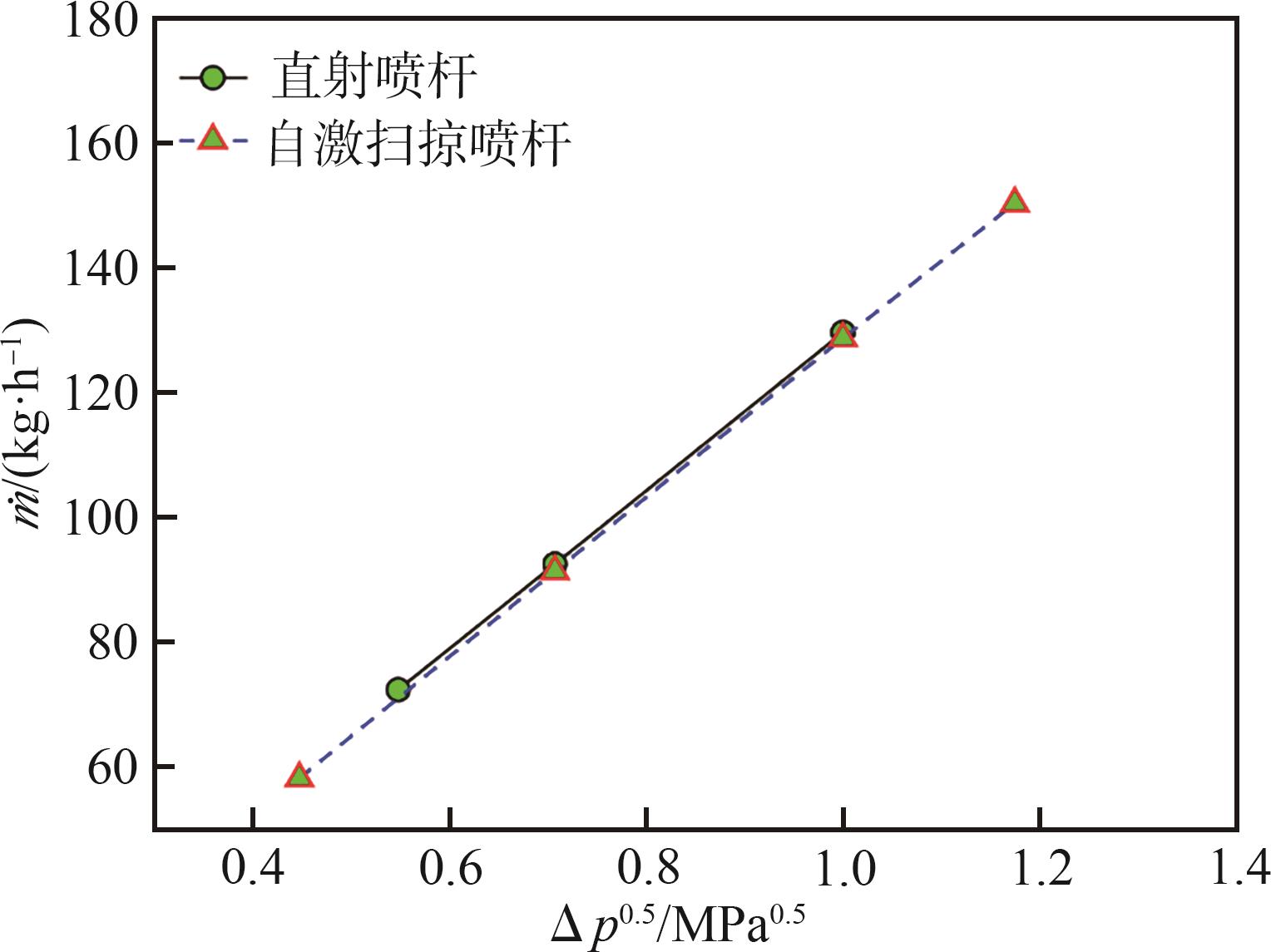
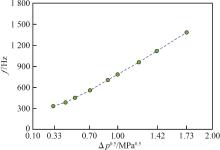
Fig.9
Frequency-pressure drop response curve of self-excited sweeping nozzle
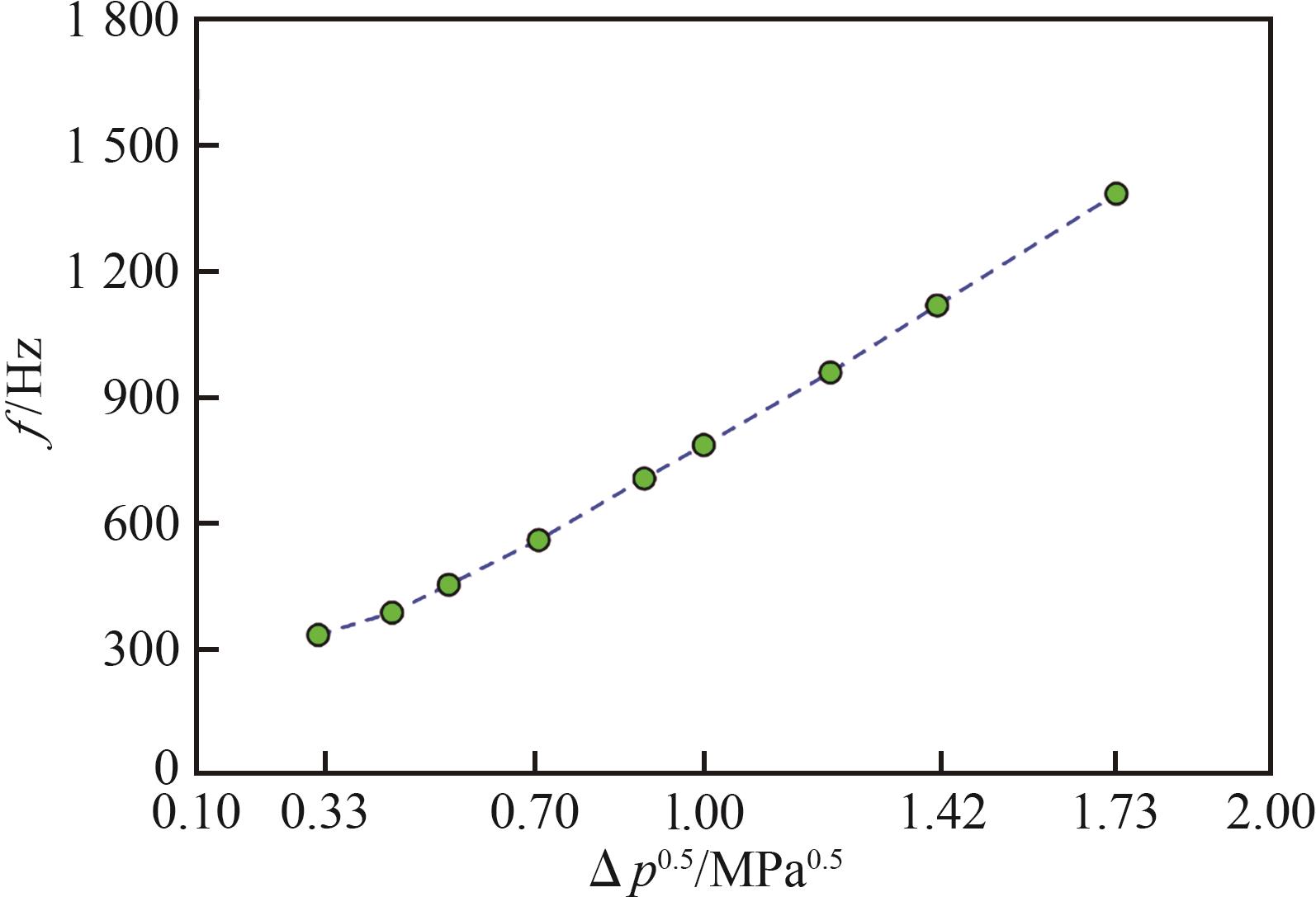
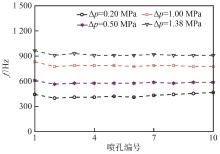
Fig.10
Frequency comparison among various nozzles in self-excited sweeping spray bar under different pressure drops
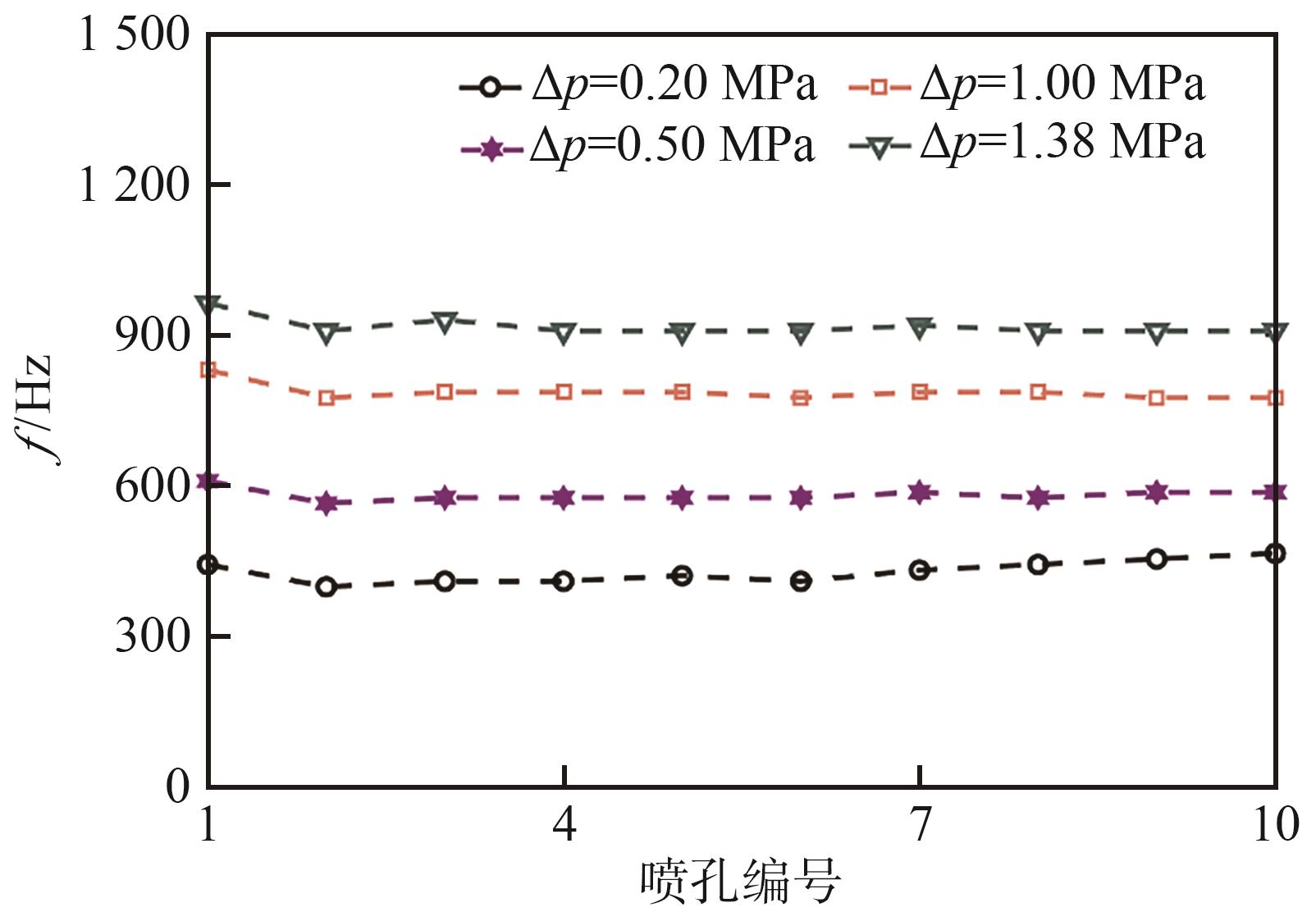
Fig.11
Sweeping angle comparison among various nozzles in self-excited sweeping spray bar under different pressure drops
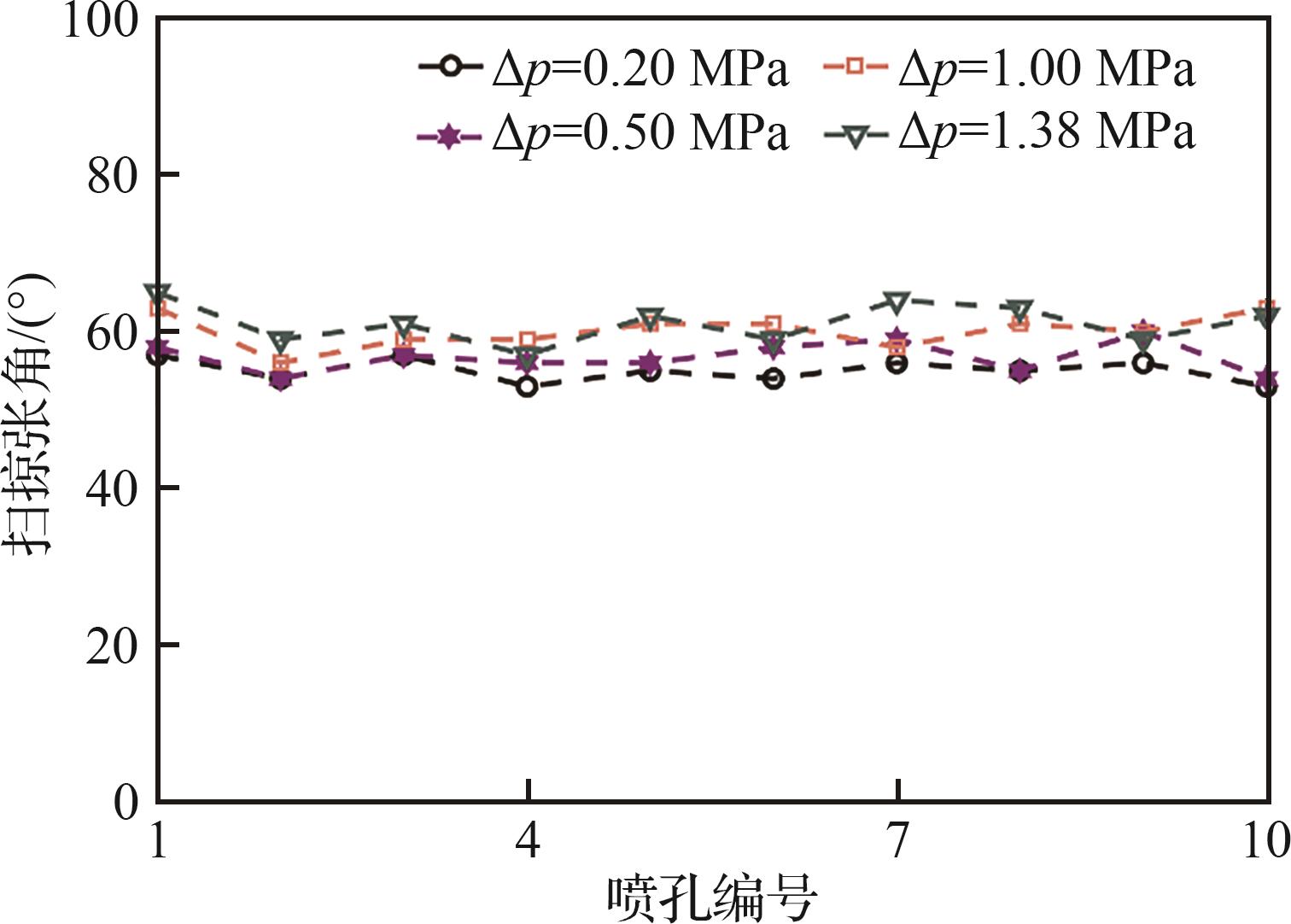

Table 1
Comparison of ignition and stable combustion equivalence ratio between plain-orifice spray bar and self-excited sweeping spray bar
| 喷杆形式 | 工况温度/K | 值班当量比 | 点火成功 | 主油点火当量比 | 稳定燃烧 | 贫油熄火当量比 | 主油富油熄火当量比 |
|---|---|---|---|---|---|---|---|
| 直射喷杆 | 500 | 0.06 | 是 | 是 | 0.45 | ||
| 0 | 否 | 否 | |||||
| 自激扫掠喷杆 | 500 | 0.06 | 是 | 是 | >0.50 | ||
| 0 | 是 | 0.29 | 是 | 0.18 |
Fig.12
Comparison of main emission concentrations in exhaust gas between self-excited sweeping spray bar and plain-orifice spray bar under different equivalence ratios
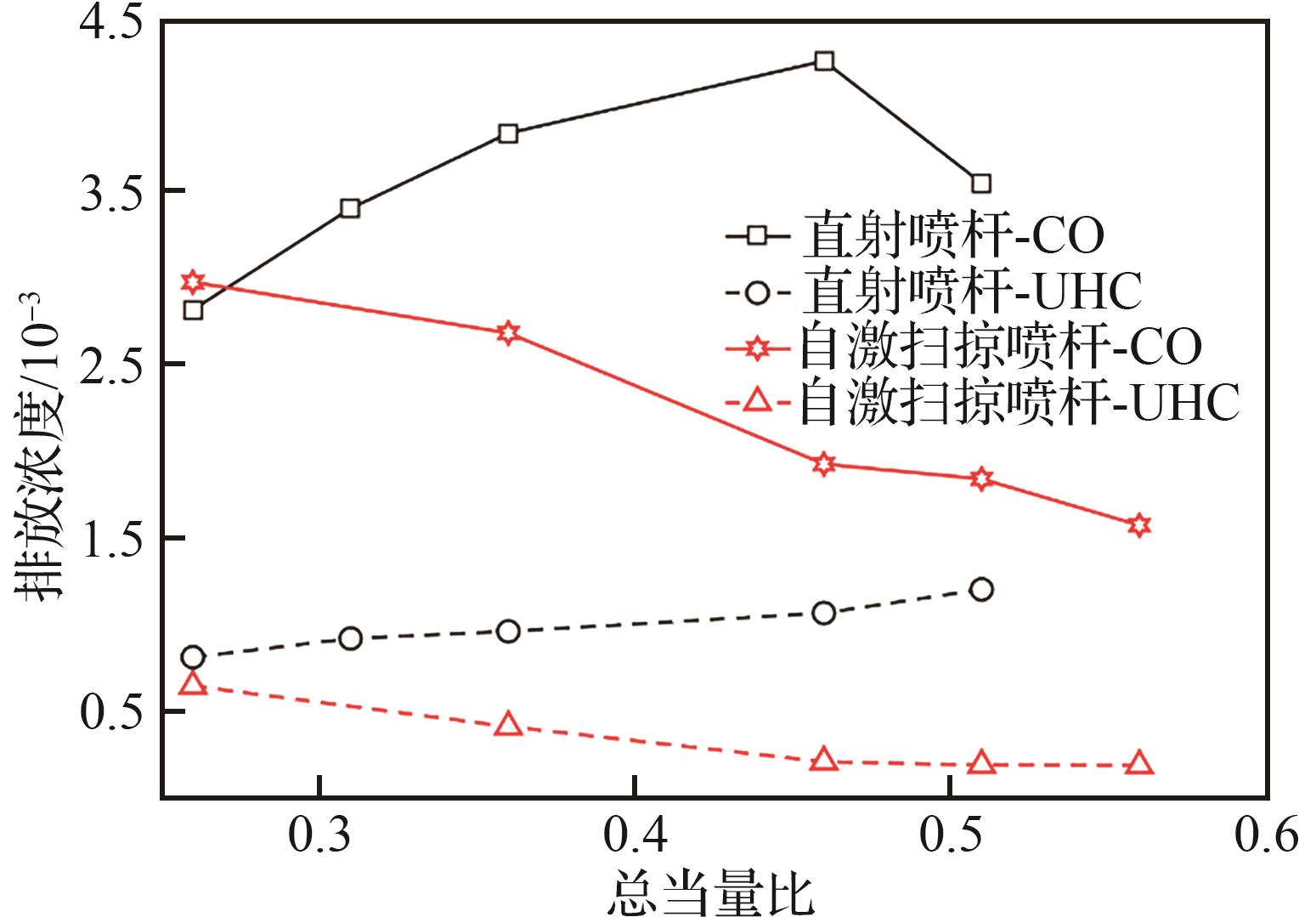
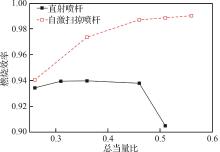
Fig.13
Comparison of overall combustion efficiencies between self-excited sweeping spray bar and plain-orifice spray bar under different equivalence ratios
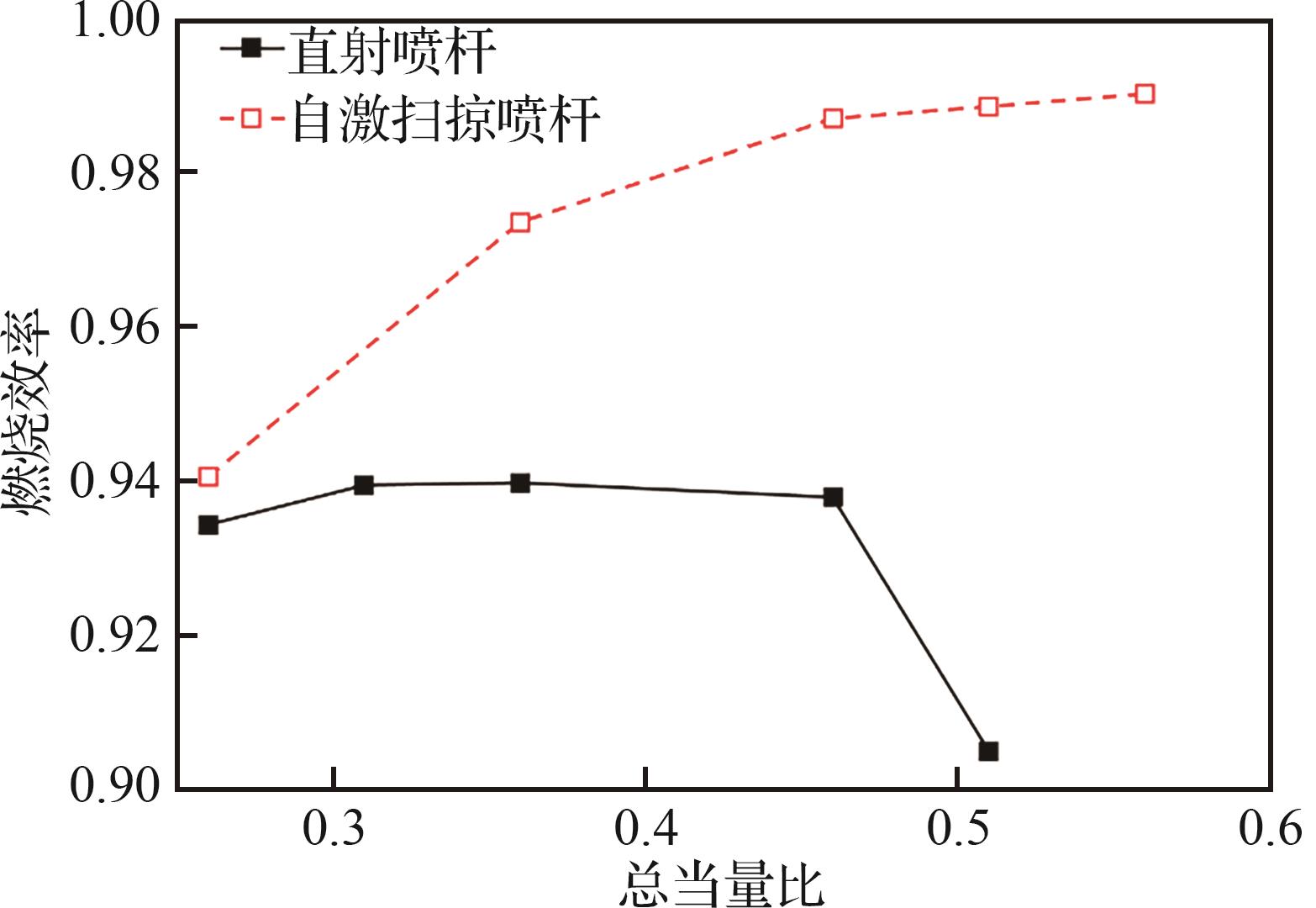
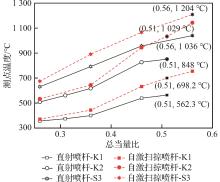
Fig.14
Comparison of measured gas temperature between self-excited sweeping spray bar and plain-orifice spray bar under different equivalence ratios
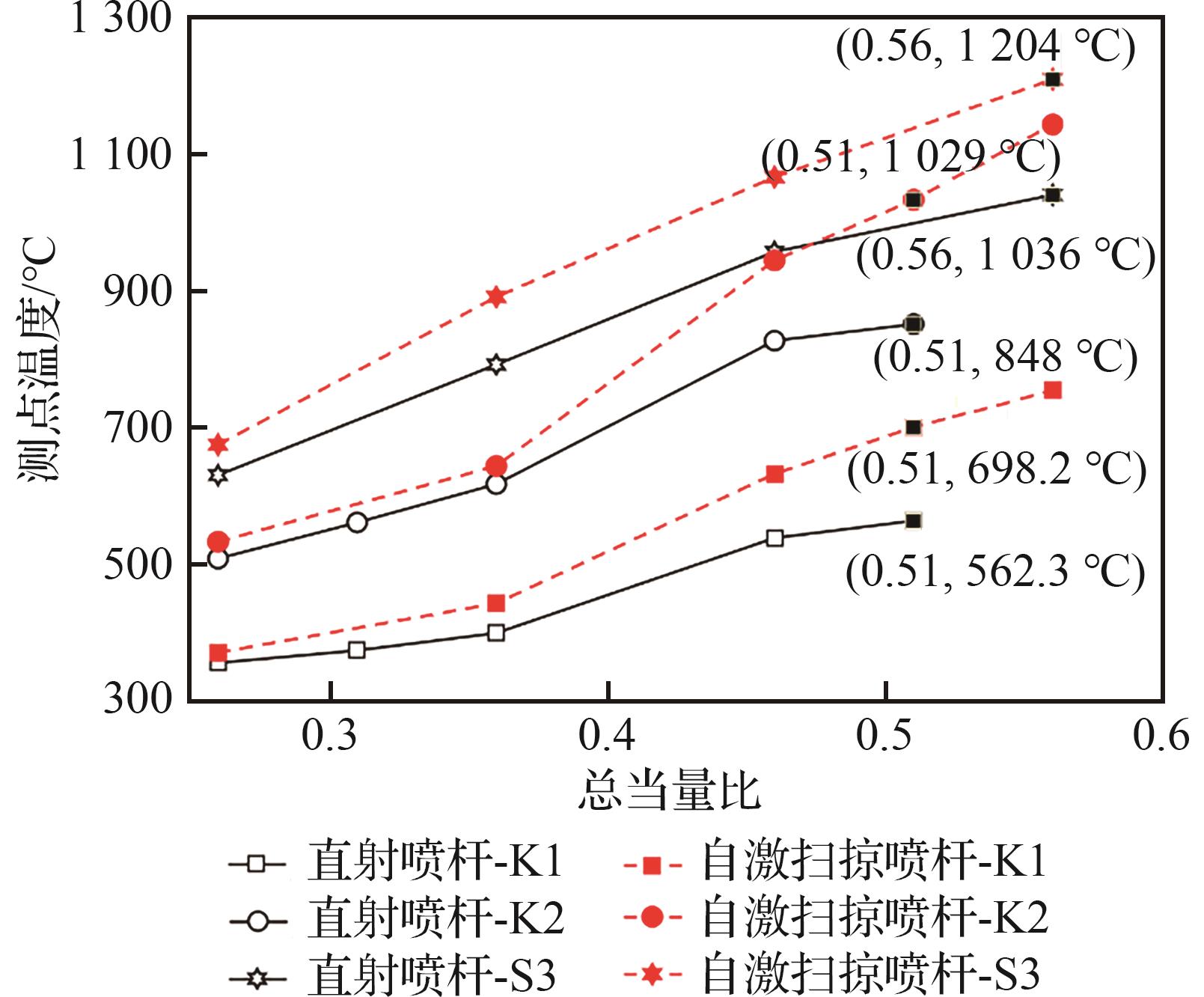
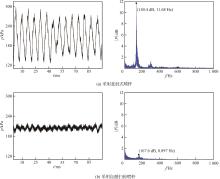
Fig.15
Transient wall pressure and spectrum (Ψ=0.51)
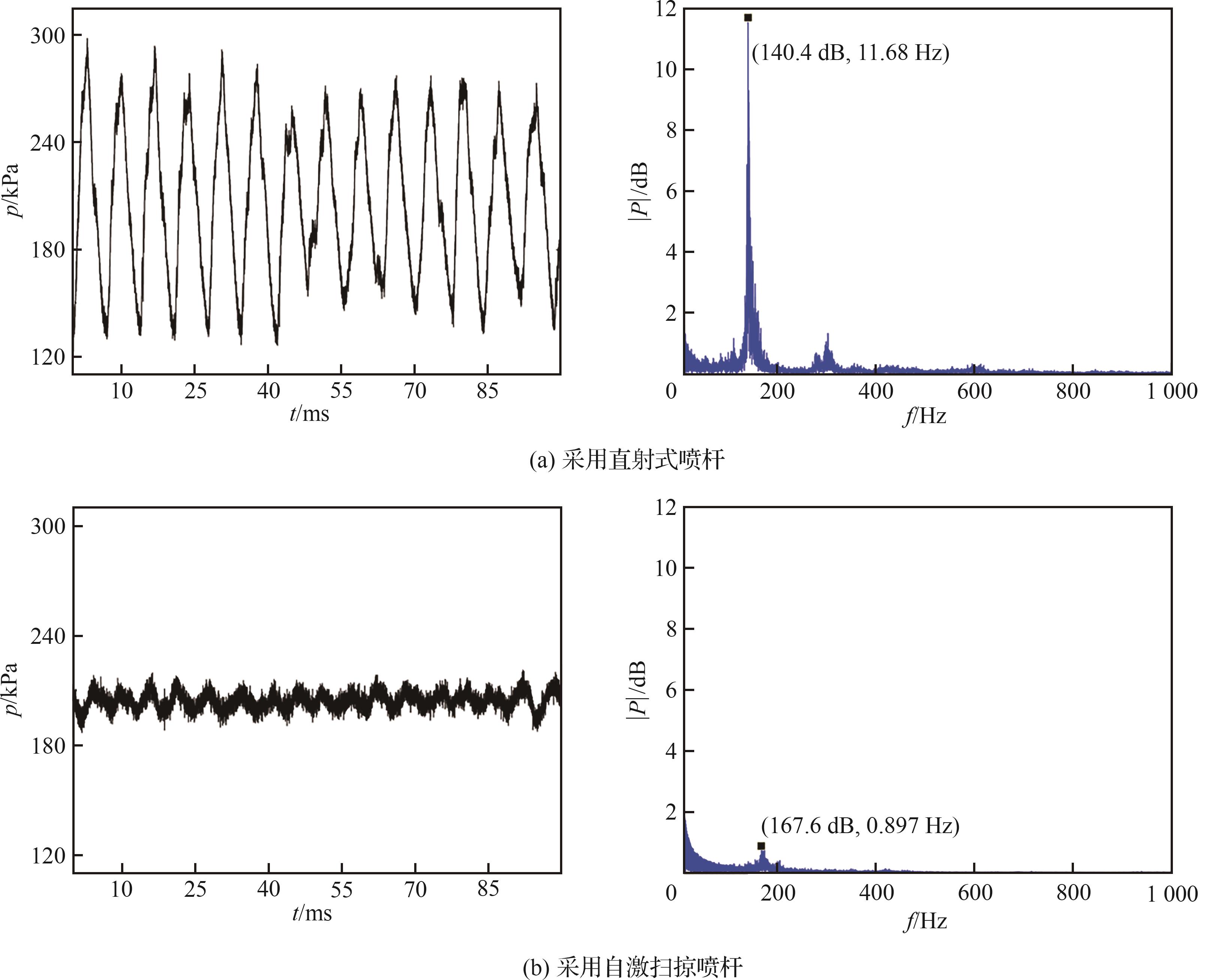
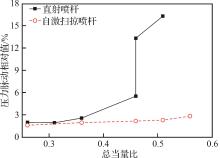
Fig.16
Relative fluctuation value of transient wall pressure variation to total fuel-air equivalence ratio with different spray bars
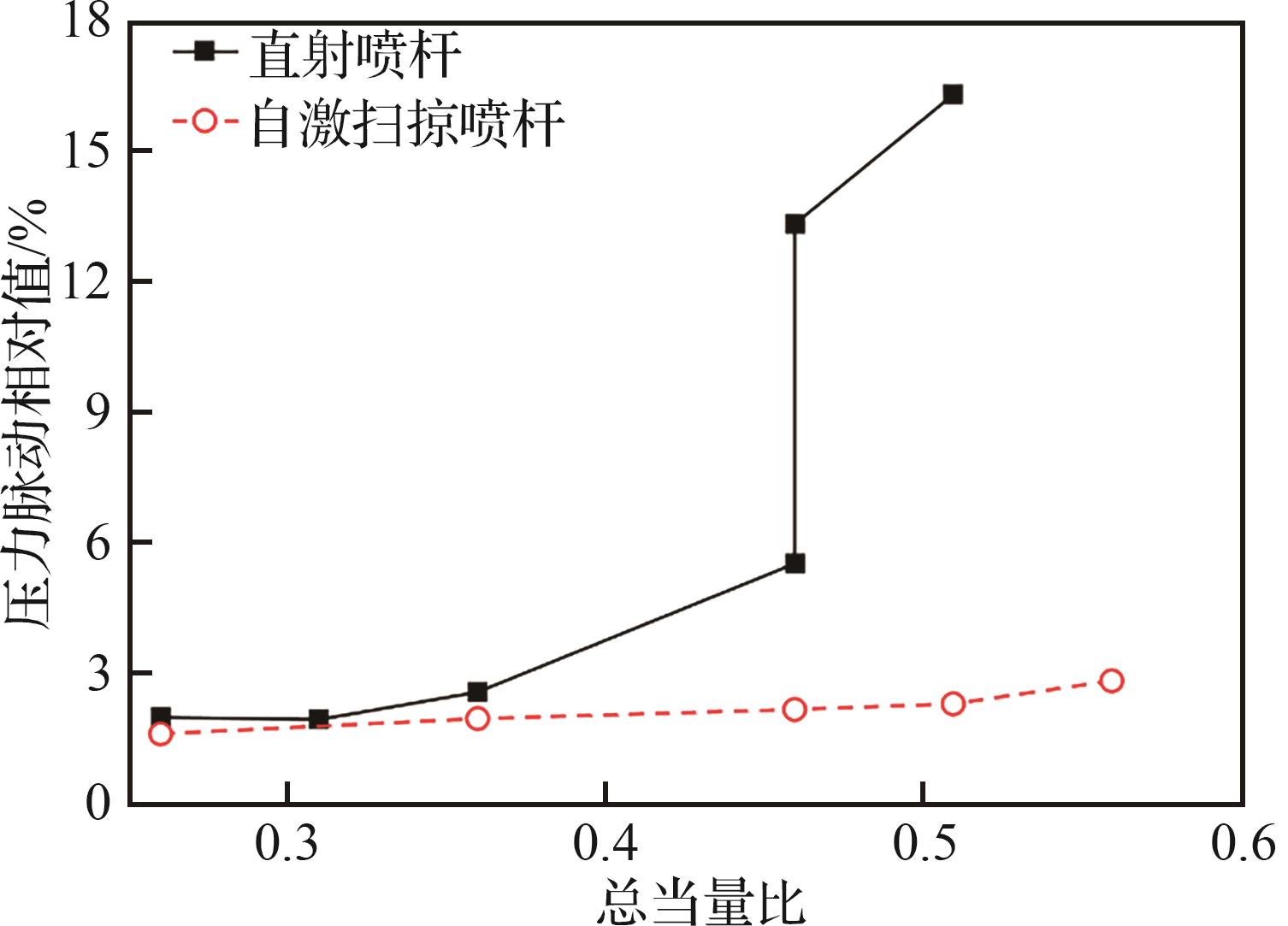
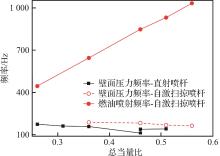
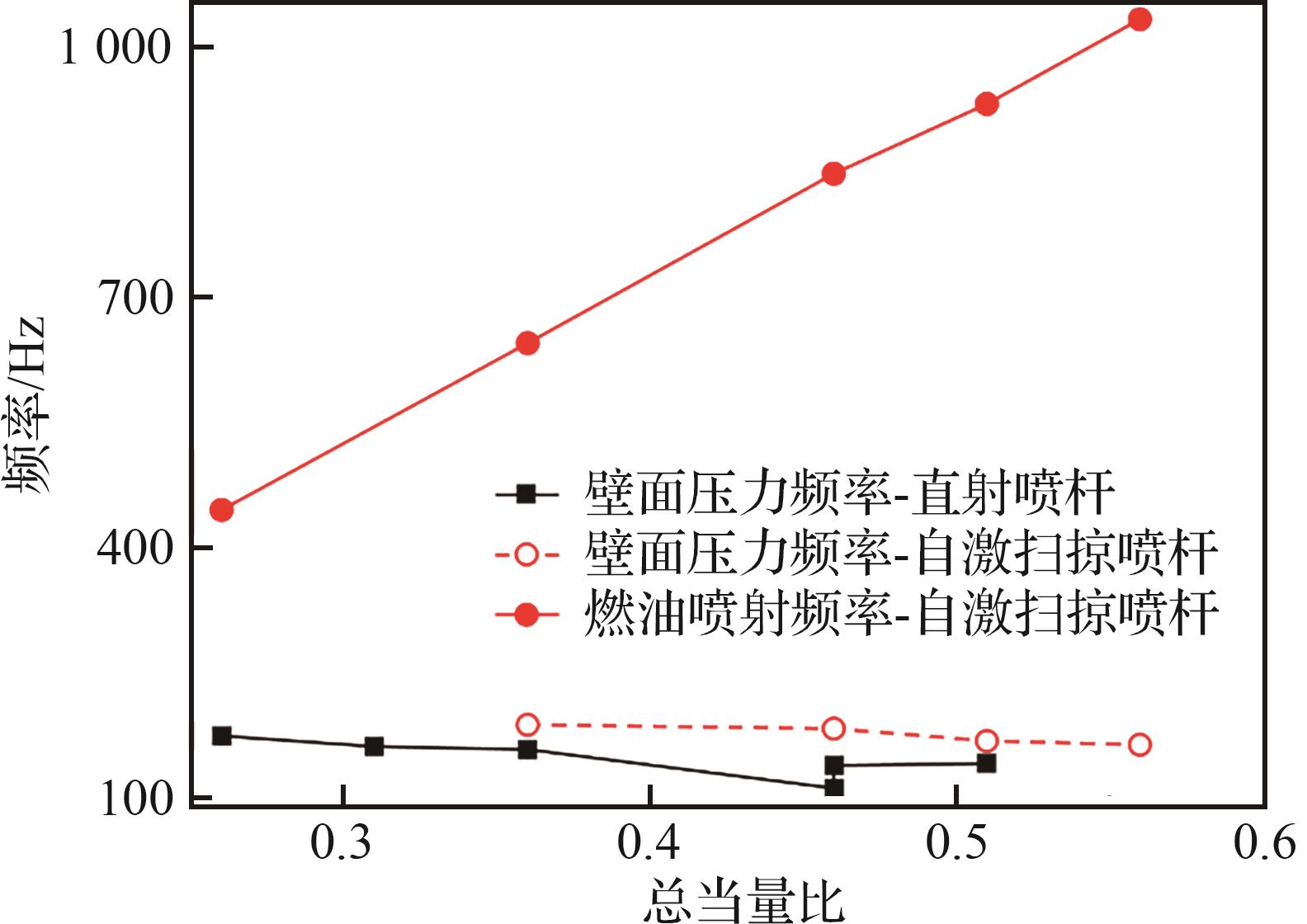
Fig.17
Dominating frequency of transient wall pressure and fuel injection frequency of self-excited sweeping nozzle variations to total fuel-air equivalence ratio with different spray bars
| 1 | 季鹤鸣, 刘玉英. 涡扇加力与多功能排气装置[M]. 上海: 上海交通大学出版社, 2021. |
| JI H M, LIU Y Y. Afterburner and multi-function exhaust system of turbofan engine[M]. Shanghai: Shanghai Jiao Tong University Press, 2021 (in Chinese). | |
| 2 | 尚守堂, 何小民. 航空发动机加力燃烧室设计[M]. 北京: 科学出版社, 2022. |
| SHANG S T, HE X M. Design of afterburner for aero-engine[M]. Beijing: Science Press, 2022 (in Chinese). | |
| 3 | 金如山, 索建秦. 先进燃气轮机燃烧室[M]. 北京: 航空工业出版社, 2016. |
| JIN R S, SUO J Q. Advanced gas turbine combustor[M]. Beijing: Aviation Industry Press, 2016 (in Chinese). | |
| 4 | 黄勇, 林宇震, 樊未军, 等. 燃烧与燃烧室[M]. 1版. 北京: 北京航空航天大学出版社, 2009. |
| HUANG Y, LIN Y Z, FAN W J, et al. Combustion and combustion chamber [M]. 1st ed. Beijing: Beijing University of Aeronautics & Astronautics Press, 2009 (in Chinese). | |
| 5 | SONG J, JUNG C, HWANG J, et al. An experimental study on the flame dynamics with V-gutter type flameholder in the model combustor[C]∥47th AIAA/ASME/SAE/ASEE Joint Propulsion Conference & Exhibit. Reston: AIAA, 2011. |
| 6 | KIEL B, GARWICK K, GORD J, et al. A detailed investigation of bluff body stabilized flames[C]∥45th AIAA Aerospace Sciences Meeting and Exhibit. Reston: AIAA, 2007. |
| 7 | INAMURA T, TAKAHASHI M, KUMAKAWA A. Combustion characteristics of a liquid-fueled ramjet combustor[J]. Journal of Propulsion and Power, 2001, 17(4): 860-868. |
| 8 | 张孝春, 孙雨超, 刘涛. 先进加力燃烧室设计技术综述[J]. 航空发动机, 2014, 40(2): 24-30, 60. |
| ZHANG X C, SUN Y C, LIU T. Summary of advanced afterburner design technology[J]. Aeroengine, 2014, 40(2): 24-30, 60 (in Chinese). | |
| 9 | 罗莲军, 刘玉英, 张文龙, 等. 喷油杆与凹腔支板稳定器近距匹配雾化特性[J]. 航空动力学报, 2013, 28(11): 2462-2467. |
| LUO L J, LIU Y Y, ZHANG W L, et al. Atomization characteristics of fuel injector and cavity-based strut flame stabilizer under close-range matching condition[J]. Journal of Aerospace Power, 2013, 28(11): 2462-2467 (in Chinese). | |
| 10 | LOVETT J, BROGAN T, PHILIPPONA D, et al. Development needs for advanced afterburner designs[C]∥40th AIAA/ASME/SAE/ASEE Joint Propulsion Conference and Exhibit. Reston: AIAA, 2004. |
| 11 | LEE J, LIN K C, EKLUND D. Challenges in fuel injection for high-speed propulsion systems[J]. AIAA Journal, 2015, 53(6): 1405-1423. |
| 12 | 刘小勇, 王明福, 刘建文, 等. 超燃冲压发动机研究回顾与展望[J]. 航空学报, 2024, 45(5): 529878. |
| LIU X Y, WANG M F, LIU J W, et al. Review and prospect of research on scramjet[J]. Acta Aeronautica et Astronautica Sinica, 2024, 45(5): 529878 (in Chinese). | |
| 13 | 颜应文, 韩宗英, 刘云鹏, 等. 一种采用圆弧形扇形喷嘴和凹腔结构加力燃烧室: CN201810219294.5[P]. 2020-03-17. |
| YAN Y W, HAN Z Y, LIU Y P, et al. An afterburner with a circular arc fan-shaped nozzle and a cavity structure : CN201810219294.5[P]. 2020-03-17 (in Chinese). | |
| 14 | 韩宗英, 颜应文, 刘云鹏, 等. 一种采用平面扇形喷嘴供油的加力燃烧室: ZL201810219559.1[P]. 2018-11-20. |
| HAN Z Y, YAN Y W, LIU Y P, et al. An afterburner fueled by fan nozzles: ZL201810219559.1[P]. 2018-11-20 (in Chinese). | |
| 15 | 邸东, 刘雨辰, 王亚军, 等. 加力用扇形喷嘴雾化特性试验[J]. 航空动力学报, 2020, 35(3): 457-470. |
| DI D, LIU Y C, WANG Y J, et al. Experiment on atomization characteristics of fan nozzle[J]. Journal of Aerospace Power, 2020, 35(3): 457-470 (in Chinese). | |
| 16 | 王晓洁. 高温高速气流中直射式喷嘴与扇形喷嘴的雾化特性试验研究[D]. 镇江: 江苏大学, 2022. |
| WANG X J. Experimental study on atomization characteristics of direct nozzle and fan nozzle in high temperature and high speed airflow[D]. Zhenjiang: Jiangsu University, 2022 (in Chinese). | |
| 17 | 施刚强, 吴杰, 胡喆, 等. 高温高速来流条件下扇形喷嘴雾化特性研究[J]. 推进技术, 2024, 45(6): 154-163. |
| SHI G Q, WU J, HU Z, et al. Atomization characteristics of fan-shaped nozzle under high-speed and high-temperature[J]. Journal of Propulsion Technology, 2024, 45(6): 154-163 (in Chinese). | |
| 18 | CHANG J L, HE L J, CHEN L H, et al. Atomization of liquid pulsed jet in subsonic crossflow[J]. 2023, 13(5): 055117. |
| 19 | 王士奇, 陈健, 杨谦, 等. 自激扫掠喷嘴: 航空发动机燃油喷射新选择[J]. 航空动力, 2023(3): 12-15. |
| WANG S Q, CHEN J, YANG Q, et al. Self-excited sweeping nozzle: a new choice for aero engine fuel injection[J]. Aerospace Power, 2023(3): 12-15 (in Chinese). | |
| 20 | GREGORY J, TOMAC M N. A review of fluidic oscillator development and application for flow control[C]∥ 43rd Fluid Dynamics Conference. Reston: AIAA, 2013. |
| 21 | WOSZIDLO R, OSTERMANN F, SCHMIDT H J. Fundamental properties of fluidic oscillators for flow control applications[J]. AIAA Journal, 2019, 57(3): 978-992. |
| 22 | 王士奇, 温泉. 新型自激扫掠喷嘴及其工作特性研究[J]. 推进技术, 2023, 44(10): 107-116. |
| WANG S Q, WEN Q. Working characteristics of a new self-excited sweeping nozzle[J]. Journal of Propulsion Technology, 2023, 44(10): 107-116 (in Chinese). | |
| 23 | 王士奇, 温泉, 韩啸. 一种基于自激扫掠振荡燃油喷嘴的加力燃烧室结构: ZL202110519916.8[P]. 2021-08-20. |
| WANG S Q, WEN Q, HAN X, et al. An afterburner structure with self-excited sweeping oscillating fuel injection nozzles:ZL202110519916.8[P]. 2021-08-20 (in Chinese). | |
| 24 | 王士奇, 温泉, 刘英杰, 等. 一种亚毫米自激扫掠喷射振荡器:ZL202210041292.8[P]. 2022-04-19. |
| WANG S Q, WEN Q, LIU Y J, et al. A self-excited sweeping spray oscillator in sub-milimeter scale:ZL202210041292.8[P]. 2022-04-19 (in Chinese). | |
| 25 | 王士奇, 温泉. 自激扫掠喷嘴工作特性的数值和实验研究[J]. 航空动力学报, doi: 10.13224/j.cnki.jasp.20220923 . |
| WANG S Q, WEN Q. Numerical and experimental study on working characteristics of self-excited sweeping nozzle[J]. Journal of Aerospace Power, doi: 10.13224/j.cnki.jasp.20220923 (in Chinese). | |
| 26 | 王士奇, 温泉, 贾志刚, 等. 基于自激扫掠喷嘴的加力燃烧效率实验研究[J]. 航空学报, 2025, 46(1):130621. |
| WANG S Q, WEN Q, JIA Z G, et al. Experimental study on the afterburner efficiency based on self-excited sweeping nozzle[J]. Acta Aeronautica et Astronautica Sinica, 2025, 46(1):130621 (in Chinese). | |
| 27 | 德图仪器国际贸易(上海)有限公司. 德图Testo 350 烟气分析仪操作手册[EB/OL]. [2024-10-16]. . |
| Testo Instruments International Trading (Shanghai) Co., Ltd.. Testo 350 flue gas analyzer instruction manual[EB/OL]. [2024-10-16]. . | |
| 28 | 许军民. 冲压发动机燃烧室火焰稳定器试验研究和数值模拟[D]. 西安: 西安电子科技大学, 2007. |
| XU J M. Experimental study and numerical simulation of flame stabilizer in ramjet combustion chamber[D]. Xi’an: Xidian University, 2007 (in Chinese). |
| [1] | Lei QIN, Guangyu ZHANG, Xiaoyu WANG, Xiaofeng SUN. Key factors and control methods of combustion instability under axial staging combustion [J]. Acta Aeronautica et Astronautica Sinica, 2025, 46(5): 531692-531692. |
| [2] | Shiqi WANG, Quan WEN, Zhigang JIA, Yixin CHENG, Lin LI, Chi ZHANG, Weiye HUO, Liang MA. Experiment on afterburner combustion efficiency based on self-excited sweeping nozzle [J]. Acta Aeronautica et Astronautica Sinica, 2025, 46(2): 130621-130621. |
| [3] | Guangxu WANG, Baoe YANG, Yonghua TAN, Yushan GAO, Bin LI. Randomness of high frequency longitudinal combustion instability in liquid rocket engines [J]. Acta Aeronautica et Astronautica Sinica, 2024, 45(14): 129485-129485. |
| [4] | Guangxu WANG, Bin LI, Yonghua TAN, Yushan GAO. High frequency combustion instability in liquid rocket engines: Review [J]. Acta Aeronautica et Astronautica Sinica, 2024, 45(11): 529450-529450. |
| [5] | Feng ZHANG, Yi SUN, Shuai SHANG, Baoe YANG. High pressure combustion experiment for hypergolic propellant unlike doublet injectors [J]. Acta Aeronautica et Astronautica Sinica, 2024, 45(11): 529507-529507. |
| [6] | Weidong LIU, Haoyang PENG, Shijie LIU, Hailong ZHANG, Xueqiang YUAN. Research Progresses of rotating detonation combustion and its application [J]. Acta Aeronautica et Astronautica Sinica, 2023, 44(15): 528875-528875. |
| [7] | Xiaofeng SUN, Guangyu ZHANG, Xiaoyu WANG, Lei LI, Xiangyang DENG, Ronghui CHENG. Research progress in aero-engine combustion instability prediction and control [J]. Acta Aeronautica et Astronautica Sinica, 2023, 44(14): 628733-628733. |
| [8] | Tao CHEN, Xingping XU, Hongda ZHANG, Xingsi HAN. Numerical simulation of combustion instability by SATES coupling with FGM combustion model [J]. Acta Aeronautica et Astronautica Sinica, 2023, 44(14): 628207-628207. |
| [9] | WANG Guangxu, TAN Yonghua, ZHUANG Fengchen, CHEN Jianhua, YANG Bao'e, HONG Liu. Suppression effect of injection intensity distribution on longitudinal combustion instability [J]. ACTA AERONAUTICAET ASTRONAUTICA SINICA, 2022, 43(9): 126018-126018. |
| [10] | LI Jia'nan, LEI Fanpei, YANG Anlong, ZHOU Lixin. Atomization characteristics of impinging liquid jets coupled with forced perturbation [J]. ACTA AERONAUTICAET ASTRONAUTICA SINICA, 2020, 41(12): 124027-124027. |
| [11] | KANG Zhongtao, LI Xiangdong, MAO Xiongbing, LI Qinglian. Review on gas liquid shear coaxial injector in liquid rocket engine [J]. ACTA AERONAUTICAET ASTRONAUTICA SINICA, 2018, 39(9): 22221-022221. |
| [12] | LIU Zeyu, ZHANG Chi, HAN Xiao, LIN Yuzhen. Effects of stratification ratio on structure of separated stratified premixed swirl flame [J]. ACTA AERONAUTICAET ASTRONAUTICA SINICA, 2018, 39(3): 121692-121692. |
| [13] | SHAN Ruizi, CAO Junwei, MO Zhan, CHEN Zhiming. Research of solid ducted rocket combustion efficiency based on design of experiment methodology [J]. ACTA AERONAUTICAET ASTRONAUTICA SINICA, 2015, 36(9): 2859-2868. |
| [14] | CUI Yu-feng;XU Gang;HUANG Wei-guang. Numerical Simulation on Supersonic Combustion over a Reward Facing Step with Transverse Hydrogen and Air Injection [J]. ACTA AERONAUTICAET ASTRONAUTICA SINICA, 2004, 25(2): 113-116. |
| [15] | Wan Jian;Gu Shanjian;Yang Maolin. Xiao Weihui. STUDY ON ATOMIZATION FEATURES OF A PLAIN INJECTOR IN HIGH SPEED TRANSVERSE AIR STREAM [J]. ACTA AERONAUTICAET ASTRONAUTICA SINICA, 1990, 11(4): 157-164. |
| Viewed | ||||||
|
Full text |
|
|||||
|
Abstract |
|
|||||
Address: No.238, Baiyan Buiding, Beisihuan Zhonglu Road, Haidian District, Beijing, China
Postal code : 100083
E-mail:hkxb@buaa.edu.cn
Total visits: 6658907 Today visits: 1341All copyright © editorial office of Chinese Journal of Aeronautics
All copyright © editorial office of Chinese Journal of Aeronautics
Total visits: 6658907 Today visits: 1341

 CJA
CJA
