Acta Aeronautica et Astronautica Sinica ›› 2025, Vol. 46 ›› Issue (5): 531879.doi: 10.7527/S1000-6893.2025.31879
• Fluid Mechanics and Flight Mechanics • Previous Articles
Yun WU1, Zhibo ZHANG1,2, Yifei ZHU2, Min JIA1, Yinghong LI1( )
)
Received:2025-02-17
Revised:2025-02-20
Accepted:2025-02-21
Online:2025-03-15
Published:2025-03-15
Contact:
Yinghong LI
E-mail:yinghong_li@126.com
Supported by:CLC Number:
Yun WU, Zhibo ZHANG, Yifei ZHU, Min JIA, Yinghong LI. Research progress and outlook of plasma combustion control[J]. Acta Aeronautica et Astronautica Sinica, 2025, 46(5): 531879.
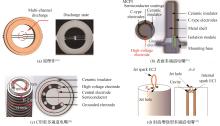
Fig.1
Structure comparison of typical multi-channel discharge nozzle
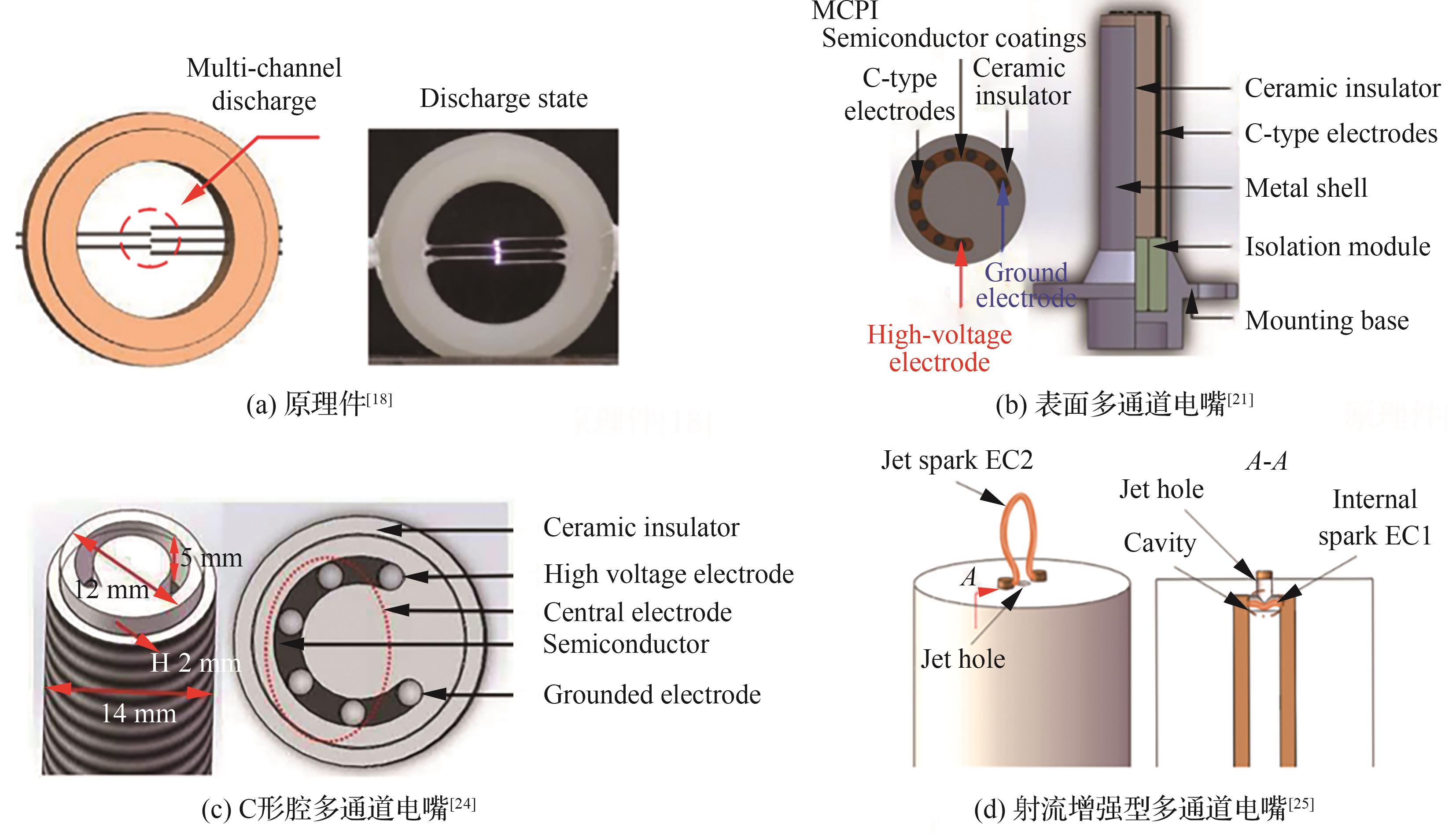
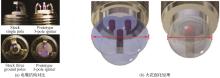
Fig.2
Multi-channel discharge automotive spark plug[27]
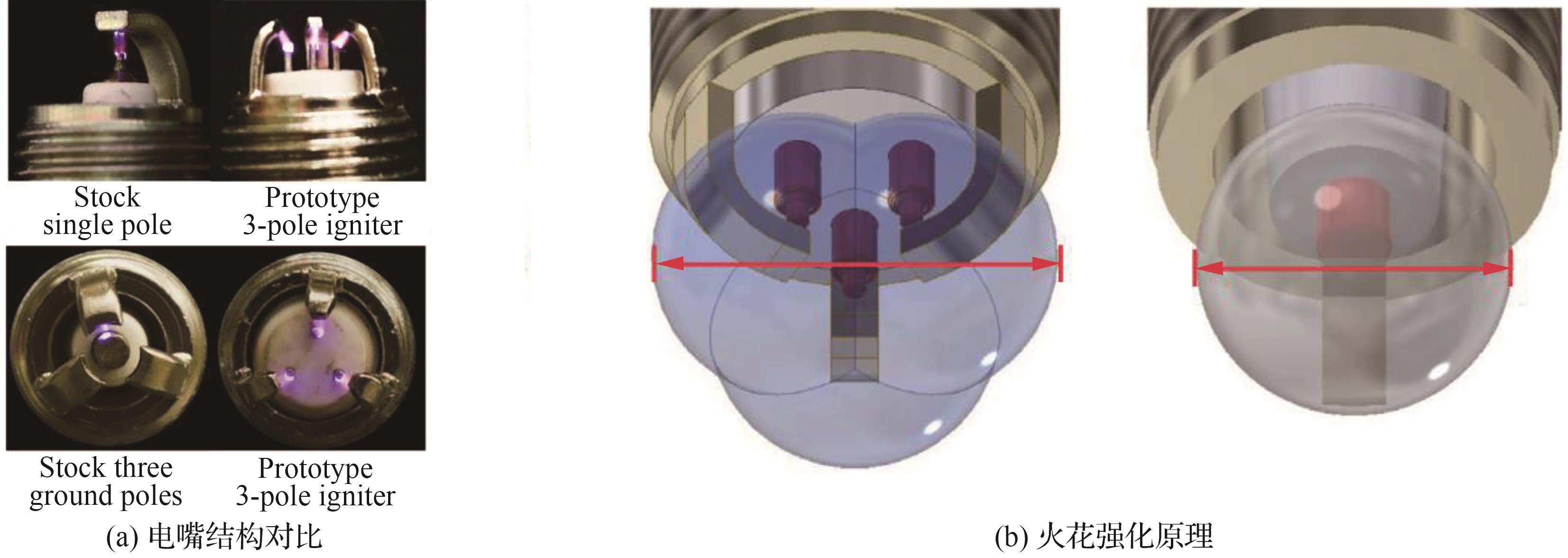
Fig.3
Typical DC arc ignition scheme of Leonov’s team
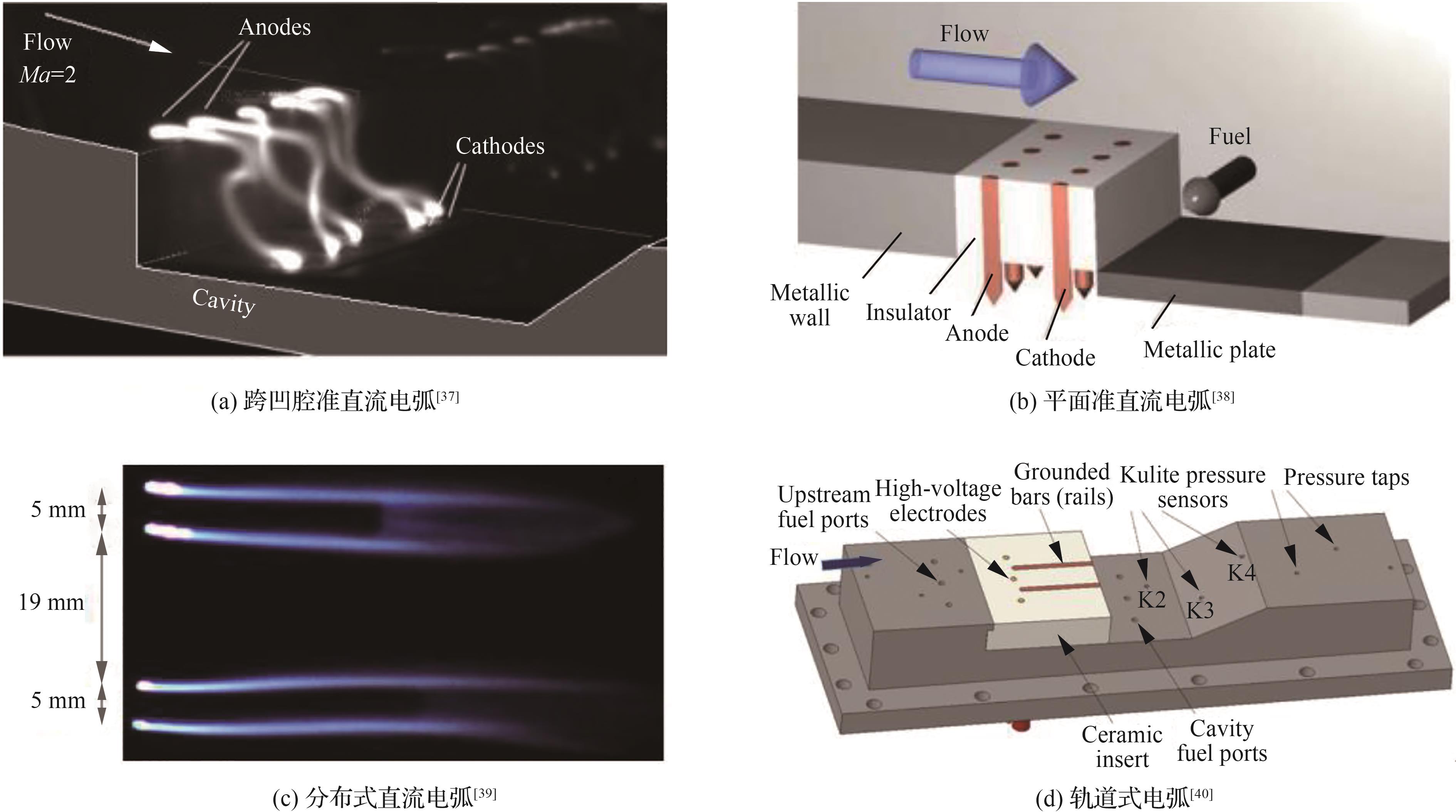
Fig.4
Three types of nozzle and discharge combination scheme from Leonov’s team[41]
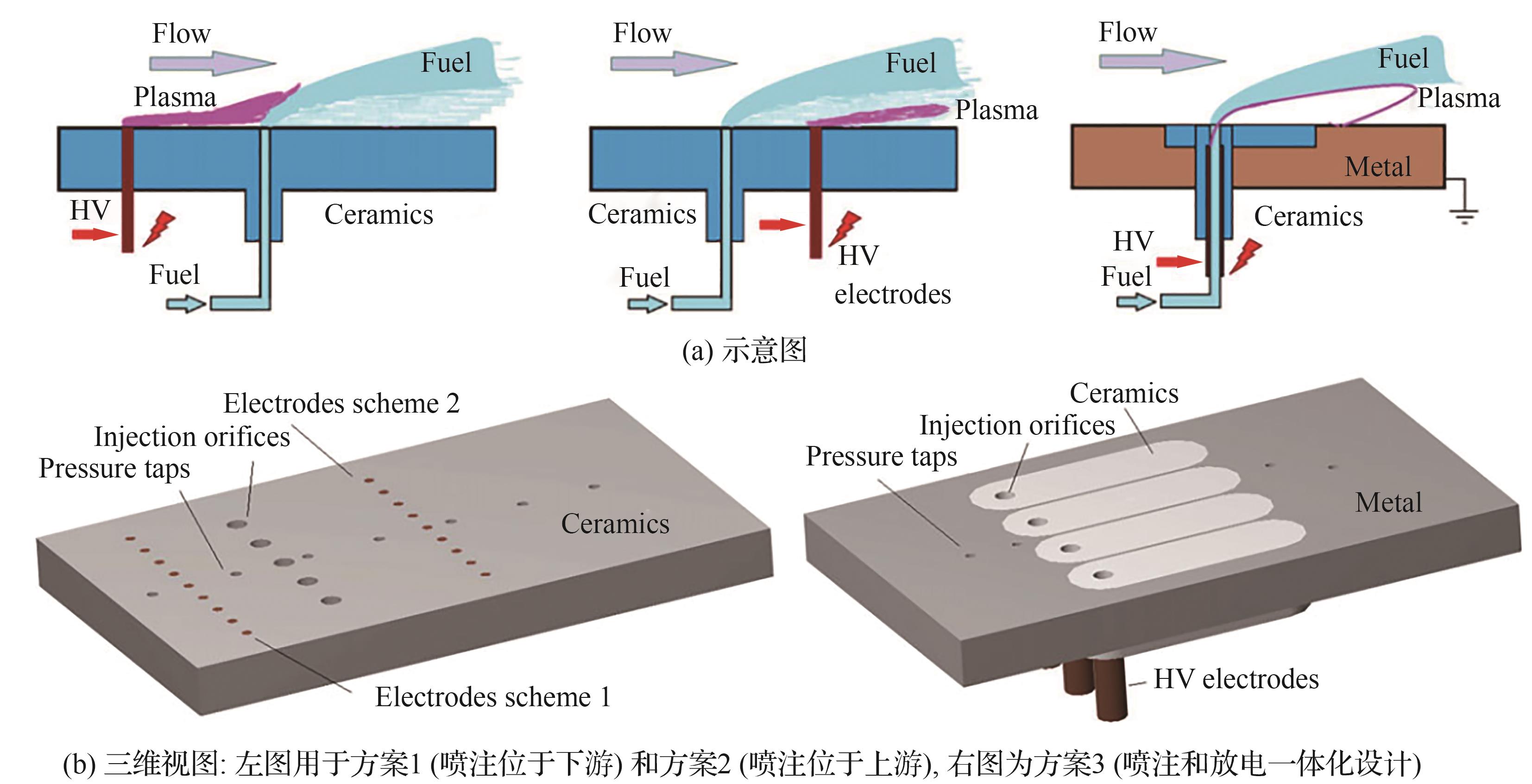
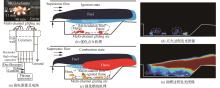
Fig.5
Scramjet combustion chamber multi-channel surface arc plasma ignition aid[50-52]
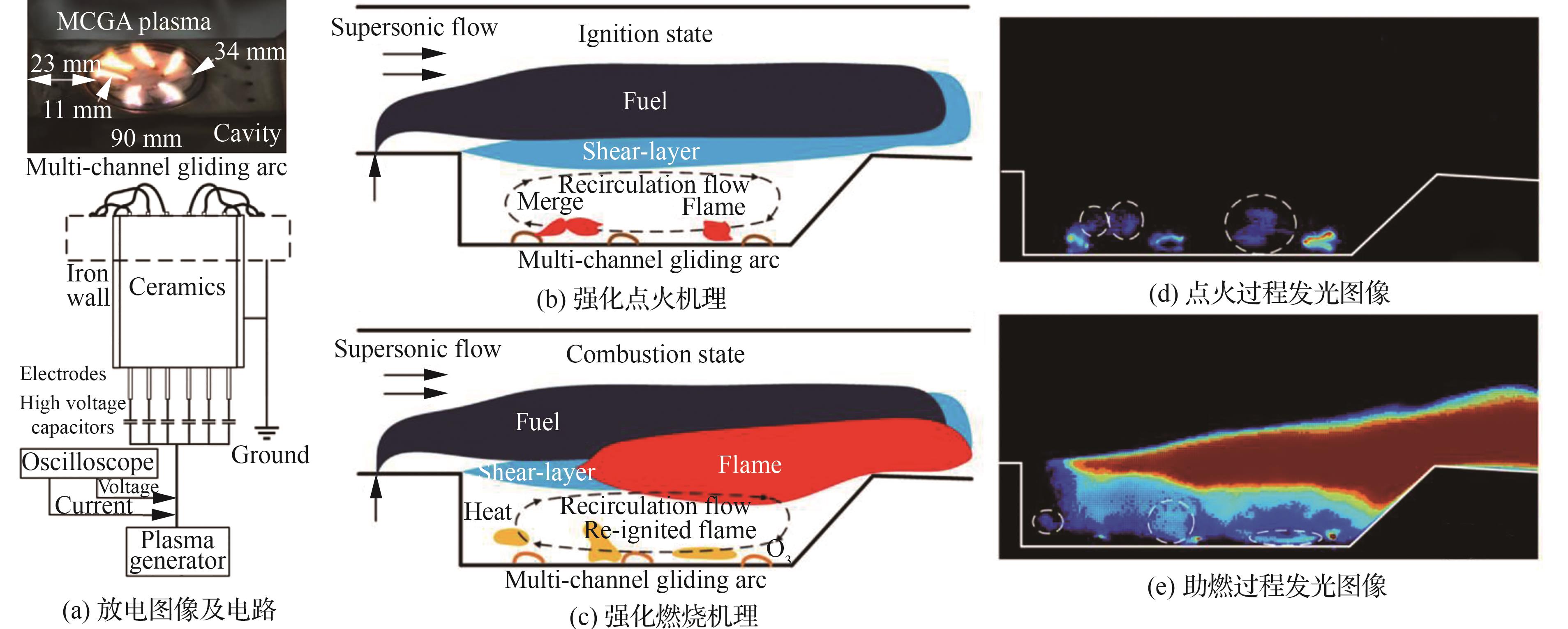
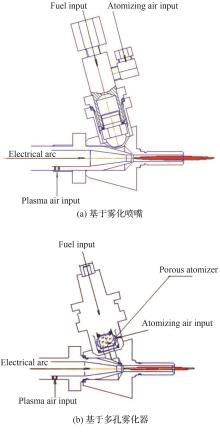
Fig.6
Plasma fuel nozzle
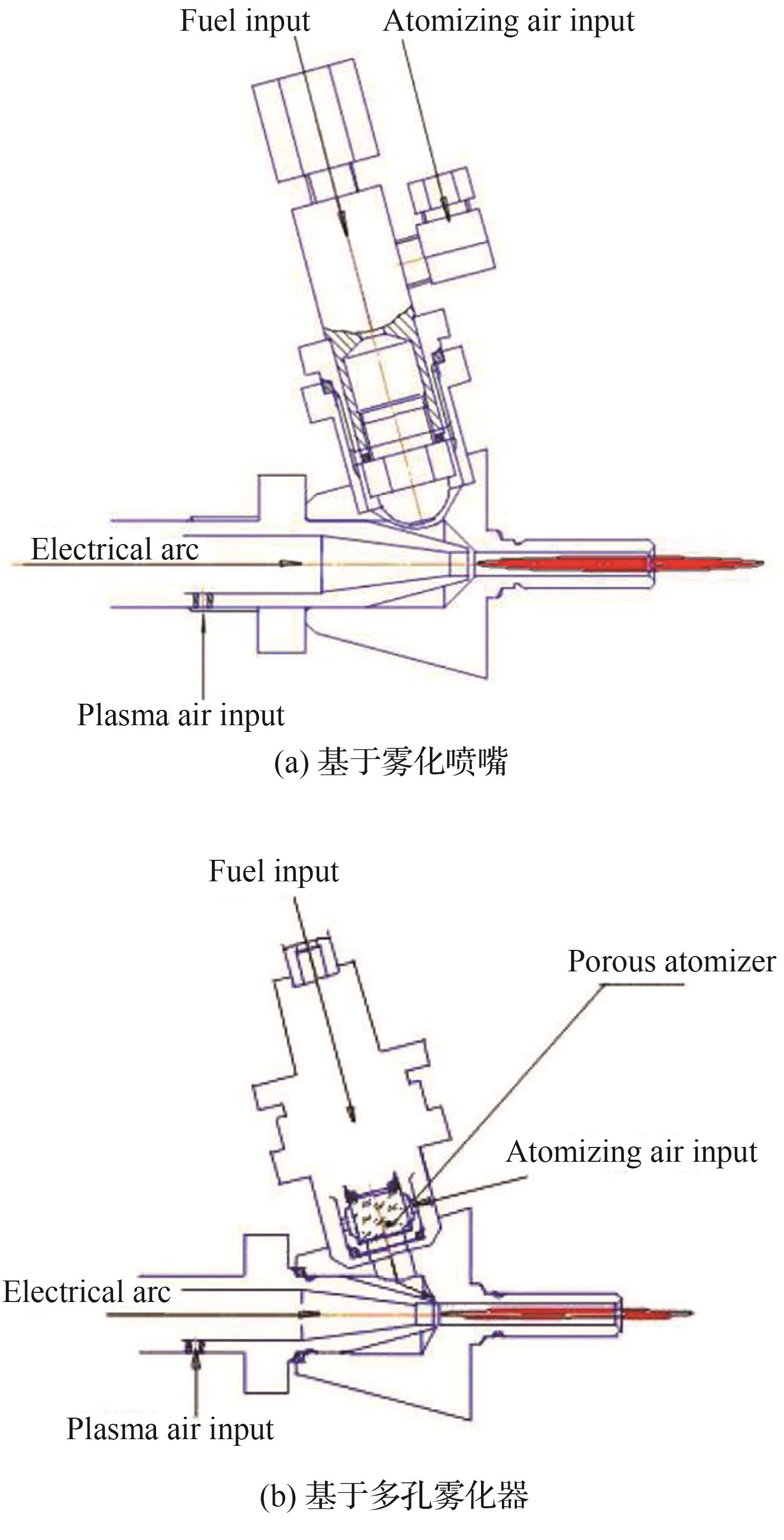
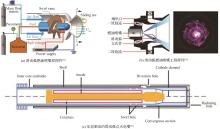
Fig.7
Various types of sliding arc plasma ignition excitation systems
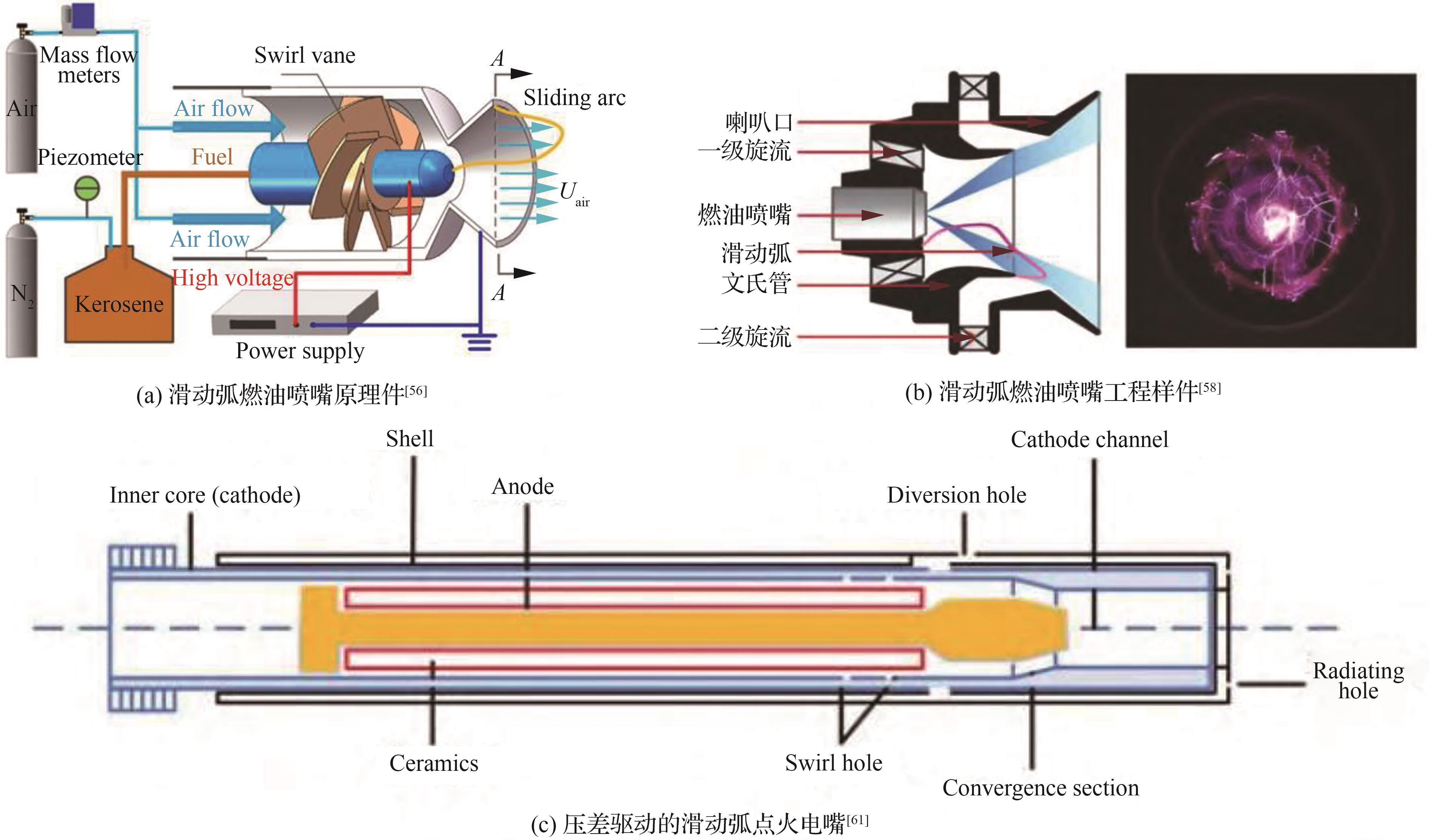
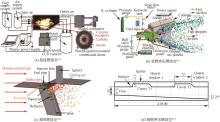
Fig.8
Verification of sliding arc plasma combustion control technology in a typical combustion chamber
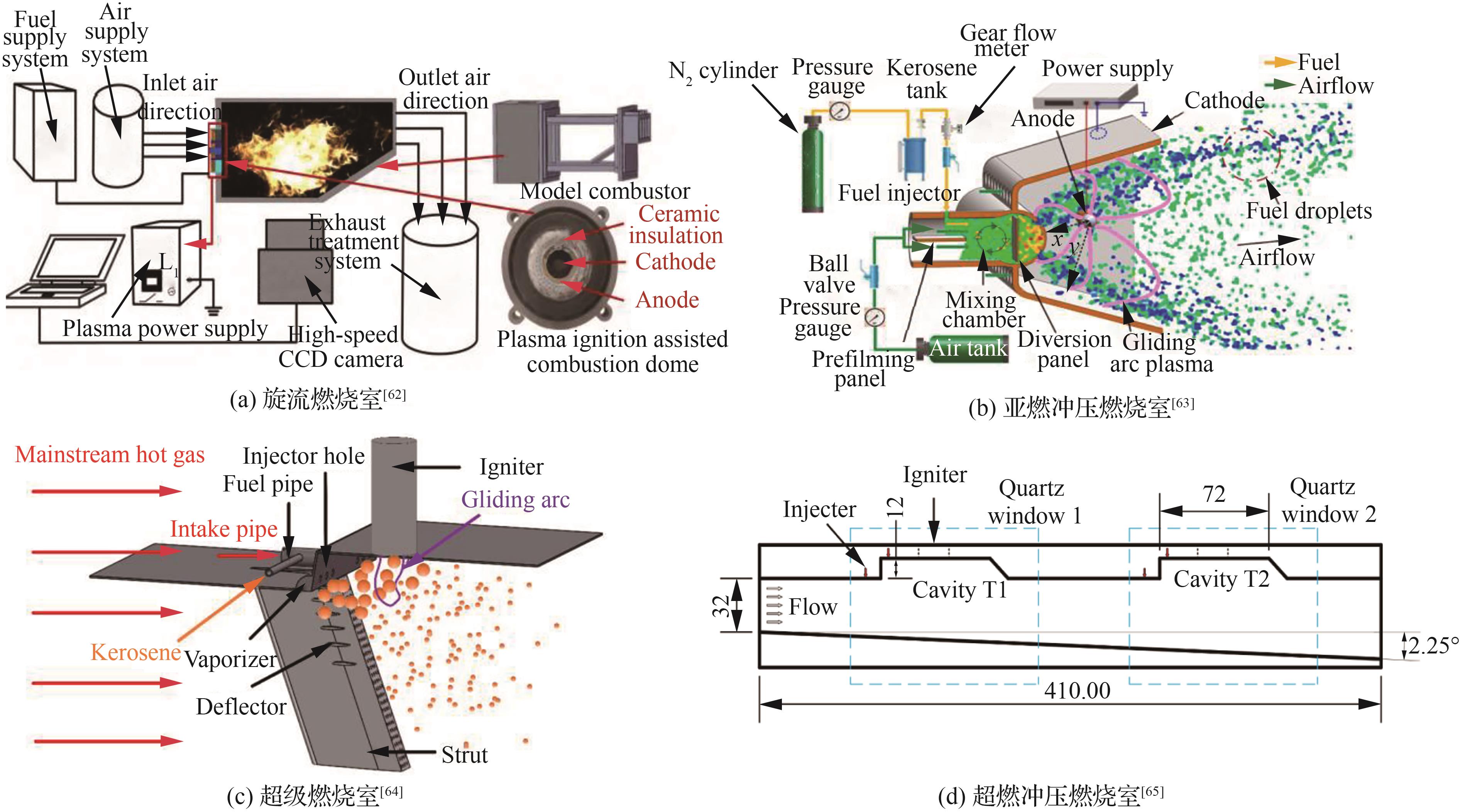
Fig.9
Scramjet experimental system and designed plasma torch ignition system[84]
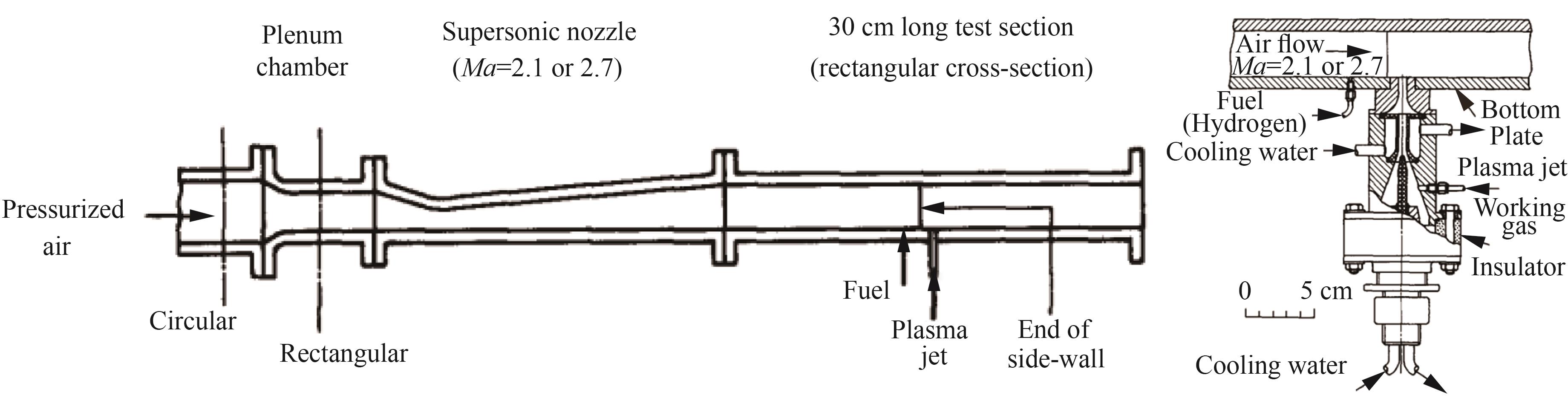
Fig.10
Aerodynamic skew-coupled plasma torch ignition scheme[100]
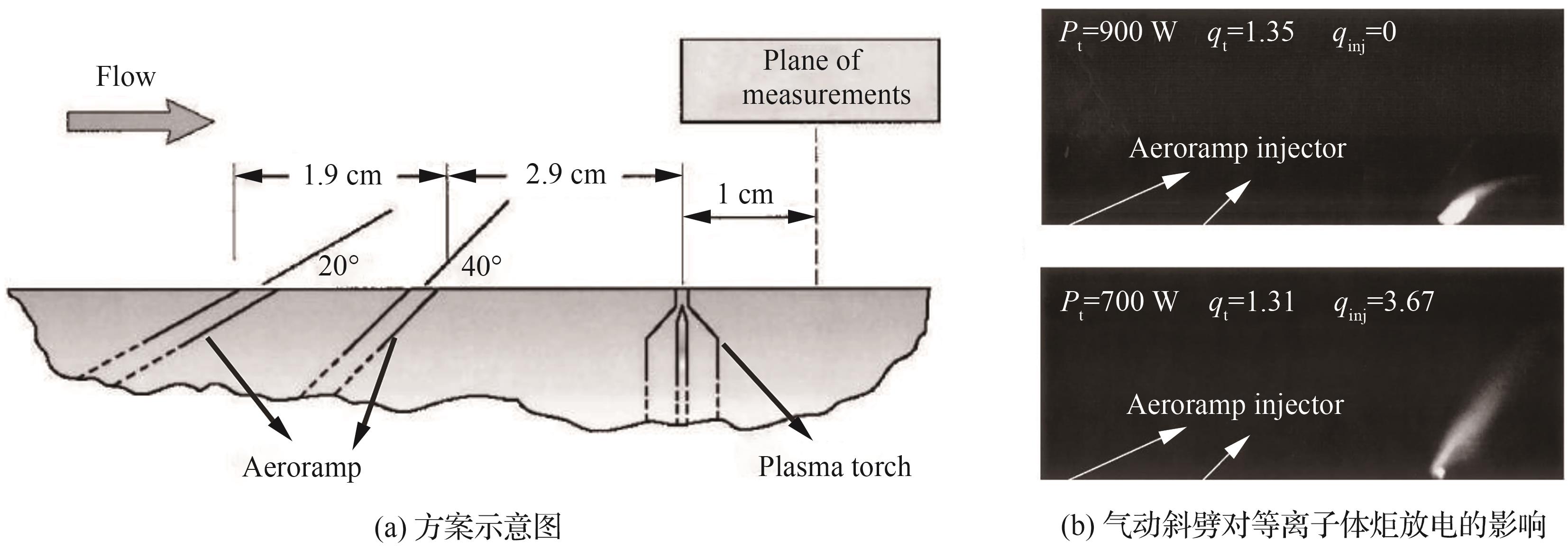
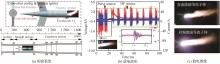
Fig.11
Research on dual-frequency coupled plasma ram ignition[105]
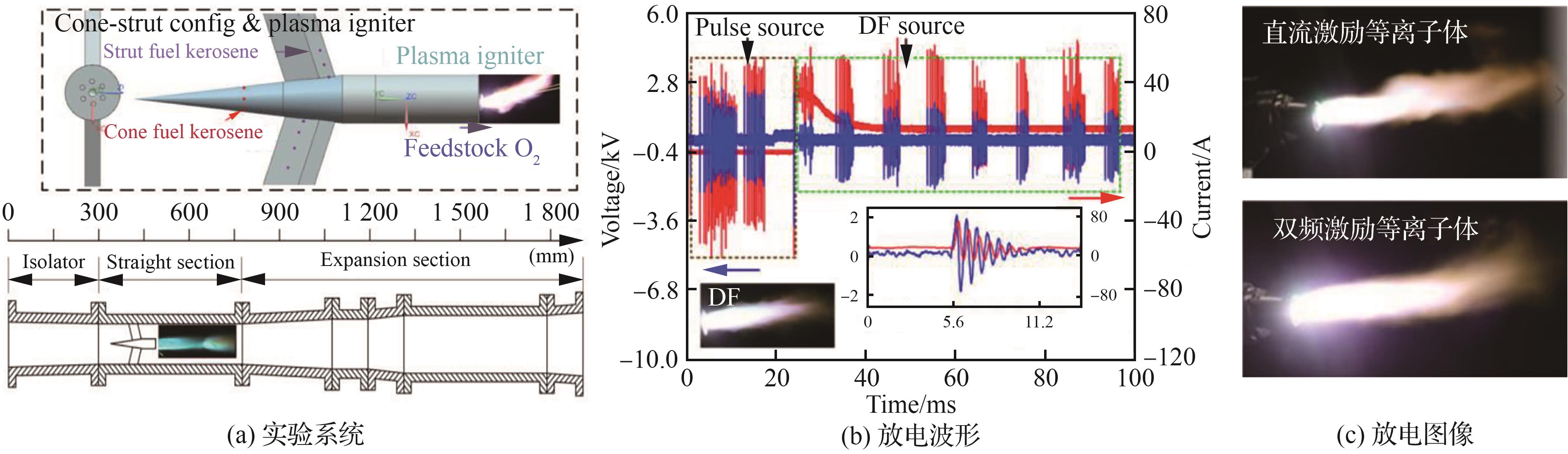
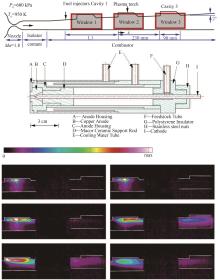
Fig.12
Experimental system of plasma torch ignition in scramjet combustion chamber and luminescence image sequence of ignition process[107]
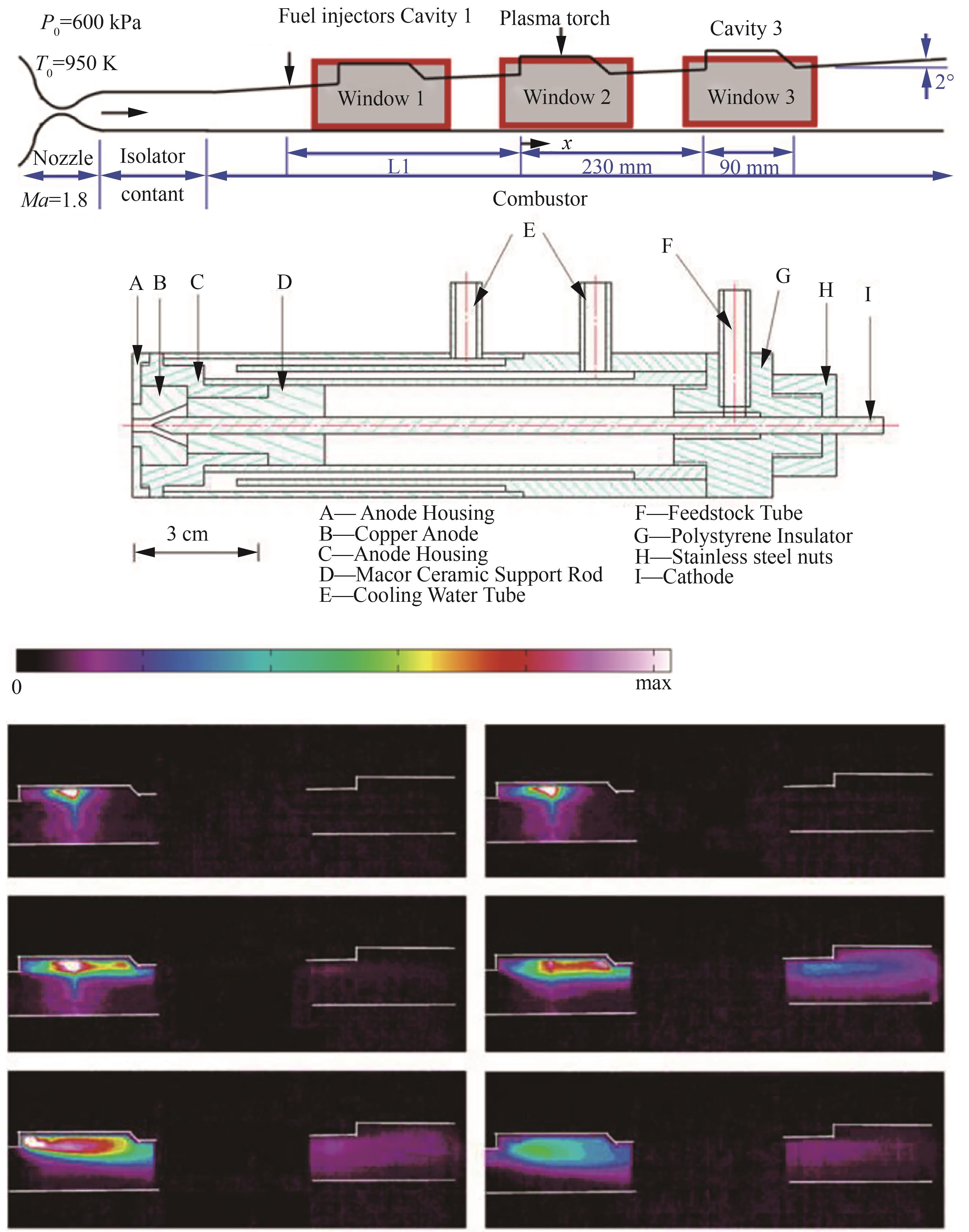
Fig.13
CH/OH chemiluminescence and schlieren images of laser ignition process[113]
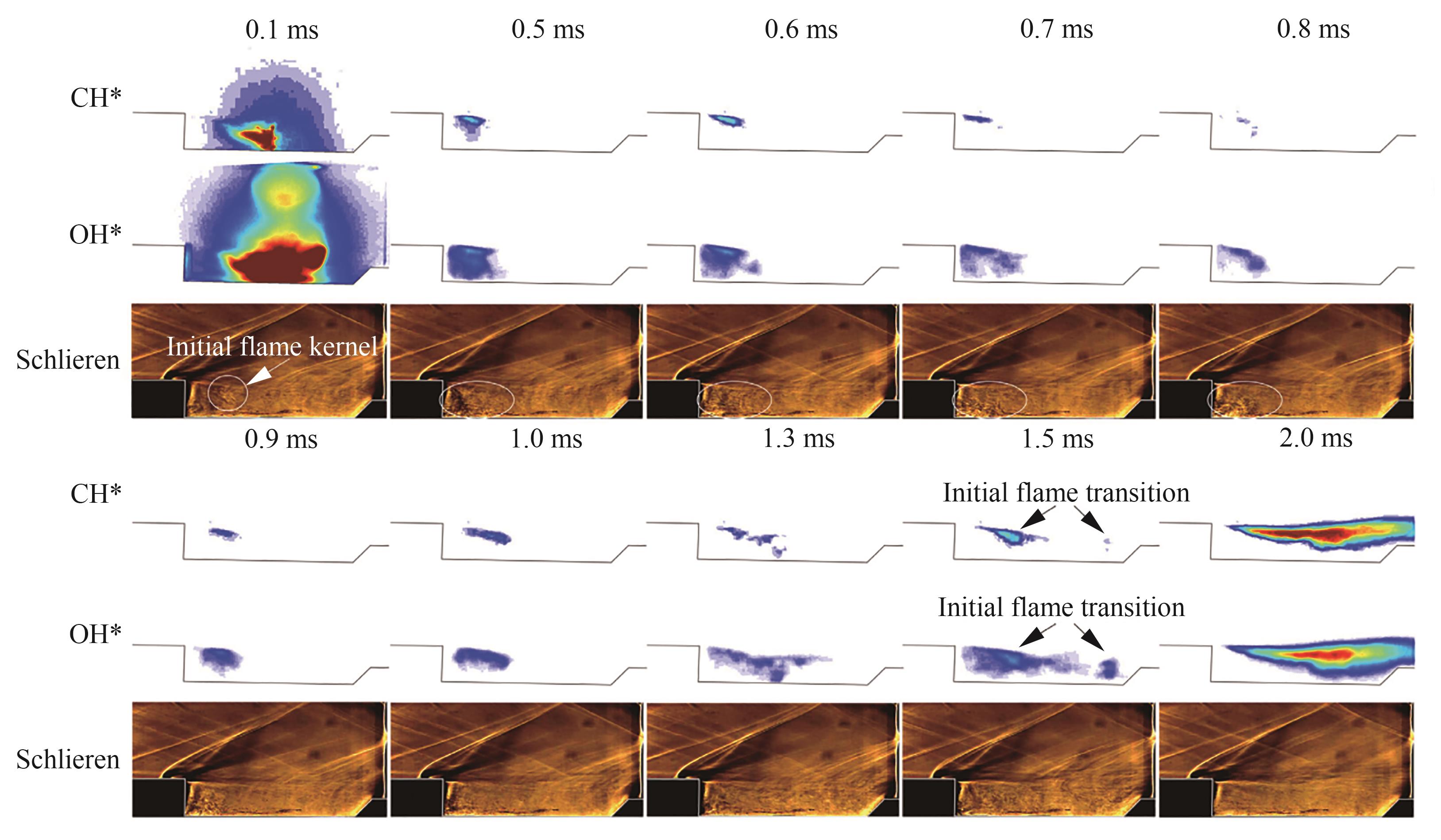
Fig.14
Influence of lens position on laser incident energy[116]
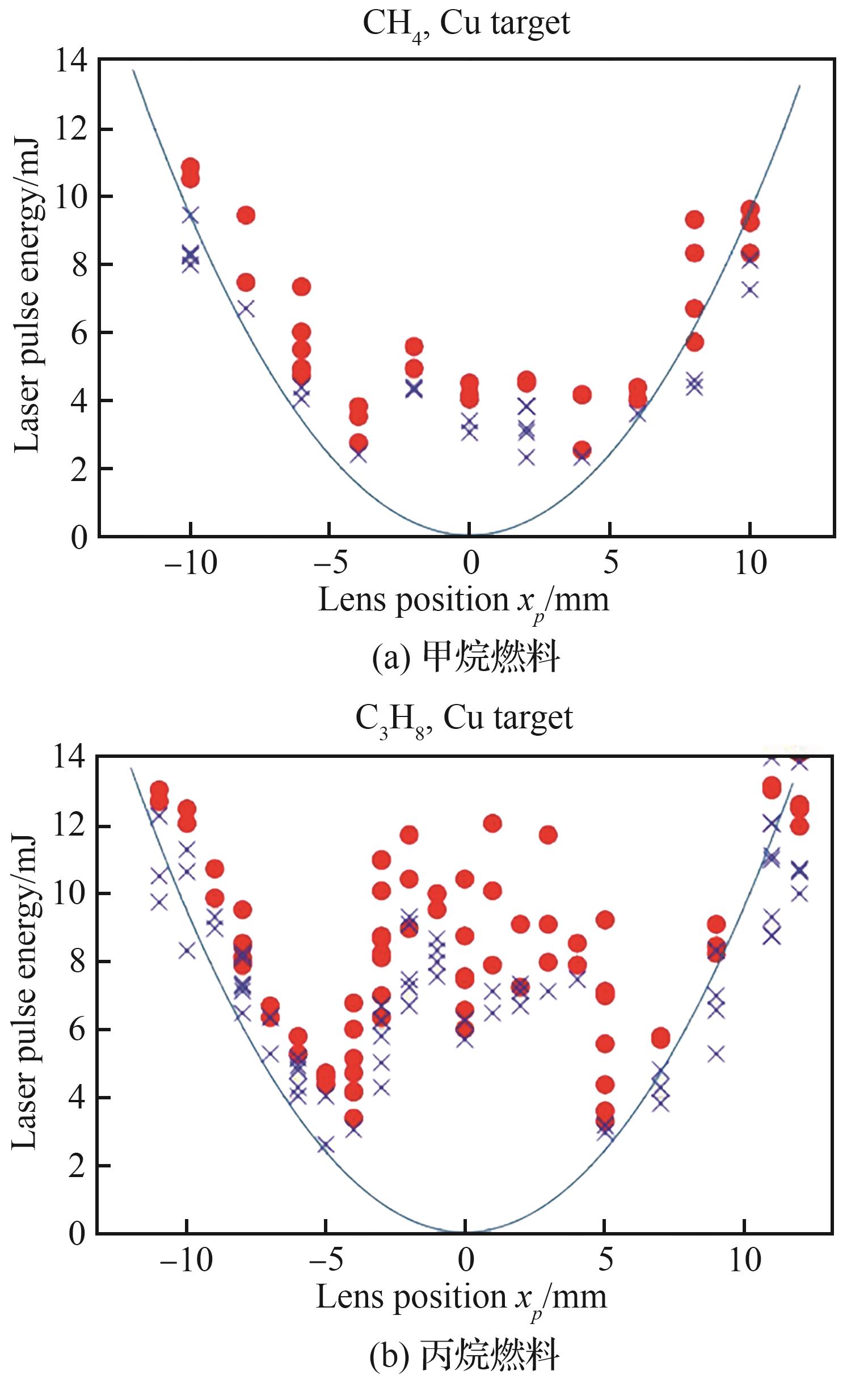
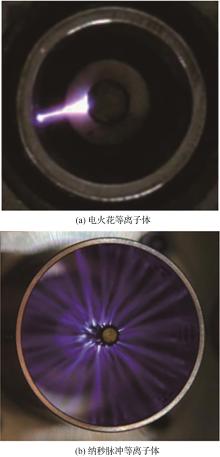
Fig.15
Comparison of discharge images
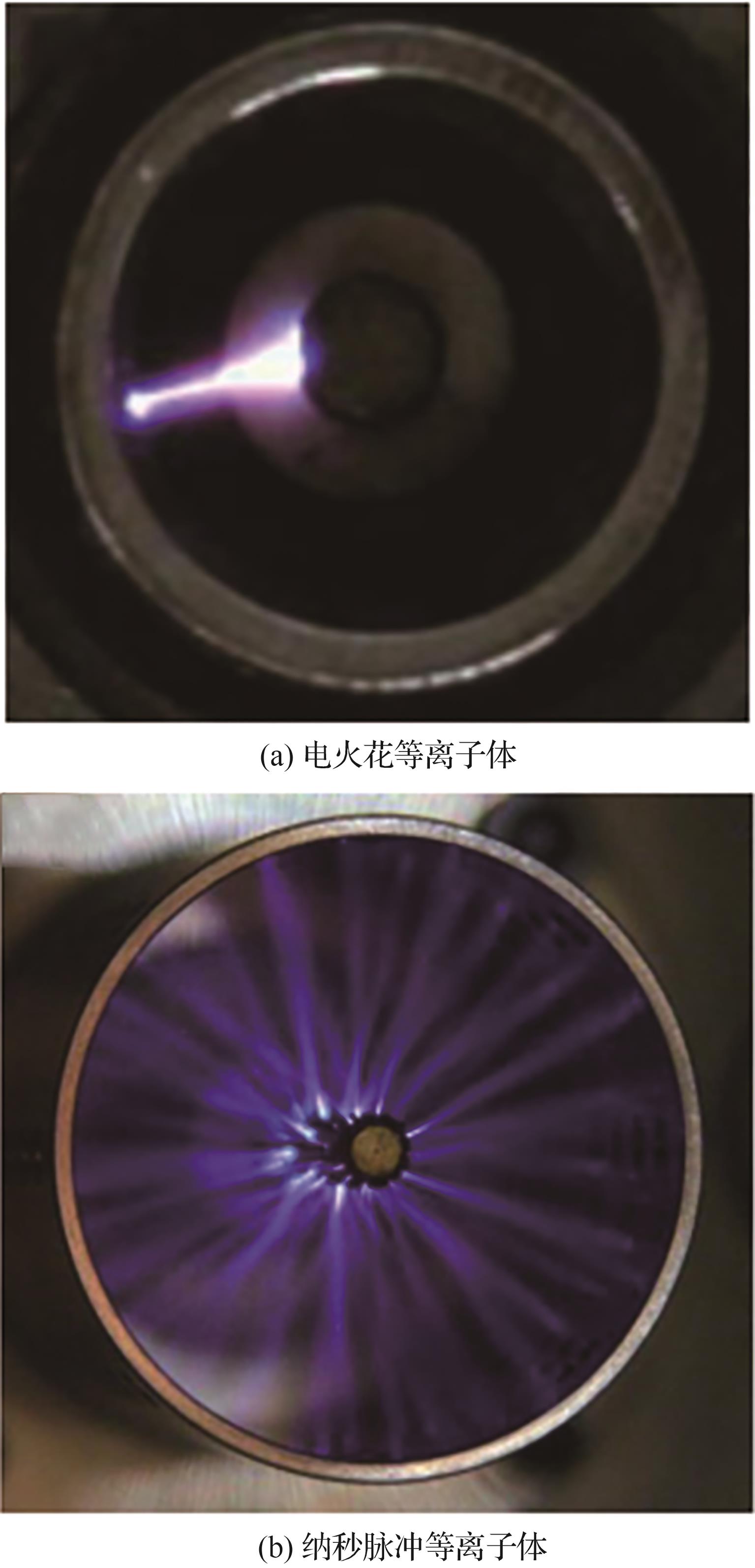
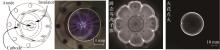
Fig.16
Structure of transient plasma nozzle, discharge image and comparison of initial fire nucleus and spark[122]
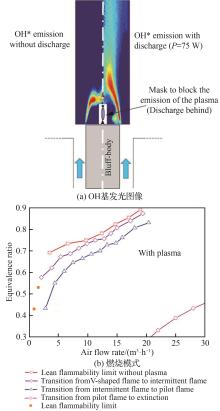
Fig.17
A nanosecond pulsed discharge plasma extends the depleted oil combustion boundary
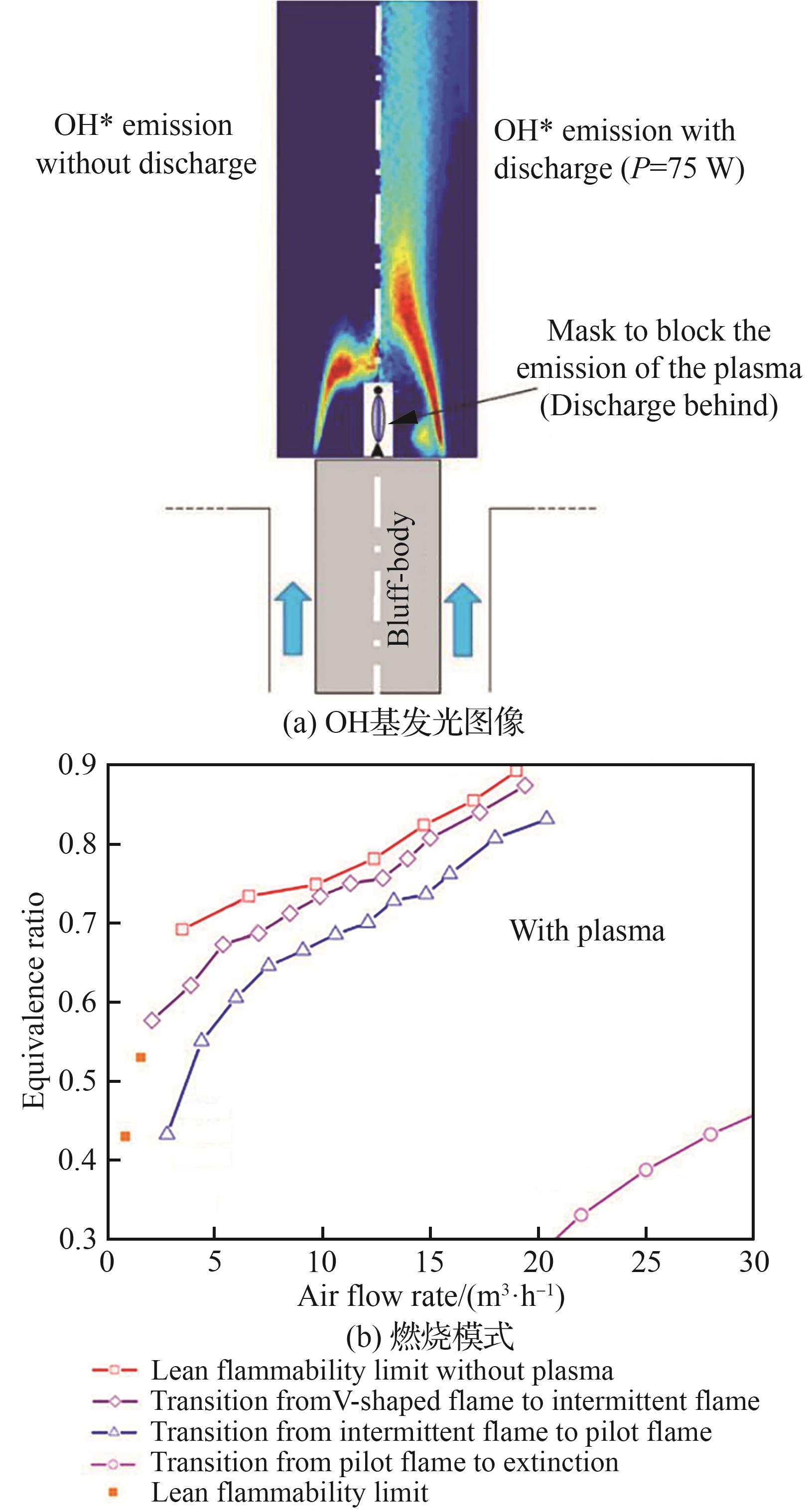
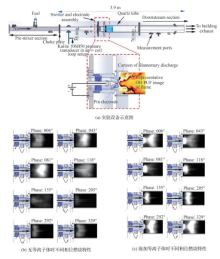
Fig.18
Study on combustion instability suppression by nanosecond pulsed plasma excitation[131]
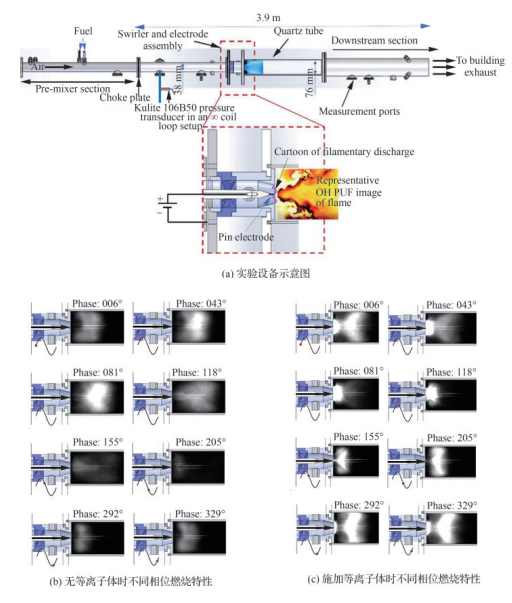
Fig.19
Schematic diagram of chemical time-temperature scale of plasma excited combustion
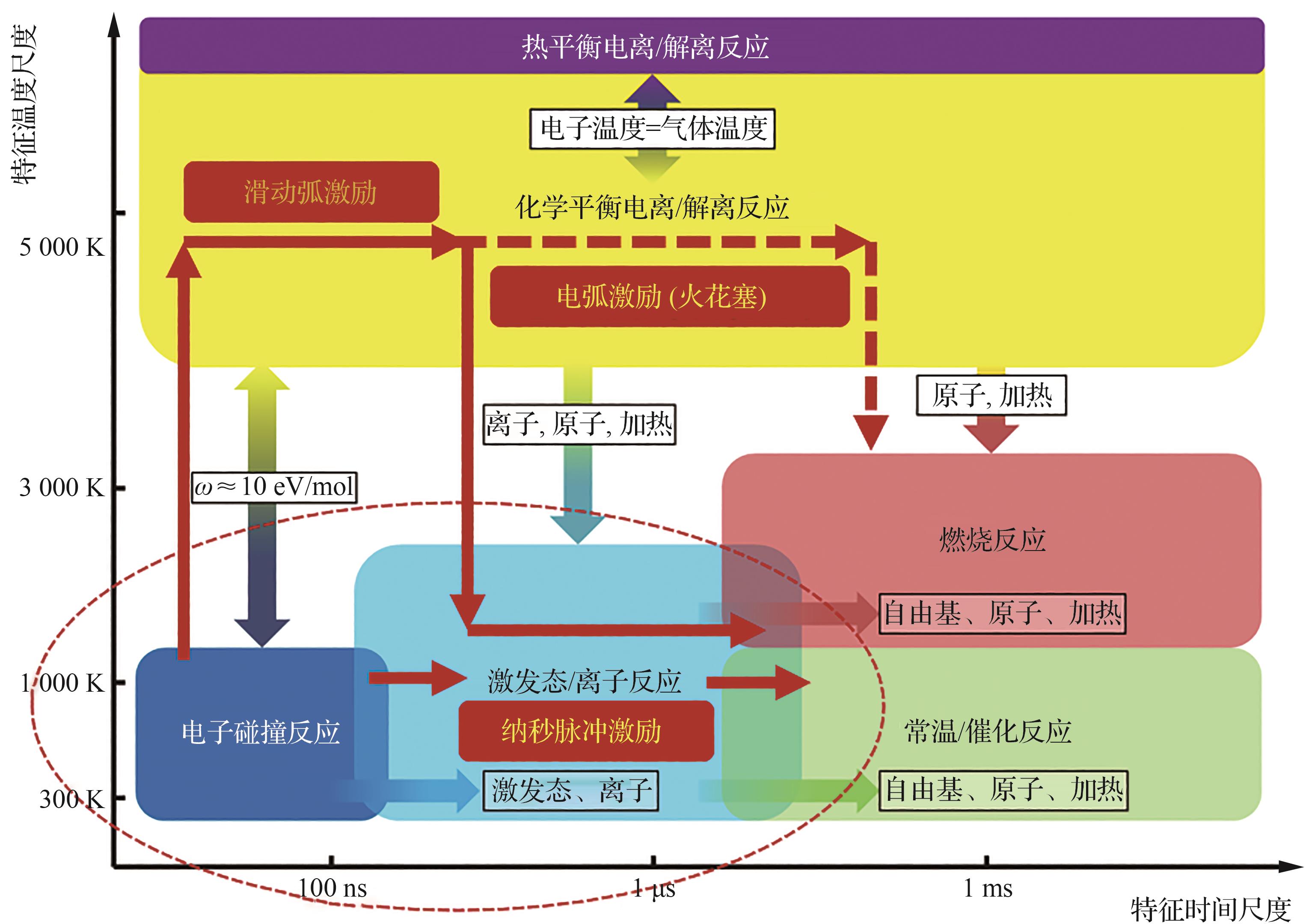
Fig.20
Influence of plasma excitation on macroscopic combustion phenomenon
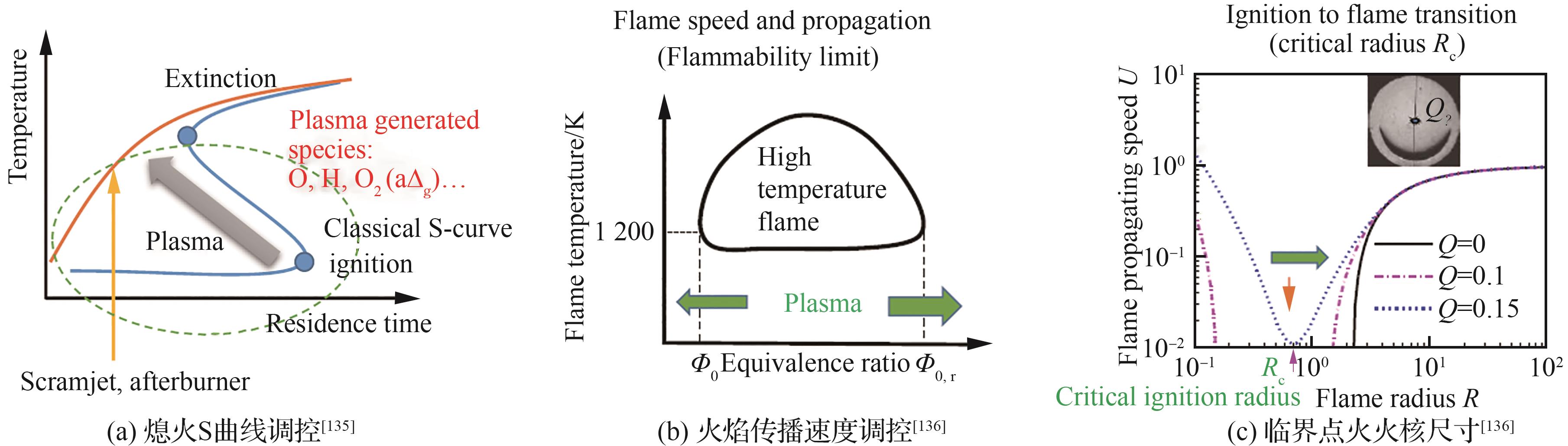
Fig.21
Plasma-excited cold flame phenomenon and plasma-combustion-thermochemical instability phenomenon[137]
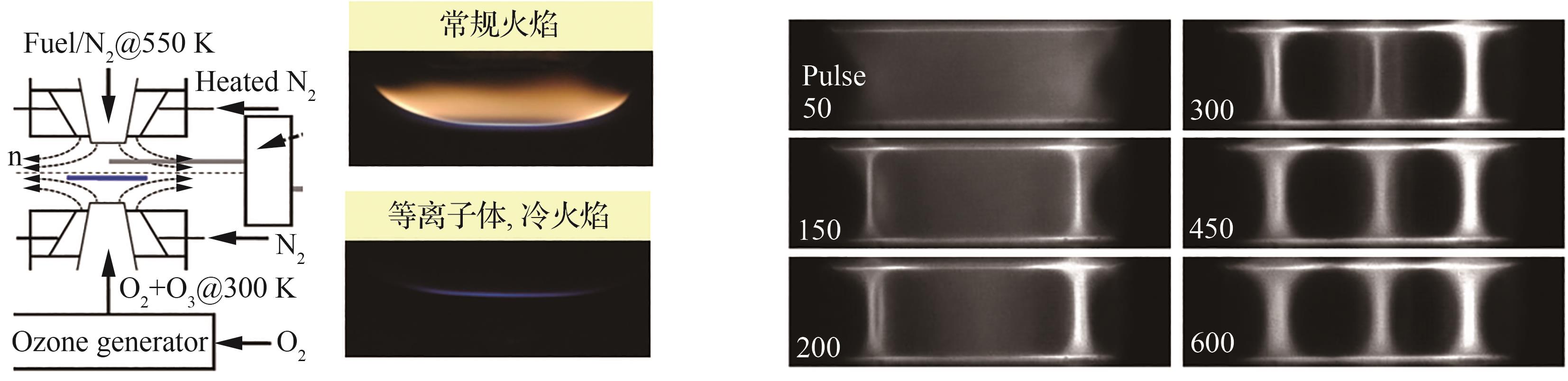
Fig.22
Typical experimental study of plasma combustion control mechanism
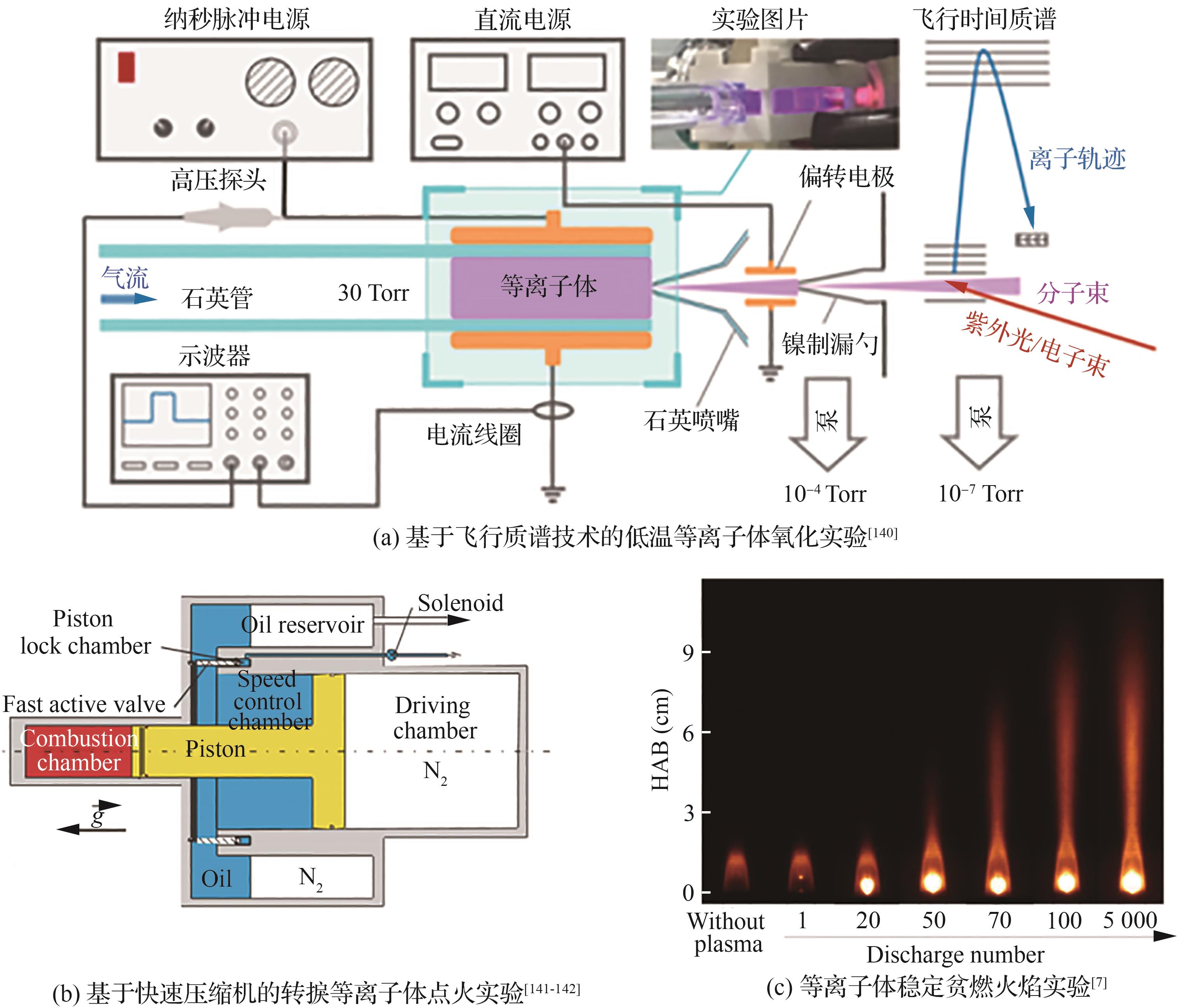
Fig.23
Schematic diagram of energy transfer channel for gas discharge heating
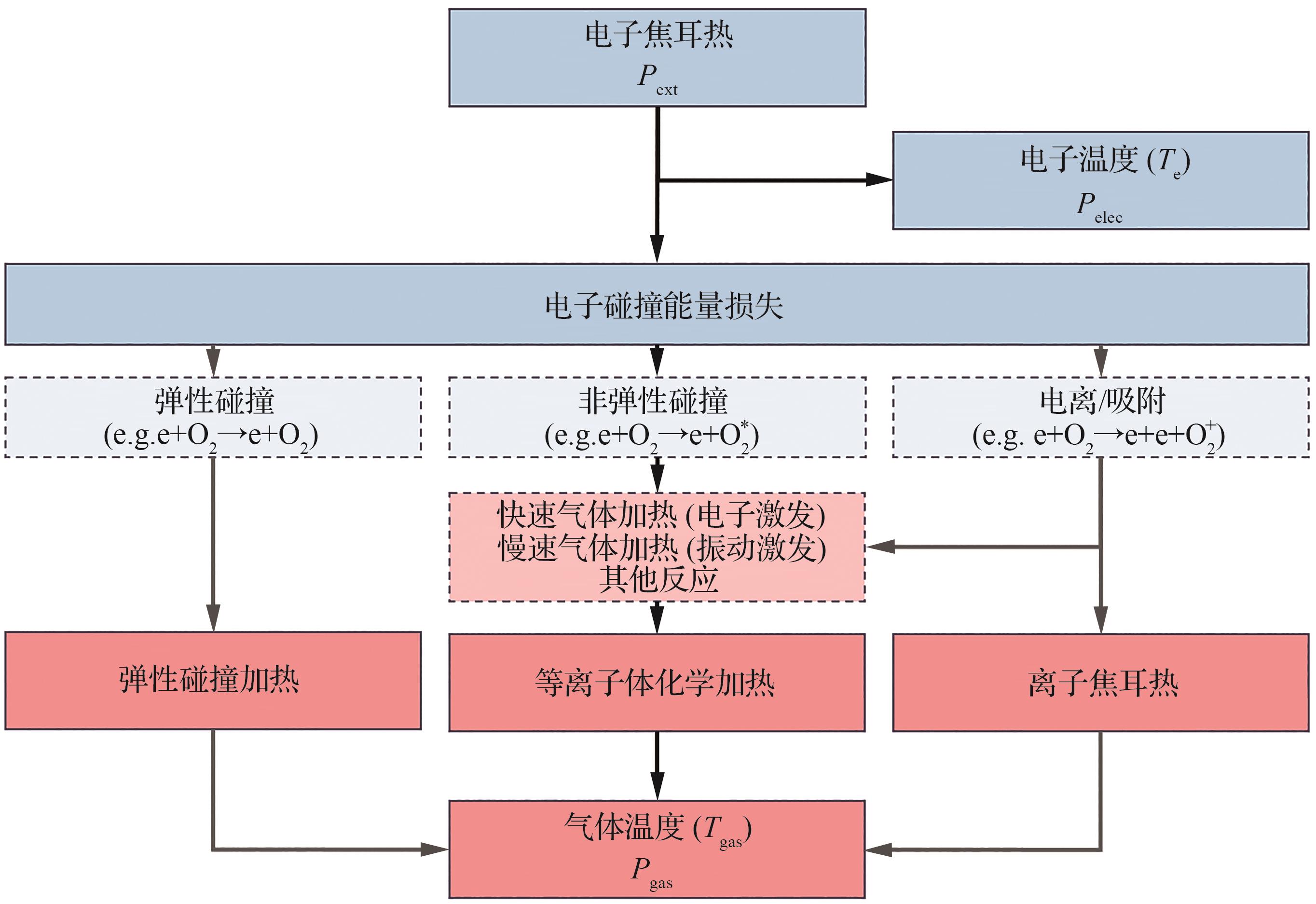
Fig.24
Schematic diagram of main chemical effects of plasma-assisted ignition
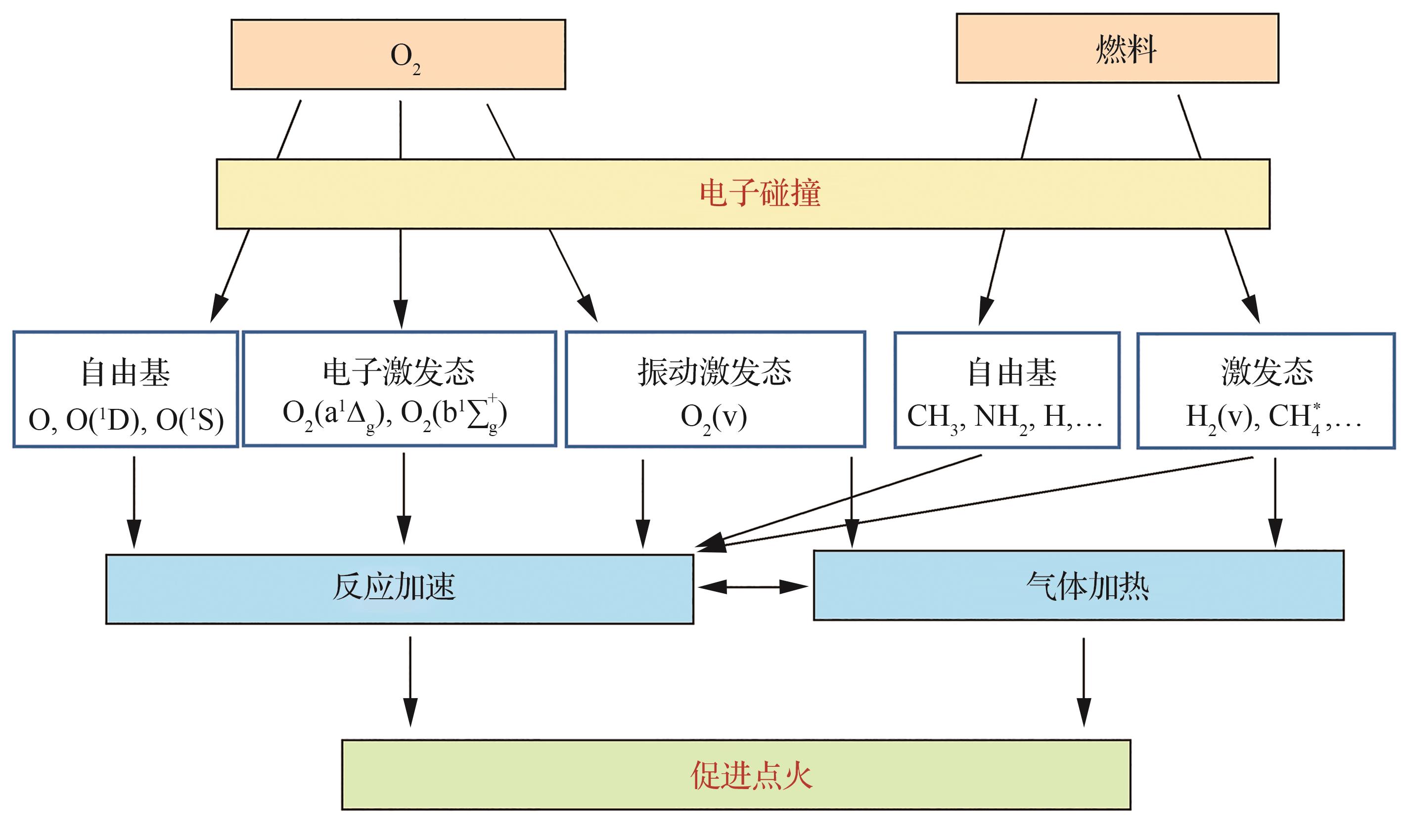

Table 1
Recent progress of reaction kinetics in plasma-assisted combustion
| 气体组成 | 放电形式 | 年份 | 文献 |
|---|---|---|---|
| CH4/Air | 重频脉冲 | 2020 | [ |
| CH4/Air | 脉冲 | 2020 | [ |
| CH4/Air | 脉冲-直流 | 2022 | [ |
| CH4/Air | 脉冲-直流 | 2020 | [ |
| CH4 reforming | 脉冲 | 2023 | [ |
| CH4/Air | 脉冲 | 2021 | [ |
| CH4/O2/He | 脉冲 | 2021 | [ |
| CH4/Air | 重频脉冲 | 2020 | [ |
| NH3/O2/He | 重频脉冲 | 2020 | [ |
| NH3/Air | 重频脉冲 | 2022 | [ |
| NH3/Air | 脉冲-直流 | 2023 | [ |
| NH3/Air | 重频脉冲 | 2023 | [ |
| NH3/Air | 脉冲 | 2023 | [ |
| NH3/O2/He | 脉冲 | 2022 | [ |
| NH3/O2/He | 脉冲 | 2021 | [ |
| H2/N2/CO/CO2 | 脉冲 | 2024 | [ |
| H2/O2 | 正弦 | 2022 | [ |
| H2/O2 | 正弦 | 2023 | [ |
| H2/Air | 脉冲 | 2020 | [ |
| C2H4/Air | 滑动弧 | 2021 | [ |
| C2H4/Air | 重频脉冲 | 2020 | [ |
| C3H8/Air | 滑动弧 | 2023 | [ |
| C3H8/Air | 重频脉冲 | 2023 | [ |
| n-Dodecane/O2/N2 | 重频脉冲 | 2020 | [ |
| n-C5H12/O2/N2 | 脉冲-直流 | 2024 | [ |
Table 2
Typical plasma excitation multi-physics modeling work
| 等离子体耦合流动 | 耦合方法 | 年份 | 文献 |
|---|---|---|---|
| SDBD流动控制 | 单向 | 2007 | [ |
| 微等离子体射流 | 双向 | 2009 | [ |
| SDBD流动控制 | 双向 | 2010 | [ |
| 尖-尖放电流动响应 | 单向 | 2013 | [ |
| 大气压等离子体射流 | 单向 | 2015 | [ |
| 大气压等离子体射流 | 单向 | 2017 | [ |
| SDBD流动控制 | 单向 | 2017 | [ |
| 等离子体耦合燃烧 | 耦合方法 | 年份 | 文献 |
| 尖-尖放电点火/H2-Air燃料 | 双向 | 2012 | [ |
| 尖-尖放电点火/H2-Air燃料 | 双向 | 2017 | [ |
| 纳秒脉冲点火/H2-Air燃料 | 双向 | 2019 | [ |
| 纳秒脉冲点火/H2-Air燃料 | 双向 | 2021 | [ |
| 尖-尖放电点火/CH4-Air燃料 | 双向 | 2022 | [ |
| SDBD点火/CH4-O2-He燃料 | 双向 | 2023 | [ |
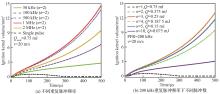
Fig.25
Initial fire core volume time evolution with different pulse numbers at different repeat pulse frequencies and 200 kHz repeat pulse frequency[199]
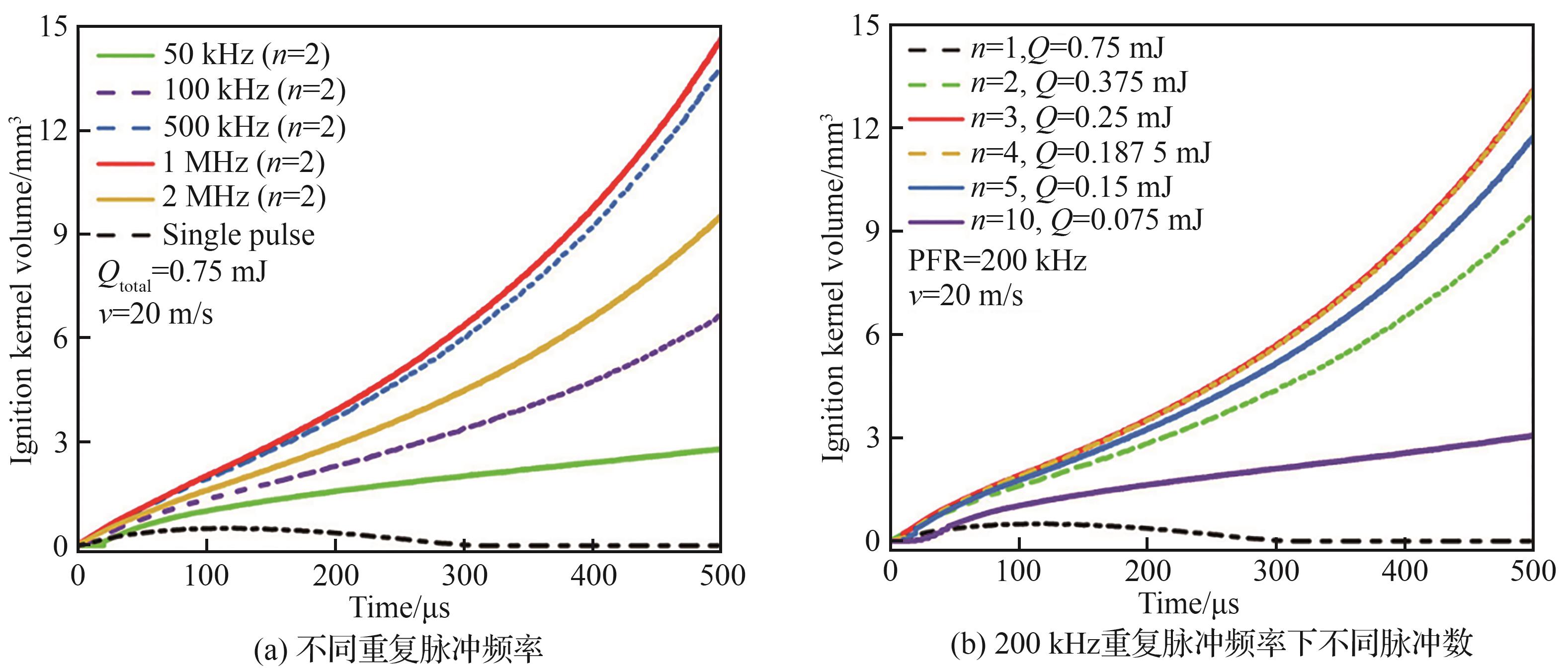
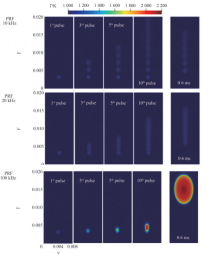
Fig.26
Temperature and time evolution of 10 pules in decouped (10 kHz), partially decoupled (20 kHz) and fully coupled (100 kHz) states
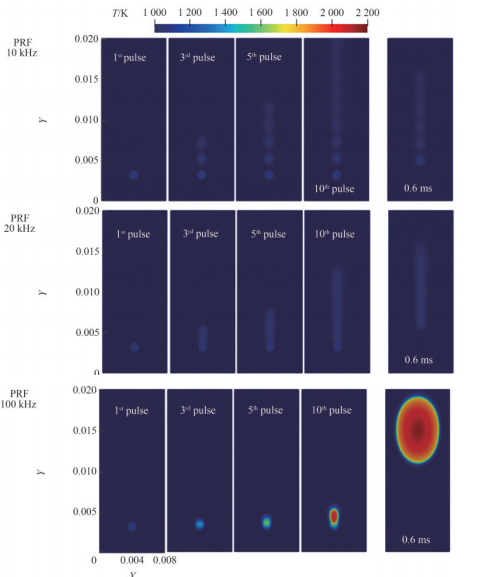
Fig.27
Coupling multi-physics model of classical sliding arc actuator
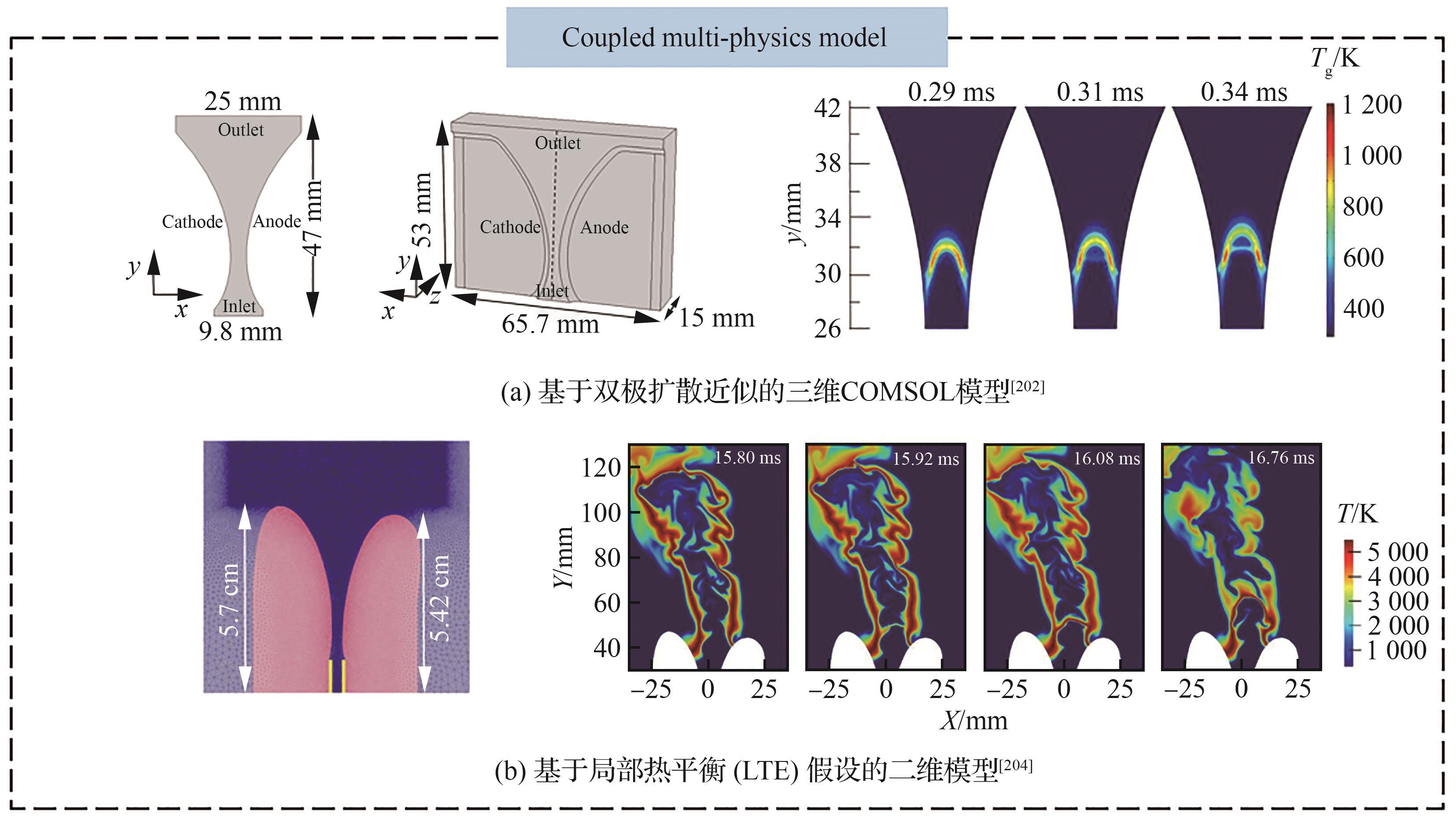
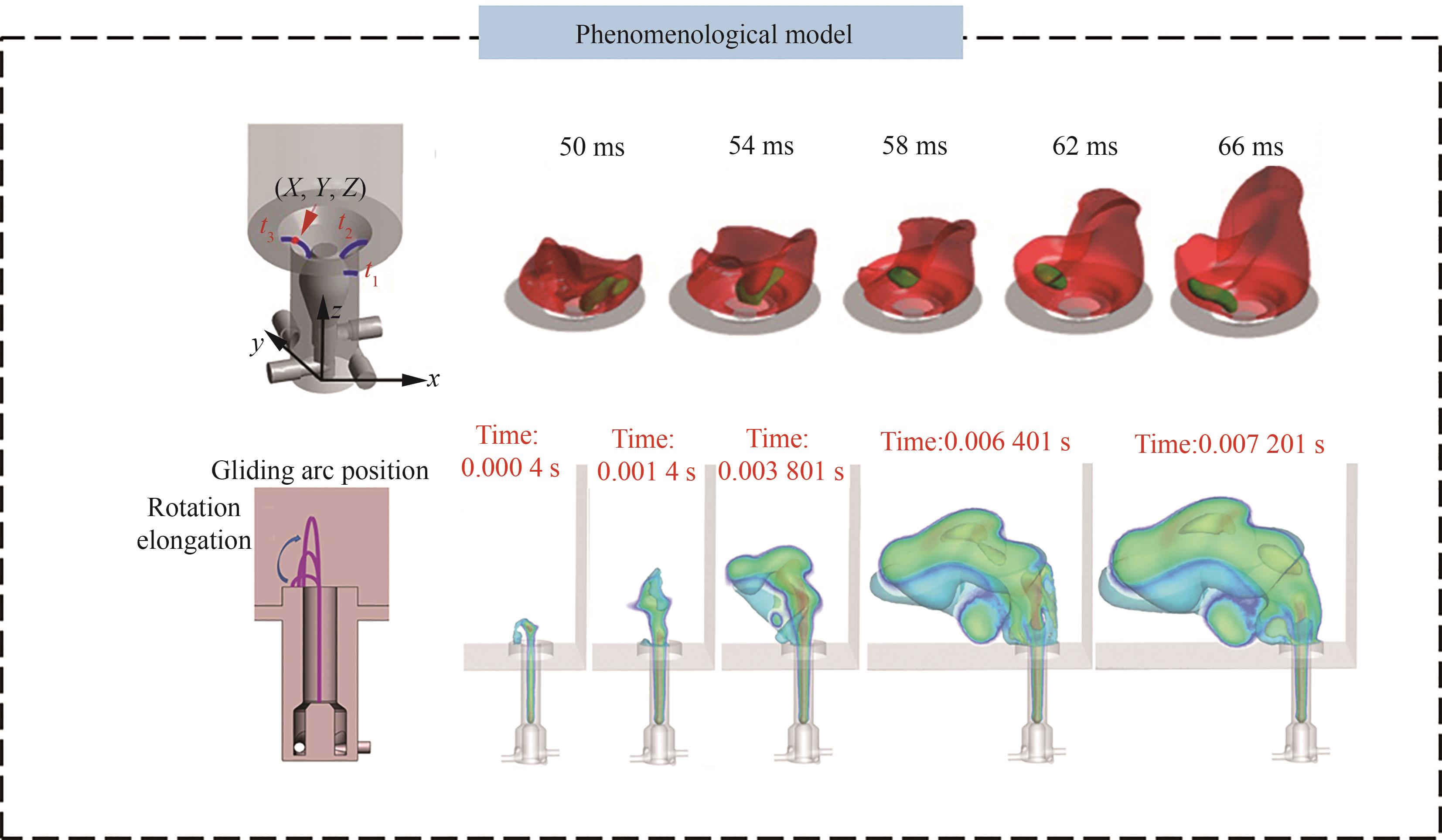
Fig.28
Phenomenological model of rotating sliding arc igniter
| 1 | LI M Z, WANG Z K, XU R G, et al. Advances in plasma-assisted ignition and combustion for combustors of aerospace engines[J]. Aerospace Science and Technology, 2021, 117: 106952. |
| 2 | CAI Z, WANG T Y, SUN M B. Review of cavity ignition in supersonic flows[J]. Acta Astronautica, 2019, 165: 268-286. |
| 3 | 于锦禄, 黄丹青, 王思博, 等. 等离子体点火与助燃技术在航空发动机上的应用[J]. 航空发动机, 2018, 44(3): 12-20. |
| YU J L, HUANG D Q, WANG S B, et al. Application of plasma ignition and assisted combustion of aeroengine[J]. Aeroengine, 2018, 44(3): 12-20 (in Chinese). | |
| 4 | 李应红, 吴云. 等离子体激励调控流动与燃烧的研究进展与展望[J]. 中国科学: 技术科学, 2020, 50(10): 1252-1273. |
| LI Y H, WU Y. Research progress and outlook of flow control and combustion control using plasma actuation[J]. Scientia Sinica (Technologica), 2020, 50(10): 1252-1273 (in Chinese). | |
| 5 | 吴云, 李应红. 等离子体流动控制与点火助燃研究进展[J]. 高电压技术, 2014, 40(7): 2024-2038. |
| WU Y, LI Y H. Progress in research of plasma-assisted flow control, ignition and combustion[J]. High Voltage Engineering, 2014, 40(7): 2024-2038 (in Chinese). | |
| 6 | LEMPERT W R. An overview or the AFOSR plasma assisted combustion MURI program[C]∥53rd AIAA Aerospace Sciences Meeting. Reston: AIAA, 2015. |
| 7 | STARIKOVSKIY A, ALEKSANDROV N. Plasma-assisted ignition and combustion[J]. Progress in Energy and Combustion Science, 2013, 39(1): 61-110. |
| 8 | JU Y G, SUN W T. Plasma assisted combustion: Dynamics and chemistry[J]. Progress in Energy and Combustion Science, 2015, 48: 21-83. |
| 9 | JU Y G, LEFKOWITZ J K, REUTER C B, et al. Plasma assisted low temperature combustion[J]. Plasma Chemistry and Plasma Processing, 2016, 36(1): 85-105. |
| 10 | 李奕新, 谭航, 杨水银. 航空发动机电点火系统现状与发展趋势[J]. 燃气涡轮试验与研究, 2015, 28(6): 49-54. |
| LI Y X, TAN H, YANG S Y. An initial study on the current development and derivatives of the electric ignition system of aero-engine[J]. Gas Turbine Experiment and Research, 2015, 28(6): 49-54 (in Chinese). | |
| 11 | BALLAL D R, LEFEBVRE A H. Ignition and flame quenching of quiescent fuel mists[J]. Proceedings of the Royal Society of London A Mathematical and Physical Sciences, 1978, 364(1717): 277-294. |
| 12 | BALLAL D R, LEFEBVRE A H. The influence of spark discharge characteristics on minimum ignition energy in flowing gases[J]. Combustion and Flame, 1975, 24: 99-108. |
| 13 | KELLEY A P, JOMAAS G, LAW C K. Critical radius for sustained propagation of spark-ignited spherical flames[J]. Combustion and Flame, 2009, 156(5): 1006-1013. |
| 14 | CHEN Z, BURKE M P, JU Y G. On the critical flame radius and minimum ignition energy for spherical flame initiation[J]. Proceedings of the Combustion Institute, 2011, 33(1): 1219-1226. |
| 15 | ZHANG Z B, WU Y, SUN Z Z, et al. Experimental research on multichannel discharge circuit and multi-electrode plasma synthetic jet actuator[J]. Journal of Physics D: Applied Physics, 2017, 50(16): 165205. |
| 16 | ZHANG Z B, WU Y, JIA M, et al. The multichannel discharge plasma synthetic jet actuator[J]. Sensors and Actuators A: Physical, 2017, 253: 112-117. |
| 17 | ZHANG Z B, WU Y, JIA M, et al. Modeling and optimization of the multichannel spark discharge[J]. Chinese Physics B, 2017, 26(6): 065204. |
| 18 | LIN B X, WU Y, ZHANG Z B, et al. Multi-channel nanosecond discharge plasma ignition of premixed propane/air under normal and sub-atmospheric pressures[J]. Combustion and Flame, 2017, 182: 102-113. |
| 19 | LIN B X, WU Y, ZHANG Z B, et al. Ignition enhancement of lean propane/air mixture by multi-channel discharge plasma under low pressure[J]. Applied Thermal Engineering, 2019, 148: 1171-1182. |
| 20 | HUANG S F, SONG H M, WU Y, et al. Experimental investigation on electrical characteristics and ignition performance of multichannel plasma igniter[J]. Chinese Physics B, 2018, 27(3): 035203. |
| 21 | LIN B X, WU Y, XU M X, et al. Experimental investigation on high-altitude ignition and ignition enhancement by multi-channel plasma igniter[J]. Plasma Chemistry and Plasma Processing, 2021, 41(5): 1435-1454. |
| 22 | HUANG S F, WU Y, SONG H M, et al. Experimental investigation of multichannel plasma igniter in a supersonic model combustor[J]. Experimental Thermal and Fluid Science, 2018, 99: 315-323. |
| 23 | CAI B H, SONG H M, WU Y, et al. Experimental investigation on swirling spray forced ignition of embedded multi-channel plasma igniter[J]. Acta Astronautica, 2021, 179: 670-679. |
| 24 | CAI B H, SONG H M, ZHANG Z B, et al. Experimental investigation of C-shape embedded multi-channel plasma igniter in a single-head swirl combustor[J]. Journal of Physics D Applied Physics, 2021, 54(13): 135201. |
| 25 | MIAO H F, ZHANG Z B, JIA M, et al. Ignition enhancement of lean kerosene air mixture by multichannel jet enhanced plasma igniter[J]. Aerospace Science and Technology, 2021, 117: 106954. |
| 26 | ZHAO H, ZHAO N B, ZHANG T H, et al. Studies of multi-channel spark ignition of lean n-pentane/air mixtures in a spherical chamber[J]. Combustion and Flame, 2020, 212: 337-344. |
| 27 | HAN X Y, YU S, TONG J, et al. Study of an innovative three-pole igniter to improve efficiency and stability of gasoline combustion under charge dilution conditions[J]. Applied Energy, 2020, 257: 113999. |
| 28 | YU S, XIE K, YU X, et al. High energy ignition strategies for diluted mixtures via a three-pole igniter[C]∥SAE Technical Paper Series, 2016. |
| 29 | NAKAMURA T, TAKAHASHI E, NISHIOKA M, et al. Long gap spark discharge ignition using a boron-doped diamond electrode[J]. Journal of Physics D: Applied Physics, 2021, 54(40): 405204. |
| 30 | ZHU Z F, LI B, GAO Q, et al. Long-gap ignition using femtosecond laser filament-triggered discharge[J]. Optics & Laser Technology, 2022, 156: 108611. |
| 31 | 中国人民解放军总装备部. 航空涡轮发动机电点火系统通用规范 [S]. 北京: 中国人民解放军总装备部, 2007. |
| Chinese People’s Liberation Army General Armament Department. General specification for electromechanical ignition systems of Aviation turbine engines [S]. Beijing: Chinese People’s Liberation Army General Armament Department, 2007 (in Chinese). | |
| 32 | 孙旭, 苏建仓, 张喜波, 等. 气体火花开关电阻特性[J]. 强激光与粒子束, 2012, 24(4): 843-846. |
| SUN X, SU J C, ZHANG X B, et al. Resistance properties of gas spark switch[J]. High Power Laser and Particle Beams, 2012, 24(4): 843-846 (in Chinese). | |
| 33 | MIAO H F, ZHANG Z B, WU Y, et al. A self-trigger three-electrode plasma synthetic jet actuator[J]. Sensors and Actuators A: Physical, 2021, 332: 113174. |
| 34 | MIAO H F, ZHANG Z B, HE Y Y, et al. Ignition enhancement of liquid kerosene by a novel high-energy spark igniter in scramjet combustor at Mach 4 flight condition[J]. Aerospace Science and Technology, 2023, 139: 108397. |
| 35 | MIAO H F, ZHANG Z B, ZHENG X, et al. Investigation on ignition enhancement characteristics by high-energy spark in a scramjet combustor under low flight Mach conditions[J]. Aerospace Science and Technology, 2024, 155: 109681. |
| 36 | GAO Z Y, ZHANG M, ZHANG Z B, et al. Numerical study of high-energy spark ignition characteristics in a scramjet combustor[J]. Case Studies in Thermal Engineering, 2024, 63: 105403. |
| 37 | LEONOV S, YARANTSEV D, NAPARTOVICH A, et al. Plasma-assisted ignition and flameholding in high-speed flow[C]∥44th AIAA Aerospace Sciences Meeting and Exhibit. Reston: AIAA, 2006. |
| 38 | LEONOV S, YARANTSEV D, CARTER C. Experiments on electrically controlled flameholding on a plane wall in a supersonic airflow[J]. Journal of Propulsion and Power, 2009, 25(2): 289-294. |
| 39 | FIRSOV A A, DOLGOV E V, LEONOV S B. Effect of DC-discharge geometry on ignition efficiency in supersonic flow[J]. Journal of Physics: Conference Series, 2018, 1112: 012011. |
| 40 | LEONOV S B, ELLIOTT S, CARTER C, et al. Modes of plasma-stabilized combustion in cavity-based M=2 configuration[J]. Experimental Thermal and Fluid Science, 2021, 124: 110355. |
| 41 | FIRSOV A, SAVELKIN K V, YARANTSEV D A, et al. Plasma-enhanced mixing and flameholding in supersonic flow[J]. Philosophical Transactions Series A, Mathematical, Physical, and Engineering Sciences, 2015, 373(2048): 20140337. |
| 42 | LEONOV S, YARANTSEV D, SABELNIKOV V. Electrically driven combustion near the plane wall in a supersonic duct[C]∥Progress in Propulsion Physics, 2011. |
| 43 | LEONOV S, FIRSOV A, YARANTSEV D, et al. Temperature measurement in plasma-assisted combustor by TDLAS[C]∥43rd AIAA Plasmadynamics and Lasers Conference. Reston: AIAA, 2012. |
| 44 | SAVELKIN K V, YARANTSEV D A, ADAMOVICH I V, et al. Ignition and flameholding in a supersonic combustor by an electrical discharge combined with a fuel injector[J]. Combustion and Flame, 2015, 162(3): 825-835. |
| 45 | LEONOV S B, HOUPT A W, HEDLUND B E. Experimental study of ignition, reignition and flameholding by Q-DC electrical discharge in a model scramjet[C]∥48th AIAA Plasmadynamics and Lasers Conference. Reston: AIAA, 2017. |
| 46 | ELLIOTT S, LAX P, LEONOV S B, et al. Acetone PLIF visualization of the fuel distribution at plasma-enhanced supersonic combustion[J]. Experimental Thermal and Fluid Science, 2022, 136: 110668. |
| 47 | FENG R, LI J, WU Y, et al. Experimental investigation on gliding arc discharge plasma ignition and flame stabilization in scramjet combustor[J]. Aerospace Science and Technology, 2018, 79: 145-153. |
| 48 | FENG R, ZHU J J, WANG Z G, et al. Dynamic characteristics of a gliding arc plasma-assisted ignition in a cavity-based scramjet combustor[J]. Acta Astronautica, 2020, 171: 238-244. |
| 49 | FENG R, HUANG Y H, ZHU J J, et al. Ignition and combustion enhancement in a cavity-based supersonic combustor by a multi-channel gliding arc plasma[J]. Experimental Thermal and Fluid Science, 2021, 120: 110248. |
| 50 | FENG R, SUN M B, WANG H B, et al. Experimental investigation of flameholding in a cavity-based scramjet combustor by a multi-channel gliding arc[J]. Aerospace Science and Technology, 2022, 121: 107381. |
| 51 | TIAN Y F, ZHU J J, SUN M B, et al. Enhancement of blowout limit in a Mach 2.92 cavity-based scramjet combustor by a gliding arc discharge[J]. Proceedings of the Combustion Institute, 2023, 39(4): 5697-5705. |
| 52 | FENG R, WANG Z G, SUN M B, et al. Multi-channel gliding arc plasma-assisted ignition in a kerosene-fueled model scramjet engine[J]. Aerospace Science and Technology, 2022, 126: 107606. |
| 53 | FENG R, ZHU J J, WANG Z G, et al. Suppression of combustion mode transitions in a hydrogen-fueled scramjet combustor by a multi-channel gliding arc plasma[J]. Combustion and Flame, 2022, 237: 111843. |
| 54 | KOROLEV Y D, MATVEEV I B. Nonsteady-state processes in a plasma pilot for ignition and flame control[J]. IEEE Transactions on Plasma Science, 2006, 34(6): 2507-2513. |
| 55 | MATVEEV I B, MATVEEVA S A, KIRCHUK E Y, et al. Plasma fuel nozzle as a prospective way to plasma-assisted combustion[J]. IEEE Transactions on Plasma Science, 2010, 38(12): 3313-3318. |
| 56 | LIN B X, WU Y, ZHU Y F, et al. Experimental investigation of gliding arc plasma fuel injector for ignition and extinction performance improvement[J]. Applied Energy, 2019, 235: 1017-1026. |
| 57 | FENG R, LI J, WU Y, et al. Ignition and blow-off process assisted by the rotating gliding arc plasma in a swirl combustor[J]. Aerospace Science and Technology, 2020, 99: 105752. |
| 58 | 耿华东, 陈一, 崔巍, 等. 滑动弧放电等离子体激励的值班火焰头部放电特性实验[J]. 空军工程大学学报(自然科学版), 2022, 23(1): 53-63. |
| GENG H D, CHEN Y, CUI W, et al. An experiment in discharge characteristics of pilot flame dome based on gliding arc discharge plasma actuation[J]. Journal of Air Force Engineering University (Natural Science Edition), 2022, 23(1): 53-63 (in Chinese). | |
| 59 | JIA M, LIN D, HUANG S F, et al. Experimental investigation on gliding arc plasma ignition in double-head swirling combustor[J]. Aerospace Science and Technology, 2021, 113: 106726. |
| 60 | JIA M, ZHANG Z B, CUI W, et al. Experimental investigation of a gliding discharge plasma jet igniter[J]. Chinese Journal of Aeronautics, 2022, 35(6): 116-124. |
| 61 | CHENG X Y, SONG H M, HUANG S F, et al. Discharge and jet characteristics of gliding arc plasma igniter driven by pressure difference[J]. Plasma Science and Technology, 2022, 24(11): 115502. |
| 62 | 侯豪豪, 陈一, 屈美娇, 等. 燃烧室减速熄火条件下滑动弧等离子体对火焰演化的影响[J]. 推进技术, 2025, 46(2): 159-168. |
| HOU H H, CHEN Y, QU M J, et al. Effects of gliding arc plasma on flame evolution under combustor deceleration and flameout conditions[J]. Journal of Propulsion Technology, 2025, 46(2): 159-168 (in Chinese). | |
| 63 | HUANG S F, WU Y, ZHANG K, et al. Experimental investigation on spray and ignition characteristics of plasma actuated bluff body flameholder[J]. Fuel, 2022, 309: 122215. |
| 64 | CHENG X Y, SONG H M, SUN J L, et al. Experimental investigation on ignition of hyperburner based on gliding arc plasma igniter driven by pressure difference[J]. Processes, 2022, 10(9): 1886. |
| 65 | ZANG Y X, JIA M, ZHANG Z B, et al. Experimental investigation on gliding arc plasma ignition and assisted combustion actuator[J]. IEEE Transactions on Plasma Science, 2023, 51(1): 127-139. |
| 66 | 林冰轩. 高空极端条件航空发动机等离子体点火助燃基础研究[D]. 西安: 空军工程大学, 2019. |
| LIN B X. Research on plasma asssisted ignition and combustion for aero-engines under high-altitude extreme conditions[D]. Xi’an: Air Force Engineering University, 2019 (in Chinese). | |
| 67 | LIN D, JIA M, ZHANG Z B, et al. Experimental investigation of ignition by multichannel gliding arcs in a swirl combustor[J]. Journal of Physics D: Applied Physics, 2021, 54(21): 215205. |
| 68 | 刘磊, 胡长淮, 陈一, 等. 反向和同向旋流滑动弧等离子体点火助燃头部的燃烧特性[J]. 燃烧科学与技术, 2024, 30(3): 311-322. |
| LIU L, HU C H, CHEN Y, et al. Combustion characteristics of reverse and isotropic rotary arc plasma ignition-assisted heads[J]. Journal of Combustion Science and Technology, 2024, 30(3): 311-322 (in Chinese). | |
| 69 | HUANG S F, WU Y, ZHANG K, et al. Experimental investigation of spray characteristics of gliding arc plasma airblast fuel injector[J]. Fuel, 2021, 293: 120382. |
| 70 | SUN J L, JIN D, HUANG S F, et al. The characteristics of gliding arc plasma and its activating effect for ramjet combustion[J]. Energies, 2022, 15(12): 4260. |
| 71 | CHENG X Y, JIN D, SONG H M, et al. Experimental study on the ignition and assisted combustion of gliding arc plasma for circumferential vapor flameholder in the ramjet combustor[J]. Applied Thermal Engineering, 2025, 263: 125346. |
| 72 | 胡长淮, 何立明, 陈一, 等. 燃烧室头部激励的等离子体强化燃烧特性实验研究[J]. 推进技术, 2021, 42(12): 2762-2771. |
| HU C H, HE L M, CHEN Y, et al. Experimental research on characteristics of plasma-enhanced combustion excited by combustor dome[J]. Journal of Propulsion Technology, 2021, 42(12): 2762-2771 (in Chinese). | |
| 73 | 程伟达, 于锦禄, 陈朝, 等. 基于滑动弧的燃烧室头部强化燃烧特性[J]. 航空动力学报, 2022, 37(7): 1392-1402. |
| CHENG W D, YU J L, CHEN Z, et al. Enhanced combustion characteristics of combustor head based on gliding arc[J]. Journal of Aerospace Power, 2022, 37(7): 1392-1402 (in Chinese). | |
| 74 | ZHANG L, YU J L, SU W H, et al. Characterization of gliding arc plasma ignition in aeroengine swirl combustion chamber[J]. 2024, 36(12): 125112. |
| 75 | WANG S B, YU J L, YE J F, et al. Ignition characteristics of pre-combustion plasma jet igniter[J]. Chinese Physics B, 2019, 28(11): 114702. |
| 76 | YU J L, ZHANG B W, YU Y, et al. Characteristics of a pre-combustion plasma jet igniter[J]. Chinese Journal of Aeronautics, 2024, 37(7): 178-189. |
| 77 | ZHANG L, YU J L, CHENG W D, et al. Study on ignition characteristics of kerosene pre-combustion plasma jet igniter[J]. Physics of Fluids, 2024, 36(6): 065130. |
| 78 | 宋少雷, 李雅军, 王玥, 等. 连续弧等离子点火器结构优化研究[J]. 热能动力工程, 2020, 35(10): 43-50. |
| SONG S L, LI Y J, WANG Y, et al. Research on optimization design of continuous plasma igniter[J]. Journal of Engineering for Thermal Energy and Power, 2020, 35(10): 43-50 (in Chinese). | |
| 79 | LIU S Z, ZHAO N B, ZHANG J G, et al. Experimental and numerical investigations of plasma ignition characteristics in gas turbine combustors[J]. Energies, 2019, 12(8): 1511. |
| 80 | YOU B C, LIU X, YANG R, et al. Experimental study of gliding arc plasma-assisted combustion in a blast furnace gas fuel model combustor: Flame structures, extinction limits and combustion stability[J]. Fuel, 2022, 322: 124280. |
| 81 | YOU B C, LIU X, KONG L, et al. Experimental study on direct ignition of blast furnace gas by plasma igniter in a gas turbine combustor[J]. Proceedings of the Institution of Mechanical Engineers, Part C: Journal of Mechanical Engineering Science, 2022, 236(16): 9306-9315. |
| 82 | SUN J G, TANG Y, LI S Q. Plasma-assisted stabilization of premixed swirl flames by gliding arc discharges[J]. Proceedings of the Combustion Institute, 2021, 38(4): 6733-6741. |
| 83 | TANG Y, SUN J G, SHI B L, et al. Extension of flammability and stability limits of swirling premixed flames by AC powered gliding arc discharges[J]. Combustion and Flame, 2021, 231: 111483. |
| 84 | KIMURA I, AOKI H, KATO M. The use of a plasma jet for flame stabilization and promotion of combustion in supersonic air flows[J]. Combustion and Flame, 1981, 42: 297-305. |
| 85 | SATO Y, SAYAMA M, OHWAKI K, et al. Effectiveness of plasma torches for ignition and flameholding in scramjet[J]. Journal of Propulsion and Power, 1992, 8(4): 883-889. |
| 86 | MASUYA G, KUDOU K, MURAKAMI A, et al. Some governing parameters of plasma torch igniter/flameholder in a scramjet combustor[J]. Journal of Propulsion and Power, 1993, 9(2): 176-181. |
| 87 | TAKITA K, TAKATORI F, MASUYA G. Effect of plasma torch feedstock on ignition characteristics in supersonic flow[C]∥36th AIAA/ASME/SAE/ASEE Joint Propulsion Conference and Exhibit. Reston: AIAA, 2000. |
| 88 | MASUYA G, TAKITA K, TAKAHASHI K, et al. Effects of airstream Mach number on H2/N2 plasma igniter[C]∥39th Aerospace Sciences Meeting and Exhibit. Reston: AIAA, 2001. |
| 89 | KITAGAWA T, MORIWAKI A, MURAKAMI K, et al. Ignition characteristics of methane and hydrogen using a plasma torch in supersonic flow[J]. Journal of Propulsion and Power, 2003, 19(5): 853-858. |
| 90 | MURAKAMI K, NISHIKAWA A, TAKITA K, et al. Ignition characteristics of hydrocarbon fuels by plasma torch in supersonic flow[C]∥12th AIAA International Space Planes and Hypersonic Systems and Technologies. Reston: AIAA, 2003. |
| 91 | TAKITA K, MURAKAMI K, NAKANE H, et al. A novel design of a plasma jet torch igniter in a scramjet combustor[J]. Proceedings of the Combustion Institute, 2005, 30(2): 2843-2849. |
| 92 | TAKITA K, NAKANE H, MASUYA G. Optimization of double plasma jet torches in a scramjet combustor[J]. Proceedings of the Combustion Institute, 2007, 31(2): 2513-2520. |
| 93 | TAKITA K, ABE N, MASUYA G, et al. Ignition enhancement by addition of NO and NO2 from a N2/O2 plasma torch in a supersonic flow[J]. Proceedings of the Combustion Institute, 2007, 31(2): 2489-2496. |
| 94 | MATSUBARA Y, TAKITA K. Effect of mixing ratio of N2/O2 feedstock on ignition by plasma jet torch[J]. Proceedings of the Combustion Institute, 2011, 33(2): 3203-3209. |
| 95 | MATSUBARA Y, TAKITA K, MASUYA G. Combustion enhancement in a supersonic flow by simultaneous operation of DBD and plasma jet[J]. Proceedings of the Combustion Institute, 2013, 34(2): 3287-3294. |
| 96 | BARBI E, MAHAN J R, O’BRIEN W F, et al. Operating characteristics of a hydrogen-argon plasma torch for supersonic combustion applications[J]. Journal of Propulsion and Power, 1989, 5(2): 129-133. |
| 97 | JACOBSEN L, GALLIMORE S, SCHETZ J, et al. An integrated aeroramp injector/plasma-igniter for hydrocarbon fuels in a supersonic flow. I-Experimental studies of the geometric configuration[C]∥10th AIAA/NAL-NASDA-ISAS International Space Planes and Hypersonic Systems and Technologies Conference. Reston: AIAA, 2001. |
| 98 | GALLIMORE S, JACOBSEN L, O'BRIEN W, et al. An integrated aeroramp-injector/plasma-igniter for hydrocarbon fuels in supersonic flow. PartB: Experimental studies of the operating conditions[R]. Reston: AIAA, 2001. |
| 99 | ANDERSON C, SCHETZ J, O’BRIEN W. Integrated liquid-fuel-injector/plasma-igniter for scramjets[C]∥12th AIAA International Space Planes and Hypersonic Systems and Technologies. Reston: AIAA, 2003. |
| 100 | GALLIMORE S D, JACOBSEN L S, O’BRIEN W F, et al. Operational sensitivities of an integrated scramjet ignition/fuel-injection system[J]. Journal of Propulsion and Power, 2003, 19(2): 183-189. |
| 101 | BONANOS A M, SCHETZ J A, O’BRIEN W F, et al. Dual-mode combustion experiments with an integrated aeroramp-injector/plasma-torch igniter[J]. Journal of Propulsion and Power, 2008, 24(2): 267-273. |
| 102 | 唐井峰, 向安定, 李寄, 等. 等离子体射流作用下光壁面超声速燃烧室点火试验研究[J]. 推进技术, 2021, 42(11): 2531-2537. |
| TANG J F, XIANG A D, LI J, et al. Experimental study on plasma jet enhanced ignition in No-cavity supersonic combustor[J]. Journal of Propulsion Technology, 2021, 42(11): 2531-2537 (in Chinese). | |
| 103 | LI J, TANG J F, ZHANG J L, et al. Flame establishment and flameholding modes spontaneous transformation in kerosene axisymmetric supersonic combustor with a plasma igniter[J]. Aerospace Science and Technology, 2021, 119: 107080. |
| 104 | LI J, TANG J F, ZHANG H R, et al. Dual-frequency excited plasma enhanced ignition in a supersonic combustion chamber[J]. Aerospace Science and Technology, 2022, 129: 107849. |
| 105 | LI J, TANG J F, ZHANG H R, et al. Dual-frequency plasma promoting flameholding in a supersonic combustion chamber[J]. Aerospace Science and Technology, 2022, 127: 107676. |
| 106 | 李飞, 余西龙, 顾洪斌, 等. 超声速气流中煤油射流的等离子体点火实验[J]. 航空动力学报, 2012, 27(4): 824-831. |
| LI F, YU X L, GU H B, et al. Experiment on kerosene fueled scramjet ignition by using plasma torch[J]. Journal of Aerospace Power, 2012, 27(4): 824-831 (in Chinese). | |
| 107 | LI F, YU X L, TONG Y G, et al. Plasma-assisted ignition for a kerosene fueled scramjet at Mach 1.8[J]. Aerospace Science and Technology, 2013, 28(1): 72-78. |
| 108 | BRIESCHENK S, O’BYRNE S, KLEINE H. Visualization of jet development in laser-induced plasmas[J]. Optics Letters, 2013, 38(5): 664. |
| 109 | BRIESCHENK S, KLEINE H, O’BYRNE S. Laser ignition of hypersonic air-hydrogen flow[J]. Shock Waves, 2013, 23(5): 439-452. |
| 110 | BRIESCHENK S, O’BYRNE S, KLEINE H. Laser-induced plasma ignition studies in a model scramjet engine[J]. Combustion and Flame, 2013, 160(1): 145-148. |
| 111 | BRIESCHENK S, O’BYRNE S, KLEINE H. Ignition characteristics of laser-ionized fuel injected into a hypersonic crossflow[J]. Combustion and Flame, 2014, 161(4): 1015-1025. |
| 112 | LI X P, LIU W D, PAN Y, et al. Experimental investigation on laser-induced plasma ignition of hydrocarbon fuel in scramjet engine at takeover flight conditions[J]. Acta Astronautica, 2017, 138: 79-84. |
| 113 | LIU C Y, SUN M B, WANG H B, et al. Ignition and flame stabilization characteristics in an ethylene-fueled scramjet combustor[J]. Aerospace Science and Technology, 2020, 106: 106186. |
| 114 | KANTROWITZ A. Propulsion to orbit by ground-based lasers[J]. Acta Astronautica, 1972, 10: 74-76. |
| 115 | BAK M S, CAPPELLI M A. Successive laser ablation ignition of premixed methane/air mixtures[J]. Optics Express, 2015, 23(11): A419-A427. |
| 116 | TAKAHASHI E, KATO S. Laser ablation ignition of flammable gas[J]. Japanese Journal of Applied Physics, 2021, 60(4): 047001. |
| 117 | LIANG T F, ZANG H W, ZHANG W, et al. Reliable laser ablation ignition of combustible gas mixtures by femtosecond filamentating laser[J]. Fuel, 2022, 311: 122525. |
| 118 | TIAN Y F, CAI Z, SUN M B, et al. Ignition characteristics of scramjet combustor with laser ablation and laser-induced breakdown[J]. Journal of Propulsion and Power, 2022, 38(5): 799-808. |
| 119 | LIU J B, RONNEY P, KUTHI A, et al. Transient plasma ignition for lean burn applications[C]∥41st Aerospace Sciences Meeting and Exhibit. Reston: AIAA, 2003. |
| 120 | LIU J B, WANG F, LEE L, et al. Effect of fuel type on flame ignition by transient plasma discharges[C]∥42nd AIAA Aerospace Sciences Meeting and Exhibit. Reston: AIAA, 2004. |
| 121 | LIU J B, WANG F, LEE L, et al. Effect of discharge energy and cavity geometry on flame ignition by transient plasma[C]∥42nd AIAA Aerospace Sciences Meeting and Exhibit. Reston: AIAA, 2004. |
| 122 | SINGLETON D R, GUNDERSEN M A. Transient plasma fuel-air ignition[J]. IEEE Transactions on Plasma Science, 2011, 39(11): 2214-2215. |
| 123 | Transient Plasma Systems[DB/OL]. [2025-02-17]. . |
| 124 | Home-TPS Ignition[DB/OL]. [2025-02-17]. . |
| 125 | PILLA G, GALLEY D, LACOSTE D A, et al. Stabilization of a turbulent premixed flame using a nanosecond repetitively pulsed plasma[J]. IEEE Transactions on Plasma Science, 2006, 34(6): 2471-2477. |
| 126 | LACOSTE D A, MOECK J P, DUROX D, et al. Effect of nanosecond repetitively pulsed discharges on the dynamics of a swirl-stabilized lean premixed flame[J]. Journal of Engineering for Gas Turbines and Power, 2013, 135(10): 101501. |
| 127 | BARBOSA S, PILLA G, LACOSTE D A, et al. Influence of nanosecond repetitively pulsed discharges on the stability of a swirled propane/air burner representative of an aeronautical combustor[J]. Philosophical Transactions Series A, Mathematical, Physical, and Engineering Sciences, 2015, 373(2048): 20140335. |
| 128 | CAMPO F, WEIBEL D. Stability enhancements to a lean, premixed gas turbine fuel injector using a nanosecond pulsed plasma discharge[R]. 2016. |
| 129 | DEL CAMPO F G. Plasma-assisted control of combustion instabilities in low-emissions combustors at realistic conditions[C]∥AIAA Propulsion and Energy 2019 Forum. Reston: AIAA, 2019. |
| 130 | DEL CAMPO F G. Design of a high pressure, optically accessible flame tube for plasma-assisted combustion studies[C]∥AIAA Propulsion and Energy 2019 Forum. Reston: AIAA, 2019. |
| 131 | SHANBOGUE S, WEIBEL D, DEL CAMPO F G, et al. Active control of large amplitude combustion oscillations using nanosecond repetitively pulsed plasmas[C]∥AIAA Scitech 2022 Forum. Reston: AIAA, 2022. |
| 132 | 赵庆武, 程勇, 杨雪, 等. 高重频纳秒脉冲放电点火系统设计[J]. 吉林大学学报(工学版), 2021, 51(2): 414-421. |
| ZHAO Q W, CHENG Y, YANG X, et al. A high-frequency nanosecond-pulsed ignition system for plasma assisted ignition and combustion[J]. Journal of Jilin University (Engineering and Technology Edition), 2021, 51(2): 414-421 (in Chinese). | |
| 133 | 刘静远, 王宁, 赵庆武, 等. 纳秒脉冲放电参数对点火性能的影响[J]. 上海交通大学学报, 2022, 56(1): 28-34. |
| LIU J Y, WANG N, ZHAO Q W, et al. Effect of nanosecond pulse discharge parameters on ignition performance[J]. Journal of Shanghai Jiao Tong University, 2022, 56(1): 28-34 (in Chinese). | |
| 134 | ZHAO Q W, XIONG Y, YANG X, et al. Experimental study on multi-channel ignition of propane-air by transient repetitive nanosecond surface dielectric barrier discharge[J]. Fuel, 2022, 324: 124723. |
| 135 | SUN W T, WON S H, JU Y G. In situ plasma activated low temperature chemistry and the S-curve transition in DME/oxygen/helium mixture[J]. Combustion and Flame, 2014, 161(8): 2054-2063. |
| 136 | JU Y G, XU B. Theoretical and experimental studies on mesoscale flame propagation and extinction[J]. Proceedings of the Combustion Institute, 2005, 30(2): 2445-2453. |
| 137 | JU Y G. Understanding cool flames and warm flames[J]. Proceedings of the Combustion Institute, 2021, 38(1): 83-119. |
| 138 | WON S H, JIANG B, DIÉVART P, et al. Self-sustaining n-heptane cool diffusion flames activated by ozone[J]. Proceedings of the Combustion Institute, 2015, 35(1): 881-888. |
| 139 | LEFKOWITZ J K, GUO P, ROUSSO A, et al. Species and temperature measurements of methane oxidation in a nanosecond repetitively pulsed discharge[J]. Philosophical Transactions Series A, Mathematical, Physical, and Engineering Sciences, 2015, 373(2048): 20140333. |
| 140 | CHEN H D, ZHANG R Z, LIAO H D, et al. Kinetic insights into plasma-assisted low-temperature oxidation of propane with synchrotron photoionization mass spectrometry[J]. Proceedings of the Combustion Institute, 2023, 39(4): 5499-5509. |
| 141 | WÜRMEL J, SIMMIE J M. CFD studies of a twin-piston rapid compression machine[J]. Combustion and Flame, 2005, 141(4): 417-430. |
| 142 | CROCHET M, MINETTI R, RIBAUCOUR M, et al. A detailed experimental study of n-propylcyclohexane autoignition in lean conditions[J]. Combustion and Flame, 2010, 157(11): 2078-2085. |
| 143 | POPOV N A, STARIKOVSKAIA S M. Relaxation of electronic excitation in nitrogen/oxygen and fuel/air mixtures: Fast gas heating in plasma-assisted ignition and flame stabilization[J]. Progress in Energy and Combustion Science, 2022, 91: 100928. |
| 144 | POPOV N A. Fast gas heating in a nitrogen–oxygen discharge plasma: I. Kinetic mechanism[J]. Journal of Physics D: Applied Physics, 2011, 44(28): 285201. |
| 145 | MONTELLO A, YIN Z, BURNETTE D, et al. Picosecond CARS measurements of nitrogen vibrational loading and rotational/translational temperature in nonequilibrium discharges[C]∥43rd AIAA Plasmadynamics and Lasers Conference. Reston: AIAA, 2012. |
| 146 | BARLEON N. Detailed modeling and simulations of nanosecond repetitively pulsed discharges for plasma-assisted combustion[D]. Toulouse: Institut National Polytechnique de Toulouse, 2022. |
| 147 | WANG L, MEBEL A M, YANG X M, et al. Ab initio/RRKM study of the O(1D)+NH3 reaction: Prediction of product branching ratios[J]. The Journal of Physical Chemistry A, 2004, 108(52): 11644-11650. |
| 148 | MEI B W, ZHANG X Y, MA S Y, et al. Experimental and kinetic modeling investigation on the laminar flame propagation of ammonia under oxygen enrichment and elevated pressure conditions[J]. Combustion and Flame, 2019, 210: 236-246. |
| 149 | MAO X Q, ROUSSO A, CHEN Q, et al. Numerical modeling of ignition enhancement of CH4/O2/He mixtures using a hybrid repetitive nanosecond and DC discharge[J]. Proceedings of the Combustion Institute, 2019, 37(4): 5545-5552. |
| 150 | MAO X Q, CHEN Q, ROUSSO A C, et al. Effects of controlled non-equilibrium excitation on H2/O2/He ignition using a hybrid repetitive nanosecond and DC discharge[J]. Combustion and Flame, 2019, 206: 522-535. |
| 151 | TANEJA T S, JOHNSON P N, YANG S. Nanosecond pulsed plasma assisted combustion of ammonia-air mixtures: Effects on ignition delays and NO x emission[J]. Combustion and Flame, 2022, 245: 112327. |
| 152 | WANG Y, GUO P, CHEN H T, et al. Numerical modeling of ignition enhancement using repetitive nanosecond discharge in a hydrogen/air mixture I: Calculations assuming homogeneous ignition[J]. Journal of Physics D: Applied Physics, 2021, 54(6): 065501. |
| 153 | MAO X Q, ZHONG H T, ZHANG T H, et al. Modeling of the effects of non-equilibrium excitation and electrode geometry on H2/air ignition in a nanosecond plasma discharge[J]. Combustion and Flame, 2022, 240: 112046. |
| 154 | FONTANAROSA D, MEHDI G, DE GIORGI M G, et al. Assessment of the impact of nanosecond plasma discharge on the combustion of methane air flames[J]. E3S Web of Conferences, 2020, 197: 10001. |
| 155 | BAN Y Y, ZHANG F, ZHONG S H, et al. The numerical simulation of nanosecond-pulsed discharge-assisted ignition in lean-burn natural gas HCCI engines[J]. Frontiers in Mechanical Engineering, 2022, 8: 930109. |
| 156 | LI S, BAI C J, CHEN X X, et al. Numerical investigation on plasma assisted ignition of methane/air mixture excited by the synergistic nanosecond repetitive pulsed and DC discharge[J]. Journal of Physics D: Applied Physics, 2021, 54(1): 015203. |
| 157 | JOHNSON P N, TANEJA T S, YANG S. Plasma-based global pathway analysis to understand the chemical kinetics of plasma-assisted combustion and fuel reforming[J]. Combustion and Flame, 2023, 255: 112927. |
| 158 | SUZUKI M, MORII Y, NAKAMURA H, et al. Effect of computational constraints on zero-dimensional computations for the nanosecond-order ignition process of the CH4/air mixture[J]. Combustion, Explosion, and Shock Waves, 2021, 57(4): 424-432. |
| 159 | SUN J T, CHEN Q, ZHAO B M, et al. Temperature-dependent ion chemistry in nanosecond discharge plasma-assisted CH4 oxidation[J]. Journal of Physics D: Applied Physics, 2022, 55(13): 135203. |
| 160 | DEAK N, BELLEMANS A, BISETTI F. Plasma-assisted ignition of methane/air and ethylene/air mixtures: Efficiency at low and high pressures[J]. Proceedings of the Combustion Institute, 2021, 38(4): 6551-6558. |
| 161 | FAINGOLD G, LEFKOWITZ J K. A numerical investigation of NH3/O2/He ignition limits in a non-thermal plasma[J]. Proceedings of the Combustion Institute, 2021, 38(4): 6661-6669. |
| 162 | QIU Y, ZHU Y, WU Y, et al. Numerical investigation of the hybrid pulse–DC plasma assisted ignition and NO[formula omitted] emission of NH[formula omitted]/N[formula omitted]/O[formula omitted] mixture[J]. Combustion and Flame, 2023, 258: 1-11. |
| 163 | MAO X Q, ZHONG H T, LIU N, et al. Ignition enhancement and NO x formation of NH3/air mixtures by non-equilibrium plasma discharge[J]. Combustion and Flame, 2024, 259: 113140. |
| 164 | SHAHSAVARI M, KONNOV A A, VALERA-MEDINA A, et al. On nanosecond plasma-assisted ammonia combustion: Effects of pulse and mixture properties[J]. Combustion and Flame, 2022, 245: 112368. |
| 165 | TANEJA T S, YANG S. Numerical modeling of plasma assisted pyrolysis and combustion of ammonia[C]∥AIAA Scitech 2021 Forum. Reston: AIAA, 2021. |
| 166 | YOU B C, LI S P, ZHENG H T, et al. Numerical investigation of nanosecond plasma-assisted ignition in blast furnace gas[J]. Fuel, 2024, 365: 131244. |
| 167 | SNOECKX R, JUN D, LEE B J, et al. Kinetic study of plasma assisted oxidation of H2 for an undiluted lean mixture[J]. Combustion and Flame, 2022, 242: 112205. |
| 168 | SNOECKX R, CHA M S. Kinetic study of plasma assisted oxidation of H2 for an undiluted rich mixture[J]. Combustion and Flame, 2023, 250: 112638. |
| 169 | 班杨杨, 张帆, 钟生辉, 等. 交流放电等离子体助燃乙烯/空气的数值模拟[J]. 内燃机工程, 2022, 43(1): 58-66. |
| BAN Y Y, ZHANG F, ZHONG S H, et al. Numerical simulation of AC discharge plasma assisted ethylene/air combustion[J]. Chinese Internal Combustion Engine Engineering, 2022, 43(1): 58-66 (in Chinese). | |
| 170 | LI Z Y, ZHU Y F, PAN D, et al. Characterization of a gliding arc igniter from an equilibrium stage to a non-equilibrium stage using a coupled 3D-0D approach[J]. Processes, 2023, 11(3): 873. |
| 171 | BAN Y Y, ZHONG S H, ZHU J J, et al. Effects of non-equilibrium plasma and equilibrium discharge on low-temperature combustion in lean propane/air mixtures[J]. Fuel, 2023, 339: 127353. |
| 172 | ZHONG H T, MAO X Q, ROUSSO A C, et al. Kinetic study of plasma-assisted n-dodecane/O2/N2 pyrolysis and oxidation in a nanosecond-pulsed discharge[J]. Proceedings of the Combustion Institute, 2021, 38(4): 6521-6531. |
| 173 | LIU N, CHEN Q, JIANG X W, et al. Three-stage hybrid NSD/DC plasma assisted n-C5H12/O2/N2 ignition: Improved energy efficiency and reduced NO x /N2O emissions[J]. Proceedings of the Combustion Institute, 2024, 40(1-4): 105449. |
| 174 | PANCHESHNYI S, EISMANN B, HAGELAAR G, et al. Computer code ZDPlasKin[M]. Toulouse: University of Toulouse, 2008: 1. |
| 175 | LUTZ A, KEE R, MILLER J. SENKIN: A Fortran program for predicting homogeneous gas phase chemical kinetics with sensitivity analysis[R]. 1987. |
| 176 | GOODWIN D G, MOFFAT H K, SPETH R L. Cantera: An object-oriented software toolkit for chemical kinetics, thermodynamics, and transport processes. Version 2.2.0[R]. 2015. |
| 177 | SHAO X, LACOSTE D A, IM H G. ChemPlasKin: a general-purpose program for unified gas and plasma kinetics simulations[J]. Applications in Energy and Combustion Science, 2024, 19: 100280. |
| 178 | HAGELAAR G J M, PITCHFORD L C. Solving the Boltzmann equation to obtain electron transport coefficients and rate coefficients for fluid models[J]. Plasma Sources Science Technology, 2005, 14(4): 722-733. |
| 179 | FLITTI A, PANCHESHNYI S. Gas heating in fast pulsed discharges in N2-O2 mixtures[J]. The European Physical Journal Applied Physics, 45(2): 21001. |
| 180 | HEIJKERS S, BOGAERTS A. CO2 conversion in a gliding arc plasmatron: Elucidating the chemistry through kinetic modeling[J]. The Journal of Physical Chemistry C, 2017, 121(41): 22644-22655. |
| 181 | 气体放电等离子体基础数据库[DB/OL]. (2022-04-05). . |
| Gas Discharge Plasma Database[DB/OL].(2022-04-05). (in Chinese). | |
| 182 | NIJDAM S, TEUNISSEN J, EBERT U. The physics of streamer discharge phenomena[J]. Plasma Sources Science and Technology, 2020, 29(10): 103001. |
| 183 | KUSHNER M J. Modelling of microdischarge devices: Plasma and gas dynamics[J]. Journal of Physics D: Applied Physics, 2005, 38(11): 1633-1643. |
| 184 | GRUBERT G K, BECKER M M, LOFFHAGEN D. Why the local-mean-energy approximation should be used in hydrodynamic plasma descriptions instead of the local-field approximation[J]. Physical Review E, 2009, 80(3): 036405. |
| 185 | LI C, BROK W J M, EBERT U, et al. Deviations from the local field approximation in negative streamer heads[J]. 2007, 101(12): 123305. |
| 186 | BOEUF J P, LAGMICH Y, UNFER T, et al. Electrohydrodynamic force in dielectric barrier discharge plasma actuators[J]. Journal of Physics D Applied Physics, 2007, 40(3): 652-662. |
| 187 | DECONINCK T, MAHADEVAN S, RAJA L L. Computational simulation of coupled nonequilibrium discharge and compressible flow phenomena in a microplasma thruster[J]. Journal of Applied Physics, 2009, 106(6): 063305. |
| 188 | UNFER T, BOEUF J P. Modeling and comparison of sinusoidal and nanosecond pulsed surface dielectric barrier discharges for flow control[J]. Plasma Physics and Controlled Fusion, 2010, 52(12): 124019. |
| 189 | THOLIN F, BOURDON A. Simulation of the hydrodynamic expansion following a nanosecond pulsed spark discharge in air at atmospheric pressure[J]. Journal of Physics D: Applied Physics, 2013, 46(36): 365205. |
| 190 | NORBERG S A, JOHNSEN E, KUSHNER M J. Formation of reactive oxygen and nitrogen species by repetitive negatively pulsed helium atmospheric pressure plasma jets propagating into humid air[J]. Plasma Sources Science and Technology, 2015, 24(3): 035026. |
| 191 | LIETZ A M, JOHNSEN E, KUSHNER M J. Plasma-induced flow instabilities in atmospheric pressure plasma jets[J]. Applied Physics Letters, 2017, 111(11): 114101. |
| 192 | ZHU Y F, SHCHERBANEV S, BARON B, et al. Nanosecond surface dielectric barrier discharge in atmospheric pressure air: I. measurements and 2D modeling of morphology, propagation and hydrodynamic perturbations[J]. Plasma Sources Science and Technology, 2017, 26(12): 125004. |
| 193 | THOLIN F. Numerical simulation of nanosecond repetitively pulsed discharges in air at atmospheric pressure : Application to plasma-assisted combustion[D]. Paris: Ecole Centrale Paris, 2012. |
| 194 | KOBAYASHI S, BONAVENTURA Z, THOLIN F, et al. Study of nanosecond discharges in H2-air mixtures at atmospheric pressure for plasma assisted combustion applications[J]. Plasma Sources Science and Technology, 2017, 26(7): 075004. |
| 195 | SHARMA A, SUBRAMANIAM V, SOLMAZ E, et al. Fully coupled modeling of nanosecond pulsed plasma assisted combustion ignition[J]. Journal of Physics D: Applied Physics, 2019, 52(9): 095204. |
| 196 | MAO X Q, ZHONG H T, JU Y G. 2D modeling of the electrode geometry effects on plasma-assisted H2/air ignition[C]∥AIAA Scitech 2022 Forum. Reston: AIAA, 2022. |
| 197 | BARLEON N, CHENG L, CUENOT B, et al. Investigation of the impact of NRP discharge frequency on the ignition of a lean methane-air mixture using fully coupled plasma-combustion numerical simulations[J]. Proceedings of the Combustion Institute, 2023, 39(4): 5521-5530. |
| 198 | XIN Z Y, ZHENG Z C, HU Y, et al. Numerical modeling of plasma assisted ignition of CH4/O2/He mixture by the nanosecond repetitive pulsed surface dielectric barrier discharge[J]. Fuel, 2024, 357: 129975. |
| 199 | MAO X Q, ZHONG H T, WANG Z Y, et al. Effects of inter-pulse coupling on nanosecond pulsed high frequency discharge ignition in a flowing mixture[J]. Proceedings of the Combustion Institute, 2023, 39(4): 5457-5464. |
| 200 | ZHAN Q, BAN Y Y, ZHANG F, et al. Numerical simulation of flame propagation characteristics of NH3/Air flames assisted by non-equilibrium plasma discharge[J]. Combustion and Flame, 2025, 271: 113809. |
| 201 | BAN Y Y, ZHANG F, ZHANG N Y, et al. The improved performance of plasma assisted combustion (PAC) simulations using the fully analytical Jacobian[J]. Combustion and Flame, 2024, 270: 113788. |
| 202 | SUN S R, KOLEV S, WANG H X, et al. Coupled gas flow-plasma model for a gliding arc: investigations of the back-breakdown phenomenon and its effect on the gliding arc characteristics[J]. Plasma Sources Science and Technology, 2017, 26(1): 015003. |
| 203 | VAN ALPHEN S, AHMADI ESHTEHARDI H, O’MODHRAIN C, et al. Effusion nozzle for energy-efficient NO production in a rotating gliding arc plasma reactor[J]. Chemical Engineering Journal, 2022, 443: 136529. |
| 204 | BOURLET A, LABAUNE J, THOLIN F, et al. Numerical model of restrikes in DC gliding arc discharges[C]∥AIAA Scitech 2022 Forum. Reston: AIAA, 2022. |
| 205 | CASTELA M, FIORINA B, COUSSEMENT A, et al. Modelling the impact of non-equilibrium discharges on reactive mixtures for simulations of plasma-assisted ignition in turbulent flows[J]. Combustion and Flame, 2016, 166: 133-147. |
| 206 | CASTELA M, STEPANYAN S, FIORINA B, et al. A 3-D DNS and experimental study of the effect of the recirculating flow pattern inside a reactive kernel produced by nanosecond plasma discharges in a methane-air mixture[J]. Proceedings of the Combustion Institute, 2017, 36(3): 4095-4103. |
| 207 | BARLÉON N, CHENG L, CUENOT B, et al. A phenomenological model for plasma-assisted combustion with NRP discharges in methane-air mixtures: PACMIND[J]. Combustion and Flame, 2023, 253: 112794. |
| 208 | WANG Y, KONG C D, WANG C Y, et al. Characteristics of unsteady rotating gliding arc induced ignition of ammonia-air mixture in swirling flow[J]. Fuel, 2024, 364: 131117. |
| 209 | WANG Y, KONG C D, WU X J, et al. Characteristics of rotating gliding arc induced thermal ignition of lean methane-air mixtures[J]. Applications in Energy and Combustion Science, 2023, 14: 100154. |
| 210 | LI Z, ZHAO N, MA X, et al. Numerical investigations of the effects of gliding arc discharge on C3H8/air ignition using a new three-dimensional phenomenological gliding arc model[R]. 2024. |
| [1] | Xiong YANG, Xiaokang LI, Dawei GUO, Mousen CHENG, Fan ZHANG, Bixuan CHE, Qingyun LEI. Research status and prospect of high⁃power wave⁃heating magnetoplasma thruster [J]. Acta Aeronautica et Astronautica Sinica, 2024, 45(7): 28761-028761. |
| [2] | Zhiting GAO, Zhuang MA, Yanbo LIU. Effect of CVD-SiC array structure on ablation resistance of ZrB2/SiC coatings [J]. Acta Aeronautica et Astronautica Sinica, 2024, 45(3): 428842-428842. |
| [3] | Peng ZHENG, Jianjun WU, Yu ZHANG, Yuxuan ZHONG. Experimental testing of inductively coupled radiofrequency plasma thruster for atmosphere-breathing electric propulsion system [J]. Acta Aeronautica et Astronautica Sinica, 2024, 45(21): 130144-130144. |
| [4] | Pan CHENG, Xiangrong JING, Zhenbing LUO, Tianxiang GAO, Yan ZHOU, Xiong DENG, Qian SUN. Characteristics of 3D ice breaking on leading edge of wing by plasma synthetic jet actuator array [J]. Acta Aeronautica et Astronautica Sinica, 2024, 45(12): 129137-129137. |
| [5] | Shiqi GAO, Bo DING, Xuzhen XIE, Zheng LI, Lin CHEN, Shouyuan QIAN, Zihan JIAO, Guanghui BAI. Drag reduction mechanism using plasma synthetic jet in high⁃speed flow [J]. Acta Aeronautica et Astronautica Sinica, 2023, 44(S2): 729373-729373. |
| [6] | Ping MA, Ning ZHANG, Anhua SHI, Zhefeng YU, Shichang LIANG, Jie HUANG. Transmission characteristics of typical band microwave in experiment⁃simulated plasma [J]. Acta Aeronautica et Astronautica Sinica, 2023, 44(S2): 729476-729476. |
| [7] | Xiaoping LI, Min YANG, Bo YAO, Yanming LIU, Lei SHI, Haoyan LIU, Chengguang LI. Reliable communication technologies of reusable launch vehicles in cooperation with satellite during re-entry [J]. Acta Aeronautica et Astronautica Sinica, 2023, 44(23): 628906-628906. |
| [8] | Rubing LIU, Zefan CHEN, Ruixin LIN, Qi LIN. Active control of flow-induced vibration of blades in a plane cascade by a plasma synthetic jet [J]. Acta Aeronautica et Astronautica Sinica, 2023, 44(20): 128430-128430. |
| [9] | Mingbo SUN, Jiajian ZHU, Tiangang LUO, Qinyuan LI, Yifu TIAN, Minggang WAN, Yongchao SUN. Research progress of unsteady supersonic combustion controlled by electric excitation technology [J]. Acta Aeronautica et Astronautica Sinica, 2023, 44(15): 528787-528787. |
| [10] | Zhenbing LUO, Wei XIE, Xuzhen XIE, Yan ZHOU, Qiang LIU. Research progress of active flow control of shock wave and its interaction [J]. Acta Aeronautica et Astronautica Sinica, 2023, 44(15): 529002-529002. |
| [11] | Weifang CHEN, Jinghua SUN, Deyang TIAN, Yesi CHEN. Influence of physical and chemical models on electromagnetic scattering characteristics of flow field [J]. ACTA AERONAUTICAET ASTRONAUTICA SINICA, 2023, 44(12): 127707-127707. |
| [12] | Bo DING, Zhenli CHEN, Zihan JIAO, Jincheng WANG, Zheng LI, Guanghui BAI. Unsteady control mechanisms of hypersonic compression corner using pulsed surface arc discharge [J]. ACTA AERONAUTICAET ASTRONAUTICA SINICA, 2023, 44(12): 127744-127744. |
| [13] | Like XIE, Hua LIANG, Yun WU, Yulin FANG, Biao WEI, Zhi SU, Xuecheng LIU, Borui ZHENG. Comparison of anti-icing performance between plasma actuation and electric heating [J]. ACTA AERONAUTICAET ASTRONAUTICA SINICA, 2023, 44(1): 627971-627971. |
| [14] | Zhikun SUN, Zhiwei SHI, Weilin ZHANG, Zheng LI, Qijie SUN. Effect of plasma actuator on lift-drag characteristics of high-speed airfoil [J]. ACTA AERONAUTICAET ASTRONAUTICA SINICA, 2022, 43(S2): 23-39. |
| [15] | Weizhuo HUA, Ling GAO, Ge CHEN, Yiwen LI, Geng GONG, Yantao WANG, Biao WEI. Experimental magneto-hydrodynamic system based on plasma torch [J]. ACTA AERONAUTICAET ASTRONAUTICA SINICA, 2022, 43(S2): 1-7. |
| Viewed | ||||||
|
Full text |
|
|||||
|
Abstract |
|
|||||
Address: No.238, Baiyan Buiding, Beisihuan Zhonglu Road, Haidian District, Beijing, China
Postal code : 100083
E-mail:hkxb@buaa.edu.cn
Total visits: 6658907 Today visits: 1341All copyright © editorial office of Chinese Journal of Aeronautics
All copyright © editorial office of Chinese Journal of Aeronautics
Total visits: 6658907 Today visits: 1341

 CJA
CJA
