Acta Aeronautica et Astronautica Sinica ›› 2025, Vol. 46 ›› Issue (24): 231877.doi: 10.7527/S1000-6893.2025.31877
• Solid Mechanics and Vehicle Conceptual Design • Previous Articles
Zijian XIANG, Zhenyu MA( ), Xixiang YANG
Received:2025-02-19
Revised:2025-03-06
Accepted:2025-04-25
Online:2025-07-03
Published:2025-05-13
Contact:
Zhenyu MA
E-mail:yuyu1031@163.com
Supported by:CLC Number:
Zijian XIANG, Zhenyu MA, Xixiang YANG. Inversion of structural performance parameters of composite materials based on deep learning[J]. Acta Aeronautica et Astronautica Sinica, 2025, 46(24): 231877.
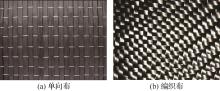
Fig.1
Common types of carbon fiber single-layer panels
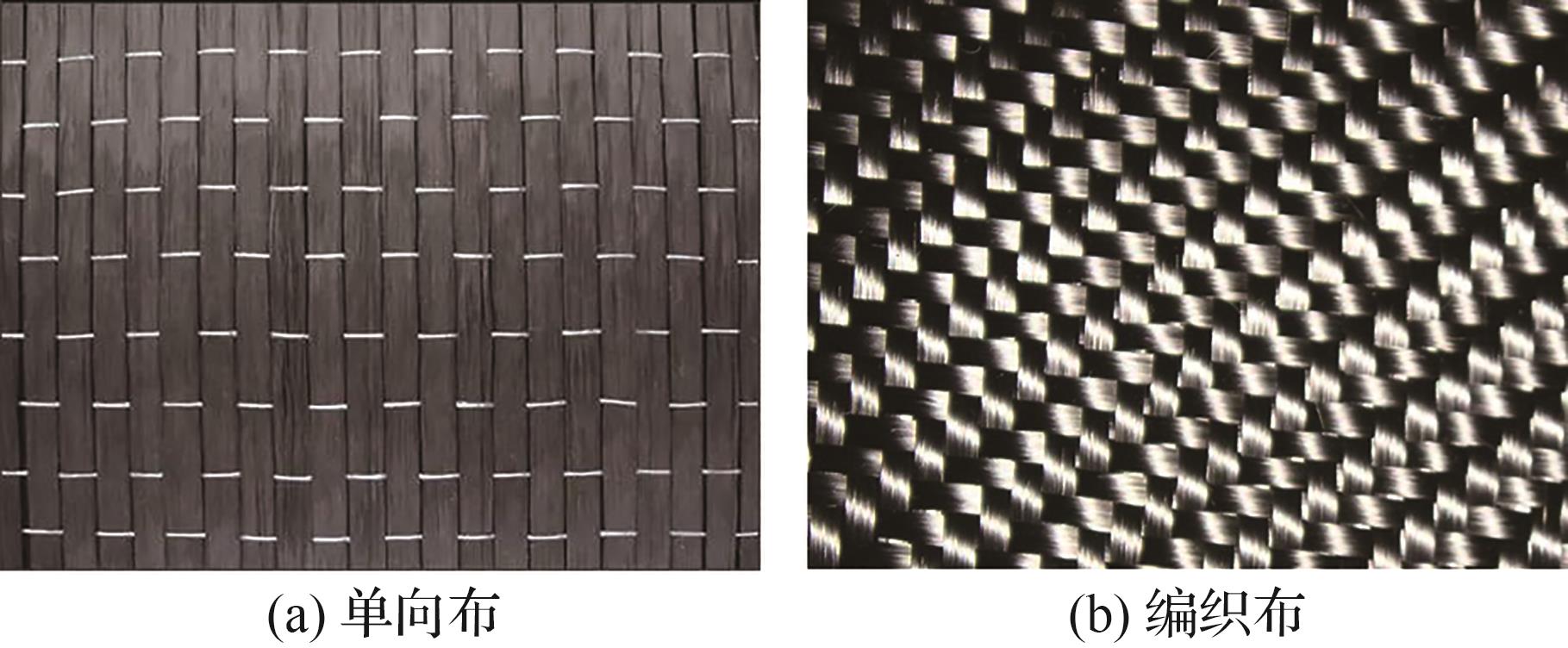
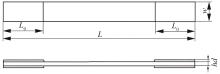
Fig.2
Schematic diagram of carbon fiber laminate specimens

Table 1
Dimensions of carbon fiber laminate specimens
| 试验类型 | 铺层方式 | 长度L/mm | 宽度w/mm | 厚度h/mm | 加强片长度L0/mm | 加强片厚度d/mm |
|---|---|---|---|---|---|---|
| 拉伸 | [0]8 | 250 | 15 | 2 | 56 | 1.6 |
| [90]8 | 175 | 25 | 2 | 25 | 1.6 | |
| [0/90]2 s | 250 | 25 | 2 | 56 | 1.6 | |
| [±45/0/90]s | 250 | 25 | 2 | 56 | 1.6 | |
| 压缩 | [0]8 | 150 | 10 | 2 | 65 | 1.6 |
| [90]8 | 150 | 25 | 2 | 65 | 1.6 | |
| [0/90]2 s | 150 | 25 | 2 | 65 | 1.6 | |
| [±45/0/90]s | 150 | 25 | 2 | 65 | 1.6 | |
| 剪切 | [±45]2 s | 250 | 25 | 2 | 56 | 1.6 |
Fig.3
Mechanical performance testing system for carbon fiber laminates
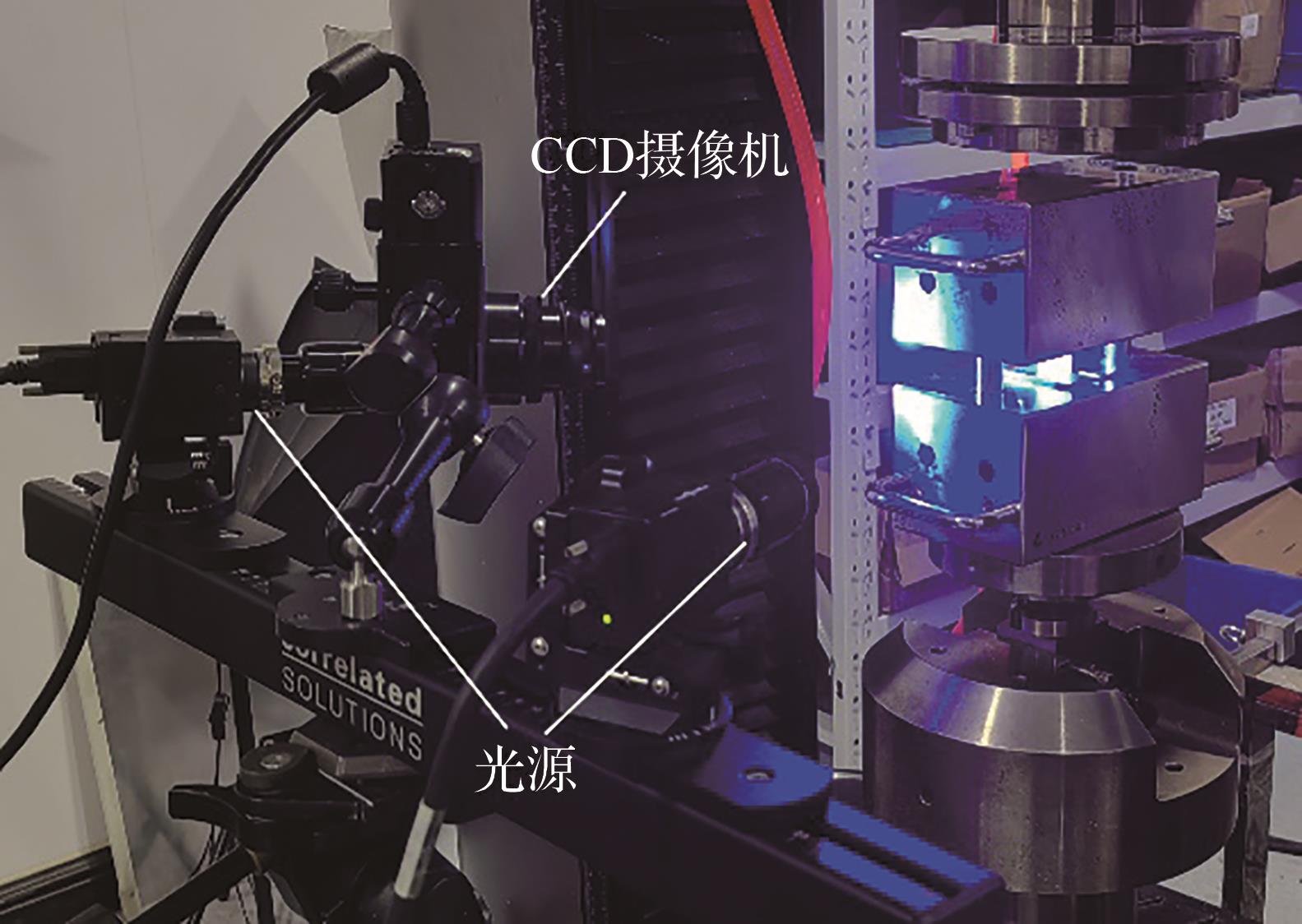
Fig.4
Comparison of carbon fiber woven fabric specimens before and after testing
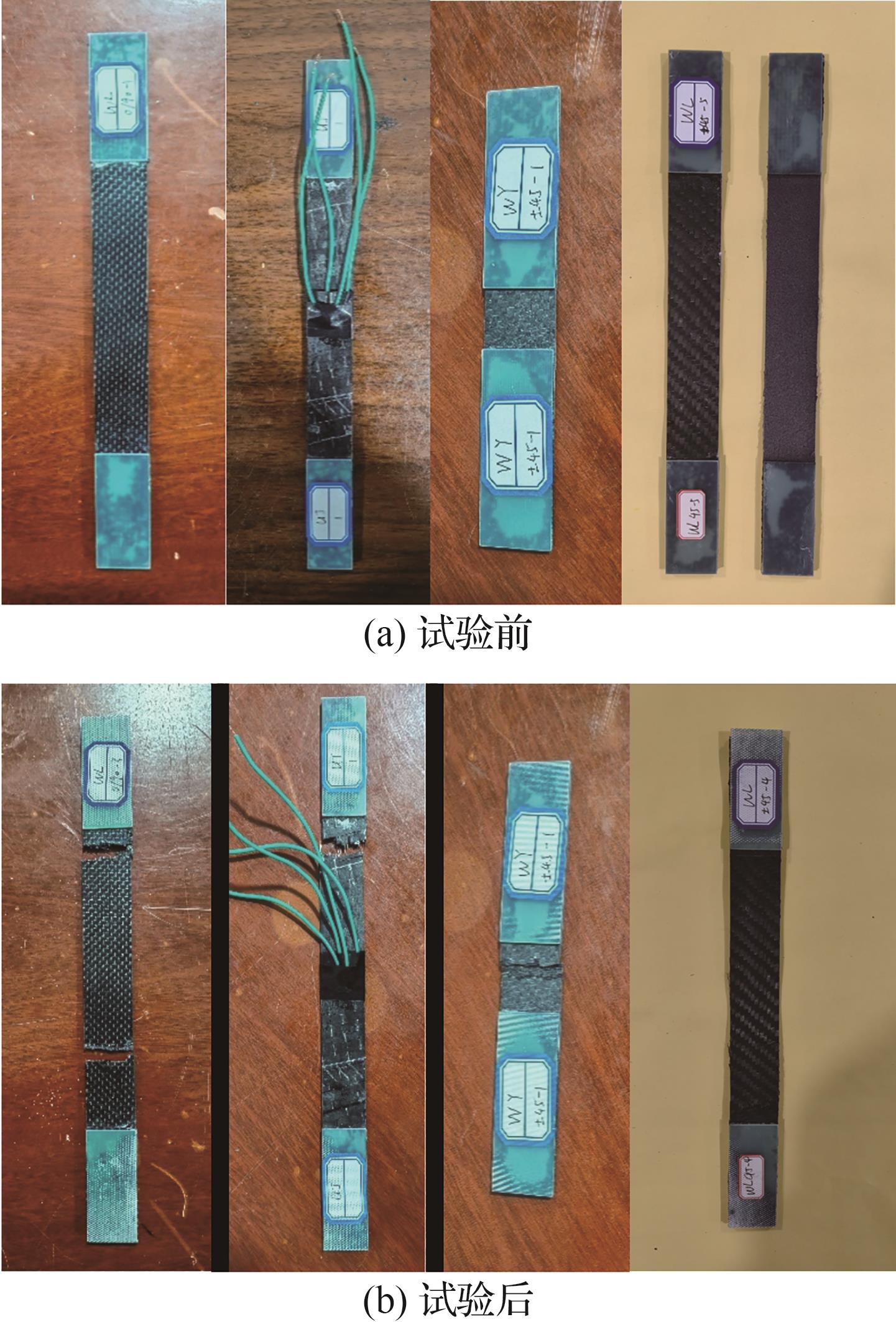
Fig.5
Load-displacement curves of specimen with layer [±45/0/90]s
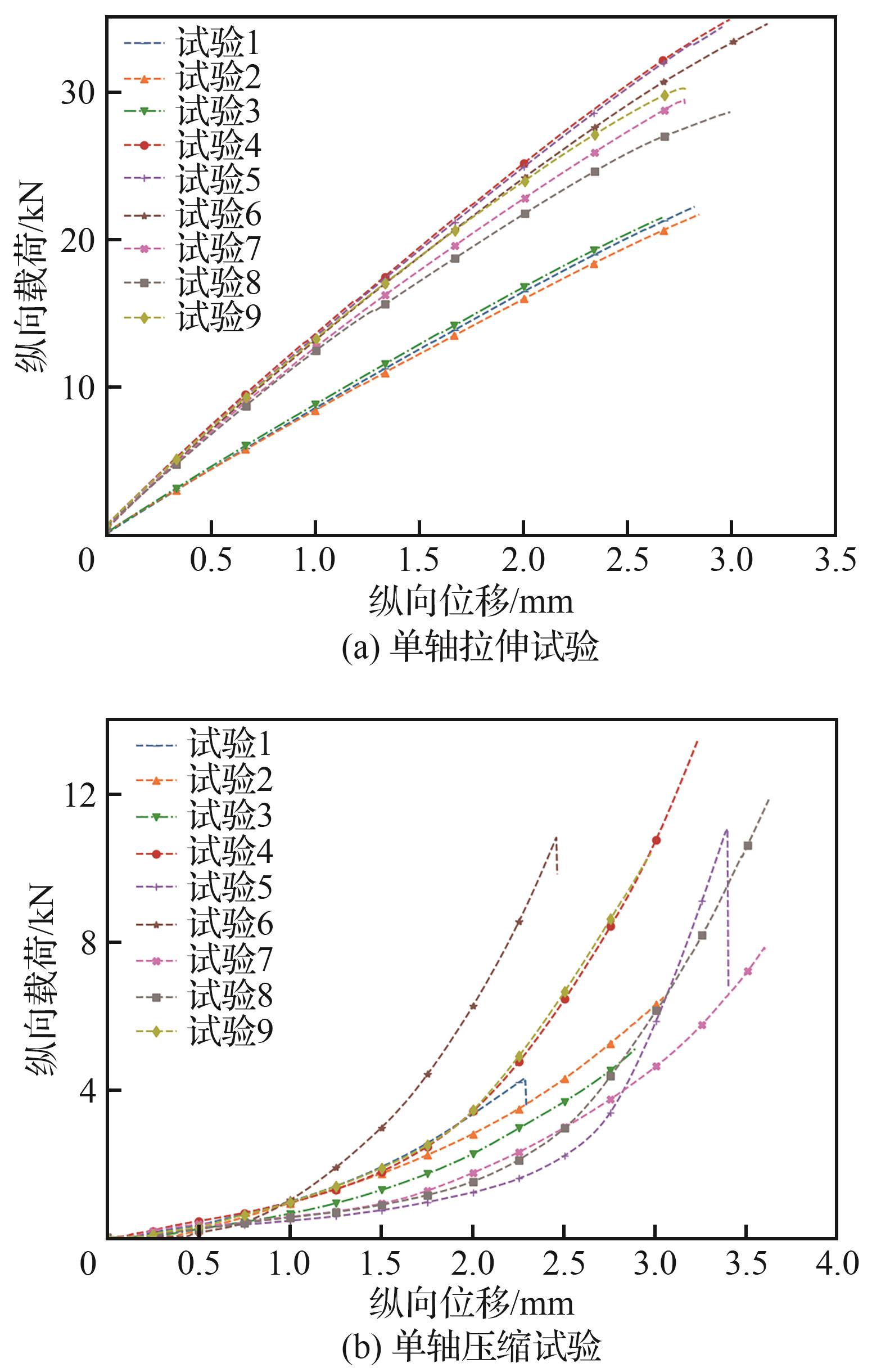
Table 2
Measurement results of material parameters for carbon fiber lamina
| 参数类型 | ||
|---|---|---|
| x弹性模量/GPa | 25.715 | 54.40 |
| y弹性模量/GPa | 27.045 | 48.10 |
| xy泊松比 | 0.037 | 0.18 |
| xy剪切模量/GPa | 10.35 | 4.19 |
| x拉伸强度/MPa | 348.74 | 512.85 |
| y拉伸强度/MPa | 13.69 | 81.59 |
| x压缩强度/MPa | 335.75 | 177.46 |
| y压缩强度/MPa | 317.53 | 75.80 |
| xy剪切强度/MPa | 177.7 | 76.32 |
Fig.6
Finite element model of laminated panel structure
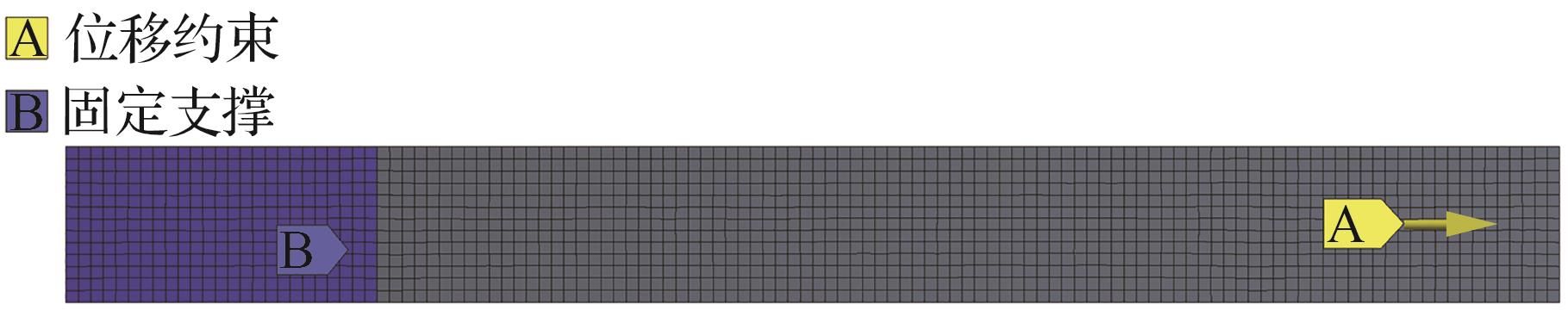
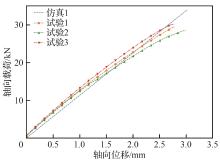
Fig.7
Comparison between simulation results and experiments of load displacement curves
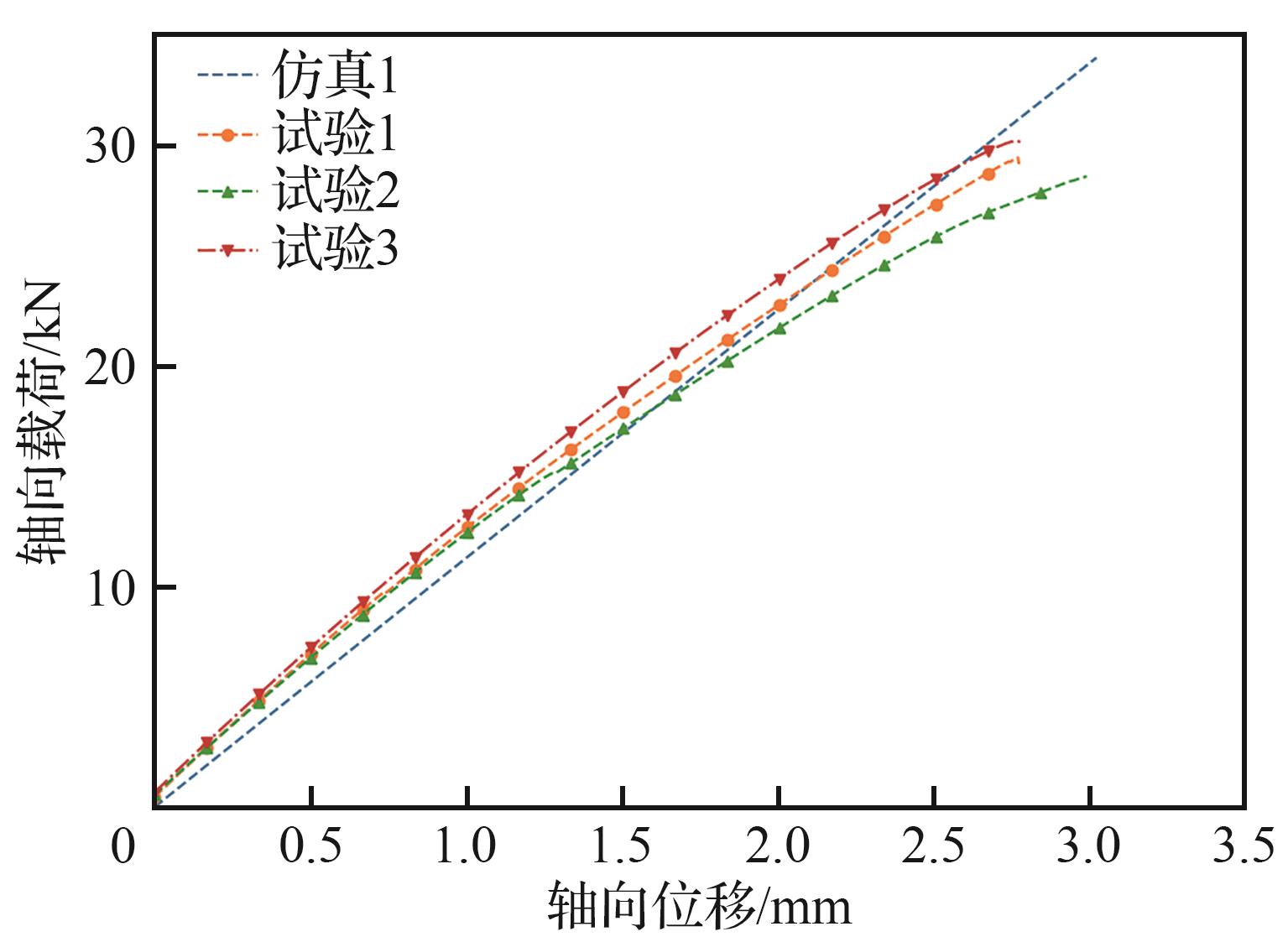
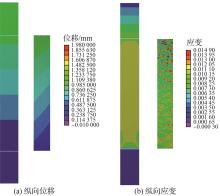
Fig.8
Comparison between simulation results of preset parameters for carbon fiber woven fabric with layer [±45/0/90]s and DIC test results
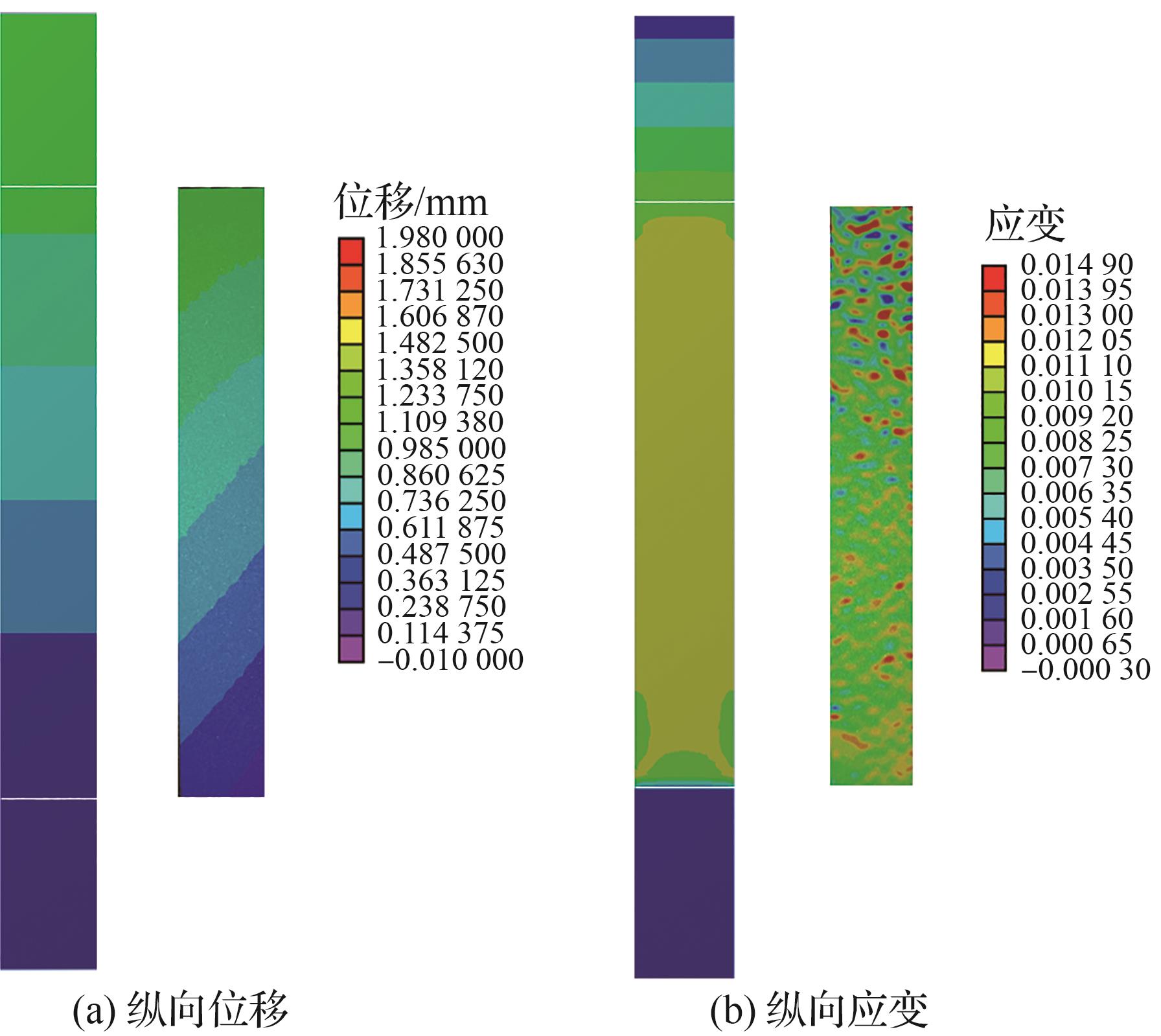
Fig.9
Schematic diagram of inversion process for structural performance parameters of composite materials
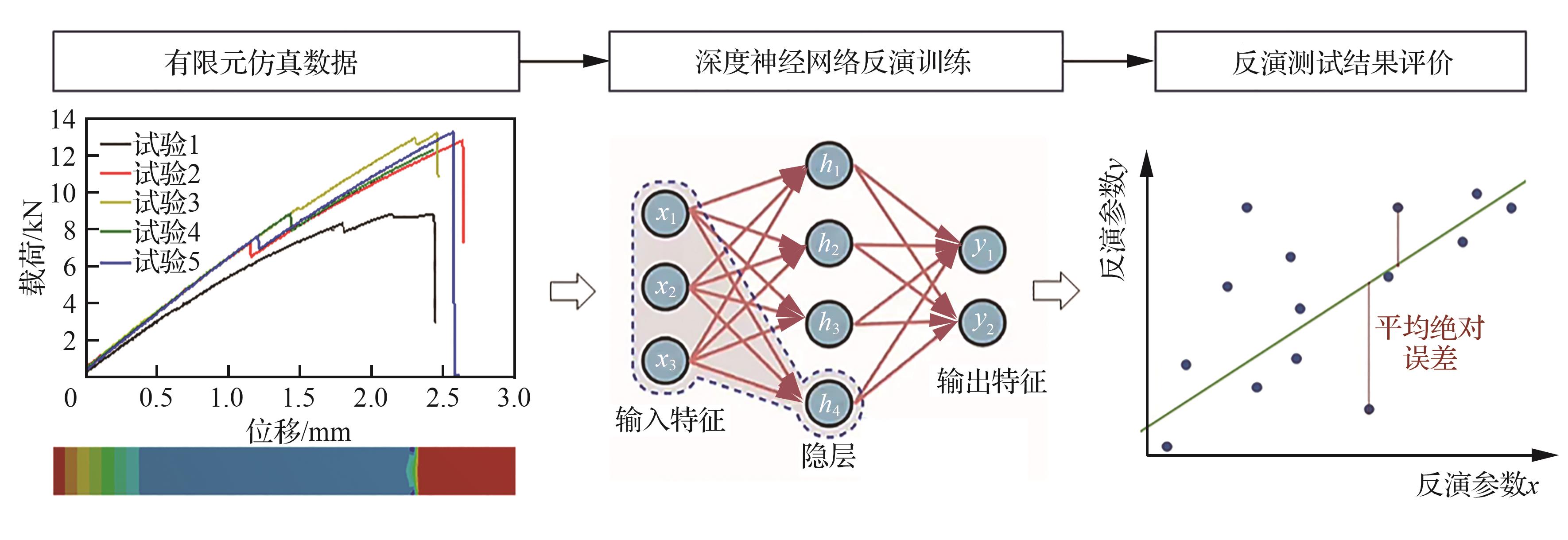
Table 3
Composition of carbon fiber laminate parameters inversion dataset
| 编号 | 材料类型 | 试验类型 | 铺层方式 | 仿真数量 |
|---|---|---|---|---|
| A | 碳纤维编织布 | 拉伸 | [0]8 | 25 |
| [90]8 | 25 | |||
| [0/90]2 s | 25 | |||
| [±45/0/90]s | 25 | |||
| 压缩 | [0]8 | 25 | ||
| [90]8 | 25 | |||
| [0/90]2 s | 25 | |||
| [±45/0/90]s | 25 | |||
| 剪切 | [±45]2 s | 50 | ||
| B | 碳纤维单向带 | 拉伸 | [0]8 | 25 |
| [90]8 | 25 | |||
| [0/90]2 s | 25 | |||
| [±45/0/90]s | 25 | |||
| 压缩 | [0]8 | 25 | ||
| [90]8 | 25 | |||
| [0/90]2 s | 25 | |||
| [±45/0/90]s | 25 | |||
| 剪切 | [±45]2 s | 50 | ||
| 总计 | 500 | |||
Fig.10
Preprocessed results of equivalent displacement contour
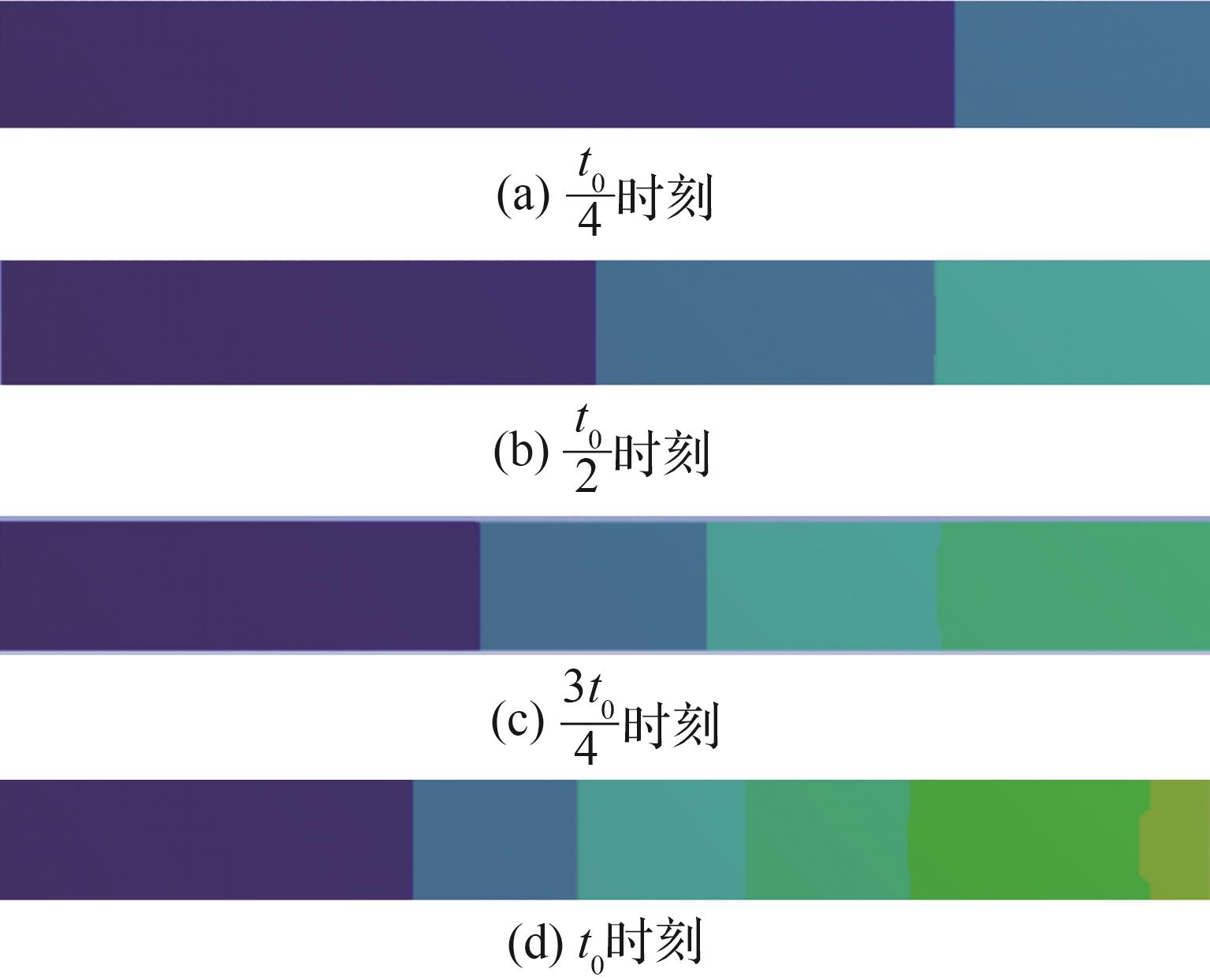
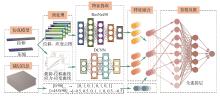
Fig.11
Schematic diagram of deep neural network inversion model
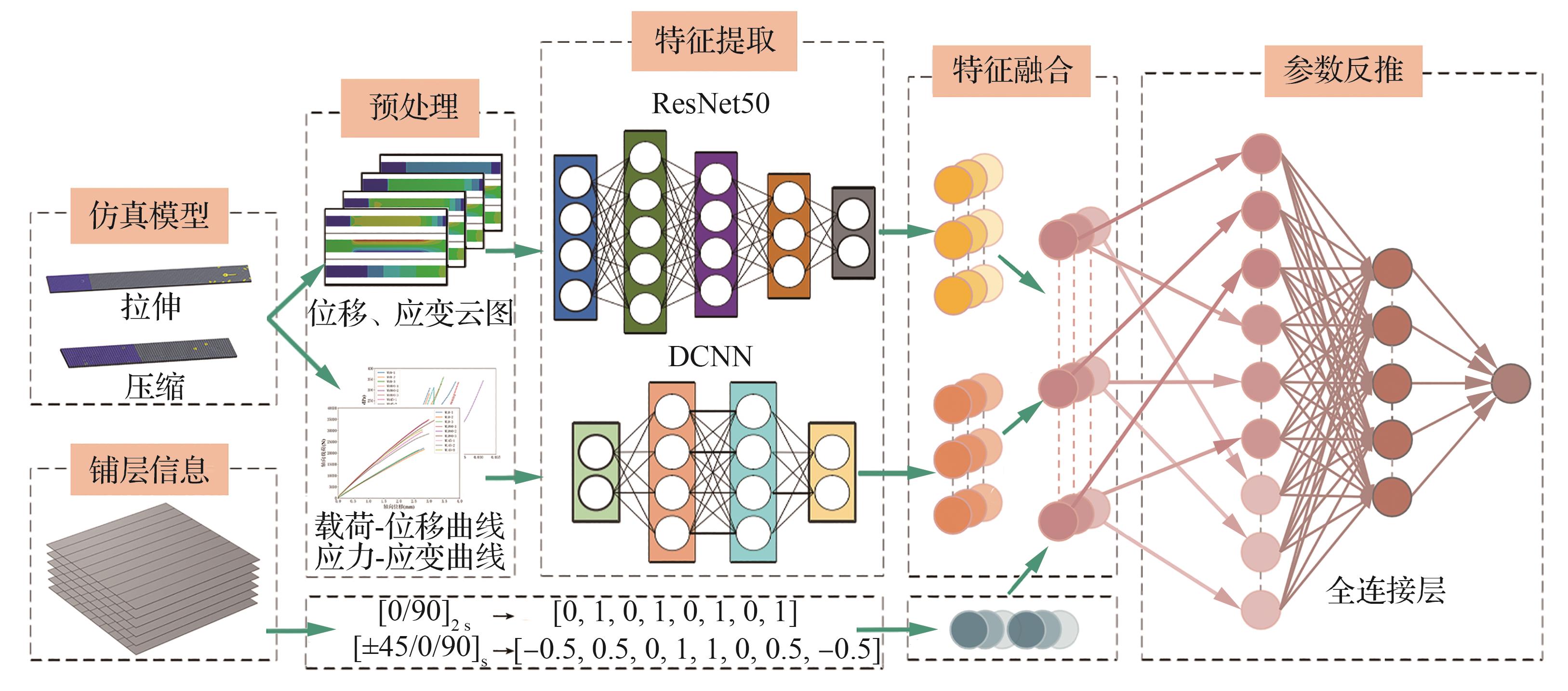
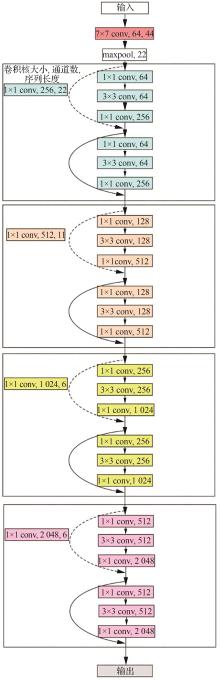
Fig.12
ResNet50 structure diagram
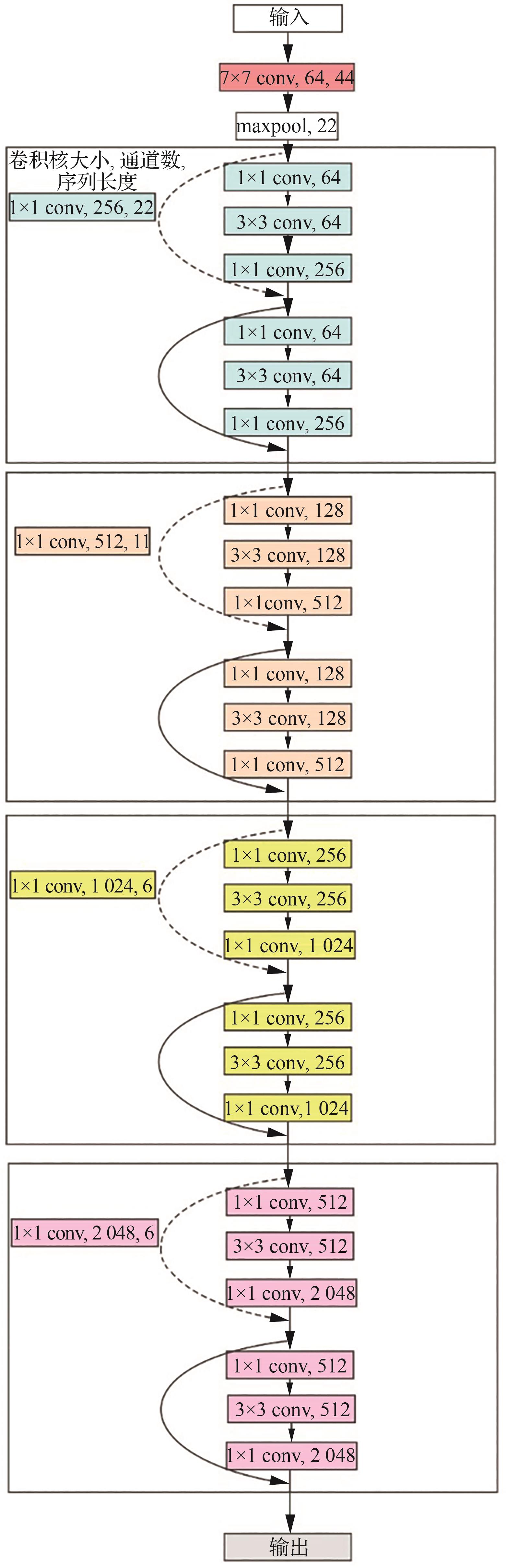
Table 4
Hyperparameters setup of inversion model
| 训练超参数 | DCNN | ResNet50 |
|---|---|---|
| 卷积层核数量 | 128 | 64~2 048 |
| 卷积核长度 | 1×3 | 7×7,3×3,1×1 |
| 卷积步长 | 1 | 2 |
| 卷积填充方式 | 零填充 | 零填充 |
| 隐藏层神经元数 | 2 048 | 36 864 |
| 每批次训练数据个数 | 8 | 8 |
| 损失函数 | MSE | MSE |
| 优化迭代算法 | Adam | Adam |
| 随机失活率 | 0.1 | 0.1 |
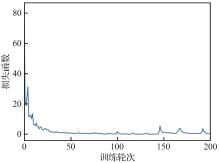
Fig.13
Inversion model training loss convergence curve
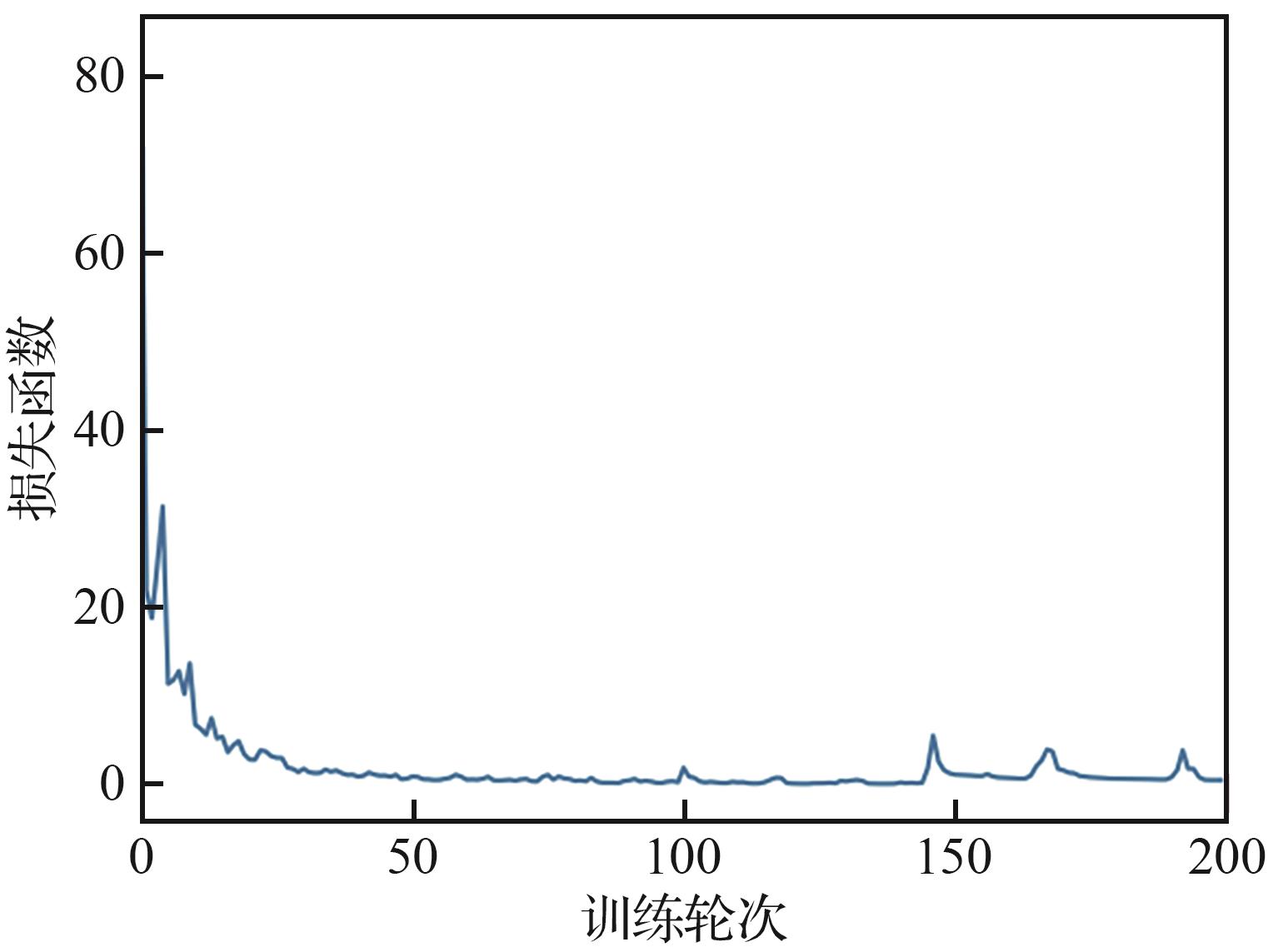
Table 5
Parameter inversion results with a sample size of 500 and a dropout rate of 0.1
| 材料参数 | x弹性模量/GPa | y弹性模量/GPa | xy泊松比 | xy剪切模量/GPa | x拉伸强度/MPa | y拉伸强度/MPa | x压缩强度/MPa | y压缩强度/MPa | xy剪切强度/MPa |
|---|---|---|---|---|---|---|---|---|---|
| MAPE/% | 3.67 | 1.33 | 9.70 | 0.25 | 7.34 | 0.61 | 8.82 | 3.48 | 4.30 |
| 仿真值 | 70.00 | 70.00 | 0.048 3 | 4.00 | 1 200.00 | 1 200.0 | 900.00 | 900.00 | 50.00 |
| 反演值 | 67.43 | 70.93 | 0.053 0 | 4.01 | 1 288.07 | 1 207.3 | 979.39 | 931.29 | 52.15 |
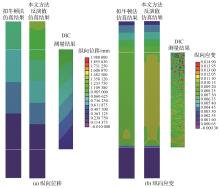
Fig.14
Comparison between simulation results of inversed parameters for carbon fiber woven fabric with layer [±45/0/90]s Quasi-Newton methods and DIC test results
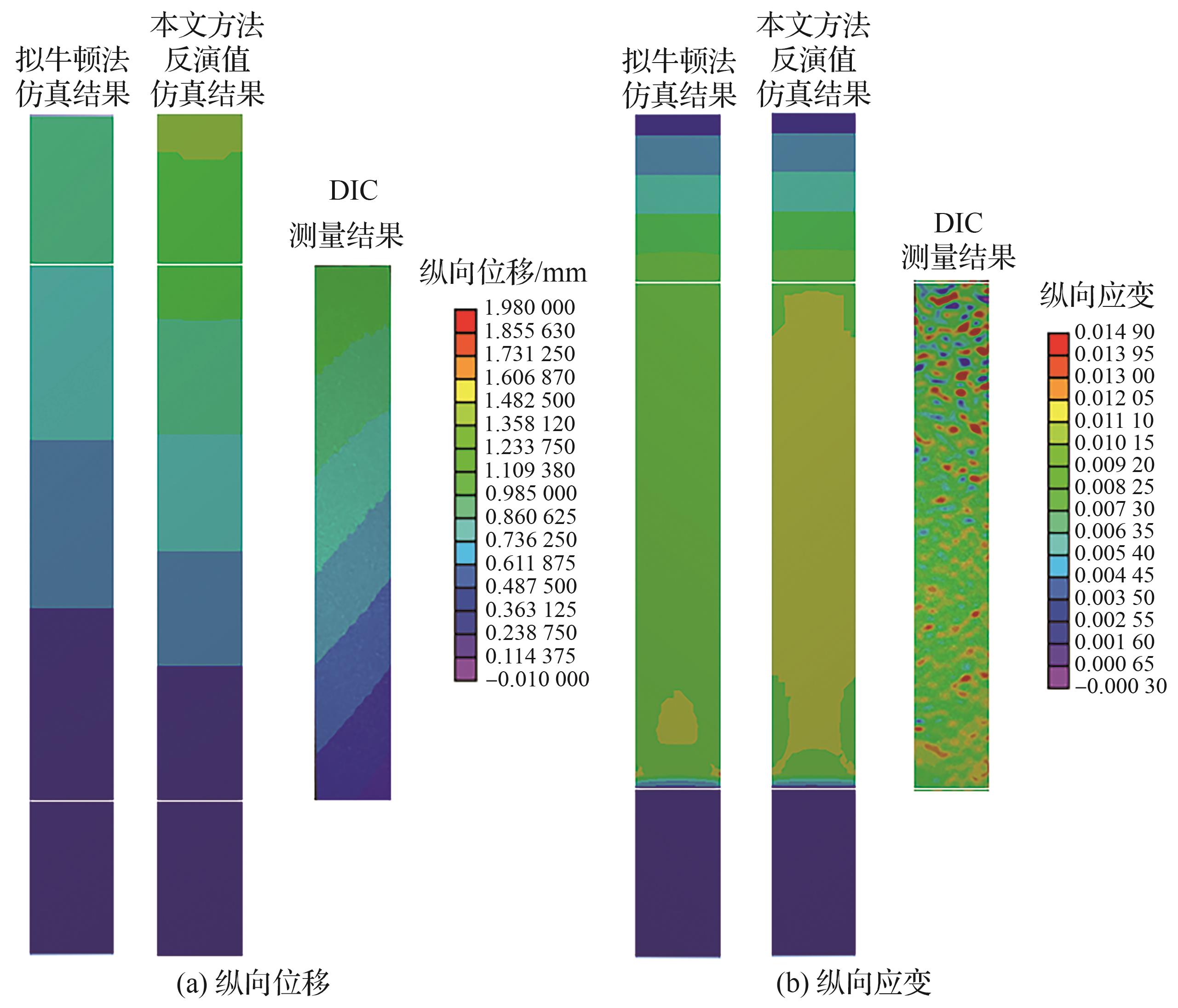
Table 6
Parameter inversion results with a sample size of 100 and a dropout rate of 0.1
| 材料参数 | x弹性模量/GPa | y弹性模量/GPa | xy泊松比 | xy剪切模量/GPa | x拉伸强度/MPa | y拉伸强度/MPa | x压缩强度/MPa | y压缩强度/MPa | xy剪切强度/MPa |
|---|---|---|---|---|---|---|---|---|---|
| MAPE/% | 17.70 | 18.09 | 51.45 | 36.18 | 2.38 | 0.59 | 1.44 | 1.69 | 8.48 |
| 仿真值 | 70.00 | 70.00 | 0.048 3 | 4.00 | 1 200.00 | 1 200.0 | 900.00 | 900.00 | 50.00 |
| 反演值 | 57.61 | 57.34 | 0.06 | 2.55 | 1 171.39 | 1 192.93 | 887.04 | 884.79 | 54.24 |
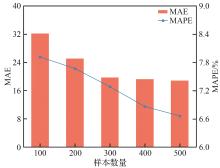
Fig.15
Variation of inversion error with sample size
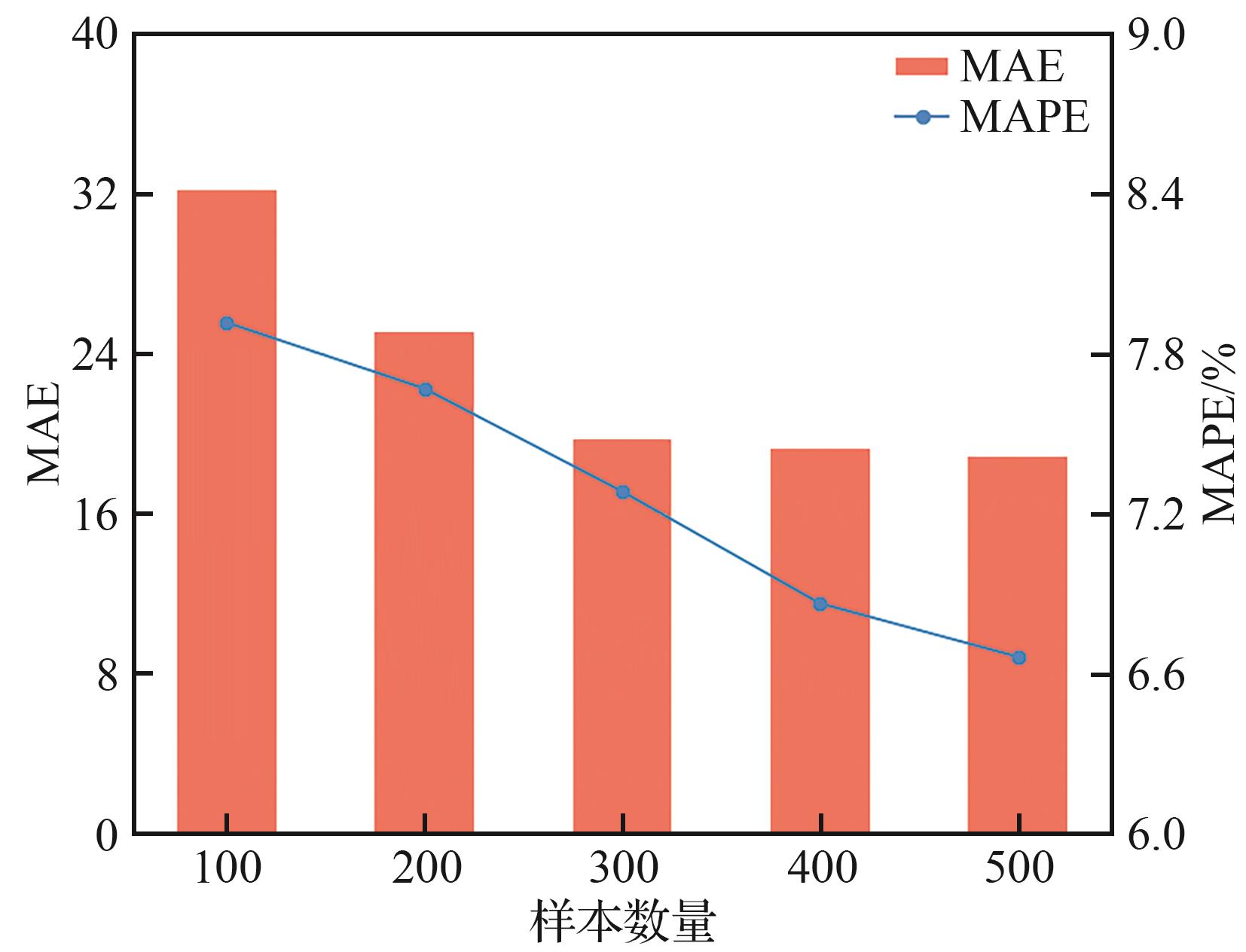
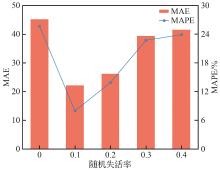
Fig.16
Variation of inversion error with dropout rate
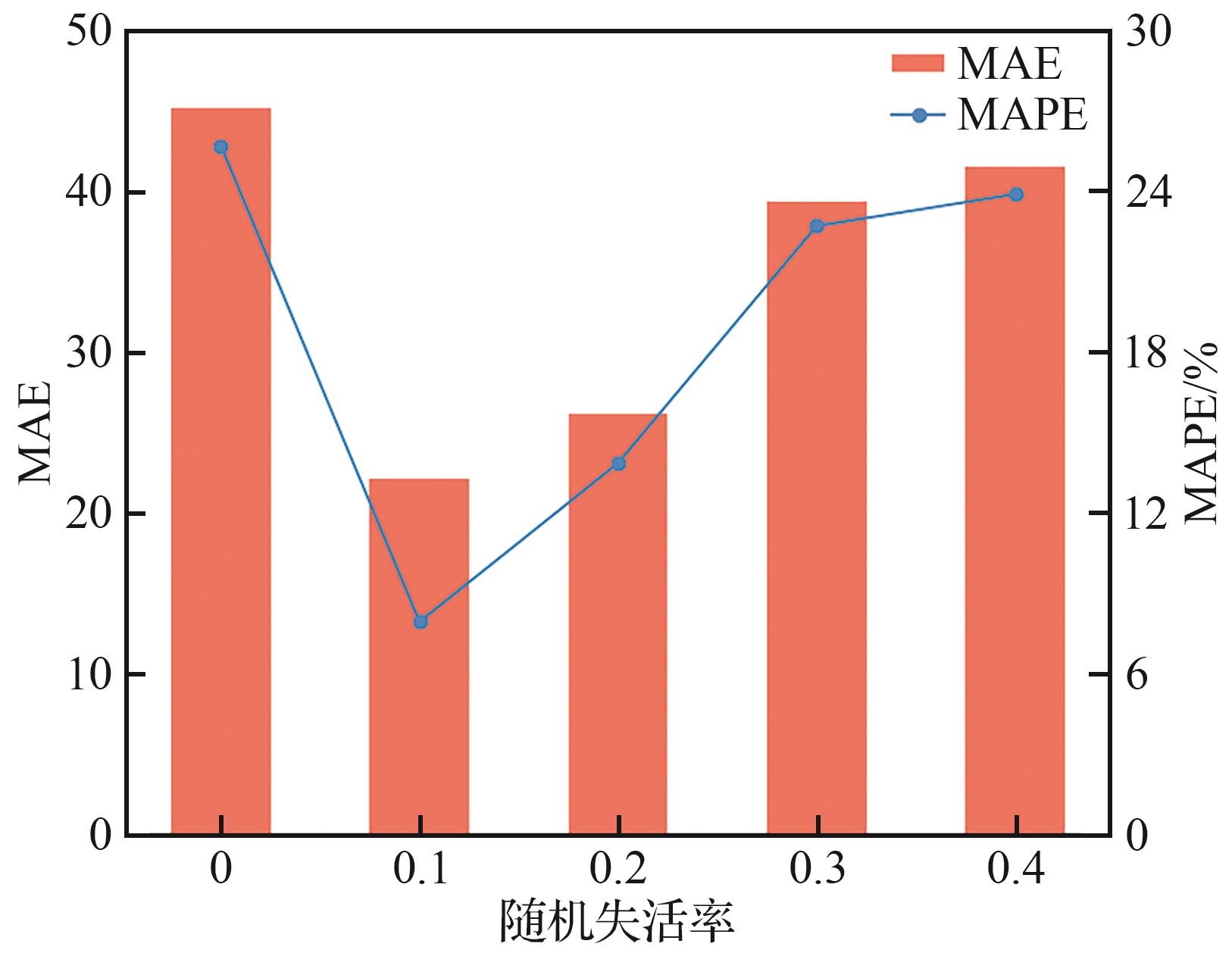
Fig.17
Variation of inversion accuracy and computation time with sample size
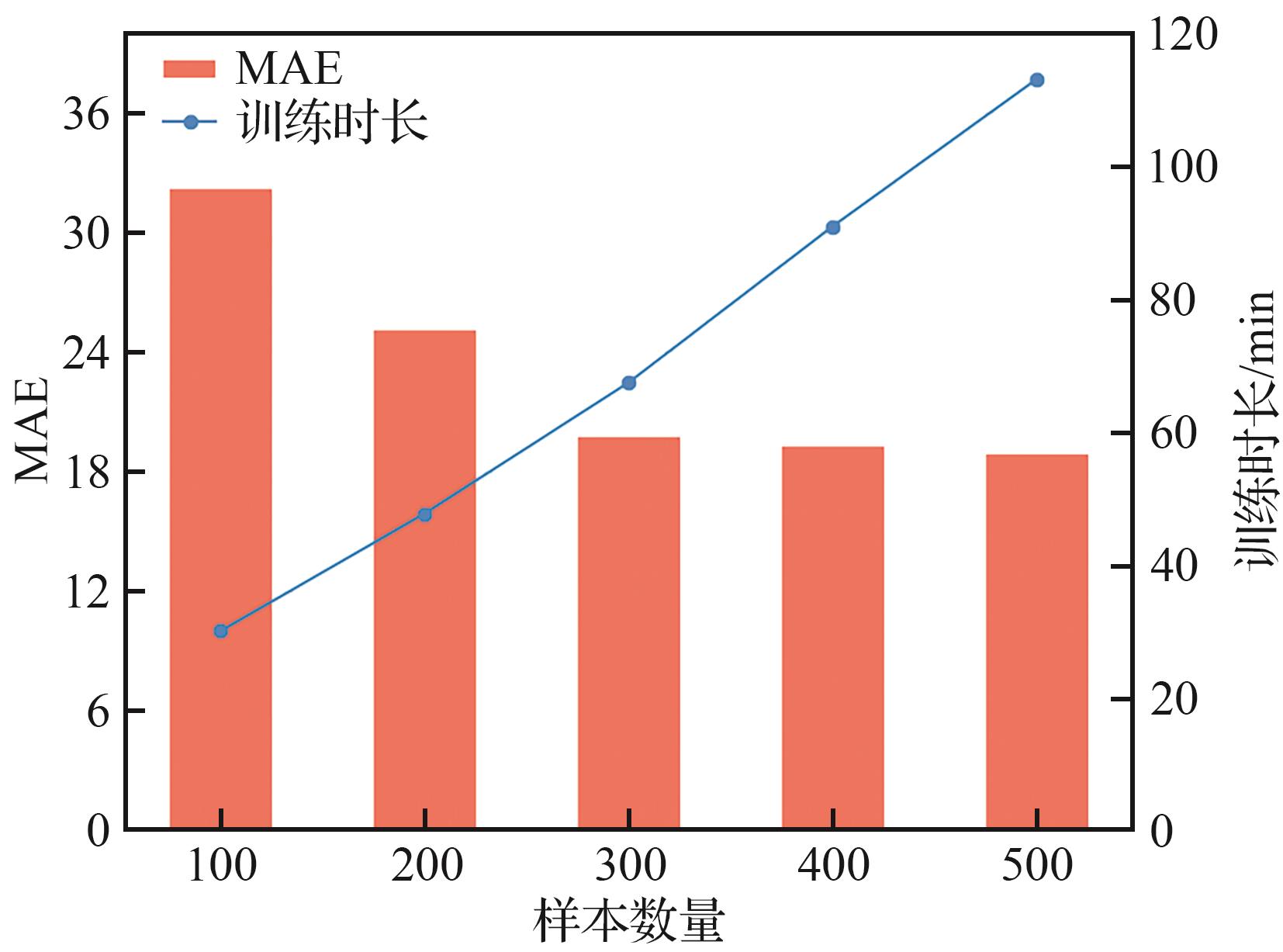
Table 7
Training set sample grouping
| 分组序号 | 样本组采用的数据特征类型 |
|---|---|
| 1 | 使用序列特征、铺层特征 |
| 2 | 使用图像特征、铺层特征,图像特征为最大载荷 |
| 3 | 使用序列特征、铺层特征、图像特征,图像特征为最大载荷 |
| 4 | 使用序列特征、铺层特征、图像特征,图像特征为最大载荷 |
| 5 | 使用序列特征、铺层特征、图像特征,图像特征为最大载荷 |
Fig.18
Comparison of model inversion errors for grouping different data feature types
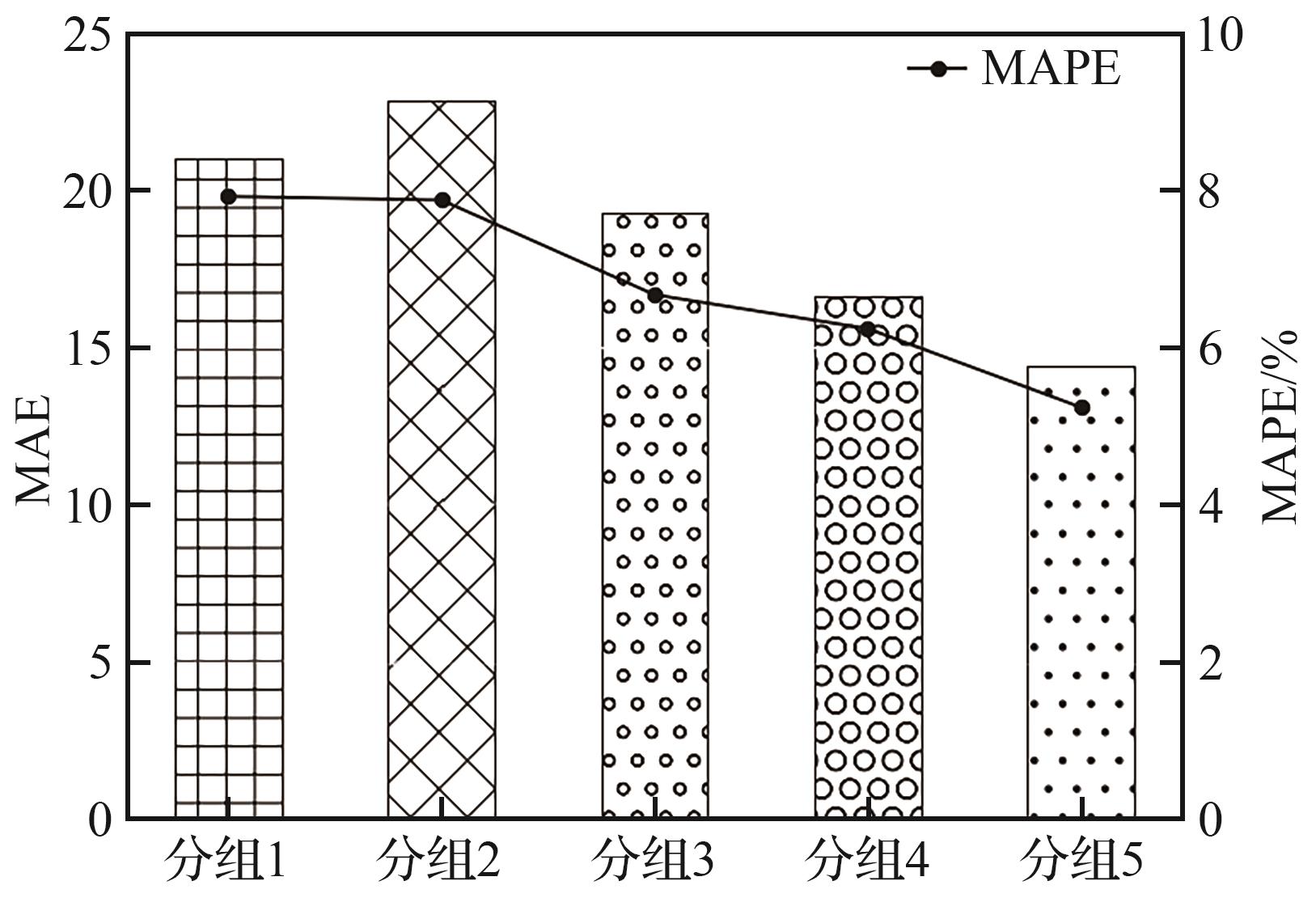
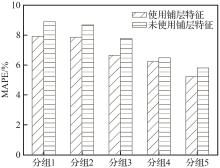
Fig.19
Comparison of inversion errors between models using layer features for grouping and models without layer features
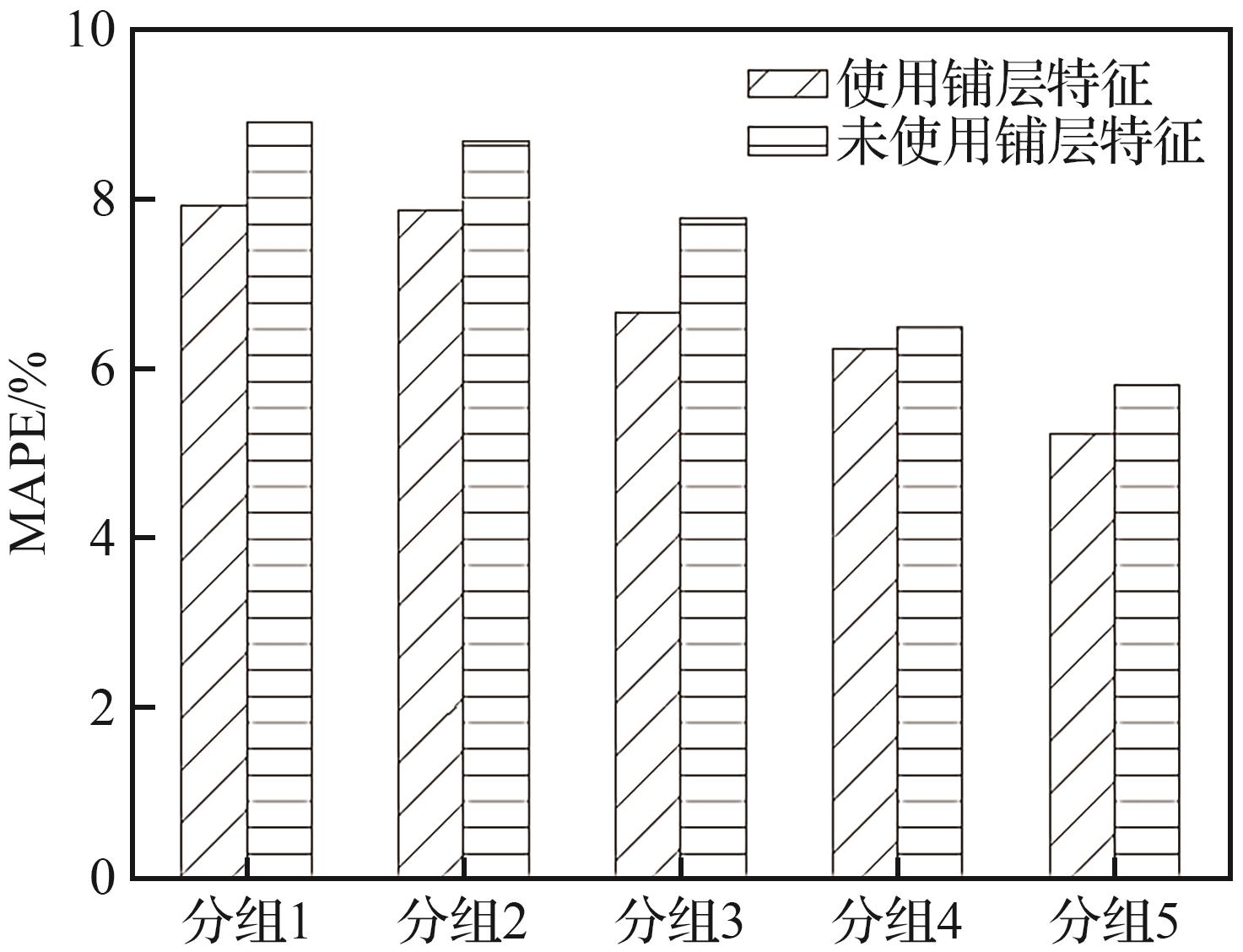
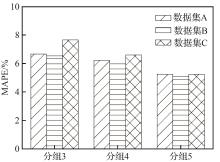
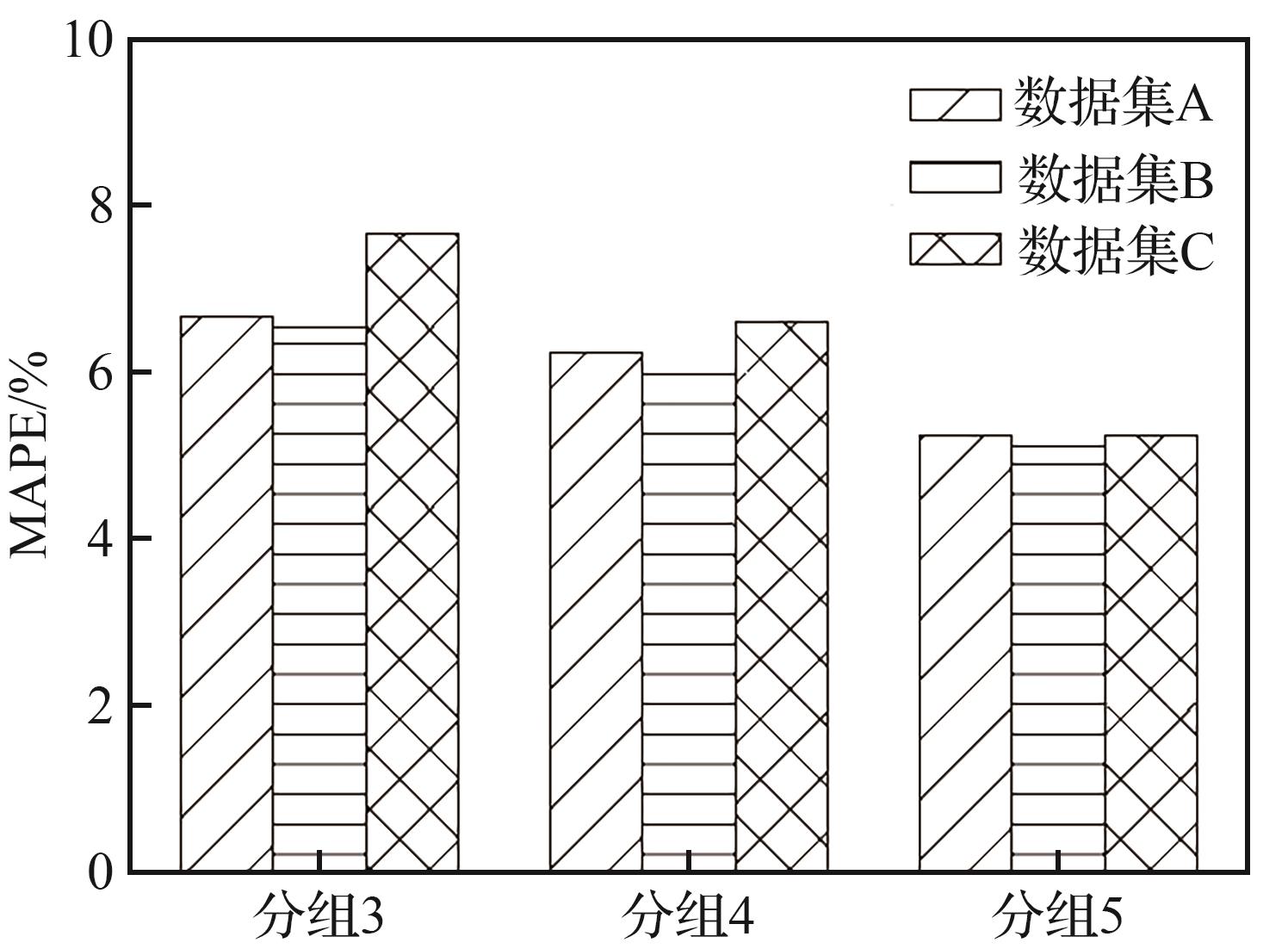
Fig.20
Comparison of model inversion errors using different datasets
| [1] | 谷学森. 基于单次实验的刚度参数反演识别方法研究[D]. 上海: 上海交通大学, 2017: 17-33. |
| GU X S. Research on the inverse identification method of stiffness parameters based on a single test[D]. Shanghai: Shanghai Jiao Tong University, 2017: 17-33 (in Chinese). | |
| [2] | 杨倩, 王彦哲, 杨迪, 等. 基于数据驱动的纤维增强复合材料自动铺放速度预测与规划[J]. 航空学报, 2024, 45(10): 429313. |
| YANG Q, WANG Y Z, YANG D, et al. Prediction and planning of automatic laying speed for fiber reinforced composite materials based on data-driven model[J]. Acta Aeronautica et Astronautica Sinica, 2024, 45(10): 429313 (in Chinese). | |
| [3] | 束静, 廖文和, 郑侃, 等. 旋转超声加工碳纤维复合材料研究现状与展望[J]. 航空学报, 2024, 45(13): 628939. |
| SHU J, LIAO W H, ZHENG K, et al. Review on rotary ultrasonic machining of carbon fiber composites[J]. Acta Aeronautica et Astronautica Sinica, 2024, 45(13): 628939 (in Chinese). | |
| [4] | 邹祺, 叶逸云, 焦俊科, 等. 碳纤维增强热固性复合材料-钛合金激光连接接头性能分析[J]. 航空学报, 2022, 43(2): 625037. |
| ZOU Q, YE Y Y, JIAO J K, et al. Performance analysis of carbon fiber reinforced thermalsetting composite-titanium alloy laser joint[J]. Acta Aeronautica et Astronautica Sinica, 2022, 43(2): 625037 (in Chinese). | |
| [5] | 赵冬梅, 邓建伟, 孙直, 等. 基于边界位移的复合材料力学参数无损反演方法[J]. 计算力学学报, 2022, 39(1): 57-62. |
| ZHAO D M, DENG J W, SUN Z, et al. Nondestructive identification of the mechanical properties of layered structures based on surface displacements[J]. Chinese Journal of Computational Mechanics, 2022, 39(1): 57-62 (in Chinese). | |
| [6] | 刘佩, 袁泉, 魏庆朝. 钢筋混凝土柱恢复力模型参数识别的贝叶斯法[J]. 华中科技大学学报(自然科学版), 2013, 41(9): 72-75. |
| LIU P, YUAN Q, WEI Q C. Bayesian approach for restoring force model parameter identification of reinforced concrete column[J]. Journal of Huazhong University of Science and Technology (Natural Science Edition), 2013, 41(9): 72-75 (in Chinese). | |
| [7] | 史继刚. 基于最大似然法的高速旋转弹丸气动参数辨识方法研究[D]. 南京: 南京理工大学, 2017: 12-25. |
| SHI J G. Aerodynamic parameter identification method for high-speed rotating projectiles based on maximum likelihood method[D]. Nanjing: Nanjing University of Science and Technology, 2017: 12-25 (in Chinese). | |
| [8] | 李守巨, 刘迎曦, 王登刚, 等. 混凝土重力坝材料参数识别的正则化最小二乘法[J]. 计算物理, 2000, 17(6): 702-706. |
| LI S J, LIU Y X, WANG D G, et al. Material para meter identification of the concrete gravitydam with regul arizing least squares method[J]. Chinese Journal of Computation Physics, 2000, 17(6): 702-706 (in Chinese). | |
| [9] | KOWALCZYK P. Identification of mechanical parameters of composites in tensile tests using mixed numerical-experimental method[J]. Measurement, 2019, 135: 131-137. |
| [10] | 钱杨情. 碳纤维复合材料特性参数识别及其结构铺层优化[D]. 湘潭: 湘潭大学, 2020: 13-33. |
| QIAN Y Q. Characteristic parameters identification and structural lamination optimization about the carbon fiber reinforced composites[D]. Xiangtan: Xiangtan University, 2020: 13-33 (in Chinese). | |
| [11] | 杨万庆, 王艳超, 李能文, 等. 基于桥联模型参数反演的复合材料力学性能预测[J]. 复合材料科学与工程, 2021(2): 84-88. |
| YANG W Q, WANG Y C, LI N W, et al. Prediction of composite mechanical properties based on material parameters reversely calculated by the bridging model[J]. Composites Science and Engineering, 2021(2): 84-88 (in Chinese). | |
| [12] | PAN B, WANG Z, LU Z. Genuine full-field deformation measurement of an object with complex shape using reliability-guided digital image correlation[J]. Opt Express, 2010, 18(2): 1011-1023. |
| [13] | HUO X T, LUO Q T, LI Q, et al. Measurement of fracture parameters based upon digital image correlation and virtual crack closure techniques[J]. Composites Part B: Engineering, 2021, 224: 109157. |
| [14] | JIANG H, ZHU R X, LIU Y, et al. Study on the optimal design of specimens for stiffness coefficients identification of glass fiber-reinforced polymer composites by virtual fields method[J]. Composites Part C: Open Access, 2024, 13: 100425. |
| [15] | ZHOU C J, GAO B, YAN B, et al. A combined machine learning/search algorithm-based method for the identification of constitutive parameters from laboratory tests and in-situ tests[J]. Computers and Geotechnics, 2024, 170: 106268. |
| [16] | WEI Y, SERRA Q, LUBINEAU G, et al. Coupling physics-informed neural networks and constitutive relation error concept to solve a parameter identification problem[J]. Computers & Structures, 2023, 283: 107054. |
| [17] | 李文丽. 基于深度学习的复合材料参数识别方法研究[D]. 南京: 南京林业大学, 2023: 8-43. |
| LI W L. Parameter identification of composite materials based on deep learning[D]. Nanjing: Nanjing Forestry University, 2023: 8-43 (in Chinese). | |
| [18] | NGUYEN H Q, LE B A, TRAN B V, et al. Deep artificial neural network-powered phase field model for predicting damage characteristic in brittle composite under varying configurations[J]. Machine Learning: Science and Technology, 2024, 5(2): 025062. |
| [19] | 刘国青. 复合材料结构有限元模型修正技术研究[D]. 上海: 上海交通大学, 2011: 17-18. |
| LIU G Q. Finite element model updating study of composite structures[D]. Shanghai: Shanghai Jiao Tong University, 2011: 17-18 (in Chinese). | |
| [20] | 曲宏亮. 基于数字图像相关技术的陶瓷基复合材料本构参数识别研究[D]. 北京: 北京理工大学, 2017: 10-25. |
| QU H L. Research on constitutive parameters identification of ceramic matrix composites based on digital image correlation[D]. Beijing: Beijing Institute of Technology, 2017: 10-25 (in Chinese). | |
| [21] | ASTM International. Standard test method for tensile properties of polymer matrix composite materials: [S]. West Conshohocken: ASTM International, 2017. |
| [22] | ASTM International. Standard Test Method for In-Plane Shear Response of Polymer Matrix Composite Materials by Tensile Test of a ±45° Laminate: [S]. West Conshohocken: ASTM International, 2007. |
| [23] | ASTM International. Standard Test Method for Compressive Properties of Polymer Matrix Composite Materials with Unsupported Gage Section by Shear Loading: [S]. West Conshohocken: ASTM International, 2003. |
| [24] | HE K M, ZHANG X Y, REN S Q, et al. Deep residual learning for image recognition[DB/OL]. arXiv preprint: 1512.03385, 2015. |
| [25] | LECUN Y, BOTTOU L, BENGIO Y, et al. Gradient-based learning applied to document recognition[J]. Proceedings of the IEEE, 1998, 86(11): 2278-2324. |
| [26] | LIU W J, QIANG J, LI X X, et al. UAV image small object detection based on composite backbone network[J]. Mobile Information Systems, 2022, 2022(1): 7319529. |
| [27] | LI X, ZHANG W, DING Q. Deep learning-based remaining useful life estimation of bearings using multi-scale feature extraction[J]. Reliability Engineering & System Safety, 2019, 182: 208-218. |
| [1] | Jianyu XU, Li ZHOU, Zhanxue WANG, Jie SHI, Hao SHI. Calculation method for hypersonic plume infrared radiation based on a fast line-by-line calculation model [J]. Acta Aeronautica et Astronautica Sinica, 2025, 46(8): 630778-630778. |
| [2] | Feng LIU, Sen YANG, Zhenpeng WEI. Variable chord wing based on composite material elastic periodic structure and pre-stressed skin [J]. Acta Aeronautica et Astronautica Sinica, 2025, 46(7): 230966-230966. |
| [3] | Lingjie MENG, Hongguang LI, Xinjun LI. SAR image simulation method guided by geomorphic category information [J]. Acta Aeronautica et Astronautica Sinica, 2025, 46(7): 331003-331003. |
| [4] | Zhihao ZHAO, Zhaohua YANG, Yun WU, Yuanjin YU. Single-photon counting imaging denoising method based on deep learning in low-light environment [J]. Acta Aeronautica et Astronautica Sinica, 2025, 46(3): 630531-630531. |
| [5] | Yiquan WU, Kang TONG. Research advances on deep learning-based small object detection in UAV aerial images [J]. Acta Aeronautica et Astronautica Sinica, 2025, 46(3): 30848-030848. |
| [6] | Tianqi FAN, Zhengxia ZOU, Zhenwei SHI. Typical remote sensing target detection with data synthesis based on reinforcement learning [J]. Acta Aeronautica et Astronautica Sinica, 2025, 46(23): 631955-631955. |
| [7] | Kui LIU, Hao SUN, Han WU, Kefeng JI, Gangyao KUANG. Dynamic brightness reconstruction for UAV visible-infrared fusion object detection [J]. Acta Aeronautica et Astronautica Sinica, 2025, 46(23): 631968-631968. |
| [8] | Bo PENG, Jikang BAI, Weiwen CHEN, Xiangtao ZHENG, Jianjun LEI, Xiaoqiang LU. Research progress for UAV search and rescue methods based on deep learning [J]. Acta Aeronautica et Astronautica Sinica, 2025, 46(23): 632761-632761. |
| [9] | Qiang ZHANG, Lei LI, Guangqi HUANG, Jiahui XIE, Guibin SONG. Open-hole tensile mechanical behavior of carbon/glass hybrid composites [J]. Acta Aeronautica et Astronautica Sinica, 2025, 46(21): 532312-532312. |
| [10] | Kairui TANG, Zhe WANG, Xiangming CHEN, Baorang CUI, Yanhui CHEN, Puhui CHEN. A multi-fidelity data-driven framework for predicting mechanical property distributions of composite structures and its validation [J]. Acta Aeronautica et Astronautica Sinica, 2025, 46(21): 532180-532180. |
| [11] | Baoquan SHI, Jiaming ZHOU, Wendong ZHANG, Xianmin CHEN, Qian HE. A network for fatigue crack segmentation and quantification using frequency-domain enhancement and linear attention mechanism [J]. Acta Aeronautica et Astronautica Sinica, 2025, 46(21): 532356-532356. |
| [12] | Xiaowei JIANG, Yiquan WU. Research progress of UAV aerial image mosaic methods [J]. Acta Aeronautica et Astronautica Sinica, 2025, 46(17): 331799-331799. |
| [13] | Miaojiao PENG, Jinwen HUANG, Dianyin HU, Rongqiao WANG, Junjie YANG, Zhigang JIA, Qinglin CHEN, Yifeng SUN, Yingqiang CAI, Kuan FAN, Zhaoyi ZHU, Xiaowen LI. Research progress on interfacial mechanical properties, damage mechanisms, and reinforcement strategies of CFRP composites for aero-engines [J]. Acta Aeronautica et Astronautica Sinica, 2025, 46(16): 231600-231600. |
| [14] | Lin CHEN, Xiwen GU, Zhiying CHEN, Zhuo ZHANG, Xiaoliang SUN. High-precision monocular vision pose measurement for large distance span in carrier landing guidance [J]. Acta Aeronautica et Astronautica Sinica, 2025, 46(15): 331568-331568. |
| [15] | Bin SUN, Hang YOU, Wenbo LI, Xiangrui LIU, Jiayi MA. Dual-band payload image fusion and its applications in low-altitude remote sensing [J]. Acta Aeronautica et Astronautica Sinica, 2025, 46(11): 531343-531343. |
| Viewed | ||||||
|
Full text |
|
|||||
|
Abstract |
|
|||||
Address: No.238, Baiyan Buiding, Beisihuan Zhonglu Road, Haidian District, Beijing, China
Postal code : 100083
E-mail:hkxb@buaa.edu.cn
Total visits: 6658907 Today visits: 1341All copyright © editorial office of Chinese Journal of Aeronautics
All copyright © editorial office of Chinese Journal of Aeronautics
Total visits: 6658907 Today visits: 1341

 CJA
CJA
