Acta Aeronautica et Astronautica Sinica ›› 2025, Vol. 46 ›› Issue (21): 532391.doi: 10.7527/S1000-6893.2025.32391
• Special Issue: 60th Anniversary of Aircraft Strength Research Institute of China • Previous Articles
Nan CHANG, Shuaijie FAN( ), Weixian LIU, Zhenyong CHEN
Received:2025-06-09
Revised:2025-06-18
Accepted:2025-07-10
Online:2025-07-29
Published:2025-07-25
Contact:
Shuaijie FAN
E-mail:fansj010@avic.com
CLC Number:
Nan CHANG, Shuaijie FAN, Weixian LIU, Zhenyong CHEN. Load-bearing capacity of bar termination ends of reverse curvature reinforced wall panels[J]. Acta Aeronautica et Astronautica Sinica, 2025, 46(21): 532391.
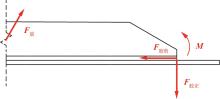
Fig.1
Reinforced skin termination bar force analysis
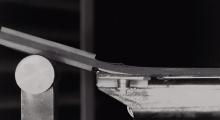
Fig.2
Skin wrinkles on test pieces after loading of rotatable bearings
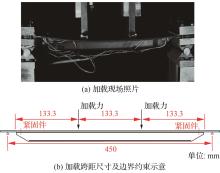
Fig.3
Four-point bending loading
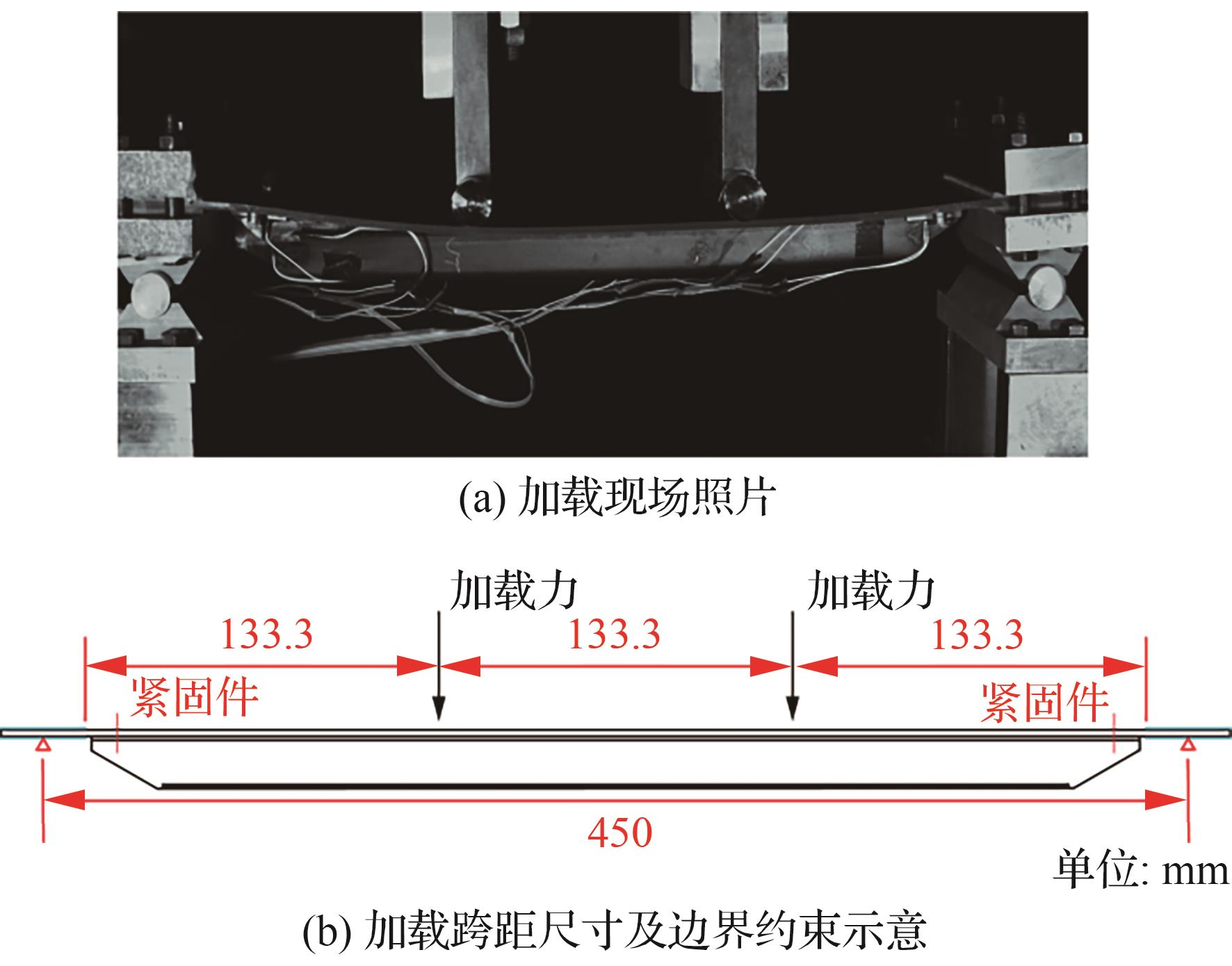
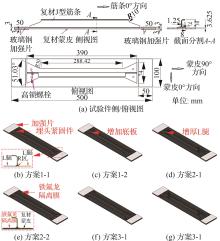
Fig.4
Configurations of test pieces
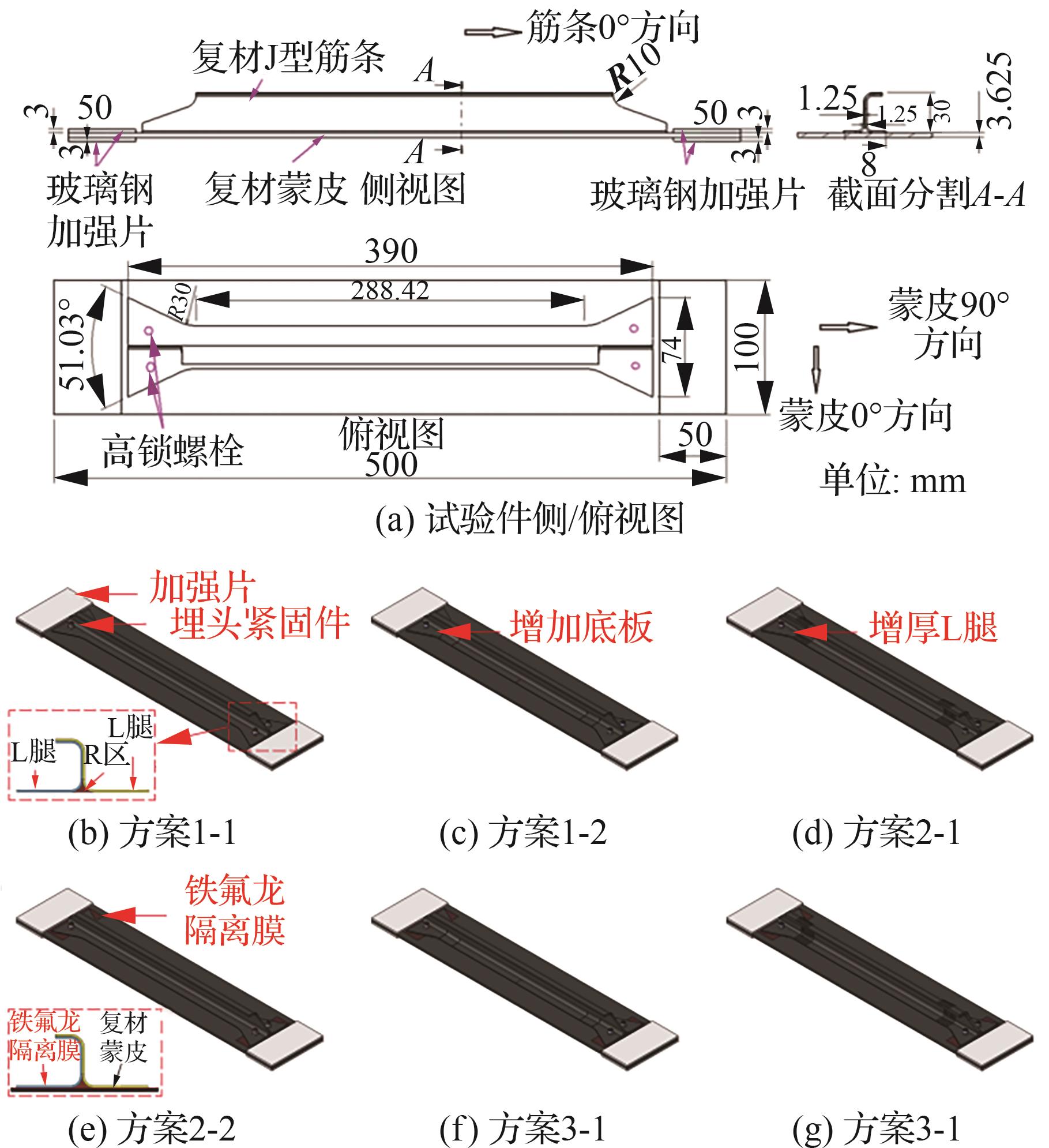

Table 1
Test piece configuration number, model mass and quantity
| 方案 | 结构 | 试验件编号 | 模型质量/g | 数量 |
|---|---|---|---|---|
| 方案1-1 | 常规设计 | CG-W-E9-# | 493.1 | 5 |
| 方案1-2 | 常规设计+端头隔离 | CG-G-E9-# | 493.1 | 5 |
| 方案2-1 | 底板加厚 | DH-W-E9-# | 503.6 | 5 |
| 方案2-2 | 底板加厚+端头隔离 | DH-G-E9-# | 503.6 | 5 |
| 方案3-1 | L腿加厚 | TH-W-E9-# | 514.6 | 5 |
| 方案3-2 | L腿加厚+端头隔离 | TH-G-E9-# | 514.6 | 5 |
Table 2
Layup of test pieces
| 部件 | 铺层 |
|---|---|
| 蒙皮 | [-45/0/45/90/-45/02/45/0/90/45/0/-45/0/90]s |
| J型筋-C型 | [-45/0/45/02/45/0/-45/0/90] |
| J型筋-C型加厚 | [-45/0/45/02/45/0/-45/0/902/0/-45/0/45/02/45/0/-45/-90/0/-45/0/45/02/45/0/-45] 丢层后:[-45/0/45/02/45/0/-45/0/90] |
| J型筋-Z型 | [-45/0/45/02/45/0/-45/0/90] |
| J型筋-Z型加厚 | [-45/0/45/02/45/0/-45/0/902/0/-45/0/45/02/45/0/-45/-90/0/-45/0/45/02/45/0/-45] 丢层后:[-45/0/45/02/45/0/-45/0/90] |
| J型筋-加厚底板 | [-45/0/45/02/45/0/-45/0/90] 全部丢层 |

Fig.5
Strain gauge placement

Table 3
Test results of Scheme 1-1
| 试验件编号 | 初始损伤/N | 极限破坏载荷/N | 线性段斜率/(N·mm-1) | 应变首次跳变对应载荷/N |
|---|---|---|---|---|
| CG-W-E9-1 | 6 565.3 | 7 654.0 | 2 233.4 | 6 560.4 |
| CG-W-E9-2 | 4 244.9 | 6 829.6 | 2 145.7 | 4 229.4 |
| CG-W-E9-3 | 5 865.9 | 6 604.5 | 2 190.1 | 5 936.2 |

Fig.6
Load-displacement curves of Scheme 1-1


Fig.7
Failure modes

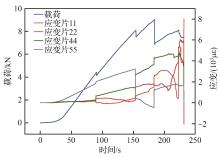
Fig.8
CG-W-E9-2 load strain-time curves


Fig.9
Histogram of test results for Scheme 1-1, Scheme 2-1, and Scheme 3-1


Fig.10
Load-displacement curves of Scheme 1-2 conventional design + end isolation

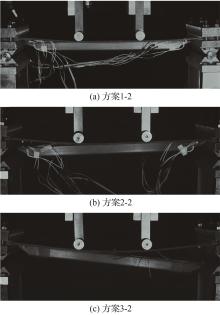
Fig.11
Failure mode diagram for loading of bar termination end isolation scheme
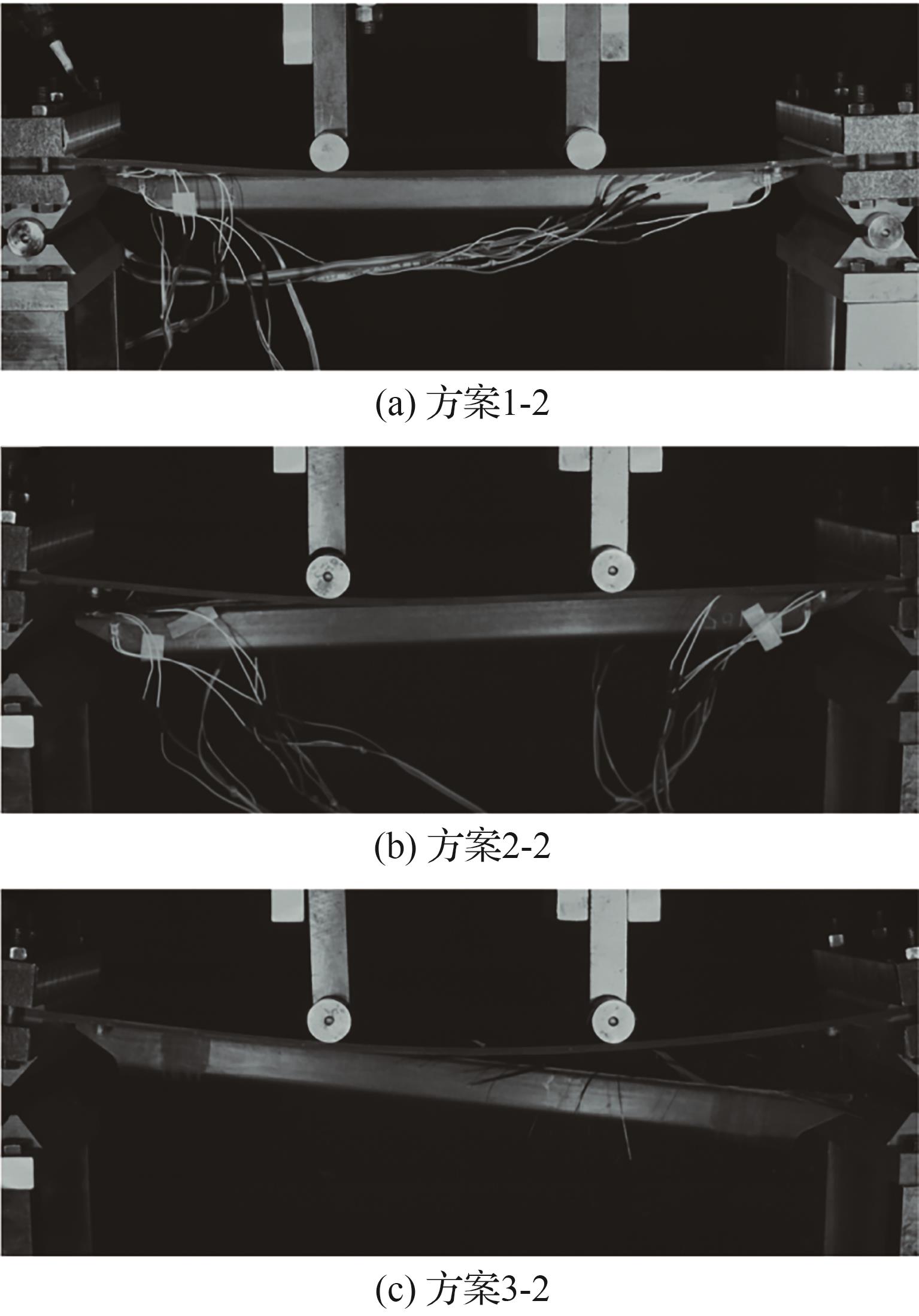
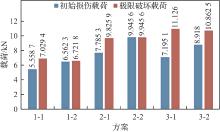
Fig.12
Test results of six schemes

| [1] | 张振, 许昊润, 倪福鹏, 等. 航空复合材料结构制造缺陷超声检测研究进展[J]. 力学季刊, 2025, 46(1): 1-19. |
| ZHANG Z, XU H R, NI F P, et al. Research progress on ultrasonic testing of manufacturing defects of aerospace composite structures[J]. Chinese Quarterly of Mechanics, 2025, 46(1): 1-19 (in Chinese). | |
| [2] | 李岩, 龙昱, 郝潞岑, 等. 3D打印纤维增强复合材料力学性能研究进展[J]. 力学季刊, 2022, 43(4): 731-750. |
| LI Y, LONG Y, HAO L C, et al. Research progress on mechanical properties of 3D printed fiber reinforced composites[J]. Chinese Quarterly of Mechanics, 2022, 43(4): 731-750 (in Chinese). | |
| [3] | BERTOLINI J, CASTANIÉ B, BARRAU J J, et al. An experimental and numerical study on omega stringer debonding[J]. Composite Structures, 2008, 86(1/3): 233-242. |
| [4] | FALZON B G, DAVIES G A O. The behavior of compressively loaded stiffener runout specimens—Part Ⅰ: Experiments[J]. Journal of Composite Materials, 2003, 37(5): 381-400. |
| [5] | 刘婷, 周凯华, 阴悦, 等. 复合材料加筋板长桁终止端设计与分析[J]. 南京航空航天大学学报, 2013, 45(3): 353-359. |
| LIU T, ZHOU K H, YIN Y, et al. Design and analysis of laminated stiffened composite panels with stringer terminations[J]. Journal of Nanjing University of Aeronautics & Astronautics, 2013, 45(3): 353-359 (in Chinese). | |
| [6] | 周凯华, 陈普会, 柴亚南. 复合材料加筋板长桁终止端失效机制[J]. 复合材料学报, 2012, 29(6): 212-218. |
| ZHOU K H, CHEN P H, CHAI Y N. Failure mechanism at stiffener runout in stiffened composite panels[J]. Acta Materiae Compositae Sinica, 2012, 29(6): 212-218 (in Chinese). | |
| [7] | 彭新未, 高敏. 不同压剪比下复合材料加筋壁板屈曲行为及承载能力试验研究[J]. 科技创新与应用, 2025, 15(14): 84-87. |
| PENG X W, GAO M. Experimental study on the buckling behavior and bearing capacity of composite reinforced siding under different compression-shear ratios[J]. Technology Innovation and Application, 2025, 15(14): 84-87 (in Chinese). | |
| [8] | 张驰, 郑锡涛, 张东健, 等. 复合材料加筋壁板轴压屈曲载荷工程估算新方法[J]. 复合材料学报, 2024, 41(9): 4875-4887. |
| ZHANG C, ZHENG X T, ZHANG D J, et al. A new engineering method for predicting the axial compression buckling load of composite stiffened panels[J]. Acta Materiae Compositae Sinica, 2024, 41(9): 4875-4887 (in Chinese). | |
| [9] | 陈金睿, 陈普会, 孔斌, 等. 考虑筋条扭转弹性支持的轴压复合材料加筋板局部屈曲分析方法[J]. 南京航空航天大学学报, 2017, 49(1): 76-82. |
| CHEN J R, CHEN P H, KONG B, et al. Local buckling analysis of axially compressed stiffened laminated panels considering rotational restraint of stiffeners[J]. Journal of Nanjing University of Aeronautics & Astronautics, 2017, 49(1): 76-82 (in Chinese). | |
| [10] | HAN X, HOU S Q, YING L, et al. On the fracture behaviour of adhesively bonded CFRP hat-shaped thin-walled beam under axial crushing load: An experimental and modelling study[J]. Composite Structures, 2019, 215: 258-265. |
| [11] | 周凯华. 复合材料加筋板长桁终止端研究[D]. 南京: 南京航空航天大学, 2012. |
| ZHOU K H. Research on stiffener runout in stiffened composite panel[D]. Nanjing: Nanjing University of Aeronautics and Astronautics, 2012 (in Chinese). | |
| [12] | 吴菁, 章向明, 胡明勇, 等. 复合材料船体帽型加筋板弯曲应力[J]. 船舶力学, 2023, 27(7): 1084-1095. |
| WU J, ZHANG X M, HU M Y, et al. Bending stress of composite hat-stiffened plates[J]. Journal of Ship Mechanics, 2023, 27(7): 1084-1095 (in Chinese). | |
| [13] | 罗惠, 李倩倩, 李炜. 三维编织复合材料帽形单加筋壁板弯曲性能研究[J/OL]. 复合材料科学与工程, 2025: 1-8. (2025-03-20). . |
| LUO H, LI Q Q, LI W. Study on the bending performance of three-dimensional braided composite hat-stiffened single-ribbed panels[J/OL]. Composites Science and Engineering, 2025: 1-8. (2025-03-20). (in Chinese). | |
| [14] | LI B K, GONG Y, GAO Y K, et al. Failure analysis of hat-stringer-stiffened aircraft composite panels under four-point bending loading[J]. Materials, 2022, 15(7): 2430. |
| [15] | 袁菲, 刘富, 柴亚南, 等. 复合材料加筋壁板帽型筋条包覆层对界面脱粘起始的影响[J]. 机械强度, 2022, 44(6): 1490-1497. |
| YUAN F, LIU F, CHAI Y N, et al. Internal cladding layer influence on the debonding of hat-stringer stiffened composite panels under axial compression[J]. Journal of Mechanical Strength, 2022, 44(6): 1490-1497 (in Chinese). | |
| [16] | 牛耘, 张平, 黄任昌, 等. 复合材料长桁刚度与壁板胶接强度研究[J]. 装备制造技术, 2024(9): 159-163. |
| NIU G, ZHANG P, HUANG R C, et al. Study on the stiffness of long truss and the adhesive strength of composite beams[J]. Equipment Manufacturing Technology, 2024(9): 159-163 (in Chinese). | |
| [17] | 陈向明, 李新祥, 柴亚南, 等. 复合材料壁板后屈曲设计与分析技术研究进展[J]. 复合材料学报, 2024, 41(9): 4673-4700. |
| CHEN X M, LI X X, CHAI Y N, et al. Research progress in post-buckling design and analysis techniques for composite stiffened panel[J]. Acta Materiae Compositae Sinica, 2024, 41(9): 4673-4700 (in Chinese). | |
| [18] | 崔德刚. 浅谈民用大飞机结构技术的发展[J]. 航空学报, 2008, 29(3): 573-582. |
| CUI D G. Structure technology development of large commercial aircraft[J]. Acta Aeronautica et Astronautica Sinica, 2008, 29(3): 573-582 (in Chinese). | |
| [19] | 赵铭, 张伟, 王鹏飞. 斜削型筋条复合材料加筋壁板轴压屈曲分析[J]. 科学技术与工程, 2017, 17(6): 97-103. |
| ZHAO M, ZHANG W, WANG P F. An analysis of buckling modes in composite panel with beveled stiffened under compress load[J]. Science Technology and Engineering, 2017, 17(6): 97-103 (in Chinese). | |
| [20] | 任翔, 刘马宝, 王晓阳, 等. 整体壁板式长桁端部斜削结构疲劳预估与试验[J]. 机械设计与制造, 2019(3): 61-65. |
| REN X, LIU M B, WANG X Y, et al. Fatigue life prediction and testing on integral airfoil stringer termination[J]. Machinery Design & Manufacture, 2019(3): 61-65 (in Chinese). |
| [1] | . Review on defect detection, characterization, and process optimization in automated fiber placement of aviation composite [J]. Acta Aeronautica et Astronautica Sinica, 0, (): 1-0. |
| [2] | Qingyi LIU, Xu YANG, Yu ZHANG, Peng YAN, Yanfei CHEN, Chuliang YAN. Multi-physics coupling modeling of laser ablation process of carbon fiber woven composites [J]. Acta Aeronautica et Astronautica Sinica, 2025, 46(21): 532372-532372. |
| [3] | . Ballistic impact response and damage characteristics of UHMWPE plain weave fabrics [J]. Acta Aeronautica et Astronautica Sinica, 0, (): 1-0. |
| [4] | Wei LI, Xin SONG, Xiangqi LIN, Zhilin SU, Chengbo WANG, Tong LI. Fast optimization method for nail load homogenization of composite joint structures [J]. Acta Aeronautica et Astronautica Sinica, 2024, 45(23): 230345-230345. |
| [5] | Wenyu WANG, Feng LI, Feixiang REN, Xingyu WEI, Jian XIONG. Research progress on structural design methods and mechanical properties of lightweight high⁃strength composite lattice stiffened shell structure [J]. Acta Aeronautica et Astronautica Sinica, 2024, 45(17): 530001-530001. |
| [6] | Xiaole WANG, Ping SUN, Xin GU, Chunyu ZHAO, Zhenyu HUANG. Low⁃frequency and multi⁃bandgap noise reduction characteristics of acoustic metamaterial⁃based helicopter sidewall [J]. Acta Aeronautica et Astronautica Sinica, 2024, 45(6): 428901-428901. |
| [7] | Lingcai HUANG. Review of nondestructive testing methods for fiber⁃reinforced polymer composites [J]. Acta Aeronautica et Astronautica Sinica, 2024, 45(5): 529697-529697. |
| [8] | Junchao YANG, Xueming WANG, Xiangming CHEN, Peng ZOU, Zhe WANG. Effect of low-velocity impact damage on compressive properties of composite stiffened panels [J]. Acta Aeronautica et Astronautica Sinica, 2023, 44(20): 228498-228498. |
| [9] | Xianbang SHEN, Kaijun YI, Xuzhen JING, Zhiyuan LIU, Rui ZHU. Design of electromechanical coupled metamaterial plates for low-frequency vibration control in aircraft structures [J]. ACTA AERONAUTICAET ASTRONAUTICA SINICA, 2023, 44(5): 226959-226959. |
| [10] | GAO Wei, LIU Cun, CHEN Shunqiang. Axial compression test and analysis method of composite stiffened plates with variable thickness [J]. ACTA AERONAUTICAET ASTRONAUTICA SINICA, 2022, 43(11): 526764-526764. |
| [11] | JIANG Zhou, FAN Yu, LI Lin, SHI Jiahui. Design method of stiffened plate for vibration reduction based on band gaps [J]. ACTA AERONAUTICAET ASTRONAUTICA SINICA, 2022, 43(9): 226007-226007. |
| [12] | WANG Houbing, WANG Xiahan, LIN Guowei, LI Xinxiang, YANG Shengchun. Residual strength evaluation of curved hat-stiffened composite panels with discrete-source damage [J]. ACTA AERONAUTICAET ASTRONAUTICA SINICA, 2022, 43(6): 525899-525899. |
| [13] | JIA Baohui, SHAN Jinyang, LU Xiang, WANG Du. Hygrothermal vibration characteristics of repaired structures of laminates with penetrating damage [J]. ACTA AERONAUTICAET ASTRONAUTICA SINICA, 2022, 43(6): 525518-525518. |
| [14] | GU Jintao, WANG Xiaole, TANG Youheng, ZHOU Jie, HUANG Zhenyu. Laminated acoustic metamaterial for improving low-frequency broadband sound insulation of aircraft wall panels [J]. ACTA AERONAUTICAET ASTRONAUTICA SINICA, 2022, 43(1): 224785-224785. |
| [15] | YANG Shengqi, ZHANG Yongcun, LIU Shutian. A new zig-zag theory for accurately predicting interlaminar shear stress of laminated beam structures [J]. ACTA AERONAUTICAET ASTRONAUTICA SINICA, 2019, 40(11): 223028-223028. |
| Viewed | ||||||
|
Full text |
|
|||||
|
Abstract |
|
|||||
Address: No.238, Baiyan Buiding, Beisihuan Zhonglu Road, Haidian District, Beijing, China
Postal code : 100083
E-mail:hkxb@buaa.edu.cn
Total visits: 6658907 Today visits: 1341All copyright © editorial office of Chinese Journal of Aeronautics
All copyright © editorial office of Chinese Journal of Aeronautics
Total visits: 6658907 Today visits: 1341

 CJA
CJA
