Acta Aeronautica et Astronautica Sinica ›› 2025, Vol. 46 ›› Issue (21): 532276.doi: 10.7527/S1000-6893.2025.32276
• Special Issue: 60th Anniversary of Aircraft Strength Research Institute of China • Previous Articles
Kai LEI( ), Jingtao WU, Wenliang DENG
Received:2025-05-20
Revised:2025-07-21
Accepted:2025-08-13
Online:2025-09-19
Published:2025-09-05
Contact:
Kai LEI
E-mail:983436817@qq.com
Supported by:CLC Number:
Kai LEI, Jingtao WU, Wenliang DENG. Analysis of mechanical properties of composite-metal bolted panel under thermo-mechanical coupling condition[J]. Acta Aeronautica et Astronautica Sinica, 2025, 46(21): 532276.
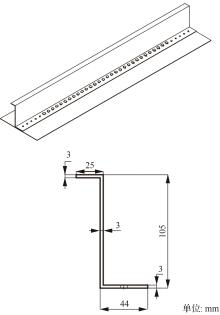
Fig.1
Diagram of hybrid panel
Table 1
Material properties of composite
| 弹性常数 | 数值 | 强度参数 | 数值 | 热膨胀系数 | 数值 |
|---|---|---|---|---|---|
| E1/GPa | 127 | XT/MPa | 2 740 | α1/(10-6K-1) | 0.07 |
| E2/GPa | 8.4 | XC/MPa | 1 309 | α2/(10-6K-1) | 25.8 |
| μ12 | 0.33 | YT/MPa | 55 | α3/(10-6K-1) | 25.8 |
| G12/GPa | 3.69 | YC/MPa | 178 | ||
| S12/MPa | 127 | ||||
| S23/MPa | 87 |
Table 2
Material properties of aluminum alloy and 30CrMnSiA
| 金属材料种类 | 材料属性 | ||
|---|---|---|---|
弹性常数 E/GPa | 泊松比 μ | 热膨胀系数 α/(10-6 K-1) | |
| 铝合金7050 | 71 | 0.3 | 23 |
| 30CrMnSiA | 210 | 0.3 | 8.8 |
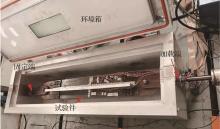
Fig.2
Photo of the environmental chamber test for hybrid panel

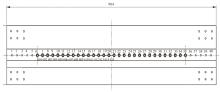
Fig.3
Diagram of strain gauge layout and naming convention for hybrid panel
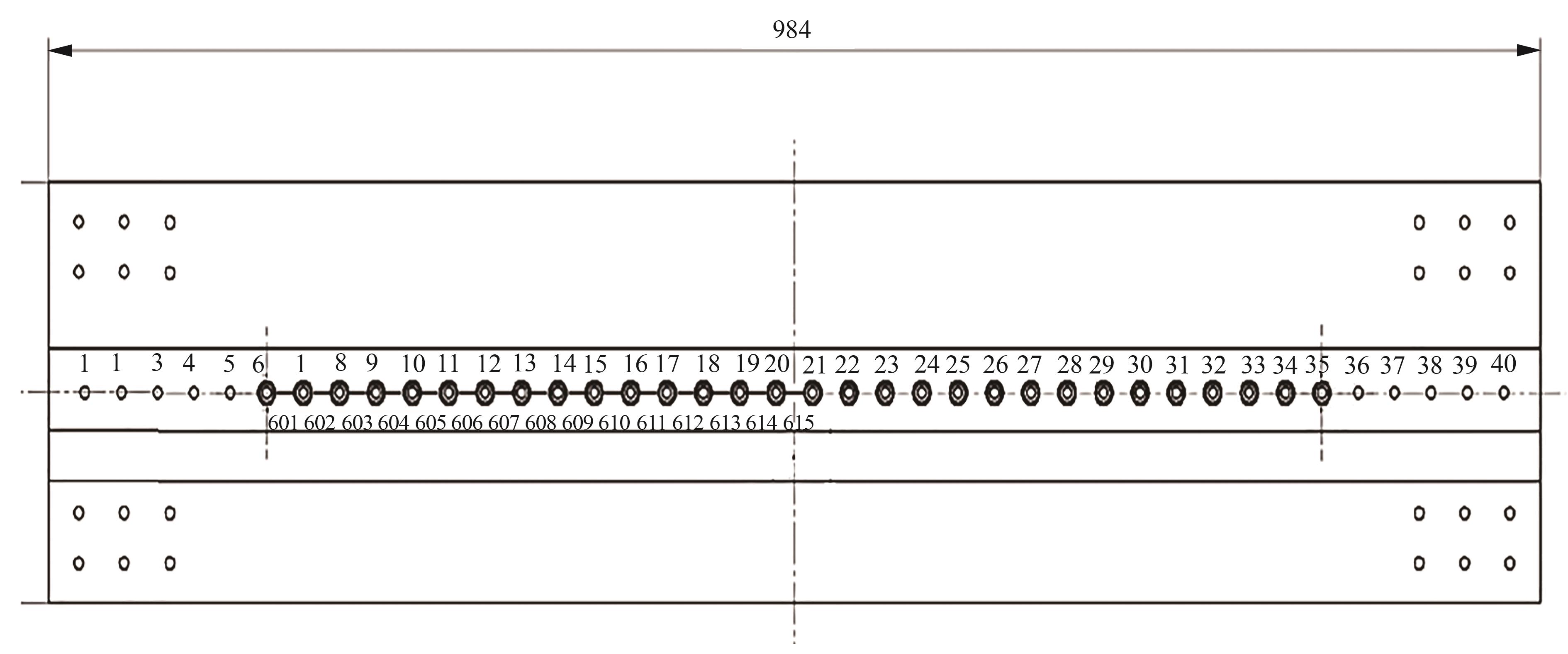
Table 3
Test process of hybrid panel
| 室温拉伸 | 温度载荷 | 温度和拉伸载荷耦合 |
|---|---|---|
① 记录环境温度24 ℃② 试验件安装至加载系统 ③ 40%最大载荷预试验 ④ 按照5%的最大载荷逐级加载,达到60 kN时,按照10%的最大载荷进行卸载 | ① 在试验箱放置试验件及热输出试样,试验件为自由状态,两端无约束 ② 设置环境箱温度24 ℃,保温10 min后应变采集系统调零 ③ 逐步升温至74 ℃,并保温至应变稳定,高温试验结束 ④ 环境箱和试验件温度回到室温后,按照相同流程,进行低温试验 | ① 试验件安装至加载系统 ② 设置环境箱温度24 ℃,保温10 min后应变采集系统调零 ③ 升温至74 ℃,并保温至应变稳定 ④ 加载系统载荷走零 ⑤ 按照5%的最大载荷逐级加载,达到60 kN时,按照10%的最大载荷进行卸载。高温和拉伸耦合试验结束 ⑥ 环境箱和试验件温度回到室温后,按照相同流程,进行低温和拉伸耦合试验 |
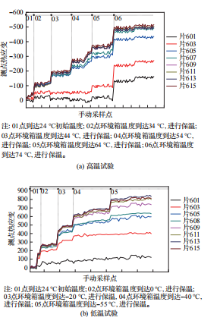
Fig.4
Thermal strain of partial measuring points on the surface of aluminum alloy stringer in temperature field for hybrid panel
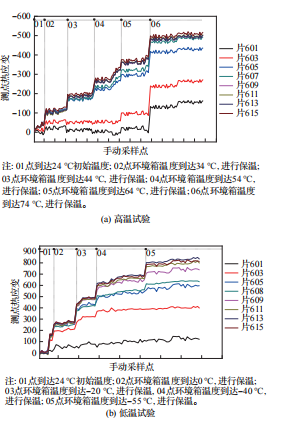
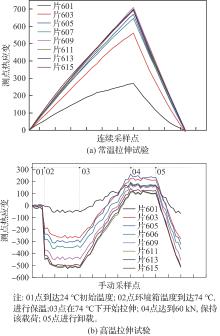
Fig.5
Strain distribution on the surface of aluminum alloy stringer for hybrid panel under different test conditions
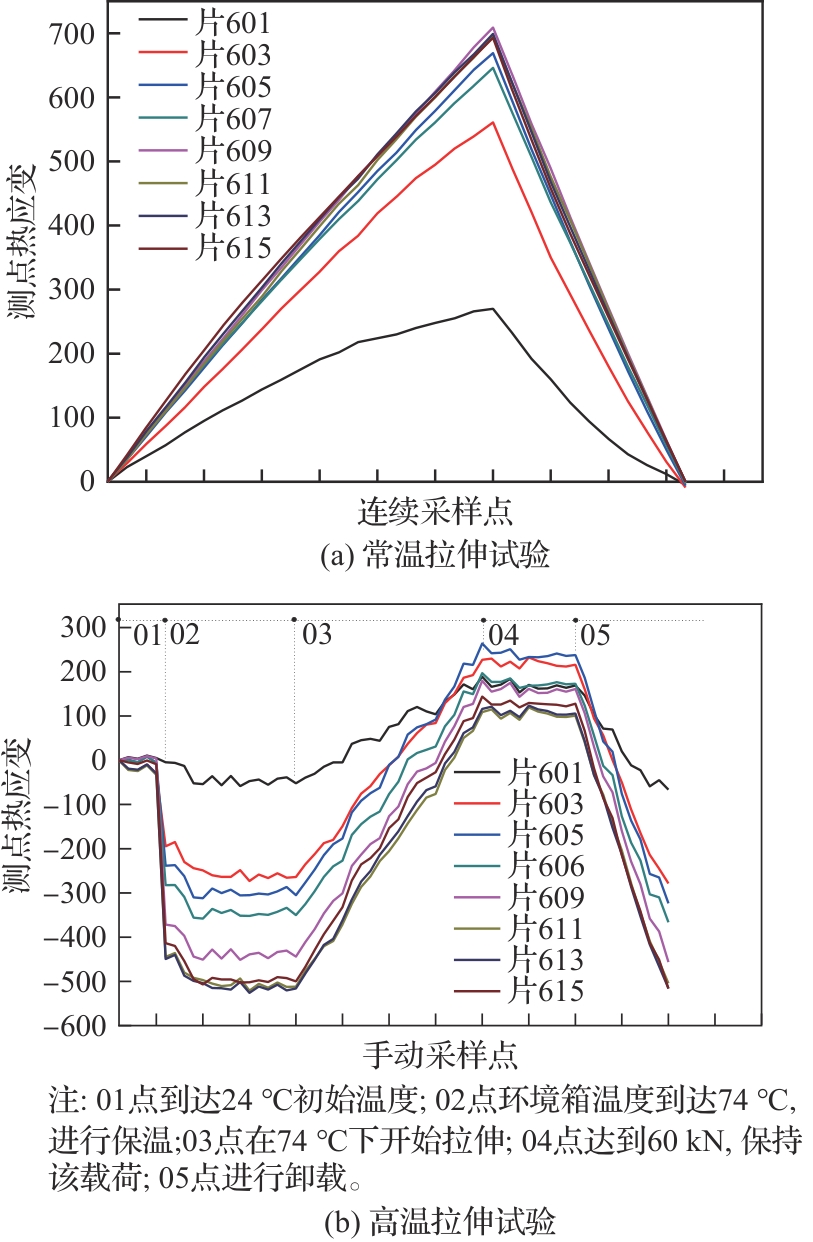
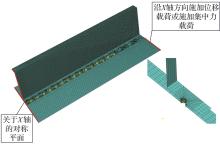
Fig.6
Plate model of hybrid panel
Table 4
Comparison of simulated and experimental strain values at measurement point No.615
| 工况 | 应变 | 误差/% | |
|---|---|---|---|
| 仿真值 | 试验值 | ||
| 室温拉伸 | 704 | 693 | 1.58 |
| 74 ℃高温 | -538 | -518 | 3.86 |
| -55 ℃低温 | 858 | 817 | 5.01 |
| 74 ℃高温拉伸耦合 | 116 | 128 | -9.38 |
| -55 ℃低温拉伸耦合 | 1 531 | 1 423 | 7.59 |
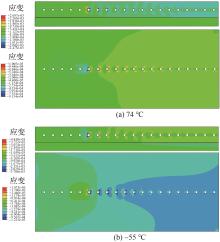
Fig.7
Thermal strain of hybrid panel under temperature fields of 74 ℃ and -55 ℃
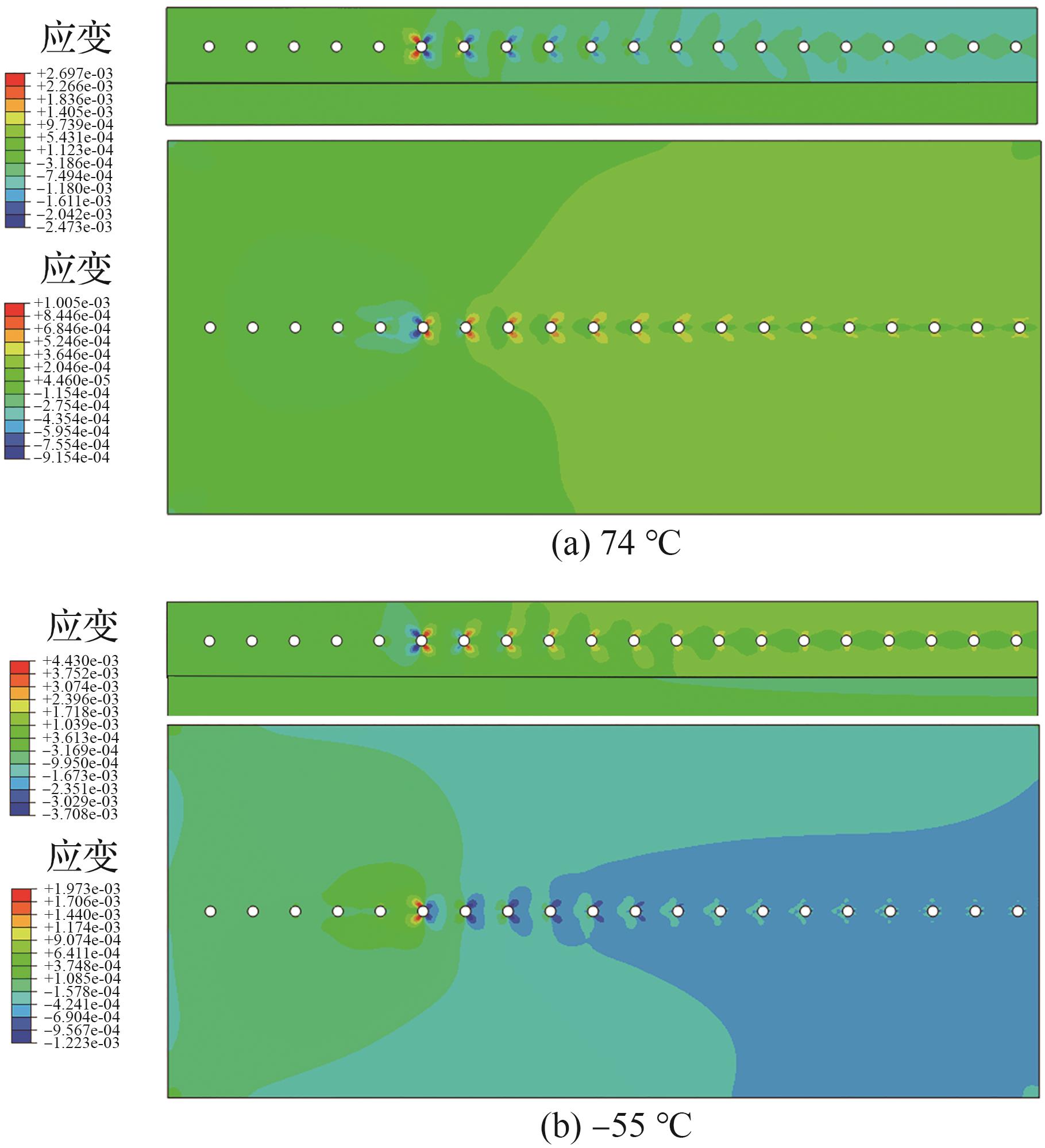

Fig.8
Bolt load distribution of hybrid panel under different test conditions
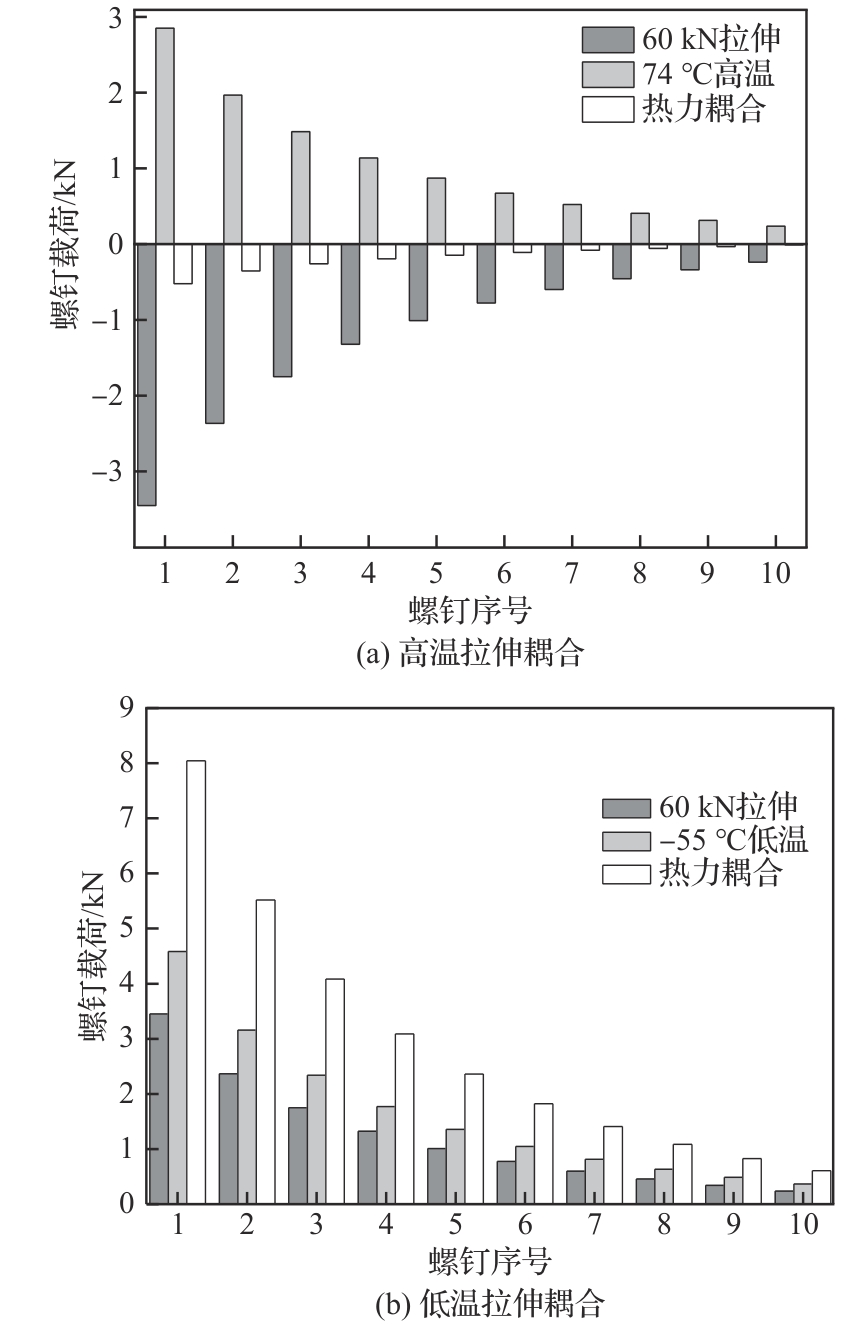
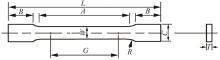
Fig.9
Structural configuration of 7050 aluminum alloy tensile failure test article
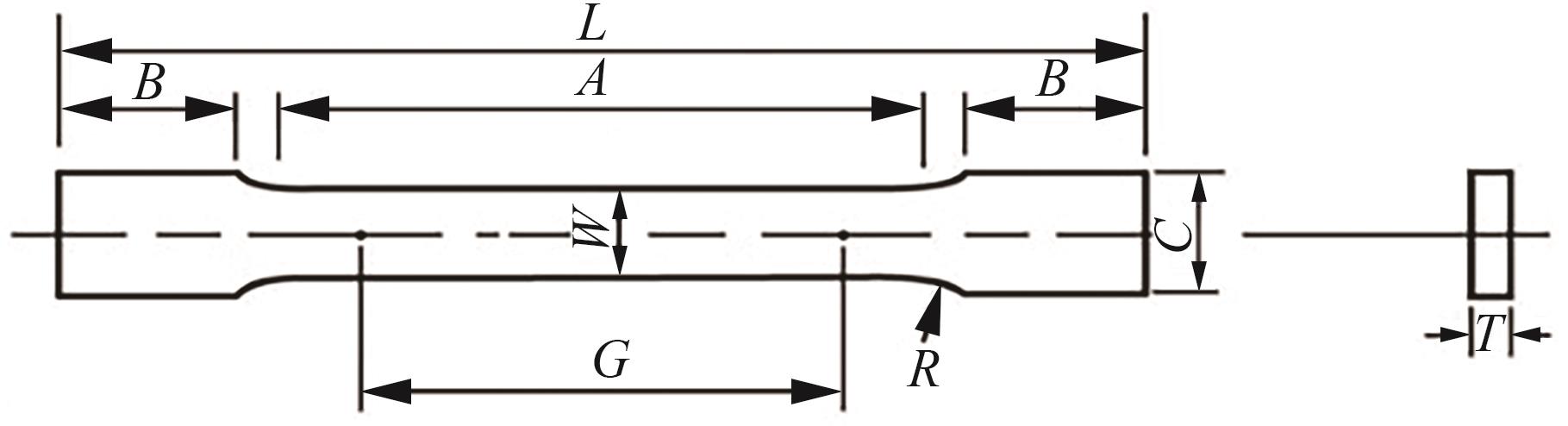
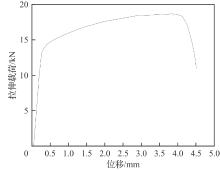
Fig.10
Simulated load-displacement curve of test article
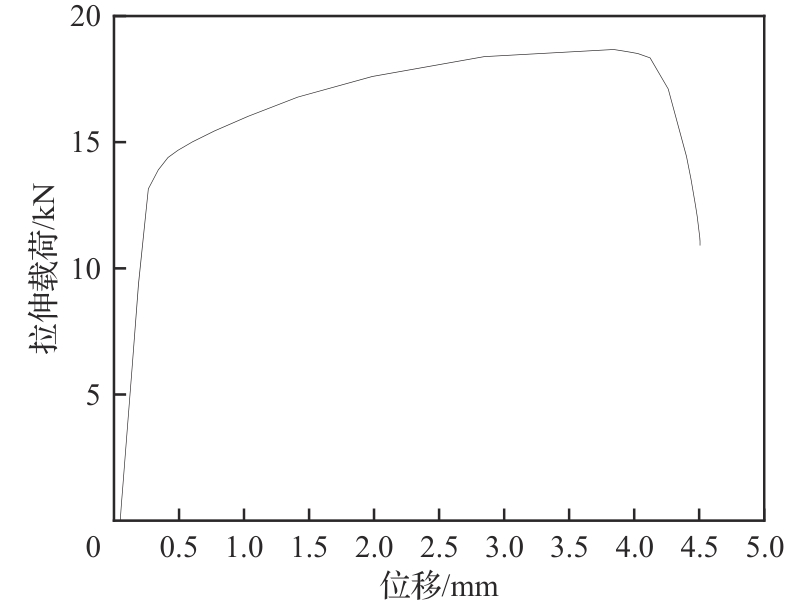
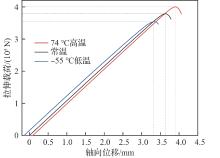
Fig.11
Load-displacement curves of hybrid panel under different temperature conditions
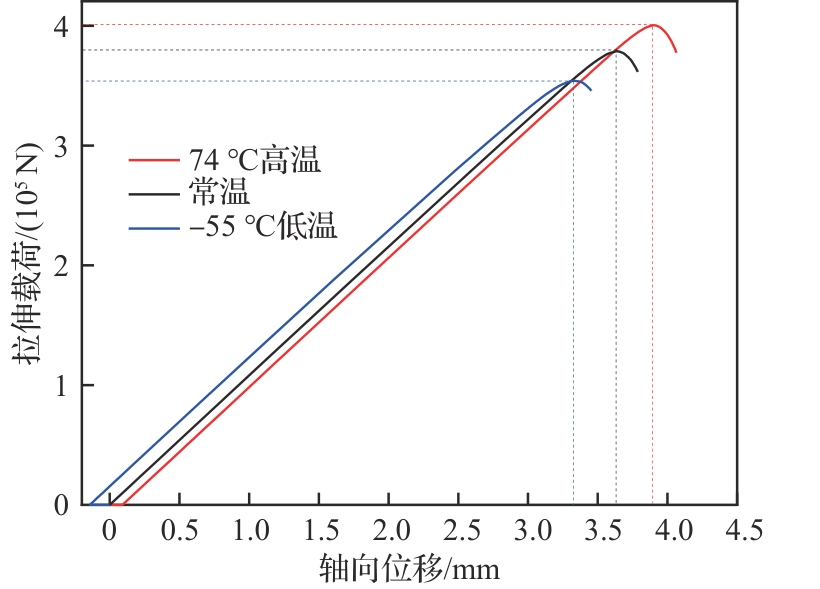
Table 5
Summary of failure loads for hybrid panel
| 温度条件/℃ | 失效载荷 /kN | 和常温环境对比/% |
|---|---|---|
| -55 | 354.13 | -6.49 |
| 25 | 378.69 | |
| 74 | 400.45 | 5.75 |

Fig.12
Typical layer damage status under failure load
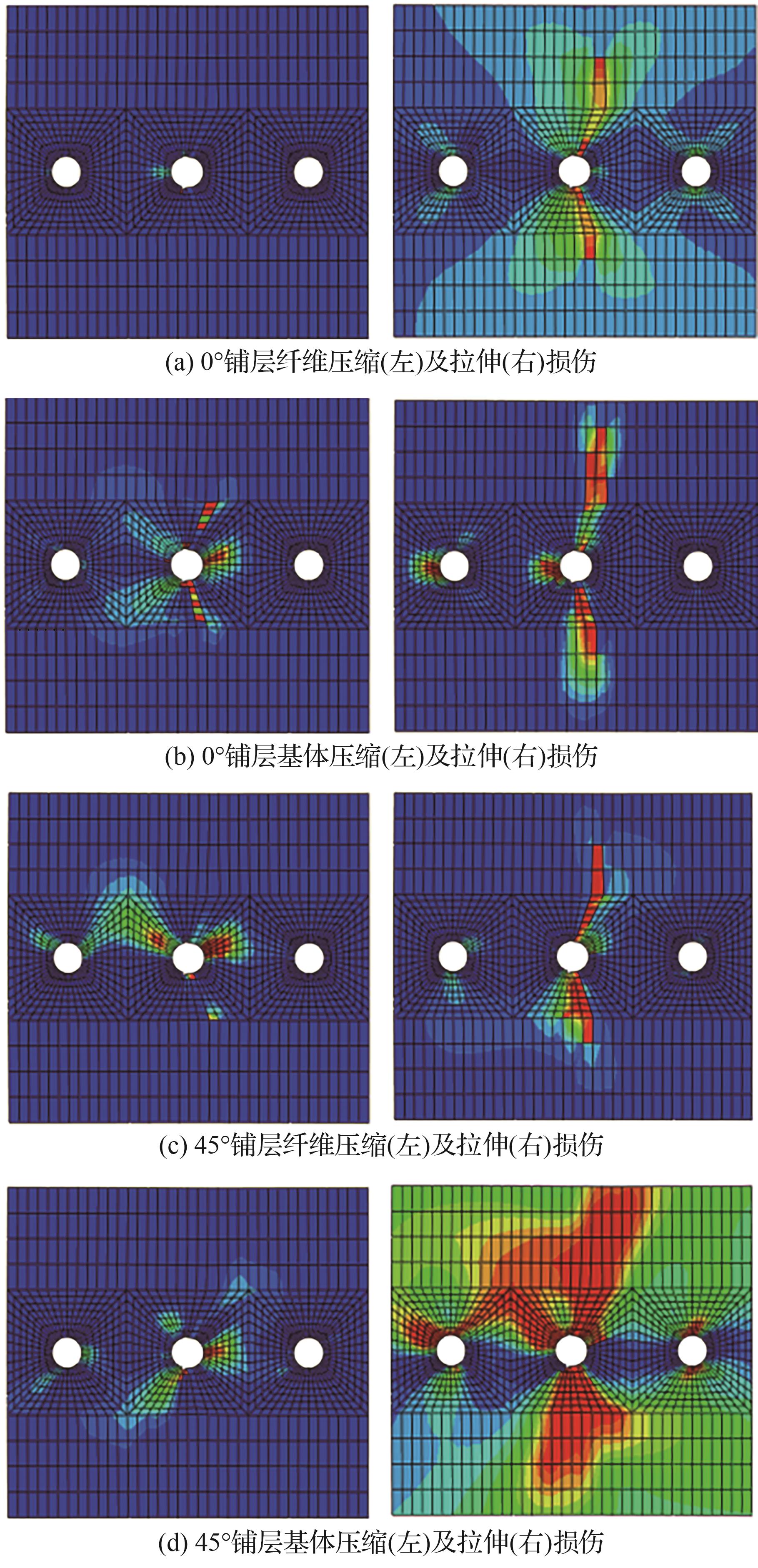

Fig.13
Bolt load distribution of the hybrid panel before failure
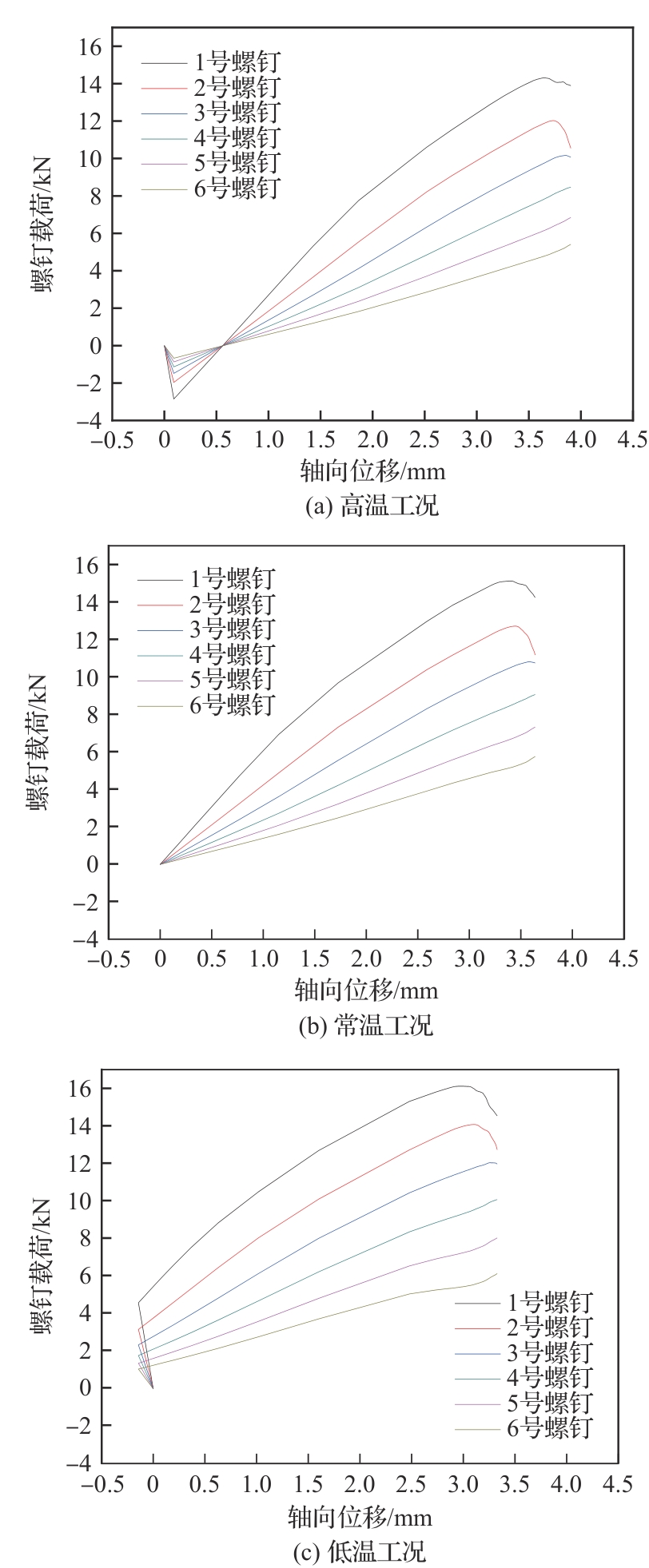
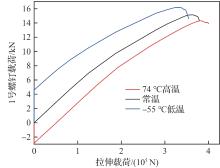
Fig.14
Variation process of bolt load No. 1 with increase of tensile load
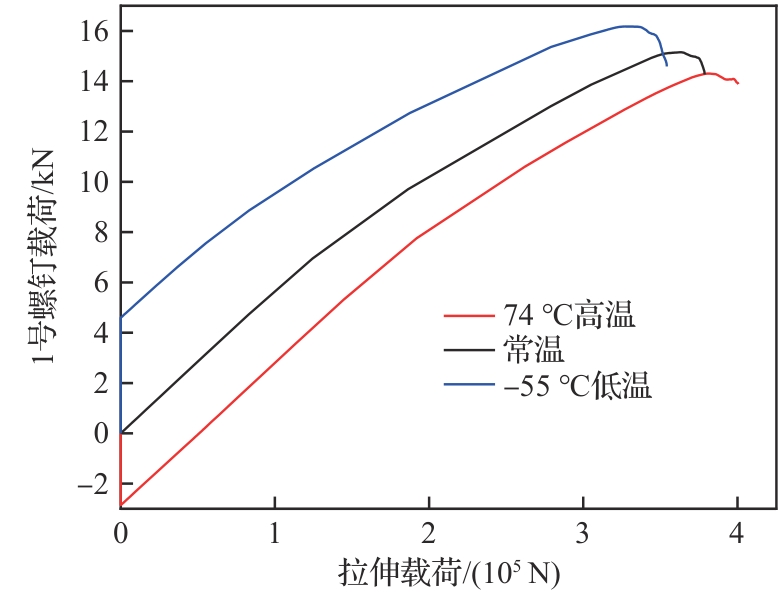

Fig.15
Load-displacement curves of new type hybrid panel under different temperature conditions
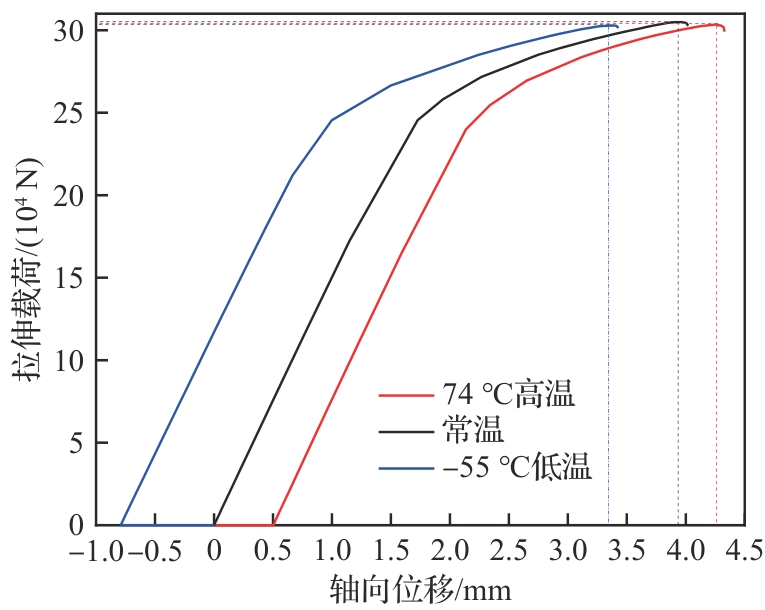
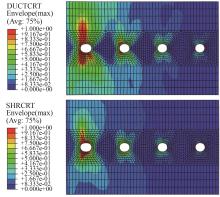
Fig.16
Simulation results of damage in metal plates under room temperature condition
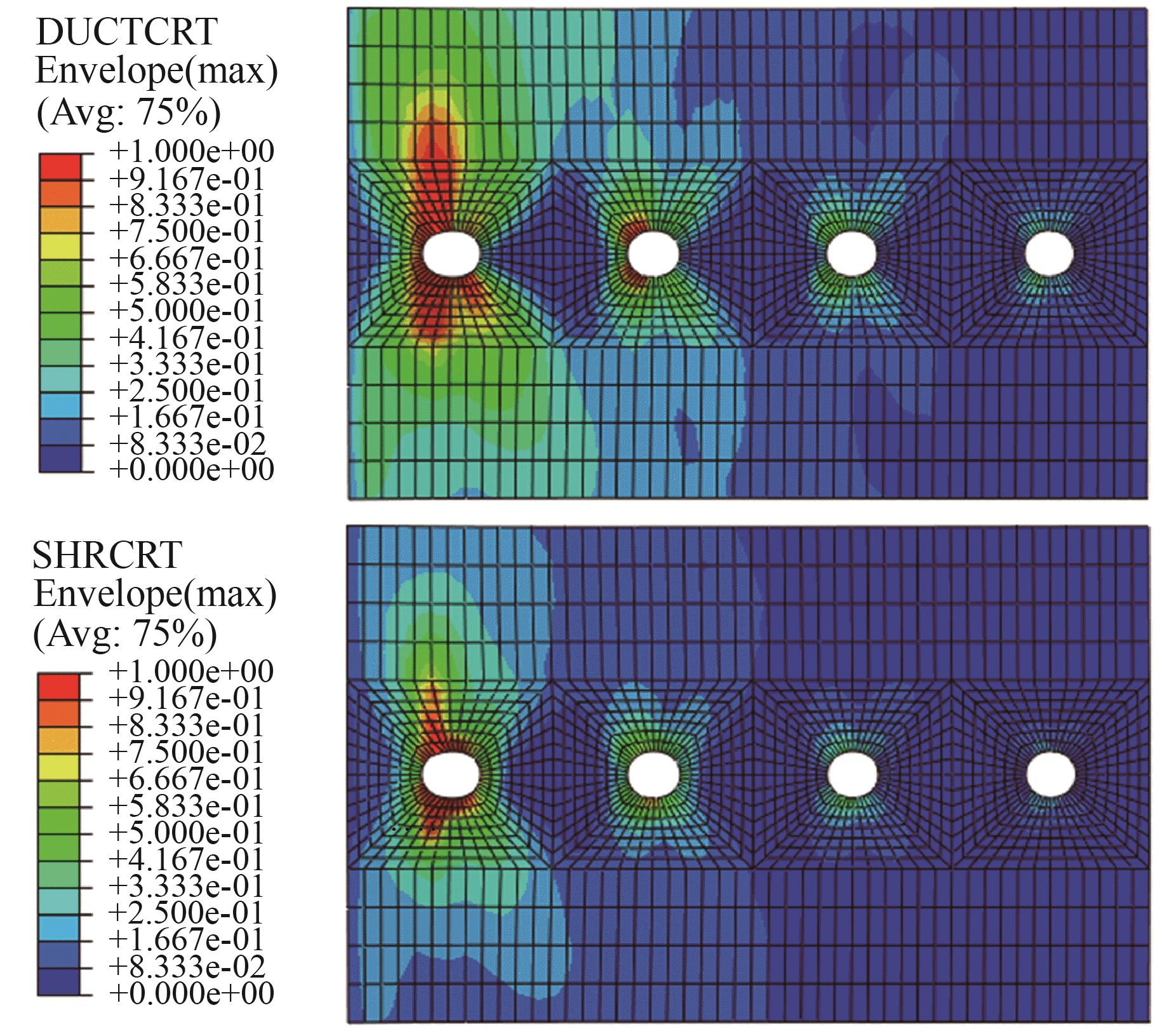
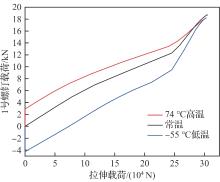
Fig.17
Variation process of bolt load No.1 of the new wall panel with increase of tensile load

| [1] | 郑洁, 赵占文. 温热环境对复合材料结构承载能力影响试验研究[J]. 航空科学技术, 2017, 28(3): 55-58. |
| ZHENG J, ZHAO Z W. Experimental research on the influence of hygrothermal environment on compressive carrying capacity of composite stiffened plates[J]. Aeronautical Science & Technology, 2017, 28(3): 55-58 (in Chinese). | |
| [2] | 苏杰, 李亚智, 杨帆, 等. 复合材料连接件钉载分配与孔周应力解析计算[J]. 应用力学学报, 2015, 32(5): 717-723, 890. |
| SU J, LI Y Z, YANG F, et al. An analytical investigation on the pin-load and stress distributions in composite joints[J]. Chinese Journal of Applied Mechanics, 2015, 32(5): 717-723, 890 (in Chinese). | |
| [3] | 贾云超, 关志东, 宋晓君. 复合材料-金属机械连接性能研究[J]. 玻璃钢/复合材料, 2015(4): 66-70, 10. |
| JIA Y C, GUAN Z D, SONG X J. Study on performance of composite-metal mechanical joints[J]. Fiber Reinforced Plastics/Composites, 2015(4): 66-70, 10 (in Chinese). | |
| [4] | 张浩宇, 侯波, 何宇廷, 等. 航空复合材料-金属连接结构的拉伸性能及其渐进损伤[J]. 机械工程材料, 2017, 41(8): 87-92. |
| ZHANG H Y, HOU B, HE Y T, et al. Tensile property of aeronautical composite-metal joint structure and its progressive damage[J]. Materials for Mechanical Engineering, 2017, 41(8): 87-92 (in Chinese). | |
| [5] | 侯赤, 周银华, 全泓玮, 等. 混合结构中金属疲劳对层合板损伤的影响[J]. 西北工业大学学报, 2018, 36(1): 74-82. |
| HOU C, ZHOU Y H, QUAN H W, et al. The effect of metal on composites fatigue damage in mixed structure[J]. Journal of Northwestern Polytechnical University, 2018, 36(1): 74-82 (in Chinese). | |
| [6] | 魏冉, 刘龙权, 汪海. 复合材料-钛合金多钉连接结构疲劳试验研究[J]. 机械科学与技术, 2012, 31(12): 1997-2002. |
| WEI R, LIU L Q, WANG H. Experimental study of the fatigue performance in multi fastener composite-to-titanium single lap joints[J]. Mechanical Science and Technology for Aerospace Engineering, 2012, 31(12): 1997-2002 (in Chinese). | |
| [7] | 韩建, 汪远, 梁珩, 等. 民用飞机机身复材-金属壁板混合连接结构的试验与分析[J]. 应用力学学报, 2023, 40(4): 761-768. |
| HAN J, WANG Y, LIANG H, et al. Test and analysis of composite-metal fuselage panel hybrid connection structure of civil aircraft[J]. Chinese Journal of Applied Mechanics, 2023, 40(4): 761-768 (in Chinese). | |
| [8] | SELLITTO A, SAPUTO S, RUSSO A, et al. Numerical-experimental investigation into the tensile behavior of a hybrid metallic-CFRP stiffened aeronautical panel[J]. Applied Sciences, 2020, 10(5): 1880. |
| [9] | GUERRERO J M, SASIKUMAR A, LLOBET J, et al. Experimental and virtual testing of a composite-aluminium aircraft wingbox under thermal loading[J]. Aerospace Science and Technology, 2023, 138: 108329. |
| [10] | GUERRERO J M, SASIKUMAR A, LLOBET J, et al. Testing and simulation of a composite-aluminium wingbox subcomponent subjected to thermal loading[J]. Composite Structures, 2022, 296: 115887. |
| [11] | YANG C, SUN W J, SENEVIRATNE W, et al. Thermally induced loads of fastened hybrid composite/aluminum structures[J]. Journal of Aircraft, 2008, 45(2): 569-580. |
| [12] | LEI K, WANG B W, WU J T, et al. Temperature-induced load of bolted hybrid composite/metal joint[C]∥ ICAS,2021. |
| [13] | KRADINOV V, BARUT A, MADENCI E, et al. Bolted double-lap composite joints under mechanical and thermal loading[J]. International Journal of Solids and Structures, 2001, 38(44-45): 7801-7837. |
| [14] | 蔡启阳, 赵琪. 环境温度和间隙对复合材料-金属混合结构机械连接钉载分配的影响[J]. 复合材料学报, 2021, 38(12): 4228-4238. |
| CAI Q Y, ZHAO Q. Effects of temperature and clearance fit on the load distribution of composite-metal hybrid structures[J]. Acta Materiae Compositae Sinica, 2021, 38(12): 4228-4238 (in Chinese). | |
| [15] | 郭居上. 温度场中复合材料板与铝合金板钉接结构内应力研究[D]. 哈尔滨: 哈尔滨工业大学, 2013: 19-30. |
| GUO J S. Internal stress analysis of bolted joints composed of composte plate and aluminum plate in the thermal field[D]. Harbin: Harbin Institute of Technology, 2013: 19-30 (in Chinese) . | |
| [16] | 魏洪, 郑茂亮, 范瑞娟. 复合材料与金属结构连接热应力有限元分析[J]. 航空科学技术, 2015, 26(9): 33-36. |
| WEI H, ZHENG M L, FAN R J. Finite element analysis on thermal stress of the connection structure between composite and metal sheet[J]. Aeronautical Science & Technology, 2015, 26(9): 33-36 (in Chinese). | |
| [17] | 邓文亮, 唐虎, 成竹. 温度对复材与金属混合结构钉载分配的影响[J]. 工程与试验, 2018, 58(3): 27-30. |
| DENG W L, TANG H, CHENG Z. Influence of temperature on nail load distribution of composite and metal structures[J]. Engineering & Test, 2018, 58(3): 27-30 (in Chinese). | |
| [18] | 杨俊清. 金属与复材混杂连接结构的热应力研究[J]. 民用飞机设计与研究, 2022(2): 15-20. |
| YANG J Q. Study on thermal stress of hybrid joint structure of composite and metal[J]. Civil Aircraft Design & Research, 2022(2): 15-20 (in Chinese). | |
| [19] | COMAN C D, CONSTANTINESCU D M. Temperature effects on joint strength and failure modes of hybrid aluminum-composite countersunk bolted joints[J]. Proceedings of the Institution of Mechanical Engineers, Part L: Journal of Materials: Design and Applications, 2019, 233(11): 2204-2218. |
| [20] | SASIKUMAR A, GUERRERO J M, QUINTANAS-COROMINAS A, et al. Numerical study to understand thermo-mechanical effects on a composite-aluminium hybrid bolted joint[J]. Composite Structures, 2021, 275: 114396. |
| [21] | 胡俊山, 张开富. 力热耦合的复合材料干涉连接结构松弛演化与失效机理[J]. 机械工程学报, 2022, 58(1): 60. |
| HU J S, ZHANG K F. Relaxation evolution and failure mechanism of composite interference connection structure with mechanical and thermal coupling[J]. Journal of Mechanical Engineering, 2022, 58(1): 60 (in Chinese). | |
| [22] | 高阳. 某型飞机中央翼关键连接区混杂结构试验仿真与分析[D]. 南京: 南京航空航天大学, 2020. |
| GAO Y. Test simulation and analysis of the hybrid structures in the critical connection area of an aircraft’s central wing[D]. Nanjing: Nanjing University of Aeronautics and Astronautics, 2020 (in Chinese). | |
| [23] | 范景峰, 程小全, 王松伟, 等. 温度对多钉连接CCF300/GW-300层合板拉伸性能的影响[J]. 高科技纤维与应用, 2014, 39(6): 54-57, 66. |
| FAN J F, CHENG X Q, WANG S W, et al. Effect of temperature on tensile properties of CCF-300/GW-300 laminates with multiple bolted joints[J]. Hi-Tech Fiber & Application, 2014, 39(6): 54-57, 66 (in Chinese). | |
| [24] | 张娇蕊, 山美娟, 黄伟, 等. 湿热环境对CFRP复合材料-铝合金螺栓连接结构静力失效的影响[J]. 复合材料学报, 2021, 38(7): 2224-2233. |
| ZHANG J R, SHAN M J, HUANG W, et al. Effects of hygrothermal environment on quasi-static failure of CFRP compositealuminum alloy bolted joints[J]. Acta Materiae Compositae Sinica, 2021, 38(7): 2224-2233 (in Chinese). | |
| [25] | 阙权庆. C/SiC复合材料螺栓连接结构热力耦合及拉伸强度分析[D]. 哈尔滨: 哈尔滨工业大学, 2018. |
| QUE Q Q. Thermal coupling and tensile strength analysis of C/SiC composite bolted connection structures[D]. Harbin: Harbin Institute of Technology, 2018 (in Chinese). | |
| [26] | 汪浩成. 温湿度对T700S/# 2510和G30-500/TC275复合材料力学性能的影响[D]. 南昌: 南昌大学, 2014: 64-66. |
| WANG H C. Effect of temperature and humidity on mechanical properties of T700S/#2515 and G30-500/TC275 composites[D]. Nanchang: Nanchang University, 2014: 64-66 (in Chinese). | |
| [27] | 罗健, 石建军, 贾彬, 等. 低温暴露对碳纤维/环氧树脂复合材料拉伸力学性能的影响[J]. 复合材料学报, 2020, 37(12): 3091-3101. |
| LUO J, SHI J J, JIA B, et al. Effect of low temperature exposure on tensile mechanical properties of carbon fiber/epoxy composites[J]. Acta Materiae Compositae Sinica, 2020, 37(12): 3091-3101 (in Chinese). | |
| [28] | 刘梦媛, 刘东勋. T700/3234层合板力学性能的研究[J]. 纤维复合材料, 2013, 30(1): 16-18, 11. |
| LIU M Y, LIU D X. Study on mechanical properties of T700/3234 laminate[J]. Fiber Composites, 2013, 30(1): 16-18, 11 (in Chinese). | |
| [29] | 陈鼎, 陈振华. 铝合金在低温下的力学性能[J]. 宇航材料工艺, 2000, 30(4): 1-7. |
| CHEN D, CHEN Z H. Mechanical properties of pure aluminum alloys at cryogenic temperatures[J]. Aerospace Materials & Technology, 2000, 30(4): 1-7 (in Chinese). |
| [1] | Zhiliang HONG, Yu LI, Wenbo HE, Shuiting DING. Influence of bolt preload on slip characteristics at discontinuous rotor interfaces under thermal load [J]. Acta Aeronautica et Astronautica Sinica, 2024, 45(24): 230402-230402. |
| [2] | Qi WANG, Long WU, Zhen LIU, Jianxia LIU, Liang XIA. Topology optimization design of thermoelastic multi-configuration gradient lattice structures [J]. Acta Aeronautica et Astronautica Sinica, 2024, 45(23): 230367-230367. |
| [3] | Jiawei FU, Zefei YANG, Yahui CAI, Xiangfan NIE, Lehua QI. Identification method for anisotropic and high strain rate plasticity of sheet metals based on heterogeneous highspeed inertial impact and principle of virtual work [J]. Acta Aeronautica et Astronautica Sinica, 2024, 45(10): 229221-229221. |
| [4] | Ziye FENG, Lixun CAI, Simiao YU. Energy⁃based J⁃integral solutions for mode⁃I cracked specimens under plane strain and plane stress [J]. ACTA AERONAUTICAET ASTRONAUTICA SINICA, 2023, 44(12): 227671-227671. |
| [5] | Xiurui WANG, Kaishang LI, Hanghang GU, Yong ZHANG, Tiwen LU, Runzi WANG, Xiancheng ZHANG. A unified criterion for high⁃low cycle fatigue life prediction based on crystal plasticity theory [J]. ACTA AERONAUTICAET ASTRONAUTICA SINICA, 2023, 44(10): 427300-427300. |
| [6] | Dong WU, Hong YANG, Wenfeng ZHAO, Yue LUO. High temperature strain measurement of hypersonic aircraft carbon-based composite material structures [J]. ACTA AERONAUTICAET ASTRONAUTICA SINICA, 2022, 43(S2): 160-169. |
| [7] | WANG Binwen, NIE Xiaohua, WAN Chunhua, WU Cunli. Research and application of virtual test technology for static strength of full scale aircraft structure [J]. ACTA AERONAUTICAET ASTRONAUTICA SINICA, 2022, 43(6): 526273-526273. |
| [8] | WANG Changyu, XU Kejun, QIN Haiqin, MA Zhongyuan, XIE Jing, XIE Zhenbo. A generalized Bodner-Partom viscoplastic constitutive model [J]. ACTA AERONAUTICAET ASTRONAUTICA SINICA, 2022, 43(12): 426009-426009. |
| [9] | SUN Dan, LI Hao, ZHAO Huan, ZHANG Guochen, LI Yu, FENG Yuzhong. Numerical and experimental study of frictional thermal effects of brush seals [J]. ACTA AERONAUTICAET ASTRONAUTICA SINICA, 2022, 43(12): 425973-425973. |
| [10] | CHANG Nan, XU Rongxin, CHEN Xianmin, YANG Jun, LI Yi. Design method for strength/durability preliminary structure optimization [J]. ACTA AERONAUTICAET ASTRONAUTICA SINICA, 2021, 42(5): 524389-524389. |
| [11] | WU Zhihui, NIU Gongjie, QIAN Jianping, LIU Rongzhong. Thermodynamics-based damage constitutive model and its application to damage analysis for HTPB/AP composite base bleed grain [J]. ACTA AERONAUTICAET ASTRONAUTICA SINICA, 2021, 42(3): 223855-223855. |
| [12] | ZHANG Jikui, KONG Xiangyi, MA Shaojun, LIU Dong, WANG Xinbo, FENG Jun, WANG Huaming. Laser additive manufactured high strength-toughness TC11 titanium alloy: Mechanical properties and application in airframe load-bearing structure [J]. ACTA AERONAUTICAET ASTRONAUTICA SINICA, 2021, 42(10): 525430-525430. |
| [13] | YAO Ping, WANG Runzi, GUO Sujuan, ZHANG Xiancheng. Finite element simulations of creep-fatigue behavior and life assessment of GH4169 alloy [J]. ACTA AERONAUTICAET ASTRONAUTICA SINICA, 2018, 39(12): 422193-422193. |
| [14] | ZHANG Teng, HE Yuting, TAN Shen'gang, WANG Xinbo, ZHANG Sheng. Series of material property indices and their application to materials selection for aircraft structure [J]. ACTA AERONAUTICAET ASTRONAUTICA SINICA, 2016, 37(10): 3170-3177. |
| [15] | WANG Huaming. Materials’ Fundamental Issues of Laser Additive Manufacturing for High-performance Large Metallic Components [J]. ACTA AERONAUTICAET ASTRONAUTICA SINICA, 2014, 35(10): 2690-2698. |
| Viewed | ||||||
|
Full text |
|
|||||
|
Abstract |
|
|||||
Address: No.238, Baiyan Buiding, Beisihuan Zhonglu Road, Haidian District, Beijing, China
Postal code : 100083
E-mail:hkxb@buaa.edu.cn
Total visits: 6658907 Today visits: 1341All copyright © editorial office of Chinese Journal of Aeronautics
All copyright © editorial office of Chinese Journal of Aeronautics
Total visits: 6658907 Today visits: 1341

 CJA
CJA
