Acta Aeronautica et Astronautica Sinica ›› 2025, Vol. 46 ›› Issue (10): 631194.doi: 10.7527/S1000-6893.2024.31194
• special column • Previous Articles
Shusheng CHEN1,2, Muliang JIA1,2, Jiahao LIN1,2, Shiyi JIN1,2, Zhenghong GAO1,2, Yueqing WANG3,4( ), Zhiqiang MA5, Zheng LI6, Chenlong DUAN7, Jiawei LI8
Received:2024-09-12
Revised:2024-10-09
Accepted:2024-10-25
Online:2024-11-19
Published:2024-11-18
Contact:
Yueqing WANG
E-mail:yqwang2013@163.com
Supported by:CLC Number:
Shusheng CHEN, Muliang JIA, Jiahao LIN, Shiyi JIN, Zhenghong GAO, Yueqing WANG, Zhiqiang MA, Zheng LI, Chenlong DUAN, Jiawei LI. Empowering aircraft technology applications with generative models: Research progress and prospects[J]. Acta Aeronautica et Astronautica Sinica, 2025, 46(10): 631194.
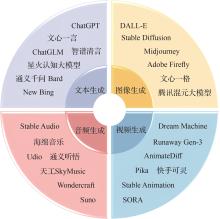
Fig.1
Representative large models

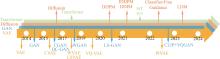
Fig.2
Development history of typical generative models
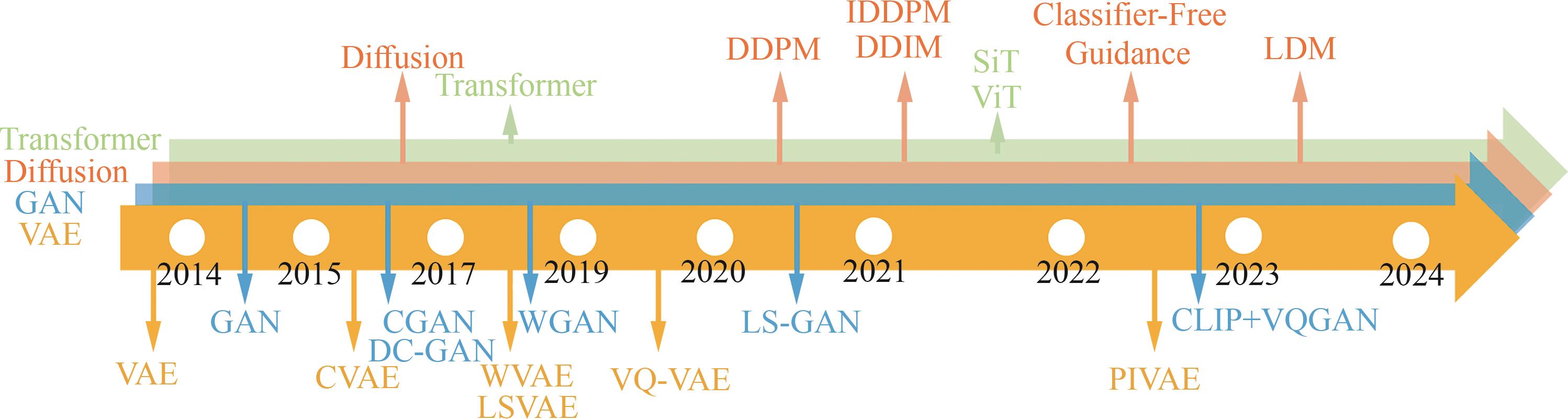
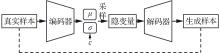
Fig.3
Architecture of VAE
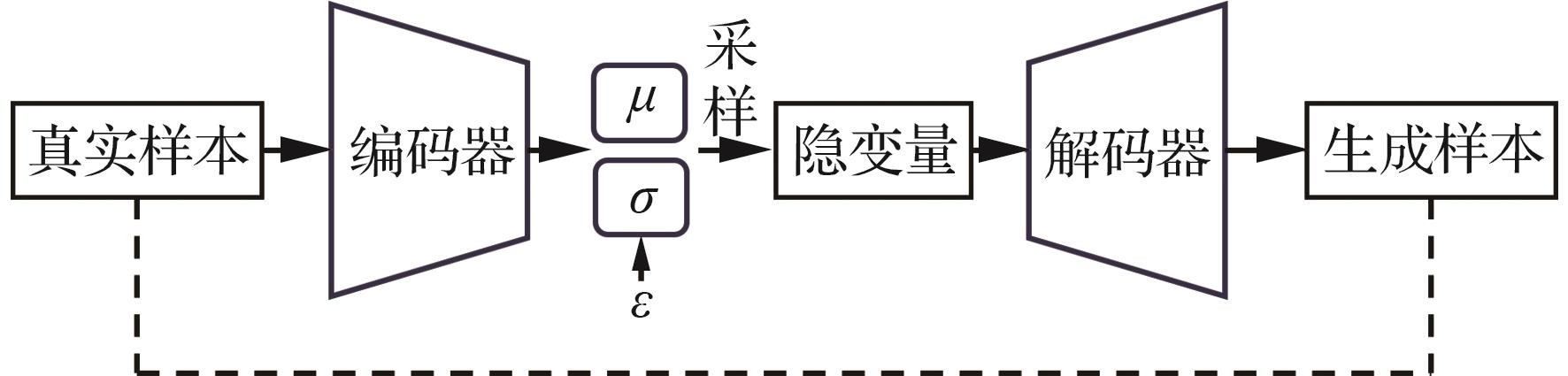
Fig.4
Architecture of ml-VAE with double latent variables[25]
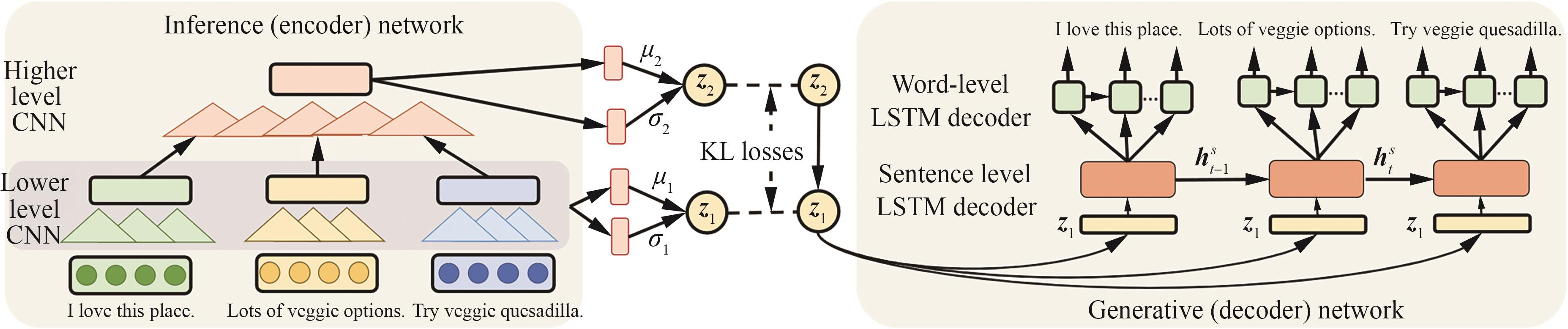
Fig.5
Architecture of VQ-VAE[27]
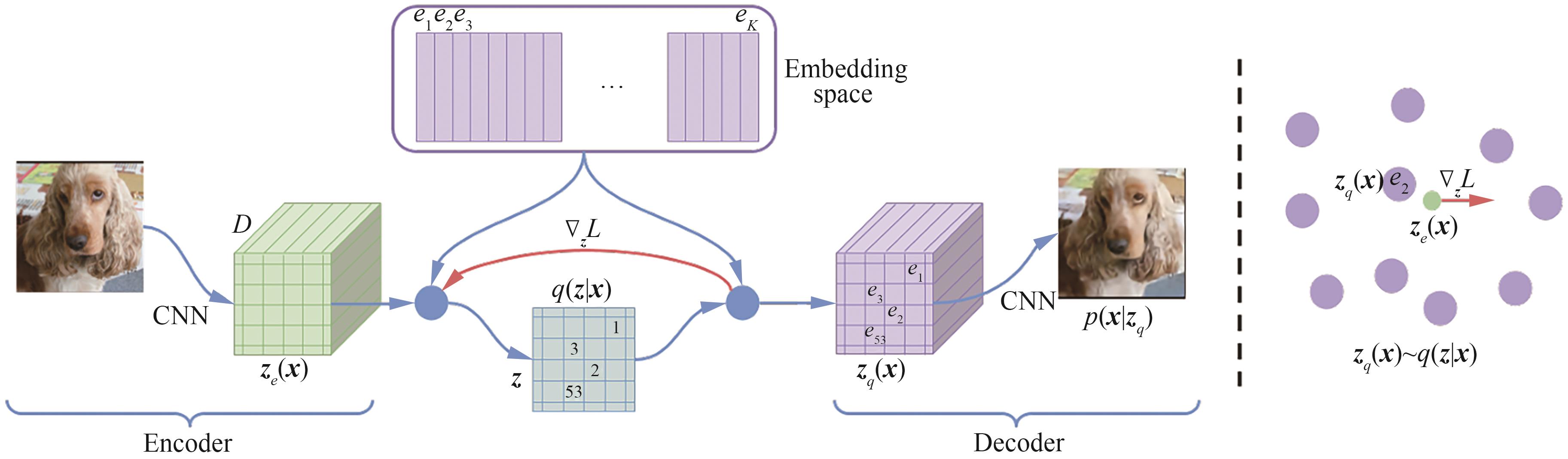
Fig.6
Architecture of VQ-VAE-2[28]
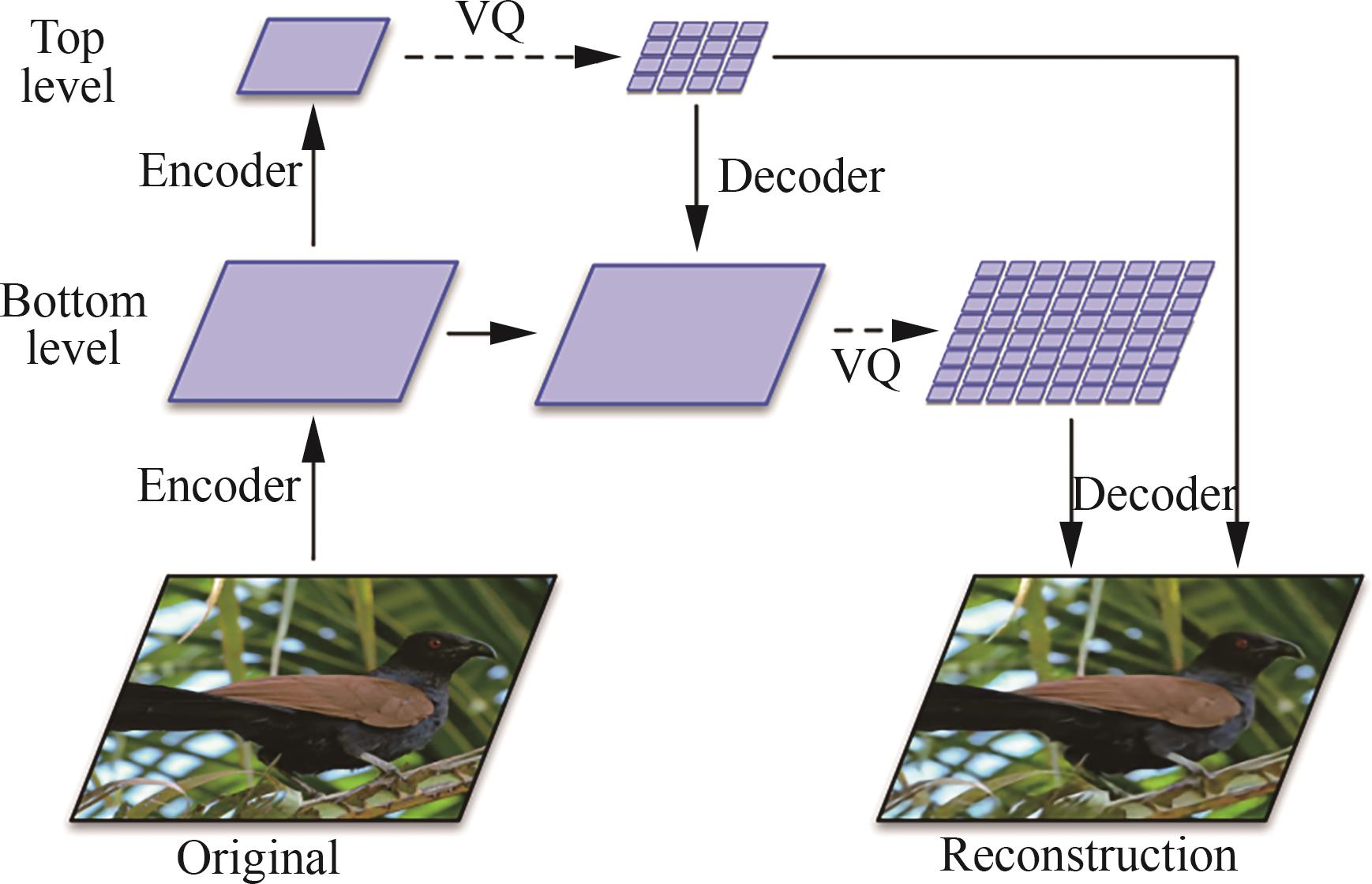
Fig.7
Architecture of GAN
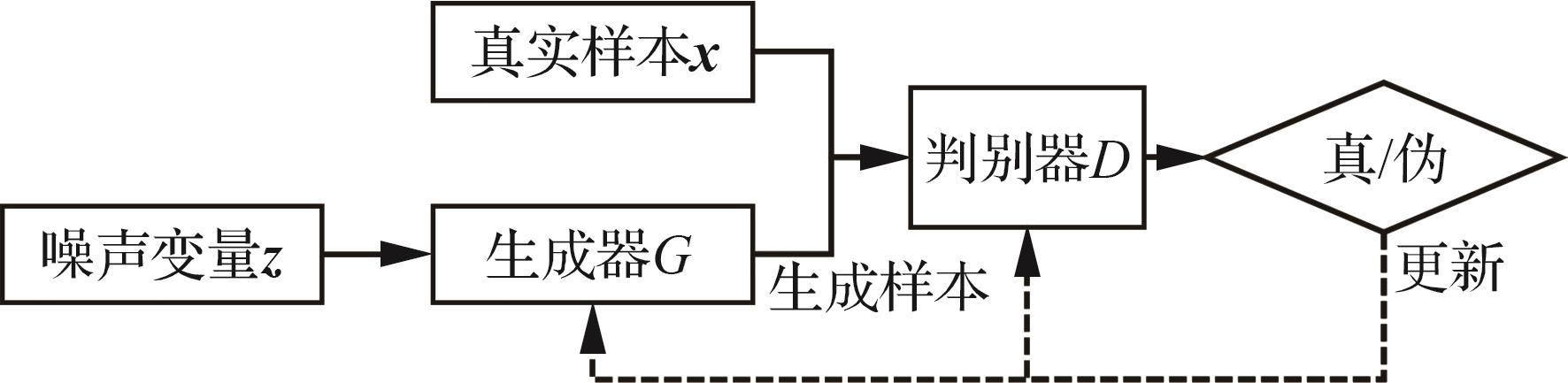

Table 1
Typical variants of GAN
| 改进方式 | 分类 | 模型变体 | 改进策略 |
|---|---|---|---|
| 目标函数改进 | 基于f-散度的改进 | f-GAN[ | 根据任意凸函数下的f-散度构建目标函数 |
| LSGAN[ | 采用最小二乘损失最小化Pearson χ2散度 | ||
| EBGAN[ | 将判别器视为能量函数 | ||
| 基于IPM的改进 | WGAN[ | 用Wasserstein距离代替JS散度改进分布距离度量方式 | |
| LS-GAN[ | 限制损失函数满足Lipschitz函数 | ||
| 架构改进 | 引入额外信息 | Semi-Supervised GAN[ | 增加真实样本的标注信息 |
| CGAN[ | 添加条件信息(标签、类别等) | ||
| InfoGAN[ | 引入隐变量表示生成数据与隐变量之间的互信息 | ||
| 整体架构改进 | StackGAN[ | 结合两个生成网络形成两段生成架构 | |
| CycleGAN[ | 通过两对生成器-判别器实现源域和生成域之间的映射,引入循环一致性损失 | ||
| 生成器改进 | AdaGAN[ | 基于Boosting算法混合多个弱生成器学习得到的特征 | |
| MADGAN[ | 引入多个生成器分别学习不同数据模式 | ||
| 判别器改进 | GMAN[ | 通过多个判别器学习不同数据模式 | |
| 交叉模型改进 | DC-GAN[ | 将卷积神经网络(Convolutional Neural Network, CNN)引入生成器和判别器 | |
| VAE-GAN[ | 利用VAE替代生成器 | ||
| SAGAN[ | 引入自注意力机制 | ||
| pix2pix[ | 采用基于U-Net的生成器和基于PatchGAN的判别器 |

Fig.8
Process of DDPM[52]

Fig.9
Architecture of LDM[55]
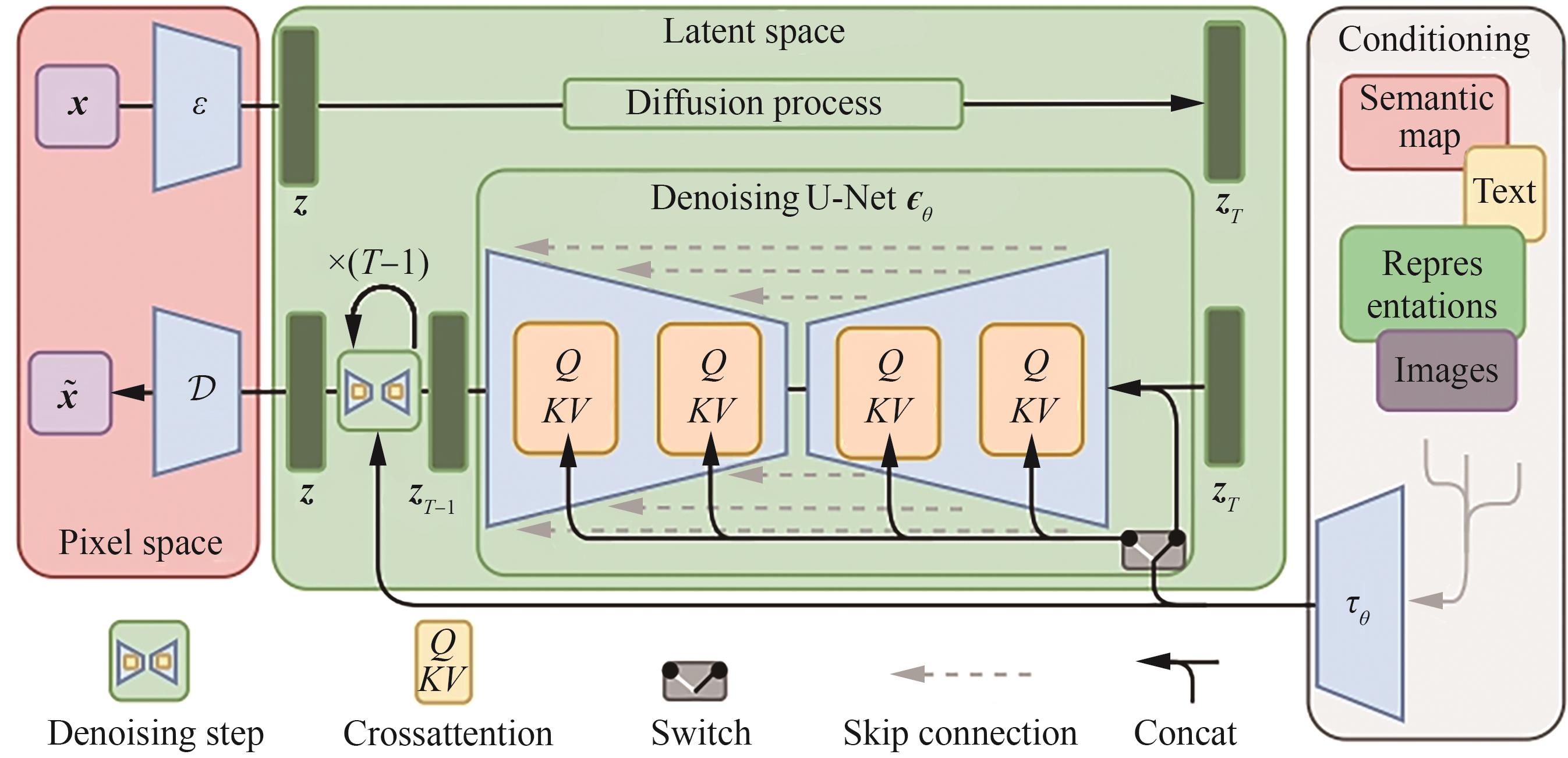
Fig.10
Architecture of Transformer[9]
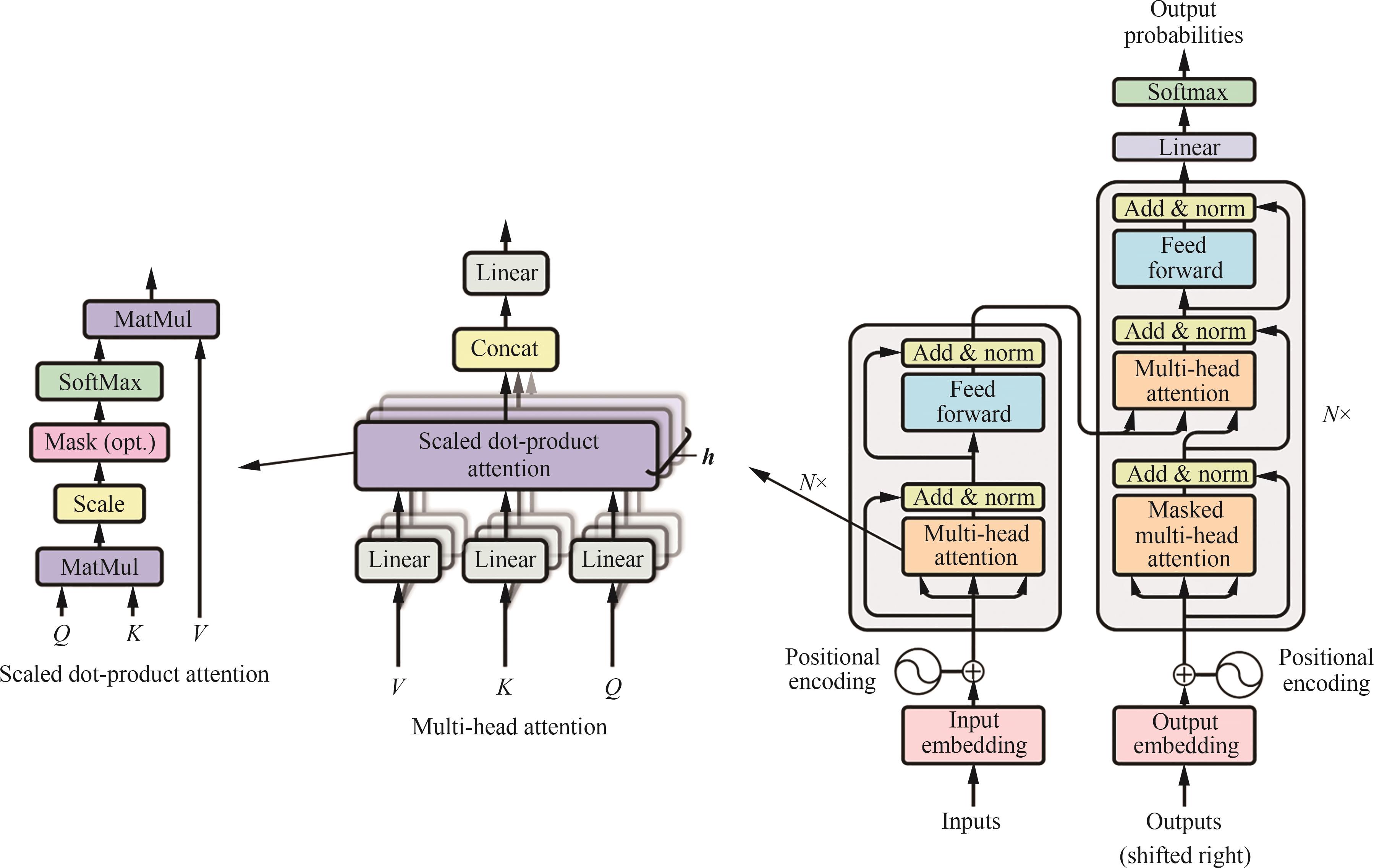
Fig.11
Schematic diagram of radom forest[70]
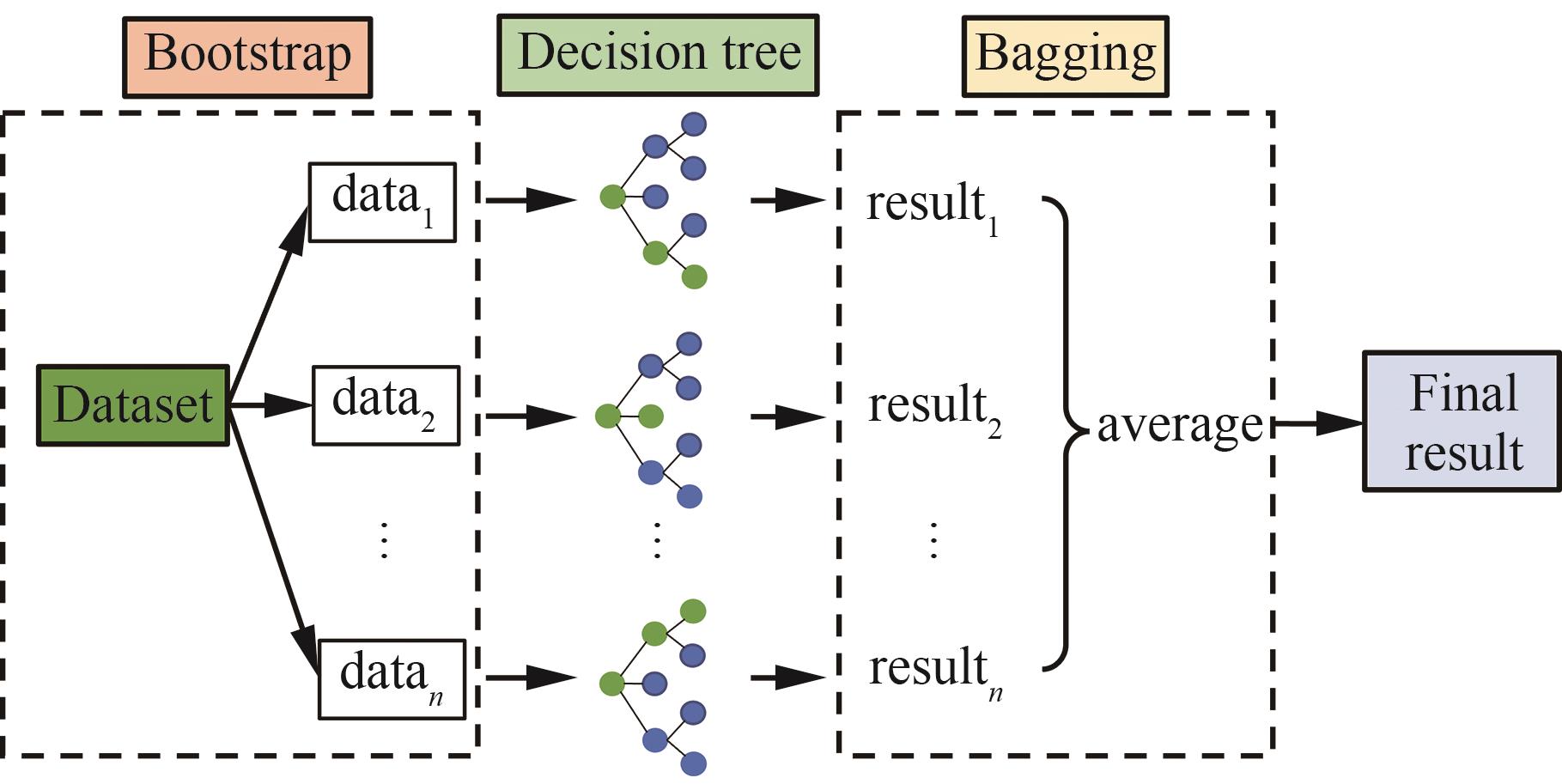
Fig.12
Structure of airfoil generator based on VAE[71]
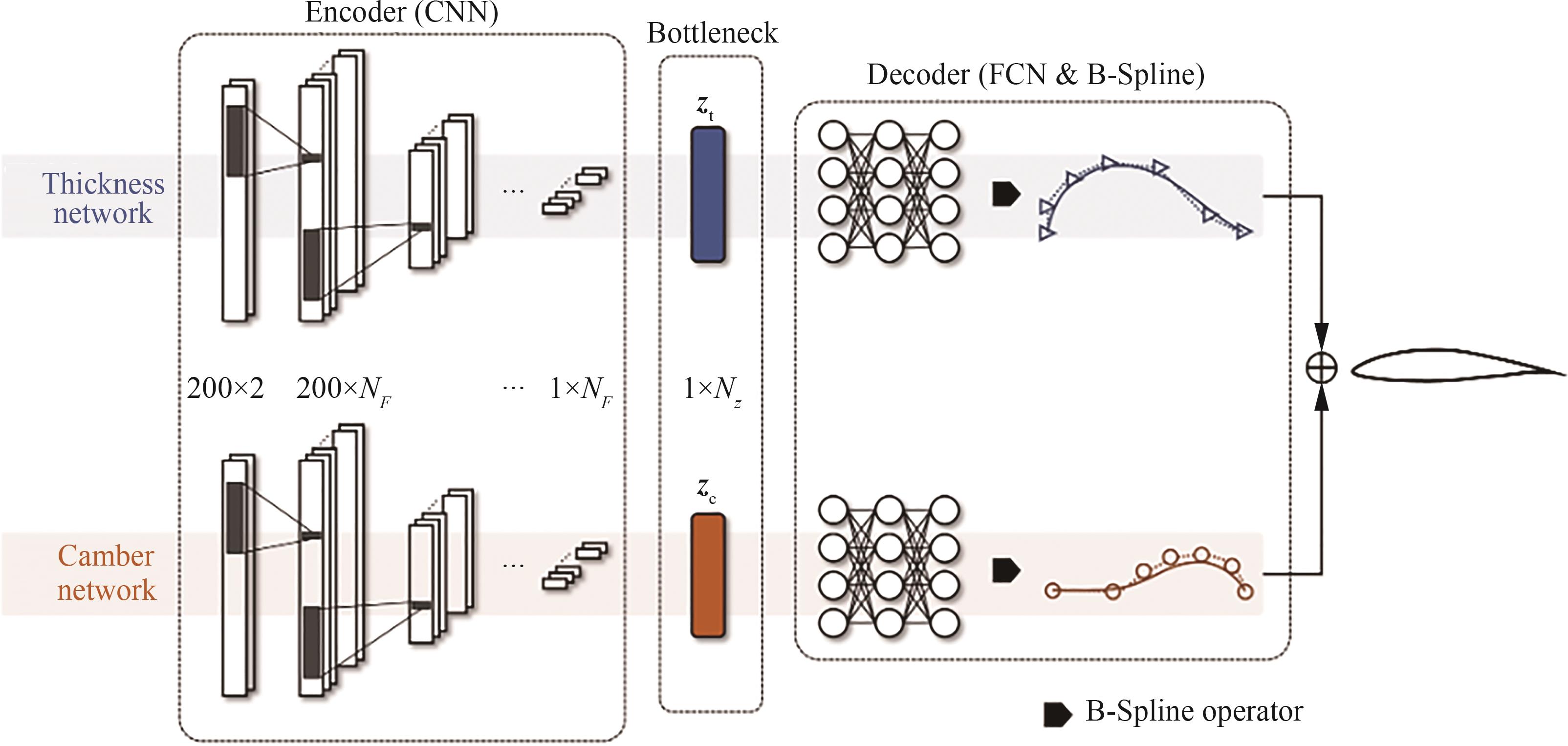
Fig.13
Effects of latent variables on airfoil shape[72]
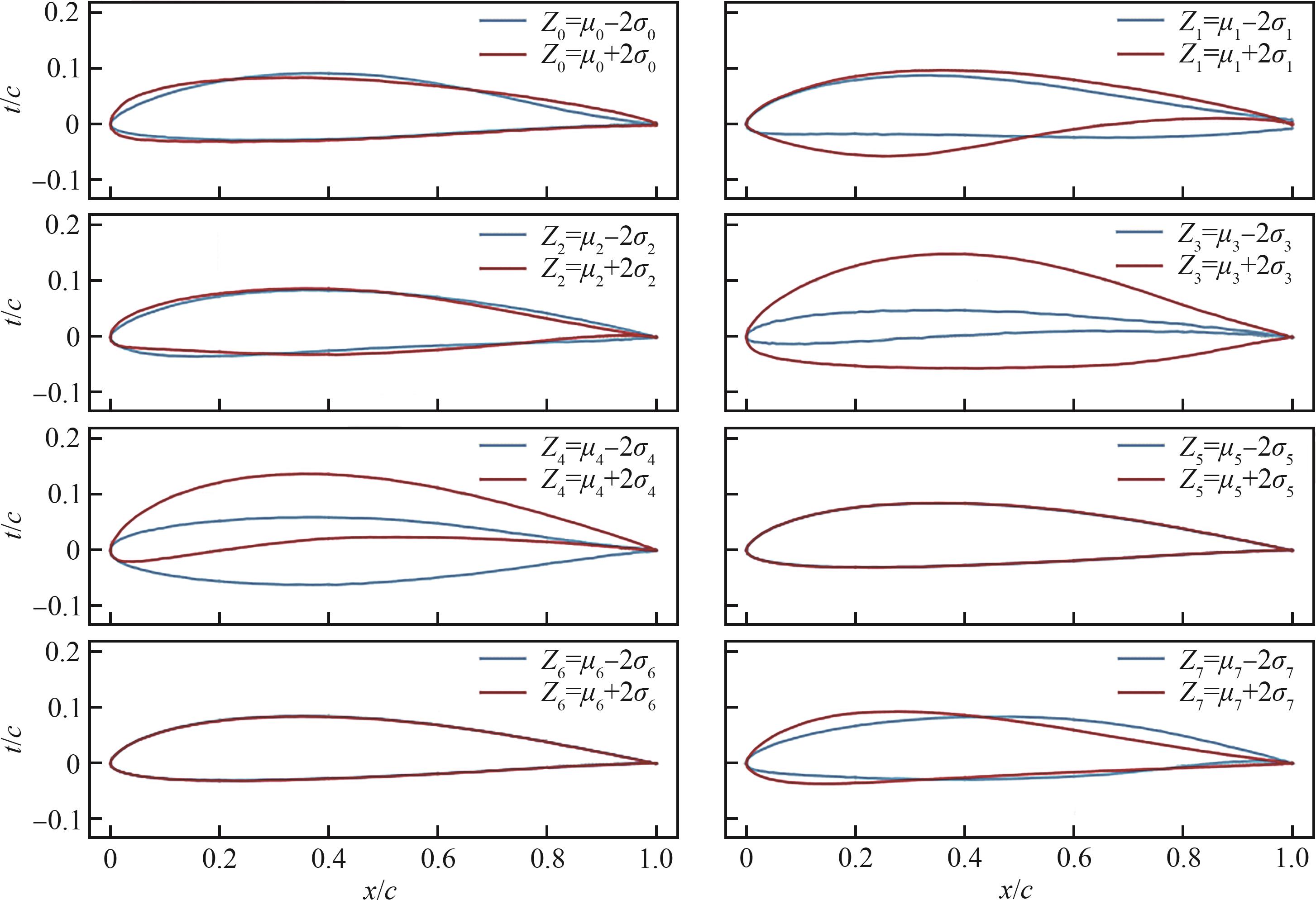
Fig.14
Schemes of geometric constraints based on VAE[73]
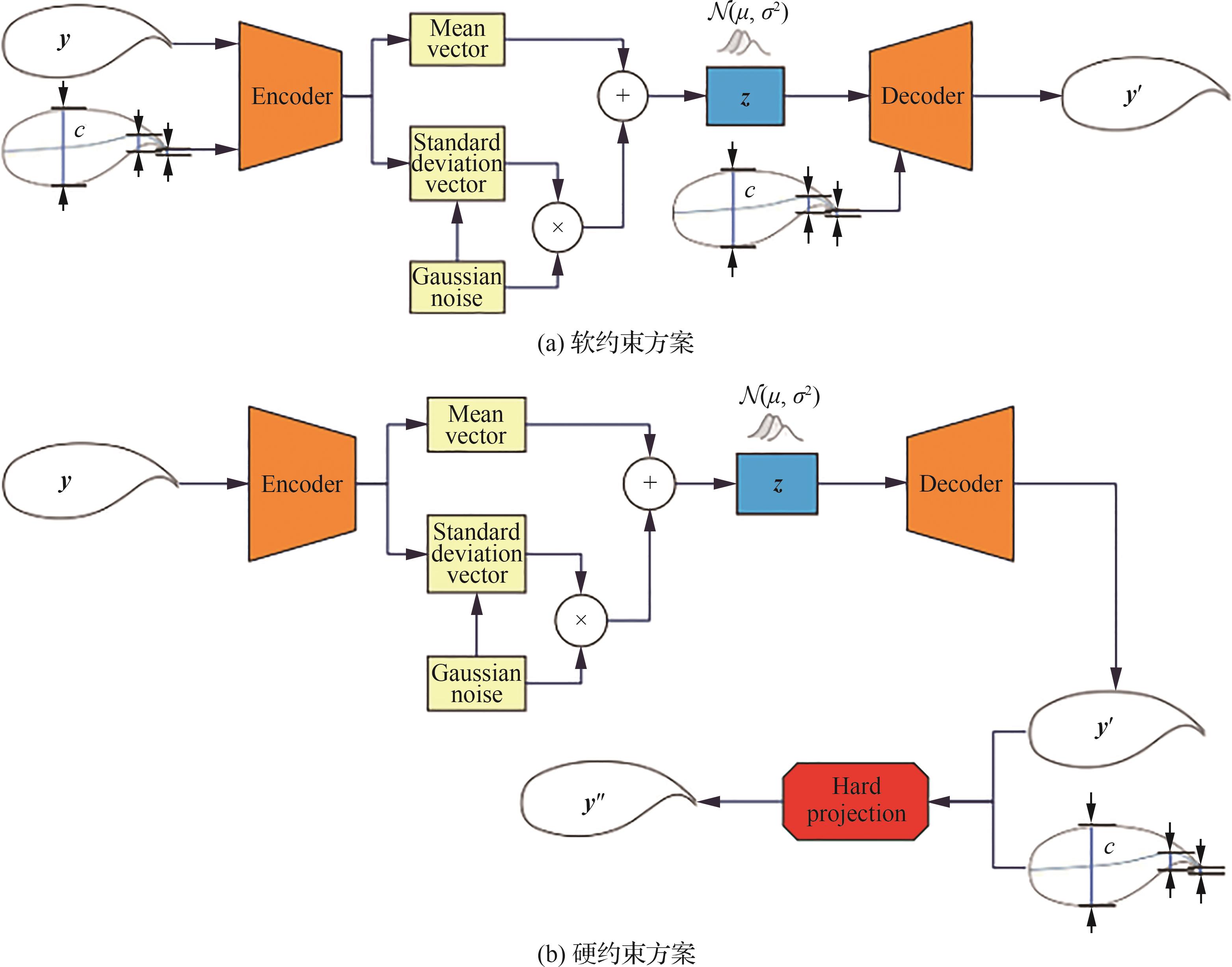
Fig.15
Typical GAN-based parameterization method
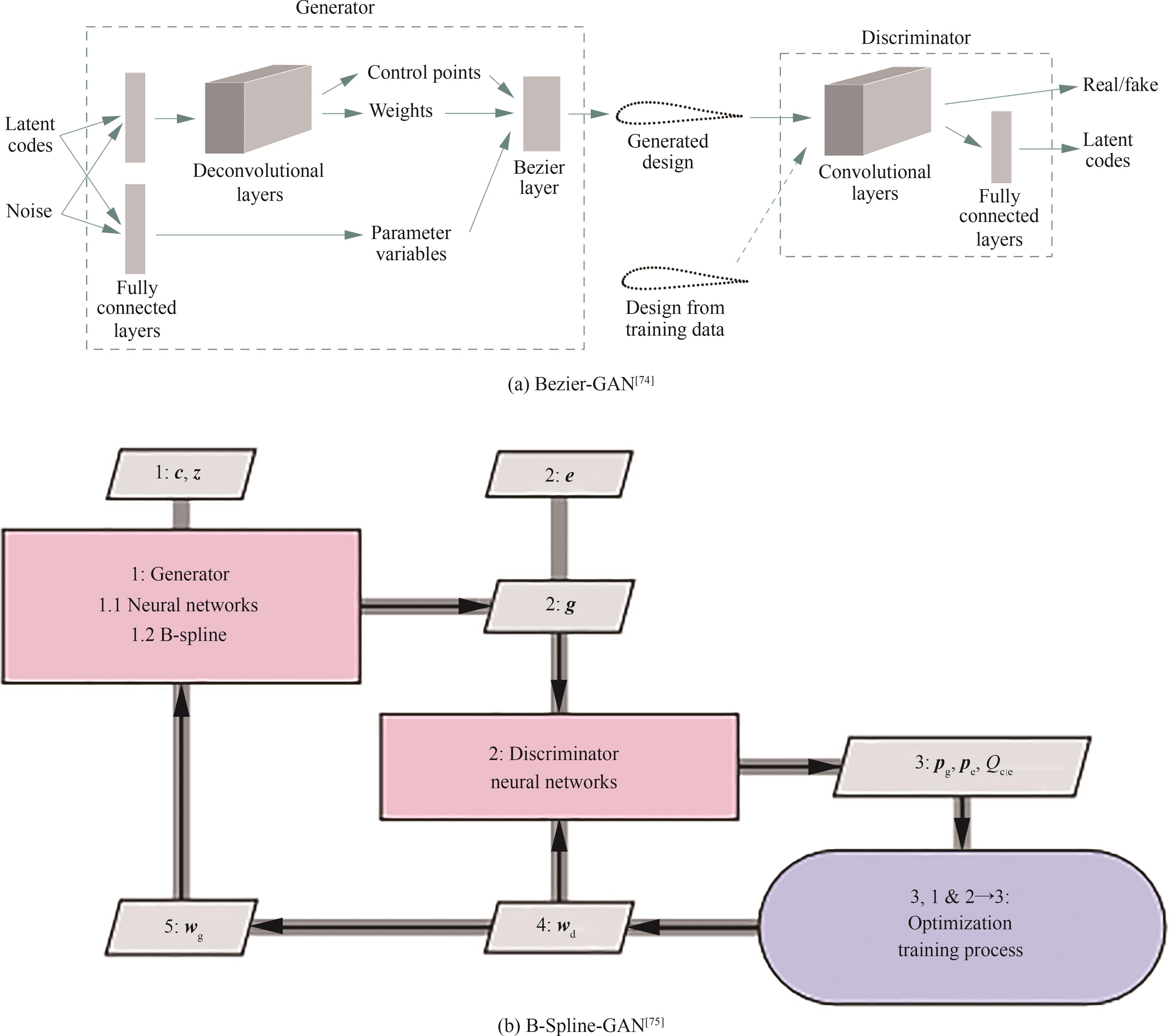

Fig.16
Generated airfoils from InfoGAN and Bezier-GAN[76]

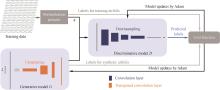
Fig.17
Architecture of DC-GAN[80]
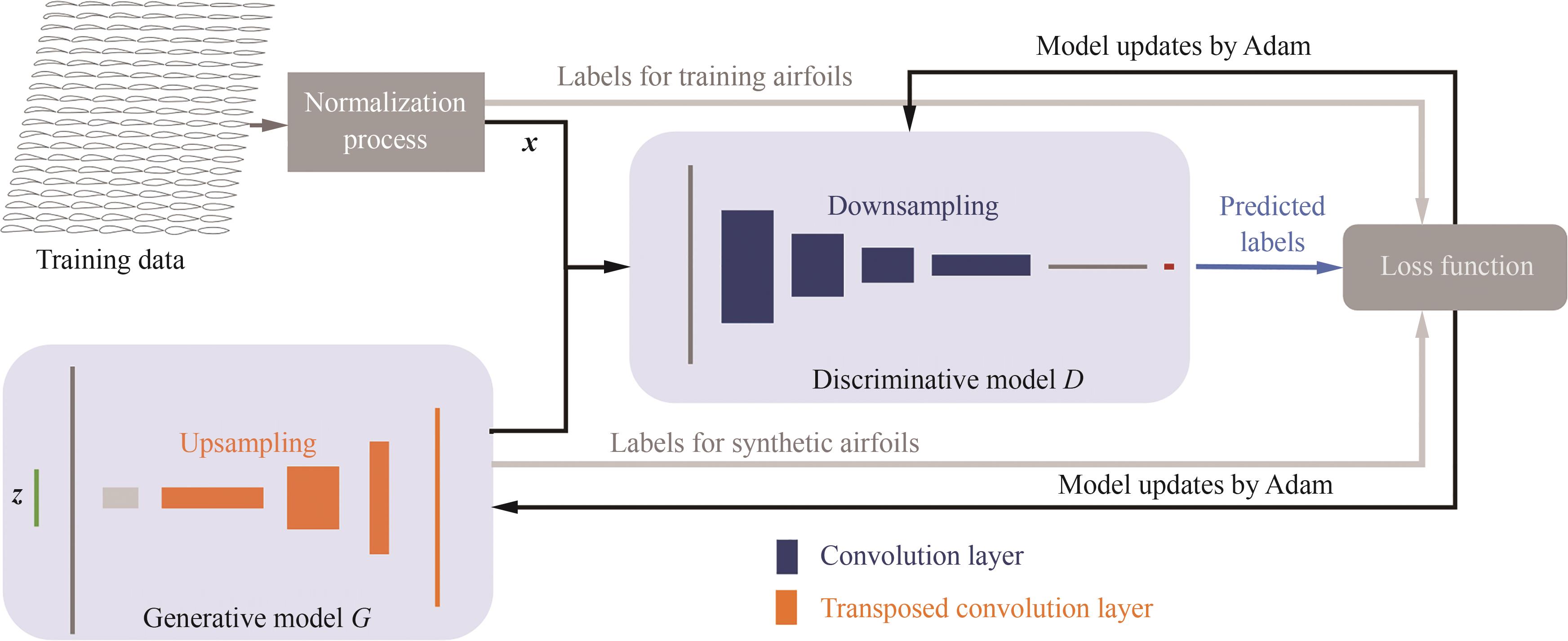
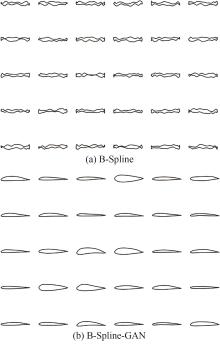
Fig.18
Randomly generated airfoils using B-Spline and B-Spline-GAN[77]
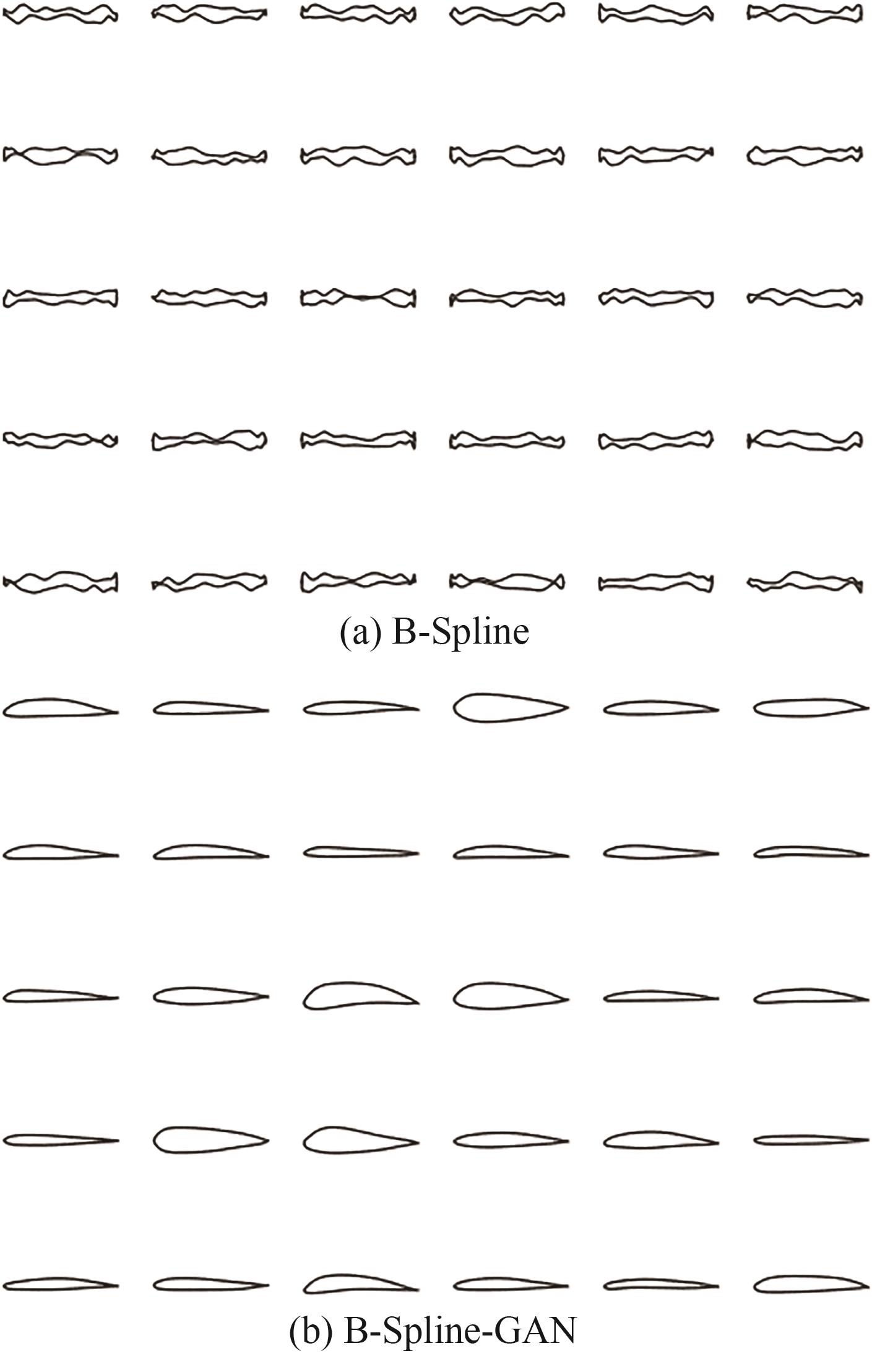
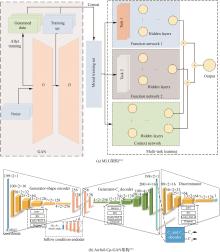
Fig.19
Two architectures for discrepancies of data types
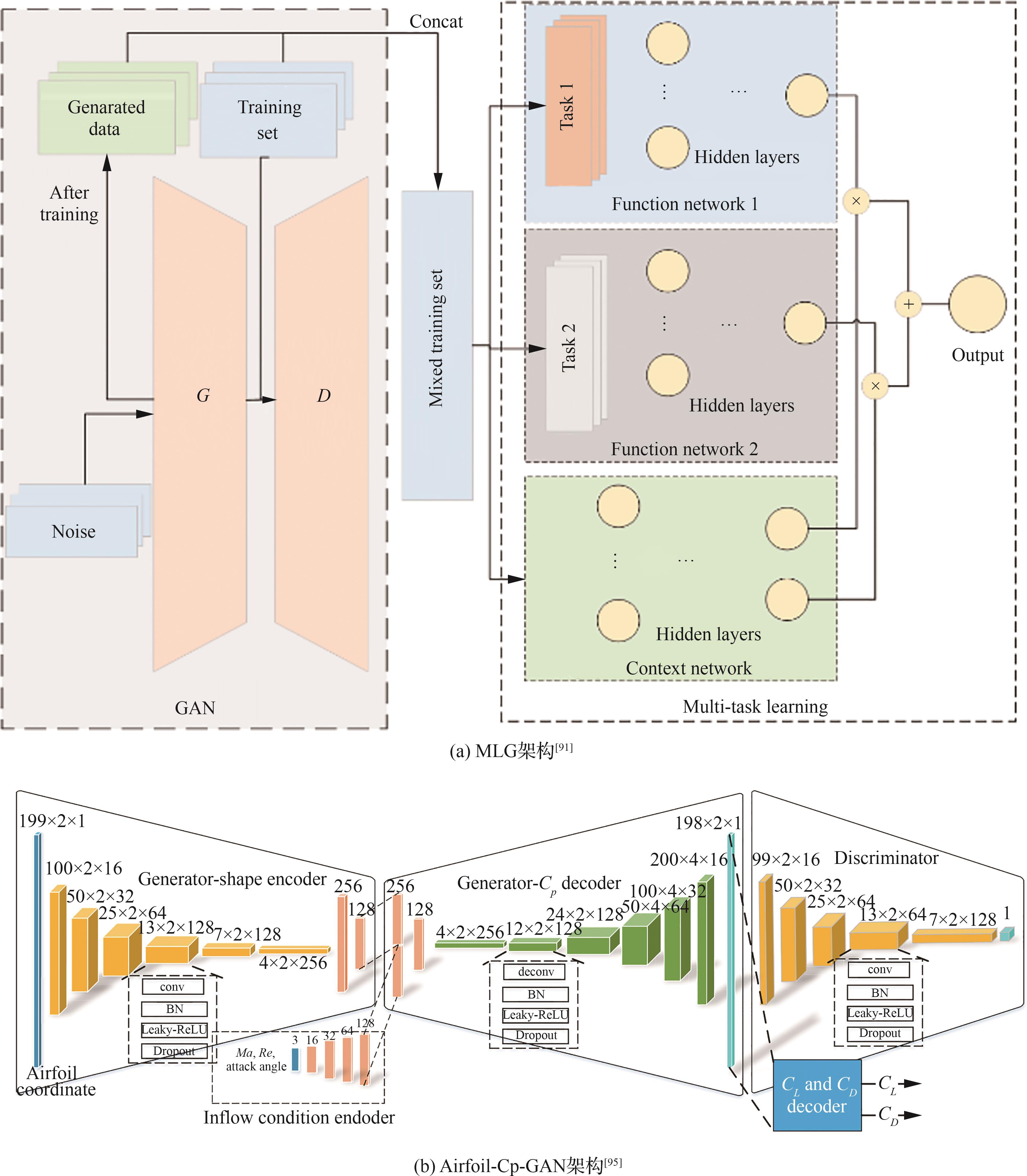
Fig.20
Architecture of MCGAN[98]

Fig.21
Distributions of turbulent kinetic energy of Rayleigh-Bénard from different models[107]
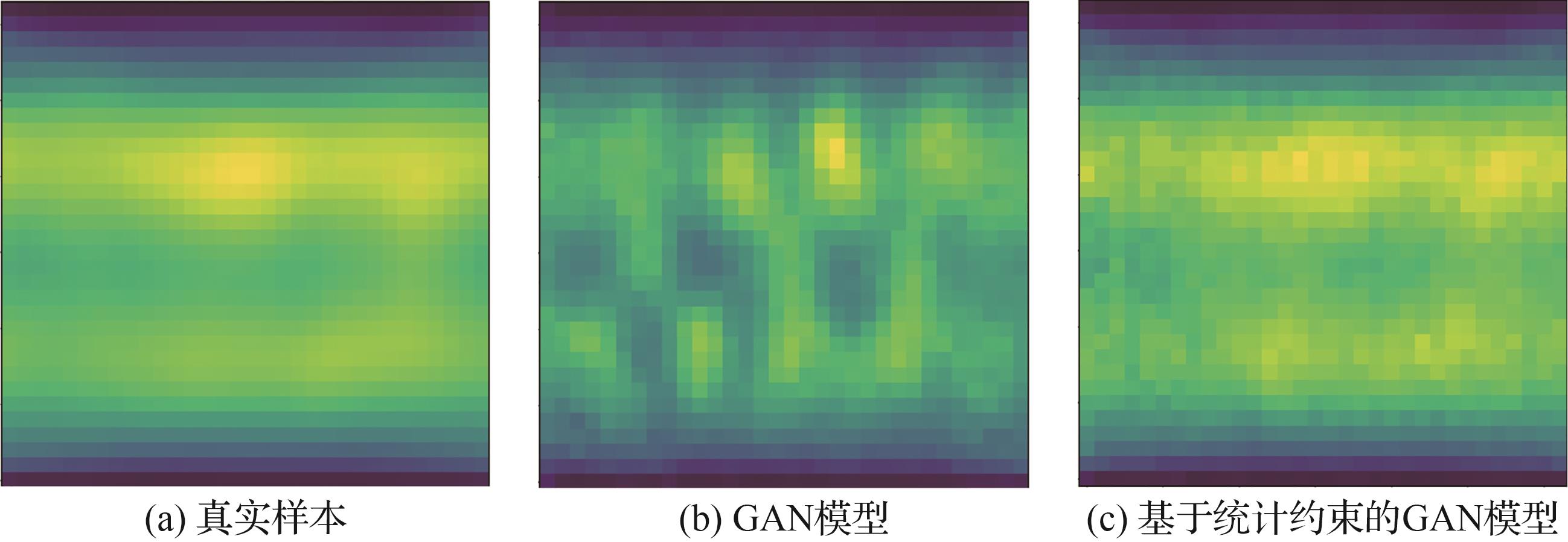
Fig.22
Architecture of FlowGAN[109]
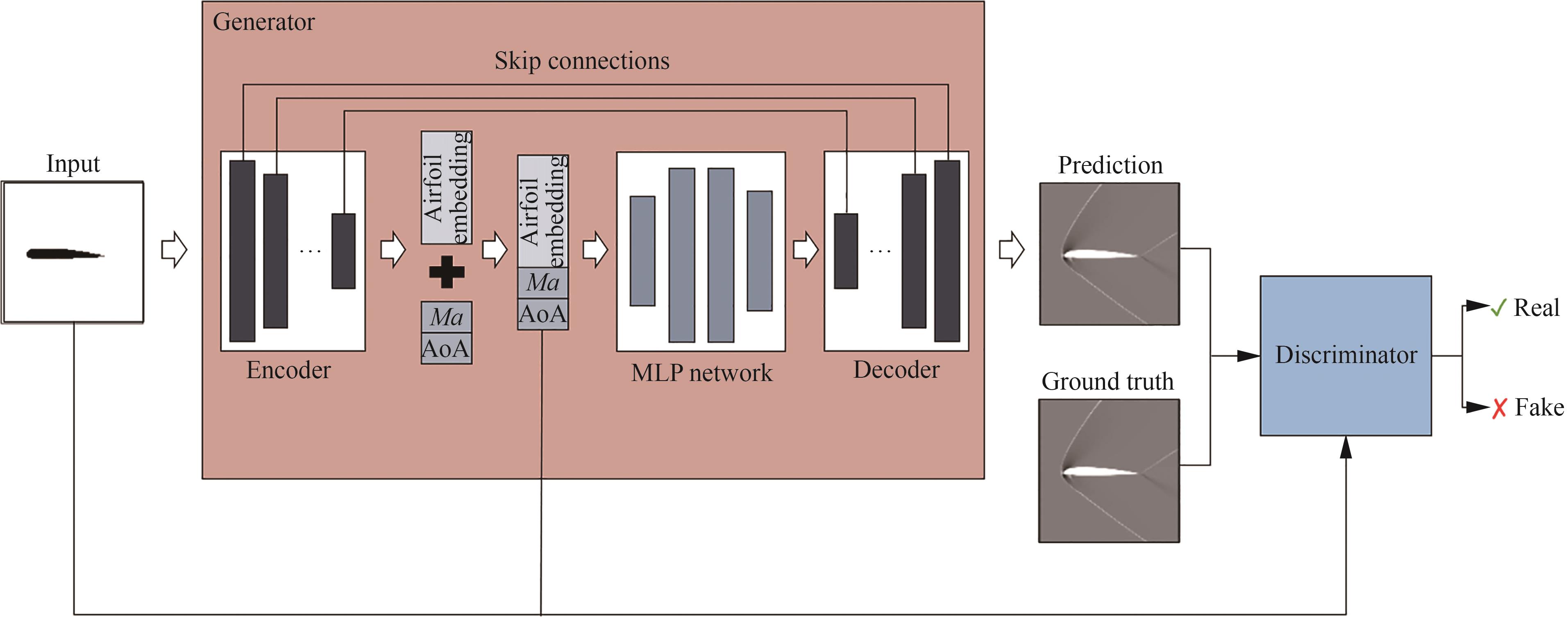
Fig.23
Flow field prediction process based on VAE to extract high-dimensional features[111]
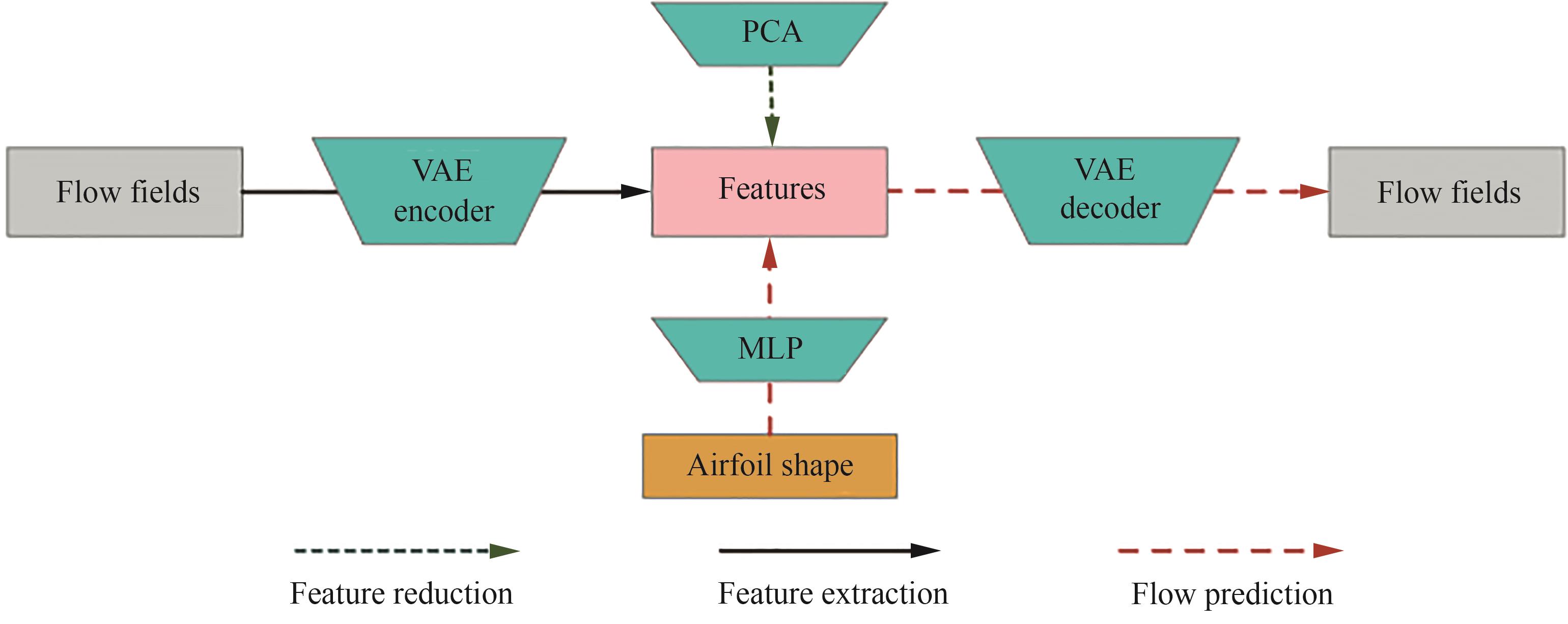
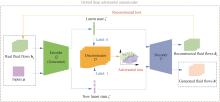
Fig.24
Hybrid model architecture of GAN and VAE[115]
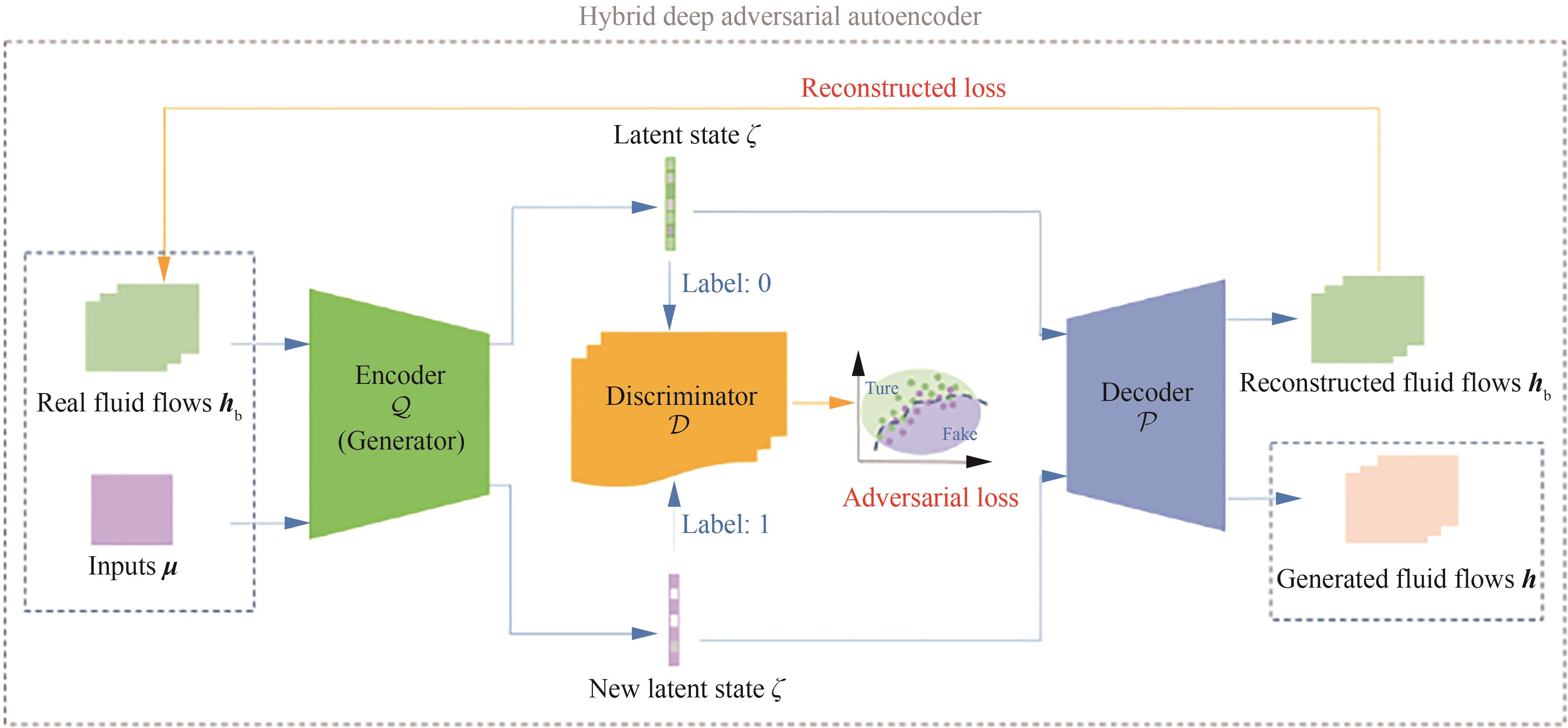
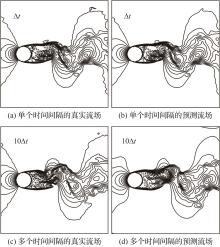
Fig.25
Truth and predicted flow fields at different times[117]
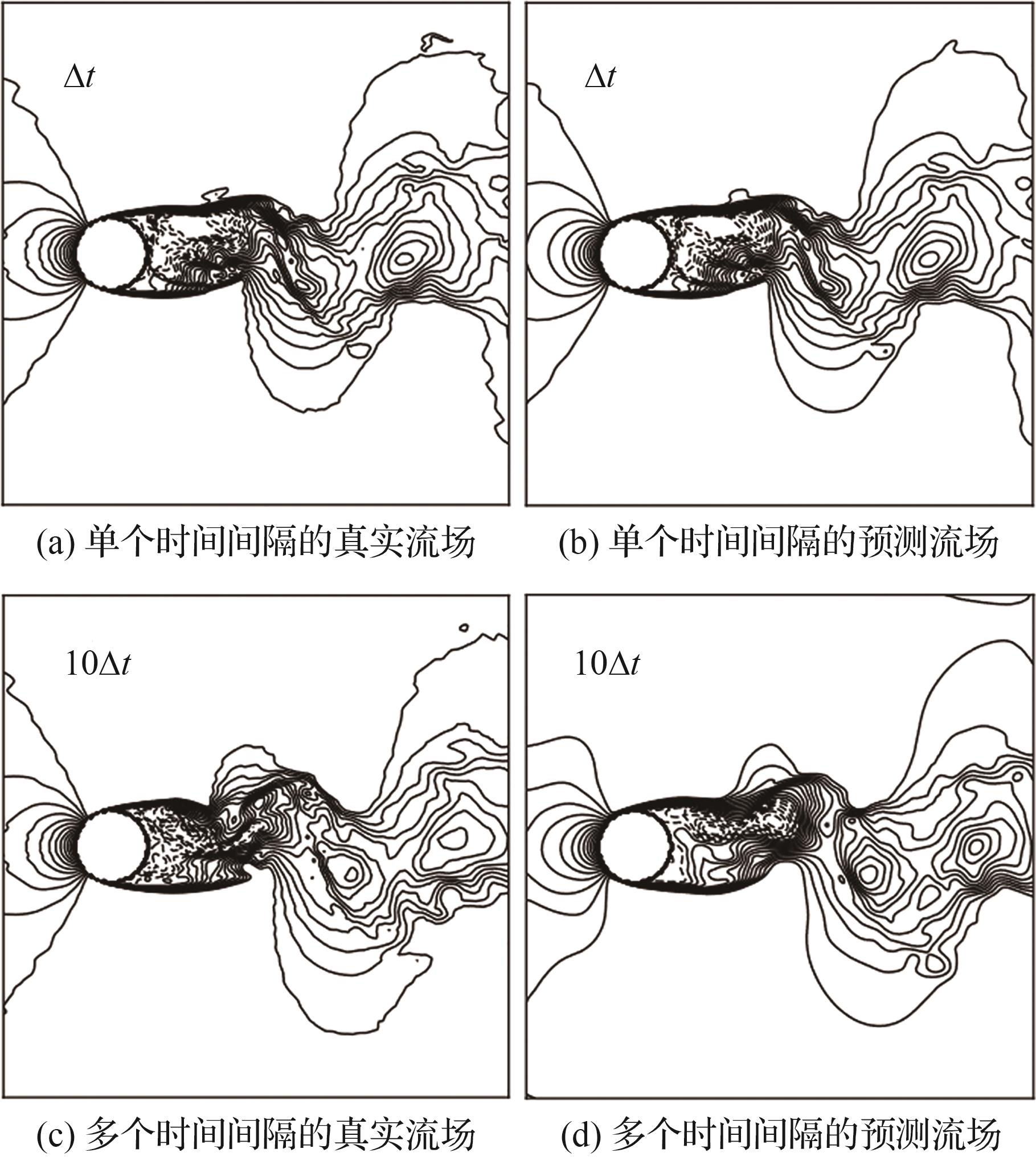
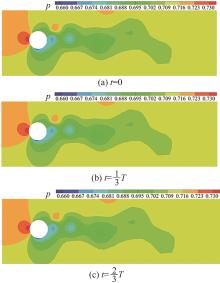
Fig.26
Predicted results at different times using CGAN[119]
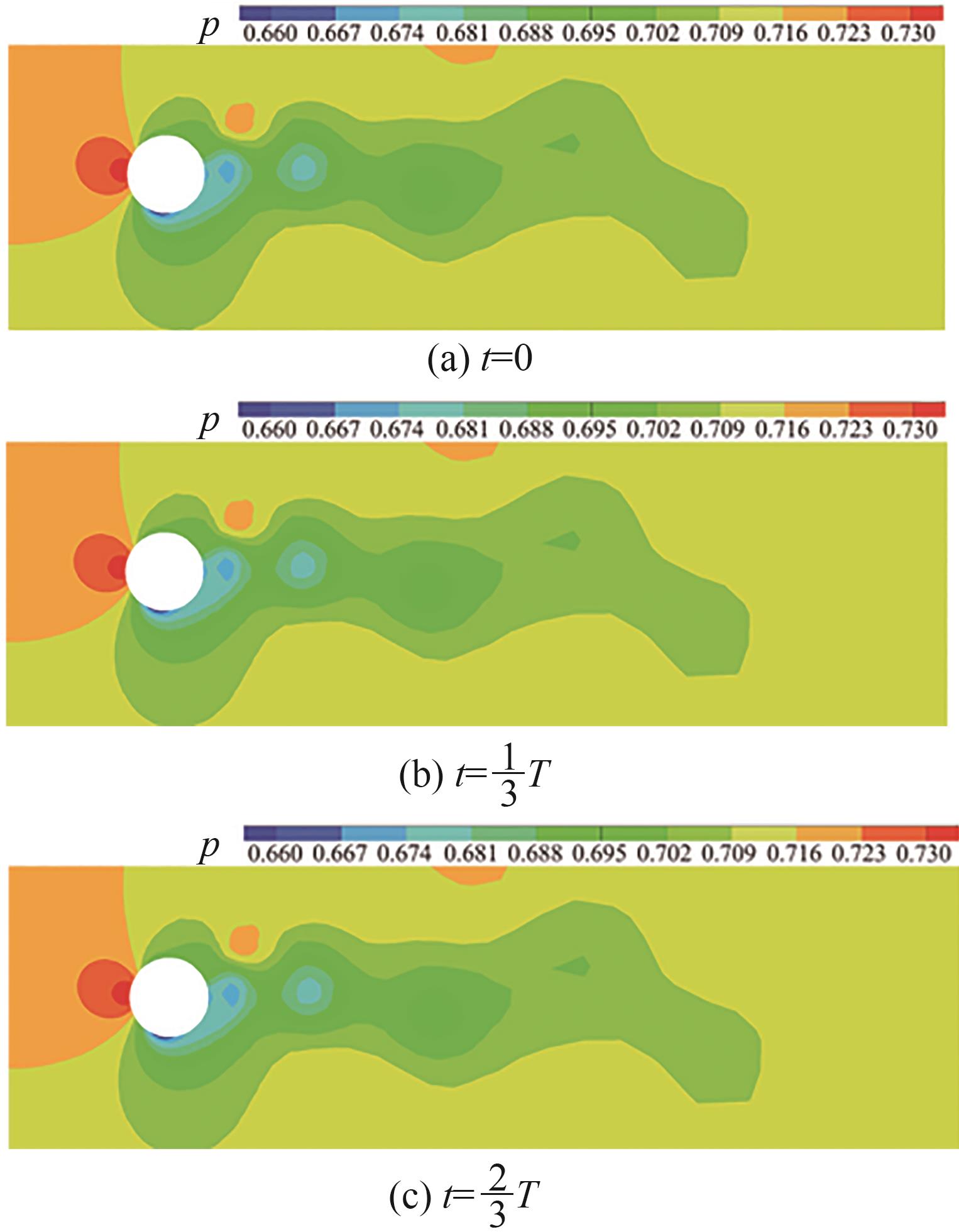
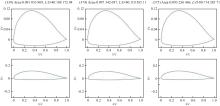
Fig.27
Generated airfoils satisfying large area and high lift to drag ratio[132]
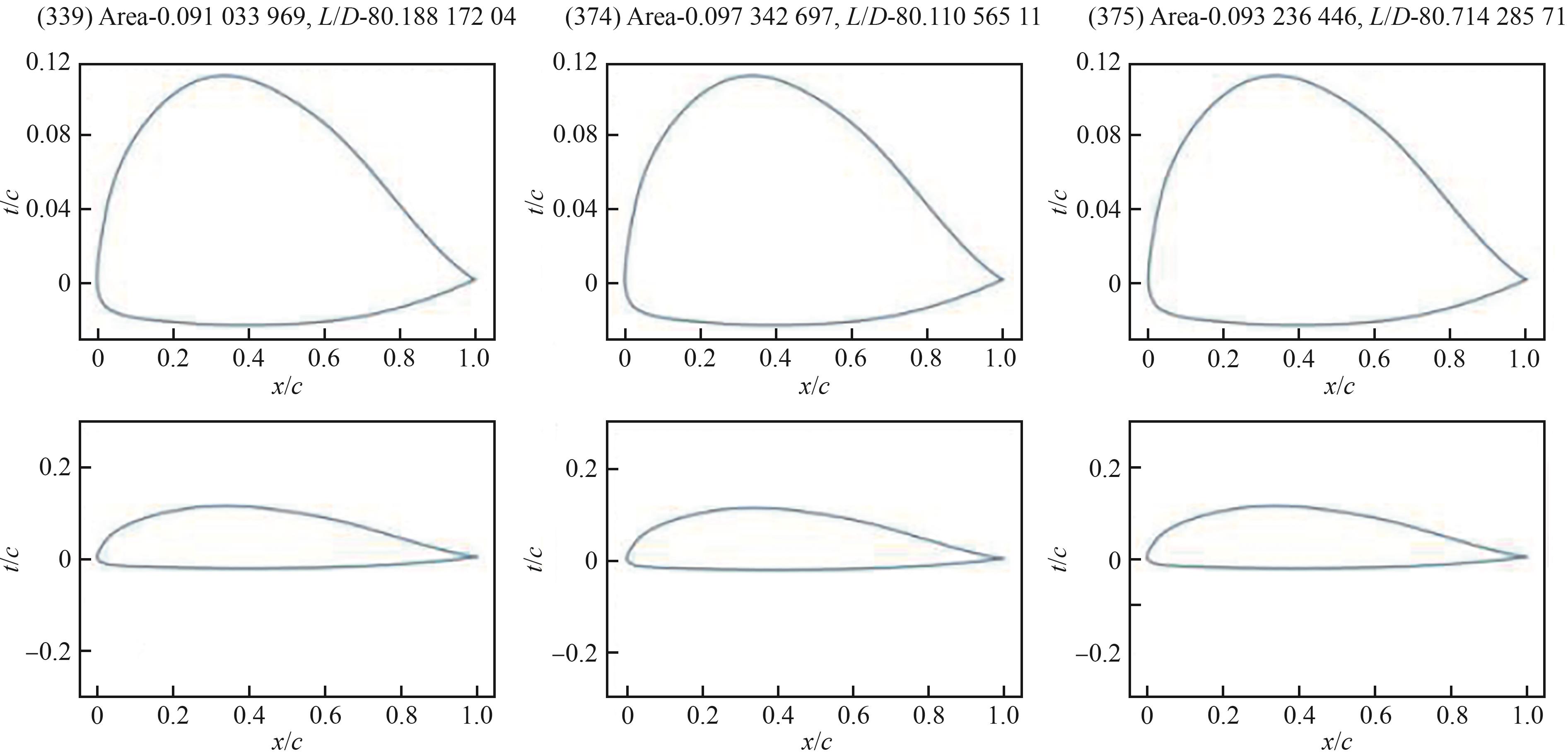
Table 2
Typical research based on different models and constraints
| 文献 | 模型架构 | 性能指标/约束 |
|---|---|---|
| Tan[ | CGAN | 升阻比、翼型面积 |
| Yilmaz和German[ | CGAN | 失速迎角、极曲线 |
| Yonekura等[ | N-CVAE、S-CVAE | 升力系数 |
| Yonekura等[ | cWGAN(Conditional WGAN)-gp | 升力系数 |
| Yonekura等[ | CVAE-WGAN-gp | 升力系数 |
| Chattoraj等[ | CGAN | 最大厚度、升阻比、攻角 |
| Heyrani和Nobari[ | PcDGAN(Performance Conditional Diverse GAN) | 升阻比 |
Fig.28
Architecture of CBGAN[143]
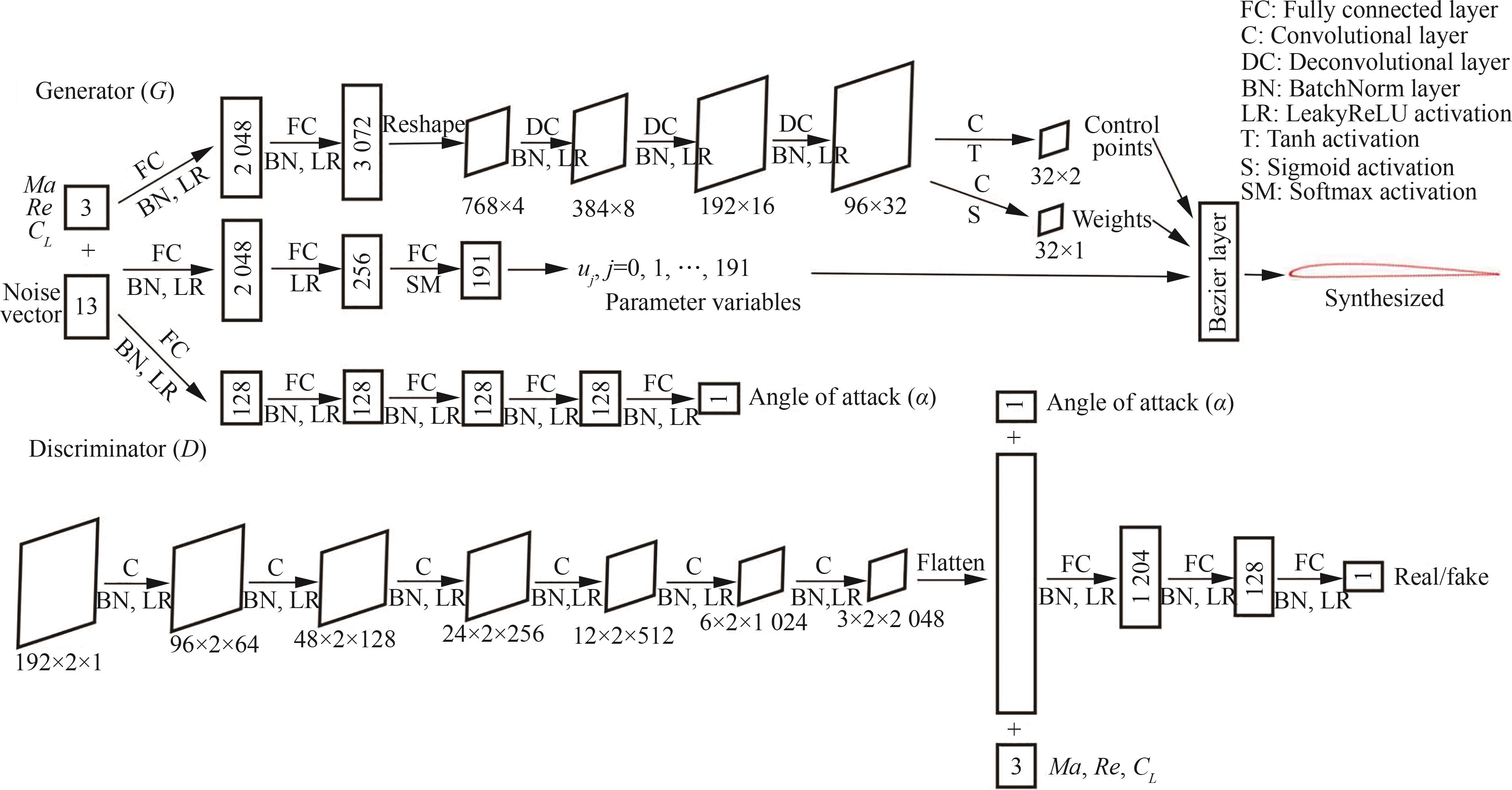
Fig.29
Framework of inverse design based on attention mechanism[144]
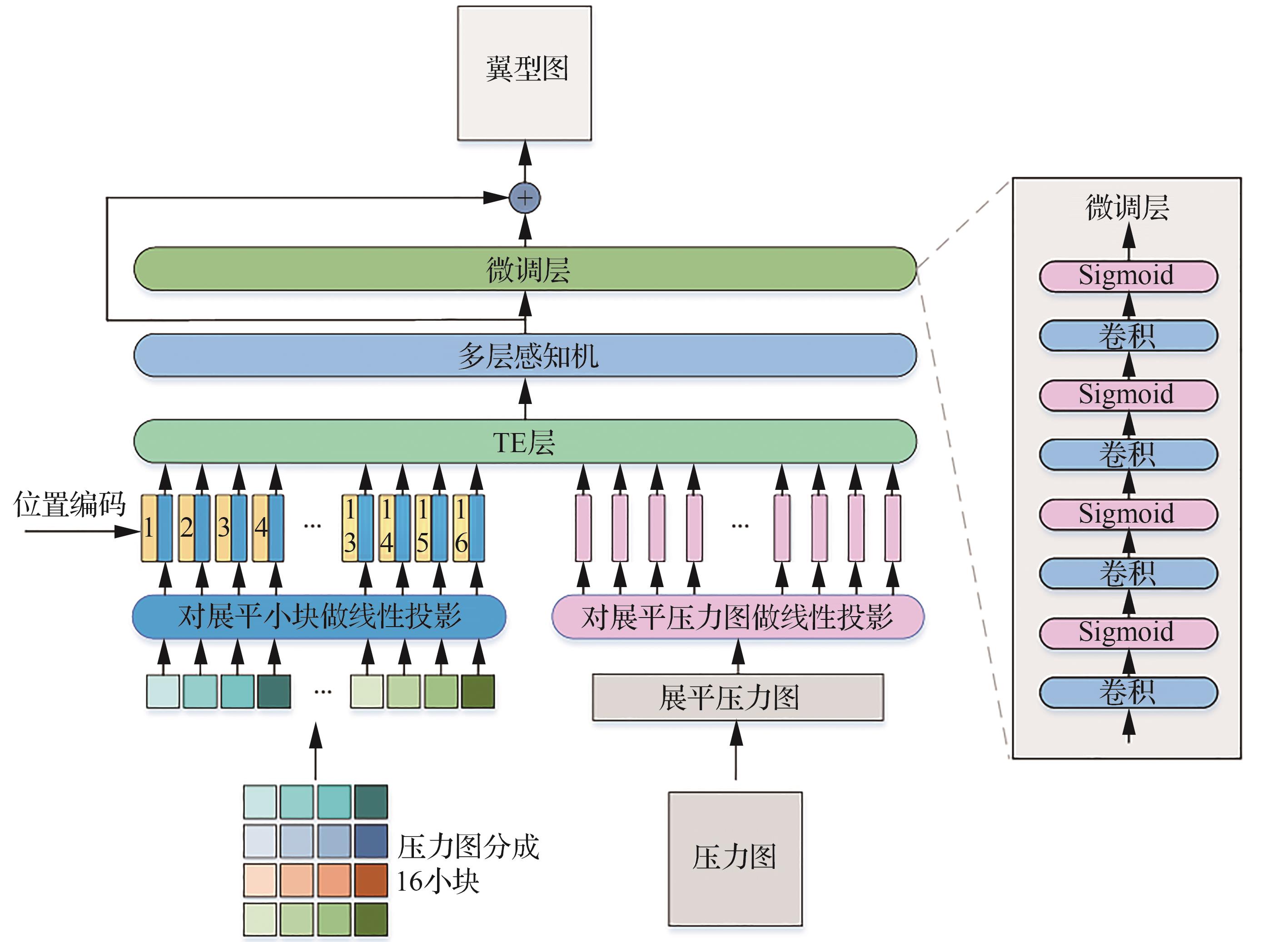
Fig.30
Architecture of aerodynamic/stealth inverse design model based on CGAN[145]
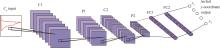
Fig.31
Architecture of CNN from pressure distribution to airfoil coordinates[146]
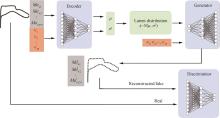
Fig.32
Wall Mach number distribution generation framework based on CVAE-GAN[147]

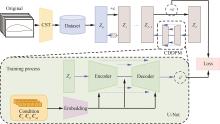
Fig.33
Architecture of CDDPM[151]
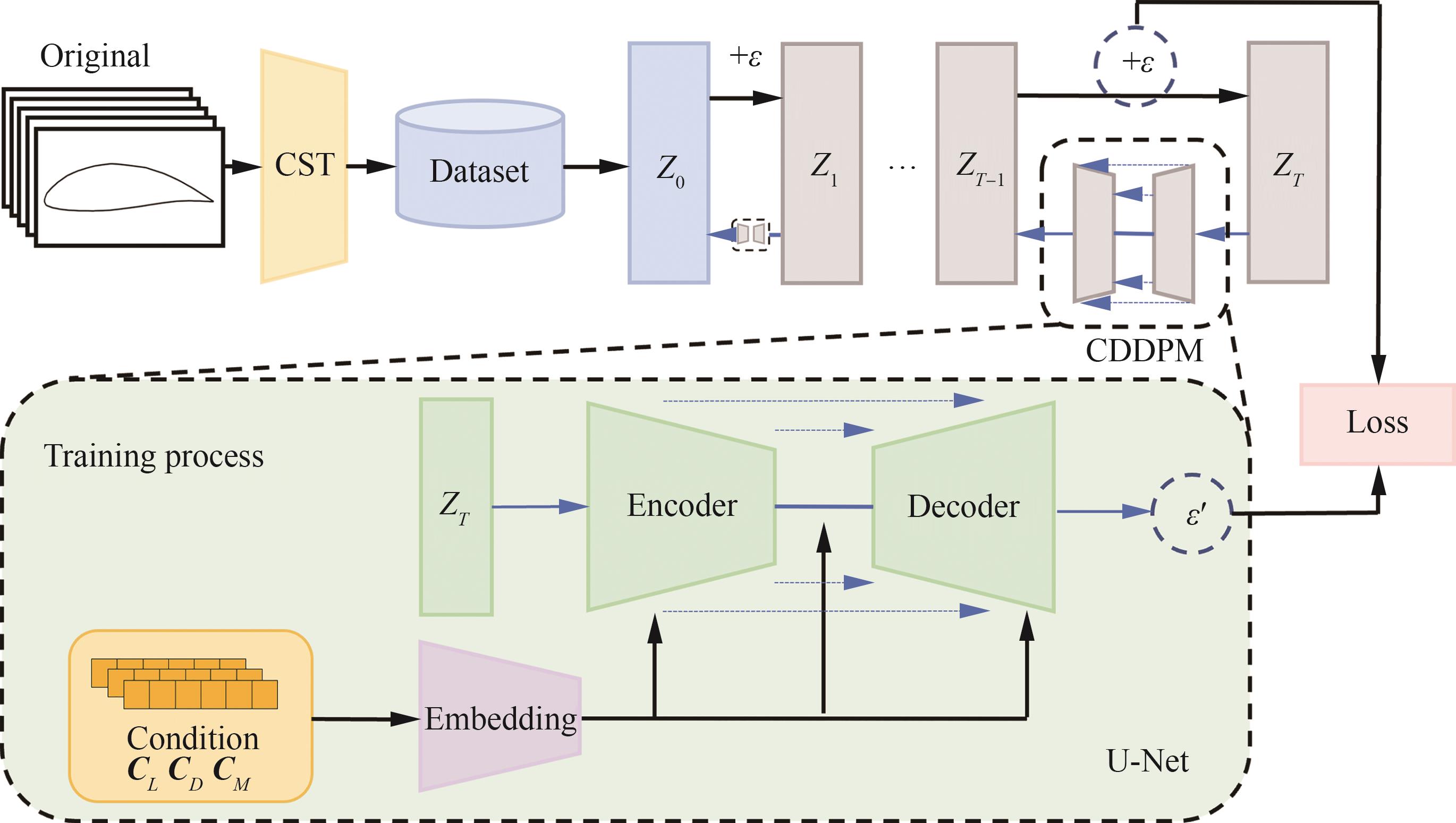
Fig.34
Typical super resolution methods based on artificial intelligence[164]
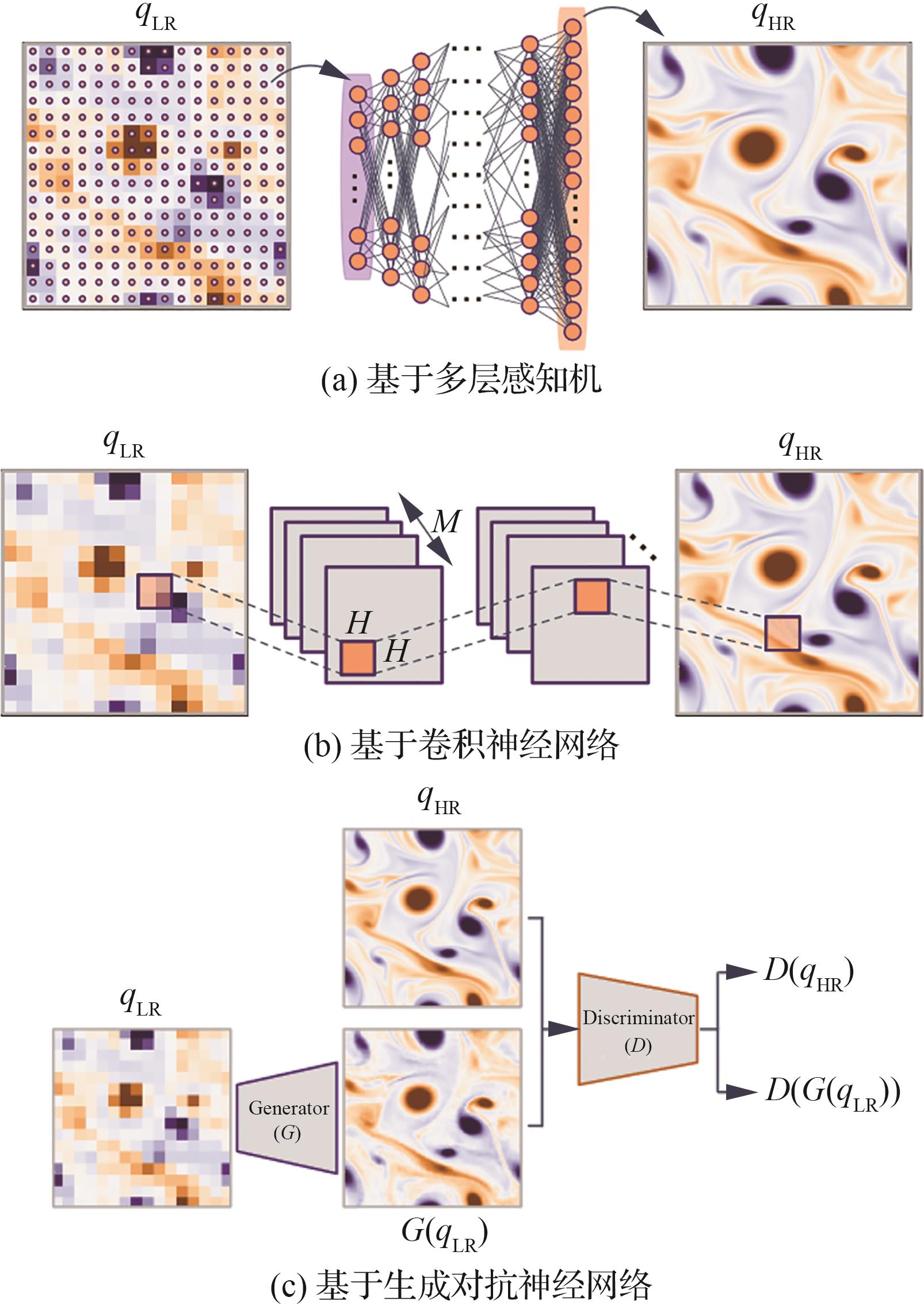
Table 3
Typical variants of super-resolution generative adversarial network
| 模型 | 总体框架 | 重建效果 |
|---|---|---|
| SRGAN[ | 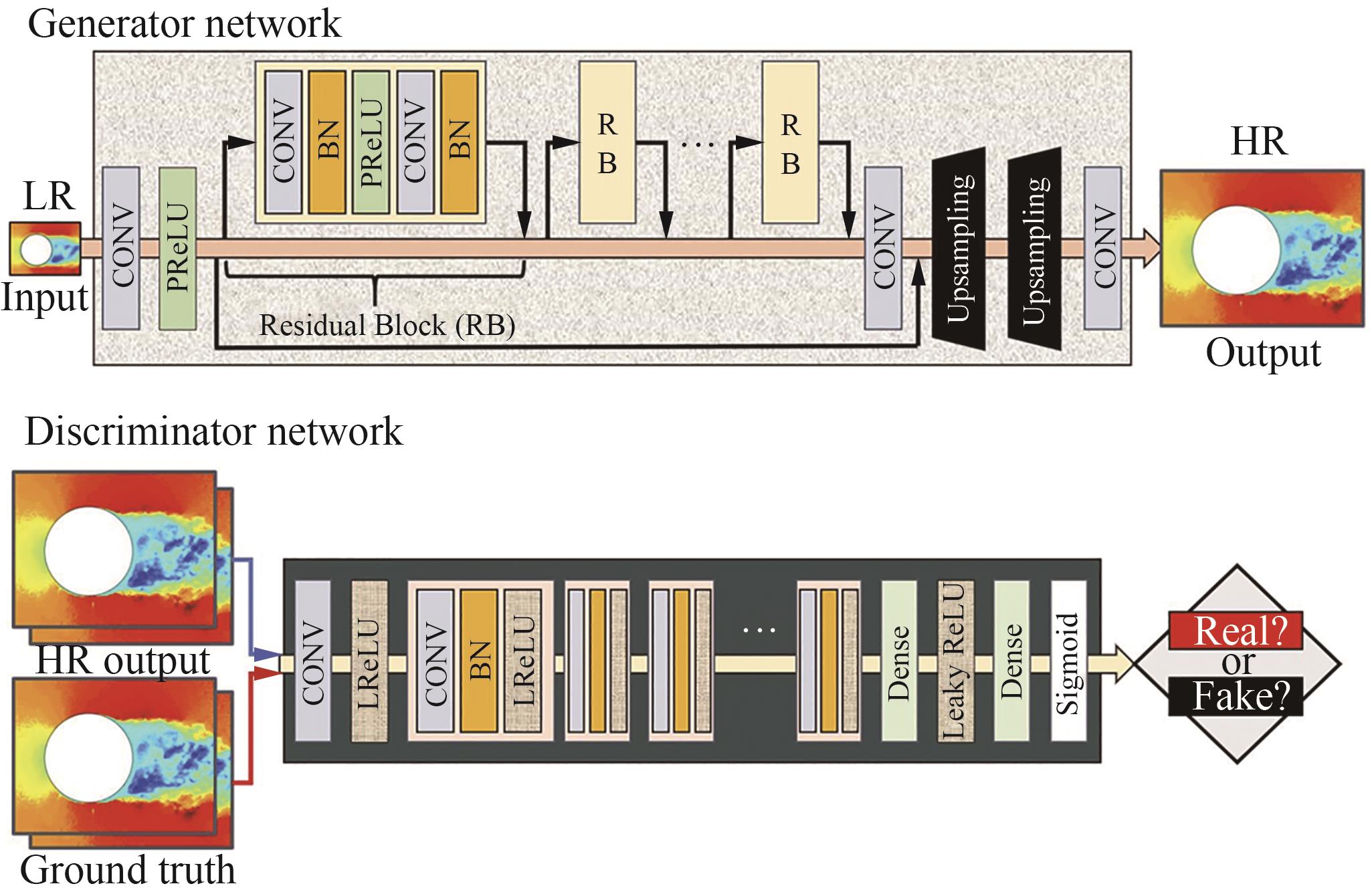 | 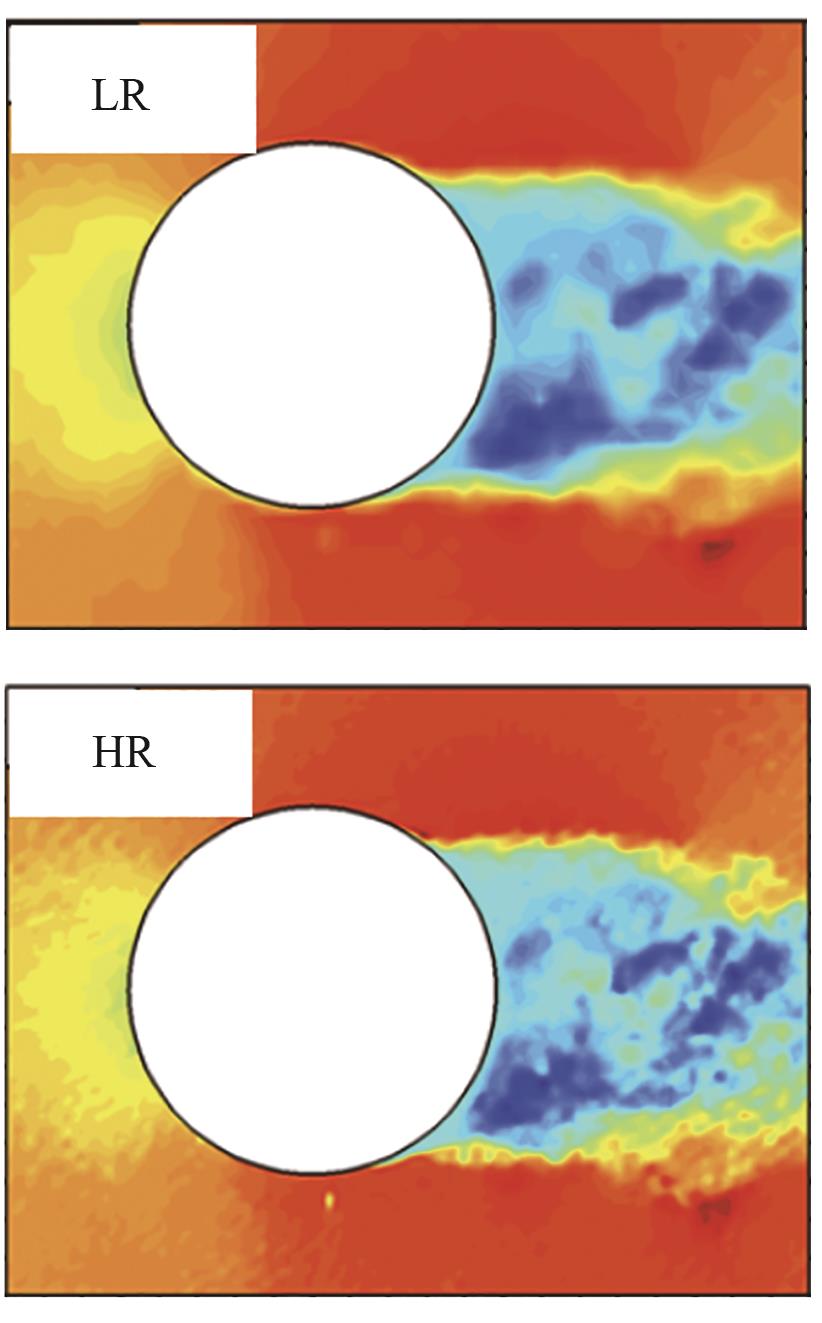 |
| ESRGAN[ | 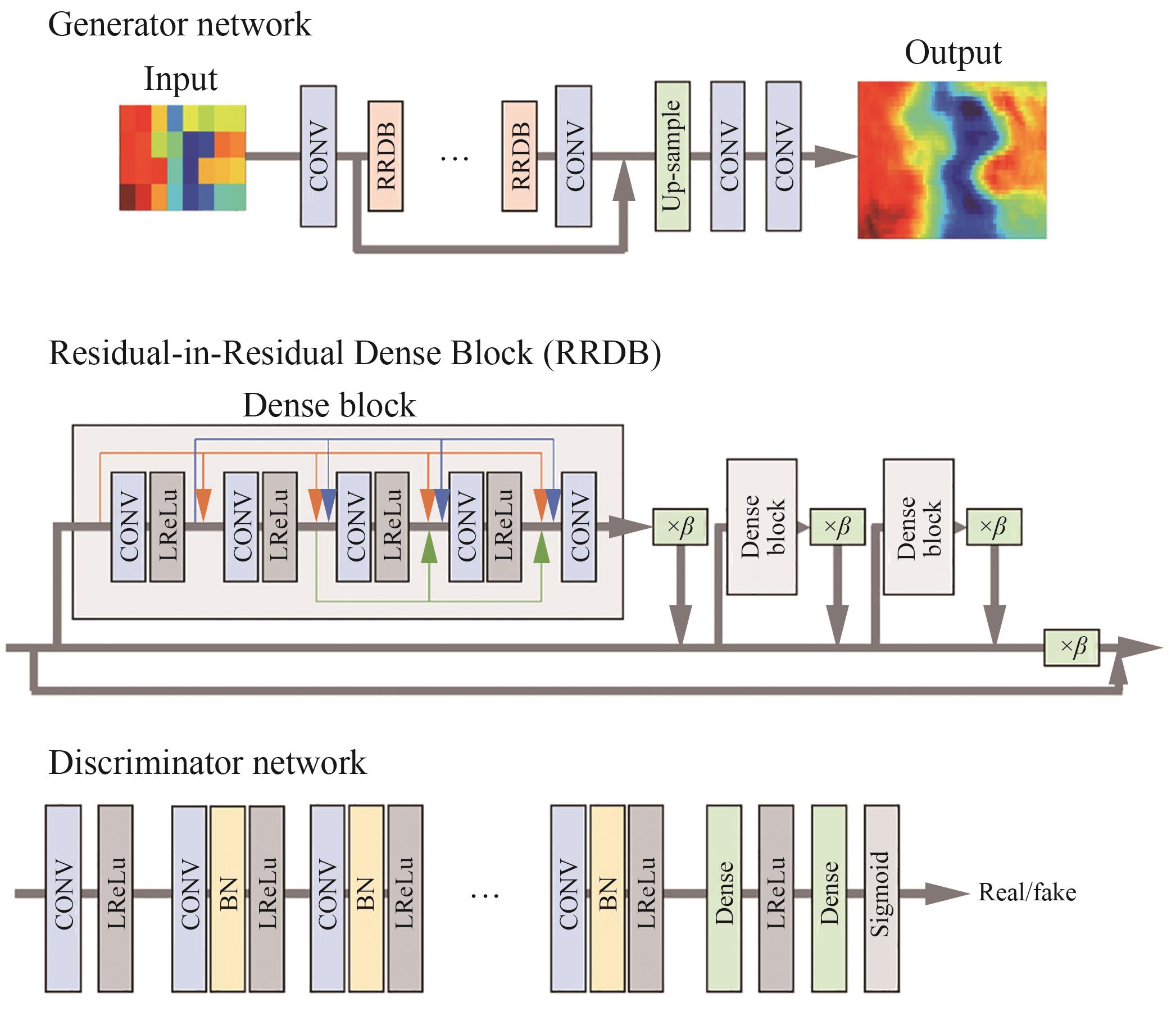 | 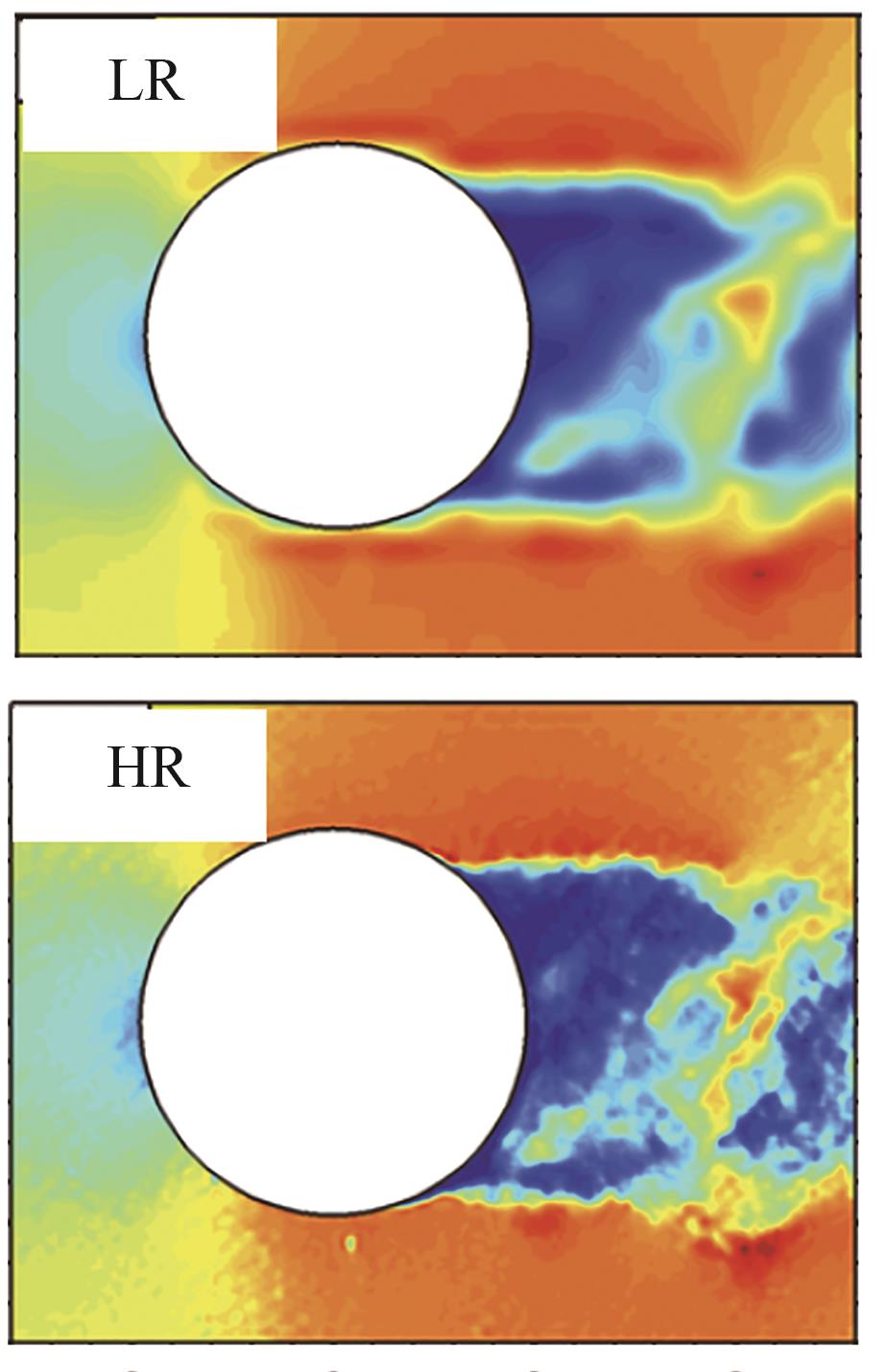 |
| MS-ESRGAN[ | 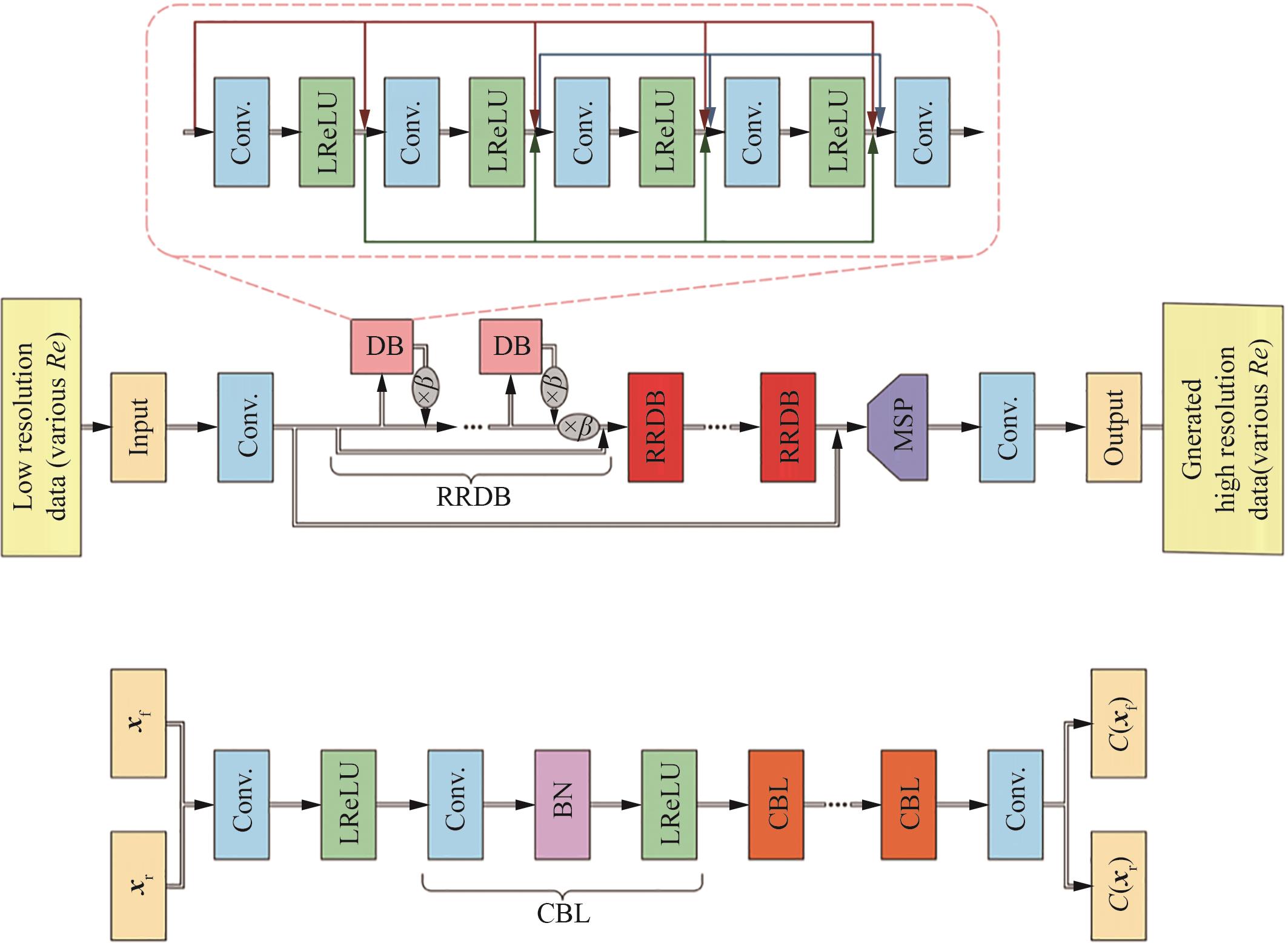 | 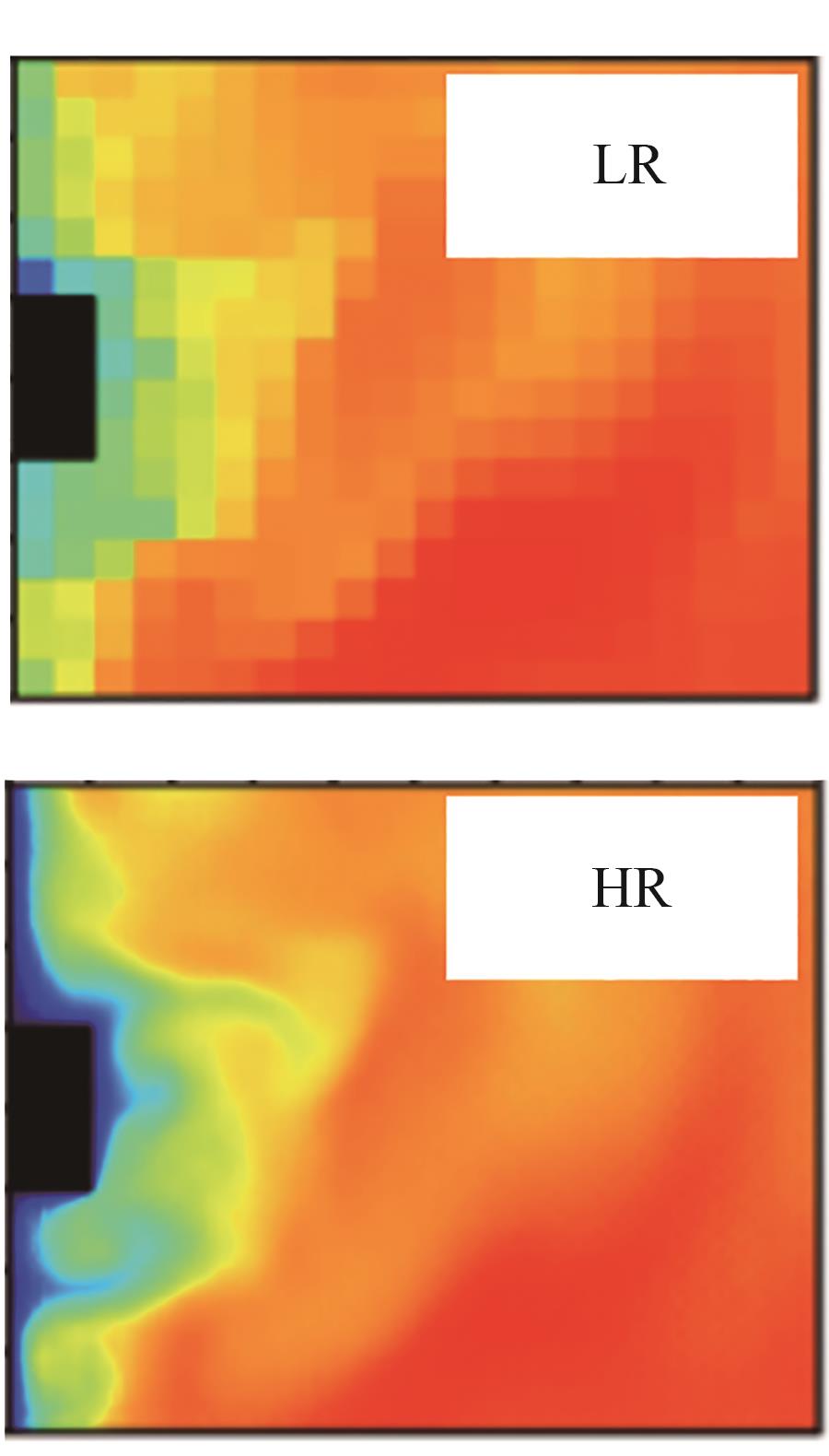 |
| 3D-SRGAN[ | 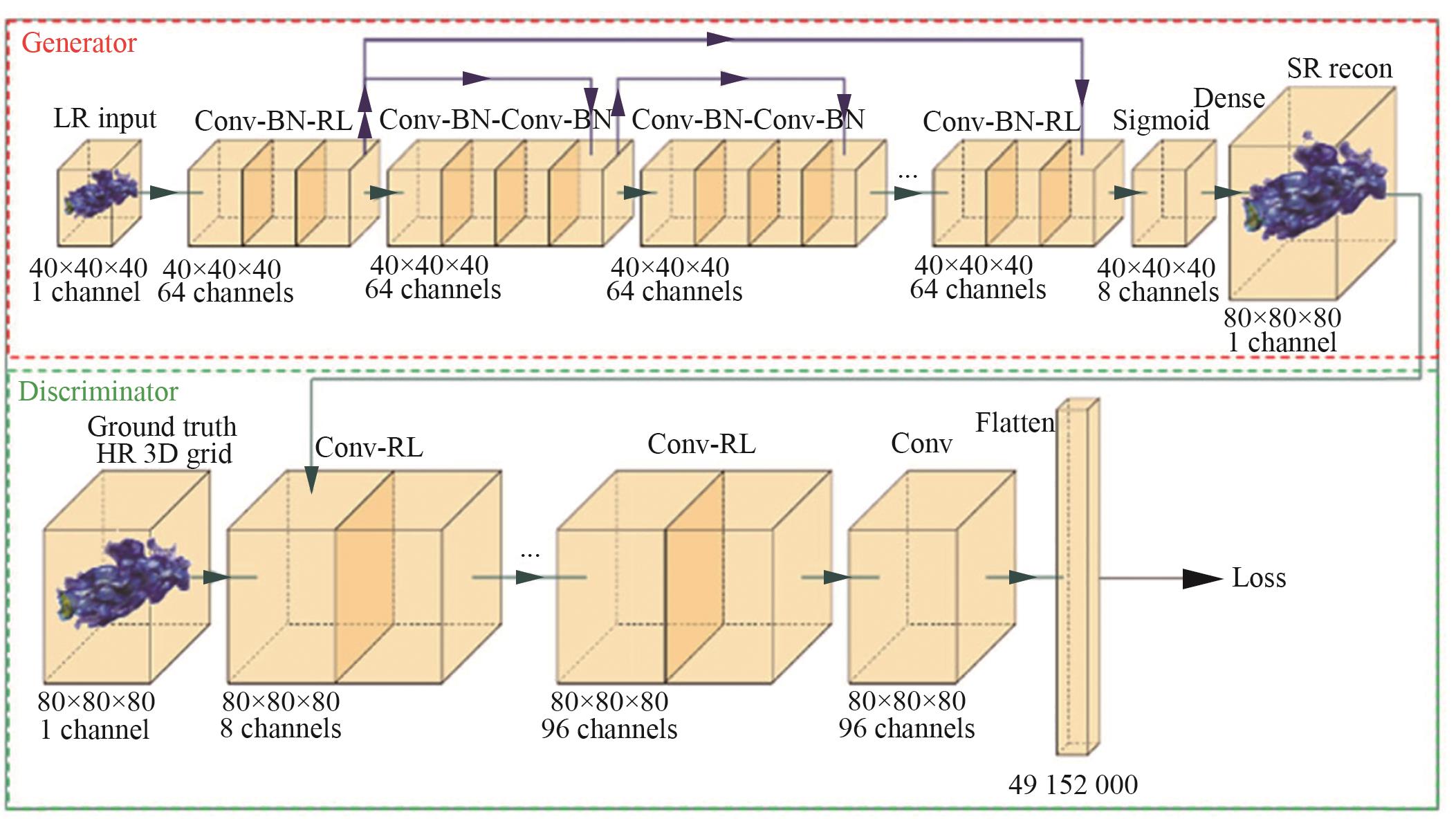 | 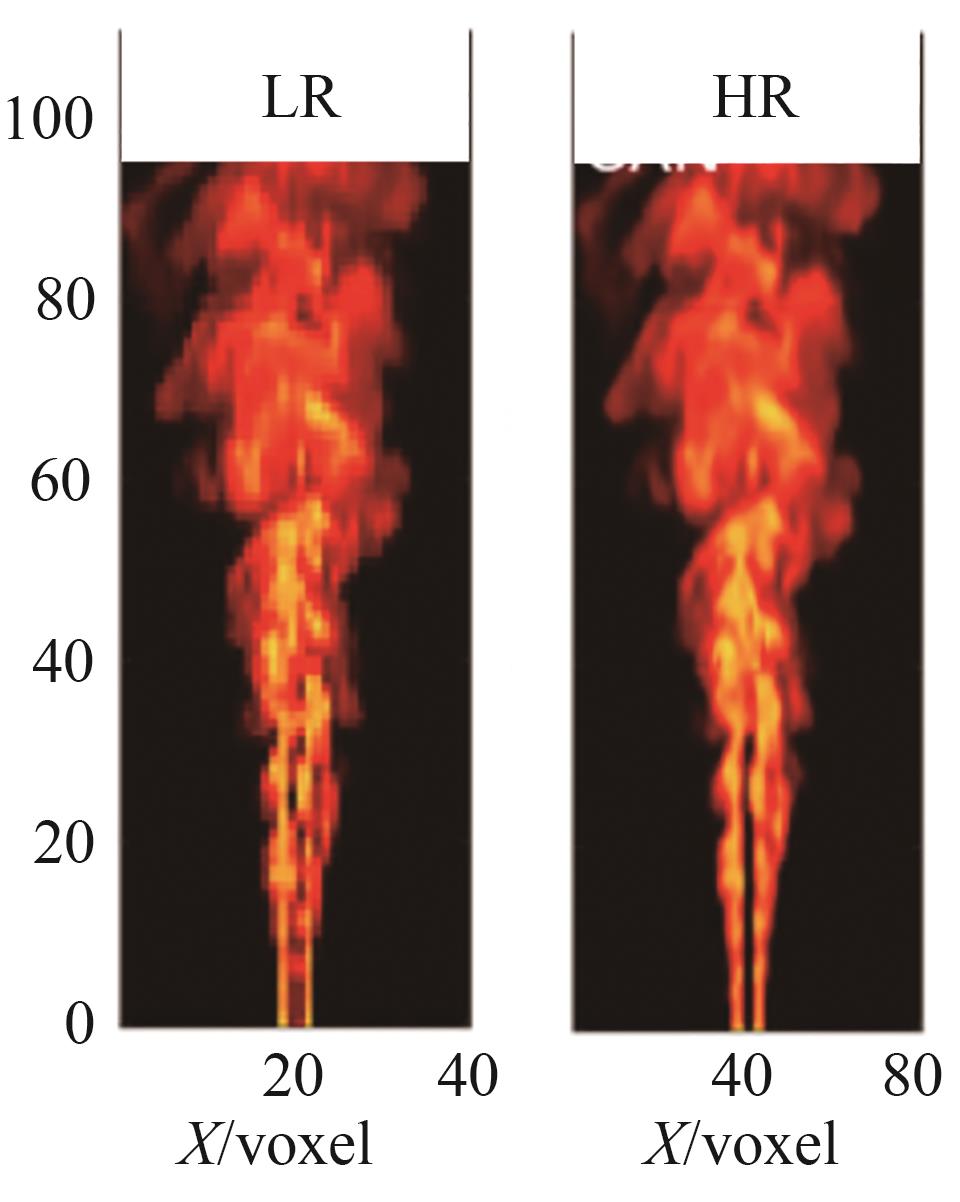 |
| tempoGAN[ | 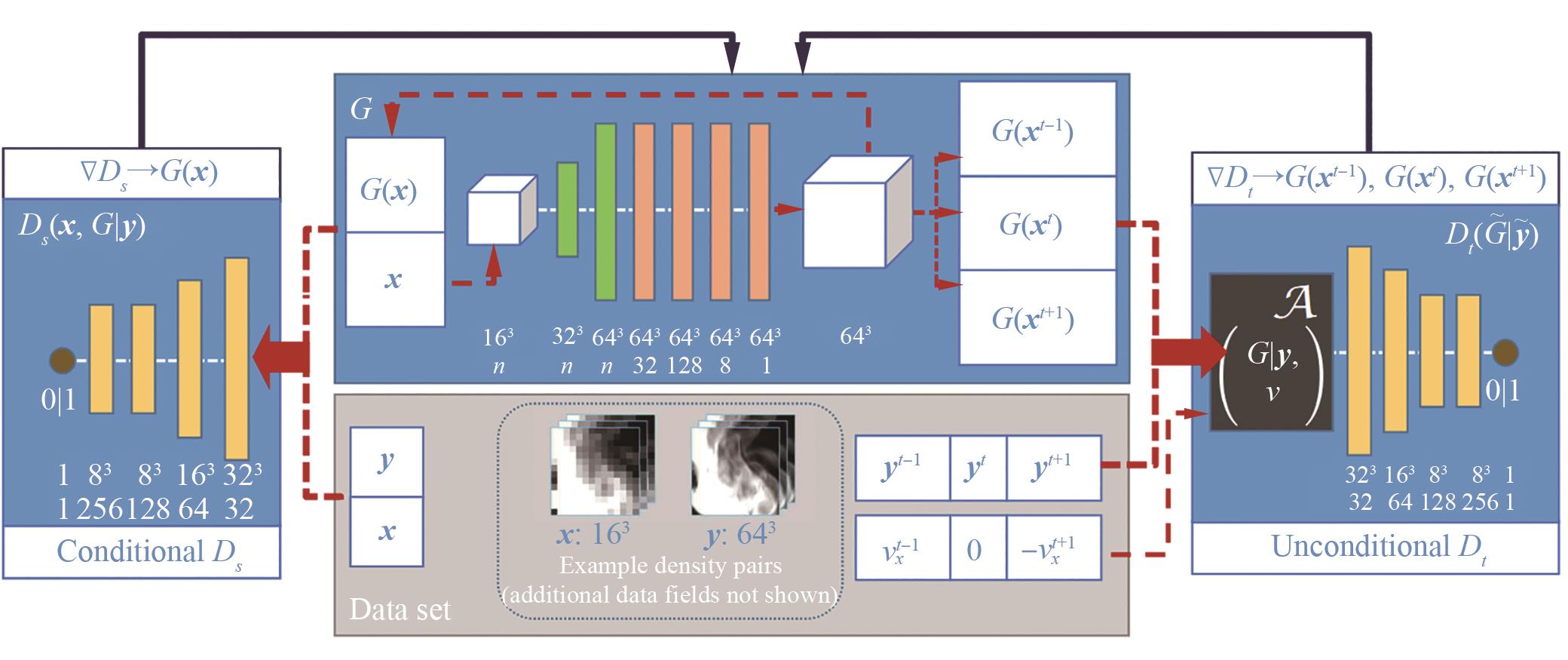 | 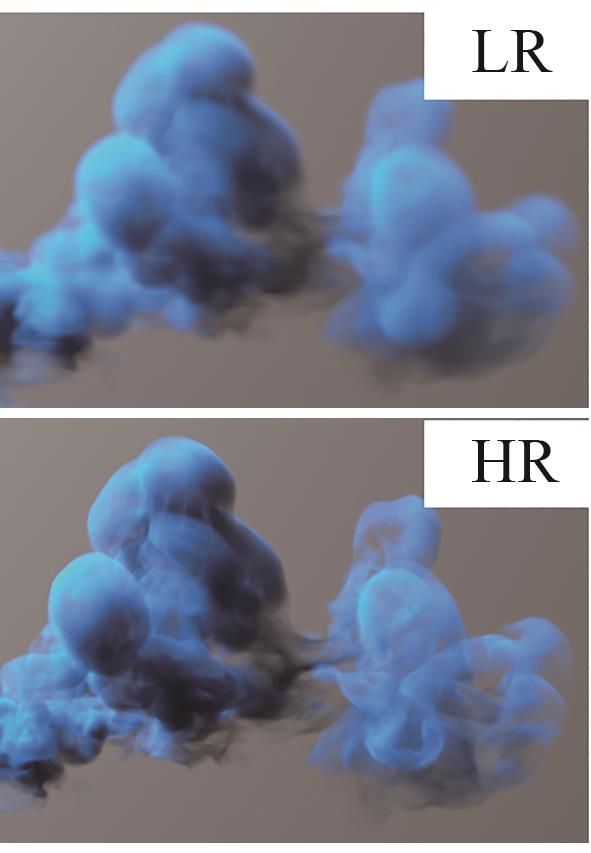 |
| CycleGAN[ | 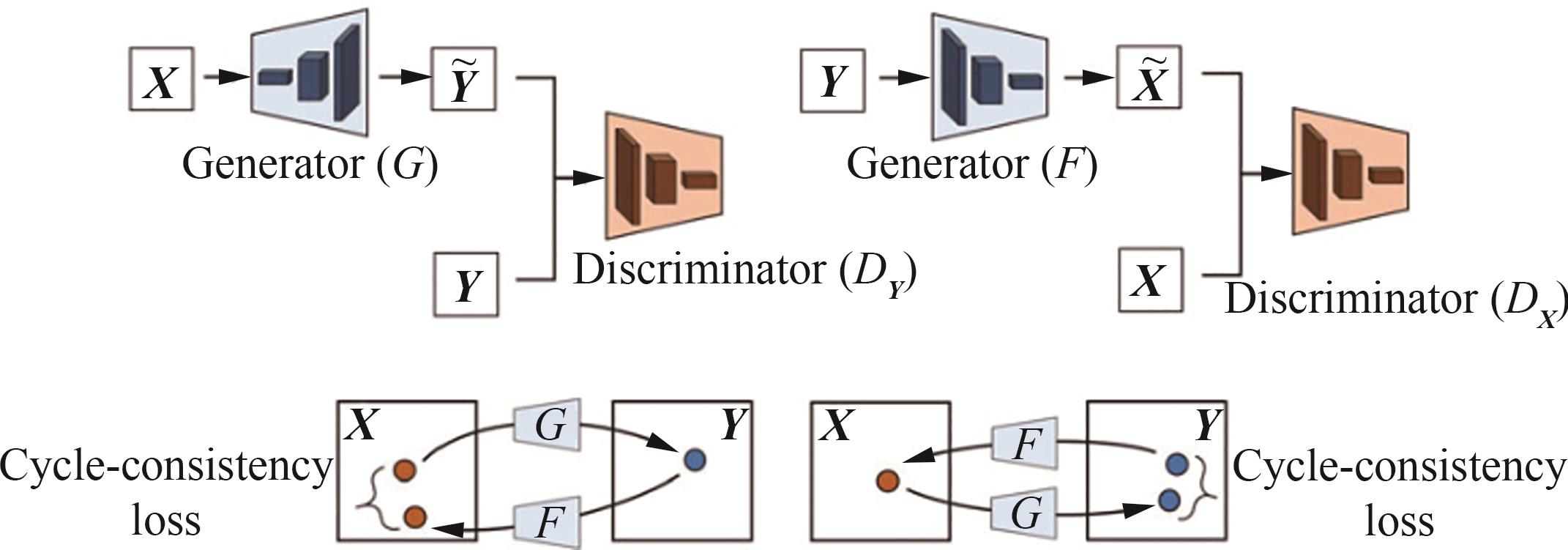 | 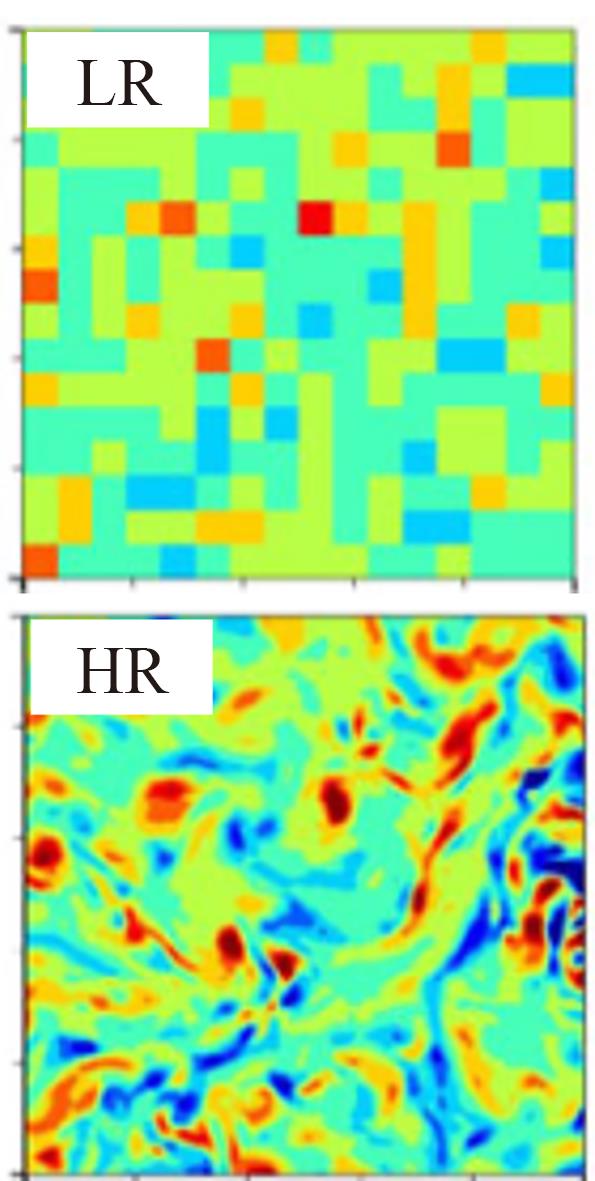 |
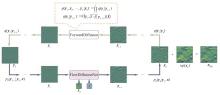
Fig.35
FlowDiffusionNet overall framework[157]
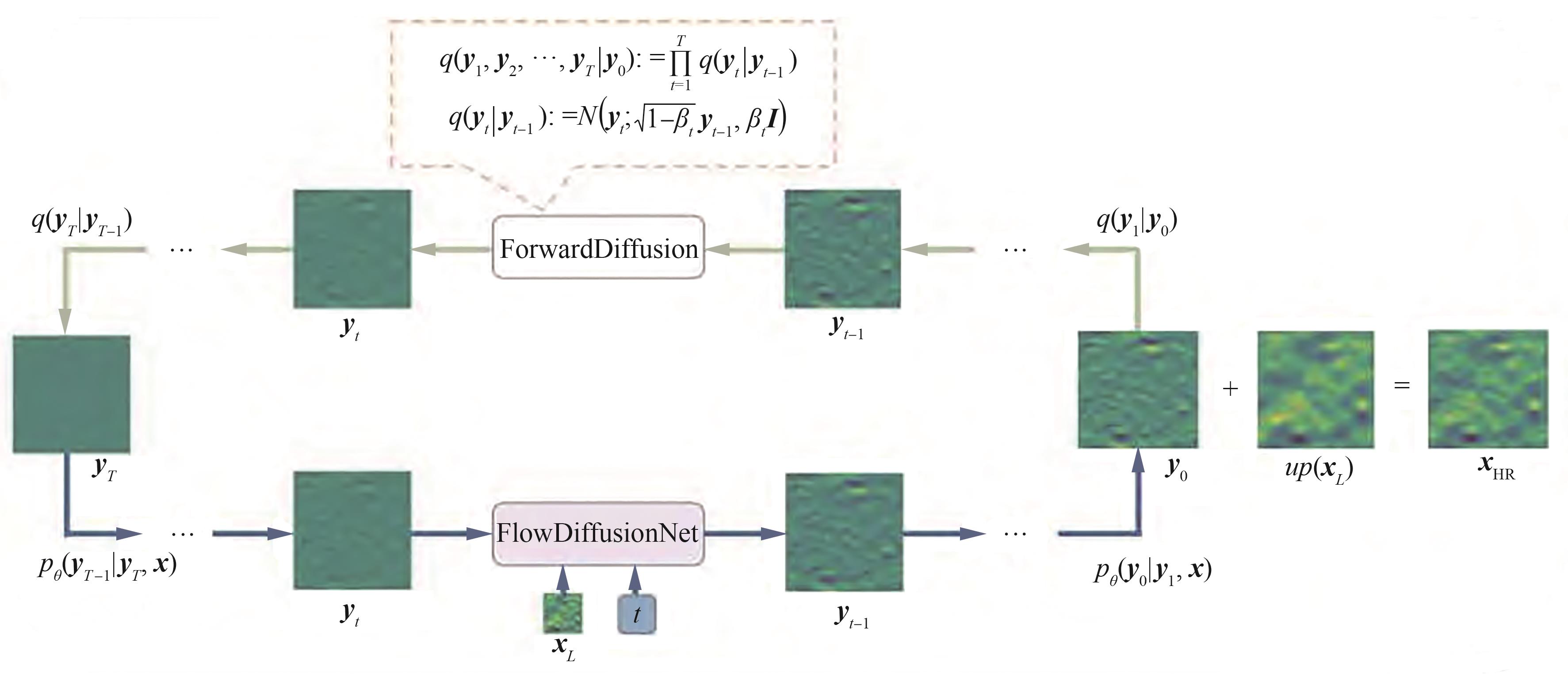
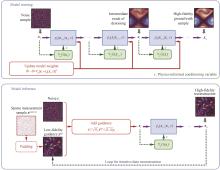
Fig.36
Procedures of model training and inference[179]
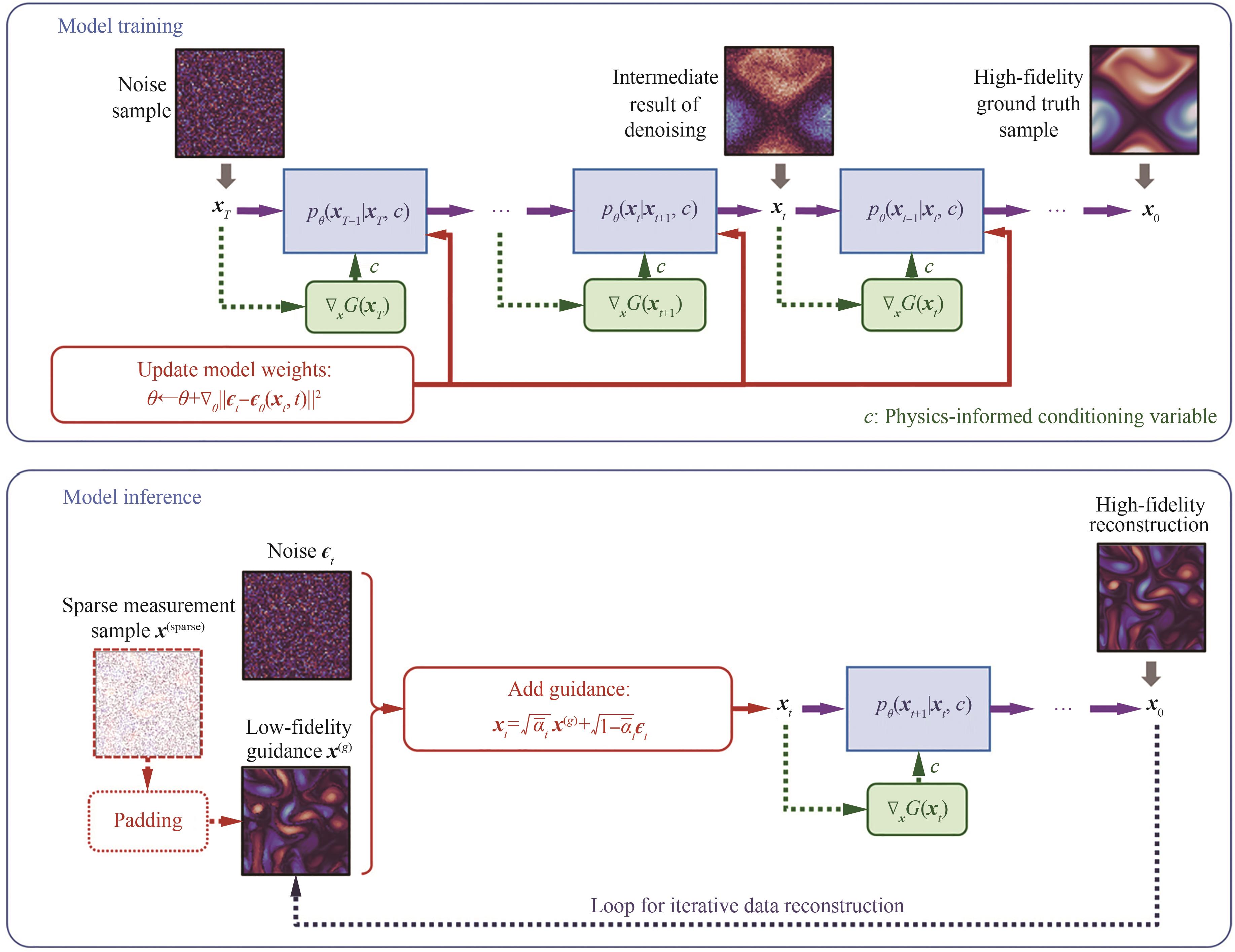
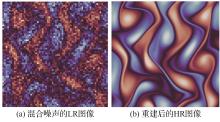
Fig.37
Super resolution reconstruction effect by PiRD[180]
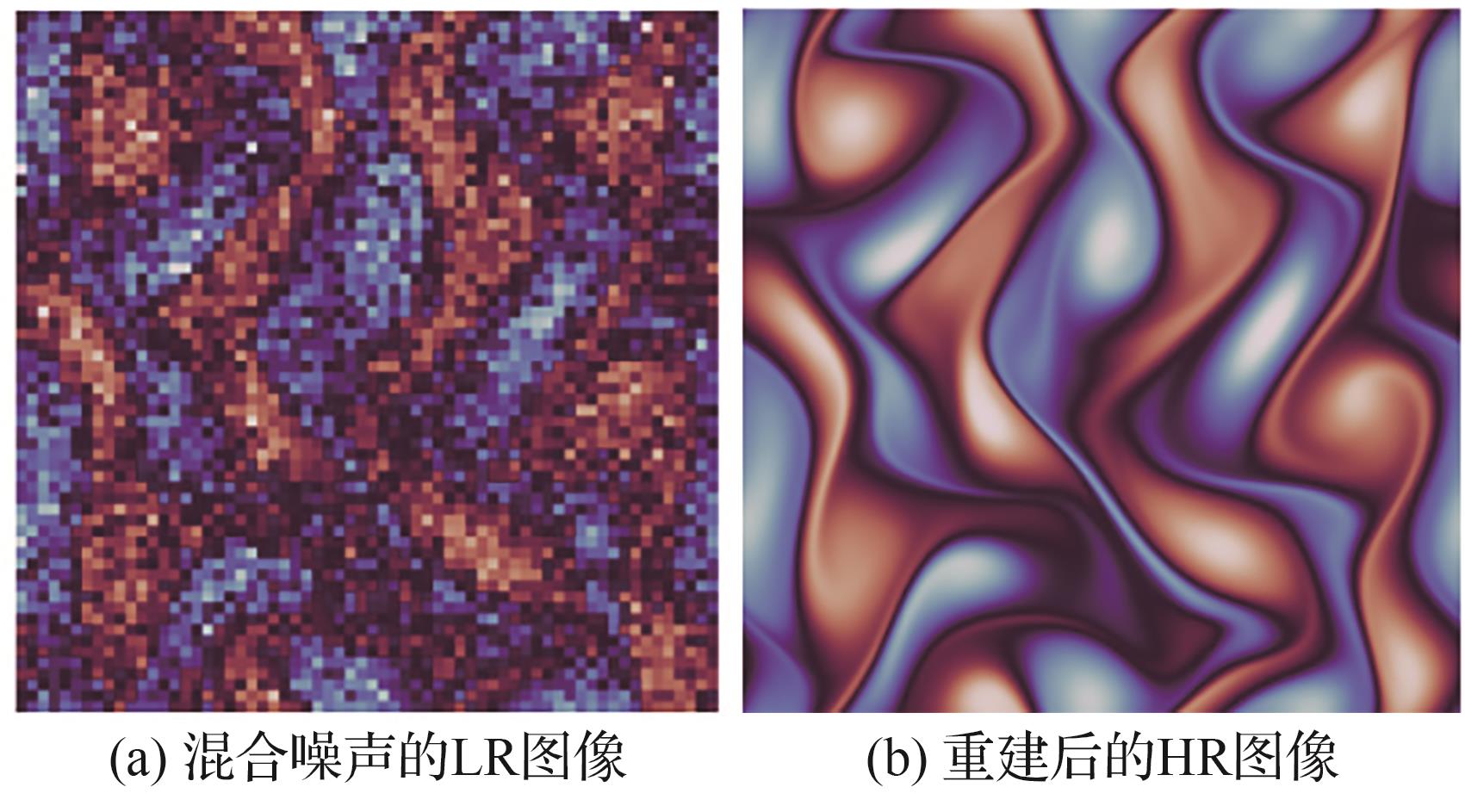
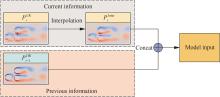
Fig.38
Input of MST-UNet[181]
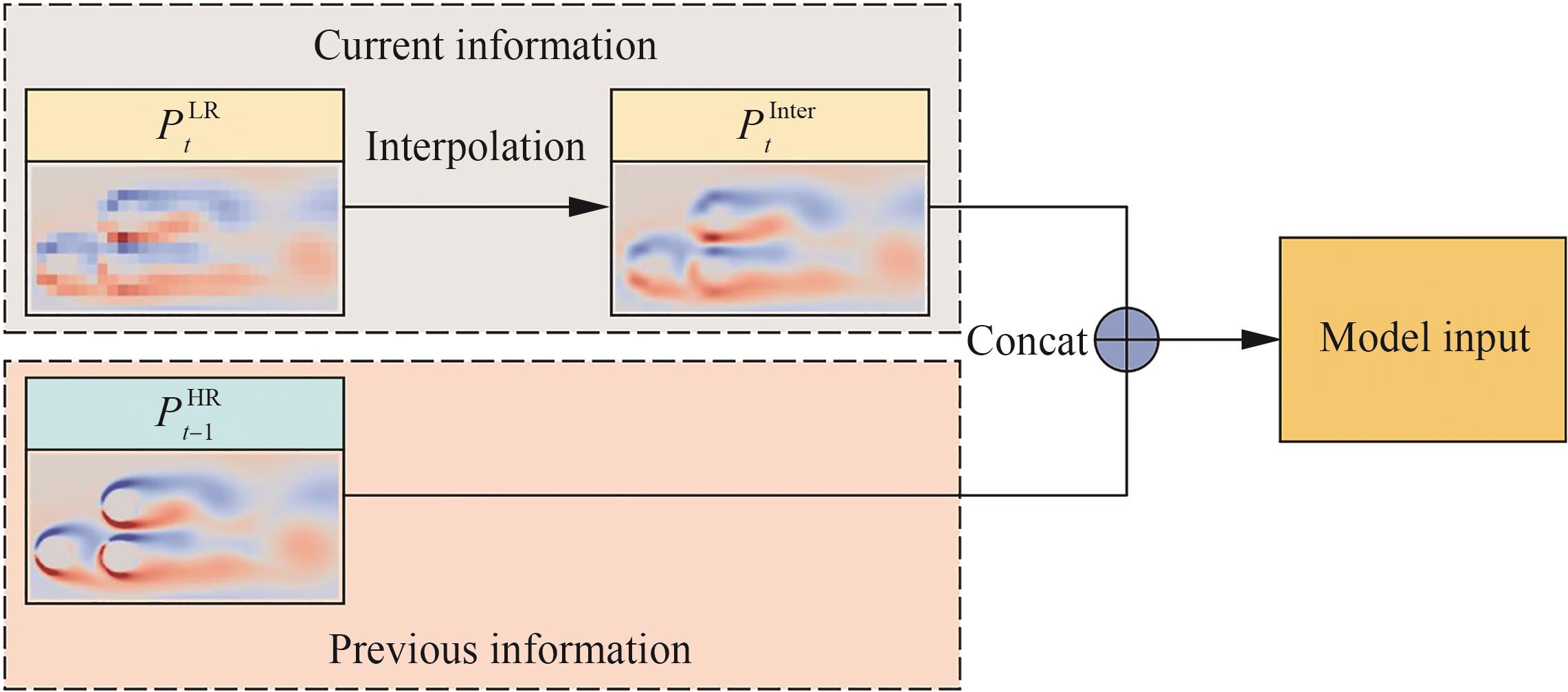
Fig.39
Performance of MST-UNet and SLR-UNet[181]
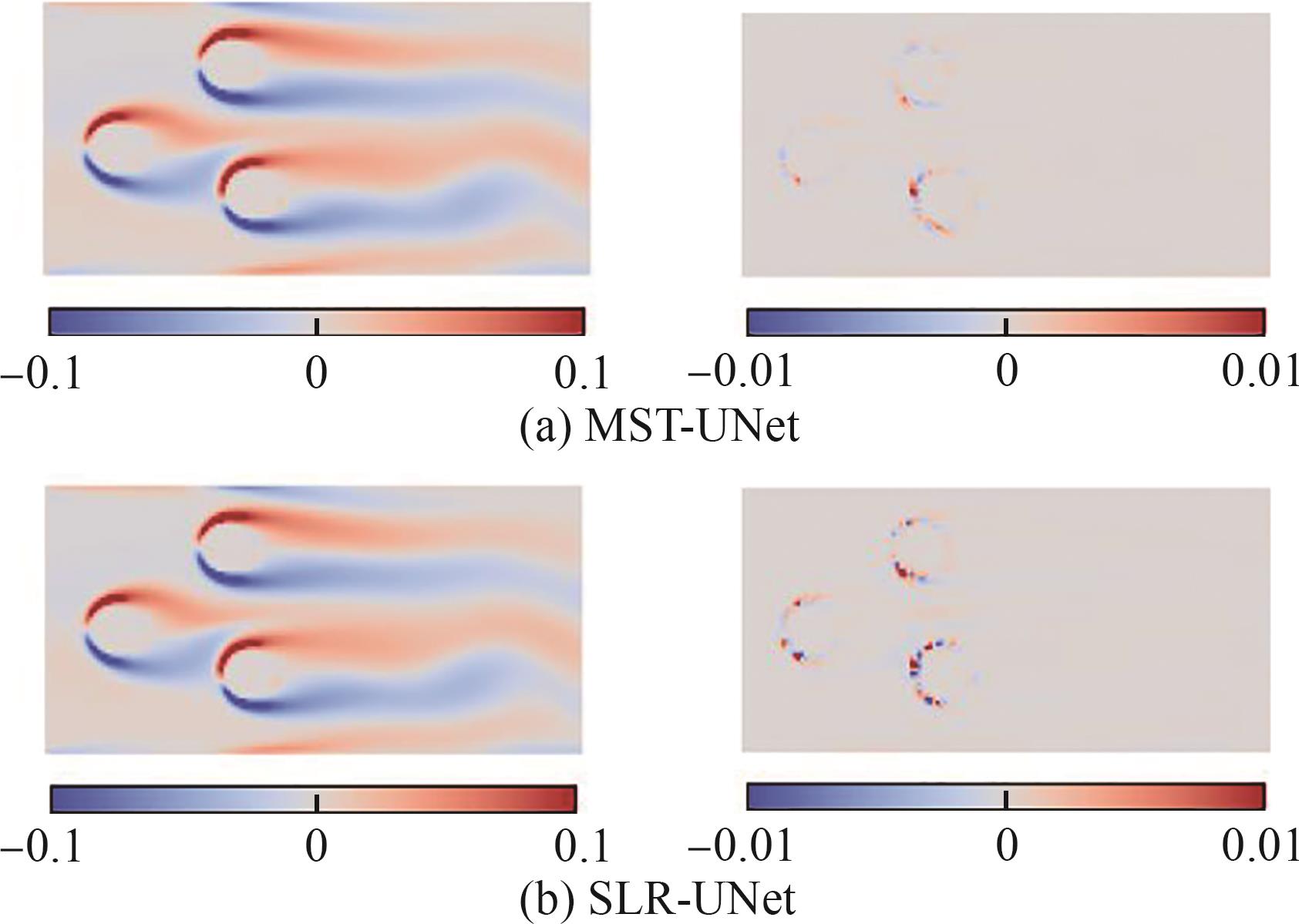
Fig.40
Architecture of SRTT[182]
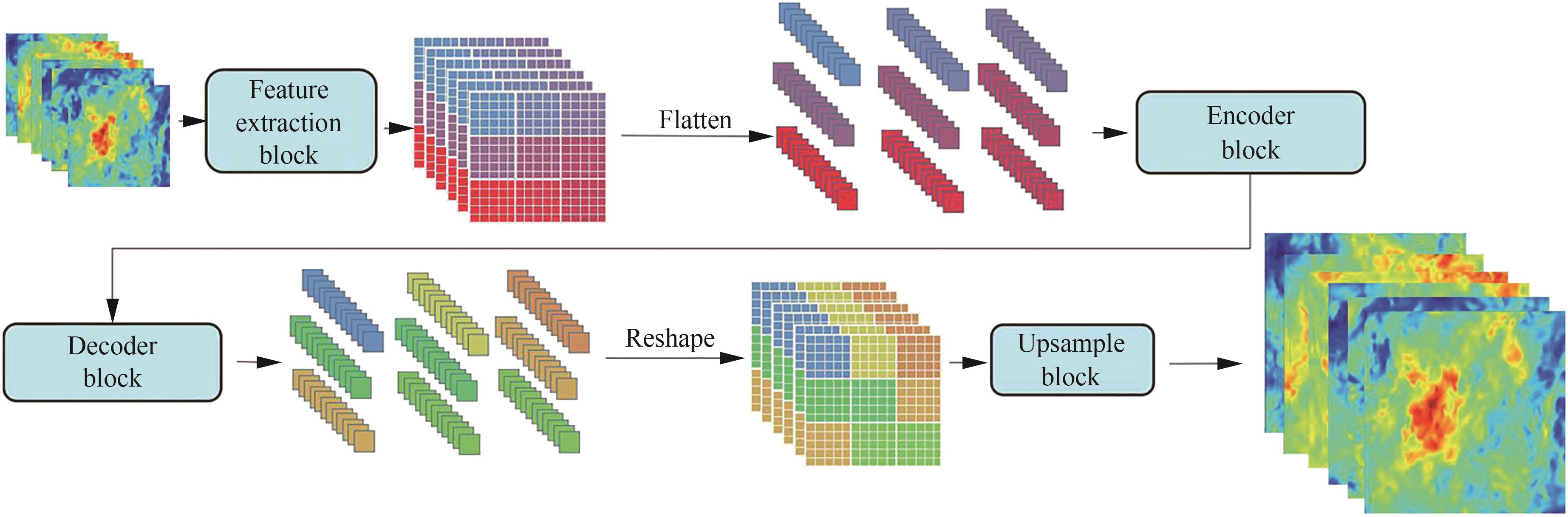
Fig.41
Architecture of GAN for flow field compression[186]
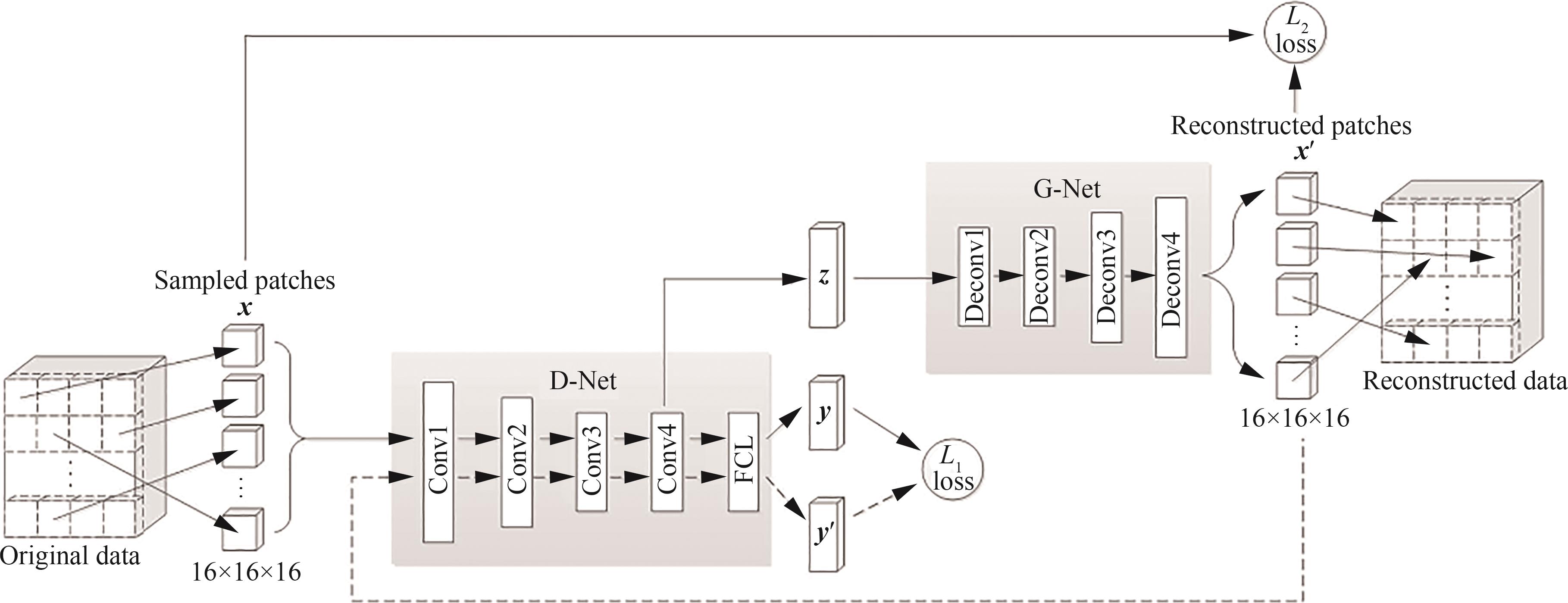
Fig.42
Comparison of original and reconstructed flow fields[186]
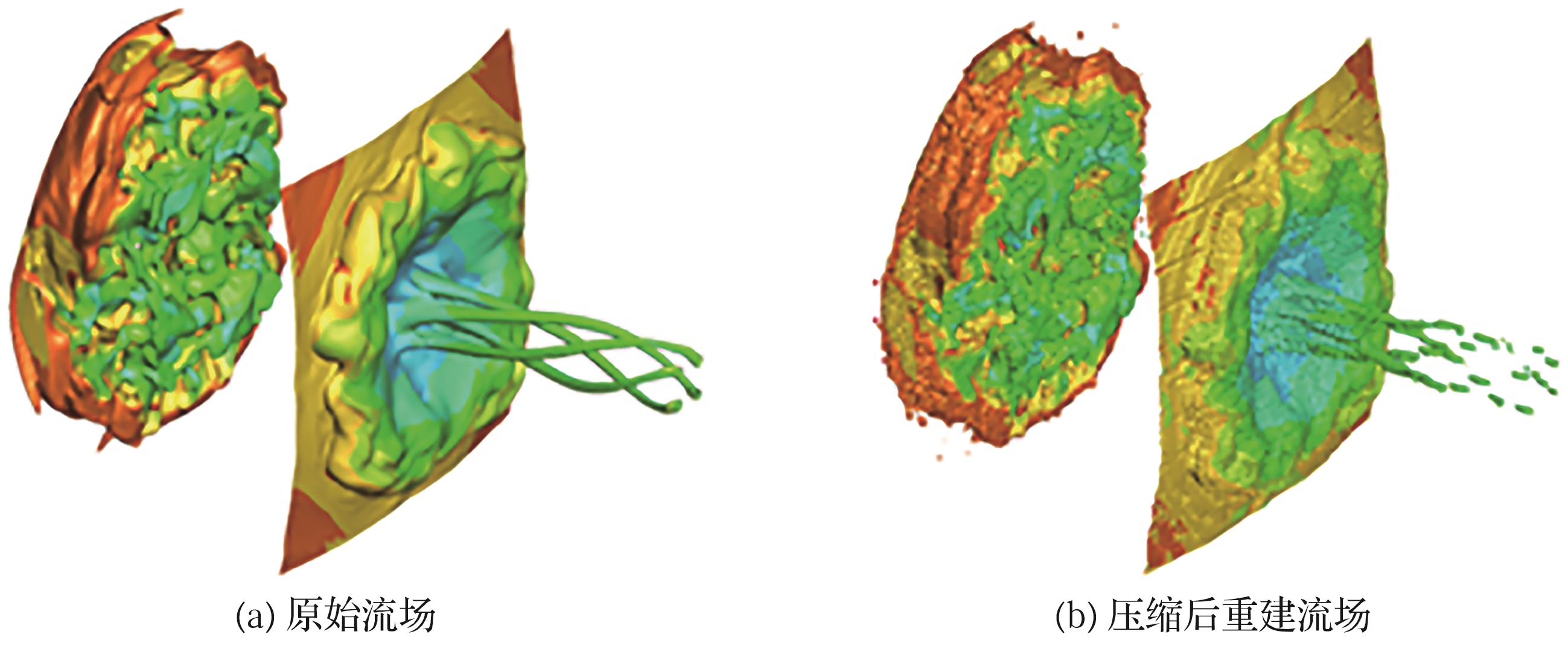
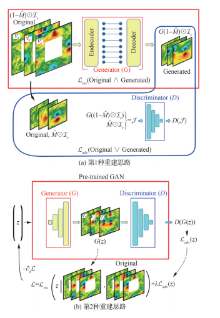
Fig.43
Two architectures for filling missing information[187]
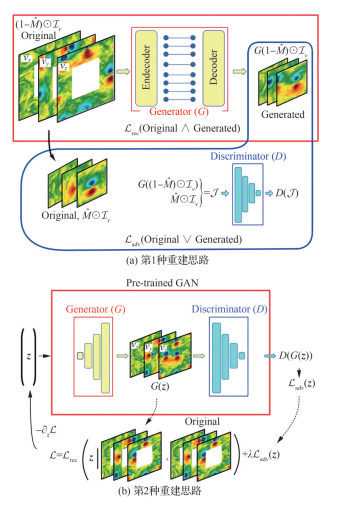
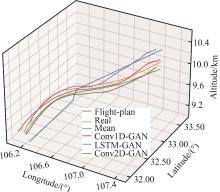
Fig.44
Predicted and real trajectories of various methods[210]
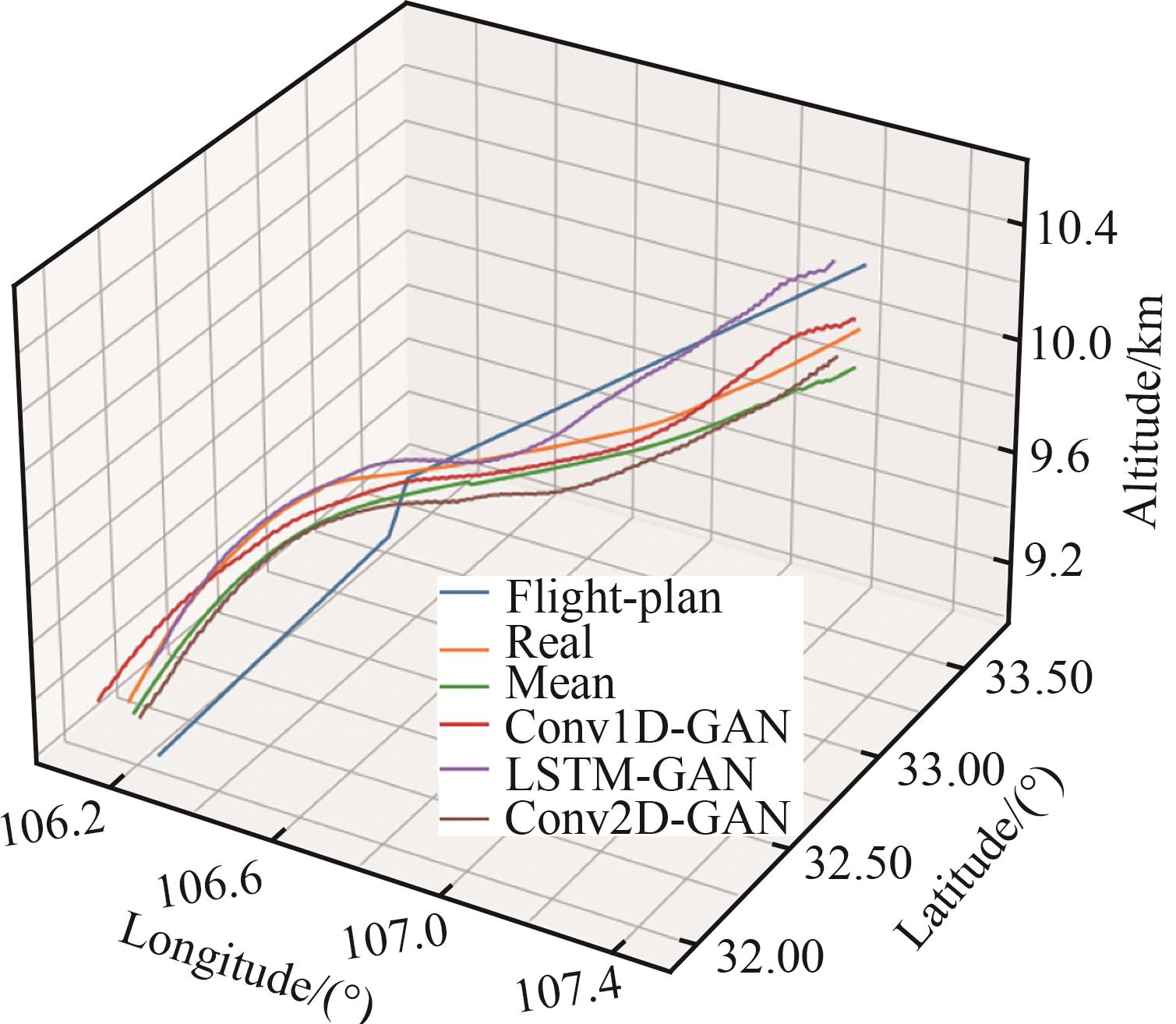
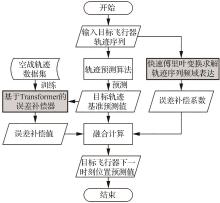
Fig.45
Process of TFPEC[227]
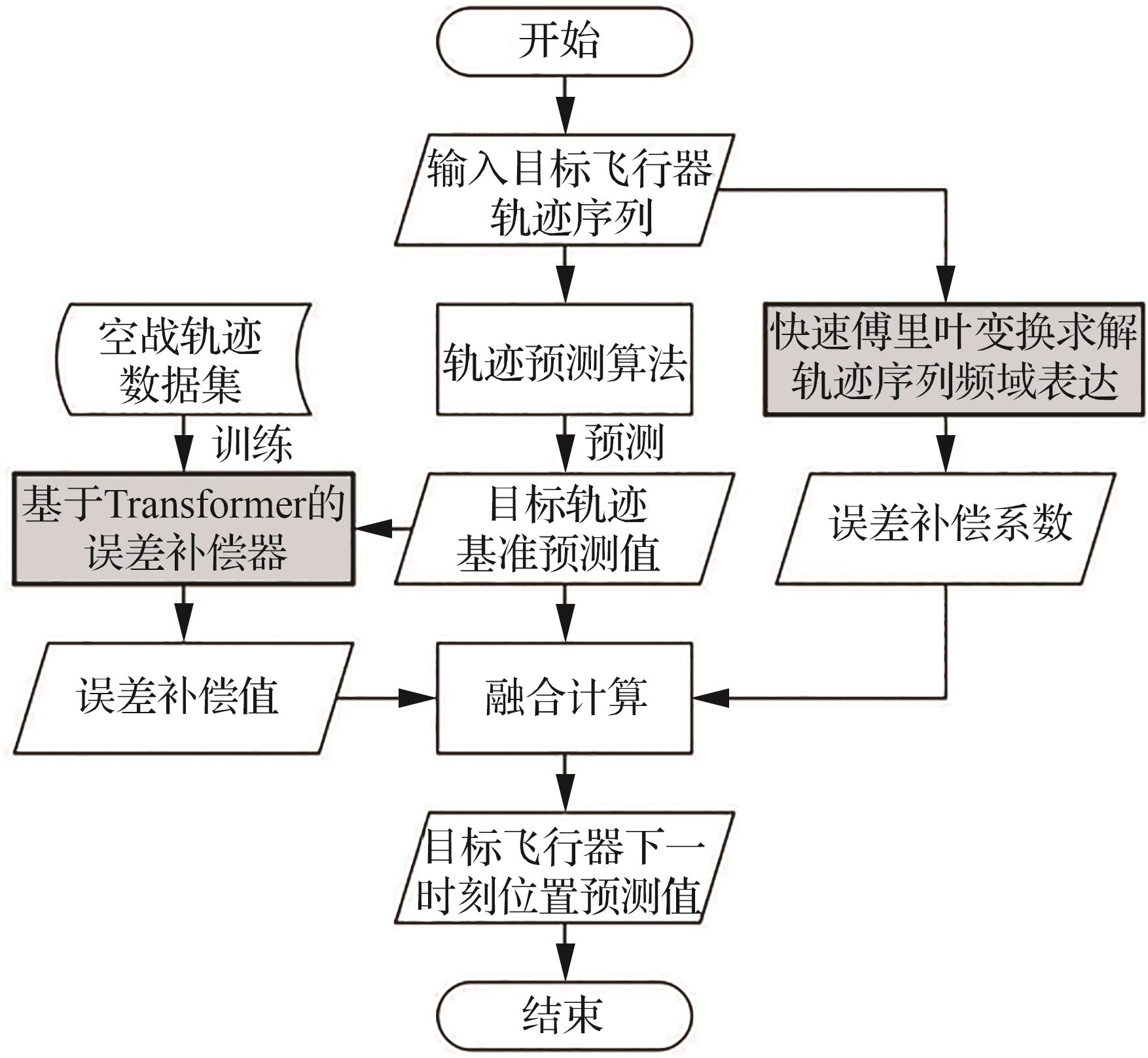
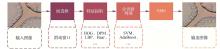
Fig.46
Process of traditional object detection methods[228]
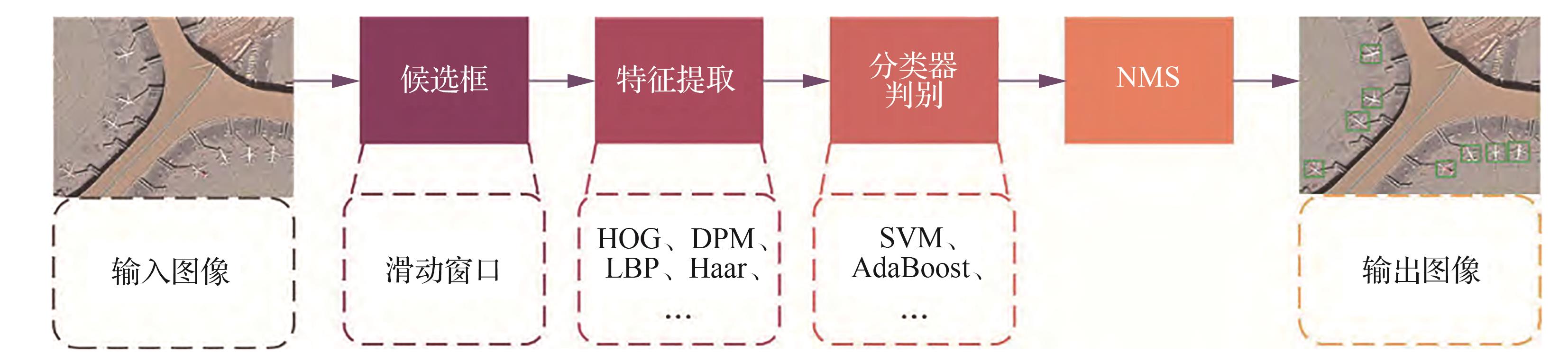
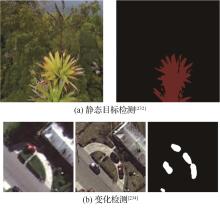
Fig.47
Two application types of object detection
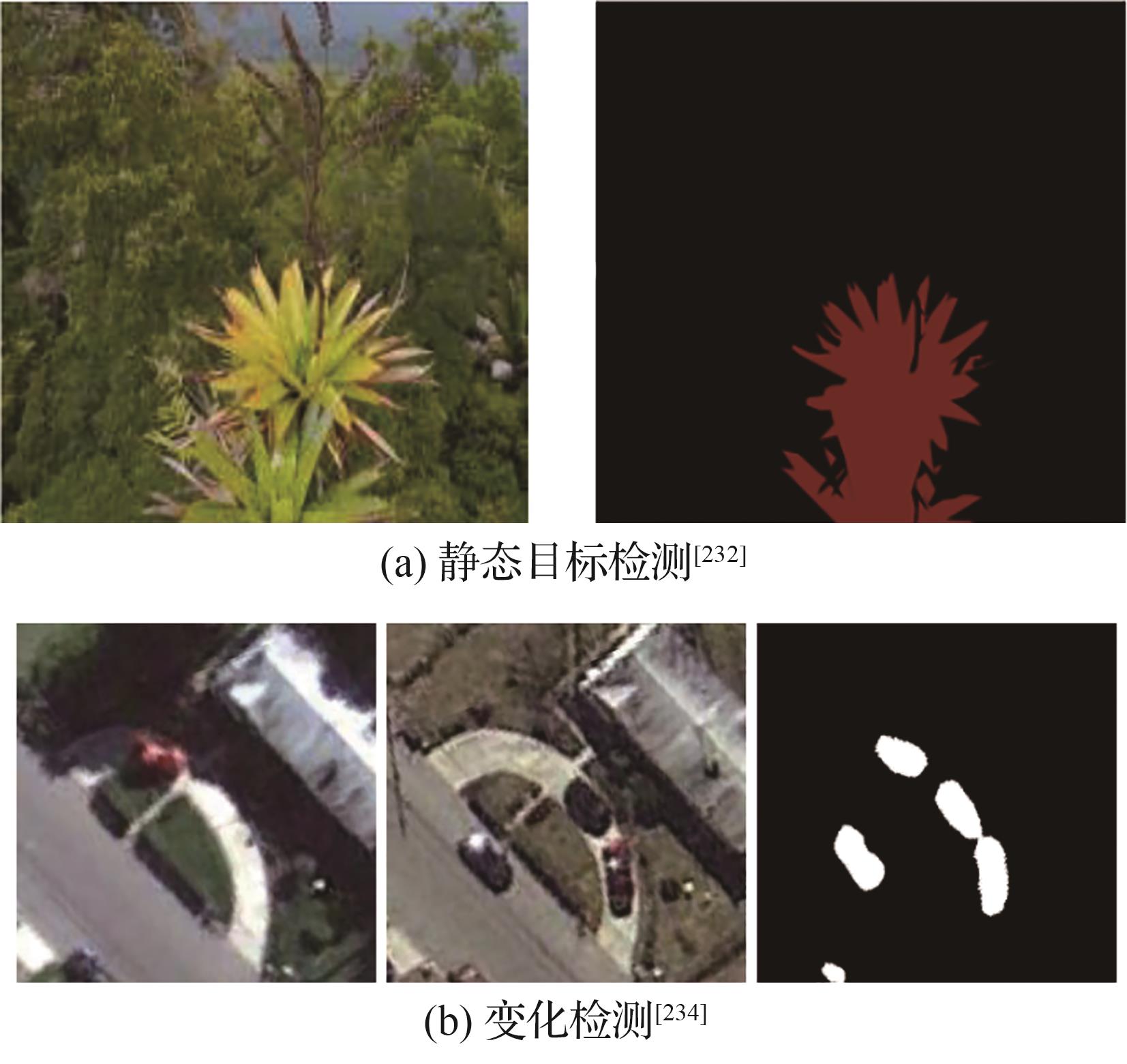
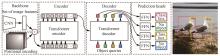
Fig.48
Framework of object detection based on Transformer[233]
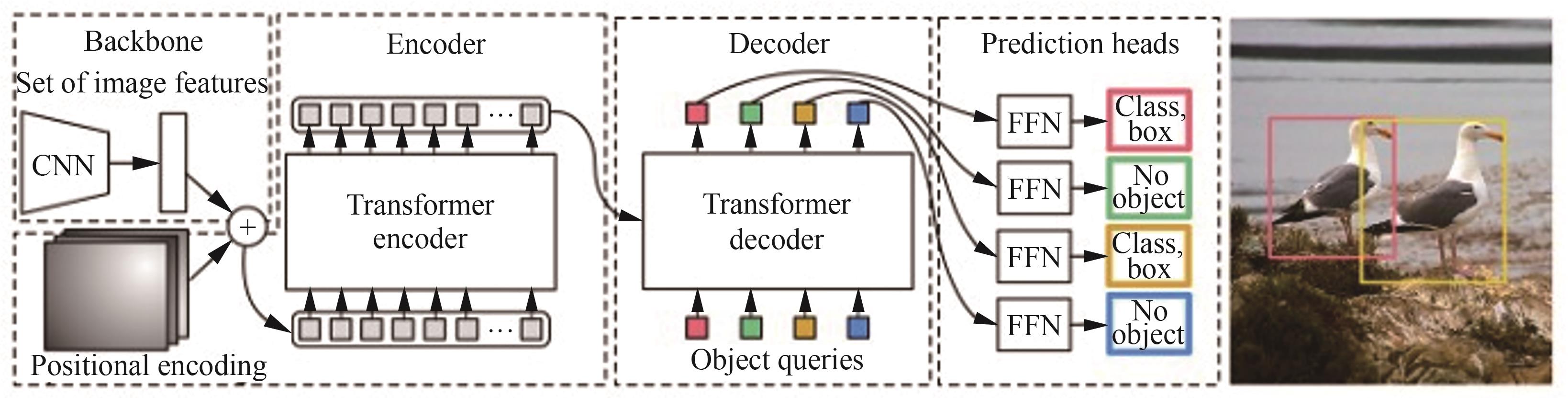
Fig.49
Framework of aircraft type recognition procedure[236]
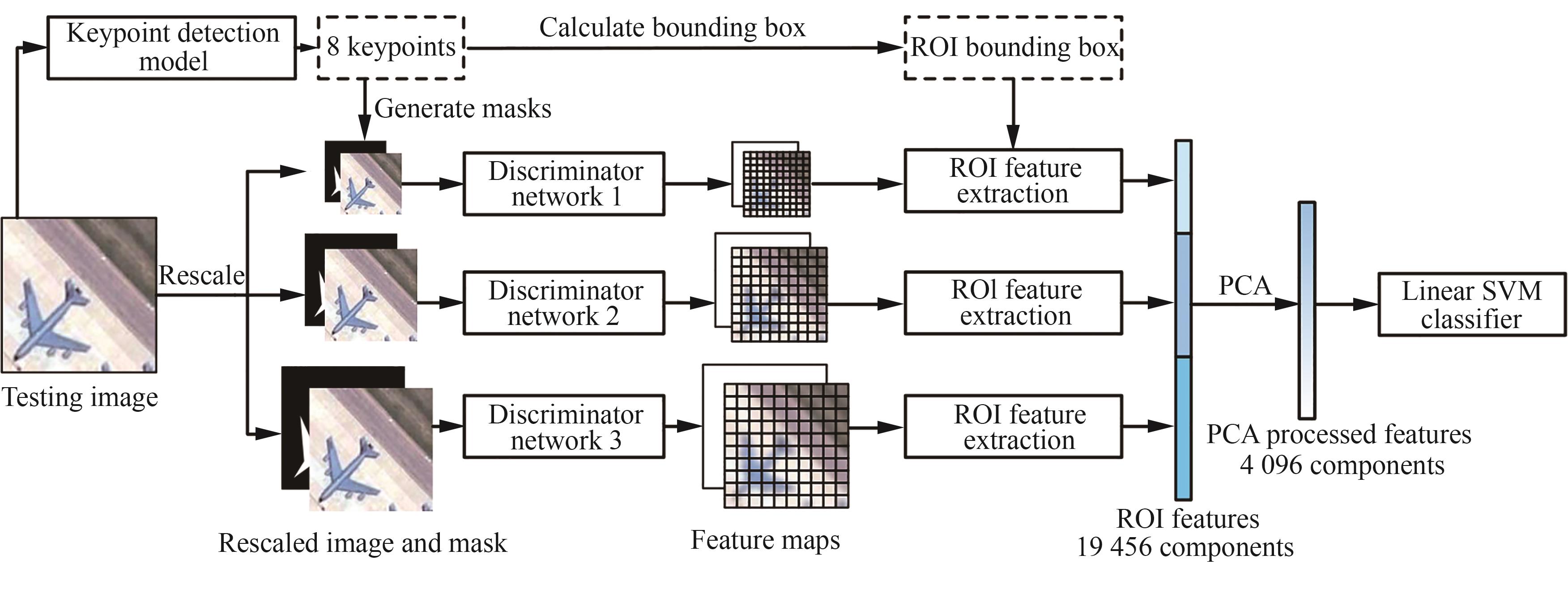
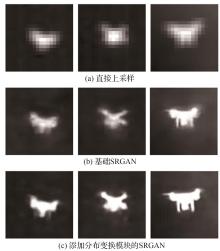
Fig.50
SR images obtained by different methods[238]
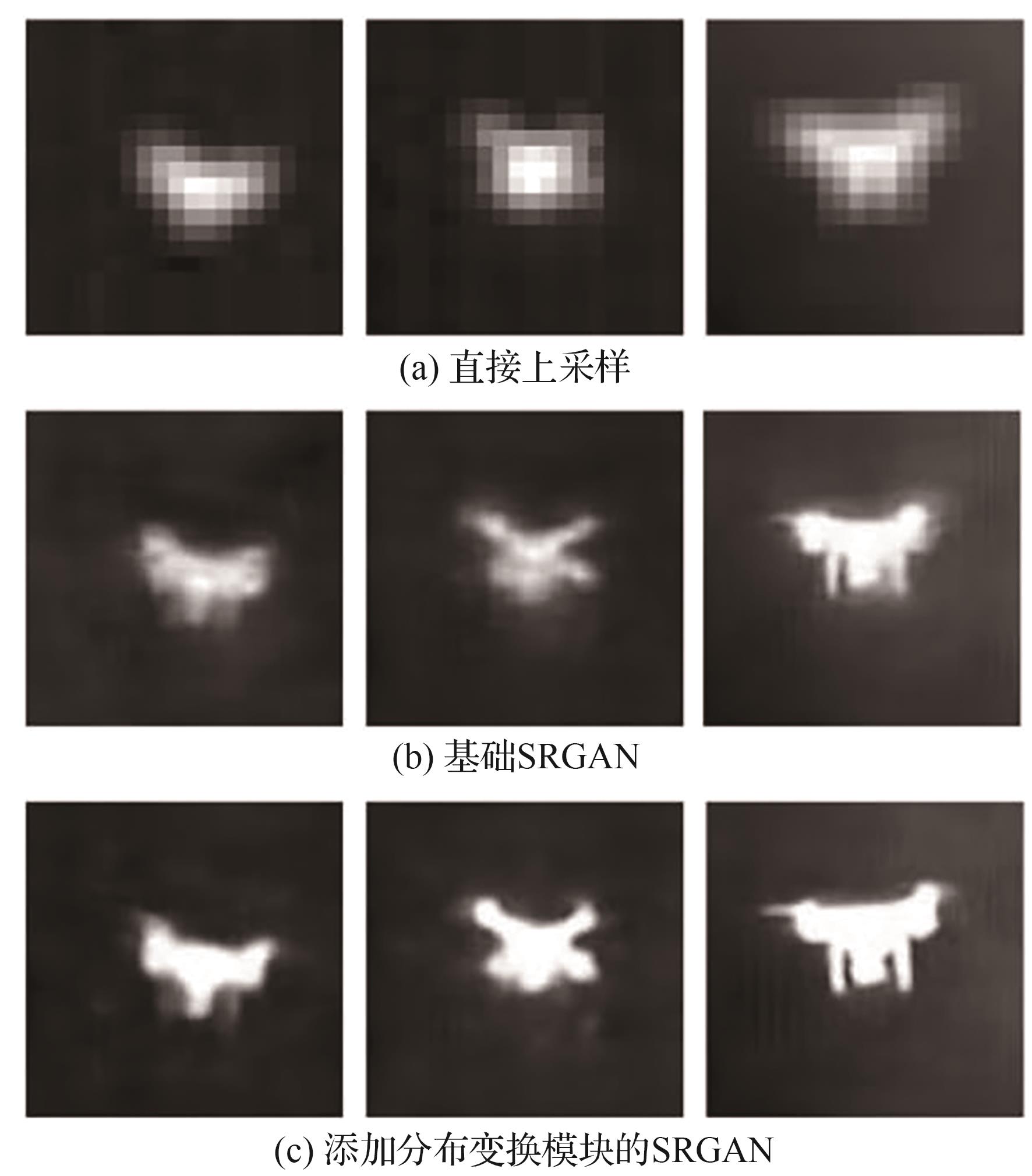
Fig.51
Process of object detection based on EESRGAN[240]
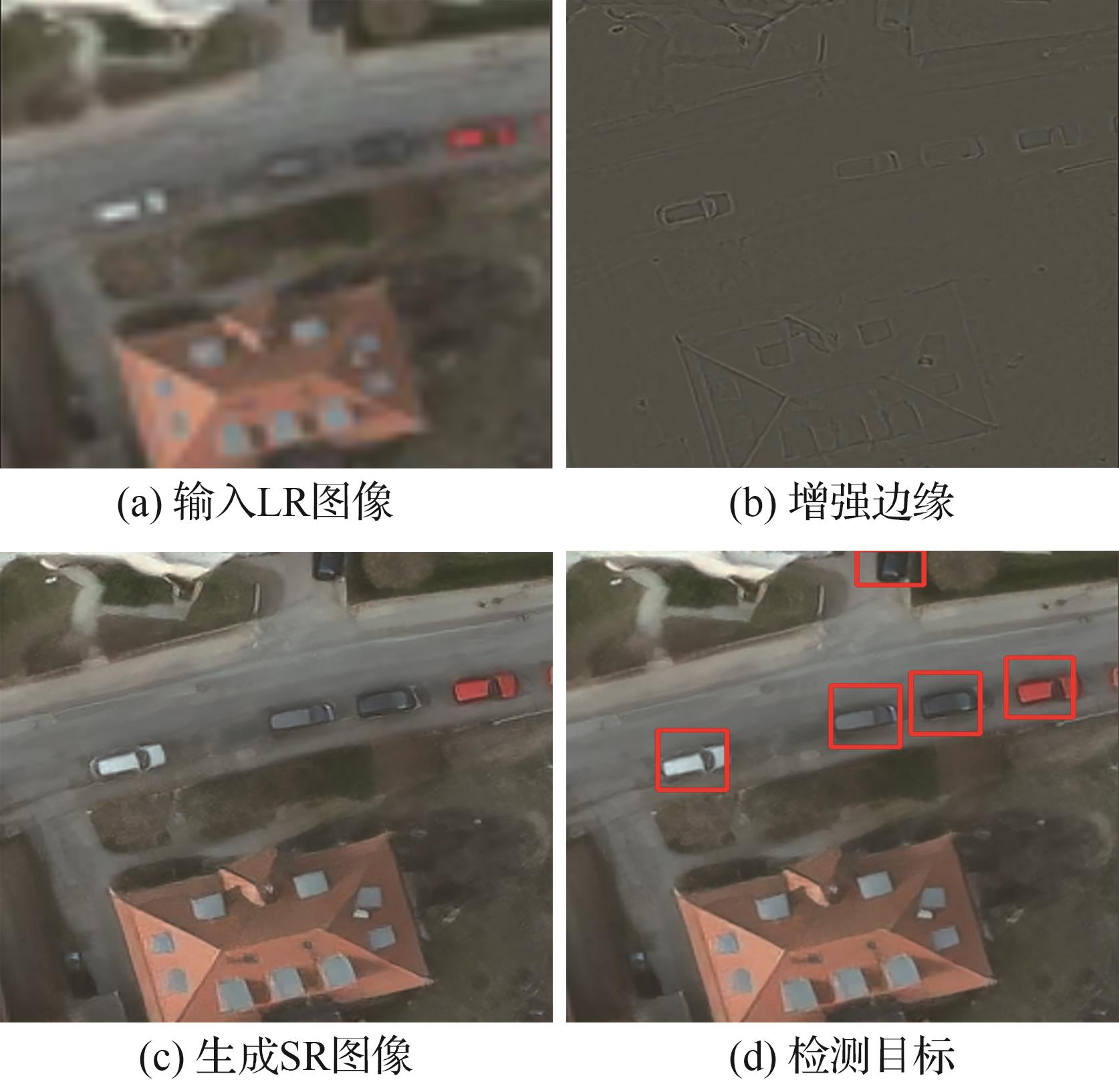
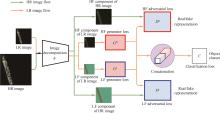
Fig.52
Architecture of DRL-GAN[244]
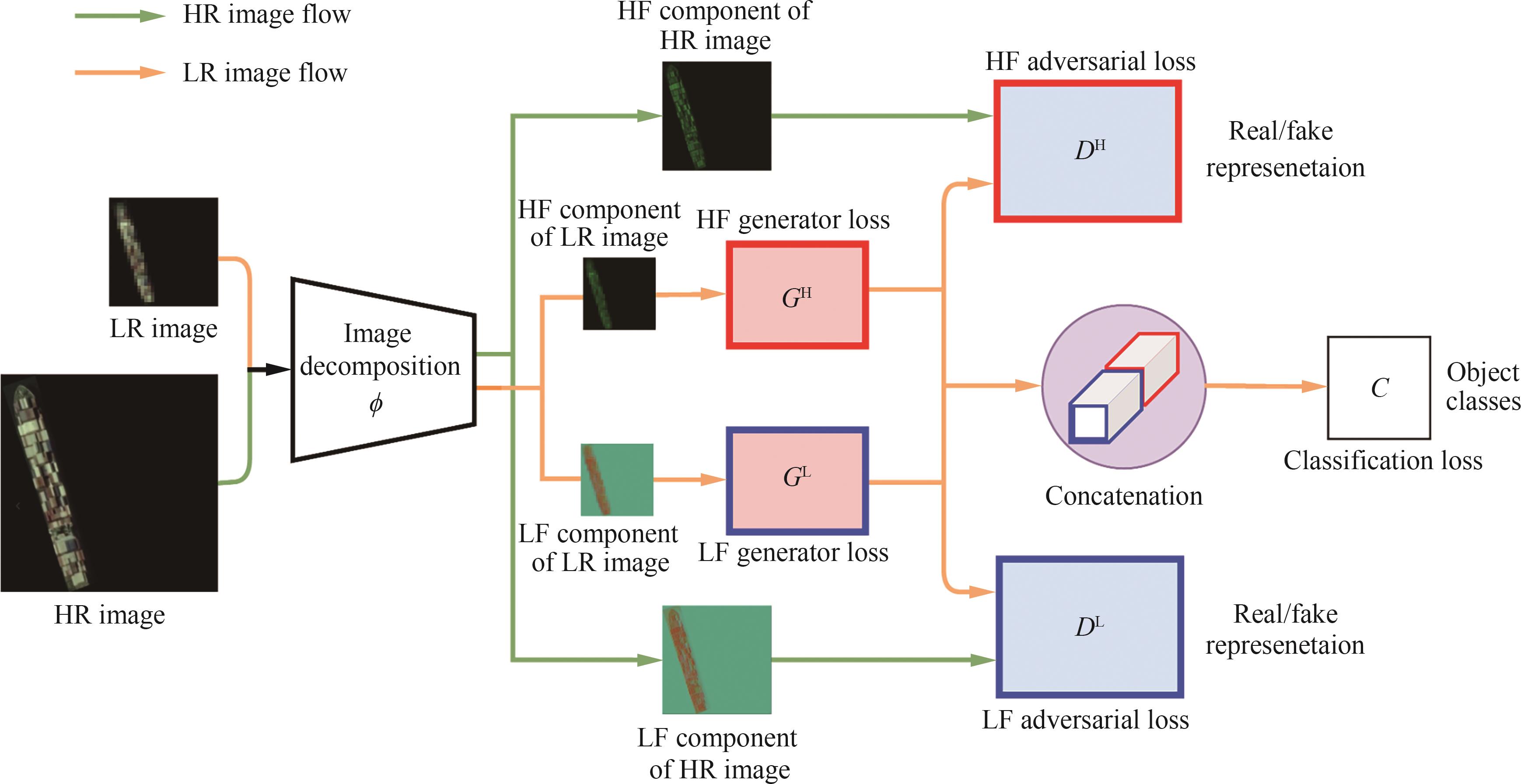
Fig.53
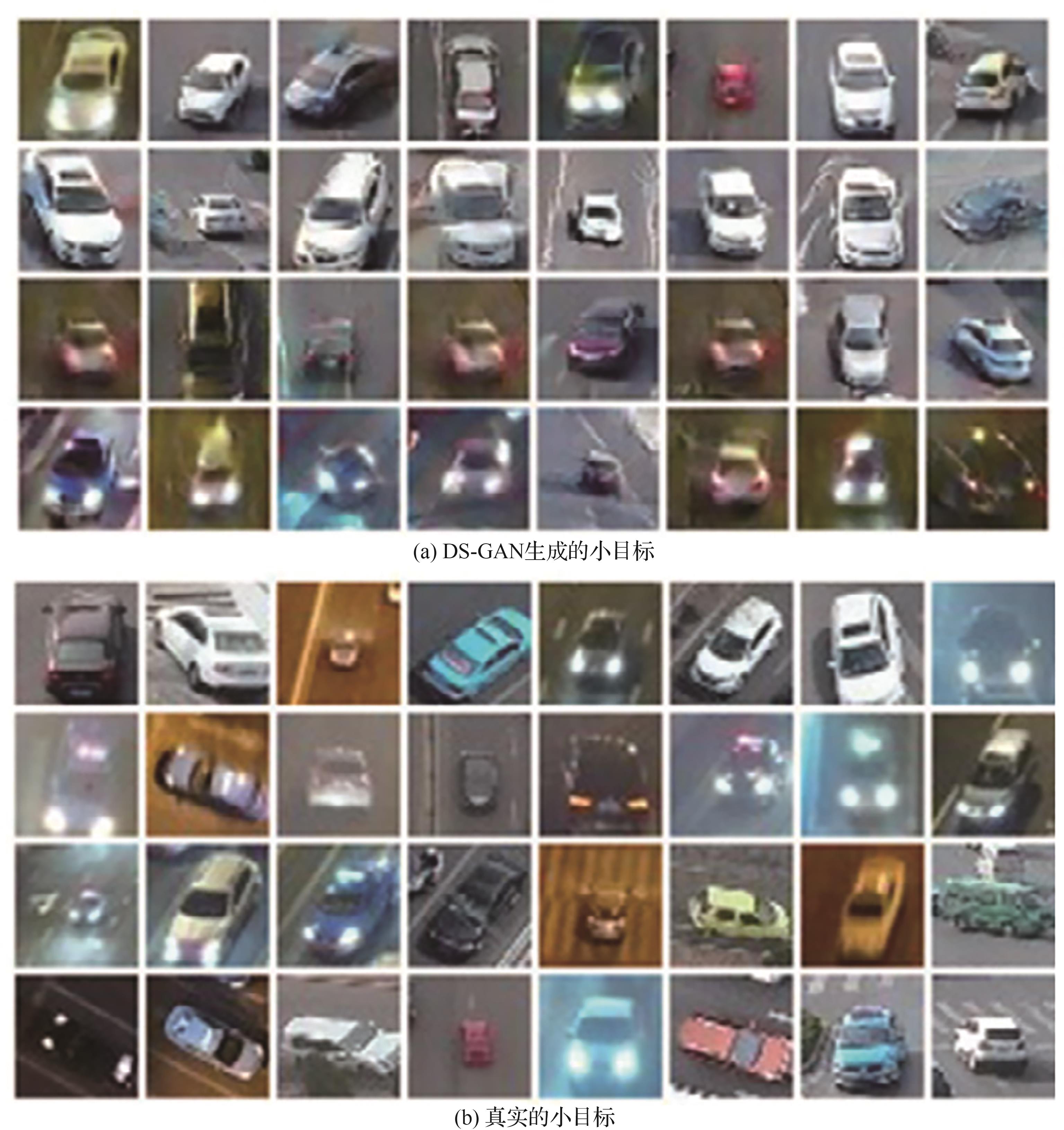
Process of data augmentation based on DS-GAN[246]
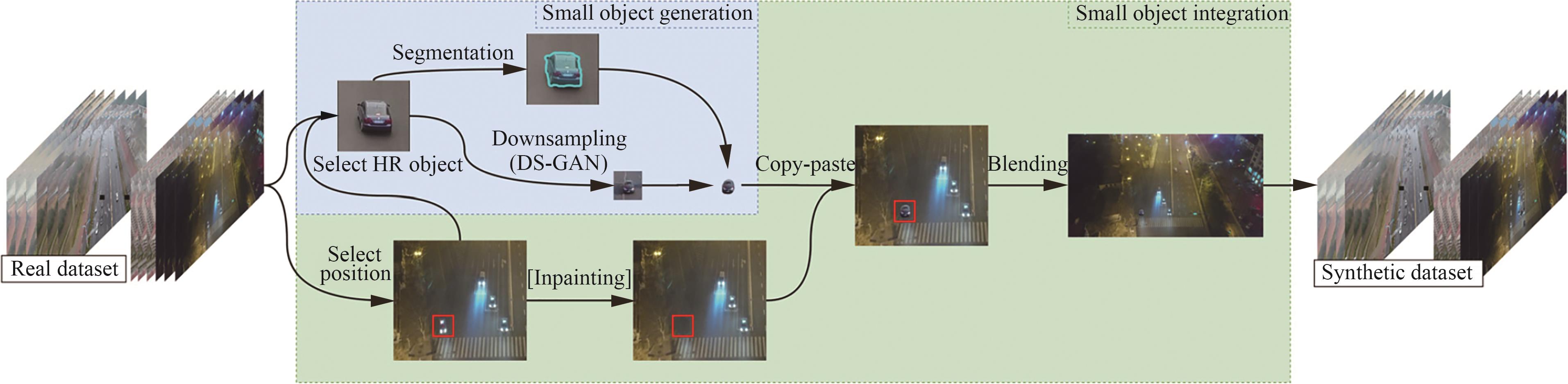
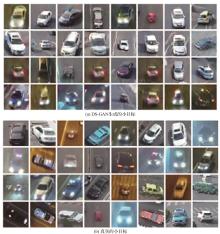
Fig.54
Small objects generated by DS-GAN and real small objects[246]
| 1 | BUBECK S, CHANDRASEKARAN V, ELDAN R, et al. Sparks of artificial general intelligence: Early experiments with GPT-4[DB/OL]. arXiv preprint: 2303.12712, 2023. |
| 2 | 王亚珅, 方勇, 江昊, 等. 2023年生成式人工智能技术主要发展动向分析[J]. 无人系统技术, 2024, 7(2): 101-112. |
| WANG Y S, FANG Y, JIANG H, et al. Main development trends of generative artificial intelligence technology in 2023[J]. Unmanned Systems Technology, 2024, 7(2): 101-112 (in Chinese). | |
| 3 | OOI K B, TAN G W, AL-EMRAN M, et al. The potential of generative artificial intelligence across disciplines: Perspectives and future directions[J]. Journal of Computer Information Systems, 2025, 65(1): 76-107. |
| 4 | WANG H C, FU T F, DU Y Q, et al. Scientific discovery in the age of artificial intelligence[J]. Nature, 2023, 620(7972): 47-60. |
| 5 | 陈树生, 贾苜梁, 刘衍旭, 等. 变体飞行器变形方式及气动布局设计关键技术研究进展[J]. 航空学报, 2024, 45(6): 629595. |
| CHEN S S, JIA M L, LIU Y X, et al. Deformation modes and key technologies of aerodynamic layout design for morphing aircraft: Review[J]. Acta Aeronautica et Astronautica Sinica, 2024, 45(6): 629595 (in Chinese). | |
| 6 | KINGMA D P, WELLING M. Auto-encoding variational Bayes[DB/OL]. arXiv preprint: 1312.6114, 2023. |
| 7 | GOODFELLOW I J, POUGET-ABADIE J, MIRZA M, et al. Generative adversarial nets[C]∥ Proceedings of the 28th International Conference on Neural Information Processing Systems-Volume 2. New York: ACM, 2014: 2672-2680. |
| 8 | SOHL-DICKSTEIN J, WEISS E, MAHESWARANA⁃THAN N, et al. Deep unsupervised learning using nonequilibrium thermodynamics[C]∥ International Conference on Machine Learning. Lille: PMLR, 2015: 2256-2265. |
| 9 | VASWANI A, SHAZEER N, PARMAR N, et al. Attention is all you need[J]. Advances in Neural Information Processing Systems, 2017, 30: 5998-6008. |
| 10 | LECUN Y, CHOPRA S, HADSELL R, et al. Energy-based models[M]∥ Predicting Structured Data.Cambridge: The MIT Press, 2007: 191-246. |
| 11 | KINGMA D P, DHARIWAL P. Glow: Generative flow with invertible 1x1 convolutions[J]. Advances in Neural Information Processing Systems, 2018, 31: 10236-10245. |
| 12 | MILDENHALL B, SRINIVASAN P P, TANCIK M, et al. NeRF: Representing scenes as neural radiance fields for view synthesis[C]∥ Computer Vision-ECCV2020. Cham: Springer International Publishing, 2020: 405-421. |
| 13 | TU W J, DENG W J, GEDEON T, et al. A closer look at the robustness of contrastive language-image pre-training (CLIP)[C]∥ Proceedings of the 37th International Conference on Neural Information Processing Systems.New York: ACM, 2023: 13678-13691. |
| 14 | 任亚琪. 基于深度学习的scRNA-seq数据降维和聚类方法研究[D]. 长沙: 湖南大学, 2022. |
| REN Y Q. Research on dimensionality reduction and clustering method of scRNA-seq data based on deep learning[D]. Changsha: Hunan University, 2022 (in Chinese). | |
| 15 | 郭秋燕, 胡磊, 代劲. 基于云模型的变分自编码器数据压缩方法[J]. 电子技术应用, 2023, 49(10): 96-99. |
| GUO Q Y, HU L, DAI J. Variational autoencoder data compression algorithm based on cloud model[J]. Application of Electronic Technique, 2023, 49(10): 96-99 (in Chinese). | |
| 16 | 杨涛. 基于变分自编码器的文本生成模型研究[D]. 重庆: 西南大学, 2022. |
| YANG T. Research on text generation model based on variational auto-encoder[D]. Chongqing: Southwest University, 2022 (in Chinese). | |
| 17 | 张志昂, 廖光忠. 改进变分自编码器的工业时序数据异常检测[J]. 计算机工程与设计, 2024, 45(1): 17-23. |
| ZHANG Z A, LIAO G Z. Anomaly detection of industrial time series data based on variational autoencoder[J]. Computer Engineering and Design, 2024, 45(1): 17-23 (in Chinese). | |
| 18 | 谢胜利, 陈泓达, 高军礼, 等. 基于分布对齐变分自编码器的深度多视图聚类[J]. 计算机学报, 2023, 46(5): 945-959. |
| XIE S L, CHEN H D, GAO J L, et al. Deep multi-view clustering based on distribution aligned variational autoencoder[J]. Chinese Journal of Computers, 2023, 46(5): 945-959 (in Chinese). | |
| 19 | HIGGINS I, MATTHEY L, PAL A, et al. Beta-VAE: Learning basic visual concepts with a constrained variational framework[C]∥ International ConferenceonLearning Representations, 2017. |
| 20 | BURGESS C P, HIGGINS I, PAL A, et al. Understanding disentangling in β-VAE[DB/OL]. arXiv preprint: 1804.03599, 2018. |
| 21 | RAMACHANDRA G. Least square variational Bayesian autoencoder with regularization[DB/OL]. arXiv preprint: 1707.03134, 2017. |
| 22 | TOLSTIKHIN I, BOUSQUET O, GELLY S, et al. Wasserstein auto-encoders[DB/OL]. arXiv preprint: 1711.01558, 2017. |
| 23 | SOHN K, YAN X C, LEE H, et al. Learning structured output representation using deep conditional generative models[C]∥ Proceedings of the 29th International Conference on Neural Information Processing Systems-Volume 2. New York: ACM, 2015: 3483-3491. |
| 24 | BAO J M, CHEN D, WEN F, et al. CVAE-GAN: Fine-grained image generation through asymmetric training[C]∥ 2017 IEEE International Conference on Computer Vision (ICCV). Piscataway: IEEE Press, 2017: 2764-2773. |
| 25 | SHEN D H, CELIKYILMAZ A, ZHANG Y Z, et al. Towards generating long and coherent text with multi-level latent variable models[DB/OL]. arXiv preprint: 1902.00154, 2019. |
| 26 | LI R Z, ZHANG Y F, CHEN H X. Physically interpretable feature learning of supercritical airfoils based on variational autoencoders[J]. AIAA Journal, 2022, 60(11): 6168-6182. |
| 27 | VAN DEN OORD A, VINYALS O, KAVUKCUOGLU K, et al. Neural discrete representation learning[C]∥ Proceedings of the 31st International Conference on Neural Information Processing Systems. New York: ACM, 2017:6309-6318. |
| 28 | RAZAVI A, VAN DEN OORD A, VINYALS O. Generating diverse high-fidelity images with VQ-VAE-2[J]. Advances in Neural Information Processing Systems, 2019, 32:14866-14876. |
| 29 | 罗佳, 黄晋英. 生成式对抗网络研究综述[J]. 仪器仪表学报, 2019, 40(3): 74-84. |
| LUO J, HUANG J Y. Generative adversarial network: An overview[J]. Chinese Journal of Scientific Instrument, 2019, 40(3): 74-84 (in Chinese). | |
| 30 | 张营营. 生成对抗网络模型综述[J]. 电子设计工程, 2018, 26(5): 34-37, 43. |
| ZHANG Y Y. A survey on generative adversarial networks[J]. Electronic Design Engineering, 2018, 26(5): 34-37, 43 (in Chinese). | |
| 31 | 龚颖, 许文韬, 赵策, 等. 生成对抗网络在图像修复中的应用综述[J]. 计算机科学与探索, 2024, 18(3): 553-573. |
| GONG Y, XU W T, ZHAO C, et al. Review of application of generative adversarial networks in image restoration[J]. Journal of Frontiers of Computer Science and Technology, 2024, 18(3): 553-573 (in Chinese). | |
| 32 | 张彬, 周粤川, 张敏, 等. 生成对抗网络改进角度与应用研究综述[J]. 计算机应用研究, 2023, 40(3): 649-658. |
| ZHANG B, ZHOU Y C, ZHANG M, et al. Review of research on improvement and application of generative adversarial networks[J]. Application Research of Computers, 2023, 40(3): 649-658 (in Chinese). | |
| 33 | NOWOZIN S, CSEKE B, TOMIOKA R, et al. f-GAN: Training generative neural samplers using variational divergence minimization[J]. Advances in Neural Information Processing Systems, 2016, 29: 271-279. |
| 34 | MAO X D, LI Q, XIE H R, et al. Least squares generative adversarial networks[C]∥ 2017 IEEE International Conference on Computer Vision (ICCV). Piscataway: IEEE Press, 2017: 2813-2821. |
| 35 | ZHAO J B, MATHIEU M, LECUN Y. Energy-based generative adversarial network[DB/OL]. arXiv preprint: 1609.03126, 2016. |
| 36 | ARJOVSKY M, CHINTALA S, BOTTOU L, et al. Wasserstein generative adversarial networks[C]∥ Proceedings of the 34th International Conference on Machine Learning-Volume 70. New York: ACM, 2017: 214-223. |
| 37 | GULRAJANI I, AHMED F, ARJOVSKY M, et al. Improved training of Wasserstein GANs[C]∥ Proceedings of the 31st International Conference on Neural Information Processing Systems. New York: ACM, 2017: 5769-5779. |
| 38 | QI G J. Loss-sensitive generative adversarial networks on lipschitz densities[J]. International Journal of Computer Vision, 2020, 128(5): 1118-1140. |
| 39 | ODENA A. Semi-supervised learning with generative adversarial networks[DB/OL]. arXiv preprint: 1606.01583, 2016. |
| 40 | MIRZA M, OSINDERO S. Conditional generative adversarial nets[DB/OL]. arXiv preprint: 1411.1784, 2014. |
| 41 | CHEN X, DUAN Y, HOUTHOOFT R, et al. InfoGAN: Interpretable representation learning by information maximizing generative adversarial nets[J]. Advances in Neural Information Processing Systems, 2016, 29: 2172-2180. |
| 42 | ZHANG H, XU T, LI H S, et al. StackGAN: Text to photo-realistic image synthesis with stacked generative adversarial networks[C]∥ 2017 IEEE International Conference on Computer Vision (ICCV). Piscataway: IEEE Press, 2017: 5908-5916. |
| 43 | ZHU J Y, PARK T, ISOLA P, et al. Unpaired image-to-image translation using cycle-consistent adversarial networks[C]∥ 2017 IEEE International Conference on Computer Vision (ICCV). Piscataway: IEEE Press, 2017: 2242-2251. |
| 44 | TOLSTIKHIN I O, GELLY S, BOUSQUET O, et al. AdaGAN: Boosting generative models[J]. Advances in Neural Information Processing Systems, 2017, 30: 5424-5433. |
| 45 | GHOSH A, KULHARIA V, NAMBOODIRI V, et al. Multi-agent diverse generative adversarial networks[C]∥2018 IEEE/CVF Conference on Computer Vision and Pattern Recognition. Piscataway: IEEE Press, 2018: 8513-8521. |
| 46 | DURUGKAR I, GEMP I, MAHADEVAN S. Generative multi-adversarial networks[DB/OL]. arXiv preprint: 1611.01673, 2016. |
| 47 | RADFORD A, METZ L, CHINTALA S, et al. Unsupervised representation learning with deep convolutional generative adversarial networks[DB/OL]. arXiv preprint: 1511.06434, 2015. |
| 48 | LARSEN A B L, SØNDERBY S K, LAROCHELLE H, et al. Autoencoding beyond pixels using a learned similarity metric[C]∥ Proceedings of the 33rd International Conference on International Conference on Machine Learning-Volume 48. New York: ACM, 2016: 1558-1566. |
| 49 | ZHANG H, GOODFELLOW I, METAXAS D, et al. Self-attention generative adversarial networks[DB/OL].arXiv preprint: 1805.08318, 2018. |
| 50 | ISOLA P, ZHU J Y, ZHOU T H, et al. Image-to-image translation with conditional adversarial networks[C]∥ 2017 IEEE Conference on Computer Vision and Pattern Recognition (CVPR). Piscataway: IEEE Press, 2017: 5967-5976. |
| 51 | 王正龙, 张保稳. 生成对抗网络研究综述[J]. 网络与信息安全学报, 2021, 7(4): 68-85. |
| WANG Z L, ZHANG B W. Survey of generative adversarial network[J]. Chinese Journal of Network and Information Security, 2021, 7(4): 68-85 (in Chinese). | |
| 52 | HO J, JAIN A, ABBEEL P, et al. Denoising diffusion probabilistic models[C]∥ Proceedings of the 34th International Conference on Neural Information Processing Systems.New York: ACM, 2020: 6840-6851. |
| 53 | CROITORU F A, HONDRU V, IONESCU R T, et al. Diffusion models in vision: A survey[J]. IEEE Transactions on Pattern Analysis and Machine Intelligence, 2023, 45(9): 10850-10869. |
| 54 | SONG J M, MENG C L, ERMON S. Denoising diffusion implicit models[DB/OL]. arXiv preprint: 2010.02502, 2020. |
| 55 | ROMBACH R, BLATTMANN A, LORENZ D, et al. High-resolution image synthesis with latent diffusion models[C]∥ 2022 IEEE/CVF Conference on Computer Vision and Pattern Recognition (CVPR). Piscataway: IEEE Press, 2022: 10674-10685. |
| 56 | NICHOL A, DHARIWAL P. Improved denoising diffusion probabilistic models[DB/OL]. arXiv preprint: 2102.09672, 2021. |
| 57 | DHARIWAL P, NICHOL A, DHARIWAL P, et al. Diffusion models beat GANs on image synthesis[C]∥Proceedings of the 35th International Conference on Neural Information Processing Systems.New York: ACM, 2021: 8780-8794. |
| 58 | HO J, SALIMANS T. Classifier-free diffusion guidance[DB/OL]. arXiv preprint: 2207.12598, 2022. |
| 59 | SONG Y, ERMON S. Generative modeling by estimating gradients of the data distribution[J]. Advances in Neural Information Processing Systems, 2019, 32:11918-11930. |
| 60 | SONG Y, SOHL-DICKSTEIN J, KINGMA D P, et al. Score-based generative modeling through stochastic differential equations[DB/OL]. arXiv preprint: 2011.13456, 2016. |
| 61 | DOSOVITSKIY A, BEYER L, KOLESNIKOV A,et al. Animage is worth 16x16 words: Transformers for image recognition at scale[C]∥ International Conference on Learning Representations, 2021. |
| 62 | LIU Z, LIN Y T, CAO Y, et al. Swin transformer: Hierarchical vision transformer using shifted windows[C]∥2021 IEEE/CVF International Conference on Computer Vision (ICCV). Piscataway: IEEE Press, 2021: 9992-10002. |
| 63 | 唐志共, 朱林阳, 向星皓, 等. 智能空气动力学若干研究进展及展望[J]. 空气动力学学报, 2023, 41(7): 1-35. |
| TANG Z G, ZHU L Y, XIANG X H, et al. Some research progress and prospect of intelligent aerodynamics[J]. Acta Aerodynamica Sinica, 2023, 41(7): 1-35 (in Chinese). | |
| 64 | MASTERS D A, TAYLOR N J, RENDALL T, et al. Review of aerofoil parameterisation methods for aerodynamic shape optimisation[C]∥ 53rd AIAA Aerospace Sciences Meeting. Reston: AIAA, 2015. |
| 65 | SUN J H, SONG W B. A unified learning model for airfoil geometry fitting and efficient optimization[C]∥AIAA SCITECH 2023 Forum. Reston: AIAA, 2023. |
| 66 | 余婧, 蒋安林, 刘亮, 等. 基于PCA降维的气动外形参数化方法[J]. 航空学报, 2024, 45(10): 129125. |
| YU J, JIANG A L, LIU L, et al. PCA aerodynamic geometry parametrization method[J]. Acta Aeronautica et Astronautica Sinica, 2024, 45(10): 129125 (in Chinese). | |
| 67 | WU X J, ZHANG W W, PENG X H, et al. Benchmark aerodynamic shape optimization with the POD-based CST airfoil parametric method[J]. Aerospace Science and Technology, 2019, 84: 632-640. |
| 68 | 金世轶, 陈树生, 杨华, 等. 基于数据挖掘的翼型气动隐身多学科分析[J/OL]. 航空动力学报, (2024-10-12)[2025-03-07]. . |
| JIN S Y, CHEN S S, YANG H, et al. Multi-disciplinary analysis of aerodynamics stealth of airfoil based on data mining[J/OL]. Journal of Aerospace Power, (2024-10-12)[2025-03-07]. (in Chinese). | |
| 69 | 陈树生, 金世轶, 林家豪, 等. 一种基于数据挖掘的翼型气动隐身设计规则提取方法: CN117787117A[P]. 2024-03-29. |
| CHEN S S, JIN S Y, LIN J H . et al.A data mining based method for extracting aerodynamic stealth design rules for wing profiles: CN202311585346[P]. 2024-03-29 (in Chinese). | |
| 70 | JIN S Y, CHEN S S, FENG C, et al. Deep learning for airfoil aerodynamic-electromagnetic coupling optimization with random forest[J]. Physics of Fluids, 2024, 36(1): 017110. |
| 71 | KANG Y E, LEE D, YEE K. Physically interpretable airfoil parameterization using variational autoencoder-based generative modeling[C]∥ AIAA SCITECH 2024 Forum. Reston: AIAA, 2024. |
| 72 | SWANNET K, VARRIALE C, DOAN N A K. Towards universal parameterization: Using variational autoencoders to parameterize airfoils[C]∥ AIAA SCITECH 2024 Forum. Reston: AIAA, 2024. |
| 73 | XIE H R, WANG J, ZHANG M. Parametric generative schemes with geometric constraints for encoding and synthesizing airfoils[J]. Engineering Applications of Artificial Intelligence, 2024, 128: 107505. |
| 74 | CHEN W, FUGE M. BézierGAN: Automatic generation of smooth curves from interpretable low-dimensional parameters[DB/OL]. arXiv preprint: 1808.08871, 2018. |
| 75 | DU X S, HE P, MARTINS J R R A. Rapid airfoil design optimization via neural networks-based parameterization and surrogate modeling[J]. Aerospace Science and Technology, 2021, 113: 106701. |
| 76 | CHEN W, CHIU K, FUGE M. Aerodynamic design optimization and shape exploration using generative adversarial networks[C]∥ AIAA Scitech 2019 Forum. Reston:AIAA, 2019. |
| 77 | DU X S, HE P, MARTINS J R R A. A B-Spline-based generative adversarial network model for fast interactive airfoil aerodynamic optimization[C]∥ AIAA Scitech 2020 Forum.Reston: AIAA, 2020. |
| 78 | CHEN W, RAMAMURTHY A. Deep generative model for efficient 3D airfoil parameterization and generation[C]∥ AIAA Scitech 2021 Forum. Reston: AIAA, 2021. |
| 79 | LI J C, ZHANG M Q, TAY C M J, et al. Low-Reynolds-number airfoil design optimization using deep-learning-based tailored airfoil modes[J]. Aerospace Science and Technology, 2022, 121: 107309. |
| 80 | LI J C, ZHANG M Q, MARTINS J R R A, et al. Efficient aerodynamic shape optimization with deep-learning-based geometric filtering[J]. AIAA Journal, 2020, 58(10): 4243-4259. |
| 81 | WANG Y Y, SHIMADA K, BARATI FARIMANI A. Airfoil GAN: Encoding and synthesizing airfoils for aerodynamic shape optimization[J]. Journal of Computational Design and Engineering, 2023, 10(4): 1350-1362. |
| 82 | WEI Z, DUFOUR E R, PELLETIER C, et al. DiffAirfoil: An efficient novel airfoil sampler based on latent space diffusion model for aerodynamic shape optimization[C]∥ AIAA Aviation Forum and Ascend 2024. Reston: AIAA, 2024. |
| 83 | RUH M L, LIU X B, YU R, et al. Airfoil shape parameterization using reconstruction-error-minimizing generative adversarial networks[C]∥ AIAA Aviation 2023 Forum. Reston: AIAA, 2023. |
| 84 | CARPENTER M, HARTFIELD R, BURKHALTER J. A comprehensive approach to cataloging missile aerodynamic performance using surrogate modeling techniques and statistical learning[C]∥ 29th AIAA Applied Aerodynamics Conference. Reston: AIAA, 2011. |
| 85 | ÇETINER A E, YAGIZ B, GUZEL G, et al. CFD based response surface modeling with an application in missile aerodynamics[C]∥ 34th AIAA Applied Aerodynamics Conference. Reston: AIAA, 2016. |
| 86 | 孙帅. 基于RBF方法的扑翼非定常气动特性数值研究[D]. 北京: 北京理工大学, 2014. |
| SUN S. A numerical study of unsteady aerodynamic characteristics of flapping wing based on RBF[D]. Beijing: Beijing Institute of Technology, 2014 (in Chinese). | |
| 87 | 彭博, 聂蓉梅, 陈海东. 基于支持向量机的火箭气动学科代理模型构建方法[J]. 导弹与航天运载技术, 2013(4): 33-37. |
| PENG B, NIE R M, CHEN H D. Surrogate model construction for rocket aerodynamic discipline based on support vector machine[J]. Missiles and Space Vehicles, 2013(4): 33-37 (in Chinese). | |
| 88 | 胡伟杰. 基于机器学习的导弹气动性能与流场预测研究[D]. 南京: 南京航空航天大学, 2021. |
| HU W J. Research on the prediction of missile aerodynamic performance and flow field based on machine learning[D]. Nanjing: Nanjing University of Aeronautics and Astronautics, 2021 (in Chinese). | |
| 89 | DURU C, ALEMDAR H, BARAN O U. A deep learning approach for the transonic flow field predictions around airfoils[J]. Computers & Fluids, 2022, 236: 105312. |
| 90 | ZHANG H. A novel deep-learning-based pressure distribution prediction approach of airfoils[J]. Proceedings of the Institution of Mechanical Engineers, Part G: Journal of Aerospace Engineering, 2023, 237(16): 3786-3799. |
| 91 | ZHANG G B, HU L W, ZHANG J, et al. A multi-task learning method combined with GAN for aerodynamic prediction[C]∥ 2022 19th International Computer Conference on Wavelet Active Media Technology and Information Processing (ICCWAMTIP). Piscataway: IEEE Press, 2022: 1-5. |
| 92 | 张广博. 基于多任务学习的大差异性空气动力学数据建模方法研究[D]. 成都: 电子科技大学, 2023. |
| ZHANG G B. Research on modeling methods for high discrepant aerodynamic data based on multi-task learning[D]. Chengdu: University of Electronic Science and Technology of China, 2023 (in Chinese). | |
| 93 | 张骏, 张广博, 程艳青, 等. 一种气动大差异性数据多任务学习方法[J]. 空气动力学学报, 2022, 40(6): 64-72. |
| ZHANG J, ZHANG G B, CHENG Y Q, et al. A multi-task learning method for large discrepant aerodynamic data[J]. Acta Aerodynamica Sinica, 2022, 40(6): 64-72 (in Chinese). | |
| 94 | HU L W, XIANG Y, ZHANG J, et al. Aerodynamic data predictions based on multi-task learning[J]. Applied Soft Computing, 2022, 116: 108369. |
| 95 | WANG Y Q, DENG L, WAN Y B, et al. An intelligent method for predicting the pressure coefficient curve of airfoil-based conditional generative adversarial networks[J]. IEEE Transactions on Neural Networks and Learning Systems, 2023, 34(7): 3538-3552. |
| 96 | HU L W, WANG W Y, XIANG Y, et al. Flow field reconstructions with GANs based on radial basis functions[J]. IEEE Transactions on Aerospace and Electronic Systems, 2022, 58(4): 3460-3476. |
| 97 | 王兵. 基于生成式对抗网络的气动建模与优化方法[D]. 成都: 电子科技大学, 2021. |
| WANG B. Aerodynamic modeling and optimization methods based on generative adversarial network[D]. Chengdu: University of Electronic Science and Technology of China, 2021 (in Chinese). | |
| 98 | 陈树生, 金世轶, 林家豪, 等. 基于混合条件生成对抗网络的飞行器气动电磁耦合优化设计方法: CN117910140B[P]. 2024-10-18. |
| CHEN S S, JIN S Y, LIN J H, et al. Optimization design method for aerodynamic electromagnetic coupling of aircraft based on mixed condition generative adversarial network: CN117910140B[P]. 2024-10-18 (in Chinese). | |
| 99 | SEKAR V, JIANG Q H, SHU C, et al. Fast flow field prediction over airfoils using deep learning approach[J]. Physics of Fluids, 2019, 31(5): 057103. |
| 100 | THUEREY N, WEIßENOW K, PRANTL L, et al. Deep learning methods for Reynolds-averaged Navier-Stokes simulations of airfoil flows[J]. AIAA Journal, 2020, 58(1): 25-36. |
| 101 | 曹晓峰, 李鸿岩, 郭承鹏, 等. 基于深度学习的二维翼型流场重构技术研究[J]. 航空科学技术, 2022, 33(7): 106-112. |
| CAO X F, LI H Y, GUO C P, et al. Research on two-dimensional airfoil flow field reconstruction based on deep learning[J]. Aeronautical Science & Technology, 2022, 33(7): 106-112 (in Chinese). | |
| 102 | GUO C Y, WANG Y H, HAN Y, et al. Unsteady flow-field forecasting leveraging a hybrid deep-learning architecture[J]. Physics of Fluids, 2024, 36(6): 067103. |
| 103 | SABATER C, STÜRMER P, BEKEMEYER P. Fast predictions of aircraft aerodynamics using deep-learning techniques[J]. AIAA Journal, 2022, 60(9): 5249-5261. |
| 104 | SAETTA E, TOGNACCINI R, IACCARINO G. Uncertainty quantification in autoencoders predictions: Applications in aerodynamics[J]. Journal of Computational Physics, 2024, 506: 112951. |
| 105 | KIM J, LEE C. Deep unsupervised learning of turbulence for inflow generation at various Reynolds numbers[J]. Journal of Computational Physics, 2020, 406: 109216. |
| 106 | WU H Z, LIU X J, AN W, et al. A deep learning approach for efficiently and accurately evaluating the flow field of supercritical airfoils[J]. Computers & Fluids, 2020, 198: 104393. |
| 107 | WU H Z, LIU X J, AN W, et al. A generative deep learning framework for airfoil flow field prediction with sparse data[J]. Chinese Journal of Aeronautics, 2022, 35(1): 470-484. |
| 108 | YANG Y J, LI R Z, ZHANG Y F, et al. Flowfield prediction of airfoil off-design conditions based on a modified variational autoencoder[J]. AIAA Journal, 2022, 60(10): 5805-5820. |
| 109 | CHEN D L, GAO X, XU C F, et al. FlowGAN: Aconditional generative adversarial network for flow prediction in various conditions[C]∥ 2020 IEEE 32nd International Conference on Tools with Artificial Intelligence (ICTAI). Piscataway: IEEE, 2020: 315-322. |
| 110 | ABAIDI R, ADAMS N A. GAN-based generation of realistic compressible-flow samples from incomplete data[J]. Computers & Fluids, 2024, 269: 106113. |
| 111 | WANG J, HE C, LI R Z, et al. Flow field prediction of supercritical airfoils via variational autoencoder based deep learning framework[J]. Physics of Fluids, 2021, 33(8): 086108. |
| 112 | TAN Z W, LI R Z, ZHANG Y F. Flow field reconstruction of 2D hypersonic inlets based on a variational autoencoder[J]. Aerospace, 2023, 10(9): 825. |
| 113 | LIU G Y, LI R Z, ZHOU X Z, et al. Reconstruction and fast prediction of 3D heat and mass transfer based on a variational autoencoder[J]. International Communications in Heat and Mass Transfer, 2023, 149: 107112. |
| 114 | SOLERA-RICO A, VILA C S, GÓMEZ-LÓPEZ M, et al. β-variational autoencoders and transformers for reduced-order modelling of fluid flows[J]. Nature Communications, 2024, 15(1): 1361. |
| 115 | CHENG M, FANG F, PAIN C C, et al. An advanced hybrid deep adversarial autoencoder for parameterized nonlinear fluid flow modelling[J]. Computer Methods in Applied Mechanics and Engineering, 2020, 372: 113375. |
| 116 | ROZOV V, BREITSAMTER C. Data-driven prediction of unsteady pressure distributions based on deep learning[J]. Journal of Fluids and Structures, 2021, 104: 103316. |
| 117 | LEE S, YOU D. Data-driven prediction of unsteady flow over a circular cylinder using deep learning[J]. Journal of Fluid Mechanics, 2019, 879: 217-254. |
| 118 | LEE S, YOU D. Prediction of laminar vortex shedding over a cylinder using deep learning[DB/OL]. arXiv preprint: 1712.07854, 2017. |
| 119 | 惠心雨, 袁泽龙, 白俊强, 等. 基于深度学习的非定常周期性流动预测方法[J]. 空气动力学学报, 2019, 37(3): 462-469. |
| HUI X Y, YUAN Z L, BAI J Q, et al. A method of unsteady periodic flow field prediction based on the deep learning[J]. Acta Aerodynamica Sinica, 2019, 37(3): 462-469 (in Chinese). | |
| 120 | 高正红, 王超. 飞行器气动外形设计方法研究与进展[J]. 空气动力学学报, 2017, 35(4): 516-528, 454. |
| GAO Z H, WANG C. Aerodynamic shape design methods for aircraft: Status and trends[J]. Acta Aerodynamica Sinica, 2017, 35(4): 516-528, 454 (in Chinese). | |
| 121 | LIGHTHILL M J. A new method of two-dimensional aerodynamic design: R&M 2112[R]. London: Aeronautical Research Council, 1945. |
| 122 | TAKANASHI S. Iterative three-dimensional transonic wing design using integral equations[J]. Journal of Aircraft, 1985, 22(8): 655-660. |
| 123 | DULIKRAVICH G, BAKER D. Aerodynamic shape inverse design using a Fourier series method[C]∥ 37th Aerospace Sciences Meeting and Exhibit. Reston: AIAA, 1999. |
| 124 | 李焦赞, 高正红, 詹浩. 基于目标压力分布优化的翼型反设计方法研究[J]. 弹箭与制导学报, 2008, 28(1): 187-190. |
| LI J Z, GAO Z H, ZHAN H. Study on inverse design method of airfoil based on optimizati on of target pressure distribution[J]. Journal of Projectiles, Rockets, Missiles and Guidance, 2008, 28(1): 187-190 (in Chinese). | |
| 125 | 李焦赞. 基于目标压力分布优化的翼型反设计方法研究[D]. 西安: 西北工业大学, 2007. |
| LI J Z. Study on inverse design method of airfoil based on optimization of target pressure distribution[D]. Xi’an: Northwestern Polytechnical University, 2007 (in Chinese). | |
| 126 | 尚克明. 直升机旋翼翼型的气动设计方法研究[D]. 南京: 南京航空航天大学, 2009. |
| SHANG K M. Research on aerodynamic design method for helicopter rotor airfoils[D]. Nanjing: Nanjing University of Aeronautics and Astronautics, 2009 (in Chinese). | |
| 127 | 刘浩, 徐敏, 叶茂. 基于特征正交分解的跨声速流场重构和翼型反设计方法研究[J]. 空气动力学学报, 2012, 30(4): 539-545. |
| LIU H, XU M, YE M. Investigations of transonic flow field reconstruction and inverse airfoil design based on proper orthogonal decomposition ROM[J]. Acta Aerodynamica Sinica, 2012, 30(4): 539-545 (in Chinese). | |
| 128 | 白俊强, 邱亚松, 华俊. 改进型Gappy POD翼型反设计方法[J]. 航空学报, 2013, 34(4): 762-771. |
| BAI J Q, QIU Y S, HUA J. Improved airfoil inverse design method based on Gappy POD[J]. Acta Aeronautica et Astronautica Sinica, 2013, 34(4): 762-771 (in Chinese). | |
| 129 | 刘俊, 宋文萍, 韩忠华, 等. Kriging模型在翼型反设计中的应用研究[J]. 空气动力学学报, 2014, 32(4): 518-526. |
| LIU J, SONG W P, HAN Z H, et al. Kriging-based airfoil inverse design[J]. Acta Aerodynamica Sinica, 2014, 32(4): 518-526 (in Chinese). | |
| 130 | 何磊, 钱炜祺, 刘滔, 等. 基于深度学习的翼型反设计方法[J]. 航空动力学报, 2020, 35(9): 1909-1917. |
| HE L, QIAN W Q, LIU T, et al. Inverse design method of airfoil based on deep learning[J]. Journal of Aerospace Power, 2020, 35(9): 1909-1917 (in Chinese). | |
| 131 | CHEN W, AHMED F. PaDGAN: Learning to generate high-quality novel designs[J]. Journal of Mechanical Design, 2021, 143(3): 031703. |
| 132 | TAN X, DAIM N, CHATTORAJ J, et al. Airfoil inverse design using conditional generative adversarial networks[C]∥ 2022 17th International Conference on Control, Automation, Robotics and Vision (ICARCV). Piscataway: IEEE Press, 2022: 143-148. |
| 133 | ACHOUR G, SUNG W J, PINON-FISCHER O J, et al. Development of a conditional generative adversarial network for airfoil shape optimization[C]∥ AIAA Scitech 2020 Forum. Reston: AIAA, 2020. |
| 134 | YILMAZ E, GERMAN B. Conditional generative adversarial network framework for airfoil inverse design[C]∥ AIAA Aviation 2020 Forum. Reston: AIAA, 2020. |
| 135 | YONEKURA K, WADA K, SUZUKI K. Generating various airfoil shapes with required lift coefficient using conditional variational autoencoders[DB/OL]. arXiv preprint: 2106.09901, 2021. |
| 136 | YONEKURA K, MIYAMOTO N, SUZUKI K. Inverse airfoil design method for generating varieties of smooth airfoils using conditional WGAN-gp[J]. Structural and Multidisciplinary Optimization, 2022, 65(6): 173. |
| 137 | YONEKURA K, TOMORI Y, SUZUKI K. Airfoil generation and feature extraction using the conditional VAE-WGAN-gp[J]. AI, 2024, 5(4): 2092-2103. |
| 138 | CHATTORAJ J, WONG J C, ZHANG Z X, et al. Tailoring generative adversarial networks for smooth airfoil design[DB/OL]. arXiv preprint: 2404.11816, 2024. |
| 139 | HEYRANI NOBARI A, CHEN W, AHMED F. PcDGAN: Acontinuous conditional diverse generative adversarial network for inverse design[C]∥ Proceedings of the 27th ACM SIGKDD Conference on Knowledge Discovery & Data Mining. New York: ACM, 2021: 606-616. |
| 140 | ZHAO Y X, ZHANG P, SUN G P, et al. CcDPM: A continuous conditional diffusion probabilistic model for inverse design[J]. Proceedings of the AAAI Conference on Artificial Intelligence, 2024, 38(15): 17033-17041. |
| 141 | 吴明雨, 陈志华, 邱志明, 等. 条件生成对抗网络的翼型反设计方法[J]. 宇航学报, 2023, 44(10): 1512-1521. |
| WU M Y, CHEN Z H, QIU Z M, et al. An inverse design method of airfoil using conditional generative adversarial network[J]. Journal of Astronautics, 2023, 44(10): 1512-1521 (in Chinese). | |
| 142 | YONEKURA K, SUZUKI K. Data-driven design exploration method using conditional variational autoencoder for airfoil design[J]. Structural and Multidisciplinary Optimization, 2021, 64(2): 613-624. |
| 143 | CHEN Q Y, WANG J, POPE P, et al. Inverse design of two-dimensional airfoils using conditional generative models and surrogate log-likelihoods[J]. Journal of Mechanical Design, 2022, 144(2): 021712. |
| 144 | 王超杰, 何磊, 李川, 等. 基于注意力机制的翼型反设计方法[J]. 航空动力学报, 2025, 40(1): 292-299. |
| WANG C J, HE L, LI C, et al. Airfoil reverse design method based on self-attention mechanism[J]. Journal of Aerospace Power, 2025, 40(1): 292-299 (in Chinese). | |
| 145 | JIN S Y, CHEN S S, CHE S Q, et al. Airfoil aerodynamic/stealth design based on conditional generative adversarial networks[J]. Physics of Fluids, 2024, 36(7): 077146. |
| 146 | SEKAR V, ZHANG M Q, SHU C, et al. Inverse design of airfoil using a deep convolutional neural network[J]. AIAA Journal, 2019, 57(3): 993-1003. |
| 147 | WANG J, LI R Z, HE C, et al. An inverse design method for supercritical airfoil based on conditional generative models[J]. Chinese Journal of Aeronautics, 2022, 35(3): 62-74. |
| 148 | LEI R W, BAI J Q, WANG H, et al. Deep learning based multistage method for inverse design of supercritical airfoil[J]. Aerospace Science and Technology, 2021, 119: 107101. |
| 149 | YANG S, LEE S G, YEE K. Inverse design optimization framework via a two-step deep learning approach: Application to a wind turbine airfoil[J]. Engineering with Computers, 2023, 39(3): 2239-2255. |
| 150 | WANG C, WANG S Y, WANG L Y, et al. Framework of nacelle inverse design method based on improved generative adversarial networks[J]. Aerospace Science and Technology, 2022, 121: 107365. |
| 151 | 陈树生, 林家豪, 翟丽君, 等. 基于生成式扩散模型的飞行器气动电磁耦合设计方法: CN118133430A[P]. 2024-06-04. |
| CHEN S S, LIN J H, ZHAI L J, et al. Design method of aerodynamic electromagnetic coupling for aircraft based on generative diffusion model: CN118133430A[P]. 2024-06-04 (in Chinese). | |
| 152 | 杨才东, 李承阳, 李忠博, 等. 深度学习的图像超分辨率重建技术综述[J]. 计算机科学与探索, 2022, 16(9): 1990-2010. |
| YANG C D, LI C Y, LI Z B, et al. Review of image super-resolution reconstruction algorithms based on deep learning[J]. Journal of Frontiers of Computer Science and Technology, 2022, 16(9): 1990-2010 (in Chinese). | |
| 153 | 许钦. 基于深度学习的湍流超分辨率算法研究[D]. 桂林: 广西师范大学, 2023. |
| XU Q. Research on turbulent super-resolution algorithm based on deep learning[D]. Guilin: Guangxi Normal University, 2023 (in Chinese). | |
| 154 | 聂涛. 基于最大后验概率的视频超分辨率算法研究[D]. 杭州: 浙江大学, 2014. |
| NIE T. Research on video super-resolution algorithm based on maximum a posteriori[D]. Hangzhou: Zhejiang University, 2014 (in Chinese). | |
| 155 | 白旭, 卜丽静, 赵国忱, 等. 多特征的POCS图像超分辨率重建方法[J]. 测绘科学, 2022, 47(12): 174-183. |
| BAI X, BU L J, ZHAO G C, et al. POCS image super-resolution reconstruction method based on multi-feature[J]. Science of Surveying and Mapping, 2022, 47(12): 174-183 (in Chinese). | |
| 156 | 李展, 陈清亮, 彭青玉, 等. 基于MAP的单帧字符图像超分辨率重建[J]. 电子学报, 2015, 43(1): 191-197. |
| LI Z, CHEN Q L, PENG Q Y, et al. MAP-based single-frame super-resolution reconstruction for character image[J]. Acta Electronica Sinica, 2015, 43(1): 191-197 (in Chinese). | |
| 157 | 韩阳, 朱军鹏, 郭春雨, 等. 基于扩散模型的流场超分辨率重建方法[J]. 力学学报, 2023, 55(10): 2309-2320. |
| HAN Y, SONG J P, GUO C Y, et al. A flow field super-resolution reconstruction method based on diffusion model[J]. Chinese Journal of Theoretical and Applied Mechanics, 2023, 55(10): 2309-2320 (in Chinese). | |
| 158 | BENJAMIN ERICHSON N, MATHELIN L, YAO Z W, et al. Shallow neural networks for fluid flow reconstruction with limited sensors[J]. Proceedings Mathematical, Physical, and Engineering Sciences, 2020, 476(2238): 20200097. |
| 159 | NAIR N J, GOZA A. Leveraging reduced-order models for state estimation using deep learning[J]. Journal of Fluid Mechanics, 2020, 897: R1. |
| 160 | 田野, 邓雪, 郭明明, 等. 深度学习技术在超燃冲压发动机流场分析中应用研究[J]. 防护工程, 2024, 46(2): 26-35. |
| TIAN Y, DENG X, GUO M M, et al. Application research of deep learning technology in flow field analysis of scramjet engines[J]. Protective Engineering, 2024, 46(2): 26-35 (in Chinese). | |
| 161 | 陈皓, 郭明明, 田野, 等. 卷积神经网络在流场重构研究中的进展[J]. 力学学报, 2022, 54(9): 2343-2360. |
| CHEN H, GUO M M, TIAN Y, et al. Progress of convolution neural networks in flow field reconstruction[J]. Chinese Journal of Theoretical and Applied Mechanics, 2022, 54(9): 2343-2360 (in Chinese). | |
| 162 | GÜEMES A, DISCETTI S, IANIRO A, et al. From coarse wall measurements to turbulent velocity fields through deep learning[J]. Physics of Fluids, 2021, 33(7): 075121. |
| 163 | LEE J N, LEE S, YOU D. Deep learning approach in multi-scale prediction of turbulent mixing-layer[DB/OL]. arXiv preprint: 1809.07021, 2018. |
| 164 | FUKAMI K, FUKAGATA K, TAIRA K. Super-resolution analysis via machine learning: A survey for fluid flows[J]. Theoretical and Computational Fluid Dynamics, 2023, 37(4): 421-444. |
| 165 | LI R, SONG B Y, CHEN Y R, et al. Deep learning reconstruction of high-Reynolds-number turbulent flow field around a cylinder based on limited sensors[J]. Ocean Engineering, 2024, 304: 117857. |
| 166 | LEDIG C, THEIS L, HUSZÁR F, et al. Photo-realistic single image super-resolution using a generative adversarial network[C]∥ 2017 IEEE Conference on Computer Vision and Pattern Recognition (CVPR). Piscataway: IEEE Press, 2017: 105-114. |
| 167 | DENG Z W, HE C X, LIU Y Z, et al. Super-resolution reconstruction of turbulent velocity fields using a generative adversarial network-based artificial intelligence framework[J]. Physics of Fluids, 2019, 31(12): 125111. |
| 168 | JEON Y, YOU D. Super-resolution reconstruction of transitional boundary layers using a deep neural network[J]. International Journal of Aeronautical and Space Sciences, 2023, 24(4): 1015-1031. |
| 169 | YOUSIF M Z, YU L Q, LIM H C. Super-resolution reconstruction of turbulent flow fields at various Reynolds numbers based on generative adversarial networks[J]. Physics of Fluids, 2022, 34(1): 015130. |
| 170 | XU W J, LUO W Y, WANG Y, et al. Data-driven three-dimensional super-resolution imaging of a turbulent jet flame using a generative adversarial network[J]. Applied Optics, 2020, 59(19): 5729-5736. |
| 171 | XIE Y, FRANZ E, CHU M Y, et al. tempoGAN: A temporally coherent, volumetric GAN for super-resolution fluid flow[J]. ACM Transactions on Graphics, 2018, 37(4): 1-15. |
| 172 | KIM H, KIM J, WON S, et al. Unsupervised deep learning for super-resolution reconstruction of turbulence[J]. Journal of Fluid Mechanics, 2021, 910: A29. |
| 173 | BODE M, GAUDING M, LIAN Z Y, et al. Using physics-informed enhanced super-resolution generative adversarial networks for subfilter modeling in turbulent reactive flows[J]. Proceedings of the Combustion Institute, 2021, 38(2): 2617-2625. |
| 174 | GAUDING M, BODE M. Using physics-informed enhanced super-resolution generative adversarial networks to reconstruct mixture fraction statistics of turbulent jet flows[M]∥ High Performance Computing. Cham: Springer International Publishing, 2021: 138-153. |
| 175 | YOUSIF M Z, YU L Q, LIM H C. High-fidelity reconstruction of turbulent flow from spatially limited data using enhanced super-resolution generative adversarial network[J]. Physics of Fluids, 2021, 33(12): 125119. |
| 176 | WERHAHN M, XIE Y, CHU M Y, et al. A multi-pass GAN for fluid flow super-resolution[J]. Proceedings of the ACM on Computer Graphics and Interactive Techniques, 2019, 2(2): 1-21. |
| 177 | 陈皓, 郭明明, 田野, 等. 超燃冲压发动机燃烧室流场超分辨率重建[J]. 推进技术, 2024, 45(1): 179-189. |
| CHEN H, GUO M M, TIAN Y, et al. Super resolution reconstruction of flow field in scramjet combustor[J]. Journal of Propulsion Technology, 2024, 45(1): 179-189 (in Chinese). | |
| 178 | QI J H, MA H B. A combined model of diffusion model and enhanced residual network for super-resolution reconstruction of turbulent flows[J]. Mathematics, 2024, 12(7): 1028. |
| 179 | SHU D L, LI Z J, BARATI FARIMANI A. A physics-informed diffusion model for high-fidelity flow field reconstruction[J]. Journal of Computational Physics, 2023, 478: 111972. |
| 180 | SHAN S M, WANG P K, CHEN S, et al. PiRD: Physics-informed residual diffusion for flow field reconstruction[DB/OL]. arXiv preprint: 2404.08412, 2024. |
| 181 | BAO K R, ZHANG X Y, PENG W, et al. Deep learning method for super-resolution reconstruction of the spatio-temporal flow field[J]. Advances in Aerodynamics, 2023, 5(1): 19. |
| 182 | YANG F Z, YANG H, FU J L, et al. Learning texture transformer network for image super-resolution[C]∥2020 IEEE/CVF Conference on Computer Vision and Pattern Recognition (CVPR). Piscataway: IEEE Press, 2020: 5790-5799. |
| 183 | LI X, YANG Z, YANG H. Hybrid-attention-based Swin-Transformer super-resolution reconstruction for tomographic particle image velocimetry[J]. Physics of Fluids, 2024, 36(6): 065132. |
| 184 | ZENG K, ZHANG Y, XU H, et al. Super-resolution reconstruction of turbulent flows with a hybrid framework of attention[J]. Physics of Fluids, 2024, 36(6): 065107. |
| 185 | 刘杨. 基于深度学习的流场原位可视化关键技术研究[D]. 长沙: 国防科技大学, 2020. |
| LIU Y. Research on flow in situ visualization based on deep learning[D]. Changsha: National University of Defense Technology, 2020 (in Chinese). | |
| 186 | LIU Y, WANG Y Q, DENG L, et al. A novel in situ compression method for CFD data based on generative adversarial network[J]. Journal of Visualization, 2019, 22(1): 95-108. |
| 187 | BUZZICOTTI M, BONACCORSO F, DI LEONI P C, et al. Reconstruction of turbulent data with deep generative models for semantic inpainting from TURB-Rot database[J]. Physical Review Fluids, 2021, 6(5): 050503. |
| 188 | POST J. The next generation air transportation system of the United States: Vision, accomplishments, and future directions[J]. Engineering, 2021, 7(4): 427-430. |
| 189 | BOLIĆ T, RAVENHILL P. SESAR: The past, present, and future of European air traffic management research[J]. Engineering, 2021, 7(4): 448-451. |
| 190 | 郭正玉, 刘浩宇, 苏雨. 空战目标轨迹预测技术研究综述[J]. 航空兵器, 2024, 31(2): 32-43. |
| GUO Z Y, LIU H Y, SU Y. Review of research on airborne target trajectory prediction technology[J]. Aero Weaponry, 2024, 31(2): 32-43 (in Chinese). | |
| 191 | 乔少杰, 韩楠, 朱新文, 等. 基于卡尔曼滤波的动态轨迹预测算法[J]. 电子学报, 2018, 46(2): 418-423. |
| QIAO S J, HAN N, ZHU X W, et al. A dynamic trajectory prediction algorithm based on Kalman filter[J]. Acta Electronica Sinica, 2018, 46(2): 418-423 (in Chinese). | |
| 192 | 郑天宇, 姚郁, 贺风华. 基于可学习EKF的高超声速飞行器航迹估计[J]. 哈尔滨工业大学学报, 2020, 52(6): 160-170. |
| ZHENG T Y, YAO Y, HE F H. Trajectory estimation of a hypersonic flight vehicle via L-EKF[J]. Journal of Harbin Institute of Technology, 2020, 52(6): 160-170 (in Chinese). | |
| 193 | MATHEW W, RAPOSO R, MARTINS B. Predicting future locations with hidden Markov models[C]∥ Proceedings of the 2012 ACM Conference on Ubiquitous Computing. New York: ACM, 2012: 911-918. |
| 194 | 翟岱亮, 雷虎民, 李炯, 等. 基于自适应IMM的高超声速飞行器轨迹预测[J]. 航空学报, 2016, 37(11): 3466-3475. |
| ZHAI D L, LEI H M, LI J, et al. Trajectory prediction of hypersonic vehicle based on adaptive IMM[J]. Acta Aeronautica et Astronautica Sinica, 2016, 37(11): 3466-3475 (in Chinese). | |
| 195 | TASTAMBEKOV K, PUECHMOREL S, DELAHAYE D, et al. Aircraft trajectory forecasting using local functional regression in Sobolev space[J]. Transportation Research Part C: Emerging Technologies, 2014, 39: 1-22. |
| 196 | 奚之飞, 徐安, 寇英信, 等. 基于改进粒子群算法辨识Volterra级数的目标机动轨迹预测[J]. 航空学报, 2020, 41(12): 324183. |
| XI Z F, XU A, KOU Y X, et al. Target maneuver trajectory prediction based on Volterra series identified by improved particle swarm algorithm[J]. Acta Aeronautica et Astronautica Sinica, 2020, 41(12): 324183 (in Chinese). | |
| 197 | 张宏鹏, 黄长强, 唐上钦,等. 基于卷积神经网络的无人作战飞机飞行轨迹实时预测[J]. 兵工学报, 2020, 41(9): 1894-1903. |
| ZHANG H P, HUANG C Q, TANG S Q, et al. CNN-based real-time prediction method of flight trajectory of unmanned combat aerial vehicle[J]. Acta Armamentarii, 2020, 41(9): 1894-1903 (in Chinese). | |
| 198 | ZENG W L, QUAN Z B, ZHAO Z Y, et al. A deep learning approach for aircraft trajectory prediction in terminal airspace[J]. IEEE Access, 2020, 8: 151250-151266. |
| 199 | 石庆研, 岳聚财, 韩萍, 等. 基于LSTM-ARIMA模型的短期航班飞行轨迹预测[J]. 信号处理, 2019, 35(12): 2000-2009. |
| SHI Q Y, YUE J C, HAN P, et al. Short-term flight trajectory prediction based on LSTM-ARIMA model[J]. Journal of Signal Processing, 2019, 35(12): 2000-2009 (in Chinese). | |
| 200 | 崔亚奇, 熊伟, 何友. 不确定航迹自适应预测模型[J]. 航空学报, 2019, 40(5): 322557. |
| CUI Y Q, XIONG W, HE Y. Adaptive forecast model for uncertain track[J]. Acta Aeronautica et Astronautica Sinica, 2019, 40(5): 322557 (in Chinese). | |
| 201 | LIU Y H, WANG H L, FAN J X, et al. Control-oriented UAV highly feasible trajectory planning: A deep learning method[J]. Aerospace Science and Technology, 2021, 110: 106435. |
| 202 | MA L, TIAN S. A hybrid CNN-LSTM model for aircraft 4D trajectory prediction[J]. IEEE Access, 2020, 8: 134668-134680. |
| 203 | ZHONG G, ZHANG H H, ZHOU J Y, et al. Short-term 4D trajectory prediction for UAV based on spatio-temporal trajectory clustering[J]. IEEE Access, 2022, 10: 93362-93380. |
| 204 | 孔建国, 李亚彬, 张时雨, 等. 基于CNN-LSTM-attention模型航迹预测研究[J]. 航空计算技术, 2023, 53(1): 1-5. |
| KONG J G, LI Y B, ZHANG S Y, et al. Research on track prediction based on CNN-LSTM-attention model[J]. Aeronautical Computing Technique, 2023, 53(1): 1-5 (in Chinese). | |
| 205 | 王堃, 周志崇,曲凯, 等. 基于注意力机制的CNN-LSTM模型的航迹预测[J]. 空军工程大学学报, 2023, 24(6): 50-57. |
| WANG K, ZHOU Z C, QU K, et al. Real-time track prediction of CNN-LSTM model based on attention mechanism[J]. Journal of Air Force Engineering University, 2023, 24(6): 50-57 (in Chinese). | |
| 206 | 李战武, 张帅, 乔英峰, 等. 基于自注意力机制和CNN-LSTM的空战目标机动轨迹预测[J]. 兵器装备工程学报, 2023, 44(7): 209-216. |
| LI Z W, ZHANG S, QIAO Y F, et al. Maneuvering trajectory prediction of air combat targets based on self-attention mechanism and CNN-LSTM[J]. Journal of Ordnance Equipment Engineering, 2023, 44(7): 209-216 (in Chinese). | |
| 207 | 方伟, 汤淼, 闫文君, 等. 基于残差神经网络和LSTM的飞行轨迹预测[J]. 舰船电子工程, 2023, 43(10): 42-46. |
| FANG W, TANG M, YAN W J, et al. Flight trajectory prediction based on residual neural network and LSTM[J]. Ship Electronic Engineering, 2023, 43(10): 42-46 (in Chinese). | |
| 208 | 王硕, 吴楠, 黄洁, 等.基于残差修正CNN-BiLSTM的空中目标航迹短期预测算法[J]. 指挥控制与仿真, 2024, 46(1): 55-63. |
| WANG S, WU N, HUANG J, et al. Short-term prediction algorithm of air target track based on residual correction CNN-BiLSTM[J]. Command Control & Simulation, 2024, 46(1): 55-63 (in Chinese). | |
| 209 | 张飞桥, 张亦驰, 严皓. 基于改进卷积网络的终端区4D航迹预测与冲突检测[J]. 科学技术与工程, 2024, 24(5): 2150-2157. |
| ZHANG F Q, ZHANG Y C, YAN H. Improved convolutional network based 4D trajectory prediction and conflict detection in terminal areas[J]. Science Technology and Engineering, 2024, 24(5): 2150-2157 (in Chinese). | |
| 210 | WU X P, YANG H Y, CHEN H, et al. Long-term 4D trajectory prediction using generative adversarial networks[J]. Transportation Research Part C: Emerging Technologies, 2022, 136: 103554. |
| 211 | XIANG J, XIE J F, CHEN J. Landing trajectory prediction for UAS based on generative adversarial network[C]∥ AIAA Scitech 2023 Forum. Reston: AIAA, 2023. |
| 212 | 陈玉立, 佟强, 谌彤童, 等. 基于注意力机制和生成对抗网络的飞行器短期航迹预测模型[J]. 计算机应用, 2022, 42(10): 3292-3299. |
| CHEN Y L, TONG Q, CHEN T T, et al. Short-term trajectory prediction model of aircraft based on attention mechanism and generative adversarial network[J]. Journal of Computer Applications, 2022, 42(10): 3292-3299 (in Chinese). | |
| 213 | ZHANG H Y, LIU Z Z. Four-dimensional aircraft trajectory prediction based on generative deep learning[J]. Journal of Aerospace Information Systems, 2024, 21(7): 554-567. |
| 214 | TONG Q, HU J Q, CHEN Y L, et al. Long-term trajectory prediction model based on transformer[J]. IEEE Access, 2023, 11: 143695-143703. |
| 215 | DONG X C, TIAN Y, NIU K X, et al. Research on flight trajectory prediction method based on transformer[C]∥ International Conference on Smart Transportation and City Engineering (STCE 2023).New York: SPIE, 2024. |
| 216 | VOS R W, SUN J, HOEKSTRA J M. A transformer-based trajectory prediction model to support air traffic demand forecasting[C]∥ International Conference on Research in Air Transportation. 2024: ICRAT 2024-87. |
| 217 | ZHANG W X, PAYAN A, MAVRIS D. Aircraft trajectory prediction in terminal airspace through deep learning approaches[C]∥ AIAA Aviation Forum and Ascend 2024. Reston: AIAA, 2024. |
| 218 | 狄子琦, 王翔宇, 吴双, 等. 基于Transformer架构的高超声速飞行器轨迹生成与预测算法[J]. 空天防御, 2023, 6(4): 35-41. |
| DI Z Q, WANG X Y, WU S, et al. An algorithm for trajectory generation and prediction of hypersonic vehicle based on Transformer architecture[J]. Air & Space Defense, 2023, 6(4): 35-41 (in Chinese). | |
| 219 | SILVESTRE J, MIELGO P, BREGON A, et al. Multi-route aircraft trajectory prediction using temporal fusion transformers[J]. IEEE Access, 2024, 12: 174094-174106. |
| 220 | LUO A F, LUO Y X, LIU H, et al. An improved transformer‐based model for long‐term 4D trajectory prediction in civil aviation[J]. IET Intelligent Transport Systems, 2024, 18(9): 1588-1598. |
| 221 | HASHEMI S M, HASHEMI S ALI, BOTEZ R M, et al. Aircraft trajectory prediction enhanced through resilient generative adversarial networks secured by blockchain: Application to UAS-S4 ehécatl[J]. Applied Sciences, 2023, 13(17): 9503. |
| 222 | LIU Y L, HANSEN M. Predicting aircraft trajectories: A deep generative convolutional recurrent neural networks approach[DB/OL]. arXiv preprint: 1812.11670, 2018. |
| 223 | PANG Y T, LIU Y M. Conditional Generative Adversarial Networks (CGAN) for aircraft trajectory prediction considering weather effects[C]∥ AIAA Scitech 2020 Forum. Reston: AIAA, 2020. |
| 224 | YEH S T, DU X S. Optimal tilt-wing eVTOL takeoff trajectory prediction using regression generative adversarial networks[J]. Mathematics, 2024, 12(1): 26. |
| 225 | YEH S T, DU X S. Transfer-learning-enhanced regression generative adversarial networks for optimal eVTOL takeoff trajectory prediction[J]. Electronics, 2024, 13(10): 1911. |
| 226 | WANG Y H, CHEN Y Y, YU R, et al. Cooperative trajectory prediction of UAVs via generative adversarial networks[C]∥ IECON 2023-49th Annual Conference of the IEEE Industrial Electronics Society. Piscataway: IEEE Press, 2023: 1-6. |
| 227 | 张百川, 毕文豪, 张安, 等. 基于Transformer模型的空战飞行器轨迹预测误差补偿方法[J]. 航空学报, 2023, 44(9): 327413. |
| ZHANG B C, BI W H, ZHANG A, et al. Transformer-based error compensation method for air combat aircraft trajectory prediction[J]. Acta Aeronautica et Astronautica Sinica, 2023, 44(9): 327413 (in Chinese). | |
| 228 | 石争浩, 仵晨伟, 李成建, 等. 航空遥感图像深度学习目标检测技术研究进展[J]. 中国图象图形学报, 2023, 28(9): 2616-2643. |
| SHI Z H, WU C W, LI C J, et al. Object detection techniques based on deep learning for aerial remote sensing images: A survey[J]. Journal of Image and Graphics, 2023, 28(9): 2616-2643 (in Chinese). | |
| 229 | 耿创,宋品德, 曹立佳. YOLO算法在目标检测中的研究进展[J]. 兵器装备工程学报, 2022, 43(9): 162-173. |
| GENG C, SONG P D, CAO L J. Research progress of YOLO algorithm in target detection[J]. Journal of Ordnance Equipment Engineering, 2022, 43(9): 162-173 (in Chinese). | |
| 230 | 裴伟, 许晏铭, 朱永英, 等. 改进的SSD航拍目标检测方法[J]. 软件学报, 2019, 30(3): 738-758. |
| PEI W, XU Y M, ZHU Y Y, et al. The target detection method of aerial photography images with improved SSD[J]. Journal of Software, 2019, 30(3): 738-758 (in Chinese). | |
| 231 | BOUDJIT K, RAMZAN N. Human detection based on deep learning YOLO-v2 for real-time UAV applications[J]. Journal of Experimental & Theoretical Artificial Intelligence, 2022, 34(3): 527-544. |
| 232 | SHASHANK A, SAJITHVARIYAR V V, SOWMYA V, et al. Identifying epiphytes in drones photos with a conditional generative adversarial network (C-GAN)[J]. The International Archives of the Photogrammetry, Remote Sensing and Spatial Information Sciences, 2020,44: 99-104. |
| 233 | CARION N, MASSA F, SYNNAEVE G, et al. End-to-end object detection with transformers[M]∥ Computer Vision-ECCV 2020. Cham: Springer International Publishing, 2020: 213-229. |
| 234 | LEBEDEV M A, VIZILTER Y V, VYGOLOV O V, et al. Change detection in remote sensing images using conditional adversarial networks[J]. ISPRS-International Archives of the Photogrammetry, Remote Sensing and Spatial Information Sciences, 2018, 422: 565-571. |
| 235 | NIU X D, GONG M G, ZHAN T, et al. A conditional adversarial network for change detection in heterogeneous images[J]. IEEE Geoscience and Remote Sensing Letters, 2019, 16(1): 45-49. |
| 236 | ZHANG Y H, SUN H, ZUO J W, et al. Aircraft type recognition in remote sensing images based on feature learning with conditional generative adversarial networks[J]. Remote Sensing, 2018, 10(7): 1123. |
| 237 | LI R, PENG Y, YANG Q Q. Fusion enhancement: UAV target detection based on multi-modal GAN[C]∥2023 IEEE 7th Information Technology and Mechatronics Engineering Conference (ITOEC). Piscataway: IEEE Press, 2023: 1953-1957. |
| 238 | REN K, GAO Y, WAN M J, et al. Infrared small target detection via region super resolution generative adversarial network[J]. Applied Intelligence, 2022, 52(10): 11725-11737. |
| 239 | SALAUDEEN H, ÇELEBI E. Pothole detection using image enhancement GAN and object detection network[J]. Electronics, 2022, 11(12): 1882. |
| 240 | RABBI J, RAY N, SCHUBERT M, et al. Small-object detection in remote sensing images with end-to-end edge-enhanced GAN and object detector network[J]. Remote Sensing, 2020, 12(9): 1432. |
| 241 | WANG J Y, LI Y N, CHEN W X. UAV aerial image generation of crucial components of high-voltage transmission lines based on multi-level generative adversarial network[J]. Remote Sensing, 2023, 15(5): 1412. |
| 242 | LI J N, LIANG X D, WEI Y C, et al. Perceptual generative adversarial networks for small object detec-tion[C]∥ Proceedings of the IEEE Conference on Computer Vision and Pattern Recognition. Piscataway: IEEE Press, 2017: 1222-1230. |
| 243 | YİĞİT S. Improving object detection of UAV images with real-ESRGAN[J]. Recent Advances in Science and Engineering, 2023, 3(2): 33-39. |
| 244 | XI Y, JIA W J, ZHENG J B, et al. DRL-GAN: Dual-stream representation learning GAN for low-resolution image classification in UAV applications[J]. IEEE Journal of Selected Topics in Applied Earth Observations and Remote Sensing, 2020, 14: 1705-1716. |
| 245 | LI X, DUAN H B, TIAN Y L, et al. Exploring image generation for UAV change detection[J]. IEEE/CAA Journal of Automatica Sinica, 2022, 9(6): 1061-1072. |
| 246 | BRAIS B, DANIELC, LORENZOS, et al. A full data augmentation pipeline for small object detection based on generative adversarial networks[J]. Pattern Recognition, 2023, 133: 108998. |
| 247 | 雷毅飞, 王露禾, 贺泊茗,等. 基于深度强化学习的多无人机空战机动策略研究[J]. 航空科学技术, 2024, 35(3): 111-118. |
| LEI Y F, WANG L H, HE B M, et al. Research on multi-UAV air combat maneuver strategy based on deep reinforcement learning[J]. Aeronautical Science & Technology, 2024, 35(3): 111-118 (in Chinese). | |
| 248 | 杨志鹏, 林松, 曾长, 等. 基于深度强化学习的多飞行器自适应协同航路规划[J]. 战术导弹技术, 2024(2): 106-116. |
| YANG Z P, LIN S, ZENG C, et al. Multi-aircraft adaptive cooperative route planning based on deep reinforcement learning[J]. Tactical Missile Technology, 2024(2): 106-116 (in Chinese). | |
| 249 | 丁溶, 曹承钰, 李繁飙, 等. 基于深度强化学习的变外形飞行器姿态控制[J]. 航天控制, 2024, 42(2): 55-61. |
| DING R, CAO C Y, LI F B, et al. Attitude control of morphing vehicle based on deep reinforcement learning[J]. Aerospace Control, 2024, 42(2): 55-61 (in Chinese). | |
| 250 | 白成超, 张琦, 谢旭东, 等. 面向复杂决策的OODA环: 智能赋能与认知增强[J]. 指挥与控制学报, 2024, 10(3): 284-297. |
| BAI C C, ZHANG Q, XIE X D, et al. OODA ring theory for complex decision-making: Intelligent empowerment and cognitive enhancement[J]. Journal of Command and Control, 2024, 10(3): 284-297 (in Chinese). |
| [1] | Guanghui WU, Jing WANG, Hairun XIE, Tuliang MA, Qiang MIAO, Jixin XIANG, Miao ZHANG. Data and knowledge-enabled intelligent aerodynamic design for civil aircraft [J]. Acta Aeronautica et Astronautica Sinica, 2025, 46(5): 531485-531485. |
| [2] | Yiquan WU, Kang TONG. Research advances on deep learning-based small object detection in UAV aerial images [J]. Acta Aeronautica et Astronautica Sinica, 2025, 46(3): 30848-030848. |
| [3] | Qingcheng WAN, Meng YU, Yubao LI, Yin WANG. Intelligent guidance algorithm for target hit point branch prediction for head-on interception [J]. Acta Aeronautica et Astronautica Sinica, 2024, 45(S1): 730873-730873. |
| [4] | Xudong LUO, Yiquan WU, Jinlin CHEN. Research progress on deep learning methods for object detection and semantic segmentation in UAV aerial images [J]. Acta Aeronautica et Astronautica Sinica, 2024, 45(6): 28822-028822. |
| [5] | Guangjia LI, Hongbo WANG, Kai ZHANG, Zhisheng YI. Lift enhancement and drag reduction technologies of solar powered unmanned aerial vehicles in near space: Review [J]. Acta Aeronautica et Astronautica Sinica, 2024, 45(5): 529644-529644. |
| [6] | Mingqi LIU, Zhonghua HAN, Tao DU, Chenzhou XU, Han ZENG, Keshi ZHANG, Wenping SONG. Optimal control efficiency characteristics and wide-speed-range aerodynamic design optimization method for grid fins of launch vehicle [J]. Acta Aeronautica et Astronautica Sinica, 2024, 45(20): 129887-129887. |
| [7] | Xiaofei YANG, Tailu SUN, Dejun MENG, Haibao YIN, Yongmei WANG. Aerodynamic design method for core⁃driven fan stage considering multiple modes [J]. Acta Aeronautica et Astronautica Sinica, 2024, 45(2): 128625-128625. |
| [8] | Qian ZHANG, Guanwei YAN, Qin NIE, Ruihai CHEN, Jianing LIU. Aircraft-missile cooperative guidance method based on trajectory numerical optimization of long-range air-to-air missiles [J]. Acta Aeronautica et Astronautica Sinica, 2024, 45(17): 530138-530138. |
| [9] | Junyu LI, Qiankun LIU, Ying FU. Infrared small object detection based on attention mechanism [J]. Acta Aeronautica et Astronautica Sinica, 2024, 45(14): 628959-628959. |
| [10] | Jiqiang GAN, Xiaoping WANG. Surface defect detection of fiber placement based on virtual sample generation [J]. Acta Aeronautica et Astronautica Sinica, 2024, 45(1): 428624-428624. |
| [11] | Baichuan ZHANG, Wenhao BI, An ZHANG, Zeming MAO, Mi YANG. Transformer-based error compensation method for air combat aircraft trajectory prediction [J]. ACTA AERONAUTICAET ASTRONAUTICA SINICA, 2023, 44(9): 327413-327413. |
| [12] | Chunpeng LI, Zhansen QIAN, Xiasheng SUN. Trailing edge deformation matrix aerodynamic design for long-range civil aircraft variable camber wing [J]. ACTA AERONAUTICAET ASTRONAUTICA SINICA, 2023, 44(7): 127335-127335. |
| [13] | Zhiqiang FENG, Zhijun XIE, Zhengwei BAO, Kewei CHEN. Real⁃time dense small object detection algorithm for UAV based on improved YOLOv5 [J]. ACTA AERONAUTICAET ASTRONAUTICA SINICA, 2023, 44(7): 327106-327106. |
| [14] | Guotao MAO, Tianmin DENG, Nanjing YU. Object detection in UAV images based on multi-scale split attention [J]. ACTA AERONAUTICAET ASTRONAUTICA SINICA, 2023, 44(5): 326738-326738. |
| [15] | Xuhui ZHANG, Chunlei XIE, Sijia LIU, Ming YAN, Siyuan XING. Development needs and difficulty analysis for smart morphing aircraft [J]. Acta Aeronautica et Astronautica Sinica, 2023, 44(21): 529302-529302. |
| Viewed | ||||||
|
Full text |
|
|||||
|
Abstract |
|
|||||
Address: No.238, Baiyan Buiding, Beisihuan Zhonglu Road, Haidian District, Beijing, China
Postal code : 100083
E-mail:hkxb@buaa.edu.cn
Total visits: 6658907 Today visits: 1341All copyright © editorial office of Chinese Journal of Aeronautics
All copyright © editorial office of Chinese Journal of Aeronautics
Total visits: 6658907 Today visits: 1341

 CJA
CJA
