Acta Aeronautica et Astronautica Sinica ›› 2026, Vol. 47 ›› Issue (10): 533060.doi: 10.7527/S1000-6893.2026.33060
• Special Issue: Intelligent Processing and Analysis of Aerospace Remote Sensing Images • Previous Articles
Yunhe LIU1, Zhizhuo JIANG2( ), Yu LIU3, Xian SUN4,5, You HE3
Received:2025-11-07
Revised:2025-12-03
Accepted:2026-01-04
Online:2026-01-16
Published:2026-01-15
Contact:
Zhizhuo JIANG
E-mail:jiangzhizhuo@nankai.edu.cn
Supported by:CLC Number:
Yunhe LIU, Zhizhuo JIANG, Yu LIU, Xian SUN, You HE. Vessel target association based on multi-view low-altitude remote sensing images[J]. Acta Aeronautica et Astronautica Sinica, 2026, 47(10): 533060.
Fig.1
Illustration of problem of intra-class variation and local missing in low-altitude remote sensing vessel images
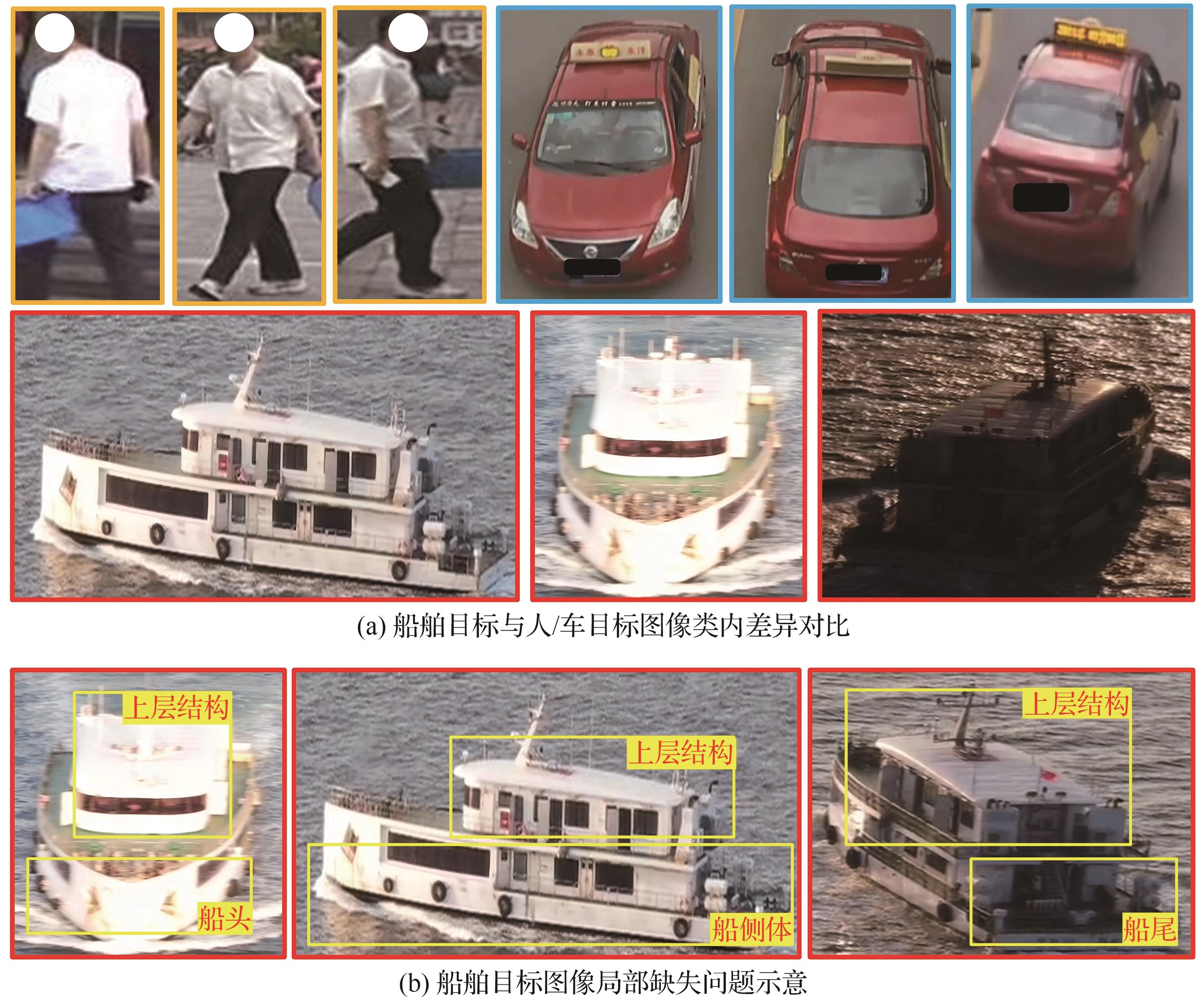
Fig.2
Illustration of proposed MCFormer
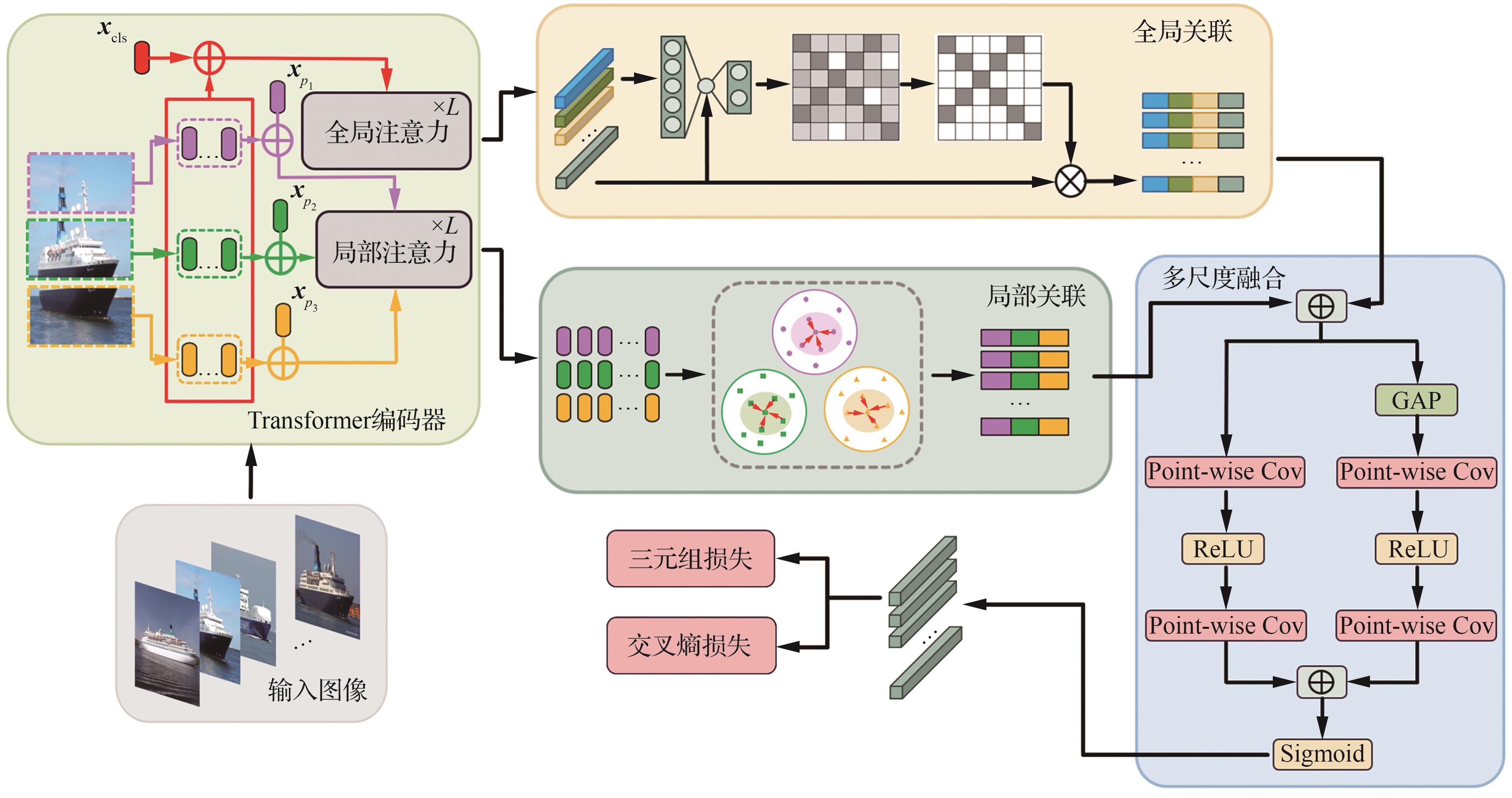

Table 1
Statistics of datasets
| 数据集 | 身份数量 | 图像数量 |
|---|---|---|
| VesselReID | 1 248 | 30 587 |
| Warships-ReID | 163 | 4 780 |
| BoatRe-ID | 107 | 5 523 |
| AirRGBShipReID | 138 | 3 209 |
Table 2
Comparison results on VesselReID dataset
| 方法 | R1/% | R5/% | R10/% | mAP/% |
|---|---|---|---|---|
| BNN[ | 63.8 | 85.3 | 90.9 | 50.7 |
| PAT[ | 66.2 | 85.7 | 90.9 | 53.9 |
| MCL[ | 63.9 | 82.1 | 88.9 | 45.3 |
| Trans-Reid[ | 68.2 | 86.3 | 91.1 | 58.7 |
| PFD-Net[ | 66.1 | 84.9 | 90.2 | 49.2 |
| AP-Net[ | 62.6 | 83.3 | 89.6 | 50.1 |
| Tran-Aligned[ | 64.3 | 82.8 | 89.4 | 51.8 |
| MVIIP[ | 71.2 | 87.3 | 91.7 | 60.8 |
| IMCL[ | 64.1 | 82.6 | 89.5 | 52.4 |
| SwinReID[ | 70.7 | 86.5 | 92.8 | 62.3 |
| SwinTransReID[ | 71.6 | 89.2 | 93.3 | 59.9 |
| MCFormer | 72.8 | 88.9 | 93.1 | 63.4 |
Table 3
Comparison results on Warships-ReID dateset
| 方法 | R1/% | R5/% | R10/% | mAP/% |
|---|---|---|---|---|
| BNN[ | 87.5 | 95.8 | 95.8 | 70.3 |
| PAT[ | 91.5 | 96.3 | 96.6 | 75.2 |
| MCL[ | 86.1 | 91.1 | 91.9 | 56.9 |
| Trans-Reid[ | 92.1 | 97.4 | 97.4 | 77.1 |
| PFD-Net[ | 90.5 | 96.5 | 96.5 | 73.9 |
| AP-Net[ | 82.9 | 97.1 | 97.1 | 53.2 |
| Tran-Aligned[ | 88.6 | 97.1 | 97.1 | 62.5 |
| MVIIP[ | 94.2 | 97.4 | 97.4 | 82.7 |
| IMCL[ | 88.3 | 95.4 | 97.1 | 66.4 |
| SwinReID[ | 93.7 | 97.1 | 97.4 | 86.6 |
| SwinTransReID[ | 95.0 | 98.1 | 98.1 | 84.7 |
| MCFormer | 96.1 | 98.1 | 98.1 | 88.4 |
Table 4
Comparison results on BoatRe-ID dateset
| 方法 | R1/% | mAP/% |
|---|---|---|
| BNN[ | 96.5 | 89.6 |
| PAT[ | 97.9 | 90.6 |
| MCL[ | 85.0 | 63.6 |
| Trans-Reid[ | 98.2 | 92.1 |
| PFD-Net[ | 96.3 | 90.3 |
| AP-Net[ | 95.9 | 89.2 |
| Tran-Aligned[ | 97.5 | 91.1 |
| MVIIP[ | 98.4 | 92.6 |
| IMCL[ | 95.2 | 90.5 |
| SwinReID[ | 98.5 | 93.2 |
| SwinTransReID[ | 98.5 | 93.1 |
| MCFormer | 98.8 | 93.5 |
Table 5
Comparison results on AirRGBShipReID dateset
| 方法 | R1/% | mAP/% |
|---|---|---|
| BNN[ | 85.6 | 64.2 |
| PAT[ | 91.2 | 72.7 |
| MCL[ | 81.8 | 55.4 |
| Trans-Reid[ | 90.7 | 72.1 |
| PFD-Net[ | 88.2 | 68.4 |
| AP-Net[ | 86.2 | 64.7 |
| Tran-Aligned[ | 88.4 | 67.9 |
| MVIIP[ | 91.8 | 72.7 |
| IMCL[ | 87.3 | 66.5 |
| SwinReID[ | 91.5 | 72.5 |
| SwinTransReID[ | 91.8 | 72.5 |
| MCFormer | 92.8 | 73.2 |
Fig.3
Visualization of association results
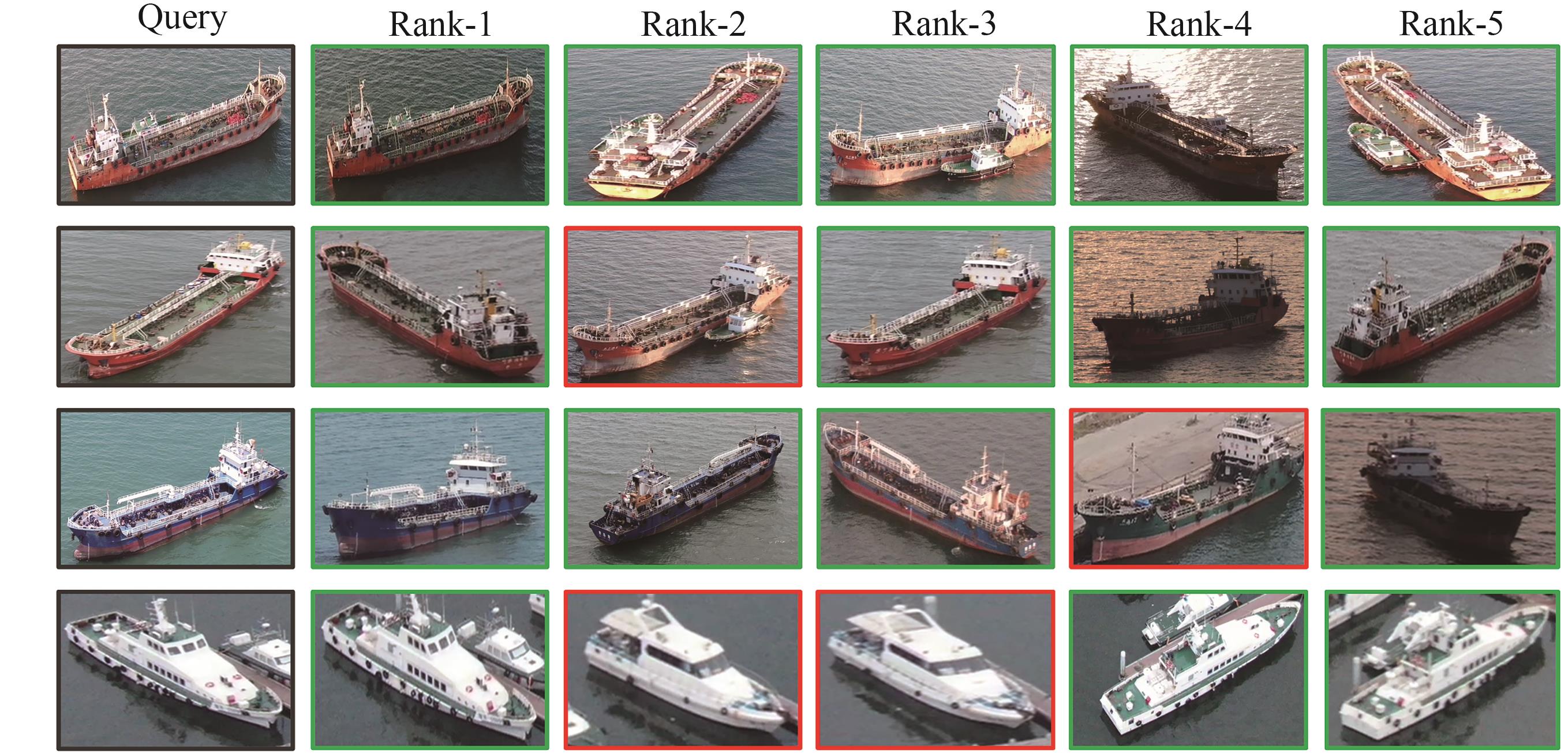
Table 6
Comparison results on inference efficiency
| 类型 | 方法 | R1/% | mAP/% | Lat/ms | FPS/张 |
|---|---|---|---|---|---|
CNN Based | BNN | 63.8 | 50.7 | 4.9 | 203.7 |
| Tran-Aligned | 64.3 | 51.8 | 6.8 | 147.1 | |
| MVIIP | 71.2 | 60.8 | 5.7 | 175.2 | |
Tansf-ormer Based | Trans-Reid | 68.2 | 58.7 | 13.6 | 73.6 |
| PAT | 66.2 | 53.9 | 17.6 | 56.8 | |
| SwinReID | 70.7 | 62.3 | 16.6 | 60.2 | |
| SwinTransReID | 71.6 | 59.9 | 16.3 | 61.4 | |
| 本文方法 | MCFormer | 72.8 | 63.4 | 19.2 | 52.1 |
| MCFormer* | 71.5 | 62.5 | 15.3 | 65.3 | |
| MCFormer+ | 70.5 | 60.9 | 5.2 | 190.8 |
Table 7
Effectiveness of main components of MCFormer
| 模型配置 | VesselReID | Warships-ReID | ||
|---|---|---|---|---|
| R1/% | mAP/% | R1/% | mAP/% | |
| Baseline | 66.7 | 54.5 | 91.7 | 77.2 |
| Baseline+GCM | 70.2 | 62.2 | 95.8 | 87.3 |
| Baseline+LCM | 70.3 | 57.0 | 92.9 | 78.2 |
| 完整MCFormer | 72.8 | 63.4 | 96.1 | 88.4 |
Fig.4
Attention maps visualization under different component settings
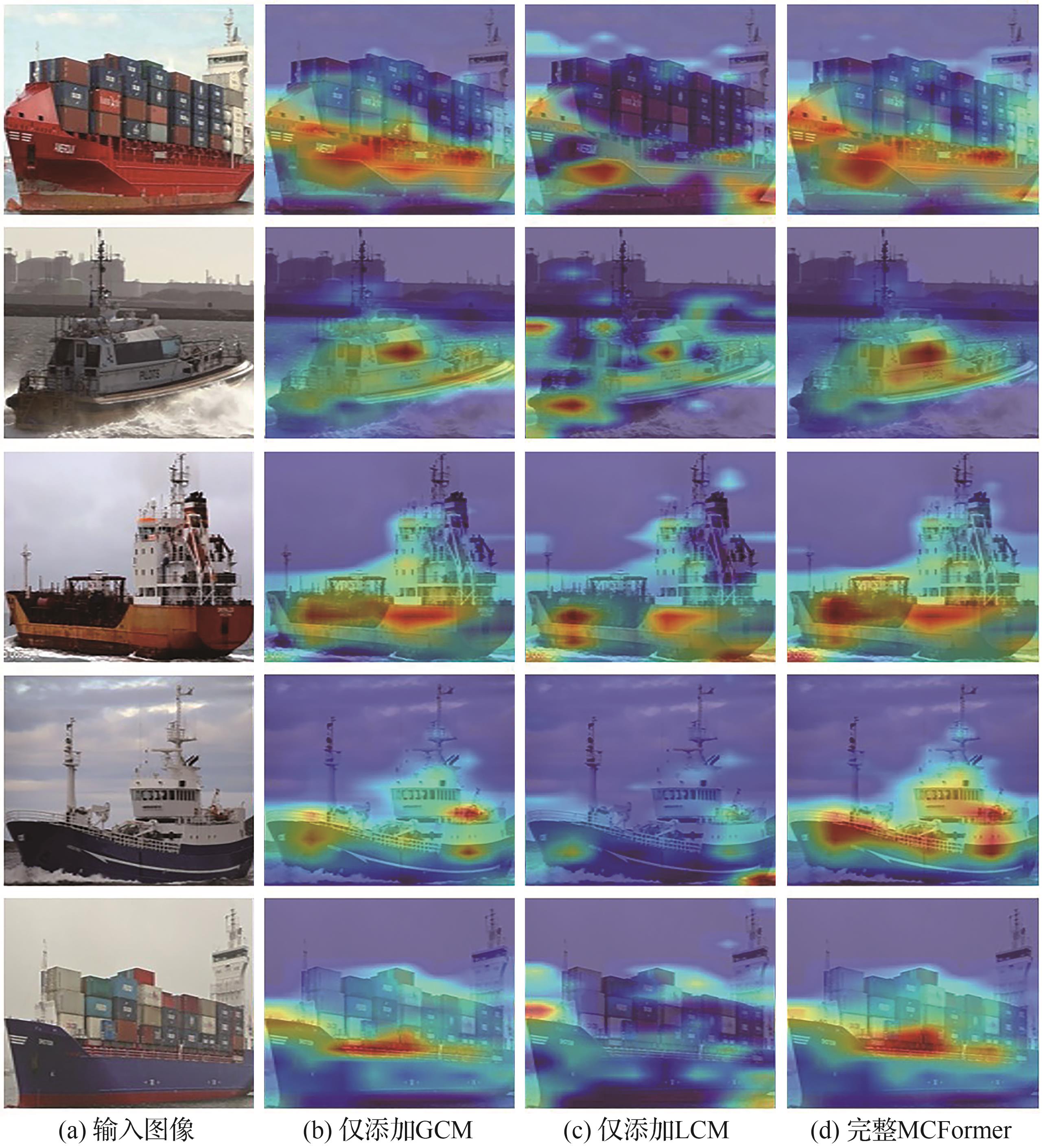
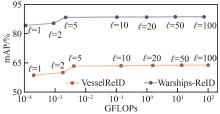
Fig.5
Effectiveness of landmarks in GCM
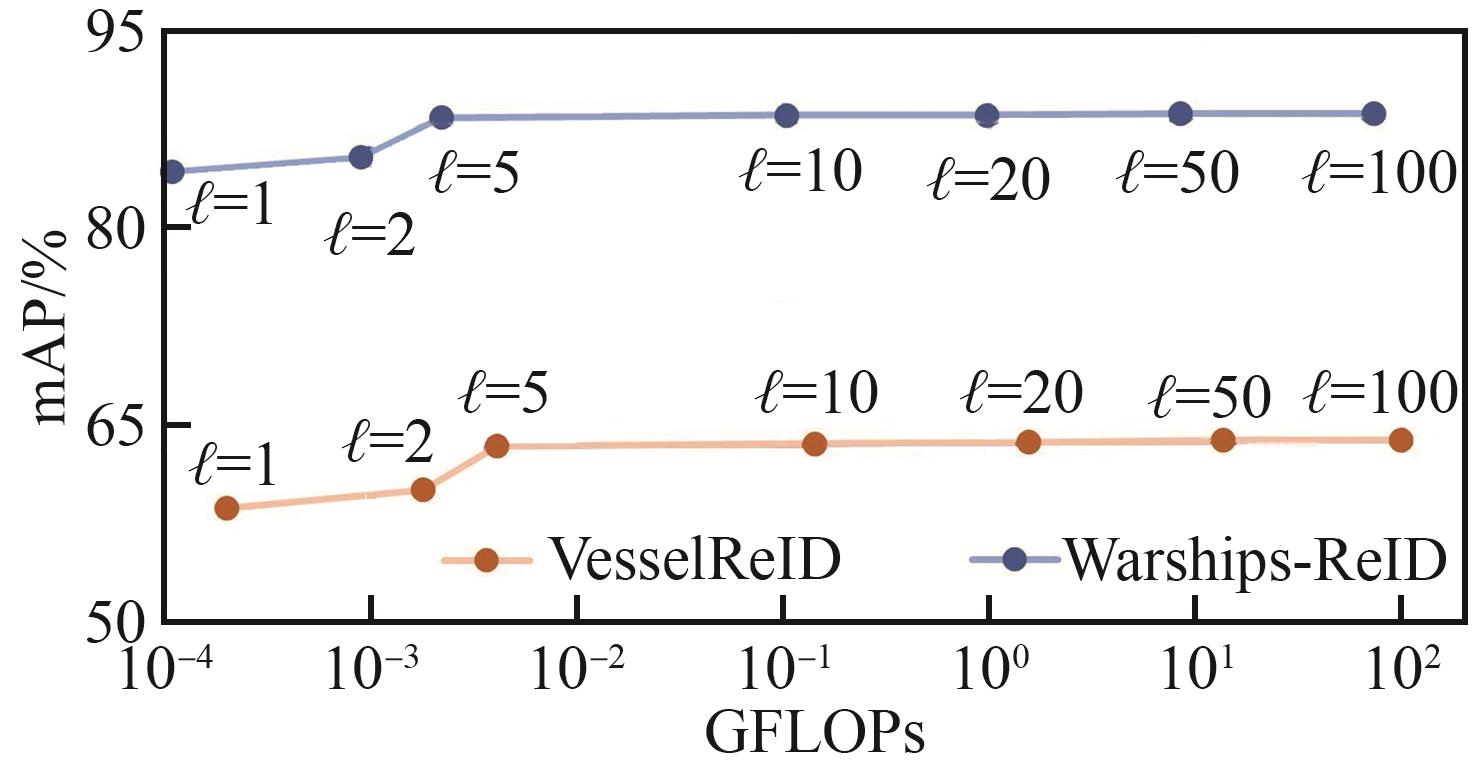
Table 8
Effectiveness of local clustering loss in LCM
| 损失函数 | VesselReID | Warships-ReID | ||
|---|---|---|---|---|
| R1/% | mAP/% | R1/% | mAP/% | |
| Baseline | 66.7 | 54.5 | 91.7 | 77.2 |
| +标准中心损失 | 68.2 | 55.8 | 92.1 | 77.5 |
| +标准聚类损失 | 64.5 | 52.7 | 89.9 | 76.1 |
| +局部聚类损失 | 70.3 | 57.0 | 92.9 | 78.2 |
Table 9
Effectiveness of local parts in LCM
| 局部划分数 | VesselReID | Warships-ReID | ||
|---|---|---|---|---|
| R1/% | mAP/% | R1/% | mAP/% | |
| 2 | 70.9 | 61.6 | 94.8 | 87.1 |
| 3 | 72.8 | 63.4 | 96.1 | 88.4 |
| 4 | 71.6 | 62.5 | 95.6 | 87.8 |
| 5 | 71.6 | 62.7 | 95.6 | 87.9 |
Table 10
Effectiveness of fusion strategies
| 融合策略 | VesselReID | Warships-ReID | ||
|---|---|---|---|---|
| R1/% | mAP/% | R1/% | mAP/% | |
| 直接相加 | 69.2 | 59.5 | 93.3 | 84.5 |
| 拼接后线性投影 | 70.1 | 61.0 | 95.8 | 86.2 |
| 多尺度通道注意力 | 72.8 | 63.4 | 96.1 | 88.4 |
| [1] | JIA Z Y, ZHU Y A, WU Q H, et al. Remote ID based UAV collision avoidance optimization for low-altitude airspace safety[J]. Chinese Journal of Aeronautics, 2025: 103841. |
| [2] | REN K, DING L, WAN M J, et al. Target localization based on cross-view matching between UAV and satellite[J]. Chinese Journal of Aeronautics, 2022, 35(9): 333-341. |
| [3] | JIN R J, WANG K, LI Z, et al. SAA-O2DINO: Oriented object detection transformer with improved denoising anchor boxes and shape-adaptive assigner[J]. Chinese Journal of Aeronautics, 2025: 103782. |
| [4] | WANG Y, LI H G, LI X J, et al. UAV image target localization method based on outlier filter and frame buffer[J]. Chinese Journal of Aeronautics, 2024, 37(7): 375-390. |
| [5] | WEN Z D, WU J H, LV Y F, et al. Cross-modality vessel re-identification with deep alignment decomposition network[J]. IEEE Transactions on Multimedia, 2024, 26: 10318-10330. |
| [6] | ZHANG Q, YAN Y M, GAO L, et al. A third-modality collaborative learning approach for visible-infrared vessel reidentification[J]. IEEE Journal of Selected Topics in Applied Earth Observations and Remote Sensing, 2024, 17: 19035-19047. |
| [7] | LU Z, SUN L G, LV P, et al. A new large-scale dataset for marine vessel re-identification based on Swin transformer network in ocean surveillance scenario[J]. IET Computer Vision, 2025, 19(1): e70007. |
| [8] | 熊振宇, 崔亚奇, 董凯, 等. 基于属性引导的多源遥感舰船目标可解释融合关联网络[J]. 航空学报, 2023, 44(22): 627476. |
| XIONG Z Y, CUI Y Q, DONG K, et al. Interpretable fusion association network for multi-source remote sensing ship target based on attribute guidance[J]. Acta Aeronautica et Astronautica Sinica, 2023, 44(22): 627476 (in Chinese). | |
| [9] | LU F, LAN X Y, ZHANG L J, et al. CricaVPR: Cross-image correlation-aware representation learning for visual place recognition[C]∥2024 IEEE/CVF Conference on Computer Vision and Pattern Recognition (CVPR). Piscataway: IEEE Press, 2024: 16772-16782. |
| [10] | ZHANG B, YUAN J K, LI B P, et al. Learning cross-image object semantic relation in transformer for few-shot fine-grained image classification[C]∥Proceedings of the 30th ACM International Conference on Multimedia. New York: ACM, 2022: 2135-2144. |
| [11] | HAN X R, CHEN Z Q, WANG R X, et al. Joint label refinement and contrastive learning with hybrid memory for unsupervised marine object re-identification[C]∥Proceedings of the 3rd ACM International Conference on Multimedia in Asia. New York: ACM, 2022. |
| [12] | WANG H, LI S Y, YANG J, et al. Cross-modal ship re-identification via optical and SAR imagery: A novel dataset and method[DB/OL]. arXiv preprint: 2506.22027, 2025. |
| [13] | DOU W H, ZHU L M, WANG Y, et al. Research on key technology of ship re-identification based on the USV-UAV collaboration[J]. Drones, 2023, 7(9): 590. |
| [14] | SPAGNOLO P, FILIERI F, DISTANTE C, et al. A new annotated dataset for boat detection and re-identification[C]∥2019 16th IEEE International Conference on Advanced Video and Signal Based Surveillance (AVSS). Piscataway: IEEE Press, 2019: 1-7. |
| [15] | ZENG G M, WANG R J, YU W N, et al. A transfer learning-based approach to maritime warships re-identification[J]. Engineering Applications of Artificial Intelligence, 2023, 125: 106696. |
| [16] | ZHANG Q, ZHANG M X, LIU J H, et al. Unsupervised maritime vessel re-identification with multi-level contrastive learning[J]. IEEE Transactions on Intelligent Transportation Systems, 2023, 24(5): 5406-5418. |
| [17] | XU C A, GAO L, LIU Y, et al. CMShipReID: A cross-modality ship dataset for the reidentification task[J]. IEEE Journal of Selected Topics in Applied Earth Observations and Remote Sensing, 2025, 18: 10503-10513. |
| [18] | LI Y P, LIU Y Z, ZHANG H Y, et al. Occlusion-aware transformer with second-order attention for person re-identification[J]. IEEE Transactions on Image Processing, 2024, 33: 3200-3211. |
| [19] | LI Y P, MIAO D Q, ZHANG H Y, et al. Multi-granularity cross transformer network for person re-identification[J]. Pattern Recognition, 2024, 150: 110362. |
| [20] | ZHENG X T, HUANG X H, JI C, et al. Multi-modal person re-identification based on transformer relational regularization[J]. Information Fusion, 2024, 103: 102128. |
| [21] | 王潇, 刘贞报. 基于多层多向Transformer的红外弱小目标检测[J]. 航空学报, 2024, 45(14): 629490. |
| WANG X, LIU Z B. Infrared small target detection based on multi-layer multi-direction transformer[J]. Acta Aeronautica et Astronautica Sinica, 2024, 45(14): 629490 (in Chinese). | |
| [22] | 刘芳, 卢晨阳, 路言, 等. 基于自适应模板更新的Transformer无人机目标跟踪算法[J]. 航空学报, 2025, 46(16): 331687. |
| LIU F, LU C Y, LU Y, et al. Adaptive template update-based Transformer algorithm for UAV target tracking[J]. Acta Aeronautica et Astronautica Sinica, 2025, 46(16): 331687 (in Chinese). | |
| [23] | HE S T, LUO H, WANG P C, et al. TransReID: Transformer-based object re-identification[C]∥2021 IEEE/CVF International Conference on Computer Vision (ICCV). Piscataway: IEEE Press, 2022: 14993-15002. |
| [24] | NI H, LI Y K, GAO L L, et al. Part-aware transformer for generalizable person re-identification[C]∥2023 IEEE/CVF International Conference on Computer Vision (ICCV). Piscataway: IEEE Press, 2024: 11246-11255. |
| [25] | WANG H C, SHEN J Y, LIU Y T, et al. NFormer: Robust person re-identification with neighbor transformer[C]∥2022 IEEE/CVF Conference on Computer Vision and Pattern Recognition (CVPR). Piscataway: IEEE Press, 2022: 7287-7297. |
| [26] | ZHANG Z, ZHANG H J, LIU S. Person re-identification using heterogeneous local graph attention networks[C]∥2021 IEEE/CVF Conference on Computer Vision and Pattern Recognition (CVPR). Piscataway: IEEE Press, 2021: 12131-12140. |
| [27] | ZHU H W, KE W J, LI D, et al. Dual cross-attention learning for fine-grained visual categorization and object re-identification[C]∥2022 IEEE/CVF Conference on Computer Vision and Pattern Recognition (CVPR). Piscataway: IEEE Press, 2022: 4682-4692. |
| [28] | DOSOVITSKIY A, BEYER L, KOLESNIKOV A, et al. An image is worth 16x16 words: Transformers for image recognition at scale[DB/OL]. arXiv Preprint: 2010.11929, 2020. |
| [29] | SUN Y F, ZHENG L, YANG Y, et al. Beyond part models: Person retrieval with refined part pooling (and a strong convolutional baseline)[C]∥Computer Vision – ECCV 2018. Cham: Springer, 2018: 501-518. |
| [30] | WANG T, LIU H, SONG P H, et al. Pose-guided feature disentangling for occluded person re-identification based on transformer[J]. Proceedings of the AAAI Conference on Artificial Intelligence, 2022, 36(3): 2540-2549. |
| [31] | CHEN G Y, GU T P, LU J W, et al. Person re-identification via attention pyramid[J]. IEEE Transactions on Image Processing, 2021, 30: 7663-7676. |
| [32] | DONG N, YAN S L, TANG H, et al. Multi-view information integration and propagation for occluded person re-identification[J]. Information Fusion, 2024, 104: 102201. |
| [33] | XU H, HUANG L H, CHEN Y T, et al. Unsupervised military-civilian cross-domain vessel re-identification using improved momentum contrast learning[C]∥2024 International Conference on New Trends in Computational Intelligence (NTCI). Piscataway: IEEE Press, 2024: 106-110. |
| [34] | ARAIN T ALI, ZHANG P C, MENG Q, et al. Swin transformer with attention mechanism: A novel framework for person re-identification[J]. Pattern Analysis and Applications, 2025, 28(2): 95. |
| [35] | WEN Y D, ZHANG K P, LI Z F, et al. A discriminative feature learning approach for deep face recognition[C]∥Computer Vision-ECCV 2016. Cham: Springer, 2016: 499-515. |
| [36] | DAI Z Z, WANG G Y, YUAN W H, et al. Cluster contrast for unsupervised person re-identification[C]∥Computer Vision-ACCV 2022. Cham: Springer, 2023: 319-337. |
| [1] | Zijian XIANG, Zhenyu MA, Xixiang YANG. Inversion of structural performance parameters of composite materials based on deep learning [J]. Acta Aeronautica et Astronautica Sinica, 2025, 46(24): 231877-231877. |
| [2] | Baoquan SHI, Jiaming ZHOU, Wendong ZHANG, Xianmin CHEN, Qian HE. A network for fatigue crack segmentation and quantification using frequency-domain enhancement and linear attention mechanism [J]. Acta Aeronautica et Astronautica Sinica, 2025, 46(21): 532356-532356. |
| [3] | Bin SUN, Hang YOU, Wenbo LI, Xiangrui LIU, Jiayi MA. Dual-band payload image fusion and its applications in low-altitude remote sensing [J]. Acta Aeronautica et Astronautica Sinica, 2025, 46(11): 531343-531343. |
| [4] | Yanfang LIU, Jiayu SHE, Qiufan YUAN, Rui ZHOU, Naiming QI. Real⁃time small target detection networks for UAV remote sensing [J]. Acta Aeronautica et Astronautica Sinica, 2024, 45(14): 630119-630119. |
| [5] | Aoze YU, Weiwei WEI, Ping WANG, Jinqiang ZHANG, Wenxiong KE. Small target detection algorithm for UAV based on patch⁃wise co⁃attention [J]. Acta Aeronautica et Astronautica Sinica, 2024, 45(14): 629148-629148. |
| [6] | Zhiqiang FENG, Zhijun XIE, Zhengwei BAO, Kewei CHEN. Real⁃time dense small object detection algorithm for UAV based on improved YOLOv5 [J]. ACTA AERONAUTICAET ASTRONAUTICA SINICA, 2023, 44(7): 327106-327106. |
| [7] | Guotao MAO, Tianmin DENG, Nanjing YU. Object detection in UAV images based on multi-scale split attention [J]. ACTA AERONAUTICAET ASTRONAUTICA SINICA, 2023, 44(5): 326738-326738. |
| [8] | Yi ZHANG, Yan ZHANG, Yu ZHANG, Yong ZHANG, Di LIU. Infrared aircraft target detection method based on multi-level feature enhancement fusion [J]. Acta Aeronautica et Astronautica Sinica, 2023, 44(22): 629220-629220. |
| [9] | Xiaohang LI, Jianjiang ZHOU. Multi⁃scale modality fusion network based on adaptive memory length [J]. Acta Aeronautica et Astronautica Sinica, 2023, 44(22): 628977-628977. |
| [10] | Yuanliang XUE, Guodong JIN, Lining TAN, Jiankun XU. Adaptive UAV target tracking algorithm based on multi-scale fusion [J]. ACTA AERONAUTICAET ASTRONAUTICA SINICA, 2023, 44(1): 326107-326107. |
| [11] | LIU Fang, SUN Yanan. UAV target tracking algorithm based on adaptive fusion network [J]. ACTA AERONAUTICAET ASTRONAUTICA SINICA, 2022, 43(7): 325522-325522. |
| [12] | LIU Fang, HAN Xiao. Adaptive aerial object detection based on multi-scale deep learning [J]. ACTA AERONAUTICAET ASTRONAUTICA SINICA, 2022, 43(5): 325270-325270. |
| [13] | LIU Chuankai, LI Dongsheng, XIE Jianfeng, LEI Junxiong, YUAN Chunqiang, HE Ximing. Multi-feature fusion based vision locating method for lunar surface sampling teleoperation [J]. ACTA AERONAUTICAET ASTRONAUTICA SINICA, 2022, 43(12): 326296-326296. |
| [14] | SHI Binbin, CHEN Zhehan. Defect detection method of powder bed based on image feature fusion [J]. ACTA AERONAUTICAET ASTRONAUTICA SINICA, 2021, 42(10): 524430-524430. |
| [15] | MA Xu, CHENG Yongmei, HAO Shuai, CHEN Kezhe, WANG Tao. Dense point feature generation algorithm based on monocular sequence images for depth measurement of unknown zone [J]. ACTA AERONAUTICAET ASTRONAUTICA SINICA, 2015, 36(2): 596-604. |
| Viewed | ||||||
|
Full text |
|
|||||
|
Abstract |
|
|||||
Address: No.238, Baiyan Buiding, Beisihuan Zhonglu Road, Haidian District, Beijing, China
Postal code : 100083
E-mail:hkxb@buaa.edu.cn
Total visits: 6658907 Today visits: 1341All copyright © editorial office of Chinese Journal of Aeronautics
All copyright © editorial office of Chinese Journal of Aeronautics
Total visits: 6658907 Today visits: 1341

 CJA
CJA
