Acta Aeronautica et Astronautica Sinica ›› 2026, Vol. 47 ›› Issue (15): 333077.doi: 10.7527/S1000-6893.2025.33077
• Electronics and Electrical Engineering and Control • Previous Articles
Shuo HE1,2,3, Jialin LIU1, Ao SHEN1, Saisai ZHU1, Yuanyuan JIN1,2,3, Lulu LI1,2,3, Yafei LI1,2,3, Mingliang XU1,2,3( )
)
Received:2025-11-11
Revised:2025-11-26
Accepted:2025-12-09
Online:2025-12-17
Published:2025-12-15
Contact:
Mingliang XU
E-mail:iexumingliang@zzu.edu.cn
Supported by:CLC Number:
Shuo HE, Jialin LIU, Ao SHEN, Saisai ZHU, Yuanyuan JIN, Lulu LI, Yafei LI, Mingliang XU. Multi-stage collaborative decision-making approach for dynamic scheduling of carrier-based aircraft support operations[J]. Acta Aeronautica et Astronautica Sinica, 2026, 47(15): 333077.
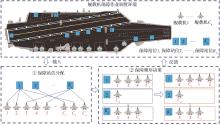
Fig. 1
Illustration of multi-stage collaborative scheduling scenario for carrier-based aircraft support operations
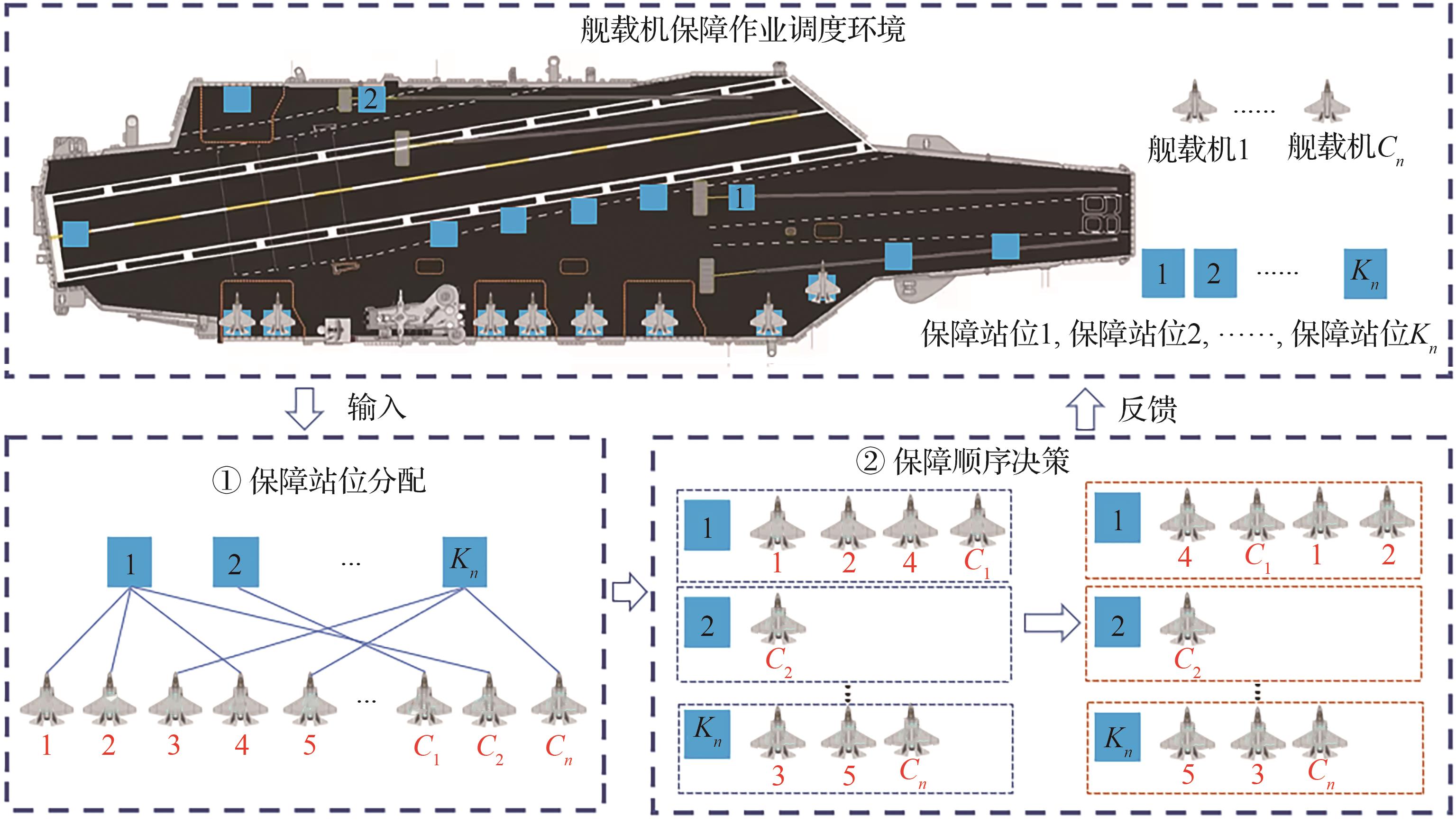
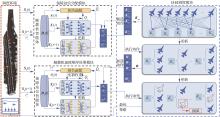
Fig.2
Multi-agent collaborative decision-making framework based on independent deep Q-network
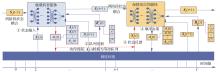
Fig.3
Illustration of multi-agent collaborative scheduling mechanism
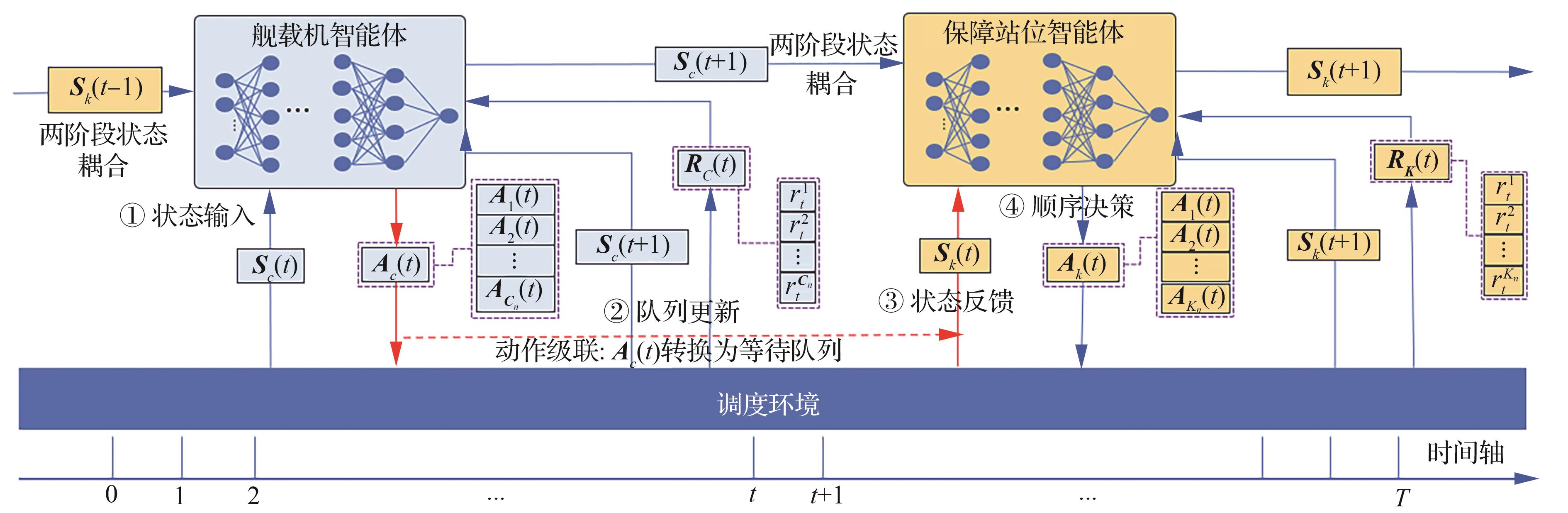

Table 1
Experimental parameters
| 参数符号 | 参数定义 | 数值 |
|---|---|---|
| Cn | 舰载机数量 | 8,10,12,14,16,21 |
| 保障站位数量 | 8,10,11,12,14,16 | |
| 保障作业数量 | 4,5,6,7,8,10 | |
学习率 (舰载机/保障站位智能体) | 1/1 | |
| y | 折扣因子 (舰载机/保障站位智能体) | 0.99/0.99 |
初始探索率 (舰载机/保障站位智能体) | 1.0/1.0 | |
最小探索率 (舰载机/保障站位智能体) | 0.1/0.1 | |
探索率衰减系数 (舰载机/保障站位智能体) | 0.995/0.995 | |
目标网络软更新系数 (舰载机/保障站位智能体) | 0.005/0.005 | |
经验回放池容量 (舰载机/保障站位智能体) | 50/50 | |
经验批量大小 (舰载机/保障站位智能体) | 128/128 |

Fig.4
Process of support operations

Table 2
Details of carrier-based aircraft support operations
| 作业序号 | 可用保障站位 |
|---|---|
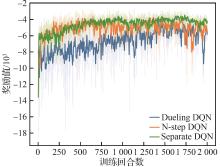
Fig.5
Comparison of reward values
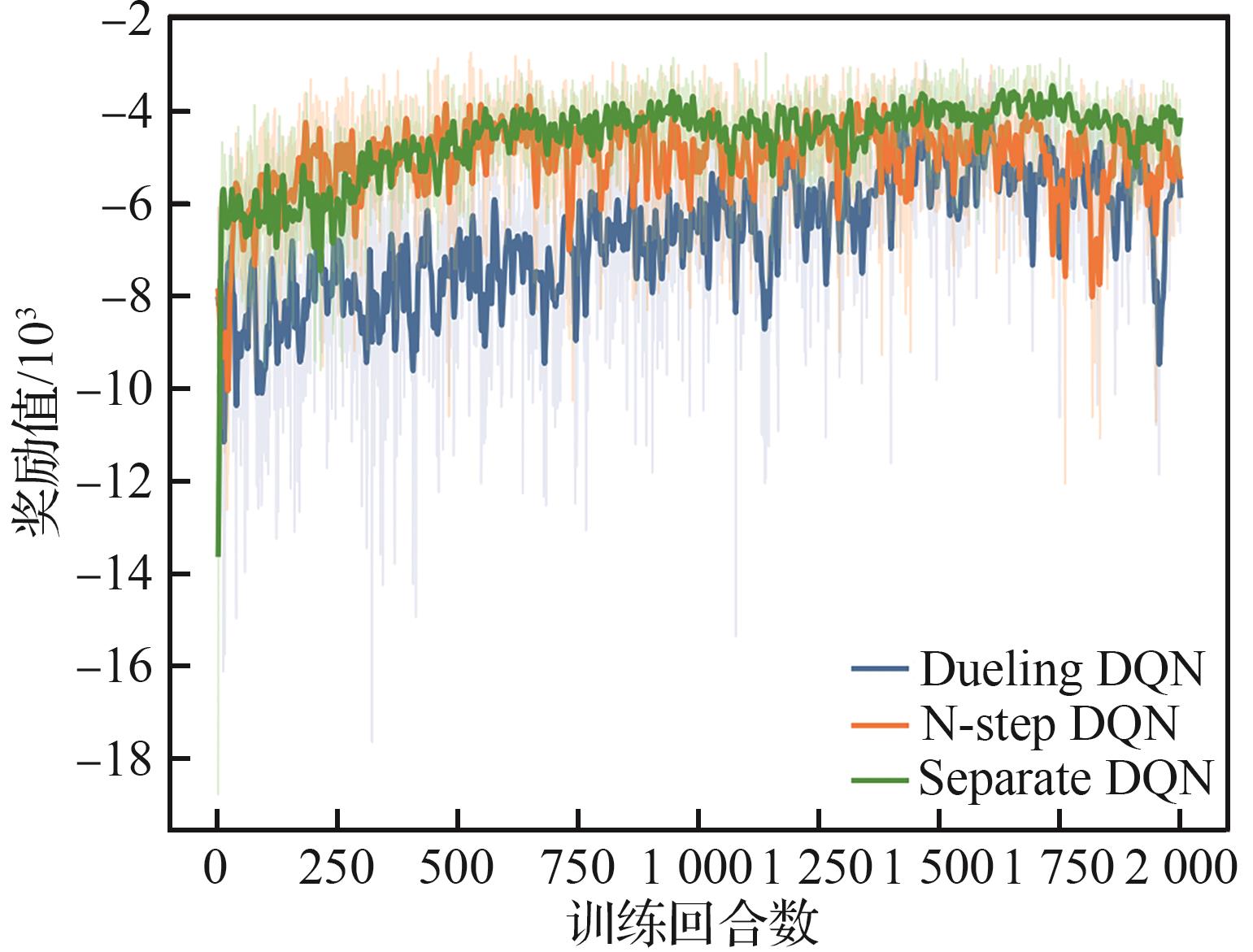
Fig.6
Gantt chart of scheduling scheme for carrier-based aircraft support operations under Separate DQN
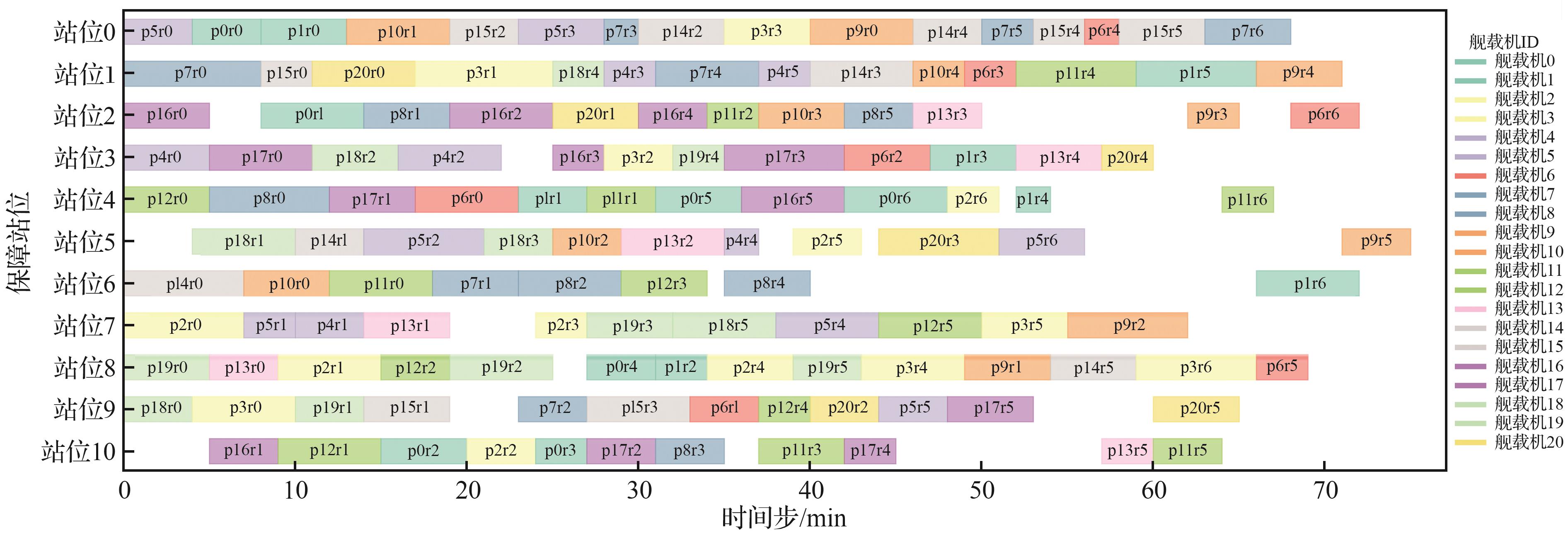
Fig.7
Gantt chart of scheduling scheme for carrier-based aircraft support operations under Dueling DQN algorithm
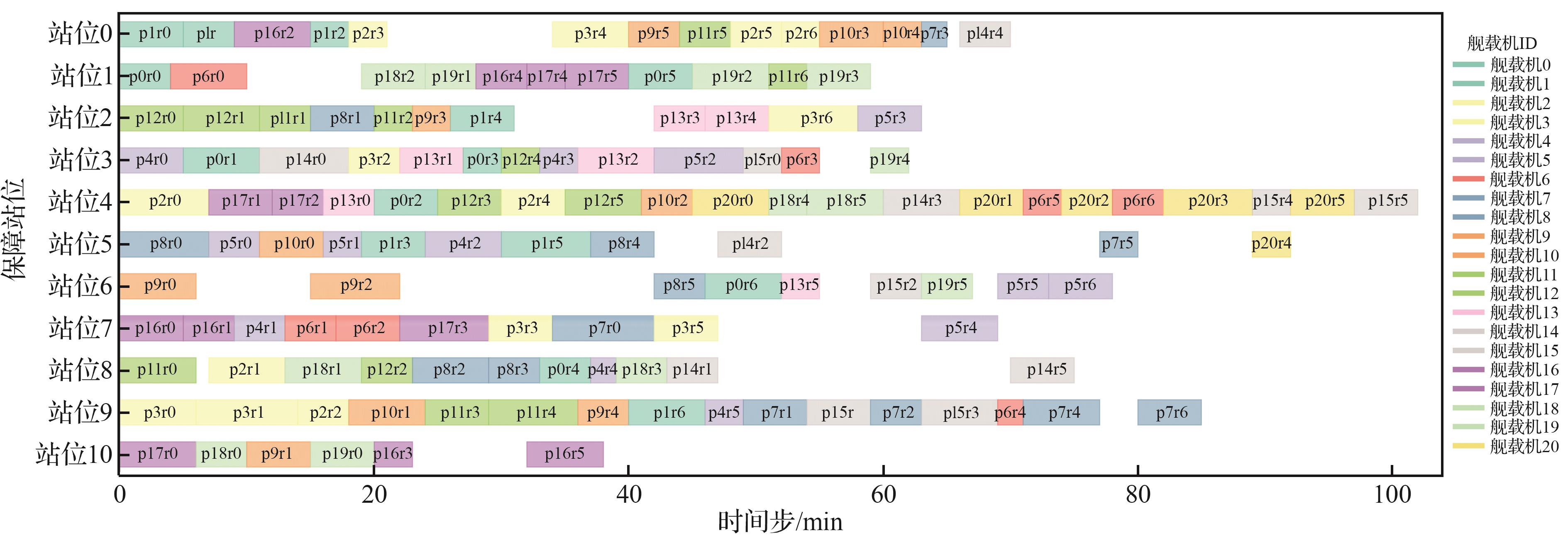
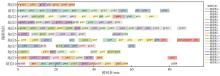
Fig.8
Gantt chart of scheduling scheme for carrier-based aircraft support operations under N-step DQN algorithm
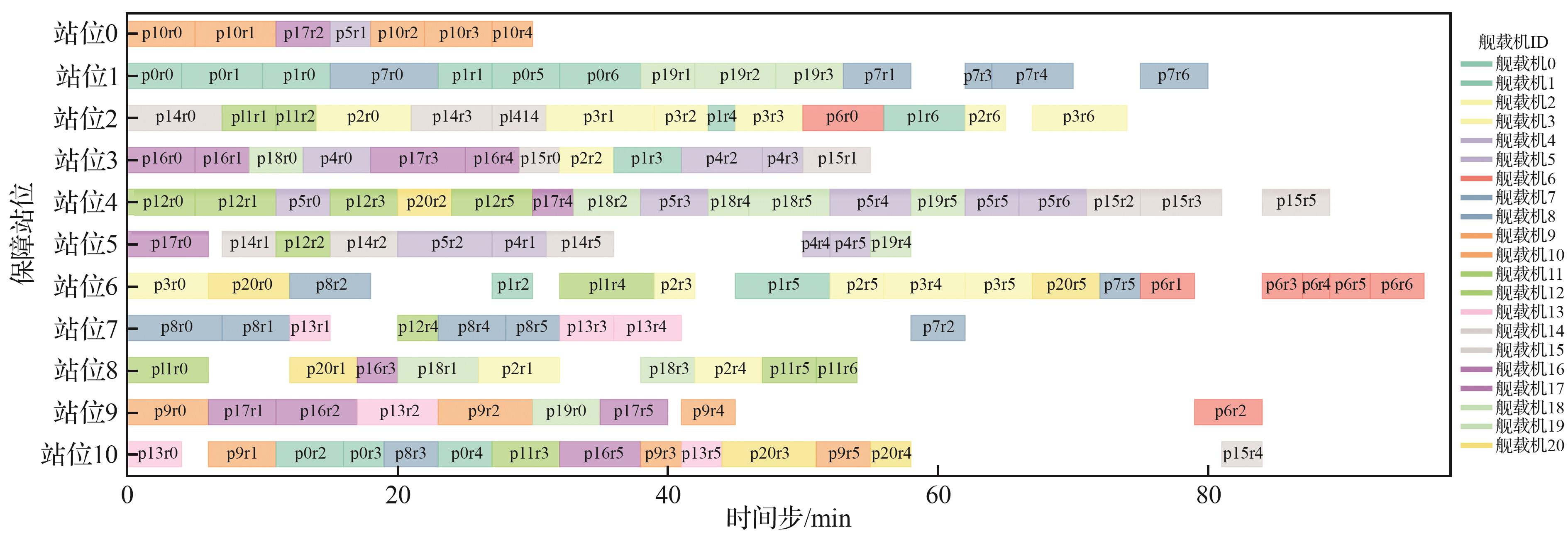
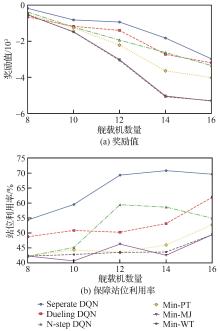
Fig.9
Performance comparison of six algorithms under different numbers of carrier-based aircraft
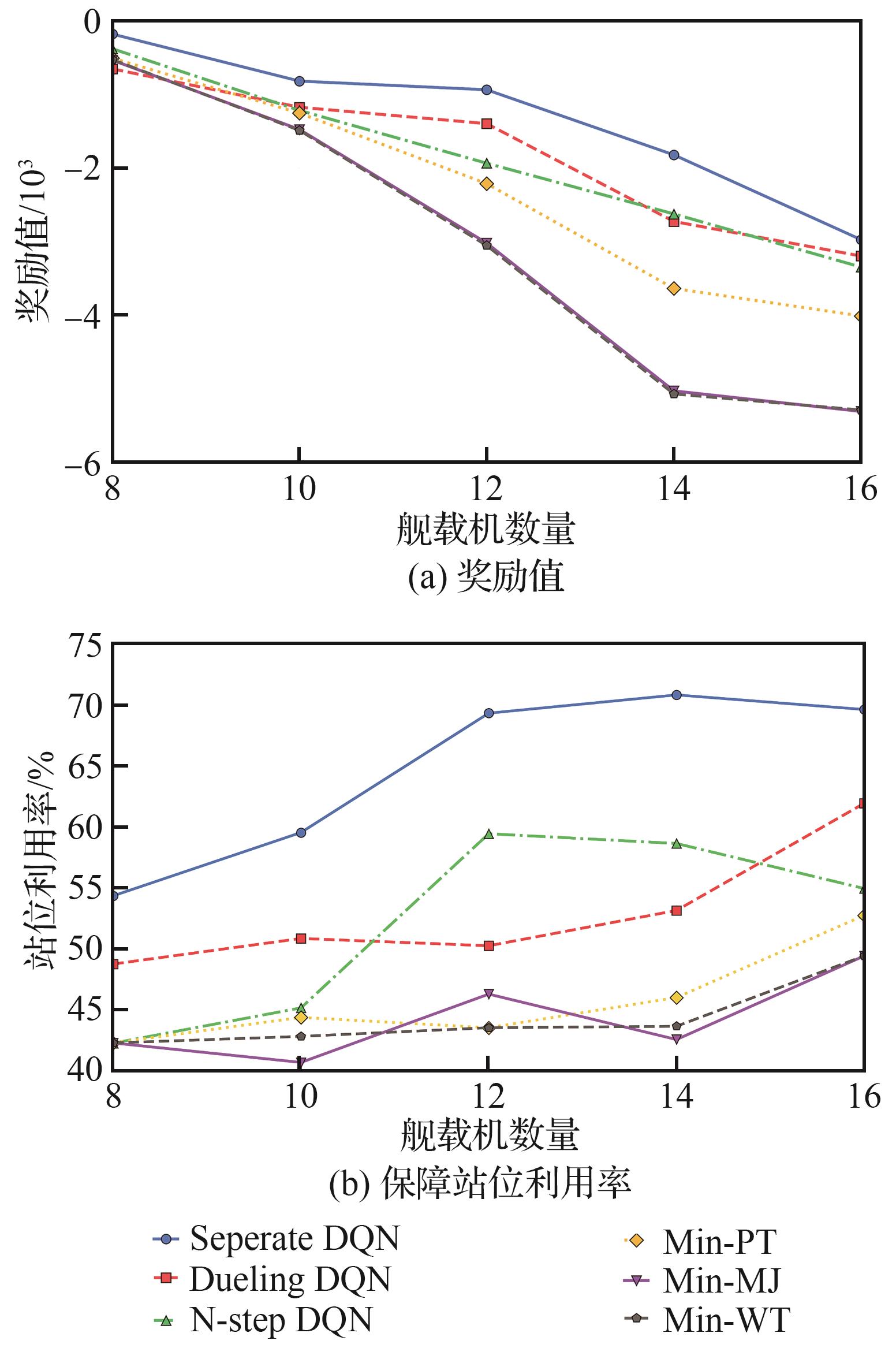
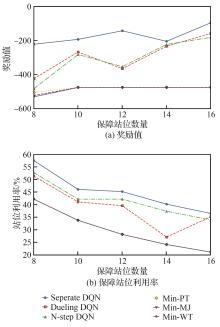
Fig.10
Performance comparison of six algorithms under different numbers of available support stations
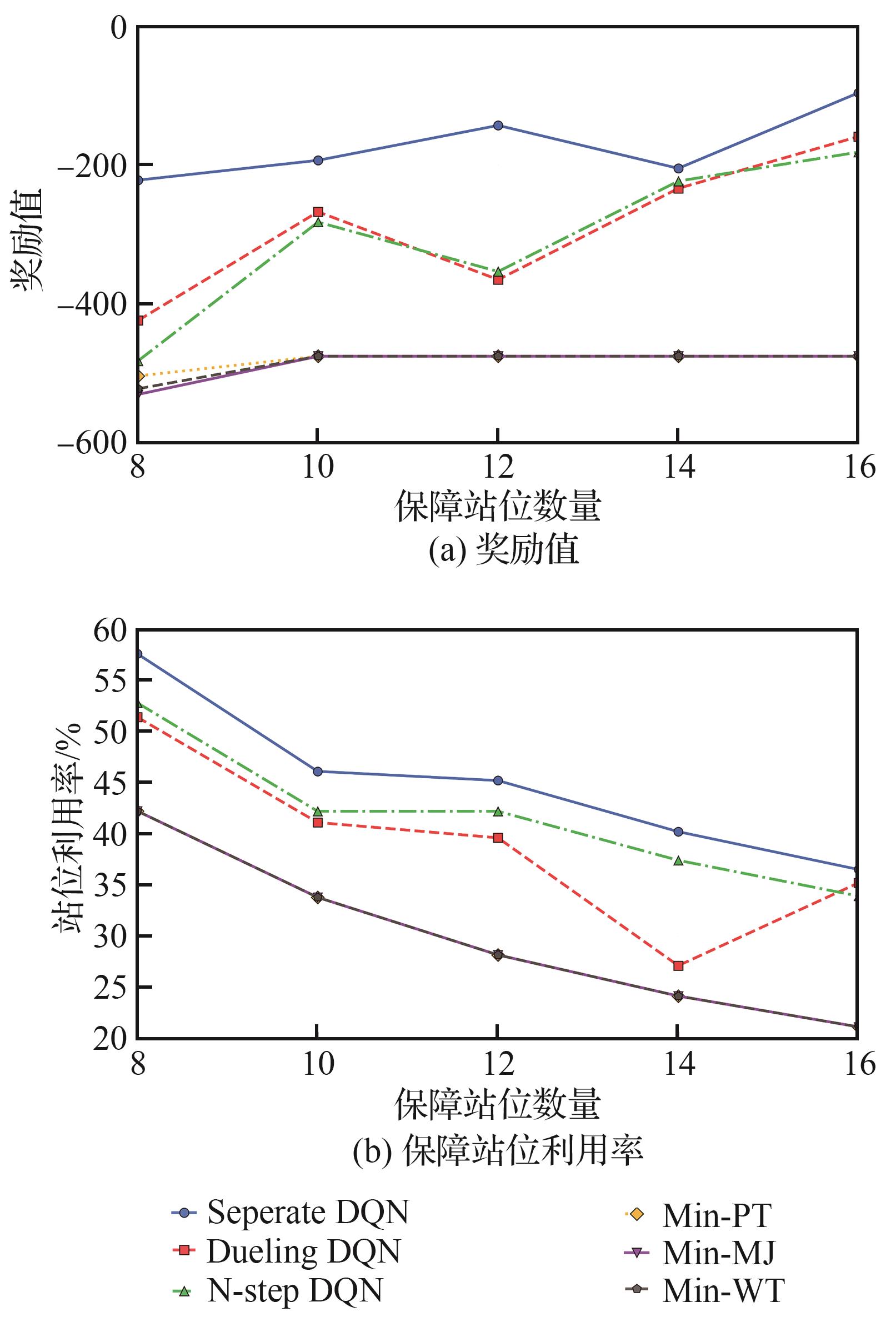
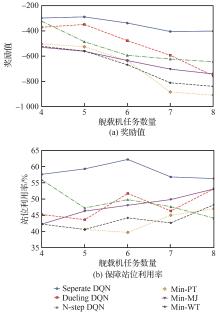
Fig.11
Performance comparison of six algorithms under different numbers of support operations
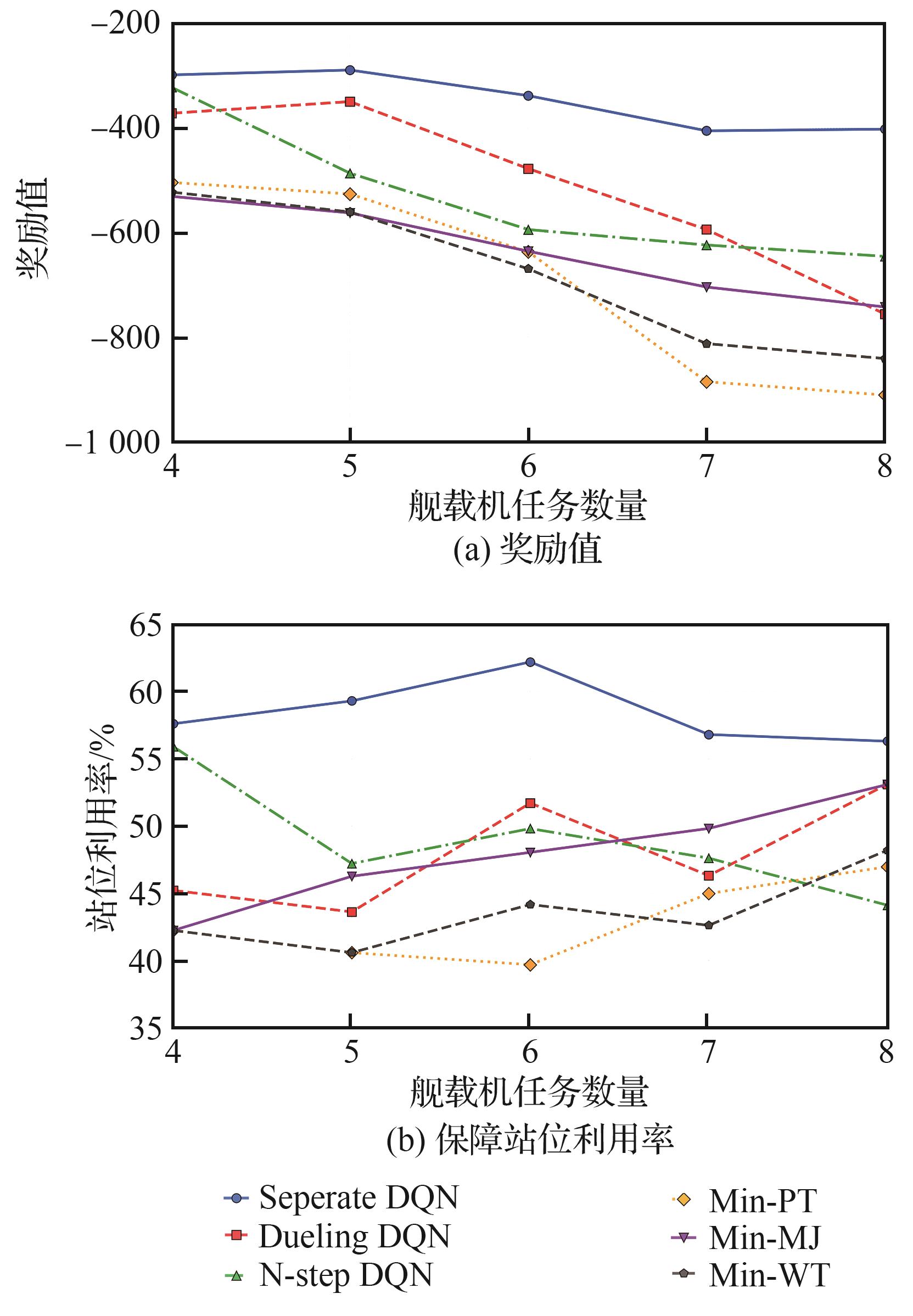
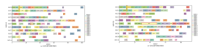
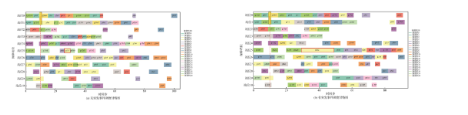
Fig.12
Comparison between the original and revised support operations scheduling scheme under dynamic disturbances
| [1] | 邓建辉, 田程程, 王岩磊, 等. 基于改进樽海鞘算法的舰载机舰面保障作业流程优化方法[J]. 中国舰船研究,2024, 19(S2): 1-10. |
| DENG J H, TIAN C C, WANG Y L, et al. Optimization method of carrier-based aircraft support operation process based on improved salp swarm algorithm[J]. Chinese Journal of Ship Research, 2024, 19(S2): 1-10 (in Chinese). | |
| [2] | LIU Y J, HAN W, SU X C, et al. Optimization of fixed aviation support resource station configuration for aircraft carrier based on aircraft dispatch mission scheduling [J]. Chinese Journal of Aeronautics, 2023, 36(2): 127-138. |
| [3] | 刘翱, 刘克. 舰载机保障作业调度问题研究进展[J]. 系统工程理论与实践, 2017, 37(1): 49-60. |
| LIU A, LIU K. Advances in carrier-based aircraft deck operation scheduling[J]. Systems Engineering-Theory & Practice, 2017, 37(1):49-60 (in Chinese). | |
| [4] | 万兵, 韩维, 梁勇, 等. 舰载机出动离场调度优化算法[J]. 系统工程与电子技术, 2021, 43(12): 3624-3634. |
| WAN B, HAN W, LIANG Y, et al. Optimization algorithm of carrier-based aircraft sortie departure scheduling[J]. Systems Engineering and Electronics, 2021,43(12):3624-3634 (in Chinese). | |
| [5] | 毕文豪, 张梦琦, 高飞, 等. 无人机集群任务分配技术研究综述[J]. 系统工程与电子技术, 2024, 46(3): 922-934. |
| BI W H, ZHANG M Q, GAO F, et al. Review on UAV swarm task allocation technology[J]. Systems Engineering and Electronics, 2024, 46(3): 922-934 (in Chinese). | |
| [6] | 鄢青青, 沈怀荣, 邵琼玲. 航天测控资源调度问题建模与求解研究综述[J]. 系统仿真学报, 2015, 27(1): 1-12, 36. |
| YAN Q Q, SHEN H R, SHAO Q L. Research overview on modeling and solution of aerospace TT&C scheduling problem[J]. Journal of System Simulation, 2015, 27(1): 1-12, 36 (in Chinese). | |
| [7] | 谭大力, 王云飞, 于连飞, 等. 基于整数线性规划方法的舰载机航空保障资源优化调度[J]. 中国舰船研究, 2019, 14(5): 145-151. |
| TAN D L, WANG Y F, YU L F, et al. Optimal scheduling of aviation support resources for carrier based aircrafts based on integer linear programming[J]. Chinese Journal of Ship Research, 2019, 14(5): 145-151 (in Chinese). | |
| [8] | RYAN J C, BANERJEE A G, CUMMINGS M L, et al. Comparing the performance of expert user heuristics and an integer linear program in aircraft carrier deck operations[J]. IEEE Transactions on Cybernetics, 2014, 44(6): 761-773. |
| [9] | 宁聪, 范菁, 孙书魁. 多无人机协同规划研究综述[J]. 计算机工程与应用, 2025, 61(1): 42-58. |
| NING C, FAN J, SUN S K, et al. Review of multi-UAV collaborative planning research[J]. Computer Engineering and Applications, 2025, 61(1): 42-58 (in Chinese). | |
| [10] | 葛宏义, 补雨薇, 蒋玉英, 等. 人工智能在太赫兹超材料设计与优化领域的研究进展[J]. 激光与光电子学进展, 2024, 61(23): 38-57. |
| GE H Y, BU Y W, JIANG Y Y, et al. Advances in artificial intelligence for design and optimization of terahertz metamaterials[J]. Laser & Optoelectronics Progress, 2024, 61(23): 38-57 (in Chinese). | |
| [11] | RAHMANI S, AGHALAR H, JEBREILI S, et al. Optimization and computing using intelligent data-driven approaches for decision-making [M]∥ Boca Raton: Taylor & Francis Group.CRC Press, 2024: 90-176. |
| [12] | 刘子玄, 万兵, 苏析超, 等. 基于HA算法的舰载机出动作业调度方法[J]. 系统工程与电子技术, 2024, 46(5): 1691-1702. |
| LIU Z X, WAN B, SU X C, et al. Sortie scheduling method of carrier aircraft based on HA algorithm[J]. Systems Engineering and Electronics, 2024, 46(5): 1691-1702 (in Chinese). | |
| [13] | 郭放, 韩维, 刘玉杰, 等 . 基于可变作业流程的舰载机机务勤务保障作业调度[J]. 航空学报, 2025, 46(13):531195. |
| GUO F, HAN W, LIU Y J, et al. Scheduling for maintenance and service support of carrier based aircraft based on variable operation process[J]. Acta Aeronautica et Astronautica Sinica, 2025, 46(13): 531195 (in Chinese). | |
| [14] | 万兵, 苏析超, 郭放, 等. 不确定性工时下甲板作业的前摄性鲁棒调度[J]. 航空学报, 2022, 43(12): 325971. |
| WAN B, SU X C, GUO F, et al. Proactive robust scheduling of aircraft carrier flight deck operations with uncertain activity durations[J]. Acta Aeronautica et Astronautica Sinica, 2022, 43(12): 325971 (in Chinese). | |
| [15] | 王宁, 张毅. 基于黏菌算法的一站式多机舰面保障作业调度研究[J]. 教练机, 2025(1): 5-11, 16. |
| WANG N, ZHANG Y. Research on one-stop support operation of aircraft carrier deck for multi-aircraft based on slime mould algorithm(SMA)[J]. Trainer, 2025(1):5-11, 16 (in Chinese). | |
| [16] | 朱兴动, 赵洋, 范加利, 等. 基于改进引力搜索算法的舰载机一站式保障作业优化调度方法[J]. 舰船电子工程, 2023, 43(8): 98-103, 196. |
| ZHU X D, ZHAO Y, FAN J L, et al. Optimization and scheduling method for shipborne aircraft one-stop support operations based on improved gravity search algorithm[J]. Ship Electronic Engineering, 2023, 43(8): 98-103, 196 (in Chinese). | |
| [17] | 袁子龙, 何非, 赵建波, 等. 航母舰载机保障作业任务分配及弹药转运调度优化方法[J]. 兵工学报, 2025, 46(5): 286-299. |
| YUAN Z L, HE F, ZHAO J B, et al. Optimization method of carrier-borne aircraft support operation assignment and ammunition transport scheduling[J]. Acta Armamentarii, 2025, 46(5): 286-299 (in Chinese). | |
| [18] | 刘哲, 马俊飞, 陈佳峰, 等. 基于改进灰狼算法的舰载机弹药保障调度优化[J]. 系统工程与电子技术, 2024, 46(4): 1264-1272. |
| LIU Z, MA J F, CHEN J F, et al. Carrier-based aircraft ammunition support scheduling optimization based on improved grey wolf optimizer algorithm[J]. Systems Engineering and Electronics, 2024, 46(4): 1264-1272 (in Chinese). | |
| [19] | 刘翱. 变邻域搜索分布估计算法求解舰载机保障作业调度问题[J]. 系统科学与数学, 2024, 44(2): 391-407. |
| LIU A. On the carrier-based aircraft deck operation scheduling problem solved by variable neighborhood search-based estimation of distribution algorithm[J]. Journal of Systems Science and Mathematical Sciences, 2024, 44(2): 391-407 (in Chinese). | |
| [20] | 李梦龙, 余明晖. 基于改进禁忌搜索算法的舰载机保障作业调度[J]. 中国舰船研究, 2018, 13(5): 132-138. |
| LI M L, YU M H. Carrier-based aircraft support operation scheduling based on improved tabu search algorithm[J]. Chinese Journal of Ship Research, 2018, 13(5): 132-138 (in Chinese). | |
| [21] | 孟杨凯, 王正, 范加利.基 于禁忌算法对不确定性舰载机保障的调度优化研究[J]. 系统仿真学报, 2021, 33(10): 2363-2371. |
| MENG Y K, WANG Z, FAN J L. Scheduling optimization research based on tabu algorithm for uncertainty carrier aircraft support[J]. Journal of System Simulation, 2021, 33(10): 2363-2371 (in Chinese). | |
| [22] | 刘小路, 杨春辉, 崔荣伟, 等. 基于改进差分进化算法的舰面保障作业优化[J]. 海军航空大学学报, 2022, 37(4): 354-360. |
| LIU X L, YANG C H, CUI R W, et al. Optimization of flight deck operation scheduling based on modified differential evolution algorithm[J]. Journal of Naval Aviation University, 2022, 37(4): 354-360 (in Chinese). | |
| [23] | 蒋婷婷, 韩维, 苏析超. 基于改进DE算法的舰载机保障调度优化[J]. 计算机仿真, 2018, 35(10): 51-56. |
| JIANG T T, HAN W, SU X C. Optimization of carrier aircraft support scheduling based on improved DE algorithm[J]. Computer Simulation, 2018, 35(10): 51-56 (in Chinese). | |
| [24] | WANG X, WANG S, LIANG X X, et al. Deep reinforcement learning: a survey[J]. IEEE Transactions on Neural Networks and Learning Systems, 2024, 35(4): 5064-5078. |
| [25] | 陈伟, 李璐璐, 陈董, 等. 差异化保障需求驱动的舰载机多机协同决策方法[J]. 航空学报, 2025, 46(13): 531274. |
| CHEN W, LI L L, CHEN D, et al. Multi-aircraft cooperative decision-making methods driven by differentiated support demands for carrier-based aircraft[J]. Acta Aeronautica et Astronautica Sinica,2025,46(13):531274 (in Chinese). | |
| [26] | 罗祎喆, 张辉, 余新得, 等. 面向舰载机多波次弹药保障任务的分层动态调度[J]. 航空学报, 2025, 46(18): 531945. |
| LUO Y Z, ZHANG H, YU X D, et al. Hierarchical dynamic scheduling for multi-wave carrier-based aircraft ammunition support missions[J]. Acta Aeronautica et Astronautica Sinica, 2025, 46(18): 531945 (in Chinese). | |
| [27] | 陈旭东, 陈琦琦, 罗祎喆, 等. 异构舰载机舰面保障作业动态并行调度[J]. 航空学报, 2025, 46(13): 531329. |
| CHEN X D, CHEN Q Q, LUO Y Z, et al. Dynamic parallel scheduling of heterogeneous carrier-based aircraft deck support operations[J]. Acta Aeronautica et Astronautica Sinica, 2025, 46(13): 531329 (in Chinese). | |
| [28] | 黄珈其, 郭宏伟, 杨帅, 等. 航空保障作业两阶段动态调度方法研究[J/OL]. 北京航空航天大学学报, (2024-08-30)[2025-11-11].. |
| HUANG J Q, GUO H W, YANG S, et al. Research on the two-stage dynamic scheduling method for aviation support operations[J/OL].Jounal of Beijing University of Aeronautics and Astronautics, (2024-08-30)[2025-11-11]. (in Chinese). | |
| [29] | 刘广, 王华, 林友芳, 等. 舰载机保障作业自适应批量匹配决策方法[J]. 航空学报, 2025, 46(1): 230615. |
| LIU G, WANG H, LIN Y F, et al. Adaptive batch matching decision method for carrier-based aircraft support operations[J]. Acta Aeronautica et Astronautica Sinica, 2025, 46(1): 230615 (in Chinese). | |
| [30] | FENG H F, ZENG W. Deep reinforcement learning for carrier-borne aircraft support operation scheduling[C]∥2021 International Conference on Intelligent Computing, Automation and Applications (ICAA). Piscataway:IEEE Press, 2021: 929-935. |
| [31] | 李亚飞, 吴庆顺, 徐明亮, 等. 基于强化学习的舰载机保障作业实时调度方法[J]. 中国科学: 信息科学, 2021, 51(2): 247-262. |
| Li Y F, Wu Q S, Xu M L, et al. Real-time scheduling for carrier-borne aircraft support operations: a reinforcement learning approach[J]. Scientia Sinica Informationis, 2021, 51(2): 247-262 (in Chinese). | |
| [32] | HAO H J, Zhang X Q, CHI Y, et al. Cooperative carrier aircraft support operation scheduling via multi-agent reinforcement learning[C]∥2023 24th IEEE International Conference on Mobile Data Management (MDM). Piscataway: IEEE Press, 2023: 297-302. |
| [1] | Wei XIONG, Dong ZHANG, Shuheng YANG, Zhi REN, Wenyi LIU. Manned/unmanned aerial vehicle collaborative interpretable method for intelligent air combat [J]. Acta Aeronautica et Astronautica Sinica, 2026, 47(7): 332547-332547. |
| [2] | Sihua GAO, Bingyang ZHAO, Jianfu LI. UAV complete data collection trajectory planning algorithm based on time window constraints [J]. Acta Aeronautica et Astronautica Sinica, 2026, 47(6): 332451-332451. |
| [3] | Jian PENG, Guanglei ZHU, Qingshun WU, Yafei LI, Shuo HE, Yuanyuan JIN, Mingliang XU. Scheduling method for carrier-based aircraft support operations based on Monte Carlo tree search [J]. Acta Aeronautica et Astronautica Sinica, 2026, 47(6): 332444-332444. |
| [4] | Lei ZHANG, Can TIAN, Fangqing WEN, Qinghe ZHANG, Han LIU. Multi-objective evolution with deep deterministic strategy gradient algorithm for mobile edge networks [J]. Acta Aeronautica et Astronautica Sinica, 2026, 47(3): 631880-631880. |
| [5] | Chunhao FAN, Junshan HU, Zhiyong YANG, Fusen HOU, Peilin CHEN, Wei TIAN. Effects of curing residual stress and deformation on tensile performance of CFRP single-sided patch-repaired titanium alloy damaged components [J]. Acta Aeronautica et Astronautica Sinica, 2026, 47(3): 431997-431997. |
| [6] | Kaifang WAN, Zhilin WU, Yunhui WU, Haozhi QIANG, Yibo WU, Bo LI. Cooperative location of multiple UAVs with deep reinforcement learning in GPS-denied environment [J]. Acta Aeronautica et Astronautica Sinica, 2025, 46(8): 331024-331024. |
| [7] | Lingfeng JIANG, Xinkai LI, Hai ZHANG, Hanwei LI, Hongli ZHANG. Mapless navigation of UAVs in dynamic environments based on an improved TD3 algorithm [J]. Acta Aeronautica et Astronautica Sinica, 2025, 46(8): 331035-331035. |
| [8] | Min YANG, Guanjun LIU, Ziyuan ZHOU. Control of lunar landers based on secure reinforcement learning [J]. Acta Aeronautica et Astronautica Sinica, 2025, 46(3): 630553-630553. |
| [9] | Qichao XIE, Chengyu CAO, Yiyun ZHAO, Fanbiao LI. Integrated guidance and control method based on deep reinforcement learning parameter tuning [J]. Acta Aeronautica et Astronautica Sinica, 2025, 46(24): 632345-632345. |
| [10] | Jiachen LIU, Lei DONG, Zijing SUN, Ye NI, Xi CHEN, Peng WANG. An explainable decision-making method for resource allocation in IMA system based on PPO-SHAP [J]. Acta Aeronautica et Astronautica Sinica, 2025, 46(24): 331872-331872. |
| [11] | Zhaoru YAO, Hang SUN, Dong REN, Li LIU, Jun WAN. Bidirectional mapping and negative correlation algorithm for aerial image dehazing [J]. Acta Aeronautica et Astronautica Sinica, 2025, 46(23): 631652-631652. |
| [12] | Chen WANG, Caisheng WEI, Zeyang YIN, Kai JIN, Xingchen LI. Collaborative planning of multi-UAV trajectories and communication strategies considering channel resource constraints [J]. Acta Aeronautica et Astronautica Sinica, 2025, 46(18): 331837-331837. |
| [13] | Yizhe LUO, Hui ZHANG, Xinde YU, Zhao JIN, Shuo FENG, Yucheng SHI, Mingling XU. Hierarchical dynamic scheduling for multi-wave carrier-based aircraft ammunition support missions [J]. Acta Aeronautica et Astronautica Sinica, 2025, 46(18): 331945-331945. |
| [14] | Yu WANG, Zhipeng XIE, Yongjian TIAN, Guanglei MENG. Distributed UAV formation control with virtual structure guided reinforcement learning [J]. Acta Aeronautica et Astronautica Sinica, 2025, 46(15): 331354-331354. |
| [15] | Xiaochen LYU, Jingping SHI, Yongxi LYU, Gengnong LI. Flow angle reconstruction algorithm for MAGIC CARPET landing with sensor failure [J]. Acta Aeronautica et Astronautica Sinica, 2025, 46(13): 531159-531159. |
| Viewed | ||||||
|
Full text |
|
|||||
|
Abstract |
|
|||||
Address: No.238, Baiyan Buiding, Beisihuan Zhonglu Road, Haidian District, Beijing, China
Postal code : 100083
E-mail:hkxb@buaa.edu.cn
Total visits: 6658907 Today visits: 1341All copyright © editorial office of Chinese Journal of Aeronautics
All copyright © editorial office of Chinese Journal of Aeronautics
Total visits: 6658907 Today visits: 1341

 CJA
CJA
