Acta Aeronautica et Astronautica Sinica ›› 2026, Vol. 47 ›› Issue (3): 431997.doi: 10.7527/S1000-6893.2025.31997
• Material Engineering and Mechanical Manufacturing • Previous Articles
Chunhao FAN1, Junshan HU1( ), Zhiyong YANG2, Fusen HOU1, Peilin CHEN1, Wei TIAN1
Received:2025-03-19
Revised:2025-04-25
Accepted:2025-06-10
Online:2025-06-16
Published:2025-06-13
Contact:
Junshan HU
E-mail:hujunshan@nuaa.edu.cn
Supported by:CLC Number:
Chunhao FAN, Junshan HU, Zhiyong YANG, Fusen HOU, Peilin CHEN, Wei TIAN. Effects of curing residual stress and deformation on tensile performance of CFRP single-sided patch-repaired titanium alloy damaged components[J]. Acta Aeronautica et Astronautica Sinica, 2026, 47(3): 431997.
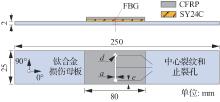
Fig.1
Schematic diagram of damaged titanium alloy components repaired by CFRP single-sided patch
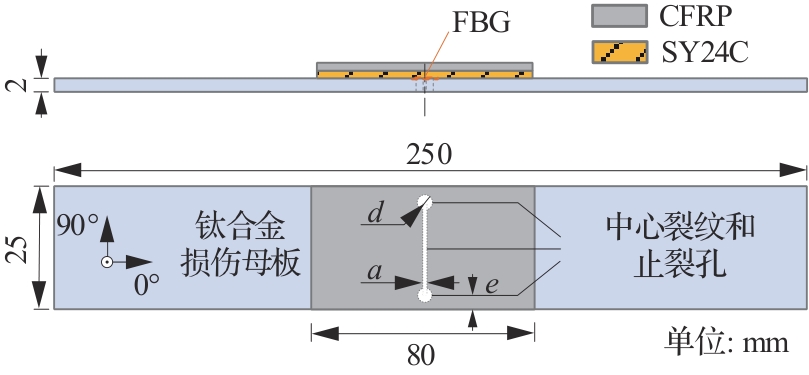
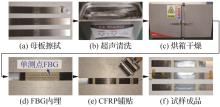
Fig.2
Operation procedure for cleaning repaired area of damaged titanium alloy components and bonding composite patches
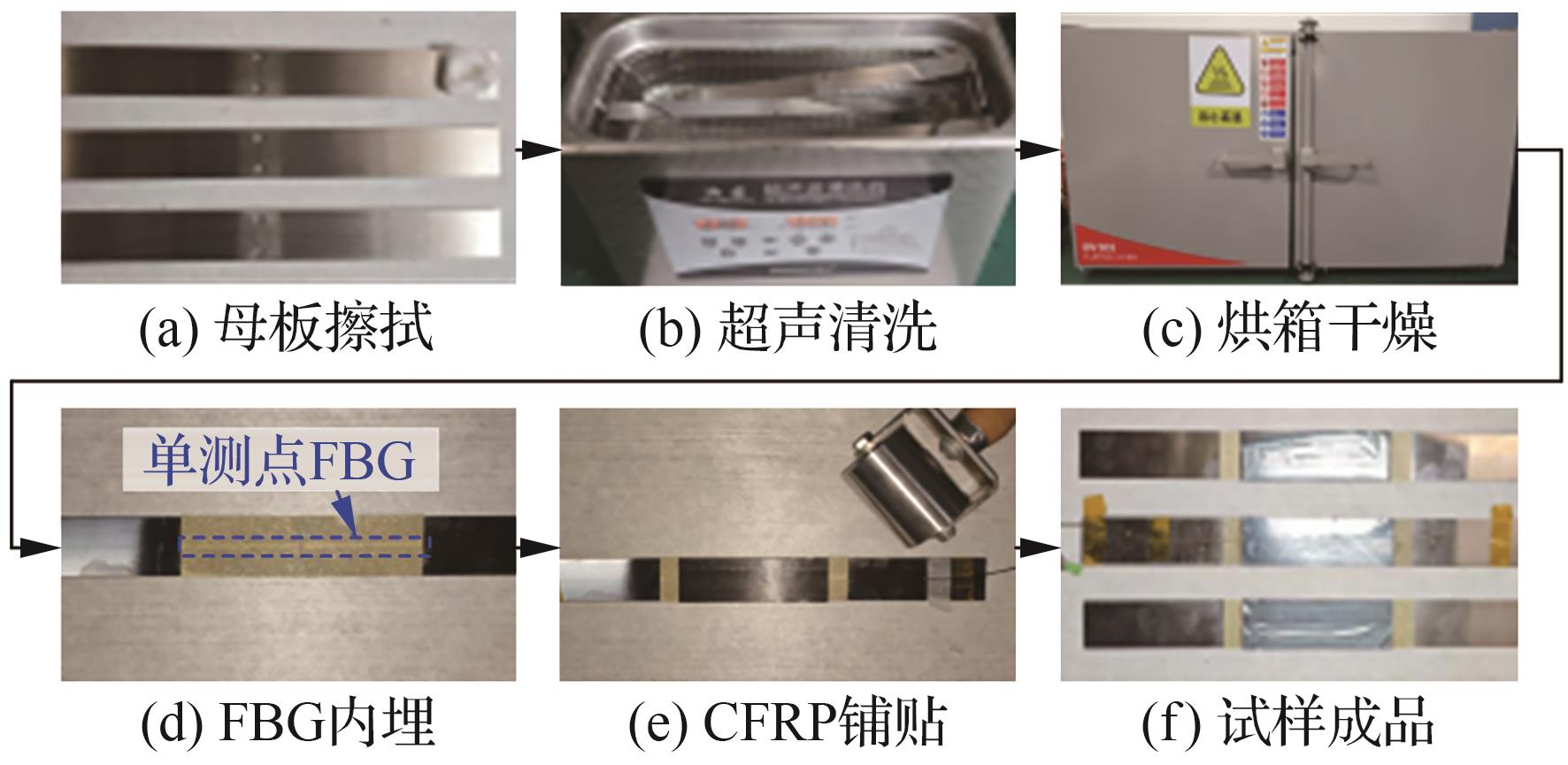
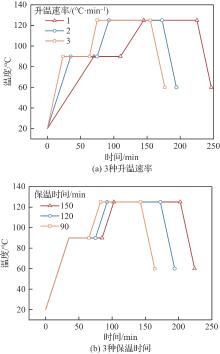
Fig.3
Process diagram of different curing temperature curves
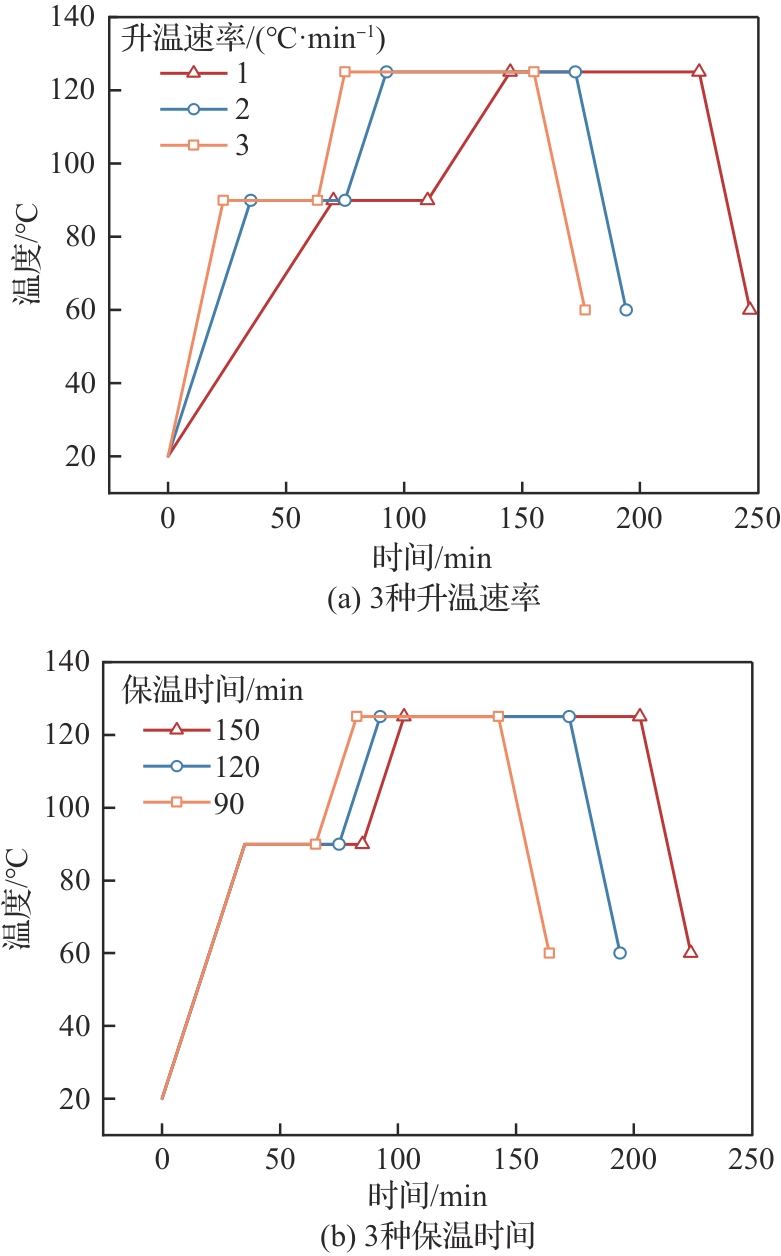

Fig.4
Co-curing bonding equipment and strain monitoring devices
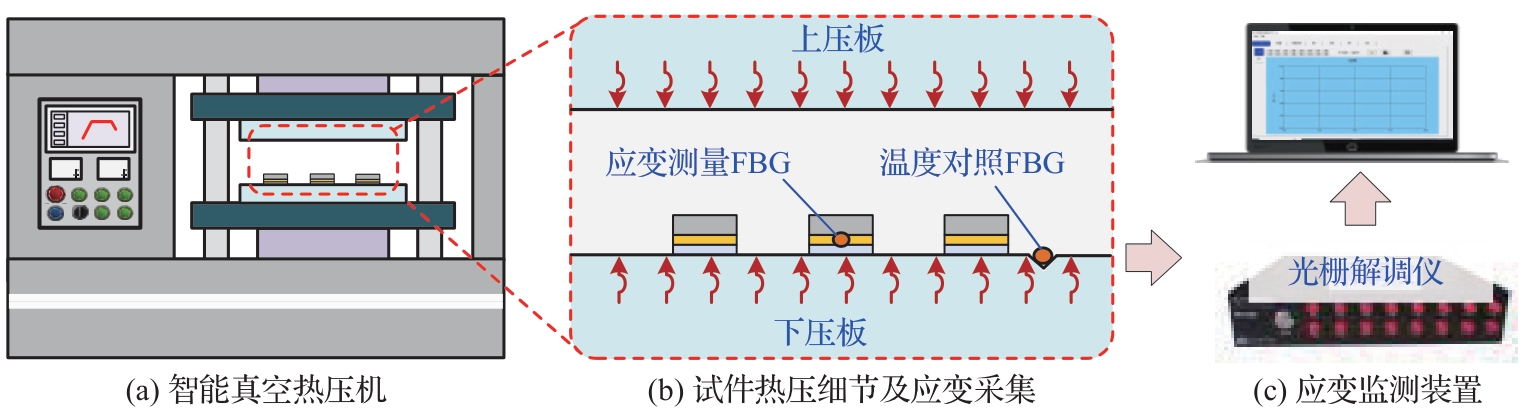
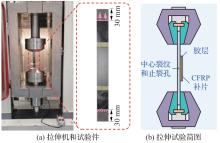
Fig.5
Schematic of quasi-static tensile test device
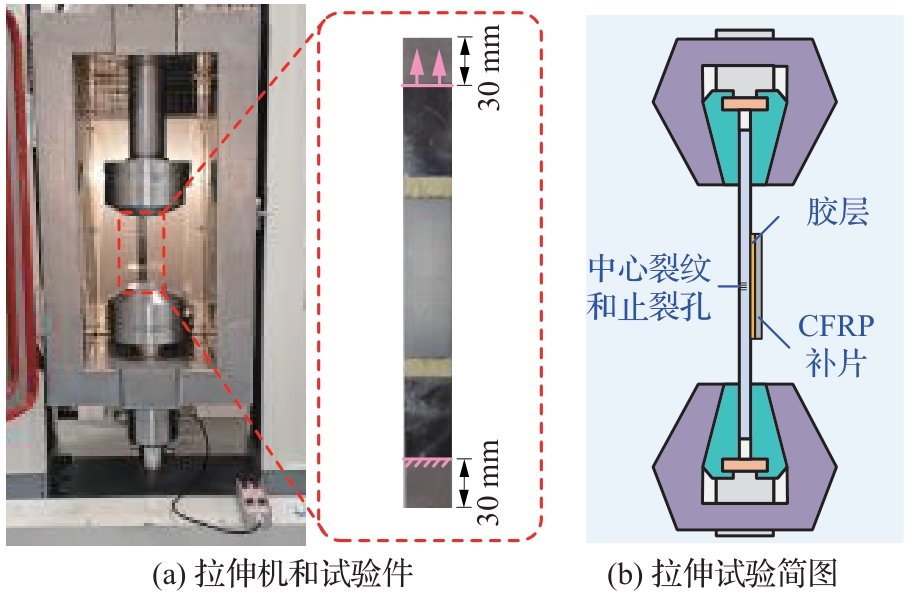
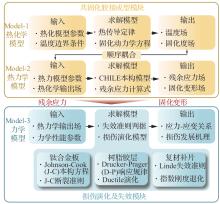
Fig. 6
Calculation process of multi-stage numerical analysis model for co-curing bonded and quasi-static tensile
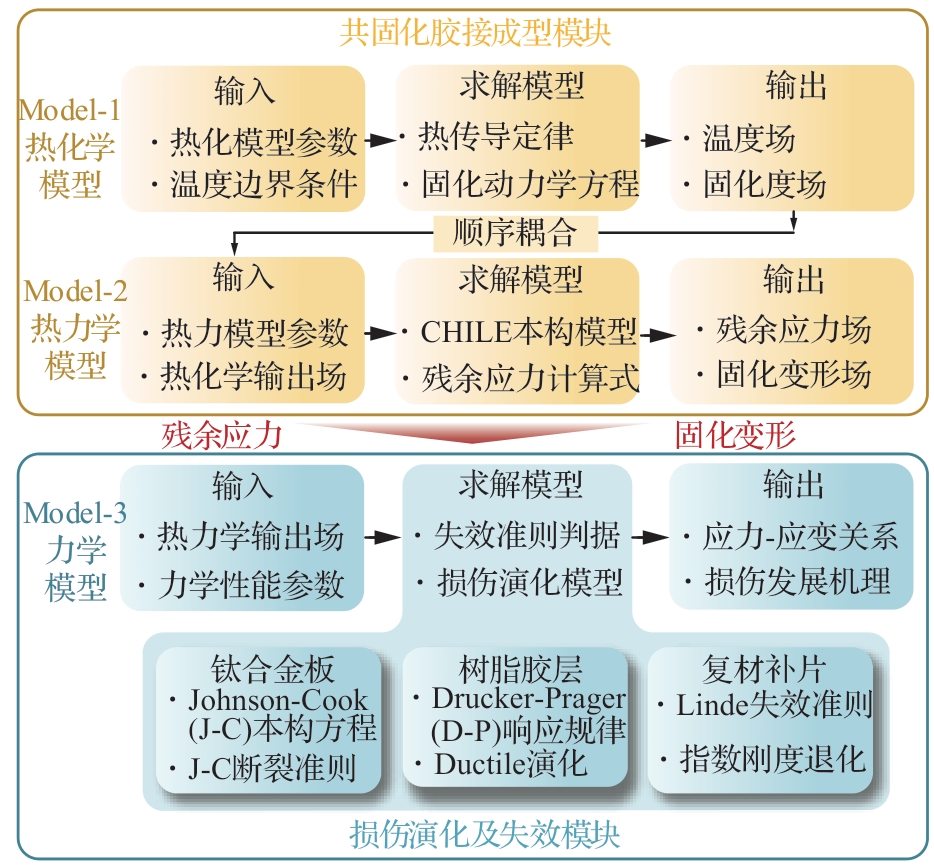

Table 1
Thermo-chemical model material parameters[34]
| 参数 | 数值 | 参数 | 数值 |
|---|---|---|---|
| ρc/(kg·m-3) | 1 230 | Vf/% | 67 |
| cc/(J·kg-1·K-1) | 1 580 | Hr/(J·g-1) | 401.5 |
| ca/(J·kg-1·K-1) | 1 740 | A/(1010 s-1) | 1.494 |
| kx /(W·m-1·K-1) | 5.43 | ΔE/(J·mol-1) | 94 750 |
| ky, kz /(W·m-1·K-1) | 0.41 | m | 0.45 |
| ρa/(kg·m-3) | 1 600 | n | 1.877 |
| kTC4/(W·m-1·K-1) | 7.955 | cTC4/(J·kg-1·K-1) | 612 |
Table 2
Thermo-mechanical model parameters[11,42-44]
| 参数 | 纤维 | 树脂 | TC4 |
|---|---|---|---|
| 弹性模量/MPa | Elf=138 000 | ETC4=110 000 | |
| Etf=9 310 | |||
| 剪切模量/MPa | G23f=5 000 | ||
| G12f=G13f=4 810 | |||
| 泊松比 | ν23f=0.45 | νr=0.38 | νTC4=0.34 |
| ν12f=ν13f=0.32 | |||
| 热膨胀系数/(10-6 K-1) | β11f=-0.9 | βr=81.4 | βTC4=8.6 |
| β22f=β33f=7.2 | |||
| 化学收缩系数/10-3 | γr=6.98 |
Table 3
J-C model parameters of TC4 plates[45]
| 参数 | 数值 | 参数 | 数值 |
|---|---|---|---|
| 初始屈服应力A′ | 1 040 | a1 | -0.09 |
| 应变硬化模量B′ | 1 030 | a2 | 0.27 |
| 应变硬化指数n′ | 0.757 | a3 | -0.48 |
| 应变率硬化系数C′ | 0 | a4 | 0 |
| 温度软化指数m′ | 0 | a5 | 0 |
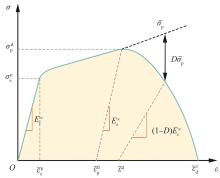
Fig.7
Elasticity, plasticity and damage evolution model of resin
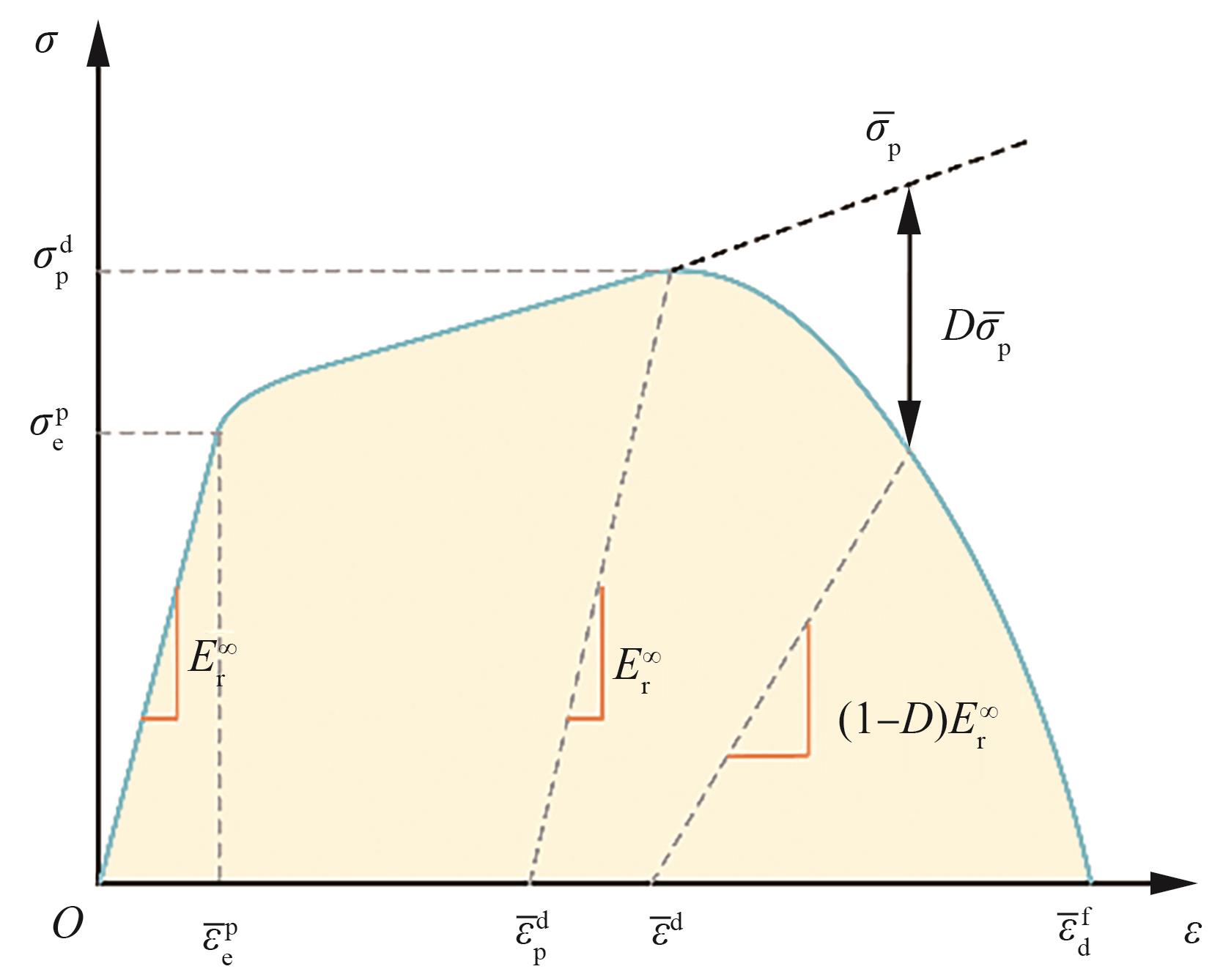
Table 4
Damage model parameters of resin[18]
| 参数 | 数值 | 参数 | 数值 |
|---|---|---|---|
| 黏结力d/MPa | 97.6 | 摩擦角β/(°) | 37.7 |
| D-P指数κ | 0.8 | 断裂能G/(J·m-2) | 1 |
| 初始损伤应变 | 0.25 |
Table 5
Strength parameter of T300/7901 composites[43]
| 参数 | 数值 |
|---|---|
| 纤维方向拉伸强度XT/MPa | 2 890 |
| 纤维方向压缩强度XC/MPa | 2 065 |
| 面内横向拉伸强度YT/MPa | 92 |
| 面内横向压缩强度YC/MPa | 187 |
| 厚度方向拉伸强度ZT/MPa | 92 |
| 厚度方向压缩强度ZC/MPa | 187 |
| 23面内剪切强度S23/MPa | 61 |
| 12、23面内剪切强度S12=S13/MPa | 107 |
Fig.8
Three-dimensional finite element model of co-curing bonding of CFRP single-sided patch-repaired structures
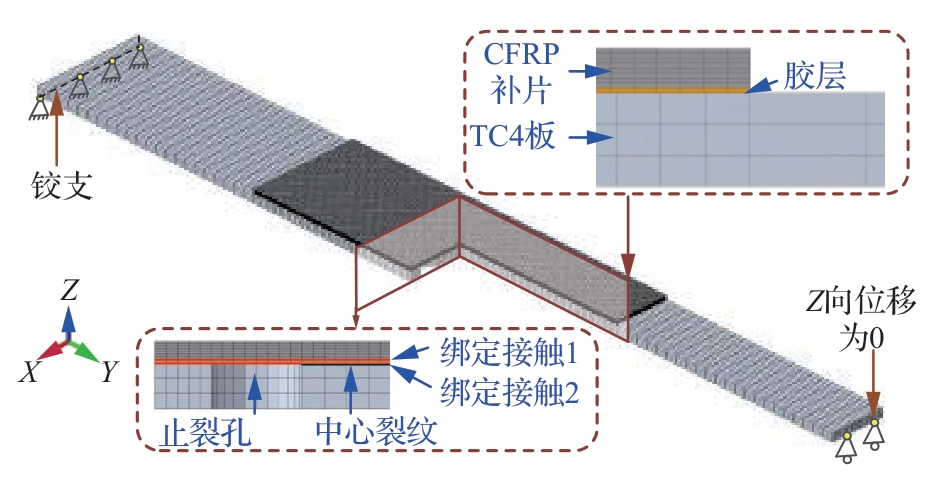
Fig.9
Three-dimensional finite element model of quasi-static tensile of CFRP single-sided patch-repaired structures
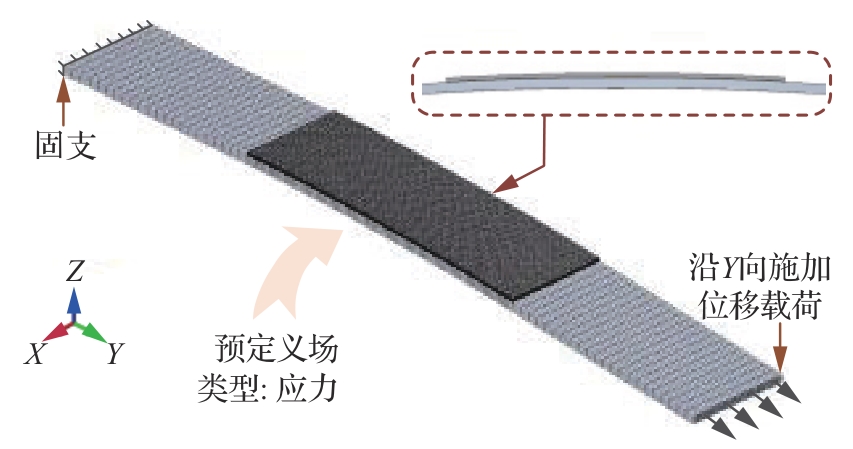
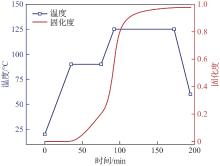
Fig.10
Curing degree curve of adhesive center point under the condition of 2 °C/min heating rate and 120 minutes holding time
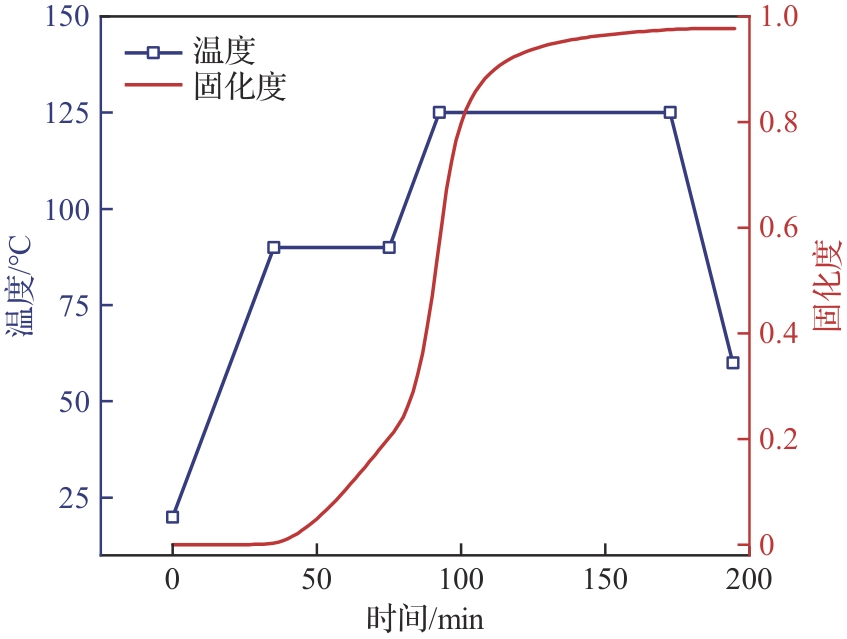
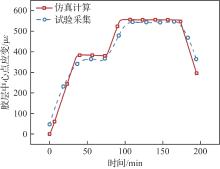
Fig.11
Comparison of strain curves at adhesive center point between experiment and simulation during curing process
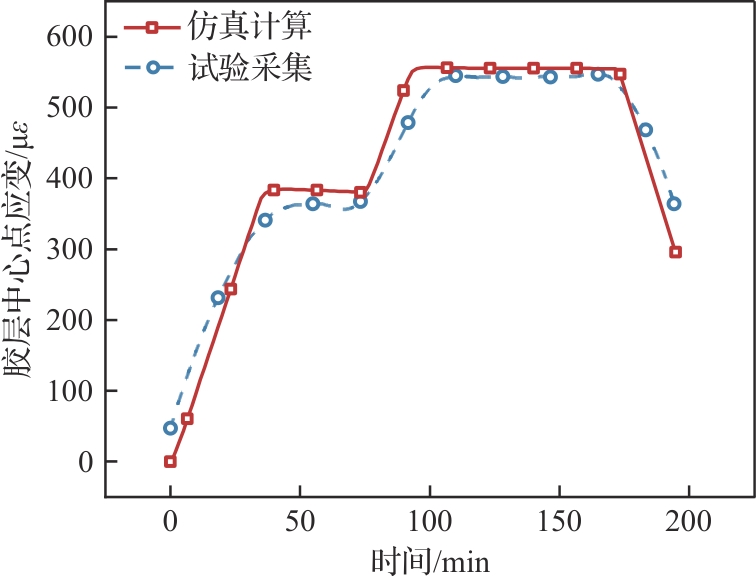
Fig.12
Stress and deformation state of specimen under condition of 2 °C/min heating rate and 120 min holding time
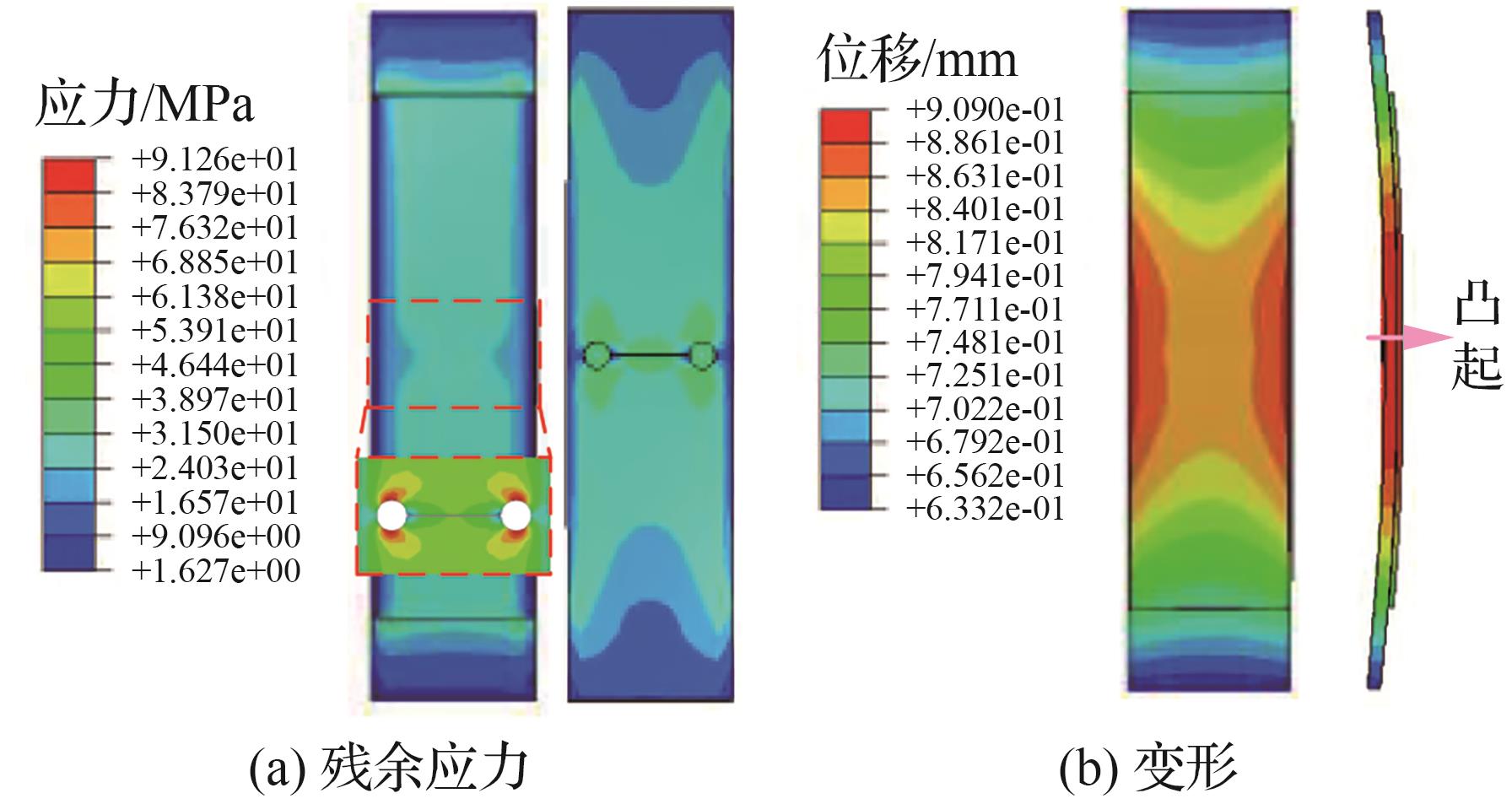
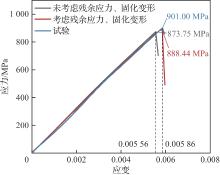
Fig.13
Stress-strain curves of patch-repaired structures
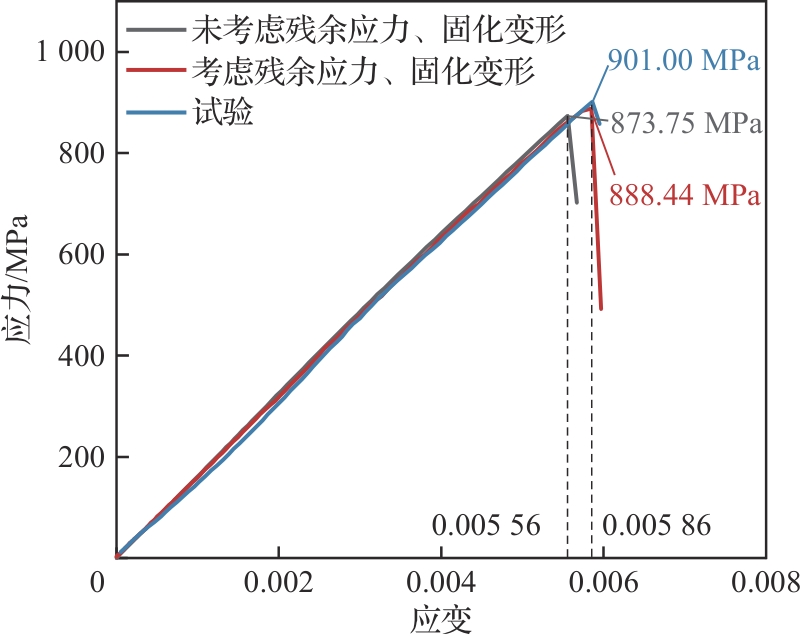
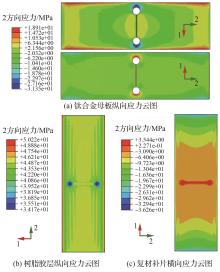
Fig.14
Stress states of each component of patch-repaired structures before stretching
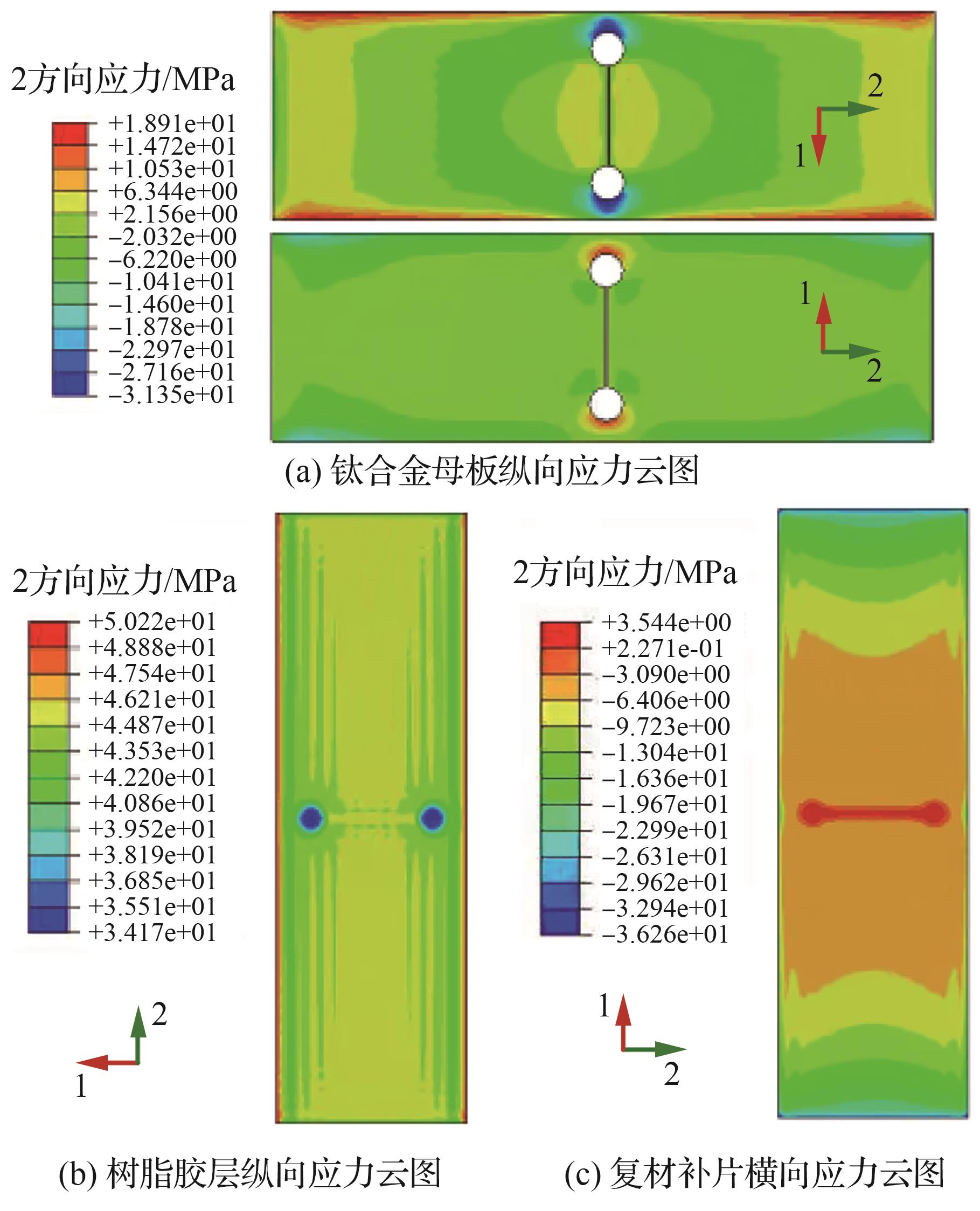
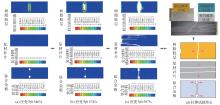
Fig.15
Numerical simulation and experimental validation of tensile damage progression in patch-repaired structures
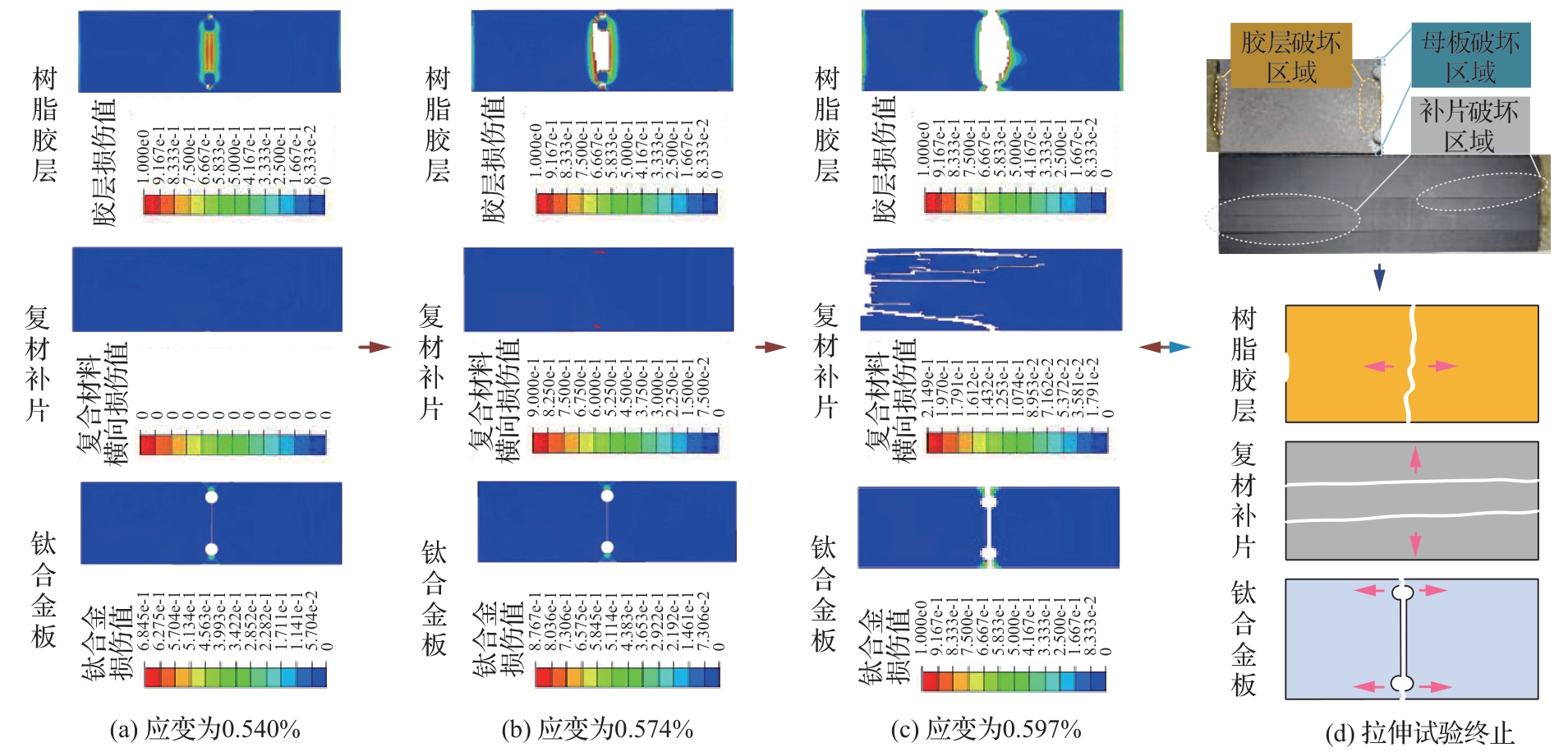
Fig.16
Influence of three kinds of heating rates on degree of cure evolution
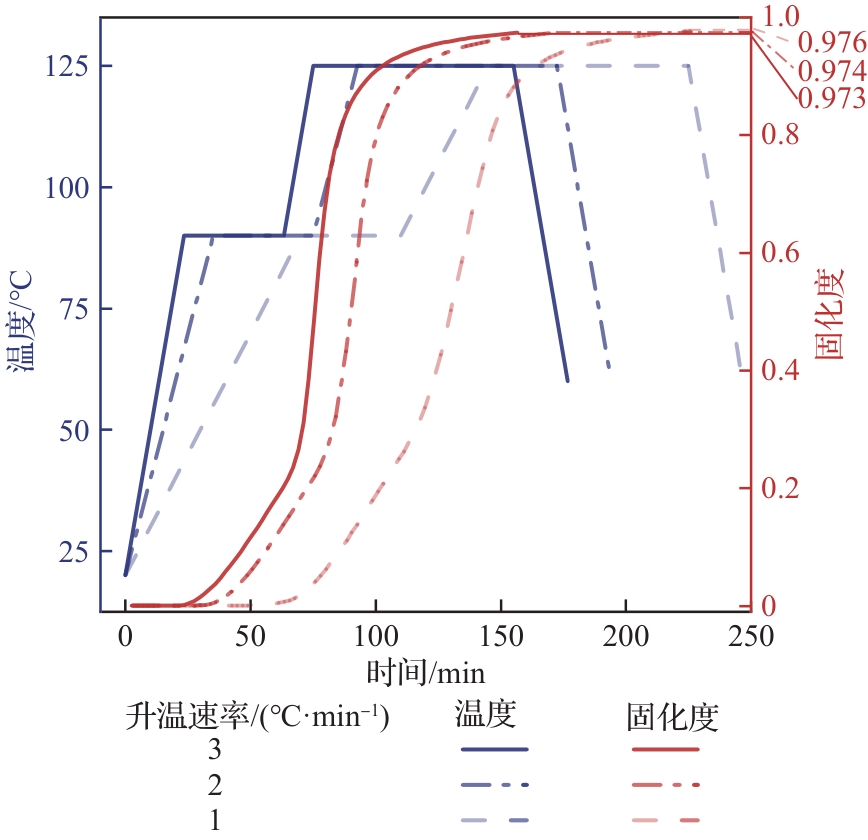
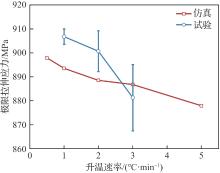
Fig.17
Influence of heating rates on ultimate tensile stress of patch-repaired structures
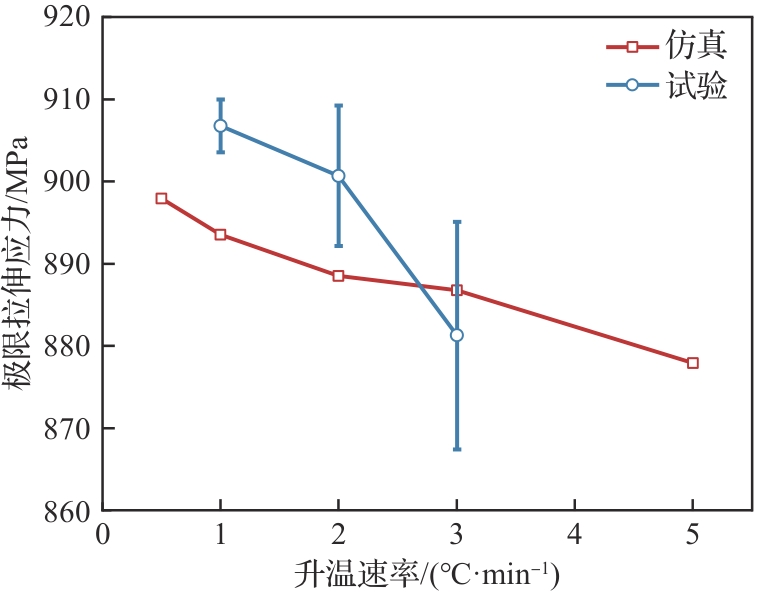
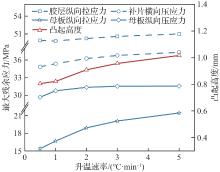
Fig.18
Maximum residual stress and bulge height of each material in structures under different heating rates
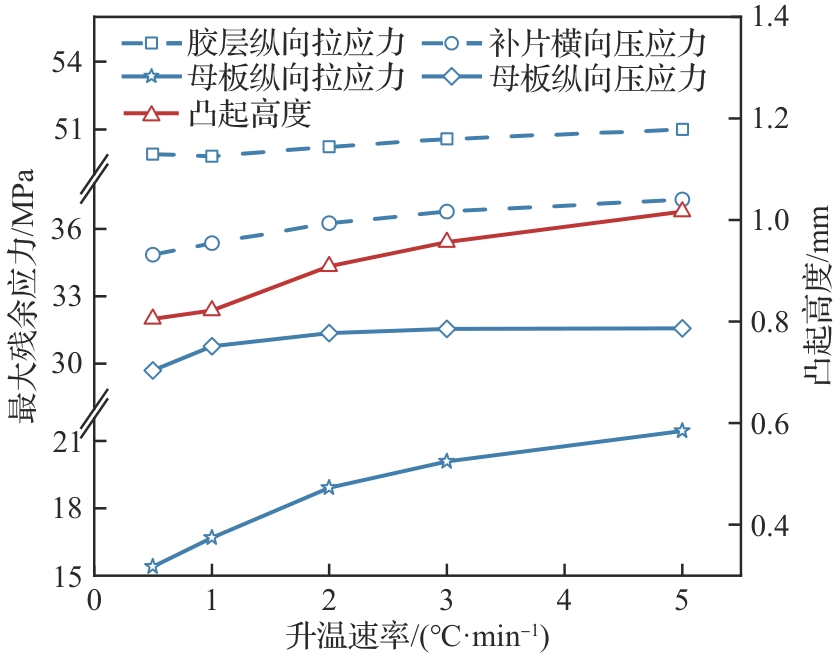
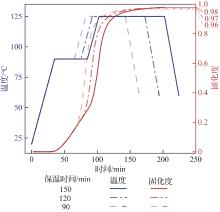
Fig.19
Influence of three kinds of holding time on degree of cure evolution
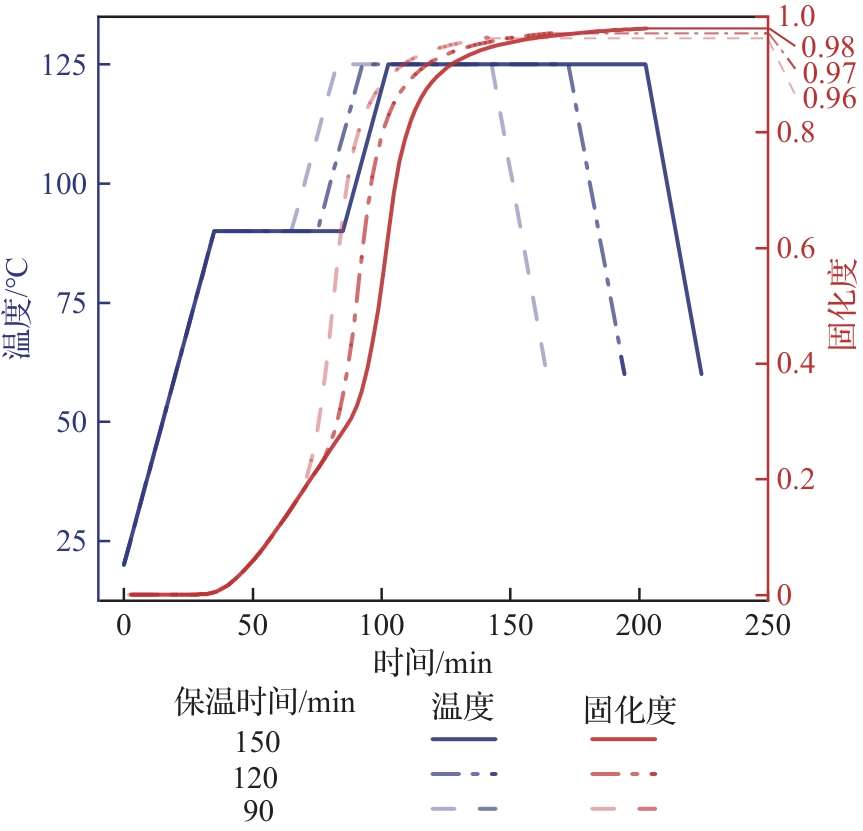
Fig.20
Influence of holding time on ultimate tensile stress of patch-repaired structures
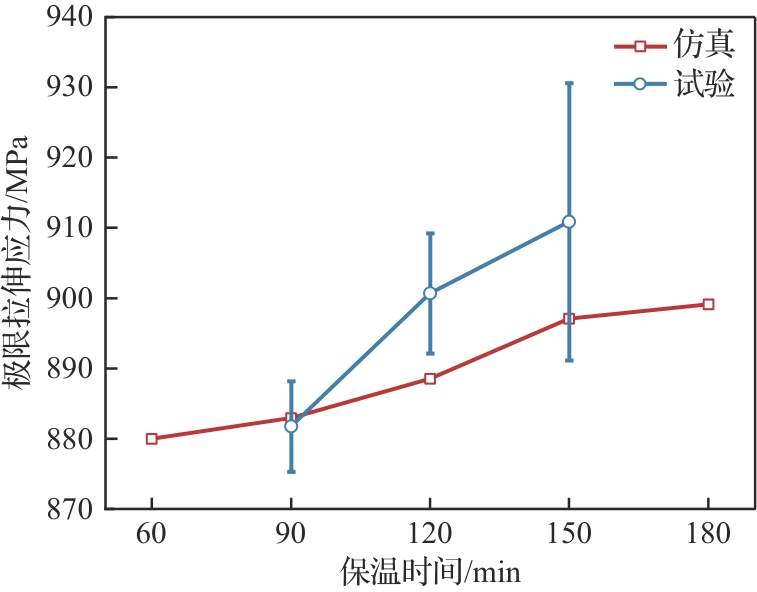
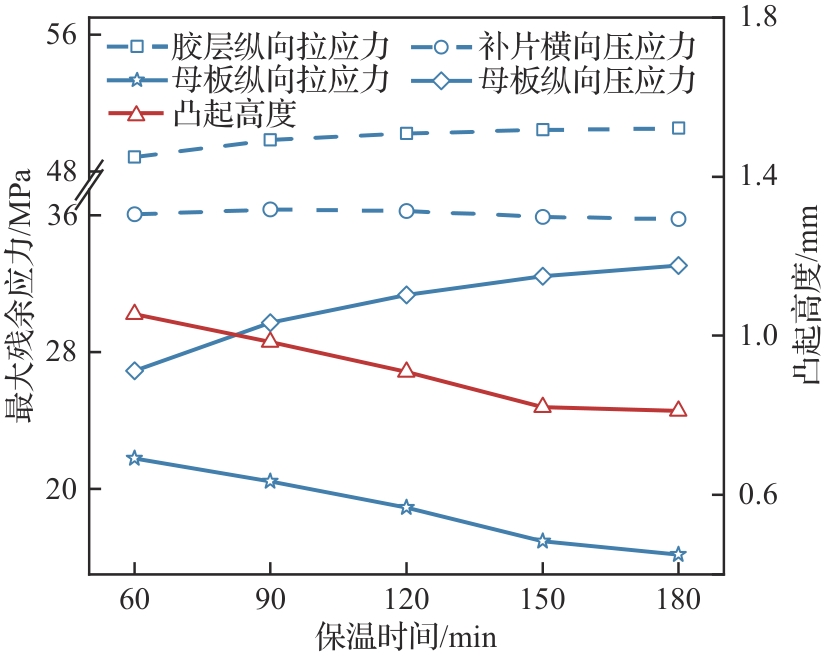
Fig.21
Maximum residual stress and bulge height of each material in structures under different holding time
| [1] | 单忠德, 周征西, 孙正, 等. 航空航天先进复合材料三维预制体成形技术与装备研究[J]. 机械工程学报, 2023, 59(20): 64-79. |
| SHAN Z D, ZHOU Z X, SUN Z, et al. Research of 3D advanced aerospace composite preforms forming technology and equipment[J]. Journal of Mechanical Engineering, 2023, 59(20): 64-79 (in Chinese). | |
| [2] | 谢金标, 孙运刚, 符彬. 复合材料胶接修复飞机金属结构关键技术及应用[J]. 航空维修与工程, 2023(2): 14-18. |
| XIE J B, SUN Y G, FU B. Key technologies and application of bonded composite repair on metallic aircraft structure[J]. Aviation Maintenance & Engineering, 2023(2): 14-18 (in Chinese). | |
| [3] | HU J S, LI C Y, FANG J R, et al. Comparison of repair methods for cracked titanium alloy aircraft structures with single-sided adhesively bonded composite patches[J]. Materials, 2023, 16(19): 6361. |
| [4] | ERRAHMANE M A, BENYETTOU M, MADANI K, et al. Numerical and experimental analysis of the performance of the metal patch compared to the composite patch under aging conditions in water immersion[J]. International Journal of Adhesion and Adhesives, 2025, 138: 103943. |
| [5] | LIAN J Y, XU Z B, RUAN X D. Analysis and control of cured deformation of fiber-reinforced thermosetting composites: A review[J]. Journal of Zhejiang University: Science A, 2019, 20(5): 311-333. |
| [6] | NEGARESH M, NAZOCKDAST H, KATBAB A A. The impact of various curing methods on the curing process of polymer-fiber composites analyzed using analytical approach[J]. Results in Engineering, 2024, 23: 102861. |
| [7] | DEI SOMMI A, BUCCOLIERO G, LIONETTO F, et al. A finite element model for the prediction of porosity in autoclave cured composites[J]. Composites Part B: Engineering, 2023, 264: 110882. |
| [8] | BLACKWELL C, SIMACEK P, CRANE R, et al. A model for the autoclave consolidation of prepregs during manufacturing of complex curvature parts[J]. International Journal of Material Forming, 2023, 16(6): 61. |
| [9] | YUAN Z Y, WANG Y J, YANG G G, et al. Evolution of curing residual stresses in composite using multi-scale method[J]. Composites Part B: Engineering, 2018, 155: 49-61. |
| [10] | DING A X, LI S X, WANG J H, et al. A new path-dependent constitutive model predicting cure-induced distortions in composite structures[J]. Composites Part A: Applied Science and Manufacturing, 2017, 95: 183-196. |
| [11] | 李冬娜. 树脂基复合材料固化行为的多尺度仿真研究[D]. 兰州: 兰州理工大学, 2018. |
| LI D N. Multiscale simulation investigation of curing behavior in resin matrix composites[D]. Lanzhou: Lanzhou University of Technology, 2018 (in Chinese). | |
| [12] | KRAVCHENKO O G, KRAVCHENKO S G, PIPES R B. Cure history dependence of residual deformation in a thermosetting laminate[J]. Composites Part A: Applied Science and Manufacturing, 2017, 99: 186-197. |
| [13] | SORRENTINO L, BELLINI C. Compaction influence on spring-in of thin composite parts: Experimental and numerical results[J]. Journal of Composite Materials, 2015, 49(17): 2149-2158. |
| [14] | FAN S J, ZHANG J M, WANG B, et al. A deep learning method for fast predicting curing process-induced deformation of aeronautical composite structures[J]. Composites Science and Technology, 2023, 232: 109844. |
| [15] | TAKAGAKI K, MINAKUCHI S, TAKEDA N. Process-induced strain and distortion in curved composites. Part Ⅰ: Development of fiber-optic strain monitoring technique and analytical methods[J]. Composites Part A: Applied Science and Manufacturing, 2017, 103: 236-251. |
| [16] | CHEN C, NESBITT S, REINER J, et al. Cure path dependency of static and dynamic mode II interlaminar fracture toughness of interlayer toughened composite laminates[J]. Composites Science and Technology, 2020, 200: 108444. |
| [17] | 彭益丰. 工艺参数对层间混杂复材制件固化残余应力及性能的影响[D]. 长沙: 中南大学, 2022. |
| PENG Y F. Effects of process parameters on curing residual stress and properties of interlaminar hybrid composites[D]. Changsha: Central South University, 2022 (in Chinese). | |
| [18] | HUI X Y, XU Y J, ZHANG W H. An integrated modeling of the curing process and transverse tensile damage of unidirectional CFRP composites[J]. Composite Structures, 2021, 263: 113681. |
| [19] | 刘振东, 郑锡涛, 范雯静, 等. 固化残余应力对无人机复合材料机翼强度的影响[J]. 航空学报, 2022, 43(6): 526117. |
| LIU Z D, ZHENG X T, FAN W J, et al. Effect of process-induced residual stress on strength of UAV composite wing[J]. Acta Aeronautica et Astronautica Sinica, 2022, 43(6): 526117 (in Chinese). | |
| [20] | BAKER A A. Repair of cracked or defective metallic aircraft components with advanced fibre composites: an overview of Australian work[J]. Composite Structures, 1984, 2(2): 153-181. |
| [21] | AABID A, ROSLI M N S BIN, HRAIRI M, et al. Enhancing repair of cracked plate using fiber-reinforced composite patch: Experimental and simulation analysis[J]. Forces in Mechanics, 2025, 18: 100302. |
| [22] | PRADHAN S S, MISHRA U, BISWAL S K. Experimental study on mechanical performance of cracked aluminium alloy repaired with composite patch[J]. Materials Today: Proceedings, 2020, 26: 2676-2680. |
| [23] | WANG J, BAKER A, CHANG P. Hybrid approaches for aircraft primary structure repairs[J]. Composite Structures, 2019, 207: 190-203. |
| [24] | AABID A, IBRAHIM Y E, HRAIRI M, et al. Optimization of structural damage repair with single and double-sided composite patches through the finite element analysis and taguchi method[J]. Materials, 2023, 16(4): 1581. |
| [25] | FERNANDES P H E, BAUMERT M, DIECKHOFF S, et al. Adhesively bonded composite patch repair in load-bearing applications for the aviation industry: manufacturing, design, and simulation[J]. Fatigue & Fracture of Engineering Materials & Structures, 2025, 48(4): 1447-1460. |
| [26] | HU J S, KANG R H, FANG J R, et al. An experimental and parametrical study on repair of cracked titanium airframe structures with single-side bonded carbon fiber-reinforced polymer prepreg patches[J]. Composite Structures, 2024, 338: 118102. |
| [27] | 方金荣, 胡俊山, 陈培林, 等. 航空钛合金损伤构件CFRP单面贴补修复界面I型断裂力学特性[J]. 复合材料学报, 2025, 42(5): 2514-2527. |
| FANG J R, HU J S, CHEN P L, et al. Mechanical characterization of mode I fracture at the interface of CFRP single-sided patch repair of damaged aerospace titanium alloy components[J]. Acta Materiae Compositae Sinica, 2025, 42(5): 2514-2527 (in Chinese). | |
| [28] | KIM H S, YOO S H, CHANG S H. In situ monitoring of the strain evolution and curing reaction of composite laminates to reduce the thermal residual stress using FBG sensor and dielectrometry[J]. Composites Part B: Engineering, 2013, 44(1): 446-452. |
| [29] | 陈诗展, 胡俊山, 张霖, 等. 航空金属构件损伤复合材料单面贴补修复力学性能[J]. 复合材料学报, 2023, 40(10): 5918-5931. |
| CHEN S Z, HU J S, ZHANG L, et al. Repair performance of damaged aircraft metal structure with one-sided composite patch[J]. Acta Materiae Compositae Sinica, 2023, 40(10): 5918-5931 (in Chinese). | |
| [30] | 国家质量监督检验检疫总局、中国国家标准化管理委员会. 纤维增强塑料拉伸性能试验方法: [S]. 北京: 中国标准出版社, 2005. |
| Standardization Administration of the People’s Republic of China. Fiber-reinforced plastics composites—Determination of tensile properties: [S]. Beijing: Standards Press of China, 2005. (in Chinese) | |
| [31] | 姜峰, 赵玉卿, 黄争鸣. 时效对7901环氧树脂力学性能的影响[J]. 工程塑料应用, 2019, 47(3): 81-84, 91. |
| JIANG F, ZHAO Y Q, HUANG Z M. Aging effect on mechanical properties of 7901 epoxy resin[J]. Engineering Plastics Application, 2019, 47(3): 81-84, 91 (in Chinese). | |
| [32] | 刘真航. SY-24中温固化胶接体系[J]. 中国胶粘剂, 2002, 11(1): 1-5. |
| LIU Z H. SY-24 Moderate temperature cured adhesive system[J]. China Adhesives, 2002, 11(1): 1-5 (in Chinese). | |
| [33] | 甘建业, 胡伟叶, 张艺澄, 等. 变厚度树脂基复合材料构件固化变形数值模拟与影响因素分析[J]. 复合材料学报, 2023, 40(7): 4195-4209. |
| GAN J Y, HU W Y, ZHANG Y C, et al. Numerical simulation and influence factors analysis of cure-induced distortions in resin matrix composites with variable thickness[J]. Acta Materiae Compositae Sinica, 2023, 40(7): 4195-4209 (in Chinese). | |
| [34] | 牛晓坤. 热固性树脂基复合材料固化变形分析[D]. 沈阳: 沈阳航空航天大学, 2018. |
| NIU X K. Analysis of curing deformation of thermosetting resin matrix composites[D]. Shenyang: Shenyang Aerospace University, 2018 (in Chinese). | |
| [35] | JOHNSTON A, VAZIRI R, POURSARTIP A. A plane strain model for process-induced deformation of laminated composite structures[J]. Journal of Composite Materials, 2001, 35(16): 1435-1469. |
| [36] | MAGNUS SVANBERG J, ANDERS HOLMBERG J. Prediction of shape distortions Part Ⅰ. FE-implementation of a path dependent constitutive model[J]. Composites Part A: Applied Science and Manufacturing, 2004, 35(6): 711-721. |
| [37] | 陶雷, 闵伟, 戚亮亮, 等. 增韧改性环氧树脂固化动力学研究及TTT图绘制[J]. 复合材料科学与工程, 2020(10): 21-29. |
| TAO L, MIN W, QI L L, et al. Study on curing kinetics of toughened modified epoxy resin and drawing of ttt diagram[J]. Composites Science and Engineering, 2020(10): 21-29 (in Chinese). | |
| [38] | STRUZZIERO G, TEUWEN J J E. A fully coupled thermo-mechanical analysis for the minimisation of spring-in and process time in ultra-thick components for wind turbine blades[J]. Composites Part A: Applied Science and Manufacturing, 2020, 139: 106105. |
| [39] | 岳广全. 整体化复合材料壁板结构固化变形模拟及控制方法研究[D]. 哈尔滨: 哈尔滨工业大学, 2010. |
| YUE G Q. Study on simulation and control method of cure-induced deformation for integrated composite panel[D]. Harbin: Harbin Institute of Technology, 2010 (in Chinese). | |
| [40] | 吴神刚. 一种低收缩率环氧树脂固化剂的合成及性能研究[D]. 武汉: 武汉工程大学, 2015. |
| WU S G. Synthesis and properties of a low shrinkage epoxy curing agent[D]. Wuhan: Wuhan Institute of Technology, 2015 (in Chinese). | |
| [41] | ÇıNAR K, ÖZTÜRK U E, ERSOY N, et al. Modelling manufacturing deformations in corner sections made of composite materials[J]. Journal of Composite Materials, 2014, 48(7): 799-813. |
| [42] | 张胜男, 许英杰, 张卫红. 考虑固化残余应力影响的Z-pin增韧复材压缩性能预测方法[J]. 航空学报, 2024, 45(20): 429966. |
| ZHANG S N, XU Y J, ZHANG W H. Numerical study on curing residual stresses in compression of Z-pinned composites[J]. Acta Aeronautica et Astronautica Sinica, 2024, 45(20): 429966 (in Chinese). | |
| [43] | 张曈. T300/7901碳纤维复合材料层合板修复性能研究[D]. 天津: 天津理工大学, 2023. |
| ZHANG T. Research on repair performance of T300/7901 carbon fiber composite laminate[D]. Tianjin: Tianjin University of Technology, 2023 (in Chinese). | |
| [44] | 沈超. 3238树脂及其改性[J]. 航空学报, 2008, 29(3): 752-756. |
| SHEN C. Resin 3238 and its modification[J]. Acta Aeronautica et Astronautica Sinica, 2008, 29(3): 752-756 (in Chinese). | |
| [45] | 邓云飞, 张永, 安静丹, 等. TC4钛合金力学性能测试及其本构关系研究[J]. 振动与冲击, 2020, 39(18): 70-77. |
| DENG Y F, ZHANG Y, AN J D, et al. Mechanical properties and constitutive relationship of TC4 titanium alloy[J]. Journal of Vibration and Shock, 2020, 39(18): 70-77 (in Chinese). | |
| [46] | 张辰, 饶云飞, 李倩倩, 等. 碳纤维-玻璃纤维混杂增强环氧树脂复合材料低速冲击性能及其模拟[J]. 复合材料学报, 2021, 38(1): 165-176. |
| ZHANG C, RAO Y F, LI Q Q, et al. Low-velocity impact behavior and numerical simulation of carbon fiber-glass fiber hybrid reinforced epoxy composites[J]. Acta Materiae Compositae Sinica, 2021, 38(1): 165-176 (in Chinese). | |
| [47] | LINDE P, DE BOER H. Modelling of inter-rivet buckling of hybrid composites[J]. Composite Structures, 2006, 73(2): 221-228. |
| [48] | GARSTKA T, ERSOY N, POTTER K D, et al. In situ measurements of through-the-thickness strains during processing of AS4/8552 composite[J]. Composites Part A: Applied Science and Manufacturing, 2007, 38(12): 2517-2526. |
| [1] | Qiang ZHANG, Lei LI, Guangqi HUANG, Jiahui XIE, Guibin SONG. Open-hole tensile mechanical behavior of carbon/glass hybrid composites [J]. Acta Aeronautica et Astronautica Sinica, 2025, 46(21): 532312-532312. |
| [2] | Kairui TANG, Zhe WANG, Xiangming CHEN, Baorang CUI, Yanhui CHEN, Puhui CHEN. A multi-fidelity data-driven framework for predicting mechanical property distributions of composite structures and its validation [J]. Acta Aeronautica et Astronautica Sinica, 2025, 46(21): 532180-532180. |
| [3] | Miaojiao PENG, Jinwen HUANG, Dianyin HU, Rongqiao WANG, Junjie YANG, Zhigang JIA, Qinglin CHEN, Yifeng SUN, Yingqiang CAI, Kuan FAN, Zhaoyi ZHU, Xiaowen LI. Research progress on interfacial mechanical properties, damage mechanisms, and reinforcement strategies of CFRP composites for aero-engines [J]. Acta Aeronautica et Astronautica Sinica, 2025, 46(16): 231600-231600. |
| [4] | Chen LIU, Chen HE, Wenming GAO, Xianfeng WANG, Lin JIANG, Shuo CHENG, Yong LI, Jun XIAO. Dual scale ply design of composite aircraft auxiliary fuel tank [J]. Acta Aeronautica et Astronautica Sinica, 2025, 46(1): 230541-230541. |
| [5] | Zhiting GAO, Zhuang MA, Yanbo LIU. Effect of CVD-SiC array structure on ablation resistance of ZrB2/SiC coatings [J]. Acta Aeronautica et Astronautica Sinica, 2024, 45(3): 428842-428842. |
| [6] | Qian YANG, Yanzhe WANG, Di YANG, Zezhong LI, Weiwei QU. Prediction and planning of automatic laying speed for fiber reinforced composite materials based on data⁃driven model [J]. Acta Aeronautica et Astronautica Sinica, 2024, 45(10): 429313-429313. |
| [7] | Jian HAN, Shiyong SUN, Bin NIU, Rui YANG, Dongjiang WU. Progress in manufacturing technologies of resin⁃based composite lattice structures [J]. ACTA AERONAUTICAET ASTRONAUTICA SINICA, 2023, 44(9): 628255-628255. |
| [8] | Liping LIU, Yuyang QI, Yueguo LIN, Rui BAO, Jianxin XU, Zhenyu FENG, Guanghui QING. Tensile failure of carbon fiber composite material bonded-rivet hybrid repaired structure [J]. Acta Aeronautica et Astronautica Sinica, 2023, 44(24): 428676-428676. |
| [9] | WAN Aoshuang. Probabilistic assessment on damage tolerance of composite helicopter horizontal tail structure [J]. ACTA AERONAUTICAET ASTRONAUTICA SINICA, 2022, 43(6): 525557-525557. |
| [10] | ZHANG Junrui, ZHENG Xitao, YUAN Lin, ZHONG Guiyong, LI Guochen. Fatigue life prediction method for hybrid multi-bolted joints based on damage weight [J]. ACTA AERONAUTICAET ASTRONAUTICA SINICA, 2021, 42(5): 524306-524306. |
| [11] | WANG Binwen, AI Sen, ZHANG Guofan, NIE Xiaohua, WU Cunli. Validation method for post-buckling analysis model of stiffened composite panels considering uncertainties [J]. ACTA AERONAUTICAET ASTRONAUTICA SINICA, 2020, 41(8): 223987-223987. |
| [12] | WANG Xiaoming, ZHOU Wenya, WU Zhigang. Dynamic shape control of wings using piezoelectric fiber composite materials [J]. ACTA AERONAUTICAET ASTRONAUTICA SINICA, 2017, 38(1): 220313-220313. |
| [13] | LIU Jianming, WAN Xiaopeng, ZHAO Meiying. Fatigue life prediction of laminated bolted joint structures [J]. ACTA AERONAUTICAET ASTRONAUTICA SINICA, 2015, 36(6): 1867-1875. |
| [14] | DUAN Yugang, DONG Xiaowei, GE Yanming, LIU Dening. Robotic Fiber Placement Trajectory Planning Based on CATIA CNC Machining Path [J]. ACTA AERONAUTICAET ASTRONAUTICA SINICA, 2014, 35(9): 2632-2640. |
| [15] | MA Baoquan, ZHOU Zhenggan. Progress and Development Trends of Composite Structure Evaluation Using Noncontact Nondestructive Testing Techniques in Aviation and Aerospace Industries [J]. ACTA AERONAUTICAET ASTRONAUTICA SINICA, 2014, 35(7): 1787-1803. |
| Viewed | ||||||
|
Full text |
|
|||||
|
Abstract |
|
|||||
Address: No.238, Baiyan Buiding, Beisihuan Zhonglu Road, Haidian District, Beijing, China
Postal code : 100083
E-mail:hkxb@buaa.edu.cn
Total visits: 6658907 Today visits: 1341All copyright © editorial office of Chinese Journal of Aeronautics
All copyright © editorial office of Chinese Journal of Aeronautics
Total visits: 6658907 Today visits: 1341

 CJA
CJA
