Acta Aeronautica et Astronautica Sinica ›› 2026, Vol. 47 ›› Issue (8): 132772.doi: 10.7527/S1000-6893.2025.32772
• Fluid Mechanics and Flight Mechanics • Previous Articles
Hao ZHENG1, Yong TANG1,2( ), Xiangnan CHEN1, Ji LI1, Zhiqiang LIN2, Baolu SHI1,2
Received:2025-09-10
Revised:2025-10-23
Accepted:2025-11-28
Online:2025-12-17
Published:2025-12-15
Contact:
Yong TANG
E-mail:tangyong@bit.edu.cn
Supported by:CLC Number:
Hao ZHENG, Yong TANG, Xiangnan CHEN, Ji LI, Zhiqiang LIN, Baolu SHI. Base-region thermal environment and flow characteristics of liquid rocket in retro-propulsion re-entry process[J]. Acta Aeronautica et Astronautica Sinica, 2026, 47(8): 132772.
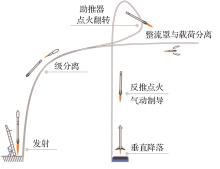
Fig.1
Schematic diagram of Falcon 9 recovery process on sea
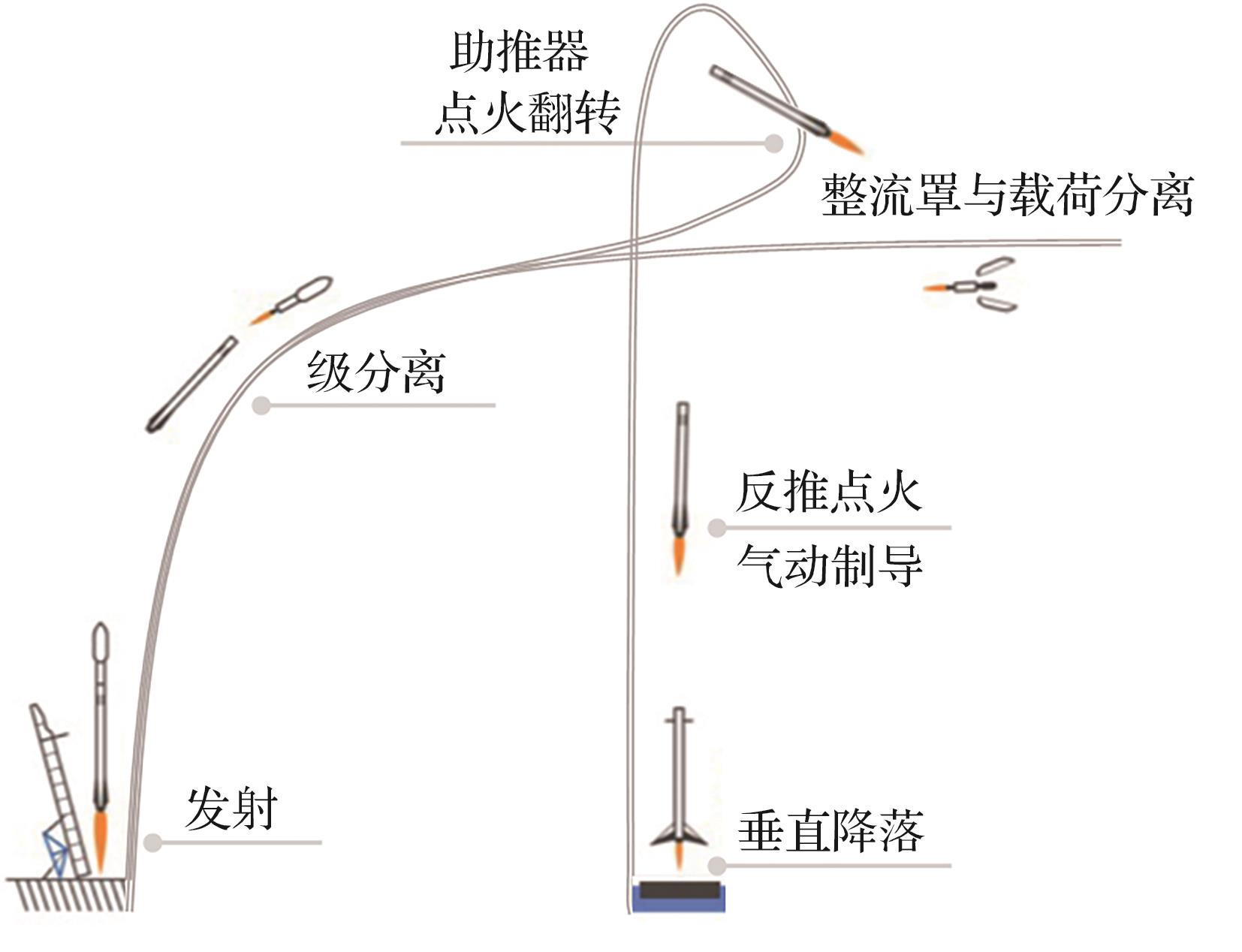
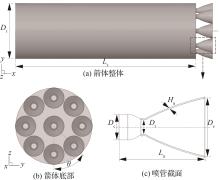
Fig.2
Rocket and nozzle configurations
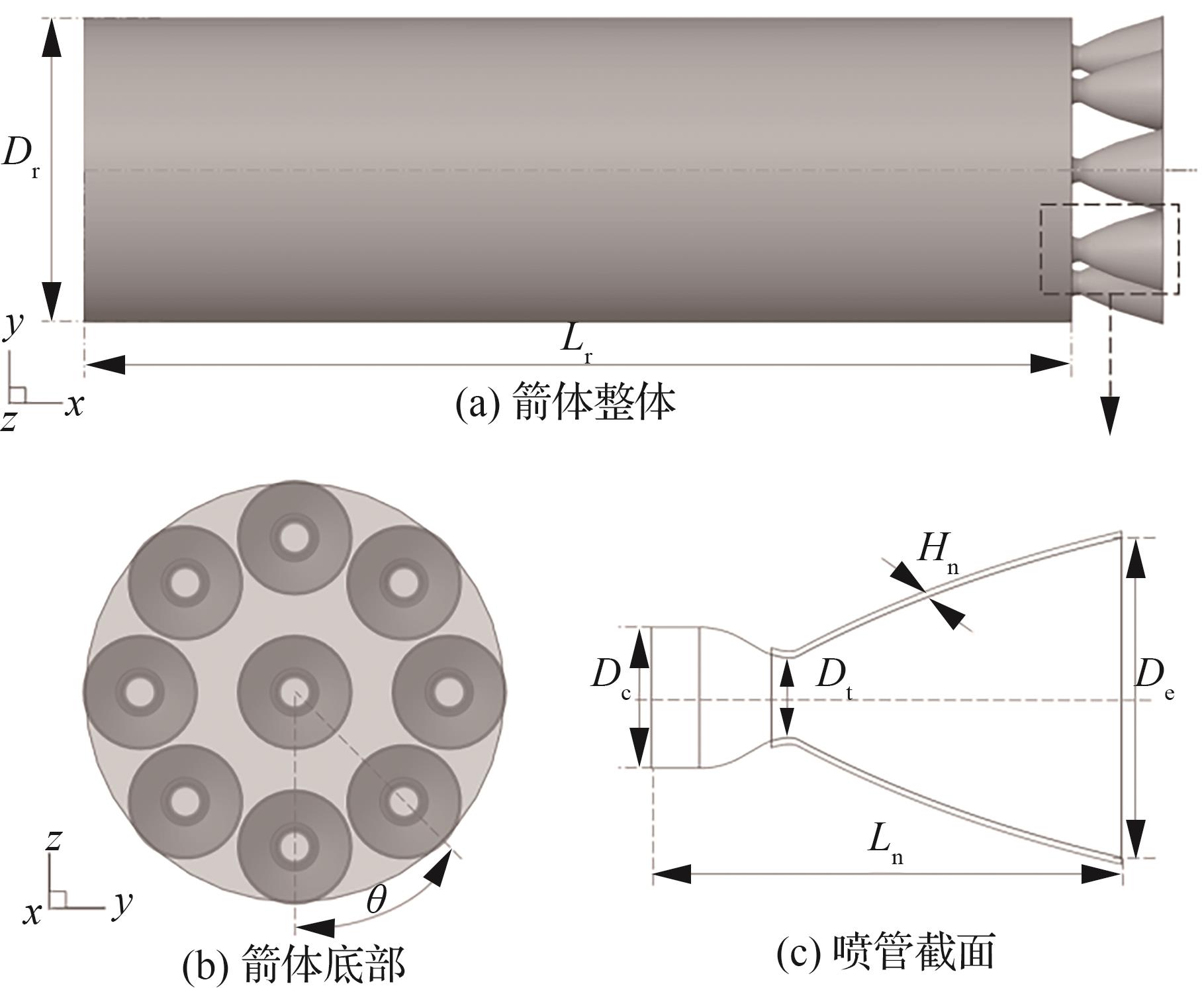

Table 1
Geometric model parameters
| 参数 | 数值 |
|---|---|
| 箭体长度Lr/m | 46 |
| 箭体直径Dr/m | 3.66 |
| 夹角θ/( | 45 |
| 喷管入口直径Dc/mm | 422 |
| 喷管出口直径De/mm | 960 |
| 喷管壁面厚度Hn/mm | 20 |
| 喷管扩张比 | 16 |
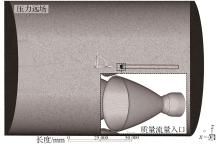
Fig.3
Schematic diagram of computational domain mesh
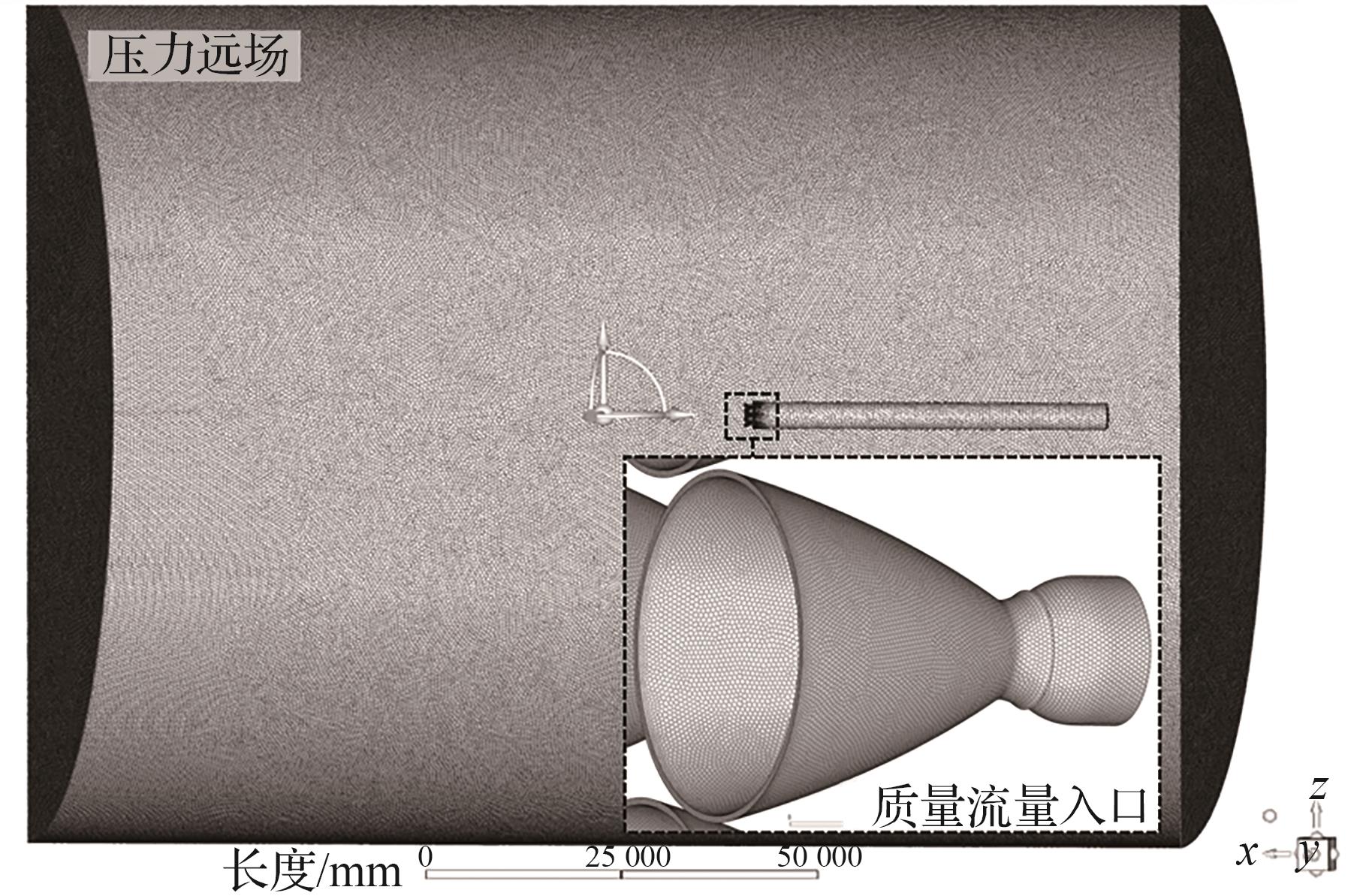
Table 2
Typical conditions and related parameters
| 工况 | 阶段 | 高度/km | 中心机c推力比/% | 分机1、5推力比/% | 其余机推力比/% | 静压/Pa | 马赫数 |
|---|---|---|---|---|---|---|---|
| 1 | 高空动力减速 | 40.0 | 100 | 100 | 0 | 287.14 | 2.83 |
| 2 | 36.8 | 100 | 100 | 0 | 445.52 | 2.39 | |
| 3 | 高空气动减速 | 36.8 | 0 | 0 | 0 | 445.52 | 2.39 |
| 4 | 低空气动减速 | 10.0 | 0 | 0 | 0 | 26 499.90 | 1.34 |
| 5 | 3.2 | 0 | 0 | 0 | 68 357.80 | 0.96 | |
| 6 | 低空动力减速 | 3.2 | 100 | 0 | 0 | 68 357.80 | 0.96 |
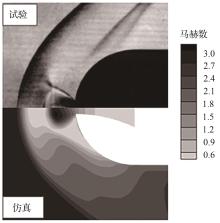
Fig.4
Test schlieren image versus simulated Mach number contours
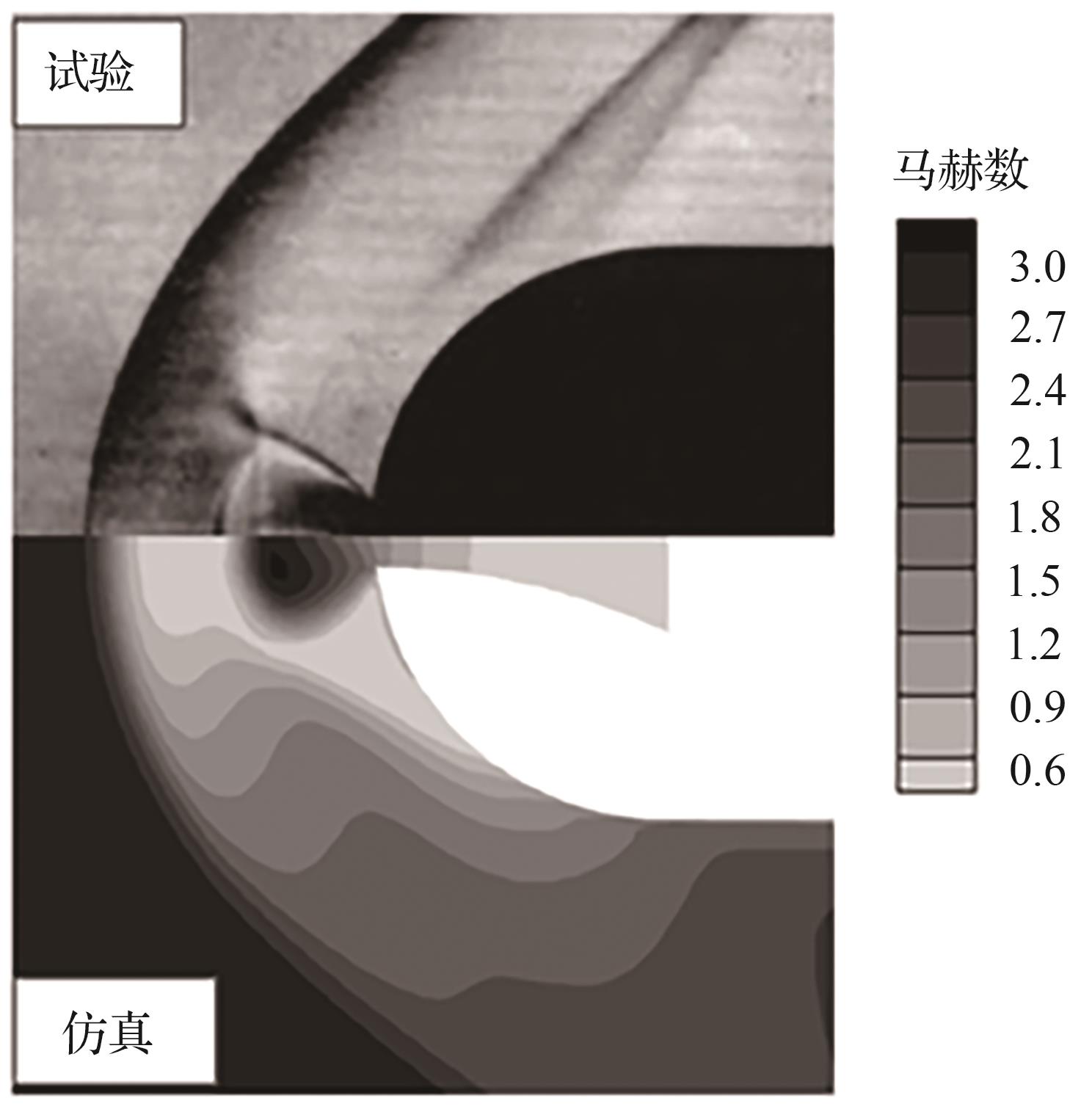
Table 3
Data comparison
| 参数 | Ecker数据[ | RPA热力计算 | CFD计算 |
|---|---|---|---|
| 海平面比冲 | 282.3 | 296.8 | 295.3 |
| 真空比冲 | 304.5 | 303.8 | |
| 海平面推力系数 | 1.56 | 1.62 | 1.75 |
Table 4
Finite rate reaction mechanism of afterburning[29-30]
| 反应方程式 | 指前因子Ar/(m3·kmol-1·s-1) | 温度指数NT | 活化能EA/(105 J·kmol-1) |
|---|---|---|---|
| H2+O = OH+H | 5.17×10⁸ | 2.27 | 291.00 |
| H+O2 = OH+O | 3.18×10¹¹ | -0.49 | 675.00 |
| OH+H2 = H2O+H | 5.89×10⁸ | 1.88 | 132.00 |
| OH+OH = H2O+O | 3.40×10⁷ | 2.26 | -74.70 |
| O+H+M = OH+M | 1.58×10¹⁰ | -1.00 | 0 |
| H+H+M = H2+M | 4.96×10⁵ | -1.21 | 25.60 |
| H+OH+M = H2O+M | 7.83×10¹¹ | -2.54 | 5.05 |
| O+O+M = O2+M | 1.89×10⁷ | 0 | -74.80 |
| CO+OH = CO2+H | 5.19×10⁶ | 2.22 | -578.00 |
| CO+O+M = CO2+M | 6.17×10⁸ | 0 | 126.00 |
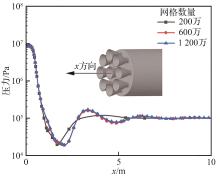
Fig.5
Grid independence verification
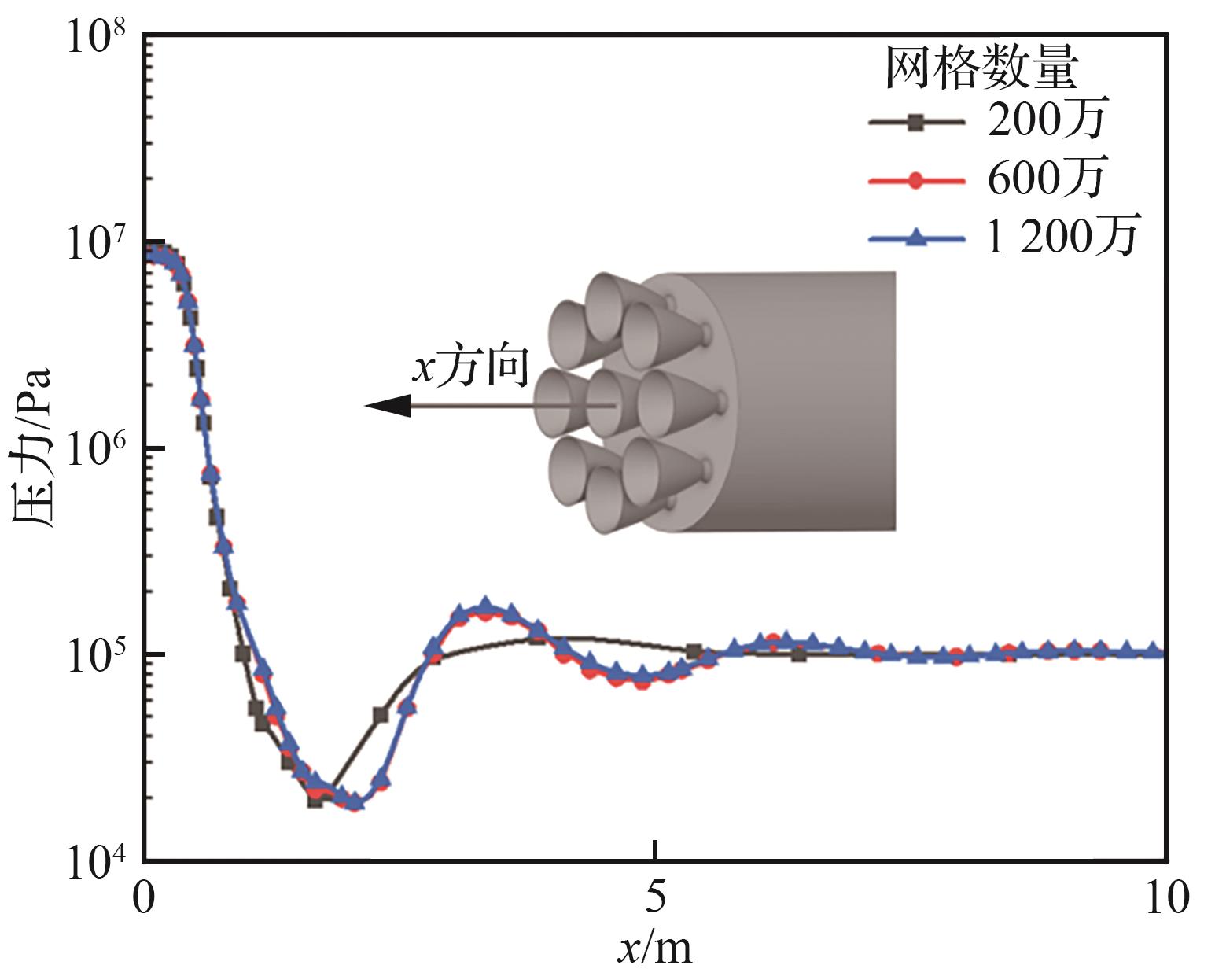
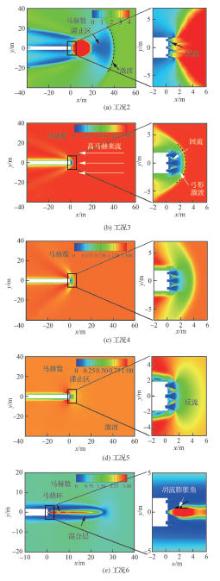
Fig.6
Mach number contours under typical conditions
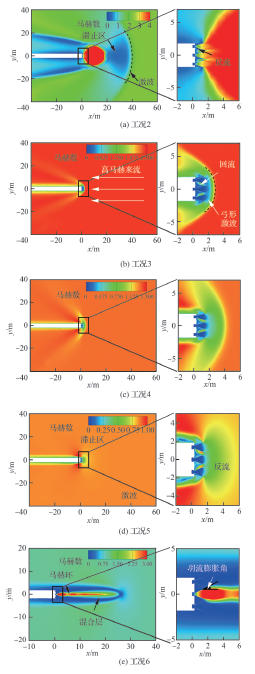
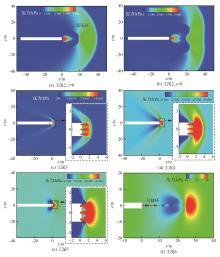
Fig.7
Pressure contours under typical conditions
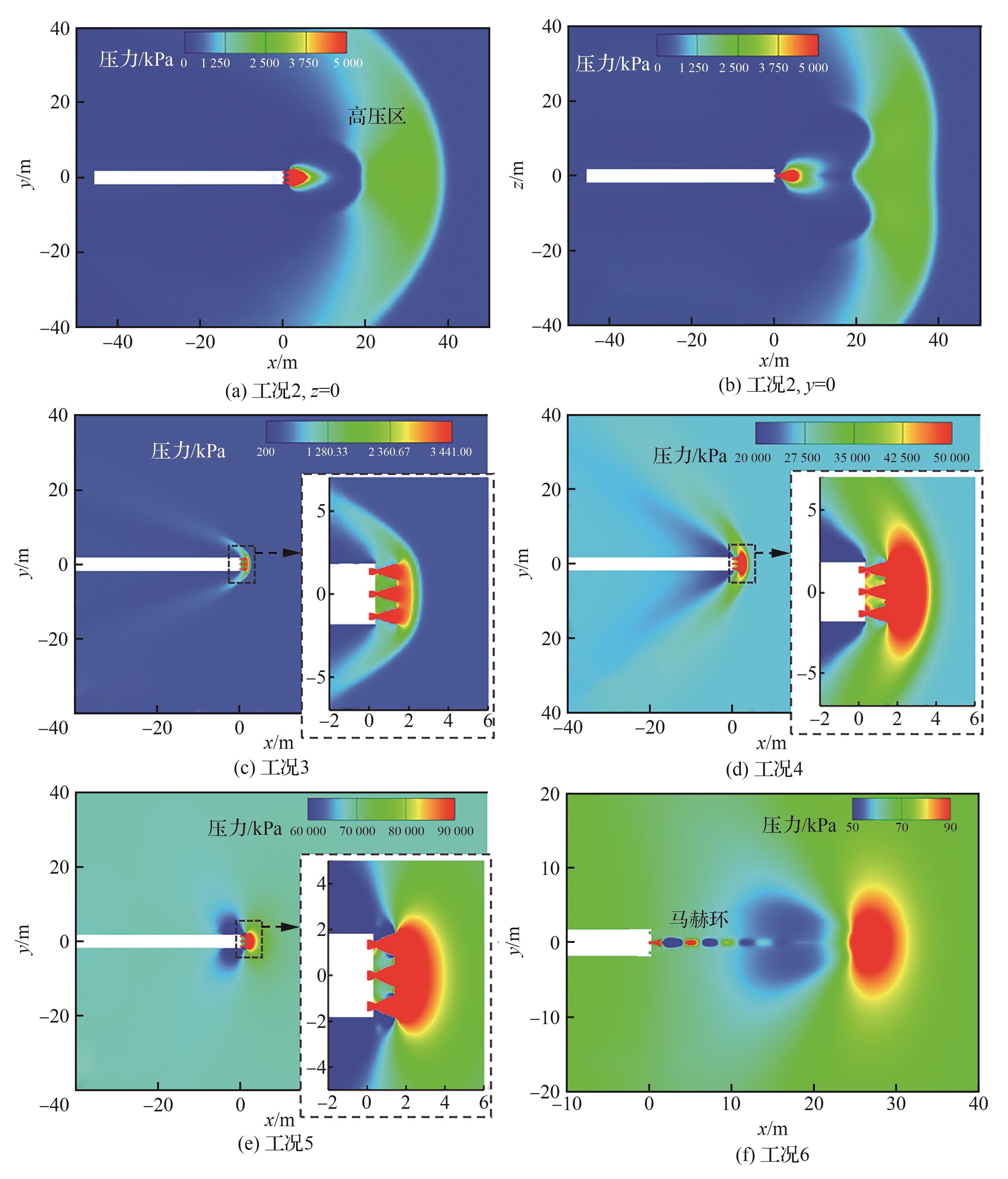
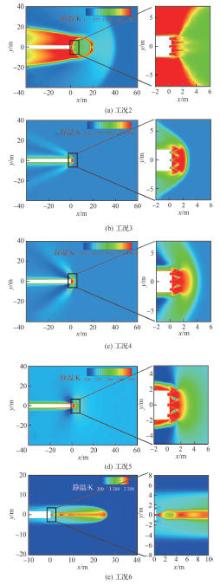
Fig.8
Temperature contours under typical conditions
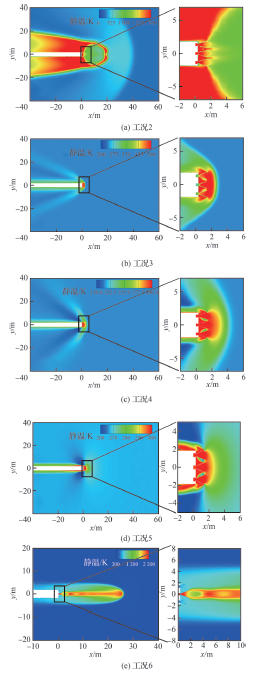
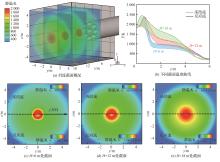
Fig.9
Temperature contours and curves of plume cross-section under Condition 6
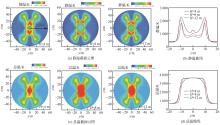
Fig.10
Temperature contours and curves of plume cross-section under Condition 2
Fig.11
Heat flux contours of nozzle inner and outer walls
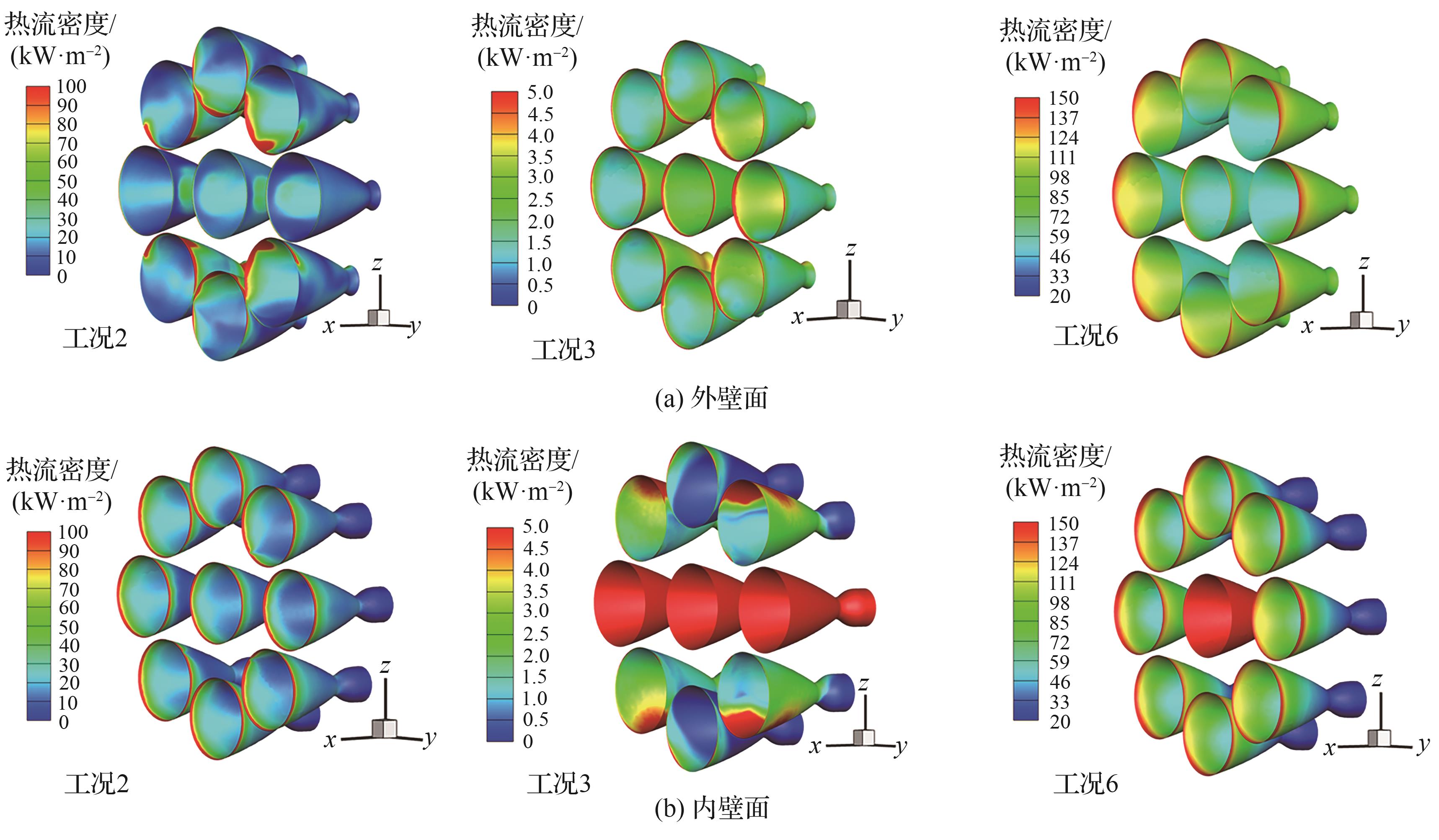
Fig.12
Heat flux contours of rocket base
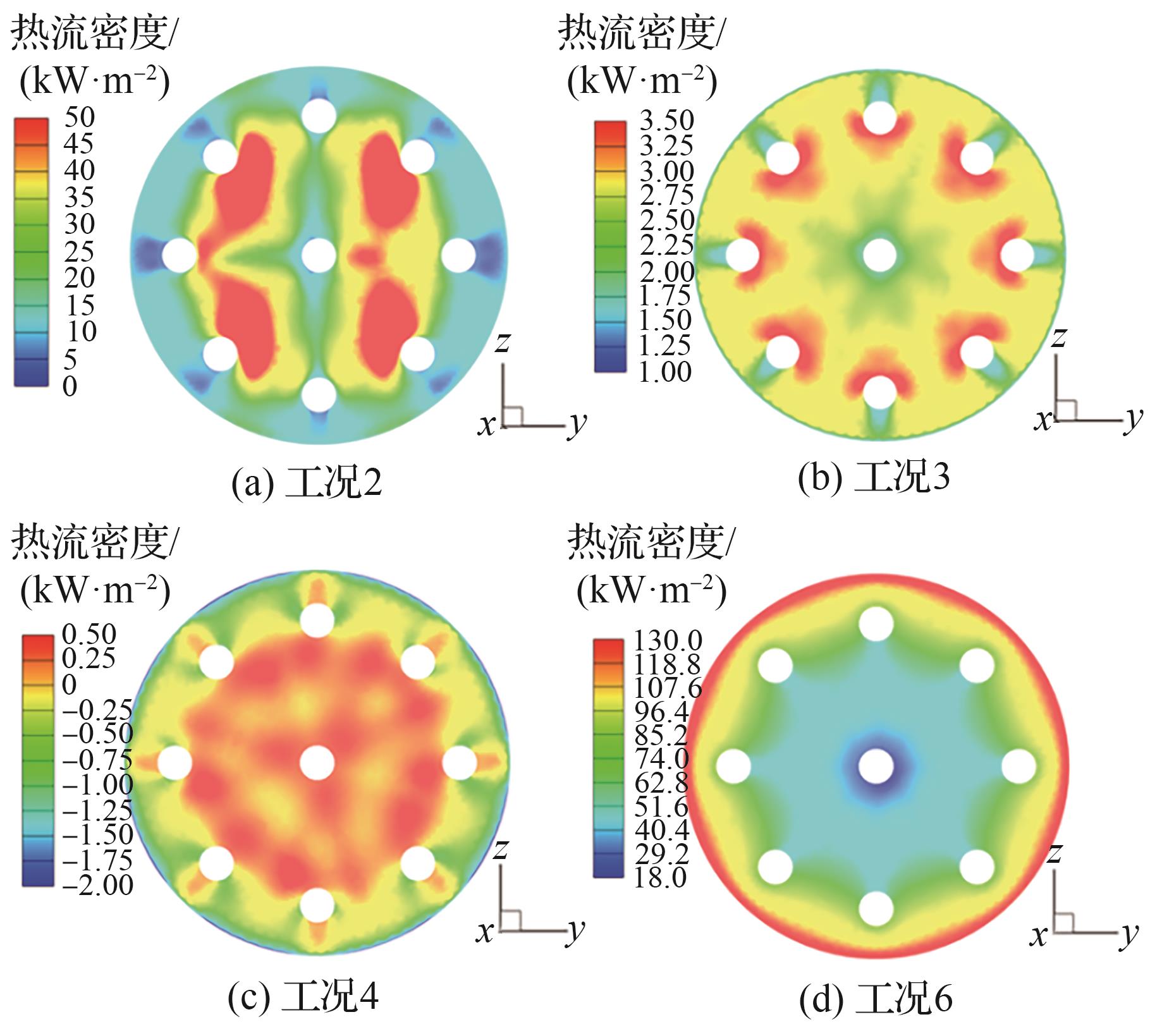
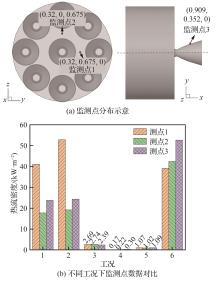
Fig.13
Distribution of monitoring points and data comparison under different operating conditions
| [1] | 包为民. 可重复使用运载火箭技术发展综述[J]. 航空学报, 2023, 44(23): 629555. |
| BAO W M. A review of reusable launch vehicle technology development[J]. Acta Aeronautica et Astronautica Sinica, 2023, 44(23): 629555 (in Chinese). | |
| [2] | 杨毅强. 可重复使用运载火箭技术研究[J]. 中国航天, 2022(11): 8. |
| YANG Y Q. Research on technologies for reusable launch vehicles[J]. Aerospace China, 2022(11): 8 (in Chinese). | |
| [3] | 胡亚豪, 刘阳旻, 李晶茹, 等. 重复使用发动机再入过程流动和热环境特性仿真研究[C]∥第三届空天动力燃烧与传热会议, 2025. |
| HU Y H, LIU Y M, LI J R,et al. Simulation study on flow and thermal environment characteristics of reusable engines during re-entry[C]∥3rd Aerospace Power Combustion and Heat Transfer Conference, 2025 (in Chinese). | |
| [4] | 张雪松. “猎鹰” 9再创历史一级火箭海上着陆回收成功[J]. 太空探索, 2016(5): 26-29. |
| ZHANG X S. Falcon 9 makes history again: First-stage rocket successfully lands and recovers at sea[J]. Space Exploration, 2016(5): 26-29 (in Chinese). | |
| [5] | 李斌, 张小平, 高玉闪. 我国可重复使用液体火箭发动机发展的思考[J]. 火箭推进, 2017, 43(1): 1-7. |
| LI B, ZHANG X P, GAO Y S. Thoughts on the development of reusable liquid rocket engines in China[J]. Journal of Rocket Propulsion, 2017, 43(1): 1-7 (in Chinese). | |
| [6] | 高朝辉, 刘宇, 肖肖, 等. 垂直着陆重复使用运载火箭对动力技术的挑战[J]. 火箭推进, 2015, 41(3): 1-6, 45. |
| GAO Z H, LIU Y, XIAO X, et al. Challenge to propulsion technology for vertical landing reusable launch vehicle[J]. Journal of Rocket Propulsion, 2015, 41(3): 1-6, 45 (in Chinese). | |
| [7] | 王振国, 罗世彬, 吴建军. 可重复使用运载器研究进展[M]. 长沙: 国防科技大学出版社, 2004: 1-20. |
| WANG Z G, LUO S B, WU J J. Research progress on reusable launch vehicles[M]. Changsha: National University of Defense Technology Press, 2004:1-20 (in Chinese). | |
| [8] | HORVATH T J, AUBUCHON V V, RUFER S, et al. Advancing supersonic retro-propulsion technology readiness: Infrared observations of the SpaceX falcon 9 first stage[C]∥AIAA Space and Astronautics Forum and Exposition. Reston: AIAA, 2017. |
| [9] | LAPTOFF M. Wind-flow study of pressure drag reduction at transonic speed by projecting a jet of air from the nose of a prolate spheroid of fineness ratio 6: RM L51E0 [R]. Washington, D.C.: NACA, 1951. |
| [10] | VENKATACHARI B S, ITO Y, CHENG G, et al. Numerical investigation of the interaction of counterflowing jets and supersonic capsule flows[C]∥42nd AIAA Thermophysics Conference. Reston: AIAA, 2011. |
| [11] | 刘浩, 李钧, 冯刚. 逆向喷流对可回收火箭气动特性的影响研究[J]. 推进技术, 2024, 45(2): 34-42. |
| LIU H, LI J, FENG G. Effects of opposing jet on aerodynamic characteristics of reusable rocket[J]. Journal of Propulsion Technology, 2024, 45(2): 34-42 (in Chinese). | |
| [12] | MALMUTH N, FOMIN V, MASLOV A, et al. Influence of a counterflow plasma jet on supersonic blunt body pressures[C]∥9th International Space Planes and Hypersonic Systems and Technologies Conference. Reston: AIAA, 1999. |
| [13] | KUMAR S, MAHULIKAR S P. Reconstruction of aero-thermal heating and thermal protection material response of a Reusable Launch Vehicle using inverse method[J]. Applied Thermal Engineering, 2016, 103: 344-355. |
| [14] | KLEVANSKI J, ECKER T, RIEHMER J, et al. Aerodynamic studies in preparation for callisto-reusable VTVL launcher first stage demonstrator[C]∥69th International Astronautical Congress, 2018. |
| [15] | 贾洪印, 张培红, 赵炜, 等. 火箭子级垂直回收布局气动特性及发动机喷管影响[J]. 航空学报, 2021, 42(2): 623995. |
| JIA H Y, ZHANG P H, ZHAO W, et al. Aerodynamic characteristics of vertical recovery of rocket sub-stage and influence of engine nozzle[J]. Acta Aeronautica et Astronautica Sinica, 2021, 42(2): 623995 (in Chinese). | |
| [16] | ZHOU Z T, LIANG X Y, ZHAO C F, et al. Investigations of base thermal environment on four-nozzle liquid launch vehicle at high altitude[J]. Journal of Spacecraft and Rockets, 2020, 57(1): 49-57. |
| [17] | ZHOU Z T, ZHANG L J, LE G G. Numerical study for the flame deflector design of four-engine liquid rockets[J]. Engineering Applications of Computational Fluid Mechanics, 2020, 14(1): 726-737. |
| [18] | ZHOU Z T, SUN P J, BAO Y Y. Numerical simulations of thermal environment of the rocket impingement jet with afterburning under different water spray angles[J]. Aerospace Science and Technology, 2022, 121: 107308. |
| [19] | ZHOU Z T, BAO Y Y. Investigating the rocket base flow characteristics and thermal environment of different nozzle configurations considering afterburning[J]. International Journal of Thermal Sciences, 2023, 185: 108073. |
| [20] | 周志坛, 李怡庆, 江平, 等. 二次燃烧对多喷管运载火箭底部热环境影响研究[J]. 航空动力学报, 2024, 39(6): 20210694. |
| ZHOU Z T, LI Y Q, JIANG P, et al. Study on the effect of afterburning on the base thermal environment of multi-nozzle launch vehicles[J]. Journal of Aerospace Power, 2024, 39(6): 20210694 (in Chinese). | |
| [21] | 闫指江, 沈丹, 吴彦森, 等. 多喷管运载火箭底部热环境研究[J]. 导弹与航天运载技术, 2021(1): 105-109, 114. |
| YAN Z J, SHEN D, WU Y S, et al. Investigation on base thermal environment of multi-nozzle launch vehicles[J]. Missiles and Space Vehicles, 2021(1): 105-109, 114 (in Chinese). | |
| [22] | SU Y F, SUN P J, CUI Y W, et al. Re-entry rocket basic flow characteristics and thermal environment of different retro-propulsion modes[J]. Chinese Journal of Aeronautics, 2024, 37(7): 190-203. |
| [23] | WANG X, XU X, YU J Q, et al. Effect of free-stream Mach number on the base thermal environment of launch vehicle[J]. Journal of Thermal Science, 2024, 33(6): 2426-2436. |
| [24] | ECKER T, KARL S, DUMONT E, et al. A numerical study on the thermal loads during a supersonic rocket retro-propulsion maneuver[C]∥53rd AIAA/SAE/ASEE Joint Propulsion Conference. Reston: AIAA, 2017. |
| [25] | ECKER T, KARL S, DUMONT E, et al. Numerical study on the thermal loads during a supersonic rocket retropropulsion maneuver[J]. Journal of Spacecraft and Rockets, 2020, 57(1): 131-146. |
| [26] | DUMONT E, STAPPERT S, ECKER T, et al. Evaluation of future ariane reusable VTOL booster stages[C]∥68th International Astronautical Congress, 2017. |
| [27] | FINLEY P J. The flow of a jet from a body opposing a supersonic free stream[J]. Journal of Fluid Mechanics, 1966, 26: 337-368. |
| [28] | ORSZAG S A, YAKHOT V, FLANNERY W S, ET AL. Renormalization group modeling and turbulence simulations[J]. Near-wall Turbulent Flows, 1993: 1031. |
| [29] | VARGA T, OLM C, NAGY T, et al. Development of a joint hydrogen and syngas combustion mechanism based on an optimization approach[J]. International Journal of Chemical Kinetics, 2016, 48(8): 407-422. |
| [30] | TSANG W, HAMPSON R F. Chemical kinetic data base for combustion chemistry. Part Ⅰ. Methane and related compounds[J]. Journal of Physical and Chemical Reference Data, 1986, 15(3): 1087-1279. |
| [1] | Yan WANG, Qingyun DOU, Guangwei WANG, Yaxuan LI, Xiaoyu HE, Xinfu LIU. Joint optimization for ascent and return trajectories of first-stage reusable rockets [J]. Acta Aeronautica et Astronautica Sinica, 2026, 47(3): 232240-232240. |
| [2] | Shidi AI, Junwei LI, Zhongliang TIAN, Lei HAN, Ningfei WANG. Solid rocket motor pressure oscillations under lateral composite overloads [J]. Acta Aeronautica et Astronautica Sinica, 2024, 45(22): 130233-130233. |
| [3] | Yin DIAO, Zhi ZHANG, Yue PENG, Yang LI, Borong ZHANG, Zhiguo ZHANG. Energy management and trajectory optimization technology for rocket landing [J]. Acta Aeronautica et Astronautica Sinica, 2024, 45(15): 229634-229634. |
| [4] | Yonghua TAN. Research progress in high thrust liquid oxygen methane rocket engine technology [J]. Acta Aeronautica et Astronautica Sinica, 2024, 45(11): 529690-529690. |
| [5] | Wu LIU, Yunyan WU, Wei LIU, Mingming TIAN, Tianpeng HUANG. Re-entry robust fault tolerant attitude control for RLVs considering unknown disturbances [J]. Acta Aeronautica et Astronautica Sinica, 2023, 44(S1): 727787-727787. |
| [6] | Weijia LIU, Yingkun LI, Xiong CHEN, Chunlei LI. Panel flutter characteristics on shock wave/boundary layer interaction based on fluid⁃structure coupling [J]. ACTA AERONAUTICAET ASTRONAUTICA SINICA, 2023, 44(6): 127085-127085. |
| [7] | Haoxiang WANG, Yao XIAO, Kaikai ZHANG, Guangli LI, Siyuan CHANG, Zhongwei TIAN, Kai CUI. Effect of body trailing edge shape on subsonic flow characteristics of high-pressure capturing wing configuration [J]. ACTA AERONAUTICAET ASTRONAUTICA SINICA, 2023, 44(6): 127215-127215. |
| [8] | Yan LYU, Lin LIU, Guangyong ZHANG, Lei LIANG, Xuesheng ZHENG. Reusable technology of air⁃launched launch vehicle [J]. Acta Aeronautica et Astronautica Sinica, 2023, 44(23): 628083-628083. |
| [9] | Mengqi GU, Jiacai ZHU, Wanlin GUO, Song XUE. Prospects for fatigue durability and reliability of reusable launch vehicle structures [J]. Acta Aeronautica et Astronautica Sinica, 2023, 44(23): 628299-628299. |
| [10] | Linkun HE, Wenchao XUE, Ran ZHANG, Huifeng LI. Guidance and control for powered descent and landing of launch vehicles: Overview and outlook [J]. Acta Aeronautica et Astronautica Sinica, 2023, 44(23): 628462-628462. |
| [11] | Zhi ZHANG, Han YUAN, Wanqing ZHANG. Powered deceleration guidance method based on gravity-turn analytical solutions [J]. Acta Aeronautica et Astronautica Sinica, 2023, 44(23): 628483-628483. |
| [12] | Weimin BAO. A review of reusable launch vehicle technology development [J]. Acta Aeronautica et Astronautica Sinica, 2023, 44(23): 629555-629555. |
| [13] | Yi RONG, Hui LIU, Ziwen YU, Pingping ZHU, Yue PENG, Jiahui YU. Behavior of cryogenic propellant in return stage of reusable launch vehicle [J]. Acta Aeronautica et Astronautica Sinica, 2023, 44(23): 629563-629563. |
| [14] | LI Hui, LYU Haiyu, ZOU Zeyu, LUO Zhong, MA Hui, HAN Qingkai. Analysis and verification of nonlinear vibrations of fiber-reinforced composite cylindrical shells in thermal environment [J]. ACTA AERONAUTICAET ASTRONAUTICA SINICA, 2022, 43(9): 425642-425642. |
| [15] | FU Yang'aoxiao, DING Mingsong, LIU Qingzong, JIANG Tao, SHI Run, DONG Weizhong, GAO Tiesuo. Numerical study of hot jet interaction effect in divert control system [J]. ACTA AERONAUTICAET ASTRONAUTICA SINICA, 2022, 43(9): 125941-125941. |
| Viewed | ||||||
|
Full text |
|
|||||
|
Abstract |
|
|||||
Address: No.238, Baiyan Buiding, Beisihuan Zhonglu Road, Haidian District, Beijing, China
Postal code : 100083
E-mail:hkxb@buaa.edu.cn
Total visits: 6658907 Today visits: 1341All copyright © editorial office of Chinese Journal of Aeronautics
All copyright © editorial office of Chinese Journal of Aeronautics
Total visits: 6658907 Today visits: 1341

 CJA
CJA
