Acta Aeronautica et Astronautica Sinica ›› 2026, Vol. 47 ›› Issue (3): 232240.doi: 10.7527/S1000-6893.2025.32240
• Solid Mechanics and Vehicle Conceptual Design • Previous Articles
Yan WANG, Qingyun DOU, Guangwei WANG, Yaxuan LI, Xiaoyu HE, Xinfu LIU( )
)
Received:2025-05-15
Revised:2025-06-13
Accepted:2024-08-11
Online:2025-09-08
Published:2025-08-28
Contact:
Xinfu LIU
E-mail:lauxinfu@sina.com
Supported by:CLC Number:
Yan WANG, Qingyun DOU, Guangwei WANG, Yaxuan LI, Xiaoyu HE, Xinfu LIU. Joint optimization for ascent and return trajectories of first-stage reusable rockets[J]. Acta Aeronautica et Astronautica Sinica, 2026, 47(3): 232240.
Table 1
Mission parameters
| 符号 | 含义 |
|---|---|
| 一子级质量占火箭总质量的比例 | |
| 一子级返回段预留的燃料占一子级燃料加注质量的比例 | |
| 一子级上升段的终端高度 | |
| 一子级上升段的终端当地弹道倾角 | |
| 一子级上升段的终端当地弹道偏角 | |
| 二子级上升段的终端时间 |
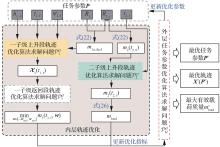
Fig.1
Flowchart of bi-level optimization framework
Table 2
Range of initial states and αA, αB
| 参数 | ||||||
|---|---|---|---|---|---|---|
| 最大值 | 70 | 2 500 | 30 | 5 | 10 | 10 |
| 最小值 | 45 | 1 800 | 10 | -5 | -10 | -10 |
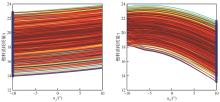
Fig.2
Relationships between fuel consumption mass of the first stage’s return and αA,αB
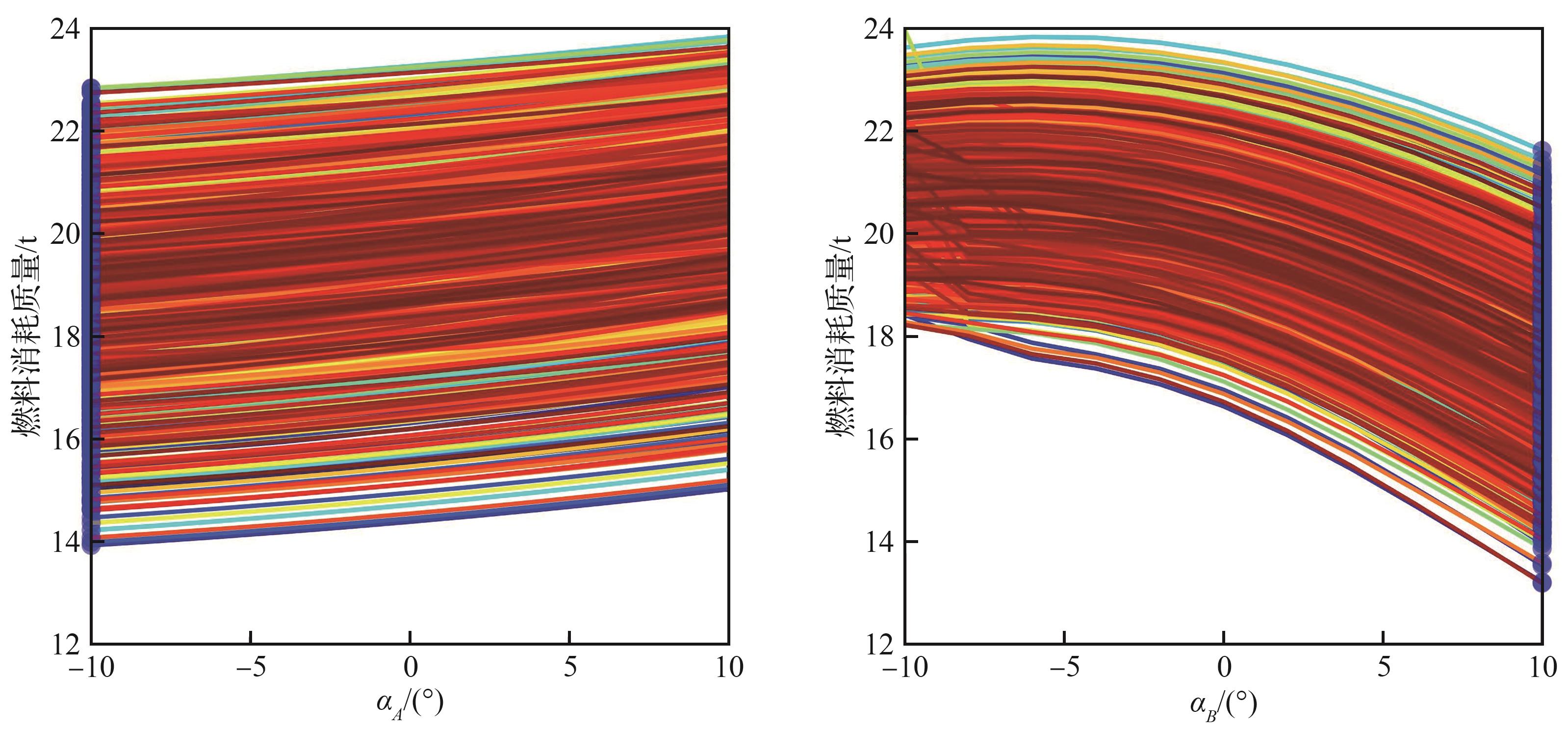
Table 3
Rocket’s parameters
| 模块 | 参数 | 数值 |
|---|---|---|
| 全箭 | 起飞质量 | 580 |
| 参考面积 | 8.814 | |
| 一子级 | 结构系数 | 0.07 |
| 发动机数量 | 9 | |
| 单台发动机真空推力 | 916.7 | |
| 单台发动机真空比冲 | 3 046 | |
| 单台发动机喷口面积 | 0.9 | |
| 二子级 | 结构系数 | 0.06 |
| 发动机数量 | 1 | |
| 单台发动机真空推力 | 1 017 | |
| 单台发动机真空比冲 | 3 413 |
Table 4
Range of mission parameters
| 参数 | ||||||
|---|---|---|---|---|---|---|
| 最大值 | 85 | 10 | 70 | 30 | 5 | 1 800 |
| 最小值 | 65 | 2 | 45 | 10 | -5 | 900 |
Fig.3
Optimal ascent and return trajectories of rocket
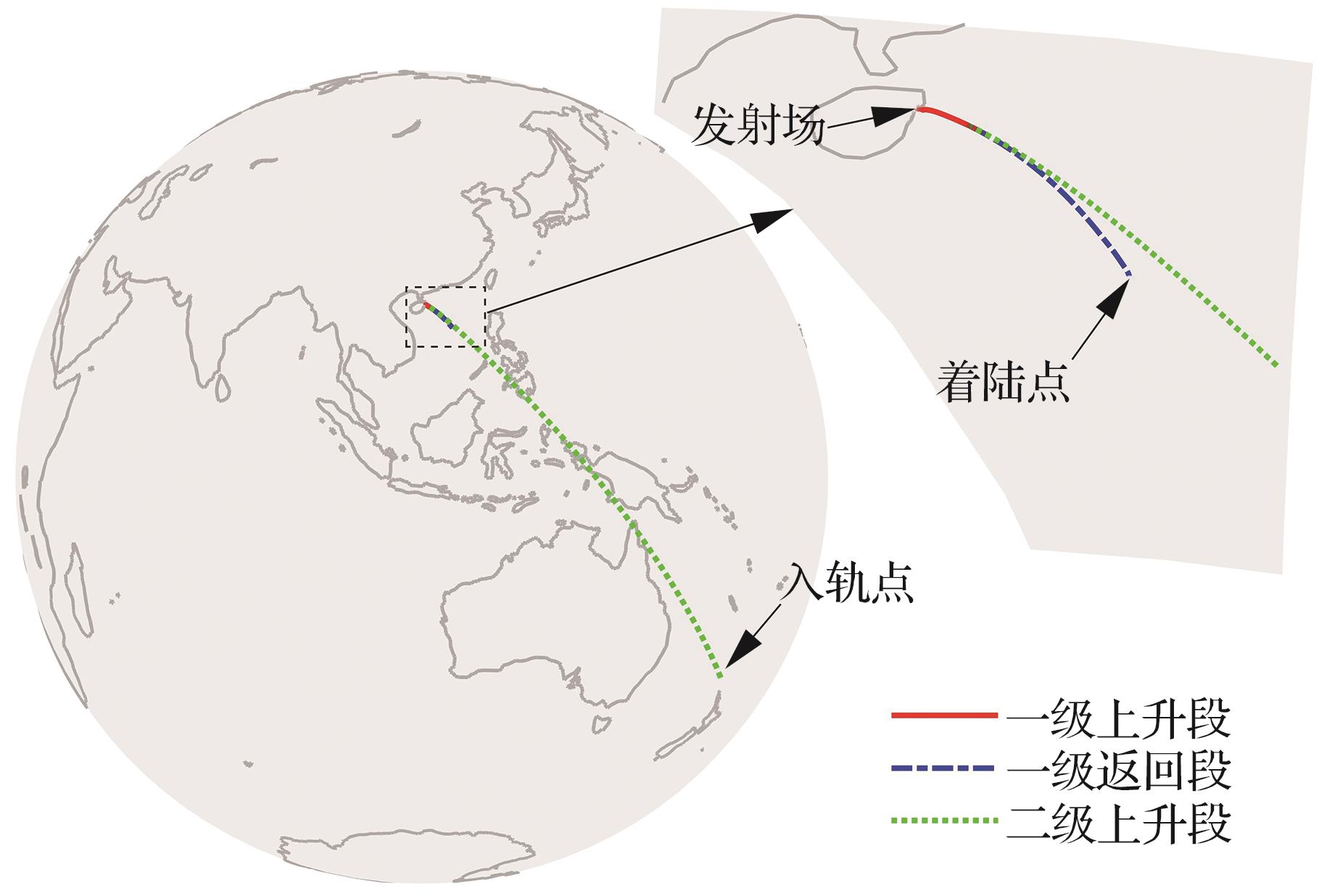
Fig.4
Altitude, velocity, and local flight-path angle
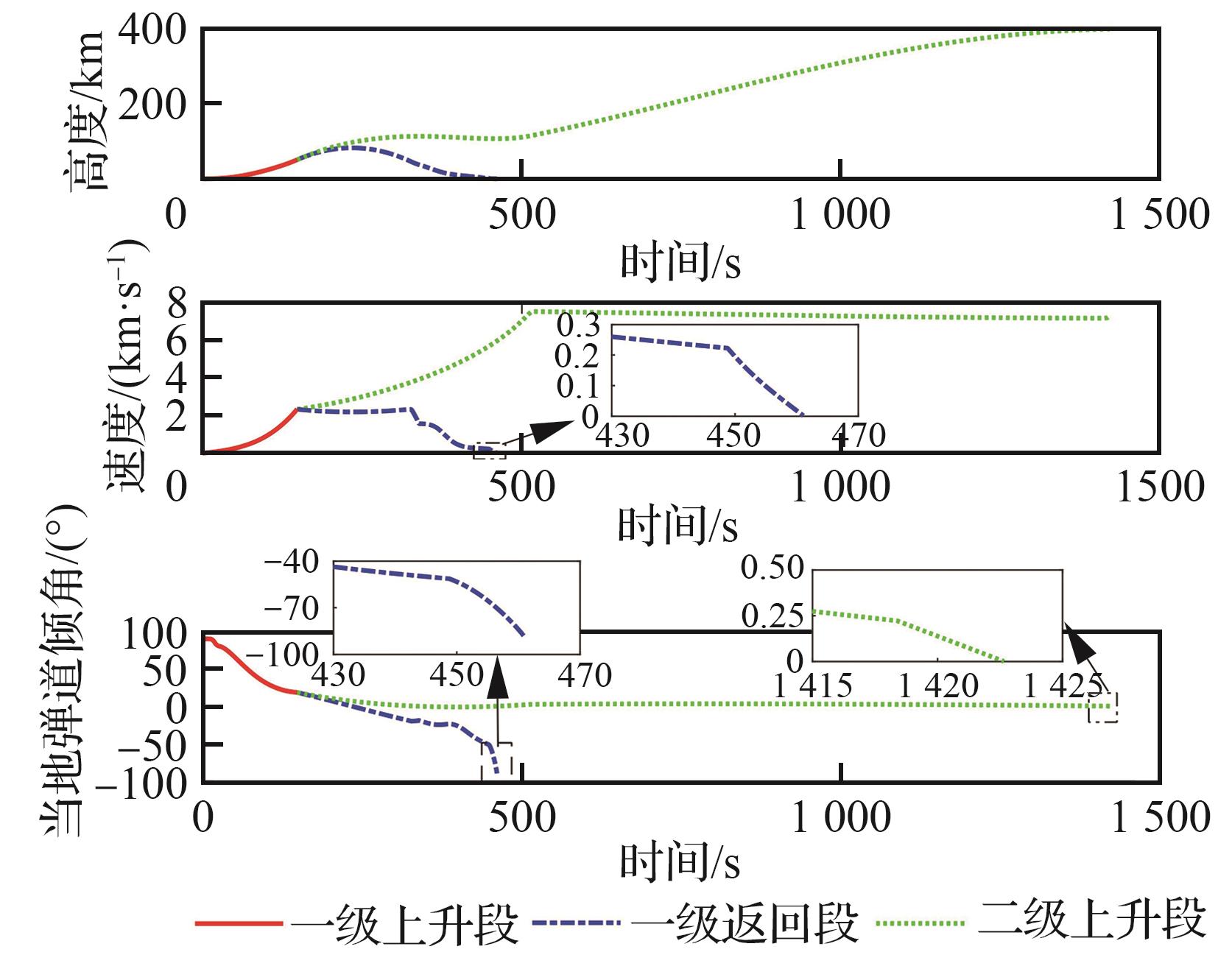
Fig.5
Thrust and total angle of attack
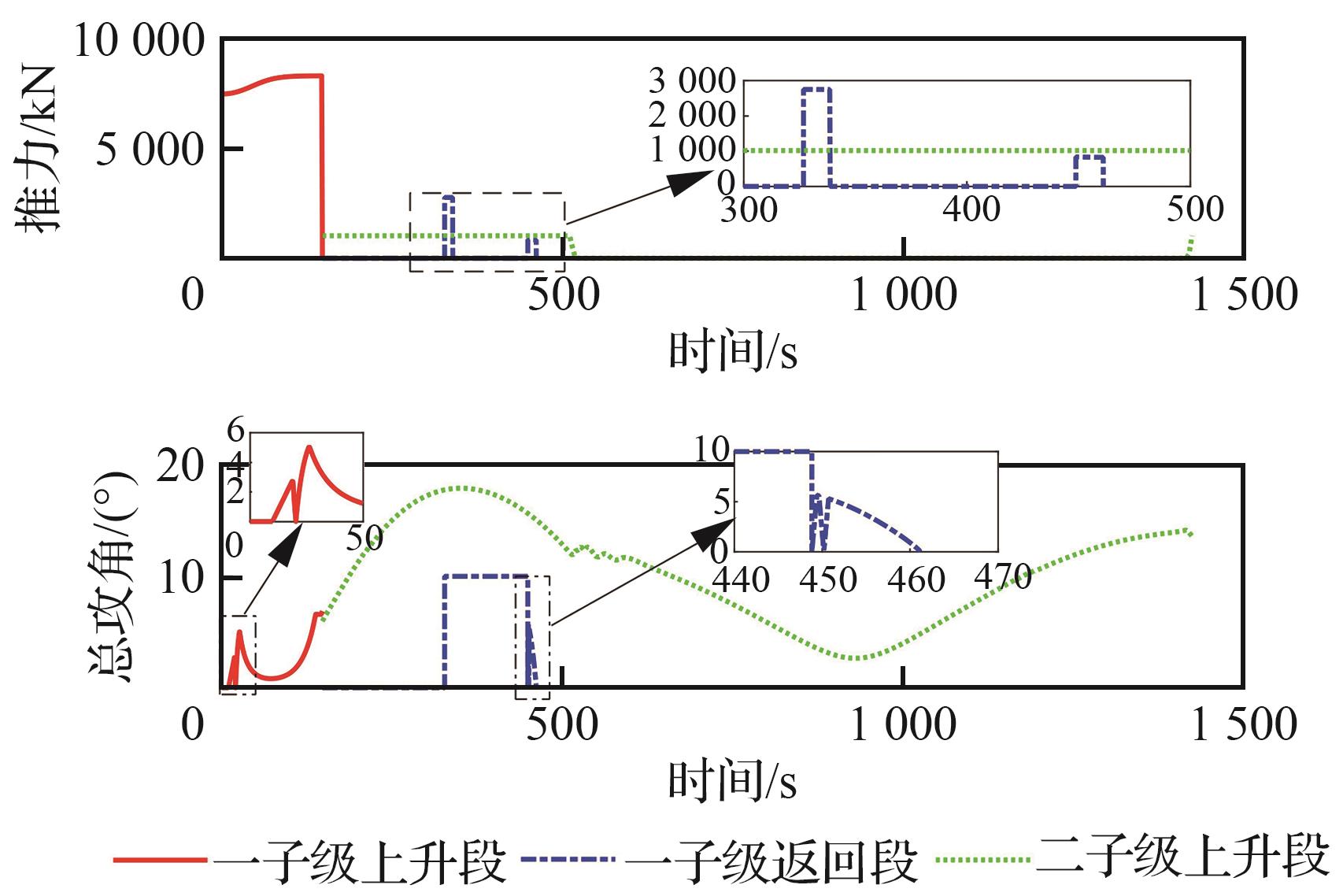
Fig.6
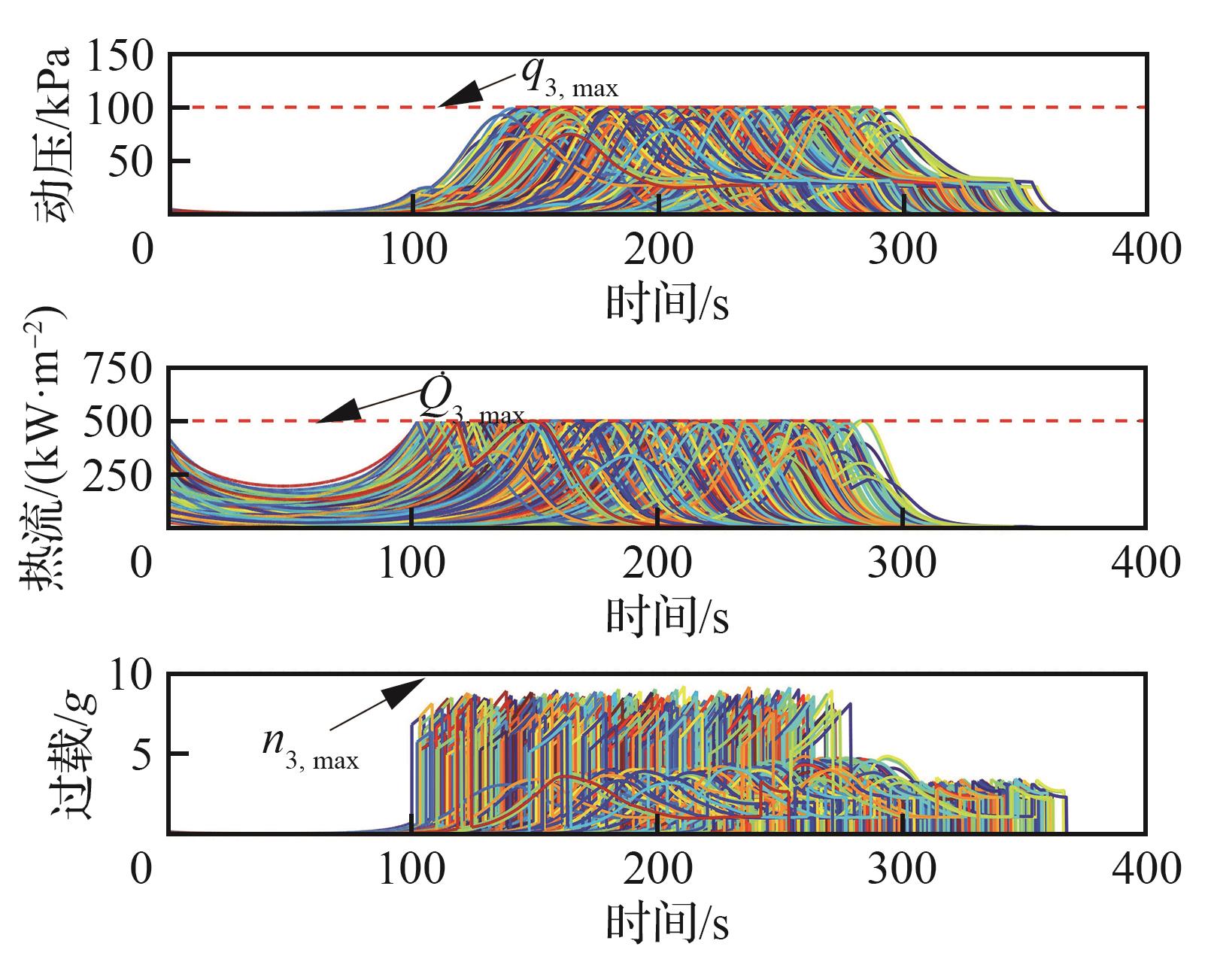
Dynamic pressure, heating rate, and load factor of the first stage’s return
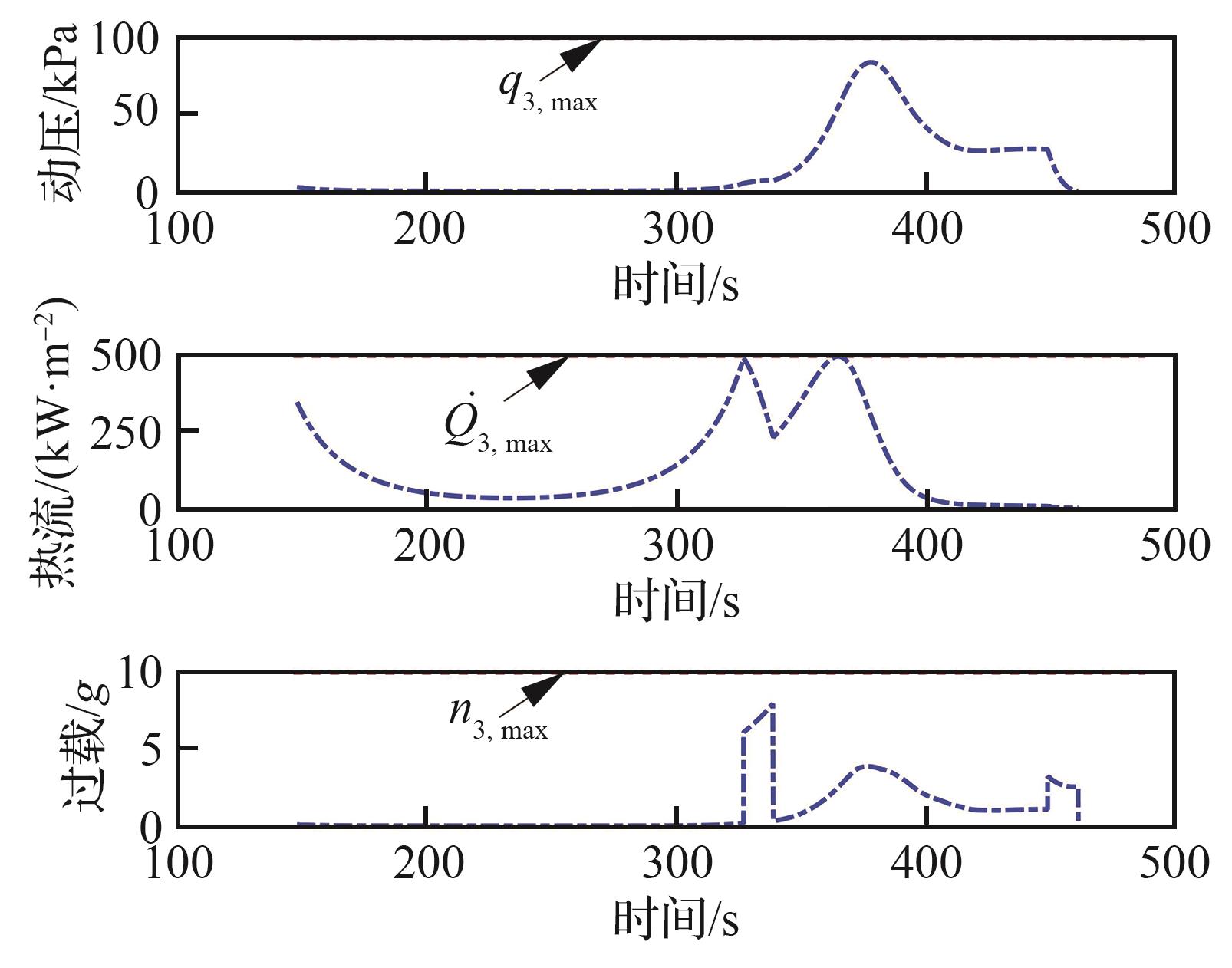
Table 5
Comparison results of mission parameters
| 参数 | ||||||
|---|---|---|---|---|---|---|
| 76.7 | 3.91 | 67.1 | 10.6 | 0.58 | 1 424.5 | |
| 79.6 | 4.85 | 48.6 | 16.1 | 0.26 | 1 416.2 | |
| 79.0 | 7.00 | 60.0 | 20.0 | 0 | 1 300 |
Table 6
Comparison results of trajectories
| 工况 | 返回段燃料 消耗质量/kg | 返回段燃料 剩余质量/kg | 有效载荷 质量/kg |
|---|---|---|---|
| 工况 1 | |||
| 工况 2 | |||
| 工况 3 |
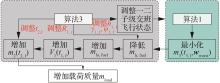
Fig.7
Principle for algorithm 3 to improve payload mass
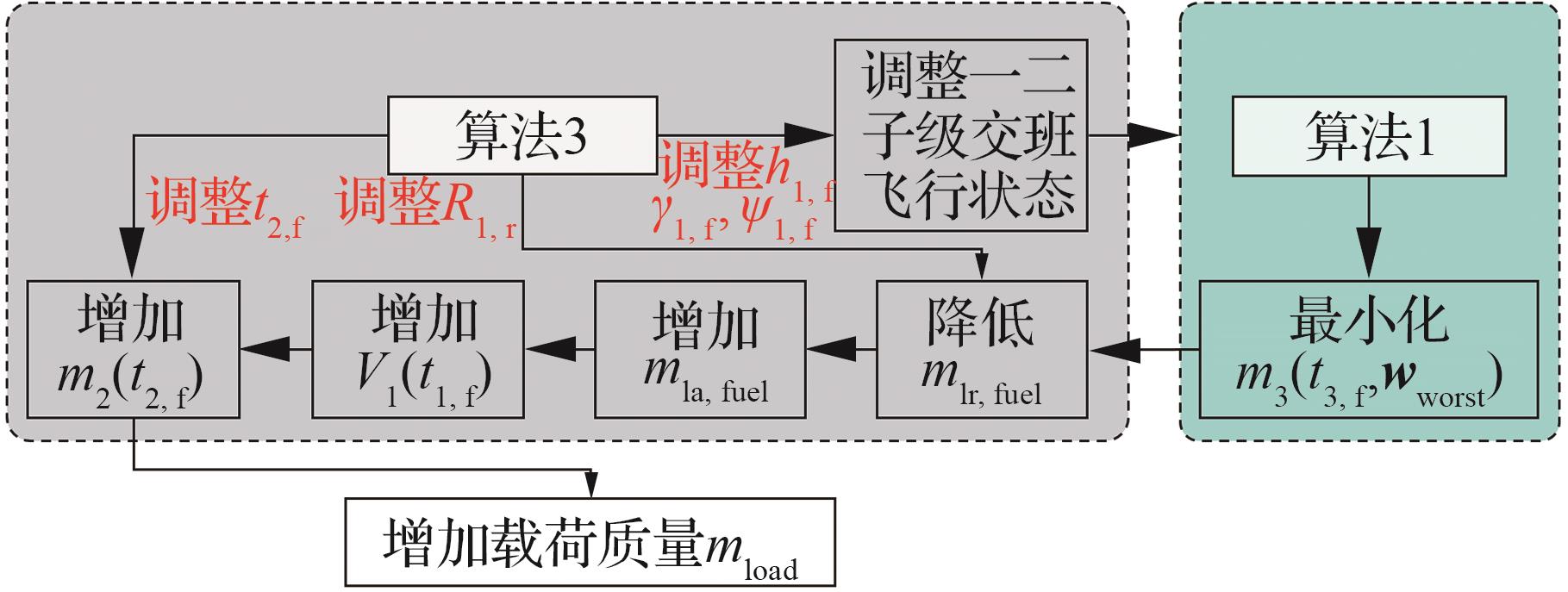
Table 7
Comparison results with existing method
| 方法 | 一子级返回段燃料消耗质量/kg | 有效载荷 质量/kg |
|---|---|---|
| 本文方法 | ||
| 文献[ |
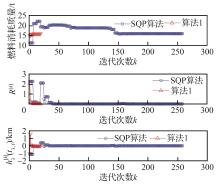
Fig.8
Comparison of iterative processes of SQP and Algorithm 1
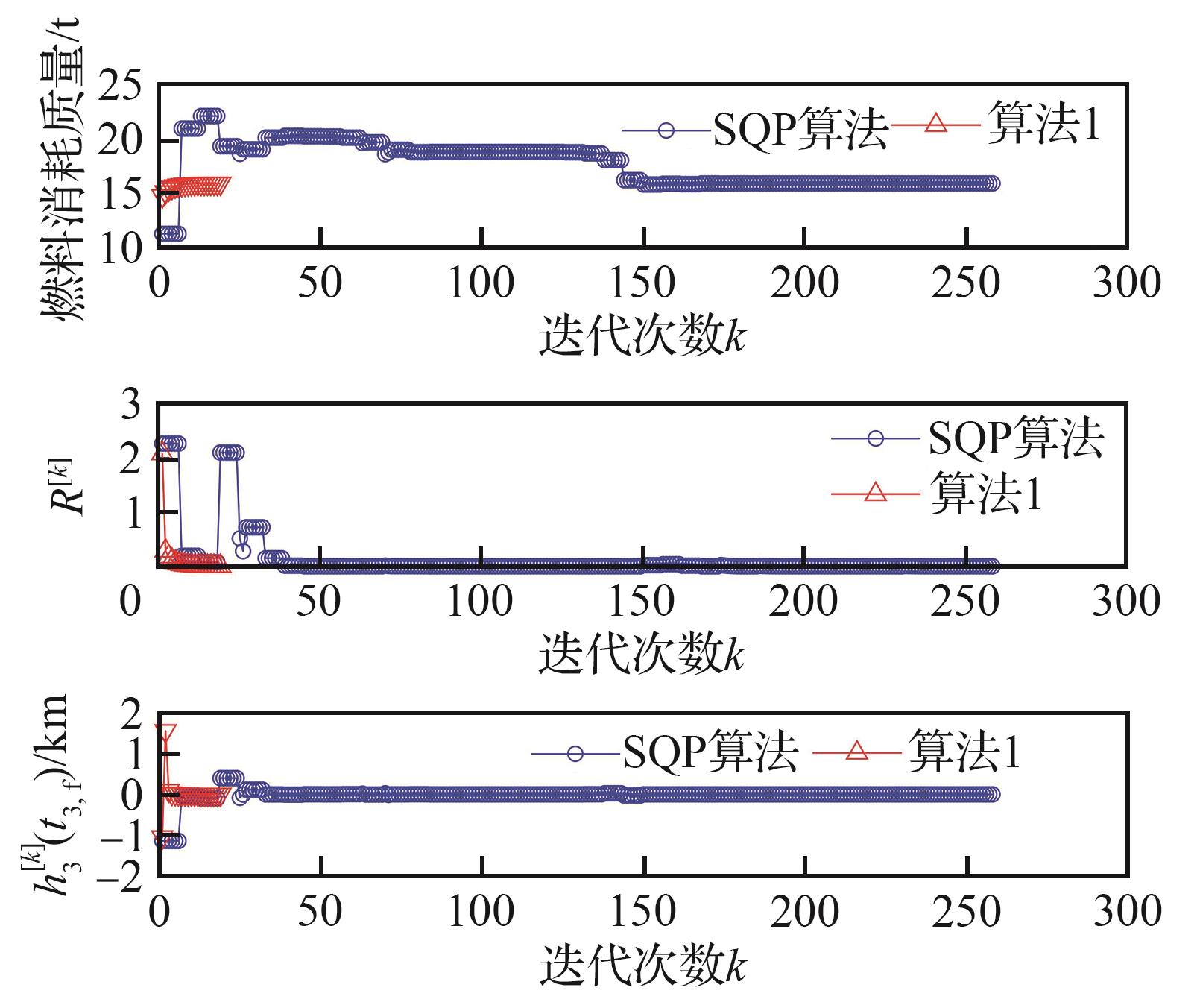
Fig.9
Comparison of thrust and total angle of attack of the first stage’s return
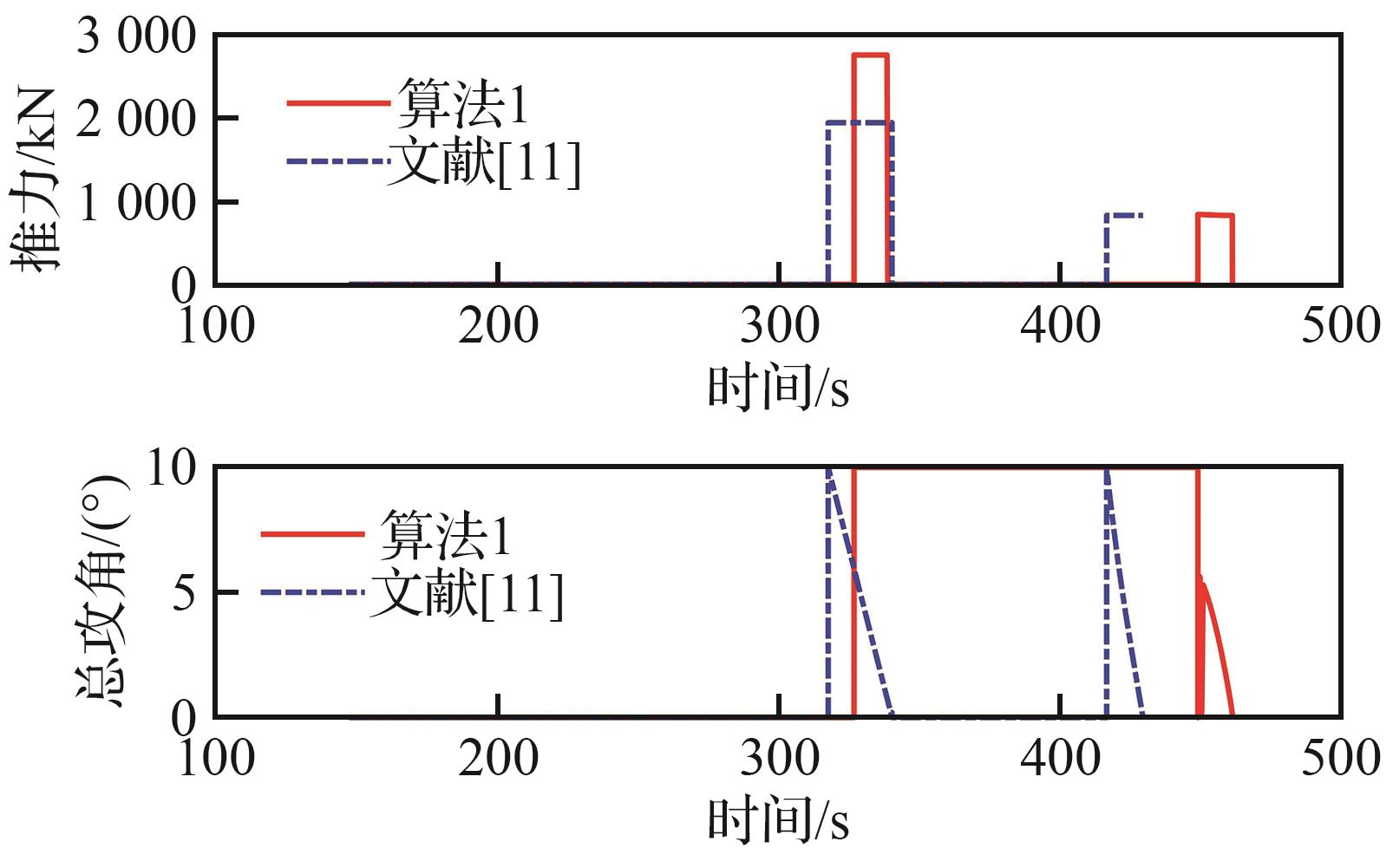
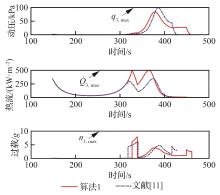
Fig.10
Comparison of dynamic pressure, heating rate, and load factor of the first stage’s return
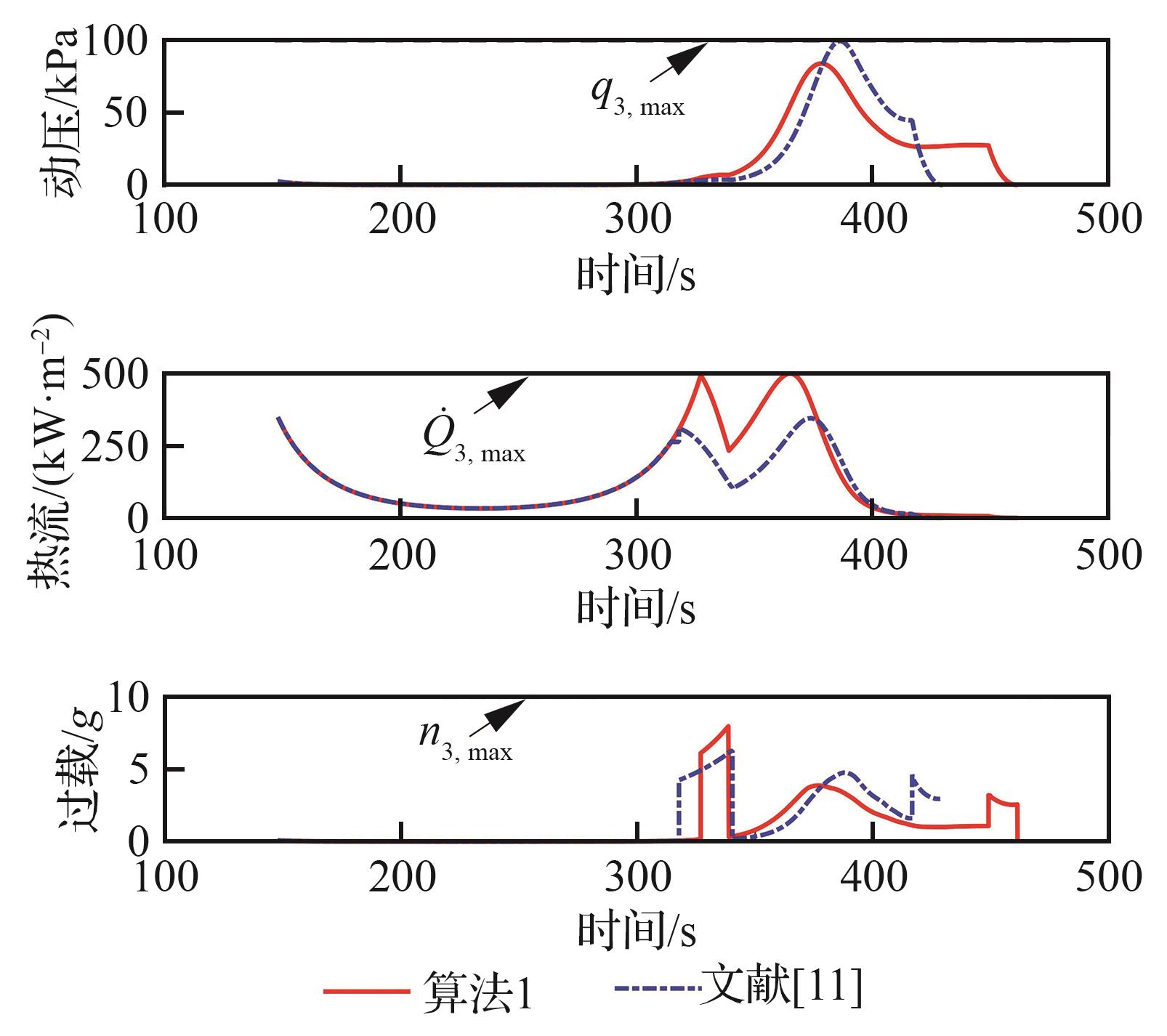
Table 8
Range of initial states
| 参数 | |||||
|---|---|---|---|---|---|
| 最大值 | 70 | 30 | 5 | 2 200 | 60 000 |
| 最小值 | 45 | 10 | -5 | 1 500 | 40 000 |
Fig.11
Trajectory, velocity, and local flight-path angle of the first stage’s return in each scenario
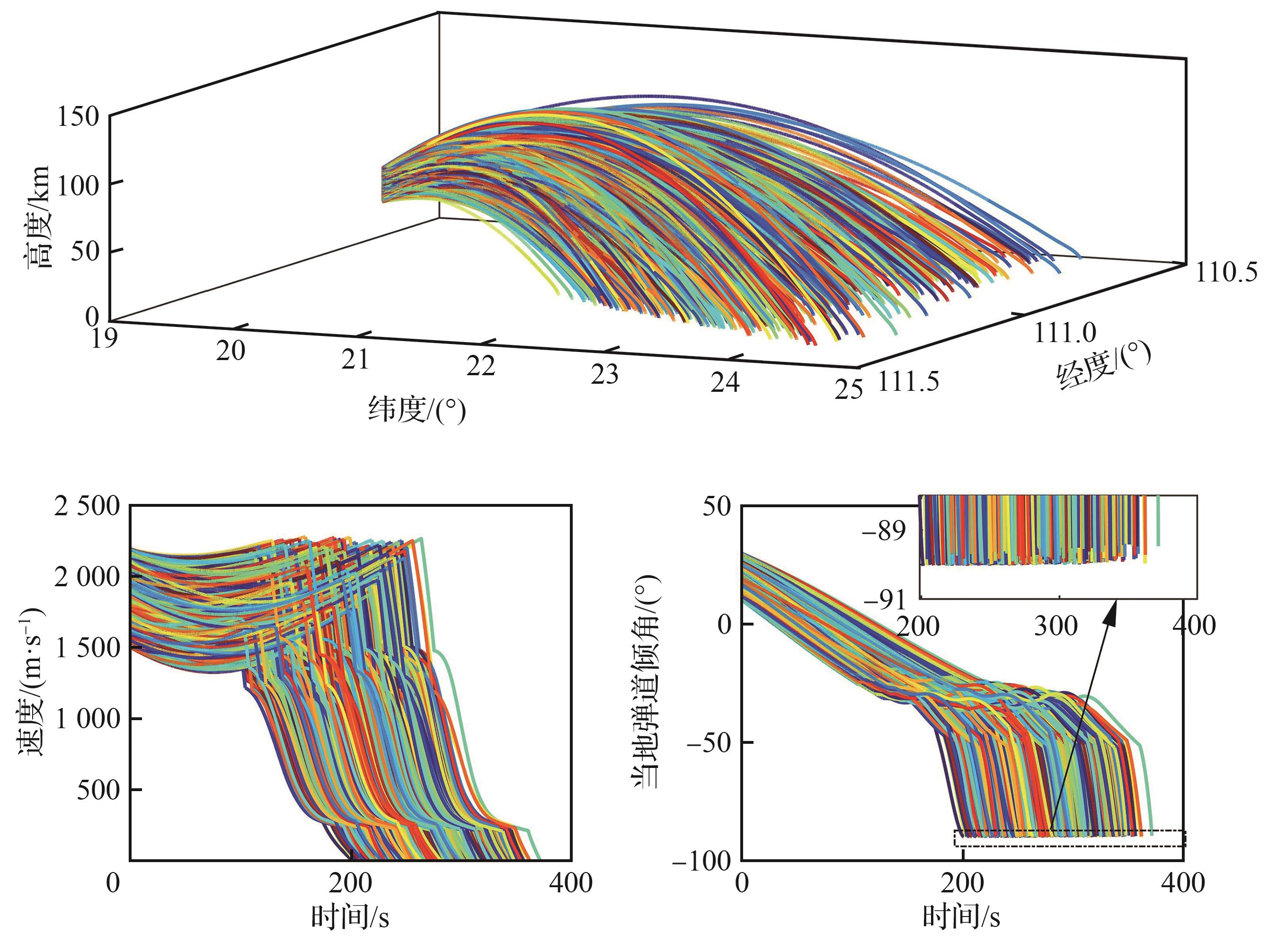
Fig.12
Dynamic pressure, heating rate, and load factor of the first stage’s return in each scenario
| [1] | 包为民. 可重复使用运载火箭技术发展综述[J]. 航空学报, 2023, 44(23): 629555. |
| BAO W M. A review of reusable launch vehicle technology development[J]. Acta Aeronautica et Astronautica Sinica, 2023, 44(23): 629555 (in Chinese). | |
| [2] | 高朝辉, 张普卓, 刘宇, 等. 垂直返回重复使用运载火箭技术分析[J]. 宇航学报, 2016, 37(2): 145-152. |
| GAO Z H, ZHANG P Z, LIU Y, et al. Analysis of vertical landing technique in reusable launch vehicle[J]. Journal of Astronautics, 2016, 37(2): 145-152 (in Chinese). | |
| [3] | HELLMAN B. Hybrid launch vehicle staging optimization for minimum cost[C]∥Space 2006. Reston: AIAA, 2006. |
| [4] | 袁文婕, 周浩, 刘小明. 垂直起降火箭入轨回收一体轨迹优化[J]. 飞行力学, 2024, 42(5): 21-25, 33. |
| YUAN W J, ZHOU H, LIU X M. Injection and recovery integrated trajectory optimization for vertical take-off and vertical landing rocket[J]. Flight Dynamics, 2024, 42(5): 21-25, 33 (in Chinese). | |
| [5] | LU P, SANDOVAL S, DAVAMI C. Fast and robust optimization of full trajectory from entry through powered descent[J]. Journal of Guidance, Control, and Dynamics, 2023, 47(2): 203-216. |
| [6] | 崔乃刚, 黄盘兴, 路菲, 等. 基于混合优化的运载器大气层内上升段轨迹快速规划方法[J]. 航空学报, 2015, 36(6): 1915-1923. |
| CUI N G, HUANG P X, LU F, et al. A hybrid optimization approach for rapid endo-atmospheric ascent trajectory planning of launch vehicles[J]. Acta Aeronautica et Astronautica Sinica, 2015, 36(6): 1915-1923 (in Chinese). | |
| [7] | 邱丰, 宋征宇. 采用联立法求解大姿态终端约束的上升段轨迹优化[J]. 宇航学报, 2017, 38(1): 18-25. |
| QIU F, SONG Z Y. Large terminal attitude constrained trajectory optimization of ascent stage via simultaneous method[J]. Journal of Astronautics, 2017, 38(1): 18-25 (in Chinese). | |
| [8] | LU P, LIU X F, YANG R Q, et al. Ascent trajectory optimization with nonlinearity-kept convexification[J]. IEEE Transactions on Aerospace and Electronic Systems, 2023, 59(3): 3236-3250. |
| [9] | LI Y, CHEN W C, ZHOU H, et al. Conjugate gradient method with pseudospectral collocation scheme for optimal rocket landing guidance[J]. Aerospace Science and Technology, 2020, 104: 105999. |
| [10] | HWANG J, AHN J. Integrated optimal guidance for reentry and landing of a rocket using multi-phase pseudo-spectral convex optimization[J]. International Journal of Aeronautical and Space Sciences, 2022, 23(4): 766-774. |
| [11] | ZHAO J, HE X Y, LI H Y, et al. An adaptive optimization algorithm based on clustering analysis for return multi-flight-phase of VTVL reusable launch vehicle[J]. Acta Astronautica, 2021, 183: 112-125. |
| [12] | 朱雄峰, 周城宏, 雍子豪, 等. 垂直起降重复使用运载火箭总体设计优化方法研究[J]. 载人航天, 2024, 30(2): 197-205. |
| ZHU X F, ZHOU C H, YONG Z H, et al. Conceptual design optimization method of vertical launch and landing reusable rockets[J]. Manned Spaceflight, 2024, 30(2): 197-205 (in Chinese). | |
| [13] | BAJODAH A H, ANSARI U. Robust successive generalised dynamic inversion control of satellite launch vehicles[J]. The Aeronautical Journal, 2025, 129(1335): 1182-1214. |
| [14] | 郑凯旋, 龙云, 汪彬, 等. 海上垂直回收运载火箭发展现状与关键技术分析[J]. 上海航天(中英文), 2024, 41(2): 36-53. |
| ZHENG K X, LONG Y, WANG B, et al. Development status and key technology analysis of maritime vertical recovery launch vehicles[J]. Aerospace Shanghai (Chinese & English), 2024, 41(2): 36-53 (in Chinese). | |
| [15] | SONG Z Y, WANG C. Powered soft landing guidance method for launchers with non-cluster configured engines[J]. Acta Astronautica, 2021, 189: 379-390. |
| [16] | CHENG G H, JING W X, GAO C S. Calculate the ignition height of the vertical landing phase online for the reusable rocket[J]. Proceedings of the Institution of Mechanical Engineers, Part G: Journal of Aerospace Engineering, 2024, 238(5): 473-486. |
| [17] | KARCHER C J. Logspace sequential quadratic programming for design optimization[J]. AIAA Journal, 2022, 60(3): 1471-1481. |
| [18] | LU P. Entry guidance: A unified method[J]. Journal of Guidance, Control, and Dynamics, 2014, 37(3): 713-728. |
| [19] | SAGLIANO M, LU P, SEELBINDER D, et al. Analytical treatise on endo-atmospheric fuel-optimal rocket landings[J]. Journal of Guidance, Control, and Dynamics, 2025, 48(3): 450-469. |
| [20] | 龙腾, 刘建, WANG G Gary, 等. 基于计算试验设计与代理模型的飞行器近似优化策略探讨[J]. 机械工程学报, 2016, 52(14): 79-105. |
| LONG T, LIU J, WANG G G, et al. Discuss on approximate optimization strategies using design of computer experiments and metamodels for flight vehicle design[J]. Journal of Mechanical Engineering, 2016, 52(14): 79-105 (in Chinese). | |
| [21] | ZHAN D W, XING H L. Expected improvement for expensive optimization: A review[J]. Journal of Global Optimization, 2020, 78(3): 507-544. |
| [22] | KOMEILIZADEH K, KAPS A, DUDDECK F. Isovolumetric adaptations to space-filling design of experiments[J]. Optimization and Engineering, 2023, 24(2): 1267-1288. |
| [23] | 刘敏华. 猎鹰9号火箭发射及箭体复用的分析[J]. 宇航总体技术, 2024, 8(1): 20-27. |
| LIU M H. Analysis of falcon 9 launch and booster reuse[J]. Astronautical Systems Engineering Technology, 2024, 8(1): 20-27 (in Chinese). | |
| [24] | WANG Y T, LIU F W, YANG L L, et al. Bi-fidelity surrogate modeling via scaled correlation construction and penalty minimization[J]. Structural and Multidisciplinary Optimization, 2024, 67(10): 176. |
| [25] | CHAI R Q, SAVVARIS A, TSOURDOS A, et al. A review of optimization techniques in spacecraft flight trajectory design[J]. Progress in Aerospace Sciences, 2019, 109: 100543. |
| [26] | JONES D R, SCHONLAU M, WELCH W J. Efficient global optimization of expensive black-box functions[J]. Journal of Global Optimization, 1998, 13(4): 455-492. |
| [27] | FOLLAND G B. Real analysis: Modern techniques and their applications[M]. New York: Wiley, 1999: 50-55. |
| [1] | Yonghui WU, Xiang LI, Hao HUANG, Xu LIU. Singularity analysis and automatic solution method for aircraft multi-constrained trajectory optimization [J]. Acta Aeronautica et Astronautica Sinica, 2026, 47(2): 332147-332147. |
| [2] | Yixin LU, Zhenzhou LYU, Hengchao LI. Efficient analysis method of reliability lifetime and its application in turbine shaft [J]. Acta Aeronautica et Astronautica Sinica, 2026, 47(2): 232111-232111. |
| [3] | Zhuangzhuang CUI, Binwu REN, Xu ZHOU, Zhe CHEN, Guoqing ZHAO. Brownout suppression optimization of helicopter landing trajectory parameters under real control [J]. Acta Aeronautica et Astronautica Sinica, 2025, 46(S1): 732186-732186. |
| [4] | Rongzu LI, Li LIU, Dun YANG. Optimal design of hydrogen-powered UAV based on multi-source domain fusion surrogate model [J]. Acta Aeronautica et Astronautica Sinica, 2025, 46(9): 630979-630979. |
| [5] | Yunwen FENG, Da TENG, Cheng LU, Rui WANG, Junyu CHEN. Integrated mechanism and generative adversarial surrogate modeling for aircraft systems reliability evaluation [J]. Acta Aeronautica et Astronautica Sinica, 2025, 46(7): 230948-230948. |
| [6] | Kaishang LI, Haoqi FAN, Runzi WANG, Xiancheng ZHANG, Shantung TU. Life design method of high-temperature equipment based on dual-scale damage theory [J]. Acta Aeronautica et Astronautica Sinica, 2025, 46(5): 531706-531706. |
| [7] | Feng QU, Qing WANG, Shaowen CHENG, Kaiqiang WANG. Aerodynamic shape optimization design of airframe/propulsion integrated hypersonic aircraft with aerodynamics/trajectory/ control coupling [J]. Acta Aeronautica et Astronautica Sinica, 2025, 46(4): 130874-130874. |
| [8] | Yuanzhuo WANG, Honghua DAI, Xiaokui YUE. Quasi-spectral trajectory optimization for vehicle based on actual dynamic equations [J]. Acta Aeronautica et Astronautica Sinica, 2025, 46(22): 331759-331759. |
| [9] | Yunwen FENG, Yuhang CUI, Qian HE, Xiaofeng XUE, Jun LU. Reliability evaluation of full-scale structural test based on ISMA-Stacking ensemble modeling and Bayesian fusion [J]. Acta Aeronautica et Astronautica Sinica, 2025, 46(21): 532365-532365. |
| [10] | Yousheng WANG, Liguo SUN, Jinpeng WEI, Wenqian TAN, Yonghao PAN. Optimization of climb trajectory of combined-cycle engine powered aircraft based on improved CSO-Gauss pseudospectral method [J]. Acta Aeronautica et Astronautica Sinica, 2025, 46(2): 230737-230737. |
| [11] | Yiyu WANG, Zexu ZHANG, Weimin BAO, Shuai YUAN, Hutao CUI. Approaching trajectory planning with field-of-view constraints for non-cooperative spacecraft rendezvous [J]. Acta Aeronautica et Astronautica Sinica, 2025, 46(16): 331702-331702. |
| [12] | Lulu JIANG, Xin PAN, Wei JIANG, Rui FENG, Gang CHEN. Optimization shape design of capsule-supersonic parachute system based on fusion surrogate strategy [J]. Acta Aeronautica et Astronautica Sinica, 2025, 46(1): 630471-630471. |
| [13] | Zhuangzhuang CUI, Xin YUAN, Guoqing ZHAO, Simeng JING, Qijun ZHAO. Influence of control strategy on forward flight performance of coaxial rigid rotor high⁃speed helicopters [J]. Acta Aeronautica et Astronautica Sinica, 2024, 45(9): 529256-529256. |
| [14] | Jiaqi LIU, Rongqian CHEN, Jinhua LOU, Xu HAN, Hao WU, Yancheng YOU. Aerodynamic shape optimization of high-speed helicopter rotor airfoil based on deep learning [J]. Acta Aeronautica et Astronautica Sinica, 2024, 45(9): 529828-529828. |
| [15] | Shusheng CHEN, Cong FENG, Zhaokang ZHANG, Ke ZHAO, Xinyang ZHANG, Zhenghong GAO. Aerodynamic design of wide-speed-range waverider-wing configuration based on global & gradient optimization method [J]. Acta Aeronautica et Astronautica Sinica, 2024, 45(6): 629596-629596. |
| Viewed | ||||||
|
Full text |
|
|||||
|
Abstract |
|
|||||
Address: No.238, Baiyan Buiding, Beisihuan Zhonglu Road, Haidian District, Beijing, China
Postal code : 100083
E-mail:hkxb@buaa.edu.cn
Total visits: 6658907 Today visits: 1341All copyright © editorial office of Chinese Journal of Aeronautics
All copyright © editorial office of Chinese Journal of Aeronautics
Total visits: 6658907 Today visits: 1341

 CJA
CJA
