Acta Aeronautica et Astronautica Sinica ›› 2026, Vol. 47 ›› Issue (4): 232342.doi: 10.7527/S1000-6893.2025.32342
• Solid Mechanics and Vehicle Conceptual Design • Previous Articles
Ruiqi HAN1, Fei XU1,2( ), Cheng CHEN1, Zhanpeng REN3, Hui ZHANG3
Received:2025-05-30
Revised:2025-07-30
Accepted:2025-08-18
Online:2025-09-08
Published:2025-08-28
Contact:
Fei XU
E-mail:xufei@nwpu.edu.cn
Supported by:CLC Number:
Ruiqi HAN, Fei XU, Cheng CHEN, Zhanpeng REN, Hui ZHANG. Molecular dynamics simulation of stress and temperature effects on supercooled water freezing[J]. Acta Aeronautica et Astronautica Sinica, 2026, 47(4): 232342.

Fig.1
RDF of supercooled water at different temperatures


Fig.2
RDF of ice at different temperatures


Fig.3
Application of CHILL+ and cluster analysis in identification of water and ice at T=210 K


Fig.4
Application of CHILL+ and cluster analysis in identifi-cation of water and ice at T=190 K


Fig.5
Freezing fraction and enthalpy as a function of time at 210 K and 190 K


Fig.6
Ice nucleus of different numbers and shapes at 230 K


Fig.7
Freezing fraction and enthalpy as a function of time at 230 K


Fig.8
RDF with different icing ratios


Fig.9
Comparison of 70% freezing fraction RDF and ice RDF peak values


Fig.10
Number of ice nuclei as a function of temperature


Fig.11
Six components of pressure as a function of time under shear

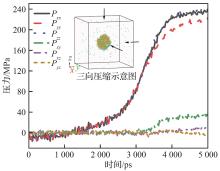
Fig.12
Six components of pressure as a function of time under triaxial compression

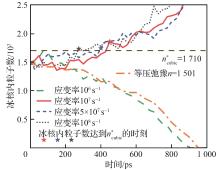
Fig.13
Number of ice nucleus as a function of time under shear


Fig.14
Freezing fraction as a function of time under shear


Fig.15
Number of ice nucleus as a function of time under triaxial compression

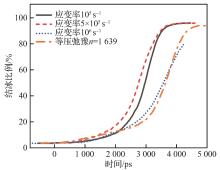
Fig.16
Freezing fraction as a function of time under triaxial compression


Fig.17
Variation of ΔH with temperature and stress

| [1] | WU Z L. Drop “impact” on an airfoil surface[J]. Advances in Colloid and Interface Science, 2018, 256: 23-47. |
| [2] | BELLOSTA T, BALDAN G, SIRIANNI G, et al. Lagrangian and Eulerian algorithms for water droplets in in-flight ice accretion[J]. Journal of Computational and Applied Mathematics, 2023, 429: 115230. |
| [3] | CHENG X, SUN T-P, GORDILLO L. Drop impact dynamics: impact force and stress distributions[J]. Annual Review of Fluid Mechanics, 2022, 54: 57-81. |
| [4] | SUN T P, ÁLVAREZ-NOVOA F, ANDRADE K, et al. Stress distribution and surface shock wave of drop impact[J]. Nature Communications, 2022, 13: 1703. |
| [5] | THANH-VINH N, MATSUMOTO K, SHIMOYAMA I. Pressure distribution on the contact area during the impact of a droplet on a textured surface[C]∥2016 IEEE 29th International Conference on Micro Electro Mechanical Systems (MEMS). Piscataway: IEEE Press, 2016: 177-180. |
| [6] | PHILIPPI J, LAGRÉE P Y, ANTKOWIAK A. Drop impact on a solid surface: Short-time self-similarity[J]. Journal of Fluid Mechanics, 2016, 795: 96-135. |
| [7] | ZHANG C, LIU H. Effect of drop size on the impact thermodynamics for supercooled large droplet in aircraft icing[J]. Physics of Fluids, 2016, 28(6): 062107. |
| [8] | YANG G M, GUO K H, LI N. Freezing mechanism of supercooled water droplet impinging on metal surfaces[J]. International Journal of Refrigeration, 2011, 34(8): 2007-2017. |
| [9] | JIN Z Y, WANG Z N, SUI D Y, et al. The impact and freezing processes of a water droplet on different inclined cold surfaces[J]. International Journal of Heat and Mass Transfer, 2016, 97: 211-223. |
| [10] | FANG W Z, ZHU F Q, TAO W Q, et al. How different freezing morphologies of impacting droplets form[J]. Journal of Colloid and Interface Science, 2021, 584: 403-410. |
| [11] | WANG L P, KONG W L, WANG F X, et al. Effect of nucleation time on freezing morphology and type of a water droplet impacting onto cold substrate[J]. International Journal of Heat and Mass Transfer, 2019, 130: 831-842. |
| [12] | SUN M M, KONG W L, WANG F X, et al. Impact freezing modes of supercooled droplets determined by both nucleation and icing evolution[J]. International Journal of Heat and Mass Transfer, 2019, 142: 118431. |
| [13] | WANG L P, WANG F X, LU C L, et al. Nucleation in supercooled water triggered by mechanical impact: Experimental and theoretical analyses[J]. Journal of Energy Storage, 2022, 52: 104755. |
| [14] | GORDILLO L, SUN TP, CHENG X. Dynamics of drop impact on solid surfaces: evolution of impact force and self-similar spreading[J]. Journal of Fluid Mechanics, 2018, 840: 190-214. |
| [15] | KANT P, KOLDEWEIJ R B J, HARTH K, et al. Fast-freezing kinetics inside a droplet impacting on a cold surface[J]. Proceedings of the National Academy of Sciences of the United States of America, 2020, 117(6): 2788-2794. |
| [16] | HU M, WANG F, TAO Q, et al. Frozen patterns of impacted droplets: From conical tips to toroidal shapes[J]. Physical Review Fluids, 2020, 5(8): 081601. |
| [17] | THIÉVENAZ V, JOSSERAND C, SÉON T. Retraction and freezing of a water film on ice[J]. Physical Review Fluids, 2020, 5(4): 041601. |
| [18] | ANGELL C A. Supercooled water[J]. Annual Review of Physical Chemistry, 1983, 34: 593-630. |
| [19] | HOLTEN V, LIMMER D T, MOLINERO V, et al. Nature of the anomalies in the supercooled liquid state of the mW model of water[J]. The Journal of Chemical Physics, 2013, 138(17): 174501. |
| [20] | KALIKMANOV V I. Nucleation Theory[M]. Dordrecht: Springer Netherlands, 2013. |
| [21] | BAI G Y, GAO D, LIU Z, et al. Probing the critical nucleus size for ice formation with graphene oxide nanosheets[J]. Nature, 2019, 576(7787): 437-441. |
| [22] | PEREYRA R G, SZLEIFER I, CARIGNANO M A. Temperature dependence of ice critical nucleus size[J]. The Journal of Chemical Physics, 2011, 135(3): 034508. |
| [23] | PEREYRA R G, SEBASTIANELLI P, ÁVILA E E. Homogeneous nucleation in supercooled liquid water. Determination of ice germ size and activation energy barrier in Molecular Dynamics simulations[J]. Molecular Simulation, 2022, 48(12): 1112-1121. |
| [24] | LIN M, XIONG Z W, CAO H S. Bridging classical nucleation theory and molecular dynamics simulation for homogeneous ice nucleation[J]. The Journal of Chemical Physics, 2024, 161(8): 084504. |
| [25] | LUO S, WANG J, LI Z G. Homogeneous ice nucleation under shear[J]. The Journal of Physical Chemistry B, 2020, 124(18): 3701-3708. |
| [26] | ESPINOSA J R, SORIA G D, RAMIREZ J, et al. Role of salt, pressure, and water activity on homogeneous ice nucleation[J]. The Journal of Physical Chemistry Letters, 2017, 8(18): 4486-4491. |
| [27] | SORIA G D, ESPINOSA J R, RAMIREZ J, et al. A simulation study of homogeneous ice nucleation in supercooled salty water[J]. The Journal of Chemical Physics, 2018, 148(22): 222811. |
| [28] | LUO S, LI C, LI F, et al. Ice crystallization in shear flows[J]. The Journal of Physical Chemistry C, 2019, 123(34): 21042-21049. |
| [29] | RICHARD D, SPECK T. The role of shear in crystallization kinetics: From suppression to enhancement[J]. Scientific Reports, 2015, 5: 14610. |
| [30] | ICKES L, WELTI A, HOOSE C, et al. Classical nucleation theory of homogeneous freezing of water: thermodynamic and kinetic parameters[J]. Physical Chemistry Chemical Physics, 2015, 17(8): 5514-5537. |
| [31] | THOMPSON A P, AKTULGA H M, BERGER R, et al. LAMMPS-A flexible simulation tool for particle-based materials modeling at the atomic, meso, and continuum scales[J]. Computer Physics Communications, 2022, 271: 108171. |
| [32] | FARMER T O, MARKVARDSEN A J, ROD T H, et al. Dynamical accuracy of water models on supercooling[J]. The Journal of Physical Chemistry Letters, 2020, 11(18): 7469-7475. |
| [33] | DICK T J, MADURA J D. Annual reports in computational chemistry[M]. Pittsburgh: Elsevier, 2005: 59-74. |
| [34] | CHAN H, CHERUKARA M J, NARAYANAN B, et al. Machine learning coarse grained models for water[J]. Nature Communications, 2019, 10: 379. |
| [35] | HUJO W, SHADRACK JABES B, RANA V K, et al. The rise and fall of anomalies in tetrahedral liquids[J]. Journal of Statistical Physics, 2011, 145(2): 293-312. |
| [36] | MOLINERO V, MOORE E B. Water modeled as an intermediate element between carbon and silicon[J]. The Journal of Physical Chemistry B, 2009, 113(13): 4008-4016. |
| [37] | NGUYEN A H, MOLINERO V. Identification of clathrate hydrates, hexagonal ice, cubic ice, and liquid water in simulations: The CHILL+ algorithm[J]. The Journal of Physical Chemistry B, 2015, 119(29): 9369-9376. |
| [38] | MOORE E B, MOLINERO V. Ice crystallization in water’s “no-man’s land”[J]. The Journal of Chemical Physics, 2010, 132(24): 244504. |
| [39] | ALVAREZ F, ARBE A, COLMENERO J. Unraveling the coherent dynamic structure factor of liquid water at the mesoscale by molecular dynamics simulations[J]. The Journal of Chemical Physics, 2021, 155(24): 244509. |
| [40] | SOUZA J B Jr, SCHLEDER G R, BETTINI J, et al. Pair distribution function obtained from electron diffraction: an advanced real-space structural characterization tool[J]. Matter, 2021, 4(2): 441-460. |
| [41] | MARTYNA G J, TOBIAS D J, KLEIN M L. Constant pressure molecular dynamics algorithms[J]. The Journal of Chemical Physics, 1994, 101(5): 4177-4189. |
| [42] | SOPER A K. Joint structure refinement of X-ray and neutron diffraction data on disordered materials[J]. Journal of Physics: Condensed Matter, 2007, 19(33): 335206. |
| [43] | ANGELL C A. Amorphous water[J]. Annual Review of Physical Chemistry, 2004, 55: 559-583. |
| [44] | MOORE E B, MOLINER O V. Structural transformation in supercooled water controls the crystallization rate of ice[J]. Nature, 2011, 479(7374): 506-508. |
| [45] | NARTEN A H, VENKATESH C G, RICE S A. Diffraction pattern and structure of amorphous solid water at 10 and 77 °K[J]. The Journal of Chemical Physics, 1976, 64(3): 1106-1121. |
| [46] | MALKIN T L, MURRAY B J, SALZMANN C G, et al. Stacking disorder in ice I[J]. Physical Chemistry Chemical Physics, 2015, 17(1): 60-76. |
| [47] | 王瑞, 任瑛, 陈卫, 等. 冰水界面动态结构的分子动力学模拟研究[J]. 化工学报, 2022, 73(3): 1315-1323. |
| WANG R, REN Y, CHEN W, et al. Molecular dynamics simulation on the dynamic structure of icing interface[J]. CIESC Journal, 2022, 73(3): 1315-1323 (in Chinese). | |
| [48] | TANAKA H. Possible resolution of the Kauzmann paradox in supercooled liquids[J]. Physical Review E, Statistical, Nonlinear, and Soft Matter Physics, 2003, 68(1 Pt 1): 011505. |
| [49] | ESPINOSA J R, SANZ E, VALERIANI C, et al. Homogeneous ice nucleation evaluated for several water models[J]. The Journal of Chemical Physics, 2014, 141(18): 18C529. |
| [50] | LI M D, HUANG Y P, XIA Y J, et al. Effective nucleation size for ice crystallization[J]. Journal of Chemical Theory and Computation, 2025, 21(4): 1990-1996. |
| [51] | European Union Aviation Safety Agency. Easy access rules for large aeroplanes: CS-25 [S]. Cologne: European Union Aviation Safety Agency, 2023:1341-1351. |
| [52] | SHAH P, DRISCOLL M M. Drop impact dynamics of complex fluids: A review[J]. Soft Matter, 2024, 20(25): 4839-4858. |
| [53] | GONZALEZ-AVILA S R, ZENG Q Y, OHL C D. Pressure and wall shear stress from high-speed droplet impact[J]. International Journal of Multiphase Flow, 2024, 181: 104981. |
| [54] | KE Q, GONG X T, LIAO S W, et al. Effects of thermostats/barostats on physical properties of liquids by molecular dynamics simulations[J]. Journal of Molecular Liquids, 2022, 365: 120116. |
| [55] | CHEN M B, SONG W J, LIN W Y, et al. Ice nucleation in supercooled water under shear[J]. Chemical Engineering Science, 2024, 300: 120674. |
| [56] | GOSWAMI A, DALAL I S, SINGH J K. Universal nucleation behavior of sheared systems[J]. Physical Review Letters, 2021, 126(19): 195702. |
| [57] | ESPINOSA J R, ZARAGOZA A, ROSALES-PELAEZ P, et al. Interfacial free energy as the key to the pressure-induced deceleration of ice nucleation[J]. Physical Review Letters, 2016, 117(13): 135702. |
| [58] | HARRIS K R, NEWITT P J. Self-diffusion of water at low temperatures and high pressure[J]. Journal of Chemical & Engineering Data, 1997, 42(2): 346-348. |
| [1] | Haifeng QI, Shinan CHANG, Zhanpeng REN, Yinglin YANG. Simulation of ice crystal parameters along path change based on path cooling method [J]. Acta Aeronautica et Astronautica Sinica, 2026, 47(4): 132227-132227. |
| [2] | Chunhao FAN, Junshan HU, Zhiyong YANG, Fusen HOU, Peilin CHEN, Wei TIAN. Effects of curing residual stress and deformation on tensile performance of CFRP single-sided patch-repaired titanium alloy damaged components [J]. Acta Aeronautica et Astronautica Sinica, 2026, 47(3): 431997-431997. |
| [3] | Lifei DONG, Zichen DENG, Chao LU, Wenze SHI, Pan HE, Weiwei CHEN. Optimal design and application of high-temperature laser coil-only Rayleigh wave EMAT [J]. Acta Aeronautica et Astronautica Sinica, 2026, 47(3): 431970-431970. |
| [4] | Li YU, Wenhao LI, Jian ZHANG, Zhuoran ZHANG, Yao SUN, Guangyuan HU. Temperature rise characteristics of oil-cooled doubly salient high-voltage DC generator for aircraft application under winding fault [J]. Acta Aeronautica et Astronautica Sinica, 2026, 47(1): 632094-632094. |
| [5] | Xinle LIU, Yanan JIANG, Rongti XIN, Qinghui LI, Jinsheng CAI. Anti-icing strategy of superhydrophobic electric thermal composite zoning [J]. Acta Aeronautica et Astronautica Sinica, 2025, 46(9): 130784-130784. |
| [6] | Baoshi YU, Yongjun LEI, Zhibin SHEN, Dapeng ZHANG. Review on analysis and control technology of curing residual stress in solid motor propellants [J]. Acta Aeronautica et Astronautica Sinica, 2025, 46(8): 31083-031083. |
| [7] | Guanwei YAO, Gaowen LIU, Yan CHEN, Xiaozhi KONG, Aqiang LIN. Forward design of high-performance turbine low-radius pre-swirl system [J]. Acta Aeronautica et Astronautica Sinica, 2025, 46(7): 130832-130832. |
| [8] | Feng LIU, Sen YANG, Zhenpeng WEI. Variable chord wing based on composite material elastic periodic structure and pre-stressed skin [J]. Acta Aeronautica et Astronautica Sinica, 2025, 46(7): 230966-230966. |
| [9] | Yunwen FENG, Da TENG, Cheng LU, Rui WANG, Junyu CHEN. Integrated mechanism and generative adversarial surrogate modeling for aircraft systems reliability evaluation [J]. Acta Aeronautica et Astronautica Sinica, 2025, 46(7): 230948-230948. |
| [10] | Zhenhua LIANG, Min TANG, Kan ZHENG, Wenhe LIAO. Fault diagnosis method of thruster of on-orbit service spacecraft based on relative position information [J]. Acta Aeronautica et Astronautica Sinica, 2025, 46(7): 230867-230867. |
| [11] | Zhuoran ZHANG, Jian ZHANG, Guangyuan HU, Han XUE, Hanqi LI, Li YU. Thermal management technologies of high-power-density high-efficiency electric machine systems for more electric aircraft [J]. Acta Aeronautica et Astronautica Sinica, 2025, 46(6): 531380-531380. |
| [12] | Yaoying ZENG, Running WANG, Jiaqi HOU, Yulei ZHANG, Jiaping ZHANG, Hejun LI. Research progress of C/C composites resistant to extreme ablation environments [J]. Acta Aeronautica et Astronautica Sinica, 2025, 46(6): 531927-531927. |
| [13] | Xian YI, Jinghao REN, Qingren LAI, Yu LIU, Qiang WANG. Icing characteristics of full-scale multi-element configurations of large aircraft: Computation and experiment [J]. Acta Aeronautica et Astronautica Sinica, 2025, 46(5): 531575-531575. |
| [14] | Kaishang LI, Haoqi FAN, Runzi WANG, Xiancheng ZHANG, Shantung TU. Life design method of high-temperature equipment based on dual-scale damage theory [J]. Acta Aeronautica et Astronautica Sinica, 2025, 46(5): 531706-531706. |
| [15] | Yuqian ZHANG, Yongge LI, Xiaochuan LIU, Yong XU. Digital-twin-driven reliability domain analysis for aircraft landing gear systems [J]. Acta Aeronautica et Astronautica Sinica, 2025, 46(24): 632256-632256. |
| Viewed | ||||||
|
Full text |
|
|||||
|
Abstract |
|
|||||
Address: No.238, Baiyan Buiding, Beisihuan Zhonglu Road, Haidian District, Beijing, China
Postal code : 100083
E-mail:hkxb@buaa.edu.cn
Total visits: 6658907 Today visits: 1341All copyright © editorial office of Chinese Journal of Aeronautics
All copyright © editorial office of Chinese Journal of Aeronautics
Total visits: 6658907 Today visits: 1341

 CJA
CJA
