Acta Aeronautica et Astronautica Sinica ›› 2026, Vol. 47 ›› Issue (5): 232422.doi: 10.7527/S1000-6893.2025.32422
• Solid Mechanics and Vehicle Conceptual Design • Previous Articles
Yue LIU1,2, Hantao REN3, Xiaofeng XUE1,2, Zhicen SONG1,2, Cheng LU1,2, Yunwen FENG1,2( )
)
Received:2025-06-16
Revised:2025-07-10
Accepted:2025-07-23
Online:2025-07-28
Published:2025-07-25
Contact:
Yunwen FENG
E-mail:fengyunwen@nwpu.edu.cn
Supported by:CLC Number:
Yue LIU, Hantao REN, Xiaofeng XUE, Zhicen SONG, Cheng LU, Yunwen FENG. Prediction of bearing strength for composite bolted joint structures based on MCI-PINN[J]. Acta Aeronautica et Astronautica Sinica, 2026, 47(5): 232422.
Fig.1
Physics-informed neural network
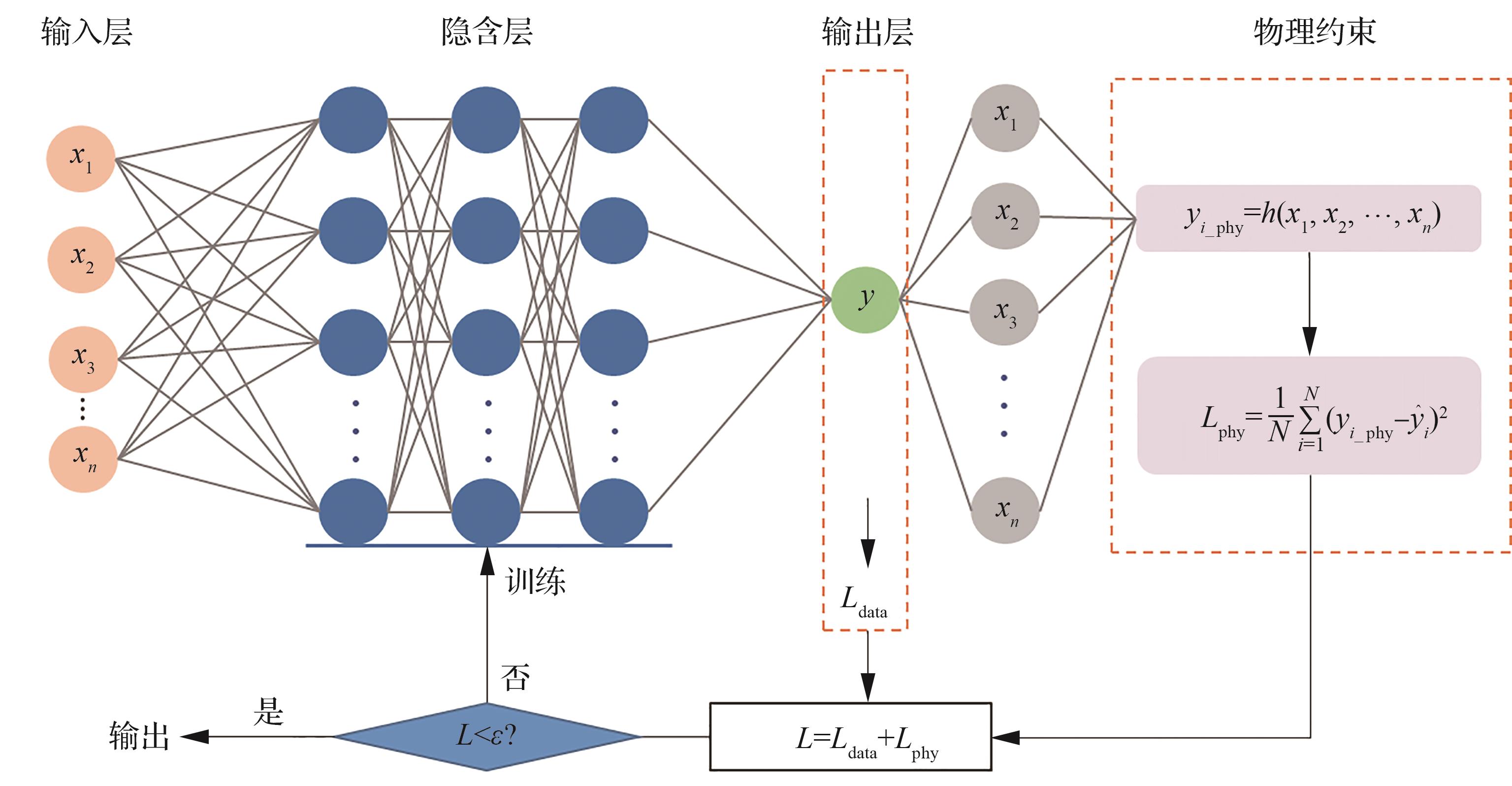
Fig.2
Nonlinear identification
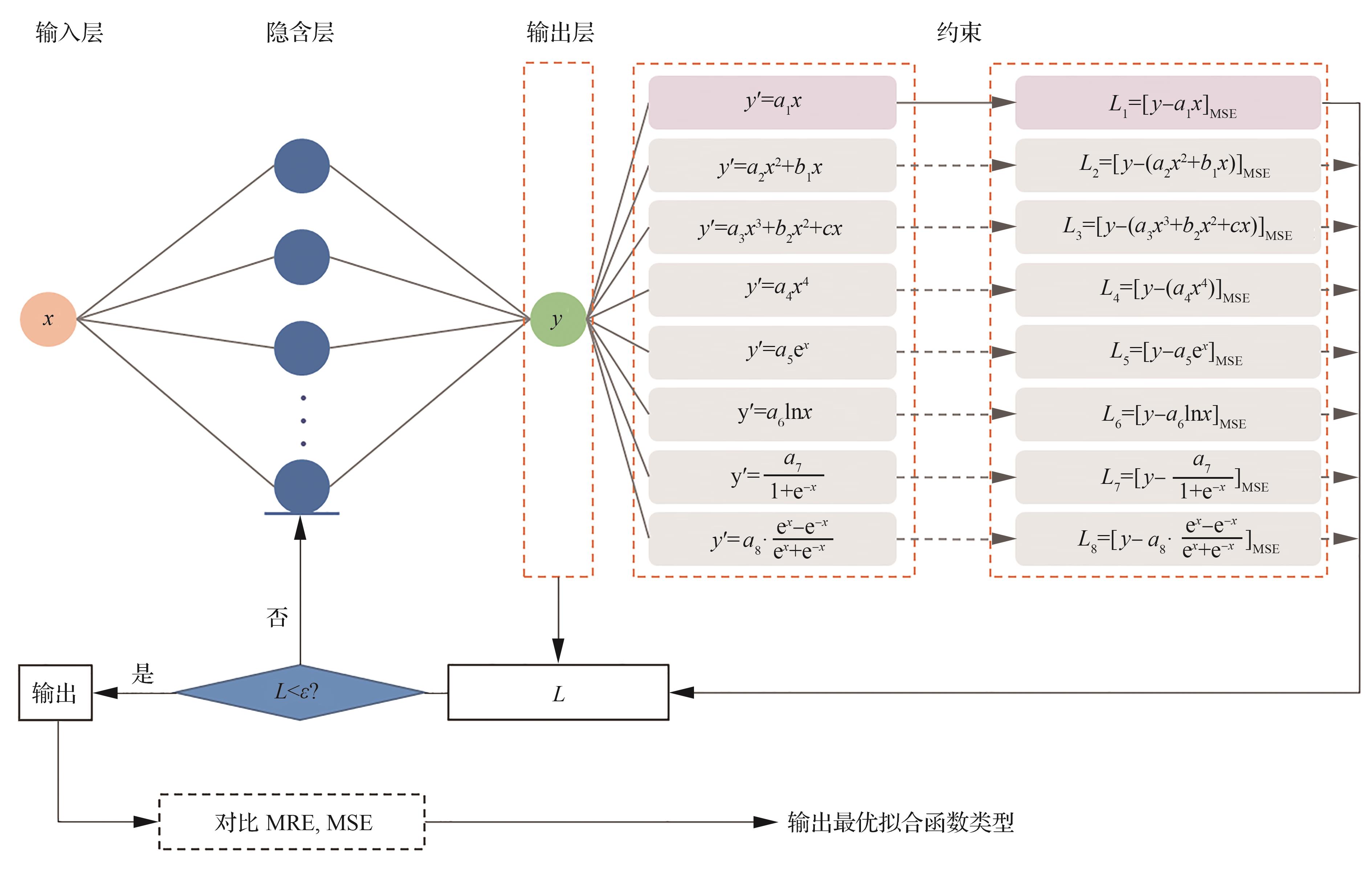
Fig.3
Multi-constraint identification physics-informed neural network
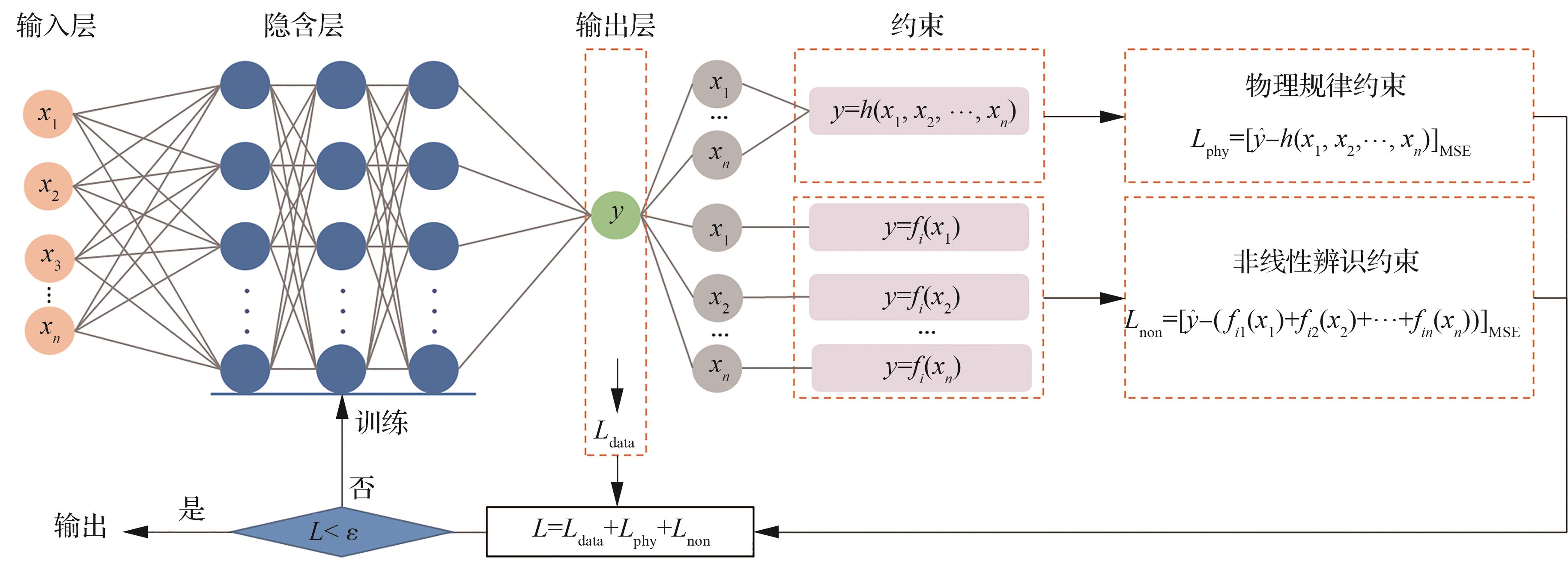
Fig.4
Process chart of composite performance prediction based on MCI-PINN
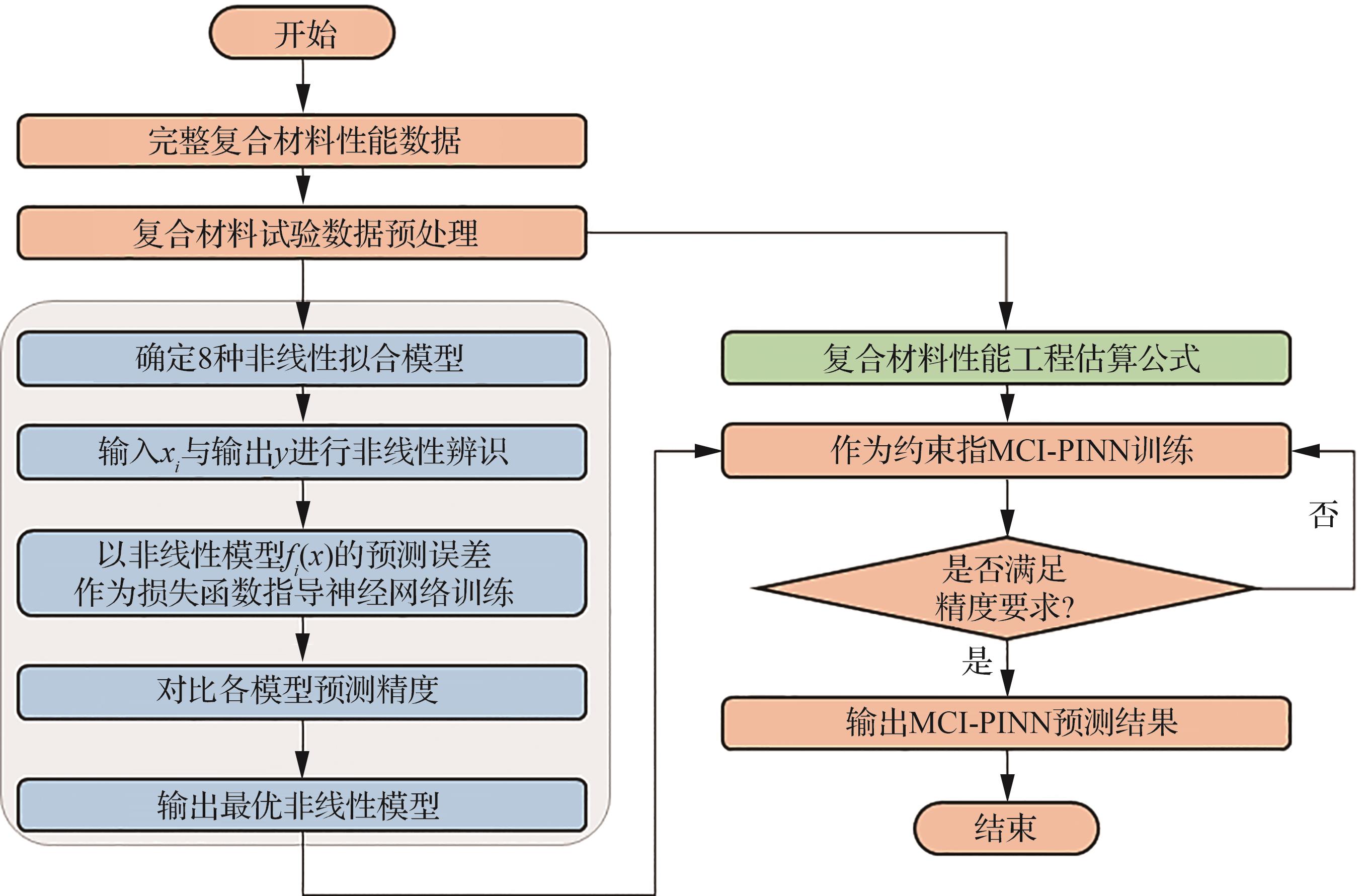

Table 1
Single shear bearing data for single bolt joint structure of X850 material
| 数据集 | 铺层比例 (0°/±45°/90°) | 孔径均值/mm | 厚度均值/mm | 数据量/条 |
|---|---|---|---|---|
| 训练集 | (18/73/9) | 6.35 | 6.345 | 11 |
| (26/70/4) | 6.35 | 4.255 | 11 | |
| (42/50/8) | 6.35 | 4.550 | 11 | |
| (36/55/9) | 6.35 | 4.255 | 11 | |
| (9/87/4) | 6.35 | 4.376 | 11 | |
| (27/59/14) | 6.35 | 4.065 | 12 | |
| (61/35/4) | 6.35 | 4.417 | 10 | |
| (40/60/0) | 6.35 | 3.841 | 12 | |
| 测试集 | (18/73/9) | 6.35 | 4.070 | 11 |
| (50/40/10) | 6.35 | 3.850 | 9 |
Fig.5
Design parameters for single bolt joint structure
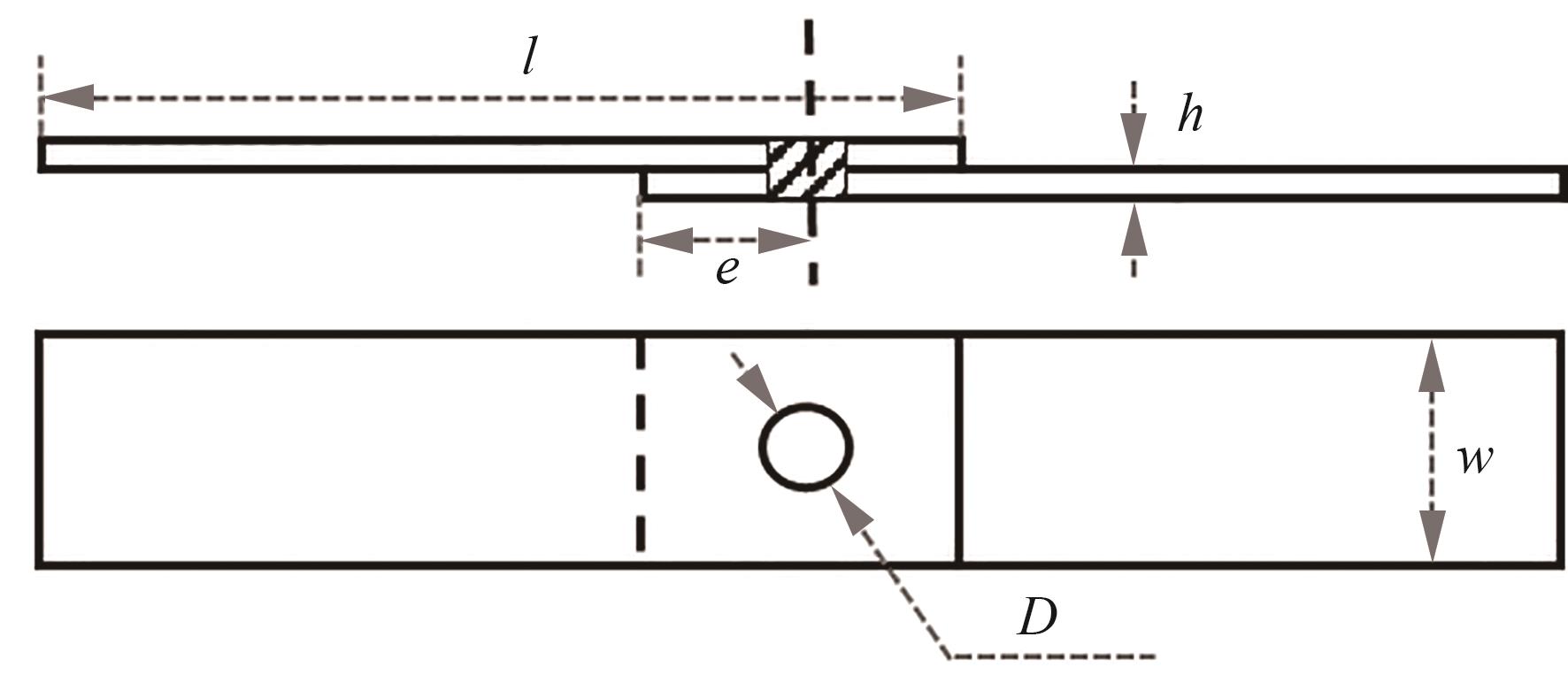
Table 2
Material parameters and correlation coefficient
| 序号 | 参数 | 符号 | 相关系数 |
|---|---|---|---|
| 1 | 纤维体积含量 | Vf | 0.82 |
| 2 | 树脂含量 | Mr | -0.81 |
| 3 | 固化层板密度 | ρ | 0.68 |
| 4 | 固化单层厚度 | hp | -0.64 |
| 5 | 树脂流动度 | F | 0.60 |
| 6 | 固化温度 | Tc | 0.59 |
| 7 | 纤维单位面积质量 | Wf | -0.45 |
| 8 | 孔隙率 | P | 0.43 |
| 9 | 固化时间 | tc | 0.37 |
| 10 | 凝胶时间 | tg | 0.21 |
| 11 | 挥发份含量 | Vc | -0.16 |
Table 3
Mechanical parameters and correlation coefficient
| 序号 | 参数 | 符号 | 相关系数 |
|---|---|---|---|
| 1 | 填充孔压缩强度 | σfhc | 0.90 |
| 2 | 填充孔拉伸强度 | σfht | 0.89 |
| 3 | 90°压缩强度 | S22C | -0.85 |
| 4 | 0°压缩模量 | E11C | 0.85 |
| 5 | 0°压缩强度 | S11C | 0.83 |
| 6 | 泊松比 | V12 | 0.81 |
| 7 | 90°压缩模量 | E22C | -0.80 |
| 8 | 纵横剪切强度 | S12 | 0.80 |
| 9 | 0°拉伸模量 | E11T | -0.62 |
| 10 | 90°拉伸模量 | E22T | 0.50 |
| 11 | 纵横剪切模量 | G12 | 0.42 |
| 12 | 90°拉伸强度 | S22T | 0.35 |
| 13 | 0°拉伸强度 | S11T | -0.30 |
Table 4
Results of nonlinear identification
| 序号 | 参数 | 输入参数 | 非线性辨识函数 | 函数形式 | MRE/% | MSE |
|---|---|---|---|---|---|---|
| 1 | 泊松比 | x1 | f2(x) | f2(x)=ax2+bx | 6.70 | 2 666 |
| 2 | 90°压缩强度 | x2 | f8(x) | 8.61 | 3 604 | |
| 3 | 0°压缩模量 | x3 | f3(x) | f3 (x)=ax3+bx2+cx | 8.94 | 3 811 |
| 4 | 0°压缩强度 | x4 | f8(x) | 8.87 | 3 767 | |
| 5 | 90°压缩模量 | x5 | f3(x) | f3 (x)=ax3+bx2+cx | 8.42 | 3 494 |
| 6 | 纵横剪切强度 | x6 | f2(x) | f2(x)=ax2+bx | 8.32 | 3 435 |
| 7 | 树脂含量 | x7 | f4(x) | f4(x)=a | 7.94 | 3 227 |
| 8 | 纤维体积含量 | x8 | f8(x) | 8.91 | 3 795 | |
| 9 | 0°层比例 | x9 | f2(x) | f2(x)=ax2+bx | 8.40 | 3 485 |
| 10 | 90°层比例 | x10 | f5(x) | f5(x)=alnx | 9.38 | 3 970 |
| 11 | 45°层比例 | x11 | f8(x) | 8.34 | 3 446 | |
| 12 | -45°层比例 | x12 | f8(x) | 8.34 | 3 446 | |
| 13 | 厚度孔径比 | x13 | f8(x) | 4.51 | 2 068 | |
| 14 | 填充孔拉伸强度 | x14 | f2(x) | f2(x)=ax2+bx | 5.53 | 3 261 |
| 15 | 填充孔压缩强度 | x15 | f8(x) | 8.30 | 3 425 |
Fig.6
Comparison of prediction results from different models
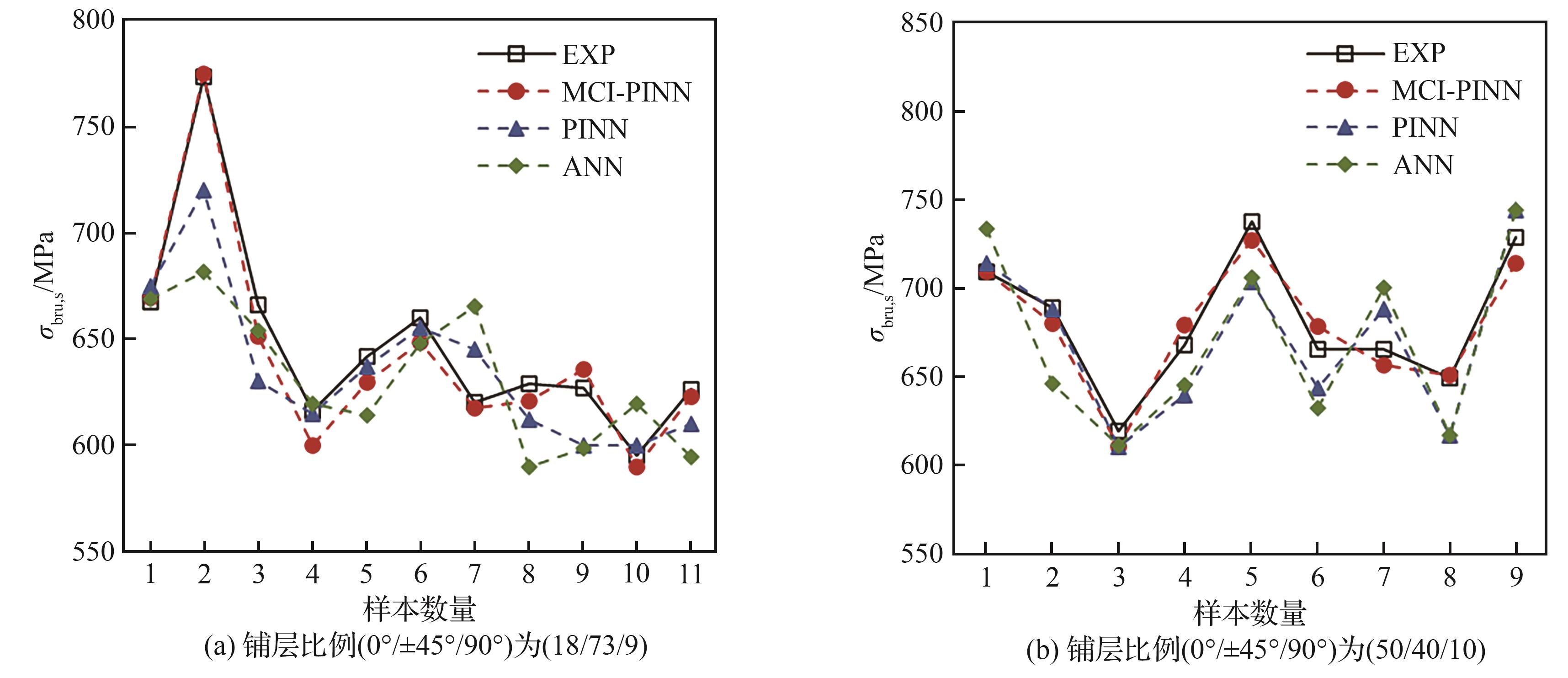
Table 5
Comparison of accuracy information of single bolt bearing strength
| 铺层比例(0°/±45°/90°) | 模型 | MRE/% | MAE | RME/% | RSDE/% | R2 | RMSE |
|---|---|---|---|---|---|---|---|
| (18/73/9) | ANN | 4.37 | 28.97 | 2.38 | 31.09 | 0.31 | 37.50 |
| PINN | 2.69 | 18.01 | 1.71 | 22.81 | 0.73 | 23.63 | |
| MCI-PINN | 1.24 | 7.89 | 0.87 | 4.72 | 0.96 | 9.34 | |
| (50/40/10) | ANN | 3.98 | 27.18 | 1.56 | 32.21 | 0.36 | 28.99 |
| PINN | 2.76 | 18.74 | 1.37 | 20.79 | 0.63 | 22.00 | |
| MCI-PINN | 1.27 | 8.66 | 0.43 | 5.78 | 0.93 | 9.83 |
Fig.7
Nonlinear identification heat map
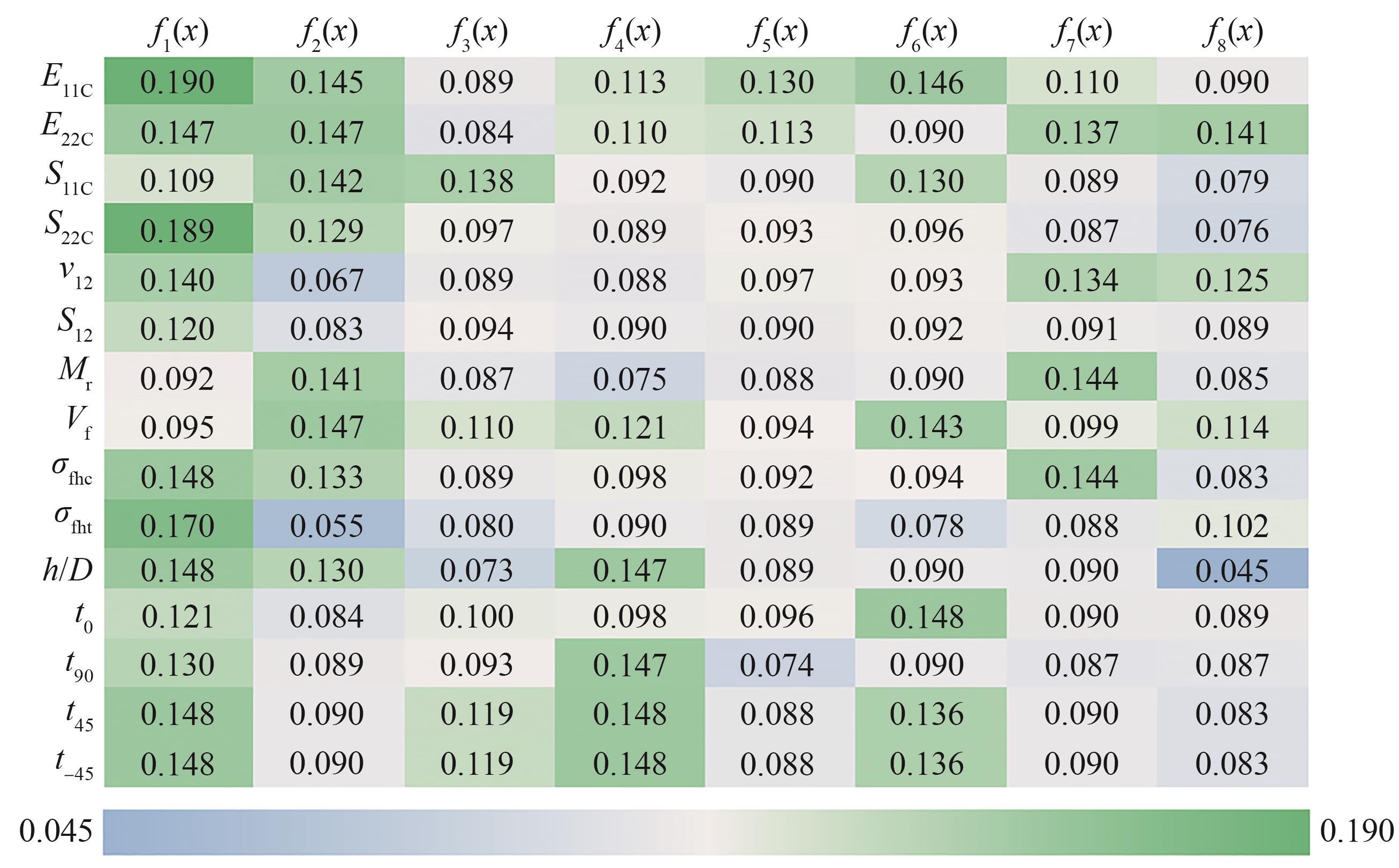
Table 6
Single shear bearing data for single bolt joint structure of X850 material
| 数据集 | 铺层比例(0°/±45°/90°) | 孔径均值/mm | 厚度均值/mm | 数据量/条 |
|---|---|---|---|---|
| L1 | (18/73/9) | 6.35 | 6.345 | 11 |
| (26/70/4) | 6.35 | 4.255 | 11 | |
| L2 | (42/50/8) | 6.35 | 4.550 | 11 |
| (36/55/9) | 6.35 | 4.255 | 11 | |
| L3 | (9/87/4) | 6.35 | 4.376 | 11 |
| (27/59/14) | 6.35 | 4.065 | 12 | |
| L4 | (61/35/4) | 6.35 | 4.417 | 10 |
| (40/60/0) | 6.35 | 3.841 | 12 | |
| L5 | (18/73/9) | 6.35 | 4.070 | 11 |
| (50/40/10) | 6.35 | 3.850 | 9 |
Fig.8
Prediction results of Group L1 dataset
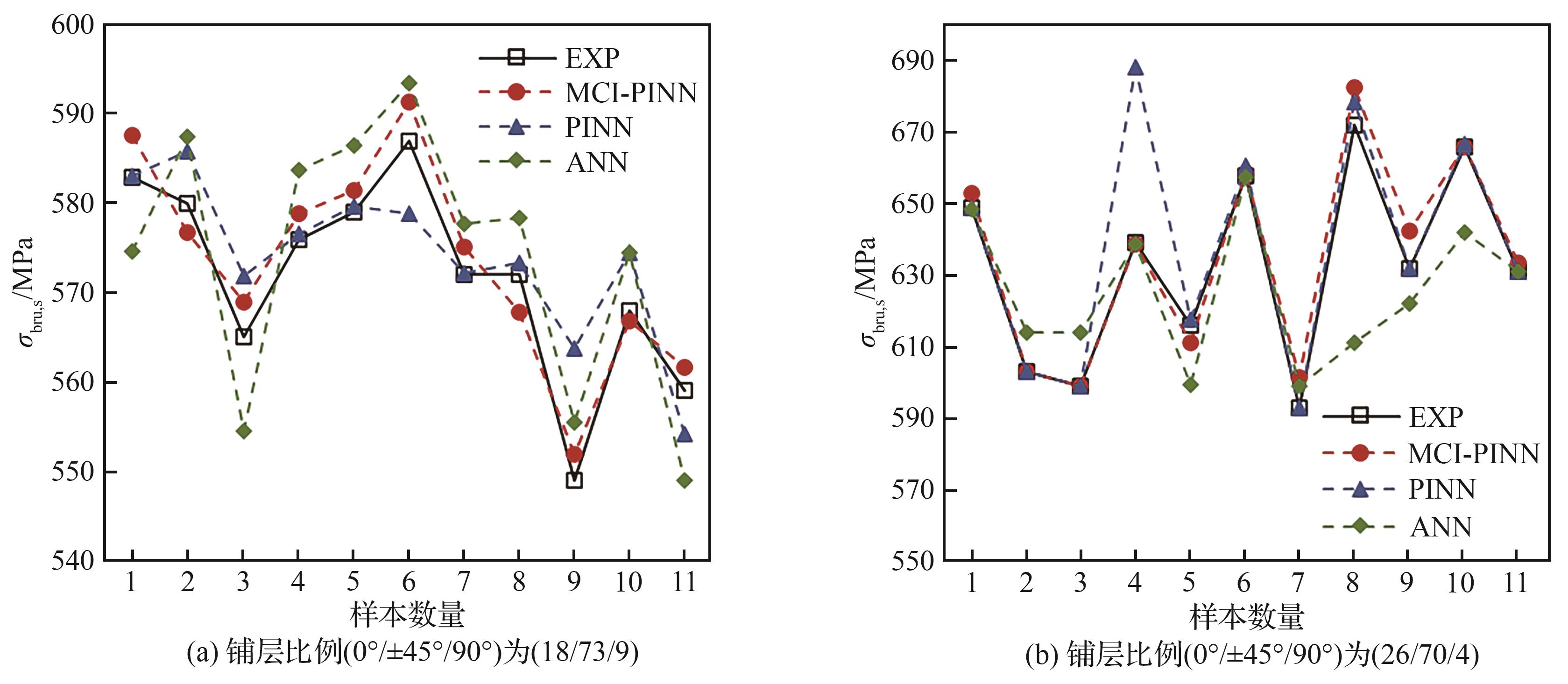
Fig.9
Prediction results of Group L2 dataset
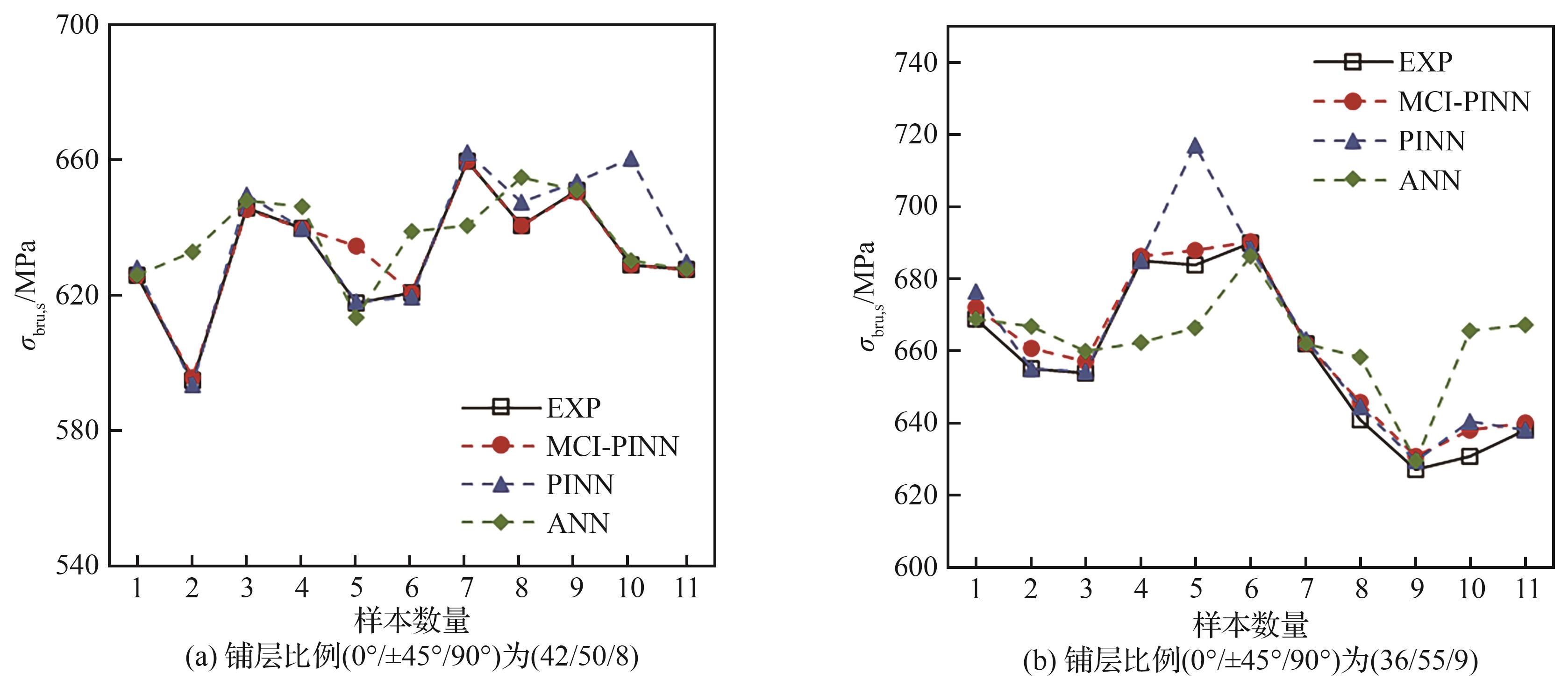
Fig.10
Prediction results of Group L3 dataset
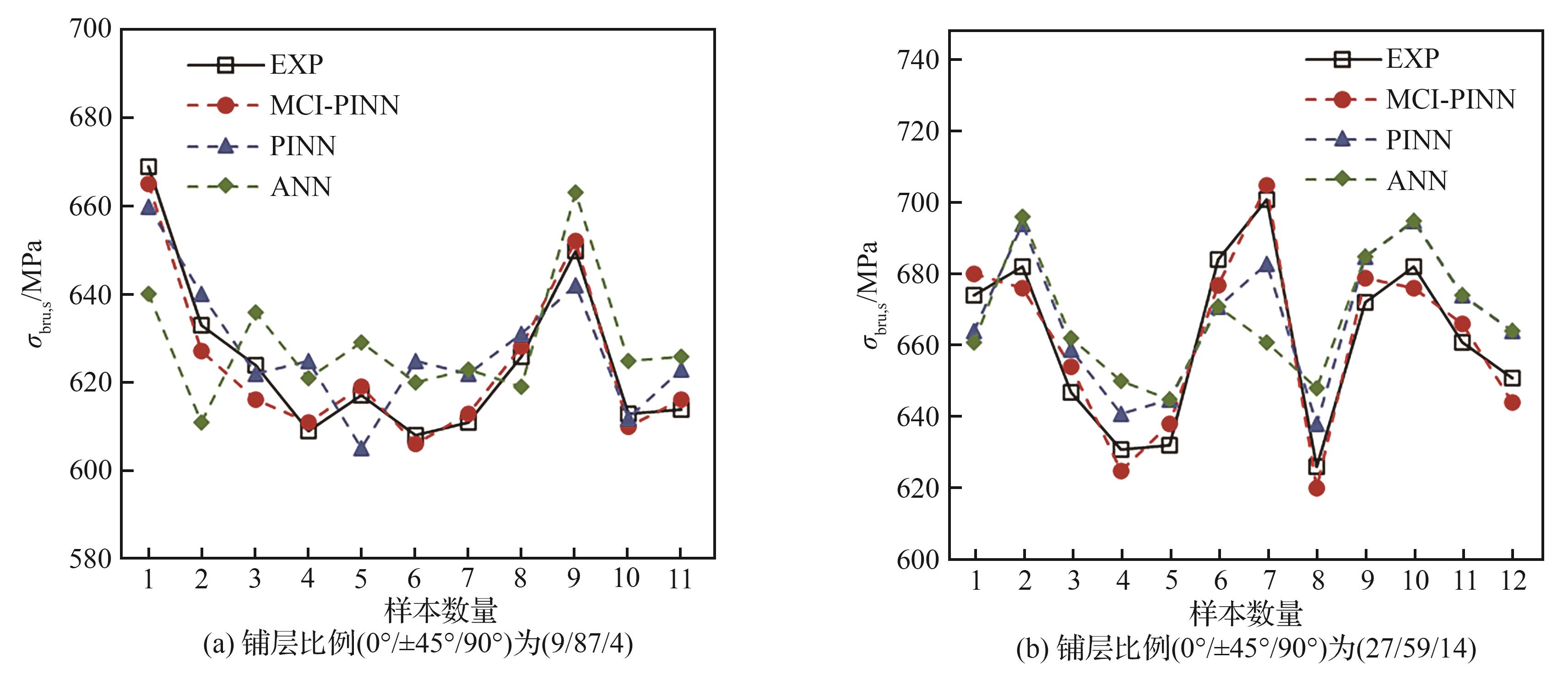
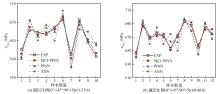
Fig.11
Prediction results of Group L4 dataset
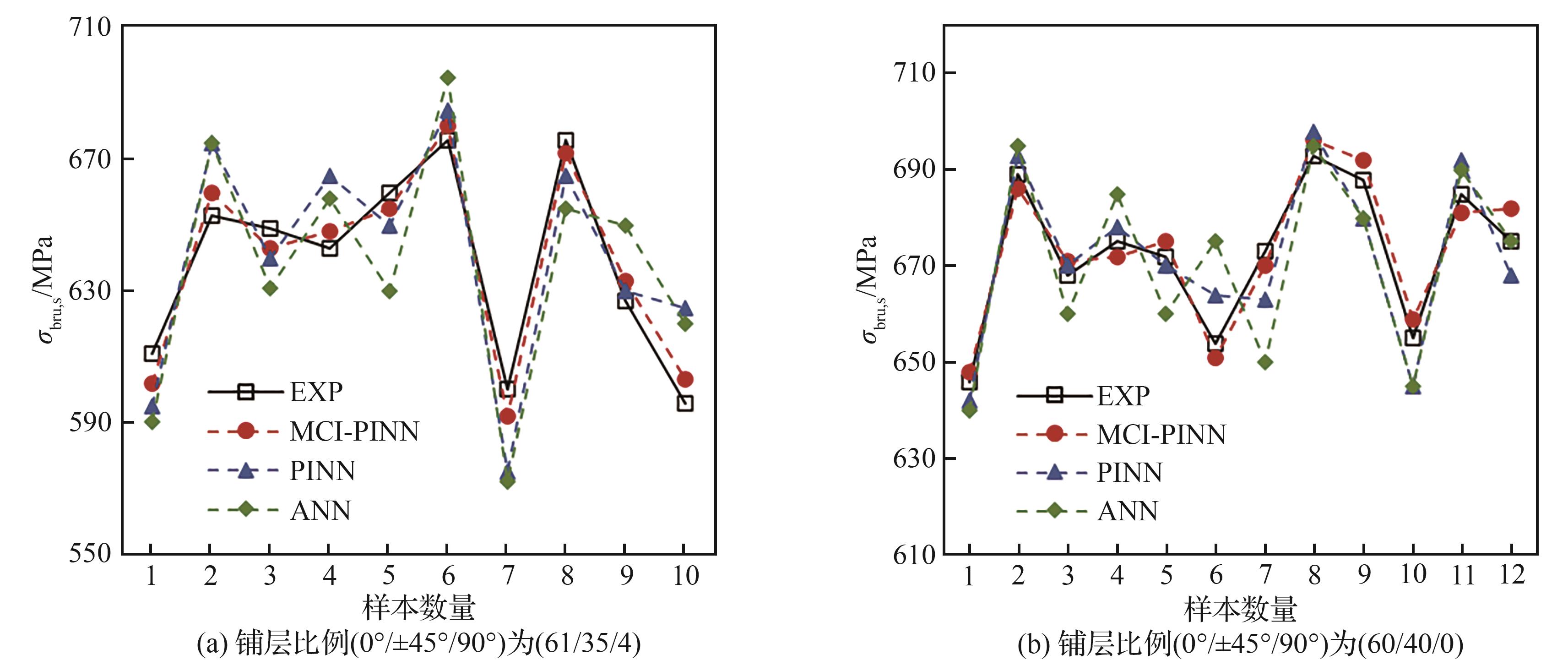
Table 7
Comparison of accuracy information of single bolt bearing strength in Group L1
| 铺层比例(0°/±45°/90°) | 模型 | MRE/% | MAE | RME/% | RSDE/% | R2 | RMSE |
|---|---|---|---|---|---|---|---|
| (18/73/9) | ANN | 1.29 | 7.37 | 0.40 | 32.34 | 0.49 | 7.51 |
| PINN | 0.78 | 4.38 | 0.39 | 18.60 | 0.67 | 6.06 | |
| MCI-PINN | 0.54 | 3.10 | 0.27 | 2.44 | 0.91 | 3.22 | |
| (26/70/4) | ANN | 1.69 | 10.94 | 1.18 | 25.26 | 0.51 | 18.10 |
| PINN | 0.83 | 8.46 | 0.84 | 19.66 | 0.69 | 14.37 | |
| MCI-PINN | 0.57 | 4.13 | 0.48 | 4.00 | 0.95 | 5.94 |
Table 8
Comparison of accuracy information of single bolt bearing strength in Group L2
| 铺层比例(0°/±45°/90°) | 模型 | MRE/% | MAE | RME/% | RSDE/% | R2 | RMSE |
|---|---|---|---|---|---|---|---|
| (42/50/8) | ANN | 1.51 | 9.38 | 0.81 | 29.73 | 0.27 | 14.62 |
| PINN | 0.79 | 4.97 | 0.71 | 16.88 | 0.66 | 9.96 | |
| MCI-PINN | 0.26 | 1.62 | 0.24 | 4.45 | 0.91 | 5.00 | |
| (36/55/9) | ANN | 1.30 | 12.91 | 0.82 | 33.63 | 0.35 | 17.11 |
| PINN | 0.81 | 5.39 | 0.77 | 17.38 | 0.75 | 10.48 | |
| MCI-PINN | 0.49 | 2.85 | 0.48 | 4.78 | 0.97 | 3.35 |
Table 9
Comparison of accuracy information of single bolt bearing strength in Group L3
| 铺层比例(0°/±45°/90°) | 模型 | MRE/% | MAE | RME/% | RSDE/% | R2 | RMSE |
|---|---|---|---|---|---|---|---|
| (9/87/4) | ANN | 2.24 | 14.09 | 0.57 | 27.32 | 0.31 | 15.23 |
| PINN | 1.15 | 7.18 | 0.48 | 21.59 | 0.79 | 8.28 | |
| MCI-PINN | 0.51 | 3.19 | 0.16 | 3.36 | 0.95 | 3.73 | |
| (27/59/14) | ANN | 2.52 | 16.75 | 0.88 | 29.59 | 0.38 | 18.36 |
| PINN | 1.91 | 12.66 | 0.88 | 19.62 | 0.70 | 12.81 | |
| MCI-PINN | 0.92 | 6.08 | 0.04 | 4.75 | 0.93 | 6.14 |
Table 10
Comparison of accuracy information of single bolt bearing strength in Group L4
| 铺层比例(0°/±45°/90°) | 模型 | MRE/% | MAE | RME/% | RSDE/% | R2 | RMSE |
|---|---|---|---|---|---|---|---|
| (61/35/4) | ANN | 3.47 | 22.10 | 0.23 | 26.92 | 0.35 | 22.50 |
| PINN | 2.48 | 15.60 | 0.22 | 19.77 | 0.61 | 17.55 | |
| MCI-PINN | 0.97 | 6.10 | 0.05 | 4.30 | 0.95 | 6.30 | |
| (40/60/0) | ANN | 1.38 | 9.25 | 0.28 | 29.43 | 0.38 | 11.34 |
| PINN | 0.89 | 6.00 | 0.12 | 17.53 | 0.78 | 6.68 | |
| MCI-PINN | 0.52 | 3.50 | 0.12 | 1.02 | 0.93 | 3.70 |
| [1] | 山美娟, 赵丽滨. 复合材料螺栓连接的增强设计与分析研究进展[J]. 复合材料学报, 2023, 40(7): 3771-3784. |
| SHAN M J, ZHAO L B. Research progress in reinforcement design and analysis of composite bolted joints[J]. Acta Materiae Compositae Sinica, 2023, 40(7): 3771-3784 (in Chinese). | |
| [2] | 董慧民, 李小刚, 马绪强, 等. 聚合物基复合材料凸头螺栓连接研究进展[J]. 北京航空航天大学学报, 2023, 49(4): 745-760. |
| DONG H M, LI X G, MA X Q, et al. Research progress in mechanically fastened polymer-matrix composite joints with protruding-head bolts[J]. Journal of Beijing University of Aeronautics and Astronautics, 2023, 49(4): 745-760 (in Chinese). | |
| [3] | 豆广征, 刘峰, 王卓煜, 等. 复合材料螺栓连接结构力学性能研究进展[J]. 新技术新工艺, 2022(9): 1-5. |
| DOU G Z, LIU F, WANG Z Y, et al. Research progress of bolted joints structure mechanical performance of composite materials[J]. New Technology & New Process, 2022(9): 1-5 (in Chinese). | |
| [4] | 孙涛, 周金宇. 碳纤维复合材料螺栓连接性能综述[J]. 现代制造工程, 2018(9): 154-160. |
| SUN T, ZHOU J Y. Summary for the connection performance of carbon fiber composite bolt[J]. Modern Manufacturing Engineering, 2018(9): 154-160 (in Chinese). | |
| [5] | 梁乐乐, 杨胜春, 宋贵宾, 等. 复合材料机械连接强度分析研究[J]. 塑料工业, 2022, 50(3): 90-94. |
| LIANG L L, YANG S C, SONG G B, et al. Analysis of mechanical bonding strength of composite materials[J]. China Plastics Industry, 2022, 50(3): 90-94 (in Chinese). | |
| [6] | 吴义韬, 姚卫星, 沈浩杰. 复合材料宏观强度准则预测能力分析[J]. 复合材料学报, 2015, 32(3): 864-873. |
| WU Y T, YAO W X, SHEN H J. Prediction ability analysis of macroscopic strength criteria for composites[J]. Acta Materiae Compositae Sinica, 2015, 32(3): 864-873 (in Chinese). | |
| [7] | 宁蕙, 谭志勇, 张宏宇. 复合材料螺栓连接结构疲劳问题研究进展[J]. 强度与环境, 2023, 50(3): 1-9. |
| NING H, TAN Z Y, ZHANG H Y. Research progress on fatigue properties of composite bolted structures[J]. Structure & Environment Engineering, 2023, 50(3): 1-9 (in Chinese). | |
| [8] | TALAEI K T, OULD S H, KAABOUCH N. Deep learning: systematic review, models, challenges, and research directions[J]. Neural Computing and Applications, 2023, 35(31): 23103-23124. |
| [9] | 闫海, 邓忠民. 基于深度学习的短纤维增强聚氨酯复合材料性能预测[J]. 复合材料学报, 2019, 36(6): 1413-1420. |
| YAN H, DENG Z M. Prediction of properties of short fiber reinforced urethane polymer composites based on deep learning[J]. Acta Materiae Compositae Sinica, 2019, 36(6): 1413-1420 (in Chinese). | |
| [10] | 刘子琦, 陈刚, SU Zhoucheng, 等. 基于细观力学和机器学习的纤维增强复合材料热-力多物理性能预测[J/OL]. 复合材料学报, 2025: 1-17. (2025-03-12). . |
| LIU Z Q, CHEN G, SU Z C, et al. Thermo-mechanical multiphysical properties prediction of fiber-reinforced composites based on micromechanics and machine learning[J/OL]. Acta Materiae Compositae Sinica, 2025: 1-17. (2025-03-12). (in Chinese). | |
| [11] | 彭凡, 邹司农, 任毅如. 基于深度学习的复合材料螺栓连接失效预测[J]. 机械强度, 2023, 45(2): 447-453. |
| PENG F, ZOU S N, REN Y R. Failure prediction of bolted connection of composite materials based on deep learning[J]. Journal of Mechanical Strength, 2023, 45(2): 447-453 (in Chinese). | |
| [12] | YANG Z Z, YU C H, GUO K, et al. End-to-end deep learning method to predict complete strain and stress tensors for complex hierarchical composite microstructures[J]. Journal of the Mechanics and Physics of Solids, 2021, 154: 104506. |
| [13] | SEPASDAR R, KARPATNE A, SHAKIBA M. A data-driven approach to full-field nonlinear stress distribution and failure pattern prediction in composites using deep learning[J]. Computer Methods in Applied Mechanics and Engineering, 2022, 397: 115126. |
| [14] | ZHANG Y, TIŇO P, LEONARDIS A, et al. A survey on neural network interpretability[J]. IEEE Transactions on Emerging Topics in Computational Intelligence, 2021, 5(5): 726-742. |
| [15] | 严如强, 商佐港, 王志颖, 等. 可解释人工智能在工业智能诊断中的挑战和机遇: 先验赋能[J]. 机械工程学报, 2024, 60(12): 1-20. |
| YAN R Q, SHANG Z G, WANG Z Y, et al. Challenges and opportunities of XAI in industrial intelligent diagnosis: priori-empowered[J]. Journal of Mechanical Engineering, 2024, 60(12): 1-20 (in Chinese). | |
| [16] | WANG W X, THAI H T. A physics-informed neural network framework for laminated composite plates under bending[J]. Thin-Walled Structures, 2025, 210: 113014. |
| [17] | HEDAYATRASA S, FINK O, VAN PAEPEGEM W, et al. K-space physics-informed neural network (k-PINN) for compressed spectral mapping and efficient inversion of vibrations in thin composite laminates[J]. Mechanical Systems and Signal Processing, 2025, 223: 111920. |
| [18] | LINGHU J, GAO W F, DONG H, et al. Higher-order multi-scale physics-informed neural network (HOMS-PINN) method and its convergence analysis for solving elastic problems of authentic composite materials[J]. Journal of Computational and Applied Mathematics, 2025, 456: 116223. |
| [19] | LI Y, WAN D T, WANG Z, et al. Physics-constrained deep learning approach for solving inverse problems in composite laminated plates[J]. Composite Structures, 2024, 348: 118514. |
| [20] | YAO L J, WANG J X, CHUAI M Y, et al. Physics-informed machine learning for loading history dependent fatigue delamination of composite laminates[J]. Composites Part A: Applied Science and Manufacturing, 2024, 187: 108474. |
| [21] | ZHOU K, SUN H T, ENOS R, et al. Harnessing deep learning for physics-informed prediction of composite strength with microstructural uncertainties[J]. Computational Materials Science, 2021, 197: 110663. |
| [22] | SHEN Y A, HAN Z L, LIANG Y C, et al. Mesh reduction methods for thermoelasticity of laminated composite structures: Study on the B-spline based state space finite element method and physics-informed neural networks[J]. Engineering Analysis with Boundary Elements, 2023, 156: 475-487. |
| [23] | 杜轲, 林志鹏, 吴文贤, 等. 物理信息神经网络方法求解平面应力问题[J]. 固体力学学报, 2025, 46(2): 230-243. |
| DU K, LIN Z P, WU W X, et al. Physics-informed neural network method for solving plane stress problems[J]. Chinese Journal of Solid Mechanics, 2025, 46(2): 230-243 (in Chinese). | |
| [24] | 田松岩, 黄鑫格, 段焰辉, 等. 面向流体力学的物理神经网络综述[J]. 计算机应用, 2024, 44(): 133-141. |
| TIAN S Y, HUANG X G, DUAN Y H, et al. A survey of physical neural networks oriented to fluid mechanics[J]. Journal of Computer Applications, 2024, 44(Sup 1): 133-141 (in Chinese). | |
| [25] | 王飞, 党浩宁, 尚勇, 等. 从传统数值方法到神经网络: 偏微分方程数值解的演进与展望[J]. 现代应用物理, 2025, 16(1): 41-66. |
| WANG F, DANG H N, SHANG Y, et al. From traditional numerical methods to neural networks: evolution and prospect of numerical solution of partial differential equations[J]. Modern Applied Physics, 2025, 16(1): 41-66 (in Chinese). | |
| [26] | 杨显昆, 郑锡涛, 成李南, 等. 复合材料层合板单钉双剪连接挤压强度的一种工程估算方法[J]. 复合材料学报, 2012, 29(6): 225-229. |
| YANG X K, ZHENG X T, CHENG L N, et al. An engineering approach to predict the bearing strength of single-bolted double-lapped joints in composite laminate[J]. Acta Materiae Compositae Sinica, 2012, 29(6): 225-229 (in Chinese). |
| [1] | Junchao YANG, Peng ZOU, Xiangming CHEN, Lei LI. Evaluation of compressive behavior in composite stiffened panels with initial debonding defects [J]. Acta Aeronautica et Astronautica Sinica, 2026, 47(5): 232417-232417. |
| [2] | Chunhao FAN, Junshan HU, Zhiyong YANG, Fusen HOU, Peilin CHEN, Wei TIAN. Effects of curing residual stress and deformation on tensile performance of CFRP single-sided patch-repaired titanium alloy damaged components [J]. Acta Aeronautica et Astronautica Sinica, 2026, 47(3): 431997-431997. |
| [3] | Yichen WANG, Fei XU, Xinzhe CHANG, Zhaohui CHENG, Wei FENG. Impact similarity law of elastic composite laminate based on ODLV oriented dimension [J]. Acta Aeronautica et Astronautica Sinica, 2026, 47(3): 232341-232341. |
| [4] | Chengpeng YANG, Fei JIA, Jingchao WEI. Statistical strength model for ceramic matrix composites in tough-to-brittle transition [J]. Acta Aeronautica et Astronautica Sinica, 2026, 47(2): 232093-232093. |
| [5] | Huidong MA, Zhe LIAN, Xinyuan YANG, Dewang LI, Xuezong BAI, Zongwen AN. Residual strength prediction for fiber-reinforced composites under variable frequency loading [J]. Acta Aeronautica et Astronautica Sinica, 2025, 46(8): 231068-231068. |
| [6] | Danlong SONG, Yuanhao WANG, Keyi HUA, Chunhua DU, Yanchao ZHANG, Yunjuan JING. Multi-scale study of radial stiffness characteristics of plain C/C composite finger seals [J]. Acta Aeronautica et Astronautica Sinica, 2025, 46(7): 430878-430878. |
| [7] | Feng LIU, Sen YANG, Zhenpeng WEI. Variable chord wing based on composite material elastic periodic structure and pre-stressed skin [J]. Acta Aeronautica et Astronautica Sinica, 2025, 46(7): 230966-230966. |
| [8] | Mou CHEN, Zhengguo HUANG, Yaohua SHEN, Fan LIU. Overview of composite anti-disturbance control technology of advanced vehicles [J]. Acta Aeronautica et Astronautica Sinica, 2025, 46(6): 531303-531303. |
| [9] | Yaoying ZENG, Running WANG, Jiaqi HOU, Yulei ZHANG, Jiaping ZHANG, Hejun LI. Research progress of C/C composites resistant to extreme ablation environments [J]. Acta Aeronautica et Astronautica Sinica, 2025, 46(6): 531927-531927. |
| [10] | Yan SHI, Han LIU, Tongtong ZHAO, Jixiang DAI, Jianjun SHA. Multi-field modeling and simulation of reactive infiltration process of ceramic matrix composites [J]. Acta Aeronautica et Astronautica Sinica, 2025, 46(3): 430722-430722. |
| [11] | Zijian XIANG, Zhenyu MA, Xixiang YANG. Inversion of structural performance parameters of composite materials based on deep learning [J]. Acta Aeronautica et Astronautica Sinica, 2025, 46(24): 231877-231877. |
| [12] | Yue WANG, Zhixiang WANG, Daokui LI, Yongjun LEI. A fast approximate modeling method and application for sample cluster enhancement [J]. Acta Aeronautica et Astronautica Sinica, 2025, 46(22): 231755-231755. |
| [13] | Qiang ZHANG, Lei LI, Guangqi HUANG, Jiahui XIE, Guibin SONG. Open-hole tensile mechanical behavior of carbon/glass hybrid composites [J]. Acta Aeronautica et Astronautica Sinica, 2025, 46(21): 532312-532312. |
| [14] | Kai LIU, Fangli WANG, Binqi CHEN, Xiangming CHEN, Zishi SHEN, Mingbo TONG. Failure behavior analysis of variable-stiffness composite open-hole plates based on an anisotropic phase-field model [J]. Acta Aeronautica et Astronautica Sinica, 2025, 46(21): 532380-532380. |
| [15] | Kairui TANG, Zhe WANG, Xiangming CHEN, Baorang CUI, Yanhui CHEN, Puhui CHEN. A multi-fidelity data-driven framework for predicting mechanical property distributions of composite structures and its validation [J]. Acta Aeronautica et Astronautica Sinica, 2025, 46(21): 532180-532180. |
| Viewed | ||||||
|
Full text |
|
|||||
|
Abstract |
|
|||||
Address: No.238, Baiyan Buiding, Beisihuan Zhonglu Road, Haidian District, Beijing, China
Postal code : 100083
E-mail:hkxb@buaa.edu.cn
Total visits: 6658907 Today visits: 1341All copyright © editorial office of Chinese Journal of Aeronautics
All copyright © editorial office of Chinese Journal of Aeronautics
Total visits: 6658907 Today visits: 1341

 CJA
CJA
