Acta Aeronautica et Astronautica Sinica ›› 2025, Vol. 46 ›› Issue (14): 131493.doi: 10.7527/S1000-6893.2024.31493
• Fluid Mechanics and Flight Mechanics • Previous Articles
Xiaotong TAN1,2, Heyong XU1,2( )
)
Received:2024-11-04
Revised:2024-11-25
Accepted:2024-12-10
Online:2024-12-13
Published:2024-12-12
Contact:
Heyong XU
E-mail:xuheyong@nwpu.edu.cn
Supported by:CLC Number:
Xiaotong TAN, Heyong XU. Flow feature and aero-optical effect for laser turret in transonic flow[J]. Acta Aeronautica et Astronautica Sinica, 2025, 46(14): 131493.
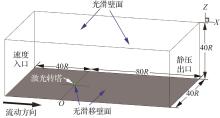
Fig.1
Schematic of flow field computational domain and boundary conditions
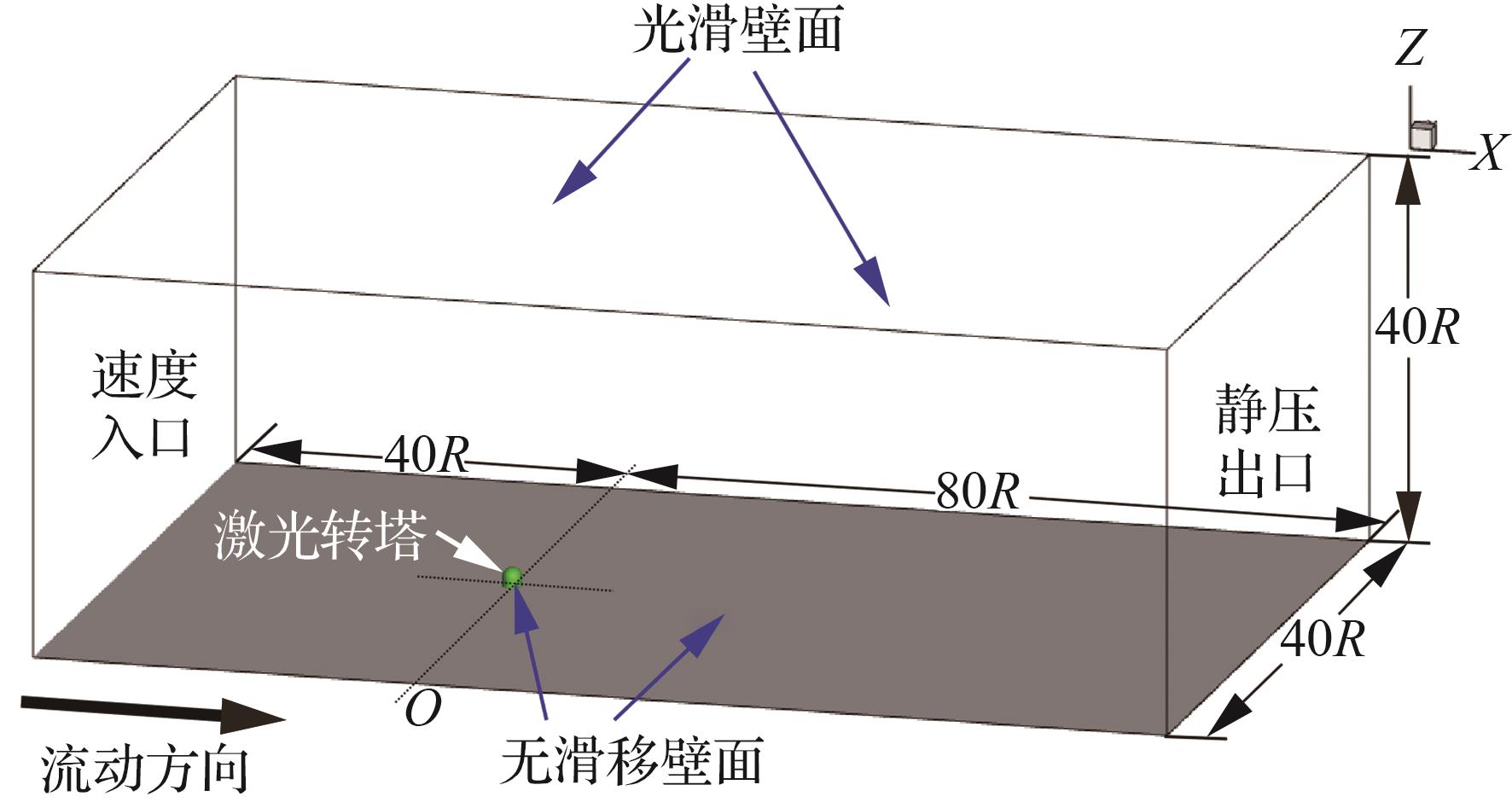
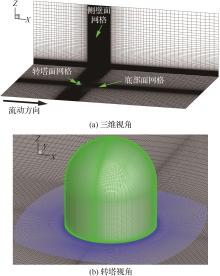
Fig.2
Structured grid topology
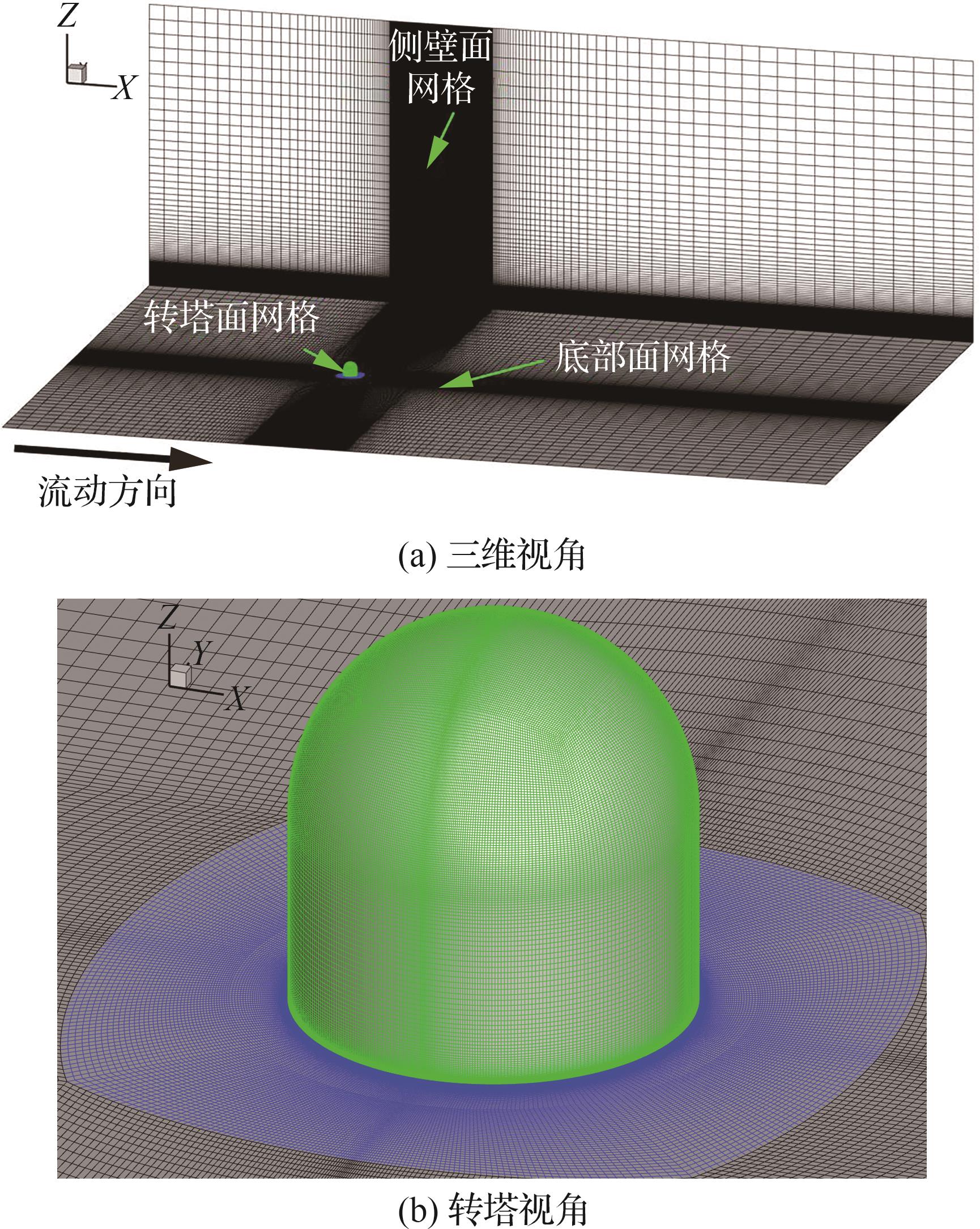
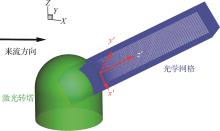
Fig.3
Schematic of optical grid at light beam emissionangle of 150°
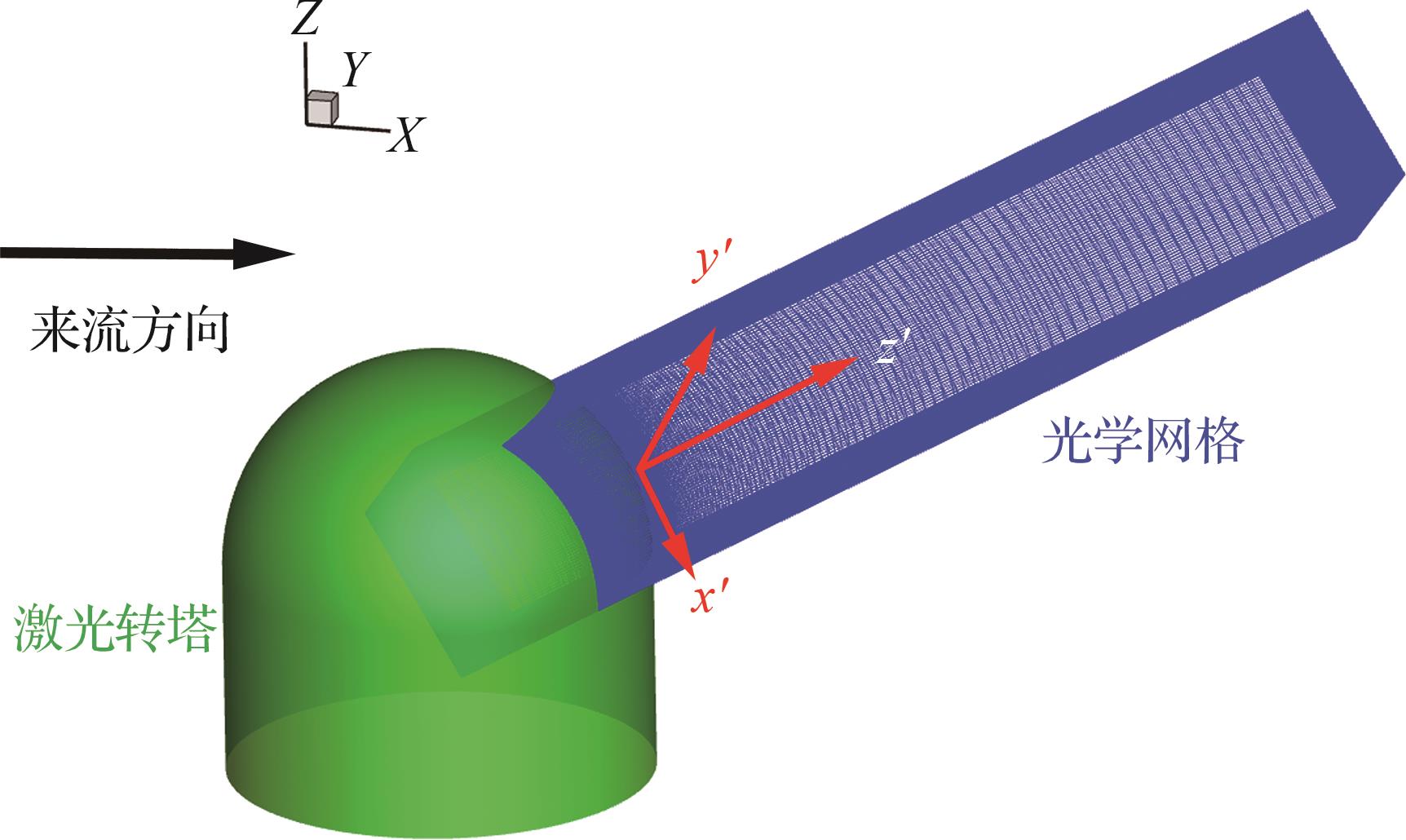
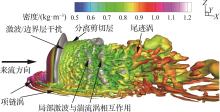
Fig.4
Q criterion and Mach number iso-surface around turret
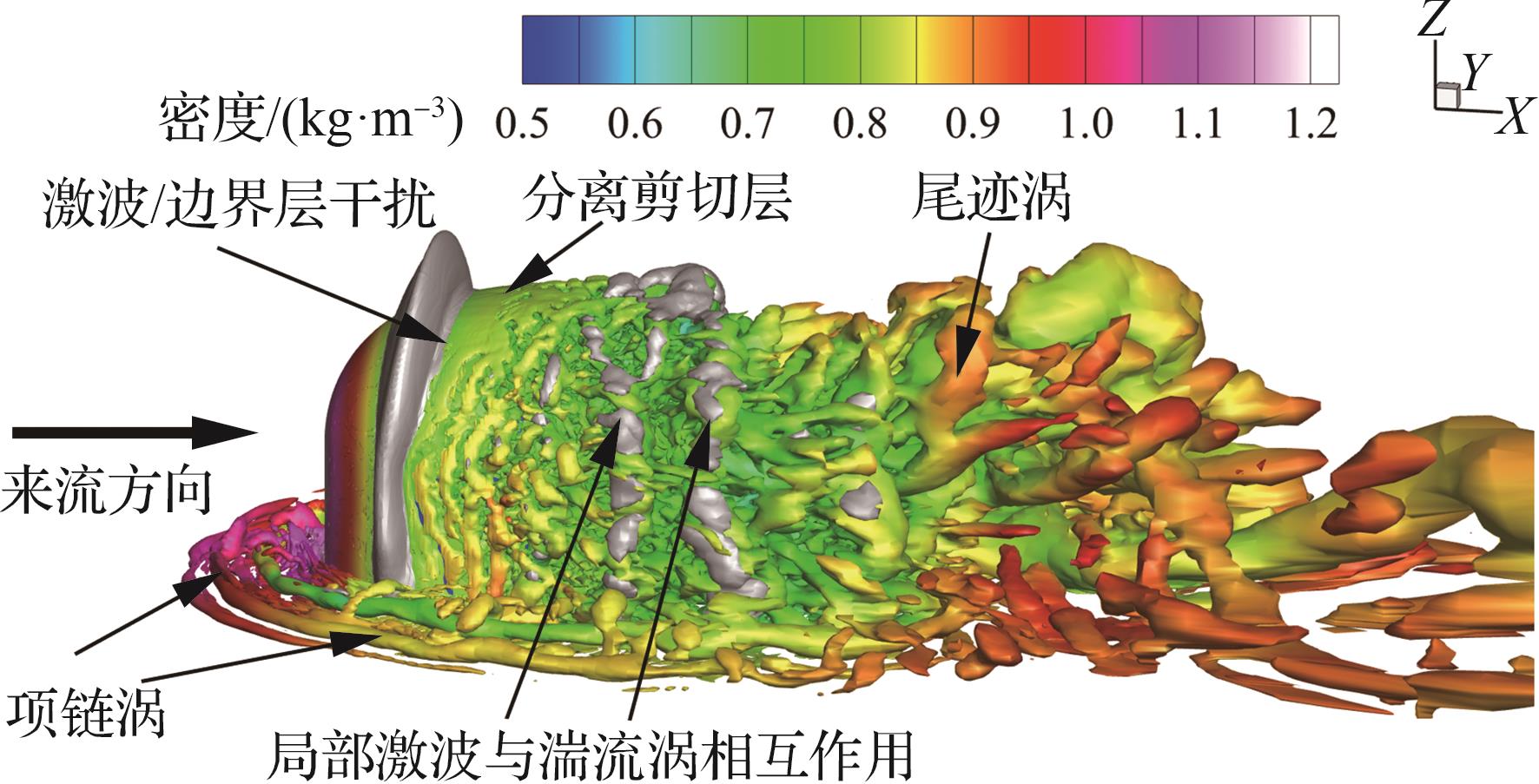
Fig.5
Time-averaged stream traces around turret
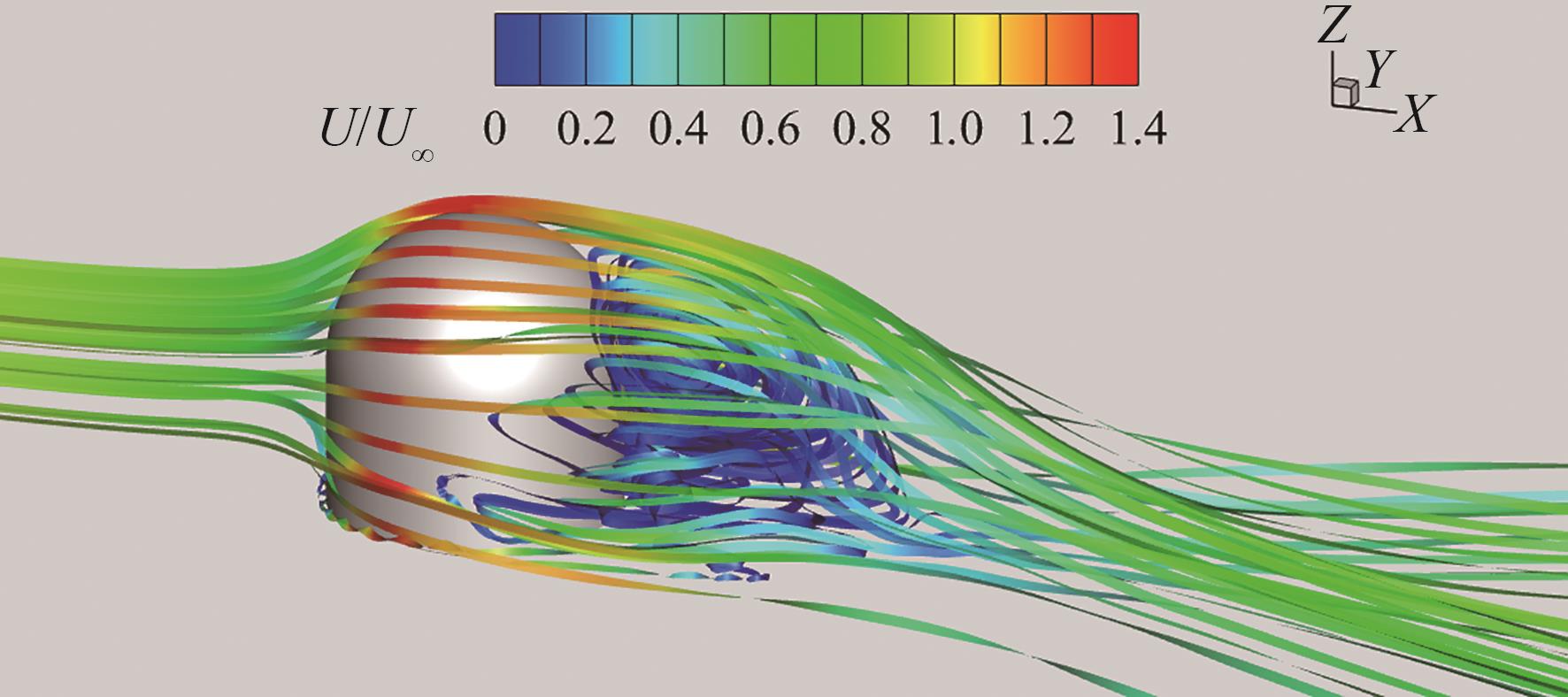
Fig.6
Instantaneous Mach number contour and instantaneous density contour
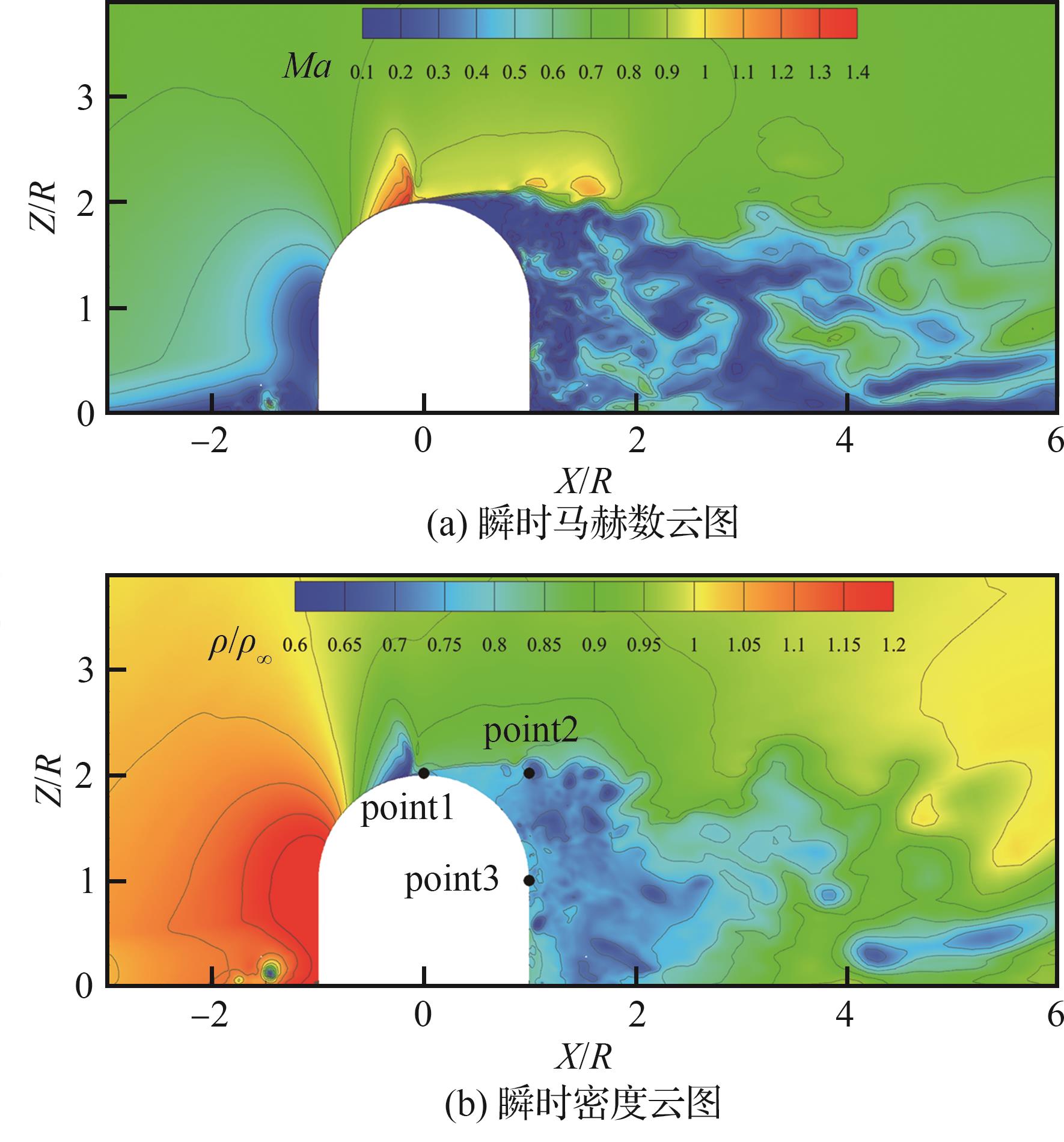
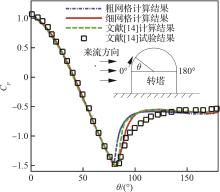
Fig.7
Comparison of time-averaged pressure coefficient on center section of turret
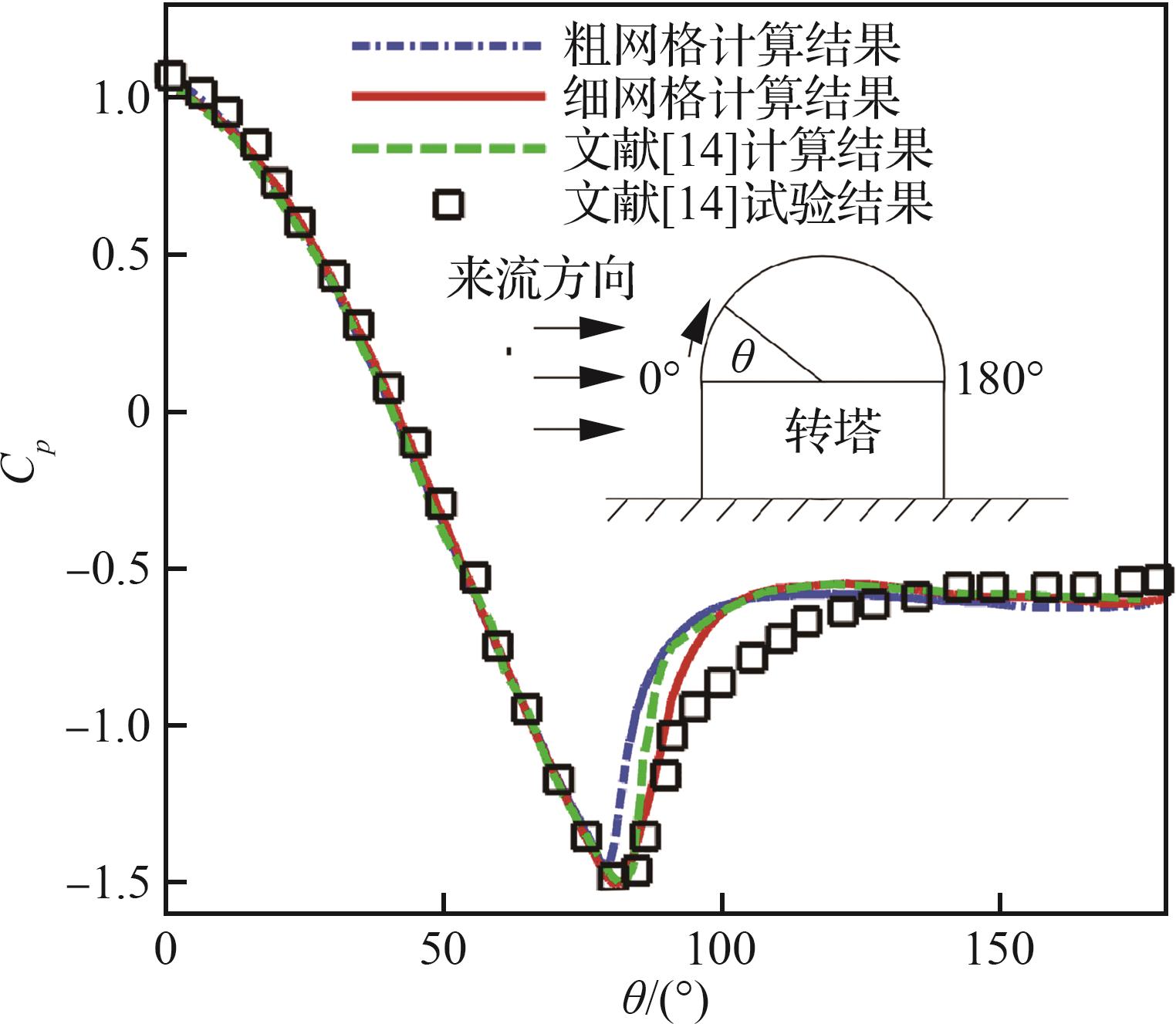
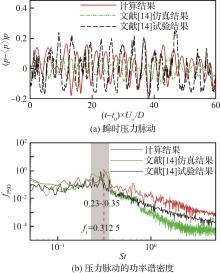
Fig.8
Comparison of pressure pulsation at point1 on turret with test data
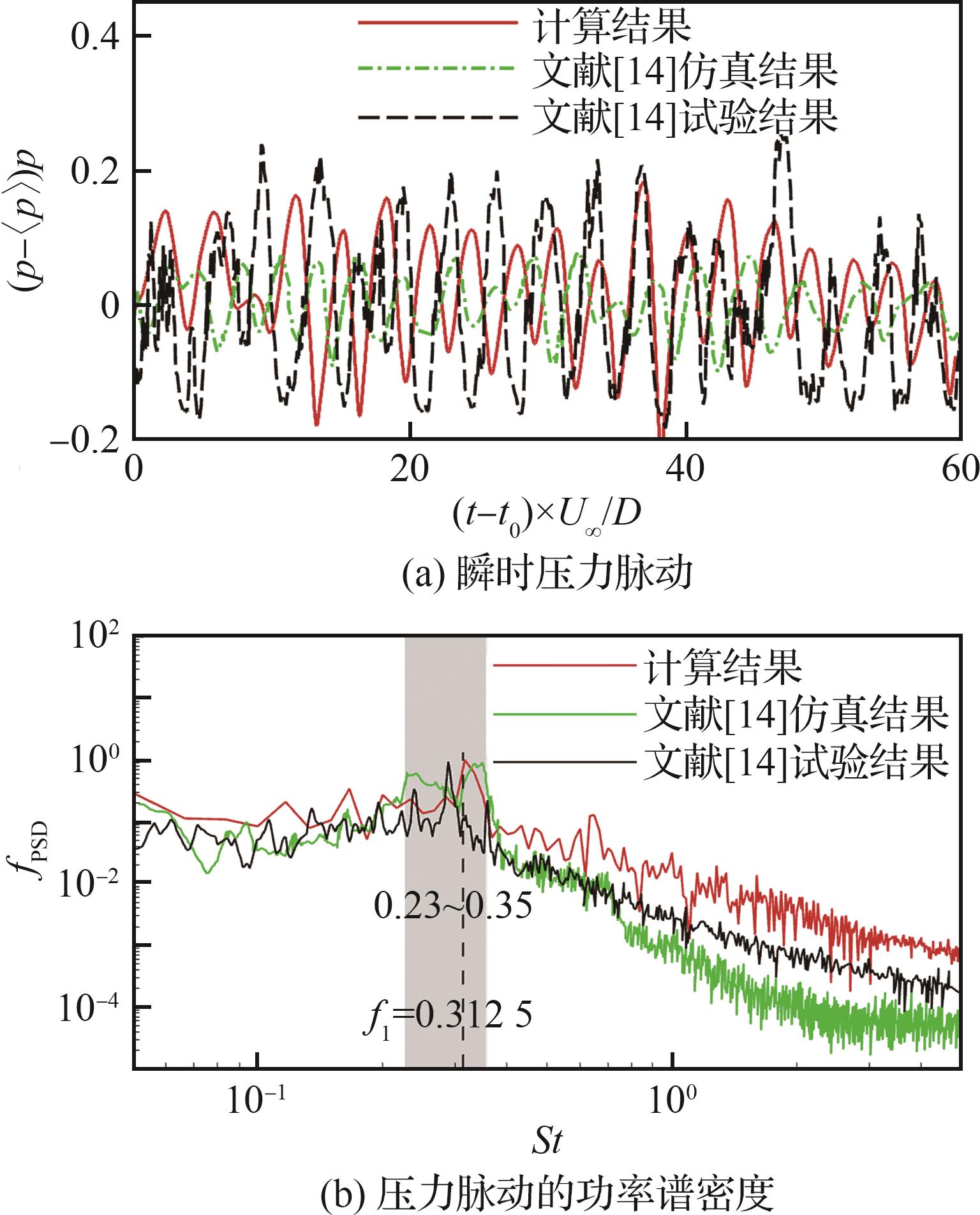
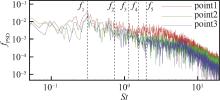
Fig.9
PSD of density variation at point1, point2 and point3
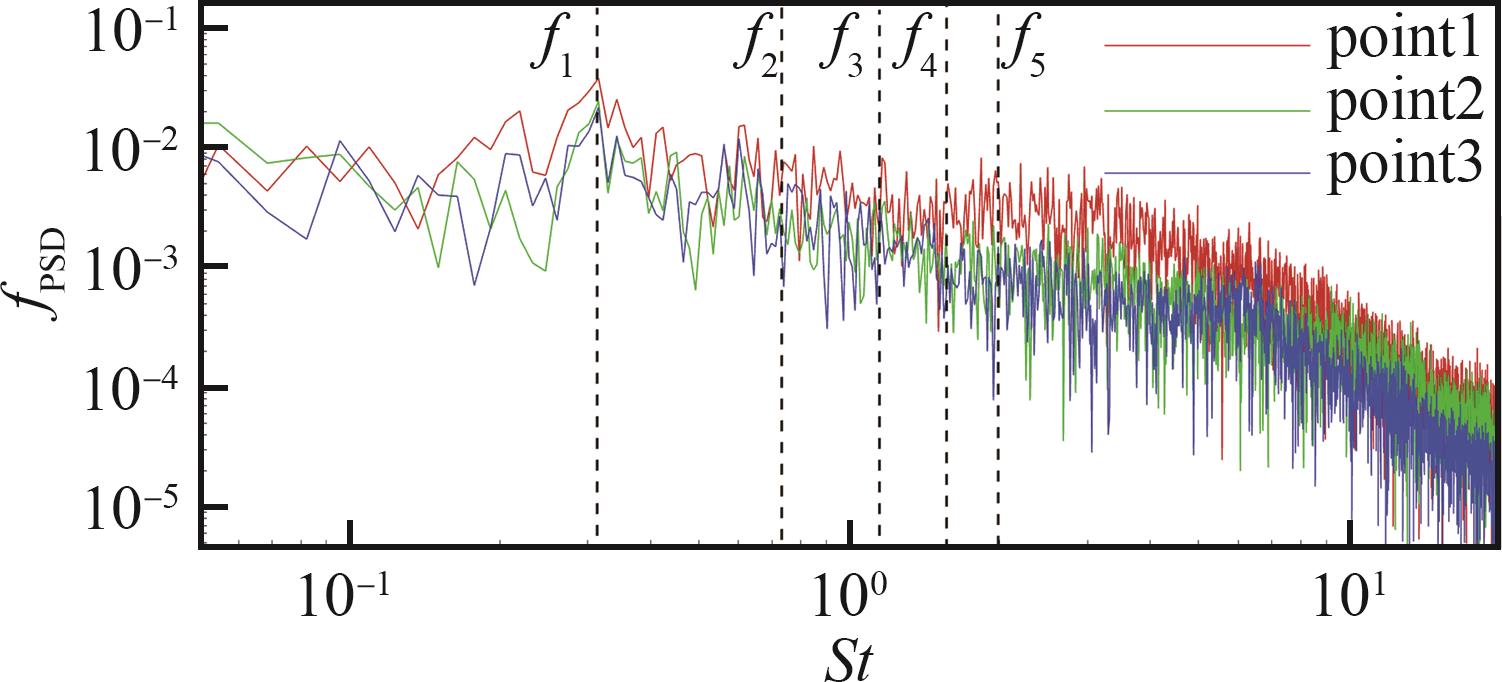
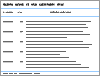
Table 1
The first five Rossiter frequencies
| 模态数 | 特征频率 |
|---|---|
| 1 | 0.313 5 |
| 2 | 0.731 6 |
| 3 | 1.148 6 |
| 4 | 1.567 6 |
| 5 | 1.985 6 |
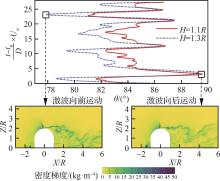
Fig.10
Positions of shock wave on turret dome
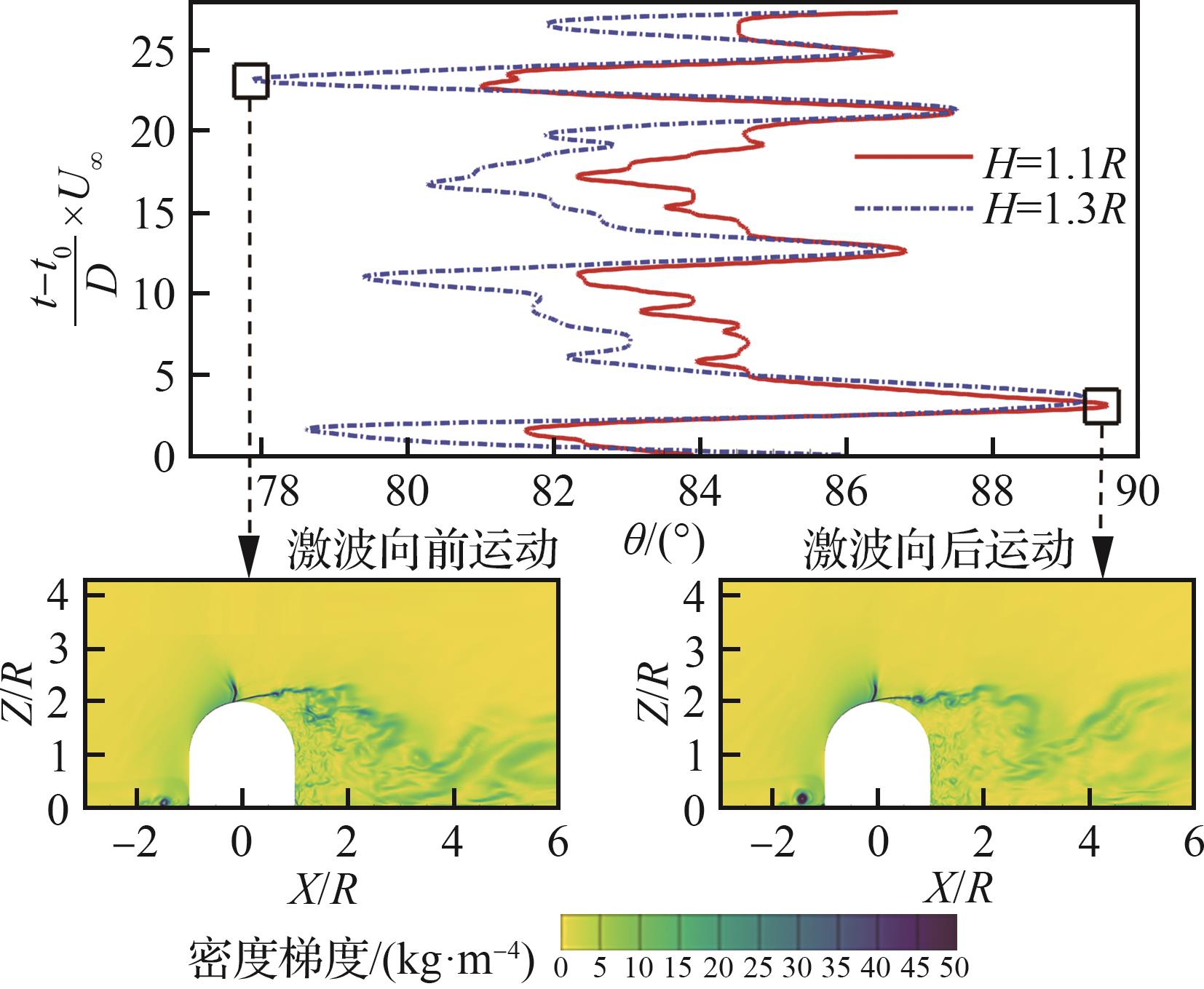
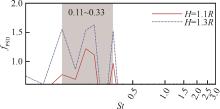
Fig.11
PSD of shock motions
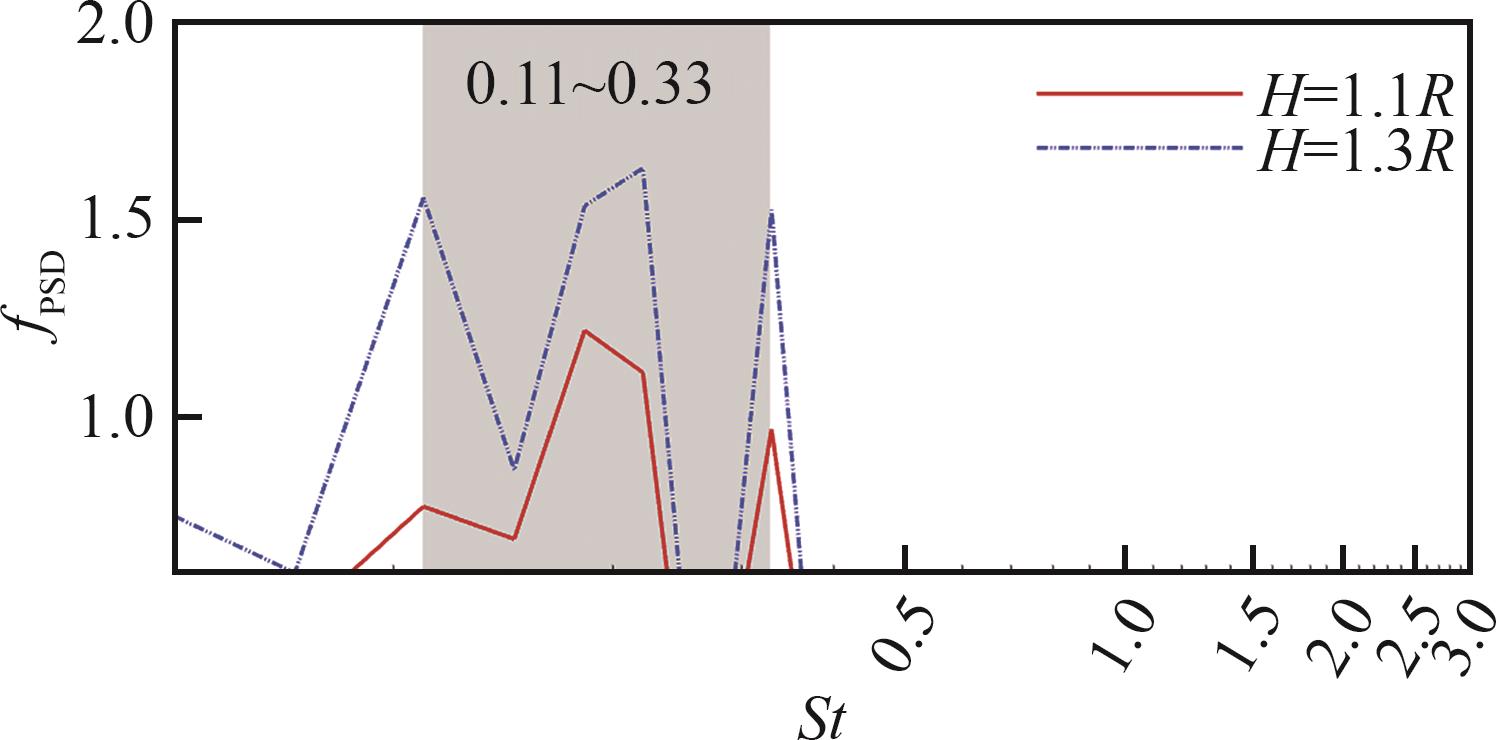
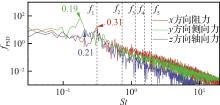
Fig.12
PSD of x, y, z force on turret
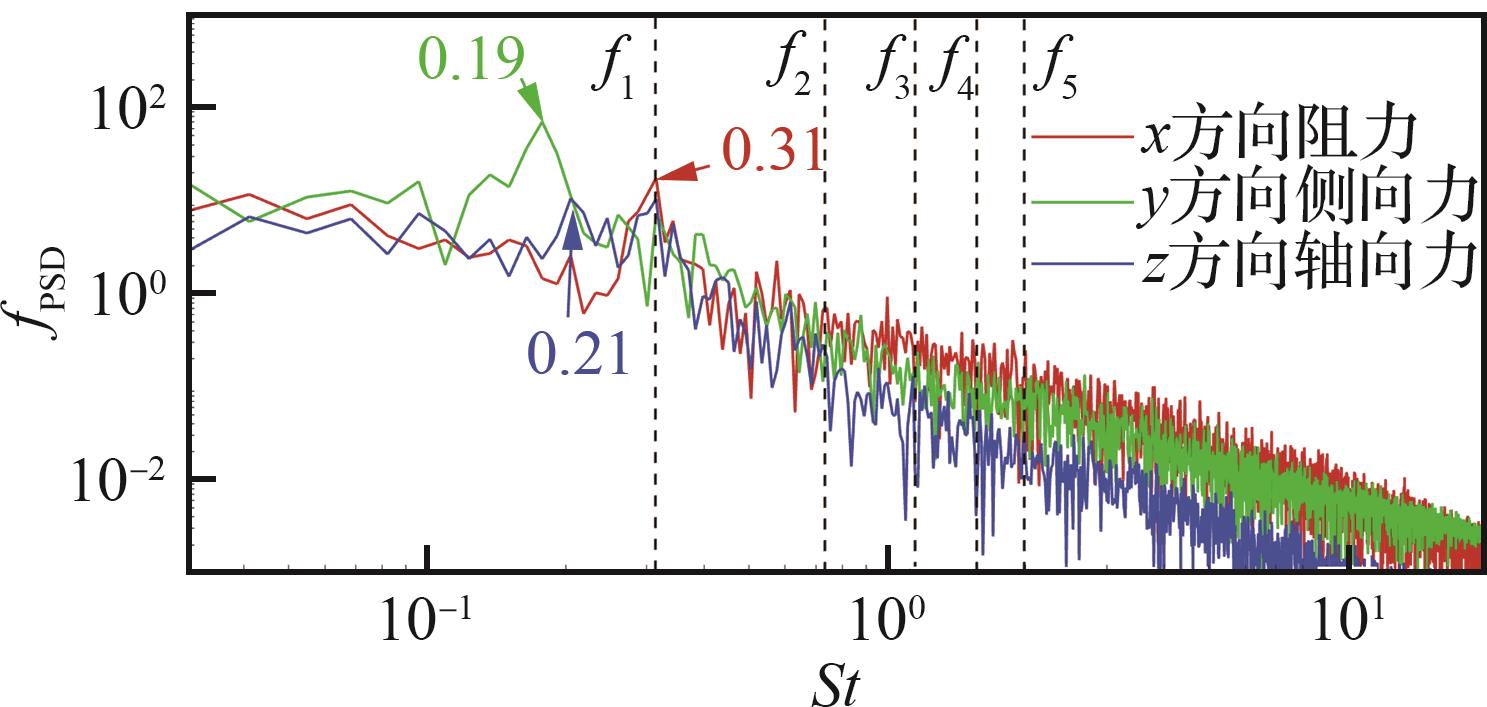
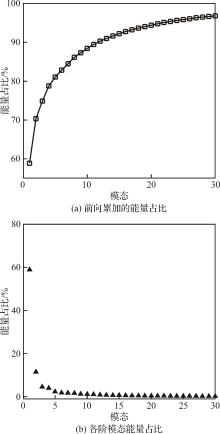
Fig.13
POD modal energy ratio of turret surface pressure
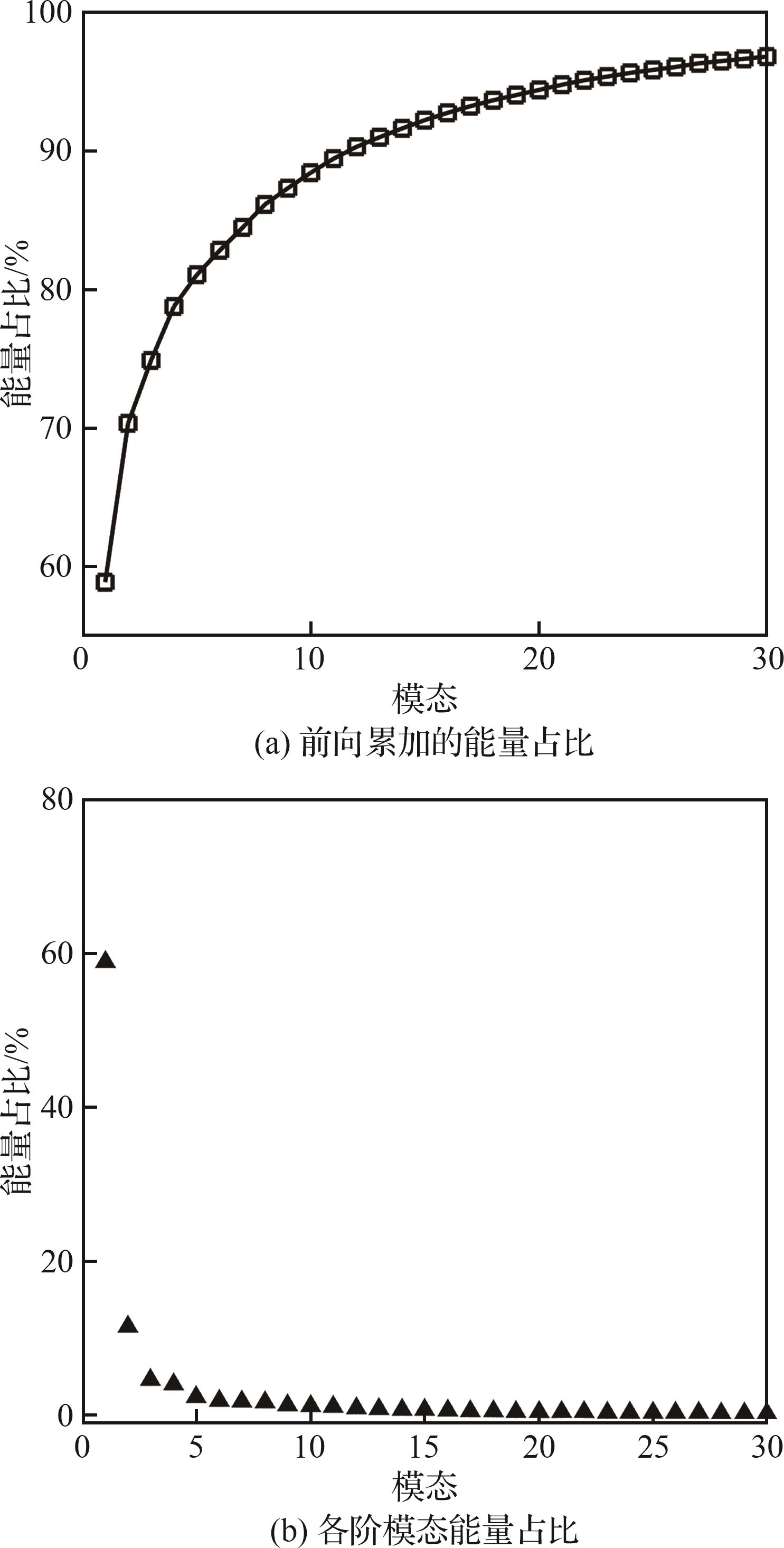
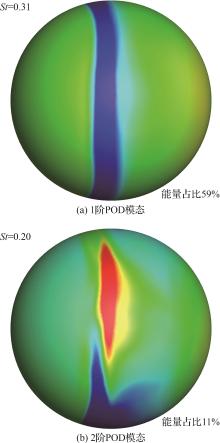
Fig.14
The first two POD mode distributions
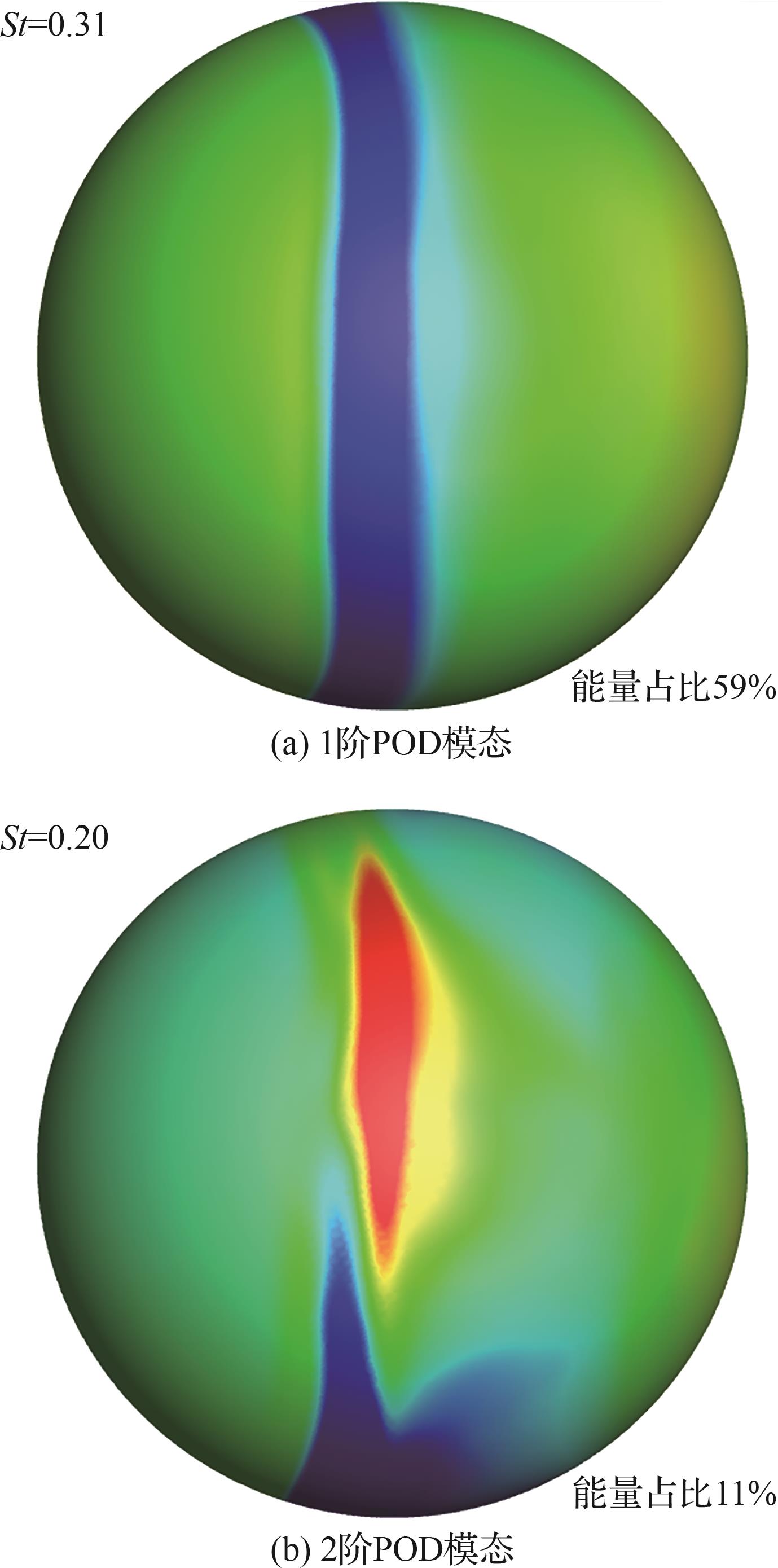
Table 2
Frequencies of “breathing” mode and “shifting” mode
| 模态分解方法 | 特征频率 | |
|---|---|---|
| “呼吸”模态 | “交替”模态 | |
| POD | 0.31 | 0.20 |
| DMD | 0.26~0.41 | 0.11~0.22 |
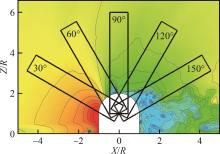
Fig.15
Flow field regions traversed by light beam at different beam emission angles
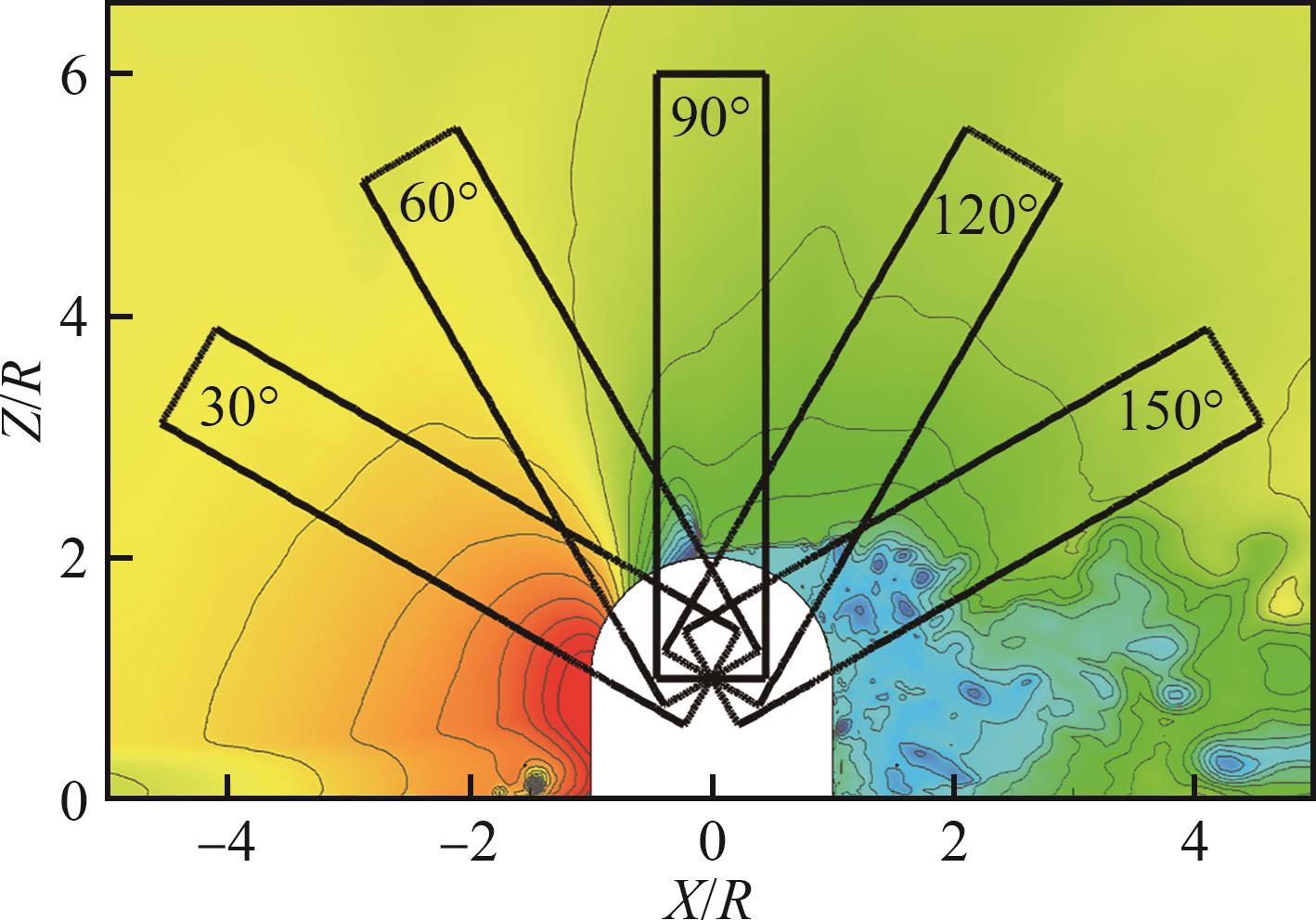
Table 3
Time-averaged high-order optical path differences at different emission angles
| θ/(°) | |
|---|---|
| 30 | 0.93 |
| 60 | 1.12 |
| 90 | 4.19 |
| 120 | 1.75 |
| 150 | 4.58 |
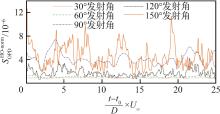
Fig.16
Variation of high-order optical path differences with time under different beam emission angles
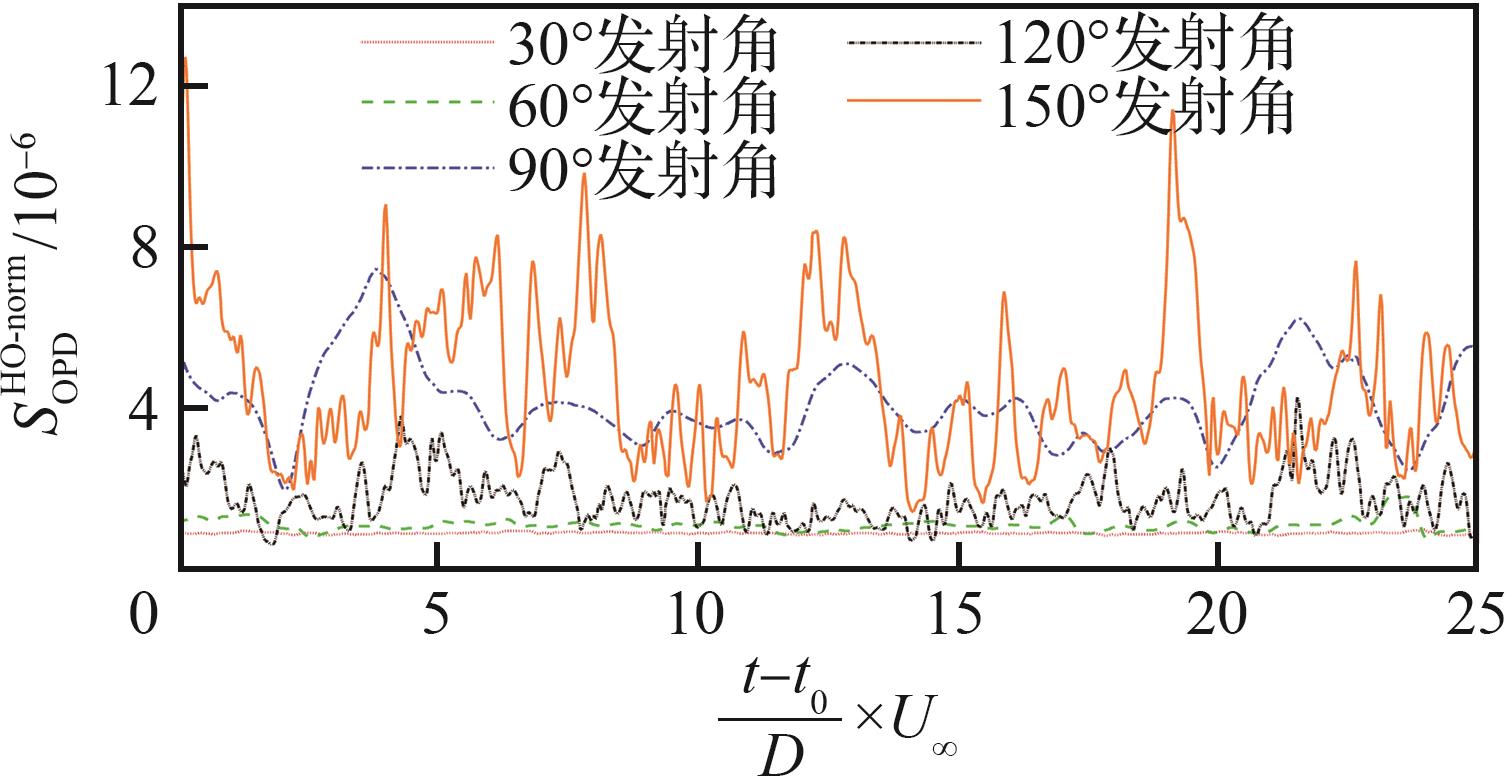
Fig.17
PSD of high-order optical path difference
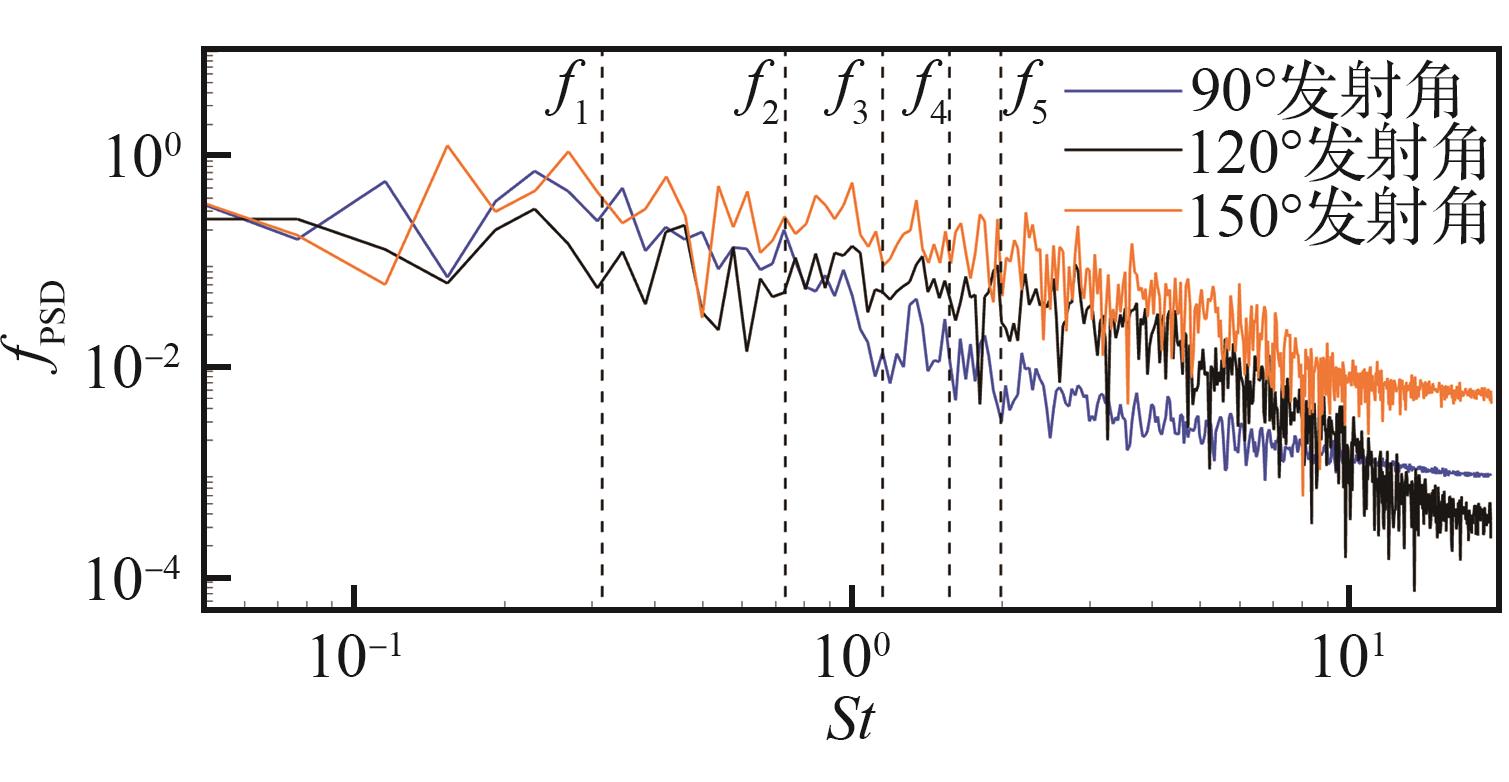
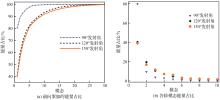
Fig.18
POD modal energy ratio of high-order optical path difference
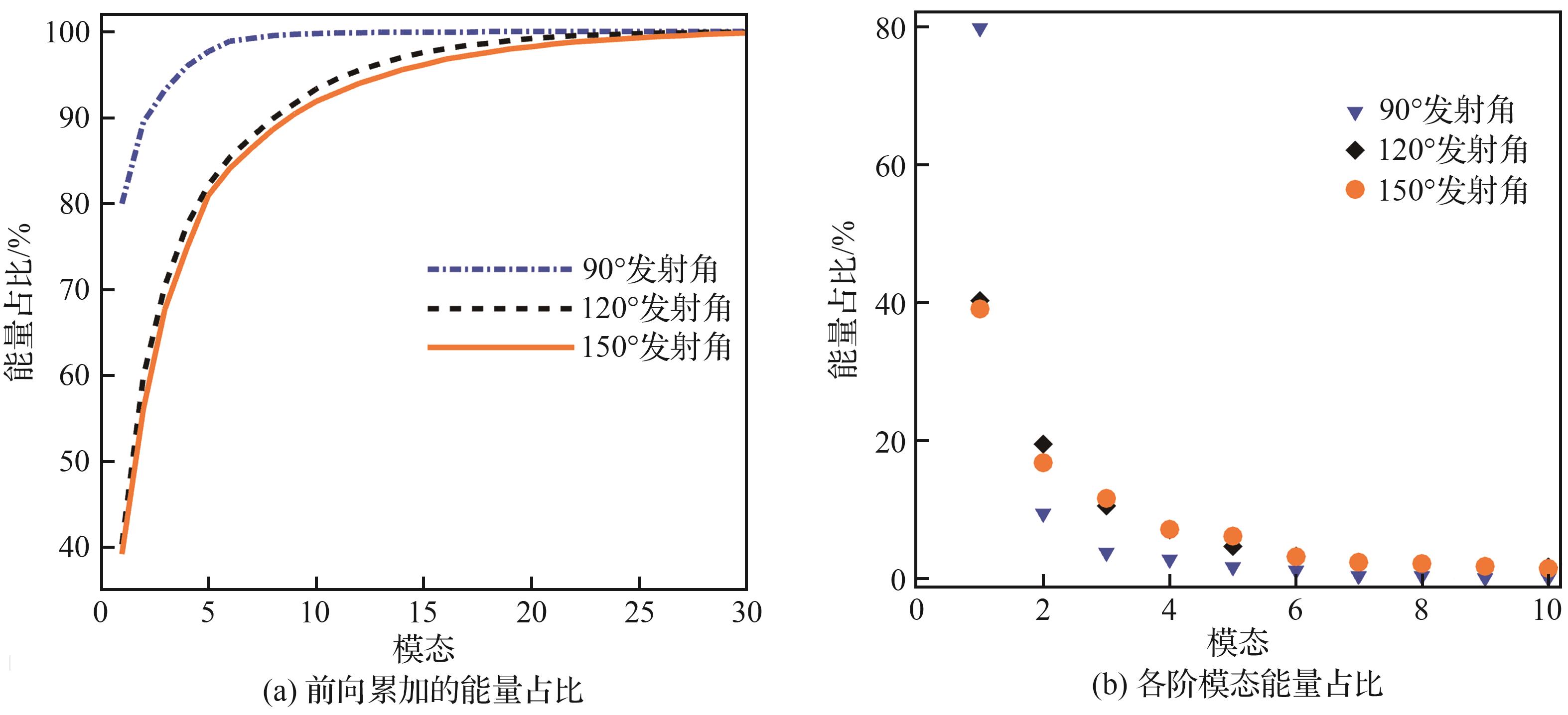
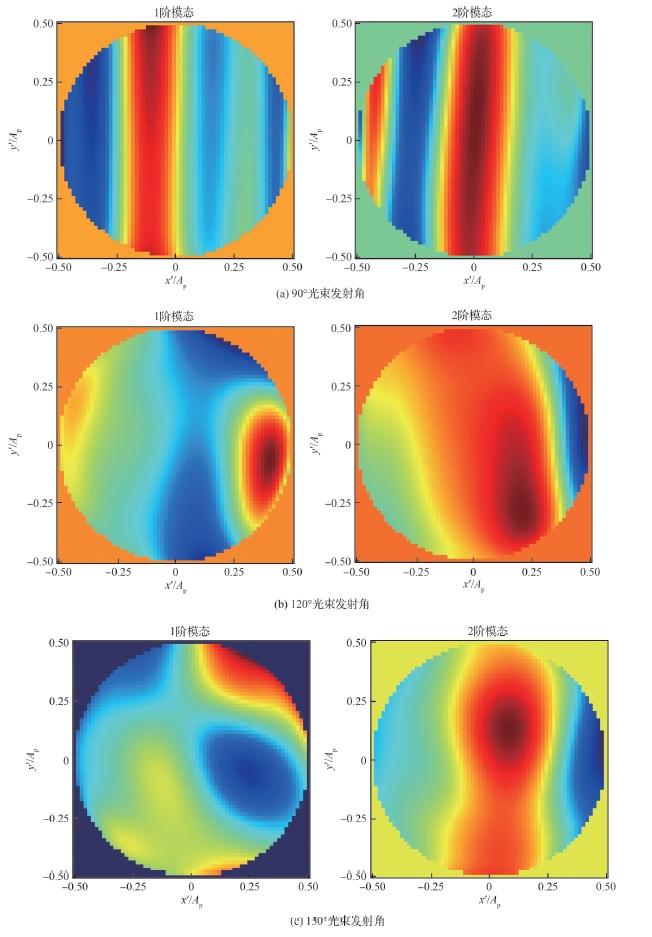
Fig.19
The first two POD mode of high-order optical path difference under different beam emission angles
| [1] | MOLER J L, LAMBERSON S E. Airborne laser (ABL): A legacy and a future for high-energy lasers[C]∥Gas and Chemical Lasers and Intense Beam Applications. 1998: 1-7. |
| [2] | PERRAM G, MARCINIAK M, GODA M. High-energy laser weapons: Technology overview[C]∥Society of Photo-Optical Instrumentation Engineers Conference on Laser Technologies for Defense and Security. 2014: 1-25. |
| [3] | LAMBERSON S, SCHALL H, ALVARADO O. Overview of airborne laser’s test program[C]∥2005 U.S. Air Force T&E Days. Reston: AIAA, 2005. |
| [4] | JUMPER E J, GORDEYEV S, CAVALIERI D, et al. Airborne aero-optics laboratory-transonic (AAOL-T)[C]∥53rd AIAA Aerospace Sciences Meeting. Reston: AIAA, 2015. |
| [5] | MORRIDA J J, GORDEYEV S, JUMPER E J. Transonic flow dynamics over a hemisphere in flight[C]∥54th AIAA Aerospace Sciences Meeting. Reston: AIAA, 2016. |
| [6] | 曹秋生, 路静, 柳建光, 等. 从SHiELD看机载激光武器的反导能力和技术挑战[J]. 中国电子科学研究院学报, 2019, 14(5): 443-451. |
| CAO Q S, LU J, LIU J G, et al. From SHiELD to look into the anti-missile capability and technical challenge of airborne laser weapon[J]. Journal of China Academy of Electronics and Information Technology, 2019, 14(5): 443-451 (in Chinese). | |
| [7] | 严毅, 穆学桢, 张宁华, 等. 机载激光武器自卫防御应用研究与前景分析[J]. 航空制造技术, 2023, 66(5): 107-113. |
| YAN Y, MU X Z, ZHANG N H, et al. Application research and prospect analysis of airborne self-defense laser weapon[J]. Aeronautical Manufacturing Technology, 2023, 66(5): 107-113 (in Chinese). | |
| [8] | GORDEYEV S, JUMPER E. Fluid dynamics and aero-optics of turrets[J]. Progress in Aerospace Sciences, 2010, 46(8): 388-400. |
| [9] | JUMPER E J, FITZGERALD E J. Recent advances in aero-optics[J]. Progress in Aerospace Sciences, 2001, 37(3): 299-339. |
| [10] | GORDEYEV S, CRESS J A, SMITH A, et al. Aero-optical measurements in a subsonic, turbulent boundary layer with non-adiabatic walls[J]. Physics of Fluids, 2015, 27(4): 045110. |
| [11] | WITTICH D, GORDEYEV S, JUMPER E. Revised scaling of optical distortions caused by compressible, subsonic turbulent boundary layers[C]∥38th Plasmadynamics and Lasers Conference. Reston: AIAA, 2007. |
| [12] | TAN X T, XU H Y. Numerical investigation of aero-optical effects around the turret based on delayed detached eddy simulation and unsteady Reynolds averaged Navier-Stokes[J]. Proceedings of the Institution of Mechanical Engineers, Part G: Journal of Aerospace Engineering, 2024(1): 20-43. |
| [13] | REN X, YU H H, YAO X H, et al. Passive fluidic control on aero-optics of transonic flow over turrets with rough walls[J]. Physics of Fluids, 2022, 34(11): 115109. |
| [14] | REN X, YU H H, YAO X H, et al. Shock boundary layer interaction and aero-optical effects in a transonic flow over hemisphere-on-cylinder turrets[J]. International Journal of Aerospace Engineering, 2022, 22: 3397763. |
| [15] | TAN X T, XU H Y, YIN K. Numerical investigation of optical distortions by turbulent wake and shock wave in the transonic flow[J]. Physics of Fluids, 2024, 36(3): 036115. |
| [16] | MALKUS M J, FREDE M T, SHERER S E, et al. Effect of submergence on transonic flow around a hemisphere[J]. AIAA Journal, 2022, 60(11): 6082-6096. |
| [17] | TANG S X, LI J, WEI Z Y. A numerical investigation of the dominant characteristics of a transonic flow over a hemispherical turret[J]. International Journal of Computational Fluid Dynamics, 2022, 36(5): 404-423. |
| [18] | BERESH S J, HENFLING J F, SPILLERS R W, et al. Unsteady shock motion in a transonic flow over a wall-mounted hemisphere[C]∥29th International Symposium on Shock Waves 2. Cham: Springer International Publishing, 2015: 1241-1246. |
| [19] | GORDEYEV S, VOROBIEV A, JUMPER E J, et al. Studies of flow topology around hemisphere at transonic speeds using time-resolved oil flow visualization[C]∥54th AIAA Aerospace Sciences Meeting. Reston: AIAA, 2016. |
| [20] | GRITSKEVICH M S, GARBARUK A V, SCHÜTZE J, et al. Development of DDES and IDDES formulations for the k-ω shear stress transport model[J]. Flow, Turbulence and Combustion, 2012, 88(3): 431-449. |
| [21] | SHUR M L, SPALART P R, STRELETS M K, et al. A hybrid RANS-LES approach with delayed-DES and wall-modelled LES capabilities[J]. International Journal of Heat and Fluid Flow, 2008, 29(6): 1638-1649. |
| [22] | 韩少强, 宋文萍, 韩忠华, 等. 高速共轴刚性旋翼非定常流动高精度数值模拟[J]. 航空学报, 2024, 45(9): 529064. |
| HAN S Q, SONG W P, HAN Z H, et al. High-accuracy numerical-simulation of unsteady flow over high-speed coaxial rigid rotors[J]. Acta Aeronautica et Astronautica Sinica, 2024, 45(9): 529064 (in Chinese). | |
| [23] | 王跃, 宋文萍, 宋敏华, 等. 涡桨飞机有/无动力降落构型的气动噪声预测[J]. 航空学报, 2023, 44(11): 126110. |
| WANG Y, SONG W P, SONG M H, et al. Aero-acoustic prediction of turboprop models with and without propellers in landing configuration[J]. Acta Aeronautica et Astronautica Sinica, 2023, 44(11): 126110 (in Chinese). | |
| [24] | 张伟伟, 寇家庆, 刘溢浪. 智能赋能流体力学展望[J]. 航空学报, 2021, 42(4): 524689. |
| ZHANG W W, KOU J Q, LIU Y L. Prospect of artificial intelligence empowered fluid mechanics[J]. Acta Aeronautica et Astronautica Sinica, 2021, 42(4): 524689 (in Chinese). | |
| [25] | 曹文博, 刘溢浪, 张伟伟. 基于降阶模型和梯度优化的流场加速收敛方法[J]. 航空学报, 2023, 44(6): 127090. |
| CAO W B, LIU Y L, ZHANG W W. Accelerated convergence method for fluid dynamics solvers based on reduced-order model and gradient optimization[J]. Acta Aeronautica et Astronautica Sinica, 2023, 44(6): 127090 (in Chinese). | |
| [26] | SCHMID P J. Dynamic mode decomposition and its variants[J]. Annual Review of Fluid Mechanics, 2022, 54: 225-254. |
| [27] | 王方剑, 解克, 刘金, 等. 小展弦比飞翼标模非定常流动及自由摇滚特性[J]. 航空学报, 2023, 44(4): 126449. |
| WANG F J, XIE K, LIU J, et al. Unsteady flow and wing rock characteristics of low aspect ratio flying-wing[J]. Acta Aeronautica et Astronautica Sinica, 2023, 44(4): 126449 (in Chinese). | |
| [28] | TIAN R Z, XU H Y, DONG Q L, et al. Numerical investigation of aero-optical effects of flow past a flat-windowed cylindrical turret[J]. Physics of Fluids, 2020, 32: 056103. |
| [29] | MENTER F R. Two-equation eddy-viscosity turbulence models for engineering applications[J]. AIAA Journal, 1994, 32(8): 1598-1605. |
| [30] | WANG K, WANG M. Computational analysis of aero-optical distortions by flow over a cylindrical turret[J]. AIAA Journal, 2016, 54(5): 1461-1471. |
| [31] | WANG M, MANI A L, GORDEYEV S. Physics and computation of aero-optics[J]. Annual Review of Fluid Mechanics, 2012, 44: 299-321. |
| [32] | ZILBERTER I A, EDWARDS J R, WITTICH D J. Numerical simulation of aero-optical effects in a supersonic cavity flow[J]. AIAA Journal, 2017, 55(9): 3095-3108. |
| [33] | SAKAMOTO H, HANIU H. A study on vortex shedding from spheres in a uniform flow[J]. Journal of Fluids Engineering, 1990, 112(4): 386-392. |
| [1] | Shilin HU, Bingzhou CHEN, Wei KANG. Lift improvement mechanism of membrane airfoil using dynamic mode decomposition [J]. Acta Aeronautica et Astronautica Sinica, 2025, 46(2): 130618-130618. |
| [2] | Junpei ZHA, Bao CHEN, Fei WU, Weipeng LI. Numerical research on aeroacoustics of supersonic single/twin rectangular jets [J]. Acta Aeronautica et Astronautica Sinica, 2025, 46(14): 131447-131447. |
| [3] | Bo YANG, He YU, Zichen FAN. Micro-energy analysis method for time-varying error of aero-optical effects [J]. Acta Aeronautica et Astronautica Sinica, 2024, 45(4): 128703-128703. |
| [4] | Wei ZHANG, Xutao NIE, Liwei OU, Zhixun XIA, Lei CHEN. Frequency⁃weighted dynamic mode decomposition for trailing edge flapping airfoil flow [J]. Acta Aeronautica et Astronautica Sinica, 2024, 45(18): 129846-129846. |
| [5] | Jing YU, Anlin JIANG, Liang LIU, Xiaojun WU, Yewei GUI, Shenshen LIU. PCA aerodynamic geometry parametrization method [J]. Acta Aeronautica et Astronautica Sinica, 2024, 45(10): 129125-129125. |
| [6] | Zhao KE, Yongxin SHI, Peng ZHANG, Kuo TIAN, Bo WANG. Vibration reduction optimization of complex thin-walled structures based on global POD reduced-order model [J]. Acta Aeronautica et Astronautica Sinica, 2023, 44(13): 227900-227900. |
| [7] | Qian YANG, Xiaofeng GUO, Qin LI, Wei DONG. Hot air anti-icing performance estimation method based on POD and surrogate model [J]. ACTA AERONAUTICAET ASTRONAUTICA SINICA, 2023, 44(1): 626992-626992. |
| [8] | TONG Fulin, DONG Siwei, DUAN Junyi, LI Xinliang. Direct numerical simulation of separation bubble in shock wave/turbulent boundary layer interaction [J]. ACTA AERONAUTICAET ASTRONAUTICA SINICA, 2022, 43(7): 125437-125437. |
| [9] | SUN Dong, LIU Pengxin, SHEN Pengfei, TONG Fulin, GUO Qilong. Direct numerical simulation of shock wave/turbulent boundary layer interaction in hollow cylinder-flare configuration at Mach number 6 [J]. ACTA AERONAUTICAET ASTRONAUTICA SINICA, 2021, 42(12): 124681-124681. |
| [10] | TONG Fulin, ZHOU Guiyu, SUN Dong, LI Xinliang. Expansion effect on shock wave and turbulent boundary layer interactions [J]. ACTA AERONAUTICAET ASTRONAUTICA SINICA, 2020, 41(9): 123731-123731. |
| [11] | CHEN Bing, ZHENG Yong, CHEN Zhanglei, ZHANG Houtian, LIU Xinjiang. A review of celestial navigation system on near space hypersonic vehicle [J]. ACTA AERONAUTICAET ASTRONAUTICA SINICA, 2020, 41(8): 623686-623686. |
| [12] | TONG Fulin, SUN Dong, YUAN Xianxu, LI Xinliang. Direct numerical simulation of impinging shock wave/turbulent boundary layer interactions in a supersonic expansion corner [J]. ACTA AERONAUTICAET ASTRONAUTICA SINICA, 2020, 41(3): 123328-123328. |
| [13] | SUN Dong, LIU Pengxin, TONG Fulin. Effect of spanwise oscillation on interaction of shock wave and turbulent boundary layer [J]. ACTA AERONAUTICAET ASTRONAUTICA SINICA, 2020, 41(12): 124054-124054. |
| [14] | GAO Chuanqiang, ZHANG Weiwei. Numerical simulation and modal analysis of transonic buffet flow over wings [J]. ACTA AERONAUTICAET ASTRONAUTICA SINICA, 2019, 40(7): 122597-122597. |
| [15] | TONG Fulin, ZHOU Guiyu, ZHOU Hao, ZHANG Peihong, LI Xinliang. Statistical characteristics of wall shear stress in shock wave and turbulent boundary layer interactions [J]. ACTA AERONAUTICAET ASTRONAUTICA SINICA, 2019, 40(5): 122504-122504. |
| Viewed | ||||||
|
Full text |
|
|||||
|
Abstract |
|
|||||
Address: No.238, Baiyan Buiding, Beisihuan Zhonglu Road, Haidian District, Beijing, China
Postal code : 100083
E-mail:hkxb@buaa.edu.cn
Total visits: 6658907 Today visits: 1341All copyright © editorial office of Chinese Journal of Aeronautics
All copyright © editorial office of Chinese Journal of Aeronautics
Total visits: 6658907 Today visits: 1341

 CJA
CJA
