Acta Aeronautica et Astronautica Sinica ›› 2025, Vol. 46 ›› Issue (14): 131451.doi: 10.7527/S1000-6893.2025.31451
• Fluid Mechanics and Flight Mechanics • Previous Articles Next Articles
Junjie FU1,2, Feng QU1,2( ), Di SUN1,2
Received:2024-10-28
Revised:2024-11-19
Accepted:2025-02-19
Online:2025-02-26
Published:2025-02-25
Contact:
Feng QU
E-mail:qufeng@nwpu.edu.cn
Supported by:CLC Number:
Junjie FU, Feng QU, Di SUN. Integrated design of waverider forebody and inward-turning inlet considering viscous effect under given flowfield distribution[J]. Acta Aeronautica et Astronautica Sinica, 2025, 46(14): 131451.
Fig.1
Foreign application of integrated design of waverider forebody and inward turning inlet
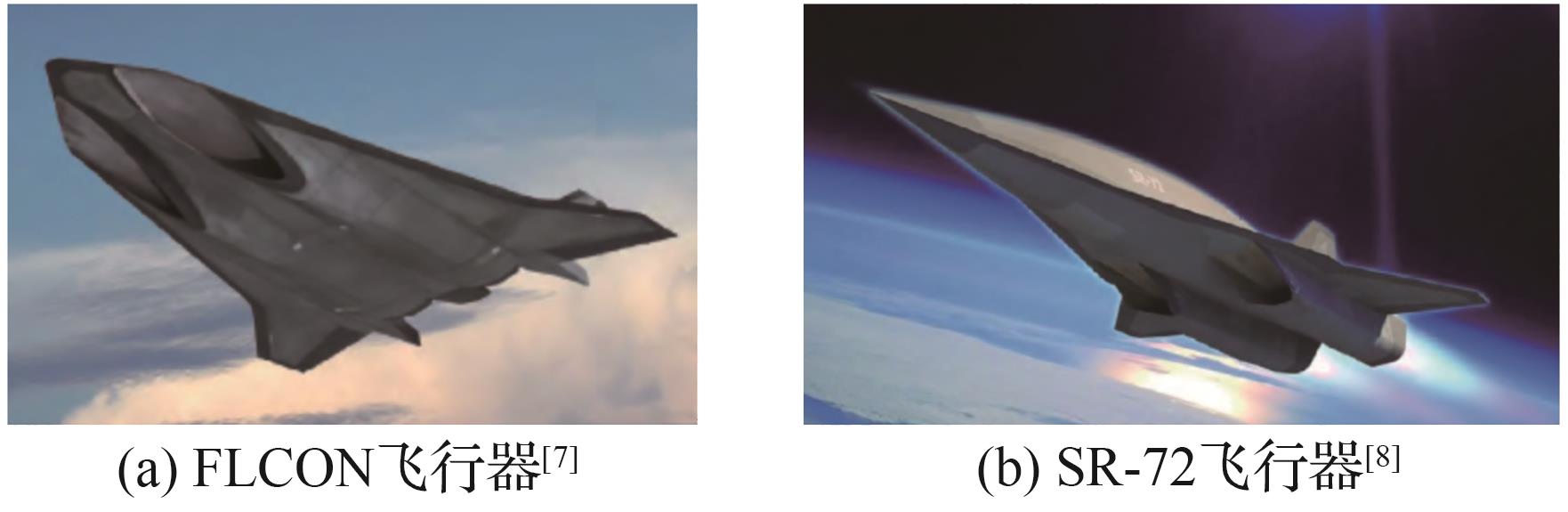
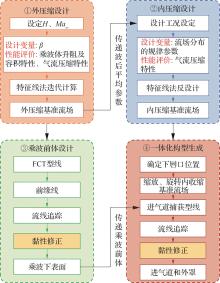
Fig.2
Process of the integrated design
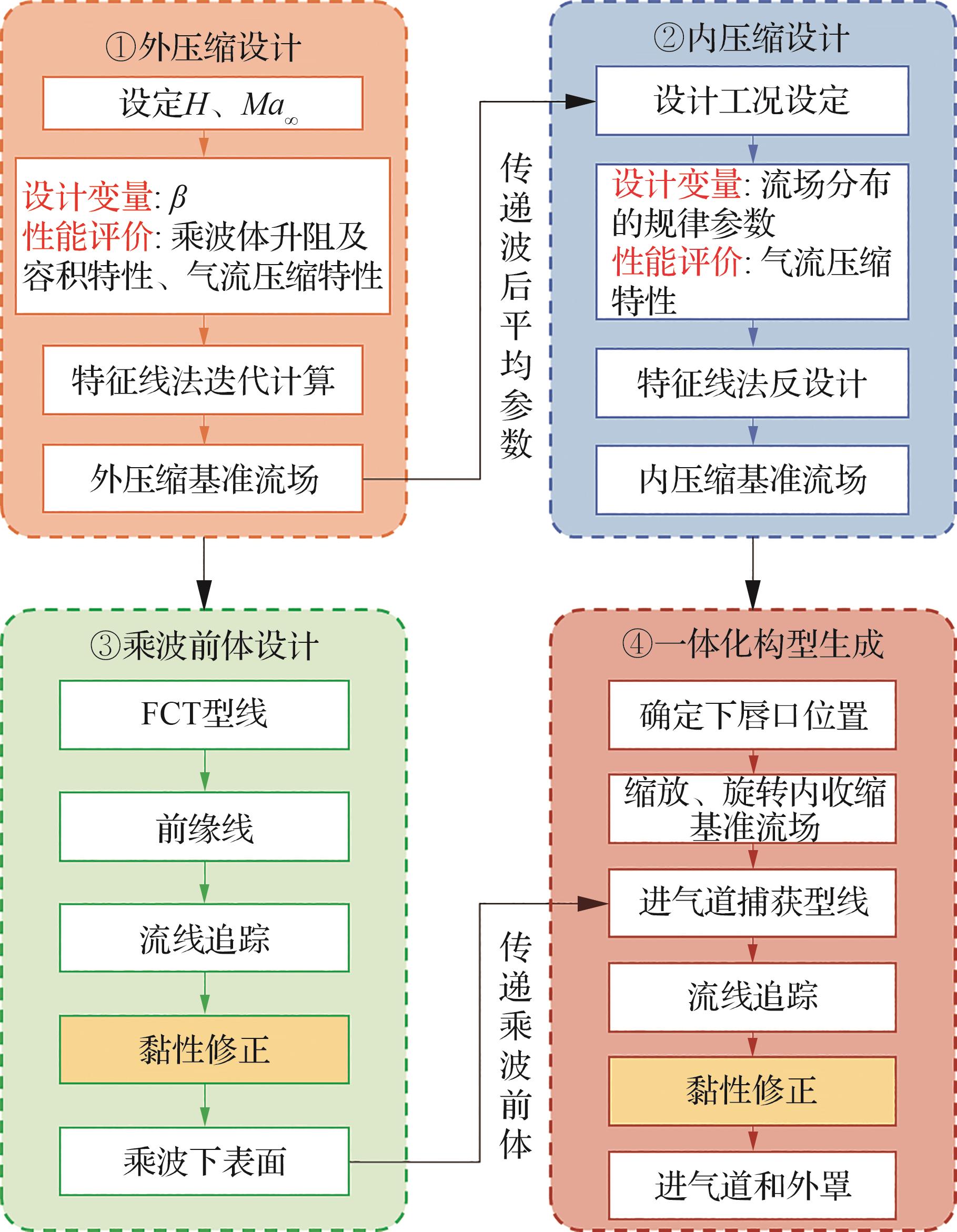
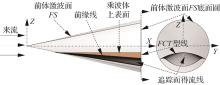
Fig.3
Schematic generation of waverider
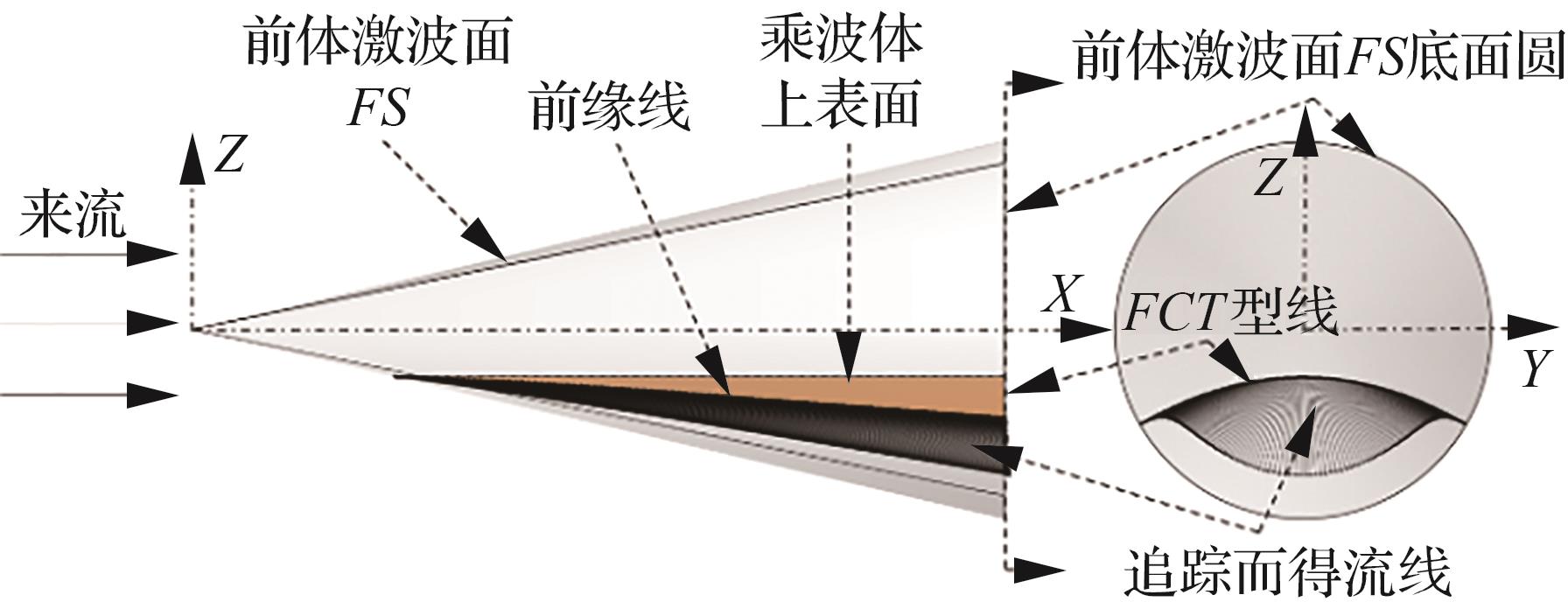
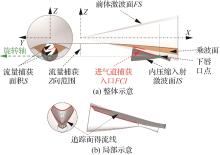
Fig.4
Schematic generation of integrated configuration
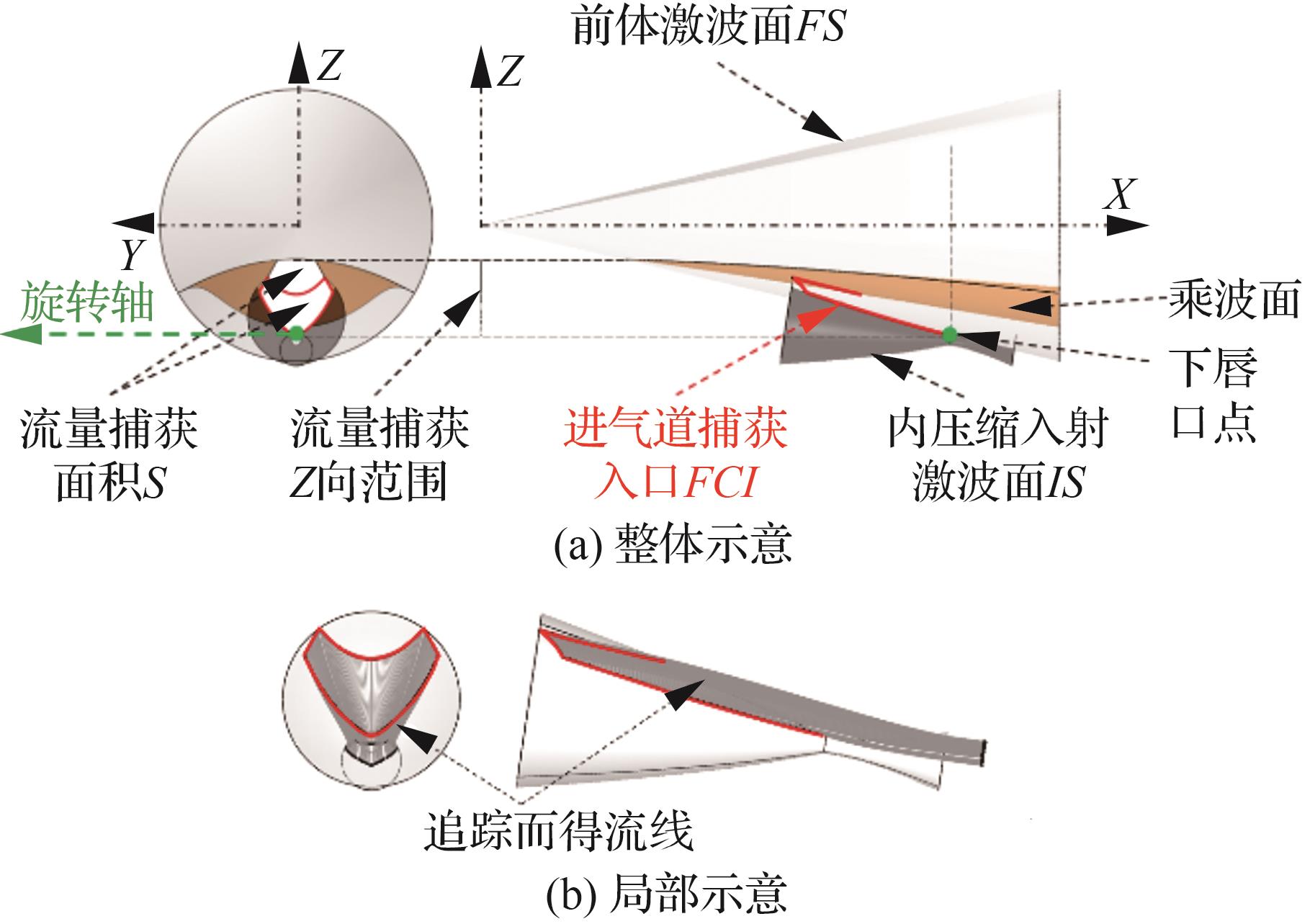
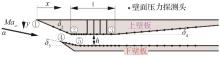
Fig.5
Inlet test model[32]
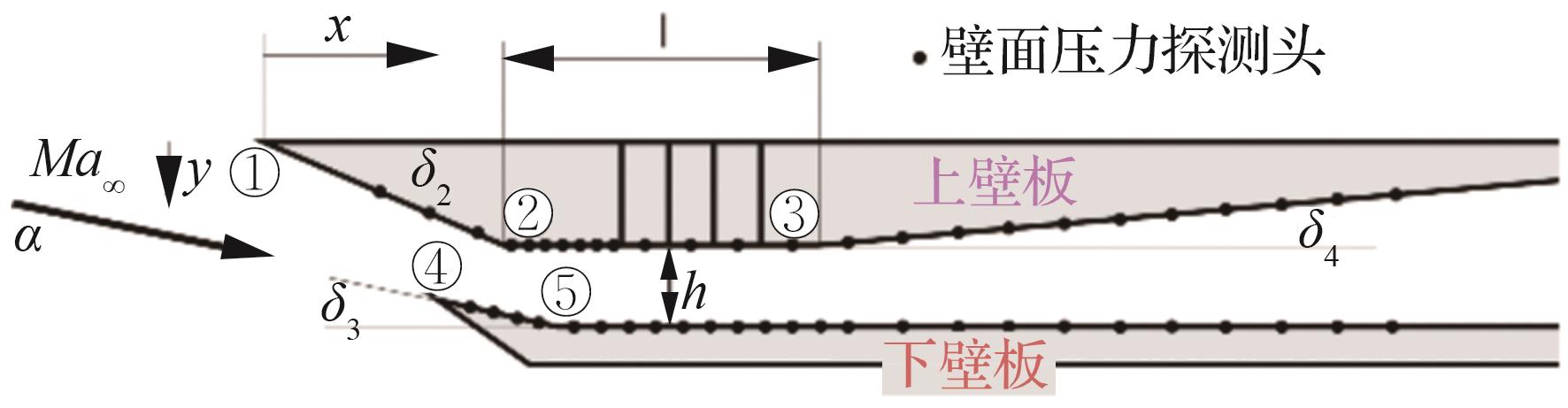
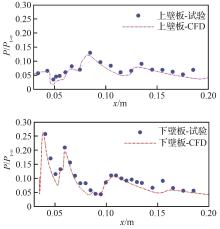
Fig.6
Calculated results of verification example
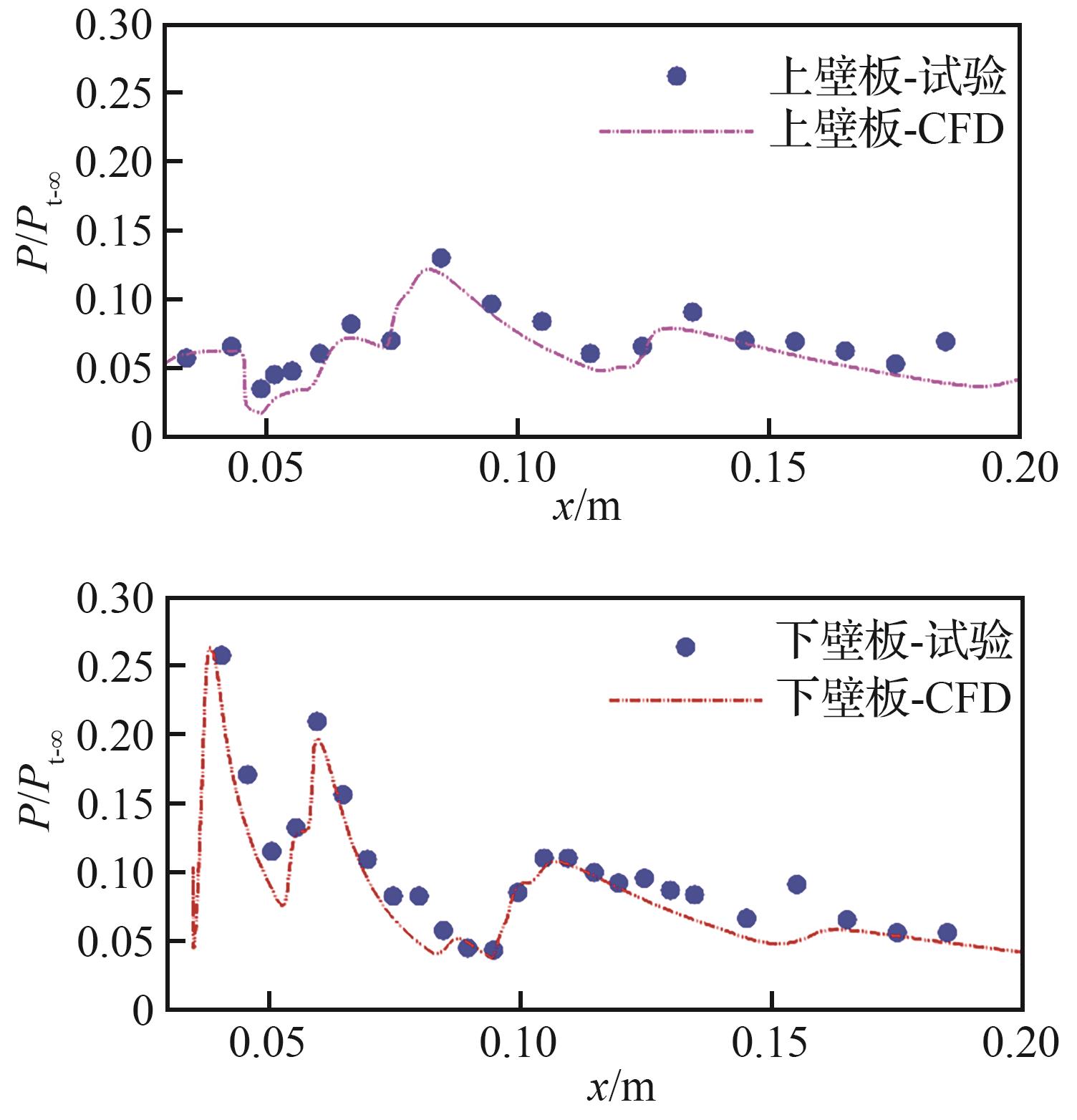
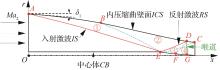
Fig.7
Internal compression basic flowfield structure
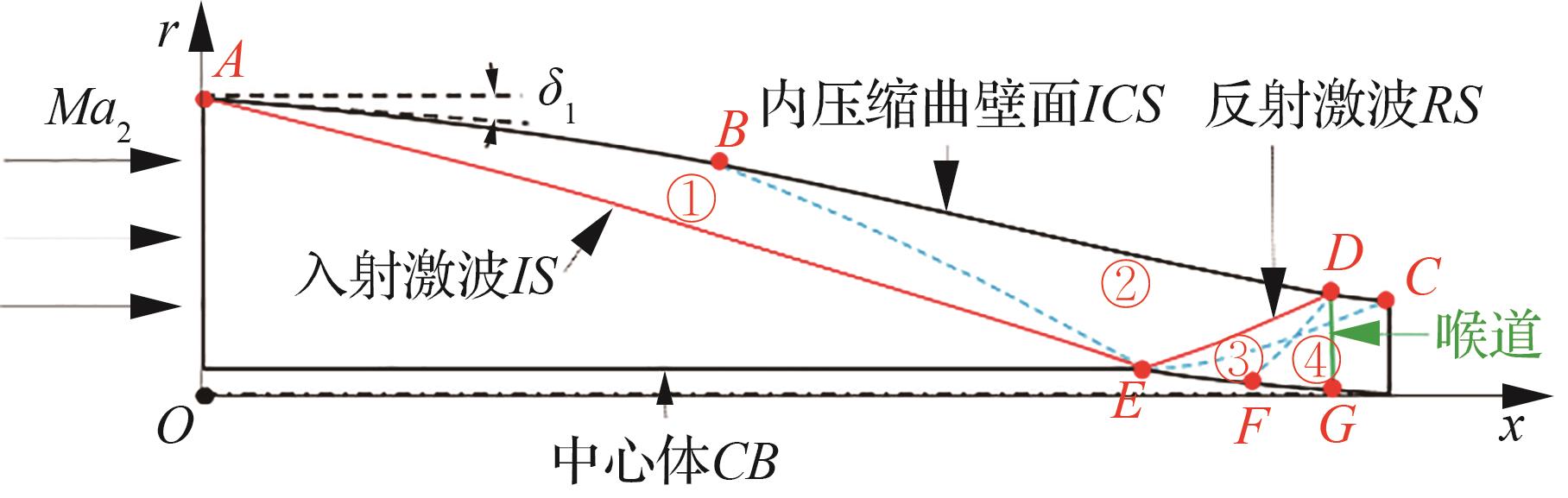
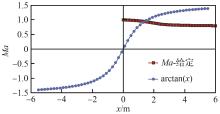
Fig.8
Arctan function and Mach number distribution
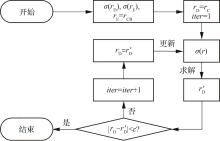
Fig.9
Solving process of reflected shock wave
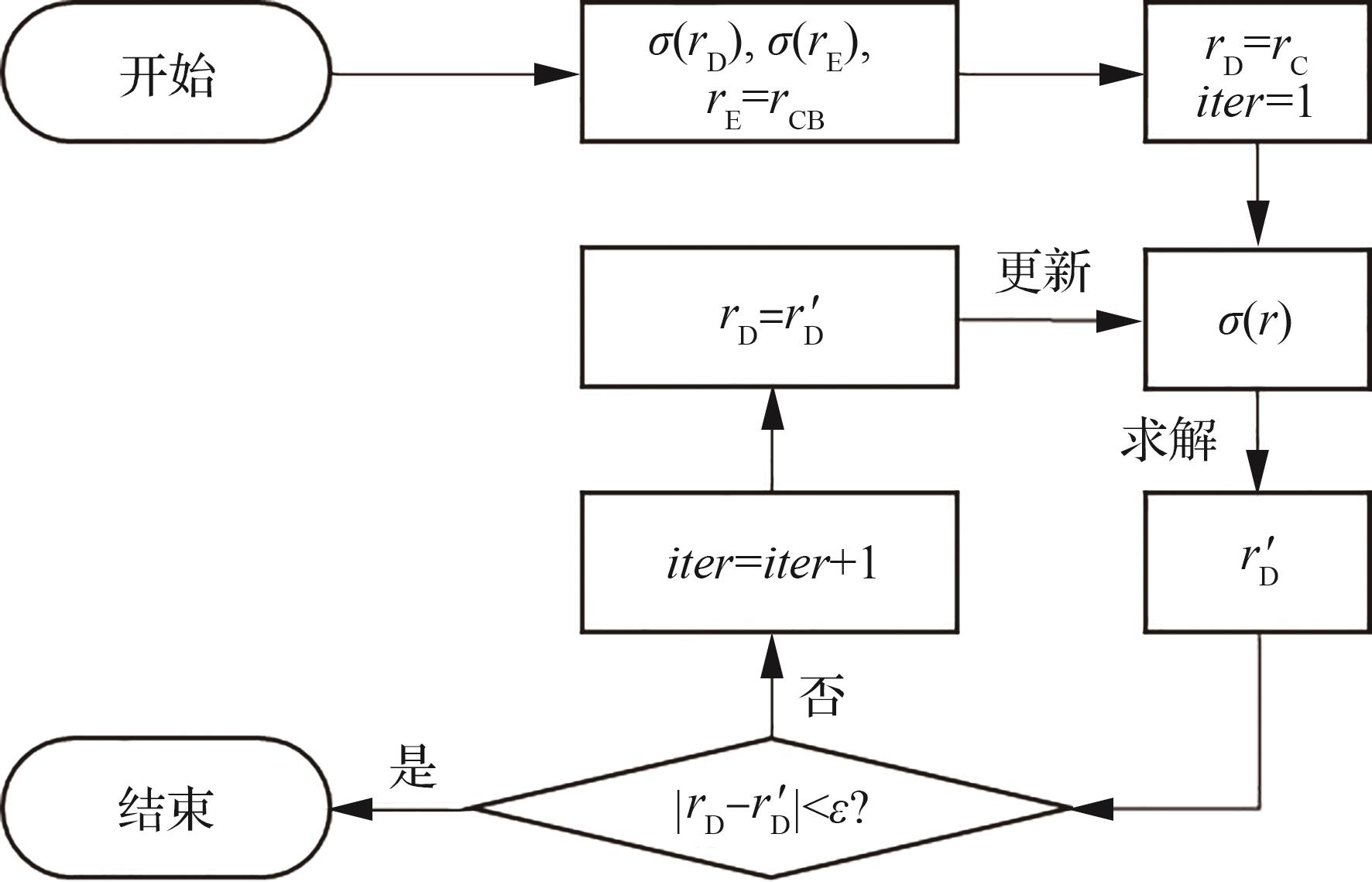
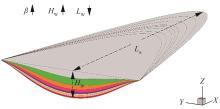
Fig.10
Waveriders at different shock angles
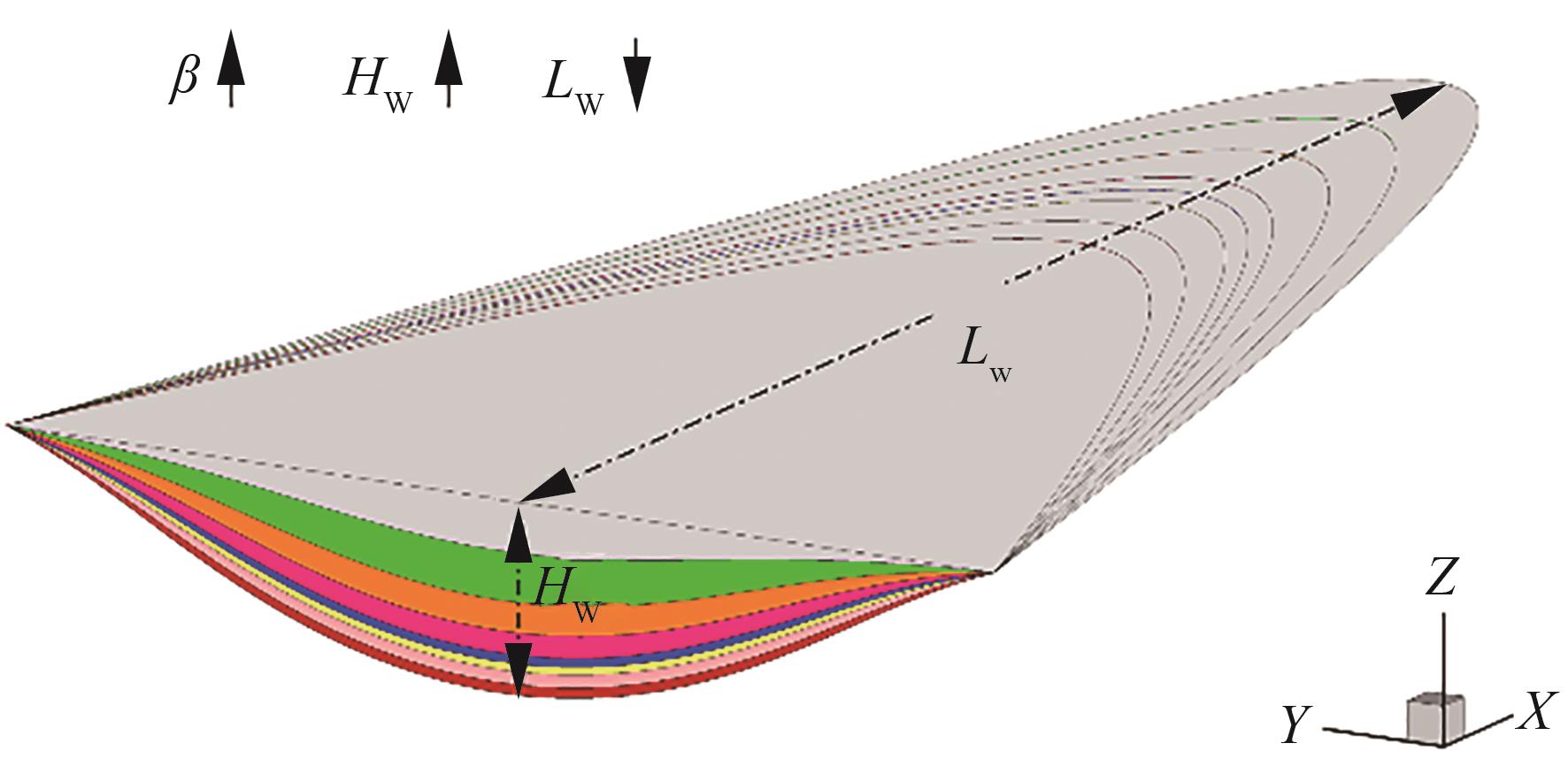
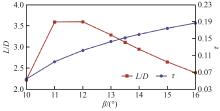
Fig.11
Inviscid lift-drag ratio and volume ratio of waveriders at different shock angles
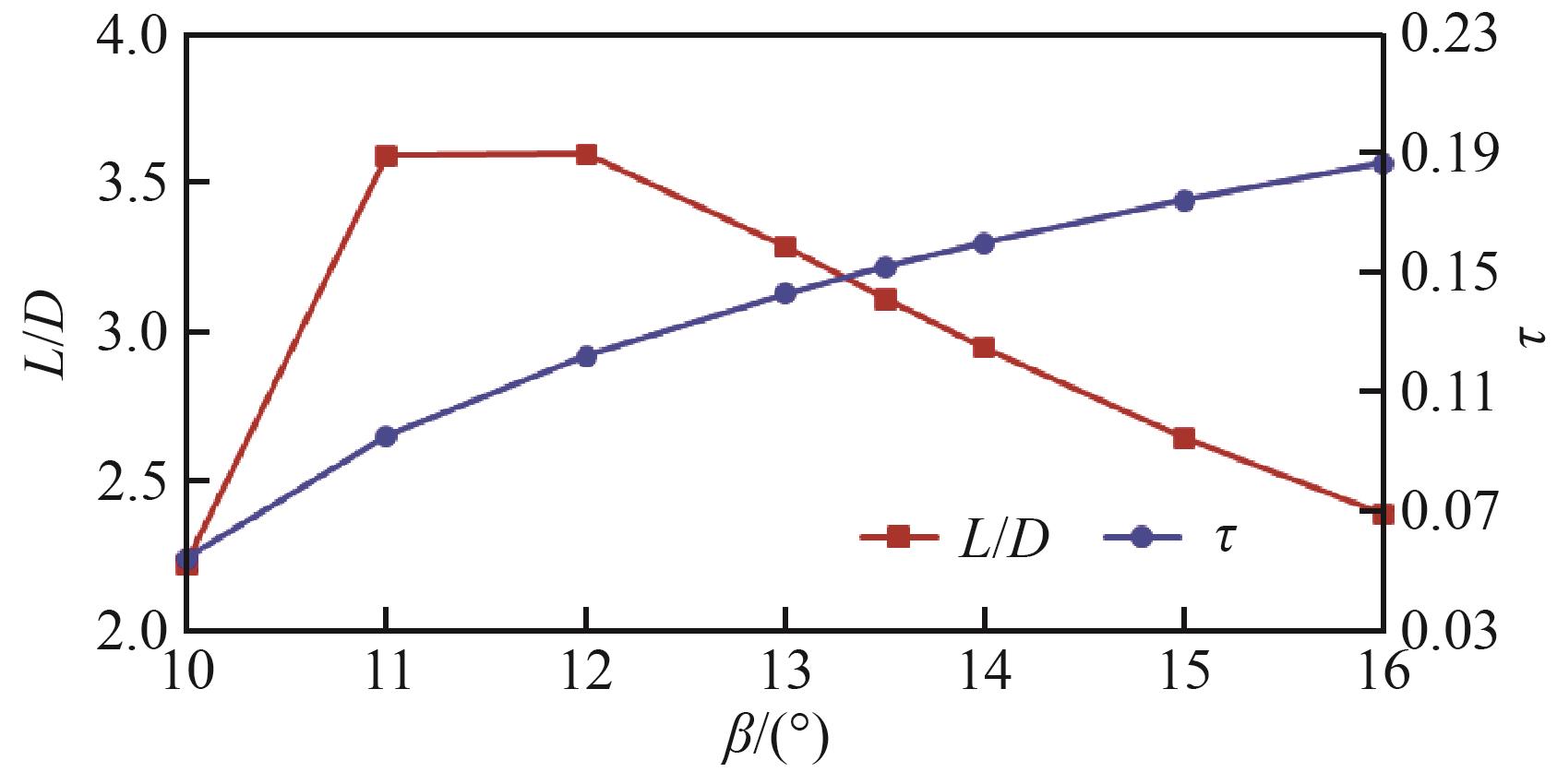

Table 1
Initial parameters of internal compression basic flowfield
| 参数 | |||||
|---|---|---|---|---|---|
| 数值 | 3 | 0.125 | 1 | 2 | -0.1 |
| 参数 | |||||
| 数值 | 0.999 | 0.98 | 5 | 5 | |
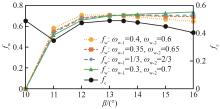
Fig.12
Lift-drag and volume performance fwat different weight coefficients and compression performance fcafter external and internal compression
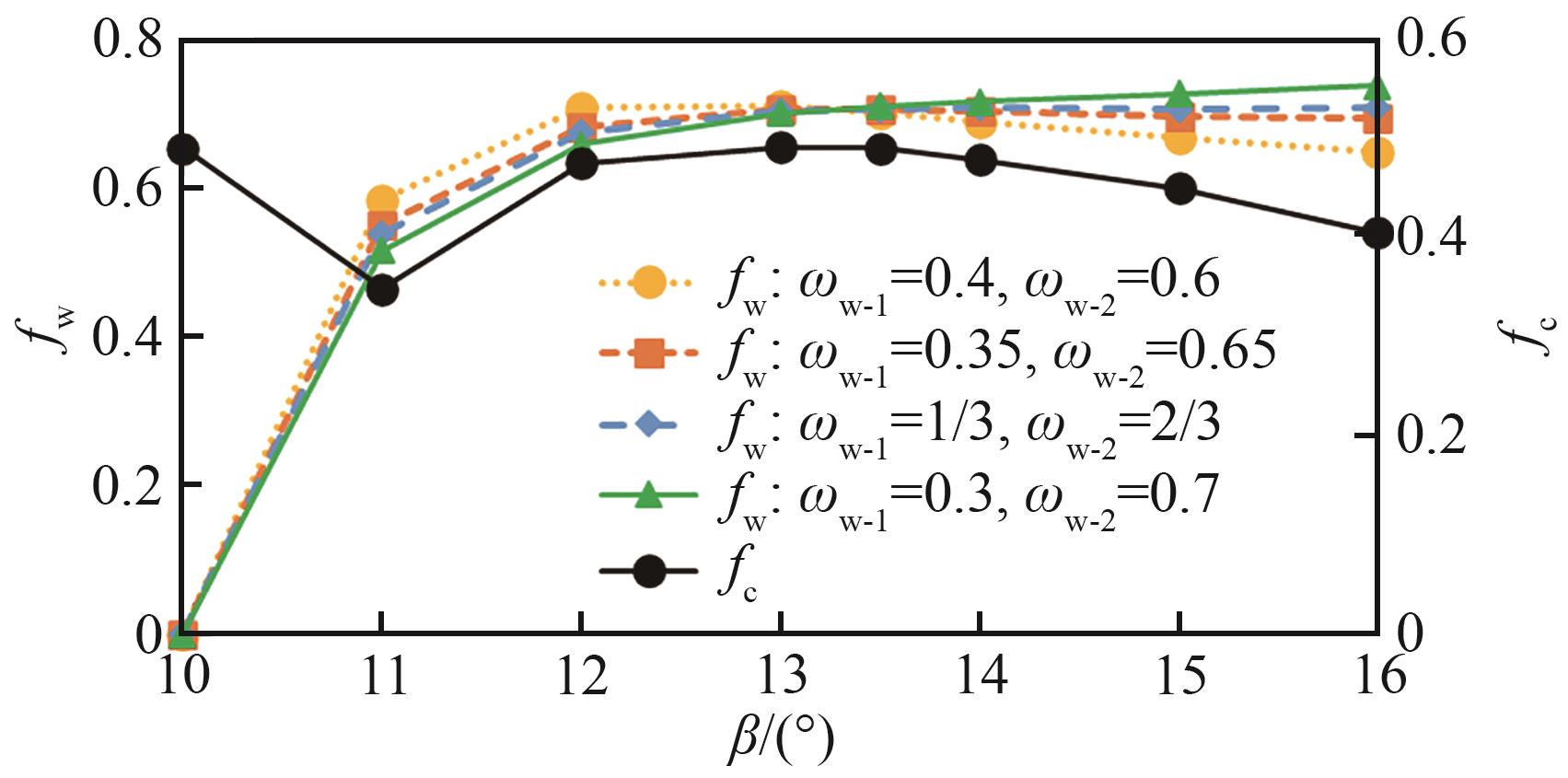
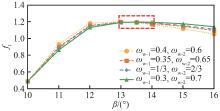
Fig.13
Performance ftat different weight coefficients
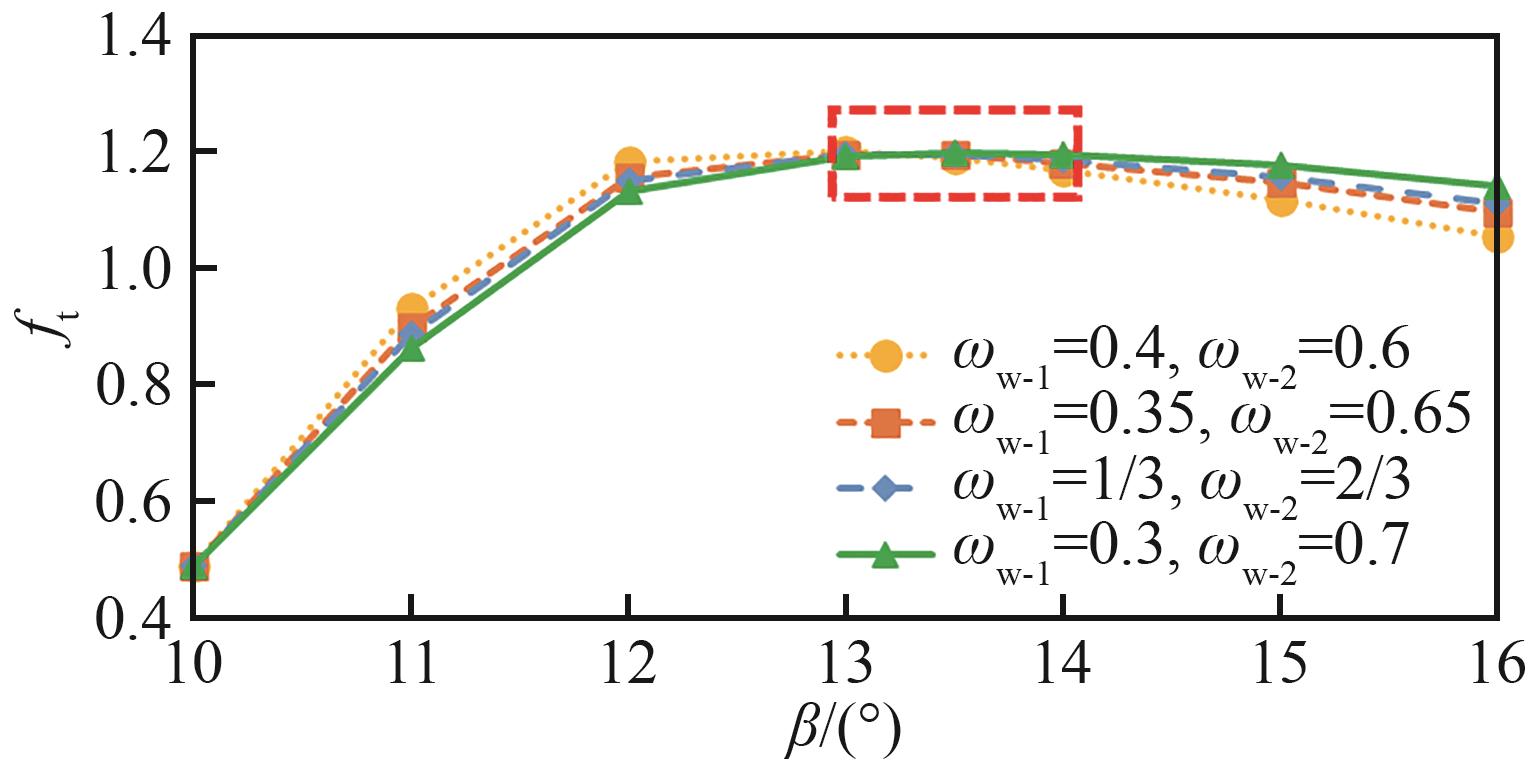
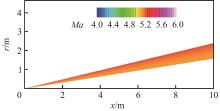
Fig.14
External compression straight conic basic flowfield at Ma∞=6 and β=13.5°
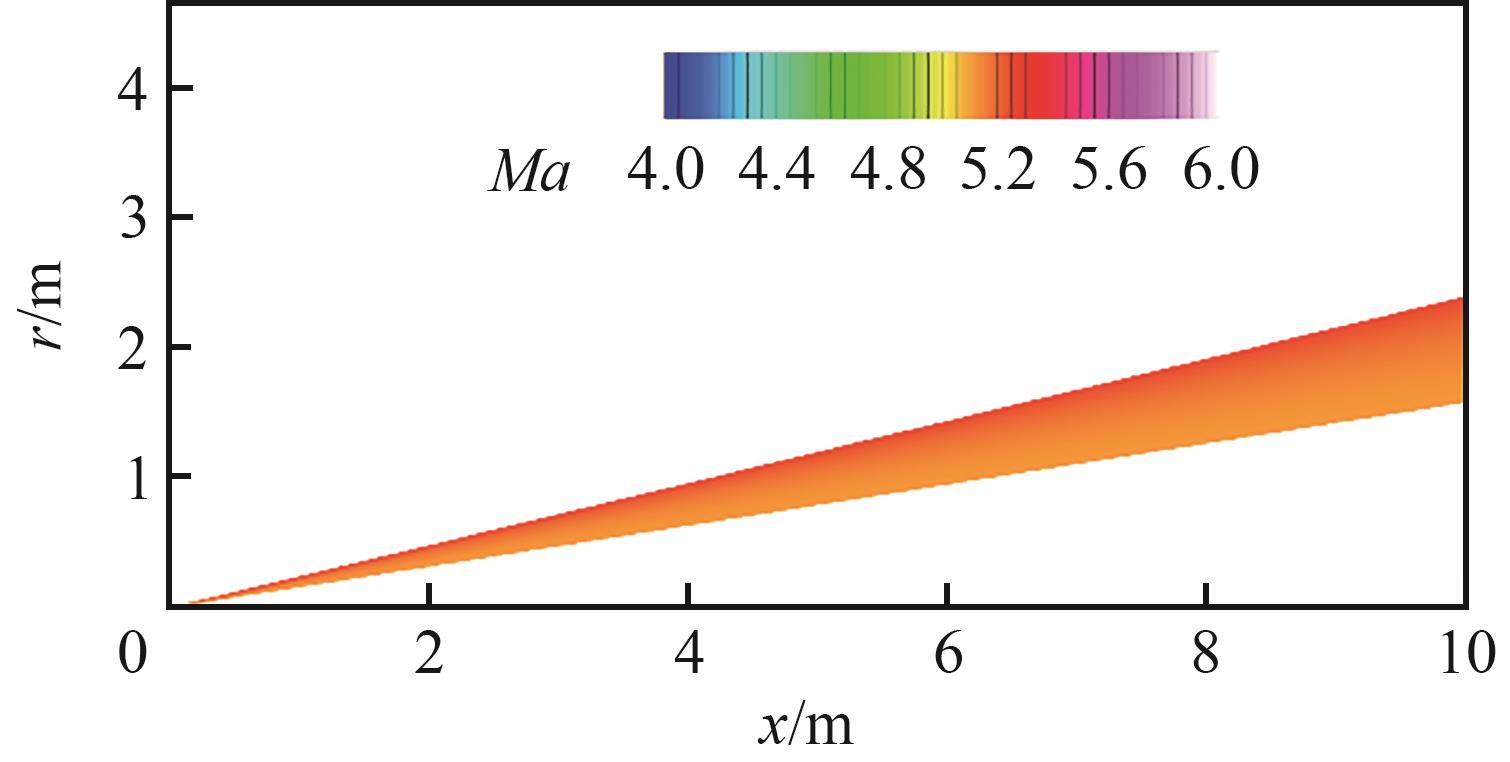
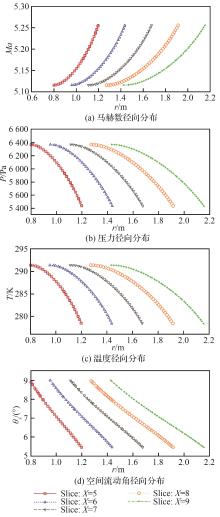
Fig.15
Flow parameters radial distributions at different x-direction positions
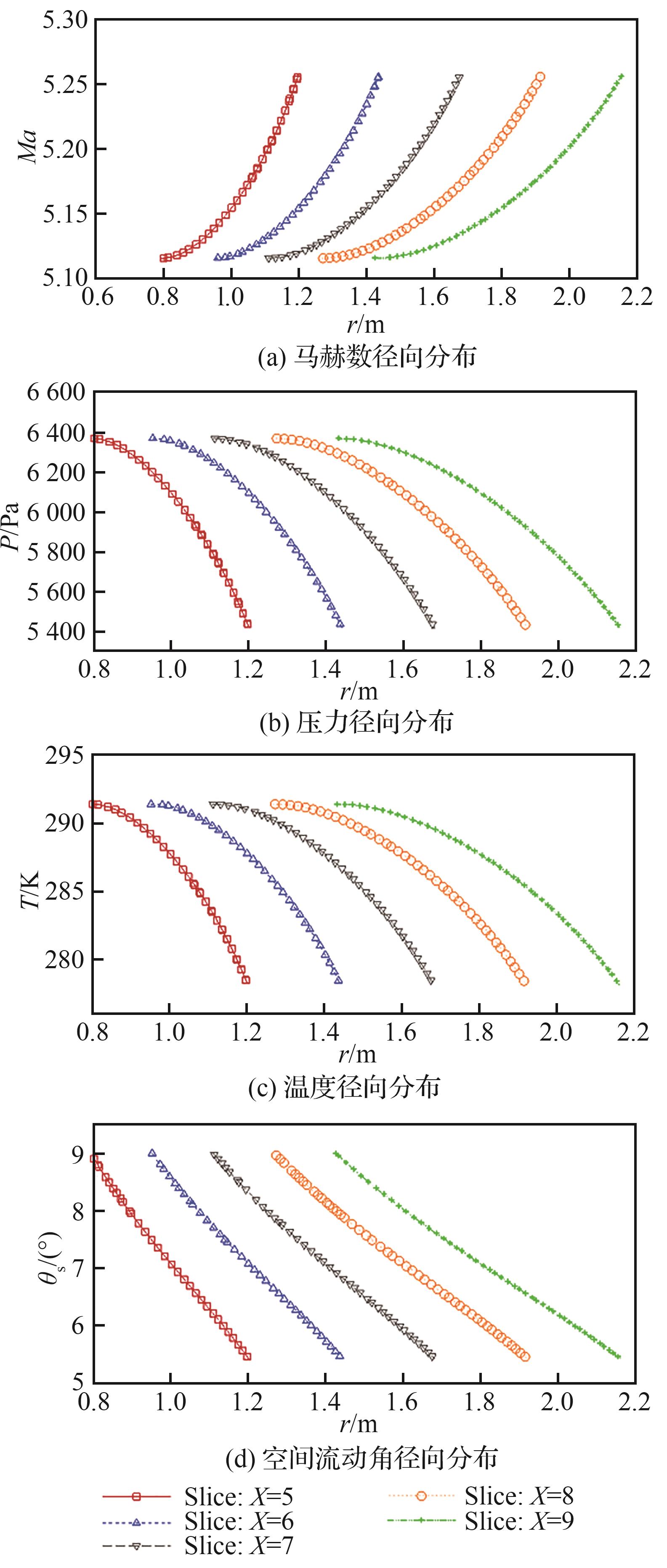
Table 2
Design conditions of internal compression basic flowfield
| 参数 | |||||
|---|---|---|---|---|---|
| 数值 | 5.17 | 6 005.97 | 0.073 02 | 286.59 | 7 189 474 |
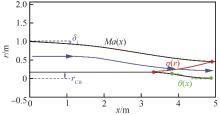
Fig.16
The given flow distributions: Ma(x), σ(r), θ(x)
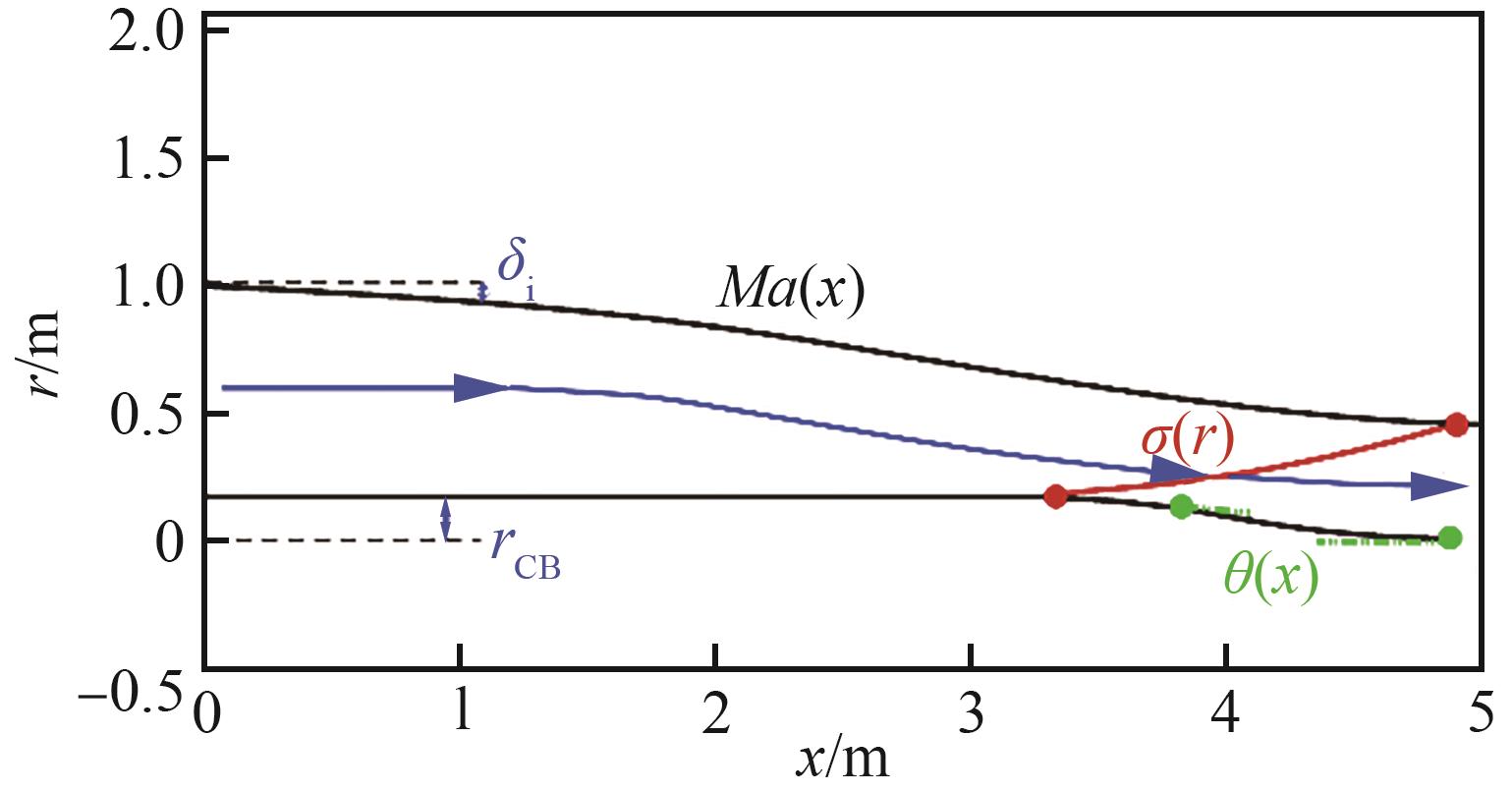
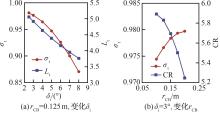
Fig.17
Variation trend of main performance parameters with leading edge angle and central body radius
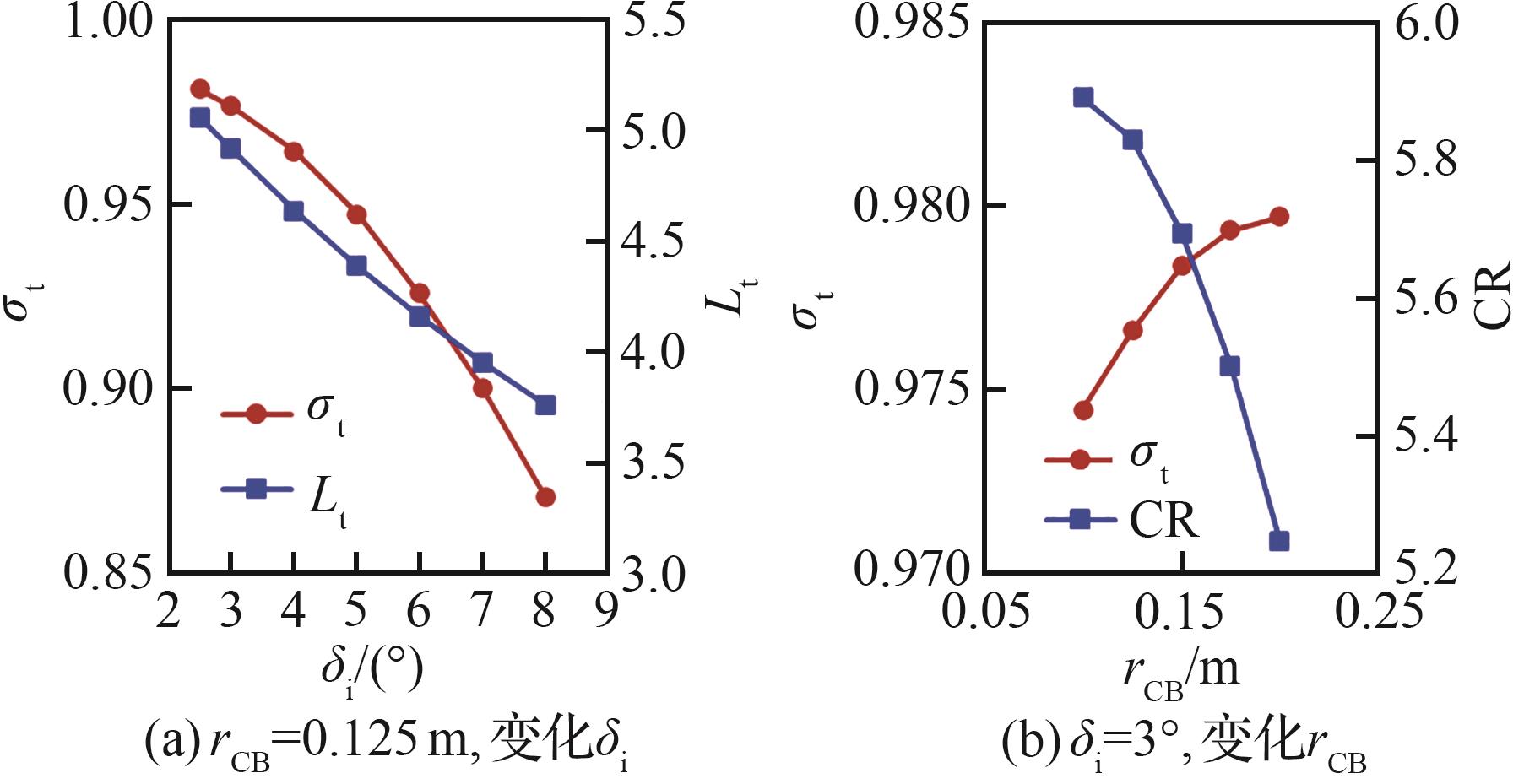
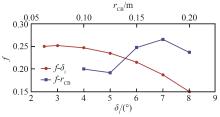
Fig.18
Variation trend of comprehensive performance with leading edge angle and central body radius
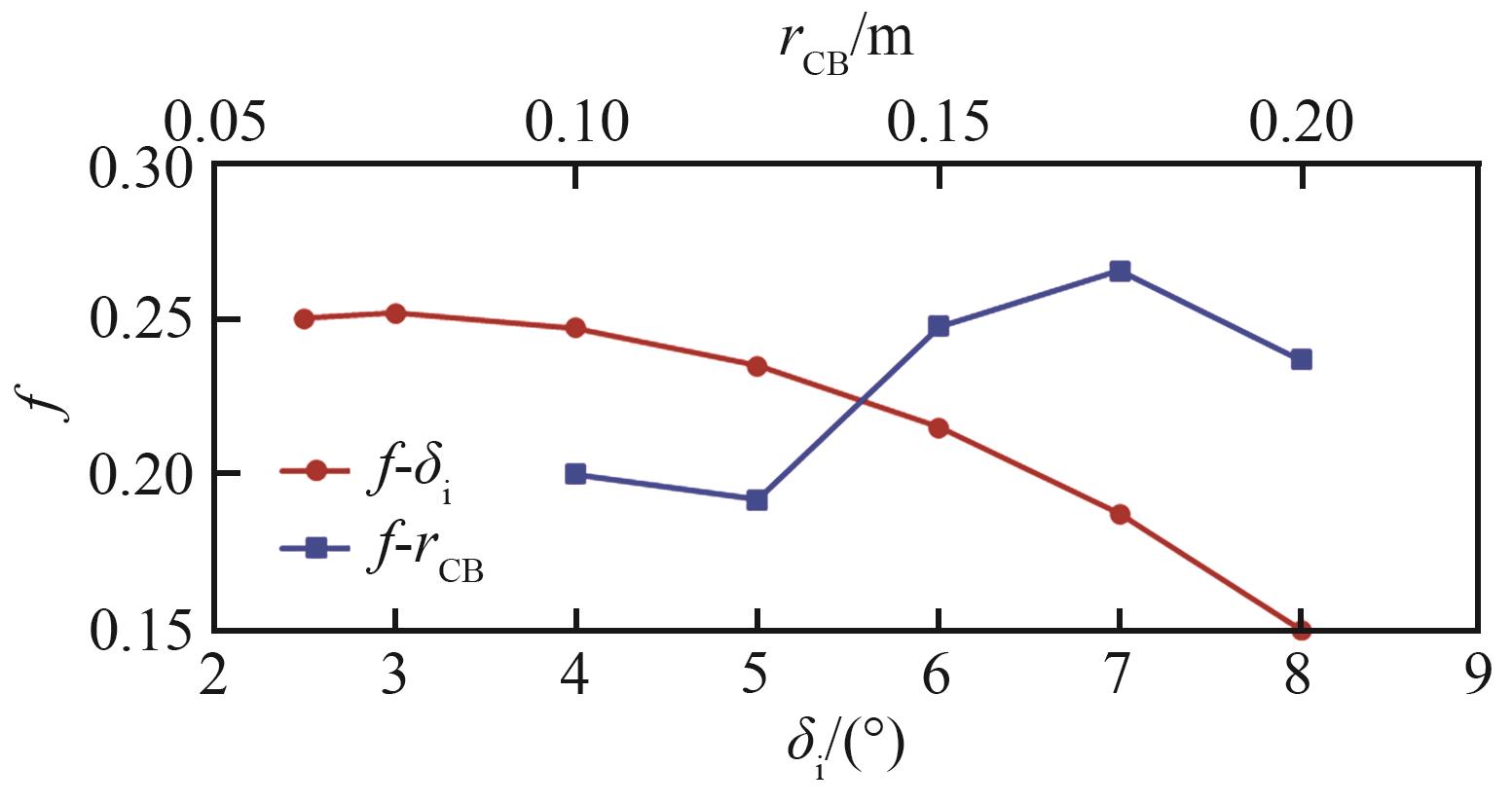
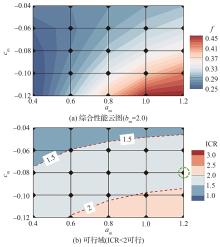
Fig.19
Contour of comprehensive performance on two-dimensional parameter space and feasible region
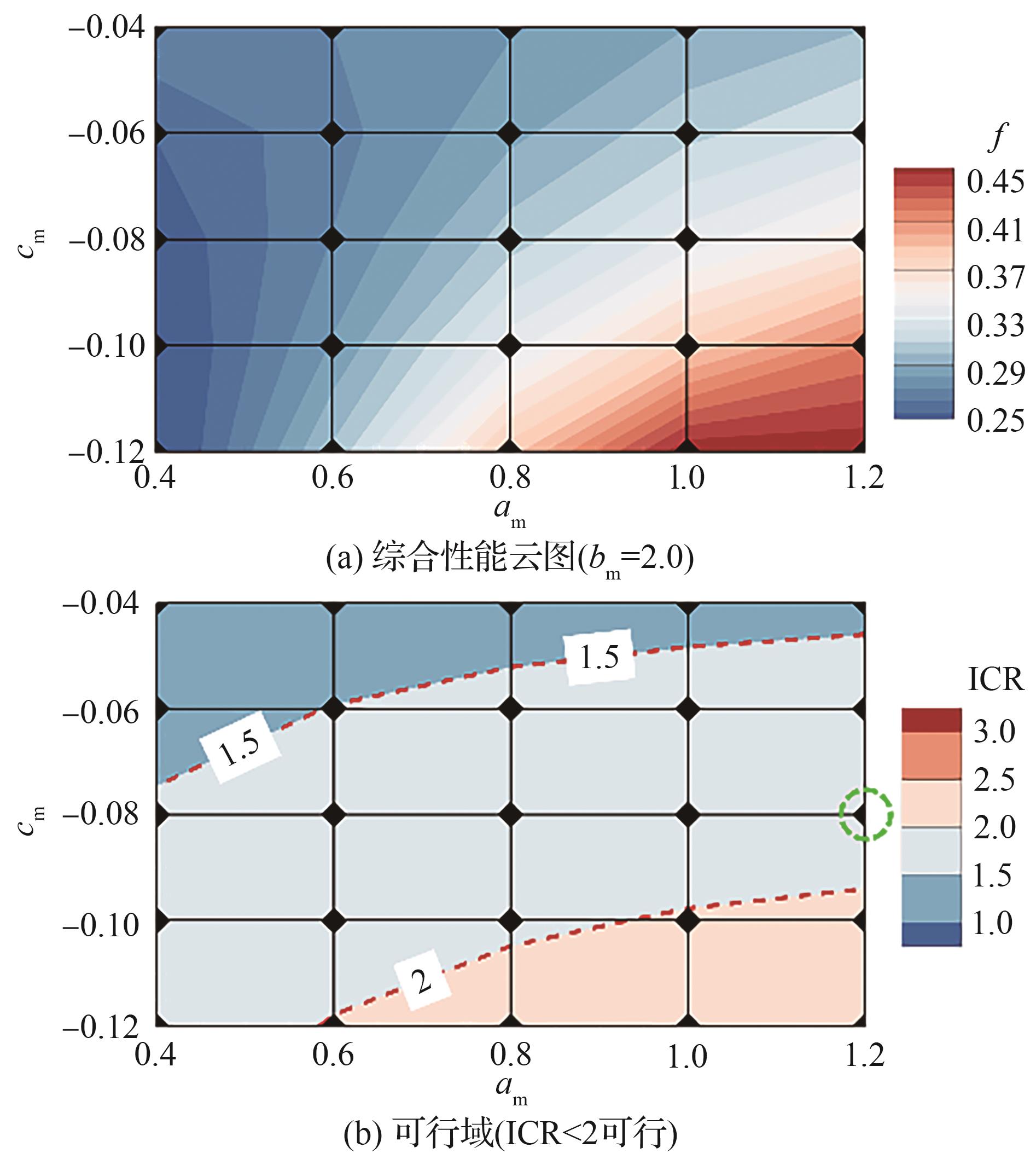
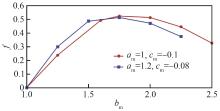
Fig.20
Variation trend of comprehensive performance with parameter bm
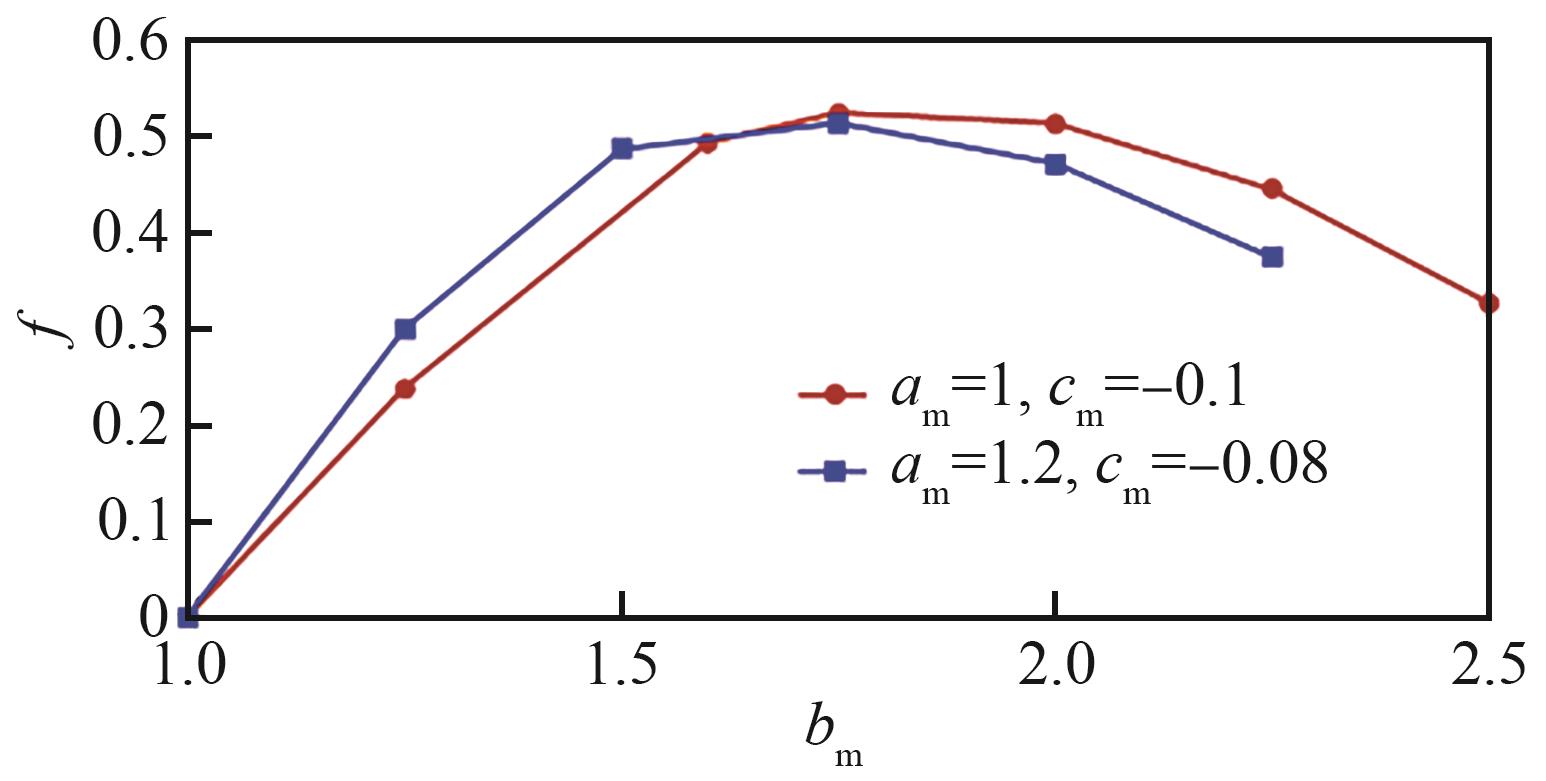
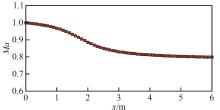
Fig.21
Mach distribution Ma(x) on the wall
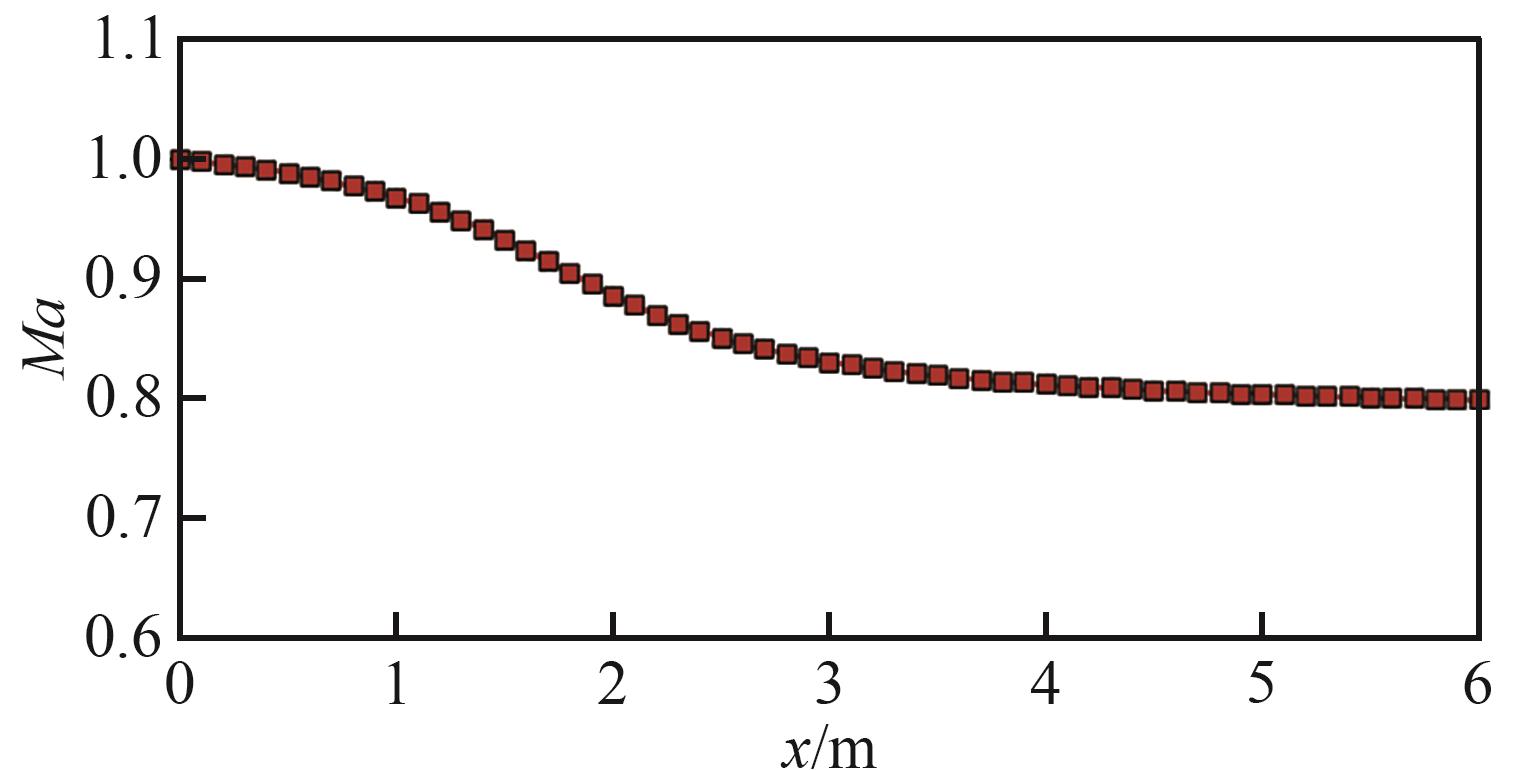
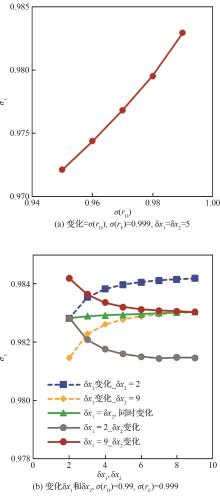
Fig.22
Variation trend of total pressure recovery coefficient σt with σ(rD), δx1, δx2
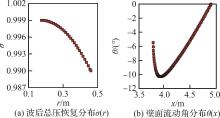
Fig.23
Total pressure recovery coefficient distribution σ(r) after the reflected shock and the flow angle distribution θ(x) on the center body
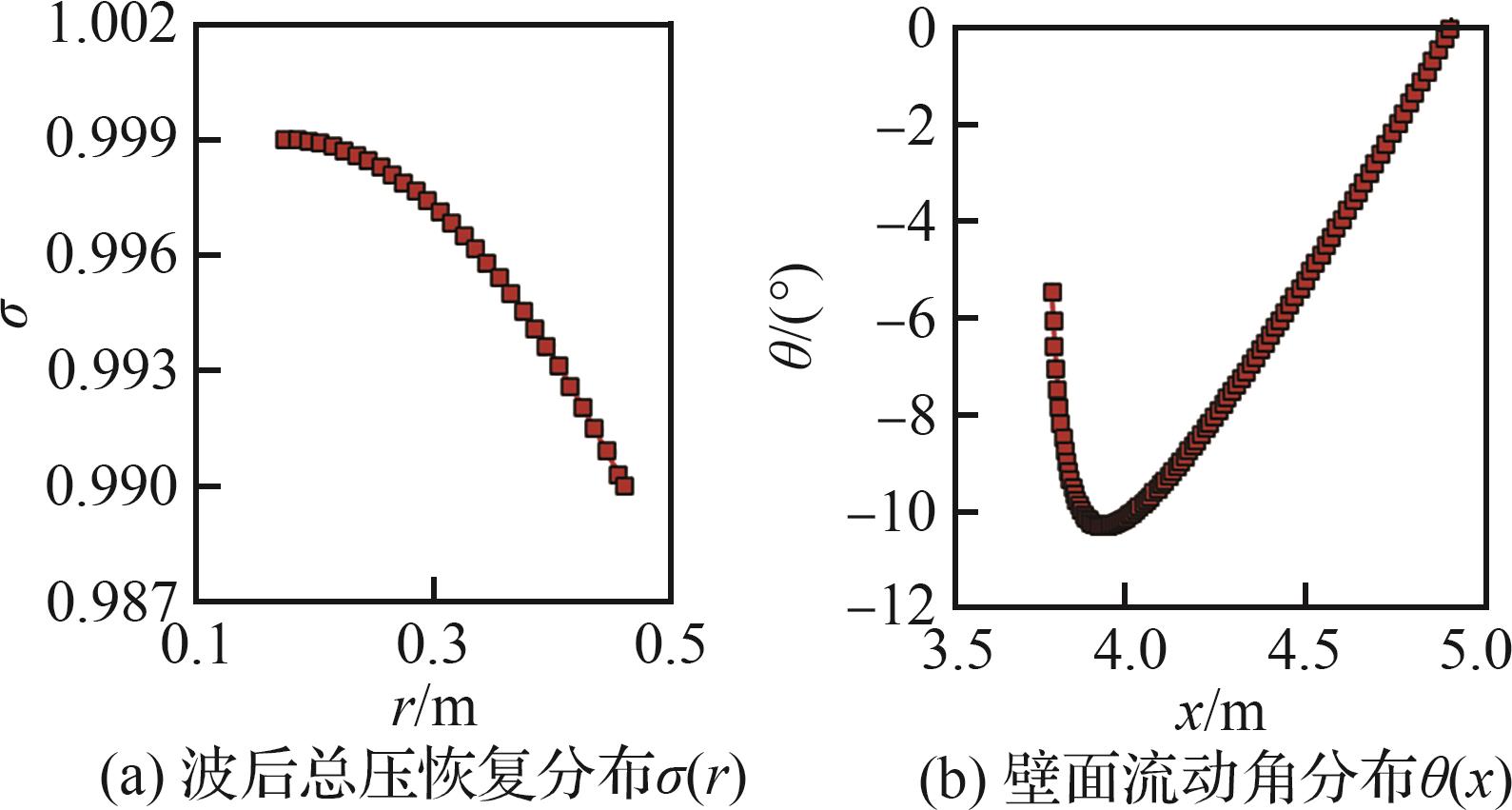
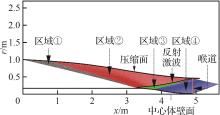
Fig.24
Characteristic lines of internal compression basic flowfield
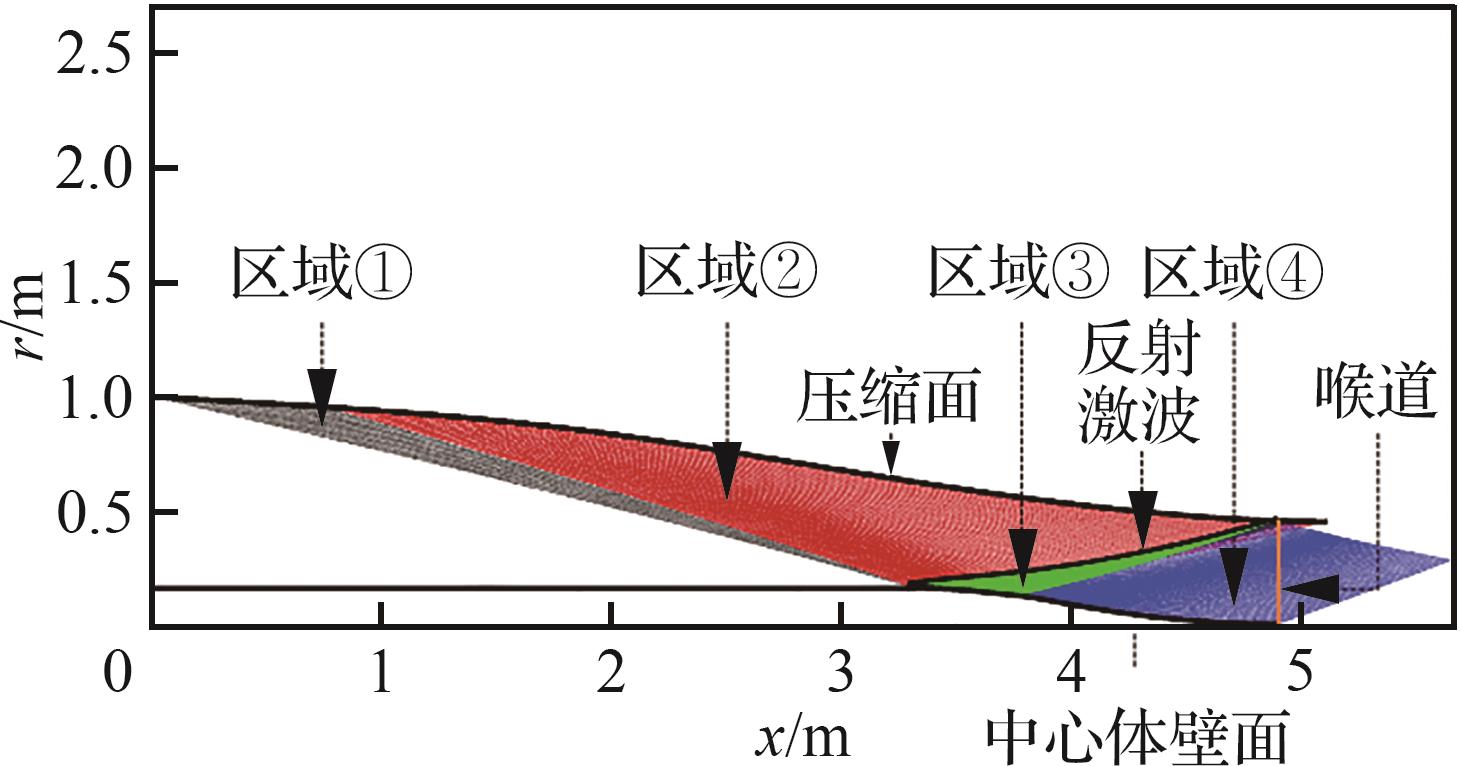
Table 3
Calculation results of MOC for internal compression basic flowfield
| 参数 | CR | ICR | |||
|---|---|---|---|---|---|
| 数值 | 0.984 22 | 9.702 36 | 4.583 85 | 1.766 71 | 4.897 86 |
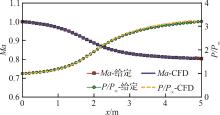
Fig.25
Comparison of factual flowfield distribution and designed flowfield distribution
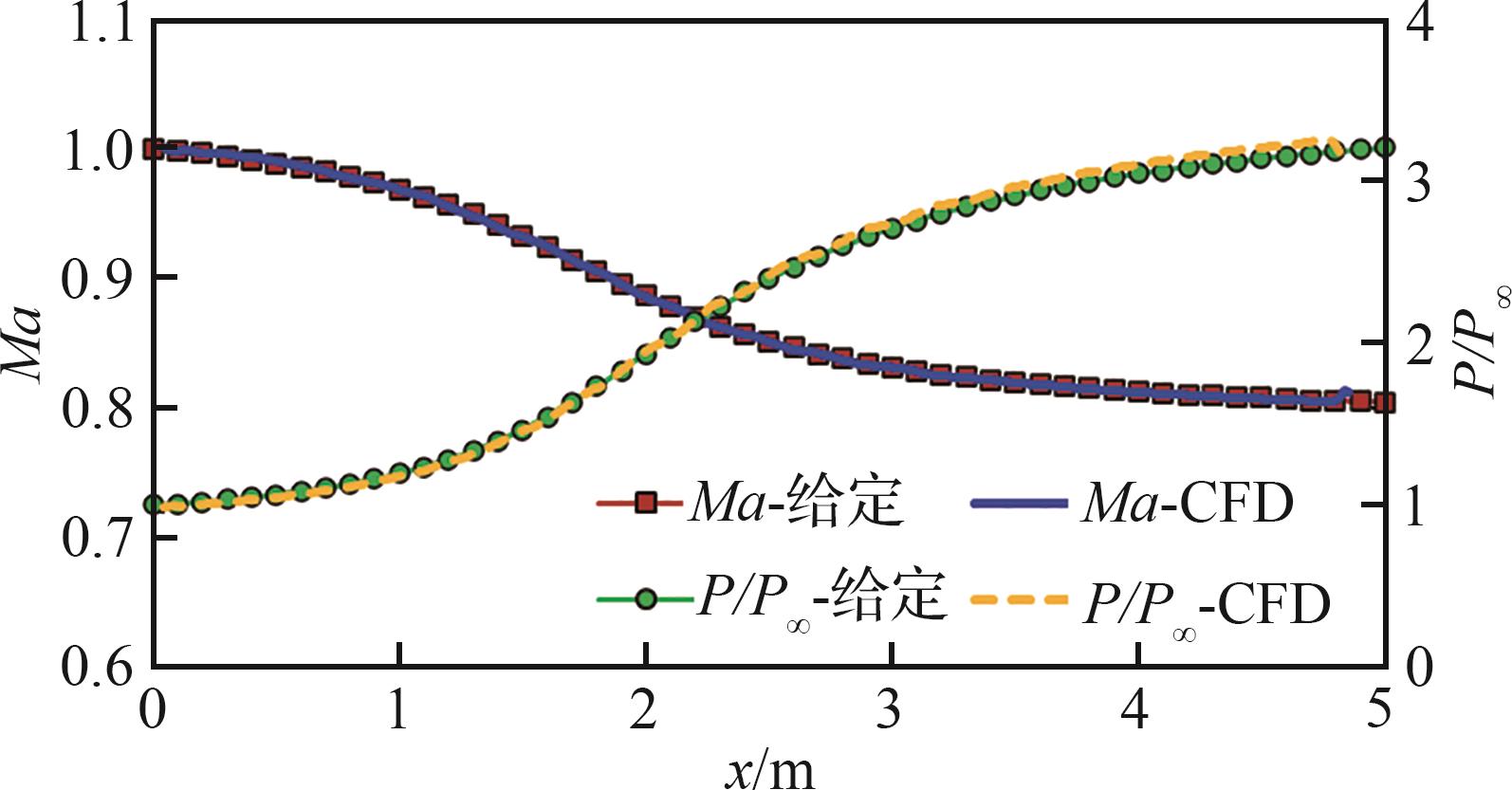
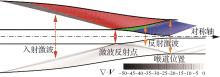
Fig.26
Validation of flow structure
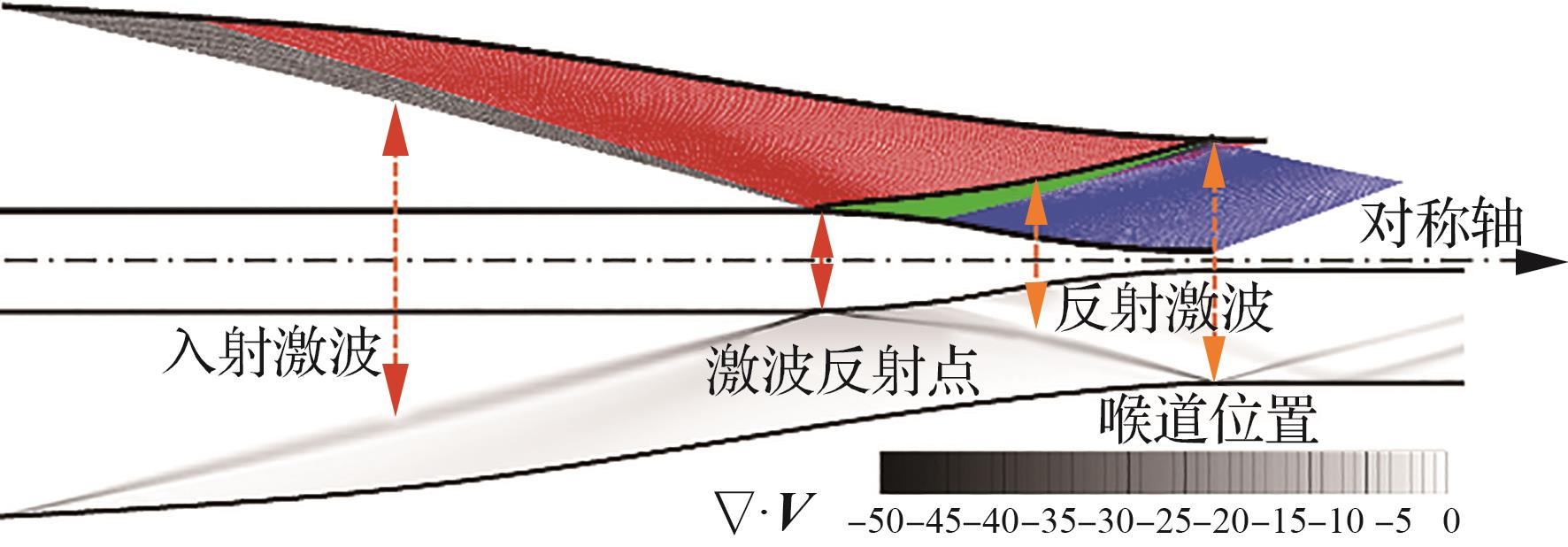
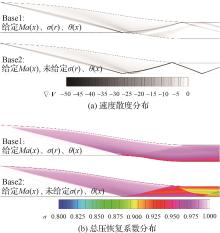
Fig.27
Comparison of flow structures of two internal compression basic flowfields
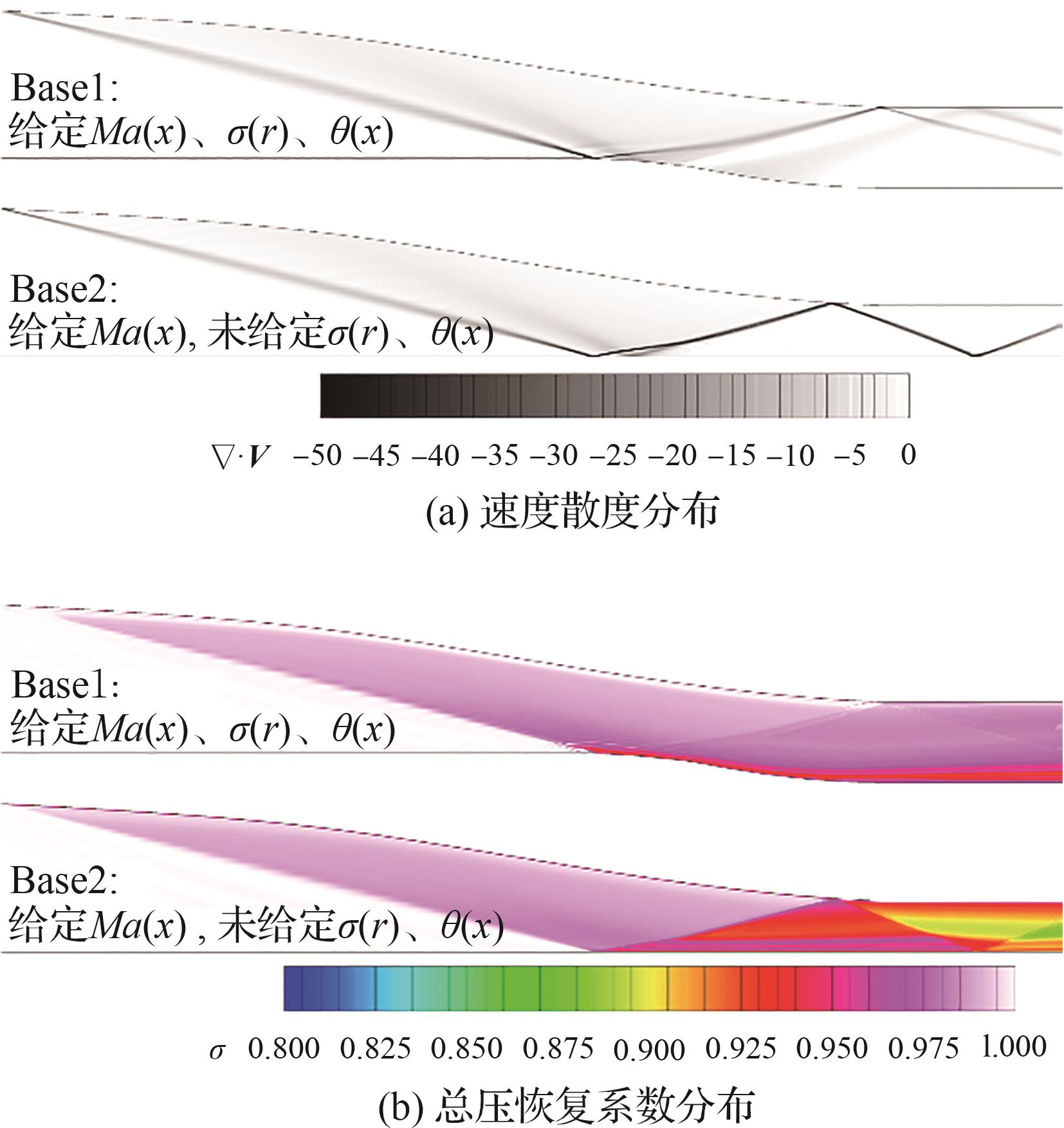
Table 4
Performance parameters of two internal compression basic flowfields
| 构型 | CR | ICR | |||
|---|---|---|---|---|---|
| Base1 | 0.983 5 | 9.820 3 | 4.583 8 | 1.766 7 | 4.897 9 |
| Base2 | 0.947 4 | 11.267 8 | 4.982 4 | 1.920 3 | 4.620 0 |
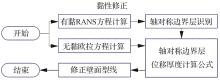
Fig.28
The process of the viscosity correction
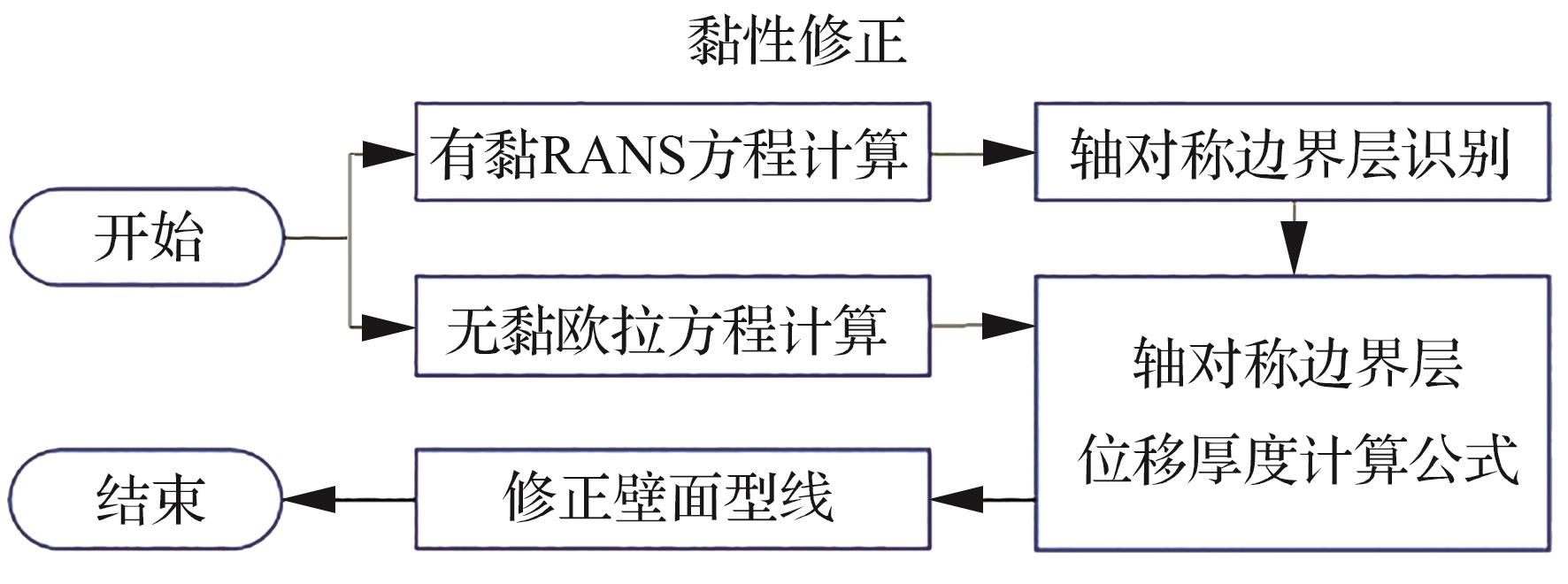
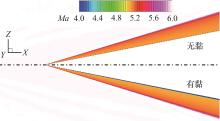
Fig.29
Inviscid and viscous results of external compression basic flowfield
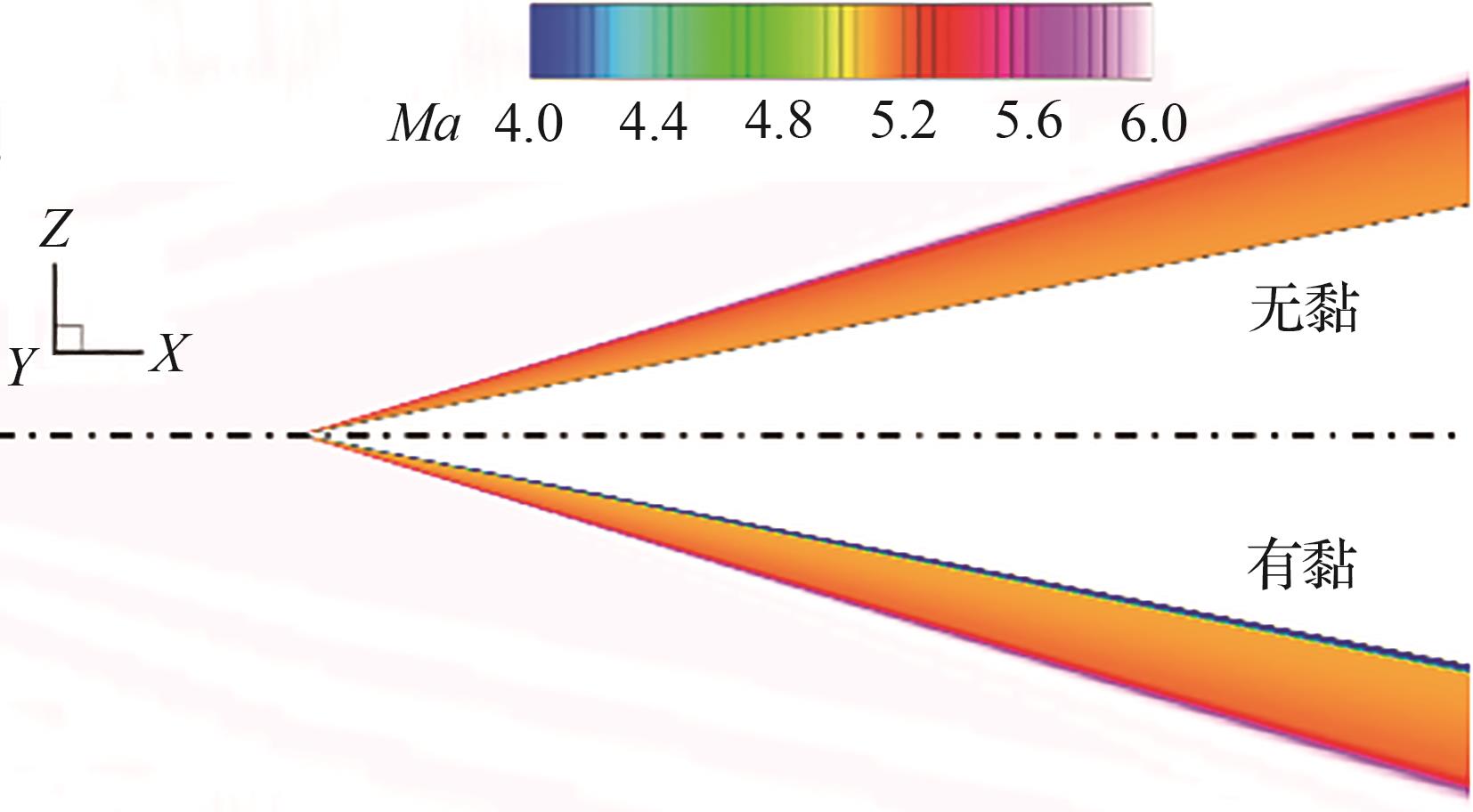
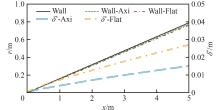
Fig.30
Correction for wall profile of external compression basic flowfield
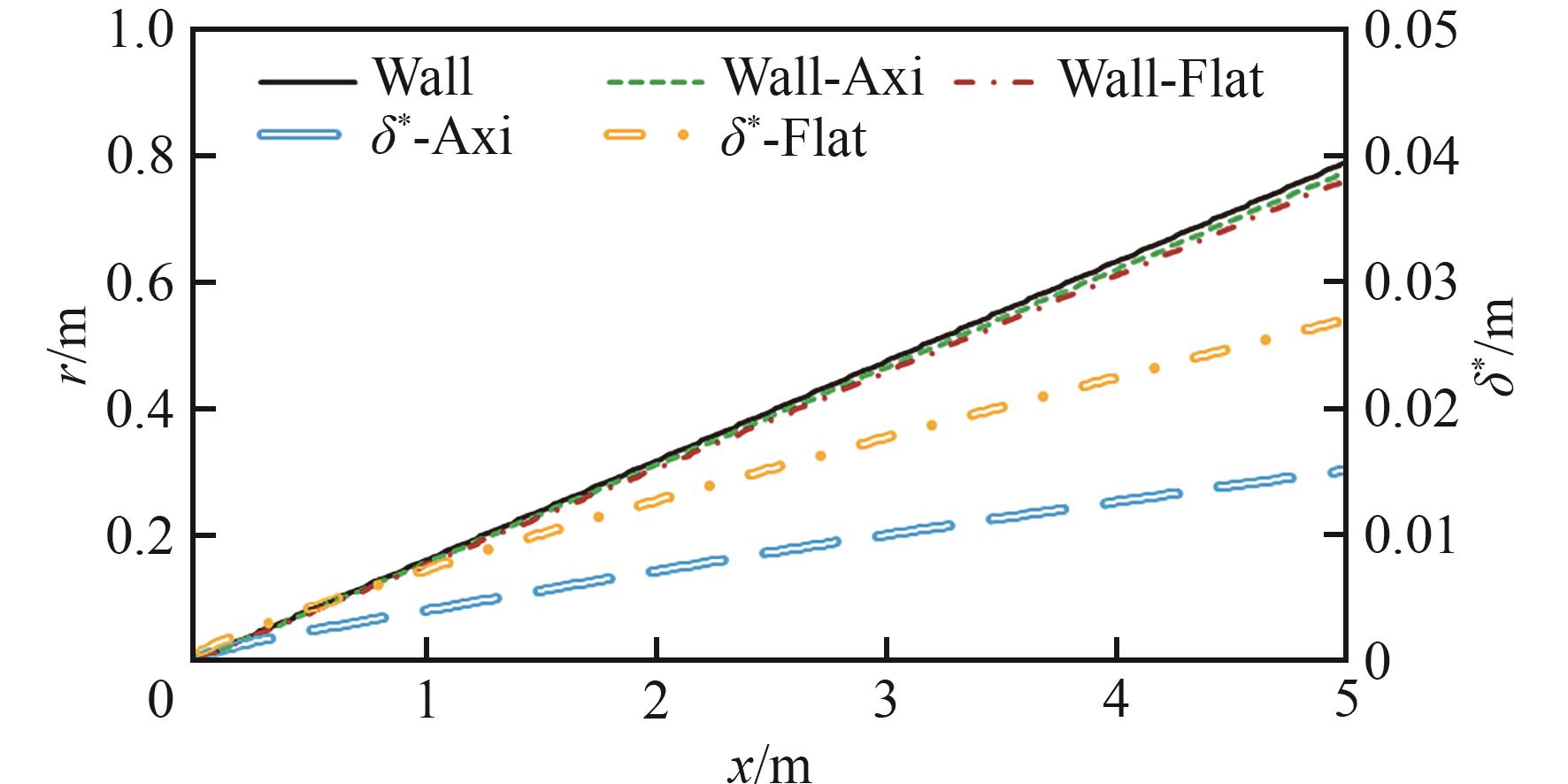
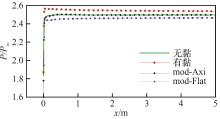
Fig.31
Correction for wall pressure distribution of external compression basic flowfield
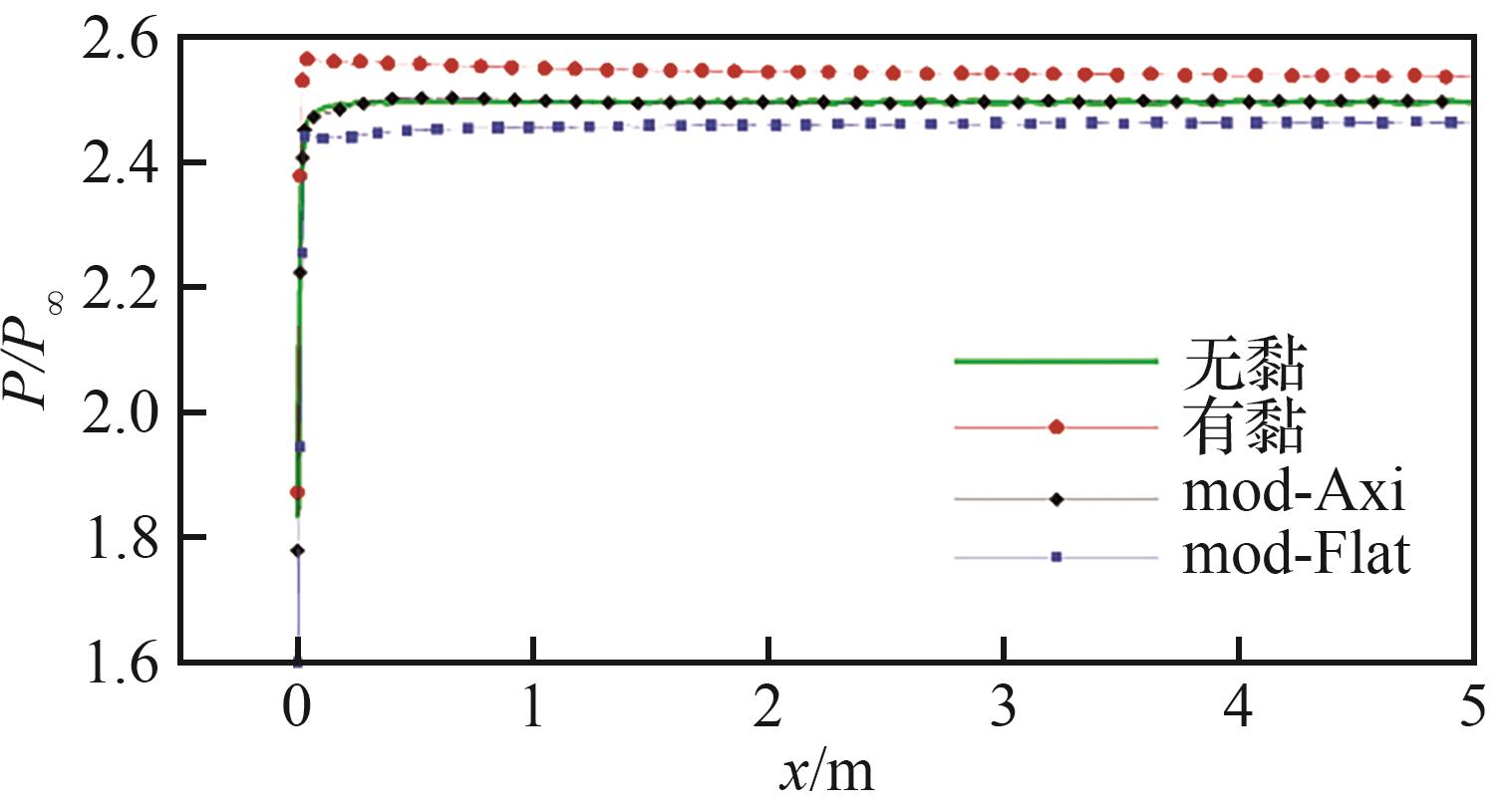
Table 5
Results of viscosity correction for external compression basic flowfield
| 指标 | 无黏 | 有黏 | mod-Axi | mod-Flat |
|---|---|---|---|---|
| 壁面压升 | 2.495 3 | 2.536 6 | 2.495 8 | 2.466 3 |
| 相对偏差 | 0 | 1.656% | 0.019% | -1.164% |
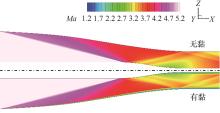
Fig.32
The inviscid and viscous results of the internal compression basic flowfield Base1
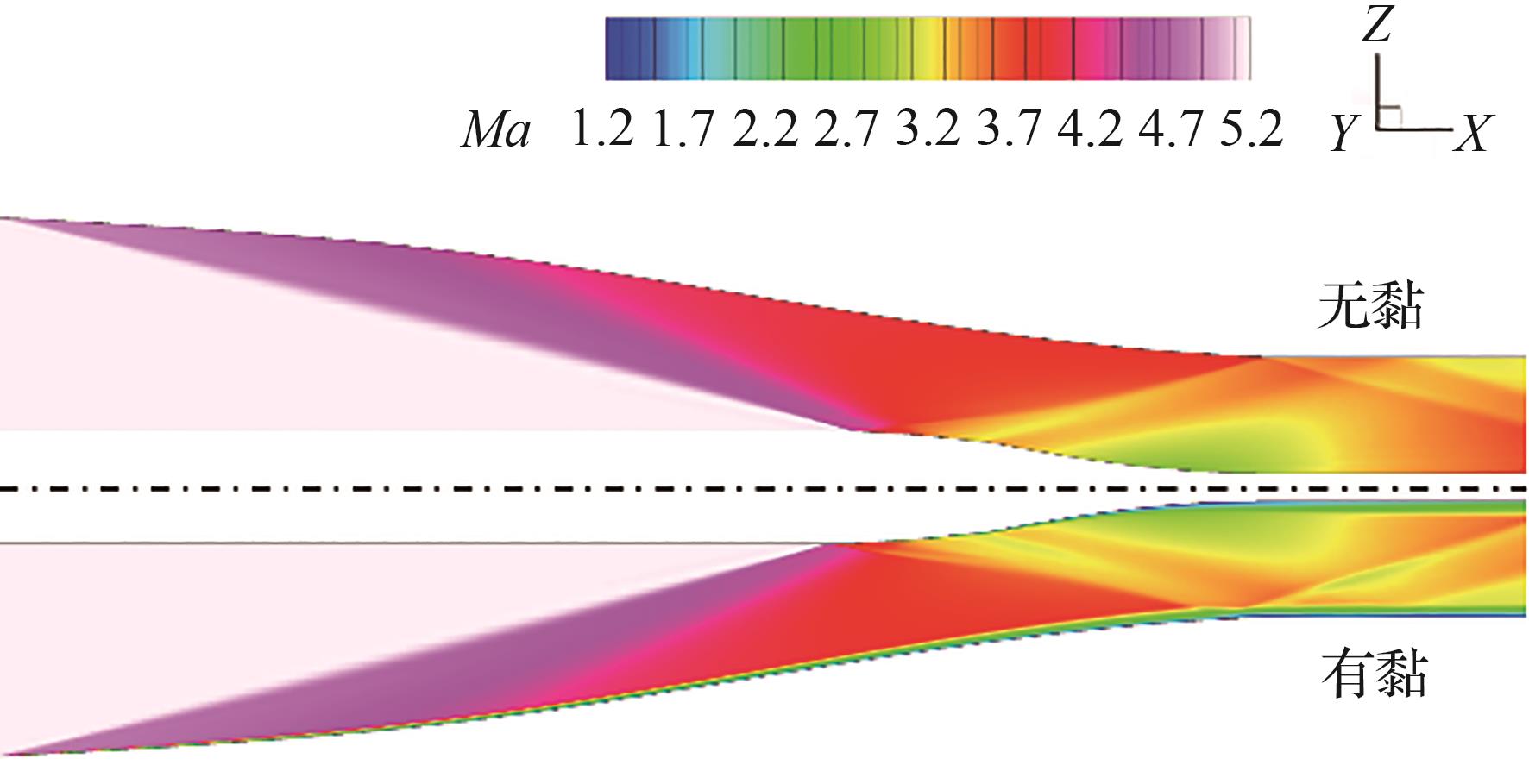
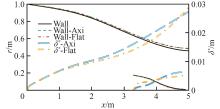
Fig.33
Correction for wall profile of internal compression basic flowfield Base1
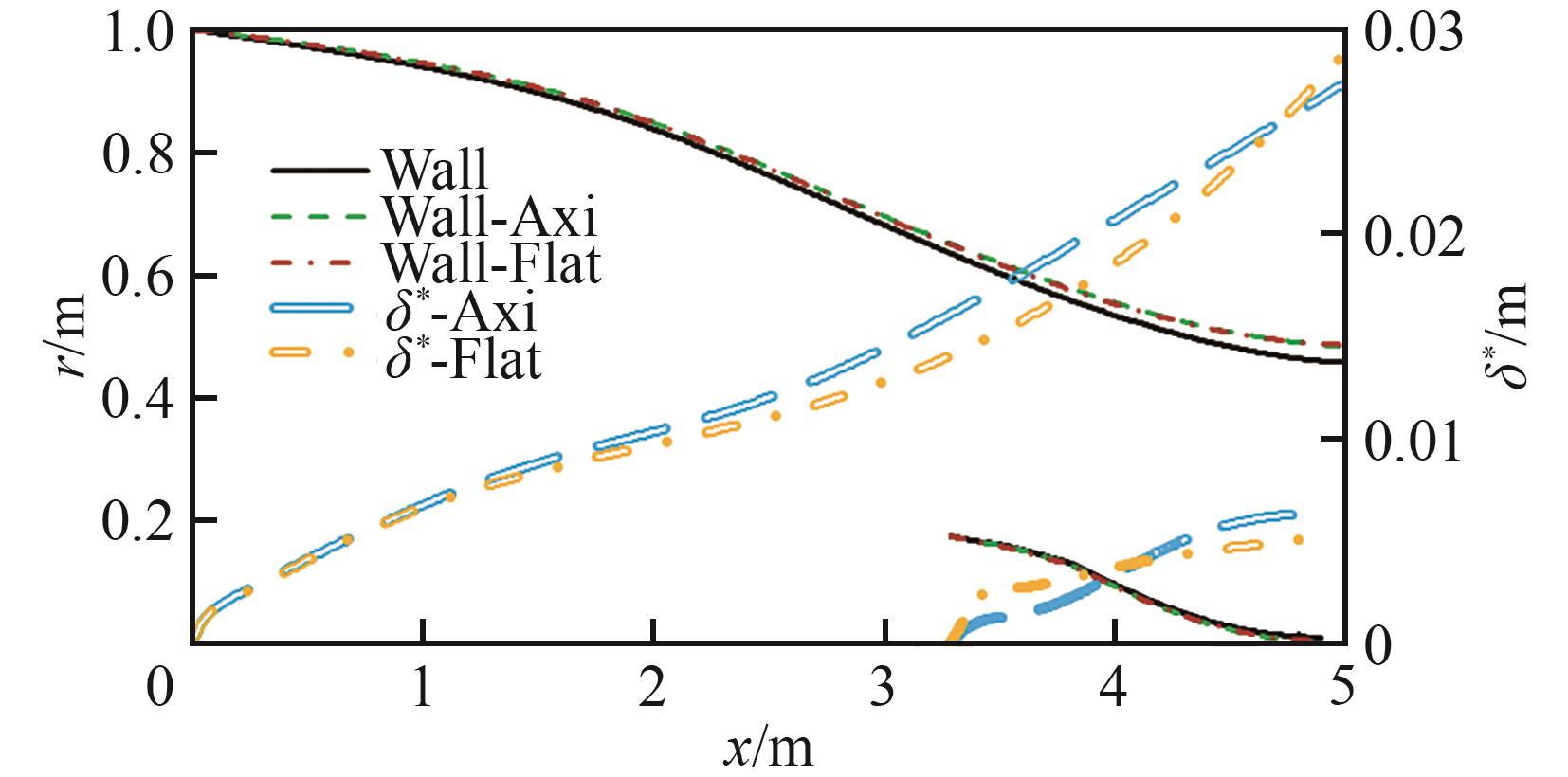
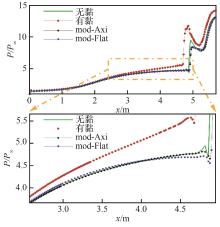
Fig.34
Correction for pressure distribution on upper wall of internal compression basic flowfield Base1
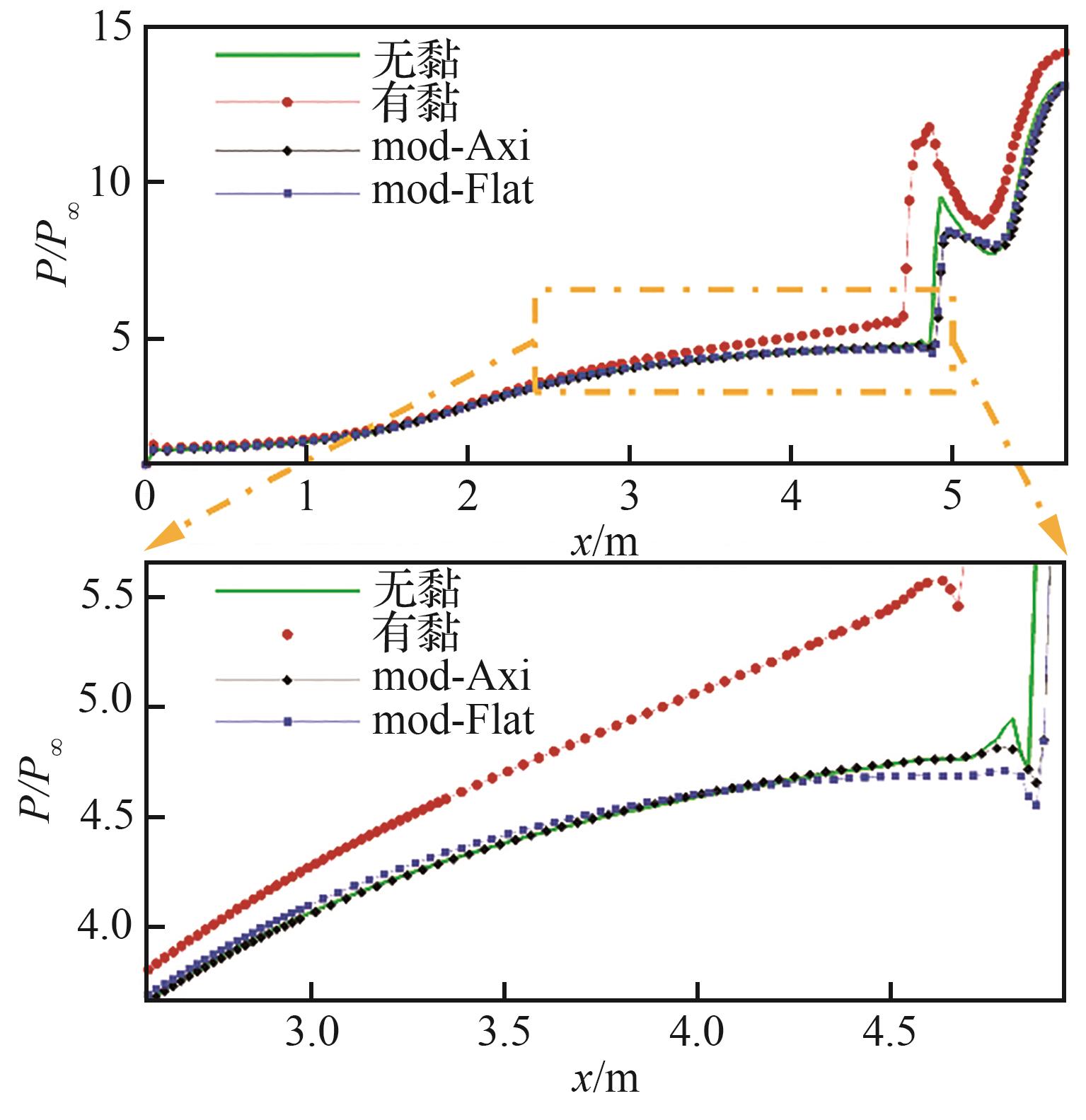
Table 6
Results of viscosity correction for internal compression basic flowfield Base1
| 指标 | 无黏 | 有黏 | mod-Axi | mod-Flat |
|---|---|---|---|---|
| σ | 0.983 5 | 0.900 3 | 0.909 4 | 0.908 7 |
| Pthroat/P2 | 9.820 3 | 11.190 0 | 9.320 7 | 9.272 8 |
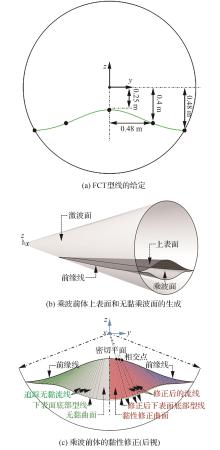
Fig.35
Designed waverider forebody
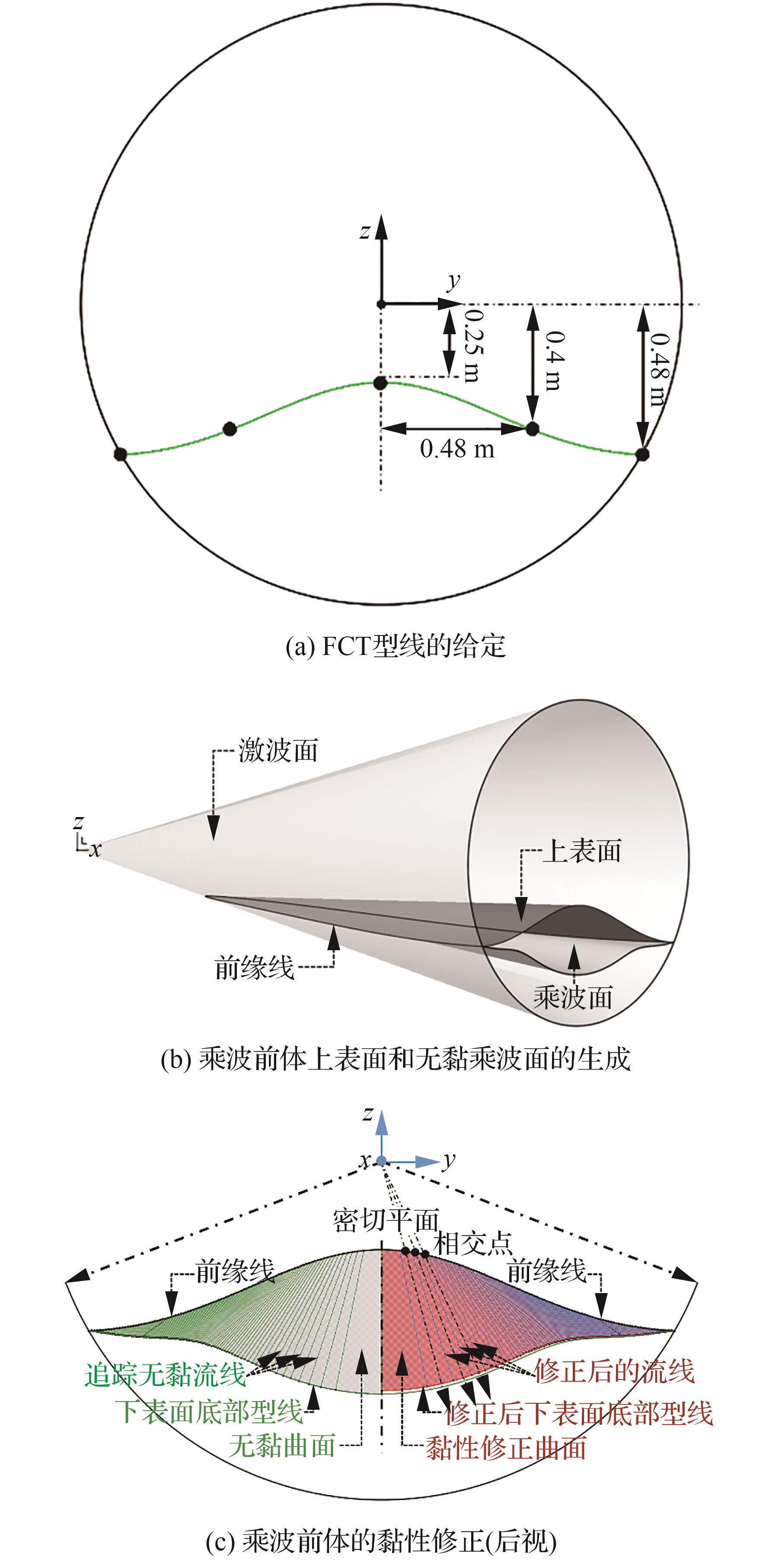
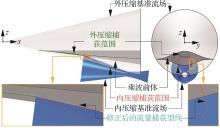
Fig.36
Flow capture lines before and after considering the viscous effect (before correction: green lines+red lines, after correction: blue dotted lines)
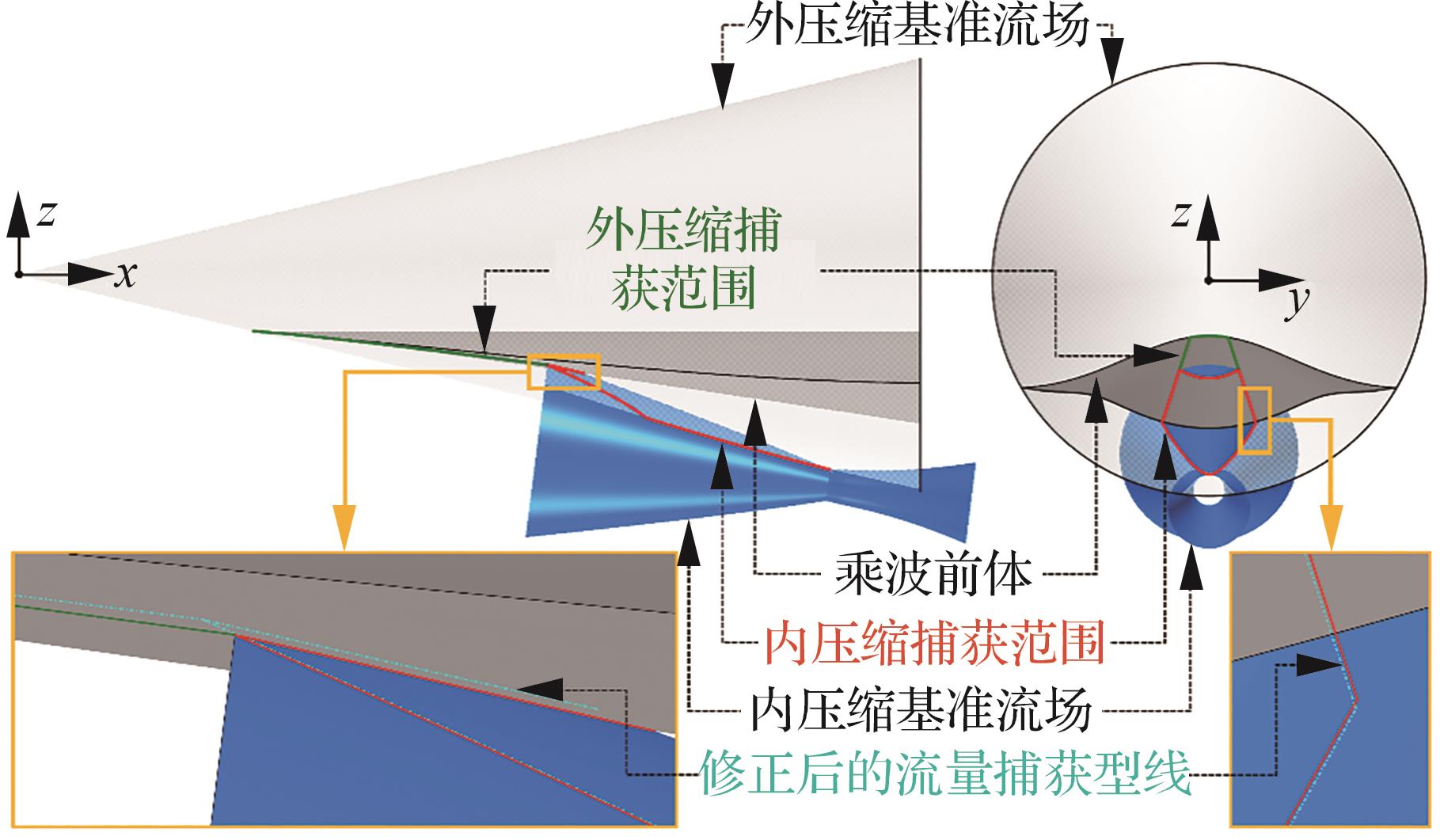
Fig.37
Viscosity correction for the inlet (the back view)
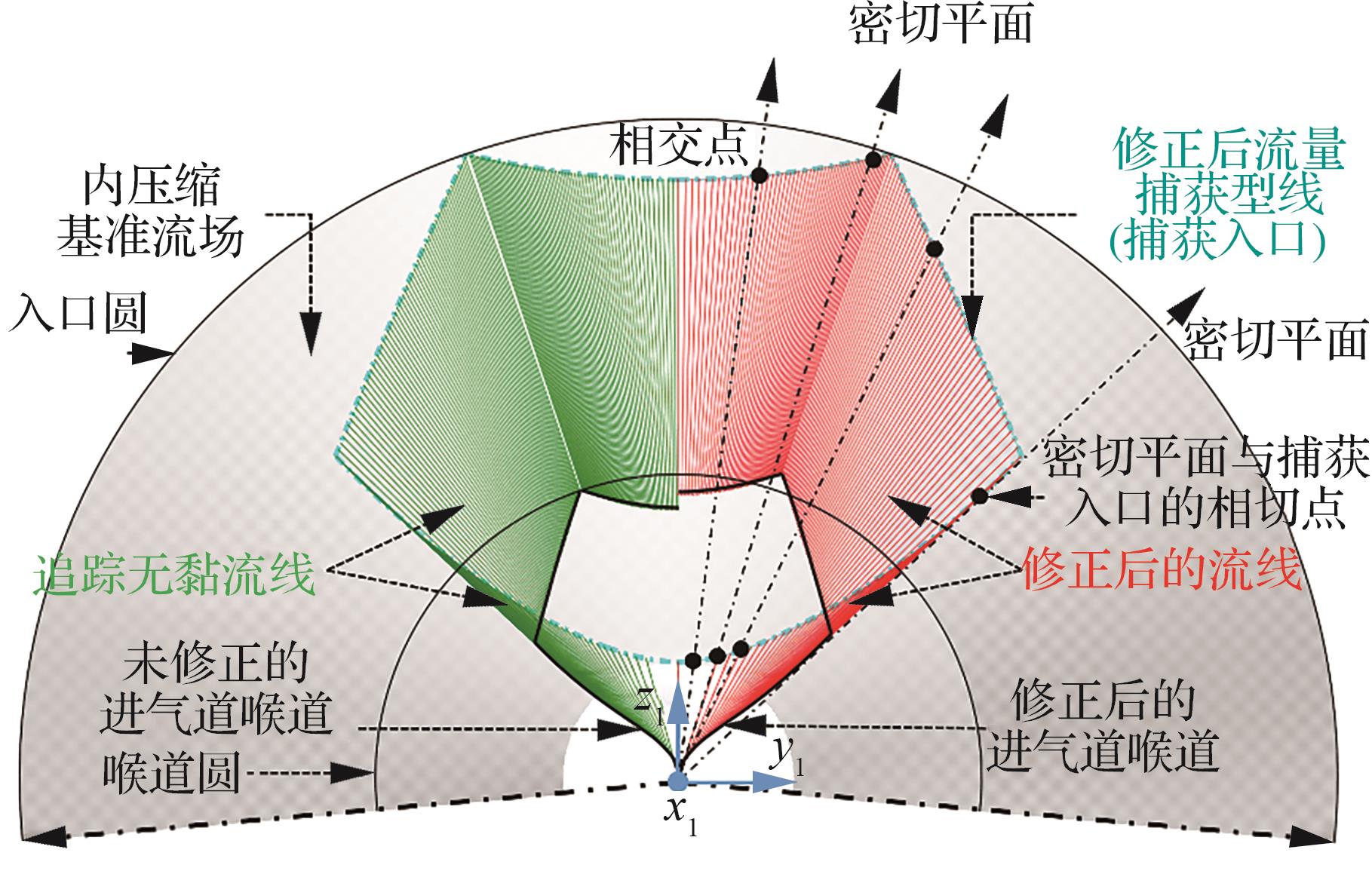
Fig.38
Comparison of geometries of different integrated configurations
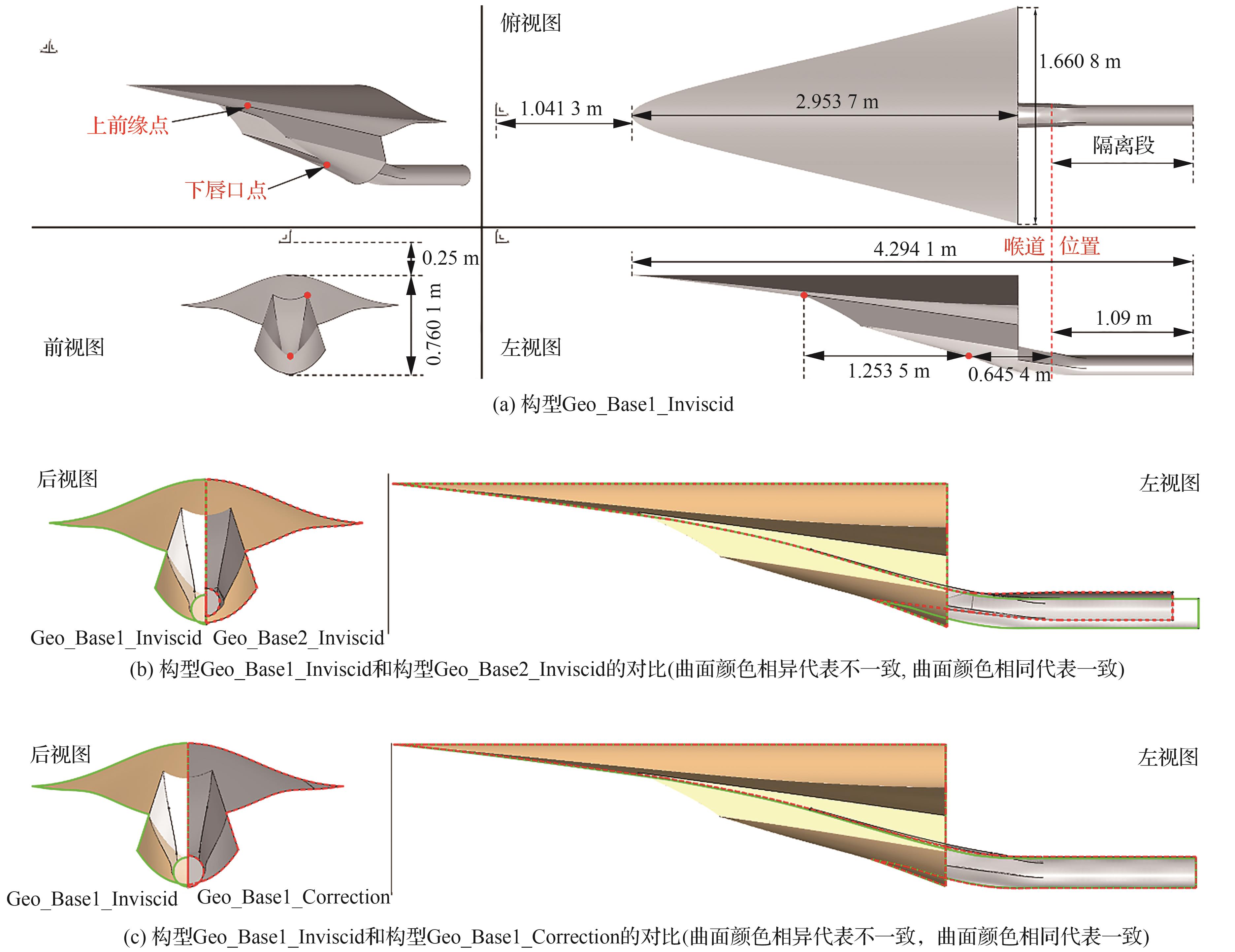
Table 7
Comparison of geometry parameters of integrated configurations
| 构型 | S0/m2 | S1/m2 | S2/m2 | CR | ICR |
|---|---|---|---|---|---|
| Geo_Base1_Inviscid | 0.17 | 0.131 9 | 0.019 1 | 8.919 | 1.902 |
| Geo_Base2_Inviscid | 0.17 | 0.131 9 | 0.017 8 | 9.431 | 2.012 |
| Geo_Base1_Correction | 0.17 | 0.134 1 | 0.021 9 | 7.760 | 1.779 |
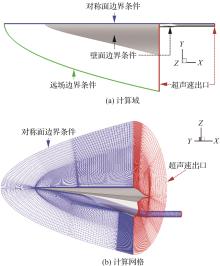
Fig.39
Computational domain and computational grid
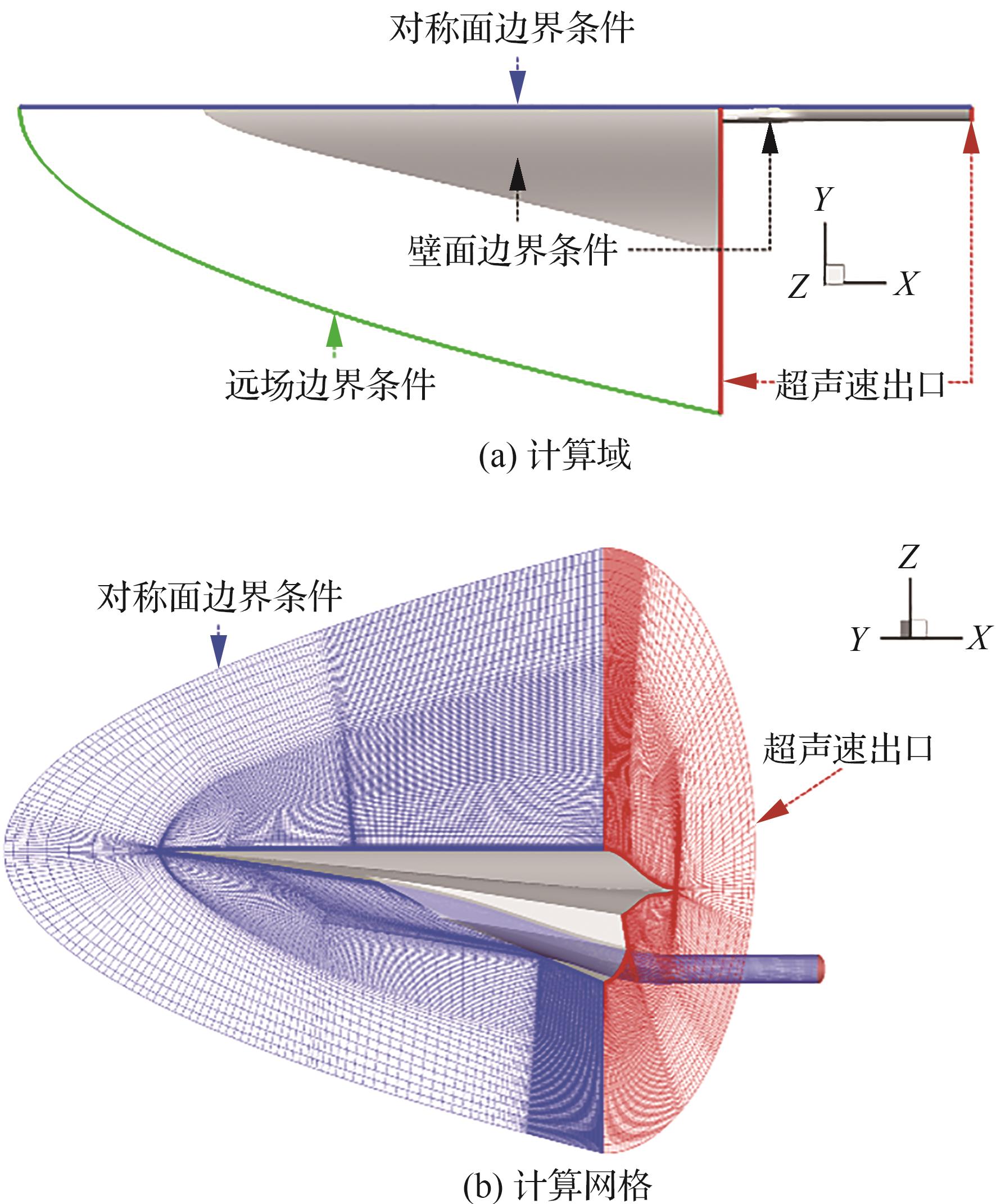
Table 8
Different mesh sizes and calculation results
| 网格 | 网格量 | CL | CD | ||
|---|---|---|---|---|---|
| 粗 | 1 872 300 | 0.070 4 | 0.039 5 | 0.724 4 | 0.584 7 |
| 中 | 6 319 040 | 0.070 7 | 0.039 1 | 0.727 7 | 0.577 4 |
| 细 | 21 326 760 | 0.070 8 | 0.039 1 | 0.729 2 | 0.572 6 |
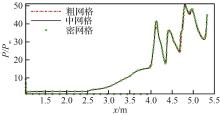
Fig.40
Comparison of pressure distribution on the symmetric plane of different grids
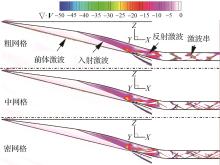
Fig.41
Comparison of flow structures on the symmetric plane of different grids
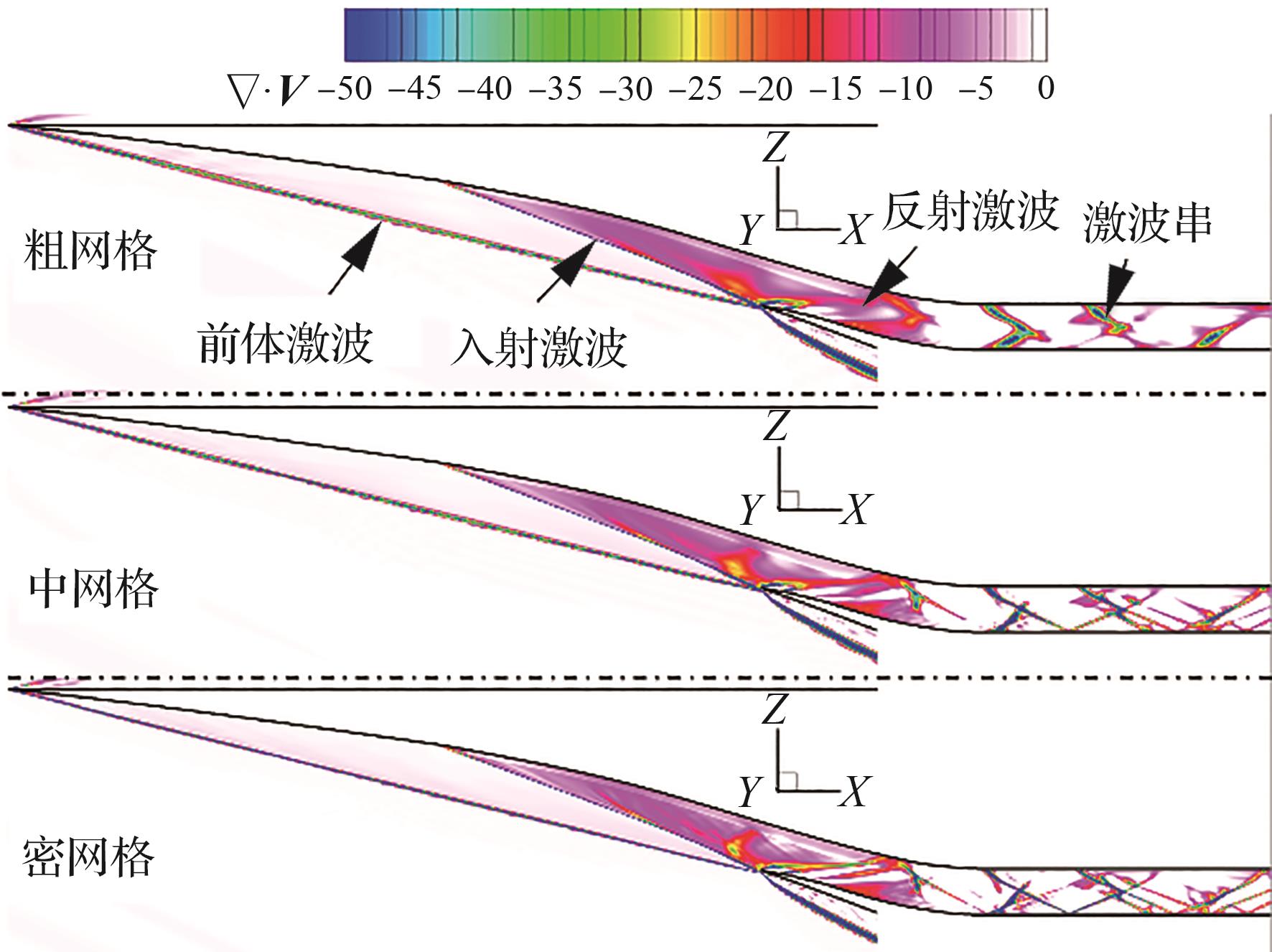
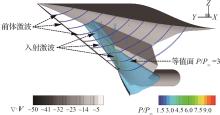
Fig.42
Spatial flowfield of Geo_Base1_Inviscid
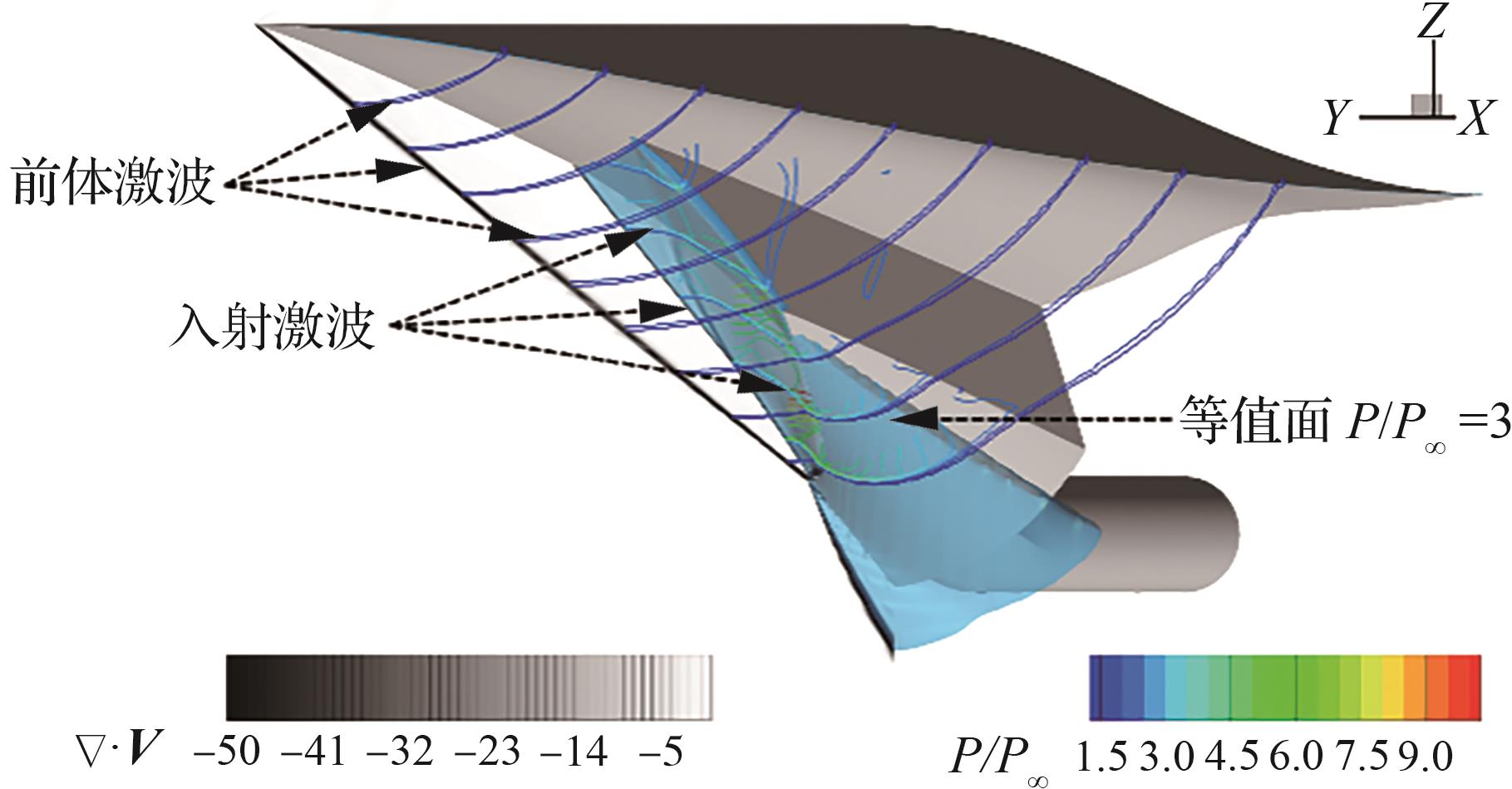
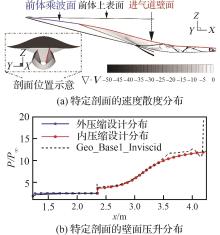
Fig.43
Velocity divergence distribution and wall pressure rise distribution of specific slice of configuration Geo_Base1_Inviscid
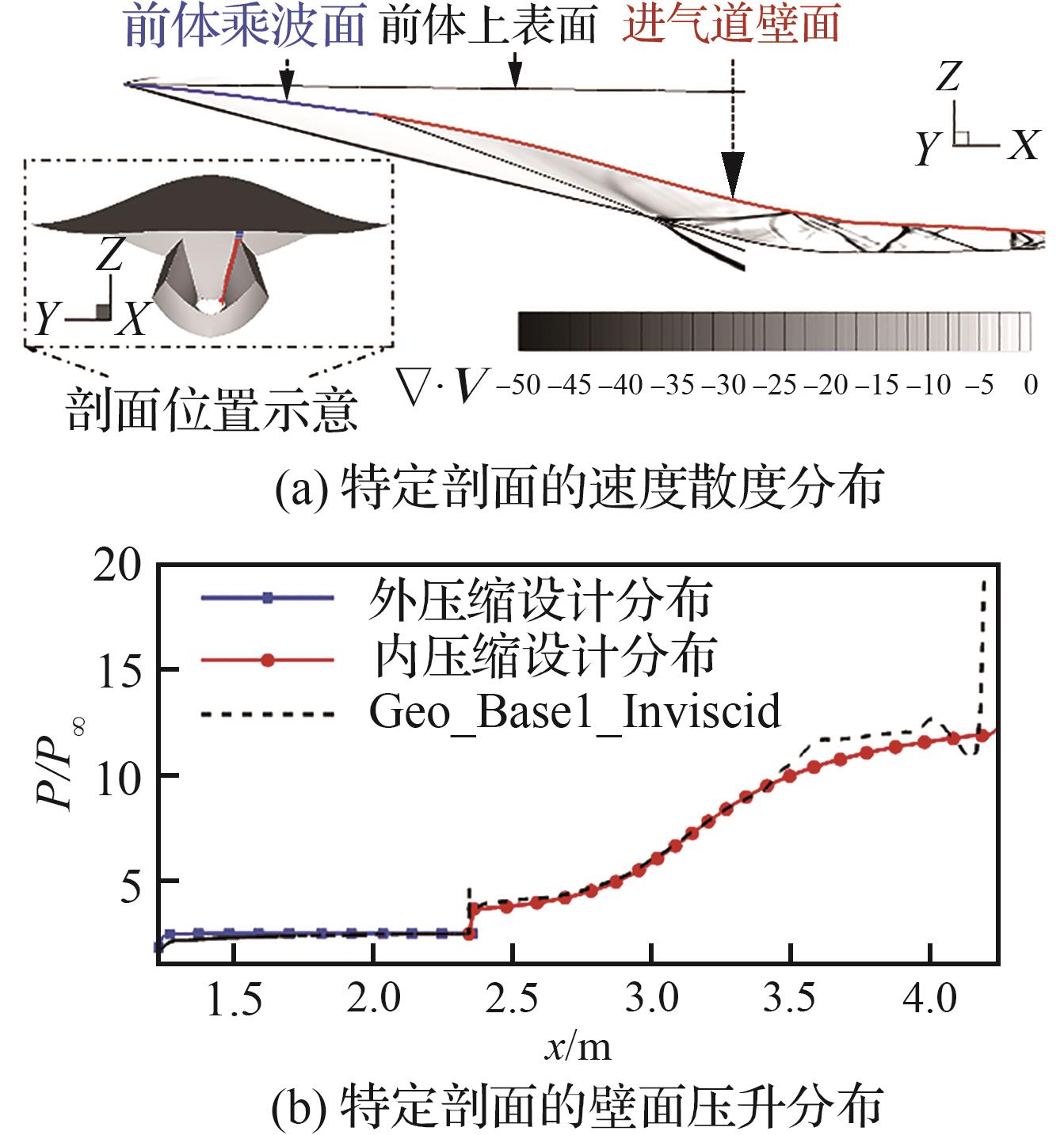
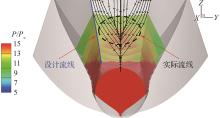
Fig.44
Surface streamline of Geo_Base1_Inviscid
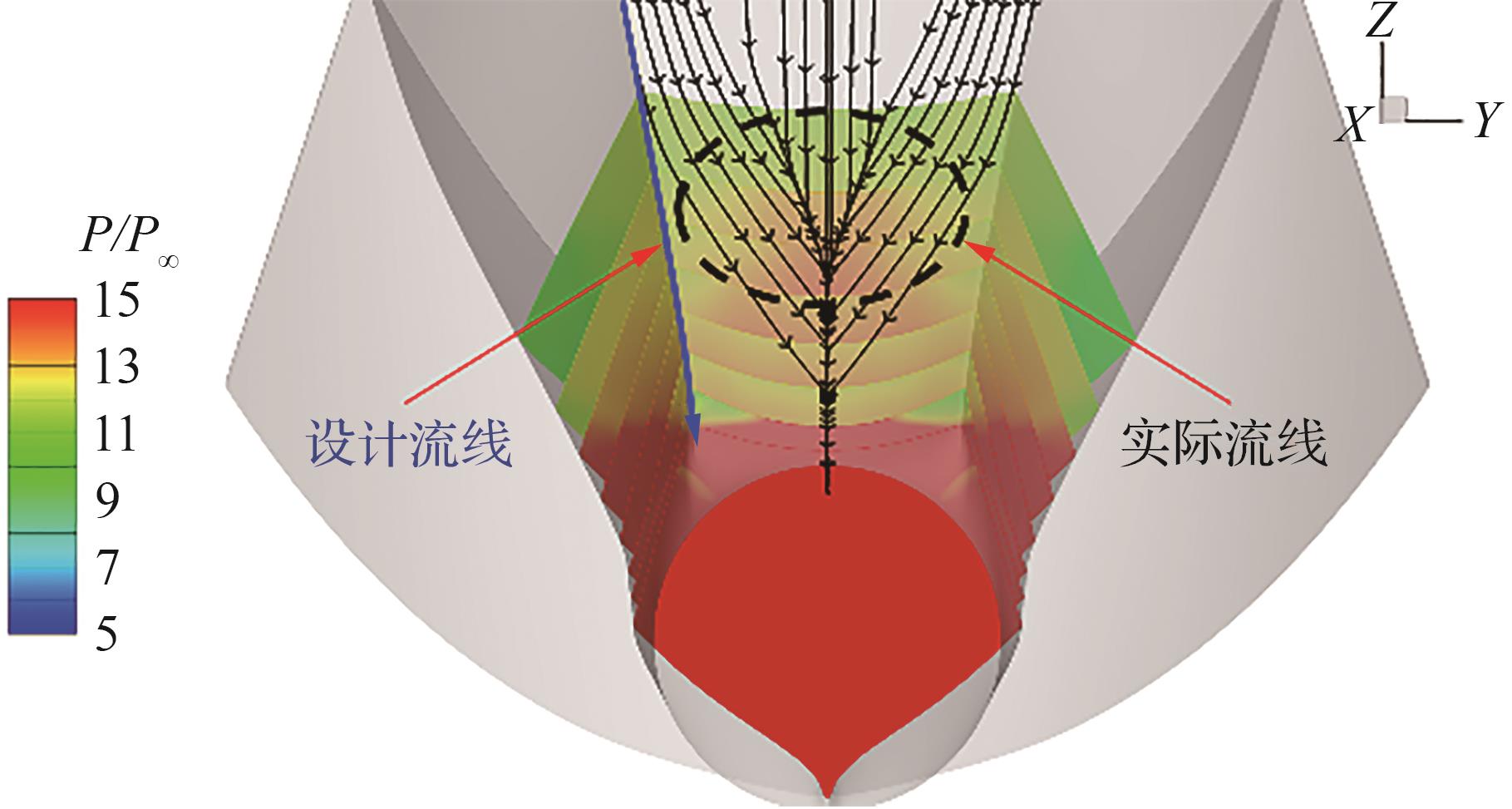
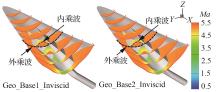
Fig.45
Comparison of external flow field structures of Geo_Base1_Inviscid and Geo_Base2_Inviscid
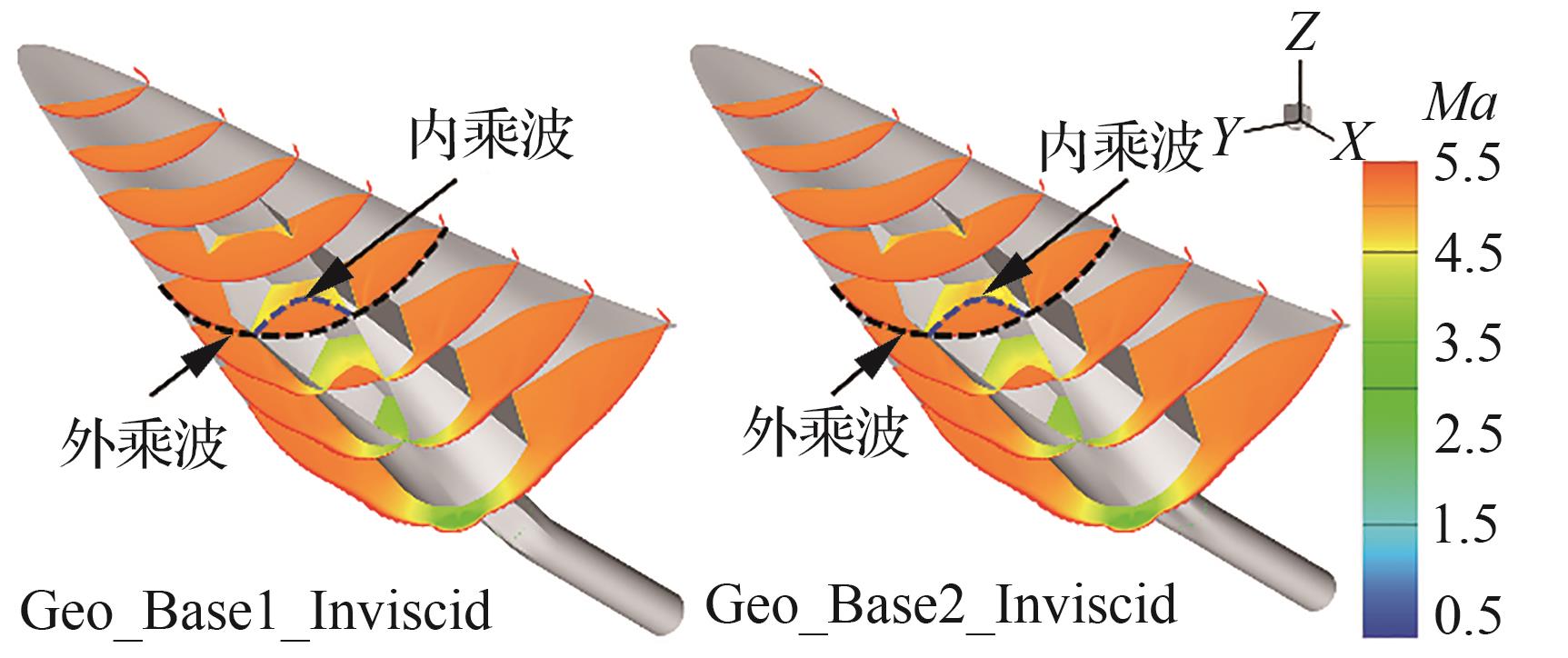
Table 9
Comparison of inviscid lift-drag performances
| 构型 | CL | CD | L/D |
|---|---|---|---|
| Geo_Base1_Inviscid | 0.080 55 | 0.025 39 | 3.172 1 |
| Geo_Base2_Inviscid | 0.073 77 | 0.026 78 | 2.754 6 |
Table 10
Comparison of lift gain
| 构型 | 上壁面 | 下壁面 | 增益 |
|---|---|---|---|
| Geo_Base1_Inviscid | 3.31 | -4.28 | -0.97 |
| Geo_Base2_Inviscid | 3.65 | -4.68 | -1.03 |
Table 11
Comparison of inviscid flow capture performance
| 构型 | |||||||
|---|---|---|---|---|---|---|---|
| Geo_Base1_Inviscid | 0.904 4 | 26.888 2 | 3.273 9 | 0.883 2 | 27.216 8 | 3.240 6 | 0.997 |
| Geo_Base2_Inviscid | 0.871 0 | 30.265 1 | 3.143 6 | 0.854 7 | 33.194 9 | 3.079 7 | 0.997 |
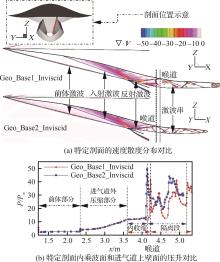
Fig.46
Comparison of velocity divergence distribution and wall pressure rise distribution of specific slice
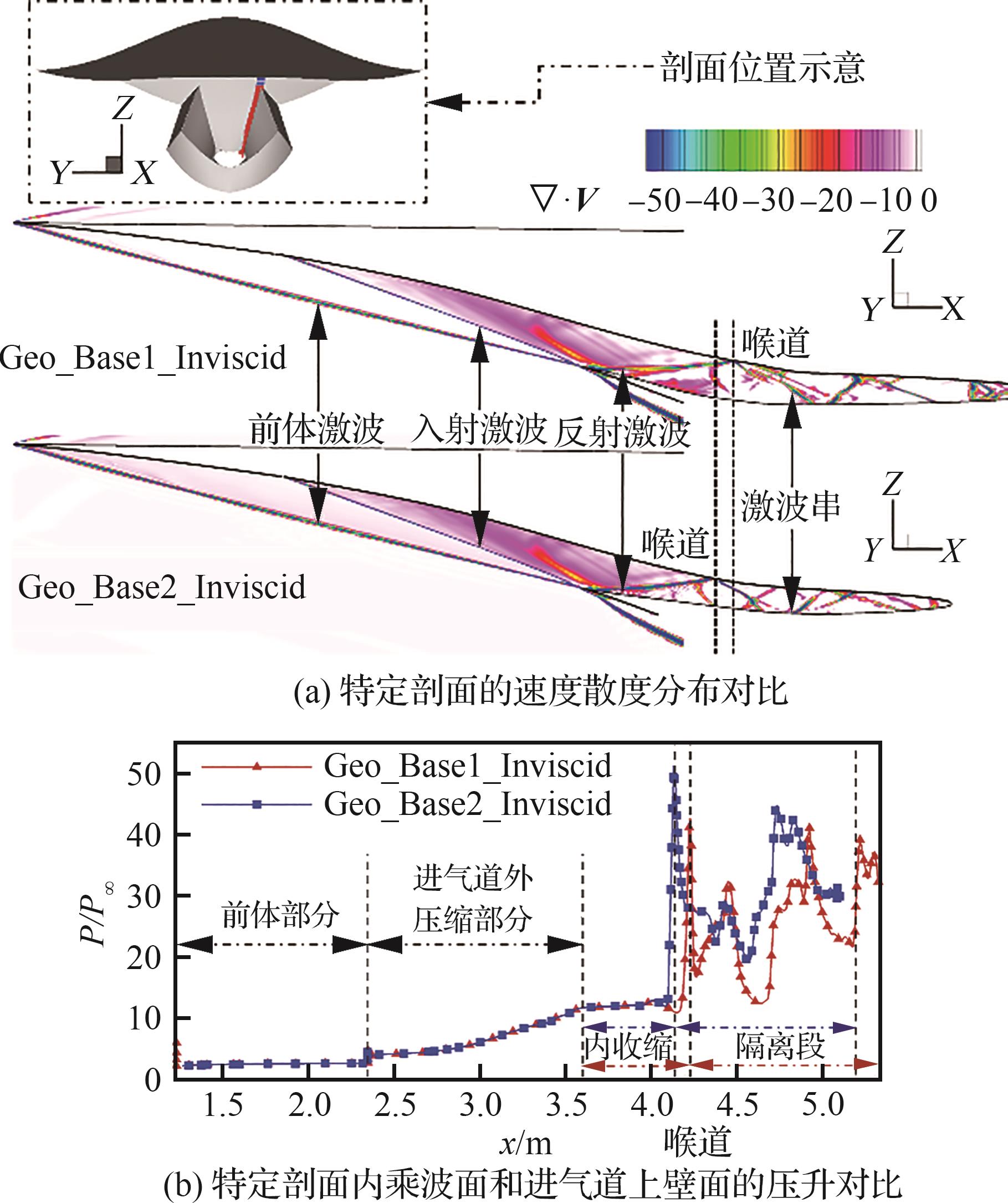
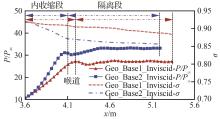
Fig.47
Comparison of spatial distributions of pressure ratio and total pressure recovery coefficient along x-direction
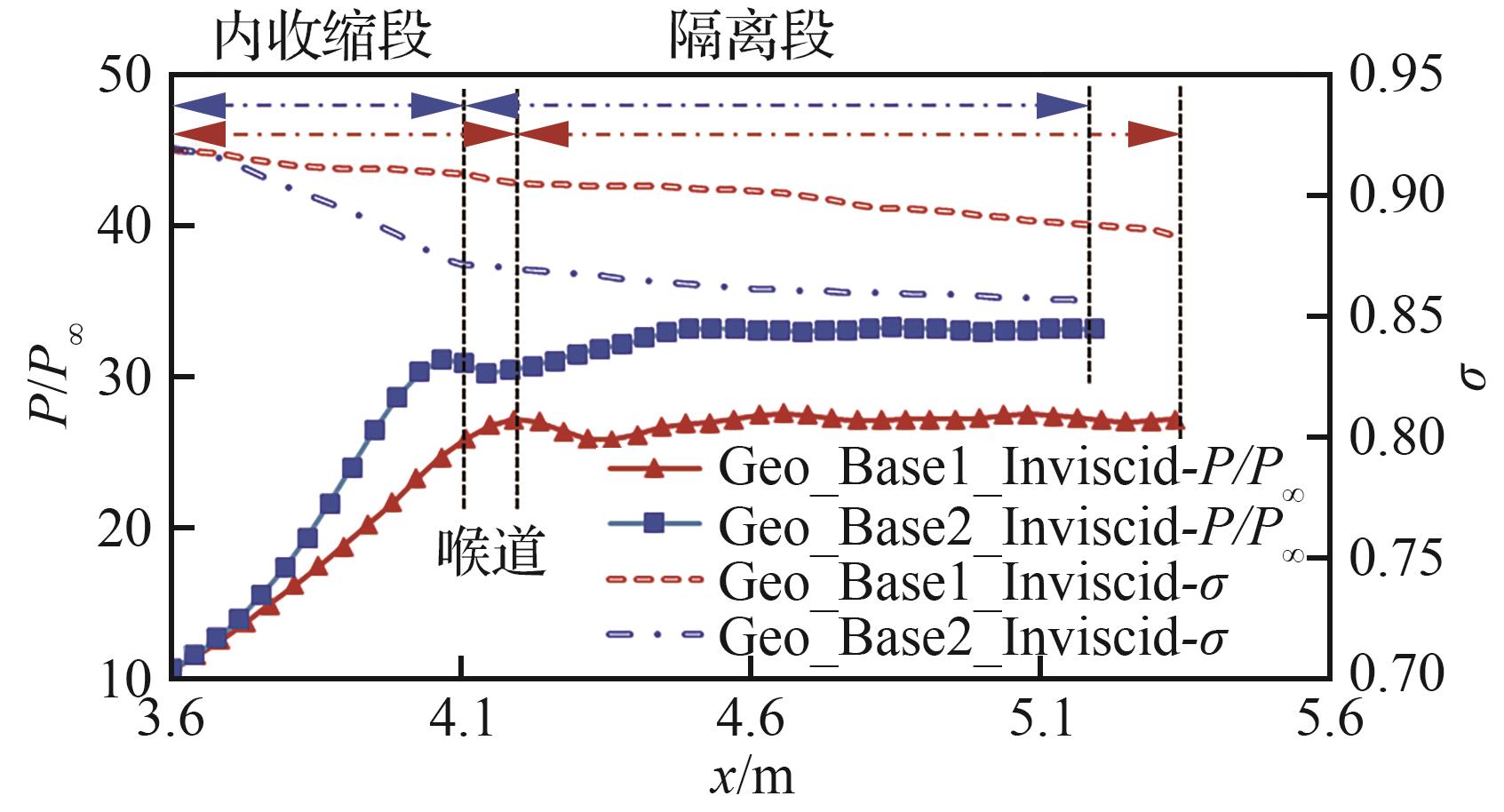
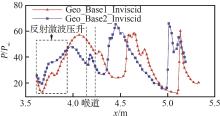
Fig.48
Comparison of pressure rise distribution on lower wall of inlet in the symmetric plane
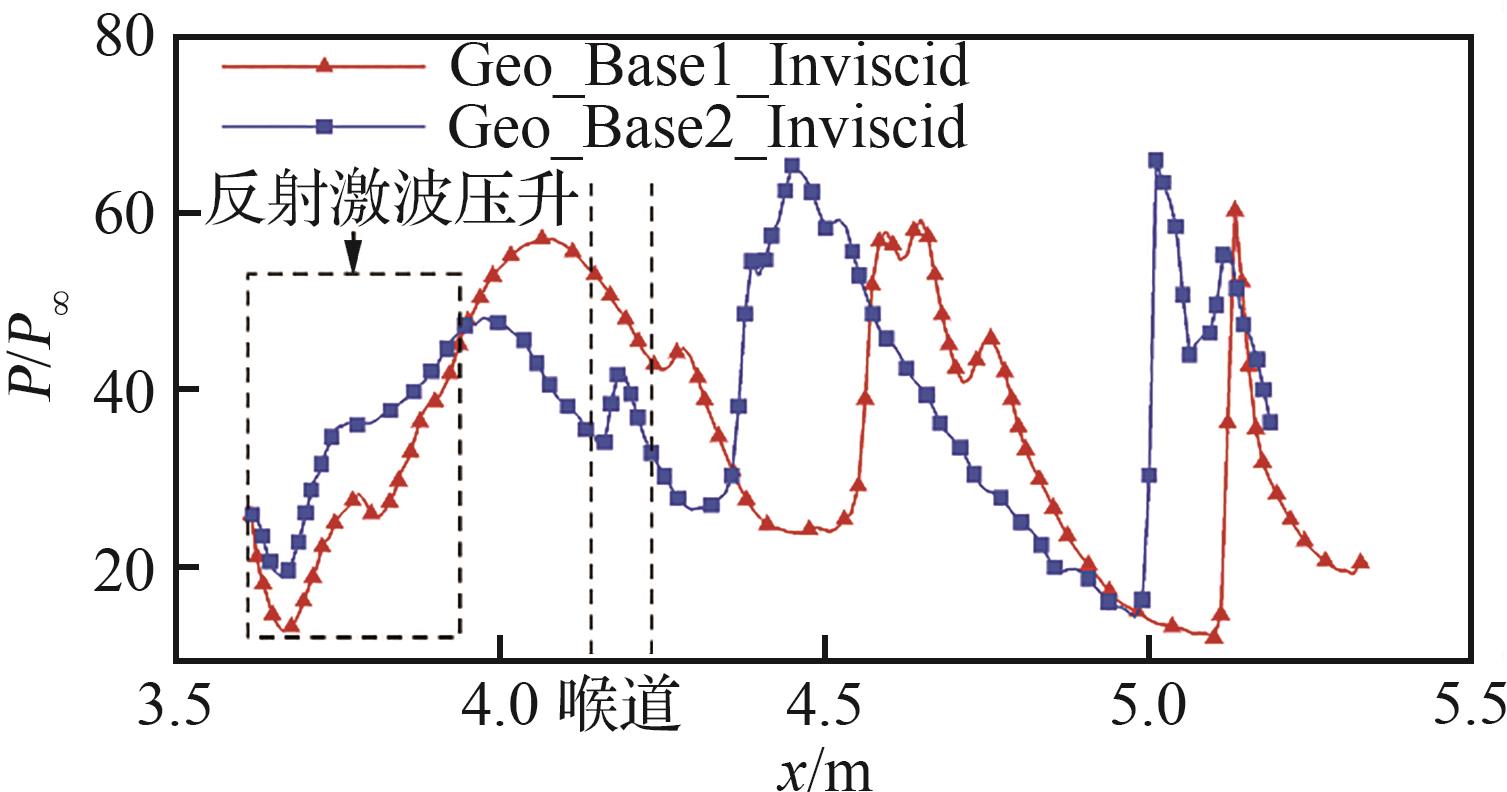
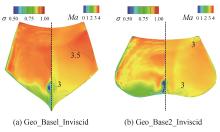
Fig.49
Comparisons of total pressure recovery coefficient and Mach distribution at throat
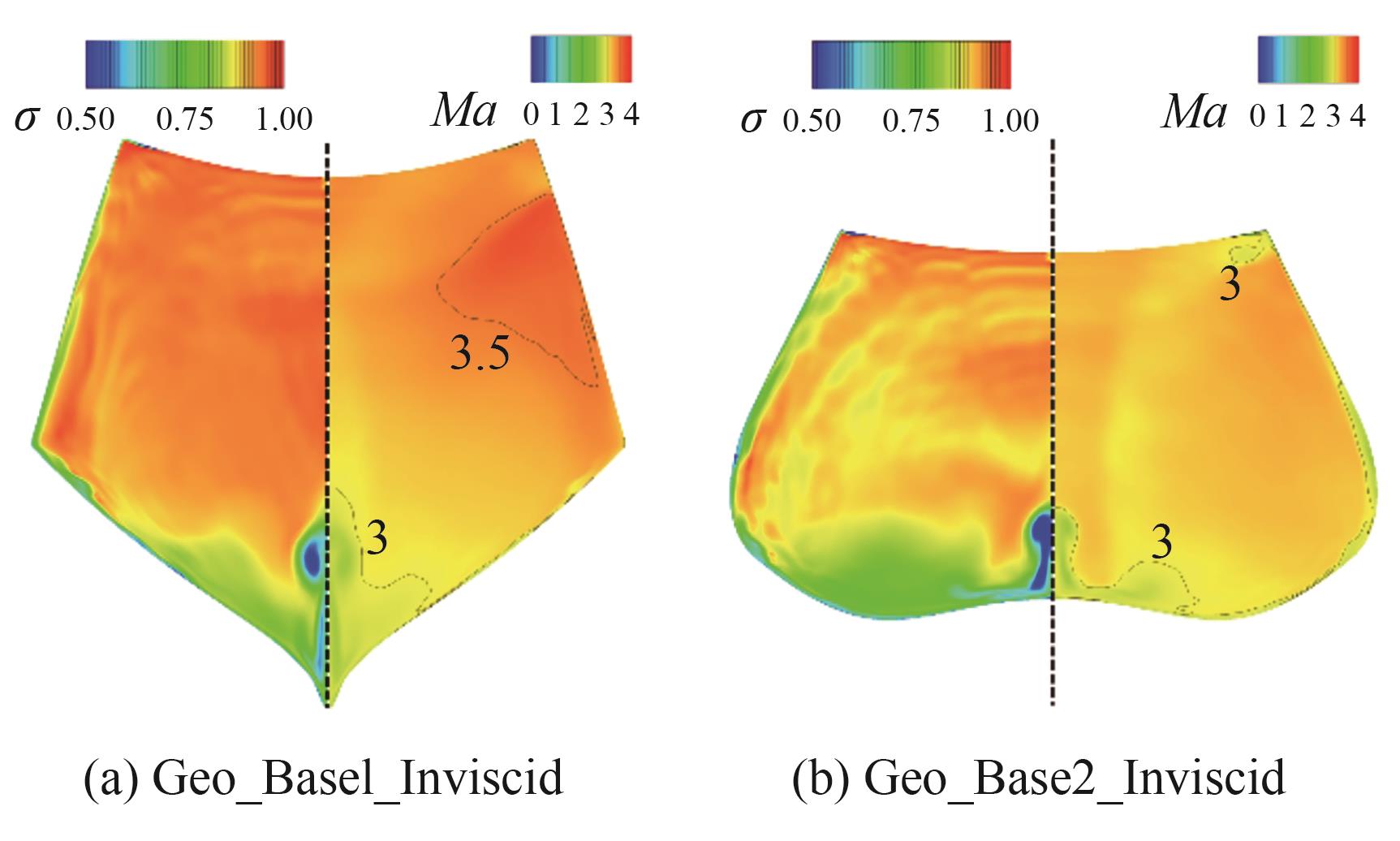
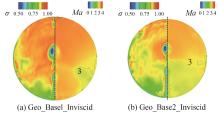
Fig.50
Comparisons of total pressure recovery coefficient and Mach distribution at outlet
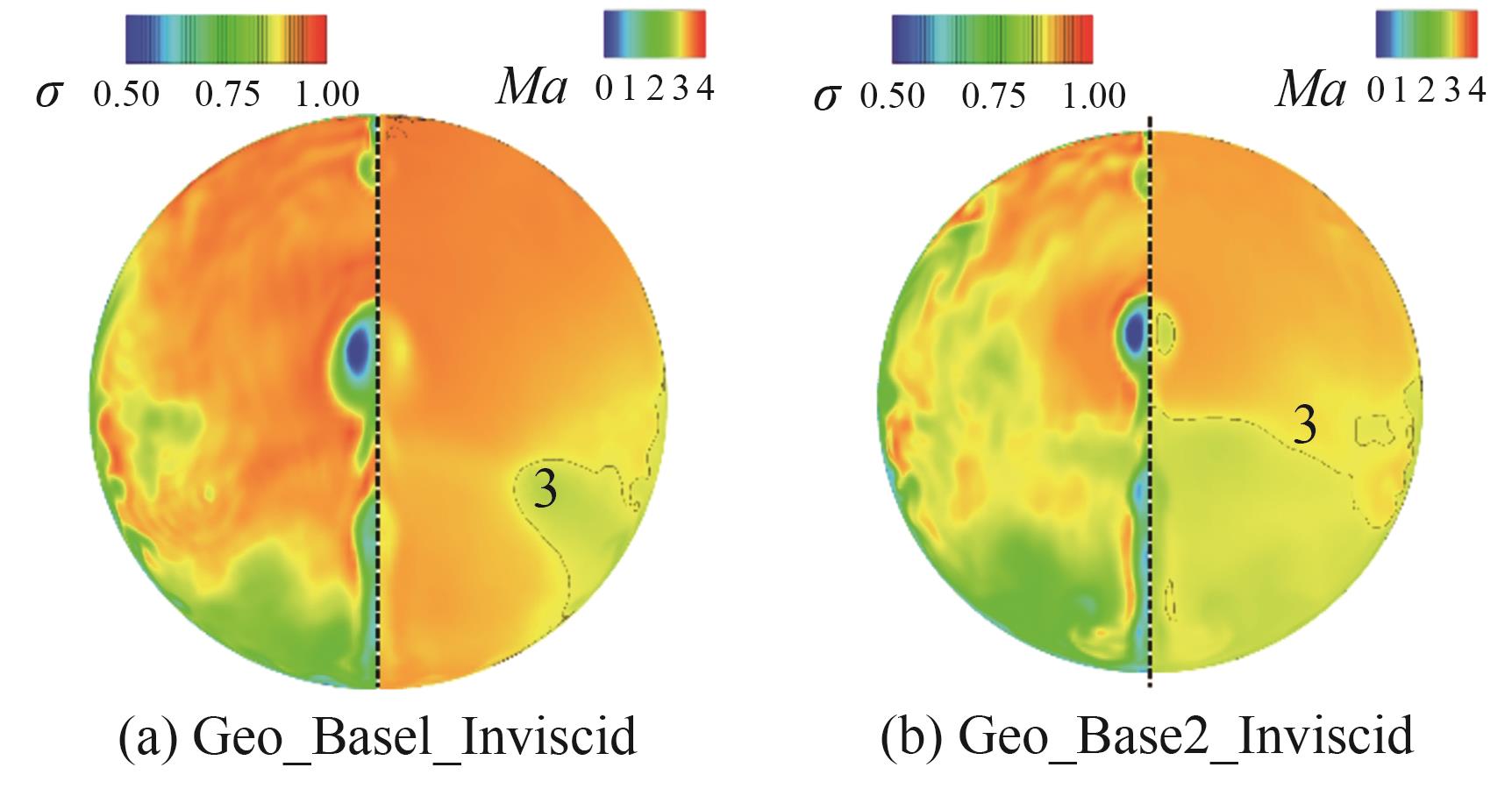
Table 12
Comparison of flowfield distortion index
| 构型 | ||
|---|---|---|
| Geo_Base1_Inviscid | 0.800 2 | 0.612 3 |
| Geo_Base2_Inviscid | 0.975 3 | 0.642 0 |
Table 13
Inviscid and viscous intake performance of configuration Geo_Base1_Inviscid
| 类型 | φ | ||||
|---|---|---|---|---|---|
| 无黏 | 0.904 4 | 26.888 2 | 0.883 2 | 27.216 8 | 0.997 |
| 黏性 | 0.727 7 | 34.420 5 | 0.577 4 | 39.844 5 | 0.962 |
Table 14
Comparison of intake performance at design point before and after viscous correction
| 构型 | φ | ||||
|---|---|---|---|---|---|
| 修正前 | 0.727 7 | 34.420 5 | 0.577 4 | 39.844 5 | 0.962 |
| 修正后 | 0.745 2 | 28.395 1 | 0.579 2 | 32.714 8 | 0.993 |
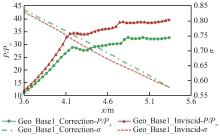
Fig.51
Comparison of spatial distribution of pressure ratio and total pressure recovery coefficient along the x-direction before and after viscosity correction
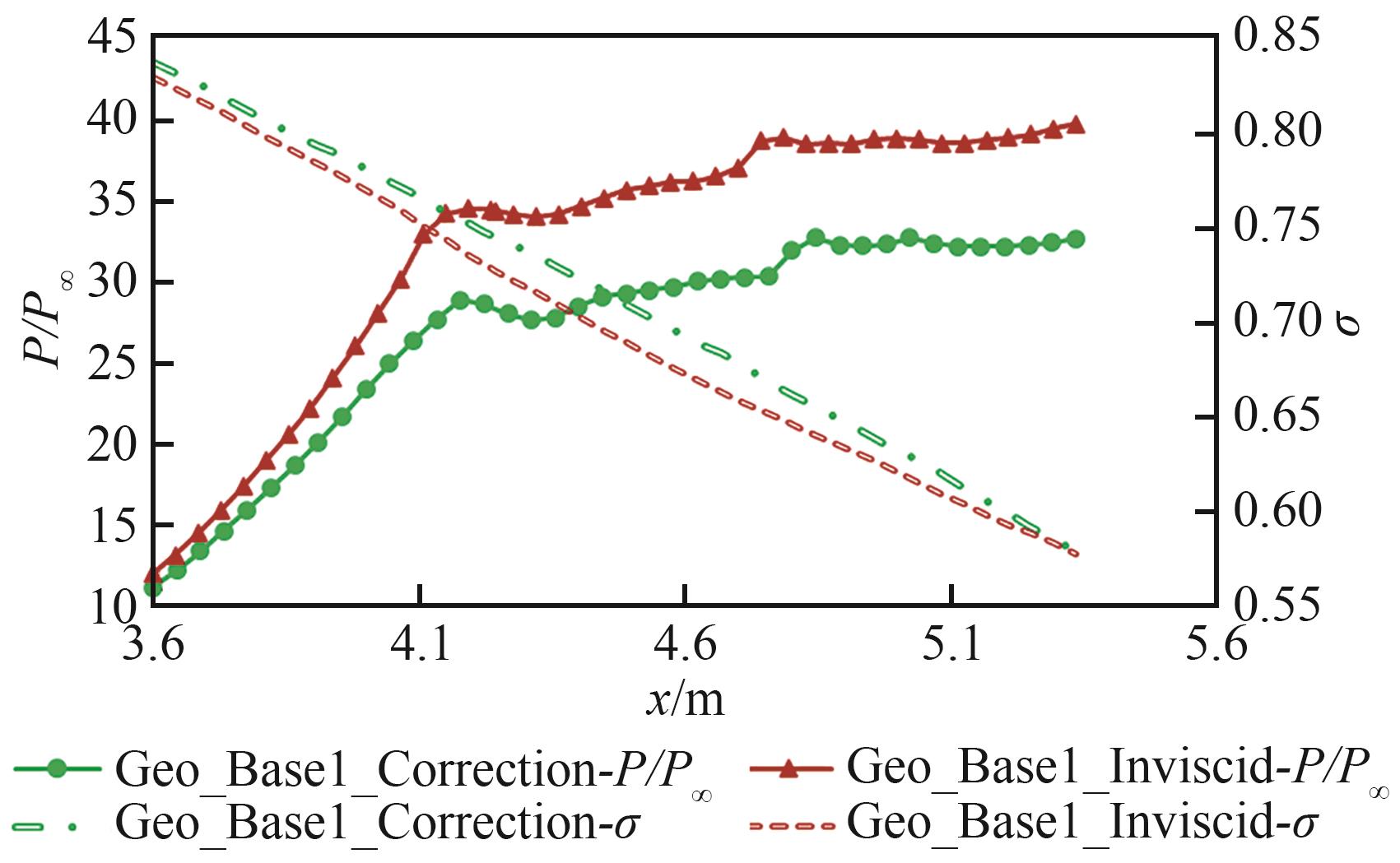
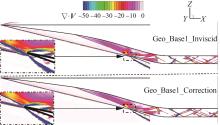
Fig.52
Comparison of viscous flowfield structures in symmetric plane before and after viscosity correction
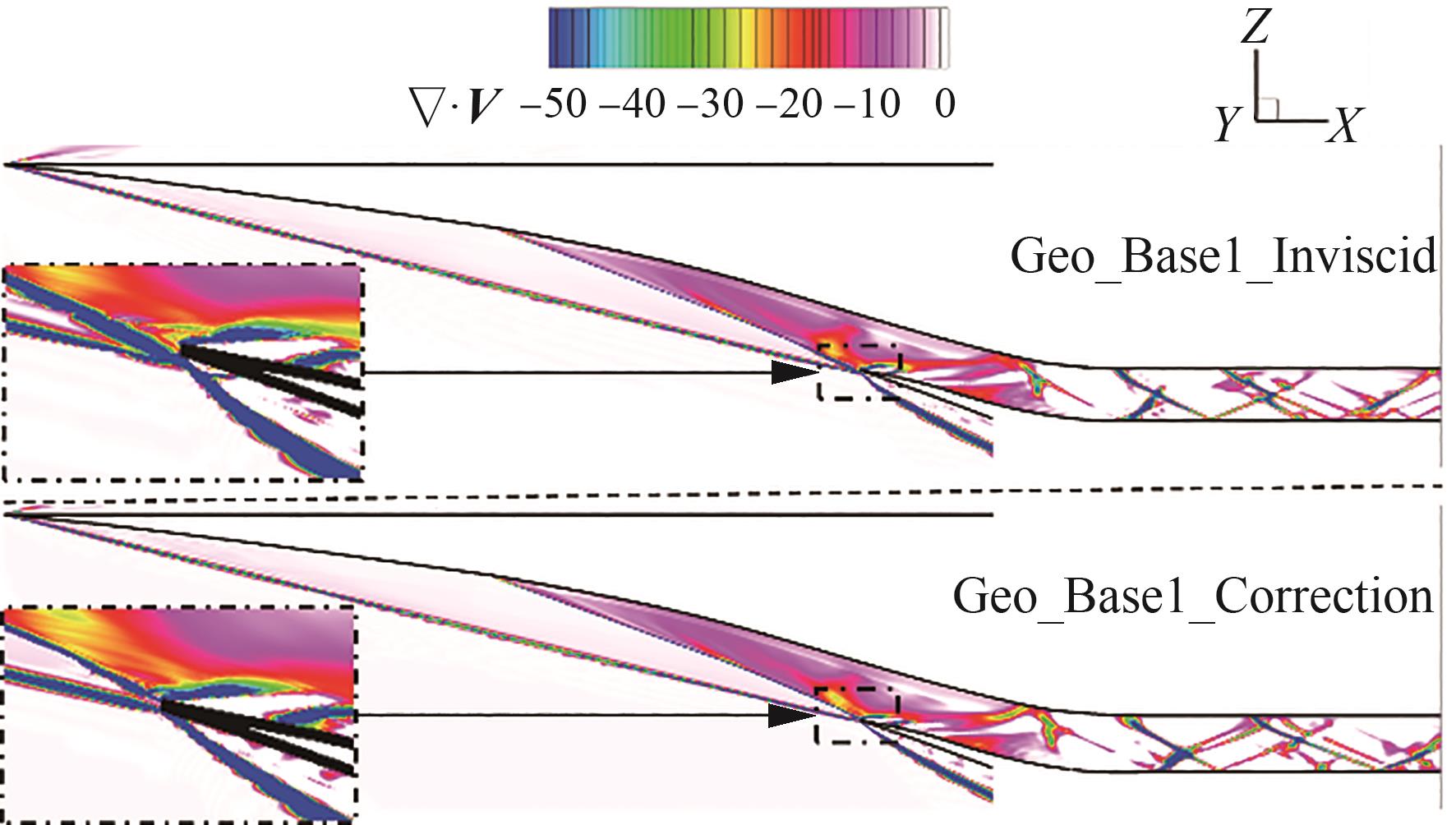
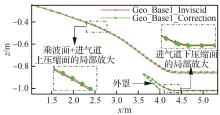
Fig.53
Comparison of geometric profiles in the symmetric plane before and after viscosity correction
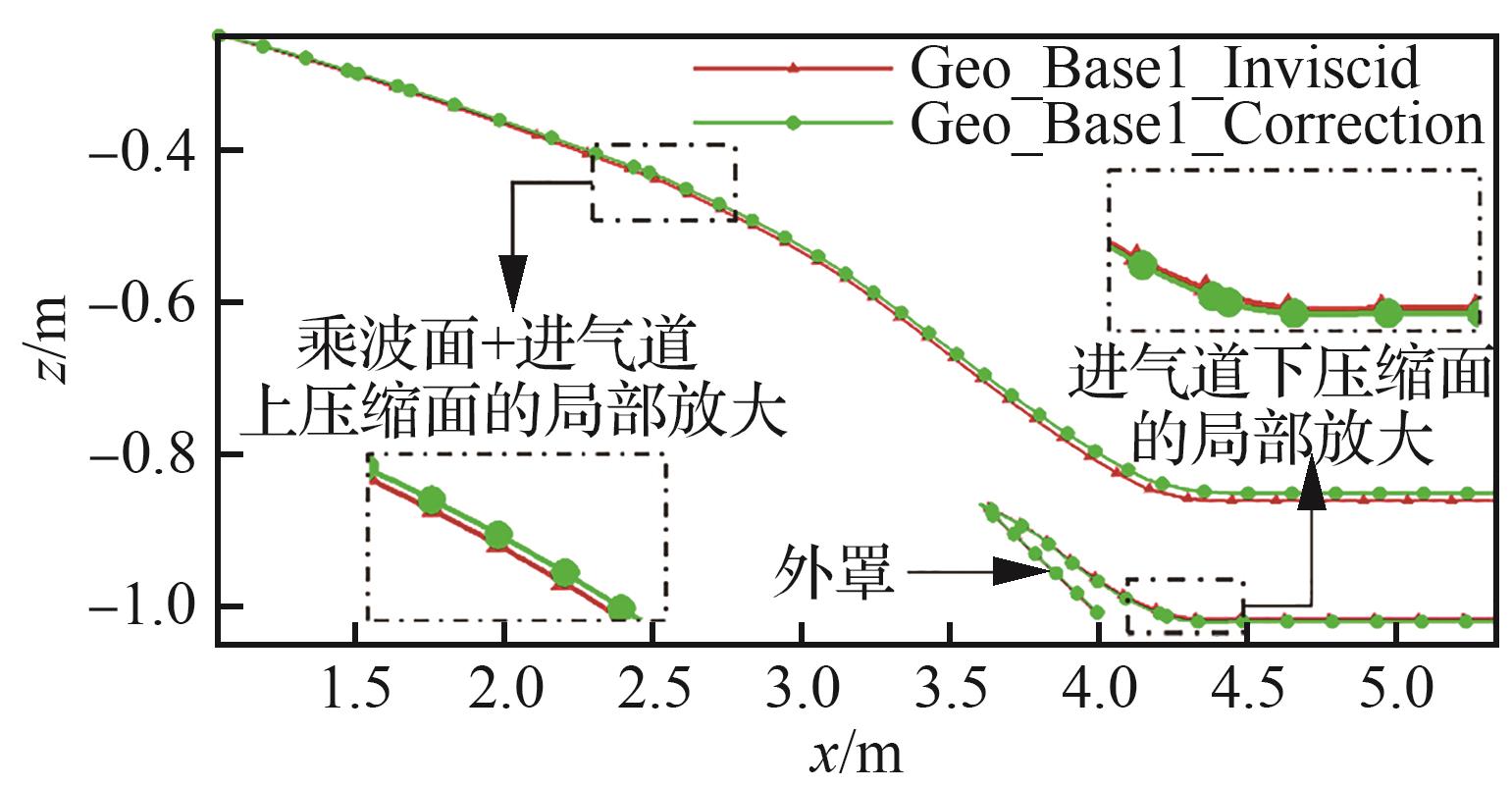
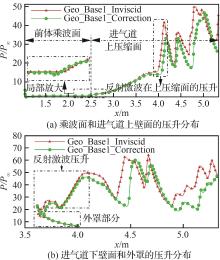
Fig.54
Comparison of wall pressure distribution in symmetric plane before and after viscosity correction
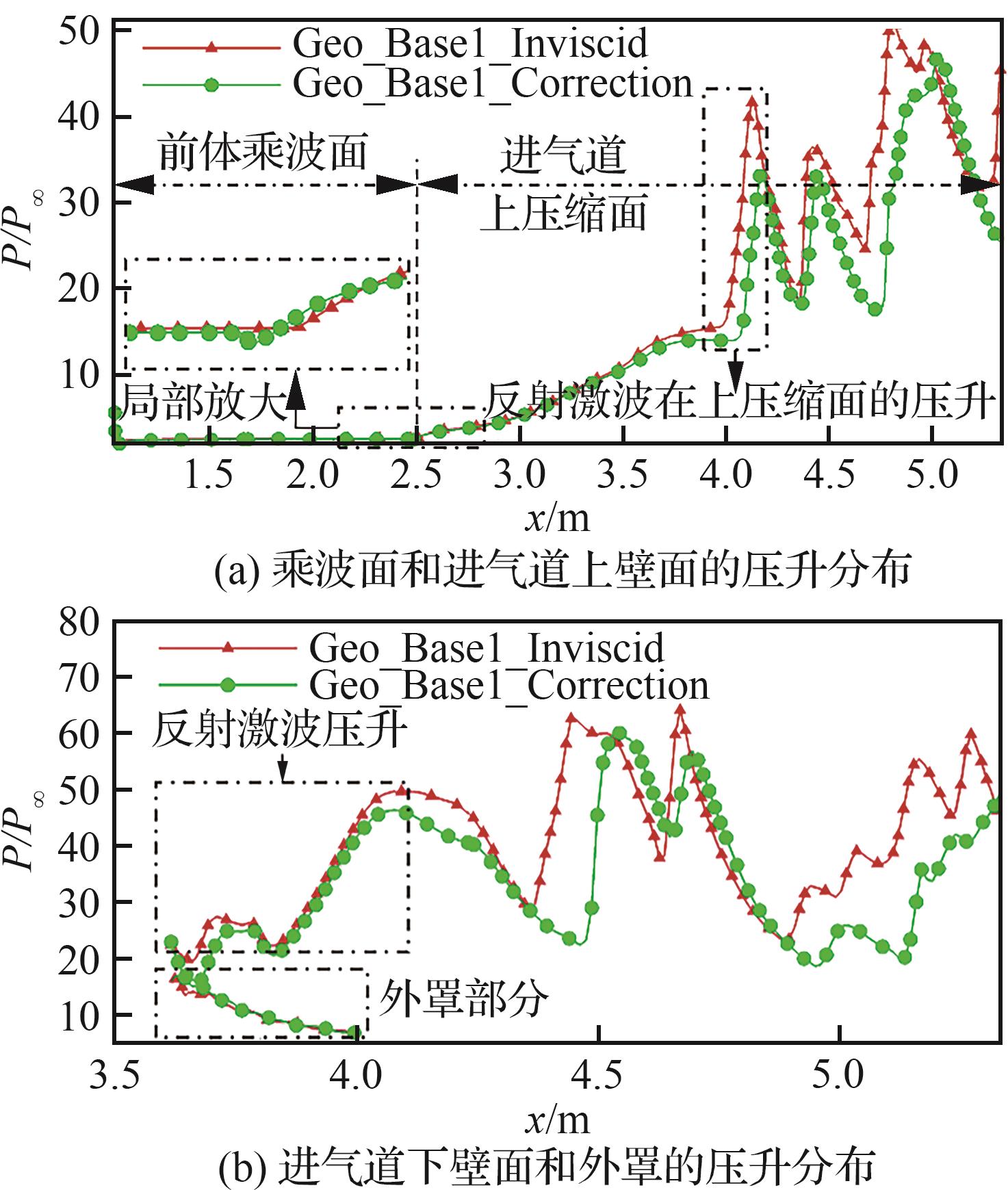
Table 15
Comparison of viscous results at design point before and after viscous correction
| 构型 | 计算 | CL | CD | L/D |
|---|---|---|---|---|
Geo_Base1_ Inviscid | 无黏 | 0.080 55 | 0.025 39 | 3.172 1 |
| 黏性 | 0.070 73 | 0.039 12 | 1.807 9 | |
Geo_Base1_ Correction | 黏性 | 0.067 04 | 0.037 08 | 1.807 7 |
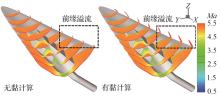
Fig.55
External inviscid and viscous flowfield structures of configuration Geo_Base1_Inviscid
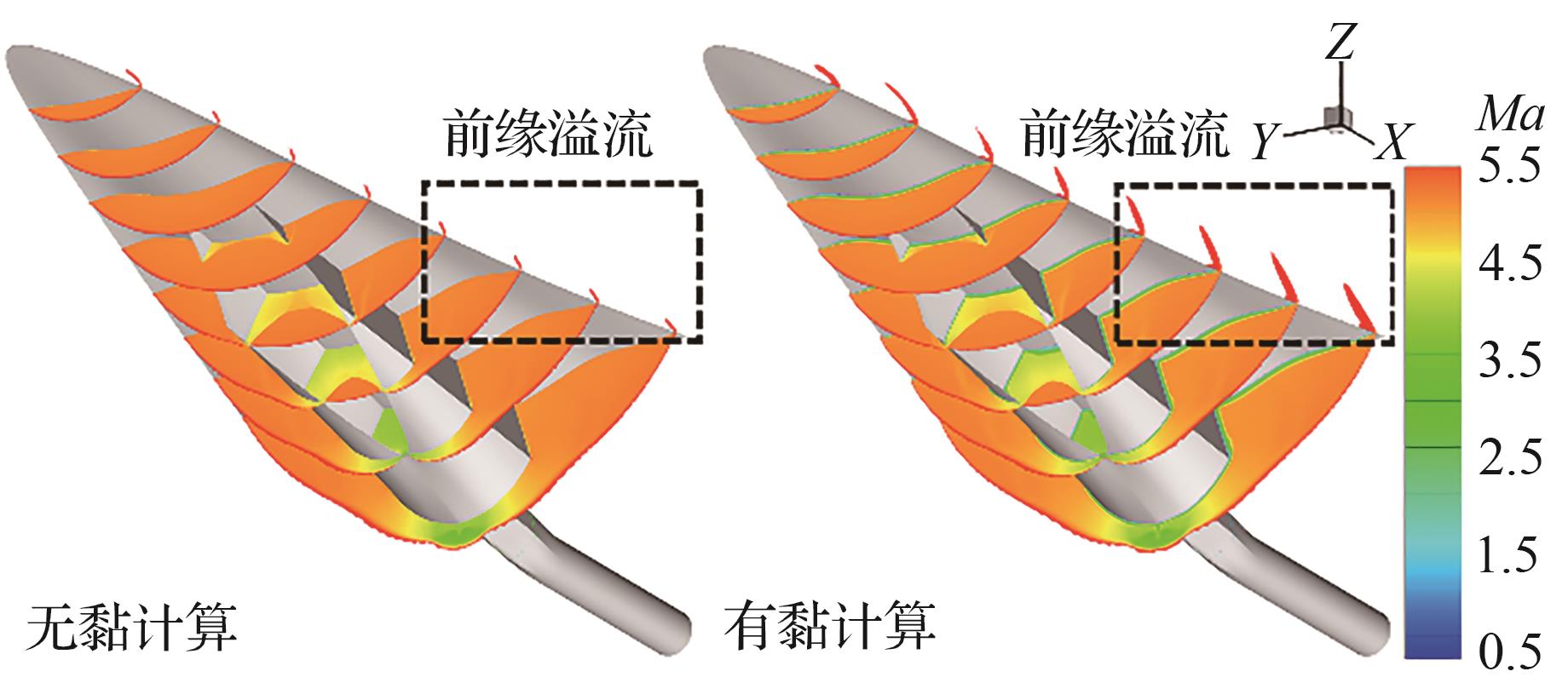
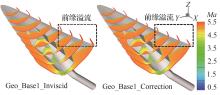
Fig.56
External viscous flowfield of integrated configurations plane before and after viscosity correction
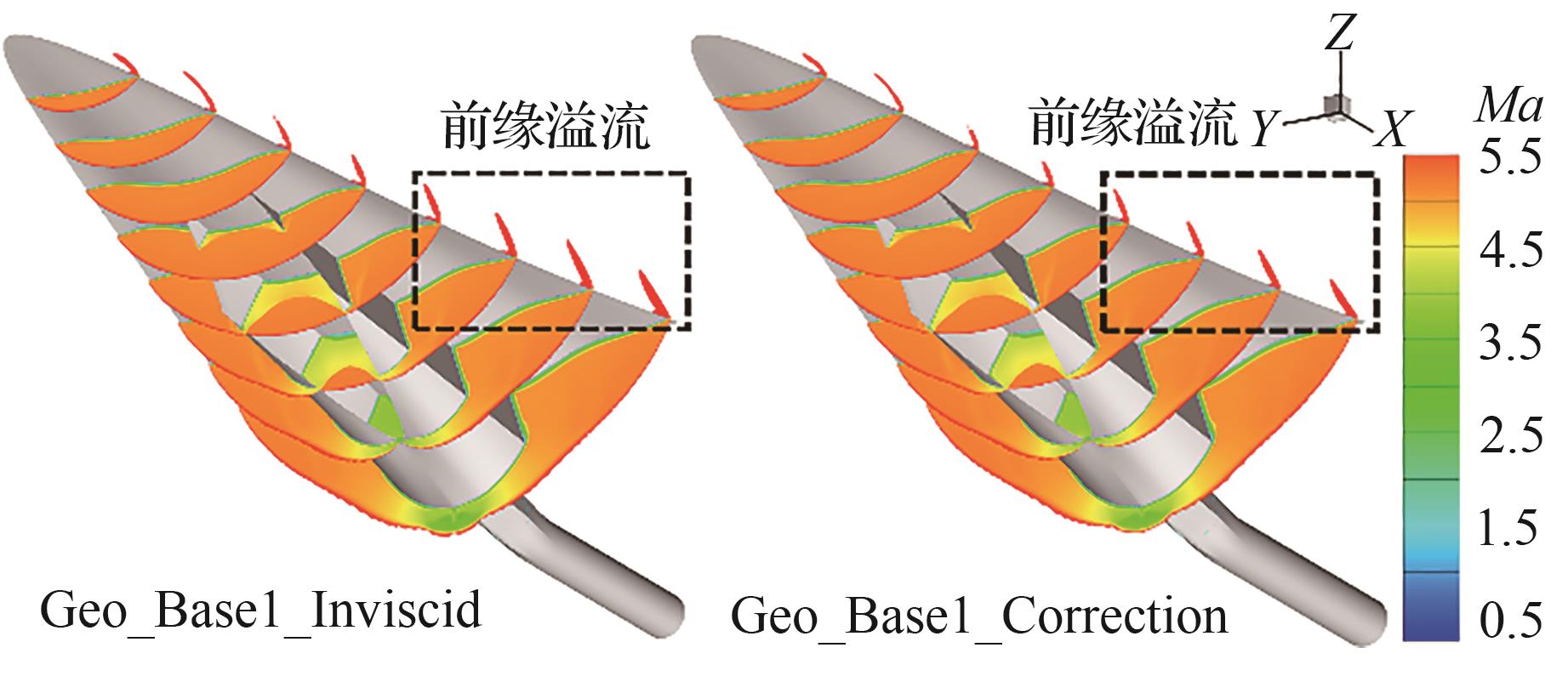
Table 16
Comparison of lift gain before and after correction
| 构型 | 计算 | 前体 | 外罩 | 进气道 | 增益 |
|---|---|---|---|---|---|
Geo_Base1_ Inviscid | 无黏 | 1.245 | 0.676 | 0.185 | 2.106 |
| 黏性 | 1.281 | 0.684 | 0.033 | 1.997 | |
Geo_Base1_ Correction | 黏性 | 1.220 | 0.652 | 0.043 | 1.915 |
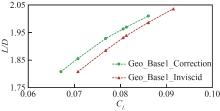
Fig.57
Comparison of lift-drag performance curves before and after viscosity correction
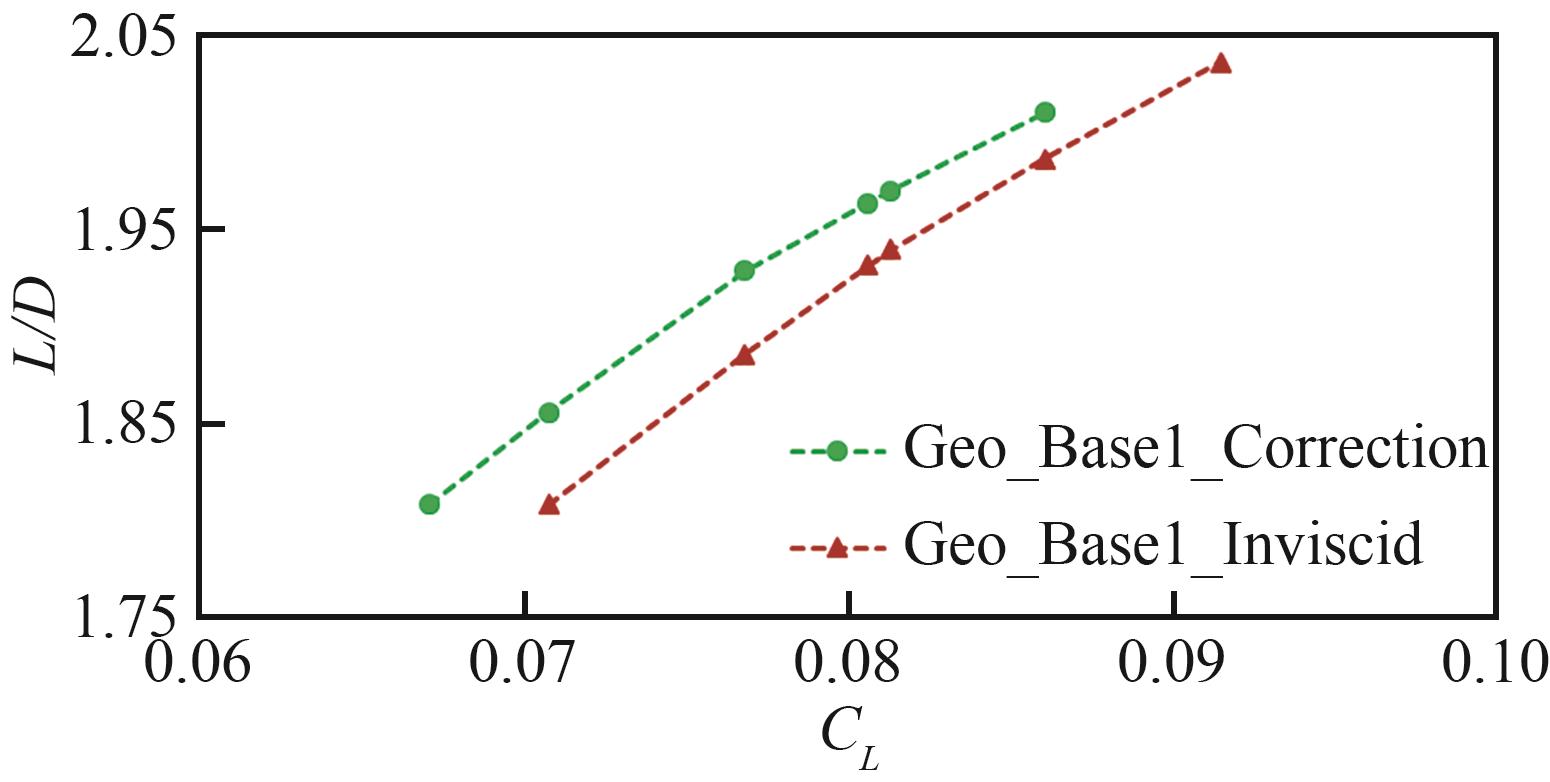
Table 17
Comparison of viscous results at CL =0.070 73
| 构型 | CL | CD | L/D | φ | ||||
|---|---|---|---|---|---|---|---|---|
| Geo_Base1_Inviscid | 0.070 73 | 0.039 12 | 1.807 9 | 0.962 | 0.727 7 | 34.420 5 | 0.577 4 | 39.844 5 |
| Geo_Base1_Correction | 0.070 73 | 0.038 12 | 1.855 5 | 1.004 | 0.739 5 | 28.996 4 | 0.578 3 | 33.442 0 |
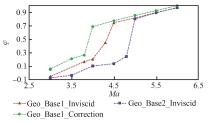
Fig.58
Comparison of wide-speed-range flow coefficients of three integrated configurations
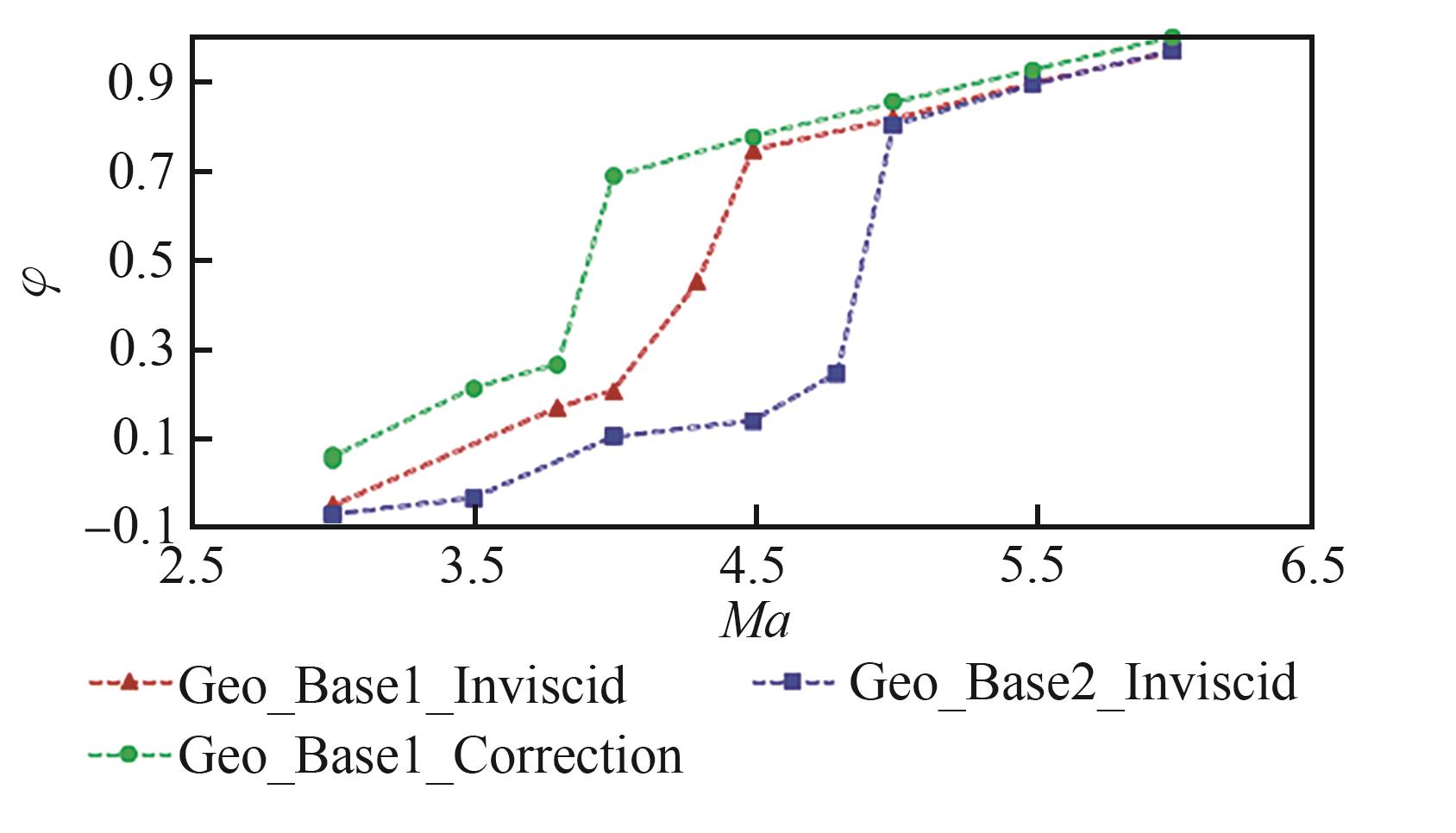
Table 18
Starting ability indexes of different configurations
| 构型 | ICR | SI |
|---|---|---|
| Geo_Base1_Inviscid | 1.902 | 0.823 814 058 |
| Geo_Base2_Inviscid | 2.012 | 0.777 103 911 |
| Geo_Base1_Correction | 1.779 | 0.882 885 242 |
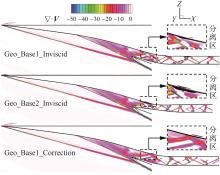
Fig.59
Comparison of shock wave structures and separation regions (black local amplification region) on the symmetric plane at Ma∞=5
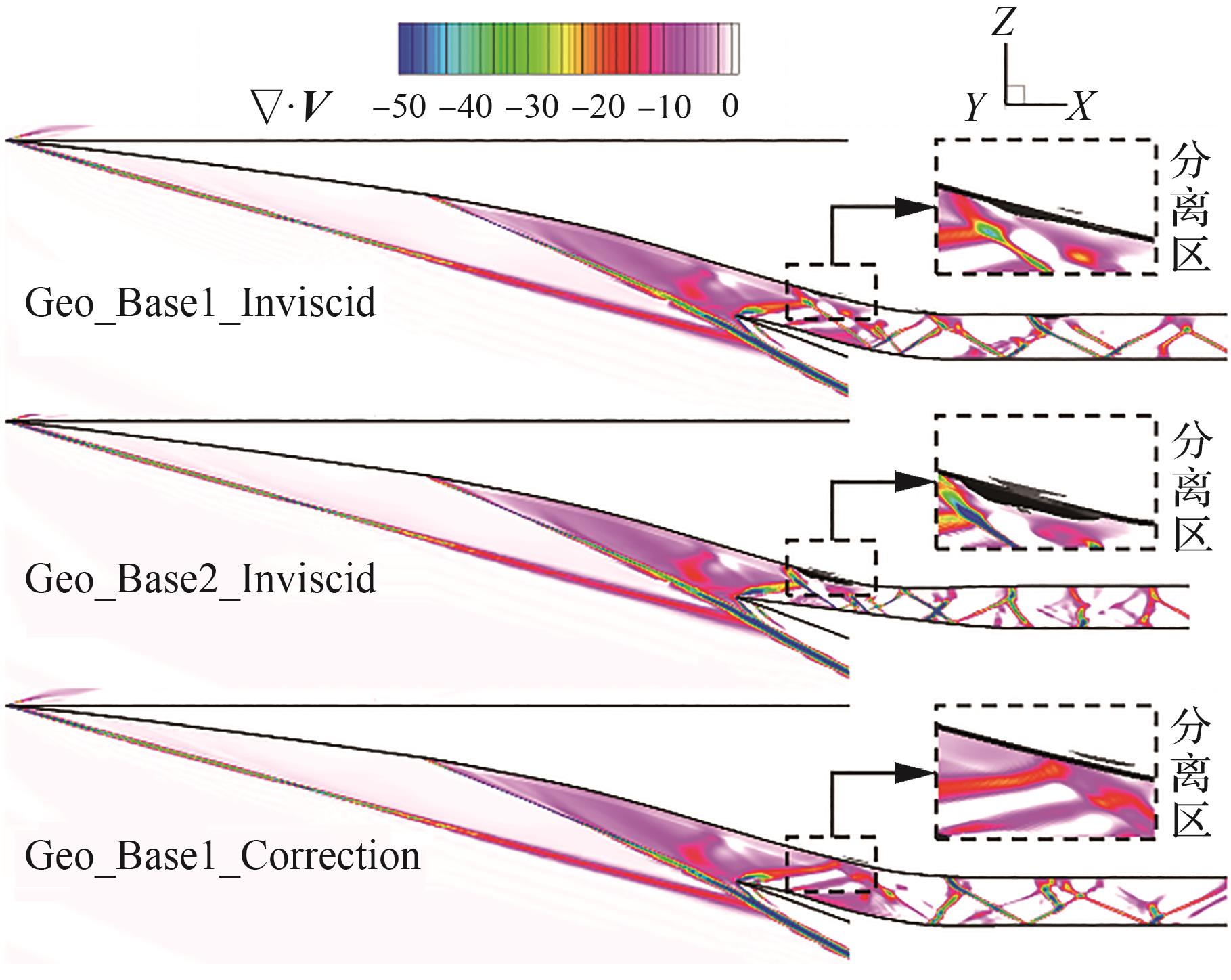
Table 19
Comparison of viscous results at non-design point Ma∞=5
| 构型 | CL | CD | L/D | φ | ||||
|---|---|---|---|---|---|---|---|---|
| Geo_Base1_Inviscid | 0.087 52 | 0.041 18 | 2.124 9 | 0.813 4 | 0.769 8 | 28.831 7 | 0.655 8 | 32.628 7 |
| Geo_Base2_Inviscid | 0.088 64 | 0.044 46 | 1.993 7 | 0.801 6 | 0.740 3 | 33.419 1 | 0.618 4 | 39.501 6 |
| Geo_Base1_Correction | 0.082 59 | 0.038 80 | 2.128 4 | 0.848 9 | 0.785 7 | 23.958 9 | 0.666 9 | 26.243 0 |
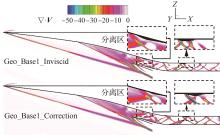
Fig.60
Comparison of shock wave structures and separation regions (black local amplification region) on the symmetric plane at Ma∞=4.5
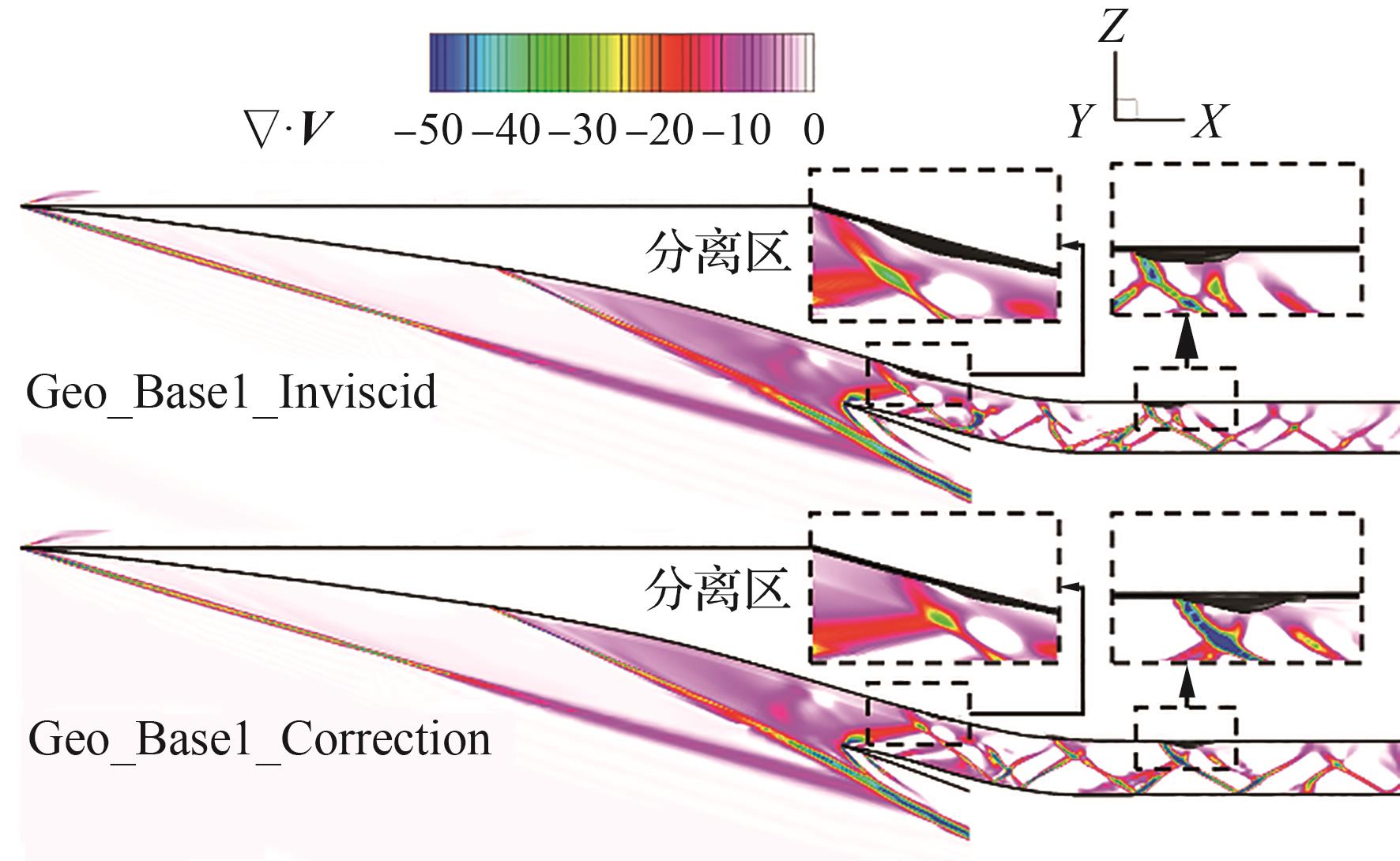
Table 20
Comparison of viscous results at non-design point Ma∞=4.5
| 构型 | CL | CD | L/D | φ | ||||
|---|---|---|---|---|---|---|---|---|
| Geo_Base1_Inviscid | 0.094 01 | 0.043 01 | 2.185 7 | 0.741 3 | 0.765 7 | 28.272 6 | 0.645 1 | 31.828 5 |
| Geo_Base1_Correction | 0.091 14 | 0.040 78 | 2.234 6 | 0.770 9 | 0.796 7 | 22.172 8 | 0.672 0 | 24.807 1 |
| [1] | SZIROCZAK D, SMITH H. A review of design issues specific to hypersonic flight vehicles[J]. Progress in Aerospace Sciences, 2016, 84: 1-28. |
| [2] | 谢赞, 周灿灿, 赵振涛, 等. 宽速域飞行器发展及研究现状综述[J]. 空天技术, 2022(4): 28-39, 86. |
| XIE Z, ZHOU C C, ZHAO Z T, et al. Overview of development and research status of wide speed range aircraft[J]. Aerospace Technology, 2022(4): 28-39, 86 (in Chinese). | |
| [3] | 罗金玲, 李超, 徐锦. 高超声速飞行器机体/推进一体化设计的启示[J]. 航空学报, 2015, 36(1): 39-48. |
| LUO J L, LI C, XU J. Inspiration of hypersonic vehicle with airframe/propulsion integrated design[J]. Acta Aeronautica et Astronautica Sinica, 2015, 36(1): 39-48 (in Chinese). | |
| [4] | 许耀宇, 黄河峡, 谭慧俊, 等. 高超声速飞行器前体/进气道一体化气动设计回顾与展望[J]. 空天技术, 2024(2): 15-38. |
| XU Y Y, HUANG H X, TAN H J, et al. Retrospect and prospect on the aerodynamic integration of hypersonic aircraft forebody/inlet[J]. Aerospace Technology, 2024(2): 15-38 (in Chinese). | |
| [5] | 丁峰, 柳军, 沈赤兵, 等. 乘波概念应用于吸气式高超声速飞行器机体/进气道一体化设计方法研究综述[J]. 实验流体力学, 2018, 32(6): 16-26. |
| DING F, LIU J, SHEN C B, et al. An overview of waverider design concept in airframe-inlet integration methodology for air-breathing hypersonic vehicles[J]. Journal of Experiments in Fluid Mechanics, 2018, 32(6): 16-26 (in Chinese). | |
| [6] | MA Y, GUO M M, TIAN Y, et al. Recent advances and prospects in hypersonic inlet design and intelligent optimization[J]. Aerospace Science and Technology, 2024, 146: 108953. |
| [7] | WALKER S, SHERK J, SHELL D, et al. The DARPA/AF falcon program: the hypersonic technology vehicle #2 (HTV-2) flight demonstration phase: AIAA-2008-2539[R]. Reston: AIAA, 2008. |
| [8] | 李宪开, 王霄, 柳军, 等. 水平起降高超声速飞机气动布局技术研究[J]. 航空科学技术, 2020,31(11): 7-13. |
| LI X K, WANG X, LIU J, et al. Research on the aerodynamic layout design for the horizontal take-off and landing hypersonic aircraft[J]. Aeronautical Science & Technology, 2020, 31(11): 7-13 (in Chinese). | |
| [9] | 乔文友, 余安远. 内转式进气道与飞行器前体的一体化设计综述[J]. 实验流体力学, 2019, 33(3): 43-59. |
| QIAO W Y, YU A Y. Overview on integrated design of inward-turning inlet with aircraft forebody[J]. Journal of Experiments in Fluid Mechanics, 2019, 33(3): 43-59 (in Chinese). | |
| [10] | 罗世彬, 孙雨航, 刘俊, 等. 高超声速乘波前体/进气道一体化设计综述[J]. 空天技术, 2022(6): 24-48. |
| LUO S B, SUN Y H, LIU J, et al. Review of hypersonic waverider forebody/inlet integrated design[J]. Aerospace Technology, 2022(6): 24-48 (in Chinese). | |
| [11] | 张文浩, 柳军, 丁峰. 内转式进气道/冯·卡门乘波体一体化设计方法[J]. 航空学报, 2020, 41(3): 123502. |
| ZHANG W H, LIU J, DING F. Integrated design method of inward turning inlet/Von Karman waverider[J]. Acta Aeronautica et Astronautica Sinica, 2020, 41(3): 123502 (in Chinese). | |
| [12] | LI Y Q, ZHENG X G, SHI C G, et al. Integration of inward-turning inlet with airframe based on dual-waverider concept[J]. Aerospace Science and Technology, 2020, 107: 106266. |
| [13] | LI Y Q, ZHENG X G, TENG J, et al. Dual waverider concept for inlet-airframe integration with controllable wall pressure distribution: AIAA-2017-2225[R]. Reston: AIAA, 2017. |
| [14] | 郑晓刚, 林德寿, 方啸雷, 等. 基于局部偏转吻切方法的背部进气高超飞行器一体化设计研究[J]. 空天技术, 2023(5): 1-10. |
| ZHENG X G, LIN D S, FANG X L, et al. Research on the integration design of hypersonic vehicles with dorsal inlets based on the local-turning osculating cones method[J]. Aerospace Technology, 2023(5): 1-10 (in Chinese). | |
| [15] | 南向军, 张堃元, 金志光. 乘波前体两侧高超声速内收缩进气道一体化设计[J]. 航空学报, 2012, 33(8): 1417-1426. |
| NAN X J, ZHANG K Y, JIN Z G. Integrated design of waverider forebody and lateral hypersonic inward turning inlets[J]. Acta Aeronautica et Astronautica Sinica, 2012, 33(8): 1417-1426 (in Chinese). | |
| [16] | DING F, LIU J, SHEN C B, et al. Novel inlet-airframe integration methodology for hypersonic waverider vehicles[J]. Acta Astronautica, 2015, 111: 178-197. |
| [17] | 贺旭照, 卫锋, 刘福军, 等. 最小波阻锥导乘波体和三维内转式进气道一体化设计[J]. 空气动力学学报, 2022, 40(1): 77-83. |
| HE X Z, WEI F, LIU F J, et al. Integrated design of minimal wave drag cone-derived waveriders and three-dimensional inward turning inlets[J]. Journal of Experiments in Fluid Mechanics, 2022, 40(1): 77-83 (in Chinese). | |
| [18] | 李永洲, 张堃元, 钟启涛. 四段修型弥散反射激波中心体基准流场研究[J]. 航空动力学报, 2014, 29(9): 2055-2062. |
| LI Y Z, ZHANG K Y, ZHONG Q T. Investigation of basic flowfield with center body consisting of four spline curves diffusing reflected shock wave[J]. Journal of Aerospace Power, 2014, 29(9): 2055-2062 (in Chinese). | |
| [19] | 何家祥, 金东海. 基于Busemann压升规律的可控消波内转基准流场设计[J]. 航空动力学报, 2017, 32(5): 1168-1175. |
| HE J X, JIN D H. Busemann pressure rise distribution based design of inward turning basic flowfield with controlled and cancelled shock waves[J]. Journal of Aerospace Power, 2017, 32(5): 1168-1175 (in Chinese). | |
| [20] | 李永洲, 张堃元, 朱伟, 等. 双弯曲入射激波的可控中心体内收缩基准流场设计[J]. 航空动力学报, 2015, 30(3): 563-570. |
| LI Y Z, ZHANG K Y, ZHU W, et al. Design for inward turning basic flowfield with controlled center body and two incident curved shock waves[J]. Journal of Aerospace Power, 2015, 30(3): 563-570 (in Chinese). | |
| [21] | 卫锋, 贺旭照, 贺元元, 等. 三维内转式进气道双激波基准流场的设计方法[J]. 推进技术, 2015, 36(3): 358-364. |
| WEI F, HE X Z, HE Y Y, et al. Design method of dual-shock wave basic flow-field for inward turning inlet[J]. Journal of Propulsion Technology, 2015, 36(3): 358-364 (in Chinese). | |
| [22] | 丁峰. 吸气式高超声速飞行器内外流一体化“全乘波”气动设计理论和方法研究[D]. 长沙: 国防科技大学, 2016. |
| DING F. Study on the theory and method of aerodynamic design of “full wave” for air-breathing hypersonic vehicle with internal and external flow integration[D]. Changsha: National University of Defense Technology, 2016 (in Chinese). | |
| [23] | 陈军, 屈峰, 付俊杰. 基于遗传/梯度混合优化策略的高超内转式进气道设计方法研究[J]. 航空学报, 2025, 46(3): 245-266. |
| CHEN J, QU F, FU J J, et al. Research on design method of the hypersonic inward turning inlet based on genetic and gradient hybrid optimization strategy[J]. Acta Aeronautica et Astronautica Sinica, 2025, 46(3): 245-266. | |
| [24] | 王晓峰, 屈峰, 付俊杰, 等. 基于离散伴随的高超内转式进气道气动优化设计[J]. 航空学报, 2023, 44(19): 56-72. |
| WANG X F, QU F, FU J J, et al. Discretized adjoint based aerodynamic design optimization for the hypersonic inward turning inlet[J]. Acta Aeronautica et Astronautica Sinica, 2023, 44(19): 56-72 (in Chinese). | |
| [25] | DRAYNA T, NOMPELIS I, CANDLER G. Hypersonic inward turning inlets: Design and optimization: AIAA-2006-0297[R]. Reston: AIAA, 2006. |
| [26] | ANDERSON J D. Fundamentals of Aerodynamics[M]. 4th. New York: McGraw Hill Companies, Inc., 2006. |
| [27] | 王旭东, 王江峰, 程克明, 等. 黏性边界层修正对前体/进气道一体化乘波布局气动性能影响分析[J]. 空气动力学学报, 2021, 39(3): 62-70. |
| WANG X D, WANG J F, CHENG K M, et al. Aerodynamic analysis of viscous boundary layer correction on integrated airframe-inlet waverider[J]. Acta Aerodynamica Sinica, 2021, 39(3): 62-70 (in Chinese). | |
| [28] | 陈栋梁. 流线追踪Busemann进气道粘性修正方法研究[D]. 长沙: 国防科技大学, 2009. |
| CHEN D L. Study on viscosity correction method of Busemann inlet with streamline tracking[D]. Changsha: National University of Defense Technology, 2009 (in Chinese). | |
| [29] | ZUCROW M J, HOFFMAN J D. Gas dynamics, Vol. 1[M]. New York: John Wiley and Sons, Inc., 1976. |
| [30] | ZHONG J X, QU F, SUN D, et al. Low-frequency unsteadiness mechanisms of unstart flow in an inlet with rectangular-to-elliptical shape transition under off-design condition at a Mach number of 4[J]. Journal of Fluid Mechanics, 2024, 991: A9. |
| [31] | JAMESON A, YOON S. Lower-upper implicit schemes with multiple grids for the Euler equations[J]. AIAA Journal, 1987, 25(7): 929-935. |
| [32] | REINARTZ B U, HERRMANN C D, BALLMANN J, et al. Aerodynamic performance analysis of a hypersonic inlet isolator using computation and experiment[J]. Journal of Propulsion and Power, 2003, 19(5): 868-875. |
| [33] | 刘传振, 白鹏, 陈冰雁, 等. 定平面形状乘波体及设计变量影响分析[J]. 宇航学报, 2017, 38(5): 451-458. |
| LIU C Z, BAI P, CHEN B Y, et al. Analysis on design variables for planform-controllable waverider[J]. Journal of Astronautics, 2017, 38(5): 451-458 (in Chinese). | |
| [34] | 李永洲. 马赫数分布可控的高超声速内收缩进气道及其一体化设计研究[D]. 南京: 南京航空航天大学, 2014. |
| LI Y Z. Study on hypersonic internal contraction inlet with controllable Mach number distribution and its integrated design[D]. Nanjing: Nanjing University of Aeronautics and Astronautics, 2014 (in Chinese). | |
| [35] | MOLDER S, TIMOFEEV E, TAHIR R. Flow starting in high compression hypersonic air inlets by mass spillage: AIAA-2004-4130[R]. Reston: AIAA, 2004. |
| [36] | NAJAFIYAZDI A, TAHIR R, TIMOFEEV E, et al. Analytical and numerical study of flow starting in supersonic inlets by mass spillage: AIAA-2007-5072[R]. Reston: AIAA, 2007. |
| [37] | 董昊, 耿玺, 程克明, 等. 高超声速内收缩进气道设计与优化[M]. 北京: 科学出版社, 2018. |
| DONG H, GENG X, CHENG K M, et al. Design and optimization of hypersonic inward turning inlet[M]. Beijing: Science Press, 2018 (in Chinese). | |
| [38] | 南向军. 压升规律可控的高超声速内收缩进气道设计方法研究[D]. 南京: 南京航空航天大学, 2012. |
| NAN X J. Investigation on design methodology of hypersonic inward turning inlets with controlled pressure rise law[D]. Nanjing: Nanjing University of Aeronautics and Astronautics, 2012 (in Chinese). | |
| [39] | 钟亚飞, 马宏伟, 郭君德, 等. 航空发动机进气总压畸变地面试验数据处理方法综述[J]. 航空发动机, 2021, 47(1): 72-85. |
| ZHONG Y F, MA H W, GUO J D, et al. Review of ground test data processing method of aeroengine inlet total pressure distortion[J]. Aeroengine, 2021, 47(1): 72-85 (in Chinese). | |
| [40] | SUN B, ZHANG K Y. Empirical equation for self-starting limit of supersonic inlets[J]. Journal of Propulsion and Power, 2010, 26(4): 874-875. |
| [1] | Xiaogang ZHENG, Zhancang HU, Zejun CAI, Chongguang SHI, Chengxiang ZHU, Yancheng YOU. Design of 3D inward-turning inlet considering cruising angle of attack [J]. Acta Aeronautica et Astronautica Sinica, 2025, 46(8): 631233-631233. |
| [2] | Xiaogang ZHENG, Chongguang SHI, Jiale ZHANG, Mi ZHANG, Wenlei ZHU, Chengxiang ZHU, Yancheng YOU. Research progress review on hypersonic three-dimensional inward-turning inlet [J]. Acta Aeronautica et Astronautica Sinica, 2025, 46(8): 631245-631245. |
| [3] | Jun CHEN, Feng QU, Junjie FU. Design method of hypersonic inward turning inlet based on genetic and gradient hybrid optimization strategy [J]. Acta Aeronautica et Astronautica Sinica, 2025, 46(3): 130808-130808. |
| [4] | Lili CHEN, Jianxia LIU, Juntao ZHANG, Zheng GUO, Anping WU, Zhongxi HOU. Waverider forebody design method with longitudinal segments and multi-stage compression [J]. Acta Aeronautica et Astronautica Sinica, 2024, 45(4): 128744-128744. |
| [5] | Dingchong LYU, Shoujun ZHAO, Si ZENG, Jian FU, Xintong HU, Huixiang LIU, Kefei MIAO, Yongling FU. Key technologies and challenges of high⁃performance servo⁃motor⁃pumps [J]. Acta Aeronautica et Astronautica Sinica, 2024, 45(15): 630225-630225. |
| [6] | Weihong ZHANG, Han ZHOU, Shaoying LI, Jihong ZHU, Lu ZHOU. Material⁃structure integrated design for high⁃performance aerospace thin⁃walled component [J]. ACTA AERONAUTICAET ASTRONAUTICA SINICA, 2023, 44(9): 627428-627428. |
| [7] | Shuai HAO, Tielin MA, Yi WANG, Jinwu XIANG, Hongzhong MA, Baifeng JIANG, Jun CAO. Progress and application of key technologies of SensorCraft [J]. ACTA AERONAUTICAET ASTRONAUTICA SINICA, 2023, 44(6): 27034-027034. |
| [8] | Yuanyuan TU, Dayi WANG, Xiangyan ZHANG, Jiaxing LI, Xiaofeng HUANG. Reconfigurability and autonomous reconfiguration methods of spacecraft [J]. Acta Aeronautica et Astronautica Sinica, 2023, 44(23): 628855-628855. |
| [9] | Yulin DING, Zhonghua HAN, Jianling QIAO, Han NIE, Wenping SONG, Bifeng SONG. Research progress in key technologies for conceptual-aerodynamic configuration design of supersonic transport aircraft [J]. ACTA AERONAUTICAET ASTRONAUTICA SINICA, 2023, 44(2): 626310-626310. |
| [10] | Yongzhou LI, Di SUN, Renhua WANG, Kunyuan ZHANG. Design of inward turning inlet with controlled Mach number under non-uniform inflow [J]. ACTA AERONAUTICAET ASTRONAUTICA SINICA, 2023, 44(12): 127857-127857. |
| [11] | WANG Zhixiang, LEI Yongjun, DUAN Jingbo, OUYANG Xing, ZHANG Dapeng, WANG Jie. Multi-region integrated design and optimization of concentrated-force diffusion component in heavy-lift launch vehicle [J]. ACTA AERONAUTICAET ASTRONAUTICA SINICA, 2022, 43(3): 225135-225135. |
| [12] | ZHANG Wenhao, LIU Jun, DING Feng. Integrated design method of inward turning inlet/Von Karman waverider [J]. ACTA AERONAUTICAET ASTRONAUTICA SINICA, 2020, 41(3): 123502-123502. |
| [13] | JIANG Yongsong, ZHENG Wentao, ZHAO Hang, YANG Mingsui, WANG Yongmei. Low noise design of fan outlet guide vane, part Ⅰ: Method and optimization [J]. ACTA AERONAUTICAET ASTRONAUTICA SINICA, 2019, 40(10): 122955-122955. |
| [14] | ZHENG Wentao, JIANG Yongsong, ZHAO Hang, PAN Ruochi, ZHAO Yong. Low noise design of fan outlet guide vane, part Ⅱ: Numerical verifications [J]. ACTA AERONAUTICAET ASTRONAUTICA SINICA, 2019, 40(10): 122956-122956. |
| [15] | SHEN Zhengyang, CHEN Xiaoming, HUANG Lingcai. Challenges for aircraft design due to special mission models of large-scale amphibious aircraft [J]. ACTA AERONAUTICAET ASTRONAUTICA SINICA, 2019, 40(1): 522400-522400. |
| Viewed | ||||||
|
Full text |
|
|||||
|
Abstract |
|
|||||
Address: No.238, Baiyan Buiding, Beisihuan Zhonglu Road, Haidian District, Beijing, China
Postal code : 100083
E-mail:hkxb@buaa.edu.cn
Total visits: 6658907 Today visits: 1341All copyright © editorial office of Chinese Journal of Aeronautics
All copyright © editorial office of Chinese Journal of Aeronautics
Total visits: 6658907 Today visits: 1341

 CJA
CJA
