Acta Aeronautica et Astronautica Sinica ›› 2024, Vol. 45 ›› Issue (S1): 730699.doi: 10.7527/S1000-6893.2024.30699
• Articles • Previous Articles Next Articles
Dong SUI, Zhipeng CUI( )
)
Received:2024-05-17
Revised:2024-06-16
Accepted:2024-07-01
Online:2024-12-25
Published:2024-07-08
Contact:
Zhipeng CUI
E-mail:17327085979.czp@nuaa.edu.cn
Supported by:CLC Number:
Dong SUI, Zhipeng CUI. A method for determining capacity of air routes intersection based on carbon emissions[J]. Acta Aeronautica et Astronautica Sinica, 2024, 45(S1): 730699.
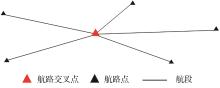
Fig.1
Geometry of intersection of air routes
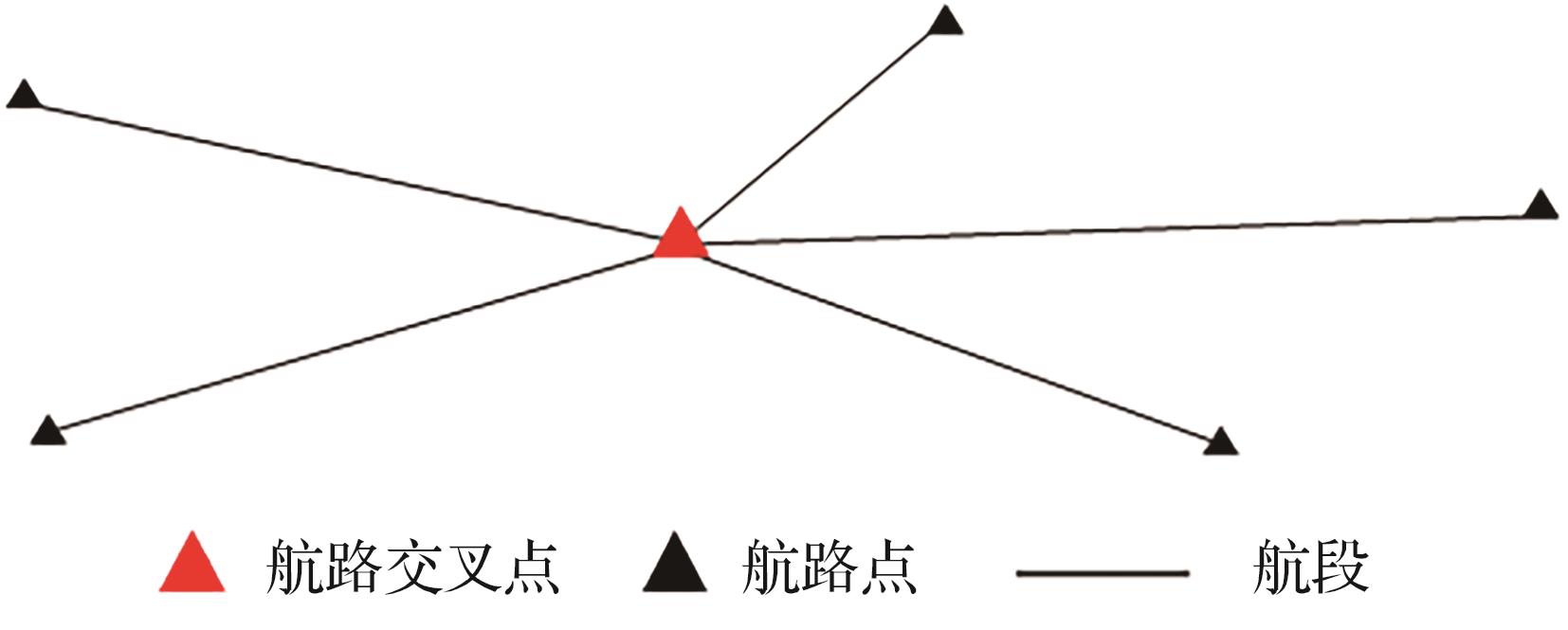
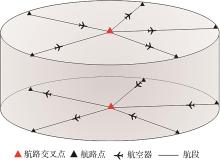
Fig.2
Aircraft operation diagram
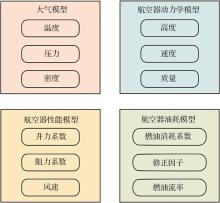
Fig.3
Aircraft fuel consumption calculation model
Table 1
Weather at the waypoint (14:00—15:00, 7 800 m)
| 航路点 | Wx /(m·s-1) | Wy /(m·s-1) | W/(m·s-1) | T/K |
|---|---|---|---|---|
| HFE | 0.93 | 11.37 | 11.41 | 283.21 |
| LKO | -3.26 | -3.06 | 4.47 | 282.44 |
| ZHO | -2.58 | -10.22 | 10.54 | 283.64 |
| PAVTU | -4.09 | -3.23 | 5.21 | 281.77 |
| KHN | -0.91 | 7.34 | 7.40 | 281.61 |
| PANKO | 1.30 | 4.85 | 5.02 | 282.26 |
Table 2
Partial flight information
| 时间 | VGS/(km·h-1) | H/m | 经度/(°) | 纬度/(°) |
|---|---|---|---|---|
| 0813143253 | 487 | 3 422 | 103.079 4 | 25.149 85 |
| 0813143301 | 496 | 3 529 | 103.088 2 | 25.151 23 |
| 0813143309 | 506 | 3 635 | 103.097 3 | 25.152 65 |
| 0813143317 | 518 | 3 741 | 103.106 8 | 25.154 1 |
| 0813143325 | 523 | 3 848 | 103.116 7 | 25.155 62 |
| 0813143333 | 540 | 3 955 | 103.126 9 | 25.157 2 |
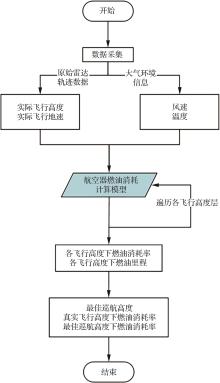
Fig.4
Flowchart for calculating optimal cruising altitude
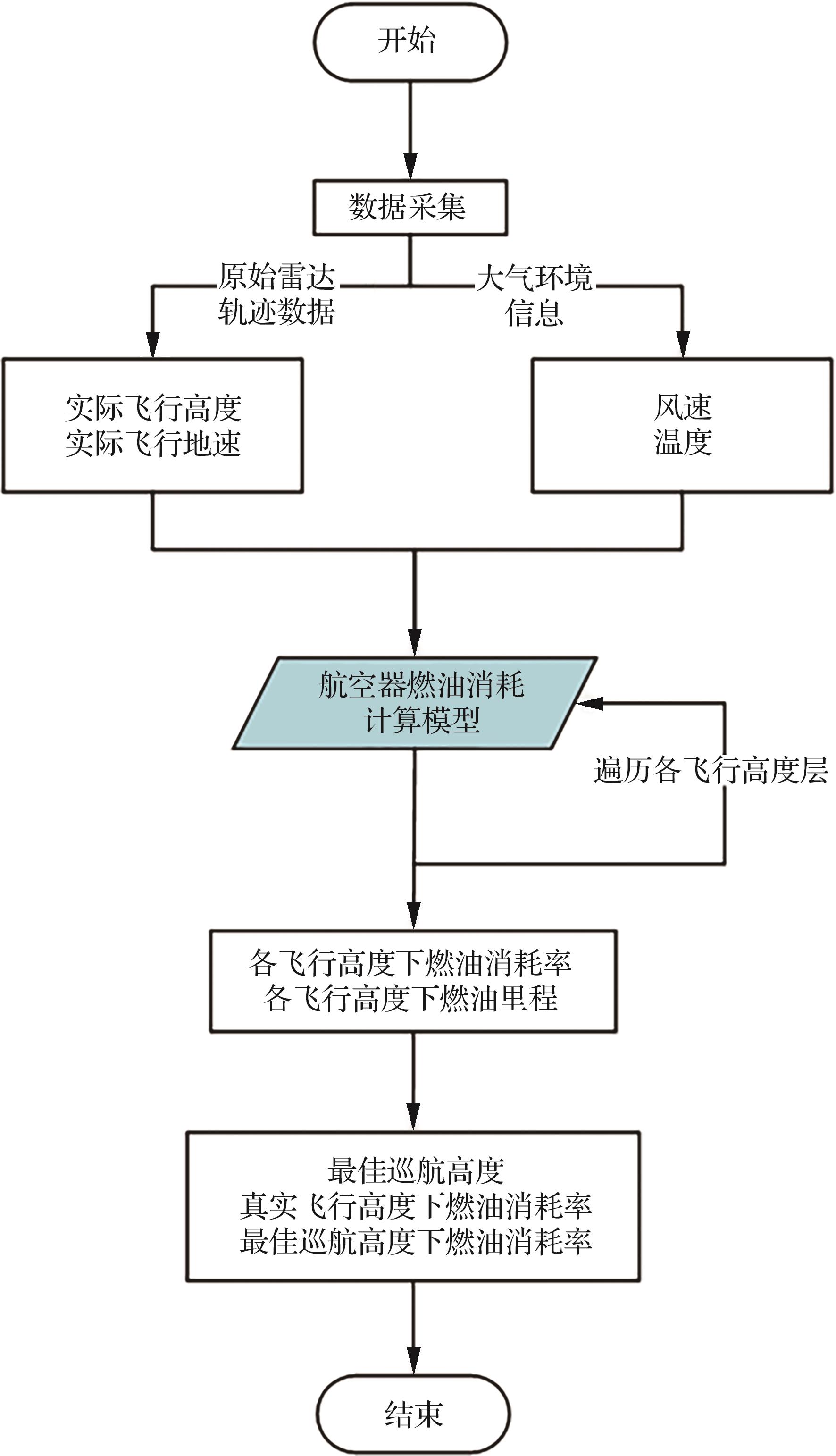
Fig.5
Fitting result of height deviation cumulative value
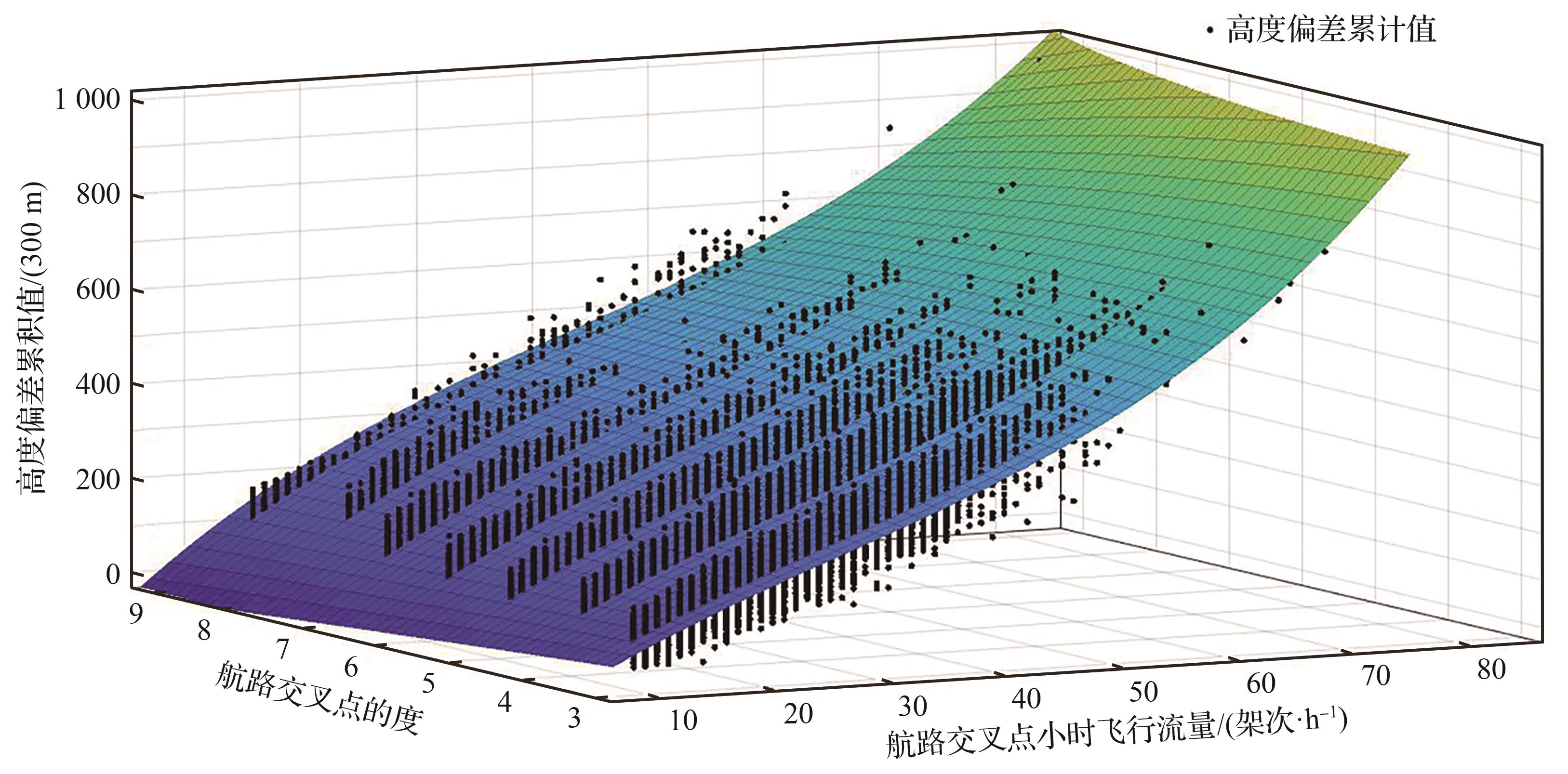
Fig.6
Fitting result of hourly additional carbon dioxide emissions
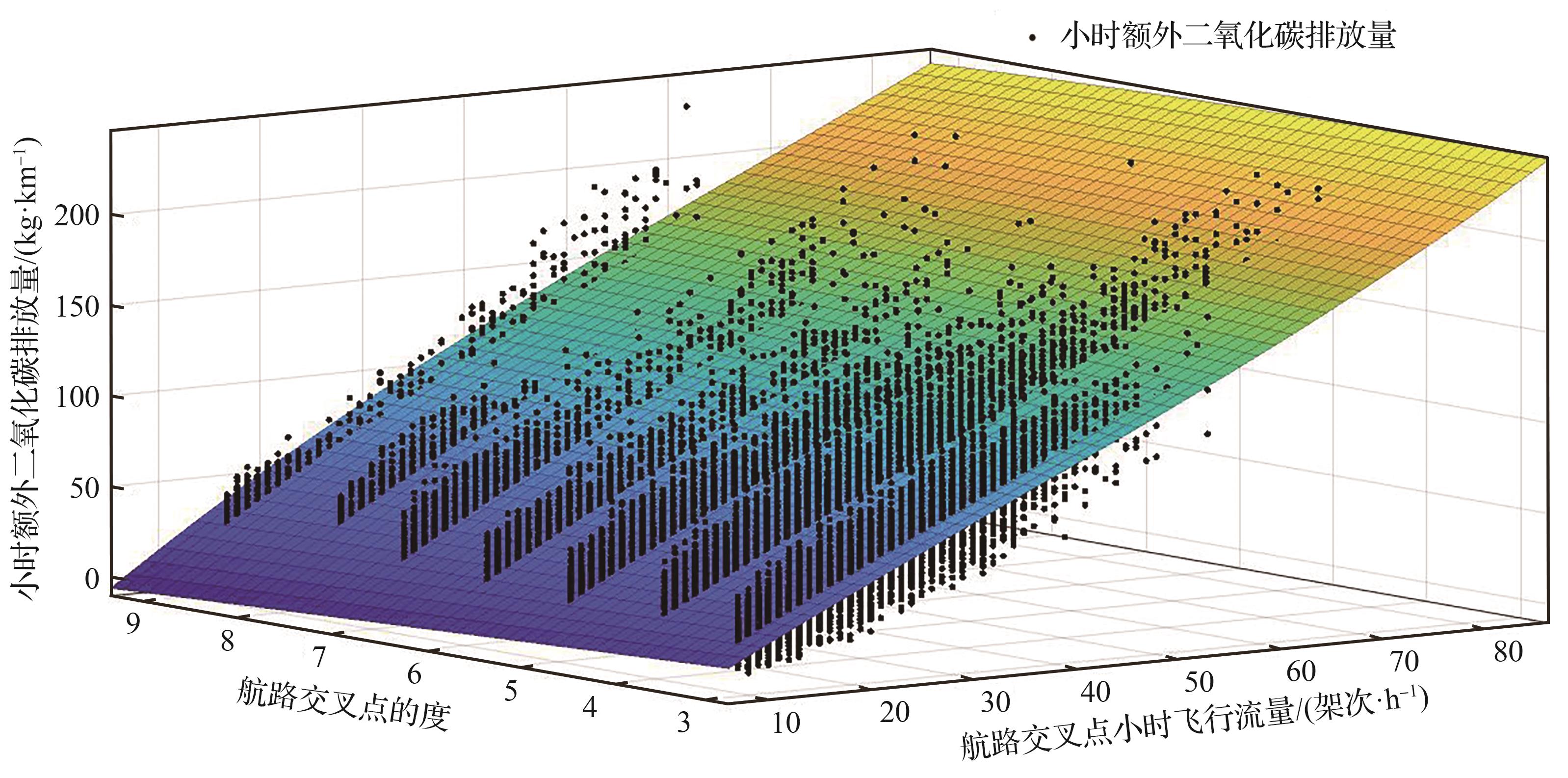
Table 3
Hourly traffic capacity of intersection of air routes
| 航路交叉点的度 | 3 | 4 | 5 | 6 | 7 | 8 | 9 |
|---|---|---|---|---|---|---|---|
小时通行能力/ (架次·h-1) | 34 | 39 | 45 | 50 | 56 | 61 | 67 |
Fig.7
Fitting result of daily additional carbon dioxide emissions
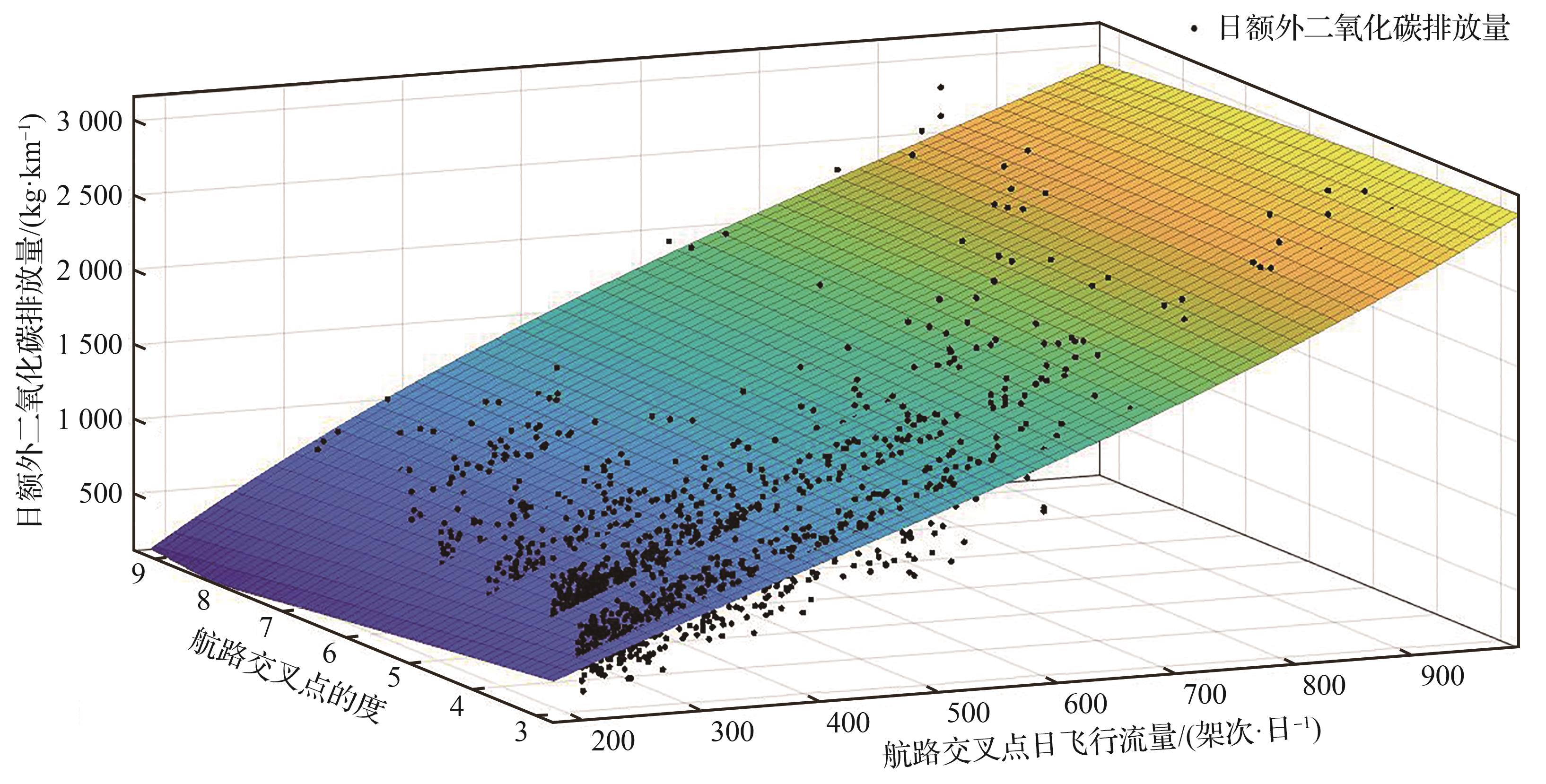
Table 4
Daily traffic capacity of intersection of air routes
| 航路交叉点的度 | 3 | 4 | 5 | 6 | 7 | 8 | 9 |
|---|---|---|---|---|---|---|---|
日通行能力/ (架次·日-1) | 425 | 494 | 562 | 631 | 699 | 768 | 836 |
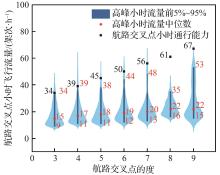
Fig.8
Comparison of carbon emissions-based hourly traffic capacity of air routes intersection and peak hourly flow
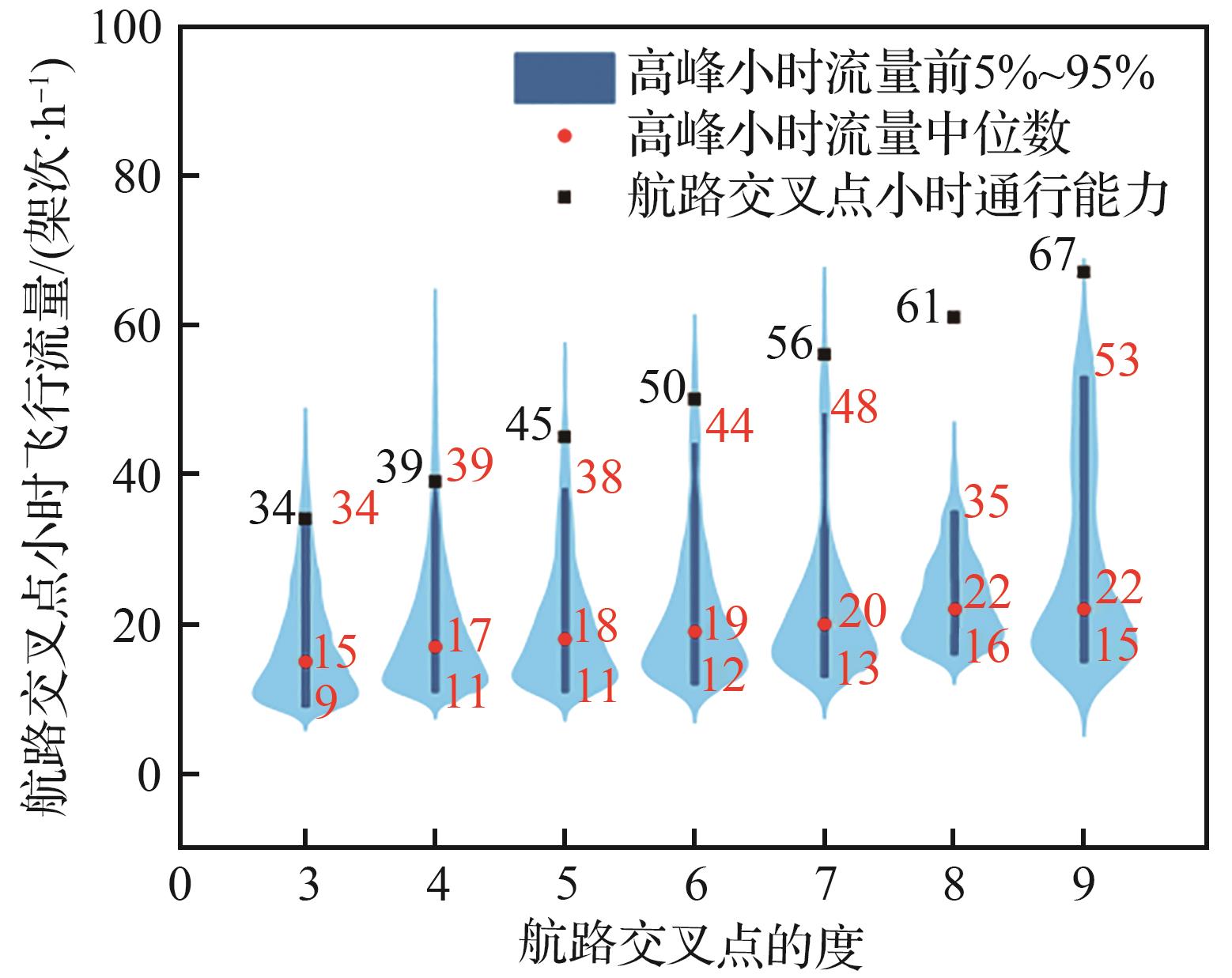
Table 5
Carbon emissions-based hourly traffic capacity and safety-based hourly traffic capacity
| 繁忙航路点 | 度 | 最大小时飞行流量/(架次·h-1) | 基于安全性的小时通行能力/(架次·h-1) | 基于碳排放的小时通行能力/(架次·h-1) |
|---|---|---|---|---|
| DODSA | 3 | 58 | 58 | 34 |
| P324 | 4 | 75 | 75 | 39 |
| P263 | 5 | 65 | 65 | 45 |
| DHB | 6 | 75 | 75 | 50 |
| WHA | 7 | 67 | 67 | 56 |
| TOL | 8 | 45 | 45 | 61 |
| HFE | 9 | 82 | 82 | 67 |
Fig.9
Comparison of average additional CO2 emissions from aircraft when hourly flow is greater than or equal to hourly capacity
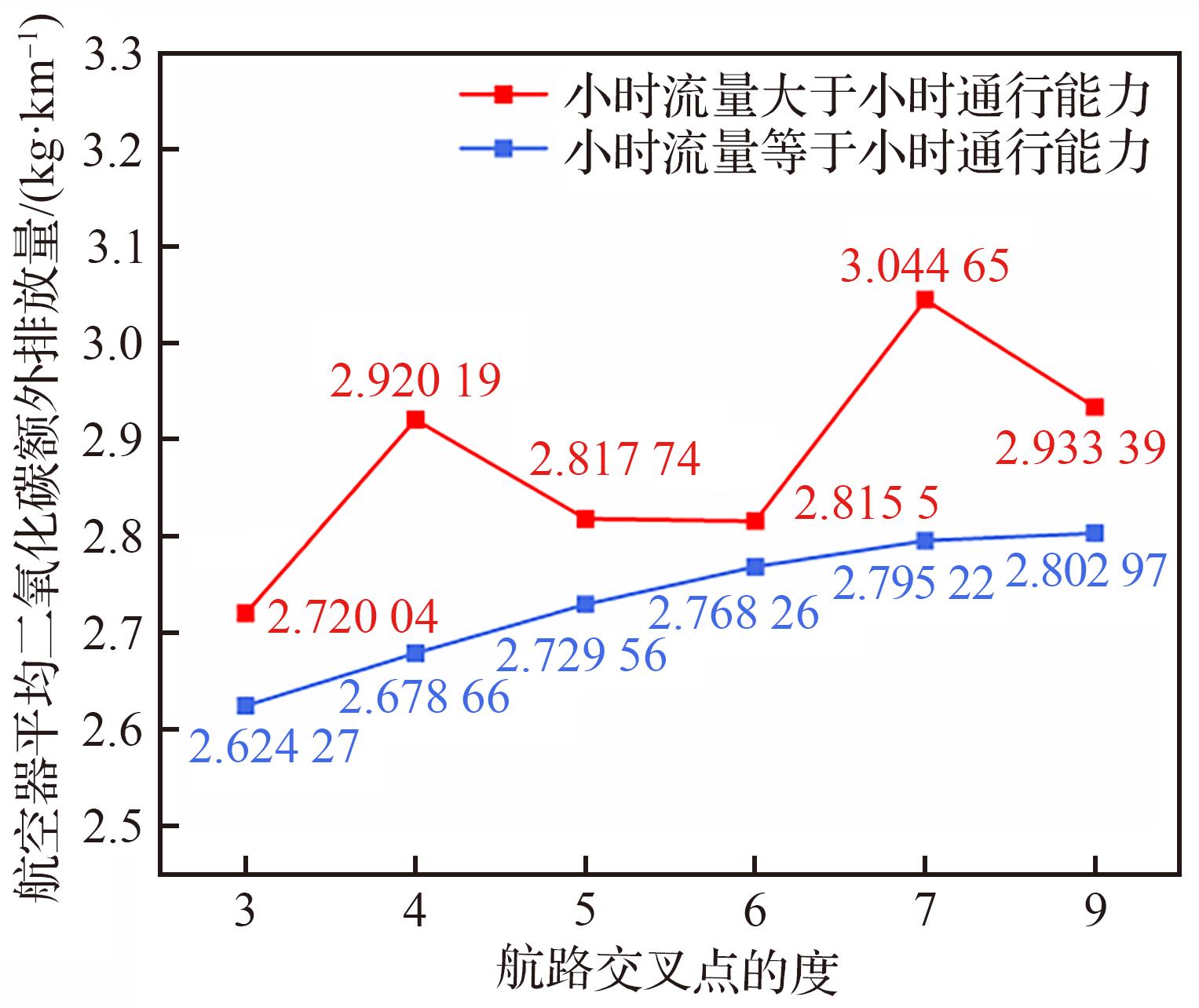
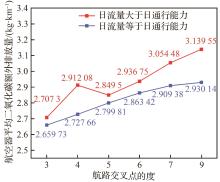
Fig.10
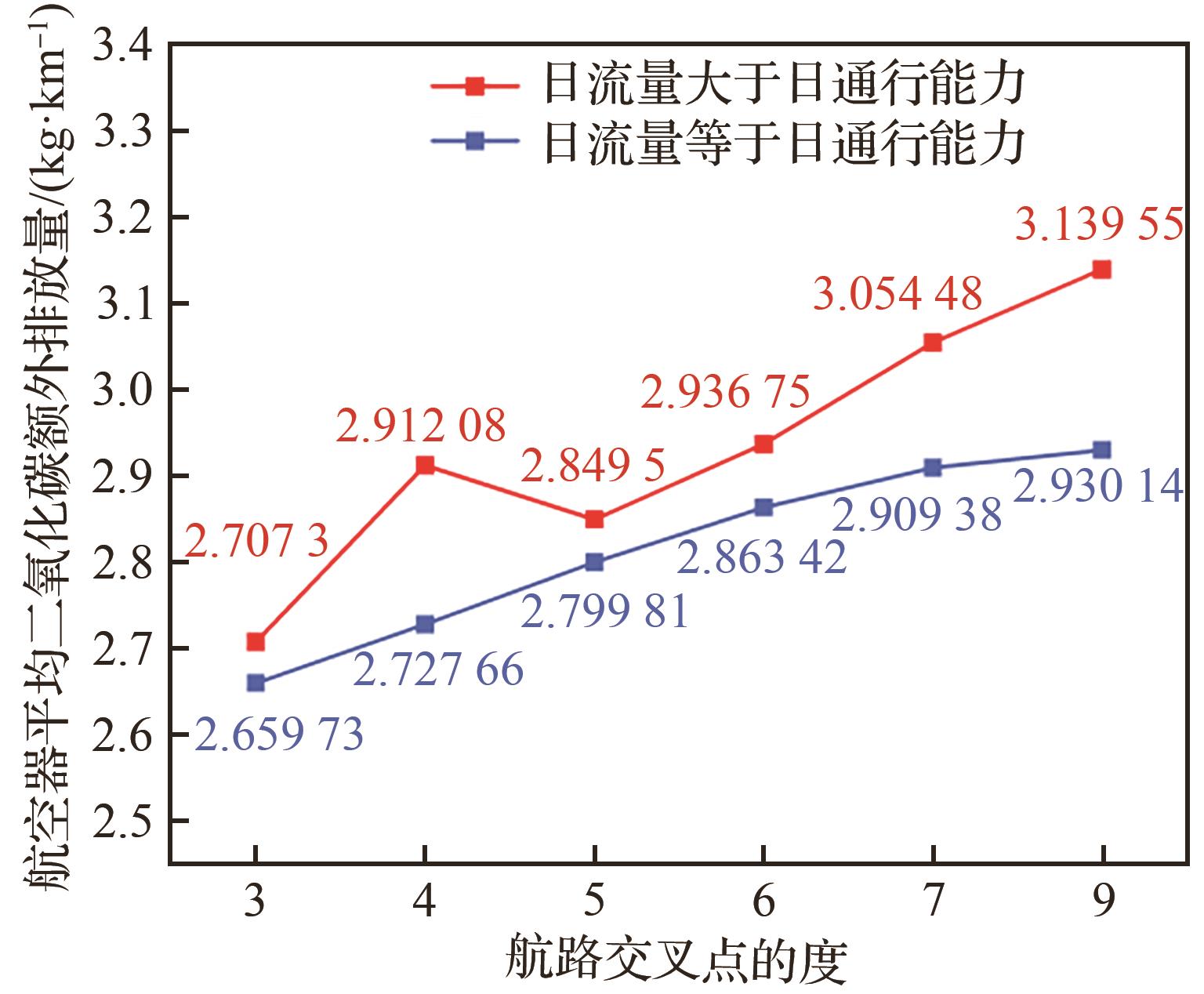
Comparison of average additional CO2 emissions from aircraft when daily flow is greater than or equal to daily capacity
| 1 | ZHOU W J, WANG T, YU Y D, et al. Scenario analysis of CO2 emissions from China’s civil aviation industry through 2030[J]. Applied Energy, 2016, 175: 100-108. |
| 2 | Transport Action Group AIR. Aviation: Benefits beyond borders[R]. ATAG, 2020. |
| 3 | LIU J, TIAN J Y, LYU W J, et al. The impact of COVID-19 on reducing carbon emissions: From the angle of international student mobility[J]. Applied Energy, 2022, 317: 119136. |
| 4 | ICAO Resolution A38-18[EB/OL]. [2014-09-09]. . |
| 5 | ICAO. Long-term traffic forecast: Passenger and cargo[R]. Chicago: ICAO, 2019. |
| 6 | BARCZAK A, DEMBIŃSKA I, ROZMUS D, et al. The impact of COVID-19 pandemic on air transport passenger markets-implications for selected EU airports based on time series models analysis[J]. Sustainability, 2022, 14(7): 4345. |
| 7 | SEKINE K, TATSUKAWA T, ITOH E, et al. Multi-objective takeoff time optimization using cellular automaton-based simulator[J]. IEEE Access, 2021, 9: 79461-79476. |
| 8 | BRUECKNER J K, ABREU C. Airline fuel usage and carbon emissions: Determining factors[J]. Journal of Air Transport Management, 2017, 62: 10-17. |
| 9 | TURGUT E T, CAVCAR M, USANMAZ O, et al. Fuel flow analysis for the cruise phase of commercial aircraft on domestic routes[J]. Aerospace Science and Technology, 2014, 37: 1-9. |
| 10 | YIN S W, HAN K, OCHIENG W Y, et al. Joint apron-runway assignment for airport surface operations[J]. Transportation Research Part B: Methodological, 2022, 156: 76-100. |
| 11 | 王超, 任云鸿. 面向节油减排的平行多跑道混合运行机场停机位分配模型[J]. 交通信息与安全, 2021, 39(5): 144-152. |
| WANG C, REN Y H. A model of gate allocation for parallel multi-runway hybrid operation from the perspective of fuel-saving and carbon emission reduction[J]. Journal of Transport Information and Safety, 2021, 39(5): 144-152 (in Chinese). | |
| 12 | 李汝宁, 冯兴. 基于改进遗传算法的最小油耗机场飞行区布局优化[J]. 重庆交通大学学报(自然科学版), 2022, 41(12): 48-55. |
| LI R N, FENG X. Flight area layout optimization of airfield with minimum fuel consumption based on improved genetic algorithm[J]. Journal of Chongqing Jiaotong University (Natural Science), 2022, 41(12): 48-55 (in Chinese). | |
| 13 | 江波, 周云帆, 李诚龙, 等. 控制污染物排放的支线机场跑滑结构优化仿真[J]. 系统仿真学报, 2020, 32(3): 501-508. |
| JIANG B, ZHOU Y F, LI C L, et al. Optimization simulation of Feeder airport runway structure for pollutant discharge control[J]. Journal of System Simulation, 2020, 32(3): 501-508 (in Chinese). | |
| 14 | 谢华, 黎子弘, 杨磊, 等. 容量受限下城市对航班四维航迹优化[J]. 航空学报, 2022, 43(8): 325581. |
| XIE H, LI Z H, YANG L, et al. Optimization of four-dimensional trajectory of city pair with limited capacity[J]. Acta Aeronautica et Astronautica Sinica, 2022, 43(8): 325581 (in Chinese). | |
| 15 | PONS-PRATS J, BUGEDA G, ZARATE F, et al. Applying multi-objective robust design optimization procedure to the route planning of a commercial aircraft[C]∥European Congress on Computational Methods in Applied Sciences and Engineering. Cham: Springer, 2018: 147-167. |
| 16 | 戴福青, 庞笔照, 赵元棣. 带偏好的交叉航路角度优化模型[J]. 西南交通大学学报, 2019, 54(1): 180-188. |
| DAI F Q, PANG B Z, ZHAO Y D. Air route crossing angles optimization model with different preferences[J]. Journal of Southwest Jiaotong University, 2019, 54(1): 180-188 (in Chinese). | |
| 17 | GERDES I, TEMME A, SCHULTZ M. Dynamic airspace sectorisation for flight-centric operations[J]. Transportation Research Part C: Emerging Technologies, 2018, 95: 460-480. |
| 18 | 韩瑞玲. 基于空域资源时空优化配置的航空碳减排研究[J]. 地球科学进展, 2023, 38(3): 309-319. |
| HAN R L. Research on aviation carbon emission reduction based on optimal spatial and temporal allocation of airspace resources[J]. Advances in Earth Science, 2023, 38(3): 309-319 (in Chinese). | |
| 19 | GATSINZI D, SAEZ NIETO F J, MADANI I. Development of a new method for ATFCM based on trajectory-based operations[J]. Proceedings of the Institution of Mechanical Engineers, Part G: Journal of Aerospace Engineering, 2019, 233(1): 261-284. |
| 20 | SHI H F, ZHENG Y E, ZHANG X Y, et al. Evaluation of residual airspace resources based on civil aviation operation big data[C]∥ 2021 IEEE 3rd International Conference on Civil Aviation Safety and Information Technology (ICCASIT). Piscataway: IEEE Press, 2021: 194-198. |
| 21 | 沈笑云, 王添莹, 张思远, 等. 航路点通行能力计算的置信区间方法[J]. 信号处理, 2022, 38(8): 1684-1692. |
| SHEN X Y, WANG T Y, ZHANG S Y, et al. Confidence interval method for calculating the capacity of waypoints[J]. Journal of Signal Processing, 2022, 38(8): 1684-1692 (in Chinese). | |
| 22 | JANIĆ M, TOŠIĆ V. En route sector capacity model[J]. Transportation Science, 1991, 25(4): 299-307. |
| 23 | SIDDIQEE W. A mathematical model for predicting the number of potential conflict situations at intersecting air routes[J]. Transportation Science, 1973, 7(2): 158-167. |
| 24 | SCHMIDT D K. Stochastic properties of conflict frequency at multiple connected air route intersections[J]. Journal of Aircraft, 1978, 15(10): 682-685. |
| 25 | HUANG S M, FERON E, REED G, et al. Compact configuration of aircraft flows at intersections[C]∥ IEEE Transactions on Intelligent Transportation Systems. Piscataway: IEEE Press, 2014: 771-783. |
| 26 | WANG S J, CAO X, LI H Y, et al. Air route network optimization in fragmented airspace based on cellular automata[J]. Chinese Journal of Aeronautics, 2017, 30(3): 1184-1195. |
| 27 | 王莉莉, 张潇潇. 航路交叉点容量及航路容量模型研究[J]. 中国民航大学学报, 2015, 33(5): 7-10. |
| WANG L L, ZHANG X X. Research on route crossing point capacity and route capacity models[J]. Journal of Civil Aviation University of China, 2015, 33(5): 7-10 (in Chinese). | |
| 28 | 武丁杰, 许凌宇, 朱莉, 等. 航路交叉点动态规划研究[J]. 科技和产业, 2023, 23(14): 209-214. |
| WU D J, XU L Y, ZHU L, et al. Research on dynamic programming of airway intersections[J]. Science Technology and Industry, 2023, 23(14): 209-214 (in Chinese). | |
| 29 | SENZIG D A, FLEMING G G, IOVINELLI R J. Modeling of terminal-area airplane fuel consumption[J]. Journal of Aircraft, 2009, 46(4): 1089-1093. |
| 30 | BURZLAFF M. Aircraft fuel consumption-estimation and visualization[D]. Hamburg: Hamburg University of Applied Science, 2017: 12-21 (in German). |
| 31 | PAGONI I, PSARAKI-KALOUPTSIDI V. Calculation of aircraft fuel consumption and CO2 emissions based on path profile estimation by clustering and registration[J]. Transportation Research Part D: Transport and Environment, 2017, 54: 172-190. |
| 32 | DALMAU R, PRATS X. Fuel and time savings by flying continuous cruise climbs[J]. Transportation Research Part D: Transport and Environment, 2015, 35: 62-71. |
| 33 | KAISER M, SCHULTZ M, FRICKE H. Enhanced jet performance model for high precision 4D flight path prediction[C]∥Proceedings of the 1st International Conference on Application and Theory of Automation in Command and Control Systems, 2011: 33-40. |
| 34 | SCHILLING G D. Modeling aircraft fuel consumption with a neural network[D]. Blacksburg: Virginia Polytechnic Institute and State University, 1997: 42-48. |
| 35 | HERSBACH H, BELL B, BERRISFORD P, et al. The ERA5 global reanalysis[J]. Quarterly Journal of the Royal Meteorological Society, 2020, 146(730): 1999-2049. |
| 36 | WU C L, SONG X Y, WANG T, et al. Core dimensions of the construction safety climate for a standardized safety-climate measurement[J]. Journal of Construction Engineering and Management, 2015, 141(8): 1-12. |
| [1] | Yuhan JI, Fancang ZENG, Xiangyu WANG, Yuanyuan WANG. Concept design and performance analysis of hydrogen fuel cell regional aircraft [J]. Acta Aeronautica et Astronautica Sinica, 2025, 46(9): 630613-630613. |
| [2] | Xunliang YAN, Yuxuan YANG, Jiawei SHI, Peichen WANG. Rapid ascent-phase trajectory planning for near-optimal fuel consumption of RBCC vehicle [J]. Acta Aeronautica et Astronautica Sinica, 2025, 46(18): 231876-231876. |
| [3] | Hua XIE, Site HAN, Jianan YIN, Xiaohui JI, Yichen YANG. Cooperative deduction and optimal allocation method for urban low-altitude UAV flight plan [J]. Acta Aeronautica et Astronautica Sinica, 2024, 45(19): 330018-330018. |
| [4] | Hua XIE, Fangzheng SU, Jianan YIN, Site HAN, Xinjue ZHANG. Network modeling and refined management of UAV flight conflicts in complex low altitude airspace [J]. Acta Aeronautica et Astronautica Sinica, 2023, 44(18): 328226-328226. |
| [5] | Bing WANG, Runyuan ZOU, Zhening CHANG. Aircraft takeoff mass estimation method based on improved simulated annealing algorithm [J]. Acta Aeronautica et Astronautica Sinica, 2023, 44(16): 328090-328090. |
| [6] | WANG Fei, HAN Xiangyu. Short-term prediction of air traffic flow based on fractal interpolation [J]. ACTA AERONAUTICAET ASTRONAUTICA SINICA, 2022, 43(9): 325585-325585. |
| [7] | XIE Hua, LI Zihong, YANG Lei, ZHU Yongwen, LIU Fangzi. Optimization of four-dimensional trajectory of city pair with limited capacity [J]. ACTA AERONAUTICAET ASTRONAUTICA SINICA, 2022, 43(8): 325581-325581. |
| [8] | WANG Zhixiang, LEI Yongjun, DUAN Jingbo, OUYANG Xing, ZHANG Dapeng, WANG Jie. Multi-region integrated design and optimization of concentrated-force diffusion component in heavy-lift launch vehicle [J]. ACTA AERONAUTICAET ASTRONAUTICA SINICA, 2022, 43(3): 225135-225135. |
| [9] | ZHAO Yifei, WANG Mengqi. Important theories and critical scientific technology of air traffic engineering [J]. ACTA AERONAUTICAET ASTRONAUTICA SINICA, 2022, 43(12): 26537-026537. |
| [10] | GAO Wei, LIU Cun, CHEN Shunqiang. Axial compression test and analysis method of composite stiffened plates with variable thickness [J]. ACTA AERONAUTICAET ASTRONAUTICA SINICA, 2022, 43(11): 526764-526764. |
| [11] | ZHANG Junfeng, YOU Lubao, YANG Chunwei, HU Rong. Arrival sequencing and scheduling based on multi-objective Imperialist competitive algorithm [J]. ACTA AERONAUTICAET ASTRONAUTICA SINICA, 2021, 42(6): 324439-324439. |
| [12] | LI Qiao, LI Jia, XIONG Huagang, YANG Jinhe. Accessing capacity of Deficit Round-Robin (DRR) in avionics very-short range THz interconnections [J]. ACTA AERONAUTICAET ASTRONAUTICA SINICA, 2021, 42(6): 624082-624082. |
| [13] | CHEN Zhijie, TANG Jinhui, WANG Chong, CHENG Jizeng, CAO Shan, SHAO Xin. Using artificial intelligence in airspace system to improve airspace hierarchical governance capability [J]. ACTA AERONAUTICAET ASTRONAUTICA SINICA, 2021, 42(4): 525018-525018. |
| [14] | YANG Lei, LI Wenbo, LIU Fangzi, CHEN Yutong, ZHAO Zheng. Multi-objective optimization of continuous descending trajectories in flexible airspace [J]. ACTA AERONAUTICAET ASTRONAUTICA SINICA, 2021, 42(2): 324157-324157. |
| [15] | CHEN Yutong, HU Minghua, YANG Lei, ZHANG Haoran, ZHAO Zheng. Autonomous trajectory planning and conflict management technology in restricted airspace [J]. ACTA AERONAUTICAET ASTRONAUTICA SINICA, 2020, 41(9): 324045-324045. |
| Viewed | ||||||
|
Full text |
|
|||||
|
Abstract |
|
|||||
Address: No.238, Baiyan Buiding, Beisihuan Zhonglu Road, Haidian District, Beijing, China
Postal code : 100083
E-mail:hkxb@buaa.edu.cn
Total visits: 6658907 Today visits: 1341All copyright © editorial office of Chinese Journal of Aeronautics
All copyright © editorial office of Chinese Journal of Aeronautics
Total visits: 6658907 Today visits: 1341

 CJA
CJA
