Acta Aeronautica et Astronautica Sinica ›› 2024, Vol. 45 ›› Issue (23): 230367.doi: 10.7527/S1000-6893.2024.30367
• Solid Mechanics and Vehicle Conceptual Design • Previous Articles Next Articles
Qi WANG1, Long WU1, Zhen LIU2, Jianxia LIU1, Liang XIA2( )
)
Received:2024-03-11
Revised:2024-05-15
Accepted:2024-06-07
Online:2024-12-15
Published:2024-06-17
Contact:
Liang XIA
E-mail:xialiang@hust.edu.cn
Supported by:CLC Number:
Qi WANG, Long WU, Zhen LIU, Jianxia LIU, Liang XIA. Topology optimization design of thermoelastic multi-configuration gradient lattice structures[J]. Acta Aeronautica et Astronautica Sinica, 2024, 45(23): 230367.

Fig.1
Hierarchical hybrid lattice cantilever


Fig.2
Static condensation


Fig.3
Design of a double clamped thermoelastic beam with six lattice substructures


Fig. 4
Density controlled samples of lattice substructures


Fig.5
Structural design based on M1 or M6 at ΔT=0


Fig.6
Structural design based on M1 or M6 at ΔT=30


Fig.7
Structural design based on M1 and M6 at ΔT=0,30


Fig.8
Structural design based on M2~M5 at ΔT=0,30


Fig.9
Structural design based on M1~M6 at ΔT=0,30


Fig. 10
Structural design with the density method at different temperature differences


Fig. 11
Structural design of three different combinations of configurations at ΔT=60

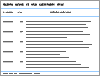
Table 1
Number and volume percentage distribution of lattice substructures
| 类型 | 参数 | |||||||||
|---|---|---|---|---|---|---|---|---|---|---|
| a | b | c | a | b | c | a | b | c | ||
| M1 | 数量 | 2 | 16 | 4 | 26 | 4 | ||||
| 体积比/% | 1.8 | 9.3 | 2.8 | 9.6 | 2.5 | |||||
| M2 | 数量 | 2 | 2 | 4 | 2 | 12 | 10 | |||
| 体积比/% | 1.9 | 1.8 | 3.8 | 1.8 | 8.0 | 7.7 | ||||
| M3 | 数量 | 66 | 41 | 74 | 62 | 86 | 82 | |||
| 体积比/% | 49.0 | 30.6 | 41.4 | 36.3 | 42.3 | 41.4 | ||||
| M4 | 数量 | 2 | 16 | 14 | 16 | 14 | ||||
| 体积比/% | 0.1 | 13.4 | 8.4 | 7.4 | 6.1 | |||||
| M5 | 数量 | 66 | 41 | 74 | 62 | 86 | 82 | |||
| 体积比/% | 49.0 | 30.6 | 41.4 | 36.3 | 42.3 | 41.4 | ||||
| M6 | 数量 | 132 | 52 | 120 | 20 | 194 | 4 | |||
| 体积比/% | 98.1 | 37.0 | 90.7 | 14.4 | 90.4 | 0.9 | ||||

Fig.12
Iteration curves for structural design in Fig.11(c)

| 1 | BENDSØE M P, KIKUCHI N. Generating optimal topologies in structural design using a homogenization method[J]. Computer Methods in Applied Mechanics and Engineering, 1988, 71(2): 197-224. |
| 2 | BENDSØE M P. Optimal shape design as a material distribution problem[J]. Structural Optimization, 1989, 1(4): 193-202. |
| 3 | ZHOU M, ROZVANY G. The COC algorithm, Part II: Topological, geometrical and generalized shape optimization[J]. Computer Methods in Applied Mechanics and Engineering, 1991, 89(1-3): 309-336. |
| 4 | BENDSØE M P, SIGMUND O. Material interpolation schemes in topology optimization[J]. Archive of Applied Mechanics, 1999, 69(9): 635-654. |
| 5 | RODRIGUES H, GUEDES J M, BENDSØE M P. Hierarchical optimization of material and structure[J]. Structural and Multidisciplinary Optimization, 2002, 24(1): 1-10. |
| 6 | ZHANG W H, SUN S P. Scale-related topology optimization of cellular materials and structures[J]. International Journal for Numerical Methods in Engineering, 2006, 68(9): 993-1011. |
| 7 | XIA L, BREITKOPF P. Recent advances on topology optimization of multiscale nonlinear structures[J]. Archives of Computational Methods in Engineering, 2017, 24(2): 227-249. |
| 8 | WU Z J, XIA L, WANG S T, et al. Topology optimization of hierarchical lattice structures with substructuring[J]. Computer Methods in Applied Mechanics and Engineering, 2019, 345: 602-617. |
| 9 | LIU Z, XIA L, XIA Q, et al. Data-driven design approach to hierarchical hybrid structures with multiple lattice configurations[J]. Structural and Multidisciplinary Optimization, 2020, 61(6): 2227-2235. |
| 10 | THOMSEN J. Topology optimization of structures composed of one or two materials[J]. Structural Optimization, 1992, 5(1): 108-115. |
| 11 | SIGMUND O, TORQUATO S. Design of materials with extreme thermal expansion using a three-phase topology optimization method[J]. Journal of the Mechanics and Physics of Solids, 1997, 45(6): 1037-1067. |
| 12 | STEGMANN J, LUND E. Discrete material optimization of general composite shell structures[J]. International Journal for Numerical Methods in Engineering, 2005, 62(14): 2009-2027. |
| 13 | GAO T, ZHANG W H. A mass constraint formulation for structural topology optimization with multiphase materials[J]. International Journal for Numerical Methods in Engineering, 2011, 88(8): 774-796. |
| 14 | SANDERS E D, AGUILÓ M A, PAULINO G H. Multi-material continuum topology optimization with arbitrary volume and mass constraints[J]. Computer Methods in Applied Mechanics and Engineering, 2018, 340: 798-823. |
| 15 | RODRIGUES H, FERNANDES P. A material based model for topology optimization of thermoelastic structures[J]. International Journal for Numerical Methods in Engineering, 1995, 38(12): 1951-1965. |
| 16 | LI Q, STEVEN G P, XIE Y M. Displacement minimization of thermoelastic structures by evolutionary thickness design[J]. Computer Methods in Applied Mechanics and Engineering, 1999, 179(3-4): 361-378. |
| 17 | LI Q, STEVEN G P, XIE Y M. Thermoelastic topology optimization for problems with varying temperature fields[J]. Journal of Thermal Stresses, 2001, 24(4): 347-366. |
| 18 | XIA Q, WANG M Y. Topology optimization of thermoelastic structures using level set method[J]. Computational Mechanics, 2008, 42(6): 837-857. |
| 19 | 孙士平, 张卫红. 热弹性结构的拓扑优化设计[J]. 力学学报, 2009, 41(6): 878-887. |
| SUN S P, ZHANG W H. Topology optimal design of thermo-elastic structures[J]. Chinese Journal of Theoretical and Applied Mechanics, 2009, 41(6): 878-887 (in Chinese). | |
| 20 | STOLPE M, SVANBERG K. An alternative interpolation scheme for minimum compliance topology optimization[J]. Structural and Multidisciplinary Optimization, 2001, 22(2): 116-124. |
| 21 | GAO T, ZHANG W H. Topology optimization involving thermo-elastic stress loads[J]. Structural and Multidisciplinary Optimization, 2010, 42(5): 725-738. |
| 22 | PEDERSEN P, PEDERSEN N L. Strength optimized designs of thermoelastic structures[J]. Structural and Multidisciplinary Optimization, 2010, 42(5): 681-691. |
| 23 | ZHANG W H, YANG J G, XU Y J, et al. Topology optimization of thermoelastic structures: Mean compliance minimization or elastic strain energy minimization[J]. Structural and Multidisciplinary Optimization, 2014, 49(3): 417-429. |
| 24 | XU B, HUANG X, ZHOU S W, et al. Concurrent topological design of composite thermoelastic macrostructure and microstructure with multi-phase material for maximum stiffness[J]. Composite Structures, 2016, 150: 84-102. |
| 25 | 贾娇, 龙凯, 程伟. 稳态热传导下基于多相材料的一体化设计[J]. 航空学报, 2016, 37(4): 1218-1227. |
| JIA J, LONG K, CHENG W. Concurrent topology optimization based on multiphase materials under steady thermal conduction[J]. Acta Aeronautica et Astronautica Sinica, 2016, 37(4): 1218-1227 (in Chinese). | |
| 26 | 李信卿, 赵清海, 张洪信, 等. 周期性功能梯度结构稳态热传导拓扑优化设计[J]. 中国机械工程, 2021, 32(19):2348-2356. |
| LI X Q, ZHAO Q H, ZHANG H X, et al. Steady-state heat conduction topology optimization design for periodic functional gradient structures [J]. China Mechanical Engineering, 2021, 32(19):2348-2356 (in Chinese). | |
| 27 | 李信卿, 赵清海, 龙凯, 等. 考虑瞬态效应的周期性多材料传热结构拓扑优化[J]. 航空学报, 2022, 43(12): 425964. |
| LI X Q, ZHAO Q H, LONG K, et al. Topology optimization of periodic multi-material heat conduction structures considering transient effects[J]. Acta Aeronautica et Astronautica Sinica, 2022, 43(12): 425964 (in Chinese). | |
| 28 | WANG F W, LAZAROV B S, SIGMUND O. On projection methods, convergence and robust formulations in topology optimization[J]. Structural and Multidisciplinary Optimization, 2011, 43(6): 767-784. |
| 29 | ANDREASSEN E, CLAUSEN A, SCHEVENELS M, et al. Efficient topology optimization in MATLAB using 88 lines of code[J]. Structural and Multidisciplinary Optimization, 2011, 43(1): 1-16. |
| 30 | SVANBERG K. The method of moving asymptotes—A new method for structural optimization[J]. International Journal for Numerical Methods in Engineering, 1987, 24(2): 359-373. |
| [1] | Yuequn LUO, Dali DING, Mulai TAN, Yidong LIU, Huan ZHOU. A review of autonomous maneuver decision methods for unmanned combat aerial vehicle [J]. Acta Aeronautica et Astronautica Sinica, 2025, 46(7): 30877-030877. |
| [2] | Jihong ZHU, Yifei ZHANG, Yahui ZHANG, Jie HOU, Weihong ZHANG. Shape preserving design of aerospace structure: From geometric feature to energy channeling [J]. Acta Aeronautica et Astronautica Sinica, 2025, 46(6): 531833-531833. |
| [3] | Guanghui WU, Jing WANG, Hairun XIE, Tuliang MA, Qiang MIAO, Jixin XIANG, Miao ZHANG. Data and knowledge-enabled intelligent aerodynamic design for civil aircraft [J]. Acta Aeronautica et Astronautica Sinica, 2025, 46(5): 531485-531485. |
| [4] | Shuming YANG, Jianjun WU, Changlin XIE, Yuqiang CHENG, Biao WANG. Application issues of data-driven intelligent fault diagnosis technologies for liquid rocket engines [J]. Acta Aeronautica et Astronautica Sinica, 2025, 46(15): 131427-131427. |
| [5] | Haotian ZHAO, Shi QIU, Ming LIU, Qichao GAI, Xibin CAO. Degradation evaluation method for communication satellite traveling wave tubes based on full life cycle data [J]. Acta Aeronautica et Astronautica Sinica, 2025, 46(12): 331376-331376. |
| [6] | Yu ZENG, Hongbo WANG, Chengyue LIAN, Yixin YANG, Dapeng XIONG, Mingbo SUN, Weidong LIU. Applicability analysis of two improved methods of SST turbulence model [J]. Acta Aeronautica et Astronautica Sinica, 2024, 45(S1): 730574-730574. |
| [7] | Yongxin SHI, Kuo TIAN, Bo WANG. Topology optimization of aerospace axisymmetric structures based on bidirectional density function [J]. Acta Aeronautica et Astronautica Sinica, 2024, 45(S1): 730585-730585. |
| [8] | Zhiliang HONG, Yu LI, Wenbo HE, Shuiting DING. Influence of bolt preload on slip characteristics at discontinuous rotor interfaces under thermal load [J]. Acta Aeronautica et Astronautica Sinica, 2024, 45(24): 230402-230402. |
| [9] | Tianhe GAO, Kuo TIAN, Lei HUANG, Shu ZHANG, Zengcong LI. Data⁃driven shape⁃topology optimization method for curved shells [J]. Acta Aeronautica et Astronautica Sinica, 2024, 45(2): 428806-428806. |
| [10] | Wei WANG, Hao WANG, Ai ZHOU, He FENG. Stepwise optimal design for shape and topology of variable camber wing [J]. Acta Aeronautica et Astronautica Sinica, 2024, 45(18): 129990-129990. |
| [11] | Lizhuo DONG, Siqi ZHANG, Zhao ZHANG, Baohai WU. Prediction method of blade machining deformation driven by mechanism⁃data hybrid [J]. Acta Aeronautica et Astronautica Sinica, 2024, 45(13): 629037-629037. |
| [12] | Shaoping ZHANG, Huiming GUO, Tong GAO, Weihong ZHANG. Design and manufacturing method of multi-scale integrated load bearing thin-walled structure for application in next-generation aeroengine based on advanced laser processing technology [J]. Acta Aeronautica et Astronautica Sinica, 2024, 45(13): 630037-630037. |
| [13] | Wentao LI, Yunqin HE, Wenbo LI, Yiyi ZHANG, Guozhu LIANG. 3D grain reverse design and shape optimization for solid rocket motor [J]. Acta Aeronautica et Astronautica Sinica, 2024, 45(11): 529089-529089. |
| [14] | Ximing CUI, Zhipeng QIU, Jia WEI, Chi ZHANG, Kai SONG, Zhe LI, Shupeng WANG. Data-driven method for characterization of structural steel surface stress of magnetic Barkhausen noise [J]. ACTA AERONAUTICAET ASTRONAUTICA SINICA, 2023, 44(8): 427237-427237. |
| [15] | YAN Hao, WU Xiaoming. Topology optimization and structure evolution of turbine disks based on load sensitivity suppression [J]. ACTA AERONAUTICAET ASTRONAUTICA SINICA, 2022, 43(5): 225295-225295. |
| Viewed | ||||||
|
Full text |
|
|||||
|
Abstract |
|
|||||
Address: No.238, Baiyan Buiding, Beisihuan Zhonglu Road, Haidian District, Beijing, China
Postal code : 100083
E-mail:hkxb@buaa.edu.cn
Total visits: 6658907 Today visits: 1341All copyright © editorial office of Chinese Journal of Aeronautics
All copyright © editorial office of Chinese Journal of Aeronautics
Total visits: 6658907 Today visits: 1341

 CJA
CJA
