Acta Aeronautica et Astronautica Sinica ›› 2026, Vol. 47 ›› Issue (10): 632578.doi: 10.7527/S1000-6893.2025.32578
• Special Issue: Intelligent Processing and Analysis of Aerospace Remote Sensing Images • Previous Articles
Lei ZHOU, Yanfeng GU, Tianzhu LIU( )
)
Received:2025-07-16
Revised:2025-08-08
Accepted:2025-09-15
Online:2025-10-10
Published:2025-10-09
Contact:
Tianzhu LIU
E-mail:tzliu@hit.edu.cn
Supported by:CLC Number:
Lei ZHOU, Yanfeng GU, Tianzhu LIU. Aircraft fine-grained object detection algorithm in remote sensing images[J]. Acta Aeronautica et Astronautica Sinica, 2026, 47(10): 632578.
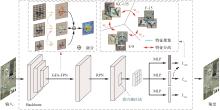
Fig.1
Model structure of HOFD-Net
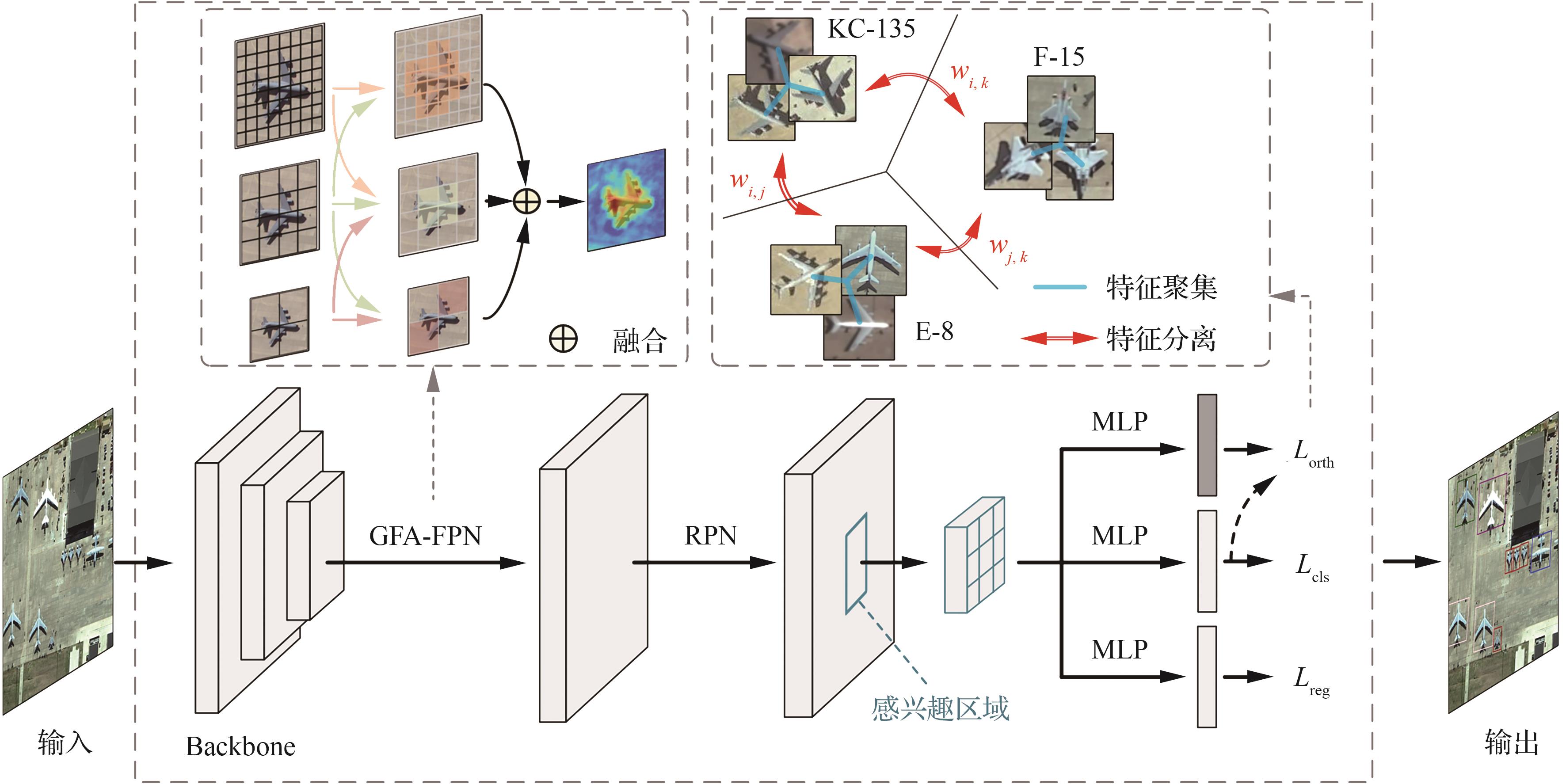
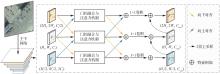
Fig.2
Module structure of GFA-FPN
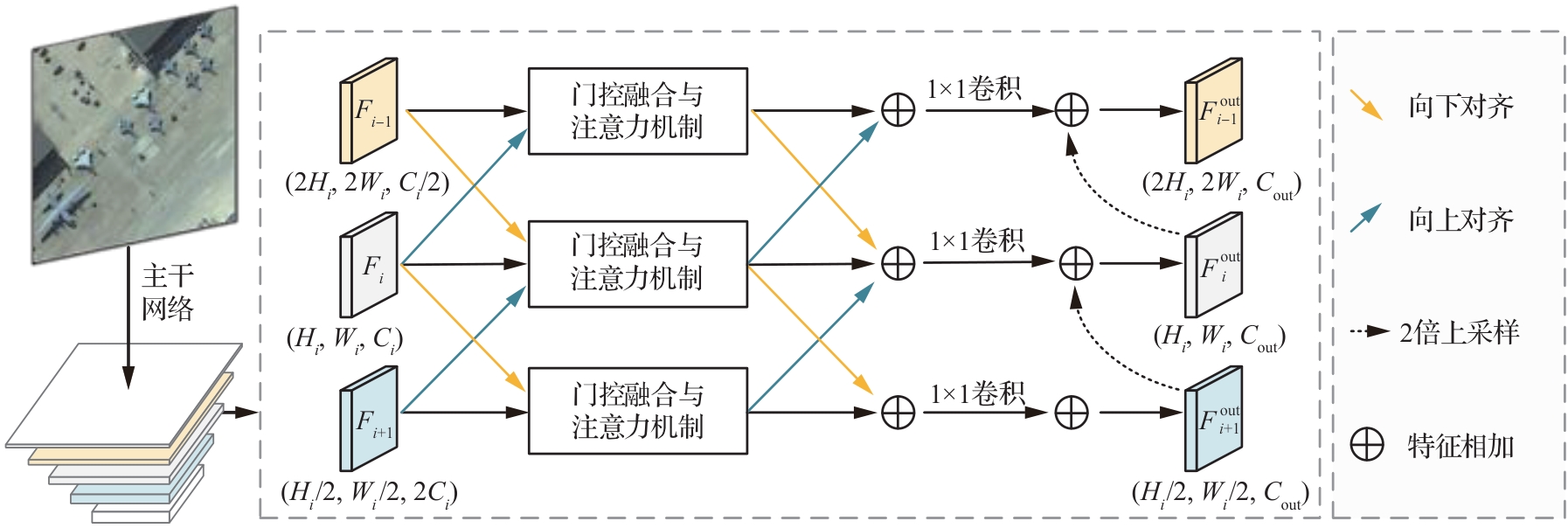
Fig.3
Module structure of gated fusion and attention
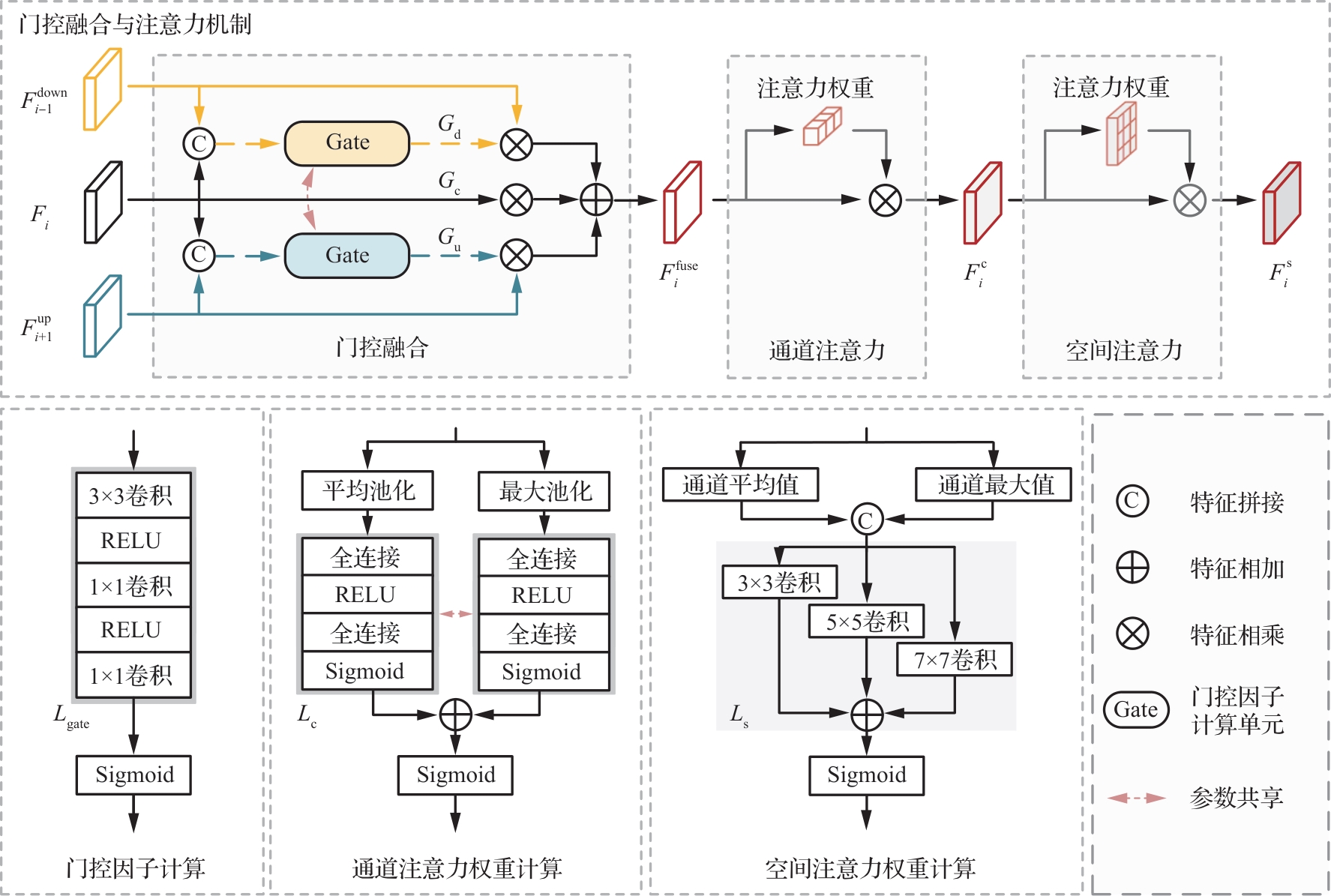

Table 1
Impact of loss weight λ on detection accuracy
| 0.1 | 0.3 | 0.5 | 0.7 | 0.9 | 1.0 | |
|---|---|---|---|---|---|---|
| mAP50∶95 /% | 58.79 | 59.25 | 59.47 | 59.74 | 59.15 | 58.95 |
Table 2
mAP results on MAR20 dataset
| 类型 | 方法 | mAP50∶95/% | mAP50/% | mAP75/% |
|---|---|---|---|---|
| 单阶段 | FCOS[ | 47.44±1.05 | 76.09±0.43 | 51.28±0.57 |
| R3Det[ | 40.45±2.60 | 62.08±3.37 | 48.52±3.41 | |
| S2ANet[ | 50.33±0.15 | 80.84±0.55 | 55.93±0.21 | |
| 两阶段 | Faster R-CNN[ | 52.93±0.03 | 81.96±0.30 | 60.55±0.12 |
| RoI Transformer[ | 56.45±0.47 | 82.60±0.59 | 69.35±0.53 | |
| Gliding-V[ | 41.02±0.87 | 78.93±1.11 | 37.65±1.28 | |
| ORCNN[ | 58.49±0.20 | 82.98±0.48 | 73.25±0.41 | |
| PCLDet[ | 58.04±0.37 | 82.92±0.35 | 72.37±0.43 | |
| PETDet[ | 61.02±0.55 | 85.51±0.61 | 76.96±0.37 | |
| HOFD-Net (Gliding-V)[ | 47.31±0.77 | 81.75±0.65 | 49.91±1.23 | |
| HOFD-Net (ORCNN)[ | 59.74±0.40 | 84.24±0.32 | 75.23±0.48 | |
| HOFD-Net (PETDet)[ | 61.45±0.49 | 85.78±0.67 | 77.84±0.20 |
Table 3
AP50 results of each category on MAR20 dataset
| 类别 | R3Det[ | FRCNN[ | RoI Trans[ | Gliding-V[ | ORCNN[ | PCLDet[ | PETDet[ | HOFD-Net (PETDet) |
|---|---|---|---|---|---|---|---|---|
| SU-35 | 70.53 | 85.16 | 86.98 | 82.89 | 86.42 | 85.47 | 88.23 | 88.51 |
| C-130 | 80.84 | 89.90 | 81.72 | 80.43 | 88.21 | 81.69 | 89.17 | 89.70 |
| C-17 | 49.51 | 88.86 | 88.70 | 86.33 | 88.58 | 89.41 | 89.86 | 89.85 |
| C-5 | 46.57 | 80.09 | 79.27 | 68.54 | 75.52 | 78.24 | 82.93 | 80.19 |
| F-16 | 57.44 | 75.44 | 78.18 | 72.74 | 79.82 | 79.85 | 82.68 | 82.86 |
| TU-160 | 79.27 | 89.14 | 90.70 | 89.44 | 90.57 | 90.88 | 90.99 | 90.79 |
| E-3 | 53.84 | 90.19 | 90.13 | 89.69 | 90.36 | 90.51 | 90.65 | 90.70 |
| B-52 | 83.43 | 89.56 | 89.66 | 86.68 | 89.53 | 87.43 | 89.04 | 88.16 |
| P-3C | 22.11 | 90.08 | 89.24 | 90.44 | 89.41 | 89.93 | 90.11 | 90.24 |
| B-1B | 78.87 | 90.87 | 90.89 | 88.41 | 90.87 | 90.84 | 90.92 | 90.91 |
| E-8 | 50.17 | 86.45 | 85.50 | 82.55 | 87.98 | 87.16 | 87.85 | 88.50 |
| TU-22 | 82.34 | 87.64 | 88.62 | 85.40 | 87.50 | 89.29 | 90.26 | 89.44 |
| F-15 | 58.99 | 67.13 | 67.85 | 64.94 | 65.86 | 66.13 | 73.24 | 73.49 |
| KC-135 | 77.64 | 88.74 | 88.79 | 79.17 | 87.92 | 87.95 | 89.29 | 88.04 |
| F-22 | 33.85 | 47.17 | 45.20 | 51.94 | 49.57 | 52.40 | 61.08 | 65.13 |
| FA-18 | 86.47 | 88.36 | 89.04 | 87.19 | 89.20 | 88.69 | 88.83 | 88.87 |
| TU-95 | 89.15 | 90.41 | 90.60 | 89.92 | 90.39 | 90.44 | 90.61 | 90.64 |
| KC-10 | 9.47 | 65.96 | 71.44 | 54.61 | 72.53 | 73.37 | 78.00 | 81.73 |
| SU-34 | 72.15 | 77.56 | 84.37 | 77.57 | 83.20 | 81.96 | 84.76 | 86.10 |
| SU-24 | 73.64 | 76.59 | 78.49 | 71.18 | 78.98 | 79.43 | 80.65 | 80.54 |
| mAP50 | 62.88 | 82.26 | 82.77 | 79.00 | 83.12 | 83.07 | 85.43 | 85.72 |
Fig.4
Confusion matrices of detection results on MAR20 dataset
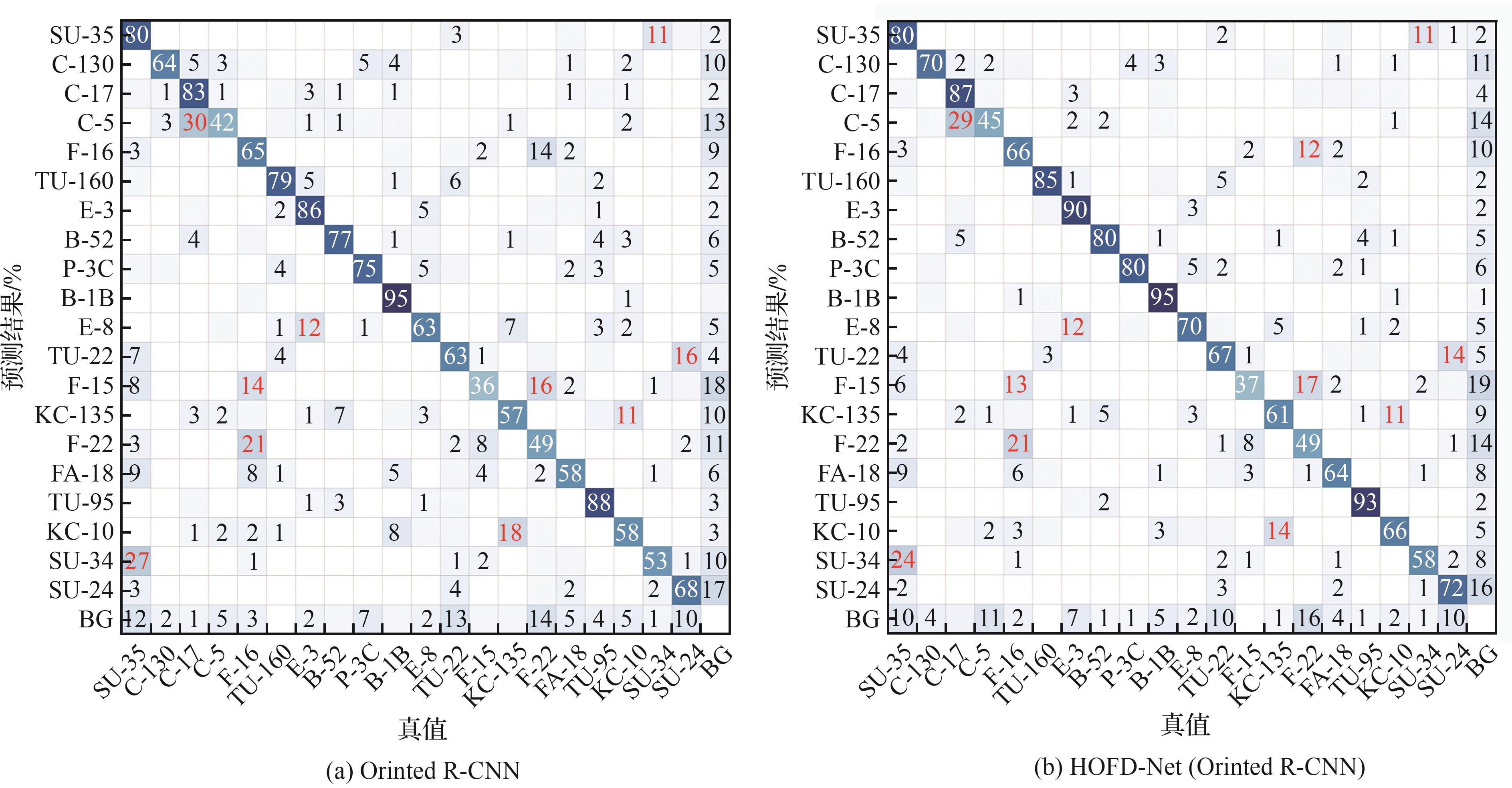
Fig.5
Visualization results of bounding box and prediction class on MAR20 dataset
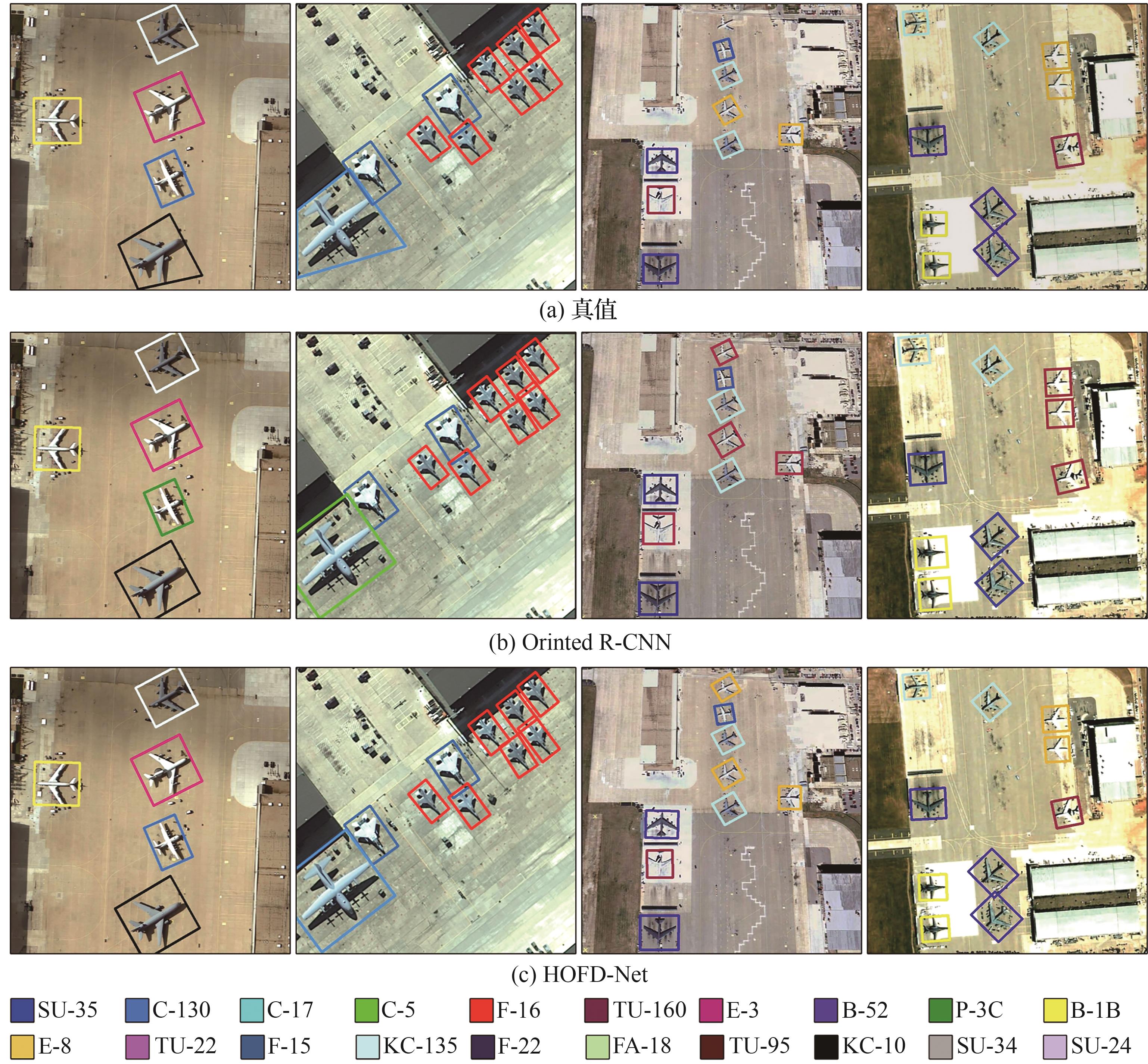
Fig.6
Visualization results of weight map in spatial attention module on MAR20 dataset
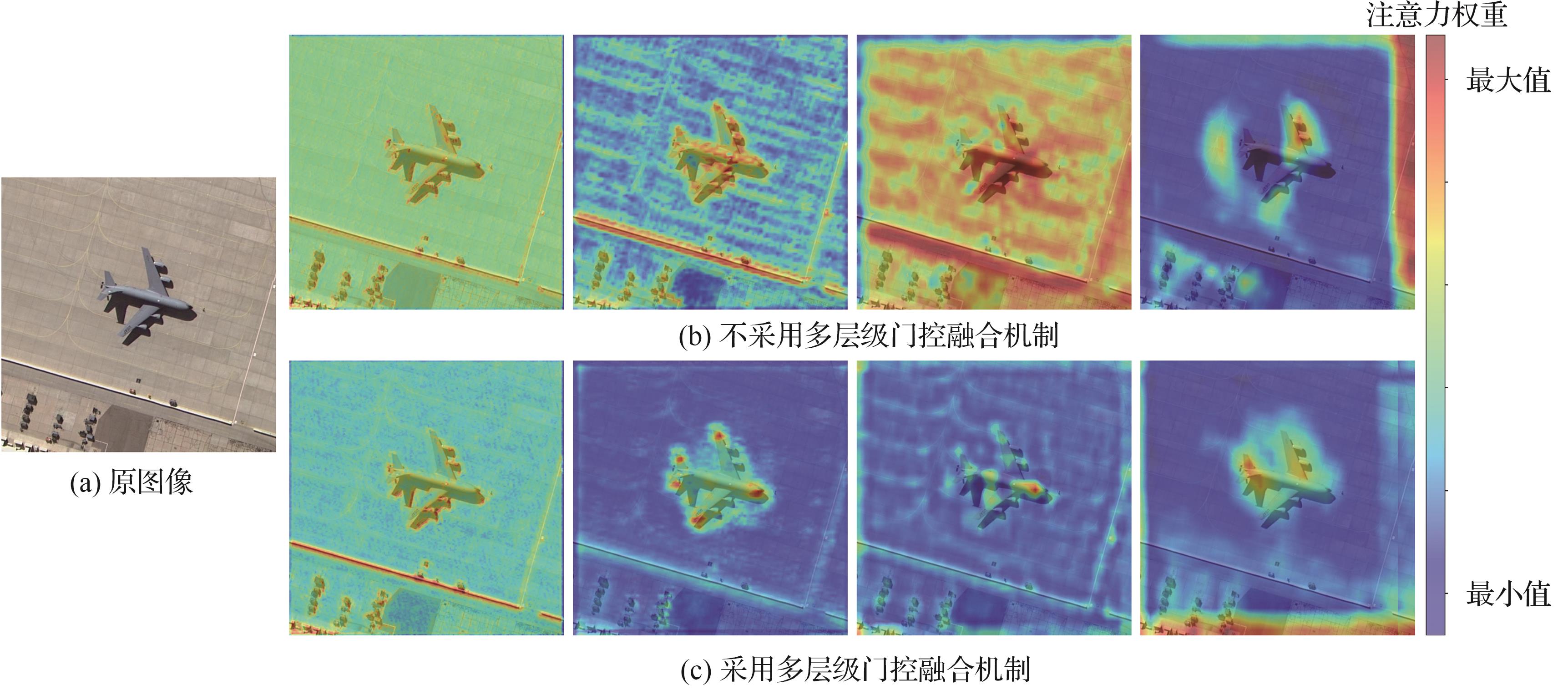
Table 4
mAP results on SMID dataset
| 类型 | 方法 | mAP50∶95/% | mAP50/% | mAP75 /% |
|---|---|---|---|---|
| 单阶段 | FCOS[ | 50.9±0.17 | 65.9±0.67 | 60.9±0.35 |
| RepPoints[ | 42.4±0.67 | 56.5±0.88 | 50.9±0.06 | |
| 两阶段 | Faster R-CNN[ | 61.2±0.58 | 80.9±0.55 | 71.9±0.49 |
| Double-Head[ | 62.6±1.09 | 81.4±0.74 | 73.8±0.27 | |
| DynamicRCNN[ | 61.2±0.42 | 77.2±0.05 | 74.2±0.72 | |
| PISA[ | 62.2±0.85 | 81.8±0.56 | 74.8±0.24 | |
| HOFD-Net (PISA) | 63.9±1.04 | 82.6±0.78 | 76.1±0.45 |
Fig.7
Confusion matrices of detection results on SMID dataset
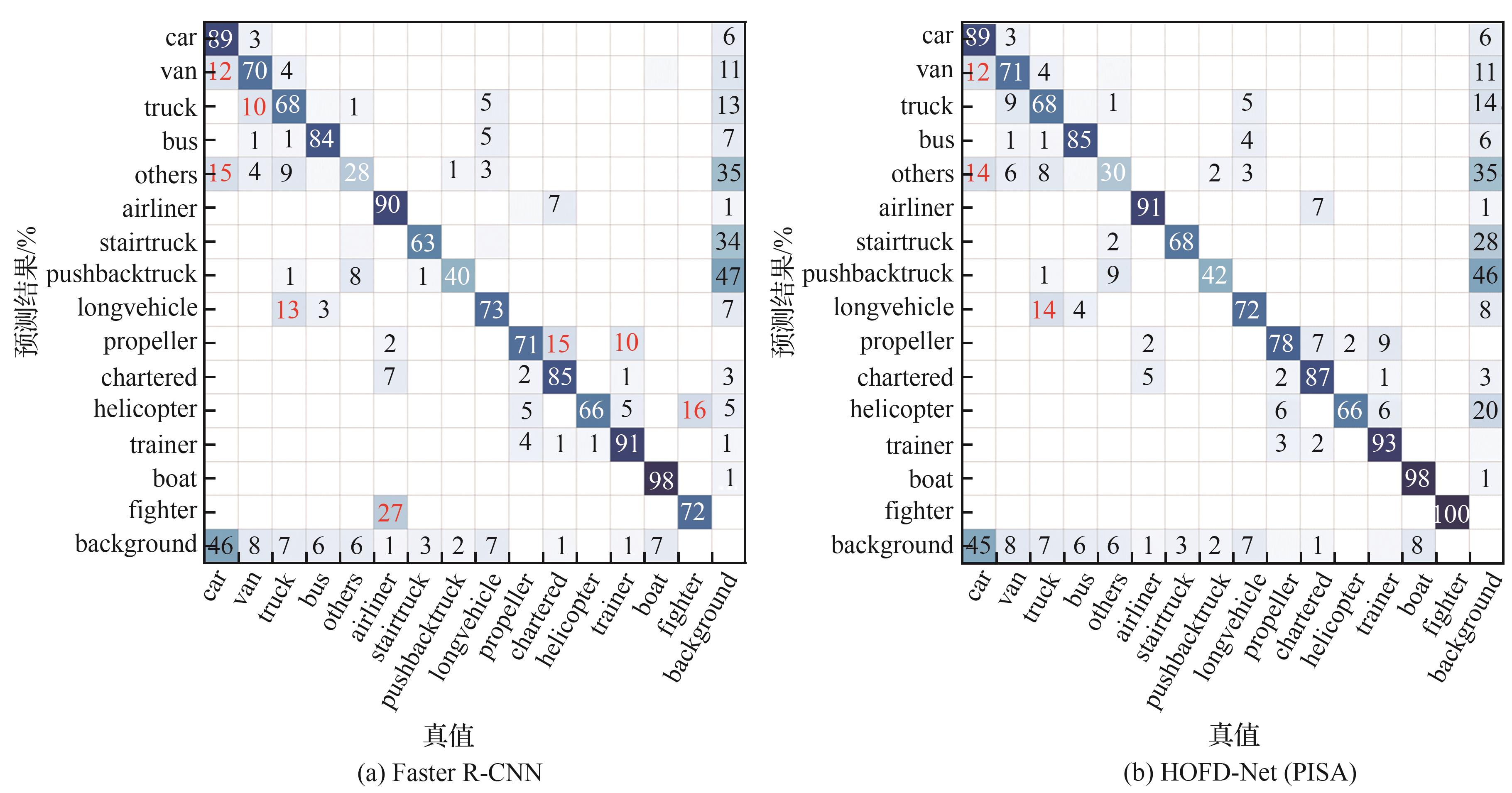
Fig.8
Visualization results of bounding box and prediction class on SMID dataset
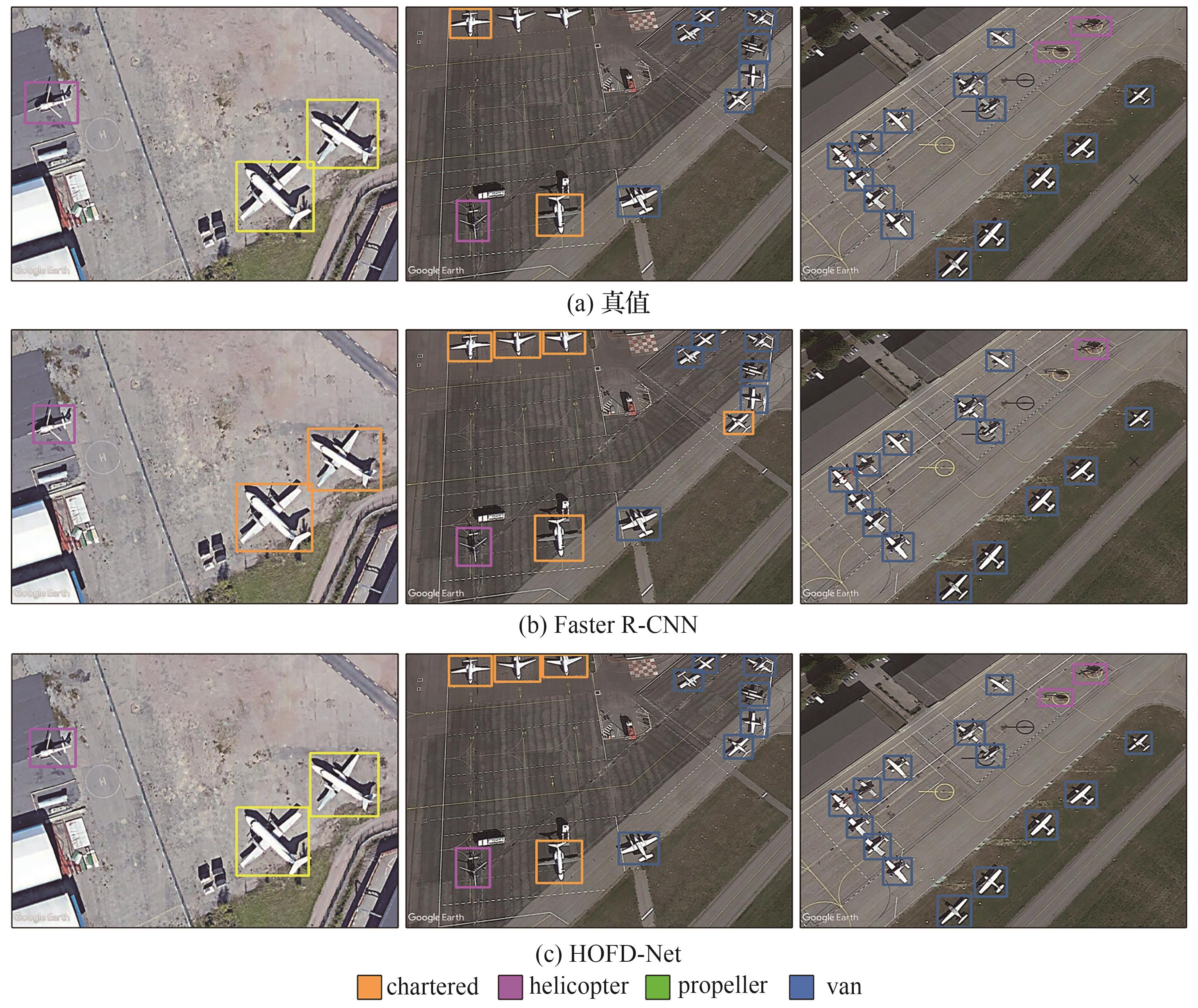
Table 5
Ablation study results on MAR20 dataset
| GFA-FPN | 自适应正交损失 | mAP50∶95 /% |
|---|---|---|
| 58.49 | ||
| 仅采用注意力机制 | 59.01 | |
| √ | 59.56 | |
| 仅采用正交损失[ | 58.75 | |
| √ | 59.07 | |
| √ | √ | 59.74 |
| [1] | GUAN Q H, LIU Y, CHEN L, et al. Aircraft detection and fine-grained recognition based on high-resolution remote sensing images[J]. Electronics, 2023, 12(14): 3146. |
| [2] | CORBANE C, NAJMAN L, PECOUL E, et al. A complete processing chain for ship detection using optical satellite imagery[J]. International Journal of Remote Sensing, 2010, 31(22): 5837-5854. |
| [3] | CHENG G, HAN J W. A survey on object detection in optical remote sensing images[J]. ISPRS Journal of Photogrammetry and Remote Sensing, 2016, 117: 11-28. |
| [4] | LI W T, ZHAO D P, YUAN B, et al. PETDet: Proposal enhancement for two-stage fine-grained object detection[J]. IEEE Transactions on Geoscience and Remote Sensing, 2023, 62: 5602214. |
| [5] | NING W Y, WANG Q X, FENG J Q, et al. Scene-object holistic relation network for fine-grained airplane detection[J]. IEEE Geoscience and Remote Sensing Letters, 2024, 21: 6010905. |
| [6] | WANG L Q, ZHANG J, TIAN J M, et al. Efficient fine-grained object recognition in high-resolution remote sensing images from knowledge distillation to filter grafting[J]. IEEE Transactions on Geoscience and Remote Sensing, 2023, 61: 4701016. |
| [7] | CHENG G, LI Q Y, WANG G X, et al. SFRNet: Fine-grained oriented object recognition via separate feature refinement[J]. IEEE Transactions on Geoscience and Remote Sensing, 2023, 61: 5610510. |
| [8] | ZHU H, ZHOU Y, XU C, et al. Enhancing fine-grained object detection in aerial images via orthogonal mapping[DB/OL]. arXiv preprint: 2407.17738, 2024. |
| [9] | LIN T Y, DOLLÁR P, GIRSHICK R, et al. Feature pyramid networks for object detection[C]∥ 2017 IEEE Conference on Computer Vision and Pattern Recognition (CVPR). Piscataway: IEEE Press, 2017: 936-944. |
| [10] | SONG J J, MIAO L J, MING Q, et al. Fine-grained object detection in remote sensing images via adaptive label assignment and refined-balanced feature pyramid network[J]. IEEE Journal of Selected Topics in Applied Earth Observations and Remote Sensing, 2022, 16: 71-82. |
| [11] | RANASINGHE K, NASEER M, HAYAT M, et al. Orthogonal projection loss[C]∥ 2021 IEEE/CVF International Conference on Computer Vision (ICCV). Piscataway: IEEE Press, 2021: 12313-12323. |
| [12] | OUYANG L H, GUO G M, FANG L Y, et al. PCLDet: Prototypical contrastive learning for fine-grained object detection in remote sensing images[J]. IEEE Transactions on Geoscience and Remote Sensing, 2023, 61: 5613911. |
| [13] | CHENG J C, YAO X W, YANG X G, et al. DIMA: Digging into multigranular archetype for fine-grained object detection[J]. IEEE Transactions on Geoscience and Remote Sensing, 2024, 62: 5628714. |
| [14] | SONG L, LI Y W, JIANG Z K, et al. Fine-grained dynamic head for object detection[C]∥Conference on Neural Information Processing Systems, 2020. |
| [15] | 禹文奇, 程塨, 王美君, 等. MAR20: 遥感图像军用飞机目标识别数据集[J]. 遥感学报, 2023, 27(12): 2688-2696. |
| YU W Q, CHENG G, WANG M J, et al. MAR20: A benchmark for military aircraft recognition in remote sensing images[J]. National Remote Sensing Bulletin, 2023, 27(12): 2688-2696 (in Chinese). | |
| [16] | HAROON M, SHAHZAD M, FRAZ M M. Multisized object detection using spaceborne optical imagery[J]. IEEE Journal of Selected Topics in Applied Earth Observations and Remote Sensing, 2020, 13: 3032-3046. |
| [17] | ZHOU Y, YANG X, ZHANG G F, et al. MMRotate: A rotated object detection benchmark using PyTorch[C]∥ Proceedings of the 30th ACM International Conference on Multimedia. New York: ACM, 2022: 7331-7334. |
| [18] | CHEN K, WANG J, PANG J, et al. MMDetection: Open mmlab detection toolbox and benchmark[DB/OL]. arXiv preprint:1906.07155, 2019. |
| [19] | XIE X X, CHENG G, WANG J B, et al. Oriented R-CNN for object detection[C]∥ 2021 IEEE/CVF International Conference on Computer Vision (ICCV). Piscataway: IEEE Press, 2021: 3500-3509. |
| [20] | REN S Q, HE K M, GIRSHICK R, et al. Faster R-CNN: Towards real-time object detection with region proposal networks[J]. IEEE Transactions on Pattern Analysis and Machine Intelligence, 2017, 39(6): 1137-1149. |
| [21] | HAN J M, DING J, LI J, et al. Align deep features for oriented object detection[J]. IEEE Transactions on Geoscience and Remote Sensing, 2021, 60: 5602511. |
| [22] | TIAN Z, SHEN C H, CHEN H, et al. FCOS: Fully convolutional one-stage object detection[C]∥2019 IEEE/CVF International Conference on Computer Vision (ICCV). Piscataway: IEEE Press, 2019: 9626-9635. |
| [23] | YANG X, YAN J C, FENG Z M, et al. R3Det: Refined single-stage detector with feature refinement for rotating object[J]. Proceedings of the AAAI Conference on Artificial Intelligence, 2021, 35(4): 3163-3171. |
| [24] | DING J, XUE N, LONG Y, et al. Learning RoI transformer for oriented object detection in aerial images[C]∥ 2019 IEEE/CVF Conference on Computer Vision and Pattern Recognition (CVPR). Piscataway: IEEE Press, 2019: 2844-2853. |
| [25] | XU Y C, FU M T, WANG Q M, et al. Gliding vertex on the horizontal bounding box for multi-oriented object detection[J]. IEEE Transactions on Pattern Analysis and Machine Intelligence, 2021, 43(4): 1452-1459. |
| [26] | CAO Y H, CHEN K, LOY C C, et al. Prime sample attention in object detection[C]∥2020 IEEE/CVF Conference on Computer Vision and Pattern Recognition (CVPR). Piscataway: IEEE Press, 2020: 11580-11588. |
| [27] | YANG Z, LIU S H, HU H, et al. RepPoints: Point set representation for object detection[C]∥2019 IEEE/CVF International Conference on Computer Vision (ICCV). Piscataway: IEEE Press, 2019: 9656-9665. |
| [28] | WU Y, CHEN Y P, YUAN L, et al. Rethinking classification and localization for object detection[C]∥2020 IEEE/CVF Conference on Computer Vision and Pattern Recognition (CVPR). Piscataway: IEEE Press, 2020: 10183-10192. |
| [29] | ZHANG H K, CHANG H, MA B P, et al. Dynamic R-CNN: Towards high quality object detection via dynamic training[M]∥Computer Vision-ECCV 2020. Cham: Springer International Publishing, 2020: 260-275. |
| [1] | Wenlin LIU, Xikun HU, Ping ZHONG. Reinforcement learning-driven object detection method for degraded remote sensing images [J]. Acta Aeronautica et Astronautica Sinica, 2026, 47(10): 532861-532861. |
| [2] | Yuanjie ZHI, Xin GE, Fan ZHANG, Zhi YANG, Mingyang MA, Shaohui MEI. A unified detection model for multimodal aerospace remote sensing images based on mixture of experts [J]. Acta Aeronautica et Astronautica Sinica, 2026, 47(10): 532864-532864. |
| [3] | Zifeng YANG, Xia XU, Bin PAN. Fast dual-branch stitching and synchronous detection framework based on shared backbone [J]. Acta Aeronautica et Astronautica Sinica, 2026, 47(10): 532876-532876. |
| [4] | Yunhe LIU, Zhizhuo JIANG, Yu LIU, Xian SUN, You HE. Vessel target association based on multi-view low-altitude remote sensing images [J]. Acta Aeronautica et Astronautica Sinica, 2026, 47(10): 533060-533060. |
| [5] | Lingjie MENG, Hongguang LI, Xinjun LI. SAR image simulation method guided by geomorphic category information [J]. Acta Aeronautica et Astronautica Sinica, 2025, 46(7): 331003-331003. |
| [6] | Yiquan WU, Kang TONG. Research advances on deep learning-based small object detection in UAV aerial images [J]. Acta Aeronautica et Astronautica Sinica, 2025, 46(3): 30848-030848. |
| [7] | Zijian XIANG, Zhenyu MA, Xixiang YANG. Inversion of structural performance parameters of composite materials based on deep learning [J]. Acta Aeronautica et Astronautica Sinica, 2025, 46(24): 231877-231877. |
| [8] | Zhenhao CHENG, Xiaogang YANG, Ruitao LU, Tao ZHANG, Siyu WANG. Multi-stage distillation for incremental detection of time-sensitive targets in UAV images [J]. Acta Aeronautica et Astronautica Sinica, 2025, 46(24): 331959-331959. |
| [9] | Wei HUANG, Jiahao PAN, Chu HE. Wavelet time-frequency localization-based model compression for UAV object detection [J]. Acta Aeronautica et Astronautica Sinica, 2025, 46(23): 631952-631952. |
| [10] | Kui LIU, Hao SUN, Han WU, Kefeng JI, Gangyao KUANG. Dynamic brightness reconstruction for UAV visible-infrared fusion object detection [J]. Acta Aeronautica et Astronautica Sinica, 2025, 46(23): 631968-631968. |
| [11] | Bo PENG, Jikang BAI, Weiwen CHEN, Xiangtao ZHENG, Jianjun LEI, Xiaoqiang LU. Research progress for UAV search and rescue methods based on deep learning [J]. Acta Aeronautica et Astronautica Sinica, 2025, 46(23): 632761-632761. |
| [12] | Shuai ZHONG, Liping WANG. MCS-RETR: Improved RT-DETR object detection method for UAV aerial images [J]. Acta Aeronautica et Astronautica Sinica, 2025, 46(22): 331987-331987. |
| [13] | Baoquan SHI, Jiaming ZHOU, Wendong ZHANG, Xianmin CHEN, Qian HE. A network for fatigue crack segmentation and quantification using frequency-domain enhancement and linear attention mechanism [J]. Acta Aeronautica et Astronautica Sinica, 2025, 46(21): 532356-532356. |
| [14] | Yi ZHENG, Xianghong CHENG, Xingbang TANG, Yi CAO. Oriented detection algorithm for insulator and their defects from aerial images based on improved ReDet [J]. Acta Aeronautica et Astronautica Sinica, 2025, 46(18): 331825-331825. |
| [15] | Guixian QU, Dongyang LIU, Xu YANG, Tian QIU, Chuankai LIU, Shuiting DING, Shuzheng YUAN, Kan GUO. Remaining useful life prediction method based on temporal information enhancement of sensors [J]. Acta Aeronautica et Astronautica Sinica, 2025, 46(17): 231634-231634. |
| Viewed | ||||||
|
Full text |
|
|||||
|
Abstract |
|
|||||
Address: No.238, Baiyan Buiding, Beisihuan Zhonglu Road, Haidian District, Beijing, China
Postal code : 100083
E-mail:hkxb@buaa.edu.cn
Total visits: 6658907 Today visits: 1341All copyright © editorial office of Chinese Journal of Aeronautics
All copyright © editorial office of Chinese Journal of Aeronautics
Total visits: 6658907 Today visits: 1341

 CJA
CJA
