Acta Aeronautica et Astronautica Sinica ›› 2025, Vol. 46 ›› Issue (22): 131975.doi: 10.7527/S1000-6893.2025.31975
• Fluid Mechanics and Flight Mechanics • Previous Articles
Yahang SONG, Xin ZHANG( ), Zhiming MA, Zhengyu ZUO
Received:2025-03-13
Revised:2025-04-07
Accepted:2025-04-15
Online:2025-05-13
Published:2025-04-17
Contact:
Xin ZHANG
E-mail:lookzx@mail.ustc.edu.cn
Supported by:CLC Number:
Yahang SONG, Xin ZHANG, Zhiming MA, Zhengyu ZUO. Airfoil gust alleviation using a plasma actuator in low-speed wind tunnel test[J]. Acta Aeronautica et Astronautica Sinica, 2025, 46(22): 131975.

Fig.1
Schematic diagram of layout of a symmetrical dielectric barrier discharge plasma actuator


Fig.2
Two-dimensional airfoil of GAW-1 with a symmetrical plasma actuator


Fig.3
Schematic diagram of test system layout


Fig.4
PIV shooting field of view

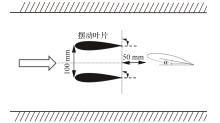
Fig.5
Gust device and test model
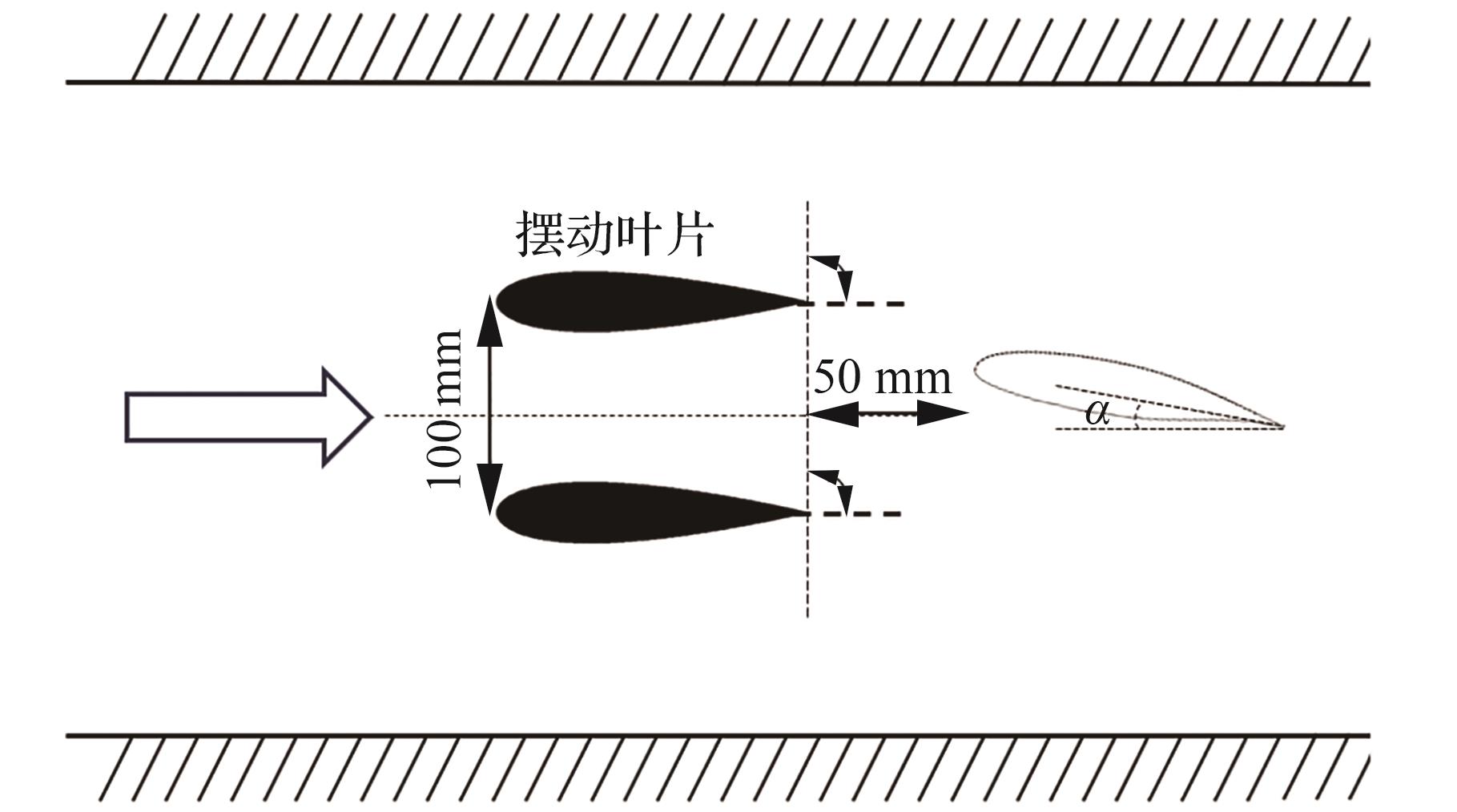
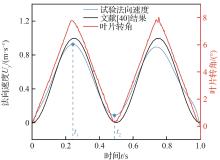
Fig.6
Normal velocity and blade angle curves under influence of gust


Fig.7
Normal velocity spectrum under influence of gust


Fig.8
Time-averaged velocity field produced by a symmetrical plasma actuator in quiescent air

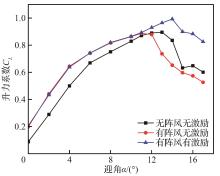
Fig.9
Variation of lift coefficient with angle of attack
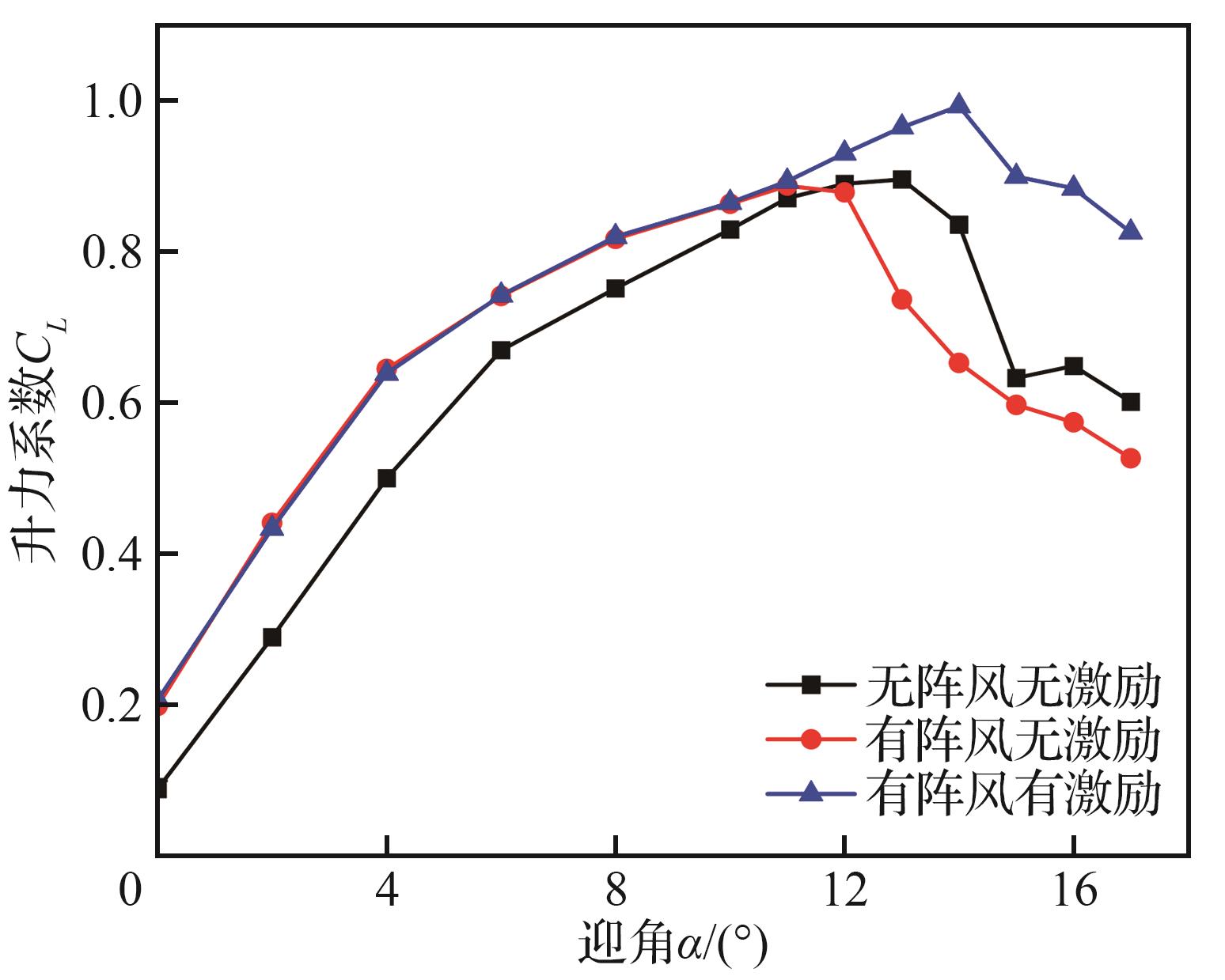

Table 1
Maximum lift coefficient and stall angle of attack under different conditions
| 状态 | 最大升力系数CL,max | 失速迎角αs/(°) |
|---|---|---|
| 无阵风无激励 | 0.895 7 | 13 |
| 有阵风无激励 | 0.887 3 | 12 |
| 有阵风有激励 | 0.992 9 | 14 |

Fig.10
Airfoil pressure distribution at different working conditions (α=13°)


Fig.11
Pressure coefficient variation over time at 1% chord length (α=13°)


Fig.12
Time-average velocity field around airfoil at different working conditions (α=13°)

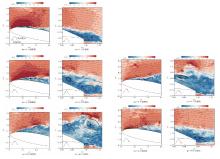
Fig.13
Instantaneous velocity fields of leading and trailing edges of airfoil without plasma actuation at different times


Fig.14
Instantaneous velocity fields of leading and trailing edges of airfoil with plasma actuation at t=0.5T


Fig.15
Change of dimensionless separation zone length with time without/with plasma actuation


Fig.16
Change of dimensionless separation zone area with time without/with plasma actuation


Fig.17
Root mean square pulsation velocity fields without and with plasma actuation

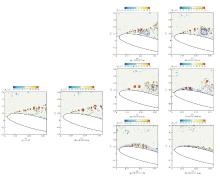
Fig.18
Change of transient flow field of leading-edge of airfoil with time with plasma actuation

| [1] | ZHOU Y T, WU Z G, YANG C. Intelligent feedforward gust alleviation based on neural network[J]. Chinese Journal of Aeronautics, 2024, 37(3): 116-132. |
| [2] | IBREN M, SULAEMAN E, ANDAN A D, et al. Gust load alleviation of flexible composite wing[J]. CFD Letters, 2020, 12(4): 79-89. |
| [3] | 张育鸣, 戴玉婷, 黄广靖, 等. 柔性变形后缘翼型阵风减缓及气动噪声分析[J]. 航空学报, 2024, 45(10): 129219. |
| ZHANG Y M, DAI Y T, HUANG G J, et al. Gust alleviation and aeroacoustic characteristics of flexible morphing trailing edge airfoil[J]. Acta Aeronautica et Astronautica Sinica, 2024, 45(10): 129219 (in Chinese). | |
| [4] | CONSIGNY H, GRAVELLE A, MOLINARO R. Aerodynamic characteristics of a two-dimensional moving spoiler in subsonic and transonic flow[J]. Journal of Aircraft, 1984, 21(9): 687-693. |
| [5] | 杨阳, 杨超, 吴志刚. 基于舵机动态特性测试的阵风减缓控制系统设计[J]. 振动与冲击, 2020, 39(4): 106-112, 121. |
| YANG Y, YANG C, WU Z G. A design of gust alleviation control system based on test of actuator’s dynamic characteristics[J]. Journal of Vibration and Shock, 2020, 39(4): 106-112, 121 (in Chinese). | |
| [6] | 杨超, 邱祈生, 周宜涛, 等. 飞机阵风响应减缓技术综述[J]. 航空学报, 2022, 43(10): 527350. |
| YANG C, QIU Q S, ZHOU Y T, et al. Review of aircraft gust alleviation technology[J]. Acta Aeronautica et Astronautica Sinica, 2022, 43(10): 527350 (in Chinese). | |
| [7] | 向锦武, 阚梓, 邵浩原, 等. 长航时无人机关键技术研究进展[J]. 哈尔滨工业大学学报, 2020, 52(6): 57-77. |
| XIANG J W, KAN Z, SHAO H Y, et al. A review of key technologies for long-endurance unmanned aerial vehicle[J]. Journal of Harbin Institute of Technology, 2020, 52(6): 57-77 (in Chinese). | |
| [8] | 吴云, 李应红. 等离子体流动控制研究进展与展望[J]. 航空学报, 2015, 36(2): 381-405. |
| WU Y, LI Y H. Progress and outlook of plasma flow control[J]. Acta Aeronautica et Astronautica Sinica, 2015, 36(2): 381-405 (in Chinese). | |
| [9] | 周岩, 罗振兵, 王林, 等. 等离子体合成射流激励器及其流动控制技术研究进展[J]. 航空学报, 2022, 43(3): 025027. |
| ZHOU Y, LUO Z B, WANG L, et al. Plasma synthetic jet actuator for flow control: Review[J]. Acta Aeronautica et Astronautica Sinica, 2022, 43(3): 025027 (in Chinese). | |
| [10] | 孙全兵, 史志伟, 耿玺, 等. 基于主动流动控制技术的无舵面飞翼布局飞行器姿态控制[J]. 航空学报, 2020, 41(12): 124080. |
| SUN Q B, SHI Z W, GENG X, et al. Attitude control of flying wing aircraft without control surfaces based on active flow control[J]. Acta Aeronautica et Astronautica Sinica, 2020, 41(12): 124080 (in Chinese). | |
| [11] | 冯立好, 魏凌云, 董磊, 等. 飞翼布局飞机耦合运动失稳的主动流动控制[J]. 航空学报, 2022, 43(10): 527353. |
| FENG L H, WEI L Y, DONG L, et al. Active flow control for coupled motion instability of flying-wing aircraft[J]. Acta Aeronautica et Astronautica Sinica, 2022, 43(10): 527353 (in Chinese). | |
| [12] | 陈尹, 顾蕴松, 孙之骏, 等. 基于翼面压力的飞行器气动力感知技术与自由飞验证[J]. 航空学报, 2021, 42(3): 124138. |
| CHEN Y, GU Y S, SUN Z J, et al. Aerodynamic perception from distributed pressure and free flight test[J]. Acta Aeronautica et Astronautica Sinica, 2021, 42(3): 124138 (in Chinese). | |
| [13] | 王浩, 罗振兵, 邓雄, 等. 基于合成双射流的翼型阵风载荷减缓[J]. 航空学报, 2024, 45(16): 129660. |
| WANG H, LUO Z B, DENG X, et al. Airfoil gust load alleviation based on dual synthetic jets[J]. Acta Aeronautica et Astronautica Sinica, 2024, 45(16): 129660 (in Chinese). | |
| [14] | XU X P, ZHU X P, ZHOU Z, et al. Application of active flow control technique for gust load alleviation[J]. Chinese Journal of Aeronautics, 2011, 24(4): 410-416. |
| [15] | MUELLER-VAHL H, NAYERI C, PASCHEREIT C O, et al. Control of unsteady aerodynamic loads using adaptive blowing[C]∥ 32nd AIAA Applied Aerodynamics Conference. Reston: AIAA, 2014. |
| [16] | GAD-EL-HAK M. Modern developments in flow control[J]. Applied Mechanics Reviews, 1996, 49(7): 365-379. |
| [17] | LI Y H, QIN N. Gust load alleviation on an aircraft wing by trailing edge circulation control[J]. Journal of Fluids and Structures, 2021, 107: 103407. |
| [18] | 苏志, 宗豪华, 梁华, 等. 等离子体湍流摩擦减阻研究进展与展望[J]. 空气动力学学报, 2023, 41(9): 1-19. |
| SU Z, ZONG H H, LIANG H, et al. Progress and outlook of plasma-based turbulent skin-friction drag reduction[J]. Acta Aerodynamica Sinica, 2023, 41(9): 1-19 (in Chinese). | |
| [19] | 刘园鹏. 三电极等离子体激励器气动特性研究及其湍流减阻应用[D]. 西安: 西安理工大学, 2023: 10-20. |
| LIU Y P. Investigation of the aerodynamic characteristics of tri-electrode dielectric barrier discharge plasma actuator and its application for turbulent drag reduction[D]. Xi’an: Xi’an University of Technology, 2023: 10-20 (in Chinese). | |
| [20] | 孟宣市, 杨泽人, 陈琦, 等. 低雷诺数下层流分离的等离子体控制[J]. 航空学报, 2016, 37(7): 2112-2122. |
| MENG X S, YANG Z R, CHEN Q, et al. Laminar separation control at low Reynolds numbers using plasma actuation[J]. Acta Aeronautica et Astronautica Sinica, 2016, 37(7): 2112-2122 (in Chinese). | |
| [21] | SATO M, NONOMURA T, OKADA K, et al. Mechanisms for laminar separated-flow control using dielectric-barrier-discharge plasma actuator at low Reynolds number[J]. Physics of Fluids, 2015, 27(11): 117101. |
| [22] | 杜海, 史志伟, 程克明, 等. 纳秒脉冲等离子体分离流控制频率优化及涡运动过程分析[J]. 航空学报, 2016, 37(7): 2102-2111. |
| DU H, SHI Z W, CHENG K M, et al. Frequency optimization and vortex dynamic process analysis of separated flow control by nanosecond pulsed plasma discharge[J]. Acta Aeronautica et Astronautica Sinica, 2016, 37(7): 2102-2111 (in Chinese). | |
| [23] | 刘汝兵, 韦文韬, 李飞, 等. 补气式等离子体合成射流激励器工作机制[J]. 航空学报, 2022, 43(8): 125854. |
| LIU R B, WEI W T, LI F, et al. Working mechanism of air-supplemented plasma synthetic jet actuator[J]. Acta Aeronautica et Astronautica Sinica, 2022, 43(8): 125854 (in Chinese). | |
| [24] | ZHANG X, HUANG Y, WANG W B, et al. Unmanned air vehicle flow separation control using dielectric barrier discharge plasma at high wind speed[J]. Science China (Physics, Mechanics & Astronomy), 2014, 57(6): 1160-1168. |
| [25] | 张鑫, 黄勇, 阳鹏宇, 等. 等离子体无人机失速分离控制飞行试验[J]. 航空学报, 2018, 39(2): 121587. |
| ZHANG X, HUANG Y, YANG P Y, et al. Flight test of flow separation control using plasma UAV[J]. Acta Aeronautica et Astronautica Sinica, 2018, 39(2): 121587 (in Chinese). | |
| [26] | GENG X, SUN Z K, LI Z, et al. Effect of flow structure frequency on flow separation control using dielectric barrier discharge actuator[J]. Physics of Fluids, 2022, 34(9): 091702. |
| [27] | CORKE T C, POST M L, ORLOV D M. SDBD plasma enhanced aerodynamics: Concepts, optimization and applications[J]. Progress in Aerospace Sciences, 2007, 43(7-8): 193-217. |
| [28] | WANG F Y, PENG B F, JIANG N, et al. Plasma characteristics and de-icing of three-electrode double-sided pulsed surface dielectric barrier discharge[J]. Journal of Physics D Applied Physics, 2024, 57(25): 255207. |
| [29] | 党维, 梁华. 基于纳秒脉冲等离子体气动激励的翼型失速涡控制研究[J]. 高压电器, 2017, 53(12): 74-80. |
| DANG W, LIANG H. Research of post-stall vortex control on airfoil based on nanosecond pulse plasma aerodynamic actuation[J]. High Voltage Apparatus, 2017, 53(12): 74-80 (in Chinese). | |
| [30] | 牛中国, 梁华, 蒋甲利. 基于微秒脉冲激励的飞翼模型等离子体流动控制试验研究[J]. 工程力学, 2023, 40(2): 247-256. |
| NIU Z G, LIANG H, JIANG J L. Experimental investigation of plasma flow control on a flying wing model based on microsecond pulsed excitation[J]. Engineering Mechanics, 2023, 40(2): 247-256 (in Chinese). | |
| [31] | ZHANG X, CUI Y D, TAY J C M, et al. Unsteady flow structures induced by single microsecond-pulsed plasma actuator[J]. AIAA Journal, 2020, 58(7): 2820-2830. |
| [32] | YANG P Y, ZHANG X, PAN C. The spatial-temporal evolution process of flow field generated by a pulsed-DC plasma actuator in quiescent air[J]. Aerospace Science and Technology, 2021, 118: 107071. |
| [33] | GAO D L, CHEN G B, CHEN W L, et al. Active control of circular cylinder flow with windward suction and leeward blowing[J]. Experiments in Fluids, 2019, 60(2): 26. |
| [34] | 李玉杰, 罗振兵, 邓雄, 等. 合成双射流控制NACA0015翼型大攻角流动分离试验研究[J]. 航空学报, 2016, 37(3): 817-825. |
| LI Y J, LUO Z B, DENG X, et al. Experimental investigation on flow separation control of stalled NACA0015 airfoil using dual synthetic jet actuator[J]. Acta Aeronautica et Astronautica Sinica, 2016, 37(3): 817-825 (in Chiese). | |
| [35] | 罗振兵, 夏智勋. 合成射流技术及其在流动控制中应用的进展[J]. 力学进展, 2005, 35(2): 221-234. |
| LUO Z B, XIA Z X. Advances in synthetic jet technology and applications in flow control[J]. Advances in Mechanics, 2005, 35(2): 221-234 (in Chinese). | |
| [36] | 顾蕴松, 李斌斌, 程克明. 斜出口合成射流激励器横流输运特性与边界层控制[J]. 航空学报, 2010, 31(2): 231-237. |
| GU Y S, LI B B, CHENG K M. Cross flow transfer characteristics of a new beveled synthetic jet actuator and its applications to boundary layer control[J]. Acta Aeronautica et Astronautica Sinica, 2010, 31(2): 231-237 (in Chinese). | |
| [37] | 宗豪华, 吴云, 宋慧敏, 等. 等离子体合成射流的理论模型与重频激励特性[J]. 航空学报, 2015, 36(6): 1762-1774. |
| ZONG H H, WU Y, SONG H M, et al. Analytical model and repetitive working characteristics of plasma synthetic jet[J]. Acta Aeronautica et Astronautica Sinica, 2015, 36(6): 1762-1774 (in Chinese). | |
| [38] | Federal Aviation Regulations, Part 25: Airworthiness standards: Transport category airplanes, Section 341: Gust and turbulence loads [S]. Washington, D.C.: Department of Transportation, Federal Aviation Administration, 1996. |
| [39] | European Aviation Safety Agency. Certification specifications for large aeroplanes: CS-25 [S]. Cologne: EASA, 2009. |
| [40] | 于金革, 马占元, 张颖, 等. 多频率组合波形阵风场模拟与测量研究[J]. 工程力学, 2024, 41(3): 250-256. |
| YU J G, MA Z Y, ZHANG Y, et al. Simulation and measurement of multi-frequency combined waveform gust field[J]. Engineering Mechanics, 2024, 41(3): 250-256 (in Chinese). | |
| [41] | 张鑫, 黄勇, 王万波, 等. 对称式布局介质阻挡放电等离子体激励器诱导启动涡[J]. 物理学报, 2016, 65(17): 174701. |
| ZHANG X, HUANG Y, WANG W B, et al. Experimental investigation on the starting vortex induced by symmetrical dielectric barrier discharge plasma actuator[J]. Acta Physica Sinica, 2016, 65(17): 174701 (in Chinese). | |
| [42] | 白鹏, 崔尔杰, 李锋, 等. 对称翼型低雷诺数小攻角升力系数非线性现象研究[J]. 力学学报, 2006, 38(1): 1-8. |
| BAI P, CUI E J, LI F, et al. Study of the nonlinear lift coefficient of the symmetrical airfoil at low Reynolds number near the 0° angle of attack[J]. Chinese Journal of Theoretical and Applied Mechanics, 2006, 38(1): 1-8 (in Chinese). | |
| [43] | 王海峰, 邓枫, 刘学强, 等. 基于喷流作用的自然层流翼型阵风载荷减缓控制[J]. 航空学报, 2022, 43(11): 526767. |
| WANG H F, DENG F, LIU X Q, et al. Gust load alleviation control based on jets for natural laminar airfoil[J]. Acta Aeronautica et Astronautica Sinica, 2022, 43(11): 526767 (in Chinese). | |
| [44] | 赵炜, 祝小平, 周洲, 等. 时变风场中低雷诺数翼型气动特性研究[J]. 西北工业大学学报, 2019, 37(1): 177-185. |
| ZHAO W, ZHU X P, ZHOU Z, et al. Exploring on aerodynamic characteristics of low Reynolds number airfoil in time-varying wind field[J]. Journal of Northwestern Polytechnical University, 2019, 37(1): 177-185 (in Chinese). | |
| [45] | SEIFERT A, GREENBLATT D, WYGNANSKI I J. Active separation control: An overview of Reynolds and Mach numbers effects[J]. Aerospace Science and Technology, 2004, 8(7): 569-582. |
| [46] | 马志明, 张鑫, 宋亚航. 基于等离子体激励的两段翼型阵风减缓控制研究[J]. 力学学报, 2025, 57(1): 55-64. |
| MA Z M, ZHANG X, SONG Y H. Two-element airfoil gust alleviation using a plasma actuator[J]. Chinese Journal of Theoretical and Applied Mechanics, 2025, 57(1): 55-64 (in Chinese). |
| [1] | Rongzu LI, Li LIU, Dun YANG. Optimal design of hydrogen-powered UAV based on multi-source domain fusion surrogate model [J]. Acta Aeronautica et Astronautica Sinica, 2025, 46(9): 630979-630979. |
| [2] | Jinglei XU, Shuai HUANG, Ruifeng PAN, Yuqi ZHANG. Research on fluidic thrust vectoring nozzle: Recent developments and future trends [J]. Acta Aeronautica et Astronautica Sinica, 2025, 46(8): 631216-631216. |
| [3] | Jiajian ZHU, Tiangang LUO, Yifu TIAN, Minggang WAN, Mingbo SUN. Enhanced ignition method with synergy of multi-channel gliding arc plasma and fuel injection in a scramjet [J]. Acta Aeronautica et Astronautica Sinica, 2025, 46(7): 131037-131037. |
| [4] | Zhenbing LUO, Hao WANG, Zhijie ZHAO. Theory of dual synthetic jets and its empowerment of advancements in aeronautical technology [J]. Acta Aeronautica et Astronautica Sinica, 2025, 46(5): 531821-531821. |
| [5] | Yun WU, Zhibo ZHANG, Yifei ZHU, Min JIA, Yinghong LI. Research progress and outlook of plasma combustion control [J]. Acta Aeronautica et Astronautica Sinica, 2025, 46(5): 531879-531879. |
| [6] | Fujie WU, Bowen WANG, Jingya QI, Mingzhi CAO, Yingjun SANG, Sheng LI, Yuzhen ZHANG, Qian CHEN, Chao ZUO. A review of airborne multi-aperture panoramic image compositing [J]. Acta Aeronautica et Astronautica Sinica, 2025, 46(3): 630505-630505. |
| [7] | Yiquan WU, Kang TONG. Research advances on deep learning-based small object detection in UAV aerial images [J]. Acta Aeronautica et Astronautica Sinica, 2025, 46(3): 30848-030848. |
| [8] | Shilin HU, Bingzhou CHEN, Wei KANG. Lift improvement mechanism of membrane airfoil using dynamic mode decomposition [J]. Acta Aeronautica et Astronautica Sinica, 2025, 46(2): 130618-130618. |
| [9] | Shanyue GUAN, Zhengyu TIAN, Wenjia XIE, Qianyue FU, Yuhang CHU, Jiajun ZHU. Analysis of plasma chemical reactions of hypersonic reentry blunt in flight corridor [J]. Acta Aeronautica et Astronautica Sinica, 2025, 46(18): 131735-131735. |
| [10] | Jiang ZHAO, Minghao PI, Bailing TIAN, Pei CHI, Yingxun WANG. Self-organized consensus decision-making method for swarm UAV tracking multiple targets [J]. Acta Aeronautica et Astronautica Sinica, 2025, 46(16): 331635-331635. |
| [11] | Fang LIU, Chenyang LU, Yan LU, Xin WANG. Adaptive template update-based Transformer algorithm for UAV target tracking [J]. Acta Aeronautica et Astronautica Sinica, 2025, 46(16): 331687-331687. |
| [12] | Hongyu WANG, Gang WANG, Tao LI, Zhenhou CHAO, Feng GAO. Transverse jet mixing based on energy deposition control via pulsed discharge [J]. Acta Aeronautica et Astronautica Sinica, 2025, 46(14): 131520-131520. |
| [13] | Zhibing ZHANG, Ziyang ZHEN. Research progress on guidance and control of fixed-wing manned and unmanned carrier-based aircraft landing [J]. Acta Aeronautica et Astronautica Sinica, 2025, 46(13): 532336-532336. |
| [14] | Haijun ZHANG, Qingyue XIA, Xu MA, Chao REN, Yang LU. A review of unmanned aerial vehicles deployment optimization in 6G low-altitude communication scenarios [J]. Acta Aeronautica et Astronautica Sinica, 2025, 46(11): 531296-531296. |
| [15] | Junzhi LI, Teng LONG, Jingliang SUN, Hongyu MIAO, Zhenlin ZHOU. Differential flatness-based spatial-temporal hierarchical trajectory planning for fixed-wing UAVs in urban environments [J]. Acta Aeronautica et Astronautica Sinica, 2025, 46(11): 531369-531369. |
| Viewed | ||||||
|
Full text |
|
|||||
|
Abstract |
|
|||||
Address: No.238, Baiyan Buiding, Beisihuan Zhonglu Road, Haidian District, Beijing, China
Postal code : 100083
E-mail:hkxb@buaa.edu.cn
Total visits: 6658907 Today visits: 1341All copyright © editorial office of Chinese Journal of Aeronautics
All copyright © editorial office of Chinese Journal of Aeronautics
Total visits: 6658907 Today visits: 1341

 CJA
CJA
