杨心源1, 邱若凡1( ), 米栋2, 周涛1, 周康1, 尤延铖1, 魏巍2
收稿日期:2025-12-01
修回日期:2025-12-15
接受日期:2026-01-30
出版日期:2026-03-06
发布日期:2026-02-27
通讯作者:
邱若凡
E-mail:rf_qiu@xmu.edu.cn
基金资助:
Xinyuan YANG1, Ruofan QIU1(), Dong MI2, Tao ZHOU1, Kang ZHOU1, Yancheng YOU1, Wei WEI2
Received:2025-12-01
Revised:2025-12-15
Accepted:2026-01-30
Online:2026-03-06
Published:2026-02-27
Contact:
Ruofan QIU
E-mail:rf_qiu@xmu.edu.cn
Supported by:摘要:
航空发动机压气机与涡轮的气动优化是提升整机性能的关键。目前主流气动优化方法只能通过改变形状提升性能,而拓扑优化不受形状变化的限制,可在整个设计域内寻求最优的任意气动布局与形状。针对航空发动机叶片设计发展2种拓扑优化方法:一是基于变密度的可压缩湍流流体拓扑优化方法,在常规变密度思路的流体拓扑优化方法基础上进一步考虑可压缩湍流特性,设计变量遍布整个设计空间的网格点上,通过离散伴随的方式实现适用于亚声速到超声速的流体拓扑优化,应用于涡轮叶片与转子叶顶间隙构型,提升了涡轮效率;二是形状-拓扑参数化流体拓扑优化方法,提出一种基于“气动基元体+拓扑因素”的流体拓扑优化技术路线,以叶型作为基本单元,再将拓扑因素参数化,将形状与空间拓扑参数共同作为设计变量,有效规避了变密度方法的流-固交界面模糊、伴随方程求解稳定性差等难题,针对压气机叶栅优化,能够生成平衡“损失-扩压”的拓扑布局。
中图分类号:
杨心源, 邱若凡, 米栋, 周涛, 周康, 尤延铖, 魏巍. 基于拓扑优化的航空发动机叶片气动优化方法[J]. 航空学报, 2026, 47(16): 133165.
Xinyuan YANG, Ruofan QIU, Dong MI, Tao ZHOU, Kang ZHOU, Yancheng YOU, Wei WEI. Aerodynamic optimization method for aero-engine blades based on topology optimization[J]. Acta Aeronautica et Astronautica Sinica, 2026, 47(16): 133165.
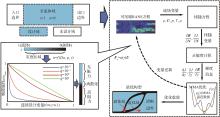
图 1
变密度可压缩流体拓扑优化原理图
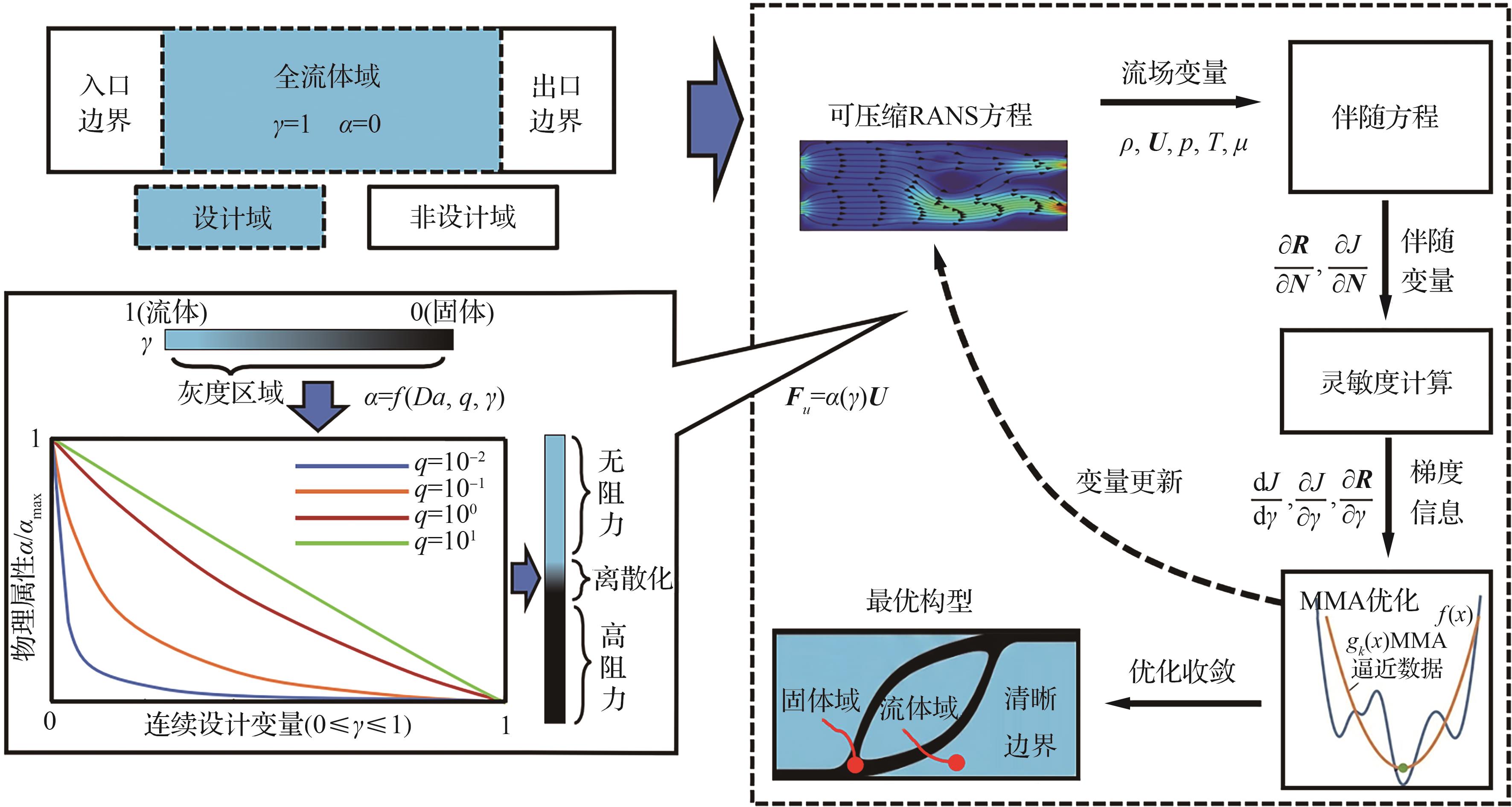
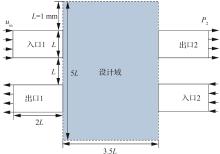
图 2
四通道问题设计域及边界条件
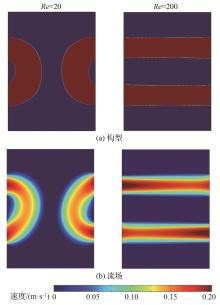
图 3
四通道设计域拓扑优化结果对比
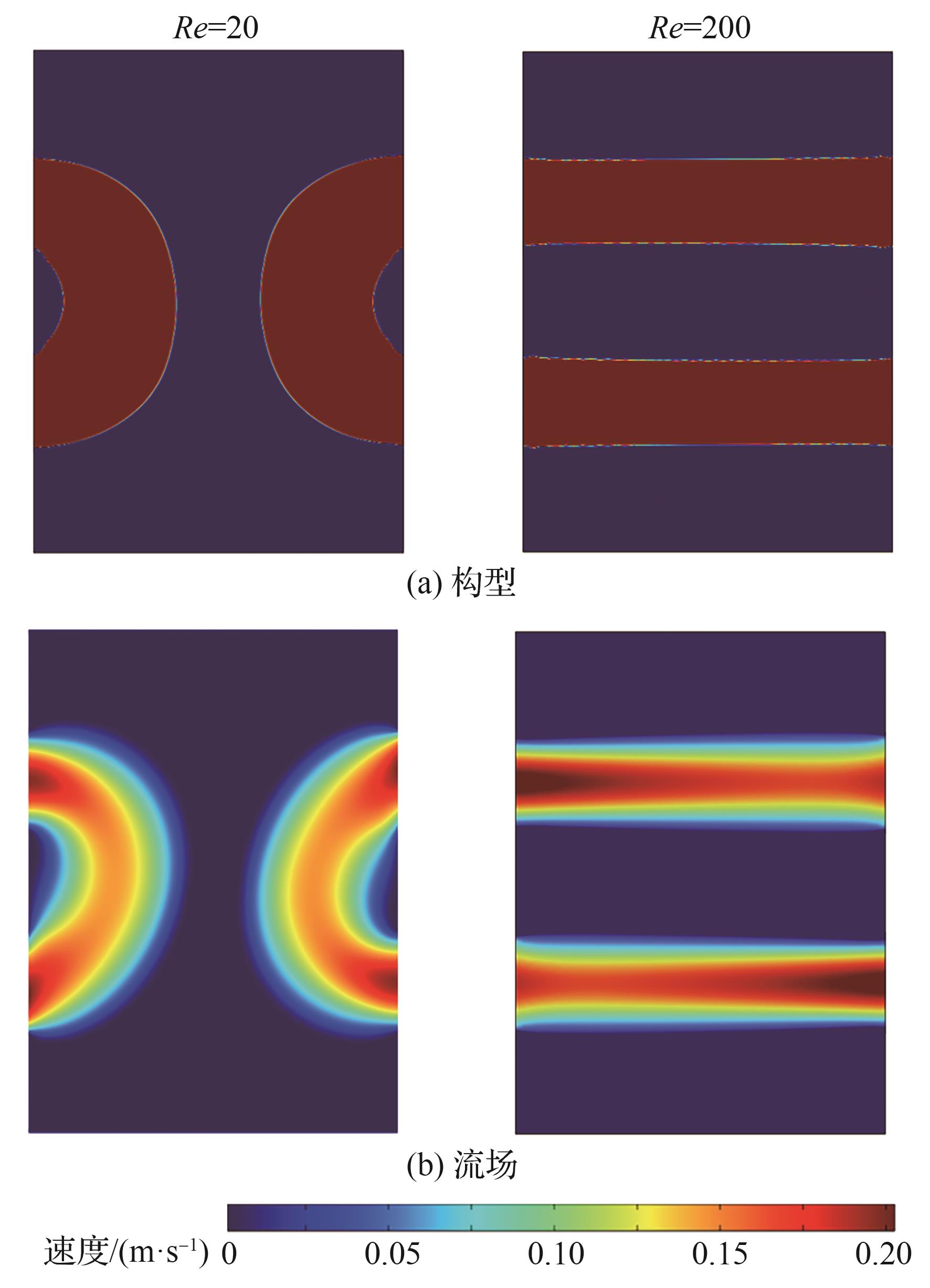
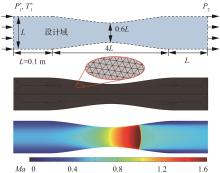
图 4
收敛扩张通道设计域、网格及初始流场
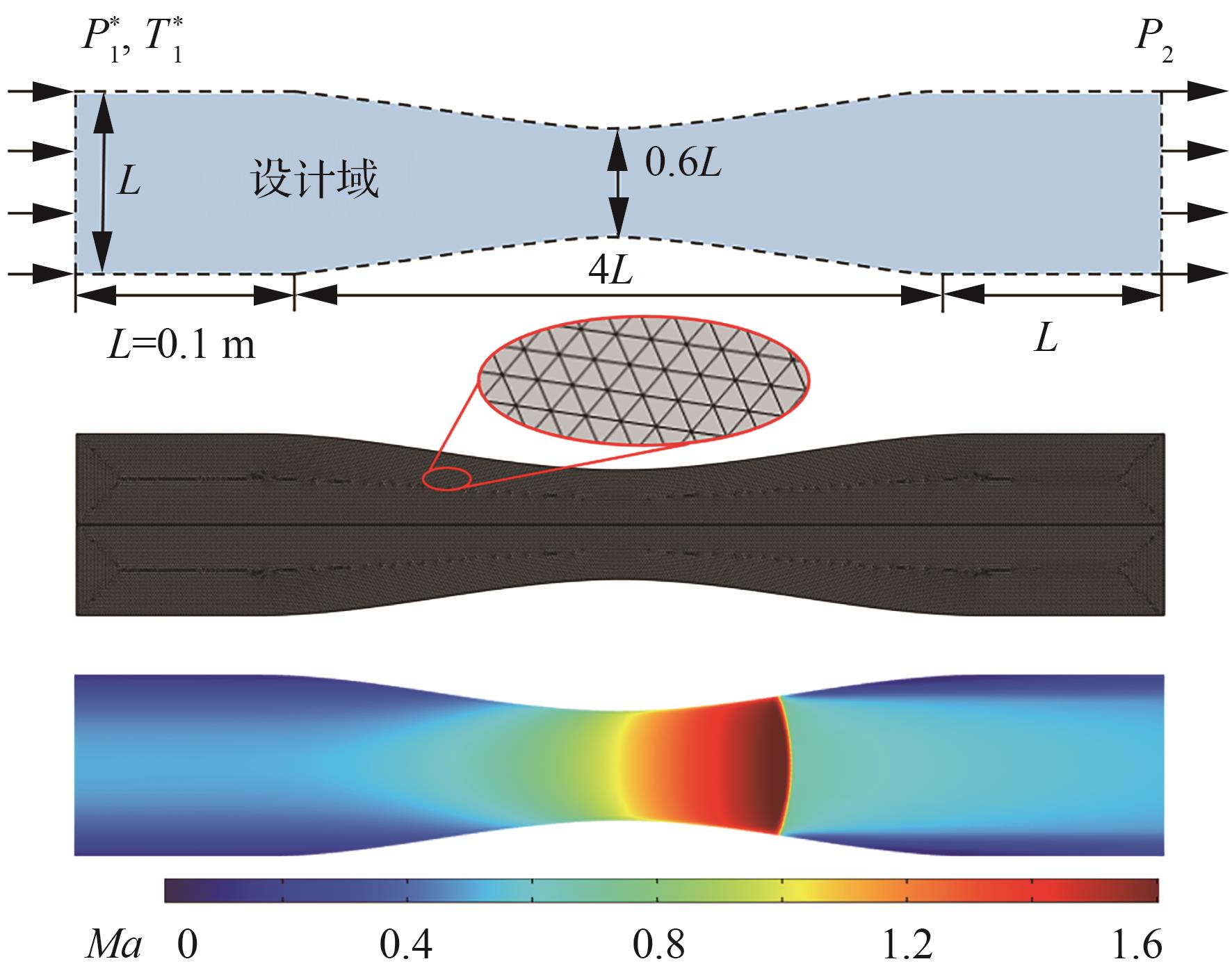
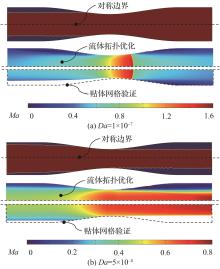
图 5
收敛扩张通道拓扑优化构型及流场(优化目标为能耗最小化)
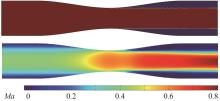
图 6
收敛扩张通道拓扑优化构型及流场(优化目标为速度衰减量最小化)
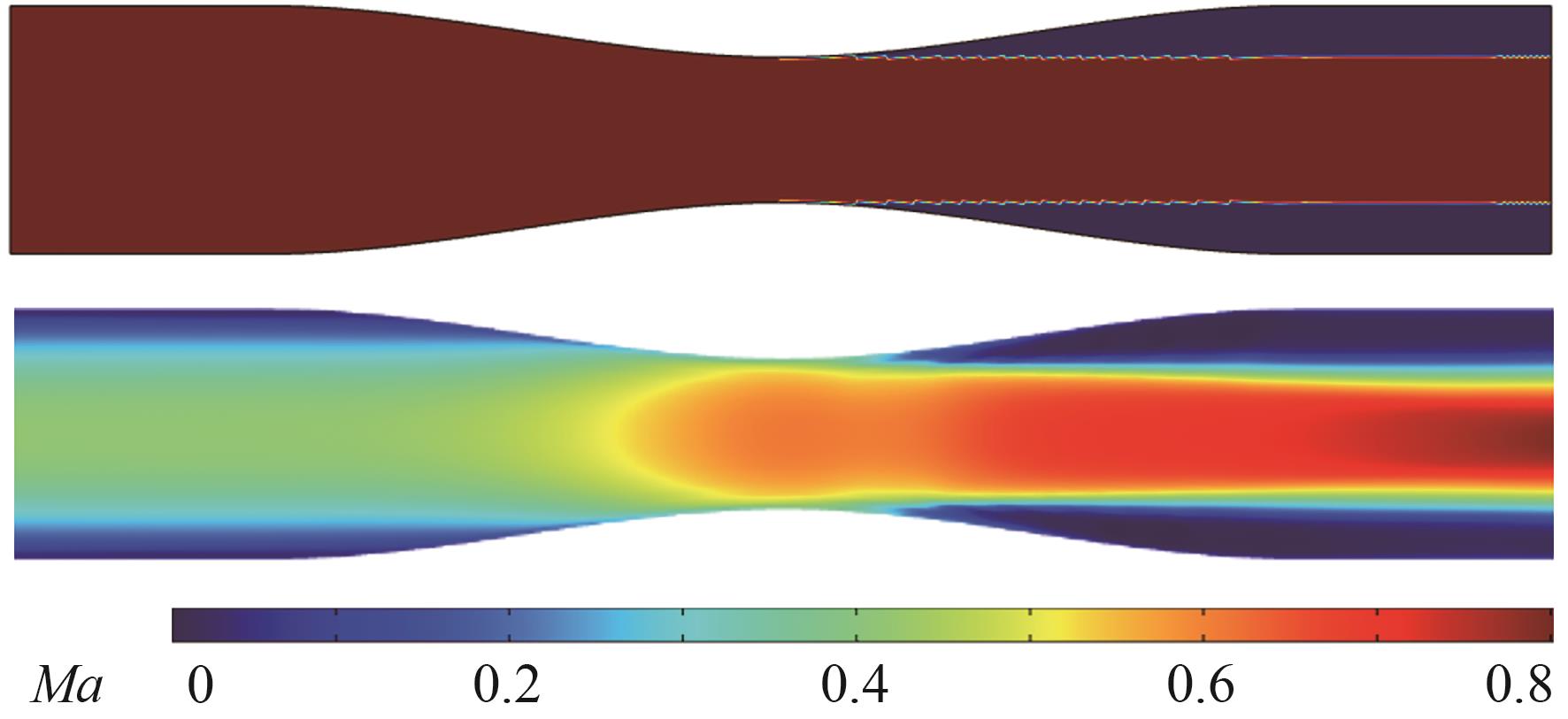
表1
收敛扩张通道优化前后性能对比
| 性能指标 | 优化前 | 优化后 |
|---|---|---|
| Ediss/(W·m-1) | 3.86×10³ | 3.60×10³ (Da=1×10⁻⁷) 2.17×10³ (Da=5×10⁻⁸) |
| 1.000 | 0.463 |
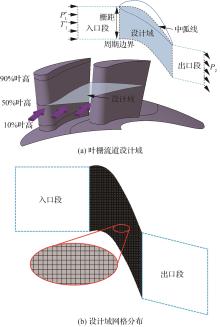
图 7
二维叶栅流道设计域示意图及网格
表2
静叶叶栅流道拓扑优化设计域边界条件
| 位置 | 栅距/m | 弦长/m | 轴向弦长/m | 体积分数 | 进口角度/(°) |
|---|---|---|---|---|---|
| 10%叶高 | 0.059 43 | 0.076 40 | 0.049 82 | 0.359 | 0 |
| 50%叶高 | 0.063 97 | 0.080 88 | 0.049 71 | 0.338 | 0 |
| 90%叶高 | 0.068 50 | 0.085 37 | 0.049 61 | 0.317 | 0 |
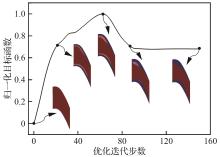
图 8
50%叶高处归一化目标函数的收敛历程及拓扑构型演化
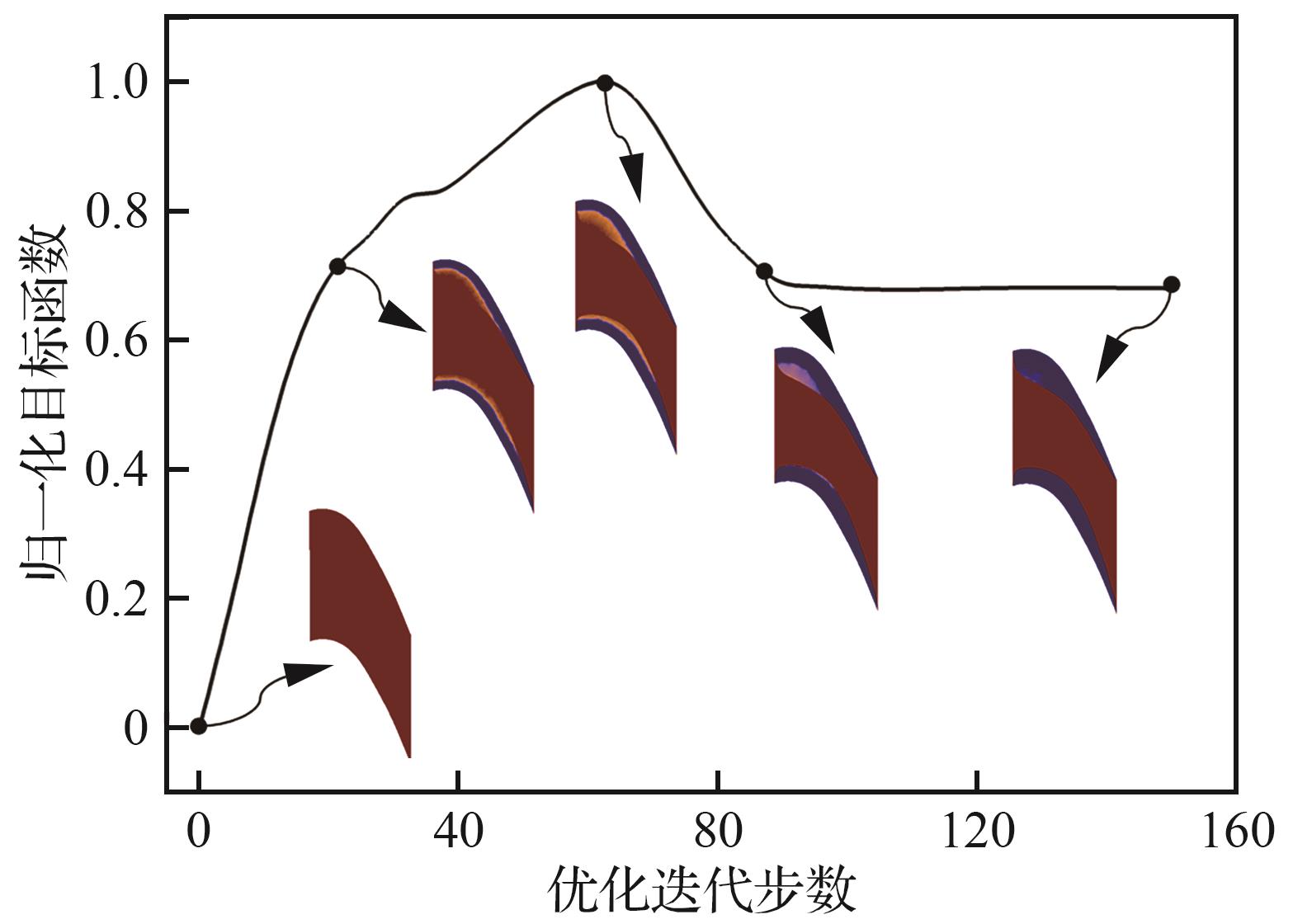
图 9
优化前后50%叶高截面叶栅流道熵分布对比
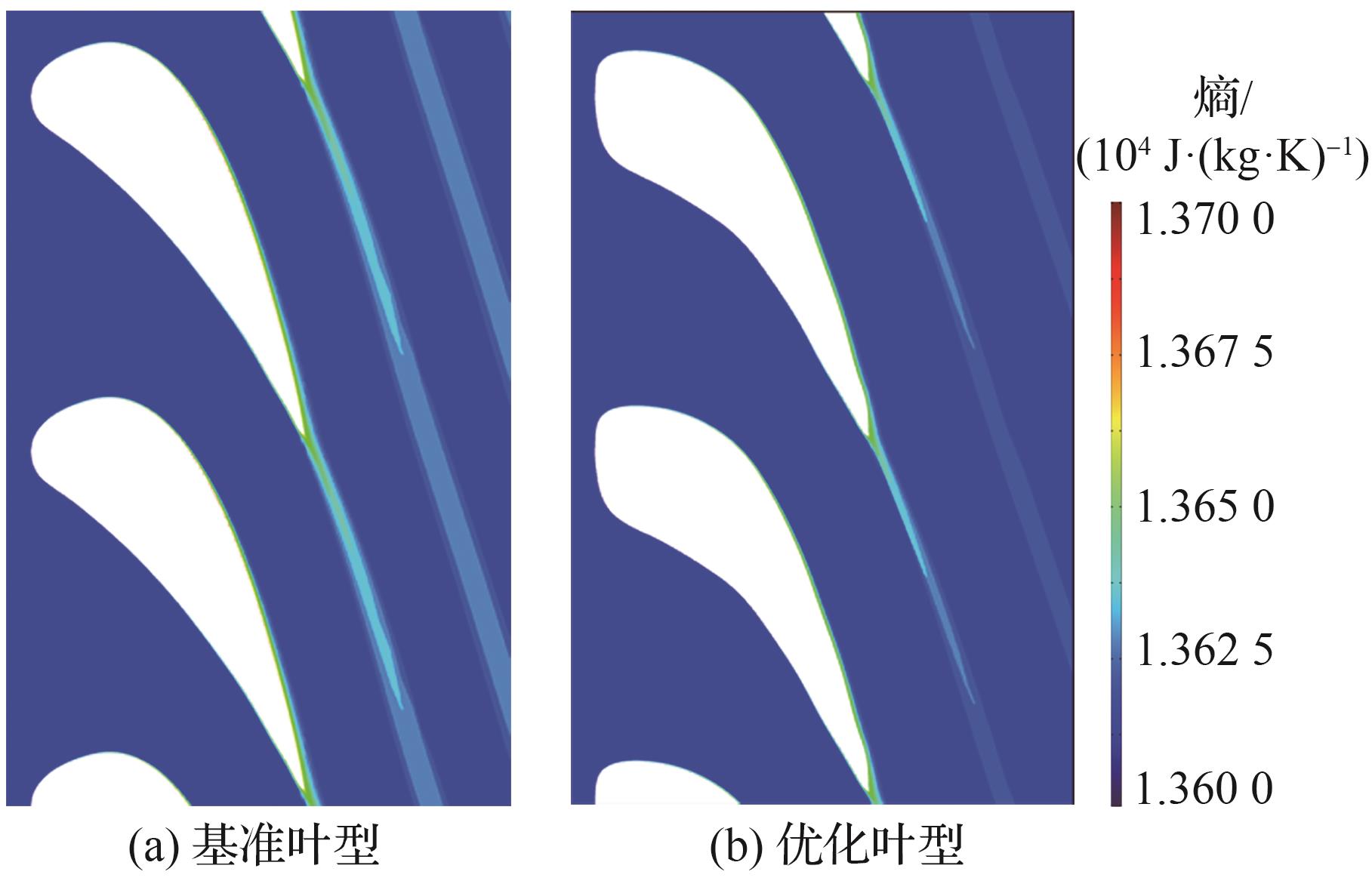
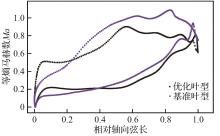
图 10
50%叶高叶栅流道优化前后叶片表面等熵马赫数
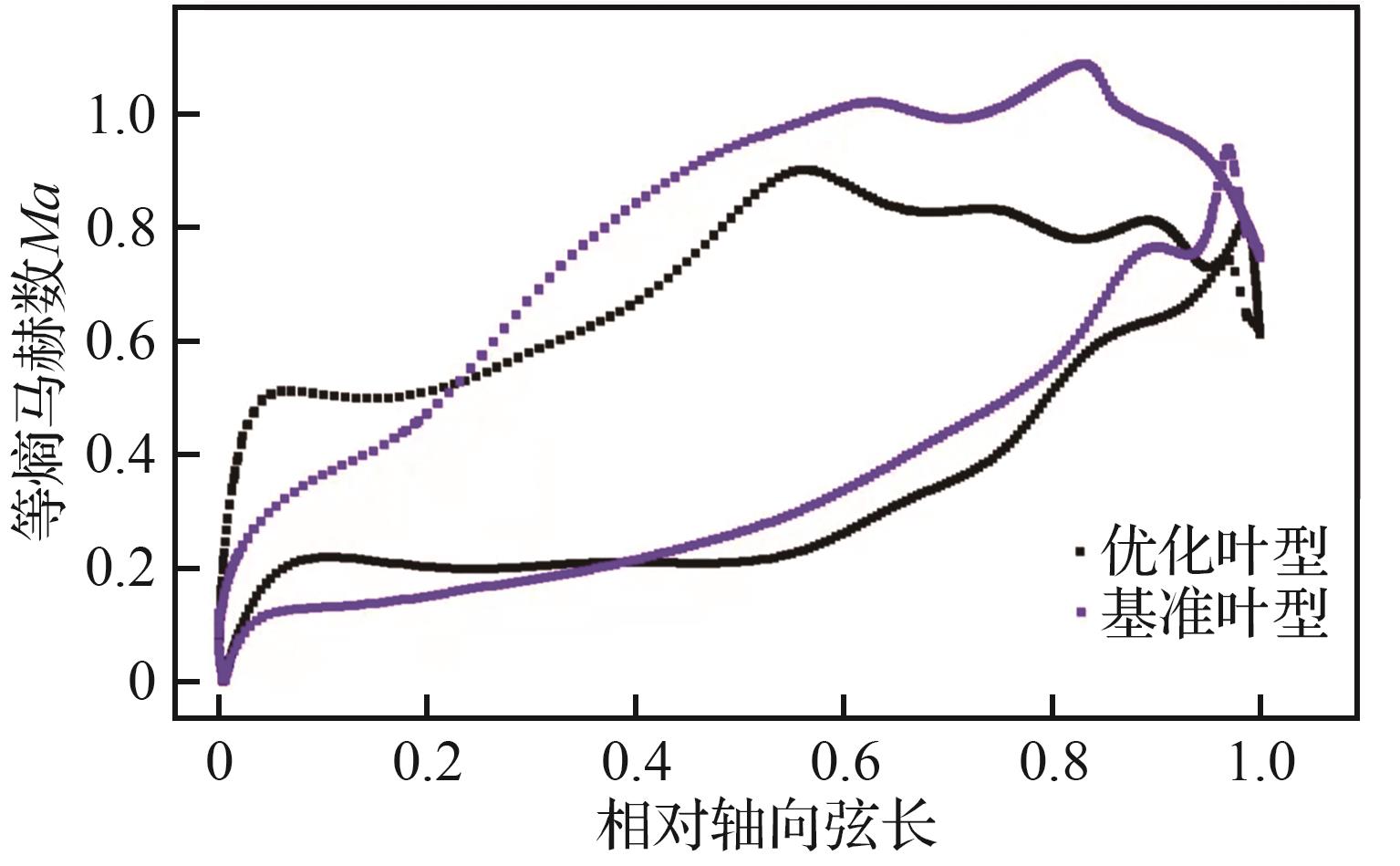
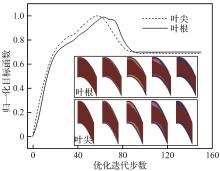
图 11
10%叶高、90%叶高设计域目标-构型收敛过程
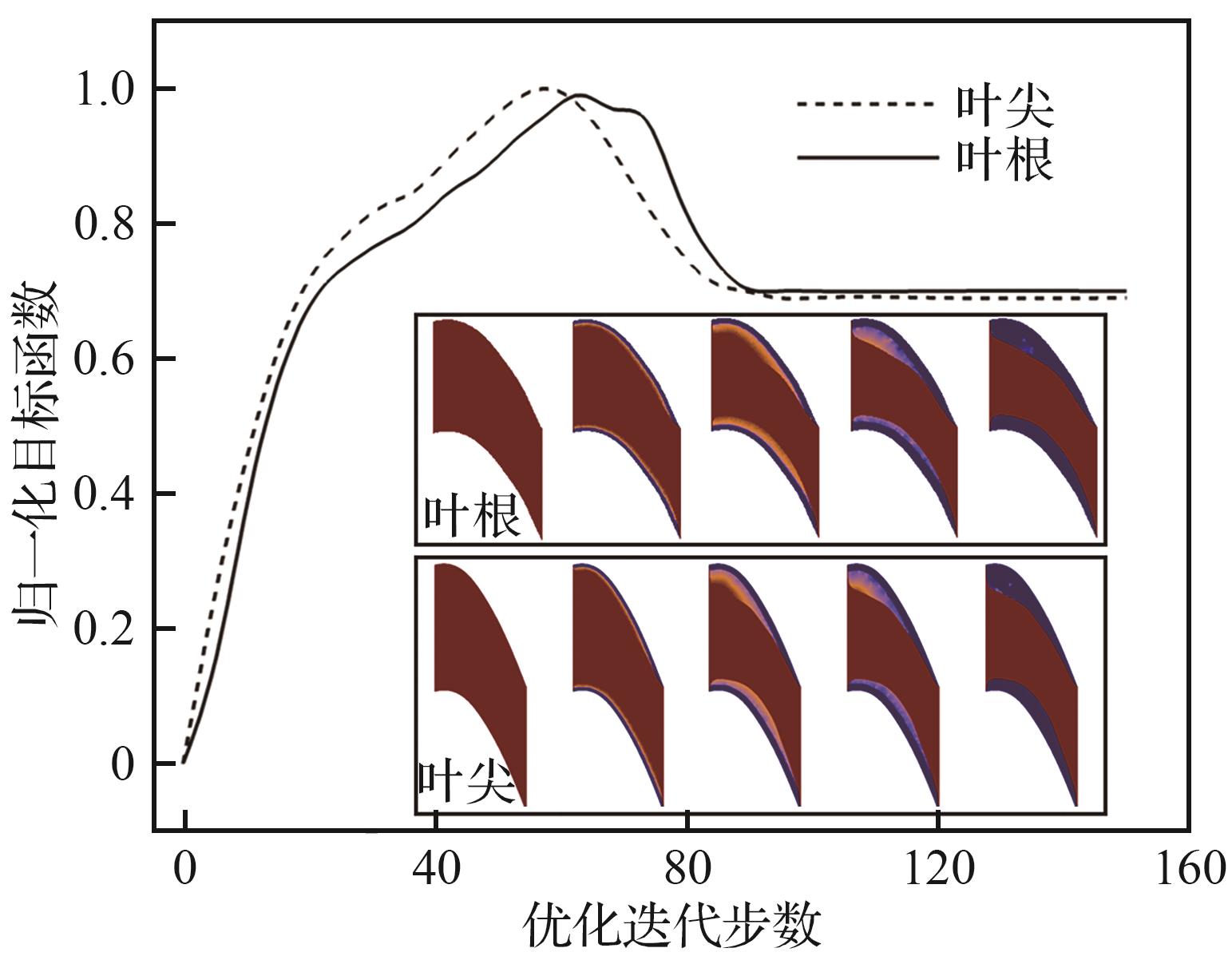
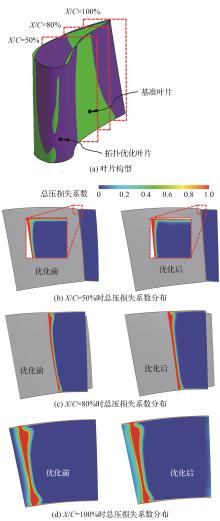
图 12
静叶优化前后对比
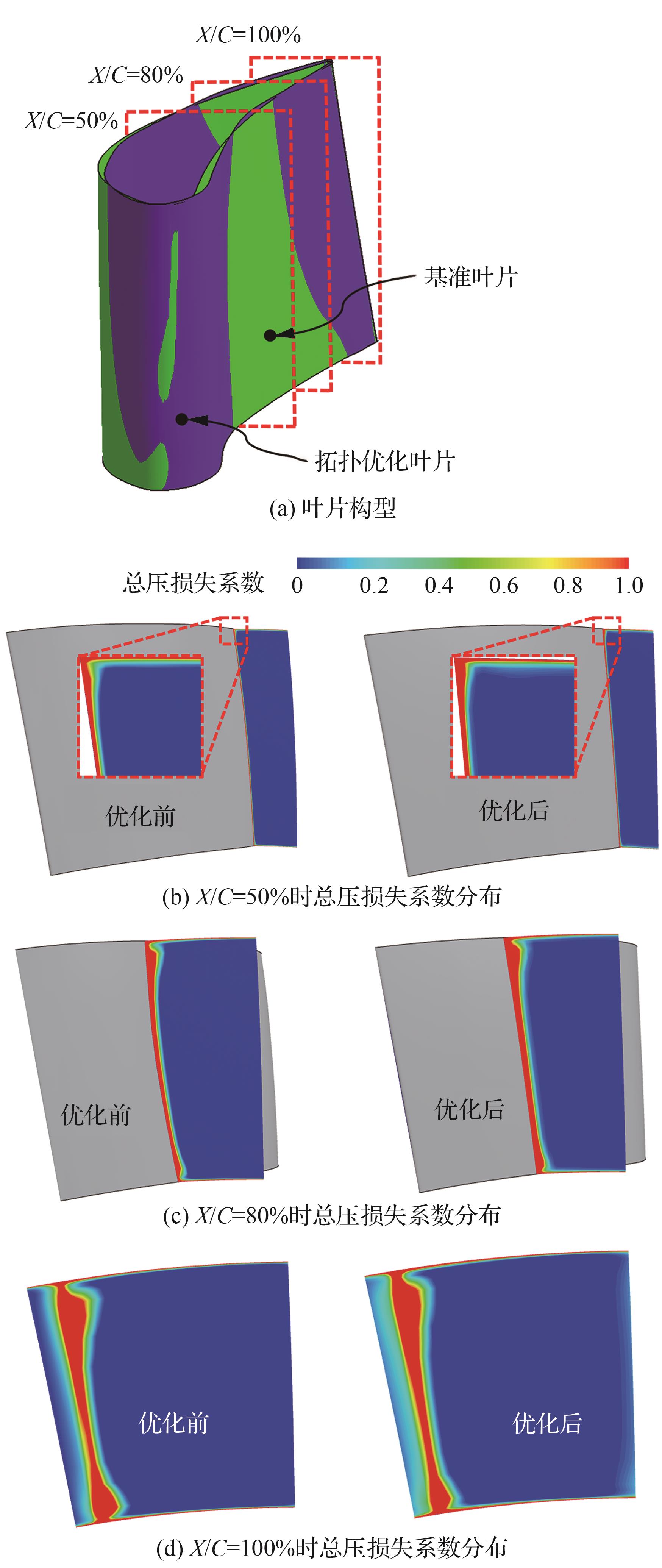
表3
叶片拓扑优化前后涡轮性能指标对比
| 性能指标 | 优化前 | 优化后 |
|---|---|---|
| 流量/(kg·s-1) | 11.086 | 11.298 |
| 落压比 | 1.379 | 1.365 |
| 等熵效率/% | 90.65 | 91.86 |
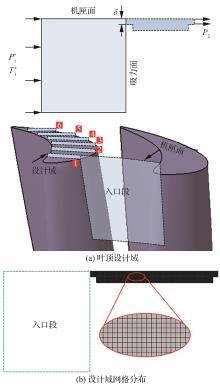
图 13
动叶叶顶设计域示意图及网格
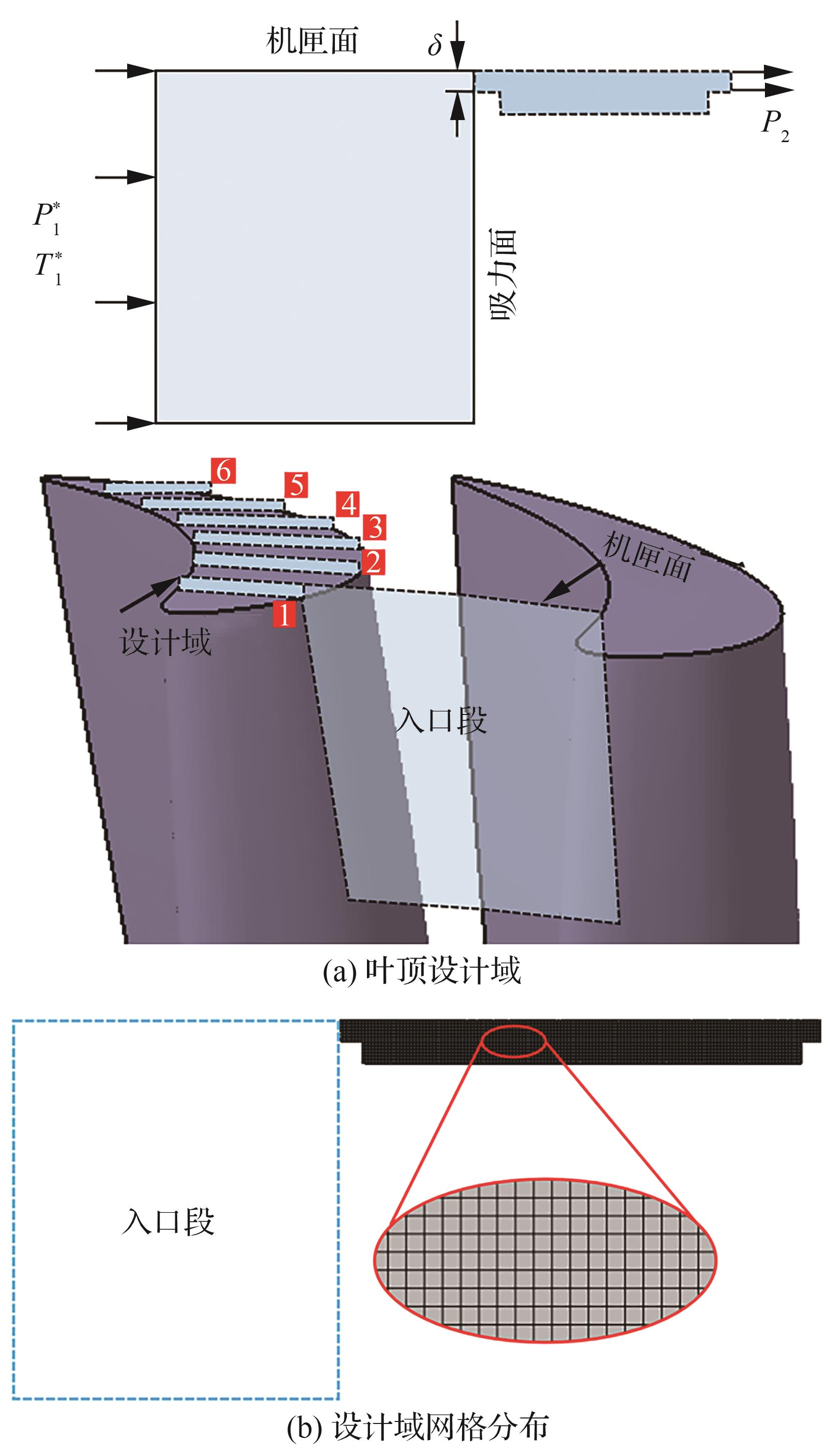
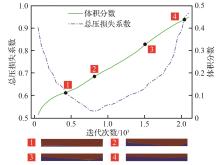
图 14
动叶叶顶截面1总压损失系数-体积约束分布规律
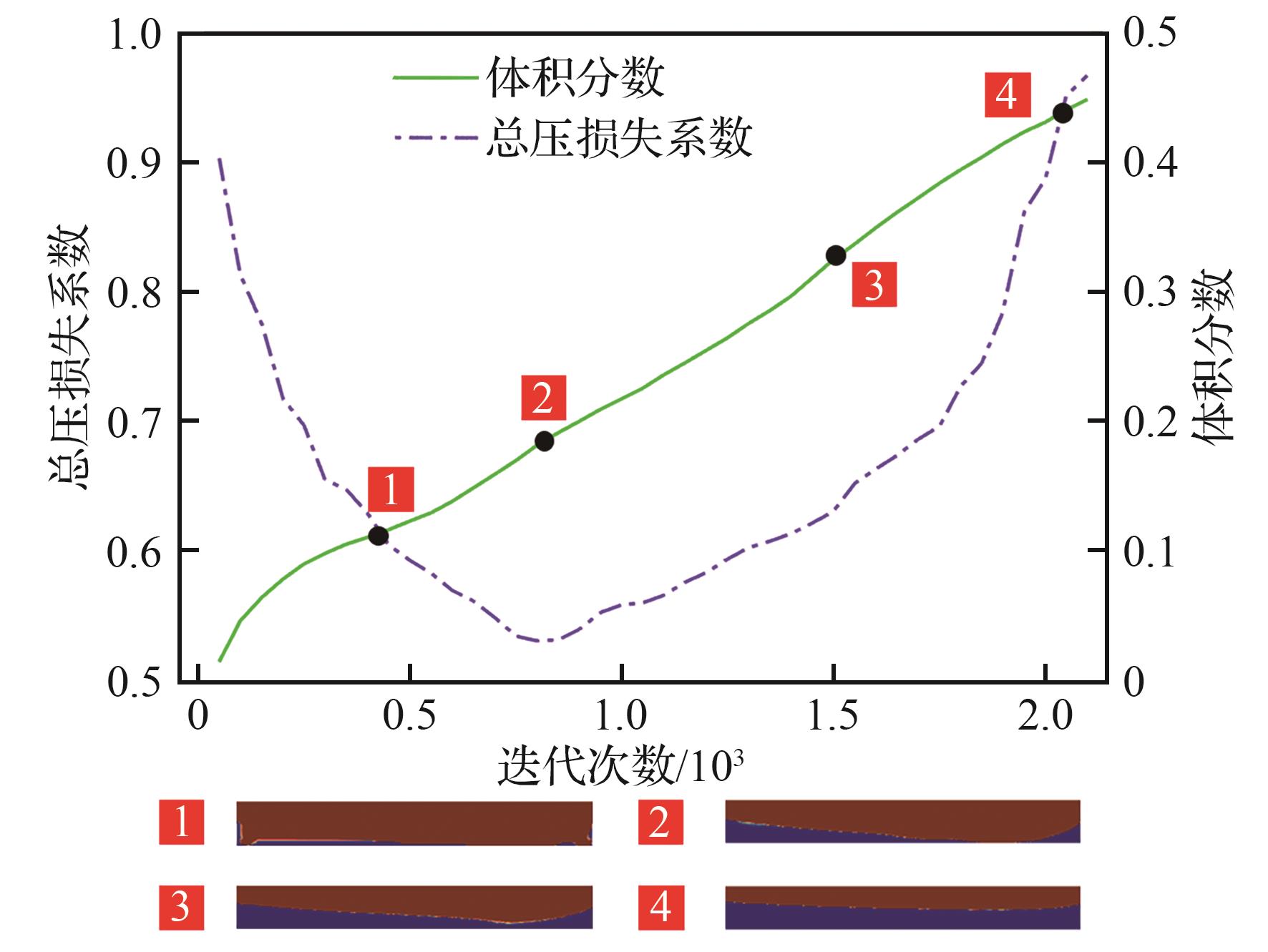
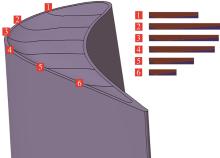
图 15
拓扑优化后曲面叶顶构型
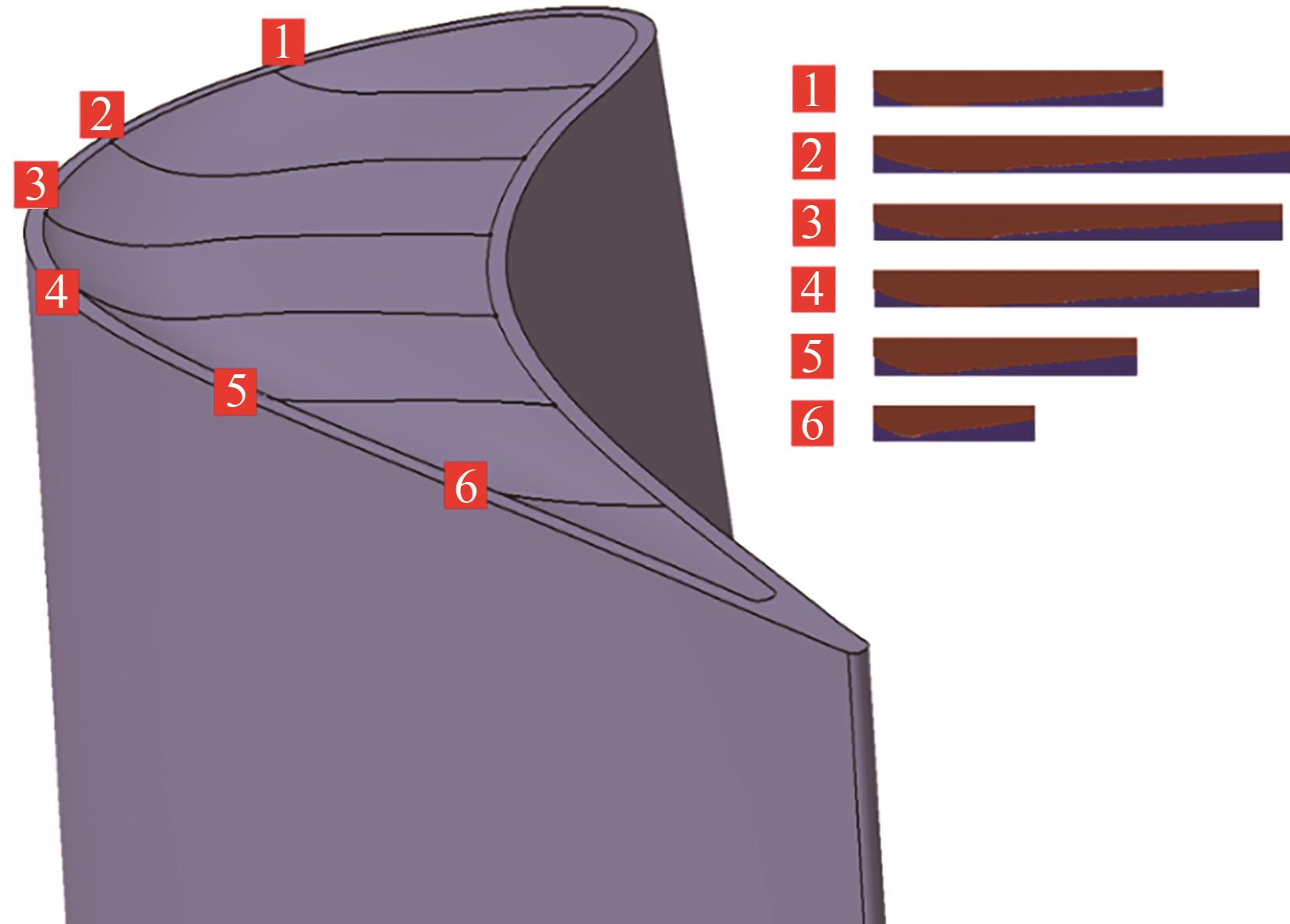
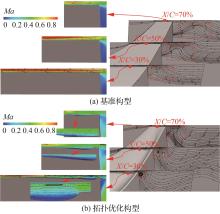
图 16
优化前后动叶30%、50%、70%轴向弦长位置叶顶间隙泄漏流场对比
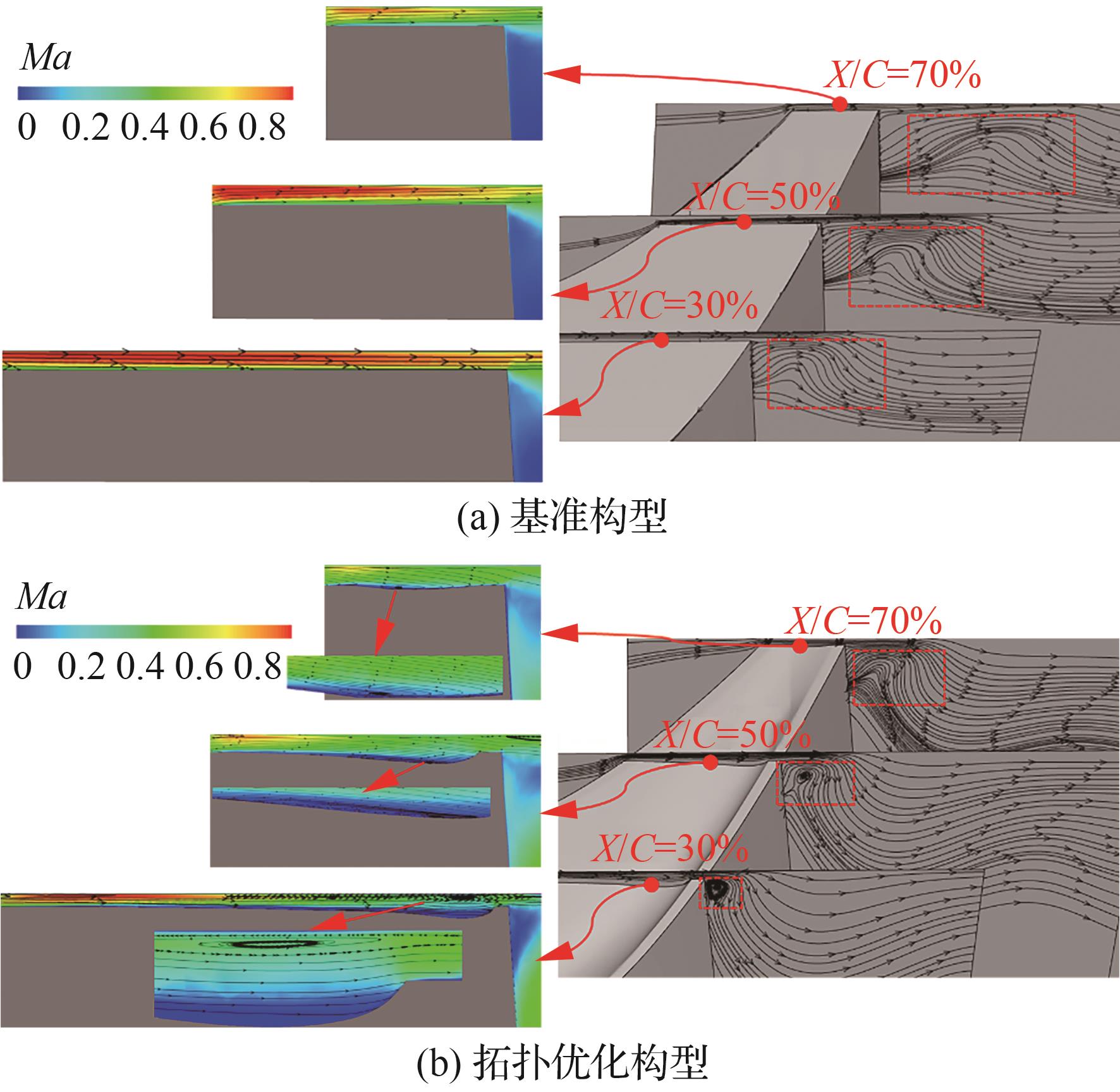
图 17
形状-拓扑参数化流体拓扑优化方法原理图
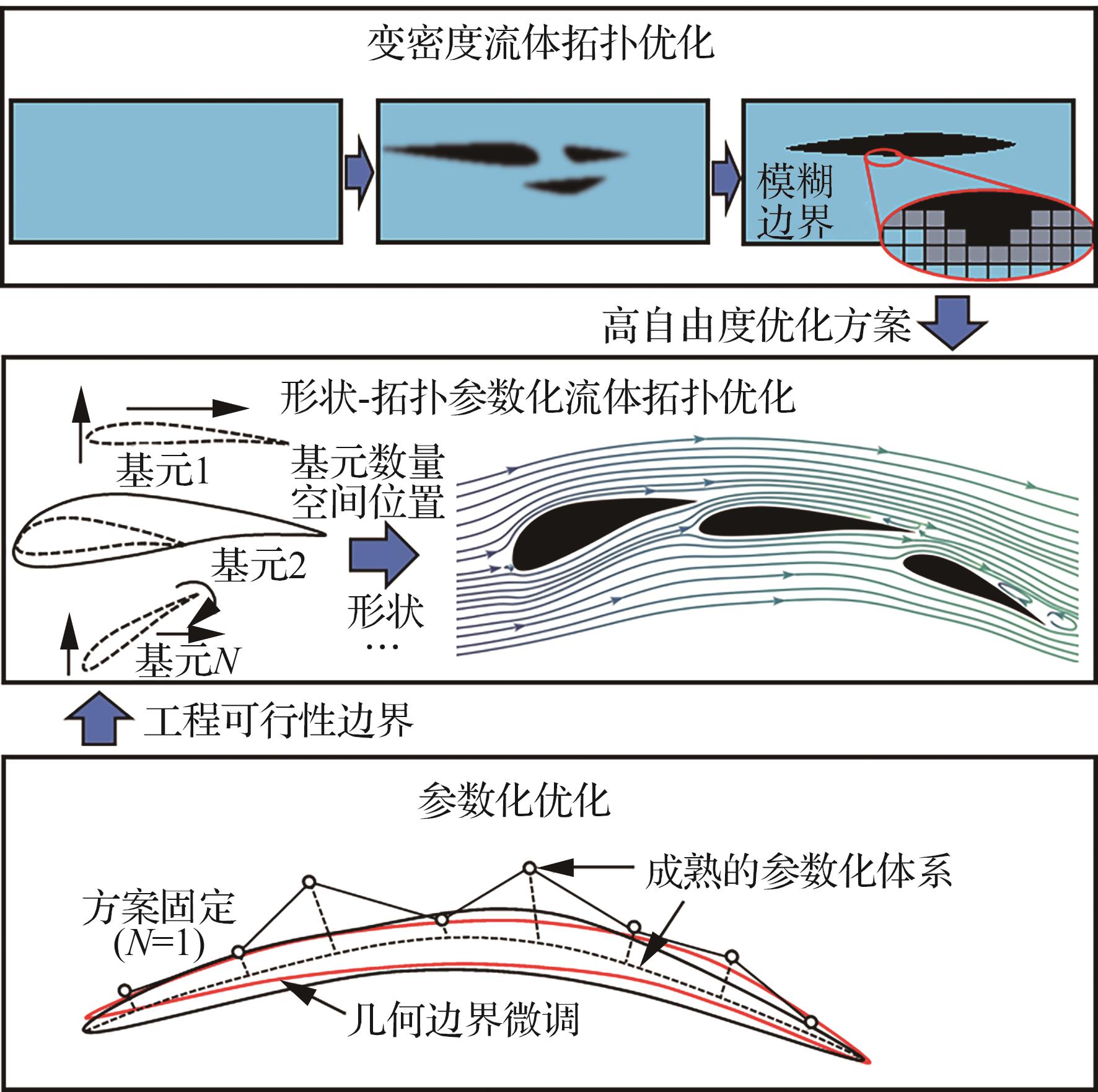
图 18
形状-拓扑参数化体系
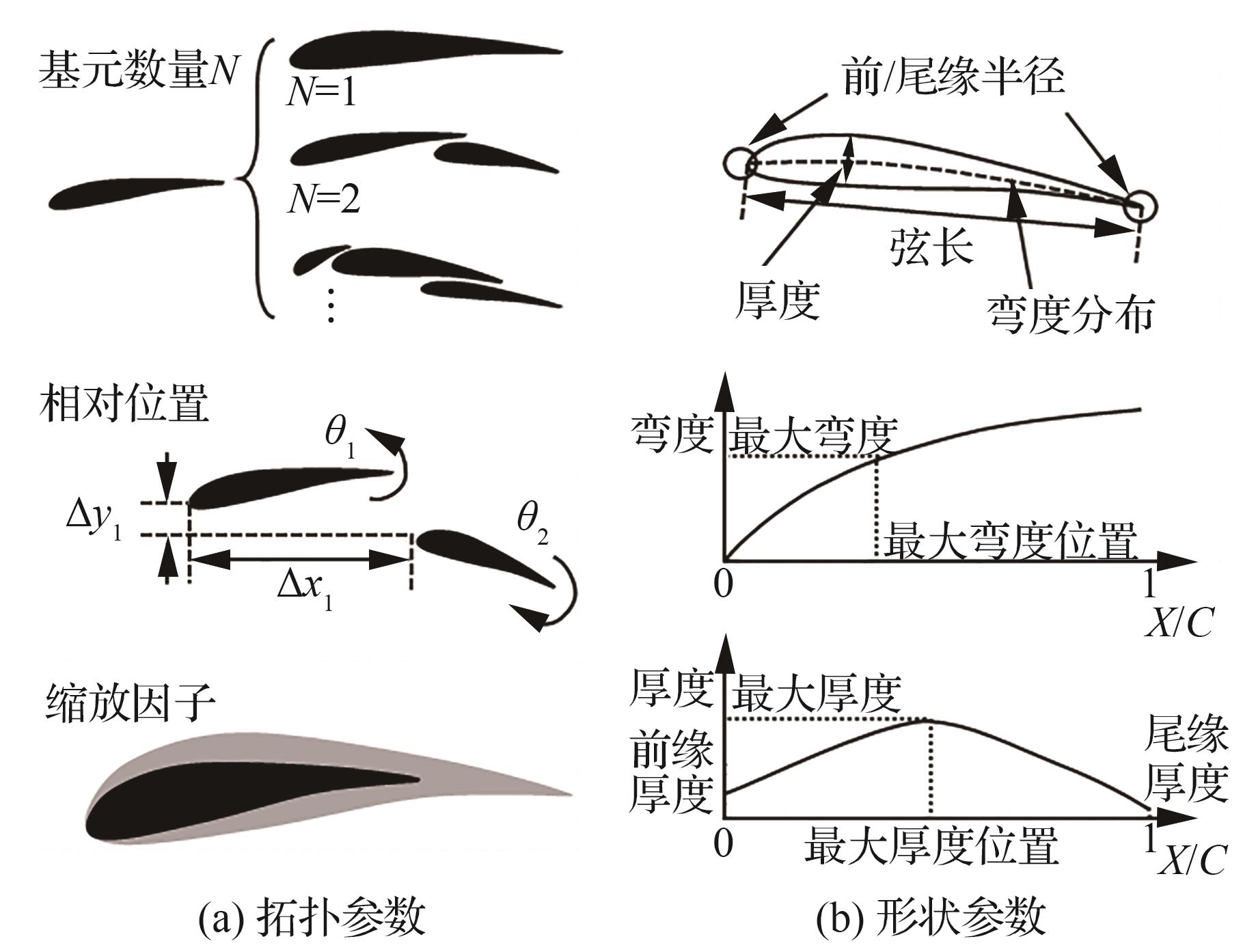
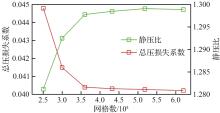
图 19
不同网格数下的计算性能
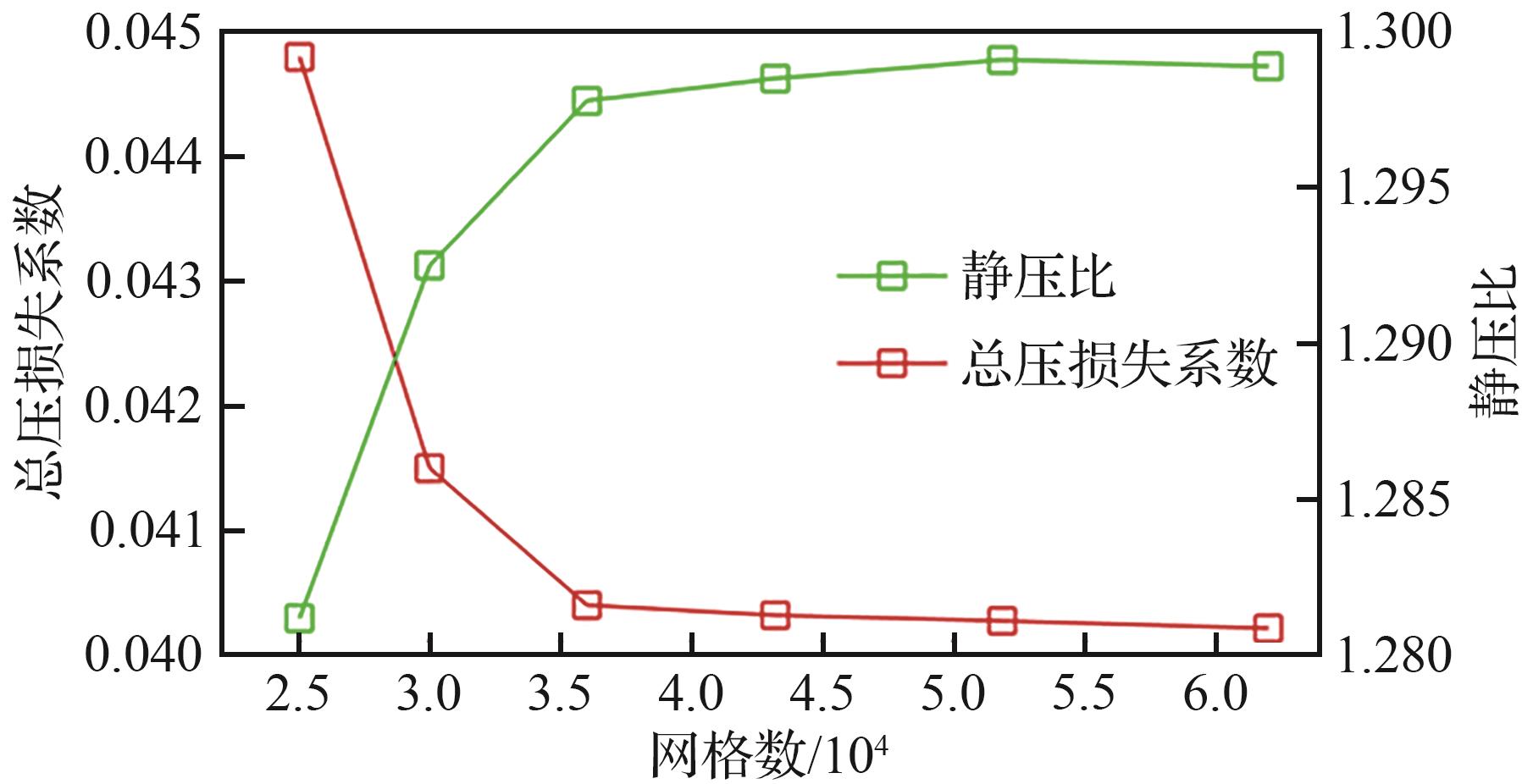
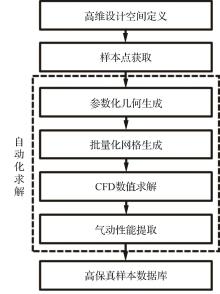
图 20
采样-数据获取工作流
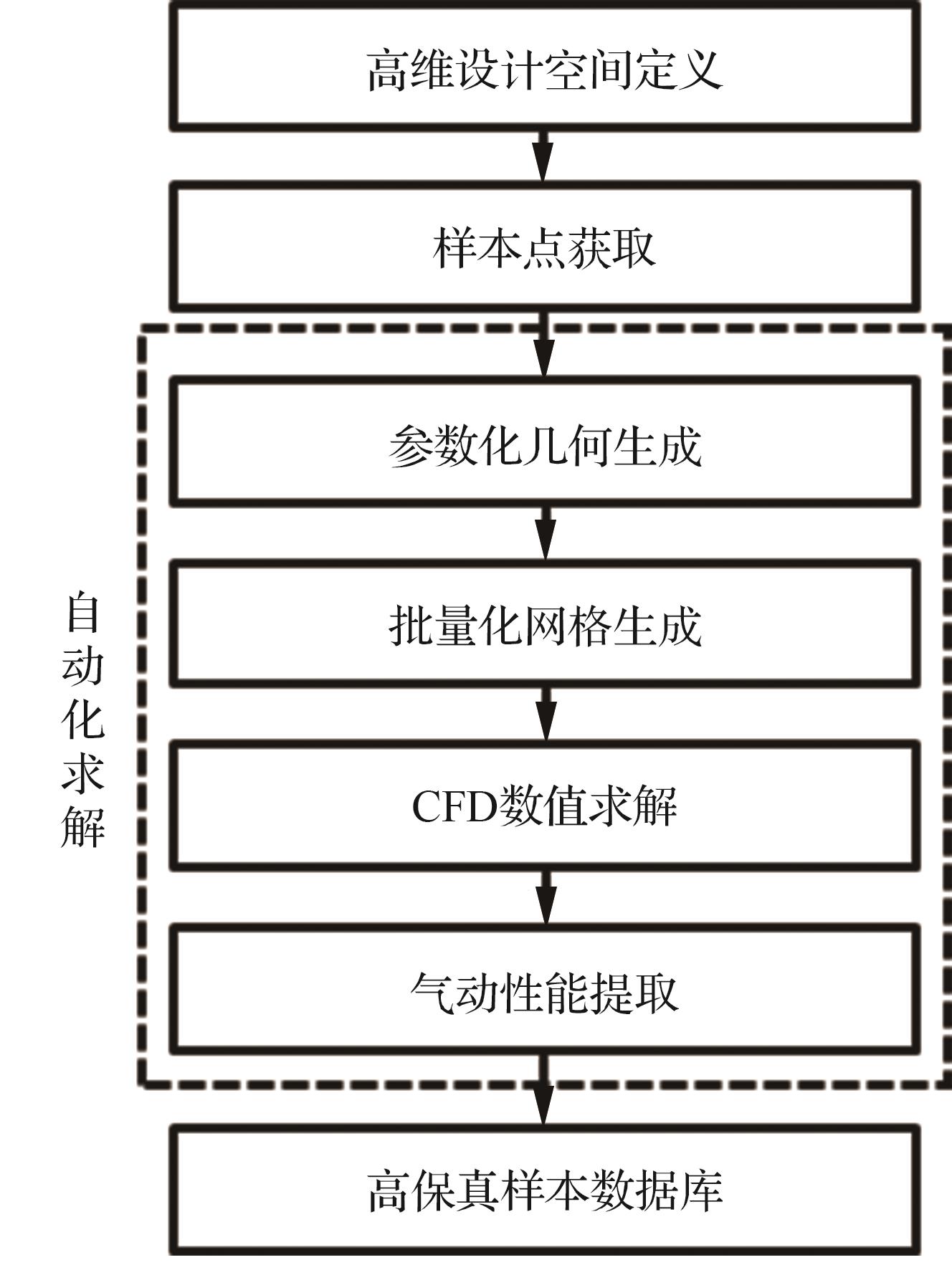
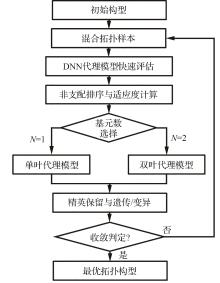
图 21
基于深度代理模型的多目标优化流程
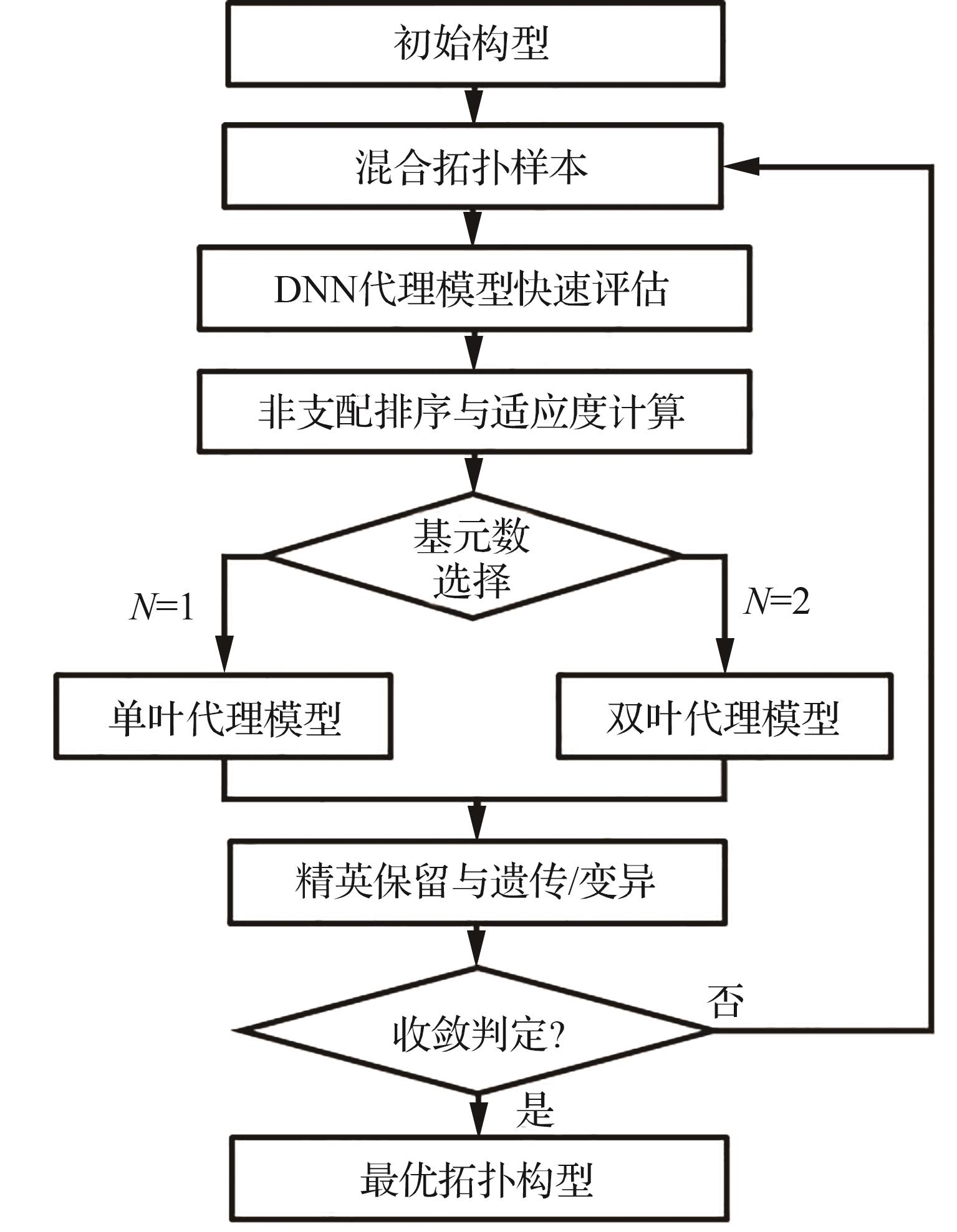
表4
设计场景初始条件
| 初始条件 | 数值 |
|---|---|
| 入口马赫数Ma | 0.7 |
| 弦长/m | 0.121 |
| 栅距/m | 0.054 |
| 转折角/(°) | 60 |
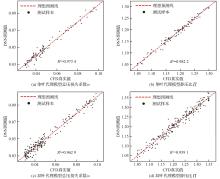
图 22
低速-高负荷场景下DNN代理模型性能对比
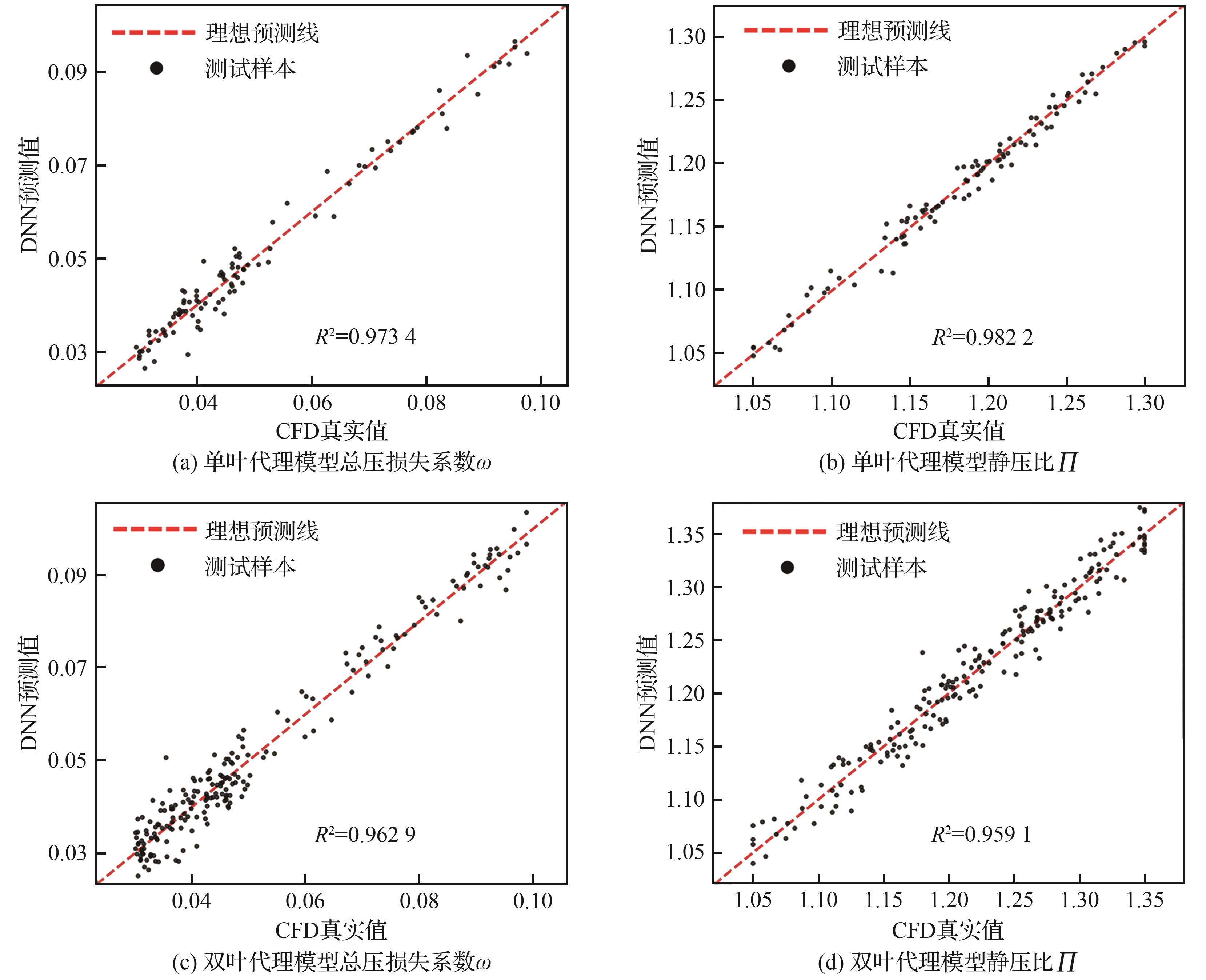
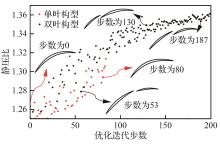
图 23
静压比迭代与拓扑择优过程
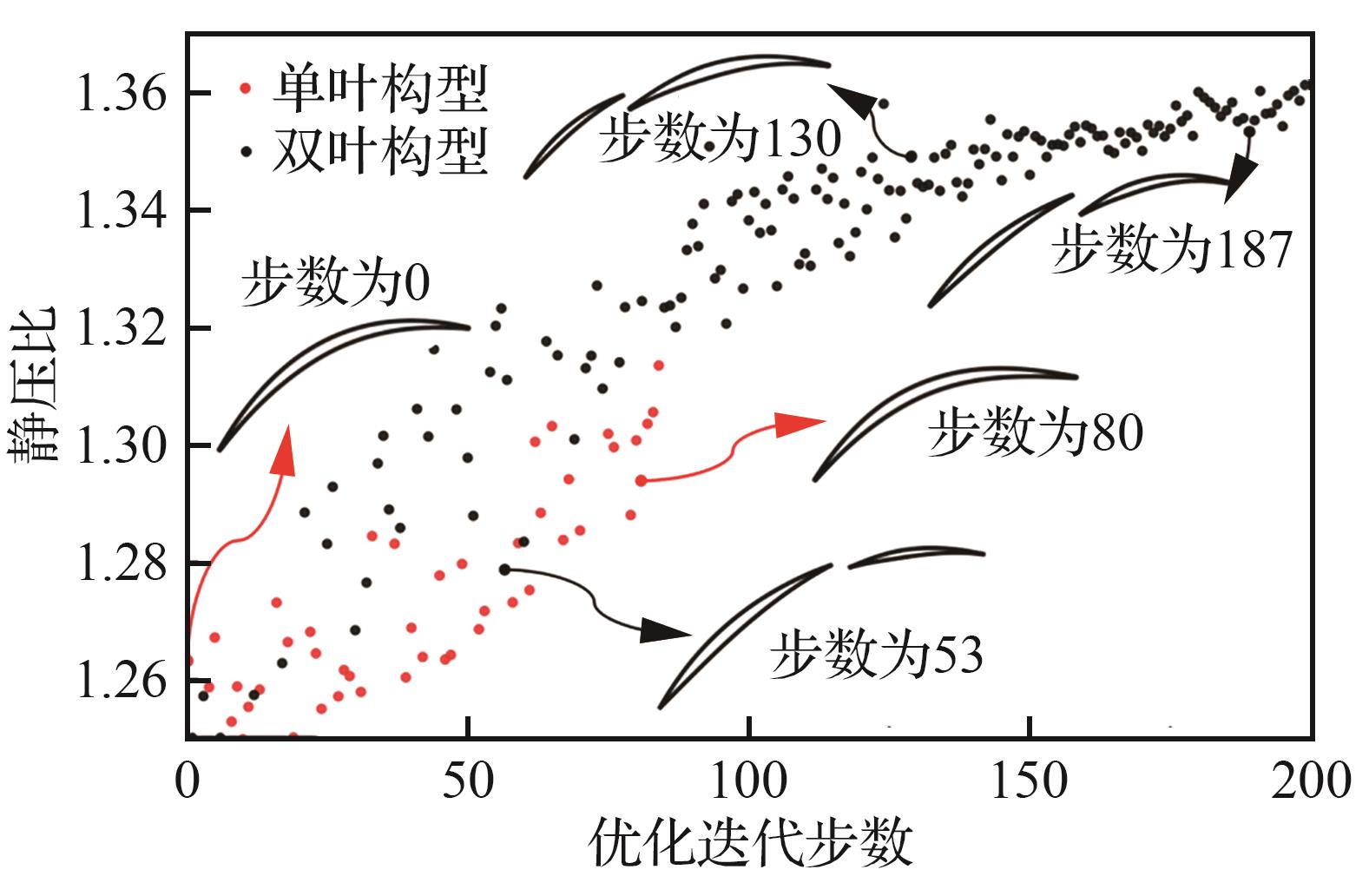
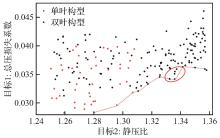
图 24
总压损失系数-静压比非支配解集分布
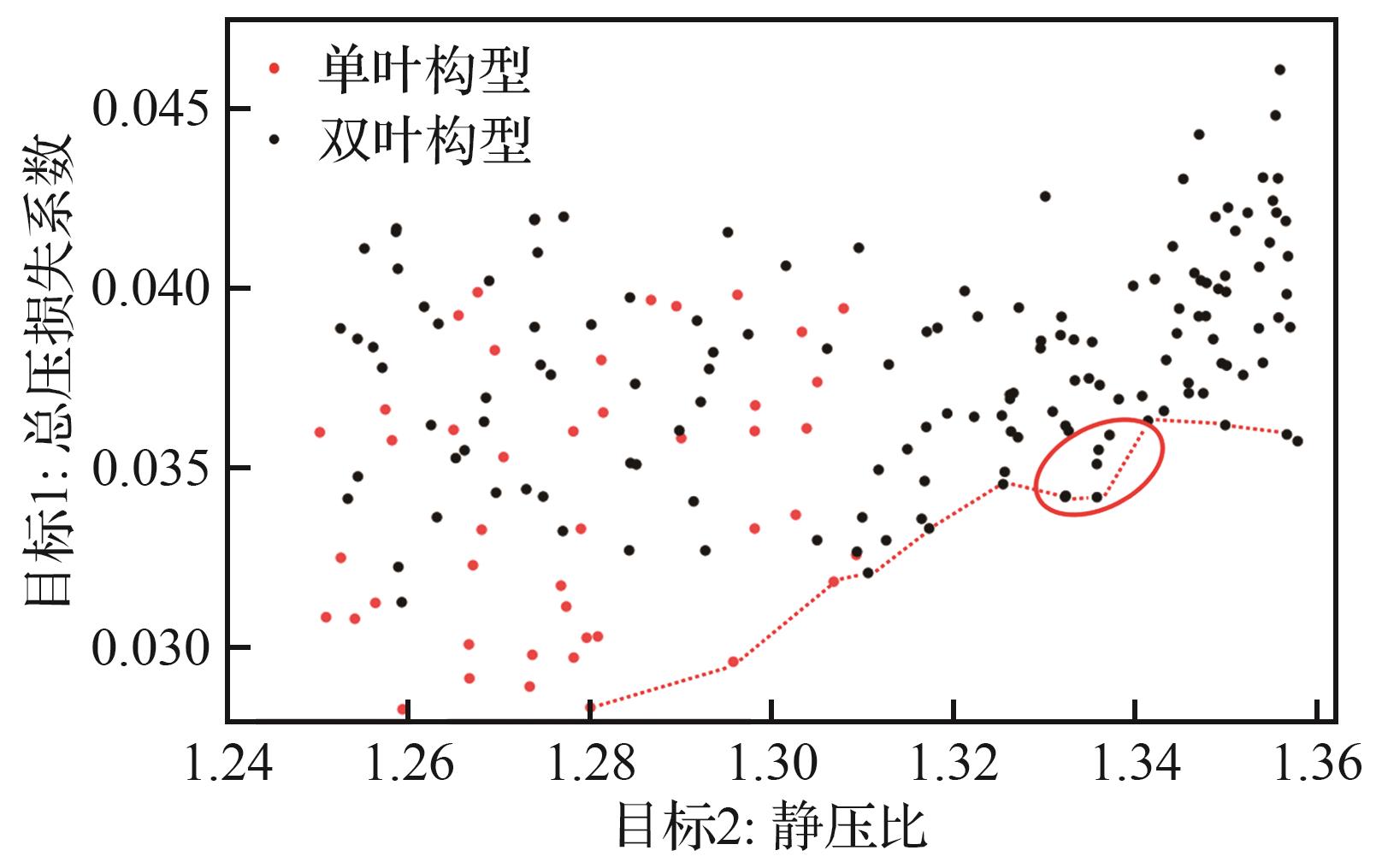
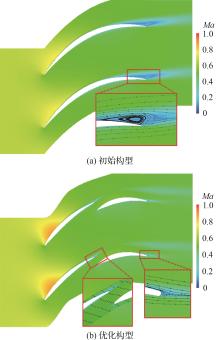
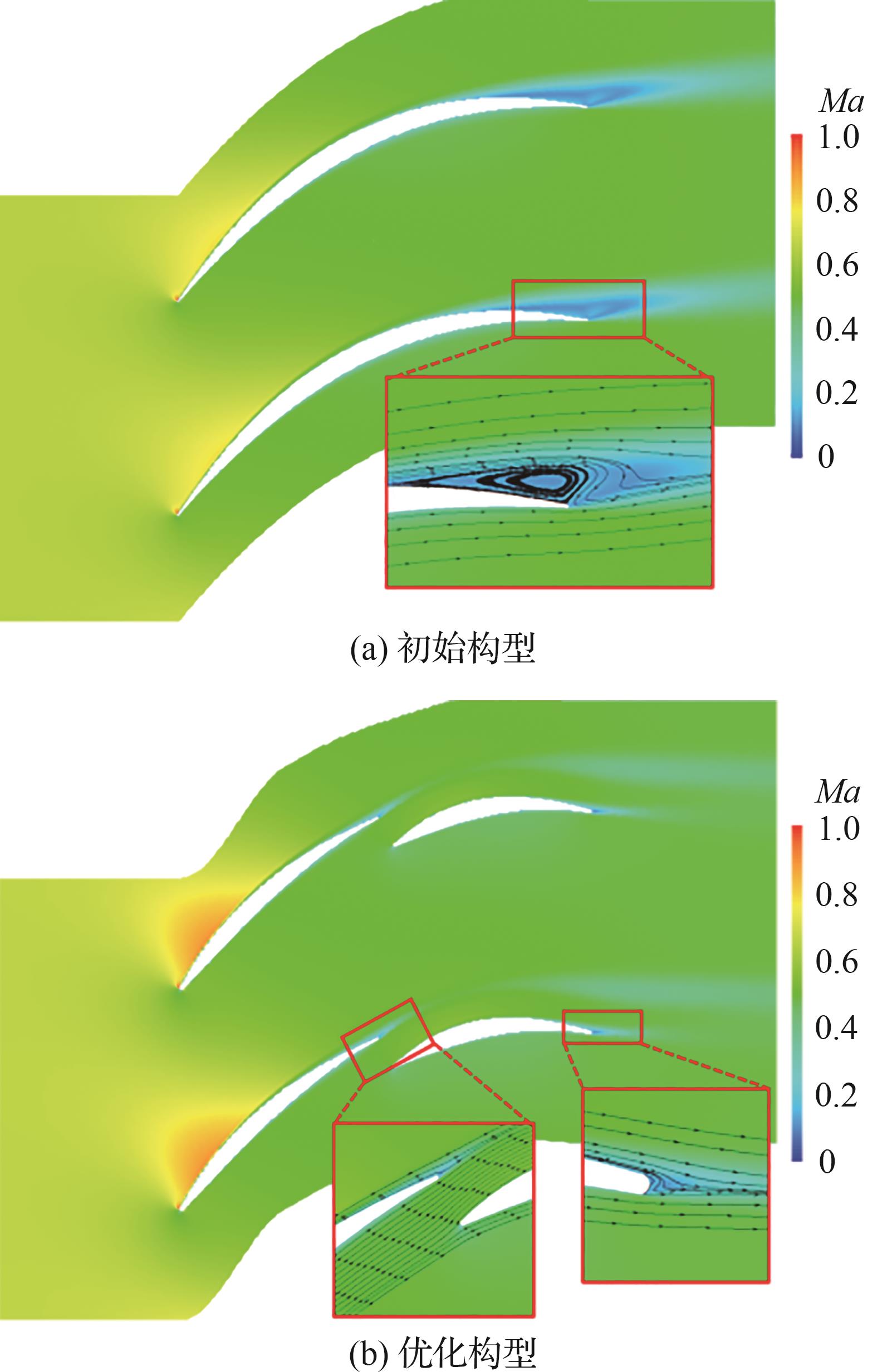
图 25
优化前后构型流场对比
| [1] | BORRVALL T, PETERSSON J. Topology optimization of fluids in Stokes flow[J]. International Journal for Numerical Methods in Fluids, 2003, 41(1): 77-107. |
| [2] | GERSBORG-HANSEN A, SIGMUND O, HABER R B. Topology optimization of channel flow problems[J]. Structural and Multidisciplinary Optimization, 2005, 30(3): 181-192. |
| [3] | ALEXANDERSEN J, SIGMUND O, AAGE N. Large scale three-dimensional topology optimisation of heat sinks cooled by natural convection[J]. International Journal of Heat and Mass Transfer, 2016, 100: 876-891. |
| [4] | CHALLIS V J, GUEST J K. Level set topology optimization of fluids in Stokes flow[J]. International Journal for Numerical Methods in Engineering, 2009, 79(10): 1284-1308. |
| [5] | ZHOU S W, LI Q. A variational level set method for the topology optimization of steady-state Navier-Stokes flow[J]. Journal of Computational Physics, 2008, 227(24): 10178-10195. |
| [6] | DENG Y B, ZHANG P, LIU Y S, et al. Optimization of unsteady incompressible Navier-Stokes flows using variational level set method[J]. International Journal for Numerical Methods in Fluids, 2013, 71(12): 1475-1493. |
| [7] | GARCKE H, HECHT C, HINZE M, et al. Numerical approximation of phase field based shape and topology optimization for fluids[J]. SIAM Journal on Scientific Computing, 2015, 37(4): A1846-A1871. |
| [8] | DENG Y B, LIU Z Y, ZHANG P, et al. Topology optimization of unsteady incompressible Navier-Stokes flows[J]. Journal of Computational Physics, 2011, 230(17): 6688-6708. |
| [9] | KREISSL S, PINGEN G, MAUTE K. Topology optimization for unsteady flow[J]. International Journal for Numerical Methods in Engineering, 2011, 87(13): 1229-1253. |
| [10] | YOON G H. Topology optimization for turbulent flow with Spalart-Allmaras model[J]. Computer Methods in Applied Mechanics and Engineering, 2016, 303: 288-311. |
| [11] | DILGEN S B, DILGEN C B, FUHRMAN D R, et al. Density based topology optimization of turbulent flow heat transfer systems[J]. Structural and Multidisciplinary Optimization, 2018, 57(5): 1905-1918. |
| [12] | PADHY R K, SURESH K, CHANDRASEKHAR A. TOMAS: Topology optimization of multiscale fluid devices using variational autoencoders and super-shapes[DB/OL]. arXiv preprint: 2309.08435, 2023. |
| [13] | KOU C H, YIN Y H, ZHU M, et al. Efficient neural topology optimization via active learning for enhancing turbulent mass transfer in fluid channels[DB/OL]. arXiv preprint: 2503.03997, 2025. |
| [14] | SÁ L F N, OKUBO C M, SILVA E C N. Topology optimization of subsonic compressible flows[J]. Structural and Multidisciplinary Optimization, 2021, 64(1): 2903. |
| [15] | MAFFEI F S, NOGUEIRA DE SÁ L F, MOSCATELLI E, et al. Integer programming topology optimization for subsonic compressible flows with geometry trimming[J]. International Journal of Heat and Mass Transfer, 2023, 201: 123614. |
| [16] | GARCIA-RODRIGUEZ L F, ALONSO D H, SILVA E C N. Turbulence effects in the topology optimization of compressible subsonic flow[J]. International Journal for Numerical Methods in Fluids, 2025, 97(1): 44-68. |
| [17] | SÁ L F N, MAFFEI F S, RIBEIRO L N B S, et al. Topology optimization design of labyrinth seal-type devices considering subsonic compressible turbulent flow conditions[J]. Computers & Mathematics with Applications, 2024, 176: 306-323. |
| [18] | 张敏, 杨金广, 刘艳. 流体拓扑优化方法及其在叶轮机械中的应用[J]. 推进技术, 2021, 42(11): 2401-2416. |
| ZHANG M, YANG J G, LIU Y. Fluid topology optimization method and its application in turbomachinery[J]. Journal of Propulsion Technology, 2021, 42(11): 2401-2416 (in Chinese). | |
| [19] | 张敏. 涡轮动叶叶顶间隙泄漏控制及结构优化研究[D]. 大连: 大连理工大学, 2019. |
| ZHANG M. Study on clearance leakage control and structure optimization of turbine rotor blade tips[D]. Dalian: Dalian University of Technology, 2019 (in Chinese). | |
| [20] | ZHANG M, DU J, ZHANG H, et al. Fluid topology optimization of gas-turbine-related components[C]∥ 1st International Conference on Mechanical System Dynamics (ICMSD 2022). London: IET, 2022: 943-949. |
| [21] | 李信卿, 赵清海, 龙凯, 等. 考虑瞬态效应的周期性多材料传热结构拓扑优化[J]. 航空学报, 2022, 43(12): 506-518. |
| LI X Q, ZHAO Q H, LONG K, et al. Topology optimization of periodic multi-material heat conduction structures considering transient effects[J]. Acta Aeronautica et Astronautica Sinica, 2022, 43(12): 506-518 (in Chinese). | |
| [22] | SONG Z L, WANG J, TANG S K, et al. Dual-objective topology optimization design for latent heat storage systems using composite phase change materials[J]. Energy, 2025, 319: 135069. |
| [23] | ZHANG T, JING T T, QIN F, et al. Topology optimization of regenerative cooling channel in non-uniform thermal environment of hypersonic engine[J]. Applied Thermal Engineering, 2023, 219: 119384. |
| [24] | 李新磊, 吴坤, 赵林英, 等. 面向发动机再生冷却的流热耦合拓扑优化[J]. 力学学报, 2023, 55(11): 2661-2674. |
| LI X L, WU K, ZHAO L Y, et al. Topology optimization of coupled thermal-fluid problems for regenerative cooling engines[J]. Chinese Journal of Theoretical and Applied Mechanics, 2023, 55(11): 2661-2674 (in Chinese). | |
| [25] | YERANEE K, RAO Y, YANG L, et al. Enhanced thermal performance of a pin-fin cooling channel for gas turbine blade by density-based topology optimization[J]. International Journal of Thermal Sciences, 2022, 181: 107783. |
| [26] | YERANEE K, RAO Y, ZUO Q R, et al. Thermal performance enhancement for gas turbine blade trailing edge cooling with topology-optimized printable diamond TPMS lattice[J]. International Journal of Heat and Fluid Flow, 2024, 110: 109649. |
| [27] | SVANBERG K. The method of moving asymptotes: A new method for structural optimization[J]. International Journal for Numerical Methods in Engineering, 1987, 24(2): 359-373. |
| [28] | BEAR J. Dynamics of fluids in porous media[M]. Boston: Courier Corporation, 2013. |
| [29] | STOLPE M, SVANBERG K. An alternative interpolation scheme for minimum compliance topology optimization[J]. Structural and Multidisciplinary Optimization, 2001, 22(2): 116-124. |
| [30] | ZYMARIS A S, PAPADIMITRIOU D I, GIANNAKOGLOU K C, et al. Continuous adjoint approach to the Spalart-Allmaras turbulence model for incompressible flows[J]. Computers & Fluids, 2009, 38(8): 1528-1538. |
| [31] | STRELETS M. Detached eddy simulation of massively separated flows[C]∥ 39th Aerospace Sciences Meeting and Exhibit. Reston: AIAA, 2001. |
| [32] | BASSI F, CRIVELLINI A, REBAY S, et al. Discontinuous Galerkin solution of the Reynolds-averaged Navier-Stokes and k-ω turbulence model equations[J]. Computers & Fluids, 2005, 34(4/5): 507-540. |
| [33] | LANGTRY R B, MENTER F R. Correlation-based transition modeling for unstructured parallelized computational fluid dynamics codes[J]. AIAA Journal, 2009, 47(12): 2894-2906. |
| [34] | HOLKA Q, TOUBIANA E, CORTIAL J, et al. Density-based topology optimization of a surface cooler in turbulent flow using a continuous adjoint turbulence model[J]. Structural and Multidisciplinary Optimization, 2022, 65(8): 223. |
| [35] | 吴望一. 流体力学-上册[M]. 北京: 北京大学出版社, 1982. |
| WU W Y. Fluid mechanics-Volume Ⅰ[M]. Beijing: Peking University Press, 1982 (in Chinese). | |
| [36] | 彭泽琰. 航空燃气轮机原理[M]. 北京: 国防工业出版社, 2000. |
| PENG Z Y. Principle of aviation gas turbine[M]. Beijing: National Defense Industry Press, 2000 (in Chinese). | |
| [37] | MARCK G, NEMER M, HARION J L, et al. Topology optimization using the SIMP method for multiobjective conductive problems[J]. Numerical Heat Transfer, Part B: Fundamentals, 2012, 61(6): 439-470. |
| [38] | GALANOS N, PAPOUTSIS-KIACHAGIAS E M, GIANNAKOGLOU K C. The cut-cell method for the conjugate heat transfer topology optimization of turbulent flows using the “think discrete-do continuous” adjoint[J]. Energies, 2024, 17(8): 1817. |
| [39] | OLESEN L H, OKKELS F, BRUUS H. A high-level programming-language implementation of topology optimization applied to steady-state Navier-Stokes flow[J]. International Journal for Numerical Methods in Engineering, 2006, 65(7): 975-1001. |
| [40] | 吴仲华. 气体流过位于任意回转面上叶栅的解法和这种叶栅的设计方法[J]. 清华大学学报(自然科学版), 1956: 100-122, 313-314. |
| WU Z H. A theory of the direct and inverse problems of compressible flow past a cascade of arbitrary blade sections lying in a general surface of revolution in a turbomachine[J]. Journal of Tsinghua University (Science and Technology), 1956: 100-122, 313-314 (in Chinese). | |
| [41] | BEHR T. Control of rotor tip leakage and secondary flow by casing air injection in unshrouded axial turbines[D]. Zurich: Swiss Federal Institute of Technology Zurich, 2007. |
| [42] | 高杰, 郑群, 许天帮, 等. 涡轮间隙泄漏涡破碎对损失的影响[J]. 航空学报, 2014, 35(5): 1257-1264. |
| GAO J, ZHENG Q, XU T B, et al. Effect of tip leakage vortex breakdown on losses in turbines[J]. Acta Aeronautica et Astronautica Sinica, 2014, 35(5): 1257-1264 (in Chinese). | |
| [43] | 高杰, 郑群, 岳国强, 等. 燃气轮机涡轮叶顶间隙气热技术研究进展[J]. 航空学报, 2017, 38(9): 521019. |
| GAO J, ZHENG Q, YUE G Q, et al. Research progress on turbine blade tip aerodynamics and heat transfer technology for gas turbines[J]. Acta Aeronautica et Astronautica Sinica, 2017, 38(9): 521019 (in Chinese). | |
| [44] | MCKAY M D, BECKMAN R J, CONOVER W J. A comparison of three methods for selecting values of input variables in the analysis of output from a computer code[J]. Technometrics, 2000, 42(1): 55-61. |
| [45] | GOODFELLOW I, BENGIO Y, COURVILLE A. Deep learning[M]. Cambridge, Massachusetts: MIT Press, 2016. |
| [46] | DEB K, PRATAP A, AGARWAL S, et al. A fast and elitist multiobjective genetic algorithm: NSGA-Ⅱ[J]. IEEE Transactions on Evolutionary Computation, 2002, 6(2): 182-197. |
| [47] | WENNERSTROM A J. Design of highly loaded axial-flow fans and compressors[M]. Vermont: Concepts ETI, Inc., 2000. |
| [48] | 刘太秋, 季路成. 压气机气动设计方法演化[J]. 航空学报, 2026, 47(12): 132631. |
| LIU T Q, JI L C. Evolution of compressor aerodynamic design methods [J]. Acta Aeronautica et Astronautica Sinica, 2026, 47(12): 132631 (in Chinese). |
| [1] | 马铁林, 景彪, 蒋崇文, 乔南璇, 付竟成, 向锦武. 跨速域乘波体组合变体机翼布局及其任务能力评估[J]. 航空学报, 2026, 47(1): 632051-632051. |
| [2] | 屈峰, 王青, 程少文, 王开强. 基于气动/轨迹/控制耦合的飞/发一体高超声速飞机气动外形优化设计[J]. 航空学报, 2025, 46(4): 130874-130874. |
| [3] | 张睿韬, 王聪, 陶俊, 王立悦, 孙刚. 基于潜在扩散模型的翼型参数化方法[J]. 航空学报, 2025, 46(10): 631180-631180. |
| [4] | 王海峰, 刘坤澎, 江泓鑫, 杜晨曦. 螺旋桨多设计点气动优化方法和变桨距角策略[J]. 航空学报, 2024, 45(9): 528831-528831. |
| [5] | 柳家齐, 陈荣钱, 楼锦华, 韩旭, 吴昊, 尤延铖. 基于深度学习的高速直升机旋翼翼型气动优化设计[J]. 航空学报, 2024, 45(9): 529828-529828. |
| [6] | 孙蓬勃, 周洲, 李旭, 王科雷. 目标气动特性下动力翼参数影响分析与优化[J]. 航空学报, 2024, 45(6): 629368-629368. |
| [7] | 刘明奇, 韩忠华, 杜涛, 许晨舟, 曾涵, 张科施, 宋文萍. 面向运载火箭栅格舵的最优操纵效率特征与宽速域气动优化设计方法[J]. 航空学报, 2024, 45(20): 129887-129887. |
| [8] | 王巍, 王浩, 周艾, 冯贺. 变弯度机翼外形与拓扑分步优化设计[J]. 航空学报, 2024, 45(18): 129990-129990. |
| [9] | 赵轲, 邓俊, 黄江涛, 陈树生, 高正红. 飞翼布局高低速一体化气动优化设计[J]. 航空学报, 2024, 45(15): 129367-129367. |
| [10] | 熊有德, 李创创, 张振辉, 吴杰. 高超声速风洞自由来流扰动热线测量技术[J]. 航空学报, 2024, 45(10): 129042-129042. |
| [11] | 万能, 庄其鑫, 郭彦亨, 常智勇, 王道. 拟合精度约束下航发叶片在机测量采样策略[J]. 航空学报, 2023, 44(7): 427151-427151. |
| [12] | 许开龙, 刘再刚, 姜胜利, 王星, 张磐. 指定流量分配系数的多回流出口边界算法[J]. 航空学报, 2023, 44(5): 126830-126830. |
| [13] | 赵欢, 高正红, 夏露. 基于新型高维代理模型的气动外形设计方法[J]. 航空学报, 2023, 44(5): 126924-126924. |
| [14] | 魏皇生, 黄柱, 席光. 一种基于幅值和波数的耗散控制方法[J]. 航空学报, 2023, 44(4): 126589-126589. |
| [15] | 刘超宇, 屈峰, 孙迪, 刘传振, 钱战森, 白俊强. 基于离散伴随的高超声速密切锥乘波体气动优化设计[J]. 航空学报, 2023, 44(4): 126664-126664. |
| 阅读次数 | ||||||
|
全文 |
|
|||||
|
摘要 |
|
|||||
版权所有 © 航空学报编辑部
版权所有 © 2011航空学报杂志社
主管单位:中国科学技术协会 主办单位:中国航空学会 北京航空航天大学

 CJA

