Acta Aeronautica et Astronautica Sinica ›› 2025, Vol. 46 ›› Issue (23): 632761.doi: 10.7527/S1000-6893.2025.32761
• special column • Previous Articles
Bo PENG1,2, Jikang BAI2,3, Weiwen CHEN3, Xiangtao ZHENG3( ), Jianjun LEI1, Xiaoqiang LU3
Received:2025-09-08
Revised:2025-09-24
Accepted:2025-10-22
Online:2025-11-14
Published:2025-11-13
Contact:
Xiangtao ZHENG
E-mail:xiangtaoz@gmail.com
Supported by:CLC Number:
Bo PENG, Jikang BAI, Weiwen CHEN, Xiangtao ZHENG, Jianjun LEI, Xiaoqiang LU. Research progress for UAV search and rescue methods based on deep learning[J]. Acta Aeronautica et Astronautica Sinica, 2025, 46(23): 632761.
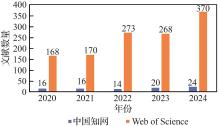
Fig.1
Statistics of literatures on UAV search and rescue in recent five years
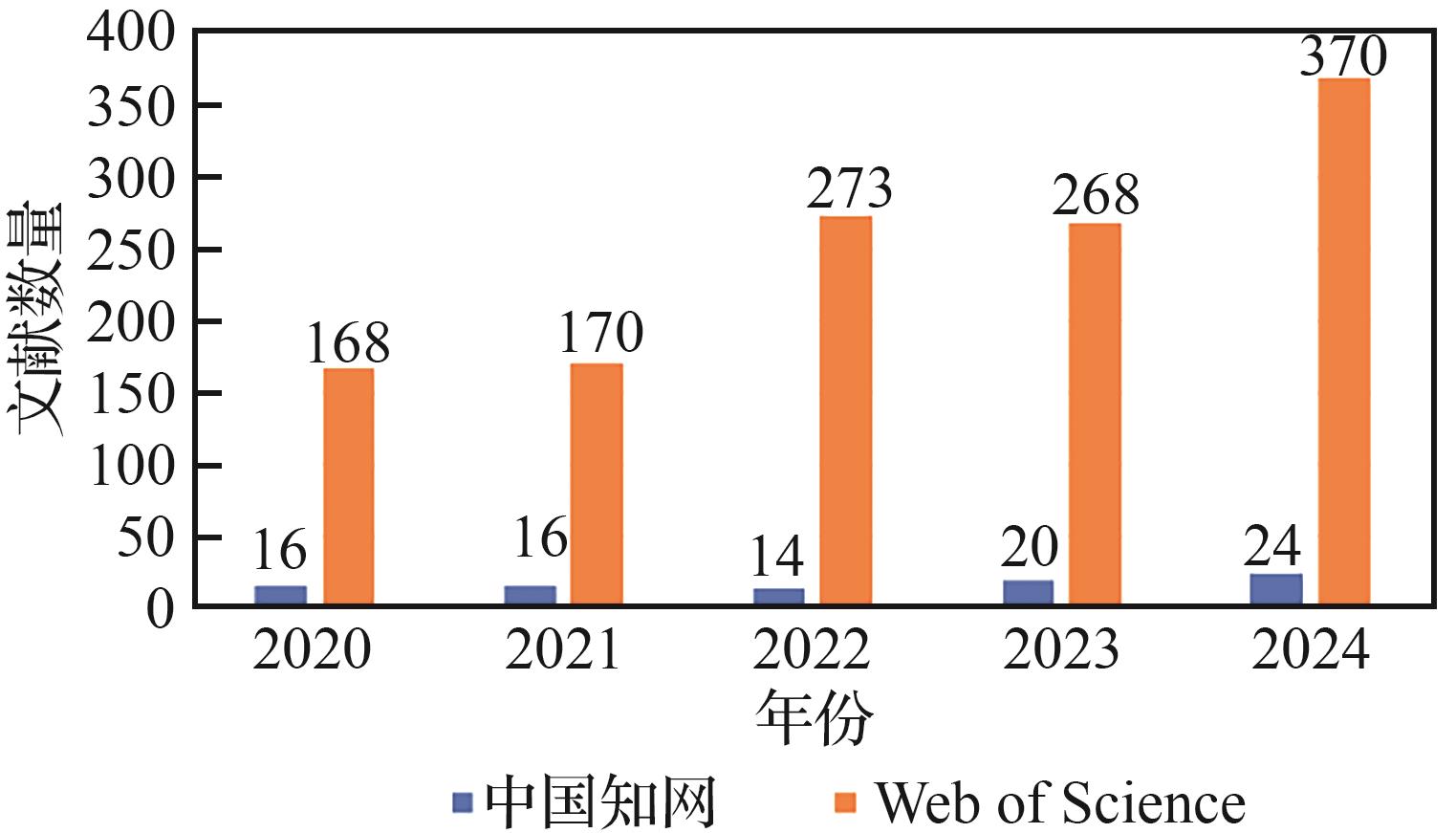
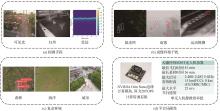
Fig.2
Challenges of UAV search and rescue

Table 1
Different detection techniques of UAV search and rescue
| 探测手段 | 配置设备 | 主要特点 |
|---|---|---|
| 可见光 | RGB相机 | 分辨率高,细节清晰,适合颜色、形态识别 易受光照、天气影响(夜晚或强雾环境下性能差) 成本低,设备轻便 |
| 红外 | 红外相机 | 可在黑暗环境下工作(无需外部光源) 对温度差异敏感,可检测人、动物及火源等,易受雨雾干扰 分辨率通常低于可见光相机 成本较高 |
| 雷达 | 雷达探测器 | 穿透能力强(可穿透烟雾、植被、部分墙体) 不受光照和天气影响,可全天候工作 成像分辨率较低(需复杂算法提升分辨率) 设备体积大、功耗高,价格昂贵 |
Fig.3
Detecting buried target through radar detection
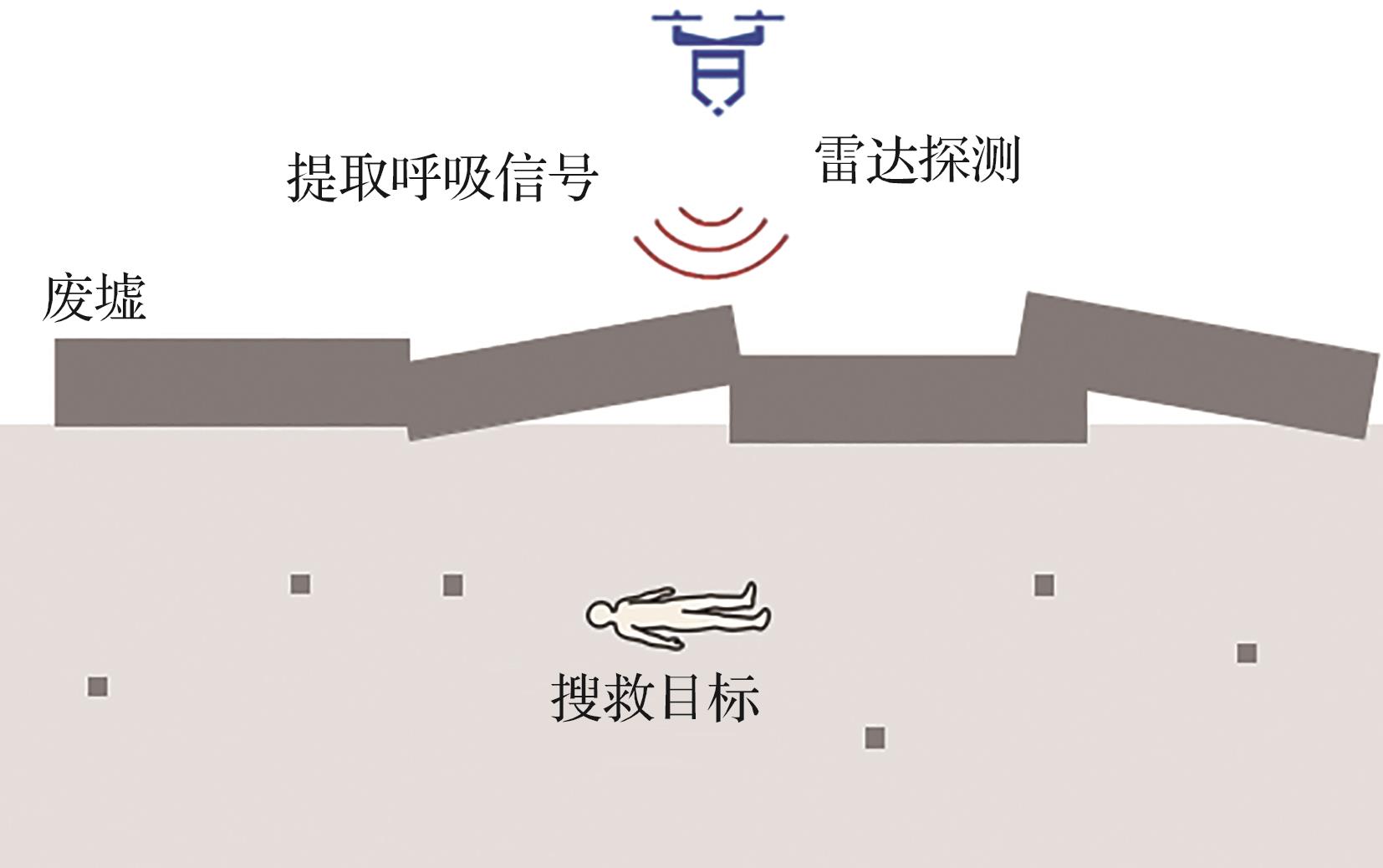
Table 2
Different types of imaging environmental interference and countermeasures
| 干扰类型 | 问题表现 | 解决方法 | 方法特点 |
|---|---|---|---|
| 低光照干扰 | 成像环境亮度低,使可见光图像噪声大、细节模糊且目标纹理不明显,目标与背景的区分度不高 | 联合低光照图像增强与目标检测的方法; 跨模态信息融合; 配置辅助设备 | 多任务网络模型复杂度高;“先增强,再检测”的框架实时性不佳;检测效果受增强效果的影响 融合红外模态可以适应极端黑暗环境;计算复杂度高,对算力要求高;需要配准可见光和红外数据 通过深度相机等,可以在极端黑暗环境看清目标 |
| 雨雾干扰 | 雨雾中微粒会吸收和散射可见光和红外信号的能量,破坏目标与背景温度差异,影响红外成像质量 | 基于深度线索的自适应特征调制方法; 联合去雾与目标检测的多任务网络; 雷达探测; | 利用深度信息,引入物理先验,模型泛化性强;检测精度依赖深度图质量 去雾任务与检测任务更新方向不同,多任务网络训练难度高;检测精度受去雾的效果影响 雷达探测可穿透雨雾,但设备要求高 |
| 运动模糊干扰 | 目标相对运动导致边缘模糊、纹理被破环 | 联合去模糊与目标检测的多任务网络 | 多任务网络训练复杂,且需要考虑模型优化以减少参数量,提升实时性 |
Fig.4
UAV search and rescue in forest background
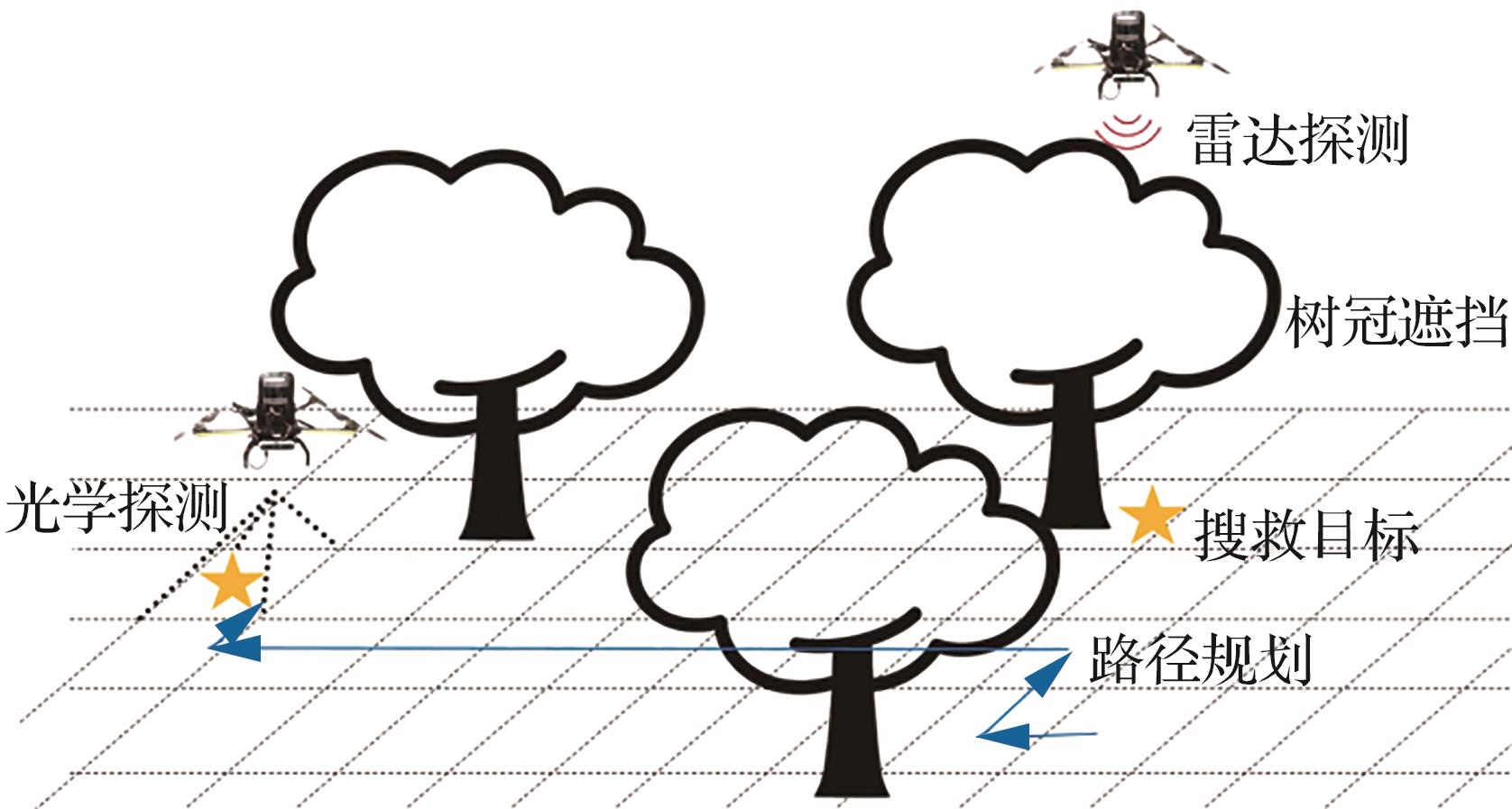
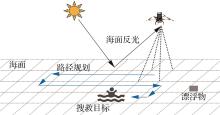
Fig.5
UAV search and rescue in marine background
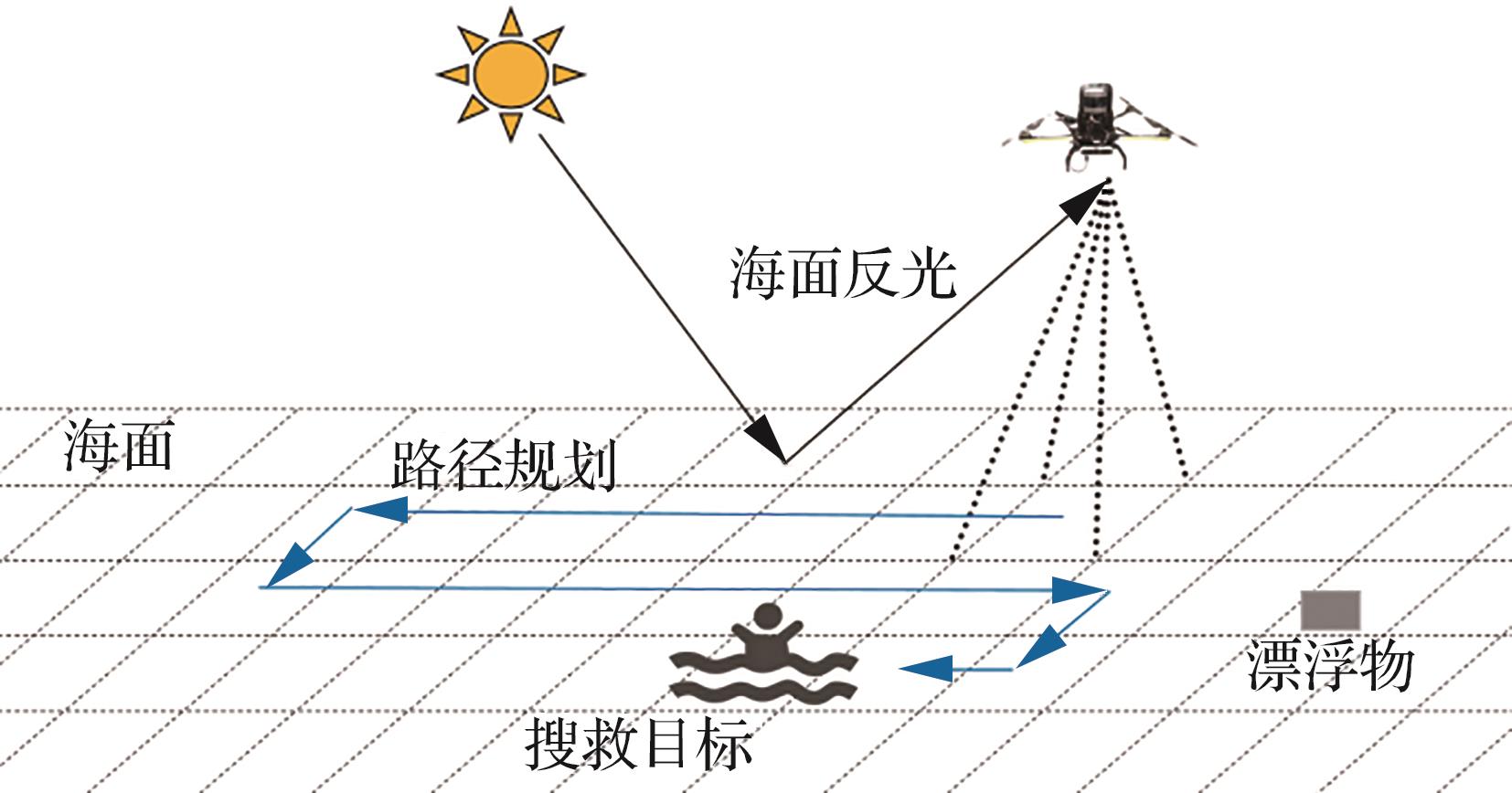
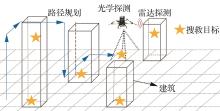
Fig.6
UAV search and rescue in urban background
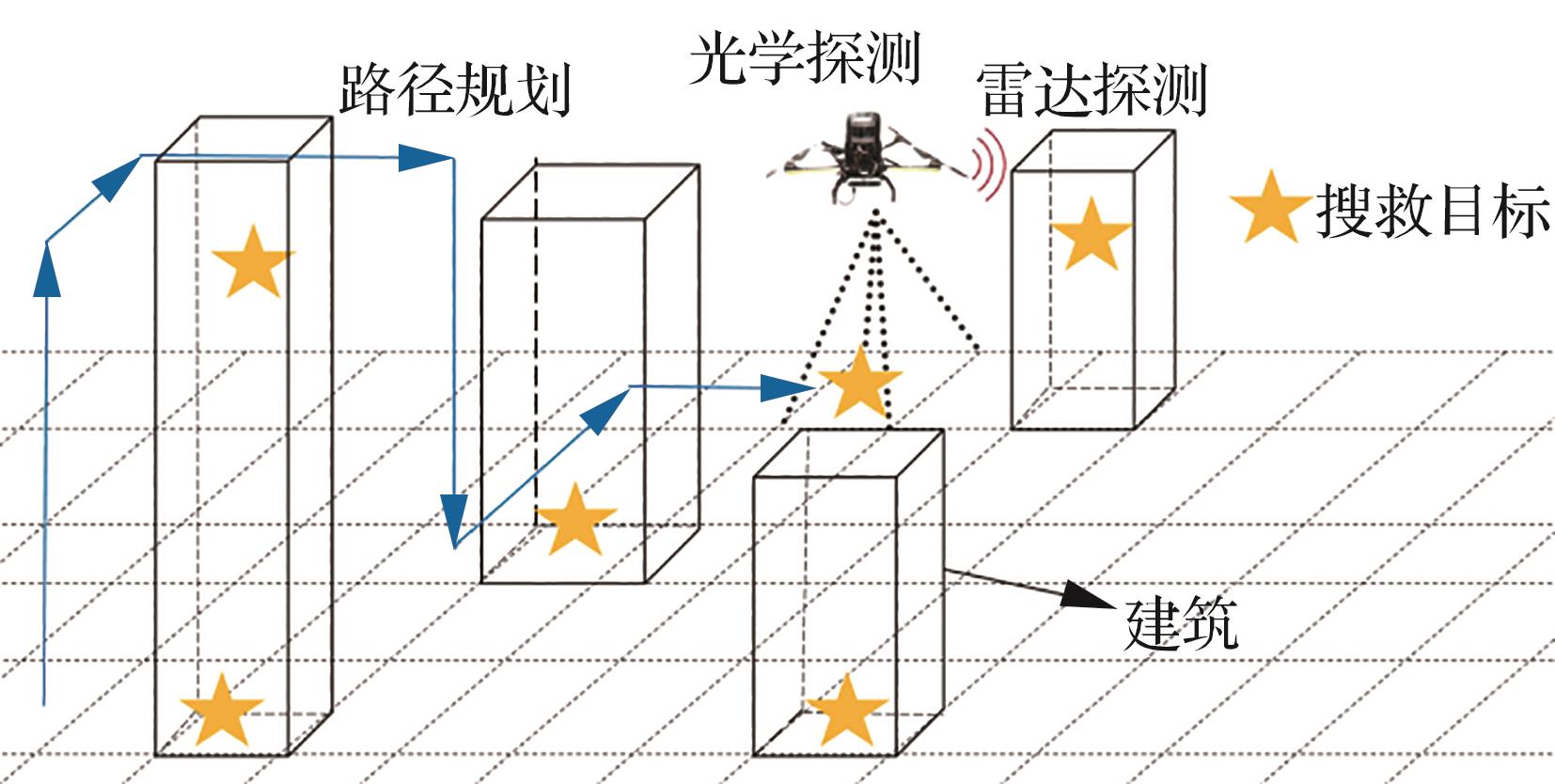
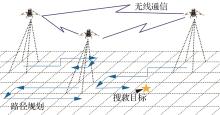
Fig.7
Multi-UAV search and rescue
Table 3
Detection datasets that can be used for UAV search and rescue
| 数据类型 | 数据集 | 发布年份 | 下载地址 |
|---|---|---|---|
| 可见光 | HERIDAL | 2019 | https:∥universe.roboflow.com/licenta-ynwvo/heridal-lrbkc |
| TinyPerson | 2020 | https:∥github.com/ucas-vg/TinyBenchmark | |
| SARD | 2021 | https:∥universe.roboflow.com/datasets-pdabr/sard-8xjhy | |
| AFO | 2021 | https:∥datasetninja.com/afo | |
| Manipal-UAV | 2023 | https:∥github.com/Akshathakrbhat/Manipal-UAV-Person-Dataset | |
| Archangel | 2023 | https:∥a2i2-archangel.vision | |
| C2A | 2024 | https:∥github.com/Ragib-Amin-Nihal/C2A | |
| 红外 | BIRDSAI | 2020 | https:∥lila.science/datasets/conservationdrones |
| UAV thermal image | 2020 | https:∥zenodo.org/records/4327118 | |
| HIT-UAV | 2023 | https:∥www.kaggle.com/datasets/pandrii000/hituav-a-highaltitude-infrared-thermal-dataset | |
| POP | 2025 | https:∥osf.io/kmcva/ | |
| 雷达 | UWB radar dataset | 2024 | https:∥zenodo.org/records/10731867 |
| 多光谱 | SeaDronesSee | 2022 | https:∥seadronessee.cs.uni-tuebingen.de./ |
| NII-CU | 2022 | https:∥www.nii-cu-multispectral.org/ | |
| WiSARD | 2022 | https:∥sites.google.com/uw.edu/wisard/ | |
| RGBTDronePerson | 2023 | https:∥nnnnerd.github.io/RGBTDronePerson/ | |
| VTSaR | 2025 | https:∥github.com/zxq309/VTSaR |
Table 4
Scale, collection scenarios and labeling of different datasets
| 数据类型 | 数据集 | 数据规模 | 采集场景 | 标注 |
|---|---|---|---|---|
| 可见光 | HERIDAL | 500张标注的全尺寸航拍图像 | 山地、荒野、森林等 | 人物位置边界框 |
| TinyPerson | 1 610张标注图像 | 海洋、海滩等 | 目标类别标注及边界框 | |
| SARD | 1 981张标注图像 | 岩石区、森林等 | 人物位置边界框 | |
| AFO | 3 647张标注图像 | 海洋 | 目标类别标注及边界框 | |
| Manipal-UAV | 13 462张标注图像 | 学校、道路及建筑等 | 人物位置边界框 | |
| Archangel | 4 643 900张标注图像 | 草地、沙漠等 | 目标类别标注、边界框、人物姿态标注及无人机与目标相对位置的元数据 | |
| C2A | 10 215张标注图像 | 火灾、洪水、废墟及交通事故等 | 人物位置边界框、人物姿态及灾难场景 | |
| 红外 | BIRDSAI | 172段标注红外视频 | 草地、水域及森林等 | 目标类别标注及边界框 |
| UAV thermal image | 6 447张标注的红外图像 | 海滩、树木及建筑等 | 人物位置边界框、人物 | |
| HIT-UAV | 2 898张标注的红外图像 | 学校、道路及操场等 | 目标类别标注、边界框及无人机飞行高度、拍摄视角、时间及天气 | |
| POP | 8 768张标注的红外图像 | 树林、草地及山区等 | 人物位置边界框 | |
| 雷达 | UWB radar | 270个完整采集会话 | 不同风力的野外场景 | 人体是否存在 |
| 多光谱 | SeaDronesSee | 超54 000张标注图像,包括432张多光谱图像 | 海洋 | 目标类别标注、边界框及无人机状态的元数据 |
| NII-CU | 5 880对标注RGB和红外图像 | 棒球场、森林等 | 人物位置边界框 | |
| WiSARD | 55 942张标注图像,包括15 453对标注RGB和红外图像 | 森林、岩石区、海岸、山地及雪地等 | 人物位置边界框及包含时间、相机视角等的元数据 | |
| RGBTDrone-Person | 6 125对标注RGB和红外图像 | 森林、建筑及田野等 | 目标类别标注及边界框 | |
| VTSaR | 32 400张标注图像,包括9 602对标注RGB和红外图像 | 街区、海岸线、海洋、工业区及荒野等 | 人物位置边界框 |
| [1] | 江波, 屈若锟, 李彦冬, 等. 基于深度学习的无人机航拍目标检测研究综述[J]. 航空学报, 2021, 42(4): 524519. |
| JIANG B, QU R K, LI Y D, et al. Object detection in UAV imagery based on deep learning: Review[J]. Acta Aeronautica et Astronautica Sinica, 2021, 42(4): 524519 (in Chinese). | |
| [2] | TONG X Z, GUO X J, SUN X Y, et al. CMDistill: Cross-modal distillation framework for UAV image object detection[J]. IEEE Journal of Selected Topics in Applied Earth Observations and Remote Sensing, 2024, 18: 1395-1409. |
| [3] | SURMANN H, KAISER T, LEINWEBER A, et al. Small commercial UAVs for indoor search and rescue missions[C]∥2021 7th International Conference on Automation, Robotics and Applications (ICARA). Piscataway: IEEE Press, 2021: 106-113. |
| [4] | NIEDZIELSKI T, JURECKA M, MIZIŃSKI B, et al. First successful rescue of a lost person using the human detection system: A case study from beskid niski (SE Poland)[J]. Remote Sensing, 2021, 13(23): 4903. |
| [5] | MARTINEZ-ALPISTE I, GOLCARENARENJI G, WANG Q, et al. Search and rescue operation using UAVs: A case study[J]. Expert Systems with Applications, 2021, 178: 114937. |
| [6] | PETRLIK M, PETRACEK P, KRATKY V, et al. UAVs beneath the surface: Cooperative autonomy for subterranean search and rescue in DARPA SubT[DB/OL]. Arxiv Preprint: 2206. 08185, 2022. |
| [7] | XU J. Application of multispectral and thermal imaging technologies in drone search and rescue missions[J]. Traitement du Signal, 2024, 41(5): 2317. |
| [8] | LIU C, SZIRÁNYI T. Road condition detection and emergency rescue recognition using on-board UAV in the wildness[J]. Remote Sensing, 2022, 14(17): 4355. |
| [9] | MUKHERJEE S, COUDERT O, BEARD C. UNIMODAL: UAV-aided infrared imaging based object detection and localization for search and disaster recovery[C]∥2022 IEEE International Symposium on Technologies for Homeland Security (HST). Piscataway: IEEE Press, 2022: 1-6. |
| [10] | PAPYAN N, KULHANDJIAN M, KULHANDJIAN H, et al. AI-based drone assisted human rescue in disaster environments: Challenges and opportunities[J]. Pattern Recognition and Image Analysis, 2024, 34(1): 169-186. |
| [11] | CAO Y S, QI F G, JING Y, et al. Mission chain driven unmanned aerial vehicle swarms cooperation for the search and rescue of outdoor injured human targets[J]. Drones, 2022, 6(6): 138. |
| [12] | MANZONI M, MORO S, LINSALATA F, et al. Evaluation of UAV-based ISAC SAR imaging: Methods and performances[C]∥2024 IEEE Radar Conference (RadarConf24). Piscataway: IEEE Press, 2024: 1-6. |
| [13] | CHAVES C S, GESCHKE R H, SHARGORODSKYY M, et al. Polarimetric UAV-deployed FMCW radar for buried people detection in rescue scenarios[C]∥2021 18th European Radar Conference (EuRAD). Piscataway: IEEE Press, 2022: 5-8. |
| [14] | ABDELLATIF A A, ELMANCY A, MOHAMED A, et al. PDSR: Efficient UAV deployment for swift and accurate post-disaster search and rescue[J]. IEEE Internet of Things Magazine, 2025, 8(3): 149-156. |
| [15] | XI Y, JIA W J, MIAO Q G, et al. Detection-driven exposure-correction network for nighttime drone-view object detection[J]. IEEE Transactions on Geoscience and Remote Sensing, 2024, 62: 5605014. |
| [16] | HE L J, ZHENG H Y, ZHAI X P. REUT: A retinex-inspired low-light image enhancer for UAV tracking at night[C]∥2022 IEEE Smartworld, Ubiquitous Intelligence & Computing, Scalable Computing & Communications, Digital Twin, Privacy Computing, Metaverse, Autonomous & Trusted Vehicles. Piscataway: IEEE Press, 2022: 1051-1057. |
| [17] | FANG Q Y, HAN D P, WANG Z K. Cross-modality fusion transformer for multispectral object detection[DB/OL]. ArXiv Preprint: 2111.00273, 2021. |
| [18] | YUAN M X, WEI X X. C²Former: Calibrated and complementary transformer for RGB-infrared object detection[J]. IEEE Transactions on Geoscience and Remote Sensing, 2024, 62: 5403712. |
| [19] | BOITEAU S, VANEGAS F, GONZALEZ F. Framework for autonomous UAV navigation and target detection in global-navigation-satellite-system-denied and visually degraded environments[J]. Remote Sensing, 2024, 16(3): 471. |
| [20] | LINDQVIST B, KANELLAKIS C, MANSOURI S S, et al. COMPRA: A COMPact reactive autonomy framework for subterranean MAV based search-and-rescue operations[J]. Journal of Intelligent & Robotic Systems, 2022, 105(3): 49. |
| [21] | FANG W X, ZHANG G Q, ZHENG Y H, et al. Multi-task learning for UAV aerial object detection in foggy weather condition[J]. Remote Sensing, 2023, 15(18): 4617. |
| [22] | WU W, CHANG H, CHEN Z W, et al. Plug-and-play robust aerial object detection under hazy conditions[J]. IEEE Journal of Selected Topics in Applied Earth Observations and Remote Sensing, 2024, 17: 983-998. |
| [23] | FENG C, CHEN Z, LI X, et al. HazyDet: Open-source benchmark for drone-view object detection with depth-cues in hazy scenes[DB/OL]. ArXiv Preprint: 2409. 19833, 2024. |
| [24] | LU H Y, YANG Y H, TAO R T, et al. Coverage path planning for SAR-UAV in search area coverage tasks based on deep reinforcement learning[C]∥2022 IEEE International Conference on Unmanned Systems (ICUS). Piscataway: IEEE Press, 2022: 248-253. |
| [25] | LI Q P, ZHANG Y X, FANG L Y, et al. DREB-net: Dual-stream restoration embedding blur-feature fusion network for high-mobility UAV object detection[J]. IEEE Transactions on Geoscience and Remote Sensing, 2025, 63: 5621218. |
| [26] | ZHU B Y, LV Q B, TAN Z. Adaptive multi-scale fusion blind deblurred generative adversarial network method for sharpening image data[J]. Drones, 2023, 7(2): 96. |
| [27] | JOBAER S, TANG X S, ZHANG Y H, et al. A novel knowledge distillation framework for enhancing small object detection in blurry environments with unmanned aerial vehicle-assisted images[J]. Complex & Intelligent Systems, 2024, 11(1): 63. |
| [28] | 周建亭, 宣士斌, 王婷. 融合遮挡信息的改进DDETR无人机目标检测算法[J]. 计算机工程与应用, 2024, 60(1): 236-244. |
| ZHOU J T, XUAN S B, WANG T. Improved DDETR UAV target detection algorithm incorporating occlusion information[J]. Computer Engineering and Applications, 2024, 60(1): 236-244 (in Chinese). | |
| [29] | MARQUES T, CARREIRA S, MIRAGAIA R, et al. Applying deep learning to real-time UAV-based forest monitoring: Leveraging multi-sensor imagery for improved results[J]. Expert Systems with Applications, 2024, 245: 123107. |
| [30] | RAMÍREZ-AYALA O, GONZÁLEZ-HERNÁNDEZ I, SALAZAR S, et al. Real-time person detection in wooded areas using thermal images from an aerial perspective[J]. Sensors, 2023, 23(22): 9216. |
| [31] | NATHAN R J, KURMI I, BIMBER O. Drone swarm strategy for the detection and tracking of occluded targets in complex environments[J]. Communications Engineering, 2023, 2: 55. |
| [32] | ZHANG J, HUANG H L. Occlusion-aware UAV path planning for reconnaissance and surveillance[J]. Drones, 2021, 5(3): 98. |
| [33] | 孔垂乐, 孟昱煜, 火久元, 等. 改进YOLOv11的无人机海上小目标检测算法[J/OL]. 计算机工程与应用, (2025-07-08)[2025-08-23]. . |
| KONG C L, MENG Y Y, HUO J Y, et al. Improved UAV maritime small target detection algorithm for YOLOv11[J/OL]. Computer Engineering and Application, (2025-07-08)[2025-08-23]. (in Chinese). | |
| [34] | XU J H, FAN X T, JIAN H D, et al. YoloOW: A spatial scale adaptive real-time object detection neural network for open water search and rescue from UAV aerial imagery[J]. IEEE Transactions on Geoscience and Remote Sensing, 2024, 62: 5623115. |
| [35] | ZHANG Y J, YIN Y, SHAO Z Y. An enhanced target detection algorithm for maritime search and rescue based on aerial images[J]. Remote Sensing, 2023, 15(19): 4818. |
| [36] | WANG S L, ZHAO Y, ZHOU C, et al. Vision-guided maritime UAV rescue system with optimized GPS path planning and dual-target tracking[J]. Drones, 2025, 9(7): 502. |
| [37] | BOULARES M, FEHRI A, JEMNI M. UAV path planning algorithm based on Deep Q-Learning to search for a floating lost target in the ocean[J]. Robotics and Autonomous Systems, 2024, 179: 104730. |
| [38] | LI X X, DIAO W H, MAO Y Q, et al. OGMN: Occlusion-guided multi-task network for object detection in UAV images[J]. ISPRS Journal of Photogrammetry and Remote Sensing, 2023, 199: 242-257. |
| [39] | 于傲泽, 魏维伟, 王平, 等. 基于分块复合注意力的无人机小目标检测算法[J]. 航空学报, 2024, 45(14): 629148. |
| YU A Z, WEI W W, WANG P, et al. Small target detection algorithm for UAV based on patch-wise co-attention[J]. Acta Aeronautica et Astronautica Sinica, 2024, 45(14): 629148 (in Chinese). | |
| [40] | ZHANG N, NEX F, VOSSELMAN G, et al. Training a disaster victim detection network for UAV search and rescue using harmonious composite images[J]. Remote Sensing, 2022, 14(13): 2977. |
| [41] | 陈锦涛, 李鸿一, 任鸿儒, 等. 基于RRT森林算法的高层消防多无人机室内协同路径规划[J]. 自动化学报, 2023, 49(12): 2615-2626. |
| CHEN J T, LI H Y, REN H R, et al. Cooperative indoor path planning of multi-UAVs for high-rise fire fighting based on RRT-forest algorithm[J]. Acta Automatica Sinica, 2023, 49(12): 2615-2626 (in Chinese). | |
| [42] | XI M, DAI H A, HE J Y, et al. A lightweight reinforcement-learning-based real-time path-planning method for unmanned aerial vehicles[J]. IEEE Internet of Things Journal, 2024, 11(12): 21061-21071. |
| [43] | DOMOZI Z, STOJCSICS D, BENHAMIDA A, et al. Real time object detection for aerial search and rescue missions for missing persons[C]∥2020 IEEE 15th International Conference of System of Systems Engineering (SoSE). Piscataway: IEEE Press, 2020: 519-524. |
| [44] | WANG R P, LIN C, LI Y J. RPLFDet: A lightweight small object detection network for UAV aerial images with rational preservation of low-level features[J]. IEEE Transactions on Instrumentation and Measurement, 2025, 74: 5013514. |
| [45] | BETTI A, TUCCI M. YOLO-S: A lightweight and accurate YOLO-like network for small target selection in aerial imagery[J]. Sensors, 2023, 23(4): 1865. |
| [46] | XU L J, YANG Q H, QIN M, et al. Collaborative human recognition with lightweight models in drone-based search and rescue operations[J]. IEEE Transactions on Vehicular Technology, 2024, 73(2): 1765-1776. |
| [47] | ZHANG X Q, FENG Y, ZHANG S, et al. Robust aerial person detection with lightweight distillation network for edge deployment[J]. IEEE Transactions on Geoscience and Remote Sensing, 2024, 62: 5630616. |
| [48] | KUMAR G, ANWAR A, DIKSHIT A, et al. Obstacle avoidance for a swarm of unmanned aerial vehicles operating on particle swarm optimization: A swarm intelligence approach for search and rescue missions[J]. Journal of the Brazilian Society of Mechanical Sciences and Engineering, 2022, 44(2): 56. |
| [49] | HORYNA J, BACA T, WALTER V, et al. Decentralized swarms of unmanned aerial vehicles for search and rescue operations without explicit communication[J]. Autonomous Robots, 2023, 47(1): 77-93. |
| [50] | 王浩宇, 张泽旭, 闻单, 等. 基于时序耦合分析的无人机集群任务分配方法[J/OL]. 航空学报, (2025-05-28)[2025-08-22]. . |
| WANG H Y, ZHANG Z X, WEN S, et al. Task allocation algorithm for UAV swarm based on temporal coupling analysis[J/OL]. Acta Aeronautica et Astronautica Sinica, (2025-05-28)[2025-08-22]. (in Chinese). | |
| [51] | KHALIL H, RAHMAN S U, ULLAH I, et al. A UAV-swarm-communication model using a machine-learning approach for search-and-rescue applications[J]. Drones, 2022, 6(12): 372. |
| [52] | 方城亮, 杨飞生, 潘泉. 基于MASAC强化学习算法的多无人机协同路径规划[J]. 中国科学: 信息科学, 2024, 54(8): 1871-1883. |
| FANG C L, YANG F S, PAN Q. Multi-UAV collaborative path planning based on multi-agent soft actor critic[J]. Scientia Sinica (Informationis), 2024, 54(8): 1871-1883 (in Chinese). | |
| [53] | BOŽIĆ-ŠTULIĆ D, MARUŠIĆ Ž, GOTOVAC S. Deep learning approach in aerial imagery for supporting land search and rescue missions[J]. International Journal of Computer Vision, 2019, 127(9): 1256-1278. |
| [54] | YU X H, GONG Y Q, JIANG N, et al. Scale match for tiny person detection[C]∥2020 IEEE Winter Conference on Applications of Computer Vision (WACV). Piscataway: IEEE Press, 2020: 1246-1254. |
| [55] | SAMBOLEK S, IVASIC-KOS M. Automatic person detection in search and rescue operations using deep CNN detectors[J]. IEEE Access, 2021, 9: 37905-37922. |
| [56] | GA̧SIENICA-JÓZKOWY J, KNAPIK M, CYGANEK B. An ensemble deep learning method with optimized weights for drone-based water rescue and surveillance[J]. Integrated Computer-Aided Engineering, 2021, 28(3): 221-235. |
| [57] | AKSHATHA K R, KARUNAKAR A K, SATISH SHENOY B, et al. Manipal-UAV person detection dataset: A step towards benchmarking dataset and algorithms for small object detection[J]. ISPRS Journal of Photogrammetry and Remote Sensing, 2023, 195: 77-89. |
| [58] | SHEN Y T, LEE Y, KWON H, et al. Archangel: A hybrid UAV-based human detection benchmark with position and pose metadata[J]. IEEE Access, 2023, 11: 80958-80972. |
| [59] | NIHAL R A, YEN B, ITOYAMA K, et al. UAV-enhanced combination to application: Comprehensive analysis and benchmarking of a human detection dataset for disaster scenarios[M]∥Pattern Recognition. Cham: Springer Nature Switzerland, 2024: 145-162. |
| [60] | BONDI E, JAIN R, AGGRAWAL P, et al. BIRDSAI: A dataset for detection and tracking in aerial thermal infrared videos[C]∥2020 IEEE Winter Conference on Applications of Computer Vision (WACV). Piscataway: IEEE Press, 2020: 1747-1756. |
| [61] | DONG J, OTA K, DONG M X. UAV-based real-time survivor detection system in post-disaster search and rescue operations[J]. IEEE Journal on Miniaturization for Air and Space Systems, 2021, 2(4): 209-219. |
| [62] | SUO J S, WANG T Y, ZHANG X Z, et al. HIT-UAV: A high-altitude infrared thermal dataset for Unmanned Aerial Vehicle-based object detection[J]. Scientific Data, 2023, 10(1): 227. |
| [63] | SONG Z Y, YAN Y L, CAO Y X, et al. An infrared dataset for partially occluded person detection in complex environment for search and rescue[J]. Scientific Data, 2025, 12(1): 300. |
| [64] | PALIODIMOS E N, PAPADOPOULOS F G, UZUNIDIS D, et al. A UWB radar and machine learning-based tool for detecting victims through foliage in search and rescue operations[C]∥2024 13th International Conference on Modern Circuits and Systems Technologies (MOCAST). Piscataway: IEEE Press, 2024: 1-5. |
| [65] | VARGA L A, KIEFER B, MESSMER M, et al. SeaDronesSee: A maritime benchmark for detecting humans in open water[C]∥2022 IEEE/CVF Winter Conference on Applications of Computer Vision (WACV). Piscataway: IEEE Press, 2022: 3686-3696. |
| [66] | SPETH S, GONÇALVES A, RIGAULT B, et al. Deep learning with RGB and thermal images onboard a drone for monitoring operations[J]. Journal of Field Robotics, 2022, 39(6): 840-868. |
| [67] | BROYLES D, HAYNER C R, LEUNG K. WiSARD: A labeled visual and thermal image dataset for wilderness search and rescue[C]∥2022 IEEE/RSJ International Conference on Intelligent Robots and Systems (IROS). Piscataway: IEEE Press, 2022: 9467-9474. |
| [68] | ZHANG Y, XU C, YANG W, et al. Drone-based RGBT tiny person detection[J]. ISPRS Journal of Photogrammetry and Remote Sensing, 2023, 204: 61-76. |
| [69] | ZHANG X Q, FENG Y, WANG N, et al. Aerial person detection for search and rescue: Survey and benchmarks[J]. Journal of Remote Sensing, 2025, 5: 474. |
| [1] | Jianyu XU, Li ZHOU, Zhanxue WANG, Jie SHI, Hao SHI. Calculation method for hypersonic plume infrared radiation based on a fast line-by-line calculation model [J]. Acta Aeronautica et Astronautica Sinica, 2025, 46(8): 630778-630778. |
| [2] | Lingjie MENG, Hongguang LI, Xinjun LI. SAR image simulation method guided by geomorphic category information [J]. Acta Aeronautica et Astronautica Sinica, 2025, 46(7): 331003-331003. |
| [3] | Zhihao ZHAO, Zhaohua YANG, Yun WU, Yuanjin YU. Single-photon counting imaging denoising method based on deep learning in low-light environment [J]. Acta Aeronautica et Astronautica Sinica, 2025, 46(3): 630531-630531. |
| [4] | Yiquan WU, Kang TONG. Research advances on deep learning-based small object detection in UAV aerial images [J]. Acta Aeronautica et Astronautica Sinica, 2025, 46(3): 30848-030848. |
| [5] | Wei HUANG, Jiahao PAN, Chu HE. Wavelet time-frequency localization-based model compression for UAV object detection [J]. Acta Aeronautica et Astronautica Sinica, 2025, 46(23): 631952-631952. |
| [6] | Tianqi FAN, Zhengxia ZOU, Zhenwei SHI. Typical remote sensing target detection with data synthesis based on reinforcement learning [J]. Acta Aeronautica et Astronautica Sinica, 2025, 46(23): 631955-631955. |
| [7] | Kui LIU, Hao SUN, Han WU, Kefeng JI, Gangyao KUANG. Dynamic brightness reconstruction for UAV visible-infrared fusion object detection [J]. Acta Aeronautica et Astronautica Sinica, 2025, 46(23): 631968-631968. |
| [8] | Shuai ZHONG, Liping WANG. MCS-RETR: Improved RT-DETR object detection method for UAV aerial images [J]. Acta Aeronautica et Astronautica Sinica, 2025, 46(22): 331987-331987. |
| [9] | Yi ZHENG, Xianghong CHENG, Xingbang TANG, Yi CAO. Oriented detection algorithm for insulator and their defects from aerial images based on improved ReDet [J]. Acta Aeronautica et Astronautica Sinica, 2025, 46(18): 331825-331825. |
| [10] | Xiaowei JIANG, Yiquan WU. Research progress of UAV aerial image mosaic methods [J]. Acta Aeronautica et Astronautica Sinica, 2025, 46(17): 331799-331799. |
| [11] | Lin CHEN, Xiwen GU, Zhiying CHEN, Zhuo ZHANG, Xiaoliang SUN. High-precision monocular vision pose measurement for large distance span in carrier landing guidance [J]. Acta Aeronautica et Astronautica Sinica, 2025, 46(15): 331568-331568. |
| [12] | Bin SUN, Hang YOU, Wenbo LI, Xiangrui LIU, Jiayi MA. Dual-band payload image fusion and its applications in low-altitude remote sensing [J]. Acta Aeronautica et Astronautica Sinica, 2025, 46(11): 531343-531343. |
| [13] | Fanteng MENG, Yong QIN, Jing CUI, Yunpeng WU, Zicheng ZHANG, Shaowei WEI. Unknown risk detection in external environment of railroad using UAV images [J]. Acta Aeronautica et Astronautica Sinica, 2025, 46(11): 531262-531262. |
| [14] | Shusheng CHEN, Muliang JIA, Jiahao LIN, Shiyi JIN, Zhenghong GAO, Yueqing WANG, Zhiqiang MA, Zheng LI, Chenlong DUAN, Jiawei LI. Empowering aircraft technology applications with generative models: Research progress and prospects [J]. Acta Aeronautica et Astronautica Sinica, 2025, 46(10): 631194-631194. |
| [15] | Weishi CHEN, Hongchuang NIU, Xin WANG, Jian WAN, Xianfeng LU, Jie ZHANG, Qingbin WANG. Review on multi-source detection technologies for birds and drones in airport clearance area [J]. Acta Aeronautica et Astronautica Sinica, 2025, 46(10): 31251-031251. |
| Viewed | ||||||
|
Full text |
|
|||||
|
Abstract |
|
|||||
Address: No.238, Baiyan Buiding, Beisihuan Zhonglu Road, Haidian District, Beijing, China
Postal code : 100083
E-mail:hkxb@buaa.edu.cn
Total visits: 6658907 Today visits: 1341All copyright © editorial office of Chinese Journal of Aeronautics
All copyright © editorial office of Chinese Journal of Aeronautics
Total visits: 6658907 Today visits: 1341

 CJA
CJA
