Acta Aeronautica et Astronautica Sinica ›› 2026, Vol. 47 ›› Issue (3): 132182.doi: 10.7527/S1000-6893.2025.32182
• Fluid Mechanics and Flight Mechanics • Previous Articles
Wei SUN1( ), Yuni ZHANG1, Ting LIU2, Zheyu SHI3, Yongfeng LIN1
Received:2025-04-29
Revised:2025-05-19
Accepted:2025-06-13
Online:2025-07-18
Published:2025-07-03
Contact:
Wei SUN
E-mail:sunw017@avic.com
Supported by:CLC Number:
Wei SUN, Yuni ZHANG, Ting LIU, Zheyu SHI, Yongfeng LIN. Experiment on influence mechanism of rotor flow on blade-vortex interaction noise[J]. Acta Aeronautica et Astronautica Sinica, 2026, 47(3): 132182.
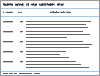
Table 1
General arrangement parameters of rotor model
| 参数 | 数值 |
|---|---|
| 旋翼直径/m | 2 |
| 旋转方向 | 俯视顺时针 |
| 桨毂形式 | 无铰式 |
| 桨叶片数 | 5 |
| 额定转速/(r·min-1) | 2 064 |
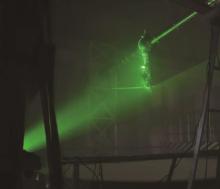
Fig.1
PIV flow field measurement
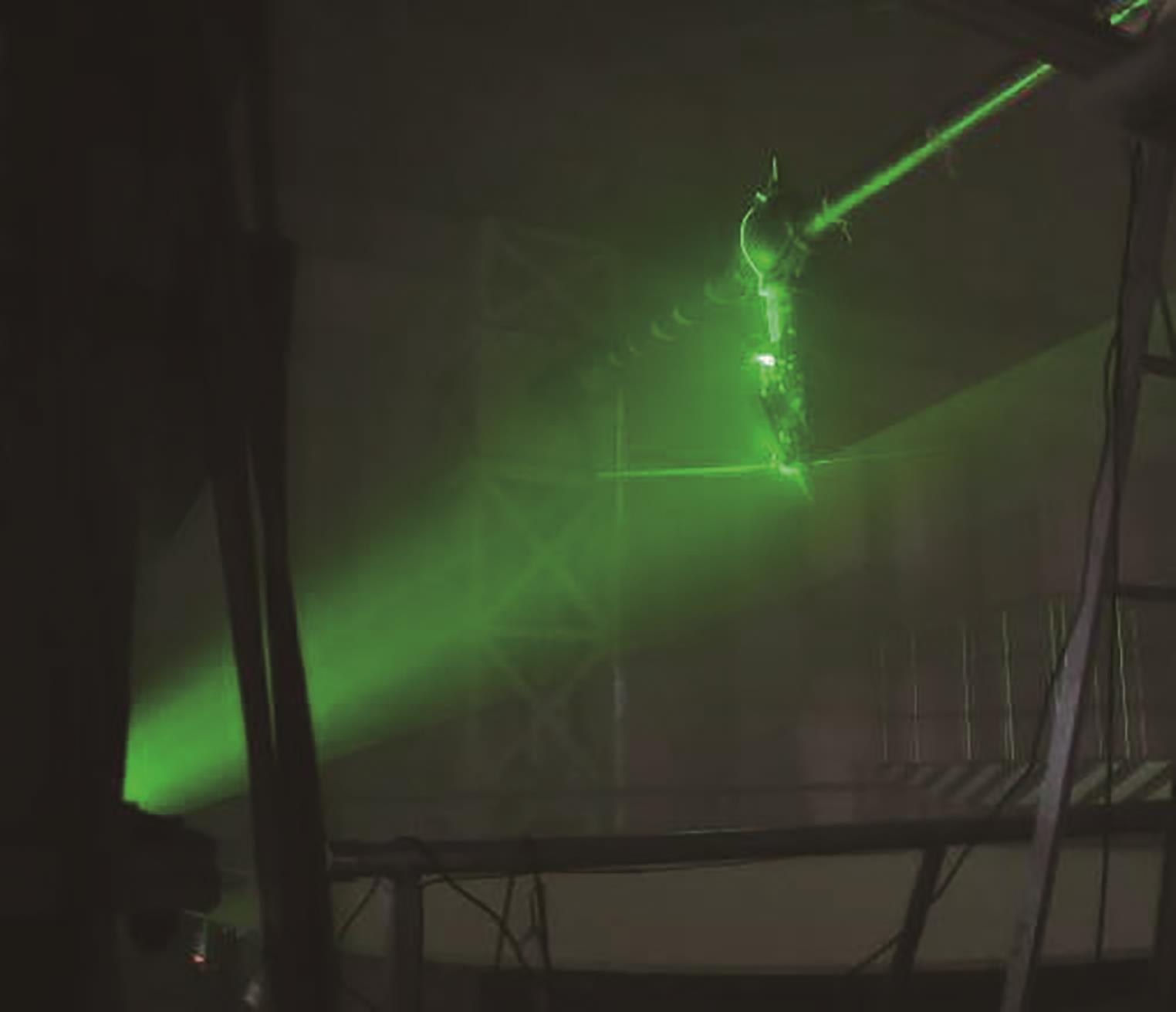
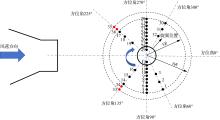
Fig.2
Schematic diagram of spherical array layout of noise measurement points
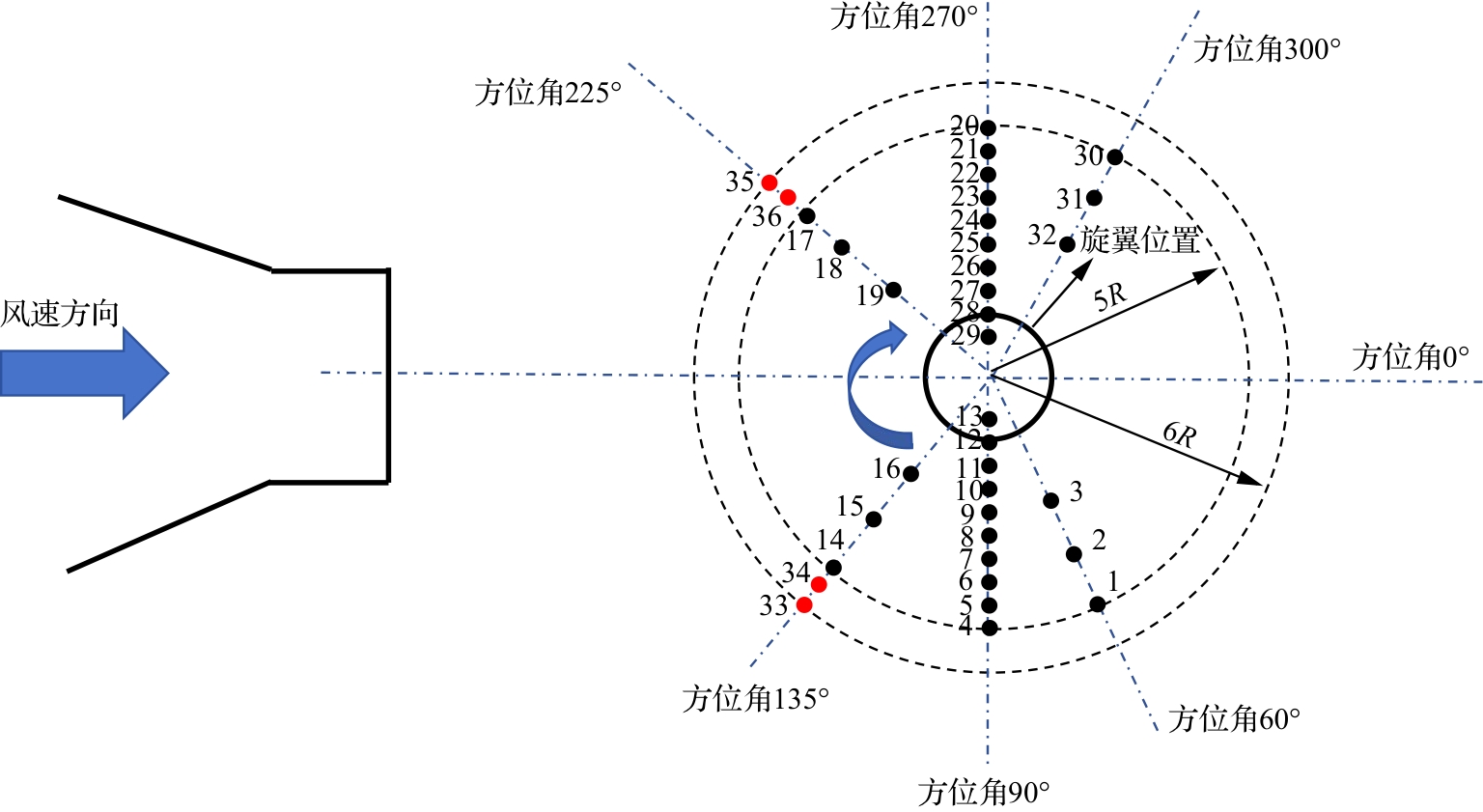
Table 2
Typical microphone measurement points locations
| 测点编号 | 方位角/(°) | 桨盘夹角/(°) | 距离 |
|---|---|---|---|
| 4~13 | 90 | 0~90(间隔10°) | 5R |
| 14 | 135 | 0 | 5R |
| 15 | 135 | 15 | 5R |
| 16 | 135 | 30 | 5R |
| 33 | 135 | 0 | 6R |
| 34 | 135 | 30 | 6R |
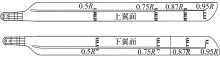
Fig.3
Rotor blade surface wiring routine diagram
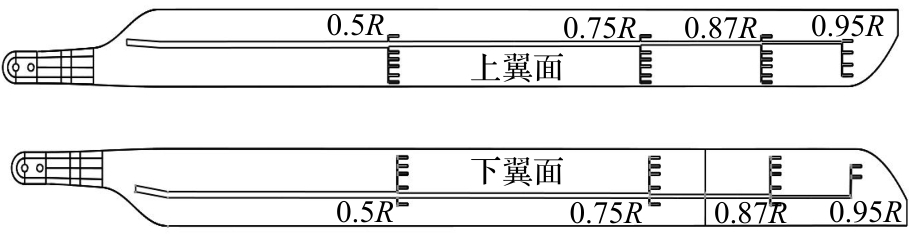
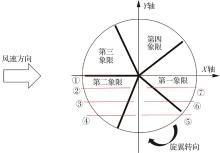
Fig.4
Schematic diagram of PIV measurement profile
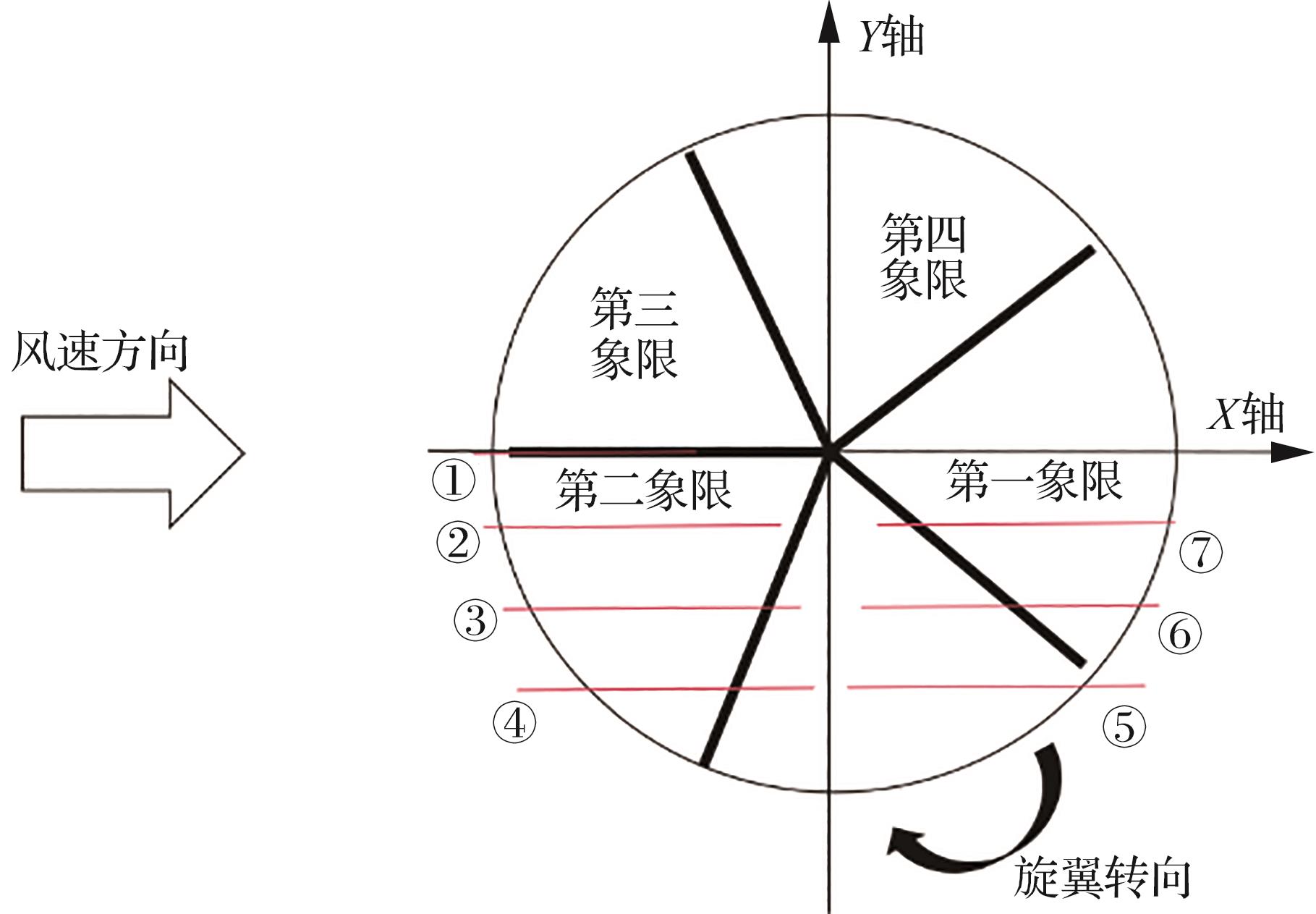
Table 3
Experiment states
| 转速/(r·min-1) | 前进比 | 垂向力系数 | 下降角度/(°) |
|---|---|---|---|
| 2 064 | 0.1~0.3 | 0.013 | -6 |
| 2 064 | 0.16 | 0.013 | -8~0(间隔2°) |
| 2 064 | 0.16 | 0.009,0.011 | -6 |
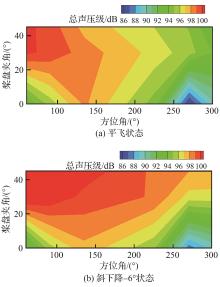
Fig.5
Contour of total sound pressure level distribution in level flight and -6° oblique descent flight
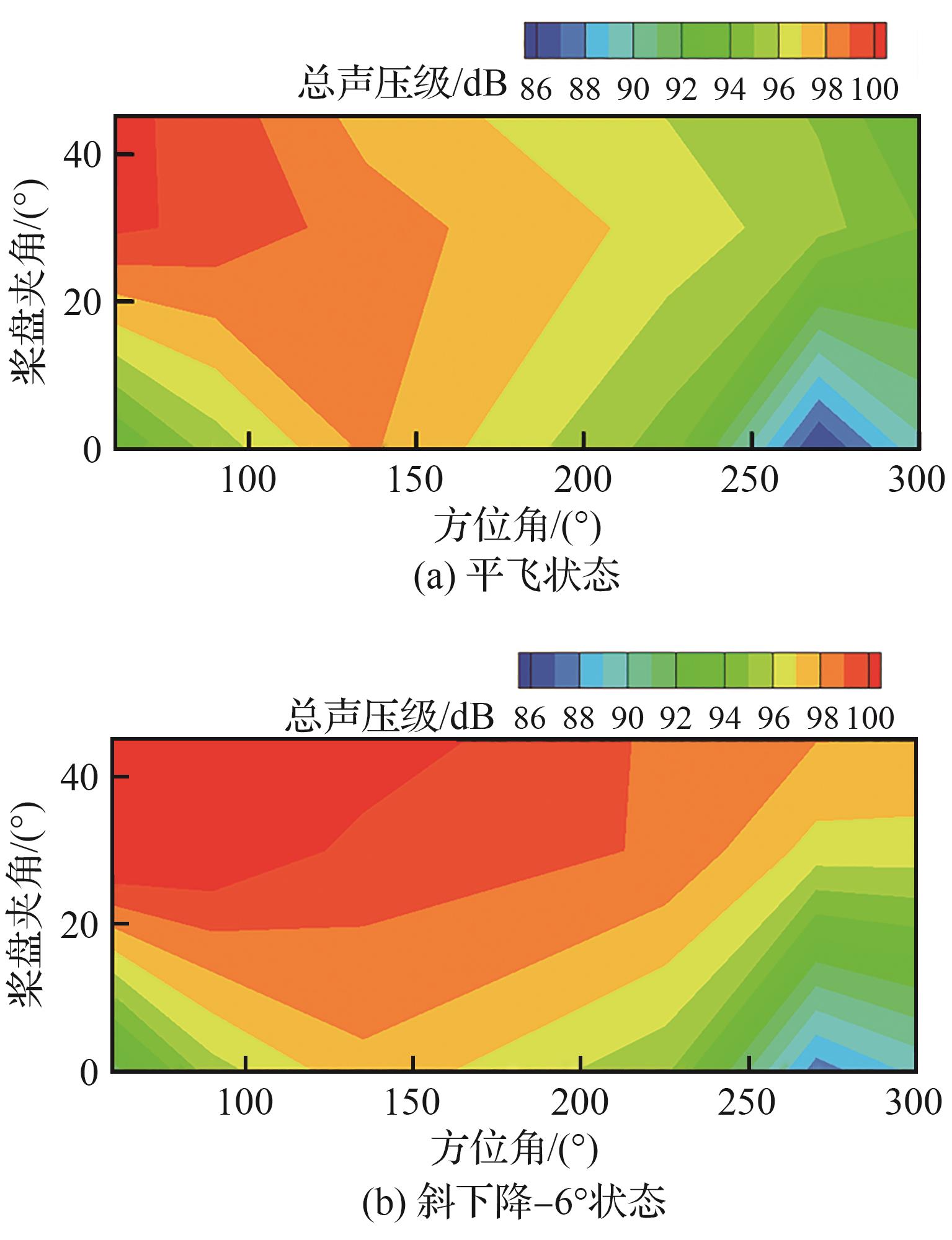
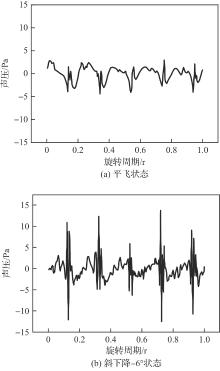
Fig.6
Time history of rotor noise pressure in level flight and -6° oblique descent flight
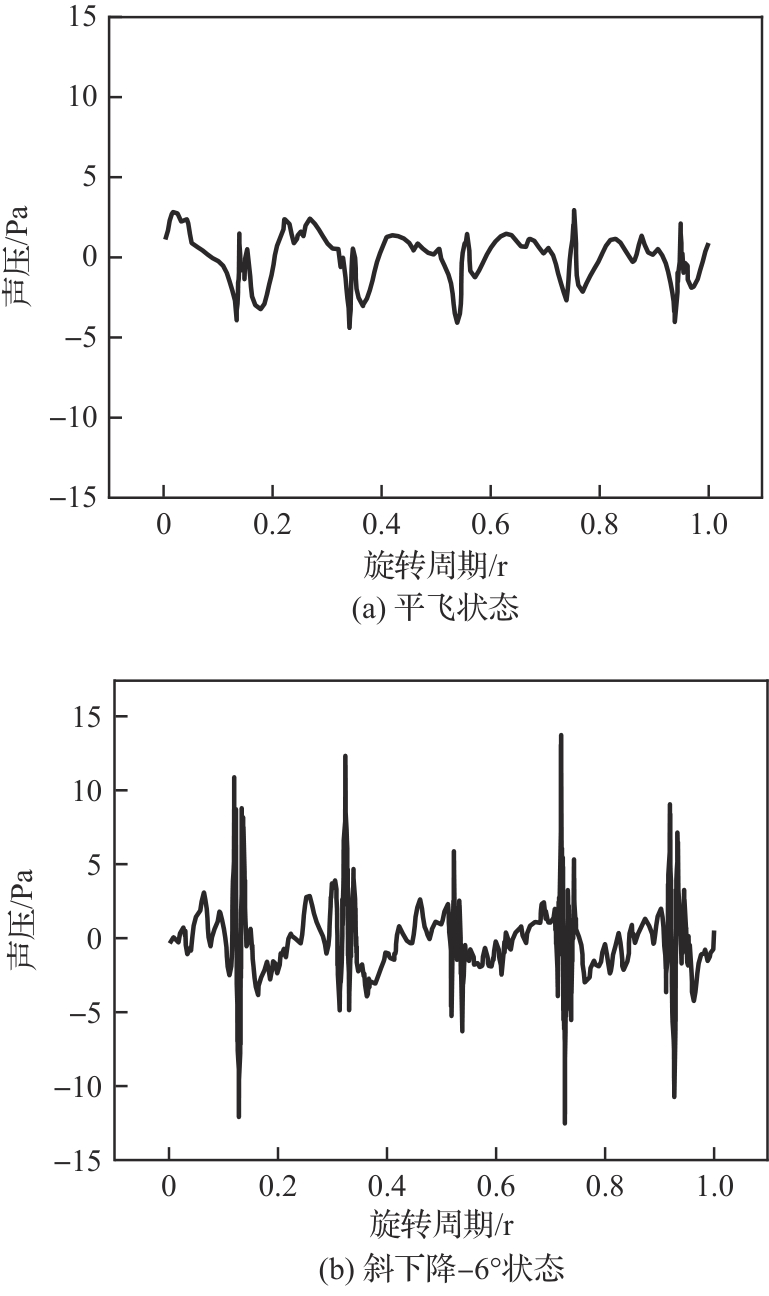
Fig.7
Sound pressure level spectrum diagram of measurement point in level flight and -6° oblique descent flight
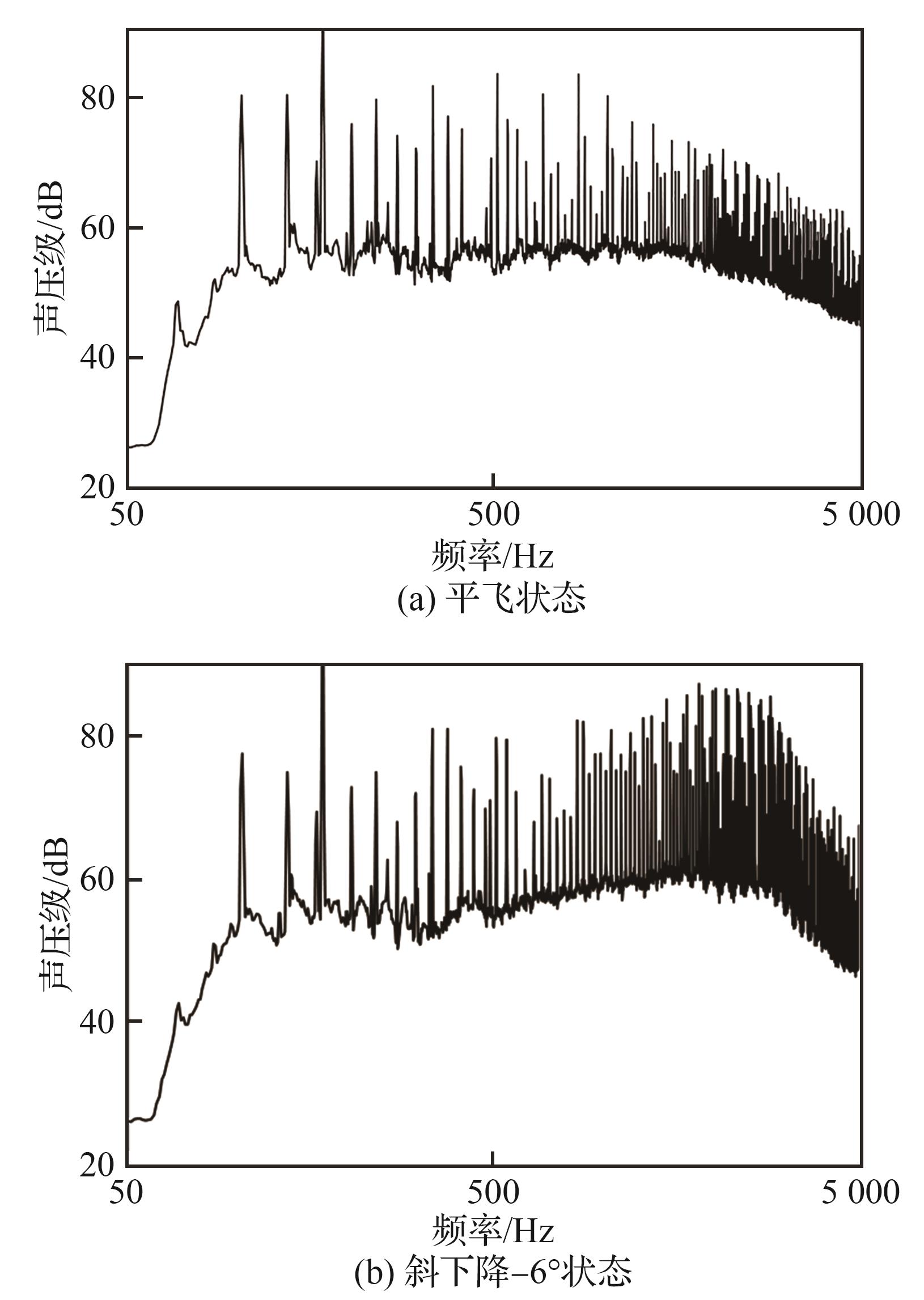
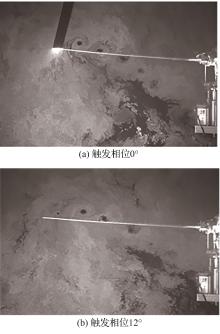
Fig.8
Blade tip vortex trajectory in oblique descent flight
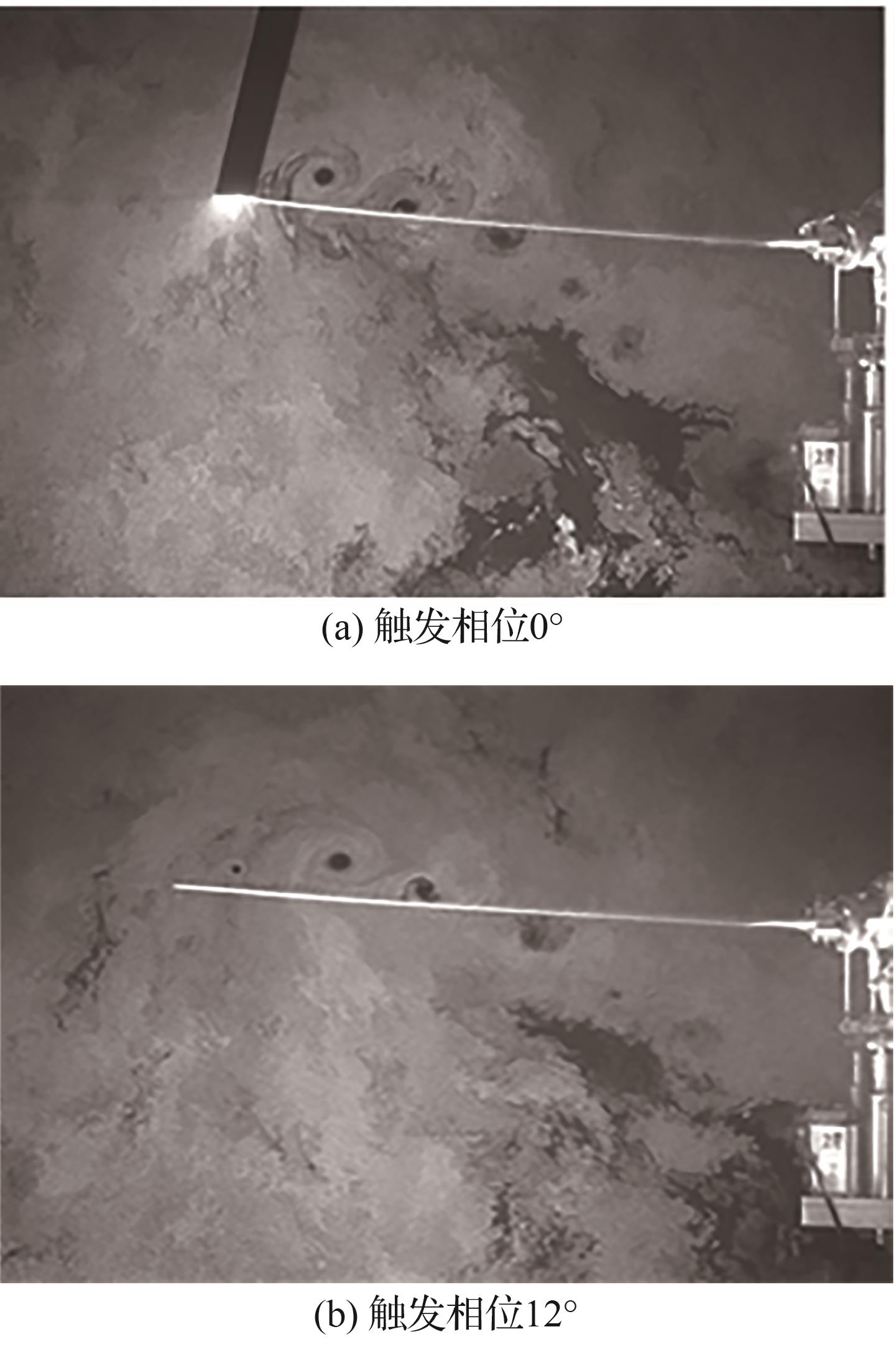
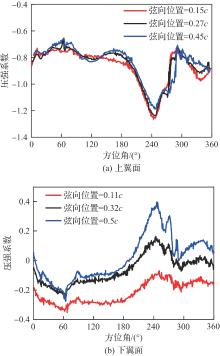
Fig.9
Pressure coefficient curves at different chordwise positions in -6° oblique descent state
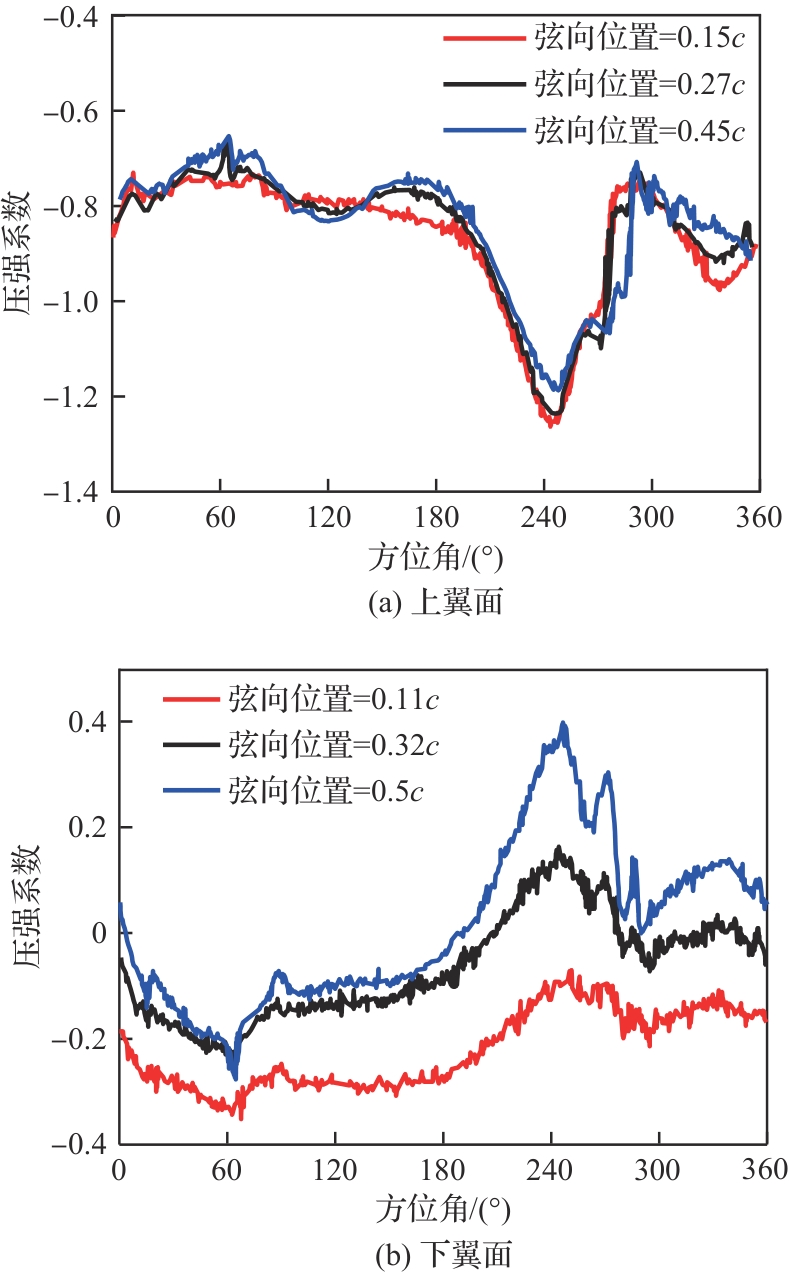
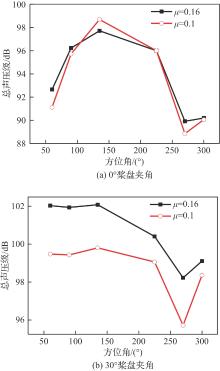
Fig.10
Variation of total sound pressure level with azimuth angles under different rotor disk angles and advance ratios
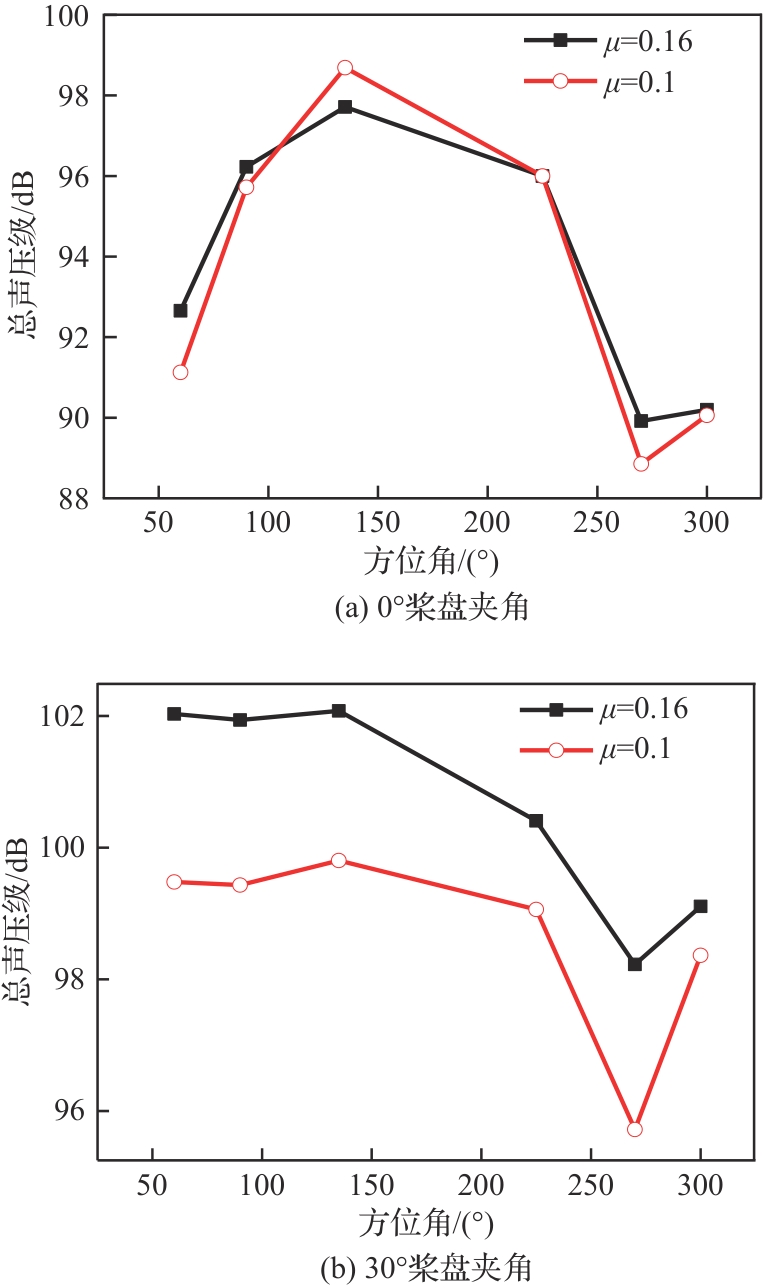
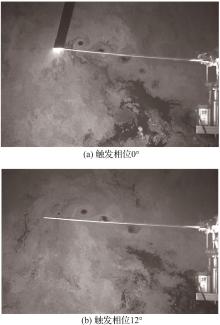
Fig.11
Original particle image of Profile ③ in oblique descent state at advance ratio 0.1
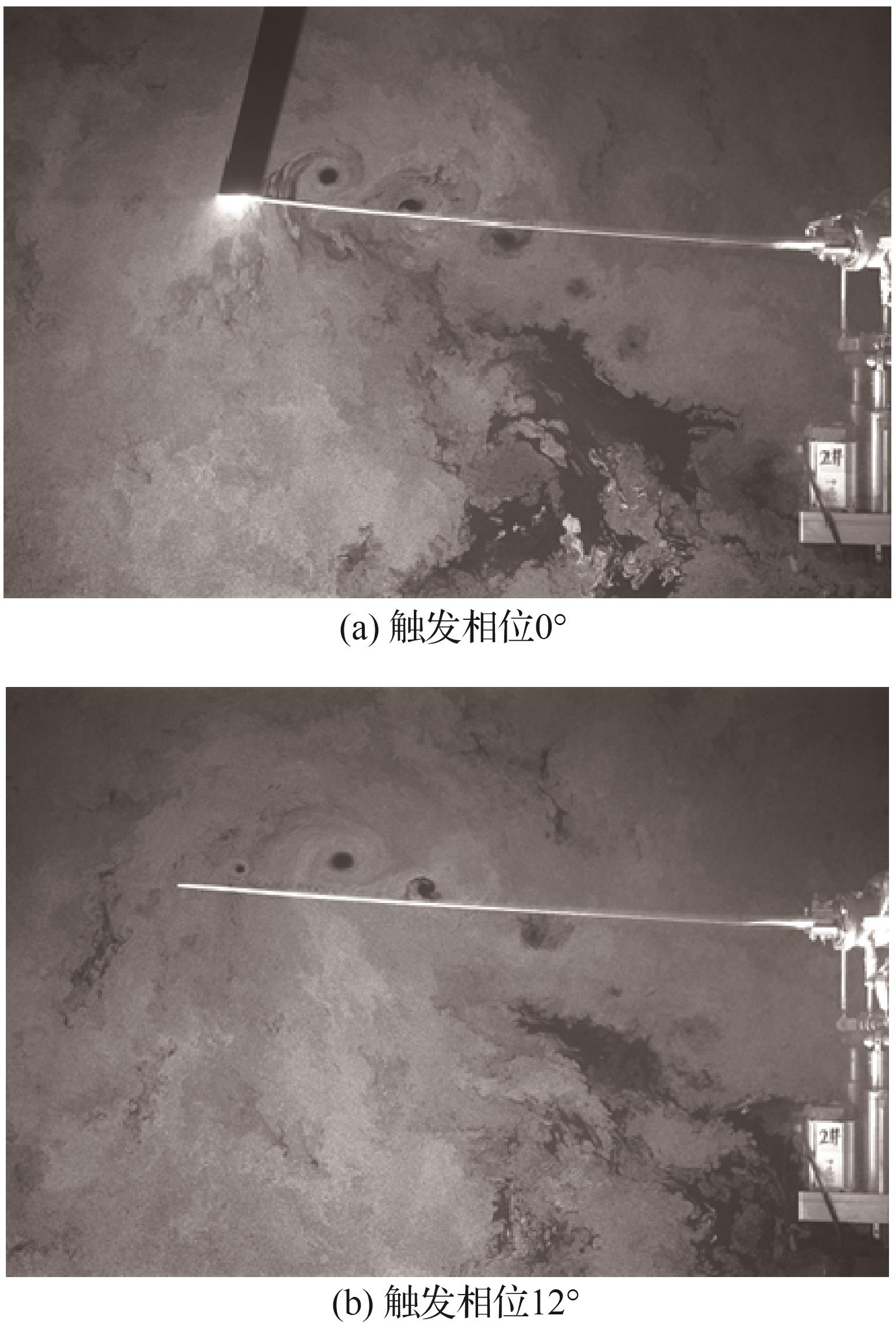
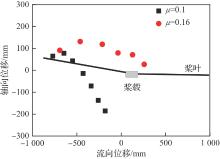
Fig.12
Blade tip vortex trajectory at different advance ratios
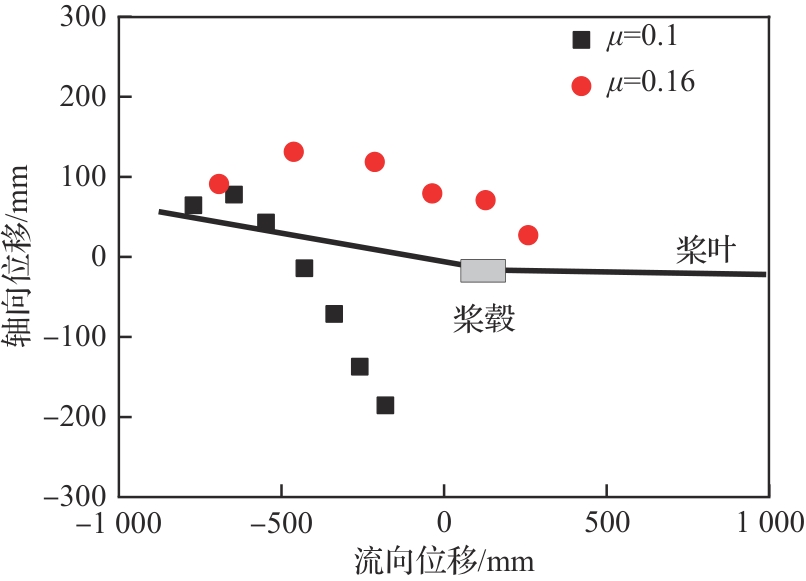
Fig.13
Comparison of noise sound pressure level at different angles in oblique descent state
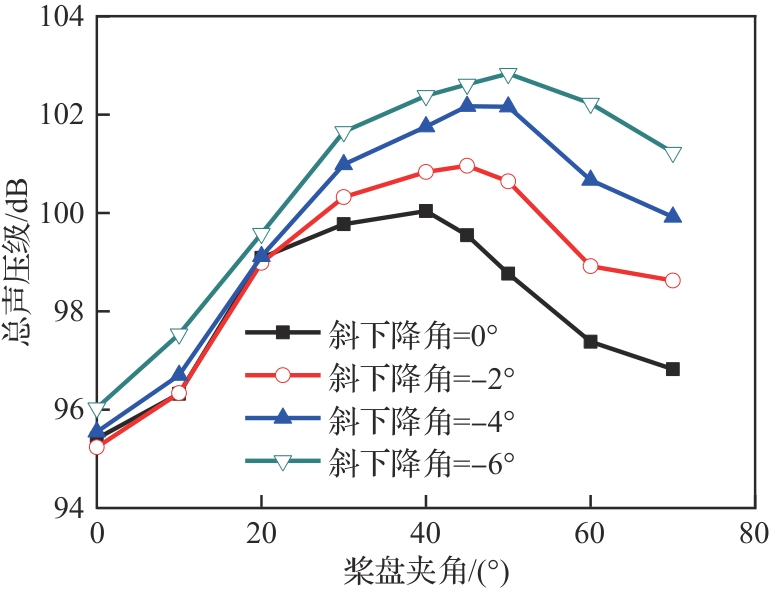
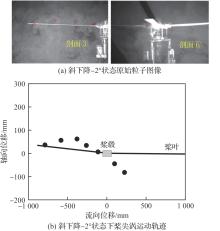
Fig.14
Original particle image and blade tip vortex trajectory fo rotor in -2° oblique descent state
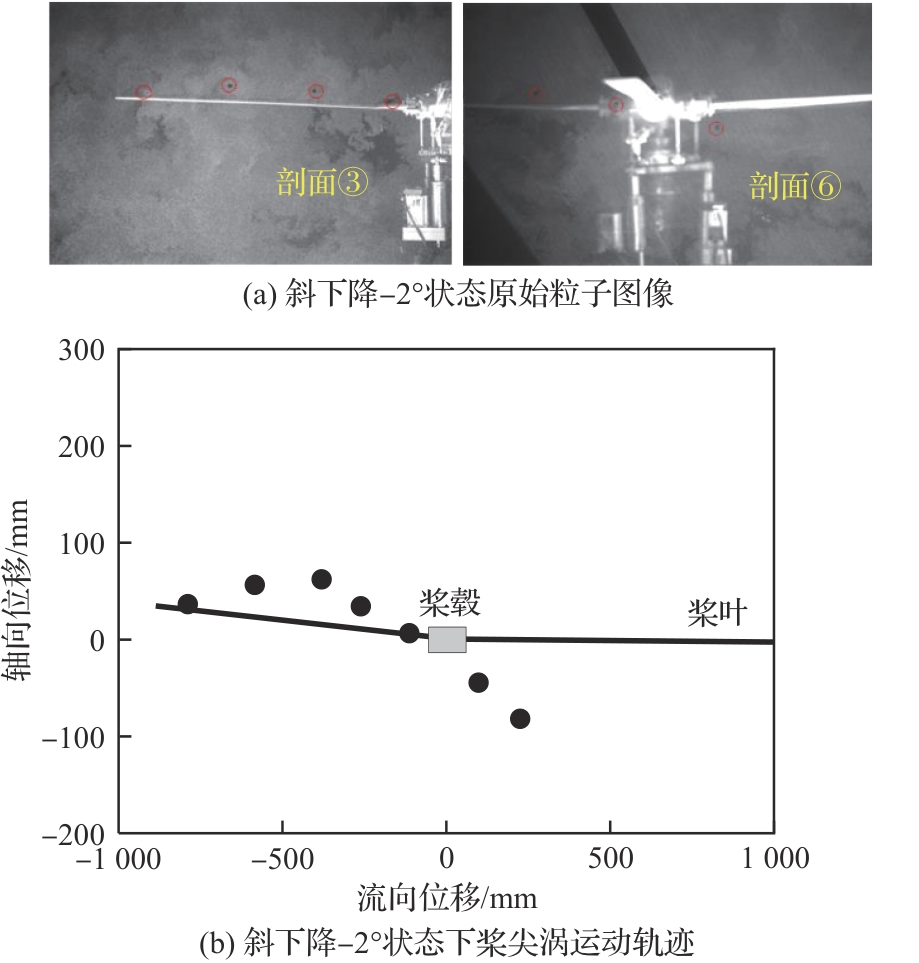
Fig.15
Original particle image and blade tip vortex trajectory of rotor in -6° oblique descent state
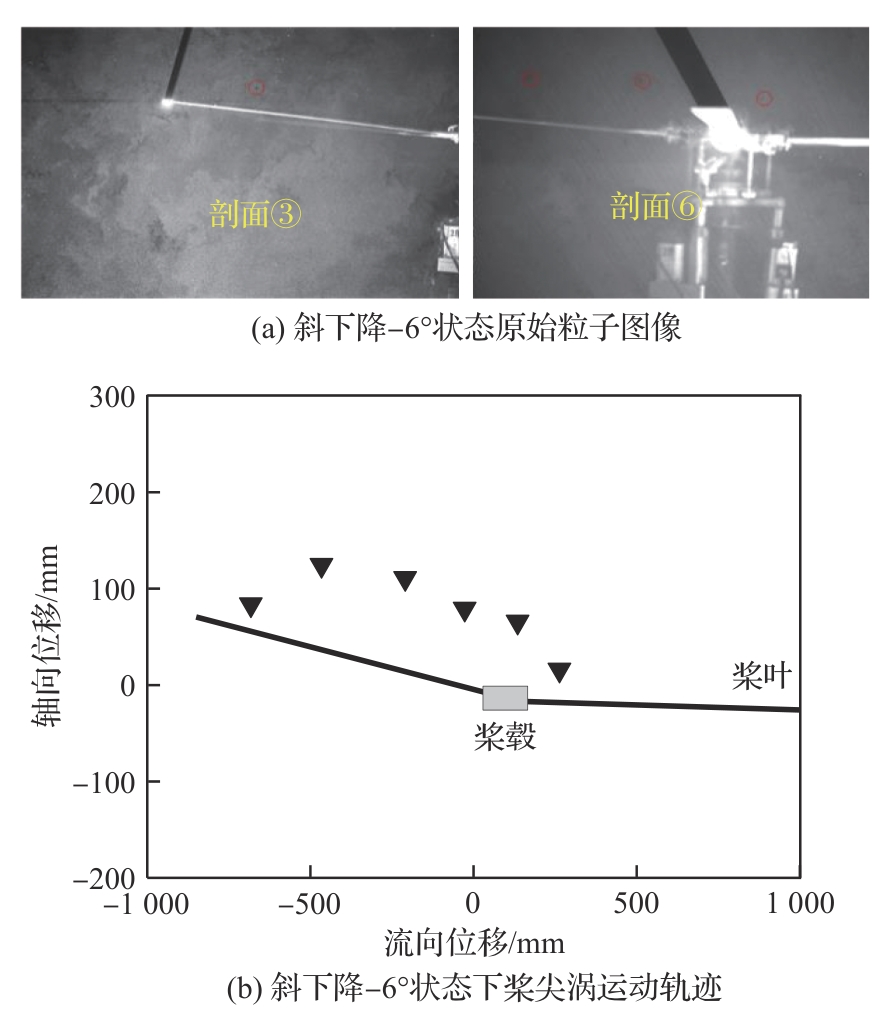
Fig.16
Blade-vortex interaction angles at different trigger moments in level flight
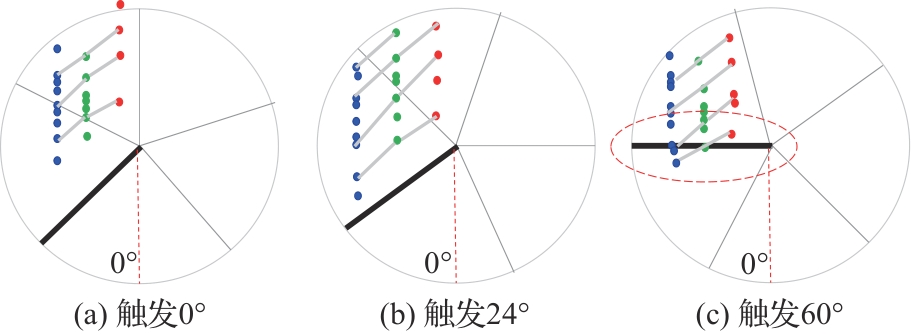
Fig.17
Blade-vortex interaction angles at different trigger moments in oblique descent state
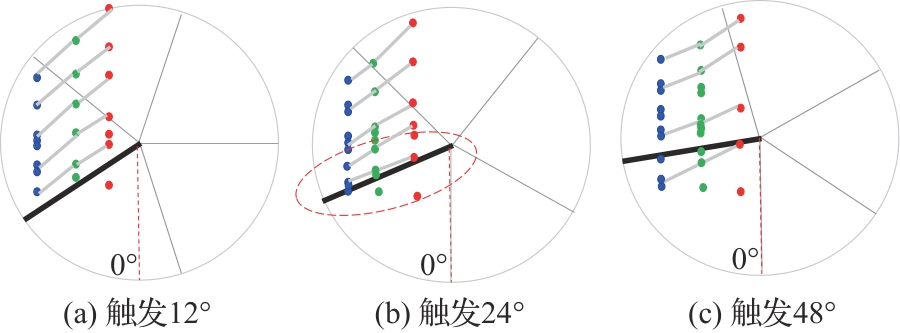
Fig.18
Comparison of pressure coefficients at different oblique descent angles
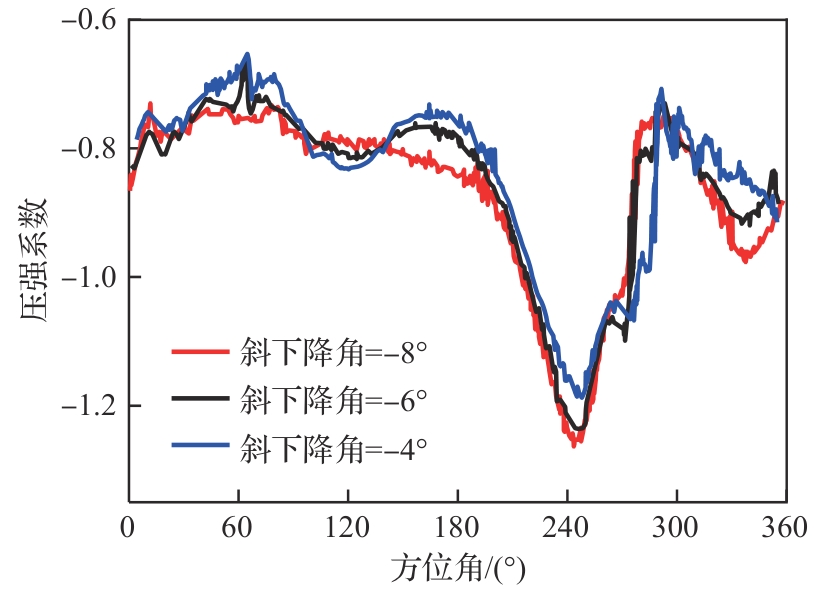
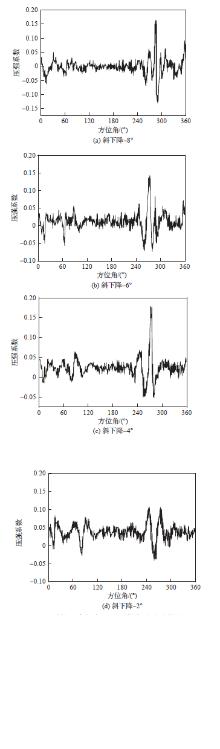
Fig.19
Comparison of high-order filtering results of pressure coefficients in different oblique descent states
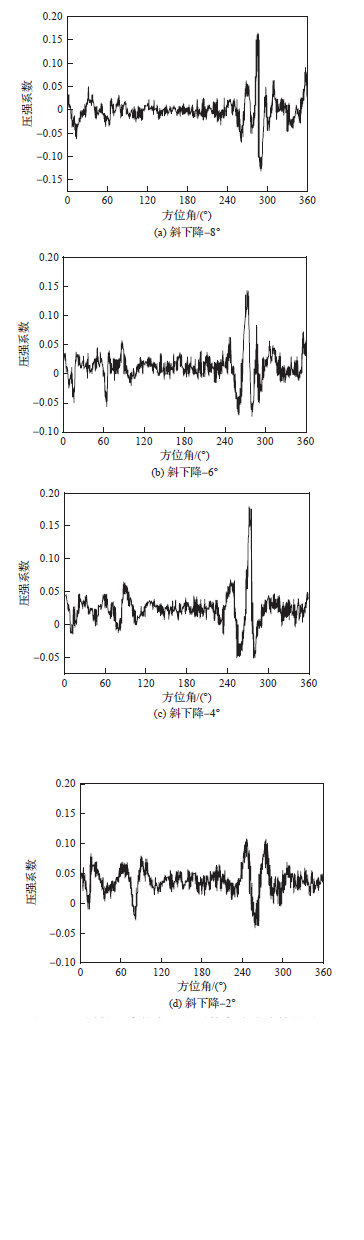
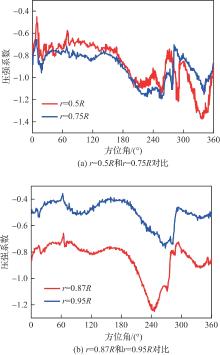
Fig.20
Comparison of pressure coefficients at different spanwise positions in -6° oblique descent state
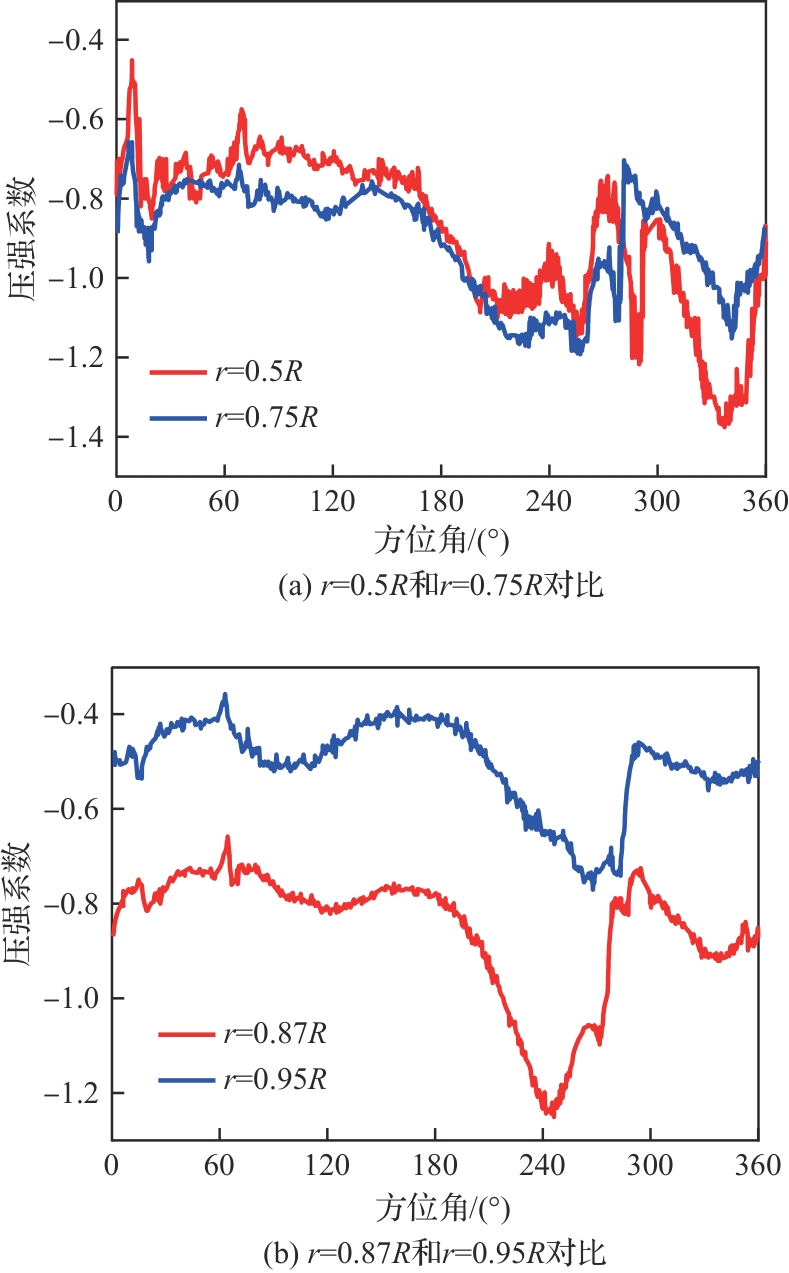
Fig.21
Comparison of pressure coefficients at different spanwise positions in -2° oblique descent state
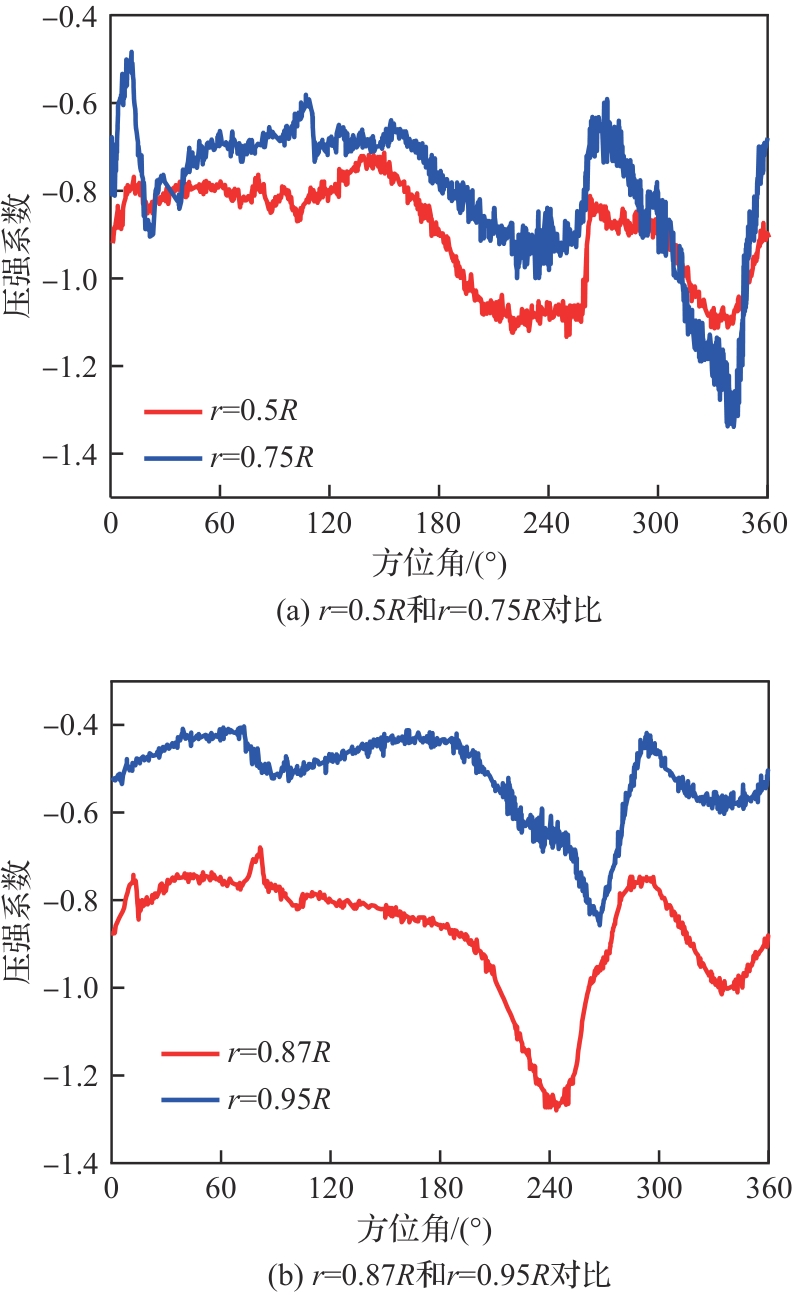
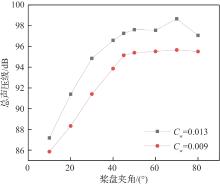
Fig.22
Variation of overall sound pressure level with rotor disk angle under different vertical force coefficients
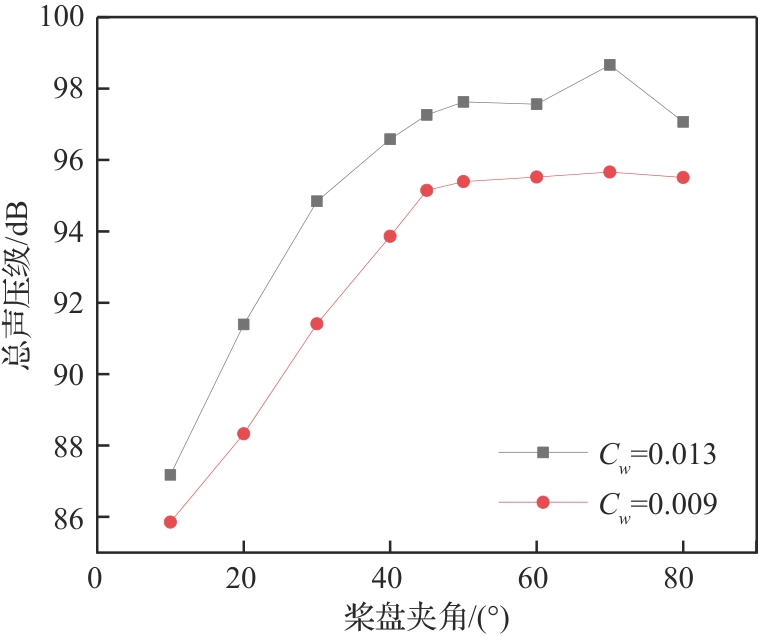
Fig.23
Blade tip vortex trajectories under different vertical force coefficients
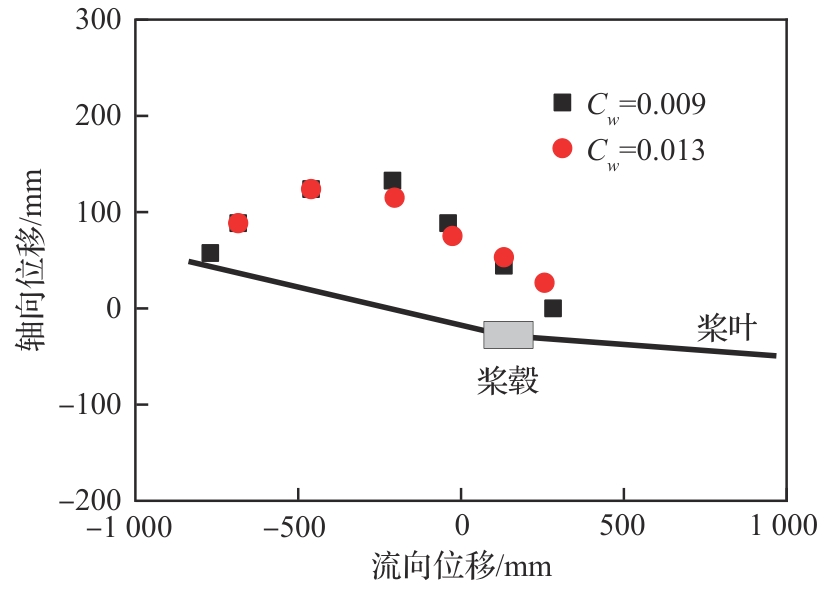
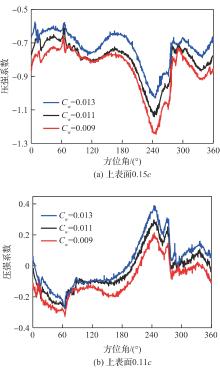
Fig.24
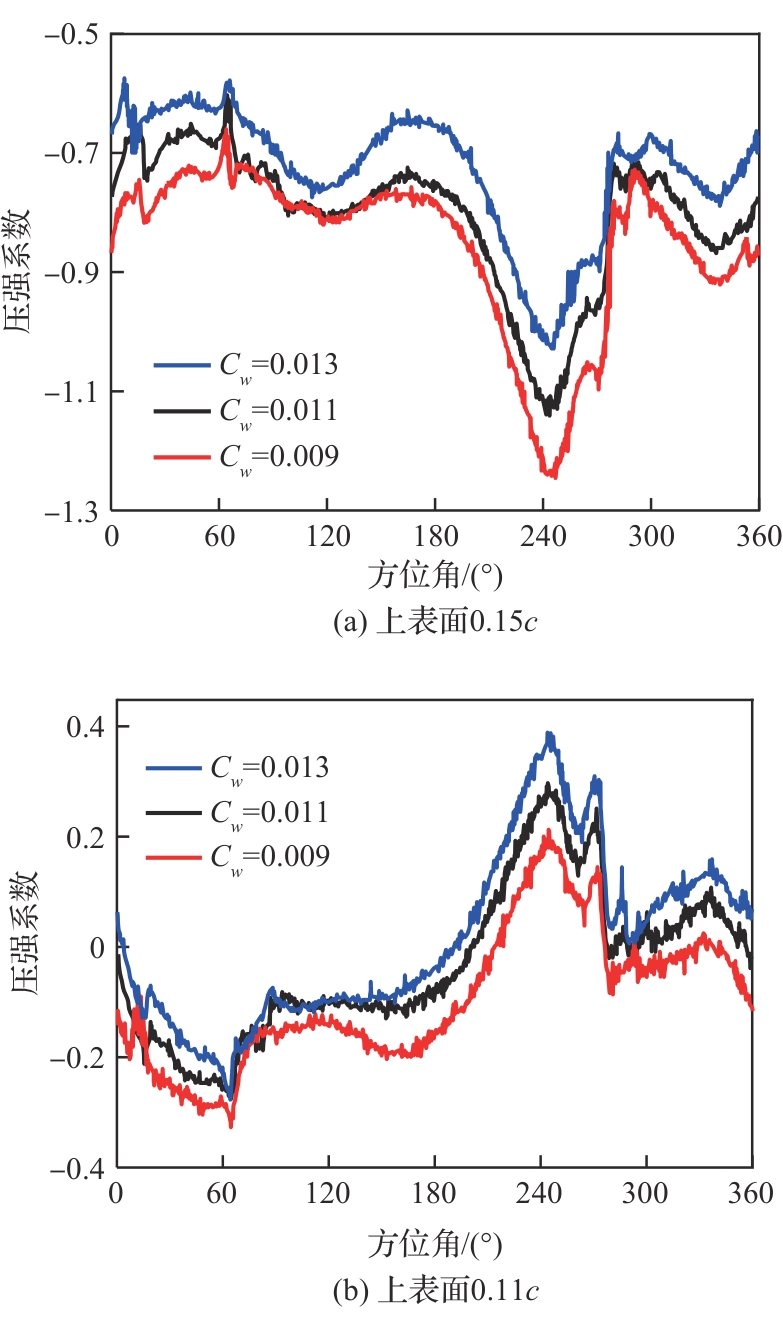
Comparison of pressure coefficients in oblique descent state at different vertical force coefficients
| [1] | 邓景辉, 朱文庆, 张威, 等. 直升机气动噪声抑制与飞行测试研究进展[J]. 南京航空航天大学学报 (自然科学版), 2023, 55(2): 169-185. |
| DENG J H, ZHU W Q, ZHANG W, et al. Progress in suppression and flight measurement for helicopters noise[J]. Journal of Nanjing University of Aeronautics & Astronautics (Natural Science Edition), 2023, 55(2): 169-185 (in Chinese). | |
| [2] | 祁浩天, 王亮权, 张卫国, 等. 旋翼间距对共轴刚性旋翼气动噪声的影响[J]. 航空学报, 2024, 45(21): 130153. |
| QI H T, WANG L Q, ZHANG W G, et al. Effect of rotor spacing on aerodynamic noise of rigid coaxial rotor[J]. Acta Aeronautica et Astronautica Sinica, 2024, 45(21): 130153 (in Chinese). | |
| [3] | JOHNSON C, SIROHI J. An experimental study of stacked rotor tip vortex interaction in hover[J]. Journal of the American Helicopter Society, 2024, 69(4): 1-14. |
| [4] | GREENWOOD E, SIM B W, BOYD D D. Effects of ambient conditions on helicopter harmonic noise radiation: Theory and experiment[J]. Journal of the American Helicopter Society, 2024, 69(1): 1-17. |
| [5] | JAIN R, CONLISK A T. Interaction of tip-vortices in the wake of a two-bladed rotor in axial flight[J]. Journal of the American Helicopter Society, 2000, 45(3): 157-164. |
| [6] | KOUSHIK S, SCHMITZ F H. Understanding in-plane helicopter blade-vortex interaction (BVI) noise[C]∥ American Helicopter Society 68th Annual Forum. Alexandria: American Helicopter Society, 2012: 1-12. |
| [7] | RAMASAMY M, LEISHMAN J G. Interdependence of diffusion and straining of helicopter blade tip vortices[J]. Journal of Aircraft, 2004, 41(5): 1014-1024. |
| [8] | YU Y H, TUNG C, VAN DER WALL B G, et al. The HART-Ⅱ test: Rotor wakes and aeroacoustics with higher-harmonic pitch control (HHC) inputs: The joint German/French/Dutch/US project[C]∥American Helicopter Society 58th Annual Forum. Alexandria: American Helicopter Society, 2002. |
| [9] | VAN DER WALL B G, BURLEY C L, YU Y, et al. The HART Ⅱ test: Measurement of helicopter rotor wakes[J]. Aerospace Science and Technology, 2004, 8(4): 273-284. |
| [10] | MARTIN P B, LEISHMAN J G, PUGLIESE J G, et al. Stereoscopic PIV measurements in the wake of a hovering rotor[C]∥American Helicopter Society 56th Annual Forum. Alexandria: American Helicopter Society, 2000. |
| [11] | YU Y H, TUNG C, GALLMAN J, et al. Aerodynamics and acoustics of rotor blade-vortex interactions[J]. Journal of Aircraft, 1995, 32(5): 970-977. |
| [12] | BOXWELL D A, SCHMITZ F H, SPLETTSTOESSER W R, et al. Helicopter model rotor-blade vortex interaction impulsive noise: Scalability and parametric variations[J]. Journal of the American Helicopter Society, 1987, 32(1): 3-12. |
| [13] | ZHAO Y Y, SHI Y J, XU G H. Helicopter blade-vortex interaction airload and noise prediction using coupling CFD/VWM method[J]. Applied Sciences, 2017, 7(4): 381 |
| [14] | 史勇杰, 徐国华. 飞行参数对旋翼桨-涡干扰噪声特性的影响机理研究[J]. 航空学报, 2013, 34(11): 2520-2528. |
| SHI Y J, XU G H. Research on the influence of flight parameters on helicopter rotor BVI noise characteristics[J]. Acta Aeronautica et Astronautica Sinica, 2013, 34(11): 2520-2528 (in Chinese). | |
| [15] | 史勇杰, 徐国华, 王菲. 直升机旋翼桨-涡干扰脉冲噪声传播特性研究[J]. 南京航空航天大学学报 (自然科学版), 2014, 46(2): 212-217. |
| SHI Y J, XU G H, WANG F. Propagation characteristics of helicopter rotor blade-vortex interaction noise[J]. Journal of Nanjing University of Aeronautics & Astronautics (Natural Science Edition), 2014, 46(2): 212-217 (in Chinese). | |
| [16] | 王菲, 徐国华, 胡志远. 大气环境对直升机旋翼桨-涡干扰噪声辐射特性的影响[J]. 南京航空航天大学学报(自然科学版), 2020, 52(2): 304-310. |
| WANG F, XU G H, HU Z Y. Effects of atmospheric environment on helicopter blade-vortex interaction noise radiation characteristics[J]. Journal of Nanjing University of Aeronautics & Astronautics (Natural Science Edition), 2020, 52(2): 304-310 (in Chinese). | |
| [17] | 陈文轩. 直升机桨-涡干扰试验研究[J]. 直升机技术, 2010(1): 1-14. |
| CHEN W X. The experiment study of helicopter blade-vortex interaction[J]. Helicopter Technique, 2010(1): 1-14 (in Chinese). | |
| [18] | 刘正江, 黄建萍, 陈焕, 等. 旋翼桨涡干扰噪声特性试验技术研究[J]. 直升机技术, 2019(1): 43-47. |
| LIU Z J, HUANG J P, CHEN H, et al. Study on characteristic of rotor blade-vortex interaction noise[J]. Helicopter Technique, 2019(1): 43-47 (in Chinese). | |
| [19] | 刘向楠, 刘少腾, 周国成, 等. 旋翼桨-涡干扰噪声特性风洞试验研究[J]. 实验流体力学, 2023, 37(3): 84-91. |
| LIU X N, LIU S T, ZHOU G C, et al. Wind tunnel test research on the characteristics of rotor blade-vortex interaction noise[J]. Journal of Experiments in Fluid Mechanics, 2023, 37(3): 84-91 (in Chinese). | |
| [20] | 杨永东. 悬停及前飞状态下旋翼尾迹的显示与测量[C]∥ 第十八届全国直升机年会. 2002. |
| YANG Y D. Visualization and measurement of rotor wake in hover and forward[C]∥18th National Helicopter Annual Conference. 2002 (in Chinese). | |
| [21] | 袁红刚, 李进学, 杨永东, 等. 前飞状态旋翼尾迹测量试验研究[J]. 实验流体力学, 2010, 24(4): 29-32. |
| YUAN H G, LI J X, YANG Y D, et al. Test investigation of wake measurement for rotors in forward flight[J]. Journal of Experiments in Fluid Mechanics, 2010, 24(4): 29-32 (in Chinese). | |
| [22] | 江露生, 曹亚雄, 刘婷, 等. 共轴刚性旋翼悬停状态桨叶表面压力测量试验与计算研究[J]. 北京航空航天大学学报, 2021, 47(12): 2484-2493. |
| JIANG L S, CAO Y X, LIU T, et al. Experimental and computational study on blade surface pressure measurement of coaxial rigid rotor in hovering state[J]. Journal of Beijing University of Aeronautics and Astronautics, 2021, 47(12): 2484-2493 (in Chinese). | |
| [23] | 唐朝, 招启军, 王博, 等. 用于BVI噪声试验的新型涡发生器设计与分析[J]. 南京航空航天大学学报 (自然科学版), 2018, 50(2): 157-166. |
| TANG C, ZHAO Q J, WANG B, et al. Design and analysis of new type vortex generator for BVI noise experiment[J]. Journal of Nanjing University of Aeronautics & Astronautics(Natural Science Edition), 2018, 50(2): 157-166 (in Chinese). |
| [1] | Chuanda WANG, Kunjian JIN, Guorui YU, Guoke HUANG, Gang WANG, Haijun PENG. Closed-loop control and experimental study of rotor vibration considering track constraints [J]. Acta Aeronautica et Astronautica Sinica, 2026, 47(2): 232096-232096. |
| [2] | Feihang NIU, Qiaozhi YIN, Xiaohui WEI, Weihua LIANG, Hong NIE. Buffering method of bio-inspired landing gear based on active compliance control [J]. Acta Aeronautica et Astronautica Sinica, 2026, 47(1): 632001-632001. |
| [3] | Yang LIU, Yongjie SHI, Guohua XU. Wind tunnel test of rotor aerodynamic interference characteristics in complex low-altitude wind fields [J]. Acta Aeronautica et Astronautica Sinica, 2026, 47(1): 632054-632054. |
| [4] | Linbo WU, Shu MENG, Wei ZHANG, Jianfeng TAN. Parameters of rotor arrangement for sand suppression in helicopter near-earth flight [J]. Acta Aeronautica et Astronautica Sinica, 2026, 47(1): 632003-632003. |
| [5] | Lixiong ZHENG, Zhe CHEN, Xin WANG, Qijun ZHAO. Prediction of whirl flutter boundary for tiltrotor aircraft based on BPNN with adaptive data [J]. Acta Aeronautica et Astronautica Sinica, 2025, 46(S1): 732159-732159. |
| [6] | Wangqing ZHU, Chenkai CAO, Guoqing ZHAO, Qinghua ZHU, Haoyu HU. Aerodynamic interference of scissor tail rotor and influence of unconventional layout parameters [J]. Acta Aeronautica et Astronautica Sinica, 2025, 46(S1): 732181-732181. |
| [7] | Jiong HE, Binwu REN, Siliang DU, Yousong XU, Bo WANG. Adaptive attitude control for tilt-quadrotor UAV based on ADRC-RBF [J]. Acta Aeronautica et Astronautica Sinica, 2025, 46(S1): 732189-732189. |
| [8] | Xiayang ZHANG, Bin LUO, Xi CHEN, Tao YANG. Optimization design of high-efficiency and low-noise rotor layout for quad-tiltrotor aircraft [J]. Acta Aeronautica et Astronautica Sinica, 2025, 46(S1): 732183-732183. |
| [9] | Zhicheng LIU, Feng LIAO, Chenkai CAO, Wangqing ZHU, Guoqing ZHAO, Qijun ZHAO, Haoyu HU. Aerodynamic influence study of ducted tail rotor geometry and configuration parameters [J]. Acta Aeronautica et Astronautica Sinica, 2025, 46(S1): 732224-732224. |
| [10] | Kelei WANG, Zhou ZHOU, Minghao LI. Research and experimental validation of loose coupling design method for propulsion wing unit [J]. Acta Aeronautica et Astronautica Sinica, 2025, 46(9): 212-229. |
| [11] | Lixiang WEI, Jinglei XU, Kuangshi CHEN, Shuai HUANG, Jianhui GE, Guangtao SONG. Scheme design and performance study of adjustable vector nozzle for wide-range hypersonic aircraft [J]. Acta Aeronautica et Astronautica Sinica, 2025, 46(8): 631086-631086. |
| [12] | Dongfei ZHANG, Junhui GAO. High-precision numerical simulation of fan rotor-stator interaction pure tone [J]. Acta Aeronautica et Astronautica Sinica, 2025, 46(7): 130884-130884. |
| [13] | Yifan YANG, Xiao WANG. Enhanced hybrid vortex particle method for aerodynamic analysis of tiltrotor rotor/wing interactions [J]. Acta Aeronautica et Astronautica Sinica, 2025, 46(7): 131040-131040. |
| [14] | Xian YI, Jinghao REN, Qingren LAI, Yu LIU, Qiang WANG. Icing characteristics of full-scale multi-element configurations of large aircraft: Computation and experiment [J]. Acta Aeronautica et Astronautica Sinica, 2025, 46(5): 531575-531575. |
| [15] | Tianxiang GAO, Zhenbing LUO, Yan ZHOU, Wenqiang PENG, Pan CHENG. Trajectory characteristics experiment of single micro water droplet controlled by dual synthetic jet actuator [J]. Acta Aeronautica et Astronautica Sinica, 2025, 46(4): 130833-130833. |
| Viewed | ||||||
|
Full text |
|
|||||
|
Abstract |
|
|||||
Address: No.238, Baiyan Buiding, Beisihuan Zhonglu Road, Haidian District, Beijing, China
Postal code : 100083
E-mail:hkxb@buaa.edu.cn
Total visits: 6658907 Today visits: 1341All copyright © editorial office of Chinese Journal of Aeronautics
All copyright © editorial office of Chinese Journal of Aeronautics
Total visits: 6658907 Today visits: 1341

 CJA
CJA
