Acta Aeronautica et Astronautica Sinica ›› 2025, Vol. 46 ›› Issue (S1): 732159.doi: 10.7527/S1000-6893.2025.32159
• Excellent Papers of the 2nd Aerospace Frontiers Conference/the 27th Annual Meeting of the China Association for Science and Technology •
Lixiong ZHENG1,2, Zhe CHEN1,2, Xin WANG1,2, Qijun ZHAO1,2( )
)
Received:2025-02-25
Revised:2025-03-27
Accepted:2025-04-27
Online:2025-05-09
Published:2025-05-06
Contact:
Qijun ZHAO
E-mail:zhaoqijun@nuaa.edu.cn
Supported by:CLC Number:
Lixiong ZHENG, Zhe CHEN, Xin WANG, Qijun ZHAO. Prediction of whirl flutter boundary for tiltrotor aircraft based on BPNN with adaptive data[J]. Acta Aeronautica et Astronautica Sinica, 2025, 46(S1): 732159.
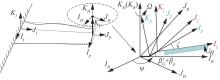
Fig.1
Model simplified and coordinate transformation
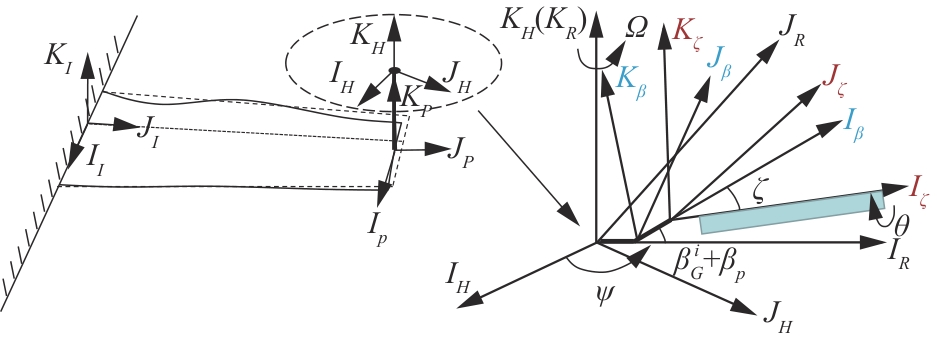
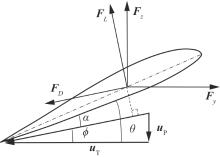
Fig.2
Aerodynamic force of blade profile
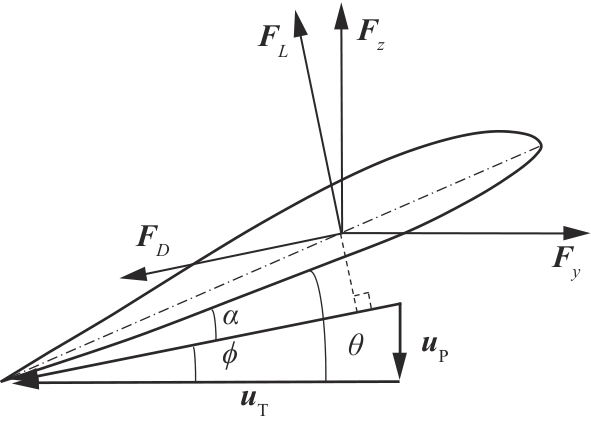
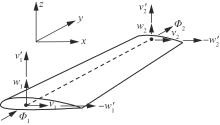
Fig.3
Schematic diagram of wing finite element
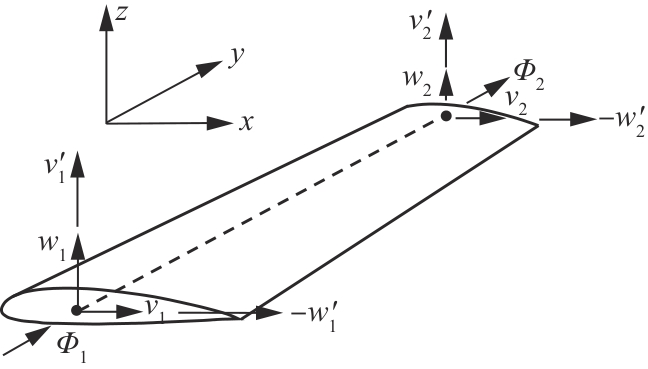
Table 1
Basic parameters of MTR model
| 参数 | 数值 |
|---|---|
| 桨叶片数Nb | 3 |
| 旋翼半径Ra/m | 0.723 9 |
| 挥舞变距调节系数 | -0.268 |
| 升力线斜率 | 5.936 |
| 巡航转速 | 109.96 |
| 桨叶挥舞惯量 | 0.055 2 |
| 机翼展长 | 0.870 |
| 机翼弦长 | 0.392 |
| 桅杆高度 | 0.243 |
| 短舱重心偏置 | -0.032 7 |
| 机翼前掠角 | 0 |
| 机翼垂弯刚度 | 2.62×10⁴ |
| 机翼弦弯刚度 | 1.159×10⁵ |
| 机翼扭转刚度 | 1.52×10⁴ |
| 机翼垂向阻尼 | 7.733 |
| 机翼弦向阻尼 | 17.709 |
| 机翼扭转阻尼 | 0.685 |
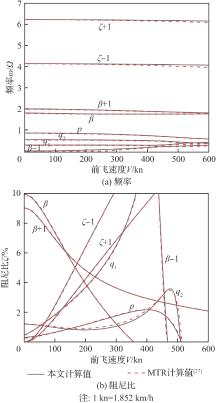
Fig.4
Curves of modal frequencies and damping ratios with forward flight speed
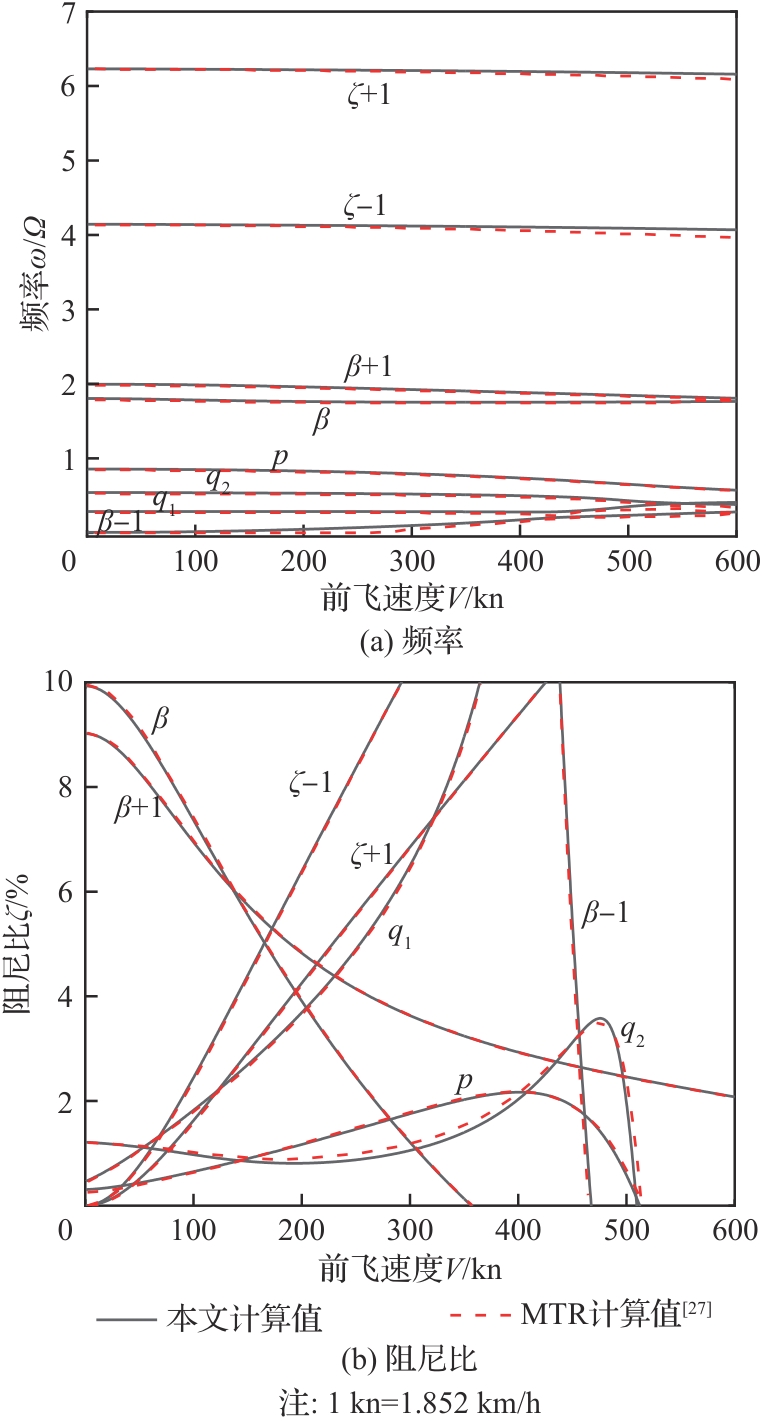
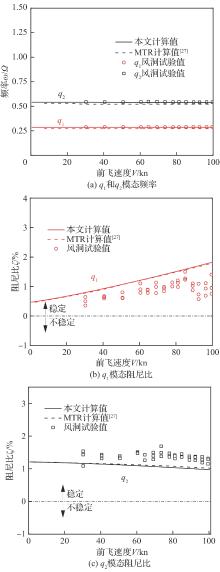
Fig.5
Curves of modal frequencies and damping ratios of q1 and q2 with forward flight speed
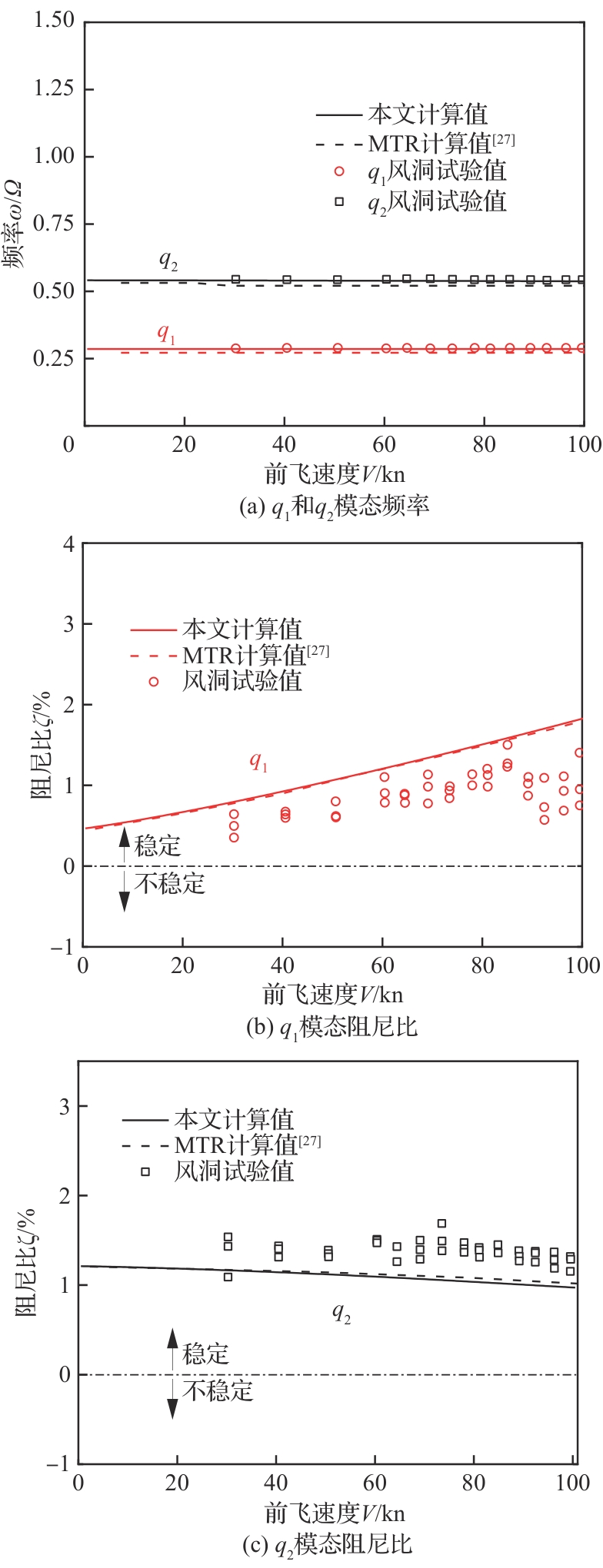
Table 2
Variation range of input parameters for tiltrotor aircraft
| 参数 | 范围 |
|---|---|
| 桅杆高度h | |
| 机翼垂弯刚度 | |
| 机翼弦弯刚度 | |
| 机翼扭转刚度 | |
| 挥舞变距调节系数 |
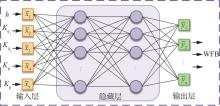
Fig.6
BP neural network structure
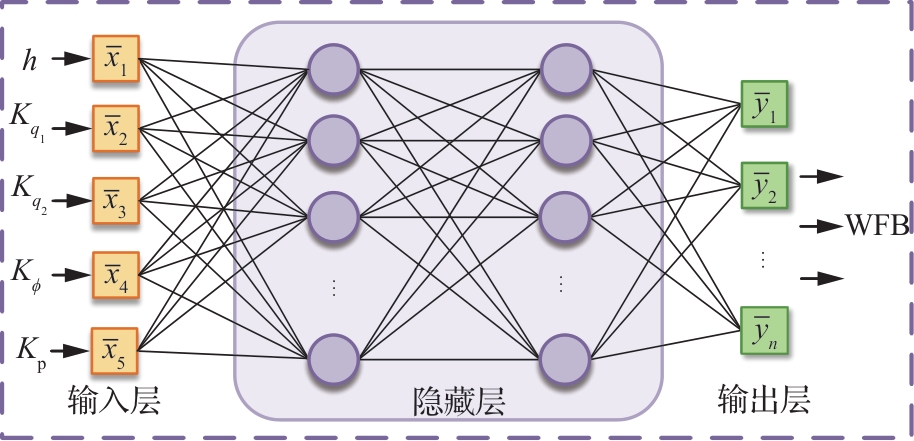
Fig.7
Neural network model training process
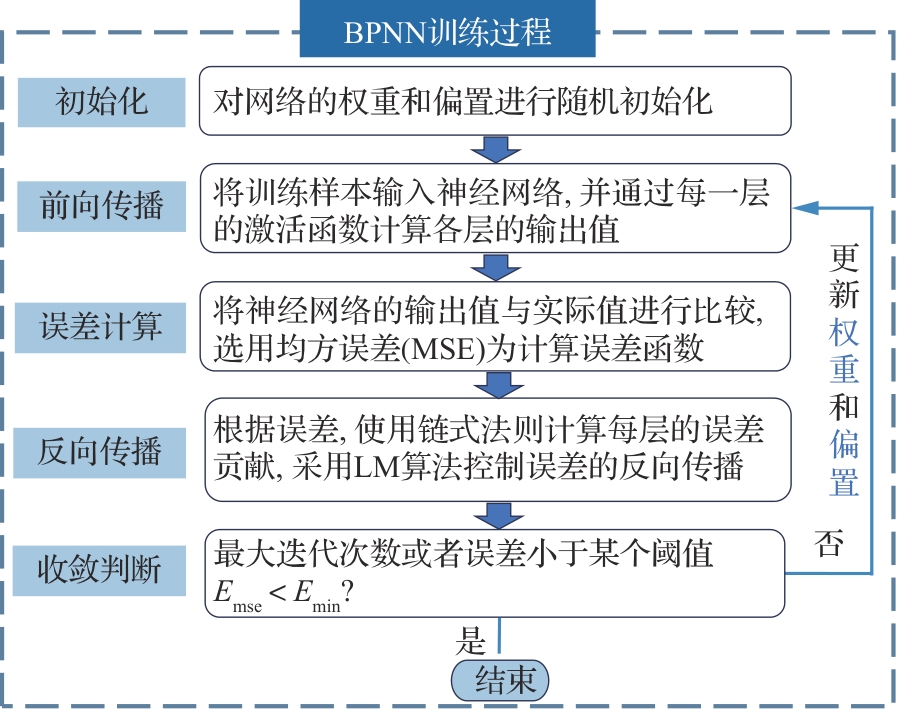
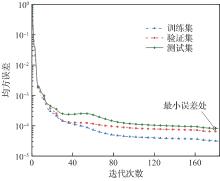
Fig.8
Error iterative convergence curves of neural network
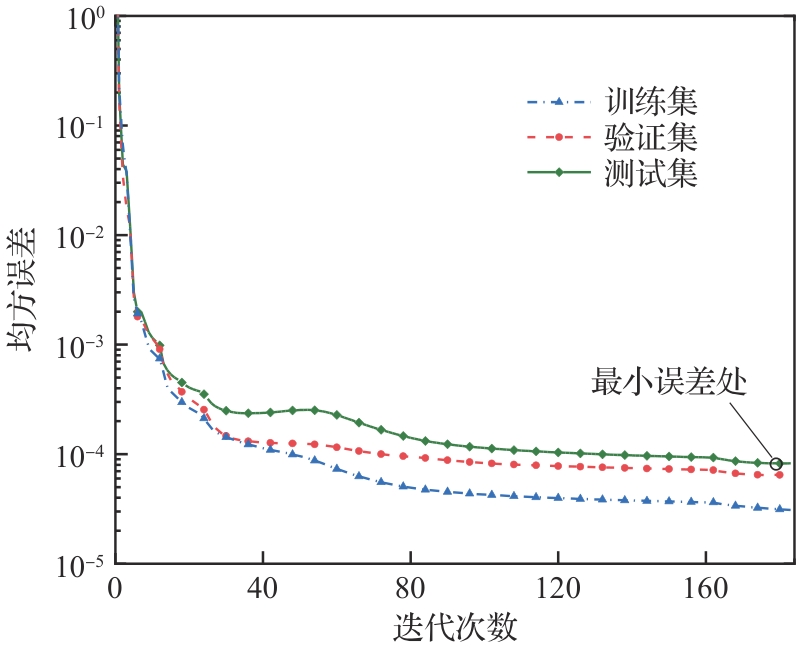
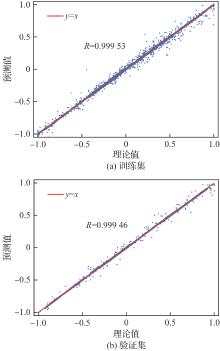
Fig.9
Neural network model correlation coefficient R
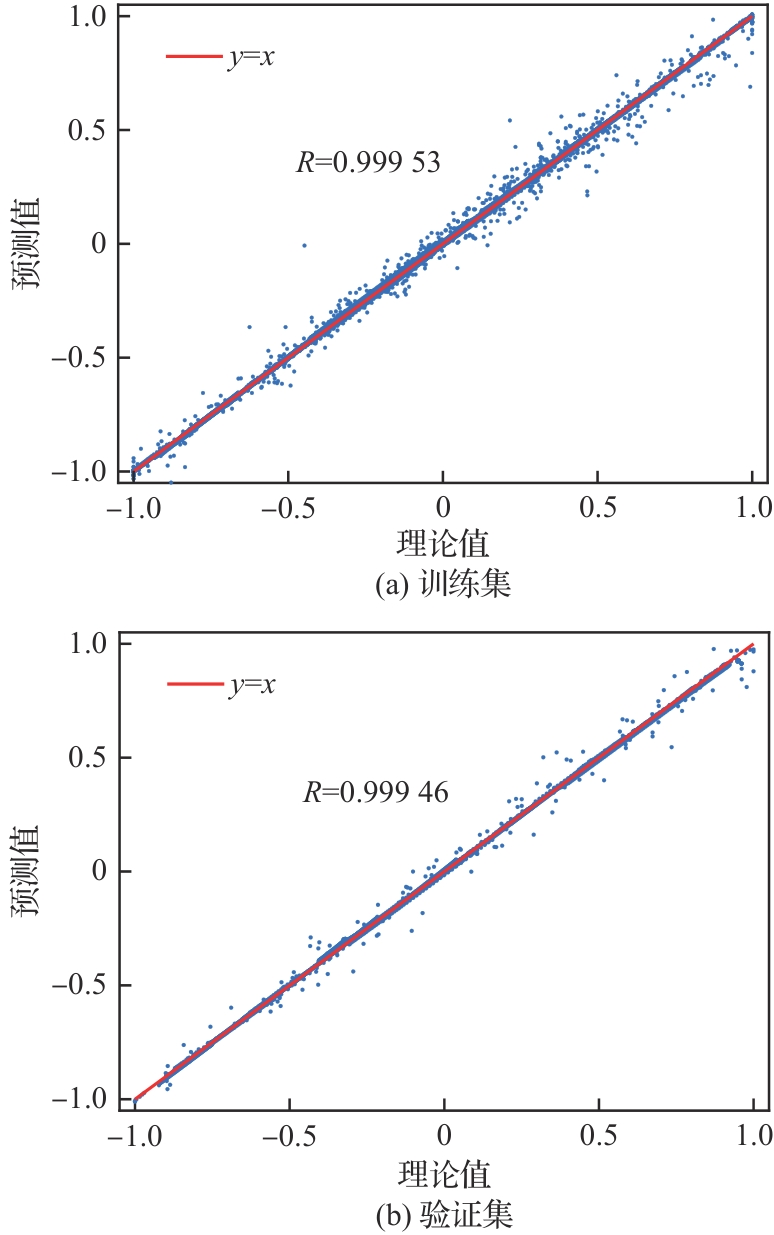
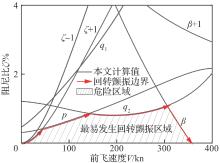
Fig.10
The minimum modal damping ratio region in forward flight state
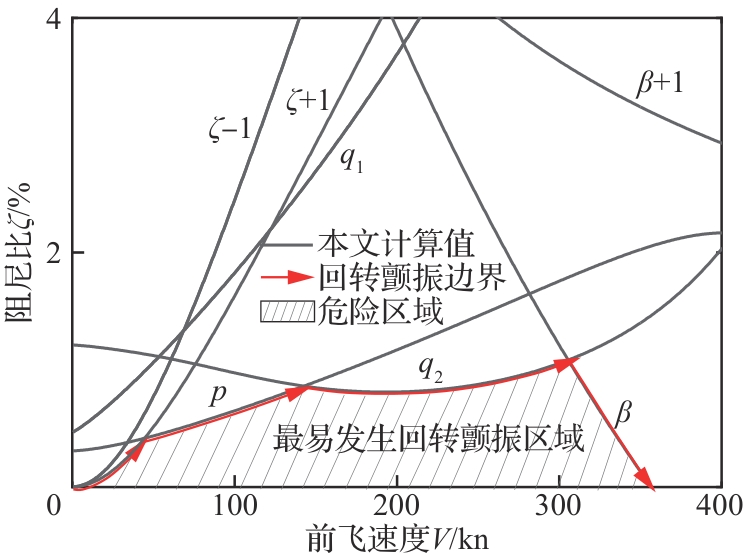
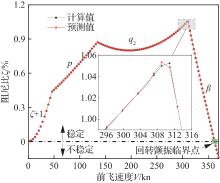
Fig.11
Comparison between theory and prediction results of whirl flutter boundary within training range
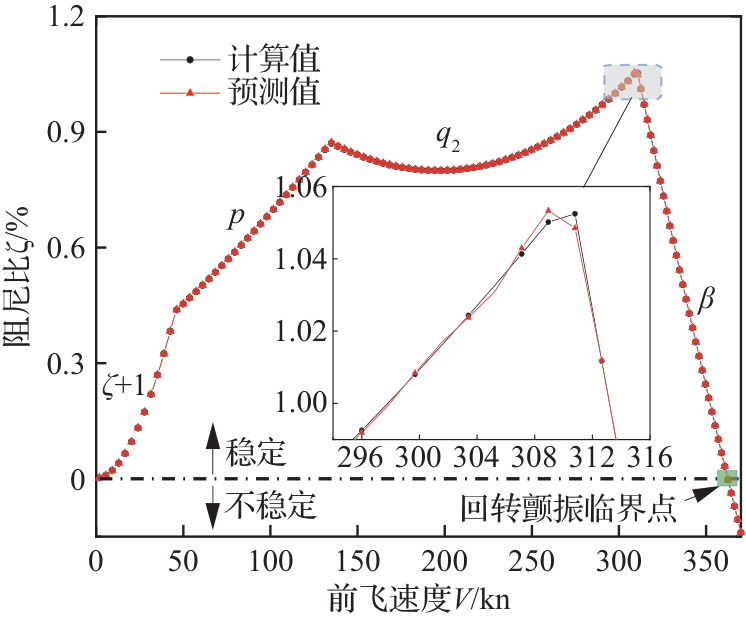
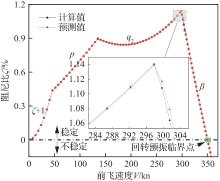
Fig.12
Comparison between theory and prediction results of whirl flutter boundary outside training range
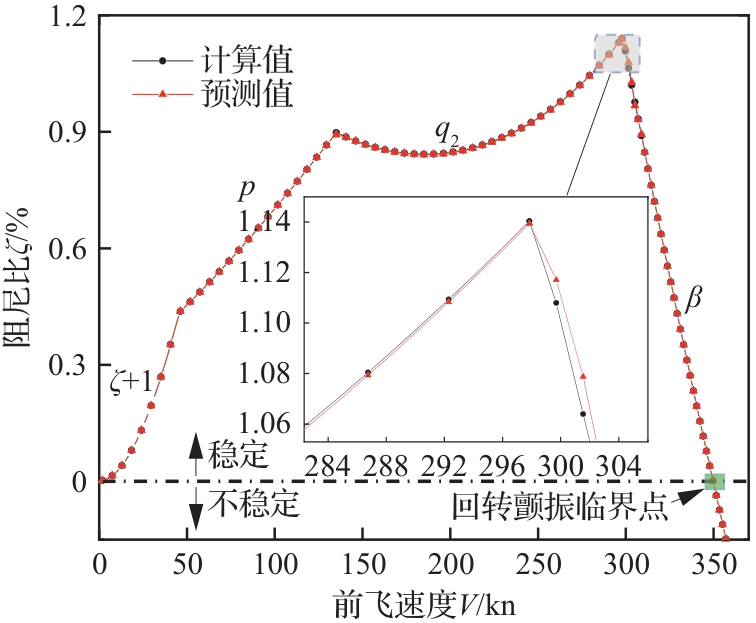
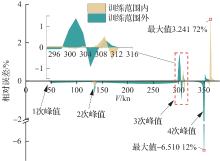
Fig.13
Error between calculated and predicted values within and outside training range
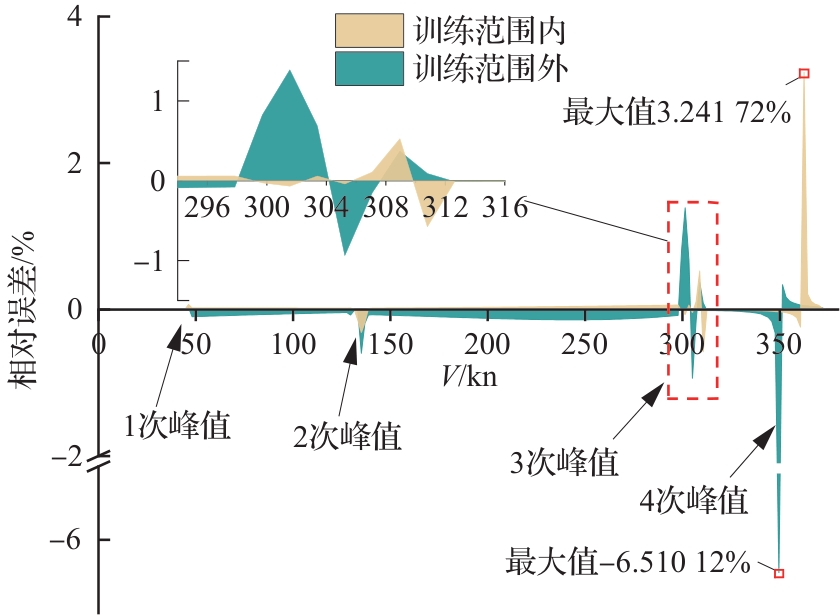
Table 3
Whirl flutter critical point speed prediction error
| 状态 | 临界点速度 | ||
|---|---|---|---|
| 理论值/kn | 预测值/kn | 误差/% | |
| 训练范围内 | 362.466 95 | 362.462 71 | -0.001 17 |
| 训练范围外 | 349.730 83 | 349.725 43 | -0.001 54 |
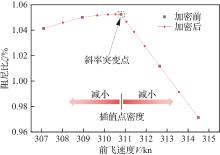
Fig.14
Comparison of data before and after adaptive refinement
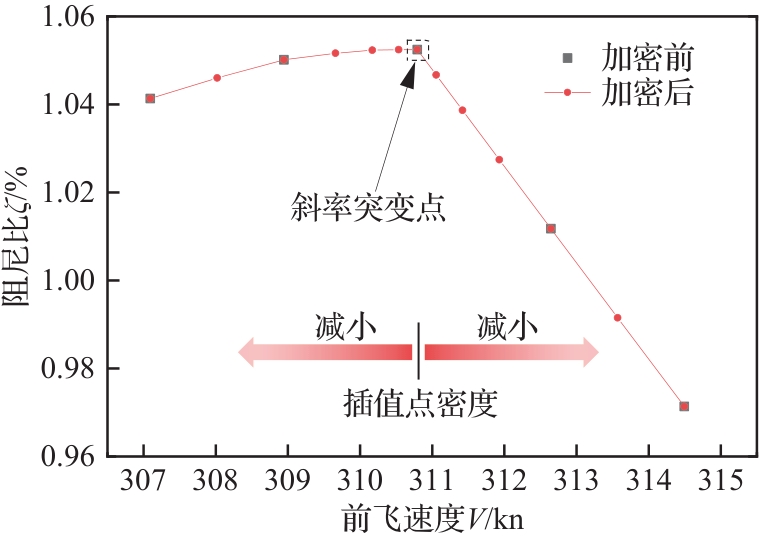
Fig.15
Error between calculated and predicted values within and outside training range
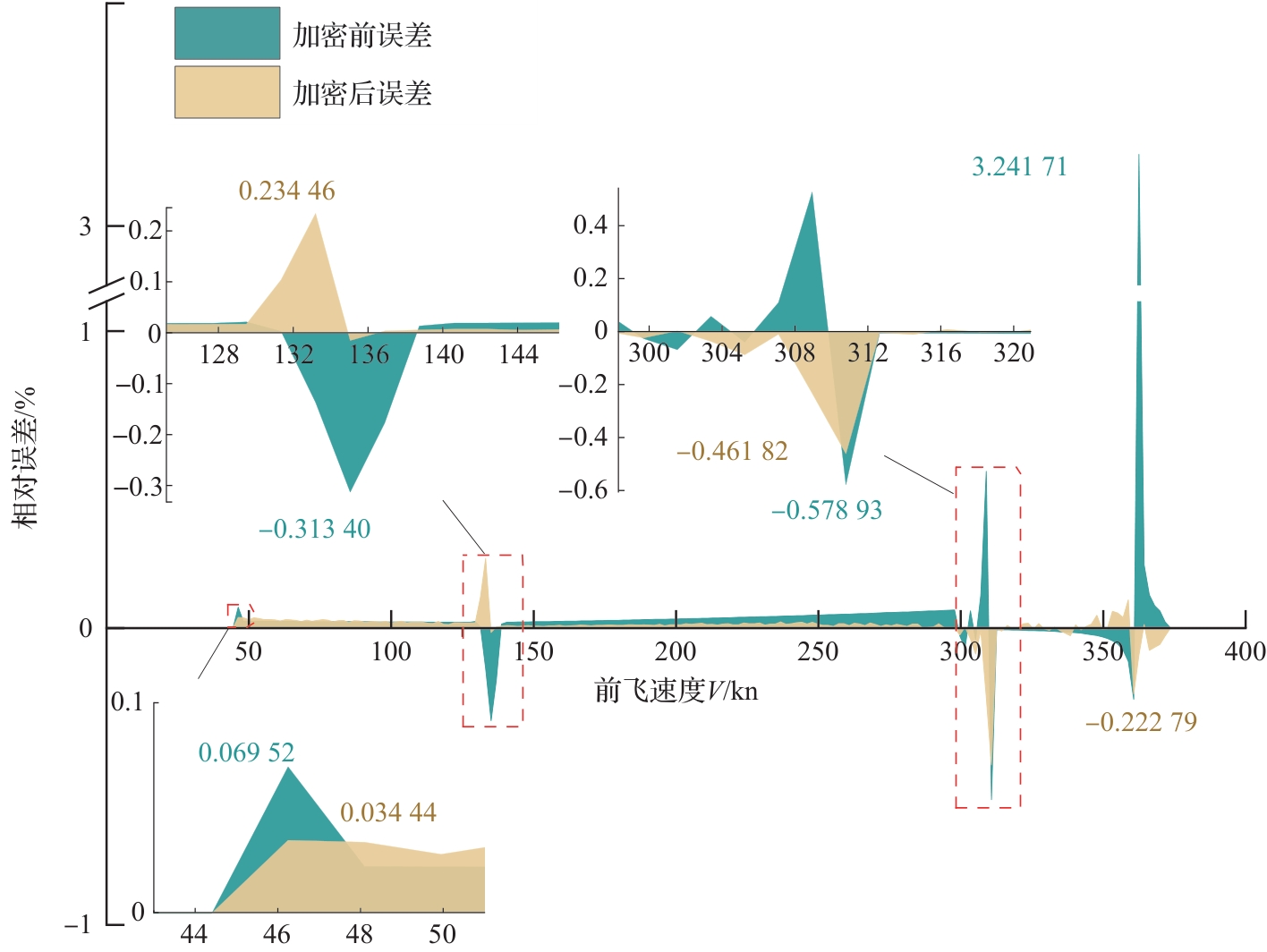
Table 4
Comparison of the maximum absolute value error of each peak before and after refinement
| 峰值次数 | 加密前最大误差/% | 加密后最大误差/% | 降幅/% |
|---|---|---|---|
| 1 | 0.069 52 | 0.034 44 | 50.46 |
| 2 | 0.313 40 | 0.234 46 | 25.19 |
| 3 | 0.578 93 | 0.461 82 | 20.23 |
| 4 | 3.241 71 | 0.222 79 | 93.13 |
| [1] | 张卫国, 唐敏, 武杰, 等. 倾转旋翼机风洞试验综述[J]. 航空学报, 2024, 45(9): 530114. |
| ZHANG W G, TANG M, WU J, et al. Overview of wind tunnel test research on tiltrotor aircraft[J]. Acta Aeronautica et Astronautica Sinica, 2024, 45(9): 530114 (in Chinese). | |
| [2] | KVATERNIK R G. Experimental and analytical studies in tilt rotor aeroelasticity[C]∥Presented at the AHS/NASA Ames Specialists’ Meeting on Rotorcraft Dynamics. 1974. |
| [3] | YOUNG M I, LYTWYN R T. The influence of blade flapping restraint on the dynamic stability of low disk loading propeller-rotors[J]. Journal of the American Helicopter Society, 1967, 12(4): 38-54. |
| [4] | JOHNSON W. Dynamics of tilting proprotor aircraft in cruise flight: NASA-TN-D-7677[R]. Moffett Field: Ames Research Center and U.S. Army Air Mobility R & D Laboratory, 1974. |
| [5] | SETTLE T B, KIDD D L. Evolution and test history of the V-22 0.2-scale aeroelastic model[C]∥Presented at the American Helicopter Society National Specialists’ Meeting on Rotorcraft Dynamics. 1989. |
| [6] | WILLIAM T Y, JR, RAYMOND G K. A historical overview of aeroelasticity branch and transonic dynamics tunnel contributions to rotorcraft technology and development: NASA/TM-2001-211054[R]. Hampton: NASA Langley Research Center, 2001. |
| [7] | NIXON M W. Aeroelastic response and stability of tiltrotors with elastically-coupled composite rotor blades[D]. College Park: University of Maryland, 1993. |
| [8] | PIATAK D J, KVATERNIK R G, NIXON M, et al. A wind-tunnel parametric investigation of tiltrotor whirl-flutter stability boundaries[C]∥Presented at the American Helicopter Society 57th Annual Forum. 2001. |
| [9] | ACREE C W JR. Impact of technology on heavy lift tiltrotors[C]∥Presented at the American Helicopter Society 62nd Annual Forum. 2006. |
| [10] | JOHNSON S C. Design and testing of a small, semi-span, prop-rotor model for whirl flutter stability[D]. State College: Pennsylvania State University, 2014: 31-65. |
| [11] | KAMBAMPATI S. Optimization of composite tiltrotor wings with extensions and winglets[D]. State College: Pennsylvania State University, 2016: 5-30. |
| [12] | IVANCO T G, KANG H, KRESHOCK A R, et al. Generalized predictive control for active stability augmentation and vibration reduction on an aeroelastic tiltrotor model[C]∥AIAA Scitech 2022 Forum. Reston: AIAA, 2022. |
| [13] | 徐敏. 倾转旋翼机的发展与关键技术综述[J]. 直升机技术, 2003(2): 40-44. |
| XU M. Summary of development and key technologies of tilt-rotor aircraft[J]. Helicopter Technique, 2003(2): 40-44 (in Chinese). | |
| [14] | 邓景辉. 高速直升机关键技术与发展[J]. 航空学报, 2024, 45(9): 529085. |
| DENG J H. Key technologies and development for high-speed helicopters[J]. Acta Aeronautica et Astronautica Sinica, 2024, 45(9): 529085 (in Chinese). | |
| [15] | 杨卫东, 董凌华. 倾转旋翼过渡状态瞬态响应分析与试验[J]. 航空动力学报, 2005, 20(5): 882-889. |
| YANG W D, DONG L H. Analysis and experiments of the tiltrotor transient response during transition flight[J]. Journal of Aerospace Power, 2005, 20(5): 882-889 (in Chinese). | |
| [16] | 杨卫东, 董凌华. 变转速倾转旋翼机多体系统气弹响应分析[J]. 哈尔滨工业大学学报, 2006, 38(2): 282-286, 324. |
| YANG W D, DONG L H. Multi-body aeroelastic analysis of til trotor with varying rotor rotational speed[J]. Journal of Harbin Institute of Technology, 2006, 38(2): 282-286, 324 (in Chinese). | |
| [17] | 董凌华, 杨卫东. 倾转旋翼/机翼耦合系统过渡飞行瞬态响应分析[J]. 南京航空航天大学学报, 2006, 38(3): 361-366. |
| DONG L H, YANG W D. Transient response analysis of rotor/wing coupled during tiltrotor transition flight[J]. Journal of Nanjing University of Aeronautics & Astronautics, 2006, 38(3): 361-366 (in Chinese). | |
| [18] | 崔超. 基于机翼控制的倾转旋翼机回转颤振主动抑制研究[D]. 南京: 南京航空航天大学, 2019: 9-20. |
| CUI C. Research on active suppression of rotary flutter of tilt-rotor aircraft based on wing control[D]. Nanjing: Nanjing University of Aeronautics and Astronautics, 2019: 9-20 (in Chinese). | |
| [19] | 薛立鹏, 张呈林. 前飞状态倾转旋翼机气弹稳定性建模[J]. 航空动力学报, 2009, 24(2): 255-261. |
| XUE L P, ZHANG C L. Modeling study on tilt-rotor’s aeroelastic stability in cruise flight[J]. Journal of Aerospace Power, 2009, 24(2): 255-261 (in Chinese). | |
| [20] | LI Z Q, XIA P Q. Aeroelastic stability of full-span tiltrotor aircraft model in forward flight[J]. Chinese Journal of Aeronautics, 2017, 30(6): 1885-1894. |
| [21] | 李治权, 夏品奇. 一种改进的前飞时倾转旋翼机非定常气弹动力学模型[J]. 中国科学: 技术科学, 2018, 48(8): 901-907. |
| LI Z Q, XIA P Q. An improved unsteady aeroelastic model for tiltrotor aircraft in forward flight[J]. Scientia Sinica (Technologica), 2018, 48(8): 901-907 (in Chinese). | |
| [22] | 邓旭东, 胡和平. 倾转旋翼机螺旋颤振稳定性研究[J]. 空气动力学学报, 2018, 36(6): 1041-1046. |
| DENG X D, HU H P. Study on whirl-flutter stability of a tiltrotor aircraft[J]. Acta Aerodynamica Sinica, 2018, 36(6): 1041-1046 (in Chinese). | |
| [23] | LI H X, QU X J, WANG W J. Multi-body motion modeling and simulation for tilt rotor aircraft[J]. Chinese Journal of Aeronautics, 2010, 23(4): 415-422. |
| [24] | RISO C, GHADAMI A, CESNIK C E S, et al. Data-driven forecasting of postflutter responses of geometrically nonlinear wings[J]. AIAA Journal, 2020, 58(6): 2726-2736. |
| [25] | YUAN H, KOU J Q, GAO C Q, et al. Resolvent analysis for flutter boundary prediction in transonic flow[J]. AIAA Journal, 2024, 62(8): 3191-3195. |
| [26] | 郑礼雄, 王博, 招启军, 等. 倾转旋翼机多模态耦合动力学建模和气弹稳定性参数影响[J]. 航空动力学报, 2025, 40(3): 20230445. |
| ZHENG L X, WANG B, ZHAO Q J, et al. Multi-mode coupling dynamic modeling and influence of aeroelastic stability parameters of tiltrotor aircraft[J]. Journal of Aerospace Power, 2025, 40(3): 20230445 (in Chinese). | |
| [27] | TSAI F, SUTHERLAND, AKINWALE, et al. Development and whirl flutter test of the Maryland tiltrotor rig[J]. Journal of the American Helicopter Society, 2024, 69(1): 1-15. |
| [28] | SU J Y, CHEN Y, ZHANG D B, et al. Full-parameter identification model based on back propagation algorithm for brushless doubly fed induction generator[J]. IEEE Transactions on Power Electronics, 2020, 35(10): 9953-9958. |
| [29] | 马菲, 张琼, 赖培军, 等. 基于BP神经网络的试飞训练安全性量化模型[J]. 航空学报, 2024, 45(5): 529957. |
| MA F, ZHANG Q, LAI P J, et al. BP neural network-based quantitative classification model for safety in experimental flight training[J]. Acta Aeronautica et Astronautica Sinica, 2024, 45(5): 529957 (in Chinese). |
| [1] | Yifan YANG, Xiao WANG. Enhanced hybrid vortex particle method for aerodynamic analysis of tiltrotor rotor/wing interactions [J]. Acta Aeronautica et Astronautica Sinica, 2025, 46(7): 131040-131040. |
| [2] | Yubin LU, Xiaohua NIE, Zhen WU. A residual stiffness prediction approach for carbon fiber reinforced composite materials based on interpretable machine learning algorithms [J]. Acta Aeronautica et Astronautica Sinica, 2025, 46(21): 532249-532249. |
| [3] | Zixu WANG, Pan LI, Junbiao SHEN, Zhenhua ZHU, Renliang CHEN. Dynamic conversion corridor of tiltrotor aircraft under accelerating and decelerating conditions [J]. Acta Aeronautica et Astronautica Sinica, 2025, 46(11): 531377-531377. |
| [4] | Changhao LIU, Yihua CAO, Xiaomeng MEI, Maosheng WANG, Guanglin ZHANG. Transport effectiveness evaluation of high⁃speed helicopters [J]. Acta Aeronautica et Astronautica Sinica, 2024, 45(9): 530182-530182. |
| [5] | Weiguo ZHANG, Min TANG, Jie WU, Xianmin PENG, Guichuan ZHANG, Bowen NIE, Liangquan WANG, Chaoqun LI. Overview of wind tunnel test research on tiltrotor aircraft [J]. Acta Aeronautica et Astronautica Sinica, 2024, 45(9): 530114-530114. |
| [6] | Fei MA, Qiong ZHANG, Peijun LAI, Yidi YUE. BP neural network⁃based quantitative classification model for safety in experimental flight training [J]. Acta Aeronautica et Astronautica Sinica, 2024, 45(5): 529957-529957. |
| [7] | Pan ZHOU, Renliang CHEN, Ningmeng YANG, Bowen NIE, Guoqiang LI. Control strategy for quad-tiltrotor aircraft [J]. Acta Aeronautica et Astronautica Sinica, 2024, 45(22): 130165-130165. |
| [8] | Yiming LIANG, Guangning LI, Min XU. Method for numerical virtual flight with intelligent control based on machine learning [J]. Acta Aeronautica et Astronautica Sinica, 2023, 44(17): 128098-81280986. |
| [9] | DONG Zhenyi, LIN Li, LEI Mingkai, MA Zhiyuan. Ultrasonic quantitative characterization of pore distribution uniformity of seal coating based on BPNN [J]. ACTA AERONAUTICAET ASTRONAUTICA SINICA, 2022, 43(5): 425294-425294. |
| [10] | LUO Junting, ZHAO Jingqi, YANG Zheyi, LIU Weipeng, ZHANG Chunxiang. Microstructure prediction of multi-directional forging of TA15 alloy based on secondary development of Deform and BP neural network [J]. ACTA AERONAUTICAET ASTRONAUTICA SINICA, 2021, 42(12): 424693-424693. |
| [11] | XIONG Qingchun, WANG Jiaxu, ZHOU Qinghua. Prediction model of machining errors based on precision and process parameters of machine tools [J]. ACTA AERONAUTICAET ASTRONAUTICA SINICA, 2018, 39(8): 421713-421713. |
| [12] | YAO Yusheng, XU Kaijun. Quality assessment of flight training based on BP neural network [J]. ACTA AERONAUTICAET ASTRONAUTICA SINICA, 2017, 38(S1): 721513-721513. |
| [13] | CHEN Zhaolin, YANG Zhichun, GU Yingsong. Effect of wing on whirl flutter of propeller engine [J]. ACTA AERONAUTICAET ASTRONAUTICA SINICA, 2016, 37(11): 3351-3360. |
| [14] | ZHANG Weiwei, ZHONG Huashou, XIAO Hua, YE Zhengyin. Review and prospect of flutter boundary prediction methods for flight flutter testing [J]. ACTA AERONAUTICAET ASTRONAUTICA SINICA, 2015, 36(5): 1367-1384. |
| [15] | LI Peng, ZHAO Qijun. CFD Calculations on the Interaction Flowfield and Aerodynamic Force of Tiltrotor/Wing in Hover [J]. ACTA AERONAUTICAET ASTRONAUTICA SINICA, 2014, 35(2): 361-371. |
| Viewed | ||||||
|
Full text |
|
|||||
|
Abstract |
|
|||||
Address: No.238, Baiyan Buiding, Beisihuan Zhonglu Road, Haidian District, Beijing, China
Postal code : 100083
E-mail:hkxb@buaa.edu.cn
Total visits: 6658907 Today visits: 1341All copyright © editorial office of Chinese Journal of Aeronautics
All copyright © editorial office of Chinese Journal of Aeronautics
Total visits: 6658907 Today visits: 1341

 CJA
CJA
