Acta Aeronautica et Astronautica Sinica ›› 2026, Vol. 47 ›› Issue (19): 633815.doi: 10.7527/S1000-6893.2026.33815
• The Centennial of the Naming of Hunan University • Previous Articles
Yinghui REN1( ), Kai FENG1, Luyao LIU1, Zhaohui DENG2, Xipeng XU2, Fei TAO3, Bo YE4, Qiang ZHAO4, Haitao LIU5, Wei LI1, Hongrui ZHAO1, Qiding YANG1
Received:2026-04-30
Revised:2026-06-01
Accepted:2026-06-29
Online:2026-07-23
Published:2026-07-16
Contact:
Yinghui REN
E-mail:rebecca_ryh@hnu.edu.cn
Supported by:CLC Number:
Yinghui REN, Kai FENG, Luyao LIU, Zhaohui DENG, Xipeng XU, Fei TAO, Bo YE, Qiang ZHAO, Haitao LIU, Wei LI, Hongrui ZHAO, Qiding YANG. Artificial intelligence and digital twin enabled intelligent grinding: Progress and opportunities[J]. Acta Aeronautica et Astronautica Sinica, 2026, 47(19): 633815.
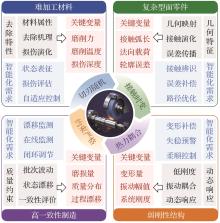
Fig.1
Mapping of grinding process complexity sources, typical task scenarios and intelligent requirements
Table 1
Typical intelligent grinding task scenarios, dominant mechanisms and intelligent requirements classified by dominant constraints
| 主导约束 | 任务场景 | 典型对象 | 主导机理 | 关键状态变量 | 主要质量风险 | 智能化需求重点 | 参考文献 |
|---|---|---|---|---|---|---|---|
| 材料属性 | 难加工材料 | 高温合金、钛合金、陶瓷、硬脆晶体材料、复合材料等 | 力热耦合、材料损伤、砂轮磨损、界面作用 | 磨削力、磨削温度、比磨削能、磨粒磨损量、损伤深度 | 表面烧伤、裂纹扩展、亚表面损伤、分层/界面损伤等 | 热-载荷-界面状态感知表征、损伤预测及低损伤自适应控制等 | [ |
| 几何特征 | 复杂型面零件 | 涡轮叶片、齿轮、非球面透镜、自由曲面光学元件等 | 接触几何演化、材料去除映射、误差传播 | 接触弧长、接触区位置、法向载荷、材料去除率、轮廓误差 | 轮廓误差、形状误差、接触一致性下降等 | 接触状态辨识、误差溯源、成形误差评估及补偿修正等 | [ |
| 结构刚度 | 弱刚性结构零件 | 薄壁件、细长轴、低刚度柔性构件、机器人柔顺磨削对象等 | 力致变形、结构振动、动态失稳、接触柔顺耦合 | 磨削力、系统刚度、位移变形量、振动幅值、稳定性边界 | 形变误差、尺寸偏差、表面振纹等 | 变形表征与补偿、动态稳定性分析、振动抑制及过程自适应调控等 | [ |
| 制造目标 | 高一致性制造 | 轴承滚子、精密轴承套圈、半导体晶圆、齿轮齿面等 | 状态漂移、磨具磨损、误差累积、质量离散 | 砂轮磨损量、质量分布、过程漂移量、在线检测特征、合格率 | 批次一致性不足、表面均匀性波动、重复精度下降等 | 一致性评价、漂移监测与补偿、在线质量检测、异常识别及闭环调节等 | [ |
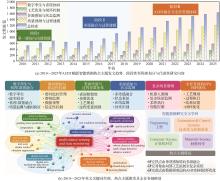
Fig.2
Research evolution, milestone stages, hotspot themes and full-task-chain mapping of AI and DT enabled intelligent grinding
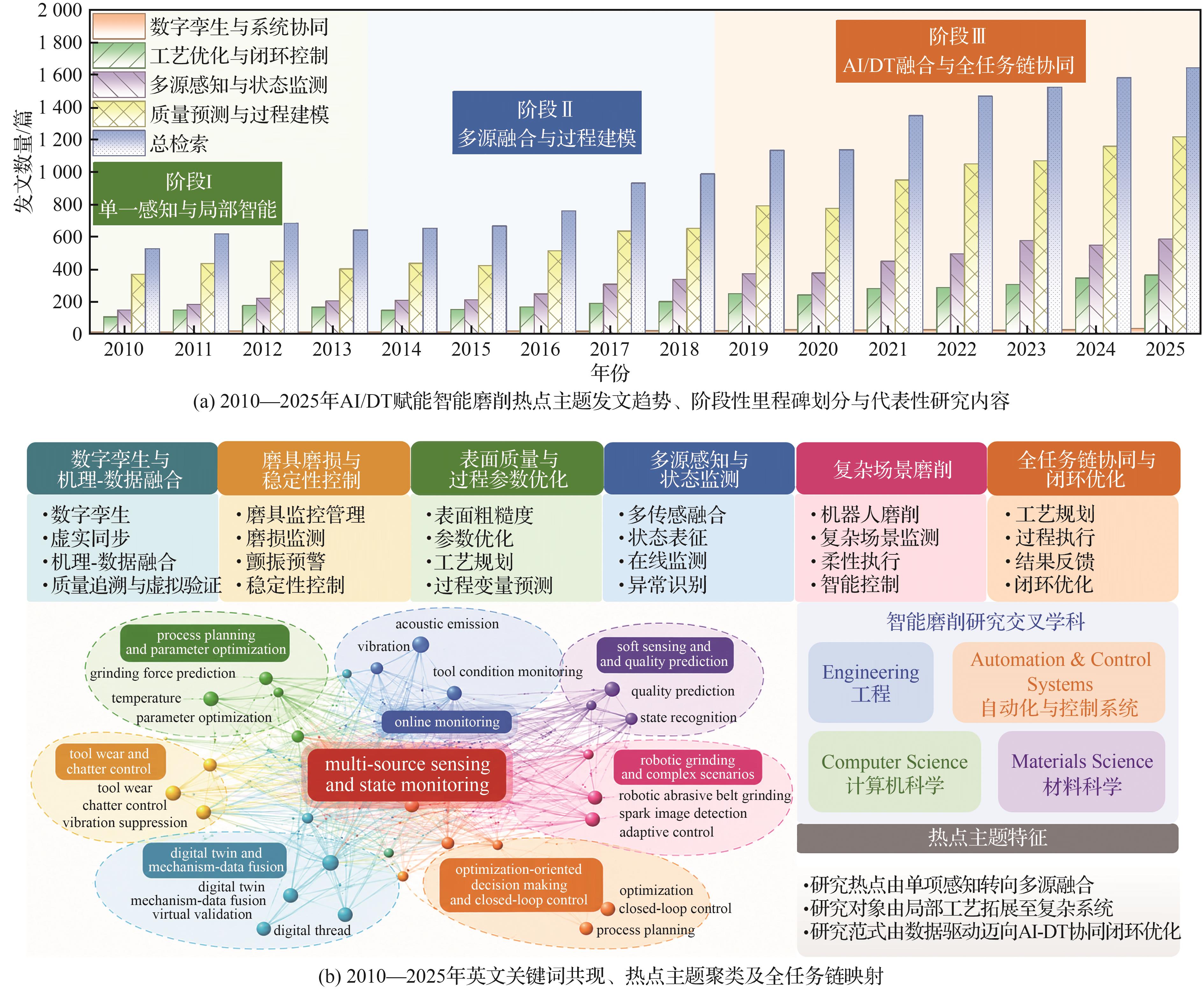
Fig.3
Full-task-chain analytical framework of AI and DT enabled intelligent grinding across pre-grinding planning, in-process execution and post-grinding feedback
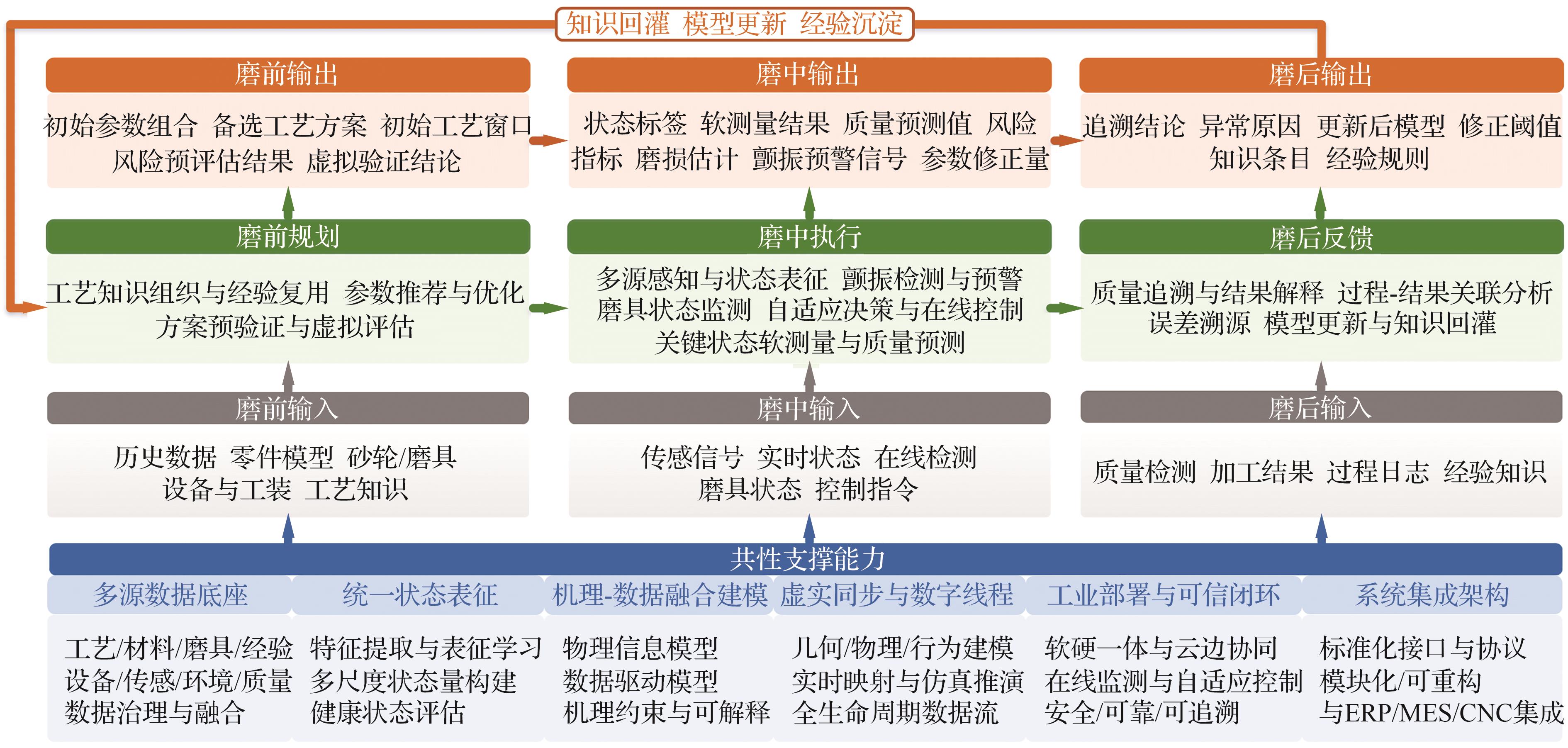
Table 2
Typical full-task-chain tasks and supporting capabilities of intelligent grinding
| 任务阶段/支撑层 | 核心目标 | 关键任务 | 典型输入 | 典型输出 | 支撑能力 | 文献 |
|---|---|---|---|---|---|---|
| 磨前规划 | 形成可行、稳健的初始工艺窗口 | 工艺知识组织与经验复用、参数推荐与优化、方案预验证与虚拟评估等 | 材料属性、零件结构、设备能力、工艺约束、历史案例、专家经验等 | 初始参数组合、备选工艺方案、初始工艺窗口、风险预评估结果、虚拟验证结论等 | 知识图谱、案例推理、代理模型、多目标优化、贝叶斯优化、虚拟评估与仿真验证等 | [ |
| 磨中执行 | 实现状态可感知、质量可预测和参数可调控 | 多源感知与状态表征、关键状态软测量、质量预测、颤振检测与预警、磨具状态监测、自适应决策与在线控制等 | 力/功率、电流、振动、AE、温度、视觉、CNC信号、机理先验等 | 状态表征结果、软测量结果、质量预测值、风险指标、磨损估计、预警信号、参数修正量等 | 监督学习、时序建模、多模态融合、物理信息网络、强化学习、边缘计算与在线部署等 | [ |
| 磨后反馈 | 实现质量追溯、结果解释与知识回灌,并推动模型与知识持续学习和滚动演化 | 质量追溯、结果解释、过程-结果关联分析、误差溯源、模型更新、知识回灌等 | 终检结果、过程日志、缺陷记录、参数轨迹、模型状态、决策记录等 | 追溯结论、异常原因、更新后模型、修正阈值、知识条目、经验规则等 | 因果分析、知识图谱、数字线程、持续学习、模型持续更新与运维等 | [ |
| 横向共性支撑层 | 贯通磨前、磨中与磨后全过程,支撑系统级协同与闭环运行 | 多源数据底座与统一状态表征、机理-数据融合建模、虚实同步与数字线程、工业部署与可信闭环、系统集成与协同运行等 | 多源异构数据、机理模型、仿真模型、控制规则、运维数据等 | 统一数据底座、统一状态描述规范、融合模型接口、数字线程链路、闭环运行机制、系统集成方案等 | 数据平台、统一状态表征、机理-数据融合、DT、数字线程、云边协同、可信闭环部署、系统集成架构等 | [ |
Fig.4
Closed-loop framework of knowledge support, scheme generation, risk evaluation and iterative updating in pre-grinding stage of intelligent grinding
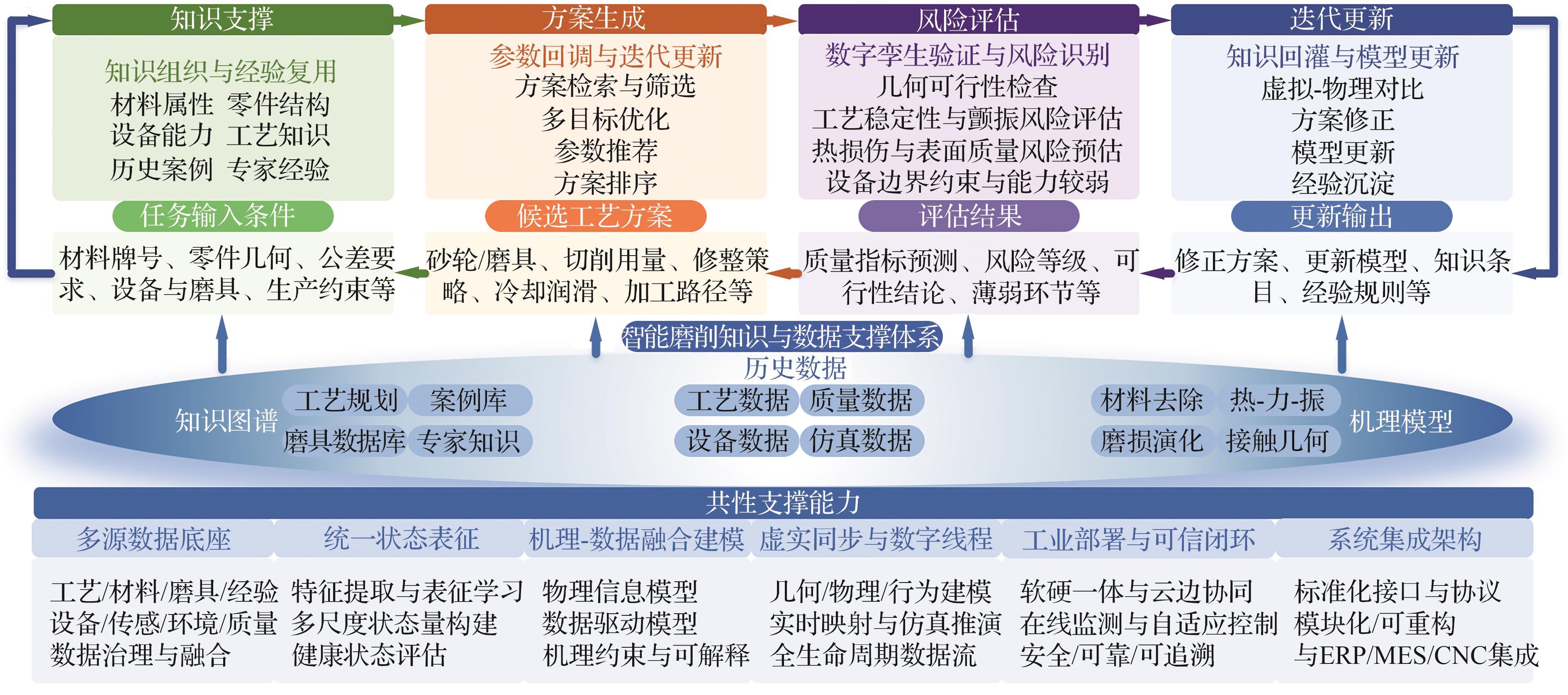
Table 3
Multi-source sensing channels and their characteristics for process-state representation
| 信息类别 | 感知通道 | 敏感工艺信息 | 主要用途 | 主要优势 | 主要局限 | 参考文献 |
|---|---|---|---|---|---|---|
| 载荷与运行状态信息 | 力/功率 | 载荷强度、接触状态、材料去除变化、功率波动 | 载荷监测、去除状态评估、运行状态识别 | 易集成、成本较低、响应直接 | 对早期磨损和微弱异常敏感性有限 | [ |
| 电流/CNC内置信号 | 负载波动、运行状态、执行行为变化 | 在线监测、状态识别、运行行为感知 | 无需额外硬件,便于长期采集 | 工艺状态表征间接,信号分辨率有限 | [ | |
| 动态响应信息 | 振动 | 颤振、砂轮钝化、磨粒破碎、动态失稳 | 稳定性监测、异常识别、失稳预警 | 对动态异常敏感,便于时频分析 | 易受环境干扰,信噪比波动较大 | [ |
| AE | 接触异常、微裂纹、烧伤前兆、早期损伤 | 烧伤预警、磨损识别、接触状态监测 | 对早期损伤和接触突变敏感 | 信号解析难度大,对安装条件敏感 | [ | |
| 热状态与表面质量信息 | 温度/热像 | 热积累、热损伤风险、冷却状态 | 热损伤评估、冷却监测、热异常识别 | 可直接反映热风险与温升分布 | 响应存在滞后,现场部署条件受限 | [ |
| 视觉/光学 | 砂轮形貌、表面缺陷、火花特征、局部损伤 | 表面检测、修整判断、质量评估、缺陷识别 | 可直接获取形貌与缺陷信息 | 对光照和现场环境敏感,实时性受限 | [ |

Fig.5
Online closed-loop framework of sensing, representation, prediction, decision-making and feedback in in-process stage of intelligent grinding
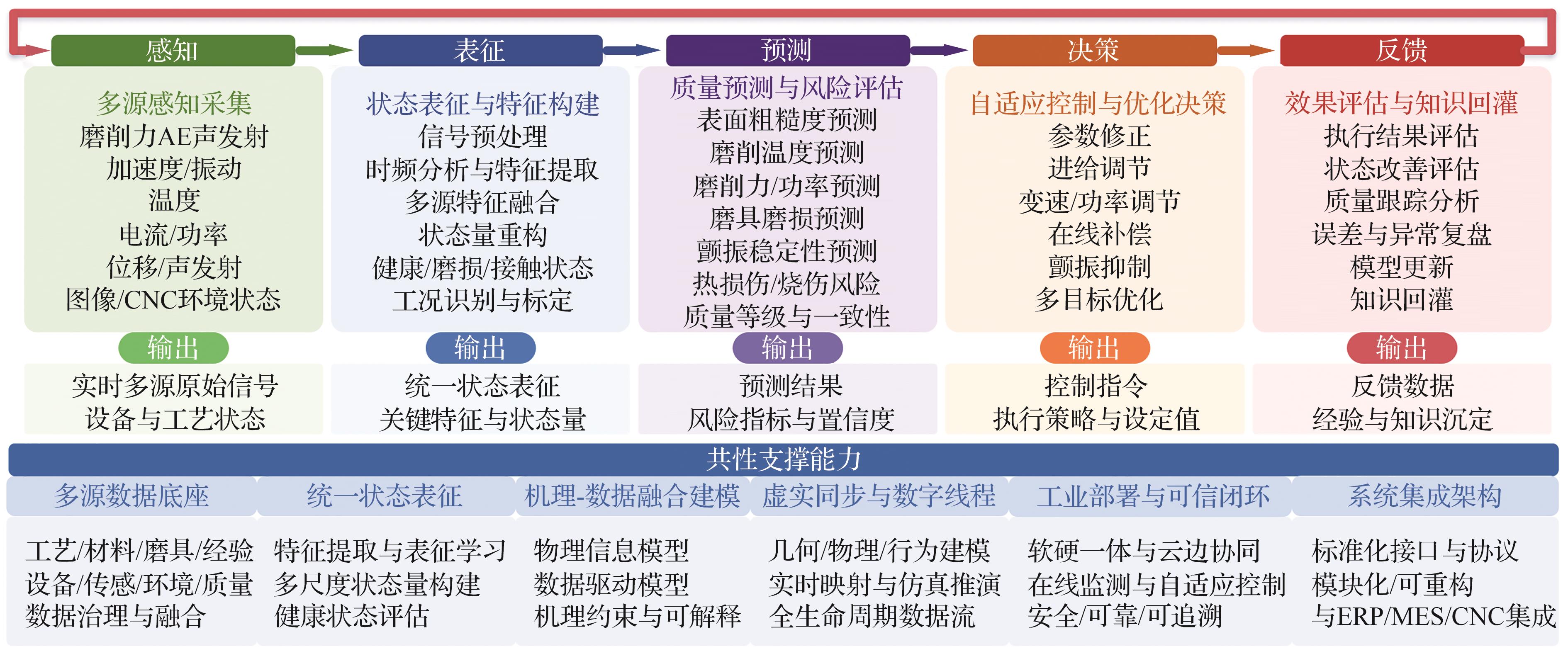
Table 4
Comparison of major application tasks and evaluation dimensions in intelligent grinding
| 任务阶段 | 典型任务 | 核心目标 | 代表性方法 | 主要评价指标 | 主要工程难点 | 文献 |
|---|---|---|---|---|---|---|
| 磨前 | 工艺知识组织与参数推荐 | 知识复用、参数生成与方案初选 | 知识图谱、本体建模、案例推理、代理模型、多目标优化、贝叶斯优化等 | 检索准确率、预测误差、收敛效率、推荐成功率 | 知识分散、语义不统一,跨零件和跨设备迁移难 | [ |
| 方案预验证与风险预评估 | 工艺窗口校核与加工风险筛查 | 数字孪生预验证、虚拟评估、风险识别、方案迭代等 | 首件合格率、风险识别率、虚实一致性、方案稳健性 | 设备边界难刻画,多风险协同评估难 | [ | |
| 磨中 | 多源感知与状态表征 | 过程状态在线辨识与异常发现 | 多传感融合、深度学习、视觉检测、内置信号复用、数字孪生监测等 | 准确率、召回率、鲁棒性、响应速度 | 噪声干扰强,标签获取难,跨工况泛化不足 | [ |
| 软测量、质量预测与失稳风险表征 | 难测变量估计、质量预测与失稳风险评估 | 机理-数据融合、时序建模、多模态融合、时频分析、智能分类器稳定性指标构建与失稳预警等 | 估计误差、预测精度、预警提前量、模型可信性 | 难测变量不可观测,弱征兆易淹没,在线部署难 | [ | |
| 磨具状态监测与寿命预测 | 磨具退化识别、寿命预测与修整决策 | 时序网络、退化模型、迁移学习、剩余寿命预测等 | 预测误差、预警提前量、磨损识别率、修整决策准确性 | 退化样本不足,阈值敏感,实时性要求高 | [ | |
| 自适应控制与优化决策 | 参数修正、过程干预与闭环优化 | 约束优化、贝叶斯优化、强化学习、孪生决策、自适应控制等 | 约束满足率、控制稳定性、质量改善率、效率提升率 | 多目标协调难,安全边界难确定,现场执行稳定性要求高 | [ | |
| 磨后 | 质量追溯、误差溯源与知识回灌 | 解释质量结果成因,更新模型并沉淀经验 | 关联分析、根因分析、因果推断、可解释模型、知识图谱、数字线程、持续学习等 | 追溯准确率、异常定位精度、知识复用效率、模型更新效果 | 数据谱系贯通不足,因果链复杂,跨任务复用难 | [ |

Fig.6
Feedback closed-loop framework of result interpretation, error traceability, model updating and knowledge feedback in post-grinding stage of intelligent grinding
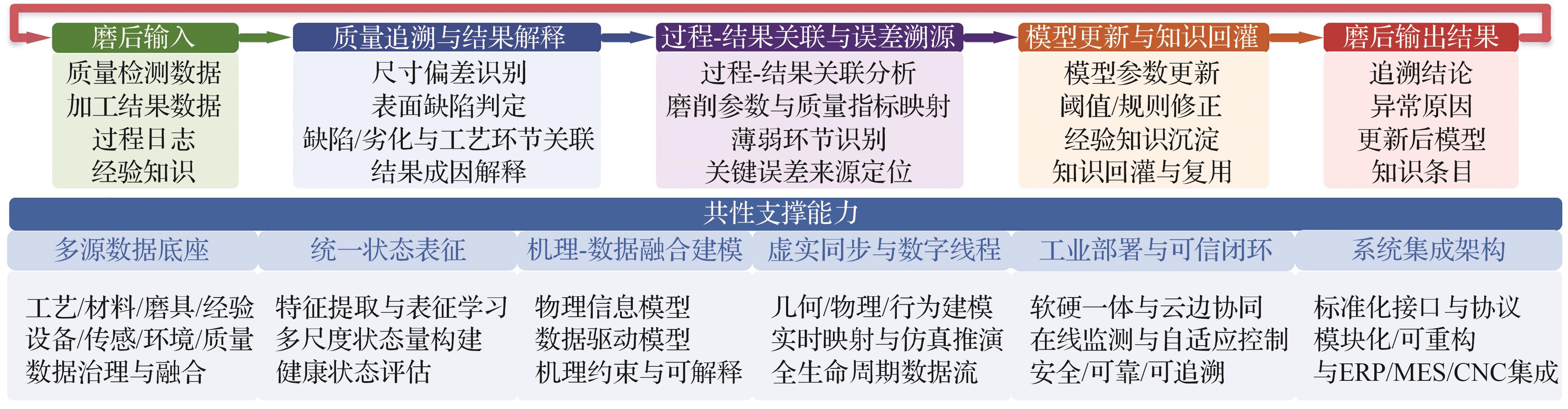
Table 5
Comparison of typical modeling and learning methods for intelligent grinding
| 类别 | 代表性方法 | 适用任务 | 数据与工程特征 | 优势 | 局限 | 文献 |
|---|---|---|---|---|---|---|
| 传统机器学习 | SVM、RF、GBDT、XGBoost、ELM等 | 小样本分类、故障识别、磨损判别、质量预测 | 小样本、人工特征、易部署 | 小样本适应性好、可解释、训练成本低 | 依赖特征设计、非线性表征有限 | [ |
| 深度学习 | CNN、LSTM、GRU、Transformer、CNN-GRU、TransBiGRU等 | 质量预测、时序建模、磨损预测、视觉检测 | 大样本、高算力、多维信号 | 自动特征提取、强非线性与时序建模 | 可解释性弱、依赖标注质量 | [ |
| 多模态融合 | 数据级融合、特征级融合、决策级融合、分层融合等 | 状态识别、磨损监测、多源协同 | 多源同步、时间对齐、系统集成 | 信息互补、鲁棒抗噪 | 算力开销大、模态缺失影响 | [ |
| 机理-数据融合 | 机理约束、残差补偿、物理引导网络、数字孪生在线更新等 | 风险预测、可信决策、闭环优化 | 机理模型支撑、在线更新、可靠性要求高 | 兼顾精度与物理可信 | 建模与更新复杂、成本高 | [ |
| 迁移学习与领域自适应 | 预训练迁移、领域自适应、DANN、特征对齐、跨域适配等 | 寿命预测、小样本识别、跨工况监测 | 多工况、分布漂移、源域依赖 | 跨工况泛化、缓解数据不足 | 依赖域相关性、适配复杂 | [ |
| [1] | ZHANG B, LU S X, RABIEY M, et al. Grinding of composite materials[J]. CIRP Annals-Manufacturing Technology, 2023, 72(2): 645-671. |
| [2] | 徐西鹏, 黄辉, 胡中伟, 等. 磨粒工具的研究现状及发展趋势[J]. 机械工程学报, 2022, 58(15): 2-20. |
| XU X P, HUANG H, HU Z W, et al. Research status and development trend of abrasive tools[J]. Journal of Mechanical Engineering, 2022, 58(15): 2-20 (in Chinese). | |
| [3] | 丁文锋, 奚欣欣, 占京华, 等. 航空发动机钛材料磨削技术研究现状及展望[J]. 航空学报, 2019, 40(6): 022763. |
| DING W F, XI X X, ZHAN J H, et al. Research status and future development of grinding technology of titanium materials for aero-engines[J]. Acta Aeronautica et Astronautica Sinica, 2019, 40(6): 022763 (in Chinese). | |
| [4] | 李可欣, 任莹晖, 李伟, 等. 多能场辅助微细磨削技术研究进展[J]. 机械工程学报, 2025, 61(13): 360-385. |
| LI K X, REN Y H, LI W, et al. Recent progress of multi-field assisted micro-grinding technology[J]. Journal of Mechanical Engineering, 2025, 61(13): 360-385 (in Chinese). | |
| [5] | HE G W, HUANG Q Q, LI X H, et al. AI-powered semiconductor wafer fabrication: A manufacturing paradigm shift[J]. International Journal of Machine Tools and Manufacture, 2026, 214: 104345. |
| [6] | 邓朝晖, 李重阳, 葛吉民, 等. 典型零件磨削加工工艺智能决策系统[J]. 机械工程学报, 2023, 59(12): 126-138. |
| DENG C H, LI Z Y, GE J M, et al. Intelligent decision system for grinding process of typical parts[J]. Journal of Mechanical Engineering, 2023, 59(12): 126-138 (in Chinese). | |
| [7] | SAJADIEH S M M, NOH S D. From simulation to autonomy: Reviews of the integration of artificial intelligence and digital twins[J]. International Journal of Precision Engineering and Manufacturing-Green Technology, 2025, 12(5): 1597-1628. |
| [8] | 张学学, 任莹晖, 杨伟程, 等. 单晶硅微细磨削非稳态特征声发射信号感知研究[J]. 机械工程学报, 2022, 58(15): 121-133. |
| ZHANG X X, REN Y H, YANG W C, et al. Study on acoustic emission signal perception of unsteady characteristic in micro-grinding of monocrystalline silicon[J]. Journal of Mechanical Engineering, 2022, 58(15): 121-133 (in Chinese). | |
| [9] | SHE C X, LI K X, REN Y H, et al. Tool wear prediction method based on bidirectional long short-term memory neural network of single crystal silicon micro-grinding[J]. The International Journal of Advanced Manufacturing Technology, 2024, 131: 2641-2651. |
| [10] | 刘献礼, 李雪冰, 丁明娜, 等. 面向智能制造的刀具全生命周期智能管控技术[J]. 机械工程学报, 2021, 57(10): 196-219. |
| LIU X L, LI X B, DING M N, et al. Intelligent management and control technology of cutting tool life-cycle for intelligent manufacturing[J]. Journal of Mechanical Engineering, 2021, 57(10): 196-219 (in Chinese). | |
| [11] | XIAO G J, LIU X T, SONG K K, et al. Research on robotic belt grinding method of blisk for obtaining high surface integrity features with variable inclination angle force control[J]. Robotics and Computer-Integrated Manufacturing, 2024, 86: 102680. |
| [12] | CHEN H, YANG J, DING H. Robotic compliant grinding of curved parts based on a designed active force-controlled end-effector with optimized series elastic component[J]. Robotics and Computer-Integrated Manufacturing, 2024, 86: 102646. |
| [13] | ULLRICH K, VON ELLING M, GUTZEIT K, et al. AI-based optimisation of total machining performance: A review[J]. CIRP Journal of Manufacturing Science and Technology, 2024, 50: 40-54. |
| [14] | 陶飞, 孙清超, 孙惠斌, 等. 航空发动机数字孪生工程:内涵与关键技术[J]. 航空学报, 2024, 45(21): 630283. |
| TAO F, SUN Q C, SUN H B, et al. Aero-engine digital twin engineering: Connotation and key technologies[J]. Acta Aeronautica et Astronautica Sinica, 2024, 45(21): 630283 (in Chinese). | |
| [15] | 戚浩, 李晓月, 陶强, 等. 数字孪生驱动的机械工艺系统研究进展[J]. 航空学报, 2024, 45(21): 628970. |
| QI H, LI X Y, TAO Q, et al. Research progress of mechanical process system driven by digital twin[J]. Acta Aeronautica et Astronautica Sinica, 2024, 45(21): 628970 (in Chinese). | |
| [16] | BAKHSHANDEH P, MOHAMMADI Y, ALTINTAS Y, et al. Digital twin assisted intelligent machining process monitoring and control[J]. CIRP Journal of Manufacturing Science and Technology, 2024, 49(2): 180-190. |
| [17] | TAO F, XIAO B, QI Q, et al. Digital twin modeling[J]. Journal of Manufacturing Systems, 2022, 64: 372-389. |
| [18] | 邓朝晖, 张晓红, 曹德芳, 等. 粗糙集-基于实例推理的凸轮轴数控磨削工艺专家系统[J]. 机械工程学报, 2010, 46(21): 178-186. |
| DENG C H, ZHANG X H, CAO D F, et al. Rough set and case-based reasoning based expert system for CNC camshaft grinding process[J]. Journal of Mechanical Engineering, 2010, 46(21): 178-186 (in Chinese). | |
| [19] | 刘涛, 邓朝晖, 葛智光, 等. 面向凸轮轴磨削加工的智能决策云服务实现[J]. 中国机械工程, 2020, 31(7): 773-780. |
| LIU T, DENG C H, GE Z G, et al. Implementation of intelligent decision cloud service for camshaft grinding processes[J]. China Mechanical Engineering, 2020, 31(7): 773-780 (in Chinese). | |
| [20] | WEN P H, MA Y, WANG R Q. Systematic knowledge modeling and extraction methods for manufacturing process planning based on knowledge graph[J]. Advanced Engineering Informatics, 2023, 58: 102172. |
| [21] | GUO L, HU T, DONG L, et al. Ontology and production rules-based dynamic knowledge base construction methodology for machining process[J]. Journal of Manufacturing Systems, 2024, 77: 1027-1044. |
| [22] | KASIE F M, BRIGHT G. Application of fuzzy case-based reasoning and fuzzy analytic hierarchy process for machining cutter planning and control[J]. Advances in Fuzzy Systems, 2023, 2023: 8072930. |
| [23] | WANG L, CHENG H, WANG R, et al. Machining scheme selection of features based on process knowledge graph and improved cosine similarity matching[J]. Machines, 2025, 13(3): 188. |
| [24] | FATTAHI S, AZARHOUSHANG B, KITZIG-FRANK H. Knowledge-based adaptive design of experiments (KADoE) for grinding process optimization using an expert system in the context of Industry 4.0[J]. Journal of Manufacturing and Materials Processing, 2025, 9(2): 62. |
| [25] | KIM G, PARK S, CHOI J G, et al. Developing a data-driven system for grinding process parameter optimization using machine learning and metaheuristic algorithms[J]. CIRP Journal of Manufacturing Science and Technology, 2024, 51: 20-35. |
| [26] | JAMSHIDI H, BUDAK E. A digital twin-based framework for selection of grinding conditions towards improved productivity and part quality[J]. Journal of Intelligent Manufacturing, 2024, 35(1): 161-173. |
| [27] | YOU T F, HAN J, TIAN X Q, et al. Multi-objective optimization of grinding process parameters for improving gear machining precision[J]. Journal of Central South University, 2025, 32: 538-551. |
| [28] | DENG C, TANG J, LU S, et al. Improved milling stability analysis for chatter-free machining parameters planning using a multi-fidelity surrogate model and transfer learning with limited experimental data[J]. International Journal of Production Research, 2024, 62(4): 1126-1143. |
| [29] | ZHANG Q, ZHANG Q, ZHAO Y, et al. Inverse solution of process parameters in gear grinding using hierarchical bayesian physics informed neural network (HBPINN)[J]. Scientific Reports, 2025, 15: 35397. |
| [30] | FENG K, WANG P, ZHANG Y, et al. Novel 3-D printed aerostatic bearings for the improvement of stability: Theoretical predictions and experimental measurements[J]. Tribology International, 2021, 163: 107149. |
| [31] | GUO Z Y, FENG K, LIU T Y, et al. Nonlinear dynamic analysis of rigid rotor supported by gas foil bearings: Effects of gas film and foil structure on subsynchronous vibrations[J]. Mechanical Systems and Signal Processing, 2018, 107: 549-566. |
| [32] | 熊万里, 原帅, 胡灿, 等. 液体静压主轴的回转精度规律及其极限预测[J]. 机械工程学报, 2021, 57(13): 70-82. |
| XIONG W L, YUAN S, HU C, et al. Rotation accuracy law and limit prediction of liquid hydrostatic spindle[J]. Journal of Mechanical Engineering, 2021, 57(13): 70-82 (in Chinese). | |
| [33] | SHEN N, WU Y, LI J, et al. Research on procedure optimisation for composite grinding based on digital twin technology[J]. International Journal of Production Research, 2023, 61(6): 1736-1754. |
| [34] | 辛宇鹏, 李文辉, 陈怡文. 面向数字孪生滚磨光整加工的高保真模型构建方法[J]. 计算机集成制造系统, 2025, 31(9): 3141-3158. |
| XIN Y P, LI W H, CHEN Y W. High-fidelity model construction method for digital twin-based tumbling finishing[J]. Computer Integrated Manufacturing Systems, 2025, 31(9): 3141-3158 (in Chinese). | |
| [35] | AFIF M F, SARHAN A A D. Computer-aided process planning, digital twin, and smart manufacturing: Interconnections and integration in CNC machining processes[J]. International Journal of Production Research, 2025, 63(24): 9593-9632. |
| [36] | PIMENOV D Y, SILVA L R R D, KUNTOĞLU M, et al. Review of advanced sensor system applications in grinding operations[J]. Journal of Advanced Research, 2025, 77: 371-405. |
| [37] | LI G, BAO Y, WANG H, et al. An online monitoring methodology for grinding state identification based on real-time signal of CNC grinding machine[J]. Mechanical Systems and Signal Processing, 2023, 200: 110540. |
| [38] | LI G, LU H, WANG H, et al. A visualization method for cross-scale online monitoring of grinding state based on data-mechanism hybrid-driven digital twin system[J]. Mechanical Systems and Signal Processing, 2025, 225: 112293. |
| [39] | HUANG J, ZHANG G. Study on spark image detection for abrasive belt grinding via transfer learning with YOLOv8[J]. Sensors, 2025, 25(9): 2946. |
| [40] | KON T, MANO H, IWAI H, et al. Effect of acoustic emission sensor location on the detection of grinding wheel deterioration in cylindrical grinding[J]. Lubricants, 2024, 12(3): 100. |
| [41] | DUAN J S, CAO G H, MA G Q, et al. Research on on-line monitoring of grinding wheel wear based on multi-sensor fusion[J]. Sensors, 2024, 24(18): 5888. |
| [42] | LI L, LI B, LU Z X, et al. Elucidating diamond grinding wheel surface characteristics through integrated optical microscopic reconstruction system[J]. Measurement, 2026, 258: 119150. |
| [43] | DENKENA B, KLEMME H, STOPPEL D. Condition monitoring of grinding wheels: Potential of internal control signals[J]. Production Engineering Research and Development, 2025, 19: 65-75. |
| [44] | WANG S, TIAN Y B, HU X T, et al. Identification of grinding wheel wear states using AE monitoring and HHT-RF method[J]. Wear, 2025, 562-563: 205668. |
| [45] | FAN Z Q, KANG C W, LI X L, et al. Advances in acoustic emission monitoring for grinding of hard and brittle materials[J]. Journal of Materials Research and Technology, 2025, 36: 1379-1408. |
| [46] | DUAN Z, CHEN T, SUO Y, et al. A grinding force prediction model and experimental validation for ultrasonic-assisted end grinding of 2.5D C/SiC composites[J]. Measurement, 2025, 242: 116118. |
| [47] | DONG L, CHEN W F, YANG S Y, et al. Automated detection of gear tooth flank surface integrity: A cascade detection approach using machine vision[J]. Measurement, 2023, 220: 113375. |
| [48] | GAO S, WANG H, HUANG H, et al. Predictive models for the surface roughness and subsurface damage depth of semiconductor materials in precision grinding[J]. International Journal of Extreme Manufacturing, 2025, 7(3): 035103. |
| [49] | ZHANG T, WANG W, DONG R, et al. Physics-guided neural network for grinding temperature prediction[J]. Journal of Engineering Design, 2025, 36(5-6): 707-730. |
| [50] | CHEN K, DAI X, ZHANG X. Physics-guided hybrid informer for grinding force prediction of abrasive belt flap wheels with depth compensation[J]. CIRP Journal of Manufacturing Science and Technology, 2026, 65: 345-357. |
| [51] | ZHANG L, MA H, HE Z, et al. A physics-informed hybrid model for grinding force prediction[J]. International Journal of Mechanical Sciences, 2026, 315: 111451. |
| [52] | PARK S H, PARK K S. A pre-trained model selection for transfer learning of remaining useful life prediction of grinding wheel[J]. Journal of Intelligent Manufacturing, 2024, 35(5): 2295-2312. |
| [53] | SI Z, SI S, MU D. Precision forecasting of grinding wheel wear: A TransBiGRU model for advanced industrial predictive maintenance[J]. Measurement, 2024, 234: 114859. |
| [54] | SURINDRA M D, ALFARISY G A F, GUPTA M K. Use of machine learning models in condition monitoring of abrasive belt in robotic arm grinding process[J]. Journal of Intelligent Manufacturing, 2025, 36(5): 5113-5139. |
| [55] | CHEN P, FAN C Y, DAI F L, et al. Online tool condition monitoring based on optimized multi-sensor acoustic features for robotic abrasive belt grinding[J]. Mechanical Systems and Signal Processing, 2025, 238: 113154. |
| [56] | XIAO Y L, WANG S L, DONG J P, et al. Online monitoring method of non-cylindrical wheel wear for gear grinding based on dynamic force model[J]. Mechanical Systems and Signal Processing, 2024, 206: 110915. |
| [57] | WAN L L, CHEN Z J, ZHANG X Y, et al. A multi-sensor monitoring methodology for grinding wheel wear evaluation based on INFO-SVM[J]. Mechanical Systems and Signal Processing, 2024, 208: 111003. |
| [58] | ZHUO R J, DENG Z H, TENG H Z, et al. The grinding wheel wear condition monitoring method based on multi-sensor information hierarchical fusion for high-speed cylindrical grinding[J]. Advanced Engineering Informatics, 2025, 67: 103541. |
| [59] | LIU T, LI W, DENG Z, et al. A chatter online prediction method and system software in high-speed grinding of camshaft[J]. The International Journal of Advanced Manufacturing Technology, 2024, 134: 4771-4783. |
| [60] | ZHUO R, DENG Z, LI Y, et al. An online chatter detection and recognition method for camshaft non-circular contour high-speed grinding based on improved LMD and GAPSO-ABC-SVM[J]. Mechanical Systems and Signal Processing, 2024, 216: 111487. |
| [61] | DE BLASI S, BAHRAMI M, ENGELS E, et al. Safe contextual Bayesian optimization integrated in industrial control for self-learning machines[J]. Journal of Intelligent Manufacturing, 2024, 35(2): 885-903. |
| [62] | ZHANG L, ZHAO Z, WANG W, et al. An integrated framework for adaptive control of feed rate driven by wheel wear monitoring[J]. Journal of Intelligent Manufacturing, 2026, 36: 703-764. |
| [63] | 陈逢军, 尹韶辉, 胡天, 等. 微小非球面光学模具单点斜轴误差补偿磨削[J]. 机械工程学报, 2013, 49(17): 59-64. |
| CHEN F J, YIN S H, HU T, et al. Single-point inclined-axis error compensation grinding for small aspheric optical molds[J]. Journal of Mechanical Engineering, 2013, 49(17): 59-64 (in Chinese). | |
| [64] | YANG Y, LI H N, LIAO Z, et al. Controlling of compliant grinding for low-rigidity components[J]. International Journal of Machine Tools and Manufacture, 2020, 152: 103543. |
| [65] | ZHANG C, YU Y, ZHOU G, et al. Hybrid mechanism and data-driven digital twin model for assembly quality traceability and optimization of complex products[J]. Advanced Engineering Informatics, 2024, 62: 102707. |
| [66] | OLIVEIRA E E, MIGUÉIS V L, BORGES J L. Automatic root cause analysis in manufacturing: An overview & conceptualization[J]. Journal of Intelligent Manufacturing, 2023, 34(5): 2061-2078. |
| [67] | SU C, TANG X, JIANG Q, et al. Digital twin system for manufacturing processes based on a multi-layer knowledge graph model[J]. Scientific Reports, 2025, 15: 12835. |
| [68] | CHENG X, HUANG F, YANG Q, et al. A digital twin data management and process traceability method for the complex product assembly process[J]. Journal of the Brazilian Society of Mechanical Sciences and Engineering, 2025, 47: 151. |
| [69] | WANG S, YANG J, YANG B, et al. An intelligent quality control method for manufacturing processes based on a human-cyber-physical knowledge graph[J]. Engineering, 2024, 41: 242-260. |
| [70] | SU C, JIANG Q, HAN Y, et al. Knowledge graph-driven decision support for manufacturing process: A graph neural network-based knowledge reasoning approach[J]. Advanced Engineering Informatics, 2025, 64: 103098. |
| [71] | PARK H S, TRAN N H. Hybrid model based autonomous system for controlling double side grinding process[J]. International Journal of Precision Engineering and Manufacturing-Smart Technology, 2024, 2(2): 191-208. |
| [72] | LU Y Q, LIU C, WANG K I-K, et al. Digital twin-driven smart manufacturing: Connotation, reference model, applications and research issues[J]. Robotics and Computer-Integrated Manufacturing, 2020, 61: 101837. |
| [73] | LIU J, MA C, LI M, et al. A compressed tensor-based edge-deployable framework for multi-source thermal error compensation in face gear machining[J]. Advanced Engineering Informatics, 2025, 68: 103802. |
| [74] | SAH D K, VAHABI M, FOTOUHI H. Federated learning at the edge in Industrial Internet of Things: A review[J]. Sustainable Computing: Informatics and Systems, 2025, 46: 101087. |
| [75] | ZHANG Y, YANG C, LIU Z, et al. Concept drift meets industrial data streams: An efficient drift adaptation framework with knowledge embedding and transfer[J]. Expert Systems with Applications, 2025, 290: 128439. |
| [76] | MADATHIL A P, LUO X, LIU Q, et al. A review of explainable artificial intelligence in smart manufacturing[J]. International Journal of Production Research, 2025, 63(23): 8654-8697. |
| [77] | GUO Z F, GUO B, WU G C, et al. Three-dimensional topography modelling and grinding performance evaluating of micro-structured CVD diamond grinding wheel[J]. International Journal of Mechanical Sciences, 2023, 244: 108079. |
| [78] | YANG Z Y, ZOU P, ZHOU L, et al. Modeling and experimental analysis of surface topography generation mechanism during ultrasonic vibration-assisted grinding[J]. Precision Engineering, 2023, 80: 30-44. |
| [79] | ZHOU W H, TANG J Y, HE H Y, et al. Position-dependent rough surface formation in face gear worm grinding[J]. International Journal of Mechanical Sciences, 2024, 270: 109076. |
| [80] | MENG Q Y, GUO B, ZHAO Q L, et al. Modelling of grinding mechanics: A review[J]. Chinese Journal of Aeronautics, 2023, 36(7): 25-39. |
| [81] | LIU M Z, LI C H, ZHANG Y B, et al. Analysis of grinding mechanics and improved grinding force model based on randomized grain geometric characteristics[J]. Chinese Journal of Aeronautics, 2023, 36(7): 160-193. |
| [82] | LI G, KANG R K, WANG H, et al. A grinding force model and surface formation mechanism of cup wheels considering crystallographic orientation[J]. Journal of Materials Processing Technology, 2023, 322: 118187. |
| [83] | CUI X, LI C H, ZHANG Y B, et al. Comparative assessment of force, temperature, and wheel wear in sustainable grinding aerospace alloy using biolubricant[J]. Frontiers of Mechanical Engineering, 2023, 18(1): 3. |
| [84] | QIAN N, CHEN J J, KHAN A M, et al. Towards sustainable grinding of difficult-to-cut alloys: A holistic review and trends[J]. Chinese Journal of Mechanical Engineering, 2024, 37: 23. |
| [85] | 丁文锋, 苗情, 李本凯, 等. 面向航空发动机的镍基合金磨削技术研究进展[J]. 机械工程学报, 2019, 55(1): 189-215. |
| DING W F, MIAO Q, LI B K, et al. Review on grinding technology of nickel-based superalloys used for aero-engine[J]. Journal of Mechanical Engineering, 2019, 55(1): 189-215 (in Chinese). | |
| [86] | YIN Y, XU J Y, SHI L Y, et al. Study on thermal damage formation mechanisms and surface integrity in creep-feed profile grinding of superalloys[J]. Journal of Manufacturing Processes, 2024, 120: 28-50. |
| [87] | HUANG Y, WU Y, XIAO G J, et al. Analysis of abrasive belt wear effect on residual stress distribution on a grinding surface[J]. Wear, 2021, 486-487: 204113. |
| [88] | XU X P, YU Y Q, HUANG H. Mechanisms of abrasive wear in the grinding of titanium (TC4) and nickel (K417) alloys[J]. Wear, 2003, 255(7-12): 1421-1426. |
| [89] | ZHANG T, JIANG F, HUANG H, et al. Towards understanding the brittle-ductile transition in the extreme manufacturing[J]. International Journal of Extreme Manufacturing, 2021, 3(2): 022001. |
| [90] | XU W H, LI C H, XU P M, et al. Grinding mechanics of ceramics: From mechanism to modeling[J]. Advances in Manufacturing, 2026, 14: 4-42. |
| [91] | 袁菘, 郭晓光, 金洙吉, 等. 金刚石高效超低损伤加工机理与工艺研究现状[J]. 机械工程学报, 2024, 60(3): 337-353. |
| YUAN S, GUO X G, JIN S J, et al. Research status of high-efficiency and ultra-low-damage machining mechanism and process of diamond[J]. Journal of Mechanical Engineering, 2024, 60(3): 337-353 (in Chinese). | |
| [92] | 郭东明, 康仁科. 半导体基片超精密磨削技术的研究现状与发展趋势[J]. 机械工程学报, 2023, 59(19): 299-329. |
| GUO D M, KANG R K. Research status and development trend of ultra-precision grinding technology for semiconductor substrates[J]. Journal of Mechanical Engineering, 2023, 59(19): 299-329 (in Chinese). | |
| [93] | WANG Y, LIN B, WANG S L, et al. Study on the system matching of ultrasonic vibration assisted grinding for hard and brittle materials processing[J]. International Journal of Machine Tools and Manufacture, 2014, 77: 66-73. |
| [94] | 朱祥龙, 康仁科, 董志刚, 等. 单晶硅片超精密磨削技术与设备[J]. 中国机械工程, 2010, 21(18): 2156-2164. |
| ZHU X L, KANG R K, DONG Z G, et al. Ultra-precision grinding technologies and equipment for monocrystalline silicon wafers[J]. China Mechanical Engineering, 2010, 21(18): 2156-2164 (in Chinese). | |
| [95] | HUANG W H, YAN J W. Effect of tool geometry on ultraprecision machining of soft-brittle materials: A comprehensive review[J]. International Journal of Extreme Manufacturing, 2023, 5(1): 012003. |
| [96] | 吴柯, 陆新明, MEHMOOD A, 等. 基于固结磨粒的单晶蓝宝石自旋转磨削加工方法[J]. 中国机械工程, 2021, 32(16): 2002-2007. |
| WU K, LU X M, MEHMOOD A, et al. Fixed abrasive-based self-rotation grinding for single crystal sapphire[J]. China Mechanical Engineering, 2021, 32(16): 2002-2007 (in Chinese). | |
| [97] | OHTA T, YAN J, KURIYAGAWA T, et al. Prediction of subsurface damage depth of ground brittle materials by surface profiling[J]. International Journal of Machining and Machinability of Materials, 2007, 2(1): 108-124. |
| [98] | GUO Y, ZHAO Y, LIU X, et al. Research on wear state identification of ordered grinding wheel for C/SiC composites based on DBO-ELM[J]. Wear, 2024, 560-561: 205589. |
| [99] | 巩亚东, 李远峰, 温泉, 等. 2.5D Cf/SiC复合材料与SiC陶瓷微磨削性能对比试验研究[J]. 东北大学学报(自然科学版), 2025, 46(1): 52-60. |
| GONG Y D, LI Y F, WEN Q, et al. Comparative experimental study on micro-grinding performance of 2.5D Cf/SiC composites and SiC ceramics[J]. Journal of Northeastern University (Natural Science), 2025, 46(1): 52-60 (in Chinese). | |
| [100] | YAN J, MULLANY B, BEAUCAMP A, et al. Surface finishing by shape-adaptive processes[J]. CIRP Annals, 2025, 74(2): 1019-1045. |
| [101] | DING S, CHEN Z, ZHANG H, et al. Gear evaluation deviations-based crucial geometric error identification of five-axis CNC gear form grinding process[J]. Journal of Manufacturing Processes, 2023, 99: 663-675. |
| [102] | GU P, CHEN J N, HUANG W W, et al. Evaluation of surface quality and error compensation for optical aspherical surface grinding[J]. Journal of Materials Processing Technology, 2024, 327: 118363. |
| [103] | YU S M, ZHU J H, YAO P, et al. Profile error compensation in precision grinding of ellipsoid optical surface[J]. Chinese Journal of Aeronautics, 2021, 34(4): 115-123. |
| [104] | 丁文锋, 曹洋, 赵彪, 等. 超声振动辅助磨削加工技术及装备研究的现状与展望[J]. 机械工程学报, 2022, 58(9): 244-269. |
| DING W F, CAO Y, ZHAO B, et al. Research status and future prospects of ultrasonic vibration-assisted grinding technology and equipment[J]. Journal of Mechanical Engineering, 2022, 58(9): 244-269 (in Chinese). | |
| [105] | 黄云, 肖贵坚, 邹莱. 航空发动机叶片机器人精密砂带磨削研究现状及发展趋势[J]. 航空学报, 2019, 40(3): 022508. |
| HUANG Y, XIAO G J, ZOU L. Current situation and development trend of robot precise belt grinding for aero-engine blade[J]. Acta Aeronautica et Astronautica Sinica, 2019, 40(3): 022508 (in Chinese). | |
| [106] | 杜雪, 王尔祺, 李荣彬, 等. 自由曲面光学虚拟制造与检测系统的探讨[J]. 应用光学, 2006, 27(6): 485-490. |
| DU X, WANG E Q, LI R B, et al. Investigation into virtual manufacturing procedure for freeform optics[J]. Journal of Applied Optics, 2006, 27(6): 485-490 (in Chinese). | |
| [107] | 李荣彬, 张志辉, 杜雪, 等. 自由曲面光学元件的设计、加工及面形测量的集成制造技术[J]. 机械工程学报, 2010, 46(11): 137-148. |
| LI R B, ZHANG Z H, DU X, et al. Integrated manufacturing technology for design, machining and measurement of freeform optics[J]. Journal of Mechanical Engineering, 2010, 46(11): 137-148 (in Chinese). | |
| [108] | SUN H C, ZHAO J C, ZHENG Z P, et al. A review of the deformation mechanism and control of low stiffness thin-walled parts[J]. CIRP Journal of Manufacturing Science and Technology, 2025, 60: 322-355. |
| [109] | XU D, ZHONG Z G, MO H, et al. Vibration control for thin-walled parts grinding through parallel magnetorheological absorber[J]. Mechanical Systems and Signal Processing, 2025, 237: 113130. |
| [110] | LIANG S, MENG Q, CHEN C, et al. Dynamic stability enhancement of weak stiffness grinding system through microstructure-induced spatial force regulation[J]. Mechanical Systems and Signal Processing, 2026, 248: 113996. |
| [111] | TANG X, YANG J, DING H. Design and control of a parallel electromagnetic variable stiffness manipulator for robotic compliant grinding[J]. Robotics and Computer-Integrated Manufacturing, 2026, 98: 103158. |
| [112] | SUN Y Q, CHEN G, WANG S, et al. Review and prospect of precision machining of bearing rollers: Cylindrical, tapered and spherical rollers[J]. Precision Engineering, 2025, 95: 436-467. |
| [113] | HWANG B H, PARK K S. Advanced back grinding of semiconductor wafers using an angle-feedback TTV compensation controller[J]. Precision Engineering, 2025, 96: 851-863. |
| [114] | SINGH S A, DESAI K A. Integrated vision-based in-line surface defect detection system for realizing zero-defect manufacturing of tapered rollers[J]. CIRP Journal of Manufacturing Science and Technology, 2025, 63: 475-489. |
| [115] | HUANG H, LI X L, MU D K, et al. Science and art of ductile grinding of brittle solids[J]. International Journal of Machine Tools and Manufacture, 2021, 161: 103675. |
| [116] | ZHOU L, EDA H, SHIMIZU J. State-of-the-art technologies and kinematical analysis for one-stop finishing of φ300 mm Si wafer[J]. Journal of Materials Processing Technology, 2002, 129(1-3): 34-40. |
| [117] | CHEN H, YANG J, QI Q, et al. A robotic grinding parameter optimization approach considering tool wear to guarantee material removal accuracy and surface quality[J]. Journal of Manufacturing Processes, 2026, 159: 228-242. |
| [118] | GHOSH T, WANG Y, MARTINSEN K, et al. A surrogate-assisted optimization approach for multi-response end milling of aluminum alloy AA3105[J]. The International Journal of Advanced Manufacturing Technology, 2020, 111(9-10): 2419-2439. |
| [119] | SI S M, SI Z K, MU D Q, et al. Grinding wheel wear evaluation with the PMSCNN model[J]. Scientific Reports, 2025, 15: 28761. |
| [120] | GE J M, CAO D H, LIU W, et al. An online monitoring approach of grinding wheel wear condition for robotic weld grinding based on enhanced CNN-GRU model[J]. Mechanical Systems and Signal Processing, 2025, 241: 113483. |
| [121] | KUHLMANN G, GUBA N, HÜSEMANN T, et al. Comprehensive study of grinding burn limit and subsurface modifications in grinding with CBN and corundum abrasives[J]. CIRP Journal of Manufacturing Science and Technology, 2025, 63: 490-504. |
| [122] | 钱宁, 徐九华, 傅玉灿, 等. 面向绿色高效磨削的振荡热管砂轮磨削温度与强化传热分析[J]. 机械工程学报, 2022, 58(15): 105-120. |
| QIAN N, XU J H, FU Y C, et al. Investigation on grinding temperature and heat transfer performance of oscillating grinding wheel for high-efficient green grinding[J]. Journal of Mechanical Engineering, 2022, 58(15): 105-120 (in Chinese). | |
| [123] | SI S, MU D, TANG H. A hybrid CBiGRUPE model for accurate grinding wheel wear prediction[J]. Sensors, 2025, 25(9): 2935. |
| [124] | ZHANG N, JIANG Z P, SUN Y B, et al. Model-data hybrid driven approach for remaining useful life prediction of cutting tool based on improved inverse Gaussian process[J]. Journal of Manufacturing Processes, 2024, 124: 604-620. |
| [125] | LI X B, LIU X L, YUE C X, et al. Data-model linkage prediction of tool remaining useful life based on deep feature fusion and Wiener process[J]. Journal of Manufacturing Systems, 2024, 73: 19-38. |
| [126] | LI J C, SHEN R Q, XU Y L, et al. Cross-parameter grinding disc wear condition monitoring via weighted multi-source deep subdomain adversarial adaptation network[J]. Journal of Manufacturing Processes, 2025, 150: 461-477. |
| [127] | HUANG Z W, LI W D, ZHU J M, et al. Cross-domain tool wear condition monitoring via residual attention hybrid adaptation network[J]. Journal of Manufacturing Systems, 2024, 72: 406-423. |
| [128] | LI Z H, TANG Q, WANG S B, et al. A deep transfer learning method for monitoring the wear of abrasive belts with a small sample dataset[J]. Journal of Manufacturing Processes, 2022, 74: 374-382. |
| [129] | ZHU L, QIN S, HAO Y, et al. Knowledge-based intelligent ensemble monitoring method of grit wear in ultrasonic assisted grinding[J]. Advanced Engineering Informatics, 2025, 64: 103043. |
| [130] | PANG W J, ZHANG G P, REN L J, et al. Abrasive belt wear condition monitoring using sound signals: a fusion of convolutional neural networks and vision transformers[J]. The International Journal of Advanced Manufacturing Technology, 2025, 140(11-12): 5987-6003. |
| [131] | LIU Y J, WANG W X, ZHAO X Y, et al. Acoustic signal-based wear monitoring for belt grinding tools with pyramid-structured abrasives using BO-KELM[J]. Computers in Industry, 2025, 166: 104235. |
| [132] | CHENG M H, JIAO L, YAN P, et al. Intelligent tool wear monitoring and multi-step prediction based on deep learning model[J]. Journal of Manufacturing Systems, 2022, 62: 286-300. |
| [133] | BENATIA M A, HAFSI M, AYED S BEN. A continual learning approach for failure prediction under non-stationary conditions: Application to condition monitoring data streams[J]. Computers & Industrial Engineering, 2025, 204: 111049. |
| [134] | ABDEL-ATY T A, NEGRI E. Conceptualizing the digital thread for smart manufacturing: A systematic literature review[J]. Journal of Intelligent Manufacturing, 2024, 35: 3629-3653. |
| [135] | SENADEERA M, RUBIN DE CELIS LEAL D, RANA S, et al. Bayesian optimisation with dimensionless groups: A synergy of performance and fundamental understanding[J]. Applied Sciences, 2025, 15(22): 12215. |
| [136] | 邵海东, 肖一鸣, 颜深. 仿真数据驱动的改进无监督域适应轴承故障诊断[J]. 机械工程学报, 2023, 59(3): 76-85. |
| SHAO H D, XIAO Y M, YAN S. Simulation data-driven enhanced unsupervised domain adaptation for bearing fault diagnosis[J]. Journal of Mechanical Engineering, 2023, 59(3): 76-85 (in Chinese). | |
| [137] | HUANG Z Q, FEY M, LIU C, et al. Hybrid learning-based digital twin for manufacturing process: Modeling framework and implementation[J]. Robotics and Computer-Integrated Manufacturing, 2023, 82: 102545. |
| [138] | KRITZINGER W, KARNER M, TRAAR G, et al. Digital twin in manufacturing: A categorical literature review and classification[J]. IFAC-PapersOnLine, 2018, 51(11): 1016-1022. |
| [139] | TAO F, QI Q L, WANG L H, et al. Digital twins and cyber-physical systems toward smart manufacturing and Industry 4.0: Correlation and comparison[J]. Engineering, 2019, 5(4): 653-661. |
| [140] | FU X, SONG H, LI S, et al. Digital twin technology in modern machining: A comprehensive review of research on machining errors[J]. Journal of Manufacturing Systems, 2025, 79: 134-161. |
| [141] | ZHANG L, LIU J H, ZHUANG C B. Digital twin modeling enabled machine tool intelligence: A review[J]. Chinese Journal of Mechanical Engineering, 2024, 37(1): 47. |
| [142] | 陶飞, 张辰源, 刘蔚然, 等. 数字工程及十个领域应用展望[J]. 机械工程学报, 2023, 59(13): 193-215. |
| TAO F, ZHANG C Y, LIU W R, et al. Digital Engineering and Its Ten Application Outlooks[J]. Journal of Mechanical Engineering, 2023, 59(13): 193-215 (in Chinese). | |
| [143] | DIAZ-IGLESIAS A, NAPPA A, DELLE FEMINE C, et al. Robust concept drift handling in dynamic industrial systems: A multi-objective optimization approach[J]. Knowledge-Based Systems, 2026, 333: 115041. |
| [144] | MOOSAVI S, FARAJZADEH-ZANJANI M, RAZAVI-FAR R, et al. Explainable AI in manufacturing and industrial cyber-physical systems: A survey[J]. Electronics, 2024, 13(17): 3497. |
| [1] | Yuheng LIU, Li YANG, Qilong HUANG. Optimizing air and missile defense strategies with explainable hierarchical reinforcement learning [J]. Acta Aeronautica et Astronautica Sinica, 2026, 47(8): 332786-332786. |
| [2] | Yu DING, Guoao NING, Kaixin JIN, Bo SUN, Huai LI, Xuanyuan SU. Fault data generation for electromechanical systems based on hierarchical Digital Twin [J]. Acta Aeronautica et Astronautica Sinica, 2026, 47(8): 432663-432663. |
| [3] | Donghuan WANG, Hai JIN, Dongkai WAN, Jun WANG, Hong XIAO. Real-time monitoring and evaluation method for aero-engine performance degradation based on performance digital twin [J]. Acta Aeronautica et Astronautica Sinica, 2026, 47(5): 132459-132459. |
| [4] | Song YAN, Yi LI, Hongqiang QIN, Xing CUI, Yushan GAO. Exhaust-plume spectroscopic diagnostics of liquid rocket engine faults: From qualitative to quantitative [J]. Acta Aeronautica et Astronautica Sinica, 2026, 47(16): 133069-133069. |
| [5] | Yan WEI, Jianjiang ZENG, Xuan WANG, Xiaolong ZHU, Tao CHEN, Mingbo TONG. Data-driven virtual-real fusion method for wing structure strength test [J]. Acta Aeronautica et Astronautica Sinica, 2026, 47(16): 233068-233068. |
| [6] | Ruotian REN, Lijun ZHAO, Xuyang ZHAO, Zheng ZHANG, Hongyi LI, Xinhua XUE, Ping TANG. A review of knowledge-guided intelligent interpretation methods for remote sensing imagery [J]. Acta Aeronautica et Astronautica Sinica, 2026, 47(10): 632103-632103. |
| [7] | Pan ZHOU, Ni LI, Jiangtao HUANG, Qinglin YANG, Yunxiao LIAN. Autonomous decision-making in close-range game under imperfect information for unmanned aerial vehicles [J]. Acta Aeronautica et Astronautica Sinica, 2025, 46(S1): 732215-732215. |
| [8] | Guanghui WU, Jing WANG, Hairun XIE, Tuliang MA, Qiang MIAO, Jixin XIANG, Miao ZHANG. Data and knowledge-enabled intelligent aerodynamic design for civil aircraft [J]. Acta Aeronautica et Astronautica Sinica, 2025, 46(5): 531485-531485. |
| [9] | Yuqian ZHANG, Yongge LI, Xiaochuan LIU, Yong XU. Digital-twin-driven reliability domain analysis for aircraft landing gear systems [J]. Acta Aeronautica et Astronautica Sinica, 2025, 46(24): 632256-632256. |
| [10] | Lei HUANG, Cong GUO, Xiaobo ZHANG, Liangchen SUN, Yinghui ZUO, Bo WANG, Kuo TIAN. Aircraft structural health management method based on flight parameter-load-life digital twin models [J]. Acta Aeronautica et Astronautica Sinica, 2025, 46(21): 532382-532382. |
| [11] | Yiwei HUANG, Yibin GENG, Tianhe GAO, Xuanwei HU, Yuan WANG, Hongyan MA, Kuo TIAN. Digital twin driven high precision reconstruction method for full-field deformation of structure [J]. Acta Aeronautica et Astronautica Sinica, 2025, 46(19): 530967-530967. |
| [12] | Dingqiang DAI, Xuan ZHOU, Leiting DONG, Xiasheng SUN. Research progress and prospects of digital engineering and digital twin in field of aeronautical fatigue and structural integrity [J]. Acta Aeronautica et Astronautica Sinica, 2025, 46(19): 531022-531022. |
| [13] | Shangyu LI, Hang FENG, Junquan CHEN, Bin CHEN, Dan MEI. A design architecture and conceptual modeling approach for digital twins [J]. Acta Aeronautica et Astronautica Sinica, 2025, 46(19): 531118-531118. |
| [14] | Junqi LEI, Yuehua CHENG, Bin JIANG, Cheng XU, Guili XU, Tianyu SUN. Digital-twin’s modelling and dynamic adjustment mechanism of rudder-loop-system under fault conditions [J]. Acta Aeronautica et Astronautica Sinica, 2025, 46(19): 531273-531273. |
| [15] | Liang CHEN, Lei HUANG, Yuxuan GU, Cong GUO, Kexin LIN, Yu GUAN, Jian SONG. Twinning technology of key part load based on flight parameters [J]. Acta Aeronautica et Astronautica Sinica, 2025, 46(19): 531292-531292. |
| Viewed | ||||||
|
Full text |
|
|||||
|
Abstract |
|
|||||
Address: No.238, Baiyan Buiding, Beisihuan Zhonglu Road, Haidian District, Beijing, China
Postal code : 100083
E-mail:hkxb@buaa.edu.cn
Total visits: 6658907 Today visits: 1341All copyright © editorial office of Chinese Journal of Aeronautics
All copyright © editorial office of Chinese Journal of Aeronautics
Total visits: 6658907 Today visits: 1341

 CJA

