Acta Aeronautica et Astronautica Sinica ›› 2026, Vol. 47 ›› Issue (10): 532874.doi: 10.7527/S1000-6893.2025.32874
• Special Issue: Intelligent Processing and Analysis of Aerospace Remote Sensing Images • Previous Articles
Shihao SHU1, Cai MENG1,2,3( ), Xiangzhi BAI1,2, Zhenwei SHI1,2
Received:2025-10-10
Revised:2025-11-28
Accepted:2025-12-29
Online:2026-01-26
Published:2026-01-19
Contact:
Cai MENG
E-mail:tsai@buaa.edu.cn
Supported by:CLC Number:
Shihao SHU, Cai MENG, Xiangzhi BAI, Zhenwei SHI. Precise lunar landing site localization algorithm based on illumination control[J]. Acta Aeronautica et Astronautica Sinica, 2026, 47(10): 532874.
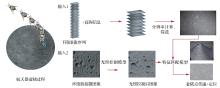
Fig.1
Algorithm flowchart of landing site localization based on illumination control
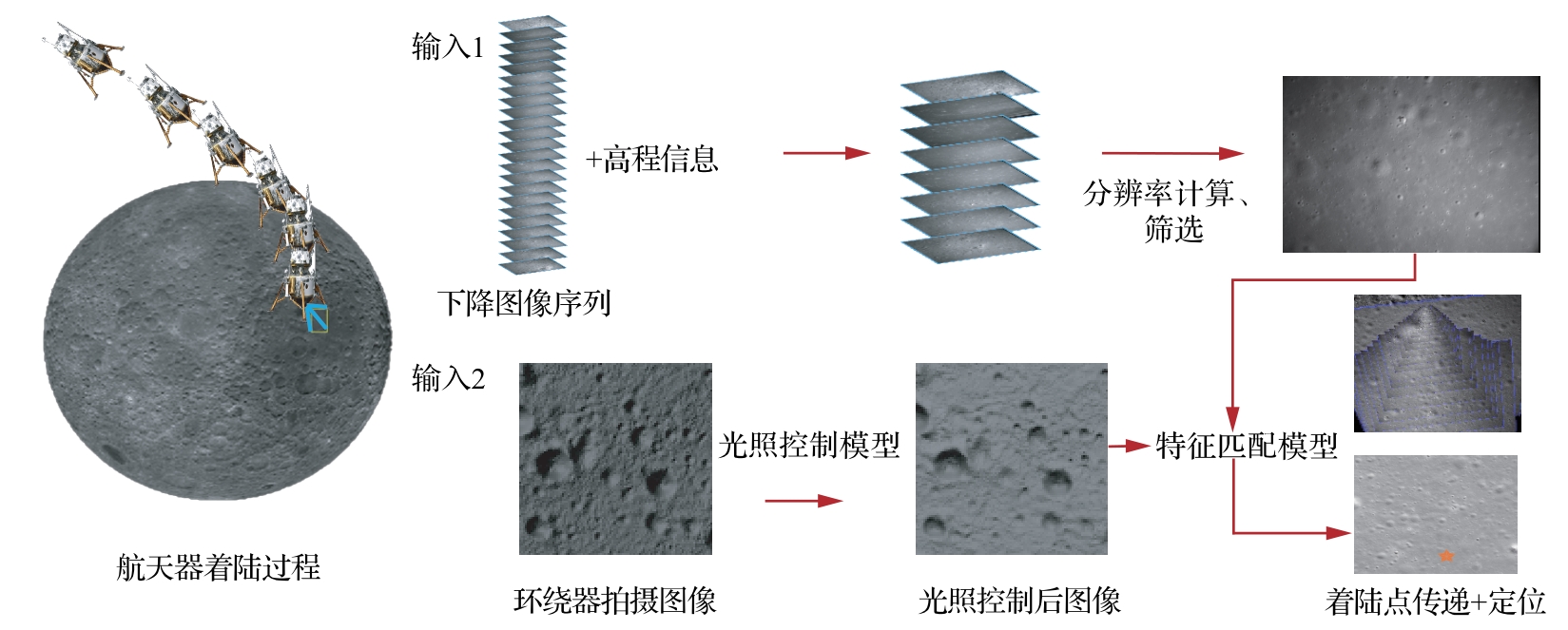
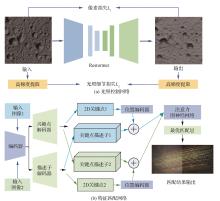
Fig.2
Schematic diagram of illumination control network and feature matching network
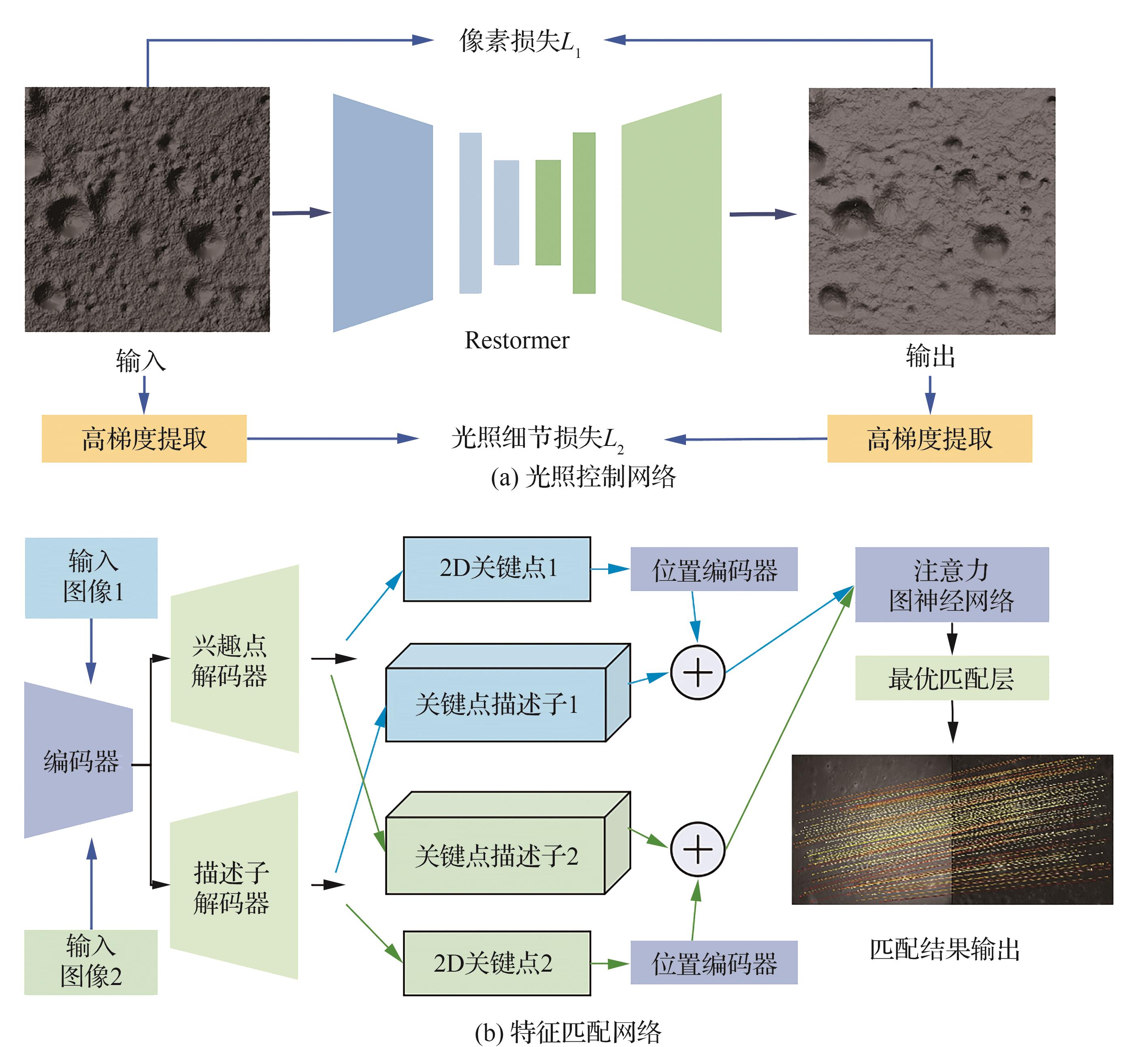

Table 1
Quantitative results of different models on illumination control task
| 模型 | RPSNR | SSSIM | SLPIPS |
|---|---|---|---|
| Restormer (基线算法) | 19.83 | 0.632 8 | 0.290 8 |
| MST++ | 19.04 | 0.615 7 | 0.301 6 |
| RetinexFormer | 19.96 | 0.634 2 | 0.292 3 |
| Histoformer | 18.26 | 0.595 1 | 0.321 3 |
| MambaIR | 18.67 | 0.601 3 | 0.291 0 |
| LomFormer (本文) | 20.52 | 0.645 8 | 0.286 8 |
Fig.3
Visual comparison of proposed illumination control algorithm and traditional illumination processing methods on real data
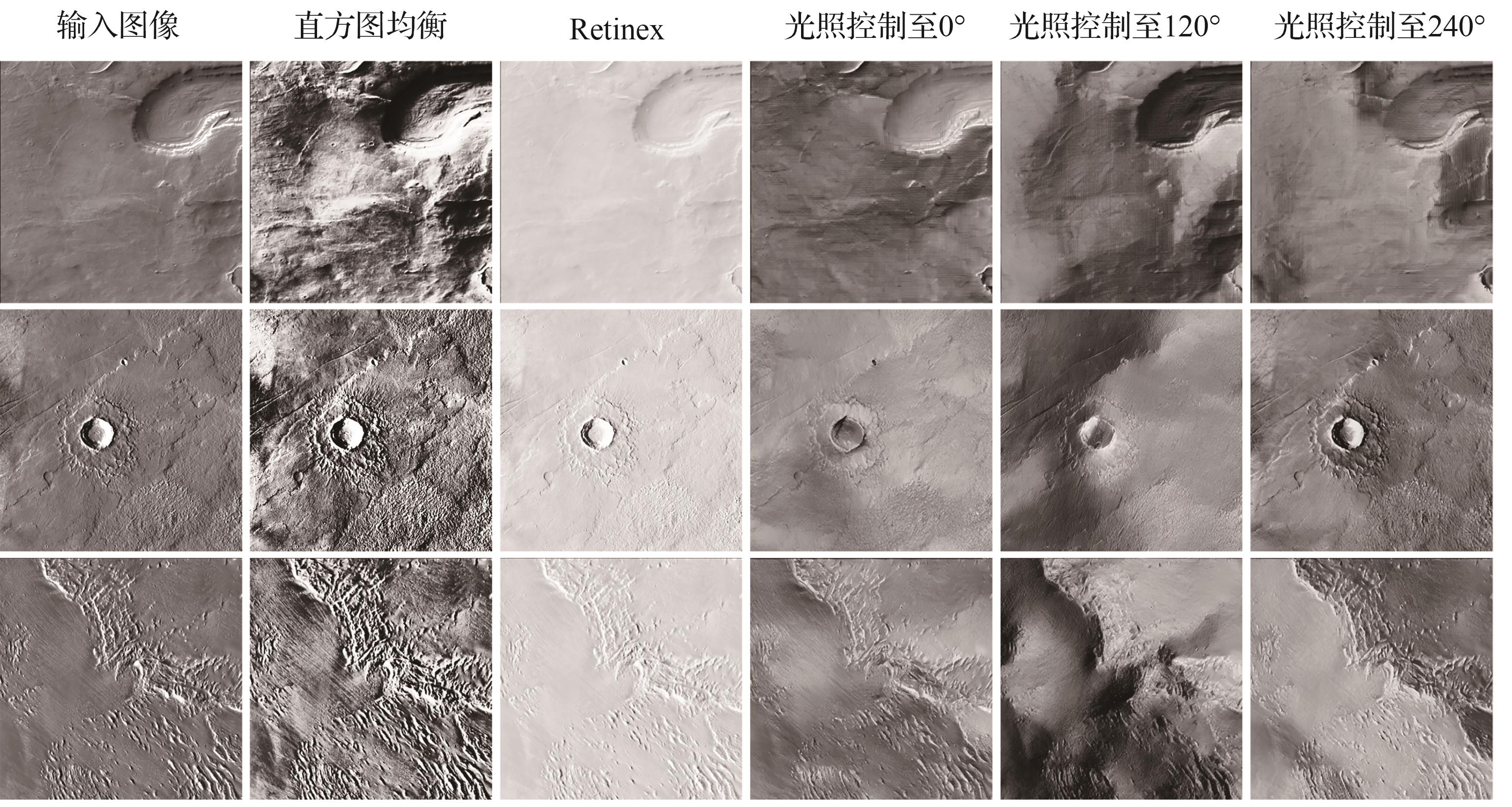
Fig.4
Visual comparison of generated results for illumination control task among enhancement/restoration algorithms and proposed method
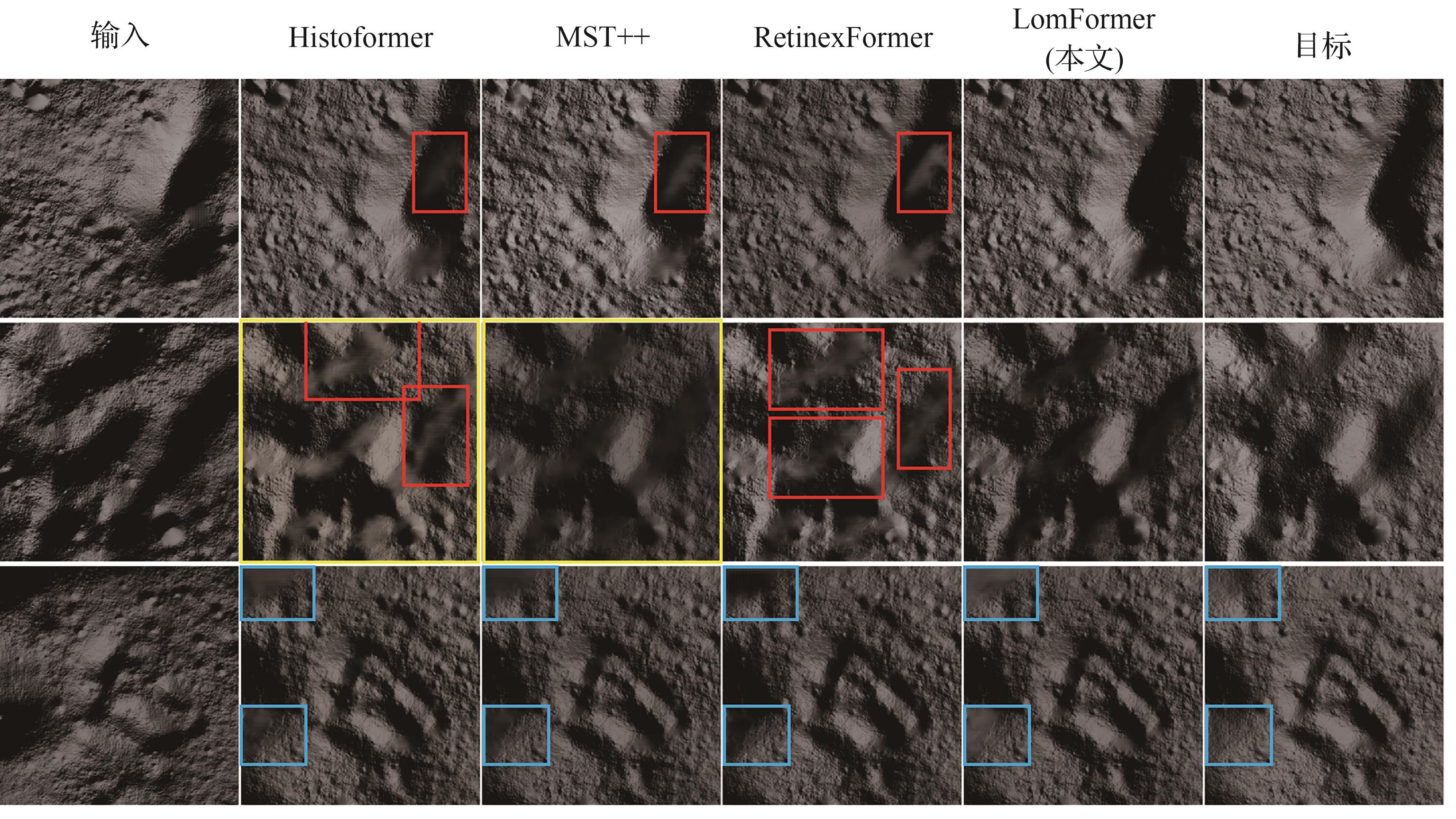
Fig.5
Visual comparison before and after adding topographic consistency constraints
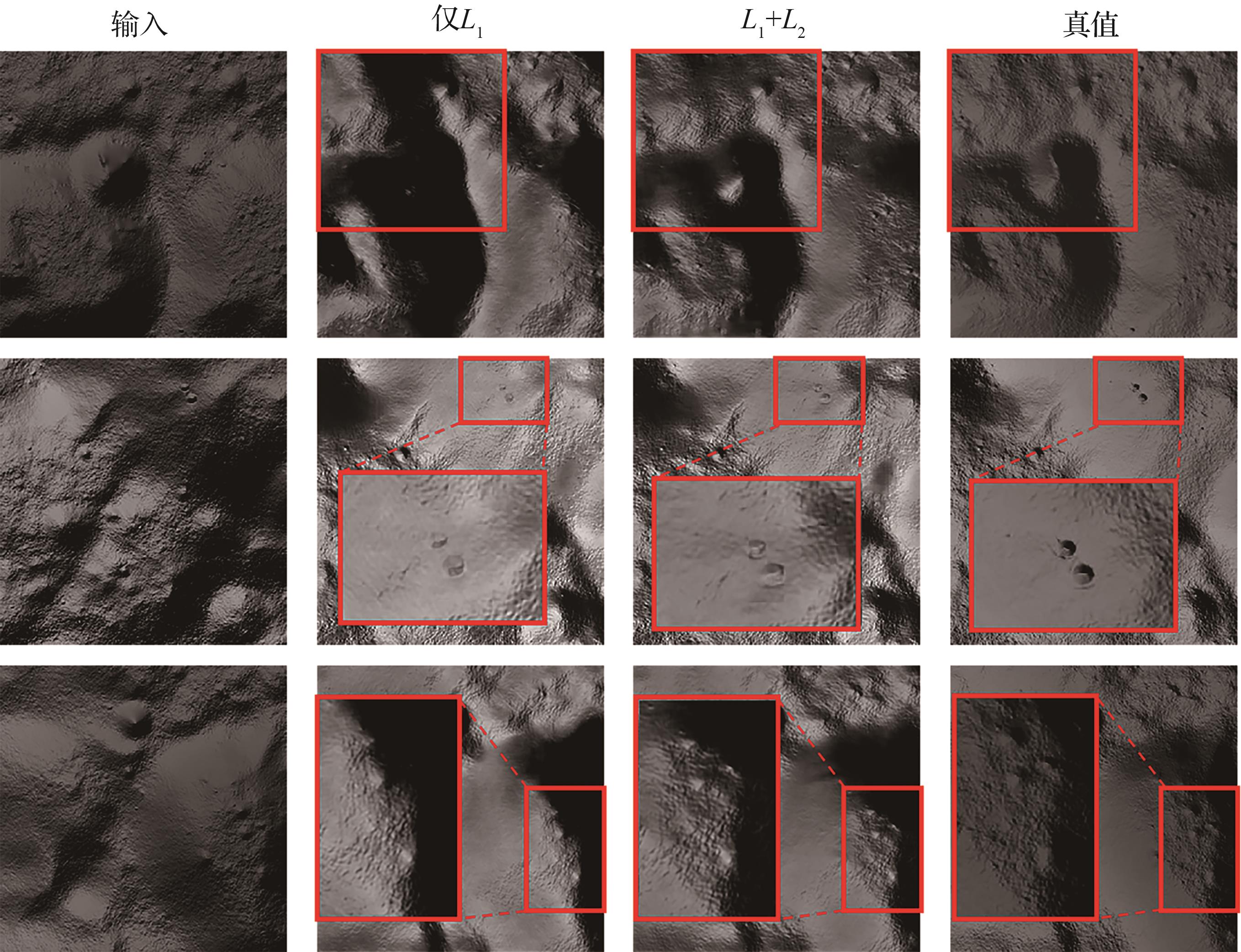
Fig.6
Visual comparison of feature matching results
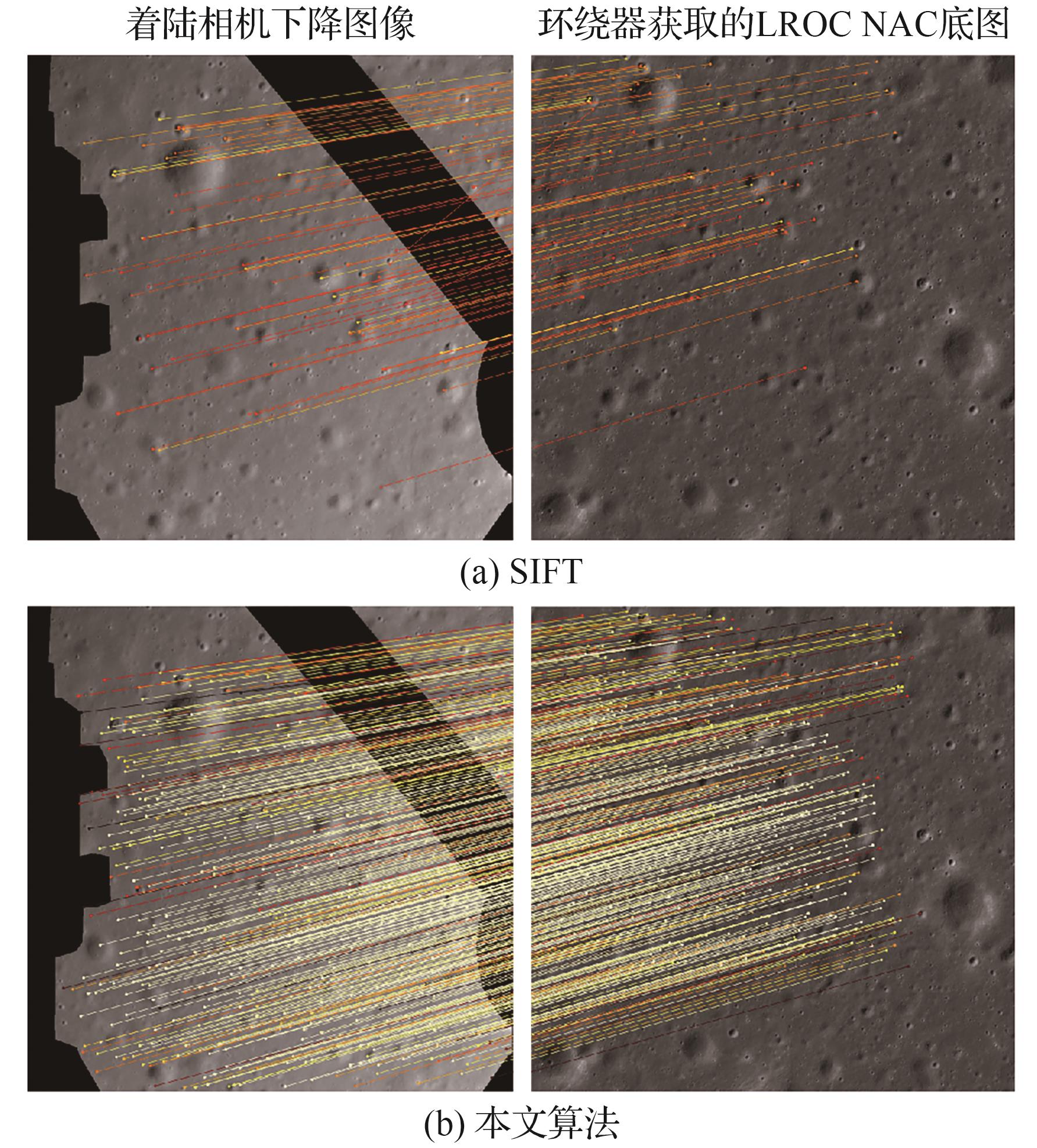
Table 2
Landing site localization errors using different image inputs
| 输入 | 结果 | 型号 | 误差/m | 集束调整 后误差/m |
|---|---|---|---|---|
| 原始输入 | 失败 | 嫦娥三号 | ||
| LomFormer (本文) | 成功 | 10.2 | 2.6 | |
| 原始输入 | 失败 | 嫦娥四号 | ||
| LomFormer (本文) | 成功 | 4.6 | 1.8 | |
| 原始输入 | 失败 | 嫦娥五号 | ||
| LomFormer (本文) | 成功 | 13.3 | 2.9 |
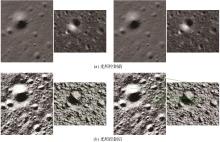
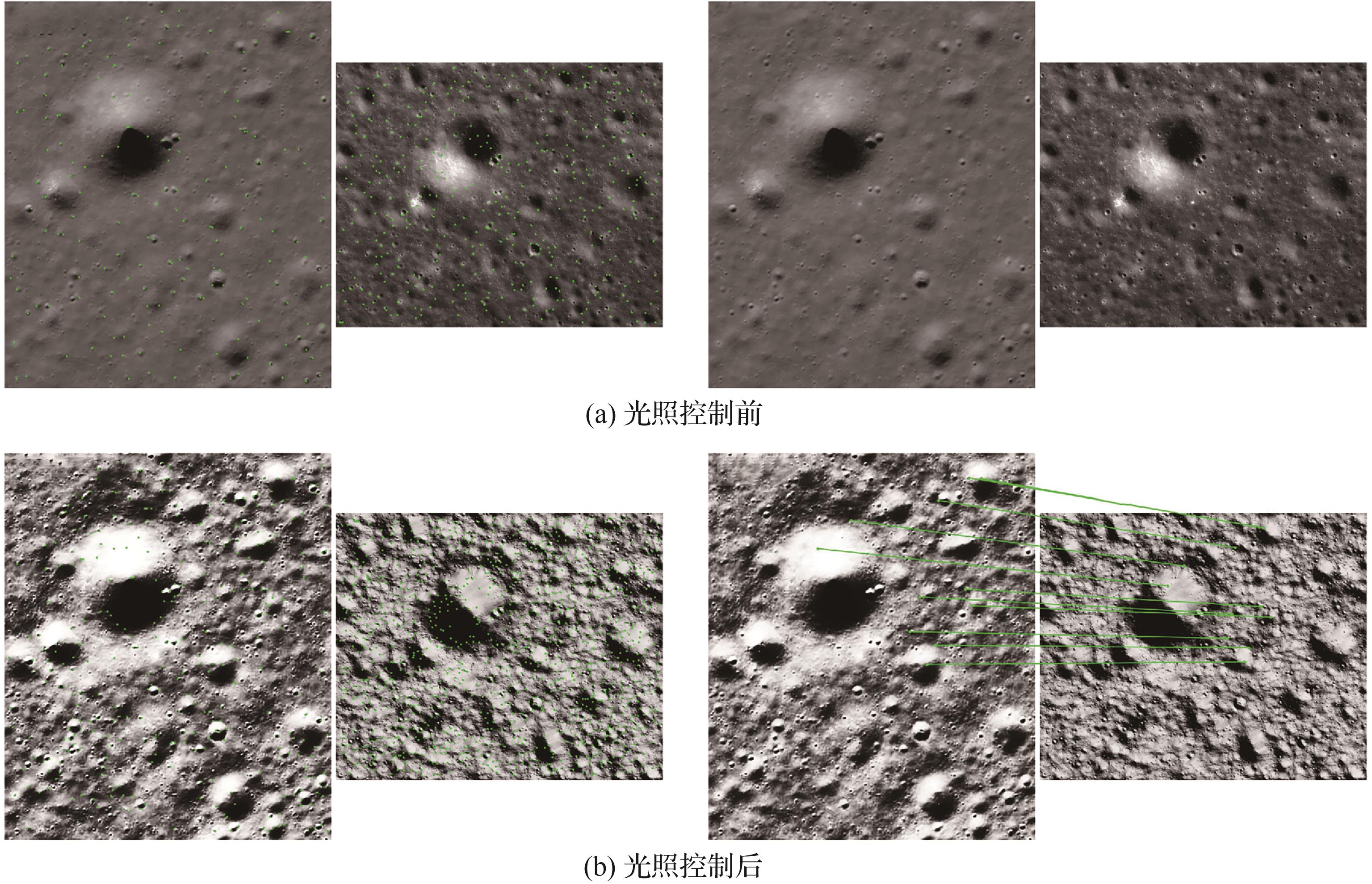
Fig.7
Comparison of landing area matching results pre- and post-illumination control under extreme lighting variation
| [1] | PIZER S M, AMBURN E P, AUSTIN J D, et al. Adaptive histogram equalization and its variations[J]. Computer Vision, Graphics, and Image Processing, 1987, 39(3): 355-368. |
| [2] | JOBSON D J, RAHMAN Z, WOODELL G A. A multiscale retinex for bridging the gap between color images and the human observation of scenes[J]. IEEE Transactions on Image Processing, 1997, 6(7): 965-976. |
| [3] | ZHANG Q W L, YANG M H, LI Q L, et al. Lunar farside volcanism 2.8 billion years ago from Chang’e-6 basalts[J]. Nature, 2025, 643(8071): 356-360. |
| [4] | CUI Z X, YANG Q, ZHANG Y Q, et al. A sample of the Moon’s far side retrieved by Chang’e-6 contains 2.83-billion-year-old basalt[J]. Science, 2024, 386(6728): 1395-1399. |
| [5] | LIU D Y, YE Z, XU Y S, et al. A mismatch removal method based on global constraint and local geometry preservation for lunar orbiter images[J]. IEEE Journal of Selected Topics in Applied Earth Observations and Remote Sensing, 2024, 17: 10221-10236. |
| [6] | LI X J, YUE Z Y, PENG M, et al. Characterization of lobate scarps at the western rim of the Apollo basin using high-resolution DEMs generated using generative adversarial network (GAN) based approach[J]. Icarus, 2025, 435: 116562. |
| [7] | GOU S, YUE Z Y, LIN Y T, et al. Thin basaltic regolith at the Chang’e-6 landing site[J]. Earth and Planetary Science Letters, 2025, 655: 119266. |
| [8] | 彭齐浩, 赵腾起, 刘传凯, 等. 一种鲁棒的月面宽基线图像特征匹配方法[J]. 光学学报, 2023, 43(24): 2410001. |
| PENG Q H, ZHAO T Q, LIU C K, et al. A robust feature matching method for wide-baseline lunar images[J]. Acta Optica Sinica, 2023, 43(24): 2410001 (in Chinese). | |
| [9] | 邸凯昌, 刘召芹, 刘斌, 等. 多源数据的嫦娥四号着陆点定位[J]. 遥感学报, 2019, 23(1): 177-184. |
| DI K C, LIU Z Q, LIU B, et al. Chang’e-4 lander localization based on multi-source data[J]. Journal of Remote Sensing, 2019, 23(1): 177-184 (in Chinese). | |
| [10] | 刘传凯, 王沼翔, 雷俊雄, 等. 基于松弛极线约束的月面复杂仿射变换图像匹配方法[J]. 航空学报, 2024, 45(2): 328659. |
| LIU C K, WANG Z X, LEI J X, et al. An epipolar relaxation constrained matching algorithm of large-affined images for lunar rover with large span distance in a single movement[J]. Acta Aeronautica et Astronautica Sinica, 2024, 45(2): 328659 (in Chinese). | |
| [11] | 王镓, 吴伟仁, 李剑, 等. 基于视觉的嫦娥四号探测器着陆点定位[J]. 中国科学: 技术科学, 2020, 50(1): 41-53. |
| WANG J, WU W R, LI J, et al. Vision based Chang’e-4 landing point localization[J]. Scientia Sinica (Technologica), 2020, 50(1): 41-53 (in Chinese). | |
| [12] | 王镓, 李达飞, 何锡明, 等. 基于多源影像的“祝融号”火星车高精度定位[J]. 深空探测学报, 2022, 9(1): 62-71. |
| WANG J, LI D F, HE X M, et al. High precision localization of Zhurong rover based on multi-source images[J]. Journal of Deep Space Exploration, 2022, 9(1): 62-71 (in Chinese). | |
| [13] | LIU J J, REN X, YAN W, et al. Descent trajectory reconstruction and landing site positioning of Chang’e-4 on the lunar farside[J]. Nature Communications, 2019, 10: 4229. |
| [14] | CHEN H, HU X Y, GLÄSER P, et al. CNN-based large area pixel-resolution topography retrieval from single-view LROC NAC images constrained with SLDEM[J]. IEEE Journal of Selected Topics in Applied Earth Observations and Remote Sensing, 2022, 15: 9398-9416. |
| [15] | 陈泽宇, 李兆津, 吴波, 等. 基于多视单目影像光度法的月球南极像素级三维重建[J]. 遥感学报, 2025, 29(2): 415-428. |
| CHEN Z Y, LI Z J, WU B, et al. Multi-view photoclinometry from monocular images for pixel-wise 3D mapping of the lunar South Pole region[J]. National Remote Sensing Bulletin, 2025, 29(2): 415-428 (in Chinese). | |
| [16] | CHEN C, YE Z, XU Y S, et al. Large-scale block bundle adjustment of LROC NAC images for lunar south pole mapping based on topographic constraint[J]. IEEE Journal of Selected Topics in Applied Earth Observations and Remote Sensing, 2024, 17: 2731-2746. |
| [17] | 焦春林, 高满屯, 史仪凯. 基于立体视觉的3D地形拼接[J]. 计算机工程与应用, 2008, 44(23): 206-208. |
| JIAO C L, GAO M T, SHI Y K. 3D terrain registration based on stereo vision[J]. Computer Engineering and Applications, 2008, 44(23): 206-208 (in Chinese). | |
| [18] | LI Y, ZENG Y Y. Lunar image matching based on impact crater morphology and distribution for landing localization[C]∥IGARSS 2024-2024 IEEE International Geoscience and Remote Sensing Symposium. Piscataway: IEEE Press, 2024: 6146-6149. |
| [19] | 王镓, 辛鑫, 万文辉, 等. 基于多源影像的探测器月面着陆点定位与精度验证[J]. 空间科学学报, 2021, 41(2): 320-328. |
| WANG J, XIN X, WAN W H, et al. Location and accuracy validation of lunar landing point based on multi-source images[J]. Chinese Journal of Space Science, 2021, 41(2): 320-328 (in Chinese). | |
| [20] | COLTUC D, BOLON P, CHASSERY J M. Exact histogram specification[J]. IEEE Transactions on Image Processing, 2006, 15(5): 1143-1152. |
| [21] | CHEN H T, WANG Y H, GUO T Y, et al. Pre-trained image processing transformer[C]∥2021 IEEE/CVF Conference on Computer Vision and Pattern Recognition (CVPR). Piscataway: IEEE Press, 2021: 12294-12305. |
| [22] | LI Y W, FAN Y C, XIANG X Y, et al. Efficient and explicit modelling of image hierarchies for image restoration[C]∥2023 IEEE/CVF Conference on Computer Vision and Pattern Recognition (CVPR). Piscataway: IEEE Press, 2023: 18278-18289. |
| [23] | ZHANG J L, ZHANG Y L, GU J J, et al. Accurate image restoration with attention retractable transformer[EB/OL]. arXiv preprint: 2210.01427, 2022. |
| [24] | ZAMIR S W, ARORA A, KHAN S, et al. Restormer: Efficient transformer for high-resolution image restoration[C]∥2022 IEEE/CVF Conference on Computer Vision and Pattern Recognition (CVPR). Piscataway: IEEE Press, 2022: 5718-5729. |
| [25] | LIANG J Y, CAO J Z, SUN G L, et al. SwinIR: Image restoration using swin transformer[C]∥2021 IEEE/CVF International Conference on Computer Vision Workshops (ICCVW). Piscataway: IEEE Press, 2021: 1833-1844. |
| [26] | GUO H, LI J M, DAI T, et al. MambaIR: A simple baseline forImage restoration withState-space model[C]∥Computer Vision-ECCV 2024. Cham: Springer, 2025: 222-241. |
| [27] | GUO H, GUO Y, ZHA Y H, et al. MambaIRv2: Attentive state space restoration[EB/OL]. arXiv preprint: 2411.15269, 2024. |
| [28] | CAI Y H, LIN J, LIN Z D, et al. MST++: Multi-stage spectral-wise transformer for efficient spectral reconstruction[C]∥2022 IEEE/CVF Conference on Computer Vision and Pattern Recognition Workshops (CVPRW). Piscataway: IEEE Press, 2022: 744-754. |
| [29] | ZHANG L, LANG Z Q, WANG P, et al. Pixel-aware deep function-mixture network for spectral super-resolution[J]. Proceedings of the AAAI Conference on Artificial Intelligence, 2020, 34(7): 12821-12828. |
| [30] | XIONG Z W, SHI Z, LI H Q, et al. HSCNN: CNN-based hyperspectral image recovery from spectrally undersampled projections[C]∥2017 IEEE International Conference on Computer Vision Workshops (ICCVW). Piscataway: IEEE Press, 2018: 518-525. |
| [31] | SHI Z, CHEN C, XIONG Z W, et al. HSCNN+: Advanced CNN-based hyperspectral recovery from RGB images[C]∥2018 IEEE/CVF Conference on Computer Vision and Pattern Recognition Workshops (CVPRW). Piscataway: IEEE Press, 2018: 939-947. |
| [32] | CAI Y H, BIAN H, LIN J, et al. Retinexformer: One-stage retinex-based transformer for low-light image enhancement[C]∥2023 IEEE/CVF International Conference on Computer Vision (ICCV). Piscataway: IEEE Press, 2024: 12470-12479. |
| [33] | ZHANG Y H, GUO X J, MA J Y, et al. Beyond brightening low-light images[J]. International Journal of Computer Vision, 2021, 129(4): 1013-1037. |
| [34] | XU X G, WANG R X, FU C W, et al. SNR-aware low-light image enhancement[C]∥2022 IEEE/CVF Conference on Computer Vision and Pattern Recognition (CVPR). Piscataway: IEEE Press, 2022: 17693-17703. |
| [35] | WANG R X, ZHANG Q, FU C W, et al. Underexposed photo enhancement using deep illumination estimation[C]∥2019 IEEE/CVF Conference on Computer Vision and Pattern Recognition (CVPR). Piscataway: IEEE Press, 2020: 6842-6850. |
| [36] | SUN S Q, REN W Q, GAO X W, et al. Restoring images in adverse weather conditions via Histogram transformer[C]∥Computer Vision-ECCV 2024. Cham: Springer, 2025: 111-129. |
| [37] | HAPKE B. Theory of reflectance and emittance spectroscopy[M]. 2nd ed. Cambridge: Cambridge University Press, 2012. |
| [38] | LIU D Y, CHENG W M, QIAN Z, et al. Boundary delineator for Martian crater instances with geographic information and deep learning[J]. Remote Sensing, 2023, 15(16): 4036. |
| [39] | DETONE D, MALISIEWICZ T, RABINOVICH A. SuperPoint: Self-supervised interest point detection and description[C]∥2018 IEEE/CVF Conference on Computer Vision and Pattern Recognition Workshops (CVPRW). Piscataway: IEEE Press, 2018: 224-236. |
| [40] | SARLIN P E, DETONE D, MALISIEWICZ T, et al. SuperGlue: Learning feature matching with graph neural networks[C]∥2020 IEEE/CVF Conference on Computer Vision and Pattern Recognition (CVPR). Piscataway: IEEE Press, 2020: 4937-4946. |
| [41] | China National Space Administration. Chang’e-2 CCD stereoscopic camera DEM-20 m dataset[EB/OL]. [2025-07-02]. . |
| [42] | LIU J J, REN X, YAN W, et al. A 76 m per pixel global color image dataset and map of Mars by Tianwen-1[J]. Science Bulletin, 2024, 69(14): 2183-2186. |
| [43] | Lunar Reconnaissance Orbiter Camera. Lunar reconnaissance orbiter camera (LROC) [EB/OL]. [2025-07-02]. . |
| [44] | PASZKE A, GROSS S, MASSA F, et al. PyTorch: An imperative style, high-performance deep learning library[EB/OL]. arXiv preprint: 1912.01703, 2019. |
| [45] | HUYNH-THU Q, GHANBARI M. Scope of validity of PSNR in image/video quality assessment[J]. Electronics Letters, 2008, 44(13): 800-801. |
| [46] | WANG Z, BOVIK A C, SHEIKH H R, et al. Image quality assessment: From error visibility to structural similarity[J]. IEEE Transactions on Image Processing, 2004, 13(4): 600-612. |
| [47] | ZHANG R, ISOLA P, EFROS A A, et al. The unreasonable effectiveness of deep features as a perceptual metric[C]∥2018 IEEE/CVF Conference on Computer Vision and Pattern Recognition. Piscataway: IEEE Press, 2018: 586-595. |
| [1] | Yuzhuo MA, Kan REN, Tao LI, Qian CHEN. Improving remote sensing image semantic segmentation based on distance loss [J]. Acta Aeronautica et Astronautica Sinica, 2026, 47(8): 332780-332780. |
| [2] | Jun HUANG, Jing ZHANG, Shiqian WENG. Airborne electro-optical target recognition algorithms [J]. Acta Aeronautica et Astronautica Sinica, 2026, 47(6): 332601-332601. |
| [3] | Leyan LI, Rennong YANG, Anxin GUO, Qi SONG, Jialiang ZUO. Beyond-visual-range air combat threat prediction and dynamic evasion method based on all-domain fire field theory [J]. Acta Aeronautica et Astronautica Sinica, 2026, 47(4): 332205-332205. |
| [4] | Zicheng FENG, Wenlong ZHANG, Donghui LIU, Qifeng YU. Robust infrared target tracking algorithm for anti-UAV in complexbackgrounds [J]. Acta Aeronautica et Astronautica Sinica, 2026, 47(4): 332264-332264. |
| [5] | Shaohua DUAN, Chunjie ZHANG, Chuankai LIU, Xiaolong ZHENG, Jitao ZHANG. AFAR-Net: Autoregressive and feedback-driven adaptive rectangular convolution network for pansharpening [J]. Acta Aeronautica et Astronautica Sinica, 2026, 47(10): 532432-532432. |
| [6] | Jiepan LI, Wei HE, Minghao TANG, Jin XIONG. Pre-disaster footprint-guilded building damage change detection in spaceborne remote sensing imagery [J]. Acta Aeronautica et Astronautica Sinica, 2026, 47(10): 532845-532845. |
| [7] | Ye TAO, Jinhui TANG, Zhen YAN, Chen ZHOU, Chong WANG. A trajectory imputation method integrating representation transformation and pattern regression [J]. Acta Aeronautica et Astronautica Sinica, 2026, 47(1): 332106-332106. |
| [8] | Jianyu XU, Li ZHOU, Zhanxue WANG, Jie SHI, Hao SHI. Calculation method for hypersonic plume infrared radiation based on a fast line-by-line calculation model [J]. Acta Aeronautica et Astronautica Sinica, 2025, 46(8): 630778-630778. |
| [9] | Lingjie MENG, Hongguang LI, Xinjun LI. SAR image simulation method guided by geomorphic category information [J]. Acta Aeronautica et Astronautica Sinica, 2025, 46(7): 331003-331003. |
| [10] | Zhihao ZHAO, Zhaohua YANG, Yun WU, Yuanjin YU. Single-photon counting imaging denoising method based on deep learning in low-light environment [J]. Acta Aeronautica et Astronautica Sinica, 2025, 46(3): 630531-630531. |
| [11] | Yiquan WU, Kang TONG. Research advances on deep learning-based small object detection in UAV aerial images [J]. Acta Aeronautica et Astronautica Sinica, 2025, 46(3): 30848-030848. |
| [12] | Zijian XIANG, Zhenyu MA, Xixiang YANG. Inversion of structural performance parameters of composite materials based on deep learning [J]. Acta Aeronautica et Astronautica Sinica, 2025, 46(24): 231877-231877. |
| [13] | Tianqi FAN, Zhengxia ZOU, Zhenwei SHI. Typical remote sensing target detection with data synthesis based on reinforcement learning [J]. Acta Aeronautica et Astronautica Sinica, 2025, 46(23): 631955-631955. |
| [14] | Kui LIU, Hao SUN, Han WU, Kefeng JI, Gangyao KUANG. Dynamic brightness reconstruction for UAV visible-infrared fusion object detection [J]. Acta Aeronautica et Astronautica Sinica, 2025, 46(23): 631968-631968. |
| [15] | Bo PENG, Jikang BAI, Weiwen CHEN, Xiangtao ZHENG, Jianjun LEI, Xiaoqiang LU. Research progress for UAV search and rescue methods based on deep learning [J]. Acta Aeronautica et Astronautica Sinica, 2025, 46(23): 632761-632761. |
| Viewed | ||||||
|
Full text |
|
|||||
|
Abstract |
|
|||||
Address: No.238, Baiyan Buiding, Beisihuan Zhonglu Road, Haidian District, Beijing, China
Postal code : 100083
E-mail:hkxb@buaa.edu.cn
Total visits: 6658907 Today visits: 1341All copyright © editorial office of Chinese Journal of Aeronautics
All copyright © editorial office of Chinese Journal of Aeronautics
Total visits: 6658907 Today visits: 1341

 CJA
CJA
