Acta Aeronautica et Astronautica Sinica ›› 2026, Vol. 47 ›› Issue (10): 532432.doi: 10.7527/S1000-6893.2025.32432
• Special Issue: Intelligent Processing and Analysis of Aerospace Remote Sensing Images • Previous Articles
Shaohua DUAN1,2, Chunjie ZHANG1,2( ), Chuankai LIU3,4, Xiaolong ZHENG5,6, Jitao ZHANG3,4
Received:2025-06-18
Revised:2025-08-06
Accepted:2025-09-15
Online:2025-10-10
Published:2025-10-09
Contact:
Chunjie ZHANG
E-mail:cjzhang@bjtu.edu.cn
Supported by:CLC Number:
Shaohua DUAN, Chunjie ZHANG, Chuankai LIU, Xiaolong ZHENG, Jitao ZHANG. AFAR-Net: Autoregressive and feedback-driven adaptive rectangular convolution network for pansharpening[J]. Acta Aeronautica et Astronautica Sinica, 2026, 47(10): 532432.
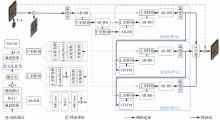
Fig.1
Architecture of AFAR-Net
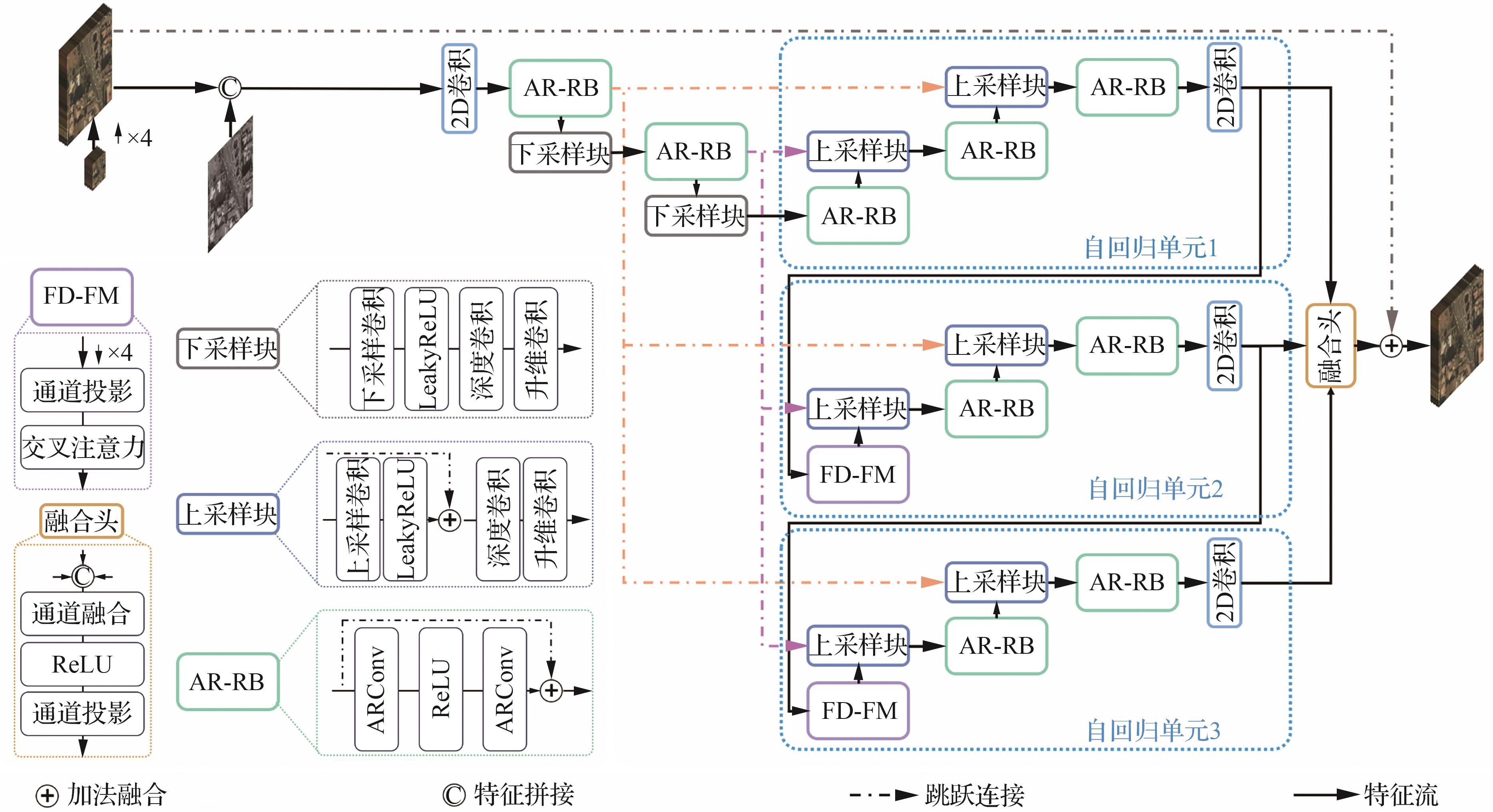
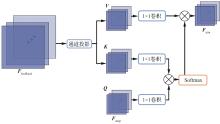
Fig.2
Structure diagram of feedback-driven fusion module
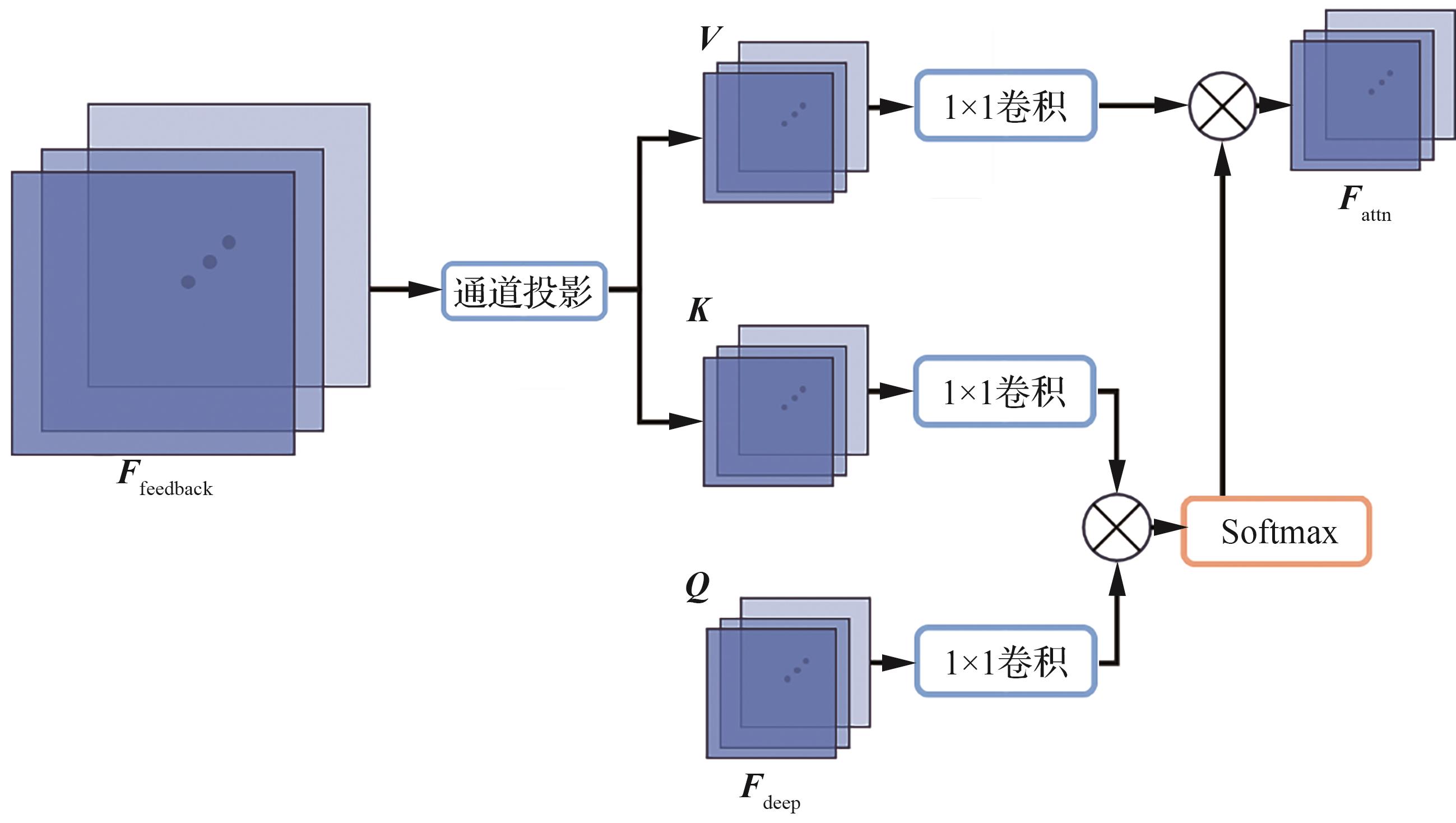

Table 1
Pansharpening performance evaluation on WV3 Dataset (Mean ± Std)
| 方法 | 低分辨率指标 | 全分辨率指标 | ||||
|---|---|---|---|---|---|---|
| SAM | ERGAS | Q | QNR | |||
| BDSD-PC[ | 5.429±1.823 | 4.698±1.617 | 0.829±0.097 | 0.062 5±0.023 5 | 0.073 0±0.035 6 | 0.870±0.053 |
| CVPR19[ | 5.207±1.574 | 5.484±1.505 | 0.764±0.088 | 0.029 7±0.005 9 | 0.041 0±0.013 6 | 0.931±0.018 |
| LRTCFPan[ | 4.737±1.412 | 4.315±1.442 | 0.846±0.091 | 0.017 6±0.006 6 | 0.052 8±0.025 8 | 0.931±0.031 |
| DiCNN[ | 3.593±0.762 | 2.673±0.663 | 0.900±0.087 | 0.036 2±0.011 1 | 0.046 2±0.017 5 | 0.920±0.026 |
| FusionNet[ | 3.325±0.698 | 2.467±0.645 | 0.904±0.090 | 0.023 9±0.009 0 | 0.036 4±0.013 7 | 0.941±0.020 |
| DCFNet[ | 3.038±0.585 | 2.165±0.499 | 0.913±0.087 | 0.018 7±0.007 2 | 0.033 7±0.005 4 | 0.948±0.012 |
| LAGConv[ | 3.104±0.559 | 2.300±0.613 | 0.910±0.091 | 0.036 8±0.014 8 | 0.041 8±0.015 2 | 0.923±0.025 |
| HMPNet[ | 3.063±0.577 | 2.229±0.545 | 0.916±0.087 | 0.018 4±0.007 3 | 0.053 0±0.055 5 | 0.930±0.011 |
| CMT[ | 2.994±0.607 | 2.214±0.516 | 0.917±0.085 | 0.020 7±0.008 2 | 0.037 0±0.007 8 | 0.943±0.014 |
| CANNet[ | 2.930±0.593 | 2.158±0.515 | 0.920±0.084 | 0.019 6±0.008 3 | 0.030 1±0.007 4 | 0.951±0.013 |
| ARConv[ | 0.921±0.083 | 0.014 6±0.005 9 | 0.958±0.010 | |||
| AFAR-Net | 2.860±0.582 | 2.113±0.525 | 0.027 5±0.005 4 | 0.958±0.010 | ||
Table 2
Pansharpening performance evaluation on QB Dataset (Mean ± Std)
| 方法 | 低分辨率指标 | 全分辨率指标 | ||||
|---|---|---|---|---|---|---|
| SAM | ERGAS | Q | QNR | |||
| BDSD-PC[ | 8.089±1.980 | 7.515±0.800 | 0.831±0.090 | 0.197 5±0.033 4 | 0.163 6±0.048 3 | 0.672±0.058 |
| CVPR19[ | 7.998±1.820 | 9.359±1.268 | 0.737±0.087 | 0.049 8±0.011 9 | 0.078 3±0.017 0 | 0.876±0.023 |
| LRTCFPan[ | 7.187±1.711 | 6.928±0.812 | 0.855±0.087 | 0.022 6±0.011 7 | 0.070 5±0.035 1 | 0.909±0.044 |
| DiCNN[ | 5.380±1.027 | 5.135±0.488 | 0.904±0.094 | 0.094 7±0.014 5 | 0.106 7±0.021 0 | 0.809±0.031 |
| FusionNet[ | 4.923±0.908 | 4.159±0.321 | 0.925±0.090 | 0.057 2±0.018 2 | 0.052 2±0.008 8 | 0.894±0.021 |
| DCFNet[ | 4.512±0.773 | 3.809±0.336 | 0.934±0.087 | 0.046 9±0.015 0 | 0.123 9±0.026 9 | 0.835±0.016 |
| LAGConv[ | 4.547±0.830 | 3.826±0.420 | 0.934±0.088 | 0.085 9±0.023 7 | 0.067 6±0.013 6 | 0.852±0.018 |
| HMPNet[ | 4.617±0.404 | 3.404±0.478 | 0.936±0.102 | 0.183 2±0.054 2 | 0.079 3±0.024 5 | 0.753±0.065 |
| CMT[ | 4.535±0.822 | 3.744±0.321 | 0.935±0.086 | 0.050 4±0.012 2 | 0.915±0.016 | |
| CANNet[ | 4.507±0.835 | 3.652±0.327 | 0.937±0.083 | 0.049 9±0.009 2 | 0.915±0.012 | |
| ARConv[ | 3.633±0.327 | 0.939±0.081 | 0.038 4±0.014 8 | 0.039 6±0.009 0 | ||
| AFAR-Net | 4.427±0.811 | 0.043 0±0.016 3 | 0.033 8±0.017 6 | 0.925±0.030 | ||
Table 3
Pansharpening performance evaluation on GF2 Dataset (Mean ± Std)
| 方法 | 低分辨率指标 | 全分辨率指标 | ||||
|---|---|---|---|---|---|---|
| SAM | ERGAS | Q | QNR | |||
| BDSD-PC[ | 1.681±0.360 | 1.667±0.445 | 0.892±0.035 | 0.075 9±0.030 1 | 0.154 8±0.028 0 | 0.781±0.041 |
| CVPR19[ | 1.598±0.353 | 1.877±0.448 | 0.886±0.028 | 0.030 7±0.012 7 | 0.062 2±0.010 1 | 0.909±0.017 |
| LRTCFPan[ | 1.315±0.283 | 1.301±0.313 | 0.932±0.033 | 0.032 5±0.026 9 | 0.089 6±0.014 1 | 0.881±0.023 |
| DiCNN[ | 1.053±2.231 | 1.081±0.254 | 0.959±0.010 | 0.036 9±0.013 2 | 0.099 2±0.013 1 | 0.868±0.016 |
| FusionNet[ | 0.974±2.212 | 0.988±0.222 | 0.964±0.009 | 0.035 0±0.012 4 | 0.101 3±0.013 4 | 0.867±0.018 |
| DCFNet[ | 0.872±0.169 | 0.784±0.146 | 0.974±0.009 | 0.024 0±0.011 5 | 0.065 9±0.009 6 | 0.912±0.012 |
| LAGConv[ | 0.786±0.148 | 0.687±0.113 | 0.981±0.008 | 0.028 4±0.013 0 | 0.079 2±0.013 6 | 0.895±0.020 |
| HMPNet[ | 0.803±0.141 | 0.564±0.099 | 0.981±0.020 | 0.081 9±0.049 9 | 0.114 6±0.012 6 | 0.813±0.049 |
| CMT[ | 0.753±0.138 | 0.648±0.109 | 0.982±0.007 | 0.022 5±0.011 6 | ||
| CANNet[ | 0.707±0.148 | 0.630±0.128 | 0.063 0±0.009 4 | 0.919±0.011 | ||
| ARConv[ | 0.626±0.127 | 0.983±0.007 | 0.018 9±0.009 7 | 0.051 5±0.009 9 | 0.931±0.012 | |
| AFAR-Net | 0.683±0.147 | 0.984±0.006 | 0.027 7±0.026 4 | 0.037 5±0.010 6 | 0.936±0.020 | |
Fig.3
Visual comparison of pansharpening results by multiple methods under low-resolution input (WV3/QB/GF2 Datasets)
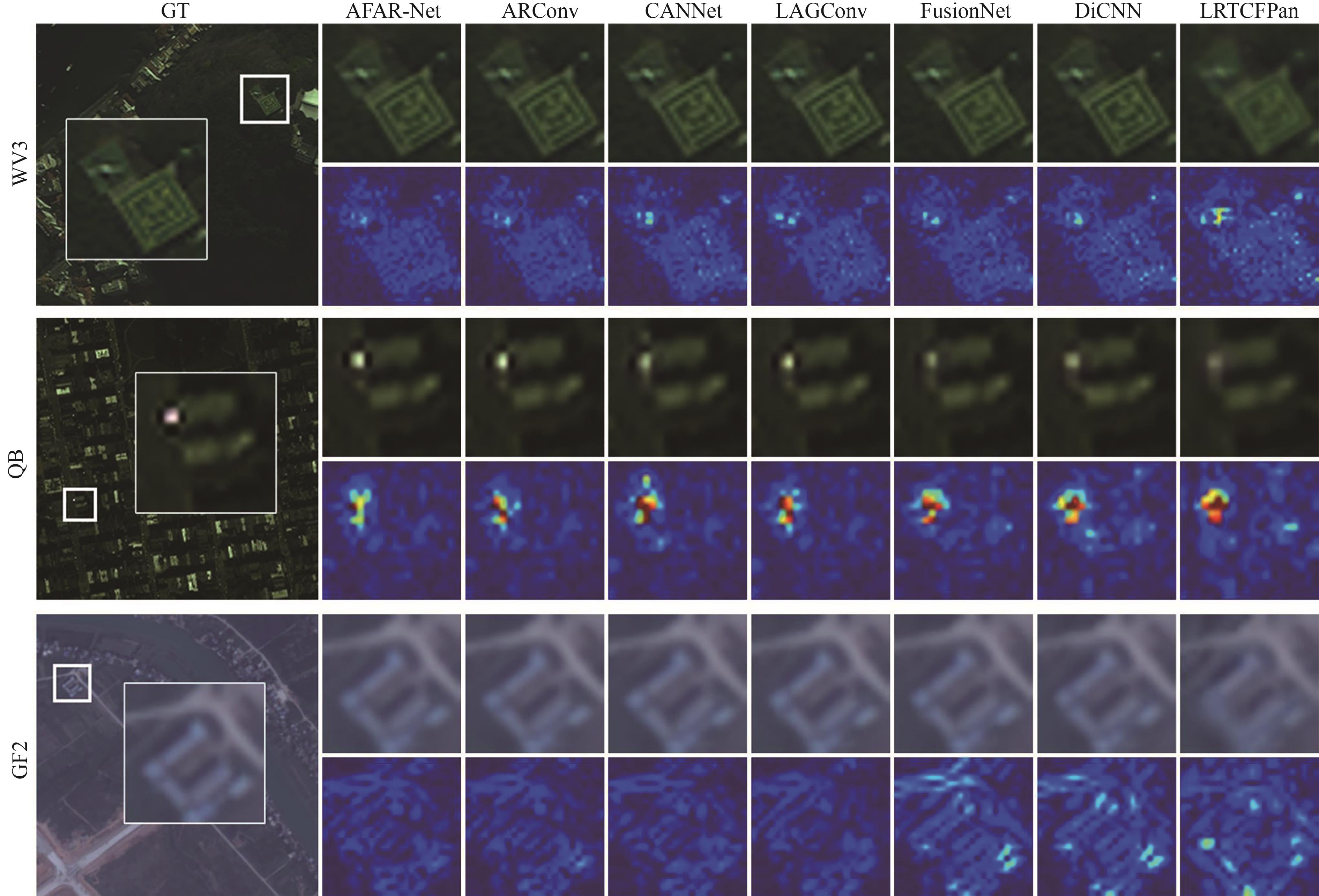
Fig.4
Visual comparison of pansharpening results by multiple methods under full-resolution input (WV3/QB/GF2 Datasets)
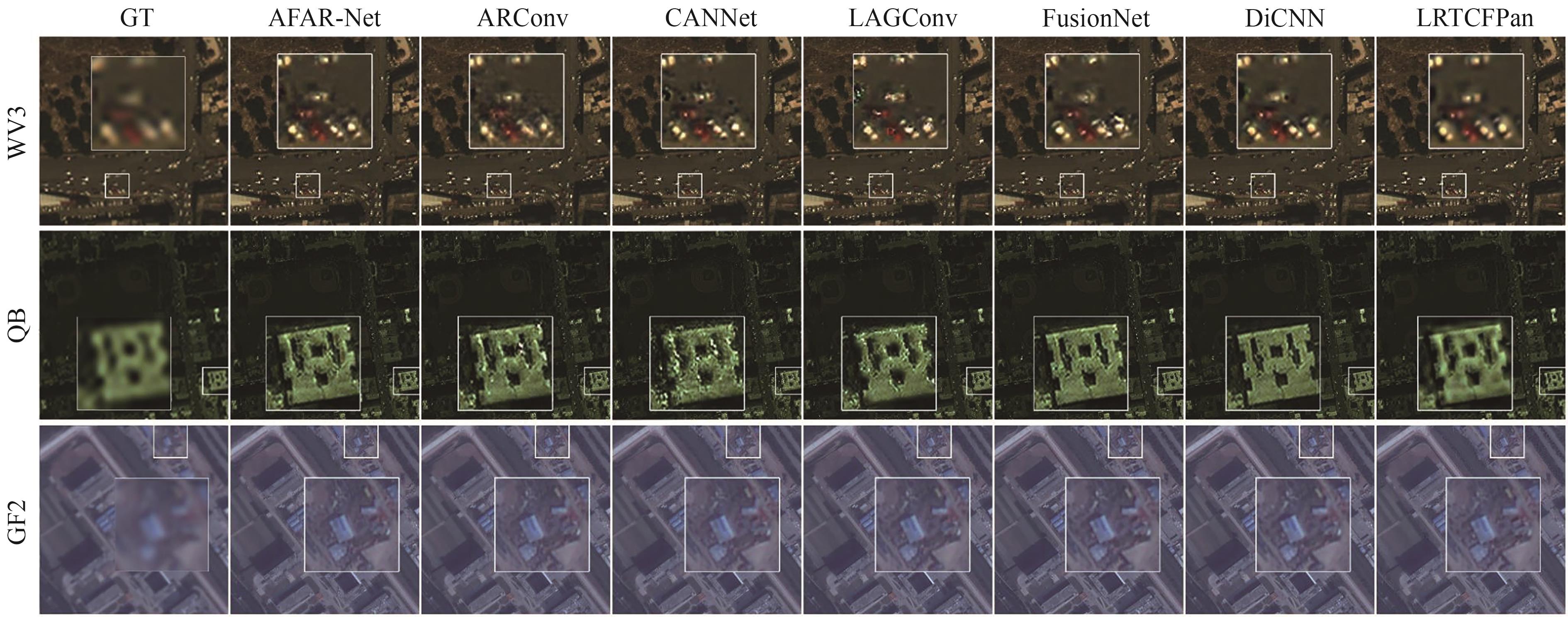
Table 4
Comparison of computational cost and inference efficiency among different methods
| 模型 | 模型规模/MB | FLOPs/109 | 参数量/106 | 推理时间/ms | 推理速度/(frame∙s-1) |
|---|---|---|---|---|---|
| DiCNN[ | 0.18 | 12.231 | 0.047 | 2.13 | 469.39 |
| FusionNet[ | 0.30 | 78.517 | 0.153 | 3.81 | 262.13 |
| LAGConv[ | 0.58 | 8.270 | 0.054 | 91.06 | 10.98 |
| CANNet[ | 3.00 | 7.069 | 0.308 | 3 107.56 | 0.32 |
| ARConv[ | 60.74 | 240.432 | 4.620 | 347.60 | 2.88 |
| AFAR-Net | 60.83 | 428.117 | 4.988 | 526.49 | 1.90 |
Table 5
Ablation test results of autoregressive mechanism and adaptive rectangular convolution residual block on WV3 Dataset (Mean ± Std)
| 自回归机制 | AR-RB | 低分辨率指标 | 全分辨率指标 | ||||
|---|---|---|---|---|---|---|---|
| SAM | ERGAS | Q | QNR | ||||
| × | × | 2.997±0.610 | 2.215±0.553 | 0.918±0.085 | 0.019 4±0.008 1 | 0.030 8±0.007 2 | 0.951±0.013 |
| √ | × | 2.951±0.593 | 2.185±0.531 | 0.919±0.085 | 0.042 3±0.062 9 | 0.049 5±0.041 4 | 0.913±0.091 |
| × | √ | 0.921±0.083 | 0.014 6±0.005 9 | 0.958±0.010 | |||
| √ | √ | 2.860±0.582 | 2.113±0.525 | 0.027 5±0.005 4 | 0.958±0.010 | ||
Table 6
Ablation test results of FD-FM on WV3 Dataset (Mean ± Std)
| FD-FM | 低分辨率指标 | ||
|---|---|---|---|
| SAM | ERGAS | Q | |
| × | 2.904 | 2.141 | 0.919 |
| √ | 2.860 | 2.113 | 0.921 |
Table 7
Ablation test results of number of regression units on WV3 Dataset (Mean ± Std)
| 回归单元数量 | 低分辨率指标 | 全分辨率指标 | ||||
|---|---|---|---|---|---|---|
| SAM | ERGAS | Q | QNR | |||
| 1 | 2.885±0.590 | 2.139±0.528 | 0.014 6±0.005 9 | 0.958±0.010 | ||
| 2 | 0.920±0.085 | 0.016 0±0.006 5 | 0.028 9±0.002 7 | 0.956±0.007 | ||
| 3 | 2.860±0.582 | 2.113± 0.525 | 0.921±0.084 | 0.015 2±0.006 3 | 0.027 5±0.005 4 | 0.958±0.010 |
| 4 | 2.870±0.583 | 2.121±0.527 | 0.920±0.086 | 0.015 2±0.006 1 | 0.029 1±0.004 4 | 0.956±0.009 |
| 5 | 2.871±0.582 | 2.123±0.525 | 0.920±0.086 | 0.014 6±0.005 9 | 0.028 9±0.003 5 | 0.957±0.008 |
| 6 | 5.801±1.862 | 7.160±1.878 | 0.617±0.101 | 0.023 8±0.006 9 | 0.081 6±0.031 7 | 0.897±0.036 |
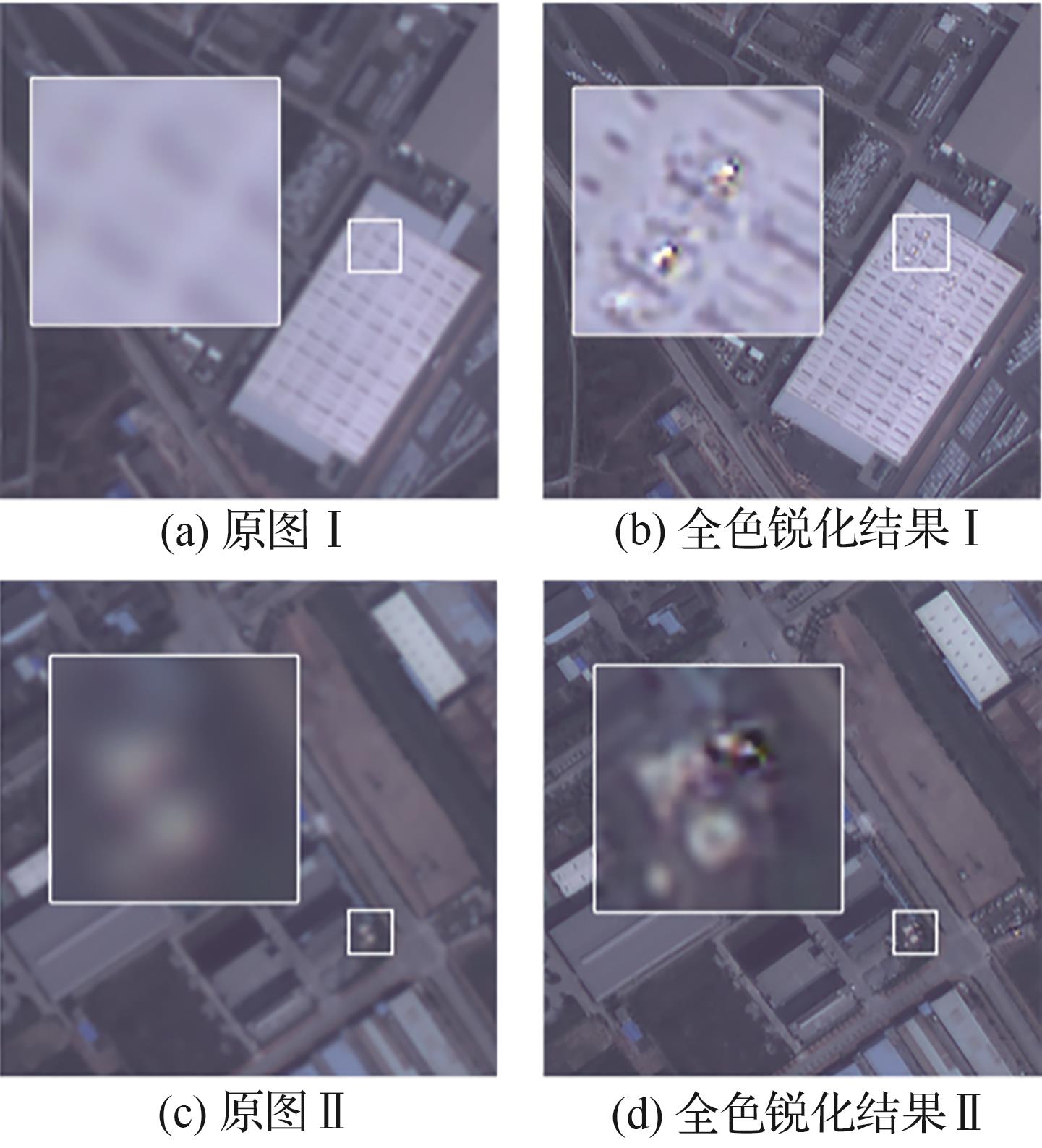
Fig.5
Examples of local anomalies in full-resolution pansharpening results of AFAR-Net method on GF2 Dataset
| [1] | 杜虓宇, 王光辉, 陆尘, 等. 复杂城市环境下的资源三号遥感影像绿地提取[J]. 遥感学报, 2024, 28(11): 2954-2969. |
| DU X Y, WANG G H, LU C, et al. Green space extraction method from ZY-3 remote sensing images in complex urban environment[J]. National Remote Sensing Bulletin, 2024, 28(11): 2954-2969 (in Chinese). | |
| [2] | SUN X, YIN D S, QIN F, et al. Revealing influencing factors on global waste distribution via deep-learning based dumpsite detection from satellite imagery[J]. Nature Communications, 2023, 14: 1444. |
| [3] | 葛宏, 王颖. 基于高光谱遥感数据的森林覆盖动态变化监测研究[J]. 测绘与空间地理信息, 2025, 48(5): 116-119. |
| GE H, WANG Y. Study on forest coverage dynamic change monitoring based on hyperspectral remote sensing data[J]. Geomatics & Spatial Information Technology, 2025, 48(5): 116-119 (in Chinese). | |
| [4] | 丛润民, 孙豪言, 罗宇轩, 等. 基于类关系挖掘的遥感图像广义小样本分割方法[J]. 航空学报, 2025, 46(23): 631694. |
| CONG R M, SUN H Y, LUO Y X, et al. Generalized few-shot segmentation for remote sensing image based on class relation mining[J]. Acta Aeronautica et Astronautica Sinica, 2025, 46(23): 631694 (in Chinese). | |
| [5] | ZHANG C J, LIU C K, DUAN S H, et al. Embodied cognitive intelligence guided Moon sample collection[J]. Innovation, 2025, 6(7): 100939. |
| [6] | CHENG J, DENG C J, SU Y Z, et al. Methods and datasets on semantic segmentation for unmanned aerial vehicle remote sensing images: A review[J]. ISPRS Journal of Photogrammetry and Remote Sensing, 2024, 211: 1-34. |
| [7] | SUN X, WANG P J, YAN Z Y, et al. FAIR1M: A benchmark dataset for fine-grained object recognition in high-resolution remote sensing imagery[J]. ISPRS Journal of Photogrammetry and Remote Sensing, 2022, 184: 116-130. |
| [8] | SHEN H F, MENG X C, ZHANG L P. An integrated framework for the spatio-temporal-spectral fusion of remote sensing images[J]. IEEE Transactions on Geoscience and Remote Sensing, 2016, 54(12): 7135-7148. |
| [9] | 赵志威, 付昱凯, 杨树文. 一种粒子群优化脉冲耦合神经网络的全色锐化算法[J]. 航天返回与遥感, 2024, 45(5): 51-63. |
| ZHAO Z W, FU Y K, YANG S W. A multispectral and panchromatic image fusion algorithm based on particle swarm optimization and pulse-coupled neural network[J]. Spacecraft Recovery & Remote Sensing, 2024, 45(5): 51-63 (in Chinese). | |
| [10] | ZHANG C J, BAI H H, ZHAO Y. Fine-grained image classification by class and image-specific decomposition with multiple views[J]. IEEE Transactions on Multimedia, 2023, 25: 6756-6766. |
| [11] | ZHANG C J, LIANG C, ZHAO Y. Exemplar-based, semantic guided zero-shot visual recognition[J]. IEEE Transactions on Image Processing, 2022, 31: 3056-3065. |
| [12] | ZHANG J, ZHANG X P, LIU S, et al. FIE-net: foreground instance enhancement network for domain adaptation object detection in remote sensing imagery[J]. IEEE Transactions on Geoscience and Remote Sensing, 2025, 63: 5620714. |
| [13] | ZOU Z X, SHI Z W. Ship detection in spaceborne optical image with SVD networks[J]. IEEE Transactions on Geoscience and Remote Sensing, 2016, 54(10): 5832-5845. |
| [14] | LYU S C, ZHAO Q, SUN Y X, et al. Unsupervised domain adaptation for VHR urban scene segmentation via prompted foundation model-based hybrid training joint-optimized network[J]. IEEE Transactions on Geoscience and Remote Sensing, 2025, 63: 4409117. |
| [15] | CHEN K Y, LIU C Y, CHEN H, et al. RSPrompter: Learning to prompt for remote sensing instance segmentation based on visual foundation model[J]. IEEE Transactions on Geoscience and Remote Sensing, 2024, 62: 4701117. |
| [16] | SUN X, TIAN Y, LU W X, et al. From single-to multi-modal remote sensing imagery interpretation: A survey and taxonomy[J]. Science China Information Sciences, 2023, 66(4): 140301. |
| [17] | CARPER W J, LILLESAND T M, KIEFER R W. The use of intensity-hue-saturation transformations for merging SPOT panchromatic and multispectral image data[J]. Photogrammetric Engineering and Remote Sensing, 1990, 56: 457-467. |
| [18] | KWARTENG P, CHAVEZ A. Extracting spectral contrast in landsat thematic mapper image data using selective principal component analysis[J]. Photogrammetric Engineering & Remote Sensing, 1989, 55(1): 339-348. |
| [19] | KING R L, WANG J. A wavelet based algorithm for pan sharpening Landsat 7 imagery[C]∥IEEE 2001 International Geoscience and Remote Sensing Symposium. Piscataway: IEEE Press, 2001: 849-851. |
| [20] | 徐欣钰, 李小军, 盖钧飞, 等. 结合NSCT变换和引导滤波的多光谱图像全色锐化算法[J]. 自然资源遥感, 2025, 37(1): 24-30. |
| XU X Y, LI X J, GE J F, et al. A multispectral image pansharpening algorithm based on nonsubsampled contourlet transform (NSCT) combined with a guided filter[J]. Remote Sensing for Natural Resources, 2025, 37(1): 24-30 (in Chinese). | |
| [21] | PALSSON F, SVEINSSON J R, ULFARSSON M O. A new pansharpening algorithm based on total variation[J]. IEEE Geoscience and Remote Sensing Letters, 2014, 11(1): 318-322. |
| [22] | WANG T T, FANG F M, LI F, et al. High-quality Bayesian pansharpening[J]. IEEE Transactions on Image Processing, 2019, 28(1): 227-239. |
| [23] | YANG J F, FU X Y, HU Y W, et al. PanNet: a deep network architecture for pan-sharpening[C]∥2017 IEEE International Conference on Computer Vision (ICCV). Piscataway: IEEE Press, 2017: 1753-1761. |
| [24] | HE L, RAO Y Z, LI J, et al. Pansharpening via detail injection based convolutional neural networks[J]. IEEE Journal of Selected Topics in Applied Earth Observations and Remote Sensing, 2019, 12(4): 1188-1204. |
| [25] | WU X, HUANG T Z, DENG L J, et al. Dynamic cross feature fusion for remote sensing pansharpening[C]∥2021 IEEE/CVF International Conference on Computer Vision (ICCV). Piscataway: IEEE Press, 2022: 14667-14676. |
| [26] | SHU W J, DOU H X, WEN R, et al. CMT: cross modulation transformer with hybrid loss for pansharpening[J]. IEEE Geoscience and Remote Sensing Letters, 2024, 21: 5004405. |
| [27] | JIN Z R, ZHANG T J, JIANG T X, et al. LAGConv: local-context adaptive convolution kernels with global harmonic bias for pansharpening[J]. Proceedings of the AAAI Conference on Artificial Intelligence, 2022, 36(1): 1113-1121. |
| [28] | WANG X Y, ZHENG Z X, SHAO J D, et al. Adaptive rectangular convolution for remote sensing pansharpening[C]∥2025 IEEE/CVF Conference on Computer Vision and Pattern Recognition (CVPR). Piscataway: IEEE Press, 2025: 17872-17881. |
| [29] | GILLESPIE A R, KAHLE A B, WALKER R E. Color enhancement of highly correlated images Ⅱ: Channel ratio and “chromaticity” transformation techniques[J]. Remote Sensing of Environment, 1987, 22(3): 343-365. |
| [30] | MAURER T. How to pan-sharpen images using the gram-Schmidt pan-sharpen method-a recipe[J]. The International Archives of the Photogrammetry, Remote Sensing and Spatial Information Sciences, 2013, 40: 239-244. |
| [31] | GARZELLI A, NENCINI F, CAPOBIANCO L. Optimal MMSE pan sharpening of very high resolution multispectral images[J]. IEEE Transactions on Geoscience and Remote Sensing, 2008, 46(1): 228-236. |
| [32] | VIVONE G. Robust band-dependent spatial-detail approaches for panchromatic sharpening[J]. IEEE Transactions on Geoscience and Remote Sensing, 2019, 57(9): 6421-6433. |
| [33] | VIVONE G, MARANO S, CHANUSSOT J. Pansharpening: Context-based generalized Laplacian Pyramids by robust regression[J]. IEEE Transactions on Geoscience and Remote Sensing, 2020, 58(9): 6152-6167. |
| [34] | 戴欢, 杨勇, 卢航远, 等. 梯度递归模型优化注入系数的全色锐化算法[J]. 西安电子科技大学学报(自然科学版), 2025, 52(2): 143-155. |
| DAI H, YANG Y, LU H Y, et al. Gradient recursive optimization based injection coefficient algorithm for pansharpening[J]. Journal of Xidian University (Natural Science), 2025, 52(2): 143-155 (in Chinese). | |
| [35] | FU X Y, LIN Z H, HUANG Y, et al. A variational pan-sharpening with local gradient constraints[C]∥2019 IEEE/CVF Conference on Computer Vision and Pattern Recognition (CVPR). Piscataway: IEEE Press, 2020: 10257-10266. |
| [36] | WU Z C, HUANG T Z, DENG L J, et al. LRTCFPan: Low-rank tensor completion based framework for pansharpening[J]. IEEE Transactions on Image Processing, 2023, 32: 1640-1655. |
| [37] | ZHANG K, ZHANG F, WAN W B, et al. Panchromatic and multispectral image fusion for remote sensing and earth observation: Concepts, taxonomy, literature review, evaluation methodologies and challenges ahead[J]. Information Fusion, 2023, 93: 227-242. |
| [38] | WANG H, ZHANG H, TIAN X, et al. Zero-Sharpen: A universal pansharpening method across satellites for reducing scale-variance gap via zero-shot variation[J]. Information Fusion, 2024, 101: 102003. |
| [39] | VIVONE G, DENG L J, DENG S Q, et al. Deep learning in remote sensing image fusion: Methods, protocols, data, and future perspectives[J]. IEEE Geoscience and Remote Sensing Magazine, 2025, 13(1): 269-310. |
| [40] | DENG L J, VIVONE G, JIN C, et al. Detail injection-based deep convolutional neural networks for pansharpening[J]. IEEE Transactions on Geoscience and Remote Sensing, 2021, 59(8): 6995-7010. |
| [41] | TIAN X, LI K, ZHANG W, et al. Interpretable model-driven deep network for hyperspectral, multispectral, and panchromatic image fusion[J]. IEEE Transactions on Neural Networks and Learning Systems, 2024, 35(10): 14382-14395. |
| [42] | XU S, ZHONG S W, LI H, et al. Spectral-spatial attention-guided multi-resolution network for pansharpening[J]. IEEE Journal of Selected Topics in Applied Earth Observations and Remote Sensing, 2025, 18: 7559-7571. |
| [43] | HUANG J, HUANG R, XU J H, et al. Wavelet-assisted multi-frequency attention network for pansharpening[J]. Proceedings of the AAAI Conference on Artificial Intelligence, 2025, 39(4): 3662-3670. |
| [44] | DUAN Y L, WU X, DENG H Y, et al. Content-adaptive non-local convolution for remote sensing pansharpening[C]∥2024 IEEE/CVF Conference on Computer Vision and Pattern Recognition (CVPR). Piscataway: IEEE Press, 2024: 27738-27747. |
| [45] | RONNEBERGER O, FISCHER P, BROX T. U-Net: convolutional networks for biomedical image segmentation[C]∥2015 Medical Image Computing and Computer-Assisted Intervention. Cham: Springer, 2015: 234-241. |
| [1] | Yuzhuo MA, Kan REN, Tao LI, Qian CHEN. Improving remote sensing image semantic segmentation based on distance loss [J]. Acta Aeronautica et Astronautica Sinica, 2026, 47(8): 332780-332780. |
| [2] | Jun HUANG, Jing ZHANG, Shiqian WENG. Airborne electro-optical target recognition algorithms [J]. Acta Aeronautica et Astronautica Sinica, 2026, 47(6): 332601-332601. |
| [3] | Leyan LI, Rennong YANG, Anxin GUO, Qi SONG, Jialiang ZUO. Beyond-visual-range air combat threat prediction and dynamic evasion method based on all-domain fire field theory [J]. Acta Aeronautica et Astronautica Sinica, 2026, 47(4): 332205-332205. |
| [4] | Zicheng FENG, Wenlong ZHANG, Donghui LIU, Qifeng YU. Robust infrared target tracking algorithm for anti-UAV in complexbackgrounds [J]. Acta Aeronautica et Astronautica Sinica, 2026, 47(4): 332264-332264. |
| [5] | Ye TAO, Jinhui TANG, Zhen YAN, Chen ZHOU, Chong WANG. A trajectory imputation method integrating representation transformation and pattern regression [J]. Acta Aeronautica et Astronautica Sinica, 2026, 47(1): 332106-332106. |
| [6] | Jianyu XU, Li ZHOU, Zhanxue WANG, Jie SHI, Hao SHI. Calculation method for hypersonic plume infrared radiation based on a fast line-by-line calculation model [J]. Acta Aeronautica et Astronautica Sinica, 2025, 46(8): 630778-630778. |
| [7] | Lingjie MENG, Hongguang LI, Xinjun LI. SAR image simulation method guided by geomorphic category information [J]. Acta Aeronautica et Astronautica Sinica, 2025, 46(7): 331003-331003. |
| [8] | Zhihao ZHAO, Zhaohua YANG, Yun WU, Yuanjin YU. Single-photon counting imaging denoising method based on deep learning in low-light environment [J]. Acta Aeronautica et Astronautica Sinica, 2025, 46(3): 630531-630531. |
| [9] | Yiquan WU, Kang TONG. Research advances on deep learning-based small object detection in UAV aerial images [J]. Acta Aeronautica et Astronautica Sinica, 2025, 46(3): 30848-030848. |
| [10] | Zijian XIANG, Zhenyu MA, Xixiang YANG. Inversion of structural performance parameters of composite materials based on deep learning [J]. Acta Aeronautica et Astronautica Sinica, 2025, 46(24): 231877-231877. |
| [11] | Tianqi FAN, Zhengxia ZOU, Zhenwei SHI. Typical remote sensing target detection with data synthesis based on reinforcement learning [J]. Acta Aeronautica et Astronautica Sinica, 2025, 46(23): 631955-631955. |
| [12] | Kui LIU, Hao SUN, Han WU, Kefeng JI, Gangyao KUANG. Dynamic brightness reconstruction for UAV visible-infrared fusion object detection [J]. Acta Aeronautica et Astronautica Sinica, 2025, 46(23): 631968-631968. |
| [13] | Bo PENG, Jikang BAI, Weiwen CHEN, Xiangtao ZHENG, Jianjun LEI, Xiaoqiang LU. Research progress for UAV search and rescue methods based on deep learning [J]. Acta Aeronautica et Astronautica Sinica, 2025, 46(23): 632761-632761. |
| [14] | Fei WANG, Yong LIU, Jiawei YAO, Xuanlei ZHU, Xiaoqiang LU, Wenxing GUO, Xuetao ZHANG, Yu GUO. RS-AdaDiff: One-step remote sensing image super-resolution diffusion model with degradation-aware adaptive estimation [J]. Acta Aeronautica et Astronautica Sinica, 2025, 46(23): 632763-632763. |
| [15] | Xiaowei JIANG, Yiquan WU. Research progress of UAV aerial image mosaic methods [J]. Acta Aeronautica et Astronautica Sinica, 2025, 46(17): 331799-331799. |
| Viewed | ||||||
|
Full text |
|
|||||
|
Abstract |
|
|||||
Address: No.238, Baiyan Buiding, Beisihuan Zhonglu Road, Haidian District, Beijing, China
Postal code : 100083
E-mail:hkxb@buaa.edu.cn
Total visits: 6658907 Today visits: 1341All copyright © editorial office of Chinese Journal of Aeronautics
All copyright © editorial office of Chinese Journal of Aeronautics
Total visits: 6658907 Today visits: 1341

 CJA
CJA
