Acta Aeronautica et Astronautica Sinica ›› 2025, Vol. 46 ›› Issue (8): 631139.doi: 10.7527/S1000-6893.2024.31139
• special column • Previous Articles
Lingling CHEN( ), Yang ZHANG, Yongqiang SHI, Qingzhen YANG
Received:2024-09-02
Revised:2024-09-18
Accepted:2024-10-18
Online:2024-11-06
Published:2024-10-29
Contact:
Lingling CHEN
E-mail:lingling.chen@nwpu.edu.cn
Supported by:CLC Number:
Lingling CHEN, Yang ZHANG, Yongqiang SHI, Qingzhen YANG. Film cooling performance/nozzle performance/infrared radiation characteristics of a vector nozzle[J]. Acta Aeronautica et Astronautica Sinica, 2025, 46(8): 631139.
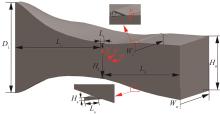
Fig.1
Vector nozzle with film cooling (half model)
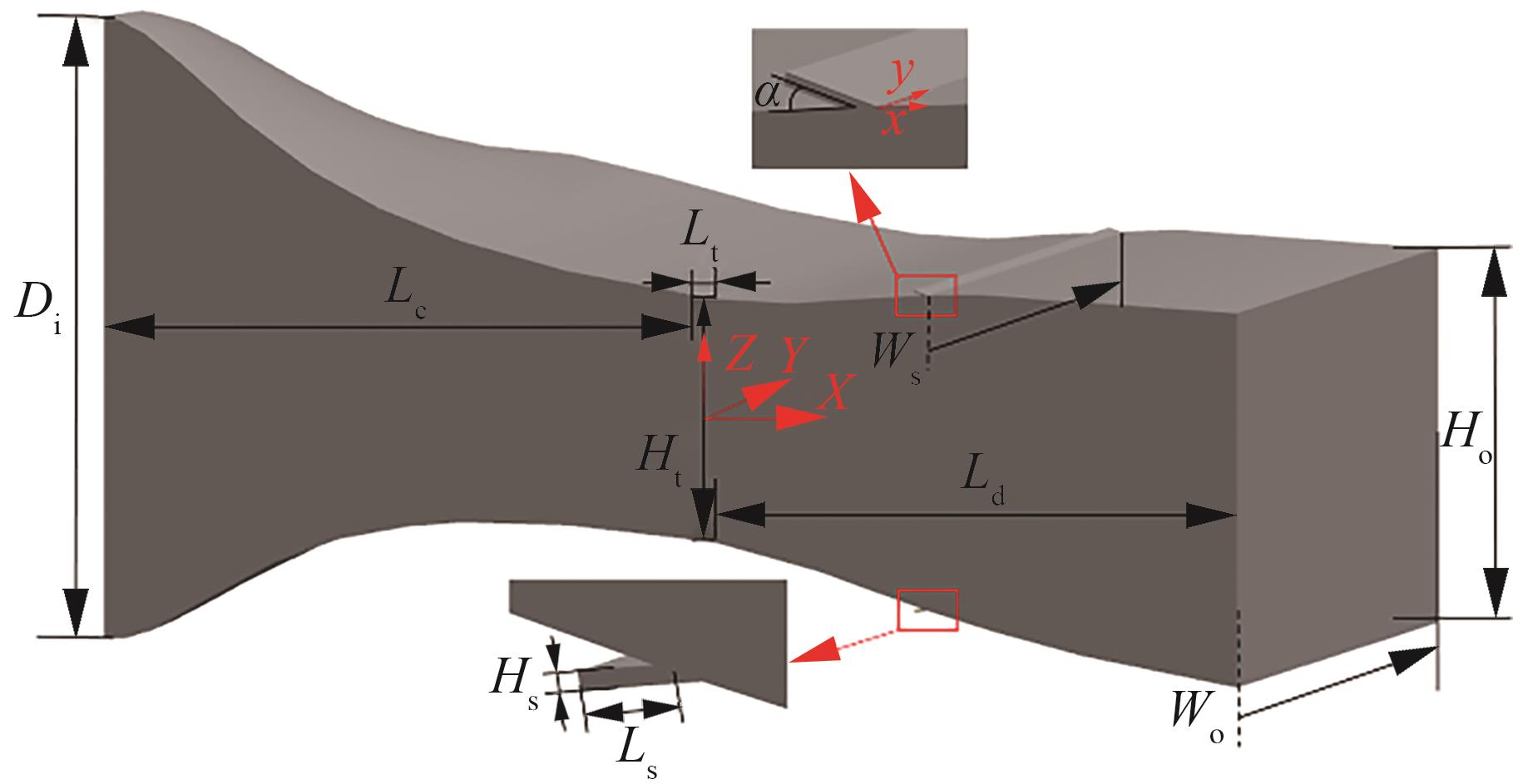
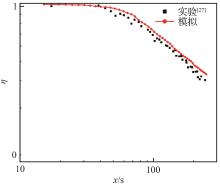
Fig.2
Comparison of film cooling efficiency along streamwise direction between numerical simulation and experiment[27]
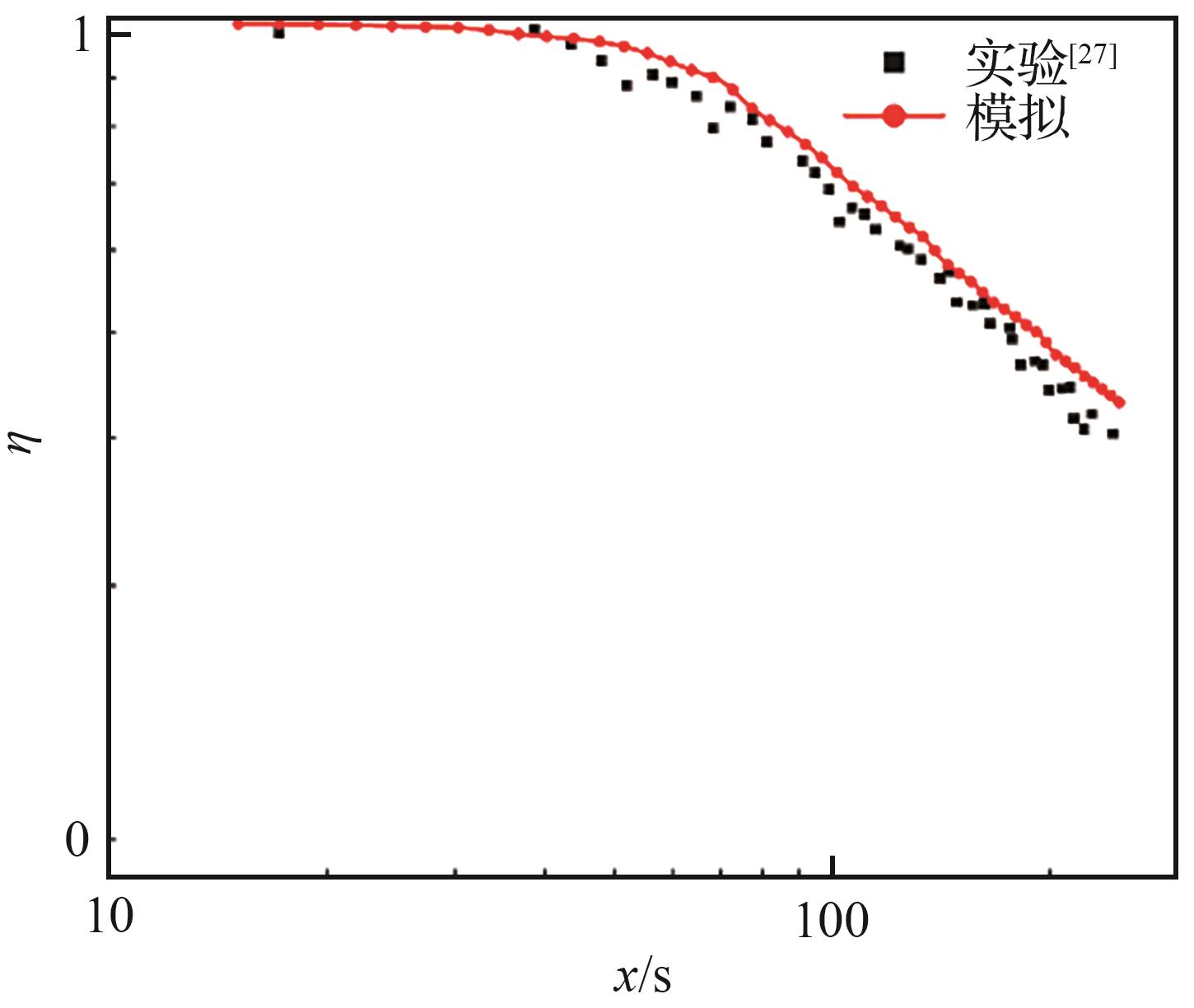
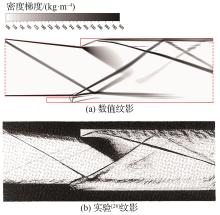
Fig. 3
Comparison of Schlieren graph between numerical simulation and experiment[28]
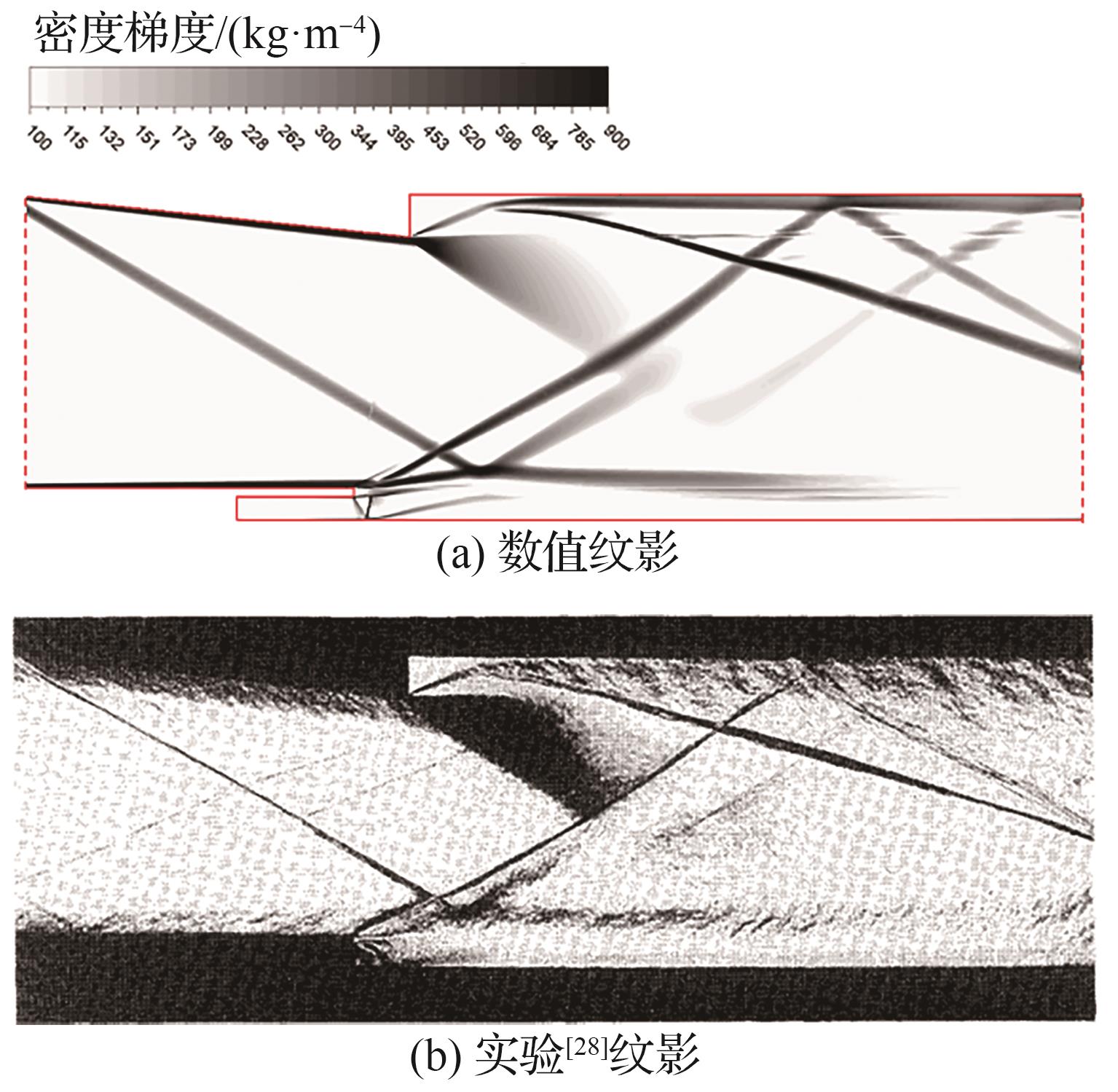
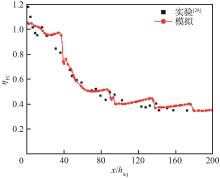
Fig.4
Comparison of film cooling efficiency betweennumerical simulation and experiment[28]
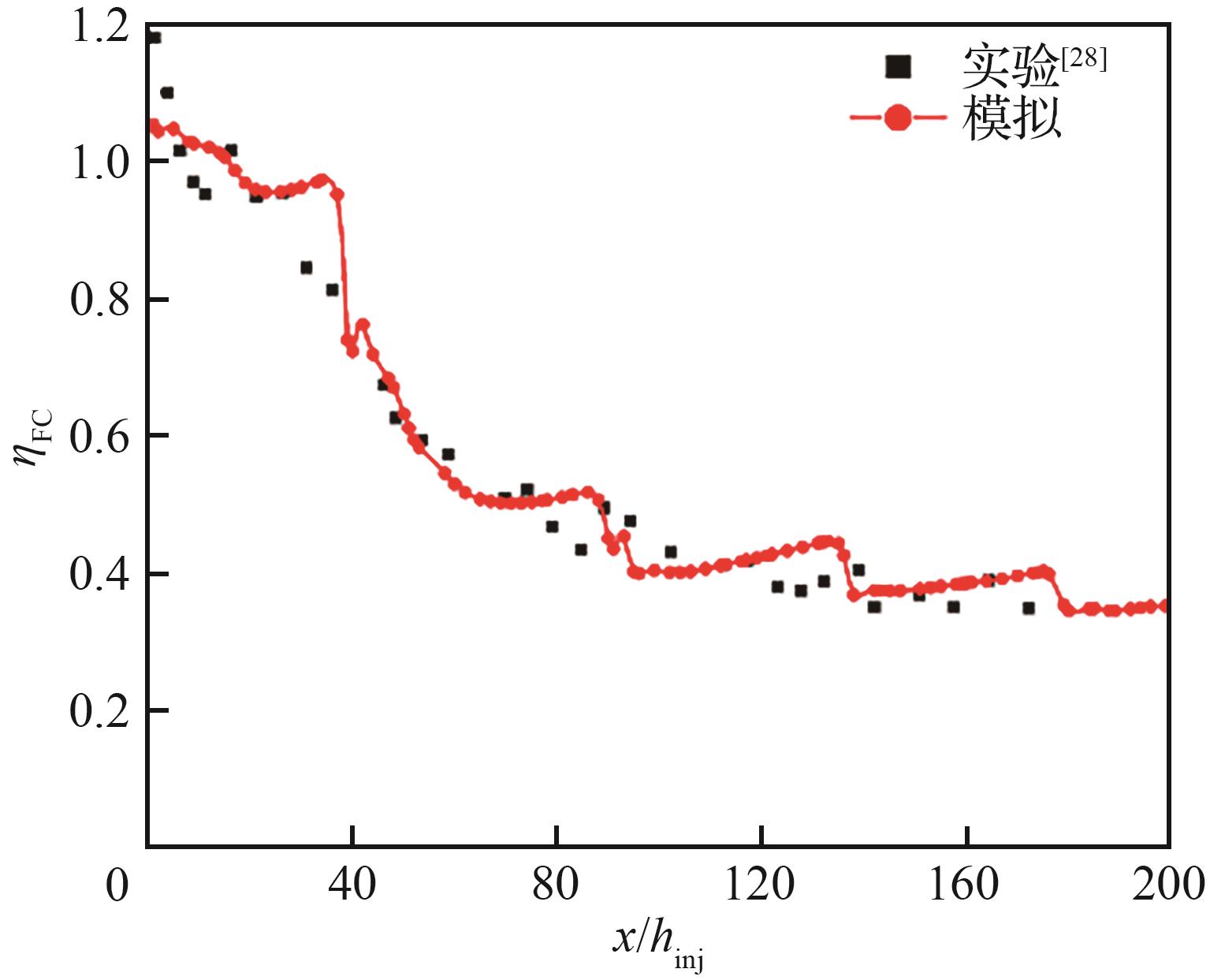
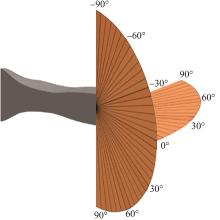
Fig.5
Infrared detection points on pitch and yaw planes
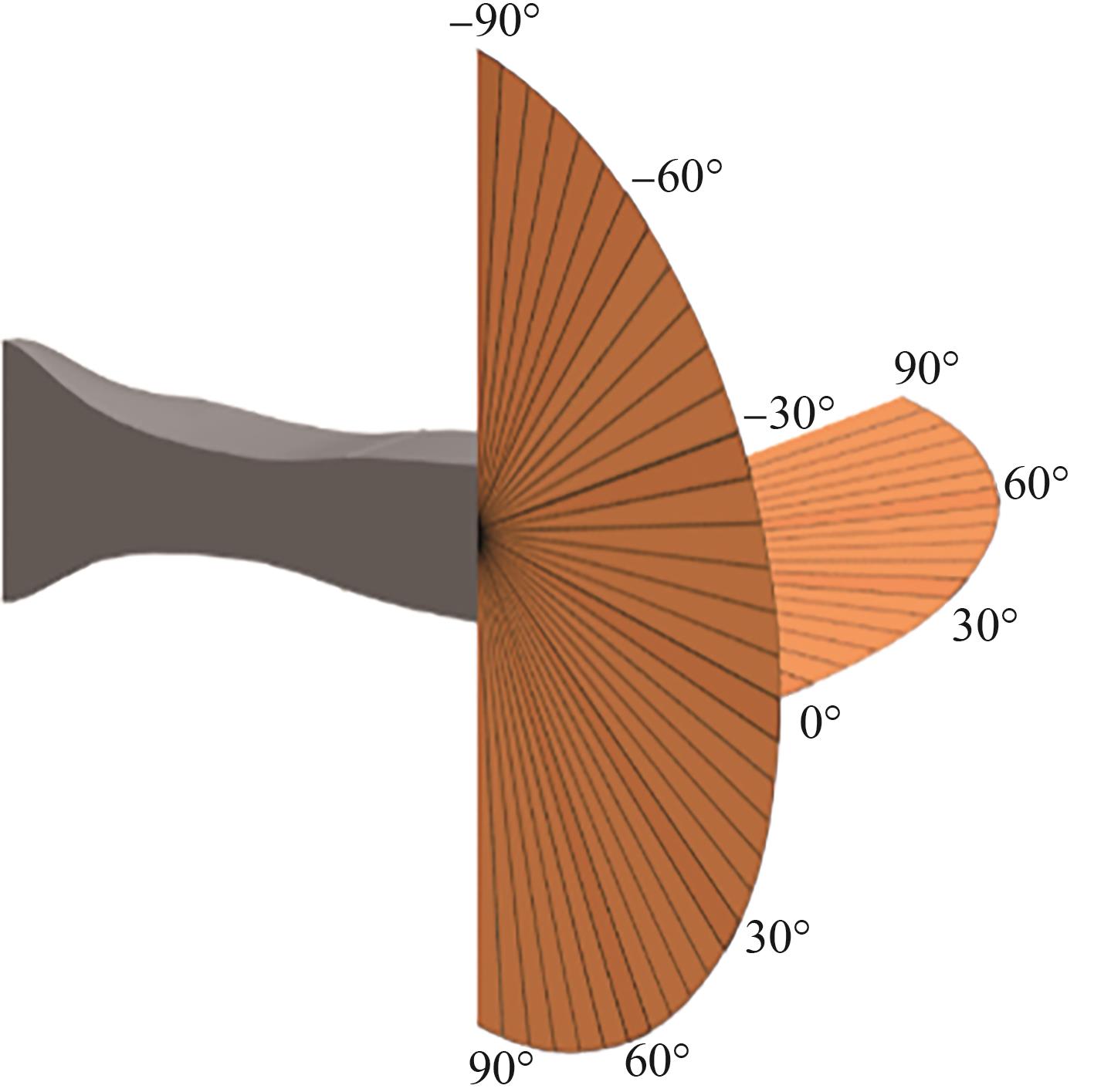
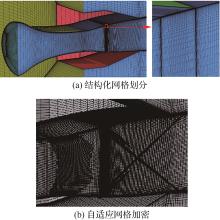
Fig.6
Grid for numerical calculation
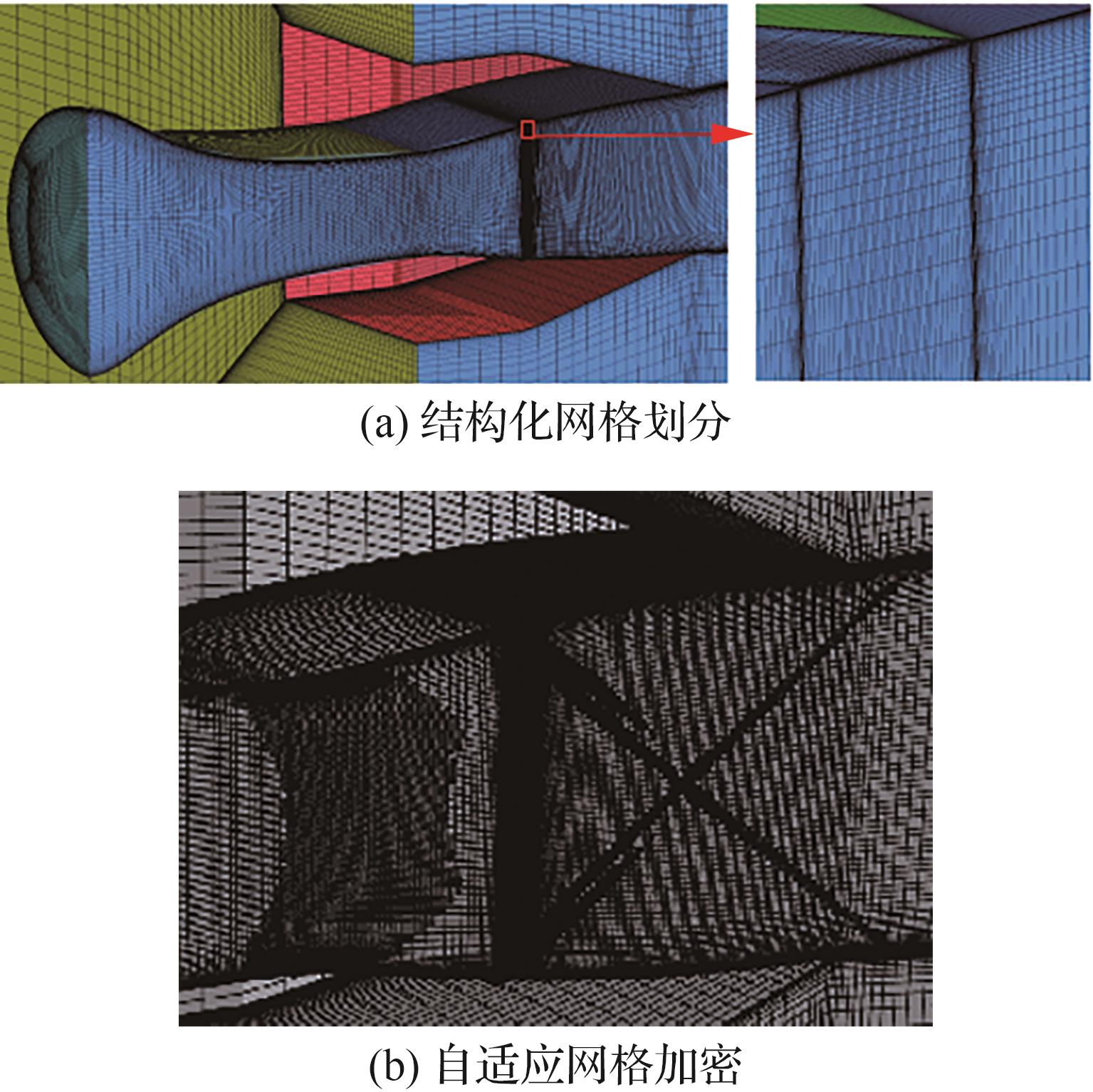
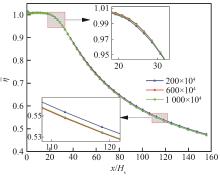
Fig.7
Streamwise distribution of lateral-averaged film cooling efficiency obtained by different meshes
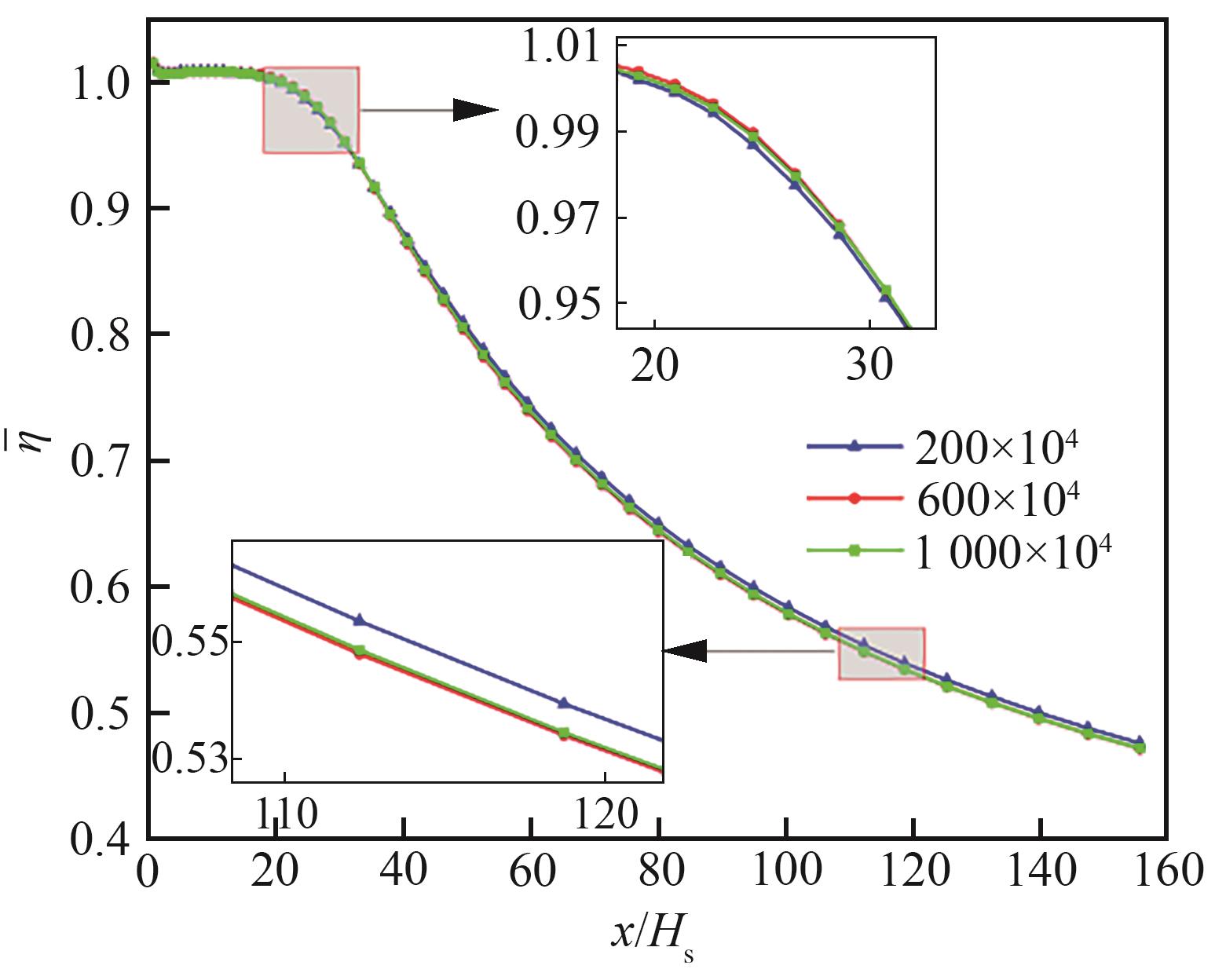
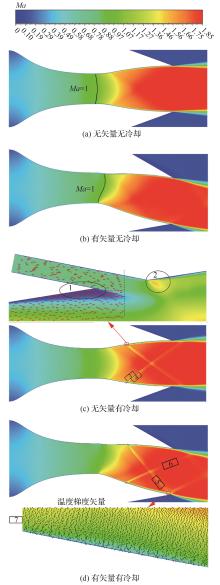
Fig.8
Mach number contour on symmetry plane of nozzle
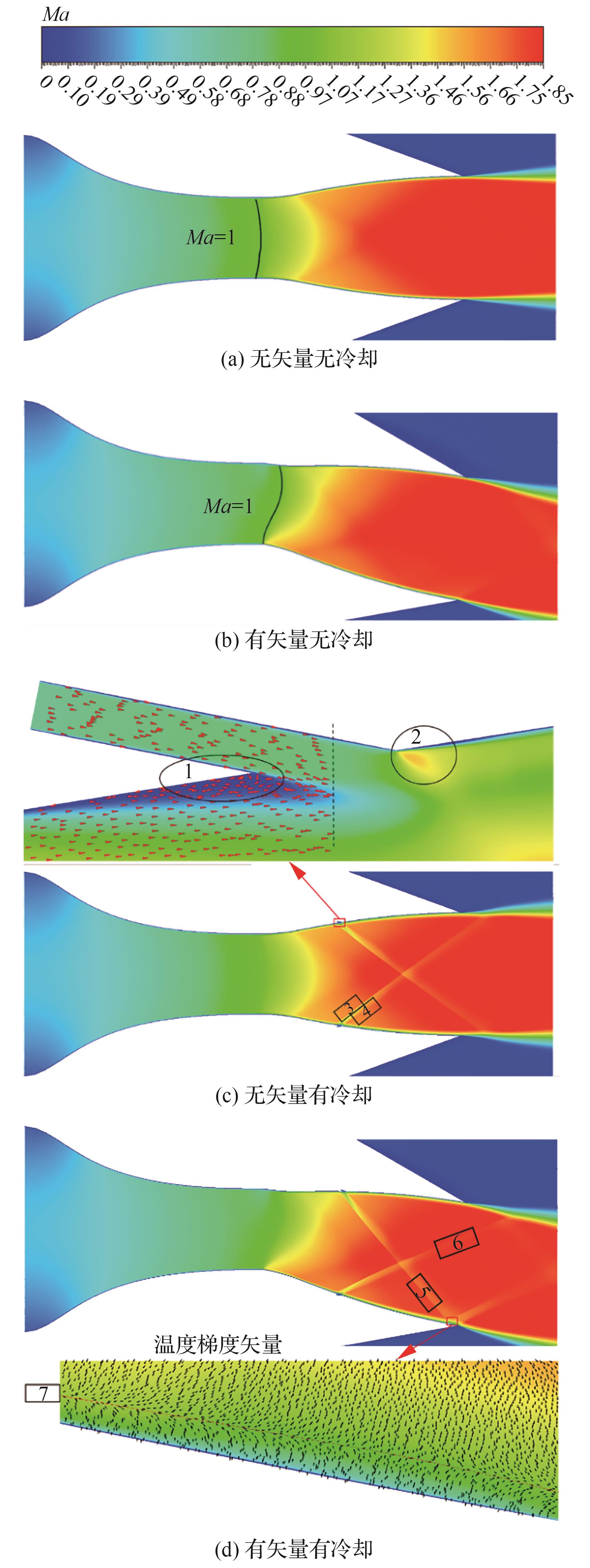
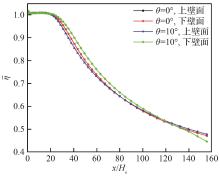
Fig.9
Streamwise distribution of lateral-averaged film cooling efficiency
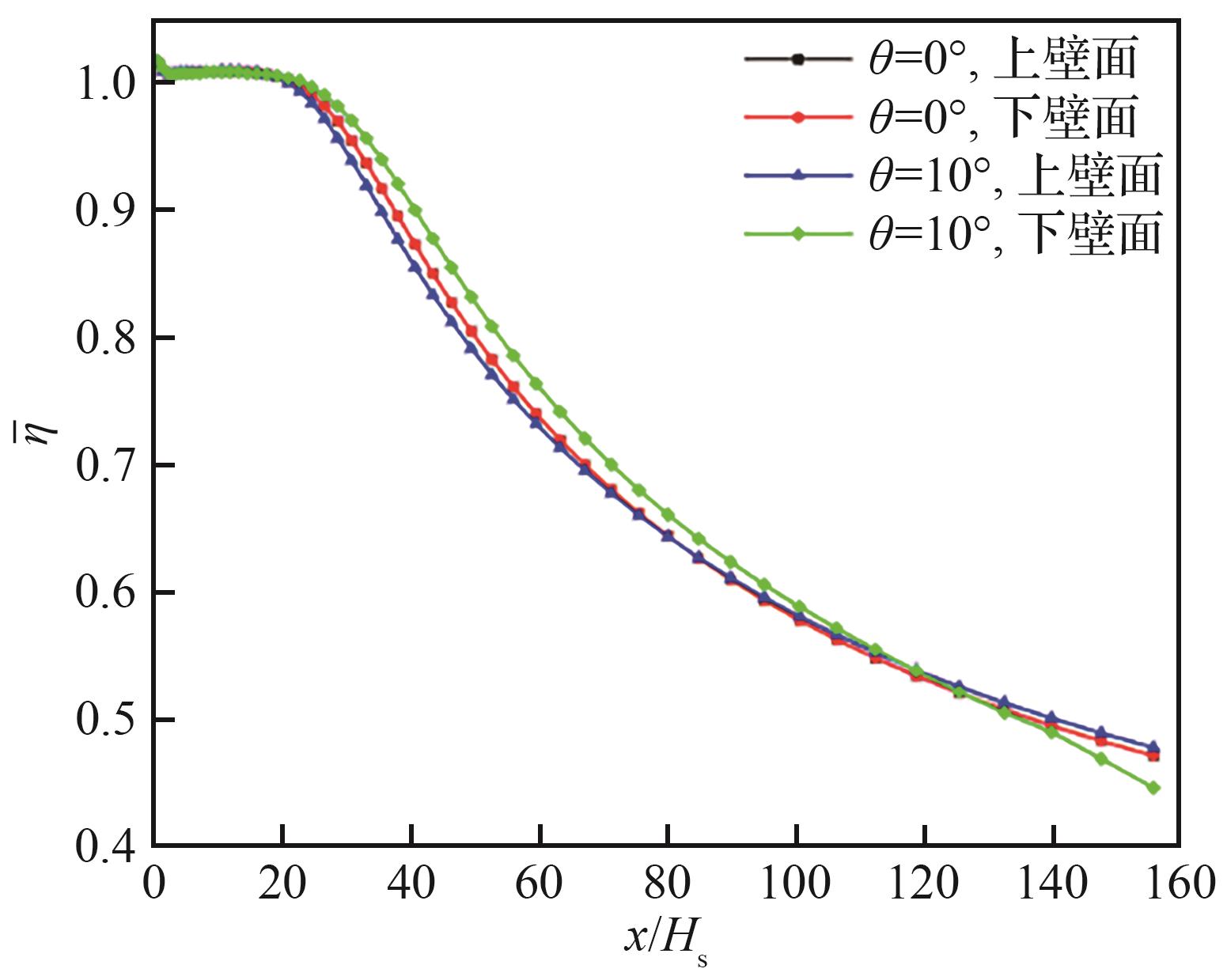
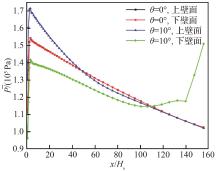
Fig.10
Streamwise distribution of lateral-averaged static pressure
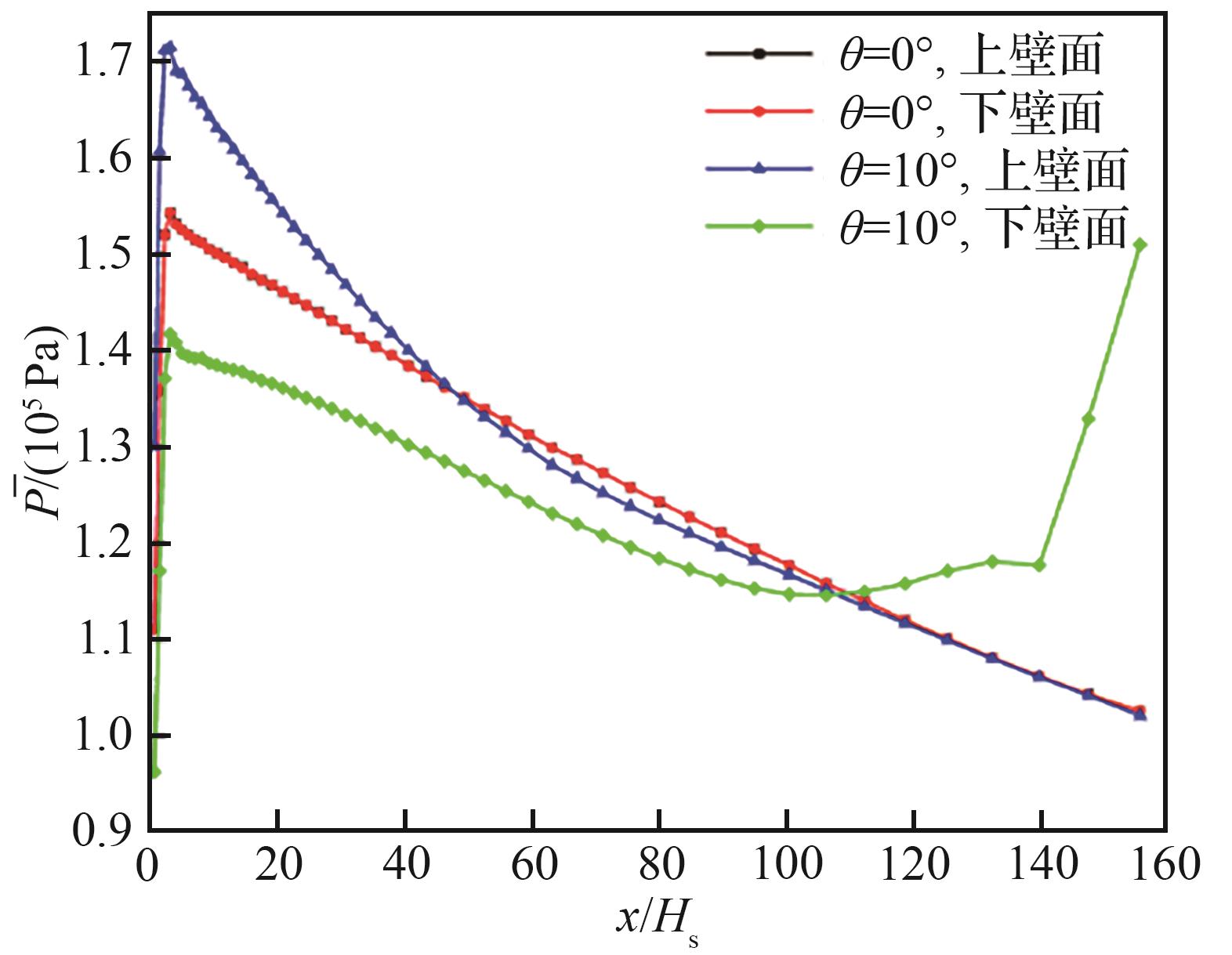
Table 1
Nozzle performance with/without vector deflection and with/without film cooling
| 工况 | cf/% | cd/% | σ |
|---|---|---|---|
| 无矢量无冷却 | 99.17 | 95.94 | 0.977 3 |
| 无矢量有冷却 | 98.37 | 95.80 | 0.965 3 |
| 有矢量无冷却 | 99.16 | 95.93 | 0.977 4 |
| 有矢量有冷却 | 98.39 | 95.78 | 0.965 3 |
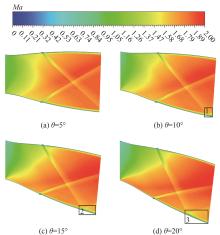
Fig.11
Mach number contour on symmetry plane of nozzle with different vector angles
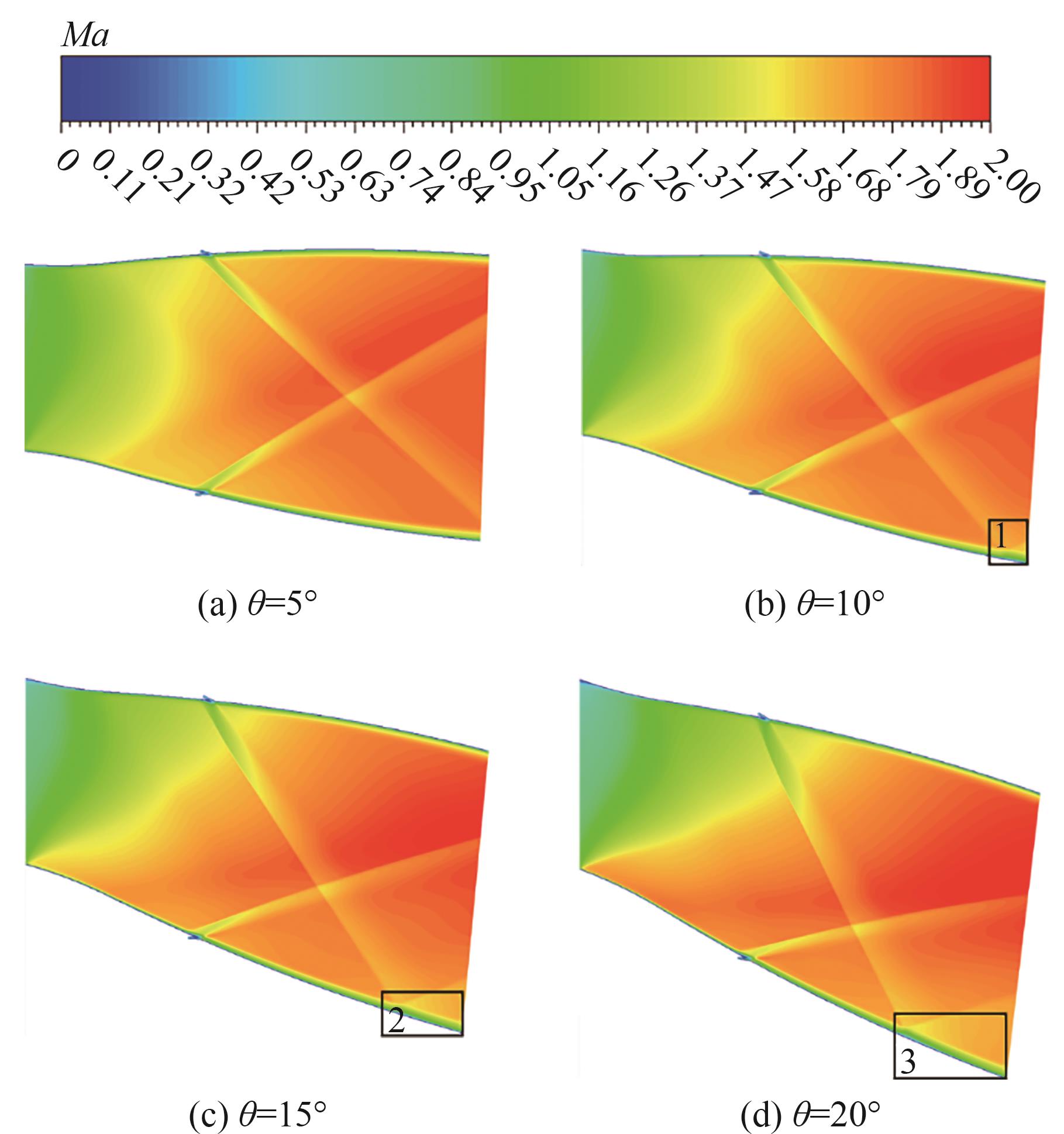
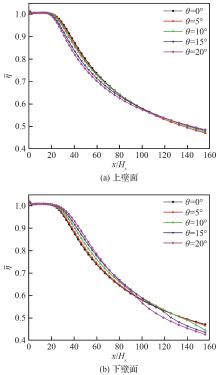
Fig.12
Streamwise distribution of lateral-averaged film cooling efficiency with different vector angles
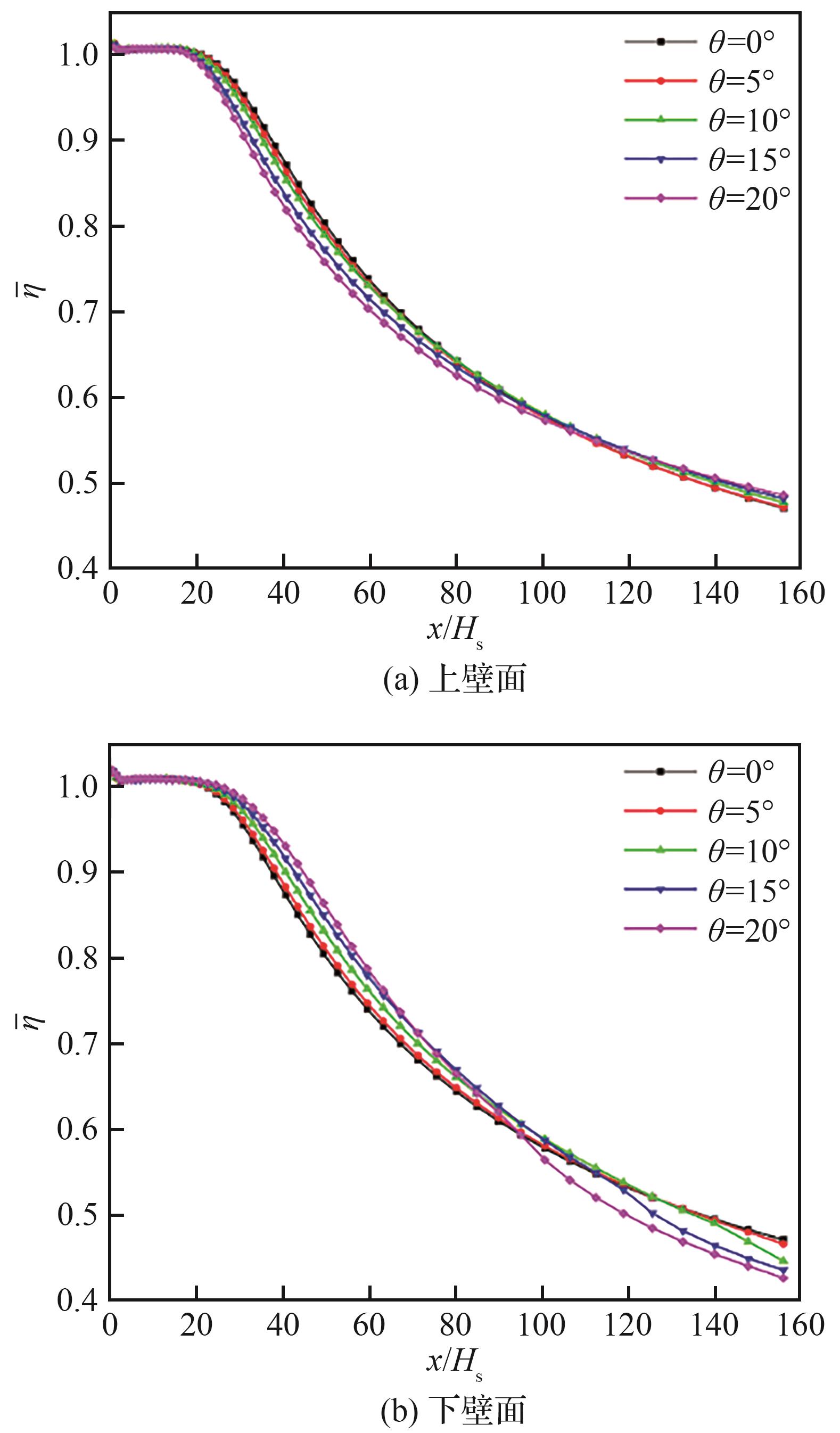
Table 2
Nozzle performance with different vector angles
| θ/(°) | cf/% | cd/% | σ |
|---|---|---|---|
| 0 | 98.37 | 95.80 | 0.965 3 |
| 5 | 98.37 | 95.81 | 0.965 4 |
| 10 | 98.39 | 95.78 | 0.965 3 |
| 15 | 98.39 | 95.75 | 0.964 8 |
| 20 | 98.39 | 95.71 | 0.964 1 |
Fig.13
Mach number contour on symmetry plane of nozzle with different injection locations
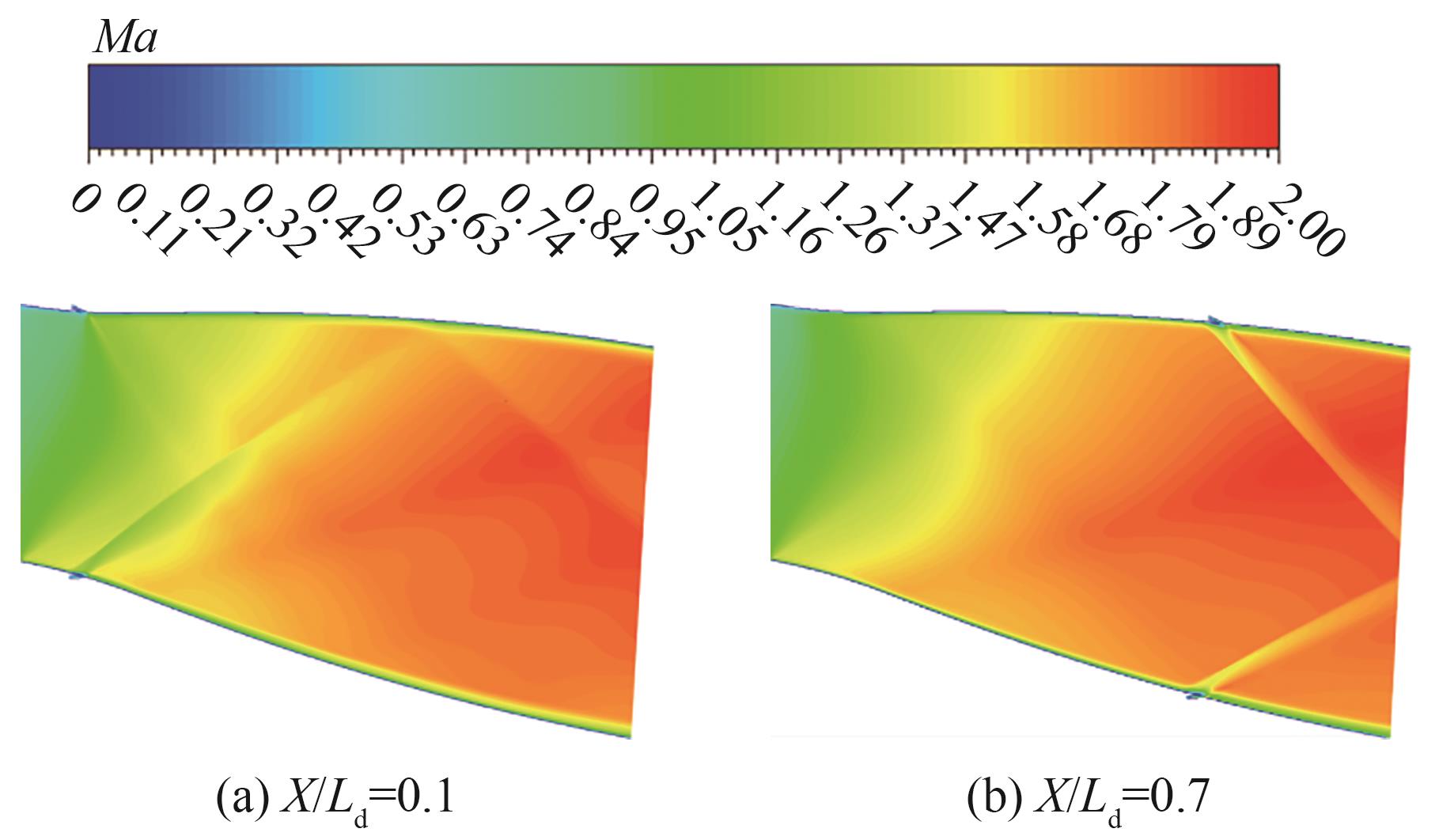
Fig.14
Streamwise distribution of lateral-averaged film cooling efficiency with different injection locations
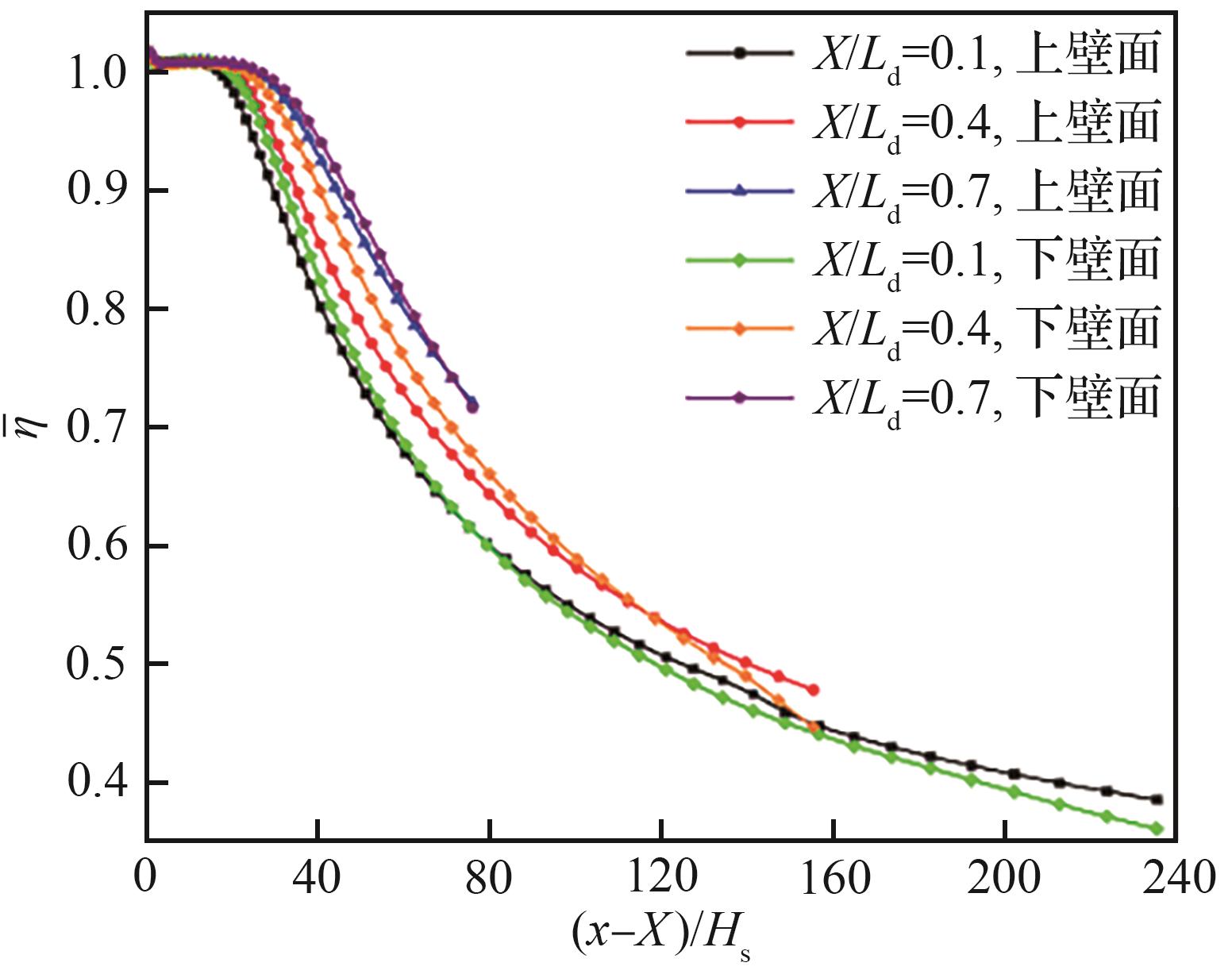
Fig.15
Mach number contour on symmetry plane of nozzle with multiple injection slots
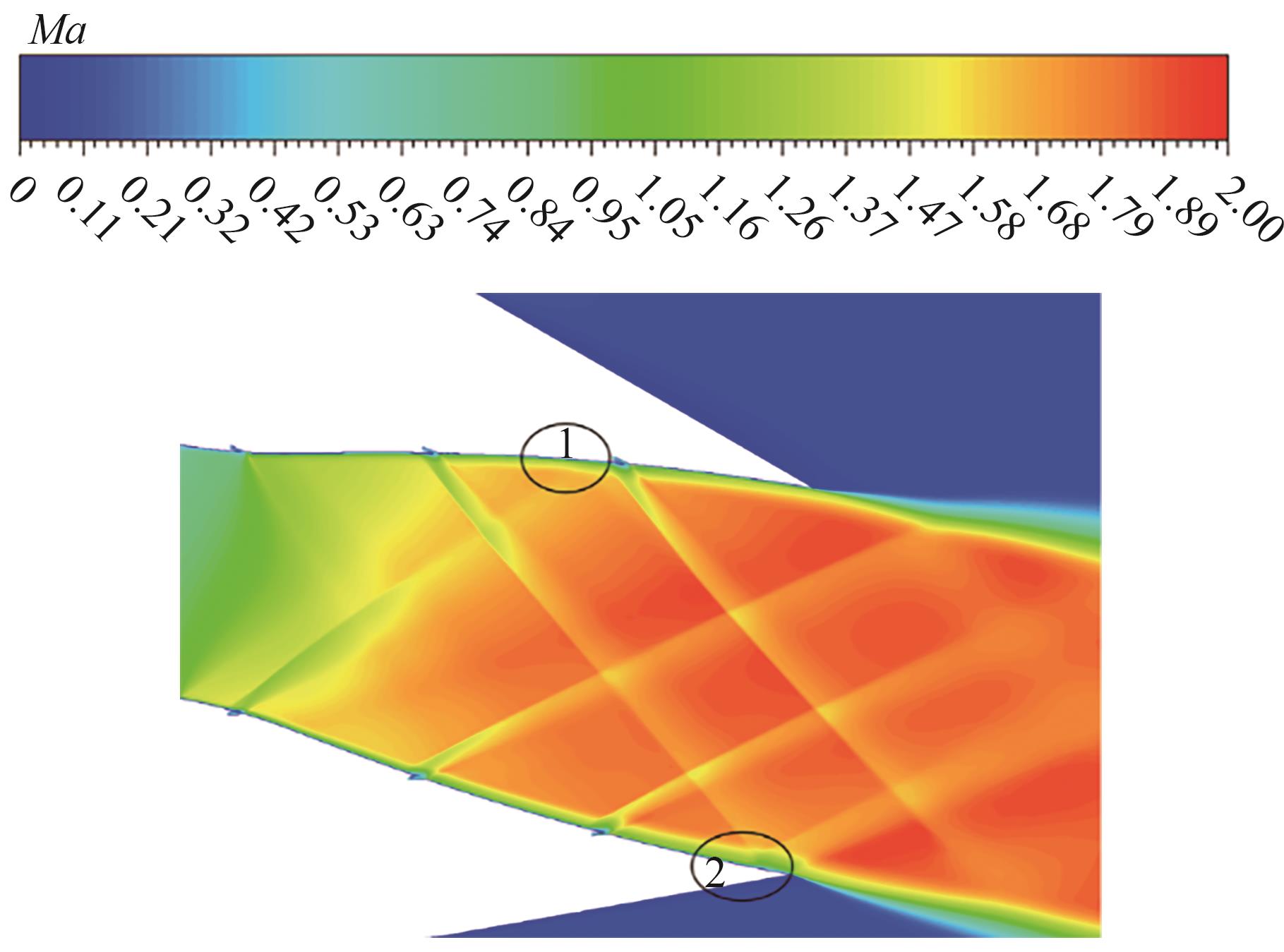
Fig.16
Streamwise distribution of lateral-averaged film cooling efficiency with different injection locations and multiple injection slots
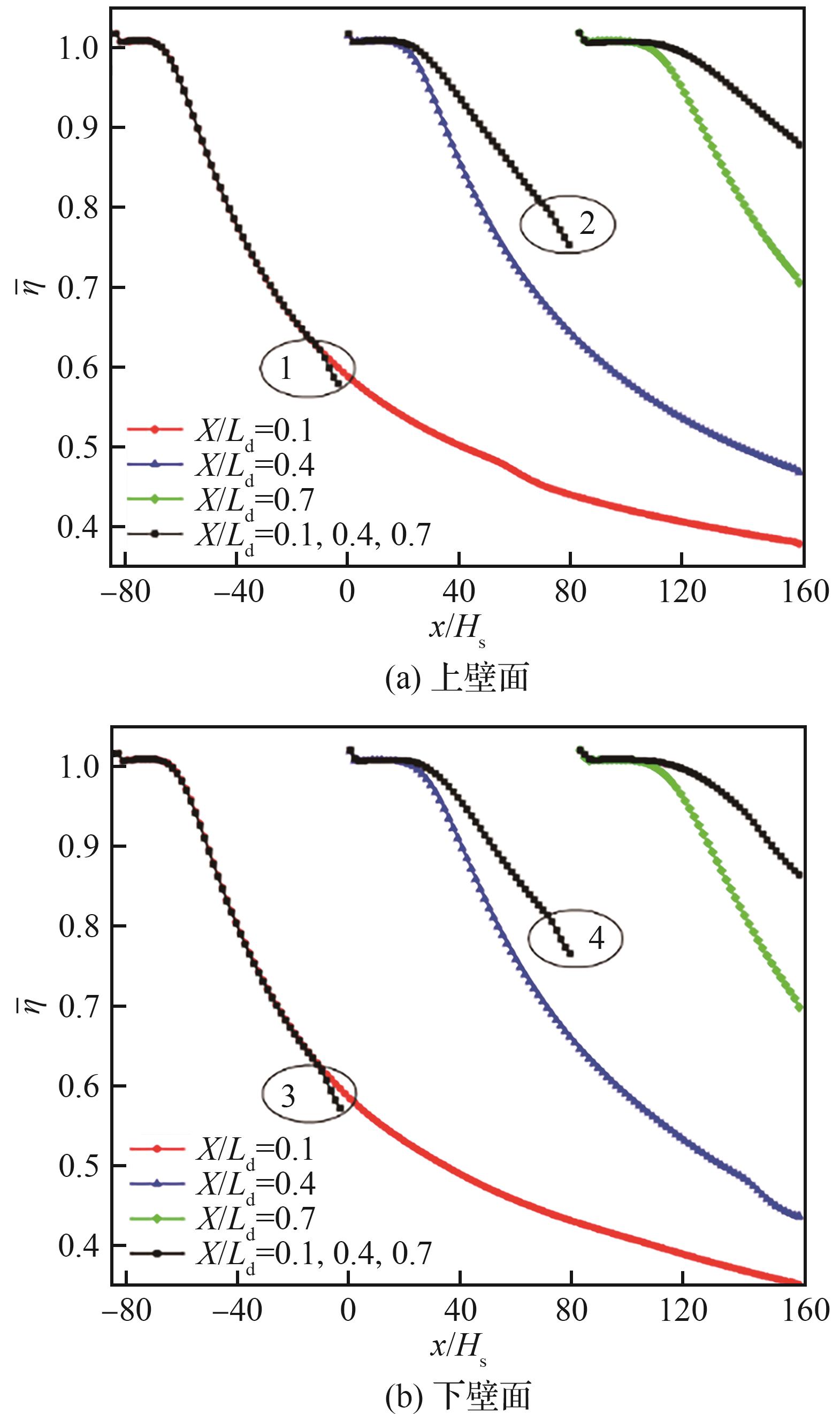
Table 3
Nozzle performance with different injection locations
| X/Ld | cf/% | cd/% | σ |
|---|---|---|---|
| 0.1 | 98.46 | 95.78 | 0.969 0 |
| 0.4 | 98.39 | 95.78 | 0.965 3 |
| 0.7 | 98.31 | 95.78 | 0.964 8 |
| 0.1,0.4,0.7 | 96.84 | 96.04 | 0.947 0 |
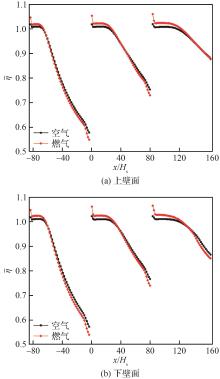
Fig.17
Streamwise distribution of lateral-averaged film cooling efficiency with different working fluids
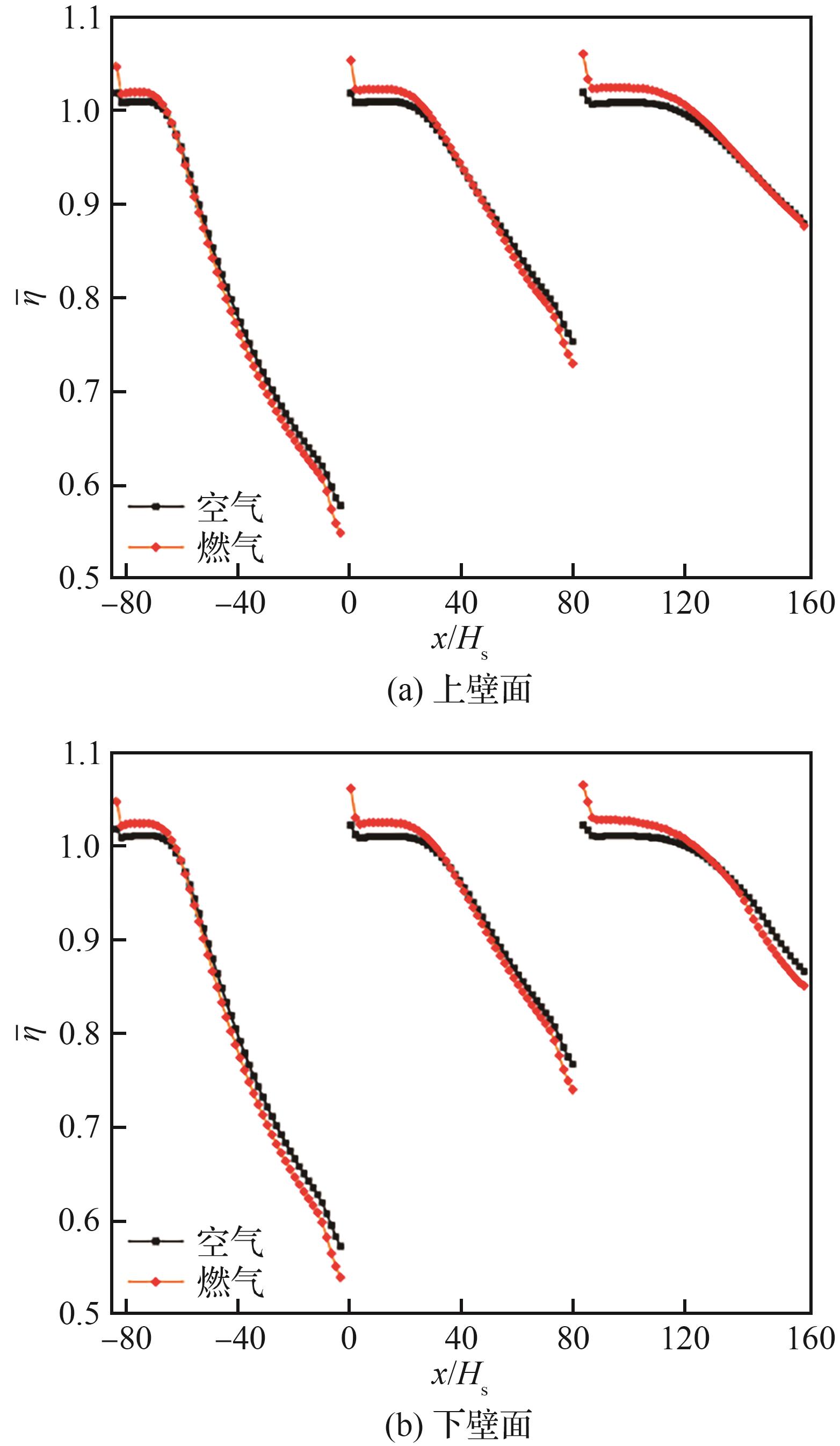
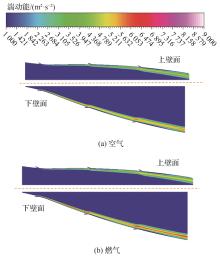
Fig.18
Turbulent kinetic energy contour in near wall region on symmetry plane of the nozzle with different working fluids
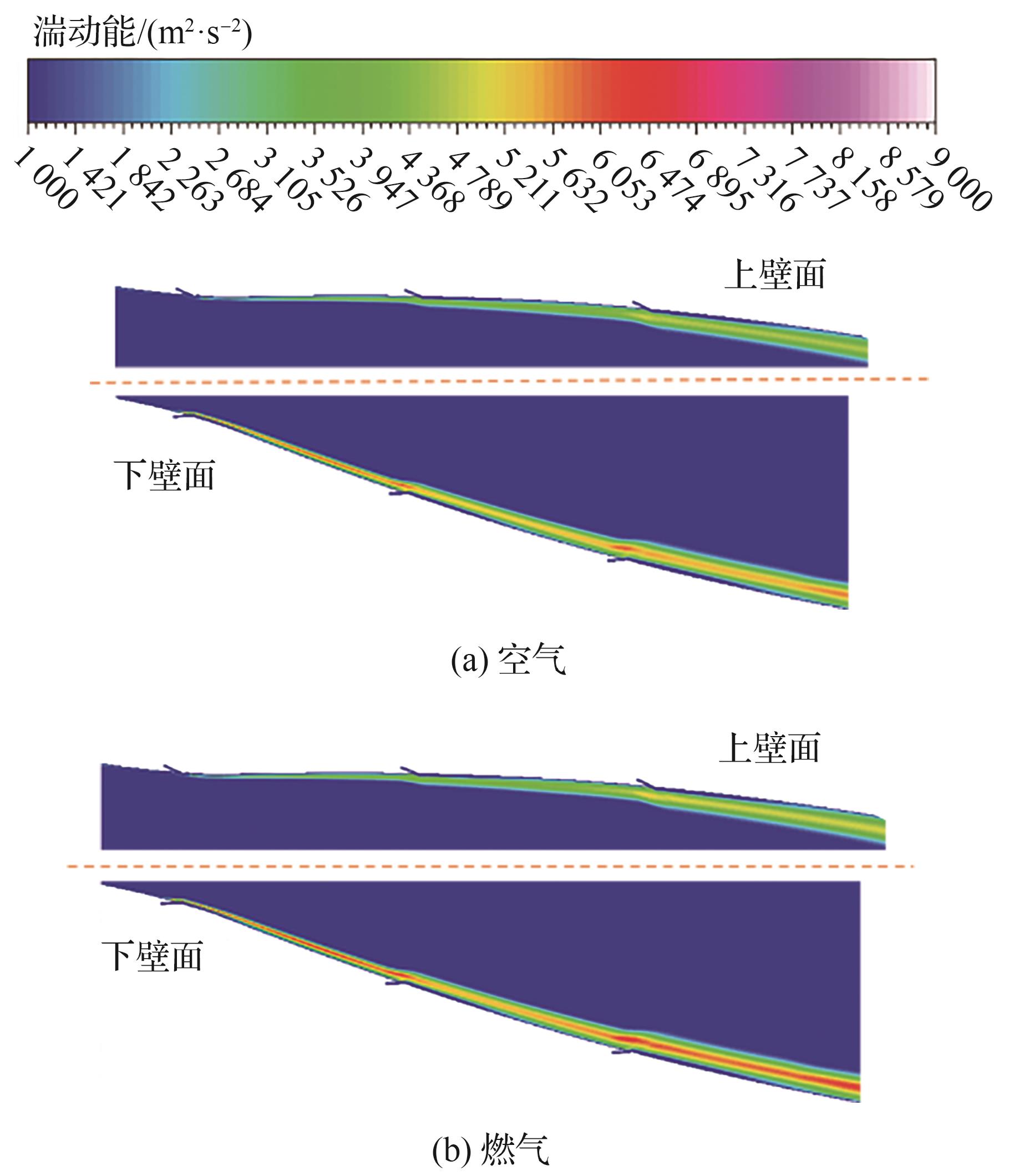
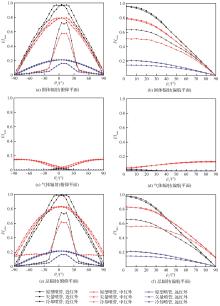
Fig.19
Distribution of integral infrared radiation intensity for different types of nozzles
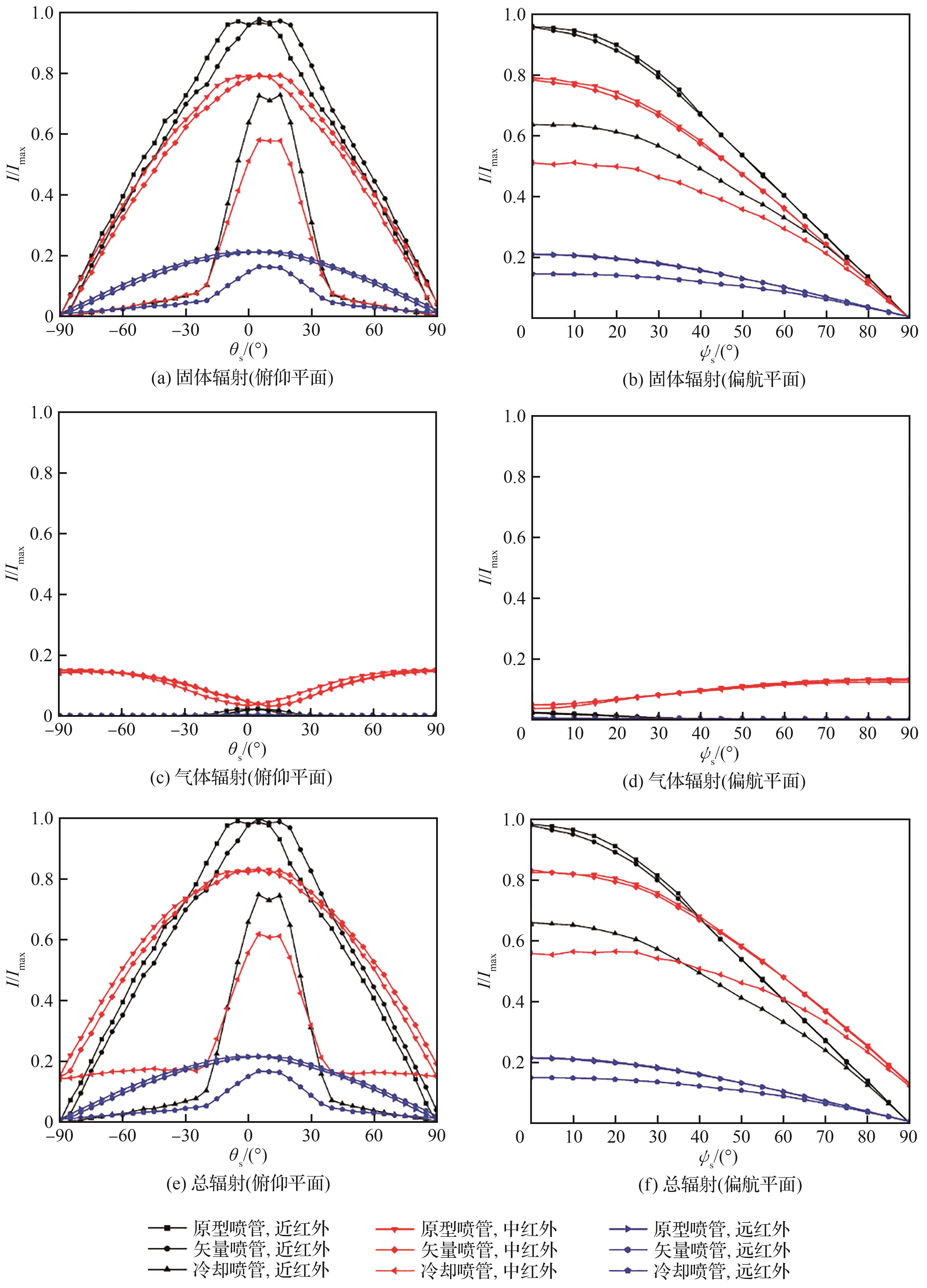
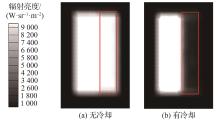
Fig.20
Brightness of infrared radiation for vector nozzle with/without film cooling (1~3 μm, θs=0°)
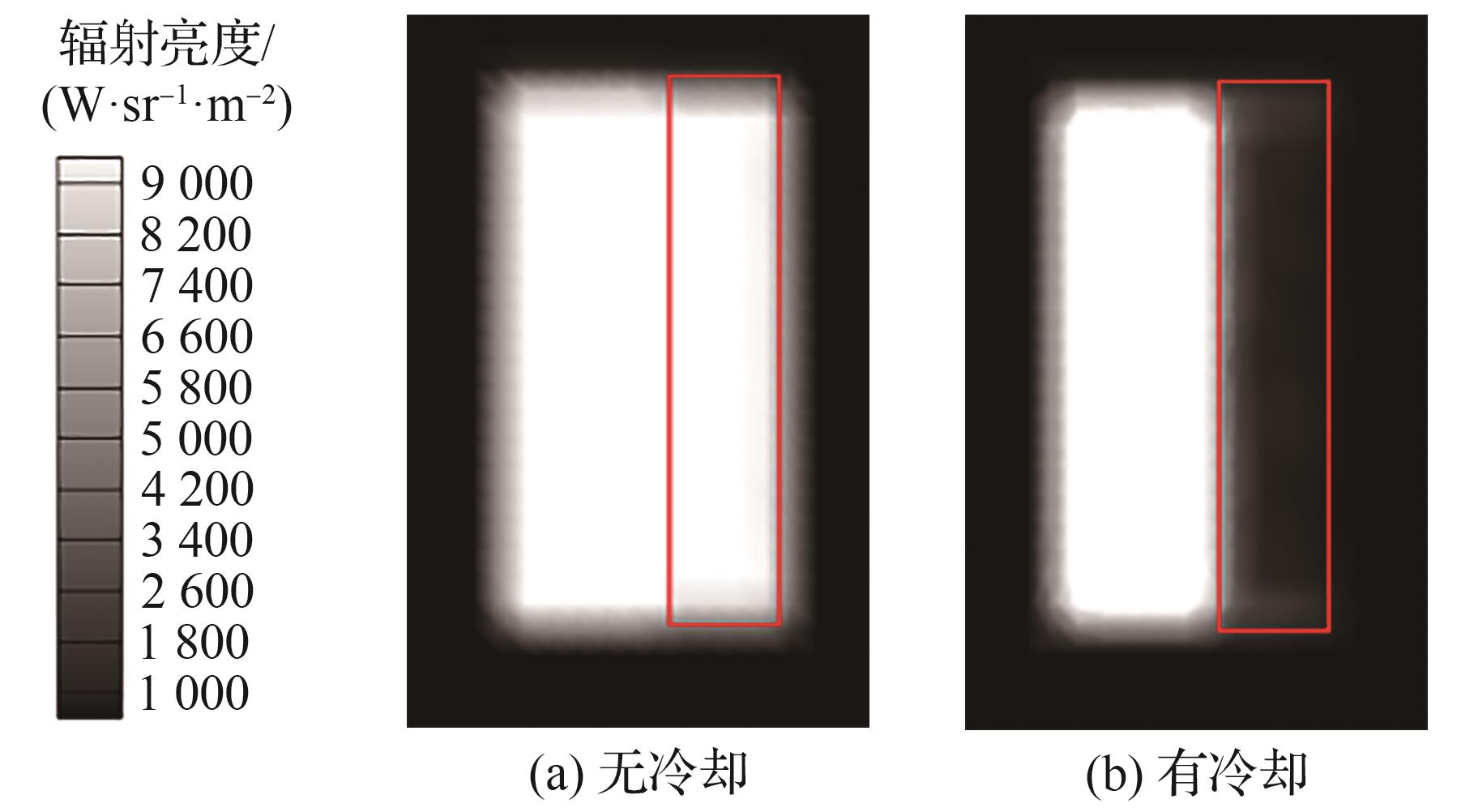
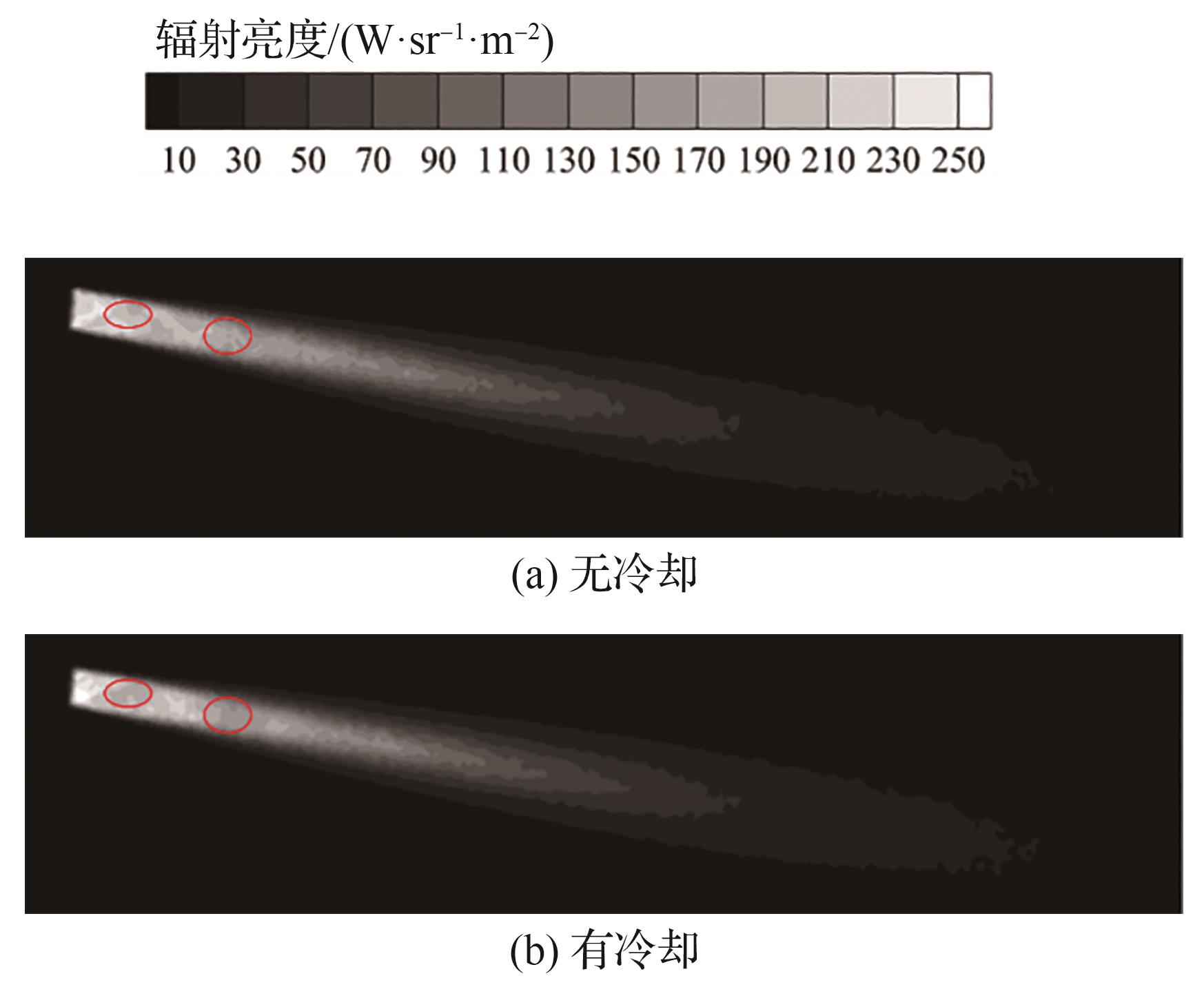
Fig.21
Brightness of infrared radiation for vector nozzlewith/without film cooling (3~5 μm, ψs=0°)
| 1 | 桑建华, 张勇. 飞行器红外隐身技术[J]. 航空科学技术, 2011, 22(5): 5-7. |
| SANG J H, ZHANG Y. Infrared stealth technology of air vehicles[J]. Aeronautical Science & Technology, 2011, 22(5): 5-7 (in Chinese). | |
| 2 | STRAIGHT D. Effect of shocks on film cooling of a full scale turbojet exhaust nozzle having an external expansion surface[C]∥15th Joint Propulsion Conference. Reston: AIAA, 1979. |
| 3 | STRAIGHT D, CULLOM R. Performance of a 2D-CD nonaxisymmetric exhaust nozzle on a turbojet engine at altitude[C]∥18th Joint Propulsion Conference. Reston: AIAA, 1982. |
| 4 | KONARSKI M, CLAYTON T. The J85 nonaxisym-metric nozzle design and cooling study: NASA-CR-135289[R]. Washington, D. C.: NASA,1978. |
| 5 | NOSEK S, STRAIGHT D. Heat-transfer characteristics of partially film cooled plug nozzle on a J-85 afterburning turbojet engine: NASA-TM-3362[R]. Washington, D. C.: NASA,1976. |
| 6 | LEBEDEV V P, LEMANOV V V, TEREKHOV V I. Film-cooling efficiency in a Laval nozzle under conditions of high freestream turbulence[J]. Journal of Heat Transfer, 2006, 128(6): 571-579. |
| 7 | SOMASEKHARAN N, SRIKRISHNAN A R, KUMAR H S, et al. Enhancement of film cooling effectiveness in a supersonic nozzle[J]. Entropy, 2023, 25(3): 481. |
| 8 | 额日其太, 王强, 吴寿生, 等. 喷管超声段壁面冷却热态试验研究[J]. 推进技术, 2001, 22(4): 322-325. |
| ERIQITAI, WANG Q, WU S S, et al. Hot-air experimental investigation of cooling applicable to exhaust nozzles[J]. Journal of Propulsion Technology, 2001, 22(4): 322-325 (in Chinese). | |
| 9 | 额日其太, 王志杰, 吴寿生. 高速热喷流条件下二元收扩喷管扩张段壁面冷却的初步试验研究[J]. 航空动力学报, 2002, 17(1): 40-44. |
| ERIQITAI, WANG Z J, WU S S. Preliminary experimental investigation on the divergent wall cooling of two dimensional C-D nozzles at high speed and hot jet conditions[J]. Journal of Aerospace Power, 2002, 17(1): 40-44 (in Chinese). | |
| 10 | 陈徐屹, 张小英. 轴对称矢量喷管的气膜冷却及红外辐射耦合计算分析[J]. 航空发动机, 2015, 41(5): 33-37. |
| CHEN X Y, ZHANG X Y. Coupled analysis of film-cooling and infrared characteristics of vectored axisymmetric nozzle[J]. Aeroengine, 2015, 41(5): 33-37 (in Chinese). | |
| 11 | 胡泽英, 邢云绯, 仲峰泉. 高超声速喷管气膜冷却流动与传热特性研究[J]. 推进技术, 2023, 44(12): 115-123. |
| HU Z Y, XING Y F, ZHONG F Q. Flow and heat transfer characteristics of film cooling on hypersonic nozzles[J]. Journal of Propulsion Technology, 2023, 44(12): 115-123 (in Chinese). | |
| 12 | JUHANY K A, HUNT M L. Flowfield measurements in supersonic film cooling including the effect of shock-wave interaction[J]. AIAA Journal, 1994, 32(3): 578-585. |
| 13 | GOLDSTEIN R J, ECKERT E R G, TSOU F K, et al. Film cooling with air and helium injection through a rearward-facing slot into a supersonic air flow[J]. AIAA Journal, 1966, 4(6): 981-985. |
| 14 | LIGRANI P M, SAUMWEBER C, SCHULZ A, et al. Shock wave-film cooling interactions in transonic flows[J]. Journal of Turbomachinery, 2001, 123(4): 788-797. |
| 15 | SHIAU C C, CHOWDHURY N H K, HAN J C, et al. Transonic turbine-vane film cooling with showerhead effect using pressure-sensitive paint measurement technique[J]. Journal of Thermophysics and Heat Transfer, 2018, 32(3): 637-647. |
| 16 | MARQUARDT P, KLAAS M, SCHRÖDER W. Experimental investigation of isoenergetic film-cooling flows with shock interaction[J]. AIAA Journal, 2019, 57(9): 3910-3923. |
| 17 | NI H, WANG M J, JIANG P X, et al. A numerical study of segmented cooling-stream injection in supersonic film cooling[J]. Chinese Journal of Aeronautics, 2022, 35(6): 156-171. |
| 18 | SONG C Q, SHEN C B. Effects of feeding Mach numbers on the flowfield structures of supersonic film cooling[J]. Journal of Thermophysics and Heat Transfer, 2018, 33(1): 264-270. |
| 19 | SONG C Q, SHEN C B. Effects of lip thickness on the flowfield structures of supersonic film cooling[J]. Journal of Thermophysics and Heat Transfer, 2018, 33(3): 599-605. |
| 20 | PETER J M F, KLOKER M J. Direct numerical simulation of supersonic turbulent flow with film cooling by wall-parallel blowing[J]. Physics of Fluids,2022, 34(2): 025125. |
| 21 | FU Q, LEI L Q, CHEN W, et al. Effect of mainstream Mach number on the flow characteristics and cooling effectiveness of supersonic film cooling[J]. Numerical Heat Transfer, Part A: Applications, 2023: 1–23. |
| 22 | 单勇, 张靖周. 波瓣喷管/气膜冷却混合管气动和红外辐射特性实验[J]. 航空学报, 2008, 29(2): 309-314. |
| SHAN Y, ZHANG J Z. Experimental on aerodynamic and infrared radiation characteristics of lobed nozzle/film cooling mixing duct[J]. Acta Aeronautica et Astronautica Sinica, 2008, 29(2): 309-314 (in Chinese). | |
| 23 | WANG H, JI H H, LU H H. Experimental investigation on infrared radiation characteristics of two-dimensional convergent-divergent vectoring nozzle[J]. Journal of Thermophysics and Heat Transfer, 2019, 33(3): 627-637. |
| 24 | YANG H Q, YANG Q Z, ZHANG S L, et al. Study on the influence of film cooling on the flow field and infrared radiation characteristics in the divergent section of a nozzle[C]∥ASME Turbo Expo 2020: Turbomachinery Technical Conference and Exposition. New York:ASME,2021. |
| 25 | 郑晨奂, 王强, 胡海洋. 加力隔热屏及中心锥冷却对二元收扩排气系统红外抑制效果数值分析[J]. 推进技术, 2023, 44(5): 203-213. |
| ZHENG C H, WANG Q, HU H Y. Numerical analysis of infrared suppression effect of afterburner heat shield and cone cooling on two-dimensional convergent-divergent exhaust system[J]. Journal of Propulsion Technology, 2023, 44(5): 203-213 (in Chinese). | |
| 26 | 朱友缘, 陈铭, 张海波. 带全遮挡导流支板排气系统流动传热及红外抑制效果数值分析[J]. 推进技术, 2024, 45(6): 2304060. |
| ZHU Y Y, CHEN M, ZHANG H B. Numerical analysis of flow and heat transfer in exhaust system with fully shielded guiding strut and infrared suppression effect[J]. Journal of Propulsion Technology, 2024, 45(6): 2304060 (in Chinese). | |
| 27 | JUHANY K A, HUNT M L, SIVO J M. Influence of injectant Mach number and temperature on supersonic film cooling[J]. Journal of Thermophysics and Heat Transfer, 1994, 8(1): 59-67. |
| 28 | KANDA T, ONO F, TAKAHASHI M, et al. Experimental studies of supersonic film cooling with shock wave interaction[J]. AIAA Journal, 1996, 34(2): 265-271. |
| 29 | ROACHE P J. Perspective: A method for uniform reporting of grid refinement studies[J]. Journal of Fluids Engineering, 1994, 116(3): 405-413. |
| 30 | ROACHE P J. Conservatism of the grid convergence index in finite volume computations on steady-state fluid flow and heat transfer[J]. Journal of Fluids Engineering, 2003, 125(4): 731-732. |
| 31 | CELIK I B, GHIA U, ROACHE P J, et al. Procedure for estimation and reporting of uncertainty due to discretization in CFD applications[J]. Journal of Fluids Engineering, 2008, 130(7): 078001. |
| [1] | He JIA, Wei JIANG, Wenlong BAO, Xin XU, Wei RONG, Li YU. Transonic/supersonic aerodynamic characteristics and fluid-structure interaction mechanism of flexible parachutes for planetary exploration [J]. Acta Aeronautica et Astronautica Sinica, 2025, 46(1): 630369-630369. |
| [2] | Dazhi SUN, Xi CHEN, Weicheng BAO, Wei BIAN, Qijun ZHAO. Interferences of high-speed helicopter fuselage on aerodynamic and aeroacoustic source characteristics of propeller [J]. Acta Aeronautica et Astronautica Sinica, 2024, 45(9): 529142-529142. |
| [3] | Yurou DAI, Jian LI, Xiaopeng XUE, Wei RONG. Aerodynamic characteristics of supersonic disk-gap-band parachute with different reefing ways [J]. Acta Aeronautica et Astronautica Sinica, 2024, 45(7): 128811-128811. |
| [4] | Chunyi YAO, Zheng ZHANG, Huiren ZHU. Influence mechanism of surface roughness on film cooling [J]. Acta Aeronautica et Astronautica Sinica, 2024, 45(24): 630661-630661. |
| [5] | Ming HUANG, Kaiyuan ZHANG, Zhigang LI, Jun LI. Uncertainty quantification of aerothermal performance of squealer tip with film cooling structure [J]. Acta Aeronautica et Astronautica Sinica, 2024, 45(19): 629979-629979. |
| [6] | Bin LI, Zenan ZHANG, Fei JIA, Jian SUN, Yanju LIU, Jinsong LENG. Research status and development trend of morphing wingtip technology [J]. Acta Aeronautica et Astronautica Sinica, 2024, 45(19): 30042-030042. |
| [7] | Shicheng ZHAO, Rong JIANG, Haoxiang GONG, Lu ZHANG, Xuping LU, Haiyong ZHA, Yingdong SONG. Effect of film cooling holes on creep properties of nickel-based single crystal superalloy [J]. Acta Aeronautica et Astronautica Sinica, 2024, 45(19): 429737-429737. |
| [8] | Yihui HAN, Jun HU, Yong YU, Jianqiao YU. Wind tunnel experimental verification of aerodynamic control force of cross⁃shaped flexible control surface [J]. Acta Aeronautica et Astronautica Sinica, 2024, 45(13): 129280-129280. |
| [9] | Dingyuan WEI, Silong ZHANG, Jianfei WEI, Jingying ZUO, Xin LI, Wen BAO. Thermal protection and drag reduction characteristics of discrete hole film cooling in high Mach number combustor [J]. Acta Aeronautica et Astronautica Sinica, 2024, 45(11): 529075-529075. |
| [10] | Siyuan CHANG, Yao XIAO, Guangli LI, Zhongwei TIAN, Kaikai ZHANG, Kai CUI. Effect of wing dihedral and anhedral angles on hypersonic aerodynamic characteristics of high-pressure capturing wing configuration [J]. ACTA AERONAUTICAET ASTRONAUTICA SINICA, 2023, 44(8): 127349-127349. |
| [11] | Wenlong BAO, He JIA, Xiaopeng XUE, Xuejiao HUANG, Shuyi GAO, Wei RONG, Qi WANG, Zhuangzhi WU. Influence of ‘windows’ structure on inflation process of ringsail parachute [J]. ACTA AERONAUTICAET ASTRONAUTICA SINICA, 2023, 44(5): 226936-226936. |
| [12] | Lei HE, Weiqi QIAN, Kangsheng DONG, Xian YI, Congcong CHAI. Aerodynamic characteristics modeling of iced airfoil based on convolution neural networks [J]. ACTA AERONAUTICAET ASTRONAUTICA SINICA, 2023, 44(5): 126434-126434. |
| [13] | Ming REN, Cunliang LIU, Kun DU, Li ZHANG, Huiren ZHU, Bolun ZHANG. Film cooling with compound angle holes in leading edge of twisted turbine blade [J]. Acta Aeronautica et Astronautica Sinica, 2023, 44(18): 128315-128315. |
| [14] | ZHOU Wei, MA Peiyang, GUO Zheng, WANG Daoping, ZHOU Ruisun. Research of combined fixed-wing UAV based on wingtip chained [J]. ACTA AERONAUTICAET ASTRONAUTICA SINICA, 2022, 43(9): 325946-325946. |
| [15] | AN Liping, WANG Hao, WANG Yangang, ZHU Zihuan. Wet compression performance and flow characteristics of transonic compressor [J]. ACTA AERONAUTICAET ASTRONAUTICA SINICA, 2022, 43(9): 126024-126024. |
| Viewed | ||||||
|
Full text |
|
|||||
|
Abstract |
|
|||||
Address: No.238, Baiyan Buiding, Beisihuan Zhonglu Road, Haidian District, Beijing, China
Postal code : 100083
E-mail:hkxb@buaa.edu.cn
Total visits: 6658907 Today visits: 1341All copyright © editorial office of Chinese Journal of Aeronautics
All copyright © editorial office of Chinese Journal of Aeronautics
Total visits: 6658907 Today visits: 1341

 CJA
CJA
