Acta Aeronautica et Astronautica Sinica ›› 2026, Vol. 47 ›› Issue (10): 632630.doi: 10.7527/S1000-6893.2025.32630
• Special Issue: Intelligent Processing and Analysis of Aerospace Remote Sensing Images • Previous Articles
Xu TANG( ), Feng GU, Jingjing MA, Xiangrong ZHANG
Received:2025-07-28
Revised:2025-09-08
Accepted:2025-09-30
Online:2025-10-28
Published:2025-10-24
Contact:
Xu TANG
E-mail:tangxu128@gmail.com
Supported by:CLC Number:
Xu TANG, Feng GU, Jingjing MA, Xiangrong ZHANG. Hyperspectral-LiDAR joint classification method based on vision-language pre-trained models[J]. Acta Aeronautica et Astronautica Sinica, 2026, 47(10): 632630.
Fig.1
Semantic-aware cross-modal fusion network and its core modules
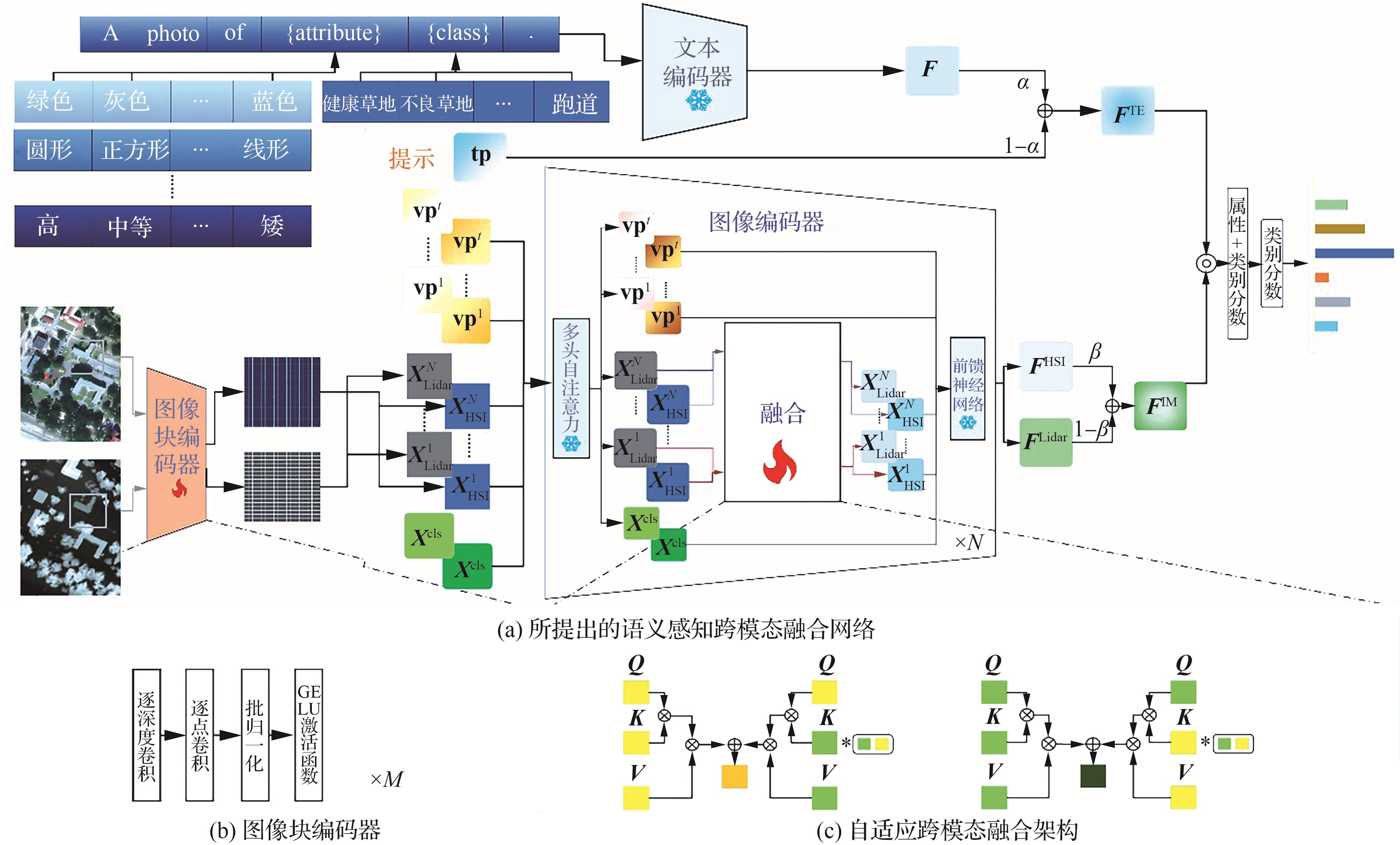
Fig.2
Visualization results of Houston 2013 dataset
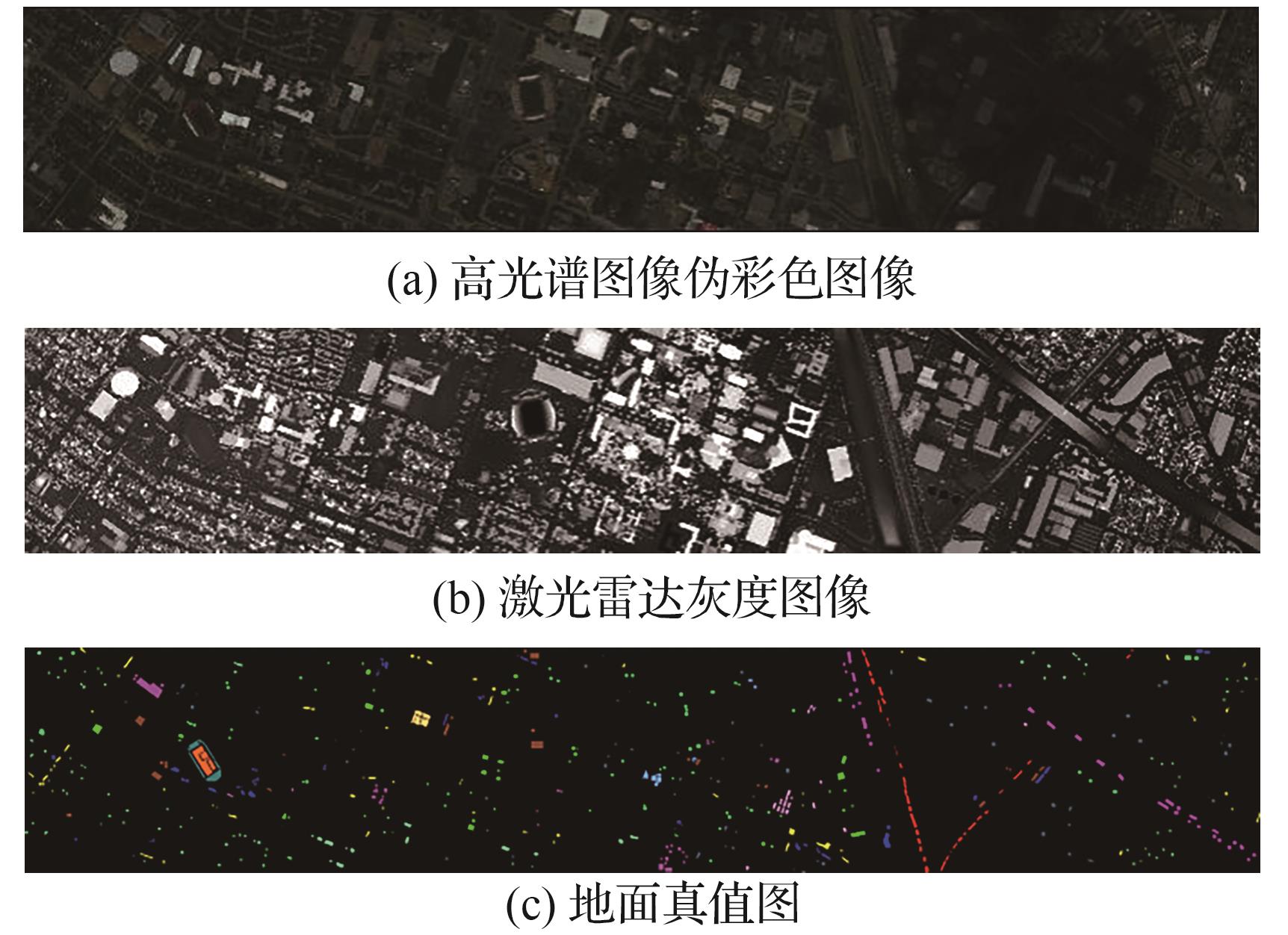
Fig.3
Visualization results of MUUFL dataset
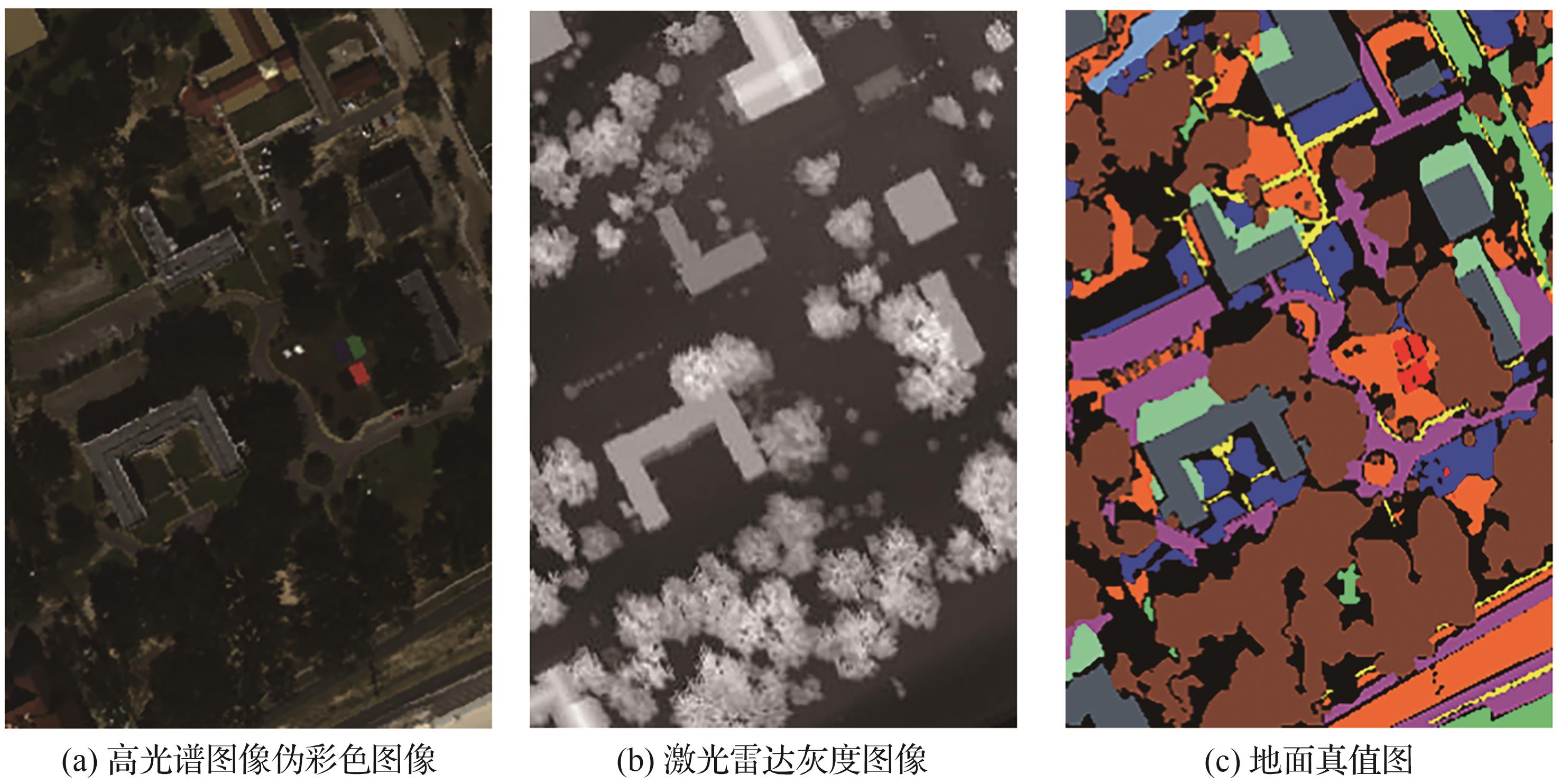
Fig.4
Visualization results of Trento dataset
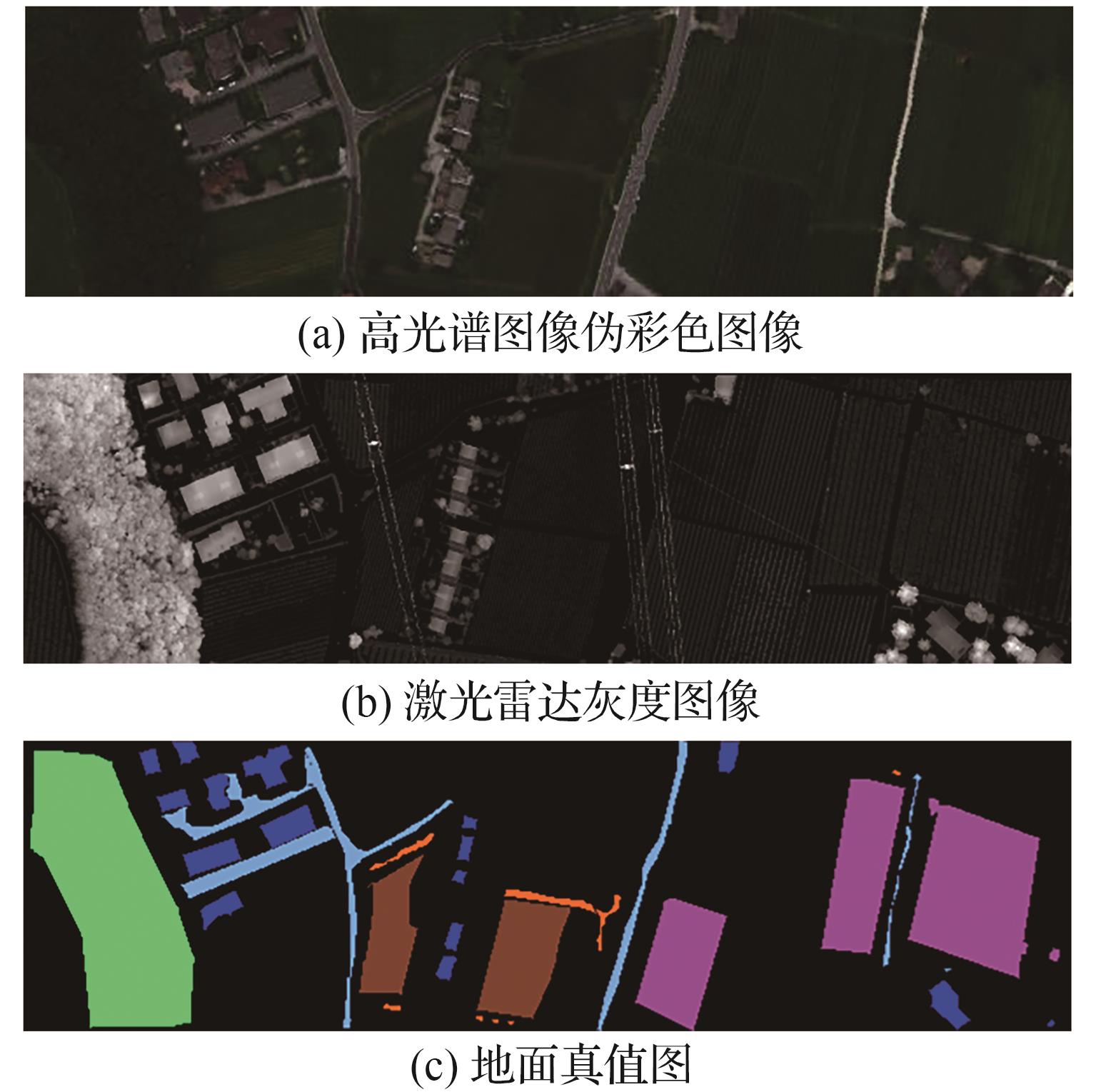
Table 1
Classification precision of different methods counted on Houston 2013 dataset
| 序号 | 类别 | 数量 | 分类精度/% | |||||||||
|---|---|---|---|---|---|---|---|---|---|---|---|---|
| 训练集 | 测试集 | IP-CNN | HRWN | Cross-HL | HyperMLP | TMCLNet | M2FNet | MGNet | SPT | SCF-Net | ||
| 1 | 健康草地 | 20 | 1 231 | 85.77 | 85.61 | 83.10 | 83.01 | 87.38 | 84.12 | 83.00 | 94.25 | 97.24* |
| 2 | 不良草地 | 20 | 1 234 | 87.34 | 85.17 | 97.37 | 84.49 | 97.80 | 95.24 | 85.15 | 95.90 | 99.51* |
| 3 | 人造草地 | 20 | 677 | 100.00* | 99.57 | 99.34 | 100.00* | 100.00* | 98.29 | 97.82 | 99.94 | 100* |
| 4 | 树木 | 20 | 1 224 | 94.26 | 92.20 | 97.30 | 98.48* | 98.82* | 95.68 | 92.61 | 98.33 | 97.55 |
| 5 | 土壤 | 20 | 1 222 | 98.42 | 100.00* | 99.94 | 100* | 98.31 | 99.12 | 100.00* | 99.82 | 100.00* |
| 6 | 水域 | 20 | 305 | 99.91 | 98.15 | 96.97 | 96.50 | 99.63 | 95.80 | 96.50 | 96.39 | 100.00* |
| 7 | 住宅区 | 20 | 1 248 | 94.59 | 95.98 | 80.15 | 83.44 | 91.70 | 92.22 | 92.63 | 96.22 | 99.05* |
| 8 | 商业区 | 20 | 1 224 | 91.81 | 97.59* | 91.01 | 80.63 | 86.78 | 90.90 | 91.83 | 76.88 | 97.06 |
| 9 | 道路 | 20 | 1 232 | 89.35 | 88.66 | 90.82 | 86.12 | 85.94 | 92.35 | 94.43* | 87.91 | 92.53 |
| 10 | 高速公路 | 20 | 1 207 | 72.43 | 86.23 | 58.86 | 79.54 | 92.26 | 76.31 | 95.17 | 86.18 | 95.28* |
| 11 | 铁路 | 20 | 1 215 | 96.57 | 97.98 | 98.77 | 94.31 | 98.99* | 94.44 | 97.34 | 91.37 | 89.06 |
| 12 | 停车场1 | 20 | 1 213 | 95.60 | 97.40* | 91.55 | 96.73 | 86.41 | 94.56 | 95.10 | 94.33 | 86.07 |
| 13 | 停车场2 | 20 | 449 | 94.37 | 91.47 | 90.49 | 88.07 | 99.01 | 91.15 | 84.56 | 95.32 | 99.78* |
| 14 | 网球场 | 20 | 408 | 99.86 | 100.00* | 99.96 | 99.19 | 97.76 | 99.35 | 100.00* | 99.80 | 100.00* |
| 15 | 跑道 | 20 | 640 | 99.99 | 100.00* | 98.64 | 99.58 | 99.89 | 98.26 | 99.58 | 100* | 100.00* |
Table 2
Classification accuracy of different methods counted on Houston 2013 dataset
| 方法 | OA/% | AA/% | Kappa/% |
|---|---|---|---|
| IP-CNN | 92.06±0.88 | 93.35±0.79 | 91.42±0.93 |
| HRWN | 93.61±0.65 | 94.40±0.49 | 93.09±0.61 |
| Cross-HL | 89.66±0.98 | 91.25±1.13 | 88.78±1.05 |
| HyperMLP | 81.00±2.32 | 89.86±0.89 | 89.03±0.86 |
| TMCLNet | 90.98±0.78 | 94.71±0.52 | 93.31±0.71 |
| M2FNet | 93.80±0.58 | 93.18±0.54 | 91.61±0.51 |
| MGNet | 93.20±0.28 | 93.72±0.36 | 92.61±0.33 |
| SPT | 93.23±0.46 | 94.18±0.39 | 92.68±0.43 |
| SCF-Net | 96.11*±0.21 | 96.87*±0.15 | 95.70*±0.13 |
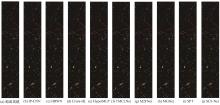
Fig.5
Classification maps of labeled samples of Houston 2013 dataset obtained by various methods
Table 3
Classification precision of different methods counted on MUUFL dataset
| 序号 | 类别 | 数量 | 分类精度/% | |||||||||
|---|---|---|---|---|---|---|---|---|---|---|---|---|
| 训练集 | 测试集 | IP-CNN | HRWN | Cross-HL | HyperMLP | TMCLNet | M2FNet | MGNet | SPT | SCF-Net | ||
| 1 | 树木 | 20 | 23 226 | 88.26 | 86.58 | 86.47 | 89.97 | 83.83 | 89.28 | 88.04 | 84.93 | 93.21* |
| 2 | 大部分草地 | 20 | 4 250 | 58.38 | 58.28 | 60.80 | 50.75 | 84.11* | 61.46 | 56.52 | 76.07 | 73.76 |
| 3 | 混合地面 | 20 | 6 862 | 47.32 | 64.85 | 54.02 | 70.37 | 67.02 | 64.16 | 68.14 | 73.93 | 76.43* |
| 4 | 泥土和沙子 | 20 | 1 806 | 87.32 | 85.94 | 93.52* | 92.91 | 88.71 | 87.60 | 87.54 | 89.27 | 90.65 |
| 5 | 道路 | 20 | 6 667 | 82.15 | 84.48 | 67.26 | 69.70 | 87.81 | 80.17 | 88.92 | 89.15* | 85.99 |
| 6 | 水 | 20 | 446 | 100.00* | 100.00* | 99.78 | 100.00* | 99.04 | 100.00* | 100.00* | 98.48 | 100.00* |
| 7 | 建筑物阴影 | 20 | 2 213 | 81.97 | 82.56 | 84.64 | 80.80 | 93.58* | 83.42 | 83.37 | 92.00 | 88.32 |
| 8 | 建筑物 | 20 | 6 220 | 90.72 | 94.18 | 89.16 | 94.79* | 87.92 | 90.23 | 90.48 | 91.21 | 93.14 |
| 9 | 人行道 | 20 | 1 365 | 63.44 | 52.53 | 56.19 | 45.35 | 66.47 | 57.51 | 60.66 | 76.01 | 81.88* |
| 10 | 黄色路缘 | 20 | 163 | 63.80 | 69.94 | 75.46 | 70.55 | 93.31 | 71.17 | 38.04 | 96.32 | 97.57* |
| 11 | 布质面板 | 20 | 249 | 94.38 | 95.98 | 95.98 | 93.98 | 98.92* | 93.57 | 95.98 | 95.18 | 96.01 |
Table 4
Classification accuracy of different methods counted on MUUFL dataset
| 方法 | OA/% | AA/% | Kappa/% |
|---|---|---|---|
| IP-CNN | 79.28±2.02 | 77.98±1.93 | 73.36±1.67 |
| HRWN | 81.21±1.83 | 79.57±0.97 | 75.88±1.54 |
| Cross-HL | 77.69±3.31 | 78.48±2.83 | 71.56±2.95 |
| HyperMLP | 81.00±2.32 | 78.11±1.98 | 75.26±0.71 |
| TMCLNet | 83.04±0.85 | 86.43±0.93 | 78.39±0.99 |
| M2FNet | 81.76±2.21 | 79.87±1.94 | 76.40±3.32 |
| MGNet | 82.45±1.94 | 77.97±2.14 | 77.34±1.53 |
| SPT | 84.48±0.91 | 87.50±0.36 | 80.16±0.72 |
| SCF-Net | 88.09*±1.24 | 88.69*±1.51 | 84.24*±1.63 |
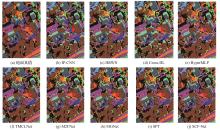
Fig.6
Classification maps of labeled samples of MUUFL dataset obtained by various methods
Table 5
Classification precision of different methods counted on Trento dataset
| 序号 | 类别 | 数量 | 分类精度/% | |||||||||
|---|---|---|---|---|---|---|---|---|---|---|---|---|
| 训练集 | 测试集 | IP-CNN | HRWN | Cross-HL | HyperMLP | TMCLNet | M2FNet | MGNet | SPT | SCF-Net | ||
| 1 | 苹果树 | 20 | 4 014 | 99.00 | 99.75 | 99.32 | 100.00* | 99.40 | 99.20 | 99.62 | 99.48 | 99.18 |
| 2 | 建筑物 | 20 | 2 883 | 99.40* | 94.32 | 95.32 | 98.66 | 97.82 | 98.15 | 98.81 | 97.73 | 97.95 |
| 3 | 地面 | 20 | 459 | 99.10 | 98.75 | 97.62 | 93.94 | 97.27 | 97.11 | 88.24 | 98.56 | 100.00* |
| 4 | 树林 | 20 | 9 103 | 99.92 | 100.00* | 99.89 | 100.00* | 99.93 | 99.99 | 99.99 | 99.98 | 100.00* |
| 5 | 葡萄园 | 20 | 10 481 | 99.66 | 100.00* | 99.97 | 99.99 | 98.13 | 99.99 | 100.00* | 99.66 | 99.97 |
| 6 | 道路 | 20 | 3 154 | 90.21 | 94.90 | 94.17 | 94.77 | 95.00 | 97.95 | 95.45 | 95.68 | 97.34* |
Table 6
Classification accuracy of different methods counted on Trento dataset
| 方法 | OA/% | AA/% | Kappa/% |
|---|---|---|---|
| IP-CNN | 98.58±0.54 | 97.88±1.19 | 98.17±1.03 |
| HRWN | 81.21±1.83 | 97.95±1.43 | 98.48±1.26 |
| Cross-HL | 98.69±1.03 | 97.47±1.45 | 98.25±1.17 |
| HyperMLP | 99.22±0.29 | 97.89±1.14 | 98.96±1.09 |
| TMCLNet | 98.58±0.26 | 97.93±1.02 | 98.07±0.83 |
| M2FNet | 99.40±0.12 | 98.73±0.43 | 99.26±0.18 |
| MGNet | 99.21±0.42 | 97.02±1.34 | 98.94±0.83 |
| SPT | 99.11±0.53 | 98.51±0.97 | 98.81±0.81 |
| SCF-Net | 99.41*±0.15 | 99.07*±0.08 | 99.21*±0.12 |
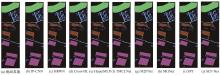
Fig.7
Classification maps of labeled samples of Trento dataset obtained by various methods
Table 7
Ablation study results of SCF-Net each component on three datasets
| 组合 | 模块 | Houston 2013 | MUUFL | Trento | ||||||||
|---|---|---|---|---|---|---|---|---|---|---|---|---|
| PE | ACMF | DACTR | OA/% | AA/% | Kappa/% | OA/% | AA/% | Kappa/% | OA/% | AA/% | Kappa/% | |
| 1 | √ | 95.90 | 96.64 | 95.49 | 87.85 | 88.46 | 83.97 | 99.17 | 98.53 | 98.92 | ||
| 2 | √ | 95.79 | 96.48 | 95.42 | 87.74 | 88.39 | 83.89 | 98.95 | 98.48 | 98.84 | ||
| 3 | √ | 95.85 | 96.52 | 95.38 | 87.69 | 88.43 | 83.81 | 98.90 | 98.41 | 98.79 | ||
| 4 | √ | √ | 96.06 | 96.73 | 95.58 | 87.97 | 88.59 | 84.13 | 99.34 | 98.89 | 99.11 | |
| 5 | √ | √ | 95.84 | 96.59 | 95.51 | 87.89 | 88.51 | 83.98 | 99.28 | 98.76 | 99.03 | |
| 6 | √ | √ | 95.92 | 96.66 | 95.45 | 87.92 | 88.53 | 84.05 | 99.25 | 98.82 | 99.07 | |
| 7 | √ | √ | √ | 96.11* | 96.87* | 95.70* | 88.09* | 88.69* | 84.24* | 99.41* | 99.07* | 99.21* |
Fig.8
Feature distribution maps of SPT and SCF-Net on three datasets
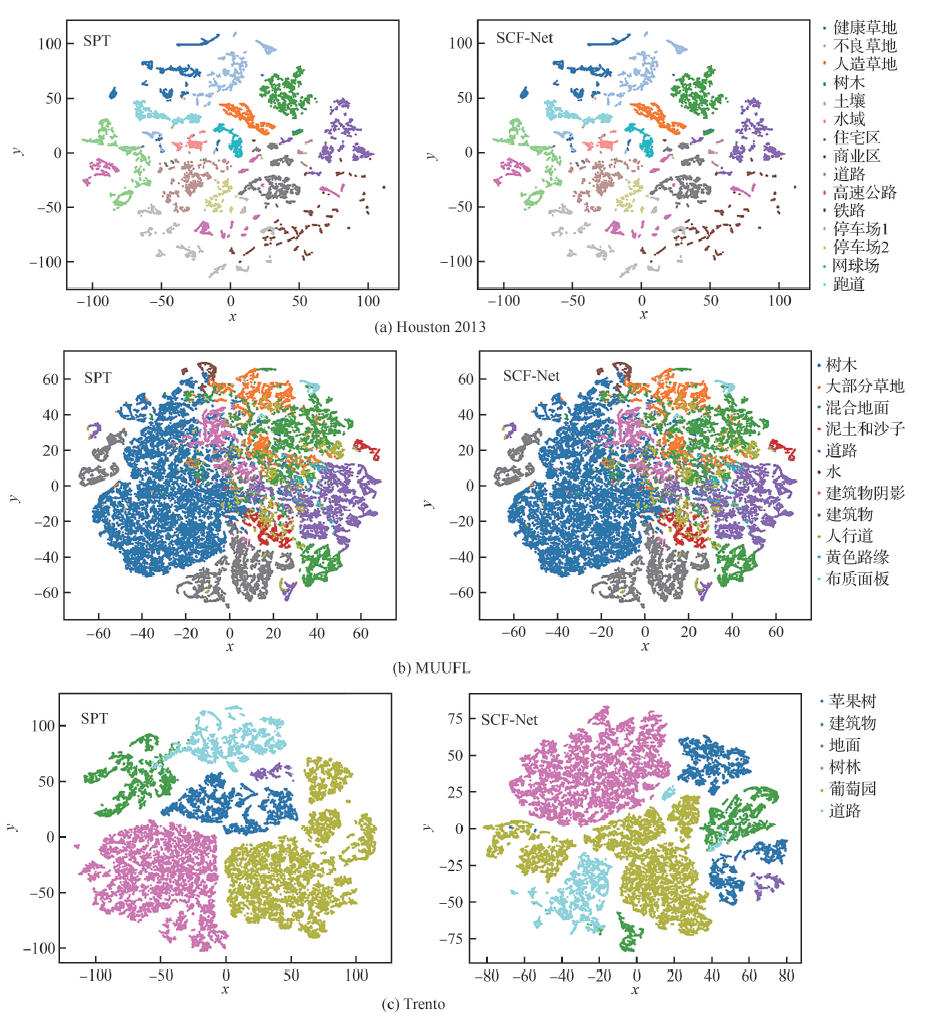
Table 8
Model size, training time, and inference time of each method on Houston 2013 dataset
| 方法 | 模型大小/MB | 训练时间/s | 推理时间/s |
|---|---|---|---|
| IP-CNN | 1.53 | 180.75 | 43.01 |
| HRWN | 1.33 | 360.92 | 20.86 |
| Cross-HL | 1.74 | 312.90 | 11.18 |
| HyperMLP | 1.52 | 174.10* | 5.43* |
| TMCLNet | 1.17 | 676.88 | 15.57 |
| M2FNet | 1.28 | 446.56 | 38.82 |
| MGNet | 1.35 | 363.12 | 28.46 |
| SPT | 16.34 | 608.34 | 14.75 |
| SCF-Net | 0.52* | 274.68 | 12.94 |
| [1] | XU K, WANG B J, ZHU Z, et al. A contrastive learning enhanced adaptive multimodal fusion network for hyperspectral and LiDAR data classification[J]. IEEE Transactions on Geoscience and Remote Sensing, 2025, 63: 4700319. |
| [2] | CHANG H H, BI H X, LI F, et al. Deep symmetric fusion transformer for multimodal remote sensing data classification[J]. IEEE Transactions on Geoscience and Remote Sensing, 2024, 62: 5644115. |
| [3] | 李晓航, 周建江. 基于自适应记忆长度的多尺度模态融合网络[J]. 航空学报, 2023, 44(22): 628977. |
| LI X H, ZHOU J J. Multi-scale modality fusion network based on adaptive memory length[J]. Acta Aeronautica et Astronautica Sinica, 2023, 44(22): 628977 (in Chinese). | |
| [4] | ZHU F, SHI C P, SHI K J, et al. Joint classification of hyperspectral and LiDAR data using hierarchical multimodal feature aggregation-based multihead axial attention transformer[J]. IEEE Transactions on Geoscience and Remote Sensing, 2025, 63: 5503817. |
| [5] | ZHANG M M, ZHAO Y Y, CHEN R J, et al. Remote sensing collaborative classification using multimodal adaptive modulation network[J]. IEEE Transactions on Geoscience and Remote Sensing, 2024, 62: 5529512. |
| [6] | MENG X C, ZHANG S F, LIU Q, et al. Uncertain category-aware fusion network for hyperspectral and LiDAR joint classification[J]. IEEE Transactions on Geoscience and Remote Sensing, 2024, 62: 5523015. |
| [7] | LIAO D L, WANG Q S, LAI T, et al. Joint classification of hyperspectral and LiDAR data based on mamba[J]. IEEE Transactions on Geoscience and Remote Sensing, 2024, 62: 5530915. |
| [8] | HU W S, LI W, LI H C, et al. Global clue-guided cross-memory quaternion transformer network for multisource remote sensing data classification[J]. IEEE Transactions on Neural Networks and Learning Systems, 2025, 36(4): 7357-7371. |
| [9] | CAI Y M, ZHANG Z J, LIU X B, et al. Learning unified anchor graph for joint clustering of hyperspectral and LiDAR data[J]. IEEE Transactions on Neural Networks and Learning Systems, 2025, 36(4): 6341-6354. |
| [10] | 冯燕, 贾应彪, 曹宇明, 等. 高光谱图像压缩感知投影与复合正则重构[J]. 航空学报, 2012, 33(8): 1466-1473. |
| FENG Y, JIA Y B, CAO Y M, et al. Compressed sensing projection and compound regularizer reconstruction for hyperspectral images[J]. Acta Aeronautica et Astronautica Sinica, 2012, 33(8): 1466-1473 (in Chinese). | |
| [11] | YU W B, HUANG H, SHEN Y, et al. IamCSC: Intuitive assimilation modality driven crossmodal subspace clustering for land-cover identification and hyperspectral-LiDAR fusion[J]. IEEE Transactions on Geoscience and Remote Sensing, 2025, 63: 5505013. |
| [12] | HU Y T, HU Q W, LI J Y. CMINet: A unified cross-modal integration framework for crop classification from satellite image time series[J]. IEEE Transactions on Geoscience and Remote Sensing, 2025, 63: 4402213. |
| [13] | WANG L F, MEI S H, WANG Y, et al. CAMCFormer: Cross-attention and multicorrelation aided transformer for few-shot object detection in optical remote sensing images[J]. IEEE Transactions on Geoscience and Remote Sensing, 2025, 63: 5613316. |
| [14] | FU X Y, ZHOU X, FU Y W, et al. Progressive semantic enhancement network for hyperspectral and LiDAR classification[J]. IEEE Transactions on Neural Networks and Learning Systems, 2025, 36(6): 11327-11339. |
| [15] | GUO F M, LI Z W, REN G B, et al. Instance-wise domain generalization for cross-scene wetland classification with hyperspectral and LiDAR data[J]. IEEE Transactions on Geoscience and Remote Sensing, 2025, 63: 5501212. |
| [16] | DONG W Q, ZHANG T, QU J H, et al. Multibranch feature fusion network with self-and cross-guided attention for hyperspectral and LiDAR classification[J]. IEEE Transactions on Geoscience and Remote Sensing, 2022, 60: 5530612. |
| [17] | FENG Y N, JIN J R, YIN Y, et al. MCFT: Multimodal contrastive fusion transformer for classification of hyperspectral image and LiDAR data[J]. IEEE Transactions on Geoscience and Remote Sensing, 2024, 62: 5537017. |
| [18] | KONG Y, YU S C, CHENG Y H, et al. Joint classification of hyperspectral images and LiDAR data based on candidate pseudo labels pruning and dual mixture of experts[J]. IEEE Transactions on Geoscience and Remote Sensing, 2025, 63: 5505912. |
| [19] | YANG C, ZHAO M H, BRUZZONE L, et al. Cross-modality adaptive feature fusion for multitype and multiscale impact craters identification on Mars[J]. IEEE Transactions on Geoscience and Remote Sensing, 2025, 63: 5613013. |
| [20] | WANG X H, SONG L Y, FENG Y N, et al. S3F2Net: Spatial-spectral-structural feature fusion network for hyperspectral image and LiDAR data classification[J]. IEEE Transactions on Circuits and Systems for Video Technology, 2025, 35(5): 4801-4815. |
| [21] | JIN X D, GU Y F, LIU T Z, et al. Supervoxel-based intrinsic scene properties from hyperspectral images and LiDAR[J]. IEEE Transactions on Geoscience and Remote Sensing, 2022, 60: 5510613. |
| [22] | ZHU B E, TANG K H, SUN Q R, et al. Generalized logit adjustment: Calibrating fine-tuned models by removing label bias in foundation models[C]∥37th International Conference on Neural Information Processing Systems. 2023. |
| [23] | MALLADI S, GAO T Y, NICHANI E, et al. Fine-tuning language models with just forward passes[C]∥37th International Conference on Neural Information Processing Systems. 2023. |
| [24] | HU E J, SHEN Y L, WALLIS P, et al. LoRA: Low-rank adaptation of large language models[C]∥10th International Conference on Learning Representations. 2022. |
| [25] | JIA M L, TANG L M, CHEN B C, et al. Visual prompt tuning[C]∥European Conference on Computer Vision 2022. 2022: 709-727. |
| [26] | HOULSBY N, GIURGIU A, JASTRZEBSKI S, et al. Parameter-efficient transfer learning for NLP[C]∥International Conference on Machine Learning. 2019. |
| [27] | QU J H, YANG Y B, DONG W Q, et al. LDS2AE: Local diffusion shared-specific autoencoder for multimodal remote sensing image classification with arbitrary missing modalities[C]∥AAAI Conference on Artificial Intelligence. 2024: 14731-14739. |
| [28] | PEDERGNANA M, MARPU P R, DALLA MURA M, et al. Classification of remote sensing optical and LiDAR data using extended attribute profiles[J]. IEEE Journal of Selected Topics in Signal Processing, 2012, 6(7): 856-865. |
| [29] | CHINI M, PIERDICCA N, EMERY W J. Exploiting SAR and VHR optical images to quantify damage caused by the 2003 bam earthquake[J]. IEEE Transactions on Geoscience and Remote Sensing, 2009, 47(1): 145-152. |
| [30] | RASTI B, GHAMISI P. Remote sensing image classification using subspace sensor fusion[J]. Information Fusion, 2020, 64: 121-130. |
| [31] | RASTI B, ULFARSSON M O, SVEINSSON J R. Hyperspectral feature extraction using total variation component analysis[J]. IEEE Transactions on Geoscience and Remote Sensing, 2016, 54(12): 6976-6985. |
| [32] | ROY S K, SUKUL A, JAMALI A, et al. Cross hyperspectral and LiDAR attention transformer: An extended self-attention for land use and land cover classification[J]. IEEE Transactions on Geoscience and Remote Sensing, 2024, 62: 5512815. |
| [33] | DING K X, LU T, FU W, et al. Global-local transformer network for HSI and LiDAR data joint classification[J]. IEEE Transactions on Geoscience and Remote Sensing, 2022, 60: 5541213. |
| [34] | ROY S K, DERIA A, HONG D F, et al. Hyperspectral and LiDAR data classification using joint CNNs and morphological feature learning[J]. IEEE Transactions on Geoscience and Remote Sensing, 2022, 60: 5530416. |
| [35] | HANG R L, LI Z, GHAMISI P, et al. Classification of hyperspectral and LiDAR data using coupled CNNs[J]. IEEE Transactions on Geoscience and Remote Sensing, 2020, 58(7): 4939-4950. |
| [36] | JIA S, ZHOU X, JIANG S G, et al. Collaborative contrastive learning for hyperspectral and LiDAR classification[J]. IEEE Transactions on Geoscience and Remote Sensing, 2023, 61: 5507714. |
| [37] | XIA S X, ZHANG X H, MENG H Y, et al. Ternary modality contrastive learning for hyperspectral and LiDAR data classification[J]. IEEE Transactions on Geoscience and Remote Sensing, 2024, 62: 5522017. |
| [38] | AGIZA A, NESEEM M, REDA S. MTLoRA: A low-rank adaptation approach for efficient multi-task learning[C]∥2024 IEEE/CVF Conference on Computer Vision and Pattern Recognition. Piscataway: IEEE Press, 2024: 16196-16205. |
| [39] | WU J L, HU X, WANG Y Q, et al. Omni-SMoLA: Boosting generalist multimodal models with soft mixture of low-rank experts[C]∥2024 IEEE/CVF Conference on Computer Vision and Pattern Recognition. Piscataway: IEEE Press, 2024: 14205-14215. |
| [40] | IMTIAZ HOSSAIN M R, SIAM M, SIGAL L, et al. Visual prompting for generalized few-shot segmentation: A multi-scale approach[C]∥2024 IEEE/CVF Conference on Computer Vision and Pattern Recognition. Piscataway: IEEE Press, 2024: 23470-23480. |
| [41] | KIM B, YU J, HWANG S J. ECLIPSE: Efficient continual learning in panoptic segmentation with visual prompt tuning[C]∥2024 IEEE/CVF Conference on Computer Vision and Pattern Recognition. Piscataway: IEEE Press, 2024: 3346-3356. |
| [42] | KONG Y, CHENG Y H, CHEN Y, et al. Joint classification of hyperspectral image and LiDAR data based on spectral prompt tuning[J]. IEEE Transactions on Geoscience and Remote Sensing. Piscataway: IEEE Press, 2024, 62: 5521312. |
| [43] | ZHU P F, SUN Y, CAO B, et al. Task-customized mixture of adapters for general image fusion[C]∥2024 IEEE/CVF Conference on Computer Vision and Pattern Recognition. Piscataway: IEEE Press, 2024: 7099-7108. |
| [44] | YIN D S, YANG Y R, WANG Z C, et al. 1% VS 100%: Parameter-efficient low rank adapter for dense predictions[C]∥2023 IEEE/CVF Conference on Computer Vision and Pattern Recognition. Piscataway: IEEE Press, 2023: 20116-20126. |
| [45] | GE C R, DU Q, SUN W W, et al. Deep residual network-based fusion framework for hyperspectral and LiDAR data[J]. IEEE Journal of Selected Topics in Applied Earth Observations and Remote Sensing, 2021, 14: 2458-2472. |
| [46] | DEBES C, MERENTITIS A, HEREMANS R, et al. Hyperspectral and LiDAR data fusion: Outcome of the 2013 GRSS data fusion contest[J]. IEEE Journal of Selected Topics in Applied Earth Observations and Remote Sensing, 2014, 7(6): 2405-2418. |
| [47] | LU T, DING K X, FU W, et al. Coupled adversarial learning for fusion classification of hyperspectral and LiDAR data[J]. Information Fusion, 2023, 93: 118-131. |
| [48] | Congalton R G. A review of assessing the accuracy of classifications of remotely sensed data[J]. Remote Sensing of Environment, 1991, 37(1): 35-46. |
| [49] | ZHANG M M, LI W, TAO R, et al. Information fusion for classification of hyperspectral and LiDAR data using IP-CNN[J]. IEEE Transactions on Geoscience and Remote Sensing, 2022, 60: 5506812. |
| [50] | ZHAO X D, TAO R, LI W, et al. Joint classification of hyperspectral and LiDAR data using hierarchical random walk and deep CNN architecture[J]. IEEE Transactions on Geoscience and Remote Sensing, 2020, 58(10): 7355-7370. |
| [51] | LI J J, LIU Y Z, SONG R, et al. HyperMLP: Superpixel prior and feature aggregated perceptron networks for hyperspectral and LiDAR hybrid classification[J]. IEEE Transactions on Geoscience and Remote Sensing, 2024, 62: 5505614. |
| [52] | SUN L, WANG X Y, ZHENG Y H, et al. Multiscale 3-D-2-D mixed CNN and lightweight attention-free transformer for hyperspectral and LiDAR classification[J]. IEEE Transactions on Geoscience and Remote Sensing, 2024, 62: 2100116. |
| [53] | Gao H, Feng H, Zhang Y, et al. Interactive enhanced network based on multihead self-attention and graph convolution for classification of hyperspectral and lidar data[J]. IEEE Transactions on Geoscience and Remote Sensing, 2024. |
| [54] | Arora S, Hu W, Kothari P K, An analysis of the t-SNE algorithm for data visualization[C]∥31st Annual Conference on Learning Theory. 2018. |
| [1] | Ao SUN, Fang XU, Shuguo JIANG, Wen YANG, Guisong XIA. A semantic segmentation method enhanced by multimodal collaboration in remote sensing foundation models [J]. Acta Aeronautica et Astronautica Sinica, 2026, 47(10): 532910-532910. |
| [2] | Zhiyang LIU, Quanwei LIU, Yuxiang ZHANG, Yanni DONG. Multi-modal marine oil spill detection via airborne hyperspectral image and satellite-borne synthetic aperture radar image fusion in aerospace remote sensing [J]. Acta Aeronautica et Astronautica Sinica, 2026, 47(10): 632581-632581. |
| Viewed | ||||||
|
Full text |
|
|||||
|
Abstract |
|
|||||
Address: No.238, Baiyan Buiding, Beisihuan Zhonglu Road, Haidian District, Beijing, China
Postal code : 100083
E-mail:hkxb@buaa.edu.cn
Total visits: 6658907 Today visits: 1341All copyright © editorial office of Chinese Journal of Aeronautics
All copyright © editorial office of Chinese Journal of Aeronautics
Total visits: 6658907 Today visits: 1341

 CJA
CJA
