Acta Aeronautica et Astronautica Sinica ›› 2026, Vol. 47 ›› Issue (4): 432129.doi: 10.7527/S1000-6893.2025.32129
• Material Engineering and Mechanical Manufacturing • Previous Articles
Yingbo QIU, Weiyu KONG, Xiangping HE, Qian BAI( )
)
Received:2025-04-15
Revised:2025-05-09
Accepted:2025-06-09
Online:2025-07-23
Published:2025-07-15
Contact:
Qian BAI
E-mail:baiqian@dlut.edu.cn
Supported by:CLC Number:
Yingbo QIU, Weiyu KONG, Xiangping HE, Qian BAI. Effect of surface hardness and surface residual stress on fretting wear characteristics of FGH99[J]. Acta Aeronautica et Astronautica Sinica, 2026, 47(4): 432129.

Table 1
Chemical composition of PM superalloys FGH99
| 元素 | C | Cr | Co | W | Mo | Ti | Al | Ni |
|---|---|---|---|---|---|---|---|---|
| 含量/ wt% | 0.03~0.07 | 12.0~14.0 | 19.5~21.5 | 2.1~2.5 | 3.6~4.0 | 3.5~3.9 | 3.2~3.6 | Bal. |

Fig.1
Schematic diagram of milling process and fretting wear experiment

Table 2
Milling parameters
| 实验编号 | 切削速度 vc/(m·min-1) | 每齿进给量 fz/(mm·z-1) | 径向切深 ae/mm |
|---|---|---|---|
| 1 | 90 | 0.04 | 0.06 |
| 2 | 90 | 0.04 | 0.12 |
| 3 | 90 | 0.04 | 0.18 |
| 4 | 90 | 0.04 | 0.24 |
| 5 | 90 | 0.04 | 0.30 |
Table 3
Main mechanical properties of FGH99 and Si3N4 at room temperature
| 材料 | 弹性模量E/GPa | 泊松比υ | 屈服极限σ0.2/MPa |
|---|---|---|---|
| FGH99 | 221 | 0.30 | 1 160 |
| Si3N4 | 300 | 0.27 |

Fig.2
Effect of radial depth of cut on surface integrity parameters


Fig.3
Ft-D-N curves and single-cycle energy dissipation evolution diagram under different radial depths of cut


Fig.4
Influence of radial depth of cut on friction coefficient

Fig.5
Influence of radial depth of cut on 3D profile of wear area and length and width of wear scars
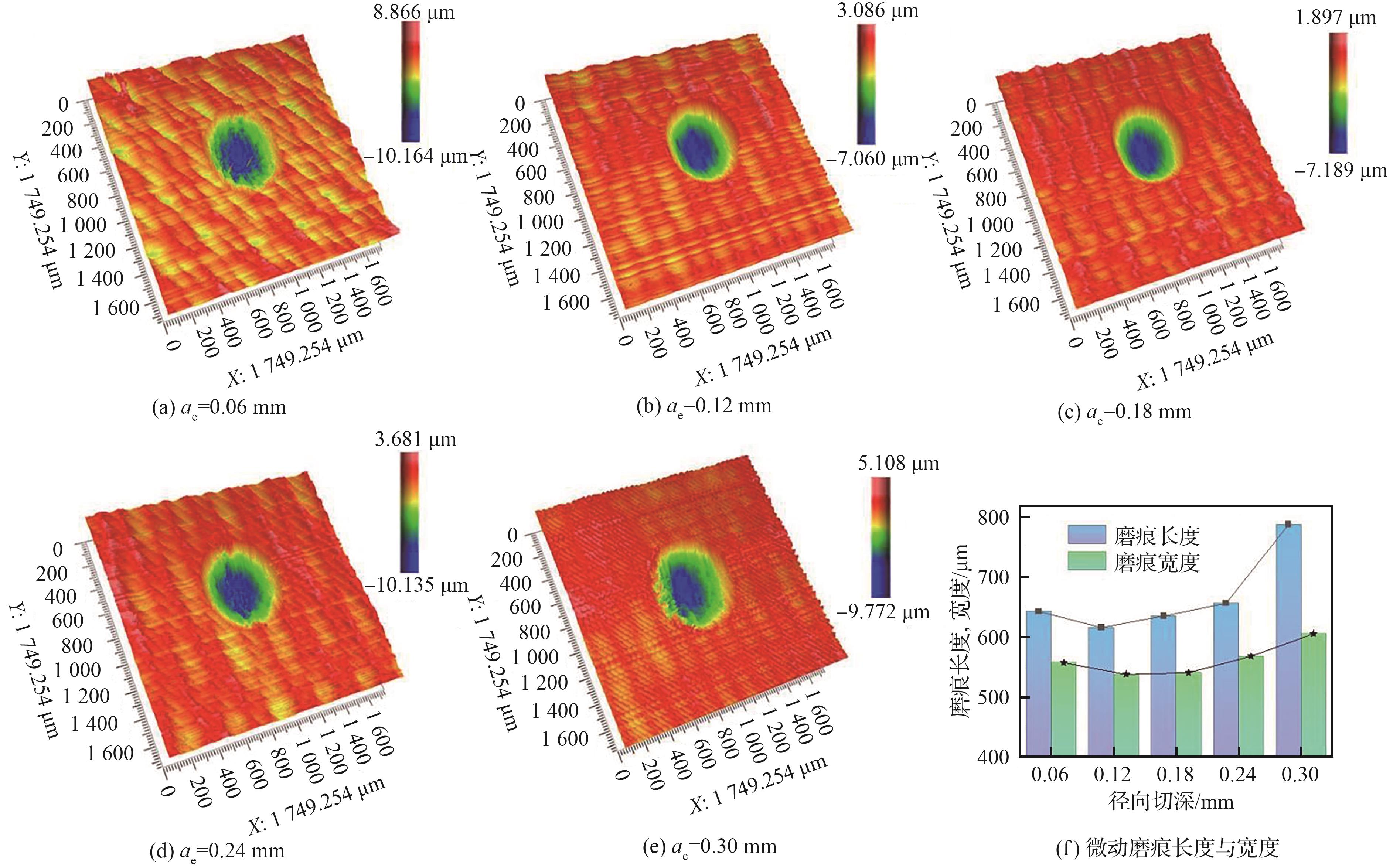
Fig.6
Influence of different radial depths of cut on wear depth and cross-sectional profile of wear scar
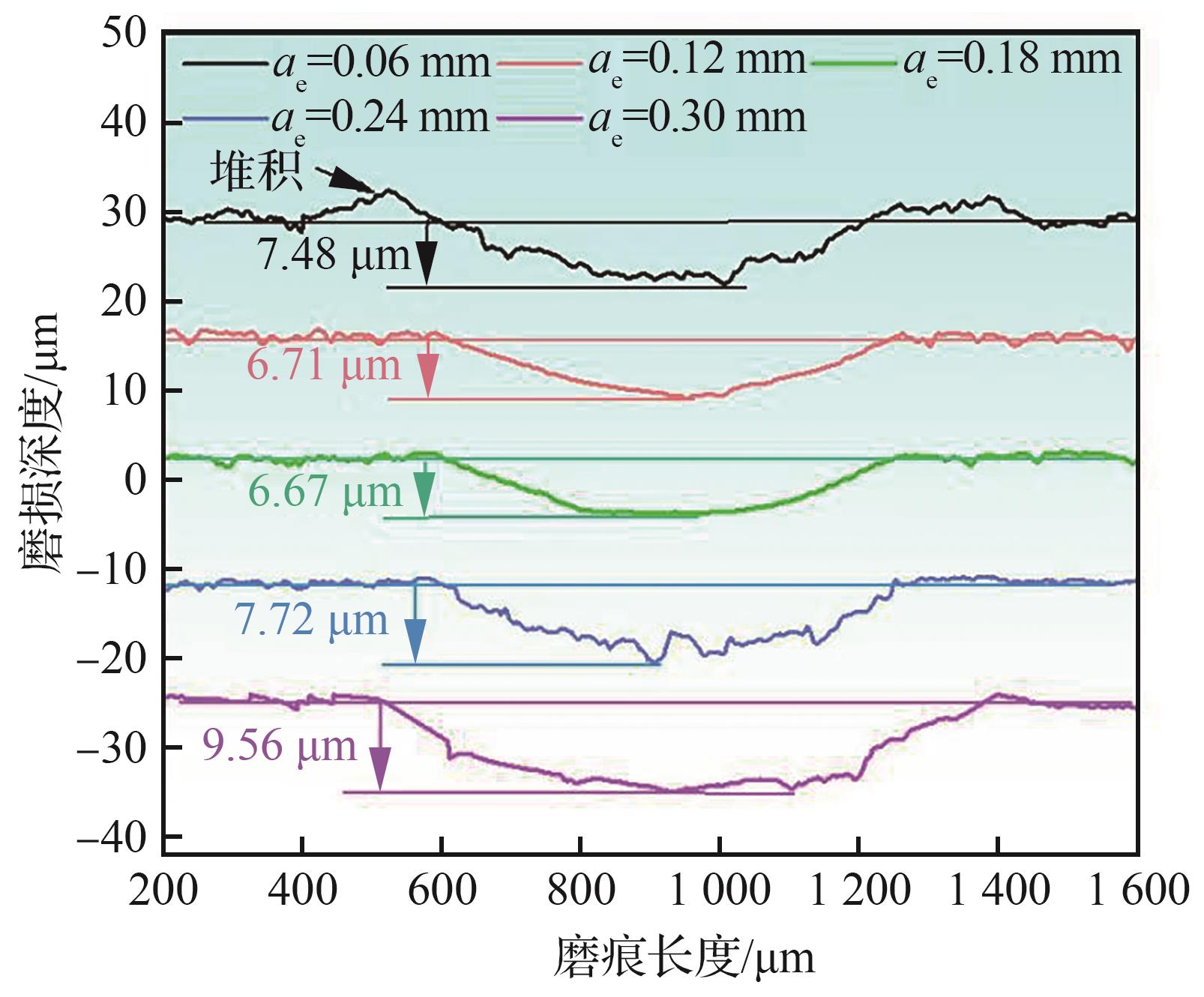

Fig.7
Influence of radial depth of cut on wear loss, surface hardness, and surface residual stress
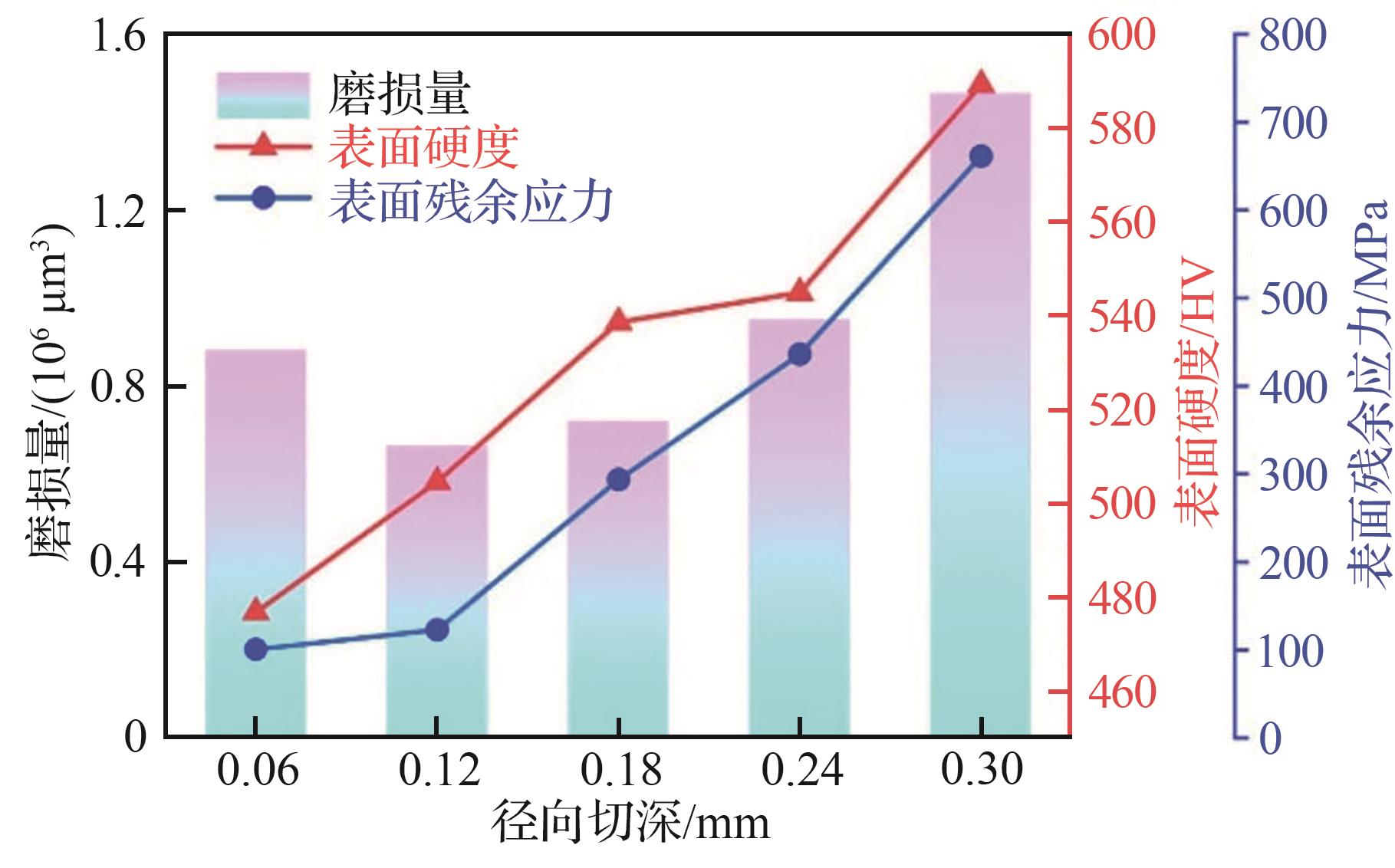

Fig.8
SEM images and EDS scanning analysis of wear area under different radial depths of cut
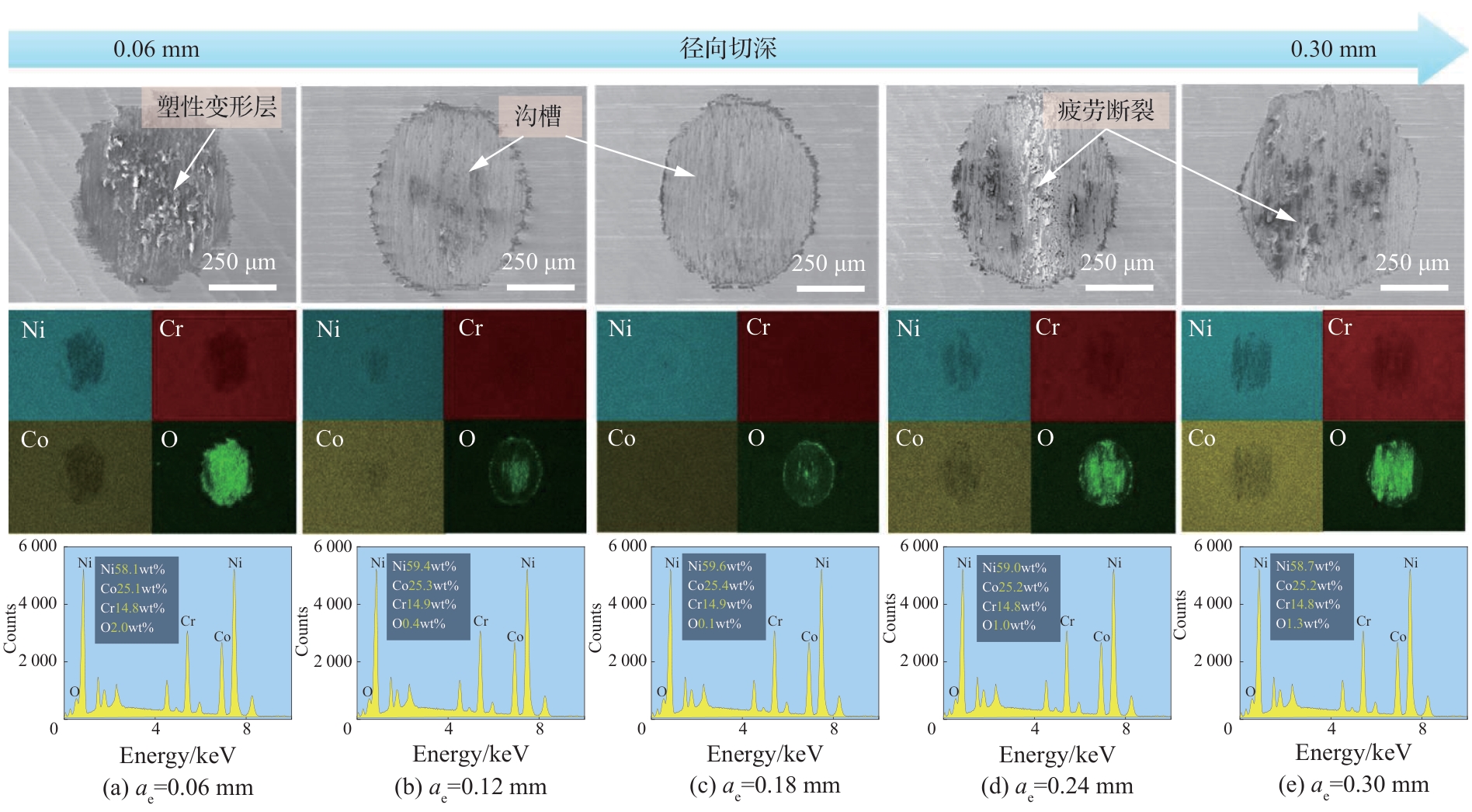
Fig.9
Single-cycle energy dissipation and scanning mass fraction of oxygen on wear area under different radial depths of cut
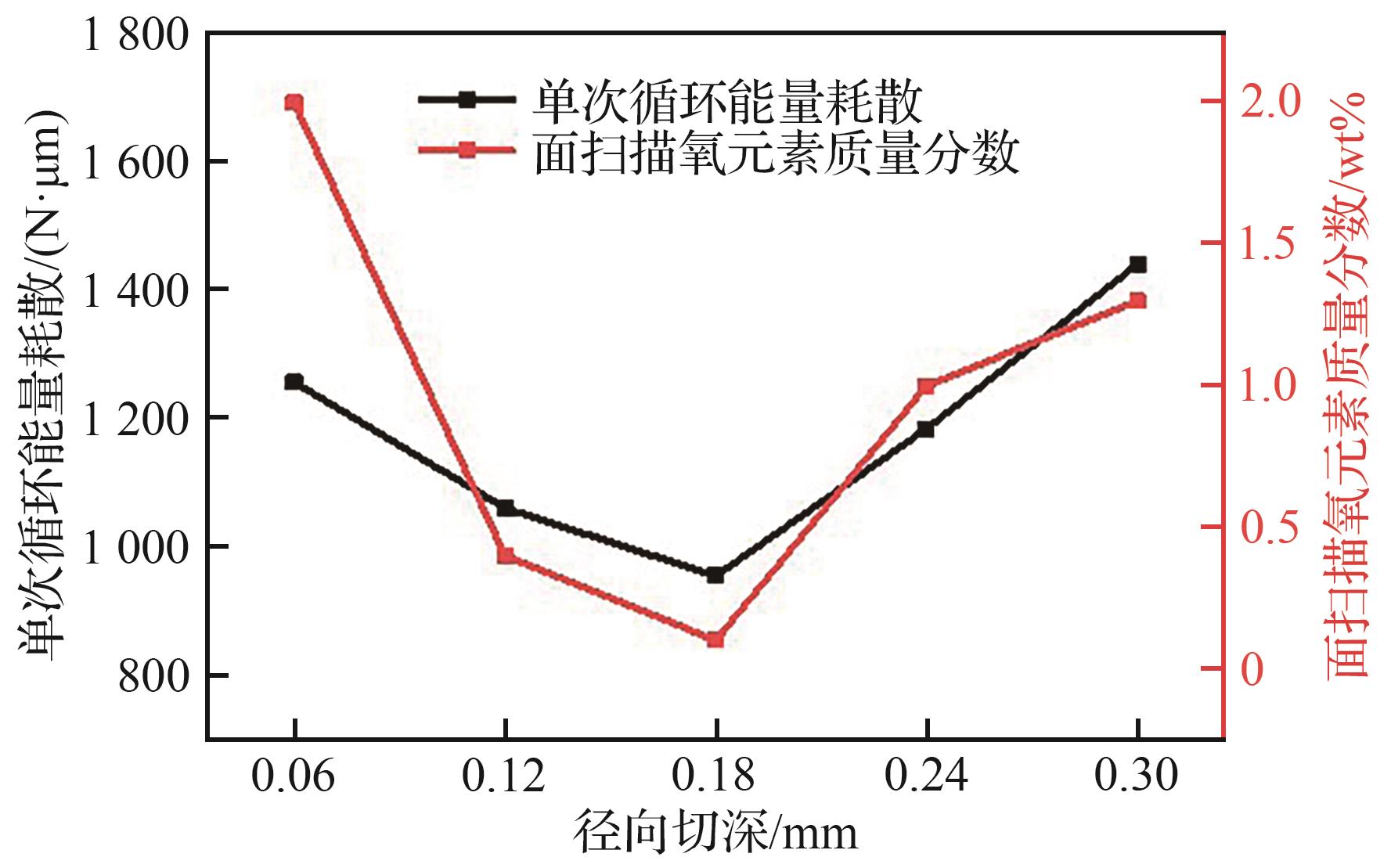

Fig.10
SEM images of fretting wear area under different radial depths of cut
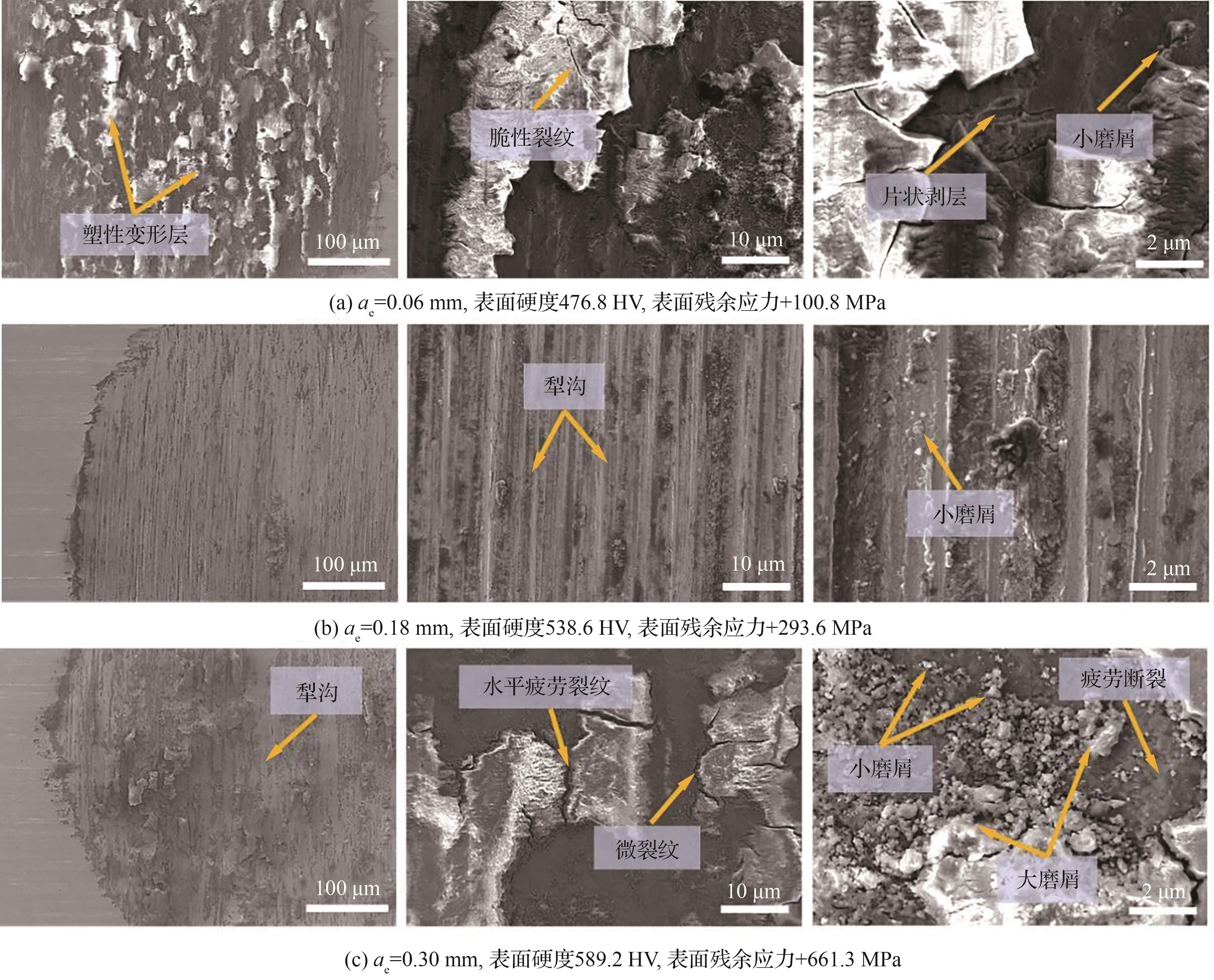

Fig.11
Cross-sectional SEM images of wear area at ae=0.30 mm


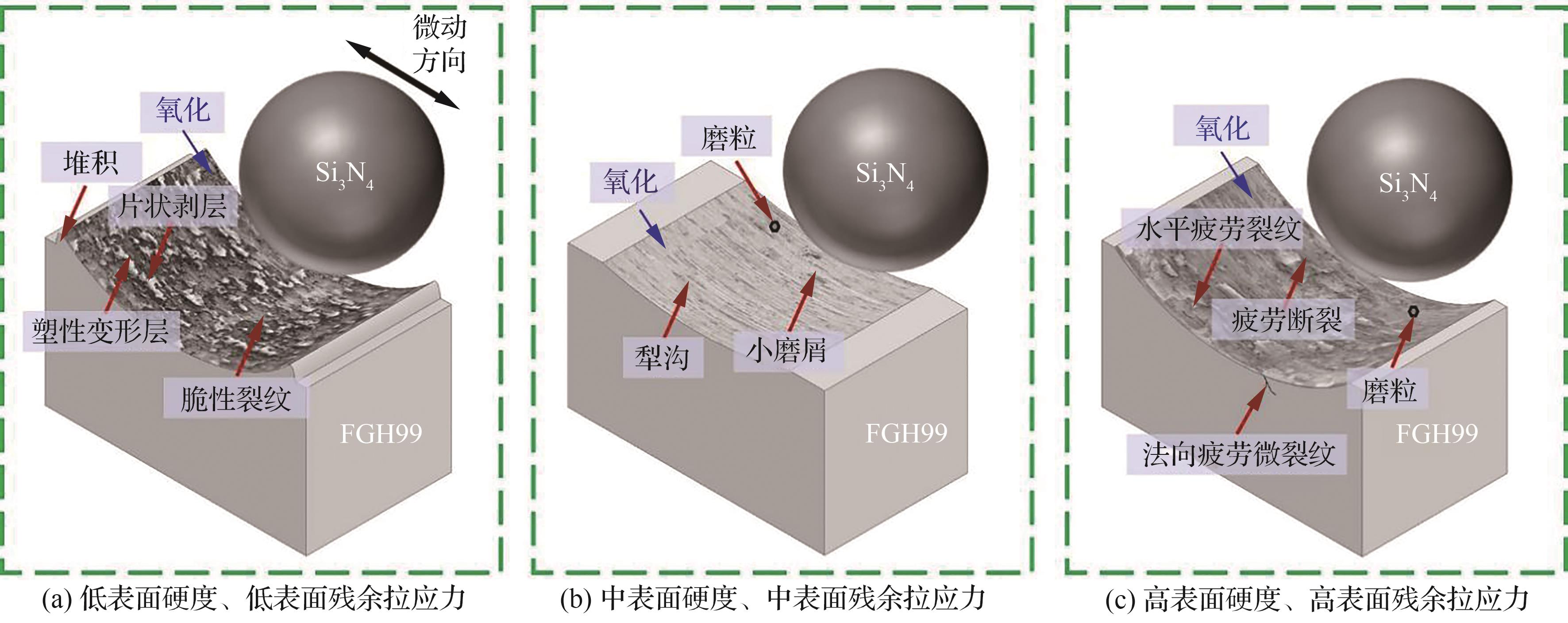
Fig.12
Schematic diagram of fretting wear mechanisms for specimens with different surface hardness and surface residual tensile stress
| [1] | CHEN W K, LIN L G, FENG R C, et al. Study of nano-broaching properties on nickel-based high-temperature alloys based on molecular dynamics simulation[J]. Materials Today Communications, 2024, 39: 108657. |
| [2] | 杨博文, 高强, 王硕, 等. 基于面面接触结构的高温微动疲劳寿命预测研究[J]. 机械工程学报, 2023, 59(18): 165-174. |
| YANG B W, GAO Q, WANG S, et al. Research on high temperature fretting fatigue life prediction based on surface-to-surface contact structure[J]. Journal of Mechanical Engineering, 2023, 59(18): 165-174 (in Chinese). | |
| [3] | 王楠, 崔海涛, 张宏建. 榫连接结构高温低周微动疲劳试验[J]. 航空动力学报, 2018, 33(12): 3007-3012. |
| WANG N, CUI H T, ZHANG H J. Low cycle fretting fatigue tests of dovetail structure at elevated temperature[J]. Journal of Aerospace Power, 2018, 33(12): 3007-3012 (in Chinese). | |
| [4] | LEMOINE E, NÊLIAS D, THOUVEREZ F, et al. Influence of fretting wear on bladed disks dynamic analysis[J]. Tribology International, 2020, 145: 106148. |
| [5] | 胡殿印, 鄢林, 李鑫, 等. 涡轮榫接疲劳寿命评估及验证: 研究现状及展望[J]. 南京航空航天大学学报, 2023, 55(4): 573-588. |
| HU D Y, YAN L, LI X, et al. Fatigue life assessment and verification of turbine attachment: Review and prospects[J]. Journal of Nanjing University of Aeronautics, 2023, 55(4): 573-588 (in Chinese). | |
| [6] | 初铭强, 丁仁根, 张书彦, 等. 航空零部件加工表面完整性[J]. 材料导报, 2021,35(7):7183-7189. |
| CHU M Q, DING R G, ZHANG S Y, et al. Surface integrity for machining aerospace parts[J]. Materials Reports, 2021, 35(7): 7183-7189 (in Chinese). | |
| [7] | SUN J, GUO Y B. A comprehensive experimental study on surface integrity by end milling Ti-6Al-4V[J]. Journal of materials processing technology, 2009, 209(8): 4036-4042. |
| [8] | FIELD M, KAHLES J F. Review of surface integrity of machined components[J]. Annals of the CIRP, 1971, 20(2): 153-163. |
| [9] | LIU X M, YUAN F P, WEI Y G. Grain size effect on the hardness of nanocrystal measured by the nanosize indenter[J]. Applied Surface Science, 2013, 279: 159-166. |
| [10] | LI W, VITTORIETTI M, JONGBLOED G, et al. The combined influence of grain size distribution and dislocation density on hardness of interstitial free steel[J]. Journal of Materials Science & Technology, 2020, 45: 35-43. |
| [11] | SCHLOFFER M, IQBAL F, GABRISCH H, et al. Microstructure development and hardness of a powder metallurgical multi phase γ-TiAl based alloy[J]. Intermetallics, 2012, 22: 231-240. |
| [12] | TEKUMALLA S, SEITA M, ZAEFFERER S. Delineating dislocation structures and residual stresses in additively manufactured alloys[J]. Acta Materialia, 2024, 262: 119413. |
| [13] | LIANGCHEN G, HAOTIAN C, ZONGJUN T, et al. Relationship between surface residual stress and dislocation configuration after laser shock processing of TC4 titanium alloy[J]. Optics & Laser Technology, 2023, 157: 108702. |
| [14] | ZHANG W X, WANG T J, CHEN X. Effect of surface interface stress on the plastic deformation of nanoporous materials and nanocomposites[J]. International Journal of Plasticity, 2010, 26(7): 957-975. |
| [15] | 彭振龙, 张翔宇, 王刚, 等.钛合金高速超声振动车削表面完整性及耐磨损性能试验研究[J]. 航空制造技术, 2024, 67(9): 30-36, 50. |
| PENG Z L, ZHANG X Y, WANG G, et al. Experimental study on surface integrity and wear resistance of titanium alloy during high-speed ultrasonic vibration cutting[J]. Aeronautical Manufacturing Technology, 2024, 67(9): 30-36, 50 (in Chinese). | |
| [16] | LA MONACA A, MURRAY J W, LIAO Z, et al. Surface integrity in metal machining-Part II: Functional performance[J]. International Journal of Machine Tools and Manufacture, 2021, 164: 103718. |
| [17] | JAWAHIR I S, BRINKSMEIER E, M’SAOUBI R, et al. Surface integrity in material removal processes: Recent advances[J]. CIRP Annals, 2011, 60(2): 603-626. |
| [18] | 李洪伟, 雷学林, 张成成, 等. GH4169高温合金孔结构的多级凸包旋转冷扩孔挤压强化工艺参数优化[J]. 航空学报, 2024, 45(16): 429692. |
| LI H W, LEI X L, ZHANG C C, et al. Optimization of process parameters for multi-annular convex hull rotating cold expansion and extrusion reinforcement of GH4169 high-temperature alloy hole structures[J]. Acta Aeronautica et Astronautica Sinica, 2024, 45(16): 429692 (in Chinese). | |
| [19] | KUBIAK K J, LISKIEWICZ T W, MATHIA T G. Surface morphology in engineering applications: Influence of roughness on sliding and wear in dry fretting[J]. Tribology International, 2011, 44(11): 1427-1432. |
| [20] | LI D W, BOTTO D, XU C, et al. Fretting wear of bolted joint interfaces[J]. Wear, 2020, 458: 203411. |
| [21] | KUANG W, QING M, WENFENG D, et al. Fretting wear behaviour of machined layer of nickel-based superalloy produced by creep-feed profile grinding[J]. Chinese Journal of Aeronautics, 2022, 35(10): 401-411. |
| [22] | AMANOV A. Improvement in mechanical properties and fretting wear of Inconel 718 superalloy by ultrasonic nanocrystal surface modification[J]. Wear, 2020, 446: 203208. |
| [23] | GU H Q, YAN P, JIAO L, et al. Effect of laser shock peening on boring hole surface integrity and conformal contact fretting fatigue life of Ti-6Al-4V alloy[J]. International Journal of Fatigue, 2023, 166: 107241. |
| [24] | LUO Y F, LI K, WEI Z J, et al. Effect of milling on fretting wear performance of GH4169 superalloy[J]. Materials Today Communications, 2025, 44: 111845. |
| [25] | LI C, AMANOV A, WANG C, et al. Effect of laser shock peening on fretting wear behaviour of AISI 304 stainless alloy[J]. Tribology International, 2024, 193: 109386. |
| [26] | XU M R, LI C P, KURNIAWAN R, et al. Study on surface integrity of titanium alloy machined by electrical discharge-assisted milling[J]. Journal of Materials Processing Technology, 2022, 299: 117334. |
| [27] | SREENU B, SARKAR R, KUMAR S S S, et al. Microstructure and mechanical behaviour of an advanced powder metallurgy nickel base superalloy processed through hot isostatic pressing route for aerospace applications[J]. Materials Science and Engineering: A, 2020, 797: 140254. |
| [28] | ASTM Committee G02. Standard test method for linearly reciprocating ball-on-flat sliding wear: [S]. West Conshohocken: ASTM International, 2022. |
| [29] | SHARMAN A R C, HUGHES J I, RIDGWAY K. The effect of tool nose radius on surface integrity and residual stresses when turning Inconel 718™[J]. Journal of Materials Processing Technology, 2015, 216: 123-132. |
| [30] | LI W, WITHERS P J, AXINTE D, et al. Residual stresses in face finish turning of high strength nickel-based superalloy[J]. Journal of Materials Processing Technology, 2009, 209(10): 4896-4902. |
| [31] | WANG M H, GAO L, ZHENG Y H. An examination of the fundamental mechanics of cutting force coefficients[J]. International Journal of Machine Tools and Manufacture, 2014, 78: 1-7. |
| [32] | THELLAPUTTA G R, CHANDRA P S, RAO C S P. Machinability of nickel based superalloys: a review[J]. Materials Today: Proceedings, 2017, 4(2): 3712-3721. |
| [33] | YUAN X L, ZHANG X Y, ZHANG Q, et al. Study on the fretting maps of Zircaloy-4 alloy against Inconel 718 alloy[J]. Tribology International, 2021, 160: 107024. |
| [34] | ZHU M H, ZHOU Z R. On the mechanisms of various fretting wear modes[J]. Tribology International, 2011, 44(11): 1378-1388. |
| [35] | 龙有红, 任岩平, 何添, 等. 31CrMoV9钢离子渗氮层的微动摩擦磨损特性研究[J]. 摩擦学学报(中英文), 2024, 44(5): 633-643. |
| LONG Y H, REN Y P, HE T, et al. Study on fretting wear behaviour of plasma nitriding layer of 31CrMoV9 steel[J]. Tribology, 2024, 44(5): 633-643 (in Chinese). | |
| [36] | EDER S J, FELDBAUER G, BIANCHI D, et al. Applicability of macroscopic wear and friction laws on the atomic length scale[J]. Physical Review Letters, 2015, 115(2): 025502. |
| [37] | LIU Y, LISKIEWICZ T W, BEAKE B D. Dynamic changes of mechanical properties induced by friction in the Archard wear model[J]. Wear, 2019, 428: 366-375. |
| [1] | Hao QIN, Qiang LIU, Rong JIANG, Yingdong SONG, Qiang ZHANG, Jiantao LIU, Jian DENG, Tianjian LU. Dwell-fatigue crack growth behavior of FGH4108 alloy at high temperature [J]. Acta Aeronautica et Astronautica Sinica, 2025, 46(21): 532364-532364. |
| [2] | Yong WANG, Pan ZHANG, Zibin ZHONG, Kai ZHONG, Zhongwei LI. 3D inspection of chemical milling contour for aircraft thin-walled parts based on point cloud dimensionality reduction [J]. Acta Aeronautica et Astronautica Sinica, 2025, 46(2): 430718-430718. |
| [3] | Weida LOU, Guohua QIN, Min WAN, Zhixiang ZHU. Prediction and experimental verification of time-varying dynamic parameters for milling thin-walled workpieces [J]. Acta Aeronautica et Astronautica Sinica, 2025, 46(14): 431540-431540. |
| [4] | Lianjie MA, Wenhao DU, Zhen ZHAO, Zhe QIU. Instantaneous milling force model of side milling hard and brittle materials in the state of tool eccentricity and runout [J]. Acta Aeronautica et Astronautica Sinica, 2024, 45(4): 428925-428925. |
| [5] | Fangyi SHENG, Guolin YANG, Fantong MENG, Zhigang DONG, Renke KANG. Finite element simulation analysis in helical milling of countersunk hole [J]. Acta Aeronautica et Astronautica Sinica, 2024, 45(1): 428690-428690. |
| [6] | Pan ZHANG, Yong WANG, Kai ZHONG, Jianjun JIANG, Wufei YANG, Zhongwei LI. 3D measurement of chemical milling plastic film pattern by coupling image grayscale and phase information [J]. Acta Aeronautica et Astronautica Sinica, 2023, 44(17): 428212-428212. |
| [7] | Zonghao LIU, Haitong WANG, Yuwei YANG, Yonglin CAI. Deformation analysis of five⁃axis milling considering material removal effect [J]. Acta Aeronautica et Astronautica Sinica, 2023, 44(13): 427977-427977. |
| [8] | LI Yufei, TIAN Wei, LI Bo, ZHANG Nan. Accuracy control method and experiment of robot milling system [J]. ACTA AERONAUTICAET ASTRONAUTICA SINICA, 2022, 43(5): 625815-625815. |
| [9] | ZHANG Jiabo, LIU Haitao, YUE Yi, YANG Jizhi, YI Maobin, WANG Yunpeng, ROU Lei. Mobile hybrid robot processing technology for large satellites [J]. ACTA AERONAUTICAET ASTRONAUTICA SINICA, 2022, 43(5): 625731-625731. |
| [10] | YUE Caixu, ZHANG Juntao, LIU Xianli, CHEN Zhitao, Steven Y. LIANG, Lihui WANG. Research progress on machining deformation of thin-walled parts in milling process [J]. ACTA AERONAUTICAET ASTRONAUTICA SINICA, 2022, 43(4): 525164-525164. |
| [11] | WU Xinlei, LIU Yonghong, QI Liang, ZHAO Lilong, JI Renjie. High-efficiency electrical discharge assisted arc milling of nickel-based superalloy [J]. ACTA AERONAUTICAET ASTRONAUTICA SINICA, 2022, 43(4): 525615-525615. |
| [12] | MU Hongpeng, LIU Zhidong, ZHOU Shuncheng, HAN Yunxiao, QIU Mingbo. Effects of different gap dielectric mode on EDM ablation milling [J]. ACTA AERONAUTICAET ASTRONAUTICA SINICA, 2022, 43(4): 525609-525609. |
| [13] | WANG Changyu, XU Kejun, QIN Haiqin, MA Zhongyuan, XIE Jing, XIE Zhenbo. A generalized Bodner-Partom viscoplastic constitutive model [J]. ACTA AERONAUTICAET ASTRONAUTICA SINICA, 2022, 43(12): 426009-426009. |
| [14] | XU Kejun, XIAO Yang, QIN Haiqin, JIA Mingming. Fatigue-creep life prediction based on cyclic strain characteristics [J]. ACTA AERONAUTICAET ASTRONAUTICA SINICA, 2021, 42(5): 524109-524109. |
| [15] | XIAO Yang, QIN Haiqin, XU Kejun, JIA Mingming, ZHANG Zhuzhu. Low cycle fatigue life prediction of FGH96 alloy based on modified SWT model [J]. ACTA AERONAUTICAET ASTRONAUTICA SINICA, 2021, 42(5): 524360-524360. |
| Viewed | ||||||
|
Full text |
|
|||||
|
Abstract |
|
|||||
Address: No.238, Baiyan Buiding, Beisihuan Zhonglu Road, Haidian District, Beijing, China
Postal code : 100083
E-mail:hkxb@buaa.edu.cn
Total visits: 6658907 Today visits: 1341All copyright © editorial office of Chinese Journal of Aeronautics
All copyright © editorial office of Chinese Journal of Aeronautics
Total visits: 6658907 Today visits: 1341

 CJA
CJA
