航空学报 > 2026, Vol. 47 Issue (S1): 733005-733005   doi: 10.7527/S1000-6893.2025.33005

视线坐标系下空间机动非合作目标交会轨迹规划与控制

董凯凯1, 王家乐1, 尚芃锦1, 郑茂章2(), 倪智宇1   

  1. 1.沈阳航空航天大学 航空宇航学院,沈阳 110136
    2.深圳信息职业技术大学 中德机器人学院,深圳 518172
  • 收稿日期:2025-10-31 修回日期:2025-11-03 接受日期:2025-12-19 出版日期:2026-01-12 发布日期:2026-01-09
  • 通讯作者: 郑茂章 E-mail:zhengmz90@foxmail.com
  • 基金资助:
    国家自然科学基金基础科学中心项目(62388101);辽宁省自然科学基金(2024-BS-153);深圳信息职业技术大学博硕士教师科研启动项目(SZIIT2024KJ017)

Trajectory planning and control for space rendezvous with non-cooperative targets in line-of-sight coordinate system

Kaikai DONG1, Jiale WANG1, Pengjin SHANG1, Maozhang ZHENG2(), Zhiyu NI1   

  1. 1.College of Aerospace Engineering,Shenyang Aerospace University,Shenyang 110136,China
    2.Sino-German School of Robotics,Shenzhen University of Information Technology,Shenzhen 518172,China
  • Received:2025-10-31 Revised:2025-11-03 Accepted:2025-12-19 Online:2026-01-12 Published:2026-01-09
  • Contact: Maozhang ZHENG E-mail:zhengmz90@foxmail.com
  • Supported by:
    Basic Science Center Project of National Natural Science Foundation of China(62388101);Liaoning Province Natural Science Foundation(2024-BS-153);Shenzhen University of Information Technology, Research Startup Program for Doctoral and Master’ s Degree-holding Faculty(SZIIT2024KJ017)

摘要:

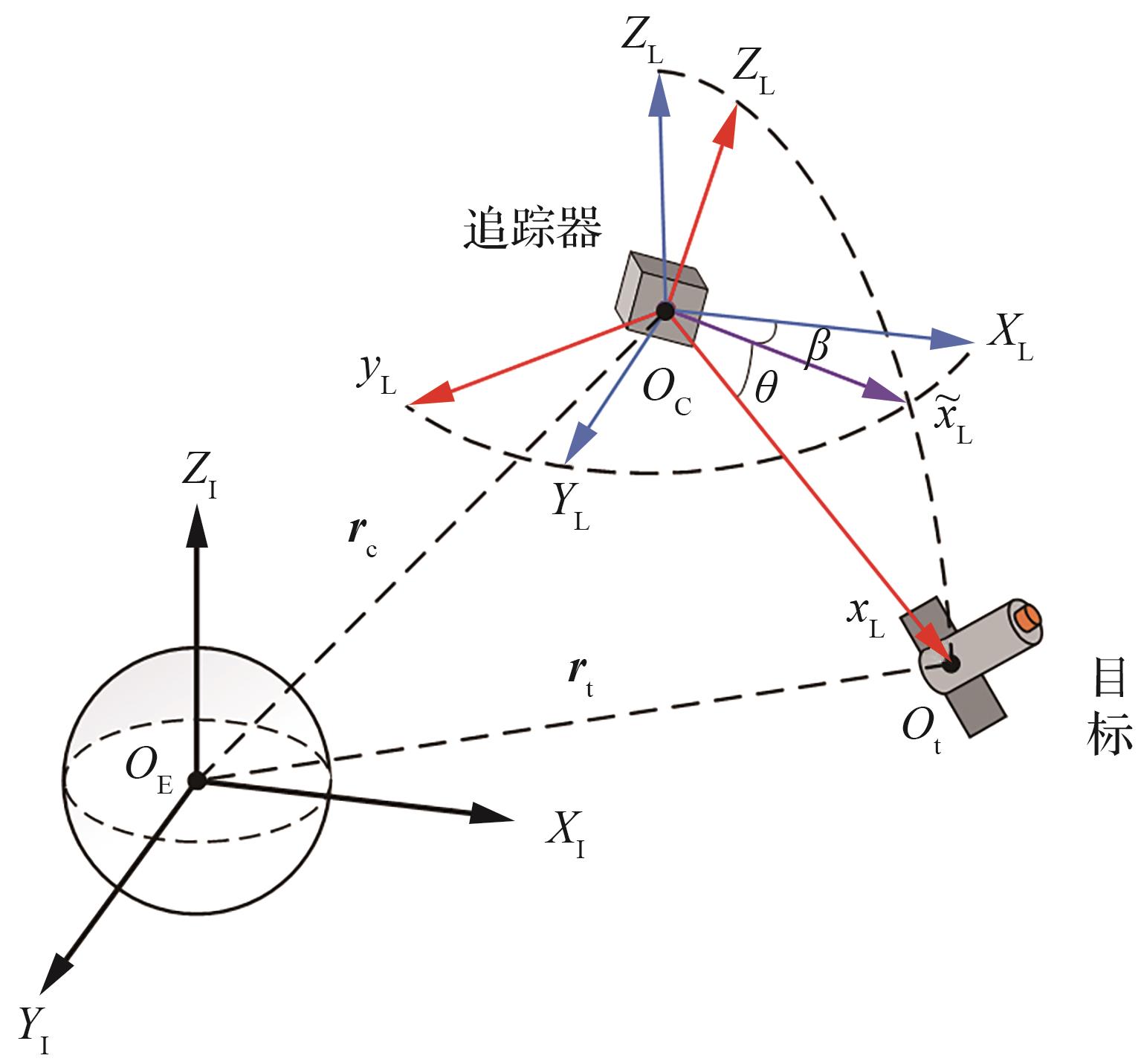
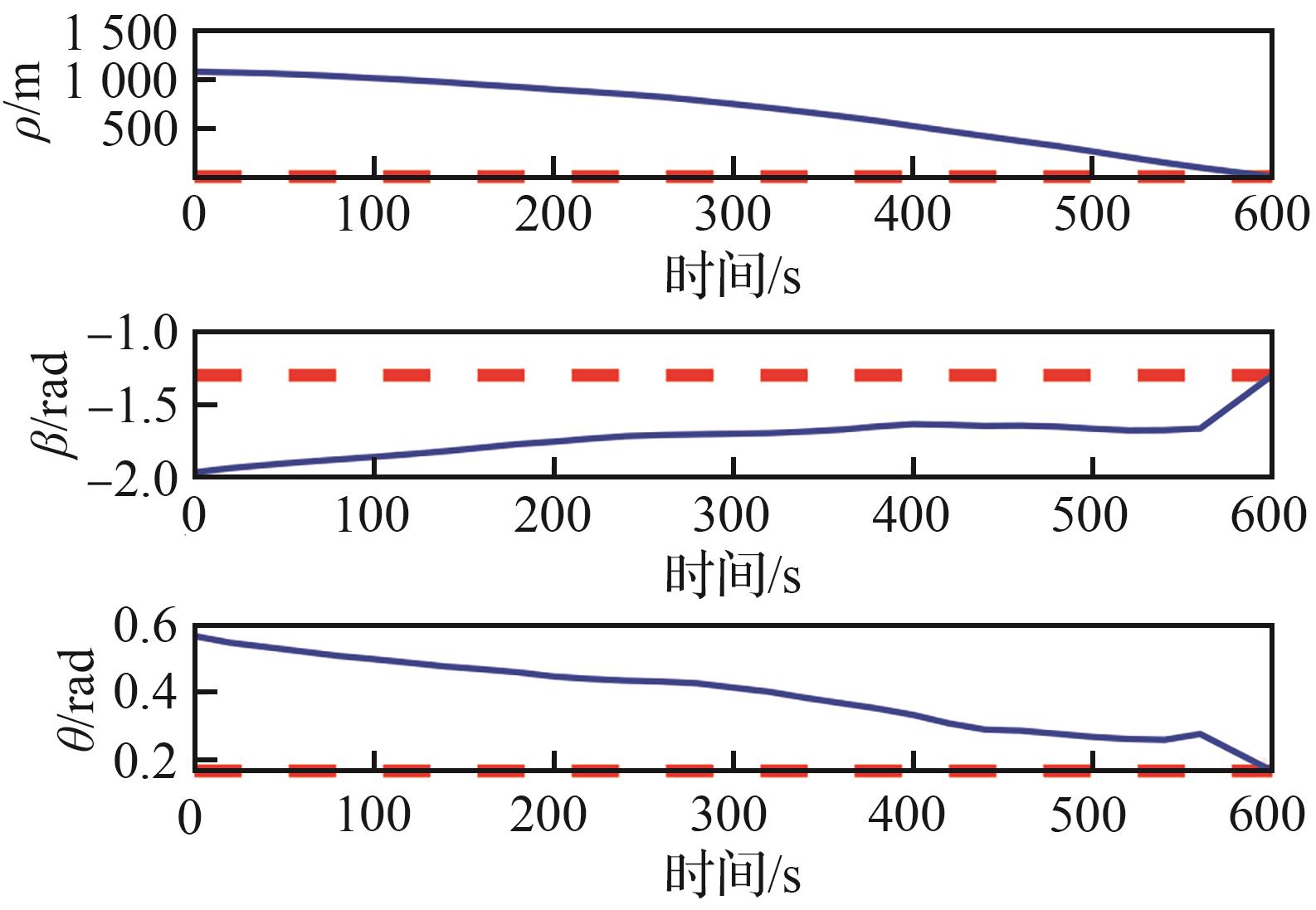
针对空间非合作目标存在机动行为时的多约束自主交会问题,提出了一种在追踪航天器视线(LOS)坐标系下、融合遗传算法与线性时变模型预测控制(LTV-MPC)的轨迹规划与控制方法,克服了传统基于当地垂直当地水平(LVLH)坐标系下设计的控制器在处理空间机动非合作目标交会任务时的局限性,同时避免了导航信息的转换误差。首先,在追踪航天器视线坐标系下建立空间非合作目标相对运动的动力学模型。然后,在综合考虑动力学、控制饱和与安全等多重约束的条件下,以燃料最优为指标函数构建优化模型,并利用遗传算法的全局收敛性与强约束处理能力进行求解,进而得到最优的标称轨迹。最后,利用线性时变模型预测控制方法具有方便处理多约束和不确定性的优势设计闭环跟踪控制器,从而对上述标称轨迹进行跟踪控制。仿真表明,所设计的轨迹能够满足控制、动力学和安全等复杂工程约束,并且是一条燃料最优、可控和可达的轨迹。此外,该控制器在存在不确定性时仍表现出良好的控制精度与鲁棒性,为空间机动非合作目标交会问题提供了有效的解决方案。

关键词: 视线坐标系, 非合作目标, 空间交会, 遗传算法, 线性时变模型预测控制

Abstract:

To address the multi-constraint autonomous rendezvous problem for maneuvering non-cooperative space targets, this paper proposes a trajectory planning and control method in the Line-of-Sight (LOS) coordinate frame of the chaser spacecraft, which integrates a genetic algorithm with Linear Time-Varying Model Predictive Control (LTV-MPC). The proposed method overcomes the limitations of conventional controllers designed in the Local Vertical Local Horizontal (LVLH) frame for rendezvous missions with maneuvering non-cooperative targets, while avoiding navigation coordinate transformation errors. First, a relative motion dynamic model between the non-cooperative target and the chaser spacecraft is established in the chaser’s LOS coordinate frame. Then, taking full account of multiple constraints including dynamics, control saturation and safety constraints, an optimization model is constructed with a fuel-optimal performance index. The model is solved using a genetic algorithm, taking advantage of its global convergence and strong constraint-handling ability, to obtain the optimal nominal trajectory. Finally, benefiting from its advantages in conveniently handling multiple constraints and uncertainties, an LTV-MPC-based closed-loop tracking controller is designed to track the aforementioned nominal trajectory. Numerical simulations show that the designed trajectory satisfies complex engineering constraints including control, dynamics and safety, and is fuel-optimal, controllable and achievable. In addition, the controller exhibits favorable control accuracy and robustness in the presence of uncertainties, providing an effective solution to the rendezvous problem with maneuvering non-cooperative space targets.

Key words: line-of-sight coordinate frame, non-cooperative targets, space rendezvous, genetic algorithm, Linear Time-Varying Model Predictive Control (LTV-MPC)

中图分类号: