Acta Aeronautica et Astronautica Sinica ›› 2026, Vol. 47 ›› Issue (10): 532845.doi: 10.7527/S1000-6893.2025.32845
• Special Issue: Intelligent Processing and Analysis of Aerospace Remote Sensing Images • Previous Articles
Jiepan LI1, Wei HE1( ), Minghao TANG2, Jin XIONG3
Received:2025-09-28
Revised:2025-11-06
Accepted:2025-11-25
Online:2025-12-09
Published:2025-12-08
Contact:
Wei HE
E-mail:weihe@whu.edu.cn
CLC Number:
Jiepan LI, Wei HE, Minghao TANG, Jin XIONG. Pre-disaster footprint-guilded building damage change detection in spaceborne remote sensing imagery[J]. Acta Aeronautica et Astronautica Sinica, 2026, 47(10): 532845.
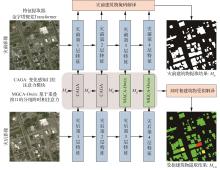
Fig.1
Illustration of two-stage Pre-Disaster Footprint-guided-change-aware damage detection Network (PDF-Net)
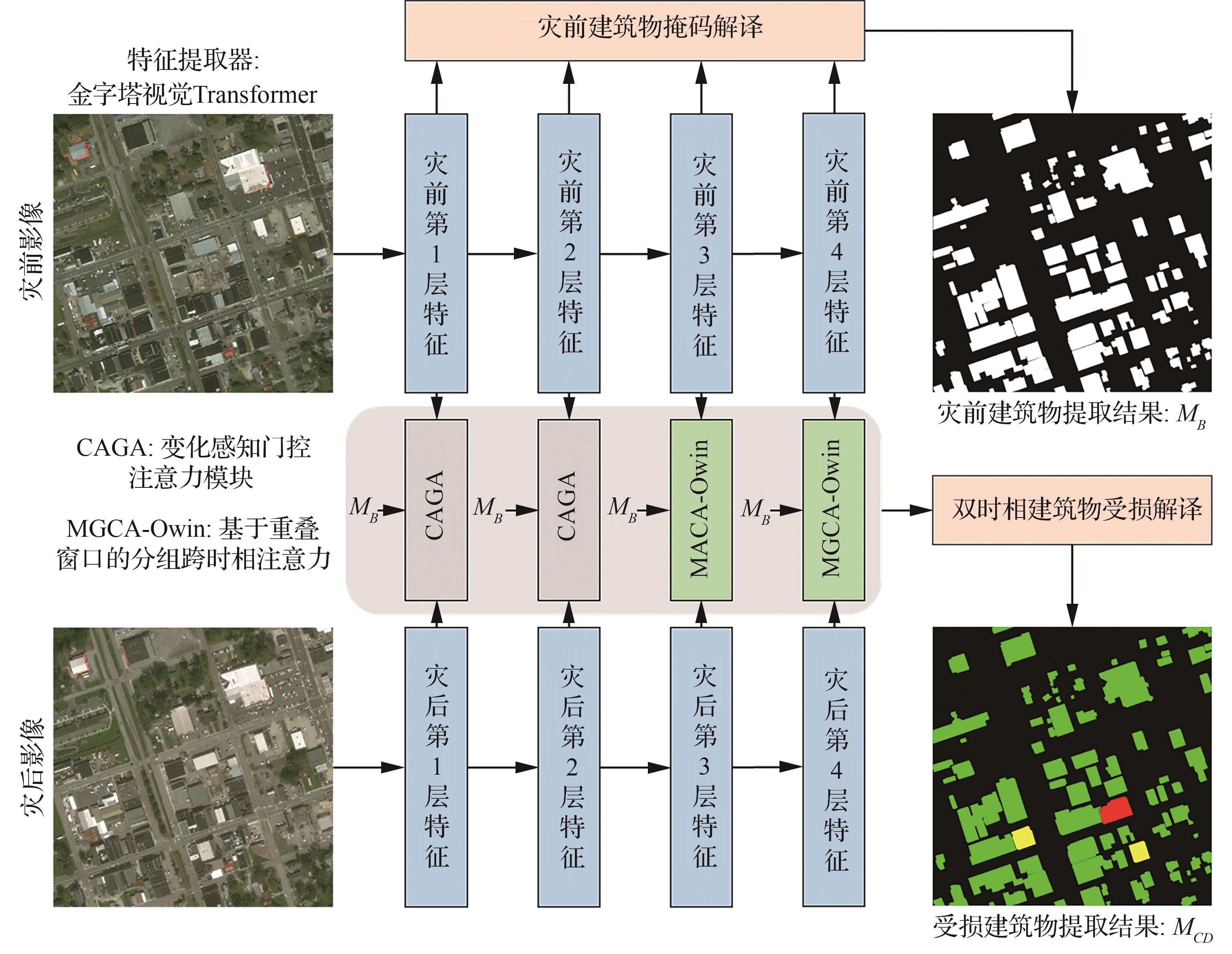
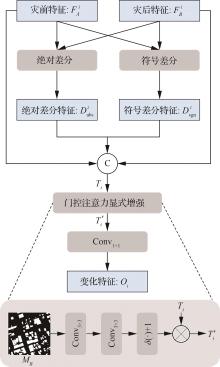
Fig.2
Illustration of change-aware gated attention module
Fig.3
Illustration of multi-group cross attention mechanism with overlap windows
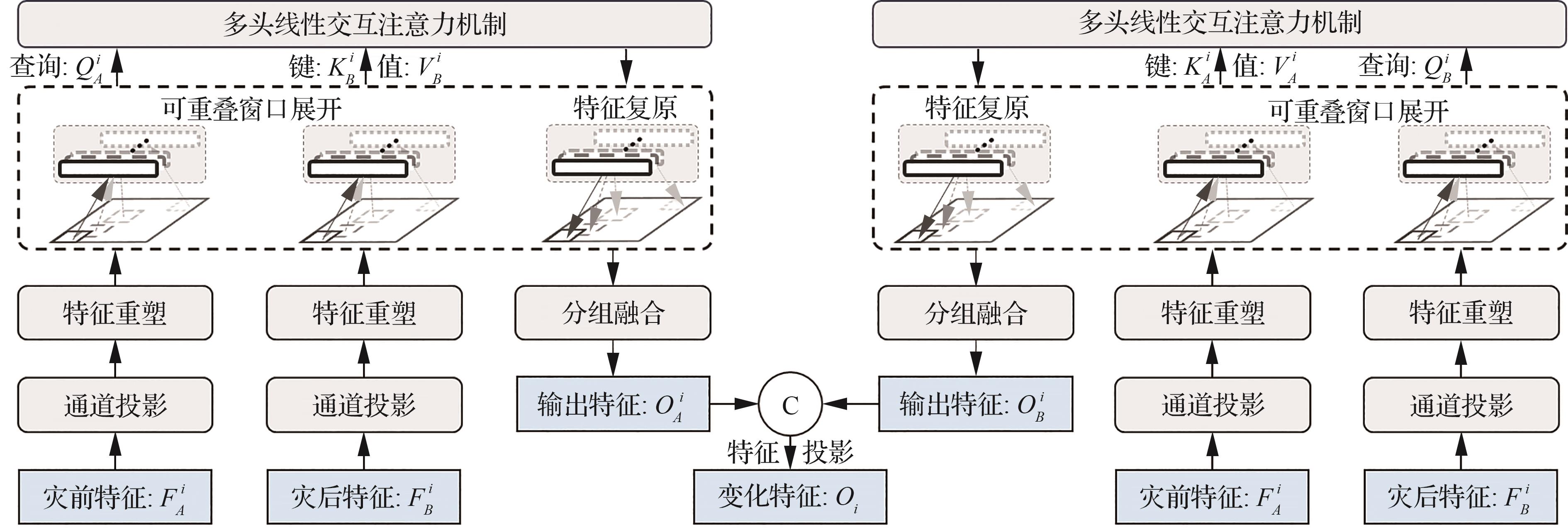

Table 1
Experimental results of per-class Intersection over Union (IoU) and mean Intersection over Union (mIoU) on xBD dataset
| 方法 | IoU/% | mIoU/% | ||||
|---|---|---|---|---|---|---|
| 背景 | 无损毁 | 轻微受损 | 严重受损 | 完全损毁 | ||
| FC-Siam-conc | 99.02 | 68.66 | 23.30 | 43.14 | 56.78 | 58.18 |
| FC-Siam-diff | 98.99 | 68.45 | 21.05 | 42.96 | 57.37 | 57.76 |
| SNUNet-CD | 99.01 | 69.55 | 24.85 | 47.37 | 53.68 | 58.89 |
| BIT | 99.02 | 69.87 | 25.43 | 47.76 | 54.22 | 59.26 |
| Change-Former | 99.05 | 71.28 | 25.29 | 50.83 | 55.79 | 60.45 |
| ChangeOS | 99.03 | 70.21 | 24.08 | 45.57 | 56.01 | 58.98 |
| P2V | 99.11 | 71.02 | 24.00 | 44.27 | 58.33 | 59.35 |
| HANet | 99.08 | 71.35 | 25.01 | 46.70 | 56.64 | 59.76 |
| CGNet | 99.07 | 71.58 | 25.62 | 47.88 | 57.03 | 60.24 |
| BAN | 99.10 | 72.49 | 26.00 | 48.93 | 58.80 | 61.06 |
| MLCNet | 99.09 | 72.33 | 26.40 | 48.99 | 59.16 | 61.19 |
| M-Swin | 99.07 | 73.15 | 25.74 | 49.66 | 60.12 | 61.55 |
| Change-Mamba | 99.10 | 72.35 | 25.07 | 49.38 | 59.04 | 60.99 |
| UACD | 99.13 | 73.19 | 25.73 | 50.86 | 60.85 | 61.95 |
| PDF-Net | 99.14 | 73.33 | 28.06 | 51.18 | 60.96 | 62.53 |
Table 2
Experimental results of per-class IoU and mIoU on Bright dataset
| 方法 | IoU/% | mIoU/% | |||
|---|---|---|---|---|---|
| 背景 | 无损毁 | 部分受损 | 完全损毁 | ||
| FC-Siam-conc | 95.73 | 67.64 | 20.03 | 48.28 | 57.92 |
| FC-Siam-diff | 92.94 | 57.38 | 17.31 | 47.50 | 53.78 |
| SNUNet-CD | 95.93 | 74.47 | 29.04 | 62.75 | 65.55 |
| BIT | 96.37 | 76.23 | 30.22 | 64.48 | 66.83 |
| ChangeFormer | 96.65 | 78.05 | 31.94 | 67.39 | 68.51 |
| ChangeOS | 95.88 | 75.92 | 27.45 | 64.76 | 66.00 |
| P2V | 96.30 | 75.75 | 25.86 | 64.38 | 65.57 |
| HANet | 96.45 | 75.62 | 29.03 | 65.50 | 66.65 |
| CGNet | 96.58 | 76.29 | 32.07 | 65.44 | 67.60 |
| BAN | 96.33 | 78.15 | 33.21 | 65.69 | 68.35 |
| MLCNet | 96.24 | 77.83 | 31.26 | 64.55 | 67.47 |
| M-Swin | 96.50 | 77.92 | 33.61 | 67.32 | 68.84 |
| ChangeMamba | 96.76 | 78.74 | 33.82 | 67.27 | 69.15 |
| UACD | 96.71 | 78.23 | 32.49 | 65.73 | 68.29 |
| PDF-Net | 96.91 | 79.80 | 36.49 | 71.30 | 71.12 |
Fig.4
Visual comparison of results on xBD dataset
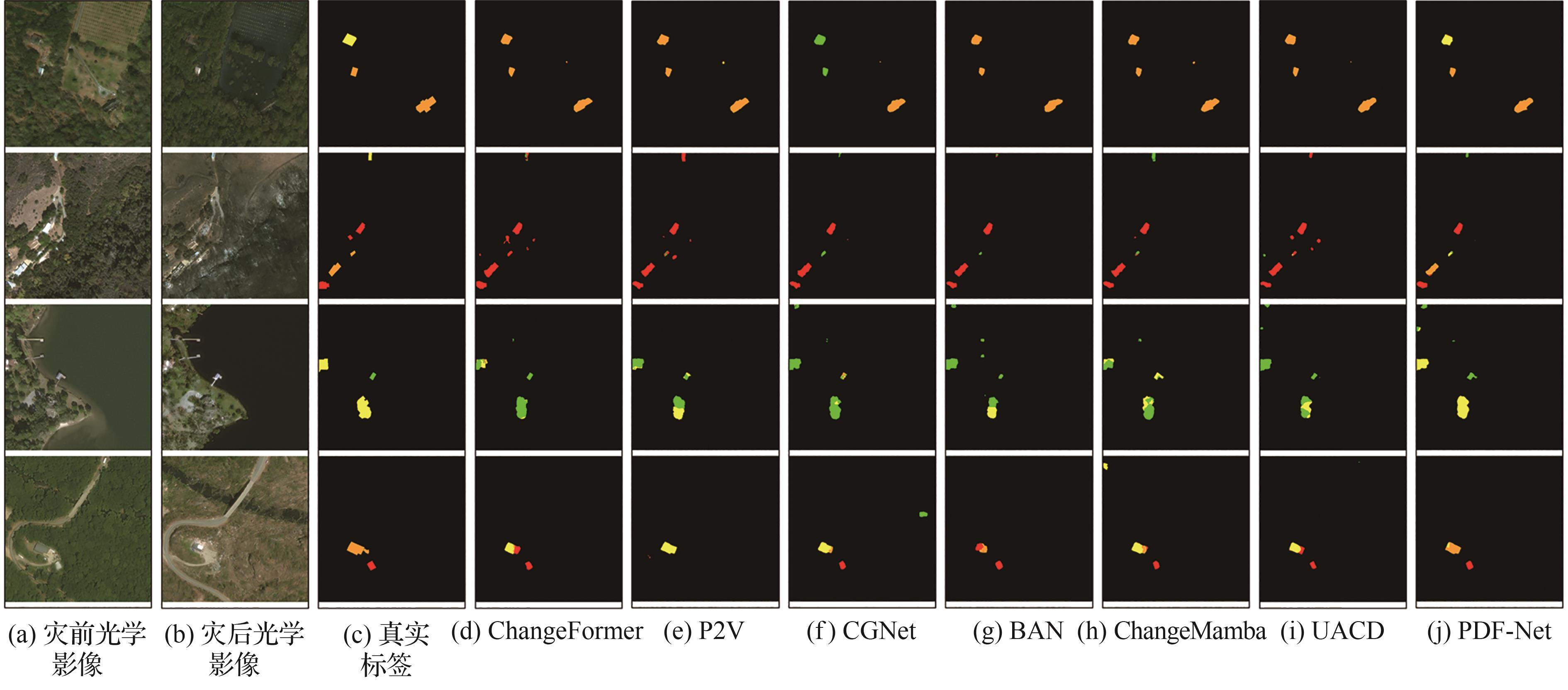
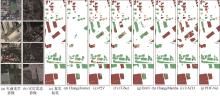
Fig.5
Visual comparison of results on Bright dataset
Table 3
Ablation results of per-class IoU and mIoU on xBD dataset
| 方法 | IoU/% | mIoU/% | ||||
|---|---|---|---|---|---|---|
| 背景 | 无损毁 | 轻微受损 | 严重受损 | 完全损毁 | ||
| w/o CAGA | 98.97 | 70.89 | 26.42 | 48.55 | 58.67 | 60.70 |
| w/o MGCA-Owin | 98.99 | 70.64 | 26.08 | 48.43 | 58.53 | 60.53 |
| w/o Building | 99.01 | 70.03 | 25.78 | 48.17 | 56.99 | 60.00 |
| PDF-Net | 99.14 | 73.33 | 28.06 | 51.18 | 60.96 | 62.53 |
Table 4
Ablation results of per-class IoU and mIoU on Bright dataset
| 方法 | IoU/% | mIoU/% | |||
|---|---|---|---|---|---|
| 背景 | 无损毁 | 部分受损 | 完全损毁 | ||
| w/o CAGA | 96.25 | 77.82 | 33.10 | 68.96 | 69.03 |
| w/o MGCA-Owin | 96.37 | 77.79 | 34.27 | 69.54 | 69.49 |
| w/o Building | 96.12 | 76.40 | 32.66 | 68.13 | 68.33 |
| PDF-Net | 96.91 | 79.80 | 36.49 | 71.30 | 71.12 |
Fig.6
Feature map visualization on xBD dataset
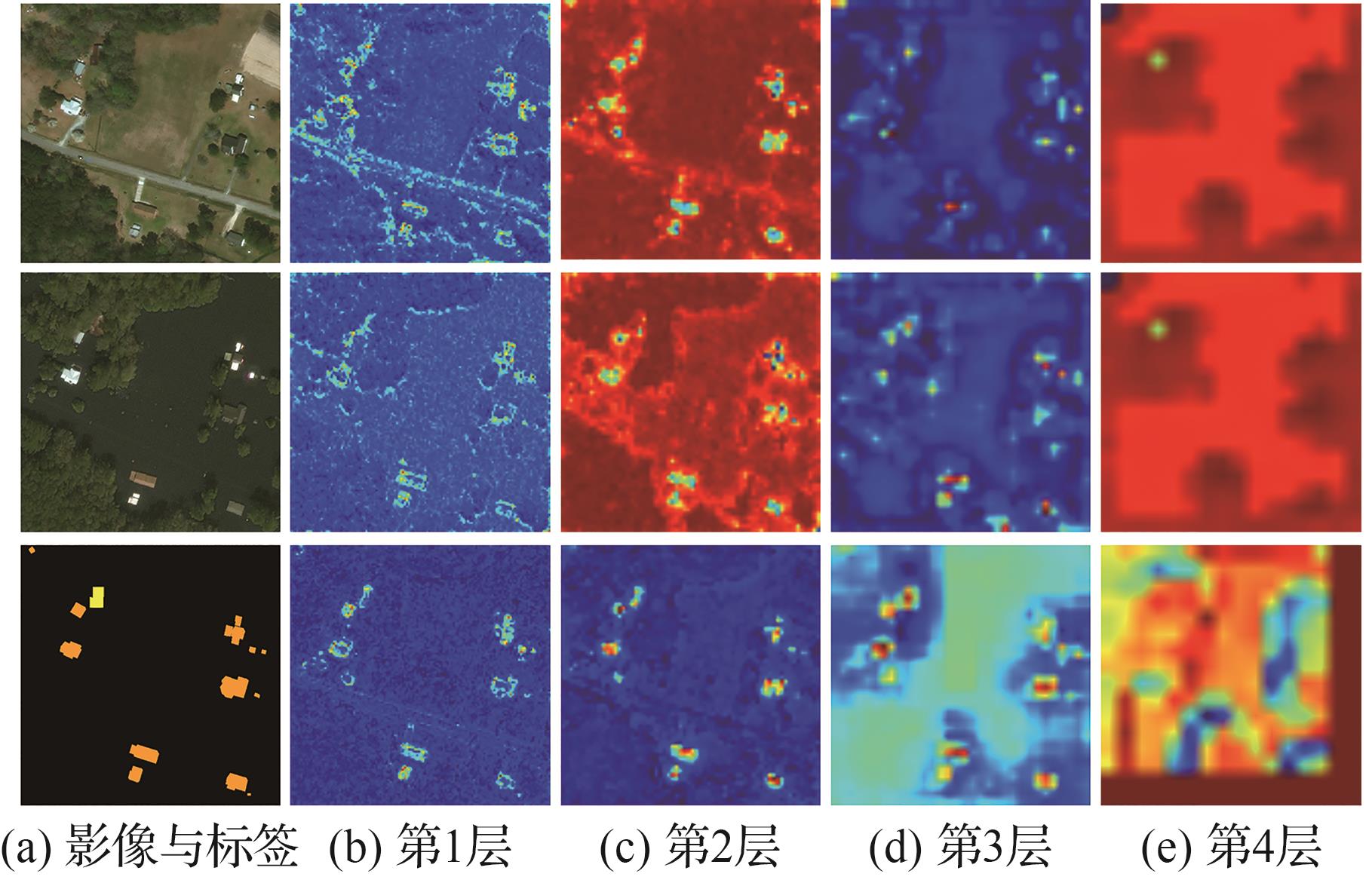
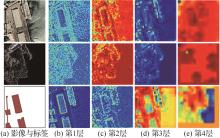
Fig.7
Feature map visualization on Bright dataset
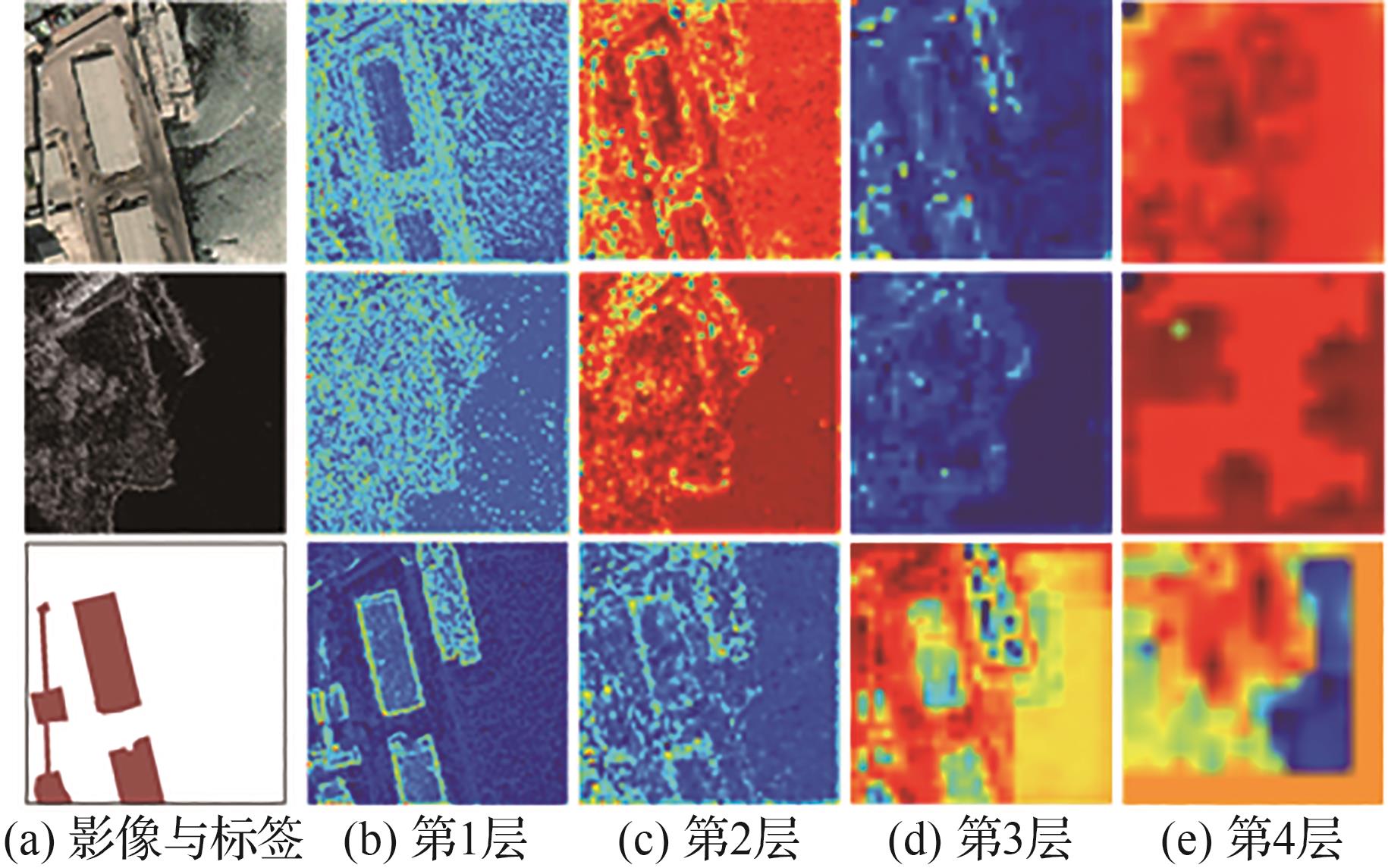
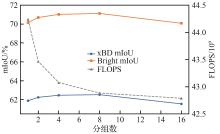
Fig.8
Effect of group number on MGCA-OWin
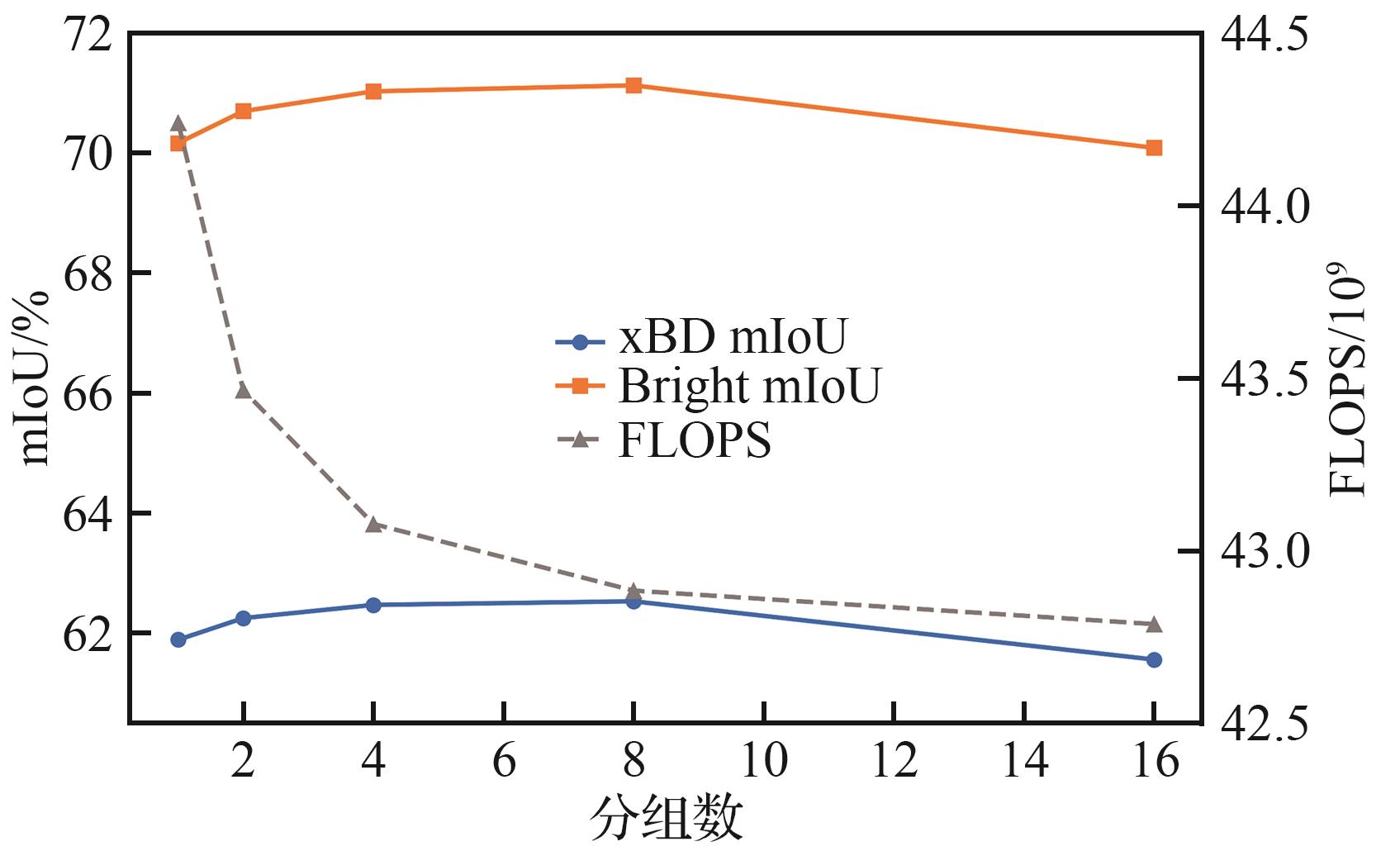
Table 5
Effects of window size and overlap ratio on performance (mIoU)
| 窗口大小 | 重叠大小 | mIoU/% | |
|---|---|---|---|
| xBD | Bright | ||
| 4 | 2 | 62.27 | 70.75 |
| 8 | 2 | 62.53 | 71.12 |
| 16 | 2 | 61.60 | 70.05 |
| 8 | 4 | 62.35 | 71.02 |
| 8 | 6 | 62.01 | 70.88 |
| [1] | 王丝丝, 刘志春, 张景, 等. 灾害应急响应中多源遥感数据国际共享服务研究[J]. 遥感技术与应用, 2024, 39(1): 198-208. |
| WANG S S, LIU Z C, ZHANG J, et al. Research on international sharing service of multi-source remote sensing data in disaster emergency response[J]. Remote Sensing Technology and Application, 2024, 39(1): 198-208 (in Chinese). | |
| [2] | WANG H F, HE W, LI Z H, et al. Cross-scenario damaged building extraction network: Methodology, application, and efficiency using single-temporal HRRS imagery[J]. ISPRS Journal of Photogrammetry and Remote Sensing, 2025, 228: 228-248. |
| [3] | 赵金玲, 黄健, 梁梓君, 等. 基于BDANet的地震灾害建筑物损毁评估[J]. 自然资源遥感, 2024, 36(4): 193-200. |
| ZHAO J L, HUANG J, LIANG Z J, et al. BDANet-based assessment of building damage from earthquake disasters[J]. Remote Sensing for Natural Resources, 2024, 36(4): 193-200 (in Chinese). | |
| [4] | 魏麟. 基于高分辨率遥感影像的震灾建筑物损毁检测[J]. 地理空间信息, 2022, 20(3): 68-71, 116. |
| WEI L. Building earthquake damage detection based on high-resolution remote sensing image[J]. Geospatial Information, 2022, 20(3): 68-71, 116 (in Chinese). | |
| [5] | 张继贤, 顾海燕, 倪欢, 等. 遥感智能变化检测的深度学习方法: 演变与发展趋势[J]. 测绘学报, 2025, 54(8): 1347-1370. |
| ZHANG J X, GU H Y, NI H, et al. Deep learning methods for remote sensing intelligent change detection: Evolution and development[J]. Acta Geodaetica et Cartographica Sinica, 2025, 54(8): 1347-1370 (in Chinese). | |
| [6] | WANG H F, HE W, LI Z H, et al. Cross-scenario damaged building extraction network: Methodology, application, and efficiency using single-temporal HRRS imagery[J]. ISPRS Journal of Photogrammetry and Remote Sensing, 2025, 228: 228-248. |
| [7] | 程塨, 王光兴, 韩军伟. 深度学习遥感变化检测综述: 典型算法及发展趋势[J]. 遥感学报, 2025, 29(6): 1587-1597. |
| CHENG G, WANG G X, HAN J W. Deep learning for change detection in remote sensing: A review and new outlooks[J]. National Remote Sensing Bulletin, 2025, 29(6): 1587-1597 (in Chinese). | |
| [8] | QUARMBY N A, CUSHNIE J L. Monitoring urban land cover changes at the urban fringe from SPOT HRV imagery in south-east England[J]. International Journal of Remote Sensing, 1989, 10(6): 953-963. |
| [9] | RIGNOT E J M, VAN ZYL J J. Change detection techniques for ERS-1 SAR data[J]. IEEE Transactions on Geoscience and Remote Sensing, 1993, 31(4): 896-906. |
| [10] | NIELSEN A A, CANTY M J. Kernel principal component analysis for change detection[J]. Image and Signal Processing for Remote Sensing XIV, 2008, 7109: 71090T. |
| [11] | NIELSEN A A, CONRADSEN K, SIMPSON J J. Multivariate alteration detection (MAD) and MAF postprocessing in multispectral, bitemporal image data: New approaches to change detection studies[J]. Remote Sensing of Environment, 1998, 64(1): 1-19. |
| [12] | GRAESSER J, RAMANKUTTY N. Detection of cropland field parcels from Landsat imagery[J]. Remote Sensing of Environment, 2017, 201: 165-180. |
| [13] | 高仁强, 陈亮雄, 杨静学, 等. 一种高分影像随机森林变化检测方法[J]. 测绘科学, 2020, 45(11): 130-138. |
| GAO R Q, CHEN L X, YANG J X, et al. A method of random forest change detection based on high resolution image[J]. Science of Surveying and Mapping, 2020, 45(11): 130-138 (in Chinese). | |
| [14] | 付青, 罗文浪, 吕敬祥. 基于AlexNet和支持向量机相结合的卫星遥感影像土地利用变化检测[J]. 激光与光电子学进展, 2020, 57(17): 172802. |
| FU Q, LUO W L, LÜ J X. Land utilization change detection of satellite remote sensing image based on AlexNet and support vector machine[J]. Laser & Optoelectronics Progress, 2020, 57(17): 172802 (in Chinese). | |
| [15] | KRIZHEVSKY A, SUTSKEVER I, HINTON G E. ImageNet classification with deep convolutional neural networks[J]. Communications of the ACM, 2017, 60(6): 84-90. |
| [16] | CHEN P, ZHANG B, HONG D F, et al. FCCDN: Feature constraint network for VHR image change detection[J]. ISPRS Journal of Photogrammetry and Remote Sensing, 2022, 187: 101-119. |
| [17] | SHELHAMER E, LONG J, DARRELL T. Fully convolutional networks for semantic segmentation[C]∥IEEE Transactions on Pattern Analysis and Machine Intelligence. Piscataway: IEEE Press, 2016: 640-651. |
| [18] | HE K, ZHANG X, REN S, et al. Deep residual learning for image recognition[C]∥2016 IEEE Conference on Computer Vision and Pattern Recognition. Piscataway: IEEE Press, 2016: 770-778. |
| [19] | LIU Z, LIN Y T, CAO Y, et al. Swin transformer: Hierarchical vision transformer using shifted windows[C]∥2021 IEEE/CVF International Conference on Computer Vision (ICCV). Piscataway: IEEE Press, 2022: 9992-10002. |
| [20] | WANG W H, XIE E Z, LI X, et al. Pyramid vision transformer: A versatile backbone for dense prediction without convolutions[C]∥2021 IEEE/CVF International Conference on Computer Vision (ICCV). Piscataway: IEEE Press, 2022: 548-558. |
| [21] | ZHENG Z, ZHONG Y F, WANG J J, et al. Building damage assessment for rapid disaster response with a deep object-based semantic change detection framework: From natural disasters to man-made disasters[J]. Remote Sensing of Environment, 2021, 265: 112636. |
| [22] | QING Y Z, MING D P, WEN Q, et al. Operational earthquake-induced building damage assessment using CNN-based direct remote sensing change detection on superpixel level[J]. International Journal of Applied Earth Observation and Geoinformation, 2022, 112: 102899. |
| [23] | 李钊, 许涛, 田西兰. 基于混合残差和全局注意力的遥感图像变化检测[J]. 电讯技术, 2025, 65(10): 1551-1560. |
| LI Z, XU T, TIAN X L. Change detection of remote sensing image based on mix residual and global attention[J]. Telecommunication Engineering, 2025, 65(10): 1551-1560 (in Chinese). | |
| [24] | SHU Q D, PAN J, ZHANG Z E, et al. DPCC-Net: Dual-perspective change contextual network for change detection in high-resolution remote sensing images[J]. International Journal of Applied Earth Observation and Geoinformation, 2022, 112: 102940. |
| [25] | CHEN H, SONG J, HAN C X, et al. ChangeMamba: Remote sensing change detection with spatiotemporal state space model[J]. IEEE Transactions on Geoscience and Remote Sensing, 2024, 62: 4409720. |
| [26] | ZHANG Z Q, BAO L Y, XIANG S, et al. B2CNet: A progressive change boundary-to-center refinement network for multitemporal remote sensing images change detection[J]. IEEE Journal of Selected Topics in Applied Earth Observations and Remote Sensing, 2024, 17: 11322-11338. |
| [27] | LIU T Y, LI J P, CAO W N, et al. MLCNet: Multitask level-specific constraint network for building change detection[J]. IEEE Journal of Selected Topics in Applied Earth Observations and Remote Sensing, 2024, 17: 11823-11838. |
| [28] | XU C, YU H N, MEI L Y, et al. Rethinking building change detection: Dual-frequency learnable visual encoder with multiscale integration network[J]. IEEE Journal of Selected Topics in Applied Earth Observations and Remote Sensing, 2024, 17: 6174-6188. |
| [29] | LI J P, HE W, LI Z H, et al. Overcoming the uncertainty challenges in detecting building changes from remote sensing images[J]. ISPRS Journal of Photogrammetry and Remote Sensing, 2025, 220: 1-17. |
| [30] | LIN T Y, DOLLÁR P, GIRSHICK R, et al. Feature pyramid networks for object detection[C]∥2017 IEEE Conference on Computer Vision and Pattern Recognition (CVPR). Piscataway: IEEE Press, 2017: 936-944. |
| [31] | GUPTA R, HOSFELT R, SAJEEV S, et al. xBD: A dataset for assessing building damage from satellite imagery[DB/OL]. arXiv preprint: 1911.09296, 2019. |
| [32] | CHEN H, SONG J, DIETRICH O, et al. Bright: A globally distributed multimodal building damage assessment dataset with very-high-resolution for all-weather disaster response[J]. Earth System Science Data, 2025, 17(11): 6217-6253. |
| [33] | CAYE DAUDT R, LE SAUX B, BOULCH A. Fully convolutional Siamese networks for change detection[C]∥2018 25th IEEE International Conference on Image Processing (ICIP). Piscataway: IEEE Press, 2018: 4063-4067. |
| [34] | CHEN T, LU Z Y, YANG Y, et al. A Siamese network based U-Net for change detection in high resolution remote sensing images[J]. IEEE Journal of Selected Topics in Applied Earth Observations and Remote Sensing, 2022, 15: 2357-2369. |
| [35] | CHEN H, QI Z P, SHI Z W. Remote sensing image change detection with transformers[J]. IEEE Transactions on Geoscience and Remote Sensing, 2022, 60: 5607514. |
| [36] | BANDARA W G C, PATEL V M. A transformer-based Siamese network for change detection[C]∥IGARSS 2022-2022 IEEE International Geoscience and Remote Sensing Symposium. Piscataway: IEEE Press, 2022: 207-210. |
| [37] | LIN M H, YANG G Y, ZHANG H Y. Transition is a process: Pair-to-video change detection networks for very high resolution remote sensing images[J]. IEEE Transactions on Image Processing, 2023, 32: 57-71. |
| [38] | HAN C X, WU C, GUO H N, et al. HANet: A hierarchical attention network for change detection with bitemporal very-high-resolution remote sensing images[J]. IEEE Journal of Selected Topics in Applied Earth Observations and Remote Sensing, 2023, 16: 3867-3878. |
| [39] | HAN C X, WU C, GUO H N, et al. Change guiding network: Incorporating change prior to guide change detection in remote sensing imagery[J]. IEEE Journal of Selected Topics in Applied Earth Observations and Remote Sensing, 2023, 16: 8395-8407. |
| [40] | LI K Y, CAO X Y, MENG D Y. A new learning paradigm for foundation model-based remote-sensing change detection[J]. IEEE Transactions on Geoscience and Remote Sensing, 2024, 62: 5610112. |
| [41] | PAN J, BAI Y C, SHU Q D, et al. M-Swin: Transformer-based multiscale feature fusion change detection network within cropland for remote sensing images[J]. IEEE Transactions on Geoscience and Remote Sensing, 2024, 62: 4702716. |
| [1] | Yuzhuo MA, Kan REN, Tao LI, Qian CHEN. Improving remote sensing image semantic segmentation based on distance loss [J]. Acta Aeronautica et Astronautica Sinica, 2026, 47(8): 332780-332780. |
| [2] | Jun HUANG, Jing ZHANG, Shiqian WENG. Airborne electro-optical target recognition algorithms [J]. Acta Aeronautica et Astronautica Sinica, 2026, 47(6): 332601-332601. |
| [3] | Leyan LI, Rennong YANG, Anxin GUO, Qi SONG, Jialiang ZUO. Beyond-visual-range air combat threat prediction and dynamic evasion method based on all-domain fire field theory [J]. Acta Aeronautica et Astronautica Sinica, 2026, 47(4): 332205-332205. |
| [4] | Zicheng FENG, Wenlong ZHANG, Donghui LIU, Qifeng YU. Robust infrared target tracking algorithm for anti-UAV in complexbackgrounds [J]. Acta Aeronautica et Astronautica Sinica, 2026, 47(4): 332264-332264. |
| [5] | Shaohua DUAN, Chunjie ZHANG, Chuankai LIU, Xiaolong ZHENG, Jitao ZHANG. AFAR-Net: Autoregressive and feedback-driven adaptive rectangular convolution network for pansharpening [J]. Acta Aeronautica et Astronautica Sinica, 2026, 47(10): 532432-532432. |
| [6] | Guangyu LU, Bowen CHEN, Keyan CHEN, Zhengxia ZOU, Zhenwei SHI. Spaceborne remote sensing image object detection based on mixture of experts model [J]. Acta Aeronautica et Astronautica Sinica, 2026, 47(10): 532599-532599. |
| [7] | Xu TANG, Feng GU, Jingjing MA, Xiangrong ZHANG. Hyperspectral-LiDAR joint classification method based on vision-language pre-trained models [J]. Acta Aeronautica et Astronautica Sinica, 2026, 47(10): 139-158. |
| [8] | Feiming WANG, Menglin LI, Yang QU, Bin PAN. Diffusion super-resolution of SAR images integrating wavelet guidance and structural enhancement [J]. Acta Aeronautica et Astronautica Sinica, 2026, 47(10): 532804-532804. |
| [9] | Ye TAO, Jinhui TANG, Zhen YAN, Chen ZHOU, Chong WANG. A trajectory imputation method integrating representation transformation and pattern regression [J]. Acta Aeronautica et Astronautica Sinica, 2026, 47(1): 332106-332106. |
| [10] | Jianyu XU, Li ZHOU, Zhanxue WANG, Jie SHI, Hao SHI. Calculation method for hypersonic plume infrared radiation based on a fast line-by-line calculation model [J]. Acta Aeronautica et Astronautica Sinica, 2025, 46(8): 630778-630778. |
| [11] | Lingjie MENG, Hongguang LI, Xinjun LI. SAR image simulation method guided by geomorphic category information [J]. Acta Aeronautica et Astronautica Sinica, 2025, 46(7): 331003-331003. |
| [12] | Zhihao ZHAO, Zhaohua YANG, Yun WU, Yuanjin YU. Single-photon counting imaging denoising method based on deep learning in low-light environment [J]. Acta Aeronautica et Astronautica Sinica, 2025, 46(3): 630531-630531. |
| [13] | Fujie WU, Bowen WANG, Jingya QI, Mingzhi CAO, Yingjun SANG, Sheng LI, Yuzhen ZHANG, Qian CHEN, Chao ZUO. A review of airborne multi-aperture panoramic image compositing [J]. Acta Aeronautica et Astronautica Sinica, 2025, 46(3): 630505-630505. |
| [14] | Yiquan WU, Kang TONG. Research advances on deep learning-based small object detection in UAV aerial images [J]. Acta Aeronautica et Astronautica Sinica, 2025, 46(3): 30848-030848. |
| [15] | Zijian XIANG, Zhenyu MA, Xixiang YANG. Inversion of structural performance parameters of composite materials based on deep learning [J]. Acta Aeronautica et Astronautica Sinica, 2025, 46(24): 231877-231877. |
| Viewed | ||||||
|
Full text |
|
|||||
|
Abstract |
|
|||||
Address: No.238, Baiyan Buiding, Beisihuan Zhonglu Road, Haidian District, Beijing, China
Postal code : 100083
E-mail:hkxb@buaa.edu.cn
Total visits: 6658907 Today visits: 1341All copyright © editorial office of Chinese Journal of Aeronautics
All copyright © editorial office of Chinese Journal of Aeronautics
Total visits: 6658907 Today visits: 1341

 CJA
CJA
