Acta Aeronautica et Astronautica Sinica ›› 2026, Vol. 47 ›› Issue (2): 132171.doi: 10.7527/S1000-6893.2025.32171
• Fluid Mechanics and Flight Mechanics • Previous Articles Next Articles
Yanfang LIU1,2,3( ), Hongyue WANG1, Yujia E1, Naiming QI1,2,3
Received:2025-04-28
Revised:2025-05-30
Accepted:2025-08-15
Online:2025-08-29
Published:2025-08-28
Contact:
Yanfang LIU
E-mail:lyf04025121@126.com
Supported by:CLC Number:
Yanfang LIU, Hongyue WANG, Yujia E, Naiming QI. A new paradigm of intelligence-driven active mass ejection drag and heat reduction research for hypersonic vehicle boundary layer[J]. Acta Aeronautica et Astronautica Sinica, 2026, 47(2): 132171.
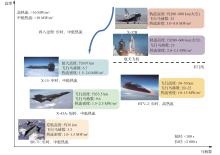
Fig.1
Heat flux density on surface of typical aircraft[4]


Fig.2
Representative experimental study[42-45]

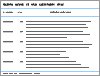
Table 1
Main influencing parameters considered in mechanism experiment research
| 全局变量 | 代表论文 | 具体参数 | 物理意义 |
|---|---|---|---|
| 几何参数 | Hwang[ | 几何尺寸 | 主动质量引射结构的几何尺寸 |
| 位置 | 主动质量引射结构的布置位置 | ||
| 面积 | 主动质量引射结构的面积 | ||
| 形状 | 主动质量引射结构的边界形状 | ||
| 多孔材料特性 | 孟丽燕等[ | 物理参数 | 固体骨架的热导率、比热容、密度和渗透率 |
| 厚度 | 多孔材料的厚度 | ||
| 耐温性 | 多孔材料的长期使用温度 | ||
| 表面发射率 | 多孔壁面的热辐射特性 | ||
| 颗粒直径 | 粉末烧结多孔材料的粉末颗粒直径 | ||
| 孔隙率 | 多孔介质中孔隙体积与总体积的比值 | ||
| 冷却工质供应 | 黄拯等[ | 冷却工质特性 | 导热系数、比热容、密度、黏度、相变温度 |
| 冷却工质的质量流量 | 单位时间内冷却工质的供给质量 | ||
| 供给温度 | 冷却工质供给腔室的温度 | ||
| 供给压力 | 驱动冷却工质从主动质量引射结构中流出的压力 | ||
| 渗透速度 | 冷却工质透过多孔介质的速度 | ||
| 主流参数 | Langener等[ | 物理参数 | 导热系数、比热容、密度、黏度 |
| 马赫数 | 风洞流场的马赫数 | ||
| 总温 | 风洞流场的滞止温度 | ||
| 总压 | 风洞流场的滞止压力 | ||
| 注入率 | 黄干等[ | 无量纲参数 | 冷却工质与主流气流之间流动强度的相对关系 |
Table 2
Typical ground assessment experimental research projects
地面考核 实验类型 | 研究单位 | 加热设备 | 主流条件 | 研究对象 | 材料 | 冷却工质 |
|---|---|---|---|---|---|---|
辐射加热 实验 | NASA 兰利研究 中心[ | 60 kW弧光灯 | 热流密度: 2 271.2 kW/m2 | 圆管、矩形管 | 烧结不锈钢 | 氦气、氢气 |
中国运载火箭技术 研究院[ | 石英灯 | 热流密度: 500 kW/m2 | 平板 | 钛铝合金、镍、 陶瓷 | 水 | |
对流加热 实验 | 静冈大学[ | 750 kW电弧 加热装置 | 速度:4 087 m/s 总温:4 303 K | 扁圆柱体 | 氧化铝 | 氮气 |
| 德国航空航天中心[ | 缩比燃烧室 | 速度:300 m/s 总温:3 600 K | 圆管式燃烧室 | C/C-SiC陶瓷基 复合材料 | 氢气 | |
空中客车防务与 航天公司[ | ILTR电加热 风洞 | 马赫数:2.1 总温:1 450 K | 平板 | C/C材料 | 空气、氮气 | |
| 德国航空航天中心[ | M3 缩比燃烧室 | 速度:294 m/s 总温:3 400 K | 简化火箭燃烧室与 喷管结构 | C/C-SiC陶瓷基 复合材料 | 氢气 | |
| 德国航空航天中心[ | L2K/L3K电弧 风洞 | 马赫数:7.0, 7.6 总温:4 220 5 400 K | 钝锥 | 陶瓷基复合材料 (91% Al2O3、 9% SiO2) | 氮气、水 | |
| 中国科学技术大学[ | 电加热风洞 | 雷诺数:16 000 总温:673~823 K | 楔形头锥 | 烧结不锈钢 | 水 | |
| 中国科学技术大学[ | 电弧风洞 | 马赫数:2.19 总温:2 400 K | 平板 | 烧结不锈钢 | 水 |
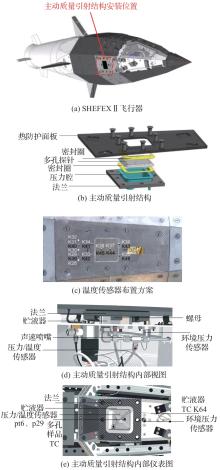
Fig.3
Hypersonic flight experiment project SHEFEX Ⅱ[45,75-79]


Fig.4
Flow mechanism under different Kn numbers and corresponding flight altitude and research scale

Table 3
Main theoretical equations and numerical calculation methods under various flow mechanisms
| 流动机制 | 核心理论方程 | 数值计算方法 | 适用性描述 | 适用物理学尺度范围 |
|---|---|---|---|---|
| 连续流动 | Navier-Stokes方程 | FVM、FDM与FEM等 | 连续介质假设 | 宏观 |
| 滑移流动 | Navier-Stokes方程/ Boltzmann方程 | 考虑滑移边界的FVM、LBM、 DSMC | 增加滑移边界条件、Boltzmann 方程可精确描述 | 宏观、介观 |
| 过渡流动 | Boltzmann方程 | LBM、DSMC | 分子间碰撞、分子与物面碰撞均显著 影响流动 | 宏观、介观 |

Fig.5
Characterization of porous media at different scales

Table 4
Comparison of theoretical models of internal flow and heat transfer in porous media
| 理论模型 | 物理假设 | 优势 | 劣势 | 方程组构成 |
|---|---|---|---|---|
| SFM | 流体的气相和液相被视为独立的相,各自有独立的流动和传热特性 | 可提供详细的相间互动信息, 计算精度较高 | 计算复杂、数值求解难度大,准确捕捉界面困难 | 流体的气液相分别采用独立的质量、动量、能量方程 |
| TPMM | 流体的液相和气相被视为单一混合相,统一处理速度、温度等物理量 | 数学处理简化,计算效率高 | 捕获具体的界面特性方面存在局限性 | 将流体的气液两相使用统一的质量、动量、能量方程 |
| LTE | 流体相和固体相在局部区域内达到热平衡,温度相同 | 简化传热过程,计算成本低 | 不适用于流固之间热交换缓慢或温度差异明显的情况 | 使用单一能量方程描述共同温度分布 |
| LTNE | 流体相和固体相存在温度差异,不处于热平衡状态 | 精确描述流固之间的热传递过程,适合各自行为差异明显的场合 | 建模与数值求解难度增加、边界条件和参数确定困难 | 流体相和固体相分别建立能量方程 |

Fig.6
Evolution and correction path of core model

Table 5
Summary of research content of SFM and TPMM correction
| 文献 | 理论模型 | 理论模型修正内容 | 数值计算方法 |
|---|---|---|---|
| Wang等[ | SFM | 引入新的压力修正方程和相分数方程,通过迭代更新压力和速度场,简化求解过程,避免复杂的相变界面跟踪 | 采用FVM离散扩散项与对流项,使用通量修正传输方案和隐式欧拉方法处理非稳态 |
| Dong等[ | TPMM | 引入混合比焓,作为热力学状态的单调函数,简化相变 界面处理,提高计算稳定性 | 采用FDM对空间离散化,验证网格独立性 |
| Hu等[ | TPMM | 提出动能焓概念,捕捉低压条件下两相区的温度变化, 改进模型对低压条件下温度梯度的描述能力 | 基于COMSOL Multiphysics的FEM,采用隐式时间步进与自适应时间步长策略 |
| He等[ | SFM | 考虑蒸汽的可压缩性、液体相变引起的动量转移及焓的 变化,解决热绝缘层问题,增强模型的准确性与鲁棒性 | 全隐式时间推进格式,求解动量与能量耦合方程 |
| Liu等[ | TPMM | 引入修正混合焓和焓比,实现不同流动状态下焓变化的 平滑统一处理,避免温度“跳跃”现象 | 基于FLUENT的FVM,嵌入用户自定义函数,并优化网格独立性和时间步长选择 |
| Su等[ | TPMM | 引入修正温度,将能量方程对流项系数转换为常数,简化方程并提高数值模拟的稳定性和收敛性 | 采用FVM迎风格式离散方程,使用PISO算法进行压力速度耦合,验证网格独立性 |
Dong和 Wang[ | SMM | 提出半混合模型(Semi-Mixed Model, SMM),结合SFM与TPMM优点,无需相变界面追踪,避免热绝缘层问题 | 采用FVM离散方程,对流项采用1阶迎风格式,扩散项采用中心差分格式,并使用SIMPLE算法耦合压力与速度 |
Table 6
Experimental fitting correlation of Nu number and its scope of application
| 文献 | 公式 | 适用范围 | 条件 |
|---|---|---|---|
Pallares和 Grau[ | 稳态层流 | ||
| Achenbach[ | 层流至湍流 | ||
胥蕊娜和 姜培学[ | 颗粒几何特性 | ||
| Xu等[ | 不同Kn数,多种气体 | 考虑稀薄效应下的速度滑移和 温度跳跃影响 |
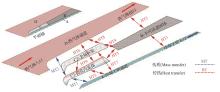
Fig.7
Partition modeling-interface coupling diagram[118]

Table 7
Theoretical models and numerical calculation methods involved in study of coupled flow and heat transfer characteristics of external and internal flow
| 文献 | 外部主流选用的理论方程及湍流模型 | 孔隙内流的流动传热理论模型 | 数值计算方法 |
|---|---|---|---|
| Cerminara等[ | N-S方程,DNS(直接求解方程,捕捉所有流动尺度无需湍流模型) | 等效Darcy-Forchheimer行为后 仍采用N-S方程 | 六阶中心差分,WENO格式, 3阶Runge-Kutta方法 |
| Liu等[ | RANS方程,SST k-ω湍流模型 | Darcy-Forchheimer模型,LTNE | FVM离散方程,压力基求解器 |
| Jiang等[ | 热化学非平衡N-S方程,Standard k-ω湍流模型 | Darcy-Forchheimer模型,LTE | FVM离散方程,对流项2阶迎风格式 |
| Huang等[ | RANS方程,Spalart-Allmaras湍流模型 | Darcy-Forchheimer模型,LTE | FVM离散方程,对流项2阶迎风格式 |
| Xiao等[ | N-S方程,LES直接解析大尺度湍流结构,引入SGS模型处理小尺度湍流对大尺度流动的影响 | Darcy-Forchheimer模型,LTNE | |
| Xiao等[ | RANS方程,SST k-ω湍流模型 | Darcy-Forchheimer模型,LTNE | 多区域数值策略 |
| Ding等[ | RANS方程,SST k-ω湍流模型 | Darcy-Forchheimer模型,LTE | FVM,多区域数值策略 |
| Su等[ | RANS方程,SST k-ω湍流模型 | TPMM-LTNE | FVM,多区域数值策略 |

Fig.8
Three kinds of intelligent agent model method classification diagram and its representative application[128-137]

Table 8
Data-driven agent model representative work
| 方法分类 | 方法 | 年份 | 主干网络 | 场景 |
|---|---|---|---|---|
| 规则网格 | DPUF[ | 2019 | CNN | 圆柱绕流 |
| TF-Net[ | 2020 | CNN | 湍流 | |
| EquNet[ | 2020 | CNN | Rayleigh-Bénard流、海洋 | |
| RSteer[ | 2022 | CNN | 烟雾 | |
| 不规则网格 | MGN[ | 2020 | GNN | 圆柱绕流、跨声速流 |
| MP-PDE[ | 2022 | GNN | Burgers方程、波浪、Naver-Stokes方程 | |
| BENO[ | 2024 | GNN/Transformer | Poisson方程 | |
| FCN[ | 2022 | GNN | Naver-Stokes方程 | |
| HAMLET[ | 2024 | GNN/Transformer | 浅水方程、Darcy方程、扩散、翼型 | |
| MAgNet[ | 2022 | GNN/CNN | Burgers方程 | |
| DINo[ | 2022 | FourierNet | Naver-Stokes方程、波浪、浅水方程 | |
| 深度算子网络 | DeepONet[ | 2021 | MLP | 反应-扩散方程、ODE |
| PI-DeepONet[ | 2021 | MLP | 跨声速流、反应-扩散方程、Burgers方程 | |
| MIONet[ | 2022 | MLP | 反应-扩散方程、ODE | |
| Fourier-MIONet[ | 2024 | MLP | 多相流 | |
| NOMAD[ | 2022 | MLP | 对流方程、浅水方程 | |
| Shift-DeepONet[ | 2022 | MLP | 对流方程、Burgers方程、Euler方程 | |
| HyperDeepONet[ | 2023 | MLP | 对流方程、Burgers方程、浅水方程 | |
| B-DeepONet[ | 2023 | MLP | 反应-扩散方程、对流方程 | |
| SVD-DeepONet[ | 2023 | MLP | ODE | |
| L-DeepONet[ | 2023 | MLP | Rayleigh-Bénard流、浅水流 | |
| 物理空间 | MGNO[ | 2020 | GNN | Burgers方程、Darcy方程 |
| LNO[ | 2024 | Laplace | 反应-扩散方程、Duffing方程 | |
| CNO[ | 2023 | CNN | Poisson方程、Naver-Stokes方程、Darcy方程 | |
| KNO[ | 2024 | Koopman | Naver-Stokes方程、Bateman-Burgers方程 | |
| SINGER[ | 2025 | GNN | 反应-扩散方程、Burgers方程、Allen-Cahn方程 | |
| FactFormer[ | 2023 | Transformer | Kolmogorov流,烟浮力 | |
| ICON[ | 2023 | Transformer | Poisson方程、反应-扩散方程、ODE | |
| Transolver[ | 2024 | Transformer | 汽车、翼型 | |
| GNO[ | 2020 | GNN | Poisson方程、随机系数的椭圆型方程 | |
| 傅里叶空间 | FNO[ | 2020 | Fourier | Burgers方程、Darcy方程、Navier-Stokes方程 |
| PINO[ | 2024 | Fourier | Burgers方程、Darcy方程、Navier-Stokes方程 | |
| Geo-FNO[ | 2023 | Fourier | Euler方程、Naver-Stokes方程、对流方程、弹性方程 | |
| GINO[ | 2023 | Fourier | RANS方程、汽车 | |
| DAFNO[ | 2023 | Fourier | 跨声速翼型、超弹性材料本构方程 | |
| U-NO[ | 2022 | Fourier | Darcy方程、Navier-Stokes方程 | |
| F-FNO[ | 2021 | Fourier | Kolmogorov流、跨声速流 | |
| CMWNO[ | 2023 | Fourier | Gray-Scott与Belousov-Zhabotinsky反应扩散方程 | |
| CFNO[ | 2022 | Fourier | Navier-Stokes方程、浅水方程、麦克斯韦方程 | |
| MCNP[ | 2025 | Fourier | 对流扩散方程、Allen-Cahn 方程、Navier-Stokes方程 | |
| RecFNO[ | 2024 | Fourier | 圆柱绕流、Darcy方程 | |
| G-FNO[ | 2023 | Fourier | Navier-Stokes方程、浅水方程 | |
| CoNO[ | 2023 | Fourier | Burgers方程、Darcy方程、Navier-Stokes方程、浅水方程 |
Table 9
Physical information fusion proxy model representative work
| 方法分类 | 方法 | 年份 | 主干网络 | 场景 |
|---|---|---|---|---|
| 物理信息神经网络 | PINN[ | 2019 | MLP | Navier-Stokes方程、反应-扩散方程、KdV方程 |
| PINN-SR[ | 2021 | MLP | Kuramoto-Sivashinsky方程、Navier-Stokes方程和Burgers方程等 | |
| NSFnets[ | 2021 | MLP | Kovasznay流、Beltrami流、圆柱绕流 | |
| Phygeonet[ | 2021 | CNN | Navier-Stokes方程、Poisson方程、热传导方程 | |
| CPINN[ | 2022 | MLP | Poisson方程、非线性Schrödinger方程、Burgers方程、Allen-Cahn方程 | |
| Stan[ | 2022 | MLP | 热传导方程、ODE | |
| NASPINN[ | 2024 | MLP | Poisson方程、Burgers方程、对流方程 | |
| Hodd-PINN[ | 2023 | Resnet | 对流方程、热传导方程 | |
| DAST[ | 2023 | MLP | Burgers方程、对流方程、反应扩散方程、Navier-Stokes 方程 | |
| OrPINN[ | 2025 | MLP | Helmholtz方程、线弹性波动方程 | |
| Sharp-PINN[ | 2025 | MLP | Allen-Cahn方程、Cahn-Hilliard方程 | |
| BINN[ | 2023 | MLP | Poisson方程、Hertz接触问题 | |
约束信息嵌入 神经网络 | DGM[ | 2018 | LSTM | Hamilton-Jacobi-Bellman方程、Burgers方程 |
| ADLGM[ | 2023 | LSTM | Poisson 方程、Burgers 方程 | |
| EDNN[ | 2021 | MLP | Burgers 方程、波动方程、Navier-Stokes方程 | |
| INSR[ | 2023 | MLP | Euler方程、对流方程、弹性动力学方程 | |
| AmorFEA[ | 2020 | MLP | Poisson方程、超弹性材料平衡方程 | |
| Neu-Gal[ | 2024 | MLP | Allen-Cahn方程、Fokker-Planck方程、KdV方程 | |
| PPNN[ | 2024 | CNN | 反应-扩散方程、Burgers 方程、Navier-Stokes 方程 |
| [1] | 包为民. 可重复使用运载火箭技术发展综述[J]. 航空学报, 2023, 44(23): 629555. |
| BAO W M. A review of reusable launch vehicle technology development[J]. Acta Aeronautica et Astronautica Sinica, 2023, 44(23): 629555 (in Chinese). | |
| [2] | 魏礼响, 徐惊雷, 陈匡世, 等. 宽域高超声速飞行器可调矢量喷管方案设计与性能研究[J]. 航空学报, 2025, 46(8): 631086. |
| WEI L X, XU J L, CHEN K S, et al. Scheme design and performance study of adjustable vector nozzle for wide-range hypersonic aircraft[J]. Acta Aeronautica et Astronautica Sinica, 2025, 46(8): 631086 (in Chinese). | |
| [3] | 张益荣, 张毅锋, 解静, 等. 典型高超声速翼身组合体粘性干扰效应模型研究[J]. 空气动力学学报, 2017, 35(2): 186-191. |
| ZHANG Y R, ZHANG Y F, XIE J, et al. Study of viscous interaction effect model for typical hypersonic wing-body figuration[J]. Acta Aerodynamica Sinica, 2017, 35(2): 186-191 (in Chinese). | |
| [4] | 潘利生, 郝亨隆, 姚子康, 等. 高速飞行器减阻降热研究进展[J]. 力学进展, 2023, 53(4): 793-818. |
| PAN L S, HAO H L, YAO Z K, et al. Current status of research on reducing drag and cooling of high-speedaircraft[J]. Advances in Mechanics, 2023, 53(4): 793-818 (in Chinese). | |
| [5] | 王长青. 空天飞行技术创新与发展展望[J]. 宇航学报, 2021, 42(7): 807-819. |
| WANG C Q. Technological innovation and development prospect of aerospace vehicle[J]. Journal of Astronautics, 2021, 42(7): 807-819 (in Chinese). | |
| [6] | 罗振兵, 夏智勋, 王林, 等. 高超声速飞行器内外流主动流动控制[M]. 北京: 科学出版社, 2019. |
| LUO Z B, XIA Z X, WANG L, et al. Active flow control of internal and external flow in hypersonic vehicle[M]. Beijing: Science Press, 2019 (in Chinese). | |
| [7] | 黄红岩, 苏力军, 雷朝帅, 等. 可重复使用热防护材料应用与研究进展[J]. 航空学报, 2020, 41(12): 023716. |
| HUANG H Y, SU L J, LEI C S, et al. Reusable thermal protective materials: Application andresearch progress[J]. Acta Aeronautica et Astronautica Sinica, 2020, 41(12): 023716 (in Chinese). | |
| [8] | 丁明松, 刘庆宗, 江涛, 等. 磁控热防护系统在天地往返运载器上的应用仿真[J]. 航空学报, 2021, 42(7): 124501. |
| DING M S, LIU Q Z, JIANG T, et al. Simulation of magnetohydrodynamic heat shield system on reusable launch vehicles[J]. Acta Aeronautica et Astronautica Sinica, 2021, 42(7): 124501 (in Chinese). | |
| [9] | 艾邦成, 陈思员, 韩海涛, 等. 疏导式热防护结构传热极限特性[J]. 航空学报, 2021, 42(2): 623989. |
| AI B C, CHEN S Y, HAN H T, et al. Heat transfer limit characteristics of integrated dredging thermal protection structure[J]. Acta Aeronautica et Astronautica Sinica, 2021, 42(2): 623989 (in Chinese). | |
| [10] | 朱广生, 姚世勇, 段毅. 高速飞行器减阻降热流动控制技术研究进展及工程应用[J]. 航空学报, 2023, 44(15):529049. |
| ZHU G S, YAO S Y, DUAN Y. Research progress and engineering application of flow control technology for drag reduction and heat reduction of high-speed flight vehicles[J]. Acta Aeronautica et Astronautica Sinica, 2023, 44(15): 529049 (in Chinese). | |
| [11] | 沈斌贤, 曾磊, 刘骁, 等. 高超声速飞行器主动质量引射热防护技术研究进展[J]. 空气动力学学报, 2022, 40(6): 1-13. |
| SHEN B X, ZENG L, LIU X, et al. Research progress of thermal protection technique by activemass injection for hypersonic vehicle[J]. Acta Aerodynamica Sinica, 2022, 40(6): 1-13 (in Chinese). | |
| [12] | 罗飞腾, 渠镇铭, 李海涛, 等. 高超声速进气道预喷注技术研究进展与关键问题[J]. 航空学报, 2025, 46(8): 27-59. |
| LUO F T, QU Z M, LI H T, et al. Research progress and key issues of inlet pre-injection at hypersonic condition[J]. Acta Aeronautica et Astronautica Sinica, 2025, 46(8): 27-59 (in Chinese). | |
| [13] | 梁彬, 赵俊波, 付增良, 等. 气体质量引射对钝锥俯仰特性的影响[J]. 航空学报, 2025, 46(3): 267-275. |
| LIANG B, ZHAO J B, FU Z L, et al. Effect of gas mass injection on pitching characteristics of blunt cone[J]. Acta Aeronautica et Astronautica Sinica, 2025, 46(3): 267-275 (in Chinese). | |
| [14] | ZHANG J Z, ZHANG S C, WANG C H, et al. Recent advances in film cooling enhancement: A review[J]. Chinese Journal of Aeronautics, 2020, 33(4): 1119-1136. |
| [15] | HWANG D. Review of research into the concept of the microblowing technique for turbulent skin friction reduction[J]. Progress in Aerospace Sciences, 2004, 40(8): 559-575. |
| [16] | MI Q, YI S H, GANG D D, et al. Research progress of transpiration cooling for aircraft thermal protection[J]. Applied Thermal Engineering, 2024, 236: 121360. |
| [17] | SHEN B X, LIU W Q, YIN L. Drag and heat reduction efficiency research on opposing jet in supersonic flows[J]. Aerospace Science and Technology, 2018, 77: 696-703. |
| [18] | 向树红, 商圣飞, 沈自才, 等. 高超声速气膜冷却技术研究进展及发展方向[J]. 宇航材料工艺, 2020, 50(3): 1-10. |
| XIANG S H, SHANG S F, SHEN Z C, et al. Research progress and development direction of hypersonic film cooling technology[J]. Aerospace Materials & Technology, 2020, 50(3): 1-10 (in Chinese). | |
| [19] | BERTIN J J, CUMMINGS R M. Critical hypersonic aerothermodynamic phenomena[J]. Annual Review of Fluid Mechanics, 2006, 38: 129-157. |
| [20] | CHEN L, HE A, ZHAO J L, et al. Pore-scale modeling of complex transport phenomena in porous media[J]. Progress in Energy and Combustion Science, 2022, 88: 100968. |
| [21] | WEINAN E, HAN J Q, ZHANG L F. Machine-learning-assisted modeling[J]. Physics Today, 2021, 74(7): 36-41. |
| [22] | CHEN X H, WANG Z C, DENG L, et al. Towards a new paradigm in intelligence-driven computational fluid dynamics simulations[J]. Engineering Applications of Computational Fluid Mechanics, 2024, 18(1): 2407005. |
| [23] | LENG C, TANG Z, ZHOU Y G, et al. Fifth paradigm in science: A case study of an intelligence-driven material design[J]. Engineering, 2023, 24: 126-137. |
| [24] | MALITSKY N, CASTAIN R, COWAN M. Spark-mpi: Approaching the fifth paradigm of cognitive applications[DB/OL]. arXiv preprint: 1806.01110, 2018. |
| [25] | HAN J Q, ZHANG L F, CAR R. Deep potential: A general representation of a many-body potential energy surface[DB/OL]. arXiv preprint: 1707.01478, 2017. |
| [26] | LI J H, HUANG W L. Paradigm shift in science with tackling global challenges[J]. National Science Review, 2019, 6(6): 1091-1093. |
| [27] | 杨小康, 许岩岩, 陈露, 等. AI for Science: 智能化科学设施变革基础研究[J]. 中国科学院院刊, 2024, 39(1): 59-69. |
| YANG X K, XU Y Y, CHEN L, et al. AI for Science: AI enabled scientific facility transforms fundamental research[J]. Bulletin of Chinese Academy of Sciences, 2024, 39(1): 59-69 (in Chinese). | |
| [28] | 陈云霁, 郭崎. AI for Technology: 技术智能在高技术领域的应用实践与未来展望[J]. 中国科学院院刊, 2024, 39(1): 34-40. |
| CHEN Y J, GUO Q. AI for Technology: Applied practices and future perspectives of technological intelligence in high tech areas[J]. Bulletin of Chinese Academy of Sciences, 2024, 39(1): 34-40 (in Chinese). | |
| [29] | 鄂维南. AI助力打造科学研究新范式[J]. 中国科学院院刊, 2024, 39(1): 10-16. |
| ER W N. AI helps to establish a new paradigm for scientific research[J]. Bulletin of Chinese Academy of Sciences, 2024, 39(1): 10-16 (in Chinese). | |
| [30] | BHARDWAJ G, O’CONNOR J, RETTIE S, et al. Accurate de novo design of membrane-traversing macrocycles[J]. Cell, 2022, 185(19): 3520-3532. |
| [31] | DAVIES A, VELIČKOVIĆ P, BUESING L, et al. Advancing mathematics by guiding human intuition with AI[J]. Nature, 2021, 600(7887): 70-74. |
| [32] | JUMPER J, EVANS R, PRITZEL A, et al. Highly accurate protein structure prediction with AlphaFold[J]. Nature, 2021, 596(7873): 583-589. |
| [33] | DEGRAVE J, FELICI F, BUCHLI J, et al. Magnetic control of tokamak plasmas through deep reinforcement learning[J]. Nature, 2022, 602(7897): 414-419. |
| [34] | 吴智, 范德威, 周裕. 人工智能控制湍流进展: 系统、算法、成就、数据分析方法[J]. 力学进展, 2023, 53(2): 273-307. |
| WU Z, FAN D W, ZHOU Y. Advances in control of turbulence by artificial intelligence: Systems, algorithms, achievements and data analysis methods[J]. Advances in Mechanics, 2023, 53(2): 273-307 (in Chinese). | |
| [35] | KRAMER B, PEHERSTORFER B, WILLCOX K E. Learning nonlinear reduced models from data with operator inference[J]. Annual Review of Fluid Mechanics, 2024, 56: 521-548. |
| [36] | 李道伦, 沈路航, 查文舒, 等. 基于神经算子与类物理信息神经网络智能求解新进展[J]. 力学学报, 2024, 56(4): 875-889. |
| LI D L, SHEN L H, ZHA W S, et al. New progress in intelligent solution of neural operators and physics-informed-based methods[J]. Chinese Journal of Theoretical and Applied Mechanics, 2024, 56(4): 875-889 (in Chinese). | |
| [37] | 王怡星, 韩仁坤, 刘子扬, 等. 流体力学深度学习建模技术研究进展[J]. 航空学报, 2021, 42(4): 524779. |
| WANG Y X, HAN R K, LIU Z Y, et al. Progress of deep learning modeling technology for fluid mechanics[J]. Acta Aeronautica et Astronautica Sinica, 2021, 42(4): 524779 (in Chinese). | |
| [38] | 安凯, 黄伟, 王振国, 等. AI驱动高速飞行器多学科发展知识图谱分析[J]. 航空学报, 2024, 45(S1): 48-66. |
| AN K, HUANG W, WANG Z G, et al. Knowledge atlas analysis of AI-driven multidisciplinary development of hypersonic aircrafts[J]. Acta Aeronautica et Astronautica Sinica, 2024, 45(S1): 48-66 (in Chinese). | |
| [39] | 张伟伟, 寇家庆, 刘溢浪. 智能赋能流体力学展望[J]. 航空学报, 2021, 42(4): 524689. |
| ZHANG W W, KOU J Q, LIU Y L. Prospect of artificial intelligence empowered fluid mechanics[J]. Acta Aeronautica et Astronautica Sinica, 2021, 42(4): 524689 (in Chinese). | |
| [40] | 吴光辉, 王景, 谢海润, 等. 数据与知识联合赋能的民机智能气动设计[J]. 航空学报, 2025, 46(5): 43-60. |
| WU G H, WANG J, XIE H R, et al. Data and knowledge-enabled intelligent aerodynamic design for civil aircraft[J]. Acta Aeronautica et Astronautica Sinica, 2025, 46(5): 43-60 (in Chinese). | |
| [41] | BRUNTON S L, NOACK B R, KOUMOUTSAKOS P. Machine learning for fluid mechanics[J]. Annual Review of Fluid Mechanics, 2020, 52: 477-508. |
| [42] | LANGENER T, VON WOLFERSDORF J, SELZER M, et al. Experimental investigations of transpiration cooling applied to C/C material[J]. International Journal of Thermal Sciences, 2012, 54: 70-81. |
| [43] | 黄干, 廖致远, 祝银海, 等. 高温主流条件下相变发汗冷却实验研究[J]. 工程热物理学报, 2017, 38(4): 817-821. |
| HUANG G, LIAO Z Y, ZHU Y H, et al. Experimental investigation of transpiration cooling with phase change in high temperature flow[J]. Journal of Engineering Thermophysics, 2017, 38(4): 817-821 (in Chinese). | |
| [44] | LIAO Z Y, ZHU Y H, HUANG G, et al. Experimental investigation of transpiration cooling on a porous plate with phase change in supersonic flow tunnel[J]. Journal of Propulsion Technology, 2019, 40(5). |
| [45] | BOEHRK H. Transpiration cooling at hypersonic flight - AKTiV on SHEFEX Ⅱ[C]∥11th AIAA/ASME Joint Thermophysics and Heat Transfer Conference. Reston: AIAA, 2014. |
| [46] | 孟丽燕, 姜培学, 蒋方帅, 等. 烧结多孔壁面发汗冷却换热的实验研究[J]. 清华大学学报(自然科学版), 2005, 45(11): 1537-1539. |
| MENG L Y, JIANG P X, JIANG F S, et al. Experimental investigation of the heat transfer for transpiration cooling through a sintered porous plate[J]. Journal of Tsinghua University (Science and Technology), 2005, 45(11): 1537-1539 (in Chinese). | |
| [47] | 黄拯, 祝银海, 熊宴斌, 等. 激波对超音速平板发汗冷却的影响[J]. 工程热物理学报, 2014,35(11): 2288-2293. |
| HUANG Z, ZHU Y H, XIONG Y B, et al. Investigation of shock wave influence on supersonic transpiration cooling[J]. Journal of Engineering Thermophysics, 2014, 35(11): 2288-2293 (in Chinese). | |
| [48] | LANGENER T, VON WOLFERSDORF J, LAUX T, et al. Experimental investigation of transpiration cooling with subsonic and supersonic flows at moderate temperature levels[C]∥44th AIAA/ASME/SAE/ASEE Joint Propulsion Conference and Exhibit.Reston: AIAA,2008. |
| [49] | 熊宴斌. 超声速主流条件发汗冷却的流动和传热机理研究[D]. 北京: 清华大学, 2013. |
| XIONG Y B. Study of the mechanism of flow and heat transfer on supersonic transpiration cooling[D]. Beijing: Tsinghua University, 2013 (in Chinese). | |
| [50] | MOFFAT R J, KAYS W M. The turbulent boundary layer on a porous plate: Experimental heat transfer with uniform blowing and suction[J]. International Journal of Heat and Mass Transfer, 1968, 11(10): 1547-1566. |
| [51] | SIMPSON R L, MOFFAT R J, KAYS W M. The turbulent boundary layer on a porous plate: Experimental skin friction with variable injection and suction[J]. International Journal of Heat and Mass Transfer, 1969, 12(7): 771-789. |
| [52] | KAYS W M. Heat transfer to the transpired turbulent boundary layer[J]. International Journal of Heat and Mass Transfer, 1972, 15(5): 1023-1044. |
| [53] | THIELBAHR W H, KAYS W M, MOFFAT R J. The turbulent boundary layer on a porous plate: Experimental heat transfer with uniform blowing and suction, with moderately strong acceleration[J]. Journal of Heat Transfer, 1972, 94(1): 111-118. |
| [54] | KEARNEY D W, KAYS W M, MOFFAT R J. Heat transfer to a strongly accelerated turbulent boundary layer: Some experimental results, including transpiration[J]. International Journal of Heat and Mass Transfer, 1973, 16(6): 1289-1305. |
| [55] | LIU Y Q, JIANG P X, XIONG Y B, et al. Experimental and numerical investigation of transpiration cooling for sintered porous flat plates[J]. Applied Thermal Engineering, 2013, 50(1): 997-1007. |
| [56] | HWANG D P. Skin-friction reduction by a micro-blowing technique[J]. AIAA Journal, 1998, 36(3): 480-481. |
| [57] | NOWAK R, WIETING A, HOLDEN M. Shock/shock interference on a transpiration cooled hemispherical model[C]∥21st Fluid Dynamics, Plasma Dynamics and Lasers Conference. Reston: AIAA, 1990. |
| [58] | HOLDEN M, RODRIGUEZ K, NOWAK R. Studies of shock/shock interaction on smooth and transpiration-cooled hemispherical nosetips in hypersonic flow[C]∥22nd Fluid Dynamics, Plasma Dynamics and Lasers Conference. Reston: AIAA, 1991. |
| [59] | CASTIGLONE L A, NORTHAM G B, BAKER N R, et al. Wall drag in internal Mach-2 flow with cavity and transpiration injection[J]. Journal of Propulsion and Power, 2000, 16(3): 472-477. |
| [60] | 马杰, 林佳, 王建华. 液态水相变发散冷却的实验[J]. 航空动力学报, 2014, 29(3): 556-562. |
| MA J, LIN J, WANG J H. Experiment on transpiration cooling with phase change of liquid water[J]. Journal of Aerospace Power, 2014, 29(3): 556-562 (in Chinese). | |
| [61] | HUANG G, ZHU Y H, LIAO Z Y, et al. Experimental investigation of transpiration cooling with phase change for sintered porous plates[J]. International Journal of Heat and Mass Transfer, 2017, 114: 1201-1213 |
| [62] | CHOI S H, SCOTTI S J, SONG K D, et al. Transpiring cooling of a scram-jet engine combustion chamber[C]∥32nd Thermophysics Conference. Reston: AIAA, 1997. |
| [63] | SONG K D, CHOI S H, SCOTTI S J. Transpiration cooling experiment for scramjet engine combustion chamber by high heat fluxes[J]. Journal of Propulsion and Power, 2006, 22(1): 96-102. |
| [64] | 吴亚东, 朱广生, 高波, 等. 多孔介质相变发汗冷却主动热防护试验研究[J]. 宇航学报, 2017, 38(2): 212-218. |
| WU Y D, ZHU G S, GAO B, et al. An experimental study on the phase-changed transpiration cooling for active thermal protection[J]. Journal of Astronautics, 2017, 38(2): 212-218 (in Chinese). | |
| [65] | 陈星宇, 王丽燕, 陈伟华, 等. 真空条件下多孔平板发汗冷却试验研究[J]. 北京航空航天大学学报, 2021, 47(8): 1594-1604. |
| CHEN X Y, WANG L Y, CHEN W H, et al. Transpiration cooling test of porous plate in vacuum environment[J]. Journal of Beijing University of Aeronautics and Astronautics, 2021, 47(8): 1594-1604 (in Chinese). | |
| [66] | OTSU H, FUJITA K, ITO T. Application of the transpiration cooling method for reentry vehicles[C]∥45th AIAA Aerospace Sciences Meeting and Exhibit. Reston: AIAA, 2007. |
| [67] | FROEHKLE K, HAIDN O, SERBEST E. New experimental results on transpiration cooling for hydrogen/oxygen rocket combustion chambers[C]∥34th AIAA/ASME/SAE/ASEE Joint Propulsion Conference and Exhibit. Reston: AIAA, 1998. |
| [68] | SOLLER S, KIRCHBERGER C, KUHN M, et al. Experimental investigation of cooling techniques and materials for highspeed flight propulsion systems[C]∥16th AIAA/DLR/DGLR International Space Planes and Hypersonic Systems and Technologies Conference. Reston: AIAA, 2009. |
| [69] | SERBEST E, HAIDN O, HALD H, et al. Effusion cooling in rocket combustors applying fibre reinforced ceramics[C]∥35th Joint Propulsion Conference and Exhibit. Reston: AIAA, 1999. |
| [70] | VAN FOREEST A, SIPPEL M, GÜLHAN A, et al. Transpiration cooling using liquid water[J]. Journal of Thermophysics and Heat Transfer, 2009, 23(4): 693-702. |
| [71] | GÜLHAN A. RESPACE-Key technologies for reusable space systems[M]. Berlin, Heidelberg: Springer, 2008. |
| [72] | WANG J H, ZHAO L J, WANG X C, et al. An experimental investigation on transpiration cooling of wedge shaped nose cone with liquid coolant[J]. International Journal of Heat and Mass Transfer, 2014, 75: 442-449. |
| [73] | LIANG D, KUAN W, QIAN Z, et al. An experimental investigation on transpiration cooling of porous flat plate[C]∥2011 International Conference on Remote Sensing, Environment and Transportation Engineering.Piscataway: IEEE Press, 2011: 5692-5696. |
| [74] | HOLDEN M. Experimental studies in the LENS shock tunnel and expansion tunnel to examine real-gas effects in hypervelocity flows[C]∥42nd AIAA Aerospace Sciences Meeting and Exhibit. Reston: AIAA, 2004. |
| [75] | WEIHS H, LONGO J, TURNER J. The sharp edge flight experiment SHEFEX Ⅱ, a mission overview and status[C]∥15th AIAA International Space Planes and Hypersonic Systems and Technologies Conference. Reston: AIAA, 2008. |
| [76] | BÖHRK H. Transpiration-cooled hypersonic flight experiment: setup, flight measurement, and reconstruction[J]. Journal of Spacecraft and Rockets, 2015, 52(3): 674-683. |
| [77] | WEIHS H. Sounding rockets for entry research: SHEFEX flight test program[C]∥Proceedings of the 21st ESA Symposium on Rocket and Balloon Programmes. Noordwijk: ESA Communications, 2013: 143-152. |
| [78] | TURNER J, ETTL J, HöRSCHGEN-EGGERS M, et al. Shefex Ⅱ vehicle and subsystem design, flight performance and their application to future hypersonic missions[C]∥Proceedings of the ESA-PAC 21st Symposium, Thun, Switzerland. Noordwijk: ESA Communications 2013: 9-13. |
| [79] | GÜLHAN A, SIEBE F, THIELE T, et al. Sharp edge flight experiment-Ⅱ instrumentation challenges and selected flight data[J]. Journal of Spacecraft and Rockets, 2013, 51(1): 175-186. |
| [80] | WEIHS H. Wall thickness optimization of a transpiration-cooled sharp leading edge at atmospheric re-entry[C]∥5th International Conference on Porous Media and Their Application in Science, Engineering and Industry. New York: Curran Associates, Inc., 2014. |
| [81] | 靳旭红, 黄飞, 张俊, 等. 上层大气层飞行器研究进展及气动技术挑战[J]. 航空学报, 2024, 45(22): 1-16. |
| JIN X H, HUANG F, ZHANG J, et al. Spacecraft in upper atmosphere: Research development and aerodynamic challenges[J]. Acta Aeronautica et Astronautica Sinica, 2024, 45(22): 1-16 (in Chinese). | |
| [82] | 张俊, 蒋亦凡, 陈松, 等. 超低轨卫星气动阻力计算与减阻设计研究综述[J]. 航空学报, 2024, 45(21): 159-180. |
| ZHANG J, JIANG Y F, CHEN S, et al. Overview of aerodynamic drag calculation and reduction design for very low Earth orbit satellites[J]. Acta Aeronautica et Astronautica Sinica, 2024, 45(21): 159-180 (in Chinese). | |
| [83] | PICONE J M, HEDIN A E, DROB D P, et al. NRLMSISE-00 empirical model of the atmosphere: Statistical comparisons and scientific issues[J]. Journal of Geophysical Research: Space Physics, 2002, 107(A12): SIA15-1-SIA15-16. |
| [84] | LOCKERBY D A, REESE J M, GALLIS M A. Capturing the Knudsen layer in continuum-fluid models of nonequilibrium gas flows[J]. AIAA Journal, 2005, 43(6): 1391-1393. |
| [85] | MOHAMAD A A. Lattice boltzmann method[M]. London: Springer, 2011. |
| [86] | 黄飞, 沈清, 程晓丽, 等. 一种DSMC分子仿真下的权因子预定义方法[J]. 航空学报, 2014, 35(8): 2174-2181. |
| HUANG F, SHEN Q, CHENG X L, et al. A new predefined method of particle weight in DSMC molecular simulation[J]. Acta Aeronautica et Astronautica Sinica, 2014, 35(8): 2174-2181 (in Chinese). | |
| [87] | JINDAL P, AGARWAL S, SHARMA R P. A brief review on numerical studies on film cooling effectiveness[J]. Applied Mechanics and Materials, 2016, 852: 699-706. |
| [88] | JOON A. Large eddy simulation of film cooling: a review[J]. Energies, 2022, 15(23): 8876. |
| [89] | 刘汉儒, 陈南树, 刘宇, 等. 多孔介质流动控制及气动降噪研究进展[J]. 航空学报, 2023, 44(16): 027923. |
| LIU H R, CHEN N S, LIU Y, et al. Review of porous media used in flow control and aerodynamic noise reduction[J]. Acta Aeronautica et Astronautica Sinica, 2023, 44(16): 027923 (in Chinese). | |
| [90] | WHITAKER S. The Forchheimer equation: A theoretical development[J]. Transport in Porous Media, 1996, 25(1): 27-61. |
| [91] | ABRIOLA L M, PINDER G F. A multiphase approach to the modeling of porous media contamination by organic compounds: 1. equation development[J]. Water Resources Research, 1985, 21(1): 11-18. |
| [92] | WANG C Y, BECKERMANN C. A two-phase mixture model of liquid-gas flow and heat transfer in capillary porous media: I. Formulation[J]. International Journal of Heat and Mass Transfer, 1993, 36(11): 2747-2758. |
| [93] | WANG C Y, BECKERMANN C. A two-phase mixture model of liquid-gas flow and heat transfer in capillary porous media: Ⅱ. Application to pressure-driven boiling flow adjacent to a vertical heated plate[J]. International Journal of Heat and Mass Transfer, 1993, 36(11): 2759-2768. |
| [94] | ALOMAR O R, MENDES M A A, TRIMIS D, et al. Simulation of complete liquid-vapour phase change process inside porous evaporator using local thermal non-equilibrium model[J]. International Journal of Thermal Sciences, 2015, 94: 228-241. |
| [95] | WANG M, WANG J H, PU J, et al. Transient heat dissipation performances of transpiration cooling with coolant phase change[J]. International Communications in Heat and Mass Transfer, 2022, 135: 106082. |
| [96] | DONG W J, WANG J H, CHEN S Y, et al. Modelling and investigation on heat transfer deterioration during transpiration cooling with liquid coolant phase-change[J]. Applied Thermal Engineering, 2018, 128: 381-392. |
| [97] | HU H W, JIANG P X, OUYANG X L, et al. A modified energy equation model for flow boiling in porous media and its application to transpiration cooling at low pressures with transient effect[J]. International Journal of Heat and Mass Transfer, 2020, 158: 119745. |
| [98] | HE F, WANG J H, XU L C, et al. Modeling and simulation of transpiration cooling with phase change[J]. Applied Thermal Engineering, 2013, 58(1/2): 173-180. |
| [99] | LIU T L, SU H, CHEN Z W, et al. Numerical investigation on the transient transport and heat transfer characteristics of transpiration cooling with liquid phase change during coolant adjustment[J]. Applied Thermal Engineering, 2022, 209: 118277. |
| [100] | SU H, HE F, WANG J H, et al. Numerical investigation on the effects of porous cone parameters on liquid transpiration cooling performance[J]. International Journal of Thermal Sciences, 2021, 161: 106743. |
| [101] | SU H, WANG J H, HE F, et al. Numerical investigation on transpiration cooling with coolant phase change under hypersonic conditions[J]. International Journal of Heat and Mass Transfer, 2019, 129: 480-490. |
| [102] | DONG W J, WANG J H. A new model and its application to investigate transpiration cooling with liquid coolant phase change[J]. Transport in Porous Media, 2018, 122(3): 575-593. |
| [103] | LEE D Y, VAFAI K. Analytical characterization and conceptual assessment of solid and fluid temperature differentials in porous media[J]. International Journal of Heat and Mass Transfer, 1999, 42(3): 423-435. |
| [104] | MARAFIE A, VAFAI K. Analysis of non-Darcian effects on temperature differentials in porous media[J]. International Journal of Heat and Mass Transfer, 2001, 44(23): 4401-4411. |
| [105] | WANG J H, WANG H N. A discussion of transpiration cooling problems through an analytical solution of local thermal nonequilibrium model[J]. Journal of Heat Transfer, 2006, 128(10): 1093-1098. |
| [106] | 黄拯. 高温与超音速条件下发汗冷却基础问题研究[D]. 北京: 清华大学, 2015. |
| HUANG Z. Research on the transpiration cooling in supersonic and high temperature flow[D]. Beijing: Tsinghua University, 2015 (in Chinese). | |
| [107] | 苏浩. 发散冷却系统冷却能力和流动换热特性的数值研究[D]. 合肥: 中国科学技术大学, 2020. |
| SU H. Numerical investigations on the cooling capacity and characteristics of flow and heat transfer of transpiration cooling[D]. Hefei: University of Science and Technology of China, 2020 (in Chinese). | |
| [108] | MINKOWYCZ W J, HAJI-SHEIKH A, VAFAI K. On departure from local thermal equilibrium in porous media due to a rapidly changing heat source: The Sparrow number[J]. International Journal of Heat and Mass Transfer, 1999, 42(18): 3373-3385. |
| [109] | PALLARES J, GRAU F X. A modification of a Nusselt number correlation for forced convection in porous media[J]. International Communications in Heat and Mass Transfer, 2010, 37(9): 1187-1190. |
| [110] | ACHENBACH E. Heat and flow characteristics of packed beds[J]. Experimental Thermal and Fluid Science, 1995, 10(1): 17-27. |
| [111] | 胥蕊娜, 姜培学. 流体在微多孔介质内对流换热实验研究[J]. 工程热物理学报, 2008, 29(8): 1377-1379. |
| XU R N, JIANG P X. Experimental investigations of convection heat transfer in microporous media[J]. Journal of Engineering Thermophysics, 2008, 29(8): 1377-1379 (in Chinese). | |
| [112] | XU R N, HUANG Y L, JIANG P X, et al. Internal heat transfer coefficients in microporous media with rarefaction effects[J]. Science China Technological Sciences, 2012, 55(10): 2869-2876. |
| [113] | CERMINARA A, DEITERDING R, SANDHAM N. A mesoscopic modelling approach for direct numerical simulations of transition to turbulence in hypersonic flow with transpiration cooling[J]. International Journal of Heat and Fluid Flow, 2020, 86: 108732. |
| [114] | LIU X, ZHOU W X, YU W L. Numerical simulation study of transpiration cooling with hydrocarbon fuel as coolant[J]. Applied Thermal Engineering, 2023, 221: 119687. |
| [115] | JIANG P X, LIAO Z Y, HUANG Z, et al. Influence of shock waves on supersonic transpiration cooling[J]. International Journal of Heat and Mass Transfer, 2019, 129: 965-974. |
| [116] | HUANG Z, ZHU Y H, XIONG Y B, et al. Investigation of transpiration cooling for sintered metal porous struts in supersonic flow[J]. Applied Thermal Engineering, 2014, 70(1): 240-249. |
| [117] | XIAO X F, ZHAO G B, ZHOU W X, et al. Large-eddy simulation of transpiration cooling in turbulent channel with porous wall[J]. Applied Thermal Engineering, 2018, 145: 618-629. |
| [118] | XIAO X F, ZHAO G B, ZHOU W X. Numerical investigation of transpiration cooling for porous nose cone with liquid coolant[J]. International Journal of Heat and Mass Transfer, 2018, 121: 1297-1306. |
| [119] | BETCHEN L, STRAATMAN A G, THOMPSON B E. A nonequilibrium finite-volume model for conjugate fluid/porous/solid domains[J]. Numerical Heat Transfer, Part A: Applications, 2006, 49(6): 543-565. |
| [120] | ALBERTO J. Momentum jump condition at the boundary between a porous medium and a homogeneous fluid: Inertial effects[J]. Journal of Porous Media, 1998, 1(3): 201-217. |
| [121] | PHANIKUMAR M S, MAHAJAN R L. Non-Darcy natural convection in high porosity metal foams[J]. International Journal of Heat and Mass Transfer, 2002, 45(18): 3781-3793. |
| [122] | ALAZMI B, VAFAI K. Analysis of variants within the porous media transport models[J]. Journal of Heat Transfer, 2000, 122(2): 303-326. |
| [123] | VON WOLFERSDORF J. Effect of coolant side heat transfer on transpiration cooling[J]. Heat and Mass Transfer, 2005, 41(4): 327-337. |
| [124] | KOVENSKII V I, TEPLITSKII Y S. Modelling of heat transfer in an infiltrated granular bed in view of the difference of phase temperatures[J]. International Journal of Heat and Mass Transfer, 2006, 49(1/2): 359-365. |
| [125] | 董文杰. 发散冷却基础问题的理论与数值研究[D]. 合肥: 中国科学技术大学, 2018. |
| DONG W J. Theoretical and numerical investigations on basic problems of transpiration cooling[D]. Hefei: University of Science and Technology of China, 2018 (in Chinese). | |
| [126] | DING R, WANG J H, HE F, et al. Numerical investigation on a double layer combined cooling structure for aerodynamic heat control of hypersonic vehicle leading edge[J]. Applied Thermal Engineering, 2020, 169: 114949. |
| [127] | SU H, HE F, WANG J H, et al. Numerical investigation on the characteristics of coolant flow, heat absorption and phase change in transpiration cooling process[J]. International Journal of Thermal Sciences, 2019, 142: 68-76. |
| [128] | LEE S, YOU D. Data-driven prediction of unsteady flow over a circular cylinder using deep learning[J]. Journal of Fluid Mechanics, 2019, 879: 217-254. |
| [129] | PFAFF T, FORTUNATO M, SANCHEZ-GONZALEZ A, et al. Learning mesh-based simulation with graph networks[C]∥International Conference on Learning Representations. Virtual Event: ICLR, 2020. |
| [130] | LU L, JIN P Z, PANG G F, et al. Learning nonlinear operators via DeepONet based on the universal approximation theorem of operators[J]. Nature Machine Intelligence, 2021, 3(3): 218-229. |
| [131] | JIANG Z Y, ZHU M, LU L. Fourier-MIONet: Fourier-enhanced multiple-input neural operators for multiphase modeling of geological carbon sequestration[J]. Reliability Engineering & System Safety, 2024, 251: 110392. |
| [132] | RAONIC B, MOLINARO R, ROHNER T, et al. Convolutional neural operators[C]∥The Eleventh International Conference on Learning Representations. Kigali: OpenReview, 2023: 1-14. |
| [133] | LI Z Y, KOVACHKI N, AZIZZADENESHELI K, et al. Fourier neural operator for parametric partial differential equations[DB/OL]. arXiv preprint: 2010.08895, 2020. |
| [134] | RAISSI M, PERDIKARIS P, KARNIADAKIS G E. Physics-informed neural networks: A deep learning framework for solving forward and inverse problems involving nonlinear partial differential equations[J]. Journal of Computational Physics, 2019, 378: 686-707. |
| [135] | OLDENBURG J, BOROWSKI F, WOLLENBERG W, et al. Augmentation of experimentally obtained flow fields by means of Physics Informed Neural Networks (PINN) demonstrated on aneurysm flow[J]. Current Directions in Biomedical Engineering, 2023, 9(1): 519-523. |
| [136] | SIRIGNANO J, SPILIOPOULOS K. DGM: A deep learning algorithm for solving partial differential equations[J]. Journal of Computational Physics, 2018, 375: 1339-1364. |
| [137] | HAO Z K, WANG Z Y, SU H, et al. Gnot: A general neural operator transformer for operator learning[C]∥International Conference on Machine Learning. Honolulu, Hawaii, USA: PMLR, 2023: 12556-12569. |
| [138] | WANG R, KASHINATH K, MUSTAFA M, et al. Towards physics-informed deep learning for turbulent flow prediction[C]∥Proceedings of the 26th ACM SIGKDD International Conference on Knowledge Discovery & Data Mining. New York: ACM, 2020: 1457-1466. |
| [139] | WANG R, WALTERS R, YU R. Incorporating symmetry into deep dynamics models for improved generalization[DB/OL]. arXiv preprint: 2002.03061, 2020. |
| [140] | WANG R, WALTERS R, YU R. Approximately equivariant networks for imperfectly symmetric dynamics[C]∥International Conference on Machine Learning. Baltimore, Maryland, USA: PMLR, 2022: 23078-23091. |
| [141] | BRANDSTETTER J, WORRALL D, WELLING M. Message passing neural PDE solvers[DB/OL]. arXiv preprint: 2202.03376, 2022. |
| [142] | WANG H X, LI J X, DWIVEDI A, et al. Beno: Boundary-embedded neural operators for elliptic pdes[DB/OL]. arXiv preprint: 2401.09323, 2024. |
| [143] | HE X D, WANG Y N, LI J. Flow completion network: Inferring the fluid dynamics from incomplete flow information using graph neural networks[J]. Physics of Fluids, 2022, 34(8): 087114. |
| [144] | BRYUTKIN A, HUANG J H, DENG Z Y, et al. Hamlet: Graph transformer neural operator for partial differential equations[DB/OL]. arXiv preprint: 2402.03541, 2024. |
| [145] | BOUSSIF O, BENGIO Y, BENABBOU L, et al. MAgnet: Mesh agnostic neural PDE solver[J]. Advances in Neural Information Processing Systems, 2022, 35: 31972-31985. |
| [146] | YIN Y, KIRCHMEYER M, FRANCESCHI J Y, et al. Continuous PDE dynamics forecasting with implicit neural representations[DB/OL]. arXiv preprint: 2209.14855, 2022. |
| [147] | HAN X, GAO H, PFAFF T, et al. Predicting physics in mesh-reduced space with temporal attention[DB/OL]. arXiv preprint: 2201.09113, 2022. |
| [148] | WANG S F, WANG H W, PERDIKARIS P. Learning the solution operator of parametric partial differential equations with physics-informed DeepONets[J]. Science Advances, 2021, 7(40): eabi8605. |
| [149] | JIN P Z, MENG S, LU L. MIONet: Learning multiple-input operators via tensor product[J]. SIAM Journal on Scientific Computing, 2022, 44(6): A3490-A3514. |
| [150] | SEIDMAN J, KISSAS G, PERDIKARIS P, et al. NOMAD: Nonlinear manifold decoders for operator learning[J]. Advances in Neural Information Processing Systems, 2022, 35: 5601-5613. |
| [151] | LANTHALER S, MOLINARO R, HADORN P, et al. Nonlinear reconstruction for operator learning of PDEs with discontinuities[DB/OL]. arXiv preprint: 2210.01074, 2022. |
| [152] | LEE J Y, CHO S W, HWANG H J. HyperDeepONet: Learning operator with complex target function space using the limited resources via hypernetwork[DB/OL]. arXiv preprint: 2312.15949, 2023. |
| [153] | LIN G, MOYA C, ZHANG Z C. B-DeepONet: An enhanced Bayesian DeepONet for solving noisy parametric PDEs using accelerated replica exchange SGLD[J]. Journal of Computational Physics, 2023, 473: 111713. |
| [154] | VENTURI S, CASEY T. SVD perspectives for augmenting DeepONet flexibility and interpretability[J]. Computer Methods in Applied Mechanics and Engineering, 2023, 403: 115718. |
| [155] | KONTOLATI K, GOSWAMI S, KARNIADAKIS G E, et al. Learning in latent spaces improves the predictive accuracy of deep neural operators[DB/OL]. arXiv preprint: 2304.07599, 2023. |
| [156] | LI Z Y, KOVACHKI N, AZIZZADENESHELI K, et al. Multipole graph neural operator for parametric partial differential equations[J]. Advances in Neural Information Processing Systems, 2020, 33: 6755-6766. |
| [157] | CAO Q Y, GOSWAMI S, KARNIADAKIS G E. Laplace neural operator for solving differential equations[J]. Nature Machine Intelligence, 2024, 6(6): 631-640. |
| [158] | XIONG W, HUANG X M, ZHANG Z Y, et al. Koopman neural operator as a mesh-free solver of non-linear partial differential equations[J]. Journal of Computational Physics, 2024, 513: 113194. |
| [159] | FENG M Q, HUANG Y X, LIAO W X, et al. SINGER: Stochastic Network Graph Evolving Operator for High Dimensional PDEs[C]∥The Thirteenth International Conference on Learning Representations. Singapore: OpenReview, 2025: 36855-36874. |
| [160] | LI Z J, SHU D L, BARATI FARIMANI A. Scalable transformer for pde surrogate modeling[J]. Advances in Neural Information Processing Systems, 2023, 36: 28010-28039. |
| [161] | YANG L, LIU S T, MENG T W, et al. In-context operator learning with data prompts for differential equation problems[J]. Proceedings of the National Academy of Sciences of the United States of America, 2023, 120(39): e2310142120. |
| [162] | WU H X, LUO H K, WANG H, et al. Transolver: A fast transformer solver for pdes on general geometries[DB/OL]. arXiv preprint: 2402.02366, 2024. |
| [163] | GENEVA N, ZABARAS N. Transformers for modeling physical systems[J]. Neural Networks, 2022, 146: 272-289. |
| [164] | LI Z Y, ZHENG H K, KOVACHKI N, et al. Physics-informed neural operator for learning partial differential equations[J]. ACM /IMS Journal of Data Science, 2024, 1(3): 1-27. |
| [165] | LI Z Y, HUANG D Z, LIU B, et al. Fourier neural operator with learned deformations for PDEs on general geometries[J]. Journal of Machine Learning Research, 2023, 24(1): 18593-18618. |
| [166] | LI Z Y, KOVACHKI N, CHOY C, et al. Geometry-informed neural operator for large-scale 3D PDEs[C]∥Proceedings of the 37th International Conference on Neural Information Processing Systems. New York: ACM, 2023: 35836-35854. |
| [167] | LIU N, JAFARZADEH S, YU Y. Domain agnostic fourier neural operators[J]. Advances in Neural Information Processing Systems, 2023, 36: 47438-47450. |
| [168] | RAHMAN M A, ROSS Z E, AZIZZADENESHELI K. U-no: U-shaped neural operators[DB/OL]. arXiv preprint: 2204.11127, 2022. |
| [169] | TRAN A, MATHEWS A, XIE L X, et al. Factorized fourier neural operators[DB/OL]. arXiv preprint: 2111.13802, 2021. |
| [170] | XIAO X Y, CAO D F, YANG R C, et al. Coupled multiwavelet neural operator learning for coupled partial differential equations[DB/OL]. arXiv preprint: 2303.02304, 2023. |
| [171] | BRANDSTETTER J, BERG R, WELLING M, et al. Clifford neural layers for PDE modeling[DB/OL]. arXiv preprint: 2209.04934, 2022. |
| [172] | ZHANG R, MENG Q, ZHU R C, et al. Monte Carlo neural PDE solver for learning PDEs via probabilistic representation[J]. IEEE Transactions on Pattern Analysis and Machine Intelligence, 2025, 47(6): 5059-5075. |
| [173] | ZHAO X Y, CHEN X Q, GONG Z Q, et al. RecFNO: A resolution-invariant flow and heat field reconstruction method from sparse observations via Fourier neural operator[J]. International Journal of Thermal Sciences, 2024, 195: 108619. |
| [174] | HELWIG J, ZHANG X, FU C, et al. Group equivariant fourier neural operators for partial differential equations[DB/OL]. arXiv preprint: 2306.05697, 2023. |
| [175] | TIWARI K, KRISHNAN N M, et al. Cono: Complex neural operator for continuous dynamical systems[DB/OL]. arXiv preprint: 2310.02094, 2023. |
| [176] | LI Z Y, KOVACHKI N, AZIZZADENESHELI K, et al. Neural operator: Graph kernel network for partial differential equations[DB/OL]. arXiv preprint: 2003.03485, 2020. |
| [177] | CAO Y D, CHAI M, LI M C, et al. Efficient learning of mesh-based physical simulation with bi-stride multi-scale graph neural network[C]∥Proceedings of the 40th International Conference on Machine Learning. New York: ACM, 2023: 3541-3558. |
| [178] | LINO M, FOTIADIS S, BHARATH A A, et al. Multi-scale rotation-equivariant graph neural networks for unsteady Eulerian fluid dynamics[J]. Physics of Fluids, 2022, 34(8): 087110. |
| [179] | CHEN Z, LIU Y, SUN H. Physics-informed learning of governing equations from scarce data[J]. Nature Communications, 2021, 12: 6136. |
| [180] | JIN X W, CAI S Z, LI H, et al. NSFnets (Navier-Stokes flow nets): Physics-informed neural networks for the incompressible Navier-Stokes equations[J]. Journal of Computational Physics, 2021, 426: 109951. |
| [181] | GAO H, SUN L N, WANG J X. PhyGeoNet: Physics-informed geometry-adaptive convolutional neural networks for solving parameterized steady-state PDEs on irregular domain[J]. Journal of Computational Physics, 2021, 428: 110079. |
| [182] | ZENG Q, KOTHARI Y, BRYNGELSON S H, et al. Competitive physics informed networks[DB/OL]. arXiv preprint: 2204.11144, 2022. |
| [183] | GNANASAMBANDAM R, SHEN B, CHUNG J, et al. Self-scalable tanh (Stan): Faster convergence and better generalization in physics-informed neural networks[DB/OL]. arXiv preprint: 2204.12589, 2022. |
| [184] | WANG Y F, ZHONG L L. NAS-PINN: Neural architecture search-guided physics-informed neural network for solving PDEs[J]. Journal of Computational Physics, 2024, 496: 112603. |
| [185] | YOU R Q, ZHANG S M, KONG T L, et al. High-order discontinuity detection physics-informed neural network[DB/OL]. arXiv preprint: 2307.15877, 2023. |
| [186] | TOLOUBIDOKHTI M, YE Y B, MISSEL R, et al. DATS: Difficulty-aware task sampler for meta-learning physics-informed neural networks[C]∥The Twelfth International Conference on Learning Representations. Vienna: OpenReview, 2024: 1-21. |
| [187] | DUARTE D H G, DE LIMA P D S, DE ARAÚJO J M. Outlier-resistant physics-informed neural network[J]. Physical Review E, 2025, 111(2): L023302. |
| [188] | CHEN N X, CUI C J, MA R J, et al. Sharp-PINNs: Staggered hard-constrained physics-informed neural networks for phase field modelling of corrosion[DB/OL]. arXiv preprint: 2502.11942, 2025. |
| [189] | SUN J, LIU Y H, WANG Y Z, et al. BINN: A deep learning approach for computational mechanics problems based on boundary integral equations[J]. Computer Methods in Applied Mechanics and Engineering, 2023, 410: 116012. |
| [190] | GAFOOR CTP A, KUMAR BOYA S, JINKA R S, et al. A physics-informed neural network for turbulent wake simulations behind wind turbines[J]. Physics of Fluids, 2025, 37: 015110. |
| [191] | ARISTOTELOUS A C, MITCHELL E C, MAROULAS V. ADLGM: An efficient adaptive sampling deep learning Galerkin method[J]. Journal of Computational Physics, 2023, 477: 111944. |
| [192] | DU Y F, ZAKI T A. Evolutional deep neural network[J]. Physical Review E, 2021, 104(4): 045303. |
| [193] | CHEN H L, WU R D, GRINSPUN E, et al. Implicit neural spatial representations for time-dependent pdes[C]∥International Conference on Machine Learning. Honolulu, Hawaii, USA: PMLR, 2023: 5162-5177. |
| [194] | Amortized finite element analysis for fast PDE-constrained optimization[C]∥Proceedings of the 37th International Conference on Machine Learning. New York: ACM, 2020: 10638-10647. |
| [195] | BRUNA J, PEHERSTORFER B, VANDEN-EIJNDEN E. Neural Galerkin schemes with active learning for high-dimensional evolution equations[J]. Journal of Computational Physics, 2024, 496: 112588. |
| [196] | LIU X Y, ZHU M, LU L, et al. Multi-resolution partial differential equations preserved learning framework for spatiotemporal dynamics[J]. Communications Physics, 2024, 7: 31. |
| [197] | LYU Y F, ZHAO X Y, GONG Z Q, et al. Multi-fidelity prediction of fluid flow based on transfer learning using Fourier neural operator[J]. Physics of Fluids, 2023, 35(7): 077118. |
| [198] | WU T L, MARUTAMA T, ZHAO Q Q, et al. Learning controllable adaptive simulation for multi-resolution physics[DB/OL]. arXiv preprint: 2305.01122, 2023. |
| [199] | ZHANG X, HELWIG J, LIN Y C, et al. Sinenet: Learning temporal dynamics in time-dependent partial differential equations[J]. arXiv preprint arXiv: , 2024. |
| [200] | SERRANO L, LE BOUDEC L, KASSAï KOUPAï A, et al. Operator learning with neural fields: Tackling pdes on general geometries[J]. Advances in Neural Information Processing Systems, 2023, 36: 70581-70611. |
| [201] | VLACHAS P R, ARAMPATZIS G, UHLER C, et al. Multiscale simulations of complex systems by learning their effective dynamics[J]. Nature Machine Intelligence, 2022, 4(4): 359-366. |
| [202] | FANG S K, COOLEY M, LONG D, et al. Solving high frequency and multi-scale pdes with gaussian processes[J]. arXiv preprint arXiv: , 2023. |
| [1] | Xiangyu LIU, Gang WANG, Siyuan WANG, Zhuowen CHEN. A data-knowledge dual-driven method for formation target intention recognition [J]. Acta Aeronautica et Astronautica Sinica, 2026, 47(2): 332170-332170. |
| [2] | Jinglei XU, Shuai HUANG, Ruifeng PAN, Yuqi ZHANG. Research on fluidic thrust vectoring nozzle: Recent developments and future trends [J]. Acta Aeronautica et Astronautica Sinica, 2025, 46(8): 631216-631216. |
| [3] | Yuequn LUO, Dali DING, Mulai TAN, Yidong LIU, Huan ZHOU. A review of autonomous maneuver decision methods for unmanned combat aerial vehicle [J]. Acta Aeronautica et Astronautica Sinica, 2025, 46(7): 30877-030877. |
| [4] | Guanghui WU, Jing WANG, Hairun XIE, Tuliang MA, Qiang MIAO, Jixin XIANG, Miao ZHANG. Data and knowledge-enabled intelligent aerodynamic design for civil aircraft [J]. Acta Aeronautica et Astronautica Sinica, 2025, 46(5): 531485-531485. |
| [5] | Zhenbing LUO, Hao WANG, Zhijie ZHAO. Theory of dual synthetic jets and its empowerment of advancements in aeronautical technology [J]. Acta Aeronautica et Astronautica Sinica, 2025, 46(5): 531821-531821. |
| [6] | Feng QU, Qing WANG, Shaowen CHENG, Kaiqiang WANG. Aerodynamic shape optimization design of airframe/propulsion integrated hypersonic aircraft with aerodynamics/trajectory/ control coupling [J]. Acta Aeronautica et Astronautica Sinica, 2025, 46(4): 130874-130874. |
| [7] | Yahang SONG, Xin ZHANG, Zhiming MA, Zhengyu ZUO. Airfoil gust alleviation using a plasma actuator in low-speed wind tunnel test [J]. Acta Aeronautica et Astronautica Sinica, 2025, 46(22): 131975-131975. |
| [8] | Shilin HU, Bingzhou CHEN, Wei KANG. Lift improvement mechanism of membrane airfoil using dynamic mode decomposition [J]. Acta Aeronautica et Astronautica Sinica, 2025, 46(2): 130618-130618. |
| [9] | Yousheng WANG, Liguo SUN, Jinpeng WEI, Wenqian TAN, Yonghao PAN. Optimization of climb trajectory of combined-cycle engine powered aircraft based on improved CSO-Gauss pseudospectral method [J]. Acta Aeronautica et Astronautica Sinica, 2025, 46(2): 230737-230737. |
| [10] | Shuming YANG, Jianjun WU, Changlin XIE, Yuqiang CHENG, Biao WANG. Application issues of data-driven intelligent fault diagnosis technologies for liquid rocket engines [J]. Acta Aeronautica et Astronautica Sinica, 2025, 46(15): 131427-131427. |
| [11] | Hongyu WANG, Gang WANG, Tao LI, Zhenhou CHAO, Feng GAO. Transverse jet mixing based on energy deposition control via pulsed discharge [J]. Acta Aeronautica et Astronautica Sinica, 2025, 46(14): 131520-131520. |
| [12] | Haotian ZHAO, Shi QIU, Ming LIU, Qichao GAI, Xibin CAO. Degradation evaluation method for communication satellite traveling wave tubes based on full life cycle data [J]. Acta Aeronautica et Astronautica Sinica, 2025, 46(12): 331376-331376. |
| [13] | Yu ZENG, Hongbo WANG, Chengyue LIAN, Yixin YANG, Dapeng XIONG, Mingbo SUN, Weidong LIU. Applicability analysis of two improved methods of SST turbulence model [J]. Acta Aeronautica et Astronautica Sinica, 2024, 45(S1): 730574-730574. |
| [14] | Xiangying GUO, Jie XU, Yongchang HUANG. Characteristic analysis of large-scale wavelength protuberances wings near critical angle [J]. Acta Aeronautica et Astronautica Sinica, 2024, 45(S1): 730557-730557. |
| [15] | Chang WANG, Long HE, Dongxia XU, Min TANG, Shuai MA, Ximing WU. Flow control drag reduction of hub on coaxial rigid rotor aircraft [J]. Acta Aeronautica et Astronautica Sinica, 2024, 45(9): 529084-529084. |
| Viewed | ||||||
|
Full text |
|
|||||
|
Abstract |
|
|||||
Address: No.238, Baiyan Buiding, Beisihuan Zhonglu Road, Haidian District, Beijing, China
Postal code : 100083
E-mail:hkxb@buaa.edu.cn
Total visits: 6658907 Today visits: 1341All copyright © editorial office of Chinese Journal of Aeronautics
All copyright © editorial office of Chinese Journal of Aeronautics
Total visits: 6658907 Today visits: 1341

 CJA
CJA
