Acta Aeronautica et Astronautica Sinica ›› 2026, Vol. 47 ›› Issue (19): 633836.doi: 10.7527/S1000-6893.2026.33836
• The Centennial of the Naming of Hunan University • Previous Articles
Yangfan DENG1,2,3, Jiachang TANG1,2( ), Zhe ZHANG3, Qishui YAO1,2, Wei PAN1,2, Hairui ZHANG4
Received:2026-05-08
Revised:2026-05-25
Accepted:2026-06-24
Online:2026-07-06
Published:2026-07-03
Contact:
Jiachang TANG
E-mail:tangjiachang@hut.edu.cn
Supported by:CLC Number:
Yangfan DENG, Jiachang TANG, Zhe ZHANG, Qishui YAO, Wei PAN, Hairui ZHANG. Bayesian active learning based adaptive discretization method for nonparametric probability box reliability analysis[J]. Acta Aeronautica et Astronautica Sinica, 2026, 47(19): 633836.
Fig.1
Schematic diagram of BAAD
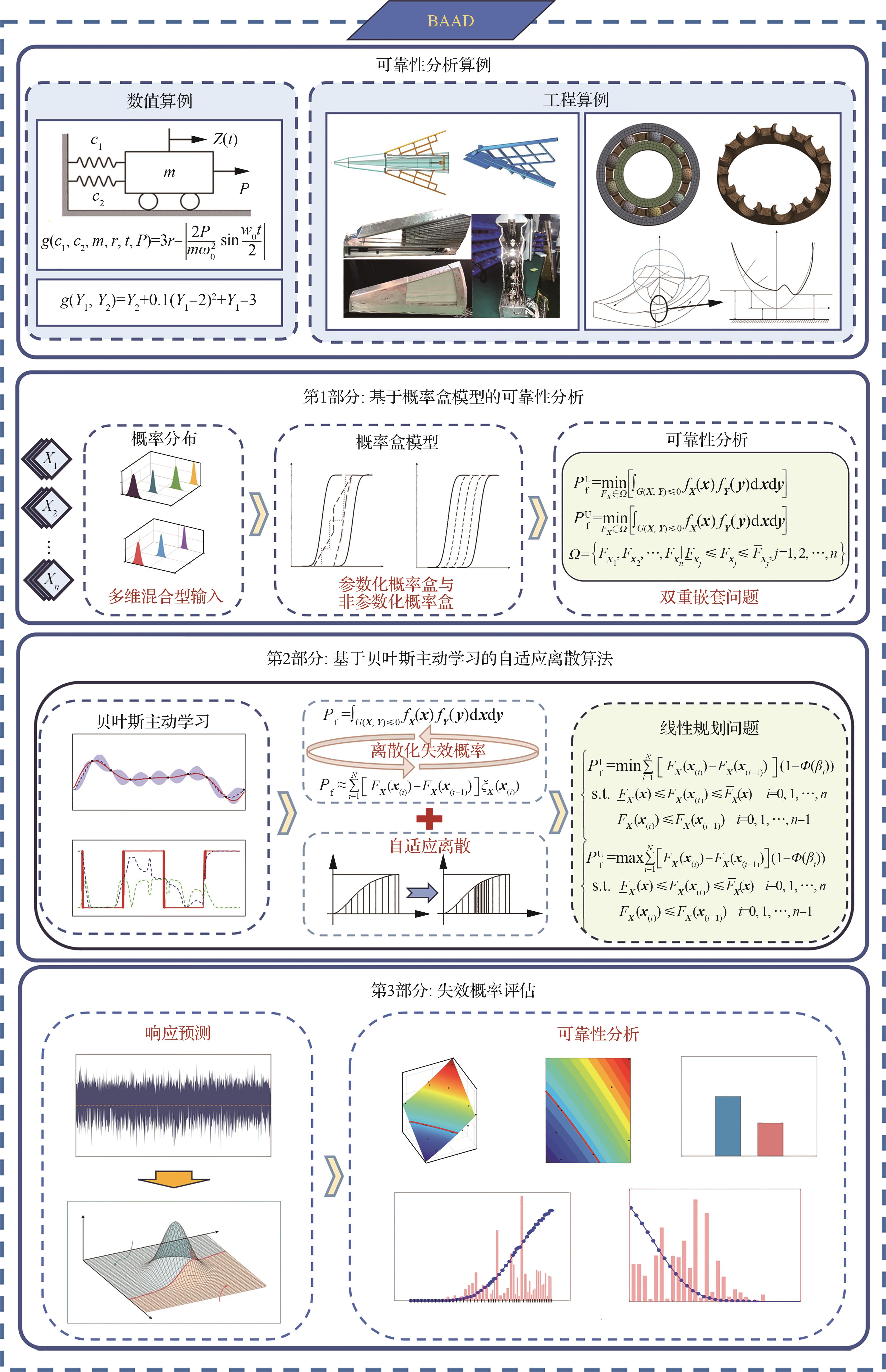
Fig.2
Nonparametric p-box and parametric p-box[43]
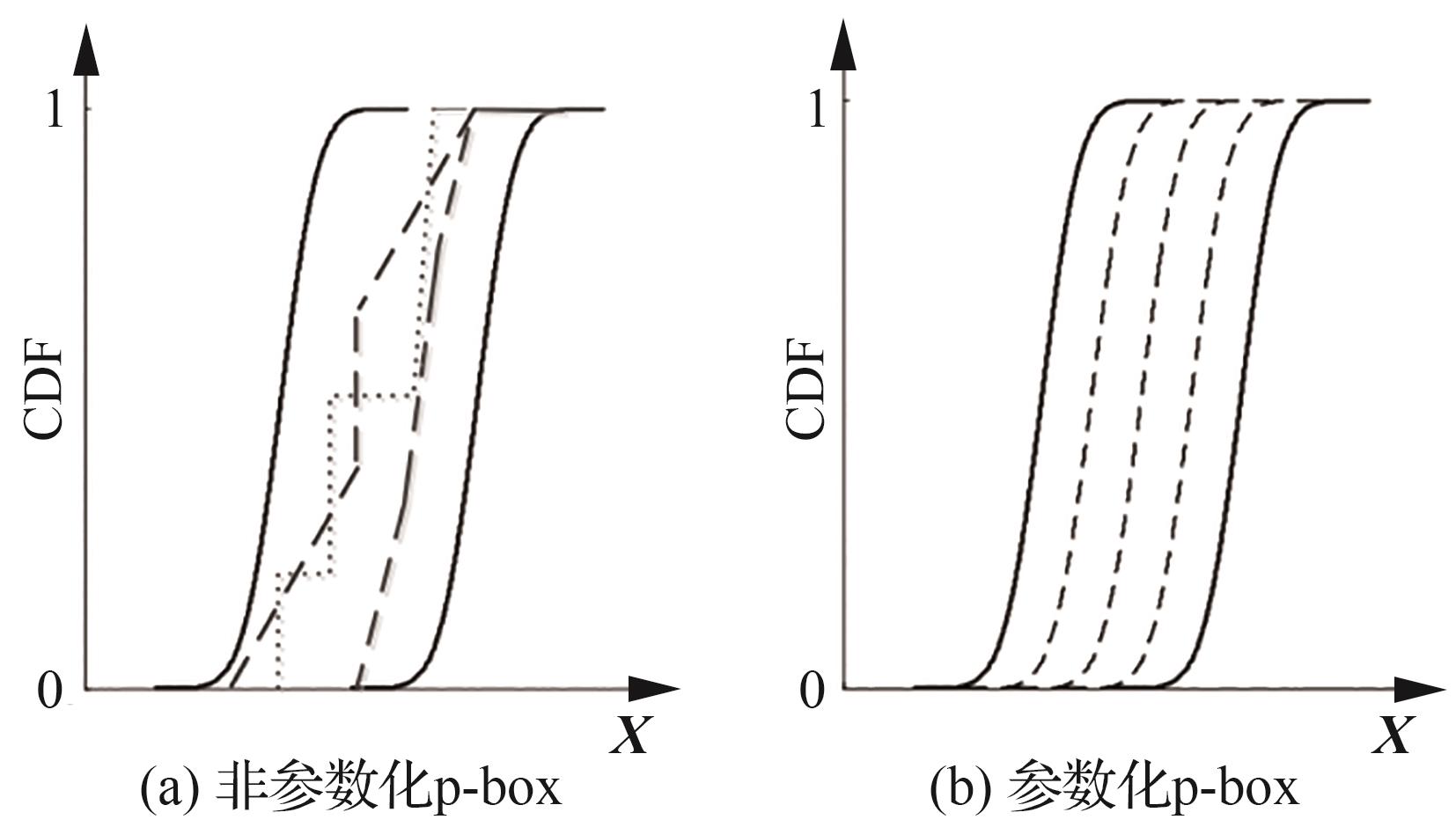
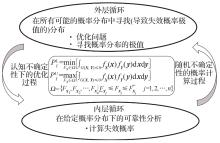
Fig.3
Schematic diagram of double-layer nesting problem
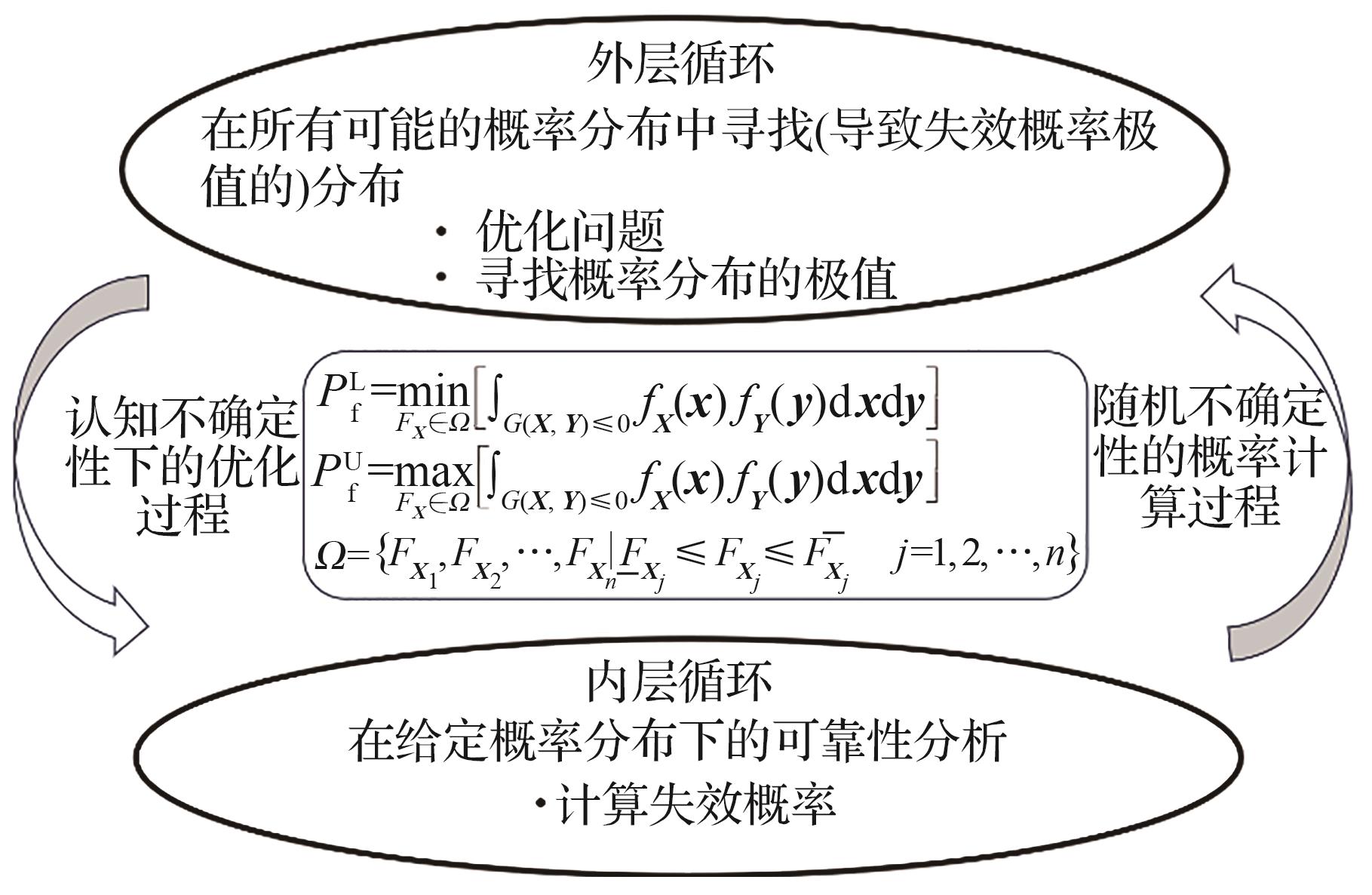
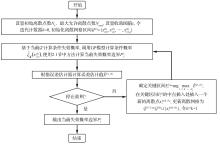
Fig.4
Adaptive discretization algorithm flow
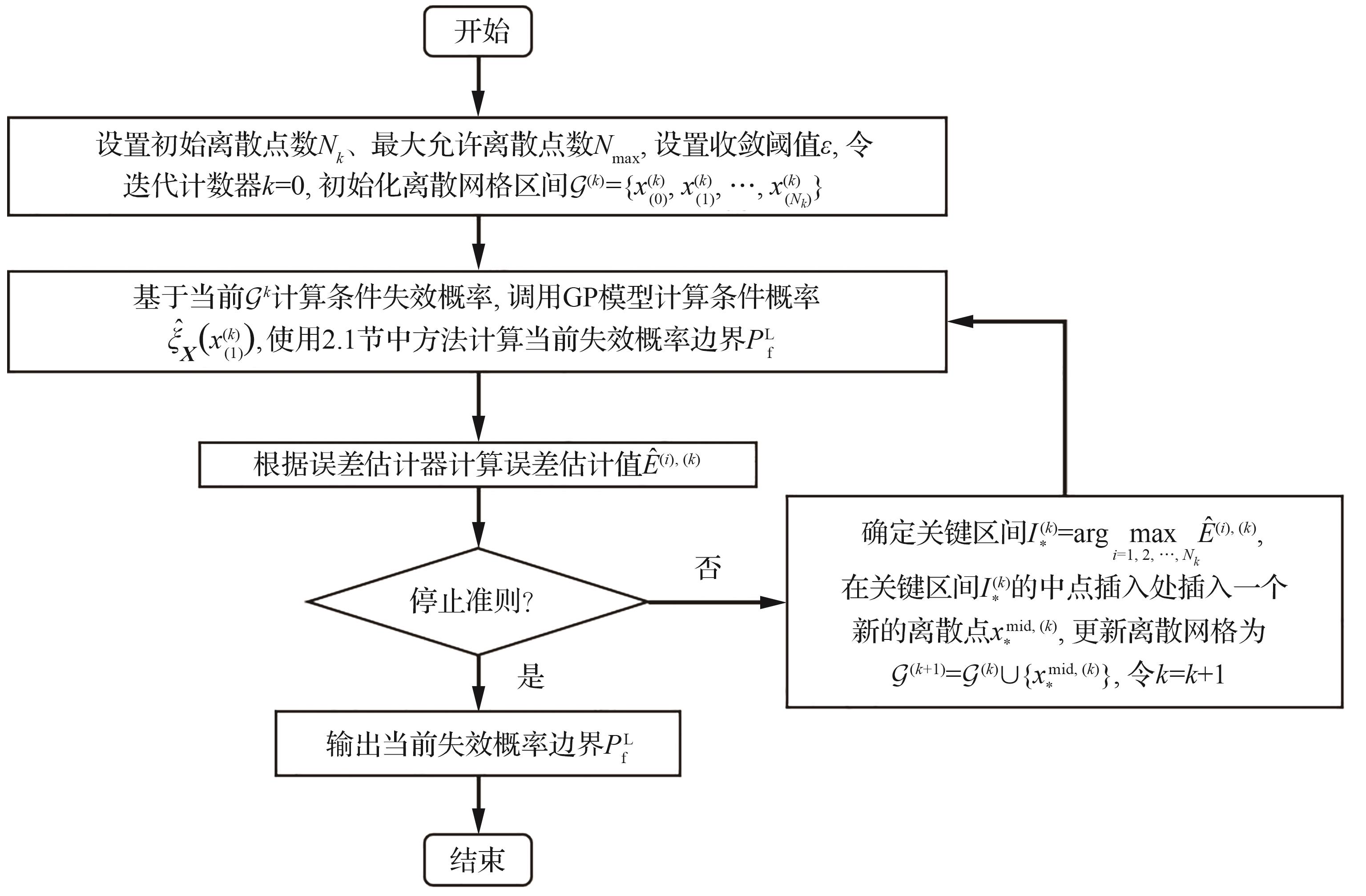
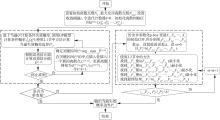
Fig.5
Algorithmic flow of proposed method
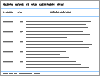
Table 1
Characteristic parameters of nonparametric p-box variables in Example 1
| 变量 | ||||
|---|---|---|---|---|
| 1.76 | 1.84 | 0.3 | 0.3 | |
| 1.67 | 1.73 | 0.25 | 0.25 |
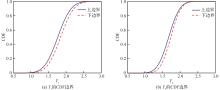
Fig.6
Upper and lower CDF bounds for nonparametric p-box variable in Example 1
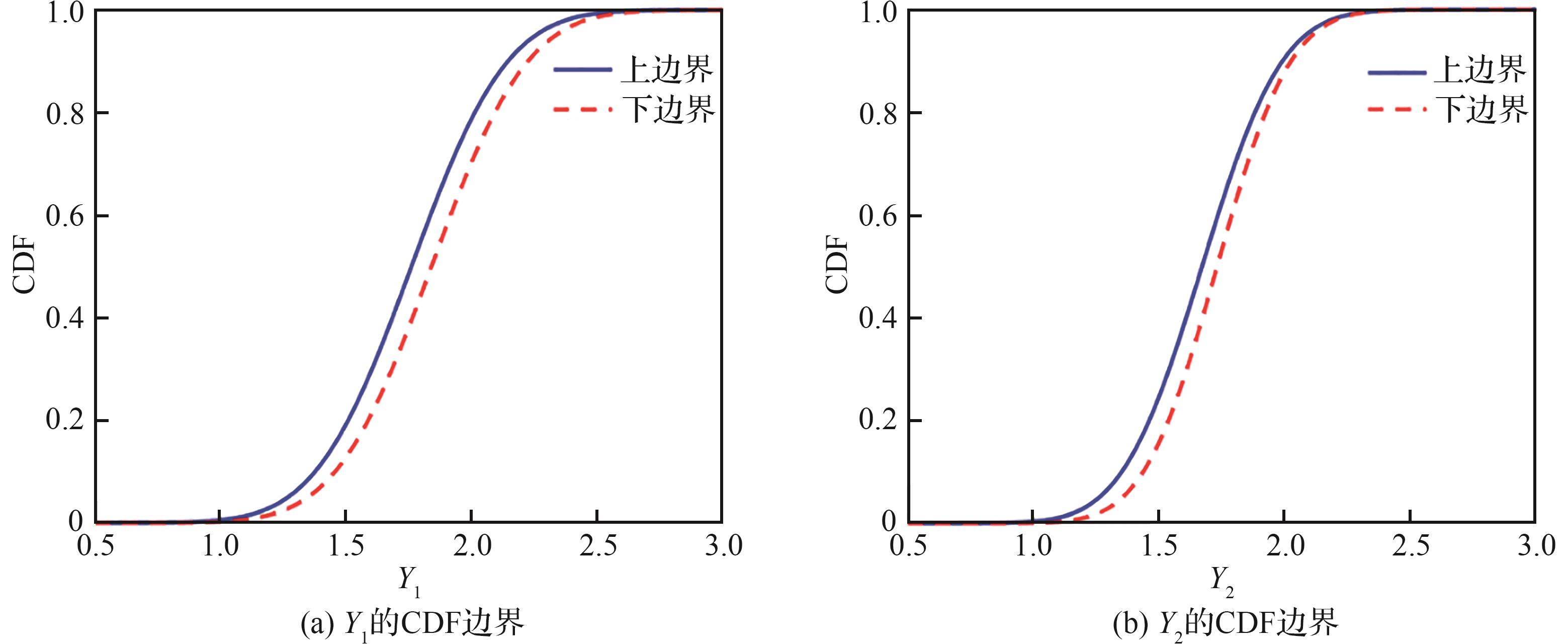
Fig.7
GP model of performance function
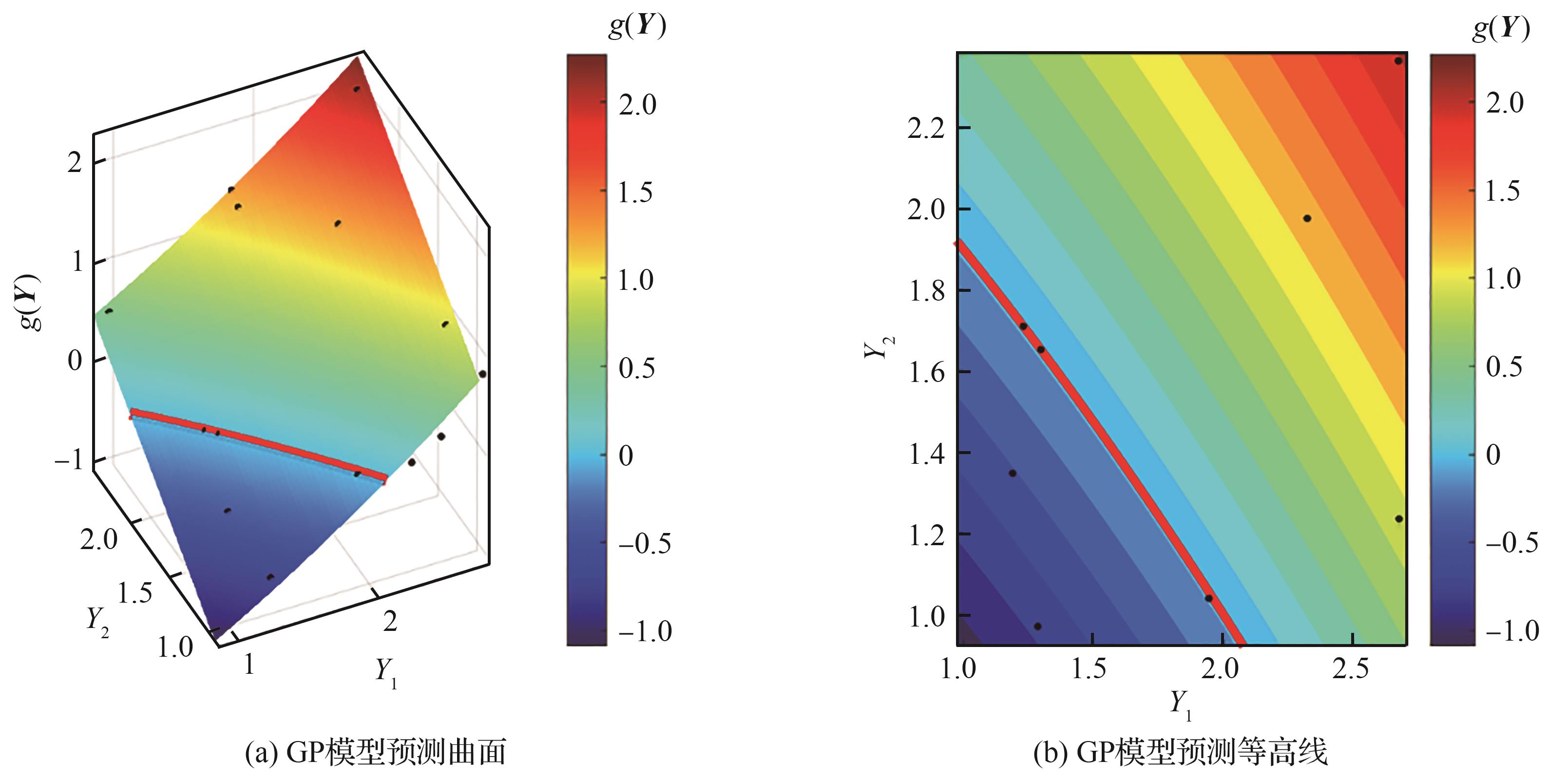
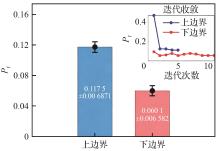
Fig.8
Failure probability boundaries in Example 1
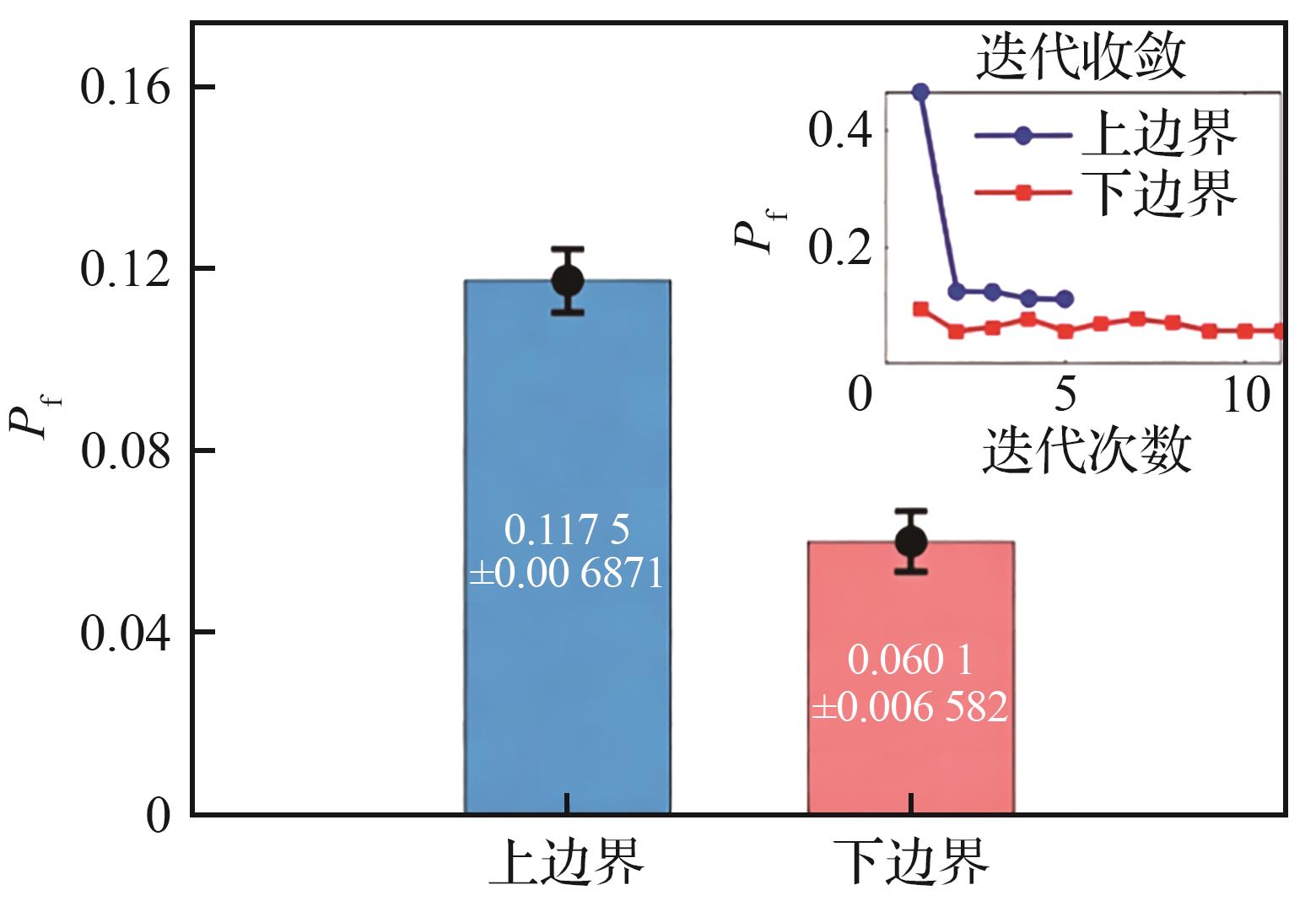
Fig.9
Conditional probability and error estimation during discretization of different variables in Example 1
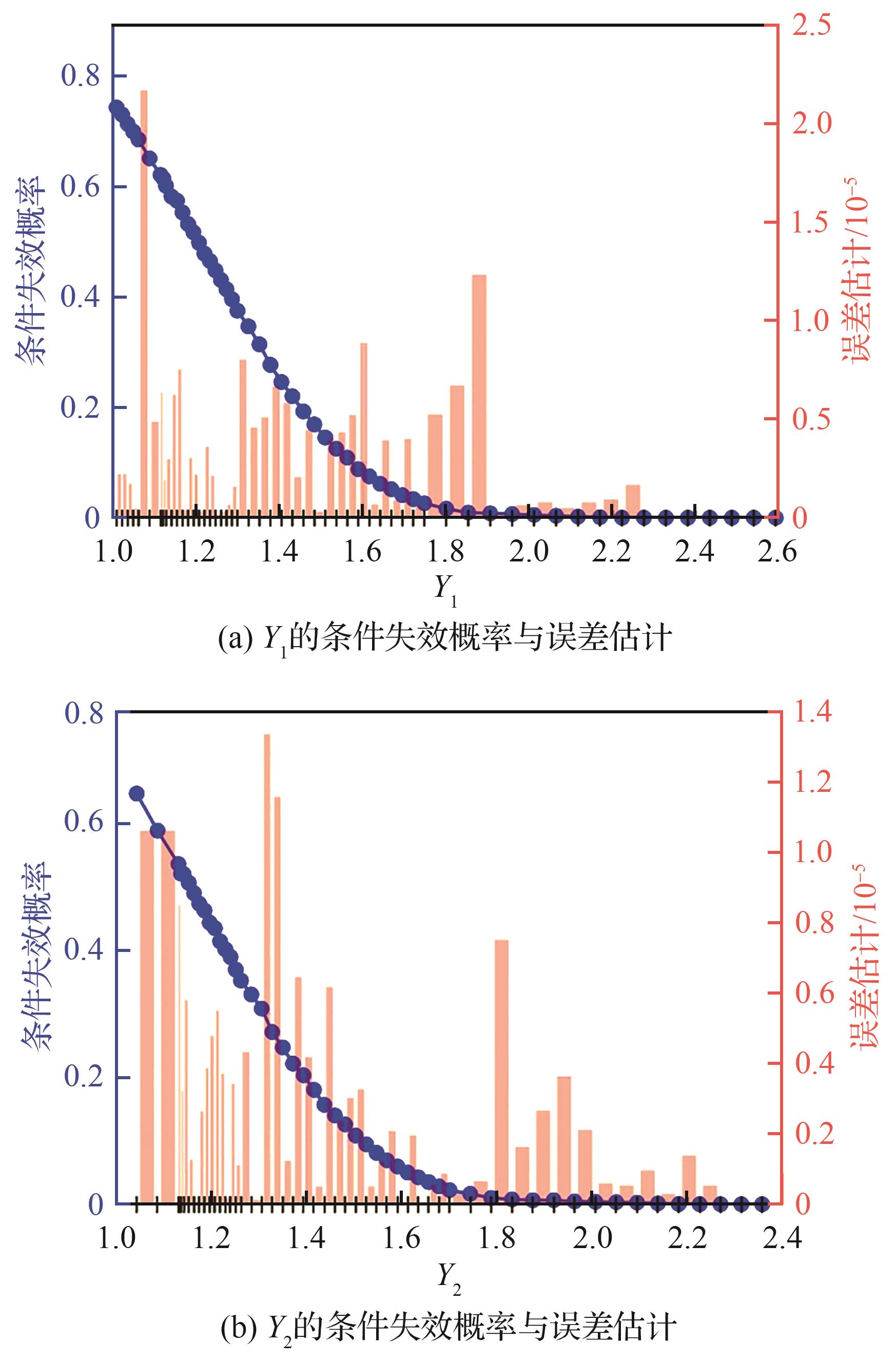
Table 2
Reliability analysis results for Example 1
| 方法 | N | Ncall | ||||
|---|---|---|---|---|---|---|
| IMC | 0.061 9 | 0.119 6 | 1×10⁷ | |||
| IMC-BPNN | 0.062 8 | 1.45 | 0.115 5 | 3.43 | 400 | |
| DL-DLSA[ | 0.060 6 | 2.10 | 0.122 6 | 2.51 | 64 | |
| CCDF-FORM | 50 | 0.056 5 | 8.70 | 0.110 2 | 7.82 | 1 992 |
| 100 | 0.059 2 | 4.32 | 0.114 7 | 4.03 | 3 938 | |
| 200 | 0.060 6 | 2.03 | 0.117 1 | 2.08 | 7 826 | |
| 250 | 0.060 7 | 1.94 | 0.117 6 | 1.67 | 9 368 | |
| BAAD | 44 | 0.060 1 | 2.91 | 0.117 5 | 1.75 | 14 |
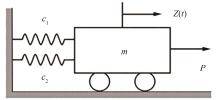
Fig.10
Nonlinear spring oscillator
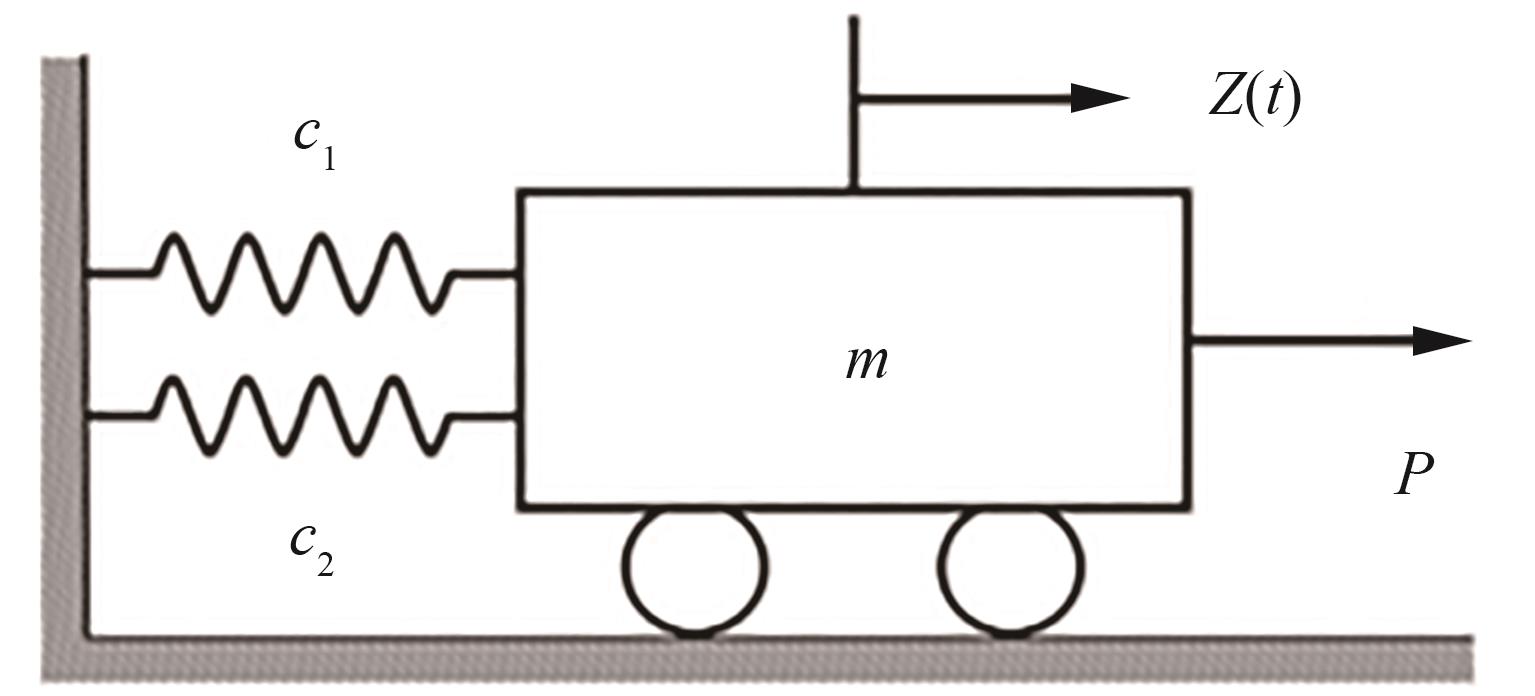
Table 3
Characteristic parameters of nonparametric p-box variables in Example 2
| 变量 | ||||
|---|---|---|---|---|
| c1/( | 1.20 | 1.22 | 0.10 | 0.11 |
| c2/( | 0.50 | 0.52 | 0.06 | 0.08 |
| r/m | 0.48 | 0.51 | 0.02 | 0.02 |
| t/s | 1.58 | 1.60 | 0.18 | 0.18 |
| P/N | 1.18 | 1.20 | 0.10 | 0.11 |
Table 4
Reliability analysis results for Example 2
| 方法 | N | Ncall | ||||
|---|---|---|---|---|---|---|
| IMC | 0.029 3 | 0.132 2 | 1×10⁷ | |||
| IMC-BPNN | 0.028 9 | 1.37 | 0.130 2 | 1.51 | 2 000 | |
| CCDF-FORM | 50 | 0.032 3 | 10.24 | 0.139 2 | 5.30 | 17 440 |
| 100 | 0.032 7 | 11.60 | 0.140 8 | 6.51 | 30 415 | |
| 150 | 0.032 9 | 12.29 | 0.140 1 | 5.96 | 44 305 | |
| BAAD | 72 | 0.028 4 | 3.07 | 0.129 5 | 2.04 | 33 |
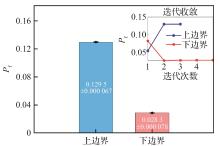
Fig.11
Failure probability boundaries in Example 2
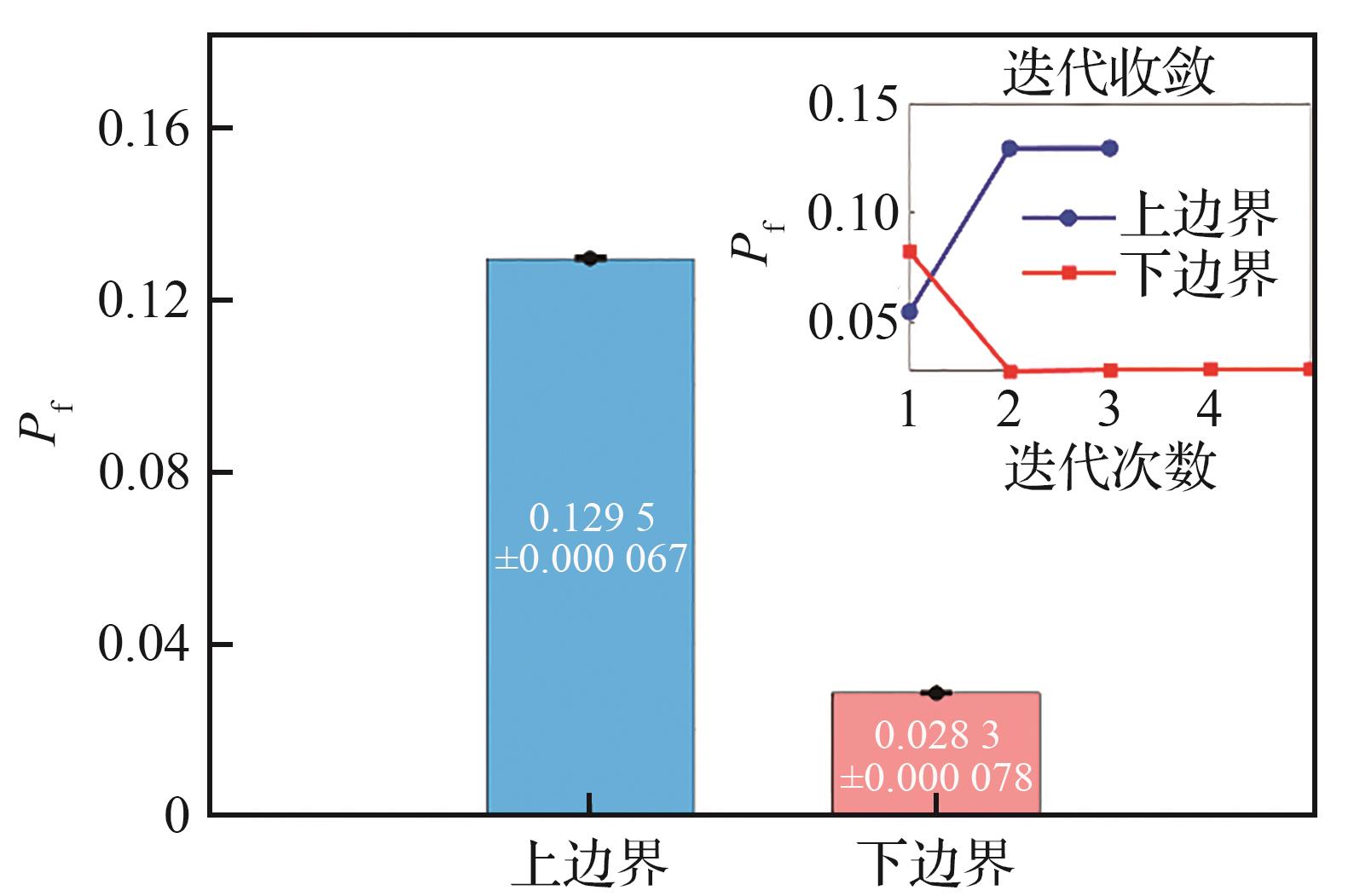
Fig.12
Schematic diagram of morphing wing mechanism
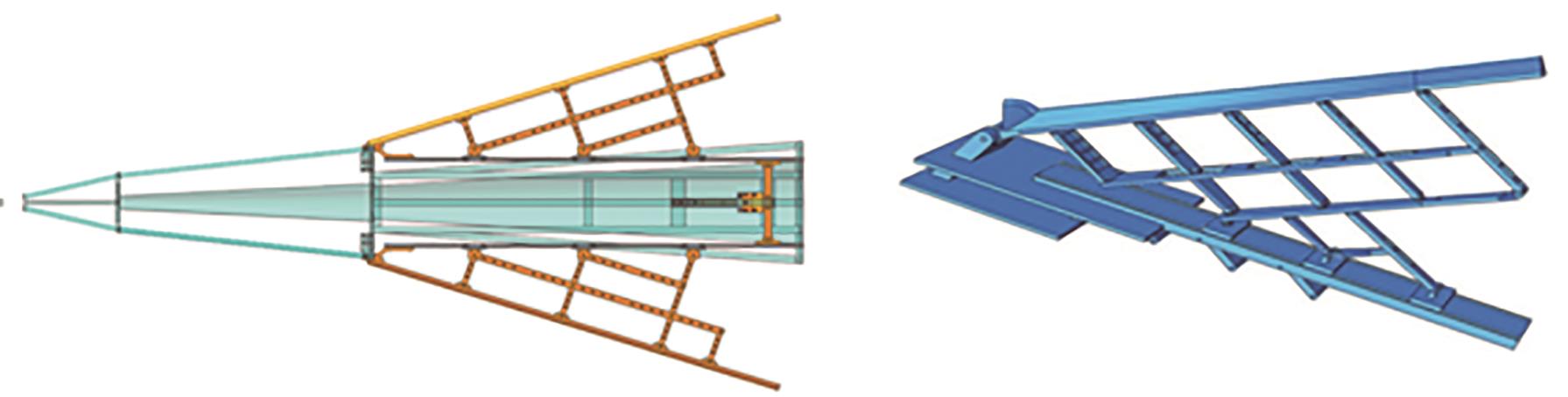
Fig.13
Structural stress diagram under thermodynamic coupling of morphing wings
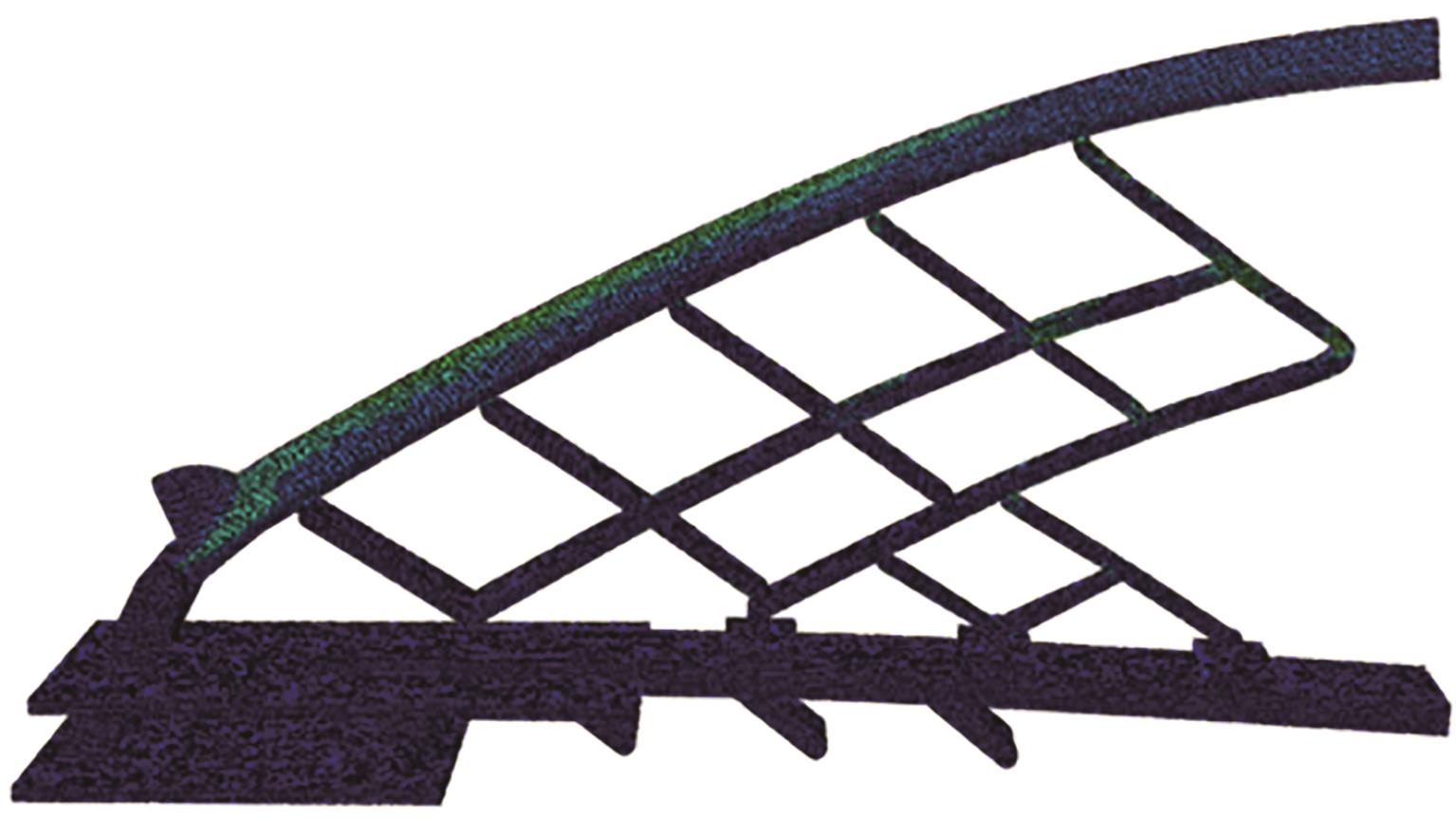
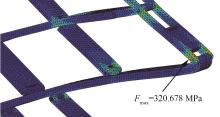
Fig.14
Stress diagram of morphing wing structure under temperature load of 1 500 ℃
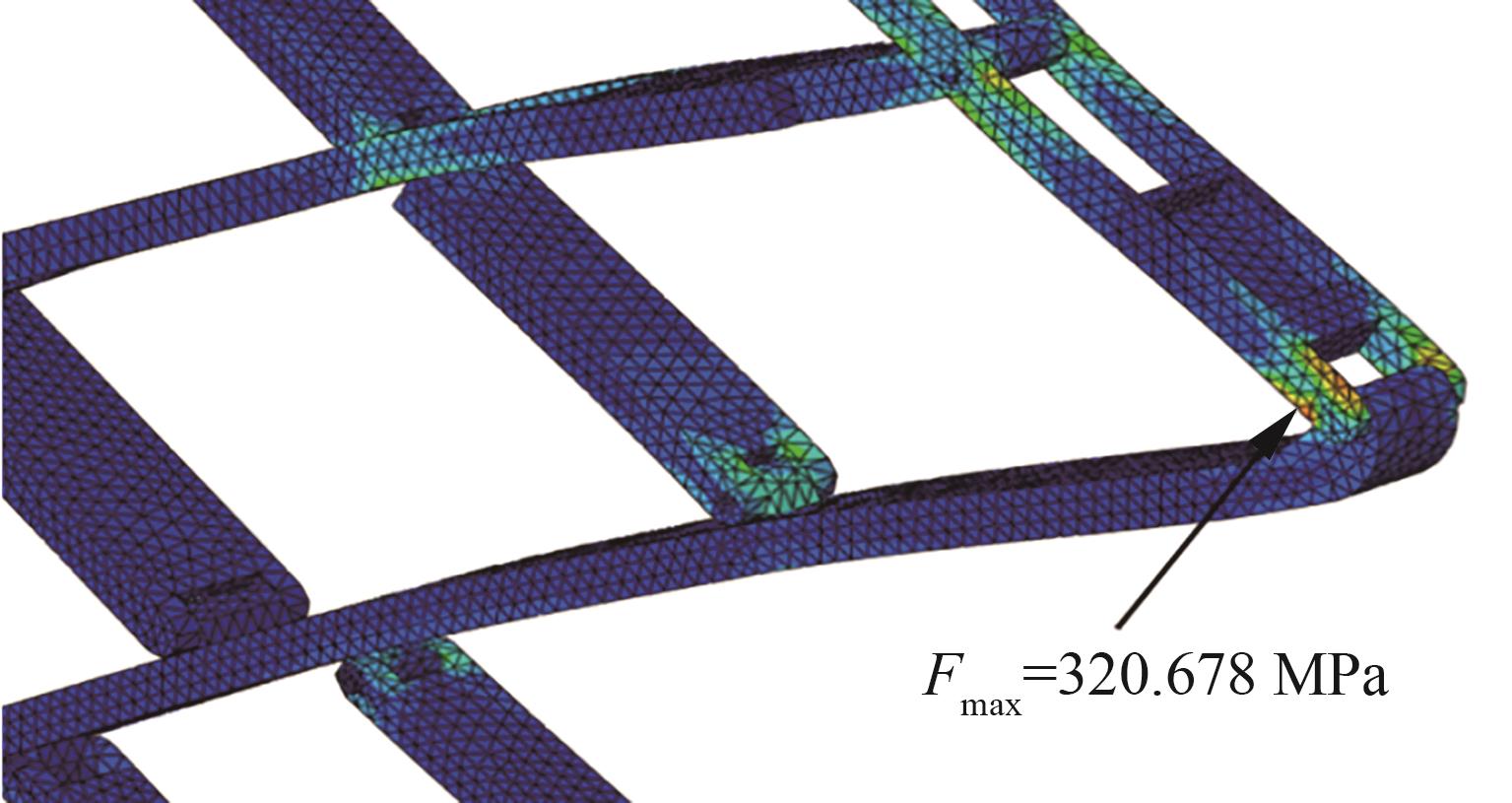
Table 5
Characteristic parameters of nonparametric p-box variables in Example 3
| 变量 | ||||
|---|---|---|---|---|
| 177.8 | 178.8 | 0.62 | 0.62 | |
| 4.58 | 4.63 | 0.07 | 0.07 | |
| 6.58 | 6.60 | 0.08 | 0.08 | |
| 1 480 | 1 500 | 10 | 10 |
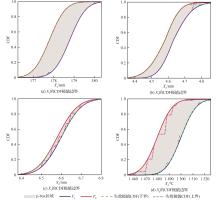
Fig.15
CDF boundaries for nonparametric p-box variables in Example 3
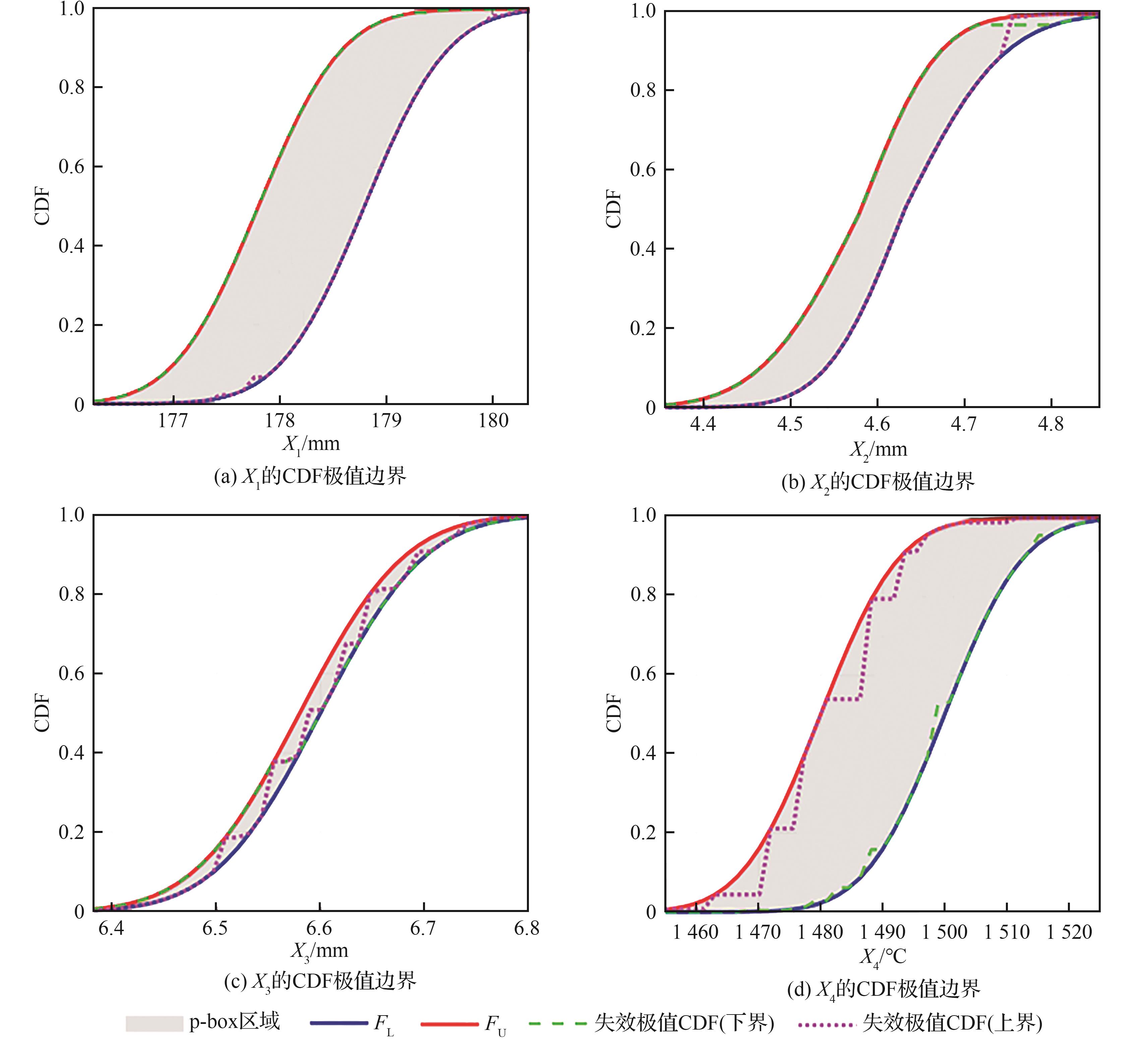
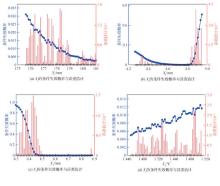
Fig.16
Conditional probability and error estimation during discretization of different variables in Example 3
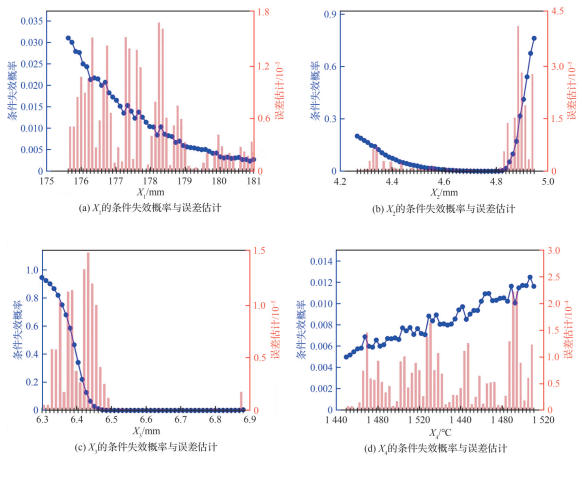
Table 6
Reliability analysis results for Example 3
| 方法 | N | 时间/s | Ncall | ||||
|---|---|---|---|---|---|---|---|
| IMC | 0.007 2 | 0.053 7 | 1×10⁷ | ||||
| IMC-BPNN | 0.007 9 | 9.72 | 0.054 5 | 1.49 | 4 000 | ||
| BAAD(无自适应) | 50 | 0.007 6 | 5.56 | 0.053 0 | 1.30 | 45.9 | 28 |
| 100 | 0.007 5 | 4.17 | 0.053 5 | 0.37 | 139.3 | ||
| 150 | 0.007 3 | 1.39 | 0.053 8 | 0.19 | 145.8 | ||
| BAAD | 54 | 0.007 3 | 1.39 | 0.053 6 | 0.19 | 49.3 |
Table 7
Characteristic parameters of nonparametric p-box variables in Example 4
| 变量 | ||||
|---|---|---|---|---|
| 0.023 7 | 0.024 1 | 0.002 8 | 0.003 0 | |
| 2.289 | 2.302 | 0.05 | 0.06 | |
| 7.225 | 7.235 | 0.03 | 0.04 | |
| 2.04 | 2. 06 | 0.045 | 0.055 |
Table 8
Reliability function of bearing lubrication under different rotational speeds
| 转速/(r∙min-1) | 功能函数 |
|---|---|
| 1.8×10⁴ | |
| 1.2×10⁴ | |
| 8×10³ |
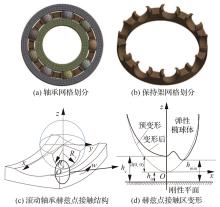
Fig.17
Deformation maps and oil film shapes in contact zone of high-speed rolling bearings
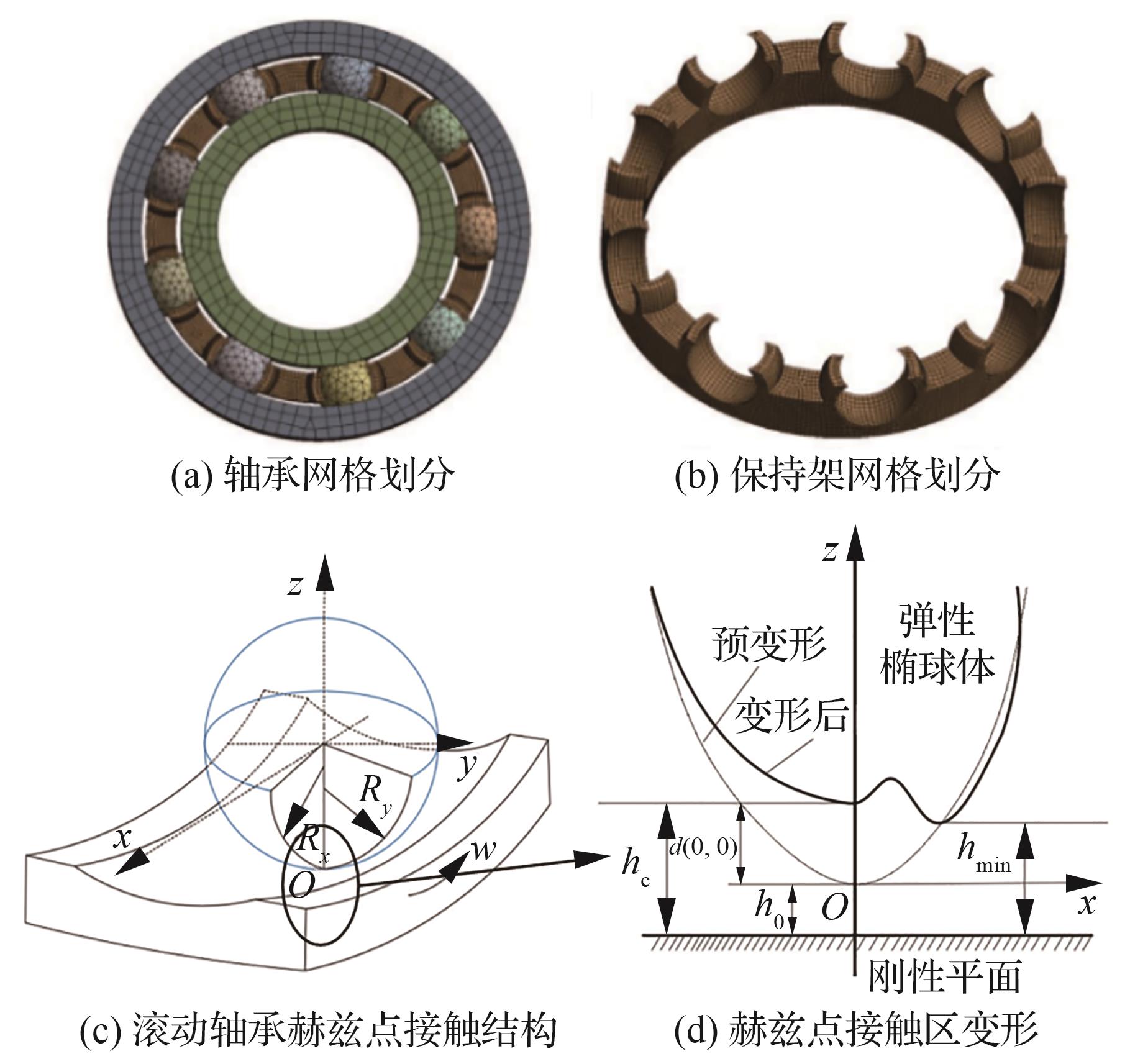
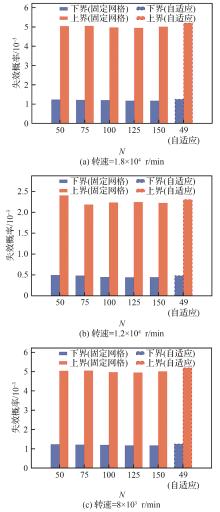
Fig.18
Comparison of failure probability at different rotational speeds
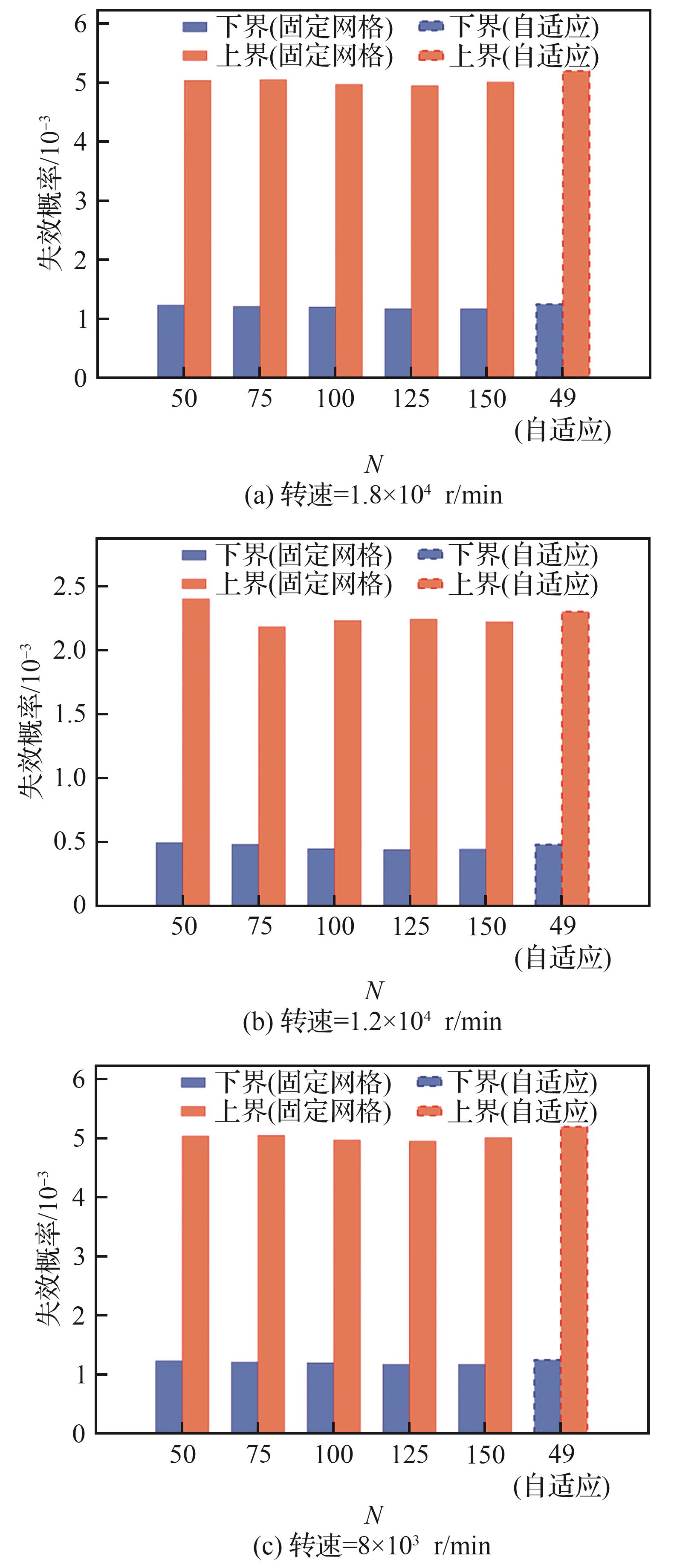
Fig.19
CDF boundaries for nonparametric p-box variables in Example 4 (rotational speed is 1.8×10⁴ r/min))
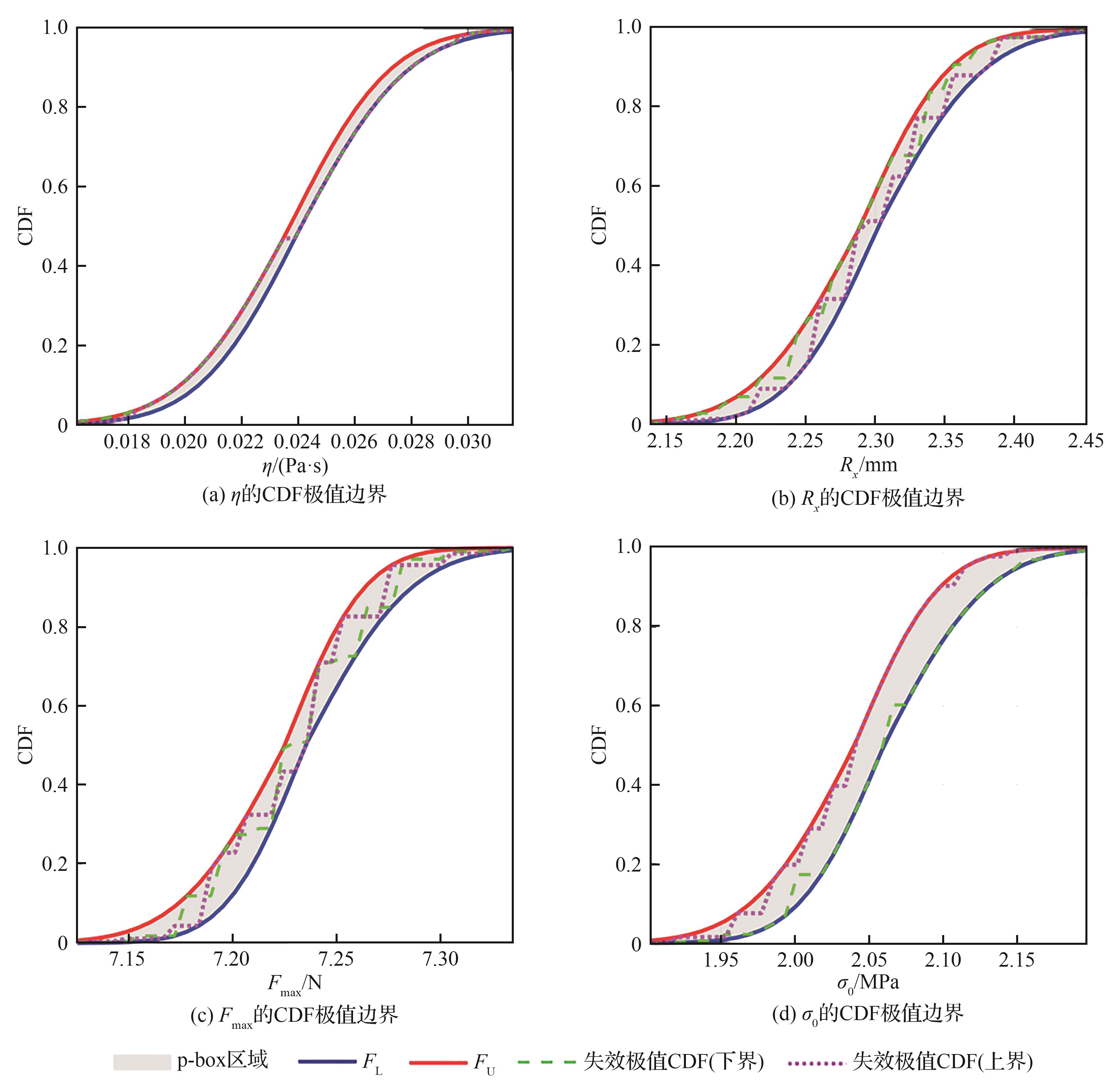
Fig.20
CDF boundaries for nonparametric p-box variables in Example 4 (rotational rate is 1.2×10⁴ r/min)
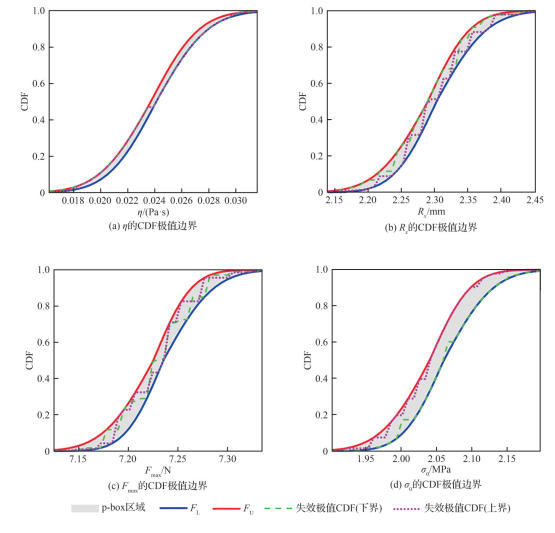
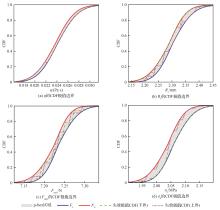
Fig.21
CDF boundaries for nonparametric p-box variables in Example 4 (rotational speed is 8×10³ r/min)
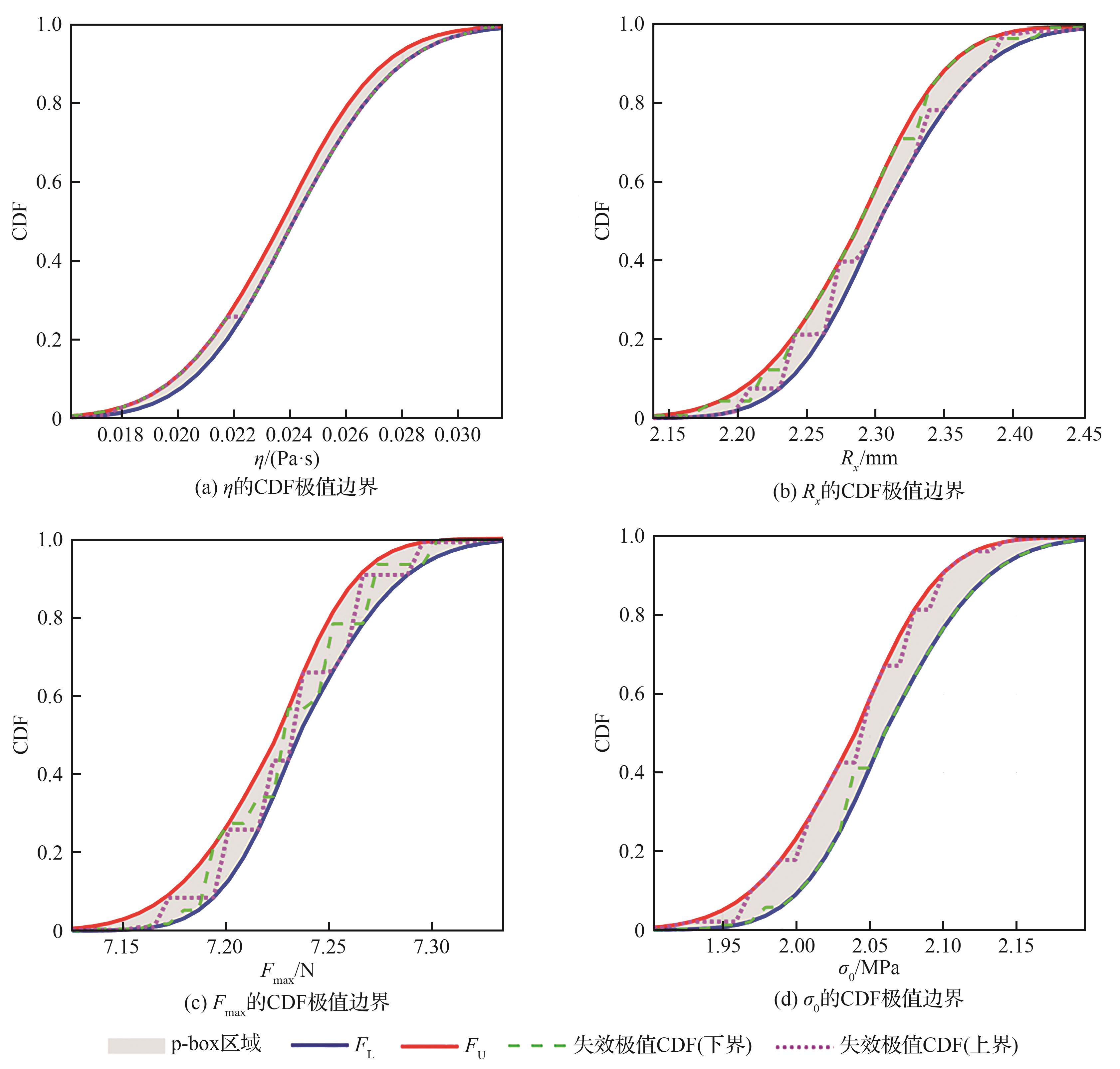
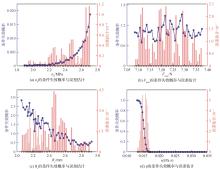
Fig.22
Conditional failure probability and error estimation during discretization of different variables in Example 4 (rotational speed is 1.8×10⁴ r/min)
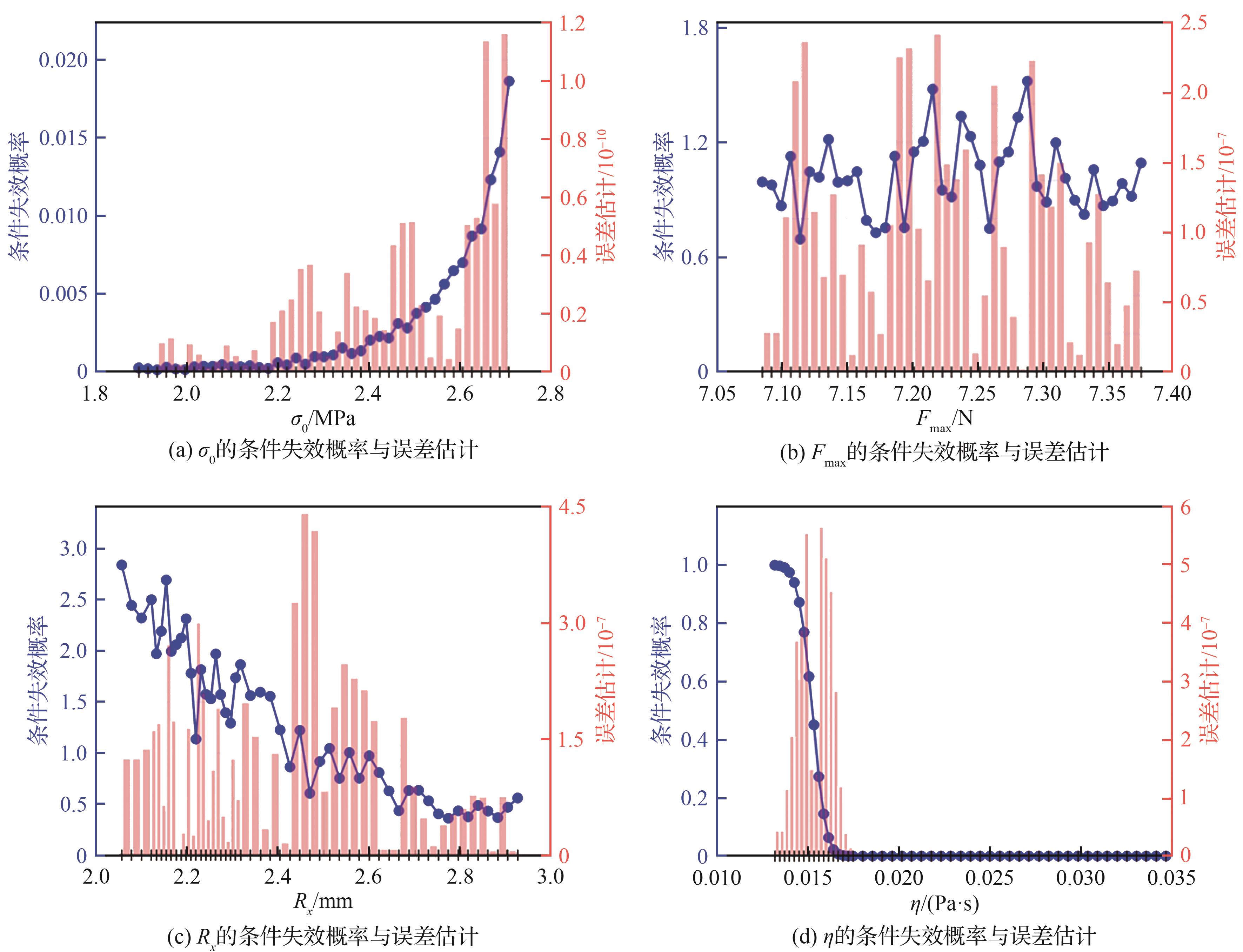
Fig.23
Conditional failure probability and error estimation during discretization of different variables in Example 4 (rotational speed is 1.2×10⁴ r/min)
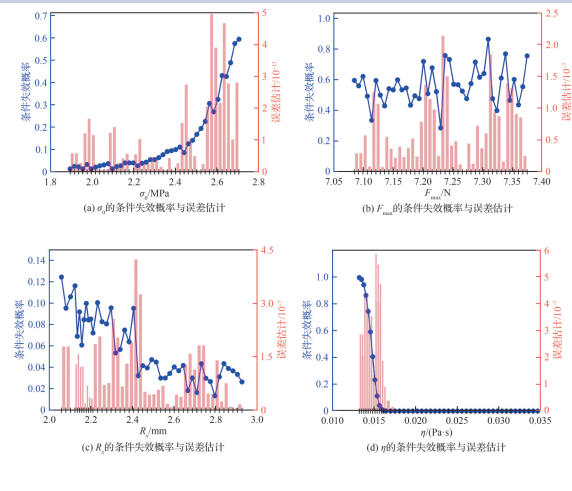
Fig.24
Conditional failure probability and error estimation during discretization of different variables in Example 4 (rotational speed is 8×10³ r/min)
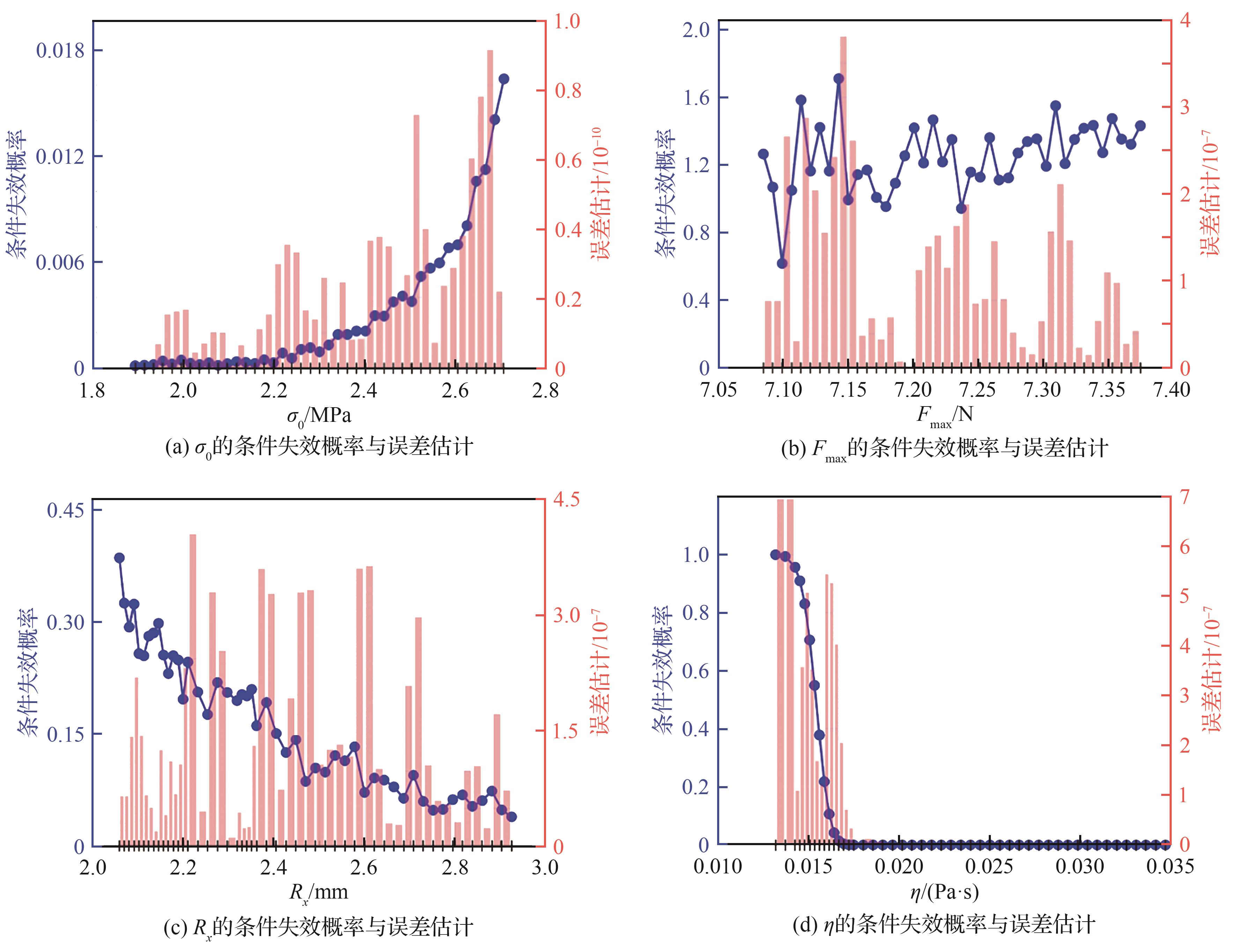
Table 9
Reliability analysis results for Example 4
| 方法 | 转速/(r∙min-1) | N | 时间/s | Ncall | ||||
|---|---|---|---|---|---|---|---|---|
| IMC | 1.8×10⁴ | 9.91×10⁻⁴ | 4.15×10⁻³ | 1×10⁷ | ||||
| 1.2×10⁴ | 4.69×10⁻⁴ | 2.37×10⁻³ | ||||||
| 8×10³ | 1.26×10⁻³ | 5.11×10⁻³ | ||||||
| BAAD(无自适应) | 1.8×10⁴ | 50 | 1.08×10⁻³ | 8.98 | 4.33×10⁻³ | 4.34 | 66.4 | 37 |
| 75 | 1.06×10⁻³ | 6.96 | 4.25×10⁻³ | 2.41 | 71.3 | |||
| 100 | 1.03×10⁻³ | 3.94 | 4.24×10⁻³ | 2.17 | 131.6 | |||
| 125 | 1.01×10⁻³ | 1.92 | 4.23×10⁻³ | 1.93 | 133.7 | |||
| 150 | 9.72×10⁻⁴ | 1.92 | 4.21×10⁻³ | 1.45 | 125.4 | |||
| 1.2×10⁴ | 50 | 4.95×10⁻⁴ | 5.54 | 2.41×10⁻³ | 1.69 | 192.5 | 31 | |
| 75 | 4.83×10⁻⁴ | 2.99 | 2.19×10⁻³ | 7.59 | 257.3 | |||
| 100 | 4.47×10⁻⁴ | 4.69 | 2.24×10⁻³ | 5.49 | 341.8 | |||
| 125 | 4.41×10⁻⁴ | 5.97 | 2.25×10⁻³ | 5.06 | 668.4 | |||
| 150 | 4.43×10⁻⁴ | 5.54 | 2.23×10⁻³ | 5.91 | 607.6 | |||
| 8×10³ | 50 | 1.16×10⁻³ | 7.94 | 5.03×10⁻³ | 1.57 | 115.7 | 33 | |
| 75 | 1.17×10⁻³ | 7.14 | 5.04×10⁻³ | 1.37 | 152.9 | |||
| 100 | 1.19×10⁻³ | 5.56 | 4.96×10⁻³ | 2.94 | 230.9 | |||
| 125 | 1.20×10⁻³ | 4.76 | 4.94×10⁻³ | 3.33 | 221.8 | |||
| 150 | 1.22×10⁻³ | 3.17 | 5.00×10⁻³ | 2.15 | 265.2 | |||
| BAAD | 1.8×10⁴ | 49 | 1.01×10⁻³ | 1.92 | 4.18×10⁻³ | 0.72 | 48.9 | 37 |
| 1.2×10⁴ | 45 | 4.81×10⁻⁴ | 2.56 | 2.31×10⁻³ | 2.53 | 178.1 | 31 | |
| 8×10³ | 46 | 1.24×10⁻³ | 1.59 | 5.19×10⁻³ | 1.57 | 129.5 | 33 |
| [1] | 唐嘉昌, 姜潮, 龙湘云, 等. 一种针对不确定性结构的区间鲁棒性优化方法[J]. 中国科学(技术科学), 2019, 49(7): 787-802. |
| TANG J C, JIANG C, LONG X Y, et al. An interval robust optimization method for uncertain structures[J]. SCIENTIA SINICA Technologica, 2019, 49(7): 787-802 (in Chinese). | |
| [2] | 唐嘉昌, 喻佳璠, 邓洋凡, 等. 基于场景生成的多模态区间不确定性优化方法[J/OL]. 湖南工业大学学报, 1-7(2026-05-08)[2026-09-28]. |
| TANG J C, YU J F, DENG Y F, et al. Multimodal interval uncertainty optimization method based on scenario generation[J/OL]. Journal of Hunan University of Technology, 1-7(2026-05-08)[2026-09-28]. (in Chinese). | |
| [3] | TANG J C, DENG Y F, CAO L X, et al. An active learning adaptive Bayesian quadrature-based multimodal reliability analysis method[J]. Engineering Applications of Artificial Intelligence, 2026, 166: 113626. |
| [4] | BEER M, FERSON S, KREINOVICH V. Imprecise probabilities in engineering analyses[J]. Mechanical Systems and Signal Processing, 2013, 37(1-2): 4-29. |
| [5] | 吕震宙. 结构/机构可靠性设计基础[M]. 西安: 西北工业大学出版社, 2019: 3-15. |
| LYU Z Z. Fundamentals of structure/mechanism reliability design[M]. Xi’an: Northwestern Polytechnical University Press, 2019: 3-15 (in Chinese). | |
| [6] | ZHANG Z, JIANG C. Evidence-theory-based structural reliability analysis with epistemic uncertainty: A review[J]. Structural and Multidisciplinary Optimization, 2021, 63(6): 2935-2953. |
| [7] | 孟德彪, 杨恒飞, 杨世源, 等. 自适应多保真度Kriging模型辅助的一阶可靠性分析方法[J]. 机械工程学报, 2025, 61(18): 344-365. |
| MENG D B, YANG H F, YANG S Y, et al. Adaptive multi-fidelity Kriging model-assisted first-order reliability analysis method[J]. Journal of Mechanical Engineering, 2025, 61(18): 344-365 (in Chinese). | |
| [8] | 李宝玉, 张磊刚, 裘群海, 等. 基于Kriging模型梯度解析解的改进一次二阶矩方法[J]. 航空学报, 2019, 40(5): 222629. |
| LI B Y, ZHANG L G, QIU Q H, et al. An advanced first order and second moment method based on gradient analytical solution of Kriging surrogate model[J]. Acta Aeronautica et Astronautica Sinica, 2019, 40(5): 222629 (in Chinese). | |
| [9] | BREITUNG K. Asymptotic approximations for probability integrals[J]. Probabilistic Engineering Mechanics, 1989, 4(4): 187-190. |
| [10] | HASOFER A M, LIND N C. Exact and invariant second-moment code format[J]. Journal of the Engineering Mechanics Division, 1974, 100(1): 111-121. |
| [11] | 吴晓敏, 吕震宙. 高维高可靠场景下广义失效概率函数估计的渐进分层重要抽样方法[J]. 航空学报, 2026, 47(14): 332918. |
| WU X M, LYU Z Z. A progressive stratified importance sampling method for estimating generalized failure probability function in high-dimensional and high reliability scenarios[J]. Acta Aeronautica et Astronautica Sinica 2026, 47(14): 332918 (in Chinese). | |
| [12] | 员婉莹, 张书童, 潘玥, 等. 失效模式重要性高效分析的序列元模型重要抽样法[J]. 宇航学报, 2026, 47(2): 322-338. |
| YUN W Y, ZHANG S T, PAN Y, et al. Sequential metamodel-based importance sampling for efficient failure mode importance analysis[J]. Journal of Astronautics, 2026, 47(2): 322-338 (in Chinese). | |
| [13] | ECHARD B, GAYTON N, LEMAIRE M. AK-MCS: An active learning reliability method combining Kriging and Monte Carlo Simulation[J]. Structural Safety, 2011, 33(2): 145-154. |
| [14] | ECHARD B, GAYTON N, LEMAIRE M, et al. A combined importance sampling and Kriging reliability method for small failure probabilities with time-demanding numerical models[J]. Reliability Engineering and System Safety, 2013, 111(C): 232-240. |
| [15] | DANG C, CICIRELLO A, VALDEBENITO M A, et al. Structural reliability analysis with extremely small failure probabilities: A quasi-Bayesian active learning method[J]. Probabilistic Engineering Mechanics, 2024, 76: 103613. |
| [16] | DANG C, VALDEBENITO M A, FAES M G R, et al. Structural reliability analysis: A Bayesian perspective[J]. Structural Safety, 2022, 99: 102259. |
| [17] | DANG C, XU J. A mixture distribution with fractional moments for efficient seismic reliability analysis of nonlinear structures[J]. Engineering Structures, 2020, 208: 109912. |
| [18] | ZHANG X F, PANDEY M D. Structural reliability analysis based on the concepts of entropy, fractional moment and dimensional reduction method[J]. Structural Safety, 2013, 43: 28-40. |
| [19] | BEN-HAIM Y. Convex models of uncertainty: Applications and implications[J]. Erkenntnis, 1994, 41(2): 139-156. |
| [20] | FERSON S, KREINOVICH V, GINZBURG L, et al. Constructing probability boxes and Dempster-Shafer structures: SAND2002-4015[R]. Albuquerque: Sandia National Laboratories, 2003. |
| [21] | FERSON S, GINZBURG L R. Different methods are needed to propagate ignorance and variability[J]. Reliability Engineering & System Safety, 1996, 54(2-3): 133-144. |
| [22] | ZADEH L A. Review of a mathematical theory of evidence [J]. AI Magazine, 1984, 5(3): 81-83. |
| [23] | GARRIDO A. A brief history of fuzzy logic[J]. Broad Research in Artificial Intelligence and Neuroscience, 2012, 3(1): 71-77. |
| [24] | ZADEH L A. Fuzzy sets and information granularity [M]. Hackensack: World Scientific Publishing Co., Inc. 1996: 433-48. |
| [25] | 刘海波, 姜潮, 郑静, 等. 含概率与区间混合不确定性的系统可靠性分析方法[J]. 力学学报, 2017, 49(2): 456-466. |
| LIU H B, JIANG C, ZHENG J, et al. A system reliability analysis method for structures with probability and interval mixed uncertainty[J]. Chinese Journal of Theoretical and Applied Mechanics, 2017, 49(2): 456-466 (in Chinese). | |
| [26] | 姜潮, 郑静. 随机-区间混合可靠性分析及优化设计[M]. 北京: 科学出版社, 2023: 8-20. |
| JIANG C, ZHENG J. Random-interval hybrid structural reliability analysis and optimization design[M]. Beijing: Science Press, 2023: 8-20 (in Chinese). | |
| [27] | FAES M G R, DAUB M, MARELLI S, et al. Engineering analysis with probability boxes: A review on computational methods[J]. Structural Safety, 2021, 93: 102092. |
| [28] | FERSON S. Probability bounds analysis solves the problem of incomplete specification in probabilistic risk and safety assessments[C]∥ Risk-Based Decisionmaking in Water Resources IX. 2012: 173-88. |
| [29] | OBERKAMPF W L, HELTON J C, JOSLYN C A, et al. Challenge problems: Uncertainty in system response given uncertain parameters[J]. Reliability Engineering & System Safety, 2004, 85(1-3): 11-19. |
| [30] | KARANKI D R, KUSHWAHA H S, VERMA A K, et al. Uncertainty analysis based on probability bounds (P-box) approach in probabilistic safety assessment[J]. Risk Analysis, 2009, 29(5): 662-675. |
| [31] | XIAO N C, HUANG H Z, WANG Z L, et al. Reliability sensitivity analysis for structural systems in interval probability form[J]. Structural and Multidisciplinary Optimization, 2011, 44(5): 691-705. |
| [32] | ZHANG Q Y, ZENG Z G, ZIO E, et al. Probability box as a tool to model and control the effect of epistemic uncertainty in multiple dependent competing failure processes[J]. Applied Soft Computing, 2017, 56(C): 570-579. |
| [33] | LIU X, KUANG Z X, YIN L R, et al. Structural reliability analysis based on probability and probability box hybrid model[J]. Structural Safety, 2017, 68: 73-84. |
| [34] | LIU X, YIN L R, HU L, et al. An efficient reliability analysis approach for structure based on probability and probability box models[J]. Structural and Multidisciplinary Optimization, 2017, 56(1): 167-181. |
| [35] | ZHANG J H, XIAO M, GAO L, et al. A bounding-limit-state-surface-based active learning Kriging method for hybrid reliability analysis under random and probability-box variables[J]. Mechanical Systems and Signal Processing, 2019, 134: 106310. |
| [36] | DANG C, WEI P F, SONG J W, et al. Estimation of failure probability function under imprecise probabilities by active learning-augmented probabilistic integration[J]. ASCE-ASME Journal of Risk and Uncertainty in Engineering Systems, Part A: Civil Engineering, 2021, 7(4): 04021054. |
| [37] | ZHANG H, MULLEN R L, MUHANNA R L. Interval Monte Carlo methods for structural reliability[J]. Structural Safety, 2010, 32(3): 183-190. |
| [38] | SCHÖBI R, SUDRET B. Structural reliability analysis for p-boxes using multi-level meta-models[J]. Probabilistic Engineering Mechanics, 2017, 48: 27-38. |
| [39] | WANG C, ZHANG H, BEER M. Computing tight bounds of structural reliability under imprecise probabilistic information[J]. Computers & Structures, 2018, 208: 92-104. |
| [40] | LI J W, JIANG C, NI B Y. An efficient uncertainty propagation analysis method for problems involving non-parameterized probability-boxes[J]. Journal of Mechanical Design, 2021, 143(10): 101704. |
| [41] | XIE H C, LI J W, LIAO D H. A new structural reliability analysis method under non-parameterized probability box variables[J]. Structural and Multidisciplinary Optimization, 2022, 65(11): 322. |
| [42] | 房祥忠. 点估计和区间估计的几种方法[J]. 中国统计, 2023(11): 32-34. |
| FANG X Z. Several methods of point estimation and interval estimation[J]. China Statistics, 2023(11): 32-34 (in Chinese). | |
| [43] | BI S F, BEER M, COGAN S, et al. Stochastic model updating with uncertainty quantification: An overview and tutorial[J]. Mechanical Systems and Signal Processing, 2023, 204: 110784. |
| [44] | DANG C, FAES M G R, VALDEBENITO M A, et al. Partially Bayesian active learning cubature for structural reliability analysis with extremely small failure probabilities[J]. Computer Methods in Applied Mechanics and Engineering, 2024, 422: 116828. |
| [45] | WEI P F. Bayesian model inference with complex posteriors: Exponential-impact-informed Bayesian quadrature[J]. Mechanical Systems and Signal Processing, 2025, 239: 113333. |
| [46] | WEI P F, ZHENG Y, FU J F, et al. An expected integrated error reduction function for accelerating Bayesian active learning of failure probability[J]. Reliability Engineering & System Safety, 2023, 231: 108971. |
| [47] | SONG J W, LIANG Z H, WEI P F, et al. Sampling-based adaptive Bayesian quadrature for probabilistic model updating[J]. Computer Methods in Applied Mechanics and Engineering, 2025, 433: 117467. |
| [48] | HU H, DENG M Y, SUN W C, et al. A structural reliability analysis method under non-parameterized P-box based on double-loop deep learning models[J]. Structural and Multidisciplinary Optimization, 2024, 67(8): 148. |
| [49] | 刘人瑞,唐嘉昌,姚齐水,等.一种变形翼机构构型综合及其可靠性优化[J]. 湖南工业大学学报,2026,40(5):67-73. |
| LIU R R, TANG J C, YAO Q S, et al. Configuration synthesis and reliability optimization of a morphing wing mechanism[J]. Journal of Hunan University of Technology, 2026, 40(5): 67-73 (in Chinese). | |
| [50] | YAO Q S, DAI L, TANG J C, et al. High-speed rolling bearing lubrication reliability analysis based on probability box model[J]. Probabilistic Engineering Mechanics, 2024, 76: 103612. |
| [1] | Xinglin LI, Zhenzhou LYU, Yizhou CHEN. Meta-model-based double importance sampling method for extremely small failure probability estimation [J]. Acta Aeronautica et Astronautica Sinica, 2026, 47(3): 232316-232316. |
| [2] | Yixin LU, Zhenzhou LYU, Hengchao LI. Efficient analysis method of reliability lifetime and its application in turbine shaft [J]. Acta Aeronautica et Astronautica Sinica, 2026, 47(2): 232111-232111. |
| [3] | Wanying YUN, Fengyuan LI, Bo HUANG, Siyu WANG, Yunfei JIAO, Xinyu BAI, Xueqi HUANG. Enhanced metamodel-based importance sampling method for reliability analysis [J]. Acta Aeronautica et Astronautica Sinica, 2025, 46(7): 230738-230738. |
| [4] | Yulian GONG, Jianguo ZHANG, Zhigang WU, Guangyuan CHU, Xiaoduo FAN, Ying HUANG. Reliability algorithm of composite structure based on active learning basis-adaptive PC-Kriging model [J]. Acta Aeronautica et Astronautica Sinica, 2024, 45(8): 228982-228982. |
| [5] | Fan ZHANG, Bohan CHENG, Peng WANG, Lei DONG. A two-stage degradation model and reliability analysis related to degradation of binary load-sharing systems [J]. Acta Aeronautica et Astronautica Sinica, 2024, 45(7): 229046-229046. |
| [6] | Feng JIANG, Huacong LI, Jiangfeng FU, Xianwei LIU. Non-probabilistic reliability analysis with fuzzy failure and safe states [J]. Acta Aeronautica et Astronautica Sinica, 2024, 45(20): 229989-229989. |
| [7] | Fan ZHANG, Zijing SUN, Guosong XIAO, Jiachen LIU, Peng WANG. Reliability analysis for multi-phased mission of HUD system based on intuitionistic fuzzy Bayesian network [J]. ACTA AERONAUTICAET ASTRONAUTICA SINICA, 2023, 44(4): 226853-226853. |
| [8] | Lechang YANG, Chenxing WANG. Parameter calibration and reliability analysis of an aero-engine rotor based on multi-source heterogeneous information [J]. Acta Aeronautica et Astronautica Sinica, 2023, 44(23): 228575-228575. |
| [9] | Feng JIANG, Huacong LI, Jiangfeng FU, Linxiong HONG. A RBF and active learning combined method for structural non-probabilistic reliability analysis [J]. ACTA AERONAUTICAET ASTRONAUTICA SINICA, 2023, 44(2): 226667-226667. |
| [10] | Yunwen FENG, Xinyi LIN, Xiaofeng XUE, Xiang YANG, Jiaqi LIU. Design of civil aircraft explosion-proof structure for high reliable one-way blasting [J]. Acta Aeronautica et Astronautica Sinica, 2023, 44(18): 228297-228297. |
| [11] | HE Yong, WANG Hong, LI Jing, QI Yankun. Joint decision making for condition-based maintenance and spare parts ordering of components based on vibration monitoring [J]. ACTA AERONAUTICAET ASTRONAUTICA SINICA, 2022, 43(5): 225304-225304. |
| [12] | JIA Beixi, LYU Zhenzhou, LEI Jingyu. Parameterized simulation platform of turbine cooling film blade life reliability analysis [J]. ACTA AERONAUTICAET ASTRONAUTICA SINICA, 2021, 42(12): 224747-224747. |
| [13] | HU Xiaoyi, WANG Ruping, WANG Xin, FU Yongtao. Recent development of safety and reliability analysis technology for model-based complex system [J]. ACTA AERONAUTICAET ASTRONAUTICA SINICA, 2020, 41(6): 523436-523436. |
| [14] | LI Fang, HE Youchen, DI Peng, CHEN Tong, YIN Dongliang. Reliability analysis of fuzzy k-out-of-n system considering maintenance influence and dynamic load distribution mechanism [J]. ACTA AERONAUTICAET ASTRONAUTICA SINICA, 2018, 39(4): 221718-221718. |
| [15] | LIU Fuchao, WEI Pengfei, ZHOU Changcong, ZHANG Zheng, YUE Zhufeng. Time-dependent reliability and sensitivity analysis for planar motion mechanisms with revolution joint clearances [J]. ACTA AERONAUTICAET ASTRONAUTICA SINICA, 2018, 39(11): 422133-422141. |
| Viewed | ||||||
|
Full text |
|
|||||
|
Abstract |
|
|||||
Address: No.238, Baiyan Buiding, Beisihuan Zhonglu Road, Haidian District, Beijing, China
Postal code : 100083
E-mail:hkxb@buaa.edu.cn
Total visits: 6658907 Today visits: 1341All copyright © editorial office of Chinese Journal of Aeronautics
All copyright © editorial office of Chinese Journal of Aeronautics
Total visits: 6658907 Today visits: 1341

 CJA

