Acta Aeronautica et Astronautica Sinica ›› 2026, Vol. 47 ›› Issue (3): 232316.doi: 10.7527/S1000-6893.2025.32316
• Solid Mechanics and Vehicle Conceptual Design • Previous Articles
Xinglin LI1,2,3, Zhenzhou LYU1,2,3( ), Yizhou CHEN1,2,3
Received:2025-05-28
Revised:2025-06-17
Accepted:2025-07-07
Online:2025-07-16
Published:2025-07-15
Contact:
Zhenzhou LYU
E-mail:zhenzhoulu@nwpu.edu.cn
Supported by:CLC Number:
Xinglin LI, Zhenzhou LYU, Yizhou CHEN. Meta-model-based double importance sampling method for extremely small failure probability estimation[J]. Acta Aeronautica et Astronautica Sinica, 2026, 47(3): 232316.
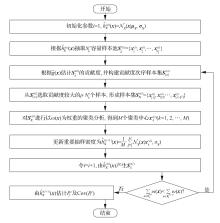
Fig.1
Flowchart for estimating normalization factors based on adaptive hierarchical double construct h^Xε(x)
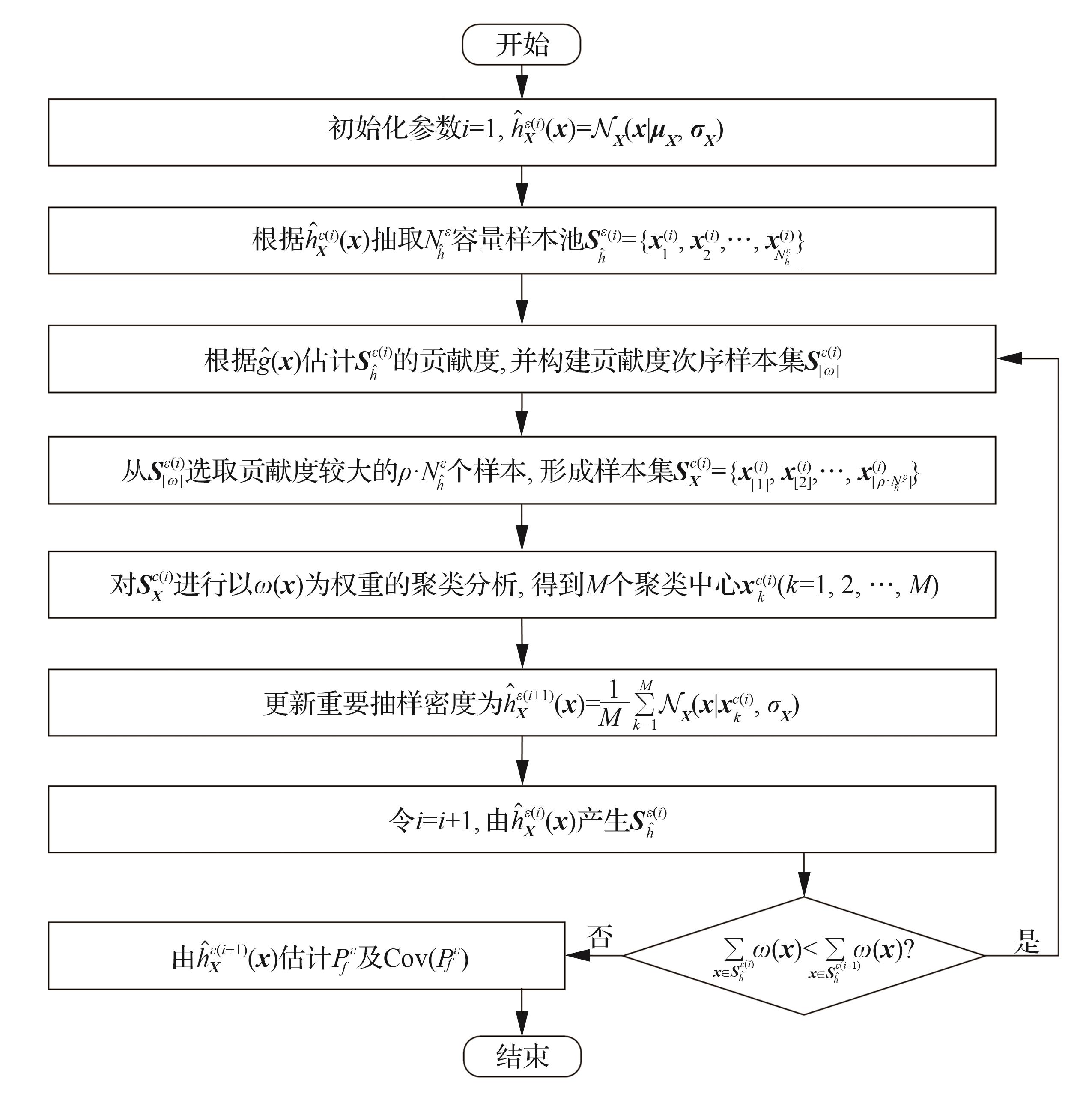

Table 1
Distribution parameters (Case 1)
| 变量 | 分布类型 | 均值 | 标准差 |
|---|---|---|---|
| 正态分布 | 1 | 0.05 | |
| 正态分布 | 1 | 0.10 | |
| 正态分布 | 0.1 | 0.01 | |
| 正态分布 | 0.79 | 0.05 | |
| 正态分布 | 0.3 | 0.2 | |
| 正态分布 | 1 | 0.2 |
Table 2
Reliability analysis results (Case 1)
| 方法 | 重要样本池容量 | 估计 | |||
|---|---|---|---|---|---|
| MCS | 3.7 | ||||
| Meta-IS | 3.6 | 3.8 | |||
| Meta-IS2 | 2.5 | 1.9 |
Table 3
Calculated cost statistics (Case 1)
| 方法 | Ncall | |||
|---|---|---|---|---|
| MCS | 106.56 | |||
| Meta-IS | 112+39 | 378.21 | ||
| Meta-IS2 | 112+39 | 378.21 | 3.13 | 381.34 |
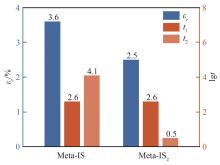
Fig.2
Comparison of calculation accuracy and time consumption (Case 1)
Table 4
Reliability analysis results (Case 2)
| 方法 | 重要样本池容量 | 估计 | |||
|---|---|---|---|---|---|
| MCS | 3.6 | ||||
| Meta-IS | 0.39 | 3.6 | |||
| Meta-IS2 | 2.20 | 4.1 |
Table 5
Calculated cost statistics (Case 2)
| 方法 | Ncall | |||
|---|---|---|---|---|
| MCS | 262.57 | |||
| Meta-IS | 449+149 | |||
| Meta-IS2 | 449+149 | 88.88 |
Fig.3
Comparison of calculation accuracy and time consumption (Case 2)
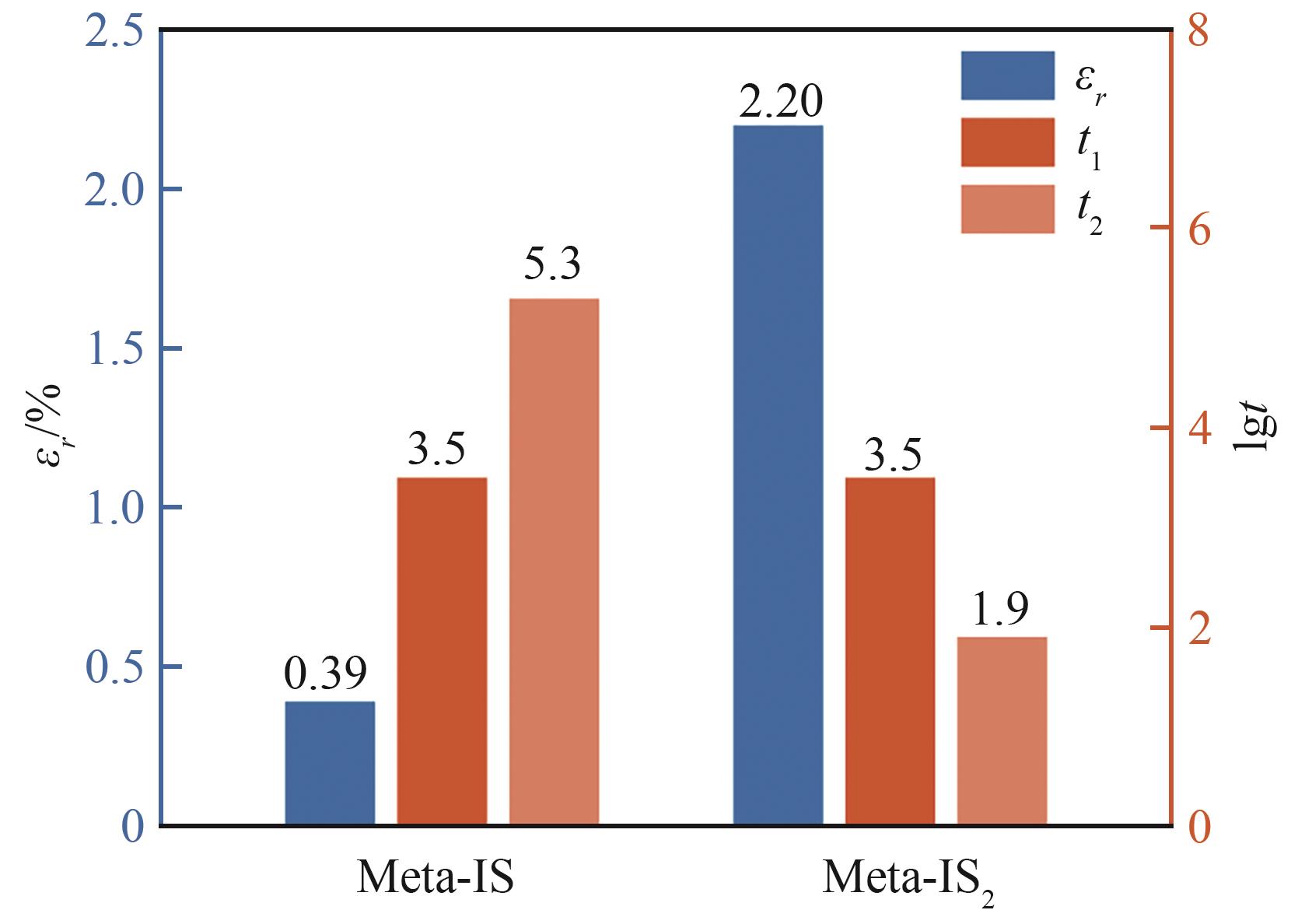
Table 6
Reliability analysis results (Case 3)
| 方法 | 重要样本池容量 | 估计 | |||
|---|---|---|---|---|---|
| MCS | 4.0 | ||||
| Meta-IS | 0.7 | 4.1 | |||
| Meta-IS2 | 1.0 | 1.2 |
Table 7
Calculated cost statistics (Case 3)
| 方法 | Ncall | |||
|---|---|---|---|---|
| MCS | 49.78 | |||
| Meta-IS | (13+15+9+8)+(1+0+0+0) | 82.46 | ||
| Meta-IS2 | (13+15+9+8)+(1+0+0+0) | 82.46 | 1.56 | 84.02 |
Fig.4
Comparison of calculation accuracy and time consumption (Case 3)
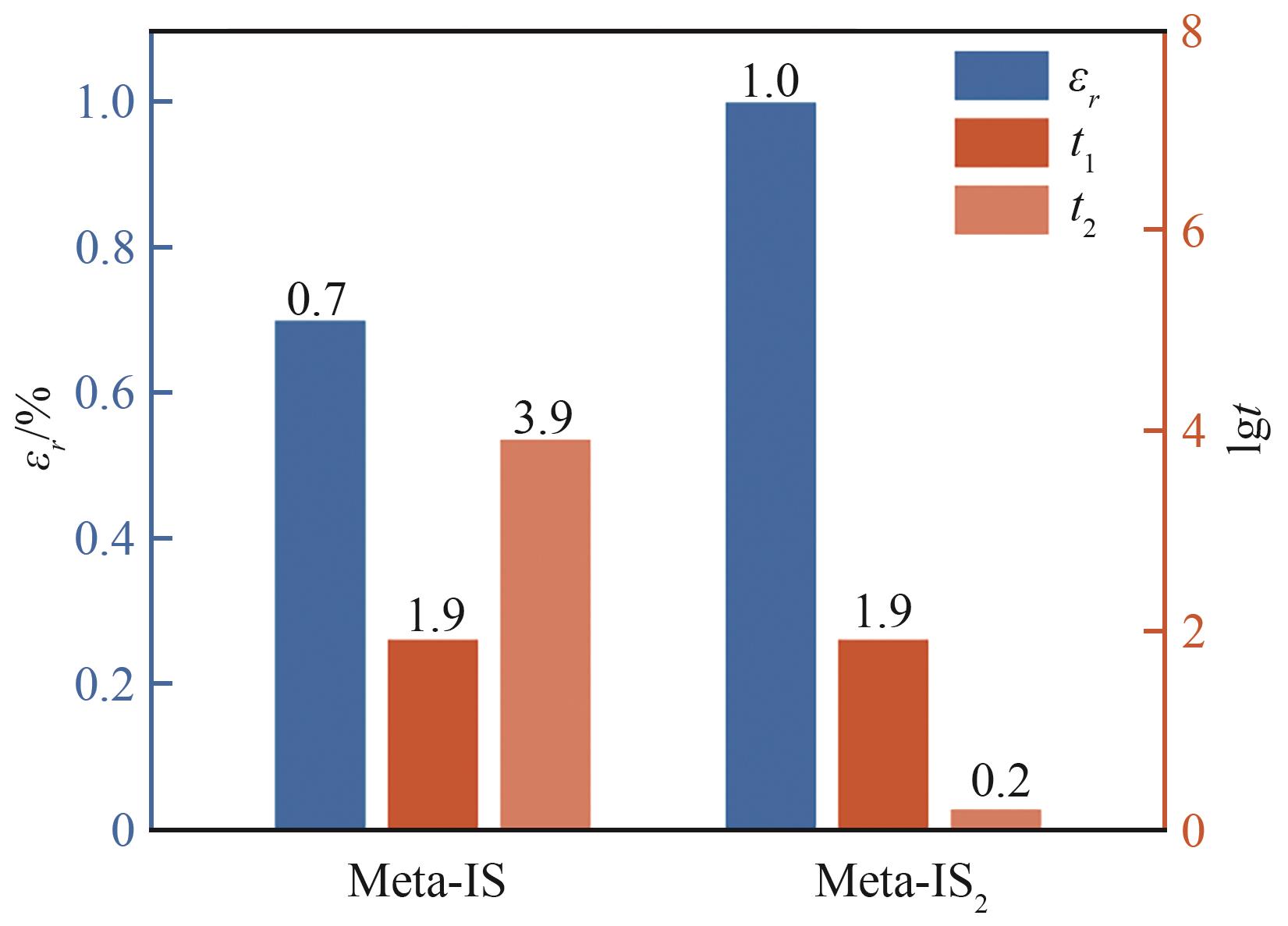
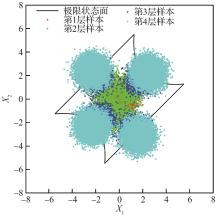
Fig.5
Sample points for exploring rare contribution region
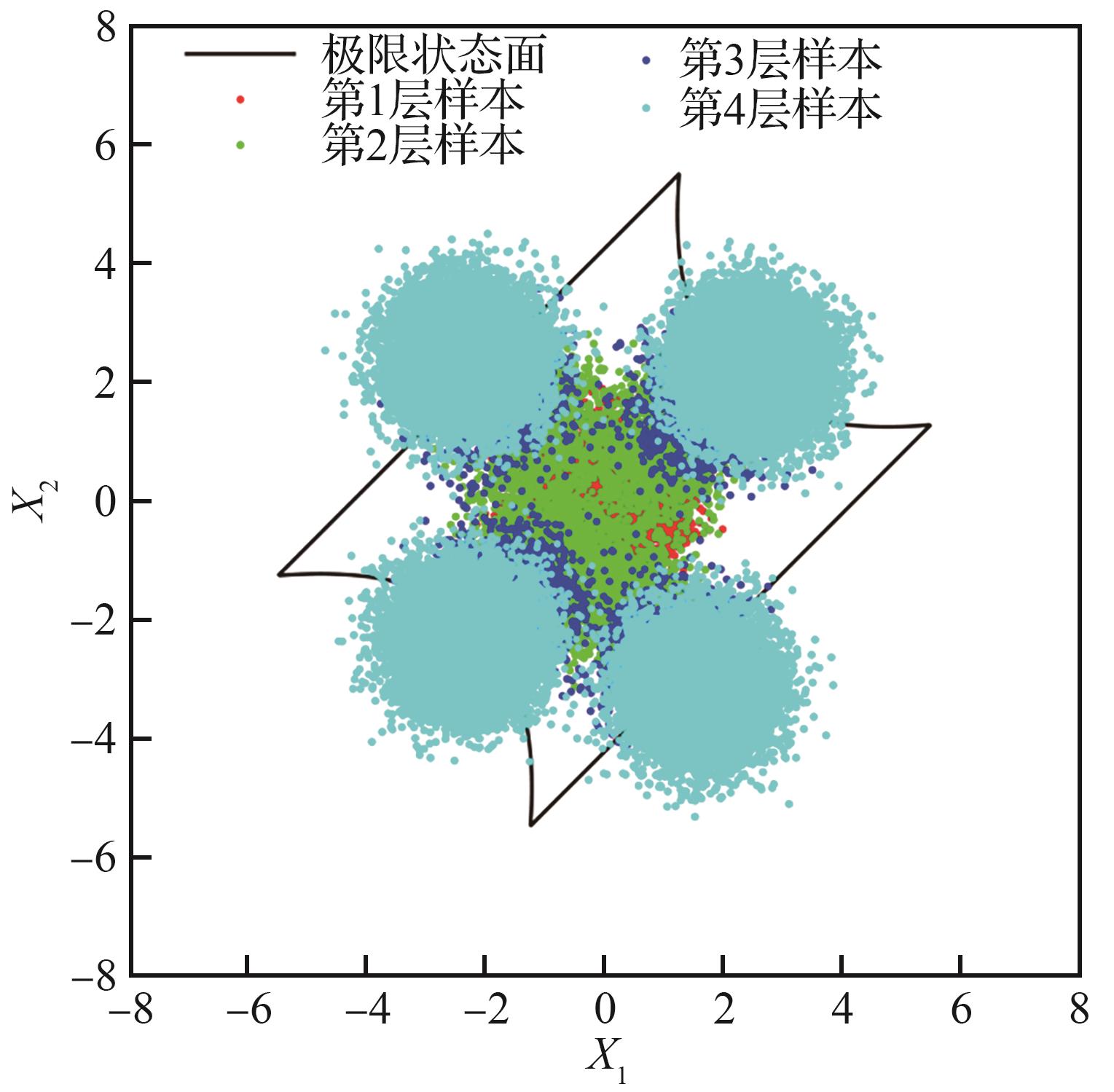
Table 8
Random variable distribution parameters of turbine shaft structure
| 变量 | 符号 | 分布类型 | 均值 | 标准差 |
|---|---|---|---|---|
| 转速 | 正态分布 | 1 000 | 33.72 | |
| 弹性模量 | 正态分布 | |||
| 泊松比 | 正态分布 | 0.325 | ||
| 扭矩 | 正态分布 | 1 200 | 48 | |
| 应力极限 | 正态分布 | 480 | 17 |
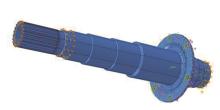
Fig.6
Load application and constraint conditions of turbine shaft
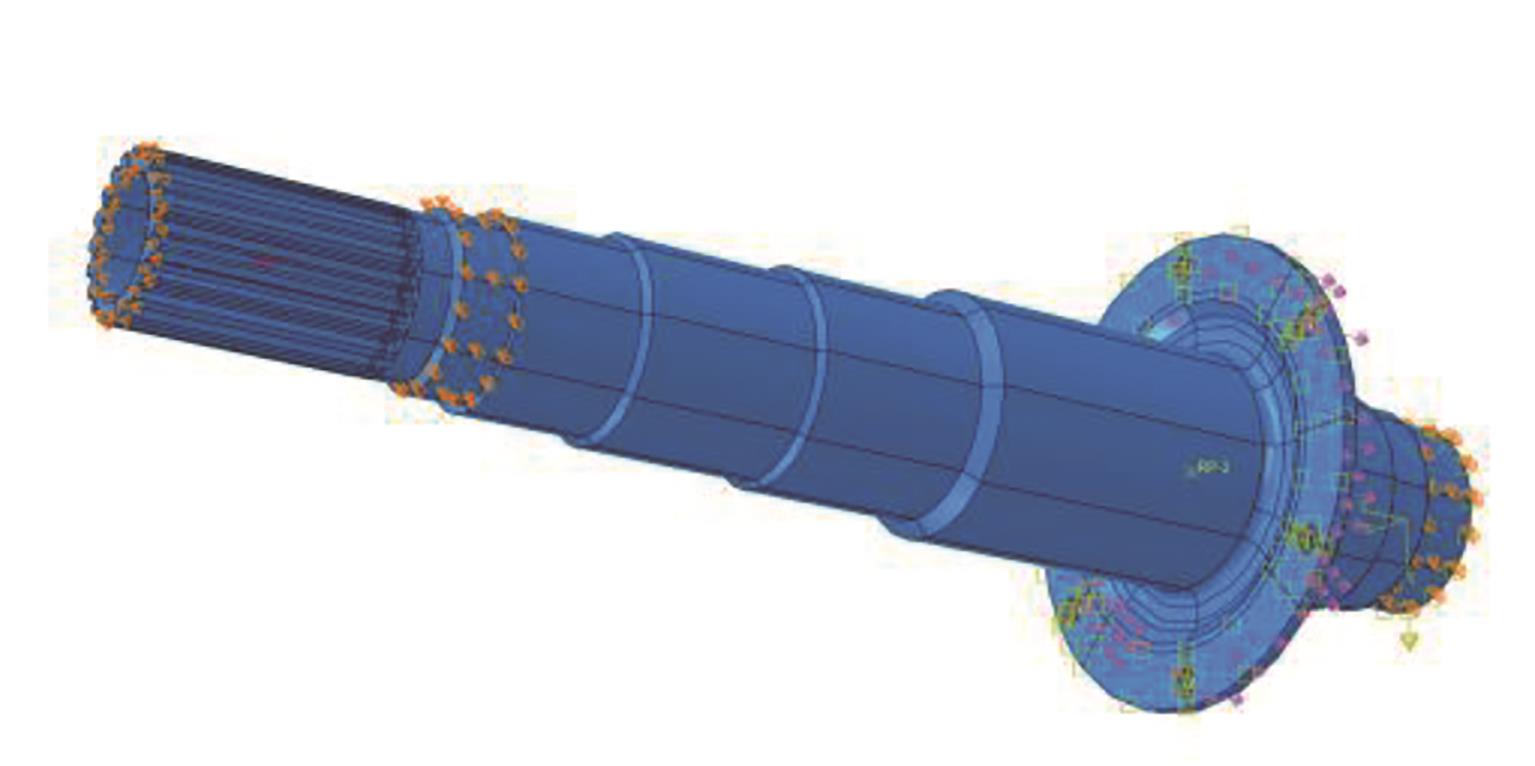
Fig.7
Stress cloud map of turbine shaft
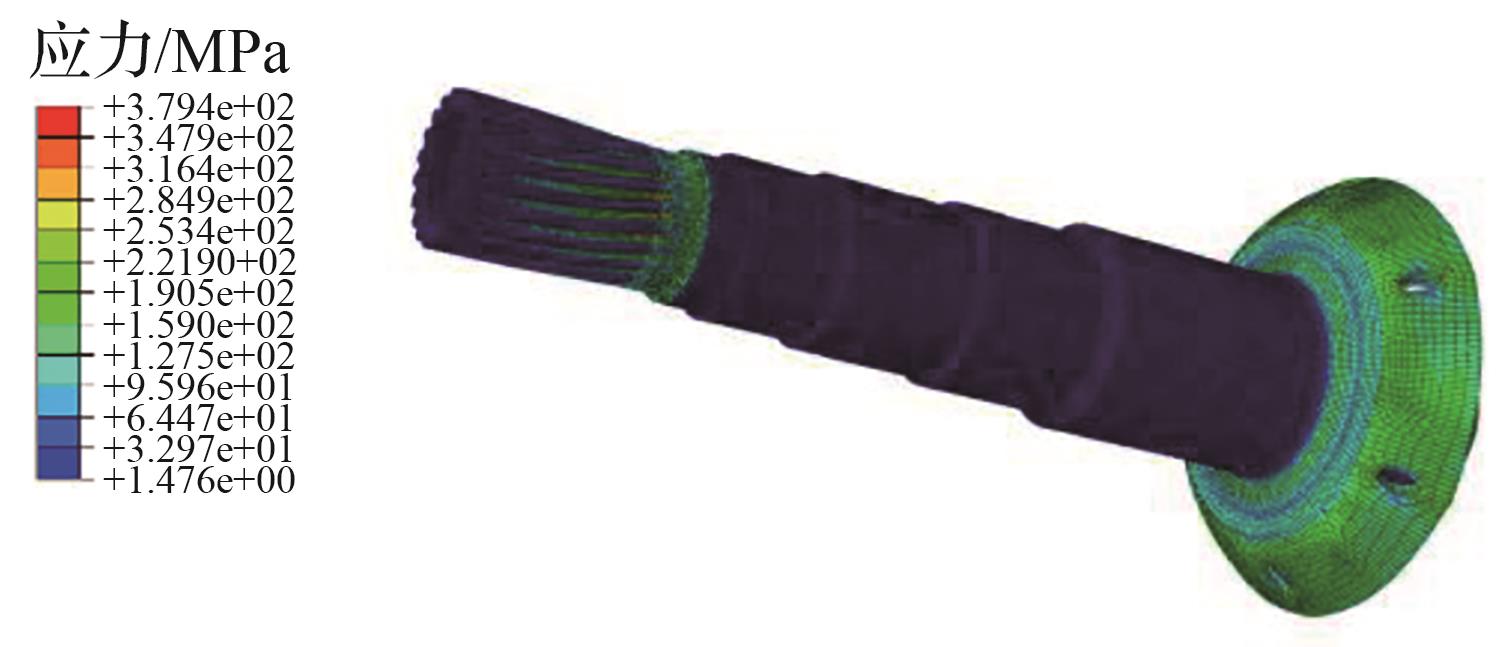
Table 9
Reliability analysis results (Case 4)
| 方法 | 重要 样本池 容量 | 估计 样本池 容量 | ||
|---|---|---|---|---|
| Meta-IS | 3.80 | |||
| Meta-IS2 | 3.24 |
Table 10
Calculated cost statistics (Case 4)
| 方法 | Ncall | |||
|---|---|---|---|---|
| Meta-IS | 32+1 | |||
| Meta-IS2 | 32+1 | 0.33 |
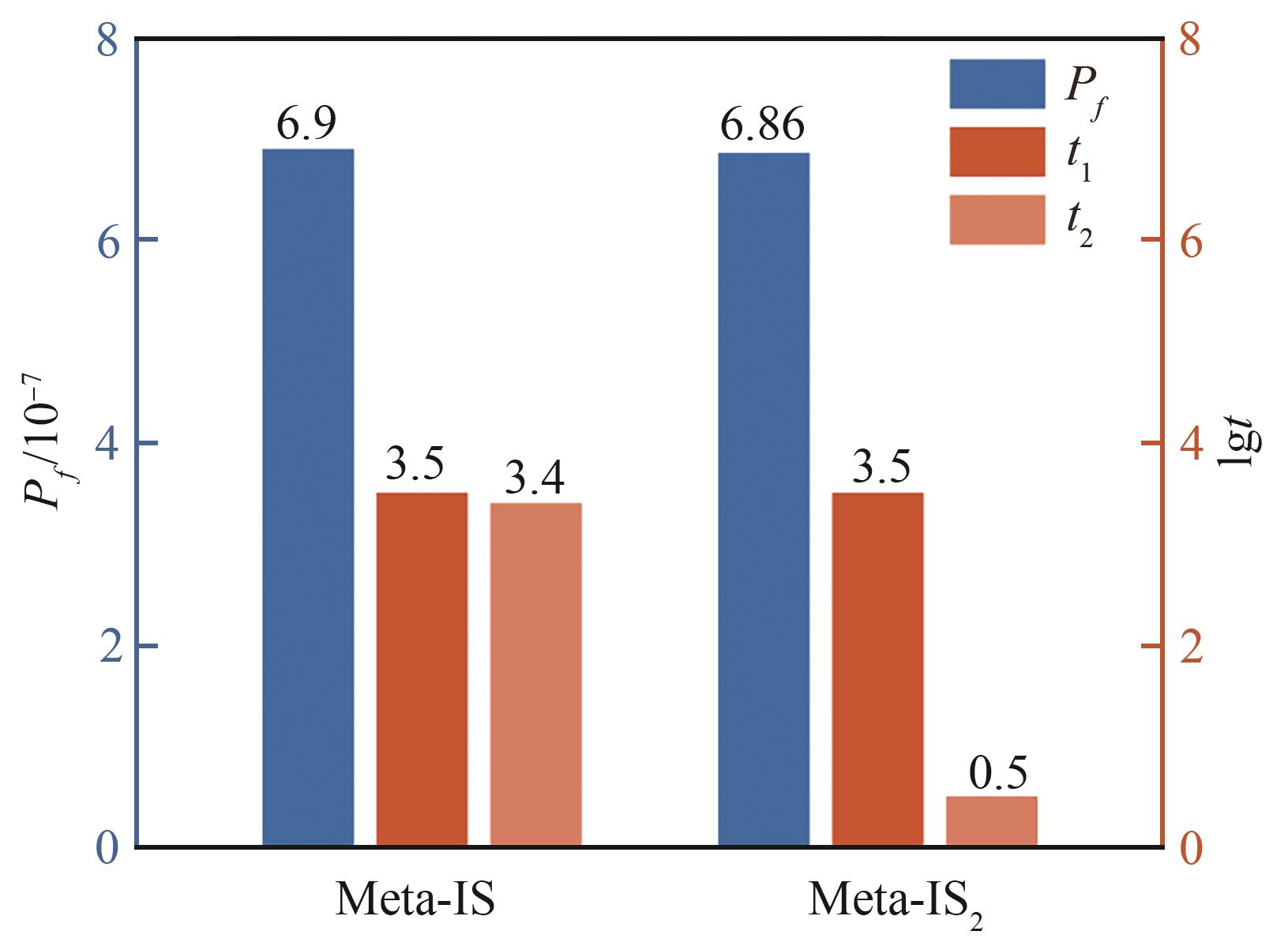
Fig.8
Comparison of failure probability and time consumption (Case 4)
| [1] | DITLEVSEN O, MELCHERS R E, GLUVER H. General multi-dimensional probability integration by directional simulation[J]. Computers & Structures, 1990, 36(2): 355-368. |
| [2] | 宋述芳, 吕震宙. 高维小失效概率下的改进线抽样方法[J]. 航空学报, 2007, 28(3): 596-599. |
| SONG S F, LYU Z Z. Improved line sampling method for structural reliability with high dimensionality and small failure probability[J]. Acta Aeronautica et Astronautica Sinica, 2007, 28(3): 596-599 (in Chinese). | |
| [3] | SCHUËLLER G I, PRADLWARTER H J, KOUTSOURELAKIS P S. A critical appraisal of reliability estimation procedures for high dimensions[J]. Probabilistic Engineering Mechanics, 2004, 19(4): 463-474. |
| [4] | AU S K, BECK J L. Estimation of small failure probabilities in high dimensions by subset simulation[J]. Probabilistic Engineering Mechanics, 2001, 16(4): 263-277. |
| [5] | ALVAREZ D A, URIBE F, HURTADO J E. Estimation of the lower and upper bounds on the probability of failure using subset simulation and random set theory[J]. Mechanical Systems and Signal Processing, 2018, 100: 782-801. |
| [6] | CHENG K, LU Z Z, XIAO S N, et al. Estimation of small failure probability using generalized subset simulation[J]. Mechanical Systems and Signal Processing, 2022, 163: 108114. |
| [7] | GROOTEMAN F. Adaptive radial-based importance sampling method for structural reliability[J]. Structural Safety, 2008, 30(6): 533-542. |
| [8] | AU S K, BECK J L. A new adaptive importance sampling scheme for reliability calculations[J]. Structural Safety, 1999, 21(2): 135-158. |
| [9] | JIA G F, TABANDEH A, GARDONI P. A density extrapolation approach to estimate failure probabilities[J]. Structural Safety, 2021, 93: 102128. |
| [10] | 员婉莹, 李逢源, 黄博, 等. 可靠性分析改进元模型重要抽样算法[J]. 航空学报, 2025, 46(7): 184-196. |
| YUN W Y, LI F Y, HUANG B, et al. Enhanced metamodel-based importance sampling method for reliability analysis[J]. Acta Aeronautica et Astronautica Sinica, 2025, 46(7): 184-196 (in Chinese). | |
| [11] | 徐思敏. 基于分层子抽样的快速马尔科夫链蒙特卡洛算法[D]. 厦门: 厦门大学, 2021. |
| XU S M. Speeding up Markov chain Monte Carlo by stratified subsampling[D]. Xiamen: Xiamen University, 2021 (in Chinese). | |
| [12] | HONG S, YUE T Y, YOU Y, et al. A resilience recovery method for complex traffic network security based on trend forecasting[J]. International Journal of Intelligent Systems, 2025(1): 3715086. |
| [13] | ZHAO Z Q, XIE L Y, ZHAO B F, et al. Reliability evaluation of folding wing mechanism deployment performance based on improved active learning Kriging method[J]. Probabilistic Engineering Mechanics, 2023, 74: 103547. |
| [14] | ECHARD B, GAYTON N, LEMAIRE M, et al. A combined importance sampling and Kriging reliability method for small failure probabilities with time-demanding numerical models[J]. Reliability Engineering & System Safety, 2013, 111: 232-240. |
| [15] | FAN X, YANG X F, LIU Y S. A Kriging-assisted adaptive improved cross-entropy importance sampling method for random-interval hybrid reliability analysis[J]. Structural and Multidisciplinary Optimization, 2024, 67(9): 158. |
| [16] | DUBOURG V, SUDRET B, DEHEEGER F. Metamodel-based importance sampling for structural reliability analysis[J]. Probabilistic Engineering Mechanics, 2013, 33: 47-57. |
| [17] | XIAO S N, NOWAK W. Failure probability estimation with failure samples: an extension of the two-stage Markov chain Monte Carlo simulation[J]. Mechanical Systems and Signal Processing, 2024, 212: 111300. |
| [18] | ZHU X M, LU Z Z, YUN W Y. An efficient method for estimating failure probability of the structure with multiple implicit failure domains by combining Meta-IS with IS-AK[J]. Reliability Engineering & System Safety, 2020, 193: 106644. |
| [19] | LING C Y, LU Z Z, ZHANG X B. An efficient method based on AK-MCS for estimating failure probability function[J]. Reliability Engineering & System Safety, 2020, 201: 106975. |
| [20] | YAN Y H, LU Z Z. Adaptive stratified mixture importance sampling for efficiently estimating extremely small failure probability with high-dimensional inputs and multiple failure domains[J]. Multidiscipline Modeling in Materials and Structures, 2025, 21(2): 480-499. |
| [21] | LUCHI D, LOUREIROS RODRIGUES A, MIGUEL VAREJÃO F. Sampling approaches for applying DBSCAN to large datasets[J]. Pattern Recognition Letters, 2019, 117: 90-96. |
| [22] | ZHAN H Y, XIAO N C, JI Y X. An adaptive parallel learning dependent Kriging model for small failure probability problems[J]. Reliability Engineering & System Safety, 2022, 222: 108403. |
| [23] | LI M Y, WANG Z Q. Deep learning for high-dimensional reliability analysis[J]. Mechanical Systems and Signal Processing, 2020, 139: 106399. |
| [24] | BAO Y Q, SUN H B, GUAN X S, et al. An active learning method using deep adversarial autoencoder-based sufficient dimension reduction neural network for high-dimensional reliability analysis[J]. Reliability Engineering & System Safety, 2024, 247: 110140. |
| [25] | HU Z, NANNAPANENI S, MAHADEVAN S. Efficient Kriging surrogate modeling approach for system reliability analysis[J]. Artificial Intelligence for Engineering Design, Analysis and Manufacturing, 2017, 31(2): 143-160. |
| [26] | CHEN Y Z, LU Z Z, WU X M. Meta model-based and cross entropy-based importance sampling algorithms for efficiently solving system failure probability function[J]. Probabilistic Engineering Mechanics, 2024, 76: 103615. |
| [27] | 郑新前, 王钧莹, 黄维娜, 等. 航空发动机不确定性设计体系探讨[J]. 航空学报, 2023, 44(7): 027099. |
| ZHENG X Q, WANG J Y, HUANG W N, et al. Uncertainty-based design system for aeroengines[J]. Acta Aeronautica et Astronautica Sinica, 2023, 44(7): 027099 (in Chinese). |
| [1] | Yixin LU, Zhenzhou LYU, Hengchao LI. Efficient analysis method of reliability lifetime and its application in turbine shaft [J]. Acta Aeronautica et Astronautica Sinica, 2026, 47(2): 232111-232111. |
| [2] | Wanying YUN, Fengyuan LI, Bo HUANG, Siyu WANG, Yunfei JIAO, Xinyu BAI, Xueqi HUANG. Enhanced metamodel-based importance sampling method for reliability analysis [J]. Acta Aeronautica et Astronautica Sinica, 2025, 46(7): 230738-230738. |
| [3] | Yulian GONG, Jianguo ZHANG, Zhigang WU, Guangyuan CHU, Xiaoduo FAN, Ying HUANG. Reliability algorithm of composite structure based on active learning basis-adaptive PC-Kriging model [J]. Acta Aeronautica et Astronautica Sinica, 2024, 45(8): 228982-228982. |
| [4] | Fan ZHANG, Bohan CHENG, Peng WANG, Lei DONG. A two-stage degradation model and reliability analysis related to degradation of binary load-sharing systems [J]. Acta Aeronautica et Astronautica Sinica, 2024, 45(7): 229046-229046. |
| [5] | Feng JIANG, Huacong LI, Jiangfeng FU, Xianwei LIU. Non-probabilistic reliability analysis with fuzzy failure and safe states [J]. Acta Aeronautica et Astronautica Sinica, 2024, 45(20): 229989-229989. |
| [6] | Fan ZHANG, Zijing SUN, Guosong XIAO, Jiachen LIU, Peng WANG. Reliability analysis for multi-phased mission of HUD system based on intuitionistic fuzzy Bayesian network [J]. ACTA AERONAUTICAET ASTRONAUTICA SINICA, 2023, 44(4): 226853-226853. |
| [7] | Lechang YANG, Chenxing WANG. Parameter calibration and reliability analysis of an aero-engine rotor based on multi-source heterogeneous information [J]. Acta Aeronautica et Astronautica Sinica, 2023, 44(23): 228575-228575. |
| [8] | Feng JIANG, Huacong LI, Jiangfeng FU, Linxiong HONG. A RBF and active learning combined method for structural non-probabilistic reliability analysis [J]. ACTA AERONAUTICAET ASTRONAUTICA SINICA, 2023, 44(2): 226667-226667. |
| [9] | Yunwen FENG, Xinyi LIN, Xiaofeng XUE, Xiang YANG, Jiaqi LIU. Design of civil aircraft explosion-proof structure for high reliable one-way blasting [J]. Acta Aeronautica et Astronautica Sinica, 2023, 44(18): 228297-228297. |
| [10] | HE Yong, WANG Hong, LI Jing, QI Yankun. Joint decision making for condition-based maintenance and spare parts ordering of components based on vibration monitoring [J]. ACTA AERONAUTICAET ASTRONAUTICA SINICA, 2022, 43(5): 225304-225304. |
| [11] | JIA Beixi, LYU Zhenzhou, LEI Jingyu. Parameterized simulation platform of turbine cooling film blade life reliability analysis [J]. ACTA AERONAUTICAET ASTRONAUTICA SINICA, 2021, 42(12): 224747-224747. |
| [12] | HU Xiaoyi, WANG Ruping, WANG Xin, FU Yongtao. Recent development of safety and reliability analysis technology for model-based complex system [J]. ACTA AERONAUTICAET ASTRONAUTICA SINICA, 2020, 41(6): 523436-523436. |
| [13] | LI Fang, HE Youchen, DI Peng, CHEN Tong, YIN Dongliang. Reliability analysis of fuzzy k-out-of-n system considering maintenance influence and dynamic load distribution mechanism [J]. ACTA AERONAUTICAET ASTRONAUTICA SINICA, 2018, 39(4): 221718-221718. |
| [14] | LIU Fuchao, WEI Pengfei, ZHOU Changcong, ZHANG Zheng, YUE Zhufeng. Time-dependent reliability and sensitivity analysis for planar motion mechanisms with revolution joint clearances [J]. ACTA AERONAUTICAET ASTRONAUTICA SINICA, 2018, 39(11): 422133-422141. |
| [15] | ZHANG Zhai, WANG Youren. Cell granularity optimization method of embryonics hardware in application design process [J]. ACTA AERONAUTICAET ASTRONAUTICA SINICA, 2016, 37(11): 3502-3511. |
| Viewed | ||||||
|
Full text |
|
|||||
|
Abstract |
|
|||||
Address: No.238, Baiyan Buiding, Beisihuan Zhonglu Road, Haidian District, Beijing, China
Postal code : 100083
E-mail:hkxb@buaa.edu.cn
Total visits: 6658907 Today visits: 1341All copyright © editorial office of Chinese Journal of Aeronautics
All copyright © editorial office of Chinese Journal of Aeronautics
Total visits: 6658907 Today visits: 1341

 CJA
CJA
