Acta Aeronautica et Astronautica Sinica ›› 2026, Vol. 47 ›› Issue (17): 632844.doi: 10.7527/S1000-6893.2025.32844
• Special Topic: Metal Fuel Propellant Technology • Previous Articles
Yang YU1,2, Kai XIANG3, Jiaxun LIU1, Xu WANG1, Qingchun YANG1, Xu XU1( ), Haiyun SUN3, Lun PAN4
Received:2025-09-28
Revised:2025-11-25
Accepted:2025-12-22
Online:2026-01-04
Published:2025-12-29
Contact:
Xu XU
E-mail:xuxu_1521@126.com
Supported by:CLC Number:
Yang YU, Kai XIANG, Jiaxun LIU, Xu WANG, Qingchun YANG, Xu XU, Haiyun SUN, Lun PAN. Combustion performance of hydrocarbon fuel containing nanoparticles in rocket[J]. Acta Aeronautica et Astronautica Sinica, 2026, 47(17): 632844.
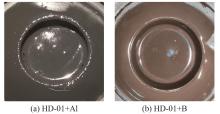
Fig.1
Slurry fuel samples containing aluminum and boron nanoparticles
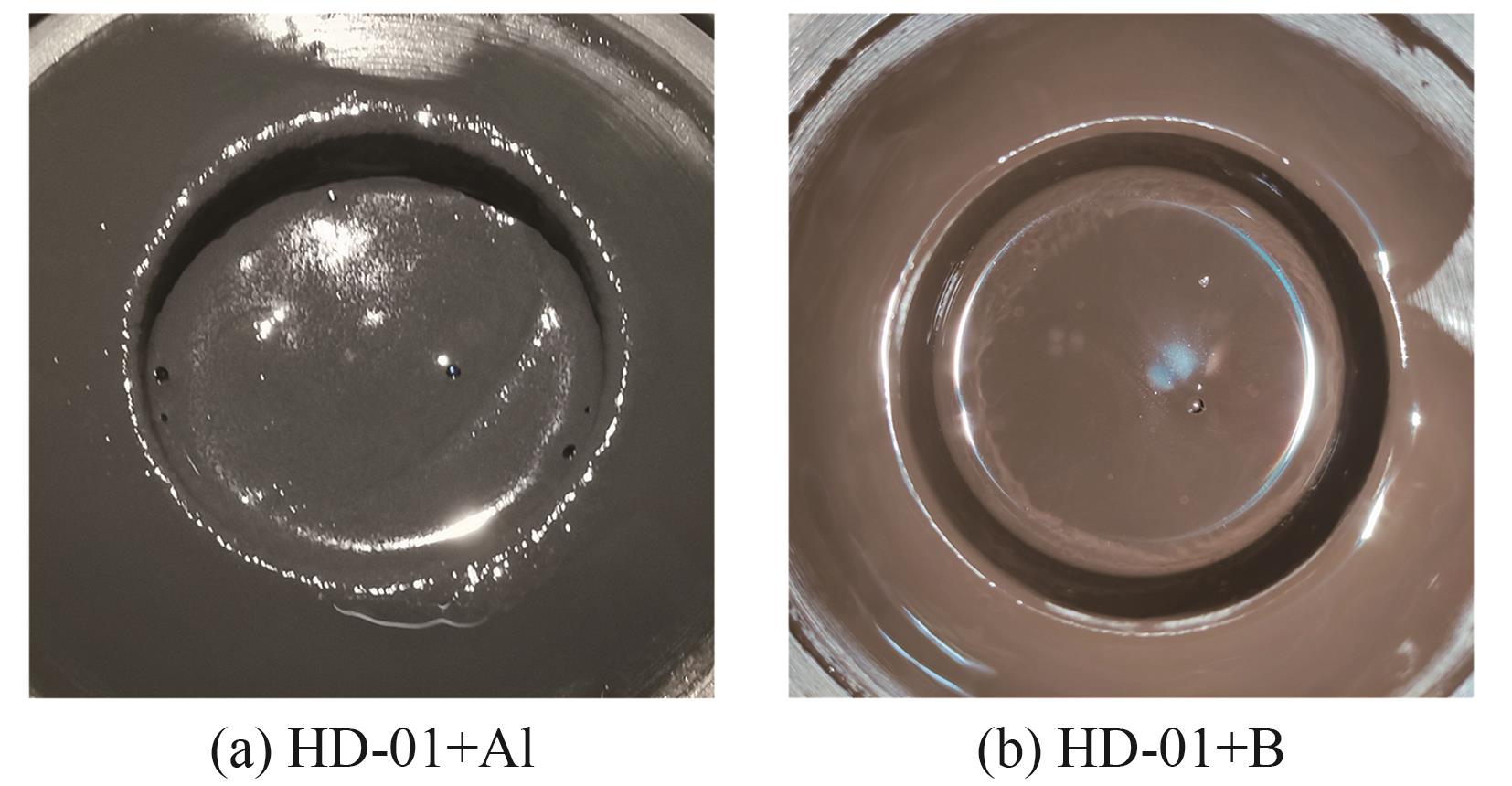
Table 1
Composition and property parameters of HD-01 series fuels
| 燃料名称 | 成分 | 密度/(g∙mL-1) | 质量热值/(MJ∙kg-1) | 体积热值/(MJ∙L-1) | 恰当氧燃比 |
|---|---|---|---|---|---|
| HD-01 | C10H16 | 0.934 | 42.1 | 39.3 | 3.29 |
| HD-01+Al | 90wt%C10H16+10wt%Al | 1.013 | 41.0 | 41.5 | 3.05 |
| HD-01+B | 90wt%C10H16+10wt%B | 0.996 | 43.8 | 43.6 | 3.18 |
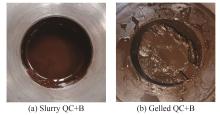
Fig.2
Slurry fuel and gel fuel samples containing boron nanoparticles
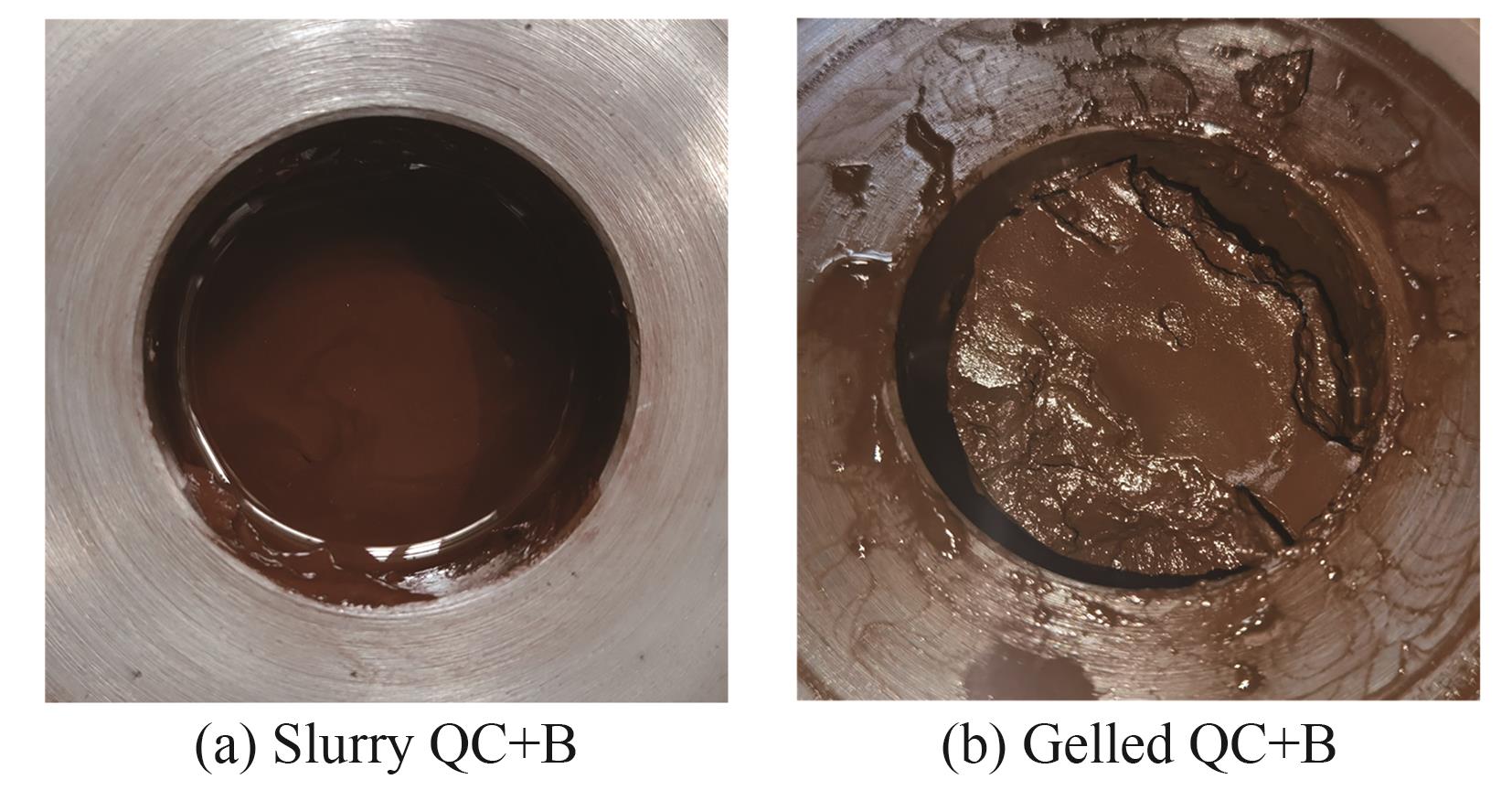
Table 2
Composition and property parameters of QC series fuels
| 燃料名称 | 成分 | 密度/(g∙mL-1) | 质量热值/(MJ∙kg-1) | 体积热值/(MJ∙L-1) | 恰当氧燃比 |
|---|---|---|---|---|---|
| QC | C7H8 | 0.984 | 44.3 | 43.6 | 3.13 |
| Slurry QC+B | 80wt%C7H8+20wt%B | 1.107 | 47.4 | 52.5 | 2.95 |
| Gelled QC+B | 80wt%C7H8+20wt%B | 1.105 | 47.3 | 52.3 | 2.92 |
Fig.3
Schematic diagram of rocket engine test system
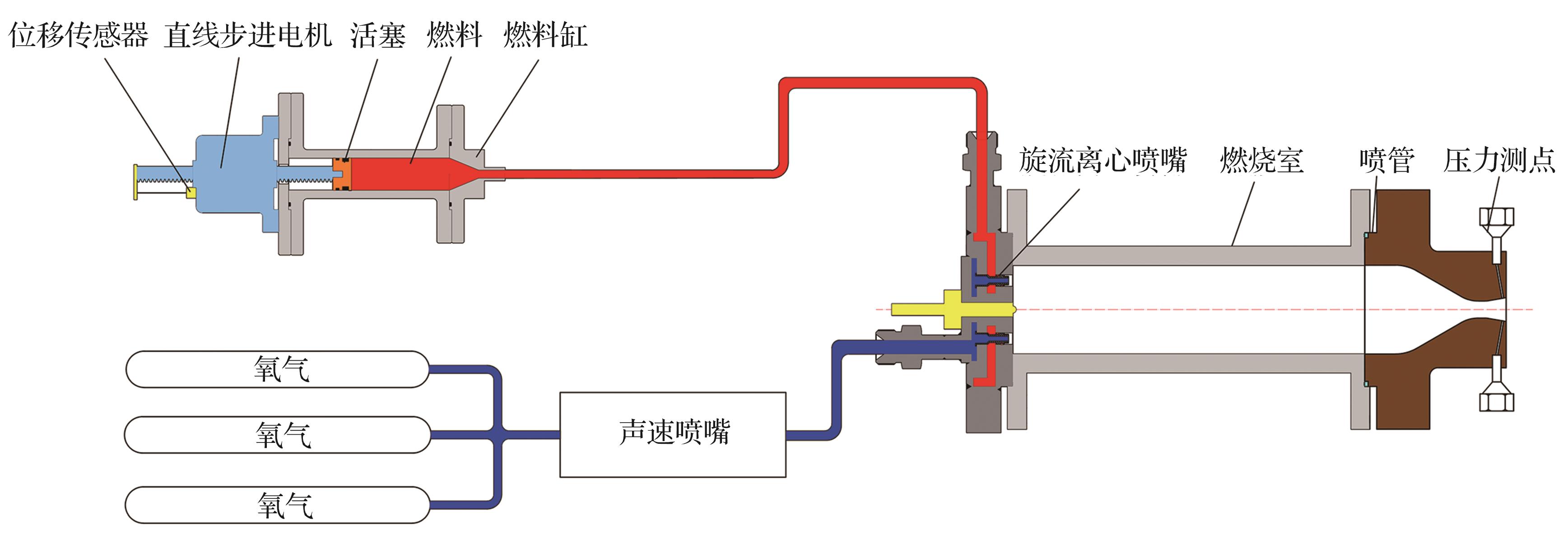
Fig.4
Schematic diagram of engine injection panel
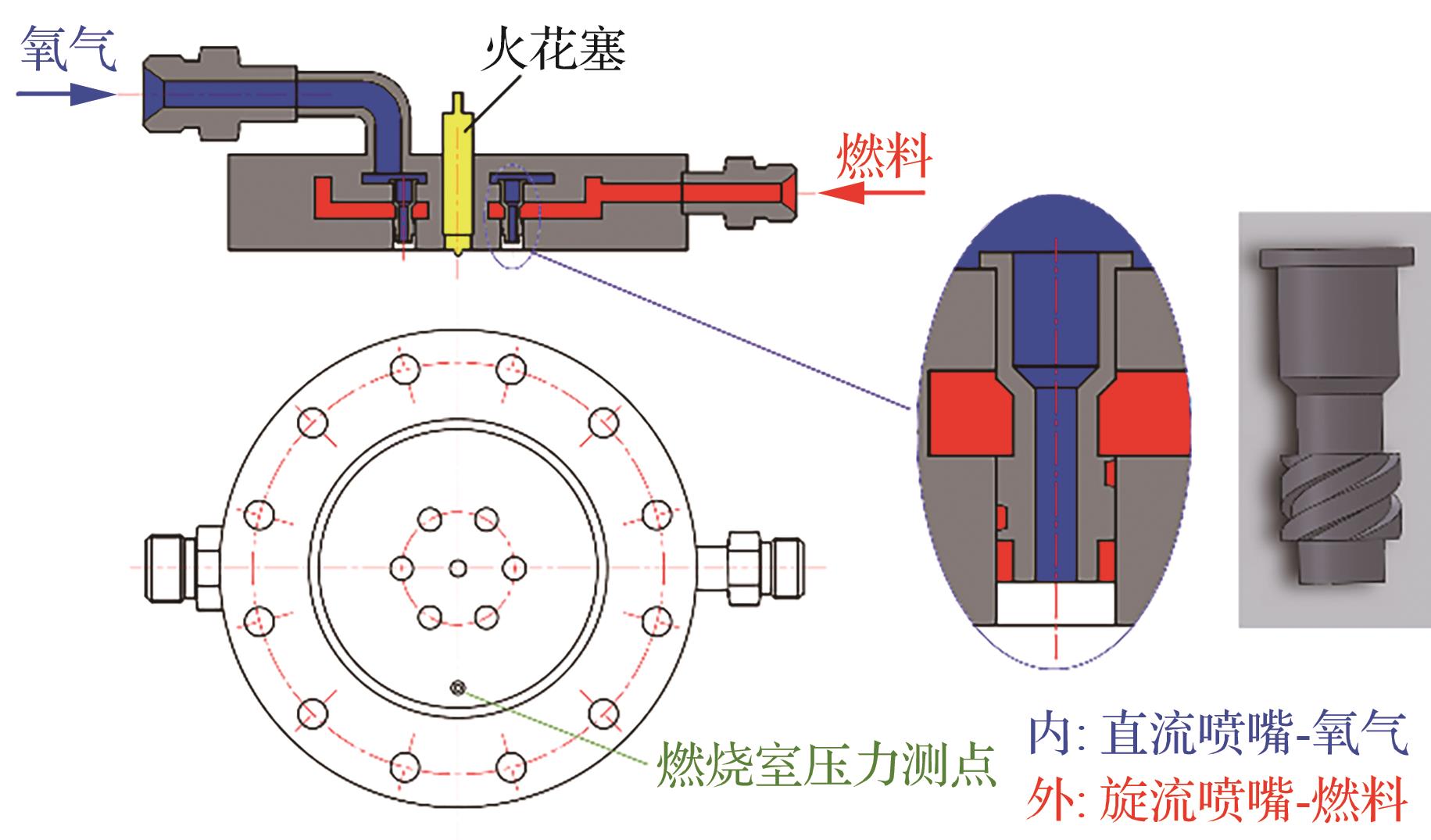
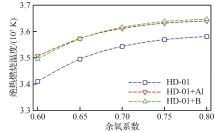
Fig.5
Effect of adding aluminum and boron particles on adiabatic combustion temperature of HD-01 fuel
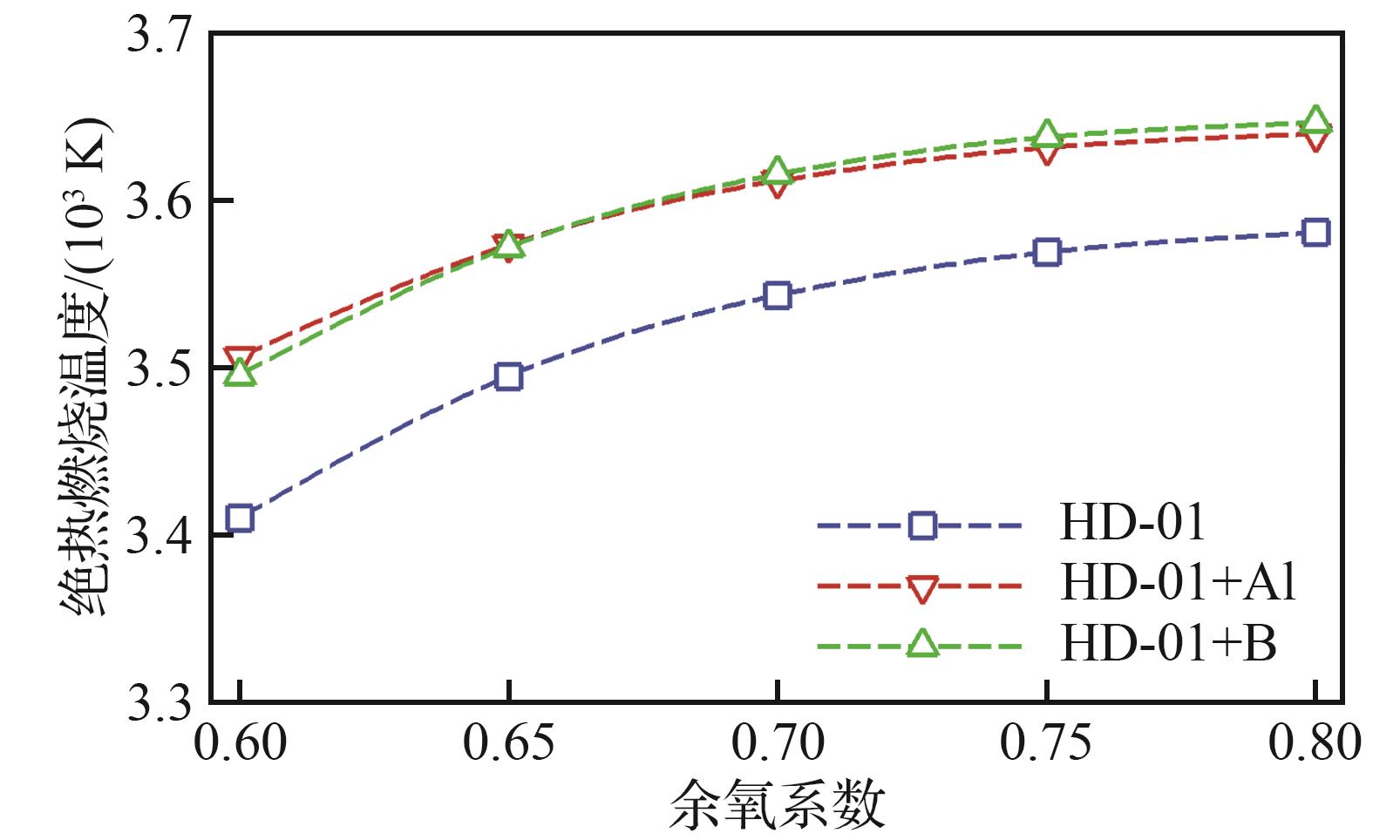
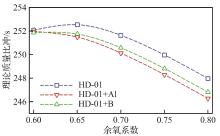
Fig.6
Effect of adding aluminum and boron particles on theoretical mass specific impulse of HD-01 fuel
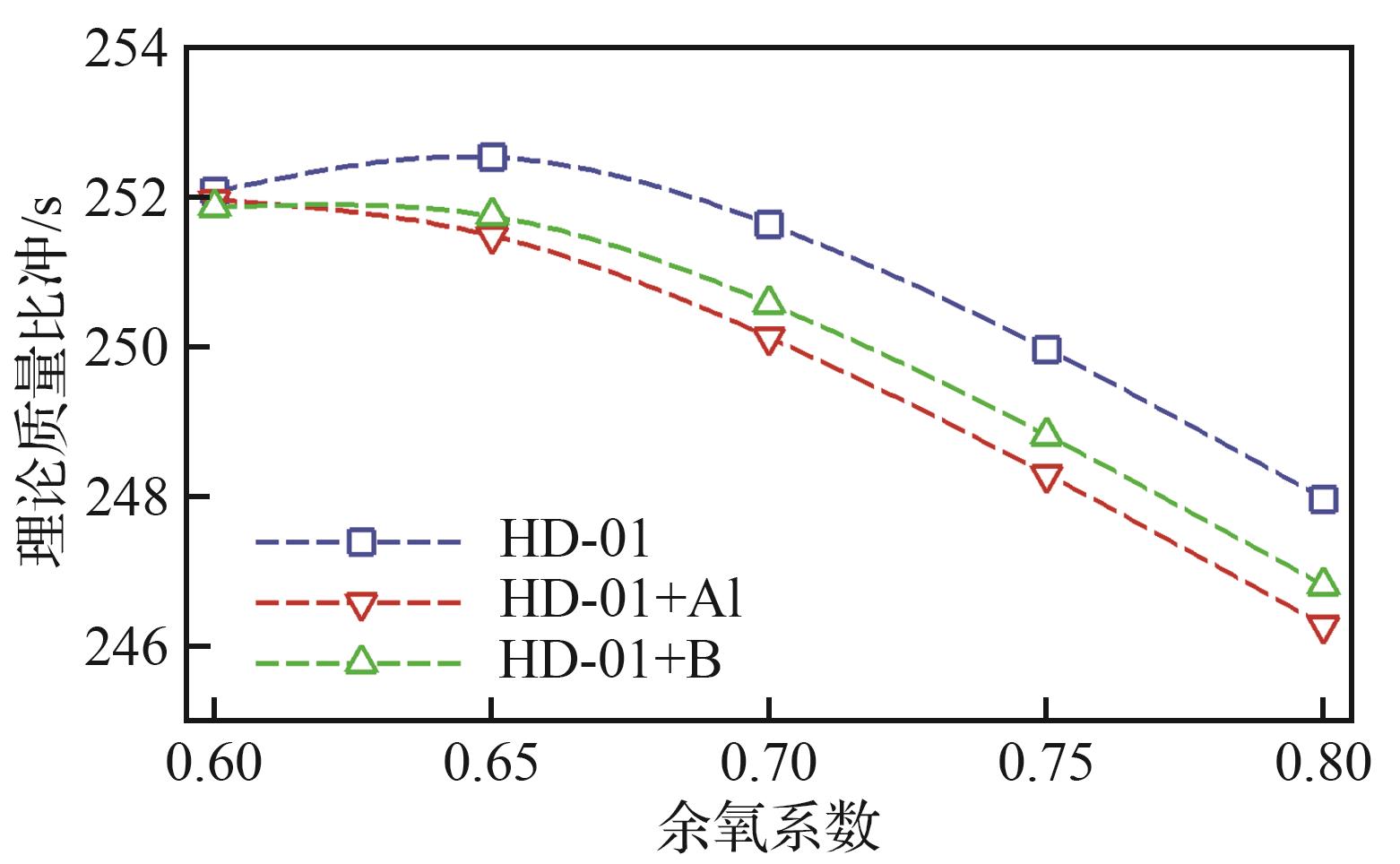
Fig.7
Effect of adding aluminum and boron particles on theoretical density specific impulse of HD-01 fuel
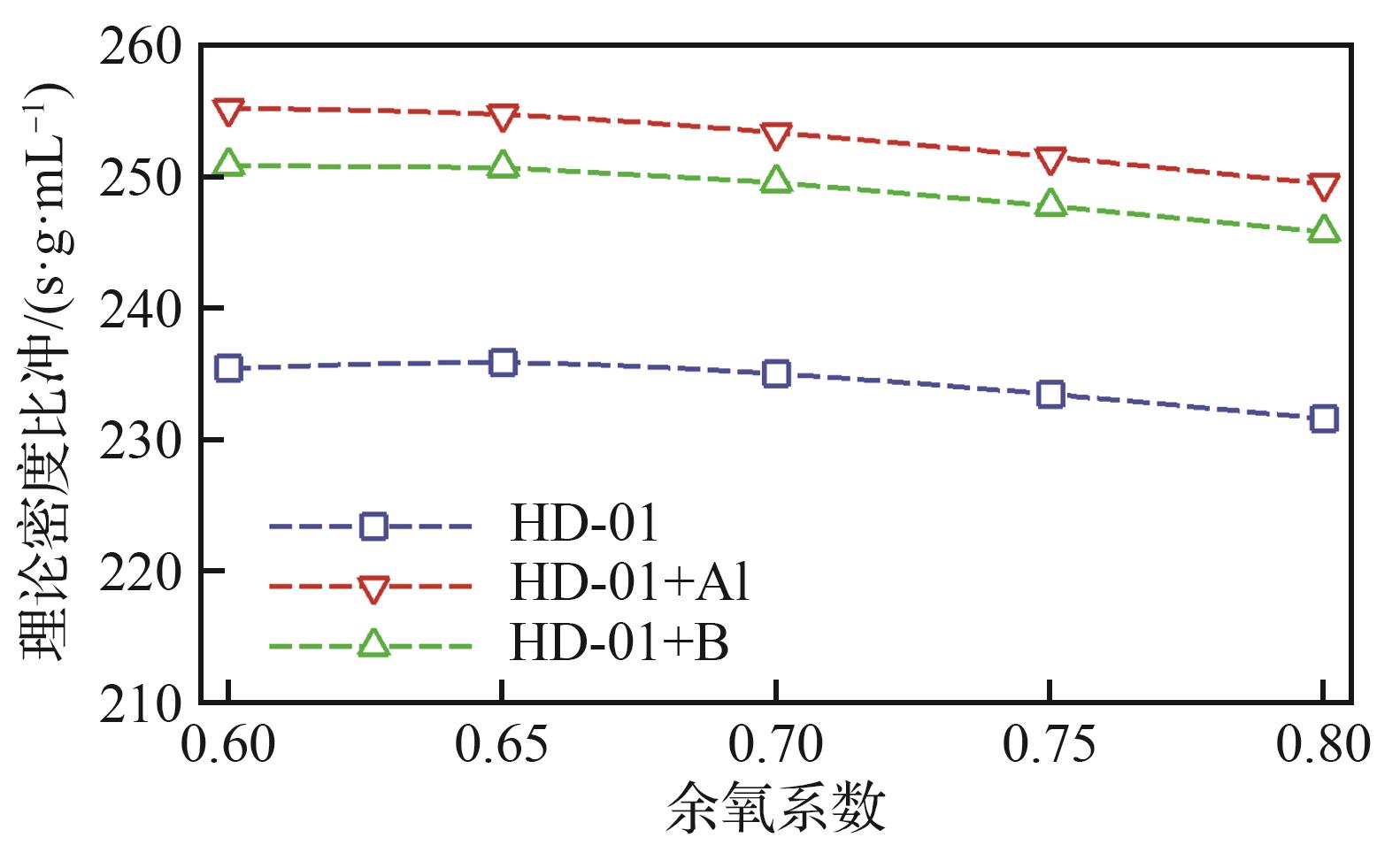
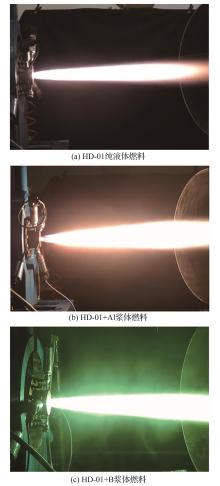
Fig.8
Engine exhaust flame corresponding to
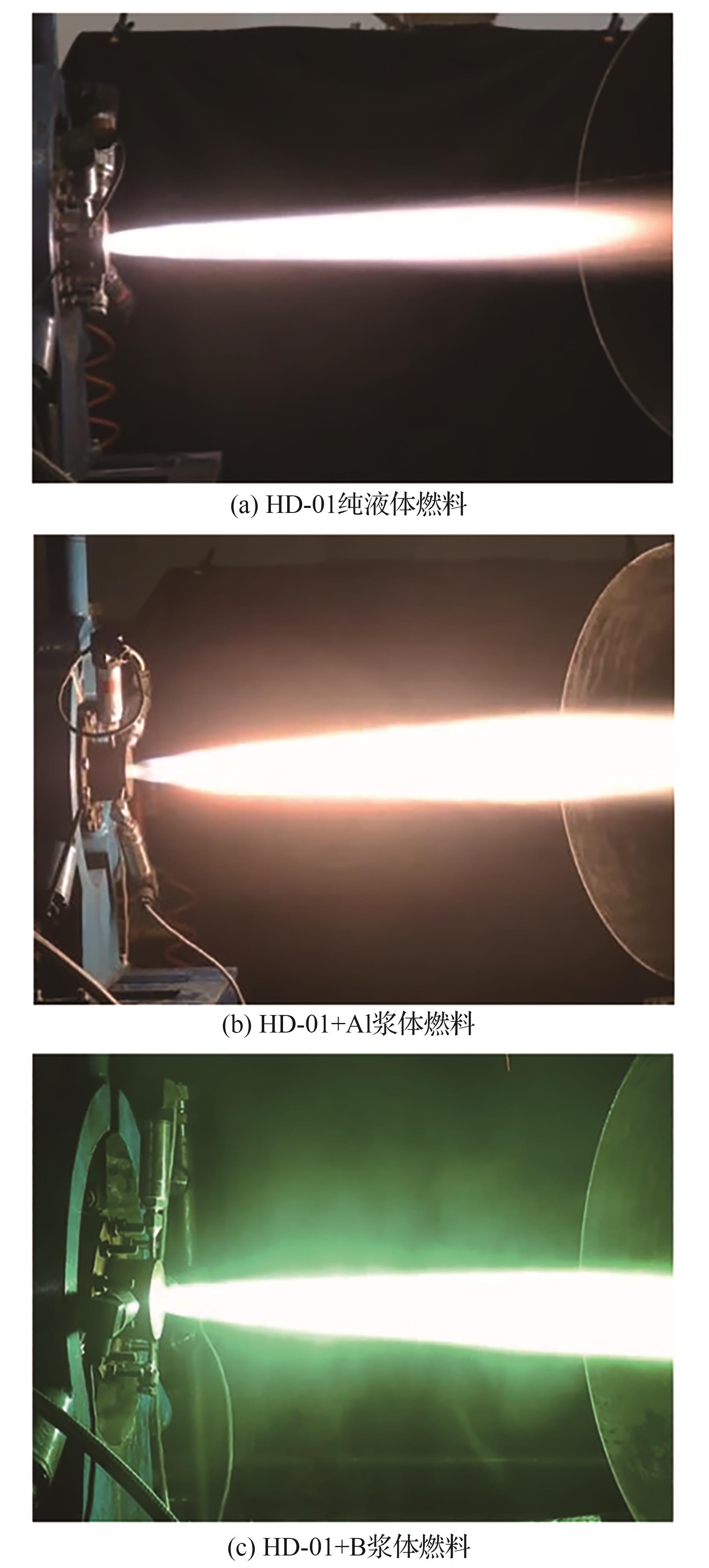
Table 3
Test results of HD-01 series fuels with different excess oxidizer coefficients
| 燃料 | 余氧系数 | 推进剂总流量/(g∙s-1) | 室压/MPa | 实际特征速度/(m∙s-1) | 理论特征速度/(m∙s-1) | 燃烧效率/% |
|---|---|---|---|---|---|---|
| HD-01 | 0.62 | 90.0 | 2.0 | 1 569.0 | 1 796.2 | 87.4 |
| 0.66 | 93.1 | 2.1 | 1 584.3 | 1 794.7 | 88.3 | |
| 0.72 | 90.9 | 2.1 | 1 639.2 | 1 781.2 | 92.0 | |
| 0.81 | 90.2 | 2.1 | 1 629.9 | 1 757.3 | 92.8 | |
| HD-01+Al | 0.62 | 91.5 | 2.0 | 1 542.1 | 1 790.7 | 86.1 |
| 0.65 | 89.7 | 2.0 | 1 567.3 | 1 785.1 | 87.8 | |
| 0.72 | 90.0 | 2.0 | 1 600.5 | 1 768.7 | 90.5 | |
| 0.80 | 90.4 | 2.1 | 1 596.4 | 1 747.7 | 91.3 | |
| HD-01+B | 0.64 | 88.3 | 2.0 | 1 535.6 | 1 789.1 | 85.8 |
| 0.70 | 87.1 | 2.0 | 1 565.1 | 1 778.1 | 88.0 | |
| 0.81 | 89.7 | 2.0 | 1 560.7 | 1 746.0 | 89.4 |
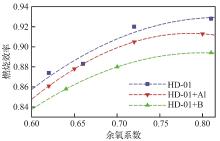
Fig.9
Combustion efficiency of HD-01 series fuels with different excess oxidizer coefficients
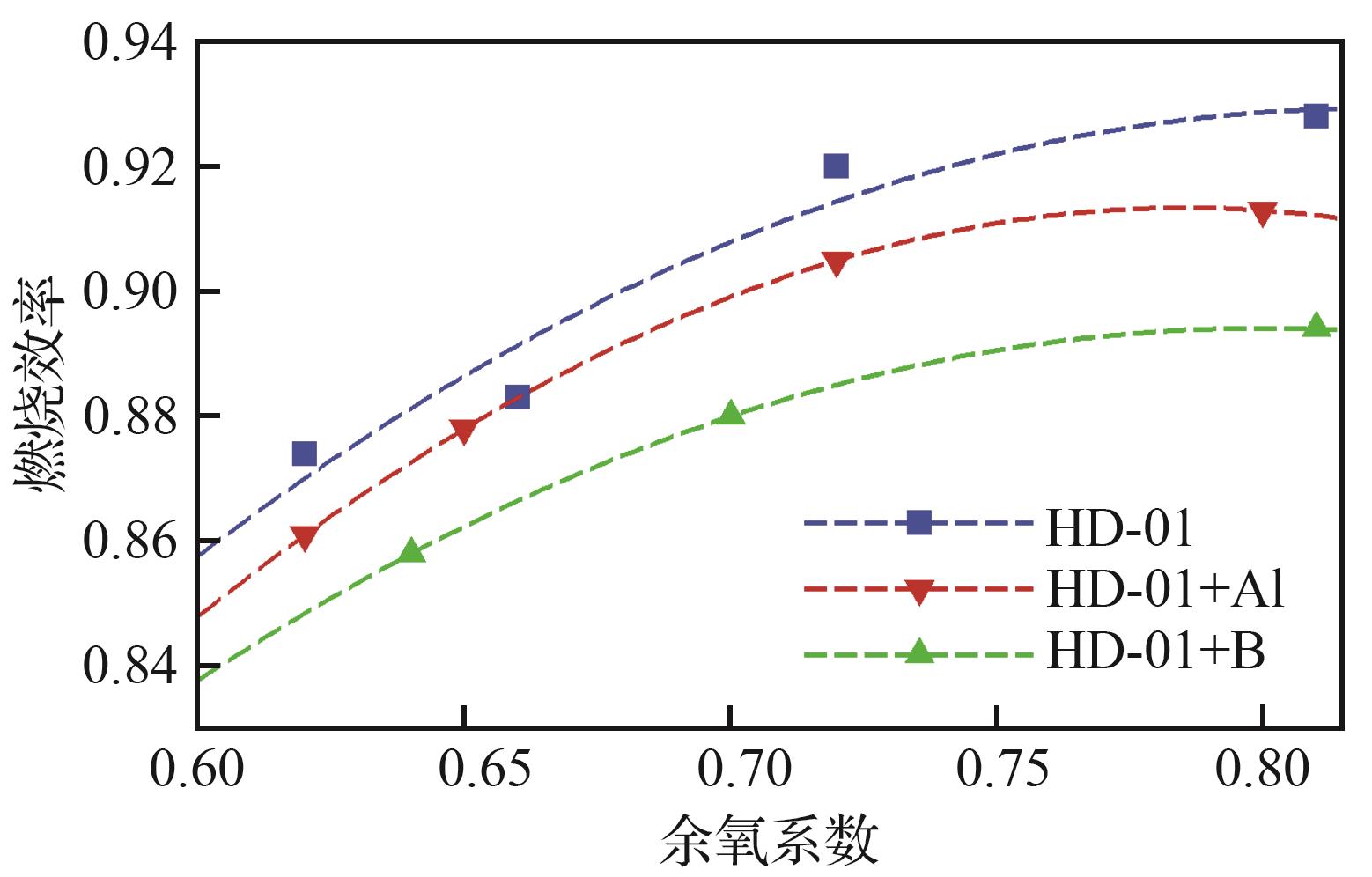
Table 4
Melting and boiling points of aluminum and boron particles
| 颗粒 | 熔点/K | 沸点/K |
|---|---|---|
| Al | 933 | 2 792 |
| B | 2 349 | 4 200 |
Table 5
Performance of HD-01 series fuels with different excess oxidizer coefficients
| 燃料 | 余氧系数 | 质量比冲/s | 密度比冲/ (s∙g∙mL-1) |
|---|---|---|---|
| HD-01 | 0.62 | 220.4 | 205.8 |
| 0.66 | 223.6 | 208.9 | |
| 0.72 | 231.7 | 216.4 | |
| 0.81 | 230.3 | 215.1 | |
| HD-01+Al | 0.62 | 217.1 | 219.9 |
| 0.65 | 220.8 | 223.7 | |
| 0.72 | 226.1 | 229.0 | |
| 0.80 | 225.8 | 228.7 | |
| HD-01+B | 0.64 | 216.6 | 215.7 |
| 0.70 | 220.9 | 220.0 | |
| 0.81 | 220.1 | 219.2 |
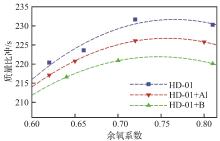
Fig.10
Mass specific impulse of HD-01 series fuels with different excess oxidizer coefficients
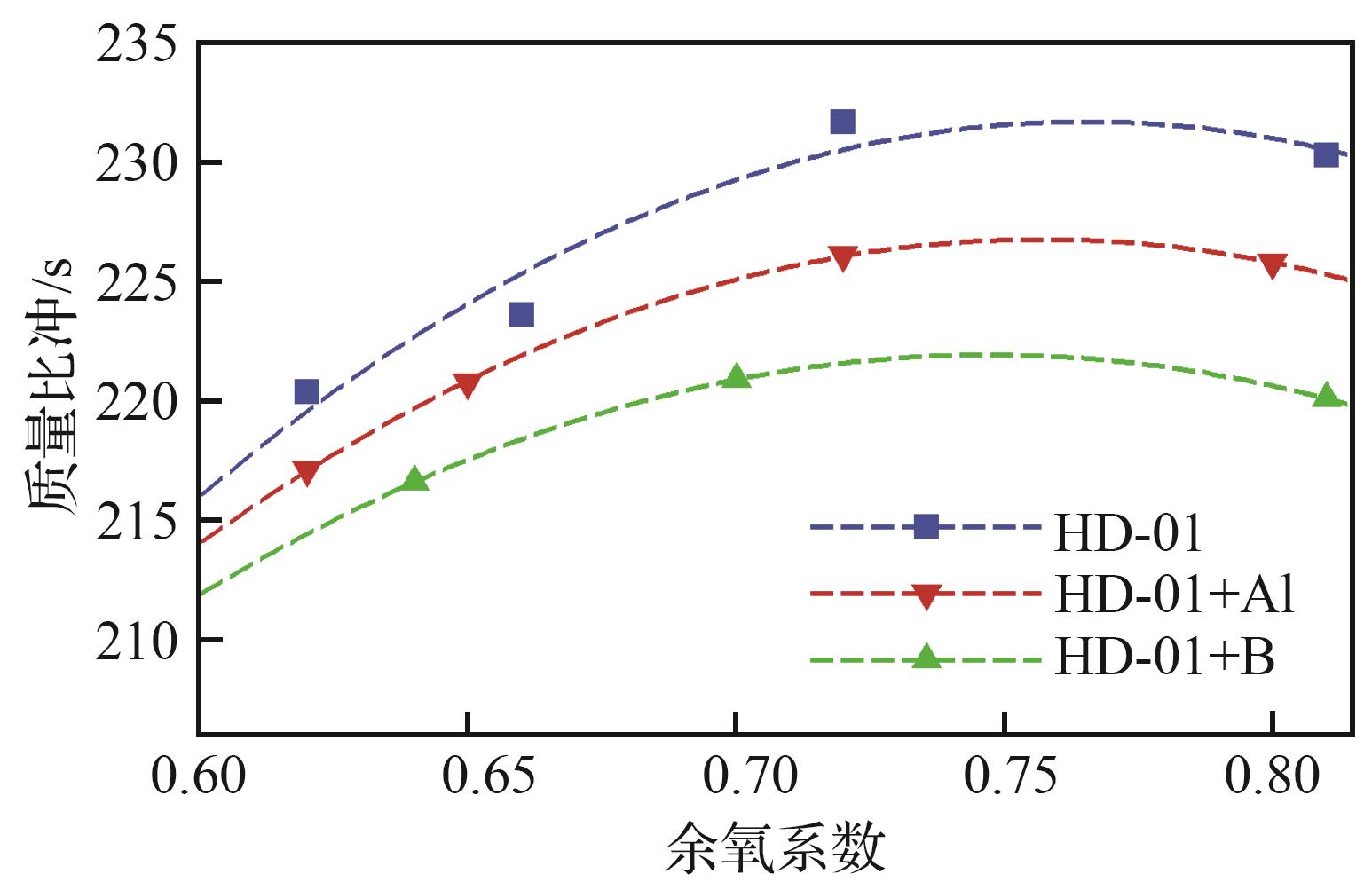
Fig.11
Density specific impulse of HD-01 series fuels with different excess oxidizer coefficients
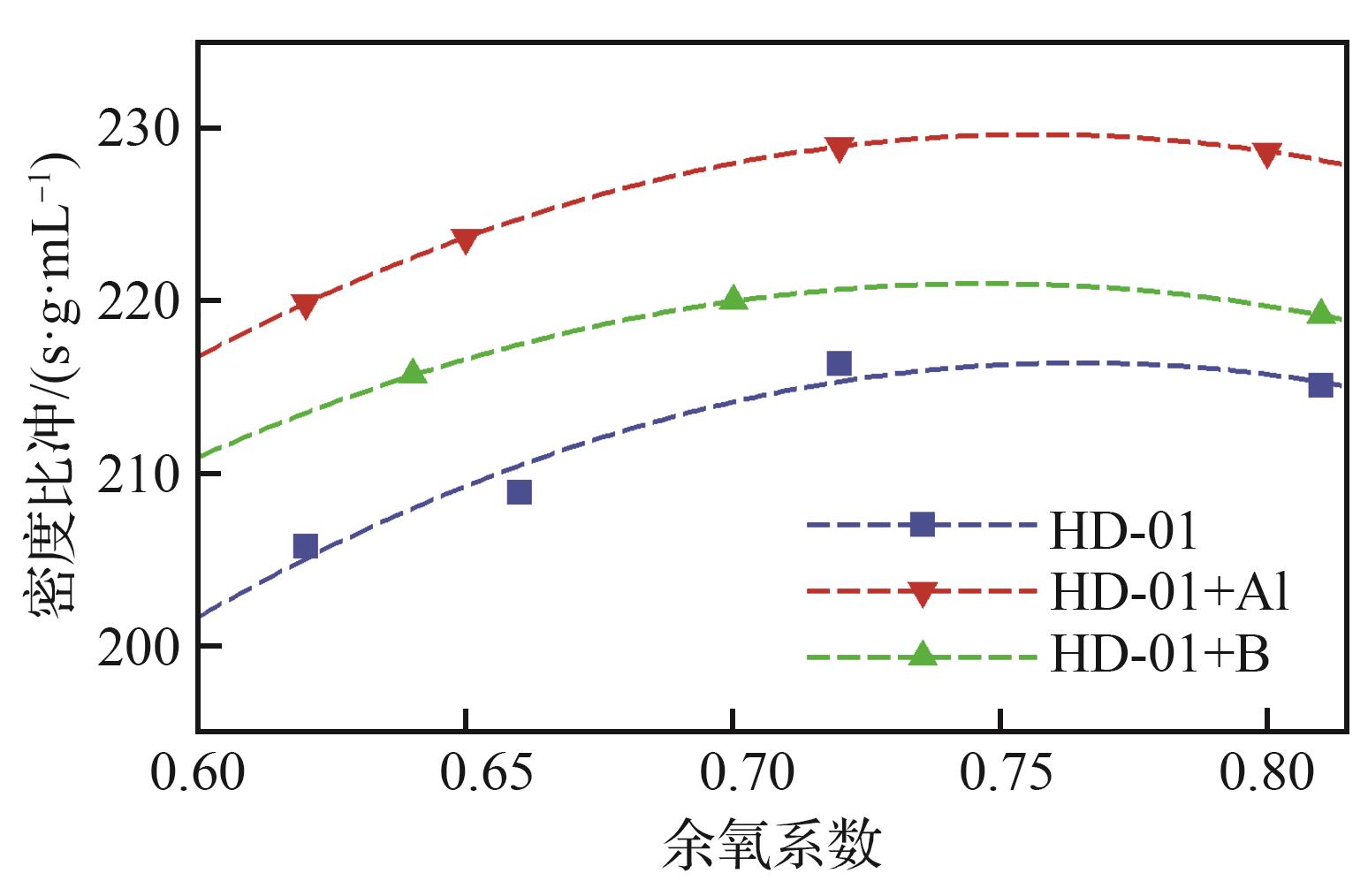
Fig.12
Effect of adding boron particles on adiabatic combustion temperature of QC fuel
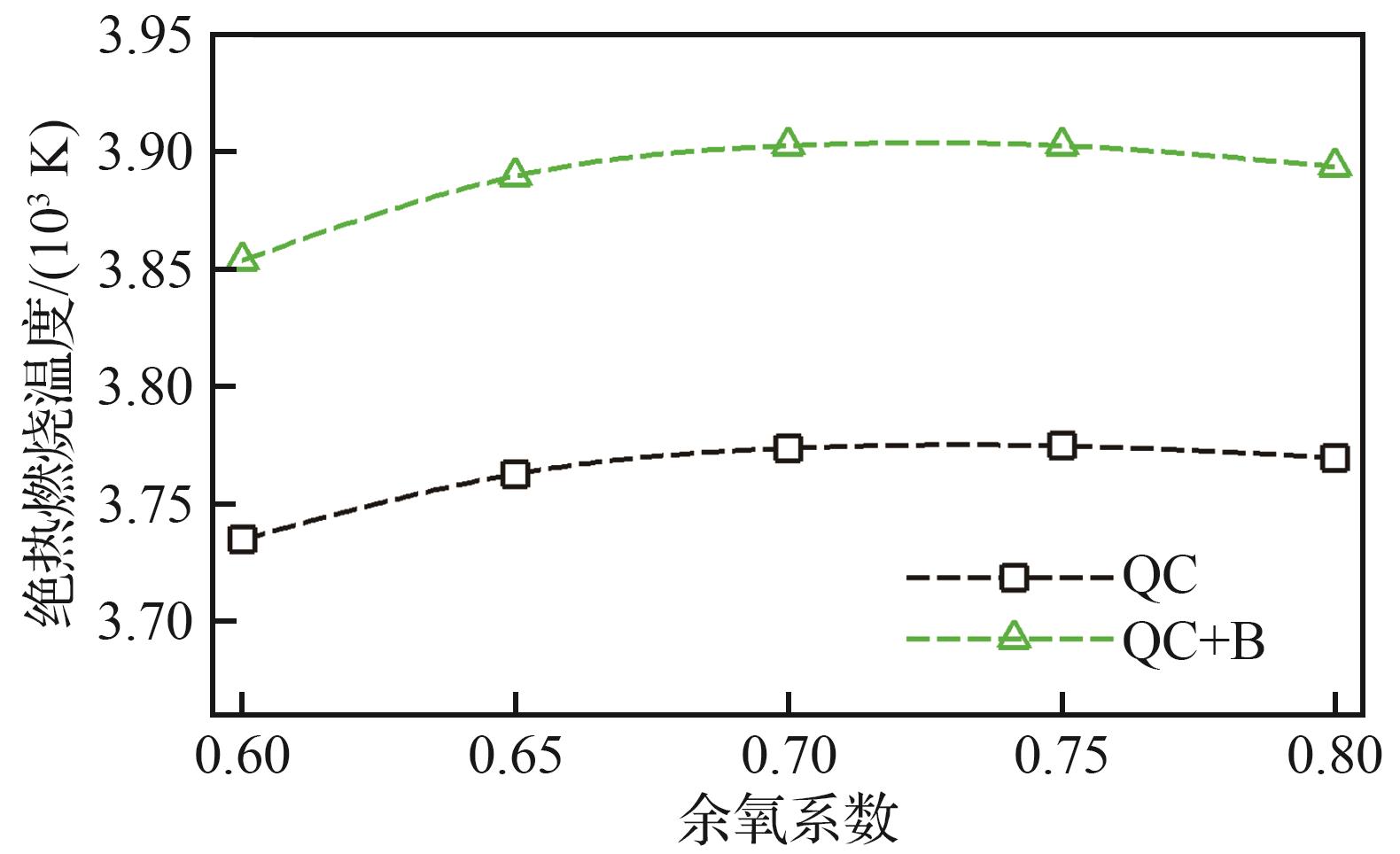
Fig.13
Effect of adding boron particles on theoretical mass specific impulse of QC fuel
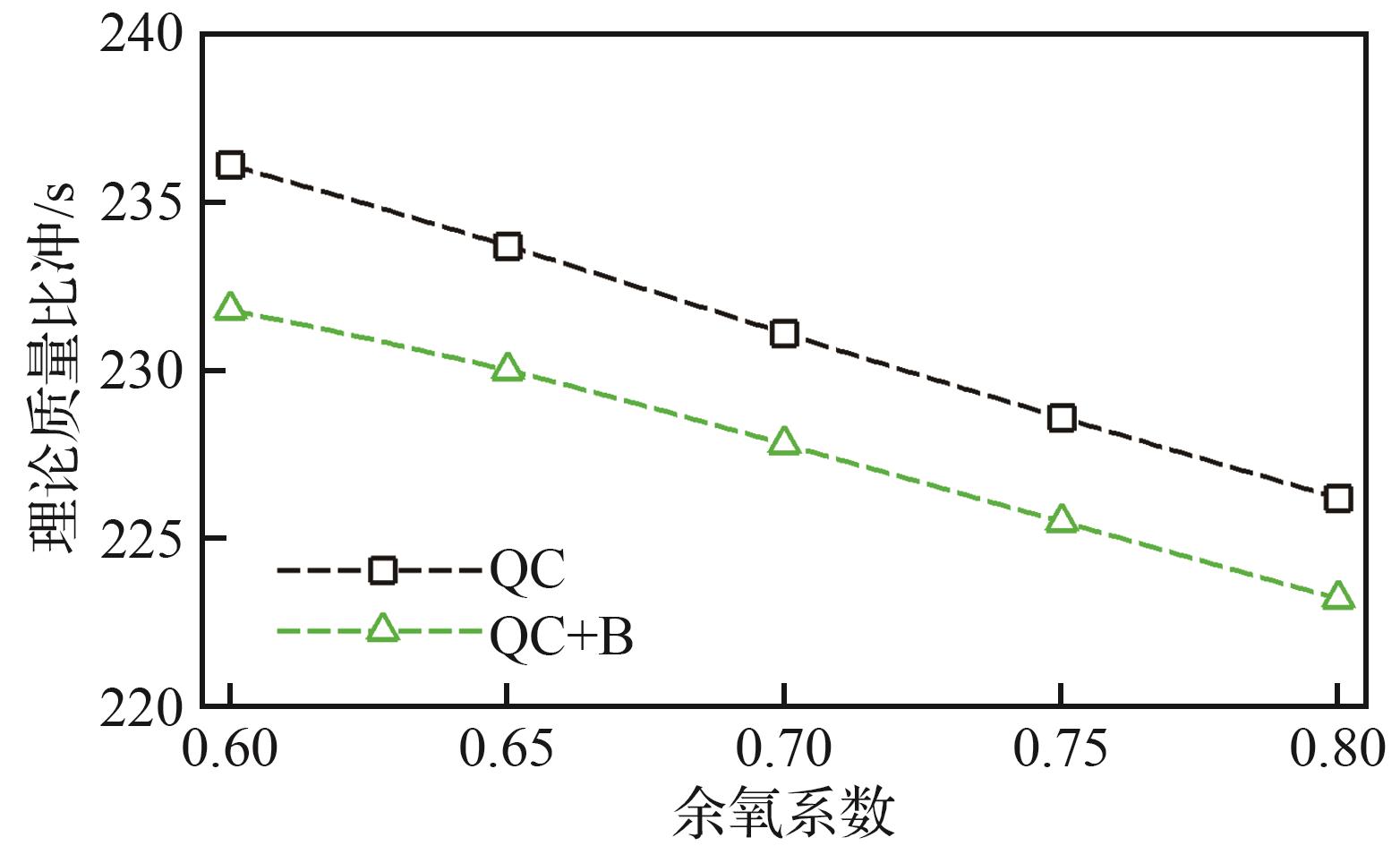
Fig.14
Effect of adding boron particles on theoretical density specific impulse of QC fuel
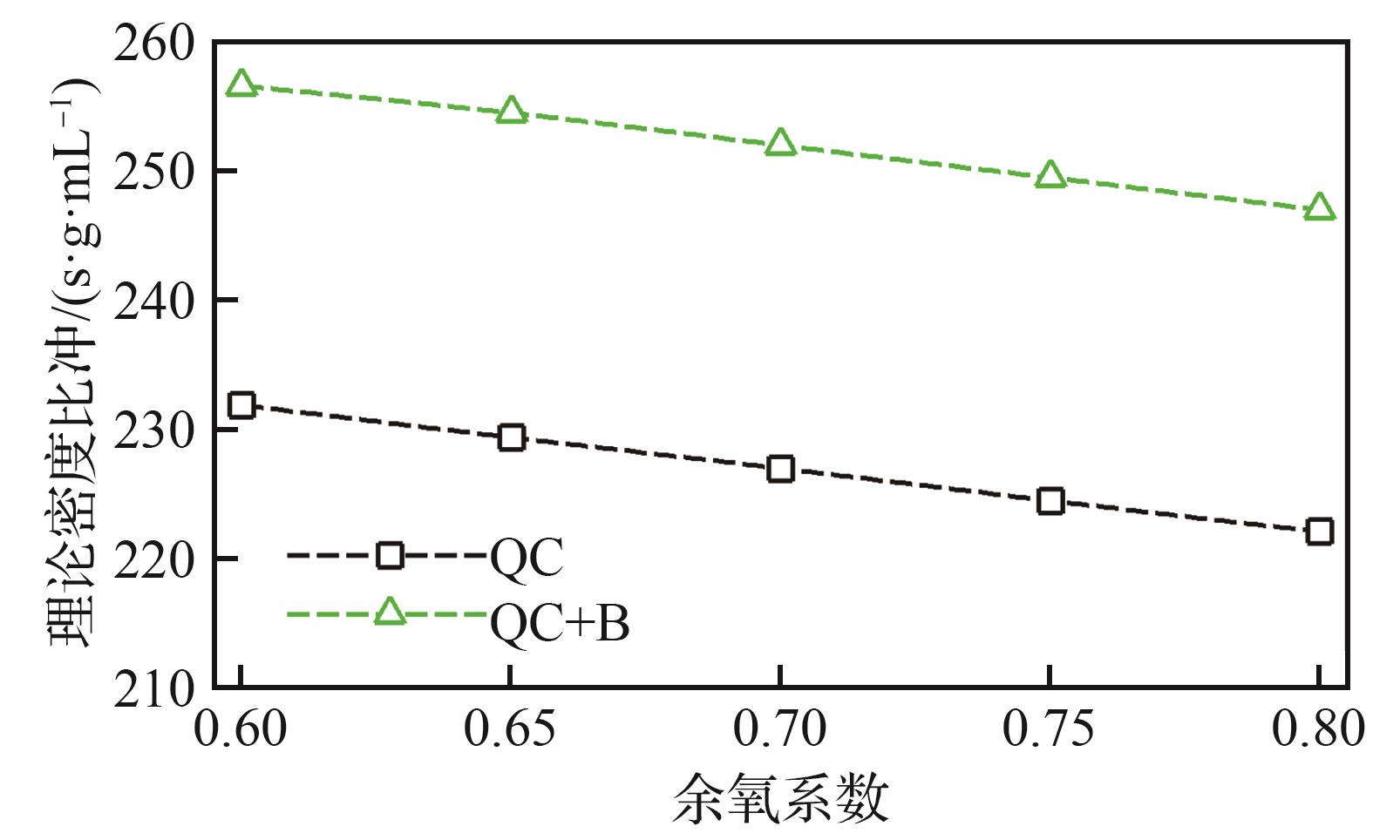
Table 6
Test results of QC series fuels with different excess oxidizer coefficients
| 燃料 | 余氧系数 | 推进剂总流量/(g∙s-1) | 室压/MPa | 实际特征速度/(m∙s-1) | 理论特征速度/(m∙s-1) | 燃烧效率/% |
|---|---|---|---|---|---|---|
| QC | 0.62 | 90.0 | 2.2 | 1 707.4 | 1 862.6 | 91.7 |
| 0.65 | 88.0 | 2.2 | 1 742.2 | 1 852.4 | 94.1 | |
| 0.70 | 88.7 | 2.2 | 1 744.4 | 1 834.8 | 95.1 | |
| 0.80 | 89.5 | 2.2 | 1 692.9 | 1 801.5 | 94.0 | |
| Slurry QC+B | 0.65 | 87.4 | 2.0 | 1 520.0 | 1 820.8 | 83.5 |
| 0.71 | 88.8 | 2.0 | 1 556.0 | 1 802.6 | 86.3 | |
| 0.78 | 87.4 | 2.0 | 1 533.9 | 1 778.1 | 86.2 | |
| Gelled QC+B | 0.62 | 91.4 | 2.2 | 1 588.7 | 1 831.7 | 86.7 |
| 0.67 | 89.7 | 2.1 | 1 599.9 | 1 817.0 | 88.1 | |
| 0.70 | 89.2 | 2.1 | 1 600.4 | 1 807.1 | 88.6 | |
| 0.78 | 89.5 | 2.1 | 1 572.5 | 1 779.1 | 88.4 |
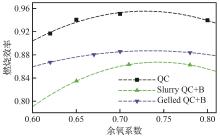
Fig.15
Combustion efficiency of QC series fuels with different excess oxidizer coefficients
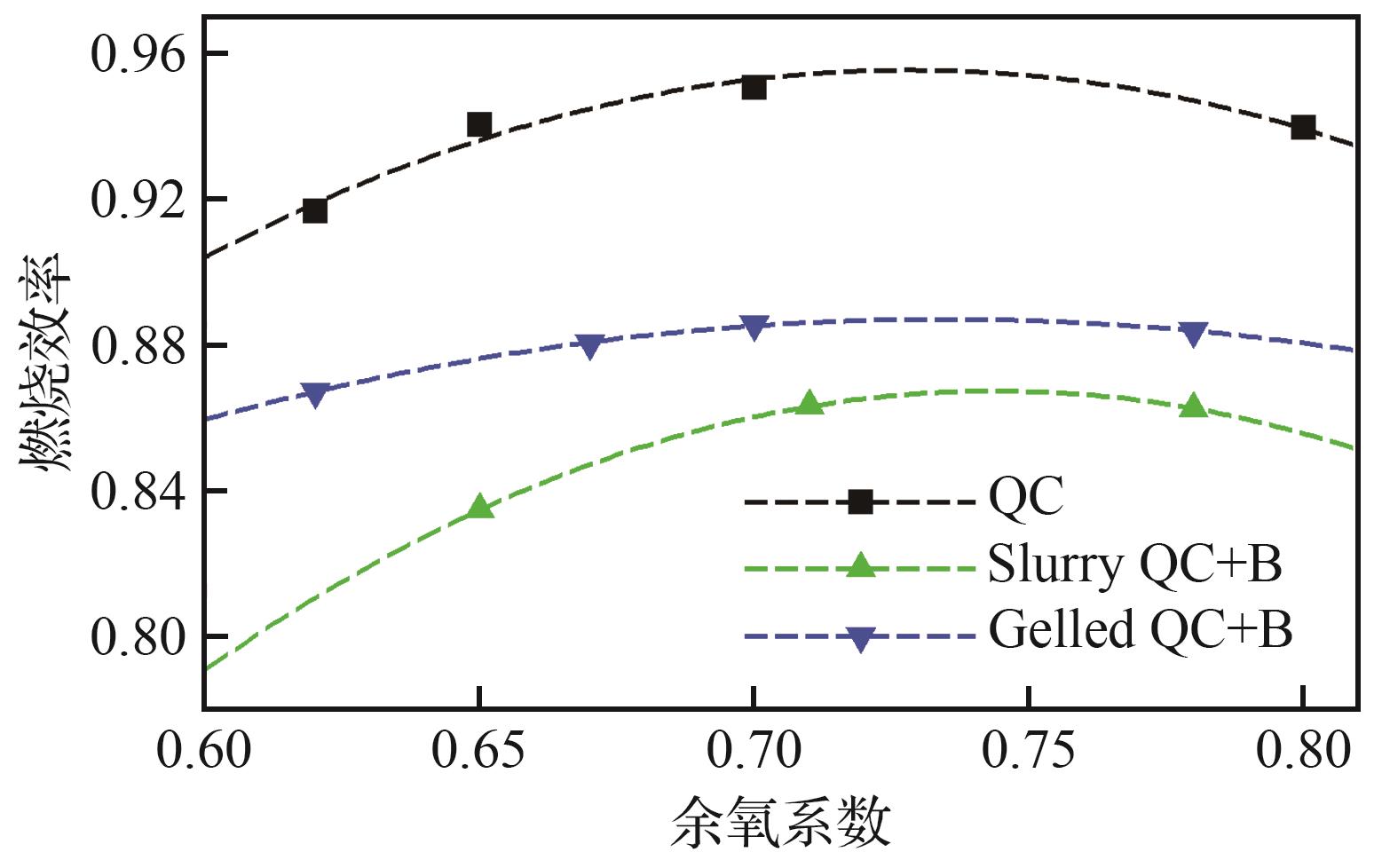
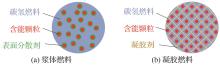
Fig.16
Structure schematic diagram of slurry fuel and gel fuel
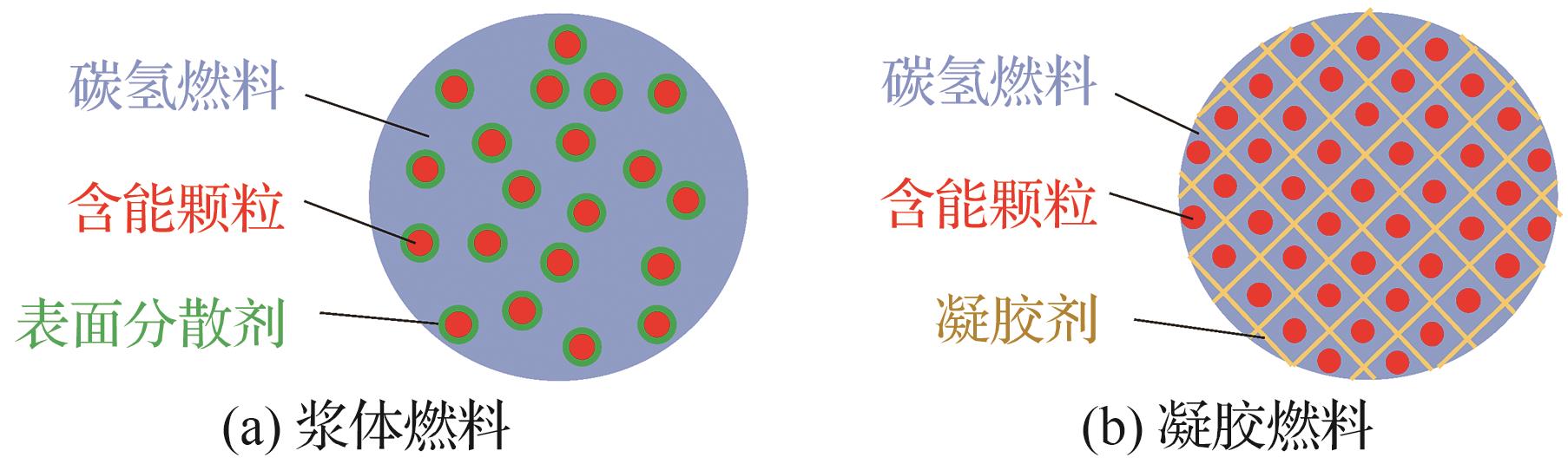
Table 7
Performance of QC series fuels with different excess oxidizer coefficients
| 燃料 | 余氧系数 | 质量比冲/s | 密度比冲/ (s∙g∙mL-1) |
|---|---|---|---|
| QC | 0.62 | 244.7 | 240.7 |
| 0.65 | 249.6 | 245.5 | |
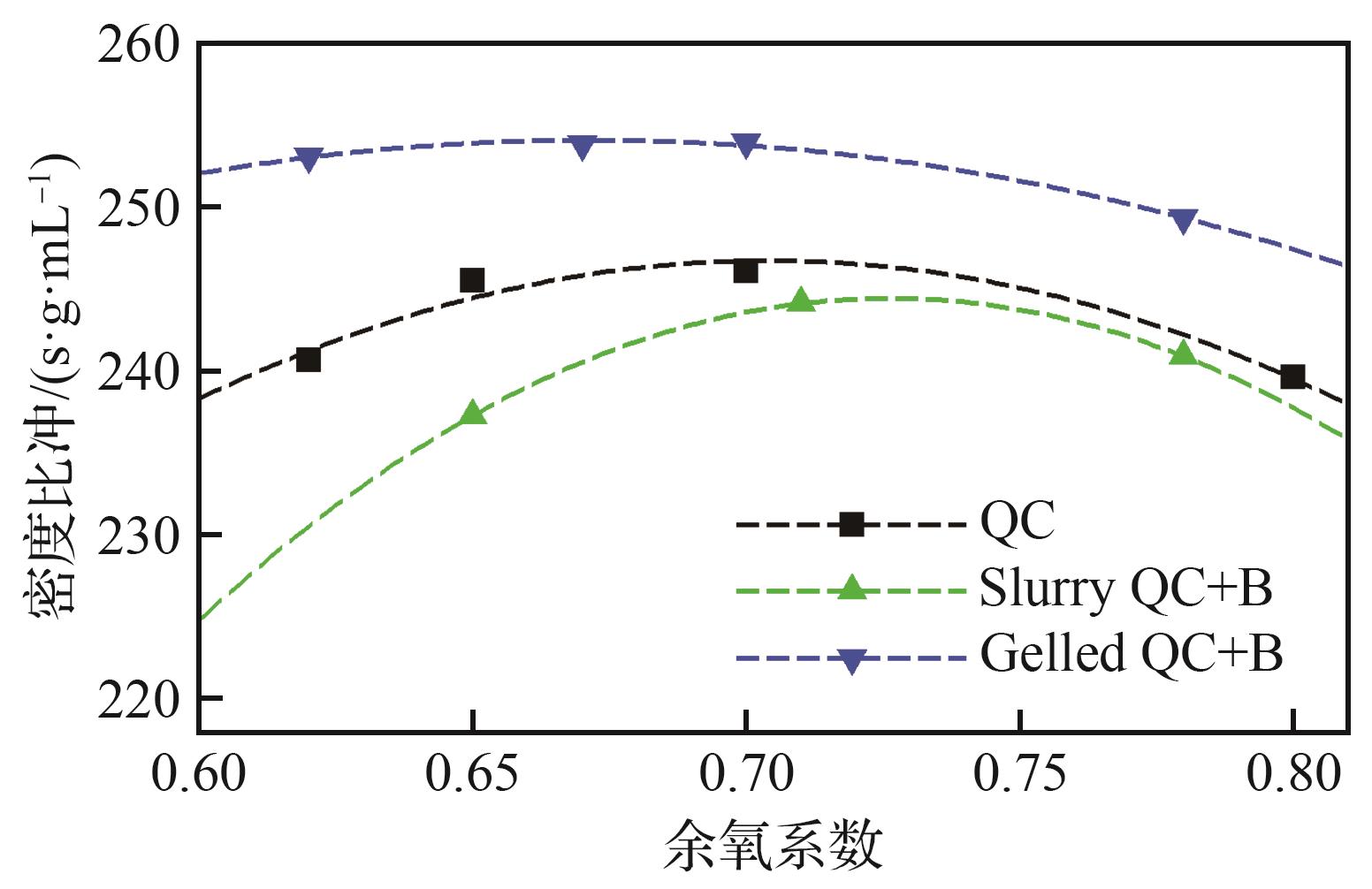
| 0.70 | 250.2 | 246.1 | |
| 0.80 | 243.6 | 239.6 | |
| Slurry QC+B | 0.65 | 214.4 | 237.3 |
| 0.71 | 220.6 | 244.1 | |
| 0.78 | 217.7 | 240.9 | |
| Gelled QC+B | 0.62 | 229.1 | 253.1 |
| 0.67 | 229.8 | 253.8 | |
| 0.70 | 229.9 | 254.0 | |
| 0.78 | 225.7 | 249.3 |
Fig.17
Mass specific impulse of QC series fuels with different excess oxidizer coefficients
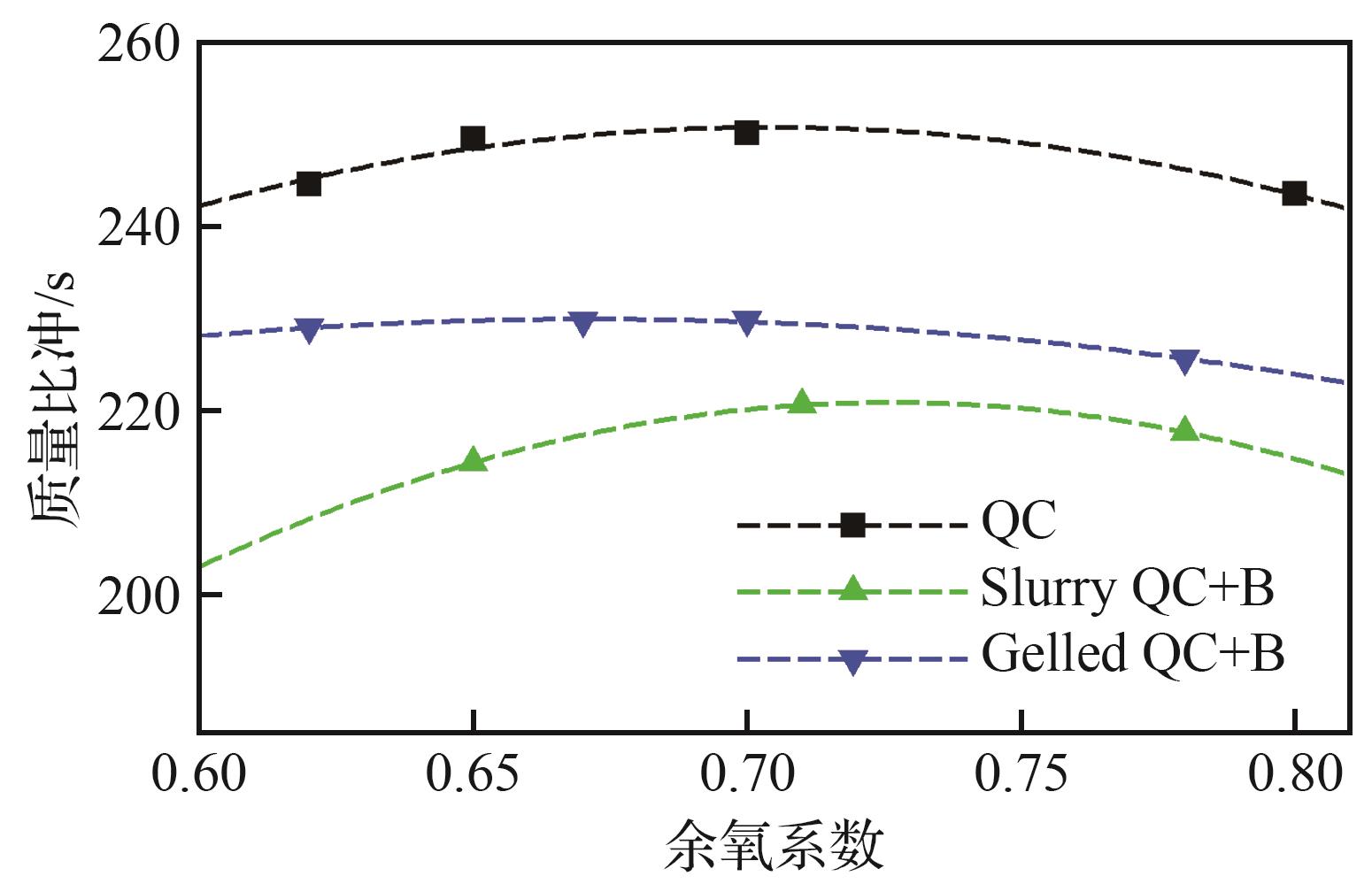
Fig.18
Density specific impulse of QC series fuels with different excess oxidizer coefficients
| [1] | 靳雨树, 徐旭, 杨庆春. 含能碳氢燃料燃烧特性及发动机应用研究进展[J]. 航空学报, 2023, 44(5): 026690. |
| JIN Y S, XU X, YANG Q C. Research progress in combustion characteristics and engine applications of energetic hydrocarbon fuels[J]. Acta Aeronautica et Astronautica Sinica, 2023, 44(5): 026690 (in Chinese). | |
| [2] | 王鹏, 闫涛, 刘平安. 纳米铝粉的可控制备及表面包覆研究进展[J]. 火炸药学报, 2024, 47(10): 870-880. |
| WANG P, YAN T, LIU P A. Research progress on preparation and surface modification of nano-aluminum powder in energetic materials[J]. Chinese Journal of Explosives & Propellants, 2024, 47(10): 870-880 (in Chinese). | |
| [3] | OJHA P K, KARMAKAR S. Boron for liquid fuel Engines-a review on synthesis, dispersion stability in li-quid fuel, and combustion aspects[J]. Progress in Aerospace Sciences, 2018, 100: 18-45. |
| [4] | 杨立军, 徐旭, 富庆飞, 等. 含能碳氢燃料的研究进展[J]. 空天技术, 2022(3): 1-17, 41. |
| YANG L J, XU X, FU Q F, et al. Research progress of energetic hydrocarbon fuels[J]. Aerospace Technology, 2022(3): 1-17, 41 (in Chinese). | |
| [5] | 王旭, 刘佳迅, 刘永祺, 等. 镁粉二次燃烧增强碳氢燃料冲压发动机推力[J]. 航空学报, 2025, 46(18): 131786. |
| WANG X, LIU J X, LIU Y Q, et al. Secondary combustion of magnesium powder to enhance kerosene-fueled scramjet thrust[J]. Acta Aeronautica et Astronautica Sinica, 2025, 46(18): 131786 (in Chinese). | |
| [6] | GORDON L J, LEE J B. Metals as fuels in multicomponent propellants[J]. ARS Journal, 1962, 32(4): 600-606. |
| [7] | E X T F, ZHI X M, ZHANG Y M, et al. Jet fuel containing ligand-protecting energetic nanoparticles: A case study of boron in JP-10[J]. Chemical Engineering Science, 2015, 129: 9-13. |
| [8] | E X T F, PAN L, WANG F, et al. Al-nanoparticle-containing nanofluid fuel: Synthesis, stability, properties, and propulsion performance[J]. Industrial & Engineering Chemistry Research, 2016, 55(10): 2738-2745. |
| [9] | GAN Y N, QIAO L. Optical properties and radiation-enhanced evaporation of nanofluid fuels containing carbon-based nanostructures[J]. Energy & Fuels, 2012, 26(7): 4224-4230. |
| [10] | JAVED I, BAEK S W, WAHEED K, et al. Evaporation characteristics of kerosene droplets with dilute concentrations of ligand-protected aluminum nanoparticles at elevated temperatures[J]. Combustion and Flame, 2013, 160(12): 2955-2963. |
| [11] | JAVED I, BAEK S W, WAHEED K. Effects of dense concentrations of aluminum nanoparticles on the evaporation behavior of kerosene droplet at elevated temperatures: The phenomenon of microexplosion[J]. Experimental Thermal and Fluid Science, 2014, 56: 33-44. |
| [12] | TYAGI H, PHELAN P E, PRASHER R, et al. Increased hot-plate ignition probability for nanoparticle-laden diesel fuel[J]. Nano Letters, 2008, 8(5): 1410-1416. |
| [13] | KIM D M, BAEK S W, YOON J. Ignition characteristics of kerosene droplets with the addition of aluminum nanoparticles at elevated temperature and pressure[J]. Combustion and Flame, 2016, 173: 106-113. |
| [14] | 胡泽君, 冯运超, 何志成, 等. 微米级铝颗粒在水蒸气和氧气中的点火燃烧特性[J]. 航空学报, 2023, 44(15): 528866. |
| HU Z J, FENG Y C, HE Z C, et al. Ignition and combustion characteristics of micro-sized aluminum particles in H2O and O2 [J]. Acta Aeronautica et Astronautica Sinica, 2023, 44(15): 528866 (in Chinese). | |
| [15] | 敖文, 刘佩进, 吕翔, 等. 固体推进剂燃烧过程铝团聚研究进展[J]. 宇航学报, 2016, 37(4): 371-380. |
| AO W, LIU P J, LYU X, et al. Review of aluminum agglomeration during the combustion of solid propellants[J]. Journal of Astronautics, 2016, 37(4): 371-380 (in Chinese). | |
| [16] | 杨大力, 夏智勋, 胡建新, 等. 煤油凝胶单液滴燃烧特性试验[J]. 航空学报, 2016, 37(3): 847-853. |
| YANG D L, XIA Z X, HU J X, et al. Experimental study on ignition and combustion characteristics of single kerosene gel droplet[J]. Acta Aeronautica et Astronautica Sinica, 2016, 37(3): 847-853 (in Chinese). | |
| [17] | MORDOSKY J, ZHANG B, KUO K, et al. Spray combustion of gelled RP-1 propellants containing nano-sized aluminum particles in rocket engine conditions[C]∥ 37th Joint Propulsion Conference and Exhibit. Reston: AIAA, 2001. |
| [18] | PALASZEWSKI B, ZAKANY J. Metallized gelled propellants-oxygen/RP-1/aluminum rocket combustion experiments[C]∥ 31st Joint Propulsion Conference and Exhibit. Reston: AIAA, 1995. |
| [19] | ELLISON R, HALL A, MOSER M. Gelled RP-1 nanophase aluminum propellant[C]∥ 39th AIAA/ASME/SAE/ASEE Joint Propulsion Conference and Exhibit. Reston: AIAA, 2003. |
| [20] | LUO Y, XU X, ZOU J J, et al. Combustion of JP-10-based slurry with nanosized aluminum additives[J]. Journal of Propulsion and Power, 2016, 32(5): 1167-1177. |
| [21] | 邵昂, 朱韶华, 鄂秀天凤, 等. 含铝金属化浆体推进剂火箭发动机燃烧性能试验研究[J]. 推进技术, 2018, 39(7): 1650-1659. |
| SHAO A, ZHU S H, E X T F, et al. Experimental study on combustion characteristic of rocket engine based on slurry propellant containing aluminum particles[J]. Journal of Propulsion Technology, 2018, 39(7): 1650-1659 (in Chinese). | |
| [22] | 刘毅, 鄂秀天凤, 李智欣, 等. 高能量密度液体燃料的火箭发动机燃烧性能研究[J]. 推进技术, 2019, 40(5): 1169-1176. |
| LIU Y, E X T F, LI Z X, et al. Study on combustion performance of high-energy-density liquid fuels in rocket engine[J]. Journal of Propulsion Technology, 2019, 40(5): 1169-1176 (in Chinese). | |
| [23] | JIN Y S, XU X, WANG X, et al. Propulsive and combustion behavior of hydrocarbon fuels containing boron nanoparticles in a liquid rocket combustor[J]. Proceedings of the Institution of Mechanical Engineers, Part G: Journal of Aerospace Engineering, 2022, 236(12): 2580-2591. |
| [24] | GAFNI G, KUZNETSOV A, NATAN B. Experimental investigation of an aluminized gel fuel ramjet combustor[M]∥Chemical rocket propulsion: A comprehensive survey of energetic materials. Cham: Springer International Publishing, 2017: 297-315. |
| [25] | NEGRI M, CIEZKI H K. Combustion of gelled propellants containing microsized and nanosized aluminum particles[J]. Journal of Propulsion and Power, 2015, 31(1): 400-407. |
| [26] | XIAO Y L, XIA Z X, HUANG L Y, et al. Experimental investigation of the effects of chamber length and boron content on boron-based gel fuel ramjet performance[J]. Acta Astronautica, 2019, 160: 101-105. |
| [27] | JIN Y S, DOU S Y, YANG Q C, et al. Performance characteristics of a scramjet engine using JP-10 fuel containing aluminum nanoparticles[J]. Acta Astronautica, 2021, 185: 70-77. |
| [28] | 靳雨树, 李智欣, 徐旭, 等. 含硼碳氢燃料在超燃冲压发动机中的燃烧试验研究[J]. 推进技术, 2023, 44(3): 265-275. |
| JIN Y S, LI Z X, XU X, et al. Experimental study on combustion of boron containing hydrocarbon fuel in scramjet[J]. Journal of Propulsion Technology, 2023, 44(3): 265-275 (in Chinese). | |
| [29] | 鄂秀天凤, 彭浩, 邹吉军, 等. 含有纳米铝颗粒的高密度悬浮燃料研究[J]. 推进技术, 2016, 37(5): 974-978. |
| E X T F, PENG H, ZOU J J, et al. Study on Al NPs-containing suspension as high-density liquid fuel[J]. Journal of Propulsion Technology, 2016, 37(5): 974-978 (in Chinese). | |
| [30] | 夏益志, 王勇, 洪流, 等. 凝胶自燃推进剂着火及火焰试验[J]. 航空学报, 2020, 41(1): 123254. |
| XIA Y Z, WANG Y, HONG L, et al. Experiment on ignition and flame of gelled hypergolic bipropellants[J]. Acta Aeronautica et Astronautica Sinica, 2020, 41(1): 123254 (in Chinese). | |
| [31] | WANG L, ZHANG X W, ZOU J J, et al. Acid-catalyzed isomerization of tetrahydrotricyclopentadiene: Synthesis of high-energy-density liquid fuel[J]. Energy & Fuels, 2009, 23(5): 2383-2388. |
| [32] | 裴慧霞, 鄂秀天凤, 张磊, 等. 添加高能纳米硼颗粒的高密度液体碳氢燃料研究[J]. 现代化工, 2017, 37(1): 111-114. |
| PEI H X, E X T F, ZHANG L, et al. Study on high-density liquid fuel containing energetic nanoparticles[J]. Modern Chemical Industry, 2017, 37(1): 111-114 (in Chinese). | |
| [33] | 邹吉军, 郭成, 张香文, 等. 航天推进用高密度液体碳氢燃料: 合成与应用[J]. 推进技术, 2014, 35(10): 1419-1425. |
| ZOU J J, GUO C, ZHANG X W, et al. High-density liquid hydrocarbon fuels for aerospace propulsion: Synthesis and application[J]. Journal of Propulsion Technology, 2014, 35(10): 1419-1425 (in Chinese). | |
| [34] | 曹锦文, 潘伦, 张香文, 等. 含纳米铝颗粒的JP-10凝胶燃料理化及流变性能[J]. 含能材料, 2020, 28(5): 382-390. |
| CAO J W, PAN L, ZHANG X W, et al. Physicochemical and rheological properties of Al/JP-10 gelled fuel[J]. Chinese Journal of Energetic Materials, 2020, 28(5): 382-390 (in Chinese). | |
| [35] | CAO J W, ZHANG Y C, PAN L, et al. Synthesis and characterization of gelled high-density fuels with low-molecular mass gellant[J]. Propellants, Explosives, Pyrotechnics, 2020, 45(7): 1018-1026. |
| [36] | DOU S Y, JIN Y S, YANG Q C, et al. Combustion characteristics and application performance of JP-10/nano-sized aluminum gel-fueled scramjet[J]. AIAA Journal, 2024, 62(4): 1330-1341. |
| [37] | 蔡国飙. 液体火箭发动机设计[M]. 北京: 北京航空航天大学出版社, 2011: 35-36. |
| CAI G B. Design of liquid rocket engine[M]. Beijing: Beihang University Press, 2011: 35-36 (in Chinese). | |
| [38] | YEH C L, KUO K K. Ignition and combustion of boron particles[J]. Progress in Energy and Combustion Science, 1996, 22(6): 511-541. |
| [39] | GAN Y N, QIAO L. Combustion characteristics of fuel droplets with addition of nano and micron-sized aluminum particles[J]. Combustion and Flame, 2011, 158(2): 354-368. |
| [40] | LIU J Z, CHEN B H, WU T T, et al. Ignition and combustion characteristics and agglomerate evolution mechanism of aluminum in nAl/JP-10 nanofluid fuel[J]. Journal of Thermal Analysis and Calorimetry, 2019, 137(4): 1369-1379. |
| [41] | 章洪涛. RP-3航空煤油及掺混纳米铝颗粒燃油的低压着火燃烧及微爆特性研究[D]. 杭州: 浙江大学, 2021. |
| ZHANG H T. Study on ignition/combustion and micro-explosion characteristics of RP-3 aviation kerosene and Al nanoparticles embedded kerosene under sub-atmospheric pressure[D]. Hangzhou: Zhejiang University, 2021 (in Chinese). | |
| [42] | CHINTERSINGH K L, SCHOENITZ M, DREIZIN E L. Oxidation kinetics and combustion of boron particles with modified surface[J]. Combustion and Flame, 2016, 173: 288-295. |
| [43] | 冯昱嘉, 孙振华, 王坤, 等. 含硼凝胶冲压发动机技术研究进展[J]. 航空学报, 2025, 46(14): 031256. |
| FENG Y J, SUN Z H, WANG K, et al. Advances in boron-loaded gel ramjet technologies[J]. Acta Aeronautica et Astronautica Sinica, 2025, 46(14): 031256 (in Chinese). | |
| [44] | SAXENA V, KUMAR N, SAXENA V K. A comprehensive review on combustion and stability aspects of metal nanoparticles and its additive effect on diesel and biodiesel fuelled C.I. engine[J]. Renewable and Sustainable Energy Reviews, 2017, 70: 563-588. |
| [45] | YOUNG G, SULLIVAN K, ZACHARIAH M R, et al. Combustion characteristics of boron nanoparticles[J]. Combustion and Flame, 2009, 156(2): 322-333. |
| [46] | SOLOMON Y, NATAN B, COHEN Y. Combustion of gel fuels based on organic gellants[J]. Combustion and Flame, 2009, 156(1): 261-268. |
| [47] | FENG S J, HE B, HE H B, et al. Experimental studies the burning process of gelled unsymmetrical dimethylhydrazine droplets under oxidant convective conditions[J]. Fuel, 2013, 111: 367-373. |
| [1] | Aohua CHEN, Linquan CHEN, Qiu WU, Junwei LI, Qiang LI, Yi LI. Influence of combustion chamber cavity on structural damping characteristics of solid rocket motors [J]. Acta Aeronautica et Astronautica Sinica, 2026, 47(6): 132527-132527. |
| [2] | Song YAN, Yi LI, Hongqiang QIN, Xing CUI, Yushan GAO. Exhaust-plume spectroscopic diagnostics of liquid rocket engine faults: From qualitative to quantitative [J]. Acta Aeronautica et Astronautica Sinica, 2026, 47(16): 133069-133069. |
| [3] | Yujia FENG, Zhenhua SUN. Rheological properties of boron-loaded gel fuel [J]. Acta Aeronautica et Astronautica Sinica, 2026, 47(12): 132822-132822. |
| [4] | Shuming YANG, Jianjun WU, Changlin XIE, Yuqiang CHENG, Biao WANG. Application issues of data-driven intelligent fault diagnosis technologies for liquid rocket engines [J]. Acta Aeronautica et Astronautica Sinica, 2025, 46(15): 131427-131427. |
| [5] | Yiqiang SUN, Tanxiao ZHU, Qinglin NIU, Zhihong HE, Shikui DONG. Altitude-scaling law for multi-band radiation signals from liquid-propellant rocket engine exhaust plumes [J]. Acta Aeronautica et Astronautica Sinica, 2024, 45(24): 630568-630568. |
| [6] | Ziguang LI, Peng CHENG, Qinglian LI, Xiao BAI, Pengjin CAO. Influence of backpressure on spray distribution characteristics of a gas-liquid pintle injector element [J]. Acta Aeronautica et Astronautica Sinica, 2024, 45(2): 128614-128614. |
| [7] | Dechuan SUN, Guoqiang ZHANG, Tianliang YAO, Liang GUAN. Influence of catalyst bed structure on performance of HAN⁃based monopropellant engine [J]. Acta Aeronautica et Astronautica Sinica, 2024, 45(16): 129818-129818. |
| [8] | Guangxu WANG, Baoe YANG, Yonghua TAN, Yushan GAO, Bin LI. Randomness of high frequency longitudinal combustion instability in liquid rocket engines [J]. Acta Aeronautica et Astronautica Sinica, 2024, 45(14): 129485-129485. |
| [9] | Ruida CHEN, Xiachao CHEN, Hongyu CHEN, Hui XU, Xin HONG. Ignition characteristics and exhaust experiment of 120 N engine at simulated high lunar temperature [J]. Acta Aeronautica et Astronautica Sinica, 2024, 45(11): 529112-529112. |
| [10] | Yushan GAO, Song YAN, Zhiwei ZHANG. Precise engine displacement testing technique based on stereo vision and circular mark points [J]. Acta Aeronautica et Astronautica Sinica, 2024, 45(11): 528826-528826. |
| [11] | Penggang MU, Binchao LI, Jun WANG, Shaowei SONG, Hanyang SHI. Research progress on structural strength of liquid rocket engine during engineering development phase [J]. Acta Aeronautica et Astronautica Sinica, 2024, 45(11): 529065-529065. |
| [12] | Feng ZHANG, Yi SUN, Shuai SHANG, Baoe YANG. High pressure combustion experiment for hypergolic propellant unlike doublet injectors [J]. Acta Aeronautica et Astronautica Sinica, 2024, 45(11): 529507-529507. |
| [13] | Guangxu WANG, Bin LI, Yonghua TAN, Yushan GAO. High frequency combustion instability in liquid rocket engines: Review [J]. Acta Aeronautica et Astronautica Sinica, 2024, 45(11): 529450-529450. |
| [14] | Yonghua TAN. Research progress in high thrust liquid oxygen methane rocket engine technology [J]. Acta Aeronautica et Astronautica Sinica, 2024, 45(11): 529690-529690. |
| [15] | Meng DONG, Yonghua TAN, Chuang HE, Lixiang XING, Ruiguo ZHAO. Hydraulic excitation experiment on frequency characteristic of simulated feed system after pump in a rocket engine [J]. ACTA AERONAUTICAET ASTRONAUTICA SINICA, 2023, 44(9): 127419-127419. |
| Viewed | ||||||
|
Full text |
|
|||||
|
Abstract |
|
|||||
Address: No.238, Baiyan Buiding, Beisihuan Zhonglu Road, Haidian District, Beijing, China
Postal code : 100083
E-mail:hkxb@buaa.edu.cn
Total visits: 6658907 Today visits: 1341All copyright © editorial office of Chinese Journal of Aeronautics
All copyright © editorial office of Chinese Journal of Aeronautics
Total visits: 6658907 Today visits: 1341

 CJA

