Acta Aeronautica et Astronautica Sinica ›› 2025, Vol. 46 ›› Issue (20): 531585.doi: 10.7527/S1000-6893.2025.31585
• Special Issue: Key Technologies for Supersonic Civil Aircraft • Previous Articles
Linxuan YANG1, Huicai MA2, Liping PANG1( )
)
Received:2024-11-29
Revised:2024-12-25
Accepted:2025-02-28
Online:2025-03-07
Published:2025-03-06
Contact:
Liping PANG
E-mail:pangliping@buaa.edu.cn
CLC Number:
Linxuan YANG, Huicai MA, Liping PANG. Design and performance simulation of environmental control system for supersonic civil aircraft[J]. Acta Aeronautica et Astronautica Sinica, 2025, 46(20): 531585.
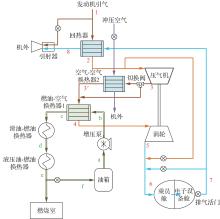
Fig.1
Schematic diagram of new environmental control system configuration for supersonic civil aircraft
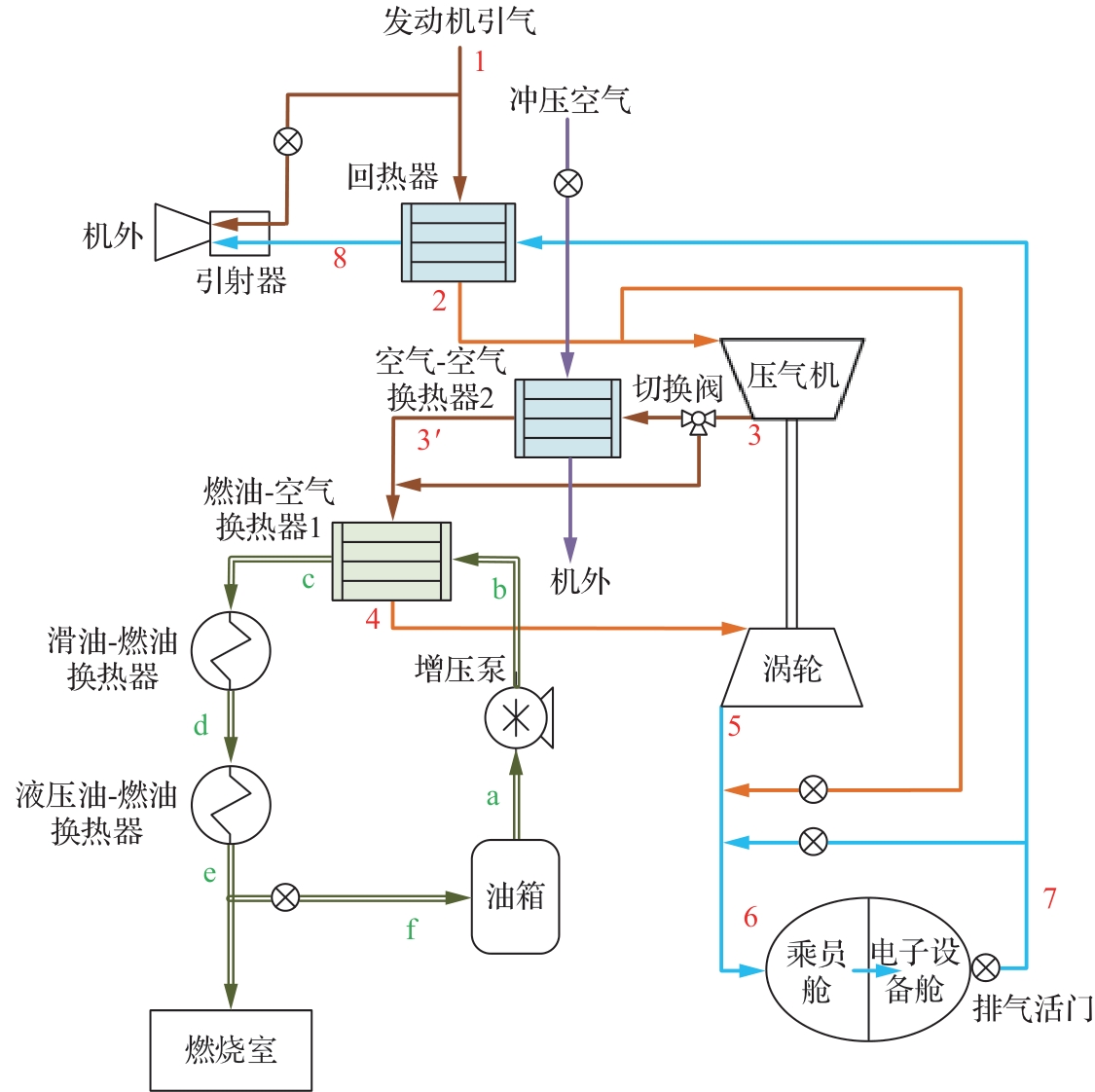
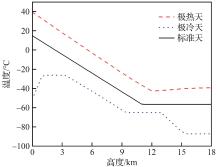
Fig.2
MIL-STD-210A atmospheric environmental temperature
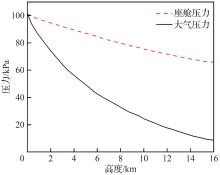
Fig.3
Cabin pressure schedule
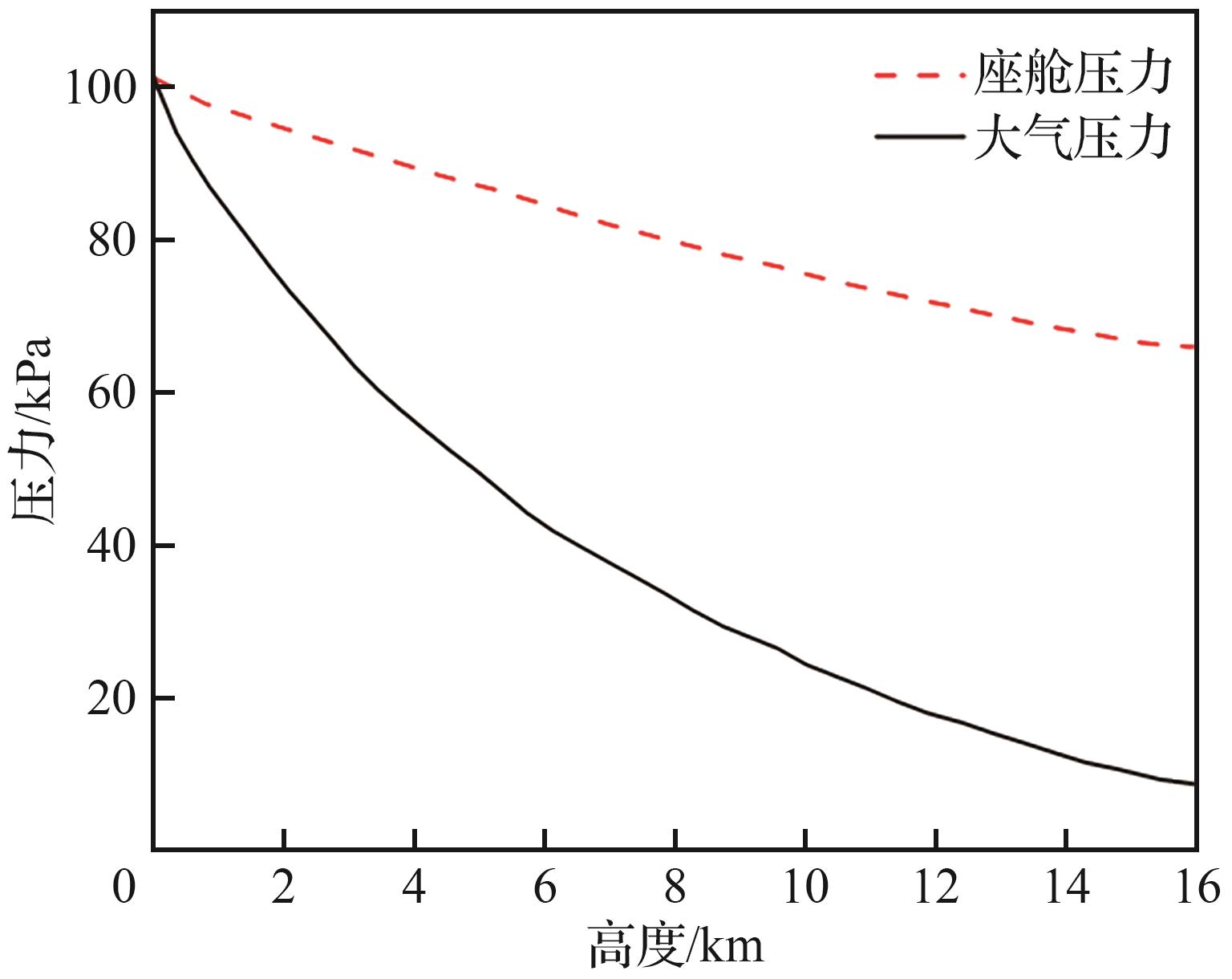
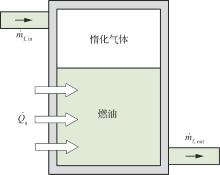
Fig.4
Schematic diagram of fuel tank model
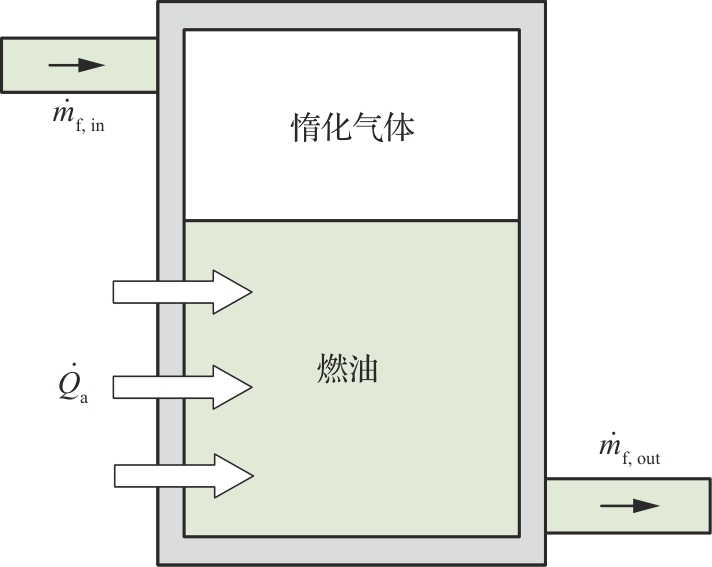
Table 1
Basic information on supersonic platform
| 参数 | 数值 |
|---|---|
| 最大起飞质量/kg | 156 489.4 |
| 翼载荷/(kg·m-2) | 585.3 |
| 推重比 | 0.435 |
| 载客量 | 100 |
| 发动机台数 | 4 |
| 环控系统套数 | 4 |
| 座舱总供气流量/(kg·h-1) | 6 000 |
| 座舱供气温度/℃ | 18 |
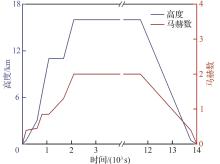
Fig.5
Supersonic civil aircraft mission profile
Table 2
Estimation of cabin heat load
| 参数 | 数值 |
|---|---|
| 通过座舱壁传入的热量/kW | 45.9 |
| 太阳辐射热/kW | 4.1 |
| 乘员热负荷/kW | 12.2 |
| 电子设备热负荷/kW | 19 |
| 总热负荷/kW | 81.2 |
Table 3
Parameters used for simulation of single set of environmental control system
| 参数 | 数值 |
|---|---|
| 马赫数 | 2 |
| 飞行高度/km | 16 |
| 单台发动机耗油量/(kg·s-1) | 1.5 |
| 滑油系统热负荷/kW | 128 |
| 液压系统热负荷/kW | 60 |
| 发动机引气温度/K | 556.31 |
| 发动机引气压力/kPa | 179.57 |
| 供油压力/kPa | 200 |
| 增压泵效率 | 0.4 |
| ReHX效率 | 0.8 |
| HX1效率 | 0.85 |
| HX2效率 | 0.85 |
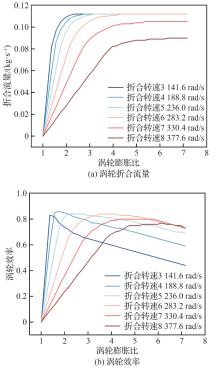
Fig.6
Turbine performance curves
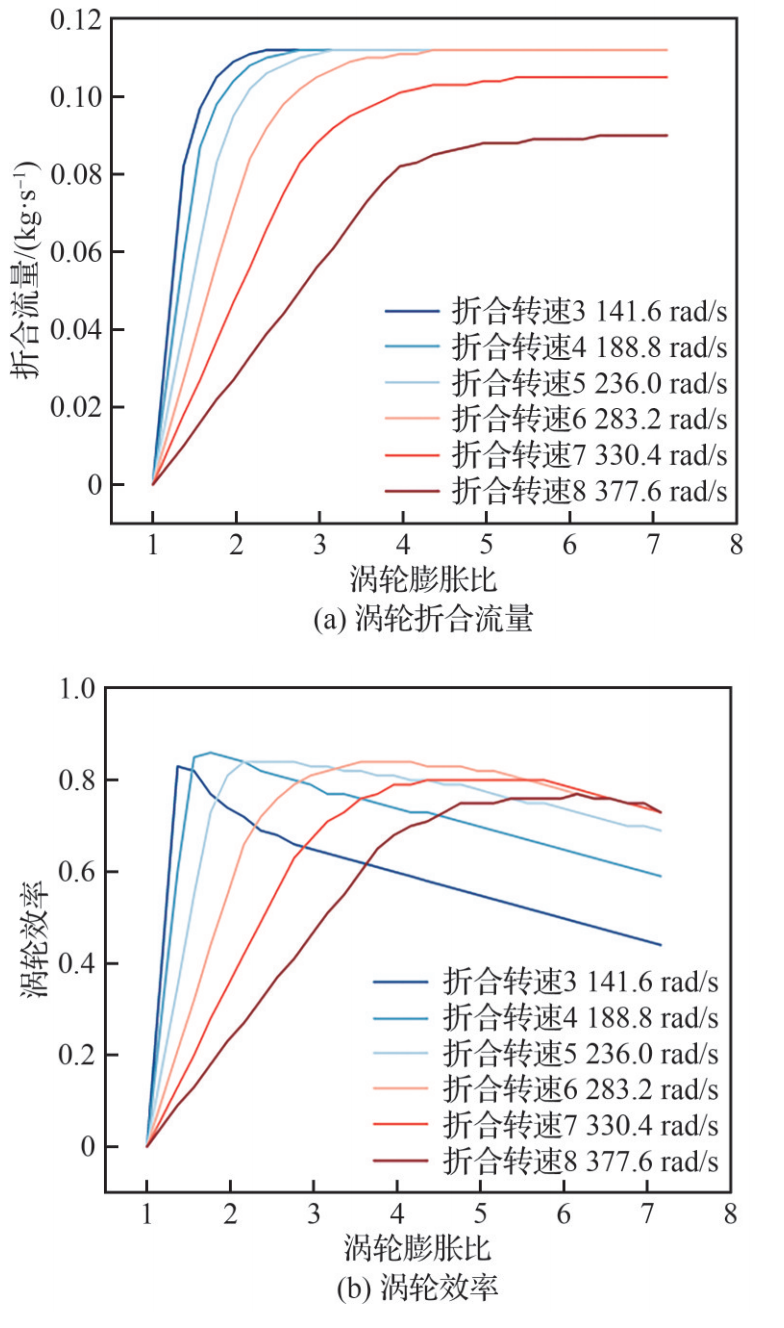
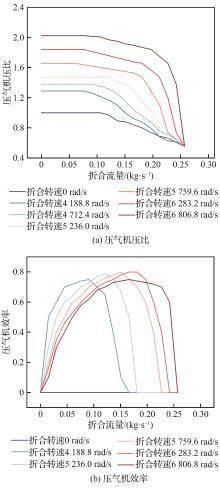
Fig.7
Compressor performance curves
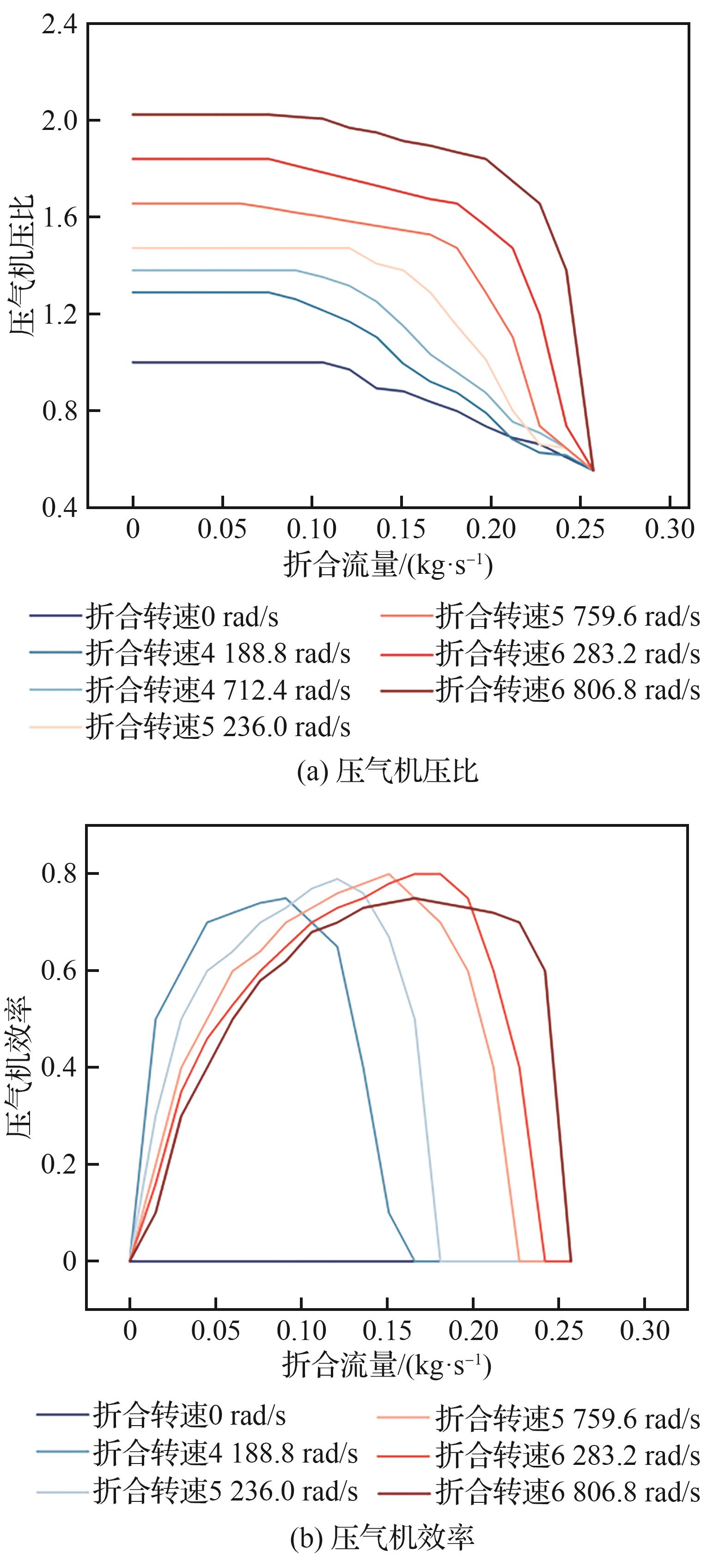
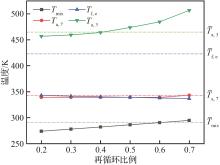
Fig.8
Variation of supply air and fuel section temperature with proportion of recirculated air
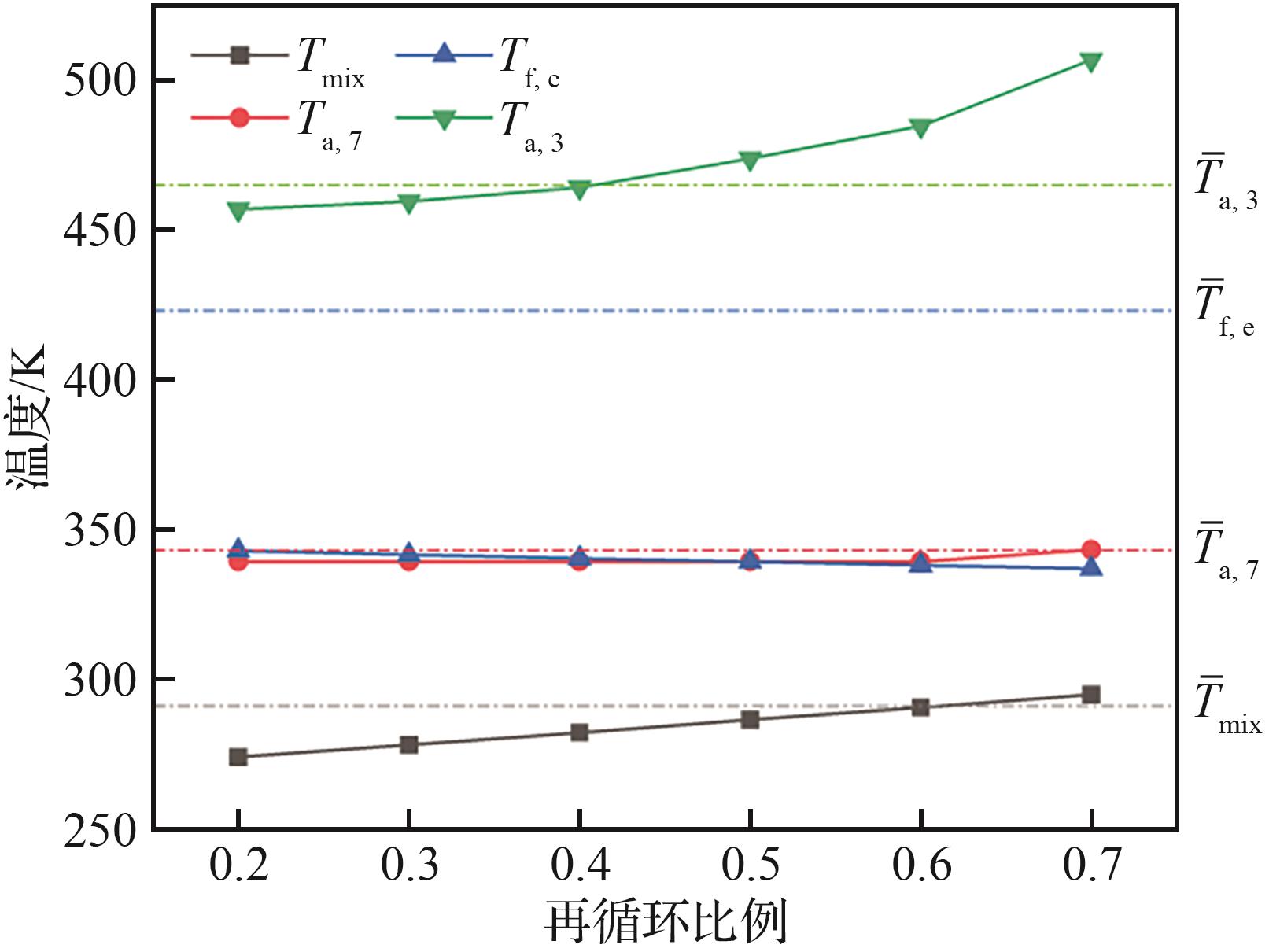
Fig.9
Variation of heat exchange capacity of heat exchangers with proportion of recirculated air
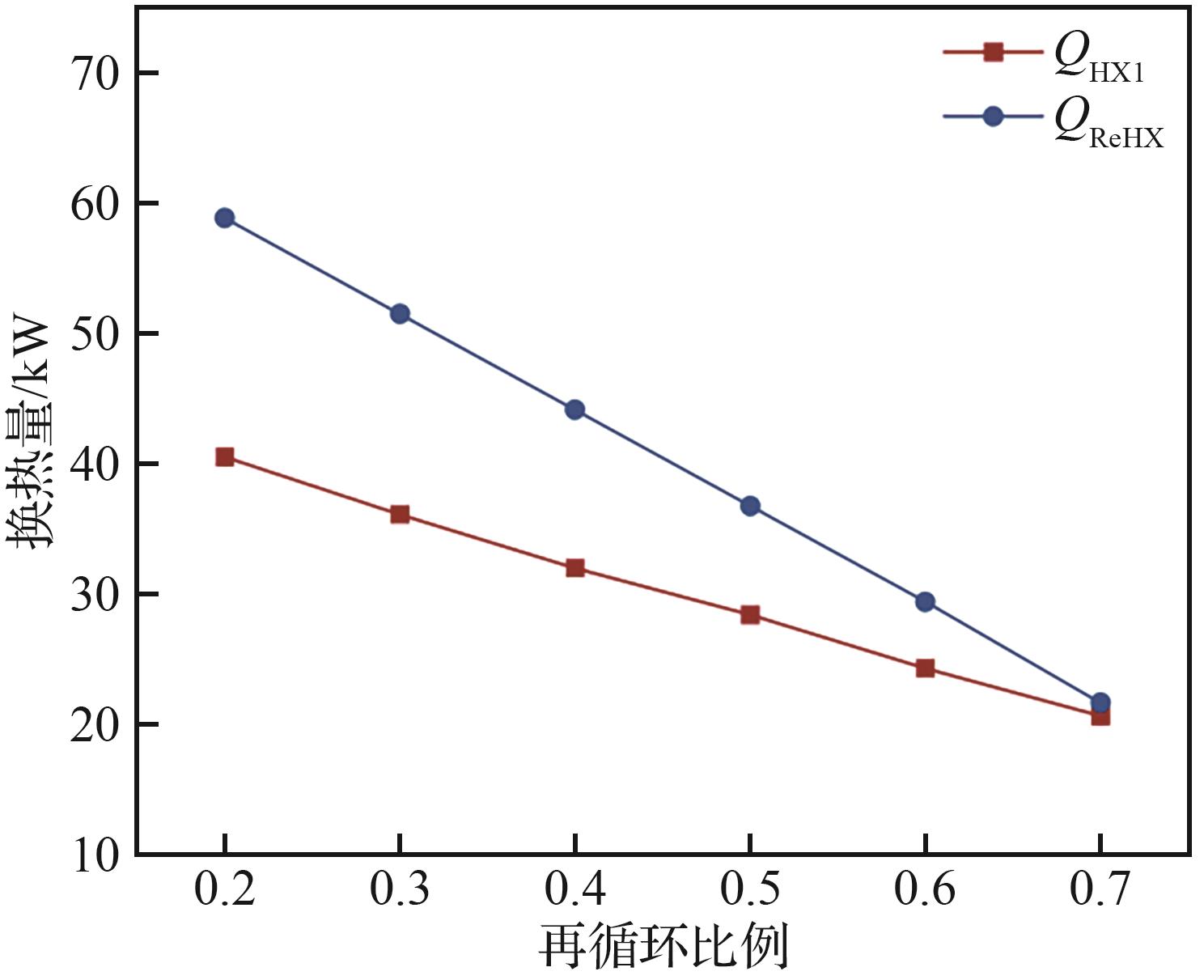
Fig.10
Variation of air supply and fuel section temperature with initial fuel temperature
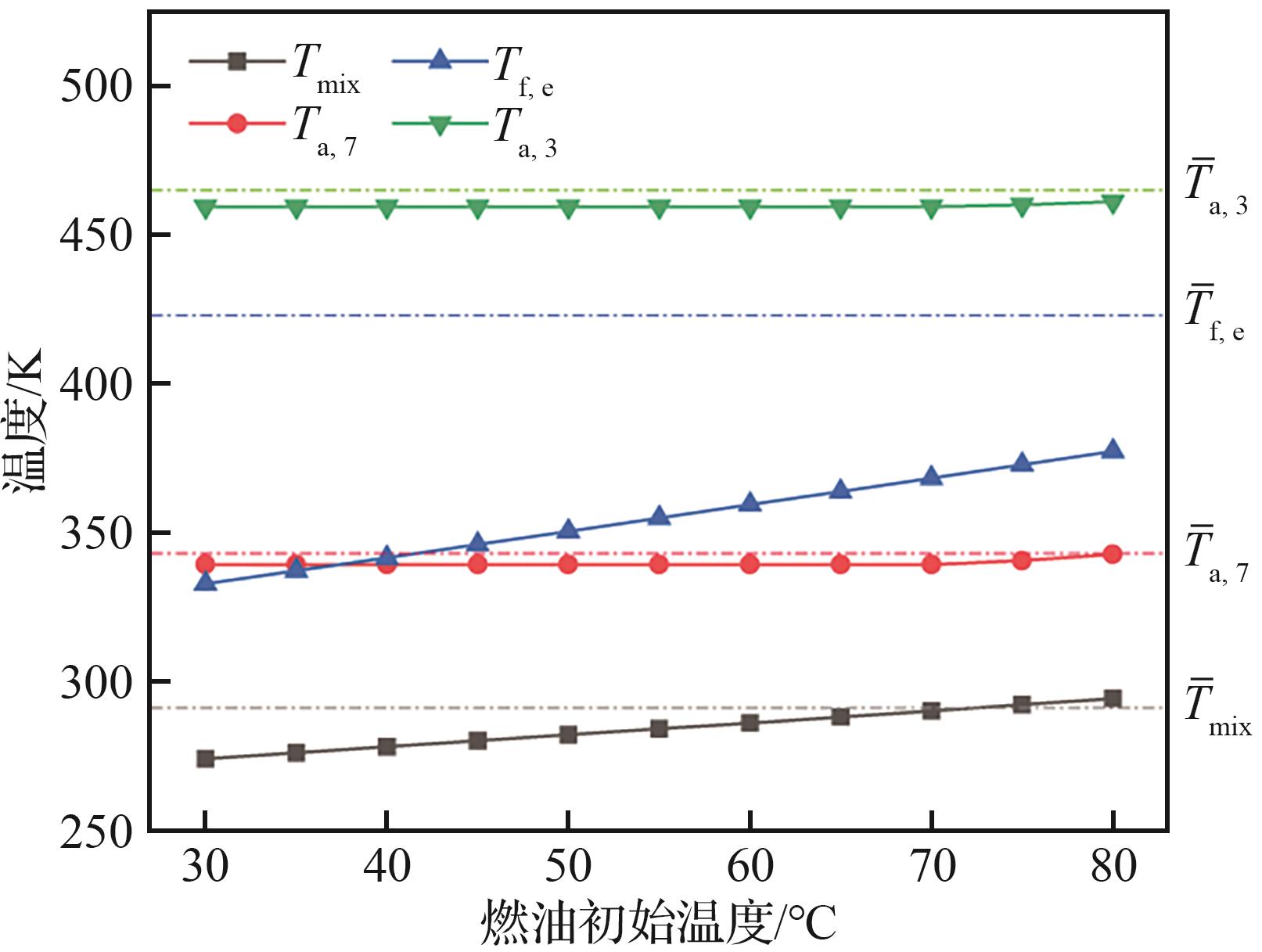
Fig.11
Variation of heat exchange capacity of heat exchangers with initial fuel temperature
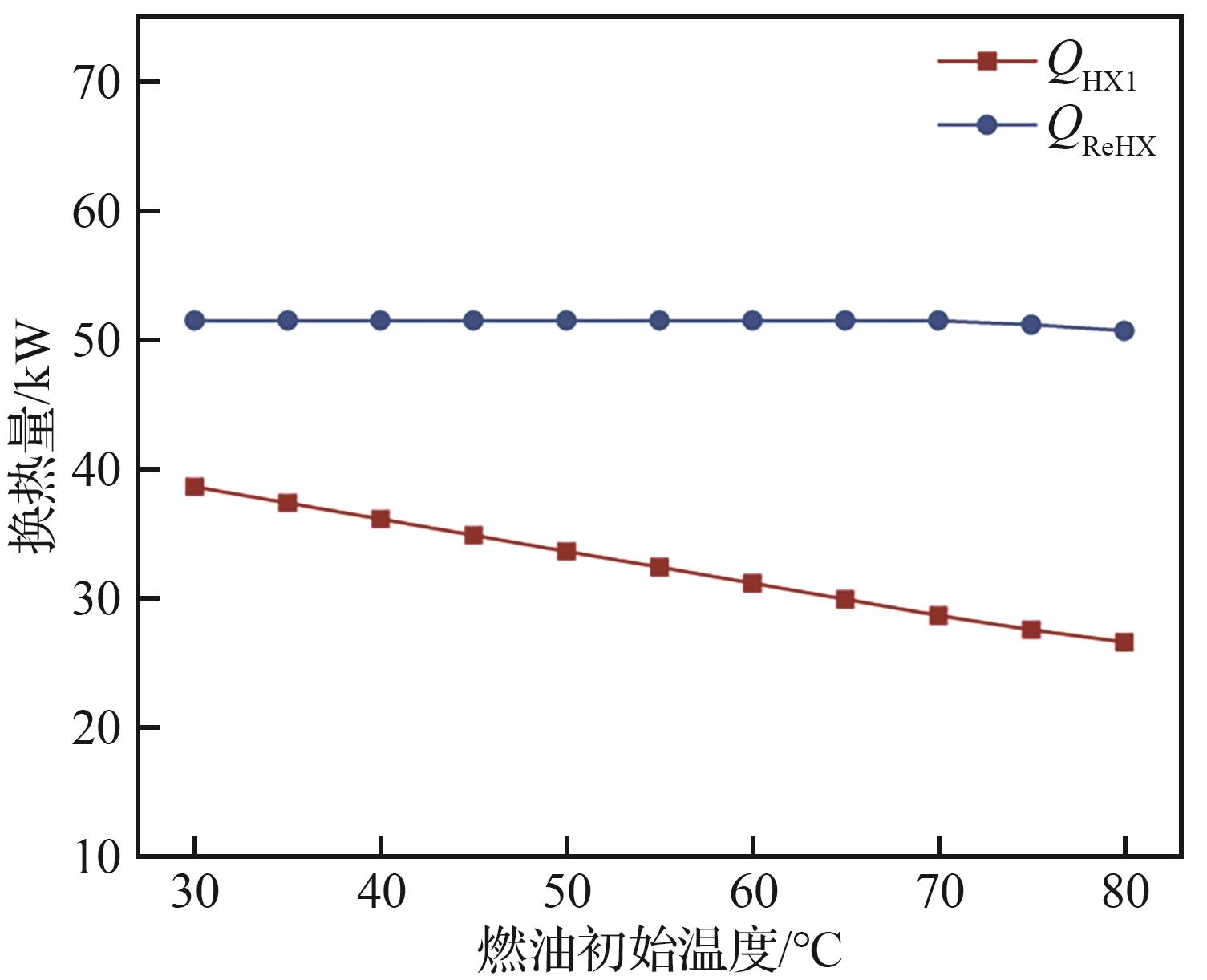
Fig.12
Variation of supply air and fuel section temperature with heat load of cabin
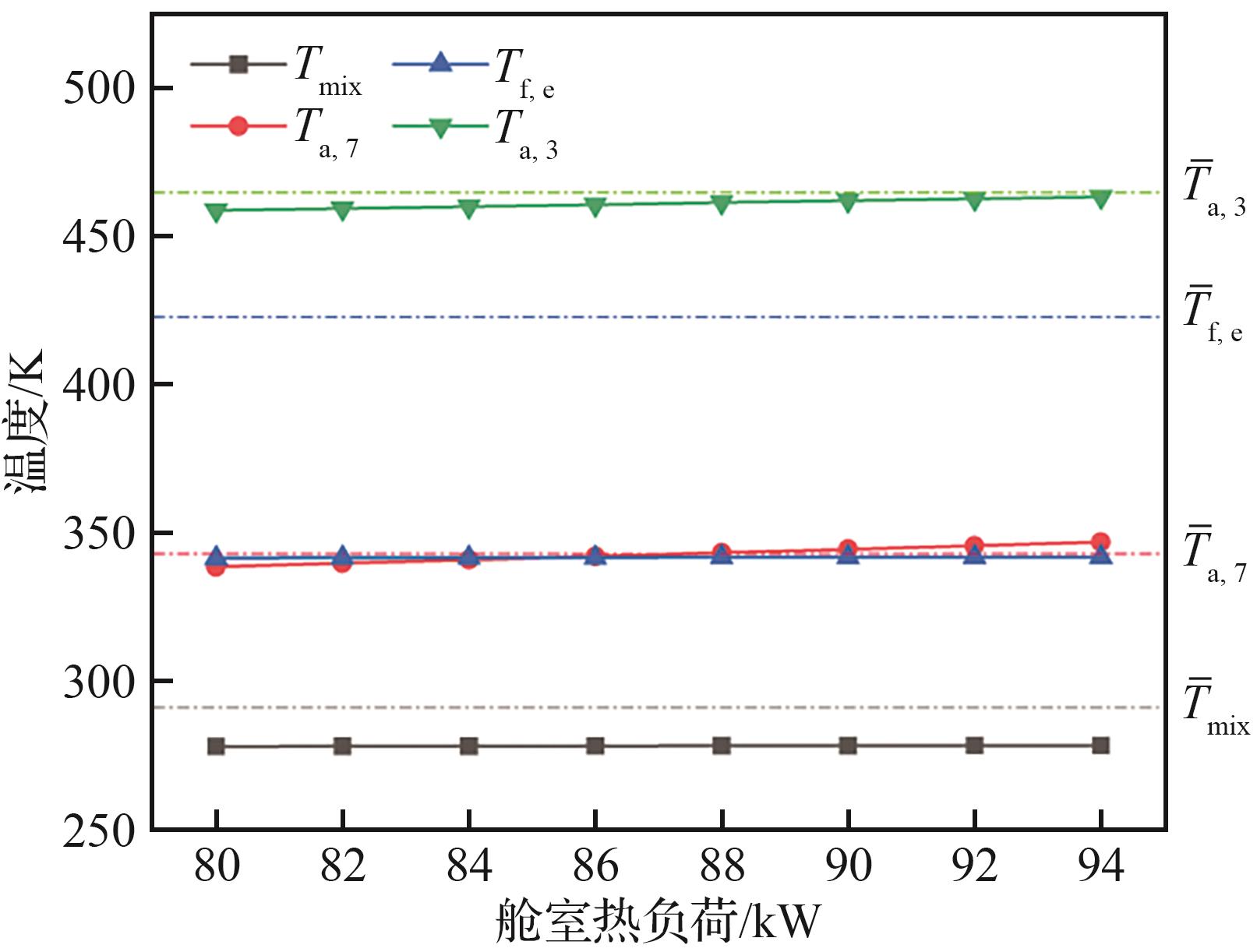
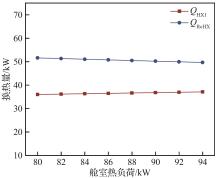
Fig.13
Variation of heat exchange capacity of heat exchangers with heat load of cabin
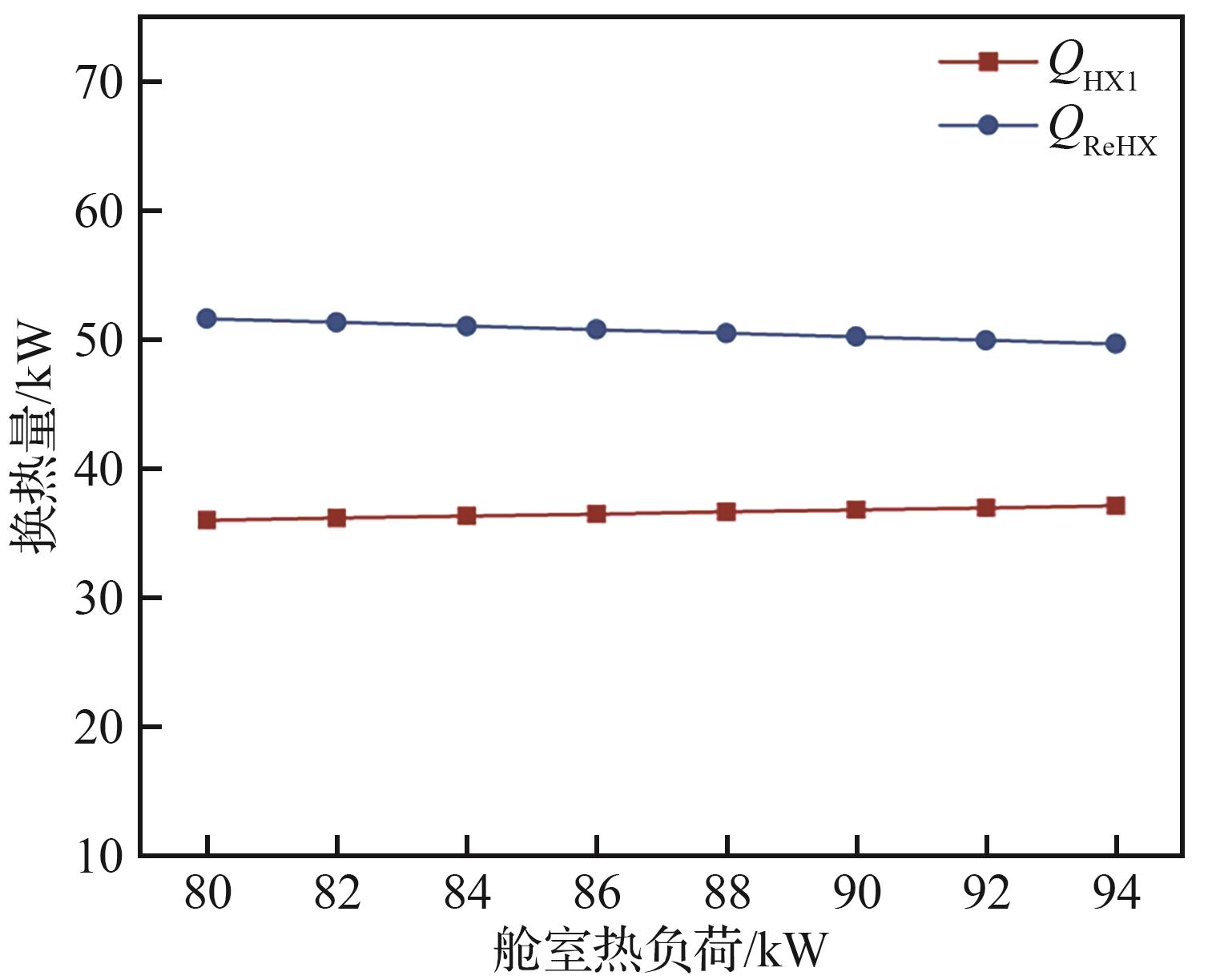
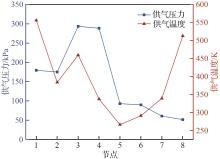
Fig.14
Temperature and pressure of air supply at each node of environmental control system
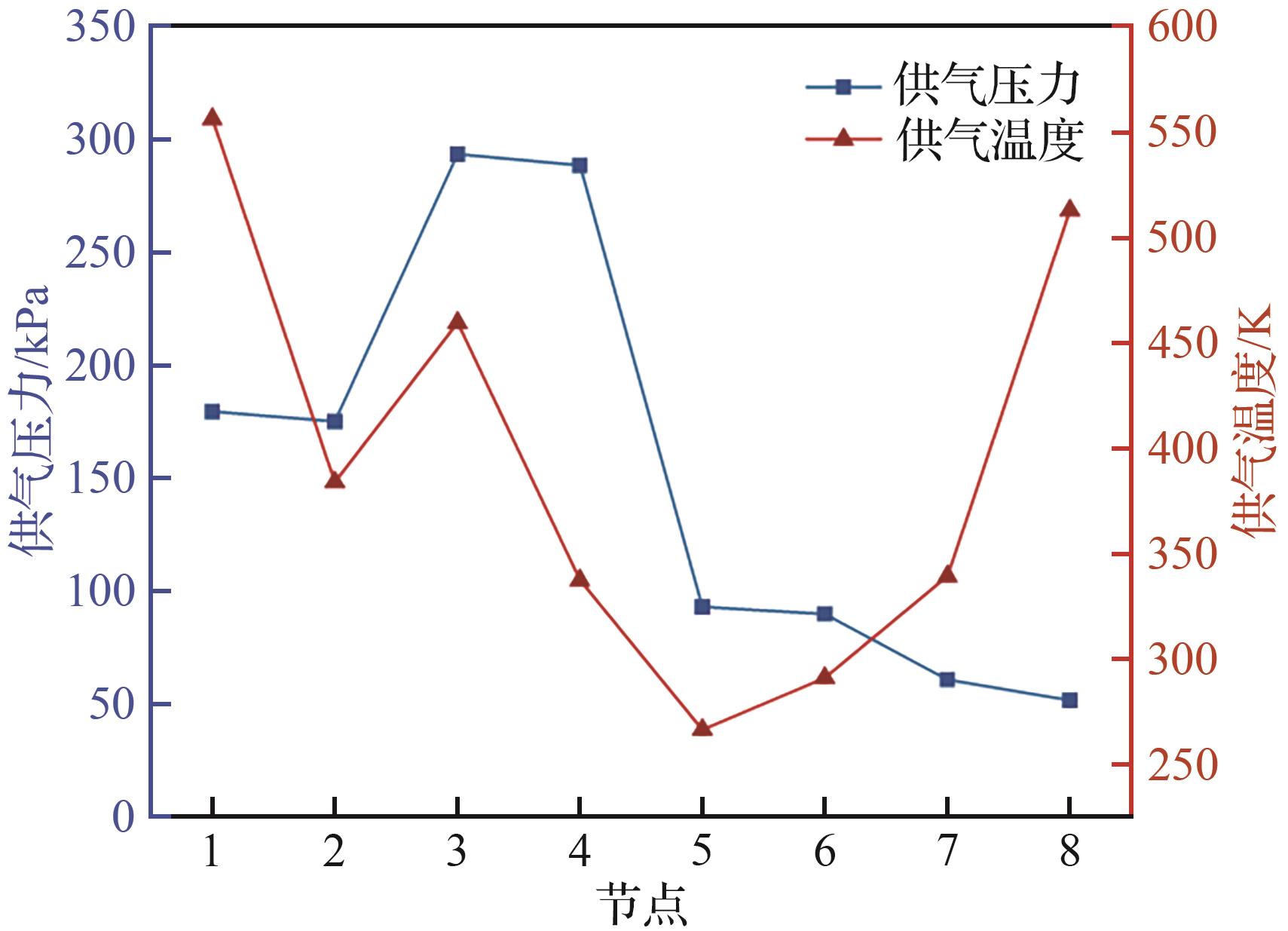
Fig.15
Fuel temperature and pressure at each node of fuel thermal management system
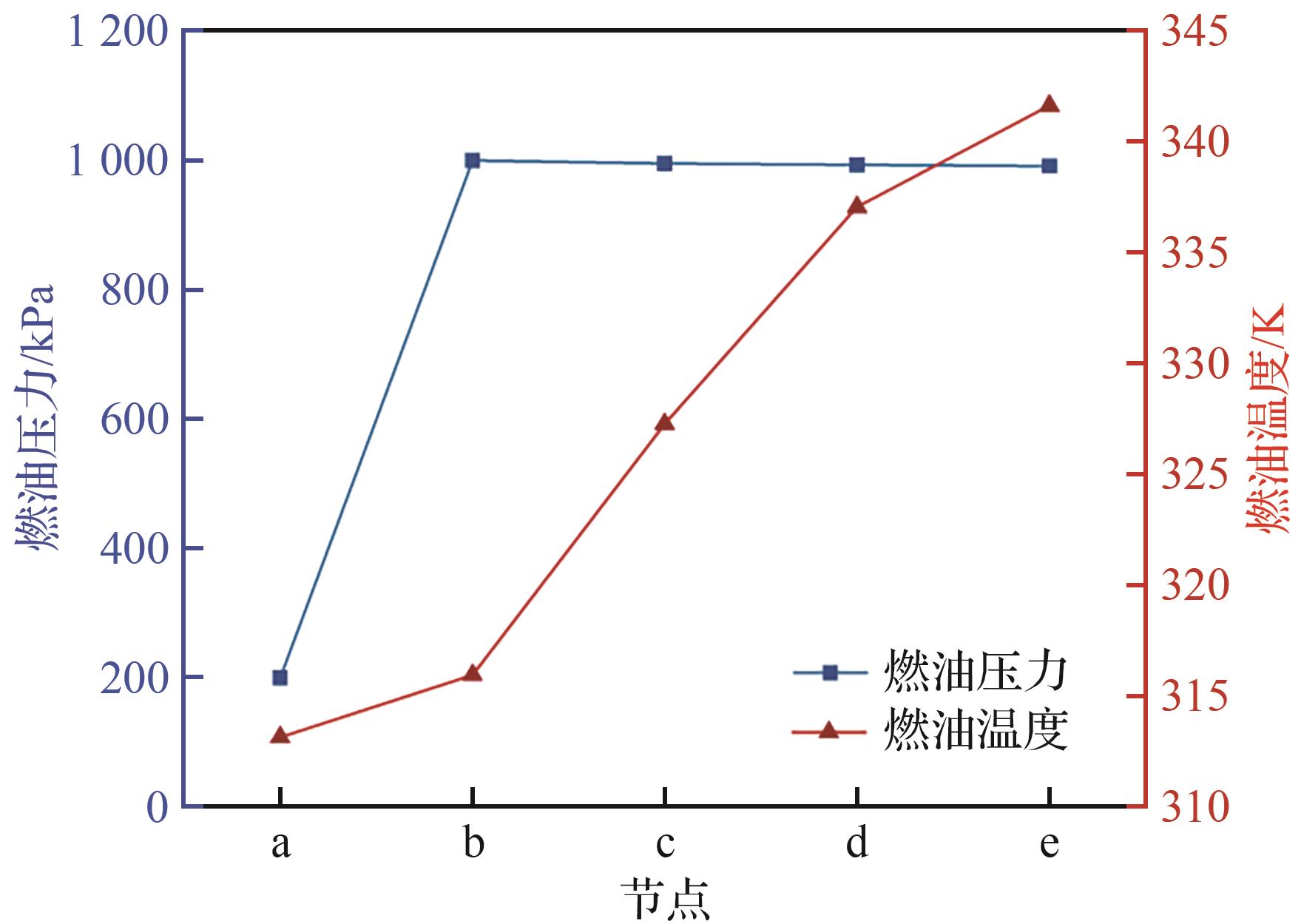
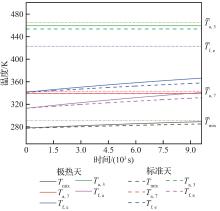
Fig.16
Variation of temperature of air supply and fuel with time in supersonic cruise phase
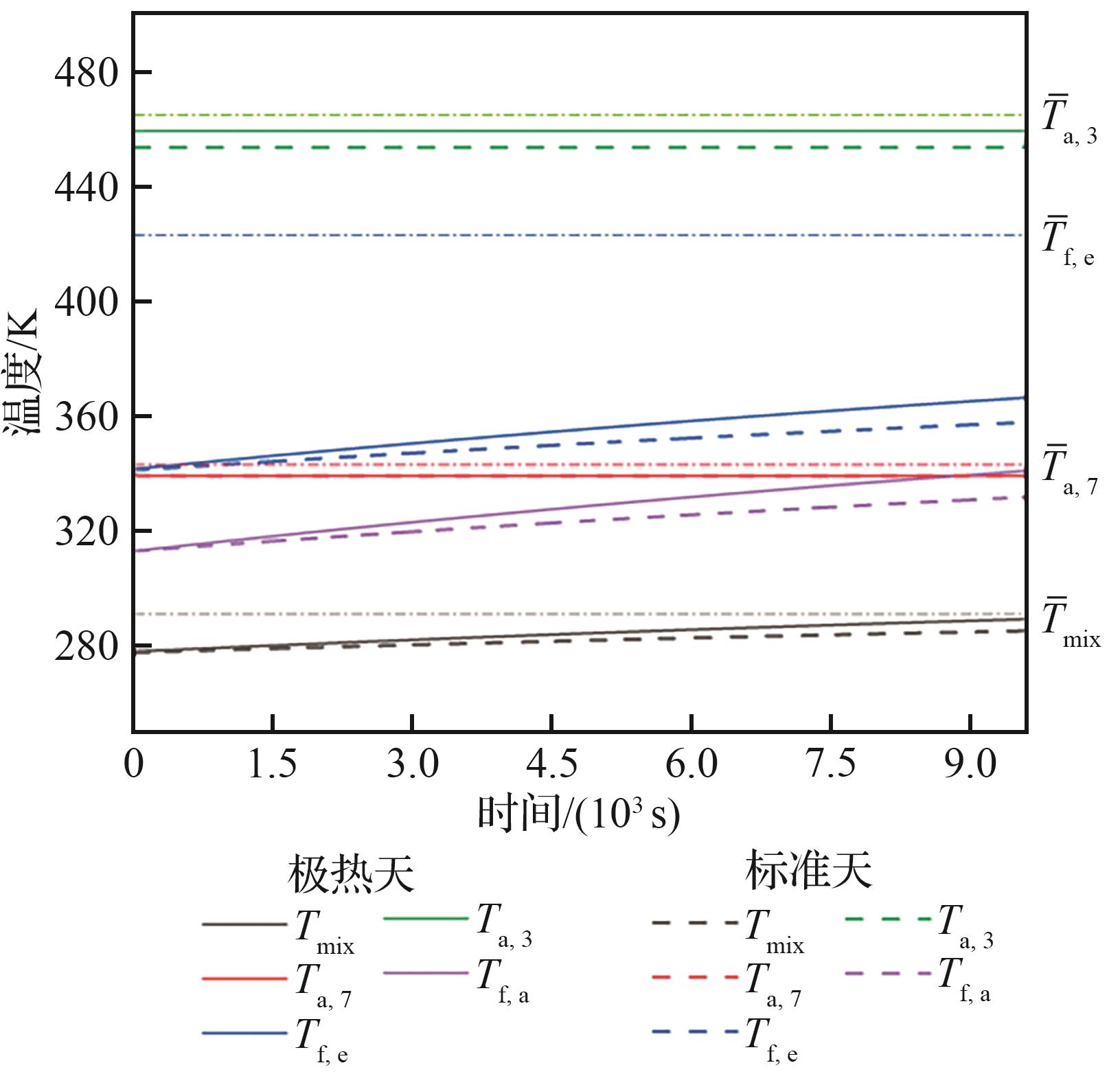
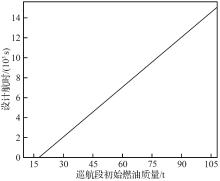
Fig.17
Relationship between designed flight time and initial fuel mass during supersonic cruise phase
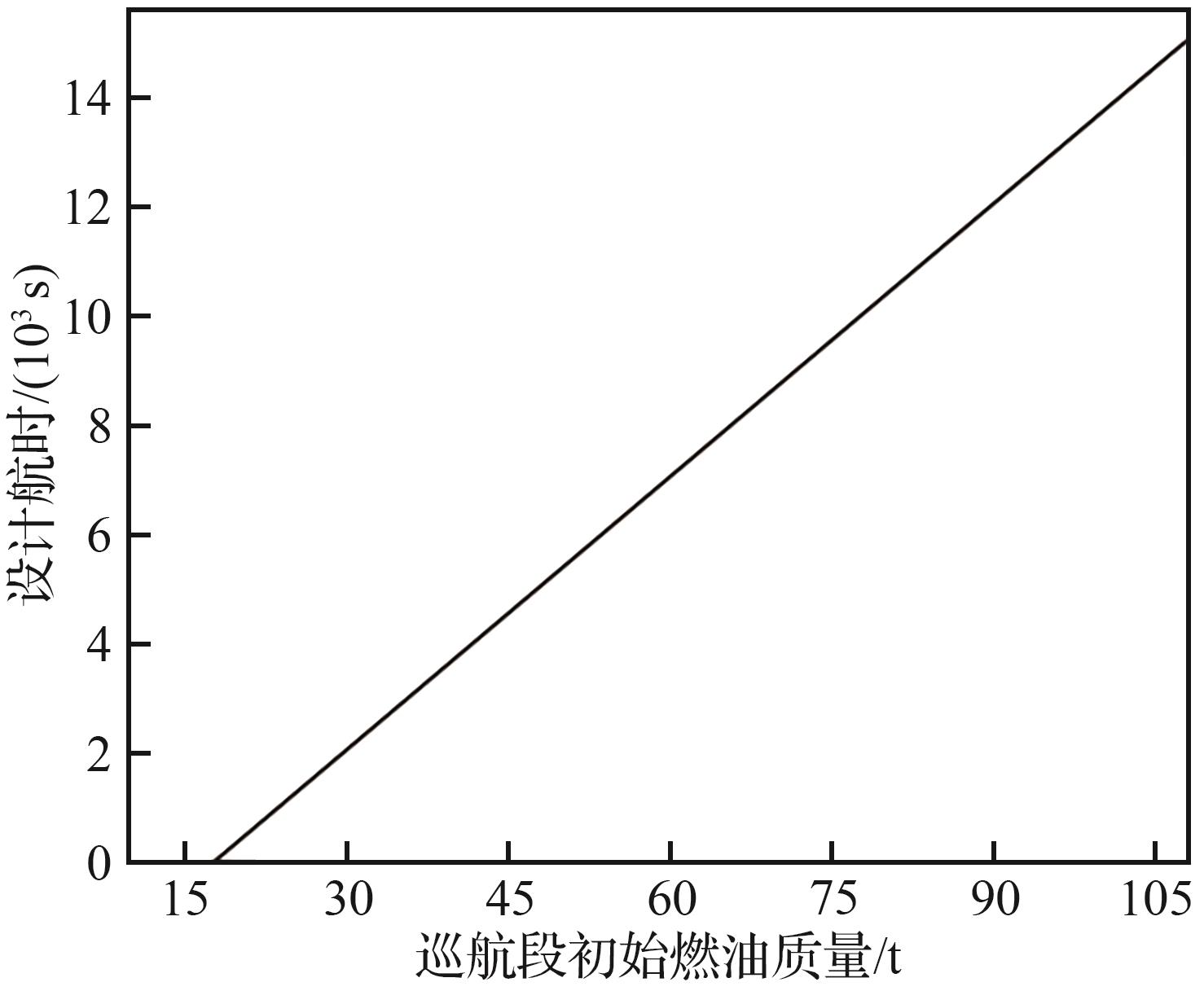
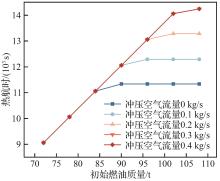
Fig.18
Relationship between thermal endurance and initial fuel mass under varying ram air flow rates
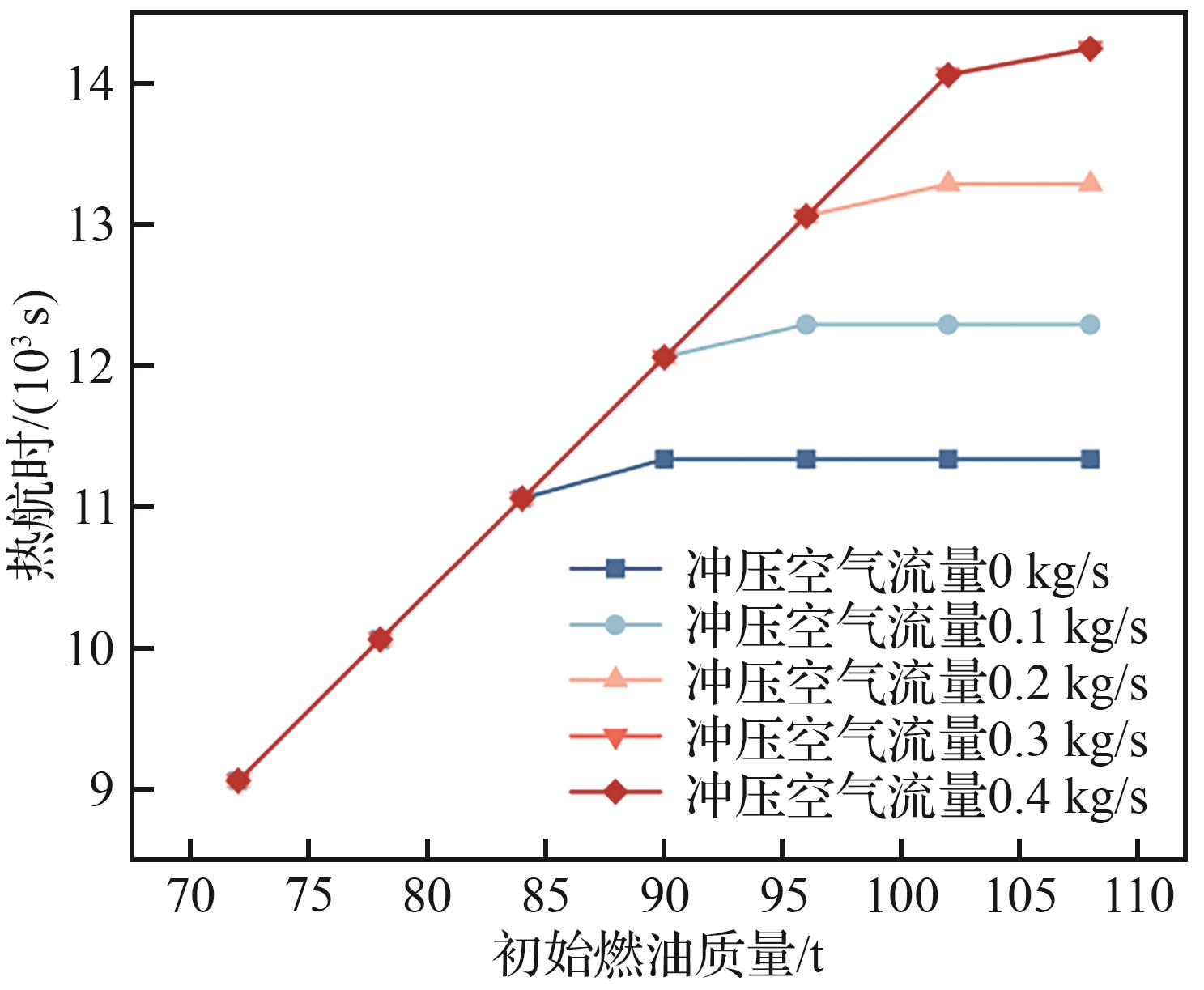
Fig.19
Relationship between thermal endurance and initial fuel temperature under varying ram air flow rates
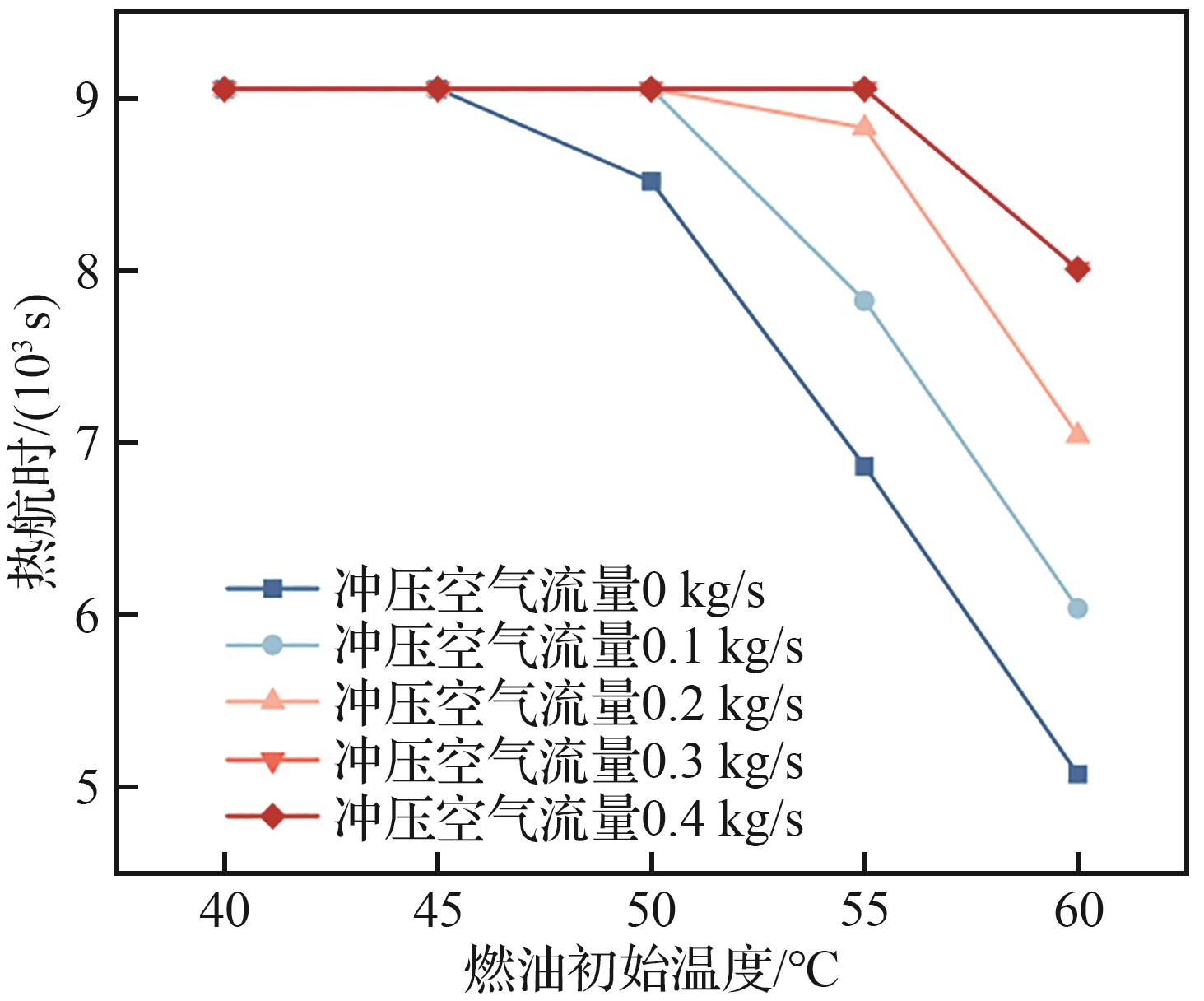
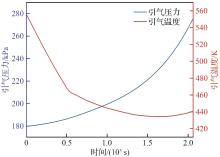
Fig.20
Engine bleed air pressure and temperature in deceleration and descent stage
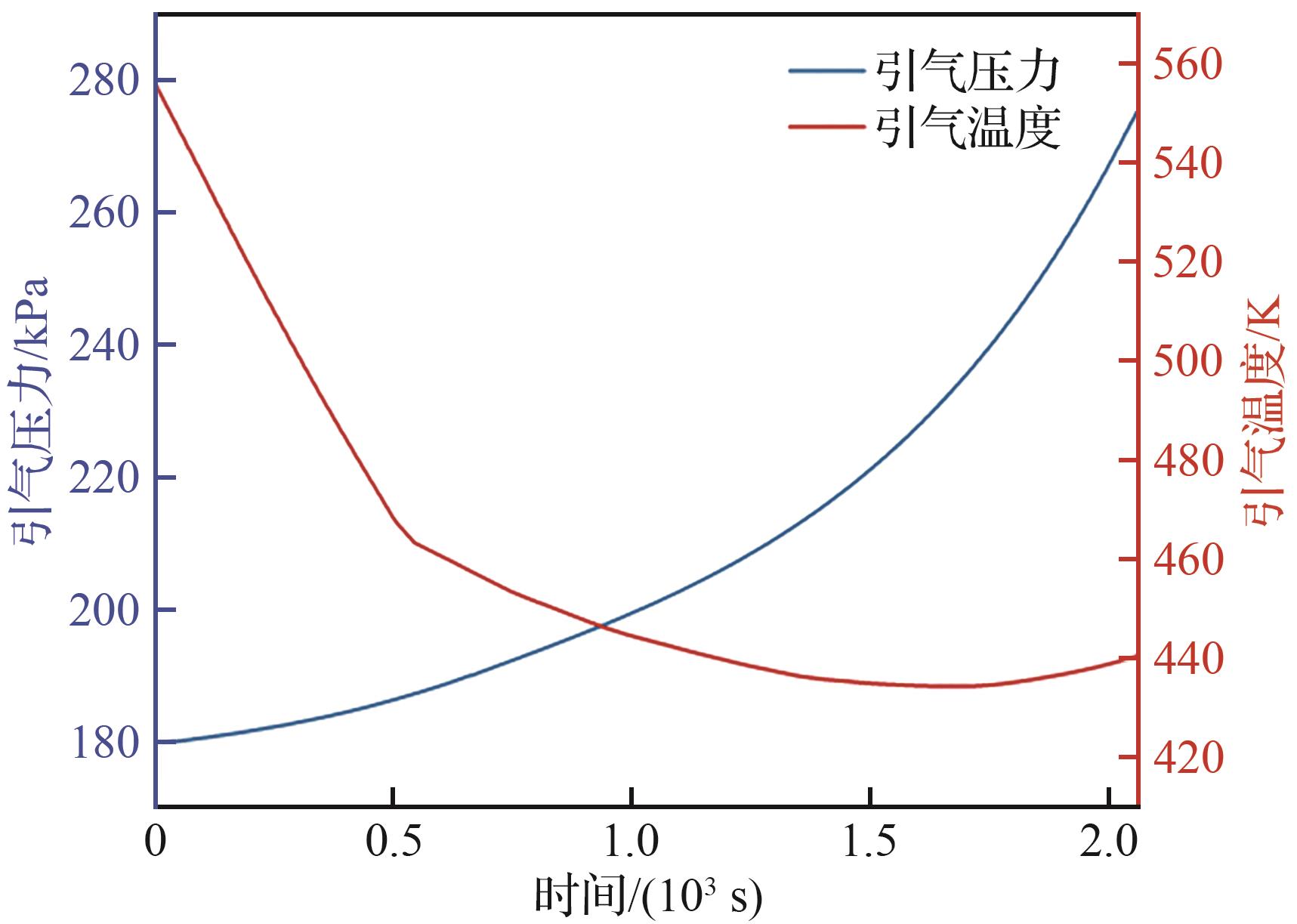
Fig.21
Fuel consumption and heat load change of lubricating oil system with time in decelerating and descent stage
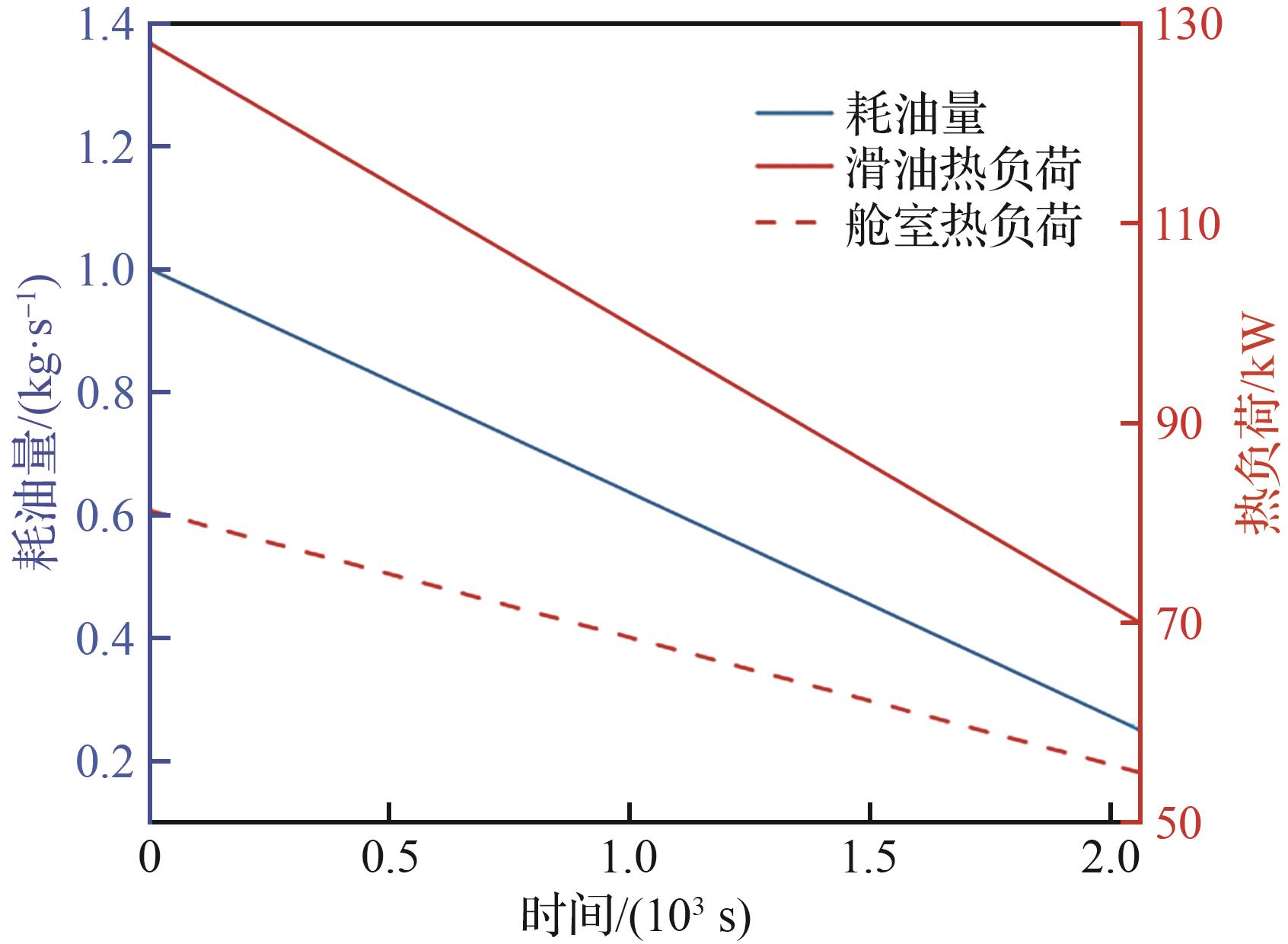
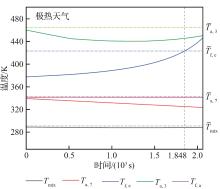
Fig.22
Variation of temperature of gas supply and fuel partial nodes with time during descent phase without activating fuel circulation loop
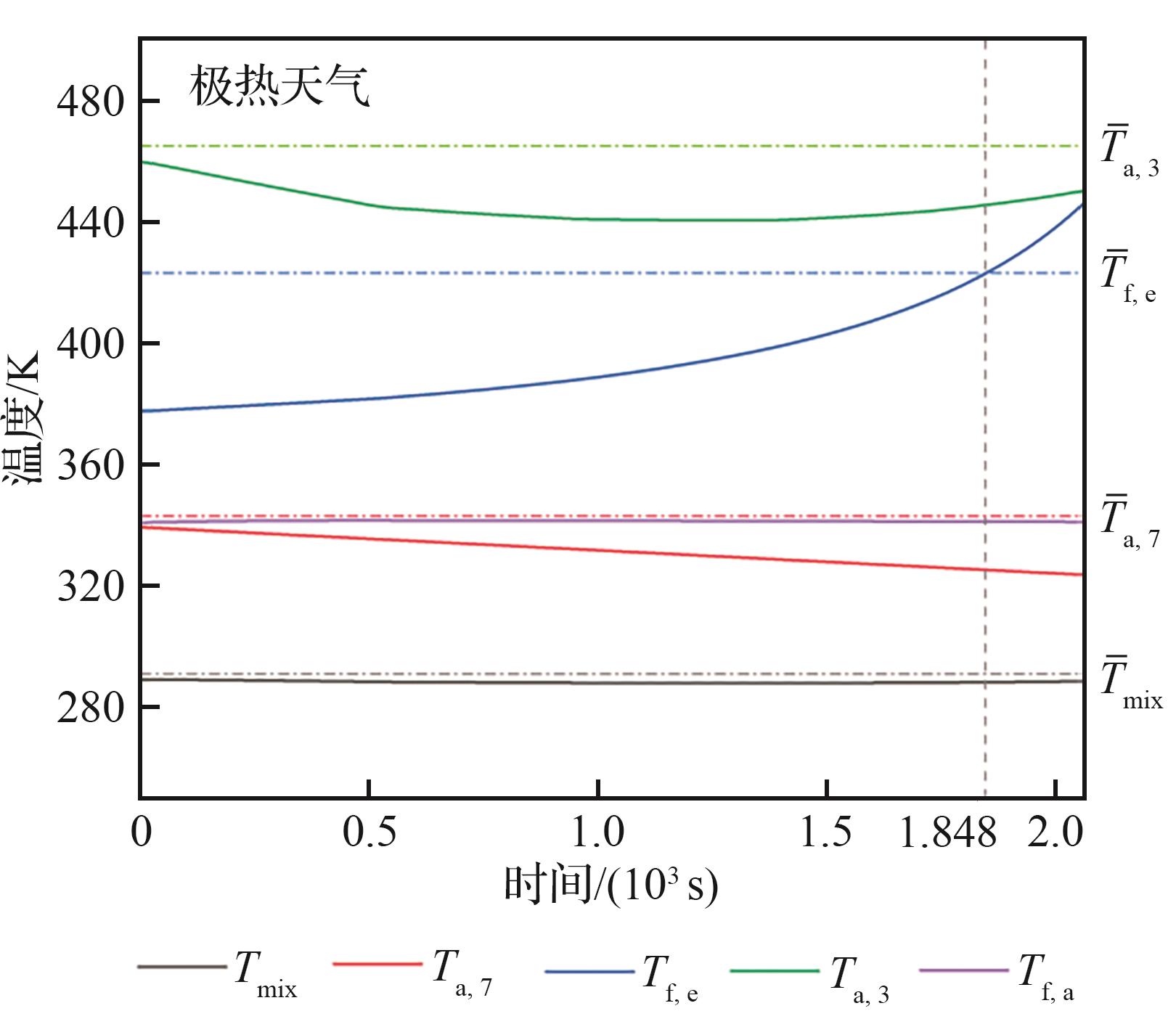
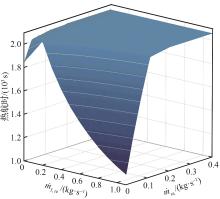
Fig.23
Influence of circulating fuel flow rate and ram air flow rate on system thermal flight time
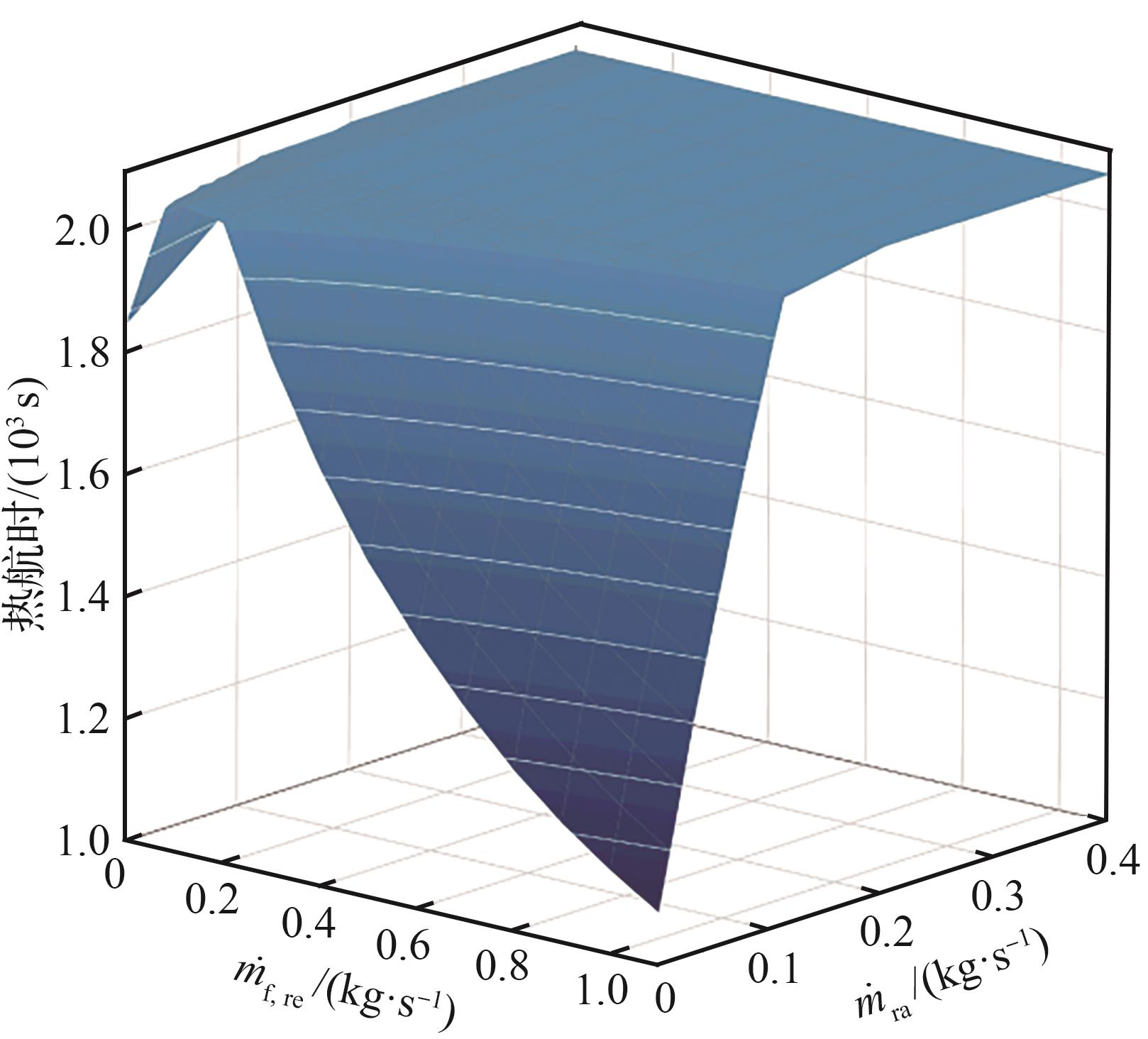
Table 4
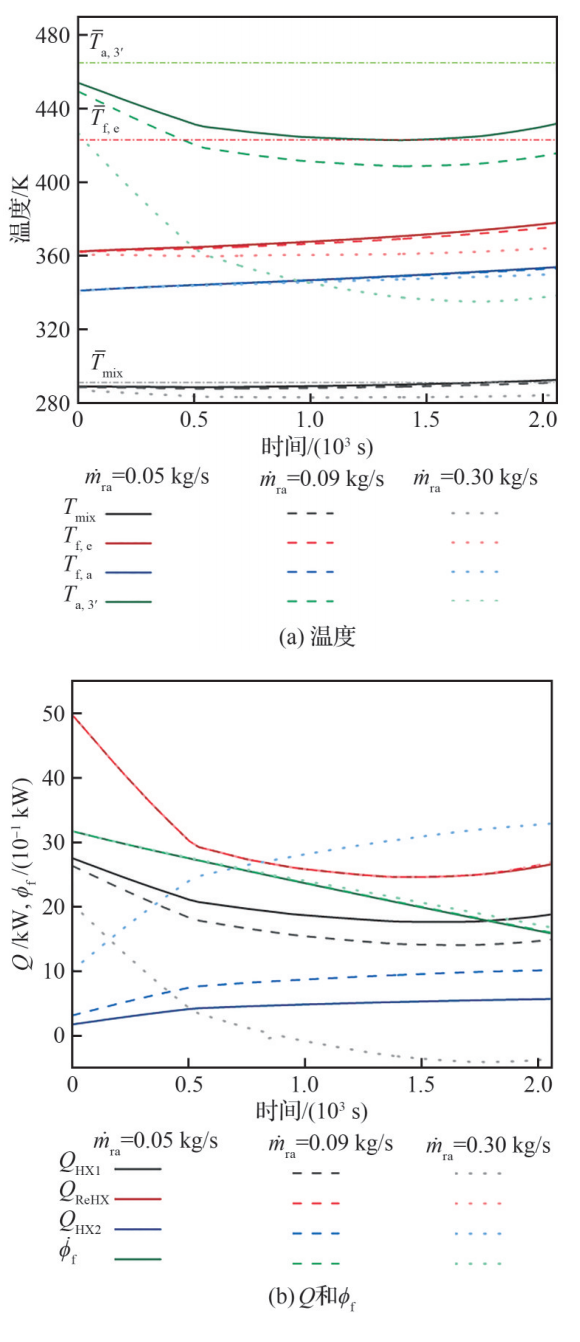
Influence of m˙f,re, m˙ra on ECS/TMS performance and hot flight time
| 工况 | 热航时/s | ||
|---|---|---|---|
| 1 | 0.05 | 0.05 | 2 051 |
| 2 | 0.05 | 0.09 | 2 060 |
| 3 | 0.05 | 0.30 | 2 060 |
| 4 | 0.20 | 0.05 | 2 060 |
| 5 | 0.20 | 0.09 | 2 060 |
| 6 | 0.20 | 0.30 | 2 060 |
| 7 | 0.80 | 0.05 | 1 734 |
| 8 | 0.80 | 0.09 | 2 045 |
| 9 | 0.80 | 0.30 | 2 060 |
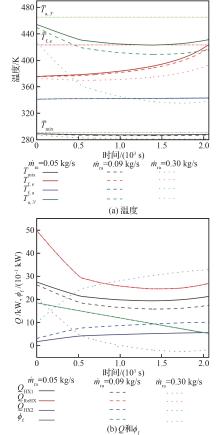
Fig.24
Variation of system parameters with time in Condition 1 to Condition 3 (m˙f,re=0.05 kg/s)
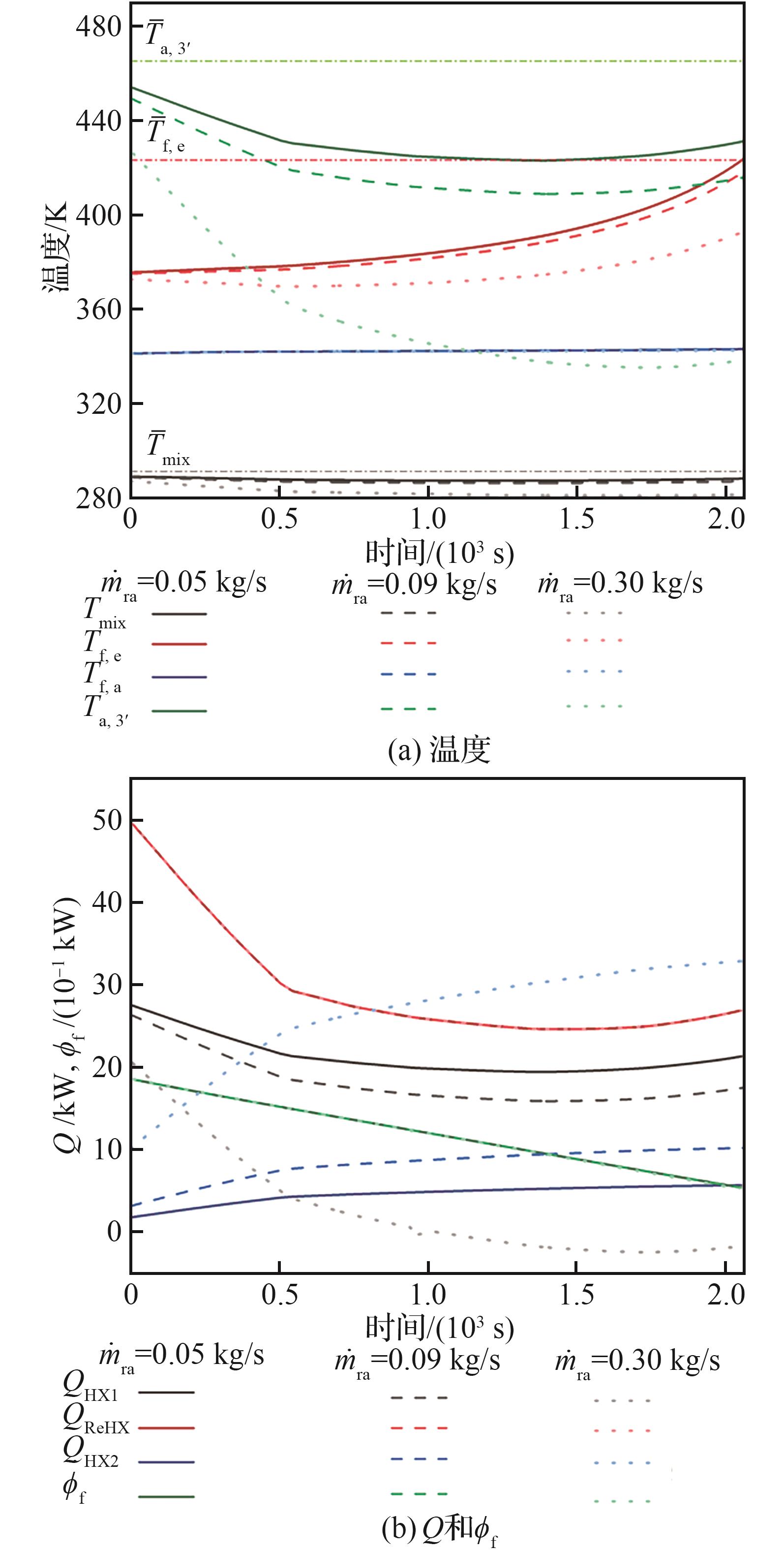
Fig.25
Variation of system parameters with time in Condition 4 to Condition 6 (m˙f,re=0.20 kg/s)
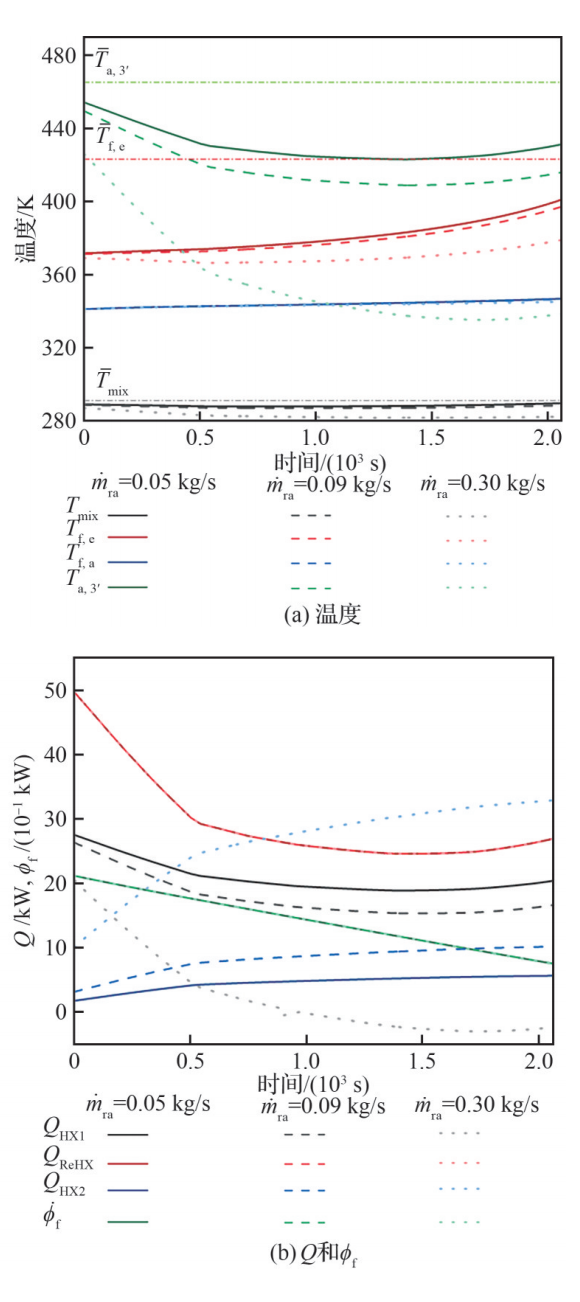
Fig.26
Variation of system parameters with time in Condition 7 to Condition 9 (m˙f,re=0.80 kg/s)
| [1] | WELGE H, NELSON C, BONET J. Supersonic vehicle systems for the 2020 to 2035 timeframe[C]∥28th AIAA Applied Aerodynamics Conference. Reston: AIAA, 2010. |
| [2] | 徐悦, 韩忠华, 尤延铖, 等. 新一代绿色超声速民机的发展现状与挑战[J]. 科学通报, 2020, 65(): 127-133. |
| XU Y, HAN Z H, YOU Y C, et al. Development status and challenges of a new generation of green supersonic civil aircraft[J]. Chinese Science Bulletin, 2020, 65(Sup 1): 127-133 (in Chinese). | |
| [3] | 欧阳天, 潘锐. 国外超声速民机技术发展综述[C]∥第六届中国航空科学技术大会. 嘉兴: 中国航空学会, 2023: 272-282. |
| OUYANG T, PAN Y. Review of supersonic civil aircraft technologies abroad[C]∥The 6th China Aeronautical Science and Technology. Jiaxing: CSAA, 2023: 272-282 (in Chinese). | |
| [4] | SUN Y C, SMITH H. Review and prospect of supersonic business jet design[J]. Progress in Aerospace Sciences, 2017, 90: 12-38. |
| [5] | BALTMAN E M, TAI J C, SHI M, et al. An investigation of cooled-cooling air for a mach 2.2 commercial supersonic transport[C]∥AIAA Propulsion and Energy 2021 Forum. Reston: AIAA, 2021. |
| [6] | VAN HEERDEN A S J, JUDT D M, JAFARI S, et al. Aircraft thermal management: Practices, technology, system architectures, future challenges, and opportunities[J]. Progress in Aerospace Sciences, 2022, 128: 100767. |
| [7] | PARRILLA J. Hybrid environmental control system integrated modeling trade study analysis for commercial aviation[D]. Cincinnati: University of Cincinnati, 2014. |
| [8] | MERZVINSKAS M, BRINGHENTI C, TOMITA J T, et al. Air conditioning systems for aeronautical applications: a review[J]. The Aeronautical Journal, 2020, 124(1274): 499-532. |
| [9] | 盛健, 张华, 吴兆林, 等. 飞机环境控制系统制冷空调技术现状[J]. 制冷学报, 2020, 41(2): 22-33. |
| SHENG J, ZHANG H, WU Z L, et al. Technology of refrigeration and air-conditioning for aircraft environment control system[J]. Journal of Refrigeration, 2020, 41(2): 22-33 (in Chinese). | |
| [10] | 刘征, 崔燚, 周琼瑶, 等. 基于AMESim的飞机环控系统建模与仿真[J]. 科技视界, 2020(22): 48-50. |
| LIU Z, CUI Y, ZHOU Q Y, et al. Modeling and simulation of aircraft environmental control system based on AMESim[J]. Science & Technology Vision, 2020(22): 48-50 (in Chinese). | |
| [11] | 刘浩. 民用飞机环控系统仿真研究[D]. 南京: 南京航空航天大学, 2019. |
| LIU H. Simulation study on environmental control system of civil aircraft[D]. Nanjing: Nanjing University of Aeronautics and Astronautics, 2019 (in Chinese). | |
| [12] | 许晓东. 民机环控系统建模与仿真技术研究[D]. 南京: 南京航空航天大学, 2018. |
| XU X D. Research on modeling and simulation techno-logy of civil aircraft environmental control system[D]. Nanjing: Nanjing University of Aeronautics and Astronautics, 2018 (in Chinese). | |
| [13] | JENNIONS I, ALI F, MIGUEZ M E, et al. Simulation of an aircraft environmental control system[J]. Applied Thermal Engineering, 2020, 172: 114925. |
| [14] | SHANGGUAN Z, QING C. Performance of a civil aircraft environmental control system coupled with hot water supplying[J]. Applied Thermal Engineering, 2022, 203: 117924. |
| [15] | SHANGGUAN Z, WEI X Y, PENG H, et al. Performance analysis of a new multifunctional aircraft environmental control system under variable operating conditions[J]. Energy Efficiency, 2024, 17(6): 65. |
| [16] | NEGI V P S, RANGANAYAKULU C. Thermal performance of three-wheel and split-wheel air cycle systems for a civil aircraft environmental control system(ECS)[J]. International Journal of Refrigeration, 2024, 166: 196-211. |
| [17] | KRUZHILOVA G V, TISHCHENKO I V. Study of the environmental control system of a supersonic passenger aircraft[C]∥2024 6th International Youth Conference on Radio Electronics, Electrical and Power Engineering (REEPE). Moscow: IEEE, 2024: 1-6. |
| [18] | VIOLA N, FERRETTO D, FUSARO R, et al. Performance assessment of an integrated environmental control system of civil hypersonic vehicles[J]. Aerospace, 2022, 9(4): 201. |
| [19] | FERRETTO D, VIOLA N. Preliminary design and simulation of a thermal management system with integrated secondary power generation capability for a Mach 8 aircraft concept exploiting liquid hydrogen[J]. Aerospace, 2023, 10(2): 180. |
| [20] | 孙友师, 俞笑, 黄铁山. 美国空军能量优化飞机研究进展综述[C]∥2017年(第三届)中国航空科学技术大会. 北京: 中国航空学会, 2017: 38-41. |
| SUN Y S, YU X, HUANG T S. Development of UASF energy optimized aircraft[C]∥2017 the 3rd China Aeronautical Science and Technology. Beijing: CSAA, 2017: 38-41 (in Chinese). | |
| [21] | WEISE P, GVOZDICH G, VON SPAKOVSKY M. INVENT: mission-integrated optimization of a tip-to-tail high performance aircraft system[C]∥50th AIAA Aerospace Sciences Meeting including the New Horizons Forum and Aerospace Exposition, Reston: AIAA, 2012. |
| [22] | GANEV E, KOERNER M. Power and thermal management for future aircraft[R]. New York: SAE International, 2013. |
| [23] | ASHFORD R, BROWN S. F-22 environmental control system/thermal management system (ECS/TMS) flight test program-downloadable constants, an innovative approach[R]. New York: SAE International, 2000. |
| [24] | 屠敏, 袁耿民, 薛飞, 等. 综合热管理在先进战斗机系统研制中的应用[J]. 航空学报, 2020, 41(6): 523629. |
| TU M, YUAN G M, XUE F, et al. Application of integrated thermal management in development of advanced fighter system[J]. Acta Aeronautica et Astronautica Sinica, 2020, 41(6): 523629 (in Chinese). | |
| [25] | 寿荣中, 何慧姗. 飞行器环境控制[M]. 北京: 北京航空航天大学出版社, 2004. |
| SHOU R Z, HE H S. Spacecraft optimal control theory and method[M]. Beijing: Beihang University Press, 2004 (in Chinese). | |
| [26] | MAO Y F, LI Y Z, WANG J X, et al. Cooling ability/capacity and exergy penalty analysis of each heat sink of mo-dern supersonic aircraft[J]. Entropy, 2019, 21(3): 223. |
| [27] | 王恒斌, 张宝霖. 国外飞机环境控制系统手册[M]. 北京: 航空工业出版社, 1986. |
| WANG H B, ZHANG B L. Handbook of foreign aircraft environmental control system[M]. Beijing: Aviation Industry Press, 1986 (in Chinese). | |
| [28] | LANGTON R, CLARK C, HEWITT M, et al. Aircraft Fuel Systems[M]. Chichester: John Wiley & Sons, 2009. |
| [29] | 余建祖. 换热器原理与设计[M]. 北京: 北京航空航天大学出版社, 2006. |
| YU J Z. Heat exchanger theory and design[M]. Beijing: Beihang University Press, 2006 (in Chinese). | |
| [30] | 沙拉, 塞库利克换热器设计技术[M]. 程林, 译. 北京: 机械工业出版社, 2010. |
| SHAH R K, SEKULIC D P. Fundamentals of heat exchanger design[M]. CHENG L, Translated. Beijing: China Machine Press, 2010 (in Chinese). | |
| [31] | 齐铭. 制冷附件[M]. 北京: 航空工业出版社, 1992. |
| QI M. Refrigeration accessories[M]. Beijing: Aviation Industry Press, 1992 (in Chinese). | |
| [32] | 蔡增基, 龙天渝. 流体力学泵与风机[M]. 4版. 北京: 中国建筑工业出版社, 1999. |
| CAI Z J, LONG T Y. Fluid mechanics pumps and fans[M]. 4th ed. Beijing: China Architecture & Building Press, 1999 (in Chinese). | |
| [33] | YANG S Y, LIN Y F, YU H Y, et al. Thermal management of fuel heat sink in aircraft via flow path optimization[J]. Applied Thermal Engineering, 2024, 246: 122880. |
| [34] | DOMAN D B. Fuel flow control for extending aircraft thermal endurance Part Ⅰ: underlying principles[C]∥AIAA Guidance, Navigation, and Control Conference. Reston: AIAA, 2016. |
| [35] | DOMAN D B. Optimal cruise altitude for aircraft thermal management[J]. Journal of Guidance, Control, and Dynamics, 2015, 38(11): 2084-2095. |
| [36] | GERMAN B J. Tank heating model for aircraft fuel thermal systems with recirculation[J]. Journal of Propulsion and Power, 2012, 28(1): 204-210. |
| [37] | 骆东. RP-3航空煤油热氧化结焦特性试验研究[D]. 南京: 南京航空航天大学, 2017. |
| LUO D. Experimental investigation on autoxidation coking characteristics of aviation kerosene RP-3[D]. Nanjing: Nanjing University of Aeronautics and Astronautics, 2017 (in Chinese). | |
| [38] | VILLENA MUNOZ C, BONAVOLONTÀ G, LAWSON C, et al. Conceptual design of a next generation supersonic airliner for low noise and emissions[C]∥AIAA Scitech 2023 Forum. Reston: AIAA, 2023. |
| [39] | VILLENA MUNOZ C, LAWSON C, RIAZ A, et al. Conceptual design of supersonic aircraft to investigate environmental impact[C]∥AIAA Scitech 2024 Forum. Reston: AIAA, 2024. |
| [40] | 张兴娟, 杨春信, 袁修干. 大飞机乘员舱热载荷的工程估算方法[J]. 北京航空航天大学学报, 2009, 35(12): 1503-1506. |
| ZHANG X J, YANG C X, YUAN X G. Engineering estimation methods of thermal load of airplane[J]. Journal of Beijing University of Aeronautics and Astronautics, 2009, 35(12): 1503-1506 (in Chinese). | |
| [41] | 陈悦. 飞机燃油系统热负荷计算及热管理分析[D]. 南京: 南京航空航天大学, 2014. |
| CHEN Y. Heat sink calculation and the analysis ofthermal management for aircraft fuel system[D]. Nanjing: Nanjing University of Aeronautics and Astronautics, 2014 (in Chinese). | |
| [42] | 马慧才, 刘毅玲, 党晓民. 高空长航时无人机综合热能管理的构型分析[J]. 化工学报, 2020, 71(): 417-424. |
| MA H C, LIU Y L, DANG X M. Configuration analysis of integrated thermal management about high altitude long-endurance unmanned aerial vehicle[J]. CIESC Journal, 2020, 71(Sup 1): 417-424 (in Chinese). |
| [1] | Yuhan JI, Fancang ZENG, Xiangyu WANG, Yuanyuan WANG. Concept design and performance analysis of hydrogen fuel cell regional aircraft [J]. Acta Aeronautica et Astronautica Sinica, 2025, 46(9): 630613-630613. |
| [2] | Xiufang LIU, Jiajun CHEN, Mian ZHENG, Fuhao ZHONG, Yanan LI, Yu HOU. Design and experiment of a new efficient cooling system for airborne electronic devices [J]. Acta Aeronautica et Astronautica Sinica, 2025, 46(9): 131078-131078. |
| [3] | Qihao DENG, Junming YAN, Ben CHEN. Operational characteristics of PEMFC anode system based on hydrogen gas recirculation [J]. Acta Aeronautica et Astronautica Sinica, 2025, 46(9): 630847-630847. |
| [4] | Haiwang LI, Shenghan GAO, Gang XIE, Mingxing YU, Xunan HE. Multiple heat sink matching and regulation strategies for distributed thermal management system of hydrogen hybrid power system [J]. Acta Aeronautica et Astronautica Sinica, 2025, 46(9): 630951-630951. |
| [5] | Zhouwei FAN, Chuihuan KONG, Ming LIU, Zhaoguang TAN. Sensitivity analysis on key parameters of hybrid hydrogen fuel cell commercial aircraft [J]. Acta Aeronautica et Astronautica Sinica, 2025, 46(9): 631066-631066. |
| [6] | Xiangyu YU, Wen LI, Jie YAN, Shizhe LIANG. Simulation research on thermal management system of fuel cell for liquid hydrogen powered UAV [J]. Acta Aeronautica et Astronautica Sinica, 2025, 46(9): 630964-630964. |
| [7] | Chuihuan KONG, Zhouwei FAN, Jiahua DAI, Nanbo XU, Zhaoguang TAN, Lijun PAN. Range analysis of civil aircraft using hydrogen energy and electricity [J]. Acta Aeronautica et Astronautica Sinica, 2025, 46(9): 331087-331087. |
| [8] | Feiteng LUO, Zhenming QU, Haitao LI, Xinke LI, Dahao YAO, Wenjuan CHEN, Yaosong LONG, Baoxi WEI, Yanjin MAN, Fujiang YANG, Qiang CHENG, Wubin KONG. Research progress and key issues of inlet pre-injection at hypersonic condition [J]. Acta Aeronautica et Astronautica Sinica, 2025, 46(8): 631189-631189. |
| [9] | Jiajian ZHU, Tiangang LUO, Yifu TIAN, Minggang WAN, Mingbo SUN. Enhanced ignition method with synergy of multi-channel gliding arc plasma and fuel injection in a scramjet [J]. Acta Aeronautica et Astronautica Sinica, 2025, 46(7): 131037-131037. |
| [10] | Shiyu YANG, Haiyu YU, Yuanfang LIN, Xingang LIANG. Performance analysis and optimization of fuel thermal management system with expendable heat sink [J]. Acta Aeronautica et Astronautica Sinica, 2025, 46(4): 130897-130897. |
| [11] | Kefeng ZHENG, Wenping SONG, Han NIE, Yulin DING, Jianling QIAO, Qing CHEN, Yiheng WANG, Ke SONG, Keshi ZHANG. Natural laminar flow wing design method for supersonic civil aircraft considering full-aircraft sonic-boom characteristics [J]. Acta Aeronautica et Astronautica Sinica, 2025, 46(20): 531214-531214. |
| [12] | Chao YANG, Yuting TAN, Wei WANG, Yan ZHAO, Xiongqing YU. Multidisciplinary optimization with low-boom design for supersonic civil aircraft conceptual design [J]. Acta Aeronautica et Astronautica Sinica, 2025, 46(20): 531457-531457. |
| [13] | Shiqi WANG, Quan WEN, Zhigang JIA, Yixin CHENG, Lin LI, Chi ZHANG, Weiye HUO, Liang MA. Experiment on afterburner combustion efficiency based on self-excited sweeping nozzle [J]. Acta Aeronautica et Astronautica Sinica, 2025, 46(2): 130621-130621. |
| [14] | Zhiguang HUA, Shiyuan PAN, Dongdong ZHAO, Xianglong LI, Manfeng DOU. Lifespan prediction of hydrogen fuel cell based on decomposition optimization parallel ESN [J]. Acta Aeronautica et Astronautica Sinica, 2025, 46(2): 330696-330696. |
| [15] | Xu WANG, Jiaxun LIU, Yongqi LIU, Suyi DOU, Qingyu LI, Xu XU, Qingchun YANG. Secondary combustion of magnesium powder to enhance kerosene-fueled scramjet thrust [J]. Acta Aeronautica et Astronautica Sinica, 2025, 46(18): 131786-131786. |
| Viewed | ||||||
|
Full text |
|
|||||
|
Abstract |
|
|||||
Address: No.238, Baiyan Buiding, Beisihuan Zhonglu Road, Haidian District, Beijing, China
Postal code : 100083
E-mail:hkxb@buaa.edu.cn
Total visits: 6658907 Today visits: 1341All copyright © editorial office of Chinese Journal of Aeronautics
All copyright © editorial office of Chinese Journal of Aeronautics
Total visits: 6658907 Today visits: 1341

 CJA
CJA
