Acta Aeronautica et Astronautica Sinica ›› 2025, Vol. 46 ›› Issue (15): 131534.doi: 10.7527/S1000-6893.2025.31534
• Fluid Mechanics and Flight Mechanics • Previous Articles
Zhiwei WANG1, Tianheng ZHA2, Bowen LIU3, Yan CHEN1( ), Aqiang LIN1, Gaowen LIU1
Received:2024-11-14
Revised:2024-12-24
Accepted:2025-03-31
Online:2025-04-11
Published:2025-04-10
Contact:
Yan CHEN
E-mail:xjtu.chenyan@nwpu.edu.cn
Supported by:CLC Number:
Zhiwei WANG, Tianheng ZHA, Bowen LIU, Yan CHEN, Aqiang LIN, Gaowen LIU. Experiment on flow and windage heating characteristics of high-speed rotating labyrinth[J]. Acta Aeronautica et Astronautica Sinica, 2025, 46(15): 131534.
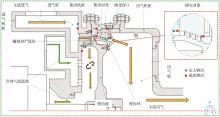
Fig.1
Overall structure and experimental measurement points of rotating labyrinth test rig
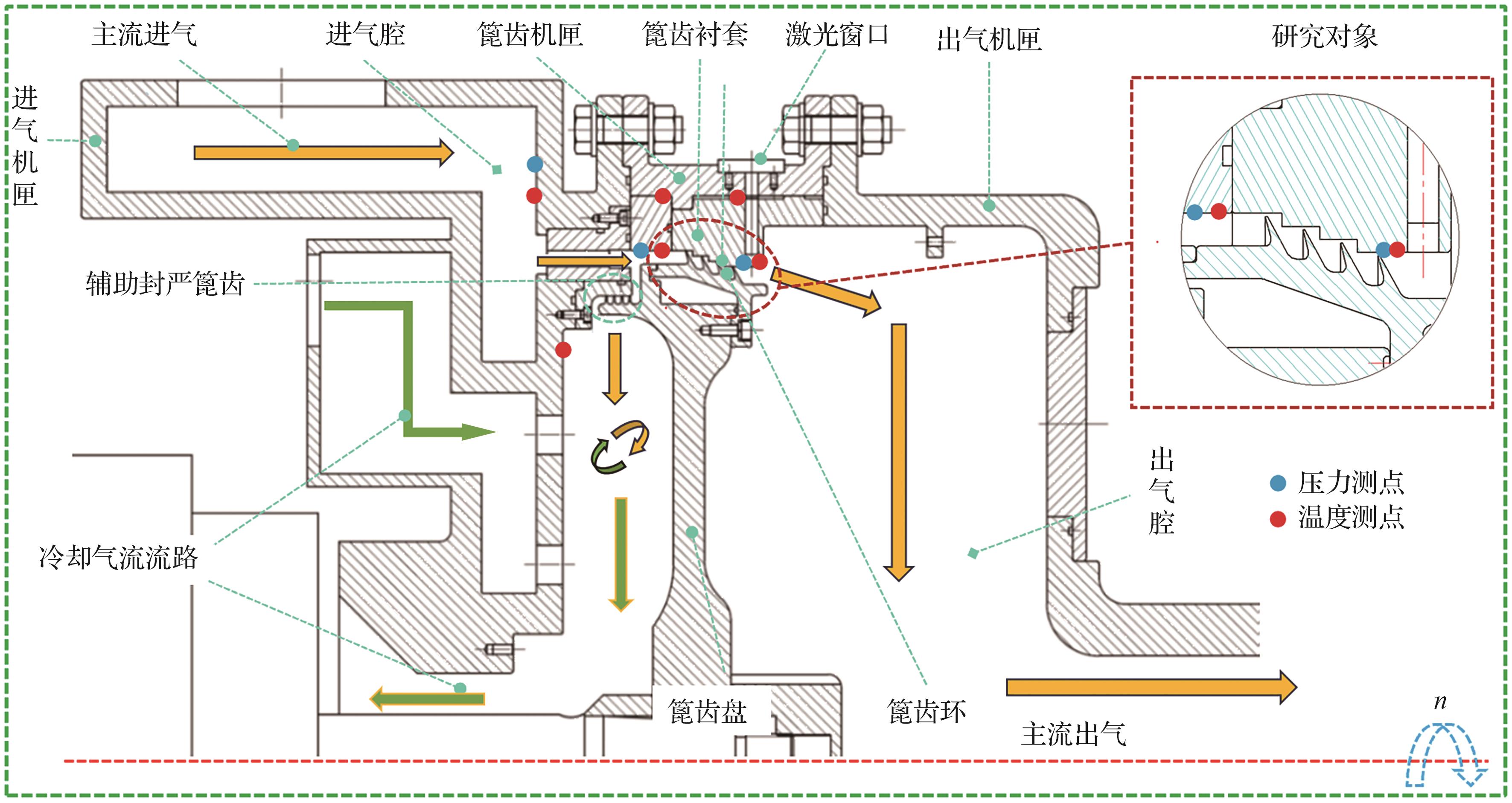
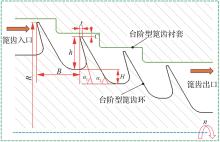
Fig.2
2D contour diagram of step-slanted labyrinth seal
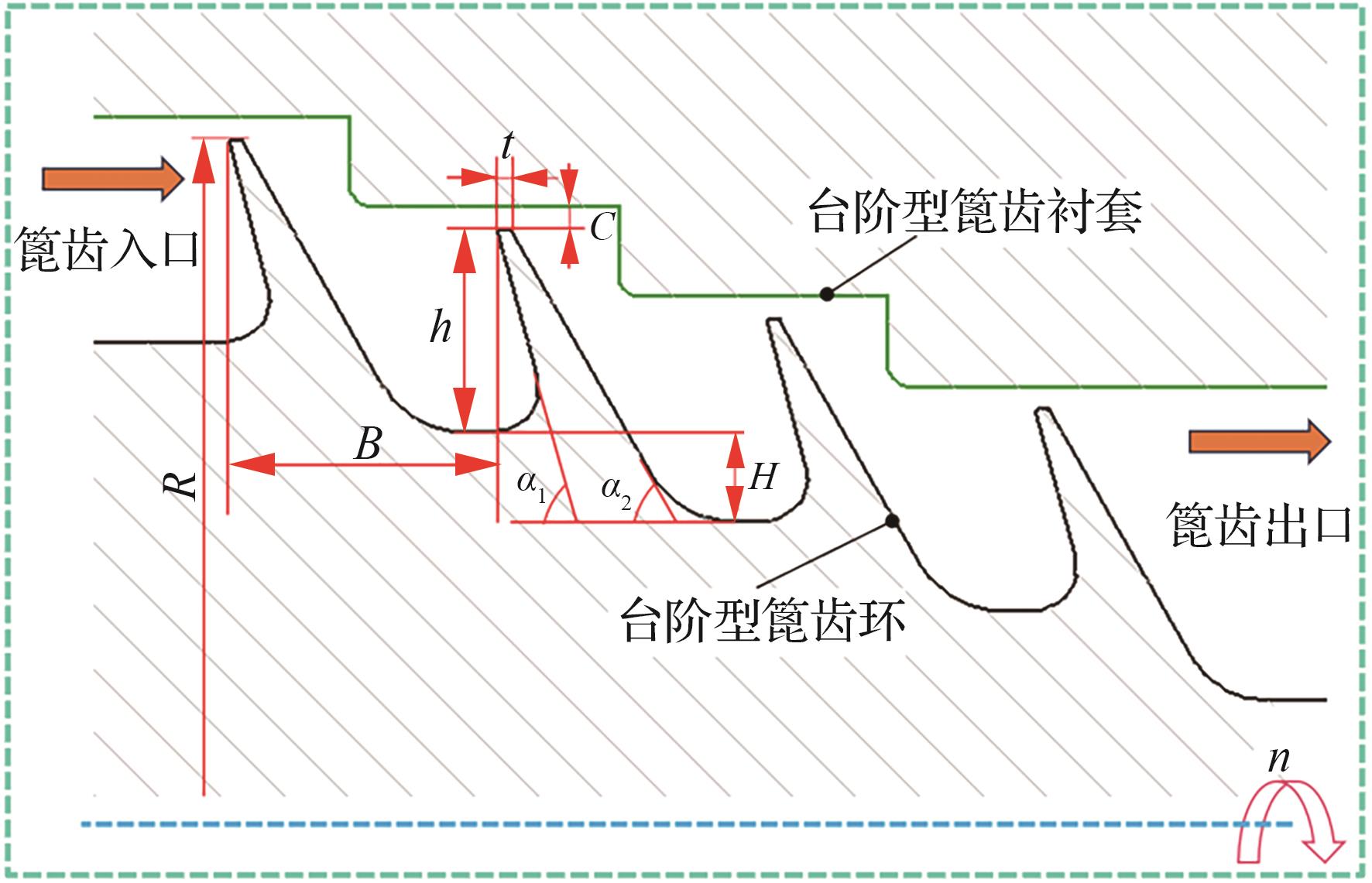
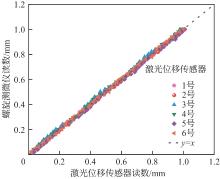
Fig.3
Laser displacement sensor calibration curves
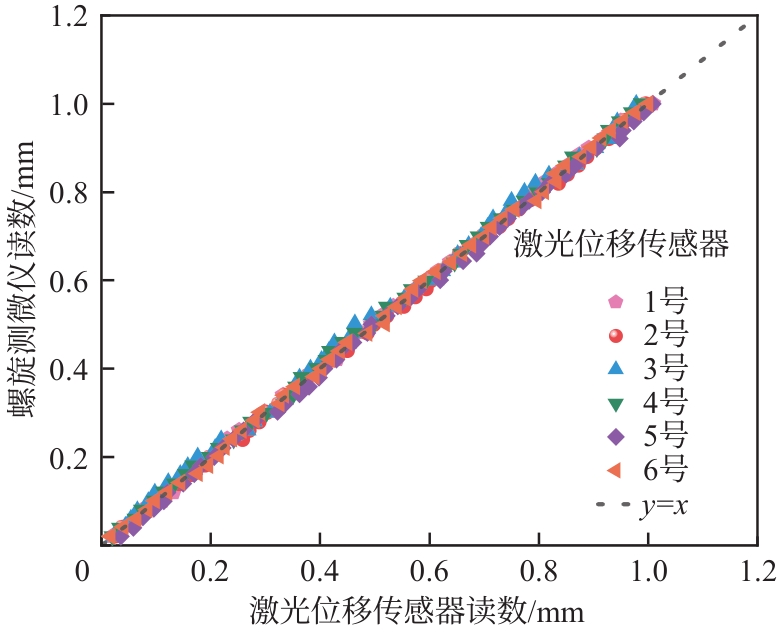

Table 1
Relative uncertainty of the main parameters
| 参数 | 相对不确定度/% |
|---|---|
| 篦齿间隙C/mm | 1.00 |
| 压比π | 0.14 |
| 泄漏流量 | 1.00 |
| 流量系数CD | 6.91 |
| 风阻温升ΔT*/℃ | 2.83 |
| 温升系数σ | 3.46 |
| 出口旋转比βout | 4.02 |
Table 2
Range of experimental conditions for studying effect of the working clearance
| 实验参数 | 参数范围 |
|---|---|
| 旋转马赫数Maφ | 0~0.557 |
| 压比π | 1.1~2.0 |
| 进气温度T | 16 |
| 设计间隙C*/mm | 0.4,0.6,0.8 |
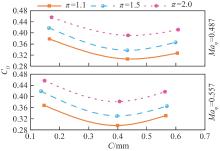
Fig.4
Influence of labyrinth seal working clearance on the leakage characteristics of labyrinth
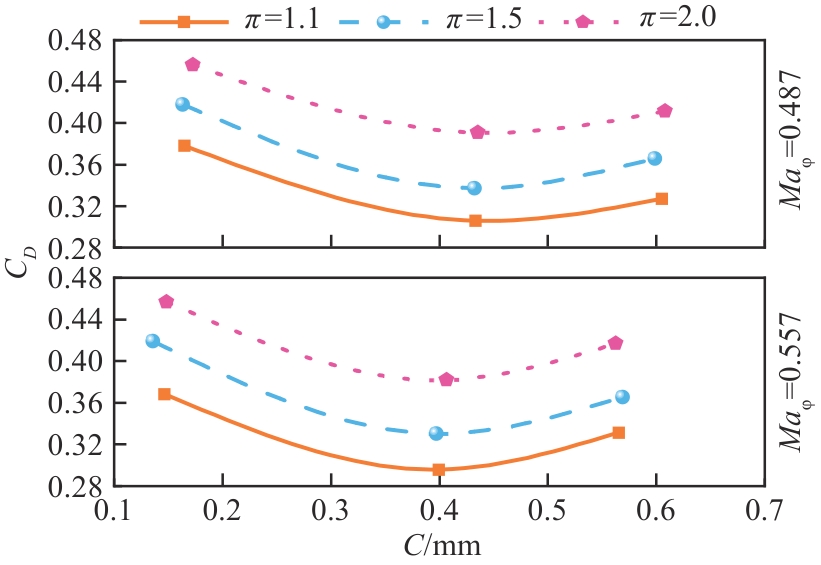
Fig.5
Influence of labyrinth seal working clearance on windage heating characteristics of labyrinth
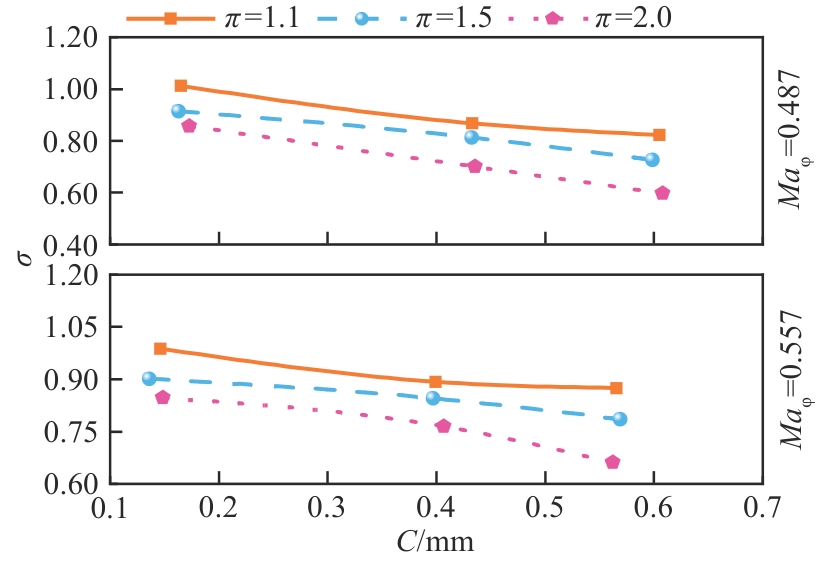
Table 3
Range of experimental conditions for studying effect of inlet temperatures
| 实验参数 | 参数范围 |
|---|---|
| 旋转马赫数Maφ | 0~0.418 |
| 压比π | 1.1~2.0 |
| 进气温度T | 15,50,100 |
| 设计间隙C*/mm | 0.8 |
Fig.6
Influence of inlet temperatures on the initial clearance of labyrinth
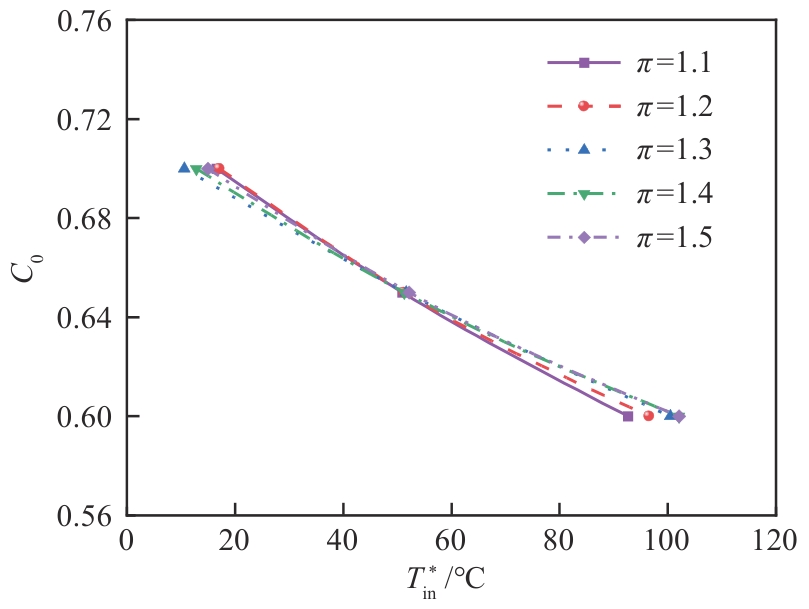
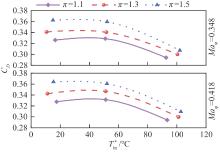
Fig.7
Effect of inlet temperatures on leakage characteristics of labyrinth
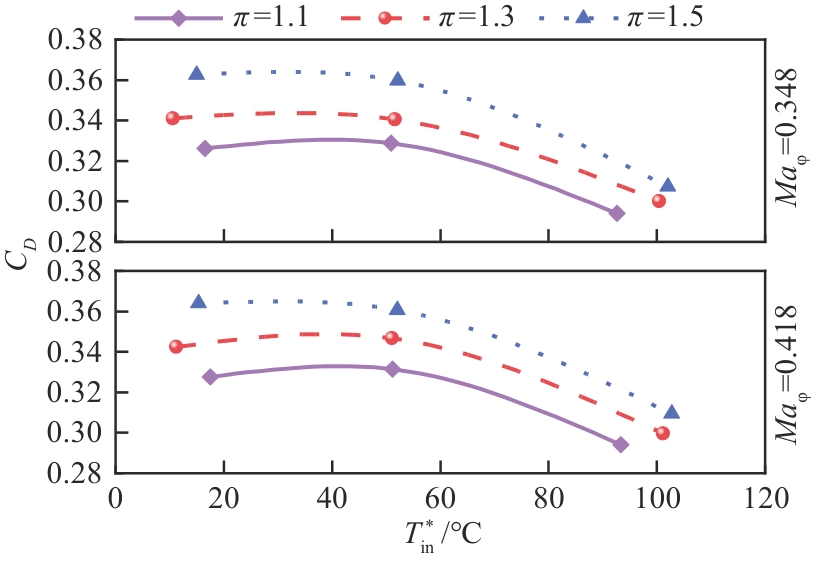
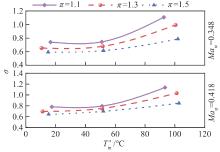
Fig.8
Influence of inlet temperatures on windage heating characteristics of labyrinth
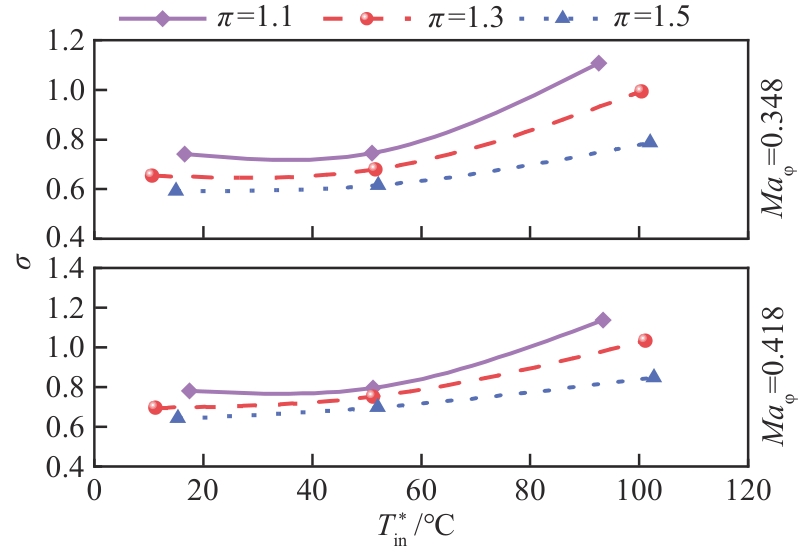
Table 4
Range of experimental conditions for studying effect of rotating Mach number
| 实验参数 | 参数范围 |
|---|---|
| 旋转马赫数Maφ | 0~0.626 |
| 压比π | 1.1~2.0 |
| 进气温度T | 16 |
| 设计间隙C*/mm | 0.6,0.8 |
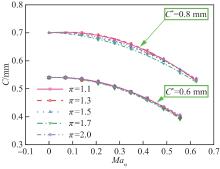
Fig.9
Influence of rotating Mach number on working clearance of labyrinth at different design clearances
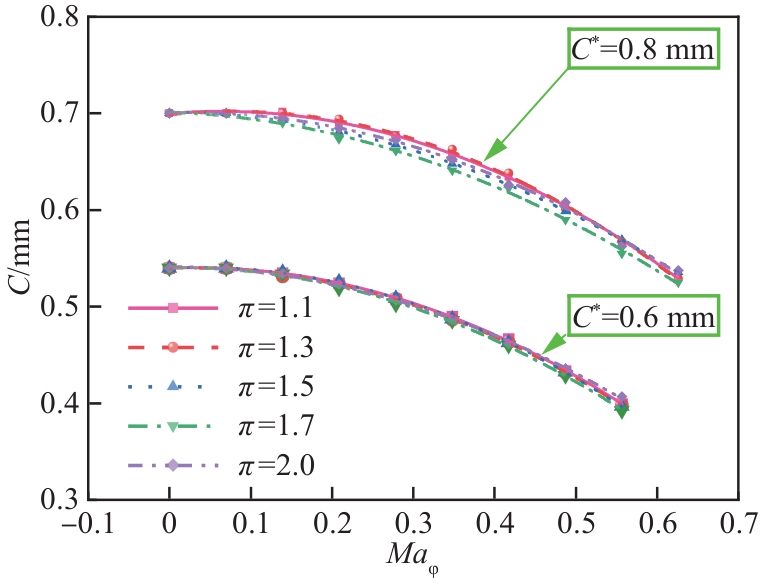
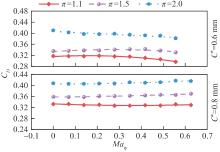
Fig.10
Influence of rotating Mach number on leakage characteristics of labyrinth
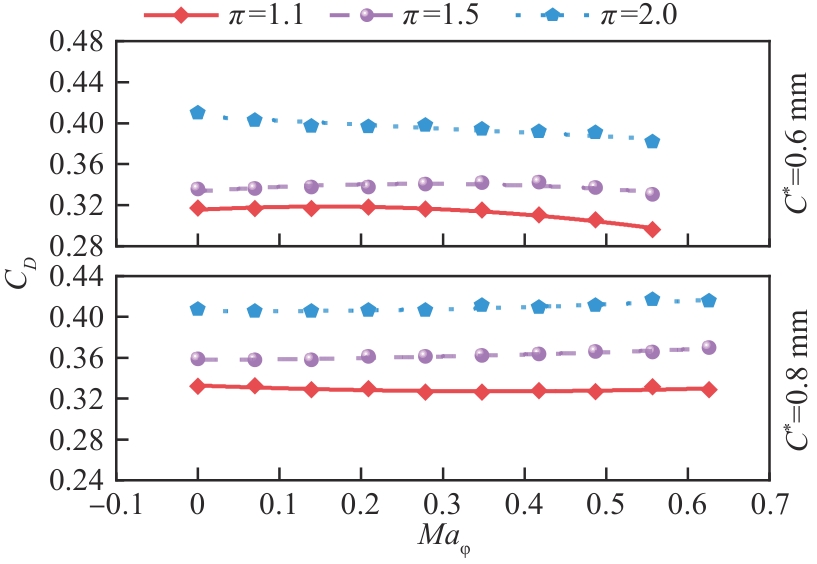
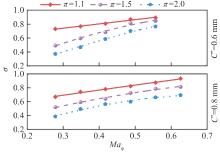
Fig.11
Influence of rotating Mach number on windage heating characteristics of labyrinth
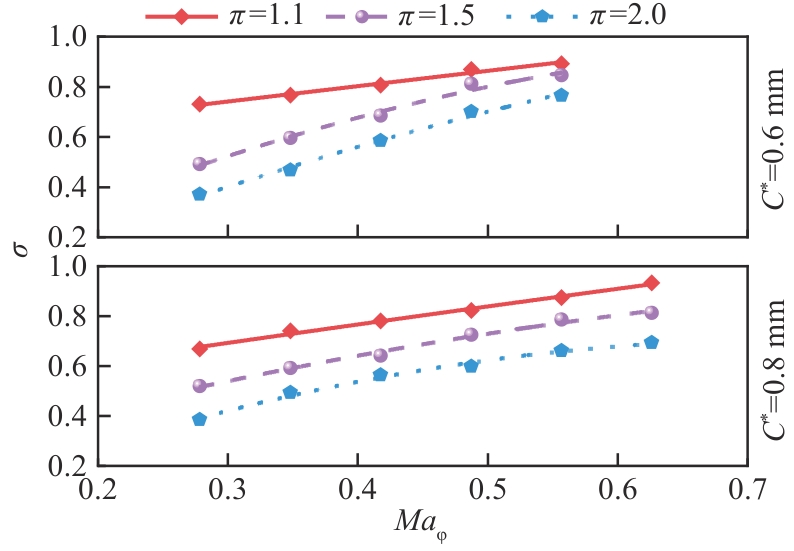
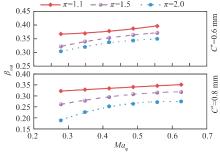
Fig.12
Influence of rotating Mach number on swirl flow characteristics of labyrinth
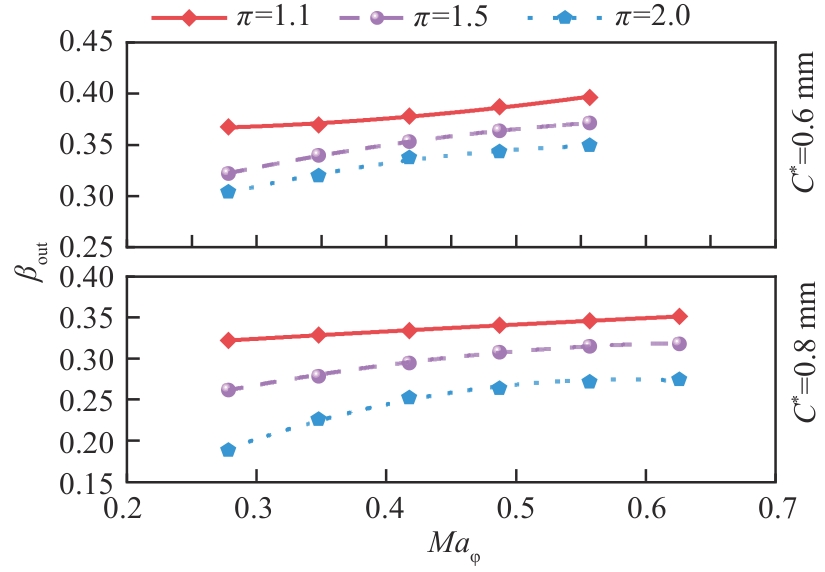
Table 5
Range of experimental conditions for studying effect of pressure ratios
| 实验参数 | 参数范围 |
|---|---|
| 旋转马赫数Maφ | 0~0.557 |
| 压比π | 1.1~.2 |
| 进气温度T | 16 |
| 设计间隙C*/mm | 0.6,0.8 |
Fig.13
Influence of pressure ratios on leakage characteristics of labyrinth
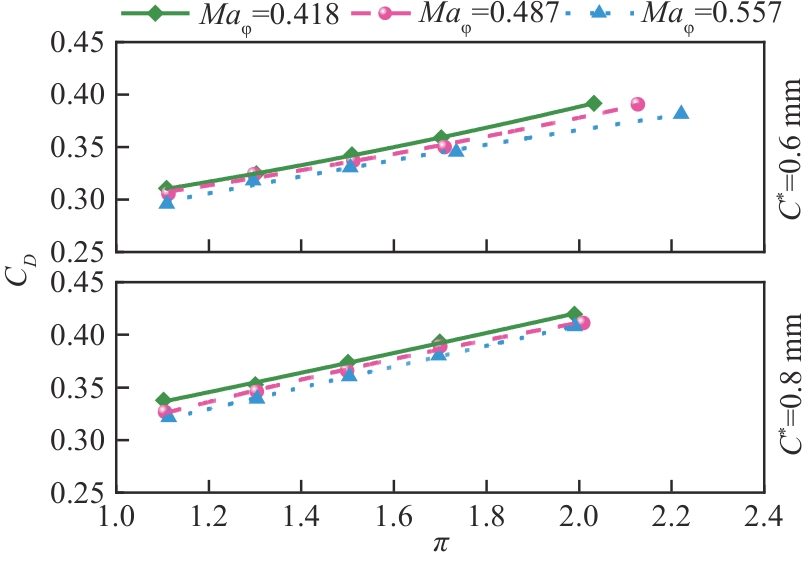
Fig.14
Influence of pressure ratios on windage heating characteristics of labyrinth
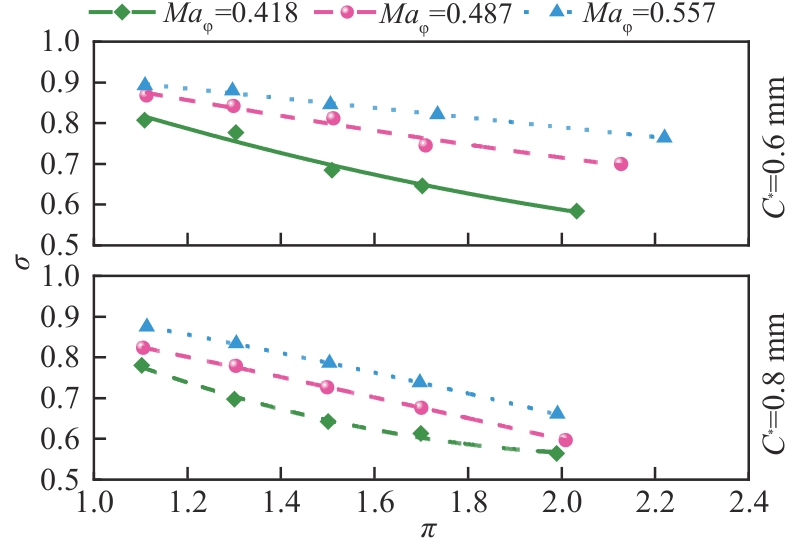
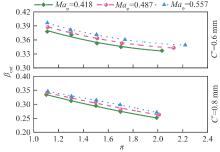
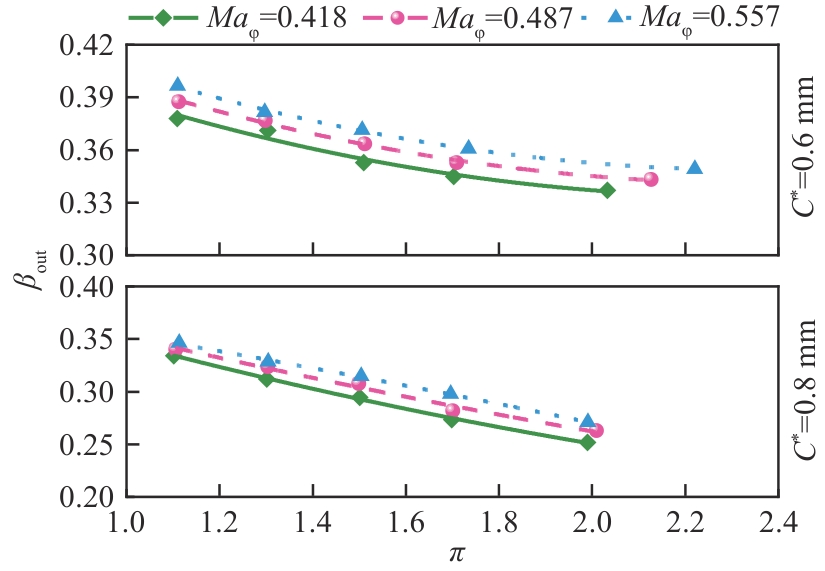
Fig.15
Influence of pressure ratios on swirl flow characteristics of labyrinth
| [1] | HU S, FENG W, GONG W Q, et al. Research on internal flow field analysis and power loss modeling of the expansion seal ring[J]. Physics of Fluids, 2023, 35(11) :113116. |
| [2] | 姚斡维, 刘高文, 陈燕, 等. 高性能涡轮低位预旋供气系统正向设计[J]. 航空学报, 2025, 46(7): 130832. |
| YAO G W, LIU G W, CHEN Y, et al. Forward design of high-performance turbine low-radius pre-swirl system[J]. Acta Aeronautica et Astronautica Sinica, 2025, 46(7): 130832 (in Chinese). | |
| [3] | 杨显赵, 刘高文, 郭令颖, 等. 高温降涡轮高位预旋供气系统的设计研究[J]. 航空学报, 2025, 46(2): 130672. |
| YANG X Z, LIU G W, GUO L Y, et al. Design of turbine high radius pre-swirl system with high temperature drop[J]. Acta Aeronautica et Astronautica Sinica, 2025, 46(2): 130672 (in Chinese). | |
| [4] | 肖传民, 田立敏, 李明文, 等. 级间篦齿泄漏对压气机性能的影响[J]. 机械工程与自动化, 2024(5): 38-40. |
| XIAO C M, TIAN L M, LI M W, et al. Effect of interstage labyrinth leakage on compressor performance[J]. Mechanical Engineering & Automation, 2024(5): 38-40 (in Chinese). | |
| [5] | STURGESS G, DATTA P. Application of CFD to gas turbine engine secondary flow systems-The labyrinth seal[C]∥24th Joint Propulsion Conference. Reston: AIAA, 1988. |
| [6] | MARTIN H M. Labyrinth Packings[J]. Engineering, 1908, 85: 35. |
| [7] | STODOLA A. Steam and Gas Turbines 6th[M]. New York: McGraw-Hill, 1927. |
| [8] | VERMES G. A fluid mechanics approach to the labyrinth seal leakage problem[J]. Journal of Engineering for Power, 1961, 83(2): 161-169. |
| [9] | WITTIG S L K, DÖRR L, KIM S. Scaling effects on leakage losses in labyrinth seals[J]. Journal of Engineering for Power, 1983, 105(2): 305-309. |
| [10] | WILLENBORG K, KIM S, WITTIG S. Effects of Reynolds number and pressure ratio on leakage loss and heat transfer in a stepped labyrinth seal[J]. Journal of Turbomachinery, 2001, 123(4): 815-822. |
| [11] | WILLENBORG K, SCHRAMM V, KIM S, et al. Influence of a honeycomb facing on the heat transfer in a stepped labyrinth seal[C]∥ASME Turbo Expo 1995: Land, Sea, and Air. New York: ASME, 1995. |
| [12] | DENECKE J, SCHARAMM V, KIM S, et al. Influence of Rub-Grooves on labyrinth seal leakage[J]. Journal of Turbomachinery, 2003, 125(2): 387-39. |
| [13] | DENECKE J, FÄRBER J, DULLENKOPF K, et al. Dimensional analysis and scaling of rotating seals[C]∥ ASME Turbo Expo 2005: Power for Land, Sea, and Air. New York: ASME, 2008. |
| [14] | DENECKE J, DULLENKOPF K, WITTIG S, et al. Experimental investigation of the total temperature increases and swirl development in rotation labyrinth seals[C]∥ASME Turbo Expo2005: Power for Land, Sea, and Air. New York: ASME, 2008. |
| [15] | DENECKE J, FÄRBER J, DULLENKOPF K, et al. Interdependence of discharge behavior, swirl development and total temperature increase in rotating labyrinth seals[C]∥ASME Turbo Expo 2008: Power for Land, Sea, and Air. New York: ASME, 2009. |
| [16] | MCGREEHAN W F, KO S H. Power dissipation in smooth and honeycomb labyrinth seals[C]∥Proceeding of the ASME 1989 International Gas Turbine and Aeroengine Congress and Exposition. New York: ASME, 1989. |
| [17] | MILLWARD J A, EDWARDS M F. Windage heating of air passing through labyrinth seals[J]. Journal of Turbomachinery, 1996, 118(2): 414-419. |
| [18] | 吴丁毅, 刘振侠. 交错式生篦齿封严特性的实验研究[J]. 推进技术, 1997, 18(2): 87-90. |
| WU D Y, LIU Z X. An experimental investigation on sealing characteristics of interlacing labyrinth[J]. Journal of Propulsion Technology, 1997, 18(2): 87-90 (in Chinese). | |
| [19] | 刘高文, 蒋兆午, 务卫涛, 等. 基于数值模拟的矩形凹槽对直通型篦齿封严特性影响研究[J]. 推进技术, 2013, 34(2): 181-186. |
| LIU G W, JIANG Z W, WU W T. Investigation on effects of rectangular groove on leakage of straight-through labyrinth seal based on numerical simulation[J]. Journal of Propulsion Technology, 2013, 34(2): 181-186 (in Chinese). | |
| [20] | 刘高文, 孔晓治, 陈凯, 等. 转动和旋流对压气机级间封严影响的数值研究[J]. 推进技术, 2014, 35(12): 1687-1693. |
| LIU G W, KONG X Z, CHEN K, et al. Numerical study for effects of rotation and swirl on labyrinth sealing in a compressor stator well[J]. Journal of Propulsion Technology, 2014, 35(12): 1687-1693 (in Chinese). | |
| [21] | 刘高文, 陈凯, 刚铁, 等. 压比和雷诺数对压气机级间篦齿封严流动特性的影响[J]. 航空动力学报, 2015, 30(7): 1554-1560. |
| LIU G W, CHEN K, GANG T, et al. Influences of pressure ratio and Reynolds number on flow characteristics of labyrinth seal in compressor stator well[J]. Journal of Aerospace Power, 2015, 30(7): 1554-1560 (in Chinese). | |
| [22] | 孔晓治, 刘高文, 陈凯. 齿位置对压气机级间封严影响的数值研究[J]. 航空动力学报, 2015, 30(12): 2925-2933. |
| KONG X Z, LIU G W, CHEN K. Numerical study on the influences of tooth position in compressor stator well sealing[J]. Journal of Aerospace Power, 2015, 30(12): 2925-2933 (in Chinese). | |
| [23] | 孔晓治, 刘高文, 雷昭, 等. 齿型对压气机级间封严特性影响的实验研究[J]. 推进技术, 2018, 39(9): 2085-2093. |
| KONG X Z, LIU G W, LEI Z, et al. Experimental investigation for effects of tooth shapes on compressor inter-stage seal[J]. Journal of Propulsion Technology, 2018, 39(9): 2085-2093 (in Chinese). | |
| [24] | 孔晓治, 刘高文, 雷昭, 等. 转速对压气机级间篦齿封严影响的实验[J]. 航空动力学报, 2016, 31(7): 1575-1582. |
| KONG X Z, LIU G W, LEI Z, et al. Experiment on influence of rotational speeds on labyrinth seal in compressor stator well[J]. Journal of Aerospace Power, 2016, 31(7): 1575-1582 (in Chinese). | |
| [25] | 郭海龙, 冯青, 刘高文, 等. 考虑间隙变化的旋转篦齿流动特性实验[J]. 航空动力学报, 2018, 33(7): 1779-1786. |
| GUO H L, FENG Q, LIU G W, et al. Experiment on flow characteristic in rotating labyrinth with consideration of clearance change[J]. Journal of Aerospace Power, 2018, 33(7): 1779-1786 (in Chinese). | |
| [26] | 王鹏飞, 郭文, 张靖周. 旋转封严篦齿风阻温升的试验研究与数值分析[J]. 航空动力学报, 2013, 28(6): 1402-1408. |
| WANG P F, GUO W, ZHANG J Z. Experimental investigation and numerical analysis of windage heating in rotating labyrinth seals[J]. Journal of Aerospace Power, 2013, 28(6): 1402-1408 (in Chinese). | |
| [27] | 徐文峰, 邹世龙, 任国哲, 等. 篦齿封严结构对压气机叶栅性能影响研究[J/OL]. 航空动力学报, (2024-10-11)[2024-11-05]. . |
| XU W F, ZOU S L, REN G Z, et al. Study on the influence of the labyrinth seal structure on the compressor cascade performance[J/OL]. Journal of Aerospace Power, (2024-10-11)[2024-11-05]. (in Chinese). | |
| [28] | 任国哲, 卢德正, 孙丹, 等. 结构参数对篦齿封严流动特性与最佳封严齿数影响研究[J]. 推进技术, 2025, 46(2): 2312084. |
| REN G Z, LU D Z, SUN D,et al. Effects of structural parameters on flow characteristics and optional number of sealing teeth of labyrinth seals[J]. Journal of Propulsion Technology, 2025, 46(2): 2312084 (in Chinese). |
| [1] | Guanwei YAO, Gaowen LIU, Yan CHEN, Xiaozhi KONG, Aqiang LIN. Forward design of high-performance turbine low-radius pre-swirl system [J]. Acta Aeronautica et Astronautica Sinica, 2025, 46(7): 130832-130832. |
| [2] | Yaling HE, Tao JIANG, Shen DU, Guoqiang XU. Research progress on performance boundary of air heat exchanger within flight envelope [J]. Acta Aeronautica et Astronautica Sinica, 2025, 46(5): 531745-531745. |
| [3] | Xianzhao YANG, Gaowen LIU, Lingying GUO, Jiale MA, Aqiang LIN. Design of turbine high radius pre-swirl system with high temperature drop [J]. Acta Aeronautica et Astronautica Sinica, 2025, 46(2): 130672-130672. |
| [4] | Lingsheng HAN, Yishun CHENG, Xinbo DUAN, Lingqi ZENG, Haibo LIU, Kuo LIU, Yongqing WANG. Cryogenic fluid labyrinth sealing characteristics considering cavitation effect [J]. Acta Aeronautica et Astronautica Sinica, 2025, 46(1): 430652-430652. |
| [5] | Zeyong YIN, Gaiqi LI, Jiancheng SHI, Yueqian YIN. Concept, method and practice of advanced versatile core engine derivative [J]. Acta Aeronautica et Astronautica Sinica, 2024, 45(7): 29713-029713. |
| [6] | Weina HUANG, Fangjuan LI, Hongbin QI. Preliminary investigation and thoughts on aero-engine digital engineering development [J]. Acta Aeronautica et Astronautica Sinica, 2024, 45(5): 529693-529693. |
| [7] | Ruixian MA, Xin WANG, Kaiming WANG, Bin LI, Mingfu LIAO, Siji WANG. Rubbing experimental study on labyrinth and rubber⁃coated case for aero⁃engines [J]. Acta Aeronautica et Astronautica Sinica, 2024, 45(4): 628350-628350. |
| [8] | Yuan XIAO, Kun FENG, Minghui HU, Zhinong JIANG. Extraction method for unsteady vibration components of aero-engine rotors [J]. Acta Aeronautica et Astronautica Sinica, 2024, 45(3): 228158-228158. |
| [9] | Zhe WANG, Zhiping WANG, Kunying DING, Tao ZHANG, Yuanhang WANG. Reliability analysis of thermal barrier coatings on turbine guide vanes of a certain type of aero-engine [J]. Acta Aeronautica et Astronautica Sinica, 2024, 45(22): 430141-430141. |
| [10] | Yingjie MEI, Dawei WANG, Chuanzhi SUN, Lamei YUAN, Xiaoming WANG, Yongmeng LIU. A digital twin testing and adjusting system for aero-engine casings based on augmented reality [J]. Acta Aeronautica et Astronautica Sinica, 2024, 45(21): 629462-629462. |
| [11] | Zesheng WANG, Hui WANG, Pengfei ZHANG, Lifeng DU, Hongqiang BAO, Dong LIN. Precision stacking assembly of aero-engine rotor driven by digital twin [J]. Acta Aeronautica et Astronautica Sinica, 2024, 45(21): 629759-629759. |
| [12] | Mingrui MA, Fuzhen CHEN, Hong YAN, Fan LIU. Numerical simulation of bird strike based on multi-resolution SPH-FEM coupling method [J]. Acta Aeronautica et Astronautica Sinica, 2024, 45(21): 230116-230116. |
| [13] | Jinyue LI, Pengfei ZHANG, Yuecheng GUO, Maocheng XU, Gang ZHAO. Assembly analysis of aero-engine mating interface based on digital twin [J]. Acta Aeronautica et Astronautica Sinica, 2024, 45(21): 629800-629800. |
| [14] | Fei TAO, Qingchao SUN, Huibin SUN, Xiaokai MU, He ZHANG, Lukai SONG, Jianqin ZHU, Zhi TAO. Aero-engine digital twin engineering: Connotation and key technologies [J]. Acta Aeronautica et Astronautica Sinica, 2024, 45(21): 630283-630283. |
| [15] | Yunlong ZHOU, Yi MA, Yingchun GUAN. Research progress on laser selective melting technology for high-performance manufacturing of aero-engines [J]. Acta Aeronautica et Astronautica Sinica, 2024, 45(13): 629508-629508. |
| Viewed | ||||||
|
Full text |
|
|||||
|
Abstract |
|
|||||
Address: No.238, Baiyan Buiding, Beisihuan Zhonglu Road, Haidian District, Beijing, China
Postal code : 100083
E-mail:hkxb@buaa.edu.cn
Total visits: 6658907 Today visits: 1341All copyright © editorial office of Chinese Journal of Aeronautics
All copyright © editorial office of Chinese Journal of Aeronautics
Total visits: 6658907 Today visits: 1341

 CJA
CJA
