Acta Aeronautica et Astronautica Sinica ›› 2026, Vol. 47 ›› Issue (8): 132638.doi: 10.7527/S1000-6893.2025.32638
• Fluid Mechanics and Flight Mechanics • Previous Articles
Jun ZHONG1,2,3, Xiaoqiang FAN1( ), Bing XIONG1, Lei CHEN1, Xiao TANG1
Received:2025-07-31
Revised:2025-09-01
Accepted:2025-12-01
Online:2025-12-17
Published:2025-12-15
Contact:
Xiaoqiang FAN
E-mail:xqfan@nudt.edu.cn
Supported by:CLC Number:
Jun ZHONG, Xiaoqiang FAN, Bing XIONG, Lei CHEN, Xiao TANG. Internal flow field development process of a hypersonic vehicle during protective cover separation[J]. Acta Aeronautica et Astronautica Sinica, 2026, 47(8): 132638.
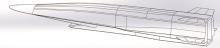
Fig.1
Sketch diagram of 3D profile of reconstructed vehicle
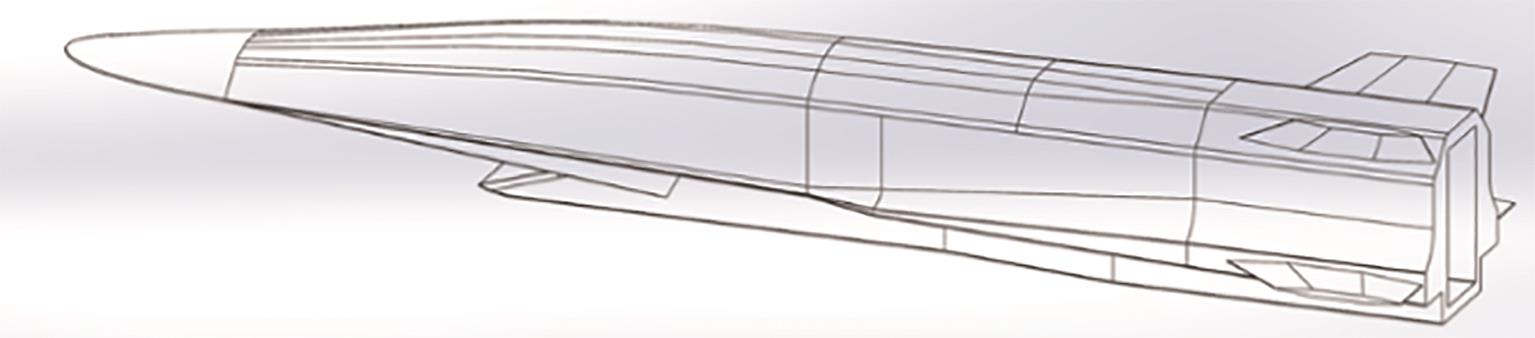
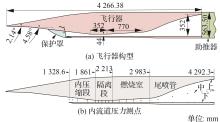
Fig.2
Sketch diagrams of vehicle symmetry plane configuration and pressure monitoring points
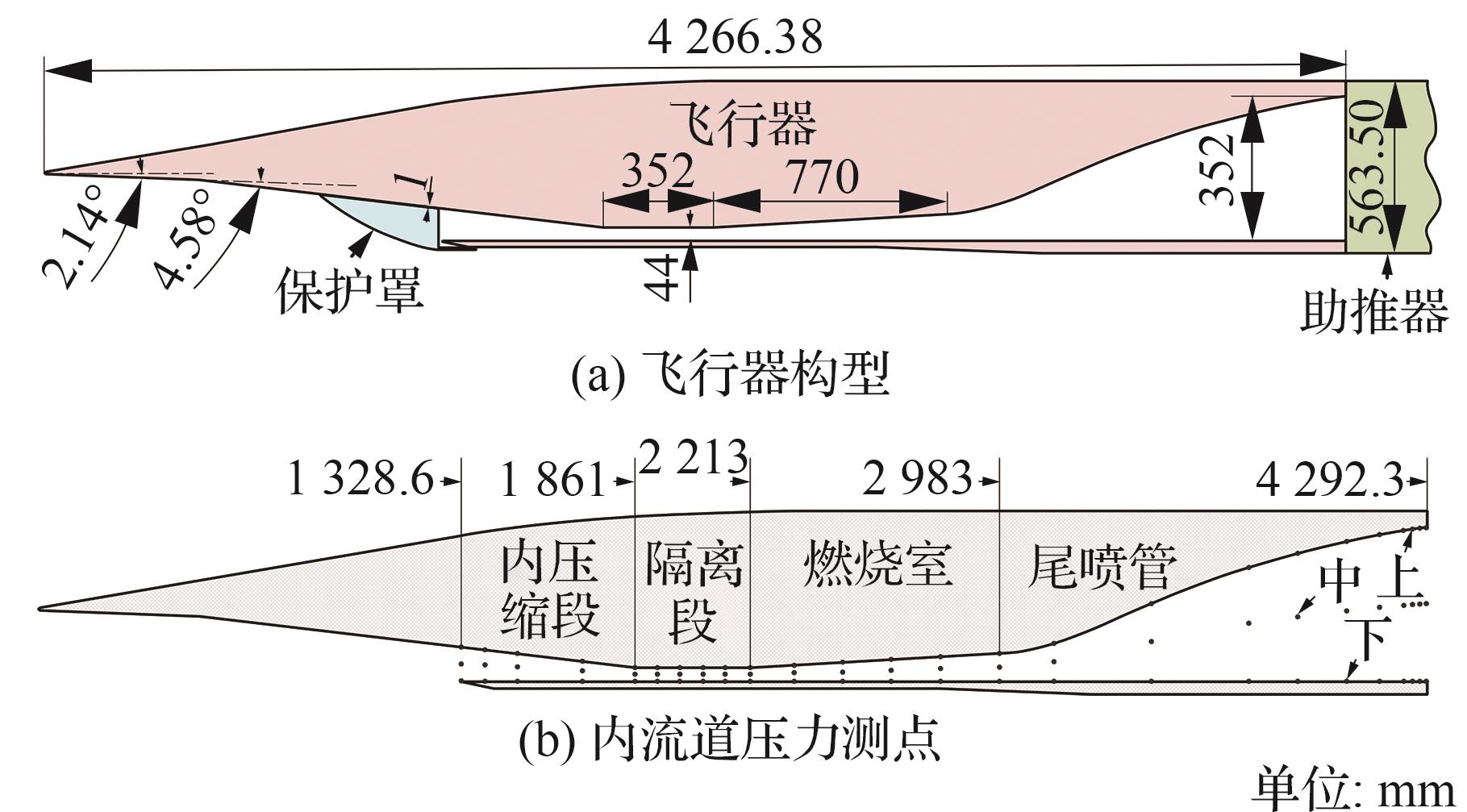
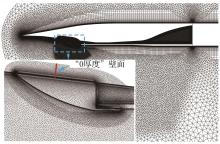
Fig.3
Computational grid
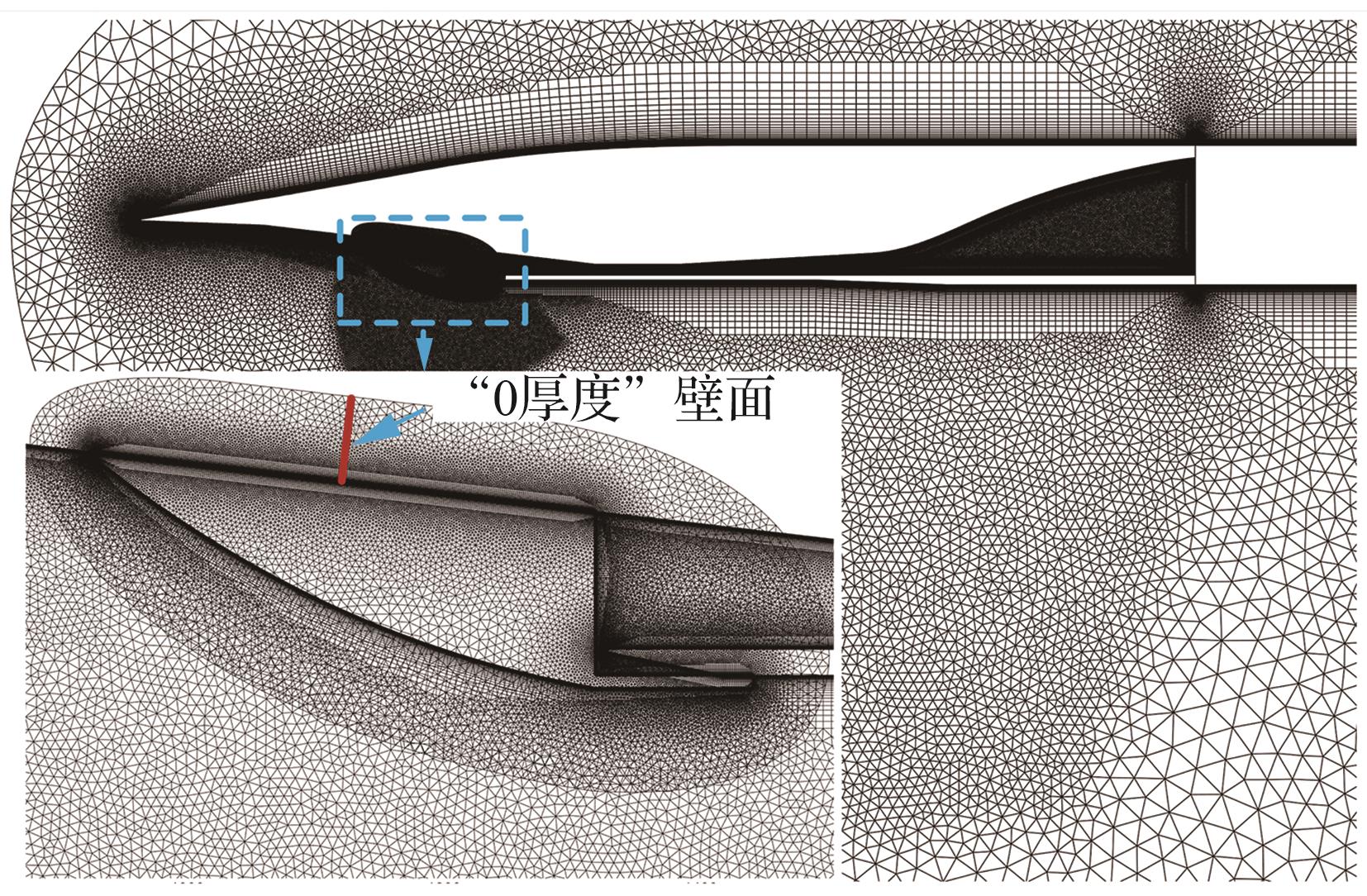
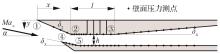
Fig.4
Sketch diagram of inlet configuration[39-40]
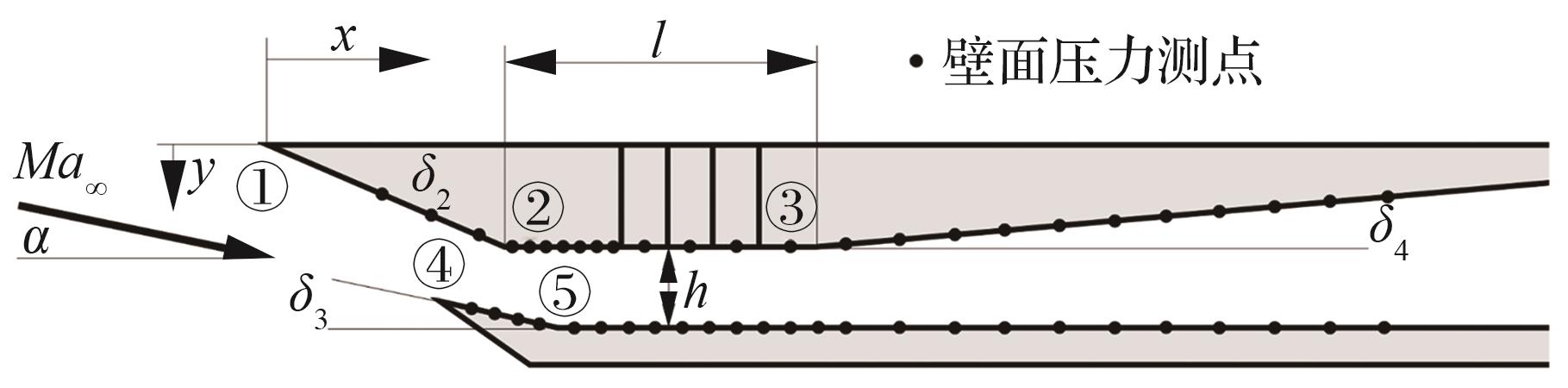
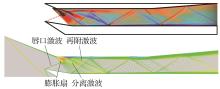
Fig.5
Comparison of flow field structure between calculated Mach contours and schlieren image[39]
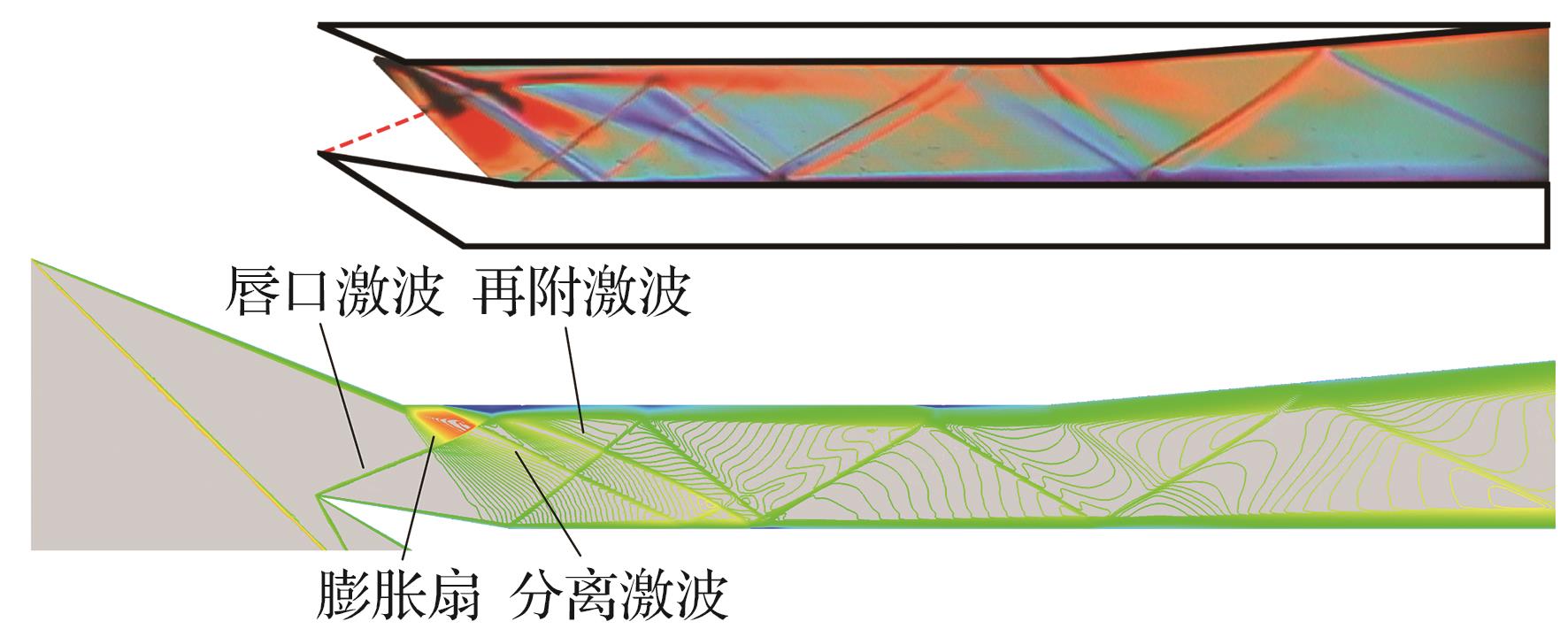
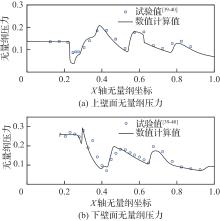
Fig.6
Comparison of pressure distribution within inlet between simulation and test results
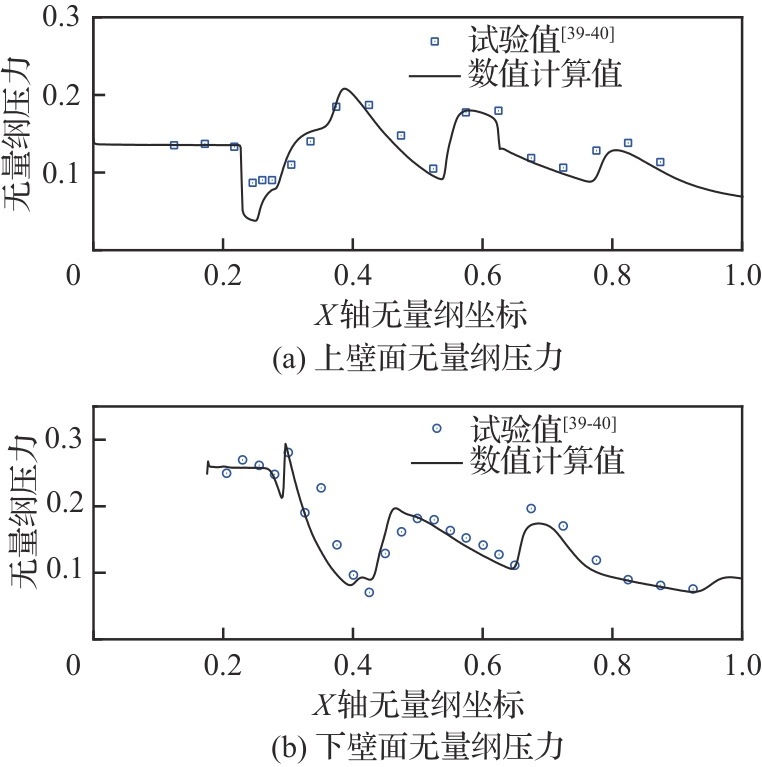
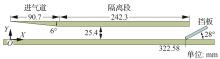
Fig.7
Sketch diagram of inlet/isolator model[41]
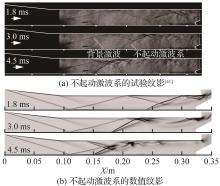
Fig.8
Comparison of unstart shock system in inlet/isolator between simulation and test results
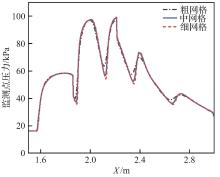
Fig.9
Grid independence verification
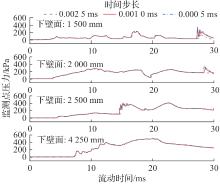
Fig.10
Timestep independence verification
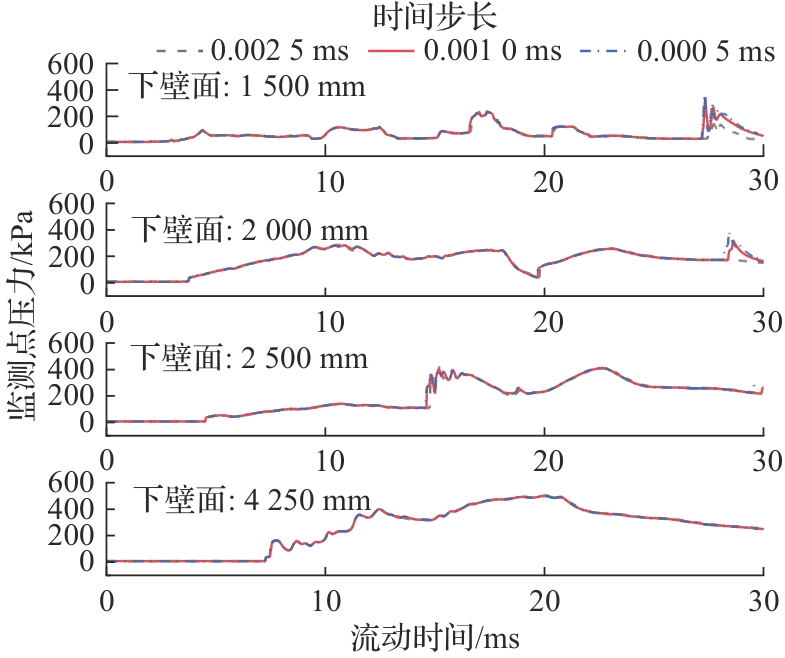
Fig.11
Initial steady flow field before protective cover separation
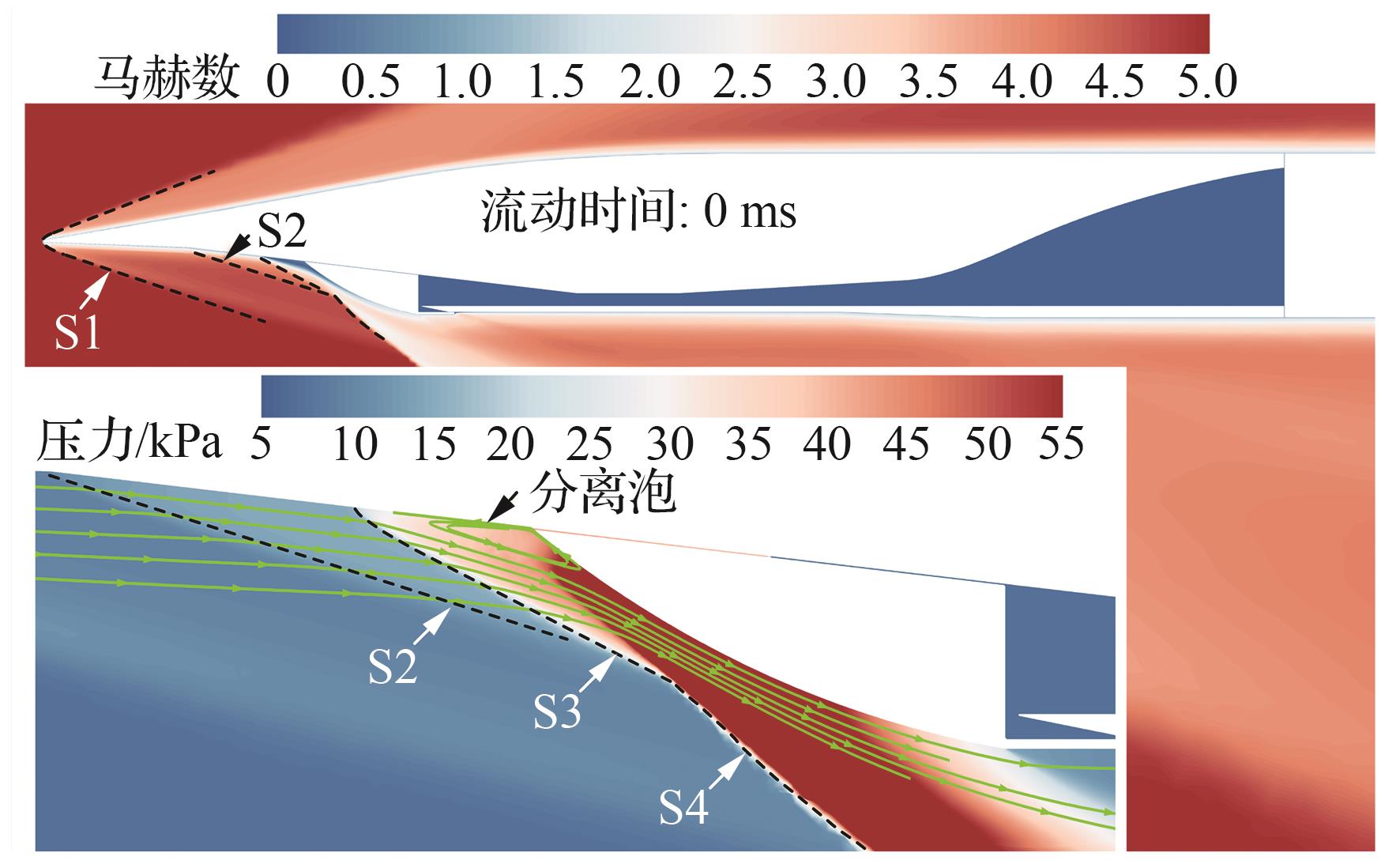
Fig.12
Flow field structures at initial rotation moment of protective cover
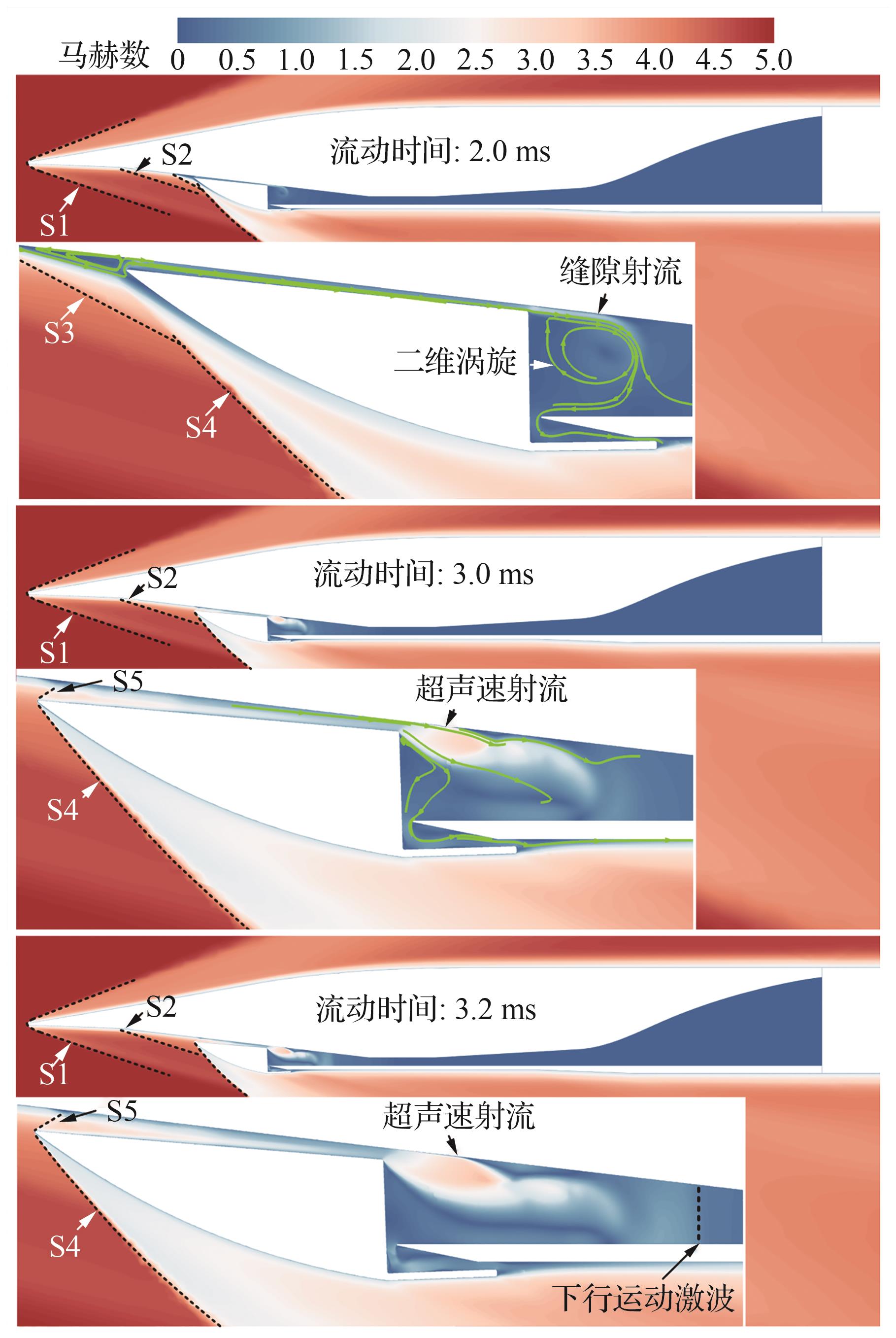
Fig.13
Flow field structures dominated by moving shock during protective cover separation
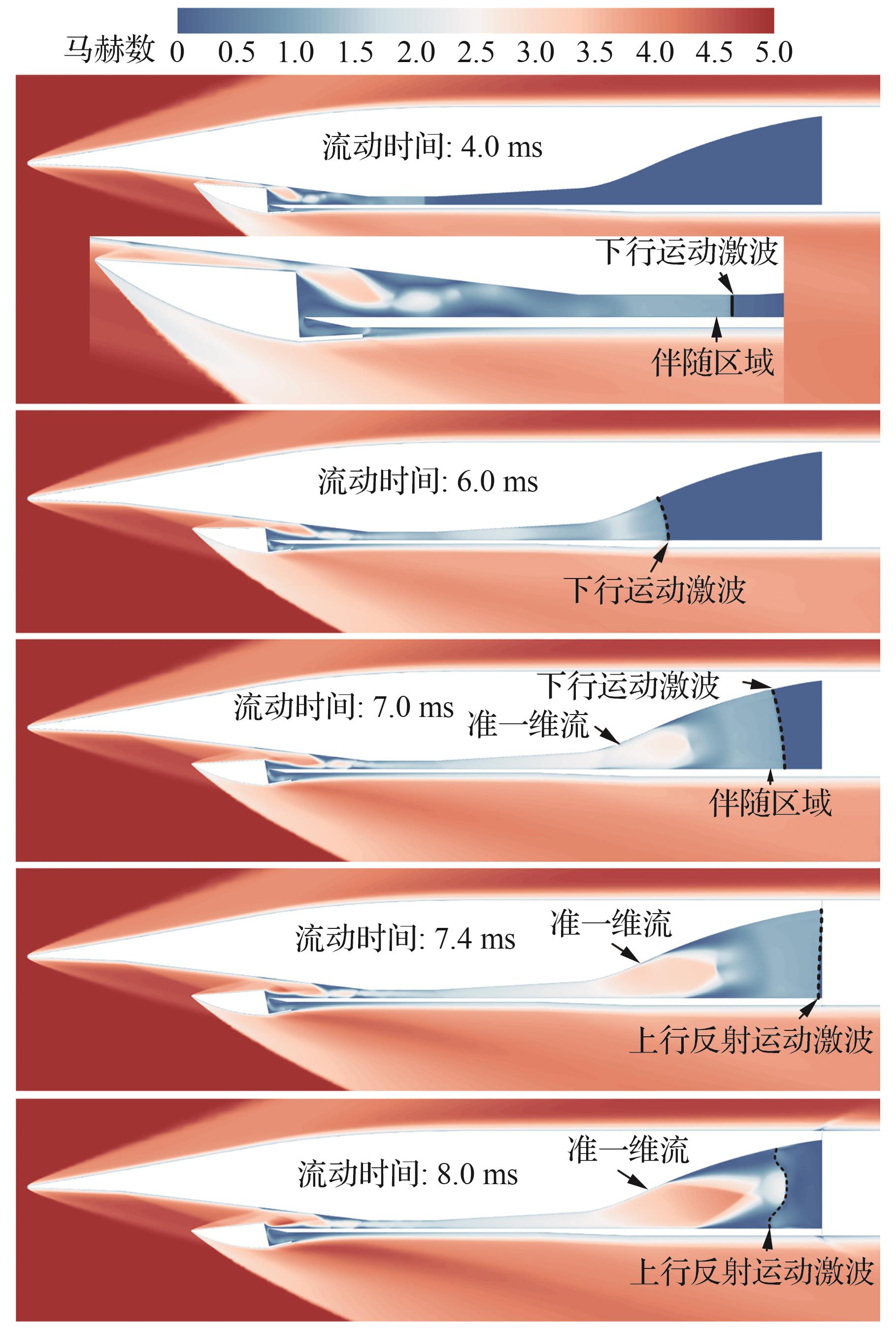
Fig.14
Flow field structures dominated by shock train during protective cover separation
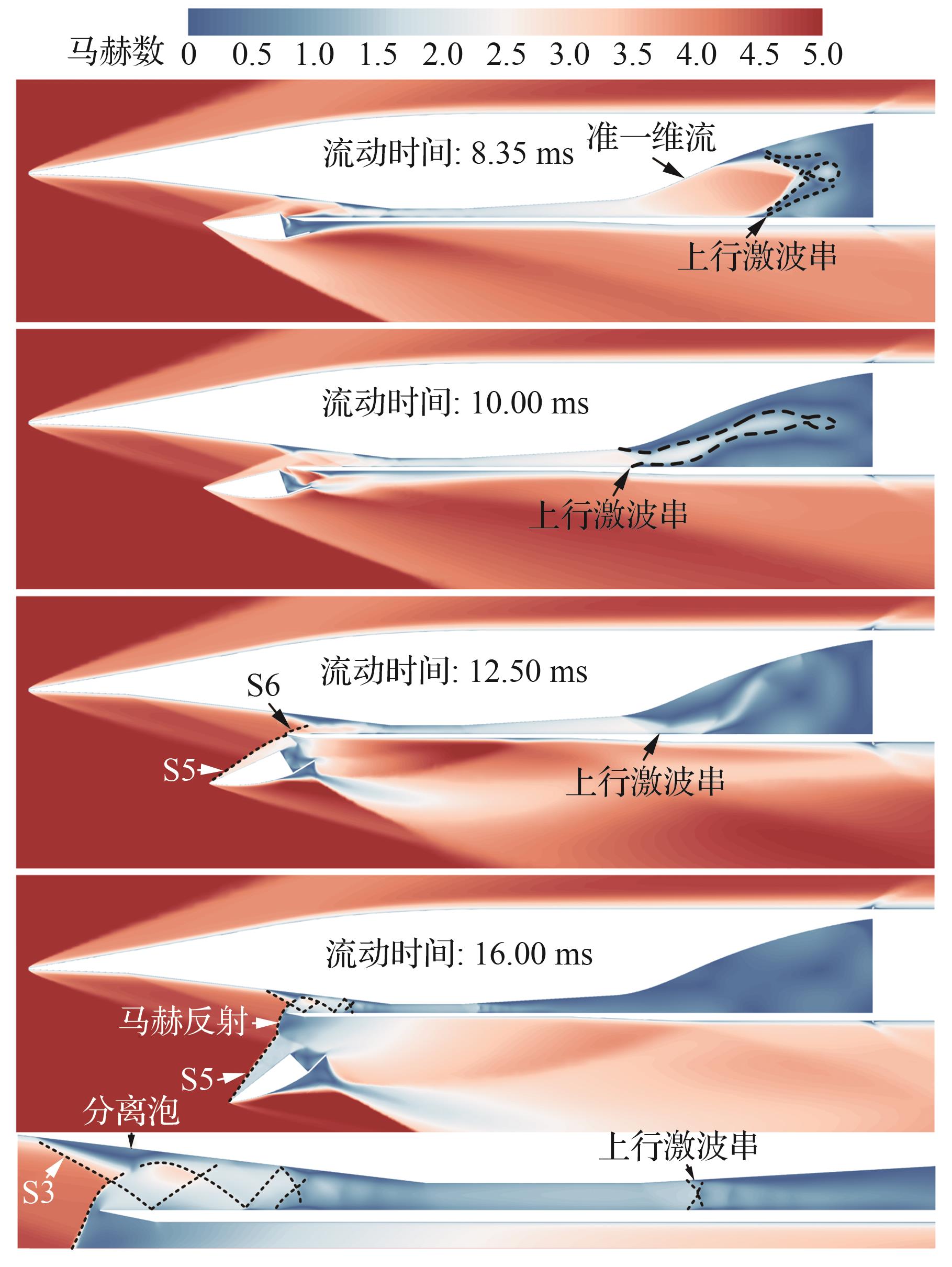
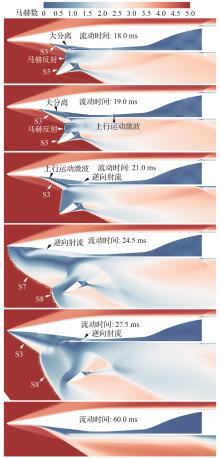
Fig.15
Flow field structures in unstarted status during protective cover separation
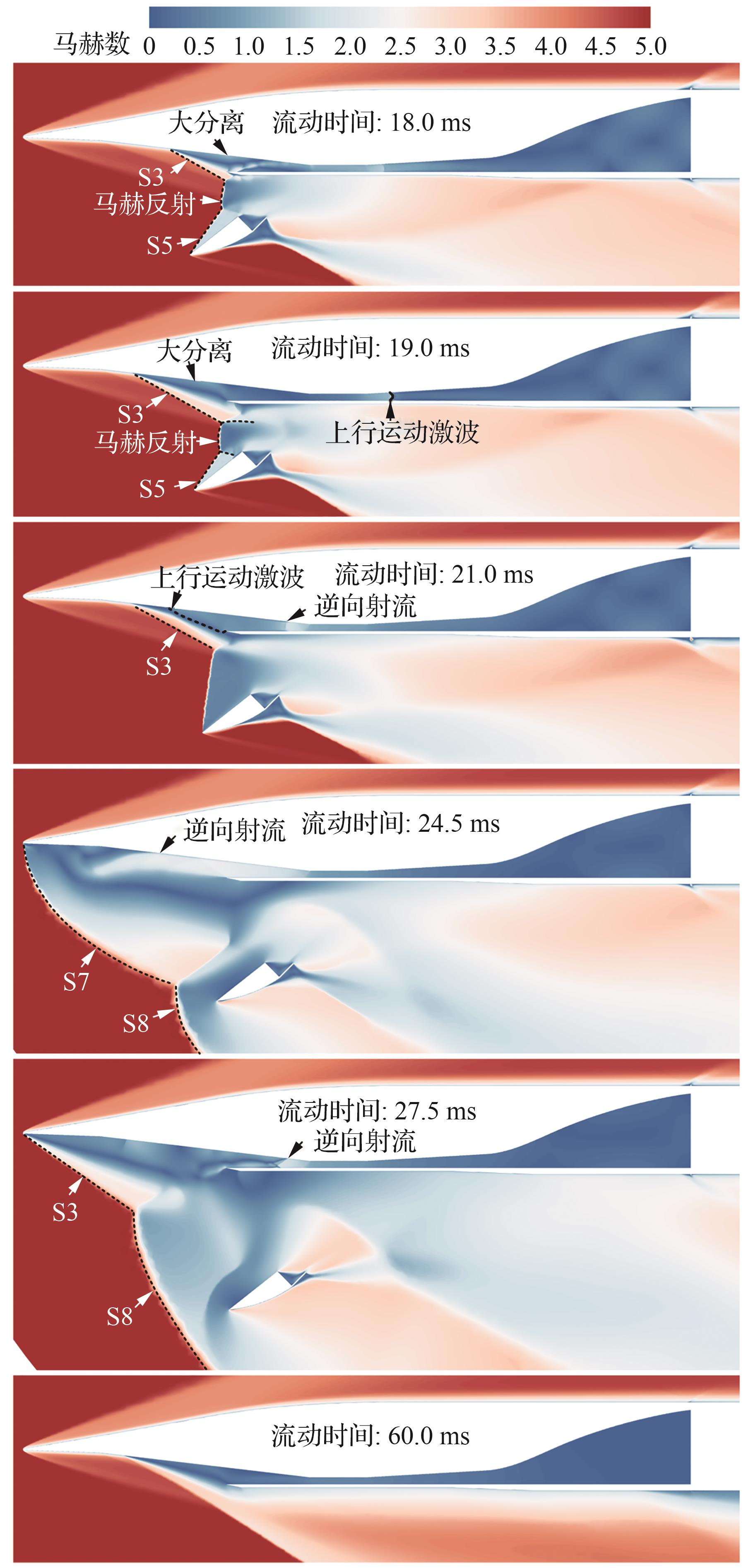
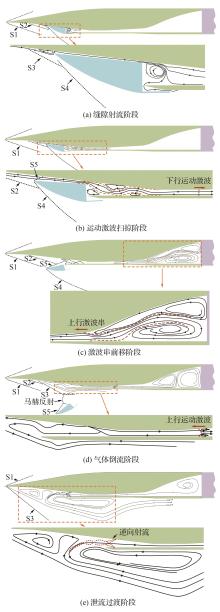
Fig.16
Sketch diagrams of flow field structure during different phases
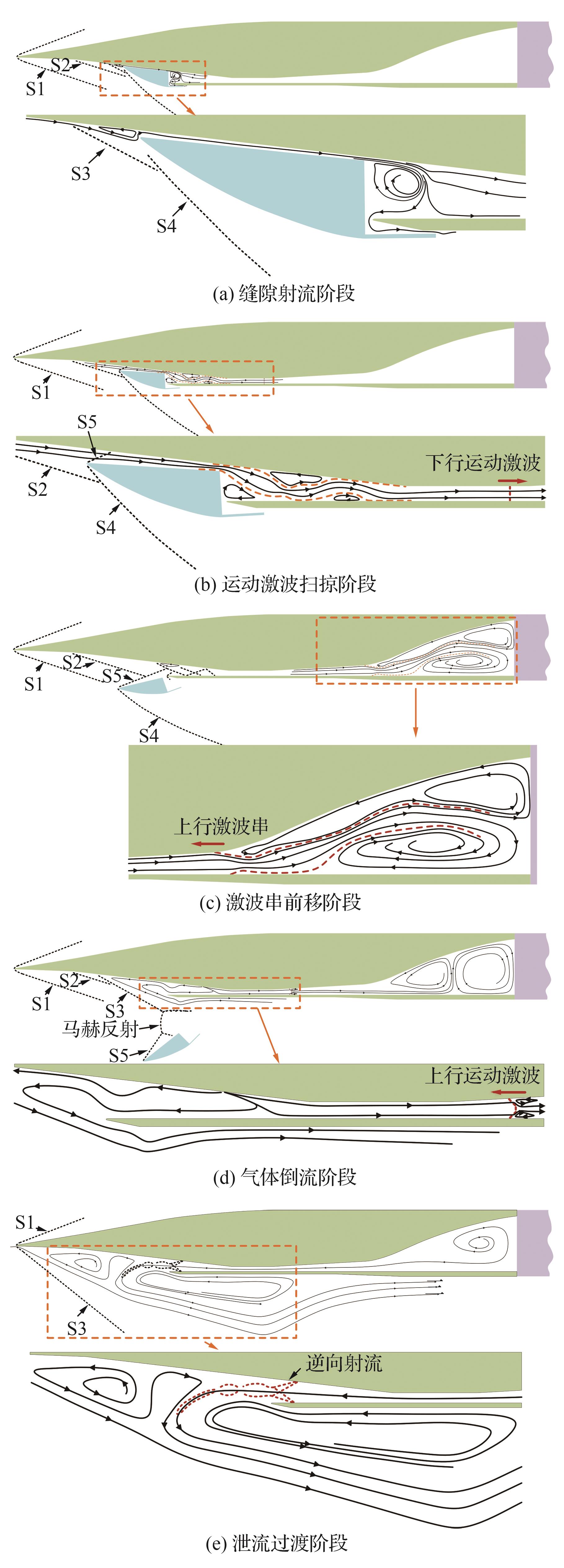
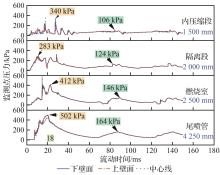
Fig.17
Pressure versus time curves of typical measurement points on internal flow path
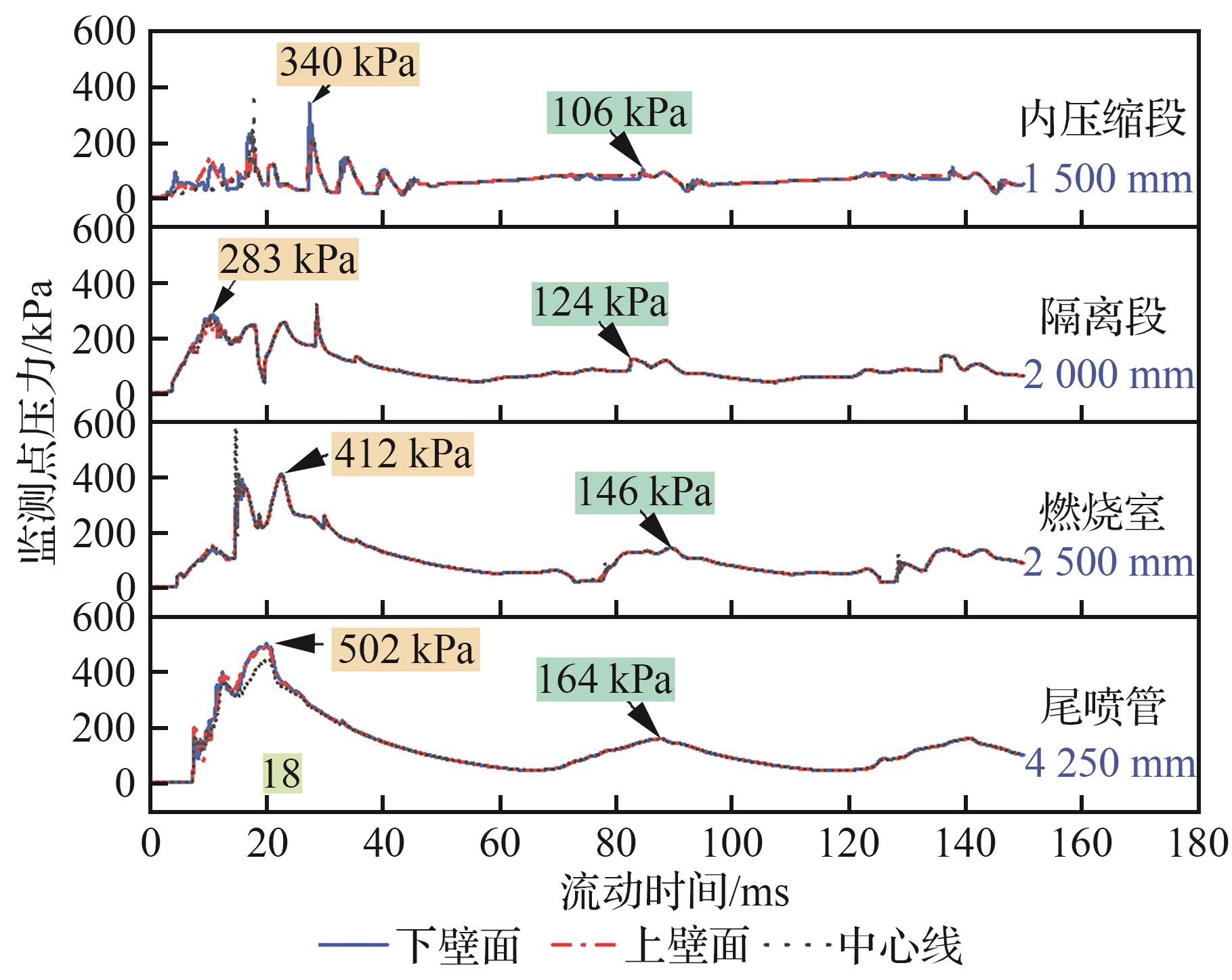
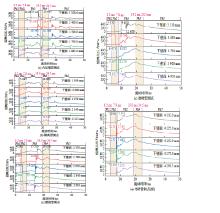
Fig.18
Pressure versus time curves of internal flow path in different phases
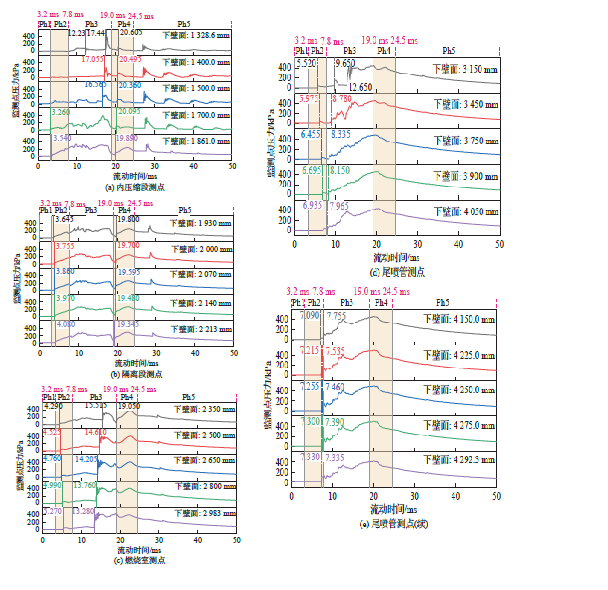

Table 1
Parameters of second pressure surge in internal flow path
| 流场区域 | 压升比 | 波后压力/kPa | 压升原因 |
|---|---|---|---|
| 内压缩段和隔离段 | 2.02~4.25 | 99.8~123.9 | 上行运动激波扫掠 |
| 燃烧室 | 2.31~6.49 | 321.3~464.4 | 激波串前移 |
| 尾喷管 | 2.28~4.96 | 52.5~160.0 | 激波串前移 |
| 尾喷管出口 | 2.70~4.07 | 102.6~162.5 | 运动激波反射 |
Table 2
Maximum pressure peaks and their pulse width parameters in internal flow path
| 流场区域 | 脉冲宽度/ms | 最大压力峰值/kPa | 静压比 | 最大压力来源 | |
|---|---|---|---|---|---|
| 内压缩段 | 0.32~2.77 | 235~580 | 39.5~80.4 | 激波系增压(Ph3) | |
| 隔离段 | 第1组高压 | 11.72~12.12 | 268~300 | 37.1~41.5 | 激波系增压(Ph3) |
| 第2组高压 | 8.72~13.32 | 252~291 | 34.9~40.3 | 高压前传(Ph4) | |
| 燃烧室 | 15.34~18.11 | 53.2~64.3 | 53.2~64.3 | 激波串增压(Ph3)或高压前传(Ph4) | |
| 尾喷管 | 18.19~20.80 | 411~502 | 56.9~69.5 | 压力积蓄(Ph4) | |
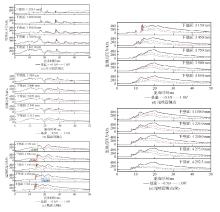
Fig.19
Pressure versus time curves of internal flow path in different cases
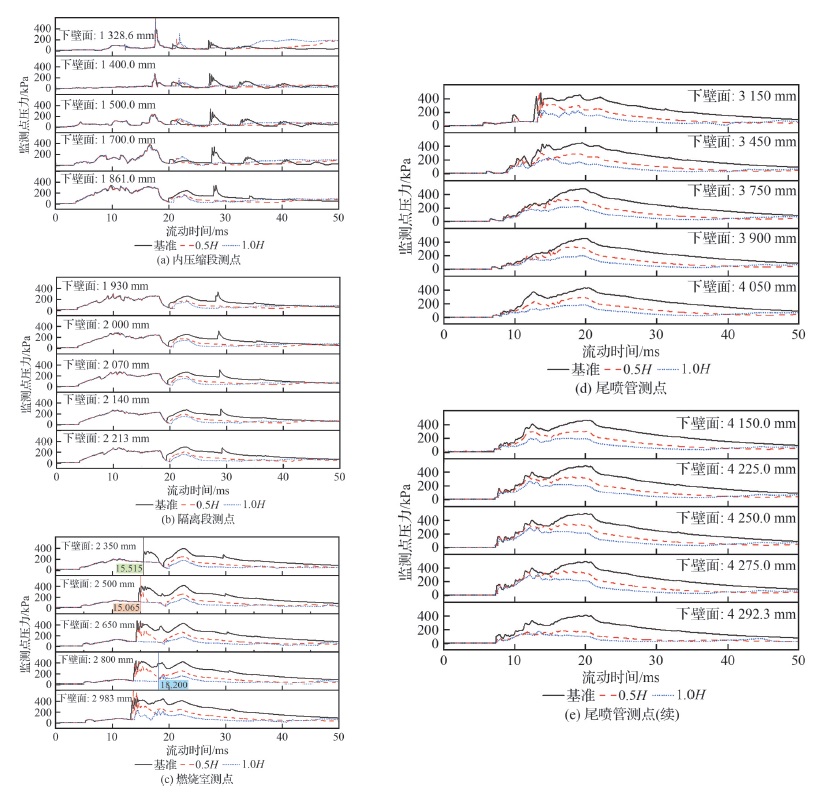
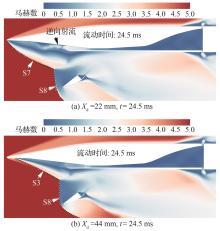
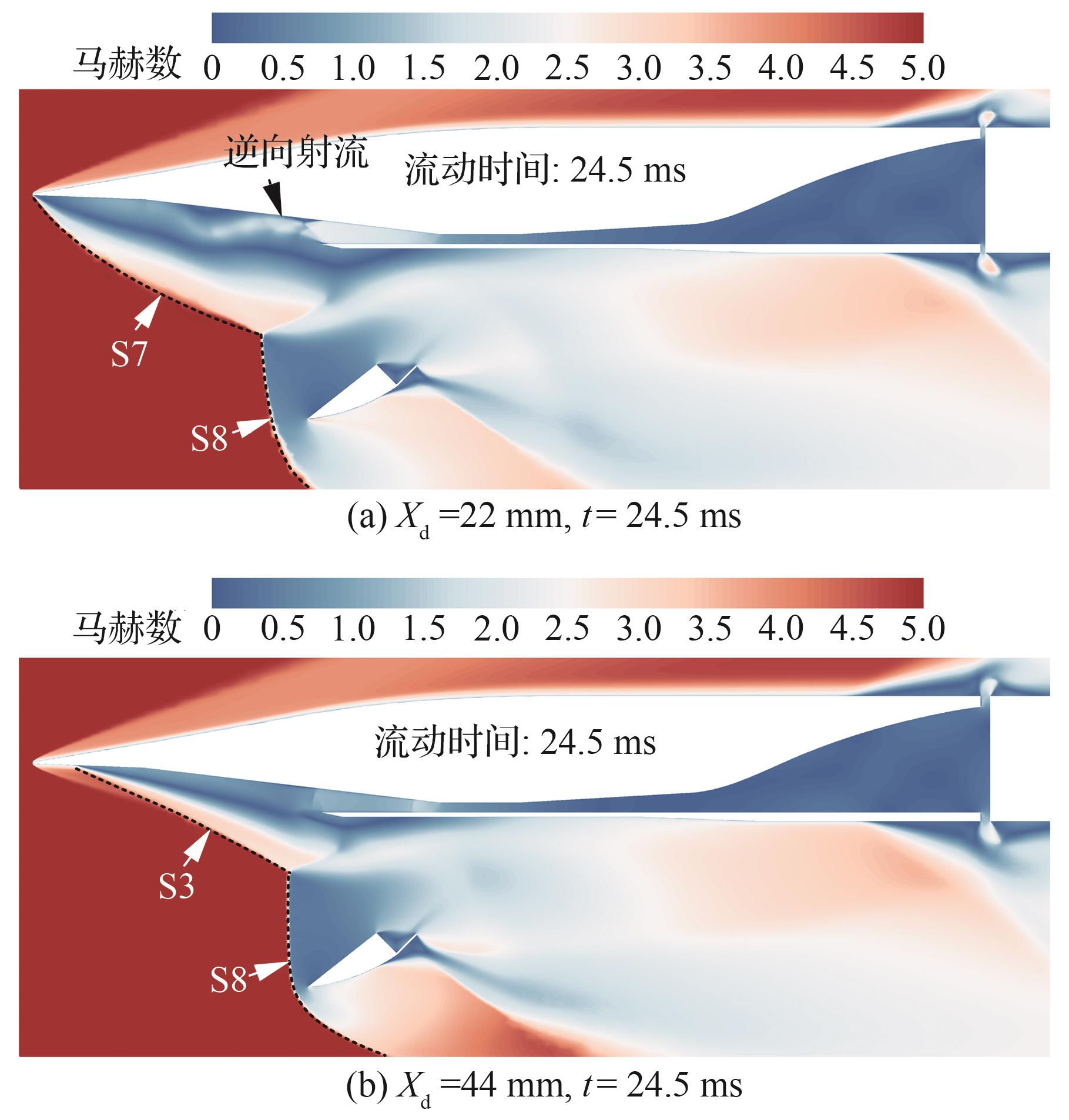
Fig.20
Mach number contour of flow field at 24.5 ms instant in different cases
| [1] | WEN X, LIU J, LI J, et al. Design and numerical simulation of a clamshell-shaped inlet cover for air-breathing hypersonic vehicles[J]. Journal of Zhejiang University: Science A, 2019, 20(5): 347-357. |
| [2] | CHAMBERLAIN R. Time-accurate calculation of the HEDI shroud separation event[C]∥Annual Interceptor Technology Conference. Huntsville: AIAA, 1992. |
| [3] | LI Y, REIMANN B, EGGERS T. Coupled simulation of CFD and flight mechanics with a two-species-gas-model for the hot staging of a multistage rocket[C]∥19th AIAA International Space Planes and Hypersonic Systems and Technologies Conference. Atlanta: AIAA, 2014. |
| [4] | 蒋增辉, 宋威, 陈农, 等. 高超声速风洞子母弹大迎角抛壳投放试验[J]. 实验流体力学, 2016, 30(5): 42-48. |
| JIANG Z H, SONG W, CHEN N, et al. Hypersonic wind tunnel drop-model test on cover ejection from cargo projectile at large angle of attack[J]. Journal of Experiments in Fluid Mechanics, 2016, 30(5): 42-48 (in Chinese). | |
| [5] | 赵飞, 刘丽玲, 石泳, 等. 类X-43A飞行器高超声速分离仿真[J]. 航空学报, 2022, 43(5): 221-230. |
| ZHAO F, LIU L L, SHI Y, et al. Hypersonic separation simulation of aerocraft similar to X-43A[J]. Acta Aeronautica et Astronautica Sinica, 2022, 43(5): 221-230 (in Chinese). | |
| [6] | 唐伟, 刘深深, 余雷, 等. 用于级间分离研究的TBCC动力TSTO气动布局概念设计[J]. 空气动力学学报, 2019, 37(5): 698-704, 721. |
| TANG W, LIU S S, YU L, et al. Conceptual design of TBCC based TSTO configurations for stage seperation investigation[J]. Acta Aerodynamica Sinica, 2019, 37(5): 698-704, 721 (in Chinese). | |
| [7] | 王粤, 汪运鹏, 王春, 等. 一种并联两级入轨飞行器纵向分离方案的数值研究[J]. 航空学报, 2023, 44(11): 127634. |
| WANG Y, WANG Y P, WANG C, et al. Numerical study of longitudinal stage separation for parallel-staged two-stage-to-orbit vehicle[J]. Acta Aeronautica et Astronautica Sinica, 2023, 44(11): 127634 (in Chinese). | |
| [8] | 郭凤美, 余梦伦. 导弹分离设计技术研究[J]. 导弹与航天运载技术, 2014(1): 5-10. |
| GUO F M, YU M L. Research on missile separation design techniques[J]. Missiles and Space Vehicles, 2014(1): 5-10 (in Chinese). | |
| [9] | BLOCKER W, RUEBUSH D. X-43A stage separation system-a flight data evaluation[C]∥AIAA/CIRA 13th International Space Planes and Hypersonics Systems and Technologies Conference. Capua: AIAA, 2005. |
| [10] | 朱学昌, 李浩远, 喻天翔, 等. 低空高速飞行器整流罩分离技术研究现状和展望[J]. 固体火箭技术, 2014, 37(1): 12-17. |
| ZHU X C, LI H Y, YU T X, et al. Research status and prospects for low-altitude and high-speed fairing separation technique[J]. Journal of Solid Rocket Technology, 2014, 37(1): 12-17 (in Chinese). | |
| [11] | 王振国, 梁剑寒, 丁猛, 等. 高超声速飞行器动力系统研究进展[J]. 力学进展, 2009, 39(6): 716-739. |
| WANG Z G, LIANG J H, DING M, et al. A review on hypersonic airbreathing propulsion system[J]. Advances in Mechanics, 2009, 39(6): 716-739 (in Chinese). | |
| [12] | HOLLAND S D, WOODS W C, ENGELUND W C. Hyper-X research vehicle experimental aerodynamics test program overview[J]. Journal of Spacecraft and Rockets, 2001, 38(6): 828-835. |
| [13] | HAUDRICH D, BRASE L. Flutter and divergence assessment of the HyFly missile[C]∥50th AIAA/ASME/ASCE/AHS/ASC Structures, Structural Dynamics, and Materials Conference. California: AIAA, 2009. |
| [14] | BOLENDER M A, DAUBY B, MUSE J A, et al. HIFiRE 6: overview and status update 2014[C]∥20th AIAA International Space Planes and Hypersonic Systems and Technologies Conference. Glasgow: AIAA, 2015. |
| [15] | MARSHALL L, CORPENING G, SHERRILL R. A chief engineer’s view of the NASA X-43A scramjet flight test[C]∥AIAA/CIRA 13th International Space Planes and Hypersonics Systems and Technologies Conference. Capua: AIAA, 2005. |
| [16] | FOELSCHE R, BECKEL S, BETTI A, et al. Flight results from a program to develop a freeflight atmospheric scramjet test technique[C]∥14th AIAA/AHI Space Planes and Hypersonic Systems and Technologies Conference. Canberra: AIAA, 2006. |
| [17] | 董楠. 吸气式高超声速飞行器多体分离流动特性及机理的数值研究[D]. 武汉: 华中科技大学, 2022. |
| DONG N. Numerical study on flow characteristics and mechanism of air-breathing hypersonic aircrafts with multi-body separation[D]. Wuhan: Huazhong University of Science and Technology, 2022 (in Chinese). | |
| [18] | 郭善广, 柳军, 金亮, 等. 高超飞行器内流道激波振荡问题的数值研究及试验验证[J]. 实验流体力学, 2012, 26(1): 7-11. |
| GUO S G, LIU J, JIN L, et al. Numerical simulation and experiment validation on shock oscillations of inner flow path of hypersonic vehicle[J]. Journal of Experiments in Fluid Mechanics, 2012, 26(1): 7-11 (in Chinese). | |
| [19] | 邹东阳, 吴岸平, 林敬周. 前向抛罩分离安全判定方法[J]. 航空学报, 2025, 46(12): 80-89. |
| ZOU D Y, WU A P, LIN J Z. Safety judgment method of forward separation of protective shield[J]. Acta Aeronautica et Astronautica Sinica, 2025, 46(12): 80-89 (in Chinese). | |
| [20] | 宋威, 艾邦成. 多体分离动力学研究进展[J]. 航空学报, 2022, 43(9): 025950. |
| SONG W, AI B C. Multibody separation dynamics: review[J]. Acta Aeronautica et Astronautica Sinica, 2022, 43(9): 025950 (in Chinese). | |
| [21] | 闻讯, 柳军, 夏智勋. 吸气式高超声速飞行器助推分离过程数值仿真[J]. 国防科技大学学报, 2019, 41(1): 34-40. |
| WEN X, LIU J, XIA Z X. Numerical simulation of booster separation for an air-breathing hypersonic vehicle[J]. Journal of National University of Defense Technology, 2019, 41(1): 34-40 (in Chinese). | |
| [22] | BUNING P G, WONG T C, DILLEY A D, et al. Computational fluid dynamics prediction of hyper-X stage separation aerodynamics[J]. Journal of Spacecraft and Rockets, 2001, 38(6): 820-827. |
| [23] | 庞川博, 向玉伟, 马兴普, 等. 高超声速导弹进气道整流罩分离气动特性研究[J]. 弹箭与制导学报, 2020, 40(3): 123-128, 134. |
| PANG C B, XIANG Y W, MA X P, et al. Research on aerodynamic characteristics of inlet fairing separation from a hypersonic missile[J]. Journal of Projectiles, Rockets, Missiles and Guidance, 2020, 40(3): 123-128, 134 (in Chinese). | |
| [24] | 朱国祥, 王磊, 苑朝凯, 等. 进气道整流罩全尺度动态分离试验研究[J]. 实验流体力学, 2019, 33(4): 45-51. |
| ZHU G X, WANG L, YUAN C K, et al. The experimental investigation on full-scale dynamic separation for an inlet shroud[J]. Journal of Experiments in Fluid Mechanics, 2019, 33(4): 45-51 (in Chinese). | |
| [25] | 钟俊, 林敬周, 解福田, 等. 高超声速大动压下整流罩分离测力风洞试验[J]. 实验流体力学, 2024, 38(2): 98-106. |
| ZHONG J, LIN J Z, XIE F T, et al. Wind tunnel force test of fairing separation in hypersonic and high dynamic pressure situation[J]. Journal of Experiments in Fluid Mechanics, 2024, 38(2): 98-106 (in Chinese). | |
| [26] | 林敬周, 王雄, 钟俊, 等. 高马赫数多体分离试验技术研究与应用[J]. 推进技术, 2020, 41(4): 925-933. |
| LIN J Z, WANG X, ZHONG J, et al. Investigation and application of high Mach number multi-body separation test technique[J]. Journal of Propulsion Technology, 2020, 41(4): 925-933 (in Chinese). | |
| [27] | LIEN J, BOSE D, MARTIN J. Automated sensitivity analysis of hyper-X (X-43A) separation simulation[C]∥AIAA Modeling and Simulation Technologies Conference and Exhibit. Providence: AIAA, 2004. |
| [28] | 刘广, 江玉刚, 任智毅, 等. 整体式整流罩高速分离流固耦合仿真[J]. 战术导弹技术, 2018(3): 30-37. |
| LIU G, JIANG Y G, REN Z Y, et al. Fluid-structure coupling simulation of integrated fairing high-speed separation[J]. Tactical Missile Technology, 2018(3): 30-37 (in Chinese). | |
| [29] | 白晓征, 刘君, 郭正, 等. 冲压发动机进气道压力振荡过程的数值研究[J]. 推进技术, 2008, 29(5): 562-565. |
| BAI X Z, LIU J, GUO Z, et al. Numerical simulation of pressure oscillation in ramjet inlet[J]. Journal of Propulsion Technology, 2008, 29(5): 562-565 (in Chinese). | |
| [30] | 赵星宇, 王翼, 范晓樯, 等. 高速进气道抛罩过程内流场演化特性研究[J]. 推进技术, 2021, 42(5): 970-979. |
| ZHAO X Y, WANG Y, FAN X Q, et al. Internal flow field evolution characteristics for inlet cover separation of high speed inlet[J]. Journal of Propulsion Technology, 2021, 42(5): 970-979 (in Chinese). | |
| [31] | WANG S Y, LI C, CHEN W. Numerical investigation on unsteady flows with an air-breathing hypersonic vehicle during its shroud separation[C]∥21st AIAA International Space Planes and Hypersonics Technologies Conference. Xiamen: AIAA, 2017. |
| [32] | 邓艳丹, 黄生洪, 杨基明, 等. 一种X-51A相似飞行器模型的气动特性初探[J]. 空气动力学学报, 2013, 31(3): 376-380, 387. |
| DENG Y D, HUANG S H, YANG J M, et al. A preliminary investigation on aerodynamic characteristics of an X-51A-like aircraft model[J]. Acta Aerodynamica Sinica, 2013, 31(3): 376-380, 387 (in Chinese). | |
| [33] | 刘雪松. X-51A高超声速飞行器三维重建及气动/隐身特性分析[D]. 南京: 南京航空航天大学, 2015. |
| LIU X S. Three-dimensional reconstruction and analysis of aerodynamic and stealth characteristic of X-51A hypersonic vehicle[D]. Nanjing: Nanjing University of Aeronautics and Astronautics, 2015 (in Chinese). | |
| [34] | BORG M P. Laminar instability and transition on the X-51A[D]. West Lafayette: Purdue University, 2009. |
| [35] | MENTER F R. Two-equation eddy-viscosity turbulence models for engineering applications[J]. AIAA Journal, 1994, 32(8): 1598-1605. |
| [36] | JIAO X L, CHANG J T, WANG Z Q, et al. Numerical study on hypersonic nozzle-inlet starting characteristics in a shock tunnel[J]. Acta Astronautica, 2017, 130: 167-179. |
| [37] | 陶渊. 高超声速进气道中激波边界层干扰现象研究[D]. 长沙: 国防科技大学, 2018. |
| TAO Y. The study of the shock wave/boundary layer interactions in hypersonic inlet[D]. Changsha: National University of Defense Technology, 2018 (in Chinese). | |
| [38] | 王巍. 有相对运动的多体分离过程非定常数值算法研究及实验验证[D]. 长沙: 国防科学技术大学, 2008. |
| WANG W. Numerical simulation technique research and experiment verification for unsteady multi-body flowfield involving relative movement[D]. Changsha: National University of Defense Technology, 2008 (in Chinese). | |
| [39] | HERRMANN C, KOSCHEL W. Experimental investigation of the internal compression inside a hypersonic intake[C]∥38th AIAA/ASME/SAE/ASEE Joint Propulsion Conference & Exhibit. Indianapolis: AIAA, 2002. |
| [40] | REINARTZ B U, HERRMANN C D, BALLMANN J, et al. Aerodynamic performance analysis of a hypersonic inlet isolator using computation and experiment[J]. Journal of Propulsion and Power, 2003, 19(5): 868-875. |
| [41] | WAGNER J L, YUCEIL K B, VALDIVIA A, et al. Experimental investigation of unstart in an inlet/isolator model in Mach 5 flow[J]. AIAA Journal, 2009, 47(6): 1528-1542. |
| [42] | RONDEAU M C, JORTIS T R. X-51A scramjet demonstrator program: waverider ground and flight test[C]∥44th International SETP Southwest Flight Test Symposium. Ft Worth, TX: Society of Flight Test Engineers, 2013. |
| [43] | 陶渊, 范晓樯, 刘俊林. 超声速连续风洞喷管启动过程分析[J]. 推进技术, 2015, 36(1): 24-29. |
| TAO Y, FAN X Q, LIU J L. Studies on starting process of a continuous supersonic wind tunnel nozzle[J]. Journal of Propulsion Technology, 2015, 36(1): 24-29 (in Chinese). | |
| [44] | LIAN X, XU H, DUAN L, et al. Flow structure and parameter evaluation of conical convergent-divergent nozzle supersonic jet flows[J]. Physics of Fluids, 2023, 35(6): 066109. |
| [45] | 高周景明, 蒋凌峰, 朱佳宇, 等. 电子初始位置对高能电子空间及时间辐射特性的影响[J]. 光散射学报, 2023, 35(1): 71-77. |
| GAO Z J M, JIANG L F, ZHU J Y, et al. Influence of electron initial position on space and time radiation characteristics of high energy electrons[J]. The Journal of Light Scattering, 2023, 35(1): 71-77 (in Chinese). |
| [1] | Liunan LI, Xiao QU, Yanfeng ZHANG, Xingen LU, Junqiang ZHU. Effect of end zone boundary layer skew on secondary flow in high-lift turbine [J]. Acta Aeronautica et Astronautica Sinica, 2026, 47(5): 132394-132394. |
| [2] | Dong LI, Yining ZHANG, Wenhui LING, Guozhu LIANG, Hao MENG. Inlet flow characteristics analysis of air-breathing rotating detonation engine [J]. Acta Aeronautica et Astronautica Sinica, 2025, 46(2): 130732-130732. |
| [3] | Dongyang ZOU, Anping WU, Jingzhou LIN. Safety judgment method of forward separation of protective shield [J]. Acta Aeronautica et Astronautica Sinica, 2025, 46(12): 131005-131005. |
| [4] | Shaoqiang HAN, Wenping SONG, Zhonghua HAN, Jianhua XU. High-accuracy numerical-simulation of unsteady flow over high-speed coaxial rigid rotors [J]. Acta Aeronautica et Astronautica Sinica, 2024, 45(9): 529064-529064. |
| [5] | Zhihao ZHU, Xiuming SUI, Jian PU, Long HAO, Wei ZHAO, Qingjun ZHAO. Aerodynamic load of multistage vaneless counterrotating turbine under wake/shock rotor/rotor interactions [J]. Acta Aeronautica et Astronautica Sinica, 2024, 45(24): 630582-630582. |
| [6] | Yunxiang FAN, Huanan AI, Mingzhen WANG, Kai CAO, Xuejun LIU, Hongqiang LYU. Unsteady hydrodynamic load reconstruction of seaplane based on deep learning [J]. Acta Aeronautica et Astronautica Sinica, 2024, 45(20): 129882-129882. |
| [7] | Songbai WANG, Yuyang HAO, Yadong WU, Yong CHEN, Huawei YU, Lin DU. Research progress on rotating instability of aeroengine compressor [J]. Acta Aeronautica et Astronautica Sinica, 2024, 45(16): 29851-029851. |
| [8] | Cheng ZHANG, Haoyuan REN, Tailong SHI, Wendi DAI. Multidisciplinary full-time coupling methods of folding fin containing non-linear connections and their applications [J]. Acta Aeronautica et Astronautica Sinica, 2023, 44(S2): 729461-729461. |
| [9] | Fangjian WANG, Ke XIE, Jin LIU, Yuhui SONG, Han QIN, Lan CHEN. Unsteady flow and wing rock characteristics of low aspect ratio flying-wing [J]. ACTA AERONAUTICAET ASTRONAUTICA SINICA, 2023, 44(4): 126449-126449. |
| [10] | Yue WANG, Yunpeng WANG, Zonglin JIANG. Test technology of longitudinal stage separation for two-stage-to-orbit vehicle in shock tunnel [J]. Acta Aeronautica et Astronautica Sinica, 2023, 44(17): 128126-128126. |
| [11] | Gaiqi LI, Dongyang MA, Du LI, Shaorong LIU, Yanmei YANG. Surge test on newly developing civil turboshaft engine under take⁃off condition [J]. Acta Aeronautica et Astronautica Sinica, 2023, 44(14): 628190-628190. |
| [12] | Hongliang ZHAO, Wenqiang ZHANG, Jiahui QIU, Min ZHANG, Juan DU, Chaoqun NIE. Unsteady simulation of stall process in transonic compressor with total temperature distortion [J]. Acta Aeronautica et Astronautica Sinica, 2023, 44(14): 628319-628319. |
| [13] | Xiaodong LIU, Pengxin LIU, Chen LI, Dong SUN, Xianxu YUAN. Direct numerical simulation of high enthalpy shock wave/turbulent boundary layer interaction [J]. Acta Aeronautica et Astronautica Sinica, 2023, 44(13): 127832-127832. |
| [14] | Yue WANG, Yunpeng WANG, Chun WANG, Zonglin JIANG. Numerical study of longitudinal stage separation for parallel-staged two-stage-to-orbit vehicle [J]. ACTA AERONAUTICAET ASTRONAUTICA SINICA, 2023, 44(11): 127634-127634. |
| [15] | WU Qiang, XU Haojun, WEI Yang, PEI Binbin, XUE Yuan. Aerodynamics/flight dynamics coupling characteristics of aircraft under icing conditions [J]. ACTA AERONAUTICAET ASTRONAUTICA SINICA, 2022, 43(8): 125566-125566. |
| Viewed | ||||||
|
Full text |
|
|||||
|
Abstract |
|
|||||
Address: No.238, Baiyan Buiding, Beisihuan Zhonglu Road, Haidian District, Beijing, China
Postal code : 100083
E-mail:hkxb@buaa.edu.cn
Total visits: 6658907 Today visits: 1341All copyright © editorial office of Chinese Journal of Aeronautics
All copyright © editorial office of Chinese Journal of Aeronautics
Total visits: 6658907 Today visits: 1341

 CJA
CJA
