Acta Aeronautica et Astronautica Sinica ›› 2026, Vol. 47 ›› Issue (8): 132620.doi: 10.7527/S1000-6893.2025.32620
• Fluid Mechanics and Flight Mechanics • Previous Articles
Cong ZENG, Yangyang ZENG, Simeng JING, Guoqing ZHAO, Qijun ZHAO( )
)
Received:2025-07-24
Revised:2025-08-23
Accepted:2025-12-04
Online:2025-12-17
Published:2025-12-15
Contact:
Qijun ZHAO
E-mail:zhaoqijun@nuaa.edu.cn
Supported by:CLC Number:
Cong ZENG, Yangyang ZENG, Simeng JING, Guoqing ZHAO, Qijun ZHAO. Aerodynamic interference characteristics and wake evolution of rotor-wing in ground effect[J]. Acta Aeronautica et Astronautica Sinica, 2026, 47(8): 132620.
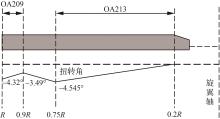
Fig.1
Geometric model schematic diagram of Helishape 7A rotor
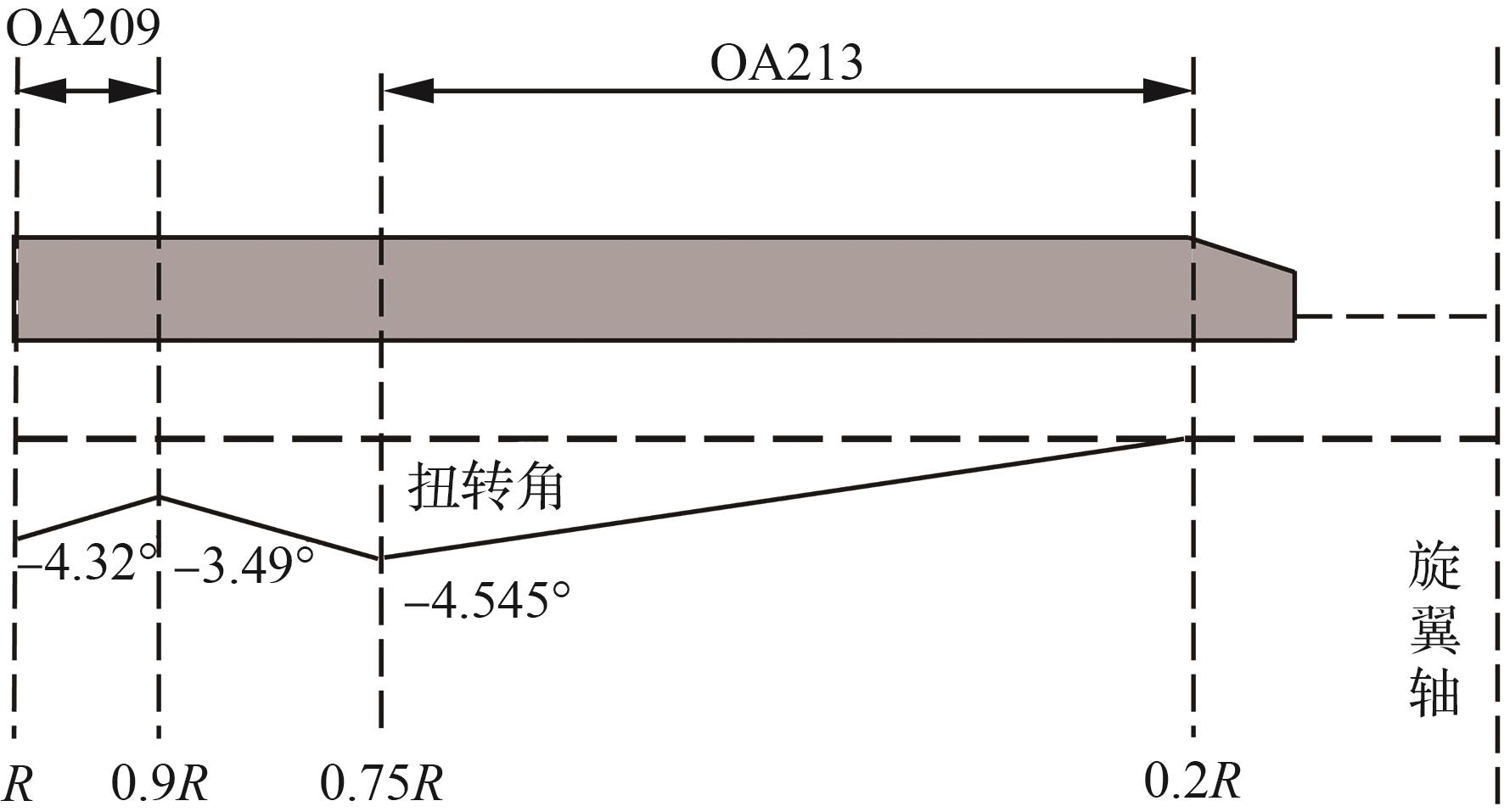
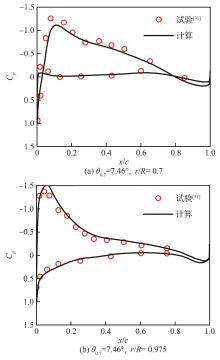
Fig.2
Surface pressure coefficient distribution of Helishape 7A rotor
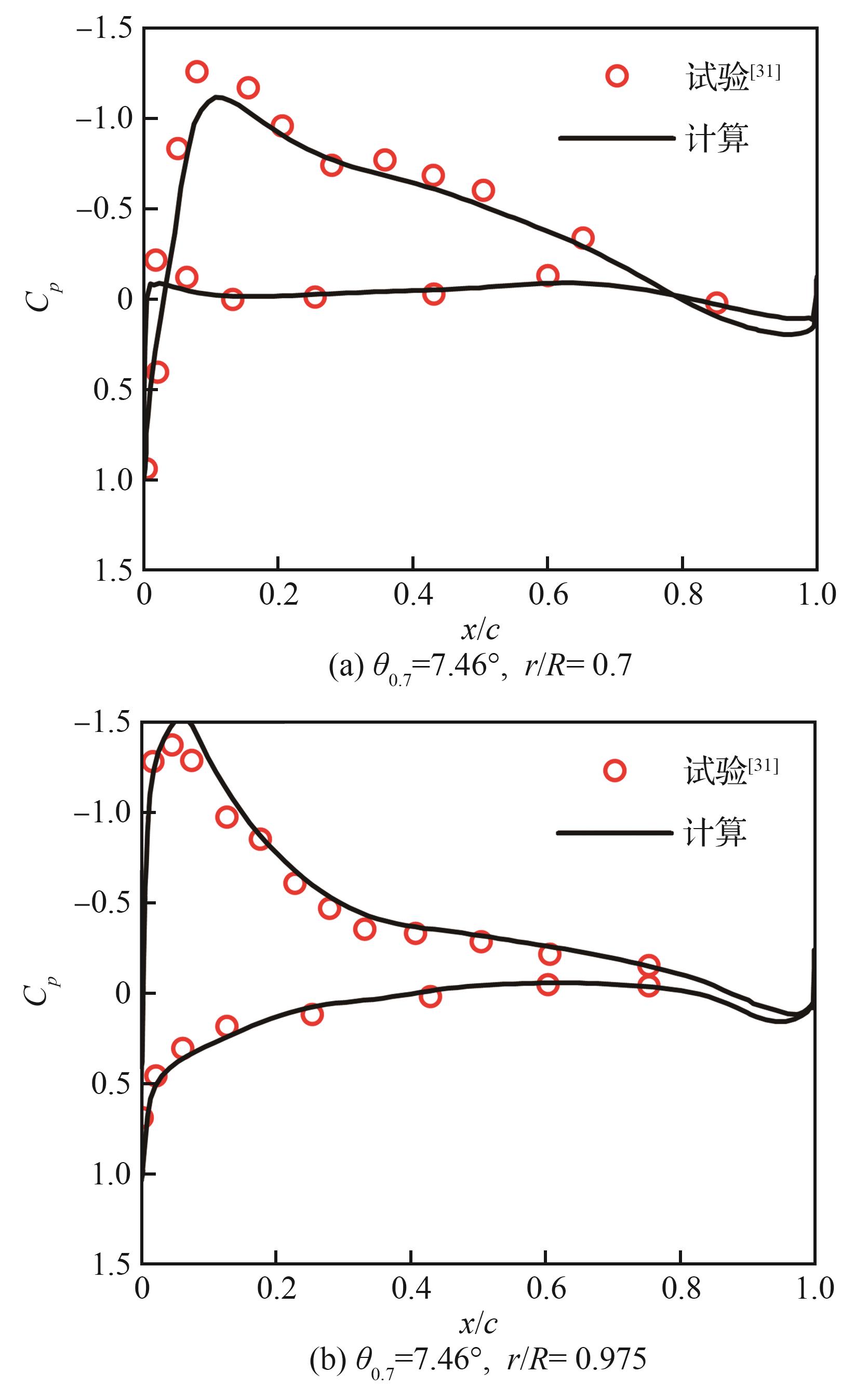

Table 1
Main parameters of tail rotor
| 参数 | 数值 |
|---|---|
| 桨叶半径/m | 1.105 |
| 桨叶根切/m | 0.425 |
| 桨叶片数 | 4 |
| 桨叶翼型 | NPL9615 |
| 桨叶弦长/m | 0.18 |
| 负扭转/(°) | 0 |
| 桨距θ0.7/(°) | 15 |
| 转速/(rad·s-1) | 172.3 |
| 离地高度/m | 0.574 6 |
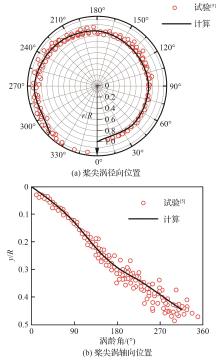
Fig.3
Blade tip vortex position of Lynx tail rotor in ground effect
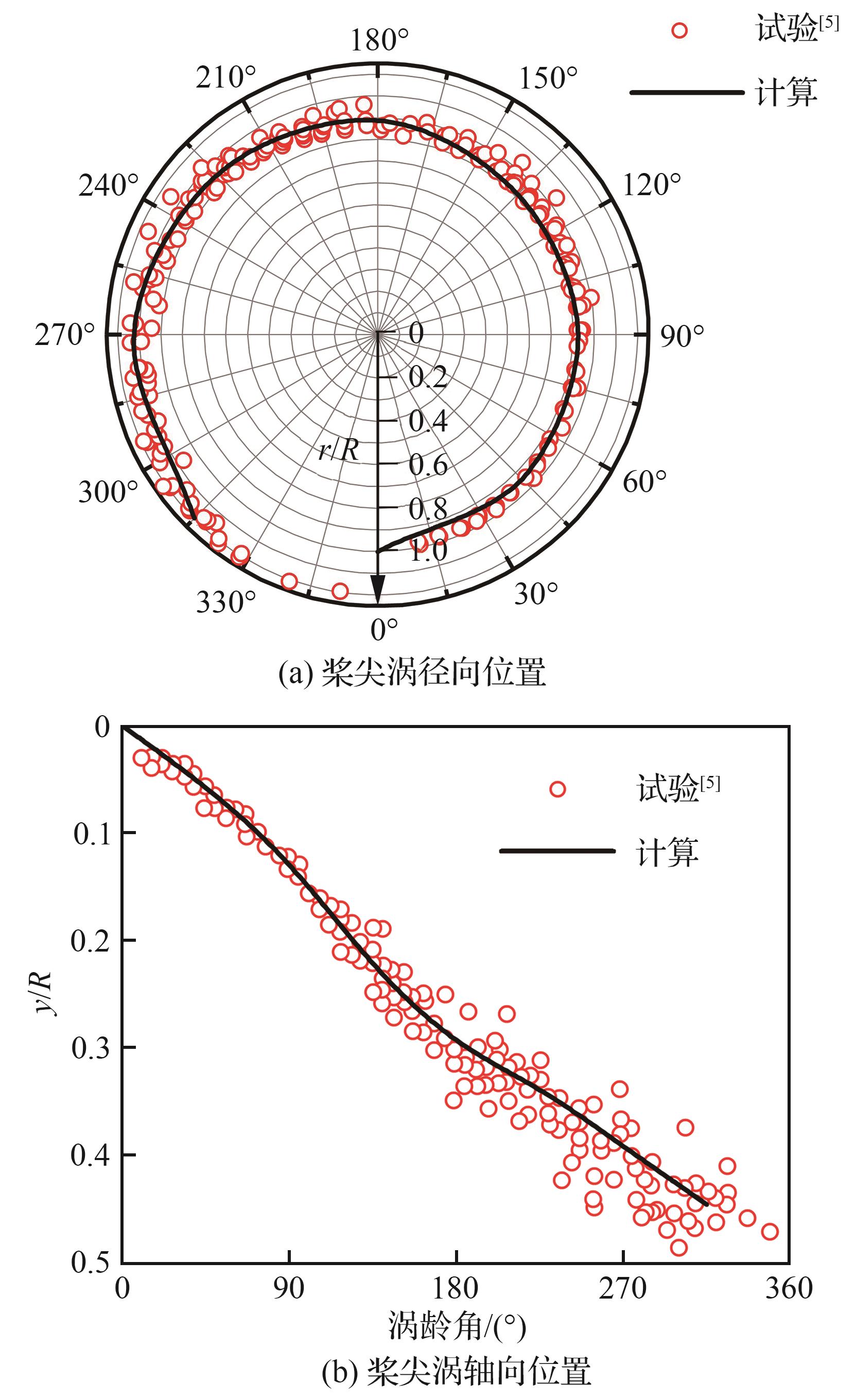
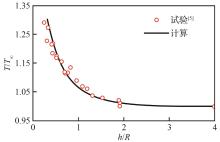
Fig.4
Comparison of thrust increments variation with different heights above ground
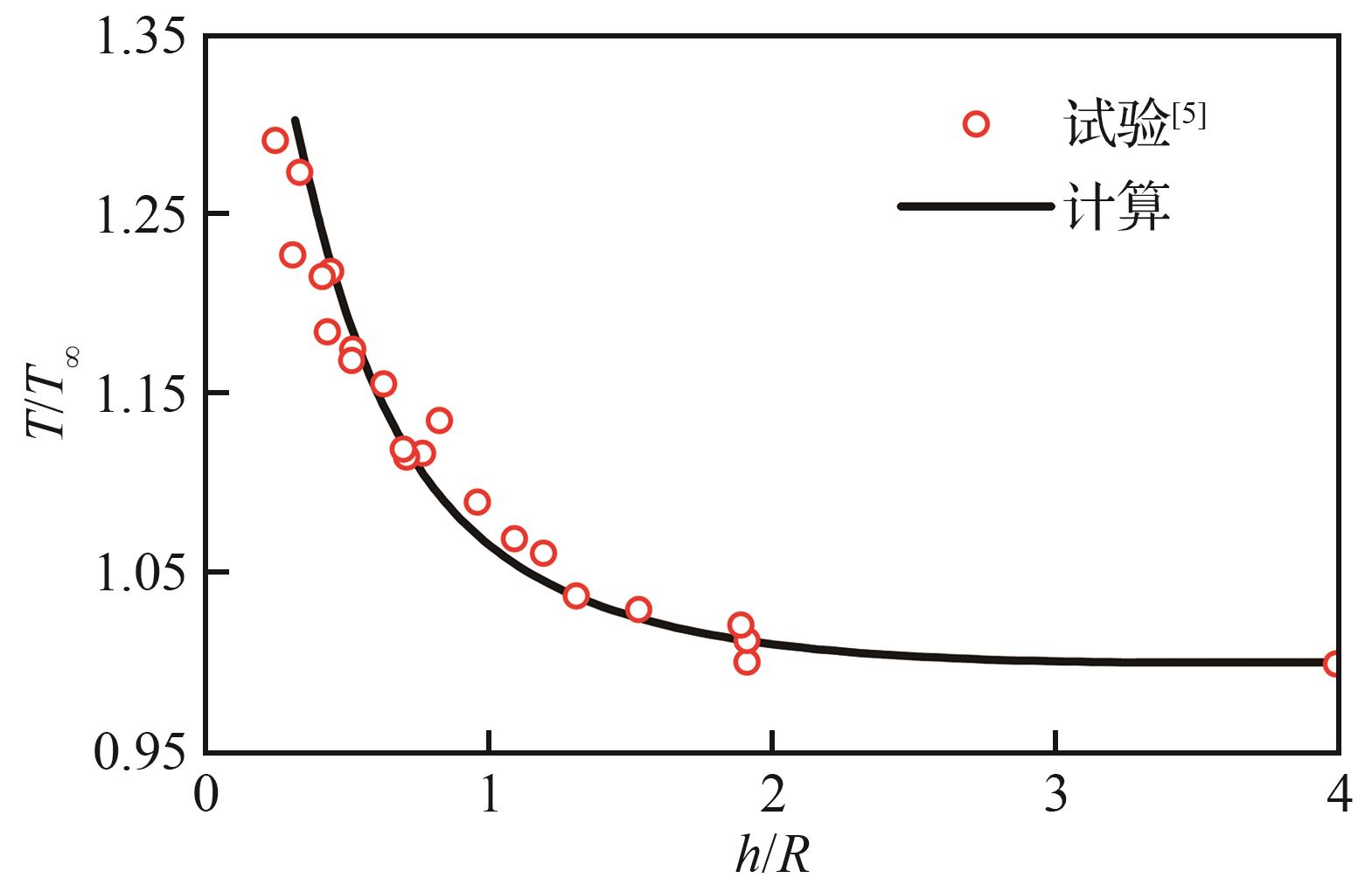
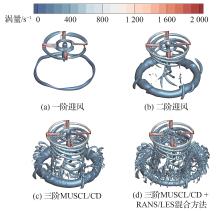
Fig.5
Rotor wake structure in hover with different numerical methods(Q=8 000)
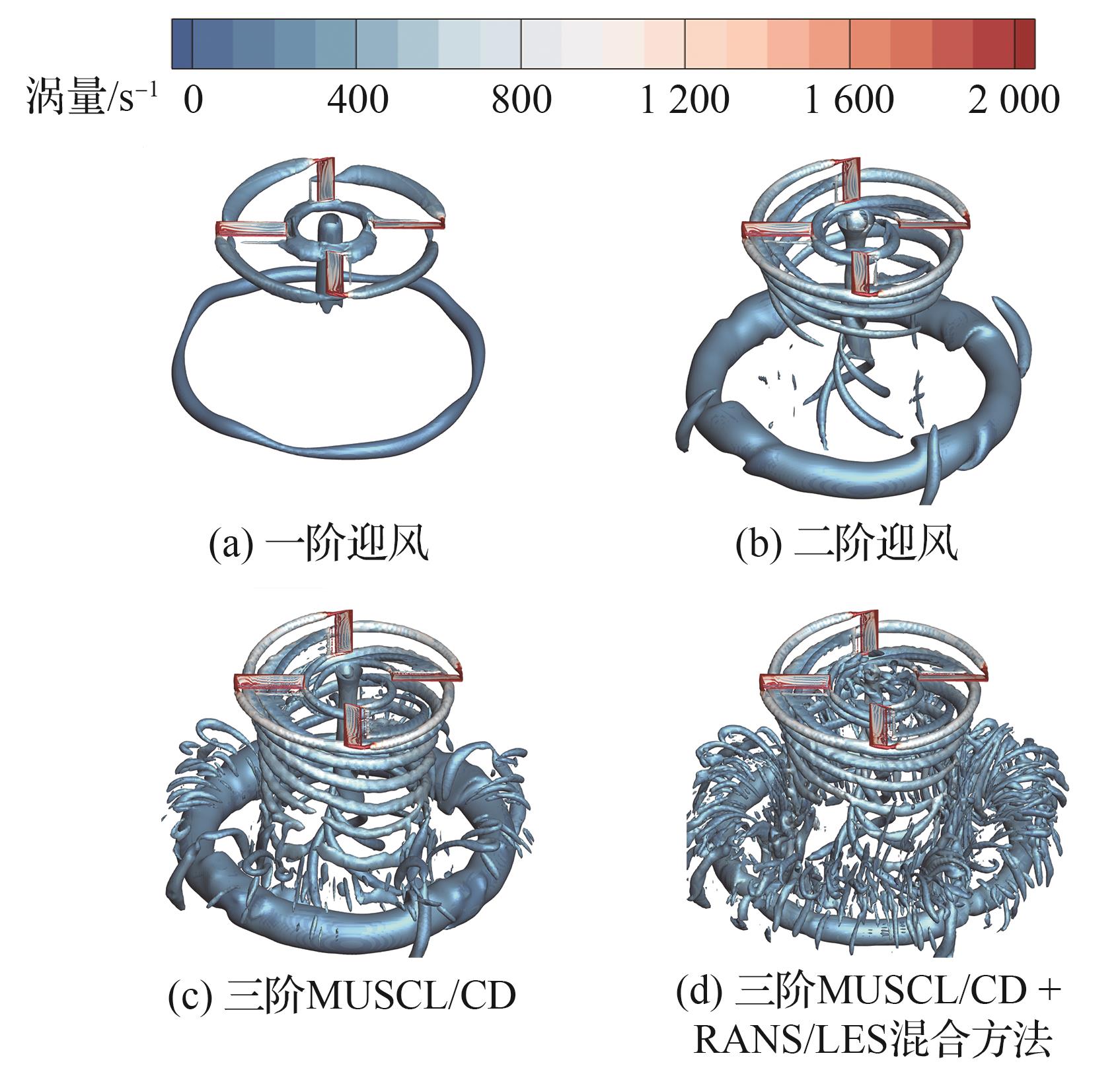
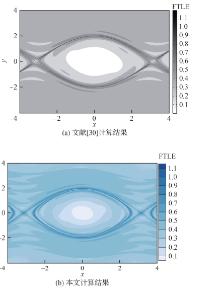
Fig.6
FTLE field of simple pendulum system
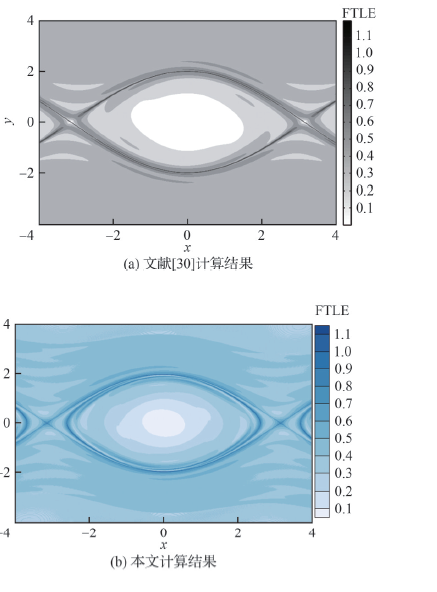
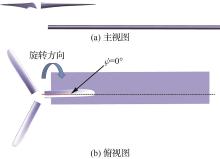
Fig.7
Geometry model of rotor-wing
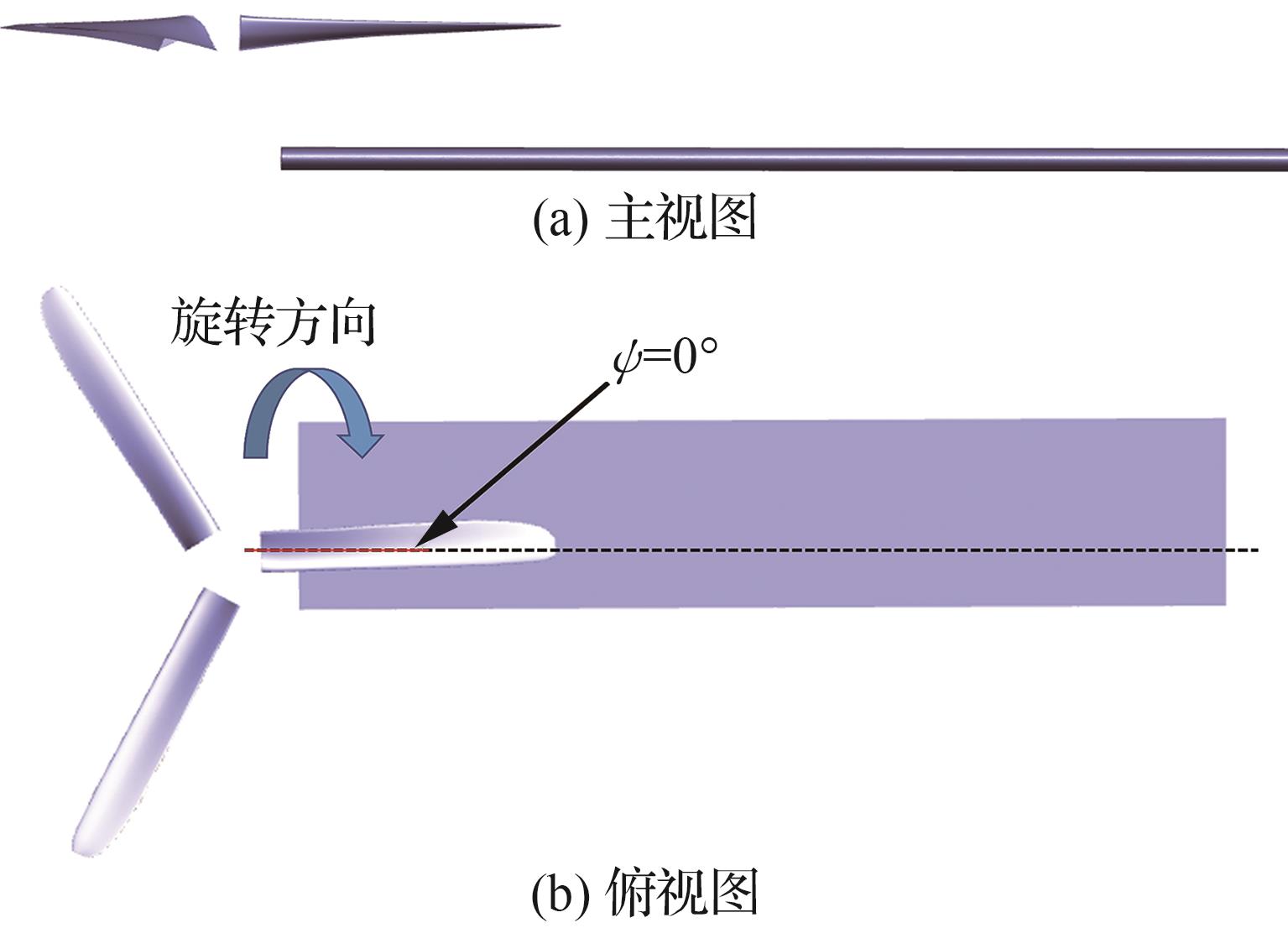
Table 2
Main parameters of rotor-wing
| 参数 | 数值 |
|---|---|
| 桨叶半径/m | 1.65 |
| 桨叶根切/m | 0.297 |
| 桨叶片数 | 3 |
| 转速/(rad·s-1) | 136 |
| 桨距θ0.7/(°) | 10 |
| 桨叶负扭转/(°) | 35 |
| 机翼展长/m | 4.74 |
| 机翼安装角/(°) | 2 |
| 桨叶翼型 | OA系列 |
| 旋翼-机翼垂直间距/m | 0.66 |
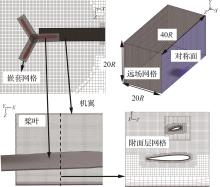
Fig.8
Computational grid schematic diagram of rotor-wing
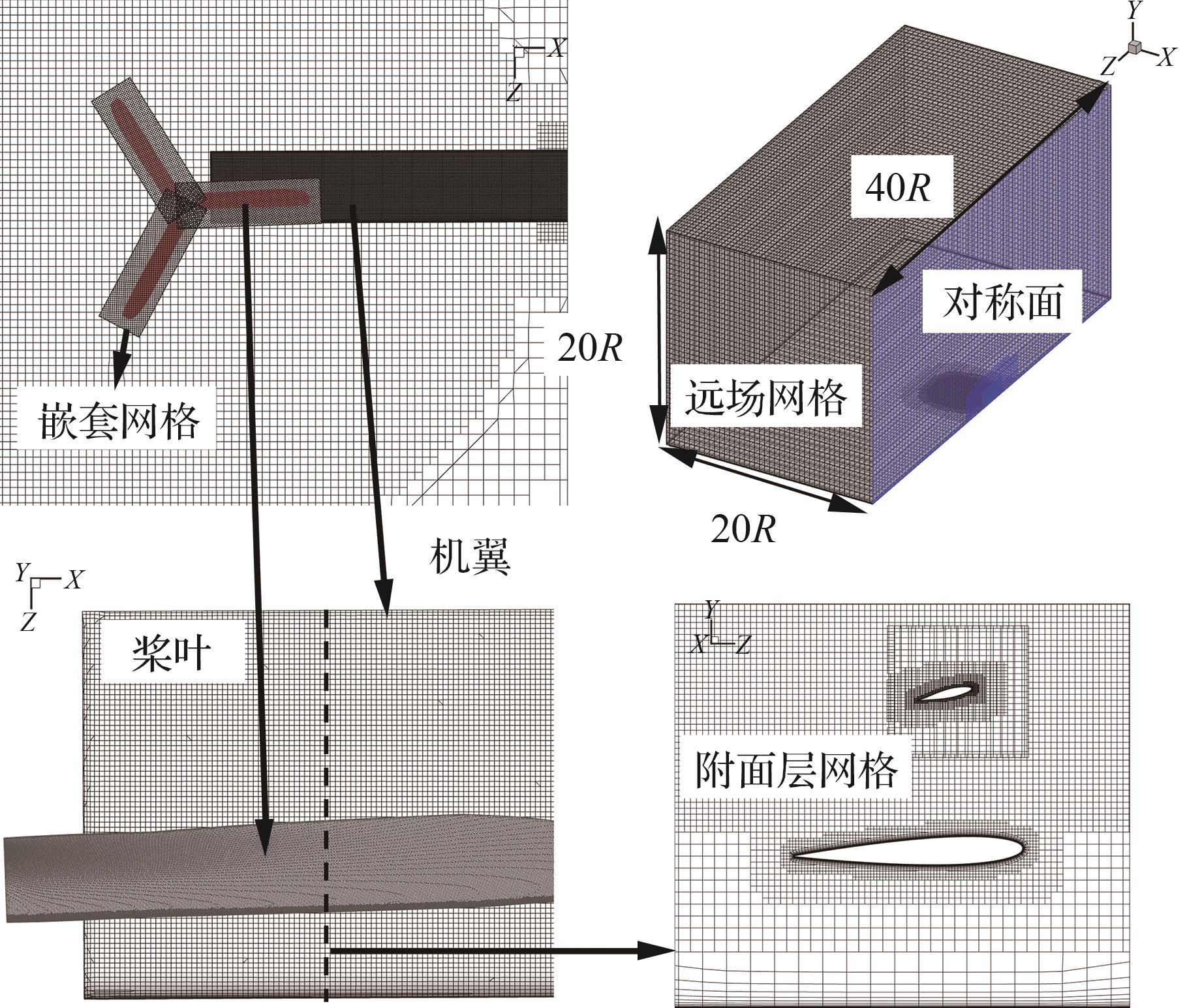
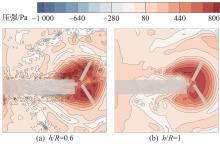
Fig.9
Contour of ground pressure distribution with different heights above ground
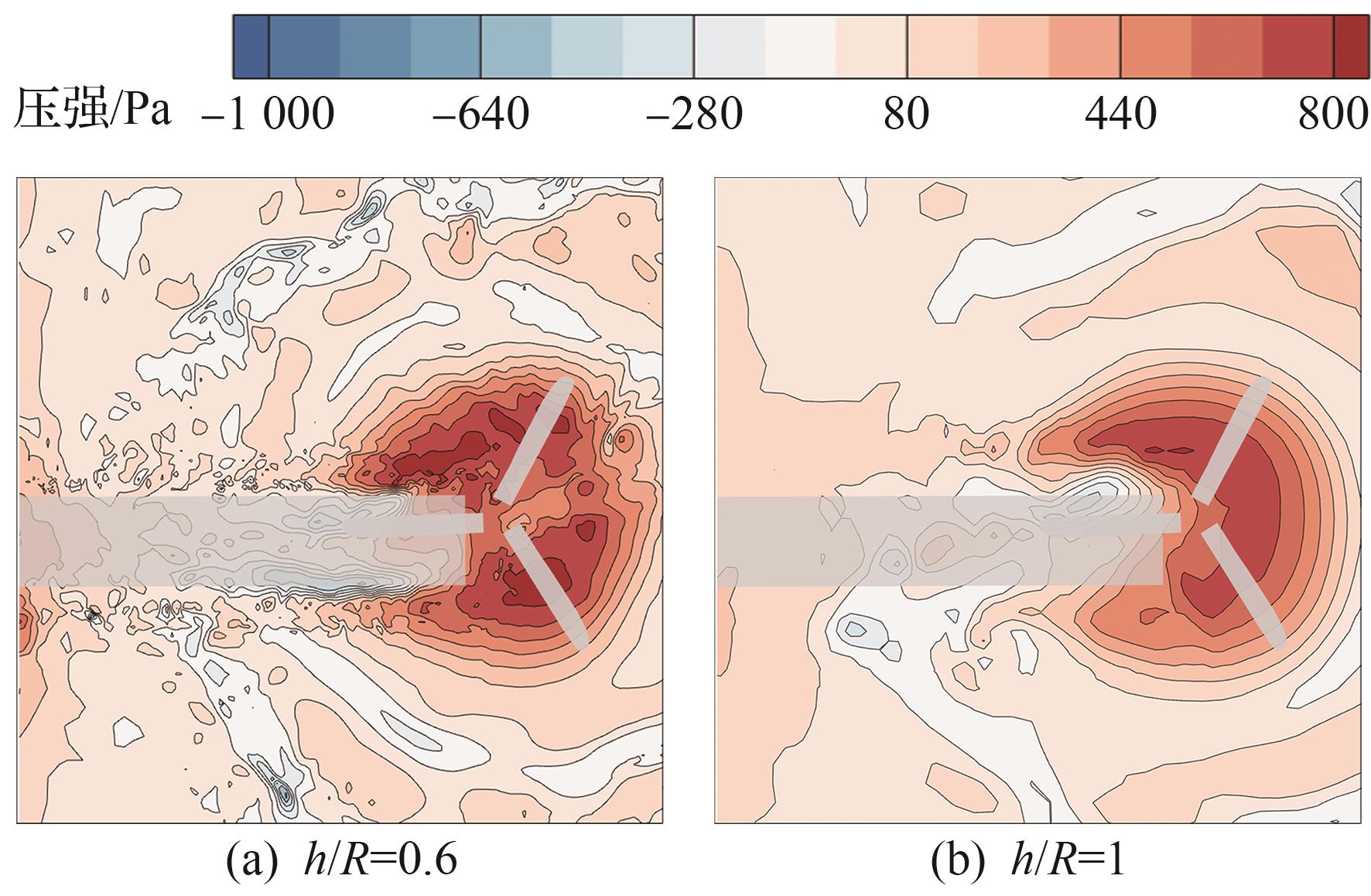
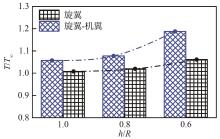
Fig.10
Variations in thrust with different heights above ground
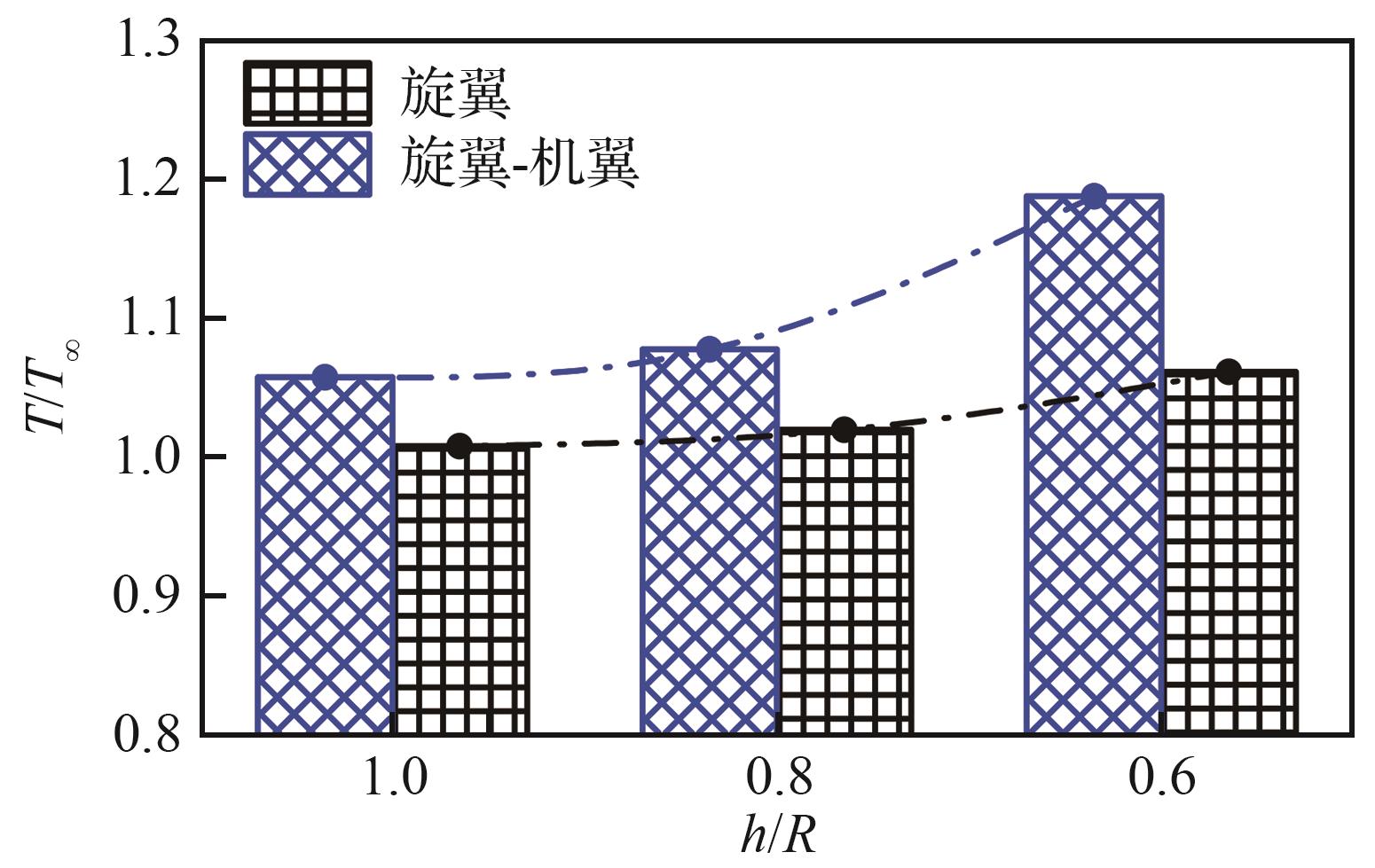
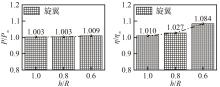
Fig.11
Variations in power and figure of merit with different heights above ground
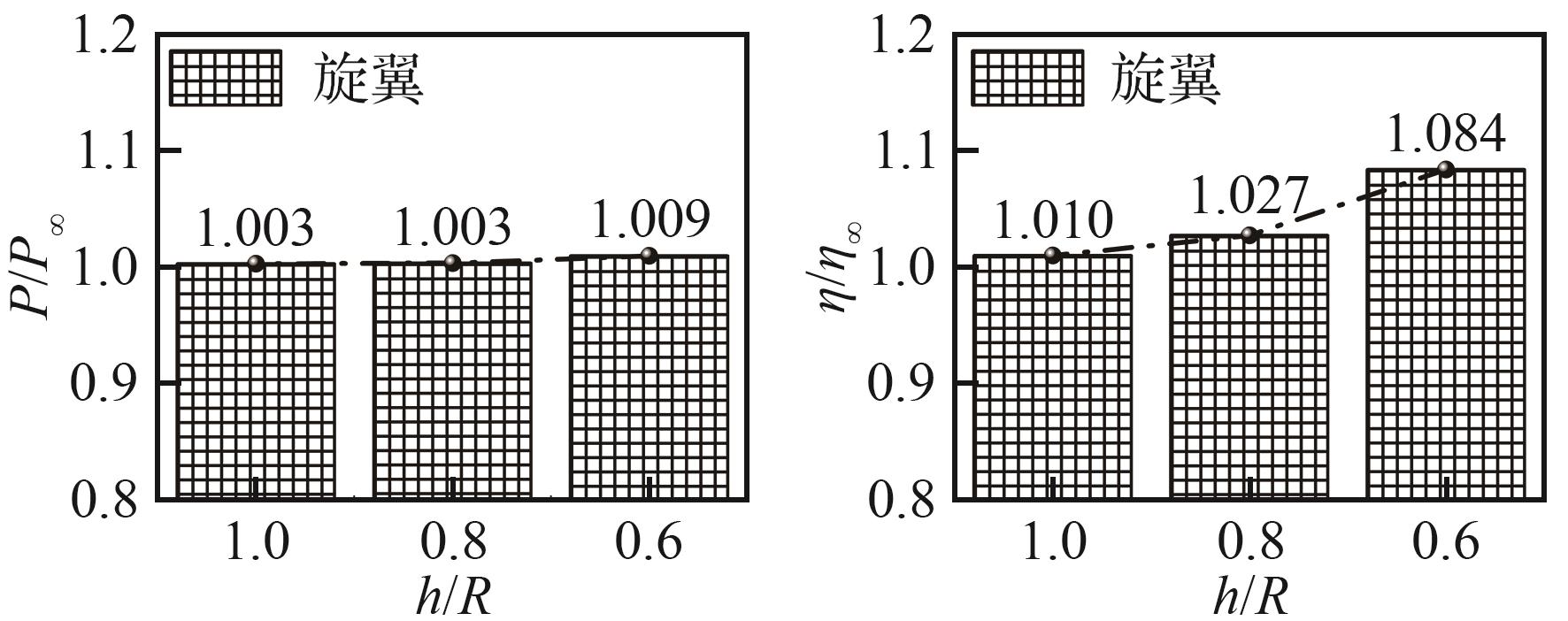
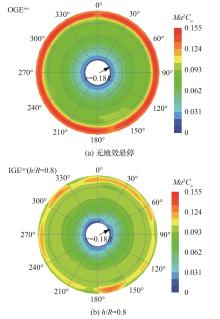
Fig.12
Distribution of normal force coefficient in rotor disk plane of an isolated rotor in hovering state
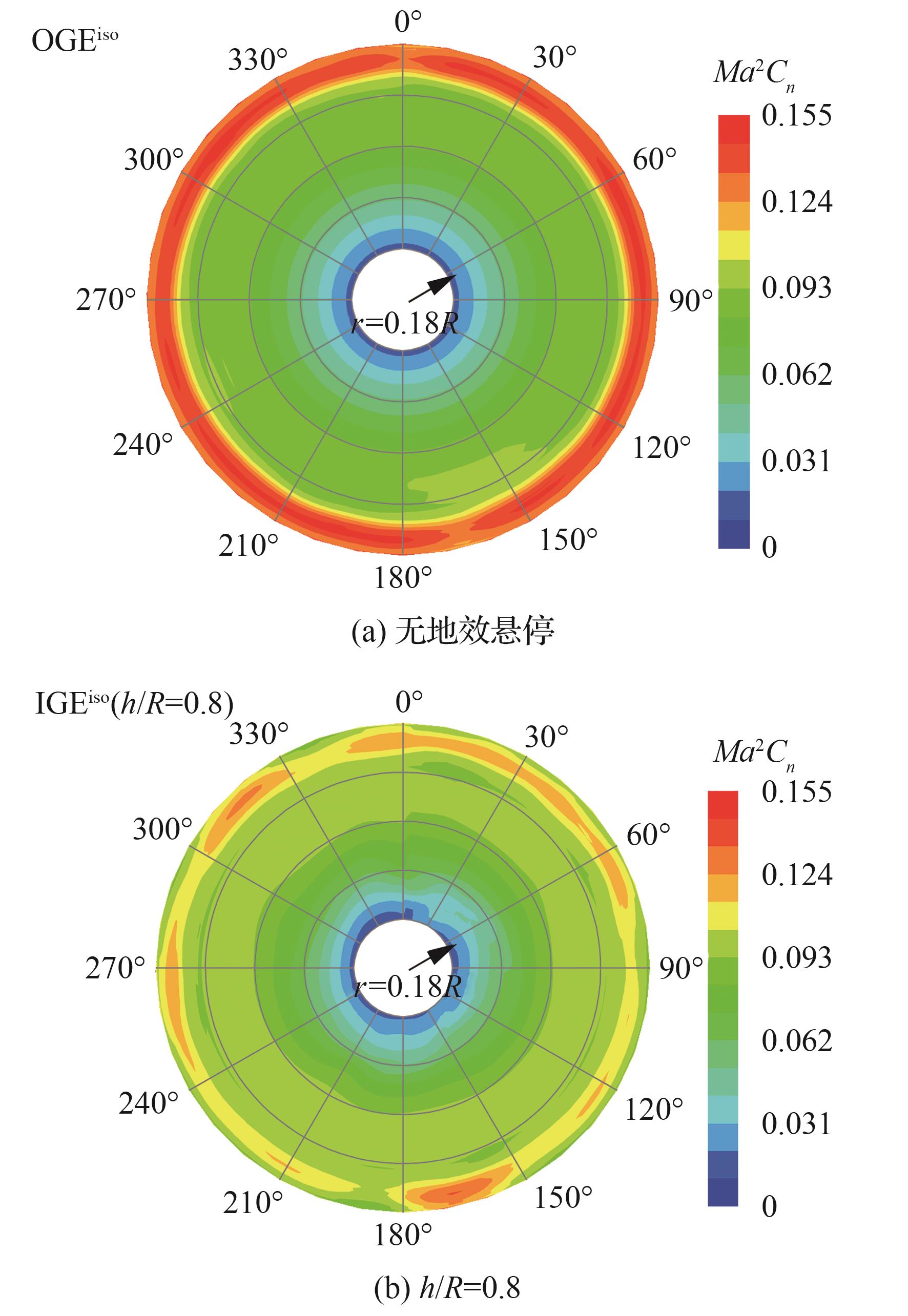
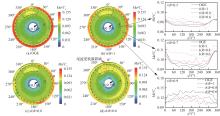
Fig.13
Distribution of normal force coefficient in rotor disk plane with different heights above ground
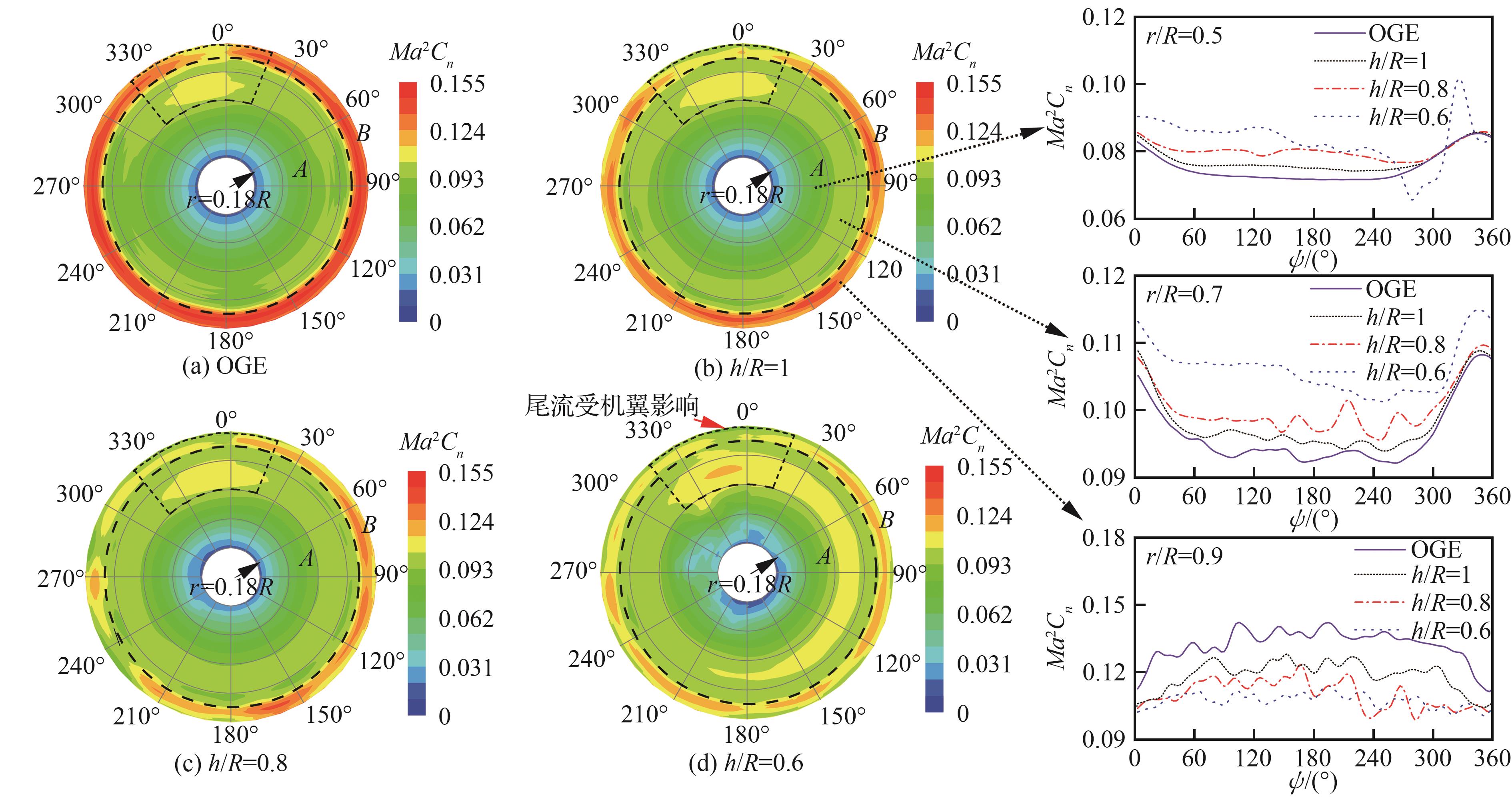
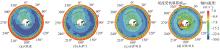
Fig.14
Distribution of axial velocity at 0.1R below plane of rotor disk with different heights above ground
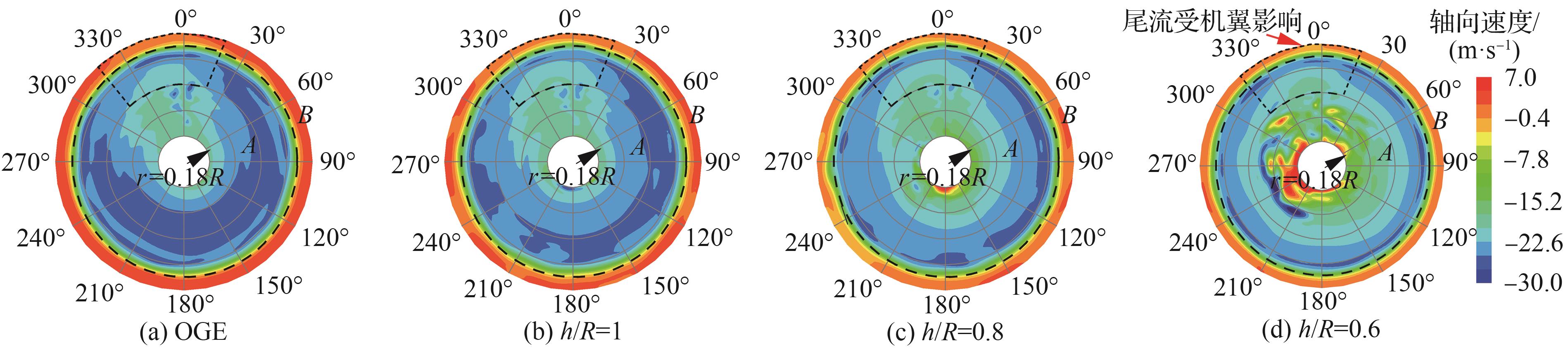
Fig.15
Surface pressure coefficient distribution of blade with different heights above ground
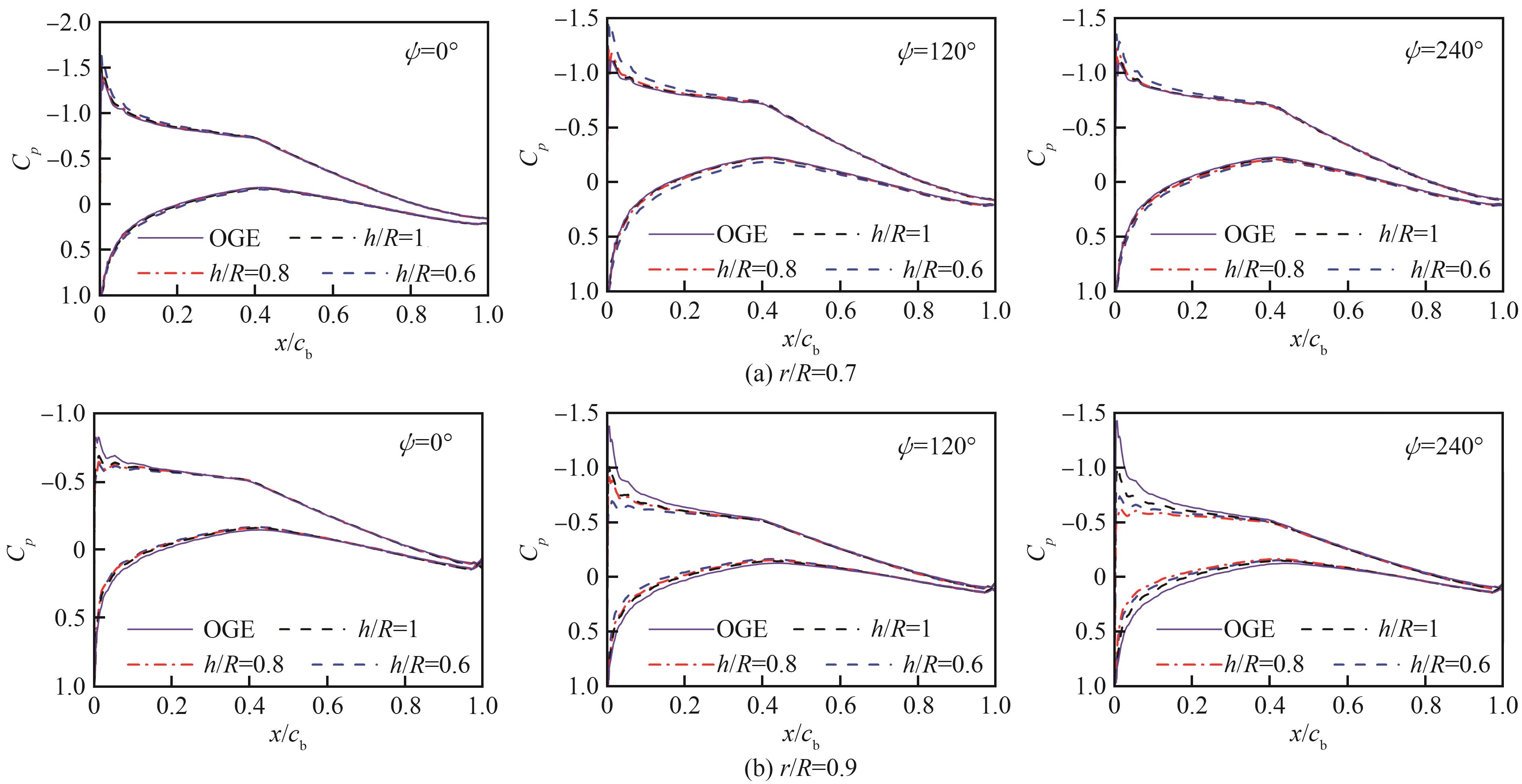
Fig.16
Variations in downwash load of wing with different heights above ground
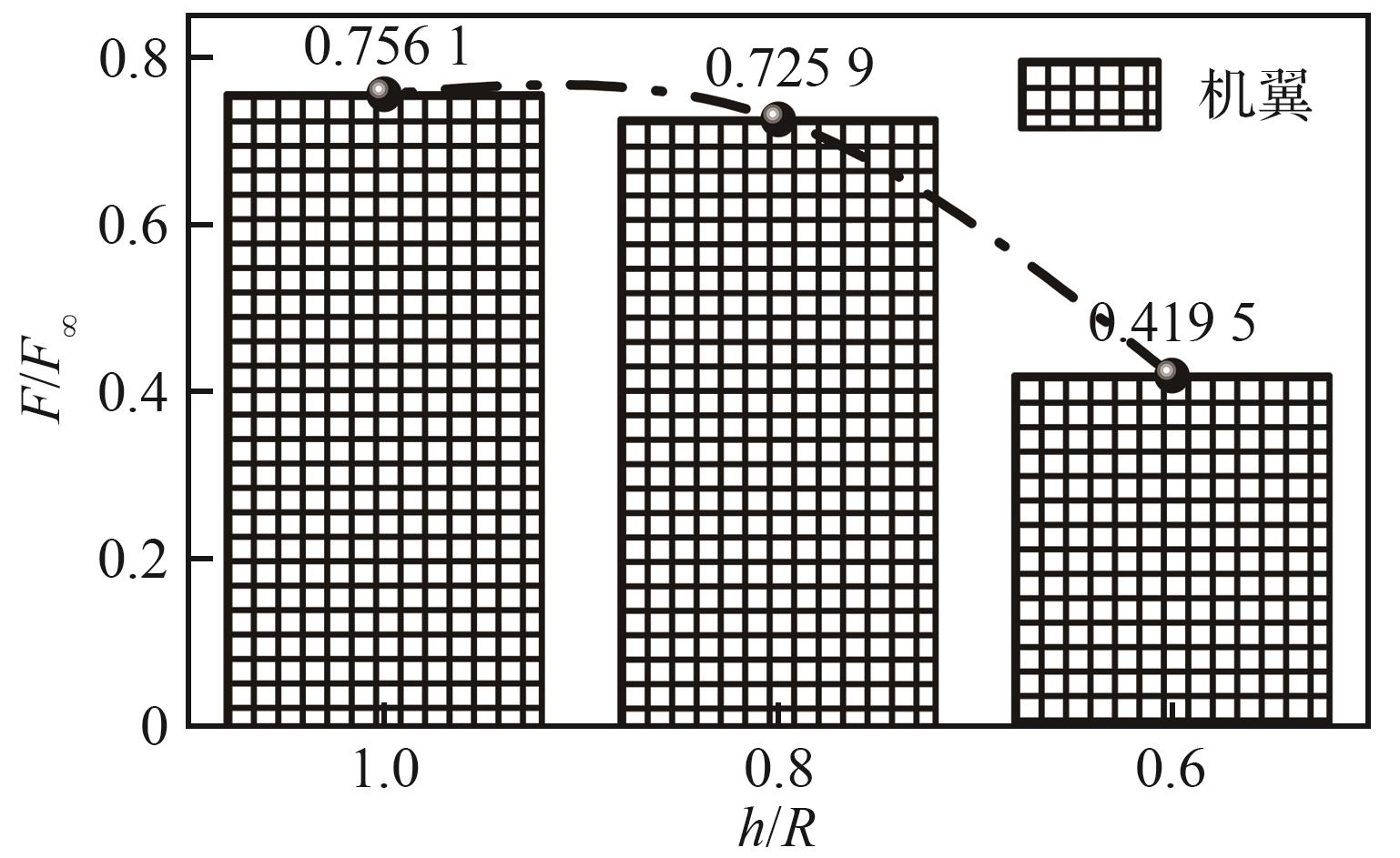
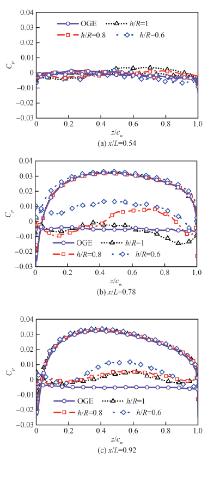
Fig.17
Surface pressure coefficient distribution of wing with different heights above ground
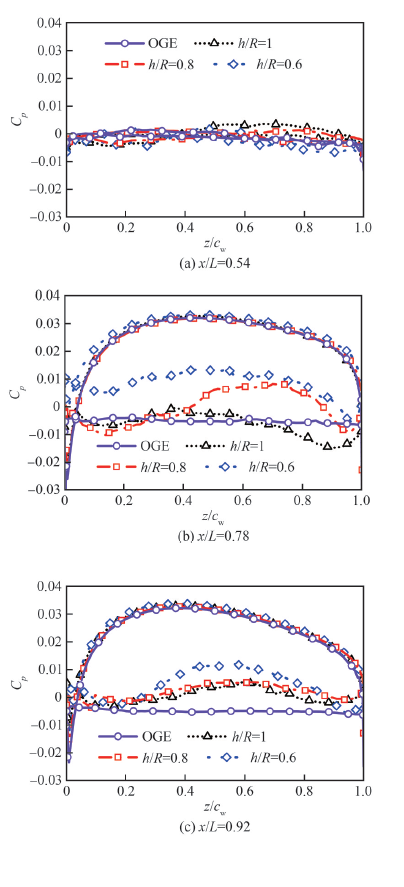
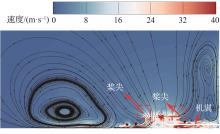
Fig.18
Contour of velocity distribution and streamlines in local flow field with h/R = 0.6
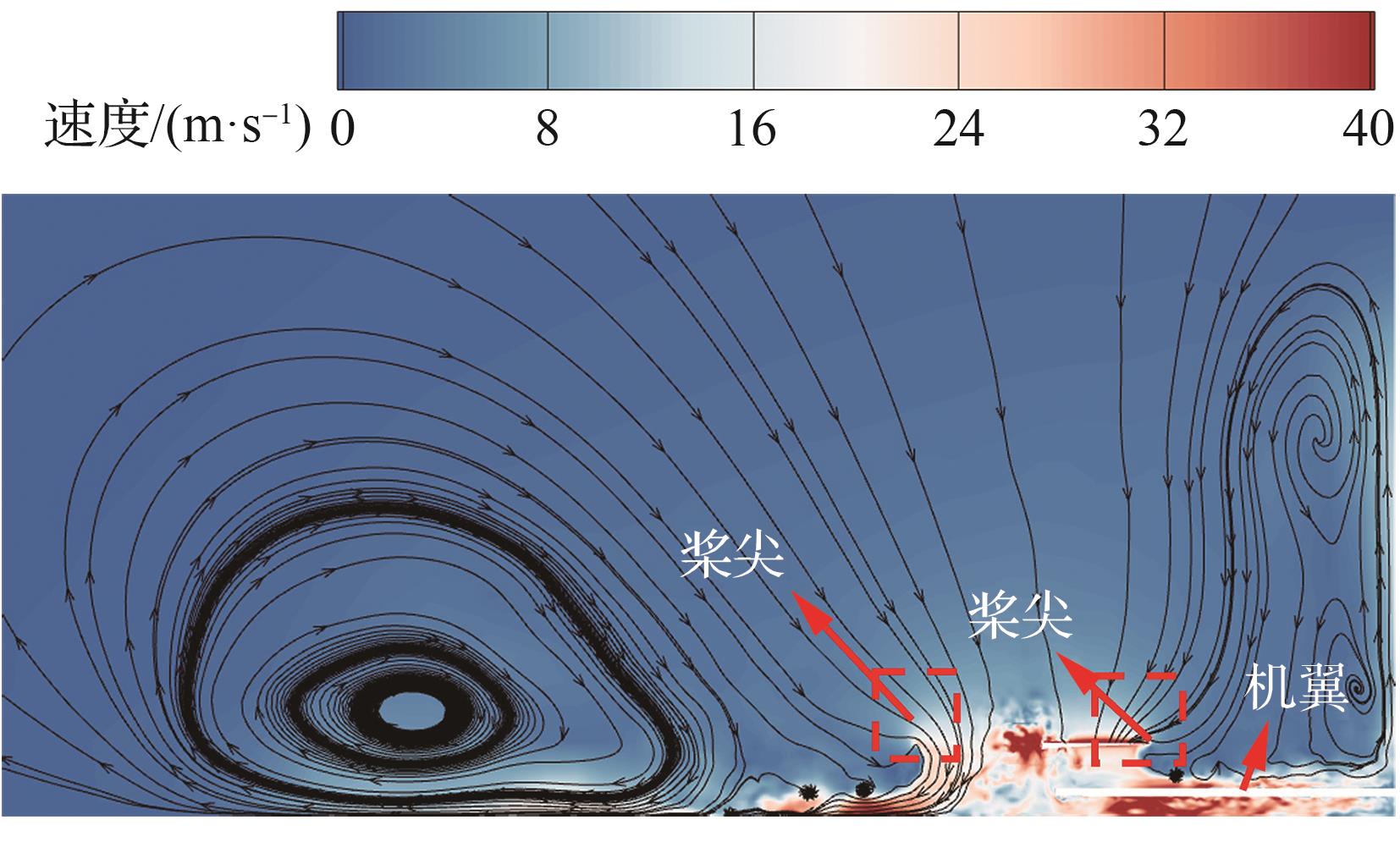
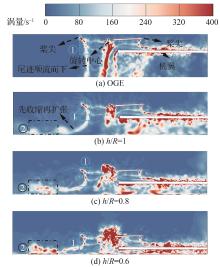
Fig.19
Contour of vorticity distribution in flow field with different heights above ground
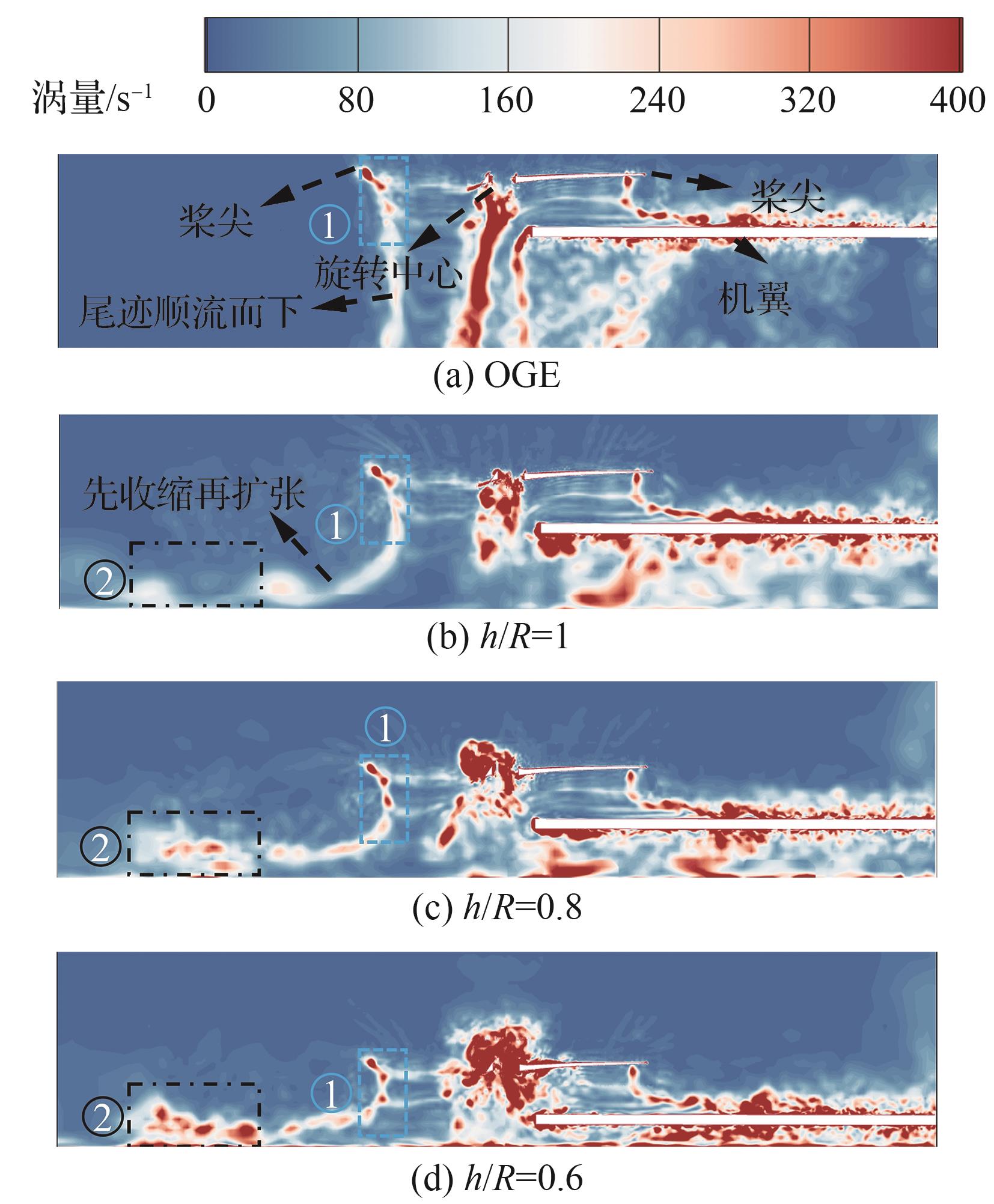
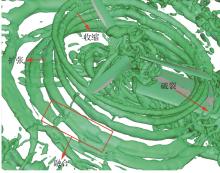
Fig.20
Vorticity iso-surface of the flow field at h/R=0.8(Q=5 000)
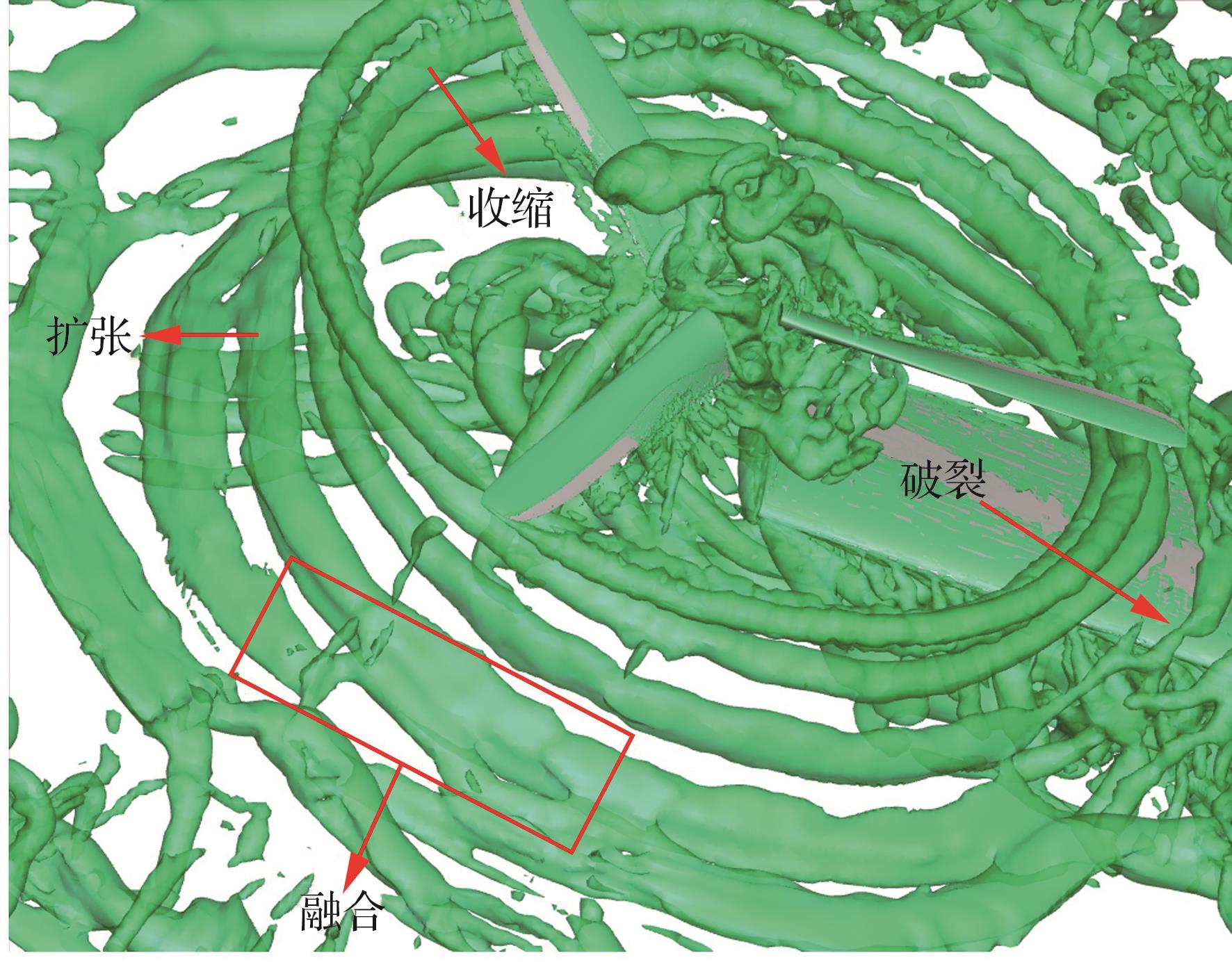
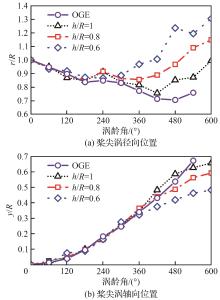
Fig.21
Variation in blade tip vortex position with different heights above ground
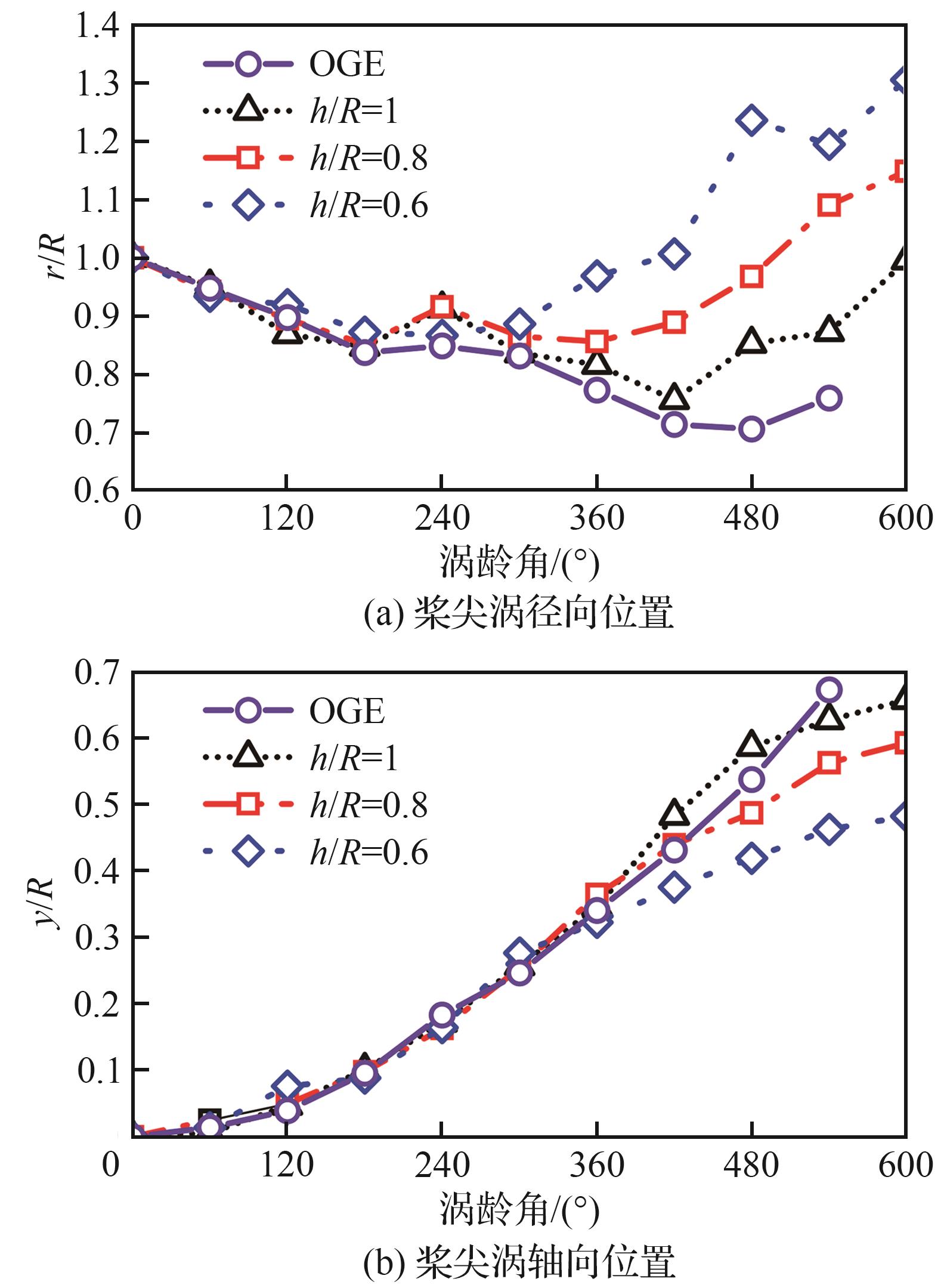
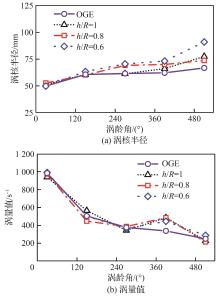
Fig.22
Variation in blade tip vortex core radius and vorticity with different heights above ground
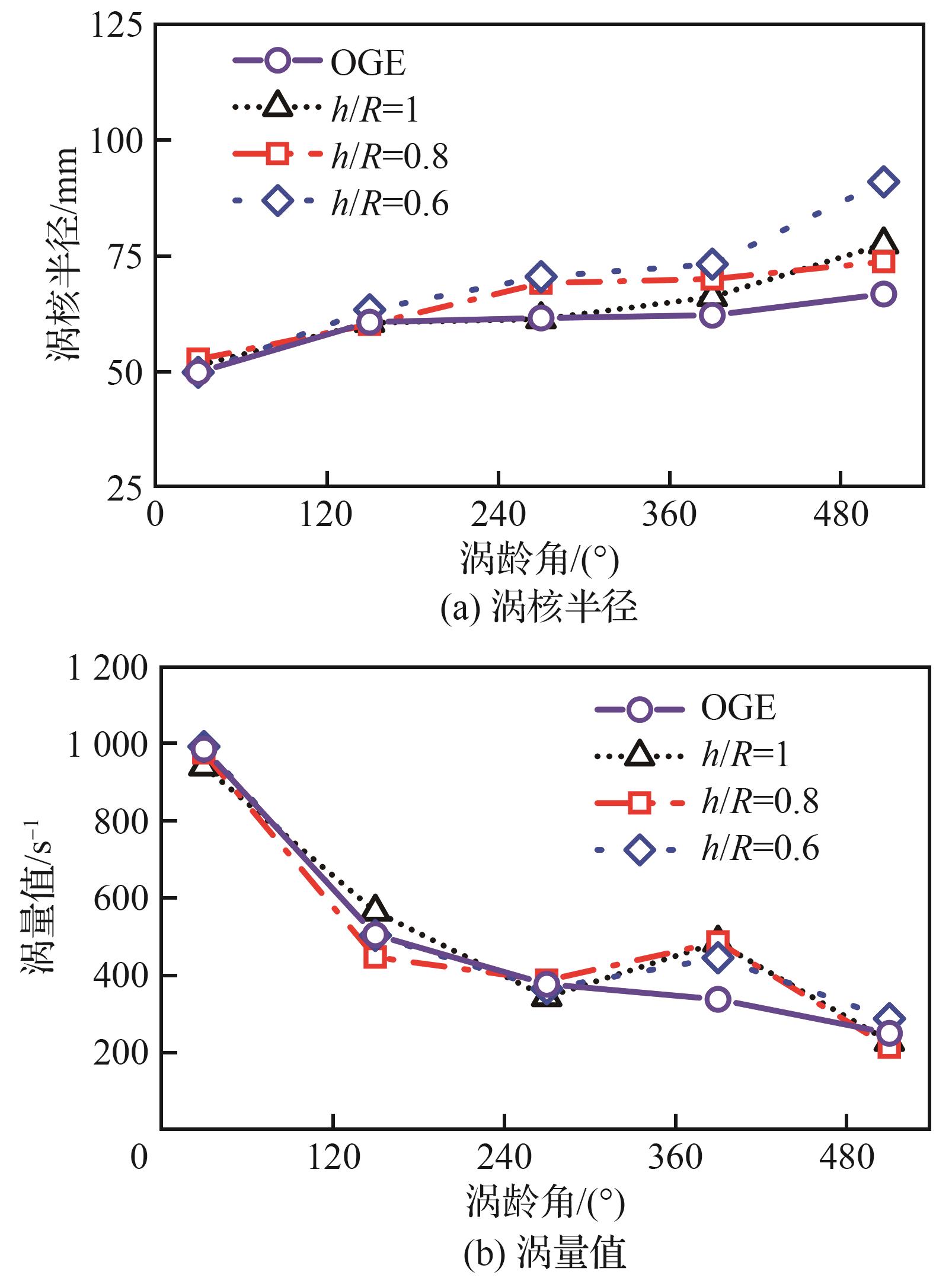
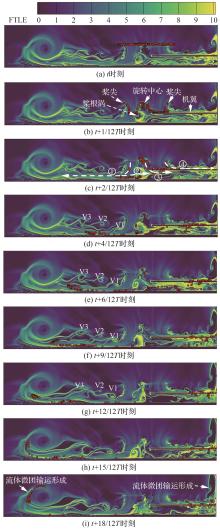
Fig.23
Evolution of finite time Lyapunov exponent field in an axial slice of inertial coordinate system in 1.5 rotation period when h/R=0.8
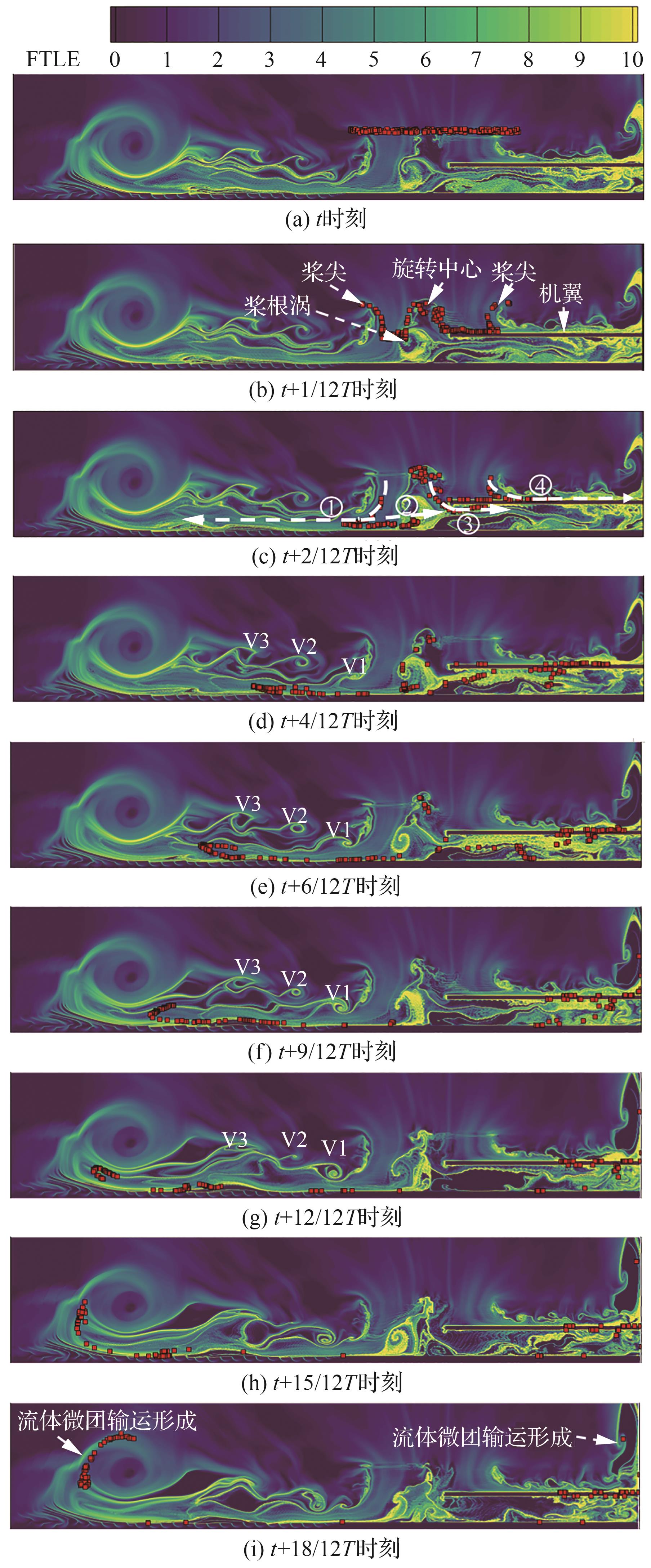
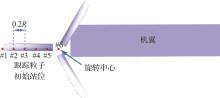
Fig.24
Schematic diagram of initial configuration for tracked particles
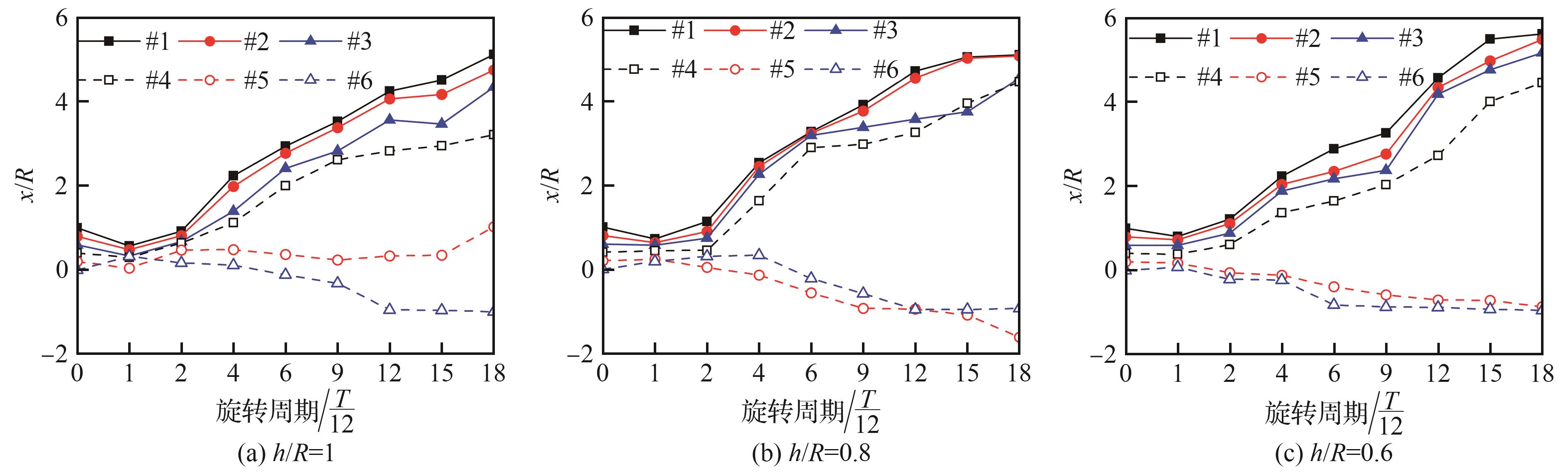
Fig.25
Radial positions of tracked particles at different time instants with varying heights above ground
| [1] | 邓景辉. 高速直升机关键技术与发展[J]. 航空学报, 2024, 45(9): 529085. |
| DENG J H. Key technologies and development for high-speed helicopters[J]. Acta Aeronautica et Astronautica Sinica, 2024, 45(9): 529085 (in Chinese). | |
| [2] | MOUSHEGIAN A M, SMITH M J. Physics and accuracy of dual-solver simulations of rotors in ground effect[J]. Journal of the American Helicopter Society, 2023, 68(1): 1-16. |
| [3] | SUGIURA M, TANABE Y, SUGAWARA H, et al. Numerical simulations and measurements of the helicopter wake in ground effect[J]. Journal of Aircraft, 2017, 54(1): 209-219. |
| [4] | FLACHSBART O. Theorie der Hubschraube[J]. Zeitschrift für Flugtechnik und Motorluftschiffahrt, 1928, 19(8): 177-183 [German]. |
| [5] | LIGHT J S. Tip vortex geometry of a hovering helicopter rotor in ground effect[J]. Journal of the American Helicopter Society, 1993, 38(2): 34-42. |
| [6] | SAIJO T, GANESH B, HUANG A, et al. Development of unsteadiness in a rotor wake in ground effect[C]∥21st AIAA Applied Aerodynamics Conference. Reston: AIAA, 2003. |
| [7] | LEE T E, LEISHMAN J G, RAMASAMY M. Fluid dynamics of interacting blade tip vortices with a ground plane[J]. Journal of the American Helicopter Society, 2010, 55(2): 22005-2200516. |
| [8] | NATHAN N D. The rotor wake in ground effect and its investigation in a wind tunnel[D]. Glasgow: University of Glasgow, 2010. |
| [9] | FEJTEK I, ROBERTS L. Navier-Stokes computation of wing/rotor interaction for a tilt rotor in hover[J]. AIAA Journal, 1992, 30(11): 2595-2603. |
| [10] | MEAKIN R. Moving body overset grid methods for complete aircraft tiltrotor simulations[C]∥11th Computational Fluid Dynamics Conference. Reston: AIAA, 1993. |
| [11] | 朱秋娴, 招启军, 林永峰, 等. 倾转旋翼机多部件对机翼气动干扰的分析及优化[J]. 航空动力学报, 2017, 32(6): 1505-1514. |
| ZHU Q X, ZHAO Q J, LIN Y F, et al. Analysis and optimizations on aerodynamic interaction of tiltrotor aircraft multi-components on its wing[J]. Journal of Aerospace Power, 2017, 32(6): 1505-1514 (in Chinese). | |
| [12] | LESTARI A, NIAZI S, RAJAGOPALAN R. Preliminary numerical analysis of a quad tilt rotor flowfield and performance [C]∥Tiltrotor Independent Aircraft Technology and Applications Specialists’ Meeting of the American Helicopter Society. 2001: 20-22. |
| [13] | NARDUCCI R P, LIU J, WELLS A J, et al. CFD simulations of a hovering tiltrotor in ground effect[C]∥ AIAA Scitech 2024 Forum. Reston: AIAA, 2024. |
| [14] | 王军杰, 陈仁良, 俞志明, 等. 倾转四旋翼飞行器地面效应和水面效应数值模拟[J]. 航空动力学报, 2024, 39(12): 66-77. |
| WANG J J, CHEN R L, YU Z M, et al. Numerical simulation of ground effect and water surface effect of quad tilt rotor aircraft[J]. Journal of Aerospace Power, 2024, 39(12): 66-77 (in Chinese). | |
| [15] | 李鹏, 招启军. 悬停状态倾转旋翼/机翼干扰流场及气动力的CFD计算[J]. 航空学报, 2014, 35(2): 361-371. |
| LI P, ZHAO Q J. CFD calculations on the interaction flowfield and aerodynamic force of tiltrotor/wing in hover[J]. Acta Aeronautica et Astronautica Sinica, 2014, 35(2): 361-371 (in Chinese). | |
| [16] | 王娜, 叶靓, 戚姝妮. 基于DES方法的倾转旋翼悬停计算研究[J]. 空气动力学学报, 2018, 36(1): 57-63. |
| WANG N, YE L, QI S N. Numerical study for tilt rotor in hover with detached eddy simulations[J]. Acta Aerodynamica Sinica, 2018, 36(1): 57-63 (in Chinese). | |
| [17] | 叶靓, 招启军, 徐国华. 基于非结构嵌套网格方法的旋翼地面效应数值模拟[J]. 航空学报, 2009, 30(5): 780-786. |
| YE L, ZHAO Q J, XU G H. Numerical simulation on flowfield of rotor in ground effect based on unstructured embedded grid method[J]. Acta Aeronautica et Astronautica Sinica, 2009, 30(5): 780-786 (in Chinese). | |
| [18] | 王伟琪, 陈希, 招启军. 地效环境下悬停状态直升机旋翼桨/涡干扰噪声特性[J]. 航空学报, 2024, 45(12): 129196. |
| WANG W Q, CHEN X, ZHAO Q J. Hovering helicopter rotor blade/vortex interaction noise characteristics in ground effect environment[J]. Acta Aeronautica et Astronautica Sinica, 2024, 45(12): 129196 (in Chinese). | |
| [19] | 雷鹏飞, 张家忠, 王琢璞, 等. 非定常瞬态流动过程中的Lagrangian拟序结构与物质输运作用[J]. 物理学报, 2014, 63(8): 084702. |
| LEI P F, ZHANG J Z, WANG Z P, et al. Lagrangian coherent structure and transp ort in unsteady transient flow[J]. Acta Physica Sinica, 2014, 63(8): 084702 (in Chinese). | |
| [20] | 李高华, 王福新. 高雷诺数双螺旋涡尾迹演化特性分析[J]. 物理学报, 2018, 67(5): 054701. |
| LI G H, WANG F X. Evolution characteristic analysis of double-helical vortex wake of high Reynolds number flow[J]. Acta Physica Sinica, 2018, 67(5): 054701 (in Chinese). | |
| [21] | HALLER G. An objective definition of a vortex[J]. Journal of Fluid Mechanics, 2005, 525: 1-26. |
| [22] | HALLER G. Lagrangian coherent structures[J]. Annual Review of Fluid Mechanics, 2015, 47: 137-162. |
| [23] | CARAENI M, WEST A, CARAENI D. Turbulent jet noise simulation and propagation using a 3rd order MUSCL/CD scheme on unstructured grid and Ffowcs-Williams Hawkings[C]∥Proceedings of the 5th International Conference on Jets, Wakes and Separated Flows (ICJWSF2015). Cham: Springer, 2016: 389-397. |
| [24] | DUFFAL V, DE LAAGE DE MEUX B, MANCEAU R. Development and validation of a hybrid RANS-LES approach based on temporal filtering[C]∥ASME-JSME-KSME 2019 8th Joint Fluids Engineering Conference. 2019. |
| [25] | MAYS M D, LARDEAU S, LAIZET S. Capturing the drag crisis in the flow around a smooth cylinder using a hybrid RANS-LES model on coarse meshes[J]. International Journal of Heat and Fluid Flow, 2023, 103: 109203. |
| [26] | NELSON D A, JACOBS G B. DG-FTLE: Lagrangian coherent structures with high-order discontinuous-Galerkin methods[J]. Journal of Computational Physics, 2015, 295: 65-86. |
| [27] | WANG W, CAO S L, DANG N N, et al. Study on dynamics of vortices in dynamic stall of a pitching airfoil using Lagrangian coherent structures[J]. Aerospace Science and Technology, 2021, 113: 106706. |
| [28] | HALLER G. Lagrangian coherent structures from approximate velocity data[J]. Physics of Fluids, 2002, 14(6): 1851-1861. |
| [29] | 韩帅斌, 罗勇, 张树海. 空腔流动的拉格朗日涡动力学分析[J]. 航空工程进展, 2019, 10(5): 691-697, 734. |
| HAN S B, LUO Y, ZHANG S H. Lagrangian vortex dynamics in the open cavity flow[J]. Advances in Aeronautical Science and Engineering, 2019, 10(5): 691-697, 734 (in Chinese). | |
| [30] | 曹小群, 宋君强, 任开军, 等. 有限时间Lyapunov指数的高精度计算新方法[J]. 物理学报, 2014, 63(18): 180504. |
| CAO X Q, SONG J Q, REN K J, et al. Highly accurate computation of finite-time Lyapunov exponent[J]. Acta Physica Sinica, 2014, 63(18): 180504 (in Chinese). | |
| [31] | STEIJL R, BARAKOS G, BADCOCK K. A CFD framework for analysis of helicopter rotors[C]∥17th AIAA Computational Fluid Dynamics Conference. Reston: AIAA, 2005. |
| [32] | GAWLIK E S, MARSDEN J E, DU TOIT P C, et al. Lagrangian coherent structures in the planar elliptic restricted three-body problem[J]. Celestial Mechanics and Dynamical Astronomy, 2009, 103(3): 227-249. |
| [33] | ABDELMOULA A, RAULEDER J. Aerodynamic performance of morphed camber rotor airfoils[C]∥AIAA Scitech 2019 Forum. Reston: AIAA, 2019. |
| [1] | Wei WANG, Zhihao YU, Weidong YANG, Shanji YE. Influence of trailing-edge flap deflection patterns on vibration reduction of a smart rotor [J]. Acta Aeronautica et Astronautica Sinica, 2026, 47(6): 232628-232628. |
| [2] | Liunan LI, Xiao QU, Yanfeng ZHANG, Xingen LU, Junqiang ZHU. Effect of end zone boundary layer skew on secondary flow in high-lift turbine [J]. Acta Aeronautica et Astronautica Sinica, 2026, 47(5): 132394-132394. |
| [3] | Lixiong ZHENG, Zhe CHEN, Xin WANG, Qijun ZHAO. Prediction of whirl flutter boundary for tiltrotor aircraft based on BPNN with adaptive data [J]. Acta Aeronautica et Astronautica Sinica, 2025, 46(S1): 732159-732159. |
| [4] | Zhuangzhuang CUI, Binwu REN, Xu ZHOU, Zhe CHEN, Guoqing ZHAO. Brownout suppression optimization of helicopter landing trajectory parameters under real control [J]. Acta Aeronautica et Astronautica Sinica, 2025, 46(S1): 732186-732186. |
| [5] | Xiayang ZHANG, Bin LUO, Xi CHEN, Tao YANG. Optimization design of high-efficiency and low-noise rotor layout for quad-tiltrotor aircraft [J]. Acta Aeronautica et Astronautica Sinica, 2025, 46(S1): 732183-732183. |
| [6] | Yifan YANG, Xiao WANG. Enhanced hybrid vortex particle method for aerodynamic analysis of tiltrotor rotor/wing interactions [J]. Acta Aeronautica et Astronautica Sinica, 2025, 46(7): 131040-131040. |
| [7] | Zhuoyuan LI, Xudong YANG, Kai SUN, Junhui XIONG, Shuai SHI. Aerodynamic configuration of distributed ducted fan with complex strong interference effect and performance influence [J]. Acta Aeronautica et Astronautica Sinica, 2025, 46(3): 130805-130805. |
| [8] | Yeping WANG, Honglei JI, Pan ZHOU, Yi YE. Fast analysis of aerodynamic interference for quad-tiltrotor based on vortex tube model [J]. Acta Aeronautica et Astronautica Sinica, 2025, 46(2): 130705-130705. |
| [9] | Yu LI, Tongwen CHEN, Zhigang WANG, Chiyung WEN, Xiaoxiong LIU. Incremental control of direct lift landing based on predefined-time theory [J]. Acta Aeronautica et Astronautica Sinica, 2025, 46(13): 531163-531163. |
| [10] | Zixu WANG, Pan LI, Junbiao SHEN, Zhenhua ZHU, Renliang CHEN. Dynamic conversion corridor of tiltrotor aircraft under accelerating and decelerating conditions [J]. Acta Aeronautica et Astronautica Sinica, 2025, 46(11): 531377-531377. |
| [11] | Changhao LIU, Yihua CAO, Xiaomeng MEI, Maosheng WANG, Guanglin ZHANG. Transport effectiveness evaluation of high⁃speed helicopters [J]. Acta Aeronautica et Astronautica Sinica, 2024, 45(9): 530182-530182. |
| [12] | Weiguo ZHANG, Min TANG, Jie WU, Xianmin PENG, Guichuan ZHANG, Bowen NIE, Liangquan WANG, Chaoqun LI. Overview of wind tunnel test research on tiltrotor aircraft [J]. Acta Aeronautica et Astronautica Sinica, 2024, 45(9): 530114-530114. |
| [13] | Zhihao ZHU, Xiuming SUI, Jian PU, Long HAO, Wei ZHAO, Qingjun ZHAO. Aerodynamic load of multistage vaneless counterrotating turbine under wake/shock rotor/rotor interactions [J]. Acta Aeronautica et Astronautica Sinica, 2024, 45(24): 630582-630582. |
| [14] | Xingdong LUO, Zihao HOU, Keming WU, Zhen SHEN, Shenrong ZHANG. Separation safety analysis for Stargazer using electromagnetic propulsion system [J]. Acta Aeronautica et Astronautica Sinica, 2024, 45(24): 630481-630481. |
| [15] | Pan ZHOU, Renliang CHEN, Ningmeng YANG, Bowen NIE, Guoqiang LI. Control strategy for quad-tiltrotor aircraft [J]. Acta Aeronautica et Astronautica Sinica, 2024, 45(22): 130165-130165. |
| Viewed | ||||||
|
Full text |
|
|||||
|
Abstract |
|
|||||
Address: No.238, Baiyan Buiding, Beisihuan Zhonglu Road, Haidian District, Beijing, China
Postal code : 100083
E-mail:hkxb@buaa.edu.cn
Total visits: 6658907 Today visits: 1341All copyright © editorial office of Chinese Journal of Aeronautics
All copyright © editorial office of Chinese Journal of Aeronautics
Total visits: 6658907 Today visits: 1341

 CJA
CJA
