Acta Aeronautica et Astronautica Sinica ›› 2026, Vol. 47 ›› Issue (3): 132166.doi: 10.7527/S1000-6893.2025.32166
• Fluid Mechanics and Flight Mechanics •
Hao ZHENG1, Yahui LU1, Kuanliang WANG1, Shengjia TU2, Shuzhen NIU1( )
)
Received:2025-04-27
Revised:2025-05-19
Accepted:2025-07-01
Online:2025-07-16
Published:2025-07-15
Contact:
Shuzhen NIU
E-mail:18811340232@163.com
Supported by:CLC Number:
Hao ZHENG, Yahui LU, Kuanliang WANG, Shengjia TU, Shuzhen NIU. Oblique detonation initiation via energy deposition based ignition control[J]. Acta Aeronautica et Astronautica Sinica, 2026, 47(3): 132166.
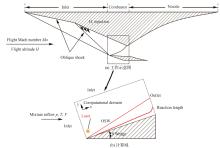
Fig.1
Working schematic diagram of oblique detonating engine and calculation domain
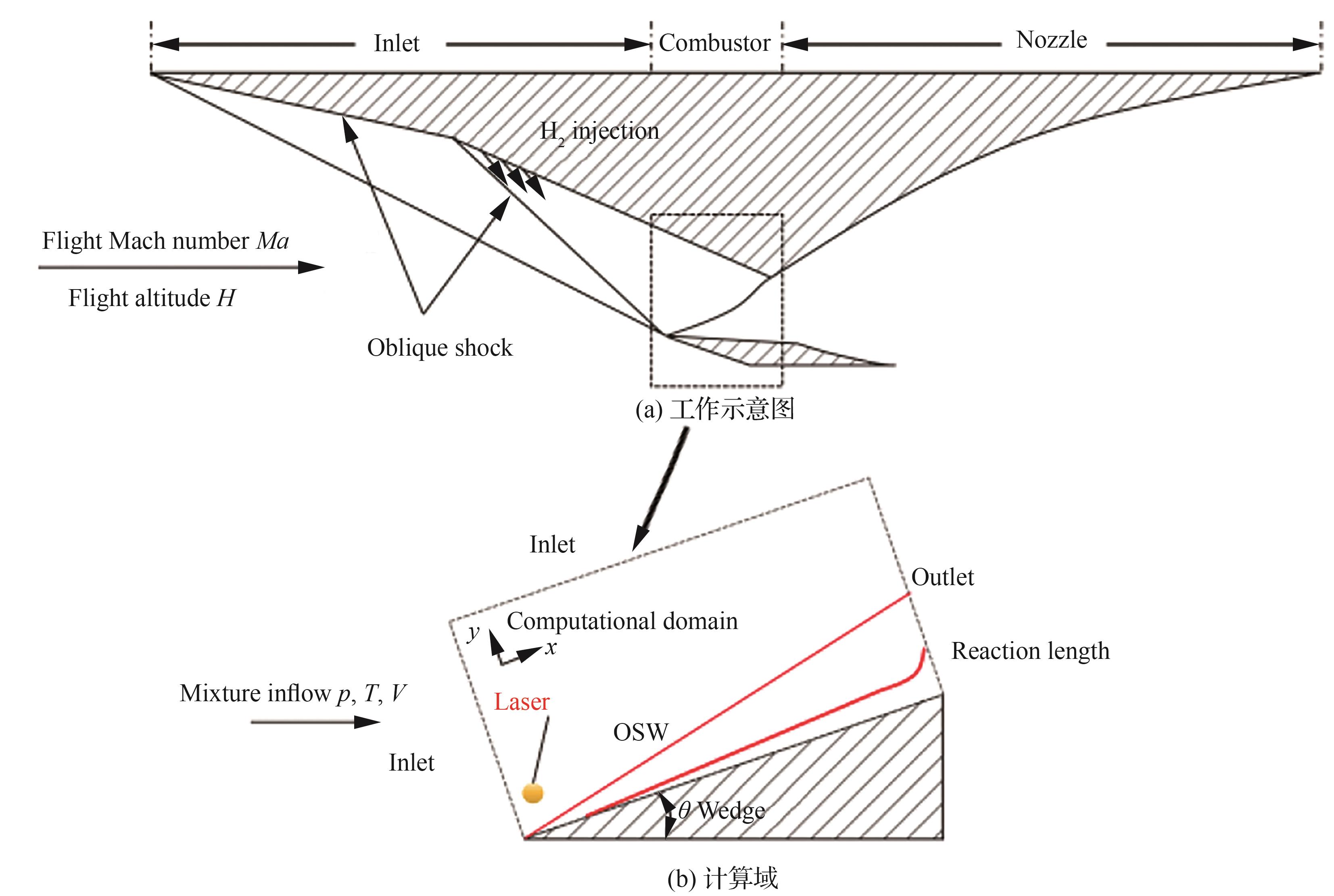
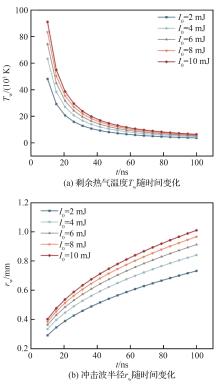
Fig.2
Variation of remaining hot gas temperature Tw after shock wave front and shock wave radius rw with time
Fig.3
Oblique detonation flow field at different wedge angles at flight Mach number Ma = 9
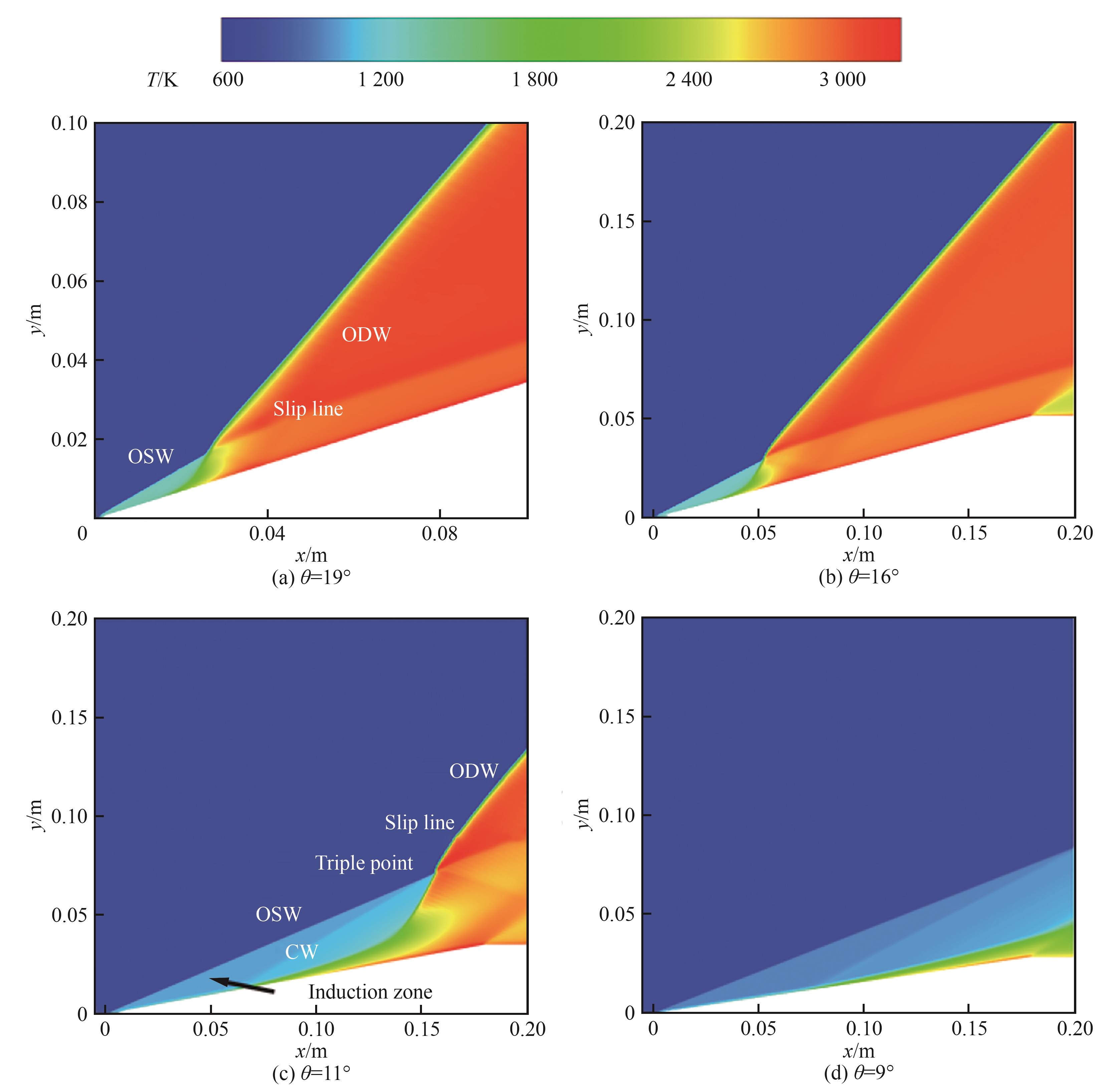
Fig.4
Oblique detonation flow field at different wedge angles at flight Mach number Ma = 8
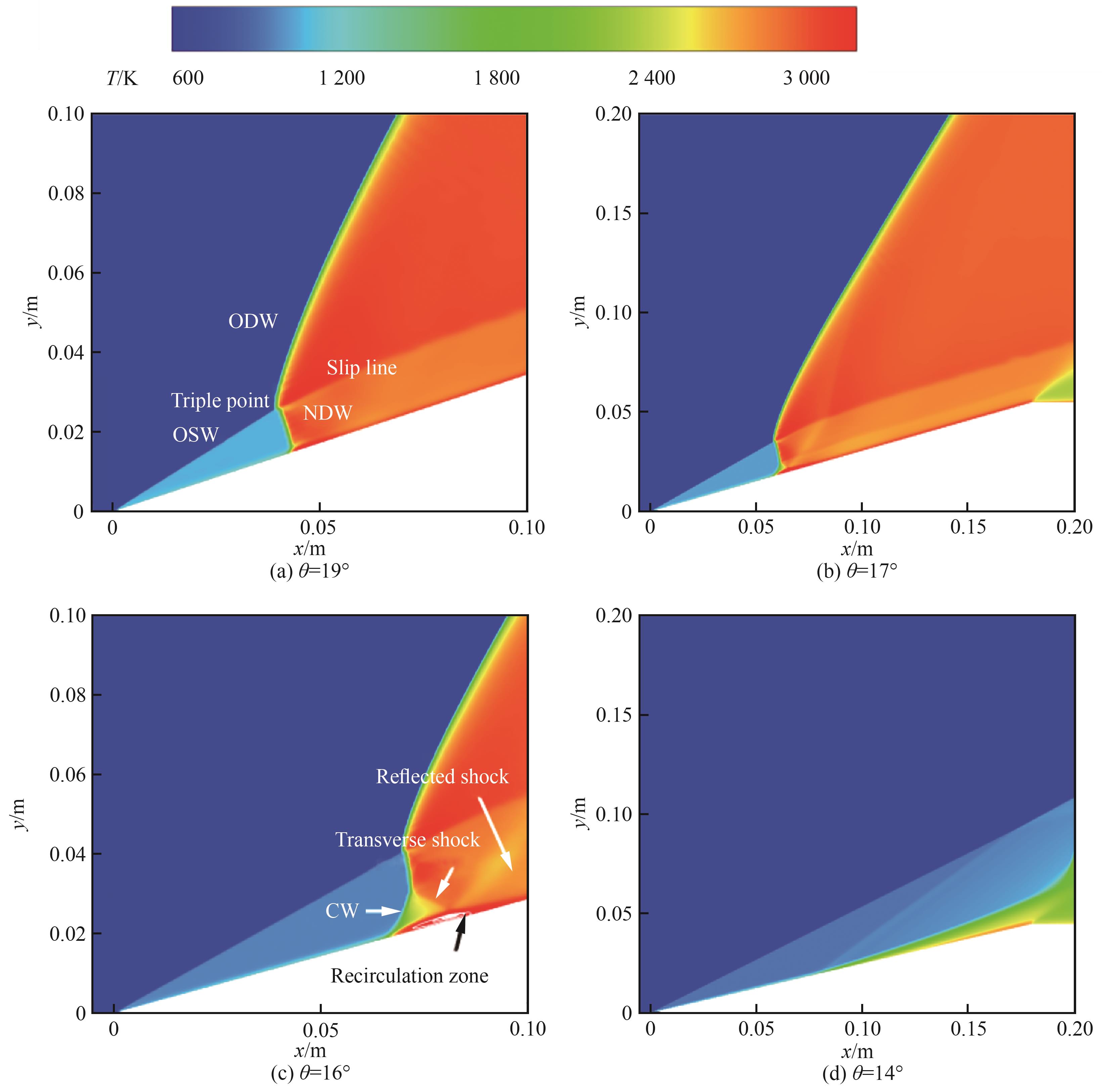
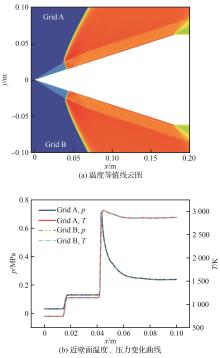
Fig.5
Grid independence validation
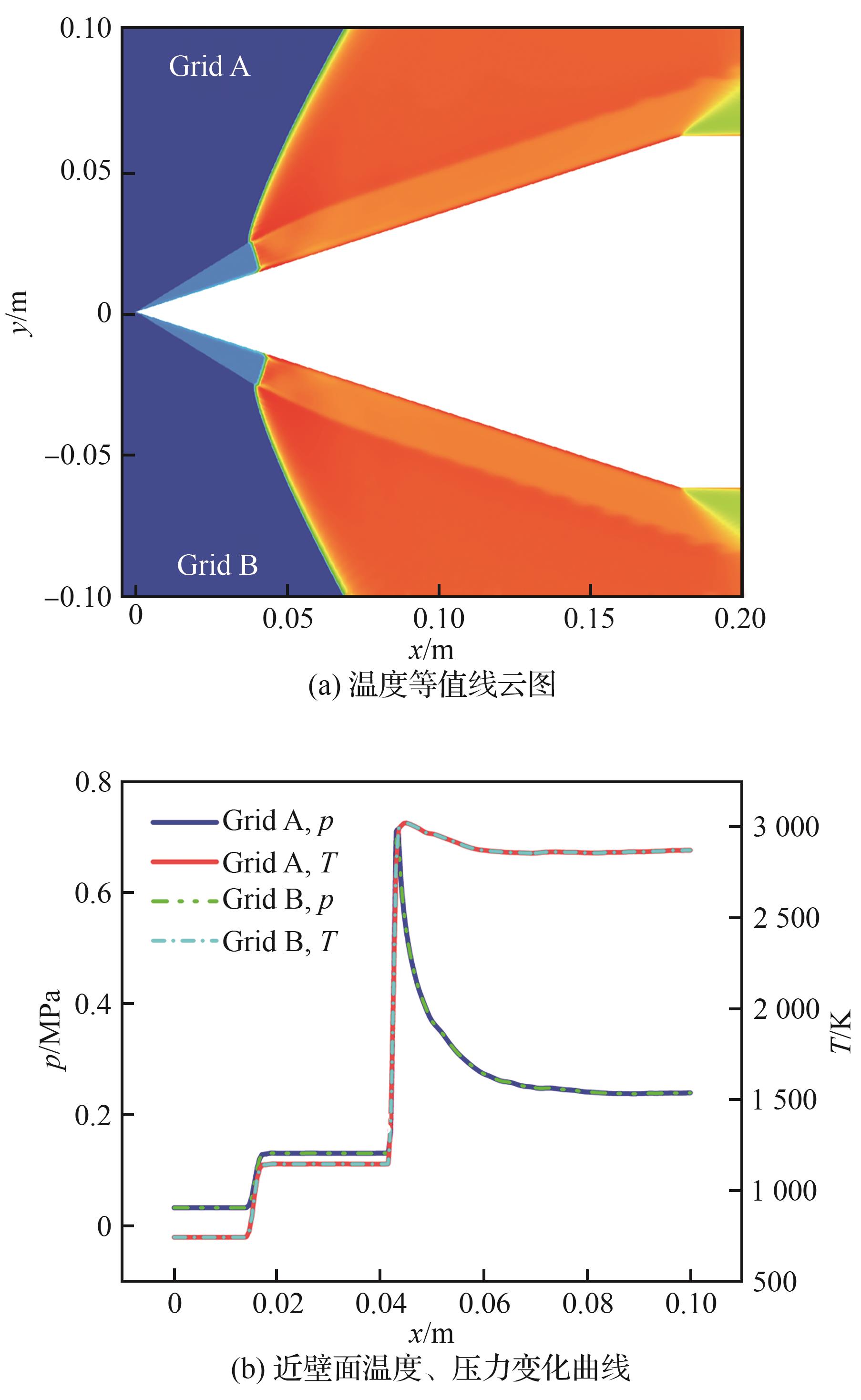
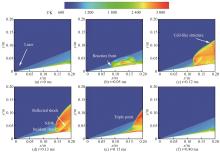
Fig.6
Evolution process of oblique detonation flow field induced by laser ignition source at Ma = 9 and θ = 9°
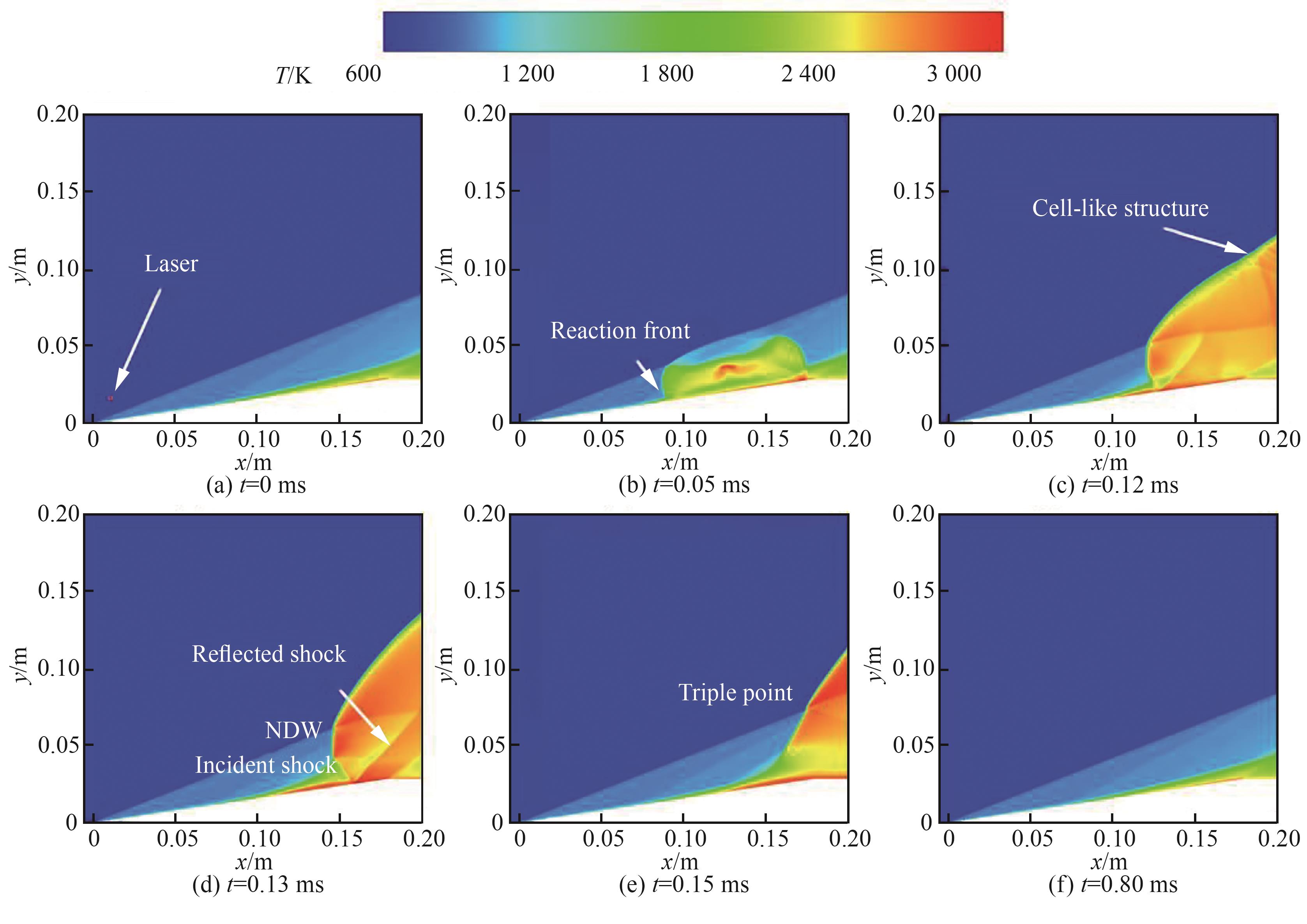
Fig.7
Evolution process of density gradient in oblique detonation flow field initiated by laser ignition source under conditions of Ma = 9 and θ =9°
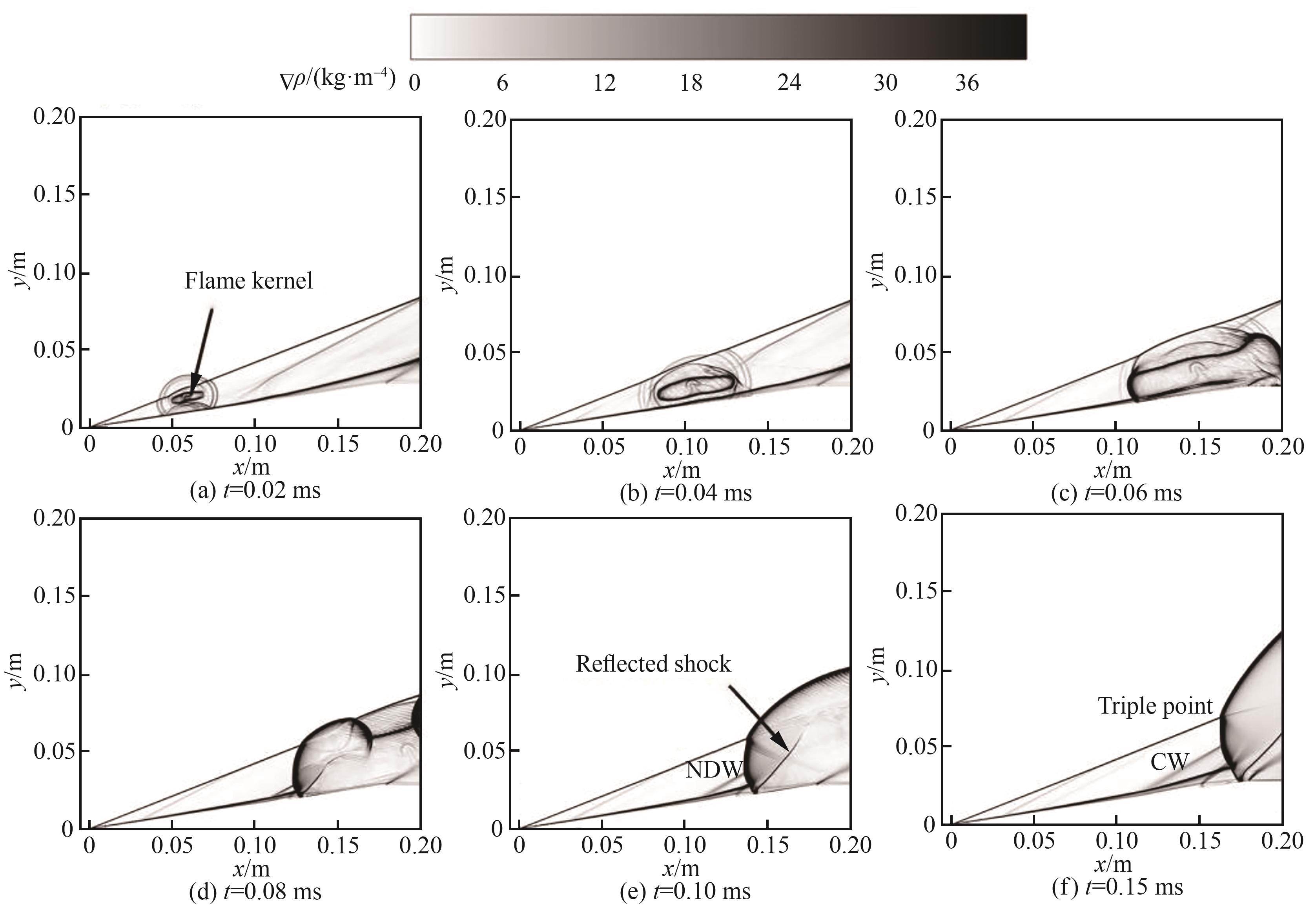
Fig.8
Evolution process of oblique detonation flow field induced by laser ignition source at Ma = 8 and θ = 14°
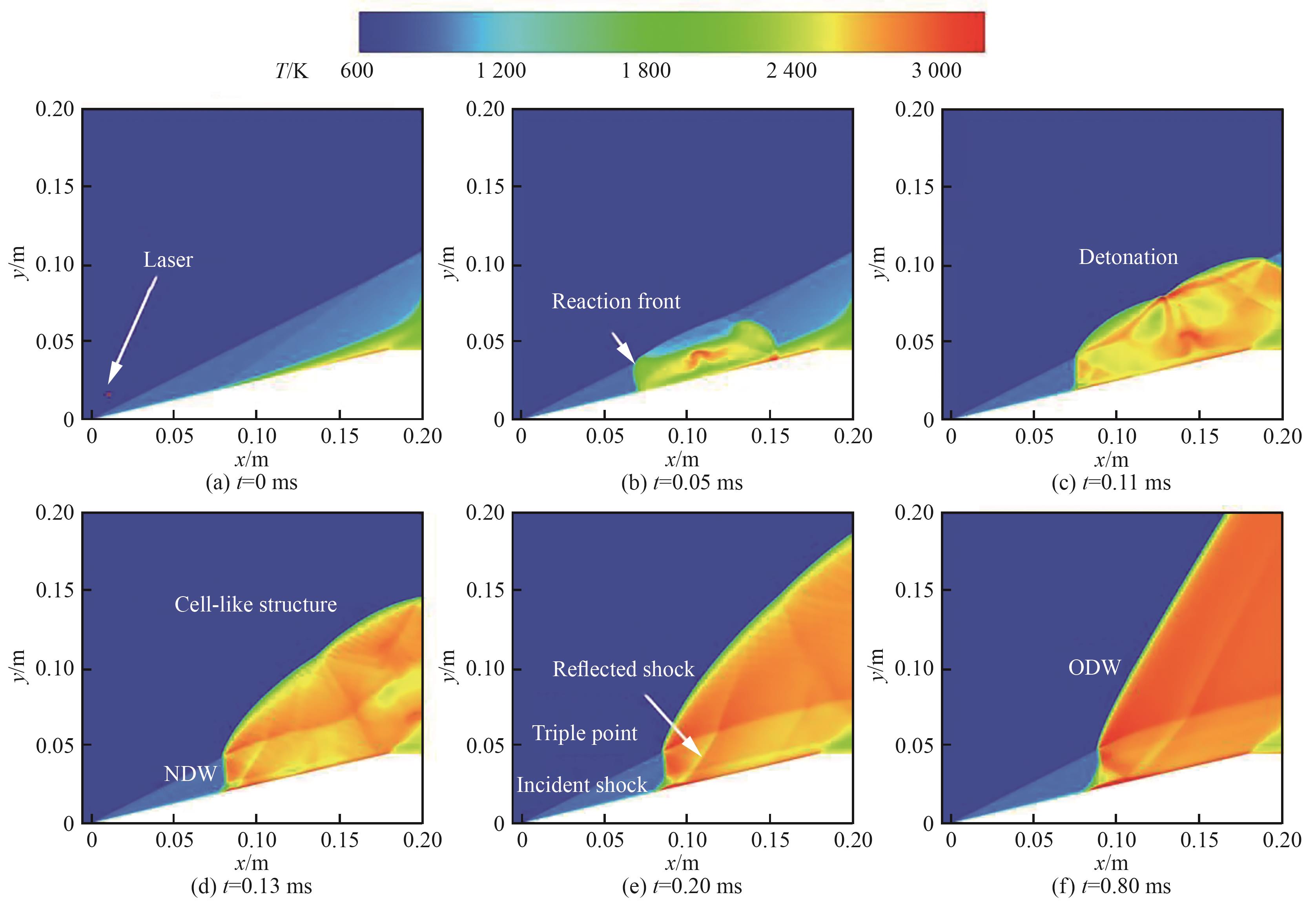
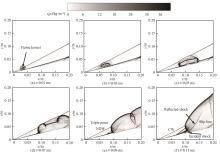
Fig.9
Evolution process of density gradient in oblique detonation flow field initiated by laser ignition source under conditions of Ma = 8 and θ =14°
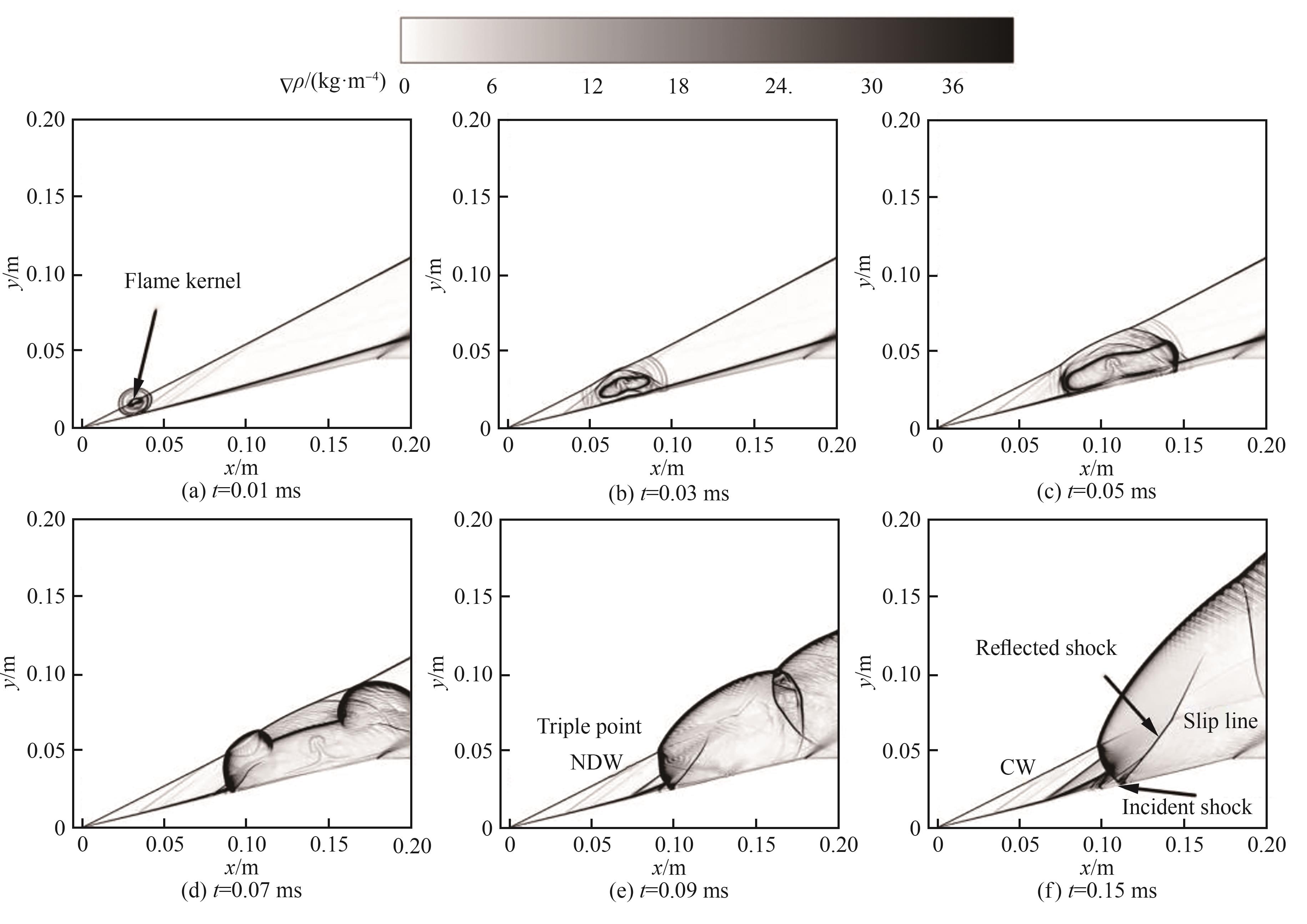
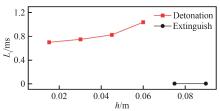
Fig.10
Relationship between establishment time of oblique detonation wave flow field and detonation initiation at different ignition heights
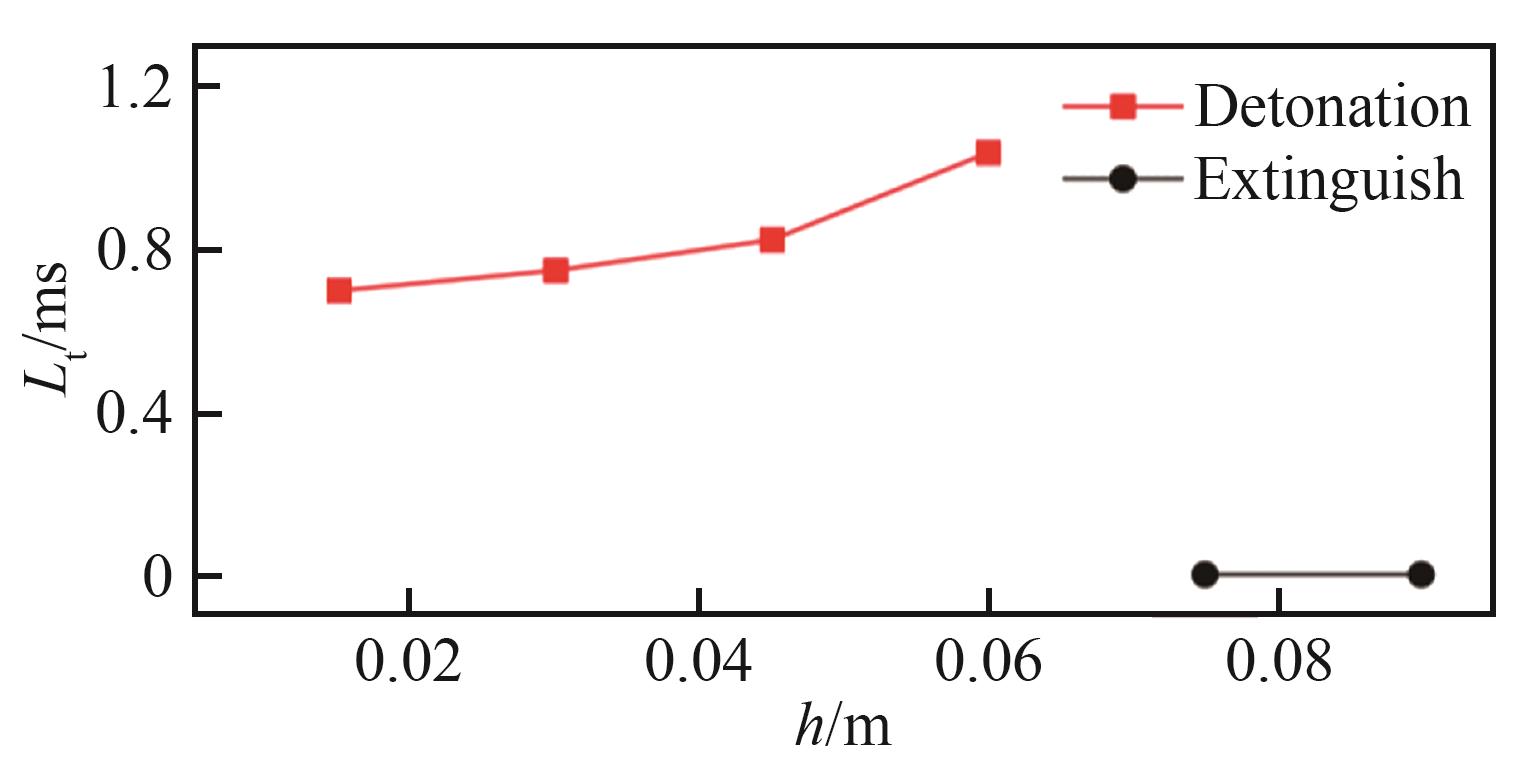
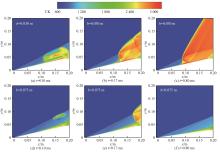
Fig.11
Effect of different ignition heights on initiation and stabilization of oblique detonation wave
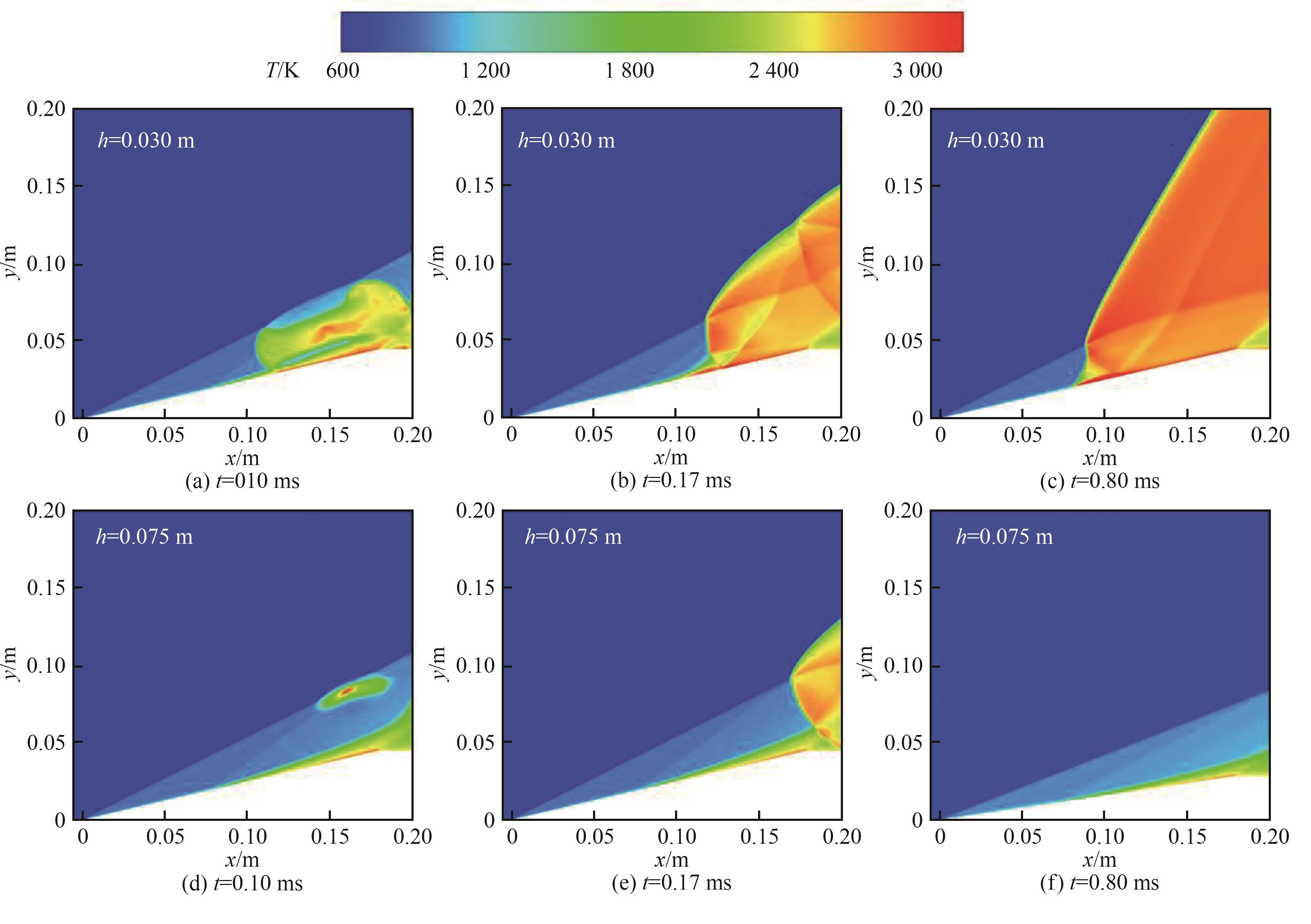
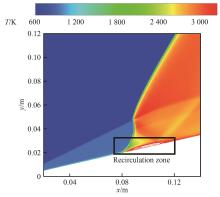
Fig.12
Structure of recirculation zone of ignition boundary layer under conditions of Ma = 8 and θ = 14°
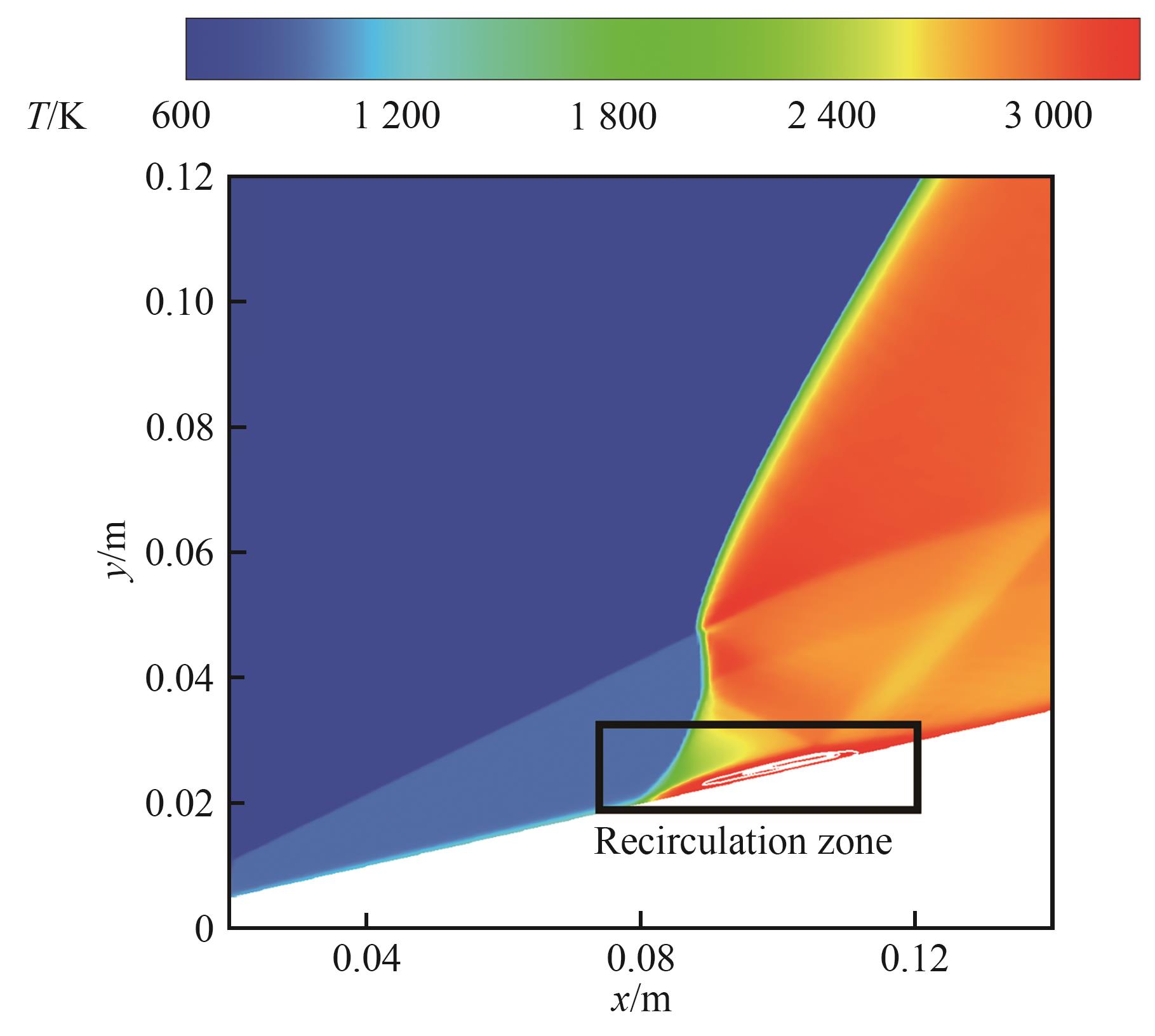
Fig.13
Evolution process of laser ignition in inviscid flow field under conditions Ma = 8 and θ = 14°: temperature field (upper) and density gradient field (lower)
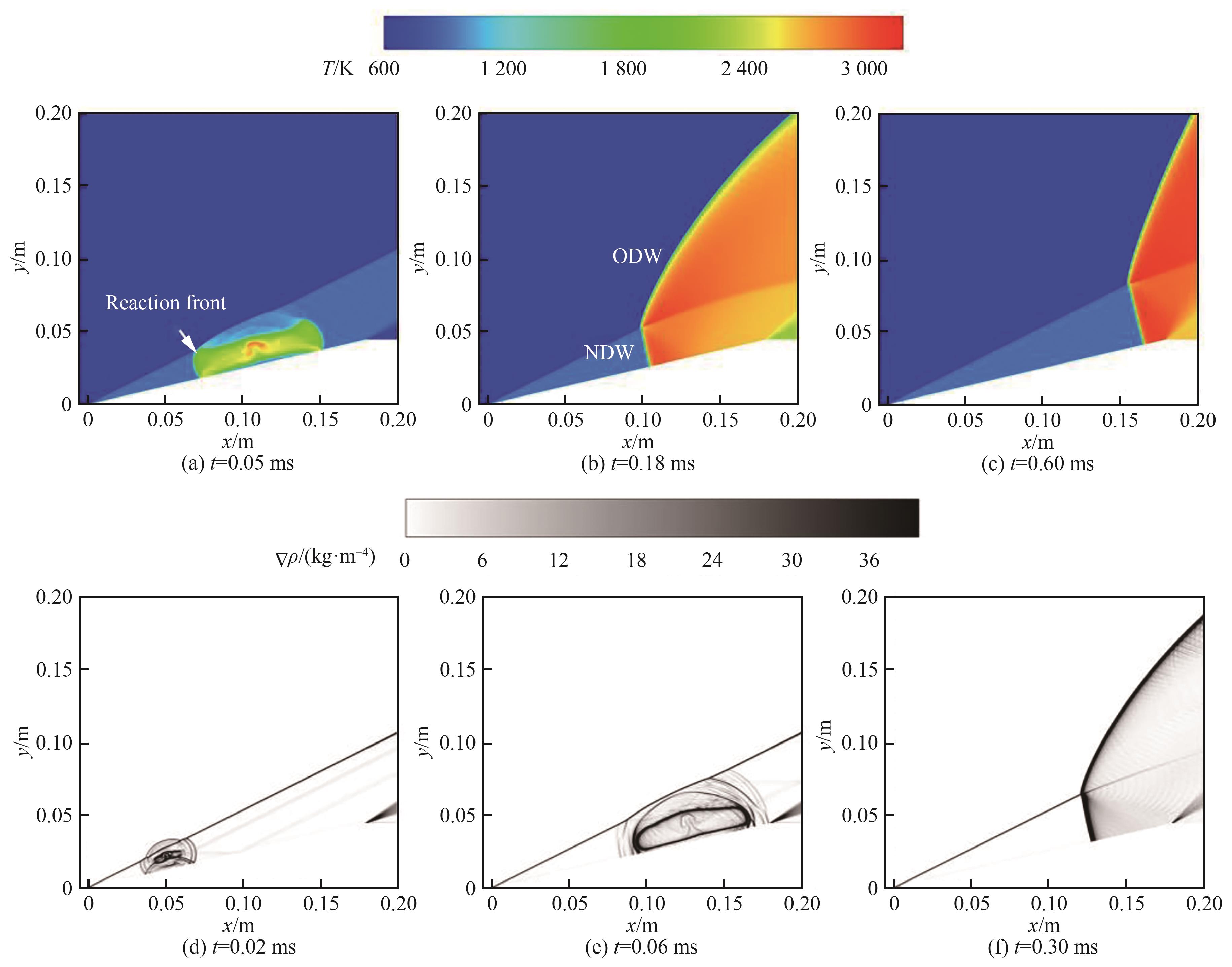
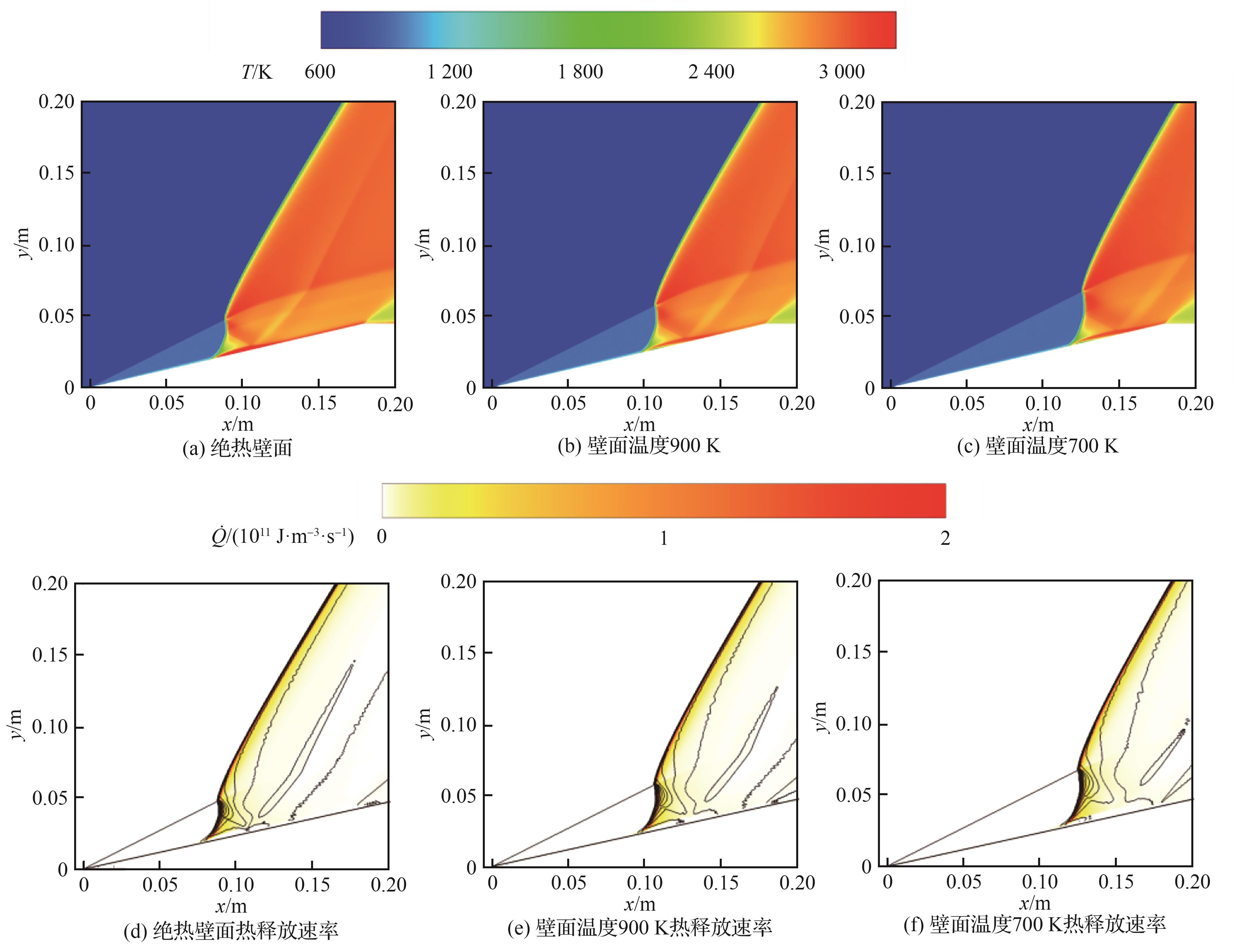
Fig.14
Steady-state flow field distribution and heat release rate after ignition at different wedge surface temperatures
| [1] | JIANG Z L. Standing oblique detonation for hypersonic propulsion: A review[J]. Progress in Aerospace Sciences, 2023, 143: 100955. |
| [2] | YANG P F, NG H D, TENG H H, et al. Initiation structure of oblique detonation waves behind conical shocks[J]. Physics of Fluids, 2017, 29(8): 086104. |
| [3] | 杨鹏飞, 张子健, 杨瑞鑫, 等. 斜爆轰发动机的推力性能理论分析[J]. 力学学报, 2021, 53(10): 2853-2864. |
| YANG P F, ZHANG Z J, YANG R X, et al. Theorical study on propulsive performance of oblique detonation engine[J]. Chinese Journal of Theoretical and Applied Mechanics, 2021, 53(10): 2853-2864 (in Chinese). | |
| [4] | HE G S, FENG Z L, WANG K L, et al. Unsteady wave characteristics of oblique detonation wave in a contraction-expansion channel[J]. International Journal of Hydrogen Energy, 2024, 71: 999-1005. |
| [5] | 滕宏辉, 姜宗林. 斜爆轰的多波结构及其稳定性研究进展[J]. 力学进展, 2020, 50: 202002. |
| TENG H H, JIANG Z L. Progress in multi-wave structure and stability of oblique detonations[J]. Advances in Mechanics, 2020, 50: 202002 (in Chinese). | |
| [6] | YANG P F, YU D H, CHEN Z, et al. Effects of thermal stratification on detonation development in hypersonic reactive flows[J]. Physical Review Fluids, 2024, 9(8): 083202. |
| [7] | 张博, 白春华. 气相爆轰动力学特征研究进展[J]. 中国科学: 物理学 力学 天文学, 2014, 44(7): 665-681. |
| ZHANG B, BAI C H. Research progress on the dynamic characteristics of gaseous detonation[J]. Scientia Sinica (Physica, Mechanica & Astronomica), 2014, 44(7): 665-681 (in Chinese). | |
| [8] | YANG P F, NG H D, TENG H H. Numerical study of wedge-induced oblique detonations in unsteady flow[J]. Journal of Fluid Mechanics, 2019, 876: 264-287. |
| [9] | TENG H H, LIU S Y, LI Z Z, et al. Effect of ozone addition on oblique detonations in hydrogen-air mixtures[J]. Applied Thermal Engineering, 2024, 240: 122292. |
| [10] | YANG P F, TENG H H, NG H D, et al. A numerical study on the instability of oblique detonation waves with a two-step induction-reaction kinetic model[J]. Proceedings of the Combustion Institute, 2019, 37(3): 3537-3544. |
| [11] | SUN J, YANG P F, TIAN B L, et al. Evolution and control of oblique detonation wave structure in unsteady inflow[J]. AIAA Journal, 2023, 61(11): 4808-4820. |
| [12] | YANG P F, TENG H H, JIANG Z L, et al. Effects of inflow Mach number on oblique detonation initiation with a two-step induction-reaction kinetic model[J]. Combustion and Flame, 2018, 193: 246-256. |
| [13] | TENG H H, NG H D, JIANG Z L. Initiation characteristics of wedge-induced oblique detonation waves in a stoichiometric hydrogen-air mixture[J]. Proceedings of the Combustion Institute, 2017, 36(2): 2735-2742. |
| [14] | PRATT D, HUMPHREY J, GLENN D. Morphology of a standing oblique detonation wave[C]∥23rd Joint Propulsion Conference. Reston: AIAA, 1987. |
| [15] | TENG H H, ZHANG Y H, YANG P F, et al. Oblique detonation wave triggered by a double wedge in hypersonic flow[J]. Chinese Journal of Aeronautics, 2022, 35(4): 176-184. |
| [16] | FANG Y S, ZHANG Z J, HU Z M, et al. Initiation of oblique detonation waves induced by a blunt wedge in stoichiometric hydrogen-air mixtures[J]. Aerospace Science and Technology, 2019, 92: 676-684. |
| [17] | YANG L, YUE L J, ZHANG Q F. Onset of oblique detonation waves for a cavity-based wedge[J]. AIAA Journal, 2022, 60(5): 2836-2849. |
| [18] | QIN Q Y, ZHANG X B. A novel method for trigger location control of the oblique detonation wave by a modified wedge[J]. Combustion and Flame, 2018, 197: 65-77. |
| [19] | ZHANG Y C, XIANG G X. Investigations on the initiation characteristics of radical-assisted oblique detonation waves generated by plasma discharges[J]. Aerospace Science and Technology, 2024, 153: 109466. |
| [20] | LI H B, LI J L, XIONG C, et al. Investigation of hot jet on active control of oblique detonation waves[J]. Chinese Journal of Aeronautics, 2020, 33(3): 861-869. |
| [21] | QIN Q Y, ZHANG X B. Study on the initiation characteristics of the oblique detonation wave by a co-flow hot jet[J]. Acta Astronautica, 2020, 177: 86-95. |
| [22] | WANG A F, BIAN J, TENG H H. Numerical study on initiation of oblique detonation wave by hot jet[J]. Applied Thermal Engineering, 2022, 213: 118679. |
| [23] | ZHANG W S, ZHANG Z J, JIANG Z L, et al. Numerical investigation of free oblique detonation wave induced by non-intrusive energy deposition[J]. AIP Advances, 2021, 11(12): 125119. |
| [24] | XIN Y R, SHANG J H, XIANG G X, et al. Investigation on accelerated initiation of oblique detonation wave induced by laser-heating hot-spot[J]. Aerospace, 2024, 11(6): 485. |
| [25] | CHAKRAVARTHY S. A unified-grid finite volume formulation for computational fluid dynamics[J]. International Journal for Numerical Methods in Fluids, 1999, 31(1): 309-323. |
| [26] | TORO E F. Riemann solvers and numerical methods for fluid dynamics: A practical introduction[M]. Berlin, Heidelberg: Springer, 2009: 32-65. |
| [27] | ROPP D L, SHADID J N. Stability of operator splitting methods for systems with indefinite operators: Advection-diffusion-reaction systems[J]. Journal of Computational Physics, 2009, 228(9): 3508-3516. |
| [28] | WILSON G J, MACCORMACK R W. Modeling supersonic combustion using a fully implicit numerical method[J]. AIAA Journal, 1992, 30(4): 1008-1015. |
| [29] | JACHIMOWSKI C J. An analytical study of the hydrogen-air reaction mechanism with application to scramjet combustion: NASA-TP-2791[R]. Washington, D.C.: NASA, 1988. |
| [30] | 郗雪辰, 牛淑贞, 杨鹏飞, 等. 氢气燃料斜爆轰发动机内波系对楔面调控的动态响应特性[J]. 航空学报, 2024, 45(22): 130275. |
| XI X C, NIU S Z, YANG P F, et al. Dynamic response characteristics of wave systems to wedge control in hydrogen-fueled oblique detonation engines[J]. Acta Aeronautica et Astronautica Sinica, 2024, 45(22): 130275 (in Chinese). | |
| [31] | TAYLOR G. The formation of a blast wave by a very intense explosion. I. Theoretical discussion[J]. Proceedings of the Royal Society of London Series A, Mathematical and Physical Sciences, 1950, 201(1065): 159-174. |
| [32] | KIELKOPF J. Spectroscopic study of laser-produced plasmas in hydrogen[J]. Physical Review E, Statistical Physics, Plasmas, Fluids, and Related Interdisciplinary Topics, 1995, 52(2): 2013-2024. |
| [33] | FANG Y S, ZHANG Z J, HU Z M. Effects of boundary layer on wedge-induced oblique detonation structures in hydrogen-air mixtures[J]. International Journal of Hydrogen Energy, 2019, 44(41): 23429-23435. |
| [34] | MIAO S K, XU D K, SONG T L, et al. Shock wave-boundary layer interactions in wedge-induced oblique detonations[J]. Combustion Science and Technology, 2020, 192(12): 2345-2370. |
| [35] | LIU Y, CHEN W Q, WANG L, et al. Oblique detonation initiation by an instantaneous energy source in high-speed wedge flows[J]. AIAA Journal, 2021, 59(11): 4794-4799. |
| [1] | Yanfang LIU, Hongyue WANG, Yujia E, Naiming QI. A new paradigm of intelligence-driven active mass ejection drag and heat reduction research for hypersonic vehicle boundary layer [J]. Acta Aeronautica et Astronautica Sinica, 2026, 47(2): 132171-132171. |
| [2] | Jiaxin DUAN, Yuan LIU, Liangjie GAO, Zhansen QIAN. A novel wide-speed waverider design method with variable multi-parameter along spanwise direction [J]. Acta Aeronautica et Astronautica Sinica, 2026, 47(1): 632109-632109. |
| [3] | Chen LI, Dong SUN, Pengxin LIU, Qilong GUO, Xianxu YUAN. Direct numerical simulation of supersonic turbulent boundary layer with plasma actuation [J]. Acta Aeronautica et Astronautica Sinica, 2025, 46(S1): 732187-732187. |
| [4] | Guoliang RONG, Yifan YANG, Chuangchuang LI, Zhiyuan LI, Xueliang LI, Jiaquan ZHAO, Jie WU. Integrated design of homogeneous mixing and heating of flow based on dual-throat Ludwieg tube wind tunnel settling chamber [J]. Acta Aeronautica et Astronautica Sinica, 2025, 46(9): 130906-130906. |
| [5] | Xiaoxu ZHANG, Wei XIAO, Jun CAO, Wei LI, Hua ZHOU, Zhuyin REN. Review of mechanism and prediction model of boundary layer flashback in hydrogen-fueled combustor [J]. Acta Aeronautica et Astronautica Sinica, 2025, 46(9): 630952-630952. |
| [6] | Xiaoyuan ZHANG, Jinping LI, Hu MA, Shizhong ZHANG, Shuo CHEN, Xingyu LU. Experimental initiation process of oblique detonation wave in combustion chamber under high Mach number conditions [J]. Acta Aeronautica et Astronautica Sinica, 2025, 46(9): 231167-231167. |
| [7] | Jianyu XU, Li ZHOU, Zhanxue WANG, Jie SHI, Hao SHI. Calculation method for hypersonic plume infrared radiation based on a fast line-by-line calculation model [J]. Acta Aeronautica et Astronautica Sinica, 2025, 46(8): 630778-630778. |
| [8] | Feiteng LUO, Zhenming QU, Haitao LI, Xinke LI, Dahao YAO, Wenjuan CHEN, Yaosong LONG, Baoxi WEI, Yanjin MAN, Fujiang YANG, Qiang CHENG, Wubin KONG. Research progress and key issues of inlet pre-injection at hypersonic condition [J]. Acta Aeronautica et Astronautica Sinica, 2025, 46(8): 631189-631189. |
| [9] | Lixiang WEI, Jinglei XU, Kuangshi CHEN, Shuai HUANG, Jianhui GE, Guangtao SONG. Scheme design and performance study of adjustable vector nozzle for wide-range hypersonic aircraft [J]. Acta Aeronautica et Astronautica Sinica, 2025, 46(8): 631086-631086. |
| [10] | Xiaogang ZHENG, Zhancang HU, Zejun CAI, Chongguang SHI, Chengxiang ZHU, Yancheng YOU. Design of 3D inward-turning inlet considering cruising angle of attack [J]. Acta Aeronautica et Astronautica Sinica, 2025, 46(8): 631233-631233. |
| [11] | Xiaogang ZHENG, Chongguang SHI, Jiale ZHANG, Mi ZHANG, Wenlei ZHU, Chengxiang ZHU, Yancheng YOU. Research progress review on hypersonic three-dimensional inward-turning inlet [J]. Acta Aeronautica et Astronautica Sinica, 2025, 46(8): 631245-631245. |
| [12] | Chengpeng WANG, Chenguang HAO, Hao LI, Longsheng XUE, Yun JIAO, Siyu WU, Zhangyu MA, Ye YUAN, Weijun LI, Puchen HOU. Application of minimum entropy production principle to analysis of shock wave/boundary layer interactions [J]. Acta Aeronautica et Astronautica Sinica, 2025, 46(8): 631458-631458. |
| [13] | Zonglin JIANG, Guilai HAN, Yunpeng WANG, Yunfeng LIU, Chaokai YUAN, Changtong LUO, Chun WANG, Zongmin HU, Meikuan LIU. Theoretical bases and key technologies of JF-22 hypervelocity wind tunnel [J]. Acta Aeronautica et Astronautica Sinica, 2025, 46(5): 531130-531130. |
| [14] | Feng QU, Qing WANG, Shaowen CHENG, Kaiqiang WANG. Aerodynamic shape optimization design of airframe/propulsion integrated hypersonic aircraft with aerodynamics/trajectory/ control coupling [J]. Acta Aeronautica et Astronautica Sinica, 2025, 46(4): 130874-130874. |
| [15] | Jun CHEN, Feng QU, Junjie FU. Design method of hypersonic inward turning inlet based on genetic and gradient hybrid optimization strategy [J]. Acta Aeronautica et Astronautica Sinica, 2025, 46(3): 130808-130808. |
| Viewed | ||||||
|
Full text |
|
|||||
|
Abstract |
|
|||||
Address: No.238, Baiyan Buiding, Beisihuan Zhonglu Road, Haidian District, Beijing, China
Postal code : 100083
E-mail:hkxb@buaa.edu.cn
Total visits: 6658907 Today visits: 1341All copyright © editorial office of Chinese Journal of Aeronautics
All copyright © editorial office of Chinese Journal of Aeronautics
Total visits: 6658907 Today visits: 1341

 CJA
CJA
