钟俊1,2,3, 范晓樯1( ), 熊冰1, 陈磊1, 唐啸1
收稿日期:2025-07-31
修回日期:2025-09-01
接受日期:2025-12-01
出版日期:2025-12-17
发布日期:2025-12-15
通讯作者:
范晓樯
E-mail:xqfan@nudt.edu.cn
基金资助:
Jun ZHONG1,2,3, Xiaoqiang FAN1(), Bing XIONG1, Lei CHEN1, Xiao TANG1
Received:2025-07-31
Revised:2025-09-01
Accepted:2025-12-01
Online:2025-12-17
Published:2025-12-15
Contact:
Xiaoqiang FAN
E-mail:xqfan@nudt.edu.cn
Supported by:摘要:
助推器和保护罩在同一时间从吸气式高超声速飞行器上解锁的“同时分离”时序方案,可利用内流道的充填高压,有利于飞行器的轴向分离过程。然而,在该时序方案分离初期,受运动激波、激波串及气体充填的作用,飞行器内流道中存在复杂多变的压力振荡,除传统的碰撞风险外,还有气体充填导致的潜在超压风险。结合重叠动网格技术,求解非定常雷诺平均Navier-Stokes(RANS)方程,对保护罩开启时飞行器内流道流场的建立过程进行数值计算,获得内流道的时序流场结构和非定常压力特性;分析开罩过程中内流场的演变机理,以及保护罩运动与级间距变化对分离初期流场建立过程的影响机制。结果表明:在“同时分离”时序方案的分离初期,内流道的充填与泄流过程中存在缝隙射流、运动激波扫掠、激波串前移、气体倒流与泄流过渡5个流动特征显著不同的阶段;保护罩开启时,内流道出现最大压力的主要因素是激波系增压、激波串增压和气体充填蓄压,并非是运动激波引起的压力跃升;内流道是否起动,决定了保护罩运动与级间距变化对内流道流场的作用是单向依赖关系还是耦合作用关系。
中图分类号:
钟俊, 范晓樯, 熊冰, 陈磊, 唐啸. 保护罩开启时高速飞行器内流场建立过程分析[J]. 航空学报, 2026, 47(8): 132638.
Jun ZHONG, Xiaoqiang FAN, Bing XIONG, Lei CHEN, Xiao TANG. Internal flow field development process of a hypersonic vehicle during protective cover separation[J]. Acta Aeronautica et Astronautica Sinica, 2026, 47(8): 132638.
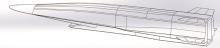
图 1
重构的飞行器三维外形示意图
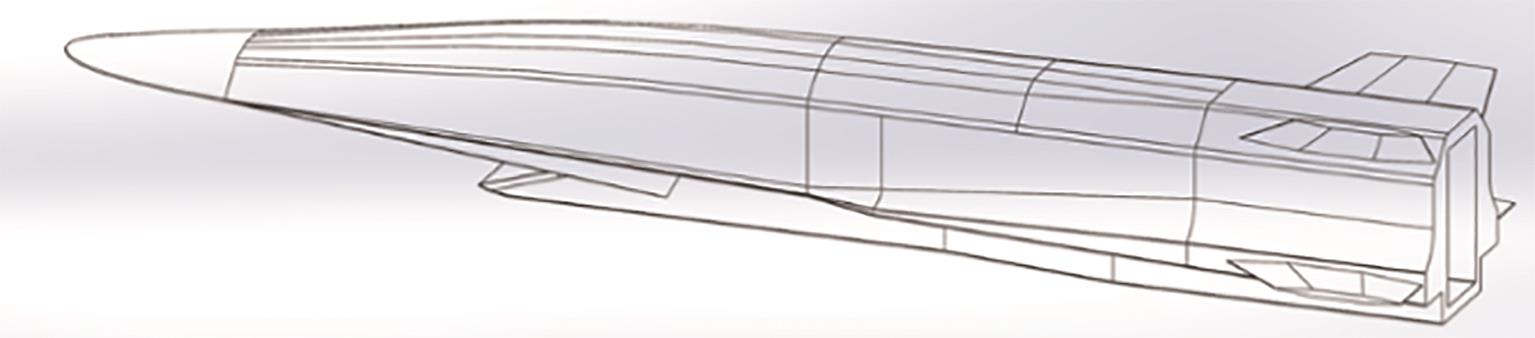
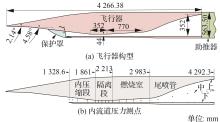
图 2
飞行器对称面构型与压力监测点的示意图
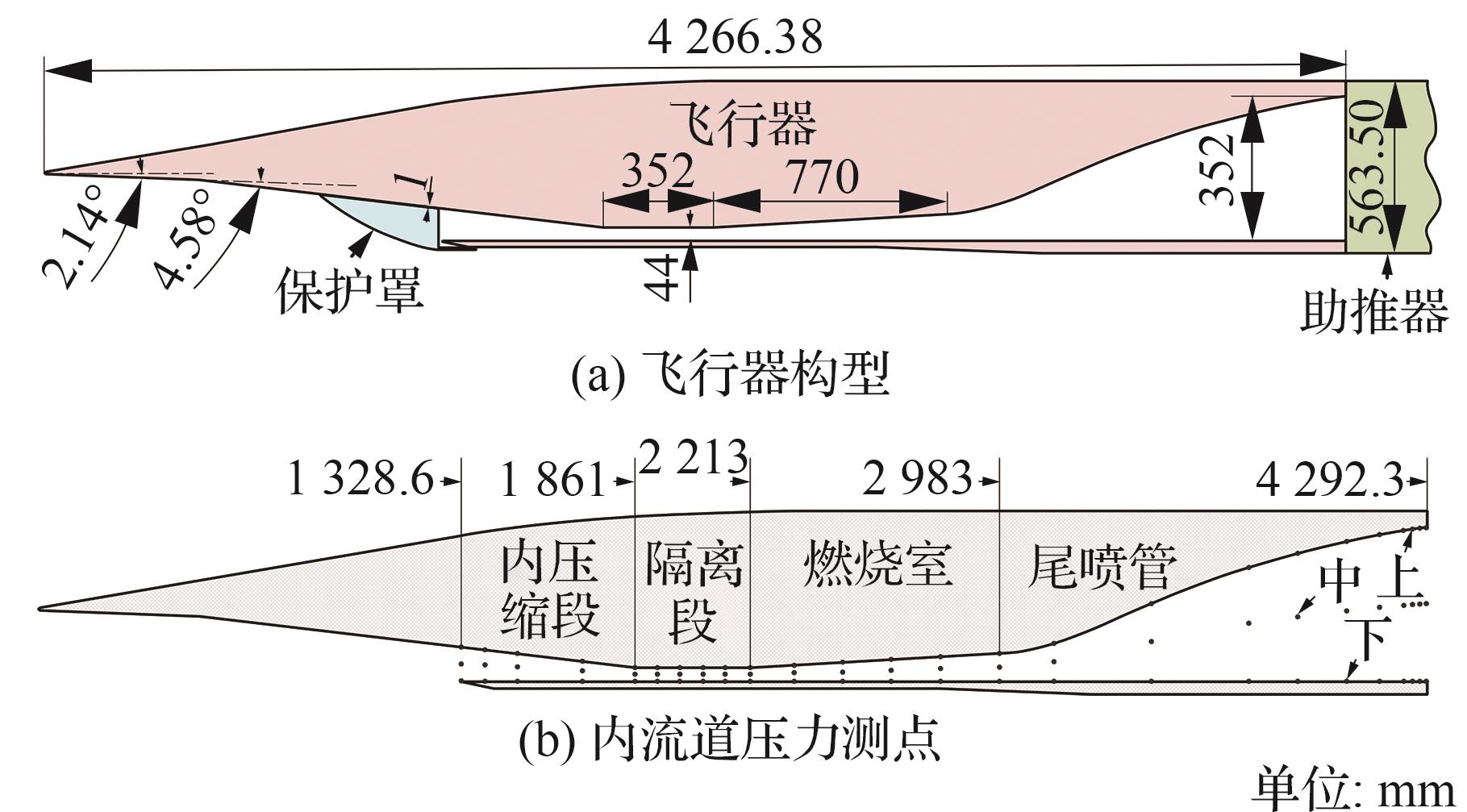
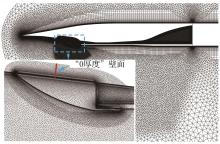
图 3
计算网格
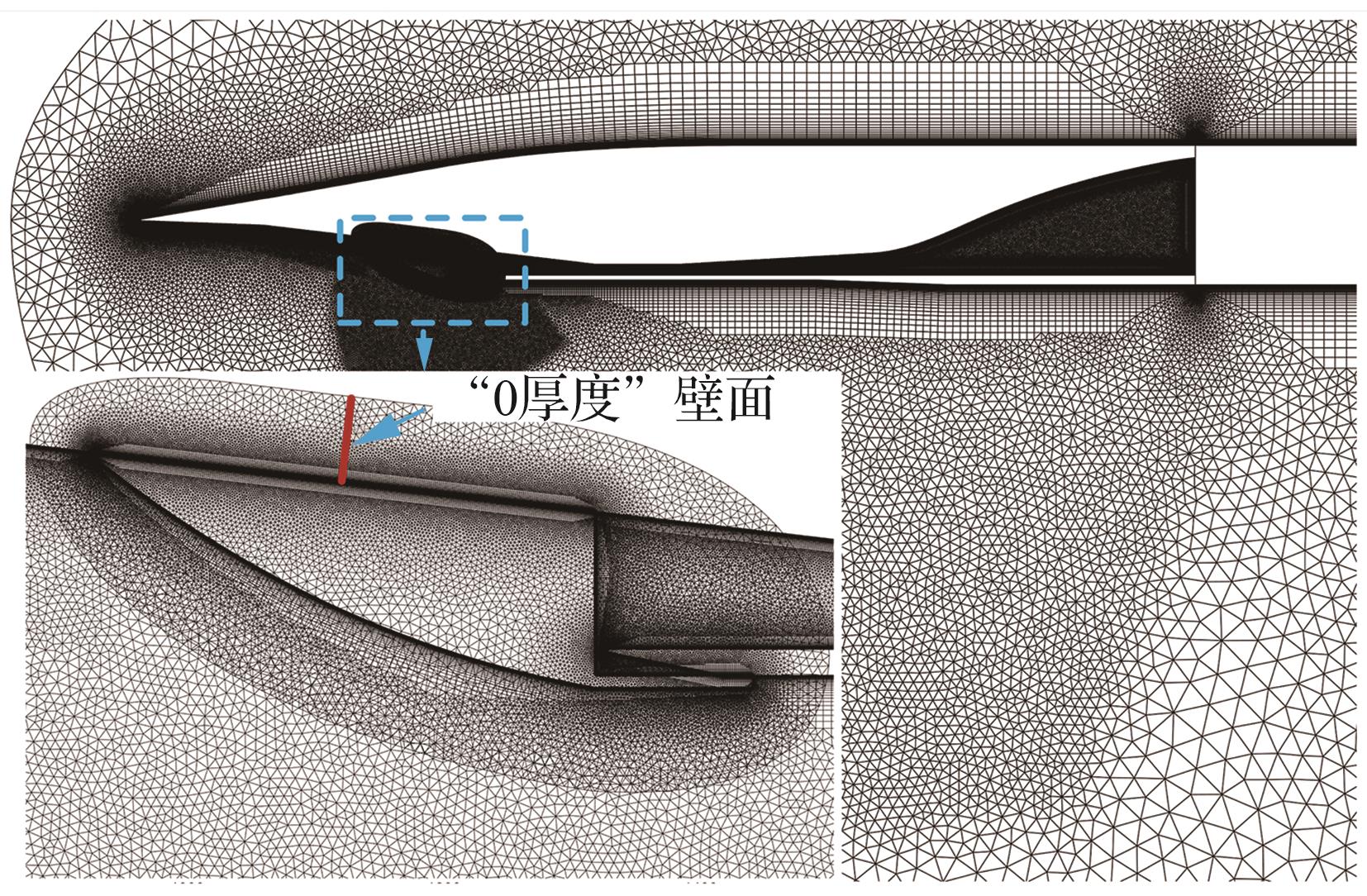
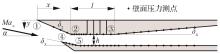
图 4
进气道模型示意图[39-40]
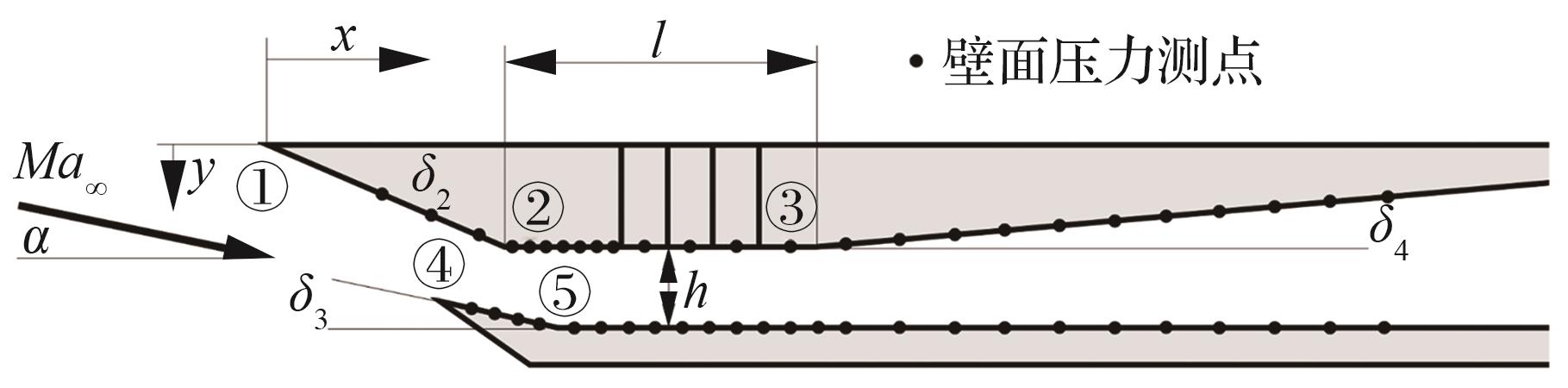
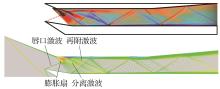
图 5
数值计算马赫数等值线与纹影流场结构[39]对比
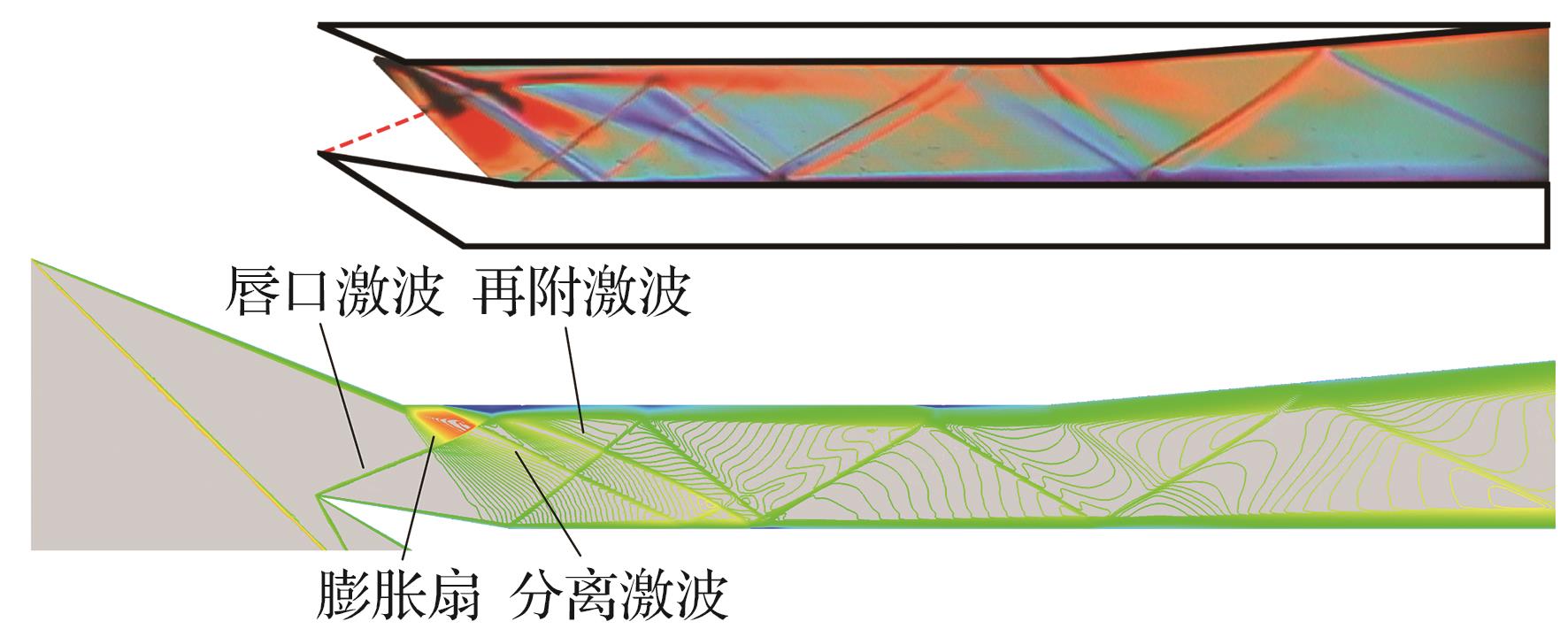
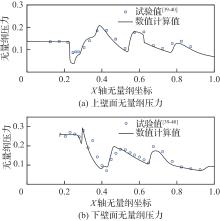
图 6
进气道内部压力分布的计算与试验结果对比
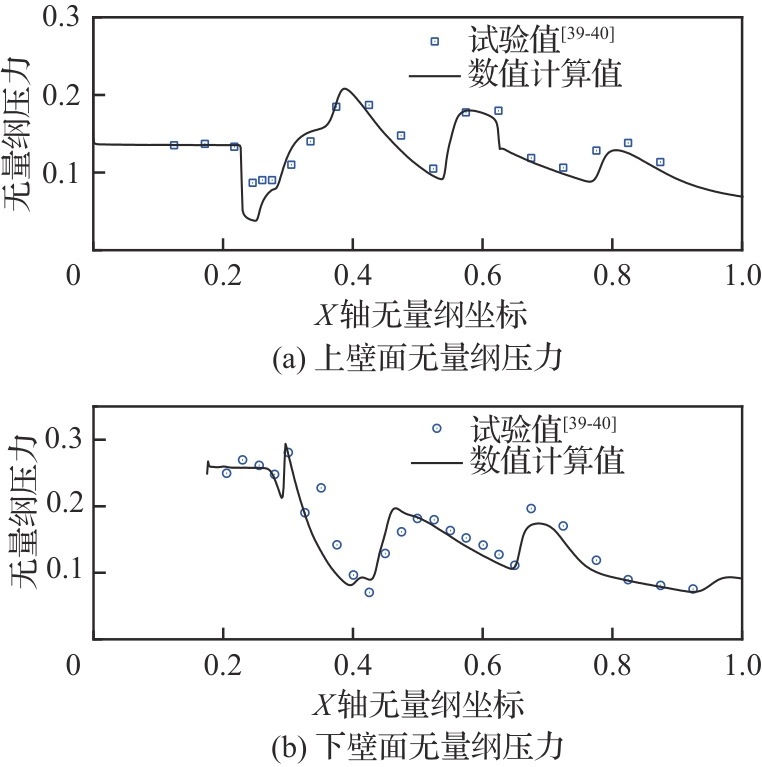
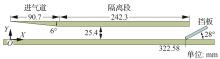
图 7
进气道/隔离段模型示意图[41]
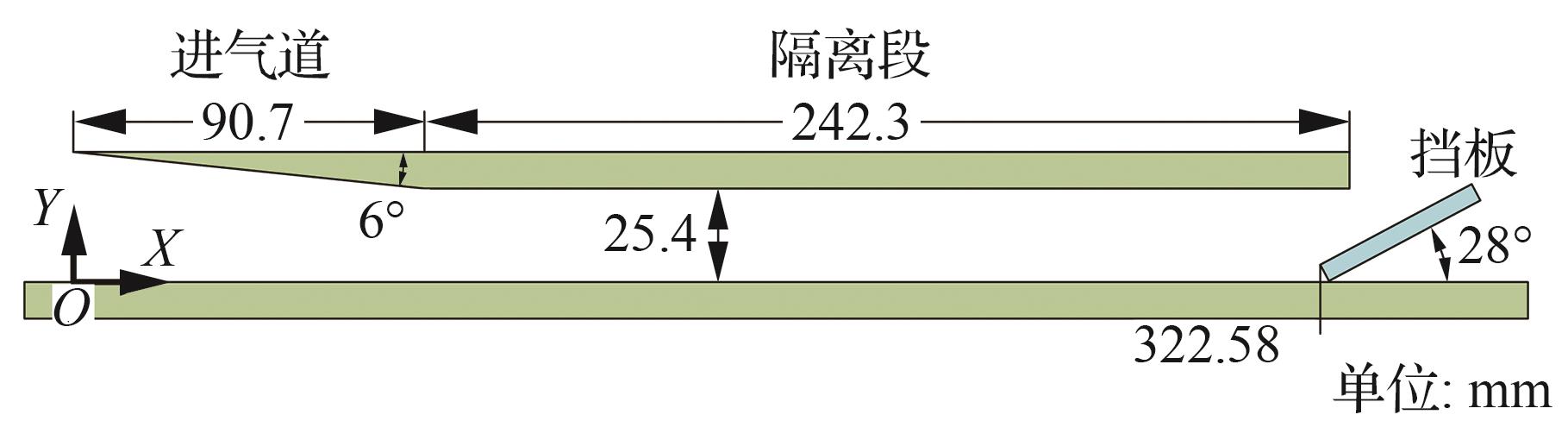
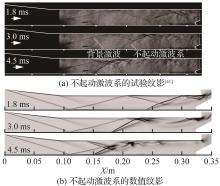
图 8
不起动激波系的数值计算与试验结果对比
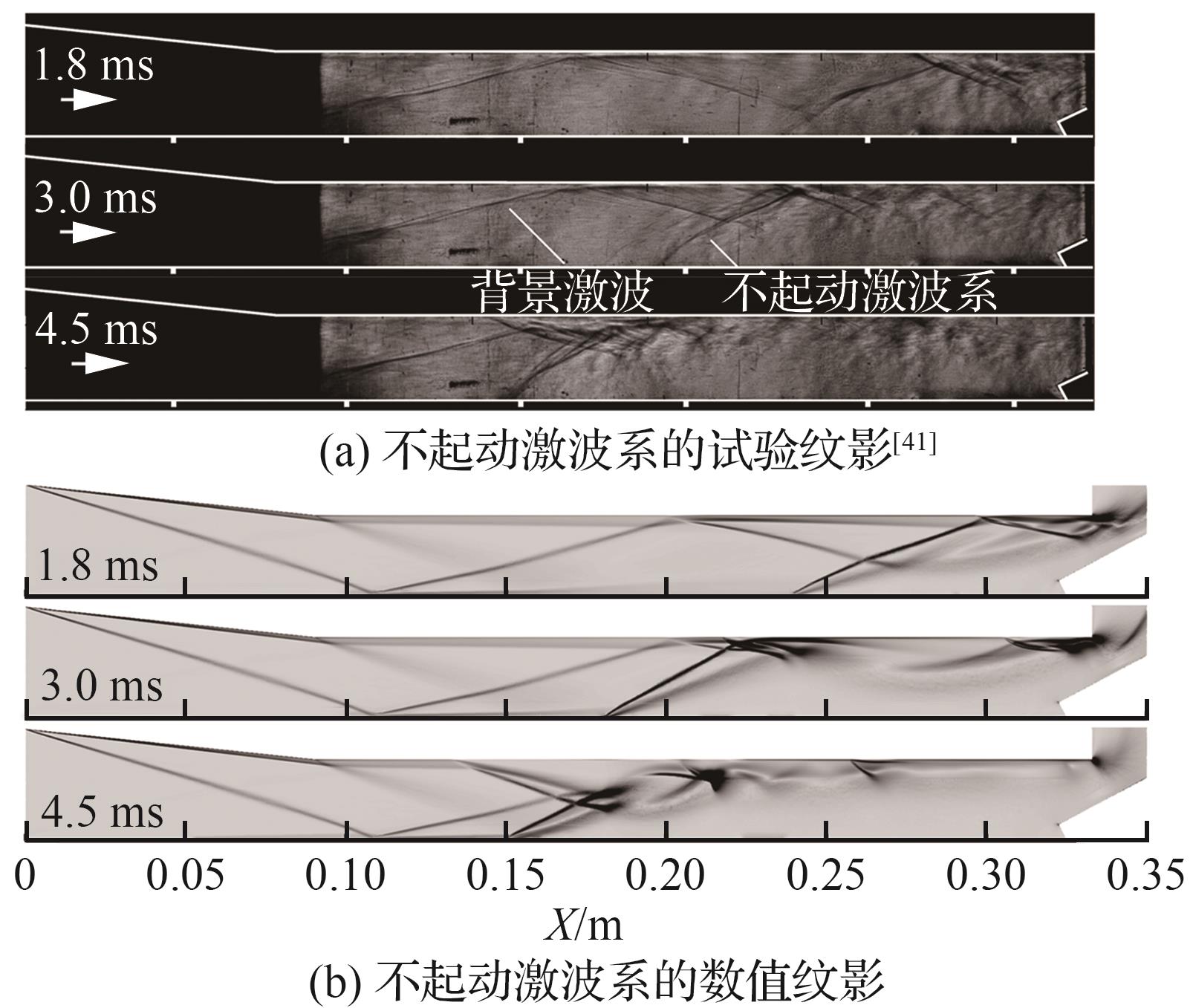
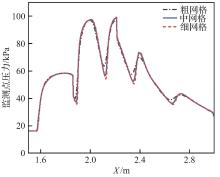
图 9
网格无关性验证
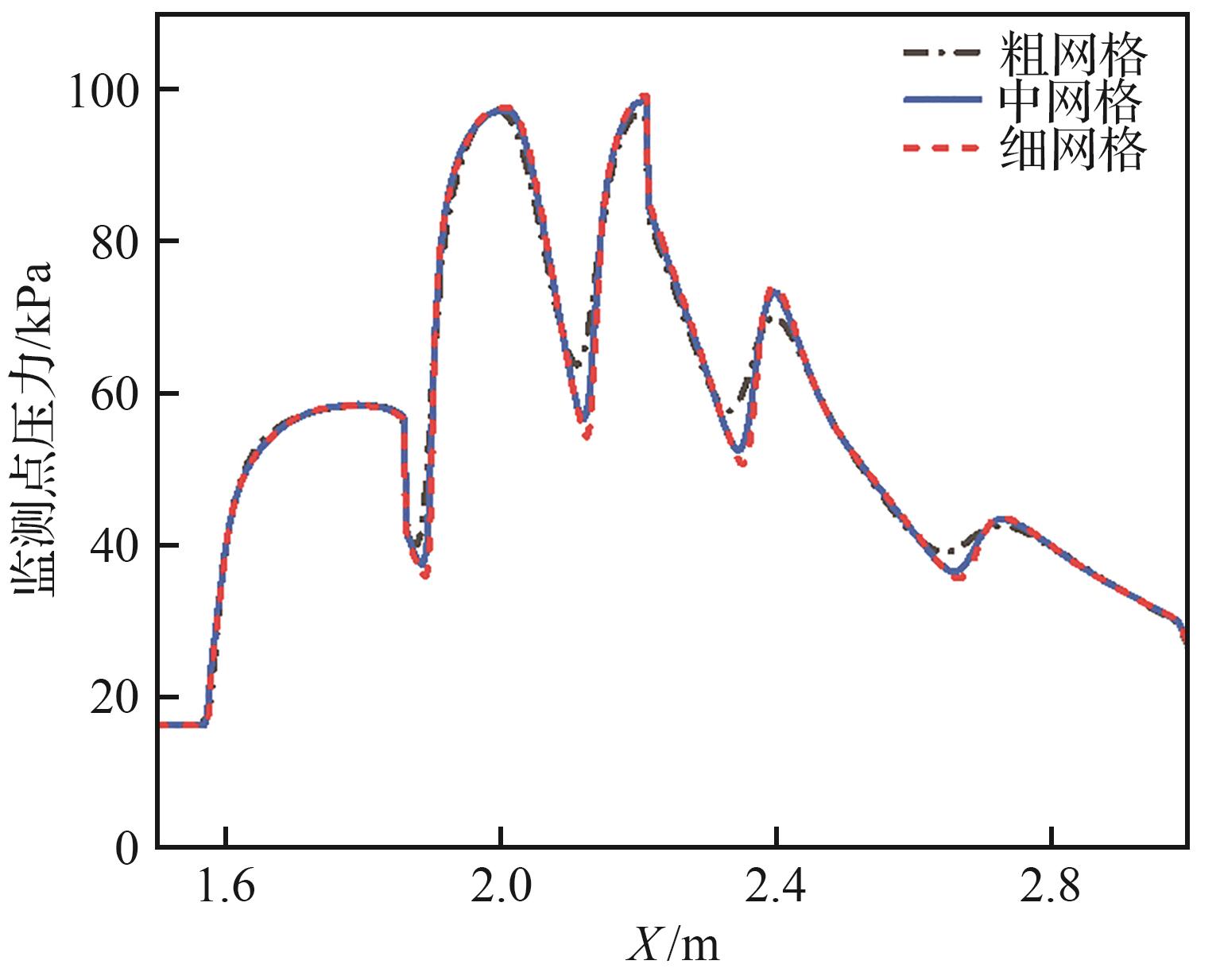
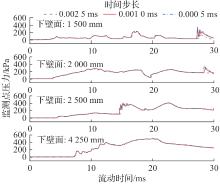
图 10
时间步长无关性验证
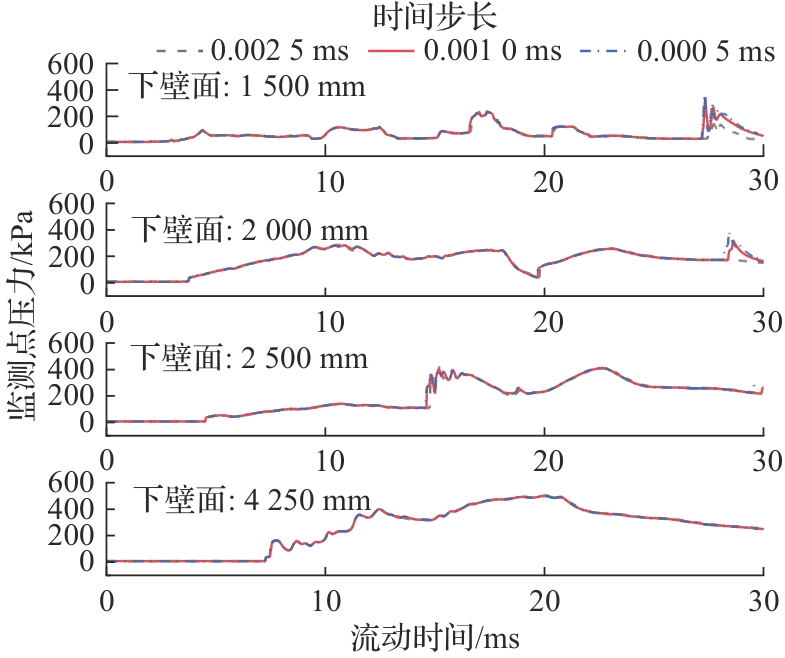
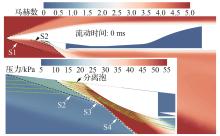
图 11
保护罩开启前的初始稳态流场
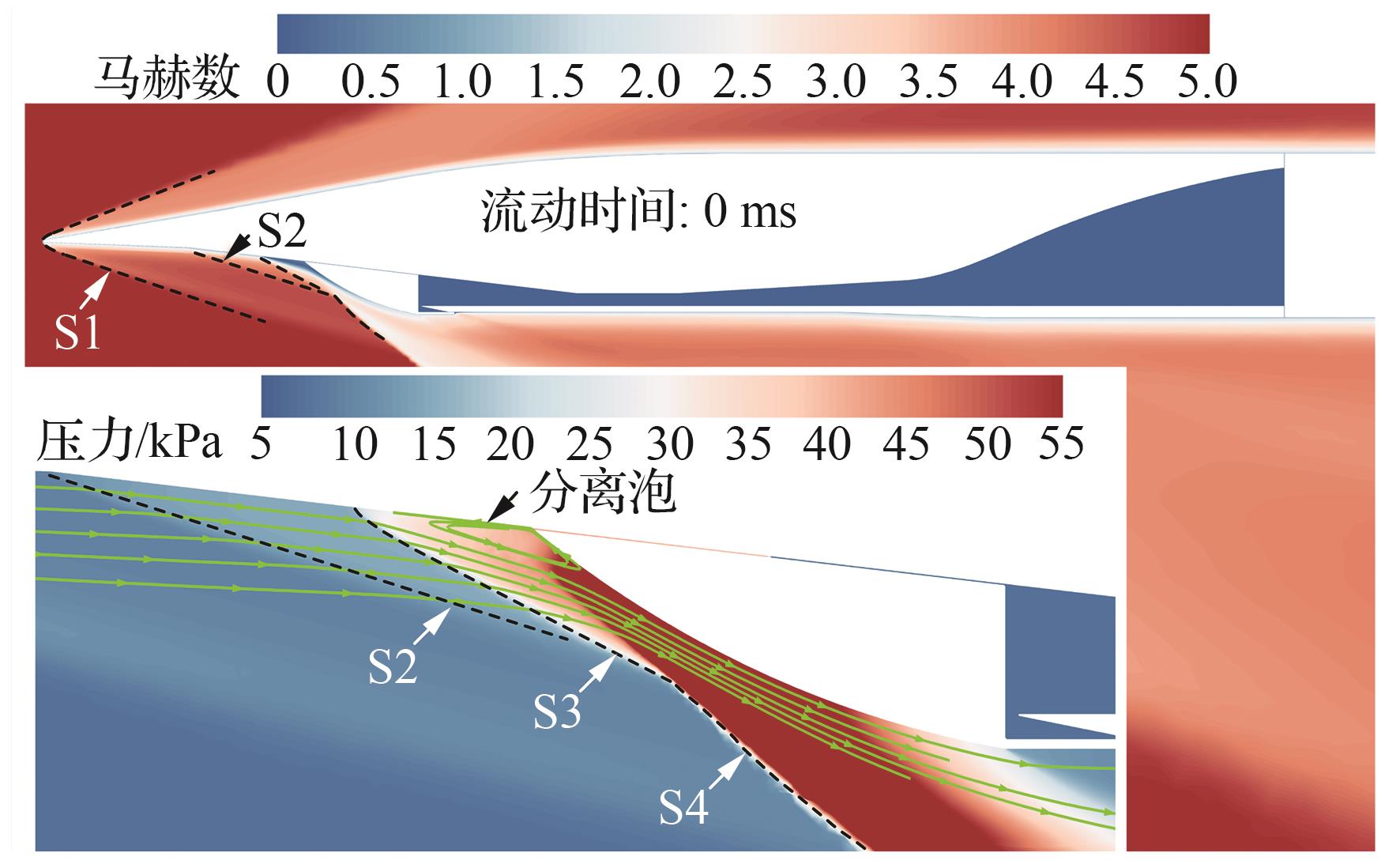
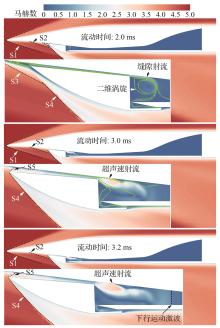
图 12
保护罩刚开始旋转时的流场结构
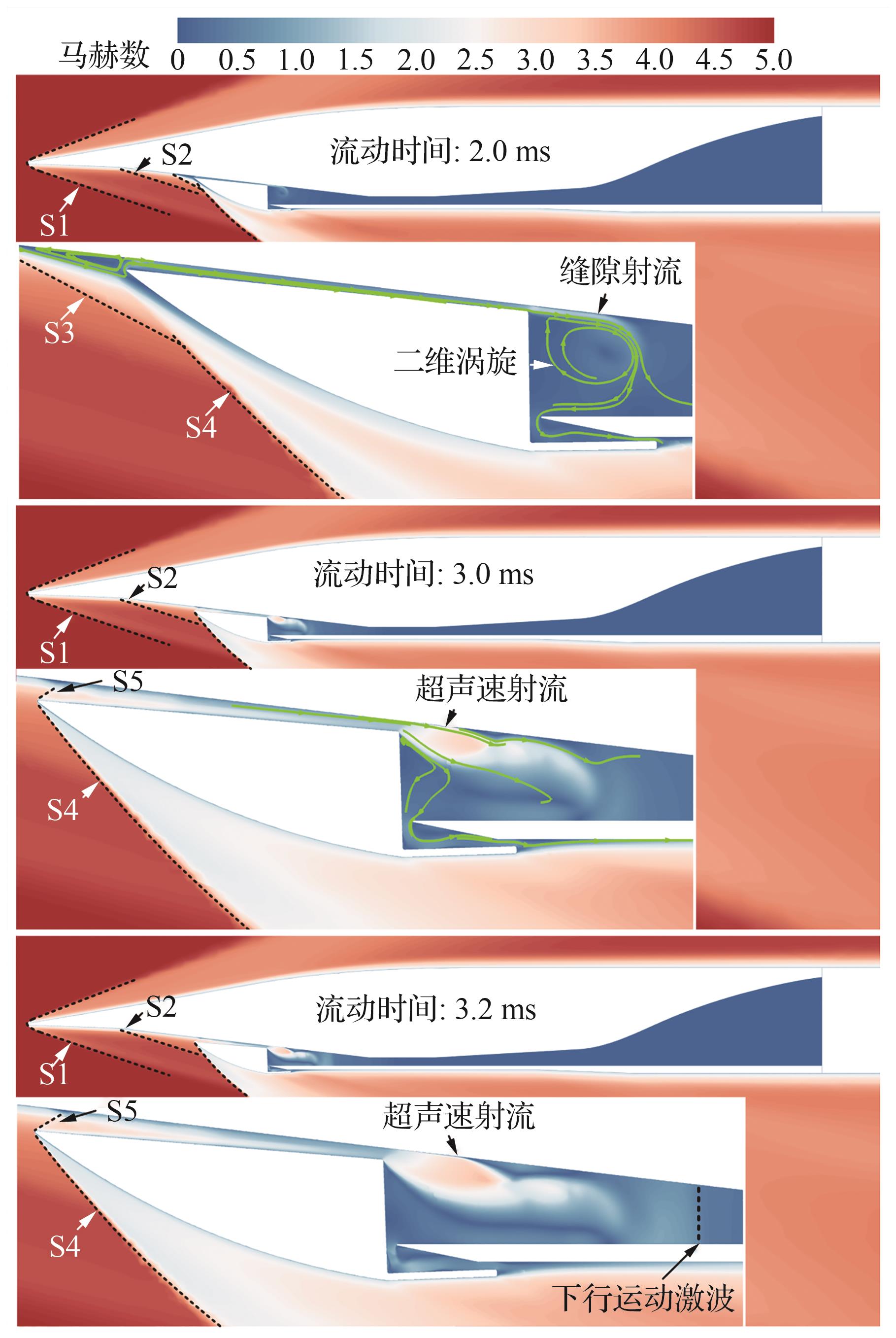
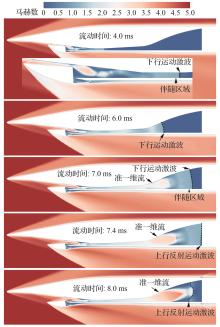
图 13
运动激波主导的保护罩分离流场结构
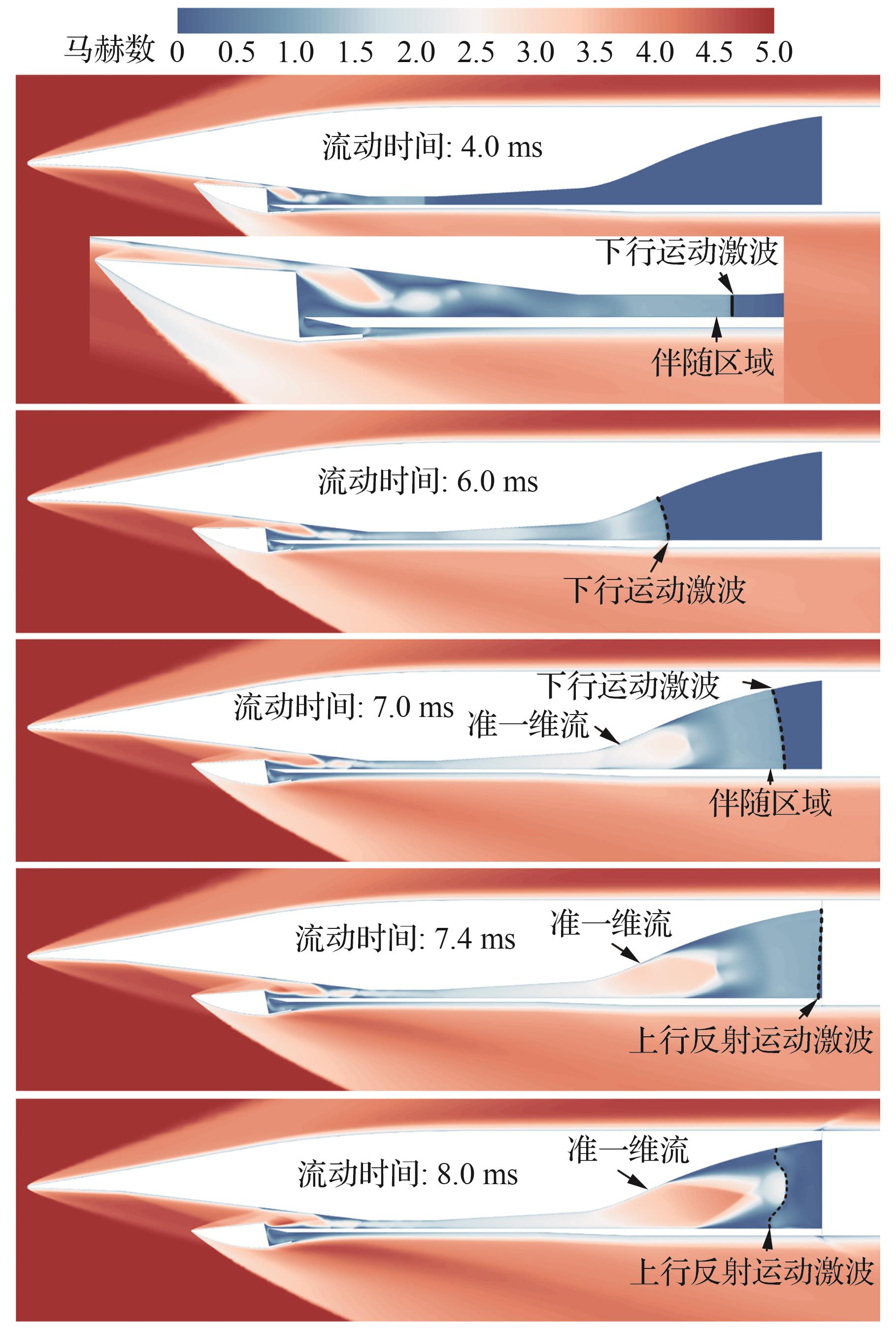
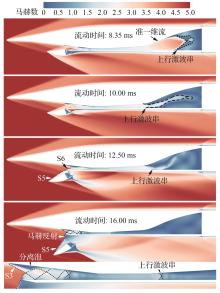
图 14
激波串主导的保护罩分离流场结构
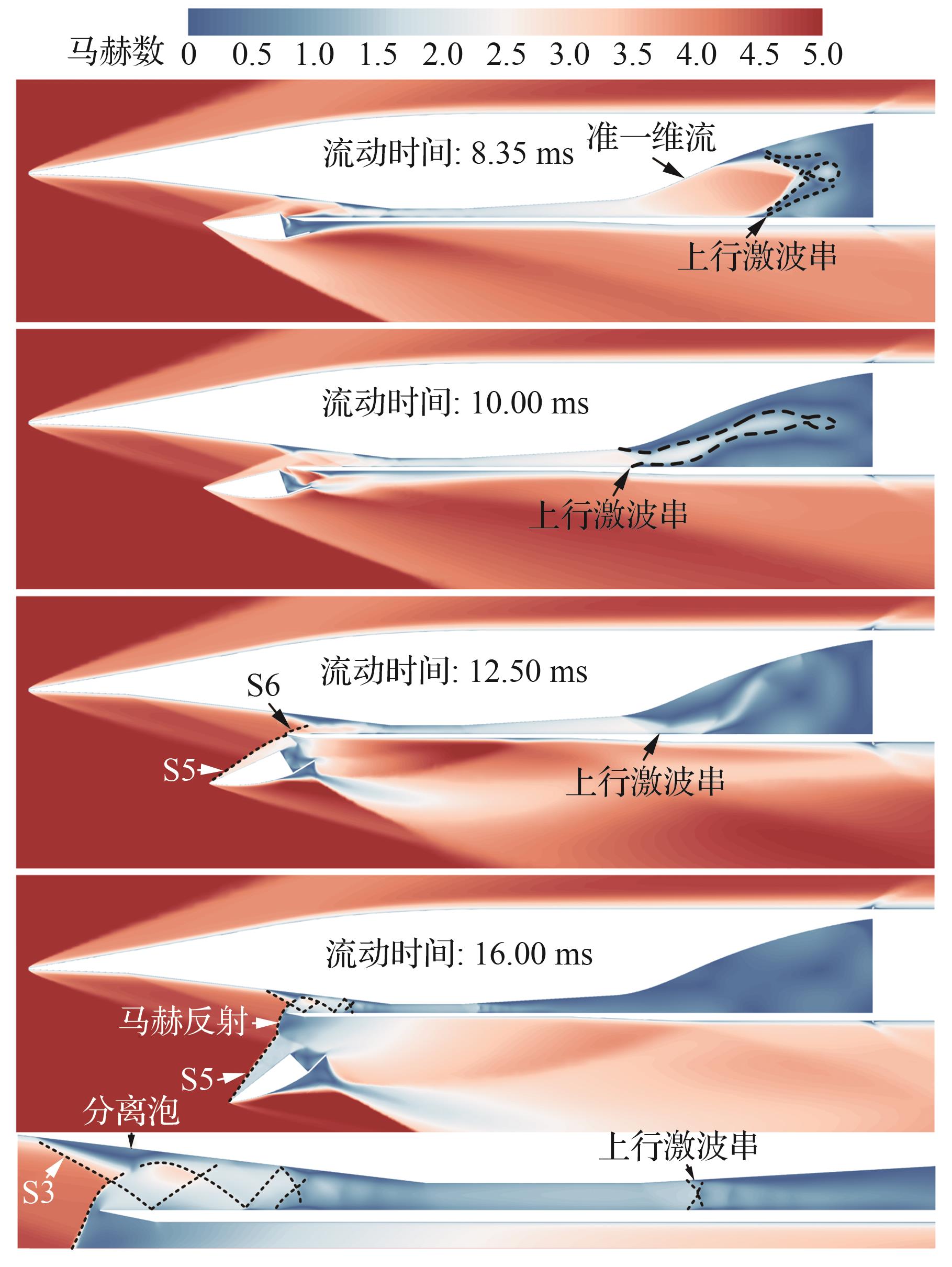
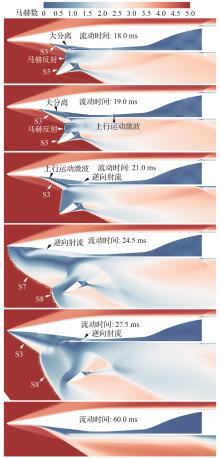
图 15
不起动状态下的保护罩分离流场结构
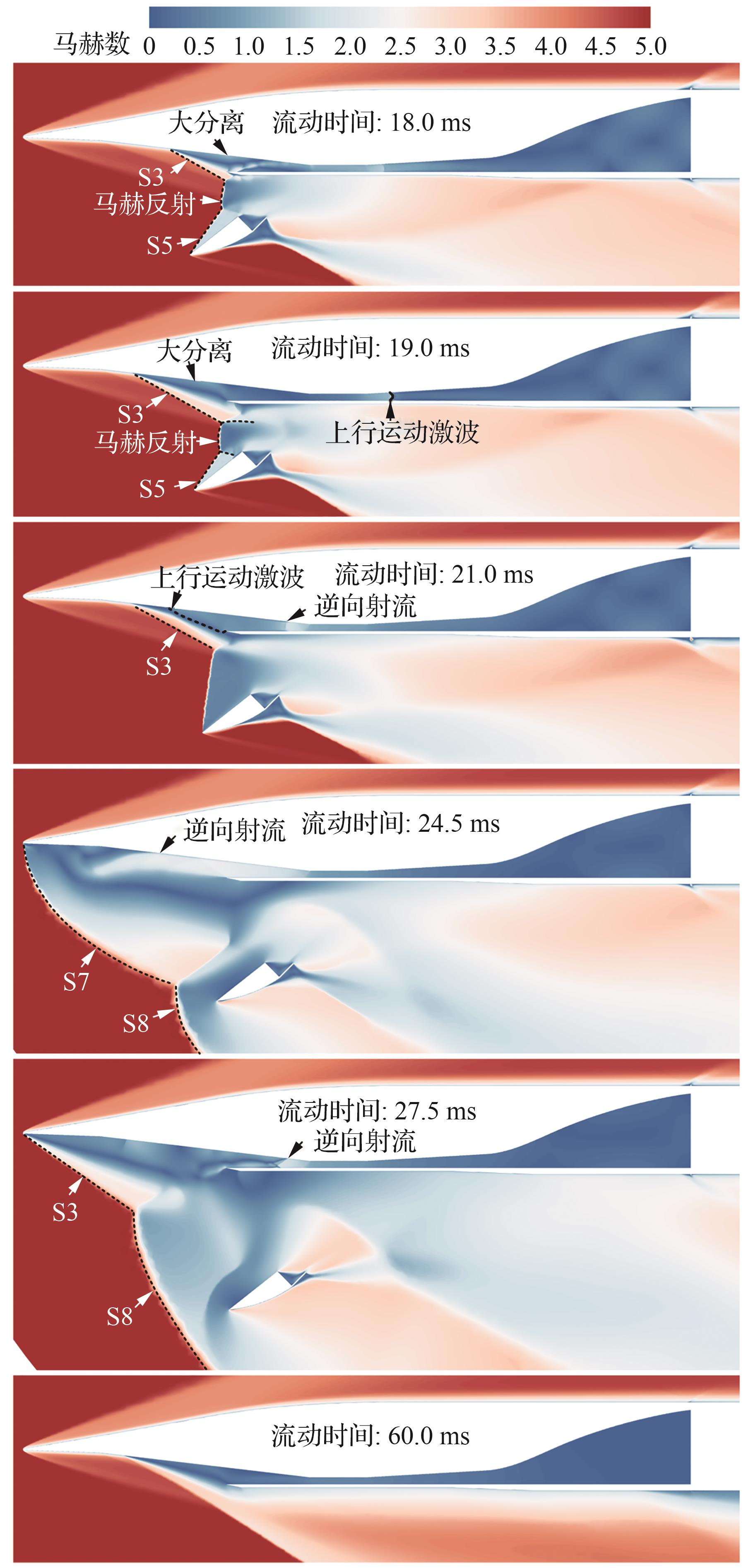
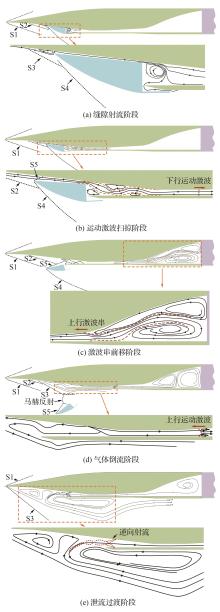
图 16
不同阶段的流场结构示意图
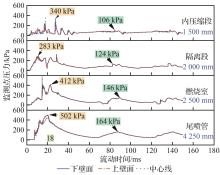
图 17
内流道典型测点时间历程压力曲线
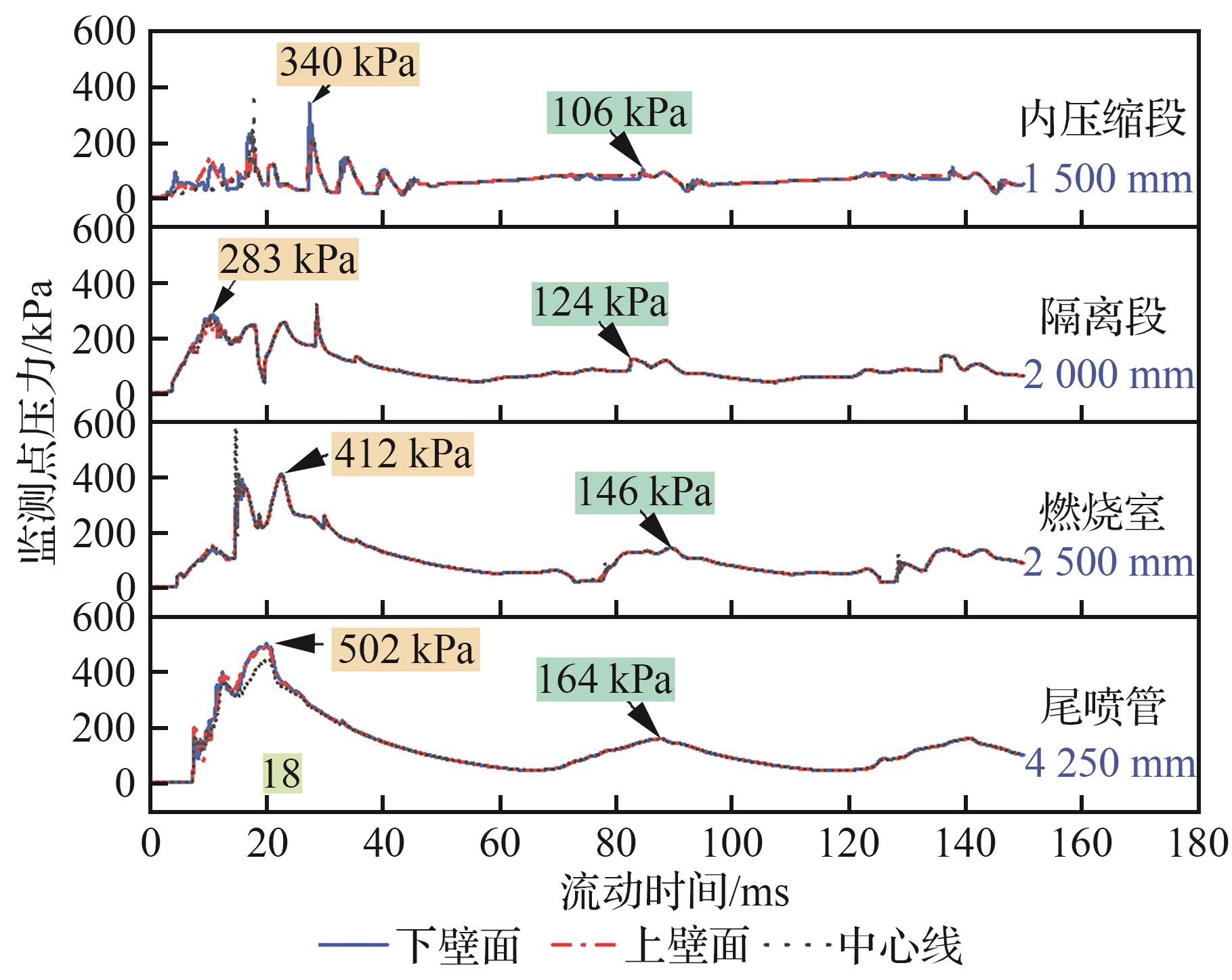
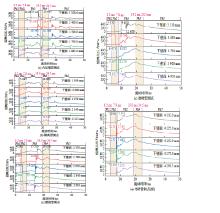
图 18
内流道不同阶段的时间历程压力曲线
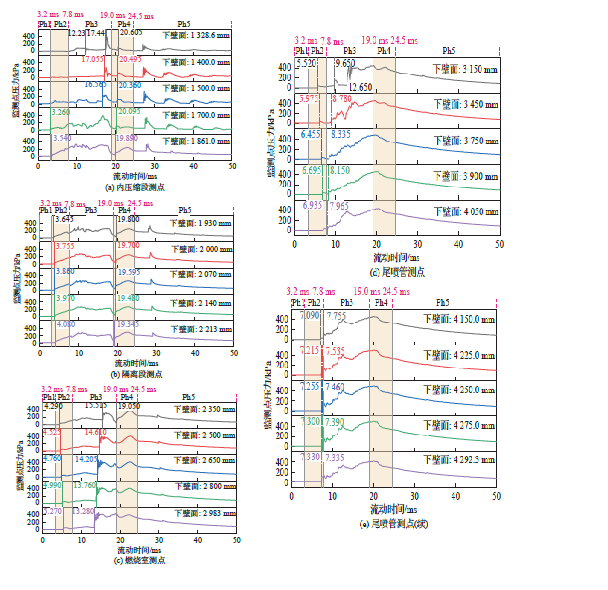

表1
内流道第2次压力跃升参数
| 流场区域 | 压升比 | 波后压力/kPa | 压升原因 |
|---|---|---|---|
| 内压缩段和隔离段 | 2.02~4.25 | 99.8~123.9 | 上行运动激波扫掠 |
| 燃烧室 | 2.31~6.49 | 321.3~464.4 | 激波串前移 |
| 尾喷管 | 2.28~4.96 | 52.5~160.0 | 激波串前移 |
| 尾喷管出口 | 2.70~4.07 | 102.6~162.5 | 运动激波反射 |
表2
内流道最大压力峰值及脉冲宽度参数
| 流场区域 | 脉冲宽度/ms | 最大压力峰值/kPa | 静压比 | 最大压力来源 | |
|---|---|---|---|---|---|
| 内压缩段 | 0.32~2.77 | 235~580 | 39.5~80.4 | 激波系增压(Ph3) | |
| 隔离段 | 第1组高压 | 11.72~12.12 | 268~300 | 37.1~41.5 | 激波系增压(Ph3) |
| 第2组高压 | 8.72~13.32 | 252~291 | 34.9~40.3 | 高压前传(Ph4) | |
| 燃烧室 | 15.34~18.11 | 53.2~64.3 | 53.2~64.3 | 激波串增压(Ph3)或高压前传(Ph4) | |
| 尾喷管 | 18.19~20.80 | 411~502 | 56.9~69.5 | 压力积蓄(Ph4) | |
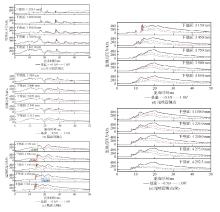
图 19
不同工况下内流道的时间历程压力曲线
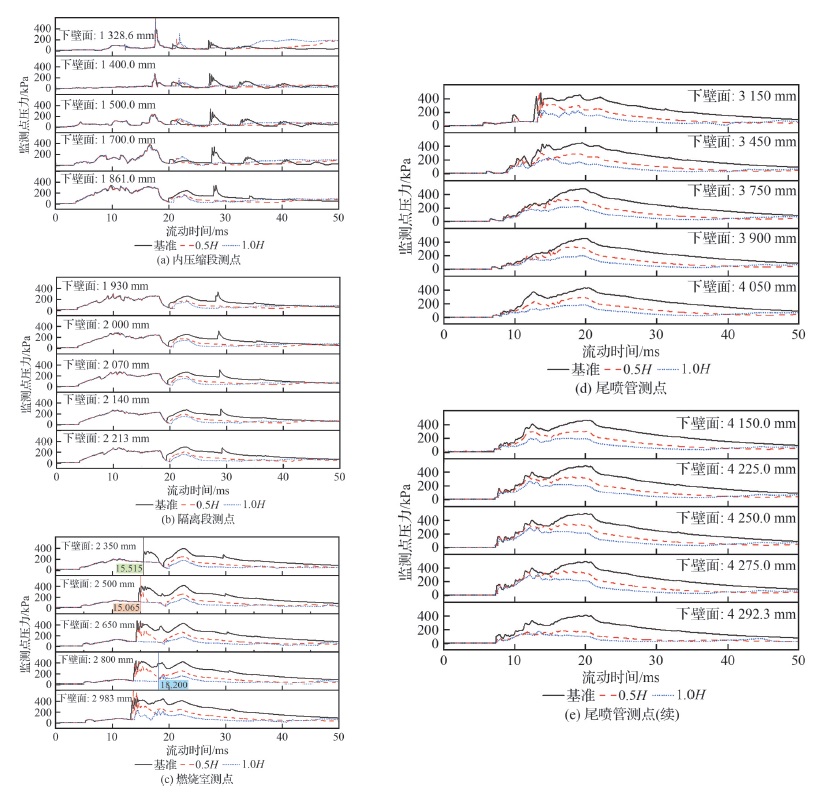
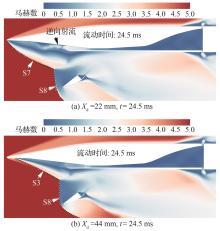
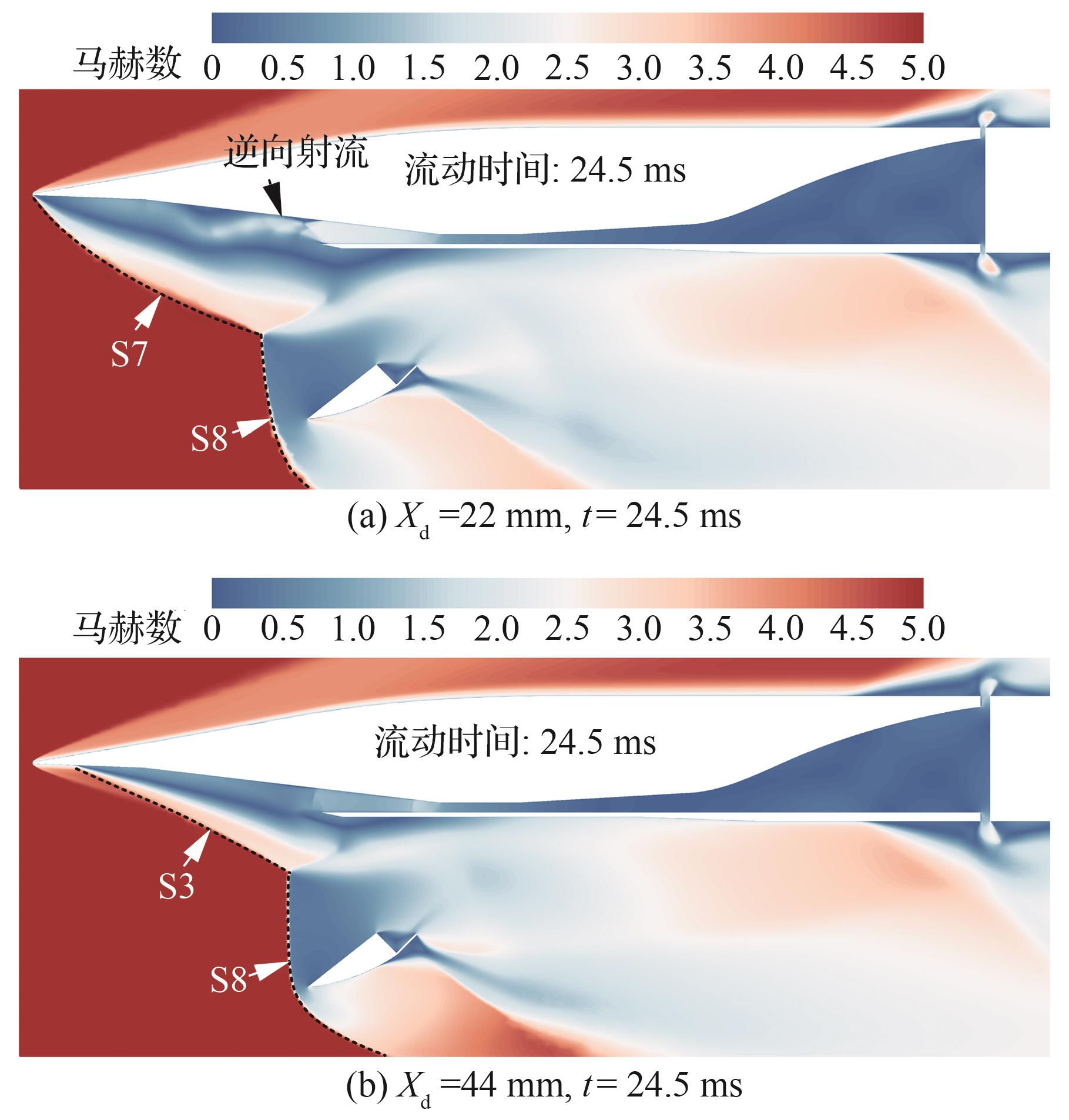
图 20
对比工况下24.5 ms时刻的流场马赫数云图
| [1] | WEN X, LIU J, LI J, et al. Design and numerical simulation of a clamshell-shaped inlet cover for air-breathing hypersonic vehicles[J]. Journal of Zhejiang University: Science A, 2019, 20(5): 347-357. |
| [2] | CHAMBERLAIN R. Time-accurate calculation of the HEDI shroud separation event[C]∥Annual Interceptor Technology Conference. Huntsville: AIAA, 1992. |
| [3] | LI Y, REIMANN B, EGGERS T. Coupled simulation of CFD and flight mechanics with a two-species-gas-model for the hot staging of a multistage rocket[C]∥19th AIAA International Space Planes and Hypersonic Systems and Technologies Conference. Atlanta: AIAA, 2014. |
| [4] | 蒋增辉, 宋威, 陈农, 等. 高超声速风洞子母弹大迎角抛壳投放试验[J]. 实验流体力学, 2016, 30(5): 42-48. |
| JIANG Z H, SONG W, CHEN N, et al. Hypersonic wind tunnel drop-model test on cover ejection from cargo projectile at large angle of attack[J]. Journal of Experiments in Fluid Mechanics, 2016, 30(5): 42-48 (in Chinese). | |
| [5] | 赵飞, 刘丽玲, 石泳, 等. 类X-43A飞行器高超声速分离仿真[J]. 航空学报, 2022, 43(5): 221-230. |
| ZHAO F, LIU L L, SHI Y, et al. Hypersonic separation simulation of aerocraft similar to X-43A[J]. Acta Aeronautica et Astronautica Sinica, 2022, 43(5): 221-230 (in Chinese). | |
| [6] | 唐伟, 刘深深, 余雷, 等. 用于级间分离研究的TBCC动力TSTO气动布局概念设计[J]. 空气动力学学报, 2019, 37(5): 698-704, 721. |
| TANG W, LIU S S, YU L, et al. Conceptual design of TBCC based TSTO configurations for stage seperation investigation[J]. Acta Aerodynamica Sinica, 2019, 37(5): 698-704, 721 (in Chinese). | |
| [7] | 王粤, 汪运鹏, 王春, 等. 一种并联两级入轨飞行器纵向分离方案的数值研究[J]. 航空学报, 2023, 44(11): 127634. |
| WANG Y, WANG Y P, WANG C, et al. Numerical study of longitudinal stage separation for parallel-staged two-stage-to-orbit vehicle[J]. Acta Aeronautica et Astronautica Sinica, 2023, 44(11): 127634 (in Chinese). | |
| [8] | 郭凤美, 余梦伦. 导弹分离设计技术研究[J]. 导弹与航天运载技术, 2014(1): 5-10. |
| GUO F M, YU M L. Research on missile separation design techniques[J]. Missiles and Space Vehicles, 2014(1): 5-10 (in Chinese). | |
| [9] | BLOCKER W, RUEBUSH D. X-43A stage separation system-a flight data evaluation[C]∥AIAA/CIRA 13th International Space Planes and Hypersonics Systems and Technologies Conference. Capua: AIAA, 2005. |
| [10] | 朱学昌, 李浩远, 喻天翔, 等. 低空高速飞行器整流罩分离技术研究现状和展望[J]. 固体火箭技术, 2014, 37(1): 12-17. |
| ZHU X C, LI H Y, YU T X, et al. Research status and prospects for low-altitude and high-speed fairing separation technique[J]. Journal of Solid Rocket Technology, 2014, 37(1): 12-17 (in Chinese). | |
| [11] | 王振国, 梁剑寒, 丁猛, 等. 高超声速飞行器动力系统研究进展[J]. 力学进展, 2009, 39(6): 716-739. |
| WANG Z G, LIANG J H, DING M, et al. A review on hypersonic airbreathing propulsion system[J]. Advances in Mechanics, 2009, 39(6): 716-739 (in Chinese). | |
| [12] | HOLLAND S D, WOODS W C, ENGELUND W C. Hyper-X research vehicle experimental aerodynamics test program overview[J]. Journal of Spacecraft and Rockets, 2001, 38(6): 828-835. |
| [13] | HAUDRICH D, BRASE L. Flutter and divergence assessment of the HyFly missile[C]∥50th AIAA/ASME/ASCE/AHS/ASC Structures, Structural Dynamics, and Materials Conference. California: AIAA, 2009. |
| [14] | BOLENDER M A, DAUBY B, MUSE J A, et al. HIFiRE 6: overview and status update 2014[C]∥20th AIAA International Space Planes and Hypersonic Systems and Technologies Conference. Glasgow: AIAA, 2015. |
| [15] | MARSHALL L, CORPENING G, SHERRILL R. A chief engineer’s view of the NASA X-43A scramjet flight test[C]∥AIAA/CIRA 13th International Space Planes and Hypersonics Systems and Technologies Conference. Capua: AIAA, 2005. |
| [16] | FOELSCHE R, BECKEL S, BETTI A, et al. Flight results from a program to develop a freeflight atmospheric scramjet test technique[C]∥14th AIAA/AHI Space Planes and Hypersonic Systems and Technologies Conference. Canberra: AIAA, 2006. |
| [17] | 董楠. 吸气式高超声速飞行器多体分离流动特性及机理的数值研究[D]. 武汉: 华中科技大学, 2022. |
| DONG N. Numerical study on flow characteristics and mechanism of air-breathing hypersonic aircrafts with multi-body separation[D]. Wuhan: Huazhong University of Science and Technology, 2022 (in Chinese). | |
| [18] | 郭善广, 柳军, 金亮, 等. 高超飞行器内流道激波振荡问题的数值研究及试验验证[J]. 实验流体力学, 2012, 26(1): 7-11. |
| GUO S G, LIU J, JIN L, et al. Numerical simulation and experiment validation on shock oscillations of inner flow path of hypersonic vehicle[J]. Journal of Experiments in Fluid Mechanics, 2012, 26(1): 7-11 (in Chinese). | |
| [19] | 邹东阳, 吴岸平, 林敬周. 前向抛罩分离安全判定方法[J]. 航空学报, 2025, 46(12): 80-89. |
| ZOU D Y, WU A P, LIN J Z. Safety judgment method of forward separation of protective shield[J]. Acta Aeronautica et Astronautica Sinica, 2025, 46(12): 80-89 (in Chinese). | |
| [20] | 宋威, 艾邦成. 多体分离动力学研究进展[J]. 航空学报, 2022, 43(9): 025950. |
| SONG W, AI B C. Multibody separation dynamics: review[J]. Acta Aeronautica et Astronautica Sinica, 2022, 43(9): 025950 (in Chinese). | |
| [21] | 闻讯, 柳军, 夏智勋. 吸气式高超声速飞行器助推分离过程数值仿真[J]. 国防科技大学学报, 2019, 41(1): 34-40. |
| WEN X, LIU J, XIA Z X. Numerical simulation of booster separation for an air-breathing hypersonic vehicle[J]. Journal of National University of Defense Technology, 2019, 41(1): 34-40 (in Chinese). | |
| [22] | BUNING P G, WONG T C, DILLEY A D, et al. Computational fluid dynamics prediction of hyper-X stage separation aerodynamics[J]. Journal of Spacecraft and Rockets, 2001, 38(6): 820-827. |
| [23] | 庞川博, 向玉伟, 马兴普, 等. 高超声速导弹进气道整流罩分离气动特性研究[J]. 弹箭与制导学报, 2020, 40(3): 123-128, 134. |
| PANG C B, XIANG Y W, MA X P, et al. Research on aerodynamic characteristics of inlet fairing separation from a hypersonic missile[J]. Journal of Projectiles, Rockets, Missiles and Guidance, 2020, 40(3): 123-128, 134 (in Chinese). | |
| [24] | 朱国祥, 王磊, 苑朝凯, 等. 进气道整流罩全尺度动态分离试验研究[J]. 实验流体力学, 2019, 33(4): 45-51. |
| ZHU G X, WANG L, YUAN C K, et al. The experimental investigation on full-scale dynamic separation for an inlet shroud[J]. Journal of Experiments in Fluid Mechanics, 2019, 33(4): 45-51 (in Chinese). | |
| [25] | 钟俊, 林敬周, 解福田, 等. 高超声速大动压下整流罩分离测力风洞试验[J]. 实验流体力学, 2024, 38(2): 98-106. |
| ZHONG J, LIN J Z, XIE F T, et al. Wind tunnel force test of fairing separation in hypersonic and high dynamic pressure situation[J]. Journal of Experiments in Fluid Mechanics, 2024, 38(2): 98-106 (in Chinese). | |
| [26] | 林敬周, 王雄, 钟俊, 等. 高马赫数多体分离试验技术研究与应用[J]. 推进技术, 2020, 41(4): 925-933. |
| LIN J Z, WANG X, ZHONG J, et al. Investigation and application of high Mach number multi-body separation test technique[J]. Journal of Propulsion Technology, 2020, 41(4): 925-933 (in Chinese). | |
| [27] | LIEN J, BOSE D, MARTIN J. Automated sensitivity analysis of hyper-X (X-43A) separation simulation[C]∥AIAA Modeling and Simulation Technologies Conference and Exhibit. Providence: AIAA, 2004. |
| [28] | 刘广, 江玉刚, 任智毅, 等. 整体式整流罩高速分离流固耦合仿真[J]. 战术导弹技术, 2018(3): 30-37. |
| LIU G, JIANG Y G, REN Z Y, et al. Fluid-structure coupling simulation of integrated fairing high-speed separation[J]. Tactical Missile Technology, 2018(3): 30-37 (in Chinese). | |
| [29] | 白晓征, 刘君, 郭正, 等. 冲压发动机进气道压力振荡过程的数值研究[J]. 推进技术, 2008, 29(5): 562-565. |
| BAI X Z, LIU J, GUO Z, et al. Numerical simulation of pressure oscillation in ramjet inlet[J]. Journal of Propulsion Technology, 2008, 29(5): 562-565 (in Chinese). | |
| [30] | 赵星宇, 王翼, 范晓樯, 等. 高速进气道抛罩过程内流场演化特性研究[J]. 推进技术, 2021, 42(5): 970-979. |
| ZHAO X Y, WANG Y, FAN X Q, et al. Internal flow field evolution characteristics for inlet cover separation of high speed inlet[J]. Journal of Propulsion Technology, 2021, 42(5): 970-979 (in Chinese). | |
| [31] | WANG S Y, LI C, CHEN W. Numerical investigation on unsteady flows with an air-breathing hypersonic vehicle during its shroud separation[C]∥21st AIAA International Space Planes and Hypersonics Technologies Conference. Xiamen: AIAA, 2017. |
| [32] | 邓艳丹, 黄生洪, 杨基明, 等. 一种X-51A相似飞行器模型的气动特性初探[J]. 空气动力学学报, 2013, 31(3): 376-380, 387. |
| DENG Y D, HUANG S H, YANG J M, et al. A preliminary investigation on aerodynamic characteristics of an X-51A-like aircraft model[J]. Acta Aerodynamica Sinica, 2013, 31(3): 376-380, 387 (in Chinese). | |
| [33] | 刘雪松. X-51A高超声速飞行器三维重建及气动/隐身特性分析[D]. 南京: 南京航空航天大学, 2015. |
| LIU X S. Three-dimensional reconstruction and analysis of aerodynamic and stealth characteristic of X-51A hypersonic vehicle[D]. Nanjing: Nanjing University of Aeronautics and Astronautics, 2015 (in Chinese). | |
| [34] | BORG M P. Laminar instability and transition on the X-51A[D]. West Lafayette: Purdue University, 2009. |
| [35] | MENTER F R. Two-equation eddy-viscosity turbulence models for engineering applications[J]. AIAA Journal, 1994, 32(8): 1598-1605. |
| [36] | JIAO X L, CHANG J T, WANG Z Q, et al. Numerical study on hypersonic nozzle-inlet starting characteristics in a shock tunnel[J]. Acta Astronautica, 2017, 130: 167-179. |
| [37] | 陶渊. 高超声速进气道中激波边界层干扰现象研究[D]. 长沙: 国防科技大学, 2018. |
| TAO Y. The study of the shock wave/boundary layer interactions in hypersonic inlet[D]. Changsha: National University of Defense Technology, 2018 (in Chinese). | |
| [38] | 王巍. 有相对运动的多体分离过程非定常数值算法研究及实验验证[D]. 长沙: 国防科学技术大学, 2008. |
| WANG W. Numerical simulation technique research and experiment verification for unsteady multi-body flowfield involving relative movement[D]. Changsha: National University of Defense Technology, 2008 (in Chinese). | |
| [39] | HERRMANN C, KOSCHEL W. Experimental investigation of the internal compression inside a hypersonic intake[C]∥38th AIAA/ASME/SAE/ASEE Joint Propulsion Conference & Exhibit. Indianapolis: AIAA, 2002. |
| [40] | REINARTZ B U, HERRMANN C D, BALLMANN J, et al. Aerodynamic performance analysis of a hypersonic inlet isolator using computation and experiment[J]. Journal of Propulsion and Power, 2003, 19(5): 868-875. |
| [41] | WAGNER J L, YUCEIL K B, VALDIVIA A, et al. Experimental investigation of unstart in an inlet/isolator model in Mach 5 flow[J]. AIAA Journal, 2009, 47(6): 1528-1542. |
| [42] | RONDEAU M C, JORTIS T R. X-51A scramjet demonstrator program: waverider ground and flight test[C]∥44th International SETP Southwest Flight Test Symposium. Ft Worth, TX: Society of Flight Test Engineers, 2013. |
| [43] | 陶渊, 范晓樯, 刘俊林. 超声速连续风洞喷管启动过程分析[J]. 推进技术, 2015, 36(1): 24-29. |
| TAO Y, FAN X Q, LIU J L. Studies on starting process of a continuous supersonic wind tunnel nozzle[J]. Journal of Propulsion Technology, 2015, 36(1): 24-29 (in Chinese). | |
| [44] | LIAN X, XU H, DUAN L, et al. Flow structure and parameter evaluation of conical convergent-divergent nozzle supersonic jet flows[J]. Physics of Fluids, 2023, 35(6): 066109. |
| [45] | 高周景明, 蒋凌峰, 朱佳宇, 等. 电子初始位置对高能电子空间及时间辐射特性的影响[J]. 光散射学报, 2023, 35(1): 71-77. |
| GAO Z J M, JIANG L F, ZHU J Y, et al. Influence of electron initial position on space and time radiation characteristics of high energy electrons[J]. The Journal of Light Scattering, 2023, 35(1): 71-77 (in Chinese). |
| [1] | 李六南, 屈骁, 张燕峰, 卢新根, 朱俊强. 端区边界层扭曲对高负荷涡轮二次流的影响[J]. 航空学报, 2026, 47(5): 132394-132394. |
| [2] | 马诺, 卫社春, 孟军辉, 刘清洋, 雷宇声. 考虑减速伞作用的无人机内埋舱体分离流场特性与动力学[J]. 航空学报, 2025, 46(3): 130755-130755. |
| [3] | 邹东阳, 吴岸平, 林敬周. 前向抛罩分离安全判定方法[J]. 航空学报, 2025, 46(12): 131005-131005. |
| [4] | 韩少强, 宋文萍, 韩忠华, 许建华. 高速共轴刚性旋翼非定常流动高精度数值模拟[J]. 航空学报, 2024, 45(9): 529064-529064. |
| [5] | 朱志豪, 隋秀明, 浦健, 郝龙, 赵巍, 赵庆军. 多级无导叶对转涡轮尾迹/激波转转级间非定常干涉对叶片气动载荷的影响[J]. 航空学报, 2024, 45(24): 630582-630582. |
| [6] | 汪松柏, 郝玉扬, 吴亚东, 陈勇, 余华蔚, 杜林. 航空发动机压气机旋转不稳定现象研究进展[J]. 航空学报, 2024, 45(16): 29851-029851. |
| [7] | 姜权峰, 陈树生, 杨华, 李祚泰, 高正红. 两级入轨航天器级间分离姿态精确控制[J]. 航空学报, 2024, 45(13): 129270-129270. |
| [8] | 魏斌斌, 高永卫, 孙博, 张亚龙, 胡淑玲, 郝礼书. 多体分离中初始扰动发展模式的理论分析[J]. 航空学报, 2024, 45(12): 129214-129214. |
| [9] | 王方剑, 解克, 刘金, 宋玉辉, 秦汉, 陈兰. 小展弦比飞翼标模非定常流动及自由摇滚特性[J]. 航空学报, 2023, 44(4): 126449-126449. |
| [10] | 王粤, 汪运鹏, 姜宗林. 激波风洞两级入轨飞行器纵向级间分离试验技术[J]. 航空学报, 2023, 44(17): 128126-128126. |
| [11] | 李概奇, 马东阳, 李杜, 刘少戎, 杨艳美. 新研民用涡轴发动机起飞状态喘振试验[J]. 航空学报, 2023, 44(14): 628190-628190. |
| [12] | 赵红亮, 张文强, 邱佳慧, 张敏, 杜娟, 聂超群. 总温畸变下跨声压气机失速过程非定常模拟[J]. 航空学报, 2023, 44(14): 628319-628319. |
| [13] | 刘晓东, 刘朋欣, 李辰, 孙东, 袁先旭. 高焓激波/湍流边界层干扰直接数值模拟[J]. 航空学报, 2023, 44(13): 127832-127832. |
| [14] | 王粤, 汪运鹏, 王春, 姜宗林. 一种并联两级入轨飞行器纵向分离方案的数值研究[J]. 航空学报, 2023, 44(11): 127634-127634. |
| [15] | 宋威, 艾邦成. 多体分离动力学研究进展[J]. 航空学报, 2022, 43(9): 25950-025950. |
| 阅读次数 | ||||||
|
全文 |
|
|||||
|
摘要 |
|
|||||
版权所有 © 航空学报编辑部
版权所有 © 2011航空学报杂志社
主管单位:中国科学技术协会 主办单位:中国航空学会 北京航空航天大学

 CJA
CJA
