邵发宁1, 杨超1, 陈娉婷1, 王飞龙1, 赵伟辰2, 宁博2, 毛军逵1( )
)
收稿日期:2025-04-10
修回日期:2025-05-06
接受日期:2025-07-02
出版日期:2025-07-16
发布日期:2025-07-15
通讯作者:
毛军逵
E-mail:mjkpe@nuaa.edu.cn
基金资助:
Faning SHAO1, Chao YANG1, Pingting CHEN1, Feilong WANG1, Weichen ZHAO2, Bo NING2, Junkui MAO1()
Received:2025-04-10
Revised:2025-05-06
Accepted:2025-07-02
Online:2025-07-16
Published:2025-07-15
Contact:
Junkui MAO
E-mail:mjkpe@nuaa.edu.cn
Supported by:摘要:
航空发动机在起飞前需要在地面保持较高转速进行暖机,否则将造成起飞过程中的推力下降。针对上述问题,以小涵道比涡扇发动机核心机为对象,结合发动机流体域一维模型和固体域二维轴对称有限元模型,开发了一种流热固耦合计算方法,实现了发动机主流道、空气系统和多部件热分析及变形分析的跨尺度耦合仿真。仿真结果表明:叶尖间隙大于设计值是造成起飞阶段发动机推力下降的主要原因。暖机能够减小起飞过程中的叶尖间隙,高压涡轮效率提升0.85%,压气机效率提升0.5%,进而促使高压转速最大提升0.51%,增大了核心机流量,降低了发动机的涵道比,最终导致发动机起飞阶段的最小推力上升2.4%。研究结果进一步表明,增加暖机时间或增加暖机转速均可提升起飞推力,但暖机转速小于0.75时无法通过增加转速减小高压涡轮叶尖间隙。最后基于序列二次规划算法,构建了以推力需求为约束条件的暖机参数优化模型,实现了不同工况下最短暖机时间与转速的优化。
中图分类号:
邵发宁, 杨超, 陈娉婷, 王飞龙, 赵伟辰, 宁博, 毛军逵. 基于流热固耦合仿真的航空发动机暖机特性及其对推力的影响[J]. 航空学报, 2026, 47(2): 132104.
Faning SHAO, Chao YANG, Pingting CHEN, Feilong WANG, Weichen ZHAO, Bo NING, Junkui MAO. Warm-up characteristics and thrust impact of aero-engines based on fluid-thermal-solid coupled simulation[J]. Acta Aeronautica et Astronautica Sinica, 2026, 47(2): 132104.

图 1
研究对象


图 2
核心机结构示意图


图 3
核心机空气系统流路


图 4
历程示意图

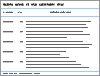
表1
各阶段工况
| 阶段 | N2,Z | 持续时间/min |
|---|---|---|
| 启动0~t1 | 0.675N2,max | 1 |
| 慢车t1~t2 | 0.675N2,max | 2 |
| 暖机t2~t3 | NH | Δt |
| 起飞t3~t4 | N2,max | 3 |

图 5
计算流程


图 6
主次流耦合计算交互流程


图 7
N2及δHPT变化历程

表2
ΔδHPT计算与试验对比
| 时间/s | 0 | 234 | 320 | 339 | 399 | 639 |
|---|---|---|---|---|---|---|
| ∆δHPT计算结果/% | 0 | -24.0 | -36.8 | -21.5 | -48.0 | -51.6 |
| ∆δHPT测试结果/% | 0 | -24.4 | -38.8 | -21.2 | -48.4 | -56.0 |
| 相对误差/% | -1.6 | -5.2 | 1.4 | -0.8 | -7.9 |

图 8
历程1中主要性能参数变化


图 9
历程1中T6变化


图 10
历程1中F变化


图 11
不同方法计算结果对比


图 12
历程1和历程2中叶尖间隙变化


图 13
历程1和历程2中各部件变形


图 14
t3~t4阶段叶尖间隙对比


图 15
t3~t4阶段高压涡轮和压气机效率对比


图 16
t3~t4阶段高压转速对比


图 17
风扇工作点对比


图 18
t3~t4阶段涵道比对比


图 19
t3~t4阶段推力对比


图 20
Fm随Δt和NH的变化


图 21
δHPT,min随Δt和NH的变化


图 22
δHPC,min随Δt和NH的变化


图 23
暖机策略优化流程

表3
优化结果
| Fm | NH | Δt /min |
|---|---|---|
| 0.970 | 0.73 | 2.01 |
| 0.975 | 0.86 | 2.09 |
| 0.980 | 0.87 | 2.18 |
| 0.985 | 0.87 | 3.22 |
| 0.990 | 0.90 | 3.95 |
| [1] | AIRBUS. Flight crew operating manual: A318/A319/A320/A321[R]. Blagnac: Airbus, 2021. |
| [2] | BOEING COMPANY THE. FMS series F-15SA aircraft flight manual: FA8634-12-C-2651[R]. Greene County: The Boeing Company, 2016. |
| [3] | 钱仁军, 宋汉强, 李本威, 等. 暖机对航空发动机性能模型的影响分析[J]. 兵器装备工程学报, 2021, 42(7): 6-12. |
| QIAN R J, SONG H Q, LI B W, et al. Effect analysis of heating of turbine on aero-engine performance model[J]. Journal of Ordnance Equipment Engineering, 2021, 42(7): 6-12 (in Chinese). | |
| [4] | 柴政, 张宏宇. 暖机对航空发动机气动稳定性影响研究[J]. 内燃机与配件, 2024(4): 26-28. |
| CHAI Z, ZHANG H Y. Research on effect of warm up on aircraft engine aerodynamic stability[J]. Internal Combustion Engine & Parts, 2024(4): 26-28 (in Chinese). | |
| [5] | 郑旭东, 张连祥. 航空发动机整机振动典型故障分析[J]. 航空发动机, 2013, 39(1): 34-37. |
| ZHENG X D, ZHANG L X. Typical failure analysis of aeroengine vibration[J]. Aeroengine, 2013, 39(1): 34-37 (in Chinese). | |
| [6] | 朱江, 柏帅宇, 张雪冬, 等. 航空发动机两种暖机方式对暖机效果的影响研究[C]∥第六届中国航空科学技术大会论文集, 2023. |
| ZHU J, BAI S Y, ZHANG X D, et al. Study on the impact of two types of air engine heating modes on the effect of heaters[C]∥Proceedings of the 6th China Aeronautical Science and Technology Conference, 2023 (in Chinese). | |
| [7] | 钱仁军, 李本威, 徐彦军, 等. 暖机对舰载机滑跃起飞安全影响分析[J]. 北京航空航天大学学报, 2020, 46(12): 2293-2301. |
| QIAN R J, LI B W, XU Y J, et al. Effect of heating of turbine on the safety of carrier-based aircraft ski jump takeoff[J]. Journal of Beijing University of Aeronautics and Astronautics, 2020, 46(12): 2293-2301 (in Chinese). | |
| [8] | BROEDE J. Saving costs in design, manufacturing and operation of aero engine parts[J]. The Aeronautical Journal, 2001, 105(1053): 619-626. |
| [9] | 钱仁军, 李本威, 宋汉强, 等. 改进多元宇宙算法在航空发动机不暖机模型修正中的应用[J]. 推进技术, 2022, 43(5): 45-54. |
| QIAN R J, LI B W, SONG H Q, et al. Application of improved multi-verse optimization algorithm in model correction of aero-engine with unheating[J]. Journal of Propulsion Technology, 2022, 43(5): 45-54 (in Chinese). | |
| [10] | 钱仁军, 李本威, 宋汉强, 等. 暖机对涡扇发动机加速过程中压气机叶尖间隙影响分析[J]. 推进技术, 2020, 41(5): 1144-1151. |
| QIAN R J, LI B W, SONG H Q, et al. Effects of heating of turbine on turbofan engine compressor tip clearance during acceleration process[J]. Journal of Propulsion Technology, 2020, 41(5): 1144-1151 (in Chinese). | |
| [11] | 钱仁军, 李本威, 宋汉强, 等. 暖机对压气机叶片径向变形影响的试验研究[J]. 推进技术, 2022, 43(3): 130-140. |
| QIAN R J, LI B W, SONG H Q, et al. Experimental study on effects of heating on radial deformation of compressor blade[J]. Journal of Propulsion Technology, 2022, 43(3): 130-140 (in Chinese). | |
| [12] | GIUNTINI S, ANDREINI A, FACCHINI B. Finite element transient modelling for aero-thermo-mechanical analysis of whole gas turbine engine[R].New York: ASME, 2019. |
| [13] | 郭晓杰. 航空发动机空气系统与热分析耦合方法研究[D]. 上海: 上海交通大学, 2014. |
| GUO X J. Coupling computational approach of secondary air system and heat transfer in aero-engine[D]. Shanghai: Shanghai Jiao Tong University, 2014 (in Chinese). | |
| [14] | MULLER Y. Integrated fluid network-thermomechanical approach for the coupled analysis of a jet engine[R].New York: ASME, 2009. |
| [15] | GANINE V, HILLS N, MILLER M, et al. Implicit heterogeneous 1D/2D coupling for aero-thermo-mechanical simulation of secondary air systems[R]. New York: ASME, 2015. |
| [16] | YANG Y M, NIKOLAIDIS T, JAFARI S, et al. Gas turbine engine transient performance and heat transfer effect modelling: A comprehensive review, research challenges, and exploring the future[J]. Applied Thermal Engineering, 2024, 236: 121523. |
| [17] | CHAPMAN J W, GUO T H, KRATZ J L, et al. Integrated turbine tip clearance and gas turbine engine simulation: AIAA-2016-5047[R]. Reston: AIAA, 2016. |
| [18] | SHENG H L, LIU T, ZHAO Y, et al. New model-based method for aero-engine turbine blade tip clearance measurement[J]. Chinese Journal of Aeronautics, 2023, 36(8): 128-147. |
| [19] | CHEN F P, CHEN Y C, SONG K R, et al. Study on the influence of heat transfer effect on performance simulation of engine transition state[C]∥2019 IEEE 10th International Conference on Mechanical and Aerospace Engineering (ICMAE). Piscataway: IEEE Press, 2019. |
| [20] | LI Z, LI Y G, SAMPATH S. Aeroengine transient performance simulation integrated with generic heat soakage and tip clearance model[J]. The Aeronautical Journal, 2022, 126(1302): 1265-1287. |
| [21] | 詹江正, 张光, 宋文艳, 等. 某型高压压气机12级转子叶尖间隙理论分析与数值模拟[J]. 机械科学与技术, 2019, 38(10): 1632-1640. |
| ZHAN J Z, ZHANG G, SONG W Y, et al. Theoretical analysis and numerical simulation of tip clearance of 12-stage high-pressure compressor rotor[J]. Mechanical Science and Technology for Aerospace Engineering, 2019, 38(10): 1632-1640 (in Chinese). | |
| [22] | 刘传凯, 左亢, 王家俊, 等. 航空发动机内部容腔耦合响应规律[J]. 航空动力学报, 2024, 39(12): 20220451. |
| LIU C K, ZUO K, WANG J J, et al. Coupling response law of aero-engine internal cavities[J]. Journal of Aerospace Power, 2024, 39(12): 20220451 (in Chinese). | |
| [23] | 刘传凯, 姜宏超, 李艳茹, 等. 航空发动机性能与二次空气系统的耦合仿真模型[J]. 航空动力学报, 2017, 32(7): 1623-1630. |
| LIU C K, JIANG H C, LI Y R, et al. Coupled simulation model of aero-engine performance and secondary air system[J]. Journal of Aerospace Power, 2017, 32(7): 1623-1630 (in Chinese). | |
| [24] | 杨学森, 程显达, 王天赤, 等. 燃机总体性能与二次空气系统耦合的过渡态仿真[J]. 航空动力学报, 2023, 38(11): 2618-2628. |
| YANG X S, CHENG X D, WANG T C, et al. Transient simulation for gas turbine overall performance coupled with secondary air system[J]. Journal of Aerospace Power, 2023, 38(11): 2618-2628 (in Chinese). | |
| [25] | YANG X S, JIAN M H, DONG W, et al. Simulation of the secondary air system of turbofan engines: Insights from 1D-3D modeling[J]. Chinese Journal of Aeronautics, 2023, 36(1): 231-245. |
| [26] | NIKOLAIDIS T, WANG H N, LASKARIDIS P. Transient modelling and simulation of gas turbine secondary air system[J]. Applied Thermal Engineering, 2020, 170: 115038. |
| [27] | 郭纳贤. 基于气热固双向耦合的核心机叶尖间隙预估与调控[D]. 南京: 南京航空航天大学, 2023. |
| GUO N X. Prediction and regulation of core engine tip clearance based on aero-thermo-structural two-way coupling[D]. Nanjing: Nanjing University of Aeronautics and Astronautics, 2023 (in Chinese). | |
| [28] | GARG S. Aircraft turbine engine control research at NASA Glenn research center[J]. Journal of Aerospace Engineering, 2013, 26(2): 422-438. |
| [29] | 唐世建, 童万军. 基于容积法的某涡扇发动机动态建模方法[J]. 航空动力学报, 2013, 28(3): 709-713. |
| TANG S J, TONG W J. Turbofan engine transient modeling based on inter-component volume method[J]. Journal of Aerospace Power, 2013, 28(3): 709-713 (in Chinese). | |
| [30] | 王磊, 毛军逵, 邱长波, 等. 基于蒙特卡罗法的航空发动机空气系统稳态算法优化[J]. 推进技术, 2021, 42(11): 2506-2514. |
| WANG L, MAO J K, QIU C B, et al. Optimization of steady state algorithm for aero engine air system based on Monte Carlo method[J]. Journal of Propulsion Technology, 2021, 42(11): 2506-2514 (in Chinese). | |
| [31] | 房友龙, 刘永葆, 贺星. 离心力作用下涡轮转子的径向变形[J]. 舰船电子工程, 2011, 31(2): 177-180. |
| FANG Y L, LIU Y B, HE X. Study of the radial elongations of the turbine rotor with the centrifugal effect[J]. Ship Electronic Engineering, 2011, 31(2): 177-180 (in Chinese). | |
| [32] | LAKSHMINARAYANA B. Methods of predicting the tip clearance effects in axial flow turbomachinery[J]. Journal of Basic Engineering, 1970, 92(3): 467-480. |
| [33] | BRINGHENTI C, BARBOSA J R. Effects of turbine tip clearance on gas turbine performance[R]. New York: ASME, 2008. |
| [34] | 陈鼎欣. 某离心叶轮叶尖与外罩工作间隙仿真及测试验证[J]. 自动化应用, 2018(4): 80-81. |
| CHEN D X. Simulation and test verification of working clearance between blade tip and casing of a centrifugal impeller[J]. Automation Application, 2018(4): 80-81 (in Chinese). | |
| [35] | 周超, 苏龙伟. 涡扇发动机加力接通断开过程模拟[J]. 中国科技信息, 2024(4): 57-61. |
| ZHOU C, SU L W. Simulation of turbofan engine afterburning on-off process[J]. China Science and Technology Information, 2024(4): 57-61 (in Chinese). | |
| [36] | 蒋子松. 涡扇发动机建模及控制计划研究[D]. 南京: 南京航空航天大学, 2020. |
| JIANG Z S. Research on molding and control plan of turbofan engine[D]. Nanjing: Nanjing University of Aeronautics and Astronautics, 2020 (in Chinese). | |
| [37] | KURZKE J, HALLIWELL I. Propulsion and power[M]. Cham: Springer International Publishing, 2018. |
| [38] | 高楚铭. 航空发动机高精度建模及起动性能仿真研究[D]. 哈尔滨: 哈尔滨工程大学, 2022. |
| GAO C M. Research on high fidelity modeling and starting performance simulation of aeroengine[D]. Harbin: Harbin Engineering University, 2022 (in Chinese). | |
| [39] | 刘红英, 夏勇, 周水生. 数学规划基础[M]. 北京: 北京航空航天大学出版社, 2012. |
| LIU H Y, XIA Y, ZHOU S S. Fundamentals of mathematical planning[M]. Beijing: Beijing University of Aeronautics & Astronautics Press, 2012 (in Chinese). |
| [1] | 王承熙, 周莉, 孙啸林, 张晓博, 王占学. 基于神经网络的S弯喷管-涡扇发动机多维度仿真[J]. 航空学报, 2025, 46(15): 130791-130791. |
| [2] | 赵磊, 李杰, 许晶莹. 低压涡轮性能试验方法对效率测量精度的影响[J]. 航空学报, 2025, 46(15): 131142-131142. |
| [3] | 袁思思, 牛序铭, 孙志刚, 宋迎东. 考虑性能退化的载荷谱修正方法[J]. 航空学报, 2025, 46(12): 231312-231312. |
| [4] | 张譍之, 孙惠斌, 颜诚, 刘萌. 考虑区间不确定性的转子叶尖间隙预测数字孪生模型[J]. 航空学报, 2024, 45(21): 629775-629775. |
| [5] | 余军杨, 傅文广, 孙鹏, 张韬, 王春雪, 赵伟. 进气畸变条件下非轴对称风扇设计及扩稳机理[J]. 航空学报, 2024, 45(16): 129725-129725. |
| [6] | 刘汝兵, 陈泽帆, 林瑞鑫, 林麒. 等离子体合成射流主动控制平面叶栅叶片流致振动[J]. 航空学报, 2023, 44(20): 128430-128430. |
| [7] | 曹传军, 刘天一, 朱伟, 王进春. 民用大涵道比涡扇发动机高压压气机技术进展[J]. 航空学报, 2023, 44(12): 27824-027824. |
| [8] | 牛广越, 段发阶, 周琦, 刘志博. 基于微波相位差测距的叶尖间隙动态测量方法[J]. 航空学报, 2022, 43(9): 625396-625396. |
| [9] | 曹明, 黄金泉, 周健, 陈雪峰, 鲁峰, 魏芳. 民用航空发动机故障诊断与健康管理现状、挑战与机遇Ⅰ: 气路、机械和FADEC系统故障诊断与预测[J]. 航空学报, 2022, 43(9): 625573-625573. |
| [10] | 段发阶, 牛广越, 周琦, 傅骁, 蒋佳佳. 航空发动机叶尖间隙在线测量技术研究综述[J]. 航空学报, 2022, 43(9): 626014-626014. |
| [11] | 贾琳渊, 陈玉春, 程荣辉, 宋可染, 谭甜. 变循环发动机过渡态性能直接模拟方法[J]. 航空学报, 2020, 41(12): 123901-123901. |
| [12] | 潘慕绚, 陈强龙, 周永权, 周文祥, 黄金泉. 涡扇发动机多动力学建模方法[J]. 航空学报, 2019, 40(5): 122632-122632. |
| [13] | 蒋永松, 郑文涛, 赵航, 杨明绥, 王咏梅. 风扇出口导向叶片低噪声设计Ⅰ:方法与优化[J]. 航空学报, 2019, 40(10): 122955-122955. |
| [14] | 郑文涛, 蒋永松, 赵航, 潘若痴, 赵勇. 风扇出口导向叶片低噪声设计Ⅱ:数值验证[J]. 航空学报, 2019, 40(10): 122956-122956. |
| [15] | 谭伟伟, 颜洪, 聂智军, 马涂亮, 梁益华. 大型客机涡扇发动机动力特性模拟[J]. 航空学报, 2019, 40(1): 522428-522428. |
| 阅读次数 | ||||||
|
全文 |
|
|||||
|
摘要 |
|
|||||
版权所有 © 航空学报编辑部
版权所有 © 2011航空学报杂志社
主管单位:中国科学技术协会 主办单位:中国航空学会 北京航空航天大学

 CJA
CJA
