辛炜华1,2, 田宇豪1, 张起鸣1, 郭京辉1( ), 林贵平3
收稿日期:2025-09-30
修回日期:2025-11-04
接受日期:2025-11-26
出版日期:2026-01-12
发布日期:2026-01-09
通讯作者:
郭京辉
E-mail:guojinghui@buaa.edu.cn
基金资助:
Received:2025-09-30
Revised:2025-11-04
Accepted:2025-11-26
Online:2026-01-12
Published:2026-01-09
摘要:
烧蚀热防护是高超声速飞行器重要的热防护手段,热解炭化防热多孔材料是一种烧蚀性热防护材料,其渗透率对输运特性有着显著影响。针对防热多孔材料渗透率公式中经验系数难以获取的问题,构建了包含材料微观结构图像、宏观结构特征参数(最大流与分形维数)的多源异构数据集,采用直接蒙特卡洛模拟粒子类方法计算微结构渗透率,并在此基础上提出了3种基于多源异构数据融合策略的渗透率预测方法:基于决策层的融合策略、基于特征直接拼接的融合策略和基于跨模态注意力机制的融合策略。比较3种不同融合策略的模型预测性能,由于基于跨模态注意力机制的融合策略能够捕捉图像卷积特征与结构特征参数之间的关系,动态调整图像卷积特征与结构特征参数之间的权值,其模型预测效果最优,在预测集上决定系数为0.949 7,平均绝对百分比误差为5.29%,且与单源数据驱动的渗透率预测模型相比,决定系数提高了6%,平均绝对百分比误差下降了41%,能够高效准确地对渗透率进行预测,为实际高超声速飞行器热防护结构精细化设计提供技术支持。
中图分类号:
辛炜华, 田宇豪, 张起鸣, 郭京辉, 林贵平. 融合多源数据的防热多孔材料渗透率预测方法[J]. 航空学报, 2026, 47(12): 432866.
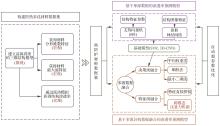
图 1
防热多孔材料渗透率预测方法流程图
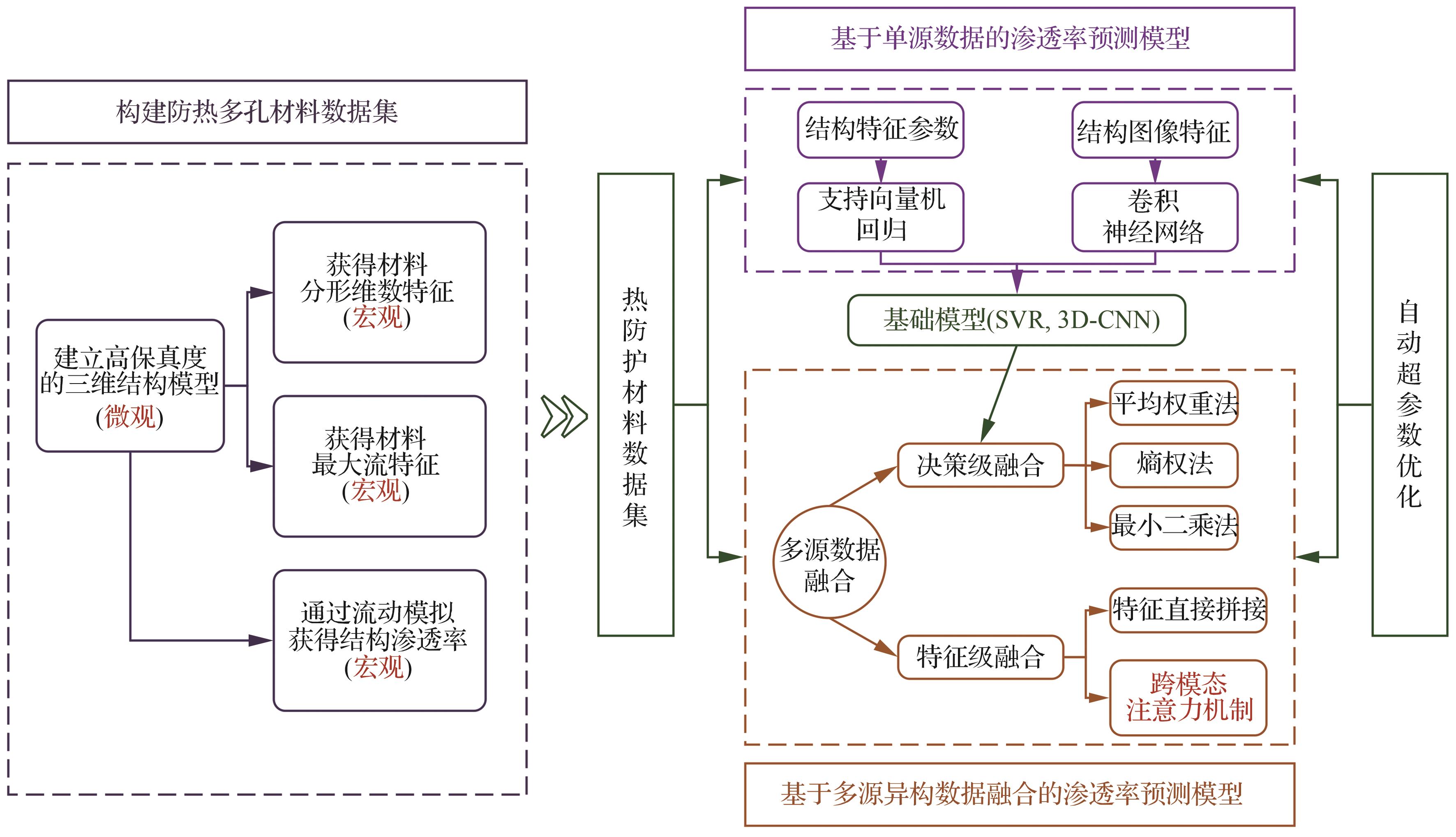
图 2
防热多孔材料切片灰度图及三维几何结构
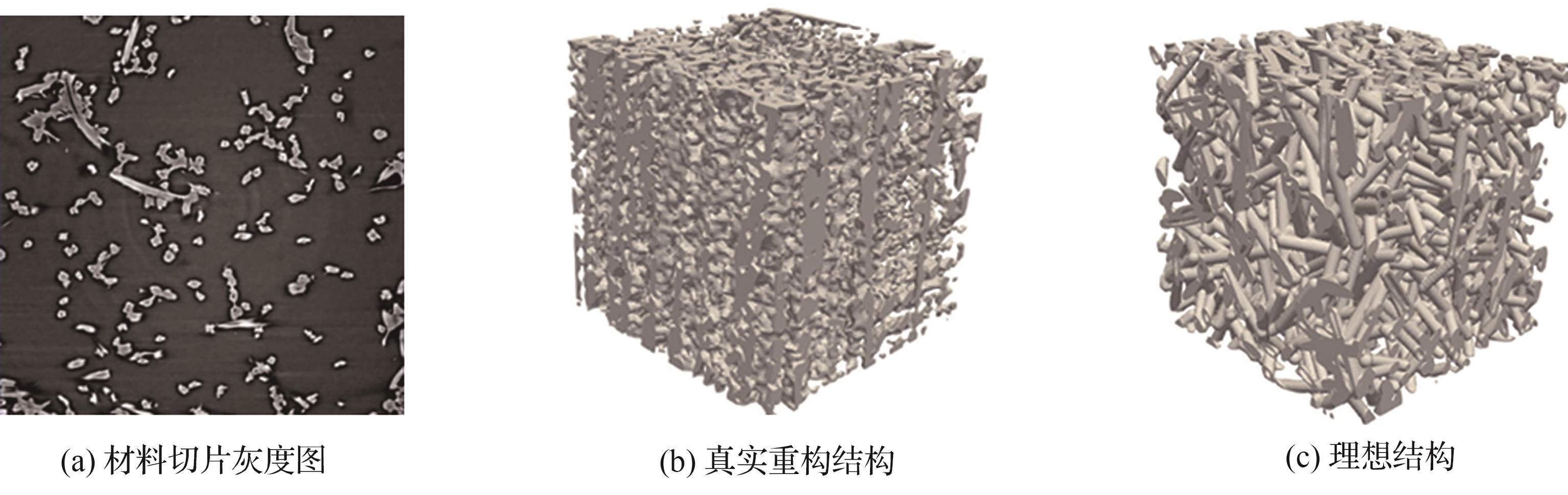
表1
结构参数取值范围
| 结构参数 | 取值范围 |
|---|---|
| 纤维半径/μm | 1.6~8.0 |
| 纤维长度/μm | 40~80 |
| 孔隙率 | 0.76~0.91 |
| 空间方位角/(°) | 15~60 |
图 3
典型结构的渗透力与平均压力的关系
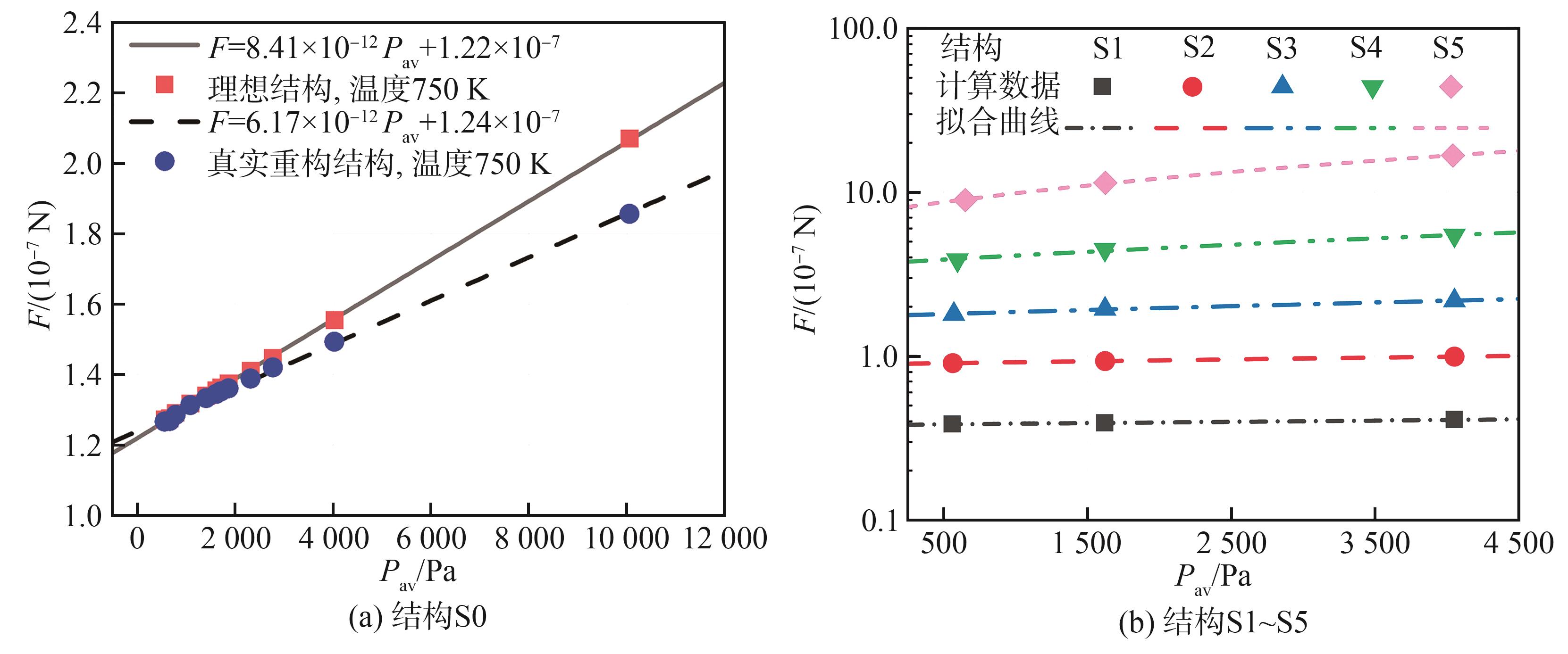
表2
典型结构的结构参数、达西渗透率、滑移系数和决定系数
| 典型结构 | 纤维半径/μm | 纤维长度/μm | 孔隙率 | 空间方位角/(°) | K0/(10⁻12 m2) | b/Pa | R2 |
|---|---|---|---|---|---|---|---|
| S0(验证) | 5.6 | 40 | 0.76 | 60 | 8.41 | 14 507 | 0.999 6 |
| S1 | 1.6 | 40 | 0.76 | 25 | 0.702 | 54 209 | 0.999 0 |
| S2 | 2.8 | 50 | 0.81 | 51 | 2.46 | 36 407 | 0.999 9 |
| S3 | 4.0 | 60 | 0.86 | 25 | 10.6 | 16 585 | 0.996 1 |
| S4 | 5.2 | 70 | 0.91 | 34 | 45.2 | 8 105 | 0.989 7 |
| S5 | 8.0 | 80 | 0.96 | 60 | 229 | 3 312 | 0.999 2 |
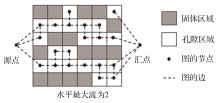
图 4
几何结构的有向图
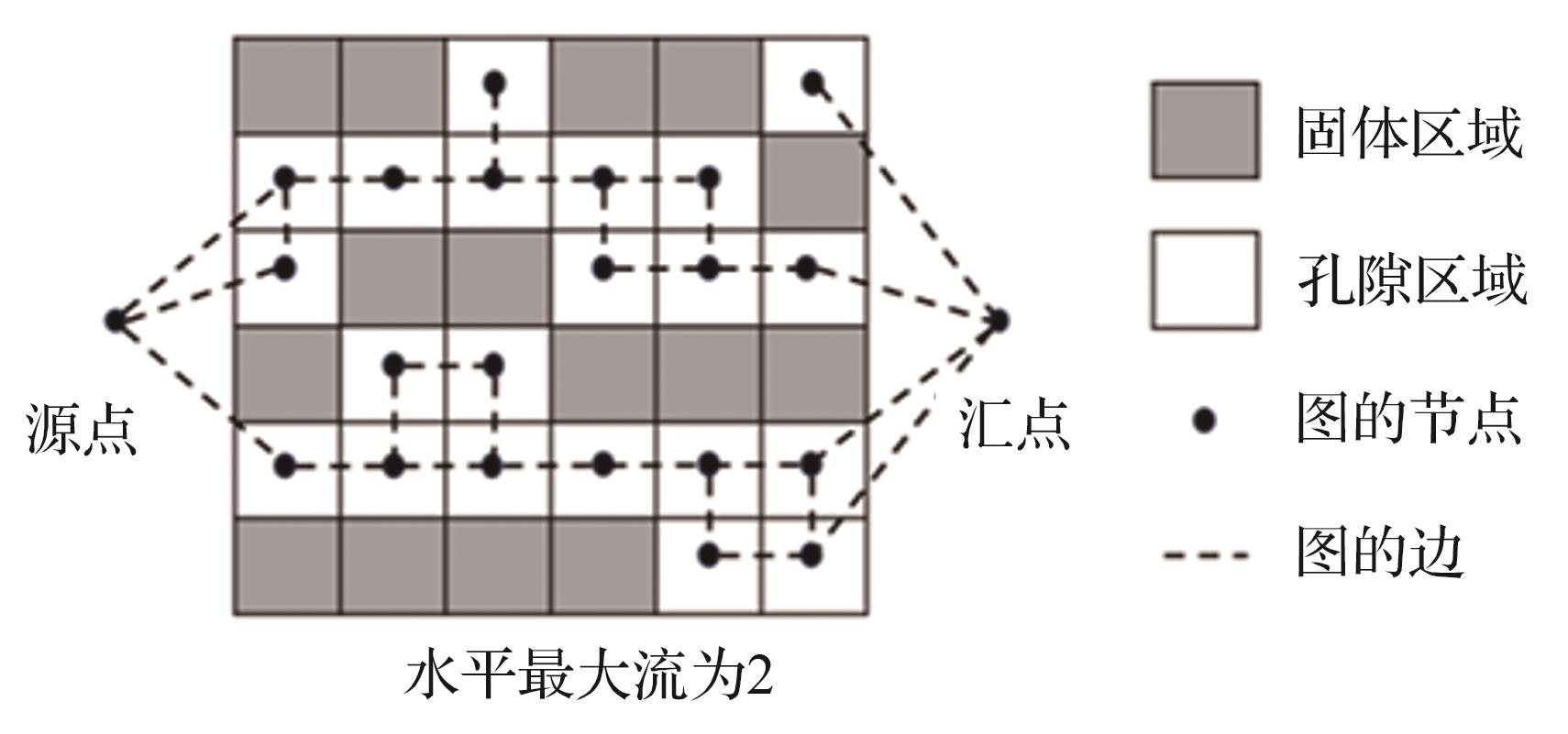
图 5
分形维数计算样例
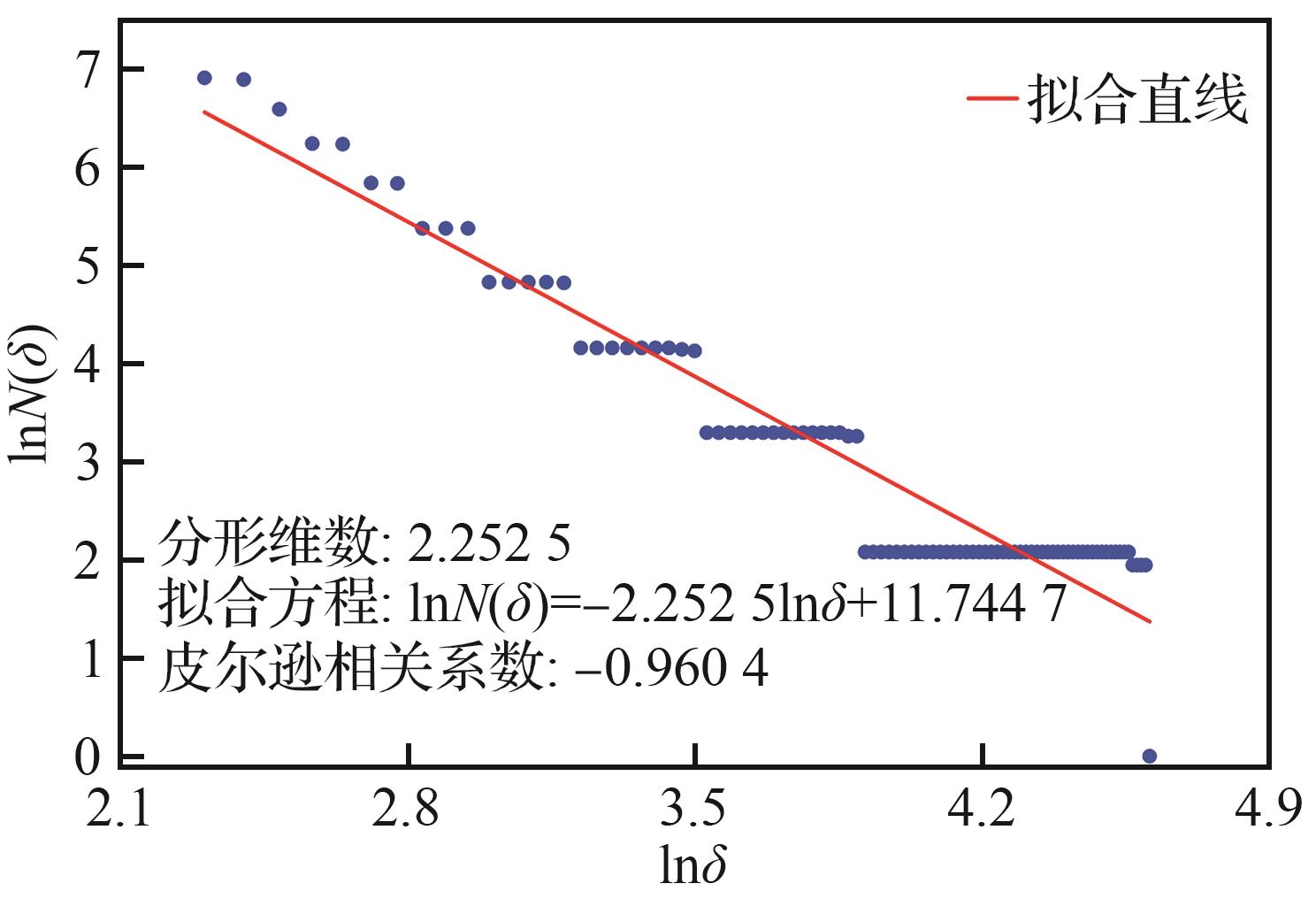
表3
SVR模型超参数优化结果
| 超参数 | 最优值 |
|---|---|
| 正则化强度(C) | 9.35 |
| 容忍度(ε) | 0.02 |
| 核函数 | RBF |
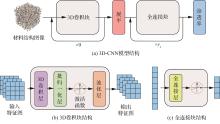
图 6
3D-CNN模型架构
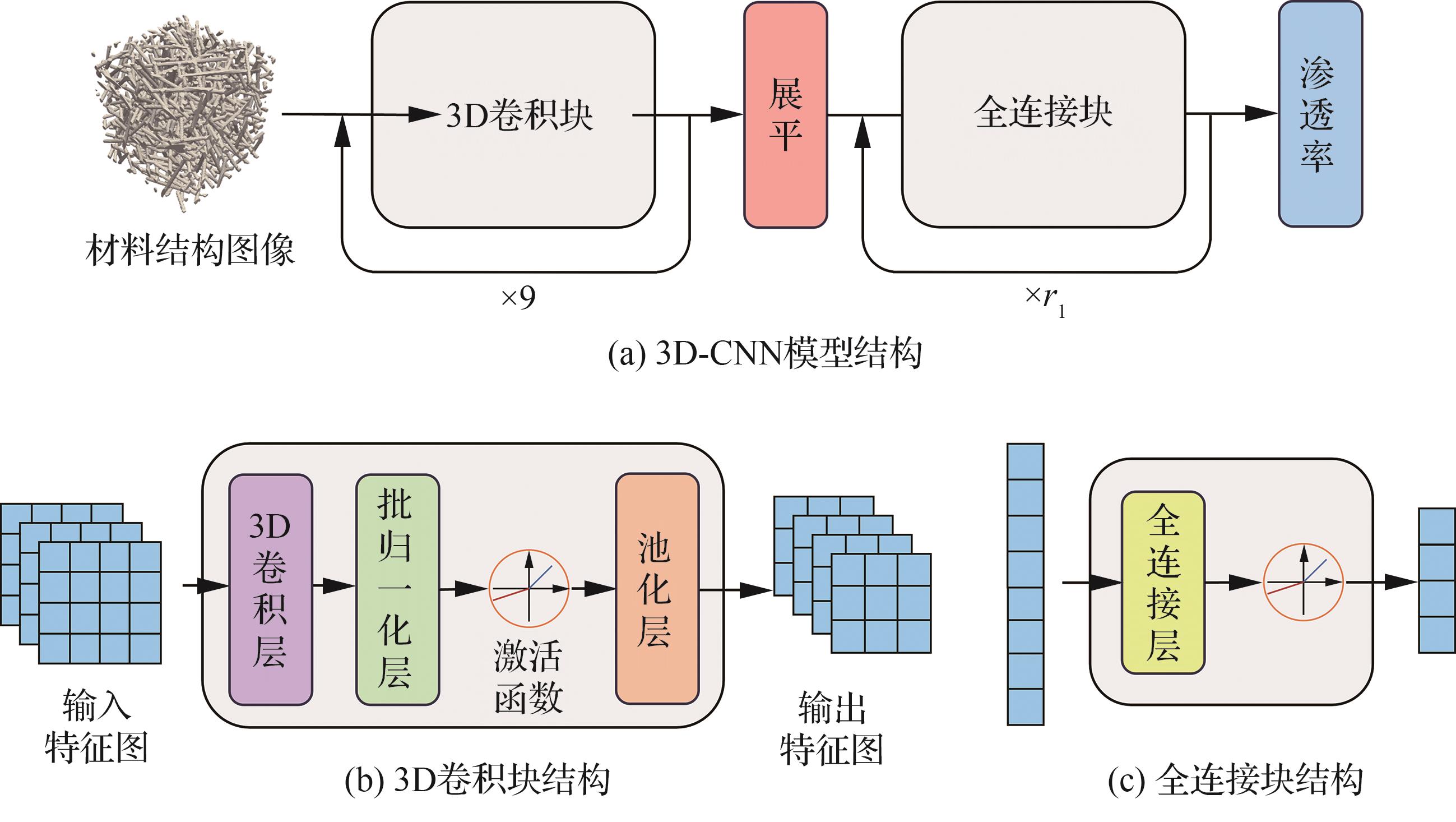
表4
特征提取器参数配置
| 3D卷积块序号 | 卷积层配置 | 池化层配置 |
|---|---|---|
| 1 | (1, 32, 9×9×9, 3) | (5, 5) |
| 2 | (32, 64, 7×7×7, 2) | (3, 3) |
| 3 | (64, 128, 5×5×5, 2) | (2, 2) |
| 4 | (128, 256, 5×5×5, 2) | (2, 1) |
| 5 | (256, 512, 3×3×3, 2) | (2, 2) |
| 6 | (512, 1 024, 3×3×3, 2) | (2, 2) |
| 7 | (1 024, 1 024, 3×3×3, 2) | (2, 2) |
| 8 | (1 024, 2 048, 3×3×3, 2) | (2, 2) |
| 9 | (2 048, 4 096, 3×3×3, 2) | (2, 2) |
表5
决策层融合模型具体参数
模型 序号 | 融合策略 | 具体参数 |
|---|---|---|
| 3 | 平均权重法 | 模型1结果权重:0.500 0 模型2结果权重:0.500 0 |
| 4 | 熵权法 | 模型1结果权重:0.495 4 模型2结果权重:0.504 6 |
| 5 | 最小二乘法 | (y1为模型1结果,y2为模型2结果) |
图 7
基于特征直接拼接的融合策略
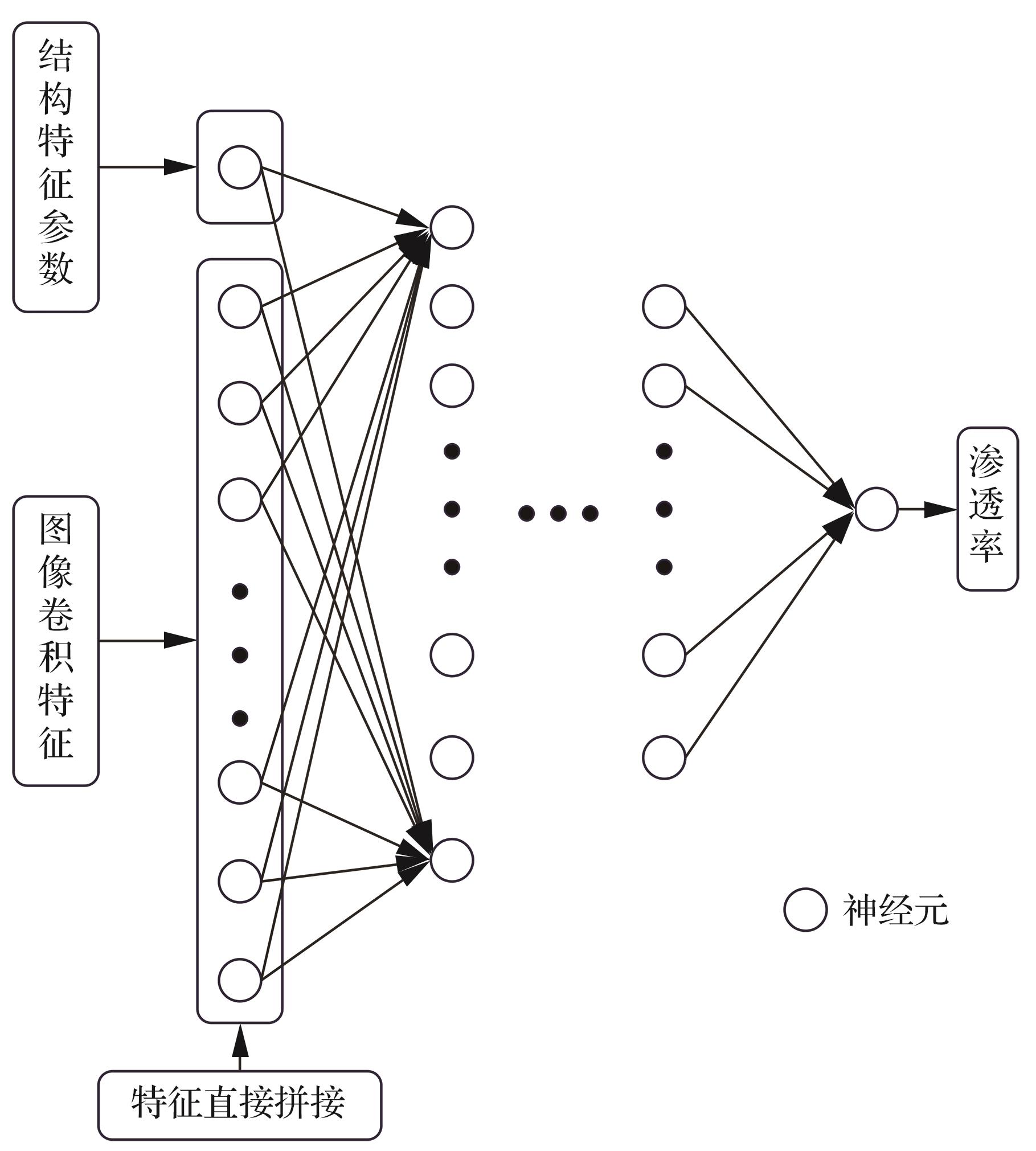
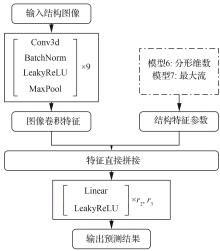
图 8
模型6和模型7流程图
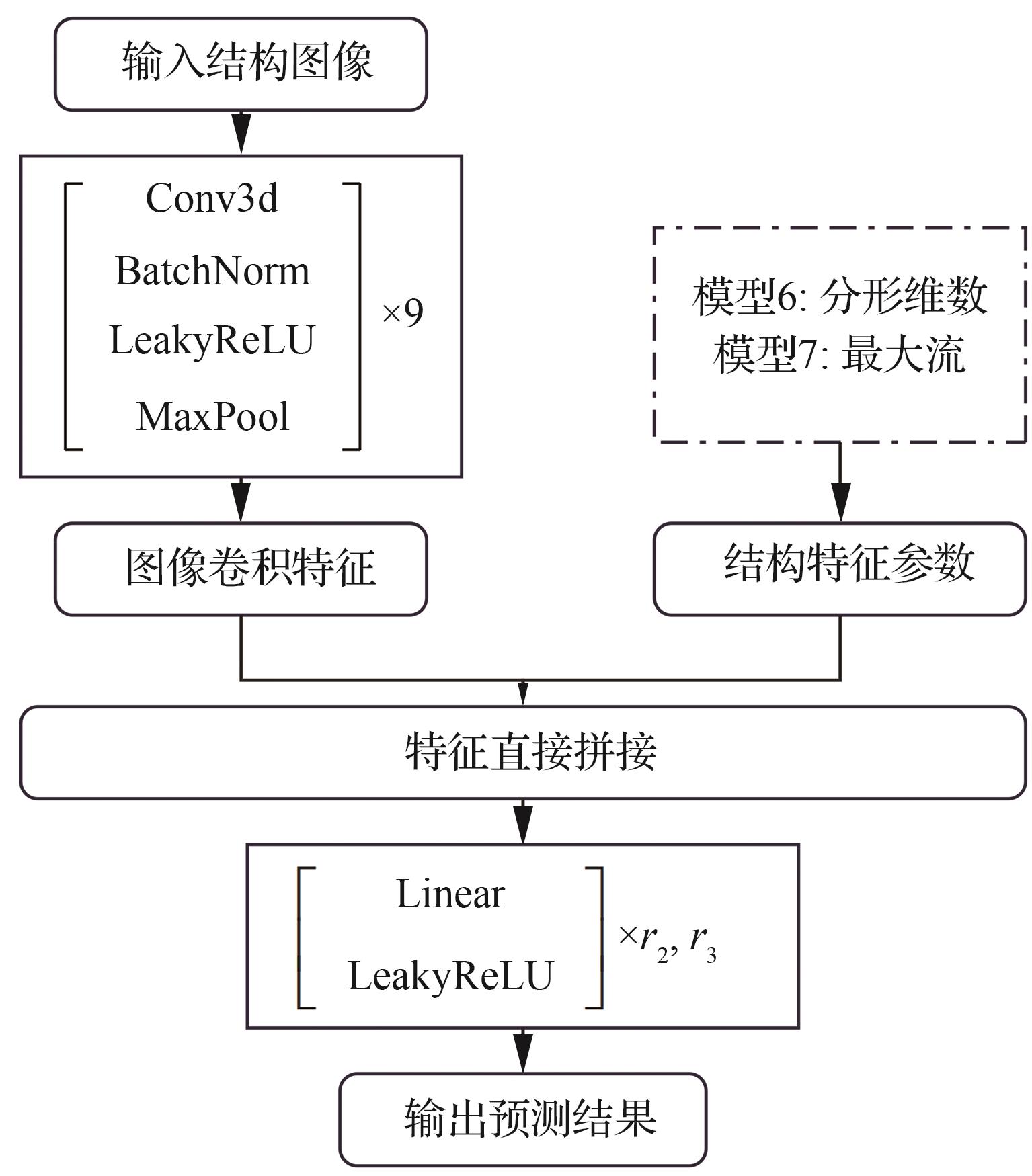
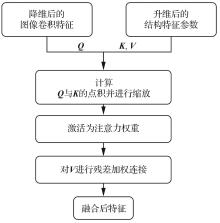
图 9
基于跨模态注意力机制的融合策略
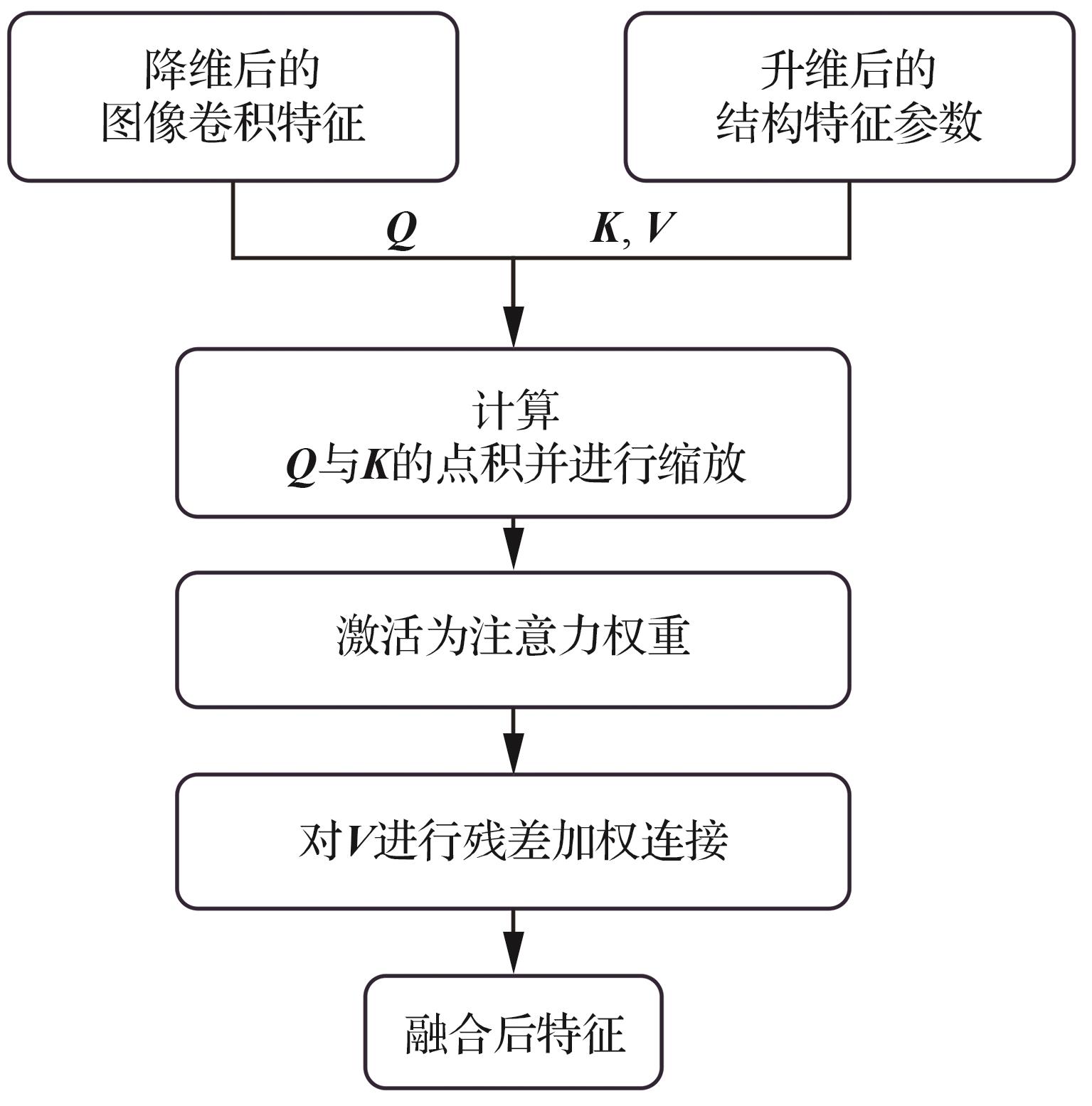
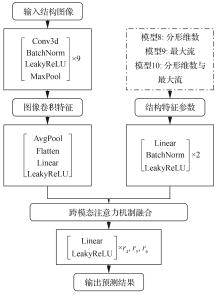
图 10
模型8、模型9和模型10流程图
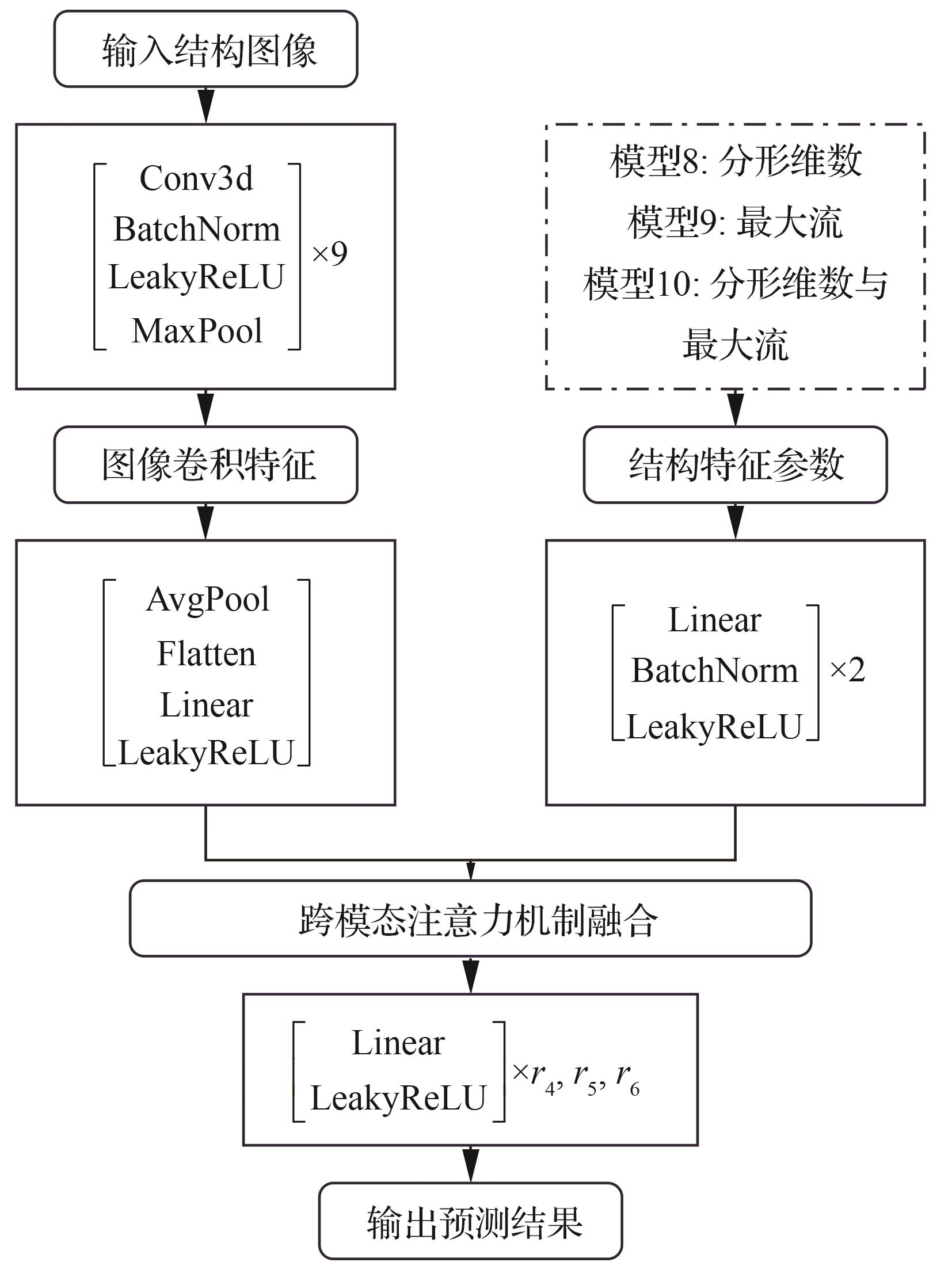
表6
模型6~模型10的融合策略
| 模型序号 | 融合策略 | 结构特征参数 |
|---|---|---|
| 6 | 特征直接拼接 | 分形维数 |
| 7 | 特征直接拼接 | 最大流 |
| 8 | 跨模态注意力机制 | 分形维数 |
| 9 | 跨模态注意力机制 | 最大流 |
| 10 | 跨模态注意力机制 | 分形维数与最大流 |
表7
模型2不同全连接层数下训练集与预测集的性能指标
| 全连接层数 | 训练集R2 | 训练集MAPE/% | 训练集 RMSE/10⁻11 | 预测集R2 | 预测集 MAPE/% | 预测集 RMSE/10⁻11 | R2下降 幅度/% | 模型参数 量/GB |
|---|---|---|---|---|---|---|---|---|
| 6 | 0.977 6 | 6.97 | 1.63 | 0.866 9 | 9.34 | 1.56 | 11.3 | 1.24 |
| 7 | 0.957 5 | 8.25 | 2.25 | 0.894 4 | 8.96 | 1.39 | 6.6 | 1.30 |
| 8 | 0.964 9 | 7.26 | 2.04 | 0.806 7 | 13.70 | 1.89 | 16.4 | 1.43 |
| 9 | 0.963 6 | 8.97 | 2.08 | 0.730 1 | 11.98 | 2.23 | 24.2 | 1.72 |
| 10 | 0.990 5 | 3.61 | 1.06 | 0.871 5 | 9.12 | 1.32 | 12.0 | 2.33 |
表8
模型2不同全连接层数下R2的95%置信区间
全连接 层数 | 训练集R2 置信下界 | 训练集R2 置信上界 | 训练集R2 均值 | 训练集R2 标准差 | 预测集R2 置信下界 | 预测集R2 置信上界 | 预测集R2 均值 | 预测集R2 标准差 |
|---|---|---|---|---|---|---|---|---|
| 6 | 0.965 5 | 0.986 2 | 0.977 6 | 0.005 3 | 0.754 6 | 0.935 0 | 0.858 4 | 0.046 4 |
| 7 | 0.923 9 | 0.977 7 | 0.957 7 | 0.014 7 | 0.817 1 | 0.948 7 | 0.889 3 | 0.033 4 |
| 8 | 0.945 1 | 0.978 9 | 0.964 9 | 0.008 6 | 0.654 7 | 0.891 1 | 0.793 1 | 0.061 1 |
| 9 | 0.942 6 | 0.976 9 | 0.963 5 | 0.009 1 | 0.535 6 | 0.875 2 | 0.719 6 | 0.088 9 |
| 10 | 0.984 5 | 0.994 2 | 0.990 4 | 0.002 6 | 0.729 9 | 0.935 1 | 0.859 7 | 0.053 1 |
表9
模型2回归器最优架构配置
| 全连接块序 | 输入维度 | 输出维度 |
|---|---|---|
| 1 | 32 768 | 1 024 |
| 2 | 1 024 | 512 |
| 3 | 512 | 256 |
| 4 | 256 | 128 |
| 5 | 128 | 64 |
| 6 | 64 | 32 |
| 7 | 32 | 1 |
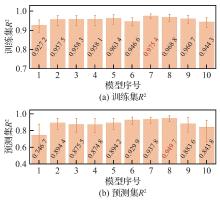
图 11
模型1~模型10在训练集与预测集上的R2及其误差条
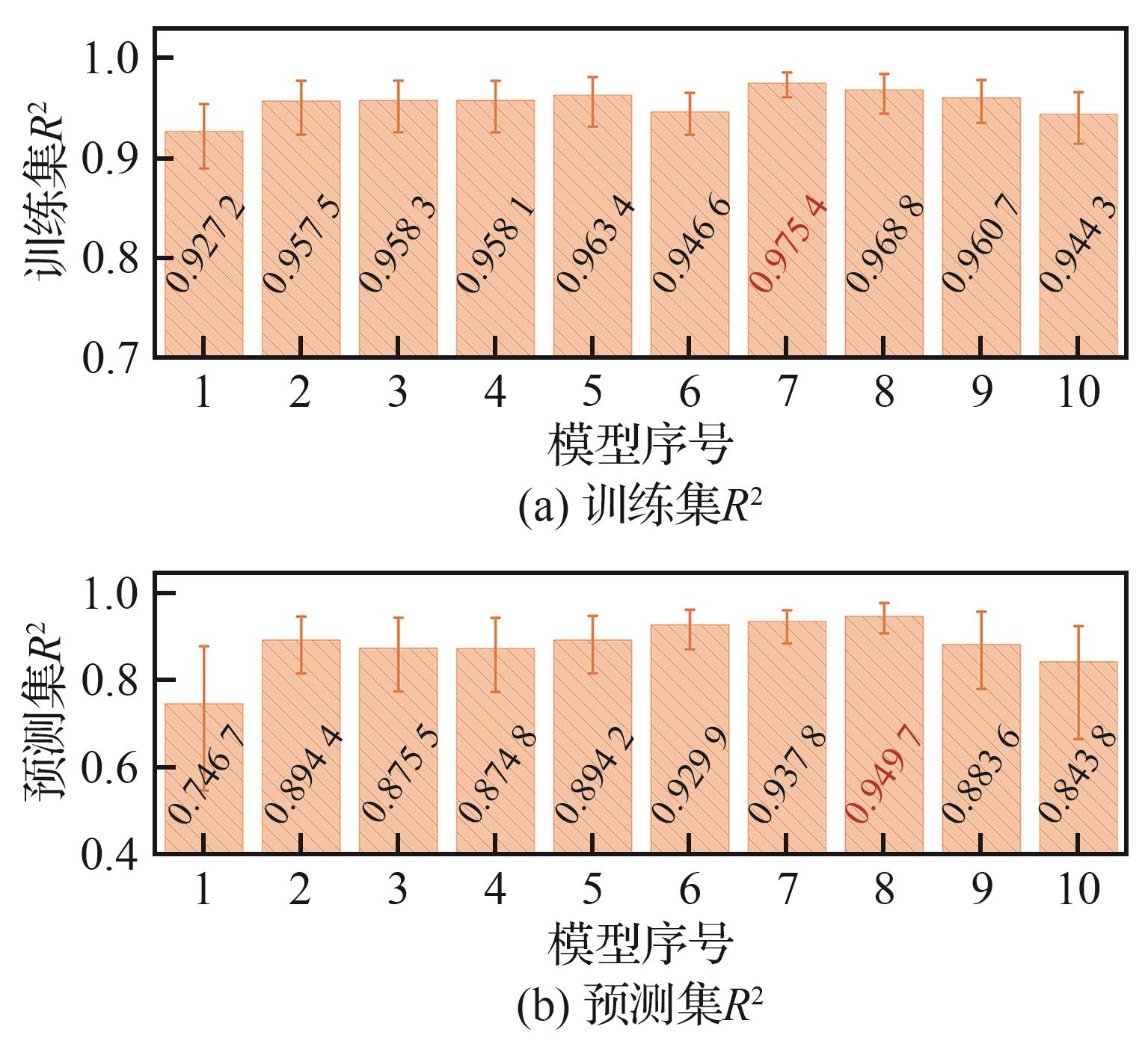
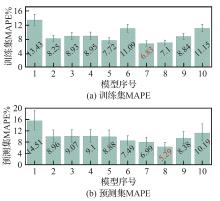
图 12
模型1~模型10在训练集与预测集上的MAPE及其误差条
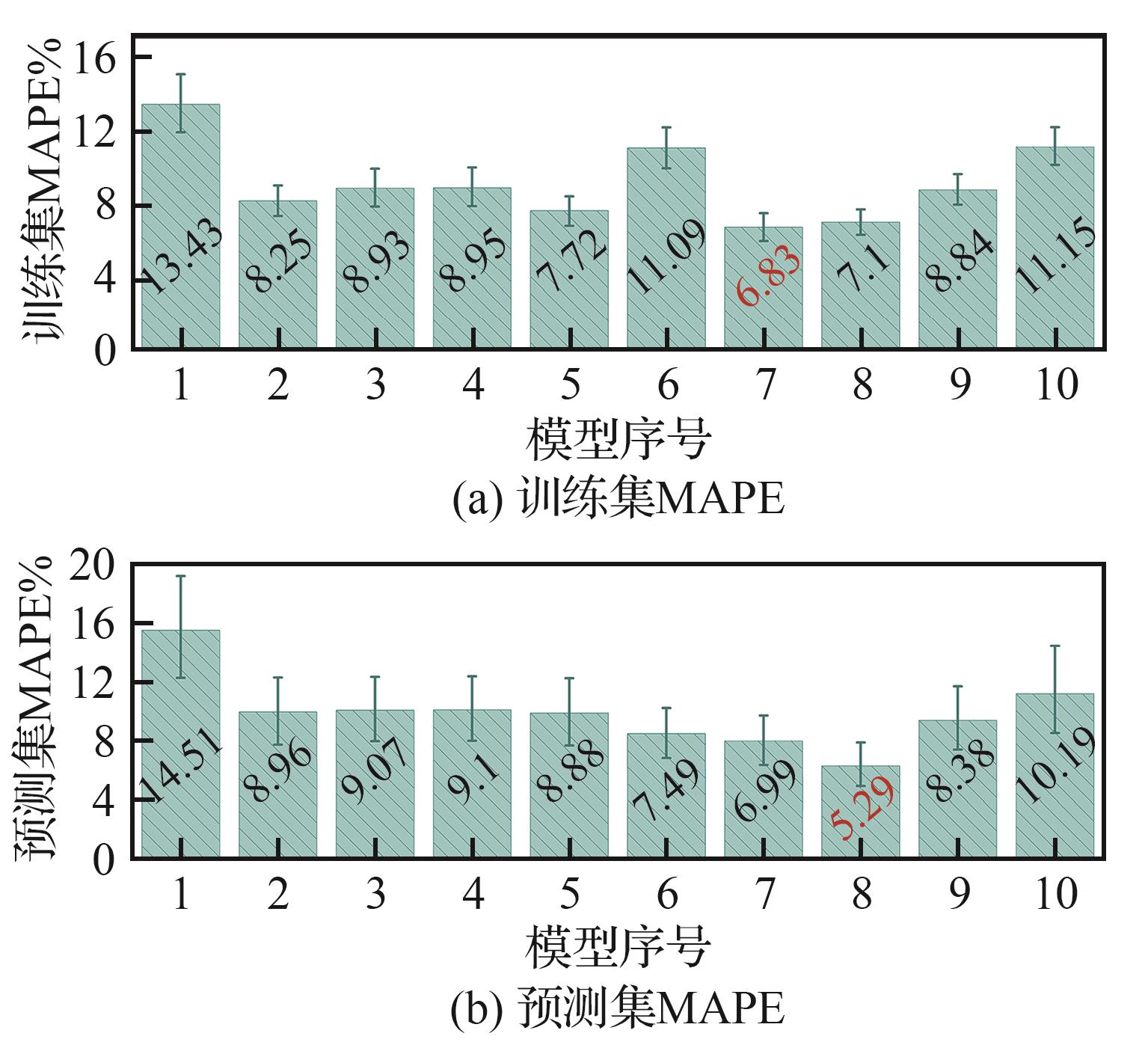
图 13
模型1~模型10在训练集与预测集上的RMSE及其误差条
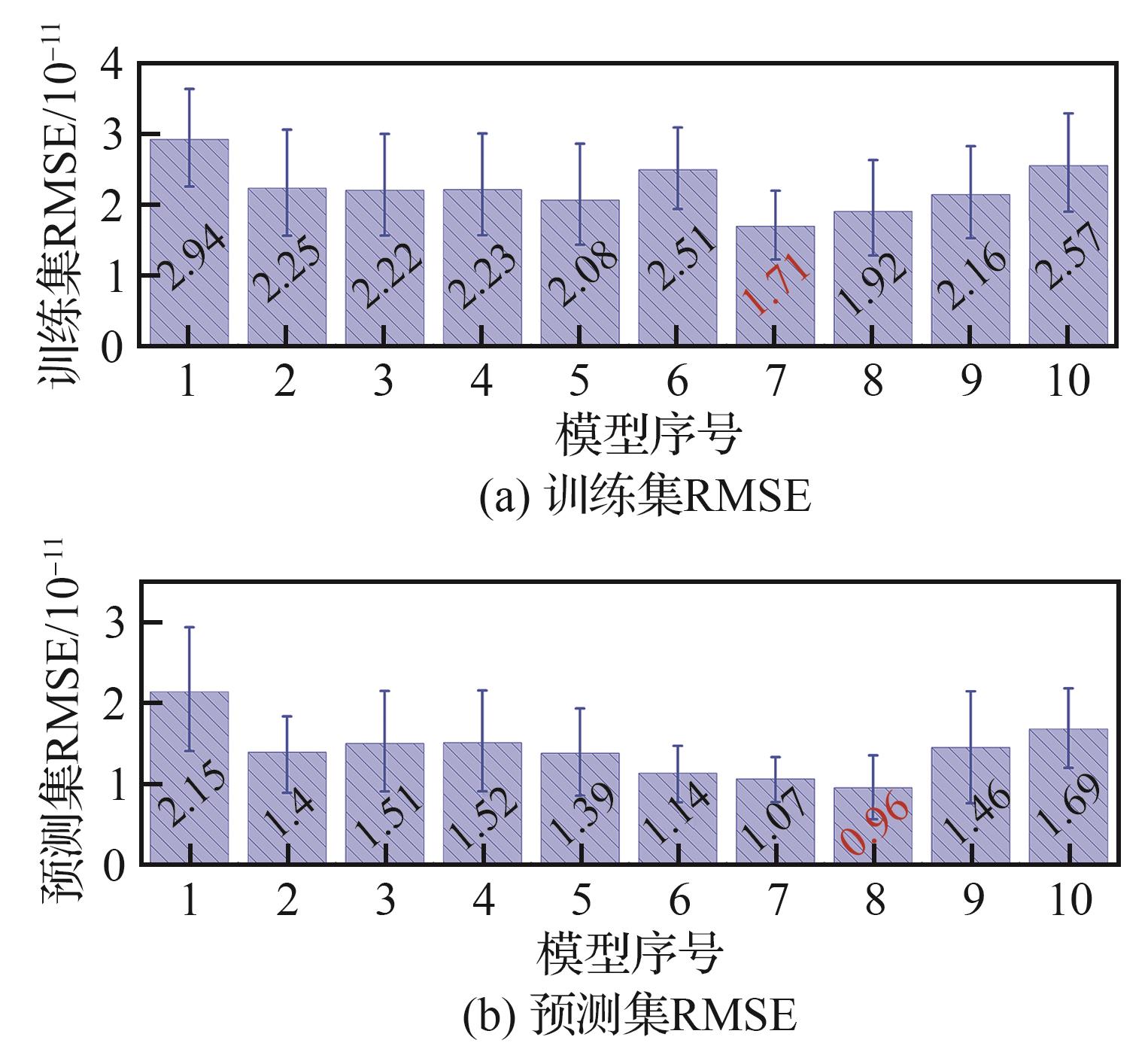
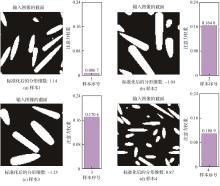
图 14
不同样本注意力权重
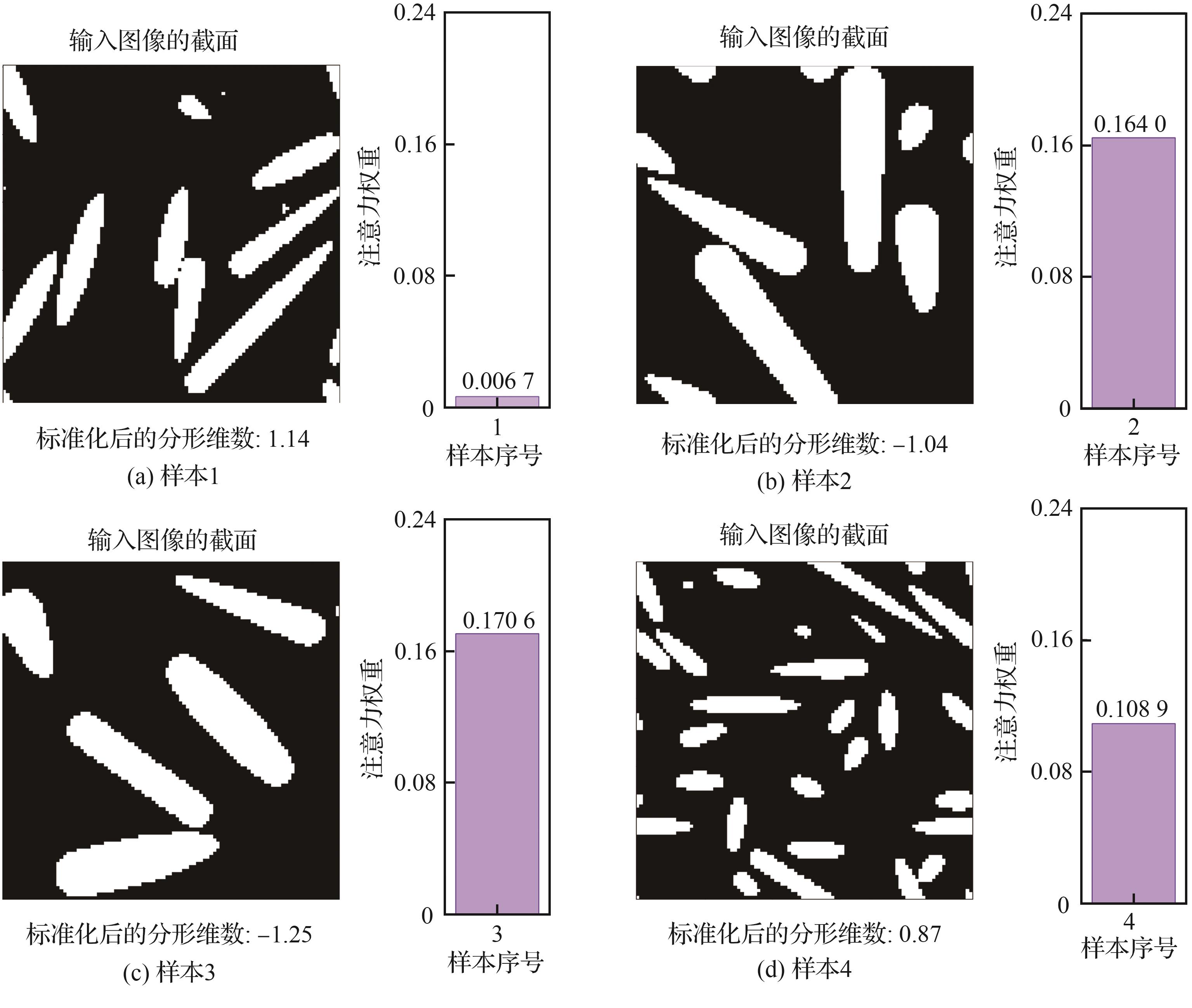
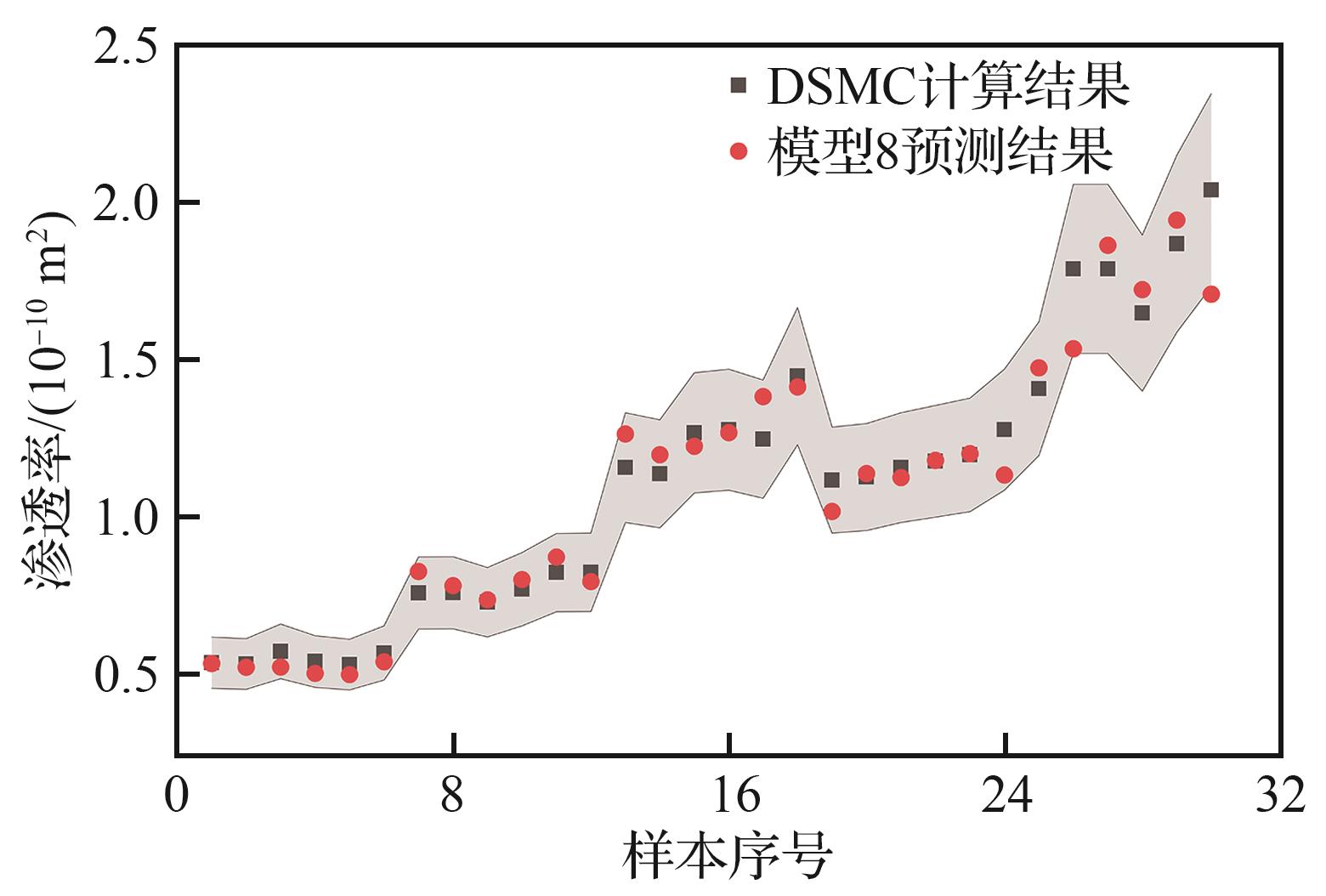
图 15
模型8在训练集和预测集上的渗透率预测与相对误差分布
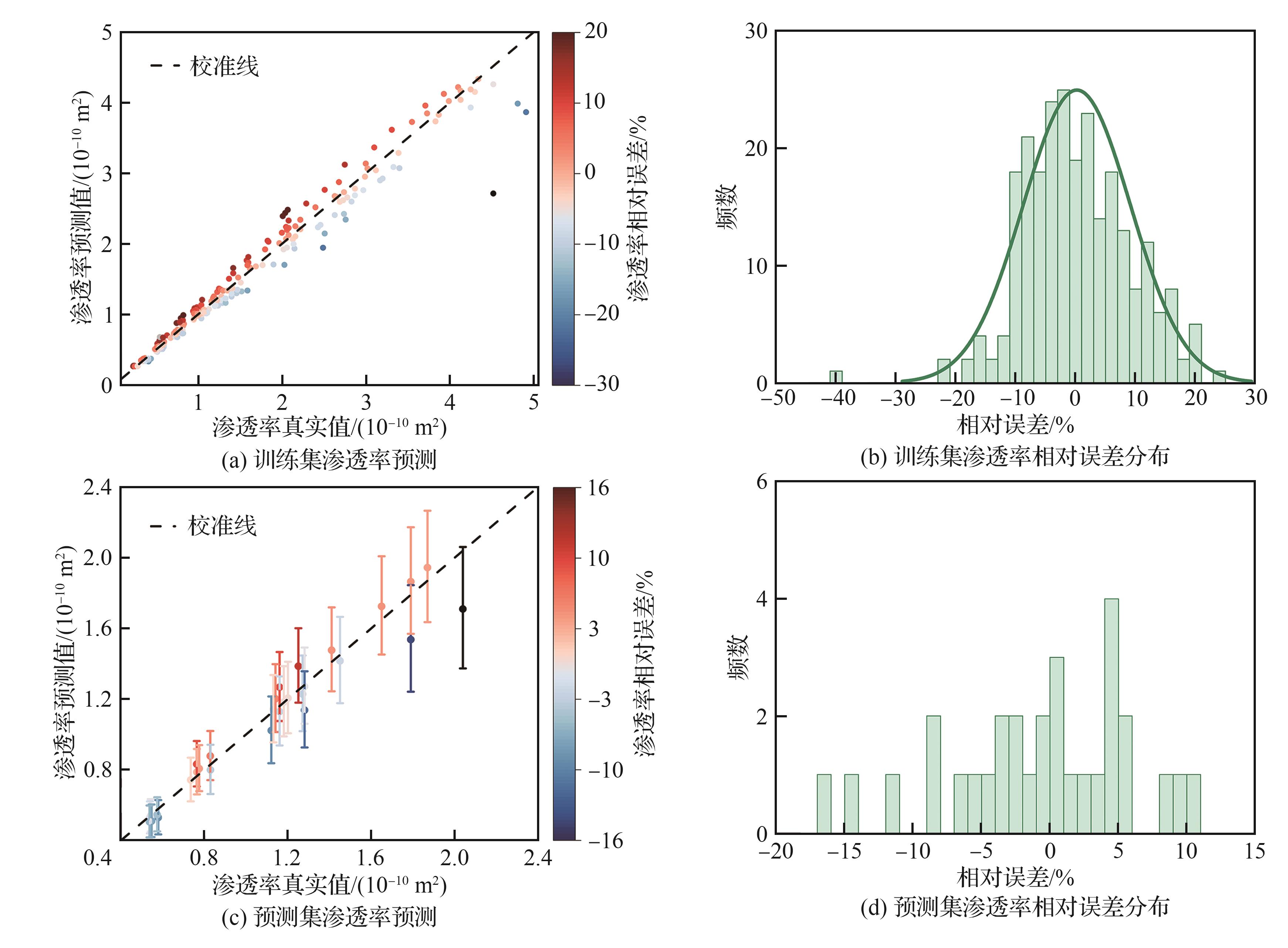
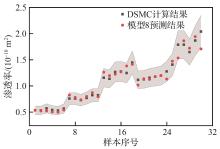
图 16
模型8在预测集上15%误差带
表A1
模型6不同全连接层数下训练集与预测集的性能指标
| 全连接层数 | 训练集R2 | 训练集 MAPE/% | 训练集 RMSE/10⁻11 | 预测集R2 | 预测集 MAPE/% | 预测集 RMSE/10⁻11 | R2下降 幅度/% | 模型参数量/GB |
|---|---|---|---|---|---|---|---|---|
| 6 | 0.951 6 | 10.88 | 2.40 | 0.789 6 | 11.59 | 1.97 | 17.0 | 1.24 |
| 7 | 0.977 7 | 6.19 | 1.63 | 0.901 6 | 7.30 | 1.36 | 7.8 | 1.30 |
| 8 | 0.977 4 | 6.61 | 1.64 | 0.922 1 | 7.72 | 1.20 | 5.7 | 1.43 |
| 9 | 0.981 9 | 6.57 | 1.44 | 0.906 1 | 7.42 | 1.31 | 7.8 | 1.72 |
| 10 | 0.946 6 | 11.09 | 2.51 | 0.929 9 | 7.49 | 1.14 | 1.8 | 2.34 |
表A2
模型7不同全连接层数下训练集与预测集的性能指标
| 全连接层数 | 训练集R2 | 训练集 MAPE/% | 训练集 RMSE/10⁻11 | 预测集R2 | 预测集 MAPE/% | 预测集 RMSE/10⁻11 | R2下降 幅度/% | 模型参数量/GB |
|---|---|---|---|---|---|---|---|---|
| 6 | 0.977 5 | 7.25 | 1.64 | 0.828 2 | 11.50 | 1.78 | 15.3 | 1.24 |
| 7 | 0.981 3 | 6.09 | 1.49 | 0.904 2 | 8.18 | 1.32 | 7.9 | 1.30 |
| 8 | 0.984 1 | 4.94 | 1.38 | 0.932 5 | 6.24 | 1.11 | 5.2 | 1.43 |
| 9 | 0.987 9 | 5.39 | 1.20 | 0.879 2 | 8.50 | 1.49 | 11.0 | 1.72 |
| 10 | 0.975 4 | 6.83 | 1.71 | 0.937 8 | 6.99 | 1.07 | 3.9 | 2.34 |
表A3
模型8不同全连接层数下训练集与预测集的性能指标
全连接 层数 | 融合特征 维度 | 训练集R2 | 训练集 MAPE/% | 训练集 RMSE/10⁻11 | 预测集R2 | 预测集 MAPE/% | 预测集 RMSE/10⁻11 | R2下降 幅度/% | 模型参数量/GB |
|---|---|---|---|---|---|---|---|---|---|
| 5 | 512 | 0.971 2 | 6.87 | 1.85 | 0.931 8 | 6.08 | 1.12 | 4.1 | 1.19 |
| 6 | 1 024 | 0.976 0 | 7.52 | 1.69 | 0.946 8 | 6.61 | 0.989 | 3.0 | 1.21 |
| 7 | 2 048 | 0.968 8 | 6.83 | 1.92 | 0.949 7 | 5.29 | 0.961 | 2.0 | 1.28 |
| 8 | 4 096 | 0.970 9 | 7.98 | 1.86 | 0.932 1 | 7.57 | 1.12 | 4.0 | 1.54 |
| 9 | 8 192 | 0.951 3 | 10.25 | 2.40 | 0.920 3 | 7.89 | 1.21 | 3.3 | 2.53 |
表A4
模型9不同全连接层数下训练集与预测集的性能指标
全连接 层数 | 融合特征 维度 | 训练集R2 | 训练集 MAPE/% | 训练集 RMSE/10⁻11 | 预测集R2 | 预测集 MAPE/% | 预测集 RMSE/10⁻11 | R2下降 幅度/% | 模型参数量/GB |
|---|---|---|---|---|---|---|---|---|---|
| 5 | 512 | 0.971 4 | 7.09 | 1.84 | 0.876 4 | 8.66 | 1.51 | 9.8 | 1.19 |
| 6 | 1 024 | 0.971 1 | 6.80 | 1.85 | 0.890 9 | 8.71 | 1.42 | 8.3 | 1.21 |
| 7 | 2 048 | 0.960 7 | 8.84 | 2.16 | 0.883 6 | 8.38 | 1.46 | 8.0 | 1.28 |
| 8 | 4 096 | 0.967 3 | 8.37 | 1.97 | 0.846 1 | 10.53 | 1.68 | 12.5 | 1.54 |
| 9 | 8 192 | 0.970 9 | 7.99 | 1.91 | 0.824 5 | 11.94 | 1.79 | 15.1 | 2.53 |
表A5
模型10不同全连接层数下训练集与预测集的性能指标
全连接 层数 | 融合特征 维度 | 训练集R2 | 训练集 MAPE/% | 训练集 RMSE/10⁻11 | 预测集R2 | 预测集 MAPE/% | 预测集 RMSE/10⁻11 | R2下降 幅度/% | 模型参数 量/GB |
|---|---|---|---|---|---|---|---|---|---|
| 5 | 512 | 0.963 4 | 8.93 | 2.09 | 0.775 2 | 13.75 | 2.03 | 19.5 | 1.19 |
| 6 | 1 024 | 0.955 1 | 8.74 | 2.31 | 0.727 6 | 15.32 | 1.75 | 23.8 | 1.22 |
| 7 | 2 048 | 0.944 3 | 11.15 | 2.57 | 0.843 8 | 10.19 | 1.69 | 11.7 | 1.28 |
| 8 | 4 096 | 0.963 0 | 7.90 | 2.09 | 0.751 2 | 13.72 | 2.14 | 22.0 | 1.56 |
| 9 | 8 192 | 0.901 7 | 11.43 | 3.42 | 0.749 9 | 14.93 | 2.32 | 16.8 | 2.54 |
| [1] | 左婧滢, 章思龙, 韦健飞, 等. 高超声速飞行器内流道燃料超声速气膜防热/减阻协同技术研究进展[J]. 推进技术, 2025, 46(1): 1-19. |
| ZUO J Y, ZHANG S L, WEI J F, et al. Review on fuel supersonic film thermal protection/drag reduction cooperative technology for internal flow of hypersonic vehicles[J]. Journal of Propulsion Technology, 2025, 46(1): 1-19 (in Chinese). | |
| [2] | 陈宇腾, 常晶, 陈为胜, 等. 一种高超声速飞行器的纵向变形与飞行最优协调控制方法[J]. 宇航学报, 2025, 46(3): 485-498. |
| CHEN Y T, CHANG J, CHEN W S, et al. Optimal integrated method design for longitudinal morphing and flight control of hypersonic vehicles[J]. Journal of Astronautics, 2025, 46(3): 485-498 (in Chinese). | |
| [3] | 周印佳. 高超声速流动-传热与材料响应耦合方法及耦合行为研究[D]. 哈尔滨: 哈尔滨工业大学, 2016: 1-2. |
| ZHOU Y J. Research on coupling methodology and coupling behavior of hypersonic flow-heat transfer and material response[D]. Harbin: Harbin Institute of Technology, 2016: 1-2 (in Chinese). | |
| [4] | 梁伟, 金华, 孟松鹤, 等. 高超声速飞行器新型热防护机制研究进展[J]. 宇航学报, 2021, 42(4): 409-424. |
| LIANG W, JIN H, MENG S H, et al. Research progress on new thermal protection mechanism of hypersonic vehicles[J]. Journal of Astronautics, 2021, 42(4): 409-424 (in Chinese). | |
| [5] | 孟松鹤, 杜善义, 韩杰才. 热防护系统及材料的研究进展[C]∥第十四届全国复合材料学术会议论文集(上). 2006: 11-17. |
| MENG S H, DU S Y, HAN J C. Research progress of thermal protection systems and materials[C]∥Proceedings of the 14th National Conference on Composite Materials (Part 1). 2006: 11-17 (in Chinese). | |
| [6] | 曾耀莹, 王润宁, 侯佳琪, 等. 耐极端烧蚀环境C/C复合材料研究进展[J]. 航空学报, 2025, 46(6): 531927. |
| ZENG Y Y, WANG R N, HOU J Q, et al. Research progress of C/C composites resistant to extreme ablation environments[J]. Acta Aeronautica et Astronautica Sinica, 2025, 46(6): 531927 (in Chinese). | |
| [7] | MANSOUR N N, PANERAI F, LACHAUD J, et al. Flow mechanics in ablative thermal protection systems[J]. Annual Review of Fluid Mechanics, 2024, 56(1): 549–575. |
| [8] | 赵瑾, 孙向春, 张俊, 等. 热防护材料气固界面传热传质问题研究进展[J]. 航空学报, 2022, 43(10): 527577. |
| ZHAO J, SUN X C, ZHANG J, et al. Research advances on heat and mass transfer coupling effect at gas-solid interface for thermal protection materials[J]. Acta Aeronautica et Astronautica Sinica, 2022, 43(10): 527577 (in Chinese). | |
| [9] | 黄鹏, 郑振荣, 毛科铸, 等. 热阻塞效应在有机硅树脂-碳纤织物复合材料烧蚀防热中的作用[J]. 复合材料学报, 2021, 38(9): 3045-3055. |
| HUANG P, ZHENG Z R, MAO K Z, et al. Effect of heat blockage on ablative thermal protection of silicone resin-carbon fiber fabrics[J]. Acta Materiae Compositae Sinica, 2021, 38(9): 3045-3055 (in Chinese). | |
| [10] | BERNSTEIN M, KRAFT R. NASA shares orion heat shield findings, updates artemis Moon missions[EB/OL]. Washington, D.C.: NASA, 2024. (2024-12-09) [2025-09-24]. . |
| [11] | PANERAI F, COCHELL T, MARTIN A, et al. Experimental measurements of the high-temperature oxidation of carbon fibers[J]. International Journal of Heat and Mass Transfer, 2019, 136: 972-986. |
| [12] | POOVATHINGAL S J, SOTO B M, BREWER C. Effective permeability of carbon composites under reentry conditions[J]. AIAA Journal, 2022, 60(3): 1293-1302. |
| [13] | MCCLURE J E, PRINS J F, MILLER C T. A novel heterogeneous algorithm to simulate multiphase flow in porous media on multicore CPU-GPU systems[J]. Computer Physics Communications, 2014, 185(7): 1865-1874. |
| [14] | WANG C S, SHEN P Y, LIOU T M. A consistent thermal lattice Boltzmann method for heat transfer in arbitrary combinations of solid, fluid, and porous media[J]. Computer Methods in Applied Mechanics and Engineering, 2020, 368: 113200. |
| [15] | 刘汉儒, 陈南树, 刘宇, 等. 多孔介质流动控制及气动降噪研究进展[J]. 航空学报, 2023, 44(16): 027923. |
| LIU H R, CHEN N S, LIU Y, et al. Review of porous media used in flow control and aerodynamic noise reduction[J]. Acta Aeronautica et Astronautica Sinica, 2023, 44(16): 027923 (in Chinese). | |
| [16] | SABET S, BARISIK M, MOBEDI M, et al. An extended Kozeny-Carman-Klinkenberg model for gas permeability in micro/nano-porous media[J]. Physics of Fluids, 2019, 31 (11):112001. |
| [17] | 钱淼, 周骥, 向忠, 等. 基于深度学习的多孔材料渗透率预测研究进展[J]. 计算机集成制造系统, 2024, 30(3): 791-810. |
| QIAN M, ZHOU J, XIANG Z, et al. Research progress of porous material permeability prediction based on deep learning[J]. Computer Integrated Manufacturing Systems, 2024, 30(3): 791-810 (in Chinese). | |
| [18] | HOMMEL J, COLTMAN E, CLASS H. Porosity-Permeability relations for evolving pore space: a review with a focus on (Bio-)geochemically altered porous media[J]. Transport in Porous Media, 2018, 124(2): 589-629. |
| [19] | CHACON L, MOHAN RAMU V B, POOVATHINGAL S J. A supervised learning model to predict length-scale dependent permeability of porous carbon composites[C]∥AIAA AVIATION 2022 Forum. Reston: AIAA, 2022: 2022-4007. |
| [20] | MOHAN RAMU V B, CHACON L, BREWER C, et al. Development of a supervised learning model to predict permeability of porous carbon composites[J]. AIAA Journal, 2023, 61(2): 843-858. |
| [21] | ZHAO X B, CHEN X J, HUANG Q, et al. Logging-data-driven permeability prediction in low-permeable sandstones based on machine learning with pattern visualization: A case study in Wenchang A Sag, Pearl River Mouth Basin[J]. Journal of Petroleum Science and Engineering, 2022, 214: 110517. |
| [22] | CHEN X J, ZHAO X B, TAHMASEBI P, et al. NMR-data-driven prediction of matrix permeability in sandstone aquifers[J]. Journal of Hydrology, 2023, 618: 129147. |
| [23] | AO Y, LI H Q, ZHU L P, et al. The linear random forest algorithm and its advantages in machine learning assisted logging regression modeling[J]. Journal of Petroleum Science and Engineering, 2019, 174: 776-789. |
| [24] | 孟胤全, 蒋建国, 吴吉春. 利用机器学习从切片的孔隙结构特征预测多孔介质渗透率[J]. 高校地质学报, 2024, 30(1): 1-11. |
| MENG Y Q, JIANG J G, WU J C, et al. Predicting permeability of porous media from pore structure features of slices by machine learning[J]. Geological Journal of China Universities, 2024, 30(1): 1-11 (in Chinese). | |
| [25] | WANG Y D, CHUNG T, ARMSTRONG R T, et al. ML-LBM: Predicting and accelerating steady state flow simulation in porous media with convolutional neural networks[J]. Transport in Porous Media, 2021, 138(1): 49-75. |
| [26] | WU H Y, FANG W Z, KANG Q J, et al. Predicting effective diffusivity of porous media from images by deep learning[J]. Scientific Reports, 2019, 9(1): 20387. |
| [27] | RABBANI A, BABAEI M, SHAMS R, et al. DeePore: A deep learning workflow for rapid and comprehensive characterization of porous materials[J]. Advances in Water Resources, 2020, 146: 103787. |
| [28] | MENG Y Q, JIANG J G, WU J C, et al. Transformer-based deep learning models for predicting permeability of porous media[J]. Advances in Water Resources, 2023, 179: 104520. |
| [29] | 何友, 刘瑜, 李耀文, 等. 多源信息融合发展及展望[J]. 航空学报, 2025, 46(6): 531672. |
| HE Y, LIU Y, LI Y W, et al. Development and prospects of multisource information fusion[J]. Acta Aeronautica et Astronautica Sinica, 2025, 46(6): 531672 (in Chinese). | |
| [30] | GÄRTTNER S, ALPAK F O, MEIER A, et al. Estimating permeability of 3D micro-CT images by physics-informed CNNs based on DNS[J]. Computational Geosciences, 2023, 27: 245-262. |
| [31] | 杨伟斌, 朱庆勇. 分形理论在碳化材料三维烧蚀热防护计算中的应用[J]. 气体物理, 2021, 6(4): 19-28. |
| YANG W B, ZHU Q Y. Application of fractal theory on three dimensional ablative thermal response of charring composite[J]. Physics of Gases, 2021, 6(4): 19-28 (in Chinese). | |
| [32] | 郭京辉, 张起鸣, 田宇豪, 等. 一种碳纤维增强防热多孔微结构几何建模方法: 中国,ZL202310664024.6[P]. 2023-09-01. |
| GUO J H, ZHANG Q M, TIAN Y H, et al. A geometric modeling method for carbon fiber reinforced thermal protection porous microstructure: China, ZL202310664024.6[P]. 2023-09-01 (in Chinese). | |
| [33] | LACHAUD J, COZMUTA I, MANSOUR N N. Multiscale approach to ablation modeling of phenolic impregnated carbon ablators[J]. Journal of Spacecraft and Rockets, 2010, 47(6): 910-921. |
| [34] | KLINKENBERG L J. The permeability of porous media to liquids and gases[C]∥API. Drilling and Production. Practice. 1941: 200-213. |
| [35] | BORNER A, PANERAI F, MANSOUR N N. High temperature permeability of fibrous materials using direct simulation Monte Carlo[J]. International Journal of Heat and Mass Transfer, 2017, 106: 1318-1326. |
| [36] | 邵丽萍. 网络最大流算法的研究[D]. 南京: 南京邮电大学, 2019: 15-16. |
| SHAO L P. Research on network maximum flow algorithms[D]. Nanjing: Nanjing University of Posts and Telecommunications, 2019: 15-16 (in Chinese). | |
| [37] | 王威. 纤维多孔材料渗透率的分形研究[D]. 武汉: 武汉工程大学, 2020: 11-12. |
| WANG W. Fractal study on permeability of fibrous porous materials[D]. Wuhan: Wuhan Institute of Technology, 2020: 11-12 (in Chinese). | |
| [38] | 鲁亮, 马建清. 基于分形特征的集合经验模态分解的谐波检测[J]. 电力系统及其自动化学报, 2025, 37(7): 59-68. |
| LU L, MA J Q. Harmonic detection based on fractal ensemble empirical mode decomposition[J]. Proceedings of the CSU-EPSA, 2025, 37(7): 59-68 (in Chinese). | |
| [39] | HAJIHOSSEINLOU M, MAGHSOUDI A, GHEZELBASH R. A semi-supervised approach for mineral prospectivity mapping via weighted positive-unlabeled learning and tree-structured parzen estimator for hyperparameter optimization[J]. Ore Geology Reviews, 2025, 185: 106783. |
| [40] | KUNCHEVA L I, WHITAKER C J. Measures of diversity in classifier ensembles and their relationship with the ensemble accuracy[J]. Machine Learning, 2023, 51: 181-207. |
| [1] | 马宇卓, 任侃, 李涛, 陈钱. 基于距离损失提升航空图像语义分割研究[J]. 航空学报, 2026, 47(8): 332780-332780. |
| [2] | 黄俊, 张菁, 翁世倩. 机载光电目标识别算法综述[J]. 航空学报, 2026, 47(6): 332601-332601. |
| [3] | 李乐言, 杨任农, 郭安新, 宋祺, 左家亮. 基于全域火力场的超视距空战威胁预测及动态逃逸方法[J]. 航空学报, 2026, 47(4): 332205-332205. |
| [4] | 冯子成, 张文龙, 刘冬辉, 于起峰. 复杂背景下反无人机红外目标鲁棒跟踪算法[J]. 航空学报, 2026, 47(4): 332264-332264. |
| [5] | 李思远, 韩德强, DEZERT Jean, 杨艺. 利用学习机制的多方法融合端到端证据建模[J]. 航空学报, 2026, 47(12): 332927-332927. |
| [6] | 任若天, 赵理君, 赵旭阳, 张正, 李宏益, 薛新华, 唐娉. 知识引导下的遥感影像智能解译方法综述[J]. 航空学报, 2026, 47(10): 632103-632103. |
| [7] | 段韶华, 张淳杰, 刘传凯, 郑晓龙, 张济韬. 自回归与反馈驱动的自适应矩形卷积全色锐化网络[J]. 航空学报, 2026, 47(10): 532432-532432. |
| [8] | 李杰潘, 贺威, 唐明豪, 熊进. 灾前建筑物掩码引导的航天遥感建筑物受损变化检测方法[J]. 航空学报, 2026, 47(10): 532845-532845. |
| [9] | 舒世灏, 孟偲, 白相志, 史振威. 基于光照控制的月球表面精确着陆点定位算法[J]. 航空学报, 2026, 47(10): 532874-532874. |
| [10] | 陶冶, 汤锦辉, 闫震, 周臣, 王冲. 融合表征转换与模式回归的航迹插补方法[J]. 航空学报, 2026, 47(1): 332106-332106. |
| [11] | 徐建宇, 周莉, 王占学, 是介, 史毫. 基于快速逐线计算模型的高超声速羽流红外辐射计算方法[J]. 航空学报, 2025, 46(8): 630778-630778. |
| [12] | 孟令捷, 李红光, 李新军. 基于地貌类别信息指导的SAR图像仿真方法[J]. 航空学报, 2025, 46(7): 331003-331003. |
| [13] | 赵志浩, 杨照华, 吴云, 余远金. 弱光环境下基于深度学习的单光子计数成像去噪方法[J]. 航空学报, 2025, 46(3): 630531-630531. |
| [14] | 吴一全, 童康. 基于深度学习的无人机航拍图像小目标检测研究进展[J]. 航空学报, 2025, 46(3): 30848-030848. |
| [15] | 项子健, 麻震宇, 杨希祥. 基于深度学习的复合材料结构性能参数反演[J]. 航空学报, 2025, 46(24): 231877-231877. |
| 阅读次数 | ||||||
|
全文 |
|
|||||
|
摘要 |
|
|||||
版权所有 © 航空学报编辑部
版权所有 © 2011航空学报杂志社
主管单位:中国科学技术协会 主办单位:中国航空学会 北京航空航天大学

 CJA
CJA
