王宇宁, 梅少辉( ), 马明阳, 任永政, 曹孟涛, 冯燕
收稿日期:2025-03-11
修回日期:2025-03-24
接受日期:2025-04-17
出版日期:2025-05-07
发布日期:2025-05-06
通讯作者:
梅少辉
E-mail:meish@nwpu.edu.cn
基金资助:
Yuning WANG, Shaohui MEI(), Mingyang MA, Yongzheng REN, Mengtao CAO, Yan FENG
Received:2025-03-11
Revised:2025-03-24
Accepted:2025-04-17
Online:2025-05-07
Published:2025-05-06
Contact:
Shaohui MEI
E-mail:meish@nwpu.edu.cn
Supported by:摘要:
光谱探测技术在无人机感知领域具有重要应用价值,其多维信息获取能力显著提升了目标识别精度与环境适应性。然而传统高光谱成像系统采用固定波段采集模式,存在硬件复杂、效率低、数据冗余等问题,难以满足无人机快速低成本目标探测需求。针对上述挑战,提出一种光谱波段自适应成像探测算法,支持动态调整光谱参数,设计结构简化的光学成像系统。首先,建立基于信息量与目标可分离度的光谱成像质量评价体系,量化分析窄带光谱数据的识别贡献;其次,提出基于最小切换时间间隔和最大切换谱段范围约束的光谱自适应模型,实现目标特征可辨识度与数据维度压缩的优化平衡;最后,结合阵列式光学模组给出一体化成像探测系统结构设计。实验验证了所提方法的有效性,为无人机光谱感知提供一条全新的高效解决方案。
中图分类号:
王宇宁, 梅少辉, 马明阳, 任永政, 曹孟涛, 冯燕. 时-谱动态约束的光谱波段自适应成像探测[J]. 航空学报, 2025, 46(23): 631963.
Yuning WANG, Shaohui MEI, Mingyang MA, Yongzheng REN, Mengtao CAO, Yan FENG. Spectral band adaptive imaging detection with temporal-spectral dynamic constraints[J]. Acta Aeronautica et Astronautica Sinica, 2025, 46(23): 631963.
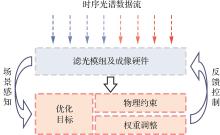
图 1
光谱自适应模型总体框架
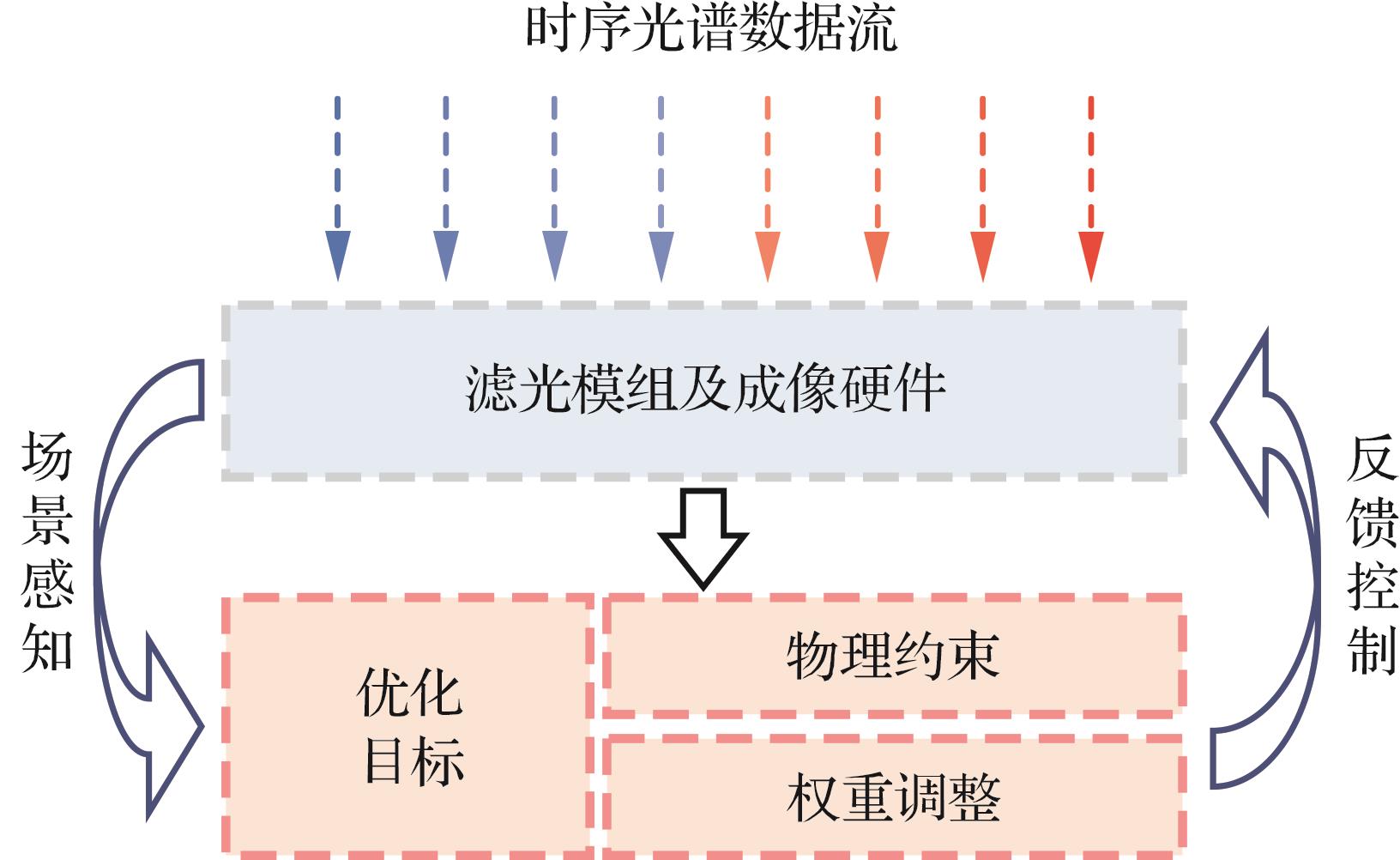
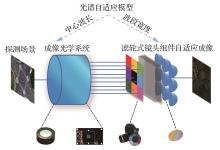
图 2
自适应光学成像设计
图 3
光谱自适应成像探测系统
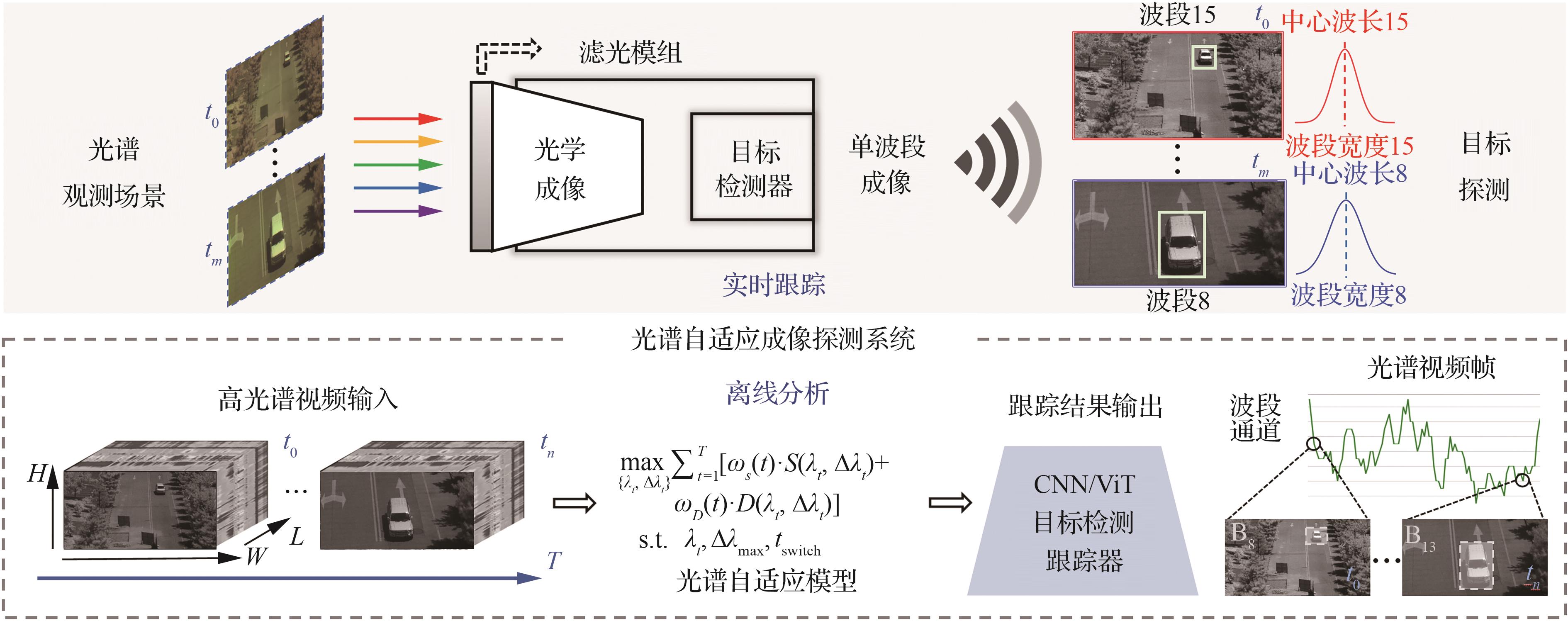
图 4
IMEC25数据集高光谱视频波段通道与光谱自适应模型成像结果
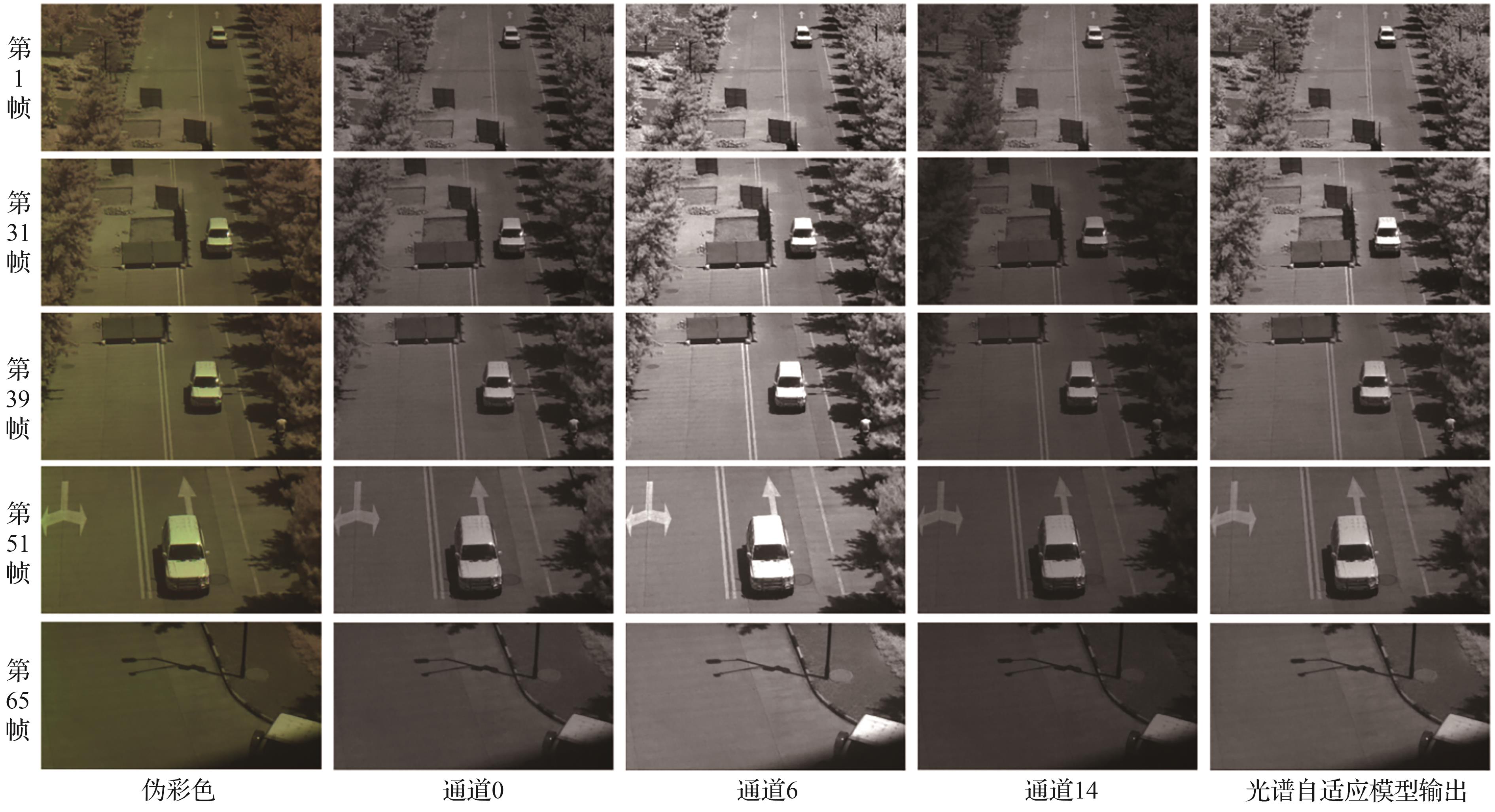
图 5
IMEC25数据集高光谱视频帧时刻光谱自适应模型成像结果
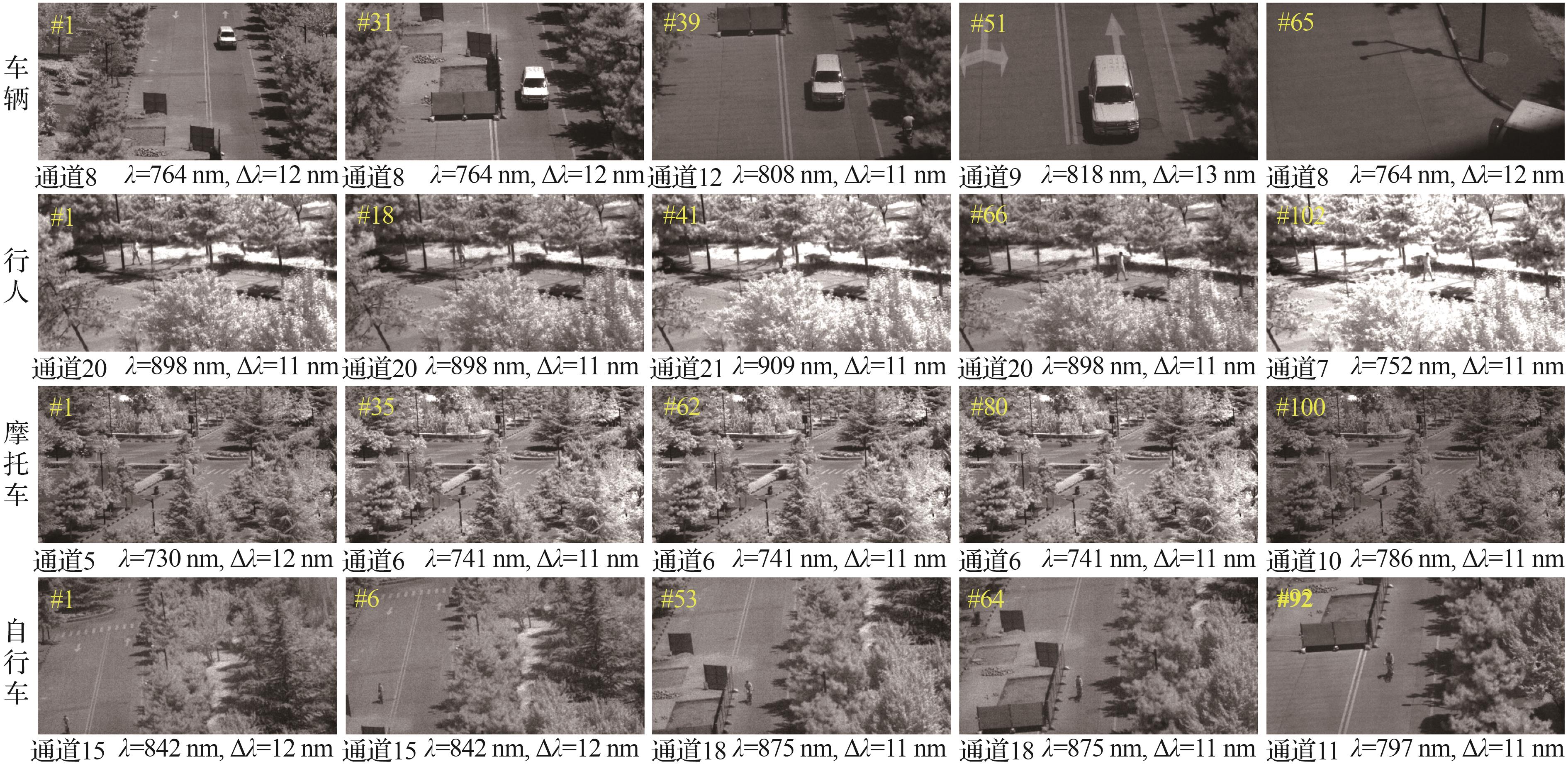
表1
平均探测精度对比
高光谱 视频 | 检测器 | 平均探测精度/% | ||
|---|---|---|---|---|
| 单一波段平均 | 理论参考标准 | 光谱自适应模型 | ||
| 车辆 | 预训练 YOLO v11-s | 73.35±2.15 | 83.41±0.89 | 78.5±1.23 |
| 行人 | 62.11±3.02 | 74.93±1.45 | 71.48±1.67 | |
| 摩托车 | 59.76±2.78 | 65.03±1.12 | 60.68±1.54 | |
| 自行车 | 77.57±1.89 | 88.32±0.76 | 80.03±1.05 | |
表2
波段切换约束对比
| 指标 | 波段切换最小时间/s | |||
|---|---|---|---|---|
| 0 | 0.5 | 1 | 1.5 | |
| 平均探测精度/% | 71.48 | 71.03 | 69.77 | 69.19 |
| 平均处理时间/s | 3.427 | 2.678 | 1.399 | 0.741 |
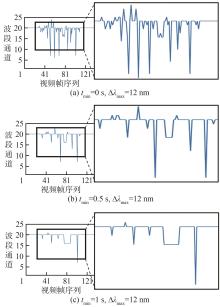
图 6
模型输出的成像波段通道
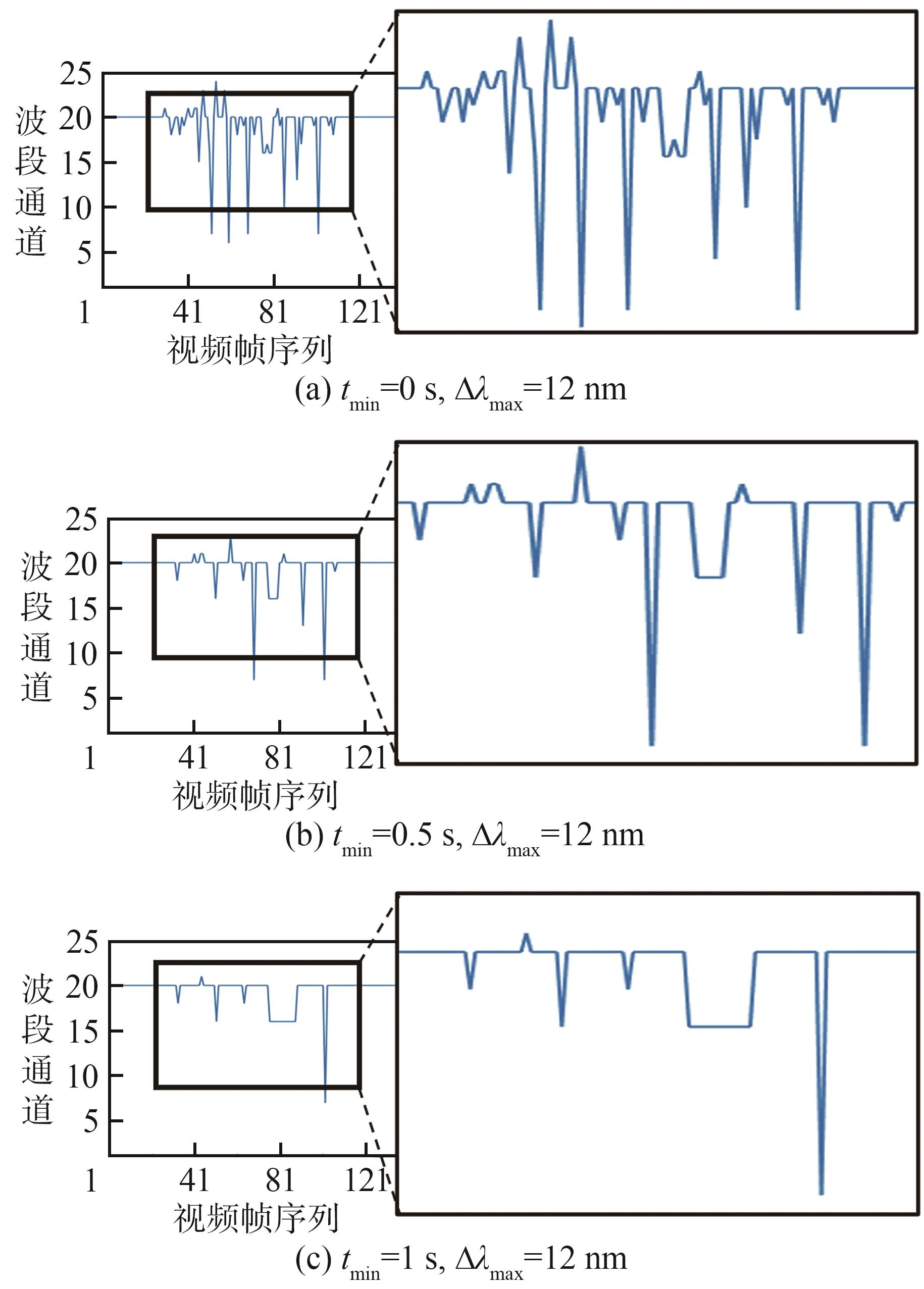
表3
IMEC25和IMEC16数据集探测对比
| 方法 | 平均探测精度/%,平均处理时间/s | |||||||
|---|---|---|---|---|---|---|---|---|
| IMEC25数据集 | IMEC16数据集 | |||||||
| 车辆 | 行人 | 摩托车 | 自行车 | 鸭子 | 路人 | 轿车 | 电瓶车 | |
| ICA | 58.64±4.21,0.351 | 37.45±5.33,0.402 | 47.83±3.89, 0.386 | 53.35±3.12,0.391 | 77.89±4.35,0.281 | 76.72±5.47,0.321 | 76.15±4.12,0.309 | 72.64±3.28,0.31 |
| MVPCA | 62.39±2.97,0.285 | 49.88±3.45,0.33 | 53.6±2.67,0.329 | 68.89±2.31,0.313 | 81.54±3.02,0.228 | 88.21±3.68,0.264 | 82.37±2.83,0.263 | 87.93±2.45,0.25 |
| PDPC | 73.81±1.75,0.219 | 60.32±2.13,0.221 | 55.96±2.05,0.222 | 71.19±1.88,0.216 | 93.25±1.82,0.175 | 89.67±2.24,0.177 | 85.43±2.11,0.177 | 90.85±1.95,0.173 |
| GIE | 75.24±1.1,0.471 | 69.28±1.88,0.503 | 54.81±0.93,0.501 | 70.4±1.32,0.484 | 94.81±2.18,0.377 | 90.12±1.61,0.402 | 83.81±0.97,0.401 | 89.94±1.01,0.39 |
| BABS | 76.73±0.01,0.334 | 68.93±0.13,0.334 | 55.89±0.45,0.336 | 75.24±0.88,0.336 | 95.05±0.15,0.267 | 90.24±0.08,0.267 | 87.28±0.09,0.269 | 90.45±0.42,0.269 |
| 光谱自适应 | 74.82±1.23,0.127 | 68.03±1.67,0.155 | 56.02±1.54,0.131 | 72.68±1.42,0.134 | 95.06±1.15,0.102 | 88.41±1.49,0.122 | 86.78±1.37,0.105 | 90.92±1.33,0.107 |
图 7
IMEC25数据集高光谱视频成像探测对比结果
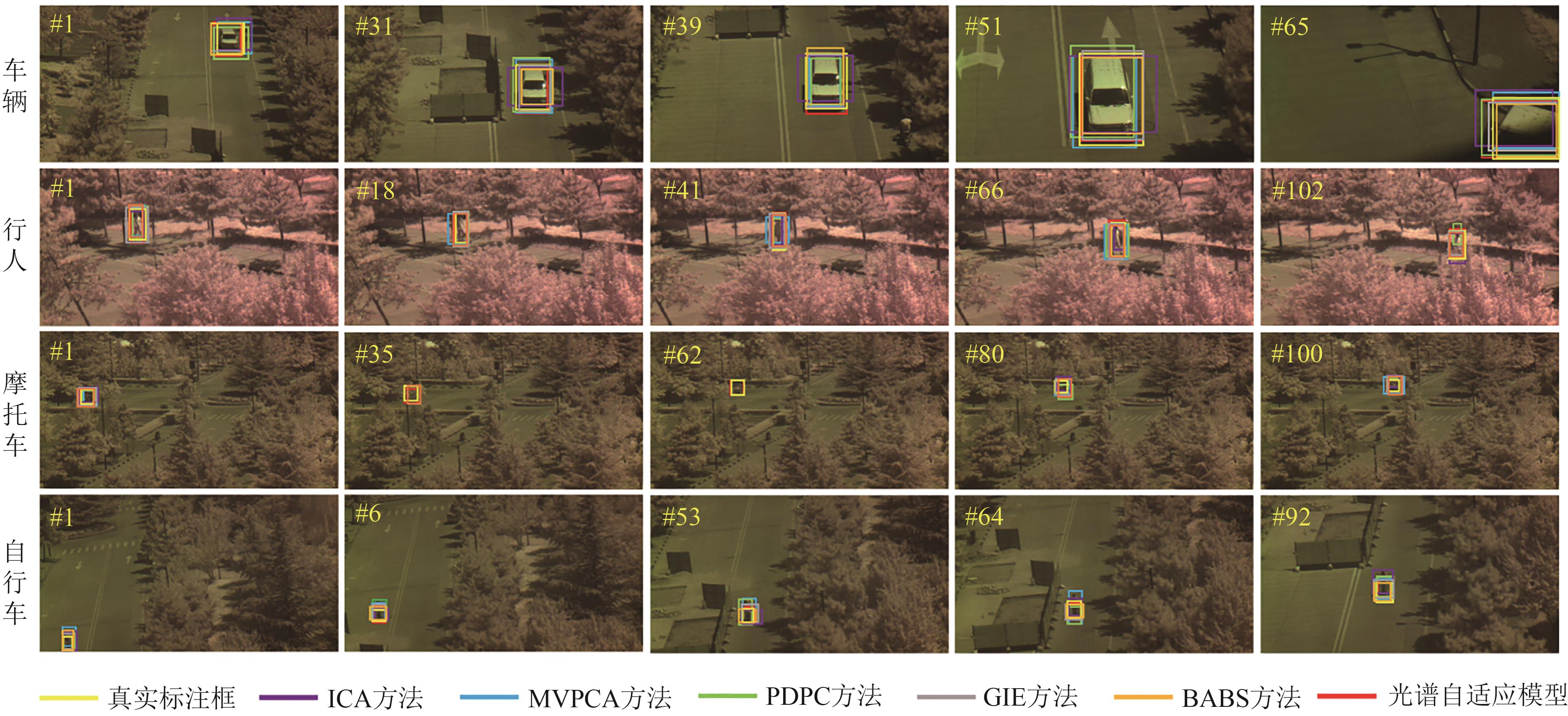
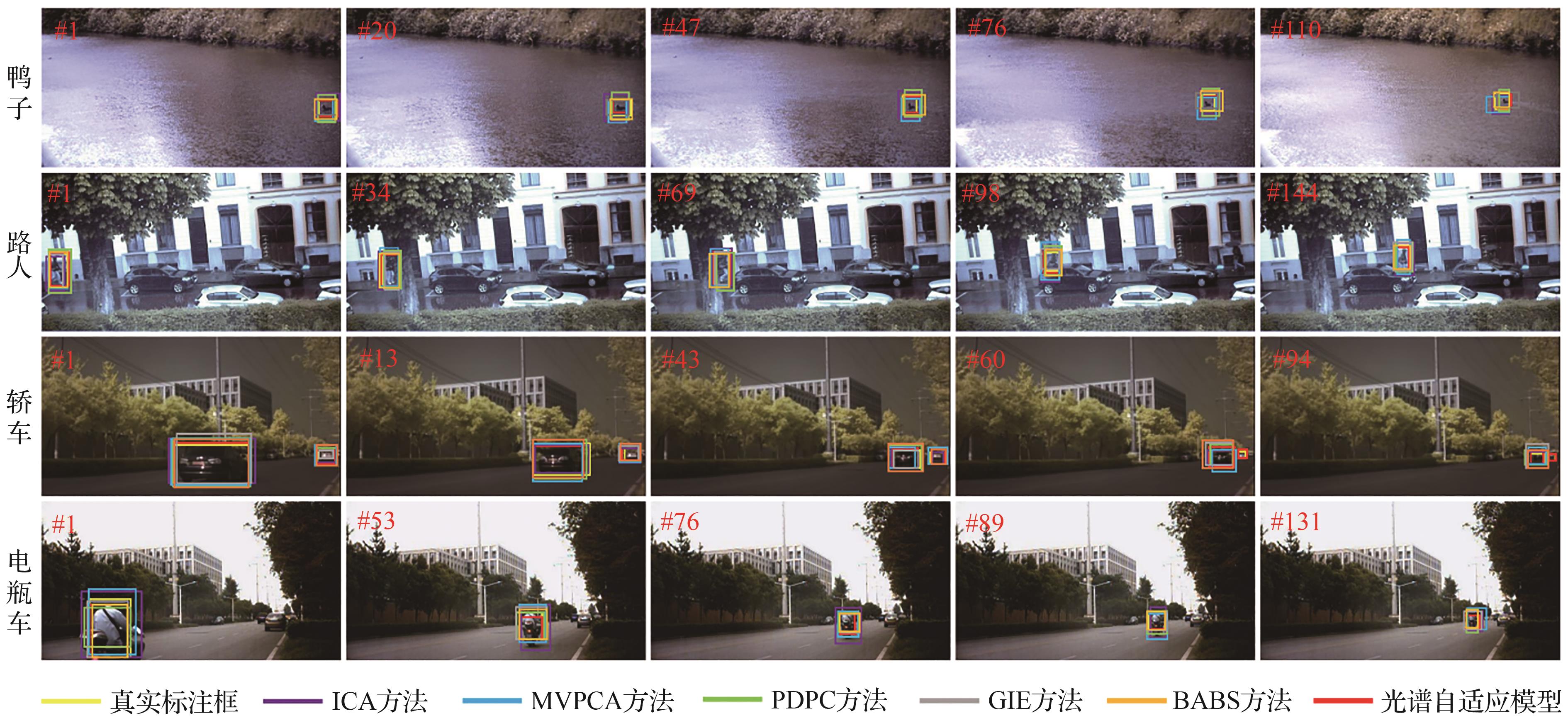
图 8
IMEC16数据集高光谱视频成像探测对比结果
| [1] | SONG M P, SHANG X D, WANG Y L, et al. Class information-based band selection for hyperspectral image classification[J]. IEEE Transactions on Geoscience and Remote Sensing, 2019, 57(11): 8394-8416. |
| [2] | RAM B G, ODUOR P, IGATHINATHANE C, et al. A systematic review of hyperspectral imaging in precision agriculture: Analysis of its current state and future prospects[J]. Computers and Electronics in Agriculture, 2024, 222: 109037. |
| [3] | 张艺伟, 郭焱培, 唐荣, 等. 高光谱遥感在植物多样性研究中的应用进展与趋势[J]. 遥感学报, 2023, 27(11): 2467-2483. |
| ZHANG Y W, GUO Y P, TANG R, et al. Progress and trends of application of hyperspectral remote sensing in plant diversity research[J]. National Remote Sensing Bulletin, 2023, 27(11): 2467-2483 (in Chinese). | |
| [4] | WANG Y, MEI S H, MA M Y, et al. HTACPE: A hybrid transformer with adaptive content and position embedding for sample learning efficiency of hyperspectral tracker[J]. IEEE Transactions on Multimedia, 2025, 27: 2384-2398. |
| [5] | 熊振宇, 崔亚奇, 董凯, 等. 基于属性引导的多源遥感舰船目标可解释融合关联网络[J]. 航空学报, 2023, 44(22): 627476. |
| XIONG Z Y, CUI Y Q, DONG K, et al. Interpretable fusion association network for multi-source remote sensing ship target based on attribute guidance[J]. Acta Aeronautica et Astronautica Sinica, 2023, 44(22): 627476 (in Chinese). | |
| [6] | SHANG X D, SONG M P, WANG Y L, et al. Target-constrained interference-minimized band selection for hyperspectral target detection[J]. IEEE Transactions on Geoscience and Remote Sensing, 2021, 59(7): 6044-6064. |
| [7] | FARRELL M D, MERSEREAU R M. On the impact of PCA dimension reduction for hyperspectral detection of difficult targets[J]. IEEE Geoscience and Remote Sensing Letters, 2005, 2(2): 192-195. |
| [8] | LI W, PRASAD S, FOWLER J E, et al. Locality-preserving dimensionality reduction and classification for hyperspectral image analysis[J]. IEEE Transactions on Geoscience and Remote Sensing, 2012, 50(4): 1185-1198. |
| [9] | FALCO N, BENEDIKTSSON J A, BRUZZONE L. A study on the effectiveness of different independent component analysis algorithms for hyperspectral image classification[J]. IEEE Journal of Selected Topics in Applied Earth Observations and Remote Sensing, 2014, 7(6): 2183-2199. |
| [10] | MA M Y, MEI S H, LI F, et al. Spectral correlation-based diverse band selection for hyperspectral image classification[J]. IEEE Transactions on Geoscience and Remote Sensing, 2023, 61: 5508013. |
| [11] | XU B Y, LI X H, HOU W J, et al. A similarity-based ranking method for hyperspectral band selection[J]. IEEE Transactions on Geoscience and Remote Sensing, 2021, 59(11): 9585-9599. |
| [12] | WU M, OU X F, LU Y L, et al. Heterogeneous cuckoo search-based unsupervised band selection for hyperspectral image classification[J]. IEEE Transactions on Geoscience and Remote Sensing, 2023, 62: 5500616. |
| [13] | 王宇轩, 孙晓兵, 提汝芳, 等. 考虑局部密度的共享近邻高光谱图像波段选择方法[J]. 光学学报, 2024, 44(24): 256-266. |
| WANG Y X, SUN X B, TI R F, et al. Method of shared nearest neighbors in hyperspectral image band selection considering local density[J]. Acta Optica Sinica, 2024, 44(24): 256-266 (in Chinese). | |
| [14] | ZHANG H Q, GAO H M, SUN H, et al. A spatial-spectrum fully attention network for band selection of hyperspectral images[J]. IEEE Geoscience and Remote Sensing Letters, 2024, 21: 5507205. |
| [15] | MA M Y, LI F, HU Y, et al. Joint spatial and spectral graph-based consistent self-representation for unsupervised hyperspectral band selection[J]. IEEE Transactions on Geoscience and Remote Sensing, 2024, 62: 5520616. |
| [16] | SUN W W, HE K, YANG G, et al. A cross-scene self-representative network for hyperspectral band selection[J]. IEEE Transactions on Geoscience and Remote Sensing, 2024, 62: 5509212. |
| [17] | XU Y B, LU L Y, SARAGADAM V, et al. A compressive hyperspectral video imaging system using a single-pixel detector[J]. Nature Communications, 2024, 15: 1456. |
| [18] | ZHANG X Y, CHEN B, ZOU W Z, et al. Progressive content-aware coded hyperspectral snapshot compressive imaging[J]. IEEE Transactions on Circuits and Systems for Video Technology, 2024, 34(11): 10817-10830. |
| [19] | HARTLEY R V. Transmission of information[J]. The Bell System Technical Journal, 1965, 7(3): 535-563. |
| [20] | ULABY F T, KOUYATE F, BRISCO B, et al. Textural information in SAR images[J]. IEEE Transactions on Geoscience and Remote Sensing, 1986, 24(2): 235-245. |
| [21] | VITERBI A. Error bounds for convolutional codes and an asymptotically optimum decoding algorithm[J]. IEEE Transactions on Information Theory, 1967, 13(2): 260-269. |
| [22] | CHEN L L, ZHAO Y Q, CHAN J C, et al. Histograms of oriented mosaic gradients for snapshot spectral image description[J]. ISPRS Journal of Photogrammetry and Remote Sensing, 2022, 183: 79-93. |
| [23] | KHANAM R, HUSSAIN M. Yolov11: An overview of the key architectural enhancements[DB/OL]. arXiv preprint: 2410.17725, 2024. |
| [24] | FALCO N, JON A B, LORENZO B. Spectral and spatial classification of hyperspectral images based on ICA and reduced morphological attribute profiles[J]. IEEE Transactions on Geoscience and Remote Sensing, 2015, 53(11): 6223-6240. |
| [25] | HE C L, ZHANG Y, GONG D W, et al. A multitask bee colony band selection algorithm with variable-size clustering for hyperspectral images[J]. IEEE Transactions on Evolutionary Computation, 2022, 26(6): 1566-1580. |
| [26] | WANG Q, ZHANG F H, LI X L. Optimal clustering framework for hyperspectral band selection[J]. IEEE Transactions on Geoscience and Remote Sensing, 2018, 56(10): 5910-5922. |
| [27] | SU Y R, MEI S H, ZHANG G, et al. Gaussian information entropy based band reduction for unsupervised hyperspectral video tracking[C]∥IGARSS 2022-2022 IEEE International Geoscience and Remote Sensing Symposium. Piscataway: IEEE Press, 2022: 791-794. |
| [28] | ISLAM M A, ZHOU J, ZHANG W C, et al. Background-aware band selection for object tracking in hyperspectral videos[J]. IEEE Geoscience and Remote Sensing Letters, 2023, 20: 5511305. |
| [29] | XIONG F C, ZHOU J, QIAN Y T. Material based object tracking in hyperspectral videos[J]. IEEE Transactions on Image Processing, 2020, 29: 3719-3733. |
| [1] | 袁田 倪丽花 刘田 谢伟 王谋 张琰. 航天器微弱DS/FH测控信号长时间相干累积捕获技术[J]. 航空学报, 0, (): 1-0. |
| [2] | 王诗悦 程凯欣 陈昱帆 王磊 孙佳琛 谷江春 朱磊. 通感一体化内生安全威胁及其跨层防御综述-“空天地一体化智能网联”专刊[J]. 航空学报, 0, (): 1-0. |
| [3] | 冯贤海 李炯 赵岩 叶继坤. 多拦截器异构视场协同覆盖优化方法(2026增刊1,会议投稿号20250109)[J]. 航空学报, 0, (): 1-0. |
| [4] | 李杰潘 贺威 唐明豪 熊进. 基于多源航天遥感影像的建筑物受损变化检测-航天遥感图像智能处理与分析专栏[J]. 航空学报, 0, (): 1-0. |
| [5] | 李思远 韩德强 Jean Dezert 杨艺. 利用学习机制的多方法融合端到端证据建模[J]. 航空学报, 0, (): 1-0. |
| [6] | 金宇强 杨旭升 张文安. 一种基于线性约束的鲁棒几何滤波方法[J]. 航空学报, 0, (): 1-0. |
| [7] | 李小平, 杨敏, 刘浩岩, 乔龙杰, 李乘光, 张琼杰. 动态等离子鞘套信道相干时间估计算法与实验验证[J]. 航空学报, 2025, 46(22): 331613-331613. |
| [8] | 周锦伦, 张洪海, 李雯清. 推进民航自主运行所需关键技术及其部署方案[J]. 航空学报, 2025, 46(22): 331998-331998. |
| [9] | 麻耀辉, 郭文杰, 高彤, 王立凯, 常亮. 拓扑优化在自主软件SABRE架构下的设计与实现[J]. 航空学报, 2025, 46(21): 532423-532423. |
| [10] | 徐仕杰, 张卫红. 广义周期点阵结构的高阶渐近展开分析方法[J]. 航空学报, 2025, 46(21): 532386-532386. |
| [11] | 王雁, 陈亮, 蔡永明, 罗利龙. 基于降维模型的翼身融合主承力结构优化方法[J]. 航空学报, 2025, 46(21): 532406-532406. |
| [12] | 王飞 刘勇 姚嘉伟 朱轩磊 卢孝强 郭文星 张雪涛 郭宇. RS-AdaDiff:基于降质感知自适应估计的单步遥感图像超分辨率扩散模型(原稿号25-32661)[J]. 航空学报, 0, (): 1-0. |
| [13] | 罗成 林贵平 罗敏. 空间可展开天线支撑结构热致振动与抑制研究[J]. 航空学报, 0, (): 1-0. |
| [14] | 徐振亮 汪小卫 宋征宇 陈蓉. 基于贝叶斯异常数据处理的火箭研制成本估算方法[J]. 航空学报, 0, (): 1-0. |
| [15] | 袁荣 吴陈远 邵书义 陈谋. 干扰与传感器故障下固定翼无人机抗饱和控制(飞行器安全控制专栏)[J]. 航空学报, 0, (): 1-0. |
| 阅读次数 | ||||||
|
全文 |
|
|||||
|
摘要 |
|
|||||
版权所有 © 航空学报编辑部
版权所有 © 2011航空学报杂志社
主管单位:中国科学技术协会 主办单位:中国航空学会 北京航空航天大学

 CJA
CJA
