杨琳萱1, 马慧才2, 庞丽萍1( )
)
收稿日期:2024-11-29
修回日期:2024-12-25
接受日期:2025-02-28
出版日期:2025-03-07
发布日期:2025-03-06
通讯作者:
庞丽萍
E-mail:pangliping@buaa.edu.cn
Linxuan YANG1, Huicai MA2, Liping PANG1()
Received:2024-11-29
Revised:2024-12-25
Accepted:2025-02-28
Online:2025-03-07
Published:2025-03-06
Contact:
Liping PANG
E-mail:pangliping@buaa.edu.cn
摘要:
由于气动加热、热沉紧缺等问题,超声速民机的环控系统和热管理系统面临着严峻的挑战。目前对民用运输机环控系统的研究主要针对亚声速民机,对超声速民机关注不足,亟需针对超声速民机环控系统展开深入研究。综合考虑超声速飞行时可用热沉特性,提出一种集成在燃油热管理系统中、具有热沉模式切换功能的新型环控系统,并对环控系统和燃油热管理系统进行热力学建模仿真。在典型飞行任务剖面下进行仿真分析,该系统可以满足超声速巡航、减速下降阶段客舱供气温度不大于18 ℃、燃油温度不大于150 ℃等关键热安全边界条件。巡航阶段设计航时增长或燃油初始温度升高时,仅使用燃油热沉可能导致系统热航时小于设计航时,此时切换模式引入冲压空气热沉可使系统热航时增加;减速下降阶段需同时使用燃油和冲压空气热沉,此时热航时受到燃油温度限制和供气温度限制的共同约束,调控循环燃油流量和冲压空气流量可延长热航时。双热沉模式切换策略平衡了热安全性与经济性,为超声速民机综合热管理系统设计提供了理论支撑与工程优化路径。
中图分类号:
杨琳萱, 马慧才, 庞丽萍. 超声速民机环控系统设计及性能仿真[J]. 航空学报, 2025, 46(20): 531585.
Linxuan YANG, Huicai MA, Liping PANG. Design and performance simulation of environmental control system for supersonic civil aircraft[J]. Acta Aeronautica et Astronautica Sinica, 2025, 46(20): 531585.
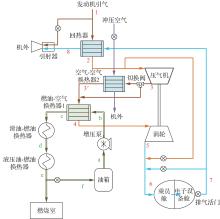
图 1
新型超声速民机环控系统构型示意图1~8为引气回路节点编号;a~f为燃油回路节点编号
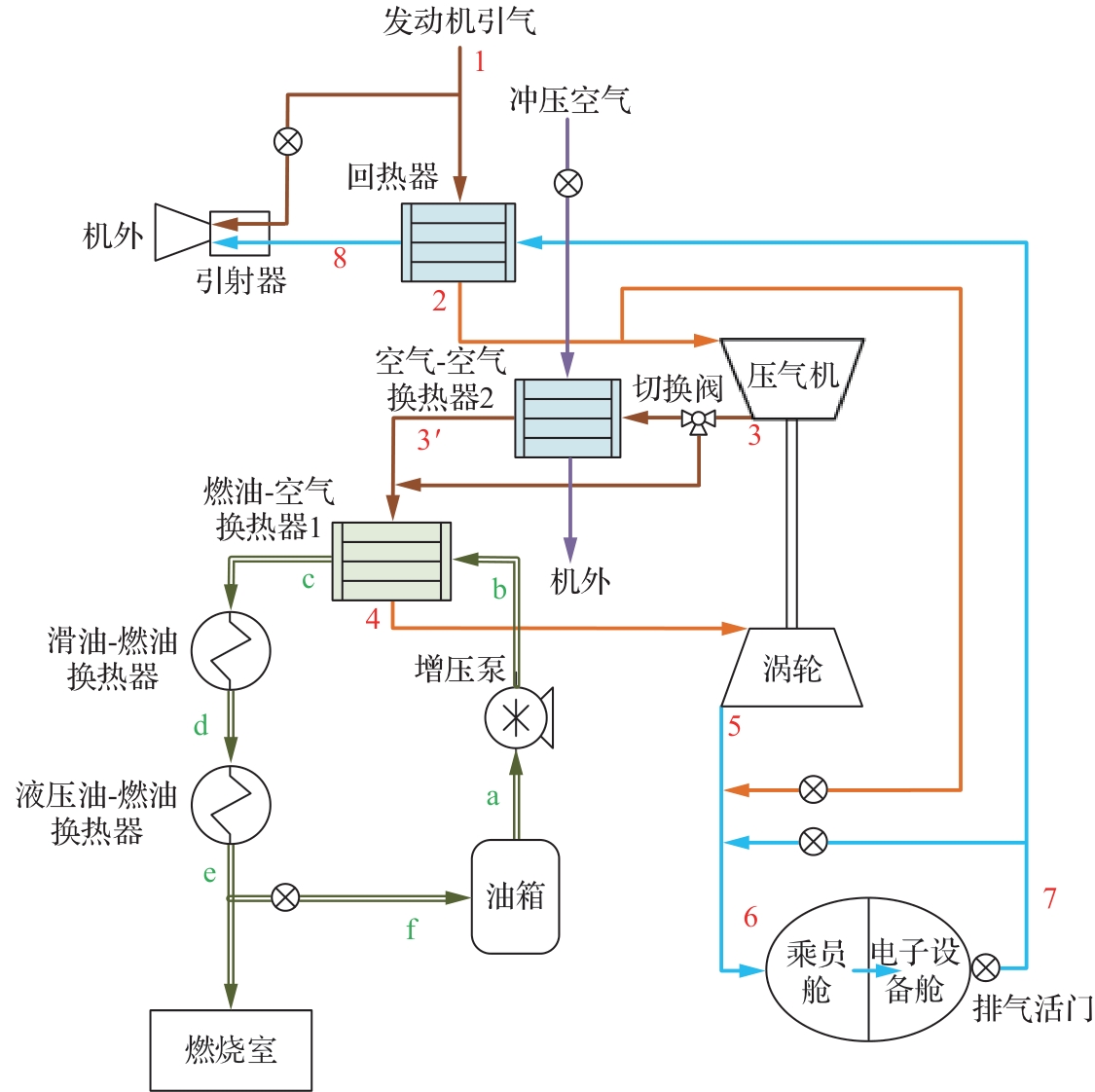
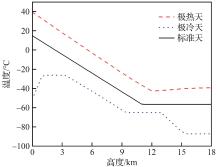
图 2
MIL-STD-210A大气环境温度
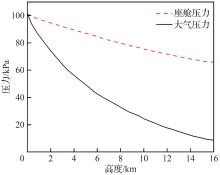
图 3
座舱压力制度
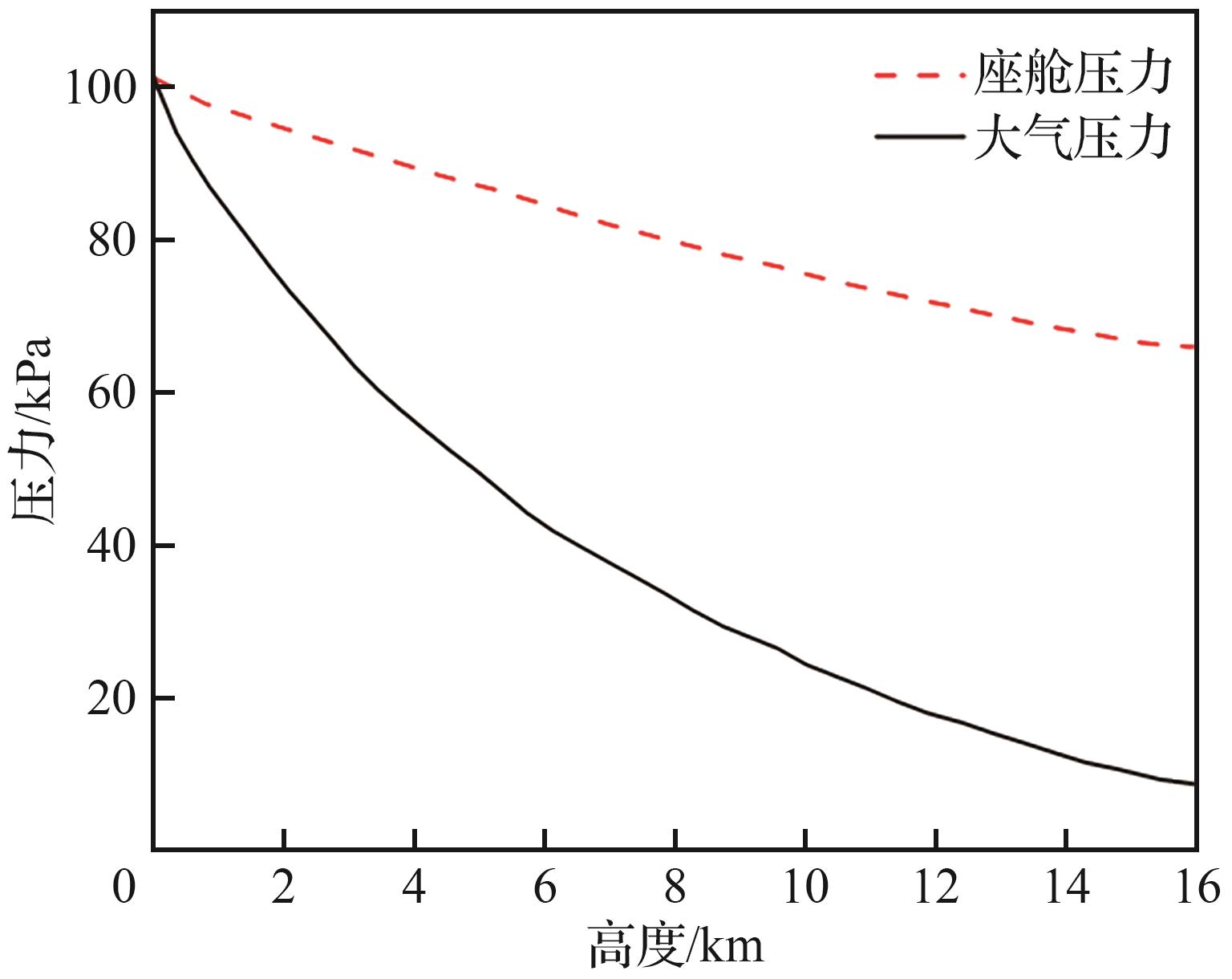
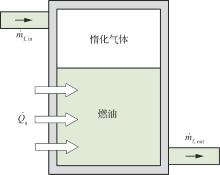
图 4
油箱模型示意图
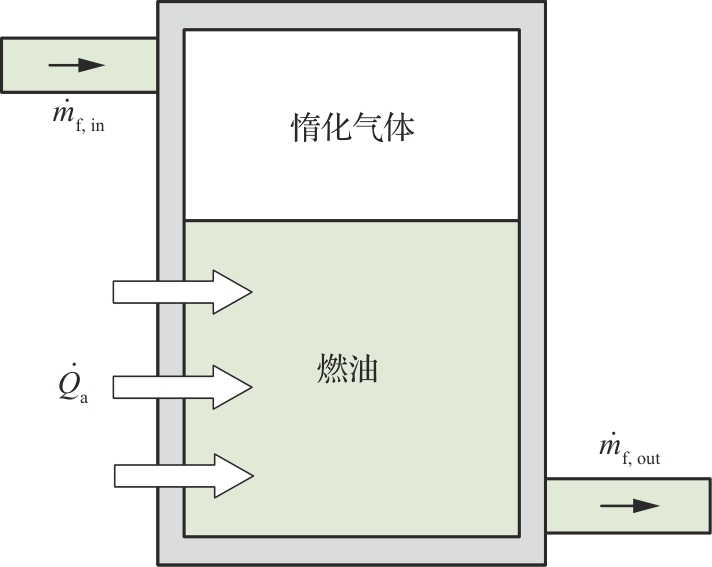

表1
超声速平台基本情况
| 参数 | 数值 |
|---|---|
| 最大起飞质量/kg | 156 489.4 |
| 翼载荷/(kg·m-2) | 585.3 |
| 推重比 | 0.435 |
| 载客量 | 100 |
| 发动机台数 | 4 |
| 环控系统套数 | 4 |
| 座舱总供气流量/(kg·h-1) | 6 000 |
| 座舱供气温度/℃ | 18 |
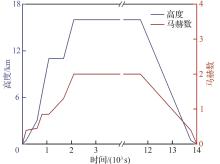
图 5
超声速民机飞行任务剖面
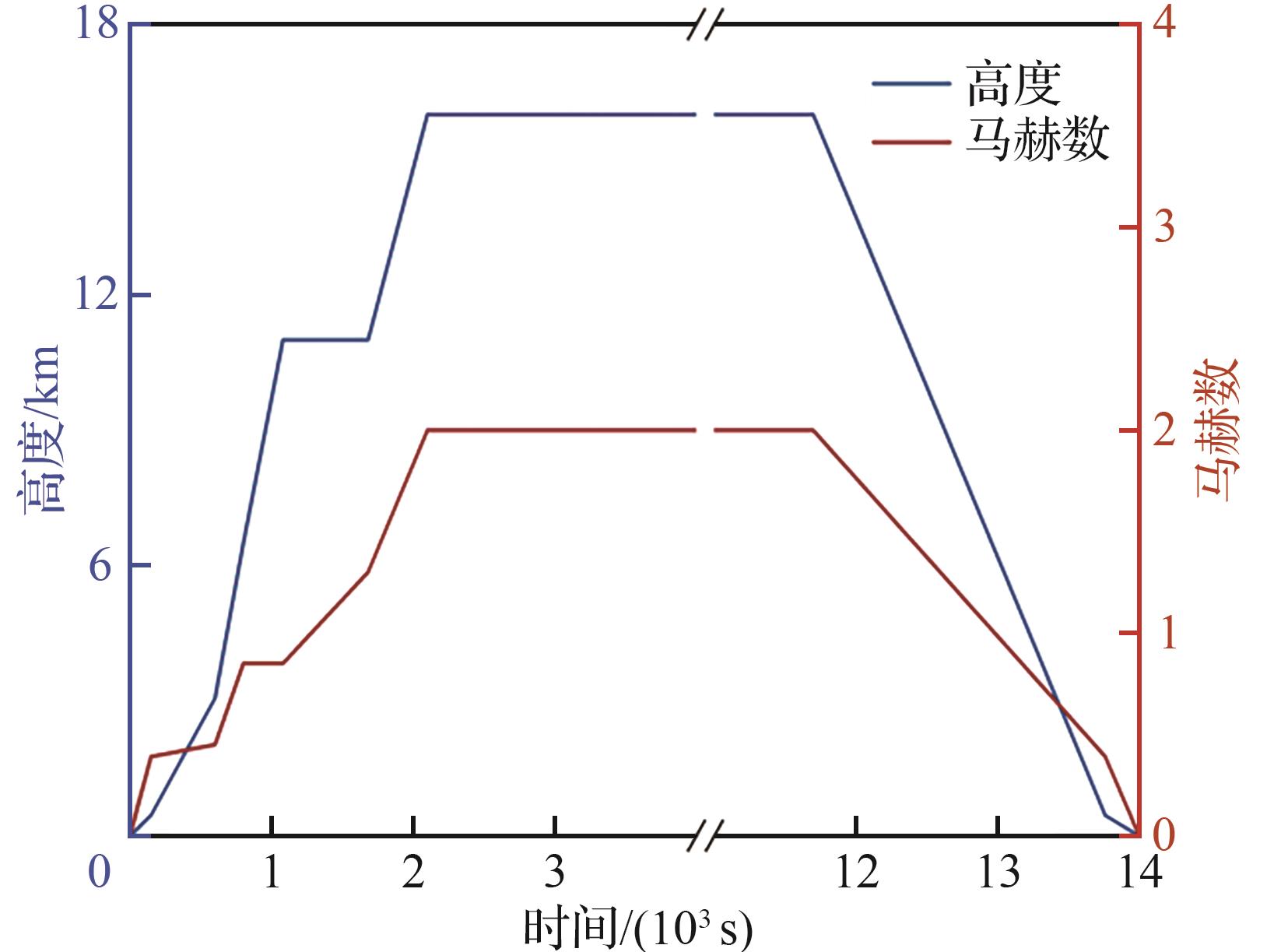
表2
舱室热负荷估算
| 参数 | 数值 |
|---|---|
| 通过座舱壁传入的热量/kW | 45.9 |
| 太阳辐射热/kW | 4.1 |
| 乘员热负荷/kW | 12.2 |
| 电子设备热负荷/kW | 19 |
| 总热负荷/kW | 81.2 |
表3
单套环控系统仿真使用参数
| 参数 | 数值 |
|---|---|
| 马赫数 | 2 |
| 飞行高度/km | 16 |
| 单台发动机耗油量/(kg·s-1) | 1.5 |
| 滑油系统热负荷/kW | 128 |
| 液压系统热负荷/kW | 60 |
| 发动机引气温度/K | 556.31 |
| 发动机引气压力/kPa | 179.57 |
| 供油压力/kPa | 200 |
| 增压泵效率 | 0.4 |
| ReHX效率 | 0.8 |
| HX1效率 | 0.85 |
| HX2效率 | 0.85 |
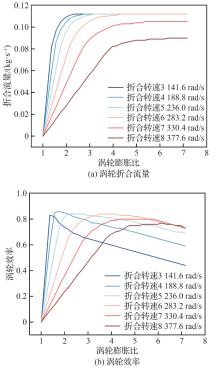
图 6
涡轮性能曲线
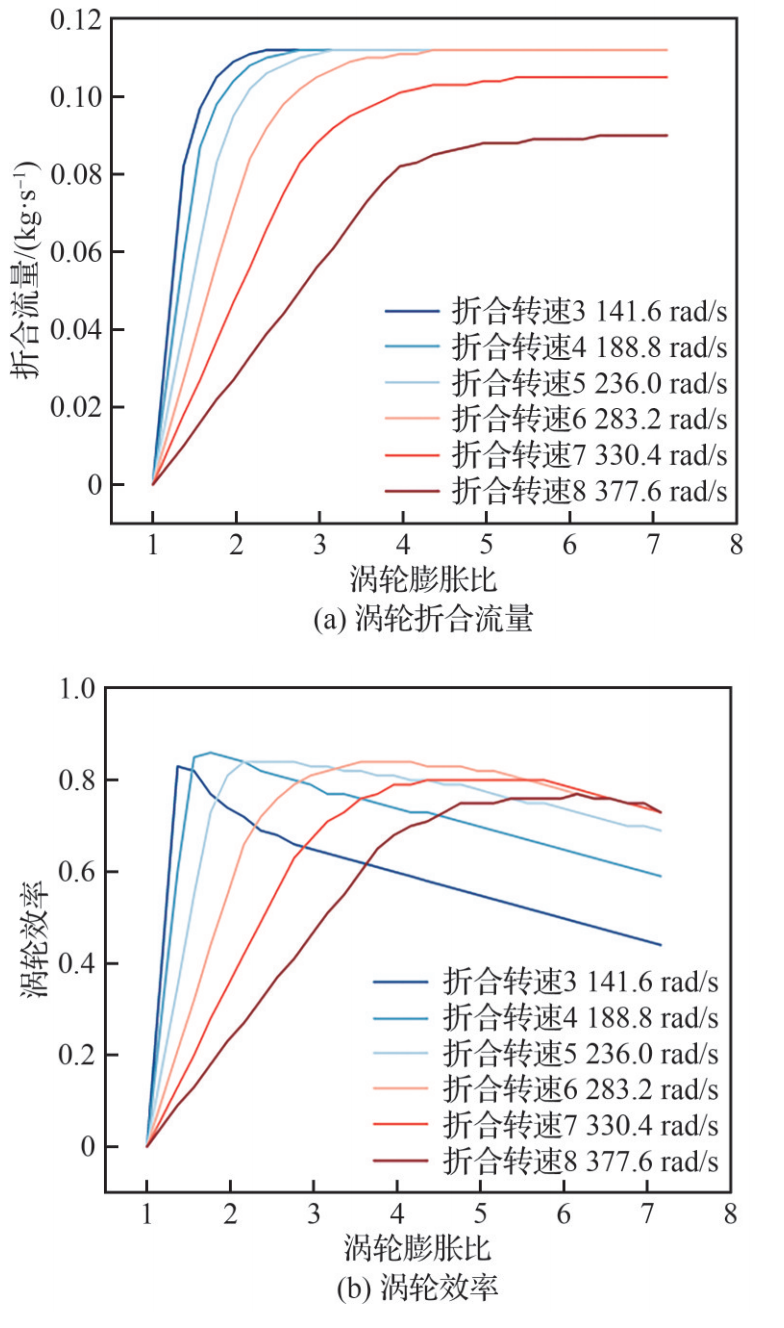
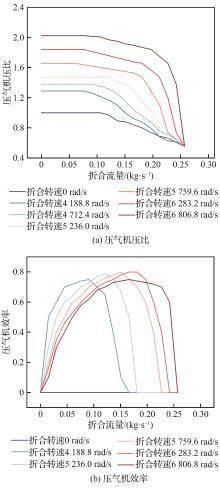
图 7
压气机性能曲线
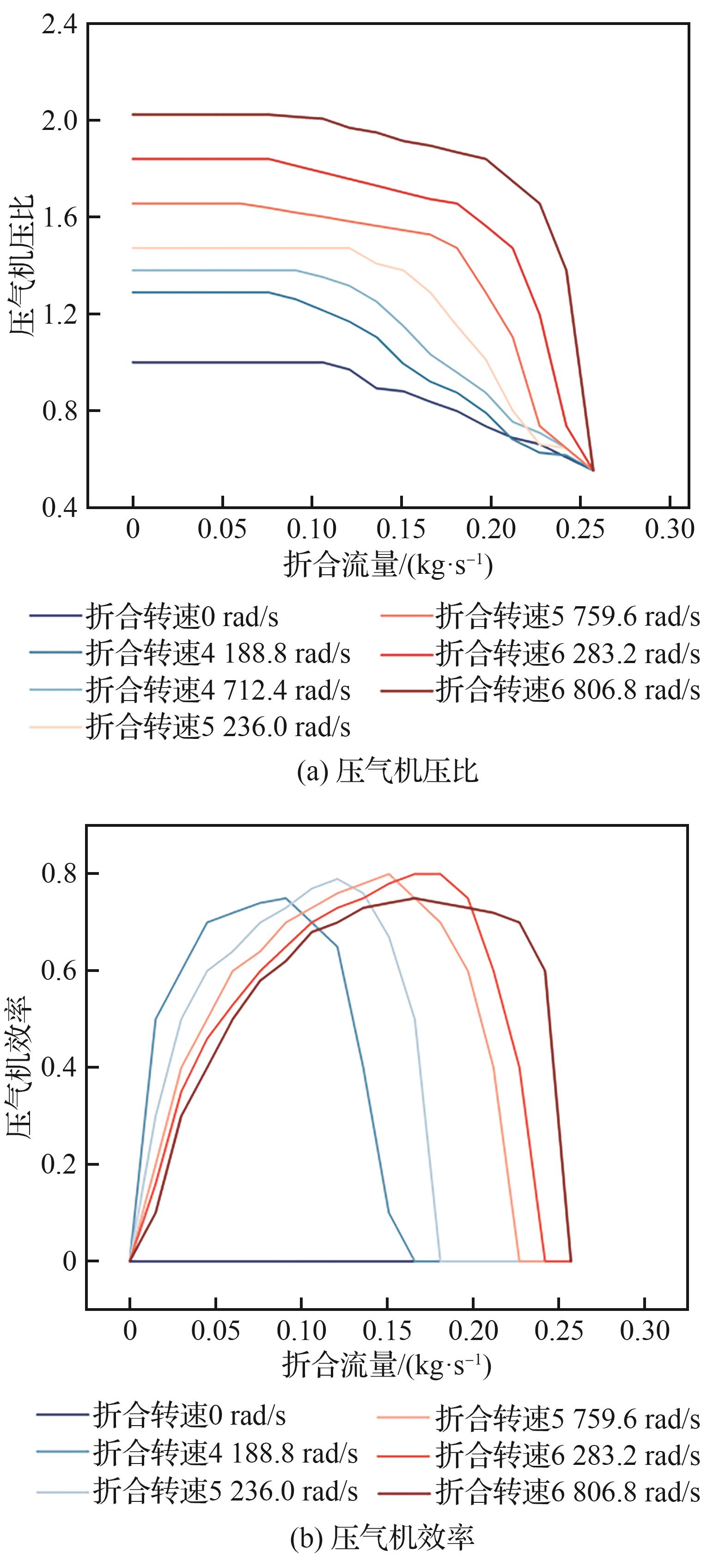
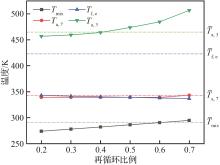
图 8
供气、燃油部分温度随再循环空气比例的变化
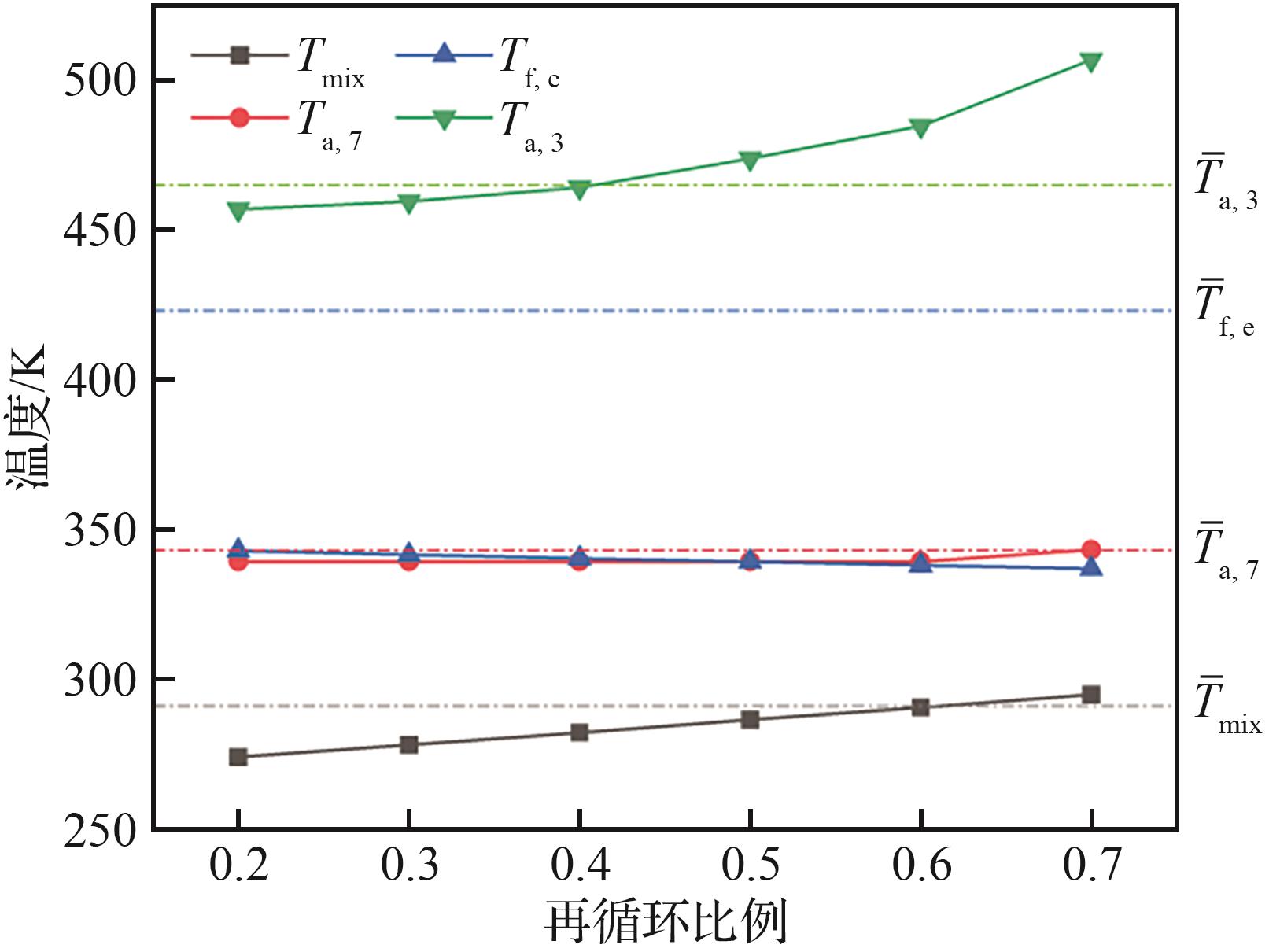
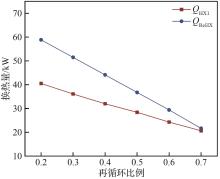
图 9
换热器换热量随再循环空气比例的变化
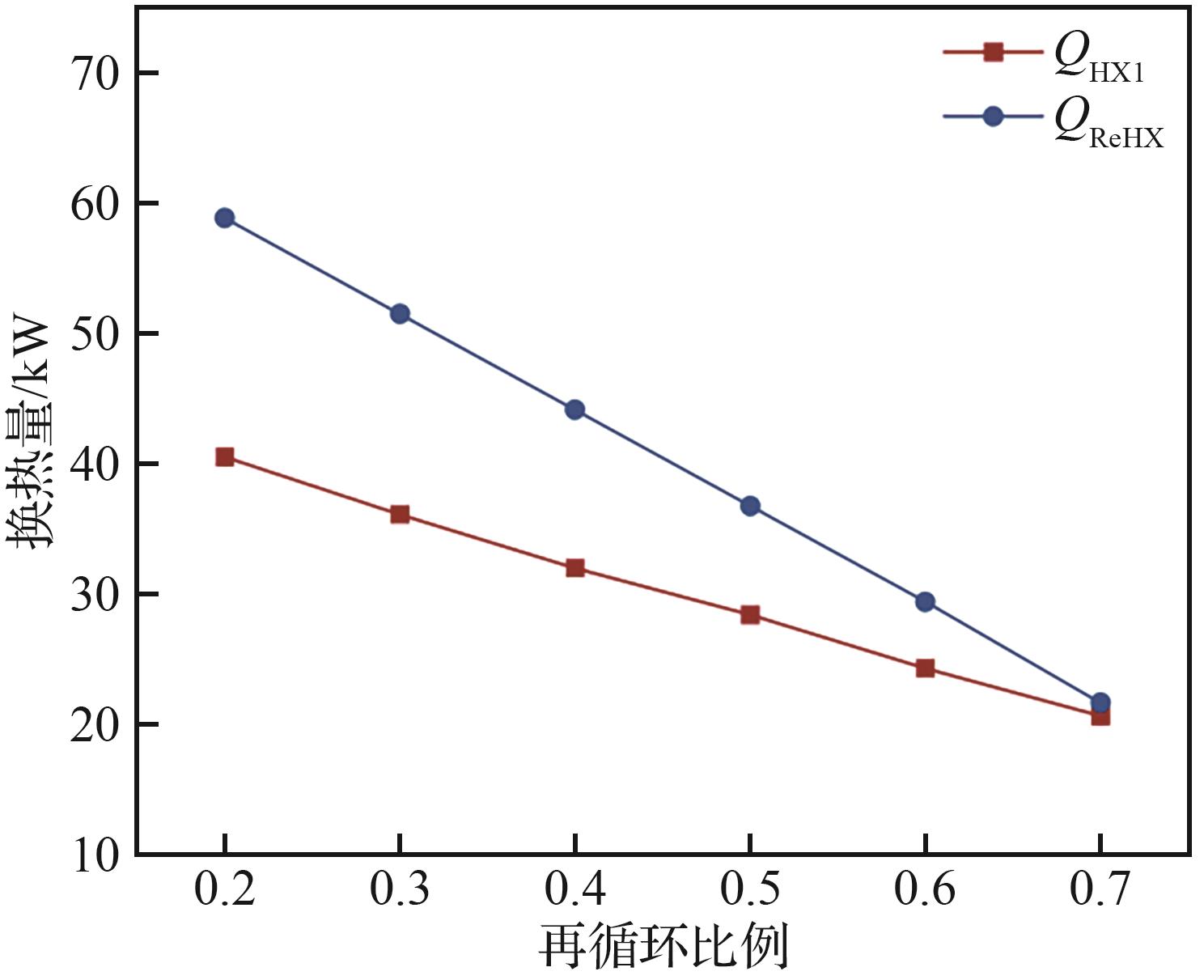
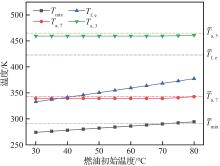
图 10
供气、燃油部分温度随燃油初始温度的变化
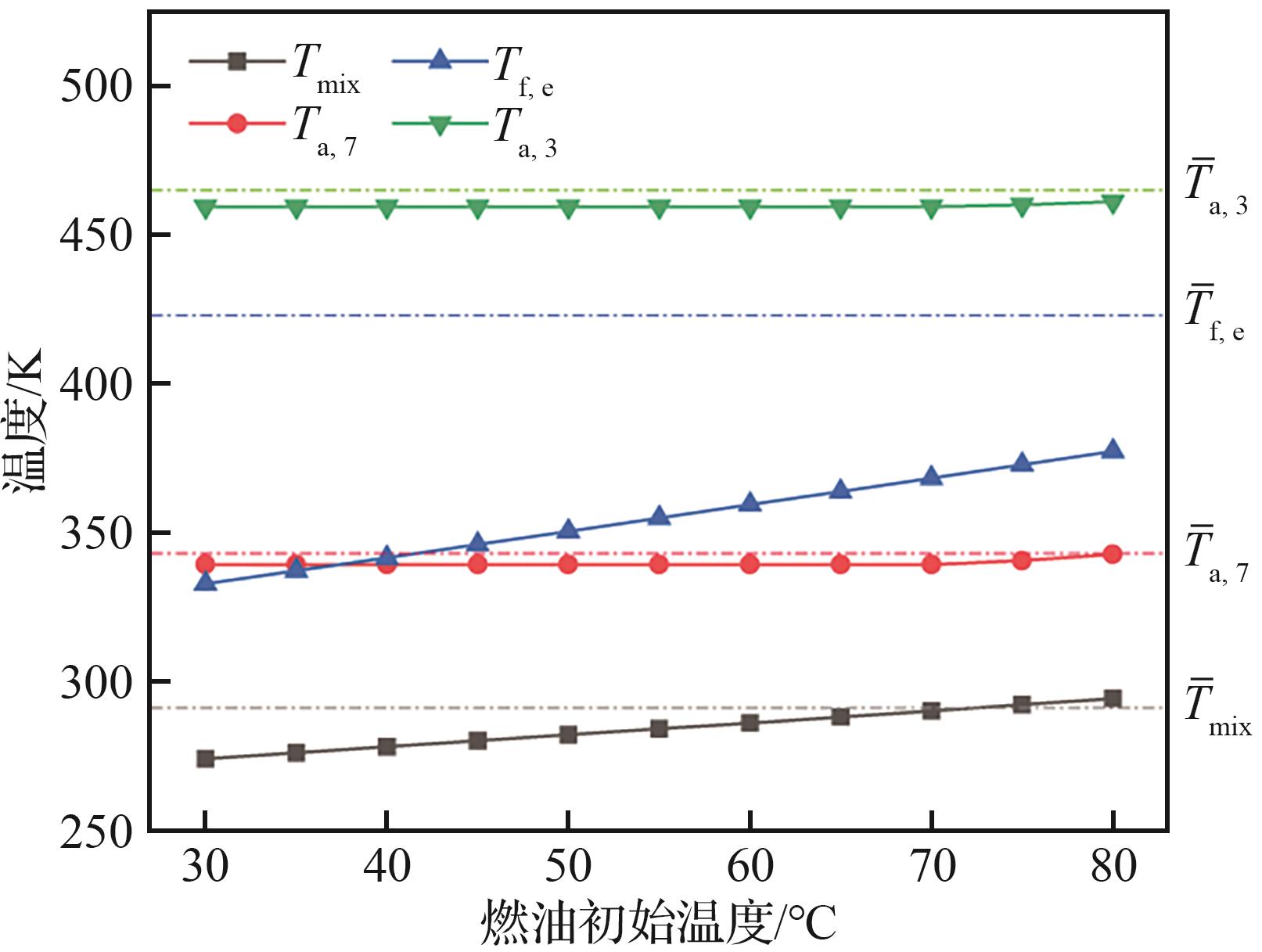
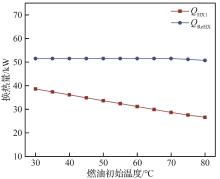
图 11
换热器换热量随燃油初始温度的变化
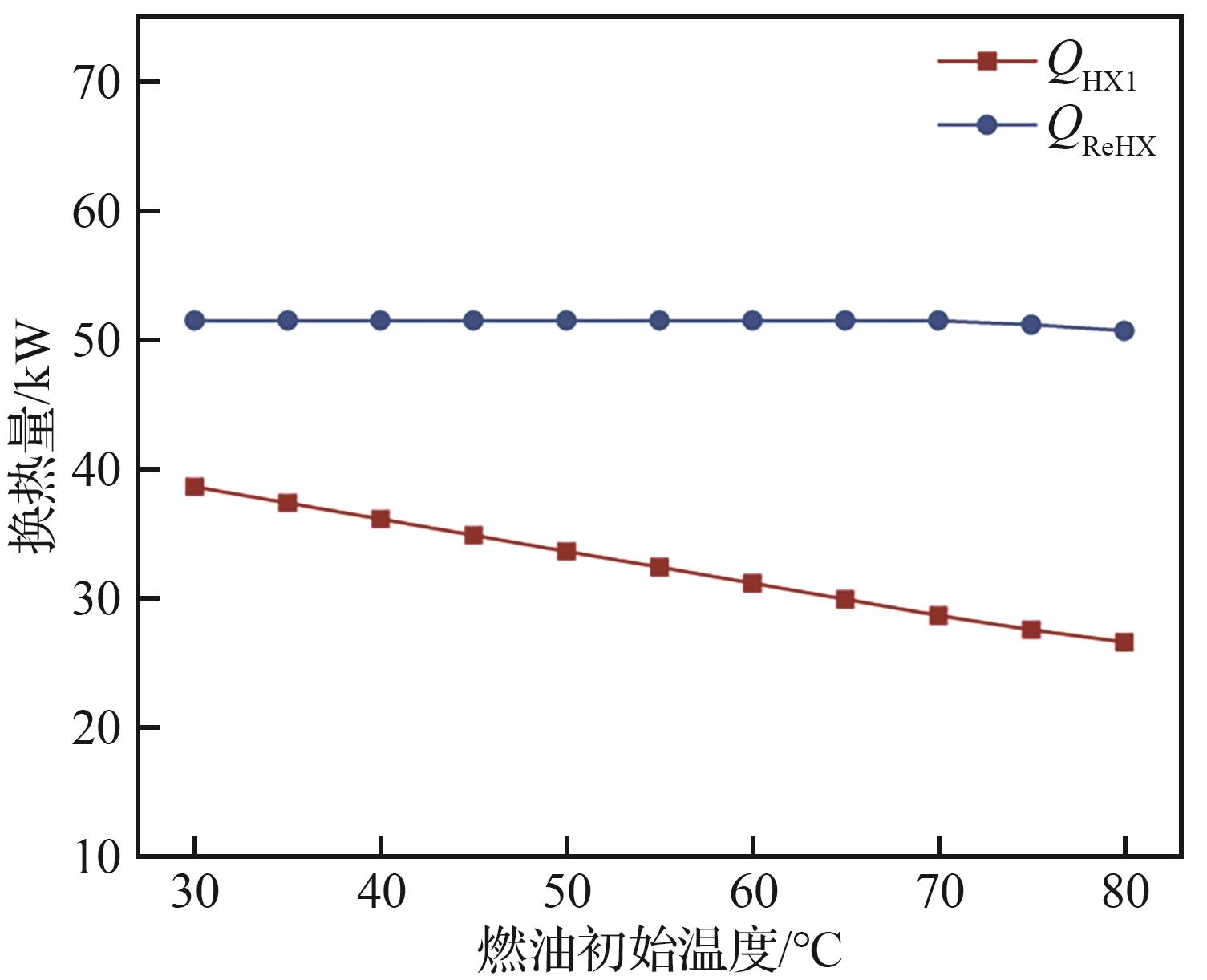
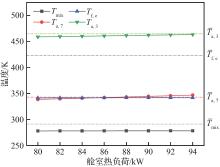
图 12
供气、燃油部分温度随舱室热负荷的变化
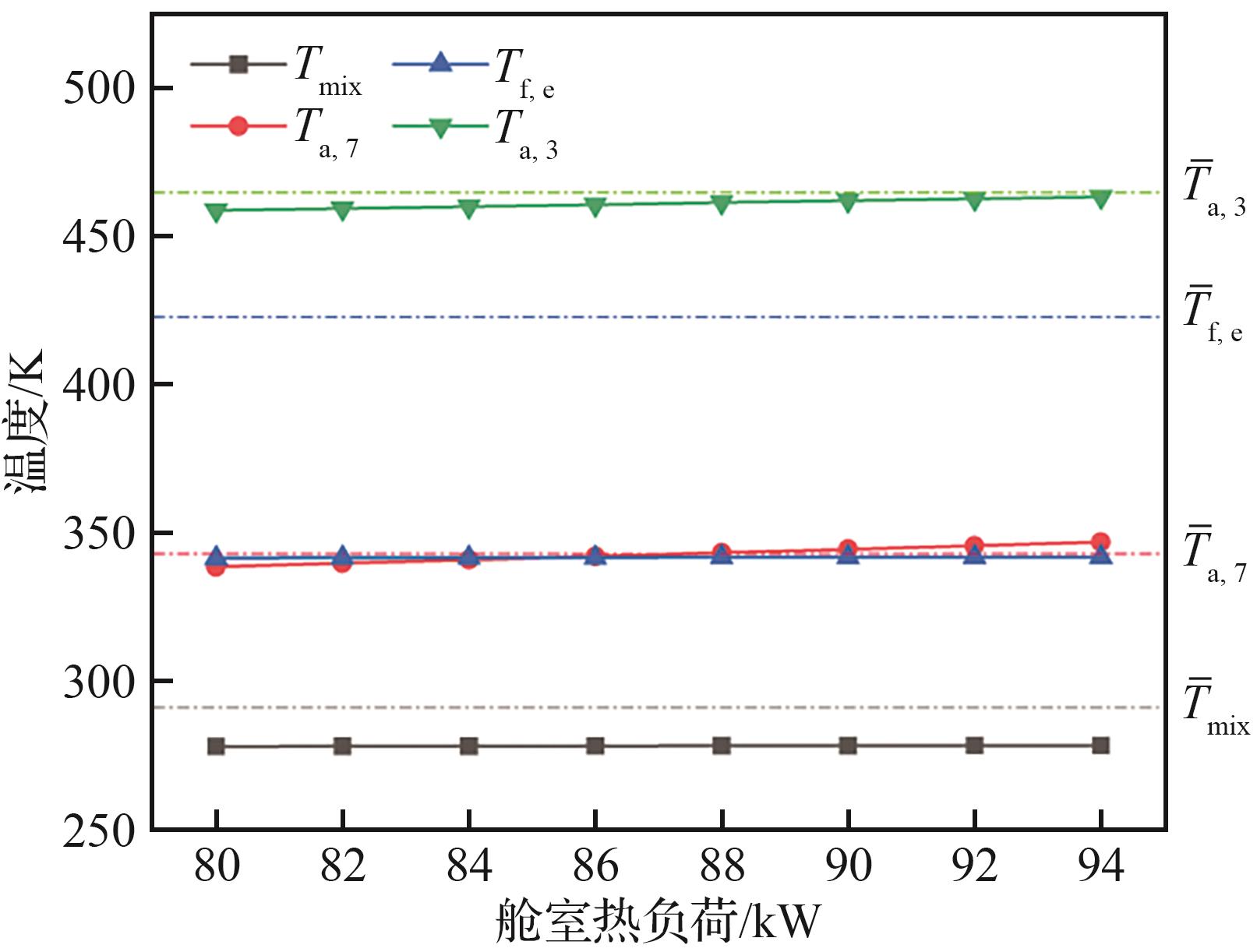
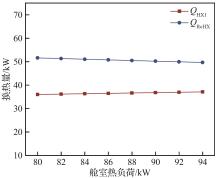
图 13
换热器换热量随舱室热负荷的变化
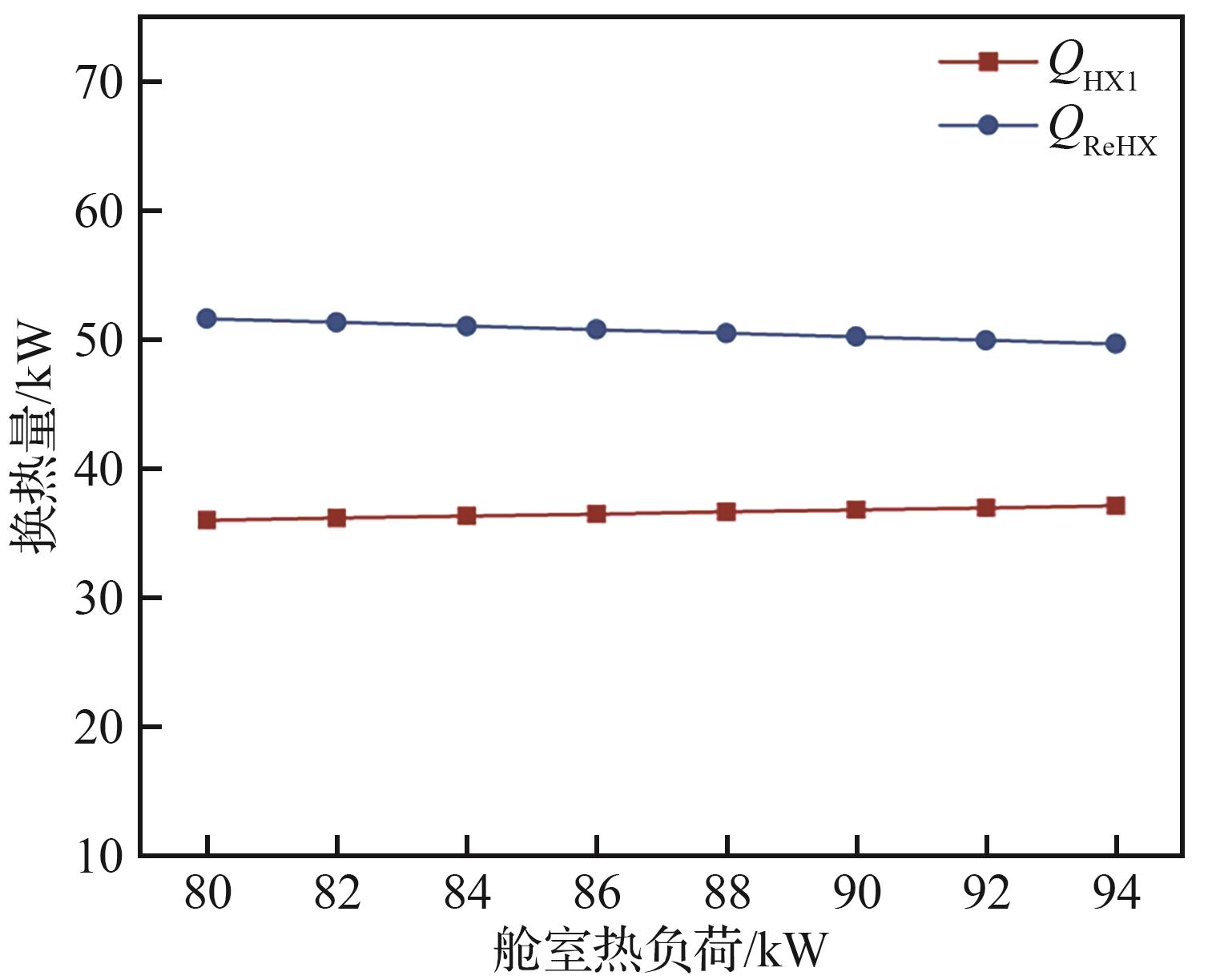
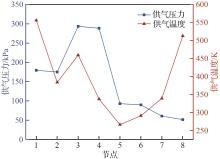
图 14
环控系统各节点供气温度、压力
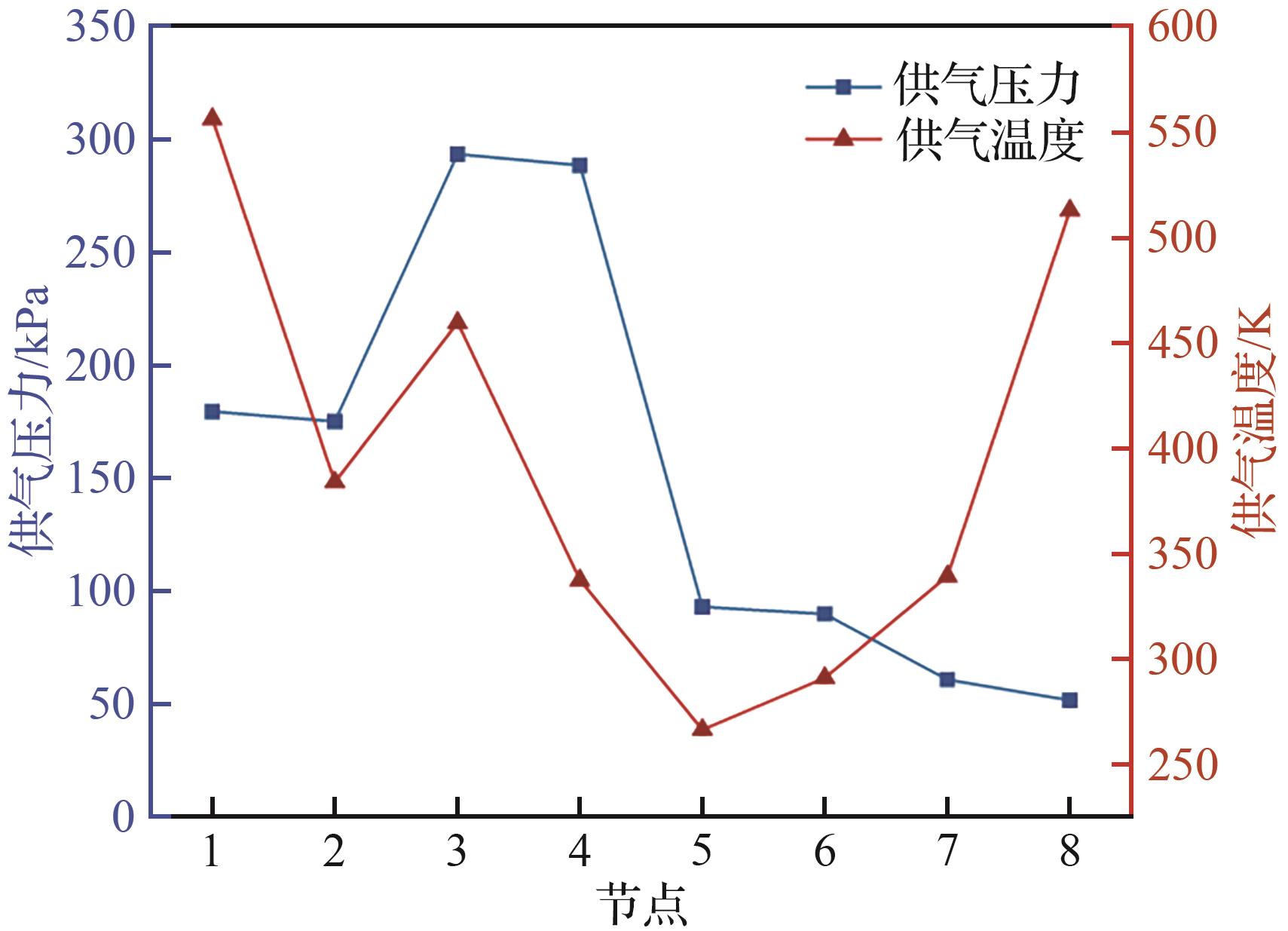
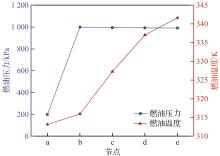
图 15
燃油热管理系统各节点燃油温度、压力
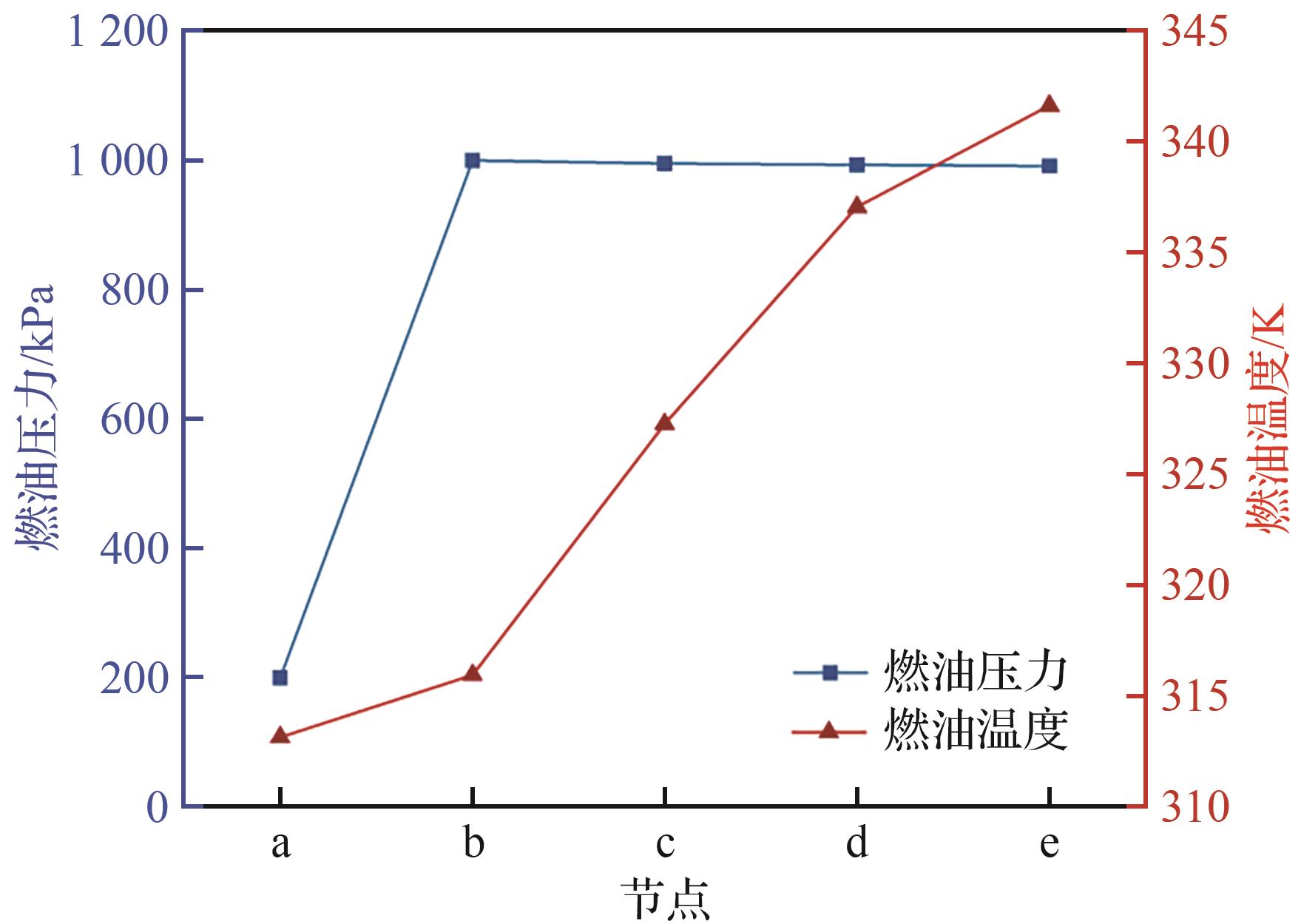
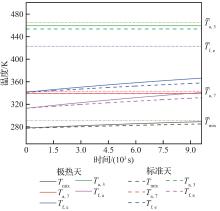
图 16
超声速巡航阶段供气、燃油部分温度随时间变化
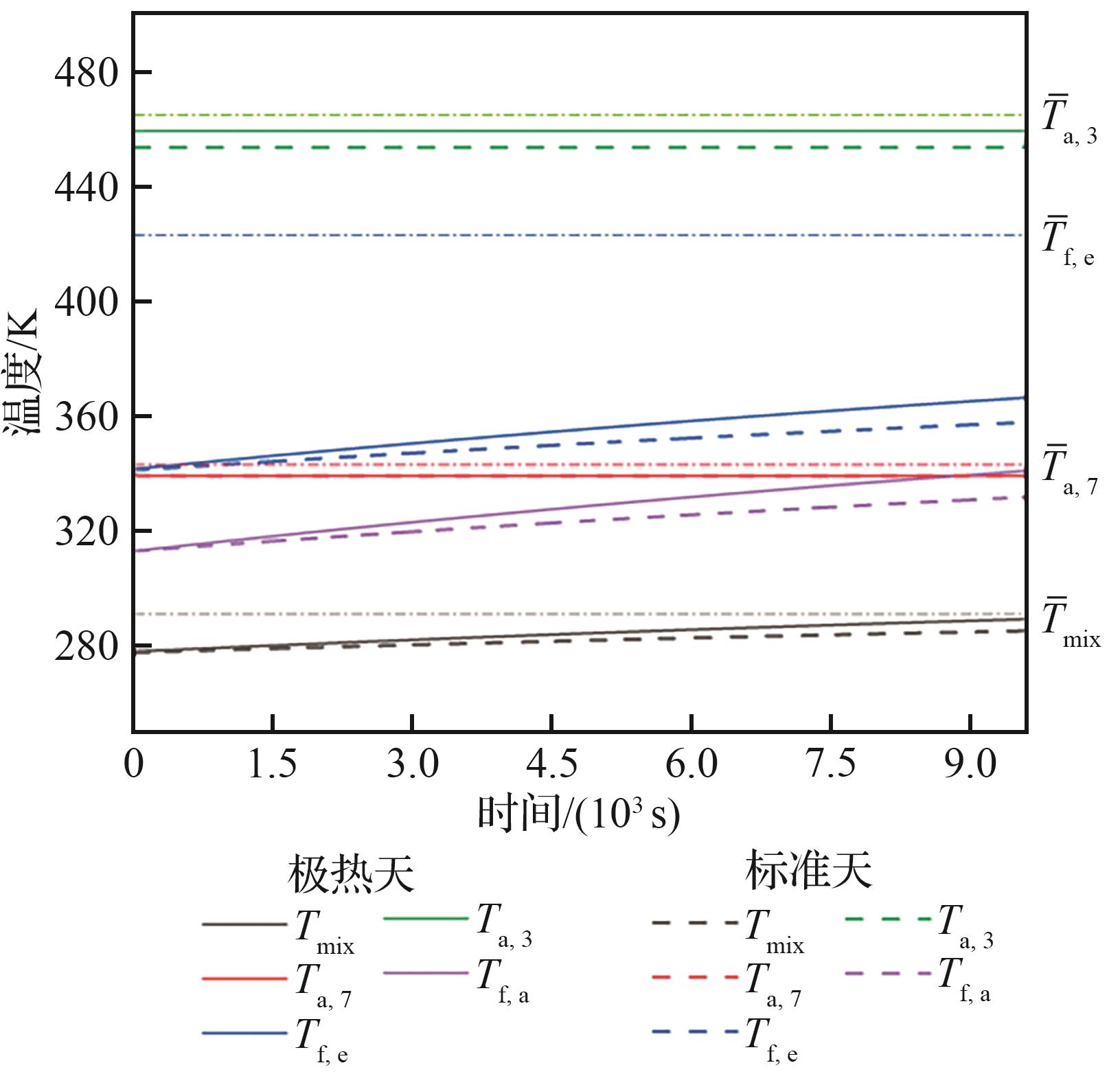
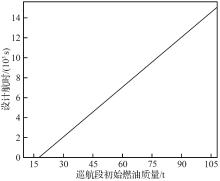
图 17
超声速巡航阶段设计航时和初始燃油质量的关系
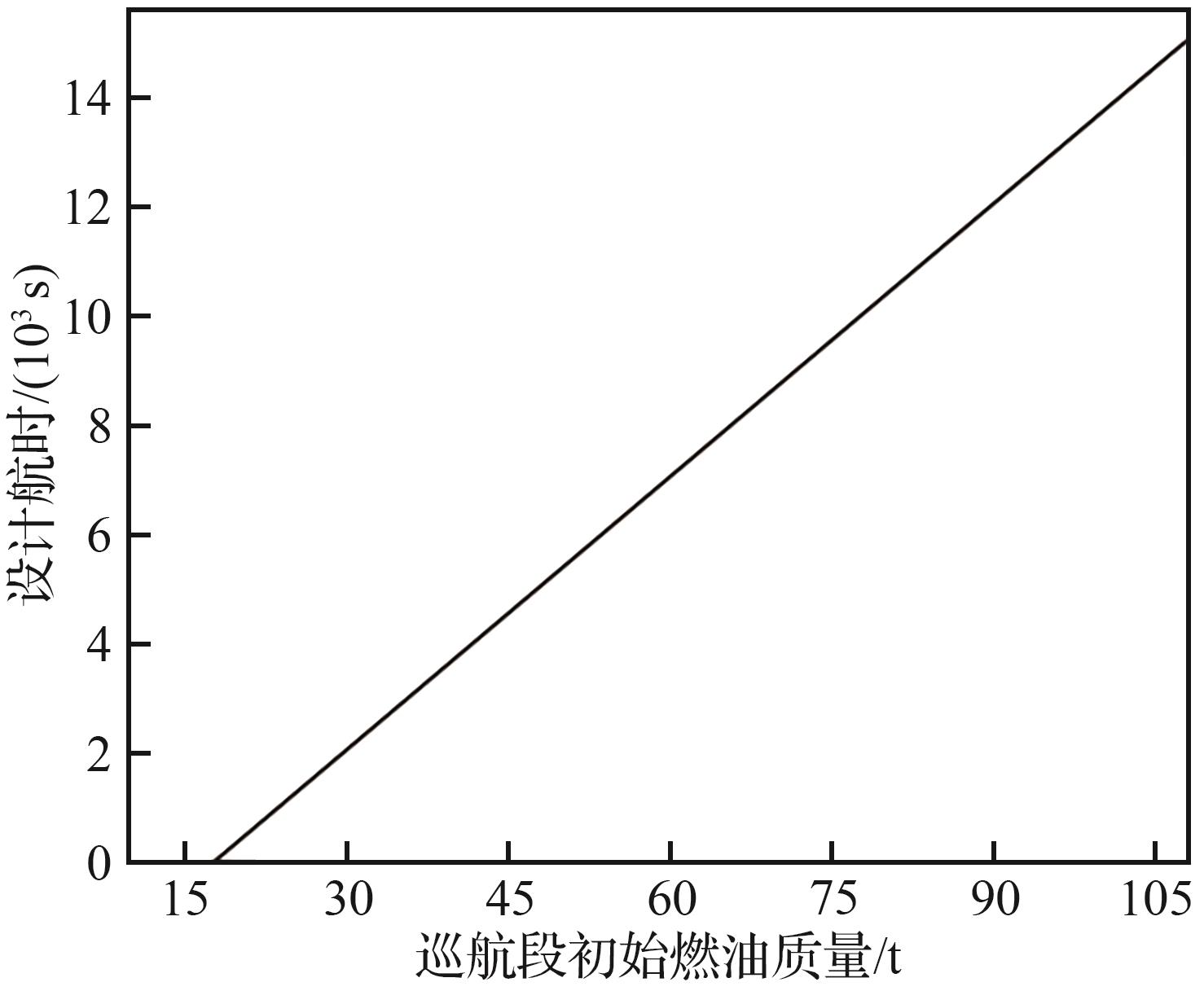
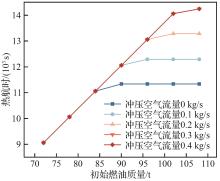
图 18
不同冲压空气流量下热航时与初始燃油质量关系
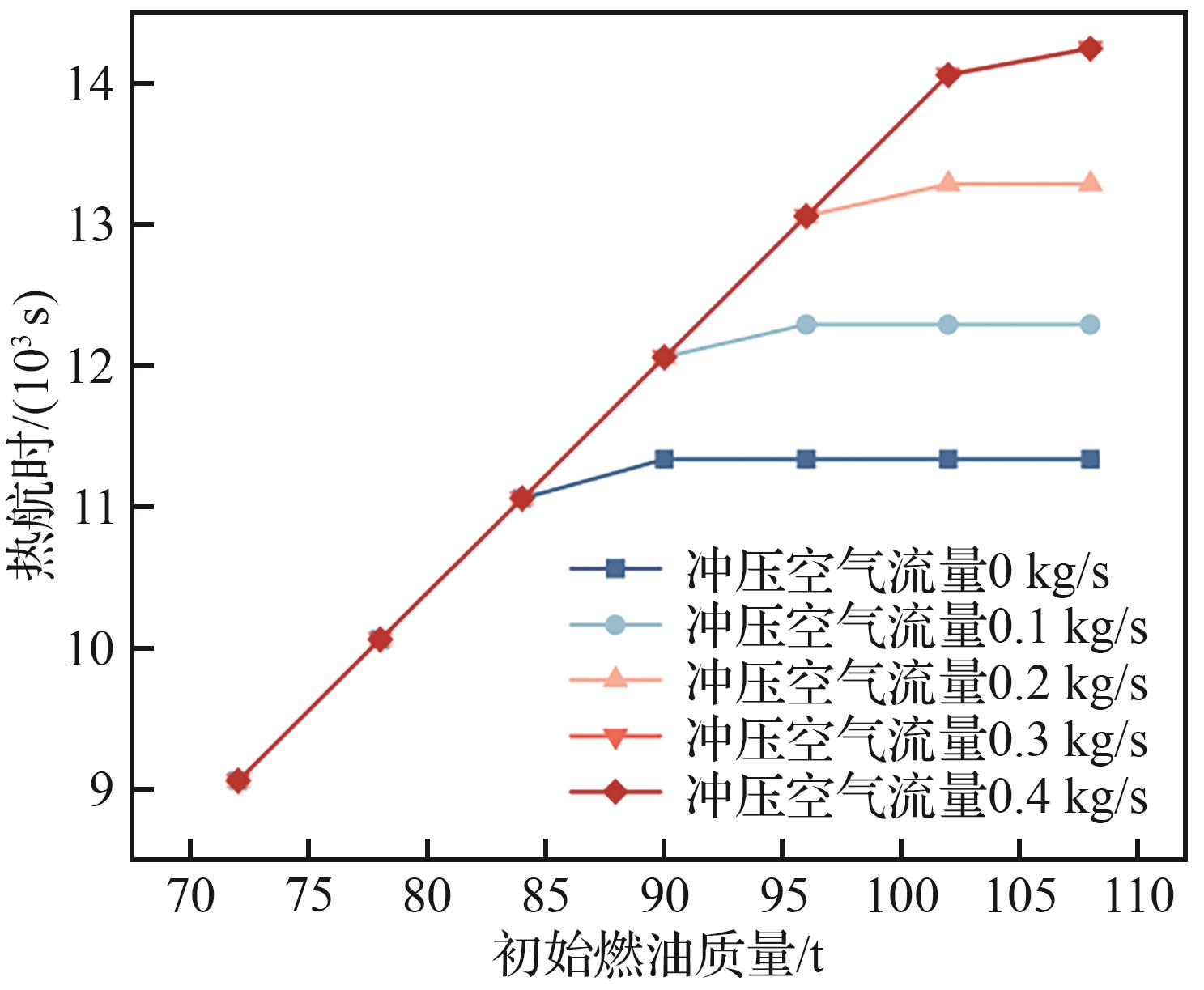
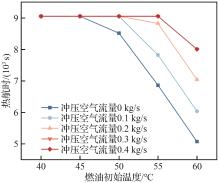
图 19
不同冲压空气流量下热航时与燃油初始温度关系
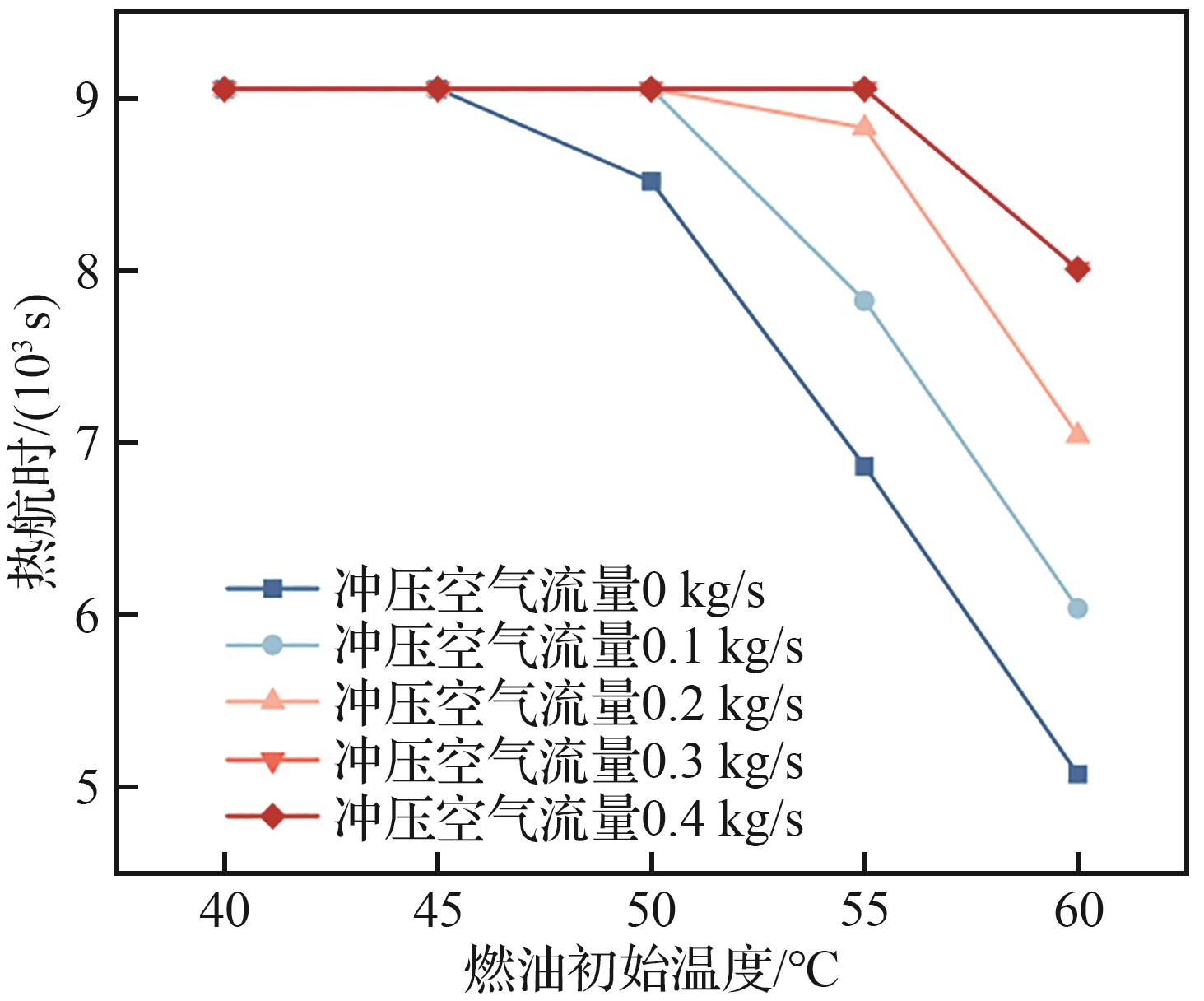
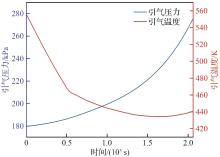
图 20
减速下降阶段发动机引气压力、温度
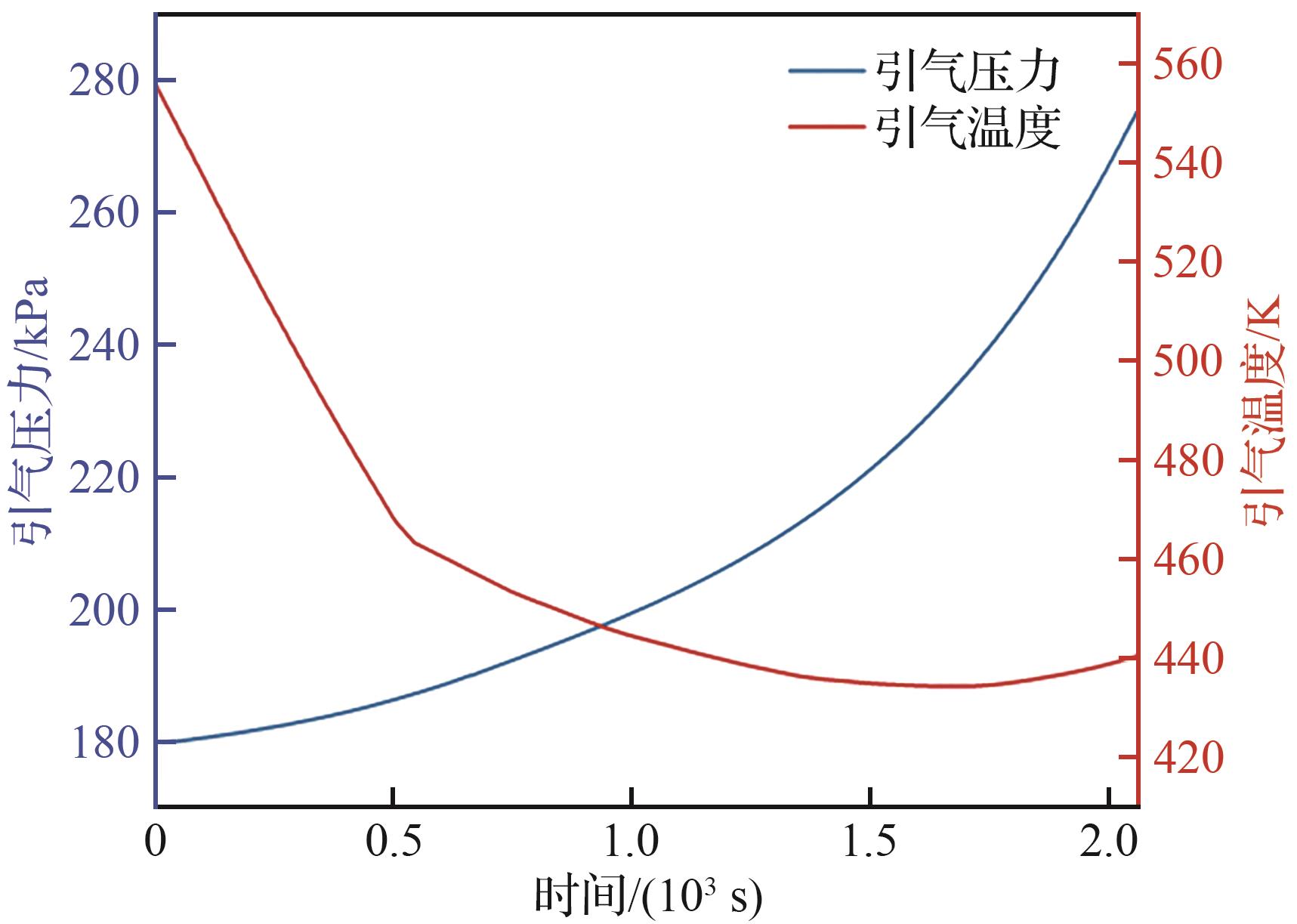
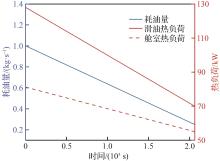
图 21
减速下降阶段耗油量、滑油系统热负荷、舱室热负荷随时间变化
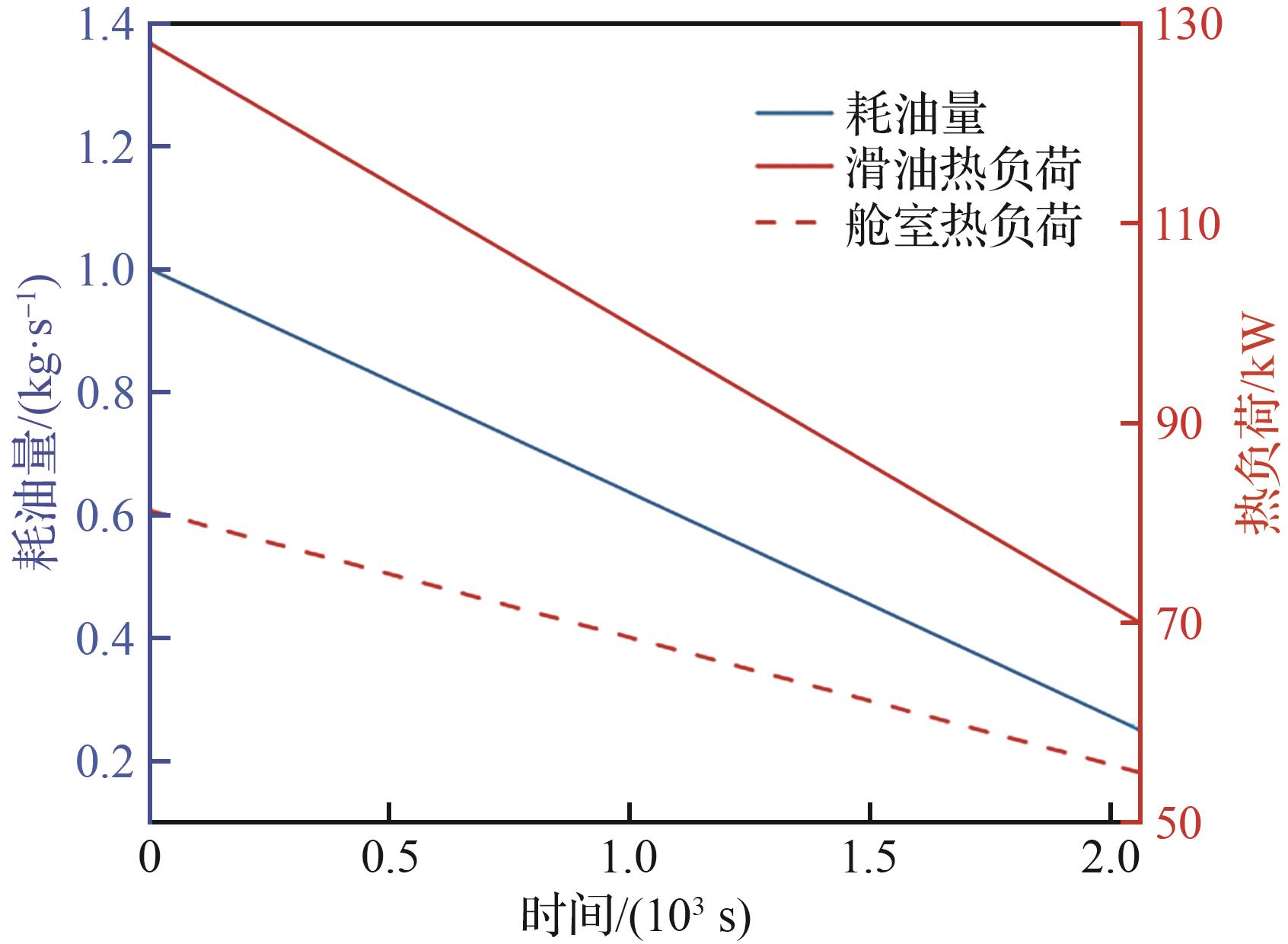
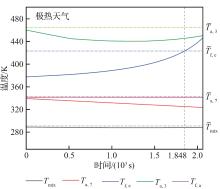
图 22
不开启燃油循环回路时下降阶段供气、燃油部分节点温度随时间变化
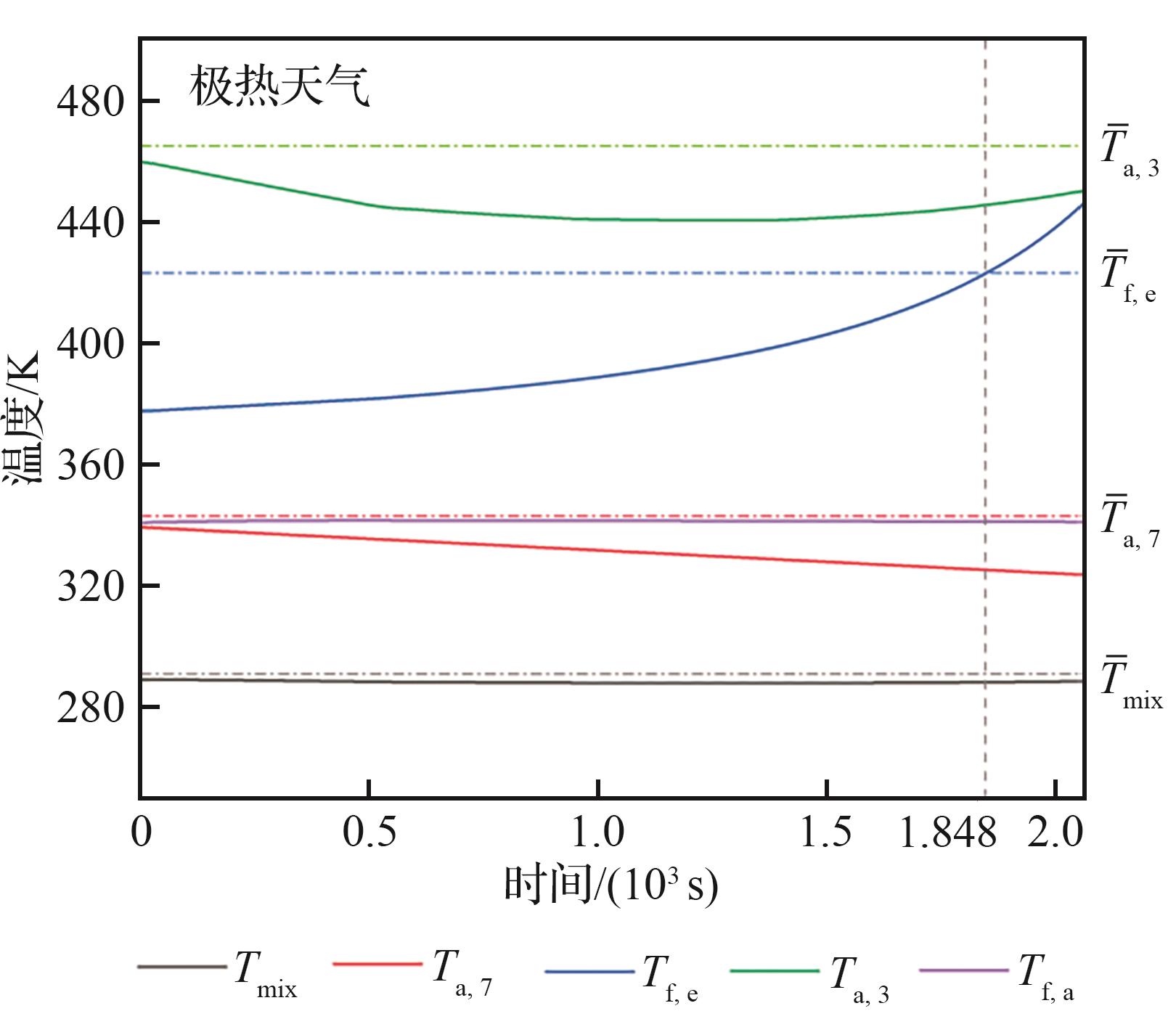
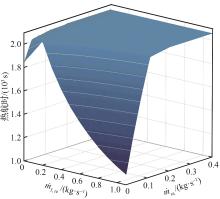
图 23
循环燃油流量、冲压空气流量对系统热航时的影响
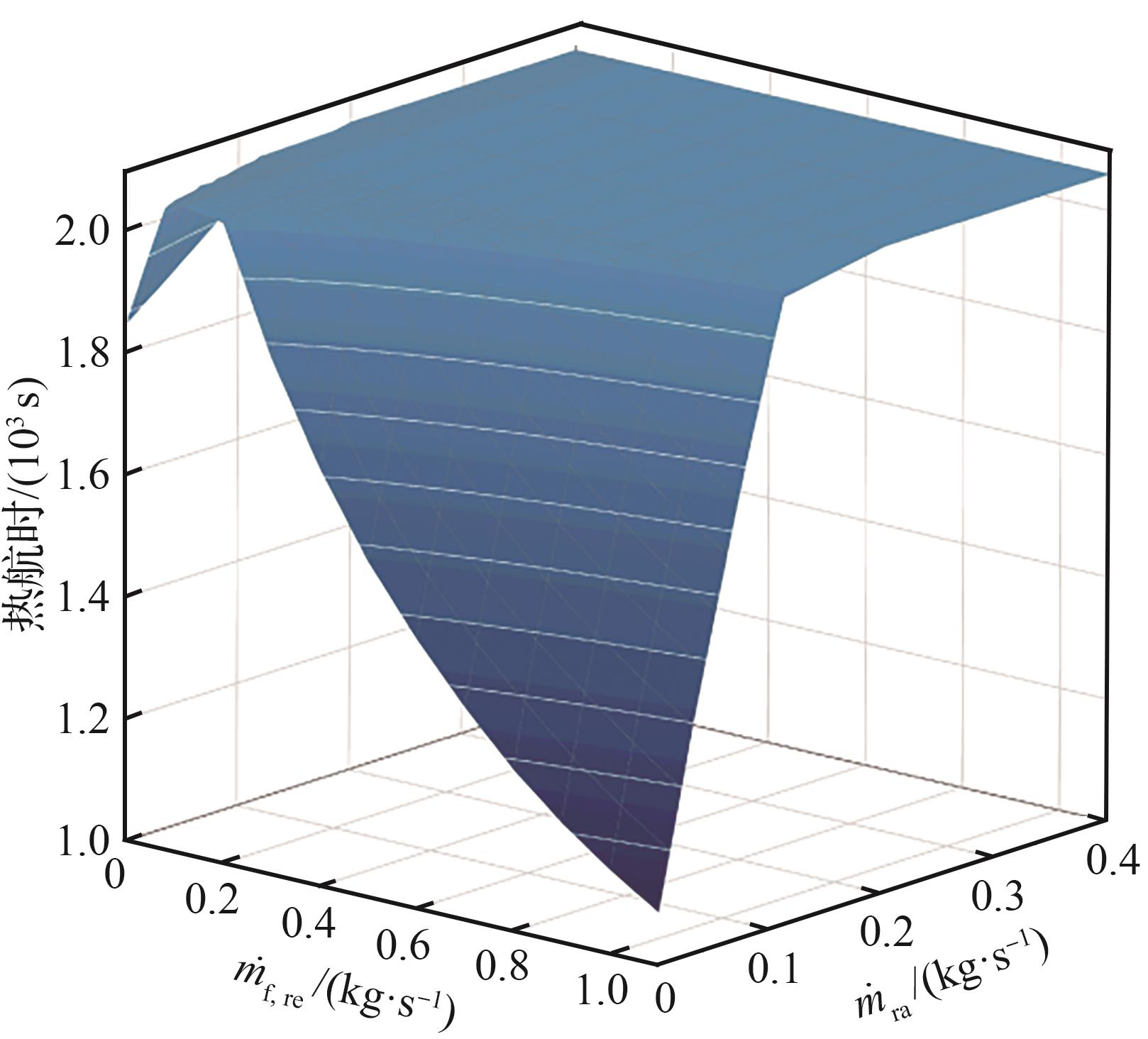
表4
m˙f,re、m˙ra对ECS/TMS性能和热航时的影响
| 工况 | 热航时/s | ||
|---|---|---|---|
| 1 | 0.05 | 0.05 | 2 051 |
| 2 | 0.05 | 0.09 | 2 060 |
| 3 | 0.05 | 0.30 | 2 060 |
| 4 | 0.20 | 0.05 | 2 060 |
| 5 | 0.20 | 0.09 | 2 060 |
| 6 | 0.20 | 0.30 | 2 060 |
| 7 | 0.80 | 0.05 | 1 734 |
| 8 | 0.80 | 0.09 | 2 045 |
| 9 | 0.80 | 0.30 | 2 060 |
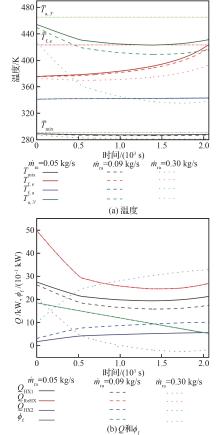
图 24
工况1~工况3系统参数随时间变化(m˙f,re=0.05 kg/s)
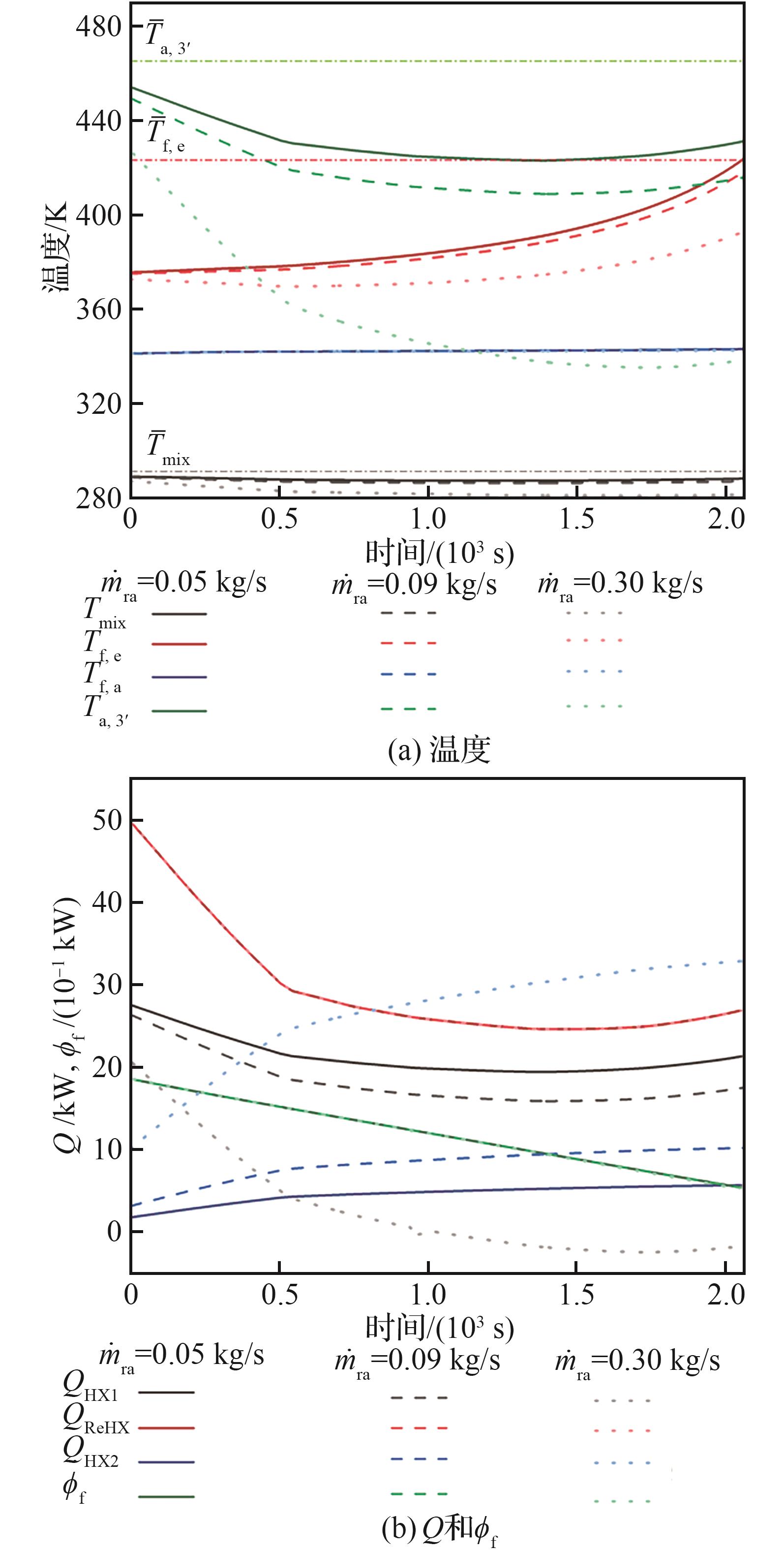
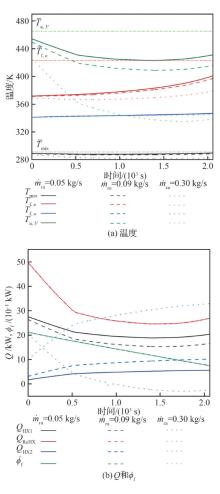
图 25
工况4~工况6系统参数随时间变化(m˙f,re=0.20 kg/s)
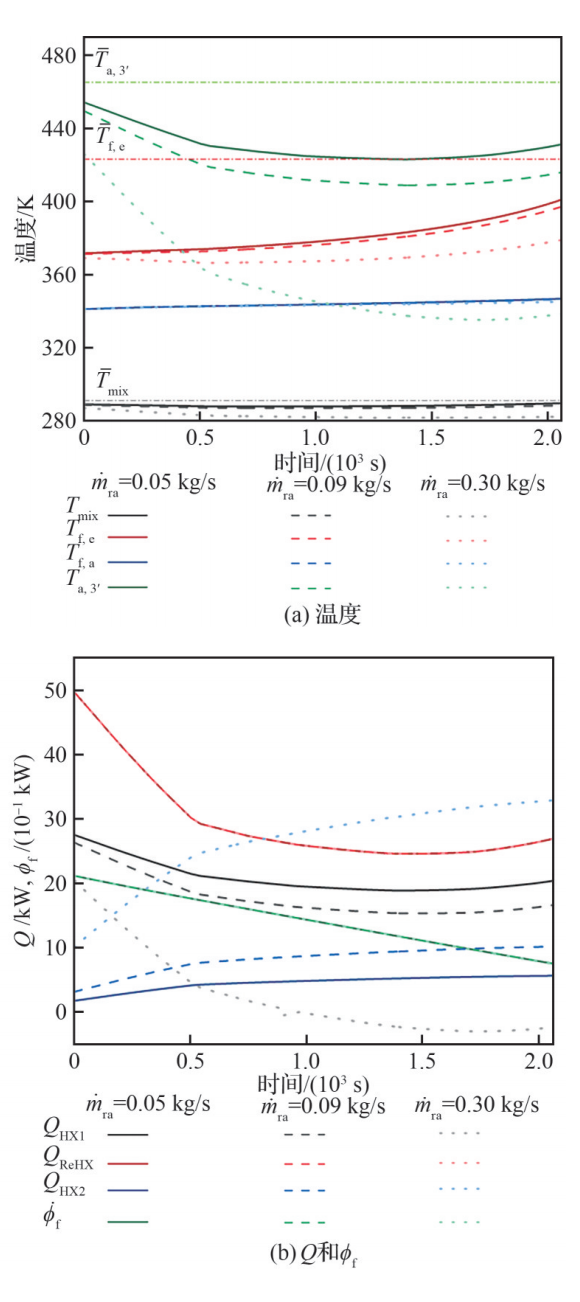
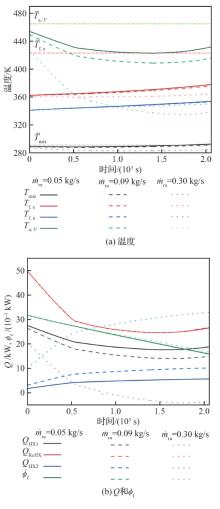
图 26
工况7~工况9系统参数随时间变化(m˙f,re=0.80 kg/s)
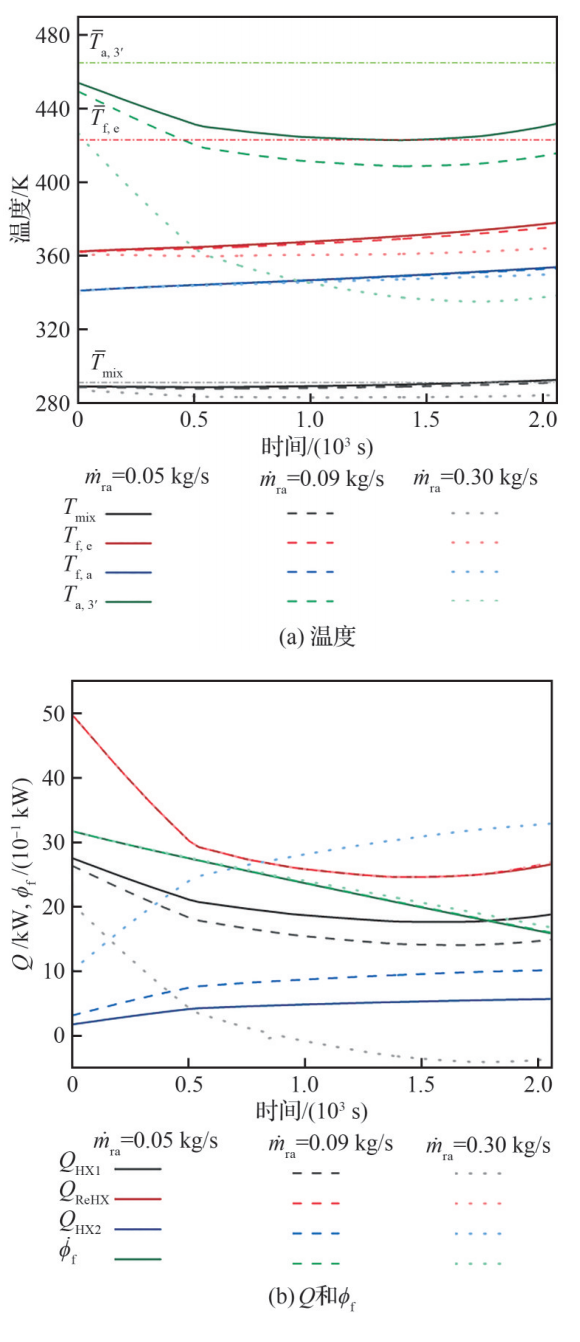
| [1] | WELGE H, NELSON C, BONET J. Supersonic vehicle systems for the 2020 to 2035 timeframe[C]∥28th AIAA Applied Aerodynamics Conference. Reston: AIAA, 2010. |
| [2] | 徐悦, 韩忠华, 尤延铖, 等. 新一代绿色超声速民机的发展现状与挑战[J]. 科学通报, 2020, 65(): 127-133. |
| XU Y, HAN Z H, YOU Y C, et al. Development status and challenges of a new generation of green supersonic civil aircraft[J]. Chinese Science Bulletin, 2020, 65(Sup 1): 127-133 (in Chinese). | |
| [3] | 欧阳天, 潘锐. 国外超声速民机技术发展综述[C]∥第六届中国航空科学技术大会. 嘉兴: 中国航空学会, 2023: 272-282. |
| OUYANG T, PAN Y. Review of supersonic civil aircraft technologies abroad[C]∥The 6th China Aeronautical Science and Technology. Jiaxing: CSAA, 2023: 272-282 (in Chinese). | |
| [4] | SUN Y C, SMITH H. Review and prospect of supersonic business jet design[J]. Progress in Aerospace Sciences, 2017, 90: 12-38. |
| [5] | BALTMAN E M, TAI J C, SHI M, et al. An investigation of cooled-cooling air for a mach 2.2 commercial supersonic transport[C]∥AIAA Propulsion and Energy 2021 Forum. Reston: AIAA, 2021. |
| [6] | VAN HEERDEN A S J, JUDT D M, JAFARI S, et al. Aircraft thermal management: Practices, technology, system architectures, future challenges, and opportunities[J]. Progress in Aerospace Sciences, 2022, 128: 100767. |
| [7] | PARRILLA J. Hybrid environmental control system integrated modeling trade study analysis for commercial aviation[D]. Cincinnati: University of Cincinnati, 2014. |
| [8] | MERZVINSKAS M, BRINGHENTI C, TOMITA J T, et al. Air conditioning systems for aeronautical applications: a review[J]. The Aeronautical Journal, 2020, 124(1274): 499-532. |
| [9] | 盛健, 张华, 吴兆林, 等. 飞机环境控制系统制冷空调技术现状[J]. 制冷学报, 2020, 41(2): 22-33. |
| SHENG J, ZHANG H, WU Z L, et al. Technology of refrigeration and air-conditioning for aircraft environment control system[J]. Journal of Refrigeration, 2020, 41(2): 22-33 (in Chinese). | |
| [10] | 刘征, 崔燚, 周琼瑶, 等. 基于AMESim的飞机环控系统建模与仿真[J]. 科技视界, 2020(22): 48-50. |
| LIU Z, CUI Y, ZHOU Q Y, et al. Modeling and simulation of aircraft environmental control system based on AMESim[J]. Science & Technology Vision, 2020(22): 48-50 (in Chinese). | |
| [11] | 刘浩. 民用飞机环控系统仿真研究[D]. 南京: 南京航空航天大学, 2019. |
| LIU H. Simulation study on environmental control system of civil aircraft[D]. Nanjing: Nanjing University of Aeronautics and Astronautics, 2019 (in Chinese). | |
| [12] | 许晓东. 民机环控系统建模与仿真技术研究[D]. 南京: 南京航空航天大学, 2018. |
| XU X D. Research on modeling and simulation techno-logy of civil aircraft environmental control system[D]. Nanjing: Nanjing University of Aeronautics and Astronautics, 2018 (in Chinese). | |
| [13] | JENNIONS I, ALI F, MIGUEZ M E, et al. Simulation of an aircraft environmental control system[J]. Applied Thermal Engineering, 2020, 172: 114925. |
| [14] | SHANGGUAN Z, QING C. Performance of a civil aircraft environmental control system coupled with hot water supplying[J]. Applied Thermal Engineering, 2022, 203: 117924. |
| [15] | SHANGGUAN Z, WEI X Y, PENG H, et al. Performance analysis of a new multifunctional aircraft environmental control system under variable operating conditions[J]. Energy Efficiency, 2024, 17(6): 65. |
| [16] | NEGI V P S, RANGANAYAKULU C. Thermal performance of three-wheel and split-wheel air cycle systems for a civil aircraft environmental control system(ECS)[J]. International Journal of Refrigeration, 2024, 166: 196-211. |
| [17] | KRUZHILOVA G V, TISHCHENKO I V. Study of the environmental control system of a supersonic passenger aircraft[C]∥2024 6th International Youth Conference on Radio Electronics, Electrical and Power Engineering (REEPE). Moscow: IEEE, 2024: 1-6. |
| [18] | VIOLA N, FERRETTO D, FUSARO R, et al. Performance assessment of an integrated environmental control system of civil hypersonic vehicles[J]. Aerospace, 2022, 9(4): 201. |
| [19] | FERRETTO D, VIOLA N. Preliminary design and simulation of a thermal management system with integrated secondary power generation capability for a Mach 8 aircraft concept exploiting liquid hydrogen[J]. Aerospace, 2023, 10(2): 180. |
| [20] | 孙友师, 俞笑, 黄铁山. 美国空军能量优化飞机研究进展综述[C]∥2017年(第三届)中国航空科学技术大会. 北京: 中国航空学会, 2017: 38-41. |
| SUN Y S, YU X, HUANG T S. Development of UASF energy optimized aircraft[C]∥2017 the 3rd China Aeronautical Science and Technology. Beijing: CSAA, 2017: 38-41 (in Chinese). | |
| [21] | WEISE P, GVOZDICH G, VON SPAKOVSKY M. INVENT: mission-integrated optimization of a tip-to-tail high performance aircraft system[C]∥50th AIAA Aerospace Sciences Meeting including the New Horizons Forum and Aerospace Exposition, Reston: AIAA, 2012. |
| [22] | GANEV E, KOERNER M. Power and thermal management for future aircraft[R]. New York: SAE International, 2013. |
| [23] | ASHFORD R, BROWN S. F-22 environmental control system/thermal management system (ECS/TMS) flight test program-downloadable constants, an innovative approach[R]. New York: SAE International, 2000. |
| [24] | 屠敏, 袁耿民, 薛飞, 等. 综合热管理在先进战斗机系统研制中的应用[J]. 航空学报, 2020, 41(6): 523629. |
| TU M, YUAN G M, XUE F, et al. Application of integrated thermal management in development of advanced fighter system[J]. Acta Aeronautica et Astronautica Sinica, 2020, 41(6): 523629 (in Chinese). | |
| [25] | 寿荣中, 何慧姗. 飞行器环境控制[M]. 北京: 北京航空航天大学出版社, 2004. |
| SHOU R Z, HE H S. Spacecraft optimal control theory and method[M]. Beijing: Beihang University Press, 2004 (in Chinese). | |
| [26] | MAO Y F, LI Y Z, WANG J X, et al. Cooling ability/capacity and exergy penalty analysis of each heat sink of mo-dern supersonic aircraft[J]. Entropy, 2019, 21(3): 223. |
| [27] | 王恒斌, 张宝霖. 国外飞机环境控制系统手册[M]. 北京: 航空工业出版社, 1986. |
| WANG H B, ZHANG B L. Handbook of foreign aircraft environmental control system[M]. Beijing: Aviation Industry Press, 1986 (in Chinese). | |
| [28] | LANGTON R, CLARK C, HEWITT M, et al. Aircraft Fuel Systems[M]. Chichester: John Wiley & Sons, 2009. |
| [29] | 余建祖. 换热器原理与设计[M]. 北京: 北京航空航天大学出版社, 2006. |
| YU J Z. Heat exchanger theory and design[M]. Beijing: Beihang University Press, 2006 (in Chinese). | |
| [30] | 沙拉, 塞库利克换热器设计技术[M]. 程林, 译. 北京: 机械工业出版社, 2010. |
| SHAH R K, SEKULIC D P. Fundamentals of heat exchanger design[M]. CHENG L, Translated. Beijing: China Machine Press, 2010 (in Chinese). | |
| [31] | 齐铭. 制冷附件[M]. 北京: 航空工业出版社, 1992. |
| QI M. Refrigeration accessories[M]. Beijing: Aviation Industry Press, 1992 (in Chinese). | |
| [32] | 蔡增基, 龙天渝. 流体力学泵与风机[M]. 4版. 北京: 中国建筑工业出版社, 1999. |
| CAI Z J, LONG T Y. Fluid mechanics pumps and fans[M]. 4th ed. Beijing: China Architecture & Building Press, 1999 (in Chinese). | |
| [33] | YANG S Y, LIN Y F, YU H Y, et al. Thermal management of fuel heat sink in aircraft via flow path optimization[J]. Applied Thermal Engineering, 2024, 246: 122880. |
| [34] | DOMAN D B. Fuel flow control for extending aircraft thermal endurance Part Ⅰ: underlying principles[C]∥AIAA Guidance, Navigation, and Control Conference. Reston: AIAA, 2016. |
| [35] | DOMAN D B. Optimal cruise altitude for aircraft thermal management[J]. Journal of Guidance, Control, and Dynamics, 2015, 38(11): 2084-2095. |
| [36] | GERMAN B J. Tank heating model for aircraft fuel thermal systems with recirculation[J]. Journal of Propulsion and Power, 2012, 28(1): 204-210. |
| [37] | 骆东. RP-3航空煤油热氧化结焦特性试验研究[D]. 南京: 南京航空航天大学, 2017. |
| LUO D. Experimental investigation on autoxidation coking characteristics of aviation kerosene RP-3[D]. Nanjing: Nanjing University of Aeronautics and Astronautics, 2017 (in Chinese). | |
| [38] | VILLENA MUNOZ C, BONAVOLONTÀ G, LAWSON C, et al. Conceptual design of a next generation supersonic airliner for low noise and emissions[C]∥AIAA Scitech 2023 Forum. Reston: AIAA, 2023. |
| [39] | VILLENA MUNOZ C, LAWSON C, RIAZ A, et al. Conceptual design of supersonic aircraft to investigate environmental impact[C]∥AIAA Scitech 2024 Forum. Reston: AIAA, 2024. |
| [40] | 张兴娟, 杨春信, 袁修干. 大飞机乘员舱热载荷的工程估算方法[J]. 北京航空航天大学学报, 2009, 35(12): 1503-1506. |
| ZHANG X J, YANG C X, YUAN X G. Engineering estimation methods of thermal load of airplane[J]. Journal of Beijing University of Aeronautics and Astronautics, 2009, 35(12): 1503-1506 (in Chinese). | |
| [41] | 陈悦. 飞机燃油系统热负荷计算及热管理分析[D]. 南京: 南京航空航天大学, 2014. |
| CHEN Y. Heat sink calculation and the analysis ofthermal management for aircraft fuel system[D]. Nanjing: Nanjing University of Aeronautics and Astronautics, 2014 (in Chinese). | |
| [42] | 马慧才, 刘毅玲, 党晓民. 高空长航时无人机综合热能管理的构型分析[J]. 化工学报, 2020, 71(): 417-424. |
| MA H C, LIU Y L, DANG X M. Configuration analysis of integrated thermal management about high altitude long-endurance unmanned aerial vehicle[J]. CIESC Journal, 2020, 71(Sup 1): 417-424 (in Chinese). |
| [1] | 刘秀芳, 陈佳军, 郑勉, 钟富豪, 李亚楠, 侯予. 新型高效机载电子器件冷却系统设计及实验[J]. 航空学报, 2025, 46(9): 131078-131078. |
| [2] | 李海旺, 高胜寒, 谢刚, 余明星, 何旭楠. 氢能混动分布式热管理系统多热沉匹配与调控策略[J]. 航空学报, 2025, 46(9): 630951-630951. |
| [3] | 虞翔宇, 李文, 严杰, 梁世哲. 无人机液氢燃料电池热管理系统仿真研究[J]. 航空学报, 2025, 46(9): 630964-630964. |
| [4] | 杨世宇, 于海育, 林远方, 梁新刚. 具备消耗性热沉的燃油热管理系统性能分析及优化[J]. 航空学报, 2025, 46(4): 130897-130897. |
| [5] | 郑可风, 宋文萍, 聂晗, 丁玉临, 乔建领, 陈晴, 王奕衡, 宋科, 张科施. 考虑全机声爆特性的超声速自然层流机翼设计方法[J]. 航空学报, 2025, 46(20): 531214-531214. |
| [6] | 杨超, 谭玉婷, 王伟, 赵彦, 余雄庆. 融入低声爆设计的超声速民机概念方案多学科优化[J]. 航空学报, 2025, 46(20): 531457-531457. |
| [7] | 隋东, 崔志鹏. 基于碳排放的航路交叉点通行能力确定方法[J]. 航空学报, 2024, 45(S1): 730699-730699. |
| [8] | 游云霞, 范周琴, 陈伟强, 曹程, 孔凡夫. 双级旋流空气雾化喷嘴一次雾化数值模拟[J]. 航空学报, 2024, 45(S1): 730579-730579. |
| [9] | 李军府, 陈晴, 王伟, 韩忠华, 谭玉婷, 丁玉临, 谢露, 乔建领, 宋科, 艾俊强. 一种先进超声速民机低声爆高效气动布局设计[J]. 航空学报, 2024, 45(6): 629613-629613. |
| [10] | 齐国宁, 吴宝海, 符江锋. 高速高压燃油齿轮泵典型卸荷槽对比分析[J]. 航空学报, 2024, 45(5): 529666-529666. |
| [11] | 单程军, 贡天宇, 易理哲, 杨浩辉, 龙垚松. 超声速民机高效高可信度声爆/气动多学科优化方法[J]. 航空学报, 2024, 45(24): 630573-630573. |
| [12] | 符江锋, 仲世杰, 刘显为, 魏鹏飞, 黄瀚霆. 耦合双层参数更新的改进PCE模型在燃油离心泵不确定性分析中的应用[J]. 航空学报, 2024, 45(21): 130126-130126. |
| [13] | 魏宇豪, 葛玉雪, 赵倩, 裴扬. 双油箱燃油热管理系统性能分析[J]. 航空学报, 2024, 45(14): 129629-129629. |
| [14] | 王迪, 冷岩, 杨龙, 韩忠华, 钱战森. 基于广义Burgers方程的声爆传播特性大气湍流影响[J]. 航空学报, 2023, 44(2): 626318-626318. |
| [15] | 丁玉临, 韩忠华, 乔建领, 聂晗, 宋文萍, 宋笔锋. 超声速民机总体气动布局设计关键技术研究进展[J]. 航空学报, 2023, 44(2): 626310-626310. |
| 阅读次数 | ||||||
|
全文 |
|
|||||
|
摘要 |
|
|||||
版权所有 © 航空学报编辑部
版权所有 © 2011航空学报杂志社
主管单位:中国科学技术协会 主办单位:中国航空学会 北京航空航天大学

 CJA
CJA
