Acta Aeronautica et Astronautica Sinica ›› 2026, Vol. 47 ›› Issue (17): 433185.doi: 10.7527/S1000-6893.2026.33185
• Material Engineering and Mechanical Manufacturing • Previous Articles
Haitao SUN1,2, Fanhao DAI1,2( ), Jiehong YUAN1,2, Kunlin ZHOU1,2, Daokui LI1,2, Zhibin SHEN1,2
Received:2025-12-03
Revised:2025-12-31
Accepted:2026-04-15
Online:2026-04-21
Published:2026-04-20
Contact:
Fanhao DAI
E-mail:fanhao919@163.com
Supported by:CLC Number:
Haitao SUN, Fanhao DAI, Jiehong YUAN, Kunlin ZHOU, Daokui LI, Zhibin SHEN. Method for evaluating interfacial mechanical property degradation and service life of solid rocket motors under constant-stress aging[J]. Acta Aeronautica et Astronautica Sinica, 2026, 47(17): 433185.
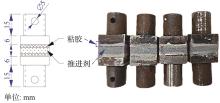
Fig.1
Specimen dimensions and photograph of adhesive interface pull-off test
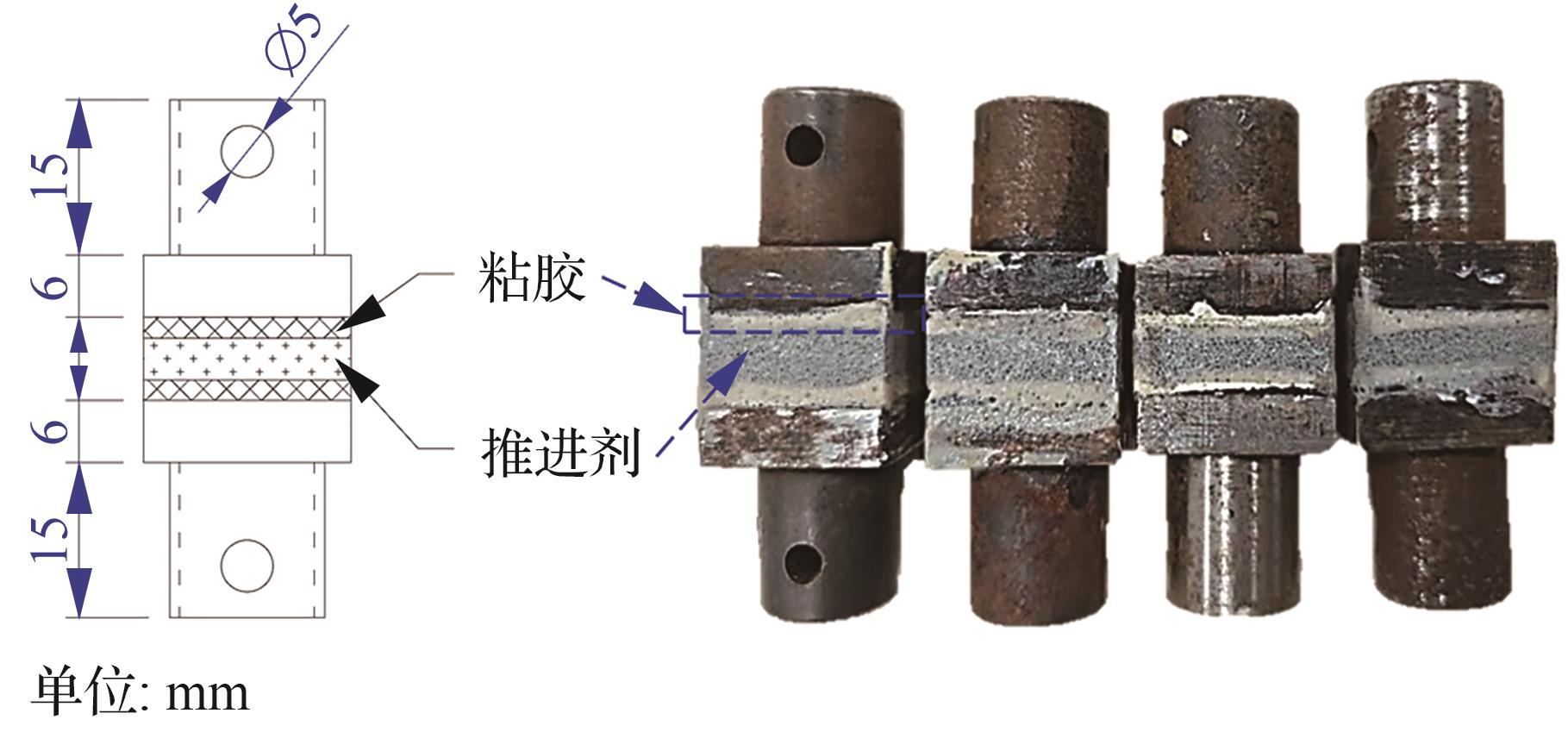
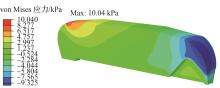
Fig.2
Numerical simulation results of gravity load case[14]
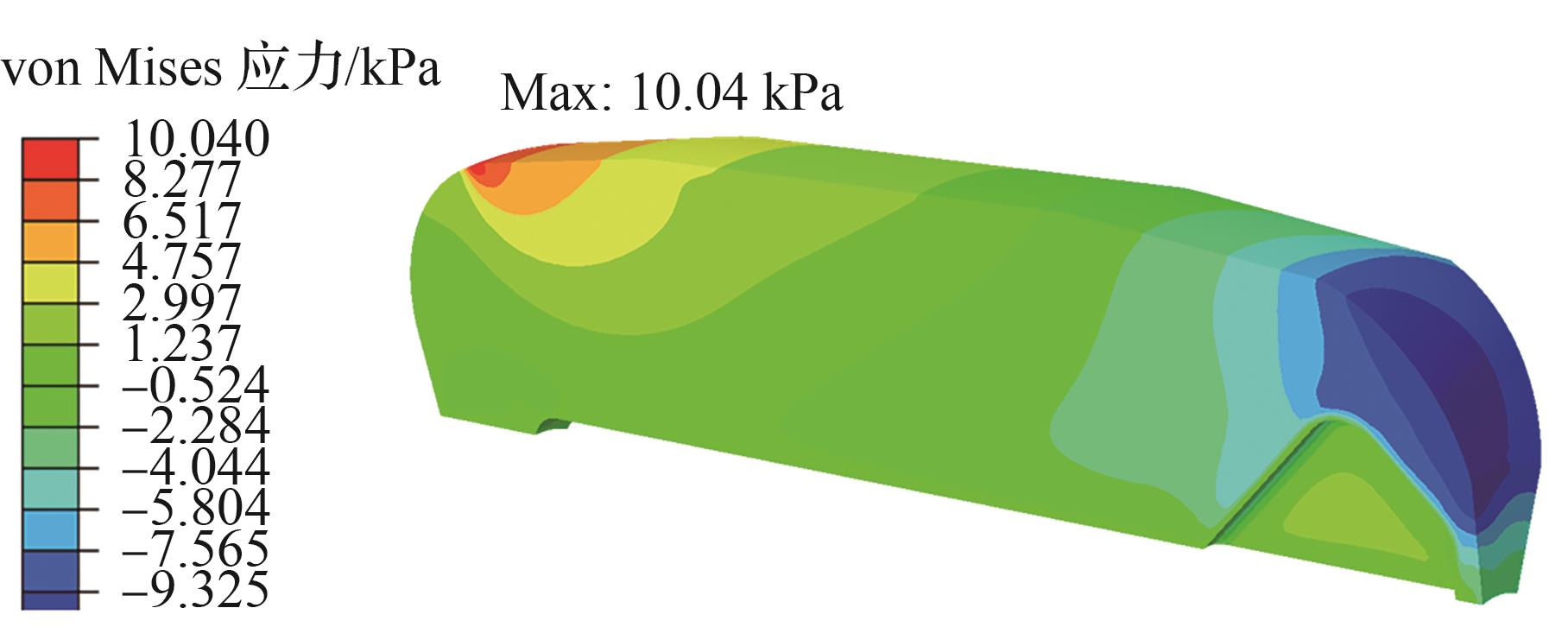
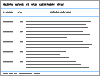
Table 1
Test scheme
| 老化应力/MPa | 老化时间/d |
|---|---|
| 0.02 | 17,37,43,49,55 |
| 0.04 | 8,14,26,41,46 |
| 0.06 | 6,16,25,29,37 |
| 0.08 | 4,8,19,22,28 |
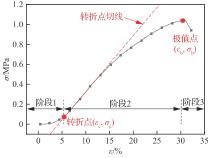
Fig.3
Stress-strain curve of virgin peel specimen at bonding interface
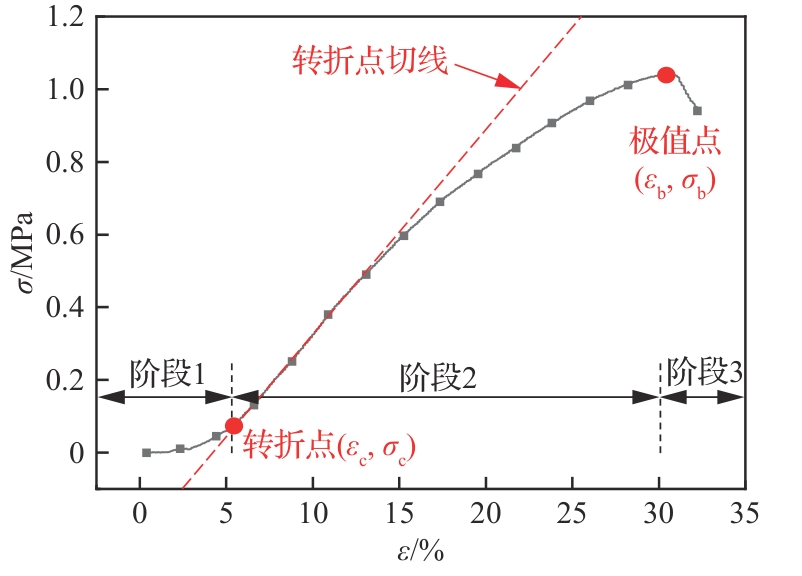
Fig.4
Evolution of failure morphology of peel specimens at bonding interface during constant-rate tensile loading process
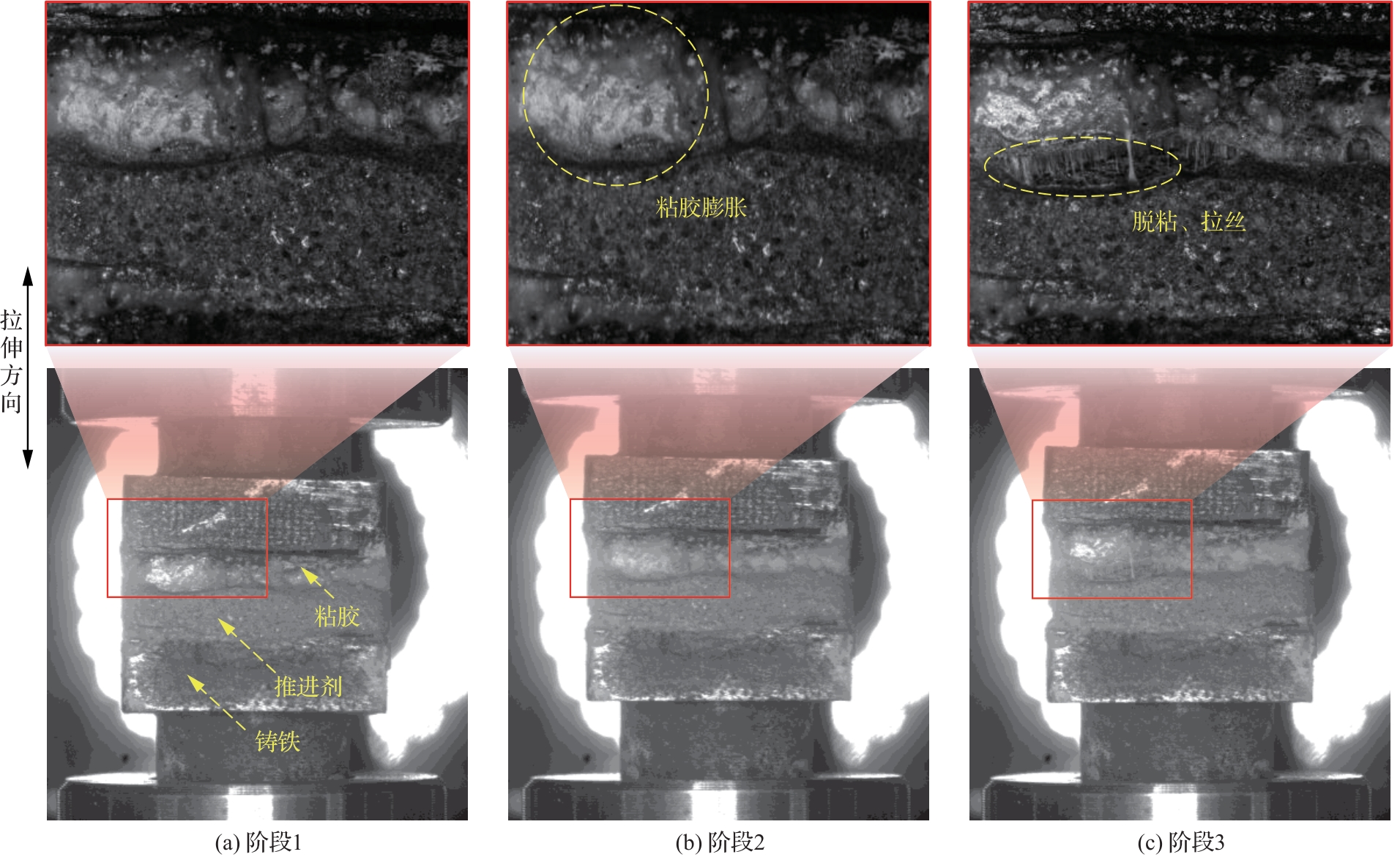
Fig.5
Stress-strain curves of peel specimens at bonding interface under different holding times at different aging stress
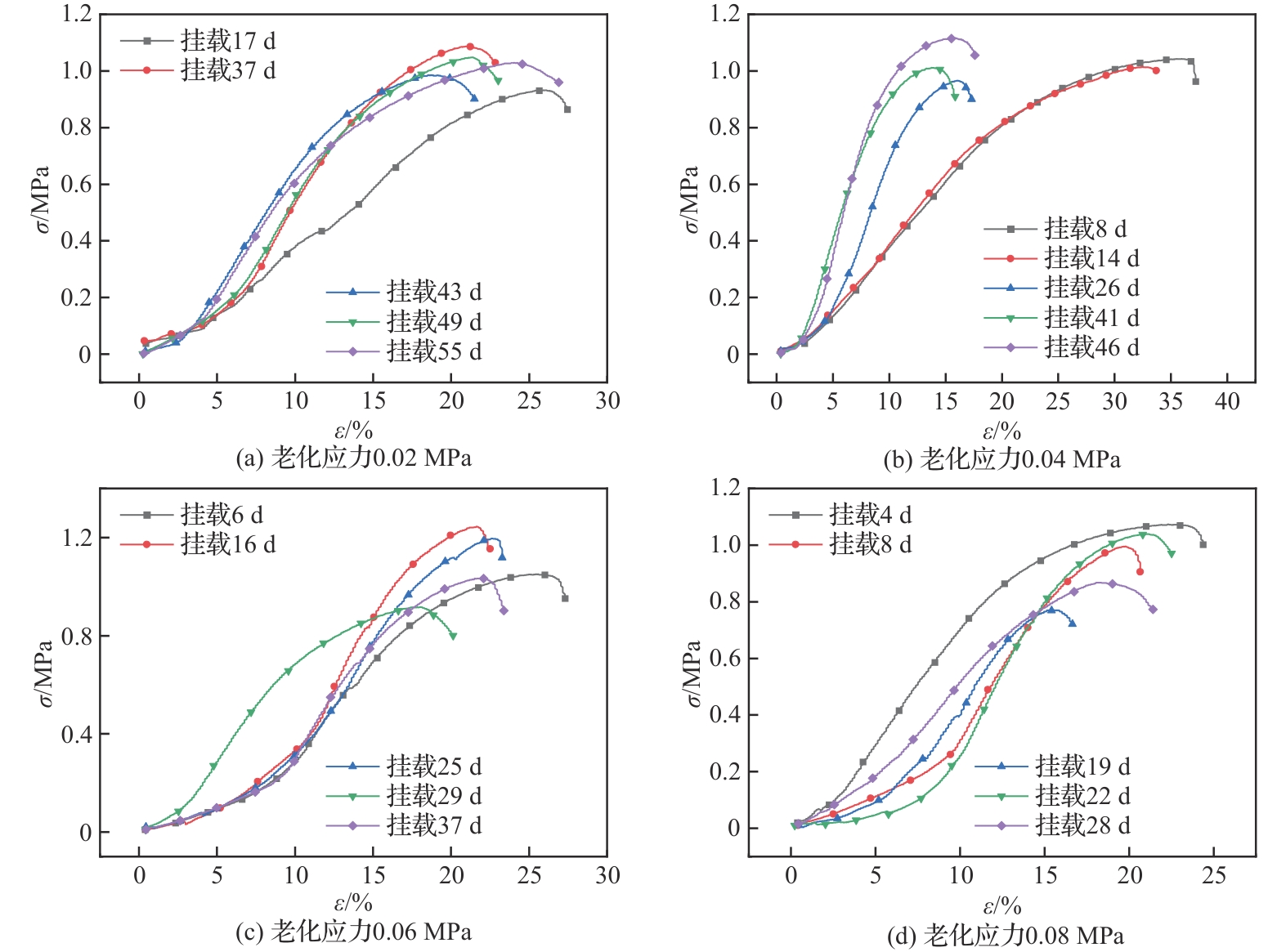
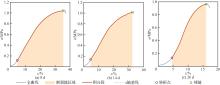
Fig.6
Fracture energy extraction for specimens aged for 8, 14, 26 d under 0.04 MPa
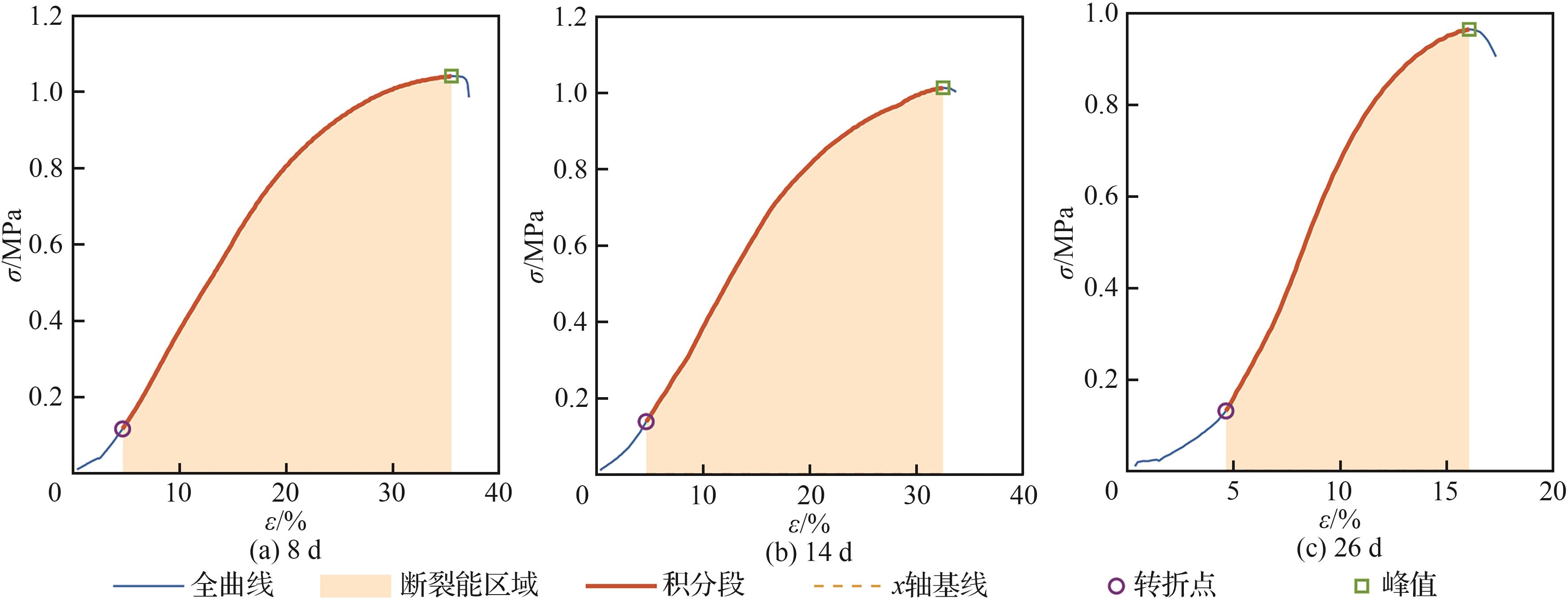
Fig.7
Degradation of maximum tensile strength of bonding interface
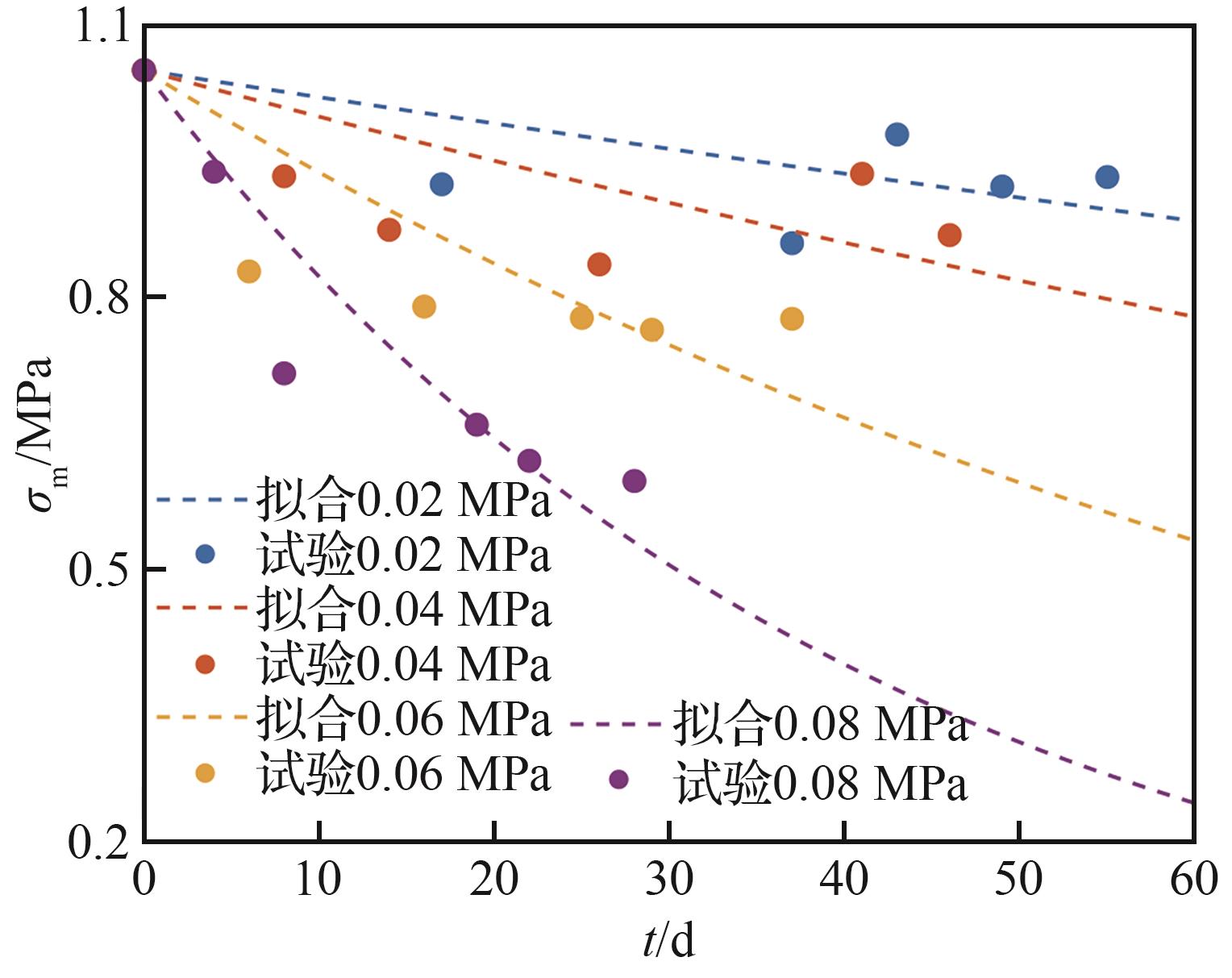
Fig.8
Degradation of maximum elongation of bonding interface
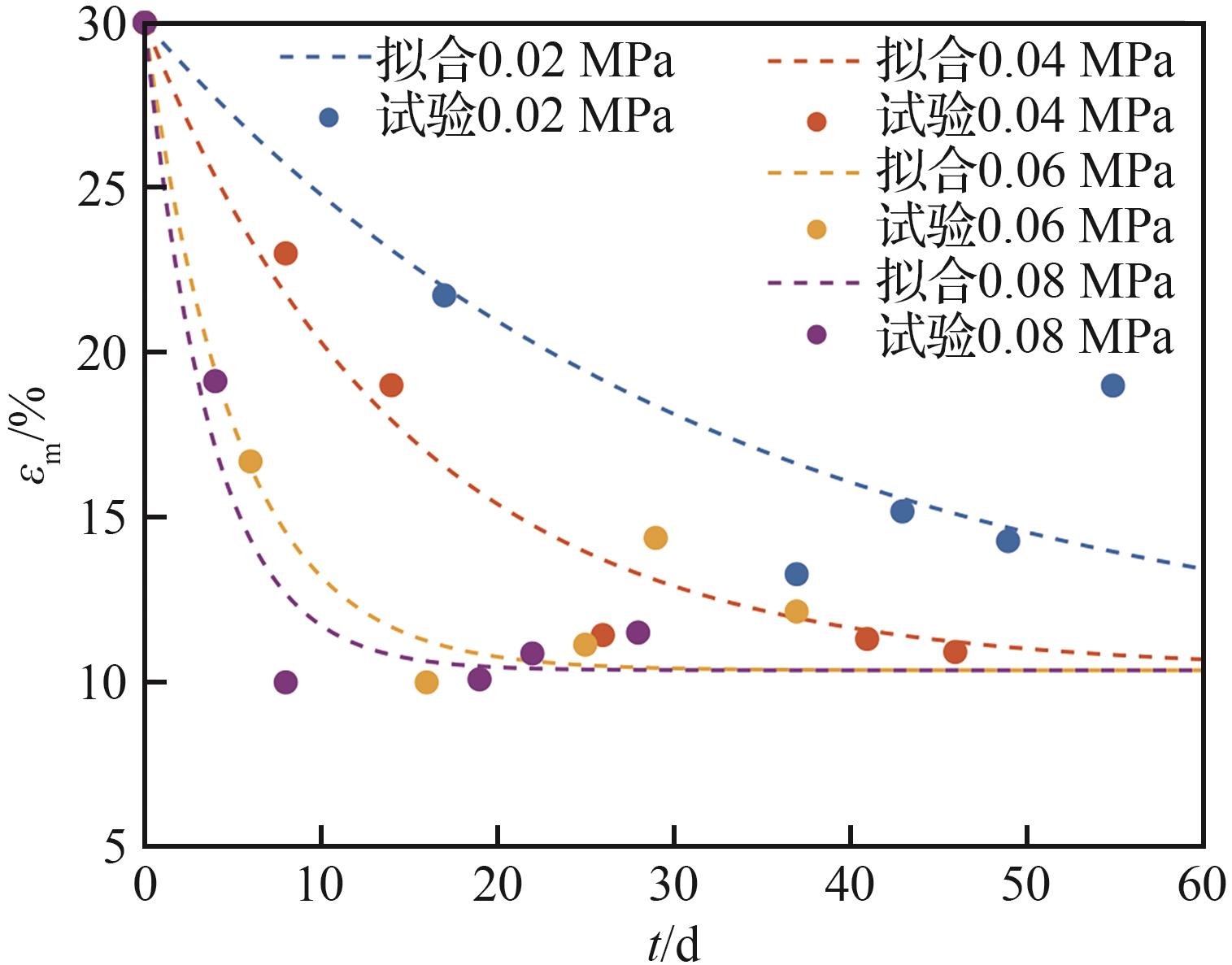
Fig.9
Degradation of fracture energy of bonding interface
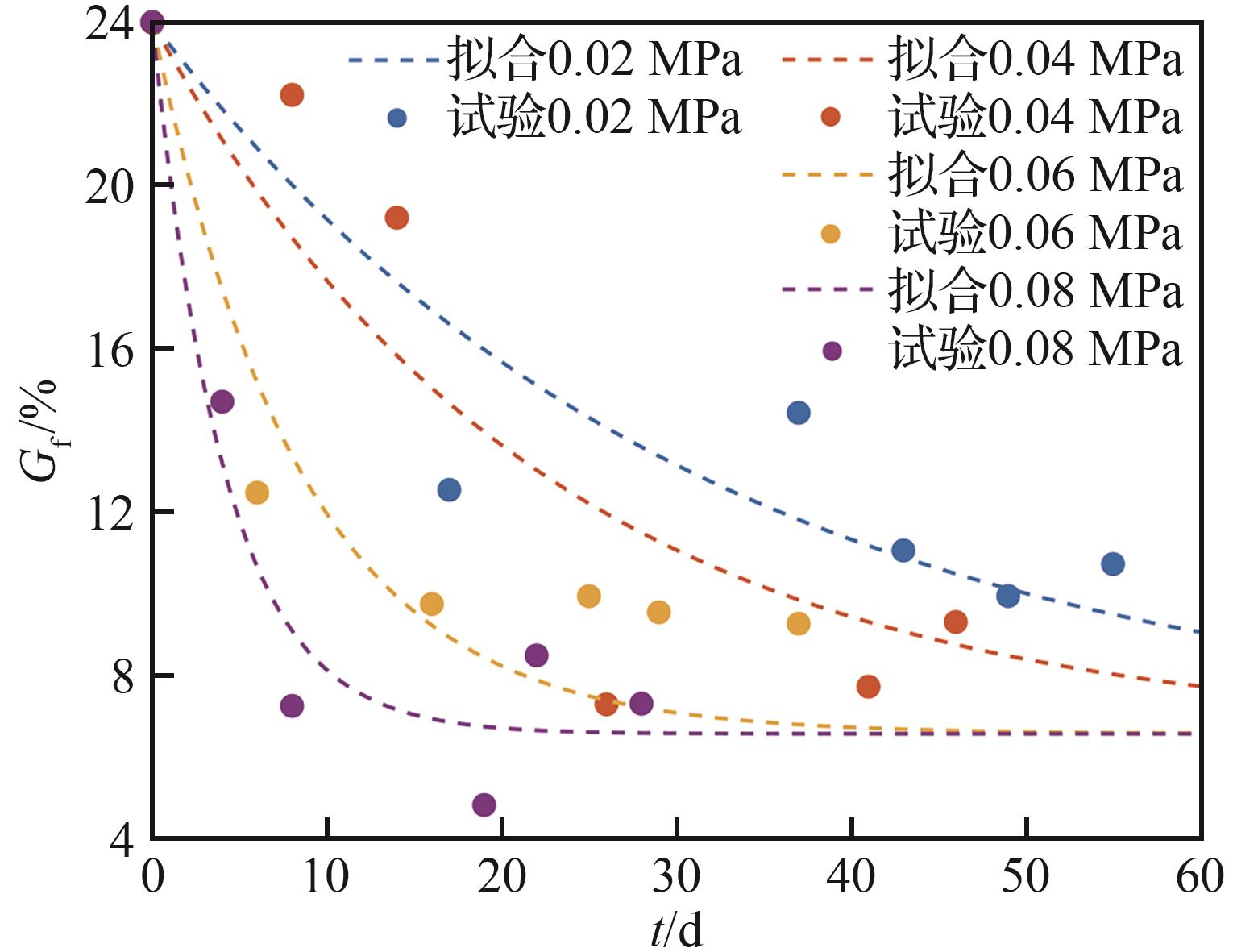
Table 2
Fitting results of aging model
| 老化应力/MPa | |||||||||||
|---|---|---|---|---|---|---|---|---|---|---|---|
| 拟合优度R2 | R2 | R2 | |||||||||
| 0.02 | 1.05 | 0.002 869 | 0.811 5 | 19.65 | 0.030 87 | 10.35 | 0.812 2 | 17.41 | 0.032 44 | 6.59 | 0.818 9 |
| 0.04 | 1.05 | 0.004 988 | 0.802 1 | 19.65 | 0.067 92 | 10.35 | 0.973 8 | 17.41 | 0.045 11 | 6.59 | 0.836 7 |
| 0.06 | 1.05 | 0.011 33 | 0.861 7 | 19.65 | 0.193 1 | 10.35 | 0.924 3 | 17.41 | 0.117 5 | 6.59 | 0.896 1 |
| 0.08 | 1.05 | 0.024 39 | 0.947 1 | 19.65 | 0.266 6 | 10.35 | 0.959 6 | 17.41 | 0.241 4 | 6.59 | 0.948 1 |
Table 3
Fitting results of performance change rate constants
| R2 | |||||
|---|---|---|---|---|---|
| 0.969 7 | 0.162 6 | 38.27 | 1 | 0.987 6 | |
| 0.184 1 | 0.847 9 | 12.83 | 0.271 8 | 0.977 2 | |
| 9.080 0 | 0.275 3 | 37.59 | 1 | 0.963 1 |
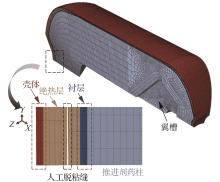
Fig.10
Finite element model of vertically stored solid rocket motor
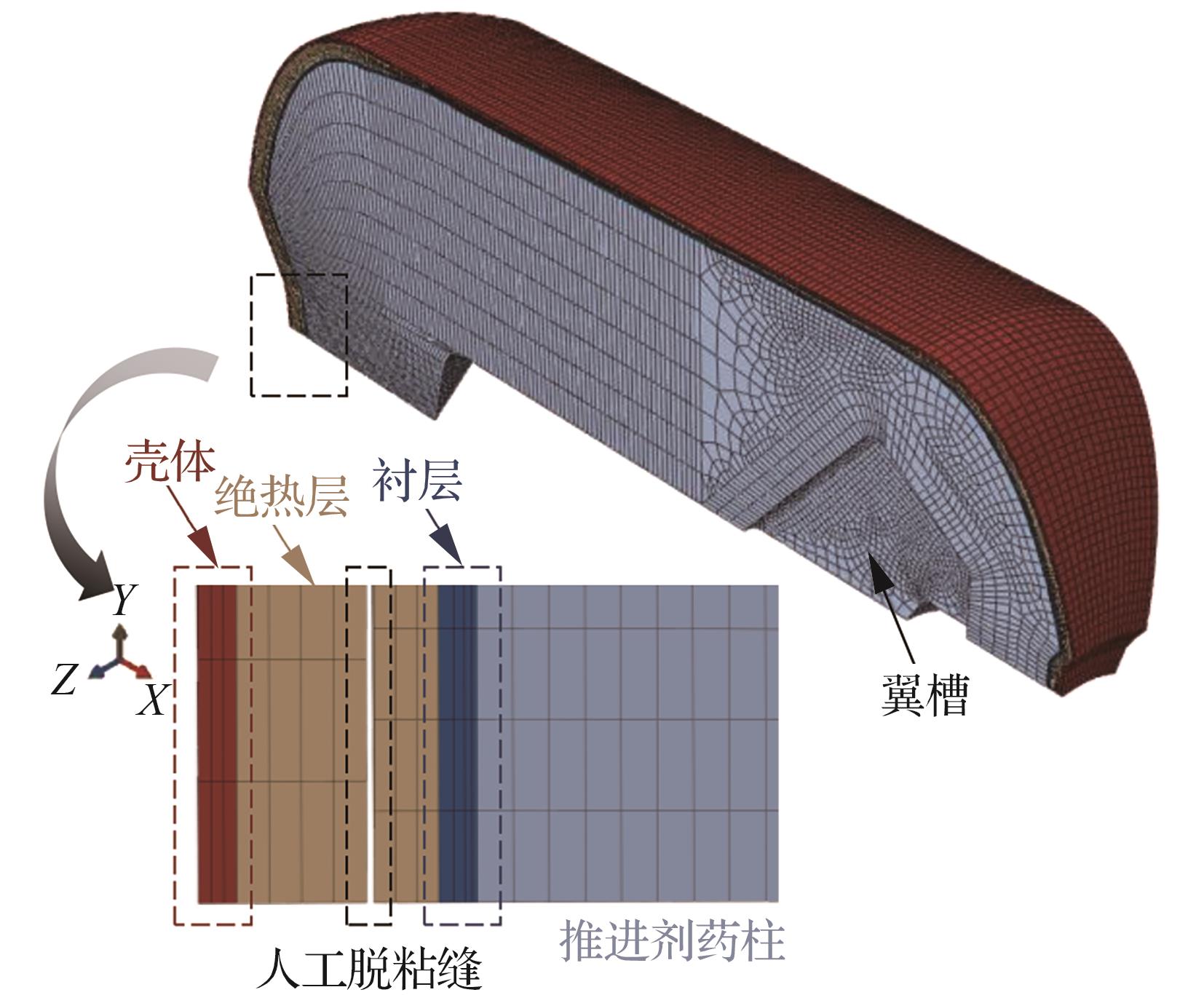
Table 4
Shell material parameters
| 方向 | 弹性模量/(104 MPa) | 泊松比 | 剪切模量/GPa |
|---|---|---|---|
| x | 2.93 | 0.166 | 26.0 |
| y | 6.66 | 0.164 | 7.75 |
| z | 2.80 | 0.073 | 7.75 |
Table 5
Material parameters of insulation layer, liner and propellant column
| 部件 | 弹性模量/MPa | 泊松比 | 密度/(g·cm-3) | 热膨胀系数/(10-5 ℃-1) |
|---|---|---|---|---|
| 绝热层 | 6.50 | 0.490 | 1.1 | 13.0 |
| 衬层,药柱 | E(t) | 0.498 | 1.8 | 7.8 |
Table 6
Prony series coefficients of propellant columns
| 级数 | ||
|---|---|---|
| 1 | 0.631 7 | 5.55 |
| 2 | 0.446 5 | 55.5 |
| 3 | 0.444 2 | 555.0 |
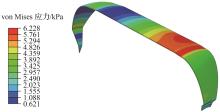
Fig.11
von Mises stress distribution in liner at end of cure cool-down
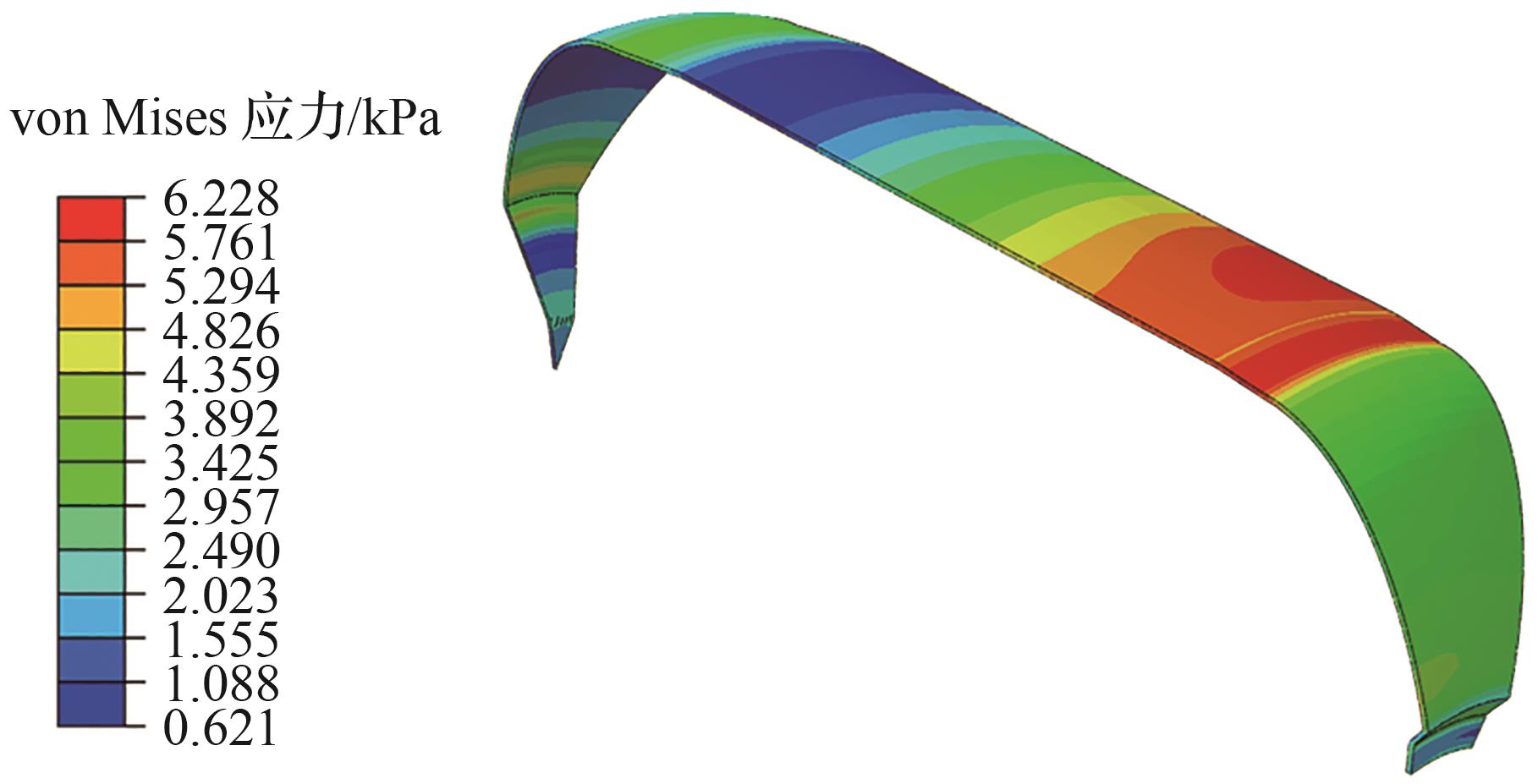
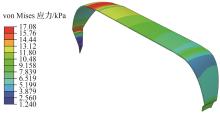
Fig.12
von Mises stress distribution in liner at beginning of storage
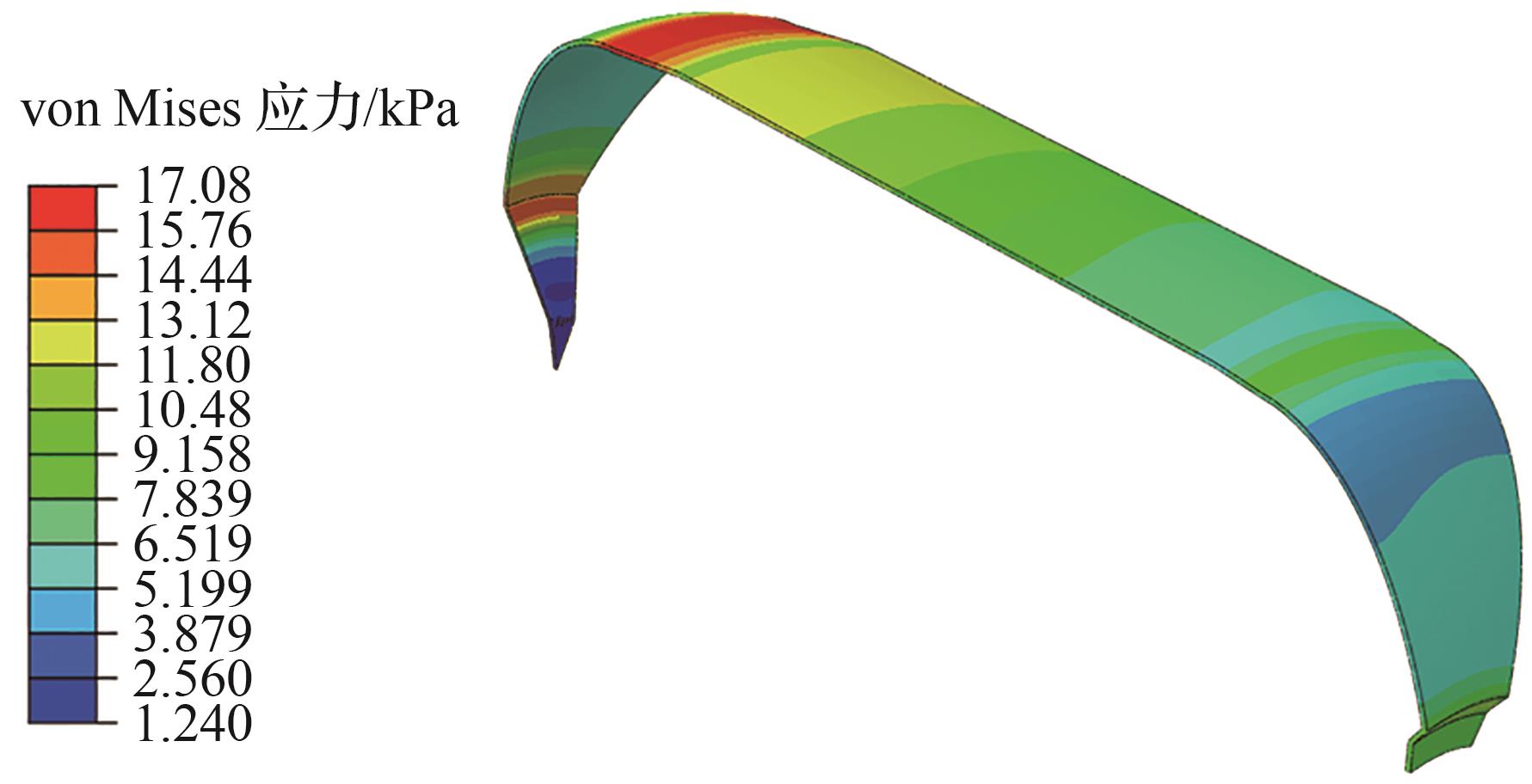
Fig.13
von Mises stress distribution in liner after 20 a of storage
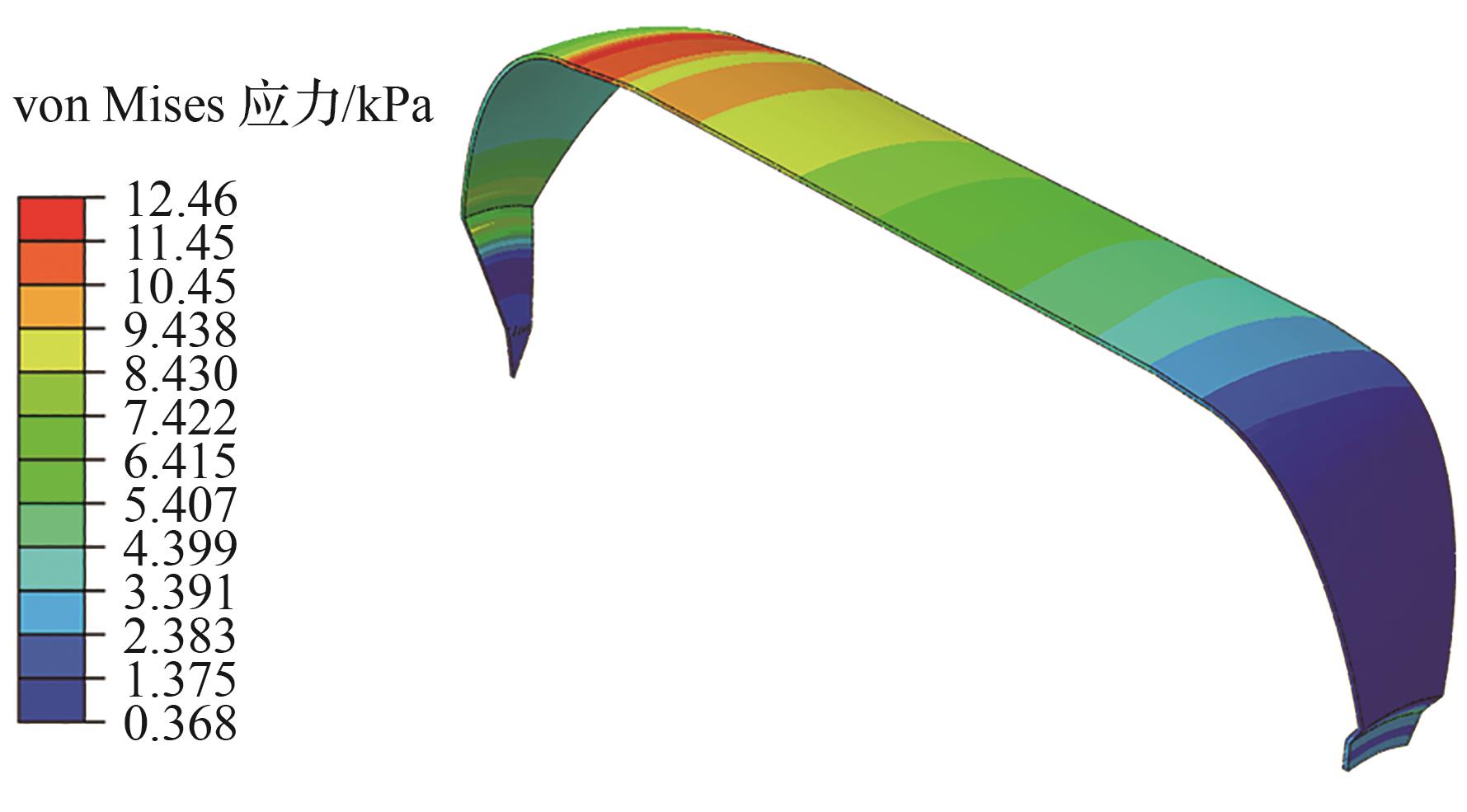
Fig.14
von Mises stress response during storage
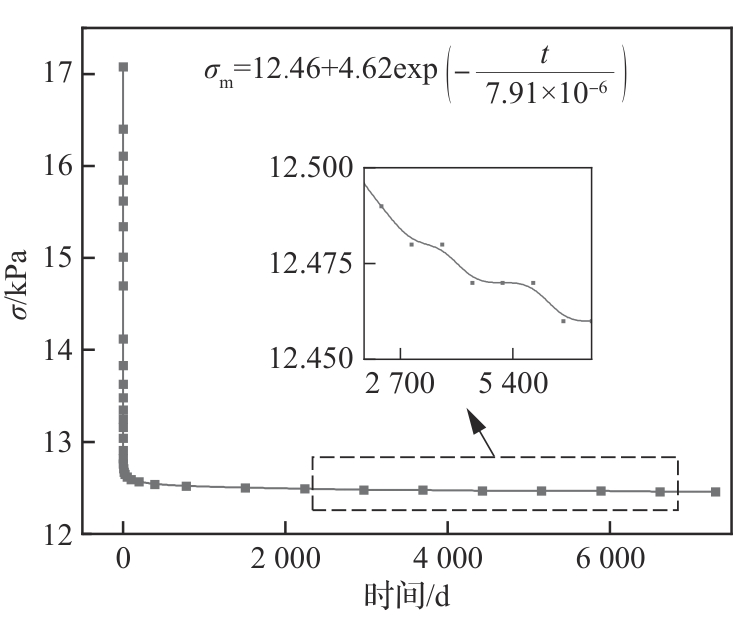
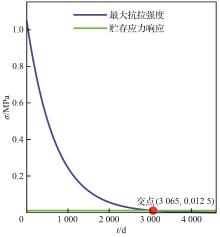
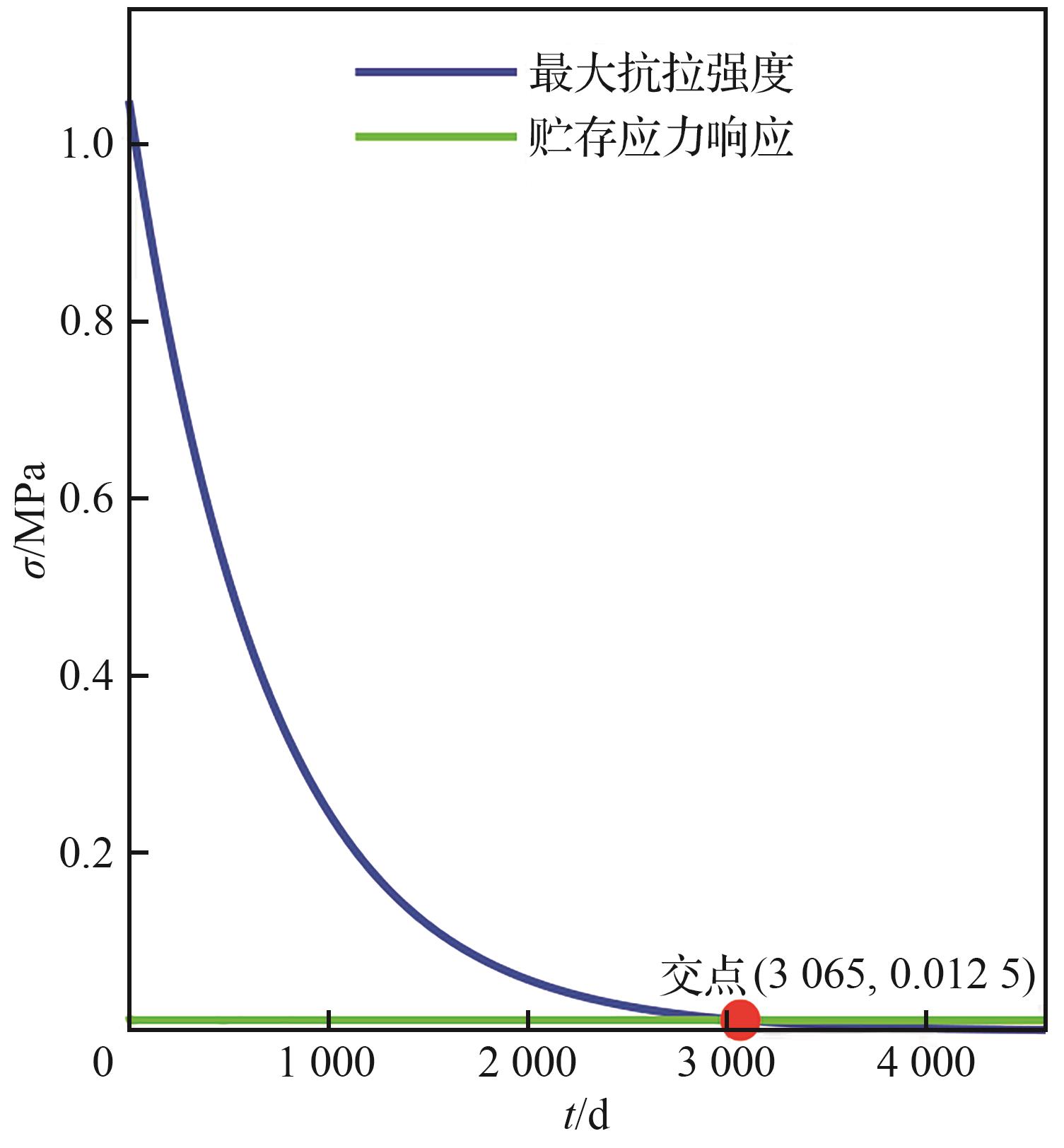
Fig.15
Results of life prediction
| [1] | 侯晓, 张旭, 刘向阳, 等. 固体火箭发动机药柱结构完整性研究进展[J]. 宇航学报, 2023, 44(4): 566-579. |
| HOU X, ZHANG X, LIU X Y, et al. Research progress on structural integrity of solid rocket motor grain[J]. Journal of Astronautics, 2023, 44(4): 566-579 (in Chinese). | |
| [2] | 强洪夫, 王稼祥, 王哲君, 等. 复合固体推进剂强度、损伤与断裂失效研究进展[J]. 火炸药学报, 2023, 46(7): 561-588. |
| QIANG H F, WANG J X, WANG Z J, et al. Research progress on strength, damage and fracture failure of composite solid propellants[J]. Chinese Journal of Explosives & Propellants, 2023, 46(7): 561-588 (in Chinese). | |
| [3] | 余家泉, 许进升, 陈雄, 等. 推进剂/包覆层界面脱粘率相关特性研究[J]. 航空学报, 2015, 36(12): 3861-3867. |
| YU J Q, XU J S, CHEN X, et al. Rate-dependent property of propellant and inhibitor interface debonding[J]. Acta Aeronautica et Astronautica Sinica, 2015, 36(12): 3861-3867 (in Chinese). | |
| [4] | 强洪夫, 王哲君. 固体火箭发动机装药结构完整性分析的基础问题及研究展望[J]. 含能材料, 2024, 32(2): 118-123. |
| QIANG H F, WANG Z J. Fundamental problems and research prospects of structural integrity analysis for solid rocket motor[J]. Chinese Journal of Energetic Materials, 2024, 32(2): 118-123 (in Chinese). | |
| [5] | NASEEM H, YERRA J, MURTHY H, et al. Ageing studies on AP/HTPB based composites solid propellants[J]. Energetic Materials Frontiers, 2021, 2(2): 111-124. |
| [6] | 李康佳, 强洪夫, 王哲君, 等. 固体火箭发动机粘接界面蠕变损伤研究进展[J]. 含能材料, 2022, 30(8): 861-871. |
| LI K J, QIANG H F, WANG Z J, et al. Research progress on bonding interface creep damage in solid rocket motors[J]. Chinese Journal of Energetic Materials, 2022, 30(8): 861-871 (in Chinese). | |
| [7] | 叶冠麟, 刘通, 申志彬, 等. 固体火箭发动机粘接界面剪切蠕变特性分析与快速预测模型[J]. 固体火箭技术, 2024, 47(2): 208-215. |
| YE G L, LIU T, SHEN Z B, et al. Characteristic analysis and rapid prediction model of shear creep at bonding interface of solid rocket motors[J]. Journal of Solid Rocket Technology, 2024, 47(2): 208-215 (in Chinese). | |
| [8] | YE G L, SUN H T, DENG K W, et al. Shear creep and failure model of bonded interface in solid rocket motors[J]. Aerospace Science and Technology, 2026, 168: 110915. |
| [9] | YILDINM H C, ÖZÜPEK S. Structural assessment of a solid propellant rocket motor: Effects of aging and damage[J]. Aerospace Science and Technology, 2011, 15(8): 635-641. |
| [10] | 宋先邨. 发动机粘接界面加速老化及寿命预测[J]. 国防科技大学学报, 2003, 25(3): 33-35. |
| SONG X C. Accelerated aging and life forecast of solid rocket motor with bonded interface[J]. Journal of National University of Defense Technology, 2003, 25(3): 33-35 (in Chinese). | |
| [11] | QIN G F, NA J X, MU W L, et al. Effect of continuous high temperature exposure on the adhesive strength of epoxy adhesive, CFRP and adhesively bonded CFRP-aluminum alloy joints[J]. Composites Part B: Engineering, 2018, 154: 43-55. |
| [12] | TAN W, NA J X, ZHOU Z F. Effect of service temperature on mechanical properties of adhesive joints after hygrothermal aging[J]. Polymers, 2021, 13(21): 3741. |
| [13] | ZHOU K L, SHEN Z B, FAN Z J, et al. Shear mechanical properties prediction method and simulation calculation model of aging NEPE propellant adhesive interface[J]. Propellants, Explosives, Pyrotechnics, 2025, 50(6): e12052. |
| [14] | 戴凡皓, 翁洁鑫, 孙海涛, 等. 长期定应力作用对HTPB推进剂力学性能影响试验研究[J]. 推进技术, 2025, 46(9): 263-272. |
| DAI F H, WENG J X, SUN H T, et al. Experimental study on effects of long-term constant stress on mechanical performance of HTPB propellant[J]. Journal of Propulsion Technology, 2025, 46(9): 263-272 (in Chinese). | |
| [15] | 周坤林, 陈家兴, 樊自建, 等. 立贮固体发动机黏接界面剪切破坏风险研究[J]. 装备环境工程, 2024, 21(4): 17-23. |
| ZHOU K L, CHEN J X, FAN Z J, et al. Risk of shear failure at the adhesive interface of a vertical storage solid engine[J]. Equipment Environmental Engineering, 2024, 21(4): 17-23 (in Chinese). | |
| [16] | OSHIMA S, KOYANAGI J. Review on damage and failure in adhesively bonded composite joints: A microscopic aspect[J]. Polymers, 2025, 17(3): 377. |
| [17] | CRETON C, CICCOTTI M. Fracture and adhesion of soft materials: A review[J]. Reports on Progress in Physics, 2016, 79(4): 046601. |
| [18] | DE LORENZIS L, ZAVARISE G. Modeling of mixed-mode debonding in the peel test applied to superficial reinforcements[J]. International Journal of Solids and Structures, 2008, 45(20): 5419-5436. |
| [19] | ZHOU D M, LIU X Y, SUI X, et al. Effect of pre-strain during ageing on the maximum elongation of composite solid propellants and its modelling[J]. Polymer Testing, 2016, 50: 200-207. |
| [20] | 代定强, 周轩, 董雷霆, 等. 数字工程与数字孪生在航空疲劳与结构完整性领域的研究进展与展望[J]. 航空学报, 2025, 46(19): 531022. |
| DAI D Q, ZHOU X, DONG L T, et al. Research progress and prospects of digital engineering and digital twin in field of aeronautical fatigue and structural integrity[J]. Acta Aeronautica et Astronautica Sinica, 2025, 46(19): 531022 (in Chinese). | |
| [21] | ADEL W M, LIANG G Z. Service life prediction of AP/Al/HTPB solid rocket propellant with consideration of softening aging behavior[J]. Chinese Journal of Aeronautics, 2019, 32(2): 361-368. |
| [22] | 周建平, 李爱丽. 热氧老化对丁羟基复合固体推进剂交联度的影响[J]. 宇航学报, 1992, 13(3): 77-85. |
| ZHOU J P, LI A L. The influence of termal aging on the crosslink density of htpb propellants[J]. Journal of Astronautics, 1992, 13(3): 77-85 (in Chinese). | |
| [23] | XU J S, CHEN X, WANG H L, et al. Thermo-damage-viscoelastic constitutive model of HTPB composite propellant[J]. International Journal of Solids and Structures, 2014, 51(18): 3209-3217. |
| [24] | 王君祺, 鲍福廷, 崔辉如. 基于轴对称内聚力单元的立贮发动机黏接界面结构完整性分析[J]. 国防科技大学学报, 2022, 44(2): 64-70. |
| WANG J Q, BAO F T, CUI H R. Structural integrity analysis of bonding interface of vertical storage motor based on axisymmetric cohesive element[J]. Journal of National University of Defense Technology, 2022, 44(2): 64-70 (in Chinese). |
| [1] | Xiang LI, Junwei LI, Qiang LI, Pengwei WEI, Chen CHEN, Qingshan FU. Influence of structure on two-phase flow in visual nozzle of solid rocket motor [J]. Acta Aeronautica et Astronautica Sinica, 2026, 47(3): 132185-132185. |
| [2] | Ping HUANG, Yuxi CHEN, Mingsui YANG, Zhibo ZHANG, Aina WANG, Pan QIN. Early warning method for compressor aerodynamic instability using phase-locked averaging filtering and moment function neural network [J]. Acta Aeronautica et Astronautica Sinica, 2026, 47(15): 633560-633560. |
| [3] | Baoshi YU, Yongjun LEI, Zhibin SHEN, Dapeng ZHANG. Review on analysis and control technology of curing residual stress in solid motor propellants [J]. Acta Aeronautica et Astronautica Sinica, 2025, 46(8): 31083-031083. |
| [4] | Jianing JIN, Ling WANG, Rui GONG, Daiyin ZHU. 3D imaging of passive squint InISAR using target-borne illuminator of opportunity [J]. Acta Aeronautica et Astronautica Sinica, 2025, 46(8): 330982-330982. |
| [5] | Lei QIN, Guangyu ZHANG, Xiaoyu WANG, Xiaofeng SUN. Key factors and control methods of combustion instability under axial staging combustion [J]. Acta Aeronautica et Astronautica Sinica, 2025, 46(5): 531692-531692. |
| [6] | Zhihao ZHAO, Zhaohua YANG, Yun WU, Yuanjin YU. Single-photon counting imaging denoising method based on deep learning in low-light environment [J]. Acta Aeronautica et Astronautica Sinica, 2025, 46(3): 630531-630531. |
| [7] | Zidi ZHONG, Qi GUO, Zhijun TU, Huijie ZHAO, Senbo WANG. Long-wave infrared polarization imaging based on liquid crystal polarization grating [J]. Acta Aeronautica et Astronautica Sinica, 2025, 46(3): 630523-630523. |
| [8] | Yuning WANG, Shaohui MEI, Mingyang MA, Yongzheng REN, Mengtao CAO, Yan FENG. Spectral band adaptive imaging detection with temporal-spectral dynamic constraints [J]. Acta Aeronautica et Astronautica Sinica, 2025, 46(23): 631963-631963. |
| [9] | Bo PENG, Jikang BAI, Weiwen CHEN, Xiangtao ZHENG, Jianjun LEI, Xiaoqiang LU. Research progress for UAV search and rescue methods based on deep learning [J]. Acta Aeronautica et Astronautica Sinica, 2025, 46(23): 632761-632761. |
| [10] | Tianzhen LI, Jingchao WEI, Yong CAO, Jingyu LIU, Yongcun LI, Wenzhi WANG. Mechanism of seawater hydrothermal aging and tensile damage characteristics of composite materials [J]. Acta Aeronautica et Astronautica Sinica, 2025, 46(22): 431729-431729. |
| [11] | Jia WEI, Baoshi YU, Dapeng ZHANG, Zhibin SHEN, Yongjun LEI. Generation and release mechanism of residual stress and strain in solid rocket motor propellant grain with pressure cure [J]. Acta Aeronautica et Astronautica Sinica, 2025, 46(16): 431661-431661. |
| [12] | Chunjie LI, Junwei LI, Zhongliang TIAN, Limin WANG, Hang YANG, Haoyu YAO. Influence of pintle ablation on internal ballistics of variable thrust solid motor [J]. Acta Aeronautica et Astronautica Sinica, 2025, 46(14): 131519-131519. |
| [13] | Jiaxun LIU, Mingfei CHEN, Xiaopeng XU, Shuai LIU, Dong WANG. Distributed dual average algorithm with communication and gradient delays for coalition games and its application in formation control [J]. Acta Aeronautica et Astronautica Sinica, 2025, 46(11): 531322-531322. |
| [14] | Li YAN, Jie ZHANG, Jiadong WANG. [J]. Acta Aeronautica et Astronautica Sinica, 2024, 45(S1): 730559-730559. |
| [15] | Ge WANG, Zhibang WANG, Fuqi WANG, Ben GUAN, Limin WANG, Haoran NING. Numerical study on quasi⁃one⁃dimensional internal ballistics of throttling segregated fuel⁃oxidizer systems [J]. Acta Aeronautica et Astronautica Sinica, 2024, 45(7): 129111-129111. |
| Viewed | ||||||
|
Full text |
|
|||||
|
Abstract |
|
|||||
Address: No.238, Baiyan Buiding, Beisihuan Zhonglu Road, Haidian District, Beijing, China
Postal code : 100083
E-mail:hkxb@buaa.edu.cn
Total visits: 6658907 Today visits: 1341All copyright © editorial office of Chinese Journal of Aeronautics
All copyright © editorial office of Chinese Journal of Aeronautics
Total visits: 6658907 Today visits: 1341

 CJA

